EP4300904A2 - Mehrschichtige papr-reduktion - Google Patents
Mehrschichtige papr-reduktion Download PDFInfo
- Publication number
- EP4300904A2 EP4300904A2 EP23181798.2A EP23181798A EP4300904A2 EP 4300904 A2 EP4300904 A2 EP 4300904A2 EP 23181798 A EP23181798 A EP 23181798A EP 4300904 A2 EP4300904 A2 EP 4300904A2
- Authority
- EP
- European Patent Office
- Prior art keywords
- layer
- layers
- specified
- dmrs
- papr
- Prior art date
- Legal status (The legal status is an assumption and is not a legal conclusion. Google has not performed a legal analysis and makes no representation as to the accuracy of the status listed.)
- Pending
Links
Images





Classifications
-
- H—ELECTRICITY
- H04—ELECTRIC COMMUNICATION TECHNIQUE
- H04L—TRANSMISSION OF DIGITAL INFORMATION, e.g. TELEGRAPHIC COMMUNICATION
- H04L27/00—Modulated-carrier systems
- H04L27/26—Systems using multi-frequency codes
- H04L27/2601—Multicarrier modulation systems
- H04L27/2614—Peak power aspects
- H04L27/2615—Reduction thereof using coding
-
- H—ELECTRICITY
- H04—ELECTRIC COMMUNICATION TECHNIQUE
- H04L—TRANSMISSION OF DIGITAL INFORMATION, e.g. TELEGRAPHIC COMMUNICATION
- H04L27/00—Modulated-carrier systems
- H04L27/26—Systems using multi-frequency codes
- H04L27/2601—Multicarrier modulation systems
- H04L27/2602—Signal structure
- H04L27/261—Details of reference signals
-
- H—ELECTRICITY
- H04—ELECTRIC COMMUNICATION TECHNIQUE
- H04L—TRANSMISSION OF DIGITAL INFORMATION, e.g. TELEGRAPHIC COMMUNICATION
- H04L27/00—Modulated-carrier systems
- H04L27/26—Systems using multi-frequency codes
- H04L27/2601—Multicarrier modulation systems
- H04L27/2602—Signal structure
- H04L27/26035—Maintenance of orthogonality, e.g. for signals exchanged between cells or users, or by using covering codes or sequences
-
- H—ELECTRICITY
- H04—ELECTRIC COMMUNICATION TECHNIQUE
- H04L—TRANSMISSION OF DIGITAL INFORMATION, e.g. TELEGRAPHIC COMMUNICATION
- H04L27/00—Modulated-carrier systems
- H04L27/26—Systems using multi-frequency codes
- H04L27/2601—Multicarrier modulation systems
- H04L27/2614—Peak power aspects
Definitions
- the present disclosure relates to Open Radio Access Network (O-RAN) for 5G-based mobile networks, and relates more particularly to a method for reducing Multi-layer Precoder Matrix (PM)-combined DeModulation Reference Signal (DMRS) symbols' Peak-to-Average Power Ratio (PAPR).
- OF-RAN Open Radio Access Network
- PM Multi-layer Precoder Matrix
- DMRS DeModulation Reference Signal
- the 3 rd Generation Partnership Project (3GPP) 5G New Radio (NR) Release 15 specification supports enhanced mobile broadband and basic ultra-reliable low-latency communications (URLLC) in spectrum up to 52.6GHz.
- 3GPP 3rd Generation Partnership Project
- 5G New Radio (NR) Release 15 specification supports enhanced mobile broadband and basic ultra-reliable low-latency communications (URLLC) in spectrum up to 52.6GHz.
- multi-layer Precoder Matrix (PM)-combined Demodulation Reference Signal (DMRS) symbols have over 2dB higher Peak-to-Average Power Ratio (PAPR) than the multi-layer PM-combined physical downlink shared channel (PDSCH) symbols in the same slot, causing the radio frequency (RF) power amplifier to backoff its output power by over 2dB to maintain the output signal-to-interference-plus-noise ratio (SINR) and avoid signal saturation.
- PM Precoder Matrix
- DMRS Demodulation Reference Signal
- PDSCH physical downlink shared channel
- layer(s) refer to the number of parallel stream(s) sent, as part of Open Systems Interconnection (OSI) networking model Layer 1 (Physical Layer), to the user equipment (UE).
- OSI Open Systems Interconnection
- UE user equipment
- 5G NR Release 15 specification defines the DMRS scrambling code for 1 code division multiplexing (CDM) group (up to 2 antenna ports) to be independent between the layers using Hadamard code (1 1; 1 -1). Therefore, for up to 2-layers, the Precoding Matrix (PM)-combined DMRS symbols do not show any correlation between the layers, and hence any PM combination between them will be sufficiently random to not cause higher PAPR than the corresponding Physical Downlink Shared Channel (PDSCH) symbols in the same slot.
- CDM code division multiplexing
- PDSCH Physical Downlink Shared Channel
- FIG. 1 illustrates the PAPR gap between the DMRS PAPR and the PDSCH PAPR, using 2 CDM groups.
- FIG. 1 which charts Complementary Cumulative Distribution Function (CCDF) on the y-axis and PAPR (units of decibel (dB)) on the x-axis, the following waveforms are shown: Cyclic-Prefix Orthogonal Frequency Division Multiplexing (CP-OFDM) waveform 1001 for PDSCH; 1-layer DMRS 1002; 2-layer DMRS 1003; 4-layer DMRS 1004; and 6-layer DMRS 1005.
- CP-OFDM Cyclic-Prefix Orthogonal Frequency Division Multiplexing
- DMRS ports 0-2 (0, 1, and 2) also use 2 DMRS CDM groups (1 DMRS CDM group for ports 0 and 1, and the other DMRS CDM group for port 2). In this case, even though ports (0 and 2) and ports 0-2 both use 2 DMRS CDM groups each, the ports 0-2 show higher PAPR since they use 3 DMRS layers as opposed to ports (0 and 2) that use only 2 DMRS layers.
- the first conventional technique is to back off the power amplifier (PA) power by 2 dB, which technique removes the DMRS PAPR issue since the DMRS high PAPR will not cause the PA to saturation.
- PA power amplifier
- This technique is not optimal because the RF side is not fully utilized, which means the gNB will suffer from reduced coverage and lower quality.
- the second conventional technique is to upgrade to 5G NR Release 16.
- 5G NR Release 16 the DMRS PAPR issue is resolved by distinguishing in the DMRS scrambling seed (Cinit) between the CDM groups.
- multiple example methods are proposed to reduce the time-domain Multi-layer PM-combined DMRS symbol PAPR to the same PAPR level as the corresponding PDSCH symbols in the same slot.
- the Multi-layer PM-combined DMRS symbol PAPR reduction is achieved by increasing the randomness level between the layers of the DMRS symbol in frequency-domain.
- increasing the randomness level between the DMRS layers is performed in a unique way that preserves the UE receiver Block Error Rate (BLER) performance by applying precoder resource group (PRG)-based segmentation techniques to the proposed methods.
- BLER Block Error Rate
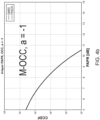
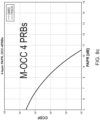
- a Modified Orthogonal Cover Code (M-OCC) method is utilized to mitigate the Multi-layer DMRS PAPR issue.
- the M-OCC method multiplies the PM-matrix with a factor in frequency domain, prior to the multiplication with the downlink (DL) layers.
- layer-3 (from 0-3 layers) is multiplied by the factor "a" for all the symbol Physical Resource Blocks (PRBs), while keeping layers 0, 1, and 2 unmodified.
- PRBs Physical Resource Blocks
- a multiplication factor "b" is applied to layer-2, while keeping layers 0 and 1 unmodified.
- the value of the multiplication factor b can be changed within the symbol based on a given segmentation method.
- the b value is alternating between -1 and 1 based on the precoder resource group (PRG) length of 2 PRBs and 4 PRBs.
- PRG precoder resource group
- a Modified Cyclic Delay Diversity (M-CDD) method is utilized to mitigate the Multi-layer DMRS PAPR issue.
- the M-CDD method multiplies the frequency-domain downlink (DL) layers with a linear phase shift prior to the multiplication with the precoder matrix.
- the slope of the phase shift "d" in frequency domain translates to the cyclic delay in time-domain.
- the cyclic delay "d" can range from 0 to the symbol length N-1.
- layer-2 and layer-3 are multiplied by a linear phase shift for all the symbol PRBs, while keeping layers 0 and 1 unmodified.
- a segmentation "step” method can be applied to the linear phase shift, creating a fixed phase shift to a "step” number of resource elements (REs).
- the "step” length can be based on the PRG length of 2 PRBs and 4 PRBs.
- a Modified Orthogonal Cover Code (M-OCC) method is utilized to mitigate the multi-layer DMRS PAPR issue.
- the M-OCC method multiplies the PM-matrix with a factor in frequency domain, prior to the multiplication with the downlink (DL) layers.
- the M-OCC method is implemented in the PHY layer (L1), e.g., at the distributed unit (DU) of the radio access network (RAN).
- a -1 factor is applied to all layer-3 resource elements (REs).
- the N-Layer (N ports) M-OCC calculation is represented as follows: ANT
- PM is the precoder matrix
- RE ( k , j ) is the DMRS entry for port (layer) k at resource element (RE) j
- RE ( m , j ) is the output DMRS symbol value for Antenna m at RE j.
- Nsc the number of REs per symbol ⁇
- PDSCH data symbols
- step 3 are the number of different phase shift values within a symbol of N REs.
- the step value can be modified based on the tradeoff between PAPR improvement vs. calculation complexity (every "step” SCs or REs), i.e., the smaller the "step", the more segments to calculate the phase shift.
- a multiplication factor "b" is applied to layer-2, while keeping layers 0 and 1 unmodified.
- the value of the multiplication factor b can be changed within the symbol based on a given segmentation method.
- the example shown in FIG. 5 illustrates a 3-layer DRMS ports and antenna port mapping using PMI matrix (i.e., 3GPP 5G NR Release 15, Type 1 single-symbol DMRS resource mapping for up to 3-layer transmissions).
- the N-Layer (N ports) M-OCC calculation is represented as follows: ANT
- PM is the precoder matrix
- RE ( k , j ) is the DMRS entry for port (layer) k at resource element (RE) j
- RE ( m , j ) is the output DMRS symbol for Antenna m at RE j.
- r(s) ⁇ s 0: (Nsc/2)-1 ⁇ (Nsc is the number of REs per symbol ⁇ are the values (e.g., as defined by 3GPP 5G NR Release 15) in the example shown in FIG. 5 .
- the same operation needs to be applied also for the corresponding data symbols (PDSCH) in the same slot.
- the b value is alternating between -1 and 1 based on the precoder resource group (PRG) length of 2 PRBs and 4 PRBs.
- PRG precoder resource group
- a Modified Cyclic Delay Diversity (M-CDD) method is utilized to mitigate the Multi-layer DMRS PAPR issue.
- the M-CDD method multiplies the frequency-domain downlink (DL) layers with a linear phase shift prior to the multiplication with the precoder matrix.
- the slope of the phase shift "d" in frequency domain translates to the cyclic delay in time-domain.
- the cyclic delay "d" can range from 0 to the symbol length N-1.
- the M-CCD method is implemented in the PHY layer (L1), e.g., at the distributed unit (DU) of the radio access network (RAN).
- a 3-layer example of the M-CCD method (shown in FIG. 7 ) only layer-2 is multiplied with the linear phase shift.
- step value is the number of REs (SCs) that will use the same phase shift value based on d
- step value is the number of REs (SCs) that will use the same phase shift value based on d
- step is the number of REs (SCs) that will use the same phase shift value based on d
- step is the number of REs (SCs) that will use the same phase shift value based on d
- “segments” are the number of different phase shift values within a symbol of N REs.
- the step value can be modified based on the tradeoff between PAPR improvement vs. calculation complexity (every "step” SCs or REs), i.e., the smaller the "step", the more segments to calculate the phase shift.
- a segmentation "step” method can be applied to the linear phase shift, creating a fixed phase shift to a "step” number of resource elements (REs).
- the "step” length can be based on the PRG length of 2 PRBs and 4 PRBs.
- the example embodiments of the methods according to the present disclosure are different from the known CDD and 3GPP Release 16 methods.
- our M-CDD method proposes segmentation based on the PRG size (2PRBs or 4 PRBs). It will improve UE's channel estimation and thus Block Error Rate (BLER) performance since we keep the same multiplication factor to layers 2 and 3 throughout the PRG length.
- BLER Block Error Rate
- Rel. 16 defines different scrambling codes for different CDM groups (Cannot be applied in Rel. 15 devices). See Figure 9 (from 38.211 specs of the two releases):
- c init 2 17 N symb slot n s , f ⁇ + l + 1 2 N ID n SCID + 1 + 2 N ID n SCID + n SCID mod 2 31
- l is the OFDM symbol number within the slot
- n s ,f ⁇ is the slot number within a frame
- c init 2 17 N symb slot n s , f ⁇ + l + 1 2 N ID n ⁇ SCID ⁇ ⁇ + 1 + 2 17 ⁇ ⁇ ⁇ 2 ⁇ + 2 N ID n ⁇ SCID ⁇ ⁇ + n ⁇ SCID ⁇ ⁇ mod 2 31
- l is the OFDM symbol number within the slot
- n s ,f ⁇ is the slot number within a frame
- 5G NR Release 16 defines different scrambling codes for different CDM groups (which methodology can't be applied in 5G NR Release 15 devices). More specifically, in 5G NR Release 16, DMRS c init is dependent on the CDM group that eliminates the high PAPR when two CDM groups are used (i.e., above 2 layer). Therefore, the present invention applies to the gNB/distributed unit (DU) only, and is fully transparent to the radio unit (RU) and the user equipment (UE), and does not require any change in either the RU or the UE.
- DU gNB/distributed unit
Landscapes
- Engineering & Computer Science (AREA)
- Computer Networks & Wireless Communication (AREA)
- Signal Processing (AREA)
- Mobile Radio Communication Systems (AREA)
- Radio Transmission System (AREA)
Applications Claiming Priority (2)
| Application Number | Priority Date | Filing Date | Title |
|---|---|---|---|
| US202263355796P | 2022-06-27 | 2022-06-27 | |
| US18/338,425 US20230421423A1 (en) | 2022-06-27 | 2023-06-21 | Multi-Layer PAPR Reduction |
Publications (2)
| Publication Number | Publication Date |
|---|---|
| EP4300904A2 true EP4300904A2 (de) | 2024-01-03 |
| EP4300904A3 EP4300904A3 (de) | 2024-01-17 |
Family
ID=87003083
Family Applications (1)
| Application Number | Title | Priority Date | Filing Date |
|---|---|---|---|
| EP23181798.2A Pending EP4300904A3 (de) | 2022-06-27 | 2023-06-27 | Mehrschichtige papr-reduktion |
Country Status (2)
| Country | Link |
|---|---|
| US (1) | US20230421423A1 (de) |
| EP (1) | EP4300904A3 (de) |
Citations (1)
| Publication number | Priority date | Publication date | Assignee | Title |
|---|---|---|---|---|
| WO2020069455A1 (en) * | 2018-09-28 | 2020-04-02 | Intel Corporation | Peak-to-average power ratio (papr) reduction in reference signals |
Family Cites Families (8)
| Publication number | Priority date | Publication date | Assignee | Title |
|---|---|---|---|---|
| KR101789621B1 (ko) * | 2010-01-19 | 2017-10-25 | 엘지전자 주식회사 | 하향링크 데이터 전송방법 및 기지국과, 하향링크 데이터 수신방법 및 사용자기기 |
| EP3577812A1 (de) * | 2017-02-06 | 2019-12-11 | Telefonaktiebolaget LM Ericsson (publ) | Gemischte raumzeit- und raumfrequenzblockcodierung |
| US11695507B2 (en) * | 2017-03-24 | 2023-07-04 | Samsung Electronics Co., Ltd. | Apparatus and method for in multiple access in wireless communication |
| WO2019039917A1 (en) * | 2017-08-24 | 2019-02-28 | Samsung Electronics Co., Ltd. | METHOD AND APPARATUS FOR GROUPING DMRS PORTS FOR USE IN A WIRELESS CELLULAR COMMUNICATION SYSTEM |
| ES2983500T3 (es) * | 2018-10-10 | 2024-10-23 | Ericsson Telefon Ab L M | Método para reducción de potencia pico a promedio de señales DM-RS |
| US11184134B2 (en) * | 2018-12-06 | 2021-11-23 | Qualcomm Incorporated | Power imbalance solutions for multiple input multiple output transmissions |
| US11563615B2 (en) * | 2020-03-27 | 2023-01-24 | Qualcomm Incorporated | Iterative reference signal symbol reconstruction and channel estimation |
| CN116996184A (zh) * | 2022-04-24 | 2023-11-03 | 华为技术有限公司 | 一种通信方法及装置 |
-
2023
- 2023-06-21 US US18/338,425 patent/US20230421423A1/en active Pending
- 2023-06-27 EP EP23181798.2A patent/EP4300904A3/de active Pending
Patent Citations (1)
| Publication number | Priority date | Publication date | Assignee | Title |
|---|---|---|---|---|
| WO2020069455A1 (en) * | 2018-09-28 | 2020-04-02 | Intel Corporation | Peak-to-average power ratio (papr) reduction in reference signals |
Non-Patent Citations (4)
| Title |
|---|
| 3GPP TS 38.211, June 2020 (2020-06-01) |
| 3GPP TS 38.211, September 2018 (2018-09-01) |
| ERICSSON: "Benefits of resource specific DMRS mapping", vol. RAN WG1, no. Busan, Korea; 20180521 - 20180525, 20 May 2018 (2018-05-20), XP051441440, Retrieved from the Internet <URL:http://www.3gpp.org/ftp/Meetings%5F3GPP%5FSYNC/RAN1/Docs/> [retrieved on 20180520] * |
| ETSI TS 138 211, July 2020 (2020-07-01) |
Also Published As
| Publication number | Publication date |
|---|---|
| EP4300904A3 (de) | 2024-01-17 |
| US20230421423A1 (en) | 2023-12-28 |
Similar Documents
| Publication | Publication Date | Title |
|---|---|---|
| Michailow et al. | Bit error rate performance of generalized frequency division multiplexing | |
| US9356746B2 (en) | Transmission method, transmission device, receiving method, and receiving device | |
| AU2014354845B2 (en) | System and method for radio frequency carrier aggregation | |
| EP3529957B1 (de) | Synthese der wellenform mit nahekonstantem modulus für übertragung in hoher frequenz | |
| US20150055597A1 (en) | Method and apparatus for performing harq in a wireless communication system | |
| US8797837B2 (en) | System and method for in-phase/quadrature multiplexing | |
| Araújo et al. | Analytical evaluation of nonlinear distortion effects on multicarrier signals | |
| Kansal et al. | Multiuser massive MIMO-OFDM system incorporated with diverse transformation for 5G applications | |
| US20130058361A1 (en) | Signal for transmission in single-carrier communication system | |
| Kim et al. | A low-complex svd-based f-ofdm | |
| US8958489B2 (en) | Method of modulating signal for data communication and device thereof | |
| US20110116359A1 (en) | Methods and apparatus for interleaving in ofdm/ofdma systems | |
| Boudjelal et al. | Toward a common transceiver framework for 6G: Orthogonal coexistence and structural unification of DFT waveforms | |
| Sathiyapriya | Implementation and study of universal filtered multi carrier under carrier frequency offset for 5G | |
| EP4300904A2 (de) | Mehrschichtige papr-reduktion | |
| Berggren et al. | Permutation polynomial interleaved DFT-s-OFDM | |
| CN101136897A (zh) | 时域同步正交频分复用系统中的频分多址接入方法 | |
| EP2251997A1 (de) | Drahtloser sender, drahtloser empfänger, drahtloses kommunikationssystem und verfahren zur drahtlosen übertragung | |
| US10491349B2 (en) | Methods and devices for multiple access transmission | |
| Thabet et al. | Synchronization error reduction using guard-band allocation for wireless communication systems | |
| Girish et al. | Filtered ofdm with index modulation | |
| Qin et al. | Low cubic metric Reed-Muller sequence design for pilot-less transmission | |
| Pitaval et al. | DFT-s-OFDM-based On-Off Keying for Low-Power Wake-Up Signal | |
| Reddy et al. | MIMO OTFS in 5G NR resource grid | |
| US20100303164A1 (en) | Block spreading for orthogonal frequency divsion multiple access systems |
Legal Events
| Date | Code | Title | Description |
|---|---|---|---|
| PUAI | Public reference made under article 153(3) epc to a published international application that has entered the european phase |
Free format text: ORIGINAL CODE: 0009012 |
|
| STAA | Information on the status of an ep patent application or granted ep patent |
Free format text: STATUS: REQUEST FOR EXAMINATION WAS MADE |
|
| PUAL | Search report despatched |
Free format text: ORIGINAL CODE: 0009013 |
|
| 17P | Request for examination filed |
Effective date: 20230627 |
|
| AK | Designated contracting states |
Kind code of ref document: A2 Designated state(s): AL AT BE BG CH CY CZ DE DK EE ES FI FR GB GR HR HU IE IS IT LI LT LU LV MC ME MK MT NL NO PL PT RO RS SE SI SK SM TR |
|
| AK | Designated contracting states |
Kind code of ref document: A3 Designated state(s): AL AT BE BG CH CY CZ DE DK EE ES FI FR GB GR HR HU IE IS IT LI LT LU LV MC ME MK MT NL NO PL PT RO RS SE SI SK SM TR |
|
| RIC1 | Information provided on ipc code assigned before grant |
Ipc: H04L 27/26 20060101AFI20231213BHEP |
|
| P01 | Opt-out of the competence of the unified patent court (upc) registered |
Effective date: 20240111 |
|
| STAA | Information on the status of an ep patent application or granted ep patent |
Free format text: STATUS: EXAMINATION IS IN PROGRESS |
|
| 17Q | First examination report despatched |
Effective date: 20260116 |