EP4300386A1 - Method, apparatus and device for predicting power battery capacity - Google Patents
Method, apparatus and device for predicting power battery capacity Download PDFInfo
- Publication number
- EP4300386A1 EP4300386A1 EP22827474.2A EP22827474A EP4300386A1 EP 4300386 A1 EP4300386 A1 EP 4300386A1 EP 22827474 A EP22827474 A EP 22827474A EP 4300386 A1 EP4300386 A1 EP 4300386A1
- Authority
- EP
- European Patent Office
- Prior art keywords
- battery
- aging
- capacity
- state parameters
- sample data
- Prior art date
- Legal status (The legal status is an assumption and is not a legal conclusion. Google has not performed a legal analysis and makes no representation as to the accuracy of the status listed.)
- Pending
Links
Images



Classifications
-
- G—PHYSICS
- G01—MEASURING; TESTING
- G01R—MEASURING ELECTRIC VARIABLES; MEASURING MAGNETIC VARIABLES
- G01R31/00—Arrangements for testing electric properties; Arrangements for locating electric faults; Arrangements for electrical testing characterised by what is being tested not provided for elsewhere
- G01R31/36—Arrangements for testing, measuring or monitoring the electrical condition of accumulators or electric batteries, e.g. capacity or state of charge [SoC]
- G01R31/3644—Constructional arrangements
- G01R31/3648—Constructional arrangements comprising digital calculation means, e.g. for performing an algorithm
-
- G—PHYSICS
- G06—COMPUTING OR CALCULATING; COUNTING
- G06Q—INFORMATION AND COMMUNICATION TECHNOLOGY [ICT] SPECIALLY ADAPTED FOR ADMINISTRATIVE, COMMERCIAL, FINANCIAL, MANAGERIAL OR SUPERVISORY PURPOSES; SYSTEMS OR METHODS SPECIALLY ADAPTED FOR ADMINISTRATIVE, COMMERCIAL, FINANCIAL, MANAGERIAL OR SUPERVISORY PURPOSES, NOT OTHERWISE PROVIDED FOR
- G06Q10/00—Administration; Management
- G06Q10/04—Forecasting or optimisation specially adapted for administrative or management purposes, e.g. linear programming or "cutting stock problem"
-
- B—PERFORMING OPERATIONS; TRANSPORTING
- B60—VEHICLES IN GENERAL
- B60L—PROPULSION OF ELECTRICALLY-PROPELLED VEHICLES; SUPPLYING ELECTRIC POWER FOR AUXILIARY EQUIPMENT OF ELECTRICALLY-PROPELLED VEHICLES; ELECTRODYNAMIC BRAKE SYSTEMS FOR VEHICLES IN GENERAL; MAGNETIC SUSPENSION OR LEVITATION FOR VEHICLES; MONITORING OPERATING VARIABLES OF ELECTRICALLY-PROPELLED VEHICLES; ELECTRIC SAFETY DEVICES FOR ELECTRICALLY-PROPELLED VEHICLES
- B60L3/00—Electric devices on electrically-propelled vehicles for safety purposes; Monitoring operating variables, e.g. speed, deceleration or energy consumption
- B60L3/12—Recording operating variables ; Monitoring of operating variables
-
- B—PERFORMING OPERATIONS; TRANSPORTING
- B60—VEHICLES IN GENERAL
- B60L—PROPULSION OF ELECTRICALLY-PROPELLED VEHICLES; SUPPLYING ELECTRIC POWER FOR AUXILIARY EQUIPMENT OF ELECTRICALLY-PROPELLED VEHICLES; ELECTRODYNAMIC BRAKE SYSTEMS FOR VEHICLES IN GENERAL; MAGNETIC SUSPENSION OR LEVITATION FOR VEHICLES; MONITORING OPERATING VARIABLES OF ELECTRICALLY-PROPELLED VEHICLES; ELECTRIC SAFETY DEVICES FOR ELECTRICALLY-PROPELLED VEHICLES
- B60L58/00—Methods or circuit arrangements for monitoring or controlling batteries or fuel cells, specially adapted for electric vehicles
- B60L58/10—Methods or circuit arrangements for monitoring or controlling batteries or fuel cells, specially adapted for electric vehicles for monitoring or controlling batteries
- B60L58/12—Methods or circuit arrangements for monitoring or controlling batteries or fuel cells, specially adapted for electric vehicles for monitoring or controlling batteries responding to state of charge [SoC]
-
- B—PERFORMING OPERATIONS; TRANSPORTING
- B60—VEHICLES IN GENERAL
- B60L—PROPULSION OF ELECTRICALLY-PROPELLED VEHICLES; SUPPLYING ELECTRIC POWER FOR AUXILIARY EQUIPMENT OF ELECTRICALLY-PROPELLED VEHICLES; ELECTRODYNAMIC BRAKE SYSTEMS FOR VEHICLES IN GENERAL; MAGNETIC SUSPENSION OR LEVITATION FOR VEHICLES; MONITORING OPERATING VARIABLES OF ELECTRICALLY-PROPELLED VEHICLES; ELECTRIC SAFETY DEVICES FOR ELECTRICALLY-PROPELLED VEHICLES
- B60L58/00—Methods or circuit arrangements for monitoring or controlling batteries or fuel cells, specially adapted for electric vehicles
- B60L58/10—Methods or circuit arrangements for monitoring or controlling batteries or fuel cells, specially adapted for electric vehicles for monitoring or controlling batteries
- B60L58/16—Methods or circuit arrangements for monitoring or controlling batteries or fuel cells, specially adapted for electric vehicles for monitoring or controlling batteries responding to battery ageing, e.g. to the number of charging cycles or the state of health [SoH]
-
- G—PHYSICS
- G01—MEASURING; TESTING
- G01R—MEASURING ELECTRIC VARIABLES; MEASURING MAGNETIC VARIABLES
- G01R31/00—Arrangements for testing electric properties; Arrangements for locating electric faults; Arrangements for electrical testing characterised by what is being tested not provided for elsewhere
- G01R31/36—Arrangements for testing, measuring or monitoring the electrical condition of accumulators or electric batteries, e.g. capacity or state of charge [SoC]
- G01R31/367—Software therefor, e.g. for battery testing using modelling or look-up tables
-
- G—PHYSICS
- G01—MEASURING; TESTING
- G01R—MEASURING ELECTRIC VARIABLES; MEASURING MAGNETIC VARIABLES
- G01R31/00—Arrangements for testing electric properties; Arrangements for locating electric faults; Arrangements for electrical testing characterised by what is being tested not provided for elsewhere
- G01R31/36—Arrangements for testing, measuring or monitoring the electrical condition of accumulators or electric batteries, e.g. capacity or state of charge [SoC]
- G01R31/374—Arrangements for testing, measuring or monitoring the electrical condition of accumulators or electric batteries, e.g. capacity or state of charge [SoC] with means for correcting the measurement for temperature or ageing
-
- G—PHYSICS
- G01—MEASURING; TESTING
- G01R—MEASURING ELECTRIC VARIABLES; MEASURING MAGNETIC VARIABLES
- G01R31/00—Arrangements for testing electric properties; Arrangements for locating electric faults; Arrangements for electrical testing characterised by what is being tested not provided for elsewhere
- G01R31/36—Arrangements for testing, measuring or monitoring the electrical condition of accumulators or electric batteries, e.g. capacity or state of charge [SoC]
- G01R31/382—Arrangements for monitoring battery or accumulator variables, e.g. SoC
-
- G—PHYSICS
- G01—MEASURING; TESTING
- G01R—MEASURING ELECTRIC VARIABLES; MEASURING MAGNETIC VARIABLES
- G01R31/00—Arrangements for testing electric properties; Arrangements for locating electric faults; Arrangements for electrical testing characterised by what is being tested not provided for elsewhere
- G01R31/36—Arrangements for testing, measuring or monitoring the electrical condition of accumulators or electric batteries, e.g. capacity or state of charge [SoC]
- G01R31/385—Arrangements for measuring battery or accumulator variables
- G01R31/387—Determining ampere-hour charge capacity or SoC
-
- G—PHYSICS
- G01—MEASURING; TESTING
- G01R—MEASURING ELECTRIC VARIABLES; MEASURING MAGNETIC VARIABLES
- G01R31/00—Arrangements for testing electric properties; Arrangements for locating electric faults; Arrangements for electrical testing characterised by what is being tested not provided for elsewhere
- G01R31/36—Arrangements for testing, measuring or monitoring the electrical condition of accumulators or electric batteries, e.g. capacity or state of charge [SoC]
- G01R31/392—Determining battery ageing or deterioration, e.g. state of health
-
- G—PHYSICS
- G01—MEASURING; TESTING
- G01R—MEASURING ELECTRIC VARIABLES; MEASURING MAGNETIC VARIABLES
- G01R31/00—Arrangements for testing electric properties; Arrangements for locating electric faults; Arrangements for electrical testing characterised by what is being tested not provided for elsewhere
- G01R31/36—Arrangements for testing, measuring or monitoring the electrical condition of accumulators or electric batteries, e.g. capacity or state of charge [SoC]
- G01R31/396—Acquisition or processing of data for testing or for monitoring individual cells or groups of cells within a battery
-
- G—PHYSICS
- G06—COMPUTING OR CALCULATING; COUNTING
- G06N—COMPUTING ARRANGEMENTS BASED ON SPECIFIC COMPUTATIONAL MODELS
- G06N20/00—Machine learning
-
- G—PHYSICS
- G06—COMPUTING OR CALCULATING; COUNTING
- G06N—COMPUTING ARRANGEMENTS BASED ON SPECIFIC COMPUTATIONAL MODELS
- G06N3/00—Computing arrangements based on biological models
- G06N3/02—Neural networks
- G06N3/04—Architecture, e.g. interconnection topology
-
- G—PHYSICS
- G06—COMPUTING OR CALCULATING; COUNTING
- G06N—COMPUTING ARRANGEMENTS BASED ON SPECIFIC COMPUTATIONAL MODELS
- G06N3/00—Computing arrangements based on biological models
- G06N3/02—Neural networks
- G06N3/04—Architecture, e.g. interconnection topology
- G06N3/044—Recurrent networks, e.g. Hopfield networks
-
- G—PHYSICS
- G06—COMPUTING OR CALCULATING; COUNTING
- G06N—COMPUTING ARRANGEMENTS BASED ON SPECIFIC COMPUTATIONAL MODELS
- G06N3/00—Computing arrangements based on biological models
- G06N3/02—Neural networks
- G06N3/04—Architecture, e.g. interconnection topology
- G06N3/0464—Convolutional networks [CNN, ConvNet]
-
- G—PHYSICS
- G06—COMPUTING OR CALCULATING; COUNTING
- G06N—COMPUTING ARRANGEMENTS BASED ON SPECIFIC COMPUTATIONAL MODELS
- G06N3/00—Computing arrangements based on biological models
- G06N3/02—Neural networks
- G06N3/04—Architecture, e.g. interconnection topology
- G06N3/0475—Generative networks
-
- G—PHYSICS
- G06—COMPUTING OR CALCULATING; COUNTING
- G06N—COMPUTING ARRANGEMENTS BASED ON SPECIFIC COMPUTATIONAL MODELS
- G06N3/00—Computing arrangements based on biological models
- G06N3/02—Neural networks
- G06N3/08—Learning methods
-
- H—ELECTRICITY
- H01—ELECTRIC ELEMENTS
- H01M—PROCESSES OR MEANS, e.g. BATTERIES, FOR THE DIRECT CONVERSION OF CHEMICAL ENERGY INTO ELECTRICAL ENERGY
- H01M10/00—Secondary cells; Manufacture thereof
- H01M10/42—Methods or arrangements for servicing or maintenance of secondary cells or secondary half-cells
-
- H—ELECTRICITY
- H01—ELECTRIC ELEMENTS
- H01M—PROCESSES OR MEANS, e.g. BATTERIES, FOR THE DIRECT CONVERSION OF CHEMICAL ENERGY INTO ELECTRICAL ENERGY
- H01M10/00—Secondary cells; Manufacture thereof
- H01M10/42—Methods or arrangements for servicing or maintenance of secondary cells or secondary half-cells
- H01M10/48—Accumulators combined with arrangements for measuring, testing or indicating the condition of cells, e.g. the level or density of the electrolyte
-
- H—ELECTRICITY
- H01—ELECTRIC ELEMENTS
- H01M—PROCESSES OR MEANS, e.g. BATTERIES, FOR THE DIRECT CONVERSION OF CHEMICAL ENERGY INTO ELECTRICAL ENERGY
- H01M10/00—Secondary cells; Manufacture thereof
- H01M10/42—Methods or arrangements for servicing or maintenance of secondary cells or secondary half-cells
- H01M10/48—Accumulators combined with arrangements for measuring, testing or indicating the condition of cells, e.g. the level or density of the electrolyte
- H01M10/486—Accumulators combined with arrangements for measuring, testing or indicating the condition of cells, e.g. the level or density of the electrolyte for measuring temperature
-
- B—PERFORMING OPERATIONS; TRANSPORTING
- B60—VEHICLES IN GENERAL
- B60L—PROPULSION OF ELECTRICALLY-PROPELLED VEHICLES; SUPPLYING ELECTRIC POWER FOR AUXILIARY EQUIPMENT OF ELECTRICALLY-PROPELLED VEHICLES; ELECTRODYNAMIC BRAKE SYSTEMS FOR VEHICLES IN GENERAL; MAGNETIC SUSPENSION OR LEVITATION FOR VEHICLES; MONITORING OPERATING VARIABLES OF ELECTRICALLY-PROPELLED VEHICLES; ELECTRIC SAFETY DEVICES FOR ELECTRICALLY-PROPELLED VEHICLES
- B60L2240/00—Control parameters of input or output; Target parameters
- B60L2240/40—Drive Train control parameters
- B60L2240/54—Drive Train control parameters related to batteries
- B60L2240/545—Temperature
-
- B—PERFORMING OPERATIONS; TRANSPORTING
- B60—VEHICLES IN GENERAL
- B60L—PROPULSION OF ELECTRICALLY-PROPELLED VEHICLES; SUPPLYING ELECTRIC POWER FOR AUXILIARY EQUIPMENT OF ELECTRICALLY-PROPELLED VEHICLES; ELECTRODYNAMIC BRAKE SYSTEMS FOR VEHICLES IN GENERAL; MAGNETIC SUSPENSION OR LEVITATION FOR VEHICLES; MONITORING OPERATING VARIABLES OF ELECTRICALLY-PROPELLED VEHICLES; ELECTRIC SAFETY DEVICES FOR ELECTRICALLY-PROPELLED VEHICLES
- B60L2240/00—Control parameters of input or output; Target parameters
- B60L2240/40—Drive Train control parameters
- B60L2240/54—Drive Train control parameters related to batteries
- B60L2240/547—Voltage
-
- B—PERFORMING OPERATIONS; TRANSPORTING
- B60—VEHICLES IN GENERAL
- B60L—PROPULSION OF ELECTRICALLY-PROPELLED VEHICLES; SUPPLYING ELECTRIC POWER FOR AUXILIARY EQUIPMENT OF ELECTRICALLY-PROPELLED VEHICLES; ELECTRODYNAMIC BRAKE SYSTEMS FOR VEHICLES IN GENERAL; MAGNETIC SUSPENSION OR LEVITATION FOR VEHICLES; MONITORING OPERATING VARIABLES OF ELECTRICALLY-PROPELLED VEHICLES; ELECTRIC SAFETY DEVICES FOR ELECTRICALLY-PROPELLED VEHICLES
- B60L2240/00—Control parameters of input or output; Target parameters
- B60L2240/40—Drive Train control parameters
- B60L2240/54—Drive Train control parameters related to batteries
- B60L2240/549—Current
-
- B—PERFORMING OPERATIONS; TRANSPORTING
- B60—VEHICLES IN GENERAL
- B60L—PROPULSION OF ELECTRICALLY-PROPELLED VEHICLES; SUPPLYING ELECTRIC POWER FOR AUXILIARY EQUIPMENT OF ELECTRICALLY-PROPELLED VEHICLES; ELECTRODYNAMIC BRAKE SYSTEMS FOR VEHICLES IN GENERAL; MAGNETIC SUSPENSION OR LEVITATION FOR VEHICLES; MONITORING OPERATING VARIABLES OF ELECTRICALLY-PROPELLED VEHICLES; ELECTRIC SAFETY DEVICES FOR ELECTRICALLY-PROPELLED VEHICLES
- B60L2260/00—Operating Modes
- B60L2260/40—Control modes
- B60L2260/46—Control modes by self learning
-
- G—PHYSICS
- G06—COMPUTING OR CALCULATING; COUNTING
- G06N—COMPUTING ARRANGEMENTS BASED ON SPECIFIC COMPUTATIONAL MODELS
- G06N5/00—Computing arrangements using knowledge-based models
- G06N5/01—Dynamic search techniques; Heuristics; Dynamic trees; Branch-and-bound
-
- H—ELECTRICITY
- H01—ELECTRIC ELEMENTS
- H01M—PROCESSES OR MEANS, e.g. BATTERIES, FOR THE DIRECT CONVERSION OF CHEMICAL ENERGY INTO ELECTRICAL ENERGY
- H01M2220/00—Batteries for particular applications
- H01M2220/20—Batteries in motive systems, e.g. vehicle, ship, plane
Definitions
- the present disclosure relates to the technical field of battery management, and more specifically, to a method for predicting a capacity of a power battery, an apparatus for predicting a capacity of a power battery, a device for predicting a capacity of a power battery, and a corresponding storage medium.
- a power battery is an important component of an electric vehicle. Lifespan is a major performance index of the power battery. Accurately predicting the lifespan not only helps to understand the degradation status of the battery, provide accurate vehicle operating status information for a user, and provide a basis for cost calculation in vehicle production and manufacturing, but also helps to prevent the occurrence of faults and disasters, thereby ensuring the safety of life and property of the user.
- the lifespan of the power battery is typically estimated by an experimental method and a model method.
- NEDC European driving cycle
- the model method mainly adopts a mechanism model and a statistical model.
- the mechanism model includes an electrochemical analysis method, an impedance method, etc.
- the statistical model mainly refers to a lifespan prediction model designed based on a neural network, such as a lifespan prediction method based on a long short-term memory (LSTM) neural network and transfer learning, and a deep learning method for predicting lifespan of lithium batteries.
- LSTM long short-term memory
- the present disclosure aims to propose a method, apparatus, and device for predicting a capacity of a power battery to at least partially solve the problems that in related arts, an experimental method is long in test cycle, and in a model method, parameters are hard to acquire, and model complexity is high.
- the present disclosure provides a method for predicting a capacity of a power battery.
- the prediction method includes the following: Sample data of the power battery is acquired. The sample data is divided into several categories by using a clustering algorithm, and each category has a corresponding aging model and a feature identifier.
- the aging model is obtained by the following steps: A fitting relationship in the aging model is determined. Parameters in the fitting relationship are determined according to sample data of the corresponding type of the aging model. The feature identifier is used for identifying features of the sample data of the corresponding category.
- Battery state parameters of a to-be-tested power battery are acquired. An aging model adopted by the battery state parameters is determined from multiple aging models. The battery state parameters are input into the adopted aging model to obtain a corresponding battery capacity.
- the sample data of the power battery includes: multiple sets of historical data for the same model of power battery under actual vehicle driving conditions.
- the step that the sample data is divided into several categories by using a clustering algorithm includes the following:
- the clustering algorithm is preset, and clustering parameters in the clustering algorithm are determined.
- the sample data is divided into a core point or a boundary point according to the clustering parameters. Categories are constructed according to the core point, and the sample data is divided into the several categories.
- the clustering algorithm is a DBSCAN algorithm; and the clustering parameters include a radius of neighborhood and a neighborhood count threshold.
- the feature identifier is a clustering center; and the feature identifier is the clustering center.
- the step that an aging model adopted by the battery state parameters is determined from multiple aging models includes the following: A distance between the battery state parameters and a clustering center corresponding to each category is calculated. A nearest aging model is selected as the aging model adopted by the battery state parameters.
- the fitting relationship includes polynomial fitting, neural network fitting, or regression tree fitting.
- the battery state parameters include: at least two of current, voltage, temperature, state of charge, storage time, depth of discharge, and coulombic efficiency.
- an apparatus for predicting a capacity of a power battery includes: an input unit, configured to acquire battery state parameters; a matcher, configured to be matched with the battery state parameters, so as to determine an aging model adopted by the battery state parameters from multiple aging models, where the multiple aging models are in one-to-one correspondence with several categories of sample data divided by a clustering algorithm, and each of the aging models includes a mapping relationship between the battery state parameters and the battery capacity; and a calculator, configured to input the battery state parameters into the adopted aging model, to obtain the corresponding battery capacity.
- a device for predicting a capacity of a power battery includes: at least one processor, and a memory connected with the at least one processor.
- the memory stores instructions executable by the at least one processor, and the at least one processor implements a foregoing method for predicting a capacity of a power battery by executing the instructions stored in the memory.
- a computer-readable storage medium is further provided, and stores a computer program.
- the program when executed by a processor, implements a foregoing method for predicting a capacity of a power battery.
- the method, apparatus, and device for predicting a capacity of a power battery according to the implementations of the present disclosure have following beneficial effects:
- multiple aging types can be distinguished, and thus, the corresponding aging models are established according to different aging types, thereby improving precision of the aging models, and more accurately predicting the capacity of the power battery.
- the clustering algorithm can distinguish different categories more comprehensively, and a distinguishing effect is more intuitive and reliable.
- FIG. 1 is a schematic flowchart of a method for predicting a capacity of a power battery according to the implementation of the present disclosure, as shown in FIG. 1 .
- a method for predicting a capacity of a power battery is provided.
- the prediction method includes the following: S01: Sample data of the power battery is acquired.
- the sample data can be acquired from the power battery under actual vehicle driving conditions, and the sample data can include current I, voltage V, temperature T, state of charge SOC, storage time t, depth of discharge DOD, and coulombic efficiency ⁇ , or a combination of parameters selected therefrom.
- the sample data is divided into several categories by using a clustering algorithm, and each category determines a corresponding aging model and a feature identifier.
- the aging model is obtained by the following steps: A fitting relationship in the aging model is determined. Parameters in the fitting relationship are determined according to sample data of the corresponding type of the aging model.
- the feature identifier is used for identifying features of the sample data of the corresponding category.
- the sample data is classified, and each category of sample data has a certain similarity or intrinsic correlation.
- the clustering algorithm may be selected from existing clustering algorithms according to actual needs.
- the aging model is required to be determined for each category.
- the aging model is a mathematical model, and it is necessary to first determine a fitting relationship in the mathematical model, that is, to select an appropriate fitting function. Then, the fitting relationship is trained or corrected by the sample data within the category, so as to determine the parameters in the fitting relationship, and thus, the aging model for calculating the battery capacity based on input parameters is obtained.
- the battery state parameters acquired herein serve as input parameters for predicting capacity, which contain the parameters that are the same as or have a subset relationship with the parameters in the sample data in step S01.
- S04 An aging model adopted by the battery state parameters is determined from multiple aging models.
- the adopted aging model is determined according to the feature identifier. By determining the appropriate aging model, more accurate battery capacity can be calculated.
- the battery state parameters are input into the adopted aging model to obtain a corresponding battery capacity.
- the aging model adopted in this step is the aging model determined in step S04, and is configured to obtain the corresponding battery capacity according to the battery state parameters, that is, the corresponding battery capacity can be obtained by inputting the battery state parameters.
- the clustering algorithm can distinguish different categories more comprehensively, and a distinguishing effect is more intuitive and reliable.
- the sample data of the power battery includes: multiple sets of historical data for the same model of power battery under actual vehicle driving conditions.
- the historical data under the actual vehicle driving conditions is adopted as samples, which can better reflect real scenarios and facilitate the acquisition of a large number of samples.
- the defects of the experimental method and the model method are overcome, which can make clustering more accurate and thus make the predication of the battery capacity more accurate.
- FIG. 2 is a flowchart of a clustering algorithm in a method for predicting a capacity of a power battery according to the implementation of the present disclosure, as shown in FIG. 2 .
- the step that the sample data is divided into several categories by using a clustering algorithm includes the following:
- the clustering algorithm is preset, and clustering parameters in the clustering algorithm are determined.
- the sample data is divided into a core point or a boundary point according to the clustering parameters. Categories are constructed according to the core point, and the sample data is divided into the several categories.
- the clustering algorithm is a DBSCAN algorithm; and the clustering parameters include a radius of neighborhood Eps and a neighborhood count threshold Minpts.
- the point q is added to the cluster C, if q is neither the core point nor assigned to any category, and q is judged as the boundary point to be added to the cluster C.
- the process continues until Np no longer contains unclassified points.
- the second step is repeatedly performed, and an unvisited point is selected.
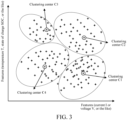
- FIG. 3 is a schematic diagram of calculation of clustering center distances in a method for predicting a capacity of a power battery according to the implementation of the present disclosure, as shown in FIG. 3 .
- feature identifiers are clustering centers.
- the step that an aging model adopted by the battery state parameters is determined from multiple aging models includes the following: A distance between the battery state parameters and a clustering center corresponding to each category is calculated. A nearest aging model is selected as the aging model adopted by the battery state parameters.
- the figure only shows the situation of four clustering centers C1-C4, and the number of the clustering centers does not limit the number of types.
- Clustering calculations in clustering analysis include Euclidean distance, Manhattan distance, Chebyshev distance, and the like, which are primarily used for measuring similarity.
- the similarity (distance) between two objects can be obtained.
- effective selection is performed according to attribute characteristics of different objects.
- the calculation of the distance between the objects is crucial in the clustering algorithm process as it directly affects the effectiveness of the algorithm, and thus, selection is required to be careful when making practical selections.
- the fitting relationship includes polynomial fitting, neural network fitting, or regression tree fitting.
- the neural network fitting includes: a convolutional neural network (CNN), a recurrent neural network (RNN), a generative adversarial network (GAN), etc. By selecting an appropriate neural network structure and training the neural network structure with sample data, an aging model which can predict the battery capacity can be obtained.
- the regression tree fitting includes common binary trees.
- a binary tree is used for recursively dividing a prediction space into several subsets, and the distribution of Y within these subsets is continuous and uniform.
- Leaf nodes in the tree correspond to different divided regions, and the division is determined by splitting rules associated with each internal node.
- a prediction sample is assigned with a unique leaf node, and the conditional distribution of Y at this node is also determined. Specific establishing steps of different aging models are not repeated herein.
- the battery state parameters include: at least two of current, voltage, temperature, state of charge, storage time, depth of discharge, and coulombic efficiency.
- those skilled in the art select, based on practical conditions and measurement conditions, at least two of the above battery state parameters for combination, to obtain a more accurate battery capacity.
- FIG. 4 is a schematic flowchart of an implementation of a method for predicting a capacity of a power battery according to the implementation of the present disclosure, as shown in FIG. 4 .
- the method for predicting a capacity of a power battery includes following steps:
- FIG. 5 is a schematic structural diagram of an apparatus for predicting a capacity of a power battery according to the implementation of the present disclosure, as shown in FIG. 5 .
- the apparatus for predicting a capacity of a power battery includes: an input unit, configured to acquire battery state parameters; a matcher, configured to be matched with the battery state parameters, so as to determine an aging model adopted by the battery state parameters from multiple aging models, where the multiple aging models are in one-to-one correspondence with several categories of sample data divided by a clustering algorithm, and each of the aging models includes a mapping relationship between the battery state parameters and the battery capacity; and a calculator, configured to input the battery state parameters into the adopted aging model, to obtain the corresponding battery capacity.
- the specific limitations on various modules (the input unit, the matcher, and the calculator) in the apparatus for predicting a capacity of a power battery may be referred to the limitations on a method for predicting a capacity of a power battery in the above, which are not repeated herein.
- the various modules in the above apparatus may be all or partly implemented by software, hardware, and a combination thereof.
- the above various modules may be embedded in or independent of a processor in a computer device in a hardware form, and may also be stored in a memory of the computer device in a software form, so that the processor can call and execute the corresponding operations of the various modules.
- a device for predicting a capacity of a power battery includes: at least one processor, and a memory connected with the at least one processor.
- the memory stores instructions executable by the at least one processor, and the at least one processor implements a foregoing method for predicting a capacity of a power battery by executing the instructions stored in the memory.
- the controller or processor mentioned herein has the functions of numerical computation and logical operations, and at least has a central processing unit (CPU) with the data processing capability, a random access memory (RAM), a read-only memory (ROM), multiple I/O ports, and an interrupt system, etc.
- the processor includes a core, and the core invokes a corresponding program unit from the memory.
- the memory may include forms such as a volatile memory, the random access memory (RAM), and/or a non-volatile memory, such as the read-only memory (ROM) or a flash memory (flash RAM) in a computer-readable medium.
- RAM random access memory
- ROM read-only memory
- flash RAM flash memory
- a computer-readable storage medium stores a computer program.
- the computer program when executed by a processor, implements a foregoing method for predicting a capacity of a power battery.
- the embodiments of the present disclosure may be provided as a method, a system, or a computer program product. Therefore, the present disclosure may use a form of hardware-only embodiments, software-only embodiments, or embodiments combining software and hardware. In addition, the present disclosure may use a form of a computer program product implemented on one or more computer-usable storage media (including but not limited to a disk memory, a CD-ROM, an optical memory, and the like) containing computer-usable program code.
- computer-usable storage media including but not limited to a disk memory, a CD-ROM, an optical memory, and the like
- These computer program instructions may alternatively be stored in a computer-readable memory that can instruct the computer or the another programmable data processing device to work in a specific manner, so that the instructions stored in the computer-readable memory generate an artifact that includes an instruction apparatus.
- the instruction apparatus implements functions specified in one or more procedures in the flowcharts and/or in one or more blocks in the block diagrams.
- These computer program instructions may further be loaded onto the computer or the another programmable data processing device, so that a series of operations and steps are performed on the computer or the another programmable device, thereby generating computer-implemented processing. Therefore, the instructions executed on the computer or the another programmable device provide steps for implementing functions specified in one or more procedures in the flowcharts and/or in one or more blocks in the block diagrams.
- the computer device includes one or more central processing units (CPUs), an input/output interface, a network interface, and an internal memory.
- CPUs central processing units
- input/output interface input/output interface
- network interface network interface
- internal memory internal memory
- the memory may include forms such as the volatile memory, the random access memory (RAM), and/or the non-volatile memory, such as the read-only memory (ROM) or the flash memory (flash RAM) in the computer-readable medium.
- RAM random access memory
- non-volatile memory such as the read-only memory (ROM) or the flash memory (flash RAM) in the computer-readable medium.
- ROM read-only memory
- flash RAM flash memory
- the computer-readable medium includes a non-volatile medium and a volatile medium, a removable medium and a non-removable medium, which may implement storage of information by using any method or technology.
- the information may be a computer-readable instruction, a data structure, a program module, or other data.
- Examples of the storage medium of the computer include but not limited to a phase-change memory (PRAM), a static random access memory (SRAM), a dynamic random access memory (DRAM), or other types of random access memory (RAM), the read-only memory (ROM), an erasable programmable read-only memory (EEPROM), a flash memory or another storage technology, a compact disc read-only memory (CD-ROM), a digital versatile disc (DVD) or another optical storage, a cartridge tape, a magnetic tape, a magnetic disk storage or another magnetic storage device, or any other non-transmission medium, which may be configured to store information accessible by the computing device.
- the computer-readable medium does not include transitory computer-readable media, such as a modulated data signal and a modulated carrier.
- the term "include,” “comprise,” or their any other variants are intended to cover a non-exclusive inclusion, so that a process, a method, a product, or a device that includes a series of elements not only includes such elements, but also includes other elements not expressly listed, or further includes elements inherent to such a process, method, product, or device. Unless otherwise specified, an element limited by “include a/an" does not exclude other same elements existing in the process, the method, the product, or the device that includes the element.
Landscapes
- Engineering & Computer Science (AREA)
- Physics & Mathematics (AREA)
- General Physics & Mathematics (AREA)
- Theoretical Computer Science (AREA)
- Life Sciences & Earth Sciences (AREA)
- Software Systems (AREA)
- Data Mining & Analysis (AREA)
- Artificial Intelligence (AREA)
- Evolutionary Computation (AREA)
- Computing Systems (AREA)
- General Engineering & Computer Science (AREA)
- Mathematical Physics (AREA)
- Health & Medical Sciences (AREA)
- Biomedical Technology (AREA)
- Biophysics (AREA)
- Computational Linguistics (AREA)
- General Health & Medical Sciences (AREA)
- Molecular Biology (AREA)
- Transportation (AREA)
- Mechanical Engineering (AREA)
- Sustainable Energy (AREA)
- Power Engineering (AREA)
- Sustainable Development (AREA)
- Chemical & Material Sciences (AREA)
- General Chemical & Material Sciences (AREA)
- Electrochemistry (AREA)
- Chemical Kinetics & Catalysis (AREA)
- Manufacturing & Machinery (AREA)
- Business, Economics & Management (AREA)
- Computer Vision & Pattern Recognition (AREA)
- Human Resources & Organizations (AREA)
- Medical Informatics (AREA)
- Economics (AREA)
- Strategic Management (AREA)
- Development Economics (AREA)
- Game Theory and Decision Science (AREA)
- Entrepreneurship & Innovation (AREA)
- Marketing (AREA)
- Operations Research (AREA)
- Quality & Reliability (AREA)
Abstract
Description
- The present disclosure claims priority to and benefits of
Chinese Patent Application No. 202110711103.9, entitled "METHOD, APPARATUS, AND DEVICE FOR PREDICTING CAPACITY OF POWER BATTERY", and filed on June 25, 2021 - The present disclosure relates to the technical field of battery management, and more specifically, to a method for predicting a capacity of a power battery, an apparatus for predicting a capacity of a power battery, a device for predicting a capacity of a power battery, and a corresponding storage medium.
- A power battery is an important component of an electric vehicle. Lifespan is a major performance index of the power battery. Accurately predicting the lifespan not only helps to understand the degradation status of the battery, provide accurate vehicle operating status information for a user, and provide a basis for cost calculation in vehicle production and manufacturing, but also helps to prevent the occurrence of faults and disasters, thereby ensuring the safety of life and property of the user.
- The lifespan of the power battery is typically estimated by an experimental method and a model method.
- In the experimental method, during actual operation of the vehicle, the current of the power battery is not constant, leading to inaccurate prediction results. In addition, standard new European driving cycle (NEDC) conditions may be adopted to simulate actual working conditions for discharge testing, but the test cycle is too long.
- The model method mainly adopts a mechanism model and a statistical model. The mechanism model includes an electrochemical analysis method, an impedance method, etc. The statistical model mainly refers to a lifespan prediction model designed based on a neural network, such as a lifespan prediction method based on a long short-term memory (LSTM) neural network and transfer learning, and a deep learning method for predicting lifespan of lithium batteries. Actual vehicle driving conditions are complex, mechanism model parameters are hard to acquire, and it is difficult to accurately predict the battery lifespan.
- In view of this, the present disclosure aims to propose a method, apparatus, and device for predicting a capacity of a power battery to at least partially solve the problems that in related arts, an experimental method is long in test cycle, and in a model method, parameters are hard to acquire, and model complexity is high.
- In order to achieve the above objectives, the present disclosure provides a method for predicting a capacity of a power battery. The prediction method includes the following: Sample data of the power battery is acquired. The sample data is divided into several categories by using a clustering algorithm, and each category has a corresponding aging model and a feature identifier. The aging model is obtained by the following steps: A fitting relationship in the aging model is determined. Parameters in the fitting relationship are determined according to sample data of the corresponding type of the aging model. The feature identifier is used for identifying features of the sample data of the corresponding category. Battery state parameters of a to-be-tested power battery are acquired. An aging model adopted by the battery state parameters is determined from multiple aging models. The battery state parameters are input into the adopted aging model to obtain a corresponding battery capacity.
- According to an embodiment of the present disclosure, the sample data of the power battery includes: multiple sets of historical data for the same model of power battery under actual vehicle driving conditions.
- According to an embodiment of the present disclosure, the step that the sample data is divided into several categories by using a clustering algorithm includes the following: The clustering algorithm is preset, and clustering parameters in the clustering algorithm are determined. The sample data is divided into a core point or a boundary point according to the clustering parameters. Categories are constructed according to the core point, and the sample data is divided into the several categories.
- According to an embodiment of the present disclosure, the clustering algorithm is a DBSCAN algorithm; and the clustering parameters include a radius of neighborhood and a neighborhood count threshold.
- According to an embodiment of the present disclosure, the feature identifier is a clustering center; and the feature identifier is the clustering center. The step that an aging model adopted by the battery state parameters is determined from multiple aging models includes the following: A distance between the battery state parameters and a clustering center corresponding to each category is calculated. A nearest aging model is selected as the aging model adopted by the battery state parameters.
- According to an embodiment of the present disclosure, the fitting relationship includes polynomial fitting, neural network fitting, or regression tree fitting.
- According to an embodiment of the present disclosure, the battery state parameters include: at least two of current, voltage, temperature, state of charge, storage time, depth of discharge, and coulombic efficiency.
- In a second aspect of the present disclosure, an apparatus for predicting a capacity of a power battery is further provided, and includes: an input unit, configured to acquire battery state parameters; a matcher, configured to be matched with the battery state parameters, so as to determine an aging model adopted by the battery state parameters from multiple aging models, where the multiple aging models are in one-to-one correspondence with several categories of sample data divided by a clustering algorithm, and each of the aging models includes a mapping relationship between the battery state parameters and the battery capacity; and a calculator, configured to input the battery state parameters into the adopted aging model, to obtain the corresponding battery capacity.
- In a third aspect of the present disclosure, a device for predicting a capacity of a power battery is further provided, and includes: at least one processor, and a memory connected with the at least one processor. The memory stores instructions executable by the at least one processor, and the at least one processor implements a foregoing method for predicting a capacity of a power battery by executing the instructions stored in the memory.
- In a fourth aspect of the present disclosure, a computer-readable storage medium is further provided, and stores a computer program. The program, when executed by a processor, implements a foregoing method for predicting a capacity of a power battery.
- Compared with the related arts, the method, apparatus, and device for predicting a capacity of a power battery according to the implementations of the present disclosure have following beneficial effects:
- Through the above implementations provided by the present disclosure, multiple aging types can be distinguished, and thus, the corresponding aging models are established according to different aging types, thereby improving precision of the aging models, and more accurately predicting the capacity of the power battery. When the sample data becomes more abundant, there are an increasing number of different aging types of data and a wider coverage of different aging types, the clustering algorithm can distinguish different categories more comprehensively, and a distinguishing effect is more intuitive and reliable.
- Other features and advantages of the present disclosure will be described in detail in the following detailed description part.
- The accompanying drawings constituting a part of the present disclosure are used for providing further understanding of the present disclosure. Exemplary implementations of the present disclosure and descriptions thereof are used for explaining the present disclosure, and do not constitute an improper limitation to the present disclosure. In the accompanying drawings:
-
FIG. 1 is a schematic flowchart of a method for predicting a capacity of a power battery according to the implementation of the present disclosure; -
FIG. 2 is a flowchart of a clustering algorithm in a method for predicting a capacity of a power battery according to the implementation of the present disclosure; -
FIG. 3 is a schematic diagram of calculation of clustering center distances in a method for predicting a capacity of a power battery according to the implementation of the present disclosure; -
FIG. 4 is a schematic flowchart of an implementation of a method for predicting a capacity of a power battery according to the implementation of the present disclosure; and -
FIG. 5 is a schematic structural diagram of an apparatus for predicting a capacity of a power battery according to the implementation of the present disclosure. - It is to be noted that, implementations in the present disclosure and features in the implementations may be combined with each other in the case of no conflict.
- The present disclosure is described in detail with reference to the accompanying drawings and in combination with the implementations as below.
-
FIG. 1 is a schematic flowchart of a method for predicting a capacity of a power battery according to the implementation of the present disclosure, as shown inFIG. 1 . A method for predicting a capacity of a power battery is provided. The prediction method includes the following:
S01: Sample data of the power battery is acquired. - The sample data can be acquired from the power battery under actual vehicle driving conditions, and the sample data can include current I, voltage V, temperature T, state of charge SOC, storage time t, depth of discharge DOD, and coulombic efficiency µ, or a combination of parameters selected therefrom.
- S02: The sample data is divided into several categories by using a clustering algorithm, and each category determines a corresponding aging model and a feature identifier. The aging model is obtained by the following steps: A fitting relationship in the aging model is determined. Parameters in the fitting relationship are determined according to sample data of the corresponding type of the aging model. The feature identifier is used for identifying features of the sample data of the corresponding category.
- The sample data is classified, and each category of sample data has a certain similarity or intrinsic correlation. By classifying the sample data through the clustering algorithm, a classification result can be rapidly obtained, and the classification result is desirable. The clustering algorithm may be selected from existing clustering algorithms according to actual needs. The aging model is required to be determined for each category. The aging model is a mathematical model, and it is necessary to first determine a fitting relationship in the mathematical model, that is, to select an appropriate fitting function. Then, the fitting relationship is trained or corrected by the sample data within the category, so as to determine the parameters in the fitting relationship, and thus, the aging model for calculating the battery capacity based on input parameters is obtained.
- S03: Battery state parameters of the to-be-tested power battery are acquired.
- The battery state parameters acquired herein serve as input parameters for predicting capacity, which contain the parameters that are the same as or have a subset relationship with the parameters in the sample data in step S01.
- S04: An aging model adopted by the battery state parameters is determined from multiple aging models.
- It is necessary to first determine the aging model adopted for the specific battery state parameters, and based on the same battery state parameters, different battery capacities may be obtained according to different aging models. In this implementation, the adopted aging model is determined according to the feature identifier. By determining the appropriate aging model, more accurate battery capacity can be calculated.
- S05: The battery state parameters are input into the adopted aging model to obtain a corresponding battery capacity. The aging model adopted in this step is the aging model determined in step S04, and is configured to obtain the corresponding battery capacity according to the battery state parameters, that is, the corresponding battery capacity can be obtained by inputting the battery state parameters.
- Through the above implementation, multiple aging types can be distinguished, and thus, the corresponding aging models are established according to different aging types, thereby improving precision of the aging models, and more accurately predicting the capacity of the power battery. When the sample data becomes more abundant, there are an increasing number of different aging types of data and a wider coverage of different aging types, the clustering algorithm can distinguish different categories more comprehensively, and a distinguishing effect is more intuitive and reliable.
- In an implementation provided by the present disclosure, the sample data of the power battery includes: multiple sets of historical data for the same model of power battery under actual vehicle driving conditions. The historical data under the actual vehicle driving conditions is adopted as samples, which can better reflect real scenarios and facilitate the acquisition of a large number of samples. Through a large number of sample data that reflects the actual state of multiple power batteries, the defects of the experimental method and the model method are overcome, which can make clustering more accurate and thus make the predication of the battery capacity more accurate.
-
FIG. 2 is a flowchart of a clustering algorithm in a method for predicting a capacity of a power battery according to the implementation of the present disclosure, as shown inFIG. 2 . In this implementation, the step that the sample data is divided into several categories by using a clustering algorithm includes the following: The clustering algorithm is preset, and clustering parameters in the clustering algorithm are determined. The sample data is divided into a core point or a boundary point according to the clustering parameters. Categories are constructed according to the core point, and the sample data is divided into the several categories. Further, the clustering algorithm is a DBSCAN algorithm; and the clustering parameters include a radius of neighborhood Eps and a neighborhood count threshold Minpts. A specific process is as below: in an embodiment, a data set is first scanned, an unvisited point p is selected, and a neighborhood set Np is generated. If the count within Eps(p) is greater than Minpts, p is judged as the core point, and a new cluster C is generated. Then, an unclassified point q in Np is selected. If q is not visited, a neighborhood set Nq is generated. If the count in Eps(q) is greater than Minpts, q is judged as the core point, and Np is updated as Np = Np + Nq. The point q is added to the cluster C, if q is neither the core point nor assigned to any category, and q is judged as the boundary point to be added to the cluster C. The process continues until Np no longer contains unclassified points. Following this, if there are still unvisited points in the data set D, the second step is repeatedly performed, and an unvisited point is selected. Through the above method, the sample data is divided into the foregoing several categories. -
FIG. 3 is a schematic diagram of calculation of clustering center distances in a method for predicting a capacity of a power battery according to the implementation of the present disclosure, as shown inFIG. 3 . In this implementation, feature identifiers are clustering centers. The step that an aging model adopted by the battery state parameters is determined from multiple aging models includes the following: A distance between the battery state parameters and a clustering center corresponding to each category is calculated. A nearest aging model is selected as the aging model adopted by the battery state parameters. The figure only shows the situation of four clustering centers C1-C4, and the number of the clustering centers does not limit the number of types. Common clustering calculations in clustering analysis include Euclidean distance, Manhattan distance, Chebyshev distance, and the like, which are primarily used for measuring similarity. By the calculation according to the above method, the similarity (distance) between two objects can be obtained. In the practical calculation, effective selection is performed according to attribute characteristics of different objects. The calculation of the distance between the objects is crucial in the clustering algorithm process as it directly affects the effectiveness of the algorithm, and thus, selection is required to be careful when making practical selections. - In an implementation provided by the present disclosure, the fitting relationship includes polynomial fitting, neural network fitting, or regression tree fitting. The polynomial fitting includes: y=p_{0}x^n + p_{1}x^{n-1} + p_{2}x^{n-2} + p_{3}x^{n-3} +...+p_{n}. The number of terms in the polynomial may be determined as needed. The neural network fitting includes: a convolutional neural network (CNN), a recurrent neural network (RNN), a generative adversarial network (GAN), etc. By selecting an appropriate neural network structure and training the neural network structure with sample data, an aging model which can predict the battery capacity can be obtained. The regression tree fitting includes common binary trees. For example, a binary tree is used for recursively dividing a prediction space into several subsets, and the distribution of Y within these subsets is continuous and uniform. Leaf nodes in the tree correspond to different divided regions, and the division is determined by splitting rules associated with each internal node. By traversing from the root to the leaf nodes, a prediction sample is assigned with a unique leaf node, and the conditional distribution of Y at this node is also determined. Specific establishing steps of different aging models are not repeated herein.
- In an implementation provided by the present disclosure, the battery state parameters include: at least two of current, voltage, temperature, state of charge, storage time, depth of discharge, and coulombic efficiency. The more input parameters there are, the more accurate the obtained battery capacity will be. In a specific scenario, those skilled in the art select, based on practical conditions and measurement conditions, at least two of the above battery state parameters for combination, to obtain a more accurate battery capacity.
-
FIG. 4 is a schematic flowchart of an implementation of a method for predicting a capacity of a power battery according to the implementation of the present disclosure, as shown inFIG. 4 . In this implementation, the method for predicting a capacity of a power battery includes following steps: - (1) The clustering algorithm, parameters and related thresholds are preset.
- (2) The sample data of the power battery under actual vehicle driving conditions is input.
- (3) The sample data is divided into several categories through the clustering algorithm, and clustering centers C 1, ... , Ck are obtained.
- (4) Model parameters corresponding to an aging model are obtained by performing a statistical model such as polynomial fitting, neural network fitting, and regression tree fitting on each category of sample data.

- (5) Distances between to-be-tested data and the clustering centers are compared so as to judge which aging model the to-be-tested data belongs to.
- (6) The to-be-tested data is input into the corresponding aging model to calculate the capacity of the power battery.
-
FIG. 5 is a schematic structural diagram of an apparatus for predicting a capacity of a power battery according to the implementation of the present disclosure, as shown inFIG. 5 . In this implementation, the apparatus for predicting a capacity of a power battery includes: an input unit, configured to acquire battery state parameters; a matcher, configured to be matched with the battery state parameters, so as to determine an aging model adopted by the battery state parameters from multiple aging models, where the multiple aging models are in one-to-one correspondence with several categories of sample data divided by a clustering algorithm, and each of the aging models includes a mapping relationship between the battery state parameters and the battery capacity; and a calculator, configured to input the battery state parameters into the adopted aging model, to obtain the corresponding battery capacity. - The specific limitations on various modules (the input unit, the matcher, and the calculator) in the apparatus for predicting a capacity of a power battery may be referred to the limitations on a method for predicting a capacity of a power battery in the above, which are not repeated herein. The various modules in the above apparatus may be all or partly implemented by software, hardware, and a combination thereof. The above various modules may be embedded in or independent of a processor in a computer device in a hardware form, and may also be stored in a memory of the computer device in a software form, so that the processor can call and execute the corresponding operations of the various modules.
- In an implementation provided by the present disclosure, a device for predicting a capacity of a power battery is further provided, and includes: at least one processor, and a memory connected with the at least one processor. The memory stores instructions executable by the at least one processor, and the at least one processor implements a foregoing method for predicting a capacity of a power battery by executing the instructions stored in the memory. The controller or processor mentioned herein has the functions of numerical computation and logical operations, and at least has a central processing unit (CPU) with the data processing capability, a random access memory (RAM), a read-only memory (ROM), multiple I/O ports, and an interrupt system, etc. The processor includes a core, and the core invokes a corresponding program unit from the memory. There may be one or more cores, and the foregoing method is implemented by adjusting core parameters. The memory may include forms such as a volatile memory, the random access memory (RAM), and/or a non-volatile memory, such as the read-only memory (ROM) or a flash memory (flash RAM) in a computer-readable medium.
- In an implementation provided by the present disclosure, a computer-readable storage medium stores a computer program. The computer program, when executed by a processor, implements a foregoing method for predicting a capacity of a power battery.
- Those skilled in the art should understand that the embodiments of the present disclosure may be provided as a method, a system, or a computer program product. Therefore, the present disclosure may use a form of hardware-only embodiments, software-only embodiments, or embodiments combining software and hardware. In addition, the present disclosure may use a form of a computer program product implemented on one or more computer-usable storage media (including but not limited to a disk memory, a CD-ROM, an optical memory, and the like) containing computer-usable program code.
- The present disclosure is described with reference to flowcharts and/or block diagrams of the method, the device (system), and the computer program product in the embodiments of the present disclosure. It is be understood that computer program instructions can implement each procedure and/or block in the flowcharts and/or block diagrams, and a combination of procedures and/or blocks in the flowcharts and/or block diagrams. These computer program instructions may be provided to a general-purpose computer, a special-purpose computer, an embedded processor, or a processor of another programmable data processing device to generate a machine, so that an apparatus configured to implement functions specified in one or more procedures in the flowcharts and/or one or more blocks in the block diagrams is generated by using instructions executed by the computer or the processor of the another programmable data processing device.
- These computer program instructions may alternatively be stored in a computer-readable memory that can instruct the computer or the another programmable data processing device to work in a specific manner, so that the instructions stored in the computer-readable memory generate an artifact that includes an instruction apparatus. The instruction apparatus implements functions specified in one or more procedures in the flowcharts and/or in one or more blocks in the block diagrams.
- These computer program instructions may further be loaded onto the computer or the another programmable data processing device, so that a series of operations and steps are performed on the computer or the another programmable device, thereby generating computer-implemented processing. Therefore, the instructions executed on the computer or the another programmable device provide steps for implementing functions specified in one or more procedures in the flowcharts and/or in one or more blocks in the block diagrams.
- In a typical configuration, the computer device includes one or more central processing units (CPUs), an input/output interface, a network interface, and an internal memory.
- The memory may include forms such as the volatile memory, the random access memory (RAM), and/or the non-volatile memory, such as the read-only memory (ROM) or the flash memory (flash RAM) in the computer-readable medium. The memory is an example of the computer-readable medium.
- The computer-readable medium includes a non-volatile medium and a volatile medium, a removable medium and a non-removable medium, which may implement storage of information by using any method or technology. The information may be a computer-readable instruction, a data structure, a program module, or other data. Examples of the storage medium of the computer include but not limited to a phase-change memory (PRAM), a static random access memory (SRAM), a dynamic random access memory (DRAM), or other types of random access memory (RAM), the read-only memory (ROM), an erasable programmable read-only memory (EEPROM), a flash memory or another storage technology, a compact disc read-only memory (CD-ROM), a digital versatile disc (DVD) or another optical storage, a cartridge tape, a magnetic tape, a magnetic disk storage or another magnetic storage device, or any other non-transmission medium, which may be configured to store information accessible by the computing device. According to limitations of this specification, the computer-readable medium does not include transitory computer-readable media, such as a modulated data signal and a modulated carrier.
- It is to be further noted that, the term "include," "comprise," or their any other variants are intended to cover a non-exclusive inclusion, so that a process, a method, a product, or a device that includes a series of elements not only includes such elements, but also includes other elements not expressly listed, or further includes elements inherent to such a process, method, product, or device. Unless otherwise specified, an element limited by "include a/an..." does not exclude other same elements existing in the process, the method, the product, or the device that includes the element.
- The foregoing descriptions are merely the embodiments of the present disclosure, but are not intended to limit the present disclosure. For those skilled in the art, various modifications and variations can be made to the present disclosure. Any modification, equivalent replacement, improvement, etc. made within the spirit and principle of the present disclosure shall fall within the scope of the protection of the present disclosure.
Claims (10)
- A method for predicting a capacity of a power battery, comprising:acquiring sample data of the power battery;dividing the sample data into several categories by using a clustering algorithm, each category having a corresponding aging model and a feature identifier, and the aging model being obtained by the following steps: determining a fitting relationship in the aging model, and determining parameters in the fitting relationship according to sample data of the corresponding type of the aging model, the feature identifier being used for identifying features of the sample data of the corresponding category;acquiring battery state parameters of a to-be-tested power battery;determining an aging model adopted by the battery state parameters from a plurality of aging models; andinputting the battery state parameters into the adopted aging model to obtain a corresponding battery capacity.
- The method according to claim 1, wherein the sample data of the power battery comprises: a plurality of sets of historical data for a same model of power battery under actual vehicle driving conditions.
- The method according to claim 1 or 2, wherein the dividing the sample data into several categories by using a clustering algorithm comprises:presetting the clustering algorithm, and determining clustering parameters in the clustering algorithm;dividing the sample data into a core point or a boundary point according to the clustering parameters; andconstructing categories according to the core point, and dividing the sample data into the several categories.
- The method according to claim 3, wherein the clustering algorithm is a DBSCAN algorithm; and
the clustering parameters comprise a radius of neighborhood and a neighborhood count threshold. - The method according to any one of claims 1 to 4, wherein the feature identifier is a clustering center; and
the determining an aging model adopted by the battery state parameters from a plurality of aging models comprises:calculating a distance between the battery state parameters and a clustering center corresponding to each category; andselecting a nearest aging model as the aging model adopted by the battery state parameters. - The method according to any one of claims 1 to 5, wherein the fitting relationship comprises polynomial fitting, neural network fitting, or regression tree fitting.
- The method according to any one of claims 1 to 6, wherein the battery state parameters comprise: at least two of current, voltage, temperature, state of charge, storage time, depth of discharge, and coulombic efficiency.
- An apparatus for predicting a capacity of a power battery, comprising:an input unit, configured to acquire battery state parameters;a matcher, configured to be matched with the battery state parameters, so as to determine an aging model adopted by the battery state parameters from a plurality of aging models, the plurality of aging models being in one-to-one correspondence with several categories of sample data divided by a clustering algorithm, and each of the aging models comprising a mapping relationship between the battery state parameters and a battery capacity; anda calculator, configured to input the battery state parameters into the adopted aging model, to obtain the corresponding battery capacity.
- A device for predicting a capacity of a power battery, comprising:at least one processor; and a memory connected with the at least one processor, whereinthe memory stores instructions executable by the at least one processor, and the at least one processor implements a method for predicting a capacity of a power battery according to any one of claims 1 to 7 by executing the instructions stored in the memory.
- A computer-readable storage medium, storing a computer program, wherein the program, when executed by a processor, implements a method for predicting a capacity of a power battery according to any one of claims 1 to 7.
Applications Claiming Priority (2)
| Application Number | Priority Date | Filing Date | Title |
|---|---|---|---|
| CN202110711103.9A CN115526368B (en) | 2021-06-25 | 2021-06-25 | Power battery capacity prediction method, device and equipment |
| PCT/CN2022/099307 WO2022267979A1 (en) | 2021-06-25 | 2022-06-17 | Method, apparatus and device for predicting power battery capacity |
Publications (2)
| Publication Number | Publication Date |
|---|---|
| EP4300386A1 true EP4300386A1 (en) | 2024-01-03 |
| EP4300386A4 EP4300386A4 (en) | 2024-10-09 |
Family
ID=84545116
Family Applications (1)
| Application Number | Title | Priority Date | Filing Date |
|---|---|---|---|
| EP22827474.2A Pending EP4300386A4 (en) | 2021-06-25 | 2022-06-17 | METHOD, APPARATUS AND DEVICE FOR PREDICTING POWER BATTERY CAPACITY |
Country Status (6)
| Country | Link |
|---|---|
| US (1) | US20240019496A1 (en) |
| EP (1) | EP4300386A4 (en) |
| JP (1) | JP2024523962A (en) |
| KR (1) | KR20230155519A (en) |
| CN (1) | CN115526368B (en) |
| WO (1) | WO2022267979A1 (en) |
Families Citing this family (12)
| Publication number | Priority date | Publication date | Assignee | Title |
|---|---|---|---|---|
| CN116047309A (en) * | 2023-02-20 | 2023-05-02 | 联想(北京)有限公司 | Method for predicting battery capacity and electronic equipment |
| CN116660756B (en) * | 2023-06-28 | 2025-01-24 | 西安理工大学 | Battery capacity decay curve generation method based on conditional generative adversarial network |
| KR102832057B1 (en) * | 2023-11-28 | 2025-07-09 | 한국과학기술원 | Apparatus and method of managing battery state based on real battery recharging data |
| KR102880268B1 (en) * | 2023-12-21 | 2025-10-31 | 국립공주대학교 산학협력단 | Apparatus and method for predicting remaining useful life of a battery based on partial discharge data |
| CN118226266B (en) * | 2023-12-28 | 2025-11-04 | 比亚迪股份有限公司 | Battery pack anomaly detection method, computer-readable storage medium and electronic device |
| CN117609846B (en) * | 2024-01-23 | 2024-06-18 | 宁德时代新能源科技股份有限公司 | Method, device, electronic device and storage medium for obtaining battery performance parameters |
| CN118133514B (en) * | 2024-02-02 | 2026-05-01 | 招商局检测车辆技术研究院有限公司 | Method and system for predicting capacity short period after battery capacity regeneration |
| DE102024108529A1 (en) | 2024-03-26 | 2025-10-02 | Bayerische Motoren Werke Aktiengesellschaft | Method and device for monitoring the thermal aging of a component of a vehicle |
| CN118191658B (en) * | 2024-05-16 | 2024-07-30 | 北京航空航天大学 | Thermal runaway diagnosis method for lithium-ion batteries throughout their life cycle based on multi-time scale fusion |
| CN118897194A (en) * | 2024-07-10 | 2024-11-05 | 深圳计算科学研究院 | A method, device, equipment and medium for predicting battery cell capacity |
| CN118534331B (en) * | 2024-07-24 | 2024-12-10 | 比亚迪股份有限公司 | Model training method, battery state determining method, device, medium and product |
| CN121613342B (en) * | 2026-02-03 | 2026-04-21 | 厦门理工学院 | Battery health state estimation method and device integrating mode identification and inflection point characteristics |
Family Cites Families (16)
| Publication number | Priority date | Publication date | Assignee | Title |
|---|---|---|---|---|
| US9625532B2 (en) * | 2011-10-10 | 2017-04-18 | Battelle Energy Alliance, Llc | Method, system, and computer-readable medium for determining performance characteristics of an object undergoing one or more arbitrary aging conditions |
| CN103954913B (en) * | 2014-05-05 | 2017-06-30 | 哈尔滨工业大学深圳研究生院 | Electric automobile power battery life-span prediction method |
| US20160239592A1 (en) * | 2015-02-12 | 2016-08-18 | Nec Laboratories America, Inc. | Data-driven battery aging model using statistical analysis and artificial intelligence |
| JP2017015594A (en) * | 2015-07-02 | 2017-01-19 | 富士通株式会社 | Battery, power management device, and power management method |
| US10209314B2 (en) * | 2016-11-21 | 2019-02-19 | Battelle Energy Alliance, Llc | Systems and methods for estimation and prediction of battery health and performance |
| KR102582380B1 (en) * | 2017-10-23 | 2023-09-25 | 에스케이온 주식회사 | Apparatus and method for correcting zero offset of hall type current sensor using reference current sensor |
| WO2020044713A1 (en) * | 2018-08-28 | 2020-03-05 | 本田技研工業株式会社 | Diagnostic device, diagnostic method, and program |
| US10921383B2 (en) * | 2019-03-07 | 2021-02-16 | Mitsubishi Electric Research Laboratories, Inc. | Battery diagnostic system for estimating capacity degradation of batteries |
| CN110163280A (en) * | 2019-05-17 | 2019-08-23 | 深圳前海微众银行股份有限公司 | A kind of clustering method and device |
| CN110687452B (en) * | 2019-09-05 | 2022-05-20 | 南京理工大学 | Online prediction method of lithium battery capacity based on K-means clustering and Elman neural network |
| CN111027625B (en) * | 2019-12-10 | 2023-08-08 | 燕山大学 | Battery screening method based on SAE and K-means clustering algorithm |
| CN111537884B (en) * | 2020-04-17 | 2022-04-29 | 中国科学院深圳先进技术研究院 | Method, device, computer equipment and medium for obtaining power battery life data |
| CN112130086B (en) * | 2020-05-29 | 2023-10-31 | 国家电网有限公司 | A method and system for predicting remaining life of power battery |
| CN112305442B (en) * | 2020-10-14 | 2023-06-20 | 北方工业大学 | A fast estimation method for power battery SOH based on kmeans clustering |
| CN111999665B (en) * | 2020-10-29 | 2021-02-19 | 北京航空航天大学 | Lithium ion battery aging test method based on micro-mechanism automobile driving condition |
| CN112505569A (en) * | 2020-11-26 | 2021-03-16 | 珠海中力新能源科技有限公司 | Battery state information generation method and device and terminal equipment |
-
2021
- 2021-06-25 CN CN202110711103.9A patent/CN115526368B/en active Active
-
2022
- 2022-06-17 WO PCT/CN2022/099307 patent/WO2022267979A1/en not_active Ceased
- 2022-06-17 KR KR1020237034068A patent/KR20230155519A/en active Pending
- 2022-06-17 JP JP2023560028A patent/JP2024523962A/en active Pending
- 2022-06-17 EP EP22827474.2A patent/EP4300386A4/en active Pending
-
2023
- 2023-09-27 US US18/373,821 patent/US20240019496A1/en active Pending
Also Published As
| Publication number | Publication date |
|---|---|
| US20240019496A1 (en) | 2024-01-18 |
| CN115526368A (en) | 2022-12-27 |
| EP4300386A4 (en) | 2024-10-09 |
| JP2024523962A (en) | 2024-07-05 |
| KR20230155519A (en) | 2023-11-10 |
| CN115526368B (en) | 2024-12-10 |
| WO2022267979A1 (en) | 2022-12-29 |
Similar Documents
| Publication | Publication Date | Title |
|---|---|---|
| US20240019496A1 (en) | Method, apparatus, and device for predicting capacity of power battery | |
| CN110161425B (en) | Method for predicting remaining service life based on lithium battery degradation stage division | |
| US20160195589A1 (en) | Degradation diagnosis system and degradation diagnosis method for secondary battery | |
| CN111190111A (en) | Electrochemical energy storage battery state of charge estimation method, device and system | |
| CN114764600B (en) | Life prediction method, device and electronic equipment for new energy vehicle battery pack | |
| WO2023142685A1 (en) | Battery insulation fault early warning method, apparatus and system, and computer device | |
| CN109800446B (en) | Method and device for estimating voltage inconsistency during discharge process of lithium-ion battery | |
| WO2022257743A1 (en) | Flow suppression prediction method, electronic device and storage medium | |
| CN117148177A (en) | Battery dynamic consistency evaluation method, device and computer equipment | |
| CN114460469A (en) | Battery state analysis method, system and terminal based on voltage and current | |
| CN114970734A (en) | Abnormal battery determination method, device, computer equipment and storage medium | |
| CN109815534A (en) | A kind of service life of flash memory prediction technique and device based on decision Tree algorithms | |
| CN120103158A (en) | Lithium battery health assessment method, device and electronic equipment | |
| CN113083739B (en) | Battery cell sorting method and device and computer equipment | |
| CN110068409B (en) | Lithium battery stress prediction method and device | |
| AU2023285881B2 (en) | Method and system for predicting power loss probability of vehicle, and cloud server | |
| CN119471442A (en) | Method, device and non-volatile storage medium for detecting lithium deposition in lithium batteries | |
| CN119556140A (en) | Power battery self-discharge rate evaluation method, device and equipment based on big data | |
| CN118731773A (en) | Abnormal battery cell detection method, device, electronic equipment and storage medium | |
| CN115825755B (en) | Method for evaluating consistency of voltages of battery cells of energy storage battery | |
| CN118604640A (en) | Battery evaluation method, device, electronic device, storage medium and program product | |
| CN118659050B (en) | A method for optimizing energy storage SOC balance control strategy | |
| CN112485694A (en) | Battery pack detection method and device | |
| He et al. | Lithium Battery Health State Prediction Based on LSTM | |
| US20230268753A1 (en) | Intelligent battery charging based on history |
Legal Events
| Date | Code | Title | Description |
|---|---|---|---|
| STAA | Information on the status of an ep patent application or granted ep patent |
Free format text: STATUS: THE INTERNATIONAL PUBLICATION HAS BEEN MADE |
|
| PUAI | Public reference made under article 153(3) epc to a published international application that has entered the european phase |
Free format text: ORIGINAL CODE: 0009012 |
|
| STAA | Information on the status of an ep patent application or granted ep patent |
Free format text: STATUS: REQUEST FOR EXAMINATION WAS MADE |
|
| 17P | Request for examination filed |
Effective date: 20230927 |
|
| AK | Designated contracting states |
Kind code of ref document: A1 Designated state(s): AL AT BE BG CH CY CZ DE DK EE ES FI FR GB GR HR HU IE IS IT LI LT LU LV MC MK MT NL NO PL PT RO RS SE SI SK SM TR |
|
| REG | Reference to a national code |
Ref country code: DE Ref legal event code: R079 Free format text: PREVIOUS MAIN CLASS: G06Q0010040000 Ipc: G01R0031392000 |
|
| DAV | Request for validation of the european patent (deleted) | ||
| DAX | Request for extension of the european patent (deleted) | ||
| A4 | Supplementary search report drawn up and despatched |
Effective date: 20240906 |
|
| RIC1 | Information provided on ipc code assigned before grant |
Ipc: G06Q 10/04 20230101ALI20240902BHEP Ipc: G01R 31/392 20190101AFI20240902BHEP |