EP4297439A2 - Method and apparatus for decoding stereo loudspeaker signals from a higher-order ambisonics audio signal - Google Patents
Method and apparatus for decoding stereo loudspeaker signals from a higher-order ambisonics audio signal Download PDFInfo
- Publication number
- EP4297439A2 EP4297439A2 EP23190274.3A EP23190274A EP4297439A2 EP 4297439 A2 EP4297439 A2 EP 4297439A2 EP 23190274 A EP23190274 A EP 23190274A EP 4297439 A2 EP4297439 A2 EP 4297439A2
- Authority
- EP
- European Patent Office
- Prior art keywords
- panning
- functions
- sampling points
- loudspeaker
- matrix
- Prior art date
- Legal status (The legal status is an assumption and is not a legal conclusion. Google has not performed a legal analysis and makes no representation as to the accuracy of the status listed.)
- Pending
Links
Images


Classifications
-
- H—ELECTRICITY
- H04—ELECTRIC COMMUNICATION TECHNIQUE
- H04S—STEREOPHONIC SYSTEMS
- H04S3/00—Systems employing more than two channels, e.g. quadraphonic
- H04S3/008—Systems employing more than two channels, e.g. quadraphonic in which the audio signals are in digital form, i.e. employing more than two discrete digital channels
-
- G—PHYSICS
- G10—MUSICAL INSTRUMENTS; ACOUSTICS
- G10L—SPEECH ANALYSIS TECHNIQUES OR SPEECH SYNTHESIS; SPEECH RECOGNITION; SPEECH OR VOICE PROCESSING TECHNIQUES; SPEECH OR AUDIO CODING OR DECODING
- G10L19/00—Speech or audio signals analysis-synthesis techniques for redundancy reduction, e.g. in vocoders; Coding or decoding of speech or audio signals, using source filter models or psychoacoustic analysis
-
- G—PHYSICS
- G10—MUSICAL INSTRUMENTS; ACOUSTICS
- G10L—SPEECH ANALYSIS TECHNIQUES OR SPEECH SYNTHESIS; SPEECH RECOGNITION; SPEECH OR VOICE PROCESSING TECHNIQUES; SPEECH OR AUDIO CODING OR DECODING
- G10L19/00—Speech or audio signals analysis-synthesis techniques for redundancy reduction, e.g. in vocoders; Coding or decoding of speech or audio signals, using source filter models or psychoacoustic analysis
- G10L19/008—Multichannel audio signal coding or decoding using interchannel correlation to reduce redundancy, e.g. joint-stereo, intensity-coding or matrixing
-
- H—ELECTRICITY
- H04—ELECTRIC COMMUNICATION TECHNIQUE
- H04S—STEREOPHONIC SYSTEMS
- H04S1/00—Two-channel systems
- H04S1/002—Non-adaptive circuits, e.g. manually adjustable or static, for enhancing the sound image or the spatial distribution
-
- H—ELECTRICITY
- H04—ELECTRIC COMMUNICATION TECHNIQUE
- H04S—STEREOPHONIC SYSTEMS
- H04S1/00—Two-channel systems
- H04S1/007—Two-channel systems in which the audio signals are in digital form
-
- H—ELECTRICITY
- H04—ELECTRIC COMMUNICATION TECHNIQUE
- H04S—STEREOPHONIC SYSTEMS
- H04S3/00—Systems employing more than two channels, e.g. quadraphonic
- H04S3/02—Systems employing more than two channels, e.g. quadraphonic of the matrix type, i.e. in which input signals are combined algebraically, e.g. after having been phase shifted with respect to each other
-
- H—ELECTRICITY
- H04—ELECTRIC COMMUNICATION TECHNIQUE
- H04S—STEREOPHONIC SYSTEMS
- H04S7/00—Indicating arrangements; Control arrangements, e.g. balance control
- H04S7/30—Control circuits for electronic adaptation of the sound field
-
- H—ELECTRICITY
- H04—ELECTRIC COMMUNICATION TECHNIQUE
- H04S—STEREOPHONIC SYSTEMS
- H04S2400/00—Details of stereophonic systems covered by H04S but not provided for in its groups
- H04S2400/01—Multi-channel, i.e. more than two input channels, sound reproduction with two speakers wherein the multi-channel information is substantially preserved
-
- H—ELECTRICITY
- H04—ELECTRIC COMMUNICATION TECHNIQUE
- H04S—STEREOPHONIC SYSTEMS
- H04S2400/00—Details of stereophonic systems covered by H04S but not provided for in its groups
- H04S2400/11—Positioning of individual sound objects, e.g. moving airplane, within a sound field
-
- H—ELECTRICITY
- H04—ELECTRIC COMMUNICATION TECHNIQUE
- H04S—STEREOPHONIC SYSTEMS
- H04S2420/00—Techniques used stereophonic systems covered by H04S but not provided for in its groups
- H04S2420/11—Application of ambisonics in stereophonic audio systems
Definitions
- the invention relates to a method and to an apparatus for decoding stereo loudspeaker signals from a higher-order Ambisonics audio signal using panning functions for sampling points on a circle.
- Such first-order Ambisonics approaches have either high negative side lobes as with Ambisonics decoders based on Blumlein stereo ( GB 394325 ) with virtual microphones having figure-of-eight patterns (cf. section 3.3.4.1 in S. Weinzierl, "Handbuch der Audiotechnik", Springer, Berlin, 2008 ), or a poor localisation in the frontal direction. With negative side lobes, for instance, sound objects from the back right direction are played back on the left stereo loudspeaker.
- a problem to be solved by the invention is to provide an Ambisonics signal decoding with improved stereo signal output. This problem is solved by the methods disclosed in claims 1 and 2. An apparatus that utilises these methods is disclosed in claim 3.
- This invention describes the processing for stereo decoders for higher-order Ambisonics HOA audio signals.
- the desired panning functions can be derived from a panning law for placement of virtual sources between the loudspeakers. For each loudspeaker a desired panning function for all possible input directions is defined.
- the Ambisonics decoding matrix is computed similar to the corresponding description in J.M. Batke, F. Keiler, "Using VBAP-derived panning functions for 3D Ambisonics decoding", Proc.
- the panning functions are approximated by circular harmonic functions, and with increasing Ambisonics order the desired panning functions are matched with decreasing error.
- a panning law like the tangent law or vector base amplitude panning (VBAP) can be used.
- VBAP vector base amplitude panning
- a special case is the use of one half of a cardioid pattern pointing to the loudspeaker direction for the back directions.
- the higher spatial resolution of higher order Ambisonics is exploited especially in the frontal region and the attenuation of negative side lobes in the back directions increases with increasing Ambisonics order.
- a stereo decoder meets some important properties: good localisation in the frontal direction between the loudspeakers, only small negative side lobes in the resulting panning functions, and a slight attenuation of back directions. Also it enables attenuation or masking of spatial regions which otherwise could be perceived as disturbing or distracting when listening to the two-channel version.
- the desired panning function is defined circle segment-wise, and in the frontal region in-between the loudspeaker positions a well-known panning processing (e.g. VBAP or tangent law) can be used while the rear directions can be slightly attenuated. Such properties are not feasible when using first-order Ambisonics decoders.
- a well-known panning processing e.g. VBAP or tangent law
- the inventive method is suited for decoding stereo loudspeaker signals l ( t ) from a higher-order Ambisonics audio signal a ( t ), said method including the steps:
- the virtual sampling points on a circle are to be defined. These are the virtual source directions used in the Ambisonics decoding processing, and for these directions the desired panning function values for e.g. two real loudspeaker positions are defined.
- the points or angle values where the desired panning functions are reaching zero are defined by ⁇ L, 0 for the left and ⁇ R ,0 for the right loudspeaker.
- Fig. 1 and Fig. 2 depict the gain of the desired (i.e. theoretical or perfect) panning functions vs. a linear angle scale as well as in polar diagram format, respectively.
- step or stage 51 for calculating the desired panning function receives the values of the azimuth angles ⁇ L and ⁇ R of the left and right loudspeakers as well as the number S of virtual sampling points, and calculates there from - as described above - matrix G containing the desired panning function values for all virtual sampling points.
- the order N is derived in step/stage 52.
- the mode matrix ⁇ is calculated in step/stage 53 based on equations 11 to 13.
Landscapes
- Engineering & Computer Science (AREA)
- Physics & Mathematics (AREA)
- Acoustics & Sound (AREA)
- Signal Processing (AREA)
- Multimedia (AREA)
- Mathematical Physics (AREA)
- Computational Linguistics (AREA)
- Health & Medical Sciences (AREA)
- Audiology, Speech & Language Pathology (AREA)
- Human Computer Interaction (AREA)
- Mathematical Analysis (AREA)
- Mathematical Optimization (AREA)
- General Physics & Mathematics (AREA)
- Pure & Applied Mathematics (AREA)
- Theoretical Computer Science (AREA)
- Algebra (AREA)
- Stereophonic System (AREA)
Abstract
Description
- The invention relates to a method and to an apparatus for decoding stereo loudspeaker signals from a higher-order Ambisonics audio signal using panning functions for sampling points on a circle.
- This application is a European divisional application of Euro-PCT patent application
EP 20186027.7 (reference: A16064EP02 , filed July 15, 2020 - Decoding of Ambisonics representations for a stereo loudspeaker or headphone setup is known for first-order Ambisonics, e.g. from equation (10) in J.S. Bamford, J. Vender-kooy, "Ambisonic sound for us", Audio Engineering Society Preprints, Convention paper 4138 presented at the 99th Convention, October 1995, New York, and from XiphWiki-Ambisonics http://wiki.xiph.org/index.php/Ambisonics#Default_channel_ conversions_from_B-Format. These approaches are based on Blumlein stereo as disclosed in
GB patent 394325 - Another approach uses mode-matching: M.A. Poletti, "Three-Dimensional Surround Sound Systems Based on Spherical Harmonics", J. Audio Eng. Soc., vol.53(11), pp.1004-1025, November 2005.
- Such first-order Ambisonics approaches have either high negative side lobes as with Ambisonics decoders based on Blumlein stereo (
GB 394325 - A problem to be solved by the invention is to provide an Ambisonics signal decoding with improved stereo signal output. This problem is solved by the methods disclosed in
claims - This invention describes the processing for stereo decoders for higher-order Ambisonics HOA audio signals. The desired panning functions can be derived from a panning law for placement of virtual sources between the loudspeakers. For each loudspeaker a desired panning function for all possible input directions is defined. The Ambisonics decoding matrix is computed similar to the corresponding description in J.M. Batke, F. Keiler, "Using VBAP-derived panning functions for 3D Ambisonics decoding", Proc. of the 2nd International Symposium on Ambisonics and Spherical Acoustics, May 6-7 2010, Paris, France, URL http://ambisonics10.ircam.fr/drupal/files /proceedings/presentations/O14_47.pdf, and
WO 2011/117399 A1 . The panning functions are approximated by circular harmonic functions, and with increasing Ambisonics order the desired panning functions are matched with decreasing error. In particular for the frontal region in-between the loudspeakers, a panning law like the tangent law or vector base amplitude panning (VBAP) can be used. For the directions to the back beyond the loudspeaker positions, panning functions with a slight attenuation of sounds from these directions are used. - A special case is the use of one half of a cardioid pattern pointing to the loudspeaker direction for the back directions.
- In the invention, the higher spatial resolution of higher order Ambisonics is exploited especially in the frontal region and the attenuation of negative side lobes in the back directions increases with increasing Ambisonics order.
- The invention can also be used for loudspeaker setups with more than two loudspeakers that are placed on a half circle or on a segment of a circle smaller than a half circle. Also it facilitates more artistic downmixes to stereo where some spatial regions receive more attenuation. This is beneficial for creating an improved direct-sound-to-diffuse-sound ratio enabling a better intelligibility of dialogs.
- A stereo decoder according to the invention meets some important properties: good localisation in the frontal direction between the loudspeakers, only small negative side lobes in the resulting panning functions, and a slight attenuation of back directions. Also it enables attenuation or masking of spatial regions which otherwise could be perceived as disturbing or distracting when listening to the two-channel version.
- In comparison to
WO 2011/117399 A1 , the desired panning function is defined circle segment-wise, and in the frontal region in-between the loudspeaker positions a well-known panning processing (e.g. VBAP or tangent law) can be used while the rear directions can be slightly attenuated. Such properties are not feasible when using first-order Ambisonics decoders. - In principle, the inventive method is suited for decoding stereo loudspeaker signals l (t) from a higher-order Ambisonics audio signal a (t), said method including the steps:
- calculating, from azimuth angle values of left and right loudspeakers and from the number S of virtual sampling points on a circle, a matrix G containing desired panning functions for all virtual sampling points,
wherein
- determining the order N of said Ambisonics audio signal a (t);
- calculating from said number S and from said order N a mode matrix Ξ and the corresponding pseudo-inverse Ξ + of said mode matrix Ξ, wherein Ξ = [ y *(φ 1), y *(φ 2), ... ,y *(φS )] and

- calculating from said matrices G and Ξ + a decoding matrix D = G Ξ +;
- calculating the loudspeaker signals l (t) = Da (t).
- In principle, the inventive method is suited for determining a decoding matrix D that can be used for decoding stereo loudspeaker signals l (t) = Da (t) from a 2-D higher-order Ambisonics audio signal a (t), said method including the steps:
- receiving the order N of said Ambisonics audio signal a (t);
- calculating, from desired azimuth angle values (φL, φR ) of left and right loudspeakers and from the number S of virtual sampling points on a circle, a matrix G containing desired panning functions for all virtual sampling points, wherein

- calculating from said number S and from said order N a mode matrix Ξ and the corresponding pseudo-inverse Ξ + of said mode matrix Ξ, wherein Ξ = [ y *(φ 1), y *(φ 2), ... , y *(φS )] and

- calculating from said matrices G and Ξ + a decoding matrix D = G Ξ + .
- In principle the inventive apparatus is suited for decoding stereo loudspeaker signals l (t) from a higher-order Ambisonics audio signal a (t), said apparatus including:
- means being adapted for calculating, from azimuth angle values of left and right loudspeakers and from the number S of virtual sampling points on a circle, a matrix G containing desired panning functions for all virtual sampling points,
wherein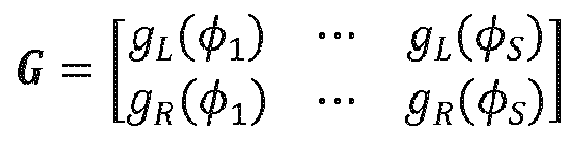
- means being adapted for determining the order N of said Ambisonics audio signal a (t);
- means being adapted for calculating from said number S and from said order N a mode matrix Ξ and the corresponding pseudo-inverse Ξ + of said mode matrix Ξ, wherein Ξ = [ y *(φ 1), y *(φ 2), ... , y *(φS )] and

- means being adapted for calculating from said matrices G and Ξ + a decoding matrix D = G Ξ +;
- means being adapted for calculating the loudspeaker signals l (t) = Da (t).
- Advantageous additional embodiments of the invention are disclosed in the respective dependent claims.
- Exemplary embodiments of the invention are described with reference to the accompanying drawings, which show in:
- Fig. 1
- Desired panning functions, loudspeaker positions φL = 30°, φR = -30°;
- Fig. 2
- Desired panning functions as polar diagram, loud-speaker positions φL = 30°, φR = -30°;
- Fig. 3
- Resulting panning function for N = 4, loudspeaker positions φL = 30°, φR = -30°;
- Fig. 4
- Resulting panning functions for N = 4 as polar diagram, loudspeaker positions φL = 30°, φR = -30°;
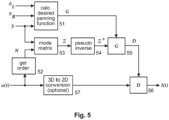
- Fig. 5
- block diagram of the processing according to the invention.
- In a first step in the decoding processing, the positions of the loudspeakers have to be defined. The loudspeakers are assumed to have the same distance from the listening position, whereby the loudspeaker positions are defined by their azimuth angles. The azimuth is denoted by φ and is measured counter-clockwise. The azimuth angles of the left and right loudspeaker are φL and φR , and in a symmetric setup φR = -φL. A typical value is φL = 30°. In the following description, all angle values can be interpreted with an offset of integer multiples of 2π (rad) or 360°.
- The virtual sampling points on a circle are to be defined. These are the virtual source directions used in the Ambisonics decoding processing, and for these directions the desired panning function values for e.g. two real loudspeaker positions are defined. The number of virtual sampling points is denoted by S, and the corresponding directions are equally distributed around the circle, leading to

- The desired panning functions gL (φ) and gR (φ) for the left and right loudspeakers have to be defined. In contrast to the approach from
WO 2011/117399 A1 and the above-mentioned Batke/Keiler article, the panning functions are defined for multiple segments where for the segments different panning functions are used. For example, for the desired panning functions three segments are used: - a) For the frontal direction between the two loudspeakers a well-known panning law is used, e.g. tangent law or, equivalently, vector base amplitude panning (VBAP) as described in V. Pulkki, "Virtual sound source positioning using vector base amplitude panning", J. Audio Eng. Society, 45(6), pp.456-466, June 1997.
- b) For directions beyond the loudspeaker circle section positions a slight attenuation for the back directions is defined, whereby this part of the panning function is approaching the value of zero at an angle approximately opposite the loudspeaker position.
- c) The remaining part of the desired panning functions is set to zero in order to avoid playback of sounds from the right on the left loudspeaker and sounds from the left on the right loudspeaker.
- The points or angle values where the desired panning functions are reaching zero are defined by φ L,0 for the left and φ R,0 for the right loudspeaker. The desired panning functions for the left and right loudspeakers can be expressed as:


- The panning functions g L,1(φ) and g R,1(φ) define the panning law between the loudspeaker positions, whereas the panning functions g L,2(φ) and g R,2(φ) typically define the attenuation for backward directions. At the intersection points the following properties should be satisfied:



- The desired panning functions are sampled at the virtual sampling points. A matrix containing the desired panning function values for all virtual sampling points is defined by:

- The real or complex valued Ambisonics circular harmonic functions are Ym (φ) with m = -N, ... , N where N is the Ambisonics order as mentioned above. The circular harmonics are represented by the azimuth-dependent part of the spherical harmonics, cf. Earl G. Williams, "Fourier Acoustics", vol.93 of Applied Mathematical Sciences, Academic Press, 1999. With the real-valued circular harmonics


- The circular harmonics are combined in a vector

- Complex conjugation, denoted by (·)*, yields

- The mode matrix for the virtual sampling points is defined by

- The resulting 2-D decoding matrix is computed by


- Vector l (t) representing the loudspeaker sample signals for time instance t is calculated by

- It is also possible to define a matrix D 3D , which already includes that 3D/2D conversion and is directly applied to the 3D Ambisonics signals a (t).
- In the following, an example for panning functions for a stereo loudspeaker setup is described. In-between the loudspeaker positions, panning functions g L,1(φ) and g R,1(φ) from eq.(2) and eq.(3) and panning gains according to VBAP are used. These panning functions are continued by one half of a cardioid pattern having its maximum value at the loudspeaker position. The angles φ L,0 and φ R,0 are defined so as to have positions opposite to the loudspeaker positions:


- Normalised panning gains are satisfying g L,1(φL ) = 1 and g R,1(φR ) = 1. The cardioid patterns pointing towards φL and φR are defined by:


- For the evaluation of the decoding, the resulting panning functions for arbitrary input directions can be obtained by

-
Fig. 1 and Fig. 2 depict the gain of the desired (i.e. theoretical or perfect) panning functions vs. a linear angle scale as well as in polar diagram format, respectively. - The resulting panning weights for Ambisonics decoding are computed using eq.(21) for the used input directions.
Fig. 3 and Fig. 4 show, calculated for an Ambisonics order N = 4, the corresponding resulting panning functions vs. a linear angle scale as well as in polar diagram format, respectively. - The comparison of
figures 3/4 withfigures 1/2 shows that the desired panning functions are matched well and that the resulting negative side lobes are very small. - In the following, an example for a 3D to 2D conversion is provided for complex-valued spherical and circular harmonics (for real-valued basis functions it can be carried out in a similar way). The spherical harmonics for 3D Ambisonics are:


- In
Fig. 5 , step orstage 51 for calculating the desired panning function receives the values of the azimuth angles φL and φR of the left and right loudspeakers as well as the number S of virtual sampling points, and calculates there from - as described above - matrix G containing the desired panning function values for all virtual sampling points. From Ambisonics signal a(t) the order N is derived in step/stage 52. From S and N the mode matrix Ξ is calculated in step/stage 53 based on equations 11 to 13. - Step or
stage 54 computes the pseudo-inverse Ξ+ of matrix Ξ. From matrices G and Ξ + the decoding matrix D is calculated in step/stage 55 according to equation 15. In step/stage 56, the loudspeaker signals l (t) are calculated from Ambisonics signal a(t) using decoding matrix D . In case the Ambisonics input signal a(t) is a three-dimensional spatial signal, a 3D-to-2D conversion can be carried out in step or stage 57 and step/stage 56 receives the 2D Ambisonics signal a '(t). Various aspects of the present invention may be appreciated from the following enumerated example embodiments (EEEs): - EEE1. Method for decoding stereo loudspeaker signals l (t) from a higher-order Ambisonics audio signal a (t), said method including the steps:
- calculating (51), from azimuth angle values (φL , φR ) of left and right loudspeakers and from the number S of virtual sampling points on a circle, a matrix G containing desired panning functions for all virtual sampling points,
wherein
- determining (52) the order N of said Ambisonics audio signal a (t);
- calculating (53, 54) from said number S and from said order N a mode matrix Ξ and the corresponding pseudo-inverse Ξ + of said mode matrix Ξ, wherein Ξ = [ y *(φ 1), y *(φ 2), ... , y *(φS )] and

- calculating (55) from said matrices G and Ξ + a decoding matrix D = G Ξ +;
- calculating (56) the loudspeaker signals l (t) = Da (t).
- calculating (51), from azimuth angle values (φL , φR ) of left and right loudspeakers and from the number S of virtual sampling points on a circle, a matrix G containing desired panning functions for all virtual sampling points,
- EEE2. Method for determining a decoding matrix D that can be used for decoding (56) stereo loudspeaker signals l (t) = Da (t) from a 2-D higher-order Ambisonics audio signal a (t), said method including the steps:
- receiving (52) the order N of said Ambisonics audio signal a (t);
- calculating (51), from desired azimuth angle values (φL , φR ) of left and right loudspeakers and from the number S of virtual sampling points on a circle, a matrix G containing desired panning functions for all virtual sampling points, wherein

- calculating (53, 54) from said number S and from said order N a mode matrix Ξ and the corresponding pseudo-inverse Ξ + of said mode matrix Ξ, wherein Ξ = [ y *(φ 1), y *(φ 2), ... , y *(φS )] and

- calculating (55) from said matrices G and Ξ + a decoding matrix D = G Ξ + .
- EEE3. Apparatus for decoding stereo loudspeaker signals l (t) from a higher-order Ambisonics audio signal a (t), said apparatus including:
- means (51) being adapted for calculating, from azimuth angle values (φL , φR ) of left and right loudspeakers and from the number S of virtual sampling points on a circle, a matrix G containing desired panning functions for all virtual sampling points,
wherein
- means (52) being adapted for determining the order N of said Ambisonics audio signal a (t);
- means (53, 54) being adapted for calculating from said number S and from said order N a mode matrix Ξ and the corresponding pseudo-inverse Ξ + of said mode matrix Ξ, wherein Ξ = [ y *(φ 1), y *(φ 2), ... , y *(φS )] and y *(φ) =

- means (55) being adapted for calculating from said matrices G and Ξ + a decoding matrix D = G Ξ +;
- means (56) being adapted for calculating the loudspeaker signals l (t) = Da (t).
- means (51) being adapted for calculating, from azimuth angle values (φL , φR ) of left and right loudspeakers and from the number S of virtual sampling points on a circle, a matrix G containing desired panning functions for all virtual sampling points,
- EEE4. Method according to the method of
EEE - EEE5. Method according to the method of
EEE EEE 3 or 4, wherein for the frontal region in-between the loudspeakers the tangent law or vector base amplitude panning VBAP is used as the panning law. - EEE6. Method according to the method of one of
EEEs - EEE7. Method according to the method of one of
EEEs - EEE8. Method according to the method of one of
EEEs - EEE9. Method according to the method of one of
EEEs - EEE10. Method according to the method of one of
EEEs
Claims (4)
- Method for decoding stereo loudspeaker signals l (t) from a higher-order Ambisonics audio signal a (t), from azimuth angle values φL and φR of left and right loudspeakers, and from S sampling points equally distributed on a circle, said method including the steps:- calculating (51), from the azimuth angles values φL and φR of the left and right loudspeakers, desired panning functions gL (φ) and gR (φ), and from the number S of virtual sampling points equally distributed on a circle, a matrix G containing the values of the desired panning functions for all virtual sampling points, wherein G =
 - determining (53, 54) from said number S and from an order N of the Ambisonics audio signal a (t) a mode matrix Ξ and the corresponding adjoint Ξ H of mode matrix Ξ based on a complex conjugation of a vector y of circular harmonics, wherein
Ξ = [ y *(φ 1), y *(φ 2), ... , y *(φS )] and - determining (55), for the equally distributed virtual sampling points, a decoding matrix D = α G Ξ H from said matrices G and ΞH and a scaling factor α wherein the scaling factor α is based on a normalisation scheme of the circular harmonics and on S; and- calculating the loudspeaker signals l (t) = Da (t).
 - Apparatus for decoding stereo loudspeaker signals l (t) from a higher-order Ambisonics audio signal a (t), from azimuth angle values φL and φR of corresponding left and right loudspeakers, and from S sampling points equally distributed on a circle, said apparatus including:- means (51) being adapted for calculating, from the azimuth angle values φL and φR of the left and right loudspeakers, desired panning functions gL (φ) and gR (φ), and from the number S of virtual sampling points equally distributed on a circle, a matrix G containing the values of the desired panning functions for all virtual sampling points, wherein
 - means (53, 54) being adapted for determining from said number S and from an order N of the Ambisonics audio signal a (t) a mode matrix Ξ and the corresponding adjoint Ξ H of mode matrix Ξ, based on a complex conjugation of a vector y of circular harmonics, wherein Ξ = [ y *(φ 1), y *(φ 2), ... , y*(φS )] and
 - means (55) being adapted for determining, for the equally distributed virtual sampling points, a decoding matrix D = α G Ξ H from said matrices G and ΞH and a scaling factor α, wherein the scaling factor α is based on a normalisation scheme of the circular harmonics and on S; and- means (56) being adapted for calculating the loudspeaker signals l (t) = Da (t).
 - Method according to the method of claim 1, or apparatus according to the apparatus of claim 2, wherein each of the desired panning functions is defined circle segment wise, and for the multiple segments on said circle different panning functions are used.
- Method according to the method of claim 1 or 3, or apparatus according to the apparatus of claim 2 or 3, wherein the remaining part of the desired panning functions is set to zero so as to avoid playback of sounds from the right on the left loudspeaker and sounds from the left on the right loudspeaker.
Applications Claiming Priority (4)
| Application Number | Priority Date | Filing Date | Title |
|---|---|---|---|
| EP12305356.3A EP2645748A1 (en) | 2012-03-28 | 2012-03-28 | Method and apparatus for decoding stereo loudspeaker signals from a higher-order Ambisonics audio signal |
| EP13711352.8A EP2832113B1 (en) | 2012-03-28 | 2013-03-20 | Method and apparatus for decoding stereo loudspeaker signals from a higher-order ambisonics audio signal |
| EP20186027.7A EP3796679B1 (en) | 2012-03-28 | 2013-03-20 | Method and apparatus for decoding stereo loudspeaker signals from a higher-order ambisonics audio signal |
| PCT/EP2013/055792 WO2013143934A1 (en) | 2012-03-28 | 2013-03-20 | Method and apparatus for decoding stereo loudspeaker signals from a higher-order ambisonics audio signal |
Related Parent Applications (2)
| Application Number | Title | Priority Date | Filing Date |
|---|---|---|---|
| EP13711352.8A Division EP2832113B1 (en) | 2012-03-28 | 2013-03-20 | Method and apparatus for decoding stereo loudspeaker signals from a higher-order ambisonics audio signal |
| EP20186027.7A Division EP3796679B1 (en) | 2012-03-28 | 2013-03-20 | Method and apparatus for decoding stereo loudspeaker signals from a higher-order ambisonics audio signal |
Publications (2)
| Publication Number | Publication Date |
|---|---|
| EP4297439A2 true EP4297439A2 (en) | 2023-12-27 |
| EP4297439A3 EP4297439A3 (en) | 2024-03-20 |
Family
ID=47915205
Family Applications (4)
| Application Number | Title | Priority Date | Filing Date |
|---|---|---|---|
| EP12305356.3A Withdrawn EP2645748A1 (en) | 2012-03-28 | 2012-03-28 | Method and apparatus for decoding stereo loudspeaker signals from a higher-order Ambisonics audio signal |
| EP20186027.7A Active EP3796679B1 (en) | 2012-03-28 | 2013-03-20 | Method and apparatus for decoding stereo loudspeaker signals from a higher-order ambisonics audio signal |
| EP23190274.3A Pending EP4297439A3 (en) | 2012-03-28 | 2013-03-20 | Method and apparatus for decoding stereo loudspeaker signals from a higher-order ambisonics audio signal |
| EP13711352.8A Active EP2832113B1 (en) | 2012-03-28 | 2013-03-20 | Method and apparatus for decoding stereo loudspeaker signals from a higher-order ambisonics audio signal |
Family Applications Before (2)
| Application Number | Title | Priority Date | Filing Date |
|---|---|---|---|
| EP12305356.3A Withdrawn EP2645748A1 (en) | 2012-03-28 | 2012-03-28 | Method and apparatus for decoding stereo loudspeaker signals from a higher-order Ambisonics audio signal |
| EP20186027.7A Active EP3796679B1 (en) | 2012-03-28 | 2013-03-20 | Method and apparatus for decoding stereo loudspeaker signals from a higher-order ambisonics audio signal |
Family Applications After (1)
| Application Number | Title | Priority Date | Filing Date |
|---|---|---|---|
| EP13711352.8A Active EP2832113B1 (en) | 2012-03-28 | 2013-03-20 | Method and apparatus for decoding stereo loudspeaker signals from a higher-order ambisonics audio signal |
Country Status (7)
| Country | Link |
|---|---|
| US (7) | US9666195B2 (en) |
| EP (4) | EP2645748A1 (en) |
| JP (7) | JP6316275B2 (en) |
| KR (6) | KR102207035B1 (en) |
| CN (6) | CN107135460B (en) |
| TW (11) | TWI845344B (en) |
| WO (1) | WO2013143934A1 (en) |
Families Citing this family (27)
| Publication number | Priority date | Publication date | Assignee | Title |
|---|---|---|---|---|
| EP2637427A1 (en) * | 2012-03-06 | 2013-09-11 | Thomson Licensing | Method and apparatus for playback of a higher-order ambisonics audio signal |
| EP2645748A1 (en) | 2012-03-28 | 2013-10-02 | Thomson Licensing | Method and apparatus for decoding stereo loudspeaker signals from a higher-order Ambisonics audio signal |
| US20140355769A1 (en) | 2013-05-29 | 2014-12-04 | Qualcomm Incorporated | Energy preservation for decomposed representations of a sound field |
| EP2866475A1 (en) * | 2013-10-23 | 2015-04-29 | Thomson Licensing | Method for and apparatus for decoding an audio soundfield representation for audio playback using 2D setups |
| EP2879408A1 (en) * | 2013-11-28 | 2015-06-03 | Thomson Licensing | Method and apparatus for higher order ambisonics encoding and decoding using singular value decomposition |
| EP3143779B1 (en) * | 2014-05-13 | 2020-10-07 | Fraunhofer Gesellschaft zur Förderung der Angewand | Apparatus and method for edge fading amplitude panning |
| US10770087B2 (en) | 2014-05-16 | 2020-09-08 | Qualcomm Incorporated | Selecting codebooks for coding vectors decomposed from higher-order ambisonic audio signals |
| EP4354432B1 (en) * | 2014-06-27 | 2026-03-11 | Dolby International AB | Apparatus for determining for the compression of an hoa data frame representation a lowest integer number of bits required for representing non-differential gain values |
| US9747910B2 (en) * | 2014-09-26 | 2017-08-29 | Qualcomm Incorporated | Switching between predictive and non-predictive quantization techniques in a higher order ambisonics (HOA) framework |
| CN106537941B (en) | 2014-11-11 | 2019-08-16 | 谷歌有限责任公司 | Virtual sound system and method |
| US10257636B2 (en) | 2015-04-21 | 2019-04-09 | Dolby Laboratories Licensing Corporation | Spatial audio signal manipulation |
| US10334387B2 (en) | 2015-06-25 | 2019-06-25 | Dolby Laboratories Licensing Corporation | Audio panning transformation system and method |
| US10249312B2 (en) | 2015-10-08 | 2019-04-02 | Qualcomm Incorporated | Quantization of spatial vectors |
| US9961467B2 (en) * | 2015-10-08 | 2018-05-01 | Qualcomm Incorporated | Conversion from channel-based audio to HOA |
| IL320151A (en) * | 2015-10-08 | 2025-06-01 | Dolby Int Ab | Layered coding for voice or compressed sound field representations |
| EP3375208B1 (en) * | 2015-11-13 | 2019-11-06 | Dolby International AB | Method and apparatus for generating from a multi-channel 2d audio input signal a 3d sound representation signal |
| US11387006B2 (en) | 2015-11-30 | 2022-07-12 | In Hand Health, LLC | Client monitoring, management, communication, and performance system and method of use |
| EP3209036A1 (en) * | 2016-02-19 | 2017-08-23 | Thomson Licensing | Method, computer readable storage medium, and apparatus for determining a target sound scene at a target position from two or more source sound scenes |
| US11012803B2 (en) | 2017-01-27 | 2021-05-18 | Auro Technologies Nv | Processing method and system for panning audio objects |
| CN106960672B (en) * | 2017-03-30 | 2020-08-21 | 国家计算机网络与信息安全管理中心 | Bandwidth extension method and device for stereo audio |
| WO2018213159A1 (en) * | 2017-05-15 | 2018-11-22 | Dolby Laboratories Licensing Corporation | Methods, systems and apparatus for conversion of spatial audio format(s) to speaker signals |
| CN110771181B (en) * | 2017-05-15 | 2021-09-28 | 杜比实验室特许公司 | Method, system and device for converting a spatial audio format into a loudspeaker signal |
| CN111123202B (en) * | 2020-01-06 | 2022-01-11 | 北京大学 | Indoor early reflected sound positioning method and system |
| CN111615045B (en) * | 2020-06-23 | 2021-06-11 | 腾讯音乐娱乐科技(深圳)有限公司 | Audio processing method, device, equipment and storage medium |
| CN112530445A (en) * | 2020-11-23 | 2021-03-19 | 雷欧尼斯(北京)信息技术有限公司 | Coding and decoding method and chip of high-order Ambisonic audio |
| CN117061983A (en) * | 2021-03-05 | 2023-11-14 | 华为技术有限公司 | Virtual speaker set determination method and device |
| US12614555B2 (en) * | 2023-09-27 | 2026-04-28 | Apple Inc. | Method and system for producing an augmented ambisonic format |
Citations (1)
| Publication number | Priority date | Publication date | Assignee | Title |
|---|---|---|---|---|
| WO2011117399A1 (en) | 2010-03-26 | 2011-09-29 | Thomson Licensing | Method and device for decoding an audio soundfield representation for audio playback |
Family Cites Families (32)
| Publication number | Priority date | Publication date | Assignee | Title |
|---|---|---|---|---|
| GB394325A (en) | 1931-12-14 | 1933-06-14 | Alan Dower Blumlein | Improvements in and relating to sound-transmission, sound-recording and sound-reproducing systems |
| US4704728A (en) * | 1984-12-31 | 1987-11-03 | Peter Scheiber | Signal re-distribution, decoding and processing in accordance with amplitude, phase, and other characteristics |
| JPH05103391A (en) | 1991-10-07 | 1993-04-23 | Matsushita Electric Ind Co Ltd | Directivity-controlled loudspeaker system |
| JPH06165281A (en) | 1992-11-18 | 1994-06-10 | Matsushita Electric Ind Co Ltd | Speaker equipment with directivity |
| US7231054B1 (en) | 1999-09-24 | 2007-06-12 | Creative Technology Ltd | Method and apparatus for three-dimensional audio display |
| JP4805541B2 (en) * | 2002-04-10 | 2011-11-02 | コーニンクレッカ フィリップス エレクトロニクス エヌ ヴィ | Stereo signal encoding |
| FR2847376B1 (en) * | 2002-11-19 | 2005-02-04 | France Telecom | METHOD FOR PROCESSING SOUND DATA AND SOUND ACQUISITION DEVICE USING THE SAME |
| US7447317B2 (en) * | 2003-10-02 | 2008-11-04 | Fraunhofer-Gesellschaft Zur Foerderung Der Angewandten Forschung E.V | Compatible multi-channel coding/decoding by weighting the downmix channel |
| EP1538741A1 (en) * | 2003-12-05 | 2005-06-08 | Semiconductor Ideas to The Market (ItoM) BV | Multiplier device |
| US7787631B2 (en) | 2004-11-30 | 2010-08-31 | Agere Systems Inc. | Parametric coding of spatial audio with cues based on transmitted channels |
| ATE378793T1 (en) * | 2005-06-23 | 2007-11-15 | Akg Acoustics Gmbh | METHOD OF MODELING A MICROPHONE |
| EP1761110A1 (en) * | 2005-09-02 | 2007-03-07 | Ecole Polytechnique Fédérale de Lausanne | Method to generate multi-channel audio signals from stereo signals |
| KR101562379B1 (en) * | 2005-09-13 | 2015-10-22 | 코닌클리케 필립스 엔.브이. | A spatial decoder and a method of producing a pair of binaural output channels |
| JP2007208709A (en) | 2006-02-02 | 2007-08-16 | Kenwood Corp | Sound reproducing apparatus |
| WO2007101958A2 (en) | 2006-03-09 | 2007-09-13 | France Telecom | Optimization of binaural sound spatialization based on multichannel encoding |
| US8712061B2 (en) | 2006-05-17 | 2014-04-29 | Creative Technology Ltd | Phase-amplitude 3-D stereo encoder and decoder |
| US7501605B2 (en) * | 2006-08-29 | 2009-03-10 | Lam Research Corporation | Method of tuning thermal conductivity of electrostatic chuck support assembly |
| ATE495635T1 (en) * | 2006-09-25 | 2011-01-15 | Dolby Lab Licensing Corp | IMPROVED SPATIAL RESOLUTION OF THE SOUND FIELD FOR MULTI-CHANNEL SOUND REPRODUCTION SYSTEMS USING DERIVATION OF SIGNALS WITH HIGH-ORDER ANGLE SIZE |
| KR101368859B1 (en) * | 2006-12-27 | 2014-02-27 | 삼성전자주식회사 | Method and apparatus for reproducing a virtual sound of two channels based on individual auditory characteristic |
| US8520873B2 (en) * | 2008-10-20 | 2013-08-27 | Jerry Mahabub | Audio spatialization and environment simulation |
| TWI424755B (en) | 2008-01-11 | 2014-01-21 | Dolby Lab Licensing Corp | Matrix decoder |
| EP2094032A1 (en) | 2008-02-19 | 2009-08-26 | Deutsche Thomson OHG | Audio signal, method and apparatus for encoding or transmitting the same and method and apparatus for processing the same |
| JP4922211B2 (en) * | 2008-03-07 | 2012-04-25 | 日本放送協会 | Acoustic signal converter, method and program thereof |
| KR20110049863A (en) * | 2008-08-14 | 2011-05-12 | 돌비 레버러토리즈 라이쎈싱 코오포레이션 | Audio Signal Formatting |
| GB0815362D0 (en) * | 2008-08-22 | 2008-10-01 | Queen Mary & Westfield College | Music collection navigation |
| EP2486450B1 (en) * | 2008-11-02 | 2021-05-19 | David Chaum | Near to eye display system and appliance |
| EP2285139B1 (en) * | 2009-06-25 | 2018-08-08 | Harpex Ltd. | Device and method for converting spatial audio signal |
| NZ587483A (en) * | 2010-08-20 | 2012-12-21 | Ind Res Ltd | Holophonic speaker system with filters that are pre-configured based on acoustic transfer functions |
| JP5826996B2 (en) | 2010-08-30 | 2015-12-02 | 日本放送協会 | Acoustic signal conversion device and program thereof, and three-dimensional acoustic panning device and program thereof |
| EP2450880A1 (en) | 2010-11-05 | 2012-05-09 | Thomson Licensing | Data structure for Higher Order Ambisonics audio data |
| EP2645748A1 (en) * | 2012-03-28 | 2013-10-02 | Thomson Licensing | Method and apparatus for decoding stereo loudspeaker signals from a higher-order Ambisonics audio signal |
| US9514620B2 (en) * | 2013-09-06 | 2016-12-06 | Immersion Corporation | Spatialized haptic feedback based on dynamically scaled values |
-
2012
- 2012-03-28 EP EP12305356.3A patent/EP2645748A1/en not_active Withdrawn
-
2013
- 2013-03-08 TW TW112122168A patent/TWI845344B/en active
- 2013-03-08 TW TW107144828A patent/TWI675366B/en active
- 2013-03-08 TW TW110122105A patent/TWI775497B/en active
- 2013-03-08 TW TW107128846A patent/TWI666629B/en active
- 2013-03-08 TW TW108123461A patent/TWI698858B/en active
- 2013-03-08 TW TW106112615A patent/TWI651715B/en active
- 2013-03-08 TW TW113117951A patent/TWI880743B/en active
- 2013-03-08 TW TW102108148A patent/TWI590230B/en active
- 2013-03-08 TW TW114109966A patent/TWI907295B/en active
- 2013-03-08 TW TW109121565A patent/TWI734539B/en active
- 2013-03-08 TW TW111127893A patent/TWI808842B/en active
- 2013-03-20 CN CN201710587967.8A patent/CN107135460B/en active Active
- 2013-03-20 CN CN201710587968.2A patent/CN107182022B/en active Active
- 2013-03-20 KR KR1020197037604A patent/KR102207035B1/en active Active
- 2013-03-20 KR KR1020247020658A patent/KR102863957B1/en active Active
- 2013-03-20 JP JP2015502213A patent/JP6316275B2/en active Active
- 2013-03-20 KR KR1020257031503A patent/KR20250141277A/en active Pending
- 2013-03-20 EP EP20186027.7A patent/EP3796679B1/en active Active
- 2013-03-20 WO PCT/EP2013/055792 patent/WO2013143934A1/en not_active Ceased
- 2013-03-20 EP EP23190274.3A patent/EP4297439A3/en active Pending
- 2013-03-20 EP EP13711352.8A patent/EP2832113B1/en active Active
- 2013-03-20 CN CN201380016236.8A patent/CN104205879B/en active Active
- 2013-03-20 CN CN201710587980.3A patent/CN107172567B/en active Active
- 2013-03-20 US US14/386,784 patent/US9666195B2/en active Active
- 2013-03-20 CN CN201710587966.3A patent/CN107222824B/en active Active
- 2013-03-20 KR KR1020227044967A patent/KR102678270B1/en active Active
- 2013-03-20 KR KR1020217001737A patent/KR102481338B1/en active Active
- 2013-03-20 CN CN201710587976.7A patent/CN107241677B/en active Active
- 2013-03-20 KR KR1020147026827A patent/KR102059486B1/en active Active
-
2017
- 2017-04-04 US US15/479,108 patent/US9913062B2/en active Active
-
2018
- 2018-01-22 US US15/876,404 patent/US10433090B2/en active Active
- 2018-03-27 JP JP2018059275A patent/JP6622344B2/en active Active
-
2019
- 2019-08-12 US US16/538,080 patent/US11172317B2/en active Active
- 2019-11-21 JP JP2019210167A patent/JP6898419B2/en active Active
-
2021
- 2021-06-10 JP JP2021097063A patent/JP7459019B2/en active Active
- 2021-11-08 US US17/521,762 patent/US12010501B2/en active Active
-
2023
- 2023-03-07 JP JP2023034396A patent/JP7529370B2/en active Active
-
2024
- 2024-05-10 US US18/661,390 patent/US12520093B2/en active Active
- 2024-05-10 US US18/661,414 patent/US12495261B2/en active Active
- 2024-07-23 JP JP2024117388A patent/JP7739546B2/en active Active
-
2025
- 2025-09-03 JP JP2025145858A patent/JP2025186291A/en active Pending
Patent Citations (1)
| Publication number | Priority date | Publication date | Assignee | Title |
|---|---|---|---|---|
| WO2011117399A1 (en) | 2010-03-26 | 2011-09-29 | Thomson Licensing | Method and device for decoding an audio soundfield representation for audio playback |
Non-Patent Citations (3)
| Title |
|---|
| EARL G. WILLIAMS: "Applied Mathematical Sciences", vol. 93, 1999, ACADEMIC PRESS, article "Fourier Acoustics" |
| M.A. POLETTI: "Three-Dimensional Surround Sound Systems Based on Spherical Harmonics", J. AUDIO ENG. SOC, vol. 53, no. 11, November 2005 (2005-11-01), pages 1004 - 1025 |
| V. PULKKI: "Virtual sound source positioning using vector base amplitude panning", J. AUDIO ENG. SOCIETY, vol. 45, no. 6, June 1997 (1997-06-01), pages 456 - 466, XP002719359 |
Also Published As
Similar Documents
| Publication | Publication Date | Title |
|---|---|---|
| US12010501B2 (en) | Method and apparatus for decoding stereo loudspeaker signals from a higher-order Ambisonics audio signal | |
| HK40098553A (en) | Method and apparatus for decoding stereo loudspeaker signals from a higher-order ambisonics audio signal | |
| HK40039379A (en) | Method and apparatus for decoding stereo loudspeaker signals from a higher-order ambisonics audio signal | |
| HK40039379B (en) | Method and apparatus for decoding stereo loudspeaker signals from a higher-order ambisonics audio signal | |
| HK1238838B (en) | Method and apparatus for decoding stereo loudspeaker signals from a higher-order ambisonics audio signal | |
| HK1238836B (en) | Method and apparatus for decoding stereo loudspeaker signals from a higher-order ambisonics audio signal | |
| HK1238835B (en) | Method and apparatus for decoding stereo loudspeaker signals from a higher-order ambisonics audio signal | |
| HK1238839B (en) | Method and apparatus for decoding stereo loudspeaker signals from a higher-order ambisonics audio signal | |
| HK1238837B (en) | Method and apparatus for decoding stereo loudspeaker signals from a higher-order ambisonics audio signal |
Legal Events
| Date | Code | Title | Description |
|---|---|---|---|
| PUAI | Public reference made under article 153(3) epc to a published international application that has entered the european phase |
Free format text: ORIGINAL CODE: 0009012 |
|
| STAA | Information on the status of an ep patent application or granted ep patent |
Free format text: STATUS: THE APPLICATION HAS BEEN PUBLISHED |
|
| AC | Divisional application: reference to earlier application |
Ref document number: 2832113 Country of ref document: EP Kind code of ref document: P Ref document number: 3796679 Country of ref document: EP Kind code of ref document: P |
|
| AK | Designated contracting states |
Kind code of ref document: A2 Designated state(s): AL AT BE BG CH CY CZ DE DK EE ES FI FR GB GR HR HU IE IS IT LI LT LU LV MC MK MT NL NO PL PT RO RS SE SI SK SM TR |
|
| PUAL | Search report despatched |
Free format text: ORIGINAL CODE: 0009013 |
|
| P01 | Opt-out of the competence of the unified patent court (upc) registered |
Effective date: 20240112 |
|
| AK | Designated contracting states |
Kind code of ref document: A3 Designated state(s): AL AT BE BG CH CY CZ DE DK EE ES FI FR GB GR HR HU IE IS IT LI LT LU LV MC MK MT NL NO PL PT RO RS SE SI SK SM TR |
|
| RIC1 | Information provided on ipc code assigned before grant |
Ipc: H04S 1/00 20060101ALN20240214BHEP Ipc: H04S 3/00 20060101AFI20240214BHEP |
|
| REG | Reference to a national code |
Ref country code: HK Ref legal event code: DE Ref document number: 40098553 Country of ref document: HK |
|
| STAA | Information on the status of an ep patent application or granted ep patent |
Free format text: STATUS: REQUEST FOR EXAMINATION WAS MADE |
|
| 17P | Request for examination filed |
Effective date: 20240904 |
|
| RBV | Designated contracting states (corrected) |
Designated state(s): AL AT BE BG CH CY CZ DE DK EE ES FI FR GB GR HR HU IE IS IT LI LT LU LV MC MK MT NL NO PL PT RO RS SE SI SK SM TR |
|
| GRAP | Despatch of communication of intention to grant a patent |
Free format text: ORIGINAL CODE: EPIDOSNIGR1 |
|
| STAA | Information on the status of an ep patent application or granted ep patent |
Free format text: STATUS: GRANT OF PATENT IS INTENDED |
|
| RIC1 | Information provided on ipc code assigned before grant |
Ipc: H04S 3/00 20060101AFI20251118BHEP Ipc: H04S 1/00 20060101ALN20251118BHEP |
|
| INTG | Intention to grant announced |
Effective date: 20251126 |
|
| GRAJ | Information related to disapproval of communication of intention to grant by the applicant or resumption of examination proceedings by the epo deleted |
Free format text: ORIGINAL CODE: EPIDOSDIGR1 |
|
| STAA | Information on the status of an ep patent application or granted ep patent |
Free format text: STATUS: REQUEST FOR EXAMINATION WAS MADE |
|
| GRAP | Despatch of communication of intention to grant a patent |
Free format text: ORIGINAL CODE: EPIDOSNIGR1 |
|
| STAA | Information on the status of an ep patent application or granted ep patent |
Free format text: STATUS: GRANT OF PATENT IS INTENDED |
|
| INTC | Intention to grant announced (deleted) | ||
| RIC1 | Information provided on ipc code assigned before grant |
Ipc: H04S 3/00 20060101AFI20260324BHEP Ipc: H04S 1/00 20060101ALN20260324BHEP |