EP4297259A1 - Method for operating a dc/dc converter - Google Patents
Method for operating a dc/dc converter Download PDFInfo
- Publication number
- EP4297259A1 EP4297259A1 EP22180345.5A EP22180345A EP4297259A1 EP 4297259 A1 EP4297259 A1 EP 4297259A1 EP 22180345 A EP22180345 A EP 22180345A EP 4297259 A1 EP4297259 A1 EP 4297259A1
- Authority
- EP
- European Patent Office
- Prior art keywords
- sub
- circuit
- converter
- capacitance
- switch
- Prior art date
- Legal status (The legal status is an assumption and is not a legal conclusion. Google has not performed a legal analysis and makes no representation as to the accuracy of the status listed.)
- Pending
Links
Images



Classifications
-
- H—ELECTRICITY
- H02—GENERATION; CONVERSION OR DISTRIBUTION OF ELECTRIC POWER
- H02M—APPARATUS FOR CONVERSION BETWEEN AC AND AC, BETWEEN AC AND DC, OR BETWEEN DC AND DC, AND FOR USE WITH MAINS OR SIMILAR POWER SUPPLY SYSTEMS; CONVERSION OF DC OR AC INPUT POWER INTO SURGE OUTPUT POWER; CONTROL OR REGULATION THEREOF
- H02M3/00—Conversion of DC power input into DC power output
- H02M3/02—Conversion of DC power input into DC power output without intermediate conversion into AC
- H02M3/04—Conversion of DC power input into DC power output without intermediate conversion into AC by static converters
- H02M3/10—Conversion of DC power input into DC power output without intermediate conversion into AC by static converters using discharge tubes with control electrode or semiconductor devices with control electrode
- H02M3/145—Conversion of DC power input into DC power output without intermediate conversion into AC by static converters using discharge tubes with control electrode or semiconductor devices with control electrode using devices of a triode or transistor type requiring continuous application of a control signal
- H02M3/155—Conversion of DC power input into DC power output without intermediate conversion into AC by static converters using discharge tubes with control electrode or semiconductor devices with control electrode using devices of a triode or transistor type requiring continuous application of a control signal using semiconductor devices only
- H02M3/156—Conversion of DC power input into DC power output without intermediate conversion into AC by static converters using discharge tubes with control electrode or semiconductor devices with control electrode using devices of a triode or transistor type requiring continuous application of a control signal using semiconductor devices only with automatic control of output voltage or current, e.g. switching regulators
- H02M3/158—Conversion of DC power input into DC power output without intermediate conversion into AC by static converters using discharge tubes with control electrode or semiconductor devices with control electrode using devices of a triode or transistor type requiring continuous application of a control signal using semiconductor devices only with automatic control of output voltage or current, e.g. switching regulators including plural semiconductor devices as final control devices for a single load
- H02M3/1582—Buck-boost converters
-
- H—ELECTRICITY
- H02—GENERATION; CONVERSION OR DISTRIBUTION OF ELECTRIC POWER
- H02J—ELECTRIC POWER NETWORKS; CIRCUIT ARRANGEMENTS OR SYSTEMS FOR SUPPLYING OR DISTRIBUTING ELECTRIC POWER; SYSTEMS FOR STORING ELECTRIC ENERGY
- H02J7/00—Circuit arrangements for charging or discharging batteries or for supplying loads from batteries
- H02J7/90—Regulation of charging or discharging current or voltage
-
- H—ELECTRICITY
- H02—GENERATION; CONVERSION OR DISTRIBUTION OF ELECTRIC POWER
- H02M—APPARATUS FOR CONVERSION BETWEEN AC AND AC, BETWEEN AC AND DC, OR BETWEEN DC AND DC, AND FOR USE WITH MAINS OR SIMILAR POWER SUPPLY SYSTEMS; CONVERSION OF DC OR AC INPUT POWER INTO SURGE OUTPUT POWER; CONTROL OR REGULATION THEREOF
- H02M1/00—Details of apparatus for conversion
- H02M1/0095—Hybrid converter topologies, e.g. NPC mixed with flying capacitor, thyristor converter mixed with MMC or charge pump mixed with buck
-
- H—ELECTRICITY
- H02—GENERATION; CONVERSION OR DISTRIBUTION OF ELECTRIC POWER
- H02M—APPARATUS FOR CONVERSION BETWEEN AC AND AC, BETWEEN AC AND DC, OR BETWEEN DC AND DC, AND FOR USE WITH MAINS OR SIMILAR POWER SUPPLY SYSTEMS; CONVERSION OF DC OR AC INPUT POWER INTO SURGE OUTPUT POWER; CONTROL OR REGULATION THEREOF
- H02M1/00—Details of apparatus for conversion
- H02M1/08—Circuits specially adapted for the generation of control voltages for semiconductor devices incorporated in static converters
- H02M1/088—Circuits specially adapted for the generation of control voltages for semiconductor devices incorporated in static converters for the simultaneous control of series or parallel connected semiconductor devices
-
- H—ELECTRICITY
- H02—GENERATION; CONVERSION OR DISTRIBUTION OF ELECTRIC POWER
- H02M—APPARATUS FOR CONVERSION BETWEEN AC AND AC, BETWEEN AC AND DC, OR BETWEEN DC AND DC, AND FOR USE WITH MAINS OR SIMILAR POWER SUPPLY SYSTEMS; CONVERSION OF DC OR AC INPUT POWER INTO SURGE OUTPUT POWER; CONTROL OR REGULATION THEREOF
- H02M3/00—Conversion of DC power input into DC power output
- H02M3/01—Resonant DC/DC converters
-
- H—ELECTRICITY
- H02—GENERATION; CONVERSION OR DISTRIBUTION OF ELECTRIC POWER
- H02M—APPARATUS FOR CONVERSION BETWEEN AC AND AC, BETWEEN AC AND DC, OR BETWEEN DC AND DC, AND FOR USE WITH MAINS OR SIMILAR POWER SUPPLY SYSTEMS; CONVERSION OF DC OR AC INPUT POWER INTO SURGE OUTPUT POWER; CONTROL OR REGULATION THEREOF
- H02M3/00—Conversion of DC power input into DC power output
- H02M3/02—Conversion of DC power input into DC power output without intermediate conversion into AC
- H02M3/04—Conversion of DC power input into DC power output without intermediate conversion into AC by static converters
- H02M3/06—Conversion of DC power input into DC power output without intermediate conversion into AC by static converters using resistors or capacitors, e.g. potential divider
- H02M3/07—Conversion of DC power input into DC power output without intermediate conversion into AC by static converters using resistors or capacitors, e.g. potential divider using capacitors charged and discharged alternately by semiconductor devices with control electrode, e.g. charge pumps
-
- H—ELECTRICITY
- H02—GENERATION; CONVERSION OR DISTRIBUTION OF ELECTRIC POWER
- H02M—APPARATUS FOR CONVERSION BETWEEN AC AND AC, BETWEEN AC AND DC, OR BETWEEN DC AND DC, AND FOR USE WITH MAINS OR SIMILAR POWER SUPPLY SYSTEMS; CONVERSION OF DC OR AC INPUT POWER INTO SURGE OUTPUT POWER; CONTROL OR REGULATION THEREOF
- H02M7/00—Conversion of AC power input into DC power output; Conversion of DC power input into AC power output
- H02M7/42—Conversion of DC power input into AC power output without possibility of reversal
- H02M7/44—Conversion of DC power input into AC power output without possibility of reversal by static converters
- H02M7/48—Conversion of DC power input into AC power output without possibility of reversal by static converters using discharge tubes with control electrode or semiconductor devices with control electrode
- H02M7/483—Converters with outputs that each can have more than two voltages levels
- H02M7/4837—Flying capacitor converters
Definitions
- the invention relates to the field of DC/DC converter, particularly based on charge pump principle.
- the invention further relates to a method for operating a DC/DC converter, to a DC/DC converter, to a use of a DC/DC converter, to a program element, and to a computer-readable storage medium.
- Charge pumps are basically capable of having benefits in terms of power density, e.g. compared to at least some other types DC-DC converters. Hence, it would be desirable to provide an enhanced DC/DC converter, based on charge pump principle, which is capable of delivering high power and which can be run either in buck mode or in booster mode.
- One aspect relates to a method for operating a DC/DC converter in a booster mode, the DC/DC converter comprising a sub-circuit with an inductance and a capacitance in series and a diode in parallel to the capacitance, the diode blocking during loading the capacitance.
- the method comprises the steps of:
- All embodiments of the DC/DC converter include a distinct sub-circuit, which comprises an inductance and a capacitance in series. Additionally, the sub-circuit comprises a diode in parallel to the capacitance, the diode blocking during loading the capacitance. "Blocking during loading the capacitance” means that in the loading phase - i.e. when the switches of the DC/DC converter realize a (direct or indirect) connection between a DC voltage source, which functions as an input of the DC/DC converter, and the diode - then the diode's anode is (directly or indirectly) connected to the minus terminal of the DC voltage source and the diode's cathode is (directly or indirectly) connected to the plus terminal of the DC voltage source.
- the method starts (and ends) with a state where the sub-circuit are disconnected.
- the connecting (and disconnecting) may be realized by means of a switch, e.g., by a MOSFET, an IGBT (Insulated-Gate Bipolar Transistor), a thyristor (SCR), a silicon carbide (SiC), and/or a gallium nitride (GaN) based semiconductor.
- a switch e.g., by a MOSFET, an IGBT (Insulated-Gate Bipolar Transistor), a thyristor (SCR), a silicon carbide (SiC), and/or a gallium nitride (GaN) based semiconductor.
- IGBT Insulated-Gate Bipolar Transistor
- SCR thyristor
- SiC silicon carbide
- GaN gallium nitride
- the capacitance is loaded, by connecting a first end of the sub-circuit to a plus terminal of a DC voltage source, and a second end of the sub-circuit to a minus terminal of the DC voltage source. Then, the first end of the sub-circuit is connected to a plus terminal of an output of the DC/DC converter and the second end of the sub-circuit to the plus terminal of a DC voltage source. (Before this step - as mentioned above -, the first end of the sub-circuit is disconnected from the plus terminal of the DC voltage source, and the second end of the sub-circuit is disconnected from the minus terminal of the DC voltage source).
- the utilization of the diode of the sub-circuit allows a complete discharge of the sub-circuit's capacitor (and inductor). As a last step, the first end and the second end of the sub-circuit are disconnected.
- This method leads to several advantages, compared to other methods, principles and/or implementations for operating a DC/DC converter.
- One advantage is its simplicity, thus resulting in a quite simple realization of the control module, e.g. there is no need of a powerful control hardware; instead, a simple, robust and less costly microcontroller, FPGA and/or other hardware or firmware may be used.
- the utilization of a capacitor as storage element has advantages - for at least some embodiments significant advantages - in terms of power density, and/or components may be dimensioned smaller, thus leading to benefits in terms of size and costs of the DC/DC converter. Using the capacitor as storage element eliminates a risk of severe overcurrent, because the current is limited by the capacitor.
- the method further has a low risk of oscillations and/or instabilities. For realizing the method, no means or devices for current measurement are needed.
- the method provides a base for adjusting the output voltage; this may be controlled by a variation of the operating frequency, i.e. the frequency the switched are controlled. The method may particularly be advantageous for a high power DC/DC converter and/or for a DC/DC converter with adjustable output voltage.
- the method further comprising the steps of: After loading the capacitance, connecting the first end of the sub-circuit to the plus terminal of the output of the DC/DC converter and the second end of the sub-circuit to the minus terminal of the output of the DC/DC converter; and disconnecting the first end and the second end of the sub-circuit.
- the sub-circuit further comprises a switch in parallel to the capacitance
- the method further comprises the steps of: Before loading the capacitance, short-circuiting the capacitance by closing the switch; and opening the switch afterwards; and, before disconnecting the first end and the second end of the sub-circuit, closing the switch; and opening the switch afterwards.
- One aspect relates to a method for operating a DC/DC converter in a buck mode of a first kind.
- the same sub-circuit may be used as for the method that operates a DC/DC converter in a booster mode (see above).
- the method starts (and ends) with a state where the sub-circuit are disconnected.
- the capacitance is loaded, by connecting a first end of the sub-circuit to a plus terminal of a DC voltage source and a second end of the sub-circuit to a minus terminal of the DC voltage source. Then, the first end of the sub-circuit is connected to a plus terminal of an output of the DC/DC converter. As a last step, the first end and, optionally, the second end of the sub-circuit are disconnected.
- This DC/DC converter may advantageously be used for a conversion ratio from 1 to 0.
- This DC/DC buck converter of a first kind does not need the third switch.
- the third switch may be removed.
- the fourth switch is always closed, except in the last step, where the sub-circuit are disconnected. So, in an embodiment, the fourth switch may be substituted by a wire (i.e. "always connected"), wherein in the last step only the first and the second switches are open or disconnected and the (shortened) "fourth switch" keeps “closed” or connected.
- One aspect relates to a method for operating a DC/DC converter in a buck mode of a second kind.
- the same sub-circuit may be used as for the method that operates a DC/DC converter in a booster mode (see above).
- the method starts (and ends) with a state where the sub-circuit are disconnected.
- the capacitance is loaded, by connecting a first end of the sub-circuit to a plus terminal of a DC voltage source and a second end of the sub-circuit to a plus terminal of an output. Then, the first end and the second end of the sub-circuit are disconnected for a predefined time period. After this, the first end of the sub-circuit is connected to the plus terminal of the DC voltage source and the second end of the sub-circuit to a minus terminal of an output. As a next step, a first end of the sub-circuit is connected to the plus terminal of an output. As a last step, the first end and the second end of the sub-circuit are disconnected.
- This DC/DC converter may advantageously be used for a conversion ratio from 1 to 0.5.
- One aspect relates to a method for operating a DC/DC converter in a buck mode of a third kind.
- the same sub-circuit may be used as for the method that operates a DC/DC converter in a booster mode (see above).
- the method starts (and ends) with a state where the sub-circuit are disconnected.
- the capacitance is loaded, by connecting a first end of the sub-circuit to a plus terminal of a DC voltage source and a second end of the sub-circuit to a plus terminal of an output. Then, the first end of the sub-circuit is connected to the plus terminal of an output and the second end of the sub-circuit to a minus terminal of the output. As a last step, the first end and the second end of the sub-circuit are disconnected.
- This DC/DC converter may advantageously be used for a conversion ratio from 0.5 to 0.
- the DC/DC converter comprises a sub-circuit with an inductance and a capacitance in series and a diode in parallel to the capacitance, the diode blocking during loading the capacitance; a first switch, arranged between a plus terminal of an output of the DC/DC converter to a first end of the sub-circuit; a second switch, arranged between a plus terminal of the DC voltage source to the first end of the sub-circuit; a third switch, arranged between the plus terminal of the DC voltage source to a second end of the sub-circuit; and a fourth switch, arranged between a minus terminal of the DC voltage source and/or a minus terminal of an output to the second end of the sub-circuit, wherein the booster DC/DC converter is configured for executing the method as described above and/or below.
- the DC/DC converter comprises a sub-circuit with an inductance and a capacitance in series and a diode in parallel to the capacitance, the diode blocking during loading the capacitance; a first switch, arranged between a plus terminal of the DC voltage source of the DC/DC converter to a first end of the sub-circuit; a second switch, arranged between a plus terminal of an output to the first end of the sub-circuit; a third switch, arranged between the plus terminal of an output to a second end of the sub-circuit; and a fourth switch, arranged between a minus terminal of the DC voltage source and/or a minus terminal of an output to the second end of the sub-circuit, wherein the buck DC/DC converter is configured for executing the method as described above and/or below.
- the DC/DC converter is designed for a DC voltage source with a voltage between 100 V and 1500 V, particularly between 200 V and 800 V.
- the voltage range of the converter may vary from a few Volts (say: 5 V) to more than 3000 V, which corresponds to double the voltage of commercially available IGBTs.
- the DC/DC converter can be used for a broad range of DC voltage sources, both for small and middle-range devices, but also for high-power converters, including, e.g., converters for charging electric vehicles, and/or for an uninterruptible power supply (UPS).
- UPS uninterruptible power supply
- the DC/DC converter is designed for a high frequency operation, particularly the DC/DC converter is operated at a frequency between 10 kHz and 100 kHz, particularly between 50 kHz and 80 kHz.
- the output voltage is a function of the operating frequency.
- the higher the frequency the higher is the conversion ratio of the DC/DC converter and/or the power transferred by the DC/DC converter.
- a resonance frequency of the LC sub-circuit may be selected slightly higher than the maximum operational frequency of the control logic in order to guarantee a deadtime.
- a resonance frequency of 55 kHz could be a useful choice.
- the transferred power may be proportional to the operating frequency, so that a highest frequency is used for running the converters at full load. At no load, the operating frequency may be close to zero.
- An increase of the number of pulses (frequency) involves a larger power flow to the output, which causes an increase of the output voltage.
- the deadtime between two pulse sequences e.g. between t 3 and t 0 in Fig. 4b
- the deadtime between two pulse sequences e.g. between t 3 and t 0 in Fig. 4b
- it could even be less than 1us.
- this deadtime may be higher than 1 ms.
- a 50 kW 360V to 700V converter may be realized with a 4 uF capacitor and a 1.5 ⁇ H inductor operating at a maximum frequency of 50 kHz (which is smaller compared to the resonance of the two passive components). At half load the operating frequency would be 25kHz.
- Example values may vary from 10 kHz, using IGBTs, to 500 kHz, if using SiC or GaN MOSFETS as switches.
- the capacitance of the sub-circuit has a value between 1 ⁇ F and 10 ⁇ F, particularly of 4 ⁇ F. This dimensioning may contribute to reduce the manufacturing costs for the DC/DC converter. As a rule of thumb, the capacitance is proportional to the power and inversely proportional to the operating frequency.
- the inductance has a value between 0.1 ⁇ H and 2.0 ⁇ H, particularly between 0.35 ⁇ H and 1.5 ⁇ H. This dimensioning may contribute to reduce both the size and the manufacturing costs for the DC/DC converter.
- Reducing the capacity of the sub-circuit's capacitance may contribute to optimize an efficiency of the DC/DC converter at low load. This may be realized by arranging two or more sub-circuits (and/or the sub-circuit's capacitances) in parallel, each one of the sub-circuits (and/or the sub-circuit's capacitances) switchable by an additional switch, which is able to connect or remove each one of the sub-circuits (and/or the sub-circuit's capacitances). To maintain the same resonance frequency each additional capacitor may also comprise a dedicated inductor. A smaller capacitor bank may involve smaller currents by means of the switches and, consequently, a conduction loss reduction.
- the DC/DC converter comprises a first output capacitance, connected in parallel to the first switch and the second switch, and a second output capacitance, connected in parallel to the third switch and the fourth switch. These capacitances may contribute to further reducing a ripple voltage of the output.
- the first switch, the second switch, the third switch and/or the fourth switch are implemented as a MOSFET, an IGBT, a thyristor (SCR), a silicon carbide (SiC), and/or a gallium nitride (GaN) based semiconductor.
- MOSFET MOSFET
- IGBT IGBT
- SCR thyristor
- SiC silicon carbide
- GaN gallium nitride
- the DC/DC converter comprises a second sub-circuit, which may have the same structure as the (first) sub-circuit and may be further comprise a switch to activate this second sub-circuit.
- This may be an optimization for a low load operation of the DC/DC converter. This may create a voltage ratio in the boosting operation that is not limited to a factor of two. The maximum voltage ratio may be about a factor of 2 to 20, particularly of about 2 to 10.
- An aspect relates to a use of a DC/DC converter as described above and/or below for providing an adjustable output voltage.
- the DC/DC converter may be operable for delivering high power; for instance, with currently available standard-switches, the DC/DC converter may be designed for a power conversion up to 100 kW.
- several DC/DC converter may be run in parallel and/or be cascaded, depending on requirements of the converter that is to be delivered.
- An aspect relates to a use of a DC/DC converter as described above and/or below as a bidirectional battery booster, particularly for charging electric vehicles, and/or for an uninterruptible power supply (UPS).
- a DC/DC converter as described above and/or below as a bidirectional battery booster, particularly for charging electric vehicles, and/or for an uninterruptible power supply (UPS).
- UPS uninterruptible power supply
- An aspect relates to a program element for executing the method as described above and/or below, when running the program element on a control device that is configured for controlling a DC/DC converter as described above and/or below, particularly for controlling controllable switches of the DC/DC converter.
- An aspect relates to a computer-readable storage medium where a computer program or a computer program product as described above is stored on.
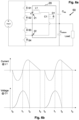
- Fig. 1a schematically shows a circuit of a DC/DC converter 10 operating in a booster mode (Booster I).
- An input of the DC/DC converter 10 is connected to a DC voltage source "Input”, with a plus terminal and a minus terminal of the DC voltage source Input.
- An output of the DC/DC converter 10 is connected to a DC output "Load”.
- the minus terminal of the DC voltage source Input is connected to the minus terminal of the output Load.
- the DC/DC converter 10 comprises a sub-circuit 20.
- the sub-circuit 20 comprises an inductance L1 and a capacitance C1, L1 and C1 arranged in series.
- the sub-circuit 20 further comprises a diode D1, arranged in parallel to the capacitance C1.
- the diode D1 is arranged in a way that it blocks during loading the capacitance C1. "Blocking during loading the capacitance" means that in the loading phase - i.e.
- the switches of the DC/DC converter realize a (direct or indirect) connection between a DC voltage source, which functions as an input of the DC/DC converter, and the diode - then the diode's anode is (directly or indirectly) connected to the minus terminal of the DC voltage source and the diode's cathode is (directly or indirectly) connected to the plus terminal of the DC voltage source.
- the DC/DC converter 10 further comprises four switches S1 - S4.
- a first switch S1 is arranged between the plus terminal of the output Load of the DC/DC converter 10 and the first end 21 of the sub-circuit 20.
- a second switch S2 is arranged between the plus terminal of the DC voltage source Input and the first end 21 of the sub-circuit 20.
- a third switch S3 is arranged between the plus terminal of the DC voltage source Input and the second end 22 of the sub-circuit 20.
- a fourth switch S4 is arranged between the minus terminal of the DC voltage source Input and/or the minus terminal of an output Load and the second end 22 of the sub-circuit 20,
- a first output capacitance C top and a second output capacitance C bottom is arranged.
- the first output capacitance C top is connected in parallel to the first switch S1 and the second switch S2.
- the second output capacitance C bottom is connected in parallel to the third switch S3 and the fourth switch S4.
- the DC/DC converter 10 of Fig. 1a is operated in a booster mode (Booster I), using following operating scheme:
- This operation mode leads to the current curve at L1 and the voltage curve at C1, depicted as "Current @ L1" or "Voltage @ C1", respectively, in Fig. 1b .
- all switches S1 - S4 are open.
- switches S2 and S4 are closed. This leads to a loading of the capacitance C1, i.e. to an increasing of Voltage @ C1.
- This increasing of the voltage leads, in a first sub-phase, to an increasing of Current @ L1 and then, in a second sub-phase, to a decreasing of Current @ L1, because the energy of L1 is added to the energy from DC voltage source Input.
- switches S2 and S4 are opened and switches S1 and S3 are closed, thus discharging C1, and resulting in a higher voltage (voltage of DC voltage source Input plus Voltage @ C1) at Load.
- Voltage @ C1 decreases until t 2 , leading firstly to an increasing of Current @ L1 and, then, to an unloading of the energy of L1.
- the energy of L1 is unloaded via diode D1.
- switches S1 and S3 are opened. After a small pause (from t 3 to t 0 ), this sequence may be started again.
- Fig. 2a schematically shows a circuit of a DC/DC converter 10 operating in another booster mode (Booster II).
- Booster II another booster mode
- the circuit of this "Booster II” may be almost the same as for "Booster I”; however, the operation mode is different.
- the DC/DC converter 10 of Fig. 2a is operated using following scheme:
- Fig. 3a schematically shows a circuit of a DC/DC converter 10 operating in another booster mode (Booster III).
- Booster III Booster III
- the circuit of this "Booster III” may be almost the same as for “Booster I”, except the additional switch S5, which is arranged in parallel to capacitance C1 (and D1).
- the DC/DC converter 10 of Fig. 3a is operated using following scheme:
- Fig. 4a schematically shows a circuit of a DC/DC converter 10 operating in a buck mode (Buck I).
- An input of the DC/DC converter 10 is connected to a DC voltage source "Input”, with a plus terminal and a minus terminal of the DC voltage source Input.
- An output of the DC/DC converter 10 is connected to a DC output "Load”.
- the minus terminal of the DC voltage source Input is connected to the minus terminal of the output Load.
- the DC/DC converter 10 comprises a sub-circuit 20.
- the sub-circuit 20 of Fig. 4a is the same as in Figs. 1a and 2a .
- the DC/DC converter 10 further comprises four switches S1 - S4.
- a first switch S1 is arranged between the plus terminal of the DC voltage source Input of the DC/DC converter 10 to a first end 21 of the sub-circuit 20.
- a second switch S2 is arranged between a plus terminal of an output Load to the first end 21 of the sub-circuit 20.
- a third switch S3 is arranged between the plus terminal of an output Load to a second end 22 of the sub-circuit 20.
- a fourth switch S4 is arranged between a minus terminal of the DC voltage source Input and/or a minus terminal of an output Load to the second end 22 of the sub-circuit 20.
- an output capacitance C bottom is arranged.
- An output capacitance C top is connected in parallel to the first switch S1 and the second switch S2.
- An output capacitance C bottom is connected in parallel to the third switch S3 and the fourth switch S4.
- the DC/DC converter 10 of Fig. 4a is operated in a buck mode (Buck I), using following operating scheme:
- the switch S4 may always be closed (also in the last step) and, thus, be substituted by a wire (i.e. "always connected"), Furthermore, this DC/DC buck converter does not need the switch S3. Hence, the switch S3 may be removed.
- This operation mode leads to the curves depicted as "Current @ L1" or "Voltage @ C1" in Fig. 4b .
- all switches S1 - S4 are open.
- switches S1 and S4 are closed. This leads to a loading of the capacitance C1, i.e. to an increasing of Voltage @ C1.
- This increasing of the voltage leads, in a first sub-phase, to an increasing of Current @ L1 and then, in a second sub-phase, to a decreasing of Current @ L1, because the energy of L1 is added to the energy from DC voltage source Input.
- switches S1 and S4 are opened, and switch S2 is closed, and S4 is kept closed, thus discharging C1, and resulting in a higher voltage at Load.
- Voltage @ C1 decreases until t 2 , leading firstly to an increasing of Current @ L1 and, then, to an unloading of the energy of L1.
- the energy of L1 is unloaded via diode D1.
- switches S2 and S4 are opened (if S4 is not substituted by a piece of wire). After a small pause (from t 3 to to), this sequence may be started again.
- Fig. 5a schematically shows a circuit of a DC/DC converter 10 operating in another buck mode (Buck II). Same reference signs as in Fig. 4a refer to same or similar components. The circuit of this "Buck II" may be almost the same as for "Buck I"; however, the operation mode is different.
- the DC/DC converter 10 of Fig. 5a is operated using following scheme:
- Fig. 6a schematically shows a circuit of a DC/DC converter 10 operating in another buck mode (Buck III). Same reference signs as in Figs. 4a and 5a refer to same or similar components. The circuit of this "Buck III" may be almost the same as for "Buck I & II"; however, the operation mode is different.
- the DC/DC converter 10 of Fig. 6a is operated using following scheme:
- This operation mode leads to the curves depicted as "Current @ L1" or "Voltage @ C1" in Fig. 6b .
- all switches S1 - S4 are open.
- switches S2 and S4 are closed. This leads to a loading of the capacitance C1, i.e. to an increasing of Voltage @ C1.
- This increasing of the voltage leads, in a first sub-phase, to an increasing of Current @ L1 and then, in a second sub-phase, to a decreasing of Current @ L1, because the energy of L1 is added to the energy from DC voltage source Input.
- switches S1 and S3 are opened and switches S2 and S4 are closed, thus discharging C1, and resulting in a higher voltage (voltage of DC voltage source Input plus Voltage @ C1) at Load.
- Voltage @ C1 decreases until t 2 , leading firstly to an increasing of Current @ L1 and, then, to an unloading of the energy of L1.
- the energy of L1 is unloaded via diode D1.
- switches S2 and S4 are opened. After a small pause (from t 3 to to), this sequence may be started again.
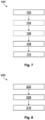
- Fig. 7 shows a flow diagram 100 according to some embodiments or aspects.
- a capacitance C1 (see, e.g., Fig. 1 ) is loaded, by connecting a first end 21 of the sub-circuit 20 to a plus terminal of a DC voltage source Input and a second end 22 of the sub-circuit 20 to a minus terminal of the DC voltage source Input.
- the first end 21 of the sub circuit 20 is connected to the plus terminal of the output Load of the DC/DC converter 10 and the second end 22 of the sub-circuit 20 to the minus terminal of the output Load of the DC/DC converter 10.
- step 106 the first end 21 and the second end 22 of the sub-circuit 20 are disconnected.
- step 108 the first end 21 of the sub-circuit 20 to a plus terminal of an output Load of the DC/DC converter 10 is connected and the second end 22 of the sub circuit 20 to the plus terminal of a DC voltage source Input.
- step 110 the first end 21 and the second end 22 of the sub-circuit 20 are disconnected.
- Fig. 8 shows a flow diagram 300 according to some embodiments or aspects.
- capacitance C1 is loaded, by connecting a first end 21 of the sub-circuit 20 to a plus terminal of a DC voltage source Input and a second end 22 of the sub-circuit 20 to a minus terminal of the DC voltage source Input.
- the first end 21 of the sub-circuit 20 is connected to a plus terminal of an output Load of the DC/DC converter 10.
- the first end 21 and the second end 22 of the sub-circuit 20 is disconnected.
- Fig. 9 shows a flow diagram 300 according to some embodiments or aspects.
- capacitance C1 is loaded, by connecting a first end 21 of the sub-circuit 20 to a plus terminal of a DC voltage source Input and a second end 22 of the sub-circuit 20 to a plus terminal of an output Load.
- a step 206 the first end 21 and the second end 22 of the sub-circuit 20 is disconnected.
- the first end 21 of the sub-circuit 20 is connected to the plus terminal of the DC voltage source Input and the second end 22 of the sub-circuit 20 to a minus terminal of an output Load.
- a first end 21 of the sub-circuit 20 is connected to the plus terminal of a DC voltage source Input.
- the first end 21 and the second end 22 of the sub-circuit 20 is disconnected.
- Fig. 10 shows a flow diagram 300 according to some embodiments or aspects.
- capacitance C1 is loaded, by connecting a first end 21 of the sub-circuit 20 to a plus terminal of a DC voltage source Input and a second end 22 of the sub-circuit 20 to a plus terminal of an output Load.
- the first end 21 of the sub-circuit 20 is connected to the plus terminal of the DC voltage source Input and the second end 22 of the sub-circuit 20 to a minus terminal of an output Load.
- the first end 21 and the second end 22 of the sub-circuit 20 is disconnected.
- the plus terminal of the DC voltage source (Input) is connected to a node between S2 and S3, i.e. between the second and the third switch, and the minus terminal of the DC voltage source (Input) has a "ground” functionality.
- the circuits described in here work in an analogous way, when the plus and minus terminals are permuted, and the switches and diodes are permuted in an analogous way.
Landscapes
- Engineering & Computer Science (AREA)
- Power Engineering (AREA)
- Dc-Dc Converters (AREA)
Abstract
connecting the first end (21) of the sub-circuit (20) to a plus terminal of an output (Load) of the DC/DC converter (10) and the second end (22) of the sub circuit (20) to the plus terminal of a DC voltage source (Input); and
disconnecting the first end (21) and the second end (22) of the sub-circuit (20).
Description
- The invention relates to the field of DC/DC converter, particularly based on charge pump principle. The invention further relates to a method for operating a DC/DC converter, to a DC/DC converter, to a use of a DC/DC converter, to a program element, and to a computer-readable storage medium.
- Charge pumps are basically capable of having benefits in terms of power density, e.g. compared to at least some other types DC-DC converters. Hence, it would be desirable to provide an enhanced DC/DC converter, based on charge pump principle, which is capable of delivering high power and which can be run either in buck mode or in booster mode.
- It is an objective of the invention to provide an enhanced DC/DC converter, based on charge pump principle. This objective is achieved by the subject-matter of the independent claims. Further embodiments are evident from the dependent claims and the following description.
- One aspect relates to a method for operating a DC/DC converter in a booster mode, the DC/DC converter comprising a sub-circuit with an inductance and a capacitance in series and a diode in parallel to the capacitance, the diode blocking during loading the capacitance. The method comprises the steps of:
- loading the capacitance, by connecting a first end of the sub-circuit to a plus terminal of a DC voltage source and a second end of the sub-circuit to a minus terminal of the DC voltage source;
- connecting the first end of the sub-circuit to a plus terminal of an output of the DC/DC converter and the second end of the sub-circuit to the plus terminal of a DC voltage source; and
- disconnecting the first end and the second end of the sub-circuit.
- The operating principle of several embodiments of this DC/DC converter is based on the same idea; however, the embodiments are optimized for specialized applications, particularly for defined conversion ratios. For a broader applicability, the embodiments may be mixed, e.g. cascaded.
- All embodiments of the DC/DC converter include a distinct sub-circuit, which comprises an inductance and a capacitance in series. Additionally, the sub-circuit comprises a diode in parallel to the capacitance, the diode blocking during loading the capacitance. "Blocking during loading the capacitance" means that in the loading phase - i.e. when the switches of the DC/DC converter realize a (direct or indirect) connection between a DC voltage source, which functions as an input of the DC/DC converter, and the diode - then the diode's anode is (directly or indirectly) connected to the minus terminal of the DC voltage source and the diode's cathode is (directly or indirectly) connected to the plus terminal of the DC voltage source.
- The method starts (and ends) with a state where the sub-circuit are disconnected. The connecting (and disconnecting) may be realized by means of a switch, e.g., by a MOSFET, an IGBT (Insulated-Gate Bipolar Transistor), a thyristor (SCR), a silicon carbide (SiC), and/or a gallium nitride (GaN) based semiconductor. Generally, for this method, when the first switch is connected, it was made sure that the second switch has been disconnected before, and vice versa. Analogously, when the third switch is connected, it was made sure that the fourth switch has been disconnected before, and vice versa.
- In a starting step, the capacitance is loaded, by connecting a first end of the sub-circuit to a plus terminal of a DC voltage source, and a second end of the sub-circuit to a minus terminal of the DC voltage source. Then, the first end of the sub-circuit is connected to a plus terminal of an output of the DC/DC converter and the second end of the sub-circuit to the plus terminal of a DC voltage source. (Before this step - as mentioned above -, the first end of the sub-circuit is disconnected from the plus terminal of the DC voltage source, and the second end of the sub-circuit is disconnected from the minus terminal of the DC voltage source). The utilization of the diode of the sub-circuit allows a complete discharge of the sub-circuit's capacitor (and inductor). As a last step, the first end and the second end of the sub-circuit are disconnected.
- This method leads to several advantages, compared to other methods, principles and/or implementations for operating a DC/DC converter. One advantage is its simplicity, thus resulting in a quite simple realization of the control module, e.g. there is no need of a powerful control hardware; instead, a simple, robust and less costly microcontroller, FPGA and/or other hardware or firmware may be used. Also, the utilization of a capacitor as storage element has advantages - for at least some embodiments significant advantages - in terms of power density, and/or components may be dimensioned smaller, thus leading to benefits in terms of size and costs of the DC/DC converter. Using the capacitor as storage element eliminates a risk of severe overcurrent, because the current is limited by the capacitor. Furthermore, soft switching can be realized, leading to less stress of at least some of the electronic components, which may contribute to higher reliability and/or availability of the DC/DC converter system. Besides, switching losses may be reduced. A risk of overvoltage is reduced due to Zero Current Switching (i.e. voltage transients in electrical systems, due to optimized utilization of the full potential of the semiconductor switch). The method further has a low risk of oscillations and/or instabilities. For realizing the method, no means or devices for current measurement are needed. As a further benefit, the method provides a base for adjusting the output voltage; this may be controlled by a variation of the operating frequency, i.e. the frequency the switched are controlled. The method may particularly be advantageous for a high power DC/DC converter and/or for a DC/DC converter with adjustable output voltage.
- In various embodiments, the method further comprising the steps of: After loading the capacitance, connecting the first end of the sub-circuit to the plus terminal of the output of the DC/DC converter and the second end of the sub-circuit to the minus terminal of the output of the DC/DC converter; and disconnecting the first end and the second end of the sub-circuit. This operation strategy advantageously allows to minimize the stress on the diode of the sub-circuit. Furthermore, this guarantees that each transition terminates "by itself".
- In various embodiments, the sub-circuit further comprises a switch in parallel to the capacitance, and the method further comprises the steps of: Before loading the capacitance, short-circuiting the capacitance by closing the switch; and opening the switch afterwards; and, before disconnecting the first end and the second end of the sub-circuit, closing the switch; and opening the switch afterwards.
- One aspect relates to a method for operating a DC/DC converter in a buck mode of a first kind. For this method, the same sub-circuit may be used as for the method that operates a DC/DC converter in a booster mode (see above). The method starts (and ends) with a state where the sub-circuit are disconnected.
- In a starting step, the capacitance is loaded, by connecting a first end of the sub-circuit to a plus terminal of a DC voltage source and a second end of the sub-circuit to a minus terminal of the DC voltage source. Then, the first end of the sub-circuit is connected to a plus terminal of an output of the DC/DC converter. As a last step, the first end and, optionally, the second end of the sub-circuit are disconnected. This DC/DC converter may advantageously be used for a conversion ratio from 1 to 0.
- This DC/DC buck converter of a first kind does not need the third switch. Hence, the third switch may be removed. Furthermore, the fourth switch is always closed, except in the last step, where the sub-circuit are disconnected. So, in an embodiment, the fourth switch may be substituted by a wire (i.e. "always connected"), wherein in the last step only the first and the second switches are open or disconnected and the (shortened) "fourth switch" keeps "closed" or connected.
- One aspect relates to a method for operating a DC/DC converter in a buck mode of a second kind. For this method, the same sub-circuit may be used as for the method that operates a DC/DC converter in a booster mode (see above). The method starts (and ends) with a state where the sub-circuit are disconnected.
- In a starting step, the capacitance is loaded, by connecting a first end of the sub-circuit to a plus terminal of a DC voltage source and a second end of the sub-circuit to a plus terminal of an output. Then, the first end and the second end of the sub-circuit are disconnected for a predefined time period. After this, the first end of the sub-circuit is connected to the plus terminal of the DC voltage source and the second end of the sub-circuit to a minus terminal of an output. As a next step, a first end of the sub-circuit is connected to the plus terminal of an output. As a last step, the first end and the second end of the sub-circuit are disconnected. This DC/DC converter may advantageously be used for a conversion ratio from 1 to 0.5.
- One aspect relates to a method for operating a DC/DC converter in a buck mode of a third kind. For this method, the same sub-circuit may be used as for the method that operates a DC/DC converter in a booster mode (see above). The method starts (and ends) with a state where the sub-circuit are disconnected.
- In a starting step, the capacitance is loaded, by connecting a first end of the sub-circuit to a plus terminal of a DC voltage source and a second end of the sub-circuit to a plus terminal of an output. Then, the first end of the sub-circuit is connected to the plus terminal of an output and the second end of the sub-circuit to a minus terminal of the output. As a last step, the first end and the second end of the sub-circuit are disconnected. This DC/DC converter may advantageously be used for a conversion ratio from 0.5 to 0.
- One aspect relates to a booster DC/DC converter. The DC/DC converter comprises a sub-circuit with an inductance and a capacitance in series and a diode in parallel to the capacitance, the diode blocking during loading the capacitance; a first switch, arranged between a plus terminal of an output of the DC/DC converter to a first end of the sub-circuit; a second switch, arranged between a plus terminal of the DC voltage source to the first end of the sub-circuit; a third switch, arranged between the plus terminal of the DC voltage source to a second end of the sub-circuit; and a fourth switch, arranged between a minus terminal of the DC voltage source and/or a minus terminal of an output to the second end of the sub-circuit, wherein the booster DC/DC converter is configured for executing the method as described above and/or below.
- One aspect relates to a buck DC/DC converter. The DC/DC converter comprises a sub-circuit with an inductance and a capacitance in series and a diode in parallel to the capacitance, the diode blocking during loading the capacitance; a first switch, arranged between a plus terminal of the DC voltage source of the DC/DC converter to a first end of the sub-circuit; a second switch, arranged between a plus terminal of an output to the first end of the sub-circuit; a third switch, arranged between the plus terminal of an output to a second end of the sub-circuit; and a fourth switch, arranged between a minus terminal of the DC voltage source and/or a minus terminal of an output to the second end of the sub-circuit, wherein the buck DC/DC converter is configured for executing the method as described above and/or below.
- In various embodiments, the DC/DC converter is designed for a DC voltage source with a voltage between 100 V and 1500 V, particularly between 200 V and 800 V. The voltage range of the converter may vary from a few Volts (say: 5 V) to more than 3000 V, which corresponds to double the voltage of commercially available IGBTs. Hence, the DC/DC converter can be used for a broad range of DC voltage sources, both for small and middle-range devices, but also for high-power converters, including, e.g., converters for charging electric vehicles, and/or for an uninterruptible power supply (UPS).
- In various embodiments, the DC/DC converter is designed for a high frequency operation, particularly the DC/DC converter is operated at a frequency between 10 kHz and 100 kHz, particularly between 50 kHz and 80 kHz. Particularly, the output voltage is a function of the operating frequency. As rule of thumb, the higher the frequency, the higher is the conversion ratio of the DC/DC converter and/or the power transferred by the DC/DC converter. This advantageously makes the DC/DC converter adjustable, contrary to most other DC/DC converters that are based on charge pump principle. For instance, a resonance frequency of the LC sub-circuit may be selected slightly higher than the maximum operational frequency of the control logic in order to guarantee a deadtime. For example, for a 50 kHz switching operation, a resonance frequency of 55 kHz could be a useful choice. The transferred power may be proportional to the operating frequency, so that a highest frequency is used for running the converters at full load. At no load, the operating frequency may be close to zero. An increase of the number of pulses (frequency) involves a larger power flow to the output, which causes an increase of the output voltage. At full converter power, the deadtime between two pulse sequences (e.g. between t3 and t0 in
Fig. 4b ) is very small. In some embodiments, it could even be less than 1us. At very low load, this deadtime may be higher than 1 ms. For example, a 50 kW 360V to 700V converter may be realized with a 4 uF capacitor and a 1.5 µH inductor operating at a maximum frequency of 50 kHz (which is smaller compared to the resonance of the two passive components). At half load the operating frequency would be 25kHz. - Furthermore, to reduce the size of the passive components, it may be advantageous to increase the maximum operating frequency. Example values may vary from 10 kHz, using IGBTs, to 500 kHz, if using SiC or GaN MOSFETS as switches.
- In various embodiments, the capacitance of the sub-circuit has a value between 1 µF and 10 µF, particularly of 4 µF. This dimensioning may contribute to reduce the manufacturing costs for the DC/DC converter. As a rule of thumb, the capacitance is proportional to the power and inversely proportional to the operating frequency.
- In various embodiments, the inductance has a value between 0.1 µH and 2.0 µH, particularly between 0.35 µH and 1.5 µH. This dimensioning may contribute to reduce both the size and the manufacturing costs for the DC/DC converter. Thus, the energy E stored in inductive element of this DC/DC converter is only about E = P / f · 8, whereas, e.g., a classical inductance-based booster, the energy E stored in inductive element is about E = P / f · 2.
- Reducing the capacity of the sub-circuit's capacitance may contribute to optimize an efficiency of the DC/DC converter at low load. This may be realized by arranging two or more sub-circuits (and/or the sub-circuit's capacitances) in parallel, each one of the sub-circuits (and/or the sub-circuit's capacitances) switchable by an additional switch, which is able to connect or remove each one of the sub-circuits (and/or the sub-circuit's capacitances). To maintain the same resonance frequency each additional capacitor may also comprise a dedicated inductor. A smaller capacitor bank may involve smaller currents by means of the switches and, consequently, a conduction loss reduction. In various embodiments, the DC/DC converter comprises a first output capacitance, connected in parallel to the first switch and the second switch, and a second output capacitance, connected in parallel to the third switch and the fourth switch. These capacitances may contribute to further reducing a ripple voltage of the output.
- In various embodiments, the first switch, the second switch, the third switch and/or the fourth switch are implemented as a MOSFET, an IGBT, a thyristor (SCR), a silicon carbide (SiC), and/or a gallium nitride (GaN) based semiconductor. These components may contribute to realize a DC/DC converter that is designed for a high frequency operation, thus reducing, e.g., the dimensions of the capacitance and/or the inductance, which may further lead to reducing the size of the DC/DC converter.
- In some embodiments, the DC/DC converter comprises a second sub-circuit, which may have the same structure as the (first) sub-circuit and may be further comprise a switch to activate this second sub-circuit. This may be an optimization for a low load operation of the DC/DC converter. This may create a voltage ratio in the boosting operation that is not limited to a factor of two. The maximum voltage ratio may be about a factor of 2 to 20, particularly of about 2 to 10.
- An aspect relates to a use of a DC/DC converter as described above and/or below for providing an adjustable output voltage. The DC/DC converter may be operable for delivering high power; for instance, with currently available standard-switches, the DC/DC converter may be designed for a power conversion up to 100 kW. Of course, several DC/DC converter may be run in parallel and/or be cascaded, depending on requirements of the converter that is to be delivered.
- An aspect relates to a use of a DC/DC converter as described above and/or below as a bidirectional battery booster, particularly for charging electric vehicles, and/or for an uninterruptible power supply (UPS).
- An aspect relates to a program element for executing the method as described above and/or below, when running the program element on a control device that is configured for controlling a DC/DC converter as described above and/or below, particularly for controlling controllable switches of the DC/DC converter.
- An aspect relates to a computer-readable storage medium where a computer program or a computer program product as described above is stored on.
- For further clarification, the invention is described by means of embodiments shown in the figures. These embodiments are to be considered as examples only, but not as limiting.
- The drawings depict:
- Figs. 1a - 6a
- schematically a circuit of a DC/DC converter according to an embodiment;
- Figs. 1b - 6b
- schematically a resulting current curve and a voltage curve of a DC/DC converter according to an embodiment;
- Figs. 7 - 10
- flow diagrams according to some embodiments or aspects.
-
Fig. 1a schematically shows a circuit of a DC/DC converter 10 operating in a booster mode (Booster I). An input of the DC/DC converter 10 is connected to a DC voltage source "Input", with a plus terminal and a minus terminal of the DC voltage source Input. An output of the DC/DC converter 10 is connected to a DC output "Load". The minus terminal of the DC voltage source Input is connected to the minus terminal of the output Load. - The DC/
DC converter 10 comprises a sub-circuit 20. The sub-circuit 20 comprises an inductance L1 and a capacitance C1, L1 and C1 arranged in series. The sub-circuit 20 further comprises a diode D1, arranged in parallel to the capacitance C1. The diode D1 is arranged in a way that it blocks during loading the capacitance C1. "Blocking during loading the capacitance" means that in the loading phase - i.e. when the switches of the DC/DC converter realize a (direct or indirect) connection between a DC voltage source, which functions as an input of the DC/DC converter, and the diode - then the diode's anode is (directly or indirectly) connected to the minus terminal of the DC voltage source and the diode's cathode is (directly or indirectly) connected to the plus terminal of the DC voltage source. - The DC/
DC converter 10 further comprises four switches S1 - S4. A first switch S1 is arranged between the plus terminal of the output Load of the DC/DC converter 10 and thefirst end 21 of the sub-circuit 20. A second switch S2 is arranged between the plus terminal of the DC voltage source Input and thefirst end 21 of the sub-circuit 20. A third switch S3 is arranged between the plus terminal of the DC voltage source Input and thesecond end 22 of the sub-circuit 20. A fourth switch S4 is arranged between the minus terminal of the DC voltage source Input and/or the minus terminal of an output Load and thesecond end 22 of the sub-circuit 20, - Parallel to the DC output Load, a first output capacitance Ctop and a second output capacitance Cbottom is arranged. The first output capacitance Ctop is connected in parallel to the first switch S1 and the second switch S2. The second output capacitance Cbottom is connected in parallel to the third switch S3 and the fourth switch S4.
- The DC/
DC converter 10 ofFig. 1a is operated in a booster mode (Booster I), using following operating scheme: - Loading the capacitance C1, by connecting a
first end 21 of the sub-circuit 20 to a plus terminal of a DC voltage source Input, by closing switch S2, and connecting asecond end 22 of the sub-circuit 20 to a minus terminal of the DC voltage source Input, by closing switch S4. - Opening switches S2 and S4.
- Connecting the
first end 21 of the sub-circuit 20 to a plus terminal of an output Load of the DC/DC converter 10, by closing switch S1, and thesecond end 22 of thesub circuit 20 to the plus terminal of a DC voltage source Input, by closing switch S3. - Disconnecting the
first end 21 and thesecond end 22 of the sub-circuit 20, by opening switches S1 and S3. - This operation mode leads to the current curve at L1 and the voltage curve at C1, depicted as "Current @ L1" or "Voltage @ C1", respectively, in
Fig. 1b . Before a time t0, all switches S1 - S4 are open. At t0, switches S2 and S4 are closed. This leads to a loading of the capacitance C1, i.e. to an increasing of Voltage @ C1. This increasing of the voltage leads, in a first sub-phase, to an increasing of Current @ L1 and then, in a second sub-phase, to a decreasing of Current @ L1, because the energy of L1 is added to the energy from DC voltage source Input. At t1, switches S2 and S4 are opened and switches S1 and S3 are closed, thus discharging C1, and resulting in a higher voltage (voltage of DC voltage source Input plus Voltage @ C1) at Load. Hence, Voltage @ C1 decreases until t2, leading firstly to an increasing of Current @ L1 and, then, to an unloading of the energy of L1. Between t2 and t3, the energy of L1 is unloaded via diode D1. At t3, switches S1 and S3 are opened. After a small pause (from t3 to t0), this sequence may be started again. -
Fig. 2a schematically shows a circuit of a DC/DC converter 10 operating in another booster mode (Booster II). Same reference signs as inFig. 1a refer to same or similar components. The circuit of this "Booster II" may be almost the same as for "Booster I"; however, the operation mode is different. The DC/DC converter 10 ofFig. 2a is operated using following scheme: - Loading the capacitance C1, by connecting a
first end 21 of the sub-circuit 20 to a plus terminal of a DC voltage source Input, by closing switch S2, and connecting asecond end 22 of the sub-circuit 20 to a minus terminal of the DC voltage source Input, by closing switch S4. - Opening switch S2 (and keeping S4 closed).
- Connecting the
first end 21 of thesub circuit 20 to the plus terminal of the output Load of the DC/DC converter 10, by closing switch S1. Thesecond end 22 of the sub-circuit 20 keeps connected to the minus terminal of the output Load of the DC/DC converter 10. - Disconnecting the
first end 21 and thesecond end 22 of the sub-circuit 20, by opening switches S1 and S4, or in some embodiments only switch S4. - Connecting the
first end 21 of the sub-circuit 20 to a plus terminal of an output Load of the DC/DC converter 10, by closing switch S1, and thesecond end 22 of thesub circuit 20 to the plus terminal of a DC voltage source Input, by closing switch S3. - Disconnecting the
first end 21 and thesecond end 22 of the sub-circuit 20, by opening switches S1 and S3. - This operation mode leads to the current curve at L1 and the voltage curve at C1 are depicted in
Fig. 2b . Before a time t0, all switches S1 - S4 are open. For period to to t1 seeFig. 1b and the related description. At t1 (voltage peak of Voltage @ C1), switch S2 is opened and switch S1 is closed. Thus, the current peak of Current @ L1 between t1 and t2 is significantly smaller than the current peak between t1 and t2 ofFig. 1b . This significantly reduces the stress on diode D1. At t3, switch S3 is opened and the rest of C1 is discharged until T4. After a small pause (from t4 to to), this sequence may be started again. -
Fig. 3a schematically shows a circuit of a DC/DC converter 10 operating in another booster mode (Booster III). Same reference signs as inFig. 1a refer to same or similar components. The circuit of this "Booster III" may be almost the same as for "Booster I", except the additional switch S5, which is arranged in parallel to capacitance C1 (and D1). The DC/DC converter 10 ofFig. 3a is operated using following scheme: - Short-circuiting the capacitance C1, by closing the switch S5.
- Opening the switch S5.
- Loading the capacitance C1, by connecting a
first end 21 of the sub-circuit 20 to a plus terminal of a DC voltage source Input, by closing switch S2, and connecting asecond end 22 of the sub-circuit 20 to a minus terminal of the DC voltage source Input, by closing switch S4. - Opening switches S2 and S4.
- Connecting the
first end 21 of the sub-circuit 20 to a plus terminal of an output Load of the DC/DC converter 10, by closing switch S1, and thesecond end 22 of thesub circuit 20 to the plus terminal of a DC voltage source Input, by closing switch S3. - Short-circuiting the capacitance C1, by closing the switch S5. Alternatively, the current may flow via diode D1.
- Opening the switch S5 (in case it has been opened in the step before).
- Disconnecting the
first end 21 and thesecond end 22 of the sub-circuit 20, by opening switches S1 and S3. -
Fig. 4a schematically shows a circuit of a DC/DC converter 10 operating in a buck mode (Buck I). Same reference signs as inFigs. 1a and2a refer to same or similar components. An input of the DC/DC converter 10 is connected to a DC voltage source "Input", with a plus terminal and a minus terminal of the DC voltage source Input. An output of the DC/DC converter 10 is connected to a DC output "Load".
The minus terminal of the DC voltage source Input is connected to the minus terminal of the output Load. - The DC/
DC converter 10 comprises a sub-circuit 20. The sub-circuit 20 ofFig. 4a is the same as inFigs. 1a and2a . - The DC/
DC converter 10 further comprises four switches S1 - S4. A first switch S1 is arranged between the plus terminal of the DC voltage source Input of the DC/DC converter 10 to afirst end 21 of the sub-circuit 20. A second switch S2 is arranged between a plus terminal of an output Load to thefirst end 21 of the sub-circuit 20. A third switch S3 is arranged between the plus terminal of an output Load to asecond end 22 of the sub-circuit 20. A fourth switch S4 is arranged between a minus terminal of the DC voltage source Input and/or a minus terminal of an output Load to thesecond end 22 of the sub-circuit 20. - Parallel to the DC output Load, an output capacitance Cbottom is arranged. An output capacitance Ctop is connected in parallel to the first switch S1 and the second switch S2. An output capacitance Cbottom is connected in parallel to the third switch S3 and the fourth switch S4.
- The DC/
DC converter 10 ofFig. 4a is operated in a buck mode (Buck I), using following operating scheme: - Loading the capacitance C1, by connecting a
first end 21 of the sub-circuit 20 to a plus terminal of a DC voltage source Input, by closing switch S1, and asecond end 22 of the sub-circuit 20 to a minus terminal of the DC voltage source Input, by closing switch S4. - Opening switch S1 (and keeping S4 closed).
- Connecting the
first end 21 of the sub-circuit 20 to a plus terminal of an output Load of the DC/DC converter 10, by closing switch S2. - Disconnecting the
first end 21 and thesecond end 22 of the sub-circuit 20, by opening switches S2 and S4. - In an embodiment, the switch S4 may always be closed (also in the last step) and, thus, be substituted by a wire (i.e. "always connected"), Furthermore, this DC/DC buck converter does not need the switch S3. Hence, the switch S3 may be removed.
- This operation mode leads to the curves depicted as "Current @ L1" or "Voltage @ C1" in
Fig. 4b . Before a time t0, all switches S1 - S4 are open. At t0, switches S1 and S4 are closed. This leads to a loading of the capacitance C1, i.e. to an increasing of Voltage @ C1. This increasing of the voltage leads, in a first sub-phase, to an increasing of Current @ L1 and then, in a second sub-phase, to a decreasing of Current @ L1, because the energy of L1 is added to the energy from DC voltage source Input. At t1, switches S1 and S4 are opened, and switch S2 is closed, and S4 is kept closed, thus discharging C1, and resulting in a higher voltage at Load. Hence, Voltage @ C1 decreases until t2, leading firstly to an increasing of Current @ L1 and, then, to an unloading of the energy of L1. Between t2 and t3, the energy of L1 is unloaded via diode D1. At t3, switches S2 and S4 are opened (if S4 is not substituted by a piece of wire). After a small pause (from t3 to to), this sequence may be started again. -
Fig. 5a schematically shows a circuit of a DC/DC converter 10 operating in another buck mode (Buck II). Same reference signs as inFig. 4a refer to same or similar components. The circuit of this "Buck II" may be almost the same as for "Buck I"; however, the operation mode is different. The DC/DC converter 10 ofFig. 5a is operated using following scheme: - Loading the capacitance C1, by connecting a
first end 21 of the sub-circuit 20 to a plus terminal of a DC voltage source Input, by closing switch S1, and asecond end 22 of the sub-circuit 20 to a plus terminal of an output Load, by closing switch S3. - Disconnecting the
first end 21 and thesecond end 22 of the sub-circuit 20, by opening switches S1 and S3. - Connecting the
first end 21 of the sub-circuit 20 to the plus terminal of the DC voltage source Input, by closing switch S1, and thesecond end 22 of the sub-circuit 20 to a minus terminal of an output Load, by closing switch S4. - Opening switch S1.
- Connecting a
first end 21 of the sub-circuit 20 to the plus terminal of an output Load, by closing switch S2. - Disconnecting the
first end 21 and thesecond end 22 of the sub-circuit 20, by opening switches S2 and S4. - This operation mode leads to the curves depicted as "Current @ L1" or "Voltage @ C1" in
Fig. 5b . Before a time t0, all switches S1 - S4 are open. At t0, switches S1 and S3 are closed. This leads to a loading of the capacitance C1, i.e. to an increasing of Voltage @ C1, until t1. Opening switches S1 and S3 at t1 leads to increasing Current @ L1, until t2, where switches S1 and S4 are closed. At t2, loading capacitance C1 is continued until t3. Also increasing Current @ L1. At t3, S1 is closed and S2 is opened, thus discharging C1 until t4. After a small pause (from t4 to t0), this sequence may be started again. -
Fig. 6a schematically shows a circuit of a DC/DC converter 10 operating in another buck mode (Buck III). Same reference signs as inFigs. 4a and5a refer to same or similar components. The circuit of this "Buck III" may be almost the same as for "Buck I & II"; however, the operation mode is different. The DC/DC converter 10 ofFig. 6a is operated using following scheme: - Loading the capacitance C1, by connecting a
first end 21 of the sub-circuit 20 to a plus terminal of a DC voltage source Input, by closing switch S1, and asecond end 22 of the sub-circuit 20 to a plus terminal of an output Load, by closing switch S3. - Opening switches S1 and S3.
- Connecting the
first end 21 of the sub-circuit 20 to the plus terminal of the output Load, by closing switch S2, and thesecond end 22 of the sub-circuit 20 to a minus terminal of an output Load, by closing switch S4. - Disconnecting the
first end 21 and thesecond end 22 of the sub-circuit 20, by opening switches S2 and S4. - This operation mode leads to the curves depicted as "Current @ L1" or "Voltage @ C1" in
Fig. 6b . Before a time t0, all switches S1 - S4 are open. At t0, switches S2 and S4 are closed. This leads to a loading of the capacitance C1, i.e. to an increasing of Voltage @ C1. This increasing of the voltage leads, in a first sub-phase, to an increasing of Current @ L1 and then, in a second sub-phase, to a decreasing of Current @ L1, because the energy of L1 is added to the energy from DC voltage source Input. At t1, switches S1 and S3 are opened and switches S2 and S4 are closed, thus discharging C1, and resulting in a higher voltage (voltage of DC voltage source Input plus Voltage @ C1) at Load. Hence, Voltage @ C1 decreases until t2, leading firstly to an increasing of Current @ L1 and, then, to an unloading of the energy of L1. Between t2 and t3, the energy of L1 is unloaded via diode D1. At t3, switches S2 and S4 are opened. After a small pause (from t3 to to), this sequence may be started again. -
Fig. 7 shows a flow diagram 100 according to some embodiments or aspects. In astep 102, a capacitance C1 (see, e.g.,Fig. 1 ) is loaded, by connecting afirst end 21 of the sub-circuit 20 to a plus terminal of a DC voltage source Input and asecond end 22 of the sub-circuit 20 to a minus terminal of the DC voltage source Input. In anoptional step 104, thefirst end 21 of thesub circuit 20 is connected to the plus terminal of the output Load of the DC/DC converter 10 and thesecond end 22 of the sub-circuit 20 to the minus terminal of the output Load of the DC/DC converter 10. In anoptional step 106, thefirst end 21 and thesecond end 22 of the sub-circuit 20 are disconnected. In astep 108, thefirst end 21 of the sub-circuit 20 to a plus terminal of an output Load of the DC/DC converter 10 is connected and thesecond end 22 of thesub circuit 20 to the plus terminal of a DC voltage source Input. In astep 110, thefirst end 21 and thesecond end 22 of the sub-circuit 20 are disconnected. -
Fig. 8 shows a flow diagram 300 according to some embodiments or aspects. In astep 202, capacitance C1 is loaded, by connecting afirst end 21 of the sub-circuit 20 to a plus terminal of a DC voltage source Input and asecond end 22 of the sub-circuit 20 to a minus terminal of the DC voltage source Input. In astep 208, thefirst end 21 of the sub-circuit 20 is connected to a plus terminal of an output Load of the DC/DC converter 10. In astep 210, thefirst end 21 and thesecond end 22 of the sub-circuit 20 is disconnected. -
Fig. 9 shows a flow diagram 300 according to some embodiments or aspects. In astep 204, capacitance C1 is loaded, by connecting afirst end 21 of the sub-circuit 20 to a plus terminal of a DC voltage source Input and asecond end 22 of the sub-circuit 20 to a plus terminal of an output Load. In astep 206, thefirst end 21 and thesecond end 22 of the sub-circuit 20 is disconnected. In astep 202, thefirst end 21 of the sub-circuit 20 is connected to the plus terminal of the DC voltage source Input and thesecond end 22 of the sub-circuit 20 to a minus terminal of an output Load. In astep 208, afirst end 21 of the sub-circuit 20 is connected to the plus terminal of a DC voltage source Input. In astep 210, thefirst end 21 and thesecond end 22 of the sub-circuit 20 is disconnected. -
Fig. 10 shows a flow diagram 300 according to some embodiments or aspects. In astep 204, capacitance C1 is loaded, by connecting afirst end 21 of the sub-circuit 20 to a plus terminal of a DC voltage source Input and asecond end 22 of the sub-circuit 20 to a plus terminal of an output Load. In astep 208, thefirst end 21 of the sub-circuit 20 is connected to the plus terminal of the DC voltage source Input and thesecond end 22 of the sub-circuit 20 to a minus terminal of an output Load. In astep 210, thefirst end 21 and thesecond end 22 of the sub-circuit 20 is disconnected. - The following table provides a survey of the method steps of realization alternatives of a DC/DC converter as described above and/or below.
Sub-circuit's first end (21) connected to Connecting switch Sub-circuit's second end (22) connected to Connecting switch S5 Booster I Input + S2 Input - / Load - S4 Load + S1 Input + S3 Load + S1 Input + S3 Booster II Input + S2 Input - / Load - S4 Load + S1 Input - / Load - S4 Load + S1 Input + S3 Booster III Input + S2 Input - / Load - S4 S5 Input + S2 Input - / Load - S4 Load + S1 Input + S3 Load + S1 Input + S3 S5 (D1) Buck I Input + S1 Input - / Load - S4 Load + S2 Input - / Load - S4 Load + S2 Input - / Load - S4 - - (S4) Buck II Input + S1 Load + S3 Input + S1 Input - / Load - S4 Load + S2 Input - / Load - S4 Buck III Input + S1 Load + S3 Load + S2 Input - / Load - S4 Load + S2 Input - / Load - S4 - In this table, the plus terminal of the DC voltage source (Input) is connected to a node between S2 and S3, i.e. between the second and the third switch, and the minus terminal of the DC voltage source (Input) has a "ground" functionality. A person skilled in the art knows that the circuits described in here work in an analogous way, when the plus and minus terminals are permuted, and the switches and diodes are permuted in an analogous way.
Claims (16)
- A method for operating a DC/DC converter (10) in a booster mode, the DC/DC converter (10) comprising a sub-circuit (20) with an inductance (L1) and a capacitance (C1) in series and a diode (D1) in parallel to the capacitance (C1), the diode (D1) blocking during loading the capacitance (C1), the method comprising the steps of:loading the capacitance (C1), by connecting a first end (21) of the sub-circuit (20) to a plus terminal of a DC voltage source (Input) and a second end (22) of the sub-circuit (20) to a minus terminal of the DC voltage source (Input);connecting the first end (21) of the sub-circuit (20) to a plus terminal of an output (Load) of the DC/DC converter (10) and the second end (22) of the sub-circuit (20) to the plus terminal of a DC voltage source (Input); anddisconnecting the first end (21) and the second end (22) of the sub-circuit (20).
- The method of claim 1, further comprising the steps of:after loading the capacitance (C1), connecting the first end (21) of the sub-circuit (20) to the plus terminal of the output (Load) of the DC/DC converter (10) and the second end (22) of the sub-circuit (20) to the minus terminal of the output (Load) of the DC/DC converter (10); anddisconnecting the first end (21) and the second end (22) of the sub-circuit (20).
- The method of claim 1, the sub-circuit (20) further comprising a switch (S5) in parallel to the capacitance (C1), the method further comprising the steps of:before loading the capacitance (C1), short-circuiting the capacitance (C1) by closing the switch (S5); and opening the switch (S5) afterwards; andbefore disconnecting the first end (21) and the second end (22) of the sub-circuit (20), closing the switch (S5); and opening the switch (S5) afterwards.
- A method for operating a DC/DC converter (10) in a buck mode, the DC/DC converter (10) comprising a sub-circuit (20) with an inductance (L1) and a capacitance (C1) in series and a diode (D1) in parallel to the capacitance (C1), the diode (D1) blocking during loading the capacitance (C1), the method comprising the steps of:loading the capacitance (C1), by connecting a first end (21) of the sub-circuit (20) to a plus terminal of a DC voltage source (Input) and a second end (22) of the sub-circuit (20) to a minus terminal of the DC voltage source (Input);connecting the first end (21) of the sub-circuit (20) to a plus terminal of an output (Load) of the DC/DC converter (10); anddisconnecting the first end (21) and, optionally, the second end (22) of the sub-circuit (20).
- A method for operating a DC/DC converter (10) in a buck mode, the DC/DC converter (10) comprising a sub-circuit (20) with an inductance (L1) and a capacitance (C1) in series and a diode (D1) in parallel to the capacitance (C1), the diode (D1) blocking during loading the capacitance (C1), the method comprising the steps of:loading the capacitance (C1), by connecting a first end (21) of the sub-circuit (20) to a plus terminal of a DC voltage source (Input) and a second end (22) of the sub-circuit (20) to a plus terminal of an output (Load);disconnecting the first end (21) and the second end (22) of the sub-circuit (20);connecting the first end (21) of the sub-circuit (20) to the plus terminal of the DC voltage source (Input) and the second end (22) of the sub-circuit (20) to a minus terminal of an output (Load);connecting a first end (21) of the sub-circuit (20) to the plus terminal of an output (Load); anddisconnecting the first end (21) and the second end (22) of the sub-circuit (20).
- A method for operating a DC/DC converter (10) in a buck mode, the DC/DC converter (10) comprising a sub-circuit (20) with an inductance (L1) and a capacitance (C1) in series and a diode (D1) in parallel to the capacitance (C1), the diode (D1) blocking during loading the capacitance (C1), the method comprising the steps of:loading the capacitance (C1), by connecting a first end (21) of the sub-circuit (20) to a plus terminal of a DC voltage source (Input) and a second end (22) of the sub-circuit (20) to a plus terminal of an output (Load);connecting the first end (21) of the sub-circuit (20) to the plus terminal of an output (Load) and the second end (22) of the sub-circuit (20) to a minus terminal of an output (Load); anddisconnecting the first end (21) and the second end (22) of the sub-circuit (20).
- A booster DC/DC converter (10), comprising:a sub-circuit (20) with an inductance (L1) and a capacitance (C1) in series and a diode (D1) in parallel to the capacitance (C1), the diode (D1) blocking during loading the capacitance (C1),a first switch (S1), arranged between a plus terminal of an output (Load) of the DC/DC converter (10) to a first end (21) of the sub-circuit (20);a second switch (S2), arranged between a plus terminal of the DC voltage source (Input) to the first end (21) of the sub-circuit (20);a third switch (S3), arranged between the plus terminal of the DC voltage source (Input) to a second end (22) of the sub-circuit (20); anda fourth switch (S4), arranged between a minus terminal of the DC voltage source (Input) and/or a minus terminal of an output (Load) to the second end (22) of the sub-circuit (20),wherein the booster DC/DC converter (10) is configured for executing the method according to claim 1 or 2.
- The booster DC/DC converter (10) of claim 7, wherein the sub-circuit (20) further comprises a switch (S5) in parallel to the capacitance (C1), wherein the buck DC/DC converter (10) is configured for executing the method according to claim 3.
- A buck DC/DC converter (10), comprising:a sub-circuit (20) with an inductance (L1) and a capacitance (C1) in series and a diode (D1) in parallel to the capacitance (C1), the diode (D1) blocking during loading the capacitance (C1),a first switch (S1), arranged between a plus terminal of the DC voltage source (Input) of the DC/DC converter (10) to a first end (21) of the sub-circuit (20);a second switch (S2), arranged between a plus terminal of an output (Load) to the first end (21) of the sub-circuit (20);a third switch (S3), arranged between the plus terminal of an output (Load) to a second end (22) of the sub-circuit (20); anda fourth switch (S4), arranged between a minus terminal of the DC voltage source (Input) and/or a minus terminal of an output (Load) to the second end (22) of the sub-circuit (20),wherein the buck DC/DC converter (10) is configured for executing the method according to claim 4, 5 or 6.
- A buck DC/DC converter (10), comprising:a sub-circuit (20) with an inductance (L1) and a capacitance (C1) in series and a diode (D1) in parallel to the capacitance (C1), the diode (D1) blocking during loading the capacitance (C1),a first switch (S1), arranged between a plus terminal of the DC voltage source (Input) of the DC/DC converter (10) to a first end (21) of the sub-circuit (20);a second switch (S2), arranged between a plus terminal of an output (Load) to the first end (21) of the sub-circuit (20);a connection (S4), arranged between a minus terminal of the DC voltage source (Input) and/or a minus terminal of an output (Load) to the second end (22) of the sub-circuit (20),wherein the buck DC/DC converter (10) is configured for executing the method according to claim 4.
- The DC/DC converter (10) of any one of claim 7 to 10,wherein the DC/DC converter (10) is designed for a DC voltage source (Input) with a voltage between 5 V and 1500 V, particularly between 200 V and 800V, and/orwherein the DC/DC converter (10) is operated at a frequency between 10 kHz and 100 kHz, particularly between 50 kHz and 80 kHz, andwherein the output voltage is a function of the operating frequency.
- The DC/DC converter (10) of any one of claims 7 to 10,further comprising a first output capacitance (Ctop), connected in parallel to the first switch (S1) and the second switch (S2), anda second output capacitance (Cbottom), connected in parallel to the third switch (S3) and the fourth switch (S4).
- The DC/DC converter (10) of any one of claims 7 to 10,
wherein the first switch (S1), the second switch (S2), the third switch (S3), the fourth switch (S4) and/or the fifth switch (S5) are implemented as a MOSFET, an IGBT, a thyristor, a silicon carbide, SiC, and/or a gallium nitride, GaN, semiconductor. - Use of a DC/DC converter (10) according to any one of claims 7 to 10 for providing an adjustable output voltage and/or as a bidirectional battery booster, particularly for charging electric vehicles, and/or for an uninterruptible power supply.
- A program element for executing the method of any one of claims 1 to 6, when running the program element on a control device that is configured for controlling a DC/DC converter (10) according to any one of claims 7 to 10, particularly for controlling controllable switches (S1 - S5) of the DC/DC converter (10).
- A computer-readable storage medium where a computer program according to claim 15 is stored on.
Priority Applications (3)
| Application Number | Priority Date | Filing Date | Title |
|---|---|---|---|
| EP22180345.5A EP4297259A1 (en) | 2022-06-22 | 2022-06-22 | Method for operating a dc/dc converter |
| US18/212,331 US20230421058A1 (en) | 2022-06-22 | 2023-06-21 | Method for Operating a DC/DC Converter |
| CN202310740980.8A CN117277790A (en) | 2022-06-22 | 2023-06-21 | Methods for operating DC/DC converters |
Applications Claiming Priority (1)
| Application Number | Priority Date | Filing Date | Title |
|---|---|---|---|
| EP22180345.5A EP4297259A1 (en) | 2022-06-22 | 2022-06-22 | Method for operating a dc/dc converter |
Publications (1)
| Publication Number | Publication Date |
|---|---|
| EP4297259A1 true EP4297259A1 (en) | 2023-12-27 |
Family
ID=82214367
Family Applications (1)
| Application Number | Title | Priority Date | Filing Date |
|---|---|---|---|
| EP22180345.5A Pending EP4297259A1 (en) | 2022-06-22 | 2022-06-22 | Method for operating a dc/dc converter |
Country Status (3)
| Country | Link |
|---|---|
| US (1) | US20230421058A1 (en) |
| EP (1) | EP4297259A1 (en) |
| CN (1) | CN117277790A (en) |
Families Citing this family (1)
| Publication number | Priority date | Publication date | Assignee | Title |
|---|---|---|---|---|
| US20240128751A1 (en) * | 2022-10-12 | 2024-04-18 | Enphase Energy, Inc. | Extended duration ac battery |
Citations (1)
| Publication number | Priority date | Publication date | Assignee | Title |
|---|---|---|---|---|
| US20220094268A1 (en) * | 2019-01-28 | 2022-03-24 | Spreadtrum Communications (Shanghai) Co., Ltd. | Buck-boost circuit and control method therefor |
Family Cites Families (1)
| Publication number | Priority date | Publication date | Assignee | Title |
|---|---|---|---|---|
| JP6392347B2 (en) * | 2014-06-30 | 2018-09-19 | シャープ株式会社 | Switching circuit and power supply circuit having the same |
-
2022
- 2022-06-22 EP EP22180345.5A patent/EP4297259A1/en active Pending
-
2023
- 2023-06-21 CN CN202310740980.8A patent/CN117277790A/en active Pending
- 2023-06-21 US US18/212,331 patent/US20230421058A1/en active Pending
Patent Citations (1)
| Publication number | Priority date | Publication date | Assignee | Title |
|---|---|---|---|---|
| US20220094268A1 (en) * | 2019-01-28 | 2022-03-24 | Spreadtrum Communications (Shanghai) Co., Ltd. | Buck-boost circuit and control method therefor |
Non-Patent Citations (3)
| Title |
|---|
| PILLONNET GAUL: "Modeling and Efficiency Analysis of Multiphase Resonant-Switched Capacitive Converters", IEEE TRANSACTIONS ON POWER ELECTRONICS, INSTITUTE OF ELECTRICAL AND ELECTRONICS ENGINEERS, USA, vol. 31, no. 1, 1 January 2016 (2016-01-01), pages 11 - 14, XP011669888, ISSN: 0885-8993, [retrieved on 20150921], DOI: 10.1109/TPEL.2015.2453258 * |
| SERRANO DIEGO ET AL: "A method for operating a DC/DC converter in a booster mode", 31 December 2016 (2016-12-31), pages 1 - 5, XP055981093, Retrieved from the Internet <URL:https://oa.upm.es/46425/1/INVE_MEM_2016_251951.pdf> [retrieved on 20221114] * |
| UNO MASATOSHI ET AL: "PWM Switched Capacitor Converter With Switched-Capacitor-Inductor Cell for Adjustable High Step-Down Voltage Conversion", IEEE TRANSACTIONS ON POWER ELECTRONICS, INSTITUTE OF ELECTRICAL AND ELECTRONICS ENGINEERS, USA, vol. 34, no. 1, 1 January 2019 (2019-01-01), pages 425 - 437, XP011697137, ISSN: 0885-8993, [retrieved on 20181127], DOI: 10.1109/TPEL.2018.2822344 * |
Also Published As
| Publication number | Publication date |
|---|---|
| US20230421058A1 (en) | 2023-12-28 |
| CN117277790A (en) | 2023-12-22 |
Similar Documents
| Publication | Publication Date | Title |
|---|---|---|
| EP3618252B1 (en) | Multi-level boost apparatus | |
| US5303140A (en) | Power source circuit | |
| US4855893A (en) | Apparatus for the low-loss wiring of the semiconductor switching elements of a three-level inverter | |
| US8174849B2 (en) | Electric power converter with soft switching for two way power conversion | |
| US20220407412A1 (en) | Inverter circuit and method, for example for use in power factor correction | |
| EP4297259A1 (en) | Method for operating a dc/dc converter | |
| US7307387B2 (en) | Switchable voltage converter | |
| CN101755379B (en) | Circuit arrangement comprising a voltage transformer and associated method | |
| CN111211688A (en) | DC-DC converter and bidirectional DC-DC converter and uninterruptible power supply including the same | |
| US12107503B2 (en) | Multi-stage buck converter | |
| CN113497555B (en) | Switching converter and method | |
| US20250119101A1 (en) | Booster stage circuit for power amplifier | |
| EP3309948A1 (en) | A dc-dc hybrid converter with gallium nitride and silicon transistors | |
| US11728727B2 (en) | Charge pump | |
| JP2021035289A (en) | Snubber circuit and power conversion device | |
| US10523114B1 (en) | Decoupling circuits for converters | |
| Castellanos | Integrated Hybrid Switched Converters: A Review | |
| US10033373B2 (en) | Half bridge having two semiconductor switches for operating a load | |
| JP7547738B2 (en) | Snubber circuit and power conversion device | |
| US20240223095A1 (en) | Self-commutating dc to dc converters with switched connectivity and reconfigurable elements enabling switching | |
| McNeill et al. | Fundamental Comparison of Efficiencies of Voltage Source Converter Phase-Leg Configurations with Super-Junction MOSFETs | |
| EP4537446A1 (en) | Converter circuit | |
| ADL | 1MHz Gate Driver in Power Technology for Fast Switching Applications | |
| JP2003324969A (en) | Zero voltage switching mode DC-DC converter | |
| PL209050B1 (en) | Regenerative system for relieving semiconductor power elements, particularly in modular structures |
Legal Events
| Date | Code | Title | Description |
|---|---|---|---|
| PUAI | Public reference made under article 153(3) epc to a published international application that has entered the european phase |
Free format text: ORIGINAL CODE: 0009012 |
|
| STAA | Information on the status of an ep patent application or granted ep patent |
Free format text: STATUS: THE APPLICATION HAS BEEN PUBLISHED |
|
| AK | Designated contracting states |
Kind code of ref document: A1 Designated state(s): AL AT BE BG CH CY CZ DE DK EE ES FI FR GB GR HR HU IE IS IT LI LT LU LV MC MK MT NL NO PL PT RO RS SE SI SK SM TR |
|
| STAA | Information on the status of an ep patent application or granted ep patent |
Free format text: STATUS: REQUEST FOR EXAMINATION WAS MADE |
|
| 17P | Request for examination filed |
Effective date: 20240620 |
|
| RBV | Designated contracting states (corrected) |
Designated state(s): AL AT BE BG CH CY CZ DE DK EE ES FI FR GB GR HR HU IE IS IT LI LT LU LV MC MK MT NL NO PL PT RO RS SE SI SK SM TR |
|
| STAA | Information on the status of an ep patent application or granted ep patent |
Free format text: STATUS: EXAMINATION IS IN PROGRESS |
|
| 17Q | First examination report despatched |
Effective date: 20251022 |