EP4296925A1 - System and method for detecting oil spill vessel - Google Patents
System and method for detecting oil spill vessel Download PDFInfo
- Publication number
- EP4296925A1 EP4296925A1 EP23179836.4A EP23179836A EP4296925A1 EP 4296925 A1 EP4296925 A1 EP 4296925A1 EP 23179836 A EP23179836 A EP 23179836A EP 4296925 A1 EP4296925 A1 EP 4296925A1
- Authority
- EP
- European Patent Office
- Prior art keywords
- oil
- vessel
- information
- oil slick
- oil spill
- Prior art date
- Legal status (The legal status is an assumption and is not a legal conclusion. Google has not performed a legal analysis and makes no representation as to the accuracy of the status listed.)
- Pending
Links
Images


Classifications
-
- G—PHYSICS
- G06—COMPUTING OR CALCULATING; COUNTING
- G06Q—INFORMATION AND COMMUNICATION TECHNOLOGY [ICT] SPECIALLY ADAPTED FOR ADMINISTRATIVE, COMMERCIAL, FINANCIAL, MANAGERIAL OR SUPERVISORY PURPOSES; SYSTEMS OR METHODS SPECIALLY ADAPTED FOR ADMINISTRATIVE, COMMERCIAL, FINANCIAL, MANAGERIAL OR SUPERVISORY PURPOSES, NOT OTHERWISE PROVIDED FOR
- G06Q10/00—Administration; Management
- G06Q10/08—Logistics, e.g. warehousing, loading or distribution; Inventory or stock management
- G06Q10/083—Shipping
- G06Q10/0833—Tracking
-
- G—PHYSICS
- G01—MEASURING; TESTING
- G01C—MEASURING DISTANCES, LEVELS OR BEARINGS; SURVEYING; NAVIGATION; GYROSCOPIC INSTRUMENTS; PHOTOGRAMMETRY OR VIDEOGRAMMETRY
- G01C13/00—Surveying specially adapted to open water, e.g. sea, lake, river or canal
- G01C13/002—Measuring the movement of open water
- G01C13/006—Measuring the movement of open water horizontal movement
-
- Y—GENERAL TAGGING OF NEW TECHNOLOGICAL DEVELOPMENTS; GENERAL TAGGING OF CROSS-SECTIONAL TECHNOLOGIES SPANNING OVER SEVERAL SECTIONS OF THE IPC; TECHNICAL SUBJECTS COVERED BY FORMER USPC CROSS-REFERENCE ART COLLECTIONS [XRACs] AND DIGESTS
- Y02—TECHNOLOGIES OR APPLICATIONS FOR MITIGATION OR ADAPTATION AGAINST CLIMATE CHANGE
- Y02A—TECHNOLOGIES FOR ADAPTATION TO CLIMATE CHANGE
- Y02A20/00—Water conservation; Efficient water supply; Efficient water use
- Y02A20/20—Controlling water pollution; Waste water treatment
- Y02A20/204—Keeping clear the surface of open water from oil spills
Definitions
- the present disclosure relates to a system and method for detecting an oil spill vessel and, more particularly, to a system and method of detecting an oil slick in an area of interest and identifying an oil spill vessel among one or more vessels, if existing in the vicinity of the oil slick.
- vessels are propelled by the power of engines, the vessels are equipped with oil tanks to store and supply fuel.
- oil tanks are often damaged so oil leaks out.
- such oil spills cause serious problems to pollute the oceans so that marine ecosystems are destroyed, coastal and offshore resources are depleted, farmed fishes are killed, and so on.
- VTSs Vessel Traffic Services
- AIS Auto Identification System
- the spilled oil forms an oil slick over time and travels under the influence of currents and winds. If one or more vessels are present in the area of interest, it may not be possible to determine which vessel is responsible for the spill.
- Patent Document 1 Korean Patent Registration No. 10-2131422
- an objective of the present disclosure is to provide a system and method of detecting an oil slick in an area of interest and identifying an oil spill vessel among one or more vessels, if existing in the vicinity of the oil slick.
- a method of detecting an oil spill vessel includes: detecting an oil slick in an area of interest, which is estimated to be an area where the oil slick has been generated; determining an oil spill vessel generating the oil slick; and identifying information of the oil spill vessel.
- the oil slick-detection may include: receiving remote sensing information of the area of interest from an aerospace platform; receiving maritime information and meteorological information of the area of interest; extracting the oil slick using the remote sensing information, maritime information and meteorological information of the area of interest; processing the location of the oil slick from the remote sensing information into virtual particle data; and tracking the trajectory of the oil slick by tracking the movement of the virtual particles in a forward or backward direction using the maritime information, meteorological information, and a coefficient value calculating a flow contribution ratio of the oil slick reflecting spatial variations in wind speeds and ocean currents.
- the oil spill vessel-determination may include determining, as the oil spill vessel, a vessel that is within a specified range.
- the specified range may be set by assuming a set angle ( ⁇ ) in consideration of external forces such as ocean currents or winds, or an Azimuth shift phenomenon.
- the oil spill vessel-determination may include determining the oil spill vessel by comparing a pattern of the backward tracking trajectory at the end of the oil slick movement direction with a pattern of the backward tracking trajectory of the vessel estimated to be the oil spill vessel.
- a system for detecting an oil spill vessel includes: an oil slick-detection unit configured to detect an oil slick in an area of interest, which is estimated to be an area where the oil slick has been generated; an oil spill vessel-determination unit configured to determine an oil spill vessel generating the oil slick; and an information-identifying unit configured to identify information of the oil spill vessel.
- the oil slick-detection unit may include: a first receiver configured to receive remote sensing information of the area of interest from an aerospace platform; a second receiver configured to receive maritime information and meteorological information of the area of interest; an extractor configured to extract the oil slick using the remote sensing information, maritime information, and meteorological information of the area of interest; a data processor configured to process the location of the oil slick from the remote sensing information into virtual particle data; and a tracker configured to track the trajectory of the oil slick by tracking the movement of the virtual particles in a forward or backward direction using the maritime information, meteorological information, and a coefficient value calculating a flow contribution ratio of the oil slick reflecting spatial variations in wind speeds and ocean currents.
- the oil spill vessel-determination unit may be configured to determine, as the oil spill vessel, a vessel that is at the end of the movement direction of the oil slick.
- the oil spill vessel-determination unit may be configured to determine, as the oil spill vessel, a vessel that is within a specified range.
- the specified range may be set by assuming a set angle ( ⁇ ) in consideration of external forces such as ocean currents or winds, or an Azimuth shift phenomenon.
- the oil spill vessel-determination unit may be configured to determine the oil spill vessel by comparing a pattern of the backward tracking trajectory at the end of the oil slick movement direction with a pattern of the backward tracking trajectory of the vessel estimated to be the oil spill vessel.
- the present disclosure it is possible to detect the oil slick in an area of interest and, if there is one or more vessels in the vicinity of the oil slick, to detect a vessel that has spilled the oil.
- ком ⁇ онент when a component is referred to herein as being “connected” or “coupled” to another component, it is to be understood that the component may be not only directly connected or coupled to the other component, but also indirectly connected or coupled thereto with a further intermediate component interposed therebetween, unless otherwise stated.
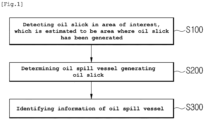
- FIG. 1 is a diagram illustrating the configuration of an oil spill vessel detection method according to an embodiment of the present disclosure
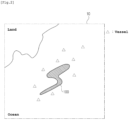
- FIG. 2 is a diagram illustrating oil slick and vessels in a region of interest according to an embodiment of the present disclosure
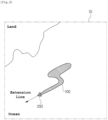
- FIGS. 3 to 6 are diagrams illustrating specific methods for identifying oil-spilled vessels according to an embodiment of the present disclosure.
- the oil spill vessel detection method includes detecting an oil slick 100 in an area of interest 10, which is estimated to be an area where the oil spill has occurred (S100).
- the area of interest 10 may include one or more of the following: i) an area for which the occurrence of the oil spill has been reported, ii) an area for which the oil spill has been determined to be likely to occur by surveillance by a ship, aircraft, satellite, or the like, and iii) an area to be estimated to be an area to which the oil spill migrate from the areas described by i) and ii).
- an oil spill vessel 200 generating the detected oil slick 100 is determined (S200)
- information of the determined oil spill vessel 200 is identified (S300).
- oil spill vessel 200 If there is more than one oil spill vessel 200 that generates the oil slick 100 detected in the area of interest 10 as illustrated in FIG. 2 , it is necessary to determine which vessel has spilled oil. This determination of the oil spill vessel 200 enables an oil spill prevention operation to proceed quickly and efficiently.
- the oil slick-determination S100 in the area of interest 10, which is an area for which the oil spill is estimated to have occurred, may include: receiving remote sensing information of the area of interest 10 from an aerospace platform (S110); receiving maritime information and meteorological information of the area of interest 10 (S120); extracting the oil slick using the remote sensing information, maritime information and meteorological information of the area of interest (S125); processing the location of the oil slick from the remote sensing information into virtual particle data (S130); and tracking the trajectory of the oil slick by tracking the movement of the virtual particles in a forward or backward direction using the maritime information, meteorological information, and a coefficient value calculating a flow contribution ratio of the oil slick reflecting spatial variations in wind speeds and ocean currents (S140).
- the aerospace platform may include one or more of a satellite, a manned aircraft, or an unmanned aircraft.
- the present disclosure is not limited thereto.
- the remote sensing information, the maritime information, and the meteorological information are information received in a first time period in the area of interest 10, and the oil slick trajectory-tracking S140 may track the movement speed and range of the soil slick for a second time period depending on the information received in the first time period.
- the remote sensing information may include at least one of image data and radio characteristic data obtained from an optical sensor, an infrared sensor, an ultraviolet sensor, or a microwave sensor.
- the maritime information may include at least one of speed and direction of a tide, and speed and direction of a current in the area of interest 10.
- the meteorological information may include information about wind speed and wind direction in the area of interest 10.
- the backward tracking of the movement of the virtual particle in S140 may be estimated based on the following Equations 1 and 2.
- x i t + ⁇ t x i t + ⁇ i t ⁇ t + u a
- x i t ⁇ ⁇ t x i t ⁇ ⁇ i t + u a
- x i t ⁇ ⁇ t , x i t , x t t + ⁇ t are the positions of the i-th virtual particle at the moment of t- ⁇ t , t , t + ⁇ t
- v is the velocity applied with a coefficient value calculated to obtain a flow contribution ratio of the oil slick reflecting a spatial variation of wind speeds and ocean currents
- u d is the turbulent diffusion velocity.
- the velocity v which is calculated by applying the coefficient value that calculates the flow contribution ratio of the oil slick reflecting the spatial variation of wind speeds and ocean currents is based on the following Equation 3.
- ⁇ C c u c + C w u w
- C c is a current drift coefficient
- u c is the surface current velocity
- C w is a wind drag coefficient
- u w is wind speed.
- the oil spill vessel-determination S200 may include determining, as the oil spill vessel, a vessel that is at the end of the movement direction of the oil slick.
- the oil spill vessel-determination S200 may include determining, as the oil spill vessel, a vessel that is within a specified range.
- the specified range may be set by assuming a set angle ( ⁇ ) in consideration of external forces such as ocean currents or winds, or an Azimuth shift phenomenon.
- the specified range may be established by assuming the set angle ( ⁇ ) centered on an extension of the end of the movement direction of the oil slick 100 to form a fan shape, and a vessel located within the fan shape may be determined as the oil spill vessel.
- the set angle ( ⁇ ) may be set in consideration of external forces such as ocean currents and winds.
- the set angle ( ⁇ ) ranges from 5° or more to 10° or less. More preferably, when the external forces such as currents or winds are large, the set angle ( ⁇ ) is preferably set to 10°, and when the external forces such as currents or winds are small, the set angle ( ⁇ ) is preferably set to 5°.
- the oil spill vessel may be determined by considering an Azimuth shift phenomenon.
- a moving object such as a vessel, exhibits an Azimuth shift phenomenon.
- FIG. 5 when a vessel that spilled oil corresponding to the oil slick 100 is the same as the oil spill vessel 200 indicated, the downstream main component line and the oil spill vessel 200 are separated by a certain interval due to the Azimuth shift phenomenon, so a vessel within a specified range may be determined as the oil spill vessel 200 by considering the Azimuth shift phenomenon.
- the oil spill vessel-determination S200 may include determining the oil spill vessel 200 by comparing a pattern of the backward tracking trajectory (trajectory a) of the end P of the oil slick 100 movement direction with a pattern of the backward tracking trajectory (trajectory b) of the vessel estimated to be the oil spill vessel 200.
- the trajectory of the end P-0 to P-2 of the movement direction of the oil slick 100-0 to 100-2 from the time t0 to the time t-2 (backward tracking) is derived as the trajectory a
- the trajectory of the movement direction of the vessel estimated to be the oil spill vessel 200-0 to 200-2 causing the oil slick 100 from the time t0 to the time t-2 is derived as the trajectory b
- the similarity of the trajectory a and the trajectory b is determined, and if the similarity is high, the vessel may be identified as the oil spill vessel 200.
- the information of the oil spill vessel determined in S200 is identified.
- the information of the oil spill vessel includes all kinds of vessel information, such as the type, the navigation route, etc. of the vessel, that can be obtained through the control tower or AIS information. After identifying the information, the spill prevention operation may be carried out efficiently by deciding how to carry out the spill prevention operation depending on the oil spill vessel information.
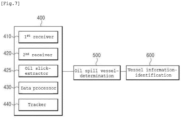
- FIG. 7 is a diagram illustrating the configuration of an oil spill detection system according to an embodiment of the present disclosure.
- the aerospace platform may include one or more of a satellite, a manned aircraft, or an unmanned aircraft.
- the present disclosure is not limited thereto.
- the forward or backward tracking of the movement of the virtual particle may be estimated based on the above Equations 1 and 2.
- the velocity v which is calculated by applying the coefficient value that calculates the flow contribution ratio of the oil slick reflecting the spatial variation of wind speeds and ocean currents, is based on the above Equation 3.
Landscapes
- Engineering & Computer Science (AREA)
- Business, Economics & Management (AREA)
- Physics & Mathematics (AREA)
- General Physics & Mathematics (AREA)
- Economics (AREA)
- Life Sciences & Earth Sciences (AREA)
- Theoretical Computer Science (AREA)
- Radar, Positioning & Navigation (AREA)
- Quality & Reliability (AREA)
- Strategic Management (AREA)
- Tourism & Hospitality (AREA)
- Marketing (AREA)
- General Business, Economics & Management (AREA)
- Human Resources & Organizations (AREA)
- Entrepreneurship & Innovation (AREA)
- Development Economics (AREA)
- Hydrology & Water Resources (AREA)
- Operations Research (AREA)
- Remote Sensing (AREA)
- General Life Sciences & Earth Sciences (AREA)
- Geophysics (AREA)
- Environmental & Geological Engineering (AREA)
- Aerodynamic Tests, Hydrodynamic Tests, Wind Tunnels, And Water Tanks (AREA)
- Geophysics And Detection Of Objects (AREA)
- Management, Administration, Business Operations System, And Electronic Commerce (AREA)
- Atmospheric Sciences (AREA)
- Biodiversity & Conservation Biology (AREA)
- Ecology (AREA)
- Environmental Sciences (AREA)
- Examining Or Testing Airtightness (AREA)
Abstract
A method of detecting an oil spill vessel includes detecting an oil slick in an area of interest, which is estimated to be an area where the oil slick has been generated, determining an oil spill vessel generating the oil slick, and identifying information of the oil spill vessel.
Description
- The present application claims priority to
Korean Patent Application No. 10-2022-0075959, filed on June 22, 2022 - The present disclosure relates to a system and method for detecting an oil spill vessel and, more particularly, to a system and method of detecting an oil slick in an area of interest and identifying an oil spill vessel among one or more vessels, if existing in the vicinity of the oil slick.
- Since vessels are propelled by the power of engines, the vessels are equipped with oil tanks to store and supply fuel. However, when vessels hit reefs or collide with other vessels, oil tanks are often damaged so oil leaks out. Especially in the case of large ships, tankers, etc., such oil spills cause serious problems to pollute the oceans so that marine ecosystems are destroyed, coastal and offshore resources are depleted, farmed fishes are killed, and so on.
- Therefore, in order to reduce marine pollution caused by such oil spills, measures such as installation of oil fences to suppress oil spread and provision of emulsifiers to break down and settle oil are generally implemented. In order to implement these measures and estimate the oil spread area, early prediction of the spread area of oil spill in the ocean is necessary.
- If a vessel deviates from its designated course, the vessel may run aground or collide with port facilities, causing loss of life and property. To prevent this, Vessel Traffic Services (VTSs) provide a control function that continuously monitors the position, speed, and course of vessels.
- By default, vessels also periodically report their location and speed through Auto Identification System (AIS), which allows VTSs to check the vessels' statuses.
- However, there are cases where AIS information is not available due to limited communication range, congestion, intentional turning off of AIS by illegal vessels, AIS failure, etc. In these cases, the vessels' information may be unknown.
- In the case of oil spill, the spilled oil forms an oil slick over time and travels under the influence of currents and winds. If one or more vessels are present in the area of interest, it may not be possible to determine which vessel is responsible for the spill.
- The foregoing is intended merely to aid in the understanding of the background of the present disclosure, and is not intended to mean that the present disclosure falls within the purview of the related art that is already known to those skilled in the art.
- (Patent Document 1)
Korean Patent Registration No. 10-2131422 - Accordingly, the present disclosure has been made keeping in mind the above problems occurring in the related art, and an objective of the present disclosure is to provide a system and method of detecting an oil slick in an area of interest and identifying an oil spill vessel among one or more vessels, if existing in the vicinity of the oil slick.
- In an aspect of the present disclosure, a method of detecting an oil spill vessel includes: detecting an oil slick in an area of interest, which is estimated to be an area where the oil slick has been generated; determining an oil spill vessel generating the oil slick; and identifying information of the oil spill vessel.
- The oil slick-detection may include: receiving remote sensing information of the area of interest from an aerospace platform; receiving maritime information and meteorological information of the area of interest; extracting the oil slick using the remote sensing information, maritime information and meteorological information of the area of interest; processing the location of the oil slick from the remote sensing information into virtual particle data; and tracking the trajectory of the oil slick by tracking the movement of the virtual particles in a forward or backward direction using the maritime information, meteorological information, and a coefficient value calculating a flow contribution ratio of the oil slick reflecting spatial variations in wind speeds and ocean currents.
- The oil spill vessel-determination may include determining, as the oil spill vessel, a vessel that is at the end of the movement direction of the oil slick.
- The oil spill vessel-determination may include determining, as the oil spill vessel, a vessel that is within a specified range.
- The specified range may be set by assuming a set angle (θ) in consideration of external forces such as ocean currents or winds, or an Azimuth shift phenomenon.
- The oil spill vessel-determination may include determining the oil spill vessel by comparing a pattern of the backward tracking trajectory at the end of the oil slick movement direction with a pattern of the backward tracking trajectory of the vessel estimated to be the oil spill vessel.
- In another aspect of the present disclosure, a system for detecting an oil spill vessel includes: an oil slick-detection unit configured to detect an oil slick in an area of interest, which is estimated to be an area where the oil slick has been generated; an oil spill vessel-determination unit configured to determine an oil spill vessel generating the oil slick; and an information-identifying unit configured to identify information of the oil spill vessel.
- The oil slick-detection unit may include: a first receiver configured to receive remote sensing information of the area of interest from an aerospace platform; a second receiver configured to receive maritime information and meteorological information of the area of interest; an extractor configured to extract the oil slick using the remote sensing information, maritime information, and meteorological information of the area of interest; a data processor configured to process the location of the oil slick from the remote sensing information into virtual particle data; and a tracker configured to track the trajectory of the oil slick by tracking the movement of the virtual particles in a forward or backward direction using the maritime information, meteorological information, and a coefficient value calculating a flow contribution ratio of the oil slick reflecting spatial variations in wind speeds and ocean currents.
- The oil spill vessel-determination unit may be configured to determine, as the oil spill vessel, a vessel that is at the end of the movement direction of the oil slick.
- The oil spill vessel-determination unit may be configured to determine, as the oil spill vessel, a vessel that is within a specified range.
- The specified range may be set by assuming a set angle (θ) in consideration of external forces such as ocean currents or winds, or an Azimuth shift phenomenon.
- The oil spill vessel-determination unit may be configured to determine the oil spill vessel by comparing a pattern of the backward tracking trajectory at the end of the oil slick movement direction with a pattern of the backward tracking trajectory of the vessel estimated to be the oil spill vessel.
- According to the present disclosure, it is possible to detect the oil slick in an area of interest and, if there is one or more vessels in the vicinity of the oil slick, to detect a vessel that has spilled the oil.
- The above and other objectives, features and advantages of the present disclosure will be more clearly understood from the following detailed description when taken in conjunction with the accompanying drawings, in which:
-
FIG. 1 is a diagram illustrating the configuration of an oil spill vessel detection method according to an embodiment of the present disclosure; -
FIG. 2 is a diagram illustrating oil slick and vessels in a region of interest according to an embodiment of the present disclosure; -
FIGS. 3 to 6 are diagrams illustrating specific methods for identifying oil-spilled vessels according to an embodiment of the present disclosure; and -
FIG. 7 is a diagram illustrating the configuration of an oil spill detection system according to an embodiment of the present disclosure. - The present disclosure may be subjected to various modifications and may have many different embodiments, so certain embodiments are illustrated in the drawings and described in detail in the description below. However, this is not intended to limit the invention to any particular embodiment, so it should be understood that the invention includes all modifications, equivalents, or substitutions that fall within the spirit and technical scope of the invention.
- In describing the present disclosure, if it is determined that a detailed description of the related prior art would unnecessarily obscure the gist of the present disclosure, such a detailed description will be omitted. In addition, numbers (e.g., first, second, etc.) utilized in the course of the description herein are merely identifiers to distinguish one component from another.
- Furthermore, when a component is referred to herein as being "connected" or "coupled" to another component, it is to be understood that the component may be not only directly connected or coupled to the other component, but also indirectly connected or coupled thereto with a further intermediate component interposed therebetween, unless otherwise stated.
- Hereinafter, preferred embodiments of the present disclosure will be described in detail with reference to the accompanying drawings.
-
FIG. 1 is a diagram illustrating the configuration of an oil spill vessel detection method according to an embodiment of the present disclosure,FIG. 2 is a diagram illustrating oil slick and vessels in a region of interest according to an embodiment of the present disclosure, andFIGS. 3 to 6 are diagrams illustrating specific methods for identifying oil-spilled vessels according to an embodiment of the present disclosure. - Referring to
FIGS. 1 to 6 , the oil spill vessel detection method according to the present disclosure includes detecting anoil slick 100 in an area ofinterest 10, which is estimated to be an area where the oil spill has occurred (S100). - The area of
interest 10 may include one or more of the following: i) an area for which the occurrence of the oil spill has been reported, ii) an area for which the oil spill has been determined to be likely to occur by surveillance by a ship, aircraft, satellite, or the like, and iii) an area to be estimated to be an area to which the oil spill migrate from the areas described by i) and ii). - Subsequently, an
oil spill vessel 200 generating the detectedoil slick 100 is determined (S200)
Subsequently, information of the determinedoil spill vessel 200 is identified (S300). - If there is more than one
oil spill vessel 200 that generates theoil slick 100 detected in the area ofinterest 10 as illustrated inFIG. 2 , it is necessary to determine which vessel has spilled oil. This determination of theoil spill vessel 200 enables an oil spill prevention operation to proceed quickly and efficiently. - The oil slick-determination S100 in the area of
interest 10, which is an area for which the oil spill is estimated to have occurred, may include: receiving remote sensing information of the area ofinterest 10 from an aerospace platform (S110); receiving maritime information and meteorological information of the area of interest 10 (S120); extracting the oil slick using the remote sensing information, maritime information and meteorological information of the area of interest (S125); processing the location of the oil slick from the remote sensing information into virtual particle data (S130); and tracking the trajectory of the oil slick by tracking the movement of the virtual particles in a forward or backward direction using the maritime information, meteorological information, and a coefficient value calculating a flow contribution ratio of the oil slick reflecting spatial variations in wind speeds and ocean currents (S140). - The aerospace platform may include one or more of a satellite, a manned aircraft, or an unmanned aircraft. However, the present disclosure is not limited thereto.
- The remote sensing information, the maritime information, and the meteorological information are information received in a first time period in the area of
interest 10, and the oil slick trajectory-tracking S140 may track the movement speed and range of the soil slick for a second time period depending on the information received in the first time period. - The remote sensing information may include at least one of image data and radio characteristic data obtained from an optical sensor, an infrared sensor, an ultraviolet sensor, or a microwave sensor.
- The maritime information may include at least one of speed and direction of a tide, and speed and direction of a current in the area of
interest 10. - The meteorological information may include information about wind speed and wind direction in the area of
interest 10. - The backward tracking of the movement of the virtual particle in S140 may be estimated based on the following
Equations 


- The velocity v, which is calculated by applying the coefficient value that calculates the flow contribution ratio of the oil slick reflecting the spatial variation of wind speeds and ocean currents is based on the following Equation 3.

- Referring to
FIG. 3 , in one embodiment, the oil spill vessel-determination S200 may include determining, as the oil spill vessel, a vessel that is at the end of the movement direction of the oil slick. - Referring to
FIG. 4 , in one embodiment, the oil spill vessel-determination S200 may include determining, as the oil spill vessel, a vessel that is within a specified range. - The specified range may be set by assuming a set angle (θ) in consideration of external forces such as ocean currents or winds, or an Azimuth shift phenomenon.
- The specified range may be established by assuming the set angle (θ) centered on an extension of the end of the movement direction of the
oil slick 100 to form a fan shape, and a vessel located within the fan shape may be determined as the oil spill vessel. - The set angle (θ) may be set in consideration of external forces such as ocean currents and winds. Preferably, the set angle (θ) ranges from 5° or more to 10° or less. More preferably, when the external forces such as currents or winds are large, the set angle (θ) is preferably set to 10°, and when the external forces such as currents or winds are small, the set angle (θ) is preferably set to 5°.
- Referring to
FIG. 5 , in the oil spill vessel-determination S200, in one embodiment, the oil spill vessel may be determined by considering an Azimuth shift phenomenon. A moving object, such as a vessel, exhibits an Azimuth shift phenomenon. InFIG. 5 , when a vessel that spilled oil corresponding to theoil slick 100 is the same as theoil spill vessel 200 indicated, the downstream main component line and theoil spill vessel 200 are separated by a certain interval due to the Azimuth shift phenomenon, so a vessel within a specified range may be determined as theoil spill vessel 200 by considering the Azimuth shift phenomenon. - Referring to
FIG. 6 , in one embodiment, the oil spill vessel-determination S200 may include determining theoil spill vessel 200 by comparing a pattern of the backward tracking trajectory (trajectory a) of the end P of theoil slick 100 movement direction with a pattern of the backward tracking trajectory (trajectory b) of the vessel estimated to be theoil spill vessel 200. - More specifically, referring to
FIG. 6 , the trajectory of the end P-0 to P-2 of the movement direction of the oil slick 100-0 to 100-2 from the time t0 to the time t-2 (backward tracking) is derived as the trajectory a, the trajectory of the movement direction of the vessel estimated to be the oil spill vessel 200-0 to 200-2 causing theoil slick 100 from the time t0 to the time t-2 is derived as the trajectory b, and the similarity of the trajectory a and the trajectory b is determined, and if the similarity is high, the vessel may be identified as theoil spill vessel 200. - In the
oil spill vessel 200 information-identification S300, the information of the oil spill vessel determined in S200 is identified. The information of the oil spill vessel includes all kinds of vessel information, such as the type, the navigation route, etc. of the vessel, that can be obtained through the control tower or AIS information. After identifying the information, the spill prevention operation may be carried out efficiently by deciding how to carry out the spill prevention operation depending on the oil spill vessel information. -
FIG. 7 is a diagram illustrating the configuration of an oil spill detection system according to an embodiment of the present disclosure. - Referring to
FIG. 7 , the oil spill vessel detection system includes: an oil slick-detection unit 400, an oil spill vessel-determination unit 500, and an information-identifyingunit 600. - The oil slick-
detection unit 400 may be configured to detect anoil slick 100 in an area ofinterest 100, which is estimated to be an area for which the oil spill has occurred. - The oil spill vessel-
determination unit 500 may be configured to determine anoil spill vessel 200 generating theoil slick 100. - The information-identifying
unit 600 may be configured to identify information of theoil spill vessel 200. - The oil slick-
detection unit 400 includes: afirst receiver 410 configured to receive remote sensing information of the area of interest from an aerospace platform; asecond receiver 420 configured to receive maritime information and meteorological information of the area of interest; anextractor 425 configured to extract the oil slick using the remote sensing information, maritime information, and meteorological information of the area of interest; adata processor 430 configured to process the location of the oil slick from the remote sensing information into virtual particle data; and atracker 440 configured to track the trajectory of the oil slick by tracking the movement of the virtual particles in a forward or backward direction using the maritime information, meteorological information, and a coefficient value calculating a flow contribution ratio of the oil slick reflecting spatial variations in wind speeds and ocean currents. - The aerospace platform may include one or more of a satellite, a manned aircraft, or an unmanned aircraft. However, the present disclosure is not limited thereto.
- The remote sensing information, the maritime information, and the meteorological information are information received in a first time period in the area of
interest 10, and the oil slick trajectory-tracking S140 may track the movement speed and range of the soil slick for a second time period depending on the information received in the first time period. - The remote sensing information may include at least one of image data and radio characteristic data obtained from an optical sensor, an infrared sensor, an ultraviolet sensor, or a microwave sensor.
- The maritime information may include at least one of speed and direction of a tide, and speed and direction of a current in the area of
interest 10. - The meteorological information may include information about wind speed and wind direction in the area of
interest 10. - In the
tracking unit 440, the forward or backward tracking of the movement of the virtual particle may be estimated based on theabove Equations - The velocity v, which is calculated by applying the coefficient value that calculates the flow contribution ratio of the oil slick reflecting the spatial variation of wind speeds and ocean currents, is based on the above Equation 3.
- Referring to
FIG. 3 , in one embodiment, in the oil spill vessel-determination unit 500, a vessel that is at the end of the movement direction of the oil slick may be determined as the oil spill vessel. - Referring to
FIG. 4 , in one embodiment, in the oil spill vessel-determination unit 500, a vessel that is within a specified range may be determined as the oil spill vessel. - The specified range may be set by assuming a set angle (θ) in consideration of external forces such as ocean currents or winds, or an Azimuth shift phenomenon.
- The specified range may be established by assuming the set angle (θ) centered on an extension of the end of the movement direction of the
oil slick 100 to form a fan shape, and a vessel located within the fan shape may be determined as the oil spill vessel. - The set angle (θ) may be set in consideration of external forces such as ocean currents and winds. Preferably, the set angle (θ) ranges from 5° or more to 10° or less. More preferably, when the external forces such as currents or winds are large, the set angle (θ) is preferably set to 10°, and when the external forces such as currents or winds are small, the set angle (θ) is preferably set to 5°.
- Referring to
FIG. 5 , in the oil spill vessel-determination unit 500, in one embodiment, the oil spill vessel may be determined by considering an Azimuth shift phenomenon. A moving object, such as a vessel, exhibits an Azimuth shift phenomenon. InFIG. 5 , when a vessel that spilled oil corresponding to theoil slick 100 is the same as theoil spill vessel 200 indicated, the downstream main component line and theoil spill vessel 200 are separated by a certain interval due to the Azimuth shift phenomenon, so a vessel within a specified range may be determined as theoil spill vessel 200 by considering the Azimuth shift phenomenon. - Referring to
FIG. 6 , in one embodiment, in the oil spill vessel-determination unit 500, theoil spill vessel 200 may be determined by comparing a pattern of the backward tracking trajectory (trajectory a) of the end P of theoil slick 100 movement direction with a pattern of the backward tracking trajectory (trajectory b) of the vessel estimated to be theoil spill vessel 200. - More specifically, referring to
FIG. 6 , the trajectory of the end P-0 to P-2 of the movement direction of the oil slick 100-0 to 100-2 from the time t0 to the time t-2 (backward tracking) is derived as the trajectory a, the trajectory of the movement direction of the vessel estimated to be the oil spill vessel 200-0 to 200-2 causing theoil slick 100 from the time t0 to the time t-2 is derived as the trajectory b, and the similarity of the trajectory a and the trajectory b is determined, and if the similarity is high, the vessel may be identified as theoil spill vessel 200. - In the oil spill vessel information-identifying
unit 600, the information of the determined oil spill vessel is identified. The information of the oil spill vessel includes all kinds of vessel information, such as the type, the navigation route, etc. of the vessel, that can be obtained through the control tower or AIS information. After identifying the information, the spill prevention operation may be carried out efficiently by deciding how to carry out the spill prevention operation depending on the oil spill vessel information. - The scope of the invention is not limited to the embodiments described above, but may be embodied in various forms within the scope of the attached claims. Various modifications that can be made by anyone having ordinary knowledge in the art to which the invention belongs, without departing from the gist of the invention are considered to be within the scope of the claimed subject matter.
Claims (8)
- A method of detecting an oil spill vessel, the method comprising:detecting an oil slick in an area of interest, which is estimated to be an area where the oil slick has been generated;determining an oil spill vessel generating the oil slick; andidentifying information of the oil spill vessel.
- The method according to claim 1, wherein the oil slick-detection comprises:receiving remote sensing information of the area of interest from an aerospace platform;receiving maritime information and meteorological information of the area of interest;extracting the oil slick using the remote sensing information, maritime information and meteorological information of the area of interest;processing the location of the oil slick from the remote sensing information into virtual particle data; andtracking the trajectory of the oil slick by tracking the movement of the virtual particles in a forward or backward direction using the maritime information, meteorological information, and a coefficient value calculating a flow contribution ratio of the oil slick reflecting spatial variations in wind speeds and ocean currents.
- The method according to claim 1 or 2, wherein the oil spill vessel-determination comprises determining, as the oil spill vessel, a vessel that is at the end of the movement direction of the oil slick.
- The method according to any one of claims 1 to 3, wherein the oil spill vessel-determination comprises determining, as the oil spill vessel, a vessel that is within a specified range.
- A system for detecting an oil spill vessel, the system comprising:an oil slick-detection unit configured to detect an oil slick in an area of interest, which is estimated to be an area where the oil slick has been generated;an oil spill vessel-determination unit configured to determine an oil spill vessel generating the oil slick; andan information-identifying unit configured to identify information of the oil spill vessel.
- The system according to claim 5, wherein the oil slick-detection unit comprises:a first receiver configured to receive remote sensing information of the area of interest from an artificial satellite;a second receiver configured to receive maritime information and meteorological information of the area of interest;an extractor configured to extract the oil slick using the remote sensing information, maritime information, and meteorological information of the area of interest;a data processor configured to process the location of the oil slick from the remote sensing information into virtual particle data; anda tracker configured to track the trajectory of the oil slick by tracking the movement of the virtual particles in a forward or backward direction using the maritime information, meteorological information, and a coefficient value calculating a flow contribution ratio of the oil slick reflecting spatial variations in wind speeds and ocean currents.
- The system according to claim 5 or 6, wherein the oil spill vessel-determination unit is configured to determine, as the oil spill vessel, a vessel that is at the end of the movement direction of the oil slick.
- The system according to any one of claims 5 to 7, wherein the oil spill vessel-determination unit is configured to determine, as the oil spill vessel, a vessel that is within a specified range.
Applications Claiming Priority (1)
| Application Number | Priority Date | Filing Date | Title |
|---|---|---|---|
| KR1020220075959A KR102479514B1 (en) | 2022-06-22 | 2022-06-22 | System and method for detecting oil spill vessel |
Publications (1)
| Publication Number | Publication Date |
|---|---|
| EP4296925A1 true EP4296925A1 (en) | 2023-12-27 |
Family
ID=84535658
Family Applications (1)
| Application Number | Title | Priority Date | Filing Date |
|---|---|---|---|
| EP23179836.4A Pending EP4296925A1 (en) | 2022-06-22 | 2023-06-16 | System and method for detecting oil spill vessel |
Country Status (3)
| Country | Link |
|---|---|
| EP (1) | EP4296925A1 (en) |
| JP (1) | JP7592788B2 (en) |
| KR (1) | KR102479514B1 (en) |
Citations (1)
| Publication number | Priority date | Publication date | Assignee | Title |
|---|---|---|---|---|
| KR20200032452A (en) * | 2018-09-18 | 2020-03-26 | 한국해양과학기술원 | Method and apparatus for tracking oil spills in Ocean |
Family Cites Families (6)
| Publication number | Priority date | Publication date | Assignee | Title |
|---|---|---|---|---|
| FR2900736B1 (en) | 2006-05-05 | 2008-06-13 | Thales Sa | METHOD FOR SIMULTANEOUSLY OBTAINING SHIP DETECTION AND RADAR MAPPING OF POLLUTION PATCHES USING A ROTARY AIRBORNE RADAR |
| JP4803444B2 (en) | 2006-09-29 | 2011-10-26 | 独立行政法人海上技術安全研究所 | Marine spilled oil remote sensing device |
| JP2008281423A (en) | 2007-05-10 | 2008-11-20 | Osaka Univ | Floating substance detection system and floating substance detection method |
| KR101534620B1 (en) * | 2014-01-22 | 2015-07-24 | 한국해양과학기술원 | Method and apparatus for detecting oil spills in ocean |
| KR20190000151A (en) * | 2017-06-22 | 2019-01-02 | (주)인스페이스 | Method for oil spill detection based vessel tracking |
| JP7369018B2 (en) | 2019-11-27 | 2023-10-25 | 株式会社Ihi | Oil film detection device and oil film detection method |
-
2022
- 2022-06-22 KR KR1020220075959A patent/KR102479514B1/en active Active
-
2023
- 2023-06-16 EP EP23179836.4A patent/EP4296925A1/en active Pending
- 2023-06-22 JP JP2023102196A patent/JP7592788B2/en active Active
Patent Citations (2)
| Publication number | Priority date | Publication date | Assignee | Title |
|---|---|---|---|---|
| KR20200032452A (en) * | 2018-09-18 | 2020-03-26 | 한국해양과학기술원 | Method and apparatus for tracking oil spills in Ocean |
| KR102131422B1 (en) | 2018-09-18 | 2020-07-08 | 한국해양과학기술원 | Method and apparatus for tracking oil spills in Ocean |
Non-Patent Citations (1)
| Title |
|---|
| KLEMAS V: "Tracking and monitoring oil slicks using remote sensing", BALTIC INTERNATIONAL SYMPOSIUM (BALTIC), 2012 IEEE/OES, IEEE, 8 May 2012 (2012-05-08), pages 1 - 7, XP032226523, ISBN: 978-1-4673-1413-8, DOI: 10.1109/BALTIC.2012.6249216 * |
Also Published As
| Publication number | Publication date |
|---|---|
| KR102479514B1 (en) | 2022-12-19 |
| JP2024001883A (en) | 2024-01-10 |
| JP7592788B2 (en) | 2024-12-02 |
Similar Documents
| Publication | Publication Date | Title |
|---|---|---|
| CN115273557B (en) | AIS-based method and system for detecting and warning collision risks of ships underway | |
| KR102269385B1 (en) | support system for vessel operation and ship having the same | |
| Greidanus et al. | Findings of the DECLIMS project—Detection and classification of marine traffic from space | |
| KR101534620B1 (en) | Method and apparatus for detecting oil spills in ocean | |
| US7548194B2 (en) | Hostile intention assessment system and method | |
| CN108922247A (en) | A kind of ship based on AIS-navigation mark Risk-Degree of Collision evaluation method | |
| CN110458089B (en) | Marine target association system and method based on high-low orbit optical satellite observation | |
| Tunaley | The estimation of ship velocity from SAR imagery | |
| Bloisi et al. | Camera based target recognition for maritime awareness | |
| Vachon et al. | Analysis of Sentinel-1 marine applications potential | |
| Robinette et al. | Sensor evaluation for autonomous surface vehicles in inland waterways | |
| CN112686106A (en) | Method for converting video image into maritime radar image | |
| Wang et al. | Research of obstacle recognition method for USV based on laser radar | |
| EP4296925A1 (en) | System and method for detecting oil spill vessel | |
| CN113484864A (en) | Unmanned ship-oriented navigation radar and photoelectric pod collaborative environment sensing method | |
| Bloisi et al. | Integrated visual information for maritime surveillance | |
| Askari et al. | An automatic approach to ship detection in spaceborne synthetic aperture radar imagery: an assessment of ship detection capability using RADARSAT | |
| Yang et al. | Design of integrated ship monitoring system using SAR, RADAR, and AIS | |
| KR102713090B1 (en) | System and method of providing responsive waterway information for smart ship | |
| O’Connell | Marine radar for improved ice detection | |
| Glenn Wright et al. | Arctic environment preservation through grounding avoidance | |
| KR102562269B1 (en) | method for determining velocity using wake of ship | |
| KR101961380B1 (en) | System and method for non-acoustic underwater submarine and object detection, and a recording medium having computer readable program for executing the method | |
| CN117826137B (en) | Method and system for combined detection of water surface object marks | |
| CN118112553A (en) | Unmanned boat target recognition and tracking method and system based on navigation radar |
Legal Events
| Date | Code | Title | Description |
|---|---|---|---|
| PUAI | Public reference made under article 153(3) epc to a published international application that has entered the european phase |
Free format text: ORIGINAL CODE: 0009012 |
|
| STAA | Information on the status of an ep patent application or granted ep patent |
Free format text: STATUS: REQUEST FOR EXAMINATION WAS MADE |
|
| 17P | Request for examination filed |
Effective date: 20230616 |
|
| AK | Designated contracting states |
Kind code of ref document: A1 Designated state(s): AL AT BE BG CH CY CZ DE DK EE ES FI FR GB GR HR HU IE IS IT LI LT LU LV MC ME MK MT NL NO PL PT RO RS SE SI SK SM TR |