EP4296900A1 - Acceleration of 1x1 convolutions in convolutional neural networks - Google Patents
Acceleration of 1x1 convolutions in convolutional neural networks Download PDFInfo
- Publication number
- EP4296900A1 EP4296900A1 EP23178341.6A EP23178341A EP4296900A1 EP 4296900 A1 EP4296900 A1 EP 4296900A1 EP 23178341 A EP23178341 A EP 23178341A EP 4296900 A1 EP4296900 A1 EP 4296900A1
- Authority
- EP
- European Patent Office
- Prior art keywords
- kernel
- buffer
- data
- feature
- mode
- Prior art date
- Legal status (The legal status is an assumption and is not a legal conclusion. Google has not performed a legal analysis and makes no representation as to the accuracy of the status listed.)
- Granted
Links
Images









Classifications
-
- G—PHYSICS
- G06—COMPUTING OR CALCULATING; COUNTING
- G06N—COMPUTING ARRANGEMENTS BASED ON SPECIFIC COMPUTATIONAL MODELS
- G06N3/00—Computing arrangements based on biological models
- G06N3/02—Neural networks
- G06N3/08—Learning methods
- G06N3/082—Learning methods modifying the architecture, e.g. adding, deleting or silencing nodes or connections
-
- G—PHYSICS
- G06—COMPUTING OR CALCULATING; COUNTING
- G06N—COMPUTING ARRANGEMENTS BASED ON SPECIFIC COMPUTATIONAL MODELS
- G06N3/00—Computing arrangements based on biological models
- G06N3/02—Neural networks
- G06N3/06—Physical realisation, i.e. hardware implementation of neural networks, neurons or parts of neurons
- G06N3/063—Physical realisation, i.e. hardware implementation of neural networks, neurons or parts of neurons using electronic means
-
- G—PHYSICS
- G06—COMPUTING OR CALCULATING; COUNTING
- G06F—ELECTRIC DIGITAL DATA PROCESSING
- G06F17/00—Digital computing or data processing equipment or methods, specially adapted for specific functions
- G06F17/10—Complex mathematical operations
- G06F17/15—Correlation function computation including computation of convolution operations
- G06F17/153—Multidimensional correlation or convolution
-
- G—PHYSICS
- G06—COMPUTING OR CALCULATING; COUNTING
- G06N—COMPUTING ARRANGEMENTS BASED ON SPECIFIC COMPUTATIONAL MODELS
- G06N3/00—Computing arrangements based on biological models
- G06N3/02—Neural networks
- G06N3/04—Architecture, e.g. interconnection topology
- G06N3/0464—Convolutional networks [CNN, ConvNet]
Definitions
- the present disclosure generally relates to convolutional accelerators, such as convolutional accelerators used in a learning/inference machine (e.g., an artificial neural network - ANN, such as a convolutional neural network - CNN).
- a learning/inference machine e.g., an artificial neural network - ANN, such as a convolutional neural network - CNN.
- learning/inference machines may quickly perform hundreds, thousands, or even millions of concurrent operations.
- Learning/inference machines may fall under the technological titles of machine learning, artificial intelligence, neural networks, probabilistic inference engines, accelerators, and the like.
- Conventional learning/inference machines can deliver hundreds of teraflops (e.g., one million millions - 10 12 - floating-point operations per second) of computing power.
- Such learning/inference machines may include or otherwise utilize CNNs, such as deep convolutional neural networks (briefly, DCNN).
- a DCNN is a computer-based tool that processes large quantities of data and adaptively "learns” by conflating proximally related features within the data, making broad predictions about the data, and refining the predictions based on reliable conclusions and new conflations.
- the DCNN is arranged in a plurality of "layers," and different types of predictions are made at each layer.
- Hardware accelerators including convolutional accelerators are often employed to accelerate the processing of large amounts of data by a DCNN.
- a convolutional accelerator comprises a feature line buffer, a kernel buffer separate from the feature line buffer, a Multiply-ACcumulate (briefly, MAC) cluster, and mode control circuitry coupled to the feature line buffer, the kernel buffer and the MAC cluster.
- the mode control circuitry in a first mode of operation of the convolutional accelerator, stores feature data in the feature line buffer, stores kernel data in the kernel buffer, transfers feature data from the feature line buffer to the MAC cluster, and transfers kernel data from the kernel buffer to the MAC cluster.
- the mode control circuitry stores feature data in the kernel buffer, stores kernel data in the feature line buffer, transfers feature data from the kernel buffer to the MAC cluster, and transfers kernel data from the feature line buffer to the MAC cluster.
- the second mode of operation may be employed to efficiently process 1xN kernels, where N is an integer greater than or equal to 1 (one).
- a system comprises a stream engine, which, in operation, streams feature and kernel data, and a convolutional accelerator coupled to the stream engine, wherein the convolutional accelerator, in operation, receives streams of feature and kernel data from the stream engine.
- the convolutional accelerator includes a feature line buffer, a kernel buffer, a multiply-accumulate cluster coupled to the feature line buffer and the kernel buffer, mode control circuitry coupled to the feature line buffer, the kernel buffer and the MAC cluster.
- the mode control circuitry in a first mode of operation of the convolutional accelerator, stores feature data in the feature line buffer, stores kernel data in the kernel buffer, transfers feature data from the feature line buffer to the MAC cluster, and transfers kernel data from the kernel buffer to the MAC cluster.
- the mode control circuitry stores feature data in the kernel buffer, stores kernel data in the feature line buffer, transfers feature data from the kernel buffer to the MAC cluster, and transfers kernel data from the feature line buffer to the MAC cluster.
- the second mode of operation may be employed to efficiently process 1xN kernels, where N is an integer greater than or equal to 1 (one or unity).
- a method comprises streaming feature data and kernel data to a convolutional accelerator, and convolving streamed kernel data with streamed feature data.
- the convolving includes, in a first mode of operation of the convolutional accelerator, storing feature data in a feature line buffer of the convolutional accelerator, storing kernel data in a kernel buffer of the convolutional accelerator, transferring feature data from the feature line buffer to a MAC cluster of the convolutional accelerator, and transferring kernel data from the kernel buffer to the MAC cluster.
- the convolving includes storing feature data in the kernel buffer, storing kernel data in the feature line buffer, transferring feature data from the kernel buffer to the MAC cluster, and transferring kernel data from the feature line buffer to the MAC cluster.
- the second mode of operation may be employed to efficiently process 1xN kernels, where N is an integer greater than or equal to 1 (one or unity).
- a non-transitory computer-readable medium's contents configure a convolutional accelerator having a plurality of modes of operation to convolve streamed kernel data with streamed feature data.
- the convolving includes, in a first mode of operation of the plurality of modes of operation of the convolutional accelerator, storing feature data in a feature line buffer of the convolutional accelerator, storing kernel data in a kernel buffer of the convolutional accelerator, transferring feature data from the feature line buffer to a MAC cluster of the convolutional accelerator, and transferring kernel data from the kernel buffer to the MAC cluster.
- the convolving includes storing feature data in the kernel buffer, storing kernel data in the feature line buffer, transferring feature data from the kernel buffer to the MAC cluster, and transferring kernel data from the feature line buffer to the MAC cluster.
- the second mode of operation may be employed to efficiently process 1xN kernels, where N is an integer greater than or equal to 1 (one or unity).
- the contents comprise instructions executed by the convolutional accelerator.
- CNNs are particularly suitable for recognition tasks, such as recognition of numbers or objects in images, and may provide highly accurate results.
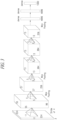
- Figure 1 is a diagram illustrating a digit recognition task concept and
- Figure 2 is a diagram illustrating an image recognition task concept.
- CNNs are specific types of deep neural networks (briefly, DNNs) with one or multiple layers which perform a convolution on a three-dimensional feature data tensor (width by height by depth).
- the first layer is an input layer and the last layer is an output layer.
- the intermediate layers may be referred to as hidden layers.
- the most used layers are convolutional layers, fully connected or dense layers, and pooling layers (max pooling, average pooling, etc.). Data exchanged between layers are called features or activations.
- Each layer also has a set of learnable parameters typically referred to as weights or kernels.
- Figure 3 is a diagram illustrating concepts of an example of a CNN, that is AlexNet.
- the illustrated CNN has a set of convolutional layers interleaved with max pooling layers, followed by a set of fully connected or dense layers.
- the parameters of a convolutional layer include a set of learnable filters referred to as kernels.
- Each kernel has three dimensions: height, width and depth.
- the height and width are typically limited in range (e.g., [1, 11] - one to eleven).
- the depth typically extends to the full depth of an input feature data.
- Each kernel slides across the width and the height of the input features and a dot product is computed.
- a result is obtained as a set of two-dimensional feature maps.
- many kernels are applied to an input feature map, each of which produces a different feature map as a result.
- the depth of the output feature tensors is also referred to the number of output channels.
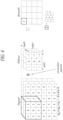
- Figure 4 is a diagram illustrating the application concept of a kernel to a feature map, producing a two-dimensional feature map having a height of 4 (four) and a width of 4.
- Convolutional layers also may have other parameters, which may be defined for the convolutional layer, rather than learned parameters. Such parameters may be referred to as hyper-parameters.
- a convolutional layer may have hyper-parameters including stride and padding hyper-parameters.
- the stride hyper-parameter indicates a step-size used to slide kernels across an input feature map.
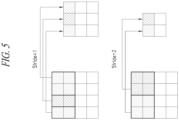
- Figure 5 is a diagram illustrating a concept of comparing a stride of 1 (one or unity) and a stride of 2. When the stride is greater than 1 (one or unity), the output feature map will be smaller than the input feature map.
- the padding hyper-parameter indicate a number of zeros to be added along the height, the width or the height and width of the input feature map.
- the padding parameters may be used to control a size of an output feature map generated by the convolution.
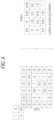
- Figure 6 is a diagram illustrating application concepts of padding to an input feature map.
- the padding preserves the input feature size along the height and width of the feature map.
- the feature data of a convolutional layer may have hundreds or even thousands of channels, with the number of channels corresponding to the depth of the feature data and of the kernel data. For this reason, feature and kernel data are often loaded into memory in batches.
- Figure 7 is a conceptual diagram illustrating the concept of loading feature data in batches.
- the feature data is split along the depth dimension into batches, with each batch of feature data having the same height, width and depth.
- the kernel depth is generally the same as the depth of the input feature map, so similar issues are addressed by batching.
- the batches have a height of 5, a width of 5, and a depth of 4. Batches are typically written into memory sequentially, with writing of a first batch being completed before beginning the writing of a second batch.
- FIG. 7 illustrates an example order in which data of a batch is written into memory.
- a similar batching process is typically applied to the kernel data, with each batch of the kernel data having a same kernel height and kernel width, and the same depth as the batches of feature data.
- Each batch of feature data is convolved with a related batch of kernel data, and a feedback mechanism is employed to accumulate the results of the batches.
- the conceptual diagram of Figure 8 illustrates the concept of batch processing of a convolution.
- FIG. 9 is a functional block diagram of an embodiment of an electronic device or system 100 of the type to which described embodiments may apply.
- the system 100 comprises one or more processing cores or circuits 102.
- the processing cores 102 may comprise, for example, one or more processors, a state machine, a microprocessor, a programmable logic circuit, discrete circuitry, logic gates, registers, etc., and various combinations thereof.
- the processing cores may control overall operation of the system 100, execution of application programs by the system 100 (e.g., programs which classify images using CNNs), etc.
- the system 100 includes one or more memories 104, such as one or more volatile and/or non-volatile memories which may store, for example, all or part of instructions and data related to control of the system 100, applications and operations performed by the system 100, etc.
- One or more of the memories 104 may include a memory array, which, in operation, may be shared by one or more processes executed by the system 100.
- the system 100 may include one or more sensors 160 (e.g., image sensors, audio sensors, accelerometers, pressure sensors, temperature sensors, etc.), one or more interfaces 170 (e . g ., wireless communication interfaces, wired communication interfaces, etc.), and other circuits 180, which may include antennas, power supplies, one or more built-in self-test (briefly, BIST) circuits, etc., and a main bus system 190.
- the main bus system 190 may include one or more data, address, power and/or control buses coupled to the various components of the system 100.
- the system 100 also includes one or more hardware accelerators 110 which, in operation, accelerate the performance of one or more operations associated with implementing a CNN.
- the hardware accelerator 110 as illustrated includes one or more convolutional accelerators 112 to facilitate efficient performance of convolutions associated with convolutional layers of a CNN.
- the convolutional accelerators include a feature line buffer memory 114, which, in operation, conventionally stores lines of feature data, a kernel buffer memory 116, which, in operation, conventionally stores kernel data, and one or more clusters of Multiply-Accumulate (briefly, MAC) units or circuits 118, which in operation perform convolution operations using the buffered kernel and feature data.
- the hardware accelerator 110 as illustrated also includes a stream engine 150 and a stream switch 155.
- the stream engine 150 in operation, transmits data streams.
- the stream engine 150 may stream data, such as feature data or kernel data stored in memory 104, to a convolutional accelerator 112 via the stream switch 155.
- the kernel dimensions may vary between CNNs, and between convolutional layers of a single CNN.
- convolutional layers with kernels having height and width dimensions of 11x11, 5x5 and 3x3 are illustrated.
- 3x3 kernels have been the most common.
- convolutional accelerators may typically be designed to efficiently support kernel computations within defined kernel height and width sizes, such as 3x3 kernels.
- the feature line buffer memory 114 may typically be a deep single port memory storing a few lines of feature data (e.g., three lines) and having a large number of storage elements per line (e.g., 1024 elements per line).
- Feature line data is often reused with multiple kernels, and a single port is generally sufficient for the feature line buffer memory 114 because the computations may typically be started once the feature line buffer is full.
- the kernel buffer memory 116 may typically be a small, wide and shallow dual-port memory (e.g., 96 bits of width by 16 memory locations). Because the kernel buffer is wide, it is relatively expensive, and for this reason is often shallow to reduce the costs of the memory (e.g., to reduce the area costs). To provide for an efficient bandwidth in view of the shallow depth of the memory, the kernel buffer 116 may be a dual-port memory to facilitate simultaneous reading of stored kernel data for use in current convolutional operations and loading of kernel data into the kernel buffer for use in subsequent convolutional operations.
- Figure 10 is a diagram illustrating processing concepts of convolutional operations having a 3x3 kernel using an embodiment of a convolutional accelerator, such as the convolutional accelerator 112 of Figure 9 .
- Feature data is stored in the feature line buffer 114 (e.g., three lines of feature data which may be processed together), and kernel data is stored in the kernel buffer 116 (e.g., supporting kernels of various sizes up to a threshold size, with the storage in the buffer optimized, for example, for 3x3 kernel data).
- Convolutional operations are performed using the MAC clusters 118 (e.g., 72 MACs organized into 6 clusters 118 of 12 MACs each - three sets of four MAC units 120) to operate on data received from the feature line buffer and the kernel buffer.
- the MAC clusters 118 e.g., 72 MACs organized into 6 clusters 118 of 12 MACs each - three sets of four MAC units 120
- Figure 10 illustrates examples of other typical components of a convolutional accelerator (e.g., streaming interfaces 142, streaming buffers 144, an adder tree 146, configuration registers 148, etc.), which are not described in detail with reference to Figure 10 .
- Larger size kernels e.g., 4x4, 11x11, etc. may typically be handled using, for example, software kernel decomposition techniques.
- CNNs have one or more layers with kernels having smaller height and width dimensions.
- hidden or inner layers especially dense or deep layers, may have a large number of channels of feature data and may frequently employ kernels having height and width dimensions smaller than 3x3, such as 1x1, 1x2, or 1x3, 1xN kernels.
- kernels having height and width dimensions smaller than 3x3, such as 1x1, 1x2, or 1x3, 1xN kernels.
- deep or dense convolutional layers having feature data with a larger number of channels convolved with 1x1 deep (or unitary) kernels are becoming increasingly popular in CNNs.
- Figure 11 is a diagram illustrating concepts of convolutional layers having 3x3 and 1x1 kernels respectively.
- Kernels having smaller height and width dimensions may be processed by switching off some of the components of a convolutional accelerator. This can be inefficient in a number of ways, as discussed with reference to the diagram of Figure 12 , which illustrates concepts of an example of processing a convolutional layer with a 1x1 (or unitary) kernel by switching off components of a convolutional accelerator optimized for use with larger size kernels.
- Feature data is stored in the feature line buffer 114 and kernel data is stored in the kernel buffer 116.
- the number of input channels to the MAC units (which is limited by the depth of the kernel data that can be stored in the kernel buffer) is maintained to be greater than or equal to the number of output channels of the MAC units.
- Typical kernel buffer depth limitations may limit the number of input channels to the MAC clusters 118 to, for example, 24 channels for kernels having a height and width dimensions of 1x1.
- the number of output channels of the MAC clusters would be limited to 24 channels, due to the bottleneck created by the size of kernel buffer memory, to avoid bandwidth saturation at the output.
- kernels 1-4 are provided to the first cluster of 12 MAC units with only 4 of the 12 MAC units being used
- kernels 5-8 are provided to the second cluster of 12 MAC units with only 4 of the 12 MAC units of the second cluster being used, etc.
- the ratio between fetched kernel data and the number of operations performed using the fetched kernel data drops dramatically as compared to processing of a 3x3 kernel, etc. using the same or a similar convolutional accelerator configuration.
- a significant number of additional fetch operations must be performed to process the convolutions of a convolutional layer having a 1x1 kernel when a solution of switching off components of the convolutional accelerator is employed.
- Another alternative is to use fine-grained accelerator hardware. This approach, however, involves a substantial overhead in terms of control circuitry and software processing to process larger kernels using the fine-grained hardware. Using fine-grained hardware is not as efficient in processing larger kernels as coarse-grained accelerators. Such larger kernels, such as 3x3 kernels, also are frequently employed in CNNs as noted above.
- a coarse-grained convolutional accelerator e.g., a convolutional accelerator designed to efficiently process kernels having height and width dimensions of 3x3
- a convolutional accelerator designed to efficiently process kernels having height and width dimensions of 3x3 may be reused or reconfigured to more efficiently perform convolutions using kernels having smaller height and width dimensions (e.g., 1x1, 1x2, ... 1xN dimensions) by employing two different modes of operation instead of switching off components.
- the size characteristics of the relatively deep feature line buffer 114 are more suited to storing kernel data associated with a 1x1 deep (or unitary) kernel than the size characteristics of the shallower kernel buffer 116.
- a first mode of operation may be employed to process kernels having larger height and width dimensions (e.g., 3x3 kernels), and a second mode of operation may be employed to process kernels having smaller height and width dimensions (e.g., 1x1, 1x2, ... 1xN).
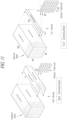
- Two concept example modes of operation are conceptually illustrated by the diagram of Figure 13 .
- a first mode of operation labeled normal mode in Figure 13
- feature data is stored in the feature line buffer 114 and kernel data is stored in the kernel buffer 116.
- the first mode of operation may be employed, for example, to process typical 3x3 kernels in a generally conventional manner. See the discussion of Figure 10 , above.
- a second mode of operation labeled deep mode in Figure 13
- feature data is stored in the kernel buffer 116 instead of in the feature line buffer
- kernel data is stored in the feature line buffer 114.
- two sets of 24 different kernels of 1x1x128 may be stored in the feature line buffer 114
- 3 lines of feature data having a depth of 128 pixels may be stored in the kernel data buffer 116.
- the second mode of operation may be employed, for example, to process 1x1 kernels, such as 1x1 kernels having a depth for which using the second mode of operation instead of the first mode of operation may provide increased efficiencies (e.g., a depth larger than a number of MAC units of the MAC cluster, in the example discussed, a kernel depth of 128, which is larger than 72).
- the system 100 as illustrated in Figure 9 comprises mode control circuitry 130.
- the mode control circuitry 130 controls the storage of feature data in the feature line buffer 114 and the transfer of feature data from the feature line buffer 114 to the MAC clusters 118, and the storage of kernel data in the kernel buffer 116, and the transfer of kernel data from the kernel buffer 116 to the MAC clusters 118.
- Operation of the mode control circuitry in the first mode of operation may be performed to control the storage and transfer of feature and kernel data in a generally conventional manner. For example, the concept is illustrated in the diagram of Figure 10 .
- mode control circuitry 130 is illustrated as a block in Figures 9 and 13 , the mode control circuitry may be implemented, for example, using control logic and discrete components (e.g., multiplexers, existing buffers, etc.) distributed through the convolutional accelerator 112.
- control logic and discrete components e.g., multiplexers, existing buffers, etc.
- the mode control circuitry 130 controls the storage of kernel data in the feature line buffer 114 and transmission of kernel data from the feature line buffer 114 to the MAC clusters 118, and the storage of feature data in the kernel buffer 116, and the transfer of feature data from the kernel buffer 116 to the MAC clusters 118. Examples of the operation and configurations of embodiments of the mode control circuitry 130 in the second mode of operation are discussed herein with reference to Figures 14 to 23 .
- Embodiments of the system 100 of Figure 9 may include more components than illustrated, may include fewer components than illustrated, may combine components, may separate components into sub-components, and various combination thereof.
- the hardware accelerator 110 may include DMA controllers
- the mode control circuitry 130 may be split into input mode control circuitry to control the storage of input feature data and kernel data into the buffers 114, 116
- output mode control circuitry to control the transfer of stored input feature data from the buffers 114, 116 to the MAC clusters 118
- all or part of the mode control circuitry 130 may be shared by one or more convolutional accelerators 112
- the mode control circuitry 130 may be integrated into other control circuitry of the convolutional accelerator, etc., and various combinations thereof.
- Figure 14 is a diagram illustrating concepts of an example of processing a convolutional layer with a 1x1 (or unitary) kernel by operating the convolutional accelerator in a second mode of operation in which kernel data is stored in a feature line buffer (e.g., feature line buffer 114 of Figure 9 ) and pixels of feature data are stored in a kernel buffer (e.g., kernel buffer 116 of Figure 9 ).
- kernel data is stored in a feature line buffer (e.g., feature line buffer 114 of Figure 9 ) and pixels of feature data are stored in a kernel buffer (e.g., kernel buffer 116 of Figure 9 ).
- a large single-port feature line buffer 114 which may normally be used to store 3 lines of feature data having a depth of 1024 elements, is instead controlled to store 24 kernels having a depth of up to 128 kernel values.
- 128 input channels are available, which is greater than the number of output channels of 72 available in the example configuration discussed above with reference to Figure 9 .
- the kernel buffer 116 is controlled to store three lines of feature data, and thus three lines of feature data may be fed to clusters of MAC units 118.
- kernels 1-4 are provided to a set of three clusters of four MAC units each.
- One of the three clusters of four MAC units computes the output for line 1 of the feature data and kernels 1-4
- a second one of the three clusters of 4 MAC units computes the output for line 2 of the feature data and kernels 1-4
- a third one of the three clusters computes the output for line 3 of the feature data and kernels 1-4.
- kernels 5-8 are provided to another set of three clusters of four MAC units each, each cluster computing the output for a respective line of the feature data and kernels 5-8.
- Kernels 9-12, 13-16, 17-20 and 21-24 are similarly provided to respective clusters of four MAC units each to compute outputs for respective lines of the feature data and the respective kernels.
- the throughput is improved from 1 pixel depth per kernel in a cycle to 3 pixel depths per kernel in a cycle when a convolutional layer having a 1x1 kernel is processed using the deep mode of operation as compared to the normal mode of operation.
- each kernel value is used in three MAC operations in a cycle, significantly improving the ratio of the number of fetch operations to the number of MAC operations performed as compared to the use of each kernel value in one MAC operation per cycle when the normal mode of operation is employed to process a 1x1 kernel (see Figure 12 ).
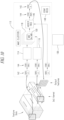
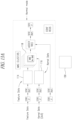
- Figure 15 is a diagram illustrating concepts of an embodiment of a configuration of a feature data path 220 and a kernel data path 230 of a convolutional accelerator 112 operating in a mode of operation, such as a deep mode of operation, in which feature line data is stored in a kernel buffer 116, and kernel data is stored in a feature line buffer 114.
- An embodiment of the feature data path 220 is shown in more detail in Figure 18
- an embodiment of the kernel data path 230 is shown in more detail in Figure 19 .
- the kernel buffer 116 in the embodiment of Figure 15 comprises six dual-port memories 216, as illustrated six 16x96 bit dual-port buffers.
- the six dual port memories 216 of the kernel buffer 116 store kernel data, which may be done in a generally conventional manner.
- four of the six dual-port memories 216 are included in the feature data path 220 and controlled by (deep-mode) feature load control circuitry 130f of the mode control circuitry 130 to store feature line data.
- the four dual-port memories are organized into six virtual buffers 116v of 128x8 bits in the feature line path 220, each virtual buffer 116v storing a line of feature data.
- Three lines of feature data may be fed to the MAC clusters 118 at a time, each line being provided by the respective virtual buffer to two of the six clusters of MAC units 118.
- feature data from three of the virtual buffers 116v is being fed to the MAC clusters 118
- feature data for a next set of computations may be loaded into the other three virtual buffers 116v.
- three lines of feature data may be stored into the virtual buffers 116v of the kernel buffer memory 116 at a time in a ping-pong fashion.
- the (deep-mode) feature data load control circuitry 130f of the mode control circuitry 130 is included in the feature data path 220, and in operation the (deep-mode) feature data load control circuitry 130f controls the order in which pixels of feature data are stored into the virtual buffers 116v of the kernel buffer 116.
- the feature line path 220 includes a FIFO buffer and optional data manipulation circuitry.
- the feature line buffer 114 is included in the kernel data path 230 and controlled to store kernel data by (deep-mode) kernel load control circuitry 130k of the mode control circuitry 130.
- the two remaining dual-port buffers 216 of the kernel buffer 116 may advantageously be used in the kernel data path 230 to facilitate the storage in and retrieval from the feature line buffer 114 of kernel data stored therein.
- one of the dual-port buffers 216a may be used to reduce the number of cycles needed to fill the feature line buffer 114 with kernel data
- one of the dual-port buffers 216b may be used to mirror the output of the feature line buffer 114 in order to emulate dual-port memory performance by the single port feature line buffer 114 (e.g., to facilitate use of kernel data stored in the dual-port buffer 216b by the MAC clusters 118 while subsequent kernel data is being loaded into the feature line buffer 114 from the dual-port buffer 216a).
- the (deep-mode) kernel load control circuitry 130k includes filtering circuitry 130kfilt, which in operation selects kernels from kernel data path 230 to load into the feature line buffer 114 via the dual-port buffer 216a, and multiplexer circuitry 130km, which in operation, controls the transmission of kernel data from the dual port buffer 216b to the MAC clusters 118.
- the mode control circuitry 130 of Figure 15 as illustrated also includes (deep-mode) serialization circuitry 130s, which in operation serializes the outputs of the MAC clusters to account for the order in which the MAC operations are performed.
- Figure 16 is a diagram illustrating concepts of feature and kernel data flow paths in a deep mode of operation of a convolutional accelerator according to an embodiment.
- Features are streamed depth-wise and a whole pixel is stored in each virtual buffer 116v of the kernel buffer 116.
- Three pixels at a time are sent to the MAC clusters 118, with each pixel being provided to a pair of the six MAC clusters 118.
- multiplexers 130fm of the mode control circuitry 130 may be controlled to provide either pixels 1-3 or pixels 4-6 to respective pairs of MAC clusters of the MAC clusters 118.
- Kernels 1-24 are stored in the feature line buffer 114, and all 24 kernels are sent to respective MAC clusters in a cycle (see Figure 14 ), generating three lines of an output feature map.
- Figure 17 is a diagram illustrating concepts of the transmission of three pixels per cycle for a given kernel value in the example configuration of Figure 16 .
- the same kernel is strided three times in a cycle, obtaining three output values for each kernel value, or 72 output values for 24 kernels in a cycle.
- the term "strided" refers to an object to which application of a stride is performed one or multiple times.
- FIG 18 is a diagram illustrating a concept of data path 220 of the feature data in a convolutional accelerator operating in a deep mode of operation according to an embodiment.
- Streaming engine 150 may be capable of streaming, for example, 3 bytes of data or more in a stream engine transaction. As illustrated, the streaming engine streams pixel 1, depth 1 of feature data (1.1 in Figure 18 ), pixel 1, depth 2 (1.2 in Figure 18 ) and pixel 1, depth 3 (1.3 in Figure 18 ) in a first transaction, T1. Transaction T2 sends the next three depths of pixel 1, shown as 1.4, 1.5 and 1.6 in Figure 18 . The transmission continues in successive transmissions until the transmission of a set of pixels is complete, as illustrated until pixel W, depth 128 is transmitted. Other pixel depths may be employed.
- the pixels are stored in a FIFO buffer, and may be manipulated using data manipulation circuitry, before being stored in respective virtual buffers 116v by the (deep-mode) feature load control circuitry 130f.
- three pixels at a time are provided by respective virtual buffers 116v to respective pairs of clusters of four MAC units.
- the availability of three pixel-values e.g., pixel 1: depth 1, pixel 2: depth 1, and pixel 3: depth 1
- each kernel value available e.g., kernels 1-24
- feature data from three of the virtual buffers 116v is being fed to the MAC clusters 118, feature data for a next set of computations may be loaded into the other three virtual buffers 116v.
- three lines of feature data may be stored into the virtual buffers 116v of the kernel buffer memory 116 at a time in a ping-pong fashion.
- Figure 19 is a diagram illustrating concepts of a data path of the kernel data 230 in a convolutional accelerator operating in a deep mode of operation according to an embodiment. The operation of the elements of the kernel data path is described above with reference to Figure 15 .
- all 24 kernel values stored in the dual-port memory 216b are supplied to respective MAC units of the 72 MAC units, with each kernel value being supplied to 3 MAC units.
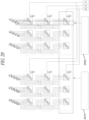
- Figure 20 is a diagram illustrating concepts of the sharing of each kernel value, twenty-four in the illustrated embodiment, with three MAC units and the sharing of each pixel of feature data with a pair of MAC clusters in a convolutional accelerator operating in a deep mode of operation according to an embodiment, to produce 72 (seventy-two) output pixels per cycle.
- the performance per cycle is tripled and each retrieved kernel value is used on three MAC operations instead of one MAC operation.
- the additional control logic employed may add a small amount of costs in terms of area (e.g., 2%).
- Figures 14 to 20 illustrate an embodiment of a deep mode of operation in the context of convolutional processing using a 1x1 (or unitary) kernel.
- Figure 21 is a conceptual diagram illustrating convolutional operations associated with a 1x2 kernel in a convolutional accelerator operating in a deep mode of operation according to an embodiment.
- the 1x2 kernel is decomposed into two 1x1 sub-kernels and the pixel values are strided.
- the first 1x1 sub-kernel is processed in a first deep mode cycle producing a first partial sum using pixel values 1-3
- the second 1x1 (or unitary) sub-kernel is processed in a second deep mode cycle using pixel values 2-4 producing an accumulated output for the 1x2 kernel.
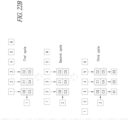
- Figure 22 (which is used to refer to Figure 22A and/or Figure 22B ) is a diagram illustrating convolutional operations concepts associated with a 1x3 kernel in a convolutional accelerator operating in a deep mode of operation according to an embodiment.
- the 1x2 kernel is decomposed into three 1x1 (or unitary) sub-kernels and the pixel values are strided.
- the first 1x1 sub-kernel is processed in a first deep mode cycle producing a first partial sum using pixel values 1-3
- the second 1x1 sub-kernel is processed in a second deep mode cycle using pixel values 2-4 producing a second partial sum
- the third 1x1 sub-kernel is processed in a third deep mode cycle using pixel values 3-5 producing an accumulated output for the 1x3 kernel.
- the concept may be extended to convolutional processing with 1xN kernels (e.g., up to the available memory in the feature line buffer 114 for storing kernel depths).
- Multiple convolutional accelerators may be employed in some embodiments, for example, to process the sub-kernels.
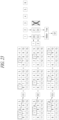
- Figure 23 is a conceptual diagram illustrating convolutional operations associated with a 1x2 kernel in a convolutional accelerator operating in a deep mode of operation using an adder tree according to an embodiment. As illustrated, two sub-kernels are each convolved with two pixel values in a cycle and the results are combined using an adder tree, which may reduce latency times associated with accumulating the results of processing of the sub-kernels in sequential cycles.
- Figure 24 illustrates a logical flow diagram generally showing an embodiment of a method 2400 for controlling a convolutional accelerator in multiple modes of operation, which may be performed, for example, by the convolutional accelerator 112 using the mode control circuitry 130 as discussed above with reference to Figures 9 to 23 .
- the method 2400 will be described with reference to Figures 1 to 23 .
- the method 2400 starts at 2402, and proceeds to 2404.
- the method 2400 determines or selects a mode of operation of a convolutional accelerator 112 in processing a convolutional layer. This may be done, for example, based on the size of a kernel to be processed by a convolutional accelerator 112 in the convolutional layer, the configuration of the convolutional accelerator 112 (e.g., the characteristics of the feature line buffer 114, the kernel buffer 116, etc.), and various combinations thereof.
- a first mode of operation such as a normal mode of operation
- the convolutional accelerator 112 is optimized to process 3x3 kernels (e.g., based on the size and configuration of the kernel buffer 116 and the clusters of MAC circuits 118)
- the kernel to be processed is a 2x2 or larger kernel
- a first mode of operation such as a normal mode of operation
- the convolutional accelerator 112 is optimized to process 3x3 kernels (e.g., based on the size and configuration of the kernel buffer 116)
- the kernel to be processed is a 1x1 (or unitary) to 1xN kernel, where N is an integer greater than or equal to 1 (one or unit)
- a second mode of operation may be selected, such as a deep mode of operation.
- the determination of the mode of operation may be made by a host processor, such as a process 102 of Figure 9 , and stored in a configuration register, such as the configuration register 148 of Figure 10 .
- the method 2400 proceeds from 2404 to 2406.
- the method 2400 determines whether the selected mode of operation is a first mode of operation or a second mode of operation, for example, a normal mode of operation or a deep mode of operation, based on the determination at 2404. When it is determined at 2406 that the mode of operation is a first mode of operation, the method 2400 proceeds from 2406 to 2408.
- the method 2400 stores feature data in the feature line buffer 114. This may be done in a generally conventional manner, such as discussed above with reference to Figures 10 and 13 . The method proceeds from 2408 to 2410.
- the method 2400 stores kernel data in the kernel buffer 116. This may be done in a generally conventional manner, such as discussed above with reference to Figures 10 and 13 . The method proceeds from 2410 to 2412.
- the method 2400 transfers feature data from the feature line buffer 114 to the MAC clusters 118, and transfers kernel data from the kernel buffer 116 to the MAC clusters 118.
- the method comprises an operation 2412 to transfer data to clusters of MAC circuits. This may be done in a generally conventional manner, such as discussed above with reference to Figures 10 and 13 . The method proceeds from 2412 to 2414.
- the method 2400 performs MAC operations using the MAC clusters 118 with the feature data and kernel data transferred at 2412. This may be done in a generally conventional manner, such as discussed above with reference to Figures 10 and 13 . The method proceeds from 2414 to 2416.
- the method 2400 performs other processing operations associated with the convolutional layer, such as accumulating results of batches of data, serializing output data, returning to 2408 to process a subsequent batch of data of the convolutional layer, transferring data to and from external memory, etc., and various combinations thereof. This may be done in a generally conventional manner, such as discussed above with reference to Figures 8 , 10 and 13 .
- the method proceeds from 2416 to 2418.
- the method 2400 performs other processing operations associated with the CNN that includes the convolutional layer, such as returning to 2404 to determine a mode of operation for a next convolutional layer of the CNN, performing pooling operations of a next layer of the CNN, transferring data to and from external memory, etc., and various combinations thereof.
- the method 2400 proceeds from 2406 to 2420.
- the method 2400 stores feature data in the kernel buffer 116. This may be done, for example, as discussed above with reference to Figures 13 to 18 and 20 . The method proceeds from 2420 to 2422.
- the method 2400 stores kernel data in the feature line buffer 114. This may be done, for example, as discussed above with reference to Figures 13 to 17 , 19 and 20 . The method proceeds from 2422 to 2424.
- the method 2400 transfers feature data from the kernel buffer 116 to the MAC clusters 118, and transfers kernel data from the feature line buffer 114 to the MAC clusters 118.
- the method comprises an operation 2424 to transfer data to clusters of MAC circuits. This may be done, for example, as discussed above with reference to Figures 13 to 20 .
- the method proceeds from 2424 to 2426.
- the method 2400 performs MAC operations using the MAC clusters 118 with the feature data and kernel data transferred at 2424. This may be done in a generally conventional manner. The method proceeds from 2414 to 2416.
- the method 2400 performs other processing operations associated with the convolutional layer, such as accumulating results of batches of data, serializing output data (e.g., to account for the order in which feature line and kernel data are processed in 2426), returning to 2420 to process a subsequent batch of data of the convolutional layer (see Figure 8 ), transferring data to and from external memory, etc., and various combinations thereof.
- the method proceeds from 2428 to 2418, where, as discussed above, other processing operations associated with the CNN may be performed.
- Embodiments of the foregoing processes and methods may contain additional acts not shown in Figure 24 , may not contain all of the acts shown in Figure 24 , may perform acts shown in Figure 24 in various orders, may combine acts, may split acts into separate acts, and may be otherwise modified in various respects.
- Figure 24 may be modified to combine acts 2404 and 2406, to perform acts 2408 and 2410 in parallel, to perform acts 2420 and 2422 in parallel, to include processing acts to facilitate processing of 1xN kernels in the second mode of operation, where N is an integer greater than 1 (see, e.g., Figures 21 to 23 ), etc., and various combinations thereof.
- a convolutional accelerator comprises a feature line buffer, a kernel buffer separate from the feature line buffer, a Multiply-ACcumulate (MAC) cluster, and mode control circuitry coupled to the feature line buffer, the kernel buffer and the MAC cluster.
- the mode control circuitry in a first mode of operation of the convolutional accelerator, stores feature data in the feature line buffer, stores kernel data in the kernel buffer, transfers feature data from the feature line buffer to the MAC cluster, and transfers kernel data from the kernel buffer to the MAC cluster.
- the mode control circuitry stores feature data in the kernel buffer, stores kernel data in the feature line buffer, transfers feature data from the kernel buffer to the MAC cluster, and transfers kernel data from the feature line buffer to the MAC cluster.
- the second mode of operation may be employed to efficiently process 1xN kernels, where N is an integer greater than or equal to 1 (one or unity).
- the mode control circuitry in the first mode of operation: stores three lines of feature line data having a depth of up to 1024 elements in the feature line buffer; and stores 3x3 kernels in the kernel buffer.
- the mode control circuitry, in the second mode of operation stores six lines of feature line data having a depth of up to 128 elements in the kernel buffer; and stores 1x1 (or unitary) kernels in the feature line buffer.
- the mode control circuitry, in the second mode of operation transfers three lines of feature line data from the kernel buffer to the MAC clusters in a cycle; and transfers twenty-four kernel data values to the MAC clusters in the cycle.
- the MAC clusters, in operation generate 72 output values in the cycle.
- the feature line buffer is a single-port memory
- the kernel buffer comprises a plurality of dual-port buffers.
- the mode control circuitry in the second mode of operation: stores feature line data in a first subset of the plurality of dual-port buffers; and buffers kernel data is a second subset of the plurality of dual-port buffers.
- the buffering kernel data in the second subset of the plurality of dual-port buffers comprises: storing kernel data in a first dual-port buffer of the second subset; transferring kernel data from the first dual-port buffer of the second subset to the feature line buffer; transferring kernel data from the feature line buffer to a second dual-port buffer of the second subset; and transferring kernel data from the second dual-port buffer of the second subset to the MAC clusters.
- the buffering kernel data in the second subset of the plurality of dual-port buffers comprises: transferring kernel data from the feature line buffer to a dual-port buffer of the second subset of dual-port buffers; and transferring kernel data from the dual-port buffer of the second subset of dual-port buffers to the MAC clusters.
- the mode control circuitry in the second mode of operation, serializes output values generated by the MAC clusters.
- the convolutional accelerator comprises a configuration register
- the mode control circuitry in operation, determines whether to operate in the first mode of operation or the second mode of operation based on a configuration parameter stored in the configuration register.
- the kernel data in the second mode of operation, has a size of IxN, where N is an integer greater than or equal to 1 (one or unity).
- a system comprises a stream engine, which, in operation, streams feature and kernel data, and a convolutional accelerator coupled to the stream engine, wherein the convolutional accelerator, in operation, receives streams of feature and kernel data from the stream engine.
- the convolutional accelerator includes a feature line buffer, a kernel buffer, a multiply-accumulate cluster coupled to the feature line buffer and the kernel buffer, mode control circuitry coupled to the feature line buffer, the kernel buffer and the MAC cluster.
- the mode control circuitry in a first mode of operation of the convolutional accelerator, stores feature data in the feature line buffer, stores kernel data in the kernel buffer, transfers feature data from the feature line buffer to the MAC cluster, and transfers kernel data from the kernel buffer to the MAC cluster.
- the mode control circuitry stores feature data in the kernel buffer, stores kernel data in the feature line buffer, transfers feature data from the kernel buffer to the MAC cluster, and transfers kernel data from the feature line buffer to the MAC cluster.
- the second mode of operation may be employed to efficiently process 1xN kernels, where N is an integer greater than or equal to 1 (one or unity).
- the mode control circuitry in the first mode of operation: stores three lines of feature line data having a depth of up to 1024 elements in the feature line buffer; and in the second mode of operation: stores six lines of feature line data having a depth of up to 128 elements in the kernel buffer; and stores 1xN kernels in the feature line buffer, where N is an integer greater than or equal to 1 (one or unity).
- the mode control circuitry, in the second mode of operation transfers three lines of feature line data from the kernel buffer to the MAC clusters in a cycle; and transfers twenty-four kernel data values to the MAC clusters in the cycle.
- the feature line buffer is a single-port memory; and the kernel buffer comprises a plurality of dual-port buffers.
- the mode control circuitry, in the second mode of operation stores feature line data in a first subset of the plurality of dual-port buffers; and buffers kernel data is a second subset of the plurality of dual-port buffers.
- a method comprises streaming feature data and kernel data to a convolutional accelerator, and convolving streamed kernel data with streamed feature data.
- the convolving includes, in a first mode of operation of the convolutional accelerator, storing feature data in a feature line buffer of the convolutional accelerator, storing kernel data in a kernel buffer of the convolutional accelerator, transferring feature data from the feature line buffer to a MAC cluster of the convolutional accelerator, and transferring kernel data from the kernel buffer to the MAC cluster.
- the convolving includes storing feature data in the kernel buffer, storing kernel data in the feature line buffer, transferring feature data from the kernel buffer to the MAC cluster, and transferring kernel data from the feature line buffer to the MAC cluster.
- the second mode of operation may be employed to efficiently process 1xN kernels, where N is an integer greater than or equal to 1 (one or unity).
- the first mode of operation includes storing three lines of feature line data having a depth of up to 1024 (one thousand twenty-four) elements in the feature line buffer, and storing 3x3 kernels in the kernel buffer; and the second mode of operation includes storing six lines of feature line data having a depth of up to 128 (one hundred twenty-eight) elements in the kernel buffer, and storing 1xN kernels in the feature line buffer, where N is an integer greater than or equal to 1 (one or unity).
- the kernel buffer comprises a plurality of dual-port buffers; and in the second mode of operation: the storing feature data in the kernel buffer comprises storing feature data in a first subset of the plurality of dual-port buffers; and the storing kernel data in the feature line buffer comprising buffering kernel data is a second subset of the plurality of dual-port buffers.
- a non-transitory computer-readable medium's contents configure a convolutional accelerator having a plurality of modes of operation to convolve streamed kernel data with streamed feature data.
- the convolving includes, in a first mode of operation of the plurality of modes of operation of the convolutional accelerator, storing feature data in a feature line buffer of the convolutional accelerator, storing kernel data in a kernel buffer of the convolutional accelerator, transferring feature data from the feature line buffer to a MAC cluster of the convolutional accelerator, and transferring kernel data from the kernel buffer to the MAC cluster.
- the convolving includes storing feature data in the kernel buffer, storing kernel data in the feature line buffer, transferring feature data from the kernel buffer to the MAC cluster, and transferring kernel data from the feature line buffer to the MAC cluster.
- the second mode of operation may be employed to efficiently process 1xN kernels, where N is an integer greater than or equal to 1 (one or unity).
- the convolving in the first mode of operation includes storing three lines of feature line data having a depth of up to 1024 elements in the feature line buffer, and storing 3x3 kernels in the kernel buffer; and in the second mode of operation the convolving includes storing six lines of feature line data having a depth of up to 128 (one hundred twenty-eight) elements in the kernel buffer, and storing 1xN kernels in the feature line buffer, where N is an integer greater than or equal to 1 (one or unity).
- the kernel buffer comprises a plurality of dual-port buffers; and in the second mode of operation: the storing feature data in the kernel buffer comprises storing feature data in a first subset of the plurality of dual-port buffers; and the storing kernel data in the feature line buffer comprises buffering kernel data is a second subset of the plurality of dual-port buffers.
- the contents comprise instructions executed by the convolutional accelerator.
- a computer readable medium comprising a computer program adapted to perform one or more of the methods or functions described above.
- the medium may be a physical storage medium, such as for example a Read Only Memory (briefly, ROM) chip, or a disk such as a Digital Versatile Disk (briefly, DVD-ROM), Compact Disk (briefly, CD-ROM), a hard disk, a memory, a network, or a portable media article to be read by an appropriate drive or via an appropriate connection, including as encoded in one or more barcodes or other related codes stored on one or more such computer-readable mediums and being readable by an appropriate reader device.
- ROM Read Only Memory
- DVD-ROM Digital Versatile Disk
- CD-ROM Compact Disk
- some or all of the methods and/or functionality may be implemented or provided in other manners, such as at least partially in firmware and/or hardware, including, but not limited to, one or more application-specific integrated circuits (briefly, ASICs), digital signal processors, discrete circuitry, logic gates, standard integrated circuits, controllers (e.g., by executing appropriate instructions, and including microcontrollers and/or embedded controllers), field-programmable gate arrays (briefly, FPGAs), complex programmable logic devices (briefly, CPLDs), etc., as well as devices that employ RFID technology, and various combinations thereof.
- ASICs application-specific integrated circuits
- controllers e.g., by executing appropriate instructions, and including microcontrollers and/or embedded controllers
- field-programmable gate arrays briefly, FPGAs
- CPLDs complex programmable logic devices
Landscapes
- Engineering & Computer Science (AREA)
- Physics & Mathematics (AREA)
- Theoretical Computer Science (AREA)
- General Physics & Mathematics (AREA)
- Data Mining & Analysis (AREA)
- Mathematical Physics (AREA)
- Computing Systems (AREA)
- General Engineering & Computer Science (AREA)
- Software Systems (AREA)
- Computational Mathematics (AREA)
- Mathematical Analysis (AREA)
- Pure & Applied Mathematics (AREA)
- Mathematical Optimization (AREA)
- Biomedical Technology (AREA)
- Biophysics (AREA)
- Health & Medical Sciences (AREA)
- Life Sciences & Earth Sciences (AREA)
- Evolutionary Computation (AREA)
- Artificial Intelligence (AREA)
- Computational Linguistics (AREA)
- General Health & Medical Sciences (AREA)
- Molecular Biology (AREA)
- Algebra (AREA)
- Databases & Information Systems (AREA)
- Neurology (AREA)
- Complex Calculations (AREA)
Abstract
Description
- The present disclosure generally relates to convolutional accelerators, such as convolutional accelerators used in a learning/inference machine (e.g., an artificial neural network - ANN, such as a convolutional neural network - CNN).
- Various computer vision, speech recognition, and signal processing applications may benefit from the use of learning/inference machines, which may quickly perform hundreds, thousands, or even millions of concurrent operations. Learning/inference machines, as discussed in this disclosure, may fall under the technological titles of machine learning, artificial intelligence, neural networks, probabilistic inference engines, accelerators, and the like. Conventional learning/inference machines can deliver hundreds of teraflops (e.g., one million millions - 1012 - floating-point operations per second) of computing power.
- Such learning/inference machines may include or otherwise utilize CNNs, such as deep convolutional neural networks (briefly, DCNN). A DCNN is a computer-based tool that processes large quantities of data and adaptively "learns" by conflating proximally related features within the data, making broad predictions about the data, and refining the predictions based on reliable conclusions and new conflations. The DCNN is arranged in a plurality of "layers," and different types of predictions are made at each layer. Hardware accelerators including convolutional accelerators are often employed to accelerate the processing of large amounts of data by a DCNN.
- In an embodiment, a convolutional accelerator comprises a feature line buffer, a kernel buffer separate from the feature line buffer, a Multiply-ACcumulate (briefly, MAC) cluster, and mode control circuitry coupled to the feature line buffer, the kernel buffer and the MAC cluster. The mode control circuitry, in a first mode of operation of the convolutional accelerator, stores feature data in the feature line buffer, stores kernel data in the kernel buffer, transfers feature data from the feature line buffer to the MAC cluster, and transfers kernel data from the kernel buffer to the MAC cluster. In a second mode of operation of the convolutional accelerator, the mode control circuitry stores feature data in the kernel buffer, stores kernel data in the feature line buffer, transfers feature data from the kernel buffer to the MAC cluster, and transfers kernel data from the feature line buffer to the MAC cluster. The second mode of operation may be employed to efficiently process 1xN kernels, where N is an integer greater than or equal to 1 (one).
- In an embodiment, a system comprises a stream engine, which, in operation, streams feature and kernel data, and a convolutional accelerator coupled to the stream engine, wherein the convolutional accelerator, in operation, receives streams of feature and kernel data from the stream engine. The convolutional accelerator includes a feature line buffer, a kernel buffer, a multiply-accumulate cluster coupled to the feature line buffer and the kernel buffer, mode control circuitry coupled to the feature line buffer, the kernel buffer and the MAC cluster. The mode control circuitry, in a first mode of operation of the convolutional accelerator, stores feature data in the feature line buffer, stores kernel data in the kernel buffer, transfers feature data from the feature line buffer to the MAC cluster, and transfers kernel data from the kernel buffer to the MAC cluster. In a second mode of operation of the convolutional accelerator, the mode control circuitry stores feature data in the kernel buffer, stores kernel data in the feature line buffer, transfers feature data from the kernel buffer to the MAC cluster, and transfers kernel data from the feature line buffer to the MAC cluster. The second mode of operation may be employed to efficiently process 1xN kernels, where N is an integer greater than or equal to 1 (one or unity).
- In an embodiment, a method comprises streaming feature data and kernel data to a convolutional accelerator, and convolving streamed kernel data with streamed feature data. The convolving includes, in a first mode of operation of the convolutional accelerator, storing feature data in a feature line buffer of the convolutional accelerator, storing kernel data in a kernel buffer of the convolutional accelerator, transferring feature data from the feature line buffer to a MAC cluster of the convolutional accelerator, and transferring kernel data from the kernel buffer to the MAC cluster. In a second mode of operation of the convolutional accelerator the convolving includes storing feature data in the kernel buffer, storing kernel data in the feature line buffer, transferring feature data from the kernel buffer to the MAC cluster, and transferring kernel data from the feature line buffer to the MAC cluster. The second mode of operation may be employed to efficiently process 1xN kernels, where N is an integer greater than or equal to 1 (one or unity).
- In an embodiment, a non-transitory computer-readable medium's contents configure a convolutional accelerator having a plurality of modes of operation to convolve streamed kernel data with streamed feature data. The convolving includes, in a first mode of operation of the plurality of modes of operation of the convolutional accelerator, storing feature data in a feature line buffer of the convolutional accelerator, storing kernel data in a kernel buffer of the convolutional accelerator, transferring feature data from the feature line buffer to a MAC cluster of the convolutional accelerator, and transferring kernel data from the kernel buffer to the MAC cluster. In a second mode of operation of the plurality of modes of operation of the convolutional accelerator, the convolving includes storing feature data in the kernel buffer, storing kernel data in the feature line buffer, transferring feature data from the kernel buffer to the MAC cluster, and transferring kernel data from the feature line buffer to the MAC cluster. The second mode of operation may be employed to efficiently process 1xN kernels, where N is an integer greater than or equal to 1 (one or unity). In an embodiment, the contents comprise instructions executed by the convolutional accelerator.
- One or more embodiments are described hereinafter with reference to the accompanying drawings.
-
Figure 1 is a diagram illustrating concepts underlying a digit recognition task; -
Figure 2 is a diagram illustrating concepts underlying an image recognition task; -
Figure 3 is a diagram illustrating concepts underlying an example of a CNN; -
Figure 4 is a diagram illustrating concepts underlying an example convolutional layer of a CNN; -
Figure 5 is a diagram illustrating concepts underlying strides of convolutional layers of a CNN; -
Figure 6 is a diagram illustrating concepts underlying application of padding of an input feature map to preserve height and width dimensions during a convolutional; -
Figure 7 is a diagram illustrating concepts underlying loading of feature data in batches; -
Figure 8 is a diagram illustrating concepts underlying processing of a convolution in batches; -
Figure 9 is a functional block diagram of an embodiment of an electronic device or system employing convolutional accelerator mode control circuitry; -
Figure 10 is a diagram illustrating concepts underlying processing of convolutional operations having a 3x3 kernel using an embodiment of a convolutional accelerator; -
Figure 11 is a diagram illustrating concepts underlying convolutional layers having 3x3 and 1x1 (one time one or unitary) kernels respectively; -
Figure 12 is a diagram illustrating concepts underlying processing of convolutional operations having a 1x1 kernel using an embodiment of a convolutional accelerator storing feature line data in a feature line buffer and kernel data in a kernel buffer in a mode of operation in which components of the convolutional accelerator are switched off; -
Figures 13A and13B (collectively referred to herein asFigure 13 ) are diagrams illustrating concepts underlying two modes of operation of a convolutional accelerator according to an embodiment; -
Figure 14 is a diagram illustrating concepts underlying processing of convolutional operations having a 1x1 kernel using an embodiment of a convolutional accelerator storing feature line data in a kernel buffer and kernel data in a feature line buffer in a deep mode of operation of the convolutional accelerator; -
Figure 15 is a functional block diagram of an embodiment of a convolutional accelerator including mode control circuitry controlling operation of the convolutional accelerator in a deep mode of operation; -
Figure 16 is a diagram illustrating concepts underlying feature and kernel data flow paths in a deep mode of operation of a convolutional accelerator according to an embodiment; -
Figure 17 is a diagram illustrating concepts underlying the performance of three convolutional operations per kernel value of a 1x1 kernel in an operational cycle of a convolutional accelerator operating in a deep mode of operation according to an embodiment; -
Figure 18 is a diagram illustrating concepts underlying a data path of the feature data in a convolutional accelerator operating in a deep mode of operation according to an embodiment; -
Figure 19 is a diagram illustrating concepts underlying a data path of the kernel data in a convolutional accelerator operating in a deep mode of operation according to an embodiment; -
Figure 20 is a diagram illustrating concepts underlying the sharing of each kernel value with three MAC units and the sharing of each pixel of feature data with a pair of MAC clusters in a convolutional accelerator operating in a deep mode of operation according to an embodiment;Figure 21 is a diagram illustrating concepts underlying convolutional operations associated with a 1x2 kernel in a convolutional accelerator operating in a deep mode of operation according to an embodiment; -
Figures 22A and22B (collectively referred to herein asFigure 22 ) are diagrams illustrating concepts underlying convolutional operations associated with a 1x3 kernel in a convolutional accelerator operating in a deep mode of operation according to an embodiment; -
Figure 23 is a diagram illustrating concepts underlying convolutional operations associated with a 1x2 kernel in a convolutional accelerator operating in a deep mode of operation using an adder tree according to an embodiment; -
Figure 24 illustrates a logical flow diagram generally showing an embodiment of a process for controlling a convolutional accelerator in multiple modes of operation. - The following description, along with the accompanying drawings, sets forth certain specific details in order to provide a thorough understanding of various disclosed embodiments. However, one skilled in the relevant art will recognize that the disclosed embodiments may be practiced in various combinations, with or without one or more of these specific details, or with other methods, components, devices, materials, etc. In other instances, well-known structures or components that are associated with the environment of the present disclosure, including but not limited to interfaces, power supplies, physical component layout, convolutional accelerators, Multiply-ACcumulate (MAC) circuitry, etc., in a hardware accelerator environment, have not been shown or described in order to avoid unnecessarily obscuring descriptions of the embodiments. Additionally, the various embodiments may be methods, systems, devices, computer program products, etc.
- Throughout the specification, claims, and drawings, the following terms take the meaning associated herein, unless the context indicates otherwise. The term "herein" refers to the specification, claims, and drawings associated with the current application. The phrases "in one embodiment," "in another embodiment," "in various embodiments," "in some embodiments," "in other embodiments," and other variations thereof refer to one or more features, structures, functions, limitations, or characteristics of the present disclosure, and are not limited to the same or different embodiments unless the context indicates otherwise. As used herein, the term "or" is an inclusive "or" operator, and is equivalent to the phrases "A or B, or both" or "A or B or C, or any combination thereof," and lists with additional elements are similarly treated. The term "based on" is not exclusive and allows for being based on additional features, functions, aspects, or limitations not described, unless the context indicates otherwise. In addition, throughout the specification, the meaning of "a," "an," and "the" include singular and plural references.
- CNNs are particularly suitable for recognition tasks, such as recognition of numbers or objects in images, and may provide highly accurate results.
Figure 1 is a diagram illustrating a digit recognition task concept andFigure 2 is a diagram illustrating an image recognition task concept. - CNNs are specific types of deep neural networks (briefly, DNNs) with one or multiple layers which perform a convolution on a three-dimensional feature data tensor (width by height by depth). The first layer is an input layer and the last layer is an output layer. The intermediate layers may be referred to as hidden layers. The most used layers are convolutional layers, fully connected or dense layers, and pooling layers (max pooling, average pooling, etc.). Data exchanged between layers are called features or activations. Each layer also has a set of learnable parameters typically referred to as weights or kernels.
Figure 3 is a diagram illustrating concepts of an example of a CNN, that is AlexNet. The illustrated CNN has a set of convolutional layers interleaved with max pooling layers, followed by a set of fully connected or dense layers. - The parameters of a convolutional layer include a set of learnable filters referred to as kernels. Each kernel has three dimensions: height, width and depth. The height and width are typically limited in range (e.g., [1, 11] - one to eleven). The depth typically extends to the full depth of an input feature data. Each kernel slides across the width and the height of the input features and a dot product is computed. At the end of the process a result is obtained as a set of two-dimensional feature maps. In a convolutional layer, many kernels are applied to an input feature map, each of which produces a different feature map as a result. The depth of the output feature tensors is also referred to the number of output channels.
Figure 4 is a diagram illustrating the application concept of a kernel to a feature map, producing a two-dimensional feature map having a height of 4 (four) and a width of 4. - Convolutional layers also may have other parameters, which may be defined for the convolutional layer, rather than learned parameters. Such parameters may be referred to as hyper-parameters. For example, a convolutional layer may have hyper-parameters including stride and padding hyper-parameters.
- The stride hyper-parameter indicates a step-size used to slide kernels across an input feature map.
Figure 5 is a diagram illustrating a concept of comparing a stride of 1 (one or unity) and a stride of 2. When the stride is greater than 1 (one or unity), the output feature map will be smaller than the input feature map. - The padding hyper-parameter indicate a number of zeros to be added along the height, the width or the height and width of the input feature map. The padding parameters may be used to control a size of an output feature map generated by the convolution.
-
Figure 6 is a diagram illustrating application concepts of padding to an input feature map. The padding preserves the input feature size along the height and width of the feature map. - The feature data of a convolutional layer may have hundreds or even thousands of channels, with the number of channels corresponding to the depth of the feature data and of the kernel data. For this reason, feature and kernel data are often loaded into memory in batches.
Figure 7 is a conceptual diagram illustrating the concept of loading feature data in batches. The feature data is split along the depth dimension into batches, with each batch of feature data having the same height, width and depth. The kernel depth is generally the same as the depth of the input feature map, so similar issues are addressed by batching. - As illustrated, the batches have a height of 5, a width of 5, and a depth of 4. Batches are typically written into memory sequentially, with writing of a first batch being completed before beginning the writing of a second batch.
- The arrows in
Figure 7 illustrate an example order in which data of a batch is written into memory. A similar batching process is typically applied to the kernel data, with each batch of the kernel data having a same kernel height and kernel width, and the same depth as the batches of feature data. Each batch of feature data is convolved with a related batch of kernel data, and a feedback mechanism is employed to accumulate the results of the batches. The conceptual diagram ofFigure 8 illustrates the concept of batch processing of a convolution. - As can be seen, the computations performed by a CNN, or by other neural networks, often include repetitive computations over large amounts of data. For this reason, computing systems having hardware accelerators may be employed to increase the efficiency of performing operations associated with the CNN.
-
Figure 9 is a functional block diagram of an embodiment of an electronic device orsystem 100 of the type to which described embodiments may apply. Thesystem 100 comprises one or more processing cores orcircuits 102. Theprocessing cores 102 may comprise, for example, one or more processors, a state machine, a microprocessor, a programmable logic circuit, discrete circuitry, logic gates, registers, etc., and various combinations thereof. The processing cores may control overall operation of thesystem 100, execution of application programs by the system 100 (e.g., programs which classify images using CNNs), etc. - The
system 100 includes one ormore memories 104, such as one or more volatile and/or non-volatile memories which may store, for example, all or part of instructions and data related to control of thesystem 100, applications and operations performed by thesystem 100, etc. One or more of thememories 104 may include a memory array, which, in operation, may be shared by one or more processes executed by thesystem 100. - The
system 100 may include one or more sensors 160 (e.g., image sensors, audio sensors, accelerometers, pressure sensors, temperature sensors, etc.), one or more interfaces 170 (e.g., wireless communication interfaces, wired communication interfaces, etc.), andother circuits 180, which may include antennas, power supplies, one or more built-in self-test (briefly, BIST) circuits, etc., and amain bus system 190. Themain bus system 190 may include one or more data, address, power and/or control buses coupled to the various components of thesystem 100. - The
system 100 also includes one ormore hardware accelerators 110 which, in operation, accelerate the performance of one or more operations associated with implementing a CNN. Thehardware accelerator 110 as illustrated includes one or moreconvolutional accelerators 112 to facilitate efficient performance of convolutions associated with convolutional layers of a CNN. The convolutional accelerators include a featureline buffer memory 114, which, in operation, conventionally stores lines of feature data, akernel buffer memory 116, which, in operation, conventionally stores kernel data, and one or more clusters of Multiply-Accumulate (briefly, MAC) units orcircuits 118, which in operation perform convolution operations using the buffered kernel and feature data. Thehardware accelerator 110 as illustrated also includes astream engine 150 and astream switch 155. Thestream engine 150, in operation, transmits data streams. For example, thestream engine 150 may stream data, such as feature data or kernel data stored inmemory 104, to aconvolutional accelerator 112 via thestream switch 155. - The kernel dimensions may vary between CNNs, and between convolutional layers of a single CNN. For example, in
Figure 3 convolutional layers with kernels having height and width dimensions of 11x11, 5x5 and 3x3 are illustrated. Historically, 3x3 kernels have been the most common. Thus, convolutional accelerators may typically be designed to efficiently support kernel computations within defined kernel height and width sizes, such as 3x3 kernels. - For example, the feature
line buffer memory 114 may typically be a deep single port memory storing a few lines of feature data (e.g., three lines) and having a large number of storage elements per line (e.g., 1024 elements per line). Feature line data is often reused with multiple kernels, and a single port is generally sufficient for the featureline buffer memory 114 because the computations may typically be started once the feature line buffer is full. - The
kernel buffer memory 116 may typically be a small, wide and shallow dual-port memory (e.g., 96 bits of width by 16 memory locations). Because the kernel buffer is wide, it is relatively expensive, and for this reason is often shallow to reduce the costs of the memory (e.g., to reduce the area costs). To provide for an efficient bandwidth in view of the shallow depth of the memory, thekernel buffer 116 may be a dual-port memory to facilitate simultaneous reading of stored kernel data for use in current convolutional operations and loading of kernel data into the kernel buffer for use in subsequent convolutional operations. -
Figure 10 is a diagram illustrating processing concepts of convolutional operations having a 3x3 kernel using an embodiment of a convolutional accelerator, such as theconvolutional accelerator 112 ofFigure 9 . Feature data is stored in the feature line buffer 114 (e.g., three lines of feature data which may be processed together), and kernel data is stored in the kernel buffer 116 (e.g., supporting kernels of various sizes up to a threshold size, with the storage in the buffer optimized, for example, for 3x3 kernel data). Convolutional operations are performed using the MAC clusters 118 (e.g., 72 MACs organized into 6clusters 118 of 12 MACs each - three sets of four MAC units 120) to operate on data received from the feature line buffer and the kernel buffer.Figure 10 illustrates examples of other typical components of a convolutional accelerator (e.g., streaminginterfaces 142, streamingbuffers 144, anadder tree 146, configuration registers 148, etc.), which are not described in detail with reference toFigure 10 . Larger size kernels (e.g., 4x4, 11x11, etc.) may typically be handled using, for example, software kernel decomposition techniques. - However, many CNNs have one or more layers with kernels having smaller height and width dimensions. For example, hidden or inner layers, especially dense or deep layers, may have a large number of channels of feature data and may frequently employ kernels having height and width dimensions smaller than 3x3, such as 1x1, 1x2, or 1x3, 1xN kernels. In particular, deep or dense convolutional layers having feature data with a larger number of channels convolved with 1x1 deep (or unitary) kernels are becoming increasingly popular in CNNs.
Figure 11 is a diagram illustrating concepts of convolutional layers having 3x3 and 1x1 kernels respectively. - Kernels having smaller height and width dimensions (e.g., 1x1 or unitary kernels) may be processed by switching off some of the components of a convolutional accelerator. This can be inefficient in a number of ways, as discussed with reference to the diagram of
Figure 12 , which illustrates concepts of an example of processing a convolutional layer with a 1x1 (or unitary) kernel by switching off components of a convolutional accelerator optimized for use with larger size kernels. Feature data is stored in thefeature line buffer 114 and kernel data is stored in thekernel buffer 116. - To avoid congestion due to bandwidth saturation at the output, the number of input channels to the MAC units (which is limited by the depth of the kernel data that can be stored in the kernel buffer) is maintained to be greater than or equal to the number of output channels of the MAC units. Typical kernel buffer depth limitations may limit the number of input channels to the
MAC clusters 118 to, for example, 24 channels for kernels having a height and width dimensions of 1x1. Thus, in the example considered the number of output channels of the MAC clusters would be limited to 24 channels, due to the bottleneck created by the size of kernel buffer memory, to avoid bandwidth saturation at the output. - In an example configuration of 72 MAC units organized into 6 clusters C0-C5 of 12
MACs 120 each discussed above, only fourMAC units 120 of the twelve MAC units of each cluster may be active, with the rest of the MAC units remaining idle, and only one output pixel per kernel may be processed per cycle. As illustrated, kernels 1-4 are provided to the first cluster of 12 MAC units with only 4 of the 12 MAC units being used, kernels 5-8 are provided to the second cluster of 12 MAC units with only 4 of the 12 MAC units of the second cluster being used, etc. - In addition, the ratio between fetched kernel data and the number of operations performed using the fetched kernel data drops dramatically as compared to processing of a 3x3 kernel, etc. using the same or a similar convolutional accelerator configuration. Thus, a significant number of additional fetch operations must be performed to process the convolutions of a convolutional layer having a 1x1 kernel when a solution of switching off components of the convolutional accelerator is employed.
- Another alternative is to use fine-grained accelerator hardware. This approach, however, involves a substantial overhead in terms of control circuitry and software processing to process larger kernels using the fine-grained hardware. Using fine-grained hardware is not as efficient in processing larger kernels as coarse-grained accelerators. Such larger kernels, such as 3x3 kernels, also are frequently employed in CNNs as noted above.
- The Inventors have realized that hardware resources of a coarse-grained convolutional accelerator (e.g., a convolutional accelerator designed to efficiently process kernels having height and width dimensions of 3x3) may be reused or reconfigured to more efficiently perform convolutions using kernels having smaller height and width dimensions (e.g., 1x1, 1x2, ... 1xN dimensions) by employing two different modes of operation instead of switching off components.
- When a convolutional layer having a 1x1 kernel is being processed, only one line of feature data needs to be stored at a time for convolving with kernels of the 1x1 kernels, so a deep three-line feature line buffer is not needed for the feature data. In addition, the size characteristics of the relatively deep
feature line buffer 114 are more suited to storing kernel data associated with a 1x1 deep (or unitary) kernel than the size characteristics of theshallower kernel buffer 116. - The inventors realized the types of data stored in the two buffers may be switched when convolutional layers having kernels with smaller height and width dimensions are being processed. A first mode of operation may be employed to process kernels having larger height and width dimensions (e.g., 3x3 kernels), and a second mode of operation may be employed to process kernels having smaller height and width dimensions (e.g., 1x1, 1x2, ... 1xN). Two concept example modes of operation are conceptually illustrated by the diagram of
Figure 13 . - In a first mode of operation, labeled normal mode in
Figure 13 , feature data is stored in thefeature line buffer 114 and kernel data is stored in thekernel buffer 116. The first mode of operation may be employed, for example, to process typical 3x3 kernels in a generally conventional manner. See the discussion ofFigure 10 , above. - In a second mode of operation, labeled deep mode in
Figure 13 , feature data is stored in thekernel buffer 116 instead of in the feature line buffer, and kernel data is stored in thefeature line buffer 114. For example, in the second mode of operation, two sets of 24 different kernels of 1x1x128 may be stored in thefeature line buffer kernel data buffer 116. The second mode of operation may be employed, for example, to process 1x1 kernels, such as 1x1 kernels having a depth for which using the second mode of operation instead of the first mode of operation may provide increased efficiencies (e.g., a depth larger than a number of MAC units of the MAC cluster, in the example discussed, a kernel depth of 128, which is larger than 72). - To facilitate the first and second modes of operation, the
system 100 as illustrated inFigure 9 comprisesmode control circuitry 130. In the first mode of operation, themode control circuitry 130 controls the storage of feature data in thefeature line buffer 114 and the transfer of feature data from thefeature line buffer 114 to theMAC clusters 118, and the storage of kernel data in thekernel buffer 116, and the transfer of kernel data from thekernel buffer 116 to theMAC clusters 118. Operation of the mode control circuitry in the first mode of operation may be performed to control the storage and transfer of feature and kernel data in a generally conventional manner. For example, the concept is illustrated in the diagram ofFigure 10 . While themode control circuitry 130 is illustrated as a block inFigures 9 and13 , the mode control circuitry may be implemented, for example, using control logic and discrete components (e.g., multiplexers, existing buffers, etc.) distributed through theconvolutional accelerator 112. - In the second mode of operation, the
mode control circuitry 130 controls the storage of kernel data in thefeature line buffer 114 and transmission of kernel data from thefeature line buffer 114 to theMAC clusters 118, and the storage of feature data in thekernel buffer 116, and the transfer of feature data from thekernel buffer 116 to theMAC clusters 118. Examples of the operation and configurations of embodiments of themode control circuitry 130 in the second mode of operation are discussed herein with reference toFigures 14 to 23 . - Embodiments of the
system 100 ofFigure 9 may include more components than illustrated, may include fewer components than illustrated, may combine components, may separate components into sub-components, and various combination thereof. For example, thehardware accelerator 110 may include DMA controllers, themode control circuitry 130 may be split into input mode control circuitry to control the storage of input feature data and kernel data into thebuffers buffers MAC clusters 118, all or part of themode control circuitry 130 may be shared by one or moreconvolutional accelerators 112, themode control circuitry 130 may be integrated into other control circuitry of the convolutional accelerator, etc., and various combinations thereof. -
Figure 14 is a diagram illustrating concepts of an example of processing a convolutional layer with a 1x1 (or unitary) kernel by operating the convolutional accelerator in a second mode of operation in which kernel data is stored in a feature line buffer (e.g.,feature line buffer 114 ofFigure 9 ) and pixels of feature data are stored in a kernel buffer (e.g.,kernel buffer 116 ofFigure 9 ). - A large single-port
feature line buffer 114, which may normally be used to store 3 lines of feature data having a depth of 1024 elements, is instead controlled to store 24 kernels having a depth of up to 128 kernel values. Thus, 128 input channels are available, which is greater than the number of output channels of 72 available in the example configuration discussed above with reference toFigure 9 . In the second mode of operation, thekernel buffer 116 is controlled to store three lines of feature data, and thus three lines of feature data may be fed to clusters ofMAC units 118. - As shown in
Figure 14 , kernels 1-4 are provided to a set of three clusters of four MAC units each. One of the three clusters of four MAC units computes the output forline 1 of the feature data and kernels 1-4, a second one of the three clusters of 4 MAC units computes the output forline 2 of the feature data and kernels 1-4, and a third one of the three clusters computes the output forline 3 of the feature data and kernels 1-4. Similarly, kernels 5-8 are provided to another set of three clusters of four MAC units each, each cluster computing the output for a respective line of the feature data and kernels 5-8. Kernels 9-12, 13-16, 17-20 and 21-24 are similarly provided to respective clusters of four MAC units each to compute outputs for respective lines of the feature data and the respective kernels. - The throughput is improved from 1 pixel depth per kernel in a cycle to 3 pixel depths per kernel in a cycle when a convolutional layer having a 1x1 kernel is processed using the deep mode of operation as compared to the normal mode of operation. In addition, each kernel value is used in three MAC operations in a cycle, significantly improving the ratio of the number of fetch operations to the number of MAC operations performed as compared to the use of each kernel value in one MAC operation per cycle when the normal mode of operation is employed to process a 1x1 kernel (see
Figure 12 ). -
Figure 15 is a diagram illustrating concepts of an embodiment of a configuration of afeature data path 220 and akernel data path 230 of aconvolutional accelerator 112 operating in a mode of operation, such as a deep mode of operation, in which feature line data is stored in akernel buffer 116, and kernel data is stored in afeature line buffer 114. An embodiment of thefeature data path 220 is shown in more detail inFigure 18 , and an embodiment of thekernel data path 230 is shown in more detail inFigure 19 . - The
kernel buffer 116 in the embodiment ofFigure 15 comprises six dual-port memories 216, as illustrated six 16x96 bit dual-port buffers. In the normal mode of operation, the sixdual port memories 216 of thekernel buffer 116 store kernel data, which may be done in a generally conventional manner. In the deep mode of operation, four of the six dual-port memories 216 are included in thefeature data path 220 and controlled by (deep-mode) featureload control circuitry 130f of themode control circuitry 130 to store feature line data. - As illustrated the four dual-port memories are organized into six
virtual buffers 116v of 128x8 bits in thefeature line path 220, eachvirtual buffer 116v storing a line of feature data. Three lines of feature data may be fed to theMAC clusters 118 at a time, each line being provided by the respective virtual buffer to two of the six clusters ofMAC units 118. While feature data from three of thevirtual buffers 116v is being fed to theMAC clusters 118, feature data for a next set of computations may be loaded into the other threevirtual buffers 116v. Thus, three lines of feature data may be stored into thevirtual buffers 116v of thekernel buffer memory 116 at a time in a ping-pong fashion. The (deep-mode) feature data loadcontrol circuitry 130f of themode control circuitry 130 is included in thefeature data path 220, and in operation the (deep-mode) feature data loadcontrol circuitry 130f controls the order in which pixels of feature data are stored into thevirtual buffers 116v of thekernel buffer 116. As illustrated, thefeature line path 220 includes a FIFO buffer and optional data manipulation circuitry. - In the second or deep mode of operation, the
feature line buffer 114 is included in thekernel data path 230 and controlled to store kernel data by (deep-mode) kernelload control circuitry 130k of themode control circuitry 130. The two remaining dual-port buffers 216 of thekernel buffer 116 may advantageously be used in thekernel data path 230 to facilitate the storage in and retrieval from thefeature line buffer 114 of kernel data stored therein. As illustrated, one of the dual-port buffers 216a may be used to reduce the number of cycles needed to fill thefeature line buffer 114 with kernel data, and one of the dual-port buffers 216b may be used to mirror the output of thefeature line buffer 114 in order to emulate dual-port memory performance by the single port feature line buffer 114 (e.g., to facilitate use of kernel data stored in the dual-port buffer 216b by theMAC clusters 118 while subsequent kernel data is being loaded into thefeature line buffer 114 from the dual-port buffer 216a). - As illustrated, the (deep-mode) kernel
load control circuitry 130k includes filtering circuitry 130kfilt, which in operation selects kernels fromkernel data path 230 to load into thefeature line buffer 114 via the dual-port buffer 216a, and multiplexer circuitry 130km, which in operation, controls the transmission of kernel data from thedual port buffer 216b to theMAC clusters 118. Themode control circuitry 130 ofFigure 15 as illustrated also includes (deep-mode)serialization circuitry 130s, which in operation serializes the outputs of the MAC clusters to account for the order in which the MAC operations are performed. -
Figure 16 is a diagram illustrating concepts of feature and kernel data flow paths in a deep mode of operation of a convolutional accelerator according to an embodiment. Features are streamed depth-wise and a whole pixel is stored in eachvirtual buffer 116v of thekernel buffer 116. Three pixels at a time are sent to theMAC clusters 118, with each pixel being provided to a pair of the sixMAC clusters 118. For example, multiplexers 130fm of themode control circuitry 130 may be controlled to provide either pixels 1-3 or pixels 4-6 to respective pairs of MAC clusters of theMAC clusters 118. - Kernels 1-24 are stored in the
feature line buffer 114, and all 24 kernels are sent to respective MAC clusters in a cycle (seeFigure 14 ), generating three lines of an output feature map.Figure 17 is a diagram illustrating concepts of the transmission of three pixels per cycle for a given kernel value in the example configuration ofFigure 16 . The same kernel is strided three times in a cycle, obtaining three output values for each kernel value, or 72 output values for 24 kernels in a cycle. For example, the term "strided" refers to an object to which application of a stride is performed one or multiple times. -
Figure 18 is a diagram illustrating a concept ofdata path 220 of the feature data in a convolutional accelerator operating in a deep mode of operation according to an embodiment.Streaming engine 150 may be capable of streaming, for example, 3 bytes of data or more in a stream engine transaction. As illustrated, the streaming engine streamspixel 1,depth 1 of feature data (1.1 inFigure 18 ),pixel 1, depth 2 (1.2 inFigure 18 ) andpixel 1, depth 3 (1.3 inFigure 18 ) in a first transaction, T1. Transaction T2 sends the next three depths ofpixel 1, shown as 1.4, 1.5 and 1.6 inFigure 18 . The transmission continues in successive transmissions until the transmission of a set of pixels is complete, as illustrated until pixel W,depth 128 is transmitted. Other pixel depths may be employed. The pixels are stored in a FIFO buffer, and may be manipulated using data manipulation circuitry, before being stored in respectivevirtual buffers 116v by the (deep-mode) featureload control circuitry 130f. As illustrated, three pixels at a time are provided by respectivevirtual buffers 116v to respective pairs of clusters of four MAC units. The availability of three pixel-values (e.g., pixel 1:depth 1, pixel 2:depth 1, and pixel 3: depth 1) for processing with each kernel value available (e.g., kernels 1-24) in a cycle provides a three-to-one improvement in the throughput and improves the ratio of MAC calculations per retrieved kernel value. - As mentioned above, while feature data from three of the
virtual buffers 116v is being fed to theMAC clusters 118, feature data for a next set of computations may be loaded into the other threevirtual buffers 116v. Thus, three lines of feature data may be stored into thevirtual buffers 116v of thekernel buffer memory 116 at a time in a ping-pong fashion. -
Figure 19 is a diagram illustrating concepts of a data path of thekernel data 230 in a convolutional accelerator operating in a deep mode of operation according to an embodiment. The operation of the elements of the kernel data path is described above with reference toFigure 15 . In each cycle, all 24 kernel values stored in the dual-port memory 216b are supplied to respective MAC units of the 72 MAC units, with each kernel value being supplied to 3 MAC units. -
Figure 20 is a diagram illustrating concepts of the sharing of each kernel value, twenty-four in the illustrated embodiment, with three MAC units and the sharing of each pixel of feature data with a pair of MAC clusters in a convolutional accelerator operating in a deep mode of operation according to an embodiment, to produce 72 (seventy-two) output pixels per cycle. - As exemplified in
Figure 20 : - block 2010: each pixel is shared between a pair of clusters, and/or
- block 2020: each kernel is shared between 3 MACs of separate clusters.
- As compared to the embodiment of
Figure 12 in processing a convolutional layer having 1x1 deep (or unitary) kernel, the performance per cycle is tripled and each retrieved kernel value is used on three MAC operations instead of one MAC operation. The additional control logic employed may add a small amount of costs in terms of area (e.g., 2%). -
Figures 14 to 20 illustrate an embodiment of a deep mode of operation in the context of convolutional processing using a 1x1 (or unitary) kernel.Figure 21 is a conceptual diagram illustrating convolutional operations associated with a 1x2 kernel in a convolutional accelerator operating in a deep mode of operation according to an embodiment. The 1x2 kernel is decomposed into two 1x1 sub-kernels and the pixel values are strided. The first 1x1 sub-kernel is processed in a first deep mode cycle producing a first partial sum using pixel values 1-3, and the second 1x1 (or unitary) sub-kernel is processed in a second deep mode cycle using pixel values 2-4 producing an accumulated output for the 1x2 kernel. -
Figure 22 (which is used to refer toFigure 22A and/orFigure 22B ) is a diagram illustrating convolutional operations concepts associated with a 1x3 kernel in a convolutional accelerator operating in a deep mode of operation according to an embodiment. The 1x2 kernel is decomposed into three 1x1 (or unitary) sub-kernels and the pixel values are strided. The first 1x1 sub-kernel is processed in a first deep mode cycle producing a first partial sum using pixel values 1-3, the second 1x1 sub-kernel is processed in a second deep mode cycle using pixel values 2-4 producing a second partial sum, and the third 1x1 sub-kernel is processed in a third deep mode cycle using pixel values 3-5 producing an accumulated output for the 1x3 kernel. The concept may be extended to convolutional processing with 1xN kernels (e.g., up to the available memory in thefeature line buffer 114 for storing kernel depths). Multiple convolutional accelerators may be employed in some embodiments, for example, to process the sub-kernels. -
Figure 23 is a conceptual diagram illustrating convolutional operations associated with a 1x2 kernel in a convolutional accelerator operating in a deep mode of operation using an adder tree according to an embodiment. As illustrated, two sub-kernels are each convolved with two pixel values in a cycle and the results are combined using an adder tree, which may reduce latency times associated with accumulating the results of processing of the sub-kernels in sequential cycles. -
Figure 24 illustrates a logical flow diagram generally showing an embodiment of amethod 2400 for controlling a convolutional accelerator in multiple modes of operation, which may be performed, for example, by theconvolutional accelerator 112 using themode control circuitry 130 as discussed above with reference toFigures 9 to 23 . For convenience, themethod 2400 will be described with reference toFigures 1 to 23 . - The
method 2400 starts at 2402, and proceeds to 2404. At 2404, themethod 2400 determines or selects a mode of operation of aconvolutional accelerator 112 in processing a convolutional layer. This may be done, for example, based on the size of a kernel to be processed by aconvolutional accelerator 112 in the convolutional layer, the configuration of the convolutional accelerator 112 (e.g., the characteristics of thefeature line buffer 114, thekernel buffer 116, etc.), and various combinations thereof. For example, if theconvolutional accelerator 112 is optimized to process 3x3 kernels (e.g., based on the size and configuration of thekernel buffer 116 and the clusters of MAC circuits 118), and the kernel to be processed is a 2x2 or larger kernel, a first mode of operation, such as a normal mode of operation, may be selected. On the other hand, if theconvolutional accelerator 112 is optimized to process 3x3 kernels (e.g., based on the size and configuration of the kernel buffer 116), and the kernel to be processed is a 1x1 (or unitary) to 1xN kernel, where N is an integer greater than or equal to 1 (one or unit), a second mode of operation may be selected, such as a deep mode of operation. Other factors may be considered as well, such as the depth of the kernel. The determination of the mode of operation may be made by a host processor, such as aprocess 102 ofFigure 9 , and stored in a configuration register, such as theconfiguration register 148 ofFigure 10 . Themethod 2400 proceeds from 2404 to 2406. - At 2406, the
method 2400 determines whether the selected mode of operation is a first mode of operation or a second mode of operation, for example, a normal mode of operation or a deep mode of operation, based on the determination at 2404. When it is determined at 2406 that the mode of operation is a first mode of operation, themethod 2400 proceeds from 2406 to 2408. - At 2408, the
method 2400 stores feature data in thefeature line buffer 114. This may be done in a generally conventional manner, such as discussed above with reference toFigures 10 and13 . The method proceeds from 2408 to 2410. - At 2410, the
method 2400 stores kernel data in thekernel buffer 116. This may be done in a generally conventional manner, such as discussed above with reference toFigures 10 and13 . The method proceeds from 2410 to 2412. - At 2412, the
method 2400 transfers feature data from thefeature line buffer 114 to theMAC clusters 118, and transfers kernel data from thekernel buffer 116 to theMAC clusters 118. In other words, the method comprises anoperation 2412 to transfer data to clusters of MAC circuits. This may be done in a generally conventional manner, such as discussed above with reference toFigures 10 and13 . The method proceeds from 2412 to 2414. - At 2414, the
method 2400 performs MAC operations using theMAC clusters 118 with the feature data and kernel data transferred at 2412. This may be done in a generally conventional manner, such as discussed above with reference toFigures 10 and13 . The method proceeds from 2414 to 2416. - At 2416, the
method 2400 performs other processing operations associated with the convolutional layer, such as accumulating results of batches of data, serializing output data, returning to 2408 to process a subsequent batch of data of the convolutional layer, transferring data to and from external memory, etc., and various combinations thereof. This may be done in a generally conventional manner, such as discussed above with reference toFigures 8 ,10 and13 . The method proceeds from 2416 to 2418. - At 2418, the
method 2400 performs other processing operations associated with the CNN that includes the convolutional layer, such as returning to 2404 to determine a mode of operation for a next convolutional layer of the CNN, performing pooling operations of a next layer of the CNN, transferring data to and from external memory, etc., and various combinations thereof. - When it is determined at 2406 that the mode of operation is a second mode of operation, for example, a deep kernel mode of operation, the
method 2400 proceeds from 2406 to 2420. - At 2420, the
method 2400 stores feature data in thekernel buffer 116. This may be done, for example, as discussed above with reference toFigures 13 to 18 and20 . The method proceeds from 2420 to 2422. - At 2422, the
method 2400 stores kernel data in thefeature line buffer 114. This may be done, for example, as discussed above with reference toFigures 13 to 17 ,19 and20 . The method proceeds from 2422 to 2424. - At 2424, the
method 2400 transfers feature data from thekernel buffer 116 to theMAC clusters 118, and transfers kernel data from thefeature line buffer 114 to theMAC clusters 118. In other words, the method comprises anoperation 2424 to transfer data to clusters of MAC circuits. This may be done, for example, as discussed above with reference toFigures 13 to 20 . The method proceeds from 2424 to 2426. - At 2426, the
method 2400 performs MAC operations using theMAC clusters 118 with the feature data and kernel data transferred at 2424. This may be done in a generally conventional manner. The method proceeds from 2414 to 2416. - At 2428, the
method 2400 performs other processing operations associated with the convolutional layer, such as accumulating results of batches of data, serializing output data (e.g., to account for the order in which feature line and kernel data are processed in 2426), returning to 2420 to process a subsequent batch of data of the convolutional layer (seeFigure 8 ), transferring data to and from external memory, etc., and various combinations thereof. The method proceeds from 2428 to 2418, where, as discussed above, other processing operations associated with the CNN may be performed. - Embodiments of the foregoing processes and methods may contain additional acts not shown in
Figure 24 , may not contain all of the acts shown inFigure 24 , may perform acts shown inFigure 24 in various orders, may combine acts, may split acts into separate acts, and may be otherwise modified in various respects. For example,Figure 24 may be modified to combineacts acts acts Figures 21 to 23 ), etc., and various combinations thereof. - In an embodiment, a convolutional accelerator comprises a feature line buffer, a kernel buffer separate from the feature line buffer, a Multiply-ACcumulate (MAC) cluster, and mode control circuitry coupled to the feature line buffer, the kernel buffer and the MAC cluster. The mode control circuitry, in a first mode of operation of the convolutional accelerator, stores feature data in the feature line buffer, stores kernel data in the kernel buffer, transfers feature data from the feature line buffer to the MAC cluster, and transfers kernel data from the kernel buffer to the MAC cluster. In a second mode of operation of the convolutional accelerator, the mode control circuitry stores feature data in the kernel buffer, stores kernel data in the feature line buffer, transfers feature data from the kernel buffer to the MAC cluster, and transfers kernel data from the feature line buffer to the MAC cluster. The second mode of operation may be employed to efficiently process 1xN kernels, where N is an integer greater than or equal to 1 (one or unity).
- In an embodiment, the mode control circuitry, in the first mode of operation: stores three lines of feature line data having a depth of up to 1024 elements in the feature line buffer; and stores 3x3 kernels in the kernel buffer. In an embodiment, the mode control circuitry, in the second mode of operation: stores six lines of feature line data having a depth of up to 128 elements in the kernel buffer; and stores 1x1 (or unitary) kernels in the feature line buffer. In an embodiment, the mode control circuitry, in the second mode of operation: transfers three lines of feature line data from the kernel buffer to the MAC clusters in a cycle; and transfers twenty-four kernel data values to the MAC clusters in the cycle. In an embodiment, the MAC clusters, in operation, generate 72 output values in the cycle.
- In an embodiment, the feature line buffer is a single-port memory, and the kernel buffer comprises a plurality of dual-port buffers. In an embodiment, the mode control circuitry, in the second mode of operation: stores feature line data in a first subset of the plurality of dual-port buffers; and buffers kernel data is a second subset of the plurality of dual-port buffers. In an embodiment, the buffering kernel data in the second subset of the plurality of dual-port buffers comprises: storing kernel data in a first dual-port buffer of the second subset; transferring kernel data from the first dual-port buffer of the second subset to the feature line buffer; transferring kernel data from the feature line buffer to a second dual-port buffer of the second subset; and transferring kernel data from the second dual-port buffer of the second subset to the MAC clusters. In an embodiment, the buffering kernel data in the second subset of the plurality of dual-port buffers comprises: transferring kernel data from the feature line buffer to a dual-port buffer of the second subset of dual-port buffers; and transferring kernel data from the dual-port buffer of the second subset of dual-port buffers to the MAC clusters. In an embodiment, the mode control circuitry, in the second mode of operation, serializes output values generated by the MAC clusters.
- In an embodiment, the convolutional accelerator comprises a configuration register, and the mode control circuitry, in operation, determines whether to operate in the first mode of operation or the second mode of operation based on a configuration parameter stored in the configuration register. In an embodiment, in the second mode of operation, the kernel data has a size of IxN, where N is an integer greater than or equal to 1 (one or unity).
- In an embodiment, a system comprises a stream engine, which, in operation, streams feature and kernel data, and a convolutional accelerator coupled to the stream engine, wherein the convolutional accelerator, in operation, receives streams of feature and kernel data from the stream engine. The convolutional accelerator includes a feature line buffer, a kernel buffer, a multiply-accumulate cluster coupled to the feature line buffer and the kernel buffer, mode control circuitry coupled to the feature line buffer, the kernel buffer and the MAC cluster. The mode control circuitry, in a first mode of operation of the convolutional accelerator, stores feature data in the feature line buffer, stores kernel data in the kernel buffer, transfers feature data from the feature line buffer to the MAC cluster, and transfers kernel data from the kernel buffer to the MAC cluster. In a second mode of operation of the convolutional accelerator, the mode control circuitry stores feature data in the kernel buffer, stores kernel data in the feature line buffer, transfers feature data from the kernel buffer to the MAC cluster, and transfers kernel data from the feature line buffer to the MAC cluster. The second mode of operation may be employed to efficiently process 1xN kernels, where N is an integer greater than or equal to 1 (one or unity).
- In an embodiment, the mode control circuitry: in the first mode of operation: stores three lines of feature line data having a depth of up to 1024 elements in the feature line buffer; and in the second mode of operation: stores six lines of feature line data having a depth of up to 128 elements in the kernel buffer; and stores 1xN kernels in the feature line buffer, where N is an integer greater than or equal to 1 (one or unity). In an embodiment, the mode control circuitry, in the second mode of operation: transfers three lines of feature line data from the kernel buffer to the MAC clusters in a cycle; and transfers twenty-four kernel data values to the MAC clusters in the cycle. In an embodiment, the feature line buffer is a single-port memory; and the kernel buffer comprises a plurality of dual-port buffers. In an embodiment, the mode control circuitry, in the second mode of operation: stores feature line data in a first subset of the plurality of dual-port buffers; and buffers kernel data is a second subset of the plurality of dual-port buffers.
- In an embodiment, a method comprises streaming feature data and kernel data to a convolutional accelerator, and convolving streamed kernel data with streamed feature data. The convolving includes, in a first mode of operation of the convolutional accelerator, storing feature data in a feature line buffer of the convolutional accelerator, storing kernel data in a kernel buffer of the convolutional accelerator, transferring feature data from the feature line buffer to a MAC cluster of the convolutional accelerator, and transferring kernel data from the kernel buffer to the MAC cluster. In a second mode of operation of the convolutional accelerator the convolving includes storing feature data in the kernel buffer, storing kernel data in the feature line buffer, transferring feature data from the kernel buffer to the MAC cluster, and transferring kernel data from the feature line buffer to the MAC cluster. The second mode of operation may be employed to efficiently process 1xN kernels, where N is an integer greater than or equal to 1 (one or unity).
- In an embodiment, the first mode of operation includes storing three lines of feature line data having a depth of up to 1024 (one thousand twenty-four) elements in the feature line buffer, and storing 3x3 kernels in the kernel buffer; and the second mode of operation includes storing six lines of feature line data having a depth of up to 128 (one hundred twenty-eight) elements in the kernel buffer, and storing 1xN kernels in the feature line buffer, where N is an integer greater than or equal to 1 (one or unity). In an embodiment, the kernel buffer comprises a plurality of dual-port buffers; and in the second mode of operation: the storing feature data in the kernel buffer comprises storing feature data in a first subset of the plurality of dual-port buffers; and the storing kernel data in the feature line buffer comprising buffering kernel data is a second subset of the plurality of dual-port buffers.
- In an embodiment, a non-transitory computer-readable medium's contents configure a convolutional accelerator having a plurality of modes of operation to convolve streamed kernel data with streamed feature data. The convolving includes, in a first mode of operation of the plurality of modes of operation of the convolutional accelerator, storing feature data in a feature line buffer of the convolutional accelerator, storing kernel data in a kernel buffer of the convolutional accelerator, transferring feature data from the feature line buffer to a MAC cluster of the convolutional accelerator, and transferring kernel data from the kernel buffer to the MAC cluster. In a second mode of operation of the plurality of modes of operation of the convolutional accelerator, the convolving includes storing feature data in the kernel buffer, storing kernel data in the feature line buffer, transferring feature data from the kernel buffer to the MAC cluster, and transferring kernel data from the feature line buffer to the MAC cluster. The second mode of operation may be employed to efficiently process 1xN kernels, where N is an integer greater than or equal to 1 (one or unity). In an embodiment, in the first mode of operation the convolving includes storing three lines of feature line data having a depth of up to 1024 elements in the feature line buffer, and storing 3x3 kernels in the kernel buffer; and in the second mode of operation the convolving includes storing six lines of feature line data having a depth of up to 128 (one hundred twenty-eight) elements in the kernel buffer, and storing 1xN kernels in the feature line buffer, where N is an integer greater than or equal to 1 (one or unity). In an embodiment, the kernel buffer comprises a plurality of dual-port buffers; and in the second mode of operation: the storing feature data in the kernel buffer comprises storing feature data in a first subset of the plurality of dual-port buffers; and the storing kernel data in the feature line buffer comprises buffering kernel data is a second subset of the plurality of dual-port buffers. In an embodiment, the contents comprise instructions executed by the convolutional accelerator.
- Some embodiments may take the form of or comprise computer program products. For example, according to one embodiment there is provided a computer readable medium comprising a computer program adapted to perform one or more of the methods or functions described above. The medium may be a physical storage medium, such as for example a Read Only Memory (briefly, ROM) chip, or a disk such as a Digital Versatile Disk (briefly, DVD-ROM), Compact Disk (briefly, CD-ROM), a hard disk, a memory, a network, or a portable media article to be read by an appropriate drive or via an appropriate connection, including as encoded in one or more barcodes or other related codes stored on one or more such computer-readable mediums and being readable by an appropriate reader device.
- Furthermore, in some embodiments, some or all of the methods and/or functionality may be implemented or provided in other manners, such as at least partially in firmware and/or hardware, including, but not limited to, one or more application-specific integrated circuits (briefly, ASICs), digital signal processors, discrete circuitry, logic gates, standard integrated circuits, controllers (e.g., by executing appropriate instructions, and including microcontrollers and/or embedded controllers), field-programmable gate arrays (briefly, FPGAs), complex programmable logic devices (briefly, CPLDs), etc., as well as devices that employ RFID technology, and various combinations thereof.
- The various embodiments described above can be combined to provide further embodiments. These and other changes can be made to the embodiments in light of the above-detailed description. In general, in the following claims, the terms used should not be construed to limit the claims to the specific embodiments disclosed in the specification and the claims, but should be construed to include all possible embodiments along with the full scope of equivalents to which such claims are entitled. Accordingly, the claims are not limited by the disclosure.
Claims (16)
- A convolutional accelerator (112), comprising:a feature line buffer (114);a kernel buffer (116) separate from the feature line buffer (114);a Multiply-Accumulate, MAC cluster (118); andmode control circuitry (130) coupled to the feature line buffer (114), the kernel buffer (116) and the MAC cluster (118), wherein the mode control circuitry (130):in a first mode of operation (2408, 2410, 2412, 2414) of the convolutional accelerator (112):stores feature data (2408) in the feature line buffer (114);stores kernel data (2410) in the kernel buffer (116);transfers feature data (2412) from the feature line buffer (114) to the MAC cluster (118); andtransfers kernel data (2412) from the kernel buffer (116) to the MAC cluster (118); andin a second mode of operation (2420, 2422, 2424, 2426) of the convolutional accelerator (112):stores feature data (2420) in the kernel buffer (116);stores kernel data (2422) in the feature line buffer (114);transfers feature data (2424) from the kernel buffer (116) to the MAC cluster (118); andtransfers kernel data (2424) from the feature line buffer (114) to the MAC cluster (118).
- The convolutional accelerator (112) of claim 1, wherein the mode control circuitry (130), in the first mode of operation (2408, 2410, 2412, 2414):stores three lines of feature line data having a depth of up to 1024 elements in the feature line buffer (114); andstores 3x3 kernels in the kernel buffer (116),
- The convolutional accelerator (112) of claim 2, wherein the mode control circuitry (130), in the second mode of operation (2420, 2422, 2424, 2426):stores six lines of feature line data having a depth of up to 128 elements in the kernel buffer (116); andstores 1x1 kernels in the feature line buffer (114),preferably wherein the mode control circuitry (130), in the second mode of operation (2420, 2422, 2424, 2426):transfers three lines of feature line data from the kernel buffer (116) to the MAC clusters (118) in a cycle; andtransfers twenty-four kernel data values to the MAC clusters (118) in the cycle, preferably wherein the MAC clusters (118), in operation, generate seventy-two output values in the cycle.
- The convolutional accelerator (112) of claim 1, wherein:the feature line buffer (114) is a single-port memory; andthe kernel buffer (116) comprises a plurality of dual-port buffers.
- The convolutional accelerator (112) of claim 5, wherein the mode control circuitry (130), in the second mode of operation (2420, 2422, 2424, 2426):stores feature line data in a first subset of the plurality of dual-port buffers of the kernel buffer (116); andbuffers kernel data is a second subset of the plurality of dual-port buffers.
- The convolutional accelerator of claim 5, wherein the buffering kernel data in the second subset of the plurality of dual-port buffers of the kernel buffer (116) comprises:storing kernel data in a first dual-port buffer of the second subset of dual-port buffers of the kernel buffer (116);transferring kernel data from the first dual-port buffer of the second subset of dual-port buffers of the kernel buffer (116) to the feature line buffer (114);transferring kernel data from the feature line buffer (114) to a second dual-port buffer of the second subset of dual-port buffers of the kernel buffer (116), andtransferring kernel data to the MAC clusters (118) from the second dual-port buffer of the second subset of dual-port buffers of the kernel buffer (116),or wherein the buffering kernel data in the second subset of the plurality of dual-port buffers of the kernel buffer (116) comprises:transferring kernel data from the feature line buffer (114) to a dual-port buffer of the second subset of dual-port buffers of the kernel buffer (116); andtransferring kernel data to the MAC clusters (118) from the dual-port buffer of the second subset of dual-port buffers of the kernel buffer (116).
- The convolutional accelerator (112) of claim 1, wherein:- the mode control circuitry (130), in the second mode of operation (2420, 2422, 2424, 2426), serializes output values generated by the MAC clusters (118), and/orin the second mode of operation (2420, 2422, 2424, 2426), the kernel data has a size of 1xN, where N is an integer greater than or equal to one.
- The convolutional accelerator (112) of claim 1, comprising a configuration register (148), wherein the mode control circuitry (130), in operation, determines whether to operate in the first mode of operation (2408, 2410, 2412, 2414) or the second mode of operation (2420, 2422, 2424, 2426) based on a configuration parameter stored in the configuration register (148).
- A system (110), comprising:a stream engine (150), which, in operation, streams feature and kernel data; anda convolutional accelerator (112) coupled to the stream engine (150), wherein the convolutional accelerator (112), in operation, receives streams of feature and kernel data from the stream engine (150), the convolutional accelerator (112) including:a feature line buffer (114);a kernel buffer (116);a multiply-accumulate, MAC cluster (118) coupled to the feature line buffer (114) and to the kernel buffer (116); andmode control circuitry (130) coupled to the feature line buffer (114), the kernel buffer (116) and the MAC cluster (118), wherein the mode control circuitry (130):in a first mode of operation (2408, 2410, 2412, 2414) of the convolutional accelerator (112):stores feature data in the feature line buffer (114);stores kernel data in the kernel buffer (116);transfers feature data from the feature line buffer (114) to the MAC cluster (118); andtransfers kernel data from the kernel buffer (116) to the MAC cluster (118); andin a second mode of operation (2420, 2422, 2424, 2426) of the convolutional accelerator (112):stores feature data in the kernel buffer (116);stores kernel data in the feature line buffer (114);transfers feature data from the kernel buffer (116) to the MAC cluster (118); andtransfers kernel data from the feature line buffer (114) to the MAC cluster (118).
- The system of claim 9, wherein the mode control circuitry (130):in the first mode of operation (2408, 2410, 2412, 2414):
stores three lines of feature line data having a depth of up to 1024 elements in the feature line buffer (114); andin the second mode of operation (2420, 2422, 2424, 2426):stores six lines of feature line data having a depth of up to 128 elements in the kernel buffer (116); andstores 1xN kernels in the feature line buffer (116), where N is an integer greater than or equal to one. - The system of claim 10, wherein the mode control circuitry (130), in the second mode of operation (2420, 2422, 2424, 2426):transfers three lines of feature line data from the kernel buffer (116) to the MAC clusters (118) in a cycle; andtransfers twenty-four kernel data values to the MAC clusters (118) in the cycle.
- The system (110) of claim 9, wherein:the feature line buffer (114) is a single-port memory; andthe kernel buffer (116) comprises a plurality of dual-port buffers,preferably wherein the mode control circuitry (130), in the second mode of operation (2420, 2422, 2424, 2426):stores feature line data in a first subset of the plurality of dual-port buffers; andbuffers kernel data is a second subset of the plurality of dual-port buffers.
- A method (2400), comprising:streaming (150) feature data and kernel data to a convolutional accelerator (112); andconvolving streamed kernel data with streamed feature data, the convolving including:in a first mode of operation (2408, 2410, 2412, 2414) of the convolutional accelerator (112):storing feature data in a feature line buffer (114) of the convolutional accelerator (112);storing kernel data in a kernel buffer (116) of the convolutional accelerator (112);transferring feature data from the feature line buffer (114) to a MAC cluster (118) of the convolutional accelerator (112); andtransferring kernel data from the kernel buffer (116) to the MAC cluster (118); andin a second mode of operation (2420, 2422, 2424, 2426) of the convolutional accelerator (112):storing feature data in the kernel buffer (116);storing kernel data in the feature line buffer (114);transferring feature data from the kernel buffer (116) to the MAC cluster (118); andtransferring kernel data from the feature line buffer (114) to the MAC cluster (118).
- The method of claim 13, wherein:the first mode of operation (2408, 2410, 2412, 2414) includes storing three lines of feature line data having a depth of up to 1024 elements in the feature line buffer (114), and storing 3x3 kernels in the kernel buffer (116), and the second mode of operation (2420, 2422, 2424, 2426) includes storing six lines of feature line data having a depth of up to 128 elements in the kernel buffer (116), and storing 1xN kernels in the feature line buffer (114), where N is an integer greater than or equal to one, and/orwherein the kernel buffer (116) comprises a plurality of dual-port buffers, and in the second mode of operation (2420, 2422, 2424, 2426): the storing feature data in the kernel buffer (116) comprises storing feature data in a first subset of the plurality of dual-port buffers of the kernel buffer (116), and the storing kernel data in the feature line buffer (114) comprising buffering kernel data is a second subset of the plurality of dual-port buffers of the kernel buffer (116).
- A non-transitory computer-readable medium having contents which configure a convolutional accelerator (112) having a plurality of modes of operation to convolve streamed kernel data with streamed feature data, the convolving including:in a first mode of operation (2408, 2410, 2412, 2414) of the plurality of modes of operation (2406) of the convolutional accelerator (112):storing feature data in a feature line buffer (114) of the convolutional accelerator (112);storing kernel data in a kernel buffer (116) of the convolutional accelerator (112);transferring feature data from the feature line buffer (114) to a MAC cluster (118) of the convolutional accelerator (112); andtransferring kernel data from the kernel buffer (116) to the MAC cluster (118); andin a second mode of operation (2420, 2422, 2424, 2426) of the plurality of modes of operation of the convolutional accelerator (112):storing feature data in the kernel buffer (116);storing kernel data in the feature line buffer (114);transferring feature data from the kernel buffer (116) to the MAC cluster (118); andtransferring kernel data from the feature line buffer (114) to the MAC cluster (118), preferably wherein the contents of the non-transitory computer-readable medium comprise instructions executed by the convolutional accelerator (112).
- The non-transitory computer-readable medium of claim 15, wherein:in the first mode of operation the convolving includes storing three lines of feature line data having a depth of up to 1024 elements in the feature line buffer, and storing 3x3 kernels in the kernel buffer; andin the second mode of operation the convolving includes storing six lines of feature line data having a depth of up to 128 elements in the kernel buffer, and storing 1xN kernels in the feature line buffer, where N is an integer greater than or equal to one, and/or wherein the kernel buffer (116) comprises a plurality of dual-port buffers, and in the second mode of operation (2420, 2422, 2424, 2426): the storing feature data in the kernel buffer (116) comprises storing feature data in a first subset of the plurality of dual-port buffers of the kernel buffer (116), and the storing kernel data in the feature line buffer (114) comprises buffering kernel data is a second subset of the plurality of dual-port buffers of the kernel buffer (116).
Applications Claiming Priority (1)
| Application Number | Priority Date | Filing Date | Title |
|---|---|---|---|
| US17/847,817 US12619678B2 (en) | 2022-06-23 | 2022-06-23 | Acceleration of 1X1 convolutions in convolutional neural networks |
Publications (2)
| Publication Number | Publication Date |
|---|---|
| EP4296900A1 true EP4296900A1 (en) | 2023-12-27 |
| EP4296900B1 EP4296900B1 (en) | 2025-07-30 |
Family
ID=86760228
Family Applications (1)
| Application Number | Title | Priority Date | Filing Date |
|---|---|---|---|
| EP23178341.6A Active EP4296900B1 (en) | 2022-06-23 | 2023-06-09 | Acceleration of 1x1 convolutions in convolutional neural networks |
Country Status (3)
| Country | Link |
|---|---|
| US (1) | US12619678B2 (en) |
| EP (1) | EP4296900B1 (en) |
| CN (1) | CN117291248A (en) |
Families Citing this family (1)
| Publication number | Priority date | Publication date | Assignee | Title |
|---|---|---|---|---|
| US11726746B1 (en) * | 2022-09-14 | 2023-08-15 | Moffett International Co., Limited | Vector operation acceleration with convolution computation unit |
Citations (2)
| Publication number | Priority date | Publication date | Assignee | Title |
|---|---|---|---|---|
| EP3346423A1 (en) * | 2017-01-04 | 2018-07-11 | STMicroelectronics Srl | Deep convolutional network heterogeneous architecture system and device |
| US20210397933A1 (en) * | 2020-06-23 | 2021-12-23 | Stmicroelectronics S.R.L. | Convolution acceleration with embedded vector decompression |
Family Cites Families (97)
| Publication number | Priority date | Publication date | Assignee | Title |
|---|---|---|---|---|
| US5189665A (en) | 1989-03-30 | 1993-02-23 | Texas Instruments Incorporated | Programmable configurable digital crossbar switch |
| US5768613A (en) | 1990-07-06 | 1998-06-16 | Advanced Micro Devices, Inc. | Computing apparatus configured for partitioned processing |
| MX9700385A (en) | 1994-07-14 | 1998-05-31 | Johnson Grace Company | Method and apparatus for compressing images. |
| US5506815A (en) | 1995-01-19 | 1996-04-09 | Etron Technology Inc. | Reconfigurable multi-user buffer memory particularly for signal processing system |
| US5794062A (en) | 1995-04-17 | 1998-08-11 | Ricoh Company Ltd. | System and method for dynamically reconfigurable computing using a processing unit having changeable internal hardware organization |
| US5996058A (en) | 1996-08-19 | 1999-11-30 | Samsung Electronics Company, Ltd. | System and method for handling software interrupts with argument passing |
| US6011779A (en) | 1996-12-30 | 2000-01-04 | Hyundai Electronics America | ATM switch queuing system |
| EP1087533A1 (en) | 1998-04-17 | 2001-03-28 | OHMI, Tadahiro | Method and apparatus for making code book, vector quantizing device, device and method for data compression, device and method for data decompression, system for data compression/decompression |
| US6668290B1 (en) | 2000-05-08 | 2003-12-23 | Crossroads Systems, Inc. | System and method for controlling readout of frame data from buffer |
| WO2002075403A1 (en) | 2001-03-16 | 2002-09-26 | Photuris, Inc. | Method and apparatus for providing gain equalizing to an optical signal in an optical communication system |
| US7069375B2 (en) | 2001-05-17 | 2006-06-27 | Decru, Inc. | Stream-oriented interconnect for networked computer storage |
| US7310319B2 (en) | 2001-11-02 | 2007-12-18 | Intel Corporation | Multiple-domain processing system using hierarchically orthogonal switching fabric |
| DK1400954T3 (en) | 2002-09-04 | 2008-03-31 | Microsoft Corp | Entropy coding by adjusting coding between level and run length / level modes |
| US7737994B1 (en) | 2003-09-26 | 2010-06-15 | Oracle America, Inc. | Large-kernel convolution using multiple industry-standard graphics accelerators |
| KR100542436B1 (en) | 2003-12-22 | 2006-01-11 | 한국전자통신연구원 | System-on-chip development device for wired and wireless internet phone |
| US20050183055A1 (en) | 2004-02-04 | 2005-08-18 | Nortel Networks Limited | Method and apparatus for automating the design of programmable logic devices |
| CN101578590A (en) | 2005-08-23 | 2009-11-11 | Slt逻辑有限公司 | Full protocol engine for reconfigurable bit stream processing in high speed networks |
| US7782873B2 (en) | 2005-08-23 | 2010-08-24 | Slt Logic, Llc | Omni-protocol engine for reconfigurable bit-stream processing in high-speed networks |
| US7978721B2 (en) | 2008-07-02 | 2011-07-12 | Micron Technology Inc. | Multi-serial interface stacked-die memory architecture |
| US20100061726A1 (en) | 2008-09-09 | 2010-03-11 | Giovanni Barbarossa | Dynamically Reconfiguring An Optical Network Using An Ethernet Switch |
| US7984194B2 (en) | 2008-09-23 | 2011-07-19 | Microsoft Corporation | Dynamically configurable switch for distributed test lab |
| US8131659B2 (en) | 2008-09-25 | 2012-03-06 | Microsoft Corporation | Field-programmable gate array based accelerator system |
| US8082426B2 (en) | 2008-11-06 | 2011-12-20 | Via Technologies, Inc. | Support of a plurality of graphic processing units |
| CN101739241A (en) | 2008-11-12 | 2010-06-16 | 中国科学院微电子研究所 | On-chip multi-core DSP cluster and application extension method |
| US8442927B2 (en) | 2009-07-30 | 2013-05-14 | Nec Laboratories America, Inc. | Dynamically configurable, multi-ported co-processor for convolutional neural networks |
| US9247157B2 (en) | 2011-05-13 | 2016-01-26 | Lattice Semiconductor Corporation | Audio and video data multiplexing for multimedia stream switch |
| US10078620B2 (en) | 2011-05-27 | 2018-09-18 | New York University | Runtime reconfigurable dataflow processor with multi-port memory access module |
| KR20130070340A (en) | 2011-12-19 | 2013-06-27 | 한국전자통신연구원 | Optical flow accelerator for the motion recognition and method thereof |
| US9020276B2 (en) | 2012-04-24 | 2015-04-28 | Stmicroelectronics S.R.L. | Hardware coprocessor for stripe-based interest point detection |
| US8860682B1 (en) | 2013-04-22 | 2014-10-14 | Cypress Semiconductor Corporation | Hardware de-convolution block for multi-phase scanning |
| US9436637B2 (en) | 2013-05-17 | 2016-09-06 | Advanced Micro Devices, Inc. | Network-on-chip architecture for multi-processor SoC designs |
| CN105247821B (en) | 2013-06-28 | 2018-11-06 | 英特尔公司 | Mechanism for controlling the utilization of resources using adaptive routing |
| US9727113B2 (en) | 2013-08-08 | 2017-08-08 | Linear Algebra Technologies Limited | Low power computational imaging |
| US9294097B1 (en) | 2013-11-15 | 2016-03-22 | Scientific Concepts International Corporation | Device array topology configuration and source code partitioning for device arrays |
| US9978014B2 (en) | 2013-12-18 | 2018-05-22 | Intel Corporation | Reconfigurable processing unit |
| US9442869B2 (en) | 2014-01-24 | 2016-09-13 | Texas Instruments Incorporated | Programmable interrupt routing in multiprocessor devices |
| US9858220B2 (en) | 2014-03-17 | 2018-01-02 | Purdue Research Foundation | Computing architecture with concurrent programmable data co-processor |
| US9652390B2 (en) | 2014-08-05 | 2017-05-16 | Advanced Micro Devices, Inc. | Moving data between caches in a heterogeneous processor system |
| US10007690B2 (en) | 2014-09-26 | 2018-06-26 | International Business Machines Corporation | Data ingestion stager for time series database |
| US9600428B2 (en) | 2014-11-20 | 2017-03-21 | International Business Machines Corporation | Implementing extent granularity authorization command flow processing in CAPI adapters |
| EP3035204B1 (en) | 2014-12-19 | 2018-08-15 | Intel Corporation | Storage device and method for performing convolution operations |
| CN104615488B (en) | 2015-01-16 | 2018-01-19 | 华为技术有限公司 | The method and apparatus of task scheduling in heterogeneous multi-core reconfigurable calculating platform |
| US9842081B2 (en) | 2015-01-27 | 2017-12-12 | International Business Machines Corporation | Implementing modal selection of bimodal coherent accelerator |
| CN104778083B (en) | 2015-03-27 | 2018-07-03 | 华为技术有限公司 | Method and device for task scheduling on heterogeneous multi-core reconfigurable computing platform |
| US10116557B2 (en) | 2015-05-22 | 2018-10-30 | Gray Research LLC | Directional two-dimensional router and interconnection network for field programmable gate arrays, and other circuits and applications of the router and network |
| US10540588B2 (en) | 2015-06-29 | 2020-01-21 | Microsoft Technology Licensing, Llc | Deep neural network processing on hardware accelerators with stacked memory |
| US20160379109A1 (en) | 2015-06-29 | 2016-12-29 | Microsoft Technology Licensing, Llc | Convolutional neural networks on hardware accelerators |
| KR102325602B1 (en) | 2015-07-06 | 2021-11-12 | 삼성전자주식회사 | Device and method to process data in parallel |
| US11074492B2 (en) | 2015-10-07 | 2021-07-27 | Altera Corporation | Method and apparatus for performing different types of convolution operations with the same processing elements |
| US10664751B2 (en) | 2016-12-01 | 2020-05-26 | Via Alliance Semiconductor Co., Ltd. | Processor with memory array operable as either cache memory or neural network unit memory |
| JP6700712B2 (en) | 2015-10-21 | 2020-05-27 | キヤノン株式会社 | Convolution operation device |
| US10185699B2 (en) | 2016-03-14 | 2019-01-22 | Futurewei Technologies, Inc. | Reconfigurable data interface unit for compute systems |
| CN105892989B (en) | 2016-03-28 | 2017-04-12 | 中国科学院计算技术研究所 | Neural network accelerator and operational method thereof |
| EP3265907B1 (en) | 2016-03-31 | 2019-08-21 | Hewlett-Packard Enterprise Development LP | Data processing using resistive memory arrays |
| CN111310904B (en) | 2016-04-29 | 2024-03-08 | 中科寒武纪科技股份有限公司 | A device and method for performing convolutional neural network training |
| US10546211B2 (en) | 2016-07-01 | 2020-01-28 | Google Llc | Convolutional neural network on programmable two dimensional image processor |
| CN106228240B (en) | 2016-07-30 | 2020-09-01 | 复旦大学 | Deep convolution neural network implementation method based on FPGA |
| US10997496B2 (en) | 2016-08-11 | 2021-05-04 | Nvidia Corporation | Sparse convolutional neural network accelerator |
| US10891538B2 (en) | 2016-08-11 | 2021-01-12 | Nvidia Corporation | Sparse convolutional neural network accelerator |
| US10128971B2 (en) | 2016-09-13 | 2018-11-13 | Mark E. Boduch | Multi wavelength routing plane optical architecture |
| US10949736B2 (en) | 2016-11-03 | 2021-03-16 | Intel Corporation | Flexible neural network accelerator and methods therefor |
| KR102631381B1 (en) * | 2016-11-07 | 2024-01-31 | 삼성전자주식회사 | Convolutional neural network processing method and apparatus |
| US11003985B2 (en) | 2016-11-07 | 2021-05-11 | Electronics And Telecommunications Research Institute | Convolutional neural network system and operation method thereof |
| KR102868989B1 (en) | 2016-11-28 | 2025-10-10 | 삼성전자주식회사 | Convolution processing apparatus and method |
| US10417560B2 (en) | 2016-12-01 | 2019-09-17 | Via Alliance Semiconductor Co., Ltd. | Neural network unit that performs efficient 3-dimensional convolutions |
| US10438115B2 (en) | 2016-12-01 | 2019-10-08 | Via Alliance Semiconductor Co., Ltd. | Neural network unit with memory layout to perform efficient 3-dimensional convolutions |
| US10394929B2 (en) | 2016-12-20 | 2019-08-27 | Mediatek, Inc. | Adaptive execution engine for convolution computing systems |
| US10558575B2 (en) | 2016-12-30 | 2020-02-11 | Intel Corporation | Processors, methods, and systems with a configurable spatial accelerator |
| US10482155B2 (en) | 2016-12-30 | 2019-11-19 | Intel Corporation | Winograd algorithm on a matrix processing architecture |
| WO2018120019A1 (en) | 2016-12-30 | 2018-07-05 | 上海寒武纪信息科技有限公司 | Compression/decompression apparatus and system for use with neural network data |
| US10416999B2 (en) | 2016-12-30 | 2019-09-17 | Intel Corporation | Processors, methods, and systems with a configurable spatial accelerator |
| US10726583B2 (en) | 2016-12-30 | 2020-07-28 | Intel Corporation | System and method of encoding and decoding feature maps and weights for a convolutional neural network |
| US10586148B2 (en) | 2016-12-31 | 2020-03-10 | Via Alliance Semiconductor Co., Ltd. | Neural network unit with re-shapeable memory |
| CN207517054U (en) | 2017-01-04 | 2018-06-19 | 意法半导体股份有限公司 | Crossfire switchs |
| US11562115B2 (en) | 2017-01-04 | 2023-01-24 | Stmicroelectronics S.R.L. | Configurable accelerator framework including a stream switch having a plurality of unidirectional stream links |
| KR102592721B1 (en) | 2017-01-11 | 2023-10-25 | 한국전자통신연구원 | Convolutional neural network system having binary parameter and operation method thereof |
| CN108304922B (en) | 2017-01-13 | 2020-12-15 | 华为技术有限公司 | Computing device and computing method for neural network computing |
| KR102457463B1 (en) | 2017-01-16 | 2022-10-21 | 한국전자통신연구원 | Compressed neural network system using sparse parameter and design method thereof |
| IT201700008949A1 (en) | 2017-01-27 | 2018-07-27 | St Microelectronics Srl | OPERATING PROCEDURE FOR NEURAL NETWORKS, NETWORK, EQUIPMENT AND CORRESPONDENT COMPUTER PRODUCT |
| CN106951395B (en) | 2017-02-13 | 2018-08-17 | 上海客鹭信息技术有限公司 | Parallel convolution operations method and device towards compression convolutional neural networks |
| CN106951961B (en) | 2017-02-24 | 2019-11-26 | 清华大学 | A kind of convolutional neural networks accelerator that coarseness is restructural and system |
| US10234633B2 (en) | 2017-03-03 | 2019-03-19 | Nec Corporation | Transmitter/receiver with orbital angular momentum based optical encryption |
| US10755136B2 (en) | 2017-05-16 | 2020-08-25 | Nec Corporation | Pruning filters for efficient convolutional neural networks for image recognition in vehicles |
| US10979718B2 (en) | 2017-09-01 | 2021-04-13 | Apple Inc. | Machine learning video processing systems and methods |
| WO2019093234A1 (en) | 2017-11-08 | 2019-05-16 | パナソニック インテレクチュアル プロパティ コーポレーション オブ アメリカ | Encoding device, decoding device, encoding method, and decoding method |
| US11687762B2 (en) | 2018-02-27 | 2023-06-27 | Stmicroelectronics S.R.L. | Acceleration unit for a deep learning engine |
| US10977854B2 (en) | 2018-02-27 | 2021-04-13 | Stmicroelectronics International N.V. | Data volume sculptor for deep learning acceleration |
| US11586907B2 (en) | 2018-02-27 | 2023-02-21 | Stmicroelectronics S.R.L. | Arithmetic unit for deep learning acceleration |
| CN108509978B (en) | 2018-02-28 | 2022-06-07 | 中南大学 | Multi-class target detection method and model based on CNN (CNN) multi-level feature fusion |
| US11120327B2 (en) | 2018-05-04 | 2021-09-14 | Apple Inc. | Compression of kernel data for neural network operations |
| CN109255429B (en) | 2018-07-27 | 2020-11-20 | 中国人民解放军国防科技大学 | A Parameter Decompression Method for Sparse Neural Network Models |
| US11803507B2 (en) | 2018-10-29 | 2023-10-31 | Secturion Systems, Inc. | Data stream protocol field decoding by a systolic array |
| US11514136B2 (en) | 2019-05-17 | 2022-11-29 | Aspiring Sky Co. Limited | Circuit for neural network convolutional calculation of variable feature and kernel sizes |
| CN111431825B (en) | 2020-02-25 | 2021-03-09 | 泰山学院 | Signal automatic classification and identification method based on deep multi-flow neural network |
| US11604975B2 (en) | 2020-04-09 | 2023-03-14 | Apple Inc. | Ternary mode of planar engine for neural processor |
| CN113807330B (en) | 2021-11-19 | 2022-03-08 | 哈尔滨工业大学(深圳)(哈尔滨工业大学深圳科技创新研究院) | 3D line-of-sight estimation method and device for resource-constrained scenarios |
| WO2023140778A1 (en) * | 2022-01-18 | 2023-07-27 | Agency For Science, Technology And Research | Convolution engine and methods of operating and forming thereof |
-
2022
- 2022-06-23 US US17/847,817 patent/US12619678B2/en active Active
-
2023
- 2023-06-09 EP EP23178341.6A patent/EP4296900B1/en active Active
- 2023-06-21 CN CN202310739812.7A patent/CN117291248A/en active Pending
Patent Citations (2)
| Publication number | Priority date | Publication date | Assignee | Title |
|---|---|---|---|---|
| EP3346423A1 (en) * | 2017-01-04 | 2018-07-11 | STMicroelectronics Srl | Deep convolutional network heterogeneous architecture system and device |
| US20210397933A1 (en) * | 2020-06-23 | 2021-12-23 | Stmicroelectronics S.R.L. | Convolution acceleration with embedded vector decompression |
Also Published As
| Publication number | Publication date |
|---|---|
| EP4296900B1 (en) | 2025-07-30 |
| CN117291248A (en) | 2023-12-26 |
| US12619678B2 (en) | 2026-05-05 |
| US20230418559A1 (en) | 2023-12-28 |
Similar Documents
| Publication | Publication Date | Title |
|---|---|---|
| US12210873B2 (en) | Compute-in-memory systems and methods | |
| KR102766833B1 (en) | Accelerators and systems for accelerating computations | |
| KR102761662B1 (en) | Method and accelerator device for accelerating operations | |
| EP3265907B1 (en) | Data processing using resistive memory arrays | |
| CN115066692A (en) | Apparatus and method for representing sparse matrices in neural networks | |
| US20220179823A1 (en) | Reconfigurable reduced instruction set computer processor architecture with fractured cores | |
| US20150324685A1 (en) | Adaptive configuration of a neural network device | |
| Véstias et al. | A fast and scalable architecture to run convolutional neural networks in low density FPGAs | |
| US11789865B2 (en) | Semiconductor device | |
| CN114330638B (en) | Reconfigurable hardware buffers in neural network accelerator frameworks | |
| US20200356809A1 (en) | Flexible pipelined backpropagation | |
| CN110765413A (en) | Matrix summation structure and neural network computing platform | |
| US20230376733A1 (en) | Convolutional neural network accelerator hardware | |
| EP3940541B1 (en) | A computer-implemented data processing method, micro-controller system and computer program product | |
| KR20220154764A (en) | Inference engine circuit architecture | |
| EP4296900B1 (en) | Acceleration of 1x1 convolutions in convolutional neural networks | |
| CN114330687B (en) | Data processing method and device and neural network processing device | |
| KR102900550B1 (en) | Accelerator and electronic device including the same | |
| KR20200013715A (en) | High speed computer accelerator with preprogrammed functions | |
| CN121444104A (en) | Method and apparatus for managing weight data access in a neural network processor | |
| Tavakoli et al. | A high throughput hardware CNN accelerator using a novel multi-layer convolution processor | |
| EP4303771B1 (en) | Iteration engine for the computation of large kernels in convolutional accelerators | |
| EP4418131A1 (en) | Reconfigurable, streaming-based clusters of processing elements, and multi-modal use thereof | |
| EP4428759A2 (en) | Reconfigurable, streaming-based clusters of processing elements, and multi-modal use thereof | |
| RU2852483C1 (en) | Programmable memory organisation device for storing neuron models and neural network parameters in neuromorphic integrated circuits |
Legal Events
| Date | Code | Title | Description |
|---|---|---|---|
| PUAI | Public reference made under article 153(3) epc to a published international application that has entered the european phase |
Free format text: ORIGINAL CODE: 0009012 |
|
| STAA | Information on the status of an ep patent application or granted ep patent |
Free format text: STATUS: THE APPLICATION HAS BEEN PUBLISHED |
|
| AK | Designated contracting states |
Kind code of ref document: A1 Designated state(s): AL AT BE BG CH CY CZ DE DK EE ES FI FR GB GR HR HU IE IS IT LI LT LU LV MC ME MK MT NL NO PL PT RO RS SE SI SK SM TR |
|
| STAA | Information on the status of an ep patent application or granted ep patent |
Free format text: STATUS: REQUEST FOR EXAMINATION WAS MADE |
|
| 17P | Request for examination filed |
Effective date: 20240606 |
|
| RBV | Designated contracting states (corrected) |
Designated state(s): AL AT BE BG CH CY CZ DE DK EE ES FI FR GB GR HR HU IE IS IT LI LT LU LV MC ME MK MT NL NO PL PT RO RS SE SI SK SM TR |
|
| GRAP | Despatch of communication of intention to grant a patent |
Free format text: ORIGINAL CODE: EPIDOSNIGR1 |
|
| STAA | Information on the status of an ep patent application or granted ep patent |
Free format text: STATUS: GRANT OF PATENT IS INTENDED |
|
| INTG | Intention to grant announced |
Effective date: 20250211 |
|
| GRAS | Grant fee paid |
Free format text: ORIGINAL CODE: EPIDOSNIGR3 |
|
| GRAA | (expected) grant |
Free format text: ORIGINAL CODE: 0009210 |
|
| STAA | Information on the status of an ep patent application or granted ep patent |
Free format text: STATUS: THE PATENT HAS BEEN GRANTED |
|
| AK | Designated contracting states |
Kind code of ref document: B1 Designated state(s): AL AT BE BG CH CY CZ DE DK EE ES FI FR GB GR HR HU IE IS IT LI LT LU LV MC ME MK MT NL NO PL PT RO RS SE SI SK SM TR |
|
| REG | Reference to a national code |
Ref country code: GB Ref legal event code: FG4D |
|
| REG | Reference to a national code |
Ref country code: CH Ref legal event code: EP |
|
| REG | Reference to a national code |
Ref country code: DE Ref legal event code: R096 Ref document number: 602023005162 Country of ref document: DE |
|
| REG | Reference to a national code |
Ref country code: IE Ref legal event code: FG4D |
|
| REG | Reference to a national code |
Ref country code: NL Ref legal event code: MP Effective date: 20250730 |
|
| REG | Reference to a national code |
Ref country code: AT Ref legal event code: MK05 Ref document number: 1819803 Country of ref document: AT Kind code of ref document: T Effective date: 20250730 |
|
| PG25 | Lapsed in a contracting state [announced via postgrant information from national office to epo] |
Ref country code: PT Free format text: LAPSE BECAUSE OF FAILURE TO SUBMIT A TRANSLATION OF THE DESCRIPTION OR TO PAY THE FEE WITHIN THE PRESCRIBED TIME-LIMIT Effective date: 20251202 |
|
| PG25 | Lapsed in a contracting state [announced via postgrant information from national office to epo] |
Ref country code: IS Free format text: LAPSE BECAUSE OF FAILURE TO SUBMIT A TRANSLATION OF THE DESCRIPTION OR TO PAY THE FEE WITHIN THE PRESCRIBED TIME-LIMIT Effective date: 20251130 |
|
| PG25 | Lapsed in a contracting state [announced via postgrant information from national office to epo] |
Ref country code: NO Free format text: LAPSE BECAUSE OF FAILURE TO SUBMIT A TRANSLATION OF THE DESCRIPTION OR TO PAY THE FEE WITHIN THE PRESCRIBED TIME-LIMIT Effective date: 20251030 |
|
| REG | Reference to a national code |
Ref country code: LT Ref legal event code: MG9D |
|
| PG25 | Lapsed in a contracting state [announced via postgrant information from national office to epo] |
Ref country code: AT Free format text: LAPSE BECAUSE OF FAILURE TO SUBMIT A TRANSLATION OF THE DESCRIPTION OR TO PAY THE FEE WITHIN THE PRESCRIBED TIME-LIMIT Effective date: 20250730 |
|
| PG25 | Lapsed in a contracting state [announced via postgrant information from national office to epo] |
Ref country code: FI Free format text: LAPSE BECAUSE OF FAILURE TO SUBMIT A TRANSLATION OF THE DESCRIPTION OR TO PAY THE FEE WITHIN THE PRESCRIBED TIME-LIMIT Effective date: 20250730 |
|
| PG25 | Lapsed in a contracting state [announced via postgrant information from national office to epo] |
Ref country code: NL Free format text: LAPSE BECAUSE OF FAILURE TO SUBMIT A TRANSLATION OF THE DESCRIPTION OR TO PAY THE FEE WITHIN THE PRESCRIBED TIME-LIMIT Effective date: 20250730 Ref country code: HR Free format text: LAPSE BECAUSE OF FAILURE TO SUBMIT A TRANSLATION OF THE DESCRIPTION OR TO PAY THE FEE WITHIN THE PRESCRIBED TIME-LIMIT Effective date: 20250730 |
|
| PG25 | Lapsed in a contracting state [announced via postgrant information from national office to epo] |
Ref country code: GR Free format text: LAPSE BECAUSE OF FAILURE TO SUBMIT A TRANSLATION OF THE DESCRIPTION OR TO PAY THE FEE WITHIN THE PRESCRIBED TIME-LIMIT Effective date: 20251031 |
|
| PG25 | Lapsed in a contracting state [announced via postgrant information from national office to epo] |
Ref country code: SE Free format text: LAPSE BECAUSE OF FAILURE TO SUBMIT A TRANSLATION OF THE DESCRIPTION OR TO PAY THE FEE WITHIN THE PRESCRIBED TIME-LIMIT Effective date: 20250730 |
|
| PG25 | Lapsed in a contracting state [announced via postgrant information from national office to epo] |
Ref country code: LV Free format text: LAPSE BECAUSE OF FAILURE TO SUBMIT A TRANSLATION OF THE DESCRIPTION OR TO PAY THE FEE WITHIN THE PRESCRIBED TIME-LIMIT Effective date: 20250730 |
|
| PG25 | Lapsed in a contracting state [announced via postgrant information from national office to epo] |
Ref country code: BG Free format text: LAPSE BECAUSE OF FAILURE TO SUBMIT A TRANSLATION OF THE DESCRIPTION OR TO PAY THE FEE WITHIN THE PRESCRIBED TIME-LIMIT Effective date: 20250730 Ref country code: PL Free format text: LAPSE BECAUSE OF FAILURE TO SUBMIT A TRANSLATION OF THE DESCRIPTION OR TO PAY THE FEE WITHIN THE PRESCRIBED TIME-LIMIT Effective date: 20250730 |
|
| PG25 | Lapsed in a contracting state [announced via postgrant information from national office to epo] |
Ref country code: RS Free format text: LAPSE BECAUSE OF FAILURE TO SUBMIT A TRANSLATION OF THE DESCRIPTION OR TO PAY THE FEE WITHIN THE PRESCRIBED TIME-LIMIT Effective date: 20251030 |
|
| PG25 | Lapsed in a contracting state [announced via postgrant information from national office to epo] |
Ref country code: ES Free format text: LAPSE BECAUSE OF FAILURE TO SUBMIT A TRANSLATION OF THE DESCRIPTION OR TO PAY THE FEE WITHIN THE PRESCRIBED TIME-LIMIT Effective date: 20250730 |
|
| PG25 | Lapsed in a contracting state [announced via postgrant information from national office to epo] |
Ref country code: SM Free format text: LAPSE BECAUSE OF FAILURE TO SUBMIT A TRANSLATION OF THE DESCRIPTION OR TO PAY THE FEE WITHIN THE PRESCRIBED TIME-LIMIT Effective date: 20250730 |
|
| PG25 | Lapsed in a contracting state [announced via postgrant information from national office to epo] |
Ref country code: DK Free format text: LAPSE BECAUSE OF FAILURE TO SUBMIT A TRANSLATION OF THE DESCRIPTION OR TO PAY THE FEE WITHIN THE PRESCRIBED TIME-LIMIT Effective date: 20250730 |
|
| PG25 | Lapsed in a contracting state [announced via postgrant information from national office to epo] |
Ref country code: IT Free format text: LAPSE BECAUSE OF FAILURE TO SUBMIT A TRANSLATION OF THE DESCRIPTION OR TO PAY THE FEE WITHIN THE PRESCRIBED TIME-LIMIT Effective date: 20250730 |
|
| PG25 | Lapsed in a contracting state [announced via postgrant information from national office to epo] |
Ref country code: CZ Free format text: LAPSE BECAUSE OF FAILURE TO SUBMIT A TRANSLATION OF THE DESCRIPTION OR TO PAY THE FEE WITHIN THE PRESCRIBED TIME-LIMIT Effective date: 20250730 |
|
| PG25 | Lapsed in a contracting state [announced via postgrant information from national office to epo] |
Ref country code: SK Free format text: LAPSE BECAUSE OF FAILURE TO SUBMIT A TRANSLATION OF THE DESCRIPTION OR TO PAY THE FEE WITHIN THE PRESCRIBED TIME-LIMIT Effective date: 20250730 Ref country code: EE Free format text: LAPSE BECAUSE OF FAILURE TO SUBMIT A TRANSLATION OF THE DESCRIPTION OR TO PAY THE FEE WITHIN THE PRESCRIBED TIME-LIMIT Effective date: 20250730 |