EP4296325A1 - Coating composition, for metal, with improved oil resistance and adhesiveness and a preparation method therefor, and a metal article coated with composition - Google Patents
Coating composition, for metal, with improved oil resistance and adhesiveness and a preparation method therefor, and a metal article coated with composition Download PDFInfo
- Publication number
- EP4296325A1 EP4296325A1 EP22756481.2A EP22756481A EP4296325A1 EP 4296325 A1 EP4296325 A1 EP 4296325A1 EP 22756481 A EP22756481 A EP 22756481A EP 4296325 A1 EP4296325 A1 EP 4296325A1
- Authority
- EP
- European Patent Office
- Prior art keywords
- meth
- weight
- parts
- metal
- coating composition
- Prior art date
- Legal status (The legal status is an assumption and is not a legal conclusion. Google has not performed a legal analysis and makes no representation as to the accuracy of the status listed.)
- Granted
Links
Classifications
-
- C—CHEMISTRY; METALLURGY
- C09—DYES; PAINTS; POLISHES; NATURAL RESINS; ADHESIVES; COMPOSITIONS NOT OTHERWISE PROVIDED FOR; APPLICATIONS OF MATERIALS NOT OTHERWISE PROVIDED FOR
- C09D—COATING COMPOSITIONS, e.g. PAINTS, VARNISHES OR LACQUERS; FILLING PASTES; CHEMICAL PAINT OR INK REMOVERS; INKS; CORRECTING FLUIDS; WOODSTAINS; PASTES OR SOLIDS FOR COLOURING OR PRINTING; USE OF MATERIALS THEREFOR
- C09D175/00—Coating compositions based on polyureas or polyurethanes; Coating compositions based on derivatives of such polymers
- C09D175/04—Polyurethanes
- C09D175/14—Polyurethanes having carbon-to-carbon unsaturated bonds
- C09D175/16—Polyurethanes having carbon-to-carbon unsaturated bonds having terminal carbon-to-carbon unsaturated bonds
-
- C—CHEMISTRY; METALLURGY
- C09—DYES; PAINTS; POLISHES; NATURAL RESINS; ADHESIVES; COMPOSITIONS NOT OTHERWISE PROVIDED FOR; APPLICATIONS OF MATERIALS NOT OTHERWISE PROVIDED FOR
- C09D—COATING COMPOSITIONS, e.g. PAINTS, VARNISHES OR LACQUERS; FILLING PASTES; CHEMICAL PAINT OR INK REMOVERS; INKS; CORRECTING FLUIDS; WOODSTAINS; PASTES OR SOLIDS FOR COLOURING OR PRINTING; USE OF MATERIALS THEREFOR
- C09D175/00—Coating compositions based on polyureas or polyurethanes; Coating compositions based on derivatives of such polymers
- C09D175/04—Polyurethanes
- C09D175/14—Polyurethanes having carbon-to-carbon unsaturated bonds
-
- C—CHEMISTRY; METALLURGY
- C08—ORGANIC MACROMOLECULAR COMPOUNDS; THEIR PREPARATION OR CHEMICAL WORKING-UP; COMPOSITIONS BASED THEREON
- C08F—MACROMOLECULAR COMPOUNDS OBTAINED BY REACTIONS ONLY INVOLVING CARBON-TO-CARBON UNSATURATED BONDS
- C08F290/00—Macromolecular compounds obtained by polymerising monomers on to polymers modified by introduction of aliphatic unsaturated end or side groups
- C08F290/02—Macromolecular compounds obtained by polymerising monomers on to polymers modified by introduction of aliphatic unsaturated end or side groups on to polymers modified by introduction of unsaturated end groups
- C08F290/06—Polymers provided for in subclass C08G
- C08F290/067—Polyurethanes; Polyureas
-
- C—CHEMISTRY; METALLURGY
- C08—ORGANIC MACROMOLECULAR COMPOUNDS; THEIR PREPARATION OR CHEMICAL WORKING-UP; COMPOSITIONS BASED THEREON
- C08G—MACROMOLECULAR COMPOUNDS OBTAINED OTHERWISE THAN BY REACTIONS ONLY INVOLVING UNSATURATED CARBON-TO-CARBON BONDS
- C08G18/00—Polymeric products of isocyanates or isothiocyanates
- C08G18/06—Polymeric products of isocyanates or isothiocyanates with compounds having active hydrogen
- C08G18/28—Polymeric products of isocyanates or isothiocyanates with compounds having active hydrogen characterised by the compounds used containing active hydrogen
- C08G18/30—Low-molecular-weight compounds
- C08G18/32—Polyhydroxy compounds; Polyamines; Hydroxyamines
- C08G18/3203—Polyhydroxy compounds
- C08G18/3212—Polyhydroxy compounds containing cycloaliphatic groups
-
- C—CHEMISTRY; METALLURGY
- C08—ORGANIC MACROMOLECULAR COMPOUNDS; THEIR PREPARATION OR CHEMICAL WORKING-UP; COMPOSITIONS BASED THEREON
- C08G—MACROMOLECULAR COMPOUNDS OBTAINED OTHERWISE THAN BY REACTIONS ONLY INVOLVING UNSATURATED CARBON-TO-CARBON BONDS
- C08G18/00—Polymeric products of isocyanates or isothiocyanates
- C08G18/06—Polymeric products of isocyanates or isothiocyanates with compounds having active hydrogen
- C08G18/28—Polymeric products of isocyanates or isothiocyanates with compounds having active hydrogen characterised by the compounds used containing active hydrogen
- C08G18/40—High-molecular-weight compounds
- C08G18/48—Polyethers
- C08G18/4825—Polyethers containing two hydroxy groups
-
- C—CHEMISTRY; METALLURGY
- C08—ORGANIC MACROMOLECULAR COMPOUNDS; THEIR PREPARATION OR CHEMICAL WORKING-UP; COMPOSITIONS BASED THEREON
- C08G—MACROMOLECULAR COMPOUNDS OBTAINED OTHERWISE THAN BY REACTIONS ONLY INVOLVING UNSATURATED CARBON-TO-CARBON BONDS
- C08G18/00—Polymeric products of isocyanates or isothiocyanates
- C08G18/06—Polymeric products of isocyanates or isothiocyanates with compounds having active hydrogen
- C08G18/28—Polymeric products of isocyanates or isothiocyanates with compounds having active hydrogen characterised by the compounds used containing active hydrogen
- C08G18/40—High-molecular-weight compounds
- C08G18/48—Polyethers
- C08G18/4833—Polyethers containing oxyethylene units
-
- C—CHEMISTRY; METALLURGY
- C08—ORGANIC MACROMOLECULAR COMPOUNDS; THEIR PREPARATION OR CHEMICAL WORKING-UP; COMPOSITIONS BASED THEREON
- C08G—MACROMOLECULAR COMPOUNDS OBTAINED OTHERWISE THAN BY REACTIONS ONLY INVOLVING UNSATURATED CARBON-TO-CARBON BONDS
- C08G18/00—Polymeric products of isocyanates or isothiocyanates
- C08G18/06—Polymeric products of isocyanates or isothiocyanates with compounds having active hydrogen
- C08G18/28—Polymeric products of isocyanates or isothiocyanates with compounds having active hydrogen characterised by the compounds used containing active hydrogen
- C08G18/40—High-molecular-weight compounds
- C08G18/48—Polyethers
- C08G18/487—Polyethers containing cyclic groups
- C08G18/4883—Polyethers containing cyclic groups containing cyclic groups having at least one oxygen atom in the ring
-
- C—CHEMISTRY; METALLURGY
- C08—ORGANIC MACROMOLECULAR COMPOUNDS; THEIR PREPARATION OR CHEMICAL WORKING-UP; COMPOSITIONS BASED THEREON
- C08G—MACROMOLECULAR COMPOUNDS OBTAINED OTHERWISE THAN BY REACTIONS ONLY INVOLVING UNSATURATED CARBON-TO-CARBON BONDS
- C08G18/00—Polymeric products of isocyanates or isothiocyanates
- C08G18/06—Polymeric products of isocyanates or isothiocyanates with compounds having active hydrogen
- C08G18/28—Polymeric products of isocyanates or isothiocyanates with compounds having active hydrogen characterised by the compounds used containing active hydrogen
- C08G18/65—Low-molecular-weight compounds having active hydrogen with high-molecular-weight compounds having active hydrogen
- C08G18/66—Compounds of groups C08G18/42, C08G18/48, or C08G18/52
- C08G18/6666—Compounds of group C08G18/48 or C08G18/52
- C08G18/667—Compounds of group C08G18/48 or C08G18/52 with compounds of group C08G18/32 or polyamines of C08G18/38
- C08G18/6674—Compounds of group C08G18/48 or C08G18/52 with compounds of group C08G18/32 or polyamines of C08G18/38 with compounds of group C08G18/3203
-
- C—CHEMISTRY; METALLURGY
- C08—ORGANIC MACROMOLECULAR COMPOUNDS; THEIR PREPARATION OR CHEMICAL WORKING-UP; COMPOSITIONS BASED THEREON
- C08G—MACROMOLECULAR COMPOUNDS OBTAINED OTHERWISE THAN BY REACTIONS ONLY INVOLVING UNSATURATED CARBON-TO-CARBON BONDS
- C08G18/00—Polymeric products of isocyanates or isothiocyanates
- C08G18/06—Polymeric products of isocyanates or isothiocyanates with compounds having active hydrogen
- C08G18/28—Polymeric products of isocyanates or isothiocyanates with compounds having active hydrogen characterised by the compounds used containing active hydrogen
- C08G18/67—Unsaturated compounds having active hydrogen
- C08G18/671—Unsaturated compounds having only one group containing active hydrogen
- C08G18/672—Esters of acrylic or alkyl acrylic acid having only one group containing active hydrogen
-
- C—CHEMISTRY; METALLURGY
- C08—ORGANIC MACROMOLECULAR COMPOUNDS; THEIR PREPARATION OR CHEMICAL WORKING-UP; COMPOSITIONS BASED THEREON
- C08G—MACROMOLECULAR COMPOUNDS OBTAINED OTHERWISE THAN BY REACTIONS ONLY INVOLVING UNSATURATED CARBON-TO-CARBON BONDS
- C08G18/00—Polymeric products of isocyanates or isothiocyanates
- C08G18/06—Polymeric products of isocyanates or isothiocyanates with compounds having active hydrogen
- C08G18/70—Polymeric products of isocyanates or isothiocyanates with compounds having active hydrogen characterised by the isocyanates or isothiocyanates used
- C08G18/72—Polyisocyanates or polyisothiocyanates
- C08G18/73—Polyisocyanates or polyisothiocyanates acyclic
-
- C—CHEMISTRY; METALLURGY
- C08—ORGANIC MACROMOLECULAR COMPOUNDS; THEIR PREPARATION OR CHEMICAL WORKING-UP; COMPOSITIONS BASED THEREON
- C08G—MACROMOLECULAR COMPOUNDS OBTAINED OTHERWISE THAN BY REACTIONS ONLY INVOLVING UNSATURATED CARBON-TO-CARBON BONDS
- C08G18/00—Polymeric products of isocyanates or isothiocyanates
- C08G18/06—Polymeric products of isocyanates or isothiocyanates with compounds having active hydrogen
- C08G18/70—Polymeric products of isocyanates or isothiocyanates with compounds having active hydrogen characterised by the isocyanates or isothiocyanates used
- C08G18/72—Polyisocyanates or polyisothiocyanates
- C08G18/74—Polyisocyanates or polyisothiocyanates cyclic
- C08G18/75—Polyisocyanates or polyisothiocyanates cyclic cycloaliphatic
- C08G18/751—Polyisocyanates or polyisothiocyanates cyclic cycloaliphatic containing only one cycloaliphatic ring
- C08G18/752—Polyisocyanates or polyisothiocyanates cyclic cycloaliphatic containing only one cycloaliphatic ring containing at least one isocyanate or isothiocyanate group linked to the cycloaliphatic ring by means of an aliphatic group
- C08G18/753—Polyisocyanates or polyisothiocyanates cyclic cycloaliphatic containing only one cycloaliphatic ring containing at least one isocyanate or isothiocyanate group linked to the cycloaliphatic ring by means of an aliphatic group containing one isocyanate or isothiocyanate group linked to the cycloaliphatic ring by means of an aliphatic group having a primary carbon atom next to the isocyanate or isothiocyanate group
- C08G18/755—Polyisocyanates or polyisothiocyanates cyclic cycloaliphatic containing only one cycloaliphatic ring containing at least one isocyanate or isothiocyanate group linked to the cycloaliphatic ring by means of an aliphatic group containing one isocyanate or isothiocyanate group linked to the cycloaliphatic ring by means of an aliphatic group having a primary carbon atom next to the isocyanate or isothiocyanate group and at least one isocyanate or isothiocyanate group linked to a secondary carbon atom of the cycloaliphatic ring, e.g. isophorone diisocyanate
-
- C—CHEMISTRY; METALLURGY
- C08—ORGANIC MACROMOLECULAR COMPOUNDS; THEIR PREPARATION OR CHEMICAL WORKING-UP; COMPOSITIONS BASED THEREON
- C08G—MACROMOLECULAR COMPOUNDS OBTAINED OTHERWISE THAN BY REACTIONS ONLY INVOLVING UNSATURATED CARBON-TO-CARBON BONDS
- C08G18/00—Polymeric products of isocyanates or isothiocyanates
- C08G18/06—Polymeric products of isocyanates or isothiocyanates with compounds having active hydrogen
- C08G18/70—Polymeric products of isocyanates or isothiocyanates with compounds having active hydrogen characterised by the isocyanates or isothiocyanates used
- C08G18/72—Polyisocyanates or polyisothiocyanates
- C08G18/74—Polyisocyanates or polyisothiocyanates cyclic
- C08G18/76—Polyisocyanates or polyisothiocyanates cyclic aromatic
- C08G18/7657—Polyisocyanates or polyisothiocyanates cyclic aromatic containing two or more aromatic rings
- C08G18/7664—Polyisocyanates or polyisothiocyanates cyclic aromatic containing two or more aromatic rings containing alkylene polyphenyl groups
- C08G18/7671—Polyisocyanates or polyisothiocyanates cyclic aromatic containing two or more aromatic rings containing alkylene polyphenyl groups containing only one alkylene bisphenyl group
-
- C—CHEMISTRY; METALLURGY
- C08—ORGANIC MACROMOLECULAR COMPOUNDS; THEIR PREPARATION OR CHEMICAL WORKING-UP; COMPOSITIONS BASED THEREON
- C08L—COMPOSITIONS OF MACROMOLECULAR COMPOUNDS
- C08L63/00—Compositions of epoxy resins; Compositions of derivatives of epoxy resins
-
- C—CHEMISTRY; METALLURGY
- C09—DYES; PAINTS; POLISHES; NATURAL RESINS; ADHESIVES; COMPOSITIONS NOT OTHERWISE PROVIDED FOR; APPLICATIONS OF MATERIALS NOT OTHERWISE PROVIDED FOR
- C09D—COATING COMPOSITIONS, e.g. PAINTS, VARNISHES OR LACQUERS; FILLING PASTES; CHEMICAL PAINT OR INK REMOVERS; INKS; CORRECTING FLUIDS; WOODSTAINS; PASTES OR SOLIDS FOR COLOURING OR PRINTING; USE OF MATERIALS THEREFOR
- C09D133/00—Coating compositions based on homopolymers or copolymers of compounds having one or more unsaturated aliphatic radicals, each having only one carbon-to-carbon double bond, and at least one being terminated by only one carboxyl radical, or of salts, anhydrides, esters, amides, imides, or nitriles thereof; Coating compositions based on derivatives of such polymers
- C09D133/04—Homopolymers or copolymers of esters
- C09D133/06—Homopolymers or copolymers of esters of esters containing only carbon, hydrogen and oxygen, the oxygen atom being present only as part of the carboxyl radical
- C09D133/10—Homopolymers or copolymers of methacrylic acid esters
-
- C—CHEMISTRY; METALLURGY
- C09—DYES; PAINTS; POLISHES; NATURAL RESINS; ADHESIVES; COMPOSITIONS NOT OTHERWISE PROVIDED FOR; APPLICATIONS OF MATERIALS NOT OTHERWISE PROVIDED FOR
- C09D—COATING COMPOSITIONS, e.g. PAINTS, VARNISHES OR LACQUERS; FILLING PASTES; CHEMICAL PAINT OR INK REMOVERS; INKS; CORRECTING FLUIDS; WOODSTAINS; PASTES OR SOLIDS FOR COLOURING OR PRINTING; USE OF MATERIALS THEREFOR
- C09D163/00—Coating compositions based on epoxy resins; Coating compositions based on derivatives of epoxy resins
-
- C—CHEMISTRY; METALLURGY
- C09—DYES; PAINTS; POLISHES; NATURAL RESINS; ADHESIVES; COMPOSITIONS NOT OTHERWISE PROVIDED FOR; APPLICATIONS OF MATERIALS NOT OTHERWISE PROVIDED FOR
- C09D—COATING COMPOSITIONS, e.g. PAINTS, VARNISHES OR LACQUERS; FILLING PASTES; CHEMICAL PAINT OR INK REMOVERS; INKS; CORRECTING FLUIDS; WOODSTAINS; PASTES OR SOLIDS FOR COLOURING OR PRINTING; USE OF MATERIALS THEREFOR
- C09D5/00—Coating compositions, e.g. paints, varnishes or lacquers, characterised by their physical nature or the effects produced; Filling pastes
-
- C—CHEMISTRY; METALLURGY
- C09—DYES; PAINTS; POLISHES; NATURAL RESINS; ADHESIVES; COMPOSITIONS NOT OTHERWISE PROVIDED FOR; APPLICATIONS OF MATERIALS NOT OTHERWISE PROVIDED FOR
- C09D—COATING COMPOSITIONS, e.g. PAINTS, VARNISHES OR LACQUERS; FILLING PASTES; CHEMICAL PAINT OR INK REMOVERS; INKS; CORRECTING FLUIDS; WOODSTAINS; PASTES OR SOLIDS FOR COLOURING OR PRINTING; USE OF MATERIALS THEREFOR
- C09D7/00—Features of coating compositions, not provided for in group C09D5/00; Processes for incorporating ingredients in coating compositions
- C09D7/40—Additives
- C09D7/60—Additives non-macromolecular
- C09D7/63—Additives non-macromolecular organic
-
- C—CHEMISTRY; METALLURGY
- C09—DYES; PAINTS; POLISHES; NATURAL RESINS; ADHESIVES; COMPOSITIONS NOT OTHERWISE PROVIDED FOR; APPLICATIONS OF MATERIALS NOT OTHERWISE PROVIDED FOR
- C09D—COATING COMPOSITIONS, e.g. PAINTS, VARNISHES OR LACQUERS; FILLING PASTES; CHEMICAL PAINT OR INK REMOVERS; INKS; CORRECTING FLUIDS; WOODSTAINS; PASTES OR SOLIDS FOR COLOURING OR PRINTING; USE OF MATERIALS THEREFOR
- C09D7/00—Features of coating compositions, not provided for in group C09D5/00; Processes for incorporating ingredients in coating compositions
- C09D7/40—Additives
- C09D7/65—Additives macromolecular
-
- C—CHEMISTRY; METALLURGY
- C09—DYES; PAINTS; POLISHES; NATURAL RESINS; ADHESIVES; COMPOSITIONS NOT OTHERWISE PROVIDED FOR; APPLICATIONS OF MATERIALS NOT OTHERWISE PROVIDED FOR
- C09D—COATING COMPOSITIONS, e.g. PAINTS, VARNISHES OR LACQUERS; FILLING PASTES; CHEMICAL PAINT OR INK REMOVERS; INKS; CORRECTING FLUIDS; WOODSTAINS; PASTES OR SOLIDS FOR COLOURING OR PRINTING; USE OF MATERIALS THEREFOR
- C09D7/00—Features of coating compositions, not provided for in group C09D5/00; Processes for incorporating ingredients in coating compositions
- C09D7/80—Processes for incorporating ingredients
Definitions
- the present invention relates to a coating composition for metal with improved oil resistance and adhesion and a method for preparing the same, and a metallic article coated with the composition, and more specifically, the present invention relates to a coating composition which comprises (meth)acryl-modified polyurethane comprising polymerized units derived from anhydrosugar alcohol-alkylene oxide adduct, (meth)acrylic monomer, and epoxy resin, and can provide a coating with excellent adhesion to metal and improved oil resistance at the same time, and a method for preparing the same, and a metallic article coated with the composition.
- Polyols and isocyanates which are essential components for polyurethane, are usually prepared from petroleum-based raw materials.
- a method for partially or completely replacing polyols and isocyanates prepared from petroleum-based raw materials with environmentally friendly components has been requested.
- Polyols can be produced from recyclable biomass such as natural vegetable oils, cellulose, lignin, etc., and biopolyols derived from natural vegetable oils are already being produced on a commercial scale.
- the properties of biopolyol produced become different according to the type of biomass used for the production.
- castor oil, palm oil, etc. are used for the production of soft and hard polyurethanes and synthetic polyols
- soybean oil is used for the production of polyols for soft polyurethane.
- the currently produced biomass-based biopolyol has a disadvantage in that it has a high viscosity.
- Natural vegetable oil-based isocyanates are essentially aliphatic compounds, which have a disadvantage in that they are less reactive than aromatic diisocyanates which are based on petroleum. Therefore, research on preparing diisocyanate using biomass has not been conducted much.
- Hydrogenated sugar means a compound obtained by adding hydrogen to the reductive end group in sugar, and generally has a chemical formula of HOCH 2 (CHOH) n CH 2 OH wherein n is an integer of 2 to 5. According to the number of carbon atoms, hydrogenated sugar is classified into tetritol, pentitol, hexitol and heptitol (4, 5, 6 and 7 carbon atoms, respectively). Among them, hexitol having 6 carbon atoms includes sorbitol, mannitol, iditol, galactitol, etc. and in particular, sorbitol and mannitol are very useful materials.
- Anhydrosugar alcohol is a material formed by removing one or more molecules of water from inside of the hydrogenated sugar. It has a tetraol form with four hydroxyl groups in the molecule when one molecule of water is removed, and a diol form with two hydroxyl groups in the molecule when two molecules of water are removed, and can be produced by using hexitol derived from starch (for example, Korean Patent No. 10-1079518 and Korean Laid-open Patent Publication No. 10-2012-0066904 ). Because anhydrosugar alcohol is an environmentally friendly material derived from recyclable natural resources, it has received much interest for a long time and researches on its production continue to proceed. Among such anhydrosugar alcohols, isosorbide produced from sorbitol has the widest industrial applicability at present.
- Anhydrosugar alcohol can be used in various fields including treatment of heart and blood vessel diseases, patch adhesive, medicaments such as mouthwash, etc., solvents for compositions in the cosmetics industry, emulsifiers in the food industry, etc. In addition, it can increase the glass transition temperature of polymer materials like polyester, PET, polycarbonate, polyurethane, epoxy resin, etc., and improve the strength of such materials. Furthermore, because anhydrosugar alcohol is an environmentally friendly material derived from natural resources, it is very useful in the plastics industry such as bioplastics and the like. It is also known that anhydrosugar alcohol can be used as an adhesive, environmentally friendly plasticizer, biodegradable polymer, and environmentally friendly solvent for water-soluble lacquer.
- anhydrosugar alcohol is receiving much interest because of its wide applicability, and the level of practical industrial application thereof is increasing.
- Korean Laid-open Patent Publication No. 10-2017-0125328 discloses preparation of an electroconductive adhesive for metal-metal interface from acryl-modified polyurethane and other acrylic monomers in the presence of thermal polymerization initiator.
- an adhesive composition prepared as such has insufficient oil resistance and adhesion thereof should be further improved.
- the purpose of the present invention is to provide a coating composition for metal which utilizes (meth)acryl-modified polyurethane comprising polymerized units derived from anhydrosugar alcohol derivative, and thus can provide a coating with excellent adhesion to metal and improved oil resistance at the same time as well as good eco-friendliness, and a method for preparing the same, and a metallic article coated with the composition.
- the present invention provides a coating composition for metal comprising, based on total 100 parts by weight of the composition, 5.1 to 64.9 parts by weight of (meth)acryl-modified polyurethane; 7.1 to 74.9 parts by weight of (meth)acrylic monomer; 2.1 to 44.9 parts by weight of epoxy resin; 0.051 to 2.49 parts by weight of epoxy curing promotor; and 0.00051 to 2.49 parts by weight of thermal polymerization initiator, wherein the (meth)acryl-modified polyurethane comprises i) polymerized units derived from anhydrosugar alcohol-alkylene oxide adduct; ii) polymerized units derived from polyisocyanate; and iii) polymerized units derived from hydroxyalkyl (meth)acrylate.
- the present invention provides a method for preparing a coating composition for metal, comprising the step of mixing, based on total 100 parts by weight of the mixture, 5.1 to 64.9 parts by weight of (meth)acryl-modified polyurethane; 7.1 to 74.9 parts by weight of (meth)acrylic monomer; 2.1 to 44.9 parts by weight of epoxy resin; 0.051 to 2.49 parts by weight of epoxy curing promotor; and 0.00051 to 2.49 parts by weight of thermal polymerization initiator, wherein the (meth)acryl-modified polyurethane comprises i) polymerized units derived from anhydrosugar alcohol-alkylene oxide adduct; ii) polymerized units derived from polyisocyanate; and iii) polymerized units derived from hydroxyalkyl (meth)acrylate.
- the present invention provides a coated metallic article comprising a metallic article; and a coating layer of the coating composition for metal of the present invention on the surface of the metallic article.
- the coating composition for metal according to the present invention has excellent adhesion to metal and excellent oil resistance after the coating at the same time, and high curing rate, and thus it can provide a coating with excellent adhesion and oil resistance on metal surface rapidly, and also has good eco-friendliness since it utilizes anhydrosugar alcohol derived from natural resources.
- the coating composition for metal of the present invention comprises (meth)acryl-modified polyurethane; (meth)acrylic monomer; epoxy resin; epoxy curing promotor; and thermal polymerization initiator.
- the (meth)acryl-modified polyurethane comprised in the present coating composition for metal comprises i) polymerized units derived from anhydrosugar alcohol-alkylene oxide adduct; ii) polymerized units derived from polyisocyanate; and iii) polymerized units derived from hydroxyalkyl (meth)acrylate.
- the anhydrosugar alcohol-alkylene oxide adduct (also referred to as “anhydrosugar alcohol-alkylene glycol”) is an adduct obtained by reacting hydroxyl group(s) at both ends or one end (preferably both ends) of anhydrosugar alcohol with alkylene oxide, and it means a compound in a form wherein hydrogen(s) of hydroxyl group(s) at both ends or one end (preferably both ends) of anhydrosugar alcohol is(are) substituted with hydroxyalkyl group(s) which is a ring-opened form of alkylene oxide.
- the alkylene oxide may be a linear alkylene oxide having 2 to 8 carbons or a branched alkylene oxide having 3 to 8 carbons, and more concretely, it may be selected from ethylene oxide, propylene oxide or a combination thereof.
- the anhydrosugar alcohol can be prepared by dehydration reaction of hydrogenated sugar derived from natural product.
- Hydrogenated sugar also referred to as "sugar alcohol” means a compound obtained by adding hydrogen to the reductive end group in sugar, and generally has a chemical formula of HOCH 2 (CHOH) n CH 2 OH wherein n is an integer of 2 to 5.
- n is an integer of 2 to 5.
- hydrogenated sugar is classified into tetritol, pentitol, hexitol and heptitol (4, 5, 6 and 7 carbon atoms, respectively).
- hexitol having 6 carbon atoms includes sorbitol, mannitol, iditol, galactitol, etc. and in particular, sorbitol and mannitol are very useful materials.
- the anhydrosugar alcohol may be monoanhydrosugar alcohol, dianhydrosugar alcohol or a mixture thereof, and although it is not especially limited, dianhydrosugar alcohol can be used.
- Monoanhydrosugar alcohol is an anhydrosugar alcohol formed by removing one molecule of water from inside of the hydrogenated sugar, and it has a tetraol form with four hydroxyl groups in the molecule.
- the kind of the monoanhydrosugar alcohol is not especially limited, and it may be preferably monoanhydrohexitol, and more concretely 1,4-anhydrohexitol, 3,6-anhydrohexitol, 2,5-anhydrohexitol, 1,5-anhydrohexitol, 2,6-anhydrohexitol or a mixture of two or more of the foregoing.
- Dianhydrosugar alcohol is an anhydrosugar alcohol formed by removing two molecules of water from inside of the hydrogenated sugar, and it has a diol form with two hydroxyl groups in the molecule, and can be produced by using hexitol derived from starch. Because dianhydrosugar alcohol is an environmentally friendly material derived from recyclable natural resources, it has received much interest for a long time and researches on its production continue to proceed. Among such dianhydrosugar alcohols, isosorbide produced from sorbitol has the widest industrial applicability at present.
- the kind of the dianhydrosugar alcohol is not especially limited, and it may be preferably dianhydrohexitol, and more concretely 1,4:3,6-dianhydrohexitol.
- 1,4:3,6-dianhydrohexitol may be isosorbide, isomannide, isoidide or a mixture of two or more of the foregoing.
- the anhydrosugar alcohol-alkylene oxide adduct may be a compound represented by the following formula 1, or a mixture of two or more of such compounds.
- the anhydrosugar alcohol-alkylene oxide adduct may be anhydrosugar alcohol-propylene oxide adduct represented by the following formula 1-1, anhydrosugar alcohol-ethylene oxide adduct represented by the following formula 1-2, or a mixture thereof.
- the anhydrosugar alcohol-alkylene oxide adduct may be that prepared by a preparation method comprising the steps of: (1) treating anhydrosugar alcohol with acid component; and (2) conducting addition reaction of the acid-treated anhydrosugar alcohol obtained in said step (1) and alkylene oxide.
- the anhydrosugar alcohol-alkylene oxide adduct may be that prepared by a preparation method comprising the steps of: (1) treating anhydrosugar alcohol with acid component; (2) conducting addition reaction of the acid-treated anhydrosugar alcohol obtained in said step (1) and alkylene oxide; and (3) conducting addition reaction of the product obtained in said step (2) and alkylene oxide in the presence of base catalyst.
- the acid component is not especially limited, and it may be selected from the group consisting of phosphoric acid, sulfuric acid, acetic acid, formic acid, heteropolyacid or a mixture thereof.
- phosphoric acid sulfuric acid
- acetic acid formic acid
- heteropolyacid phosphotungstic acid, phosphomolybdic acid, silicotungstic acid or silicomolybdic acid, etc.
- a commercially available acid component such as Amberlyst 15 (Dow Chemical), etc. can be used, too.
- the acid treatment can be conducted by using the acid component in an amount of 0.1 to 10 moles, preferably 0.1 to 8 moles, and more preferably 0.1 to 5 moles, based on 1 mole of anhydrosugar alcohol, under nitrogen atmosphere at an elevated temperature (for example, 80°C to 200°C, or 90°C to 180°C), and then conducting pressure reduction under vacuum to remove moisture in the reactor, but it is not limited thereto.
- an elevated temperature for example, 80°C to 200°C, or 90°C to 180°C
- the acid component is used in the above acid treatment to facilitate the ring opening of alkylene oxide in the addition reaction of alkylene oxide explained below.
- the reaction of adding alkylene oxide to alcohol proceeds under a base catalyst, but in case of anhydrosugar alcohol, due to structural characteristics, the rate of adding the alkylene oxide competes with the rate of opening and decomposition of the ring structure of anhydrosugar alcohol by the base catalyst. Accordingly, not only the anhydrosugar alcohol but also the decomposition product of the anhydrosugar alcohol reacts with the alkylene oxide, and the reaction product between the decomposition product of the anhydrosugar alcohol decomposed by the base catalyst and the alkylene oxide may act as a factor to lower product quality and storage stability.
- anhydrosugar alcohol is first treated with an acid component and then subjected to addition reaction of alkylene oxide
- the acid component facilitates the ring opening of the alkylene oxide without generating decomposition products of the anhydrosugar alcohol by the base catalyst, and thus anhydrosugar alcohol-alkylene oxide adduct can be easily produced by addition reaction of anhydrosugar alcohol and alkylene oxide. Therefore, when the acid-treated anhydrosugar alcohol and alkylene oxide are subjected to addition reaction, the conventional problems can be solved.
- the addition reaction of the acid-treated anhydrosugar alcohol and alkylene oxide can be conducted by slowly feeding alkylene oxide to the acid-treated anhydrosugar alcohol at an elevated temperature (for example, 100°C to 180°C, or 120°C to 160°C) during a time of, for example, 1 hour to 8 hours, or 2 hours to 4 hours, but it is not limited thereto.
- an elevated temperature for example, 100°C to 180°C, or 120°C to 160°C
- the reaction molar ratio of alkylene oxide to 1 mole of anhydrosugar alcohol may be, for example, 1 mole or more, or 2 moles or more, and 30 moles or less, 20 moles or less, 15 moles or less, or 12 moles or less, and for example, it may be 1 mole to 30 moles, preferably 2 to 20 moles, but it is not limited thereto.
- the further addition reaction of the product obtained by addition reaction of alkylene oxide with additional alkylene oxide can be conducted, for example, in high pressure reactor capable of being pressurized (for example, pressurized to 3MPa or higher) in the presence of base catalyst (for example, alkali metal hydroxide such as sodium hydroxide, potassium hydroxide, etc. or alkaline earth metal hydroxide such as calcium hydroxide, etc.) at an elevated temperature (for example, 100°C to 180°C, or 120°C to 160°C) during a time of, for example, 1 hour to 8 hours, or 2 hours to 4 hours, but it is not limited thereto.
- base catalyst for example, alkali metal hydroxide such as sodium hydroxide, potassium hydroxide, etc. or alkaline earth metal hydroxide such as calcium hydroxide, etc.
- elevated temperature for example, 100°C to 180°C, or 120°C to 160°C
- the reaction molar ratio of the alkylene oxide to 1 mole of anhydrosugar alcohol may be, for example, 1 mole or more, 2 moles or more, or 3 moles or more, and 30 moles or less, 20 moles or less, 15 moles or less, or 12 moles or less, and for example, it may be 1 mole to 30 moles, preferably 2 to 20 moles, more preferably 3 to 15 moles, but it is not limited thereto.
- the acid component used in the treatment Prior to feeding of the base catalyst, the acid component used in the treatment can be filtered and removed.
- the product obtained by the addition reaction of the acid-treated anhydrosugar alcohol and alkylene oxide i.e., a compound in a form where alkylene oxide is added to anhydrosugar alcohol
- alkylene oxide i.e., a compound in a form where alkylene oxide is added to anhydrosugar alcohol
- the acid catalyst helps to promote ring opening of alkylene oxide, but the reaction rate decreases as the number of moles of added alkylene oxide increases.
- the rate of adding alkylene oxide and the rate of ring opening of the alkylene oxide itself compete, and at this time, the rate of adding alkylene oxide becomes slow, and the self-condensation reaction between the ring-opened alkylene oxides and the generation of byproduct proceed, which may cause deterioration of quality. Therefore, the further addition reaction of alkylene oxide is conducted under base catalyst.
- the step of removing metal ions released from the used base catalyst may be conducted additionally, and for this, a metal ion adsorbent such as, for example, Ambosol MP20 (magnesium silicate component) may be used.
- a metal ion adsorbent such as, for example, Ambosol MP20 (magnesium silicate component) may be used.
- example of the polyisocyanate may be aromatic polyisocyanate such as methylenediphenyl diisocyanate (MDI) (for example, 2,4- or 4,4'-methylenediphenyl diisocyanate), xylylene diisocyanate (XDI), m- or p-tetramethylxylylene diisocyanate (TMXDI) , toluene diisocyanate (TDI), di- or tetra-alkyldiphenylmethane diisocyanate, 3,3'-dimethyldiphenyl-4,4'-diisocyanate (TODI), phenylene diisocyanate (for example, 1,3-phenylene diisocyanate, 1,4-phenylene diisocyanate), naphthalene diisocyanate (NDI), or 4,4'-dibenzyl diisocyanate, etc.; aliphatic polyisocyanate such as hydrogenated MDI (for
- example of the polyisocyanate may be methylenediphenyl diisocyanate (MDI), ethylene diisocyanate, 1,4-tetramethylene diisocyanate, 1,6-hexamethylene diisocyanate, 1,12-dodecane diisocyanate, cyclobutane-1,3-diisocyanate, cyclohexane-1,3-diisocyanate, cyclohexane-1,4-diisocyanate, isophorone diisocyanate, 2,4-hexahydrotoluene diisocyanate, 2,6-hexahydrotoluene diisocyanate, dicyclohexylmethane-4,4'-diisocyanate (HMDI), 1,3-phenylene diisocyanate, 1,4-phenylene diisocyanate, 2,4-toluene diisocyanate, 2,6-toluene diisocyanate,
- the polyisocyanate may be methylenediphenyl diisocyanate (MDI), toluene diisocyanate (TDI), hexamethylene diisocyanate (HDI), isophorone diisocyanate (IPDI), or a combination thereof.
- MDI methylenediphenyl diisocyanate
- TDI toluene diisocyanate
- HDI hexamethylene diisocyanate
- IPDI isophorone diisocyanate
- example of the hydroxyalkyl (meth)acrylate may be a linear or branched alkyl acrylate having hydroxyl group, a linear or branched alkyl methacrylate having hydroxyl group, or a combination thereof, and more concretely, it may be a linear or branched C1-C8 alkyl acrylate having hydroxyl group, a linear or branched C1-C8 alkyl methacrylate having hydroxyl group, or a combination thereof, and still more concretely, it may be hydroxymethyl acrylate, hydroxymethyl methacrylate, hydroxyethyl acrylate, hydroxyethyl methacrylate, hydroxypropyl acrylate, hydroxypropyl methacrylate, hydroxybutyl acrylate, hydroxybutyl methacrylate, hydroxypentyl acrylate, hydroxypentyl methacrylate, 2-hydroxyethylhexyl acrylate, 2-hydroxyethylhexyl acryl
- the (meth)acryl-modified polyurethane of the present invention may be represented by the following formula 2:
- the (meth)acryl-modified polyurethane of the present invention may be represented by any one of the following formulas, but it is not limited thereto:
- each of m, n and m+n is independently the same as defined in the above formula 2.
- the (meth)acryl-modified polyurethane can be obtained by reacting polyisocyanate to the anhydrosugar alcohol-alkylene oxide adduct and then reacting hydroxyalkyl (meth)acrylate thereto.
- the (meth)acryl-modified polyurethane can be prepared by a method comprising the steps of: (1) reacting anhydrosugar alcohol-alkylene oxide adduct and polyisocyanate to prepare intermediate having terminal isocyanate group; and (2) reacting the intermediate obtained in said step (1) and hydroxyalkyl (meth)acrylate.
- the (meth)acryl-modified polyurethane can be prepared by reacting 2 equivalents of diisocyanate to 1 equivalent of anhydrosugar alcohol (e.g., isosorbide (ISB))-alkylene oxide adduct to prepare intermediate having terminal isocyanate group, and then reacting the terminal isocyanate group of the intermediate with 2 equivalents of hydroxyalkyl (meth)acrylate (e.g., 2-hydroxyethyl methacrylate).
- anhydrosugar alcohol e.g., isosorbide (ISB)
- ISB isosorbide
- the reaction of the anhydrosugar alcohol-alkylene oxide adduct and polyisocyanate may be conducted optionally in the presence of catalyst (for example, tin-based catalyst such as dibutyltin dilaurate (DBTDL)) at room temperature or an elevated temperature (for example, at 50 to 100°C, preferably at 50 to 70°C) during a proper time (for example, 0.1 to 5 hours, preferably 0.5 to 2 hours).
- catalyst for example, tin-based catalyst such as dibutyltin dilaurate (DBTDL)
- DBTDL dibutyltin dilaurate
- the reaction of the product of reacting anhydrosugar alcohol-alkylene oxide adduct and polyisocyanate (i.e., the intermediate obtained in the above step (1)) and hydroxyalkyl (meth)acrylate may be conducted optionally in the presence of catalyst (for example, tin-based catalyst such as dibutyltin dilaurate (DBTDL)) at an elevated temperature (for example, at 50 to 100°C, preferably at 50 to 70°C) during a proper time (for example, 0.1 to 5 hours, preferably 0.5 to 2 hours).
- catalyst for example, tin-based catalyst such as dibutyltin dilaurate (DBTDL)
- DBTDL dibutyltin dilaurate
- the coating composition for metal of the present invention comprises, based on total 100 parts by weight of the composition, 5.1 to 64.9 parts by weight of the (meth)acryl-modified polyurethane. If the amount of the (meth)acryl-modified polyurethane in 100 parts by weight of the composition is less than 5.1 parts by weight, the adhesion of the coating formed from a composition comprising it becomes poor and the oil resistance thereof becomes very poor, and to the contrary, if the amount is greater than 64.9 parts by weight, the adhesion of the coating formed from a composition comprising it becomes poor.
- the amount of the (meth)acryl-modified polyurethane in 100 parts by weight of the coating composition for metal of the present invention may be, for example, 5.1 parts by weight or more, 5.5 parts by weight or more, 6 parts by weight or more, 6.5 parts by weight or more, 7 parts by weight or more, 7.5 parts by weight or more, 8 parts by weight or more, 8.5 parts by weight or more, 9 parts by weight or more, 9.5 parts by weight or more, or 10 parts by weight or more, and it also may be 64.9 parts by weight or less, 64.5 parts by weight or less, 64 parts by weight or less, 63.5 parts by weight or less, 63 parts by weight or less, 62.5 parts by weight or less, 62 parts by weight or less, 61.5 parts by weight or less, 61 parts by weight or less, 60.5 parts by weight or less, or 60 parts by weight or less, but it is not limited thereto.
- the (meth)acrylic monomer comprised in the present coating composition for metal is capable of adjusting the viscosity of the coating composition for metal so as to improve its workability such as applicability on metal, etc., increasing the thermal curing rate of the coating composition for metal, and enhancing the strength of the cured product so as to improve its adhesion.
- the (meth)acrylic monomer contained in the present coating composition for metal may be a monomer having (meth)acrylic group in the molecule, and preferably, it may be a monomer having 1 to 6 (concretely, 1 to 4) (meth)acrylic groups in the molecule, or a mixture of two or more thereof.
- a monomer having 1 (meth)acrylic group may be, for example, (meth)acrylic acid, lauryl (meth)acrylate, stearyl (meth)acrylate, ethylcarbitol (meth)acrylate, tetrahydrofurfuryl (meth)acrylate, caprolactone-modified tetrahydrofurfuryl (meth)acrylate, cyclohexyl (meth)acrylate, dicyclopentanyl (meth)acrylate, isobornyl (meth)acrylate, benzyl (meth)acrylate, phenyl (meth)acrylate, phenoxyethyl (meth)acrylate , phenoxydiethyleneglycol (meth) acrylate, phenoxytetraethyleneglycol (meth)acrylate, nonylphenoxyethyl (meth)acrylate, nonylphenoxytetraethylene
- a monomer having 2 or more (meth)acrylic groups may be, for example, 1,6-hexanediol diacrylate (HDDA), 1,4-butanediol diacrylate (BDDA), tripropyleneglycol diacrylate (TPGDA), bisphenol A [EO]4 ⁇ 30 diacrylate (BPA[EO]4 ⁇ 30DA, EO is ethylene oxide unit), trimethylolpropane triacrylate (TMPTA), trimethylolpropane [EO]3 ⁇ 15 triacrylate (TMP[EO]3 ⁇ 15TA, EO is ethylene oxide unit), pentaerythritol triacrylate (PETA), pentaerythritol tetraacrylate (PETTA), ditrimethylolpropane tetraacrylate (DTMPTTA), dipentaerylthritol pentaacrylate (DPPA), dipentaerythritol hexa
- the coating composition for metal of the present invention comprises, based on total 100 parts by weight of the composition, 7.1 to 74.9 parts by weight of the (meth)acrylic monomer. If the amount of the (meth)acrylic monomer in 100 parts by weight of the composition is less than 7.1 parts by weight, the adhesion of the coating formed from a composition comprising it becomes very poor and the oil resistance thereof becomes poor, and to the contrary, if the amount is greater than 74.9 parts by weight, the oil resistance of the coating formed from a composition comprising it becomes very poor.
- the amount of the (meth)acrylic monomer in 100 parts by weight of the coating composition for metal of the present invention may be, for example, 7.1 parts by weight or more, 7.5 parts by weight or more, 8 parts by weight or more, 8.5 parts by weight or more, 9 parts by weight or more, 9.5 parts by weight or more, or 10 parts by weight or more, and it also may be 74.9 parts by weight or less, 74.5 parts by weight or less, 74 parts by weight or less, 73.5 parts by weight or less, 73 parts by weight or less, 72.5 parts by weight or less, 72 parts by weight or less, 71.5 parts by weight or less, 71 parts by weight or less, 70.5 parts by weight or less, or 70 parts by weight or less, but it is not limited thereto.
- the epoxy resin comprised in the present coating composition for metal is used to enhance the strength of the cured product of the coating composition for metal and so improve its adhesion.
- the epoxy resin is a resin having epoxy group in the molecule, and preferably, it may be a resin having 2 or more epoxy groups in the molecule, or a mixture of two or more thereof.
- the epoxy resin may be, for example, bisphenol-based epoxy resin, phenol novolac-based epoxy resin, o-cresol novolac-based epoxy resin, multifunctional epoxy resin, amine-based epoxy resin, heterocycle-containing epoxy resin, substituted epoxy resin, naphthol-based epoxy resin, or a mixture thereof, but it is not limited thereto.
- the coating composition for metal of the present invention comprises, based on total 100 parts by weight of the composition, 2.1 to 44.9 parts by weight of the epoxy resin. If the amount of the epoxy resin in 100 parts by weight of the composition is less than 2.1 parts by weight, the adhesion of the coating formed from a composition comprising it becomes poor, and to the contrary, if the amount is greater than 44.9 parts by weight, the adhesion and oil resistance of the coating formed from a composition comprising it become poor.
- the amount of the epoxy resin in 100 parts by weight of the coating composition for metal of the present invention may be, for example, 2.1 parts by weight or more, 2.5 parts by weight or more, 3 parts by weight or more, 3.5 parts by weight or more, 4 parts by weight or more, 4.5 parts by weight or more, or 5 parts by weight or more, and it also may be 44.9 parts by weight or less, 44.5 parts by weight or less, 44 parts by weight or less, 43.5 parts by weight or less, 43 parts by weight or less, 42.5 parts by weight or less, 42 parts by weight or less, 41.5 parts by weight or less, 41 parts by weight or less, 40.5 parts by weight or less, 40 parts by weight or less, or 39 parts by weight or less, but it is not limited thereto.
- the epoxy curing promotor comprised in the present coating composition for metal is used to increase the curing rate of the epoxy resin.
- the epoxy curing promotor may be, for example, substituted imidazole (e.g., 1-methylimidazole, 2-methylimidazole, 2-ethyl-4-methylimidazole, 2-phenylimidazole, 1-cyanoethylimidazole), imidazoline (e.g., 2-phenylimidazoline), tertiary amine (e.g., N,N-dimethylbenzylamine), 2,4,6-tris(dimethylaminomethyl)phenol (DMP30), bisphenol A, bisphenol F, nonylphenol, p-tert-butylphenol, novolac type phenolic resin, salicylic acid, p-toluenesulfonic acid, 1,4-diazabicyclo[2.2.2]octane (DABCO), 1,8-diazabicyclo[5.4.0]undec-7-ene (DBU), S-triazine (e.g., Lupragen
- the coating composition for metal of the present invention comprises, based on total 100 parts by weight of the composition, 0.051 to 2.49 parts by weight of the epoxy curing promotor. If the amount of the epoxy curing promotor in 100 parts by weight of the composition is less than 0.051 part by weight, a composition comprising it is not cured and so a coating is not formed therefrom, and to the contrary, if the amount is greater than 2.49 parts by weight, the adhesion and oil resistance of the coating formed from a composition comprising it become very poor.
- the amount of the epoxy curing promotor in 100 parts by weight of the coating composition for metal of the present invention may be, for example, 0.051 part by weight or more, 0.055 part by weight or more, 0.06 part by weight or more, 0.065 part by weight or more, 0.07 part by weight or more, 0.075 part by weight or more, 0.08 part by weight or more, 0.085 part by weight or more, 0.09 part by weight or more, 0.095 part by weight or more, or 0.1 part by weight or more, and it also may be 2.49 parts by weight or less, 2.45 parts by weight or less, 2.4 parts by weight or less, 2.35 parts by weight or less, 2.3 parts by weight or less, 2.25 parts by weight or less, 2.2 parts by weight or less, 2.15 parts by weight or less, 2.1 parts by weight or less, 2.05 parts by weight or less, 2 parts by weight or less, 1.5 parts by weight or less, or 1 part by weight or less, but it is not limited thereto.
- the thermal polymerization initiator comprised in the present coating composition for metal is used to initiate the polymerization of the (meth)acrylic monomer and the (meth)acryl-modified polyurethane and thus promote the curing.
- the thermal polymerization initiator may be selected from compounds represented by the following formula 3-1, compounds represented by the following formula 3-2, or mixtures thereof:
- the coating composition for metal of the present invention comprises, based on total 100 parts by weight of the composition, 0.00051 to 2.49 parts by weight of the thermal polymerization initiator. If the amount of the thermal polymerization initiator in 100 parts by weight of the composition is less than 0.00051 part by weight, a composition comprising it is not cured and so a coating is not formed therefrom, and to the contrary, if the amount is greater than 2.49 parts by weight, the adhesion and oil resistance of the coating formed from a composition comprising it become very poor.
- the amount of the thermal polymerization initiator in 100 parts by weight of the coating composition for metal of the present invention may be, for example, 0.00051 part by weight or more, 0.00055 part by weight or more, 0.0006 part by weight or more, 0.00065 part by weight or more, 0.0007 part by weight or more, 0.00075 part by weight or more, 0.0008 part by weight or more, 0.00085 part by weight or more, 0.0009 part by weight or more, 0.00095 part by weight or more, 0.001 part by weight or more, 0.005 part by weight or more, or 0.01 part by weight or more, and it also may be 2.49 parts by weight or less, 2.45 parts by weight or less, 2.4 parts by weight or less, 2.35 parts by weight or less, 2.3 parts by weight or less, 2.25 parts by weight or less, 2.2 parts by weight or less, 2.15 parts by weight or less, 2.1 parts by weight or less, 2.05 parts by weight or less, 2 parts by weight or less, 1.5 parts by weight or less, 1 part by weight
- the coating composition for metal of the present invention can further comprise additive(s) that can be used conventionally in paint compositions for metal.
- the present invention provides a method for preparing a coating composition for metal, comprising the step of mixing, based on total 100 parts by weight of the mixture, 5.1 to 64.9 parts by weight of (meth)acryl-modified polyurethane; 7.1 to 74.9 parts by weight of (meth)acrylic monomer; 2.1 to 44.9 parts by weight of epoxy resin; 0.051 to 2.49 parts by weight of epoxy curing promotor; and 0.00051 to 2.49 parts by weight of thermal polymerization initiator, wherein the (meth)acryl-modified polyurethane comprises i) polymerized units derived from anhydrosugar alcohol-alkylene oxide adduct; ii) polymerized units derived from polyisocyanate; and iii) polymerized units derived from hydroxyalkyl (meth)acrylate.
- the concrete kinds and use amounts of the (meth)acryl-modified polyurethane, (meth)acrylic monomer, epoxy resin, epoxy curing promotor and thermal polymerization initiator are the same as explained above.
- the mixing of the (meth)acryl-modified polyurethane, (meth)acrylic monomer, epoxy resin, epoxy curing promotor and thermal polymerization initiator can be conducted under temperature condition of 60°C or lower (e.g., 10 to 60°C, and more concretely, 20 to 60°C). If the temperature condition for mixing of the components is too higher than 60°C, polymerization reaction of the (meth)acrylic monomer may proceed during the mixing and curing may occur during preparation of the composition, and thus it may be difficult to use the resulting product as a coating composition.
- the present invention provides a coated metallic article comprising a metallic article; and a coating layer of the coating composition for metal of the present invention on the surface of the metallic article.
- the metallic article may be a mechanical part, electric part or electronic part, but it is not limited thereto.
- the reaction was conducted at 100 to 140°C for 2 to 3 hours.
- the inside of the reactor was cooled to 50°C, 4.0g of Ambosol MP20 as adsorbent was added thereto, and the inside of the reactor was reheated and agitated at 100°C to 120°C for 1 to 5 hours to remove residual metal ions (at that time, the inside of the reactor was substituted with nitrogen and/or pressure reduction under vacuum was carried out).
- the inside of the reactor was cooled to 60°C to 90°C and the remaining byproduct was removed to obtain 362g of isosorbide-ethylene oxide 5 mole adduct in transparent liquid form.
- propylene oxide was used instead of ethylene oxide. Concretely, excepting that 116g of propylene oxide was firstly added instead of 88g of ethylene oxide and 174g of propylene oxide was secondly added instead of 132g of ethylene oxide, the same method as Preparation Example A1 was conducted to obtain 423g of isosorbide-propylene oxide 5 mole adduct in transparent liquid form.
- propylene oxide was used instead of ethylene oxide. Concretely, excepting that 116g of propylene oxide was firstly added instead of 88g of ethylene oxide and 465g of propylene oxide was secondly added instead of 132g of ethylene oxide, the same method as Preparation Example A1 was conducted to obtain 698g of isosorbide-propylene oxide 10 mole adduct in transparent liquid form.
- Preparation Example B1 Preparation of (meth)acryl-modified polyurethane by using isosorbide-ethylene oxide 5 mole adduct as polyol, isophorone diisocyanate (IPDI) as polyisocyanate and 2-hydroxyethyl methacrylate as hydroxyalkyl (meth)acrylate
- IPDI isophorone diisocyanate
- 2-hydroxyethyl methacrylate as hydroxyalkyl (meth)acrylate
- IPDI isophorone diisocyanate
- DBTDL dibutyltin dilaurate
- Preparation Example B2 Preparation of (meth)acryl-modified polyurethane by using isosorbide-ethylene oxide 10 mole adduct as polyol, hexamethylene diisocyanate (HDI) as polyisocyanate and 2-hydroxyethyl acrylate as hydroxyalkyl (meth)acrylate
- Preparation Example B3 Preparation of (meth)acryl-modified polyurethane by using isosorbide-propylene oxide 5 mole adduct as polyol, methylenediphenyl diisocyanate (MDI) as polyisocyanate and 2-hydroxyethyl methacrylate as hydroxyalkyl (meth)acrylate
- MDI methylenediphenyl diisocyanate
- 2-hydroxyethyl methacrylate as hydroxyalkyl (meth)acrylate
- Preparation Example B4 Preparation of (meth)acryl-modified polyurethane by using isosorbide-propylene oxide 10 mole adduct as polyol, isophorone diisocyanate (IPDI) as polyisocyanate and 2-hydroxyethyl methacrylate as hydroxyalkyl (meth)acrylate
- IPDI isophorone diisocyanate
- 2-hydroxyethyl methacrylate as hydroxyalkyl (meth)acrylate
- Preparation Example B5 Preparation of (meth)acryl-modified polyurethane by using isosorbide as polyol, isophorone diisocyanate (IPDI) as polyisocyanate and 2-hydroxyethyl methacrylate as hydroxyalkyl (meth)acrylate
- Preparation Example B6 Preparation of (meth)acryl-modified polyurethane by using polyethylene glycol (number average molecular weight: 500 g/mol) as polyol, isophorone diisocyanate (IPDI) as polyisocyanate and 2-hydroxyethyl methacrylate as hydroxyalkyl (meth)acrylate
- polyethylene glycol number average molecular weight: 500 g/mol
- IPDI isophorone diisocyanate
- 2-hydroxyethyl methacrylate 2-hydroxyalkyl (meth)acrylate
- Preparation Example B7 Preparation of (meth)acryl-modified polyurethane by using polypropylene glycol (number average molecular weight: 500 g/mol) as po lyol, hexamethylene diisocyanate (HDI) as polyisocyanate and 2-hydroxyethyl acrylate as hydroxyalkyl (meth)acrylate
- polypropylene glycol number average molecular weight: 500 g/mol
- HDI hexamethylene diisocyanate
- 2-hydroxyethyl acrylate 2-hydroxyalkyl (meth)acrylate
- Preparation Example B8 Preparation of (meth)acryl-modified polyurethane by using polytetramethylene glycol (number average molecular weight: 1,000 g/mol) as polyol, methylenediphenyl diisocyanate (MDI) as polyisocyanate and 2-hydroxyethyl methacrylate as hydroxyalkyl (meth)acrylate
- polytetramethylene glycol number average molecular weight: 1,000 g/mol
- MDI methylenediphenyl diisocyanate
- 2-hydroxyethyl methacrylate 2-hydroxyalkyl (meth)acrylate
- the (meth)acryl-modified polyurethane, (meth)acrylic monomer, epoxy resin, epoxy curing promotor and thermal polymerization initiator were fed with the weight ratio shown in the following Table 1, and were mixed by agitation at a temperature of 60°C or lower to prepare a liquid coating composition with oil resistance for metal.
- the sum of the amounts of the (meth)acryl-modified polyurethane, (meth)acrylic monomer, epoxy resin, epoxy curing promotor and thermal polymerization initiator was 100 parts by weight in total.
- the coating composition with oil resistance for metal prepared in each of Examples A1 to A4 and Comparative Examples A1 to A14 was applied with an area of 2.5cm x 2.0cm on each surface of two rolled steel sheets cut into 2.5cm x 12cm size, and then the applied parts of the two rolled steel sheets were overlapped and fixed, and cured by heat at 150°C for 5 minutes to prepare a metal adhesion sample.
- the adhesion and oil resistance were evaluated according to the following methods, and the results are shown in the following Table 2.
- the lap shear strength (MPa) of the metal adhesion sample was measured by using UTM (Instron 5967, Instron). Concretely, for each metal adhesion sample, the shear strength was measured 5 times in total, and the average value thereof was calculated. Higher shear strength means better adhesion.
- the metal adhesion sample was immersed in mineral oil (Daejung Chemical) and heated at 190°C for 200 hours, and then for each metal adhesion sample, the shear strength was measured 5 times according to the adhesion measurement method explained in the above (1), and the average value thereof was calculated. Thereafter, for each metal adhesion sample, the reduction ratio (%) of shear strength after immersion to shear strength before immersion was calculated. Lower reduction ratio of shear strength means better oil resistance.
- Shear strength reduction ratio (%) (Shear strength before immersion - Shear strength after immersion) x 100 / Shear strength before immersion [Table 2] Adhesion (shear strength (MPa)) Oil resistance (shear strength reduction ratio (%))
- the adhesion to metal was excellent so as to show a shear strength of 16 MPa or higher, and the adhesion was maintained well so as to show a shear strength reduction ratio of less than 30% even after immersion in mineral oil at 190°C for 200 hours, and thus the oil resistance was also excellent.
- the adhesion to metal was excellent, and the adhesion was maintained well even in mineral oil at high temperature, and thus the oil resistance was also excellent.
Landscapes
- Chemical & Material Sciences (AREA)
- Organic Chemistry (AREA)
- Life Sciences & Earth Sciences (AREA)
- Engineering & Computer Science (AREA)
- Materials Engineering (AREA)
- Wood Science & Technology (AREA)
- Health & Medical Sciences (AREA)
- Chemical Kinetics & Catalysis (AREA)
- Medicinal Chemistry (AREA)
- Polymers & Plastics (AREA)
- Paints Or Removers (AREA)
- Epoxy Resins (AREA)
- Polyurethanes Or Polyureas (AREA)
- Application Of Or Painting With Fluid Materials (AREA)
Abstract
Description
- The present invention relates to a coating composition for metal with improved oil resistance and adhesion and a method for preparing the same, and a metallic article coated with the composition, and more specifically, the present invention relates to a coating composition which comprises (meth)acryl-modified polyurethane comprising polymerized units derived from anhydrosugar alcohol-alkylene oxide adduct, (meth)acrylic monomer, and epoxy resin, and can provide a coating with excellent adhesion to metal and improved oil resistance at the same time, and a method for preparing the same, and a metallic article coated with the composition.
- Polyols and isocyanates, which are essential components for polyurethane, are usually prepared from petroleum-based raw materials. However, in the field of polyurethane, due to various reasons such as accelerated depletion of petroleum resources, demand to reduce greenhouse gas emissions according to climate change, rise of raw material prices, and increasing need for recyclable raw materials, a method for partially or completely replacing polyols and isocyanates prepared from petroleum-based raw materials with environmentally friendly components has been requested.
- Polyols can be produced from recyclable biomass such as natural vegetable oils, cellulose, lignin, etc., and biopolyols derived from natural vegetable oils are already being produced on a commercial scale. The properties of biopolyol produced become different according to the type of biomass used for the production. In general, castor oil, palm oil, etc. are used for the production of soft and hard polyurethanes and synthetic polyols, and soybean oil is used for the production of polyols for soft polyurethane. However, the currently produced biomass-based biopolyol has a disadvantage in that it has a high viscosity.
- Natural vegetable oil-based isocyanates are essentially aliphatic compounds, which have a disadvantage in that they are less reactive than aromatic diisocyanates which are based on petroleum. Therefore, research on preparing diisocyanate using biomass has not been conducted much.
- Hydrogenated sugar (also referred to as "sugar alcohol") means a compound obtained by adding hydrogen to the reductive end group in sugar, and generally has a chemical formula of HOCH2(CHOH)nCH2OH wherein n is an integer of 2 to 5. According to the number of carbon atoms, hydrogenated sugar is classified into tetritol, pentitol, hexitol and heptitol (4, 5, 6 and 7 carbon atoms, respectively). Among them, hexitol having 6 carbon atoms includes sorbitol, mannitol, iditol, galactitol, etc. and in particular, sorbitol and mannitol are very useful materials.
- Anhydrosugar alcohol is a material formed by removing one or more molecules of water from inside of the hydrogenated sugar. It has a tetraol form with four hydroxyl groups in the molecule when one molecule of water is removed, and a diol form with two hydroxyl groups in the molecule when two molecules of water are removed, and can be produced by using hexitol derived from starch (for example,
Korean Patent No. 10-1079518 Korean Laid-open Patent Publication No. 10-2012-0066904 - Anhydrosugar alcohol can be used in various fields including treatment of heart and blood vessel diseases, patch adhesive, medicaments such as mouthwash, etc., solvents for compositions in the cosmetics industry, emulsifiers in the food industry, etc. In addition, it can increase the glass transition temperature of polymer materials like polyester, PET, polycarbonate, polyurethane, epoxy resin, etc., and improve the strength of such materials. Furthermore, because anhydrosugar alcohol is an environmentally friendly material derived from natural resources, it is very useful in the plastics industry such as bioplastics and the like. It is also known that anhydrosugar alcohol can be used as an adhesive, environmentally friendly plasticizer, biodegradable polymer, and environmentally friendly solvent for water-soluble lacquer.
- As such, anhydrosugar alcohol is receiving much interest because of its wide applicability, and the level of practical industrial application thereof is increasing.
-
Korean Laid-open Patent Publication No. 10-2017-0125328 - The purpose of the present invention is to provide a coating composition for metal which utilizes (meth)acryl-modified polyurethane comprising polymerized units derived from anhydrosugar alcohol derivative, and thus can provide a coating with excellent adhesion to metal and improved oil resistance at the same time as well as good eco-friendliness, and a method for preparing the same, and a metallic article coated with the composition.
- In order to achieve the above-stated purpose, the present invention provides a coating composition for metal comprising, based on total 100 parts by weight of the composition, 5.1 to 64.9 parts by weight of (meth)acryl-modified polyurethane; 7.1 to 74.9 parts by weight of (meth)acrylic monomer; 2.1 to 44.9 parts by weight of epoxy resin; 0.051 to 2.49 parts by weight of epoxy curing promotor; and 0.00051 to 2.49 parts by weight of thermal polymerization initiator, wherein the (meth)acryl-modified polyurethane comprises i) polymerized units derived from anhydrosugar alcohol-alkylene oxide adduct; ii) polymerized units derived from polyisocyanate; and iii) polymerized units derived from hydroxyalkyl (meth)acrylate.
- In other aspect, the present invention provides a method for preparing a coating composition for metal, comprising the step of mixing, based on total 100 parts by weight of the mixture, 5.1 to 64.9 parts by weight of (meth)acryl-modified polyurethane; 7.1 to 74.9 parts by weight of (meth)acrylic monomer; 2.1 to 44.9 parts by weight of epoxy resin; 0.051 to 2.49 parts by weight of epoxy curing promotor; and 0.00051 to 2.49 parts by weight of thermal polymerization initiator, wherein the (meth)acryl-modified polyurethane comprises i) polymerized units derived from anhydrosugar alcohol-alkylene oxide adduct; ii) polymerized units derived from polyisocyanate; and iii) polymerized units derived from hydroxyalkyl (meth)acrylate.
- In another aspect, the present invention provides a coated metallic article comprising a metallic article; and a coating layer of the coating composition for metal of the present invention on the surface of the metallic article.
- The coating composition for metal according to the present invention has excellent adhesion to metal and excellent oil resistance after the coating at the same time, and high curing rate, and thus it can provide a coating with excellent adhesion and oil resistance on metal surface rapidly, and also has good eco-friendliness since it utilizes anhydrosugar alcohol derived from natural resources.
- The present invention is explained in more detail below.
- The coating composition for metal of the present invention comprises (meth)acryl-modified polyurethane; (meth)acrylic monomer; epoxy resin; epoxy curing promotor; and thermal polymerization initiator.
- The (meth)acryl-modified polyurethane comprised in the present coating composition for metal comprises i) polymerized units derived from anhydrosugar alcohol-alkylene oxide adduct; ii) polymerized units derived from polyisocyanate; and iii) polymerized units derived from hydroxyalkyl (meth)acrylate.
- The anhydrosugar alcohol-alkylene oxide adduct (also referred to as "anhydrosugar alcohol-alkylene glycol") is an adduct obtained by reacting hydroxyl group(s) at both ends or one end (preferably both ends) of anhydrosugar alcohol with alkylene oxide, and it means a compound in a form wherein hydrogen(s) of hydroxyl group(s) at both ends or one end (preferably both ends) of anhydrosugar alcohol is(are) substituted with hydroxyalkyl group(s) which is a ring-opened form of alkylene oxide.
- In an embodiment, the alkylene oxide may be a linear alkylene oxide having 2 to 8 carbons or a branched alkylene oxide having 3 to 8 carbons, and more concretely, it may be selected from ethylene oxide, propylene oxide or a combination thereof.
- The anhydrosugar alcohol can be prepared by dehydration reaction of hydrogenated sugar derived from natural product. Hydrogenated sugar (also referred to as "sugar alcohol") means a compound obtained by adding hydrogen to the reductive end group in sugar, and generally has a chemical formula of HOCH2(CHOH)nCH2OH wherein n is an integer of 2 to 5. According to the number of carbon atoms, hydrogenated sugar is classified into tetritol, pentitol, hexitol and heptitol (4, 5, 6 and 7 carbon atoms, respectively). Among them, hexitol having 6 carbon atoms includes sorbitol, mannitol, iditol, galactitol, etc. and in particular, sorbitol and mannitol are very useful materials.
- The anhydrosugar alcohol may be monoanhydrosugar alcohol, dianhydrosugar alcohol or a mixture thereof, and although it is not especially limited, dianhydrosugar alcohol can be used.
- Monoanhydrosugar alcohol is an anhydrosugar alcohol formed by removing one molecule of water from inside of the hydrogenated sugar, and it has a tetraol form with four hydroxyl groups in the molecule. In the present invention, the kind of the monoanhydrosugar alcohol is not especially limited, and it may be preferably monoanhydrohexitol, and more concretely 1,4-anhydrohexitol, 3,6-anhydrohexitol, 2,5-anhydrohexitol, 1,5-anhydrohexitol, 2,6-anhydrohexitol or a mixture of two or more of the foregoing.
- Dianhydrosugar alcohol is an anhydrosugar alcohol formed by removing two molecules of water from inside of the hydrogenated sugar, and it has a diol form with two hydroxyl groups in the molecule, and can be produced by using hexitol derived from starch. Because dianhydrosugar alcohol is an environmentally friendly material derived from recyclable natural resources, it has received much interest for a long time and researches on its production continue to proceed. Among such dianhydrosugar alcohols, isosorbide produced from sorbitol has the widest industrial applicability at present.
- In the present invention, the kind of the dianhydrosugar alcohol is not especially limited, and it may be preferably dianhydrohexitol, and more concretely 1,4:3,6-dianhydrohexitol. 1,4:3,6-dianhydrohexitol may be isosorbide, isomannide, isoidide or a mixture of two or more of the foregoing.
- In an embodiment, the anhydrosugar alcohol-alkylene oxide adduct may be a compound represented by the following formula 1, or a mixture of two or more of such compounds.

- In the above formula 1,
- each of R1 and R2 independently represents a linear alkylene group having 2 to 8 carbons or a branched alkylene group having 3 to 8 carbons,
- each of m and n independently represents an integer of 0 to 15, and
- m+n represents an integer of 1 to 30.
- More preferably, in the above formula 1,
- each of R1 and R2 independently represents ethylene group, propylene group or isopropylene group, and preferably R1 and R2 are the same, and
- each of m and n independently represents an integer of 0 to 14,
- provided that m+n is an integer of 1 or more, 2 or more, or 3 or more, and an integer of 25 or less, 20 or less, 15 or less, or 12 or less, and for example, it represents an integer of 1 to 25, preferably an integer of 2 to 20, and more preferably an integer of 3 to 15.
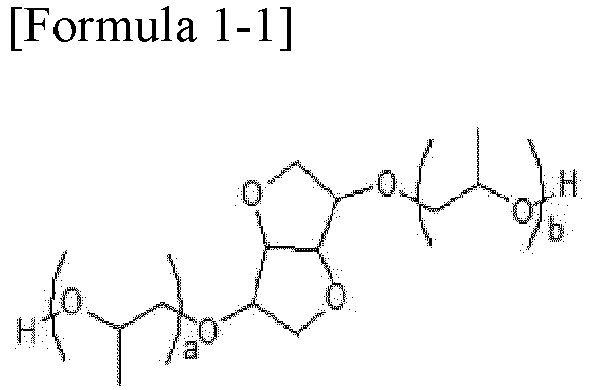
- In an embodiment, the anhydrosugar alcohol-alkylene oxide adduct may be anhydrosugar alcohol-propylene oxide adduct represented by the following formula 1-1, anhydrosugar alcohol-ethylene oxide adduct represented by the following formula 1-2, or a mixture thereof.
- In the above formula 1-1,
- each of a and b independently represents an integer of 0 to 15, and
- a+b represents an integer of 1 to 30.
- More preferably, in the above formula 1-1,
- each of a and b independently represents an integer of 0 to 14,
- provided that a+b is an integer of 1 or more, 2 or more, or 3 or more, and an integer of 25 or less, 20 or less, 15 or less, or 12 or less, and for example, it represents an integer of 1 to 25, preferably an integer of 2 to 20, and more preferably an integer of 3 to 15.

- In the above formula 1-2,
- each of c and d independently represents an integer of 0 to 15, and
- c+d represents an integer of 1 to 30.
- More preferably, in the above formula 1-2,
- each of c and d independently represents an integer of 0 to 14,
- provided that c+d is an integer of 1 or more, 2 or more, or 3 or more, and an integer of 25 or less, 20 or less, 15 or less, or 12 or less, and for example, it represents an integer of 1 to 25, preferably an integer of 2 to 20, and more preferably an integer of 3 to 15.
- In an embodiment, the anhydrosugar alcohol-alkylene oxide adduct may be that prepared by a preparation method comprising the steps of: (1) treating anhydrosugar alcohol with acid component; and (2) conducting addition reaction of the acid-treated anhydrosugar alcohol obtained in said step (1) and alkylene oxide.
- More concretely, the anhydrosugar alcohol-alkylene oxide adduct may be that prepared by a preparation method comprising the steps of: (1) treating anhydrosugar alcohol with acid component; (2) conducting addition reaction of the acid-treated anhydrosugar alcohol obtained in said step (1) and alkylene oxide; and (3) conducting addition reaction of the product obtained in said step (2) and alkylene oxide in the presence of base catalyst.
- The acid component is not especially limited, and it may be selected from the group consisting of phosphoric acid, sulfuric acid, acetic acid, formic acid, heteropolyacid or a mixture thereof. In an embodiment, as the heteropolyacid, phosphotungstic acid, phosphomolybdic acid, silicotungstic acid or silicomolybdic acid, etc. may be used, and as other useful acid component, a commercially available acid component such as Amberlyst 15 (Dow Chemical), etc. can be used, too.
- In an embodiment, the acid treatment can be conducted by using the acid component in an amount of 0.1 to 10 moles, preferably 0.1 to 8 moles, and more preferably 0.1 to 5 moles, based on 1 mole of anhydrosugar alcohol, under nitrogen atmosphere at an elevated temperature (for example, 80°C to 200°C, or 90°C to 180°C), and then conducting pressure reduction under vacuum to remove moisture in the reactor, but it is not limited thereto.
- The acid component is used in the above acid treatment to facilitate the ring opening of alkylene oxide in the addition reaction of alkylene oxide explained below.
- In general, the reaction of adding alkylene oxide to alcohol proceeds under a base catalyst, but in case of anhydrosugar alcohol, due to structural characteristics, the rate of adding the alkylene oxide competes with the rate of opening and decomposition of the ring structure of anhydrosugar alcohol by the base catalyst. Accordingly, not only the anhydrosugar alcohol but also the decomposition product of the anhydrosugar alcohol reacts with the alkylene oxide, and the reaction product between the decomposition product of the anhydrosugar alcohol decomposed by the base catalyst and the alkylene oxide may act as a factor to lower product quality and storage stability. To the contrary, if anhydrosugar alcohol is first treated with an acid component and then subjected to addition reaction of alkylene oxide, the acid component facilitates the ring opening of the alkylene oxide without generating decomposition products of the anhydrosugar alcohol by the base catalyst, and thus anhydrosugar alcohol-alkylene oxide adduct can be easily produced by addition reaction of anhydrosugar alcohol and alkylene oxide. Therefore, when the acid-treated anhydrosugar alcohol and alkylene oxide are subjected to addition reaction, the conventional problems can be solved.
- In an embodiment, the addition reaction of the acid-treated anhydrosugar alcohol and alkylene oxide can be conducted by slowly feeding alkylene oxide to the acid-treated anhydrosugar alcohol at an elevated temperature (for example, 100°C to 180°C, or 120°C to 160°C) during a time of, for example, 1 hour to 8 hours, or 2 hours to 4 hours, but it is not limited thereto. The reaction molar ratio of alkylene oxide to 1 mole of anhydrosugar alcohol may be, for example, 1 mole or more, or 2 moles or more, and 30 moles or less, 20 moles or less, 15 moles or less, or 12 moles or less, and for example, it may be 1 mole to 30 moles, preferably 2 to 20 moles, but it is not limited thereto.
- In an embodiment, the further addition reaction of the product obtained by addition reaction of alkylene oxide with additional alkylene oxide can be conducted, for example, in high pressure reactor capable of being pressurized (for example, pressurized to 3MPa or higher) in the presence of base catalyst (for example, alkali metal hydroxide such as sodium hydroxide, potassium hydroxide, etc. or alkaline earth metal hydroxide such as calcium hydroxide, etc.) at an elevated temperature (for example, 100°C to 180°C, or 120°C to 160°C) during a time of, for example, 1 hour to 8 hours, or 2 hours to 4 hours, but it is not limited thereto. The reaction molar ratio of the alkylene oxide to 1 mole of anhydrosugar alcohol may be, for example, 1 mole or more, 2 moles or more, or 3 moles or more, and 30 moles or less, 20 moles or less, 15 moles or less, or 12 moles or less, and for example, it may be 1 mole to 30 moles, preferably 2 to 20 moles, more preferably 3 to 15 moles, but it is not limited thereto. Prior to feeding of the base catalyst, the acid component used in the treatment can be filtered and removed.
- The product obtained by the addition reaction of the acid-treated anhydrosugar alcohol and alkylene oxide (i.e., a compound in a form where alkylene oxide is added to anhydrosugar alcohol) has a very stable structure, and thus even in the presence of base catalyst, the ring structure of the anhydrosugar alcohol is neither easily opened nor decomposed at high temperature. Therefore, it is very advantageous for further addition reaction of alkylene oxide. If it is continued to use the acid catalyst even during the further additional reaction of alkylene oxide, the acid catalyst helps to promote ring opening of alkylene oxide, but the reaction rate decreases as the number of moles of added alkylene oxide increases. That is, the rate of adding alkylene oxide and the rate of ring opening of the alkylene oxide itself compete, and at this time, the rate of adding alkylene oxide becomes slow, and the self-condensation reaction between the ring-opened alkylene oxides and the generation of byproduct proceed, which may cause deterioration of quality. Therefore, the further addition reaction of alkylene oxide is conducted under base catalyst.
- Thereafter, the step of removing metal ions released from the used base catalyst may be conducted additionally, and for this, a metal ion adsorbent such as, for example, Ambosol MP20 (magnesium silicate component) may be used.
- In an embodiment, example of the polyisocyanate may be aromatic polyisocyanate such as methylenediphenyl diisocyanate (MDI) (for example, 2,4- or 4,4'-methylenediphenyl diisocyanate), xylylene diisocyanate (XDI), m- or p-tetramethylxylylene diisocyanate (TMXDI) , toluene diisocyanate (TDI), di- or tetra-alkyldiphenylmethane diisocyanate, 3,3'-dimethyldiphenyl-4,4'-diisocyanate (TODI), phenylene diisocyanate (for example, 1,3-phenylene diisocyanate, 1,4-phenylene diisocyanate), naphthalene diisocyanate (NDI), or 4,4'-dibenzyl diisocyanate, etc.; aliphatic polyisocyanate such as hydrogenated MDI (H12MDI), 1-methyl-2,4-diisocyanatocyclohexane, 1,12-diisocyanatododecane, 1,6-diisocyanato-2,2,4-trimethylhexane, 1,6-diisocyanato-2,4,4-trimethylhexane, isophorone diisocyanate (IPDI), tetramethoxybutane-1,4-diisocyanate, butane-1,4-diisocyanate, hexamethylene diisocyanate (HDI) (for example, 1,6-hexamethylene diisocyanate), dimer fatty acid diisocyanate, dicyclohexylmethane diisocyanate, cyclohexane diisocyanate (for example, cyclohexane-1,4-diisocyanate) or ethylene diisocyanate, etc.; or a combination thereof, but it is not limited thereto.
- In other embodiment, example of the polyisocyanate may be methylenediphenyl diisocyanate (MDI), ethylene diisocyanate, 1,4-tetramethylene diisocyanate, 1,6-hexamethylene diisocyanate, 1,12-dodecane diisocyanate, cyclobutane-1,3-diisocyanate, cyclohexane-1,3-diisocyanate, cyclohexane-1,4-diisocyanate, isophorone diisocyanate, 2,4-hexahydrotoluene diisocyanate, 2,6-hexahydrotoluene diisocyanate, dicyclohexylmethane-4,4'-diisocyanate (HMDI), 1,3-phenylene diisocyanate, 1,4-phenylene diisocyanate, 2,4-toluene diisocyanate, 2,6-toluene diisocyanate, mixed toluene diisocyanate of 2,4-toluene diisocyanate and 2,6-toluene diisocyanate (2,4-/2,6-isomer ratio=80/20), diphenylmethane-2,4'-diisocyanate, diphenylmethane-4,4'-diisocyanate, polydiphenylmethane diisocyanate (PMDI), naphthalene-1,5-diisocyanate, or a combination thereof, but it is not limited thereto.
- More concretely, the polyisocyanate may be methylenediphenyl diisocyanate (MDI), toluene diisocyanate (TDI), hexamethylene diisocyanate (HDI), isophorone diisocyanate (IPDI), or a combination thereof.
- In an embodiment, example of the hydroxyalkyl (meth)acrylate may be a linear or branched alkyl acrylate having hydroxyl group, a linear or branched alkyl methacrylate having hydroxyl group, or a combination thereof, and more concretely, it may be a linear or branched C1-C8 alkyl acrylate having hydroxyl group, a linear or branched C1-C8 alkyl methacrylate having hydroxyl group, or a combination thereof, and still more concretely, it may be hydroxymethyl acrylate, hydroxymethyl methacrylate, hydroxyethyl acrylate, hydroxyethyl methacrylate, hydroxypropyl acrylate, hydroxypropyl methacrylate, hydroxybutyl acrylate, hydroxybutyl methacrylate, hydroxypentyl acrylate, hydroxypentyl methacrylate, 2-hydroxyethylhexyl acrylate, 2-hydroxyethylhexyl methacrylate, 2-hydroxyethylbutyl acrylate, 2-hydroxyethylbutyl metacrylate, hydroxyoctyl acrylate, hydroxyoctyl methacrylate, or a combination thereof, and still more concretely, it may be 2-hydroxyethyl acrylate, 2-hydroxyethyl methacrylate, hydroxypropyl acrylate, hydroxypropyl methacrylate, hydroxybutyl acrylate, hydroxybutyl methacrylate, or a combination thereof, but it is not limited thereto.
- In an embodiment, the (meth)acryl-modified polyurethane of the present invention may be represented by the following formula 2:


- In the above formula 2,
- each of R1 is independently an alkylene group, concretely it is a C2-C8 linear or C3-C8 branched alkylene group, and more concretely it is a C2-C6 linear or C3-C6 branched alkylene group,
- each of R2 is independently an alkylene group, a cycloalkylene group, or an arylene group, and concretely it is a C2-C20 linear or C3-C20 branched alkylene group, a C3-C20 cycloalkylene group, or a C6-C20 arylene group,
- each of R3 is independently an alkylene group, concretely it is a C1-C8 linear or C3-C8 branched alkylene group, and more concretely it is a C2-C6 linear or C3-C6 branched alkylene group,
- each of R4 is independently a hydrogen atom or an alkyl group, and concretely it is a hydrogen atom or a C1-C4 linear or C3-C4 branched alkyl group,
- M is a divalent organic group derived from anhydrosugar alcohol, concretely it is a divalent organic group derived from isosorbide, isomannide or isoidide, and more concretely it is selected from the following formulas:

- each of m and n independently represents an integer of 0 to 15,
- m+n represents an integer of 1 to 30, more concretely an integer of 1 to 25, still more concretely an integer of 1 to 20, still more concretely an integer of 3 to 15, and still more concretely an integer of 5 to 15.
- More concretely, the (meth)acryl-modified polyurethane of the present invention may be represented by any one of the following formulas, but it is not limited thereto:



- In the above formulas, each of m, n and m+n is independently the same as defined in the above formula 2.
- The (meth)acryl-modified polyurethane can be obtained by reacting polyisocyanate to the anhydrosugar alcohol-alkylene oxide adduct and then reacting hydroxyalkyl (meth)acrylate thereto.
- In an embodiment, the (meth)acryl-modified polyurethane can be prepared by a method comprising the steps of: (1) reacting anhydrosugar alcohol-alkylene oxide adduct and polyisocyanate to prepare intermediate having terminal isocyanate group; and (2) reacting the intermediate obtained in said step (1) and hydroxyalkyl (meth)acrylate.
- According to an embodiment, the (meth)acryl-modified polyurethane can be prepared by reacting 2 equivalents of diisocyanate to 1 equivalent of anhydrosugar alcohol (e.g., isosorbide (ISB))-alkylene oxide adduct to prepare intermediate having terminal isocyanate group, and then reacting the terminal isocyanate group of the intermediate with 2 equivalents of hydroxyalkyl (meth)acrylate (e.g., 2-hydroxyethyl methacrylate).
- In case of acryl-modified polyurethane prepared by using a general alkylene oxide (for example, ethylene oxide or polypropylene oxide, etc.) rather than the anhydrosugar alcohol-alkylene oxide adduct, the oil resistance of the coating formed from a composition comprising it is lowered (when polypropylene oxide is applied), or the adhesion of the coating formed from a composition comprising it is lowered (when ethylene oxide is applied).
- According to an embodiment, the reaction of the anhydrosugar alcohol-alkylene oxide adduct and polyisocyanate may be conducted optionally in the presence of catalyst (for example, tin-based catalyst such as dibutyltin dilaurate (DBTDL)) at room temperature or an elevated temperature (for example, at 50 to 100°C, preferably at 50 to 70°C) during a proper time (for example, 0.1 to 5 hours, preferably 0.5 to 2 hours).
- According to an embodiment, the reaction of the product of reacting anhydrosugar alcohol-alkylene oxide adduct and polyisocyanate (i.e., the intermediate obtained in the above step (1)) and hydroxyalkyl (meth)acrylate may be conducted optionally in the presence of catalyst (for example, tin-based catalyst such as dibutyltin dilaurate (DBTDL)) at an elevated temperature (for example, at 50 to 100°C, preferably at 50 to 70°C) during a proper time (for example, 0.1 to 5 hours, preferably 0.5 to 2 hours).
- The coating composition for metal of the present invention comprises, based on total 100 parts by weight of the composition, 5.1 to 64.9 parts by weight of the (meth)acryl-modified polyurethane. If the amount of the (meth)acryl-modified polyurethane in 100 parts by weight of the composition is less than 5.1 parts by weight, the adhesion of the coating formed from a composition comprising it becomes poor and the oil resistance thereof becomes very poor, and to the contrary, if the amount is greater than 64.9 parts by weight, the adhesion of the coating formed from a composition comprising it becomes poor.
- More concretely, the amount of the (meth)acryl-modified polyurethane in 100 parts by weight of the coating composition for metal of the present invention may be, for example, 5.1 parts by weight or more, 5.5 parts by weight or more, 6 parts by weight or more, 6.5 parts by weight or more, 7 parts by weight or more, 7.5 parts by weight or more, 8 parts by weight or more, 8.5 parts by weight or more, 9 parts by weight or more, 9.5 parts by weight or more, or 10 parts by weight or more, and it also may be 64.9 parts by weight or less, 64.5 parts by weight or less, 64 parts by weight or less, 63.5 parts by weight or less, 63 parts by weight or less, 62.5 parts by weight or less, 62 parts by weight or less, 61.5 parts by weight or less, 61 parts by weight or less, 60.5 parts by weight or less, or 60 parts by weight or less, but it is not limited thereto.
- The (meth)acrylic monomer comprised in the present coating composition for metal is capable of adjusting the viscosity of the coating composition for metal so as to improve its workability such as applicability on metal, etc., increasing the thermal curing rate of the coating composition for metal, and enhancing the strength of the cured product so as to improve its adhesion.
- The (meth)acrylic monomer contained in the present coating composition for metal may be a monomer having (meth)acrylic group in the molecule, and preferably, it may be a monomer having 1 to 6 (concretely, 1 to 4) (meth)acrylic groups in the molecule, or a mixture of two or more thereof.
- In an embodiment, as the (meth)acrylic monomer, a monomer having 1 (meth)acrylic group may be, for example, (meth)acrylic acid, lauryl (meth)acrylate, stearyl (meth)acrylate, ethylcarbitol (meth)acrylate, tetrahydrofurfuryl (meth)acrylate, caprolactone-modified tetrahydrofurfuryl (meth)acrylate, cyclohexyl (meth)acrylate, dicyclopentanyl (meth)acrylate, isobornyl (meth)acrylate, benzyl (meth)acrylate, phenyl (meth)acrylate, phenoxyethyl (meth)acrylate , phenoxydiethyleneglycol (meth) acrylate, phenoxytetraethyleneglycol (meth)acrylate, nonylphenoxyethyl (meth)acrylate, nonylphenoxytetraethyleneglycol (meth)acrylate, methoxydiethyleneglycol (meth)acrylate, ethoxydiethyleneglycol (meth)acrylate, butoxyethyl (meth)acrylate, butoxytriethyleneglycol (meth)acrylate, 2-ethylhexylpolyethyleneglycol (meth)acrylate, nonylphenylpolypropyleneglycol (meth)acrylate, methoxydipropyleneglycol (meth)acrylate, glycidyl (meth)acrylate, 2-hydroxyethyl (meth)acrylate, 2-hydroxypropyl (meth)acrylate, glycerol (meth)acrylate, polyethyleneglycol (meth)acrylate, polypropyleneglycol (meth)acrylate, epichlorohydrin (hereinafter abbreviated as ECH)-modified butyl (meth)acrylate, ECH-modified phenoxy (meth)acrylate, ethylene oxide (hereinafter abbreviated as EO)-modified phthalic acid (meth)acrylate, EO-modified succinic acid (meth)acrylate, caprolactone-modified 2-hydroxyethyl (meth)acrylate, N,N-dimethylaminoethyl (meth)acrylate, N,N-diethylaminoethyl (meth)acrylate, (2-methyl-2-ethyl-1,3-dioxolan-4-yl)methyl (meth)acrylate, or a mixture thereof, but it is not limited thereto.
- In other embodiment, as the (meth)acrylic monomer, a monomer having 2 or more (meth)acrylic groups may be, for example, 1,6-hexanediol diacrylate (HDDA), 1,4-butanediol diacrylate (BDDA), tripropyleneglycol diacrylate (TPGDA), bisphenol A [EO]4~30 diacrylate (BPA[EO]4~30DA, EO is ethylene oxide unit), trimethylolpropane triacrylate (TMPTA), trimethylolpropane [EO]3~15 triacrylate (TMP[EO]3~15TA, EO is ethylene oxide unit), pentaerythritol triacrylate (PETA), pentaerythritol tetraacrylate (PETTA), ditrimethylolpropane tetraacrylate (DTMPTTA), dipentaerylthritol pentaacrylate (DPPA), dipentaerythritol hexaacrylate (DPHA), or a mixture thereof, but it is not limited thereto.
- The coating composition for metal of the present invention comprises, based on total 100 parts by weight of the composition, 7.1 to 74.9 parts by weight of the (meth)acrylic monomer. If the amount of the (meth)acrylic monomer in 100 parts by weight of the composition is less than 7.1 parts by weight, the adhesion of the coating formed from a composition comprising it becomes very poor and the oil resistance thereof becomes poor, and to the contrary, if the amount is greater than 74.9 parts by weight, the oil resistance of the coating formed from a composition comprising it becomes very poor.
- More concretely, the amount of the (meth)acrylic monomer in 100 parts by weight of the coating composition for metal of the present invention may be, for example, 7.1 parts by weight or more, 7.5 parts by weight or more, 8 parts by weight or more, 8.5 parts by weight or more, 9 parts by weight or more, 9.5 parts by weight or more, or 10 parts by weight or more, and it also may be 74.9 parts by weight or less, 74.5 parts by weight or less, 74 parts by weight or less, 73.5 parts by weight or less, 73 parts by weight or less, 72.5 parts by weight or less, 72 parts by weight or less, 71.5 parts by weight or less, 71 parts by weight or less, 70.5 parts by weight or less, or 70 parts by weight or less, but it is not limited thereto.
- The epoxy resin comprised in the present coating composition for metal is used to enhance the strength of the cured product of the coating composition for metal and so improve its adhesion.
- The epoxy resin is a resin having epoxy group in the molecule, and preferably, it may be a resin having 2 or more epoxy groups in the molecule, or a mixture of two or more thereof.
- In an embodiment, the epoxy resin may be, for example, bisphenol-based epoxy resin, phenol novolac-based epoxy resin, o-cresol novolac-based epoxy resin, multifunctional epoxy resin, amine-based epoxy resin, heterocycle-containing epoxy resin, substituted epoxy resin, naphthol-based epoxy resin, or a mixture thereof, but it is not limited thereto.
- The coating composition for metal of the present invention comprises, based on total 100 parts by weight of the composition, 2.1 to 44.9 parts by weight of the epoxy resin. If the amount of the epoxy resin in 100 parts by weight of the composition is less than 2.1 parts by weight, the adhesion of the coating formed from a composition comprising it becomes poor, and to the contrary, if the amount is greater than 44.9 parts by weight, the adhesion and oil resistance of the coating formed from a composition comprising it become poor.
- More concretely, the amount of the epoxy resin in 100 parts by weight of the coating composition for metal of the present invention may be, for example, 2.1 parts by weight or more, 2.5 parts by weight or more, 3 parts by weight or more, 3.5 parts by weight or more, 4 parts by weight or more, 4.5 parts by weight or more, or 5 parts by weight or more, and it also may be 44.9 parts by weight or less, 44.5 parts by weight or less, 44 parts by weight or less, 43.5 parts by weight or less, 43 parts by weight or less, 42.5 parts by weight or less, 42 parts by weight or less, 41.5 parts by weight or less, 41 parts by weight or less, 40.5 parts by weight or less, 40 parts by weight or less, or 39 parts by weight or less, but it is not limited thereto.
- The epoxy curing promotor comprised in the present coating composition for metal is used to increase the curing rate of the epoxy resin.
- In an embodiment, the epoxy curing promotor may be, for example, substituted imidazole (e.g., 1-methylimidazole, 2-methylimidazole, 2-ethyl-4-methylimidazole, 2-phenylimidazole, 1-cyanoethylimidazole), imidazoline (e.g., 2-phenylimidazoline), tertiary amine (e.g., N,N-dimethylbenzylamine), 2,4,6-tris(dimethylaminomethyl)phenol (DMP30), bisphenol A, bisphenol F, nonylphenol, p-tert-butylphenol, novolac type phenolic resin, salicylic acid, p-toluenesulfonic acid, 1,4-diazabicyclo[2.2.2]octane (DABCO), 1,8-diazabicyclo[5.4.0]undec-7-ene (DBU), S-triazine (e.g., Lupragen N600), bis(2-dimethylaminoethyl) ether (e.g., Lupragen N206), pentamethyldiethylenetriamine (e.g., Lupragen N301), trimethylaminoethylethanolamine (e.g., Lupragen N400), tetramethyl-1,6-hexanediamine (e.g., Lupragen N500), aminoethylmorpholine, aminopropylmorpholine, aminoethylethyleneurea, ketimine (e.g., Epi-Kure 3502) (reaction product of ethylene diamine and methyl isobutyl ketone), uron (e.g., 3-(4-chlorophenyl)-1,1-dimethylurea (monuron), 3-(3,4-dichlorophenyl)-1,1-dimethylurea (diuron), 3-phenyl-1,1-dimethylurea (phenuron) and 3-(3-chloro-4-methylphenyl)-1,1-dimethylurea (chlorotolurone)), tolyl-2,4-bis-N,N-dimethylcarbamide (e.g., Amicure UR2T), dicyandiamide (DICY), Mannich base or secondary amine (e.g., dialkylamine such as di(2-ethylhexyl)amine, dibutylamine, dipropylamine, ditridecylamine), N,N'-diisopropylisophoronediamine (e.g., Jefflink® XTJ-584), N,N'-di isobutyl-4,4'-diaminodicyclohexylmethane (e.g., Clearlink 1000), N-(hydroxyethyl)aniline, and di(2-methoxyethyl)amine, or a combination thereof, but it is not limited thereto.
- The coating composition for metal of the present invention comprises, based on total 100 parts by weight of the composition, 0.051 to 2.49 parts by weight of the epoxy curing promotor. If the amount of the epoxy curing promotor in 100 parts by weight of the composition is less than 0.051 part by weight, a composition comprising it is not cured and so a coating is not formed therefrom, and to the contrary, if the amount is greater than 2.49 parts by weight, the adhesion and oil resistance of the coating formed from a composition comprising it become very poor.
- More concretely, the amount of the epoxy curing promotor in 100 parts by weight of the coating composition for metal of the present invention may be, for example, 0.051 part by weight or more, 0.055 part by weight or more, 0.06 part by weight or more, 0.065 part by weight or more, 0.07 part by weight or more, 0.075 part by weight or more, 0.08 part by weight or more, 0.085 part by weight or more, 0.09 part by weight or more, 0.095 part by weight or more, or 0.1 part by weight or more, and it also may be 2.49 parts by weight or less, 2.45 parts by weight or less, 2.4 parts by weight or less, 2.35 parts by weight or less, 2.3 parts by weight or less, 2.25 parts by weight or less, 2.2 parts by weight or less, 2.15 parts by weight or less, 2.1 parts by weight or less, 2.05 parts by weight or less, 2 parts by weight or less, 1.5 parts by weight or less, or 1 part by weight or less, but it is not limited thereto.
- The thermal polymerization initiator comprised in the present coating composition for metal is used to initiate the polymerization of the (meth)acrylic monomer and the (meth)acryl-modified polyurethane and thus promote the curing.
- In an embodiment, the thermal polymerization initiator may be selected from compounds represented by the following formula 3-1, compounds represented by the following formula 3-2, or mixtures thereof:

- in the above formula 3-1,
- each of R and R' is independently C2-C8 linear or C3-C8 branched alkyl group; C3-C20 cycloalkyl group; C6-C20 aryl group; or a C2-C8 linear or C3-C8 branched methoxy-alkyl group,
- X is -CN or -CO2R", where R" is C2-C8 linear or C3-C8 branched alkyl group; C3-C20 cycloalkyl group; or C6-C20 aryl group,

- in the above formula 3-2,
- each of R is independently C2-C8 linear or C3-C8 branched alkyl group; C3-C20 cycloalkyl group; or C6-C20 aryl group.
- The coating composition for metal of the present invention comprises, based on total 100 parts by weight of the composition, 0.00051 to 2.49 parts by weight of the thermal polymerization initiator. If the amount of the thermal polymerization initiator in 100 parts by weight of the composition is less than 0.00051 part by weight, a composition comprising it is not cured and so a coating is not formed therefrom, and to the contrary, if the amount is greater than 2.49 parts by weight, the adhesion and oil resistance of the coating formed from a composition comprising it become very poor.
- More concretely, the amount of the thermal polymerization initiator in 100 parts by weight of the coating composition for metal of the present invention may be, for example, 0.00051 part by weight or more, 0.00055 part by weight or more, 0.0006 part by weight or more, 0.00065 part by weight or more, 0.0007 part by weight or more, 0.00075 part by weight or more, 0.0008 part by weight or more, 0.00085 part by weight or more, 0.0009 part by weight or more, 0.00095 part by weight or more, 0.001 part by weight or more, 0.005 part by weight or more, or 0.01 part by weight or more, and it also may be 2.49 parts by weight or less, 2.45 parts by weight or less, 2.4 parts by weight or less, 2.35 parts by weight or less, 2.3 parts by weight or less, 2.25 parts by weight or less, 2.2 parts by weight or less, 2.15 parts by weight or less, 2.1 parts by weight or less, 2.05 parts by weight or less, 2 parts by weight or less, 1.5 parts by weight or less, 1 part by weight or less, or 0.5 part by weight or less, but it is not limited thereto.
- In addition to the components explained above, the coating composition for metal of the present invention can further comprise additive(s) that can be used conventionally in paint compositions for metal.
- In other aspect, the present invention provides a method for preparing a coating composition for metal, comprising the step of mixing, based on total 100 parts by weight of the mixture, 5.1 to 64.9 parts by weight of (meth)acryl-modified polyurethane; 7.1 to 74.9 parts by weight of (meth)acrylic monomer; 2.1 to 44.9 parts by weight of epoxy resin; 0.051 to 2.49 parts by weight of epoxy curing promotor; and 0.00051 to 2.49 parts by weight of thermal polymerization initiator, wherein the (meth)acryl-modified polyurethane comprises i) polymerized units derived from anhydrosugar alcohol-alkylene oxide adduct; ii) polymerized units derived from polyisocyanate; and iii) polymerized units derived from hydroxyalkyl (meth)acrylate.
- In the method for preparing a coating composition for metal of the present invention, the concrete kinds and use amounts of the (meth)acryl-modified polyurethane, (meth)acrylic monomer, epoxy resin, epoxy curing promotor and thermal polymerization initiator are the same as explained above.
- In a preferable embodiment, the mixing of the (meth)acryl-modified polyurethane, (meth)acrylic monomer, epoxy resin, epoxy curing promotor and thermal polymerization initiator can be conducted under temperature condition of 60°C or lower (e.g., 10 to 60°C, and more concretely, 20 to 60°C). If the temperature condition for mixing of the components is too higher than 60°C, polymerization reaction of the (meth)acrylic monomer may proceed during the mixing and curing may occur during preparation of the composition, and thus it may be difficult to use the resulting product as a coating composition.
- In another aspect, the present invention provides a coated metallic article comprising a metallic article; and a coating layer of the coating composition for metal of the present invention on the surface of the metallic article.
- In an embodiment, the metallic article may be a mechanical part, electric part or electronic part, but it is not limited thereto.
- There is no special limitation to the method for forming a coating layer of the coating composition for metal of the present invention on the metallic article, and it can be conducted by using a conventional coating method and device.
- The present invention is explained in more detail through the following Examples and Comparative Examples. However, the scope of the present invention is not limited thereby in any manner.
- 146g of isosorbide and 0.15g of phosphoric acid (85%) as an acid component were put into a reactor that could be pressurized, and the inside of the reactor was substituted with nitrogen and heated up to 100°C and the moisture in the reactor was removed by pressure reduction under vacuum. Then, while firstly adding 88g of ethylene oxide slowly thereto, the reaction was conducted at 100 to 140°C for 2 to 3 hours. At that time, the reaction temperature was controlled so as not to exceed 140°C. Thereafter, the inside of the reactor was cooled to 50°C, and then 0.3g of potassium hydroxide was added to the reactor, the inside of the reactor was substituted with nitrogen and heated up to 100°C and the moisture in the reactor was removed by pressure reduction under vacuum. Then, while secondly adding 132g of ethylene oxide slowly thereto, the reaction was conducted at 100 to 140°C for 2 to 3 hours. After completing the reaction, the inside of the reactor was cooled to 50°C, 4.0g of Ambosol MP20 as adsorbent was added thereto, and the inside of the reactor was reheated and agitated at 100°C to 120°C for 1 to 5 hours to remove residual metal ions (at that time, the inside of the reactor was substituted with nitrogen and/or pressure reduction under vacuum was carried out). After confirming that no metal ions were detected, the inside of the reactor was cooled to 60°C to 90°C and the remaining byproduct was removed to obtain 362g of isosorbide-ethylene oxide 5 mole adduct in transparent liquid form.
- Excepting that the secondly added amount of ethylene oxide was changed from 132g to 352g, the same method as Preparation Example A1 was conducted to obtain 551g of isosorbide-ethylene oxide 10 mole adduct in transparent liquid form.
- As the raw material for the addition reaction, propylene oxide was used instead of ethylene oxide. Concretely, excepting that 116g of propylene oxide was firstly added instead of 88g of ethylene oxide and 174g of propylene oxide was secondly added instead of 132g of ethylene oxide, the same method as Preparation Example A1 was conducted to obtain 423g of isosorbide-propylene oxide 5 mole adduct in transparent liquid form.
- As the raw material for the addition reaction, propylene oxide was used instead of ethylene oxide. Concretely, excepting that 116g of propylene oxide was firstly added instead of 88g of ethylene oxide and 465g of propylene oxide was secondly added instead of 132g of ethylene oxide, the same method as Preparation Example A1 was conducted to obtain 698g of isosorbide-propylene oxide 10 mole adduct in transparent liquid form.
- Into a 3-necked glass reactor equipped with an agitator, 222g of isophorone diisocyanate (IPDI) and 0.1g of dibutyltin dilaurate (DBTDL) as reaction catalyst were fed. While agitating the mixture at room temperature, 183g of the isosorbide-ethylene oxide 5 mole adduct prepared in Preparation Example A1 was added slowly thereto and the crosslinking reaction was conducted. After completing addition of the isosorbide-ethylene oxide 5 mole adduct, the mixture was agitated at 50°C for 1 hour for aging, and 65g of 2-hydroxyethyl methacrylate was added slowly thereto and the acryl modification reaction was conducted. After completing addition of 2-hydroxyethyl methacrylate, the mixture was agitated at 50°C for 1 hour for aging, and the reaction product was cooled to room temperature to obtain 467g of (meth)acryl-modified polyurethane of the following formula A.

- Excepting that 168g of hexamethylene diisocyanate (HDI) was used instead of isophorone diisocyanate (IPDI) as polyisocyanate, 293g of the isosorbide-ethylene oxide 10 mole adduct prepared in Preparation Example A2 was used instead of the isosorbide-ethylene oxide 5 mole adduct prepared in Preparation Example A1 as polyol and 58g of 2-hydroxyethyl acrylate was used instead of 2-hydroxyethyl methacrylate as hydroxyalkyl (meth)acrylate, the same method as Preparation Example B1 was conducted to obtain 515g of (meth)acryl-modified polyurethane of the following formula B.

- Excepting that 250g of methylenediphenyl diisocyanate (MDI) was used instead of isophorone diisocyanate (IPDI) as polyisocyanate and 218g of the isosorbide-propylene oxide 5 mole adduct prepared in Preparation Example A3 was used instead of the isosorbide-ethylene oxide 5 mole adduct prepared in Preparation Example A1 as polyol, the same method as Preparation Example B 1 was conducted to obtain 529g of (meth)acryl-modified polyurethane of the following formula C.

- Excepting that 363g of the isosorbide-propylene oxide 10 mole adduct prepared in Preparation Example A4 was used instead of the isosorbide-ethylene oxide 5 mole adduct prepared in Preparation Example A1 as polyol, the same method as Preparation Example B1 was conducted to obtain 643g of (meth)acryl-modified polyurethane of the following formula D.
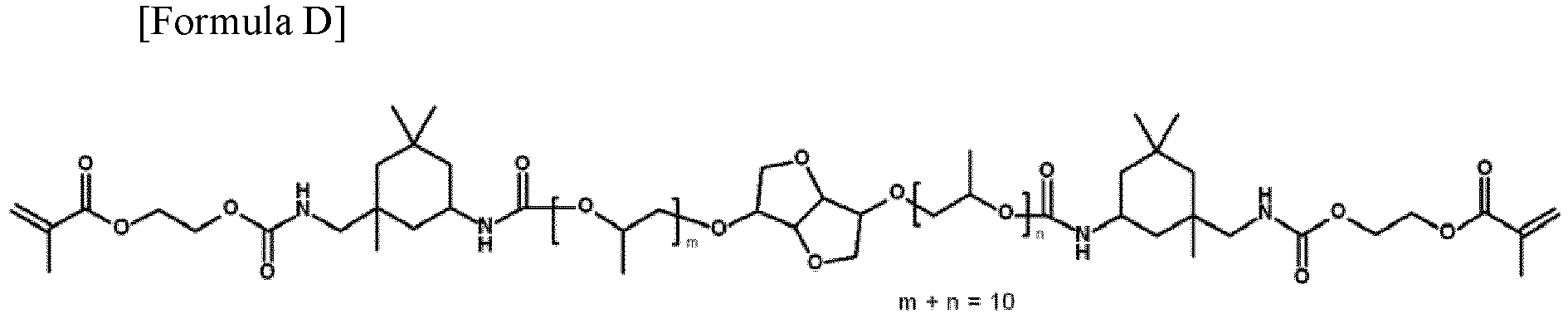
- Excepting that 146g of isosorbide was used instead of the isosorbide-ethylene oxide 5 mole adduct prepared in Preparation Example A1 as polyol, the same method as Preparation Example B1 was conducted to obtain 431g of (meth)acryl-modified polyurethane of the following formula E.

- Excepting that 500g of polyethylene glycol (number average molecular weight: 500 g/mol) was used instead of the isosorbide-ethylene oxide 5 mole adduct prepared in Preparation Example A1 as polyol, the same method as Preparation Example B1 was conducted to obtain 782g of (meth)acryl-modified polyurethane of the following formula F.

- Excepting that 168g of hexamethylene diisocyanate (HDI) was used instead of isophorone diisocyanate (IPDI) as polyisocyanate, 500g of polypropylene glycol (number average molecular weight: 500 g/mol, Kumho Petrochemical) was used instead of the isosorbide-ethylene oxide 5 mole adduct prepared in Preparation Example A1 as polyol and 58g of 2-hydroxyethyl acrylate was used instead of 2-hydroxyethyl methacrylate as hydroxyalkyl (meth)acrylate, the same method as Preparation Example B1 was conducted to obtain 720g of (meth)acryl-modified polyurethane of the following formula G.

- Excepting that 250g of methylenediphenyl diisocyanate (MDI) was used instead of isophorone diisocyanate (IPDI) as polyisocyanate and 1,000g of polytetramethylene glycol (number average molecular weight: 1,000 g/mol, Aldrich) was used instead of the isosorbide-ethylene oxide 5 mole adduct prepared in Preparation Example A1 as polyol, the same method as Preparation Example B1 was conducted to obtain 1,308g of (meth)acryl-modified polyurethane of the following formula H.


- In a mixing reactor maintained at 60°C or lower, the (meth)acryl-modified polyurethane, (meth)acrylic monomer, epoxy resin, epoxy curing promotor and thermal polymerization initiator were fed with the weight ratio shown in the following Table 1, and were mixed by agitation at a temperature of 60°C or lower to prepare a liquid coating composition with oil resistance for metal. At that time, the sum of the amounts of the (meth)acryl-modified polyurethane, (meth)acrylic monomer, epoxy resin, epoxy curing promotor and thermal polymerization initiator was 100 parts by weight in total.
-
- Preparation Example B1: (meth)acryl-modified polyurethane of formula A obtained in Preparation Example B1
- Preparation Example B2: (meth)acryl-modified polyurethane of formula B obtained in Preparation Example B2
- Preparation Example B3: (meth)acryl-modified polyurethane of formula C obtained in Preparation Example B3
- Preparation Example B4: (meth)acryl-modified polyurethane of formula D obtained in Preparation Example B4
- Preparation Example B5: (meth)acryl-modified polyurethane of formula E obtained in Preparation Example B5
- Preparation Example B6: (meth)acryl-modified polyurethane of formula F obtained in Preparation Example B6
- Preparation Example B7: (meth)acryl-modified polyurethane of formula G obtained in Preparation Example B7
- Preparation Example B8: (meth)acryl-modified polyurethane of formula H obtained in Preparation Example B8
-
- 2-HEMA: 2-hydroxyethyl methacrylate (Samchun Pure Chemical)
- 4-HBA: 4-hydroxybutyl acrylate (Samchun Pure Chemical)
- BA: butyl acrylate (Samchun Pure Chemical)
- PETTA: pentaerythritol tetraacrylate (Miwon Commercial)
- P-2M: 2-methacryloyloxyethyl acid phosphate (Kyoei Chemical)
- BDDA: 1,4-butanediol diacrylate (Aldrich)
-
- YD-128: bisphenol A-based epoxy resin (Kukdo Chemical)
- YDF-170: bisphenol F-based epoxy resin (Kukdo Chemical)
- 1,4-BDGE: 1,4-butanediol diglycidyl ether (Kukdo Chemical)
-
- DICY: Dicyandiamide (Evonik)
- UR2T: 1,1'-(4 methyl-m-phenylene)bis(3,3 dimethylurea) (Evonik)
-
- V-65: 2,2'-azobis(2,4-dimethylvaleronitrile) (Fuji Film)
- V-40: 1,1'-azobis(cyclohexane-1-carbonitrile) (Fuji Film)
- Peroyl TCP: bis(4-t-butylcyclohexyl)peroxydicarbonate (Nichiyu)
- The coating composition with oil resistance for metal prepared in each of Examples A1 to A4 and Comparative Examples A1 to A14 was applied with an area of 2.5cm x 2.0cm on each surface of two rolled steel sheets cut into 2.5cm x 12cm size, and then the applied parts of the two rolled steel sheets were overlapped and fixed, and cured by heat at 150°C for 5 minutes to prepare a metal adhesion sample. For each of the samples, the adhesion and oil resistance were evaluated according to the following methods, and the results are shown in the following Table 2.
- In order to evaluate the adhesion to metal of the metal coating composition, the lap shear strength (MPa) of the metal adhesion sample was measured by using UTM (Instron 5967, Instron). Concretely, for each metal adhesion sample, the shear strength was measured 5 times in total, and the average value thereof was calculated. Higher shear strength means better adhesion.
- The metal adhesion sample was immersed in mineral oil (Daejung Chemical) and heated at 190°C for 200 hours, and then for each metal adhesion sample, the shear strength was measured 5 times according to the adhesion measurement method explained in the above (1), and the average value thereof was calculated. Thereafter, for each metal adhesion sample, the reduction ratio (%) of shear strength after immersion to shear strength before immersion was calculated. Lower reduction ratio of shear strength means better oil resistance.
- Shear strength reduction ratio (%) = (Shear strength before immersion - Shear strength after immersion) x 100 / Shear strength before immersion
[Table 2] Adhesion (shear strength (MPa)) Oil resistance (shear strength reduction ratio (%)) Example A1 17.8 21 A2 16.5 28 A3 18.0 23 A4 17.4 24 Comparative Example A1 13.8 22 A2 12.4 28 A3 16.2 72 A4 18.1 Spontaneously peeled off after heating was finished A5 11.9 Spontaneously peeled off after heating was finished A6 14.3 22 A7 10.5 31 A8 16.9 Spontaneously peeled off after heating was finished A9 13.1 25 A10 12.9 32 A11 Not cured A12 8.3 Spontaneously peeled off after heating was finished A13 Not cured A14 4.5 Spontaneously peeled off after heating was finished - As shown in Table 2 above, in case of the metal adhesion samples of Examples A1 to A4 for which the coating compositions comprising the (meth)acryl-modified polyurethane according to the present invention were applied, the adhesion to metal was excellent so as to show a shear strength of 16 MPa or higher, and the adhesion was maintained well so as to show a shear strength reduction ratio of less than 30% even after immersion in mineral oil at 190°C for 200 hours, and thus the oil resistance was also excellent.
- However, in case of the metal adhesion samples of Comparative Examples A1 and A2, the adhesion was poor. Also, in case of the metal adhesion samples of Comparative Examples A3 and A4, the shear strength was lowered remarkably after immersion in mineral oil at the high temperature, and thus the oil resistance was poor. In case of the metal adhesion sample of Comparative Example A5, both of the adhesion and oil resistance were very poor, and in case of the metal adhesion sample of Comparative Example A6, the adhesion was poor. In case of the metal adhesion sample of Comparative Example A7, the adhesion was very poor. In case of the metal adhesion sample of Comparative Example A8, the oil resistance was very poor so that spontaneous peeling off of the metal adhesion sample was observed after finishing immersion in mineral oil and heating. In case of the metal adhesion samples of Comparative Examples A9 and A10, the adhesion was poor. In case of the metal adhesion samples of Comparative Examples A11 and A13, the metal coating compositions were not cured, and thus it was impossible to evaluate the adhesion and oil resistance. In case of the metal adhesion samples of Comparative Examples A12 and A14, both of the adhesion and oil resistance were poor.
- As explained above, in case of the coating composition for metal comprising the (meth)acryl-modified polyurethane according to the present invention with an amount in a specific range, the adhesion to metal was excellent, and the adhesion was maintained well even in mineral oil at high temperature, and thus the oil resistance was also excellent.
| Components | Example | |||||||||||||
| A1 | A2 | A3 | A4 | |||||||||||
| Acryl-modified PU (pbw) | Prep. Ex. B1(50) | Prep. Ex. B2(10) | Prep. Ex. B3(60) | Prep. Ex. B4(50) | ||||||||||
| (Meth)acrylic monomer (pbw) | 2-HEMA(35) | BA(65) | 4-HBA(34) | 2-HEMA(9) | ||||||||||
| PETTA(2) | P-2M(5) | P-2M(1) | ||||||||||||
| Epoxy resin (pbw) | YD-128 (11) | YDF-170 (19) | 1,4-BDGE (5) | YD-128 (39) | ||||||||||
| Epoxy curing promotor (pbw) | DICY (1) | UR2T (0.5) | DICY (0.95) | DICY (0.9) | ||||||||||
| Thermal polymerization initiator (pbw) | V-65 (1) | V-40 P (0.5) | eroyl TCP (005) | V-65 (0.1) | ||||||||||
| Components | Comparative Example | |||||||||||||
| A1 | A2 | A3 | A4 | A5 | A6 | |||||||||
| Acryl-modified PU (pbw) | Prep. Ex. B5(50) | Prep. Ex. B6(60) | Prep. Ex. B7(50) | Prep. Ex. B8(45) | Prep. Ex. B1(5) | Prep. Ex. B2(65) | ||||||||
| (Meth)acrylic monomer (pbw) | 2-HEMA(30) | BA(21) | 4-HBA(34) | 2-HEMA(37) | 2-HEMA(81) | BA(22) | ||||||||
| P-2M(5) | PETTA(3) | BDDA(1.5) | P-2M(2) | PETTA(2) | PETTA(2) | |||||||||
| Epoxy resin (pbw) | YD-128 (14) | 1,4-BDGE (15) | YD-128 (14) | YD-128 (15) | YD-128 (11) | 1,4-BDGE (10) | ||||||||
| Epoxy curing promotor (pbw) | DICY (0.5) | DICY (0.5) | DICY (0.49) | DICY (0.99) | DICY (0.99) | DICY (0.5) | ||||||||
| Thermal polymerization initiator (pbw) | V-40 (0.5) | Peroyl TCP (0.5) | V-40 (0.01) | V-65 (0.01) | V-40 (0.01) | V-40 (0.5) | ||||||||
| Components | Comparative Example | |||||||||||||
| A7 | A8 | A9 | A10 | A11 | A12 | A13 | A14 | |||||||
| Acryl-modified PU (pbw) | Prep. Ex. B3(60) | Prep. Ex. B4(10) | Prep. Ex. B1(45) | Prep. Ex. Bl(30) | Prep. Ex. Bl(50) | Prep. Ex. B4(45) | Prep. Ex. B1(45) | Prep. Ex. Bl(50) | ||||||
| (Meth)acrylic monomer (pbw) | 2-HEMA(5) | 2-HEMA(70) | 2-HEMA(50) | 4-HBA(21) | 2-HEMA(35) | 2-HEMA(22) | 2-HEMA(37) | 2-HEMA(35) | ||||||
| P-2M(2) | PETTA(5) | P-2M(2) | BDDA(3) | PETTA(2) | P-2M(1) | P-2M(2) | ||||||||
| Epoxy resin (pbw) | YDF-170 (32) | YD-128 (14) | YD-128 (2) | YD-128 (45) | YD-128 (11) | YD-128 (29) | YD-128 (15) | YD-128 (11) | ||||||
| Epoxy curing promotor (pbw) | DICY (0.99) | DICY (0.5) | DICY (0.1) | DICY (0.99) | DICY (0.05) | DICY (2.5) | DICY (0.9995) | DICY (1.5) | ||||||
| Thermal polymerization initiator (pbw) | V-65 (0.01) | Peroyl TCP (0.5) | Peroyl TCP (0.9) | V-65 (0.01) | V-65 (1.95) | V-65 (0.5) | V-6 (0.0005) | V-65 (2.5) | ||||||
| (pbw: parts by weight; Prep. Ex.: Preparation Example) |
Claims (13)
- A coating composition for metal comprising, based on total 100 parts by weight of the composition,5.1 to 64.9 parts by weight of (meth)acryl-modified polyurethane;7.1 to 74.9 parts by weight of (meth)acrylic monomer;2.1 to 44.9 parts by weight of epoxy resin;0.051 to 2.49 parts by weight of epoxy curing promotor; and0.00051 to 2.49 parts by weight of thermal polymerization initiator,wherein the (meth)acryl-modified polyurethane comprises i) polymerized units derived from anhydrosugar alcohol-alkylene oxide adduct; ii) polymerized units derived from polyisocyanate; and iii) polymerized units derived from hydroxyalkyl (meth)acrylate.
- The coating composition for metal of claim 1, wherein the anhydrosugar alcohol-alkylene oxide adduct is an adduct obtained by reacting hydroxyl group(s) at both ends or one end of anhydrosugar alcohol with alkylene oxide, and wherein the alkylene oxide is a linear alkylene oxide having 2 to 8 carbons or a branched alkylene oxide having 3 to 8 carbons.
- The coating composition for metal of claim 2, wherein the anhydrosugar alcohol is isosorbide, isomannide, isoidide or a mixture thereof.
- The coating composition for metal of claim 1, wherein the polyisocyanate is methylenediphenyl diisocyanate (MDI), toluene diisocyanate (TDI), hexamethylene diisocyanate (HDI), isophorone diisocyanate (IPDI), or a combination thereof.
- The coating composition for metal of claim 1, wherein the hydroxyalkyl (meth)acrylate is hydroxy-C1-8alkyl (meth)acrylate.
- The coating composition for metal of claim 1, wherein the (meth)acryl-modified polyurethane is represented by the following formula 2:
 each of R1 is independently an alkylene group,each of R2 is independently an alkylene group, a cycloalkylene group, or an arylene group,each of R3 is independently an alkylene group,each of R4 is independently a hydrogen atom or an alkyl group,M is a divalent organic group derived from anhydrosugar alcohol,each of m and n independently represents an integer of 0 to 15, andm+n represents an integer of 1 to 30.
 - The coating composition for metal of claim 1, wherein the (meth)acryl-modified polyurethane is that prepared by a method comprising the steps of: reacting anhydrosugar alcohol-alkylene oxide adduct and polyisocyanate to prepare intermediate having terminal isocyanate group; and reacting the intermediate and hydroxyalkyl (meth)acrylate.
- The coating composition for metal of claim 1, wherein the (meth)acrylic monomer is a monomer having 1 to 4 (meth)acrylic groups in the molecule.
- The coating composition for metal of claim 1, wherein the epoxy resin is a resin having 2 or more epoxy groups in the molecule.
- The coating composition for metal of claim 1, wherein the thermal polymerization initiator is selected from compounds represented by the following formula 3-1, compounds represented by the following formula 3-2, or mixtures thereof:
 each of R and R' is independently C2-C8 linear or C3-C8 branched alkyl group; C3-C20 cycloalkyl group; C6-C20 aryl group; or a C2-C8 linear or C3-C8 branched methoxy-alkyl group,X is -CN or -CO2R", where R" is C2-C8 linear or C3-C8 branched alkyl group; C3-C20 cycloalkyl group; or C6-C20 aryl group,
 in the above formula 3-2,
each of R is independently C2-C8 linear or C3-C8 branched alkyl group; C3-C20 cycloalkyl group; or C6-C20 aryl group. - A method for preparing a coating composition for metal, comprising the step of mixing, based on total 100 parts by weight of the mixture, 5.1 to 64.9 parts by weight of (meth)acryl-modified polyurethane; 7.1 to 74.9 parts by weight of (meth)acrylic monomer; 2.1 to 44.9 parts by weight of epoxy resin; 0.051 to 2.49 parts by weight of epoxy curing promotor; and 0.00051 to 2.49 parts by weight of thermal polymerization initiator,
wherein the (meth)acryl-modified polyurethane comprises i) polymerized units derived from anhydrosugar alcohol-alkylene oxide adduct; ii) polymerized units derived from polyisocyanate; and iii) polymerized units derived from hydroxyalkyl (meth)acrylate. - The method for preparing a coating composition for metal of claim 11, wherein the mixing of the (meth)acryl-modified polyurethane, (meth)acrylic monomer, epoxy resin, epoxy curing promotor and thermal polymerization initiator is conducted under temperature condition of 60°C or lower.
- A coated metallic article comprising:a metallic article; anda coating layer of the coating composition for metal of any one of Claims 1 to 10 on the surface of the metallic article.
Applications Claiming Priority (2)
| Application Number | Priority Date | Filing Date | Title |
|---|---|---|---|
| KR1020210020898A KR102442189B1 (en) | 2021-02-17 | 2021-02-17 | Coating composition for metal with improved oil resistance and adhesion and method for preparing the same, and metallic article coated with the composition |
| PCT/KR2022/002269 WO2022177283A1 (en) | 2021-02-17 | 2022-02-16 | Coating composition, for metal, with improved oil resistance and adhesiveness and a preparation method therefor, and a metal article coated with composition |
Publications (3)
| Publication Number | Publication Date |
|---|---|
| EP4296325A1 true EP4296325A1 (en) | 2023-12-27 |
| EP4296325A4 EP4296325A4 (en) | 2025-03-05 |
| EP4296325B1 EP4296325B1 (en) | 2026-05-13 |
Family
ID=82930939
Family Applications (1)
| Application Number | Title | Priority Date | Filing Date |
|---|---|---|---|
| EP22756481.2A Active EP4296325B1 (en) | 2021-02-17 | 2022-02-16 | Coating composition, for metal, with improved oil resistance and adhesiveness and a preparation method therefor, and a metal article coated with composition |
Country Status (7)
| Country | Link |
|---|---|
| US (1) | US20240158664A1 (en) |
| EP (1) | EP4296325B1 (en) |
| JP (1) | JP7665766B2 (en) |
| KR (1) | KR102442189B1 (en) |
| CN (1) | CN116888230B (en) |
| MX (1) | MX2023009596A (en) |
| WO (1) | WO2022177283A1 (en) |
Families Citing this family (4)
| Publication number | Priority date | Publication date | Assignee | Title |
|---|---|---|---|---|
| WO2024144248A1 (en) * | 2022-12-28 | 2024-07-04 | 삼양이노켐 주식회사 | Anaerobic adhesive composition with improved cure rate and pot life and method for preparing same |
| KR102675946B1 (en) * | 2022-12-30 | 2024-06-18 | 삼양이노켐 주식회사 | Anaerobic adhesive composition with excellent oil resistance and impact resistance and method for preparing the same |
| KR102755847B1 (en) * | 2023-03-13 | 2025-01-22 | 삼양이노켐 주식회사 | Adhesive coating composition for metal comprising anhydrosugar alcohol-derived material, and electrical steel sheet laminate comprising the same and manufacturing method thereof |
| WO2026010951A1 (en) * | 2024-07-02 | 2026-01-08 | Swimc Llc | Biobased epoxy resins |
Family Cites Families (29)
| Publication number | Priority date | Publication date | Assignee | Title |
|---|---|---|---|---|
| JP2854749B2 (en) * | 1992-01-10 | 1999-02-03 | 太陽インキ製造株式会社 | UV / Heat curable solder resist ink composition |
| JP3493829B2 (en) * | 1994-10-28 | 2004-02-03 | 日本油脂Basfコーティングス株式会社 | Curable base coat coating composition, coating film forming method, and coated article |
| JP4717999B2 (en) * | 1999-11-01 | 2011-07-06 | 三洋化成工業株式会社 | Thermosetting paint resin composition |
| TW200613903A (en) * | 2004-05-26 | 2006-05-01 | Showa Denko Kk | Photosensitive resin composition, and cured product and use thereof |
| JP4654089B2 (en) * | 2004-12-03 | 2011-03-16 | 新日本製鐵株式会社 | Chromate-free resin composite vibration damping material with excellent durability adhesion |
| KR100649432B1 (en) * | 2005-02-23 | 2006-11-27 | 조광페인트주식회사 | Manufacturing method of water-dispersible UV-curable polyurethane acrylate resin and coating composition thereof |
| JP2007002034A (en) | 2005-06-22 | 2007-01-11 | Bau Japan Kk | Antifogging film composition and antifogging mirror |
| JP2008063471A (en) * | 2006-09-08 | 2008-03-21 | Nisshin Chem Ind Co Ltd | Coating material for metal and metal material provided with coating film of the coating material for metal |
| JP4284555B2 (en) * | 2006-09-08 | 2009-06-24 | 日信化学工業株式会社 | Glass fiber treatment coating composition and glass fiber containing acetylene compound |
| KR101036829B1 (en) * | 2008-12-23 | 2011-05-24 | 주식회사 노루홀딩스 | UV curable resin composition for transparent colored coated steel sheet and steel sheet using same |
| JP5303705B2 (en) | 2009-02-24 | 2013-10-02 | サンノプコ株式会社 | Curable composition |
| DE102009027395A1 (en) * | 2009-07-01 | 2011-01-05 | Evonik Degussa Gmbh | Reactive derivatives based on dianhydrohexitol based isocyanates |
| KR101079518B1 (en) | 2009-12-29 | 2011-11-03 | 주식회사 삼양제넥스 | A method for preparation of anhydrosugar alcohols |
| KR101172615B1 (en) | 2010-12-15 | 2012-08-08 | 주식회사 삼양제넥스 | Methods for distilling and manufacturing anhydrosugar alcohols |
| EP2684694B1 (en) * | 2011-03-08 | 2016-03-02 | Toray Industries, Inc. | Laminated polyester film, molding member, compact, and manufacturing method thereof |
| JP5809989B2 (en) * | 2012-01-11 | 2015-11-11 | 第一工業製薬株式会社 | Aqueous polyurethane resin composition and method for producing the same |
| EP2644589A1 (en) | 2012-03-30 | 2013-10-02 | Cytec Surface Specialties, S.A. | Radiation Curable (Meth)acrylated Compounds |
| EP2644634A1 (en) * | 2012-03-30 | 2013-10-02 | Cytec Surface Specialties, S.A. | Radiation curable (meth)acrylated compounds |
| KR102177644B1 (en) * | 2012-12-28 | 2020-11-11 | 다우 글로벌 테크놀로지스 엘엘씨 | A coating composition and articles made therefrom |
| EP2990428A4 (en) * | 2013-04-26 | 2017-01-11 | Daicel-Allnex Ltd. | Urethane (meth)acrylate and active energy ray-curable resin composition |
| US20160362515A1 (en) * | 2014-02-28 | 2016-12-15 | Arkema France | Curable aqueous polyurethane dispersions made from renewable resources |
| JP2015209387A (en) | 2014-04-25 | 2015-11-24 | 三洋化成工業株式会社 | Diol composition and production method thereof |
| US10266729B2 (en) * | 2015-03-02 | 2019-04-23 | Three Bond Co., Ltd. | Thermocurable electroconductive adhesive |
| KR101912193B1 (en) * | 2017-06-26 | 2018-10-29 | 주식회사 삼양사 | Thermoplastic polyether ester elastomer resin composition with improved durability and molded article comprising the same |
| EP3835302B1 (en) * | 2018-08-08 | 2024-10-02 | Samyang Corporation | Diisocyanate compound having anhydrosugar alcohol core and preparation method therefor |
| KR102100452B1 (en) * | 2018-10-08 | 2020-04-14 | 한국생산기술연구원 | Polyurethane acrylate for dlp-sla type 3d printing and method of preparing the same |
| US11566145B2 (en) * | 2019-03-14 | 2023-01-31 | Covestro Llc | Polyurethane coating compositions and their use as gel coats |
| JP7284387B2 (en) * | 2019-03-27 | 2023-05-31 | 日本製鉄株式会社 | Water-based paint composition and painted metal plate |
| KR102161451B1 (en) * | 2019-07-12 | 2020-10-06 | 주식회사 삼양사 | Anhydrous alcohol-based urethane-modified polyol composition and toughening agent for an epoxy resin comprising the same, and epoxy resin composition comprising the toughening agent |
-
2021
- 2021-02-17 KR KR1020210020898A patent/KR102442189B1/en active Active
-
2022
- 2022-02-16 MX MX2023009596A patent/MX2023009596A/en unknown
- 2022-02-16 US US18/277,468 patent/US20240158664A1/en active Pending
- 2022-02-16 JP JP2023549860A patent/JP7665766B2/en active Active
- 2022-02-16 WO PCT/KR2022/002269 patent/WO2022177283A1/en not_active Ceased
- 2022-02-16 CN CN202280015246.9A patent/CN116888230B/en active Active
- 2022-02-16 EP EP22756481.2A patent/EP4296325B1/en active Active
Also Published As
| Publication number | Publication date |
|---|---|
| MX2023009596A (en) | 2023-09-07 |
| JP7665766B2 (en) | 2025-04-21 |
| US20240158664A1 (en) | 2024-05-16 |
| CN116888230B (en) | 2024-11-05 |
| JP2024506947A (en) | 2024-02-15 |
| KR102442189B1 (en) | 2022-09-13 |
| WO2022177283A1 (en) | 2022-08-25 |
| CN116888230A (en) | 2023-10-13 |
| EP4296325B1 (en) | 2026-05-13 |
| EP4296325A4 (en) | 2025-03-05 |
| KR20220117937A (en) | 2022-08-25 |
Similar Documents
| Publication | Publication Date | Title |
|---|---|---|
| EP4296325B1 (en) | Coating composition, for metal, with improved oil resistance and adhesiveness and a preparation method therefor, and a metal article coated with composition | |
| EP4169965B1 (en) | Hydrophilic acryl-modified polyurethane and method for preparing the same, and waterborne coating composition prepared therefrom and method for preparing the same | |
| JP7752755B2 (en) | Composition for bonding dissimilar materials and method for producing same | |
| CN115926103A (en) | A kind of polyurethane prepolymer composition and its preparation method and application | |
| EP3981814B1 (en) | Polyol composition comprising anhydrosugar alcohols and anhydrosugar alcohol polymer | |
| KR102610226B1 (en) | (Meth)acryl-modified polyurethane composition and method for preparing the same | |
| KR102431630B1 (en) | Acryl-modified polyurethane composition and method for preparing the same, and waterborne adhesive composition prepared therefrom and method for preparing the same | |
| KR20210014836A (en) | Isocyanate prepolymer, moisture-curing polyurethane and eco-friendly adhesive composition comprising the same | |
| KR20210019036A (en) | Isocyanate prepolymer, moisture-curing polyurethane and eco-friendly adhesive composition comprising the same | |
| KR102434783B1 (en) | Acryl-modified polyurethane composition and method for preparing the same, and waterborne coating composition prepared therefrom and method for preparing the same | |
| KR102161123B1 (en) | Anhydrodugar alcohol-based composition crosslinked with aromatic ether-based epoxy compound and polyol composition prepared by adding alkylene oxide thereto | |
| JP7767581B2 (en) | (Meth)acrylic-modified polyurethane composition and method for producing same | |
| KR20240173218A (en) | Adhesive coating composition for electrical steel sheet with improved adhesion and oil resistance | |
| KR102754210B1 (en) | Anaerobic adhesive composition with improved curing rate and pot life and method for preparing the same | |
| KR102675946B1 (en) | Anaerobic adhesive composition with excellent oil resistance and impact resistance and method for preparing the same | |
| JP7688966B2 (en) | resin composition | |
| KR20250179657A (en) | Two-component type curable composition with remarkably improved rapid curing capability at room temperature and composition for adhesion obtained therefrom | |
| KR20250133224A (en) | Two-component type curable composition capable of rapid curing at room temperature and composition for adhesion obtained therefrom | |
| EP4653481A1 (en) | Polyisocyanate composition, mixture, coating composition, and coating film | |
| KR20220153269A (en) | Chain-extended polyol composition capable of providing adhesive with improved adhesion strength and toughness, chain extender comprising the chain-extended polyol composition and chain-extended polyurethane using the same, and adhesive comprising the chain-extended polyurethane | |
| KR20230037170A (en) | A polyol composition prepared by adding alkylene oxide to anhydrosugar alcohol composition crosslinked with epoxy compound and a method for preparing the same, and a polyurethane pepolymer, a chain-extended polyurethane and an adhesive prepared by using the polyol composition | |
| KR20220093696A (en) | Chain extender composition comprising anhydrosugar alcohol-alkylene glycol or anhydrosugar alcohol-alkylene glycol composition and chain-extended polyurethane using the same, and adhesive comprising the chain-extended polyurethane |
Legal Events
| Date | Code | Title | Description |
|---|---|---|---|
| STAA | Information on the status of an ep patent application or granted ep patent |
Free format text: STATUS: THE INTERNATIONAL PUBLICATION HAS BEEN MADE |
|
| PUAI | Public reference made under article 153(3) epc to a published international application that has entered the european phase |
Free format text: ORIGINAL CODE: 0009012 |
|
| STAA | Information on the status of an ep patent application or granted ep patent |
Free format text: STATUS: REQUEST FOR EXAMINATION WAS MADE |
|
| 17P | Request for examination filed |
Effective date: 20230918 |
|
| AK | Designated contracting states |
Kind code of ref document: A1 Designated state(s): AL AT BE BG CH CY CZ DE DK EE ES FI FR GB GR HR HU IE IS IT LI LT LU LV MC MK MT NL NO PL PT RO RS SE SI SK SM TR |
|
| DAV | Request for validation of the european patent (deleted) | ||
| DAX | Request for extension of the european patent (deleted) | ||
| A4 | Supplementary search report drawn up and despatched |
Effective date: 20250205 |
|
| RIC1 | Information provided on ipc code assigned before grant |
Ipc: C09D 5/00 20060101ALI20250130BHEP Ipc: C08L 63/00 20060101ALI20250130BHEP Ipc: C09D 7/65 20180101ALI20250130BHEP Ipc: C09D 7/63 20180101ALI20250130BHEP Ipc: C09D 175/14 20060101AFI20250130BHEP |
|
| REG | Reference to a national code |
Ref country code: DE Free format text: PREVIOUS MAIN CLASS: C09D0175140000 Ipc: C09D0175160000 Ref country code: DE Ref legal event code: R079 Ref document number: 602022036864 Country of ref document: DE Free format text: PREVIOUS MAIN CLASS: C09D0175140000 Ipc: C09D0175160000 |
|
| GRAP | Despatch of communication of intention to grant a patent |
Free format text: ORIGINAL CODE: EPIDOSNIGR1 |
|
| STAA | Information on the status of an ep patent application or granted ep patent |
Free format text: STATUS: GRANT OF PATENT IS INTENDED |
|
| RIC1 | Information provided on ipc code assigned before grant |
Ipc: C09D 175/16 20060101AFI20251126BHEP Ipc: C09D 7/63 20180101ALI20251126BHEP Ipc: C09D 7/65 20180101ALI20251126BHEP Ipc: C08L 63/00 20060101ALI20251126BHEP Ipc: C09D 5/00 20060101ALI20251126BHEP Ipc: C08F 290/06 20060101ALI20251126BHEP Ipc: C08G 18/48 20060101ALI20251126BHEP Ipc: C08G 18/66 20060101ALI20251126BHEP Ipc: C08G 18/73 20060101ALI20251126BHEP Ipc: C08G 18/76 20060101ALI20251126BHEP Ipc: C08G 18/32 20060101ALI20251126BHEP Ipc: C08G 18/75 20060101ALI20251126BHEP Ipc: C08G 18/67 20060101ALI20251126BHEP |
|
| INTG | Intention to grant announced |
Effective date: 20251218 |
|
| GRAS | Grant fee paid |
Free format text: ORIGINAL CODE: EPIDOSNIGR3 |
|
| GRAA | (expected) grant |
Free format text: ORIGINAL CODE: 0009210 |
|
| STAA | Information on the status of an ep patent application or granted ep patent |
Free format text: STATUS: THE PATENT HAS BEEN GRANTED |
|
| AK | Designated contracting states |
Kind code of ref document: B1 Designated state(s): AL AT BE BG CH CY CZ DE DK EE ES FI FR GB GR HR HU IE IS IT LI LT LU LV MC MK MT NL NO PL PT RO RS SE SI SK SM TR |
|
| REG | Reference to a national code |
Ref country code: CH Ref legal event code: F10 Free format text: ST27 STATUS EVENT CODE: U-0-0-F10-F00 (AS PROVIDED BY THE NATIONAL OFFICE) Effective date: 20260513 |