EP4295868A1 - Processing device, uv emission device, and uv emission method - Google Patents
Processing device, uv emission device, and uv emission method Download PDFInfo
- Publication number
- EP4295868A1 EP4295868A1 EP22780097.6A EP22780097A EP4295868A1 EP 4295868 A1 EP4295868 A1 EP 4295868A1 EP 22780097 A EP22780097 A EP 22780097A EP 4295868 A1 EP4295868 A1 EP 4295868A1
- Authority
- EP
- European Patent Office
- Prior art keywords
- ultraviolet rays
- irradiator
- target person
- irradiation
- amount
- Prior art date
- Legal status (The legal status is an assumption and is not a legal conclusion. Google has not performed a legal analysis and makes no representation as to the accuracy of the status listed.)
- Withdrawn
Links
Images





Classifications
-
- H—ELECTRICITY
- H05—ELECTRIC TECHNIQUES NOT OTHERWISE PROVIDED FOR
- H05B—ELECTRIC HEATING; ELECTRIC LIGHT SOURCES NOT OTHERWISE PROVIDED FOR; CIRCUIT ARRANGEMENTS FOR ELECTRIC LIGHT SOURCES, IN GENERAL
- H05B47/00—Circuit arrangements for operating light sources in general, i.e. where the type of light source is not relevant
- H05B47/10—Controlling the light source
- H05B47/16—Controlling the light source by timing means
-
- A—HUMAN NECESSITIES
- A61—MEDICAL OR VETERINARY SCIENCE; HYGIENE
- A61L—METHODS OR APPARATUS FOR STERILISING MATERIALS OR OBJECTS IN GENERAL; DISINFECTION, STERILISATION OR DEODORISATION OF AIR; CHEMICAL ASPECTS OF BANDAGES, DRESSINGS, ABSORBENT PADS OR SURGICAL ARTICLES; MATERIALS FOR BANDAGES, DRESSINGS, ABSORBENT PADS OR SURGICAL ARTICLES
- A61L2/00—Disinfection or sterilisation of materials or objects, in general; Accessories therefor
- A61L2/02—Disinfection or sterilisation of materials or objects, in general; Accessories therefor using physical processes
- A61L2/08—Radiation
- A61L2/10—Ultraviolet [UV] radiation
-
- A—HUMAN NECESSITIES
- A61—MEDICAL OR VETERINARY SCIENCE; HYGIENE
- A61L—METHODS OR APPARATUS FOR STERILISING MATERIALS OR OBJECTS IN GENERAL; DISINFECTION, STERILISATION OR DEODORISATION OF AIR; CHEMICAL ASPECTS OF BANDAGES, DRESSINGS, ABSORBENT PADS OR SURGICAL ARTICLES; MATERIALS FOR BANDAGES, DRESSINGS, ABSORBENT PADS OR SURGICAL ARTICLES
- A61L2/00—Disinfection or sterilisation of materials or objects, in general; Accessories therefor
- A61L2/24—Apparatus using programmed or automatic operation
-
- A—HUMAN NECESSITIES
- A61—MEDICAL OR VETERINARY SCIENCE; HYGIENE
- A61L—METHODS OR APPARATUS FOR STERILISING MATERIALS OR OBJECTS IN GENERAL; DISINFECTION, STERILISATION OR DEODORISATION OF AIR; CHEMICAL ASPECTS OF BANDAGES, DRESSINGS, ABSORBENT PADS OR SURGICAL ARTICLES; MATERIALS FOR BANDAGES, DRESSINGS, ABSORBENT PADS OR SURGICAL ARTICLES
- A61L2/00—Disinfection or sterilisation of materials or objects, in general; Accessories therefor
- A61L2/26—Accessories
-
- A—HUMAN NECESSITIES
- A61—MEDICAL OR VETERINARY SCIENCE; HYGIENE
- A61L—METHODS OR APPARATUS FOR STERILISING MATERIALS OR OBJECTS IN GENERAL; DISINFECTION, STERILISATION OR DEODORISATION OF AIR; CHEMICAL ASPECTS OF BANDAGES, DRESSINGS, ABSORBENT PADS OR SURGICAL ARTICLES; MATERIALS FOR BANDAGES, DRESSINGS, ABSORBENT PADS OR SURGICAL ARTICLES
- A61L9/00—Disinfection, sterilisation or deodorisation of air
- A61L9/16—Disinfection, sterilisation or deodorisation of air using physical phenomena
- A61L9/18—Radiation
- A61L9/20—Ultraviolet radiation
-
- H—ELECTRICITY
- H05—ELECTRIC TECHNIQUES NOT OTHERWISE PROVIDED FOR
- H05B—ELECTRIC HEATING; ELECTRIC LIGHT SOURCES NOT OTHERWISE PROVIDED FOR; CIRCUIT ARRANGEMENTS FOR ELECTRIC LIGHT SOURCES, IN GENERAL
- H05B47/00—Circuit arrangements for operating light sources in general, i.e. where the type of light source is not relevant
- H05B47/10—Controlling the light source
- H05B47/175—Controlling the light source by remote control
-
- A—HUMAN NECESSITIES
- A61—MEDICAL OR VETERINARY SCIENCE; HYGIENE
- A61L—METHODS OR APPARATUS FOR STERILISING MATERIALS OR OBJECTS IN GENERAL; DISINFECTION, STERILISATION OR DEODORISATION OF AIR; CHEMICAL ASPECTS OF BANDAGES, DRESSINGS, ABSORBENT PADS OR SURGICAL ARTICLES; MATERIALS FOR BANDAGES, DRESSINGS, ABSORBENT PADS OR SURGICAL ARTICLES
- A61L2103/00—Materials or objects being the target of disinfection or sterilisation
- A61L2103/05—Living organisms or biological materials
-
- A—HUMAN NECESSITIES
- A61—MEDICAL OR VETERINARY SCIENCE; HYGIENE
- A61L—METHODS OR APPARATUS FOR STERILISING MATERIALS OR OBJECTS IN GENERAL; DISINFECTION, STERILISATION OR DEODORISATION OF AIR; CHEMICAL ASPECTS OF BANDAGES, DRESSINGS, ABSORBENT PADS OR SURGICAL ARTICLES; MATERIALS FOR BANDAGES, DRESSINGS, ABSORBENT PADS OR SURGICAL ARTICLES
- A61L2103/00—Materials or objects being the target of disinfection or sterilisation
- A61L2103/75—Room floors or walls
-
- A—HUMAN NECESSITIES
- A61—MEDICAL OR VETERINARY SCIENCE; HYGIENE
- A61L—METHODS OR APPARATUS FOR STERILISING MATERIALS OR OBJECTS IN GENERAL; DISINFECTION, STERILISATION OR DEODORISATION OF AIR; CHEMICAL ASPECTS OF BANDAGES, DRESSINGS, ABSORBENT PADS OR SURGICAL ARTICLES; MATERIALS FOR BANDAGES, DRESSINGS, ABSORBENT PADS OR SURGICAL ARTICLES
- A61L2202/00—Aspects relating to methods or apparatus for disinfecting or sterilising materials or objects
- A61L2202/10—Apparatus features
- A61L2202/14—Means for controlling sterilisation processes, data processing, presentation and storage means, e.g. sensors, controllers, programs
-
- A—HUMAN NECESSITIES
- A61—MEDICAL OR VETERINARY SCIENCE; HYGIENE
- A61L—METHODS OR APPARATUS FOR STERILISING MATERIALS OR OBJECTS IN GENERAL; DISINFECTION, STERILISATION OR DEODORISATION OF AIR; CHEMICAL ASPECTS OF BANDAGES, DRESSINGS, ABSORBENT PADS OR SURGICAL ARTICLES; MATERIALS FOR BANDAGES, DRESSINGS, ABSORBENT PADS OR SURGICAL ARTICLES
- A61L2209/00—Aspects relating to disinfection, sterilisation or deodorisation of air
- A61L2209/10—Apparatus features
- A61L2209/11—Apparatus for controlling air treatment
- A61L2209/111—Sensor means, e.g. motion, brightness, scent, contaminant sensors
-
- H—ELECTRICITY
- H05—ELECTRIC TECHNIQUES NOT OTHERWISE PROVIDED FOR
- H05B—ELECTRIC HEATING; ELECTRIC LIGHT SOURCES NOT OTHERWISE PROVIDED FOR; CIRCUIT ARRANGEMENTS FOR ELECTRIC LIGHT SOURCES, IN GENERAL
- H05B45/00—Circuit arrangements for operating light-emitting diodes [LED]
- H05B45/10—Controlling the intensity of the light
-
- H—ELECTRICITY
- H05—ELECTRIC TECHNIQUES NOT OTHERWISE PROVIDED FOR
- H05B—ELECTRIC HEATING; ELECTRIC LIGHT SOURCES NOT OTHERWISE PROVIDED FOR; CIRCUIT ARRANGEMENTS FOR ELECTRIC LIGHT SOURCES, IN GENERAL
- H05B47/00—Circuit arrangements for operating light sources in general, i.e. where the type of light source is not relevant
- H05B47/10—Controlling the light source
- H05B47/105—Controlling the light source in response to determined parameters
- H05B47/115—Controlling the light source in response to determined parameters by determining the presence or movement of objects or living beings
-
- Y—GENERAL TAGGING OF NEW TECHNOLOGICAL DEVELOPMENTS; GENERAL TAGGING OF CROSS-SECTIONAL TECHNOLOGIES SPANNING OVER SEVERAL SECTIONS OF THE IPC; TECHNICAL SUBJECTS COVERED BY FORMER USPC CROSS-REFERENCE ART COLLECTIONS [XRACs] AND DIGESTS
- Y02—TECHNOLOGIES OR APPLICATIONS FOR MITIGATION OR ADAPTATION AGAINST CLIMATE CHANGE
- Y02B—CLIMATE CHANGE MITIGATION TECHNOLOGIES RELATED TO BUILDINGS, e.g. HOUSING, HOUSE APPLIANCES OR RELATED END-USER APPLICATIONS
- Y02B20/00—Energy efficient lighting technologies, e.g. halogen lamps or gas discharge lamps
- Y02B20/40—Control techniques providing energy savings, e.g. smart controller or presence detection
Definitions
- the present disclosure relates to a processing device, an ultraviolet (UV) emission device, and a UV emission method.
- UV ultraviolet
- An air conditioner described in Patent Document 1 includes an emitter means configured to emit ultraviolet rays into an installation space, an emission direction changing means configured to change the direction in which the ultraviolet rays are emitted, and a control means. If a moving body is present in the space, the control means controls the emission direction changing means to make the emitter means emit ultraviolet rays into the installation space without emission to the position of the moving body based on positional information on the moving body. Thus, ultraviolet rays can be emitted into a living space without emission to a moving body such as a human body or an animal.
- Patent Document 1 Japanese Unexamined Patent Publication No. 2009-14259
- a first aspect of the present disclosure is directed to a UV emission device.
- the UV emission device includes: an irradiator (100) configured to irradiate a predetermined irradiation area (P) in a predetermined space with ultraviolet rays; and a control unit (346) configured to control the irradiator (100) based on an amount of exposure of a target person to ultraviolet rays.
- the irradiation area can be effectively sterilized by ultraviolet rays.
- a second aspect of the present disclosure is an embodiment of the first aspect.
- the control unit (346) controls an irradiation intensity and/or an irradiation time of ultraviolet rays emitted from the irradiator (100).
- a third aspect of the present disclosure is an embodiment of the first or second aspect.
- the control unit (346) controls the irradiator (100) so that the amount of exposure of the target person to ultraviolet rays is less than or equal to a predetermined permissible amount (334).
- a fourth aspect of the present disclosure is an embodiment of any one of the first to third aspects.
- the control unit (346) controls the irradiator (100) so that an irradiation intensity of ultraviolet rays is lower than if no person is present in the irradiation area (P) or so that the irradiation area (P) is not irradiated with ultraviolet rays.
- the amount of exposure of the target person to ultraviolet rays can be effectively reduced.
- a fifth aspect of the present disclosure is an embodiment of any one of the first to fourth aspects.
- the control unit (346) controls the irradiator (100) so that an irradiation intensity of ultraviolet rays is lower than if no person is present in the irradiation area (P) or so that the irradiation area (P) is prevented from being irradiated with ultraviolet rays.
- the amount of exposure of the target person to ultraviolet rays can be effectively reduced.
- a sixth aspect of the present disclosure is an embodiment of any one of the first to fifth aspects.
- the control unit (346) controls the irradiator (100) so that an irradiation intensity and/or an irradiation time of ultraviolet rays emitted from the irradiator (100) are greater than if the condition is not satisfied.
- a seventh aspect of the present disclosure is an embodiment of any one of the first to sixth aspects.
- the control unit (346) controls the irradiator (100) so that the irradiation area (P) where the target person has stayed is irradiated with ultraviolet rays.
- effective sterilization by ultraviolet rays can be performed even if bacteria that have been parasitic on the target person are spread in the irradiation area (P) during stay of the target person therein.
- An eighth aspect of the present disclosure is an embodiment of any one of the first to seventh aspects.
- the UV emission device according to the eighth aspect further includes: a determiner (341) configured to perform a determination process of determining whether or not the target person is present in the irradiation area (P).
- the position of the target person can be determined through the determination process.
- a ninth aspect of the present disclosure is an embodiment of the eighth aspect.
- the determiner (341) performs the determination process using at least one of a motion sensor (201) configured to sense a target region in the irradiation area (P), a seating sensor (202) provided in the irradiation area (P), or start information on a terminal (203) provided in the irradiation area (P).
- the position of the target person can be determined through the determination process.
- a tenth aspect of the present disclosure is an embodiment of the eighth or ninth aspect.
- the UV emission device further includes: an exposure amount output unit (342) configured to output the amount of exposure of the target person to ultraviolet rays, based on a determination result of the determiner (341) and operation information on the irradiator (100).
- an eleventh aspect of the present disclosure is an embodiment of the tenth aspect.
- the exposure amount output unit (342) associates and outputs identification information on the target person with the amount of exposure of the target person to ultraviolet rays.
- the amount of exposure of each of the target persons to ultraviolet rays can be output with identification secured.
- a twelfth aspect of the present disclosure is an embodiment of any one of the eighth to eleventh aspects.
- the determiner (341) further determines whether or not the target person is present in a close area (Pa) close to the irradiation area (P), and if the determiner (341) determines that the target person is present in the close area (Pa), the control unit (346) controls the irradiator (100) so that an irradiation intensity of ultraviolet rays is lower than if the target person is present outside both the irradiation area (P) and the close area (Pa).
- the irradiation intensity of ultraviolet rays emitted to the irradiation area (P) can be set lower in consideration of the situation where the target person present in the close area (Pa) can easily enter the irradiation area (P).
- control unit (346) can control the irradiator (100) using the learning model (336) generated by machine learning.
- the information on the target person and ultraviolet rays includes identification information for identifying the target person, positional information on the target person, information indicating an irradiation intensity of ultraviolet rays emitted from the irradiator (100), and information indicating the irradiation area (P).
- the learning model (336) can be generated so that, based on the information on the target person and ultraviolet rays, the area where the target person will be present in the future is estimated and then emission of ultraviolet rays from the irradiator (100) is controlled.
- a fifteenth aspect of the present disclosure is an embodiment of any one of the first to fourteenth aspects.
- the ultraviolet rays emitted from the irradiator (100) have a wavelength greater than or equal to 190 nm and less than or equal to 280 nm.
- ultraviolet rays can be emitted at a wavelength greater than or equal to 190 nm and less than or equal to 280 nm.
- a sixteenth aspect of the present disclosure is directed to a processing device.
- a processing device includes: a communication unit (310) capable of communicating with an irradiator (100) configured to irradiate a predetermined irradiation area (P) in a predetermined space with ultraviolet rays; and a control unit (346) configured to control the irradiator (100) by transmitting a signal through the communication unit (310) to the irradiator (100).
- the control unit (346) controls the irradiator (100) based on an amount of exposure of a target person to ultraviolet rays.
- the irradiation area (P) can be effectively sterilized by ultraviolet rays.
- a seventeenth aspect of the present disclosure is directed to a UV emission method.
- the UV emission method includes: irradiating a predetermined irradiation area (P) in a predetermined space with ultraviolet rays from an irradiator (100); and controlling the irradiator (100) based on an amount of exposure of a target person to ultraviolet rays.
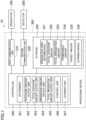
- FIG. 1 is a block diagram illustrating a configuration of the UV emission device (10) according to the first embodiment of the present invention.
- FIG. 2 illustrates a first example of installation of an irradiator (100) and detectors (200).
- the UV emission device (10) includes the irradiator (100), the detectors (200), and a processing device (300).
- the irradiator (100) irradiates a predetermined irradiation area (P) in a predetermined space with ultraviolet rays.
- the ultraviolet rays emitted from the irradiator (100) have a wavelength greater than or equal to 190 nm and less than or equal to 280 nm, for example.
- Examples of the irradiator (100) include a light source that emits ultraviolet rays.
- the light source include a light source element, such as a light-emitting diode (LED) and a laser diode, an excimer lamp, an ultraviolet lamp, and a mercury lamp.
- the predetermined space is a space such as a commercial institution (e.g., a residence, an office, a hospital, a lobby, a hall, or a supermarket) or an industrial institution (e.g., a factory) that is large enough to allow a person to be present and move therein.
- the predetermined space does not include, for example, a space the interior of which consists of only the ultraviolet irradiation area (P), such as a tanning device.
- the predetermined irradiation area (P) indicates an area in the predetermined space.
- the irradiator (100) generates the irradiation area (P) irradiated with ultraviolet rays.
- the irradiator (100) is installed on the ceiling of a building (B 1) to emit ultraviolet rays from the ceiling into a room (R), thereby generating the irradiation area (P) in the room (R).
- the detectors (200) each detect a target person.
- the detectors (200) each include, for example, at least one of a motion sensor (201), a seating sensor (202), or a terminal (203) (personal computer (PC)).
- the motion sensor (201) senses the inside of the irradiation area (P) as a target region.
- the target person enters the irradiation area (P)
- the target person is detected by the motion sensor (201).
- a determiner (341) of a controller (340) determines that the target person is present in the irradiation area (P).
- a chair (G) and a desk (E) are set up in the irradiation area (P).
- the seating sensor (202) is set up on the chair (G).
- the target person enters the irradiation area (P) and seats himself/herself in the chair (G)
- the target person is sensed by the seating sensor (202).
- the determiner (341) of the controller (340) determines that the target person is present in the irradiation area (P).
- the processing device (300) is a device for effectively achieving air sterilization (sterilization of air) by ultraviolet rays while keeping the amount of exposure of the target person to ultraviolet rays from exceeding a predetermined permissible amount.
- the first communication unit (310) is communicably connected to the irradiator (100) in a wired or wireless manner.
- the second communication unit (320) is communicably connected to the detectors (200) in a wired or wireless manner.
- Each of the first and second communication units (310) and (320) includes, for example, at least one of a device for performing wireless communication (e.g., Bluetooth (registered trademark), wireless fidelity (Wi-Fi) (registered trademark), or Internet communications) (such as a wireless LAN module) or a device for performing wired communication (such as a communication port connected to a communication cable).
- a device for performing wireless communication e.g., Bluetooth (registered trademark), wireless fidelity (Wi-Fi) (registered trademark), or Internet communications
- a wireless LAN module such as a wireless LAN module
- a device for performing wired communication such as a communication port connected to a communication cable.
- the irradiation area information (331) indicates the position of the ultraviolet irradiation area (P) irradiated by the irradiator (100). Examples of the irradiation area information (331) include the latitude and longitude of the ultraviolet irradiation area (P).
- the total exposure amount (332) indicates the total amount of exposure of the target person to ultraviolet rays.
- the total exposure amount (332) stored in the storage (330) increases with increase in the time of the target person staying in the irradiation area (P).
- the total exposure amount (332) stored in the storage (330) is reset to 0 every first predetermined period (e.g., every day), and counting is started from 0 every time it is reset.
- the total irradiation amount (333) is information indicating the total ultraviolet irradiation amount of the irradiation area (P).
- the total amount of ultraviolet rays emitted increases with increase in the time of the irradiator (100) irradiating the irradiation area (P) with ultraviolet rays.
- the total amount of ultraviolet rays emitted that is stored in the storage (330) is reset to 0 every second predetermined period (e.g., every day), and counting is started from 0 every time it is reset.
- the first predetermined period (the timing at which the total exposure amount (332) is reset) and the second predetermined period (the timing at which the total irradiation amount (333) is reset) may be the same or may be different from each other.
- the target amount (335) is information indicating the target total amount (predetermined target amount) of irradiation of the irradiation area (P) with ultraviolet rays.
- the predetermined target amount is set to enable effective air sterilization in the irradiation area (P), for example.
- the learning model (336) indicates a control program for the irradiator (100) configured so that the total amount of irradiation of the irradiation area (P) with ultraviolet rays exceeds the predetermined target amount while the total amount of exposure of the target person to ultraviolet rays does not exceed the predetermined upper limit amount.
- the controller (340) executes a computer program stored in the storage (330) to function as the determiner (341), the exposure amount output unit (342), the total exposure amount output unit (343), the irradiation amount output unit (344), the total irradiation amount output unit (345), the control unit (346), and the learning unit (347).
- the control unit (346) controls the irradiator (100) based on the amount of exposure of the target person to ultraviolet rays.
- the control unit (346) controls the irradiator (100) by transmitting a signal from the first communication unit (310) to the irradiator (100).
- the control unit (346) controls the irradiator (100) so that ultraviolet rays of a predetermined irradiation intensity are emitted from the irradiator (100) for a predetermined time, thereby performing first to sixth irradiation processes to be described later (see FIGS. 5 , 6 , 9 , and 11 ).
- the irradiator (100) may be controlled using artificial intelligence (AI).
- the learning unit (347) generates the learning model (336) by machine learning using information on the target person and ultraviolet rays as input data.
- the information on the target person and ultraviolet rays includes identification information for identifying the target person, positional information on the target person, information indicating the irradiation intensity of the ultraviolet rays emitted from the irradiator (100), and information indicating an ultraviolet irradiation area (P).
- a control value for the irradiator (100) is used as output data.
- the control value for the irradiator (100) includes the irradiation intensity and/or the irradiation time of ultraviolet rays emitted from the irradiator (100). If the AI is used to control the irradiator (100), the learning model (336) can be generated so that, based on the information on the target person and ultraviolet rays, the area where the target person will be present in the future is estimated and then emission of ultraviolet rays from the irradiator (100) is controlled.
- the control unit (346) controls the irradiator (100) by using the learning model (336) generated by the learning unit (347).
- the learning unit (347) generates the learning model (336) obtained by learning the control value for the irradiator (100) corresponding to the information on the target person and ultraviolet rays by, for example, a reinforcement learning method.
- the generated learning model (336) is stored in the storage (330).
- the reinforcement learning is a method in which the cycle where while the current state of an environment where a target to be learned is present (i.e., input) is observed, a predetermined action (i.e., output) is executed in the current state and some reward is given for the action is repeated through trial and error to learn a policy that maximizes the total reward as an optimal solution.
- the reward can be negative (minus) if the amount of exposure of the target person to ultraviolet rays exceeds the predetermined upper limit amount within the first predetermined period, or if the amount of irradiation of the irradiation area (P) with ultraviolet rays from the irradiator (100) is not greater than or equal to the predetermined target amount within the second predetermined period.
- FIG. 3 is a flowchart showing the process of updating the total exposure amount (332).
- the process of updating the total exposure amount (332) is a process in which every time the target person is exposed to ultraviolet rays emitted from the irradiator (100), the total exposure amount (332) stored in the storage (330) is updated.
- step S 1 the determiner (341) performs a determination process of determining whether or not the target person is present in the irradiation area (P).
- the determiner (341) performs the determination process using the detectors (200).
- to perform the determination process at least one of the motion sensor (201), the seating sensor (202), or start information on the terminal (203) is used.
- step S1 determines that the target person is present in the irradiation area (P) (Yes in step S 1), the process proceeds to step S2. If the determiner (341) determines that the target person is not present in the irradiation area (P) (No in step S1), the process proceeds to step S4.
- step S2 the determiner (341) determines whether or not the irradiator (100) irradiates the irradiation area (P) with ultraviolet rays. If the determiner (341) determines that the irradiation area (P) is irradiated with ultraviolet rays (Yes in step S2), the process proceeds to step S3. If the determiner (341) determines that the irradiation area (P) is not irradiated with ultraviolet rays (No in step S2), the process proceeds to step S5.
- step S3 the exposure amount output unit (342) outputs the amount of exposure of the target person to ultraviolet rays based on the determination result of the determiner (341) and operation information on the irradiator (100).
- the exposure amount output unit (342) outputs the time for which the target person has stayed in the irradiation area (P) (irradiation area stay time).
- the irradiation area stay time is the time for which the determiner (341) has determined the target person is present in the irradiation area (P).
- the exposure amount output unit (342) outputs, as the time of the target person being exposed to ultraviolet rays, the time where the irradiation area stay time of the target person and the irradiation time of ultraviolet rays emitted from the irradiator (100) overlap each other.
- the irradiation time of ultraviolet rays emitted from the irradiator (100) is a first example of operation information on the irradiator (100) of the present invention.
- the exposure amount output unit (342) outputs the product of the time of the target person being exposed to ultraviolet rays and the irradiation intensity of ultraviolet rays from the irradiator (100), as the amount of exposure of the target person to ultraviolet rays.
- the irradiation intensity of ultraviolet rays from the irradiator (100) is a second example of the operation information on the irradiator (100) of the present invention.
- step S4 the control unit (346) adds the amount of exposure of the target person to ultraviolet rays that is output in step S3 to the total exposure amount (332) of the target person to ultraviolet rays that is stored in the storage (330). As a result, the total exposure amount (332) is updated.
- step S5 the determiner (341) determines whether or not the first predetermined period has elapsed since implementation of the last first reset process. If the determiner (341) determines that the first predetermined period has elapsed (Yes in step S5), the process proceeds to step S6. If the determiner (341) determines that the first predetermined period has not elapsed (No in step S5), the process proceeds to step S1.
- step S6 the control unit (346) performs a first reset process.
- the first reset process is a process in which the total exposure amount (332) of the target person to ultraviolet rays that is stored in the storage (330) is set to 0.
- the process shown in step S6 is completed, the process proceeds to step S1.
- FIG. 4 is a flowchart showing the process of updating the total irradiation amount (333).
- the process of updating the total irradiation amount (333) is a process in which every time the irradiator (100) irradiates the irradiation area (P) with ultraviolet rays, the total irradiation amount (333) stored in the storage (330) is updated.
- step S110 the determiner (341) determines whether or not the irradiator (100) irradiates the irradiation area (P) with ultraviolet rays. If the determiner (341) determines that the irradiation area (P) is irradiated with ultraviolet rays (Yes in step S110), the process proceeds to step S120. If the determiner (341) determines that the irradiation area (P) is not irradiated with ultraviolet rays (No in step S110), the process proceeds to step S140.
- step S120 the control unit (346) outputs the amount of irradiation of the irradiation area (P) with ultraviolet rays based on the operation information on the irradiator (100).
- the control unit (346) outputs the product of the irradiation time and the irradiation intensity of ultraviolet rays emitted from the irradiator (100), as the ultraviolet irradiation amount.
- step S130 the control unit (346) adds the ultraviolet irradiation amount output in step S120 to the total irradiation amount (333) stored in the storage (330). As a result, the total irradiation amount (333) is updated.
- step S140 the determiner (341) determines whether or not the second predetermined period has elapsed since implementation of the last second reset process. If the determiner (341) determines that the second predetermined period has elapsed (Yes in step S140), the process proceeds to step S150. If the determiner (341) determines that the second predetermined period has not elapsed (No in step S140), the process proceeds to step S110.
- step S150 the control unit (346) performs a second reset process.
- the second reset process is a process in which the total irradiation amount (333) of ultraviolet rays that is stored in the storage (330) is set to 0.
- the process shown in step S150 is completed, the process proceeds to step S 110.
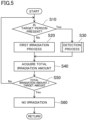
- FIG. 5 is a flowchart showing the process of controlling the irradiator (100).
- the irradiator (100) is controlled in consideration of a balance between the amount of exposure of the target person to ultraviolet rays and the amount of irradiation of the irradiation area (P) with ultraviolet rays.
- the process of updating the total exposure amount (332) shown in FIG. 3 and the process of updating the total irradiation amount (333) shown in FIG. 4 are performed in parallel with the control process shown in FIG. 5 .
- step S10 the determiner (341) performs a determination process of determining whether or not the target person is present in the irradiation area (P). If the determiner (341) determines that the target person is present in the irradiation area (P) (Yes in step S10), the process proceeds to step S30. If the determiner (341) determines that the target person is not present in the irradiation area (P) (No in step S10), the process proceeds to step S20.
- step S20 the control unit (346) controls the irradiator (100) to perform a first irradiation process.
- the first irradiation process is a process of making the irradiator (100) emit ultraviolet rays at a predetermined first irradiation intensity.
- the first irradiation intensity is the irradiation intensity set to place air sterilization by ultraviolet rays at the highest priority, and is set to, for example, the irradiation intensity at full power. Then, the process proceeds to step S40.
- step S30 the control unit (346) performs a detection process.
- the detection process will be described later. Then, the process proceeds to step S40.
- step S40 the control unit (346) acquires the total irradiation amount (333) stored in the storage (330).
- step S50 the control unit (346) determines whether or not the total irradiation amount (333) is greater than or equal to the target amount (335) stored in the storage (330). If it is determined that the total irradiation amount (333) is greater than or equal to the target amount (335) (Yes in step S50), the process proceeds to step S60. If it is determined that the total irradiation amount (333) is not greater than or equal to the target amount (335) (No in step S50), the process proceeds to step S10.
- step S60 the control unit (346) controls the irradiator (100) so that the irradiation area (P) is not irradiated with ultraviolet rays.
- the operation for the irradiator (100) to emit ultraviolet rays may be turned off.
- a light source for the irradiator (100) may be turned around so that the irradiator (100) emit ultraviolet rays in directions other than the directions toward the irradiation area (P) (e.g., directions toward the ceiling).
- FIG. 6 is a flowchart showing the detection process.
- the control unit (346) compares the total exposure amount (332) of the target person stored in the storage (330), a predetermined first reference amount, and a predetermined second reference amount to one another.
- Each of the first and second reference amounts indicates the ultraviolet irradiation amount.
- the ascending order of the first reference amount, the second reference amount, and the permissible amount (334) is the second reference amount, the first reference amount, and the permissible amount (334). Note that the first reference amount and the permissible amount (334) may be the same. If the AI is used to control the irradiator (100), each of the first and second reference amounts may be determined by machine learning.
- step S32 If the total exposure amount (332) is greater than or equal to the first reference amount (first reference amount ⁇ total exposure amount), the process proceeds to step S32. If the total exposure amount (332) is greater than or equal to the second reference amount and less than the first reference amount (second reference amount ⁇ total exposure amount ⁇ first reference amount), the process proceeds to step S33. If the total exposure amount (332) is less than the second reference amount (total exposure amount ⁇ second reference amount), the process proceeds to step S34.
- step S32 the control unit (346) controls the irradiator (100) so that the irradiator (100) does not irradiate the irradiation area (P) with ultraviolet rays.
- the process shown in step S32 is completed, the process proceeds to step S10 shown in FIG. 5 .
- step S33 the control unit (346) controls the irradiator (100) to perform a second irradiation process.
- the second irradiation process is a process of making the irradiator (100) emit ultraviolet rays at a predetermined second irradiation intensity.
- the second irradiation intensity is lower than the first irradiation intensity of the ultraviolet rays emitted in the first irradiation process (see FIG. 5 ) in step S20 (second irradiation intensity ⁇ first irradiation intensity).
- the second irradiation intensity is, for example, about 20% of the first irradiation intensity.
- step S34 the control unit (346) controls the irradiator (100) to perform a third irradiation process.
- the third irradiation process is a process of making the irradiator (100) emit ultraviolet rays at a predetermined third irradiation intensity.
- the third irradiation intensity is lower than the first irradiation intensity of the ultraviolet rays emitted in the first irradiation process (see FIG. 5 ) in step S20, and is higher than the second irradiation intensity of the ultraviolet rays emitted in the second irradiation process in step S33 (second irradiation intensity ⁇ third irradiation intensity ⁇ first irradiation intensity).
- the third irradiation intensity is, for example, about 50% of the first irradiation intensity.
- the irradiation intensity of ultraviolet rays from the irradiator (100) is more limited than if the target person is not present in the irradiation area (P) (second irradiation intensity ⁇ third irradiation intensity ⁇ first irradiation intensity). This can prevent the total exposure amount (332) of the target person to ultraviolet rays (see FIG. 1 ) from exceeding the permissible amount (334).
- the present invention is not limited to this.
- the total exposure amount (332) of the target person to ultraviolet rays may be prevented from exceeding the permissible amount (334) by limiting the ultraviolet irradiation time and setting the irradiation intensity of ultraviolet rays from the irradiator (100) to the first irradiation intensity that is the same as in the first irradiation process (see step S20 in FIG. 5 ).
- the irradiation time of ultraviolet rays emitted from the irradiator (100) is limited to a first predetermined time
- the irradiation time of ultraviolet rays emitted from the irradiator (100) is limited to a second predetermined time that is longer than the first predetermined time.
- both the irradiation intensity of ultraviolet rays from the irradiator (100) and the ultraviolet irradiation time may be limited.
- the irradiation intensity of ultraviolet rays and the ultraviolet irradiation time in each of steps S33 and S34 may be determined by machine learning.
- the detectors (200) may include an imager (such as a camera) that captures an image of the irradiation area (P).
- the second communication unit (320) receives image data captured by the imager that is the detector (200).
- the determiner (341) performs, for example, pattern matching between the image data received by the second communication unit (320) and the image data prepared in advance on the target person, thereby determining whether or not the target person is present in the irradiation area (P).
- the detectors (200) may be each configured as a portable terminal (such as a smartphone or a tablet PC) carried by the target person.
- the portable terminal includes a global positioning system (GPS) module, and acquires positional information on the target person using the GPS module.
- the GPS module receives radio waves from global positioning system (GPS) satellites and calculates the positional information on the target person (information indicating the latitude and longitude) from the received radio waves.
- the portable terminal that is the detector (200) is communicably connected to the second communication unit (320) in a wired or wireless manner.
- the positional information on the target person calculated by the portable terminal is transmitted to the second communication unit (320) through a communication network such as the Internet.
- the determiner (341) determines whether or not the target person is present in the irradiation area (P), in step S 1 shown in FIG. 3 and step S10 shown in FIG. 5 , based on the positional information on the target person received by the second communication unit (320) and the irradiation area information (331) stored in the storage (330). If the spot indicated by the positional information on the target person is located in the area indicated by the irradiation area information (331), the determiner (341) determines that the target person is present in the irradiation area (P). If the spot indicated by the positional information on the target person is not located in the area indicated by the irradiation area information (331), the determiner (341) determines that the target person is not present in the irradiation area (P).
- the control unit (346) controls the irradiator (100) based on the amount of exposure of the target person to ultraviolet rays as described above with reference to FIGS. 1 to 6 .
- the control unit (346) controls the irradiator (100) based on the amount of exposure of the target person to ultraviolet rays as described above with reference to FIGS. 1 to 6 .
- ultraviolet rays can be radiated to the irradiation area (P) with the target person reliably safe so that the total exposure amount (332) of the target person does not exceed the permissible amount (334).
- the irradiation area can be effectively sterilized by ultraviolet rays.
- the control unit (346) controls the irradiator (100) so that the irradiation intensity of ultraviolet rays is lower than if no person is present in the irradiation area (P) (see step S20 in FIG. 5 , and steps S33 and S34 in FIG. 6 ).
- the control unit (346) controls the irradiator so that the irradiation area is not irradiated with ultraviolet rays (see step S32 in FIG. 6 ). This can effectively reduce the amount of exposure of the target person to ultraviolet rays.
- the irradiator (100) irradiates, with ultraviolet rays, the irradiation area (P) where the target person has stayed, and thus effective sterilization by ultraviolet rays can be performed even if bacteria that have been parasitic on the target person are spread in the irradiation area (P) during stay of the target person therein.
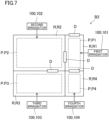
- FIG. 7 illustrates a second example of installation of irradiators (100) and a detector (200).
- a plurality of rooms are provided in a building (B2).
- the internal spaces (R) (internal spaces (R1) to (R4)) of the rooms each include an irradiation area (P) (irradiation areas (P1) to (P4)) irradiated with ultraviolet rays by the irradiator (100) (first to fourth irradiators (101) to (104)).
- Each room has a gate through which a target person comes in and out of the room. The gate is provided with a door (D).
- the plurality of internal spaces (R) are each provided with the detector (200) configured to detect the target person (at least one of a motion sensor (201), a seating sensor (202), or a terminal (203)) (see FIG. 2 ).
- the controller (340) performs the process of updating the total exposure amount (332) shown in FIG. 3 , the process of updating the total irradiation amount (333) shown in FIG. 4 , and the control processes illustrated in FIGS. 5 and 6 , for each of the irradiation areas (P).
- the amount of exposure of the target person to ultraviolet rays can be reduced while a sufficient amount of irradiation of the plurality of irradiation areas (P) (irradiation areas (P1) to (P4)) with ultraviolet rays can be secured.
- control unit (346) controls the irradiator (100) so that ultraviolet rays are emitted without emission to an area where the target person is present (one of the irradiation areas (P) where the target person is present) (see step S20 in FIG. 5 and step S32 in FIG. 6 ). As a result, the amount of exposure of the target person to ultraviolet rays can be effectively reduced.
- the plurality of rooms are provided, and each of them includes an irradiation area (P) (any one of the irradiation areas (P1) to (P4)).
- P any one of the irradiation areas (P1) to (P4).
- P4 any one of the irradiation areas (P1) to (P4)).
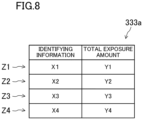
- a third embodiment of a UV emission device (10) will be described with reference to FIGS. 1 and 8 .
- the third embodiment there exist a plurality of target persons (first to fourth target persons (Z1) to (Z4)).
- the plurality of target persons (first to fourth target persons (Z1) to (Z4)) correspond to a plurality of pieces of identification information (first to fourth identification information (X1) to (X4)), respectively.
- the plurality of target persons are identified by the corresponding pieces of identification information.
- detectors (200) include, for example, an imager that captures an image of an irradiation area (P).
- the controller (340) performs the process of updating the total exposure amount (332) shown in FIG. 3 , the process of updating the total irradiation amount (333) shown in FIG. 4 , and the control processes respectively shown in FIGS. 5 and 6 .
- the controller (340) performs the process of updating the total exposure amount (332) and the control process for each of the target persons.
- the determiner (341) identifies the target person present in the irradiation area (P).
- the target person is identified such that it is determined as to which of the plurality of target persons (first to fourth target persons (Z1) to (Z4)) the target person present in the irradiation area (P) corresponds to.
- the imager captures an image of the target person in the irradiation area (P).
- the determiner (341) executes, for example, pattern matching between data of the captured image of the target person and the data of images of the target persons prepared in advance, thereby identifying the target person whose image has been captured.
- the target person whose image has been captured by the imager is the target person present in the irradiation area (P).
- step S3 the exposure amount output unit (342) associates and outputs the identification information on the target person determined in step S1 with the amount of exposure of the target person to ultraviolet rays. For example, if it is determined in step S1 that the target person is the first target person (Z1), the exposure amount output unit (342) associates and outputs the first identification information (X1) on the first target person (Z1) with the amount of exposure of the first target person (Z1) to ultraviolet rays.
- step S4 the control unit (346) adds the ultraviolet exposure amount output in step S3 to the total exposure amount of the target person determined in step S1 included in the total irradiation amount group (333a) stored in the storage (330). As a result, the total exposure amount is updated.
- step S1 if it is determined in step S1 that the target person is the first target person (Z1), the control unit (346) adds the ultraviolet exposure amount output in step S3 to the first total exposure amount (Y1) of the first target person (Z1). As a result, the first total exposure amount (Y1) of the first target person (Z1) is updated.
- step S10 the determiner (341) determines that at least one of the plurality of target persons (the first to fourth target persons (Z1) to (Z4)) is present in the irradiation area (P) (Yes in step S10), the process proceeds to step S30. As a result, a detection process (see FIG. 6 ) is performed in step S30.
- step S10 If the determiner (341) determines that none of the target persons are present in the irradiation area (P) (No in step S10), the process proceeds to step S20. As a result, a first irradiation process is performed in step S20.
- the determiner (341) identifies the target persons by pattern matching using image data on the target persons.
- each target person may carry a portable object (such as a card) including an identifier (such as a QR code (registered trademark)) assigned to the target person.
- the identifier of each target person and the identification information are associated with each other.
- the imager that is the detector (200) captures an image of the identifier carried by the target person.
- Information indicating the identifier whose image has been captured by the imager is transmitted to the second communication unit (320). Then, the determiner (341) identifies the target person present in the irradiation area (P) from the identifier received by the second communication unit (320).
- the exposure amount output unit (342) associates and outputs the identification information on each target person with the amount of exposure of the target person to ultraviolet rays.
- the ultraviolet exposure amount of each of the plurality of target persons first to fourth target persons (Z1) to (Z4)
- FIG. 9 is a flowchart showing a variation of the detection process (see FIG. 6 ).
- the process of updating the total exposure amount (332) shown in FIG. 3 the process of updating the total irradiation amount (333) shown in FIG. 4 , the control process shown in FIG. 5 , and the variation of the detection process shown in FIG. 9 are performed for the target person.
- step S31 the control unit (346) compares the total exposure amount (332) of the target person stored in the storage (330), a predetermined first reference amount, and a predetermined second reference amount to one another. If the total exposure amount (332) is greater than or equal to the first reference amount (first reference amount ⁇ total exposure amount), the process proceeds to step S32. If the total exposure amount (332) is greater than or equal to the second reference amount and less than the first reference amount (second reference amount ⁇ total exposure amount ⁇ first reference amount), the process proceeds to step S33a. If the total exposure amount (332) is less than the second reference amount (total exposure amount ⁇ second reference amount), the process proceeds to step S34a.
- step S33a If the determiner (341) determines that the predetermined condition is satisfied (Yes in step S33a), the process proceeds to step S33b. If the determiner (341) determines that the predetermined condition is not satisfied (No in step S33a), the process proceeds to step S33.
- step S34a the determiner (341) determines whether or not a predetermined condition is satisfied. If the determiner (341) determines that the predetermined condition is satisfied (Yes in step S34a), the process proceeds to step S34b. If the determiner (341) determines that the predetermined condition is not satisfied (No in step S34a), the process proceeds to step S34.
- step S34b the control unit (346) controls the irradiator (100) to perform a fifth irradiation process.
- the fifth irradiation process is a process of controlling the irradiator (100) so that the irradiation intensity and/or the irradiation time of ultraviolet rays emitted from the irradiator (100) are greater than in the third irradiation process (see step S34).
- the process shown in step S34b is completed, the process proceeds to step S34.
- the detectors (200) further include a close-area appliance configured to detect a target person present in the close area (Pa), such as a motion sensor that senses a target region in the close area (Pa), a seating sensor provided in the close area (Pa), a terminal provided in the close area (Pa), and an imager configured to capture an image of the close area (Pa).
- a close-area appliance configured to detect a target person present in the close area (Pa)
- a close-area appliance configured to detect a target person present in the close area (Pa)
- a close-area appliance configured to detect a target person present in the close area (Pa)
- a close-area appliance configured to detect a target person present in the close area (Pa)
- a close-area appliance configured to detect a target person present in the close area (Pa)
- the control unit (346) controls the irradiator (100) so that the irradiation intensity of ultraviolet rays is lower than if the target person is present outside both the irradiation area (P) and the close area (Pa) (see steps S20 and S20b).
- the irradiation intensity of ultraviolet rays emitted to the irradiation area (P) can be set lower in consideration of the situation where the target person present in the close area (Pa) can easily enter the irradiation area (P).
Landscapes
- Health & Medical Sciences (AREA)
- Epidemiology (AREA)
- Life Sciences & Earth Sciences (AREA)
- Animal Behavior & Ethology (AREA)
- General Health & Medical Sciences (AREA)
- Public Health (AREA)
- Veterinary Medicine (AREA)
- Photometry And Measurement Of Optical Pulse Characteristics (AREA)
- Circuit Arrangement For Electric Light Sources In General (AREA)
- Apparatus For Disinfection Or Sterilisation (AREA)
- Disinfection, Sterilisation Or Deodorisation Of Air (AREA)
Abstract
Description
- The present disclosure relates to a processing device, an ultraviolet (UV) emission device, and a UV emission method.
- An air conditioner described in Patent Document 1 includes an emitter means configured to emit ultraviolet rays into an installation space, an emission direction changing means configured to change the direction in which the ultraviolet rays are emitted, and a control means. If a moving body is present in the space, the control means controls the emission direction changing means to make the emitter means emit ultraviolet rays into the installation space without emission to the position of the moving body based on positional information on the moving body. Thus, ultraviolet rays can be emitted into a living space without emission to a moving body such as a human body or an animal.
- Patent Document 1:
Japanese Unexamined Patent Publication No. 2009-14259 - Unfortunately, a person moving around in the installation space may prevent ultraviolet rays from being emitted into the living space to avoid irradiation of the person with ultraviolet rays. This makes it difficult to emit a sufficient amount of ultraviolet rays into the living space, and then an intended bactericidal effect might not be obtained. In addition, since ultraviolet rays are emitted without emission to the area where a person is present, the position of the person and its surroundings are not sterilized by ultraviolet rays. Thus, the living space may be unevenly sterilized. As a result, an intended bactericidal effect might not be obtained.
- It is an object of the present disclosure to effectively sterilize an ultraviolet irradiation area.
- A first aspect of the present disclosure is directed to a UV emission device. The UV emission device includes: an irradiator (100) configured to irradiate a predetermined irradiation area (P) in a predetermined space with ultraviolet rays; and a control unit (346) configured to control the irradiator (100) based on an amount of exposure of a target person to ultraviolet rays.
- According to the first aspect, the irradiation area can be effectively sterilized by ultraviolet rays.
- A second aspect of the present disclosure is an embodiment of the first aspect. In the second aspect, the control unit (346) controls an irradiation intensity and/or an irradiation time of ultraviolet rays emitted from the irradiator (100).
- According to the second aspect, the irradiation intensity and/or the irradiation time of ultraviolet rays emitted from the irradiator (100) are controlled to control the amount of exposure of the target person to ultraviolet rays.
- A third aspect of the present disclosure is an embodiment of the first or second aspect. In the third aspect, the control unit (346) controls the irradiator (100) so that the amount of exposure of the target person to ultraviolet rays is less than or equal to a predetermined permissible amount (334).
- According to the third aspect, the amount of exposure of the target person to ultraviolet rays can be reduced to the predetermined permissible amount (334) or lower.
- A fourth aspect of the present disclosure is an embodiment of any one of the first to third aspects. In the fourth aspect, if the target person is present in the irradiation area (P), the control unit (346) controls the irradiator (100) so that an irradiation intensity of ultraviolet rays is lower than if no person is present in the irradiation area (P) or so that the irradiation area (P) is not irradiated with ultraviolet rays.
- According to the fourth aspect, the amount of exposure of the target person to ultraviolet rays can be effectively reduced.
- A fifth aspect of the present disclosure is an embodiment of any one of the first to fourth aspects. In the fifth aspect, if the target person is present in the irradiation area (P), the control unit (346) controls the irradiator (100) so that an irradiation intensity of ultraviolet rays is lower than if no person is present in the irradiation area (P) or so that the irradiation area (P) is prevented from being irradiated with ultraviolet rays.
- According to the fifth aspect, the amount of exposure of the target person to ultraviolet rays can be effectively reduced.
- A sixth aspect of the present disclosure is an embodiment of any one of the first to fifth aspects. In the sixth aspect, if a condition that the number of times of a plurality of people coming close to each other with a distance shorter than a predetermined distance within a predetermined period in the irradiation area (P) be greater than a predetermined number of times is satisfied, the control unit (346) controls the irradiator (100) so that an irradiation intensity and/or an irradiation time of ultraviolet rays emitted from the irradiator (100) are greater than if the condition is not satisfied.
- According to the sixth aspect, if the number of times of a plurality of people coming close to each other with a distance shorter than the predetermined distance increases, the risk of infection between the people close to each other increases. However, in this case, the irradiation intensity and/or the irradiation time of ultraviolet rays emitted from the irradiator (100) are increased to enable effective sterilization by ultraviolet rays, and thus the risk of infection can be reduced.
- A seventh aspect of the present disclosure is an embodiment of any one of the first to sixth aspects. In the seventh aspect, the control unit (346) controls the irradiator (100) so that the irradiation area (P) where the target person has stayed is irradiated with ultraviolet rays.
- In the seventh aspect, effective sterilization by ultraviolet rays can be performed even if bacteria that have been parasitic on the target person are spread in the irradiation area (P) during stay of the target person therein.
- An eighth aspect of the present disclosure is an embodiment of any one of the first to seventh aspects. The UV emission device according to the eighth aspect further includes: a determiner (341) configured to perform a determination process of determining whether or not the target person is present in the irradiation area (P).
- According to the eighth aspect, the position of the target person can be determined through the determination process.
- A ninth aspect of the present disclosure is an embodiment of the eighth aspect. In the ninth aspect, the determiner (341) performs the determination process using at least one of a motion sensor (201) configured to sense a target region in the irradiation area (P), a seating sensor (202) provided in the irradiation area (P), or start information on a terminal (203) provided in the irradiation area (P).
- According to the ninth aspect, the position of the target person can be determined through the determination process.
- A tenth aspect of the present disclosure is an embodiment of the eighth or ninth aspect. The UV emission device according to the tenth aspect further includes: an exposure amount output unit (342) configured to output the amount of exposure of the target person to ultraviolet rays, based on a determination result of the determiner (341) and operation information on the irradiator (100).
- According to the tenth aspect, the outputting of the amount of exposure of the target person to ultraviolet rays allows the irradiator to be controlled based on the amount of exposure of the target person to ultraviolet rays.
- An eleventh aspect of the present disclosure is an embodiment of the tenth aspect. In the eleventh aspect, the exposure amount output unit (342) associates and outputs identification information on the target person with the amount of exposure of the target person to ultraviolet rays.
- According to the eleventh aspect, if the target person includes a plurality of target persons, the amount of exposure of each of the target persons to ultraviolet rays can be output with identification secured.
- A twelfth aspect of the present disclosure is an embodiment of any one of the eighth to eleventh aspects. In the twelfth aspect, the determiner (341) further determines whether or not the target person is present in a close area (Pa) close to the irradiation area (P), and if the determiner (341) determines that the target person is present in the close area (Pa), the control unit (346) controls the irradiator (100) so that an irradiation intensity of ultraviolet rays is lower than if the target person is present outside both the irradiation area (P) and the close area (Pa).
- According to the twelfth aspect, the irradiation intensity of ultraviolet rays emitted to the irradiation area (P) can be set lower in consideration of the situation where the target person present in the close area (Pa) can easily enter the irradiation area (P).
- A thirteenth aspect of the present disclosure is an embodiment of any one of the first to twelfth aspects. In the thirteenth aspect, the control unit (346) controls the irradiator (100) based on a learning model (336) generated by machine learning using information on the target person and ultraviolet rays as input data.
- According to the thirteenth aspect, the control unit (346) can control the irradiator (100) using the learning model (336) generated by machine learning.
- A fourteenth aspect of the present disclosure is an embodiment of the thirteenth aspect. In the fourteenth aspect, the information on the target person and ultraviolet rays includes identification information for identifying the target person, positional information on the target person, information indicating an irradiation intensity of ultraviolet rays emitted from the irradiator (100), and information indicating the irradiation area (P).
- According to the fourteenth aspect, the learning model (336) can be generated so that, based on the information on the target person and ultraviolet rays, the area where the target person will be present in the future is estimated and then emission of ultraviolet rays from the irradiator (100) is controlled.
- A fifteenth aspect of the present disclosure is an embodiment of any one of the first to fourteenth aspects. In the fifteenth aspect, the ultraviolet rays emitted from the irradiator (100) have a wavelength greater than or equal to 190 nm and less than or equal to 280 nm.
- According to the fifteenth aspect, ultraviolet rays can be emitted at a wavelength greater than or equal to 190 nm and less than or equal to 280 nm.
- A sixteenth aspect of the present disclosure is directed to a processing device. A processing device includes: a communication unit (310) capable of communicating with an irradiator (100) configured to irradiate a predetermined irradiation area (P) in a predetermined space with ultraviolet rays; and a control unit (346) configured to control the irradiator (100) by transmitting a signal through the communication unit (310) to the irradiator (100). The control unit (346) controls the irradiator (100) based on an amount of exposure of a target person to ultraviolet rays.
- According to the sixteenth aspect, the irradiation area (P) can be effectively sterilized by ultraviolet rays.
- A seventeenth aspect of the present disclosure is directed to a UV emission method. The UV emission method includes: irradiating a predetermined irradiation area (P) in a predetermined space with ultraviolet rays from an irradiator (100); and controlling the irradiator (100) based on an amount of exposure of a target person to ultraviolet rays.
- According to the seventeenth aspect, the irradiation area (P) can be effectively sterilized by ultraviolet rays.
-
-
FIG. 1 is a block diagram illustrating a configuration of a UV emission device according to a first embodiment of the present invention. -
FIG. 2 illustrates a first example of installation of an irradiator and detectors. -
FIG. 3 is a flowchart showing a process of updating the total exposure amount. -
FIG. 4 is a flowchart showing a process of updating the total irradiation amount. -
FIG. 5 is a flowchart showing a process of controlling the irradiator. -
FIG. 6 is a flowchart showing a detection process. -
FIG. 7 illustrates a second example of installation of irradiators and detectors. -
FIG. 8 shows a total irradiation amount group that is a variation of the total irradiation amount. -
FIG. 9 is a flowchart showing a variation of the detection process. -
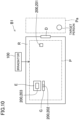
FIG. 10 illustrates a third example of installation of an irradiator and detectors. -
FIG. 11 is a flowchart showing a variation of the process of controlling the irradiator. - Embodiments of the present invention will be described in detail with reference to the drawings. Note that like reference characters denote the same or equivalent components in the drawings, and the detailed description thereof, the description of advantages associated therewith, and other descriptions will not be repeated.
- A UV emission device (10) according to a first embodiment of the present invention will be described with reference to
FIGS. 1 and2 .FIG. 1 is a block diagram illustrating a configuration of the UV emission device (10) according to the first embodiment of the present invention.FIG. 2 illustrates a first example of installation of an irradiator (100) and detectors (200). - As illustrated in
FIGS. 1 and2 , the UV emission device (10) includes the irradiator (100), the detectors (200), and a processing device (300). - The irradiator (100) irradiates a predetermined irradiation area (P) in a predetermined space with ultraviolet rays. The ultraviolet rays emitted from the irradiator (100) have a wavelength greater than or equal to 190 nm and less than or equal to 280 nm, for example. Examples of the irradiator (100) include a light source that emits ultraviolet rays. Examples of the light source include a light source element, such as a light-emitting diode (LED) and a laser diode, an excimer lamp, an ultraviolet lamp, and a mercury lamp. The predetermined space is a space such as a commercial institution (e.g., a residence, an office, a hospital, a lobby, a hall, or a supermarket) or an industrial institution (e.g., a factory) that is large enough to allow a person to be present and move therein. The predetermined space does not include, for example, a space the interior of which consists of only the ultraviolet irradiation area (P), such as a tanning device. The predetermined irradiation area (P) indicates an area in the predetermined space.
- The irradiator (100) generates the irradiation area (P) irradiated with ultraviolet rays. In the first embodiment, the irradiator (100) is installed on the ceiling of a building (B 1) to emit ultraviolet rays from the ceiling into a room (R), thereby generating the irradiation area (P) in the room (R).
- The detectors (200) each detect a target person. The detectors (200) each include, for example, at least one of a motion sensor (201), a seating sensor (202), or a terminal (203) (personal computer (PC)).
- The motion sensor (201) senses the inside of the irradiation area (P) as a target region. When the target person enters the irradiation area (P), the target person is detected by the motion sensor (201). As a result, a determiner (341) of a controller (340) determines that the target person is present in the irradiation area (P).
- A chair (G) and a desk (E) are set up in the irradiation area (P). The seating sensor (202) is set up on the chair (G). When the target person enters the irradiation area (P) and seats himself/herself in the chair (G), the target person is sensed by the seating sensor (202). As a result, the determiner (341) of the controller (340) determines that the target person is present in the irradiation area (P).
- The terminal (203) is set up on the desk (E). When the target person enters the irradiation area (P) and starts the terminal (203), the start information on the terminal (203) is output to the controller (340). As a result, the determiner (341) of the controller (340) determines that the target person is present in the irradiation area (P).
- The processing device (300) is a device for effectively achieving air sterilization (sterilization of air) by ultraviolet rays while keeping the amount of exposure of the target person to ultraviolet rays from exceeding a predetermined permissible amount.
- The processing device (300) includes a first communication unit (310), a second communication unit (320), a storage (330), and the controller (340).
- The first communication unit (310) is communicably connected to the irradiator (100) in a wired or wireless manner. The second communication unit (320) is communicably connected to the detectors (200) in a wired or wireless manner. Each of the first and second communication units (310) and (320) includes, for example, at least one of a device for performing wireless communication (e.g., Bluetooth (registered trademark), wireless fidelity (Wi-Fi) (registered trademark), or Internet communications) (such as a wireless LAN module) or a device for performing wired communication (such as a communication port connected to a communication cable).
- The storage (330) includes a main memory (e.g., a semiconductor memory), such as a flash memory, a read only memory (ROM), and a random access memory (RAM), and may further include an auxiliary memory (e.g., a hard disk drive, a solid state drive (SSD), a secure digital (SD) memory card, or a universal seral bus (USB) flash memory). The storage (330) stores various computer programs executable by the controller (340).
- The storage (330) stores irradiation area information (331), the total exposure amount (332), the total irradiation amount (333), the permissible amount (334), a target amount (335), and a learning model (336).
- The irradiation area information (331) indicates the position of the ultraviolet irradiation area (P) irradiated by the irradiator (100). Examples of the irradiation area information (331) include the latitude and longitude of the ultraviolet irradiation area (P).
- The total exposure amount (332) indicates the total amount of exposure of the target person to ultraviolet rays. The amount of exposure of the target person to ultraviolet rays is expressed by, for example, the product of the exposure time of the target person being exposed to ultraviolet rays from the irradiator (100) and the irradiation intensity (UV illuminance) of ultraviolet rays to which the target person is exposed (amount of exposure of target person to ultraviolet rays (mj/cm2) = exposure time (s) × irradiation intensity (W/cm2)).
- While the irradiator (100) irradiates the irradiation area (P) with ultraviolet rays, the total exposure amount (332) stored in the storage (330) increases with increase in the time of the target person staying in the irradiation area (P). The total exposure amount (332) stored in the storage (330) is reset to 0 every first predetermined period (e.g., every day), and counting is started from 0 every time it is reset.
- The total irradiation amount (333) is information indicating the total ultraviolet irradiation amount of the irradiation area (P). The ultraviolet irradiation amount is expressed by, for example, the product of the irradiation time of the irradiator (100) irradiating the irradiation area (P) with ultraviolet rays and the irradiation intensity of ultraviolet rays emitted from the irradiator (100) during the irradiation time (amount of exposure of target person to ultraviolet rays (mj/cm2) = irradiation time (s) × irradiation intensity (W/cm2)).
- The total amount of ultraviolet rays emitted increases with increase in the time of the irradiator (100) irradiating the irradiation area (P) with ultraviolet rays. The total amount of ultraviolet rays emitted that is stored in the storage (330) is reset to 0 every second predetermined period (e.g., every day), and counting is started from 0 every time it is reset.
- Note that the first predetermined period (the timing at which the total exposure amount (332) is reset) and the second predetermined period (the timing at which the total irradiation amount (333) is reset) may be the same or may be different from each other.
- The permissible amount (334) is information indicating the upper limit (a predetermined upper limit amount) of the total amount of exposure of the target person to ultraviolet rays. The predetermined upper limit amount is set in consideration of, for example, safety for a human body. The predetermined upper limit amount is set to, for example, 22 mj/cm2. Note that the predetermined upper limit amount may vary depending on the wavelength of ultraviolet rays emitted from the irradiator (100).
- The target amount (335) is information indicating the target total amount (predetermined target amount) of irradiation of the irradiation area (P) with ultraviolet rays. The predetermined target amount is set to enable effective air sterilization in the irradiation area (P), for example.
- The learning model (336) indicates a control program for the irradiator (100) configured so that the total amount of irradiation of the irradiation area (P) with ultraviolet rays exceeds the predetermined target amount while the total amount of exposure of the target person to ultraviolet rays does not exceed the predetermined upper limit amount.
- The controller (340) includes a processor, such as a central processing unit (CPU) or a microprocessor unit (MPU). The controller (340) executes a computer program stored in the storage (330) so as to control elements of the processing device (300). The controller (340) includes the determiner (341), an exposure amount output unit (342), a total exposure amount output unit (343), an irradiation amount output unit (344), a total irradiation amount output unit (345), a control unit (346), and a learning unit (347). The controller (340) executes a computer program stored in the storage (330) to function as the determiner (341), the exposure amount output unit (342), the total exposure amount output unit (343), the irradiation amount output unit (344), the total irradiation amount output unit (345), the control unit (346), and the learning unit (347).
- The control unit (346) controls the irradiator (100) based on the amount of exposure of the target person to ultraviolet rays. The control unit (346) controls the irradiator (100) by transmitting a signal from the first communication unit (310) to the irradiator (100). The control unit (346) controls the irradiator (100) so that ultraviolet rays of a predetermined irradiation intensity are emitted from the irradiator (100) for a predetermined time, thereby performing first to sixth irradiation processes to be described later (see
FIGS. 5 ,6 ,9 , and11 ). - The irradiator (100) may be controlled using artificial intelligence (AI). In this case, the learning unit (347) generates the learning model (336) by machine learning using information on the target person and ultraviolet rays as input data. The information on the target person and ultraviolet rays includes identification information for identifying the target person, positional information on the target person, information indicating the irradiation intensity of the ultraviolet rays emitted from the irradiator (100), and information indicating an ultraviolet irradiation area (P). In the learning model (336), a control value for the irradiator (100) is used as output data. The control value for the irradiator (100) includes the irradiation intensity and/or the irradiation time of ultraviolet rays emitted from the irradiator (100). If the AI is used to control the irradiator (100), the learning model (336) can be generated so that, based on the information on the target person and ultraviolet rays, the area where the target person will be present in the future is estimated and then emission of ultraviolet rays from the irradiator (100) is controlled.
- For the AI processing of the learning unit (347), deep learning technology, reinforcement learning, deep reinforcement learning, and other technologies can be used. If the AI is used to control the irradiator (100), the control unit (346) controls the irradiator (100) by using the learning model (336) generated by the learning unit (347).
- The learning unit (347) generates the learning model (336) obtained by learning the control value for the irradiator (100) corresponding to the information on the target person and ultraviolet rays by, for example, a reinforcement learning method. The generated learning model (336) is stored in the storage (330). The reinforcement learning is a method in which the cycle where while the current state of an environment where a target to be learned is present (i.e., input) is observed, a predetermined action (i.e., output) is executed in the current state and some reward is given for the action is repeated through trial and error to learn a policy that maximizes the total reward as an optimal solution. In the first embodiment, the optimal solution for an operation of the irradiator (100), specifically, the irradiation intensity and/or the irradiation time of ultraviolet rays emitted from the irradiator (100) are learned. Examples of the method for reinforcement learning include Q-learning. In the Q-learning performed by the learning unit (347), the reward can be positive (plus), for example, if the amount of exposure of the target person to ultraviolet rays does not exceed the predetermined upper limit amount within the first predetermined period, and the amount of irradiation of the irradiation area (P) with ultraviolet rays from the irradiator (100) is greater than or equal to the predetermined target amount within the second predetermined period. On the other hand, the reward can be negative (minus) if the amount of exposure of the target person to ultraviolet rays exceeds the predetermined upper limit amount within the first predetermined period, or if the amount of irradiation of the irradiation area (P) with ultraviolet rays from the irradiator (100) is not greater than or equal to the predetermined target amount within the second predetermined period.
- The process of updating the total exposure amount (332) will be described with reference to
FIGS. 1 to 3 .FIG. 3 is a flowchart showing the process of updating the total exposure amount (332). The process of updating the total exposure amount (332) is a process in which every time the target person is exposed to ultraviolet rays emitted from the irradiator (100), the total exposure amount (332) stored in the storage (330) is updated. - As illustrated in
FIGS. 1 to 3 , in step S 1, the determiner (341) performs a determination process of determining whether or not the target person is present in the irradiation area (P). The determiner (341) performs the determination process using the detectors (200). In the first embodiment, to perform the determination process, at least one of the motion sensor (201), the seating sensor (202), or start information on the terminal (203) is used. - If the determiner (341) determines that the target person is present in the irradiation area (P) (Yes in step S 1), the process proceeds to step S2. If the determiner (341) determines that the target person is not present in the irradiation area (P) (No in step S1), the process proceeds to step S4.
- In step S2, the determiner (341) determines whether or not the irradiator (100) irradiates the irradiation area (P) with ultraviolet rays. If the determiner (341) determines that the irradiation area (P) is irradiated with ultraviolet rays (Yes in step S2), the process proceeds to step S3. If the determiner (341) determines that the irradiation area (P) is not irradiated with ultraviolet rays (No in step S2), the process proceeds to step S5.
- In step S3, the exposure amount output unit (342) outputs the amount of exposure of the target person to ultraviolet rays based on the determination result of the determiner (341) and operation information on the irradiator (100).
- A procedure in which the exposure amount output unit (342) outputs the amount of exposure of the target person to ultraviolet rays will be described.
- First, the exposure amount output unit (342) outputs the time for which the target person has stayed in the irradiation area (P) (irradiation area stay time). The irradiation area stay time is the time for which the determiner (341) has determined the target person is present in the irradiation area (P).
- Next, the exposure amount output unit (342) outputs, as the time of the target person being exposed to ultraviolet rays, the time where the irradiation area stay time of the target person and the irradiation time of ultraviolet rays emitted from the irradiator (100) overlap each other. The irradiation time of ultraviolet rays emitted from the irradiator (100) is a first example of operation information on the irradiator (100) of the present invention.
- Next, the exposure amount output unit (342) outputs the product of the time of the target person being exposed to ultraviolet rays and the irradiation intensity of ultraviolet rays from the irradiator (100), as the amount of exposure of the target person to ultraviolet rays. The irradiation intensity of ultraviolet rays from the irradiator (100) is a second example of the operation information on the irradiator (100) of the present invention.
- In step S4, the control unit (346) adds the amount of exposure of the target person to ultraviolet rays that is output in step S3 to the total exposure amount (332) of the target person to ultraviolet rays that is stored in the storage (330). As a result, the total exposure amount (332) is updated.
- In step S5, the determiner (341) determines whether or not the first predetermined period has elapsed since implementation of the last first reset process. If the determiner (341) determines that the first predetermined period has elapsed (Yes in step S5), the process proceeds to step S6. If the determiner (341) determines that the first predetermined period has not elapsed (No in step S5), the process proceeds to step S1.
- In step S6, the control unit (346) performs a first reset process. The first reset process is a process in which the total exposure amount (332) of the target person to ultraviolet rays that is stored in the storage (330) is set to 0. When the process shown in step S6 is completed, the process proceeds to step S1.
- Next, the process of updating the total irradiation amount (333) will be described with reference to
FIGS. 1 ,2 , and4. FIG. 4 is a flowchart showing the process of updating the total irradiation amount (333). The process of updating the total irradiation amount (333) is a process in which every time the irradiator (100) irradiates the irradiation area (P) with ultraviolet rays, the total irradiation amount (333) stored in the storage (330) is updated. - As illustrated in
FIGS. 1 ,2 , and4 , in step S110, the determiner (341) determines whether or not the irradiator (100) irradiates the irradiation area (P) with ultraviolet rays. If the determiner (341) determines that the irradiation area (P) is irradiated with ultraviolet rays (Yes in step S110), the process proceeds to step S120. If the determiner (341) determines that the irradiation area (P) is not irradiated with ultraviolet rays (No in step S110), the process proceeds to step S140. - In step S120, the control unit (346) outputs the amount of irradiation of the irradiation area (P) with ultraviolet rays based on the operation information on the irradiator (100). The control unit (346) outputs the product of the irradiation time and the irradiation intensity of ultraviolet rays emitted from the irradiator (100), as the ultraviolet irradiation amount.
- In step S130, the control unit (346) adds the ultraviolet irradiation amount output in step S120 to the total irradiation amount (333) stored in the storage (330). As a result, the total irradiation amount (333) is updated.
- In step S140, the determiner (341) determines whether or not the second predetermined period has elapsed since implementation of the last second reset process. If the determiner (341) determines that the second predetermined period has elapsed (Yes in step S140), the process proceeds to step S150. If the determiner (341) determines that the second predetermined period has not elapsed (No in step S140), the process proceeds to step S110.
- In step S150, the control unit (346) performs a second reset process. The second reset process is a process in which the total irradiation amount (333) of ultraviolet rays that is stored in the storage (330) is set to 0. When the process shown in step S150 is completed, the process proceeds to step S 110.
- The process in which the control unit (346) controls the irradiator (100) will be described with reference to
FIGS. 1 ,2 , and5. FIG. 5 is a flowchart showing the process of controlling the irradiator (100). In the control process, the irradiator (100) is controlled in consideration of a balance between the amount of exposure of the target person to ultraviolet rays and the amount of irradiation of the irradiation area (P) with ultraviolet rays. The process of updating the total exposure amount (332) shown inFIG. 3 and the process of updating the total irradiation amount (333) shown inFIG. 4 are performed in parallel with the control process shown inFIG. 5 . - As illustrated in
FIGS. 1 ,2 , and5 , in step S10, the determiner (341) performs a determination process of determining whether or not the target person is present in the irradiation area (P). If the determiner (341) determines that the target person is present in the irradiation area (P) (Yes in step S10), the process proceeds to step S30. If the determiner (341) determines that the target person is not present in the irradiation area (P) (No in step S10), the process proceeds to step S20. - In step S20, the control unit (346) controls the irradiator (100) to perform a first irradiation process. The first irradiation process is a process of making the irradiator (100) emit ultraviolet rays at a predetermined first irradiation intensity. The first irradiation intensity is the irradiation intensity set to place air sterilization by ultraviolet rays at the highest priority, and is set to, for example, the irradiation intensity at full power. Then, the process proceeds to step S40.
- In step S30, the control unit (346) performs a detection process. The detection process will be described later. Then, the process proceeds to step S40.
- In step S40, the control unit (346) acquires the total irradiation amount (333) stored in the storage (330).
- In step S50, the control unit (346) determines whether or not the total irradiation amount (333) is greater than or equal to the target amount (335) stored in the storage (330). If it is determined that the total irradiation amount (333) is greater than or equal to the target amount (335) (Yes in step S50), the process proceeds to step S60. If it is determined that the total irradiation amount (333) is not greater than or equal to the target amount (335) (No in step S50), the process proceeds to step S10.
- In step S60, the control unit (346) controls the irradiator (100) so that the irradiation area (P) is not irradiated with ultraviolet rays. In this case, the operation for the irradiator (100) to emit ultraviolet rays may be turned off. In addition, for example, a light source for the irradiator (100) may be turned around so that the irradiator (100) emit ultraviolet rays in directions other than the directions toward the irradiation area (P) (e.g., directions toward the ceiling).
- The detection process will be described with reference to
FIGS. 1 ,2 ,5 , and6. FIG. 6 is a flowchart showing the detection process. - As illustrated in
FIGS. 1 ,2 , and6 , in step S31, the control unit (346) compares the total exposure amount (332) of the target person stored in the storage (330), a predetermined first reference amount, and a predetermined second reference amount to one another. Each of the first and second reference amounts indicates the ultraviolet irradiation amount. The ascending order of the first reference amount, the second reference amount, and the permissible amount (334) is the second reference amount, the first reference amount, and the permissible amount (334). Note that the first reference amount and the permissible amount (334) may be the same. If the AI is used to control the irradiator (100), each of the first and second reference amounts may be determined by machine learning. - If the total exposure amount (332) is greater than or equal to the first reference amount (first reference amount ≤ total exposure amount), the process proceeds to step S32. If the total exposure amount (332) is greater than or equal to the second reference amount and less than the first reference amount (second reference amount ≤ total exposure amount < first reference amount), the process proceeds to step S33. If the total exposure amount (332) is less than the second reference amount (total exposure amount < second reference amount), the process proceeds to step S34.
- In step S32, the control unit (346) controls the irradiator (100) so that the irradiator (100) does not irradiate the irradiation area (P) with ultraviolet rays. When the process shown in step S32 is completed, the process proceeds to step S10 shown in
FIG. 5 . - In step S33, the control unit (346) controls the irradiator (100) to perform a second irradiation process. The second irradiation process is a process of making the irradiator (100) emit ultraviolet rays at a predetermined second irradiation intensity. The second irradiation intensity is lower than the first irradiation intensity of the ultraviolet rays emitted in the first irradiation process (see
FIG. 5 ) in step S20 (second irradiation intensity < first irradiation intensity). The second irradiation intensity is, for example, about 20% of the first irradiation intensity. When the process shown in step S33 is completed, the process proceeds to step S10 shown inFIG. 5 . - In step S34, the control unit (346) controls the irradiator (100) to perform a third irradiation process. The third irradiation process is a process of making the irradiator (100) emit ultraviolet rays at a predetermined third irradiation intensity. The third irradiation intensity is lower than the first irradiation intensity of the ultraviolet rays emitted in the first irradiation process (see
FIG. 5 ) in step S20, and is higher than the second irradiation intensity of the ultraviolet rays emitted in the second irradiation process in step S33 (second irradiation intensity < third irradiation intensity < first irradiation intensity). The third irradiation intensity is, for example, about 50% of the first irradiation intensity. When the process shown in step S34 is completed, the process proceeds to step S10 shown inFIG. 5 . - If the target person is present in the irradiation area (P) in each of the second irradiation process in step S33 and the third irradiation process in step S34 both shown in
FIG. 6 , the irradiation intensity of ultraviolet rays from the irradiator (100) is more limited than if the target person is not present in the irradiation area (P) (second irradiation intensity < third irradiation intensity < first irradiation intensity). This can prevent the total exposure amount (332) of the target person to ultraviolet rays (seeFIG. 1 ) from exceeding the permissible amount (334). However, the present invention is not limited to this. - In each of the second irradiation process in step S33 and the third irradiation process in step S34, the total exposure amount (332) of the target person to ultraviolet rays (see
FIG. 1 ) may be prevented from exceeding the permissible amount (334) by limiting the ultraviolet irradiation time and setting the irradiation intensity of ultraviolet rays from the irradiator (100) to the first irradiation intensity that is the same as in the first irradiation process (see step S20 inFIG. 5 ). In this case, for example, in the second irradiation process in step S33, the irradiation time of ultraviolet rays emitted from the irradiator (100) is limited to a first predetermined time, and in the third irradiation process in step S34, the irradiation time of ultraviolet rays emitted from the irradiator (100) is limited to a second predetermined time that is longer than the first predetermined time. - In each of steps S33 and S34, both the irradiation intensity of ultraviolet rays from the irradiator (100) and the ultraviolet irradiation time may be limited.
- If the AI is used to control the irradiator (100), the irradiation intensity of ultraviolet rays and the ultraviolet irradiation time in each of steps S33 and S34 may be determined by machine learning.
- The detectors (200) (see
FIG. 1 ) may include an imager (such as a camera) that captures an image of the irradiation area (P). In this case, in step S 1 shown inFIG. 3 and step S10 shown inFIG. 5 , the second communication unit (320) receives image data captured by the imager that is the detector (200). The determiner (341) performs, for example, pattern matching between the image data received by the second communication unit (320) and the image data prepared in advance on the target person, thereby determining whether or not the target person is present in the irradiation area (P). - The detectors (200) may be each configured as a portable terminal (such as a smartphone or a tablet PC) carried by the target person. In this case, the portable terminal includes a global positioning system (GPS) module, and acquires positional information on the target person using the GPS module. The GPS module receives radio waves from global positioning system (GPS) satellites and calculates the positional information on the target person (information indicating the latitude and longitude) from the received radio waves. The portable terminal that is the detector (200) is communicably connected to the second communication unit (320) in a wired or wireless manner. The positional information on the target person calculated by the portable terminal is transmitted to the second communication unit (320) through a communication network such as the Internet.
- If the detector (200) is configured as a portable terminal, the determiner (341) determines whether or not the target person is present in the irradiation area (P), in step S 1 shown in
FIG. 3 and step S10 shown inFIG. 5 , based on the positional information on the target person received by the second communication unit (320) and the irradiation area information (331) stored in the storage (330). If the spot indicated by the positional information on the target person is located in the area indicated by the irradiation area information (331), the determiner (341) determines that the target person is present in the irradiation area (P). If the spot indicated by the positional information on the target person is not located in the area indicated by the irradiation area information (331), the determiner (341) determines that the target person is not present in the irradiation area (P). - The control unit (346) controls the irradiator (100) based on the amount of exposure of the target person to ultraviolet rays as described above with reference to
FIGS. 1 to 6 . Thus, if the target person is present in the irradiation area (P), ultraviolet rays can be radiated to the irradiation area (P) with the target person reliably safe so that the total exposure amount (332) of the target person does not exceed the permissible amount (334). As a result, the irradiation area can be effectively sterilized by ultraviolet rays. - If the target person is present in the irradiation area (P), the control unit (346) controls the irradiator (100) so that the irradiation intensity of ultraviolet rays is lower than if no person is present in the irradiation area (P) (see step S20 in
FIG. 5 , and steps S33 and S34 inFIG. 6 ). Alternatively, the control unit (346) controls the irradiator so that the irradiation area is not irradiated with ultraviolet rays (see step S32 inFIG. 6 ). This can effectively reduce the amount of exposure of the target person to ultraviolet rays. - In addition, the irradiator (100) irradiates, with ultraviolet rays, the irradiation area (P) where the target person has stayed, and thus effective sterilization by ultraviolet rays can be performed even if bacteria that have been parasitic on the target person are spread in the irradiation area (P) during stay of the target person therein.
- A second embodiment of a UV emission device (10) will be described with reference to
FIG. 7. FIG. 7 illustrates a second example of installation of irradiators (100) and a detector (200). - As illustrated in
FIG. 7 , in the second embodiment, a plurality of rooms are provided in a building (B2). The internal spaces (R) (internal spaces (R1) to (R4)) of the rooms each include an irradiation area (P) (irradiation areas (P1) to (P4)) irradiated with ultraviolet rays by the irradiator (100) (first to fourth irradiators (101) to (104)). Each room has a gate through which a target person comes in and out of the room. The gate is provided with a door (D). - The plurality of internal spaces (R) (internal spaces (R1) to (R4)) are each provided with the detector (200) configured to detect the target person (at least one of a motion sensor (201), a seating sensor (202), or a terminal (203)) (see
FIG. 2 ). - If the plurality of irradiation areas (P) are provided as illustrated in
FIG. 7 , the controller (340) performs the process of updating the total exposure amount (332) shown inFIG. 3 , the process of updating the total irradiation amount (333) shown inFIG. 4 , and the control processes illustrated inFIGS. 5 and6 , for each of the irradiation areas (P). As a result, the amount of exposure of the target person to ultraviolet rays can be reduced while a sufficient amount of irradiation of the plurality of irradiation areas (P) (irradiation areas (P1) to (P4)) with ultraviolet rays can be secured. - In addition, the control unit (346) controls the irradiator (100) so that ultraviolet rays are emitted without emission to an area where the target person is present (one of the irradiation areas (P) where the target person is present) (see step S20 in
FIG. 5 and step S32 inFIG. 6 ). As a result, the amount of exposure of the target person to ultraviolet rays can be effectively reduced. - In the second embodiment, the plurality of rooms are provided, and each of them includes an irradiation area (P) (any one of the irradiation areas (P1) to (P4)). However, the present invention is not limited to this. A plurality of regions without overlapping each other may be set in one room so that each of the set regions includes an irradiation area (P).
- A third embodiment of a UV emission device (10) will be described with reference to
FIGS. 1 and8 . - As shown in
FIG. 8 , in the third embodiment, there exist a plurality of target persons (first to fourth target persons (Z1) to (Z4)). The plurality of target persons (first to fourth target persons (Z1) to (Z4)) correspond to a plurality of pieces of identification information (first to fourth identification information (X1) to (X4)), respectively. The plurality of target persons are identified by the corresponding pieces of identification information. -
FIG. 8 shows a total irradiation amount group (333a) that is a variation of the total irradiation amount (333) (seeFIG. 1 ). The total irradiation amount group (333a) is information indicating associations between the plurality of pieces of identification information (the first to fourth identification information (X1) to (X4)) and a plurality of total exposure amounts (first to fourth exposure amounts (Y1) to (Y4)). The total irradiation amount group (333a) includes information indicating the total exposure amount of each of the target persons. The total irradiation amount group (333a) is stored in the storage (330). - As shown in
FIGS. 1 and8 , in the third embodiment, detectors (200) (seeFIG. 1 ) include, for example, an imager that captures an image of an irradiation area (P). - In the third embodiment, just like the first embodiment, the controller (340) performs the process of updating the total exposure amount (332) shown in
FIG. 3 , the process of updating the total irradiation amount (333) shown inFIG. 4 , and the control processes respectively shown inFIGS. 5 and6 . In this case, the controller (340) performs the process of updating the total exposure amount (332) and the control process for each of the target persons. - The process of updating the total exposure amount (332) according to the third embodiment will be described with reference to
FIG. 3 . Differences from the updating process of the first embodiment will be mainly described below. - As shown in
FIG. 3 , if it is determined in step S1 that the target person is present in the irradiation area (P), the determiner (341) identifies the target person present in the irradiation area (P). The target person is identified such that it is determined as to which of the plurality of target persons (first to fourth target persons (Z1) to (Z4)) the target person present in the irradiation area (P) corresponds to. In this case, the imager captures an image of the target person in the irradiation area (P). Then, the determiner (341) executes, for example, pattern matching between data of the captured image of the target person and the data of images of the target persons prepared in advance, thereby identifying the target person whose image has been captured. In other words, the target person whose image has been captured by the imager is the target person present in the irradiation area (P). - In step S3, the exposure amount output unit (342) associates and outputs the identification information on the target person determined in step S1 with the amount of exposure of the target person to ultraviolet rays. For example, if it is determined in step S1 that the target person is the first target person (Z1), the exposure amount output unit (342) associates and outputs the first identification information (X1) on the first target person (Z1) with the amount of exposure of the first target person (Z1) to ultraviolet rays.
- In step S4, the control unit (346) adds the ultraviolet exposure amount output in step S3 to the total exposure amount of the target person determined in step S1 included in the total irradiation amount group (333a) stored in the storage (330). As a result, the total exposure amount is updated.
- For example, if it is determined in step S1 that the target person is the first target person (Z1), the control unit (346) adds the ultraviolet exposure amount output in step S3 to the first total exposure amount (Y1) of the first target person (Z1). As a result, the first total exposure amount (Y1) of the first target person (Z1) is updated.
- The control process (see
FIG. 5 ) according to the third embodiment will be described with reference toFIGS. 5 and6 . Differences from the first embodiment will be mainly described below. - If, as shown in
FIG. 5 , in step S10, the determiner (341) determines that at least one of the plurality of target persons (the first to fourth target persons (Z1) to (Z4)) is present in the irradiation area (P) (Yes in step S10), the process proceeds to step S30. As a result, a detection process (seeFIG. 6 ) is performed in step S30. - If the determiner (341) determines that none of the target persons are present in the irradiation area (P) (No in step S10), the process proceeds to step S20. As a result, a first irradiation process is performed in step S20.
- In the third embodiment, the determiner (341) identifies the target persons by pattern matching using image data on the target persons. However, the present invention is not limited to this. For example, each target person may carry a portable object (such as a card) including an identifier (such as a QR code (registered trademark)) assigned to the target person. The identifier of each target person and the identification information (first to fourth identification information (X1) to (X4)) are associated with each other. In this case, if a target person is present in the irradiation area (P), the imager that is the detector (200) captures an image of the identifier carried by the target person. Information indicating the identifier whose image has been captured by the imager is transmitted to the second communication unit (320). Then, the determiner (341) identifies the target person present in the irradiation area (P) from the identifier received by the second communication unit (320).
- In a second variation, a plurality of target persons each carry a portable terminal, which is configured to transmit positional information on the target person carrying the portable terminal (see the second variation of the detector (200) of the first embodiment). Identification information on the target person carrying the portable terminal is added to the positional information. For example, positional information on the first target person (Z 1) and a first identification information (X1) on the first target person (Z 1) are transmitted from the portable terminal carried by the first target person (Z 1). As a result, the determiner (341) can identify the target persons from the identification information transmitted together with the positional information.
- As described with reference to
FIGS. 5 and6 , the exposure amount output unit (342) associates and outputs the identification information on each target person with the amount of exposure of the target person to ultraviolet rays. As a result, the ultraviolet exposure amount of each of the plurality of target persons (first to fourth target persons (Z1) to (Z4)) can be output with identification secured. - A fourth embodiment of a UV emission device (10) will be described with reference to
FIGS. 1 and9. FIG. 9 is a flowchart showing a variation of the detection process (seeFIG. 6 ). - In the fourth embodiment, a plurality of people in addition to a target person are present. In addition, in the fourth embodiment, as indicated by the second variation of the process for identifying the plurality of target persons according to the third embodiment, each of the plurality of people including the target person possesses a portable terminal. The position of each person can be determined by the positional information and identification information transmitted from the associated portable terminal.
- In the fourth embodiment, the process of updating the total exposure amount (332) shown in
FIG. 3 , the process of updating the total irradiation amount (333) shown inFIG. 4 , the control process shown inFIG. 5 , and the variation of the detection process shown inFIG. 9 are performed for the target person. - A variation of the detection process will be described below. Differences from the detection process shown in
FIG. 6 will be mainly described below. - As shown in
FIGS. 1 and9 , in step S31, the control unit (346) compares the total exposure amount (332) of the target person stored in the storage (330), a predetermined first reference amount, and a predetermined second reference amount to one another. If the total exposure amount (332) is greater than or equal to the first reference amount (first reference amount ≤ total exposure amount), the process proceeds to step S32. If the total exposure amount (332) is greater than or equal to the second reference amount and less than the first reference amount (second reference amount ≤ total exposure amount < first reference amount), the process proceeds to step S33a. If the total exposure amount (332) is less than the second reference amount (total exposure amount < second reference amount), the process proceeds to step S34a. - In step S33a, the determiner (341) determines whether or not a predetermined condition is satisfied. The predetermined condition is that the number of times of a plurality of people coming close to each other with a distance shorter than a predetermined distance within a predetermined period in the irradiation area (P) be greater than a predetermined number of times. The determiner (341) functions as a timer, and counts the predetermined period. The determiner (341) determines whether or not the predetermined condition is satisfied within the predetermined period based on positional information on each of the plurality of people transmitted from the portable terminal of each of the plurality of people.
- If the determiner (341) determines that the predetermined condition is satisfied (Yes in step S33a), the process proceeds to step S33b. If the determiner (341) determines that the predetermined condition is not satisfied (No in step S33a), the process proceeds to step S33.
- In step S33b, the control unit (346) controls the irradiator (100) to perform a fourth irradiation process. The fourth irradiation process is a process of controlling the irradiator (100) so that the irradiation intensity and/or the irradiation time of ultraviolet rays emitted from the irradiator (100) are greater than in the second irradiation process (see step S33). When the process shown in step S33b is completed, the process proceeds to step S33.
- In step S34a, the determiner (341) determines whether or not a predetermined condition is satisfied. If the determiner (341) determines that the predetermined condition is satisfied (Yes in step S34a), the process proceeds to step S34b. If the determiner (341) determines that the predetermined condition is not satisfied (No in step S34a), the process proceeds to step S34.
- In step S34b, the control unit (346) controls the irradiator (100) to perform a fifth irradiation process. The fifth irradiation process is a process of controlling the irradiator (100) so that the irradiation intensity and/or the irradiation time of ultraviolet rays emitted from the irradiator (100) are greater than in the third irradiation process (see step S34). When the process shown in step S34b is completed, the process proceeds to step S34.
- As described above with reference to
FIGS. 1 and9 , if the predetermined condition is satisfied in the irradiation area (P), the control unit (346) controls the irradiator (100) so that the irradiation intensity and/or the irradiation time of ultraviolet rays emitted from the irradiator (100) are greater than if the predetermined condition is not satisfied (see steps S33b, S33, 34b, and S34). If the number of times of a plurality of people coming close to each other with a distance shorter than the predetermined distance increases, the risk of infection between the people close to each other increases. However, in this case, the irradiation intensity and/or the irradiation time of ultraviolet rays are increased to enable effective sterilization by ultraviolet rays, and thus the risk of infection can be reduced. - A fifth embodiment of a UV emission device (10) will be described with reference to
FIGS. 1 ,10 , and11 .FIG. 10 illustrates a third example of installation of an irradiator (100) and detectors (200).FIG. 11 is a flowchart showing a variation of the process of controlling the irradiator (100) illustrated inFIG. 5 . - As illustrated in
FIG. 10 , in the fifth embodiment, a close area (Pa) close to an irradiation area (P) is set. The close area (Pa) is, for example, an area located within a predetermined distance from the irradiation area (P) through a passage that communicates with the irradiation area (P) (in the fifth embodiment, a gate opened and closed by a door (D)). - As illustrated in
FIGS. 1 and10 , in the fifth embodiment, the detectors (200) further include a close-area appliance configured to detect a target person present in the close area (Pa), such as a motion sensor that senses a target region in the close area (Pa), a seating sensor provided in the close area (Pa), a terminal provided in the close area (Pa), and an imager configured to capture an image of the close area (Pa). - A variation of the process of controlling the irradiator (100) will be described with reference to
FIGS. 1 ,10 , and11 . Differences from the control process illustrated inFIG. 4 will be mainly described below. - As illustrated in
FIGS. 1 ,10 , and11 , if the determiner (341) determines in step S10 that the target person is not present in the irradiation area (P) (No in step S10), the process proceeds to step S20a. - In step S20a, the determiner (341) determines whether or not the target person is present in the close irradiation area (Pa) by using the close-area appliance of the detector (200). The determiner (341) may determine whether or not the target person is present in the close irradiation area (Pa) by using positional information on the target person transmitted from the portable terminal of the target person.
- If the determiner (341) determines that the target person is present in the close irradiation area (Pa) (Yes in step S20a), the process proceeds to step S20b. If the determiner (341) determines that the target person is not present in the irradiation area (P) (No in step S20a), the process proceeds to step S20.
- In step S20b, the control unit (346) controls the irradiator (100) to perform a sixth irradiation process. The sixth irradiation process is a process of controlling the irradiator (100) so that the irradiation intensity of ultraviolet rays is lower than in the first irradiation process (see step S20). When the process shown in step S20b is completed, the process proceeds to step S40.
- As described above with reference to
FIGS. 1 ,10 , and11 , if the determiner (341) determines that the target person is present in the close area (Pa), the control unit (346) controls the irradiator (100) so that the irradiation intensity of ultraviolet rays is lower than if the target person is present outside both the irradiation area (P) and the close area (Pa) (see steps S20 and S20b). Thus, the irradiation intensity of ultraviolet rays emitted to the irradiation area (P) can be set lower in consideration of the situation where the target person present in the close area (Pa) can easily enter the irradiation area (P). - While the embodiments and variations thereof have been described above, it will be understood that various changes in form and details may be made without departing from the spirit and scope of the claims (e.g., (1) to (2)). The embodiments and the variations thereof may be combined and replaced with each other without deteriorating intended functions of the present disclosure.
-
- (1) The UV emission device (10) may be provided in an air conditioner.
- (2) As shown in steps S33 and S34 shown in
FIGS. 6 and9 and steps S33b and S34b shown inFIG. 9 , if the irradiation area (P) where the target person is present is irradiated with ultraviolet rays, a wavelength filter or any other element maybe used to reduce or remove hazardous components. - As can be seen from the foregoing description, the present disclosure is useful for a processing device, a UV emission device, and a UV emission method.
-
- 100
- Irradiator
- 200
- Detector
- 201
- Motion Sensor
- 202
- Seating Sensor
- 203
- Terminal
- 310
- First Communication Unit (Communication Unit)
- 336
- Learning Model
- 341
- Determiner
- 342
- Exposure Amount Output Unit
- 346
- Control Unit
- P
- Irradiation Area
- Pa
- Close Area
Claims (17)
- A UV emission device comprising:an irradiator (100) configured to irradiate a predetermined irradiation area (P) in a predetermined space with ultraviolet rays; anda control unit (346) configured to control the irradiator (100) based on an amount of exposure of a target person to ultraviolet rays.
- The UV emission device of claim 1, wherein
the control unit (346) controls an irradiation intensity and/or an irradiation time of ultraviolet rays emitted from the irradiator (100). - The UV emission device of claim 1 or 2, wherein
the control unit (346) controls the irradiator (100) so that the amount of exposure of the target person to ultraviolet rays is less than or equal to a predetermined permissible amount (334). - The UV emission device of any one of claims 1 to 3, wherein
if the target person is present in the irradiation area (P), the control unit (346) controls the irradiator (100) so that an irradiation intensity of ultraviolet rays is lower than if no person is present in the irradiation area (P) or so that the irradiation area (P) is not irradiated with ultraviolet rays. - The UV emission device of any one of claims 1 to 4, wherein
the control unit (346) controls the irradiator (100) so that ultraviolet rays are emitted without emission to an area where the target person is present. - The UV emission device of any one of claims 1 to 5, wherein
if a condition that the number of times of a plurality of people coming close to each other with a distance shorter than a predetermined distance within a predetermined period in the irradiation area (P) be greater than a predetermined number of times is satisfied, the control unit (346) controls the irradiator (100) so that an irradiation intensity and/or an irradiation time of ultraviolet rays emitted from the irradiator (100) are greater larger than if the condition is not satisfied. - The UV emission device of any one of claims 1 to 6, wherein
the control unit (346) controls the irradiator (100) so that the irradiation area (P) where the target person has stayed is irradiated with ultraviolet rays. - The UV emission device of any one of claims 1 to 7 further comprising:
a determiner (341) configured to perform a determination process of determining whether or not the target person is present in the irradiation area (P). - The UV emission device of claim 8, wherein
the determiner (341) performs the determination process using at least one of a motion sensor (201) configured to sense a target region in the irradiation area (P), a seating sensor (202) provided in the irradiation area (P), or start information on a terminal (203) provided in the irradiation area (P). - The UV emission device of claim 8 or 9 further comprising:
an exposure amount output unit (342) configured to output the amount of exposure of the target person to ultraviolet rays based on a determination result of the determiner (341) and operation information on the irradiator (100). - The UV emission device of claim 10, wherein
the exposure amount output unit (342) associates and outputs identification information on the target person with the amount of exposure of the target person to ultraviolet rays. - The UV emission device of any one of claims 8 to 11, whereinthe determiner (341) further determines whether or not the target person is present in a close area (Pa) close to the irradiation area (P), andif the determiner (341) determines that the target person is present in the close area (Pa), the control unit (346) controls the irradiator (100) so that an irradiation intensity of ultraviolet rays is lower than if the target person is present outside both the irradiation area (P) and the close area (Pa).
- The UV emission device of any one of claims 1 to 12, wherein
the control unit (346) controls the irradiator (100) based on a learning model (336) generated by machine learning using information on the target person and ultraviolet rays as input data. - The UV emission device of claim 13, wherein
the information on the target person and ultraviolet rays includes identification information for identifying the target person, positional information on the target person, information indicating an irradiation intensity of ultraviolet rays emitted from the irradiator (100), and information indicating the irradiation area (P). - The UV emission device of any one of claims 1 to 14, wherein
the ultraviolet rays emitted from the irradiator (100) have a wavelength greater than or equal to 190 nm and less than or equal to 280 nm. - A processing device comprising:a communication unit (310) capable of communicating with an irradiator (100) configured to irradiate a predetermined irradiation area (P) in a predetermined space with ultraviolet rays; anda control unit (346) configured to control the irradiator (100) by transmitting a signal through the communication unit (310) to the irradiator (100),the control unit (346) controlling the irradiator (100) based on an amount of exposure of a target person to ultraviolet rays.
- A UV emission method comprising:irradiating a predetermined irradiation area (P) in a predetermined space with ultraviolet rays from an irradiator (100); andcontrolling the irradiator (100) based on an amount of exposure of a target person to ultraviolet rays.
Applications Claiming Priority (2)
| Application Number | Priority Date | Filing Date | Title |
|---|---|---|---|
| JP2021060751 | 2021-03-31 | ||
| PCT/JP2022/011746 WO2022209877A1 (en) | 2021-03-31 | 2022-03-15 | Processing device, uv emission device, and uv emission method |
Publications (2)
| Publication Number | Publication Date |
|---|---|
| EP4295868A1 true EP4295868A1 (en) | 2023-12-27 |
| EP4295868A4 EP4295868A4 (en) | 2024-08-07 |
Family
ID=83459044
Family Applications (1)
| Application Number | Title | Priority Date | Filing Date |
|---|---|---|---|
| EP22780097.6A Withdrawn EP4295868A4 (en) | 2021-03-31 | 2022-03-15 | TREATMENT DEVICE, UV EMISSION DEVICE AND UV EMISSION METHOD |
Country Status (5)
| Country | Link |
|---|---|
| US (1) | US12350391B2 (en) |
| EP (1) | EP4295868A4 (en) |
| JP (1) | JP7174314B2 (en) |
| CN (1) | CN117083090B (en) |
| WO (1) | WO2022209877A1 (en) |
Families Citing this family (1)
| Publication number | Priority date | Publication date | Assignee | Title |
|---|---|---|---|---|
| WO2025074572A1 (en) * | 2023-10-05 | 2025-04-10 | 日本電信電話株式会社 | Ultraviolet light irradiation system |
Family Cites Families (28)
| Publication number | Priority date | Publication date | Assignee | Title |
|---|---|---|---|---|
| AU2005200096B2 (en) * | 1999-03-01 | 2007-07-26 | Johnson & Johnson Vision Care, Inc. | Method of sterilization |
| KR20000062691A (en) * | 1999-03-01 | 2000-10-25 | 존슨 앤드 존슨 비젼 케어, 인코포레이티드 | Method of sterilization |
| JP2005210054A (en) * | 2003-12-22 | 2005-08-04 | Keyence Corp | Ultraviolet irradiation device, ultraviolet irradiation condition setting method, and ultraviolet irradiation method |
| JP2009014259A (en) | 2007-07-04 | 2009-01-22 | Mitsubishi Electric Corp | Air conditioner |
| JP5414721B2 (en) * | 2011-03-17 | 2014-02-12 | 株式会社東芝 | Monitoring system for UV irradiation equipment |
| JP6016115B2 (en) * | 2013-01-30 | 2016-10-26 | Toto株式会社 | Toilet equipment |
| US9889219B2 (en) | 2014-11-10 | 2018-02-13 | Diversey, Inc. | Decontamination apparatus and method |
| WO2016077403A1 (en) * | 2014-11-10 | 2016-05-19 | Daylight Medical, Inc. | Decontamination apparatus and method |
| JP6151736B2 (en) | 2015-03-31 | 2017-06-21 | 株式会社トクヤマ | UV sterilizer |
| WO2017147460A1 (en) * | 2016-02-25 | 2017-08-31 | Ralph Birchard Lloyd | System and method for disinfecting an occupied environment using direction controlled germicidal radiation |
| JP2018007929A (en) * | 2016-07-15 | 2018-01-18 | 株式会社Pfu | Sterilization device |
| EP3290058A1 (en) * | 2016-09-02 | 2018-03-07 | BrainLit AB | A light control system and a method for exposing a subportion of a space with light within a predetermined spectral range at a predetermined threshold intensity |
| JP2018056236A (en) * | 2016-09-27 | 2018-04-05 | 日機装株式会社 | Ultraviolet light irradiation device |
| AU2017356855B2 (en) * | 2016-11-14 | 2021-12-16 | Diversey, Inc. | Decontamination apparatus and method |
| JP6490318B1 (en) | 2018-03-29 | 2019-03-27 | サンエナジー株式会社 | UV irradiation apparatus, UV irradiation method, lighting apparatus and UV irradiation system |
| JP6955118B2 (en) * | 2018-03-30 | 2021-10-27 | ユーブイ パートナーズ,インコーポレイティド | Disinfection behavior tracking and rating |
| CN209783735U (en) * | 2018-09-10 | 2019-12-13 | 句容市人民医院 | Automatic monitor and detection equipment for ultraviolet lamp tube radiation illuminance |
| JP7324397B2 (en) | 2019-01-12 | 2023-08-10 | 岩崎電気株式会社 | Sterilization device for containers and/or contents |
| BR112022019701A2 (en) * | 2020-04-01 | 2022-11-22 | Freestyle Partners Llc | SYSTEM AND METHOD FOR THE SAFE ERADICATION OF PATHOGENS |
| US20230248862A1 (en) * | 2020-07-02 | 2023-08-10 | Current Lighting Solutions, Llc | Light disinfection system control systems |
| JP6977853B1 (en) * | 2020-11-25 | 2021-12-08 | ウシオ電機株式会社 | Bacterial or virus inactivating device |
| JP6948605B1 (en) | 2020-08-05 | 2021-10-13 | ウシオ電機株式会社 | Bacterial or virus inactivating method, bacterial or virus inactivating device |
| JP7099500B2 (en) | 2020-08-25 | 2022-07-12 | ウシオ電機株式会社 | Inactivating device and inactivating method |
| US11883546B2 (en) * | 2020-08-28 | 2024-01-30 | Abl Ip Holding Llc | Luminaire with disinfection light exposure and dosage limit control protocol and sensor integration |
| JP6908172B1 (en) * | 2020-11-20 | 2021-07-21 | ウシオ電機株式会社 | Inactivation method and inactivation system |
| US12311066B2 (en) * | 2020-12-11 | 2025-05-27 | The Boeing Company | Ultraviolet light sanitizing system and method with occupancy detection |
| WO2022190606A1 (en) * | 2021-03-12 | 2022-09-15 | 富士フイルム株式会社 | Ultraviolet sterilization device, operation method for ultraviolet sterilization device, and operation program for ultraviolet sterilization device |
| EP4085936A1 (en) * | 2021-05-04 | 2022-11-09 | The Boeing Company | Systems and methods for sanitization of individuals with ultraviolet light |
-
2022
- 2022-03-15 JP JP2022040620A patent/JP7174314B2/en active Active
- 2022-03-15 CN CN202280022984.6A patent/CN117083090B/en active Active
- 2022-03-15 WO PCT/JP2022/011746 patent/WO2022209877A1/en not_active Ceased
- 2022-03-15 EP EP22780097.6A patent/EP4295868A4/en not_active Withdrawn
-
2023
- 2023-09-28 US US18/374,501 patent/US12350391B2/en active Active
Also Published As
| Publication number | Publication date |
|---|---|
| US20240016963A1 (en) | 2024-01-18 |
| CN117083090B (en) | 2024-08-06 |
| EP4295868A4 (en) | 2024-08-07 |
| CN117083090A (en) | 2023-11-17 |
| WO2022209877A1 (en) | 2022-10-06 |
| JP7174314B2 (en) | 2022-11-17 |
| JP2022159009A (en) | 2022-10-17 |
| US12350391B2 (en) | 2025-07-08 |
Similar Documents
| Publication | Publication Date | Title |
|---|---|---|
| AU2017256814B2 (en) | An autonomous disinfectant system | |
| EP3506953B1 (en) | A light control system and a method for exposing a sub-portion of a space with light within a predetermined spectral range at a predetermined threshold intensity | |
| KR101876003B1 (en) | Case for pet with active sterilizing function and cure function | |
| CN114692385A (en) | Contaminant diffusion analysis | |
| JPWO2020039818A1 (en) | Space purification system and space purification method | |
| US12350391B2 (en) | Processing device, UV emission device, and UV emission method | |
| KR102338279B1 (en) | UV robot to sterilize indoor space | |
| US20210402446A1 (en) | Automated mobile device for cleaning and disinfecting | |
| US11892184B2 (en) | Facility apparatus control device and facility apparatus control method | |
| AU2021204786A1 (en) | UV emitter and controller for disinfection of spaces | |
| CN107670082A (en) | A kind of Sleeping capsule sterilization method and Sleeping capsule | |
| WO2013062007A1 (en) | Apparatus managing device and apparatus management method | |
| US20230317285A1 (en) | Systems and methods for detecting and tracing individuals exhibiting symptoms of infections | |
| EP4433103A1 (en) | System and method for administering and measuring germicidal treatments with cloud-based management and control | |
| KR101455571B1 (en) | System and Method for Managing a Parking Space Using a One-Pass Tag | |
| US20250213739A1 (en) | Sterilization method and sterilization system | |
| JP7255923B1 (en) | UV irradiation system and UV irradiation method | |
| TWI847603B (en) | Method and system for ozone generation | |
| EP4568424A1 (en) | A method for determining visible light intensity at an illumination zone of a surgical light module | |
| TWI892100B (en) | Method and computing device of controlling a cohort of ozone gas generating devices | |
| US11972673B2 (en) | System for assisting a patient to raise an alarm | |
| JP6991922B2 (en) | Image sensors, identification methods, control systems and programs | |
| CN118488857A (en) | Method for operating a radiation emitting device | |
| JP2022126994A (en) | Information providing device, information providing system, control method, and program | |
| JP2022187982A (en) | Systems and methods for sanitization of proximate regions between individuals with ultraviolet light |
Legal Events
| Date | Code | Title | Description |
|---|---|---|---|
| STAA | Information on the status of an ep patent application or granted ep patent |
Free format text: STATUS: THE INTERNATIONAL PUBLICATION HAS BEEN MADE |
|
| PUAI | Public reference made under article 153(3) epc to a published international application that has entered the european phase |
Free format text: ORIGINAL CODE: 0009012 |
|
| STAA | Information on the status of an ep patent application or granted ep patent |
Free format text: STATUS: REQUEST FOR EXAMINATION WAS MADE |
|
| 17P | Request for examination filed |
Effective date: 20230920 |
|
| AK | Designated contracting states |
Kind code of ref document: A1 Designated state(s): AL AT BE BG CH CY CZ DE DK EE ES FI FR GB GR HR HU IE IS IT LI LT LU LV MC MK MT NL NO PL PT RO RS SE SI SK SM TR |
|
| DAV | Request for validation of the european patent (deleted) | ||
| DAX | Request for extension of the european patent (deleted) | ||
| A4 | Supplementary search report drawn up and despatched |
Effective date: 20240708 |
|
| P01 | Opt-out of the competence of the unified patent court (upc) registered |
Free format text: CASE NUMBER: APP_38320/2024 Effective date: 20240627 |
|
| RIC1 | Information provided on ipc code assigned before grant |
Ipc: A61L 9/20 20060101ALI20240702BHEP Ipc: H05B 47/16 20200101ALI20240702BHEP Ipc: A61L 2/26 20060101ALI20240702BHEP Ipc: A61L 2/00 20060101ALI20240702BHEP Ipc: A61L 2/10 20060101ALI20240702BHEP Ipc: A61L 2/24 20060101AFI20240702BHEP |
|
| STAA | Information on the status of an ep patent application or granted ep patent |
Free format text: STATUS: EXAMINATION IS IN PROGRESS |
|
| 17Q | First examination report despatched |
Effective date: 20250116 |
|
| STAA | Information on the status of an ep patent application or granted ep patent |
Free format text: STATUS: THE APPLICATION IS DEEMED TO BE WITHDRAWN |
|
| 18D | Application deemed to be withdrawn |
Effective date: 20251007 |