EP4295364B1 - Adaptives remixen von separarierten audioquellen - Google Patents
Adaptives remixen von separarierten audioquellen Download PDFInfo
- Publication number
- EP4295364B1 EP4295364B1 EP22712284.3A EP22712284A EP4295364B1 EP 4295364 B1 EP4295364 B1 EP 4295364B1 EP 22712284 A EP22712284 A EP 22712284A EP 4295364 B1 EP4295364 B1 EP 4295364B1
- Authority
- EP
- European Patent Office
- Prior art keywords
- remixing
- time
- gain
- time slot
- criterion
- Prior art date
- Legal status (The legal status is an assumption and is not a legal conclusion. Google has not performed a legal analysis and makes no representation as to the accuracy of the status listed.)
- Active
Links
Images



Classifications
-
- G—PHYSICS
- G10—MUSICAL INSTRUMENTS; ACOUSTICS
- G10L—SPEECH ANALYSIS TECHNIQUES OR SPEECH SYNTHESIS; SPEECH RECOGNITION; SPEECH OR VOICE PROCESSING TECHNIQUES; SPEECH OR AUDIO CODING OR DECODING
- G10L21/00—Speech or voice signal processing techniques to produce another audible or non-audible signal, e.g. visual or tactile, in order to modify its quality or its intelligibility
- G10L21/02—Speech enhancement, e.g. noise reduction or echo cancellation
- G10L21/0272—Voice signal separating
-
- G—PHYSICS
- G10—MUSICAL INSTRUMENTS; ACOUSTICS
- G10L—SPEECH ANALYSIS TECHNIQUES OR SPEECH SYNTHESIS; SPEECH RECOGNITION; SPEECH OR VOICE PROCESSING TECHNIQUES; SPEECH OR AUDIO CODING OR DECODING
- G10L19/00—Speech or audio signals analysis-synthesis techniques for redundancy reduction, e.g. in vocoders; Coding or decoding of speech or audio signals, using source filter models or psychoacoustic analysis
-
- G—PHYSICS
- G10—MUSICAL INSTRUMENTS; ACOUSTICS
- G10L—SPEECH ANALYSIS TECHNIQUES OR SPEECH SYNTHESIS; SPEECH RECOGNITION; SPEECH OR VOICE PROCESSING TECHNIQUES; SPEECH OR AUDIO CODING OR DECODING
- G10L25/00—Speech or voice analysis techniques not restricted to a single one of groups G10L15/00 - G10L21/00
- G10L25/27—Speech or voice analysis techniques not restricted to a single one of groups G10L15/00 - G10L21/00 characterised by the analysis technique
-
- H—ELECTRICITY
- H04—ELECTRIC COMMUNICATION TECHNIQUE
- H04S—STEREOPHONIC SYSTEMS
- H04S7/00—Indicating arrangements; Control arrangements, e.g. balance control
- H04S7/30—Control circuits for electronic adaptation of the sound field
Definitions
- One example is to make the speech in a movie audio track clearer, louder, and more intelligible.
- the proposed method may apply source separation to estimate the sources and remix these estimates by applying automatically generated time-varying, signal-adaptive gains.
- the remixing aims to fulfill a time-varying criterion concerning the separated sources and their relationship in the output mix.
- the output mixture has to be smooth and esthetically pleasing. For this purpose, a temporal context is taken into consideration during the generation of the remixing gains so to avoid abrupt and unaesthetic changes.
- An envisioned application is to enable object-based audio personalization, e.g., based on MPEG-H Audio [1, 2].
- MPEG-H Audio [1, 2].
- MPEG Unified Speech and Audio Coding the MPEG-H Audio standard offers many extensions for use in the context of immersive 3D audio, such as coding and rendering of multi-channel and object signals, transmission of object metadata, the compressed transmission of (speaker layout agnostic) object positions and trajectories, and it allows for personalization and user interactivity on the decoder side that is enabled and controlled by object metadata.
- the underlying main ideas of the new codec are to provide suitable means for an immersive experience, for universal delivery, and for personal interactivity.
- Alternative application scenarios might involve traditional broadcasting and streaming services. In these, full personalization is usually not available (or needed), but an alternative audio track (generated as described in this report) can be generated offline and offered by the broadcasting / streaming provider. In a further envisioned application, the alternative audio track could be generated directly by the end-device. In other words, all modules are placed in the end-device.
- constant gains are applied on the estimated target source and/or on the residual sources, e.g., in order to modify the SNR (signal to noise ratio) during the remixing.
- the SNR may be the ratio of the target signal to the at least one residual signal.
- the attenuation needs to be stronger when the ducking signal is softer, so that it becomes better audible in the mixture.
- WO 2015/150066 A1 discloses a method for generating audio content.
- No remixing gain is based on relative matrix comparing levels of a target signal with a level of a residual signal or of the input signal.
- US 2013/0108096 discloses a method for enhanced dynamics processing of streaming audio by source separation and remixing.
- WO 2019/229199 A1 discloses a method for adaptive remixing of audio content.
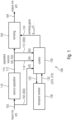
- Figure 1 Main concept: Given an input mix, separated source signals are estimated and remixed by applying automatically generated time-varying, signal-adaptive gains. The remixing gains are generated by the control module with the aim of fulfilling a time-varying criterion concerning the separated source signals and their relationship in the output mix.
- the modules in the figure can be distributed in different devices, i.e., signal encoding, transmission, and decoding can take place before or after the remixing module.
- s(t) the speech recordings of all speakers in a movie soundtrack or all lead instruments in a musical recording
- background signal b(t) comprising all residual audio sources not belonging to the target source:
- Source separation of audio signals aims to estimate s(t), given the mixture signal x(t) (input signal 102).
- the output of the separation is an estimate of the target source ⁇ (t).
- more secondary sources can be estimated and output by the source separation module, e.g., an estimate of the residual sources b ⁇ (t).
- a post-filtering can be applied to ⁇ (t) and b ⁇ (t), e.g., an equalizer for enhancing and/or attenuating certain frequency regions or a post-processing for removing musical noise.
- the estimated source signals ⁇ (t) and b ⁇ (t) are not intended to be listened to separately, but they are remixed with a partial modification of the relative levels [2, 6].
- SNR Signal-to-Noise Ratio
- Fig. 1 shows an example of system 100.
- the system 100 permits signal-adaptive remixing of separated audio sources.
- the system 100 processes an input signal 102 (input mix) x(t).
- the input signal may be a mono signal. This may apply to the target signal and the residual signal.
- the system 100 provides, for example, an output signal (output mix) y(t) 104 (further post-processing can be applied, such as loudness normalization, dynamic range compression, or applying equalization).
- the system 100 may include a source separation block 110.
- the source separation block 110 may extract different signals from the input signal 102 (e.g., by signal processing, filtering, etc.).
- a target signal 114 may be separated from at least one residual signal 112.
- An example may be, for example, a target signal ⁇ (t), which is separated from a background signal b ⁇ (t) (residual signal).
- the target signal 114 may be a speech, while the background signal 114 may include other sounds present in the input signal (e.g. ambience, effects, and music).
- the target signal may be a signal which is filtered from the input signal 102, because maybe a user intends to have an increased level for the target signal 114 in respect to that at least one residual signal 112.
- the target signal 114 may be speech only, estimated by blind source separation, and so on. It is possible for a user to identify the target signal 114 to be separated from the residual signals 112.
- a remixing block 150 may be provided, to provide the output signal (output mix) y(t) 104.
- the remixing block 150 may be input with the target signal 114 and the one or more residual signals 112 and can remix them according to modified gains 124.
- the remixing block may therefore operate by using a remixing matrix with coefficients (gains 124) which, in general, vary in time.
- At least one gain 124 at the remixing block 150 is variable in time: e.g., different time instants or time slots of the target signal ⁇ (t) (114) and/or the at least one residual signal b ⁇ (t) (112) are subjected to gains which vary along the elapsing of time, and in particular based on the values (and for metrics obtained from them) of the target signal ⁇ (t) (114) at different (e.g., future or past) time instants or time slots.
- the remixing gains are modified in such a way that they evolve with time and they can, for example, provide some particular functions. Functions will subsequently be discussed (e.g. as smoothing gains) for reducing the level of the background in respect to the level of speech (e.g., embodying a function which is normally performed by the so-called ducking functions).
- a control block 120 is provided, which has, in input, the target signal 114 and, either the input signal 102 and/or the one or more residual signals 112 (the input signal 102 or the target signal 114 is also called “signal 302" or "first signal 302").
- Fig. 1 shows both the input signal 102 and the background signal 112 being input to the control block 120, but in some examples it may be that only one of the input signal 102 and the background signal 112 is actually inputted onto the control block 120).
- the control block 120 makes use of a temporal context block 130.
- the control block 120 may request temporal context information 132 by exerting a control.
- the control block 120 provides temporal information 122 on the current time instant or time slot which will be subsequently used as temporal context information 132 (e.g., for subsequent time instants or time slots, and/or for refining a previously obtained rough gain 125, so as to deviate from the rough gain 125 to obtain the remixing gain 124).
- the temporal information 122 on the current time instant or time slot may include at least one of the utterance integration block 330 (e.g., 332, 334) or information associated thereto; rough gain 343 and/or activity information (e.g. gate information) 342; a gated gain (e.g., rough gain 352, e.g. 125); and the at least one remixing gain 124 (e.g., g smooth (t-1)).
- the control block 120 appropriately defines, time instant by time instant or time slot by time slot, the at least one remixing gain (e.g. remixing gains) 125 to be provided to the remixing block 150. Accordingly, the obtained output signal (output mix) 104 will be remixed by keeping into consideration not only the target signal 114 at a particular time instant or time slot, but also on the target signal in the temporal context (e.g., future or past time instants or slots).
- the input signal 102 and the separated signals 114, 112 (302), and/or the processed versions of those signals are signals evolving in time along a discrete succession of time instants or time slots.
- Each time instant may be, for example, associated to a particular sample (e.g., signal in the time domain), e.g. present in the input signal (e.g. ambience, effects, and music).
- time may be understood as being subdivided (e.g. partitioned) into a plurality of time slots, and each time slot may be associated to a signal description in the frequency domain (e.g., digital Fourier transforms DFT, short-time Fourier transform STFT, fast Fourier transform FFT, and so on).
- a plurality of values may be associated to the particular time slot, each value being, for example, a coefficient to be associated to a particular frequency.
- Fig. 4 shows an example of the evolution in time of the target signal 114 and the residual signal 112 or input signal 102 (signal 302, or "first signal 302", is used for indicating either the residual signal 112 or the input signal 102).
- a time evolution is shown as a typical horizontal line, where time instants or time slots t are along a discrete succession.
- both the target signal 114 and the signal 302 presents a value either in the time domain or in the frequency domain (the value may have multiple components; for example, if the value is in the frequency domain, a plurality of components may be provided, e.g. one component for each frequency band).
- the target signal 114 (or processed version thereof) presents the value 1141
- the signal 302 (112, 102) (or processed version thereof) presents the value 1121.
- Reference signs 406 and 416 refer to windows of consecutive time instants or time slots which are subsequent, in the discrete succession, to the current time instant or time slot 401.
- reference signs 407, 417 refer to windows of consecutive time instants or time slots which are before, in the discrete succession, the current time instant or time slot 401.
- Reference sign 425 refers to the time instant or time slot immediately before the determined current time instant or time slot 401 (where the determined current time instant or time slot 401 is expressed as t, the time instant or time slot immediately before the determined current time instant or time slot 401 is expressed as t-1).
- the at least one remixing gain is first obtained for the determined current time instant or time slot 401, and subsequently the determined current time instant or time slot 401 is obtained.
- the target signal 114 and the signal 302 (112, 102) (or processed versions thereof) also present some values for the slots of the windows 407 and 406, even though they are not shown in Fig. 4 .
- the windows 407 and 406 and the determined current time instant or time slot 401 may form a time window which includes the determined current time instant or time slot 401.
- the windows in the past, in the future, or both in the past and future may have a predetermined time length (e.g., a predetermined number of time instants or time slots).
- window 416 may comprise a predetermined number of time instants or time slots.
- the plurality of time instants or time slots 406 are some slots within the window 416.
- at least one (or both) of the windows 406, 416 is immediately before or immediately after the current time instant or time slot 401. In some examples, at least one (or both) of the windows 406, 416 is not immediately before or immediately after the current time instant or time slot 401.
- the time instant or time slot 403 happens to be, in the time evolution (according to the discrete succession) of the target signal 114 and of the signal 302, subsequent to the current time instant or time slot 401. Accordingly, the time instant or time slot 403 is understood to be “in the future” with respect to the time instant or time slot 401.
- the values of the target signal 104 and of the signal 302 (112, 102), or processed versions thereof, are respectively indicated to with 1143 and 1123. It will be shown that it is possible to have different remixing gains 124 for different time slots or time instants. Moreover, it is possible to adapt the gain 124 associated to the time instant or time slot 401 as being obtained by also considering the value of the time instant or time slot 403.
- the same may be performed for other time instants or time slots with respect to the time instant or time slot 401.
- the values 1143 and 1123 at the future time instant or time slot 403 may be already known (e.g., stored in buffers).
- the time instant or time slot 401 is the current time instant or time slot, it is meant that the current time instant or time slot 401 is currently processed, even though the future time instants or time slots (e.g., 403) are already known and/or some form of preprocessing is already performed to the future time instants or time slots, e.g., 403. Accordingly, the fact that some time instants or time slots are in the future shall not be understood as obtaining some features which are unknown, but it is more than the current time instant or time slot 401 is adapted to the future time instant or time slot 403, which is already known.
- rough remixing gains 125 After having obtained the rough remixing gains 125, it is subsequently possible to obtain the remixing gains 124, by performing deviations from the rough remixing gains 125 (in particular in transitory intervals or transition intervals) so as to obtain the remixing gains 124, e.g. by making use of temporal context information.
- This process may be performed iteratively, e.g. by first obtaining the remixing gains 124 for time instants in the past, then for a present time instant, and subsequently for the time instants in the future.
- Fig. 4 also shows that the control block 120 receives (or measures) metrics from the current time instant or time slot 401, while the temporal context block 130 receives (or measures) metrics taken from the values 1143 and 1123 of the target signal 114 and of the signal 302 (residual signal 112 or input signal 102, or processed version thereof) at the future time instant or time slot 403 (the same could be done for a past time instant or time slot, which are not shown in Fig. 4 but which may be used exactly as the future time instant or time slot 403). The same may apply to the time instants or time slots 407 (in the past) or the time instants of the window 406 (in the future).
- the metrics which are obtained may include, for example, absolute metrics 4141 and/or 4143 associated to absolute magnitudes (e.g., loudness, level, power, energy, etc., of the particular signal 114 or 302) at the current time instant or time slot 401 or 403, as can be obtained, for example, from the value 1141 and/or 1143.
- absolute metrics 4141 and/or 4143 associated to absolute magnitudes (e.g., loudness, level, power, energy, etc., of the particular signal 114 or 302) at the current time instant or time slot 401 or 403, as can be obtained, for example, from the value 1141 and/or 1143.
- the metrics which are obtained include relative metrics 4145 and 4146.
- the relative metrics 4145 and 4146 may be the at least one metrics.
- a relative metrics 4145 is obtained by comparing an absolute metrics of the target signal 114 (e.g., as obtained from value 1141) with an absolute metrics of signal 302 (112, 102) at the current time instant slot 401 (e.g., as obtained from value 1121).
- Another relative metrics 4146 takes into account values 1143 and 1123 of the target signal 114 and the signal 302 (112 or 102) in the at least one future and/or past time instant or time slot 403.
- the metrics 4145 and 4146 are shown as being obtained at comparing blocks 425' and 426', respectively.
- relative metrics 4145, 4146 the (possibly frequency-weighted) may be the relative intensity of the signals, e.g., SNR(t) (also indicated as SNR in (t) in formulas (5) and (6)), which may imply, for example, a ratio between absolute metrics such as those above.
- Multiple relative metrics may form a composite relative metrics.
- a metrics may imply, for example, a norm on the instant value of the signal. For example, a 1-norm, a 2-norm, etc. may be used.
- the metrics may be a norm, such as 1-norm, a 2-norm, etc.
- a norm may provide a non-negative real number which keeps into consideration the channels of the signal (e.g., the sum of their absolute values, the square root of the sum of their squared values, etc.). Further, multiple metrics (absolute metrics, relative metrics, or both) may be combined with each other to obtain a metrics which is a composite metrics (and partially relative metrics and partially absolute metrics).
- An example of absolute metrics 4141, 4143 is the absolute intensity of the signals, possibly frequency-weighted, e.g. absolute metrics such as the intensity of the target signal 114 and/or the intensity of the signal 302 (e.g., 102, 112), respectively.
- Another example of absolute metrics 4141, 4143 may be an estimate of the perceived time-varying loudness and/or loudness difference.
- Another example of absolute metrics is a time-dependent quality or intelligibility metric or a speech activity probability.
- Another example of absolute metrics is a combination of these or other time-dependent features of the signals (multiple absolute metrics may form a composite absolute metrics).
- the generation of the at least one remixing gain 124 may be subjected to the definition of one or more remixing criteria.
- a remixing criterion may be, for example, a criterion for obtaining a particular goal (e.g., attenuating a background signal or boosting a particular target signal).
- the choice of a particular criterion may generally be associated to the metrics 4141 and/or 4145 (or respectively 4143 and 4146) in a particular time slot 401 (or respectively 403).
- a remixing criterion may therefore be associated to the value of a particular time instant or time slot 401 or 403.
- the current time instant or time slot 401 and the past and/or future time instant or time slot 403 are two time instants or time slots for which different remixing criteria are chosen (e.g. due to different results of an activity detection operation). It may be that, for the determined current time instant or time slot 401, the control block 120 chooses not to completely follow the remixing criterion as would be defined based on the metrics 4141 and 4145 of the target signal 114 at the current time instant or time slot 401: the control block 120 may therefore keep into account the temporal context 132.
- remixing criteria may be defined for the current time instant or time slots 401 and 403 on the basis of the metrics 4141 and 4145 associated to the same time instant or time slot
- the remixing criteria can also be not completely respected, by virtue of using the temporal context 132 and in particular, the metrics 4146 and/or 4143 associated to future and/or past time instants or time slots, thereby operating a deviation.
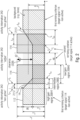
- Fig. 2 shows an example of operation which may be obtained through the examples above.
- the target signal 114 which could be imagined to be a human voice
- the speech when present, is at a loudness level L V .
- the noise 112 (residual signal, background signal) is shown to be acquired as having a constant level L H1 .
- speech 114 starts.
- the speech 114 transitorily ends at time instant t F , but restarts again at instant t L , hence defining a brief time interval 46 without voice 114 (it may be a time interval between the enunciation of one first word and the enunciation of one second word).
- instant t K also indicated as t E
- the speech 114 ends again (it may be that the speaker does not enunciate words anymore).
- noise 112 residual signal, background signal
- level L H1 residual signal, background signal
- noise 112 is to be subsequently played back at level L H2 ⁇ L H1 , so as to increase the quality of the output signal 104 by reducing the noise 112 (by a quantity indicated by 38 in Fig. 2 ), to permit the listener to better understand the speech 114.
- a unitary remixing gain (e.g. 0 dB) could be applied to the noise 112
- a remixing gain less than unitary could be chosen for time instants or time slots after time instant t B (in particular in the interval t DA ).
- the level of the noise 112 would be modified from level L H1 to a level L H2 which causes the difference between the speech 114 and the noise 112 to be the quantity indicated with 42 (clearance).
- the first remixing criterion may be based, for each time instant or time slot before t B , on relative and/or absolute metrics 4145, 4141 associated to exactly that time instant or time slot.
- the second remixing criterion may be based, for each time instant or time slot in the interval t DS (but which is in the future with respect to the time instants or time slots before t B ), on relative and/or absolute metrics 4146, 4143 associated to exactly that future time instant or time slot.
- an abrupt change of criterion and of gate, accordingly
- the noise 112 would jump from level L H2 to level L H1 .
- a more smoothed transition (e.g. identified by ramp 2112 in Fig. 2 ) is therefore in principle preferable.
- a gradual reduction of the remixing gain for the noise 112 is performed. Accordingly, the pumping effect is not audible or at least less audible. Therefore, throughout the time interval t DS , the gain for the background 112 (residual signal) is progressively reduced in respect to the level L V of the speech (target signal 114).
- the determined current time instant or time slot 401 will have a remixing gain 124 which is intermediate between those associated to the current time instant or time slot before t A and after t B .
- the remixing criterion provides a rough value of the gain that would cause the level L H1 , while a time instants in the time interval t DS after t B should have a remixing gain which is the gain that causes the level L H2 .
- time interval 46 there is no gradual modification between two different remixing criteria, but instead it is remained in the remixing gain as would be defined by the second remixing criterion instead of moving towards the gain defined by the first remixing criterion. It is possible to make use, in some cases, of an utterance integration 330, which permits to recognize that the time interval 46 between the two time intervals (e.g. encompassing t DA and t OR ) at which the speech is obtained is still an interval in which the target signal 114 is active. It is noted that some remixing criteria may be dominant over other remixing criteria.
- the second remixing criterion adopted in the remixing region 200H2 is dominant over the first remixing criterion adopted in the remixing region 200H1: we want to maintain the gain 124 for the residual signal 112 low for coping with situations in which the absence of the target signal is only due to a pause within two words, without increasing the loudness of the noise 112.
- the first remixing criterion is non-dominant: in the intermediate region 200G, the ramp 2112 is immediately generated, without waiting too much.
- a first remixing criterion and a second remixing criterion may be, in general, used for generating at least one rough remixing gain (e.g. in non-transitory phases).
- the rough remixing gain 125 may subsequently be corrected by applying a deviation (see also below), e.g. in transitory phases.
- the different remixing criteria apply different gains (e.g. different rough gains) and, therefore, will cause different remixings.
- the discrimination between the remixing criteria is generally made based on a criterion condition.
- the criterion condition may take into account the metrics 4145 (absolute metrics for the determined current time instant 401) and/or 4141 (relative metrics determined current time instant 401) (see Fig. 4 ). Therefore, if different time instants or time slots have different values 1141, and consequently different metrics 4141 and/or 4145, it may happen that they end being associated to different remixing criteria.
- the criterion condition may take into account the metrics 4141 (absolute metrics for the determined current time instant 401) and/or 4145 (relative metrics determined current time instant 401) on the target signal 114 or a processed version thereof (such as version 314, 335 and, e.g. in case of relative metrics 4145, also versions 312 and 332 of the input mix 102 or the residual signal 112).
- the first and second criteria may be easily respected.
- the first remixing criterion is respected: the gain for the time instants or time slots of the background signal 112 is maintained unitary.
- the second remixing criterion may provide a reduction of the gain for the residual signal 112 with respect to the first remixing criterion (or in particular, an increase of the ratio between the remixing gain associated the remixing gain associated to the target signal over to the residual signal 112 from the first remixing criterion to the second remixing criterion).
- the first and second criteria e.g., in case of transitory; see intermediate region 200G in Fig. 2 ).
- An example is provided in the intermediate region 200G, in which the ramp 2112 is generated and the gains for the residual signal 112 are progressively reduced, to reach the reduced gain prescribed by the second remixing criterion for increasing the distance from the target signal 114.
- the deviation may be based on the temporal context information 132.
- the example of Fig. 2 is very general (see also formula (5) below), but other different criteria and/or criterion conditions may be chosen.
- each of the first and second remixing criterion is associated to a rough remixing gain (the rough remixing gain based on the first remixing criterion being in principle different from the rough remixing gain based on the second remixing criterion), which can be, notwithstanding, modified (e.g. corrected, deviated).
- the deviation may be based, for example, on the temporal context information 132.
- the deviation is evident in Fig. 2 by virtue of the ramp 2112: before the time instant t B the first criterion would prescribe a higher gain for the residual signal 112, while, after t B the second criterion would imply that the gain should be at a lower level.
- the ramp 2112 is advantageously obtained.
- ramp 2113 before the time instant t E the second remixing criterion would prescribe a lower gain for the residual signal 112, while, after t E the first remixing criterion would imply that the gain should be at a higher level.
- the ramp 2113 is advantageously obtained.
- the deviation may take into consideration the time slots or time instants which are immediately subsequent to the determined current time instant or time slot 401 (e.g. window 406 or 416 in Figs. 4 and 7 ).
- the temporal context information 132 used for the deviation may be based on a remixing gain obtained for a previous slot or instant (e.g., time instant 425 or slot 407 in Fig. 4 ), which may be at least one of the time slot or instant immediately preceding the determined current time slot 401.
- the deviation may be based on a linear combination of the rough gain 125 as obtained for the determined time instant or time slot 401, and the previously obtained remixing gain (also indicated with g smooth (t-1)) of the immediately preceding time slot or time instant 425.
- g smooth (t-1) also indicated with g smooth (t-1)
- Some transient variation of the target signal 114 and/or the residual signal 112 or input signal 102 may cause a time instant or slot to be associated to have an incorrect value, so that its metrics 4141 (absolute metrics) or 4145 (relative metrics) may be incorrect, which could drive to be associated to a wrong remixing criterion.
- interval 46 it is possible to make use of temporal content information 132 regarding the future time slots or time instants, so as to conclude that the first remixing criterion that would appear from the metrics is only temporary, and the first remixing criterion will be used soon. Accordingly, it is possible to deviate from the first remixing criterion (which would cause the increase of the gain for the residual signal 112) by performing a deviation that maintains the gain constant.
- the deviation condition may be at least partially based on the temporal context information 132 (e.g., a window 406 or 416 of time instants or time slots, which are in the future with respect to the determined time instant or time slot 401). If all the future instants are associated to the second criterion (provided that they are in a time window 406 or 416 of a predetermined length, also indicated with T HOLDAHEAD ), then the deviation is performed by correcting the rough gain 125. Accordingly, the gain 124 for the residual signal 112 may gradually increase (time interval t DR ).
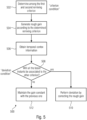
- step 502 it may be determined whether the determined current time instant or time slot 401 is on the first or second remixing criterion. This may be an example of the evaluation of the criterion condition discussed above. This may be based on metrics 4141 (absolute metrics, e.g. intensity, etc.) and/or 4145 (relative metrics, e.g. SNR i , etc.) on the determined current sample or time instant. Subsequently, a rough gain is generated at step 504 according to the determined criterion. Accordingly, the first and second criteria may prescribe different gains 125.
- temporal context information may be obtained from the temporal context block 130.
- the deviation condition is evaluated.
- a condition on the immediately subsequent time instants or time slots 406 or 416 immediately subsequent to the determined current time instant or time slot 401 may be evaluated. For example, if, within a predetermined time window of a predetermined length, all the subsequent time instants or time slots are associated to the different criteria, then it is transitioned to step 510, in which the deviation is performed by correcting the rough gain, e.g. using the techniques discussed with respect to formulas (10) and/or (12).
- This may be obtained, for example, by defining the at least one gain 124 as a linear combination which keeps into account both the rough gain (g(t)) as obtained from the metrics 4141 (absolute metrics) and 4145 (relative metrics) on the target signal 114 at the determined time instant or time slot 401 and by also taking into account the preceding version (e.g. g smooth (t)) of the at least one gain 124 immediately preceding the determined current time instant or time slot 401. Accordingly, it may be gradually transitioned from a particular criterion to another criterion.
- step 508 determines that not all the future instants in the future time window 406 or 416 will be associated to another criterion, but some of them will also be associated to the current criterion as determined at step 502, then it is transitioned towards step 512 and the gain 124 is maintained constant with respect to the previous one (i.e., the gain 124 as already obtained for the immediately previous current time instant or time slot 425 immediately preceding the determined time instant or time slot 401). More in general, at step 508 it is possible to take into account a time instant or time slot preceding the time instants or time slots (e.g.
- the determined time instant or time slot such as one of the two time instants or time slots (t and t-1) immediately preceding the time instants or time slots (e.g. 406 or 416) in the time window following the determined time instant or time slot, so as to compare whether the criterion associated to the future time window 406 or 416 is the same of the criterion associated to the one time instant or time slot (t, t-1) immediately preceding the time instants or time slots (e.g. 406 or 416) following the determined time instant or time slot, while at step 502 there may be, in addition or in alternative, determined the remixing criterion of the time instant or time slot t-1, as well.
- one remixing criterion is dominant (prevailing) with respect to another remixing criterion.
- the second remixing criterion is dominant with respect to the first remixing criterion: while in time interval 46 the gain of the background signal 112 is maintained low, the same is not carried out for time interval t DS (the ramp 2112 starts quickly).
- the second remixing criterion prevails over the first remixing criterion because we want that a quick pause between two words (between time instants t F and t L ) has not a change in the gain 124 for the background signal 112.
- Blocks 508 and 512 would be deactivated.
- Fig. 6 shows a variant 600, which is not only valid for transitories (e.g. at transitions). This variant 600 is also valid for the non-transition regions (e.g., region 200H1 and region 200H2 in Fig. 2 ).
- method 600 may have blocks 502, 504 and 506, which may be the same as those of method 500 of Fig. 5 , or one of its variants, some of which are discussed above and below.
- a preliminary condition is evaluated in block 608, in which it is evaluated whether all the future instants or slots of the window 406 or 416 (e.g. immediately after the determined current time instant for slot 401) will be associated to the same criterion that has been determined in step 502.
- step 502 If the future instant time slots 406 or 416 are associated to the same criterion that is chosen for the determined current time instant or time slot 401 (or, in some variants, to the immediately preceding time instant or time slot 425, t-1) at step 502, then it is transitioned to step 614, where the same criterion is used and the rough gain is used as the determined gain without deviations. If, to the contrary, the evaluation of the preliminary condition 608 is negative (and it is therefore understood that there are, subsequently, some time instants or time slots for which the criterion will be different from that chosen at step 502 for the determined current instant or time slot 401), then the deviation condition 508 is evaluated. At that point, the same outcomes of method 500 of Fig.
- Method 600 may therefore describe the operations of Fig. 2 in such a way that the non-transitory time intervals (e.g., high gain region 200H1 and low gain region 200H2 in Fig. 2 ) are controlled by block 614.
- method(s) 500 and/or 600 may include, e.g. at the end, shifting the least one gain (124, g smooth ) as obtained for each time instant or time step of the discrete succession of time instants or time slots by a predetermined number of time instants or time steps towards the past.
- Fig. 7 shows an example 700 that explains how to operate, in particular, for performing the deviation and/or for performing the evaluation. It is also further discussed and explained in subsection 4.8 herein below.
- the evolution shows the determined current time instant 401 (time t) the time instant or time slot 425 and, immediately subsequently to the determined current time instant 401 (t), a window 406, 416 of rough gains 125 is also defined.
- the window also subsequently explained as "t holdahead " is defined.
- the window may have a predetermined length.
- the gain(s) 124 (including the immediately preceding time instant or time slot 425 or t-1) is(are) the gain(s) as already obtained (e.g., correct gains in previous iterations for preceding time instants, e.g. g smooth (t)).
- the remaining instants may have only the rough gain(s) 125, previously obtained based on the metrics (absolute metrics and/or relative metrics) on the target signal 114 that are at those time instants. Therefore, during the process, the final gain(s) 124 of each (all) time instant(s) are subsequently and iteratively updated.
- an evaluation may be performed on the window 406 or 416 (t holdahead ) of the immediately subsequent time instants or slots.
- the rough gains 125 (g) are evaluated. It is looked (determined) whether they are associated to the first criterion or the second criterion, and/or it is looked (determine) whether they have the same remixing criterion of one of the time instants or slots immediately preceding the window 406 or 416, e.g. the determined time instant or slot 401.
- This may be the evaluation which is carried out in step 508 of Figs. 5 and 6 , and that causes the transitioning towards either step 510 or step 512.
- a discussion will be performed in subsection 4.8.
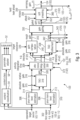
- Fig. 3 shows an example of control block 120, which may be adopted in some cases (e.g. it may cause the operations like in Fig. 2 ). However, in some examples the system of Fig. 1 may be different from the block 120.
- the separated target source 114 or ⁇ (t) and the input signal (input mix) x(t) 102 which is here considered the so-called first signal 302.
- the input signal 102 it would also be possible to provide at least one of the residual signals b ⁇ (t) 112 as signal 302.
- control block 120 provides remixing gain g smooth (t) 124 which are to be provided to the remixing block 150.
- Both the target signal 114 and the first signal 302 (112, 102) may be processed to obtain a short-term level estimation 314 and 312, respectively.
- the operations of the short-term level estimations will be explained below in subsection 4.2, but it is already explained that they are associated to a first order IIR filter.
- a smoothing time constant ⁇ may be used for both blocks 306 and 308. It is also possible to transfer into a logarithmic domain to better reflect the magnitude response of the human audio.
- the TAD block 318 may compare the target signal 114 (or a processed version 314 thereof) with an absolute threshold 315 ("absolute gate”) and/or can compare the target signal 114 (or a processed version 314 thereof) with a relative threshold 316 ( "relative gate”) (e.g., in comparison with the first signal 302, i.e. the input signal 102 or one of the residual signals 112 or a processed version 312 thereof).
- absolute threshold 315 absolute threshold
- relative threshold 316 "relative gate”
- the target signal 114 is not big enough in comparison with the first signal 302 (input signal 102 or the residual signal(s) 112), then it is imagined that in the particular time instant or time slot, the target signal 114 is inactive. Accordingly, in short term activity information 320 may be generated indicating that the target signal is active. If, on the other side, the target signal 114 is not big enough (e.g., either in absolute terms or in relative terms with respect to the input signal or one of the residual signals) then the short-term activity information 320 indicates that the target signal 114 is supposed to be inactive (non-active).
- the short-term activity information 320 is considered to be a gate signal, which may be understood as a binary information, which indicate that the target signal 114 is considered to be active or non-active. It is to be noted that the short term activity detection information 320 is not definitive in at least some examples. In fact, downstream, this information may be filtered and changed by also taking into account the behavior of the target signal 114 for the time instants and/or time slots closely consecutive to the determined current time instant.
- the short term activity detection information 320 may in general take into account uniquely the evolution of the signals 114 and 302 (e.g., 102 or 112) of the processed versions thereof 314 and 312, but in general does not take into consideration the signal (e.g. 114 and/or 302) at samples and/or instants around the considered time instant. As it will be shown in the following, this can give some issues, since it is possible that a pause is performed between two different words in a speech and this could cause (if the speech is the target signal 114) that the short-term activity information 320 is different between the samples and/or slots carrying the words and the sample and/or slot carrying the pause between the words.
- Said in other terms even if we may want that the speech has a gain which is relatively higher than the gains gained for the background, it is possible that we do not want to modify it instantaneously, since an instantaneous modification is understood as unpleasant by a human listening.
- a context based integration block 330 is provided.
- Block 330 may permit to perform an utterance integration (see also section 4.4 below).
- Block 330 may in some examples be described as follows: a cumulative sum of the target signal 114 (or one of its processed version 314, 334) and a cumulative sum of first signal 302 (112 or 102, or one of its processed versions 312 or 332) may be obtained depending on whether activity is detected (based on the activity information 320) for time instants or time slots for which activity is detected. In some examples, all the time instants or all the time slots of an interval in of time instants associated to the same criterion are assigned the same value (e.g. the average of the cumulative sum), and they may be assigned to have the same value.
- the block 330 may wait up to a minimum threshold of consecutive time instants or time slots associated to the non-dominant criterion before giving the same value for all the preceding time instants and time slots. This may therefore be an averaging which makes use of temporal context information from the future and/or from the past. Further information is provided in section 4.4.
- the output of the block 330 may be an averaged version of the target signal 114 (314) and the first signal 302 (102, 112).
- a gain computation block 340 may be provided.
- the gain computation block 340 may operate according to a constraint (such as a target clearance in the example of the attenuation as shown in Fig. 2 ) 339 (e.g. C).
- the output 343 of the gain computation block 340 may be a rough gain 343. Reference can also be made to section 4.6 below and an example is provided in formula (5).
- a target activity refinement (TAD) block 338 may substantially perform a similar operation of the TAD block 318 and may provide an activity information 342 which may be substantially similar to the short term activity detection 340, but which takes into account a more stable processed version of the signals 114, 112 and/or 102 (302). This may be due the fact that the utterance integration permits to tolerate long intervals without activity of the target signal 114.
- the gate signal 342 as outputted by the TAD refinement block 338 provides an activity information of the target signal 114.
- the activity information may be "active" in interval 46, without distinctions between the status activity information in the interval 46 in the other intervals between t B and t E .
- the short-term TAD block 318 provides an activity information which is "active" when the speech 114 is at a level L v , while the other intervals, including interval 46, would have given a "non-active" output).
- the gain computation block 340 defines a remixing criterion which only takes into account the metrics 4141 (absolute metrics) and/or 4145 (relative metrics) of the current time instant 401, but does not take into account future or past time instants or slots 403 and their metrics 4146 (relative metrics) and/or 4143 (absolute metrics).
- the output 343 of the gain computation block 340 may therefore be, in some examples, an output which does not provide a variable remixing gain (e.g. it is not smoothed). It is possible to understand the output gain 343 as a rough remixing gain which has to be subsequently refined by taking into account metrics (e.g.
- the gain computation block 340 basically embodies the second remixing criterion which is verified, for example, in the third, low gain region of Fig. 2 (between t B and the end of the interval T OR ).
- the TAD refinement block 338 may be seen as identifying the time intervals in which the second remixing criterion is not to be used. This can be, for example, the high gain region 200H1 of Fig. 2 , in which, e.g. based on the absolute relative metrics 4141 and 4145, no activity of the target signal 114 is detected. It is noted that the inputs 315 and 316 of the TAD refinement block 338 are not necessarily the same of the inputs 315 and 316 of the short-term TAD block 318, but in some examples at least one (or both) the inputs 315 and 316 of the TAD refinement block 338 may be the same of respectively one of the inputs 315 and 316 of the short-term TAD block 318.
- the activity information 342 operates like a gate in gain gating block 350.
- the activity information 342 may discriminate between choosing the first remixing criterion and the second remixing criterion.
- the output 352 of the block 350 is still a rough gain.
- the rough gated gain 352 e.g. 125
- the rough gain (gated gain) 352 (125) may be g(t).
- the determination between the different gains may be made by taking into account the absolute gate 315, which may be the value G with which the intensity Î s (absolute metrics) is compared, so as to obtain the activity information (which e.g. provides information whether the speech is active).
- Different ways of defining the rough gains (and/or of determining which remixing criterion each time instant pertain) may be implemented.
- the elements 308, 306, 318, 330, 52, 54, 56 shown in Fig. 3 may be optional.
- the input signal 102 e.g. input mix
- residual signal 112 or more in general first signal 302
- the target signal 114 it is also possible to refer to its processed version(s), e.g. 314 and/or 334.
- the signals (or processed version thereof) may be used to obtain, for example, the relative metrics (e.g.,, SNR i ) and/or the absolute metrics (e.g., intensities).
- the ramp 2112 may be generated.
- the first remixing criterion nor the second remixing criterion is used.
- temporal context information permits to take into account past time instant(s) and/or future time instant(s). Therefore, the gain can be gradually reduced in the ramp 2112. The same would apply in the interval t DR , where an ascending ramp 2113 is obtained analogously. Reference can also be made to sections 4.7 and 4.8 below.
- At least one remixing gain 124 may be seen as being obtained by refining a rough remixing gain 343 or 352 by adding an additive component (modifying component) which corrects the rough remixing gain 343 or 352, smoothening the obtained remixing gain 124.
- an additive component modifying component
- the start of the ramp 2112 or 2113 is based on the knowledge of the future temporal context information: knowing that there will be a change in remixing criterion soon (e.g. within a temporal window 406 or 416 immediately subsequent to the determined time instant or time slot 401), the deviation may start.
- the modifying (correcting) can be based on the immediately preceding and/or subsequent time gain 124 (g smooth (t-1)) as previously provided.
- the gain as output for the immediately preceding time instant or time slot it is possible to obtain a gradual descending or ascending effect for the gain.
- This is shown in formula (10) below is for the descending gains (e.g., ramp 2112 in the intermediate region in the interval t DS ) and formula (12) is for ramp 2113 in the interval t DR .
- Block 360 may have inputs 357 (associated to ⁇ att (t); 358 ( ⁇ rel (t)) and t holdahead (359) as explained in sections 5.7 and 5.8. It is noted that ⁇ att is greater than ⁇ rel .
- the control block 120 may provide temporal information 122 on the current time instant or time slot which will be subsequently used as temporal context information 132 (e.g., for subsequent time instants or time slots, and/or for refining a previously obtained rough gain 125, so as to deviate from the rough gain 124 to obtain the remixing gain 125).
- the temporal information 122 on the current time instant or time slot may include at least one of the output of the utterance integration block 330 (e.g., 332, 334) or information associated thereto; rough gain 343 and/or activity information (e.g. gate information) 342; a gated gain (e.g., rough gain 352); and/or the at least one remixing gain 124 (e.g., g smooth (t-1)).
- the signals are here discussed as they were real-valued time signals, but the same problem could be formulated in the time-frequency domain, e.g., Short-time Fourier Transform (STFT) domain.
- STFT Short-time Fourier Transform
- the remixing gains 124 are in general computed based on features (metrics) of the input signals ⁇ (t) (112) and x(t) 102 (and/or potentially of b ⁇ (t) 112) along with a criterion, and parameters that define the desired features of the output mixture y(t). These parameters can be user-defined or fixed by one or more presets.
- a prominent feature is (or is associated to) the intensity of the signals (which may be the absolute metrics 4141 and 4143).
- Different ways of quantifying the intensity of a signal can be used here, with different computational requirements. These are for example:
- metrics Another important feature (metrics) is the intensity difference between signals (relative metrics 4145 and/or 4146). Different ways of quantifying the intensity difference exist and are applicable for the proposed method. These may be for example:
- a specific value C target clearance 339 in Fig. 3
- the desired minimum output SNR e.g. C corresponds to a high SNR so that the target speech 114 is clear and intelligible; see also reference numeral 42 in Fig. 2
- the additional condition which may be optional
- G e.g., preventing modification to the original mixture in passages where the target speech is not active
- h(t) 1 and ignore w( ⁇ ):
- SNR out t ⁇ s ⁇ t ⁇ 2 ⁇ g t b ⁇ t ⁇ 2 , from which it is clear that SNR out (t) can be controlled by g(t).
- the solution according to formula (5) is substantially a solution which takes into account, for each time instant 401, only metrics 4141 and 4145 on values of that time instant, without taking into account different (future or past) values.
- the gating condition and/or the clearance condition may form or be comprised in the criterion condition).
- time integration, and smoothing may be applied on the remixing gains g(t) and/or on the involved signals (e.g., Î s and SNR in (t) also indicated with SNR i (t)) so to avoid abrupt transitions and pumping, and to generally obtain a smooth and esthetically pleasing output mix.
- g smooth (t) do not strictly fulfill the criterion used for computing the first gains (rough gain) g(t), e.g., by not fulfilling the instantaneous SNR criterion (e.g. criterion condition) at locations in which large gain changes are smoothed over time (e.g. the above discussed second, intermediate region in Fig. 2 , i.e. in the interval t DS and/or I DR ).
- the temporally smoothed gains are preferred by the listeners of the resulting mix.
- estimates of the perceived momentary or short-term loudness can be used as intensity measures for the control criteria. Preferences for loudness differences are investigated in [3, 4]. Other criteria can be based on a partial loudness model [10] or on time-dependent intelligibility or quality metrics, similarly to [11]. Also a voice activity detection could be usefully integrated, e.g., by replacing the gating condition Î s ⁇ G with a condition based on speech presence probability.
- control module could take b ⁇ (t) instead of x(t) as input and similar results could be achieved.
- ⁇ (t) only one signal between x(t) and b ⁇ (t) is needed for the Control module.
- Our preference is having access to x(t) (as in Fig. 1 ) instead of b ⁇ (t), in particular if ⁇ (t) + b ⁇ (t) ⁇ x(t). This preference is motivated by the fact that x(t) could be used, e.g., as quality reference (as mentioned in Sec. 4.1).
- Fig. 3 illustrates main operations using the temporal context for producing g smooth (t) (also referred to with 124).
- Control module in detail: Operational block diagram of an example of the usage of temporal context for producing g smooth (t).
- a non-essential part of the proposed method contains the automatic adjustment of one or more of the operational parameters of the method, e.g., "Target clearance", "Attack”, or “Release”. This can be based on the classification of the non-speech parts of the input mix x(t), e.g., if these are dominated by music content or by ambient noise and effects. This information can be used to adjust the "Target clearance 339" accordingly, e.g., to a different value as suggested by the findings in [3, 4].
- Another option is to adjust the remixing parameters based on a quality estimate of the separation.
- a quality estimate of the separation can be done based on ⁇ (t) (114) and x(t) (102), as presented in [12] or based on deep neural networks (DNNs), similarly to [11].
- DNNs deep neural networks
- a classifier 52 may classify a content of the signals 114 and/or 102 and/or 112.
- the classifier 52 may have a class determiner 54 which, for example, distinguishes a first class from a second class, for example speech from non-speech, music or other tonal noises from transient events, whereby both a class of the noises and a number of differentiated classes can be arbitrary.
- the class determiner 54 may provide the determined class to a parameter adjuster 58 by means of a class determination signal 56.
- the classifier 52 may be configured to set at least one parameter of the combining and / or the signal attenuation based on a result of the classification.
- the parameters set by means of the parameter adjuster 58 can thus relate to any further operation of the device 40.
- IIR infinite impulse response
- I x ,smooth t ⁇ I x ,smooth t ⁇ 1 + 1 ⁇ ⁇ I x t
- ⁇ is a feedback coefficient, e.g., computed from a smoothing time-constant.
- the smoothed estimate 314, 312 can be further transformed into a logarithmic domain to better reflect the magnitude response of the human auditory system. This is referred to as E x (t) for the input signal 102 (or more in general the first signal 302) and as ⁇ s (t) for the target source signal 114.
- the smoothed intensity estimates are used for a simple level-based activity detection.
- a gate signal 320 is produced, signaling if ⁇ s (t) is big enough in absolute terms, i.e., it is bigger than an absolute threshold and in relative terms, i.e., compared to E x (t) with a relative threshold.
- the gate signal 320 may represent a short-term activity detection, which indicates the activity of the target signal 114 but which may be modified by taking into account the temporal context, for example.
- the parameters 315 and 316 may be an absolute threshold (e.g. so-called “absolute gate” , and also indicated with G) and/or a relative threshold (e.g. so-called “relative gate”, which is optional).
- UI Utterance Integration
- the target source 114 is speech, it has to be observed that people tend to talk louder during the first syllables of an utterance. This means that ⁇ s (t) is higher in the utterance beginning compared to the rest of the utterance. Assuming a constant level or the background sources, the effect on the gain is that in the beginning of the utterance less background attenuation is needed than later on and the attenuation changes gradually over time to more attenuation. This "creeping" background attenuation is perceived esthetically rather unpleasing.
- UI (e.g. at block 330) takes as the input the TAD output gate signal 320 and the two initial signal level estimates ⁇ s (t) and E x (t) (314 and 312).
- UI implements a sliding window mean computation applied on the linear-domain level estimates before transforming them back in the logarithmic domain.
- the computation has two main modes of operation: start of utterance and sliding. The more interesting is the first one:
- a benefit of this processing is that the level estimate remains constant during the start of an utterance and also later on it changes more slowly.
- the constant level estimate results into a more consistent gain value and avoid the "creeping gain" problem, making the output esthetically much more pleasant.
- the output of UI may be refined level estimate ⁇ s (t) and ⁇ b (t). The later may be used, for example, to obtain at least one of the metrics 4141, 4143, 4145, 4146.
- the window is also called “filtering window” and may make use of values of any of the signals 114, 302 (112, 102) or their processed versions (314, 312) to obtain filtered versions 334 and 332 of those signals (334 is the filtered version of 114 or 314; 342 is the filtered version of 302, e.g. 102, 112, or the processed version 312.
- a filtering window for the determined current time instant or time slot 401 could be, for example, represented by the union of the pluralities of future and past samples 406 and 407.
- a long-term activity detection 342 (here considered a gate signal, e.g. a binary signal) is therefore obtained.
- the parameters 315 and 316 may be an absolute threshold (e.g. G, "absolute gate”, which may be the G of formula (5)) and/or a relative threshold (relative gate, optional).
- G absolute threshold
- relative gate relative threshold
- the core of the gain computation can be now carried out as explained in Sec. 3.3 (see in particular Eq. 5) and by using the stable and smooth intensity estimates and the gate signal obtained so far.
- the output is g(t), which undergoes a temporal smoothing as explained in the following.
- the temporal smoothing can be implemented in various ways, but we may use a simple first-order IIR-filtering approach as an example (other techniques may be implemented).
- the control inputs to the smoothing method are attack time (357) t att (e.g. corresponding to the ramp 2112 and to the transition from the first remixing criterion to the second remixing criterion), release time (358) t rel (e.g. corresponding to the ramp 2113 and to the transition from the second remixing criterion to the first remixing criterion), and hold look-ahead time t holdahead (359).
- a problem with this smoothing is that if there is a short pause in the target source signal 114, e.g., between words, sentences, or talkers, the attenuation gain starts the release phase, the background signal comes (partly) back up before being attenuated again when the speech continues.
- An attempt to solve this pumping problem in the earlier works is to use a constant hold time which delays the release phase always with a constant amount.
- a drawback of this is that the release is delayed always, regardless if the need for background attenuation continues or not. This can cause unpleasant gaps after the target activity (i.e., speech) has ended.
- the smoothing uses a look-ahead buffer into the future and detects if the gain applies the same amount or more attenuation within the window of length t holdahead . If this is the case, operation similar to normal hold is activated and the current gain value is kept, otherwise attack and release smoothing is performed normally.
- Fig. 2 shows the evolution of the at least one gain 125 and of the background signal 112 after having applied shifting 8 (e.g. at the end of method 500 and/or 600).
- shifting may move the background signal 112 towards the past, e.g. by a first shifting amount (which in this case could be t OA ).
- the shifting may move the background signal 112 towards the past, e.g. by a second shifting amount.
- the first shifting amount, for shifting from the first criterion to the second criterion may be different from (e.g.
- the shifting amount may be the same for all the time instants, and a coherent shifting may be applied to all the time instants.
- it is simply possible to assign an obtained gain g smooth (t) to a time instant in the past t-Sh (where Sh is a constant number of time instants or time slots, e.g. Sh 100 or another number e.g. between 50 and 250), and therefore it is obtained (e.g. at post processing) that the remixing gain provided to the remixing block 150 is g smooth (t-Sh), basically operating a coherent translation towards the past of the obtained at least one gain.
- the different shifting amounts may be predefined, e.g., stored in a storage unit: the first shifting amount (e.g. Sh1) will be applied when the transition is from the first criterion towards the second criterion, and the second shifting amount (e.g. Sh2) will be applied when the transition is from the second criterion towards the first criterion.
- the remixing criteria and the rough gains may be understood as also being shifted towards the past for the same shifting amounts.
- the determined current time instant or time slot may also have the temporal context information 132, which is in the past or in the future with respect to the determined current time instant or time slot before shifting.
- the obtained gain 124 g smooth (t)
- the shifting amount e.g. Sh, Sh1, Sh2.
- the system may comprise a source separation block (e.g. 110) estimating, from an input signal (e.g. 102) which evolves in time along a discrete succession of time instants or time slots (e.g. 401, 403), a target signal (e.g. 114) and at least one residual signal (e.g. 112) to be subsequently remixed (e.g. at remixing block 150, which is part or not part of the system 100) according to at least one remixing gain (e.g. 124) variable along the discrete succession.
- a source separation block e.g. 110
- an input signal e.g. 102
- a target signal e.g. 114
- at least one residual signal e.g. 112
- remixing block 150 which is part or not part of the system 100
- remixing gain e.g. 124) variable along the discrete succession.
- the system 100 may comprise a control block (e.g. 120) determining, for a determined current time instant or time slot (e.g. 401), at least one metrics (e.g. one of an absolute metrics 4141 and a relative metrics 4145) on the target signal (e.g. 114, 1141), or a processed version (e.g. 314, 334) of the target signal (e.g. 114, 1141), in the determined current time instant or time slot (e.g. 401).
- the at least one metrics e.g. one of an absolute metrics 4141 and a relative metrics 4145
- the at least one metrics may be a relative metrics (e.g. 4145).
- the at least one relative metrics may be, or be based on, the SNR in (e.g. signal-to-noise ratio) of the input signal (e.g. 102) or of the processed version thereof (e.g. 314 and/or 334).
- the SNR in may be, or be associated to, a relative intensity between the target signal (e.g. 114) and the input signal (e.g. 102, 1121), or a processed version (e.g. 312, 332) of the input signal, or the at least one residual signal (e.g. 112, 1121), or a processed version (e.g. 312, 332) of the at least one residual signal. Examples are provided in formulas (5) and (6).
- the system 100 may comprise a temporal context block (e.g. 130).
- the temporal context block (e.g. 130) may, for example, perform at least one of the operations:
- At least one future time instant and at least one past time instant may be determined at the temporal context block (e.g. 130).
- the at least one future time instant or time slot e.g. 403, 406, 416 or one in a window, such as a window 417, 407, 416, 426, etc.
- the past time instant or time slot e.g. 425, or in a window 407, 417) may be, in the discrete succession, before the determined current time instant or time slot.
- the temporal context information e.g.
- the control block (e.g. 120) may be configured to generate at least one remixing gain associated to the determined current time instant or time slot by (e.g. 401, t) considering:
- the at least one remixing gain may for example be obtained after having compared the relative metrics (e.g. SNRi in ) with a threshold (e.g. C, 339).
- a threshold e.g. C, 339.
- the relative metrics e.g. 4145
- a gain g(t) e.g. rough gain
- the distance between the level of the target signal (or processed version thereof) and the level of the level of the input signal e.g. 102, 1121
- a processed version e.g. 312, 332
- At least one criterion condition e.g. a comparison between a relative metrics, e.g. SNR in (t), and a predetermined threshold, e.g.
- C) may therefore be defined to perform a discrimination between using the first remixing criterion and using the second remixing criterion at each time instant or time slot.
- At least one criterion condition may be a condition on the at least one (relative and/or absolute) metrics on at least the target signal, or a processed version thereof, at the determined current time instant or time slot, or on information obtained from the at least one metrics on the at least the target signal or a processed version thereof.
- the determined current time instant or time slot is associated to one of the at least one first remixing criterion and one second remixing criterion based on the metrics on the target signal, or a processed version of the target signal, in the determined current time instant or time slot.
- the system may also obtain (e.g. determine) the at least one remixing gain (e.g. in smoothed version in some examples, which is also indicated with g smooth (t)) for the determined current time slot or time instant (t) by considering temporal context information 132 so as to deviate, from the at least one rough remixing gain, based on a deviation obtained from the temporal context information 132.
- the rough remixing criterion g(t+ ⁇ t) may be possible.
- the temporal context information 132 (comprising e.g. information such as g smooth (t-1), which is information on the past, and/or information such as the rough gain for subsequent time slots or time instants, which is information on the future) it is possible to properly deviate from the remixing criterion defined by evaluating the criterion condition.
- the deviation from the rough remixing gain (e.g. g(t)) by correcting the at least one rough remixing gain (e.g. g(t)) for a gain amount associated to a previously obtained remixing gain (e.g. g smooth (t-1)) for a time instant or time slot (e.g. t-1) preceding the determined current time instant or time slot (e.g. t) may be subjected to the fulfilment of a deviation condition.
- the deviation condition may also be based on the temporal context information 132.
- the temporal context information 132 may include information on rough remixing gains already obtained for time instants or time slots following the determined time instant or time slot (e.g.
- the utterance integration therefore, permits to maintain the level at the criterion established for the dominant second remixing criteria at the expense of the non-dominant first remixing criterion.
- a possibility is provided when transitioning from the second criterion to the first criterion.
- Other examples may also completely avoid the utterance integration.
- the gates 124 as provided could, for example, be shifted by a predetermined amount towards the past. However, in some examples, this could be post-processing operation down streamed to block 360 (but up streamed to the remixing block 150).
- any of blocks 110, 120, 130, 150 may be separated from the other ones or may be in the same device of at least one of the other ones.
- the at least one gain may also comprise both the remixing gain to be applied to the background noise 112 (b(t)) and the gain h(t) (in its rough version) or h smooth (t) to the target signal 114 (s(t)) and may therefore be formed e.g. by a 2-elements vector.
- a second ratio (which may be 1/g smooth (t), e.g. obtained at the second remixing criterion, when the background signal 112 is attenuated) between the rough remixing gain associated to the target signal (which may be 1) and the rough remixing gain (which may be g smooth (t) ⁇ 1) associated to the input signal (or processed version thereof) or the target signal (or processed version thereof) may be higher than a first ratio (which may be 1, e.g. obtained at the first remixing criterion, e.g.
- the examples above also refer to a non-transitory storage unit storing instructions which, when executed by a processor, cause the processer to process audio signals, according to:
- the implementation in hardware or in software may be performed using a digital storage medium, for example cloud storage, a floppy disk, a DVD, a Blue-Ray, a CD, a ROM, a PROM, an EPROM, an EEPROM or a FLASH memory, having electronically readable control signals stored thereon, which cooperate (or are capable of cooperating) with a programmable computer system such that the respective method is performed. Therefore, the digital storage medium may be computer readable.
- a digital storage medium for example cloud storage, a floppy disk, a DVD, a Blue-Ray, a CD, a ROM, a PROM, an EPROM, an EEPROM or a FLASH memory, having electronically readable control signals stored thereon, which cooperate (or are capable of cooperating) with a programmable computer system such that the respective method is performed. Therefore, the digital storage medium may be computer readable.
- Some examples according to the invention comprise a data carrier having electronically readable control signals, which are capable of cooperating with a programmable computer system, such that one of the methods described herein is performed.
- examples of the present invention may be implemented as a computer program product with a program code, the program code being operative for performing one of the methods when the computer program product runs on a computer.
- the program code may for example be stored on a machine-readable carrier.
- Examples comprise the computer program for performing one of the methods described herein, stored on a machine-readable carrier.
- an examples of the method is, therefore, a computer program having a program code for performing one of the methods described herein, when the computer program runs on a computer.
- a further examples of the methods is, therefore, a data carrier (or a digital storage medium, or a computer-readable medium) comprising, recorded thereon, the computer program for performing one of the methods described herein.
- a further example is, therefore, a data stream or a sequence of signals representing the computer program for performing one of the methods described herein. The data stream or the sequence of signals may for example be configured to be transferred via a data communication connection, for example via the Internet.
- a further examples comprises a processing means, for example a computer, or a programmable logic device, configured to or adapted to perform one of the methods described herein.
- a further examples comprises a computer having installed thereon the computer program for performing one of the methods described herein.
- a programmable logic device for example a field programmable gate array
- a field programmable gate array may cooperate with a microprocessor in order to perform one of the methods described herein.
- the methods are preferably performed by any hardware apparatus.
Landscapes
- Engineering & Computer Science (AREA)
- Computational Linguistics (AREA)
- Signal Processing (AREA)
- Health & Medical Sciences (AREA)
- Audiology, Speech & Language Pathology (AREA)
- Human Computer Interaction (AREA)
- Physics & Mathematics (AREA)
- Acoustics & Sound (AREA)
- Multimedia (AREA)
- Quality & Reliability (AREA)
- Control Of Amplification And Gain Control (AREA)
- Signal Processing For Digital Recording And Reproducing (AREA)
Claims (30)
- System (100) zur Verarbeitung von Audiosignalen, das folgende Merkmale aufweist:einen Quellentrennungsblock (110), der dazu konfiguriert ist, aus einem Eingangssignal (102), das sich in der Zeit entlang einer diskreten Abfolge von Zeitpunkten oder Zeitschlitzen (401, 403) entwickelt, ein Zielsignal (114) und zumindest ein Restsignal (112) zu schätzen, um anschließend gemäß zumindest einer Neumischverstärkung (124), die entlang der diskreten Abfolge variabel ist, neu gemischt zu werden (150);einen Steuerblock (120), der dazu konfiguriert ist, für einen bestimmten aktuellen Zeitpunkt oder Zeitschlitz (401) eine erste relative Metrik (4145) für das Zielsignal (114, 1141) in dem bestimmten aktuellen Zeitpunkt oder Zeitschlitz (401) zu bestimmen, wobei die erste relative Metrik einen Pegel des Zielsignals (114, 1141) mit einem Pegel des zumindest einen Restsignals (112, 1121) oder des Eingangssignals (102, 1121) in dem bestimmten aktuellen Zeitpunkt oder Zeitschlitz (401) vergleicht; undeinen zeitlichen Kontextblock (130), der dazu konfiguriert ist, zeitliche Kontextinformationen (132, 370, 372) basierend auf einer zweiten relativen Metrik (4146) in zumindest einem zukünftigen und/oder vergangenen Zeitpunkt oder Zeitschlitz (403, 425, 407, 417, 406, 416) zu bestimmen, wobei die zweite relative Metrik (4146) einen Pegel des Zielsignals (114) mit einem Pegel des Eingangssignals (102, 1121) oder des zumindest einen Restsignals (112, 1121) in dem zumindest einen zukünftigen und/oder vergangenen Zeitpunkt oder Zeitschlitz (403) vergleicht, wobei der zumindest eine zukünftige Zeitpunkt oder Zeitschlitz (403, 406, 416) in der diskreten Abfolge nach dem bestimmten aktuellen Zeitpunkt oder Zeitschlitz (401) liegt und der vergangene Zeitpunkt oder Zeitschlitz (407, 417, 425) in der diskreten Abfolge vor dem bestimmten aktuellen Zeitpunkt oder Zeitschlitz liegt,wobei der Steuerblock (120) dazu konfiguriert ist, zumindest eine Neumischverstärkung (124), die dem bestimmten aktuellen Zeitpunkt oder Zeitschlitz zugeordnet ist, basierend auf Folgendem zu erzeugen:der ersten relativen Metrik (4145) in dem bestimmten aktuellen Zeitpunkt oder Zeitschlitz (401); undden zeitlichen Kontextinformationen (132, 370, 372).
- System gemäß Anspruch 1, bei dem die zeitlichen Kontextinformationen die zweite relative Metrik (4146) in dem zumindest einen bestimmten zukünftigen und/oder vergangenen Zeitpunkt oder Zeitschlitz (403, 425, 407, 417, 406, 416) enthalten.
- System gemäß einem der vorhergehenden Ansprüche, bei dem die zeitlichen Kontextinformationen Informationen über zumindest eine zuvor erhaltene Neumisch-Verstärkung (124) enthalten.
- System gemäß einem der vorhergehenden Ansprüche, das ferner einen Neumischblock (150) aufweist, der ein neugemischtes Ausgangssignal (104) bereitstellt, bei dem das Zielsignal (114) und das zumindest eine Restsignal (112) gemäß der zumindest einen Neumisch-Verstärkung (124) miteinander gemischt werden.
- System gemäß einem der vorhergehenden Ansprüche, bei dem zumindest ein erstes Neumischkriterium und ein zweites Neumischkriterium zum Erzeugen zumindest einer groben Neumisch-Verstärkung definiert sind, wobei die zumindest eine grobe Neumisch-Verstärkung eine erste grobe Neumisch-Verstärkung, die durch das erste Neumischkriterium bereitgestellt wird, und eine zweite grobe Neumisch-Verstärkung umfasst, die durch das zweite Neumischkriterium bereitgestellt wird, wobei die erste grobe Neumisch-Verstärkung höher als die zweite grobe Neumisch-Verstärkung ist, wobei zumindest eine Kriteriumbedingung (502) eine Unterscheidung zwischen einer Verwendung des ersten Neumischkriteriums und einer Verwendung des zweiten Neumischkriteriums zu jedem Zeitpunkt oder Zeitschlitz durchführt,so dass basierend auf der zumindest einen Kriteriumbedingung (502) jeder Zeitpunkt oder Zeitschlitz einem des zumindest einen ersten Neumischkriteriums und zweiten Neumischkriteriums zugeordnet ist,wobei die zumindest eine Kriteriumbedingung (502) zumindest eine Bedingung bezüglich der ersten relativen Metrik zu dem bestimmten aktuellen Zeitpunkt oder Zeitschlitz (401) umfasst,so dass der bestimmte aktuelle Zeitpunkt oder Zeitschlitz (401) einem des zumindest einen ersten Neumischkriteriums und zweiten Neumischkriteriums basierend auf der ersten relativen Metrik für das Zielsignal (114) in dem bestimmten aktuellen Zeitpunkt oder Zeitschlitz (401) zugeordnet ist, wobei das erste Neumischkriterium dem bestimmten aktuellen Zeitpunkt oder Zeitschlitz zugewiesen wird, wenn die erste relative Metrik über einem Schwellenwert liegt, und das zweite Neumischkriterium dem bestimmten aktuellen Zeitpunkt oder Zeitschlitz zugewiesen wird, wenn die erste relative Metrik unter dem Schwellenwert liegt,wobei das System ferner dazu konfiguriert ist, die zumindest eine Neumisch-Verstärkung (124) für den bestimmten aktuellen Zeitschlitz oder Zeitpunkt (401) zu erhalten durch Berücksichtigen von zeitlichen Kontextinformationen (132, 370, 372), um von der zumindest einen groben Neumisch-Verstärkung (124) basierend auf einer Abweichung, die aus den zeitlichen Kontextinformationen (132, 370, 372) erhalten wird, abzuweichen (510).
- System gemäß Anspruch 5, wobei das System dazu konfiguriert ist, von der zumindest einen groben Neumisch-Verstärkung (125) abzuweichen (510) durch Korrigieren der zumindest einen groben Neumisch-Verstärkung (125) um einen Betrag, der einer zuvor erhaltenen zumindest einen Neumisch-Verstärkung für einen Zeitpunkt oder Zeitschlitz (425) zugeordnet ist, der dem bestimmten aktuellen Zeitpunkt oder Zeitschlitz (401) vorausgeht.
- System gemäß Anspruch 5 oder 6,wobei das System dazu konfiguriert ist, von der zumindest einen groben Neumisch-Verstärkung (125) abzuweichen (510) durch Korrigieren der zumindest einen groben Neumisch-Verstärkung (125) um einen Verstärkungsbetrag, der einer zuvor erhaltenen zumindest einen Neumisch-Verstärkung für einen Zeitpunkt oder Zeitschlitz (425) zugeordnet ist, der dem bestimmten aktuellen Zeitpunkt oder Zeitschlitz (401) vorausgeht, der der Erfüllung einer Abweichungsbedingung (508) unterliegt, basierend auf den zeitlichen Kontextinformationen wobei die zeitlichen Kontextinformationen Informationen über grobe Neumisch-Verstärkungen enthalten, die bereits für Zeitpunkte oder Zeitschlitze erhalten wurden, die dem bestimmten Zeitpunkt oder Zeitschlitz (401) folgen;wobei die Abweichungsbedingung (508) erfüllt ist, wenn eine vorbestimmte Anzahl von groben Neumisch-Verstärkungen, die bereits für Zeitpunkte oder Zeitschlitze (416) erhalten wurden, die dem bestimmten Zeitpunkt oder Zeitschlitz (401) folgen, einem Neumischkriterium zugeordnet sind, das sich von dem Neumischkriterium des Zeitpunkts oder Zeitschlitzes unterscheidet, der dem aktuellen bestimmten Zeitpunkt oder Zeitschlitz vorausgeht,wobei, wenn die Abweichungsbedingung (508) nicht erfüllt ist, die zumindest eine Neumisch-Verstärkung (124) für den bestimmten aktuellen Zeitpunkt oder Zeitschlitz (401) gleich der zumindest einen Neumisch-Verstärkung für einen Zeitpunkt oder Zeitschlitz gehalten wird, der dem bestimmten aktuellen Zeitpunkt oder Zeitschlitz (401) vorausgeht.
- System gemäß Anspruch 6 oder 7, das ferner dazu konfiguriert ist, die zumindest eine grobe Neumisch-Verstärkung (125) durch eine lineare Kombination der zumindest einen groben Neumisch-Verstärkung (125, g(t)) und der zuvor erhaltenen zumindest einen Neumisch-Verstärkung für den Zeitpunkt oder Zeitschlitz (425) zu korrigieren, der dem bestimmten aktuellen Zeitpunkt oder Zeitschlitz (401) vorausgeht.
- System gemäß Anspruch 8, bei dem die lineare Kombination auf einem ersten vordefinierten Parameter basiert, der zwischen 0 und 1 enthalten ist, wobei der erste vordefinierte Parameter die zumindest eine grobe Neumisch-Verstärkung (125, g(t)) skaliert und ein zweiter vordefinierter Parameter zwischen 0 und 1 die zuvor erhaltene zumindest eine Neumisch-Verstärkung für den Zeitpunkt oder Zeitschlitz (425) skaliert, der dem bestimmten aktuellen Zeitpunkt oder Zeitschlitz (401) vorausgeht, wobei die Summe zwischen dem ersten vordefinierten Parameter und dem zweiten vordefinierten Parameter 1 beträgt.
- System gemäß einem der Ansprüche 5 bis 9, bei dem die zumindest eine Kriteriumbedingung (502) eine Bedingung bezüglich der zumindest einen ersten relativen Metrik (4145) zu dem bestimmten aktuellen Zeitpunkt oder Zeitschlitz (401) umfasst, so dass:wenn die erste relative Metrik (4145) zwischen dem Zielsignal (114) und dem zumindest einen Restsignal (112) oder Eingangssignal (102) zu dem bestimmten aktuellen Zeitpunkt oder Zeitschlitz (401) größer als ein vorbestimmter relativer Schwellenwert ist, der bestimmte aktuelle Zeitschlitz oder Zeitpunkt (401) dem ersten Neumischkriterium zugeordnet wird; undwenn die erste relative Metrik (4145) zwischen dem Zielsignal (114) und dem zumindest einen Restsignal (112) zu dem bestimmten aktuellen Zeitpunkt oder Zeitschlitz (401) kleiner als der vorbestimmte relative Schwellenwert ist, der bestimmte aktuelle Zeitschlitz oder Zeitpunkt (401) dem zweiten Neumischkriterium zugeordnet wird,wobei:das erste Neumischkriterium ein erstes Verhältnis annimmt zwischen:der groben Neumisch-Verstärkung, die dem Zielsignal (114) zugeordnet ist; undder groben Neumisch-Verstärkung, die dem Eingangssignal (102) oder dem zumindest einen Restsignal (112) zugeordnet ist;das zweite Neumischkriterium ein zweites Verhältnis annimmt zwischen:der groben Neumisch-Verstärkung, die dem Zielsignal (114) zugeordnet ist;der groben Neumisch-Verstärkung, die dem Eingangssignal (102) oder dem zumindest einen Restsignal (112) zugeordnet ist,wobei das zweite Verhältnis höher als das erste Verhältnis ist,wobei die Abweichung ein allmähliches Bewegen des Verhältnisses zwischen der Neumisch-Verstärkung, die dem Zielsignal zugeordnet ist, und der Neumisch-Verstärkung, die dem zumindest einen Restsignal oder dem Eingangssignal zugeordnet ist, von dem ersten Verhältnis zu dem zweiten Verhältnis oder umgekehrt umfasst.
- System gemäß einem der Ansprüche 5 bis 10, bei dem die zumindest eine Kriteriumbedingung eine Bedingung bezüglich zumindest einer absoluten Metrik (4141) zu dem bestimmten aktuellen Zeitpunkt oder Zeitschlitz (401) umfasst, so dass:wenn die absolute Metrik (4141) für das Zielsignal (114) zu dem bestimmten aktuellen Zeitpunkt oder Zeitschlitz (401) kleiner als ein vorbestimmter absoluter Schwellenwert ist, der bestimmte aktuelle Zeitschlitz oder Zeitpunkt (401) dem ersten Neumischkriterium zugeordnet wird; undwenn die absolute Metrik (4145) für das Zielsignal (114) zu dem bestimmten aktuellen Zeitpunkt oder Zeitschlitz (401) größer als der vorbestimmte absolute Schwellenwert ist, der bestimmte aktuelle Zeitschlitz oder Zeitpunkt (401) dem zweiten Neumischkriterium zugeordnet wird,wobei:das erste Neumischkriterium ein erstes Verhältnis annimmt zwischen:der groben Neumisch-Verstärkung, die dem Zielsignal (114) zugeordnet ist; undder groben Neumisch-Verstärkung, die dem Eingangssignal (102) oder dem zumindest einen Restsignal (112) zugeordnet ist;das zweite Neumischkriterium ein zweites Verhältnis annimmt zwischen:der groben Neumisch-Verstärkung, die dem Zielsignal (114) zugeordnet ist;der groben Neumisch-Verstärkung, die dem Eingangssignal (102) oder dem zumindest einen Restsignal (112) zugeordnet ist,wobei das zweite Verhältnis höher als das erste Verhältnis ist,wobei die Abweichung ein allmähliches Bewegen des Verhältnisses zwischen der Neumisch-Verstärkung, die dem Zielsignal zugeordnet ist, und der Neumisch-Verstärkung, die dem zumindest einen Restsignal oder dem Eingangssignal zugeordnet ist, von dem ersten Verhältnis zu dem zweiten Verhältnis oder umgekehrt umfasst.
- System gemäß einem der Ansprüche 7 bis 11, bei dem die Abweichungsbedingung (508) erfüllt ist, wenn eine vorbestimmte Anzahl von groben Neumisch-Verstärkungen (125), die bereits für Zeitpunkte oder Zeitschlitze in einem Zeitfenster (406, 416) erhalten wurden, die dem bestimmten Zeitpunkt oder Zeitschlitz (401) folgen, einem Neumischkriterium zugeordnet sind, das sich von dem Neumischkriterium unterscheidet, das dem Zeitpunkt oder Zeitschlitz (425) zugeordnet ist, der dem aktuellen bestimmten Zeitpunkt oder Zeitschlitz vorausgeht,
wobei, wenn die Abweichungsbedingung nicht erfüllt ist, (512) die zumindest eine Neumisch-Verstärkung (124) für den bestimmten aktuellen Zeitpunkt oder Zeitschlitz (401) gleich der zumindest einen Neumisch-Verstärkung für einen Zeitpunkt oder Zeitschlitz gehalten wird, der dem bestimmten aktuellen Zeitpunkt oder Zeitschlitz (401) vorausgeht. - System gemäß einem der Ansprüche 5 bis 12, bei dem die Abweichungsbedingung (508) zumindest dann nicht erfüllt ist, wenn die grobe Neumisch-Verstärkung (125), die dem bestimmten aktuellen Zeitpunkt oder Zeitschlitz (401) zugeordnet ist, einem Neumischkriterium zugeordnet ist, das sich von dem Neumischkriterium unterscheidet, das dem Zeitpunkt oder Zeitschlitz (425) zugeordnet ist, der dem aktuellen bestimmten Zeitpunkt oder Zeitschlitz vorausgeht,
und in diesem Fall die zumindest eine Neumisch-Verstärkung (124) für den bestimmten aktuellen Zeitpunkt oder Zeitschlitz (401) gleich der zumindest einen Neumisch-Verstärkung für einen Zeitpunkt oder Zeitschlitz gehalten wird, der dem bestimmten aktuellen Zeitpunkt oder Zeitschlitz (401) vorausgeht. - System gemäß einem der Ansprüche 7 bis 13, bei dem das zweite Neumischkriterium gegenüber dem ersten Neumischkriterium dominant ist und die Abweichungsbedingung ausgewertet wird, wenn der Zeitpunkt oder Zeitschlitz (425), der dem aktuellen bestimmten Zeitpunkt oder Zeitschlitz vorausgeht, dem zweiten Neumischkriterium zugeordnet ist, während die Auswertung der Abweichungsbedingung deaktiviert wird, wenn der Zeitpunkt oder Zeitschlitz (425), der dem aktuellen bestimmten Zeitpunkt oder Zeitschlitz vorausgeht, dem ersten Neumischkriterium zugeordnet ist.
- System gemäß einem der Ansprüche 5 bis 14, das dazu konfiguriert ist, basierend auf der ersten relativen Metrik für das Zielsignal (114) in dem zumindest einen bestimmten aktuellen Zeitpunkt (401) und den zeitlichen Kontextinformationen zwischen einem transitorischen Zeitintervall und nicht transitorischen Zeitintervallen zu unterscheiden, um:in dem nicht transitorischen Zeitintervall den Wert der zumindest einen groben Neumisch-Verstärkung gemäß dem aktuellen Neumischkriterium der zumindest einen Neumisch-Verstärkung zuzuweisen; undvon der zumindest einen groben Neumisch-Verstärkung gemäß dem aktuellen Neumischkriterium in den transitorischen Zeitintervallen abzuweichen.
- System gemäß einem der Ansprüche 5 bis 15, das dazu konfiguriert ist, dem Zielsignal (114) eine Aktivitätsinformation (320, 342) für jeden Zeitpunkt oder Zeitschlitz (401, 403) zuzuordnen, die basierend auf der Metrik (4145, 4146) in jedem Zeitpunkt oder Zeitschlitz (401, 403) bestätigt, ob für jeden Zeitpunkt oder Zeitschlitz (401, 403) das Zielsignal (114) aktiv oder nicht aktiv ist, wobei die zumindest eine Kriteriumbedingung die Aktivitätsinformation berücksichtigt.
- System gemäß einem der Ansprüche 15 oder 16, bei dem sich der zumindest eine zukünftige und/oder vergangene Zeitpunkt oder Zeitschlitz (403) in einem Zeitfenster (406, 416) vorbestimmter Zeitlänge befindet.
- System gemäß einem der Ansprüche 16 bis 17 bei Abhängigkeit von Anspruch 11, bei dem die Aktivitätsinformation aktiv ist für:
Zeitpunkte oder Zeitschlitze, für die die absolute Metrik (4141), die einem Pegel oder einer Lautstärke des Zielsignals (114) als größer als ein vorbestimmter absoluter Schwellenwert (315) zugeordnet ist, und/oder die erste relative Metrik (4146), die das Zielsignal (114) mit dem zumindest einen Restsignal (112) oder Eingangssignal (102) vergleicht, größer als ein vorbestimmter relativer Schwellenwert (316) ist. - System gemäß Anspruch 18, bei dem die Aktivitätsinformation zusätzlich aktiv ist für:Zeitpunkte oder Zeitschlitze innerhalb eines Zeitfensters, in dem die Zeitpunkte oder Zeitschlitze die absolute Metrik (4141) aufweisen, die einem Pegel oder einer Lautstärke des Zielsignals (114) kleiner als der vorbestimmte absolute Schwellenwert (315) zugeordnet ist, und/oder die erste relative Metrik (4146), die das Zielsignal (114) mit dem zumindest einen Restsignal (112) oder Eingangssignal (102) vergleicht, kleiner als der vorbestimmte relative Schwellenwert (316) ist,aber das Zeitfenster eine Länge aufweist, die kleiner als ein vorbestimmter Zeitschwellenwert ist.
- System gemäß Anspruch 19, bei dem die Aktivitätsinformation negativ ist für:Zeitpunkte oder Zeitschlitze innerhalb eines Zeitfensters, in dem die Zeitpunkte oder Zeitschlitze die absolute Metrik (4141) aufweisen, die einem Pegel oder einer Lautstärke des Zielsignals (114) kleiner als der vorbestimmte absolute Schwellenwert (315) zugeordnet ist, und/oder die erste relative Metrik (4146), die das Zielsignal (114) mit dem zumindest einen Restsignal (112) oder Eingangssignal (102) vergleicht, kleiner als der vorbestimmte relative Schwellenwert (316) ist,und das Zeitfenster eine Länge aufweist, die größer als der vorbestimmte Zeitschwellenwert ist.
- System gemäß einem der Ansprüche 5 bis 20, das dazu konfiguriert ist, die zumindest eine Verstärkung (124) für eine Mehrzahl von aufeinanderfolgenden Zeitpunkten oder Zeitabtastungen zu definieren, um allmählich von dem ersten Neumischkriterium in Richtung des zweiten Neumischkriteriums abzuweichen.
- System gemäß einem der vorhergehenden Ansprüche, das dazu konfiguriert ist, für den bestimmten aktuellen Zeitpunkt oder Zeitschlitz (401) eine Zeitmittelung an einer Mehrzahl (406, 407) von Zeitpunkten oder Zeitschlitzen (401) durchzuführen, die dem bestimmten Zeitpunkt (401) vorausgehen und/oder folgen, um einen Durchschnitt der zumindest einen Metrik (4145) entlang der Mehrzahl (406, 407) von Zeitpunkten oder Zeitschlitzen (401) zu erhalten.
- System gemäß einem der vorhergehenden Ansprüche, das dazu konfiguriert ist, die zumindest eine Verstärkung (124), wie sie für jeden Zeitpunkt oder Zeitschritt der diskreten Abfolge von Zeitpunkten oder Zeitschlitzen erhalten wurde, um eine vorbestimmte Anzahl von Zeitpunkten oder Zeitschritten in Richtung der Vergangenheit zu verschieben.
- System gemäß einem der vorhergehenden Ansprüche, das ferner einen Neumischblock aufweist, der dazu konfiguriert ist, für den bestimmten aktuellen Zeitpunkt oder Zeitschlitz (401) die zumindest eine Verstärkung (124) und das zumindest eine Restsignal (112) anzuwenden.
- System gemäß einem der vorhergehenden Ansprüche, bei dem die zumindest eine Neumisch-Verstärkung (124) verschiedene Neumisch-Verstärkungen (124) für unterschiedliche Frequenzbänder umfasst.
- System gemäß Anspruch 25, bei dem die erste relative Metrik (4145, 4141) in dem bestimmten aktuellen Zeitpunkt oder Zeitschlitz (401) und die zweite relative Metrik (4146) in dem zumindest einen bestimmten zukünftigen und/oder vergangenen Zeitpunkt oder Zeitschlitz (403) auf Metriken für unterschiedliche Frequenzbänder unterteilt sind, um die unterschiedlichen Neumisch-Verstärkungen (124) für unterschiedliche Frequenzbänder zu erhalten.
- System gemäß einem der vorhergehenden Ansprüche, bei dem die erste relative Metrik (120) in dem bestimmten aktuellen Zeitpunkt oder Zeitschlitz und die zweite relative Metrik für den zumindest einen zukünftigen und/oder vergangenen Zeitpunkt oder Zeitschlitz gemäß Gewichtungskoeffizienten gewichtet sind, die gemäß der Frequenz variieren.
- System gemäß einem der vorhergehenden Ansprüche, das dazu konfiguriert ist, einen Bitstrom zu codieren, der das Zielsignal (114) und das zumindest eine Restsignal (112) oder Eingangssignal (102) und die zumindest eine Verstärkung (124) codiert.
- Verfahren zum Verarbeiten von Audiosignalen, das folgende Schritte aufweist:einen Quellentrennungsschritt (110), der aus einem Eingangssignal (102), das sich in der Zeit entlang einer diskreten Abfolge von Zeitpunkten oder Zeitschlitzen (401, 403) entwickelt, ein Zielsignal (114) und zumindest ein Restsignal (112) erhält, um anschließend gemäß zumindest einer Neumischverstärkung (124), die entlang der diskreten Abfolge variabel ist, neu gemischt zu werden (150);einen Steuerschritt (120), der für einen bestimmten aktuellen Zeitpunkt oder Zeitschlitz (401) eine erste relative Metrik (4145) in dem bestimmten aktuellen Zeitpunkt oder Zeitschlitz (401) bestimmt, wobei die erste relative Metrik (4145) einen Pegel des Zielsignals (114, 1141) mit einem Pegel des Eingangssignals (102, 1121) oder des zumindest einen Restsignals (112, 1121) in dem bestimmten aktuellen Zeitpunkt oder Zeitschlitz (401) vergleicht; undeinen zeitlichen Kontextschritt (130), der zeitliche Kontextinformationen (132, 370, 372) basierend auf einer zweiten relativen Metrik (4146) in zumindest einem zukünftigen und/oder vergangenen Zeitpunkt oder Zeitschlitz (403, 425, 407, 417, 406, 416) bestimmt, wobei die zweite relative Metrik (4146) einen Pegel des Zielsignals (114) mit einem Pegel des Eingangssignals (102, 1121) oder des zumindest einen Restsignals (112, 1121) in dem zumindest einen zukünftigen und/oder vergangenen Zeitpunkt oder Zeitschlitz (403) vergleicht, wobei der zumindest eine zukünftige Zeitpunkt oder Zeitschlitz (403, 406, 416) in der diskreten Abfolge nach dem bestimmten aktuellen Zeitpunkt oder Zeitschlitz (401) liegt und der vergangene Zeitpunkt oder Zeitschlitz (407, 417, 425) in der diskreten Abfolge vor dem bestimmten aktuellen Zeitpunkt oder Zeitschlitz liegt,wobei das Verfahren ein Erzeugen zumindest einer Neumisch-Verstärkung (124) basierend auf Folgendem umfasst:der ersten relativen Metrik (4145) in dem bestimmten aktuellen Zeitpunkt oder Zeitschlitz (401); undden zeitlichen Kontextinformationen (132, 370, 372).
- Nicht flüchtige Speichereinheit, die Befehle speichert, die, wenn sie durch einen Prozessor ausgeführt werden, den Prozessor dazu veranlassen, das Verfahren gemäß Patentanspruch 29 durchzuführen.
Applications Claiming Priority (2)
| Application Number | Priority Date | Filing Date | Title |
|---|---|---|---|
| DE102021201668.5A DE102021201668A1 (de) | 2021-02-22 | 2021-02-22 | Signaladaptives Neumischen von getrennten Audioquellen |
| PCT/EP2022/054432 WO2022175552A1 (en) | 2021-02-22 | 2022-02-22 | Signal-adaptive remixing of separated audio sources |
Publications (3)
| Publication Number | Publication Date |
|---|---|
| EP4295364A1 EP4295364A1 (de) | 2023-12-27 |
| EP4295364C0 EP4295364C0 (de) | 2024-11-27 |
| EP4295364B1 true EP4295364B1 (de) | 2024-11-27 |
Family
ID=80933592
Family Applications (1)
| Application Number | Title | Priority Date | Filing Date |
|---|---|---|---|
| EP22712284.3A Active EP4295364B1 (de) | 2021-02-22 | 2022-02-22 | Adaptives remixen von separarierten audioquellen |
Country Status (5)
| Country | Link |
|---|---|
| US (1) | US20230395079A1 (de) |
| EP (1) | EP4295364B1 (de) |
| CN (1) | CN117321682A (de) |
| DE (1) | DE102021201668A1 (de) |
| WO (1) | WO2022175552A1 (de) |
Families Citing this family (2)
| Publication number | Priority date | Publication date | Assignee | Title |
|---|---|---|---|---|
| CN120612902A (zh) * | 2024-03-08 | 2025-09-09 | 北京字跳网络技术有限公司 | 用于混合音频的方法、装置、设备、介质和程序产品 |
| CN119993115B (zh) * | 2025-02-26 | 2025-11-28 | 平安科技(深圳)有限公司 | 基于条件流匹配模型的语音生成方法、装置及相关组件 |
Citations (1)
| Publication number | Priority date | Publication date | Assignee | Title |
|---|---|---|---|---|
| WO2015150066A1 (en) * | 2014-03-31 | 2015-10-08 | Sony Corporation | Method and apparatus for generating audio content |
Family Cites Families (4)
| Publication number | Priority date | Publication date | Assignee | Title |
|---|---|---|---|---|
| US9485589B2 (en) * | 2008-06-02 | 2016-11-01 | Starkey Laboratories, Inc. | Enhanced dynamics processing of streaming audio by source separation and remixing |
| US10863297B2 (en) | 2016-06-01 | 2020-12-08 | Dolby International Ab | Method converting multichannel audio content into object-based audio content and a method for processing audio content having a spatial position |
| WO2019229199A1 (en) * | 2018-06-01 | 2019-12-05 | Sony Corporation | Adaptive remixing of audio content |
| WO2020120754A1 (en) * | 2018-12-14 | 2020-06-18 | Sony Corporation | Audio processing device, audio processing method and computer program thereof |
-
2021
- 2021-02-22 DE DE102021201668.5A patent/DE102021201668A1/de active Pending
-
2022
- 2022-02-22 EP EP22712284.3A patent/EP4295364B1/de active Active
- 2022-02-22 CN CN202280030352.4A patent/CN117321682A/zh active Pending
- 2022-02-22 WO PCT/EP2022/054432 patent/WO2022175552A1/en not_active Ceased
-
2023
- 2023-08-18 US US18/452,084 patent/US20230395079A1/en active Pending
Patent Citations (1)
| Publication number | Priority date | Publication date | Assignee | Title |
|---|---|---|---|---|
| WO2015150066A1 (en) * | 2014-03-31 | 2015-10-08 | Sony Corporation | Method and apparatus for generating audio content |
Also Published As
| Publication number | Publication date |
|---|---|
| EP4295364A1 (de) | 2023-12-27 |
| WO2022175552A1 (en) | 2022-08-25 |
| US20230395079A1 (en) | 2023-12-07 |
| CN117321682A (zh) | 2023-12-29 |
| DE102021201668A1 (de) | 2022-08-25 |
| EP4295364C0 (de) | 2024-11-27 |
Similar Documents
| Publication | Publication Date | Title |
|---|---|---|
| JP7150939B2 (ja) | ボリューム平準化器コントローラおよび制御方法 | |
| JP6921907B2 (ja) | オーディオ分類および処理のための装置および方法 | |
| EP3232567B1 (de) | Entzerrersteuergerät und steuerungsverfahren | |
| US20230395079A1 (en) | Signal-adaptive Remixing of Separated Audio Sources | |
| CN115699172A (zh) | 用于处理初始音频信号的方法和装置 | |
| Borgh et al. | An improved adaptive gain equalizer for noise reduction with low speech distortion | |
| HK1242852B (en) | Volume leveler controller and controlling method | |
| HK1242852A1 (en) | Volume leveler controller and controlling method | |
| HK1244110B (en) | Equalizer controller and controlling method | |
| HK1238803A1 (en) | Volume leveler controller and controlling method | |
| HK1238803B (en) | Volume leveler controller and controlling method |
Legal Events
| Date | Code | Title | Description |
|---|---|---|---|
| STAA | Information on the status of an ep patent application or granted ep patent |
Free format text: STATUS: UNKNOWN |
|
| STAA | Information on the status of an ep patent application or granted ep patent |
Free format text: STATUS: THE INTERNATIONAL PUBLICATION HAS BEEN MADE |
|
| PUAI | Public reference made under article 153(3) epc to a published international application that has entered the european phase |
Free format text: ORIGINAL CODE: 0009012 |
|
| STAA | Information on the status of an ep patent application or granted ep patent |
Free format text: STATUS: REQUEST FOR EXAMINATION WAS MADE |
|
| 17P | Request for examination filed |
Effective date: 20230914 |
|
| AK | Designated contracting states |
Kind code of ref document: A1 Designated state(s): AL AT BE BG CH CY CZ DE DK EE ES FI FR GB GR HR HU IE IS IT LI LT LU LV MC MK MT NL NO PL PT RO RS SE SI SK SM TR |
|
| DAV | Request for validation of the european patent (deleted) | ||
| DAX | Request for extension of the european patent (deleted) | ||
| GRAP | Despatch of communication of intention to grant a patent |
Free format text: ORIGINAL CODE: EPIDOSNIGR1 |
|
| STAA | Information on the status of an ep patent application or granted ep patent |
Free format text: STATUS: GRANT OF PATENT IS INTENDED |
|
| INTG | Intention to grant announced |
Effective date: 20240624 |
|
| GRAS | Grant fee paid |
Free format text: ORIGINAL CODE: EPIDOSNIGR3 |
|
| GRAA | (expected) grant |
Free format text: ORIGINAL CODE: 0009210 |
|
| STAA | Information on the status of an ep patent application or granted ep patent |
Free format text: STATUS: THE PATENT HAS BEEN GRANTED |
|
| AK | Designated contracting states |
Kind code of ref document: B1 Designated state(s): AL AT BE BG CH CY CZ DE DK EE ES FI FR GB GR HR HU IE IS IT LI LT LU LV MC MK MT NL NO PL PT RO RS SE SI SK SM TR |
|
| REG | Reference to a national code |
Ref country code: GB Ref legal event code: FG4D |
|
| REG | Reference to a national code |
Ref country code: CH Ref legal event code: EP |
|
| REG | Reference to a national code |
Ref country code: IE Ref legal event code: FG4D |
|
| REG | Reference to a national code |
Ref country code: DE Ref legal event code: R096 Ref document number: 602022008199 Country of ref document: DE |
|
| U01 | Request for unitary effect filed |
Effective date: 20241219 |
|
| U07 | Unitary effect registered |
Designated state(s): AT BE BG DE DK EE FI FR IT LT LU LV MT NL PT RO SE SI Effective date: 20250103 |
|
| U20 | Renewal fee for the european patent with unitary effect paid |
Year of fee payment: 4 Effective date: 20241220 |
|
| PG25 | Lapsed in a contracting state [announced via postgrant information from national office to epo] |
Ref country code: HR Free format text: LAPSE BECAUSE OF FAILURE TO SUBMIT A TRANSLATION OF THE DESCRIPTION OR TO PAY THE FEE WITHIN THE PRESCRIBED TIME-LIMIT Effective date: 20241127 Ref country code: IS Free format text: LAPSE BECAUSE OF FAILURE TO SUBMIT A TRANSLATION OF THE DESCRIPTION OR TO PAY THE FEE WITHIN THE PRESCRIBED TIME-LIMIT Effective date: 20250327 |
|
| PG25 | Lapsed in a contracting state [announced via postgrant information from national office to epo] |
Ref country code: ES Free format text: LAPSE BECAUSE OF FAILURE TO SUBMIT A TRANSLATION OF THE DESCRIPTION OR TO PAY THE FEE WITHIN THE PRESCRIBED TIME-LIMIT Effective date: 20241127 |
|
| PG25 | Lapsed in a contracting state [announced via postgrant information from national office to epo] |
Ref country code: NO Free format text: LAPSE BECAUSE OF FAILURE TO SUBMIT A TRANSLATION OF THE DESCRIPTION OR TO PAY THE FEE WITHIN THE PRESCRIBED TIME-LIMIT Effective date: 20250227 |
|
| PG25 | Lapsed in a contracting state [announced via postgrant information from national office to epo] |
Ref country code: GR Free format text: LAPSE BECAUSE OF FAILURE TO SUBMIT A TRANSLATION OF THE DESCRIPTION OR TO PAY THE FEE WITHIN THE PRESCRIBED TIME-LIMIT Effective date: 20250228 |
|
| PG25 | Lapsed in a contracting state [announced via postgrant information from national office to epo] |
Ref country code: PL Free format text: LAPSE BECAUSE OF FAILURE TO SUBMIT A TRANSLATION OF THE DESCRIPTION OR TO PAY THE FEE WITHIN THE PRESCRIBED TIME-LIMIT Effective date: 20241127 |
|
| PG25 | Lapsed in a contracting state [announced via postgrant information from national office to epo] |
Ref country code: RS Free format text: LAPSE BECAUSE OF FAILURE TO SUBMIT A TRANSLATION OF THE DESCRIPTION OR TO PAY THE FEE WITHIN THE PRESCRIBED TIME-LIMIT Effective date: 20250227 |
|
| PG25 | Lapsed in a contracting state [announced via postgrant information from national office to epo] |
Ref country code: SM Free format text: LAPSE BECAUSE OF FAILURE TO SUBMIT A TRANSLATION OF THE DESCRIPTION OR TO PAY THE FEE WITHIN THE PRESCRIBED TIME-LIMIT Effective date: 20241127 |
|
| PG25 | Lapsed in a contracting state [announced via postgrant information from national office to epo] |
Ref country code: SK Free format text: LAPSE BECAUSE OF FAILURE TO SUBMIT A TRANSLATION OF THE DESCRIPTION OR TO PAY THE FEE WITHIN THE PRESCRIBED TIME-LIMIT Effective date: 20241127 |
|
| PG25 | Lapsed in a contracting state [announced via postgrant information from national office to epo] |
Ref country code: CZ Free format text: LAPSE BECAUSE OF FAILURE TO SUBMIT A TRANSLATION OF THE DESCRIPTION OR TO PAY THE FEE WITHIN THE PRESCRIBED TIME-LIMIT Effective date: 20241127 |
|
| PG25 | Lapsed in a contracting state [announced via postgrant information from national office to epo] |
Ref country code: MC Free format text: LAPSE BECAUSE OF FAILURE TO SUBMIT A TRANSLATION OF THE DESCRIPTION OR TO PAY THE FEE WITHIN THE PRESCRIBED TIME-LIMIT Effective date: 20241127 |
|
| REG | Reference to a national code |
Ref country code: CH Ref legal event code: PL |
|
| PLBE | No opposition filed within time limit |
Free format text: ORIGINAL CODE: 0009261 |
|
| STAA | Information on the status of an ep patent application or granted ep patent |
Free format text: STATUS: NO OPPOSITION FILED WITHIN TIME LIMIT |
|
| PG25 | Lapsed in a contracting state [announced via postgrant information from national office to epo] |
Ref country code: CH Free format text: LAPSE BECAUSE OF NON-PAYMENT OF DUE FEES Effective date: 20250228 |
|
| 26N | No opposition filed |
Effective date: 20250828 |
|
| PG25 | Lapsed in a contracting state [announced via postgrant information from national office to epo] |
Ref country code: IE Free format text: LAPSE BECAUSE OF NON-PAYMENT OF DUE FEES Effective date: 20250222 |