EP4295331B1 - Handling access rights for access to a physical space - Google Patents
Handling access rights for access to a physical space Download PDFInfo
- Publication number
- EP4295331B1 EP4295331B1 EP22708088.4A EP22708088A EP4295331B1 EP 4295331 B1 EP4295331 B1 EP 4295331B1 EP 22708088 A EP22708088 A EP 22708088A EP 4295331 B1 EP4295331 B1 EP 4295331B1
- Authority
- EP
- European Patent Office
- Prior art keywords
- access
- user
- role
- control device
- credential
- Prior art date
- Legal status (The legal status is an assumption and is not a legal conclusion. Google has not performed a legal analysis and makes no representation as to the accuracy of the status listed.)
- Active
Links
Images

Classifications
-
- G—PHYSICS
- G07—CHECKING-DEVICES
- G07C—TIME OR ATTENDANCE REGISTERS; REGISTERING OR INDICATING THE WORKING OF MACHINES; GENERATING RANDOM NUMBERS; VOTING OR LOTTERY APPARATUS; ARRANGEMENTS, SYSTEMS OR APPARATUS FOR CHECKING NOT PROVIDED FOR ELSEWHERE
- G07C9/00—Individual registration on entry or exit
- G07C9/20—Individual registration on entry or exit involving the use of a pass
- G07C9/27—Individual registration on entry or exit involving the use of a pass with central registration
-
- G—PHYSICS
- G07—CHECKING-DEVICES
- G07C—TIME OR ATTENDANCE REGISTERS; REGISTERING OR INDICATING THE WORKING OF MACHINES; GENERATING RANDOM NUMBERS; VOTING OR LOTTERY APPARATUS; ARRANGEMENTS, SYSTEMS OR APPARATUS FOR CHECKING NOT PROVIDED FOR ELSEWHERE
- G07C9/00—Individual registration on entry or exit
-
- G—PHYSICS
- G07—CHECKING-DEVICES
- G07C—TIME OR ATTENDANCE REGISTERS; REGISTERING OR INDICATING THE WORKING OF MACHINES; GENERATING RANDOM NUMBERS; VOTING OR LOTTERY APPARATUS; ARRANGEMENTS, SYSTEMS OR APPARATUS FOR CHECKING NOT PROVIDED FOR ELSEWHERE
- G07C9/00—Individual registration on entry or exit
- G07C9/20—Individual registration on entry or exit involving the use of a pass
-
- G—PHYSICS
- G07—CHECKING-DEVICES
- G07C—TIME OR ATTENDANCE REGISTERS; REGISTERING OR INDICATING THE WORKING OF MACHINES; GENERATING RANDOM NUMBERS; VOTING OR LOTTERY APPARATUS; ARRANGEMENTS, SYSTEMS OR APPARATUS FOR CHECKING NOT PROVIDED FOR ELSEWHERE
- G07C9/00—Individual registration on entry or exit
- G07C9/20—Individual registration on entry or exit involving the use of a pass
- G07C9/22—Individual registration on entry or exit involving the use of a pass in combination with an identity check of the pass holder
-
- G—PHYSICS
- G08—SIGNALLING
- G08B—SIGNALLING OR CALLING SYSTEMS; ORDER TELEGRAPHS; ALARM SYSTEMS
- G08B13/00—Burglar, theft or intruder alarms
-
- H—ELECTRICITY
- H04—ELECTRIC COMMUNICATION TECHNIQUE
- H04B—TRANSMISSION
- H04B5/00—Near-field transmission systems, e.g. inductive or capacitive transmission systems
- H04B5/70—Near-field transmission systems, e.g. inductive or capacitive transmission systems specially adapted for specific purposes
- H04B5/77—Near-field transmission systems, e.g. inductive or capacitive transmission systems specially adapted for specific purposes for interrogation
-
- H—ELECTRICITY
- H04—ELECTRIC COMMUNICATION TECHNIQUE
- H04W—WIRELESS COMMUNICATION NETWORKS
- H04W4/00—Services specially adapted for wireless communication networks; Facilities therefor
- H04W4/80—Services using short range communication, e.g. near-field communication [NFC], radio-frequency identification [RFID] or low energy communication
-
- G—PHYSICS
- G07—CHECKING-DEVICES
- G07C—TIME OR ATTENDANCE REGISTERS; REGISTERING OR INDICATING THE WORKING OF MACHINES; GENERATING RANDOM NUMBERS; VOTING OR LOTTERY APPARATUS; ARRANGEMENTS, SYSTEMS OR APPARATUS FOR CHECKING NOT PROVIDED FOR ELSEWHERE
- G07C2209/00—Indexing scheme relating to groups G07C9/00 - G07C9/38
- G07C2209/04—Access control involving a hierarchy in access rights
-
- G—PHYSICS
- G07—CHECKING-DEVICES
- G07C—TIME OR ATTENDANCE REGISTERS; REGISTERING OR INDICATING THE WORKING OF MACHINES; GENERATING RANDOM NUMBERS; VOTING OR LOTTERY APPARATUS; ARRANGEMENTS, SYSTEMS OR APPARATUS FOR CHECKING NOT PROVIDED FOR ELSEWHERE
- G07C9/00—Individual registration on entry or exit
- G07C9/00174—Electronically operated locks; Circuits therefor; Nonmechanical keys therefor, e.g. passive or active electrical keys or other data carriers without mechanical keys
- G07C9/00571—Electronically operated locks; Circuits therefor; Nonmechanical keys therefor, e.g. passive or active electrical keys or other data carriers without mechanical keys operated by interacting with a central unit
Definitions
- the present disclosure relates to the field of handling access rights for gaining access to a physical space secured by an access control device.
- Locks and keys are evolving from the traditional pure mechanical locks. These days, electronic locks are becoming increasingly common. For electronic locks, no mechanical key profile is needed for authentication of a user.
- the electronic locks can e.g. be opened using an electronic credential (fob, card, etc.).
- the credential and electronic lock can e.g. communicate over a wireless interface.
- Such electronic locks provide a number of benefits, including improved flexibility in management of access rights, audit trails, access management, etc.
- access rights need to be configured for each credential that is to have access to any restricted physical space.
- the process of configuring access for users and their credentials is labour intensive.
- large access control systems such as for large corporations, there are cumbersome access approval procedures that are needed for central access right administrators to manage the access rights.
- US 2014/266573 A1 presents an access control method for providing a guest with an access when the guest credential is found to lack the necessary access rights.
- One object is to improve how access rights are managed.
- the method may further comprise the step of: receiving a user input indicating that the user requests increased access rights.
- the short-range wireless communication may comply with RFID, Radio-Frequency Identification, or NFC, Near-Field Communication.
- the address may be an e-mail address.
- the address may be a phone number.
- the method may further comprise the step of: determining that usage of a second access role assigned to the user is less than a threshold; generating a decreased-access request message, the decreased-access request message comprising a link that, when activated, removes the second access role of the user; and sending the decreased-access request message to the address of the superior.
- an access control device for handling access rights for access to a physical space according to claim 7.
- the access control device may further comprise instructions that, when executed by the processor, cause the access control device to: receive a user input indicating that the user requests increased access rights.
- the short-range wireless communication may comply with RFID, radio-frequency identification, or NFC, near-field communication.
- the address may be an e-mail address.
- the address may be a phone number.
- the access control device may further comprise instructions that, when executed by the processor, cause the access control device to: determine that usage of a second access role assigned to the user is less than a threshold; generate a decreased-access request message, the decreased-access request message comprising a link that, when activated, removes the second access role of the user; and send the decreased-access request message to the address of the superior.
- a computer program product comprising a computer program according to the third aspect and a computer readable means on which the computer program is stored.
- a convenient way to handle access rights is provided.
- the supervisor of the user can approve access to the user and assign an appropriate access role for the user by simply clicking a link in a message sent to the supervisor.
- the supervisor who also knows the user, can conveniently and swiftly approve access when appropriate.
- This solution both reduces waiting time for the user and improves control for the supervisor, and reduces burden and risk of mismanagement of any central access right administration. This is a significant improvement from the prior art, where central administrators manually assign roles to users based on information from others, a process that is error-prone, that leads to substantial administrative work and often leads to granting more access than needed.
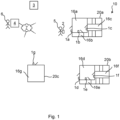
- FIG 1 is a schematic diagram illustrating an environment in which embodiments presented herein can be applied.
- An (electronic) access control system 10 contains a plurality of access control devices 1a-g and optionally a server 3. While the method is described with reference to a single access control device, the same method can be performed by any of a plurality of access control devices of the access control system 10.
- Each access control device 1a-g secures access to a respective physical space 16a-g by selectively locking or unlocking an electronic lock, based on communication with a credential 2 of a user 5.
- the electronic lock can form part of the access control device or can be separate, but paired with, the access control device.
- the communication between the access control device and the credential 2 can be short-range wireless communication, e.g. based on RFID (Radio Frequency Identification) or NFC (Near-Field Communication).
- the communication can also be contact based, e.g. based on galvanic smartcard communication or magnetic card reading.
- the credential 2 does not need to have a user interface and can be implemented as an access card or key fob.
- the access control devices 1a-g can be grouped based on their physical location. For instance a first set of access control devices 1a-c can secure respective physical spaces 16a-c of a first building 20a, a second set of access control devices 1d-f can secure respective physical spaces 16d-f of a second building 20b and another access control device 1g can secure a physical space 16g of a third building 20c.
- a server 3 can be used to keep track of access rights for credentials in the access control system 10.
- the server 3 can be connected to a communication network 7, which can be an internet protocol (IP) based network.
- IP internet protocol
- the communication network 7 can e.g. comprise any one or more of a wired local area network, a local wireless network, a cellular network, a wide area network (such as the Internet), etc.
- the communication network 7 can be used for communication between the server 3 and any online components of the access control system 10, e.g. all or a subset of the access control devices 1a-g.
- a supervisor 6 is the supervisor, or manager, of the user 5.
- the supervisor 6 has access to an electronic device 4 that can receive messages via the communication network 7.
- the electronic device 4 can be a desktop computer, a laptop computer, a tablet computer, a smartphone, a wearable device, etc.
- the access control device in question checks the access rights for the credential to determine whether to grant or deny access. As described in more detail below, this is based on access roles. For instance, a first access role can be used to grant access to the first building 20a, a second access role can be used to grant access to the second building 20b and a third access role can be used to grant access to the third building 20c. Each access control device 1a-g can determine which access role(s) that are to be granted access. Access roles can be defined in any other way, including overlapping access rights between access roles.
- the access control device can send a message to the supervisor 6 (or more specifically, the electronic device 4 of the supervisor), asking whether the user 5 is to be granted access to the physical space secured by the access control device. Since the supervisor 6 knows the user 5, the supervisor can easily determine whether the user 5 should be allowed the requested access or not. This also reduces or even eliminates the need for any central administration of access rights.
- Fig 2 is a flow chart illustrating embodiments of methods for handling access rights for access to a physical space 16a-g for the user 5. The method is performed in an access control device 1, 1a-g.
- the access control device communicates with a credential 2 of a user 5, based on short-range wireless communication.
- the short-range wireless communication can e.g. comply with RFID (Radio-Frequency Identification) or NFC (Near-Field Communication).
- the credential 2 can e.g. be in the form of a card or key fob.
- An identifier of the credential can be obtained in this step.
- one or more access roles of the user stored on the credential
- the access roles can be cryptographically signed by a trusted party to ensure that they are valid.
- the credential is thus associated with one or more access role. Based on the access provided by the access role(s), the credential can thus be used to gain access accordingly. Such access is valid until further notice, e.g. until the association between the credential and the access role(s) is removed or the definition of the access role is modified.
- the access control device determines whether the credential 2 currently has access rights to access the physical space 16a-g. This determination is based on access roles.
- the access roles of the user are found by querying a (local or remote) database based on the identifier of the credential.
- the access roles are retrieved from the credential, as described above, and the cryptographic signature applied to the access roles is verified.
- the signature can have been applied by a trusted party, e.g. an owner of the access control system 10, for which a public key is stored by the access control device.
- the access control device determines whether the access role allows access to the physical space secured by the access control device, e.g. based on access role definition, stored locally or remotely.
- the access role definition defines what access control devices that are to grant access when a credential with the access role is presented. In other words, each access role is associated with one or more access control devices.
- the method proceeds to a grant access step. Otherwise, the method proceeds to an optional conditional request access step 43, or a find address step if step 43 is not performed.
- the access control device determines whether it receives a user input indicating that the user requests increased access rights or not. For instance, after determining that access is not granted in step 42, this information is presented to the user locally (i.e. in the immediate vicinity of the access control device), e.g. using a display, sounds and/or LED (light emitting diodes), prompting the user whether to query the superior of the user to obtain access. If the user would like the access control device to request the supervisor for access, the user indicates this by manipulating an appropriate user interface element, e.g.
- the method proceeds to the find address step. Otherwise, the method ends.
- the access control device finds a communication address to the superior 6 to the user 5.
- the address is of a form that allows communication that the user requests access and that allows the supervisor to selectively approve the request.
- the address can be of a form that enables text-based communication.
- the address is in the form of an e-mail address for sending an e-mail.
- the address is in the form of a phone number for sending a text message to the superior 6.
- the address is in the form of an identifier of the supervisor 6 within the access control system, allowing communication to occur to client software executing in the device of the superior, e.g. in an application also known as an app.
- the access control device In a generate request message step 46, the access control device generates an increased-access request message.
- This message comprises a link that, when activated, adds a first access role to the user 5.
- the link is in the form of a URI (Uniform Resource Indicator).
- the first access role implies that (i.e. is defines that) the access control device 1, 1a-g should grant access for the user 5 to the physical space 16a-g that is secured by the access control device performing the method.
- the link can be addressed to a server 3 of the access control system or to the access control device itself.
- the request message can also comprise an indication of the user, e.g. a name of the user that has been looked up based on the identifier of the credential, and a descriptor of the access control device and/or physical space secured by the access control device.
- the text of the request message can be "John Doe requests access to the office of Big Corp at third floor of the building at 10 High St. If you approve access, please click the following link: https://foo.bar.com/12345678 ".
- the request message also comprises a link to indicate that access is denied.
- the request message than also comprises the text " If you deny access, please click the following link: https://foo.bar.com/87654321 ".
- the text and link structure can vary depending on the circumstances.
- a send message step 48 the access control device sends the increased-access request message to the address of the superior 6, or more precisely to the address of a device of the superior.
- the superior can then decide whether to grant the requested access or not based on the message.
- the message can be sent directly from the access control device or via the server 3.
- a receive indication step 50 the access control device receives an indication that the superior has activated (e.g. clicked on) the link, adding the first access role to the user 5.
- the indication is based on the superior approving access by clicking the link in the message.
- the indication can be received via the server 3 or in a direct HTTP (Hypertext Transfer Protocol) request from the device of the supervisor.
- a grant access step 52 the access control device grants access for the user 5 to the physical space 16a-g that is secured by the access control device that performs the method. This results in an electronic lock being unlocked, allowing the user to enter the physical space secured by the access control device.
- the superior approval conveniently occurs using a link in the message to the superior.
- the link refers to a server that records the action of the superior.
- embodiments presented herein are based on separate entities for informing the superior of approval (the user device of the superior) and receiving indication of link activation (from the server in the link). This allows direct communication with the superior, while enabling a secure central repository of access control in the server.
- the access control device determines whether usage of a second access role assigned to the user is less than a threshold.
- the threshold can be expressed as a number of occurrences of access-role usage (to gain access to a physical space) during a specific time period (e.g. last month, last x days, etc.).
- the method proceeds to an optional generate reduction message step 56. Otherwise, the method ends.
- the access control device In an optional generate reduction message step 56, the access control device generates a decreased-access request message.
- the decreased-access request message comprises a link that, when activated, removes the second access role of the user 5.
- the format of the decreased-access request message can be the same as for the increased-access request message.
- the access control device sends the decreased-access request message to the address of the superior 6.
- the supervisor can then decide whether to reduce access, by removing the second access role of the user 5 as suggested in the decreased-access request message, in which case, the supervisor clicks the link in the decreased-access request message.
- the system can thus also adapt access rights to allow the supervisor to conveniently remove access rights that are not used. This prevents the user from keeping access rights that are not necessary.
- Fig 3 is a schematic diagram illustrating components of the access control device 1, which can e.g. be any of the access control devices 1a-g of Fig 1 . It is to be noted that, when the access control device 1 is implemented in a host device, one or more of the mentioned components can be shared with the host device.
- a processor 60 is provided using any combination of one or more of a suitable central processing unit (CPU), graphics processing unit (GPU) , multiprocessor, microcontroller, digital signal processor (DSP), etc., capable of executing software instructions 67 stored in a memory 64, which can thus be a computer program product.
- the processor 60 could alternatively be implemented using an application specific integrated circuit (ASIC), field programmable gate array (FPGA), etc.
- the processor 60 can be configured to execute the method described with reference to Fig 2 above.
- the memory 64 can be any combination of random-access memory (RAM) and/or read-only memory (ROM).
- the memory 64 also comprises persistent storage, which, for example, can be any single one or combination of magnetic memory, optical memory, solid-state memory or even remotely mounted memory.
- a data memory 66 is also provided for reading and/or storing data during execution of software instructions in the processor 60.
- the data memory 66 can be any combination of RAM and/or ROM.
- the access control device 1 further comprises an I/O interface 62 for communicating with external and/or internal entities.
- the I/O interface 62 also includes a user interface, such as any one or more of a display with or without touch-screen ability, a keypad, etc.
- Fig 4 shows one example of a computer program product 90 comprising computer readable means.
- a computer program 91 can be stored, which computer program can cause a processor to execute a method according to embodiments described herein.
- the computer program product is in the form of a removable solid-state memory, e.g. a Universal Serial Bus (USB) drive.
- USB Universal Serial Bus
- the computer program product could also be embodied in a memory of a device, such as the computer program product 64 of Fig 3 .
- While the computer program 91 is here schematically shown as a section of the removable solid-state memory, the computer program can be stored in any way which is suitable for the computer program product, such as another type of removable solid-state memory, or an optical disc, such as a CD (compact disc), a DVD (digital versatile disc) or a Blu-Ray disc.
- an optical disc such as a CD (compact disc), a DVD (digital versatile disc) or a Blu-Ray disc.
Landscapes
- Physics & Mathematics (AREA)
- General Physics & Mathematics (AREA)
- Engineering & Computer Science (AREA)
- Computer Networks & Wireless Communication (AREA)
- Signal Processing (AREA)
- Storage Device Security (AREA)
- Lock And Its Accessories (AREA)
- Telephonic Communication Services (AREA)
- Mobile Radio Communication Systems (AREA)
- Data Exchanges In Wide-Area Networks (AREA)
Description
- The present disclosure relates to the field of handling access rights for gaining access to a physical space secured by an access control device.
- Locks and keys are evolving from the traditional pure mechanical locks. These days, electronic locks are becoming increasingly common. For electronic locks, no mechanical key profile is needed for authentication of a user. The electronic locks can e.g. be opened using an electronic credential (fob, card, etc.). The credential and electronic lock can e.g. communicate over a wireless interface. Such electronic locks provide a number of benefits, including improved flexibility in management of access rights, audit trails, access management, etc.
- However, access rights need to be configured for each credential that is to have access to any restricted physical space. The process of configuring access for users and their credentials is labour intensive. Moreover, in large access control systems, such as for large corporations, there are cumbersome access approval procedures that are needed for central access right administrators to manage the access rights.
-
US 2014/266573 A1 presents an access control method for providing a guest with an access when the guest credential is found to lack the necessary access rights. - One object is to improve how access rights are managed.
- According to a first aspect, it is provided a method for handling access rights for access to a physical space according to
claim 1. - The method may further comprise the step of: receiving a user input indicating that the user requests increased access rights.
- The short-range wireless communication may comply with RFID, Radio-Frequency Identification, or NFC, Near-Field Communication.
- The address may be an e-mail address.
- The address may be a phone number.
- The method may further comprise the step of: determining that usage of a second access role assigned to the user is less than a threshold; generating a decreased-access request message, the decreased-access request message comprising a link that, when activated, removes the second access role of the user; and sending the decreased-access request message to the address of the superior.
- According to a second aspect, it is provided an access control device for handling access rights for access to a physical space according to
claim 7. - The access control device may further comprise instructions that, when executed by the processor, cause the access control device to: receive a user input indicating that the user requests increased access rights.
- The short-range wireless communication may comply with RFID, radio-frequency identification, or NFC, near-field communication.
- The address may be an e-mail address.
- The address may be a phone number.
- The access control device may further comprise instructions that, when executed by the processor, cause the access control device to: determine that usage of a second access role assigned to the user is less than a threshold; generate a decreased-access request message, the decreased-access request message comprising a link that, when activated, removes the second access role of the user; and send the decreased-access request message to the address of the superior.
- According to a third aspect, it is provided a computer program for handling access rights for access to a physical space according to claim 13.
- According to a fourth aspect, it is provided a computer program product comprising a computer program according to the third aspect and a computer readable means on which the computer program is stored.
- Generally, all terms used in the claims are to be interpreted according to their ordinary meaning in the technical field, unless explicitly defined otherwise herein. All references to "a/an/the element, apparatus, component, means, step, etc." are to be interpreted openly as referring to at least one instance of the element, apparatus, component, means, step, etc., unless explicitly stated otherwise. The steps of any method disclosed herein do not have to be performed in the exact order disclosed, unless explicitly stated.
- Aspects and embodiments are now described, by way of example, with reference to the accompanying drawings, in which:
-
Fig 1 is a schematic diagram illustrating an environment in which embodiments presented herein can be applied; -
Fig 2 is a flow chart illustrating embodiments of methods for handling access rights for access to a physical space for the user; -
Fig 3 is a schematic diagram illustrating components of the access control device, which can e.g. be any of the access control devices ofFig 1 ; and -
Fig 4 shows one example of a computer program product comprising computer readable means. - The aspects of the present disclosure will now be described more fully hereinafter with reference to the accompanying drawings, in which certain embodiments of the invention are shown. These aspects may, however, be embodied in many different forms and should not be construed as limiting; rather, these embodiments are provided by way of example so that this disclosure will be thorough and complete, and to fully convey the scope of all aspects of invention to those skilled in the art. Like numbers refer to like elements throughout the description.
- According to embodiments presented herein, a convenient way to handle access rights is provided. When a user is denied access by an access control device, the supervisor of the user can approve access to the user and assign an appropriate access role for the user by simply clicking a link in a message sent to the supervisor. In such a system, the supervisor, who also knows the user, can conveniently and swiftly approve access when appropriate. This solution both reduces waiting time for the user and improves control for the supervisor, and reduces burden and risk of mismanagement of any central access right administration. This is a significant improvement from the prior art, where central administrators manually assign roles to users based on information from others, a process that is error-prone, that leads to substantial administrative work and often leads to granting more access than needed.
-
Fig 1 is a schematic diagram illustrating an environment in which embodiments presented herein can be applied. An (electronic)access control system 10 contains a plurality ofaccess control devices 1a-g and optionally aserver 3. While the method is described with reference to a single access control device, the same method can be performed by any of a plurality of access control devices of theaccess control system 10. - Each
access control device 1a-g secures access to a respectivephysical space 16a-g by selectively locking or unlocking an electronic lock, based on communication with a credential 2 of auser 5. The electronic lock can form part of the access control device or can be separate, but paired with, the access control device. The communication between the access control device and the credential 2 can be short-range wireless communication, e.g. based on RFID (Radio Frequency Identification) or NFC (Near-Field Communication). The communication can also be contact based, e.g. based on galvanic smartcard communication or magnetic card reading. The credential 2 does not need to have a user interface and can be implemented as an access card or key fob. - The
access control devices 1a-g can be grouped based on their physical location. For instance a first set ofaccess control devices 1a-c can secure respectivephysical spaces 16a-c of afirst building 20a, a second set ofaccess control devices 1d-f can secure respectivephysical spaces 16d-f of asecond building 20b and anotheraccess control device 1g can secure aphysical space 16g of athird building 20c. - A
server 3 can be used to keep track of access rights for credentials in theaccess control system 10. Theserver 3 can be connected to acommunication network 7, which can be an internet protocol (IP) based network. Thecommunication network 7 can e.g. comprise any one or more of a wired local area network, a local wireless network, a cellular network, a wide area network (such as the Internet), etc. Thecommunication network 7 can be used for communication between theserver 3 and any online components of theaccess control system 10, e.g. all or a subset of theaccess control devices 1a-g. - A supervisor 6 is the supervisor, or manager, of the
user 5. The supervisor 6 has access to anelectronic device 4 that can receive messages via thecommunication network 7. For instance, theelectronic device 4 can be a desktop computer, a laptop computer, a tablet computer, a smartphone, a wearable device, etc. - When the credential 2 is presented to one of the
access control devices 1a-g, the access control device in question checks the access rights for the credential to determine whether to grant or deny access. As described in more detail below, this is based on access roles. For instance, a first access role can be used to grant access to thefirst building 20a, a second access role can be used to grant access to thesecond building 20b and a third access role can be used to grant access to thethird building 20c. Eachaccess control device 1a-g can determine which access role(s) that are to be granted access. Access roles can be defined in any other way, including overlapping access rights between access roles. - According to embodiments presented herein, when the
user 5 is denied access by one of theaccess control devices 1a-g, the access control device can send a message to the supervisor 6 (or more specifically, theelectronic device 4 of the supervisor), asking whether theuser 5 is to be granted access to the physical space secured by the access control device. Since the supervisor 6 knows theuser 5, the supervisor can easily determine whether theuser 5 should be allowed the requested access or not. This also reduces or even eliminates the need for any central administration of access rights. -
Fig 2 is a flow chart illustrating embodiments of methods for handling access rights for access to aphysical space 16a-g for theuser 5. The method is performed in anaccess control device - In a communicate with
credential step 40, the access control device communicates with a credential 2 of auser 5, based on short-range wireless communication. The short-range wireless communication can e.g. comply with RFID (Radio-Frequency Identification) or NFC (Near-Field Communication). As explained above, the credential 2 can e.g. be in the form of a card or key fob. An identifier of the credential can be obtained in this step. In an embodiment not falling under the claims, one or more access roles of the user (stored on the credential) are also obtained from the credential in this step. The access roles can be cryptographically signed by a trusted party to ensure that they are valid. The credential is thus associated with one or more access role. Based on the access provided by the access role(s), the credential can thus be used to gain access accordingly. Such access is valid until further notice, e.g. until the association between the credential and the access role(s) is removed or the definition of the access role is modified. - In a conditional access granted
step 42, the access control device determines whether the credential 2 currently has access rights to access thephysical space 16a-g. This determination is based on access roles. According to the invention the access roles of the user are found by querying a (local or remote) database based on the identifier of the credential. In an unclaimed alternative, the access roles are retrieved from the credential, as described above, and the cryptographic signature applied to the access roles is verified. The signature can have been applied by a trusted party, e.g. an owner of theaccess control system 10, for which a public key is stored by the access control device. The access control device then determines whether the access role allows access to the physical space secured by the access control device, e.g. based on access role definition, stored locally or remotely. The access role definition defines what access control devices that are to grant access when a credential with the access role is presented. In other words, each access role is associated with one or more access control devices. - If the credential 2 currently has access rights to access the
physical space 16a-g, the method proceeds to a grant access step. Otherwise, the method proceeds to an optional conditionalrequest access step 43, or a find address step ifstep 43 is not performed. - In the optional conditional
request access step 43, the access control device determines whether it receives a user input indicating that the user requests increased access rights or not. For instance, after determining that access is not granted instep 42, this information is presented to the user locally (i.e. in the immediate vicinity of the access control device), e.g. using a display, sounds and/or LED (light emitting diodes), prompting the user whether to query the superior of the user to obtain access. If the user would like the access control device to request the supervisor for access, the user indicates this by manipulating an appropriate user interface element, e.g. by touching an indicated area of a touch screen of the access control device, by pressing an appropriate key of a keypad of the access control device, by voicing a command that is captured by a microphone of the access control device, etc. In any case, if this step is performed and the user would like the access control device to request access, this is indicated in user input of a user interface provided by the access control device. - If this user input is received, the method proceeds to the find address step. Otherwise, the method ends.
- In the
find address step 44, the access control device finds a communication address to the superior 6 to theuser 5. The address is of a form that allows communication that the user requests access and that allows the supervisor to selectively approve the request. For instance, the address can be of a form that enables text-based communication. In one embodiment, the address is in the form of an e-mail address for sending an e-mail. Alternatively or additionally, the address is in the form of a phone number for sending a text message to the superior 6. Alternatively or additionally, the address is in the form of an identifier of the supervisor 6 within the access control system, allowing communication to occur to client software executing in the device of the superior, e.g. in an application also known as an app. - In a generate
request message step 46, the access control device generates an increased-access request message. This message comprises a link that, when activated, adds a first access role to theuser 5. According to the invention the link is in the form of a URI (Uniform Resource Indicator). The first access role implies that (i.e. is defines that) theaccess control device user 5 to thephysical space 16a-g that is secured by the access control device performing the method. The link can be addressed to aserver 3 of the access control system or to the access control device itself. The request message can also comprise an indication of the user, e.g. a name of the user that has been looked up based on the identifier of the credential, and a descriptor of the access control device and/or physical space secured by the access control device. - As an illustratory example, the text of the request message can be "John Doe requests access to the office of Big Corp at third floor of the building at 10 High St. If you approve access, please click the following link: https://foo.bar.com/12345678". Optionally, the request message also comprises a link to indicate that access is denied. In an illustratory example, the request message than also comprises the text " If you deny access, please click the following link: https://foo.bar.com/87654321". The text and link structure can vary depending on the circumstances.
- In a
send message step 48, the access control device sends the increased-access request message to the address of the superior 6, or more precisely to the address of a device of the superior. The superior can then decide whether to grant the requested access or not based on the message. The message can be sent directly from the access control device or via theserver 3. - In a receive
indication step 50, the access control device receives an indication that the superior has activated (e.g. clicked on) the link, adding the first access role to theuser 5. The indication is based on the superior approving access by clicking the link in the message. The indication can be received via theserver 3 or in a direct HTTP (Hypertext Transfer Protocol) request from the device of the supervisor. - In a
grant access step 52, the access control device grants access for theuser 5 to thephysical space 16a-g that is secured by the access control device that performs the method. This results in an electronic lock being unlocked, allowing the user to enter the physical space secured by the access control device. - It can thus be seen how embodiments presented herein provide a convenient way to adapt access rights of users of the access control system. No central access right administration needs to be involved and instead the supervisor of each user can manage the access rights of her/his subordinates. Using the link in the increased-access request message, it is very easy for the supervisor to approve the access by simply clicking the link. Also, it is very easy and convenient for the user requesting access to interact with the access control device to request access when needed. The credential does not need a user interface and can e.g. be implemented as an access card or key fob.
- The superior approval conveniently occurs using a link in the message to the superior. The link refers to a server that records the action of the superior. Hence, embodiments presented herein are based on separate entities for informing the superior of approval (the user device of the superior) and receiving indication of link activation (from the server in the link). This allows direct communication with the superior, while enabling a secure central repository of access control in the server.
- In an optional conditional low usage step 54, the access control device determines whether usage of a second access role assigned to the user is less than a threshold. For instance, the threshold can be expressed as a number of occurrences of access-role usage (to gain access to a physical space) during a specific time period (e.g. last month, last x days, etc.). When usage of the second access role that is assigned to the user is less than the threshold, the method proceeds to an optional generate
reduction message step 56. Otherwise, the method ends. - In an optional generate
reduction message step 56, the access control device generates a decreased-access request message. The decreased-access request message comprises a link that, when activated, removes the second access role of theuser 5. The format of the decreased-access request message can be the same as for the increased-access request message. - In an optional send
reduction message step 58, the access control device sends the decreased-access request message to the address of the superior 6. The supervisor can then decide whether to reduce access, by removing the second access role of theuser 5 as suggested in the decreased-access request message, in which case, the supervisor clicks the link in the decreased-access request message. - Using the
optional steps -
Fig 3 is a schematic diagram illustrating components of theaccess control device 1, which can e.g. be any of theaccess control devices 1a-g ofFig 1 . It is to be noted that, when theaccess control device 1 is implemented in a host device, one or more of the mentioned components can be shared with the host device. Aprocessor 60 is provided using any combination of one or more of a suitable central processing unit (CPU), graphics processing unit (GPU) , multiprocessor, microcontroller, digital signal processor (DSP), etc., capable of executingsoftware instructions 67 stored in amemory 64, which can thus be a computer program product. Theprocessor 60 could alternatively be implemented using an application specific integrated circuit (ASIC), field programmable gate array (FPGA), etc. Theprocessor 60 can be configured to execute the method described with reference toFig 2 above. - The
memory 64 can be any combination of random-access memory (RAM) and/or read-only memory (ROM). Thememory 64 also comprises persistent storage, which, for example, can be any single one or combination of magnetic memory, optical memory, solid-state memory or even remotely mounted memory. - A
data memory 66 is also provided for reading and/or storing data during execution of software instructions in theprocessor 60. Thedata memory 66 can be any combination of RAM and/or ROM. - The
access control device 1 further comprises an I/O interface 62 for communicating with external and/or internal entities. The I/O interface 62 also includes a user interface, such as any one or more of a display with or without touch-screen ability, a keypad, etc. - Other components of the
access control device 1 are omitted in order not to obscure the concepts presented herein. -
Fig 4 shows one example of acomputer program product 90 comprising computer readable means. On this computer readable means, acomputer program 91 can be stored, which computer program can cause a processor to execute a method according to embodiments described herein. In this example, the computer program product is in the form of a removable solid-state memory, e.g. a Universal Serial Bus (USB) drive. As explained above, the computer program product could also be embodied in a memory of a device, such as thecomputer program product 64 ofFig 3 . While thecomputer program 91 is here schematically shown as a section of the removable solid-state memory, the computer program can be stored in any way which is suitable for the computer program product, such as another type of removable solid-state memory, or an optical disc, such as a CD (compact disc), a DVD (digital versatile disc) or a Blu-Ray disc. - The aspects of the present disclosure have mainly been described above with reference to a few embodiments. However, as is readily appreciated by a person skilled in the art, other embodiments than the ones disclosed above are equally possible within the scope of the invention, as defined by the appended patent claims. Thus, while various aspects and embodiments have been disclosed herein, other aspects and embodiments will be apparent to those skilled in the art.
Claims (14)
- A method for handling access rights for access to a physical space (16a-g), the method being performed in an access control device (1, 1a-g), the method comprising the steps of:communicating (40) with a credential (2) of a user (5), based on short-range wireless communication;determining (42) that the credential (2) does not currently have access rights to access the physical space (16a-g) by determining that there is no access role associated with the access control device that is associated with the credential, wherein access roles of the user are found by querying a local or remote database based on the identifier of the credential;finding (44) a communication address to a superior (6) to the user (5);generating (46) an increased-access request message, comprising a link that, when activated, adds a first access role to the user (5), the first access role implying that the access control device (1, 1a-g) should grant access for the user (5) to the physical space (16a-g), wherein the link is in the form of a URI, Uniform Resource Indicator, wherein access, provided by the first access role, is valid until the association between the credential and the access role is removed or the definition of the access role is modified;sending (48) the increased-access request message to the address of the superior (6);receiving (50) an indication that the superior has activated the link, thereby adding the first access role to the user (5); andgranting (52) access for the user (5) to the physical space (16a-g).
- The method according to claim 1, further comprising the step of:
receiving (43) a user input indicating that the user requests increased access rights. - The method according to claim 1 or 2, wherein the short-range wireless communication complies with RFID, Radio-Frequency Identification, or NFC, Near-Field Communication.
- The method according to any one of the preceding claims, wherein the address is an e-mail address.
- The method according to any one of the preceding claims, wherein the address is a phone number.
- The method according to any one of the preceding claims, further comprising the step of:determining (54) that usage of a second access role assigned to the user is less than a threshold, wherein the second access role is usable to gain access to a physical space;generating (56) a decreased-access request message, the decreased-access request message comprising a link that, when activated, removes the second access role of the user (5); andsending (58) the decreased-access request message to the address of the superior (6).
- An access control device (1, 1a-g) for handling access rights for access to a physical space (16a-g), the access control device (1, 1a-g) comprising:a processor (60); anda memory (64) storing instructions (67) that, when executed by the processor, cause the access control device (1, 1a-g) to:communicate with a credential (2) of a user (5), based on short-range wireless communication;determine that the credential (2) does not currently have access rights to access the physical space (16a-g) by determining that there is no access role associated with the access control device that is associated with the credential, wherein access roles of the user are found by querying a local or remote database based on the identifier of the credential;find a communication address to a superior (6) to the user;generate an increased-access request message, comprising a link that, when activated, adds a first access role to the user (5), the first access role implying that the access control device (1, 1a-g) should grant access for the user (5) to the physical space (16a-g), wherein the link is in the form of a URI, Uniform Resource Indicator, wherein access, provided by the first access role, is valid until the association between the credential and the access role is removed or the definition of the access role is modified;send the increased-access request message to the address of the superior (6);receive an indication that the superior has activated the link, thereby adding the first access role to the user (5); andgrant access for the user (5) to the physical space (16a-g).
- The access control device (1, 1a-g) according to claim 7, further comprising instructions (67) that, when executed by the processor, cause the access control device (1, 1a-g) to:
receive a user input indicating that the user requests increased access rights. - The access control device (1, 1a-g) according to claim 7 or 8, wherein the short-range wireless communication complies with RFID, radio-frequency identification, or NFC, near-field communication.
- The access control device (1, 1a-g) according to any one of claims 7 to 9, wherein the address is an e-mail address.
- The access control device (1, 1a-g) according to any one of claims 7 to 10, wherein the address is a phone number.
- The access control device (1, 1a-g) according to any one of claims 7 to 11, further comprising instructions (67) that, when executed by the processor, cause the access control device (1, 1a-g) to:determine that usage of a second access role assigned to the user is less than a threshold, wherein the second access role is usable to gain access to a physical space;generate a decreased-access request message, the decreased-access request message comprising a link that, when activated, removes the second access role of the user (5); andsend the decreased-access request message to the address of the superior (6).
- A computer program (67, 91) for handling access rights for access to a physical space (16a-g), the computer program comprising computer program code which, when executed on an access control device (1, 1a-g) causes the access control device (1, 1a-g) to:communicate with a credential (2) of a user (5), based on short-range wireless communication;determine that the credential (2) does not currently have access rights to access the physical space (16a-g) by determining that there is no access role associated with the access control device that is associated with the credential, wherein access roles of the user are found by querying a local or remote database based on the identifier of the credential;find a communication address to a superior (6) to the user;generate an increased-access request message, comprising a link that, when activated, adds a first access role to the user (5), the first access role implying that the access control device (1, 1a-g) should grant access for the user (5) to the physical space (16a-g), wherein the link is in the form of a URI, Uniform Resource Indicator, wherein access, provided by the first access role, is valid until the association between the credential and the access role is removed or the definition of the access role is modified;send the increased-access request message to the address of the superior (6);receive an indication that the superior has activated the link, thereby adding the first access role to the user (5); andgrant access for the user (5) to the physical space (16a-g).
- A computer program product (64, 90) comprising a computer program according to claim 13 and a computer readable means on which the computer program is stored.
Applications Claiming Priority (2)
| Application Number | Priority Date | Filing Date | Title |
|---|---|---|---|
| SE2150179A SE546372C2 (en) | 2021-02-19 | 2021-02-19 | Handling access rights for access to a physical space |
| PCT/EP2022/053947 WO2022175389A1 (en) | 2021-02-19 | 2022-02-17 | Handling access rights for access to a physical space |
Publications (2)
| Publication Number | Publication Date |
|---|---|
| EP4295331A1 EP4295331A1 (en) | 2023-12-27 |
| EP4295331B1 true EP4295331B1 (en) | 2025-03-12 |
Family
ID=80786329
Family Applications (1)
| Application Number | Title | Priority Date | Filing Date |
|---|---|---|---|
| EP22708088.4A Active EP4295331B1 (en) | 2021-02-19 | 2022-02-17 | Handling access rights for access to a physical space |
Country Status (6)
| Country | Link |
|---|---|
| US (1) | US12315320B2 (en) |
| EP (1) | EP4295331B1 (en) |
| ES (1) | ES3025001T3 (en) |
| FI (1) | FI4295331T3 (en) |
| SE (1) | SE546372C2 (en) |
| WO (1) | WO2022175389A1 (en) |
Families Citing this family (1)
| Publication number | Priority date | Publication date | Assignee | Title |
|---|---|---|---|---|
| SE546372C2 (en) | 2021-02-19 | 2024-10-15 | Assa Abloy Ab | Handling access rights for access to a physical space |
Family Cites Families (10)
| Publication number | Priority date | Publication date | Assignee | Title |
|---|---|---|---|---|
| JP4723949B2 (en) * | 2004-08-09 | 2011-07-13 | 日本電信電話株式会社 | Access control system, access control method, and access control program |
| US9367978B2 (en) * | 2013-03-15 | 2016-06-14 | The Chamberlain Group, Inc. | Control device access method and apparatus |
| US20170012990A1 (en) * | 2015-07-08 | 2017-01-12 | International Business Machines Corporation | Indirect user authentication |
| US10490003B2 (en) * | 2015-12-31 | 2019-11-26 | Vivint, Inc. | Guest mode access |
| US10339736B2 (en) * | 2016-01-27 | 2019-07-02 | Honeywell International Inc. | Remote application for controlling access |
| EP3479319A1 (en) * | 2016-06-29 | 2019-05-08 | Visa International Service Association | Method and system for transit processing |
| CA3044613C (en) * | 2016-12-06 | 2025-05-20 | Assa Abloy Ab | Providing access to a lock for a service provider |
| WO2020005465A1 (en) * | 2018-06-30 | 2020-01-02 | Carrier Corporation | A system of conditional access where access is granted to other users when primary accessor is present in room |
| CN109523676A (en) * | 2018-11-23 | 2019-03-26 | 国网河南省电力公司检修公司 | A kind of intelligent error preventing operation key locker and its application method |
| SE546372C2 (en) | 2021-02-19 | 2024-10-15 | Assa Abloy Ab | Handling access rights for access to a physical space |
-
2021
- 2021-02-19 SE SE2150179A patent/SE546372C2/en unknown
-
2022
- 2022-02-17 EP EP22708088.4A patent/EP4295331B1/en active Active
- 2022-02-17 WO PCT/EP2022/053947 patent/WO2022175389A1/en not_active Ceased
- 2022-02-17 US US18/547,017 patent/US12315320B2/en active Active
- 2022-02-17 ES ES22708088T patent/ES3025001T3/en active Active
- 2022-02-17 FI FIEP22708088.4T patent/FI4295331T3/en active
Also Published As
| Publication number | Publication date |
|---|---|
| FI4295331T3 (en) | 2025-04-30 |
| WO2022175389A1 (en) | 2022-08-25 |
| US20240321029A1 (en) | 2024-09-26 |
| SE2150179A1 (en) | 2022-08-20 |
| SE546372C2 (en) | 2024-10-15 |
| US12315320B2 (en) | 2025-05-27 |
| ES3025001T3 (en) | 2025-06-05 |
| EP4295331A1 (en) | 2023-12-27 |
Similar Documents
| Publication | Publication Date | Title |
|---|---|---|
| US10636240B2 (en) | Architecture for access management | |
| US8918856B2 (en) | Trusted intermediary for network layer claims-enabled access control | |
| US8561172B2 (en) | System and method for virtual information cards | |
| JP7228977B2 (en) | Information processing device, authorization system and verification method | |
| US8087060B2 (en) | Chaining information card selectors | |
| US20100251353A1 (en) | User-authorized information card delegation | |
| JP6675163B2 (en) | Authority transfer system, control method of authorization server, authorization server and program | |
| US9037849B2 (en) | System and method for managing network access based on a history of a certificate | |
| US12273448B2 (en) | Secure information sharing systems and methods | |
| CN1610292A (en) | Interoperable credential gathering and access modularity | |
| CN115191104B (en) | Decentralized identities anchored by decentralized identifiers | |
| US11954672B1 (en) | Systems and methods for cryptocurrency pool management | |
| US9122849B2 (en) | Secure authentication using memory cards | |
| US11823511B2 (en) | Providing access to a lock for a service provider using a grant token and credential | |
| EP4295331B1 (en) | Handling access rights for access to a physical space | |
| JP2006202180A (en) | Access management program | |
| JP2011013982A (en) | Authentication system, authentication information providing apparatus, use authority control device, authentication method, and program | |
| JP7668314B2 (en) | PROGRAM, INFORMATION PROCESSING APPARATUS AND INFORMATION PROCESSING METHOD | |
| JP2015215839A (en) | Proxy application approval system and proxy application approval method | |
| US20180139198A1 (en) | Key based authorization for programmatic clients | |
| EP3742318B1 (en) | Method and device for the storing, inspection control and retrieval of data from a permanently immutable, distributed and decentralized storage | |
| JP2010073001A (en) | Authentication control apparatus and authentication control program |
Legal Events
| Date | Code | Title | Description |
|---|---|---|---|
| STAA | Information on the status of an ep patent application or granted ep patent |
Free format text: STATUS: UNKNOWN |
|
| STAA | Information on the status of an ep patent application or granted ep patent |
Free format text: STATUS: THE INTERNATIONAL PUBLICATION HAS BEEN MADE |
|
| PUAI | Public reference made under article 153(3) epc to a published international application that has entered the european phase |
Free format text: ORIGINAL CODE: 0009012 |
|
| STAA | Information on the status of an ep patent application or granted ep patent |
Free format text: STATUS: REQUEST FOR EXAMINATION WAS MADE |
|
| 17P | Request for examination filed |
Effective date: 20230918 |
|
| AK | Designated contracting states |
Kind code of ref document: A1 Designated state(s): AL AT BE BG CH CY CZ DE DK EE ES FI FR GB GR HR HU IE IS IT LI LT LU LV MC MK MT NL NO PL PT RO RS SE SI SK SM TR |
|
| DAV | Request for validation of the european patent (deleted) | ||
| DAX | Request for extension of the european patent (deleted) | ||
| GRAP | Despatch of communication of intention to grant a patent |
Free format text: ORIGINAL CODE: EPIDOSNIGR1 |
|
| STAA | Information on the status of an ep patent application or granted ep patent |
Free format text: STATUS: GRANT OF PATENT IS INTENDED |
|
| INTG | Intention to grant announced |
Effective date: 20241011 |
|
| GRAS | Grant fee paid |
Free format text: ORIGINAL CODE: EPIDOSNIGR3 |
|
| GRAA | (expected) grant |
Free format text: ORIGINAL CODE: 0009210 |
|
| STAA | Information on the status of an ep patent application or granted ep patent |
Free format text: STATUS: THE PATENT HAS BEEN GRANTED |
|
| AK | Designated contracting states |
Kind code of ref document: B1 Designated state(s): AL AT BE BG CH CY CZ DE DK EE ES FI FR GB GR HR HU IE IS IT LI LT LU LV MC MK MT NL NO PL PT RO RS SE SI SK SM TR |
|
| REG | Reference to a national code |
Ref country code: GB Ref legal event code: FG4D |
|
| REG | Reference to a national code |
Ref country code: CH Ref legal event code: EP |
|
| REG | Reference to a national code |
Ref country code: DE Ref legal event code: R096 Ref document number: 602022011714 Country of ref document: DE |
|
| REG | Reference to a national code |
Ref country code: IE Ref legal event code: FG4D |
|
| REG | Reference to a national code |
Ref country code: FI Ref legal event code: FGE |
|
| REG | Reference to a national code |
Ref country code: ES Ref legal event code: FG2A Ref document number: 3025001 Country of ref document: ES Kind code of ref document: T3 Effective date: 20250605 |
|
| PG25 | Lapsed in a contracting state [announced via postgrant information from national office to epo] |
Ref country code: RS Free format text: LAPSE BECAUSE OF FAILURE TO SUBMIT A TRANSLATION OF THE DESCRIPTION OR TO PAY THE FEE WITHIN THE PRESCRIBED TIME-LIMIT Effective date: 20250612 |
|
| REG | Reference to a national code |
Ref country code: LT Ref legal event code: MG9D |
|
| PG25 | Lapsed in a contracting state [announced via postgrant information from national office to epo] |
Ref country code: NO Free format text: LAPSE BECAUSE OF FAILURE TO SUBMIT A TRANSLATION OF THE DESCRIPTION OR TO PAY THE FEE WITHIN THE PRESCRIBED TIME-LIMIT Effective date: 20250612 |
|
| PG25 | Lapsed in a contracting state [announced via postgrant information from national office to epo] |
Ref country code: HR Free format text: LAPSE BECAUSE OF FAILURE TO SUBMIT A TRANSLATION OF THE DESCRIPTION OR TO PAY THE FEE WITHIN THE PRESCRIBED TIME-LIMIT Effective date: 20250312 |
|
| REG | Reference to a national code |
Ref country code: NL Ref legal event code: MP Effective date: 20250312 |
|
| PG25 | Lapsed in a contracting state [announced via postgrant information from national office to epo] |
Ref country code: LV Free format text: LAPSE BECAUSE OF FAILURE TO SUBMIT A TRANSLATION OF THE DESCRIPTION OR TO PAY THE FEE WITHIN THE PRESCRIBED TIME-LIMIT Effective date: 20250312 |
|
| PG25 | Lapsed in a contracting state [announced via postgrant information from national office to epo] |
Ref country code: GR Free format text: LAPSE BECAUSE OF FAILURE TO SUBMIT A TRANSLATION OF THE DESCRIPTION OR TO PAY THE FEE WITHIN THE PRESCRIBED TIME-LIMIT Effective date: 20250613 Ref country code: BG Free format text: LAPSE BECAUSE OF FAILURE TO SUBMIT A TRANSLATION OF THE DESCRIPTION OR TO PAY THE FEE WITHIN THE PRESCRIBED TIME-LIMIT Effective date: 20250312 |
|
| REG | Reference to a national code |
Ref country code: AT Ref legal event code: MK05 Ref document number: 1775683 Country of ref document: AT Kind code of ref document: T Effective date: 20250312 |
|
| PG25 | Lapsed in a contracting state [announced via postgrant information from national office to epo] |
Ref country code: NL Free format text: LAPSE BECAUSE OF FAILURE TO SUBMIT A TRANSLATION OF THE DESCRIPTION OR TO PAY THE FEE WITHIN THE PRESCRIBED TIME-LIMIT Effective date: 20250312 |
|
| PG25 | Lapsed in a contracting state [announced via postgrant information from national office to epo] |
Ref country code: SE Free format text: LAPSE BECAUSE OF FAILURE TO SUBMIT A TRANSLATION OF THE DESCRIPTION OR TO PAY THE FEE WITHIN THE PRESCRIBED TIME-LIMIT Effective date: 20250312 |
|
| PG25 | Lapsed in a contracting state [announced via postgrant information from national office to epo] |
Ref country code: SM Free format text: LAPSE BECAUSE OF FAILURE TO SUBMIT A TRANSLATION OF THE DESCRIPTION OR TO PAY THE FEE WITHIN THE PRESCRIBED TIME-LIMIT Effective date: 20250312 |
|
| PG25 | Lapsed in a contracting state [announced via postgrant information from national office to epo] |
Ref country code: PT Free format text: LAPSE BECAUSE OF FAILURE TO SUBMIT A TRANSLATION OF THE DESCRIPTION OR TO PAY THE FEE WITHIN THE PRESCRIBED TIME-LIMIT Effective date: 20250714 |
|
| PG25 | Lapsed in a contracting state [announced via postgrant information from national office to epo] |
Ref country code: IT Free format text: LAPSE BECAUSE OF FAILURE TO SUBMIT A TRANSLATION OF THE DESCRIPTION OR TO PAY THE FEE WITHIN THE PRESCRIBED TIME-LIMIT Effective date: 20250312 Ref country code: PL Free format text: LAPSE BECAUSE OF FAILURE TO SUBMIT A TRANSLATION OF THE DESCRIPTION OR TO PAY THE FEE WITHIN THE PRESCRIBED TIME-LIMIT Effective date: 20250312 |
|
| PG25 | Lapsed in a contracting state [announced via postgrant information from national office to epo] |
Ref country code: AT Free format text: LAPSE BECAUSE OF FAILURE TO SUBMIT A TRANSLATION OF THE DESCRIPTION OR TO PAY THE FEE WITHIN THE PRESCRIBED TIME-LIMIT Effective date: 20250312 |
|
| PG25 | Lapsed in a contracting state [announced via postgrant information from national office to epo] |
Ref country code: EE Free format text: LAPSE BECAUSE OF FAILURE TO SUBMIT A TRANSLATION OF THE DESCRIPTION OR TO PAY THE FEE WITHIN THE PRESCRIBED TIME-LIMIT Effective date: 20250312 Ref country code: CZ Free format text: LAPSE BECAUSE OF FAILURE TO SUBMIT A TRANSLATION OF THE DESCRIPTION OR TO PAY THE FEE WITHIN THE PRESCRIBED TIME-LIMIT Effective date: 20250312 |
|
| PG25 | Lapsed in a contracting state [announced via postgrant information from national office to epo] |
Ref country code: RO Free format text: LAPSE BECAUSE OF FAILURE TO SUBMIT A TRANSLATION OF THE DESCRIPTION OR TO PAY THE FEE WITHIN THE PRESCRIBED TIME-LIMIT Effective date: 20250312 |
|
| PG25 | Lapsed in a contracting state [announced via postgrant information from national office to epo] |
Ref country code: SK Free format text: LAPSE BECAUSE OF FAILURE TO SUBMIT A TRANSLATION OF THE DESCRIPTION OR TO PAY THE FEE WITHIN THE PRESCRIBED TIME-LIMIT Effective date: 20250312 |
|
| PG25 | Lapsed in a contracting state [announced via postgrant information from national office to epo] |
Ref country code: IS Free format text: LAPSE BECAUSE OF FAILURE TO SUBMIT A TRANSLATION OF THE DESCRIPTION OR TO PAY THE FEE WITHIN THE PRESCRIBED TIME-LIMIT Effective date: 20250712 |
|
| REG | Reference to a national code |
Ref country code: DE Ref legal event code: R097 Ref document number: 602022011714 Country of ref document: DE |
|
| PG25 | Lapsed in a contracting state [announced via postgrant information from national office to epo] |
Ref country code: DK Free format text: LAPSE BECAUSE OF FAILURE TO SUBMIT A TRANSLATION OF THE DESCRIPTION OR TO PAY THE FEE WITHIN THE PRESCRIBED TIME-LIMIT Effective date: 20250312 |
|
| PLBE | No opposition filed within time limit |
Free format text: ORIGINAL CODE: 0009261 |
|
| STAA | Information on the status of an ep patent application or granted ep patent |
Free format text: STATUS: NO OPPOSITION FILED WITHIN TIME LIMIT |
|
| REG | Reference to a national code |
Ref country code: CH Ref legal event code: L10 Free format text: ST27 STATUS EVENT CODE: U-0-0-L10-L00 (AS PROVIDED BY THE NATIONAL OFFICE) Effective date: 20260121 |