EP4293674A1 - Stable structure search system, stable structure search method, and stable structure search program - Google Patents

Stable structure search system, stable structure search method, and stable structure search program Download PDF

Info

Publication number
EP4293674A1
EP4293674A1 EP23155997.2A EP23155997A EP4293674A1 EP 4293674 A1 EP4293674 A1 EP 4293674A1 EP 23155997 A EP23155997 A EP 23155997A EP 4293674 A1 EP4293674 A1 EP 4293674A1
Authority
EP
European Patent Office
Prior art keywords
coarse
particle
coordinates
stable structure
grained
Prior art date
Legal status (The legal status is an assumption and is not a legal conclusion. Google has not performed a legal analysis and makes no representation as to the accuracy of the status listed.)
Pending
Application number
EP23155997.2A
Other languages
German (de)
French (fr)
Inventor
Kentaro Katayama
Current Assignee (The listed assignees may be inaccurate. Google has not performed a legal analysis and makes no representation or warranty as to the accuracy of the list.)
Fujitsu Ltd
Original Assignee
Fujitsu Ltd
Priority date (The priority date is an assumption and is not a legal conclusion. Google has not performed a legal analysis and makes no representation as to the accuracy of the date listed.)
Filing date
Publication date
Application filed by Fujitsu Ltd filed Critical Fujitsu Ltd
Publication of EP4293674A1 publication Critical patent/EP4293674A1/en
Pending legal-status Critical Current

Links

Images

Classifications

    • GPHYSICS
    • G16INFORMATION AND COMMUNICATION TECHNOLOGY [ICT] SPECIALLY ADAPTED FOR SPECIFIC APPLICATION FIELDS
    • G16CCOMPUTATIONAL CHEMISTRY; CHEMOINFORMATICS; COMPUTATIONAL MATERIALS SCIENCE
    • G16C20/00Chemoinformatics, i.e. ICT specially adapted for the handling of physicochemical or structural data of chemical particles, elements, compounds or mixtures
    • G16C20/30Prediction of properties of chemical compounds, compositions or mixtures
    • GPHYSICS
    • G16INFORMATION AND COMMUNICATION TECHNOLOGY [ICT] SPECIALLY ADAPTED FOR SPECIFIC APPLICATION FIELDS
    • G16BBIOINFORMATICS, i.e. INFORMATION AND COMMUNICATION TECHNOLOGY [ICT] SPECIALLY ADAPTED FOR GENETIC OR PROTEIN-RELATED DATA PROCESSING IN COMPUTATIONAL MOLECULAR BIOLOGY
    • G16B15/00ICT specially adapted for analysing two-dimensional [2D] or three-dimensional [3D] molecular structures, e.g. structural or functional relations or structure alignment
    • G16B15/30Drug targeting using structural data; Docking or binding prediction
    • GPHYSICS
    • G16INFORMATION AND COMMUNICATION TECHNOLOGY [ICT] SPECIALLY ADAPTED FOR SPECIFIC APPLICATION FIELDS
    • G16BBIOINFORMATICS, i.e. INFORMATION AND COMMUNICATION TECHNOLOGY [ICT] SPECIALLY ADAPTED FOR GENETIC OR PROTEIN-RELATED DATA PROCESSING IN COMPUTATIONAL MOLECULAR BIOLOGY
    • G16B50/00ICT programming tools or database systems specially adapted for bioinformatics
    • G16B50/30Data warehousing; Computing architectures
    • GPHYSICS
    • G16INFORMATION AND COMMUNICATION TECHNOLOGY [ICT] SPECIALLY ADAPTED FOR SPECIFIC APPLICATION FIELDS
    • G16CCOMPUTATIONAL CHEMISTRY; CHEMOINFORMATICS; COMPUTATIONAL MATERIALS SCIENCE
    • G16C20/00Chemoinformatics, i.e. ICT specially adapted for the handling of physicochemical or structural data of chemical particles, elements, compounds or mixtures
    • G16C20/40Searching chemical structures or physicochemical data
    • GPHYSICS
    • G16INFORMATION AND COMMUNICATION TECHNOLOGY [ICT] SPECIALLY ADAPTED FOR SPECIFIC APPLICATION FIELDS
    • G16CCOMPUTATIONAL CHEMISTRY; CHEMOINFORMATICS; COMPUTATIONAL MATERIALS SCIENCE
    • G16C20/00Chemoinformatics, i.e. ICT specially adapted for the handling of physicochemical or structural data of chemical particles, elements, compounds or mixtures
    • G16C20/50Molecular design, e.g. of drugs

Definitions

  • the embodiments discussed herein are related to a stable structure search system, a stable structure search method, and a stable structure search program.
  • An object of one aspect is to reduce the amount of computation when searching for a stable structure of a coarse-grained model.
  • a stable structure search system including: a calculation unit that, in a model in which N particles (N is an integer equal to or greater than two) arranged in a shape of a row are arranged in a lattice space, calculates coordinates in the lattice space of an i+1-th particle in the row, by using the coordinates in the lattice space of an i-th particle in the row, and state variables represented by relative coordinates in the lattice space of the i-th particle and the i+1-th particle; a computation unit that computes a value of energy of the model, based on the coordinates in the lattice space of each of the N particles, every time the state variables are altered; and a specifying unit that specifies the state variables with which the value of the energy has a local minimum value.
  • the amount of computation when searching for a stable structure of a coarse-grained model may be reduced.
  • FIG. 1 is a diagram illustrating an application example of the stable structure search system.
  • the applicants of the present application have proceeded with the development of a search method for first narrowing down to specified medium molecules (for example, cyclic peptides) and then searching for a stable structure of the narrowed-down medium molecules in the following distinct two phases.
  • specified medium molecules for example, cyclic peptides
  • the first phase is a phase to generate a coarse-grained model (an example of a model) by representing (coarse-graining) an amino acid molecule with one particle and to search for a stable structure of the coarse-grained model.
  • the stable structure search system according to the first embodiment is a system applied to the first phase indicated by the dotted line frame in FIG. 1 and is a system that achieves a reduction in the amount of computation when searching for a stable structure of the coarse-grained model.
  • the second phase is a phase to search for a stable structure with all atoms based on the coarse-grained model having the stable structure found by the search and to additionally verify the drug efficacy based on the all-atom model having the stable structure found by the search.
  • the stable structure search system according to the first embodiment which will be described in detail below, is a system applied to the first phase of such a comprehensive flow of medium molecule drug discovery.
  • FIG. 2 is a diagram illustrating an overview of the stable structure search process for a coarse-grained model.
  • ⁇ a skeleton portion centered on the ⁇ -carbon of an amino acid forming a main chain particle of a peptide, and ⁇ a side chain particle are each replaced by one particle that is coarse-grained (coarse-grained particle), and ⁇ the replaced coarse-grained particles are arranged in a row shape in, for example, a face-centered cubic (FCC) space (lattice space) to thereby generate a coarse-grained model including a plurality of coarse-grained particles, and a search for a stable structure of the generated coarse-grained model is made as a combinatorial optimization problem using an Ising device.
  • FCC face-centered cubic
  • the reference sign 210 schematically illustrates a coarse-grained model in an initial state, in which a plurality of coarse-grained particles (five coarse-grained particles in the example in FIG. 2 ) arranged in a face-centered cubic (FCC) space (lattice space). Note that, in the example in FIG. 2 , the space of the face-centered cubic is represented by a two-dimensional plane for simplification of illustration.
  • FCC face-centered cubic
  • the state transition of the coarse-grained model is repeated by moving the position of each coarse-grained particle in the space of the face-centered cubic. Then, in the stable structure search system according to the first embodiment, in the course of repeating the state transition, ⁇ transition permissibility (also referred to as alterability) is determined every time based on the difference between the energy value before the transition and the energy value after the transition, and ⁇ the minimum energy value (more precisely, the energy value having a local minimum value) is specified from among the energy values after transition (after alteration) determined that the transition is permitted (to be alterable).
  • ⁇ transition permissibility also referred to as alterability
  • the stable structure search system uses the Markov-Chain Monte Carlo (MCMC) to ⁇ determine that the transition is permitted when the energy value after the transition is smaller than the energy value before the transition, and ⁇ determine that the transition is permitted when the difference between the energy value after the transition and the energy value before the transition is smaller than a predetermined thermal noise even when the energy value after the transition is greater than the energy value before the transition (that is, determine that the transition is permitted when a predetermined condition is satisfied), thereby specifying the minimum energy value without falling into a local solution.
  • MCMC Markov-Chain Monte Carlo
  • the stable structure search system according to the first embodiment efficiently specifies the minimum energy value.
  • the stable structure search system calculates the coordinates of the i+1-th coarse-grained particle in a row among a plurality of coarse-grained particles arranged in the row shape, using a state variable represented by coordinates relative to the coordinates of the i-th coarse-grained particle in the row, and ⁇ computes the energy value based on the interaction between the coarse-grained particles, based on the coordinates of each coarse-grained particle calculated using the state variable, thereby specifying the minimum energy value with a small amount of computation (details will be described later).
  • the "state variable” mentioned here is a variable for specifying the state of the coarse-grained model (the coordinates of each coarse-grained particle of the coarse-grained model).
  • the reference sign 220 schematically illustrates a stable structure of the coarse-grained model found by the search in response to the minimum energy value specified by the stable structure search system according to the first embodiment.
  • the reference sign 220 represents the space of the face-centered cubic in a two-dimensional plane for simplification of illustration.
  • the coordinates of the i+1-th coarse-grained particle are calculated using a state variable represented by coordinates relative to the coordinates of the i-th coarse-grained particle.
  • FIGs. 3A and 3B are diagrams illustrating a representation method with relative coordinates. Note that, in the example in FIGs. 3A and 3B , the space of the face-centered cubic is represented by a two-dimensional plane for simplification of description.
  • FIG. 3A illustrates, as a comparative example, a case where state variables are represented by absolute coordinates.
  • the second coarse-grained particle has four different candidate positions adjacent to the first coarse-grained particle.
  • the third coarse-grained particle has eight different candidate positions adjacent to each of the candidate positions of the second coarse-grained particle.
  • the fourth coarse-grained particle has 16 different candidate positions adjacent to each of the candidate positions of the third coarse-grained particle.
  • FIG. 3B illustrates a case where the state variables are represented by relative coordinates.
  • the second coarse-grained particle has four different candidate positions adjacent to the first coarse-grained particle.
  • the third coarse-grained particle has three different candidate positions adjacent to the candidate position of the second coarse-grained particle. Furthermore, when the position of the third coarse-grained particle included in the coarse-grained model is designated, the fourth coarse-grained particle has three different candidate positions adjacent to the candidate position of the third coarse-grained particle.
  • FIGs. 4A and 4B are diagrams illustrating a specific example of state variables.
  • the i+1-th coarse-grained particle has 12 different positions adjacent to the i-th coarse-grained particle (refer to ⁇ 0> to ⁇ 11>).
  • the relative coordinates of the 12 coarse-grained particles from the origin may be as follows:
  • the coordinates of the i+1-th coarse-grained particle adjacent to the i-th coarse-grained particle will be assigned to any one set of the above 12 different sets of relative coordinates (refer to the reference sign 420).
  • FIG. 4B illustrates an example in which the coordinates of each coarse-grained particle in a coarse-grained model including eight coarse-grained particles are calculated using state variables represented by relative coordinates.
  • FIG. 5 is a diagram illustrating details of the energy computation process.
  • the energy computation process (refer to the reference sign 510) executed when searching for a stable structure of the coarse-grained model includes the computation process for, as energy based on the interaction between the coarse-grained particles, ⁇ energy according to the angle between the coarse-grained particles, ⁇ energy according to the dihedral angle between the coarse-grained particles, ⁇ energy according to the repulsive force or the attractive force between the coarse-grained particles, and ⁇ energy according to the distance between the coarse-grained particles at two ends when having a cyclic structure, and is expressed by formula 1 below.
  • E ⁇ angles K ⁇ ⁇ ⁇ ⁇ ⁇ 0 + ⁇ dihedral K ⁇ ⁇ 1 + cos N ⁇ ⁇ ⁇ 0 + ⁇ i ⁇ j ⁇ 3 5 ⁇ ij r ij 12 ⁇ 6 ⁇ ij r ij 10 + K end ⁇ R th ⁇ r 1 N 4
  • K ⁇ , K ⁇ , and Kend denote weights for each term.
  • denotes the angle formed by three consecutive coarse-grained particles from the i-1-th to the i+1-th
  • denotes the dihedral angle formed by four consecutive coarse-grained particles from the i-2-th to the i+1-th.
  • ⁇ 0 denotes the desired value of the angle
  • ⁇ 0 denotes the desired value of the dihedral angle.
  • rij denotes the distance between the i-th coarse-grained particle and the j-th coarse-grained particle
  • oij denotes the distance in a natural state between the i-th coarse-grained particle and the j-th coarse-grained particle
  • r1N denotes the distance between the coarse-grained particles at the two ends
  • Rth denotes the desired value of the distance between the coarse-grained particles at the two ends.
  • the stable structure search system according to the first embodiment treats the difference in energy values caused along with moving the position of each coarse-grained particle, as a computation object. This enables the stable structure search system according to the first embodiment to reduce the amount of computation for the energy computation process.
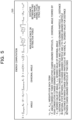
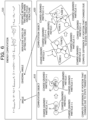
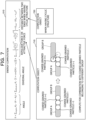
  • FIGs. 6 and 7 are first and second diagrams illustrating details of each term of the energy computation process.
  • the stable structure search system when computing the energy according to the angle between the coarse-grained particles, treats the difference in energy values caused along with moving the positions of the coarse-grained particles, as a computation object.
  • the angle around the i-1-th coarse-grained particle, the angle around the i-2-th coarse-grained particle,..., and the like do not change between before and after the i+1-th coarse-grained particle moves and are therefore not included in the computation of the energy according to the angle between the coarse-grained particles.
  • the i+2-th and subsequent coarse-grained particles each move in parallel while maintaining the angles when the i+1-th coarse-grained particle moves.
  • the angle around the i+1-th coarse-grained particle, the angle around the i+2-th coarse-grained particle,..., and the like do not change between before and after the i+1-th coarse-grained particle moves and are therefore not included in the computation of the energy according to the angle between the coarse-grained particles.
  • the stable structure search system when computing the energy according to the dihedral angle between the coarse-grained particles, treats the difference in energy values caused along with moving the positions of the coarse-grained particles, as a computation object.
  • the energy according to the difference ( ⁇ - ⁇ ') between ⁇ the dihedral angle ⁇ formed between a plane A formed by the i-2-th to i-th coarse-grained particles and a plane B formed by the i-1-th to i+1-th coarse-grained particles before the i+1-th coarse-grained particle moves, and ⁇ the dihedral angle ⁇ ' formed between the plane A formed by the i-2-th to i-th coarse-grained particles and a plane B' formed by the i-1-th to i+1-th coarse-grained particles after the i+1-th coarse-grained particle moves is computed as the energy according to the dihedral angle between the coarse-grained particles.
  • the dihedral angle formed between the plane formed by the i-3-th to i-1-th coarse-grained particles and the plane formed by the i-2-th to i-th coarse-grained particles, and the like do not change between before and after the i+1-th coarse-grained particle moves. For this reason, these dihedral angles are not included in the computation of the energy according to the dihedral angle between the coarse-grained particles.
  • the i+2-th and subsequent coarse-grained particles each move in parallel while maintaining the angles when the i+1-th coarse-grained particle moves.
  • the dihedral angle formed between the plane formed by the i-1-th to i+1-th coarse-grained particles and the plane formed by the i-th to i+2-th coarse-grained particles, and the like do not change between before and after the i+1-th coarse-grained particle moves. For this reason, these dihedral angles are not included in the computation of the energy according to the dihedral angle between the coarse-grained particles.
  • the stable structure search system when computing the energy according to the repulsive force or the attractive force between coarse-grained particles, treats all combinations constituted among coarse-grained particles belonging to different groups from each other, as computation objects. In other words, the repulsive force or the attractive force between the coarse-grained particles belonging to the same group is not included in the energy computation.
  • the energy according to the repulsive force or the attractive force between the coarse-grained particles belonging to the group A does not change between before and after the i+1-th coarse-grained particle moves and is therefore not included in the computation of the energy according to the repulsive force or the attractive force between the coarse-grained particles.
  • the repulsive force or the attractive force between the coarse-grained particles belonging to the group B does not change between before and after the i+1-th coarse-grained particle moves. For this reason, this repulsive force or attractive force is not included in the computation of the energy according to the repulsive force or the attractive force between the coarse-grained particles.
  • the energy according to the distance between the coarse-grained particles at the two ends when having a cyclic structure is normally computed every time the i+1-th coarse-grained particle moves (is not excluded from the computation object when the coarse-grained model has a cyclic structure).
  • FIG. 8 is a diagram illustrating an example of the system configuration of the stable structure search system and the functional configuration of a terminal device.
  • FIG. 9 is a diagram illustrating an example of the system configuration of the stable structure search system and the functional configuration of an Ising device.
  • a stable structure search system 800 includes a terminal device 810 and an Ising device 820.
  • a stable structure search instruction program is installed in the terminal device 810, and when the program is executed, the terminal device 810 functions as a state variable input unit 811, an energy model input unit 812, a search instruction unit 813, and an execution instruction unit 814.
  • the state variable input unit 811 accepts input of the coarse-grained model in an initial state (reference sign 210), which is a search object for a stable structure. Note that the state variable input unit 811 specifies the coarse-grained model (reference sign 210) by accepting settings for the number of amino acid residues N (N is an integer equal to or greater than two) and the amino acid residue sequence. In addition, the state variable input unit 811 assigns the initial state of the coarse-grained model (reference sign 210) by randomly designating N-1 state variables.
  • the state variable input unit 811 also accepts input of relative coordinates (reference sign 420) for representing the state variables. Note that the execution instruction unit 814 is notified of the coarse-grained model in the initial state (reference sign 210) and the relative coordinates (reference sign 420) whose input has been accepted by the state variable input unit 811.
  • the energy model input unit 812 accepts input of a computation formula (reference sign 510) used when executing the energy computation process based on the interaction between the coarse-grained particles. Note that the execution instruction unit 814 is notified of the computation formula (reference sign 510) whose input has been accepted by the energy model input unit 812.
  • the search instruction unit 813 accepts input of the number of searches when searching for a stable structure or variables to be searched for, for the coarse-grained model (reference sign 210).
  • the here mentioned number of searches or variables to be searched for are equivalent to the number of updates of the state variables in the Ising device 820.
  • the execution instruction unit 814 is notified of the number of searches or the variables to be searched for, of which input has been accepted by the search instruction unit 813.
  • the execution instruction unit 814 instructs the Ising device 820 to search for a stable structure, based on each piece of information notified by the state variable input unit 811, the energy model input unit 812, and the search instruction unit 813.
  • ⁇ the search object the coarse-grained model (reference sign 210)
  • ⁇ the initial state of the coarse-grained model the state variables designated at random
  • ⁇ the state variable representation method relative coordinates (reference sign 420)
  • ⁇ the energy computation method during the search process the computation formula (reference sign 510)
  • the execution instruction unit 814 issues a search instruction to the Ising device 820.
  • the execution instruction unit 814 receives a search result from the Ising device 820.
  • the search result received by the execution instruction unit 814 includes the computation result for the minimum energy and the state variables at that time. This allows the execution instruction unit 814 to output a stable structure for the coarse-grained model (reference sign 210) and the energy based on the interaction between the coarse-grained particles of the coarse-grained model (reference sign 220) in the stable structure.
  • the stable structure search program is installed in the Ising device 820, and when the program is executed, the Ising device 820 functions as a search unit 910, an optimal solution specifying unit 920, a state conversion unit 930, and an energy computation unit 940.
  • the search unit 910 searches for a stable structure for the coarse-grained model (reference sign 210) based on the search instruction from the terminal device 810 and transmits the search result to the terminal device 810. Specifically, the search unit 910 updates (alters) the state variables of the coarse-grained model (reference sign 210) within the range of the instructed number of searches (or variables to be searched for). In addition, the search unit 910 determines whether or not the transition is permitted, based on the energy value calculated every time a state variable is updated and the state of the coarse-grained model is transitioned. In addition, the search unit 910 transmits the minimum energy value specified from among the energy values determined that the transition is permitted, and the state variables at that time, to the terminal device 810 as a search result.
  • the example in FIG. 9 illustrates how the search unit 910 notifies the optimal solution specifying unit 920 of the energy values computed by the energy computation unit 940 for the current state variables ([0, 1, 9, 6]).
  • the example in FIG. 9 also illustrates how the search unit 910 updates the state variables from [0, 1, 9, 6] to [0, 1, 4, 6] and notifies the optimal solution specifying unit 920 and the state conversion unit 930 of the updated state variables.
  • the optimal solution specifying unit 920 is an example of a specifying unit.
  • the optimal solution specifying unit 920 compares the energy value stored in an energy value storage unit 950 every time the energy value is notified by the search unit 910 and, when the notified energy value is smaller, stores the notified energy value in the energy value storage unit 950. This allows the optimal solution specifying unit 920 to specify the minimum energy value.
  • the optimal solution specifying unit 920 holds the updated state variables every time the updated state variables are notified by the search unit 910 and, when the corresponding energy value is notified by the search unit 910 and the corresponding energy value is stored in the energy value storage unit 950, stores the held state variables in a state variable storage unit 960. This allows the optimal solution specifying unit 920 to specify the state variables corresponding to the minimum energy value.
  • the state conversion unit 930 is an example of a calculation unit and, every time the updated state variables are notified by the search unit 910, refers to a relative coordinate storage unit 970 to calculate the coordinates of each coarse-grained particle of the coarse-grained model after the state transition. Note that it is assumed that the relative coordinates transmitted along with the search instruction from the terminal device 810 have been stored in the relative coordinate storage unit 970.
  • the energy computation unit 940 is notified of the coordinates of each coarse-grained particle of the coarse-grained model after the state transition calculated by the state conversion unit 930.
  • the energy computation unit 940 executes the energy computation process every time the coordinates of each coarse-grained particle of the coarse-grained model after the state transition are notified by the state conversion unit 930. Specifically, the energy computation unit 940 computes the energy values for the computation objects described with reference to FIGs. 6 and 7 , based on the computation formula (reference sign 510) transmitted along with the search instruction from the terminal device 810. Note that the search unit 910 is notified of the energy values computed by the energy computation unit 940, and by handling the updated state variables ([0, 1, 4, 6]) as the state variables before update, the search unit 910 performs the following search.
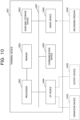
  • FIG. 10 is a diagram illustrating an example of the hardware configuration of the terminal device.
  • the terminal device 810 includes a processor 1001, a memory 1002, an auxiliary storage device 1003, an interface (I/F) device 1004, a communication device 1005, and a drive device 1006.
  • the processor 1001, the auxiliary storage device 1003, the I/F device 1004, the communication device 1005, and the drive device 1006 of the terminal device 810 are coupled to each other via a bus 1007.
  • the processor 1001 includes various arithmetic devices such as a central processing unit (CPU) and a graphics processing unit (GPU).
  • the processor 1001 reads various programs (such as the stable structure search instruction program as an example) into the memory 1002 to execute the read various programs.
  • the memory 1002 includes a main storage device such as a read only memory (ROM) or a random access memory (RAM).
  • the processor 1001 and the memory 1002 form a so-called computer.
  • the processor 1001 executes various programs read into the memory 1002 to cause the computer to implement the above various functions.
  • the auxiliary storage device 1003 stores various programs and various sorts of information used when the various programs are executed by the processor 1001.
  • the I/F device 1004 is a coupling device that couples an operation device 1010 and an output device 1020, which are examples of external devices, with the terminal device 810.
  • the communication device 1005 is a communication device for communicating with the Ising device 820 via a network.
  • the drive device 1006 is a device for setting a recording medium 1030.
  • the recording medium 1030 mentioned here includes a medium that optically, electrically, or magnetically records information, such as a compact disc read only memory (CD-ROM), a flexible disk, or a magneto-optical disk.
  • the recording medium 1030 may include a semiconductor memory or the like that electrically records information, such as a ROM or a flash memory.
  • various programs installed in the auxiliary storage device 1003 are installed, for example, by setting the distributed recording medium 1030 in the drive device 1006 and reading various programs recorded in the recording medium 1030.
  • various programs installed in the auxiliary storage device 1003 may be installed by being downloaded from a network via the communication device 1005.
  • the hardware configuration of the Ising device 820 may be similar to the hardware configuration of the terminal device 810, for example.
  • the hardware configuration of the Ising device 820 may be similar to the hardware configuration of a so-called quantum computer.
  • FIG. 11 is a flowchart illustrating a flow of the stable structure search process.
  • step S1101 the terminal device 810 specifies a coarse-grained model as a search object for a stable structure, by accepting settings for the number of amino acid residues N (N is an integer equal to or greater than two) and the amino acid residue sequence.
  • step S1102 the terminal device 810 randomly designates the initial state for the coarse-grained model with the N coarse-grained particles. Specifically, the terminal device 810 randomly designates N-1 state variables.
  • the terminal device 810 accepts input of relative coordinates for representing the state variables.
  • the terminal device 810 also accepts input of the computation formula used for the energy computation process during the search process.
  • the terminal device 810 accepts the number of searches or the variables to be searched for, as the number of updates of the state variables during the search process.
  • the terminal device 810 transmits the search instruction to the Ising device 820 to cause the Ising device 820 to search for a stable structure of the coarse-grained model, based on each piece of the accepted information.
  • step S1104 the Ising device 820 executes the search process. Note that details of the search process by the Ising device 820 will be described later.
  • step S1105 the terminal device 810 receives the search result from the Ising device 820 and outputs the computation result for the minimum energy value for the coarse-grained model as a search object, and the state variables at that time.
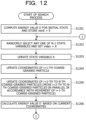
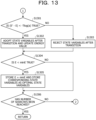
  • FIGs. 12 and 13 are first and second flowcharts illustrating details of the search process.
  • step S1201 in FIG. 12 the Ising device 820 computes the energy value for the coarse-grained model (reference sign 210) in the initial state and stores the computed energy value as the minimum energy value (minE) at the current time point.
  • step S1203 the Ising device 820 updates the state variable X.
  • the coarse-grained particle that moves due to updating the state variable X is assumed to be the i+1-th coarse-grained particle.
  • step S1204 the Ising device 820 calculates the coordinates of the i+1-th coarse-grained particle. Specifically, the Ising device 820 calculates the coordinates of the i+1-th coarse-grained particle by adding the relative coordinates corresponding to the state variable X to the coordinates of the i-th coarse-grained particle.
  • step S1205 the Ising device 820 updates the coordinates of the i+2-th to N-th coarse-grained particles. Specifically, the Ising device 820 updates the coordinates of the i+2-th to N-th coarse-grained particles, by moving the i+2-th to N-th coarse-grained particles in parallel in accordance with the movement of the i+1-th coarse-grained particle.
  • step S1206 the Ising device 820 computes the energy value E' based on the coordinates of each coarse-grained particle of the coarse-grained model after transition, of which the state has transitioned due to updating the state variable X.
  • the Ising device 820 calculates the difference between the energy value E stored as the minimum energy value (minE) at the current time point and the energy value E' computed in step S1206. In addition, the Ising device 820 determines whether or not the calculated difference is less than a predetermined thermal noise (-Tlog(a) in the example in FIG. 13 ). Note that a denotes a uniform random number and is a value that satisfies a ⁇ [0, 1].
  • step S1301 When it is determined in step S1301 that the calculated difference is less than the predetermined thermal noise (-Tlog(a)) (in the case of YES in step S1301), the process proceeds to step S1302.
  • step S1302 the Ising device 820 determines that transition is permitted and adopts the updated state variables, while updating the energy value (replacing the energy value E with the energy value E').
  • step S1301 when it is determined in step S1301 that the calculated difference is equal to or greater than the predetermined thermal noise (-Tlog(a)) (in the case of NO in step S1301), the process proceeds to step S1303.
  • step S1303 the Ising device 820 determines that transition is not permitted and rejects the updated state variables.
  • step S1304 the Ising device 820 determines whether or not the energy value E is smaller than the minimum energy value (minE). When it is determined in step S1304 that the energy value E is smaller than the minimum energy value (minE) (in the case of YES in step S1304), the process proceeds to step S1305.
  • step S1305 the Ising device 820 stores the energy value E as the minimum energy value (minE) at the current time point.
  • the Ising device 820 also stores the corresponding state variables as the optimal state variables at the current time point.
  • step S1304 when it is determined in step S1304 that the energy value E is equal to or greater than the minimum energy value (minE) (in the case of NO in step S1304), the process proceeds to step S1306.
  • step S1306 the Ising device 820 determines whether or not the number of updates of the state variables has reached the number of searches (or the variables to be searched for) transmitted along with the search instruction. When it is determined in step S1306 that the number of searches (or the variables to be searched for) has not been reached (in the case of NO in step S1306), the process returns to step S1202 in FIG. 12 .
  • step S1306 when it is determined in step S1306 that the number of searches (or the variables to be searched for) has been reached (in the case of YES in step S1306), the minimum energy value (minE) and the optimal state variables are transmitted to the terminal device 810 as a search result. Thereafter, the process returns to step S1105.
  • minE minimum energy value
  • FIG. 14 is a diagram illustrating an example of the effect of reduction in the amount of computation.
  • the "number of bits” denotes the number of bits involved in representing the coordinates of each coarse-grained particle.
  • total number of states denotes the number of combinations of coordinates that each coarse-grained particle included in the coarse-grained model can take.
  • the "RAM capacity” denotes the memory capacity involved during the energy computation process.
  • the amount of computation for each item is indicated for each of the case where the lattice space is a face-centered cubic and the case where the lattice space is a night walk.
  • the stable structure search system 800 according to the first embodiment may be enabled to greatly reduce each amount of computation during the stable structure search process.
  • the stable structure search system 800 according to the first embodiment may be enabled to greatly raise the number of coarse-grained particles N of the coarse-grained model as a search object, under the computer power in the current state.
  • the stable structure search system 800 calculates the coordinates in the lattice space of the i+1-th coarse-grained particle in the row, by using ⁇ the coordinates in the lattice space of the i-th coarse-grained particle in the row, and ⁇ state variables represented by relative coordinates in the lattice space of the i-th coarse-grained particle and the i+1-th coarse-grained particle.
  • the stable structure search system 800 repeatedly executes the process of computing the value of energy of the coarse-grained model, based on the coordinates in the lattice space of each of the N coarse-grained particles under the limited computation objects, every time the state variables are altered.
  • the state variables may be selected in a manner different than the selecting of the state variables at random.
  • the selection and update may be made in a predetermined order, such as sequentially selecting from the first state variable to the N-1-th state variable.
  • the weight of each term such as K ⁇ , K ⁇ , and Kend, is fixed in the computation formula (reference sign 510) used for the energy computation process.
  • the weight of each term may be altered, for example, according to the type of amino acid.
  • the stable structure search system 800 has been described as including the terminal device 810 and the Ising device 820.
  • the terminal device 810 and the Ising device 820 may form an integrated device.
  • the stable structure search program includes the stable structure search instruction program, and each functional unit of the terminal device 810 described with reference to FIG. 8 and each functional unit of the Ising device 820 described with reference to FIG. 9 are implemented in the Ising device 820.

Landscapes

  • Engineering & Computer Science (AREA)
  • Chemical & Material Sciences (AREA)
  • Life Sciences & Earth Sciences (AREA)
  • Bioinformatics & Cheminformatics (AREA)
  • Health & Medical Sciences (AREA)
  • Physics & Mathematics (AREA)
  • Theoretical Computer Science (AREA)
  • Crystallography & Structural Chemistry (AREA)
  • Spectroscopy & Molecular Physics (AREA)
  • Bioinformatics & Computational Biology (AREA)
  • General Health & Medical Sciences (AREA)
  • Medical Informatics (AREA)
  • Biotechnology (AREA)
  • Evolutionary Biology (AREA)
  • Biophysics (AREA)
  • Pharmacology & Pharmacy (AREA)
  • Medicinal Chemistry (AREA)
  • Computing Systems (AREA)
  • Bioethics (AREA)
  • Databases & Information Systems (AREA)
  • Management, Administration, Business Operations System, And Electronic Commerce (AREA)

Abstract

A stable structure search system including: a calculation unit that, in a model in which N particles (N is an integer equal to or greater than two) arranged in a shape of a row are arranged in a lattice space, calculates coordinates in the lattice space of an i+1-th particle in the row, by using the coordinates in the lattice space of an i-th particle in the row, and state variables represented by relative coordinates in the lattice space of the i-th particle and the i+1-th particle; a computation unit that computes a value of energy of the model, based on the coordinates in the lattice space of each of the N particles, every time the state variables are altered; and a specifying unit that specifies the state variables with which the value of the energy has a local minimum value.

Description

    FIELD
  • The embodiments discussed herein are related to a stable structure search system, a stable structure search method, and a stable structure search program.
  • BACKGROUND
  • In recent years, in the field of drug discovery, medium molecules (molecular weight 500 to 3000) with few side effects have attracted attention, and the development of a search method for searching for a stable structure of medium molecules is underway.
  • As one example, a method of searching for a stable structure in a coarse-grained model using interaction potentials between coarse-grained particles can be mentioned.
  • International Publication Pamphlet No. WO 2019/230303 , Japanese Laid-open Patent Publication No. 2020-194487 , Japanese Laid-open Patent Publication No. 2019-179304 , and Japanese Laid-open Patent Publication No. 2021-82165 are disclosed as related art.
  • SUMMARY TECHNICAL PROBLEM
  • However, in the case of the above method, when the number of coarse-grained particles becomes greater, the amount of computation increases, making it difficult to find a solution.
  • An object of one aspect is to reduce the amount of computation when searching for a stable structure of a coarse-grained model.
  • SOLUTION TO PROBLEM
  • According to an aspect of the embodiments, there is provided a stable structure search system including: a calculation unit that, in a model in which N particles (N is an integer equal to or greater than two) arranged in a shape of a row are arranged in a lattice space, calculates coordinates in the lattice space of an i+1-th particle in the row, by using the coordinates in the lattice space of an i-th particle in the row, and state variables represented by relative coordinates in the lattice space of the i-th particle and the i+1-th particle; a computation unit that computes a value of energy of the model, based on the coordinates in the lattice space of each of the N particles, every time the state variables are altered; and a specifying unit that specifies the state variables with which the value of the energy has a local minimum value.
  • ADVANTAGEOUS EFFECTS OF INVENTION
  • The amount of computation when searching for a stable structure of a coarse-grained model may be reduced.
  • BRIEF DESCRIPTION OF DRAWINGS
    • FIG. 1 is a diagram illustrating an application example of a stable structure search system;
    • FIG. 2 is a diagram illustrating an overview of a stable structure search process for a coarse-grained model;
    • FIGs. 3A and 3B are diagrams illustrating a representation method with relative coordinates;
    • FIGs. 4A and 4B are diagrams illustrating a specific example of state variables;
    • FIG. 5 is a diagram illustrating details of an energy computation process;
    • FIG. 6 is a first diagram illustrating details of each term of the energy computation process;
    • FIG. 7 is a second diagram illustrating details of each term of the energy computation process;
    • FIG. 8 is a diagram illustrating an example of the system configuration of a stable structure search system and the functional configuration of a terminal device;
    • FIG. 9 is a diagram illustrating an example of the system configuration of the stable structure search system and the functional configuration of an Ising device;
    • FIG. 10 is a diagram illustrating an example of the hardware configuration of the terminal device;
    • FIG. 11 is a flowchart illustrating a flow of the stable structure search process;
    • FIG. 12 is a first flowchart illustrating details of a search process;
    • FIG. 13 is a second flowchart illustrating details of the search process; and
    • FIG. 14 is a diagram illustrating an example of the effect of reduction in the amount of computation.
    DESCRIPTION OF EMBODIMENTS
  • Hereinafter, each embodiment will be described with reference to the accompanying drawings. Note that, in the present specification and the drawings, constituent elements having substantially the same functional configuration are given the same reference sign, and redundant description will be omitted.
  • [First Embodiment] <Application Example of Stable Structure Search System>
  • First, an application example of a stable structure search system according to a first embodiment will be described. FIG. 1 is a diagram illustrating an application example of the stable structure search system.
  • Commonly, in the field of drug discovery, the mainstream so far has been to use low-molecular-weight molecules. However, in the case of the low-molecular-weight molecules, a bind to proteins other than the target protein could easily happen, which has been likely to inhibit functions other than those intended. For this reason, in recent years, medium molecules with less side effects have attracted attention.
  • Meanwhile, in the case of medicine candidate medium molecules, the amount of computation is enormous when searching for a stable structure. Thus, the applicants of the present application have proceeded with the development of a search method for first narrowing down to specified medium molecules (for example, cyclic peptides) and then searching for a stable structure of the narrowed-down medium molecules in the following distinct two phases.
  • The first phase is a phase to generate a coarse-grained model (an example of a model) by representing (coarse-graining) an amino acid molecule with one particle and to search for a stable structure of the coarse-grained model. Note that the stable structure search system according to the first embodiment is a system applied to the first phase indicated by the dotted line frame in FIG. 1 and is a system that achieves a reduction in the amount of computation when searching for a stable structure of the coarse-grained model.
  • The second phase is a phase to search for a stable structure with all atoms based on the coarse-grained model having the stable structure found by the search and to additionally verify the drug efficacy based on the all-atom model having the stable structure found by the search.
  • Note that, when the preferred drug efficacy is not obtained in the second phase, a search for a further stable structure is made for the coarse-grained model by returning to the first phase. The above cycle is repeatedly performed until the preferred drug efficacy is obtained, and when the preferred drug efficacy is obtained, a medium molecule medicine will be synthesized based on the all-atom model having the stable structure at that time and activity evaluations and the like (so-called wet experiments) will be conducted by, for example, a pharmaceutical manufacturer.
  • The stable structure search system according to the first embodiment, which will be described in detail below, is a system applied to the first phase of such a comprehensive flow of medium molecule drug discovery.
  • <Overview of Stable Structure Search Process for Coarse-Grained Model>
  • Next, an overview of a search process for a stable structure of a coarse-grained model by the stable structure search system according to the first embodiment will be described. FIG. 2 is a diagram illustrating an overview of the stable structure search process for a coarse-grained model.
  • In the stable structure search system according to the first embodiment, as an amino acid molecule coupled in a linear chain, · a skeleton portion centered on the α-carbon of an amino acid forming a main chain particle of a peptide, and · a side chain particle are each replaced by one particle that is coarse-grained (coarse-grained particle), and · the replaced coarse-grained particles are arranged in a row shape in, for example, a face-centered cubic (FCC) space (lattice space) to thereby generate a coarse-grained model including a plurality of coarse-grained particles, and a search for a stable structure of the generated coarse-grained model is made as a combinatorial optimization problem using an Ising device.
  • In FIG. 2, the reference sign 210 schematically illustrates a coarse-grained model in an initial state, in which a plurality of coarse-grained particles (five coarse-grained particles in the example in FIG. 2) arranged in a face-centered cubic (FCC) space (lattice space). Note that, in the example in FIG. 2, the space of the face-centered cubic is represented by a two-dimensional plane for simplification of illustration.
  • As illustrated in FIG. 2, in the stable structure search system according to the first embodiment, when searching for a stable structure of the coarse-grained model (reference sign 210), the state transition of the coarse-grained model is repeated by moving the position of each coarse-grained particle in the space of the face-centered cubic. Then, in the stable structure search system according to the first embodiment, in the course of repeating the state transition, · transition permissibility (also referred to as alterability) is determined every time based on the difference between the energy value before the transition and the energy value after the transition, and · the minimum energy value (more precisely, the energy value having a local minimum value) is specified from among the energy values after transition (after alteration) determined that the transition is permitted (to be alterable). This is how the stable structure search system according to the first embodiment searches for a coarse-grained model (reference sign 220) having a stable structure.
  • Specifically, the stable structure search system according to the first embodiment uses the Markov-Chain Monte Carlo (MCMC) to · determine that the transition is permitted when the energy value after the transition is smaller than the energy value before the transition, and · determine that the transition is permitted when the difference between the energy value after the transition and the energy value before the transition is smaller than a predetermined thermal noise even when the energy value after the transition is greater than the energy value before the transition (that is, determine that the transition is permitted when a predetermined condition is satisfied), thereby specifying the minimum energy value without falling into a local solution.
  • In addition, by repeating the state transition of the coarse-grained model using the parallel tempering (PT), the stable structure search system according to the first embodiment efficiently specifies the minimum energy value.
  • Besides, the stable structure search system according to the first embodiment · calculates the coordinates of the i+1-th coarse-grained particle in a row among a plurality of coarse-grained particles arranged in the row shape, using a state variable represented by coordinates relative to the coordinates of the i-th coarse-grained particle in the row, and · computes the energy value based on the interaction between the coarse-grained particles, based on the coordinates of each coarse-grained particle calculated using the state variable, thereby specifying the minimum energy value with a small amount of computation (details will be described later). The "state variable" mentioned here is a variable for specifying the state of the coarse-grained model (the coordinates of each coarse-grained particle of the coarse-grained model).
  • Note that, in FIG. 2, the reference sign 220 schematically illustrates a stable structure of the coarse-grained model found by the search in response to the minimum energy value specified by the stable structure search system according to the first embodiment. However, as with the reference sign 210, the reference sign 220 represents the space of the face-centered cubic in a two-dimensional plane for simplification of illustration.
  • <Advantages of Representing State Variables by Relative Coordinates>
  • As described above, in the stable structure search system according to the first embodiment, the coordinates of the i+1-th coarse-grained particle are calculated using a state variable represented by coordinates relative to the coordinates of the i-th coarse-grained particle. Thus, in the following, the advantages of representing state variables by relative coordinates will be described.
  • FIGs. 3A and 3B are diagrams illustrating a representation method with relative coordinates. Note that, in the example in FIGs. 3A and 3B, the space of the face-centered cubic is represented by a two-dimensional plane for simplification of description.
  • Among them, FIG. 3A illustrates, as a comparative example, a case where state variables are represented by absolute coordinates. As illustrated in FIG. 3A, when the position of the first coarse-grained particle included in the coarse-grained model is designated, the second coarse-grained particle has four different candidate positions adjacent to the first coarse-grained particle.
  • In addition, the third coarse-grained particle has eight different candidate positions adjacent to each of the candidate positions of the second coarse-grained particle. Furthermore, the fourth coarse-grained particle has 16 different candidate positions adjacent to each of the candidate positions of the third coarse-grained particle.
  • In this manner, when trying to specify the coordinates of each coarse-grained particle using a state variable represented by absolute coordinates, since the number of candidate positions of the coarse-grained particles is expanded as the number of coarse-grained particles included in the coarse-grained model becomes greater, the number of bits of the state variables increases.
  • Meanwhile, FIG. 3B illustrates a case where the state variables are represented by relative coordinates. As illustrated in FIG. 3B, when the position of the first coarse-grained particle included in the coarse-grained model is designated, the second coarse-grained particle has four different candidate positions adjacent to the first coarse-grained particle.
  • In addition, when the position of the second coarse-grained particle included in the coarse-grained model is designated, the third coarse-grained particle has three different candidate positions adjacent to the candidate position of the second coarse-grained particle. Furthermore, when the position of the third coarse-grained particle included in the coarse-grained model is designated, the fourth coarse-grained particle has three different candidate positions adjacent to the candidate position of the third coarse-grained particle.
  • In this manner, when the coordinates of each coarse-grained particle are specified using a state variable represented by relative coordinates, since the number of candidate positions of the i+1-th coarse-grained particle is unchanged regardless of the number of coarse-grained particles included in the coarse-grained model, the number of bits of the state variables is also not expanded.
  • That is, when the state variables are represented by relative coordinates as illustrated in FIG. 3B, there is an advantage that the number of bits of the state variables may be reduced.
  • <Specific Examples of State Variables>
  • Next, a specific example of state variables represented by relative coordinates will be described. FIGs. 4A and 4B are diagrams illustrating a specific example of state variables.
  • As illustrated in FIG. 4A, it is assumed that the center position of a face-centered cubic (FCC) 410 is the origin (coordinates = (0, 0, 0)) and the i-th coarse-grained particle is located at the origin. In this case, the i+1-th coarse-grained particle has 12 different positions adjacent to the i-th coarse-grained particle (refer to <0> to <11>). Then, the relative coordinates of the 12 coarse-grained particles from the origin may be as follows:
    • Relative Coordinates of Position of <0>: (-1, -1, 0)
    • Relative Coordinates of Position of <1>: (-1, 1, 0)
    • Relative Coordinates of Position of < 2>: (1, -1, 0)
    • Relative Coordinates of Position of <3>: (1, 1, 0)
    • Relative Coordinates of Position of <4>: (-1, 0, -1)
    • Relative Coordinates of Position of <5>: (-1, 0, 1)
    • Relative Coordinates of Position of <6>: (1, 0, -1)
    • Relative Coordinates of Position of <7>: (0, -1, -1)
    • Relative Coordinates of Position of <8>: (0, -1, -1)
    • Relative Coordinates of Position of <9>: (0, -1, 1)
    • Relative Coordinates of Position of <10>: (0, 1, -1)
    • Relative Coordinates of Position of <11>: (0, 1, 1)
  • That is, the coordinates of the i+1-th coarse-grained particle adjacent to the i-th coarse-grained particle will be assigned to any one set of the above 12 different sets of relative coordinates (refer to the reference sign 420).
  • As an example, FIG. 4B illustrates an example in which the coordinates of each coarse-grained particle in a coarse-grained model including eight coarse-grained particles are calculated using state variables represented by relative coordinates. Specifically, when the coordinates of the zeroth coarse-grained particle are assumed as the origin (coordinates = (0, 0, 0)) and the state variables = [0, 1, 4, 6, 3, 2, 7] is assumed, examples of calculating may be as follows:
    • · the coordinates of the first coarse-grained particle = the coordinates of the zeroth coarse-grained particle + the relative coordinates of the position of <0>;
    • · the coordinates of the second coarse-grained particle = the coordinates of the first coarse-grained particle + the relative coordinates of the position of <1>;
    • · the coordinates of the third coarse-grained particle = the coordinates of the second coarse-grained particle + the relative coordinates of the position of <4>;
    • · the coordinates of the fourth coarse-grained particle = the coordinates of the third coarse-grained particle + the relative coordinates of the position of <6>;
    • · the coordinates of the fifth coarse-grained particle = the coordinates of the fourth coarse-grained particle + the relative coordinates of the position of <3>;
    • · the coordinates of the sixth coarse-grained particle = the coordinates of the fifth coarse-grained particle + the relative coordinates of the position of <2>; and
    • · the coordinates of the seventh coarse-grained particle = the coordinates of the sixth coarse-grained particle + the relative coordinates of the position of <7>.
    <Details of Energy Computation Process>
  • Next, details of an energy computation process based on the interaction between coarse-grained particles, which is executed by the stable structure search system according to the first embodiment when searching for a stable structure of the coarse-grained model, will be described. FIG. 5 is a diagram illustrating details of the energy computation process.
  • As illustrated in FIG. 5, the energy computation process (refer to the reference sign 510) executed when searching for a stable structure of the coarse-grained model includes the computation process for, as energy based on the interaction between the coarse-grained particles, · energy according to the angle between the coarse-grained particles, · energy according to the dihedral angle between the coarse-grained particles, · energy according to the repulsive force or the attractive force between the coarse-grained particles, and · energy according to the distance between the coarse-grained particles at two ends when having a cyclic structure, and is expressed by formula 1 below.
    [Mathematical Formula 1] E = angles K θ θ θ 0 + dihedral K τ 1 + cos N τ τ 0 + i < j 3 5 σ ij r ij 12 6 σ ij r ij 10 + K end R th r 1 N 4
    Figure imgb0001
  • Note that, in above formula 1, Kθ, Kτ, and Kend denote weights for each term. In addition, in above formula 1, θ denotes the angle formed by three consecutive coarse-grained particles from the i-1-th to the i+1-th, and τ denotes the dihedral angle formed by four consecutive coarse-grained particles from the i-2-th to the i+1-th. In addition, θ0 denotes the desired value of the angle, and τ0 denotes the desired value of the dihedral angle. In addition, rij denotes the distance between the i-th coarse-grained particle and the j-th coarse-grained particle, and oij denotes the distance in a natural state between the i-th coarse-grained particle and the j-th coarse-grained particle. Furthermore, r1N denotes the distance between the coarse-grained particles at the two ends, and Rth denotes the desired value of the distance between the coarse-grained particles at the two ends.
  • Here, in executing the above energy computation process, the stable structure search system according to the first embodiment treats the difference in energy values caused along with moving the position of each coarse-grained particle, as a computation object. This enables the stable structure search system according to the first embodiment to reduce the amount of computation for the energy computation process.
  • FIGs. 6 and 7 are first and second diagrams illustrating details of each term of the energy computation process. As indicated by the reference sign 610 in FIG. 6, when computing the energy according to the angle between the coarse-grained particles, the stable structure search system according to the first embodiment treats the difference in energy values caused along with moving the positions of the coarse-grained particles, as a computation object.
  • Specifically, when the state of the coarse-grained model has transitioned due to the movement of the i+1-th coarse-grained particle relative to the i-th coarse-grained particle, the energy according to the difference (= θ-θ') between · the angle θ formed between the i-1-th coarse-grained particle, the i-th coarse-grained particle, and the i+1-th coarse-grained particle before the i+1-th coarse-grained particle moves (the angle θ around the i-th coarse-grained particle before the i+1-th coarse-grained particle moves), and · the angle θ' formed between the i-1-th coarse-grained particle, the i-th coarse-grained particle, and the i+1-th coarse-grained particle after the i+1-th coarse-grained particle moves (the angle θ' around the i-th coarse-grained particle after the i+1-th coarse-grained particle moves) is computed as the energy according to the angle between the coarse-grained particles. In other words, the angle around the i-1-th coarse-grained particle, the angle around the i-2-th coarse-grained particle,..., and the like do not change between before and after the i+1-th coarse-grained particle moves and are therefore not included in the computation of the energy according to the angle between the coarse-grained particles. In addition, the i+2-th and subsequent coarse-grained particles each move in parallel while maintaining the angles when the i+1-th coarse-grained particle moves. That is, the angle around the i+1-th coarse-grained particle, the angle around the i+2-th coarse-grained particle,..., and the like do not change between before and after the i+1-th coarse-grained particle moves and are therefore not included in the computation of the energy according to the angle between the coarse-grained particles.
  • Similarly, as indicated by the reference sign 620 in FIG. 6, when computing the energy according to the dihedral angle between the coarse-grained particles, the stable structure search system according to the first embodiment treats the difference in energy values caused along with moving the positions of the coarse-grained particles, as a computation object.
  • Specifically, when the state of the coarse-grained model has transitioned due to the movement of the i+1-th coarse-grained particle relative to the i-th coarse-grained particle, the energy according to the difference (= τ-τ') between · the dihedral angle τ formed between a plane A formed by the i-2-th to i-th coarse-grained particles and a plane B formed by the i-1-th to i+1-th coarse-grained particles before the i+1-th coarse-grained particle moves, and · the dihedral angle τ' formed between the plane A formed by the i-2-th to i-th coarse-grained particles and a plane B' formed by the i-1-th to i+1-th coarse-grained particles after the i+1-th coarse-grained particle moves is computed as the energy according to the dihedral angle between the coarse-grained particles. In other words, the dihedral angle formed between the plane formed by the i-3-th to i-1-th coarse-grained particles and the plane formed by the i-2-th to i-th coarse-grained particles, and the like do not change between before and after the i+1-th coarse-grained particle moves. For this reason, these dihedral angles are not included in the computation of the energy according to the dihedral angle between the coarse-grained particles. In addition, the i+2-th and subsequent coarse-grained particles each move in parallel while maintaining the angles when the i+1-th coarse-grained particle moves. That is, the dihedral angle formed between the plane formed by the i-1-th to i+1-th coarse-grained particles and the plane formed by the i-th to i+2-th coarse-grained particles, and the like do not change between before and after the i+1-th coarse-grained particle moves. For this reason, these dihedral angles are not included in the computation of the energy according to the dihedral angle between the coarse-grained particles.
  • In addition, as indicated by the reference sign 710 in FIG. 7, when computing the energy according to the repulsive force or the attractive force between coarse-grained particles, the stable structure search system according to the first embodiment treats all combinations constituted among coarse-grained particles belonging to different groups from each other, as computation objects. In other words, the repulsive force or the attractive force between the coarse-grained particles belonging to the same group is not included in the energy computation.
  • Specifically, when the state of the coarse-grained model has transitioned due to the movement of the i+1-th coarse-grained particle relative to the i-th coarse-grained particle, the energy according to the difference between · the repulsive force or the attractive force computed for all combinations among respective coarse-grained particles separately belonging to a group A (the group to which each of i-th and preceding coarse-grained particles belongs) and a group B (the group to which each of i+1-th and subsequent coarse-grained particles belongs) before the i+1-th coarse-grained particle moves, and · the repulsive force or the attractive force computed for all combinations among respective coarse-grained particle separately belonging to the group A (the group to which each of i-th and preceding coarse-grained particle belongs) and the group B (the group to which each of i+1-th and subsequent coarse-grained particles belongs) after the i+1-th coarse-grained particle moves are computed as the energy according to the repulsive force or the attractive force between the coarse-grained particles. In other words, the energy according to the repulsive force or the attractive force between the coarse-grained particles belonging to the group A does not change between before and after the i+1-th coarse-grained particle moves and is therefore not included in the computation of the energy according to the repulsive force or the attractive force between the coarse-grained particles. In addition, since each coarse-grained particle belonging to the group B moves in parallel while maintaining the distance when the i+1-th coarse-grained particle moves, the repulsive force or the attractive force between the coarse-grained particles belonging to the group B does not change between before and after the i+1-th coarse-grained particle moves. For this reason, this repulsive force or attractive force is not included in the computation of the energy according to the repulsive force or the attractive force between the coarse-grained particles.
  • Note that, as indicated by the reference sign 720 in FIG. 7, in a case where the coarse-grained model has a cyclic structure, when the state of the coarse-grained model transitions due to the movement of the i+1-th coarse-grained particle relative to the i-th coarse-grained particle, the distance between the coarse-grained particles at the two ends regularly changes.
  • For this reason, the energy according to the distance between the coarse-grained particles at the two ends when having a cyclic structure is normally computed every time the i+1-th coarse-grained particle moves (is not excluded from the computation object when the coarse-grained model has a cyclic structure).
  • <System Configuration of Stable Structure Search System and Functional Configuration of Each Device>
  • Next, a system configuration of the stable structure search system according to the first embodiment and a functional configuration of each device will be described with reference to FIGs. 8 and 9. FIG. 8 is a diagram illustrating an example of the system configuration of the stable structure search system and the functional configuration of a terminal device. In addition, FIG. 9 is a diagram illustrating an example of the system configuration of the stable structure search system and the functional configuration of an Ising device.
  • System Configuration of Stable Structure Search System and Functional Configuration of Terminal Device
  • As illustrated in FIG. 8, a stable structure search system 800 according to the first embodiment includes a terminal device 810 and an Ising device 820.
  • A stable structure search instruction program is installed in the terminal device 810, and when the program is executed, the terminal device 810 functions as a state variable input unit 811, an energy model input unit 812, a search instruction unit 813, and an execution instruction unit 814.
  • The state variable input unit 811 accepts input of the coarse-grained model in an initial state (reference sign 210), which is a search object for a stable structure. Note that the state variable input unit 811 specifies the coarse-grained model (reference sign 210) by accepting settings for the number of amino acid residues N (N is an integer equal to or greater than two) and the amino acid residue sequence. In addition, the state variable input unit 811 assigns the initial state of the coarse-grained model (reference sign 210) by randomly designating N-1 state variables.
  • The state variable input unit 811 also accepts input of relative coordinates (reference sign 420) for representing the state variables. Note that the execution instruction unit 814 is notified of the coarse-grained model in the initial state (reference sign 210) and the relative coordinates (reference sign 420) whose input has been accepted by the state variable input unit 811.
  • The energy model input unit 812 accepts input of a computation formula (reference sign 510) used when executing the energy computation process based on the interaction between the coarse-grained particles. Note that the execution instruction unit 814 is notified of the computation formula (reference sign 510) whose input has been accepted by the energy model input unit 812.
  • The search instruction unit 813 accepts input of the number of searches when searching for a stable structure or variables to be searched for, for the coarse-grained model (reference sign 210). The here mentioned number of searches or variables to be searched for are equivalent to the number of updates of the state variables in the Ising device 820. Note that the execution instruction unit 814 is notified of the number of searches or the variables to be searched for, of which input has been accepted by the search instruction unit 813.
  • The execution instruction unit 814 instructs the Ising device 820 to search for a stable structure, based on each piece of information notified by the state variable input unit 811, the energy model input unit 812, and the search instruction unit 813. Note that, by transmitting · the search object: the coarse-grained model (reference sign 210), · the initial state of the coarse-grained model: the state variables designated at random, · the state variable representation method: relative coordinates (reference sign 420), · the energy computation method during the search process: the computation formula (reference sign 510), and · the number of updates of the state variables during the search process: the number of searches or the variables to be searched for, the execution instruction unit 814 issues a search instruction to the Ising device 820.
  • In addition, by issuing the search instruction to the Ising device 820, the execution instruction unit 814 receives a search result from the Ising device 820. The search result received by the execution instruction unit 814 includes the computation result for the minimum energy and the state variables at that time. This allows the execution instruction unit 814 to output a stable structure for the coarse-grained model (reference sign 210) and the energy based on the interaction between the coarse-grained particles of the coarse-grained model (reference sign 220) in the stable structure.
  • (2) System Configuration of Stable Structure Search System and Functional Configuration of Ising Device
  • Subsequently, a functional configuration of the Ising device 820 will be described with reference to FIG. 9 (since the system configuration of the stable structure search system 800 has already been described with reference to FIG. 8, description thereof will be omitted here).
  • The stable structure search program is installed in the Ising device 820, and when the program is executed, the Ising device 820 functions as a search unit 910, an optimal solution specifying unit 920, a state conversion unit 930, and an energy computation unit 940.
  • The search unit 910 searches for a stable structure for the coarse-grained model (reference sign 210) based on the search instruction from the terminal device 810 and transmits the search result to the terminal device 810. Specifically, the search unit 910 updates (alters) the state variables of the coarse-grained model (reference sign 210) within the range of the instructed number of searches (or variables to be searched for). In addition, the search unit 910 determines whether or not the transition is permitted, based on the energy value calculated every time a state variable is updated and the state of the coarse-grained model is transitioned. In addition, the search unit 910 transmits the minimum energy value specified from among the energy values determined that the transition is permitted, and the state variables at that time, to the terminal device 810 as a search result.
  • The example in FIG. 9 illustrates how the search unit 910 notifies the optimal solution specifying unit 920 of the energy values computed by the energy computation unit 940 for the current state variables ([0, 1, 9, 6]). The example in FIG. 9 also illustrates how the search unit 910 updates the state variables from [0, 1, 9, 6] to [0, 1, 4, 6] and notifies the optimal solution specifying unit 920 and the state conversion unit 930 of the updated state variables.
  • The optimal solution specifying unit 920 is an example of a specifying unit. The optimal solution specifying unit 920 compares the energy value stored in an energy value storage unit 950 every time the energy value is notified by the search unit 910 and, when the notified energy value is smaller, stores the notified energy value in the energy value storage unit 950. This allows the optimal solution specifying unit 920 to specify the minimum energy value.
  • In addition, the optimal solution specifying unit 920 holds the updated state variables every time the updated state variables are notified by the search unit 910 and, when the corresponding energy value is notified by the search unit 910 and the corresponding energy value is stored in the energy value storage unit 950, stores the held state variables in a state variable storage unit 960. This allows the optimal solution specifying unit 920 to specify the state variables corresponding to the minimum energy value.
  • The state conversion unit 930 is an example of a calculation unit and, every time the updated state variables are notified by the search unit 910, refers to a relative coordinate storage unit 970 to calculate the coordinates of each coarse-grained particle of the coarse-grained model after the state transition. Note that it is assumed that the relative coordinates transmitted along with the search instruction from the terminal device 810 have been stored in the relative coordinate storage unit 970.
  • The example in FIG. 9 illustrates how the state conversion unit 930 calculates the coordinates of each coarse-grained particle (a coarse-grained particle 0 to a coarse-grained particle 4) as follows, based on the relative coordinates, when notified of [0, 1, 4, 6] by the search unit 910 as the updated state variables: · coarse-grained particle 0: (0, 0, 0), · coarse-grained particle 1: (0, 0, 0) + (-1, -1, 0) = (-1, -1, 0), · coarse-grained particle 2: (-1, -1, 0) + (-1, 1, 0) = (-2, 0, 0), · coarse-grained particle 3: (-2, 0, 0) + (-1, 0, -1) = (-3, 0, -1), · coarse-grained particle 4: (-3, 0, -1) + (1, 0, -1) = (-2, 0, -2).
  • Note that the energy computation unit 940 is notified of the coordinates of each coarse-grained particle of the coarse-grained model after the state transition calculated by the state conversion unit 930.
  • The energy computation unit 940 executes the energy computation process every time the coordinates of each coarse-grained particle of the coarse-grained model after the state transition are notified by the state conversion unit 930. Specifically, the energy computation unit 940 computes the energy values for the computation objects described with reference to FIGs. 6 and 7, based on the computation formula (reference sign 510) transmitted along with the search instruction from the terminal device 810. Note that the search unit 910 is notified of the energy values computed by the energy computation unit 940, and by handling the updated state variables ([0, 1, 4, 6]) as the state variables before update, the search unit 910 performs the following search.
  • <Hardware Configuration of Terminal Device>
  • Next, a hardware configuration of the terminal device 810 will be described. FIG. 10 is a diagram illustrating an example of the hardware configuration of the terminal device.
  • As illustrated in FIG. 10, the terminal device 810 includes a processor 1001, a memory 1002, an auxiliary storage device 1003, an interface (I/F) device 1004, a communication device 1005, and a drive device 1006. Note that the processor 1001, the auxiliary storage device 1003, the I/F device 1004, the communication device 1005, and the drive device 1006 of the terminal device 810 are coupled to each other via a bus 1007.
  • The processor 1001 includes various arithmetic devices such as a central processing unit (CPU) and a graphics processing unit (GPU). The processor 1001 reads various programs (such as the stable structure search instruction program as an example) into the memory 1002 to execute the read various programs.
  • The memory 1002 includes a main storage device such as a read only memory (ROM) or a random access memory (RAM). The processor 1001 and the memory 1002 form a so-called computer. The processor 1001 executes various programs read into the memory 1002 to cause the computer to implement the above various functions.
  • The auxiliary storage device 1003 stores various programs and various sorts of information used when the various programs are executed by the processor 1001.
  • The I/F device 1004 is a coupling device that couples an operation device 1010 and an output device 1020, which are examples of external devices, with the terminal device 810.
  • The communication device 1005 is a communication device for communicating with the Ising device 820 via a network.
  • The drive device 1006 is a device for setting a recording medium 1030. The recording medium 1030 mentioned here includes a medium that optically, electrically, or magnetically records information, such as a compact disc read only memory (CD-ROM), a flexible disk, or a magneto-optical disk. In addition, the recording medium 1030 may include a semiconductor memory or the like that electrically records information, such as a ROM or a flash memory.
  • Note that various programs installed in the auxiliary storage device 1003 are installed, for example, by setting the distributed recording medium 1030 in the drive device 1006 and reading various programs recorded in the recording medium 1030. Alternatively, various programs installed in the auxiliary storage device 1003 may be installed by being downloaded from a network via the communication device 1005.
  • Note that only the hardware configuration of the terminal device 810 has been described here, and the hardware configuration of the Ising device 820 has not been described. However, the hardware configuration of the Ising device 820 may be similar to the hardware configuration of the terminal device 810, for example. Alternatively, the hardware configuration of the Ising device 820 may be similar to the hardware configuration of a so-called quantum computer.
  • <Flow of Stable Structure Search Process>
  • Next, a flow of the stable structure search process by the stable structure search system 800 will be described. FIG. 11 is a flowchart illustrating a flow of the stable structure search process.
  • In step S1101, the terminal device 810 specifies a coarse-grained model as a search object for a stable structure, by accepting settings for the number of amino acid residues N (N is an integer equal to or greater than two) and the amino acid residue sequence.
  • In step S1102, the terminal device 810 randomly designates the initial state for the coarse-grained model with the N coarse-grained particles. Specifically, the terminal device 810 randomly designates N-1 state variables.
  • In step S1103, the terminal device 810 accepts input of relative coordinates for representing the state variables. The terminal device 810 also accepts input of the computation formula used for the energy computation process during the search process. In addition, the terminal device 810 accepts the number of searches or the variables to be searched for, as the number of updates of the state variables during the search process. Furthermore, the terminal device 810 transmits the search instruction to the Ising device 820 to cause the Ising device 820 to search for a stable structure of the coarse-grained model, based on each piece of the accepted information.
  • In step S1104, the Ising device 820 executes the search process. Note that details of the search process by the Ising device 820 will be described later.
  • In step S1105, the terminal device 810 receives the search result from the Ising device 820 and outputs the computation result for the minimum energy value for the coarse-grained model as a search object, and the state variables at that time.
  • <Flow of Search Process>
  • Next, details of the search process (step S1104) by the Ising device 820 will be described with reference to FIGs. 12 and 13. FIGs. 12 and 13 are first and second flowcharts illustrating details of the search process.
  • In step S1201 in FIG. 12, the Ising device 820 computes the energy value for the coarse-grained model (reference sign 210) in the initial state and stores the computed energy value as the minimum energy value (minE) at the current time point.
  • In step S1202, the Ising device 820 randomly selects any one of the N-1 state variables that specify the coordinates of the N coarse-grained particles of the coarse-grained model, and sets index = X (X = any integer from 0 to N-2).
  • In step S1203, the Ising device 820 updates the state variable X. Note that, here, the coarse-grained particle that moves due to updating the state variable X is assumed to be the i+1-th coarse-grained particle.
  • In step S1204, the Ising device 820 calculates the coordinates of the i+1-th coarse-grained particle. Specifically, the Ising device 820 calculates the coordinates of the i+1-th coarse-grained particle by adding the relative coordinates corresponding to the state variable X to the coordinates of the i-th coarse-grained particle.
  • In step S1205, the Ising device 820 updates the coordinates of the i+2-th to N-th coarse-grained particles. Specifically, the Ising device 820 updates the coordinates of the i+2-th to N-th coarse-grained particles, by moving the i+2-th to N-th coarse-grained particles in parallel in accordance with the movement of the i+1-th coarse-grained particle.
  • In step S1206, the Ising device 820 computes the energy value E' based on the coordinates of each coarse-grained particle of the coarse-grained model after transition, of which the state has transitioned due to updating the state variable X.
  • Subsequently, in step S1301 in FIG. 13, the Ising device 820 calculates the difference between the energy value E stored as the minimum energy value (minE) at the current time point and the energy value E' computed in step S1206. In addition, the Ising device 820 determines whether or not the calculated difference is less than a predetermined thermal noise (-Tlog(a) in the example in FIG. 13). Note that a denotes a uniform random number and is a value that satisfies a ∈ [0, 1].
  • When it is determined in step S1301 that the calculated difference is less than the predetermined thermal noise (-Tlog(a)) (in the case of YES in step S1301), the process proceeds to step S1302.
  • In step S1302, the Ising device 820 determines that transition is permitted and adopts the updated state variables, while updating the energy value (replacing the energy value E with the energy value E').
  • On the other hand, when it is determined in step S1301 that the calculated difference is equal to or greater than the predetermined thermal noise (-Tlog(a)) (in the case of NO in step S1301), the process proceeds to step S1303.
  • In step S1303, the Ising device 820 determines that transition is not permitted and rejects the updated state variables.
  • In step S1304, the Ising device 820 determines whether or not the energy value E is smaller than the minimum energy value (minE). When it is determined in step S1304 that the energy value E is smaller than the minimum energy value (minE) (in the case of YES in step S1304), the process proceeds to step S1305.
  • In step S1305, the Ising device 820 stores the energy value E as the minimum energy value (minE) at the current time point. The Ising device 820 also stores the corresponding state variables as the optimal state variables at the current time point.
  • On the other hand, when it is determined in step S1304 that the energy value E is equal to or greater than the minimum energy value (minE) (in the case of NO in step S1304), the process proceeds to step S1306.
  • In step S1306, the Ising device 820 determines whether or not the number of updates of the state variables has reached the number of searches (or the variables to be searched for) transmitted along with the search instruction. When it is determined in step S1306 that the number of searches (or the variables to be searched for) has not been reached (in the case of NO in step S1306), the process returns to step S1202 in FIG. 12.
  • On the other hand, when it is determined in step S1306 that the number of searches (or the variables to be searched for) has been reached (in the case of YES in step S1306), the minimum energy value (minE) and the optimal state variables are transmitted to the terminal device 810 as a search result. Thereafter, the process returns to step S1105.
  • <Effect of Reduction in Amount of Computation>
  • Next, an effect of reduction in the amount of computation during the stable structure search process by the stable structure search system 800 according to the first embodiment will be described. FIG. 14 is a diagram illustrating an example of the effect of reduction in the amount of computation.
  • In this, the reference sign 1410 indicates, as a comparative example, the amount of computation when searching for a stable structure by · using state variables represented by absolute coordinates, and · computing the energy without limiting the computation objects when the number of coarse-grained particles N = 20 is employed.
  • Meanwhile, the reference sign 1420 indicates the amount of computation when the stable structure search system 800 according to the first embodiment searches for a stable structure by · using state variables represented by relative coordinates, and · treating the difference in energy caused along with moving the position of the coarse-grained particle, as the computation object, when the number of coarse-grained particles N = 20 is employed.
  • Note that, among the respective items relating to the amount of computation indicated by the reference signs 1410 and 1420, the "number of bits" denotes the number of bits involved in representing the coordinates of each coarse-grained particle. In addition, the "total number of states" denotes the number of combinations of coordinates that each coarse-grained particle included in the coarse-grained model can take. In addition, the "RAM capacity" denotes the memory capacity involved during the energy computation process.
  • In addition, the amount of computation for each item is indicated for each of the case where the lattice space is a face-centered cubic and the case where the lattice space is a night walk.
  • As is clear from the comparison between the reference signs 1410 and 1420, the stable structure search system 800 according to the first embodiment may be enabled to greatly reduce each amount of computation during the stable structure search process. In other words, the stable structure search system 800 according to the first embodiment may be enabled to greatly raise the number of coarse-grained particles N of the coarse-grained model as a search object, under the computer power in the current state.
  • As is clear from the above description, in a coarse-grained model in which N coarse-grained particles arranged in a shape of a row are arranged in a lattice space, the stable structure search system 800 according to the first embodiment calculates the coordinates in the lattice space of the i+1-th coarse-grained particle in the row, by using · the coordinates in the lattice space of the i-th coarse-grained particle in the row, and · state variables represented by relative coordinates in the lattice space of the i-th coarse-grained particle and the i+1-th coarse-grained particle. In addition, the stable structure search system 800 according to the first embodiment repeatedly executes the process of computing the value of energy of the coarse-grained model, based on the coordinates in the lattice space of each of the N coarse-grained particles under the limited computation objects, every time the state variables are altered.
  • This may enable the stable structure search system according to the first embodiment to specify the state variables with the minimum energy and reduce the amount of computation when searching for a stable structure of the coarse-grained model.
  • [Second Embodiment]
  • In the above first embodiment, the case of randomly selecting and updating any one of the N-1 state variables during the search process has been described, but the state variables may be selected in a manner different than the selecting of the state variables at random. For example, the selection and update may be made in a predetermined order, such as sequentially selecting from the first state variable to the N-1-th state variable.
  • Note that, in the case of the face-centered cubic, 12 different values are included in the values of the updated state variable, and it is assumed to be designated at random to which value the state variable is to be updated.
  • In addition, in the above first embodiment, it has been assumed that the weight of each term, such as Kθ, Kτ, and Kend, is fixed in the computation formula (reference sign 510) used for the energy computation process. However, the weight of each term may be altered, for example, according to the type of amino acid.
  • In addition, in the above first embodiment, the stable structure search system 800 has been described as including the terminal device 810 and the Ising device 820. However, the terminal device 810 and the Ising device 820 may form an integrated device. In this case, it is assumed that the stable structure search program includes the stable structure search instruction program, and each functional unit of the terminal device 810 described with reference to FIG. 8 and each functional unit of the Ising device 820 described with reference to FIG. 9 are implemented in the Ising device 820.
  • Note that the present embodiments are not limited to the configurations described here and may include, for example, combinations of the configurations or the like described in the above embodiments and other elements. These points may be altered without departing from the spirit of the embodiments and may be appropriately defined according to application modes thereof.

Claims (12)

  1. A stable structure search system comprising:
    a calculation unit that, in a model in which N particles (N is an integer equal to or greater than two) arranged in a shape of a row are arranged in a lattice space, calculates coordinates in the lattice space of an i+1-th particle in the row, by using the coordinates in the lattice space of an i-th particle in the row, and state variables represented by relative coordinates in the lattice space of the i-th particle and the i+1-th particle;
    a computation unit that computes a value of energy of the model, based on the coordinates in the lattice space of each of the N particles, every time the state variables are altered; and
    a specifying unit that specifies the state variables with which the value of the energy has a local minimum value.
  2. The stable structure search system according to claim 1, further comprising a search unit that alters any one variable among N-1 variables included in the state variables.
  3. The stable structure search system according to claim 1, wherein the relative coordinates are the coordinates of the i+1-th particle when the i-th particle is arranged at an origin in the lattice space.
  4. The stable structure search system according to claim 3, wherein the calculation unit calculates the coordinates of the i+1-th particle when the state variables are altered, based on the altered state variables.
  5. The stable structure search system according to claim 4, wherein the calculation unit calculates the coordinates of each of an i+2-th particle to an N-th particle, by assuming that each of the i+2-th particle to the N-th particle moves in parallel along with a movement of the i+1-th particle.
  6. The stable structure search system according to claim 2, wherein the computation unit computes the value of the energy based on an interaction between the N particles, based on the coordinates in the lattice space of each of the N particles.
  7. The stable structure search system according to claim 6, wherein the energy includes at least any one of: an energy according to angles between the N particles, an energy according to dihedral angles between the N particles, an energy according to a repulsive force or an attractive force between the N particles, and an energy according to a distance between the particles at two ends when the N particles have a cyclic structure.
  8. The stable structure search system according to claim 5, wherein the computation unit computes a difference between the energy after the state variables are altered and the energy before the state variables are altered.
  9. The stable structure search system according to claim 6, wherein the search unit determines that alteration of the state variables is permitted when the difference computed by the computation unit satisfies a predetermined condition.
  10. The stable structure search system according to claim 9, wherein the specifying unit specifies, from among the state variables altered within a range of a predetermined number of updates, the state variables when determined by the search unit to be alterable and with which the energy that corresponds to the state variables has the local minimum value.
  11. A stable structure search method implemented by a computer, the method comprising:
    calculating, in a model in which N particles (N is an integer equal to or greater than two) arranged in a shape of a row are arranged in a lattice space, coordinates in the lattice space of an i+1-th particle in the row, by using the coordinates in the lattice space of an i-th particle in the row, and state variables represented by relative coordinates in the lattice space of the i-th particle and the i+1-th particle;
    computing a value of energy of the model, based on the coordinates in the lattice space of each of the N particles, every time the state variables are altered; and
    specifying the state variables with which the value of the energy has a local minimum value.
  12. A stable structure search program comprising instructions which, when executed by a computer, cause the computer to perform processing comprising:
    calculating, in a model in which N particles (N is an integer equal to or greater than two) arranged in a shape of a row are arranged in a lattice space, coordinates in the lattice space of an i+1-th particle in the row, by using the coordinates in the lattice space of an i-th particle in the row, and state variables represented by relative coordinates in the lattice space of the i-th particle and the i+1-th particle;
    computing a value of energy of the model, based on the coordinates in the lattice space of each of the N particles, every time the state variables are altered; and
    specifying the state variables with which the value of the energy has a local minimum value.
EP23155997.2A 2022-06-16 2023-02-10 Stable structure search system, stable structure search method, and stable structure search program Pending EP4293674A1 (en)

Applications Claiming Priority (1)

Application Number Priority Date Filing Date Title
JP2022097375A JP2023183717A (en) 2022-06-16 2022-06-16 Stable structure search system, stable structure search method, and stable structure search program

Publications (1)

Publication Number Publication Date
EP4293674A1 true EP4293674A1 (en) 2023-12-20

Family

ID=85225276

Family Applications (1)

Application Number Title Priority Date Filing Date
EP23155997.2A Pending EP4293674A1 (en) 2022-06-16 2023-02-10 Stable structure search system, stable structure search method, and stable structure search program

Country Status (4)

Country Link
US (1) US20230410939A1 (en)
EP (1) EP4293674A1 (en)
JP (1) JP2023183717A (en)
CN (1) CN117253534A (en)

Citations (4)

* Cited by examiner, † Cited by third party
Publication number Priority date Publication date Assignee Title
JP2019179304A (en) 2018-03-30 2019-10-17 富士通株式会社 Stable stereostructure calculation method, calculation device, and program
WO2019230303A1 (en) 2018-05-29 2019-12-05 富士フイルム株式会社 Molecularly stable structure searching method, molecularly stable structure searching program, and molecularly stable structure searching device
JP2020194487A (en) 2019-05-30 2020-12-03 富士通株式会社 Structure search device, structure search method, and structure search program
JP2021082165A (en) 2019-11-22 2021-05-27 富士通株式会社 Structure search method, structure search program and structure search device

Family Cites Families (8)

* Cited by examiner, † Cited by third party
Publication number Priority date Publication date Assignee Title
JP7019808B2 (en) * 2018-06-22 2022-02-15 富士フイルム株式会社 Data processing equipment, data processing methods, data processing programs, and non-temporary recording media
JP7176381B2 (en) * 2018-12-03 2022-11-22 富士通株式会社 Structure search method for cyclic molecule, structure search device, and program
CN109741796B (en) * 2019-01-07 2020-06-30 厦门大学 Parallel particle swarm alloy nanoparticle structure optimization method and system
GB201904340D0 (en) * 2019-03-28 2019-05-15 Univ Dublin Configurational energy calculation and crystal structure prediction
JP7251281B2 (en) * 2019-04-11 2023-04-04 富士通株式会社 Bonded structure search device, bond structure search method, and bond structure search program
JP7219402B2 (en) * 2019-06-27 2023-02-08 富士通株式会社 Optimization device, optimization device control method, and optimization device control program
WO2021117510A1 (en) * 2019-12-13 2021-06-17 国立大学法人お茶の水女子大学 Structure prediction method and structure prediction device
JP2022062322A (en) * 2020-10-08 2022-04-20 富士通株式会社 Structure search program, structure search device, and structure search method

Patent Citations (4)

* Cited by examiner, † Cited by third party
Publication number Priority date Publication date Assignee Title
JP2019179304A (en) 2018-03-30 2019-10-17 富士通株式会社 Stable stereostructure calculation method, calculation device, and program
WO2019230303A1 (en) 2018-05-29 2019-12-05 富士フイルム株式会社 Molecularly stable structure searching method, molecularly stable structure searching program, and molecularly stable structure searching device
JP2020194487A (en) 2019-05-30 2020-12-03 富士通株式会社 Structure search device, structure search method, and structure search program
JP2021082165A (en) 2019-11-22 2021-05-27 富士通株式会社 Structure search method, structure search program and structure search device

Non-Patent Citations (5)

* Cited by examiner, † Cited by third party
Title
"Advances in Chemical Physics: Volume 155", 11 April 2014, JOHN WILEY & SONS, INC., Hoboken, New Jersey, ISBN: 978-1-118-75577-8, article RYAN BABBUSH ET AL: "Construction of Energy Functions for Lattice Heteropolymer Models: Efficient Encodings for Constraint Satisfaction Programming and Quantum Annealing", pages: 201 - 244, XP055692281, DOI: 10.1002/9781118755815.ch05 *
BENÍTEZ CÉSAR MANUEL VARGAS ET AL: "Protein structure prediction with the 3D-HP side-chain model using a master-slave parallel genetic algorithm", BRAZILIAN COMPUTER SOCIETY. JOURNAL, vol. 16, no. 1, 24 April 2010 (2010-04-24), BR, pages 69 - 78, XP093093325, ISSN: 0104-6500, DOI: 10.1007/s13173-010-0002-6 *
SEAN MULLANE: "Protein folding in the modern era: a pedestrian's guide", ARXIV.ORG, CORNELL UNIVERSITY LIBRARY, 201 OLIN LIBRARY CORNELL UNIVERSITY ITHACA, NY 14853, 10 July 2020 (2020-07-10), XP081712103 *
TOMAS BABEJ ET AL: "Coarse-grained lattice protein folding on a quantum annealer", ARXIV.ORG, CORNELL UNIVERSITY LIBRARY, 201 OLIN LIBRARY CORNELL UNIVERSITY ITHACA, NY 14853, 2 November 2018 (2018-11-02), XP080941413 *
WONG RENATA ET AL: "Quantum Speedup for Protein Structure Prediction", IEEE TRANSACTIONS ON NANOBIOSCIENCE, IEEE SERVICE CENTER, PISCATAWAY, NY, US, vol. 20, no. 3, 10 March 2021 (2021-03-10), pages 323 - 330, XP011863721, ISSN: 1536-1241, [retrieved on 20210630], DOI: 10.1109/TNB.2021.3065051 *

Also Published As

Publication number Publication date
CN117253534A (en) 2023-12-19
US20230410939A1 (en) 2023-12-21
JP2023183717A (en) 2023-12-28

Similar Documents

Publication Publication Date Title
Gao et al. Incorporation of solvent effect into multi-objective evolutionary algorithm for improved protein structure prediction
JP2022517100A (en) Systems and methods for hybrid algorithms using cluster shrinkage
Wang et al. Reconstruct high-resolution 3D genome structures for diverse cell-types using FLAMINGO
EP2885736B1 (en) Systems and methods for sampling and analysis of polymer conformational dynamics
JP7251281B2 (en) Bonded structure search device, bond structure search method, and bond structure search program
Boomsma et al. PHAISTOS: a framework for Markov chain Monte Carlo simulation and inference of protein structure
Morozov et al. Protein-protein docking using a tensor train black-box optimization method
Smith et al. Motion Primitive Approach to Spacecraft Trajectory Design in a Multi-body System
EP4293674A1 (en) Stable structure search system, stable structure search method, and stable structure search program
Sarkar et al. Splice junction prediction in DNA sequence using multilayered RNN model
US20250087299A1 (en) Identification of binding sites in a protein structure
US6718289B1 (en) Processing apparatus and method for solving optimization problem
Khalife et al. Secondary structure assignment of proteins in the absence of sequence information
Yao et al. Sampling‐based exploration of folded state of a protein under kinematic and geometric constraints
Szkandera et al. Iterative solution for the narrow passage problem in motion planning
Moll et al. Roadmap methods for protein folding
KR20250097814A (en) Message-passing graph neural network with vector-scalar message passing and runtime geometry computation
US20220115085A1 (en) Non-transitory computer-readable storage medium, structure search device, and structure search method
CA2415584A1 (en) Protein threading by linear programming
EP4521410A1 (en) Stable conformation search system, stable conformation search method, and stable conformation search program
CN109390035B (en) Protein conformation space optimization method based on local structure comparison
Kondov et al. Protein structure prediction using particle swarm optimization and a distributed parallel approach
Yoshizawa et al. Topological Delaunay Graph for Efficient 3D Binary Image Analysis
Smith Amino Acid Environment Fitness in Protein-Protein and Protein-Molecule Interactions Using Deep Neural Nets
Nicosia et al. Generalized pattern search and mesh adaptive direct search algorithms for protein structure prediction

Legal Events

Date Code Title Description
PUAI Public reference made under article 153(3) epc to a published international application that has entered the european phase

Free format text: ORIGINAL CODE: 0009012

STAA Information on the status of an ep patent application or granted ep patent

Free format text: STATUS: THE APPLICATION HAS BEEN PUBLISHED

AK Designated contracting states

Kind code of ref document: A1

Designated state(s): AL AT BE BG CH CY CZ DE DK EE ES FI FR GB GR HR HU IE IS IT LI LT LU LV MC ME MK MT NL NO PL PT RO RS SE SI SK SM TR

STAA Information on the status of an ep patent application or granted ep patent

Free format text: STATUS: REQUEST FOR EXAMINATION WAS MADE

17P Request for examination filed

Effective date: 20240418

RBV Designated contracting states (corrected)

Designated state(s): AL AT BE BG CH CY CZ DE DK EE ES FI FR GB GR HR HU IE IS IT LI LT LU LV MC ME MK MT NL NO PL PT RO RS SE SI SK SM TR