EP4293624B1 - Verfahren und system zur erzeugung von farbvarianten für modebekleidung - Google Patents
Verfahren und system zur erzeugung von farbvarianten für modebekleidung Download PDFInfo
- Publication number
- EP4293624B1 EP4293624B1 EP23179218.5A EP23179218A EP4293624B1 EP 4293624 B1 EP4293624 B1 EP 4293624B1 EP 23179218 A EP23179218 A EP 23179218A EP 4293624 B1 EP4293624 B1 EP 4293624B1
- Authority
- EP
- European Patent Office
- Prior art keywords
- color
- target
- embedding
- image
- generating
- Prior art date
- Legal status (The legal status is an assumption and is not a legal conclusion. Google has not performed a legal analysis and makes no representation as to the accuracy of the status listed.)
- Active
Links
Images



Classifications
-
- G—PHYSICS
- G06—COMPUTING OR CALCULATING; COUNTING
- G06T—IMAGE DATA PROCESSING OR GENERATION, IN GENERAL
- G06T11/00—Two-dimensional [2D] image generation
- G06T11/10—Texturing; Colouring; Generation of textures or colours
-
- G—PHYSICS
- G06—COMPUTING OR CALCULATING; COUNTING
- G06T—IMAGE DATA PROCESSING OR GENERATION, IN GENERAL
- G06T7/00—Image analysis
- G06T7/10—Segmentation; Edge detection
- G06T7/194—Segmentation; Edge detection involving foreground-background segmentation
-
- G—PHYSICS
- G06—COMPUTING OR CALCULATING; COUNTING
- G06T—IMAGE DATA PROCESSING OR GENERATION, IN GENERAL
- G06T2207/00—Indexing scheme for image analysis or image enhancement
- G06T2207/20—Special algorithmic details
- G06T2207/20084—Artificial neural networks [ANN]
Definitions
- the embodiments herein generally relate to the field of Neural Network (NN) based image processing and, more particularly, to a method and system for generating color variants for fashion apparels.
- NN Neural Network
- Color is considered as an important attribute in fashion industry and plays critical role in decisions of customers. Color attracts the attention of viewers with its easily recognizable and distinguishable nature, and effectively leads to actual sales. According to the statistics by Design & Decor Lab, 84.7% customers consider color as the primary reason to buy a product, whereas 62-90% decision on initial viewing is only based on the apparel color. In e-commerce websites, fashion products are mostly depicted with multiple colors to aid this decision-making process. However, the mismatch in color preference can result in direct monetary loss for retailers. Hence, in realistic scenario, the consumers should be given an opportunity to preview the product with the desired color before selecting it for purchase. This leads to increased customer satisfaction and sales, overall improving the growth of retail market.
- GANs Generative Adversarial Networks
- existing method rely on complex multistep process such as bounding box generation, segmentation, clustering, and generation methods to achieve the results.
- Many image-to-image translation methods in literature such as Pix2Pix, StyleGAN, BiCycleGAN, etc. do not possess control on color and have no mechanism check and correct the generated color.
- the existing methods generate one random color by keeping up the style information, hence there is no guarantee the color at the output of is as intended.
- a method for generating color variants for fashion apparels includes receiving (a) an input image comprising a fashion apparel, and (b) a target color for generating a color variant of the fashion apparel, wherein the target color is represented in terms of Red Blue Green (RGB) components. Further, the method includes generating via a two-step encoder of a Fashion Apparel Regeneration - Generative Adversarial Network (FAR-GAN) executed by the one or more hardware processors, a target style embedding of the fashion apparel by processing the input image.
- FAR-GAN Fashion Apparel Regeneration - Generative Adversarial Network
- the two-step encoder comprises (a) a first level encoder generating a concatenated feature embedding representing a plurality of primary low-level features and an edge map of the fashion apparel and (b) a second level encoder generating the target style embedding from the concatenated feature embedding. Further, the method includes generating a target color embedding from the RGB components of the target color via muti-layer Fully Connected (FC) layers of the FAR-GAN.
- FC Fully Connected
- the method includes generating via a decoder of the FAR-GAN a synthetic target image comprising the color variant of the fashion apparel, wherein the decoder dictates the target style embedding by the target color embedding using an Adaptive Instance Normalization (AdaIN) and utilizes un-correlated Gaussian noise added to each of the plurality of decoder blocks to impose variability in a color and a style of the fashion apparel in the synthetic target image enabling the synthetic target image to appear realistic when displayed on a display screen.
- AdaIN Adaptive Instance Normalization
- the method includes a discriminator connected to the decoder to determine whether the synthetic target image is a realistic or a non-realistic image by comparing the synthetic target image with the input image, wherein the FAR-GAN is trained on an adversarial loss to continuously enhance the synthetic target image.
- the method includes using of a Color Consistency Loss (CCL) to explicitly control color information and penalize the FAR-GAN until a color of the synthetic target image is similar to the target color, wherein the CCL utilizes a cost function L 2 which is a function of the target color and a dominant color in the synthetic target image.
- CCL Color Consistency Loss
- a system for generating color variants for fashion apparels comprises a memory storing instructions; one or more Input/Output (I/O) interfaces; and one or more hardware processors coupled to the memory via the one or more I/O interfaces, wherein the one or more hardware processors are configured by the instructions to receive (a) an input image comprising a fashion apparel, and (b) a target color for generating a color variant of the fashion apparel, wherein the target color is represented in terms of Red Blue Green (RGB) components.
- RGB Red Blue Green
- the one or more hardware processors are configured to generate via a two-step encoder of a Fashion Apparel Regeneration - Generative Adversarial Network (FAR-GAN) executed by the one or more hardware processors, a target style embedding of the fashion apparel by processing the input image.
- the two-step encoder comprises (a) a first level encoder generating a concatenated feature embedding representing a plurality of primary low-level features and an edge map of the fashion apparel and (b) a second level encoder generating the target style embedding from the concatenated feature embedding.
- the one or more hardware processors are configured to generate a target color embedding from the RGB components of the target color via muti-layer Fully Connected (FC) layers of the FAR-GAN. Furthermore, the one or more hardware processors are configured to generate via a decoder of the FAR-GAN a synthetic target image comprising the color variant of the fashion apparel, wherein the decoder dictates the target style embedding by the target color embedding using an Adaptive Instance Normalization (AdaIN) and utilizes un-correlated Gaussian noise added to each of the plurality of decoder blocks to impose variability in a color and a style of the fashion apparel in the synthetic target image enabling the synthetic target image to appear realistic when displayed on a display screen.
- AdaIN Adaptive Instance Normalization
- the one or more hardware processors are configured to utilize a discriminator connected to the decoder to determine whether the synthetic target image is a realistic or a non-realistic image by comparing the synthetic target image with the input image, wherein the FAR-GAN is trained on an adversarial loss to continuously enhance the synthetic target image.
- the one or more hardware processors are configured to utilize a Color Consistency Loss (CCL) to explicitly control color information and penalize the FAR-GAN until a color of the synthetic target image is similar to the target color, wherein the CCL utilizes a cost function L 2 which is a function of the target color and a dominant color in the synthetic target image.
- CCL Color Consistency Loss
- L 2 cost function L 2 which is a function of the target color and a dominant color in the synthetic target image.
- the method includes receiving (a) an input image comprising a fashion apparel, and (b) a target color for generating a color variant of the fashion apparel, wherein the target color is represented in terms of Red Blue Green (RGB) components. Further, the method includes generating via a two-step encoder of a Fashion Apparel Regeneration - Generative Adversarial Network (FAR-GAN) executed by the one or more hardware processors, a target style embedding of the fashion apparel by processing the input image.
- FAR-GAN Fashion Apparel Regeneration - Generative Adversarial Network
- the two-step encoder comprises (a) a first level encoder generating a concatenated feature embedding representing a plurality of primary low-level features and an edge map of the fashion apparel and (b) a second level encoder generating the target style embedding from the concatenated feature embedding. Further, the method includes generating a target color embedding from the RGB components of the target color via muti-layer Fully Connected (FC) layers of the FAR-GAN.
- FC Fully Connected
- the method includes generating via a decoder of the FAR-GAN a synthetic target image comprising the color variant of the fashion apparel, wherein the decoder dictates the target style embedding by the target color embedding using an Adaptive Instance Normalization (AdaIN) and utilizes un-correlated Gaussian noise added to each of the plurality of decoder blocks to impose variability in a color and a style of the fashion apparel in the synthetic target image enabling the synthetic target image to appear realistic when displayed on a display screen.
- AdaIN Adaptive Instance Normalization
- the method includes a discriminator connected to the decoder to determine whether the synthetic target image is a realistic or a non-realistic image by comparing the synthetic target image with the input image, wherein the FAR-GAN is trained on an adversarial loss to continuously enhance the synthetic target image.
- the method includes using of a Color Consistency Loss (CCL) to explicitly control color information and penalize the FAR-GAN until a color of the synthetic target image is similar to the target color, wherein the CCL utilizes a cost function L 2 which is a function of the target color and a dominant color in the synthetic target image.
- CCL Color Consistency Loss
- Embodiments of the present disclosure provide a method and system for generating color variants for fashion apparels by providing a Fashion Apparel Regeneration - Generative Adversarial Network (FAR-GAN) to generate color variants of the fashion apparels.
- the FAR-GAN utilizes a two-step encoding process to encapsulate both an input image and an edge-map information along with a target color embedding branch to manipulate or control the color information present in the fashion apparel present in the input image that is to be changed to a desired target color.
- the color and structural information is disentangled by controlling them using a color consistency loss.
- the disentanglement approach utilized by the method disclosed provides a technique to separately deal with the color information and the structural or style information such that the structural information does not change while changing the color information.
- the FAR-GAN can be trained end-to-end without incorporating complex multi-step process.
- the FAR-GAN provides an integrated Neural network (NN) architecture that has reduced complexity while providing color control and hence consume lesser processing time to generate output, effectively enhancing customer satisfaction specifically in customer centric interactive system.
- NN Neural network
- FIGS. 1A through 5 where similar reference characters denote corresponding features consistently throughout the figures, there are shown preferred embodiments and these embodiments are described in the context of the following exemplary system and/or method.
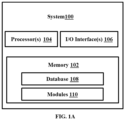
- FIG. 1A is a functional block diagram of a system 100, for generating color variants for fashion apparels, in accordance with some embodiments of the present disclosure.
- the system 100 includes a processor(s) 104, communication interface device(s), alternatively referred as input/output (I/O) interface(s) 106, and one or more data storage devices or a memory 102 operatively coupled to the processor(s) 104.
- the system 100 with one or more hardware processors is configured to execute functions of one or more functional blocks of the system 100.
- the processor(s) 104 can be one or more hardware processors 104.
- the one or more hardware processors 104 can be implemented as one or more microprocessors, microcomputers, microcontrollers, digital signal processors, central processing units, state machines, logic circuitries, and/or any devices that manipulate signals based on operational instructions.
- the one or more hardware processors 104 are configured to fetch and execute computer-readable instructions stored in the memory 102.
- the system 100 can be implemented in a variety of computing systems including laptop computers, notebooks, hand-held devices such as mobile phones, workstations, mainframe computers, servers, and the like.
- the I/O interface(s) 106 can include a variety of software and hardware interfaces, for example, a web interface, a graphical user interface to display the generated target images and the like and can facilitate multiple communications within a wide variety of networks N/W and protocol types, including wired networks, for example, LAN, cable, etc., and wireless networks, such as WLAN, cellular and the like.
- the I/O interface (s) 106 can include one or more ports for connecting to number of external devices or to another server or devices.
- the memory 102 may include any computer-readable medium known in the art including, for example, volatile memory, such as static random access memory (SRAM) and dynamic random access memory (DRAM), and/or non-volatile memory, such as read only memory (ROM), erasable programmable ROM, flash memories, hard disks, optical disks, and magnetic tapes.
- volatile memory such as static random access memory (SRAM) and dynamic random access memory (DRAM)
- DRAM dynamic random access memory
- non-volatile memory such as read only memory (ROM), erasable programmable ROM, flash memories, hard disks, optical disks, and magnetic tapes.
- the memory 102 includes a plurality of modules 110.
- the plurality of modules 110 include programs or coded instructions that supplement applications or functions performed by the system 100 for executing different steps involved in the process of generation of color variants, being performed by the system 100.
- the plurality of modules 110 can include routines, programs, objects, components, and data structures, which performs particular tasks or implement particular abstract data types.
- the plurality of modules 110 may also be used as, signal processor(s), node machine(s), logic circuitries, and/or any other device or component that manipulates signals based on operational instructions.
- the plurality of modules 110 can be used by hardware, by computer-readable instructions executed by the one or more hardware processors 104, or by a combination thereof.
- the plurality of modules 110 may include computer-readable instructions that supplement applications or functions performed by the system 100.
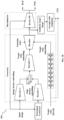
- the plurality of modules 110 can include various sub-modules such components of the FAR-GAN, which include a two-step encoder comprising (a) a first level encoder and (b) a second level encoder, a decoder, a block for generating a target color embedding of a target color, a block for color consistency loss, and a discriminator for determining whether a synthetic target image generated by the FAR-GAN is a realistic or a non-realistic image (fake image).
- the integrated NN architecture of the FAR-GAN depicting the architectural overview of the system 100 is shown in FIG. 1B and explained in conjunction with a flow diagram depicted in FIG. 2 .
- the memory 102 may comprise information pertaining to input(s)/output(s) of each step performed by the processor(s) 104 of the system 100 and methods of the present disclosure. Further, the memory 102 includes a database 108.
- the database (or repository) 108 may include a plurality of abstracted piece of code for refinement and data that is processed, received, or generated as a result of the execution of the plurality of modules 110.
- the database 108 is shown internal to the system 100, it will be noted that, in alternate embodiments, the database 108 can also be implemented external to the system 100, and communicatively coupled to the system 100.
- the data contained within such external database may be periodically updated. For example, new data may be added into the database (not shown in FIG. 1 ) and/or existing data may be modified and/or non-useful data may be deleted from the database.
- the data may be stored in an external system, such as a Lightweight Directory Access Protocol (LDAP) directory and a Relational Database Management System (RDBMS).
- LDAP Lightweight Directory Access Protocol
- RDBMS Relational Database Management System
- FIG. 2 is a flow diagram illustrating a method 200 for generating the color variants for the fashion apparels using the system of FIG. 1B , in accordance with some embodiments of the present disclosure.
- the system 100 comprises one or more data storage devices or the memory 102 operatively coupled to the processor(s) 104 and is configured to store instructions for execution of steps of the method 200 by the processor(s) or one or more hardware processors 104.
- the steps of the method 200 of the present disclosure will now be explained with reference to the components or blocks of the system 100 as depicted in FIG. 1A , 1B and the steps of flow diagram as depicted in FIG. 2 .
- the one or more hardware processors 104 receive (a) the input image comprising a fashion apparel, and (b) a target color for generating a color variant of the fashion apparel.
- the target color is represented in terms of Red Blue Green (RGB) components.
- RGB Red Blue Green
- an end user interested in color change of the apparel can specify or select a color as the target color and the system 100 generates corresponding RGB components for the selected color.
- the one or more hardware processors 104 generate a target style embedding of the fashion apparel by processing the input image via the two-step encoder of the FAR-GAN.
- the two-step encoder comprises: (a) the first level encoder generating a concatenated feature embedding representing a plurality of primary low-level features and an edge map of the fashion apparel, and (b) the second level encoder generating the target style embedding from the concatenated feature embedding.
- the generation of the target style embedding is explained in conjunction with steps below.
- the plurality of primary low-level features of the fashion apparel are extracted via a first encoder of the first level encoder to generate an image feature embedding.
- a segmentation process is applied on the input image to detect the object (fashion apparel) from the input image prior to processing the input image by the first level encoder.
- the edge map of the fashion apparel is generated via a pre-trained Cycle GAN known in the art. For example, the pre-training is performed over publicly available Zalando dataset. From the edge map, an edge feature embedding is generated via the second encoder of the first level encoder.
- the image feature embedding captures several aspects of the fashion apparel image, such as style, texture, color, pattern, etc.
- the method disclosed herein applies both embeddings to enrich the overall information.
- the image feature captures the overall fashion apparel understanding and edge feature explicitly captures the structural information.
- the NN design of the first level encoder (Encoder-1) and the second level encoder (Encoder-2) is provided in TABLE 1.
- Both the first level encoder and the second level encoder consider input of dimension (H,W,C) to produce the output of (H/4,W/4,B).
- the (H,W,C) values for the Encoder-1 and the Encoder-2 are (256,256,32) and (64,64,128) respectively.
- the (A,B) values for the Encoder-1 and the Encoder-2 are (32,64) and (128,256), respectively.
- Res (X) corresponds to 3-layer residual block with X filters, as in one of the literatures in the art. Before the Encoder-1, one Convolutional layer is used as stem with 32 filters.
- the concatenating the image feature embedding and the edge feature embedding to generate the concatenated feature embedding that provides total information of the fashion apparel in the input image After getting the set of structural and image information, the concatenating the image feature embedding and the edge feature embedding to generate the concatenated feature embedding that provides total information of the fashion apparel in the input image. Encoding process captures all the important cues which should be used to synthesize new image. Hence, concatenation provides with all the information of the fashion apparel necessary for effective synthesis. Further, the target style embedding of the fashion apparel is generated by processing the concatenated feature embedding via the second level encoder. The target style embedding captures high-level complex features, representative of the overall style information present in the input image.
- the one or more hardware processors 104 generate a target color embedding from the RGB components of the target color via multi-layer Fully Connected (FC) layers of the FAR-GAN.
- FC Fully Connected
- Existing recoloring methods either consider a color palette, color mask or histogram to control the color. However, these methods, change the color scheme of the entire image without focusing on a single object, such as the fashion apparel herein.
- Some existing methods incorporate complex multi-step operations, such as segmentation, color transformer network and paired discriminator to perform the task. Contrary to this, the method 200 provides a target color embedding branch to create the color embedding for manipulating the encoded style features in the decoder. This makes the overall architecture simple and easy to control. In this network branch.
- Normalized RGB components of the target color are provided as an input comprising a color vector that is passed on through eight dense layers, each of dimension 128 to create a non-linear target color embedding.
- a Leaky ReLU activation function known in the art is used. After the dense operation, a 128-dimension target color embedding is obtained which is used in the decoder for color feature manipulation.
- the one or more hardware processors 104 generate, via the decoder of the FAR-GAN, the synthetic target image comprising the color variant of the fashion apparel.
- the decoder enables dictating of the target style embedding by the target color embedding using an Adaptive Instance Normalization (AdaIN) impose variability and utilizes un-correlated Gaussian noise added to each of the plurality of decoder blocks to impose variability in a color and a style of the fashion apparel in the synthetic target image enabling the object in the synthetic target image to appear realistic when displayed on a display screen of the system 100. For example, if a red color is provided as the target color, the Gaussian noise enables creating different shades of red so that the synthesized product looks realistic. Also, the gaussian noise generates minor changes in appearance to make the product realistic.
- AdaIN Adaptive Instance Normalization
- FIG. 3 depicts the block diagram of the decoder of the system 100 to generate the color variant of the fashion apparel received in the input image in accordance with some embodiments of the present disclosure.
- the target color embedding vector is responsible to alter the properties of the target style embedding obtained from the encoder-2 of the FAR-GAN.
- the decoder considers both the target style and color embedding and produces the synthetic target image with desired color in a bottom-up approach.
- the decoder consists of five decoder blocks, two of which are depicted in FIG. 3 . These blocks are interconnected through the up sampling layers that increases the spatial resolution by a factor of 2. Inside the decoder, the color representation influences the style representation of the product by changing the color of synthesized apparel.
- the color representation vector first undergoes through a learned affine transformation to generate scaling and bias factors across the channel of the style representation.
- AdaIN known in the art, which normalizes each channel and applies bias and scaling factor, depending on the color embedding vector.
- This operation alters the importance of the style features for subsequent operation dictated by the color embedding.
- the un-correlated Gaussian noise is provided to the decoder.
- the noise is added for all feature maps with different spatial resolutions following a learned per-feature scaling factor.
- the decoder of the FAR-GAN consists of two Convolutional (Conv) and AdaIN layers.
- Conv Convolutional
- AdaIN AdaIN layers.
- A is a learned affine transform
- B is a learned noise scaling factor.
- the last block does not contain up sampling layer and the number of filters in the final Conv layer in the decoder is 3.
- the one or more hardware processors 104 via the discriminator of the FAR-GAN depicted in FIG. 1B , determine whether the synthetic target image is a realistic or a non-realistic image by comparing with the input image.
- the FAR-GAN is trained on an adversarial loss to continuously enhance the synthetic target image.
- the Color Consistency Loss (CCL) of the FAR-GAN enables to explicitly control color information and penalize the FAR-GAN until a color of the synthetic target image is similar to the target color, wherein the CCL utilizes a cost function L 2 which is a function of the target color and a dominant color in the synthetic target image.
- the overall FAR-GAN architecture is composed of encoder-decoder architecture as generator and ResNet-50, known in the art as the discriminator as depicted in FIG. 1B
- the discriminator also takes the conditional information with the query image and makes the decision if the synthesized image is realistic or not.
- a GAN model of the FAR-GAN is trained on the adversarial loss.
- the CCL is provided.
- the dominant color is extracted from the generated image (synthetic target image), and the FAR-GAN is configured to bring value of the dominant color closer to the target color value using an L2 cost function.
- the CCL is represented in equation below.
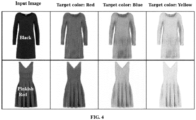
- FIG. 4 depicts a plurality of color variant of a fashion apparel generated at output by the system of FIG. 1B , in accordance with some embodiments of the present disclosure.
- First column contains the input images, alternatively also referred to as query images from Zalando dataset and next three columns demonstrate the synthetic images generated by FAR-GAN on the target color given in top of Rows 2-4. It can be understood that due to limitation of using only black and white drawings, greyed images of the original colored output synthetic target images are depicted with color specified using names of the colors. Similar explanation hold for experimental results of FIG. 5 .
- EXPERIMENTAL RESULTS For experimentation, two datasets: Zalando and Shopping100k public datasets accessible to researchers are considered. 440 images from Zalando dataset, and 400 images from Shopping100k belonging to red, green, blue, and yellow colors have been selected for experimentation. For every image, four target colors, viz. red, green, yellow, and blue; are considered, thereby the training samples increase by four times.
- results are compared with cGAN, StyleGAN, Pix2Pix, BiCycleGAN, and PaletteNet. To ensure fairness, all these methods are trained from scratch using both the datasets used by us.
- Fr'echet Inception Distance (FID) is considered to evaluate the quality of generated image, F1-score between the query and generated edge maps and Mean-Squared Error (MSE) between target and the dominant color of generated image.
- the FID is considered over inception score (IS) since it considers the distribution of both real and generated images, whereas IS considers only the distribution of generated images. Also, since FID finds the distance, lower value of FID is better. For F1-score and MSE, higher and lower values are better, respectively.
- FIG. 5 depicts comparative analysis of color variant outputs generated by the system of FIG. 1B with state of the art techniques, in accordance with some embodiments of the present disclosure.
- the method disclosed herein can additionally apply bounding box or segmentation techniques known in the art to segregate each fashion apparel and then process to generate and display the color variant for each fashion apparel.
- Such computer-readable storage means contain program-code means for implementation of one or more steps of the method, when the program runs on a server or mobile device or any suitable programmable device.
- the hardware device can be any kind of device which can be programmed including e.g., any kind of computer like a server or a personal computer, or the like, or any combination thereof.
- the device may also include means which could be e.g., hardware means like e.g., an application-specific integrated circuit (ASIC), a field-programmable gate array (FPGA), or a combination of hardware and software means, e.g., an ASIC and an FPGA, or at least one microprocessor and at least one memory with software processing components located therein.
- the means can include both hardware means, and software means.
- the method embodiments described herein could be implemented in hardware and software.
- the device may also include software means. Alternatively, the embodiments may be implemented on different hardware devices, e.g., using a plurality of CPUs.
- the embodiments herein can comprise hardware and software elements.
- the embodiments that are implemented in software include but are not limited to, firmware, resident software, microcode, etc.
- the functions performed by various components described herein may be implemented in other components or combinations of other components.
- a computer-usable or computer readable medium can be any apparatus that can comprise, store, communicate, propagate, or transport the program for use by or in connection with the instruction execution system, apparatus, or device.
- a computer-readable storage medium refers to any type of physical memory on which information or data readable by a processor may be stored.
- a computer-readable storage medium may store instructions for execution by one or more processors, including instructions for causing the processor(s) to perform steps or stages consistent with the embodiments described herein.
- the term "computer-readable medium” should be understood to include tangible items and exclude carrier waves and transient signals, i.e., be non-transitory. Examples include random access memory (RAM), read-only memory (ROM), volatile memory, nonvolatile memory, hard drives, CD ROMs, DVDs, flash drives, disks, and any other known physical storage media.
Landscapes
- Engineering & Computer Science (AREA)
- Physics & Mathematics (AREA)
- General Physics & Mathematics (AREA)
- Theoretical Computer Science (AREA)
- Computer Vision & Pattern Recognition (AREA)
- Image Processing (AREA)
Claims (14)
- Prozessorimplementiertes Verfahren (200) zum Erzeugen von Farbvarianten für Modebekleidung, wobei das Verfahren Folgendes umfasst:Empfangen (202), über einen oder mehrere Hardwareprozessoren, (a) eines Eingangsbildes, das eine Modebekleidung umfasst, und (b) einer Zielfarbe zum Erzeugen einer Farbvariante der Modebekleidung, wobei die Zielfarbe in Form von Rot-Blau-Grün-, RGB-, Komponenten dargestellt ist;Erzeugen (204), über einen zweistufigen Codierer eines Modebekleidungs-Regenerations-Generative Adversarial-Netzwerks, FAR-GAN, das von dem einen oder den mehreren Hardwareprozessoren ausgeführt wird, einer Zielstileinbettung der Modebekleidung durch Verarbeiten des Eingangsbildes, wobei der zweistufige Codierer Folgendes umfasst: (a) einen Codierer erster Ebene, der eine verkettete Merkmalseinbettung erzeugt, die eine Mehrzahl von primären Merkmalen niedriger Ebene und eine Kantenkarte der Modebekleidung darstellt, und (b) einen Codierer zweiter Ebene, der die Zielstileinbettung aus der verketteten Merkmalseinbettung erzeugt;Erzeugen (206), über den einen oder die mehreren Hardwareprozessoren, einer Zielfarbeinbettung aus den RGB-Komponenten der Zielfarbe über mehrschichtige Fully-Connected-, FC-, Schichten des FAR-GAN; undErzeugen (208), über einen Decodierer des FAR-GAN, der von dem einen oder den mehreren Hardwareprozessoren ausgeführt wird, wobei der Decodierer eine Mehrzahl von Decodiererblöcken umfasst, eines synthetischen Zielbildes, das die Farbvariante der Modebekleidung umfasst, wobei der Decodierer die Zielstileinbettung durch die Zielfarbeinbettung unter Verwendung einer Adaptive-Instance-Normalisierung, AdaIN, vorschreibt und unkorreliertes Gaußsches Rauschen verwendet, das zu jedem der Mehrzahl von Decodiererblöcken hinzugefügt wird, um eine Variabilität in einer Farbe und einem Stil der Modebekleidung in dem synthetischen Zielbild durchzusetzen, wodurch ermöglicht wird, dass das synthetische Zielbild realistisch erscheint, wenn es auf einem Anzeigebildschirm angezeigt wird.
- Verfahren nach Anspruch 1, ferner umfassend einen Diskriminator, der mit dem Decodierer verbunden ist, um zu bestimmen, ob das synthetische Zielbild ein realistisches oder ein nicht-realistisches Bild ist, indem das synthetische Zielbild mit dem Eingangsbild verglichen wird, wobei das FAR-GAN auf einen Adversarial-Verlust trainiert wird, um das synthetische Zielbild kontinuierlich zu verbessern.
- Verfahren nach Anspruch 1, ferner umfassend die Verwendung eines Farbkonsistenzverlusts, CCL, um Farbinformationen explizit zu steuern und das FAR-GAN zu bestrafen, bis eine Farbe des synthetischen Zielbildes der Zielfarbe ähnlich ist, wobei der CCL eine Kostenfunktion L 2 verwendet, die eine Funktion der Zielfarbe und einer dominanten Farbe in dem synthetischen Zielbild ist.
- Verfahren nach Anspruch 1, wobei das Erzeugen der Zielstileinbettung Folgendes umfasst:Extrahieren der Mehrzahl von primären Merkmalen niedriger Ebene der Modebekleidung über einen ersten Codierer des Codierers erster Ebene, um eine Bildmerkmalseinbettung zu erzeugen;Erzeugen der Kantenkarte der Modebekleidung über einen vortrainierten Zyklus-GAN;Erzeugen, über einen zweiten Codierer des Codierers erster Ebene, einer Kantenmerkmalseinbettung aus der Kantenkarte;Verketten der Bildmerkmalseinbettung und der Kantenmerkmalseinbettung, um die verkettete Merkmalseinbettung zu erzeugen; undErzeugen der Zielstileinbettung der Modebekleidung durch Verarbeiten der verketteten Merkmalseinbettung über den Codierer zweiter Ebene.
- Verfahren nach Anspruch 1, wobei, wenn das Eingangsbild einen überfüllten Hintergrund umfasst, ein Segmentierungsprozess auf das Eingangsbild angewendet wird, um die Modebekleidung aus dem Eingangsbild vor dem Verarbeiten des Eingangsbildes durch den Codierer erster Ebene zu erkennen.
- System (100) zum Erzeugen von Farbvarianten für Modebekleidung, wobei das System (100) Folgendes umfasst:einen Speicher (102), der Anweisungen speichert;eine oder mehrere Eingabe/Ausgabe-, E/A-, Schnittstellen (106); undeinen oder mehrere Hardwareprozessoren (104), die über die eine oder die mehreren E/A-Schnittstellen (106) mit dem Speicher (102) gekoppelt sind,wobei der Speicher (102) ein Modebekleidungs-Regenerations-Generative Adversarial-Netzwerk, FAR-GAN, umfasst, das von dem einen oder den mehreren Hardwareprozessoren ausgeführt wird, das durch die Anweisungen zu Folgendem konfiguriert ist:Empfangen (a) eines Eingangsbildes, das eine Modebekleidung umfasst, und (b) einer Zielfarbe zum Erzeugen einer Farbvariante der Modebekleidung, wobei die Zielfarbe in Form von Rot-Blau-Grün-, RGB-, Komponenten dargestellt ist;Erzeugen, über einen zweistufigen Codierer des FAR-GAN, einer Zielstileinbettung der Modebekleidung durch Verarbeiten des Eingangsbildes, wobei der zweistufige Codierer Folgendes umfasst: (a) einen Codierer erster Ebene, der eine verkettete Merkmalseinbettung erzeugt, die eine Mehrzahl von primären Merkmalen niedriger Ebene und eine Kantenkarte der Modebekleidung darstellt, und (b) einen Codierer zweiter Ebene, der die Zielstileinbettung aus der verketteten Merkmalseinbettung erzeugt;Erzeugen einer Zielfarbeinbettung aus den RGB-Komponenten der Zielfarbe über mehrschichtige Fully-Connected-, FC-, Schichten des FAR-GAN; undErzeugen, über einen Decodierer des FAR-GAN, wobei der Decodierer eine Mehrzahl von Decodiererblöcken umfasst, eines synthetischen Zielbildes, das die Farbvariante der Modebekleidung umfasst, wobei der Decodierer die Zielstileinbettung durch die Zielfarbeinbettung unter Verwendung einer Adaptive-Instance-Normalisierung, AdaIN, vorschreibt und unkorreliertes Gaußsches Rauschen verwendet, das zu jedem der Mehrzahl von Decodiererblöcken hinzugefügt wird, um eine Variabilität in einer Farbe und einem Stil der Modebekleidung in dem synthetischen Zielbild durchzusetzen, wodurch ermöglicht wird, dass das synthetische Zielbild realistisch erscheint, wenn es auf einem Anzeigebildschirm angezeigt wird.
- System nach Anspruch 6, wobei das FAR-GAN über einen mit dem Decodierer verbundenen Diskriminator konfiguriert ist, um zu bestimmen, ob das synthetische Zielbild ein realistisches oder ein nicht-realistisches Bild ist, indem das synthetische Zielbild mit dem Eingangsbild verglichen wird, wobei das FAR-GAN auf einen Adversarial-Verlust trainiert wird, um das synthetische Zielbild kontinuierlich zu verbessern.
- System nach Anspruch 6, wobei das FAR-GAN-Netzwerk konfiguriert ist, um einen Farbkonsistenzverlust, CCL, zu verwenden, um Farbinformationen explizit zu steuern und das FAR-GAN zu bestrafen, bis eine Farbe des synthetischen Zielbildes der Zielfarbe ähnlich ist, wobei der CCL eine Kostenfunktion L 2 verwendet, die eine Funktion der Zielfarbe und einer dominanten Farbe in dem synthetischen Zielbild ist.
- System nach Anspruch 6, wobei das FAR-GAN konfiguriert ist, um die Zielstileinbettung durch Folgendes zu erzeugen:Extrahieren der Mehrzahl von primären Merkmalen niedriger Ebene der Modebekleidung über einen ersten Codierer des Codierers erster Ebene, um eine Bildmerkmalseinbettung zu erzeugen;Erzeugen der Kantenkarte der Modebekleidung über einen vortrainierten Zyklus-GAN;Erzeugen, über einen zweiten Codierer des Codierers erster Ebene, einer Kantenmerkmalseinbettung aus der Kantenkarte;Verketten der Bildmerkmalseinbettung und der Kantenmerkmalseinbettung, um die verkettete Merkmalseinbettung zu erzeugen; undErzeugen der Zielstileinbettung der Modebekleidung durch Verarbeiten der verketteten Merkmalseinbettung über den Codierer zweiter Ebene.
- System nach Anspruch 6, wobei, wenn das Eingangsbild einen überfüllten Hintergrund umfasst, der eine oder die mehreren Hardwareprozessoren konfiguriert sind, um einen Segmentierungsprozess auf das Eingangsbild anzuwenden, um die Modebekleidung aus dem Eingangsbild vor dem Verarbeiten des Eingangsbildes durch den Codierer erster Ebene zu erkennen.
- Ein oder mehrere nichtflüchtige maschinenlesbare Informationsspeichermedien, die eine oder mehrere Anweisungen umfassen, die, wenn sie von einem oder mehreren Hardwareprozessoren ausgeführt werden, Folgendes bewirken:Empfangen (a) eines Eingangsbildes, das eine Modebekleidung umfasst, und (b) einer Zielfarbe zum Erzeugen einer Farbvariante der Modebekleidung, wobei die Zielfarbe in Form von Rot-Blau-Grün-, RGB-, Komponenten dargestellt ist;Erzeugen, über einen zweistufigen Codierer eines Modebekleidungs-Regenerations-Generative Adversarial-Netzwerks, FAR-GAN, das von dem einen oder den mehreren Hardwareprozessoren ausgeführt wird, einer Zielstileinbettung der Modebekleidung durch Verarbeiten des Eingangsbildes, wobei der zweistufige Codierer Folgendes umfasst: (a) einen Codierer erster Ebene, der eine verkettete Merkmalseinbettung erzeugt, die eine Mehrzahl von primären Merkmalen niedriger Ebene und eine Kantenkarte der Modebekleidung darstellt, und (b) einen Codierer zweiter Ebene, der die Zielstileinbettung aus der verketteten Merkmalseinbettung erzeugt;Erzeugen einer Zielfarbeinbettung aus den RGB-Komponenten der Zielfarbe über mehrschichtige Fully-Connected-, FC-, Schichten des FAR-GAN; undErzeugen, über einen Decodierer des FAR-GAN, der von dem einen oder den mehreren Hardwareprozessoren ausgeführt wird, wobei der Decodierer eine Mehrzahl von Decodiererblöcken umfasst, eines synthetischen Zielbildes, das die Farbvariante der Modebekleidung umfasst, wobei der Decodierer die Zielstileinbettung durch die Zielfarbeinbettung unter Verwendung einer Adaptive-Instance-Normalisierung, AdaIN, vorschreibt und unkorreliertes Gaußsches Rauschen verwendet, das zu jedem der Mehrzahl von Decodiererblöcken hinzugefügt wird, um eine Variabilität in einer Farbe und einem Stil der Modebekleidung in dem synthetischen Zielbild durchzusetzen, wodurch ermöglicht wird, dass das synthetische Zielbild realistisch erscheint, wenn es auf einem Anzeigebildschirm angezeigt wird.
- Ein oder mehrere nichtflüchtige maschinenlesbare Informationsspeichermedien nach Anspruch 11, wobei die eine oder die mehreren Anweisungen, die, wenn sie von dem einen oder den mehreren Hardwareprozessoren ausgeführt werden, ferner die Verwendung eines Farbkonsistenzverlusts, CCL, bewirken, um Farbinformationen explizit zu steuern und das FAR-GAN zu bestrafen, bis eine Farbe des synthetischen Zielbildes der Zielfarbe ähnlich ist, wobei der CCL eine Kostenfunktion L 2 verwendet, die eine Funktion der Zielfarbe und einer dominanten Farbe in dem synthetischen Zielbild ist.
- Ein oder mehrere nichtflüchtige maschinenlesbare Informationsspeichermedien nach Anspruch 11, wobei die eine oder die mehreren Anweisungen, die, wenn sie von dem einen oder den mehreren Hardwareprozessoren ausgeführt werden, das Erzeugen der Zielstileinbettung durch Folgendes bewirken:Extrahieren der Mehrzahl von primären Merkmalen niedriger Ebene der Modebekleidung über einen ersten Codierer des Codierers erster Ebene, um eine Bildmerkmalseinbettung zu erzeugen;Erzeugen der Kantenkarte der Modebekleidung über einen vortrainierten Zyklus-GAN;Erzeugen, über einen zweiten Codierer des Codierers erster Ebene, einer Kantenmerkmalseinbettung aus der Kantenkarte;Verketten der Bildmerkmalseinbettung und der Kantenmerkmalseinbettung, um die verkettete Merkmalseinbettung zu erzeugen; undErzeugen der Zielstileinbettung der Modebekleidung durch Verarbeiten der verketteten Merkmalseinbettung über den Codierer zweiter Ebene.
- Ein oder mehrere nichtflüchtige maschinenlesbare Informationsspeichermedien nach Anspruch 11, wobei die eine oder die mehreren Anweisungen, wenn sie von dem einen oder den mehreren Hardwareprozessoren ausgeführt werden, das Anwenden, wenn das Eingangsbild einen überfüllten Hintergrund umfasst, eines Segmentierungsprozesses auf das Eingangsbild bewirken, um die Modebekleidung aus dem Eingangsbild vor dem Verarbeiten des Eingangsbildes durch den Codierer erster Ebene zu erkennen.
Applications Claiming Priority (1)
| Application Number | Priority Date | Filing Date | Title |
|---|---|---|---|
| IN202221034940 | 2022-06-17 |
Publications (3)
| Publication Number | Publication Date |
|---|---|
| EP4293624A1 EP4293624A1 (de) | 2023-12-20 |
| EP4293624B1 true EP4293624B1 (de) | 2024-08-07 |
| EP4293624C0 EP4293624C0 (de) | 2024-08-07 |
Family
ID=86776429
Family Applications (1)
| Application Number | Title | Priority Date | Filing Date |
|---|---|---|---|
| EP23179218.5A Active EP4293624B1 (de) | 2022-06-17 | 2023-06-14 | Verfahren und system zur erzeugung von farbvarianten für modebekleidung |
Country Status (2)
| Country | Link |
|---|---|
| US (1) | US12374001B2 (de) |
| EP (1) | EP4293624B1 (de) |
Families Citing this family (2)
| Publication number | Priority date | Publication date | Assignee | Title |
|---|---|---|---|---|
| CN118537660B (zh) * | 2024-07-19 | 2024-10-18 | 南通理工学院 | 一种融合主脉特征和边缘特征的烟叶检测方法 |
| CN119130784A (zh) * | 2024-11-12 | 2024-12-13 | 浙江理工大学 | 一种基于流行色的织物图案色彩迁移方法 |
Family Cites Families (6)
| Publication number | Priority date | Publication date | Assignee | Title |
|---|---|---|---|---|
| US20030058237A1 (en) * | 2001-09-27 | 2003-03-27 | Koninklijke Philips Electronics N.V. | Multi-layered background models for improved background-foreground segmentation |
| US11727463B2 (en) * | 2019-10-07 | 2023-08-15 | Salesforce, Inc. | Systems and methods of image-based neural network apparel recommendation |
| US11756239B2 (en) * | 2021-04-26 | 2023-09-12 | Adobe, Inc. | Multi-modal image color segmenter and editor |
| US12322007B2 (en) * | 2022-03-16 | 2025-06-03 | Adobe Inc. | Systems and methods for color palette optimization |
| US12277630B2 (en) * | 2022-05-09 | 2025-04-15 | Adobe Inc. | Unsupervised style and color cues for transformer-based image generation |
| US20240169604A1 (en) * | 2022-11-21 | 2024-05-23 | Adobe Inc. | Text and color-guided layout control with a diffusion model |
-
2023
- 2023-06-14 EP EP23179218.5A patent/EP4293624B1/de active Active
- 2023-06-16 US US18/336,649 patent/US12374001B2/en active Active
Also Published As
| Publication number | Publication date |
|---|---|
| US20230410390A1 (en) | 2023-12-21 |
| US12374001B2 (en) | 2025-07-29 |
| EP4293624C0 (de) | 2024-08-07 |
| EP4293624A1 (de) | 2023-12-20 |
Similar Documents
| Publication | Publication Date | Title |
|---|---|---|
| Cai et al. | PiiGAN: generative adversarial networks for pluralistic image inpainting | |
| Singh et al. | Neural style transfer: A critical review | |
| CN111080628B (zh) | 图像篡改检测方法、装置、计算机设备和存储介质 | |
| US10853987B2 (en) | Generating cartoon images from photos | |
| US12536669B2 (en) | Matting network training method and matting method | |
| EP4293624A1 (de) | Verfahren und system zur erzeugung von farbvarianten für modebekleidung | |
| EP4270391B1 (de) | Verfahren und systeme zur emotionssteuerbaren verallgemeinerten sprechenden gesichtserzeugung | |
| Phan et al. | Color orchestra: Ordering color palettes for interpolation and prediction | |
| Nousi et al. | Deep autoencoders for attribute preserving face de-identification | |
| US12277766B2 (en) | Information generation method and apparatus | |
| CN111429416B (zh) | 一种人脸色素斑识别方法、装置及电子设备 | |
| US20190236813A1 (en) | Information processing apparatus, information processing program, and information processing method | |
| Bugeau et al. | Influence of color spaces for deep learning image colorization | |
| EP4184387A1 (de) | Verfahren und system zur personalisierten ersatzproduktempfehlung | |
| Conrad et al. | Two-stage seamless text erasing on real-world scene images | |
| Yao et al. | A Comprehensive Survey on Sampling‐Based Image Matting | |
| CN108717436B (zh) | 一种基于显著性检测的商品目标快速检索方法 | |
| Fang et al. | Stylized-colorization for line arts | |
| Tinago et al. | Deepfakes in Visual Art: Differentiating AI-Generated Art from Human Art Using Convolutional Neural Networks (CNN) | |
| Lian et al. | CVFont: Synthesizing chinese vector fonts via deep layout inferring | |
| Jeong et al. | Succinct palette and color model generation and manipulation using hierarchical representation | |
| Cheng et al. | Image restoration fabric defect detection based on the dual generative adversarial network patch model | |
| CN119722862A (zh) | 图像处理方法、装置、设备及计算机存储介质 | |
| Bhattacharya et al. | Far-gan: Color-controlled fashion apparel regeneration | |
| EP4481687A1 (de) | Verfahren und system zur umfärbung eines produkts |
Legal Events
| Date | Code | Title | Description |
|---|---|---|---|
| PUAI | Public reference made under article 153(3) epc to a published international application that has entered the european phase |
Free format text: ORIGINAL CODE: 0009012 |
|
| STAA | Information on the status of an ep patent application or granted ep patent |
Free format text: STATUS: REQUEST FOR EXAMINATION WAS MADE |
|
| 17P | Request for examination filed |
Effective date: 20231113 |
|
| AK | Designated contracting states |
Kind code of ref document: A1 Designated state(s): AL AT BE BG CH CY CZ DE DK EE ES FI FR GB GR HR HU IE IS IT LI LT LU LV MC ME MK MT NL NO PL PT RO RS SE SI SK SM TR |
|
| GRAP | Despatch of communication of intention to grant a patent |
Free format text: ORIGINAL CODE: EPIDOSNIGR1 |
|
| STAA | Information on the status of an ep patent application or granted ep patent |
Free format text: STATUS: GRANT OF PATENT IS INTENDED |
|
| RIC1 | Information provided on ipc code assigned before grant |
Ipc: G06T 11/00 20060101AFI20240322BHEP |
|
| INTG | Intention to grant announced |
Effective date: 20240411 |
|
| GRAS | Grant fee paid |
Free format text: ORIGINAL CODE: EPIDOSNIGR3 |
|
| GRAA | (expected) grant |
Free format text: ORIGINAL CODE: 0009210 |
|
| STAA | Information on the status of an ep patent application or granted ep patent |
Free format text: STATUS: THE PATENT HAS BEEN GRANTED |
|
| AK | Designated contracting states |
Kind code of ref document: B1 Designated state(s): AL AT BE BG CH CY CZ DE DK EE ES FI FR GB GR HR HU IE IS IT LI LT LU LV MC ME MK MT NL NO PL PT RO RS SE SI SK SM TR |
|
| REG | Reference to a national code |
Ref country code: GB Ref legal event code: FG4D |
|
| REG | Reference to a national code |
Ref country code: CH Ref legal event code: EP |
|
| REG | Reference to a national code |
Ref country code: IE Ref legal event code: FG4D |
|
| REG | Reference to a national code |
Ref country code: DE Ref legal event code: R096 Ref document number: 602023000347 Country of ref document: DE |
|
| U01 | Request for unitary effect filed |
Effective date: 20240830 |
|
| U07 | Unitary effect registered |
Designated state(s): AT BE BG DE DK EE FI FR IT LT LU LV MT NL PT RO SE SI Effective date: 20240910 |
|
| PG25 | Lapsed in a contracting state [announced via postgrant information from national office to epo] |
Ref country code: NO Free format text: LAPSE BECAUSE OF FAILURE TO SUBMIT A TRANSLATION OF THE DESCRIPTION OR TO PAY THE FEE WITHIN THE PRESCRIBED TIME-LIMIT Effective date: 20241107 |
|
| PG25 | Lapsed in a contracting state [announced via postgrant information from national office to epo] |
Ref country code: PL Free format text: LAPSE BECAUSE OF FAILURE TO SUBMIT A TRANSLATION OF THE DESCRIPTION OR TO PAY THE FEE WITHIN THE PRESCRIBED TIME-LIMIT Effective date: 20240807 Ref country code: GR Free format text: LAPSE BECAUSE OF FAILURE TO SUBMIT A TRANSLATION OF THE DESCRIPTION OR TO PAY THE FEE WITHIN THE PRESCRIBED TIME-LIMIT Effective date: 20241108 |
|
| PG25 | Lapsed in a contracting state [announced via postgrant information from national office to epo] |
Ref country code: IS Free format text: LAPSE BECAUSE OF FAILURE TO SUBMIT A TRANSLATION OF THE DESCRIPTION OR TO PAY THE FEE WITHIN THE PRESCRIBED TIME-LIMIT Effective date: 20241207 |
|
| PG25 | Lapsed in a contracting state [announced via postgrant information from national office to epo] |
Ref country code: HR Free format text: LAPSE BECAUSE OF FAILURE TO SUBMIT A TRANSLATION OF THE DESCRIPTION OR TO PAY THE FEE WITHIN THE PRESCRIBED TIME-LIMIT Effective date: 20240807 |
|
| PG25 | Lapsed in a contracting state [announced via postgrant information from national office to epo] |
Ref country code: RS Free format text: LAPSE BECAUSE OF FAILURE TO SUBMIT A TRANSLATION OF THE DESCRIPTION OR TO PAY THE FEE WITHIN THE PRESCRIBED TIME-LIMIT Effective date: 20241107 Ref country code: ES Free format text: LAPSE BECAUSE OF FAILURE TO SUBMIT A TRANSLATION OF THE DESCRIPTION OR TO PAY THE FEE WITHIN THE PRESCRIBED TIME-LIMIT Effective date: 20240807 |
|
| PG25 | Lapsed in a contracting state [announced via postgrant information from national office to epo] |
Ref country code: RS Free format text: LAPSE BECAUSE OF FAILURE TO SUBMIT A TRANSLATION OF THE DESCRIPTION OR TO PAY THE FEE WITHIN THE PRESCRIBED TIME-LIMIT Effective date: 20241107 Ref country code: PL Free format text: LAPSE BECAUSE OF FAILURE TO SUBMIT A TRANSLATION OF THE DESCRIPTION OR TO PAY THE FEE WITHIN THE PRESCRIBED TIME-LIMIT Effective date: 20240807 Ref country code: NO Free format text: LAPSE BECAUSE OF FAILURE TO SUBMIT A TRANSLATION OF THE DESCRIPTION OR TO PAY THE FEE WITHIN THE PRESCRIBED TIME-LIMIT Effective date: 20241107 Ref country code: IS Free format text: LAPSE BECAUSE OF FAILURE TO SUBMIT A TRANSLATION OF THE DESCRIPTION OR TO PAY THE FEE WITHIN THE PRESCRIBED TIME-LIMIT Effective date: 20241207 Ref country code: HR Free format text: LAPSE BECAUSE OF FAILURE TO SUBMIT A TRANSLATION OF THE DESCRIPTION OR TO PAY THE FEE WITHIN THE PRESCRIBED TIME-LIMIT Effective date: 20240807 Ref country code: GR Free format text: LAPSE BECAUSE OF FAILURE TO SUBMIT A TRANSLATION OF THE DESCRIPTION OR TO PAY THE FEE WITHIN THE PRESCRIBED TIME-LIMIT Effective date: 20241108 Ref country code: ES Free format text: LAPSE BECAUSE OF FAILURE TO SUBMIT A TRANSLATION OF THE DESCRIPTION OR TO PAY THE FEE WITHIN THE PRESCRIBED TIME-LIMIT Effective date: 20240807 |
|
| PG25 | Lapsed in a contracting state [announced via postgrant information from national office to epo] |
Ref country code: SM Free format text: LAPSE BECAUSE OF FAILURE TO SUBMIT A TRANSLATION OF THE DESCRIPTION OR TO PAY THE FEE WITHIN THE PRESCRIBED TIME-LIMIT Effective date: 20240807 |
|
| PG25 | Lapsed in a contracting state [announced via postgrant information from national office to epo] |
Ref country code: CZ Free format text: LAPSE BECAUSE OF FAILURE TO SUBMIT A TRANSLATION OF THE DESCRIPTION OR TO PAY THE FEE WITHIN THE PRESCRIBED TIME-LIMIT Effective date: 20240807 |
|
| PG25 | Lapsed in a contracting state [announced via postgrant information from national office to epo] |
Ref country code: SK Free format text: LAPSE BECAUSE OF FAILURE TO SUBMIT A TRANSLATION OF THE DESCRIPTION OR TO PAY THE FEE WITHIN THE PRESCRIBED TIME-LIMIT Effective date: 20240807 |
|
| PLBE | No opposition filed within time limit |
Free format text: ORIGINAL CODE: 0009261 |
|
| STAA | Information on the status of an ep patent application or granted ep patent |
Free format text: STATUS: NO OPPOSITION FILED WITHIN TIME LIMIT |
|
| 26N | No opposition filed |
Effective date: 20250508 |
|
| U20 | Renewal fee for the european patent with unitary effect paid |
Year of fee payment: 3 Effective date: 20250624 |
|
| PG25 | Lapsed in a contracting state [announced via postgrant information from national office to epo] |
Ref country code: MC Free format text: LAPSE BECAUSE OF FAILURE TO SUBMIT A TRANSLATION OF THE DESCRIPTION OR TO PAY THE FEE WITHIN THE PRESCRIBED TIME-LIMIT Effective date: 20240807 |
|
| PG25 | Lapsed in a contracting state [announced via postgrant information from national office to epo] |
Ref country code: IE Free format text: LAPSE BECAUSE OF NON-PAYMENT OF DUE FEES Effective date: 20250614 |