EP4292444A2 - Soluble tapioca flour compositions - Google Patents
Soluble tapioca flour compositions Download PDFInfo
- Publication number
- EP4292444A2 EP4292444A2 EP23208056.4A EP23208056A EP4292444A2 EP 4292444 A2 EP4292444 A2 EP 4292444A2 EP 23208056 A EP23208056 A EP 23208056A EP 4292444 A2 EP4292444 A2 EP 4292444A2
- Authority
- EP
- European Patent Office
- Prior art keywords
- tapioca flour
- soluble
- soluble tapioca
- product
- flour
- Prior art date
- Legal status (The legal status is an assumption and is not a legal conclusion. Google has not performed a legal analysis and makes no representation as to the accuracy of the status listed.)
- Granted
Links
Images

Classifications
-
- A—HUMAN NECESSITIES
- A23—FOODS OR FOODSTUFFS; TREATMENT THEREOF, NOT COVERED BY OTHER CLASSES
- A23L—FOODS, FOODSTUFFS OR NON-ALCOHOLIC BEVERAGES, NOT OTHERWISE PROVIDED FOR; PREPARATION OR TREATMENT THEREOF
- A23L19/00—Products from fruits or vegetables; Preparation or treatment thereof
- A23L19/10—Products from fruits or vegetables; Preparation or treatment thereof of tuberous or like starch containing root crops
- A23L19/11—Cassava, manioc, tapioca, or fermented products thereof, e.g. gari
Definitions
- This application relates to soluble flour compositions and methods of manufacturing the same.
- soluble tapioca flour compositions having desirable chemical properties and solubility and viscosity functionality for use in food products such as, beverage mix, infant food, a medicinal product, an emulsion, convenience foods, or a snack-based filling.
- Such compositions can be used as a partial or complete replacement of maltodextrin and offer a more clean-label alternative.
- soluble tapioca flour composition Described herein is a soluble tapioca flour composition and a method of manufacturing the same.
- Such soluble tapioca flour compositions can be used in food and beverage applications as a maltodextrin replacement.
- tapioca flour may also be referred to herein as cassava flour, and that such difference in terms is based on geographical and market differences.
- Cassava flour sold commercially typically contains fiber contents (both soluble and insoluble fiber) in the range of 2.0-10 grams fiber per 100 grams of flour, whereas tapioca flour sold commercially may be more refined, and may contain lower amounts of fiber than the previously mentioned cassava flour.
- cassava or tapioca flour refers to milled flours containing greater than 2 grams of fiber per 100 grams flour.
- soluble tapioca flour can be referred to as hydrolyzed, enzymatically treated, enzymatically-modified, and/or solubilized tapioca flour.
- the skilled person knows how to manufacture a soluble tapioca flour, e.g. from US5350593 and US20186268997 , the disclosures of which are incorporated herein by reference.
- soluble tapioca flour has been treated to promote greater solubility of their principle components in liquids such as water. Further, such soluble flour demonstrates similar functionality as that of maltodextrin, has a desirable "clean flavor", mouthfeel, and texture suitable for food and beverage applications.
- soluble is referencing solubility of flour components in water.
- frlour encompasses (1) non-grain flours and (2) fractionated, non-whole grain flours wherein a portion of bran and germ have been removed.
- soluble tapioca flour compositions created by treating native tapioca flour with an enzyme to obtain a soluble tapioca flour intermediate.
- the enzyme is preferably an alpha-amylase enzyme, however other bacterial or fungal enzymes may also be used, for example but not limited to iso-, gluco-, beta-, pullulanase, and/or alpha enzymes, and/or combinations thereof.
- the alpha-amylase is a thermal stable alpha-amylase.
- the soluble tapioca flour intermediate is treated with a second enzyme designed to hydrolyze cell wall material, for example but not limited to pectinase, beta glucanase, xylanase, and cellulase.
- This second-enzyme treated soluble tapioca flour composition is referred to herein as the "first soluble tapioca flour composition”.
- the first soluble tapioca flour composition optionally can be subsequently filtered to create a filtered soluble tapioca flour composition referred to herein as the "second soluble tapioca flour composition”.
- both first and second soluble tapioca flour compositions are referred to herein as the "soluble tapioca flour compositions”.
- Figure 1 provides an illustration of the manufacturing process to achieve the soluble tapioca flour compositions described herein.
- the soluble tapioca flour compositions described herein comprise a carbohydrate content ranging from 90 to 98 wt% and more preferably from 92 to 97 wt%.
- the protein content of the soluble tapioca flour compositions ranges from 0.5 to 1.5 wt%, preferably between 0.75 and 1.3 wt%, more preferably between 0.9 and 1.1 wt% and more preferably around 1 wt%.
- the fat content is less than 1 wt% and the insoluble fiber content ranges from 0.5 to 3.5 wt% and more preferably 0.5 to 1 wt%.
- the dextrose equivalent (“DE") of the soluble tapioca flour compositions described herein range 5 to 18 and more preferably 8 to 15. Such compositions are distinguishable from native flour and have significantly improved solubility and viscosity functionality for certain food applications.
- soluble tapioca flour compositions described herein are substantially soluble and have improved solubility over native tapioca flour starting material. Without being bound by any theory, it is believed that the enzyme treatments and optional subsequent filtration further improves solubility.
- Solubility is measured by particle size distribution and based on the wet/dispersed solubility in 90C water.
- the soluble tapioca flour compositions comprise a particle size distribution wherein 90% of particles have a size of 350 microns or less.
- the soluble tapioca flour compositions comprise a particle size distribution wherein 50% of particles have a particle size of 150 microns or less. Further, the soluble tapioca flour compositions comprise a particle size distribution wherein 10% of particles have a size of 40 microns or less.
- the filtered, second soluble tapioca flour composition is nearly completely soluble in water wherein 100% of particles have a size of less than 1 micron, more preferably less than 0.5 microns, and even more preferably less than 0.1 microns.
- the soluble tapioca flour composition of the invention comprises a particle size distribution wherein 90% of particles have a size of 350 microns or less and 50% of particles have a particle size of 150 microns or less. Preferably, 10% of particles have a size of 40 microns or less. Preferably, said composition contains a particle size distribution wherein 100% of particles have a size of less than 1 micron, preferably less than 0.5 microns. Preferably, the composition is substantially soluble in water.
- the soluble tapioca flour compositions have desirable viscosity functionality.
- the soluble tapioca flour compositions have a viscosity ranging from 1 to 10 cP at 20C and 10% dry solids and more preferably ranging from 2 to 5 cP at 20C and 10% dry solids (at a shear rate of 10 [1/s]).
- the soluble tapioca flour composition as described herein is desirable for use in food applications.
- Notable food applications include but are not limited to beverages, beverage mixes, infant food, medicinal products, food emulsions, convenience foods, bakery, dairy, salad dressings, and snack-based fillings or food products (including frozen meals).
- Beverages and beverage mixes can include instant mixes for hot or cold beverages, flavored milk including chocolate milk, carbonated soft drinks, fruit juices, sports beverages, nutrition beverages, and infant formula.
- Dairy can include ice cream, yogurt, sour cream, whip cream, and non-dairy vegan alternatives.
- Convenience foods include but are not limited to salad dressings (pourable and spoonable), sauces (instant and prepared), condiments, puddings, bars, cereals, coatings for cereal, spreads, low-fat spreads, icings, hard candies, soft candies, gummy products, and dry mix seasonings.
- Bakery can include cookies, cakes, muffins, crackers, pastries, and laminated baked products.
- the soluble tapioca flour composition as described herein can be used as at least a partial replacement of maltodextrin in food applications and in many cases can be used as a full replacement of maltodextrin in food applications.
- Such soluble flour can be an effective maltodextrin replacement in any food application in which maltodextrins are currently used.
- the soluble tapioca flour demonstrates similar functionality (e.g., pH, solubility, and viscosity) as maltodextrin making it a suitable replacement for maltodextrin in food applications. Such replacement allows for consumer-friendly labelling as soluble flours may be more well received by some consumers as compared to maltodextrin.
- such soluble tapioca flour additionally has the capability to replace maltodextrins in flavor encapsulation applications wherein a flavor emulsion is created and spray dried, to convert a liquid flavor into a solid.
- maltodextrins may be used alongside a lipophilic starch, or alternately used alone to create a flavor emulsion.
- Maltodextrins are typically used in this space due to their ability to form matrices that positively contribute to encapsulation.
- the soluble tapioca flour described herein can replace maltodextrins in this space due to their bland flavor, low viscosity, and low cost. Additionally, soluble tapioca flours can replace maltodextrin in plating oil-based flavors.
- the soluble tapioca flour as described herein can be used for instant sauces (e.g., dry mix that is reconstituted to a sauce formed by the consumer), prepared sauces, dry mix seasoning, and flavor encapsulation.
- instant sauces e.g., dry mix that is reconstituted to a sauce formed by the consumer
- sauces e.g., dry mix that is reconstituted to a sauce formed by the consumer
- sauces e.g., dry mix that is reconstituted to a sauce formed by the consumer
- sauces e.g., dry mix that is reconstituted to a sauce formed by the consumer
- sauces e.g., dry mix that is reconstituted to a sauce formed by the consumer
- sauces e.g., dry mix that is reconstituted to a sauce formed by the consumer
- sauces e.g., dry mix seasoning, and flavor encapsulation.
- Such soluble tapioca flours can be added in varying amounts and consistently demonstrate similar taste and
- Example #1 Method of making soluble tapioca flour
- a 25% (w/w) aqueous flour slurry was prepared using King Lion cassava flour (King Lion Premium Cassava flour, American Key Food Products LLC, NJ, USA). A quantity of 24 kg water was added in the mixing tank first, and then the mixing was started at slow speed to prevent splashing. 8 kg as-is tapioca flour was added slowly to the mixing tank while contents were mixed continuously at a slow speed. The slurry was maintained at ambient temperature. The speed of mixing was adjusted to prevent settling of flour solids.
- the pH and the temperature of the slurry in feed tank were adjusted to pH to 4.8 - 5.2 using 7% HCl and about 22 °C. After pH adjustment, the mixing of the slurry continued at a gentle speed. A required quantity of 6.8 g GC 127 (0.085% flour wt. basis) enzyme (thermostable alpha-amylase enzyme, DuPont) was weighted in a clean plastic container and enzyme was added into the slurry.
- 6.8 g GC 127 (0.085% flour wt. basis) enzyme thermoostable alpha-amylase enzyme, DuPont
- the jet cooker was equilibrated at a cooking temperature between 270 °F (132°C) and an outlet temperature of 203°F (95°C) (atmospheric flash in product tank). Once the cooking conditions were set, the feeding of the tapioca flour slurry into the jet cooker commenced. The liquefact product exiting the jet cooker was collected into a product tank which was equipped with an overhead mixer and temperature controlled up to 95°C. After the first jet-cooking, it was preferred to pass the jet cooked slurry through the jet cooker a second time, followed by an addition of 2 g (0.025% flour wt. basis) GC 127 enzyme dosing.
- the liquefact was held in the product tank at 95°C for a desired holding time ( ⁇ 30 min to 1 hour), while continuously mixing the liquefacts at a slow speed to avoid splashing of hot liquid. After completion of desired holding times, the pH was adjusted to 2.7 - 3.0 at 95°C and the liquefact was held at the set pH for 15 minutes. The mixing the liquefacts continued at a slow speed to avoid splashing of hot liquid. To ensure complete inactivation of enzyme, the temperature was accurately controlled and the holding time was set to 15 minutes.
- the heating was turned off by adjusting the steam valve and the slurry coolled down to 80°C (use cooling water circulation if needed).
- the mixing of liquefacts continued at a slow speed to avoid splashing of hot liquid.
- the pH was adjusted to 4.45 in liquefacts using NaOH base buffer. The liquefacts could be spray-dried for making soluble tapioca flour intermediate.
- the first soluble tapioca flour compositions 12 kg liquefacts was transferred directly to the Groen cooker. Once pH was between 4.45 and temperature at 48-53°C, 49.9 g Viscozyme L (optimal pH range of 3.3-5.5 and a temperature of 25-55°C, Novozymes Inc.) was added to the slurry and the enzymatic reaction was carried out for 60 minutes. The slurry was heated to 85°C for 15 minutes to kill the Viscozyme L. Said soluble tapioca flour composition can then be spray-dried to obtain the first tapioca flour composition.
- Viscozyme L optimal pH range of 3.3-5.5 and a temperature of 25-55°C, Novozymes Inc.
- the first tapioca flour composition was filtered using Buchner vacuum filtration (Whatman filter paper grade 4 or VWR filter paper 417 pore 35-45 ⁇ ) to obtain a second soluble tapioca flour composition that was filtered. Such filtration can then be followed by spray-draying.
- Figure 1 provides a general illustration of this process.
- Table 1 provides the chemical composition of the first and second tapioca flour compositions compared to standard tapioca flour.
- the soluble tapioca flour compositions described herein are desirable for use in food products, because they demonstrate good solubility functionality.
- Particle size distribution analysis was carried out using a Malvern Mastersizer 3000 Laser Light Diffraction Particle Size Analyzer.
- the particle size of material is determined by laser diffraction, which measures particle size distributions determined by angular variation in intensity of light scattered as a laser beam passes through a dispersed particulate sample. This dispersed particulate sample is a slurry in water.
- Dx (10), (50) and (90) means 10%, 50% and 90% of the population lies below the diameters of D10, D50 and D90 respectively.
- D[4,3] is volume weighted mean.
- sample preparation 10 ml of 1% solution of maltodextrin or soluble flour was prepared. Sample was added to the Hydro LV cell dropwise until the obscuration reached at least 1% to start measurement. If the 1% 10 ml solution was added and the obscuration was still less than 1%, the particle sizes were considered to be zero.
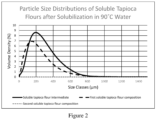
- Table 2 and Figure 2 shows the particle size distribution of the soluble tapioca intermediate material and the first and second soluble tapioca flour compositions described herein.
- both first and second soluble tapioca flour compositions demonstrate good solubility indicative of the particle size distribution, however the filtering of the second soluble tapioca flour composition enhances such solubility having nearly complete solubility indicative of a general particle size distribution of 0 microns.
- the soluble tapioca flour compositions described herein are desirable for use in food products because they demonstrate good viscosity functionality as well.
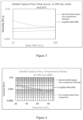
- Figures 3 and 4 provide viscosity curves at a given shear rate and temperature, respectively, compared to maltodextrin.
- Figure 3 provides viscosity profiles of the various samples when measured at 20°C at shear rates between 10-100 [1/s].
- the first soluble flour composition has a viscosity of 4.3 centipoise (cP) and the second soluble flour composition has a viscosity of 1.8 cP compared to a maltodextrin viscosity of 2.3 cP.
- Figure 4 provides that at 25°C, the first soluble flour composition has a viscosity of 2.7 cP and the second soluble flour composition has a viscosity of 1.7 cP, compared to maltodextrin having a viscosity of 2.1 cP, when measured at a shear rate of 20/s.
- Water was combined with the dry ingredients containing Cargill Dry MD 01909 or the first or second soluble tapioca flour compositions (a one to one replacement of maltodextrin) and mixed in a Cuisinart food processor for approximately 3 minutes - see Table 3 for the formulation.
- the oil was slowly added to the mixer and mixed for approximately 5 minutes.
- Vinegar was then added and mixed for approximately 1 minute.
- Bostwick measurements were then measured and described in Table 4. Measurements were completed utilizing Bostwick Consistometer (CSC Scientific Company, Inc., Fairfax, Virginia, USA) with a sample loading weight of 100 grams, and a measurement window of 15 seconds. Viscosity was also measured using a Brookfield Rheometer fitted with spindle 64 measured at 20 rpm. Bostwick and viscosity data demonstrates that the soluble tapioca compositions described herein can be suitable replacements for maltodextrin.
Landscapes
- Health & Medical Sciences (AREA)
- Nutrition Science (AREA)
- Life Sciences & Earth Sciences (AREA)
- Chemical & Material Sciences (AREA)
- Engineering & Computer Science (AREA)
- Food Science & Technology (AREA)
- Polymers & Plastics (AREA)
- Grain Derivatives (AREA)
- Confectionery (AREA)
- Seasonings (AREA)
- Jellies, Jams, And Syrups (AREA)
- Preparation Of Fruits And Vegetables (AREA)
Abstract
Description
- This application relates to soluble flour compositions and methods of manufacturing the same.
- Consumers are asking for label friendly alternatives to maltodextrin in food and beverage applications. While there is a desire to create label-friendly alternatives, there is also a desire for such alternatives to have similar functionality as that of maltodextrin.
- Described herein are soluble tapioca flour compositions having desirable chemical properties and solubility and viscosity functionality for use in food products such as, beverage mix, infant food, a medicinal product, an emulsion, convenience foods, or a snack-based filling. Such compositions can be used as a partial or complete replacement of maltodextrin and offer a more clean-label alternative.
-
-
Figure 1 provides an illustration of the manufacturing process to achieve the soluble tapioca flour compositions described herein. -
Figure 2 shows the particle size distribution of the soluble tapioca flour compositions described herein. -
Figures 3 and 4 provide viscosity curves of the soluble tapioca flour compositions at a given shear rate and temperature, respectively, compared to maltodextrin. - Described herein is a soluble tapioca flour composition and a method of manufacturing the same. Such soluble tapioca flour compositions can be used in food and beverage applications as a maltodextrin replacement. It shall be understood that tapioca flour may also be referred to herein as cassava flour, and that such difference in terms is based on geographical and market differences. Cassava flour sold commercially typically contains fiber contents (both soluble and insoluble fiber) in the range of 2.0-10 grams fiber per 100 grams of flour, whereas tapioca flour sold commercially may be more refined, and may contain lower amounts of fiber than the previously mentioned cassava flour. In this application, reference to cassava or tapioca flour refers to milled flours containing greater than 2 grams of fiber per 100 grams flour. As used herein, the term "soluble tapioca flour" can be referred to as hydrolyzed, enzymatically treated, enzymatically-modified, and/or solubilized tapioca flour. The skilled person knows how to manufacture a soluble tapioca flour, e.g. from
US5350593 andUS20186268997 , the disclosures of which are incorporated herein by reference. - Such soluble tapioca flour has been treated to promote greater solubility of their principle components in liquids such as water. Further, such soluble flour demonstrates similar functionality as that of maltodextrin, has a desirable "clean flavor", mouthfeel, and texture suitable for food and beverage applications. As used herein, the term "soluble" is referencing solubility of flour components in water. As used herein, the term "flour" encompasses (1) non-grain flours and (2) fractionated, non-whole grain flours wherein a portion of bran and germ have been removed.
- Described herein are soluble tapioca flour compositions created by treating native tapioca flour with an enzyme to obtain a soluble tapioca flour intermediate. The enzyme is preferably an alpha-amylase enzyme, however other bacterial or fungal enzymes may also be used, for example but not limited to iso-, gluco-, beta-, pullulanase, and/or alpha enzymes, and/or combinations thereof. In preferred aspects, the alpha-amylase is a thermal stable alpha-amylase. Subsequently, the soluble tapioca flour intermediate is treated with a second enzyme designed to hydrolyze cell wall material, for example but not limited to pectinase, beta glucanase, xylanase, and cellulase. This second-enzyme treated soluble tapioca flour composition is referred to herein as the "first soluble tapioca flour composition". The first soluble tapioca flour composition optionally can be subsequently filtered to create a filtered soluble tapioca flour composition referred to herein as the "second soluble tapioca flour composition". Collectively, both first and second soluble tapioca flour compositions are referred to herein as the "soluble tapioca flour compositions".
Figure 1 provides an illustration of the manufacturing process to achieve the soluble tapioca flour compositions described herein. - Compositionally, the soluble tapioca flour compositions described herein comprise a carbohydrate content ranging from 90 to 98 wt% and more preferably from 92 to 97 wt%. The protein content of the soluble tapioca flour compositions ranges from 0.5 to 1.5 wt%, preferably between 0.75 and 1.3 wt%, more preferably between 0.9 and 1.1 wt% and more preferably around 1 wt%. The fat content is less than 1 wt% and the insoluble fiber content ranges from 0.5 to 3.5 wt% and more preferably 0.5 to 1 wt%.
- The dextrose equivalent ("DE") of the soluble tapioca flour compositions described herein
range 5 to 18 and more preferably 8 to 15. Such compositions are distinguishable from native flour and have significantly improved solubility and viscosity functionality for certain food applications. - The soluble tapioca flour compositions described herein are substantially soluble and have improved solubility over native tapioca flour starting material. Without being bound by any theory, it is believed that the enzyme treatments and optional subsequent filtration further improves solubility.
- Solubility is measured by particle size distribution and based on the wet/dispersed solubility in 90C water. The soluble tapioca flour compositions comprise a particle size distribution wherein 90% of particles have a size of 350 microns or less. The soluble tapioca flour compositions comprise a particle size distribution wherein 50% of particles have a particle size of 150 microns or less. Further, the soluble tapioca flour compositions comprise a particle size distribution wherein 10% of particles have a size of 40 microns or less. In some aspects, the filtered, second soluble tapioca flour composition is nearly completely soluble in water wherein 100% of particles have a size of less than 1 micron, more preferably less than 0.5 microns, and even more preferably less than 0.1 microns.
- Preferably, the soluble tapioca flour composition of the invention, comprises a particle size distribution wherein 90% of particles have a size of 350 microns or less and 50% of particles have a particle size of 150 microns or less. Preferably, 10% of particles have a size of 40 microns or less. Preferably, said composition contains a particle size distribution wherein 100% of particles have a size of less than 1 micron, preferably less than 0.5 microns. Preferably, the composition is substantially soluble in water.
- Furthermore, the soluble tapioca flour compositions have desirable viscosity functionality. The soluble tapioca flour compositions have a viscosity ranging from 1 to 10 cP at 20C and 10% dry solids and more preferably ranging from 2 to 5 cP at 20C and 10% dry solids (at a shear rate of 10 [1/s]).
- The soluble tapioca flour composition as described herein is desirable for use in food applications. Notable food applications include but are not limited to beverages, beverage mixes, infant food, medicinal products, food emulsions, convenience foods, bakery, dairy, salad dressings, and snack-based fillings or food products (including frozen meals). Beverages and beverage mixes can include instant mixes for hot or cold beverages, flavored milk including chocolate milk, carbonated soft drinks, fruit juices, sports beverages, nutrition beverages, and infant formula. Dairy can include ice cream, yogurt, sour cream, whip cream, and non-dairy vegan alternatives. Convenience foods include but are not limited to salad dressings (pourable and spoonable), sauces (instant and prepared), condiments, puddings, bars, cereals, coatings for cereal, spreads, low-fat spreads, icings, hard candies, soft candies, gummy products, and dry mix seasonings. Bakery can include cookies, cakes, muffins, crackers, pastries, and laminated baked products.
- The soluble tapioca flour composition as described herein can be used as at least a partial replacement of maltodextrin in food applications and in many cases can be used as a full replacement of maltodextrin in food applications. Such soluble flour can be an effective maltodextrin replacement in any food application in which maltodextrins are currently used. The soluble tapioca flour demonstrates similar functionality (e.g., pH, solubility, and viscosity) as maltodextrin making it a suitable replacement for maltodextrin in food applications. Such replacement allows for consumer-friendly labelling as soluble flours may be more well received by some consumers as compared to maltodextrin.
- Further, such soluble tapioca flour additionally has the capability to replace maltodextrins in flavor encapsulation applications wherein a flavor emulsion is created and spray dried, to convert a liquid flavor into a solid. In these applications maltodextrins may be used alongside a lipophilic starch, or alternately used alone to create a flavor emulsion. Maltodextrins are typically used in this space due to their ability to form matrices that positively contribute to encapsulation. The soluble tapioca flour described herein can replace maltodextrins in this space due to their bland flavor, low viscosity, and low cost. Additionally, soluble tapioca flours can replace maltodextrin in plating oil-based flavors.
- In preferred aspects, the soluble tapioca flour as described herein can be used for instant sauces (e.g., dry mix that is reconstituted to a sauce formed by the consumer), prepared sauces, dry mix seasoning, and flavor encapsulation. Such soluble tapioca flours can be added in varying amounts and consistently demonstrate similar taste and functionality as maltodextrin.
- In a mixing tank, a 25% (w/w) aqueous flour slurry was prepared using King Lion cassava flour (King Lion Premium Cassava flour, American Key Food Products LLC, NJ, USA). A quantity of 24 kg water was added in the mixing tank first, and then the mixing was started at slow speed to prevent splashing. 8 kg as-is tapioca flour was added slowly to the mixing tank while contents were mixed continuously at a slow speed. The slurry was maintained at ambient temperature. The speed of mixing was adjusted to prevent settling of flour solids.
- The pH and the temperature of the slurry in feed tank were adjusted to pH to 4.8 - 5.2 using 7% HCl and about 22 °C. After pH adjustment, the mixing of the slurry continued at a gentle speed. A required quantity of 6.8 g GC 127 (0.085% flour wt. basis) enzyme (thermostable alpha-amylase enzyme, DuPont) was weighted in a clean plastic container and enzyme was added into the slurry.
- Using water as the feed for the jet cooker, the jet cooker was equilibrated at a cooking temperature between 270 °F (132°C) and an outlet temperature of 203°F (95°C) (atmospheric flash in product tank). Once the cooking conditions were set, the feeding of the tapioca flour slurry into the jet cooker commenced. The liquefact product exiting the jet cooker was collected into a product tank which was equipped with an overhead mixer and temperature controlled up to 95°C. After the first jet-cooking, it was preferred to pass the jet cooked slurry through the jet cooker a second time, followed by an addition of 2 g (0.025% flour wt. basis) GC 127 enzyme dosing.
- The liquefact was held in the product tank at 95°C for a desired holding time (~30 min to 1 hour), while continuously mixing the liquefacts at a slow speed to avoid splashing of hot liquid. After completion of desired holding times, the pH was adjusted to 2.7 - 3.0 at 95°C and the liquefact was held at the set pH for 15 minutes. The mixing the liquefacts continued at a slow speed to avoid splashing of hot liquid. To ensure complete inactivation of enzyme, the temperature was accurately controlled and the holding time was set to 15 minutes.
- the heating was turned off by adjusting the steam valve and the slurry coolled down to 80°C (use cooling water circulation if needed). The mixing of liquefacts continued at a slow speed to avoid splashing of hot liquid. The pH was adjusted to 4.45 in liquefacts using NaOH base buffer. The liquefacts could be spray-dried for making soluble tapioca flour intermediate.
- To make the first soluble tapioca flour compositions, 12 kg liquefacts was transferred directly to the Groen cooker. Once pH was between 4.45 and temperature at 48-53°C, 49.9 g Viscozyme L (optimal pH range of 3.3-5.5 and a temperature of 25-55°C, Novozymes Inc.) was added to the slurry and the enzymatic reaction was carried out for 60 minutes. The slurry was heated to 85°C for 15 minutes to kill the Viscozyme L. Said soluble tapioca flour composition can then be spray-dried to obtain the first tapioca flour composition.
- In some instances, prior to spray-drying, the first tapioca flour composition was filtered using Buchner vacuum filtration (Whatman
filter paper grade 4 or VWR filter paper 417 pore 35-45µ) to obtain a second soluble tapioca flour composition that was filtered. Such filtration can then be followed by spray-draying. -
Figure 1 provides a general illustration of this process. Table 1 provides the chemical composition of the first and second tapioca flour compositions compared to standard tapioca flour. - The soluble tapioca flour compositions described herein are desirable for use in food products, because they demonstrate good solubility functionality. Particle size distribution analysis was carried out using a Malvern Mastersizer 3000 Laser Light Diffraction Particle Size Analyzer. The particle size of material is determined by laser diffraction, which measures particle size distributions determined by angular variation in intensity of light scattered as a laser beam passes through a dispersed particulate sample. This dispersed particulate sample is a slurry in water. Dx (10), (50) and (90) means 10%, 50% and 90% of the population lies below the diameters of D10, D50 and D90 respectively. D[4,3] is volume weighted mean. In sample preparation, 10 ml of 1% solution of maltodextrin or soluble flour was prepared. Sample was added to the Hydro LV cell dropwise until the obscuration reached at least 1% to start measurement. If the 1% 10 ml solution was added and the obscuration was still less than 1%, the particle sizes were considered to be zero.
- Table 2 and
Figure 2 shows the particle size distribution of the soluble tapioca intermediate material and the first and second soluble tapioca flour compositions described herein. Notably, both first and second soluble tapioca flour compositions demonstrate good solubility indicative of the particle size distribution, however the filtering of the second soluble tapioca flour composition enhances such solubility having nearly complete solubility indicative of a general particle size distribution of 0 microns.Table 1 Particle Size Distributions of Soluble Tapioca Flours after Solubilization in 90°C Water Sample Name Dx (10) (µm) Dx (50) (µm) Dx (90) (µm) D [4,3] (µm) Mode (µm) Soluble tapioca flour intermediate 50 172 390 201 196 First soluble tapioca flour composition 29 115 312 149 148 Second soluble tapioca flour composition (filtered) 0 0 0 0 0 - The soluble tapioca flour compositions described herein are desirable for use in food products because they demonstrate good viscosity functionality as well.
Figures 3 and 4 provide viscosity curves at a given shear rate and temperature, respectively, compared to maltodextrin.Figure 3 provides viscosity profiles of the various samples when measured at 20°C at shear rates between 10-100 [1/s]. At a shear rate of 10 [1/s], the first soluble flour composition has a viscosity of 4.3 centipoise (cP) and the second soluble flour composition has a viscosity of 1.8 cP compared to a maltodextrin viscosity of 2.3 cP.Figure 4 provides that at 25°C, the first soluble flour composition has a viscosity of 2.7 cP and the second soluble flour composition has a viscosity of 1.7 cP, compared to maltodextrin having a viscosity of 2.1 cP, when measured at a shear rate of 20/s. - Water was combined with the dry ingredients containing
Cargill Dry MD 01909 or the first or second soluble tapioca flour compositions (a one to one replacement of maltodextrin) and mixed in a Cuisinart food processor for approximately 3 minutes - see Table 3 for the formulation. The oil was slowly added to the mixer and mixed for approximately 5 minutes. Vinegar was then added and mixed for approximately 1 minute.Table 2 Control (Reduced Fat, 17.5% Oil) INGREDIENT % GRAMS Water 48.98 146.94 Vegetable Oil 17.5 52.5 Cargill Dry MD 01909 (10 DE) 16.7 50.1 Vinegar 7 21 Sugar 3 9 Salt 1.7 5.1 Egg Yolk Powder 1.5 4.5 HiForm Starch 12754 2.8 8.4 Ground Mustard 0.5 1.5 Potassium Sorbate 0.12 0.36 Xanthan gum 0.2 0.6 Total 100 300 - Bostwick measurements were then measured and described in Table 4. Measurements were completed utilizing Bostwick Consistometer (CSC Scientific Company, Inc., Fairfax, Virginia, USA) with a sample loading weight of 100 grams, and a measurement window of 15 seconds. Viscosity was also measured using a Brookfield Rheometer fitted with spindle 64 measured at 20 rpm. Bostwick and viscosity data demonstrates that the soluble tapioca compositions described herein can be suitable replacements for maltodextrin.
Table 3 Dressing Viscosities Initial Brookfield, Spindle 64, 20 RPM (cp)24 hours after initial production Brookfield, Spindle 64, 20 RPM (cp)Bostwick (15 seconds)-Initial Bostwick (15 seconds)-24 hours Control (Reduced Fat, 17.5% Oil) 10948 18167 7.0 5.5 First soluble tapioca composition 16875 27025 5.0 3.0 Second soluble tapioca composition (filtered) 9988 14390 8.5 6.5 - Professional sensory analysis was also carried out. Each panelist was served about 2 oz of sample in 2 oz serving cups. Panelists were instructed to cleanse their palate with water in between samples. Comparison questionnaires aimed at comparing characteristics and attributes of the test samples compared to salad
dressings containing control 10 DE maltodextrin were completed. Mean comparison score were calculated, and are presented in Table 5, again showing the soluble tapioca flour compositions described herein are a suitable replacement for maltodextrin.Table 4 Characteristics & Attributes Control (maltodextrin) First soluble tapioca flour composition Second soluble tapioca flour composition (filtered) Appearance & color 5 3.25 4.5 Overall aroma 5 5 5 Overall taste 5 4 5 Overall texture 4.8 4 4.5 Off- flavor 5 4.5 4.5 Overall flavor 5 4 3.8 Overall likeness 5 4 4.5 Table 5 *DE (Dextrose Equivalent) was determined by Iodine-KI method. Sample Label Sample Details CHO Protei n Fat Solub le Fiber Insol uble fiber Sugar Galac tose Fruct ose Gluco se Sucro se Malto se Lacto se Ash Moist ure DE (Iodin e-KI Meth od) King Lion Flour King Lion Cassava Flour 88.50 % 0.88% < 0.5% 2.90% 6.20% 1.19% <0.1 % 0.11% 0.20% 0.89% 0.89% <0.1 % 0.72% 9.93% Soluble Tapioca Flour (intermedi ate) Tapioca flour hydrolyzed by α-amylase 94.70 % 0.82% <0.5 % 2.20% 3.00% 3.32% <0.1 % 0.39% 0.70% 0.54% 1.70% <0.1 % 0.87% 3.60% 13 First soluble tapioca flour compositio n Tapioca flour hydrolyzed by α-amylase & Viscozyme L 93.50 % 1.07% <0.5 % 0.30% 2.40% 9.45% <0.1 % 0.45% 5.91% 0.30% 2.79% <0.1 % 1.29% 4.17% 13 Second soluble tapioca flour compositio n Tapioca flour hydrolyzed by α-amylase, Viscozyme L& Filtered 96.70 % <0.78 1 <0.5 % <0.2 % 0.60% 8.41% <0.1 % 0.52% 5.01% 0.27% 2.61% <0.1 % 1.02% 2.29% 13 - The present invention will now be described with reference to the following clauses:
- 1. Soluble tapioca flour composition, comprising a carbohydrate content ranging from 90 to 98 wt%, a protein content ranging from 0.5 to 1.5 wt%, a fat content of less than 1 wt%, and an insoluble fiber content ranging from 0.5 to 3.5 wt%.
- 2. The composition of
clause 1, wherein the insoluble fiber content ranges from 0.5 to 1 wt% - 3. The composition of
clauses 1 or 2, having a dextrose equivalent ranging from 5 to 18. - 4. The composition of clause 3, having a dextrose equivalent ranging from 8 to 15.
- 5. The composition of any one of the preceding clauses, wherein the composition is filtered.
- 6. The composition of any one of the preceding clauses, having a viscosity ranging from 1 to 10 cP at 25C and 10% dry solids.
- 7. Soluble tapioca flour composition, comprising a particle size distribution wherein 90% of particles have a size of 350 microns or less and 50% of particles have a particle size of 150 microns or less.
- 8. The composition of clause 7, further comprising a particle size distribution wherein 10% of particles have a size of 40 microns or less.
- 9. Soluble tapioca flour composition, comprising a particle size distribution wherein 100% of particles have a size of less than 1 micron.
- 10. The composition of
clause 9, further comprising a particle size distribution wherein 100% of particles have a size of less than 0.5 microns. - 11. The composition of
clause 9, wherein the composition is substantially soluble in water. - 12. A food product, comprising the soluble tapioca flour composition of
clauses - 13. The food product of clause 12, being a beverage mix, infant food, a medicinal product, an emulsion, convenience foods, salad dressings, or a snack-based filling.
- 14. The food product of clause 12, wherein the soluble tapioca flour composition is at least a partial replacement or full replacement of maltodextrin.
- 15. Use of a soluble tapioca flour composition in
clauses
Claims (11)
- A flavor encapsulation product comprising a soluble tapioca flour composition;
wherein:the soluble tapioca flour composition comprises a carbohydrate content ranging from 90 to 98 wt%, a protein content ranging from 0.5 to 1.5 wt%, a fat content of less than 1 wt%, and an insoluble fiber content ranging from 0.5 to 3.5 wt%;the flavor encapsulation is a flavor emulsion; andthe soluble tapioca flour is at least a partial replacement or full replacement of maltodextrin. - The product of claim 1, wherein the soluble tapioca flour composition comprises an insoluble fiber content ranging from 0.5 to 1 wt%.
- The product of claim 1 or 2, wherein the soluble tapioca flour composition has a dextrose equivalent ranging from 5 to 18.
- The product of claim 1 or 2, wherein the soluble tapioca flour composition has a dextrose equivalent ranging from 8 to 15.
- The product of any one of the preceding claims, wherein the soluble tapioca flour composition is filtered.
- The product of any one of the preceding claims, wherein the soluble tapioca flour composition has a viscosity ranging from 1 to 10 cP at 25 °C and 10% dry solids.
- The product of any one of the preceding claims, wherein the soluble tapioca flour composition has a particle size distribution wherein 90% of particles have a size of 350 microns or less and 50% of particles have a particle size of 150 microns or less.
- The product of claim 7, wherein 10% of particles have a size of 40 microns or less.
- The product of any one of the preceding claims, wherein the soluble tapioca flour composition comprises a particle size distribution wherein 100% of particles have a size of less than 1 micron.
- The product of any one of the preceding claims, wherein the soluble tapioca flour composition comprises a particle size distribution wherein 100% of particles have a size of less than 0.5 microns.
- The product of any one of the preceding claims, wherein the soluble tapioca flour composition is substantially soluble in water.
Applications Claiming Priority (3)
| Application Number | Priority Date | Filing Date | Title |
|---|---|---|---|
| US201962952938P | 2019-12-23 | 2019-12-23 | |
| PCT/US2020/066604 WO2021133799A1 (en) | 2019-12-23 | 2020-12-22 | Soluble tapioca flour compositions |
| EP20839524.4A EP4081049B1 (en) | 2019-12-23 | 2020-12-22 | Soluble tapioca flour compositions |
Related Parent Applications (1)
| Application Number | Title | Priority Date | Filing Date |
|---|---|---|---|
| EP20839524.4A Division EP4081049B1 (en) | 2019-12-23 | 2020-12-22 | Soluble tapioca flour compositions |
Publications (3)
| Publication Number | Publication Date |
|---|---|
| EP4292444A2 true EP4292444A2 (en) | 2023-12-20 |
| EP4292444A3 EP4292444A3 (en) | 2024-03-13 |
| EP4292444B1 EP4292444B1 (en) | 2025-05-14 |
Family
ID=74181380
Family Applications (2)
| Application Number | Title | Priority Date | Filing Date |
|---|---|---|---|
| EP23208056.4A Active EP4292444B1 (en) | 2019-12-23 | 2020-12-22 | Soluble tapioca flour compositions |
| EP20839524.4A Active EP4081049B1 (en) | 2019-12-23 | 2020-12-22 | Soluble tapioca flour compositions |
Family Applications After (1)
| Application Number | Title | Priority Date | Filing Date |
|---|---|---|---|
| EP20839524.4A Active EP4081049B1 (en) | 2019-12-23 | 2020-12-22 | Soluble tapioca flour compositions |
Country Status (10)
| Country | Link |
|---|---|
| US (1) | US12127569B2 (en) |
| EP (2) | EP4292444B1 (en) |
| CN (1) | CN114867365B (en) |
| BR (1) | BR112022012520A2 (en) |
| CA (2) | CA3162646C (en) |
| DK (1) | DK4081049T3 (en) |
| ES (1) | ES2969036T3 (en) |
| MX (1) | MX2022007814A (en) |
| PL (1) | PL4081049T3 (en) |
| WO (1) | WO2021133799A1 (en) |
Families Citing this family (1)
| Publication number | Priority date | Publication date | Assignee | Title |
|---|---|---|---|---|
| BR112022012513A2 (en) | 2019-12-23 | 2022-09-06 | Cargill Inc | COMPOSITION OF SOLUBLE RICE FLOUR AND FOOD PRODUCT |
Citations (2)
| Publication number | Priority date | Publication date | Assignee | Title |
|---|---|---|---|---|
| US5350593A (en) | 1991-12-23 | 1994-09-27 | National Starch And Chemical Investment Holding Corporation | Dietary fiber derived from tapioca and process therefor |
| US20180268997A1 (en) | 2013-09-27 | 2018-09-20 | Murata Manufacturing Co., Ltd. | Multilayer ceramic electronic component having an inorganic matter at an interface between an external electrode and the ceramic body |
Family Cites Families (16)
| Publication number | Priority date | Publication date | Assignee | Title |
|---|---|---|---|---|
| US2987424A (en) * | 1959-05-01 | 1961-06-06 | Champion Paper & Fibre Co | Root crop flour and method of and system for making same |
| US6733769B1 (en) * | 1999-05-06 | 2004-05-11 | Opta Food Ingredients, Inc. | Methods for lowering viscosity of glucomannan compositions, uses and compositions |
| AU2002326076A1 (en) * | 2002-07-17 | 2004-02-02 | Gilberto Collazos Hernandez | Method of obtaining malto dextrin, glucose, maltose and dextrose from cassava starch |
| MX349885B (en) * | 2008-01-30 | 2017-08-17 | Cargill Inc | Preparation of enzymatically hydrolyzed starch. |
| US9510614B2 (en) * | 2008-11-04 | 2016-12-06 | The Quaker Oats Company | Food products prepared with soluble whole grain oat flour |
| US20120003356A1 (en) | 2010-06-30 | 2012-01-05 | Athula Ekanayake | Process for Producing Cassava Flour |
| US20120009299A1 (en) * | 2010-07-12 | 2012-01-12 | Caravan Ingredients Inc. | Microwavable frozen cookie dough |
| JP2016511012A (en) * | 2013-03-14 | 2016-04-14 | リッチ プロダクツ コーポレイション | Heat treated flower |
| CN104621510A (en) * | 2015-02-04 | 2015-05-20 | 广西壮族自治区亚热带作物研究所 | Method for manufacturing fresh cassava crispy chips |
| CN105177088A (en) * | 2015-07-31 | 2015-12-23 | 广西科开成林科技有限公司 | Method of using tapioca flour to cleanly prepare nitrogenous syrup |
| CN105341802B (en) * | 2015-11-30 | 2019-06-14 | 广西大学 | A kind of preparation method of non-instant edible modified cassava whole flour |
| WO2017173324A2 (en) * | 2016-04-01 | 2017-10-05 | Danisco Us Inc. | Alpha-amylases, compositions & methods |
| CN107814880A (en) * | 2017-10-25 | 2018-03-20 | 陕西聚洁瀚化工有限公司 | The preparation method of tapioca microballoon |
| CN109957035A (en) * | 2017-12-14 | 2019-07-02 | 上海东升新材料有限公司 | A kind of method that super-voltage micro jet method prepares succinate modified tapioca |
| CA3104106A1 (en) * | 2018-06-26 | 2020-01-02 | Cargill, Incorporated | Soluble flour and methods of manufacturing same |
| CN112969372B (en) * | 2018-11-02 | 2024-05-14 | 嘉吉公司 | Soluble powder for food applications |
-
2020
- 2020-12-22 EP EP23208056.4A patent/EP4292444B1/en active Active
- 2020-12-22 ES ES20839524T patent/ES2969036T3/en active Active
- 2020-12-22 WO PCT/US2020/066604 patent/WO2021133799A1/en not_active Ceased
- 2020-12-22 DK DK20839524.4T patent/DK4081049T3/en active
- 2020-12-22 MX MX2022007814A patent/MX2022007814A/en unknown
- 2020-12-22 CN CN202080089580.XA patent/CN114867365B/en active Active
- 2020-12-22 CA CA3162646A patent/CA3162646C/en active Active
- 2020-12-22 PL PL20839524.4T patent/PL4081049T3/en unknown
- 2020-12-22 BR BR112022012520A patent/BR112022012520A2/en unknown
- 2020-12-22 US US17/757,858 patent/US12127569B2/en active Active
- 2020-12-22 CA CA3253197A patent/CA3253197A1/en active Pending
- 2020-12-22 EP EP20839524.4A patent/EP4081049B1/en active Active
Patent Citations (2)
| Publication number | Priority date | Publication date | Assignee | Title |
|---|---|---|---|---|
| US5350593A (en) | 1991-12-23 | 1994-09-27 | National Starch And Chemical Investment Holding Corporation | Dietary fiber derived from tapioca and process therefor |
| US20180268997A1 (en) | 2013-09-27 | 2018-09-20 | Murata Manufacturing Co., Ltd. | Multilayer ceramic electronic component having an inorganic matter at an interface between an external electrode and the ceramic body |
Also Published As
| Publication number | Publication date |
|---|---|
| DK4081049T3 (en) | 2023-12-18 |
| CN114867365A (en) | 2022-08-05 |
| CA3162646C (en) | 2025-07-08 |
| BR112022012520A2 (en) | 2022-09-06 |
| US12127569B2 (en) | 2024-10-29 |
| EP4292444A3 (en) | 2024-03-13 |
| PL4081049T3 (en) | 2024-04-08 |
| CN114867365B (en) | 2025-01-07 |
| EP4081049B1 (en) | 2023-11-29 |
| CA3162646A1 (en) | 2021-07-01 |
| ES2969036T3 (en) | 2024-05-16 |
| MX2022007814A (en) | 2022-07-19 |
| EP4292444B1 (en) | 2025-05-14 |
| EP4081049A1 (en) | 2022-11-02 |
| CA3253197A1 (en) | 2025-07-07 |
| US20230023166A1 (en) | 2023-01-26 |
| WO2021133799A1 (en) | 2021-07-01 |
Similar Documents
| Publication | Publication Date | Title |
|---|---|---|
| TWI513412B (en) | Soluble oat or barley flour and method for producing the same | |
| DK2152088T3 (en) | HYDROOLIZED, SPRAYER DRYED, AGGLOMERATED GRAIN POWDER AND DRINKABLE FOOD PRODUCTS | |
| CA3030858C (en) | Brewer's spent-grain based protein powder | |
| JP5321028B2 (en) | Food properties improver | |
| JP2020015871A (en) | Starch degradation product, food and beverage composition using the starch degradation product, and food and beverage | |
| EP4081049B1 (en) | Soluble tapioca flour compositions | |
| US12446603B2 (en) | Soluble rice flour compositions | |
| EP2252165B9 (en) | Use of alternan as fat or oil replacer in foodstuffs | |
| EP4081050B1 (en) | Reconstituted soluble tapioca flour | |
| CA3162652C (en) | Reconstituted soluble tapioca flour | |
| CA3162926C (en) | Soluble rice flour compositions | |
| KR102080326B1 (en) | Method for producing mulberry scorched rice snack and mulberry scorched rice snack produced by same method | |
| JP2020186337A (en) | Starch decomposition product, as well as composition for foods using starch decomposition product, foods, rich enhancer, manufacturing method of foods, and rich enhancing method | |
| EP3135124B1 (en) | Use of a water-soluble pea polysaccharide | |
| WO2023164490A1 (en) | Foodstuff comprising palm product | |
| CN113951481A (en) | Flower jam capable of being puffed, and preparation method and application thereof | |
| US20020031590A1 (en) | Bakery product | |
| HK1146200A (en) | Soluble oat or barley flour and method of making utilizing enzymes |
Legal Events
| Date | Code | Title | Description |
|---|---|---|---|
| PUAI | Public reference made under article 153(3) epc to a published international application that has entered the european phase |
Free format text: ORIGINAL CODE: 0009012 |
|
| STAA | Information on the status of an ep patent application or granted ep patent |
Free format text: STATUS: THE APPLICATION HAS BEEN PUBLISHED |
|
| AC | Divisional application: reference to earlier application |
Ref document number: 4081049 Country of ref document: EP Kind code of ref document: P |
|
| AK | Designated contracting states |
Kind code of ref document: A2 Designated state(s): AL AT BE BG CH CY CZ DE DK EE ES FI FR GB GR HR HU IE IS IT LI LT LU LV MC MK MT NL NO PL PT RO RS SE SI SK SM TR |
|
| PUAL | Search report despatched |
Free format text: ORIGINAL CODE: 0009013 |
|
| AK | Designated contracting states |
Kind code of ref document: A3 Designated state(s): AL AT BE BG CH CY CZ DE DK EE ES FI FR GB GR HR HU IE IS IT LI LT LU LV MC MK MT NL NO PL PT RO RS SE SI SK SM TR |
|
| RIC1 | Information provided on ipc code assigned before grant |
Ipc: A23L 19/10 20160101AFI20240207BHEP |
|
| STAA | Information on the status of an ep patent application or granted ep patent |
Free format text: STATUS: REQUEST FOR EXAMINATION WAS MADE |
|
| 17P | Request for examination filed |
Effective date: 20240724 |
|
| RBV | Designated contracting states (corrected) |
Designated state(s): AL AT BE BG CH CY CZ DE DK EE ES FI FR GB GR HR HU IE IS IT LI LT LU LV MC MK MT NL NO PL PT RO RS SE SI SK SM TR |
|
| GRAP | Despatch of communication of intention to grant a patent |
Free format text: ORIGINAL CODE: EPIDOSNIGR1 |
|
| STAA | Information on the status of an ep patent application or granted ep patent |
Free format text: STATUS: GRANT OF PATENT IS INTENDED |
|
| INTG | Intention to grant announced |
Effective date: 20240902 |
|
| GRAJ | Information related to disapproval of communication of intention to grant by the applicant or resumption of examination proceedings by the epo deleted |
Free format text: ORIGINAL CODE: EPIDOSDIGR1 |
|
| STAA | Information on the status of an ep patent application or granted ep patent |
Free format text: STATUS: REQUEST FOR EXAMINATION WAS MADE |
|
| GRAP | Despatch of communication of intention to grant a patent |
Free format text: ORIGINAL CODE: EPIDOSNIGR1 |
|
| STAA | Information on the status of an ep patent application or granted ep patent |
Free format text: STATUS: GRANT OF PATENT IS INTENDED |
|
| INTG | Intention to grant announced |
Effective date: 20250102 |
|
| GRAS | Grant fee paid |
Free format text: ORIGINAL CODE: EPIDOSNIGR3 |
|
| GRAA | (expected) grant |
Free format text: ORIGINAL CODE: 0009210 |
|
| STAA | Information on the status of an ep patent application or granted ep patent |
Free format text: STATUS: THE PATENT HAS BEEN GRANTED |
|
| AC | Divisional application: reference to earlier application |
Ref document number: 4081049 Country of ref document: EP Kind code of ref document: P |
|
| AK | Designated contracting states |
Kind code of ref document: B1 Designated state(s): AL AT BE BG CH CY CZ DE DK EE ES FI FR GB GR HR HU IE IS IT LI LT LU LV MC MK MT NL NO PL PT RO RS SE SI SK SM TR |
|
| REG | Reference to a national code |
Ref country code: GB Ref legal event code: FG4D |
|
| REG | Reference to a national code |
Ref country code: CH Ref legal event code: EP |
|
| P01 | Opt-out of the competence of the unified patent court (upc) registered |
Free format text: CASE NUMBER: APP_18269/2025 Effective date: 20250415 |
|
| REG | Reference to a national code |
Ref country code: DE Ref legal event code: R096 Ref document number: 602020051476 Country of ref document: DE |
|
| REG | Reference to a national code |
Ref country code: IE Ref legal event code: FG4D |
|
| REG | Reference to a national code |
Ref country code: NL Ref legal event code: FP |
|
| PG25 | Lapsed in a contracting state [announced via postgrant information from national office to epo] |
Ref country code: PT Free format text: LAPSE BECAUSE OF FAILURE TO SUBMIT A TRANSLATION OF THE DESCRIPTION OR TO PAY THE FEE WITHIN THE PRESCRIBED TIME-LIMIT Effective date: 20250915 Ref country code: ES Free format text: LAPSE BECAUSE OF FAILURE TO SUBMIT A TRANSLATION OF THE DESCRIPTION OR TO PAY THE FEE WITHIN THE PRESCRIBED TIME-LIMIT Effective date: 20250514 Ref country code: FI Free format text: LAPSE BECAUSE OF FAILURE TO SUBMIT A TRANSLATION OF THE DESCRIPTION OR TO PAY THE FEE WITHIN THE PRESCRIBED TIME-LIMIT Effective date: 20250514 |
|
| REG | Reference to a national code |
Ref country code: LT Ref legal event code: MG9D |
|
| PG25 | Lapsed in a contracting state [announced via postgrant information from national office to epo] |
Ref country code: NO Free format text: LAPSE BECAUSE OF FAILURE TO SUBMIT A TRANSLATION OF THE DESCRIPTION OR TO PAY THE FEE WITHIN THE PRESCRIBED TIME-LIMIT Effective date: 20250814 Ref country code: GR Free format text: LAPSE BECAUSE OF FAILURE TO SUBMIT A TRANSLATION OF THE DESCRIPTION OR TO PAY THE FEE WITHIN THE PRESCRIBED TIME-LIMIT Effective date: 20250815 |
|
| PG25 | Lapsed in a contracting state [announced via postgrant information from national office to epo] |
Ref country code: PL Free format text: LAPSE BECAUSE OF FAILURE TO SUBMIT A TRANSLATION OF THE DESCRIPTION OR TO PAY THE FEE WITHIN THE PRESCRIBED TIME-LIMIT Effective date: 20250514 |
|
| REG | Reference to a national code |
Ref country code: AT Ref legal event code: MK05 Ref document number: 1794014 Country of ref document: AT Kind code of ref document: T Effective date: 20250514 |
|
| PG25 | Lapsed in a contracting state [announced via postgrant information from national office to epo] |
Ref country code: BG Free format text: LAPSE BECAUSE OF FAILURE TO SUBMIT A TRANSLATION OF THE DESCRIPTION OR TO PAY THE FEE WITHIN THE PRESCRIBED TIME-LIMIT Effective date: 20250514 |
|
| PG25 | Lapsed in a contracting state [announced via postgrant information from national office to epo] |
Ref country code: HR Free format text: LAPSE BECAUSE OF FAILURE TO SUBMIT A TRANSLATION OF THE DESCRIPTION OR TO PAY THE FEE WITHIN THE PRESCRIBED TIME-LIMIT Effective date: 20250514 |
|
| PG25 | Lapsed in a contracting state [announced via postgrant information from national office to epo] |
Ref country code: AT Free format text: LAPSE BECAUSE OF FAILURE TO SUBMIT A TRANSLATION OF THE DESCRIPTION OR TO PAY THE FEE WITHIN THE PRESCRIBED TIME-LIMIT Effective date: 20250514 |
|
| PG25 | Lapsed in a contracting state [announced via postgrant information from national office to epo] |
Ref country code: RS Free format text: LAPSE BECAUSE OF FAILURE TO SUBMIT A TRANSLATION OF THE DESCRIPTION OR TO PAY THE FEE WITHIN THE PRESCRIBED TIME-LIMIT Effective date: 20250814 |
|
| PG25 | Lapsed in a contracting state [announced via postgrant information from national office to epo] |
Ref country code: IS Free format text: LAPSE BECAUSE OF FAILURE TO SUBMIT A TRANSLATION OF THE DESCRIPTION OR TO PAY THE FEE WITHIN THE PRESCRIBED TIME-LIMIT Effective date: 20250914 |
|
| PG25 | Lapsed in a contracting state [announced via postgrant information from national office to epo] |
Ref country code: LV Free format text: LAPSE BECAUSE OF FAILURE TO SUBMIT A TRANSLATION OF THE DESCRIPTION OR TO PAY THE FEE WITHIN THE PRESCRIBED TIME-LIMIT Effective date: 20250514 |
|
| PGFP | Annual fee paid to national office [announced via postgrant information from national office to epo] |
Ref country code: NL Payment date: 20251119 Year of fee payment: 6 |
|
| PGFP | Annual fee paid to national office [announced via postgrant information from national office to epo] |
Ref country code: DE Payment date: 20251126 Year of fee payment: 6 |
|
| PGFP | Annual fee paid to national office [announced via postgrant information from national office to epo] |
Ref country code: GB Payment date: 20251119 Year of fee payment: 6 |
|
| PG25 | Lapsed in a contracting state [announced via postgrant information from national office to epo] |
Ref country code: SM Free format text: LAPSE BECAUSE OF FAILURE TO SUBMIT A TRANSLATION OF THE DESCRIPTION OR TO PAY THE FEE WITHIN THE PRESCRIBED TIME-LIMIT Effective date: 20250514 Ref country code: DK Free format text: LAPSE BECAUSE OF FAILURE TO SUBMIT A TRANSLATION OF THE DESCRIPTION OR TO PAY THE FEE WITHIN THE PRESCRIBED TIME-LIMIT Effective date: 20250514 |
|
| PGFP | Annual fee paid to national office [announced via postgrant information from national office to epo] |
Ref country code: FR Payment date: 20251119 Year of fee payment: 6 |
|
| PGFP | Annual fee paid to national office [announced via postgrant information from national office to epo] |
Ref country code: BE Payment date: 20251119 Year of fee payment: 6 |
|
| PG25 | Lapsed in a contracting state [announced via postgrant information from national office to epo] |
Ref country code: CZ Free format text: LAPSE BECAUSE OF FAILURE TO SUBMIT A TRANSLATION OF THE DESCRIPTION OR TO PAY THE FEE WITHIN THE PRESCRIBED TIME-LIMIT Effective date: 20250514 |
|
| PG25 | Lapsed in a contracting state [announced via postgrant information from national office to epo] |
Ref country code: EE Free format text: LAPSE BECAUSE OF FAILURE TO SUBMIT A TRANSLATION OF THE DESCRIPTION OR TO PAY THE FEE WITHIN THE PRESCRIBED TIME-LIMIT Effective date: 20250514 |
|
| PG25 | Lapsed in a contracting state [announced via postgrant information from national office to epo] |
Ref country code: SK Free format text: LAPSE BECAUSE OF FAILURE TO SUBMIT A TRANSLATION OF THE DESCRIPTION OR TO PAY THE FEE WITHIN THE PRESCRIBED TIME-LIMIT Effective date: 20250514 |
|
| PG25 | Lapsed in a contracting state [announced via postgrant information from national office to epo] |
Ref country code: IT Free format text: LAPSE BECAUSE OF FAILURE TO SUBMIT A TRANSLATION OF THE DESCRIPTION OR TO PAY THE FEE WITHIN THE PRESCRIBED TIME-LIMIT Effective date: 20250514 |
|
| REG | Reference to a national code |
Ref country code: DE Ref legal event code: R097 Ref document number: 602020051476 Country of ref document: DE |
|
| PG25 | Lapsed in a contracting state [announced via postgrant information from national office to epo] |
Ref country code: RO Free format text: LAPSE BECAUSE OF FAILURE TO SUBMIT A TRANSLATION OF THE DESCRIPTION OR TO PAY THE FEE WITHIN THE PRESCRIBED TIME-LIMIT Effective date: 20250514 |
|
| PLBE | No opposition filed within time limit |
Free format text: ORIGINAL CODE: 0009261 |
|
| STAA | Information on the status of an ep patent application or granted ep patent |
Free format text: STATUS: NO OPPOSITION FILED WITHIN TIME LIMIT |
|
| REG | Reference to a national code |
Ref country code: CH Ref legal event code: L10 Free format text: ST27 STATUS EVENT CODE: U-0-0-L10-L00 (AS PROVIDED BY THE NATIONAL OFFICE) Effective date: 20260325 |
|
| 26N | No opposition filed |
Effective date: 20260217 |