EP4292268B1 - Zusammenarbeit zwischen cloud-gerät und benutzergerät bei der entscheidungsfindung - Google Patents
Zusammenarbeit zwischen cloud-gerät und benutzergerät bei der entscheidungsfindung Download PDFInfo
- Publication number
- EP4292268B1 EP4292268B1 EP22708262.5A EP22708262A EP4292268B1 EP 4292268 B1 EP4292268 B1 EP 4292268B1 EP 22708262 A EP22708262 A EP 22708262A EP 4292268 B1 EP4292268 B1 EP 4292268B1
- Authority
- EP
- European Patent Office
- Prior art keywords
- data
- public safety
- gathered data
- electronic processor
- information
- Prior art date
- Legal status (The legal status is an assumption and is not a legal conclusion. Google has not performed a legal analysis and makes no representation as to the accuracy of the status listed.)
- Active
Links
Images



Classifications
-
- G—PHYSICS
- G08—SIGNALLING
- G08B—SIGNALLING OR CALLING SYSTEMS; ORDER TELEGRAPHS; ALARM SYSTEMS
- G08B25/00—Alarm systems in which the location of the alarm condition is signalled to a central station, e.g. fire or police telegraphic systems
- G08B25/007—Details of data content structure of message packets; data protocols
-
- H—ELECTRICITY
- H04—ELECTRIC COMMUNICATION TECHNIQUE
- H04L—TRANSMISSION OF DIGITAL INFORMATION, e.g. TELEGRAPHIC COMMUNICATION
- H04L67/00—Network arrangements or protocols for supporting network services or applications
- H04L67/01—Protocols
- H04L67/10—Protocols in which an application is distributed across nodes in the network
-
- G—PHYSICS
- G08—SIGNALLING
- G08B—SIGNALLING OR CALLING SYSTEMS; ORDER TELEGRAPHS; ALARM SYSTEMS
- G08B25/00—Alarm systems in which the location of the alarm condition is signalled to a central station, e.g. fire or police telegraphic systems
- G08B25/01—Alarm systems in which the location of the alarm condition is signalled to a central station, e.g. fire or police telegraphic systems characterised by the transmission medium
- G08B25/012—Alarm systems in which the location of the alarm condition is signalled to a central station, e.g. fire or police telegraphic systems characterised by the transmission medium using recorded signals, e.g. speech
-
- G—PHYSICS
- G08—SIGNALLING
- G08B—SIGNALLING OR CALLING SYSTEMS; ORDER TELEGRAPHS; ALARM SYSTEMS
- G08B25/00—Alarm systems in which the location of the alarm condition is signalled to a central station, e.g. fire or police telegraphic systems
- G08B25/01—Alarm systems in which the location of the alarm condition is signalled to a central station, e.g. fire or police telegraphic systems characterised by the transmission medium
- G08B25/016—Personal emergency signalling and security systems
-
- G—PHYSICS
- G08—SIGNALLING
- G08B—SIGNALLING OR CALLING SYSTEMS; ORDER TELEGRAPHS; ALARM SYSTEMS
- G08B25/00—Alarm systems in which the location of the alarm condition is signalled to a central station, e.g. fire or police telegraphic systems
- G08B25/01—Alarm systems in which the location of the alarm condition is signalled to a central station, e.g. fire or police telegraphic systems characterised by the transmission medium
- G08B25/10—Alarm systems in which the location of the alarm condition is signalled to a central station, e.g. fire or police telegraphic systems characterised by the transmission medium using wireless transmission systems
-
- G—PHYSICS
- G08—SIGNALLING
- G08B—SIGNALLING OR CALLING SYSTEMS; ORDER TELEGRAPHS; ALARM SYSTEMS
- G08B26/00—Alarm systems in which substations are interrogated in succession by a central station
- G08B26/001—Alarm systems in which substations are interrogated in succession by a central station with individual interrogation of substations connected in parallel
- G08B26/003—Alarm systems in which substations are interrogated in succession by a central station with individual interrogation of substations connected in parallel replying the identity and the state of the sensor
-
- H—ELECTRICITY
- H04—ELECTRIC COMMUNICATION TECHNIQUE
- H04L—TRANSMISSION OF DIGITAL INFORMATION, e.g. TELEGRAPHIC COMMUNICATION
- H04L67/00—Network arrangements or protocols for supporting network services or applications
- H04L67/01—Protocols
- H04L67/10—Protocols in which an application is distributed across nodes in the network
- H04L67/1001—Protocols in which an application is distributed across nodes in the network for accessing one among a plurality of replicated servers
- H04L67/1004—Server selection for load balancing
- H04L67/1008—Server selection for load balancing based on parameters of servers, e.g. available memory or workload
-
- H—ELECTRICITY
- H04—ELECTRIC COMMUNICATION TECHNIQUE
- H04L—TRANSMISSION OF DIGITAL INFORMATION, e.g. TELEGRAPHIC COMMUNICATION
- H04L67/00—Network arrangements or protocols for supporting network services or applications
- H04L67/50—Network services
- H04L67/56—Provisioning of proxy services
- H04L67/561—Adding application-functional data or data for application control, e.g. adding metadata
-
- H—ELECTRICITY
- H04—ELECTRIC COMMUNICATION TECHNIQUE
- H04L—TRANSMISSION OF DIGITAL INFORMATION, e.g. TELEGRAPHIC COMMUNICATION
- H04L67/00—Network arrangements or protocols for supporting network services or applications
- H04L67/50—Network services
- H04L67/60—Scheduling or organising the servicing of application requests, e.g. requests for application data transmissions using the analysis and optimisation of the required network resources
- H04L67/61—Scheduling or organising the servicing of application requests, e.g. requests for application data transmissions using the analysis and optimisation of the required network resources taking into account QoS or priority requirements
-
- H—ELECTRICITY
- H04—ELECTRIC COMMUNICATION TECHNIQUE
- H04W—WIRELESS COMMUNICATION NETWORKS
- H04W4/00—Services specially adapted for wireless communication networks; Facilities therefor
- H04W4/02—Services making use of location information
- H04W4/029—Location-based management or tracking services
-
- H—ELECTRICITY
- H04—ELECTRIC COMMUNICATION TECHNIQUE
- H04W—WIRELESS COMMUNICATION NETWORKS
- H04W4/00—Services specially adapted for wireless communication networks; Facilities therefor
- H04W4/30—Services specially adapted for particular environments, situations or purposes
- H04W4/38—Services specially adapted for particular environments, situations or purposes for collecting sensor information
-
- H—ELECTRICITY
- H04—ELECTRIC COMMUNICATION TECHNIQUE
- H04W—WIRELESS COMMUNICATION NETWORKS
- H04W4/00—Services specially adapted for wireless communication networks; Facilities therefor
- H04W4/90—Services for handling of emergency or hazardous situations, e.g. earthquake and tsunami warning systems [ETWS]
-
- H—ELECTRICITY
- H04—ELECTRIC COMMUNICATION TECHNIQUE
- H04W—WIRELESS COMMUNICATION NETWORKS
- H04W4/00—Services specially adapted for wireless communication networks; Facilities therefor
- H04W4/70—Services for machine-to-machine communication [M2M] or machine type communication [MTC]
Definitions
- UE devices may be configured to store data gathered from their own sensors and/or data received from other UE devices and/or external devices. UE devices may also communicate with a cloud device to, for example, provide data to the cloud device and/or receive data/instructions from the cloud device. In some situations, each of the UE devices and the cloud device may be capable of processing/analyzing data in order to, for example, provide an output to a user or transmit an instruction to another device.
- WO2017117674A1 discloses a method and system architecture for automation and alarm systems.
- An intelligent fire detection sensor is provided, which supplies input data to a gateway device for processing and enables two-way communication with users and a third-party monitoring service.
- the system architecture is hierarchically organized, allowing devices to process system data differently at various levels of the hierarchy.
- the gateway device oversees the processing of at least some sensor data and may activate one or more secondary sensors at the fire detector (such as an optical camera) based on the processing results. Additionally, the gateway device and fire detection sensor may collaborate to process voice commands and/or gesture data, as well as to recognize false alarms.
- US2020351380A1 describes telecommunications systems and associated methods for determining data processing locations.
- the method involves receiving data linked to an Internet of Things (IoT) device and assessing multiple processing factors associated with the data. Subsequently, based on this assessment, the method selects the location for data processing.
- IoT Internet of Things
- US2020159205A1 discusses embodiments relating to a manufacturing data processing system comprising: an edge device; a cloud platform; and a sensing device configured to collect manufacturing data and provide it to the edge device. Both the edge device and the cloud platform are configured to perform various data processing functions on the manufacturing data. Additionally, the system includes a resource manager communicating with the edge device and the cloud platform. The resource manager determines whether each data processing function should occur at the edge device or the cloud platform. If the function is determined to occur at the edge device, the resource manager instructs the edge device accordingly. Conversely, if the function is determined to occur at the cloud platform, the resource manager instructs the cloud platform. If it's determined that some functions occur at the edge device and others at the cloud platform, the resource manager coordinates accordingly.
- the UE device may gather data but may not be aware of other similar data that has been gathered by other devices in the communication system and that has already been processed/analyzed by another device in the communication system. In such situations, the UE device may process its own gathered data only to later find out that such processed data is redundant and did not need to be processed. In this situation, the processing resources of the UE device may have essentially been wasted by discharging the device's battery and burdening processing capabilities (for at least a limited time) of the UE device without producing processed data that is new/useful to the overall communication system, and possibly delaying processing of other queued critical data.
- some data processing/analysis may be desirable to perform by the UE device regardless of whether processing of similar data has already occurred by other devices in the communication system or whether the processing could be performed more rigorously or extensively by the CEC device.
- such local processing of gathered data by the UE device may be desirable when it is useful to provide real-time data analysis in a time-sensitive situation such as environmental monitoring/analysis at an incident scene involving hazardous materials.
- each public safety officer may be assigned a different task across a number of areas at a location of the public safety incident.
- the UE device of each public safety officer may not be aware of the assigned tasks of other officers or of data gathered by the UE devices of other officers and/or by other devices (e.g., Internet-of-Things (IoT) devices) at the location of the public safety incident.
- IoT Internet-of-Things
- context information is any information that "contextualizes" the data, and helps in understanding a data set's relationship to, and importance in setting the priority of, a particular real-world incident of interest.
- context information may be received from, and categorized by, a plurality of sources, including public safety networks, private networks, personal networks, municipal and state networks, autonomous Internet of Things (IoT) networks, factory networks, etc, each having different domains and uses specific to a particular application, but that may also provide relevant context to other data sets from sources that are not otherwise related to an intended (i.e. primary) use.
- Access to context information may also be regulated and otherwise controlled by legal governing bodies, that may allow access to confidential materials under "extraordinary circumstances" that would otherwise not be available, such as circumstances posing extreme life-threatening conditions, or other incidences related to public/national security interests.
- External context information may be categorized by source, including global public safety contexts, military threat analytics, local public utility management system contexts, private cloud management system contexts, and the like.
- An example of global public safety incident (GPSI) context information includes data received from a public safety command center, which may also include context information obtained from one or more UE devices and/or IoT devices at the location of the public safety incident (i.e., local public safety incident context information).
- GPSI context information includes data received from a public safety command center, which may also include context information obtained from one or more UE devices and/or IoT devices at the location of the public safety incident (i.e., local public safety incident context information).
- the UE device and/or the CEC device is configured to determine whether the UE device or the CEC device should process the first gathered data.
- the methods, devices, and systems disclosed herein address the above-noted technological problem by providing collaborative processing/analysis of gathered data between the UE devices and the CEC device in a public safety communication system.
- Such collaborative processing allows the UE device to perform computational tasks of high priority (e.g., time sensitive tasks) while allowing the CEC device to determine whether the UE device or the CEC device should perform other computational tasks related to other gathered data.
- the disclosed collaborative processing allows the UE device to operate more efficiently by often avoiding the exclusive use of internal processing capabilities, and internal power source capabilities, etc. which may be limited due to constrained processing clock speeds and power constraints that impact processing tasks. These UE device limitations may easily have detrimental impact on high priority data processing with respect to the public safety incident.
- the disclosed collaborative processing allows the UE device to better preserve battery life and reserve processing capabilities while still providing local processing capabilities with respect to gathered data determined to be a high priority based on the GPSI context information of the public safety incident during which the UE device is being used.
- GPSI context information that was gathered by other devices besides the UE device (i.e., non-local context information) improves the ability of the UE device and the CEC device to determine whether locally gathered data is of a high priority to the public safety incident and should therefore be processed by the UE device that gathered/received the data.
- One embodiment provides a cloud-based electronic computing device according to independent claim 12.
- Another embodiment provides a method, performed by a cloud-based electronic computing device, for determining whether to process data at a first User Equipment (UE) device or at the cloud-based electronic computing device, according to independent claim 1. Further embodiments of the method are provided in the dependent claims 2-11.
- UE User Equipment
- example systems and devices presented herein are illustrated with a single example of each of its component parts. Some examples may not describe or illustrate all components of the systems or devices. Other example embodiments may include more or fewer of each of the illustrated components, may combine some components, or may include additional or alternative components.
- FIG. 1 is a diagram of a communication system 100 according to one example embodiment.
- the communication system 100 includes User Equipment (UE) devices 105A through 105D.
- the communication system 100 may also include Internet-of-Things (IoT) devices 110A through 110C.
- IoT Internet-of-Things
- UE User Equipment
- IoT Internet-of-Things
- a reference to UE device 105 and IoT device 110 is respectively used. It is not necessary, however, that the UE devices 105A through 105D are identical or that the IoT devices 110A through 110C are identical.
- the UE devices 105A through 105D and the IoT devices 110A through 110C are merely examples.
- the communication system 100 may include more or fewer UE devices 105 and IoT devices110 than illustrated in FIG. 1 .
- One or more IoT devices 110 at a similar general location may be referred to as an IoT infrastructure.
- the IoT devices 110 that make up the IoT infrastructure may be configured to communicate with each other and with other nearby devices (e.g., UE devices) within communication range of the IoT devices 110 as explained herein.
- the devices 105 and 110 are located at a scene/location of a public safety incident.
- a public safety incident is an event, occurrence, or situation affecting or potentially affecting the safety of one or more citizens that one or more public safety officers (for example, firefighters, police officers, paramedics, and the like) are tasked with protecting.
- the public safety incident may be an incident in which public safety officers/personnel engage in to protect public interests and keep the public safe (for example, a building fire, a criminal pursuit or other law enforcement event, a natural disaster, a medical incident, a traffic accident, a public safety disturbance, and the like).
- the UE device 105 is a handheld communication device, for example, a mobile telephone or other portable communication device, mobile vehicular radio, laptop computer, tablet computer, smart watch or other smart wearable, and may be located in or be a part of a drone or unmanned aerial vehicle, or may be another device configured to communicate with other devices included in the communication system 100.
- the UE device 105 is a handheld radio carried by a public safety officer or first responder, such as a police officer.
- the UE device 105 is a mobile communication device mounted in or on a vehicle (for example, a police vehicle, an ambulance, or the like).
- the IoT device 110 is a stationary or portable device configured to perform a task such as gathering data and/or providing an output to a user.
- the IoT device 110 may be located in a location that is proximate to a public safety incident scene.
- the IoT device 110 is a security camera, a smoke detector, a carbon monoxide detector, a fire alarm or other type of alarm system, and/or the like located in a building. When a fire occurs in the building, the building may be considered a public safety incident scene/location.
- the IoT device 110 is a personal area communication device such as a body-wom camera, a body-wom microphone, a smartphone, and the like.
- the communication system 100 may also include a public safety command center 125 and a CEC device 120.
- the public safety command center 125 includes one or more UE devices 105 (for example, one or more desktop computers that act as dispatch consoles).
- UE devices 105 for example, one or more desktop computers that act as dispatch consoles.
- the CEC device 120 includes one or more electronic processors located at the same location or at distributed locations.
- the CEC device 120 may include one or more servers that provide computational resources to the devices 105 and 110 of the communication system 100.
- the CEC device 120 may include a cloud-based software agent 130 configured to execute at least some of the methods described herein.
- the cloud-based software agent 130 is a software application that controls other integrated or separate cloud-based processing devices to perform certain tasks.
- the cloud-based software agent 130 processes an image (i.e., image/video) analytics processing device to analyze image (i.e. image/video) data, for example, that is gathered from the devices 105 and/or 110.
- One or more elements of the CEC device 120 may be implemented as a discrete network element on a dedicated hardware, as a software instance running on dedicated hardware, or as a virtualized function instantiated on an appropriate platform, e.g., dedicated hardware or a cloud-based computing infrastructure.
- public safety incident information is generated and is stored by one or more UE devices 105 at the command center 125 and/or in one or more memories of the CEC device 120.
- public safety information may be generated at the command center 125 automatically by an electronic processor (e.g., of a UE device 105 acting as a dispatch console) monitoring calls received by the command center 125.
- the electronic processor may retrieve metadata associated with retrieved calls (e.g., location of call, caller identification of caller, etc.).
- the electronic processor may perform natural language processing of audio during a call.
- Public safety incident information may also be generated manually at the command center 125, for example, by a dispatcher or an emergency call handler entering data received during a call into a UE device 105 (e.g., a dispatch console) located at the command center 125.
- a dispatcher or an emergency call handler entering data received during a call into a UE device 105 (e.g., a dispatch console) located at the command center 125.
- the command center 125 and/or the CEC device 120 stores context information regarding numerous sub-scenes at a public safety incident as well as context information of numerous UE devices 105 and the corresponding public safety personnel associated with each UE device 105.
- the command center 125 and/or the CEC device 120 may be aware of the locations of each UE device 105 at the public safety incident, the capabilities of each UE device 105 at the public safety incident, and an intended task to be performed by each public safety officer at the public safety incident.
- GPSI context information When the context information of one UE device or public safety officer is stored at the command center 125 and/or the CEC device 120, such context information may be referred to as global public safety incident (GPSI) context information and is saved with other context information about the public safety incident (e.g., context information about other UE devices 105 or public safety officers or context information about the public safety incident in general). GPSI context information may also include context information gathered from other locations / scenes that may be related to the public safety incident, such as for example scenes in other locations where respective public safety disturbances events are concurrently happening and therefore are likely to have been coordinated. In some embodiments, GPSI context information is accessible by any device 105, 110 that is configured to communicate with the command center 125 and/or the CEC device 120 where the GPSI context information is stored.
- GPSI context information is accessible by any device 105, 110 that is configured to communicate with the command center 125 and/or the CEC device 120 where the GPSI context information is stored.
- each UE device 105 may not store all of the GPSI context information locally in the memory of the UE device 105. However, each UE device 105 may store some local context information, for example, that is gathered locally by input devices/sensors of the UE device 105.
- public safety incident context information may include a location of the UE device 105 as determined by a global positioning system (GPS) receiver or equivalent means, environmental data sensed by environmental sensors of the UE device 105 or by nearby IoT devices 110 communicatively coupled with the UE device 105, stored data regarding one or more assigned tasks of the user of the UE device 105 with respect to the public safety incident, and/or the like.
- GPS global positioning system
- local context information also includes data inputted by a user of the UE device 105 (e.g., a man-down indication reported by the user, a request for backup input by the user, etc.). Additionally, the UE device 105 may receive some GPSI context information from the command center 125 and/or the CEC device 120. Any context information stored locally by the UE device 105 may be referred to as local public safety incident (LPSI) context information because it is saved and updated locally on the memory of the UE device 105. In other words, the LPSI context information is locally accessible by the electronic processor of the UE device 105 without communicating with a remotely located entity/device such as the command center 125 or the CEC device 120. However, as noted above, the LPSI context information for each UE device 105 may be limited due to memory, processing, and/or communication limitations of the UE devices 105.
- LPSI local public safety incident
- some public safety incident context information may be accurately referred to as both global and local if such information is stored and accessible globally at the command center 125 and/or the CEC device 120 and if such information is also stored in a memory of a first UE device 105. However, for any UE devices 105 that are not storing such information, such information would only be considered GPSI context information. Accordingly, in some embodiments, whether public safety incident context information is global and/or local depends on the perspective of each UE device 105.
- the command center 125, the CEC device 120, and at least some of the UE devices 105 and the IoT devices 110 may be configured to communicate with each other over a 5G/LTE network via a 5G/LTE base station 115 (for example, by sending and receiving radio signals to and from the base station 115).
- a 5G/LTE base station 115 for example, by sending and receiving radio signals to and from the base station 115.
- the communication system 100 may include additional base stations 115.
- the 5G/LTE communication network includes the 5G/LTE base station(s) 115, the command center 125, the CEC device 120, the UE devices 105 configured to communicate via the base station 115, and the IoT devices 110 configured to communicate via the base station 115.
- components of the 5G/LTE communication network such as the 5G/LTE base station(s) 115, the command center 125, the CEC device 120, etc. may be interconnected to each other directly, or through repeater stations, using either a terrestrial based switched-packet data communication system (i.e., internet), or a RF wireless communication protocol of sufficient data bandwidth to facilitate proper operations, or some combination of RF wireless and terrestrial based linkage as may be appropriate.
- a terrestrial based switched-packet data communication system i.e., internet
- RF wireless communication protocol of sufficient data bandwidth to facilitate proper operations, or some combination of RF wireless and terrestrial based linkage as may be appropriate.
- the 5G/LTE communication network incorporates a cloud-based software agent 130 that may be capable of communicating data such as streaming, downloading, and uploading audio data, image data (i.e., image/video), voice data, text data, and/or the like between the entities/devices 105, 110, 115, 120, and 125 shown in FIG. 1 .
- the UE devices 105 may also be referred to as edge devices because they provide an entry point to the 5G/LTE communication network.
- the communication network is a 5G/LTE communication network that includes a cloud-based software agent 130.
- the communication network may include wireless and wired portions. All or parts of the communication network may be implemented using various existing or future-developed specifications or protocols.
- the communication network is implemented using a direct-mode, conventional, or trunked land mobile radio (LMR) standard or protocol, for example, a Digital Mobile Radio (DMR) standard defined by the European Telecommunications Standards Institute (ETSI), a Project 25 (P25) standard defined by the Association of Public Safety Communications Officials International (APCO), a Terrestrial Trunked Radio (TETRA) standard defined by the European Telecommunications Standards Institute (ETSI), or other LMR radio protocols or standards.
- DMR Digital Mobile Radio
- ETSI European Telecommunications Standards Institute
- P25 Project 25
- APCO Association of Public Safety Communications Officials International
- TETRA Terrestrial Trunked Radio
- ETSI European Telecommunications Standards Institute
- the communication network implements the Long Term Evolution (LTE) (including LTE-Advanced or LTE-Advanced Pro compliant with, for example, the 3GPP TS 36 specification series), or the 5G (including a network architecture compliant with, for example, the 3GPP TS 23 specification series and a new radio (NR) air interface compliant with the 3GPP TS 38 specification series) standard, among other possibilities, and over which multimedia broadcast multicast services (MBMS), single site point-to-multipoint (SC-PTM) services, or Mission Critical Push-to-talk (MCPTT) services may be provided, or over which an open mobile alliance (OMA) push to talk (PTT) over cellular (OMA-PoC), a voice over IP (VoIP), or a PTT over IP (PoIP) application may be implemented.
- LTE Long Term Evolution
- 5G including a network architecture compliant with, for example, the 3GPP TS 23 specification series and a new radio (NR) air interface compliant with the 3GPP
- the UE devices 105 and the IoT devices 110 may be configured to communicate directly with each other using a communication channel or connection that is outside of the 5G/LTE communication network (i.e., the communication does not occur via the base station 115). For example, as indicated by the lightning bolts in FIG. 1 , at least some of the UE devices 105 and the IoT devices 110 may communicate directly with each other when they are within a predetermined distance from each other using short-range communication mechanisms such as Bluetooth ® communication links. In some embodiments, one or more IoT devices 110 may not be configured to communicate directly over the 5G/LTE network.
- the IoT device 110 may be configured to directly communicate with a nearby IoT device 110 or UE device 105, which in turn is configured to communicate over the 5G/LTE network, for example, to relay information received "at the edge" from the IoT device 110B or 110C to other devices of the communication system 100 via direct device-to-device communication and/or via communication over the 5G/LTE network.
- FIG. 1 illustrates only one example embodiment of the communication system 100.
- the system 100 may include more or fewer components and may perform functions that are not explicitly described herein.
- the communication system 100 may include additional UE devices 105, IoT devices 110, base stations 115, and command centers 125.
- the CEC device 120 may include numerous separate cloud-based components as described previously herein.
- the lightning bolts in FIG. 1 represent communication capability between devices shown in FIG. 1 . Such communication may occur wirelessly in some situations and may occur over wired connections between the devices in other situations.
- the communication link between the command center 125 and the CEC device 120 may be a landline connection.
- FIG. 2 is a block diagram 200 of a UE device 105 of the communication system 100 according to one example embodiment.
- the UE device 105 includes a first electronic processor 205 (for example, a microprocessor or another electronic device).
- the first electronic processor 205 may include input and output interfaces (not shown) and be electrically connected to a first memory 210, a first network interface 215 including a transceiver and an antenna, a display 220, a microphone 225, a speaker 230, a camera 235, and sensors 240.
- the first memory 210 includes read only memory (ROM), random access memory (RAM), other non-transitory computer-readable media, or a combination thereof.
- the first electronic processor 205 is configured to receive instructions and data from the first memory 210 and execute, among other things, the instructions. In particular, the first electronic processor 205 executes instructions stored in the first memory 210 to perform at least some of the methods described herein.
- the first network interface 215 may send and receive data to and from other devices in the communication system 100 (for example, directly and/or over the communication network described previously herein).
- the first network interface 215 includes a wireless Radio Frequency (RF) communication transceiver and an antenna, for example a RF antenna, for wirelessly communicating with other devices.
- the first network interface 215 may include a connector or port for receiving a wired connection to one or more communication networks, such as an Ethernet cable.
- the first electronic processor 205 receives electrical signals representing sound from the microphone 225 and receives electrical signals representing image data (which may include image data and/or video data) from the camera 235.
- the first electronic processor 205 may communicate information relating to these electrical signals to other devices through the first network interface 215 (for example, to another UE device 105 or to the CEC device 120). Similarly, the first electronic processor 205 may output data received via the first network interface 215 (for example, audio data and/or image data from another UE device 105, from an IoT device 110, from the CEC device 120, and/or from the command center 125) using the speaker 230, the display 220 (which may include a touchscreen), or a combination thereof.
- the first network interface 215 for example, audio data and/or image data from another UE device 105, from an IoT device 110, from the CEC device 120, and/or from the command center 125
- the speaker 230 for example, audio data and/or image data from another UE device 105, from an IoT device 110, from the CEC device 120, and/or from the command center 125
- the display 220 which may include a touchscreen
- a user interface of the UE device 105 may include one or more output devices that provide output to a user (e.g., the display 220, the speaker 230, etc.) and one or more input devices that receive input from the user (e.g., the microphone 225, the display 220 embodied as a touchscreen, etc.).
- output devices e.g., the display 220, the speaker 230, etc.
- input devices e.g., the microphone 225, the display 220 embodied as a touchscreen, etc.
- the UE device 105 may include fewer or additional components in configurations different from that illustrated in FIG. 2 .
- the UE device 105 also includes one or more of a location component (for example, a global positioning system (GPS) receiver), a push-to-talk (PTT) mechanism/button, and one or more additional data gathering devices/sensors 240 (e.g., similar to data gathering device 320 explained below with respect to FIG. 3 ).
- data gathering devices such as the microphone 225, the camera 235, and the sensors 240 may also be referred to as input devices that are configured to capture data (e.g. locally within the surroundings of the UE device 105).
- the UE device 105 may not include the camera 235.
- the UE device 105 performs at least one additional functionality than the functionality described herein.
- the first network interface 215 may be configured to communicate over one or more different wireless communication networks or using different wireless communication protocols.
- the network interface 215 may include multiple RF transceivers and/or multiple RF antennas to allow for communication over different types of wireless communication networks/protocols.
- the network interface 215 includes multiple RF transceivers to allow for communication over different types of wireless communication networks/protocols but each transceiver may be configured to use the same RF antenna to engage in such communications.
- a single RF transceiver may be configured to allow for communication over different types of wireless communication networks/protocols.
- the network interface 215 is configured to directly communicate with nearby devices 105, 110 using a first communication protocol (e.g., Bluetooth ® ) that is outside of the 5G/LTE communication network.
- the network interface 215 may also be configured to communicate with the same or different devices 105, 110 as well as other devices 105, 110, 120, 125 using a second communication protocol over the 5G/LTE communication network.
- FIG. 3 is a block diagram 300 of an IoT device 110 according to one example embodiment.
- the IoT device 110 includes a second electronic processor 305, an optional input/output interface (not shown), a second memory 310, a second network interface 315 (for example, including a transceiver and an antenna), one or more data gathering devices 320, and optionally one or more output devices 325.
- the components shown in FIG. 3 are similar to the like-named components described above with respect to the UE device 105 and perform similar general functions. Accordingly, in some embodiments, the IoT devices 110 may include at least some similar components and functionality (e.g., data gathering capabilities and data communication capabilities) as the UE devices 105.
- the network interface 315 is configured to directly communicate with nearby devices 105, 110 using the first communication protocol (e.g., Bluetooth ® ) that is outside of the 5G/LTE communication network and may not be configured to communicate using the second communication protocol over the 5G/LTE communication network.
- the first communication protocol e.g., Bluetooth ®
- the data gathering device 320 includes a camera (e.g., a thermal camera, an infrared camera, a night vision camera, and/or the like), an air quality sensor (e.g., a smoke detector, a carbon monoxide detector, or the like), a microphone, a moisture sensor, a temperature sensor, and/or any other sensor/device configured to gather data with respect to the surroundings of the IoT device 110.
- the output device 325 includes a speaker, a buzzer, a light emitting diode (LED) or other light, and/or any other alarm or device configured to provide an output that may be recognized by a nearby person such as a public safety officer or a member of the general public.
- the IoT device 110 may include fewer or additional components in configurations different from that illustrated in FIG. 3 .
- the IoT device 110 also includes a location component (for example, a GPS receiver), and/or a proximity sensor.
- some IoT devices 110 may not include one of the data gathering device 320 or the output device 325. Rather, some IoT devices 110 may perform a single function of gathering data with the data gathering device 320 and transmitting gathered data to other devices in the communication system 100, for example by continuously streaming video footage through the second network interface 315.
- some other IoT devices 110 may perform a single function of receiving instructions from other devices in the communication system 100 and providing an output via the output device 325 in response to receiving the instruction.
- the IoT device 110 performs at least one additional functionality than the functionality described herein.
- FIG. 4 is a block diagram 400 of the CEC device 120 according to one example embodiment.
- the cloud-based software agent 130 operations may be primarily performed on the electronic computing device 120, although parallel processes that augments the software agent 130 tasks may be running on different physical and/or virtual platforms.
- the CEC device 120 includes one or more computers that include a third electronic processor 405, an optional input/output interface (not shown), a third memory 410, and a third network interface 415 (for example, including an RF transceiver and an RF antenna). These components are similar to those described above with respect to the UE device 105 and perform similar general functions.
- the CEC device 120 may include a physical device and/or a virtual device, such as one or more servers.
- the CEC device 120 may be a specialized computer or any machine capable of executing instructions (sequential or otherwise) that specify actions to be taken by that machine.
- the functionality of the third electronic processor 405 is implemented by one or more electronic processors located at the same or different locations.
- FIG. 4 shows a single third electronic processor 405
- the third electronic processor 405 may be representative of electronic processors of multiple distributed cloud devices (e.g., an image analytics processing device configured to analyze image data).
- the third electronic processor 405 implements the cloud-based software agent 130 mentioned previously herein that is configured to execute at least some of the methods described herein.
- the CEC device 120 may include fewer or additional components in configurations different from that illustrated in FIG. 4 . In some embodiments, the CEC device 120 performs at least an additional functionality than the functionality described herein.
- the CEC device 120 communicates with other devices of the communication system 100 to receive, store, and process/analyze information (e.g., gathered data) and to control and/or influence operation of other devices 105, 110 as explained in greater detail below.
- information e.g., gathered data
- each public safety officer may be assigned a different task across a number of areas at a location of the public safety incident.
- a first UE device 105 of a first public safety officer may not be aware of the assigned tasks of other officers or of data gathered by other UE devices 105 of other officers and/or by IoT devices 110 outside the communication range of the first UE device 105 at the location of the public safety incident.
- the first UE device 105 may only have access to LPSI context information rather than the GPSI context information stored by, for example, the CEC device 120.
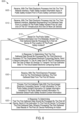
- FIGS. 5-6 are flowcharts of methods for determining whether to process gathered data at the first UE device 105 or at the CEC device 120.
- the general processes performed throughout each of the methods shown in FIGS. 5-6 are included in the system flow diagram 700 of FIG. 7 . While a particular order of processing steps, message receptions, and/or message transmissions is indicated in FIGS. 5-7 as an example, timing and ordering of such steps, receptions, and transmissions may vary where appropriate without negating the purpose and advantages of the examples set forth in detail throughout the remainder of this disclosure.
- block 505 may be executed after blocks 510 and 515 in some situations or in some embodiments.
- FIG. 5 is a flowchart of a method 500 of determining whether to process data gathered by the first UE device 105 (or by another device such as an IoT device 110) at the first UE device 105 or at the CEC device 120 according to one example embodiment.
- the method 500 is performed by the first UE device 105, and, specifically, the first electronic processor 205.
- the method 500 sequencing by processor 205 may be executed in conjunction with a related method 600 of FIG. 6 that is executed by the CEC device 120 to further determine how to process data gathered by the first UE device 105 (or by another device such as an IoT device 110).
- the method 500 is explained from the perspective of the first UE device 105 while the method 600 is explained from the perspective of the CEC device 120.
- An instance of the method 500 begins at block 505, where the first electronic processor 205 receives, via the first network interface 215, public safety incident information about a public safety incident from the public safety command center 125.
- the public safety incident information is received directly from the command center 125 via the 5G/LTE network.
- the public safety incident information is received from the CEC device 120, which is configured to store information received from the command center 125.
- at least some portions of the CEC device 120 may be located at the command center 125.
- the public safety incident information received by the first UE 105 is a portion of GPSI context information as explained previously herein.
- Such information may include a type of public safety incident for which the user of the first UE device 105 has been assigned (e.g., a fire, a gas leak, a bank robbery, a natural disaster, a traffic accident, a public safety disturbance, or the like).
- the public safety incident information may provide a building map/blueprint if the public safety incident involves a building (e.g., a building fire).
- the public safety incident information may indicate one or more IoT devices 110 expected to be located at the location of the incident (e.g., security cameras and smoke detectors in a building), as well as ancillary information, for example, authentication keys (e.g. passwords, scrambling keys, etc.) to enable secure connection with the IoT devices 110.
- IoT devices 110 expected to be located at the location of the incident
- ancillary information for example, authentication keys (e.g. passwords, scrambling keys, etc.) to enable secure connection with the IoT devices 110.
- Other types of public safety incident information also may be received by the first UE device 105.
- the first electronic processor 205 Upon receiving the public safety incident information from remote entities/devices 120, 125, the first electronic processor 205 stores the public safety incident information in the first memory 210. As explained previously herein, upon being stored in the first memory 210 for local use by the first electronic processor 205, the received public safety incident information may be referred to as LPSI context information with respect to the first UE device 105. Also as explained previously herein, this LPSI context information is only a portion of the GPSI context information stored by the CEC device 120 with respect to all UE devices 105 associated with the public safety incident and with respect to the public safety incident in general.
- the LPSI context information may be updated locally at the UE device 105 on the basis of data acquired by the UE device 105, for example based on user inputs and/or readings from the sensor 240. Consequently, at some point in time, the updated LPSI context information may include information that is outside of (i.e., not included in) the GPSI context information.
- This updated LPSI context information may enable the first electronic processor 205 of the UE device 105 to make determinations based on its exclusive knowledge of the updated LPSI context information. For example, based on the updated LPSI context information, the first electronic processor 205 may determine to override instructions received from the software agent 130.
- the first electronic processor 205 receives, from at least one of the group consisting of (i) one of its own input devices (e.g., the microphone 225, the camera 235, or another data gathering device), (ii) the IoT infrastructure (i.e., one or more IoT devices 110), and (iii) one or more other UE devices 105, first gathered data from a location of the public safety incident.
- the first gathered data may be gathered by an input device of the first UE device 105 itself or may be gathered by another device 105, 110 and received, for example, via wireless communication, by the first UE device 105.
- the first gathered data may include any type of data detectable by an input device/sensor (e.g., audio data, image data (which includes video data), air quality data, temperature data, and/or the like).
- an input device/sensor e.g., audio data, image data (which includes video data), air quality data, temperature data, and/or the like.
- this assumption may be verified by the first electronic processor 205 by comparing a determined location of the first UE device 105 with a known or received location of the public safety incident, or with "geotag" data fields embedded within the first gathered data.
- the first electronic processor 205 generates metadata representing the first gathered data.
- the metadata may be any subset/summary of the first gathered data that can be extracted from the first gathered data with a small amount of processing.
- the metadata provides information about the first gathered data without performing detailed analysis/processing (e.g., without performing detailed image analysis of image data such as shape recognition or detailed identification of patterns/trends in other data) of the entirety of the first gathered data.
- the metadata may merely indicate a type of the first gathered data (i.e., a type of input device/sensor that was used to capture the first gathered data).
- the metadata may indicate a size of a file including the first gathered data and/or an image resolution of the first gathered data when the first gathered data is image data.
- the metadata may indicate whether first gathered video data includes audio data along with the video data.
- the metadata may include one video frame for every second of the video data (e.g., a summary of the video data) instead of all of the frames that make up the entirety of the first gathered video data.
- the first electronic processor 205 determines, based on the LPSI context information and the metadata, whether to process the first gathered data by the first electronic processor 205 of the first UE device 105. In other words, the first electronic processor 205 determines whether the first gathered data should be immediately processed/analyzed by the first electronic processor 205 (e.g., rather than sending the metadata to the CEC device 120 and waiting for instructions from the CEC device 120 as to whether to locally process the first gathered data or to transmit the first gathered data to the CEC device 120 to be processed).
- the first electronic processor 205 is configured to determine that the first gathered data should be processed by the first electronic processor 205 in response to determining that the metadata indicates that the first gathered data includes high priority information with respect to the public safety incident based on at least one of a type of the public safety incident (e.g., a fire, a hostage situation, a gas leak, a bank robbery, or the like), the location of the public safety incident (e.g., proximity to a hospital or other buildings, proximity to other nearby incidents, frequency of previous incidents as the same location, or the like), and an environment of the public safety incident (e.g., indoor versus outdoor, high visibility/well-lit versus low visibility/dark, weather at the location of the incident, or the like).
- a type of the public safety incident e.g., a fire, a hostage situation, a gas leak, a bank robbery, or the like
- the location of the public safety incident e.g., proximity to a hospital or other buildings, proximity to
- processing of first gathered data that is likely to result in processed data that provides a time-sensitive notification is performed immediately by the first electronic processor 205 of the first UE device 105 while processing of first gathered data that is likely to result in processed data of lower priority (e.g., medium priority or low priority) is not performed immediately by the first electronic processor 205.
- the determination of whether processing the first gathered data is a high priority computational task is determined based on the LPSI context information stored by the first memory 210 and based on the metadata representing the first gathered data.
- some first gathered data may be determined to be high priority data regardless of LPSI context information. For example, audio/video data indicating that a gunshot occurred or any data indicating a "man-down" situation has occurred may be determined to be high priority data regardless of any local context information. Other examples of determining a priority level of the first gathered data (e.g., based on the metadata and the LPSI context information) are provided below.
- the first electronic processor 205 determines that processing the first gathered data is a high priority (e.g., because of the potential danger for an explosion when flammable gas is near a fire).
- the first electronic processor 205 determines that processing the first gathered data is not a high priority (e.g., image data processing is unlikely to result in useful information due to poor visibility). In some embodiments, the first electronic processor 205 determines that processing the first gathered data in this second example is a low priority.
- the first electronic processor 205 may determine that processing the first gathered data is a medium priority because the data has a higher chance of being discernible than if the camera is a standard camera without night vision or infrared capabilities.
- the appropriate first gathered data set and affiliated local context information internal to an individual UE device 105 may be communicated as locally prioritized to the cloud-based electronic computing device 120 whereupon additional processing may transpire which encompasses gathered data, metadata, GPSI context information, and LPSI context information that may be shared by other UE devices 105.
- a new prioritization level may be determined for some portion of the first gathered data set, and the updated prioritization may subsequently be communicated back to the originating UE device 105 from the computing device 120 through 5G/LTE base station 125.
- the individual UE prioritization metric for a first data set may be adjusted and the method of weighting a prioritization that is used by the first electronic processor 205 of the UE device 105 may also be dynamically adjusted based on computing device's 120 re-prioritization so as to accommodate an expanded understanding of the incident, without encumbering the UE device 105 with additional processing or potential exposure to incident threats that may occur due to local processing of less important/useful/relevant data compared to potentially more important/useful/relevant data.
- the metadata may indicate that the first gathered data is video data, but the local context information may not include any specific information that indicates whether analysis of video data will be particularly useful during the public safety incident (e.g., during a routine security check of building). Accordingly, the first electronic processor 205 determines that processing the first gathered data is not a high priority and is instead, for example, a medium priority.
- the metadata may indicate that the first gathered data is from an air quality sensor configured to detect caustic vapors or flammable gas of a particular chemical agent.
- the local context information may indicate that the public safety incident is a routine security check of a building and that a fire is not currently occurring at the building. Accordingly, the first electronic processor 205 determines that processing the first gathered data is not a high priority and is instead, for example, a medium priority.
- the first electronic processor 205 is configured to use prioritization metrics stored in the first memory 210 to determine a priority of processing/analyzing the first gathered data.
- the prioritization metrics may be based on any of the information included in the local context information and/or in the metadata representing the first gathered data, as well as UE device 105 self-diagnostics (e.g., data packet size of the first gathered data, battery life of the first UE device 105, availability and latency of the CEC device 120, data format and correlation of the first gathered data, estimated usefulness of the processing of the first gathered data, priority of potential notifications that could be provided based on the processing of the first gathered data, and/or the like).
- first gathered data with a large data packet size may tend to indicate that the first gathered data should not be processed by the first electronic processor 205 so as to avoid using limited power and processing capabilities of the first UE device 105.
- low battery life of the first UE device 105 may tend to indicate that the first gathered data should not be processed by the first electronic processor 205 so as to avoid further consuming power from the already low battery of the first UE device 105.
- the local context information indicating (i) that the CEC device 120 is functioning more slowly than usual or (ii) that the first UE device 105 does not have network coverage to communicate with the CEC device 120 may tend to indicate that the first gathered data should be processed by the first electronic processor 205 based on reduced latency or unavailability of the CEC device 120.
- Examples of data format of the first gathered data e.g., type of data
- estimated usefulness of the processing of the first gathered data e.g., estimated usefulness of the processing of the first gathered data
- priority of potential notifications that could be provided based on the processing of the first gathered data have been previously provided herein with respect to examples one through four.
- the prioritization metrics stored in the first memory 210 used to determine a priority of processing/analyzing the first gathered data may be reconfigurable, for example several prioritization metric profiles may be store in first memory 210 and one profile is summoned depending on the local and/or global context information available at a given point in time.
- each of the prioritization metrics may have a weight in an algorithm that is used to determine whether to immediately process the first gathered data by the first electronic processor 205.
- the weights may be preprogrammed weights that are user-adjustable.
- individual prioritization metrics and prioritization profiles stored in memory 210 may be dynamically adjusted by the CEC device 120 via wireless communication from base 5G/LTE base 125 based on expanded computations using data sets and contexts not available to the first electronic processor 205 of the UE device 105, where the expanded cloud based processing may indicate imminent threat assessments that warrant reprioritization prior to local awareness of the threat by the first electronic processor 205 within a UE device 105.
- the first electronic processor 205 processes the first gathered data to at least one of (i) provide an output with an output device of the first UE device 105 and (ii) transmit data to another local device that may be within the perimeter of the public safety incident (e.g., the IoT infrastructure (i.e., an IoT device 110) and/or one or more UE devices 105).
- the first electronic processor 205 locally processes the first gathered data without communicating the first gathered data or its corresponding metadata to the CEC device 120.
- the first electronic processor 205 may locally process the first gathered data to allow processed first gathered data to be used by one or more public safety personnel and/or devices 105, 110 located at the public safety incident more quickly than if the first gathered data or its corresponding metadata was communicated to the CEC device 120, for example, to further determine the priority/potential usefulness of the first gathered data.
- the first electronic processor 205 may immediately locally process first gathered data determined to be of high priority as explained previously herein such that the processed first gathered data may be utilized locally at the public safety incident.
- the first gathered data from the air quality sensor configured to detect flammable gas may be locally processed to determine whether a level of flammable gas of a particular chemical agent being detected by the sensor exceeds a predetermined threshold.
- the first electronic processor 205 may provide a notification to the user of the UE device 105 (e.g., via the display 220, the speaker 230, or both) indicating that they should immediately leave the building.
- the first UE device 105 may additionally or alternatively transmit a similar notification to one or more other UE devices 105 and/or IoT devices 110.
- the first UE device 105 may instruct an IoT device 110 that includes an audible alarm to generate sound indicating that the building should be evacuated.
- the time saved by immediately locally processing the first gathered data as opposed to transmitting the first gathered data or its metadata to the cloud may provide the additional time needed to increase safety for one or more public safety officers and/or members of the public.
- the first UE device 105 additionally or alternatively provides an instruction to another UE device 105 and/or an IoT device 110 to gather additional data based on the processed first gathered data.
- the instruction is related to a prioritized public safety task such as identifying a location of a trespasser, identifying a location of a source of a fire, identifying noise being produced from a certain area, etc.
- the instruction may instruct one or more devices 105, 110 to adjust the positioning of a camera to change a field of view to be in a direction where a trespasser is determined to be hiding.
- the instruction may instruct one or more devices 105, 110 to engage in certain camera or audio filtering techniques based on the determined environment of the public safety incident, to control beam forming of an audio detection array of microphones to capture noise from a certain direction, to adjust the sensitivity of sensors such as smoke detectors, or the like.
- the first UE device 105 after executing block 525 to locally process the first gathered data at the first UE device 105, the first UE device 105 transmits the processed data and/or the gathered data to the CEC device 120 to add to the GPSI context information.
- the first electronic processor 205 transmits, via the first network interface 215, at least one of the group consisting of metadata and the first gathered data to the CEC device 120.
- the first UE device 105 does not immediately process the first gathered data internally (i.e., locally) using the first electronic processor 205.
- the first UE device 105 transmits the first gathered data and/or its metadata to the CEC device 120 to allow the CEC device 120 to determine the priority/potential usefulness of the first gathered data as explained below with respect to FIG. 6 .
- the CEC device 120 stores and updates GPSI context information that includes more information than the LPSI context information internal to the first UE device 105, the CEC device 120 may be able to better determine the priority level of the first gathered data and whether the first gathered data should be processed/analyzed as explained below with respect to FIG. 6 .
- the CEC device 120 may also be configured to determine whether the first UE device 105 should process the first gathered data or if the CEC device 120 should process the first gathered data as explained below with respect to FIG. 6 .
- the second, third, and fourth examples explained previously herein with respect to block 520 each illustrate situations where the first UE 105 may not immediately process the first gathered data and may instead transmit the first gathered data and/or its metadata to the CEC device 120.
- the first UE device 105 may receive and/or generate multiple types of gathered data simultaneously or nearly simultaneously.
- the first UE device 105 may receive or generate multiple types of first gathered data from the above examples (e.g., air quality data and video data) simultaneously or nearly simultaneously.
- the first electronic processor 205 may transmit the gathered data and/or the metadata representing the gathered data to the CEC device 120 (at block 530).
- the first electronic processor 205 may engage in weighted scaling to prioritize data packet transmissions to the CEC device 120 for each type of gathered data based on one or more prioritization metrics explained previously herein.
- the weighted scaling is implemented according equation (1) to determine a weighting factor for transmission to the CEC device 120 ( ⁇ ) for each data packet associated with different gathered data.
- ⁇ is a scaling factor of the k-th part of a data packet that may be informed by LPSI context information.
- n is a number of part of a data packet queued for transmission to the CEC device 120.
- equation (1) assumes That for each "data packet" there are a number of parts of information, including size of the data, type of data, header information that may indicate characteristics of the data such location where the data was gathered, source of the data, time stamp of when the data was gathered, and/or the like. Many data packets may be generated by and/or received from many different sources or from one source over an extended time. Accordingly, the UE device 105 may use equation (1) or a similar equation to determine an order in which data packets should be transmitted to the CEC device 120 for further processing in accordance with other portions of this disclosure.
- ⁇ ( weight ) is a cumulative priority weighting for a "data packet.”
- a data packet may be comprised of "n" different parts, with each part given a predetermined associated weight ⁇ k , for example.
- Contents of a data packet may include, among other, the following example parts along with their respective weighting: data size, data type, time stamp, data source, and/or location.
- data type weighting may be used such that data known to include more definitive information or that indicates higher probability for short transmission time is given a higher weight for transmission.
- time stamp weighting may be used such that more recent data is given a higher weight for transmission.
- data source weighting may be used such that data from different sources is given different weight for transmission.
- data source weighting data from an IoT device 110 may have a varying weight ⁇ based on the type of IoT device 110 (e.g., based on what type of data is being produced by the IoT device 110).
- P becomes a multiplier to increase the value of a part of a packet, which can be the adjusted by the CEC device 120 to scale a priority of the packets that are transmitted to the CEC device 120 from the UE devices 105.
- the CEC device 120 may also control ⁇ .
- the value of controlling P over ⁇ may be that P may increase the entire data packet priority without effecting ⁇ .
- the scale factor rating P may be different for each part of a data packet, but the same for a specific data set.
- the "n-k" power factor may be another component of the weighting factor where n may be the number of parts in a data packet, and k may be a specific part index.
- n may be the number of parts in a data packet
- k may be a specific part index.
- Equation (1) to find the total weighting of the entire data packet using equation (1), multiply ⁇ by the P raised to the (n-k) if data index location is used. Then sum up the individual factors to arrive at a particular data packet's priority rating. Then compare the priority rating of the data packet to other data packet weights to determine which packet(s) has the highest weighting for transmission and should be transmitted to the CEC device 120 first.
- equation (1) is merely one example of determining which an order of data packets to send to the CEC device 120 when multiple data packets are waiting to be transmitted. Any part of equation (1) can be modified, discarded, or replaced in other embodiments.
- the method proceeds back to block 505 to begin a subsequent instance of the method 500 and continue gathering data at the scene/location of the public safety incident.
- the first UE device 105 may also receive additional or updated information from the command center 125 and/or the CEC device 120 to be saved in the first memory 210 as LPSI context information.
- FIG. 6 is a flowchart of a method 600 of determining whether to process data gathered by the first UE device 105 (or by another device such as an IoT device 110) at the first UE device 105 or at the CEC device 120 when incident information, such as a data sets prioritization metrics, and/or context meta data, is received by the cloud based electronic computing device 120 and reprocessed in relation to a specific incident of interest at electronic processor 405, according to one example embodiment.
- the method 600 is performed by the CEC device 120, and, specifically, the third electronic processor 405 that may have access to ancillary telemetry of unknown relevance or context to a specific public safety incident of interest.
- Processor 405 may be a single processor or a network of distributed processors within computing device 120, where processor(s) 405 may be tasked with complementary or divergent processing tasks such as may be needed to efficiently quantify an appropriate prioritization based on computations incorporating expanded data sets, metadata, and context information, and where said computations may be scaled in complexity based on the scope of the variables (i.e., data sets, metadata, context metrics, etc.) being utilized.
- the method 600 may be executed in conjunction with the related method 500 of FIG. 5 that is executed by the UE device 105.
- both methods 500 and 600 relate to determining where/how to process data gathered by the first UE device 105 (or by another device such as an IoT device 110), the method 600 is explained from the perspective of the CEC device 120 while the method 500 was explained from the perspective of the UE device 105. In some embodiments, the method 600 is executed after/in response to performance of block 530 by the UE device 105. In other embodiments, the CEC device 120 may execute the method 600 independently of whether the UE device 105 performs the method 500.
- An instance of the method 600 begins at block 605, where the third electronic processor 405 receives, via the third network interface 415, public safety incident information about a public safety incident from the public safety command center 125.
- the receipt of public safety incident information by the CEC device 120 at block 605 is generally similar to the receipt of public safety incident information by the first UE device 105 at block 505 explained previously herein.
- the CEC device 120 may store more public safety incident information than the first UE device 105 as explained previously herein.
- the explanation with respect to block 505 also applies to block 605 and will not be repeated for the sake of brevity.
- the third electronic processor 405 of the cloud based electronic computing device 120 receives, via the third network interface 415, metadata representing first gathered data from a location of the public safety incident from a group consisting of at least one of the Internet-of-things infrastructure (i.e., one or more IoT devices 110) and/or at least one of the UE devices 105 (e.g., the first UE device 105).
- the metadata is generated by the first UE device 105 (at block 515) and transmitted by the first UE device 105 (at block 530) as explained previously herein.
- the CEC device 120 may also receive the first gathered data from the at least one of the Internet-of-things infrastructure (i.e., one or more IoT devices 110) and one or more UE devices 105 (e.g., the first UE device 105).
- the first gathered data may be received along with its corresponding metadata or it may be received at a later time, for example, in response to the CEC device providing an instruction to first UE device 105 or the IoT device 110 to transmit the first gathered data (e.g., see block 625).
- the third electronic processor 405 determines, based on the GPSI information and the metadata, whether to process the first gathered data by the first UE device 105 at the location of the public safety incident or by the third electronic processor 405 of the CEC device 120.
- the determination made by the CEC device 120 at block 615 is generally similar to the determination made by the first UE device 105 at block 520 explained previously herein (e.g., using prioritization metrics and weighting factors).
- the explanation with respect to block 520 also applies to block 615 and, for the sake of brevity, will not be repeated in its entirety when explaining the details of block 615.
- the third electronic processor 405 of the CEC device 120 derives its response to a particular data set based on GPSI context information available from multiple sources, instead of the more limited LPSI context information as is considered at block 520 for UE devices 105.
- the CEC device 120 stores GPSI context information that includes information that may not be included in the LPSI context information of the first UE device 105, the CEC device 120 may be able to better determine the priority level of the first gathered data and whether the first gathered data should be processed/analyzed using specific algorithms, considerations and/or prioritizations.
- the global context information may include information from numerous UE devices 105, IoT devices 110, and the command center 125 as explained previously herein.
- the GPSI context information may also be more up-to-date than LPSI context information stored on the first UE device 105, for example, if the GPSI context information was recently updated and the updated GPSI information was not yet transmitted to the first UE device 105.
- the third electronic processor 405 of computing device 120 may be configured to determine that the first gathered data should be processed by the first UE device 105 in response to determining that the metadata indicates that the first gathered data includes high priority information with respect to the public safety incident based on at least one of a type of the public safety incident, the location of the public safety incident, and an environment of the public safety incident.
- the third electronic processor 405 is configured to determine that the first gathered data should be processed by the CEC device 120 in response to determining that the metadata indicates that the first gathered data includes medium or low priority information or in response to determining that the first gathered data is expected to be partially or completely redundant with previously stored data based on the metadata.
- a first UE device 105 may have determined at block 520 ( FIG 5 ) that detailed processing of local gathered air quality data was rated at medium priority because the public safety incident was a routine security check of a building and a fire was not currently detected by sensors at the building, the more up-to-date GPSI context information stored at the CEC device 120 may indicate that a "call-in" report of a fire at the building had been recently received. Accordingly, the third electronic processor 405 may determine that processing of the air quality data that may indicate the presence of flammable gas at the building is a high priority.
- the third electronic processor 405 may determine that the air quality data should be processed as soon as possible by the first UE device 105 (i.e., processed locally by the first UE device 105 rather than by the CEC device 120). The third electronic processor 405 may also determine that future gathered air quality data from the first UE device 105 should be processed locally by the first UE device 105 for the foreseeable future and may provide a corresponding instruction to the first UE device 105.
- the first UE device 105 may have determined at block 520 ( FIG. 5 ) that processing of gathered video data was rated at medium priority because there was no indication that the video data was particularly useful during the public safety incident (e.g., during a routine security check of building), recently updated GPSI context information stored at the CEC device 120 may indicate that a report of an public safety disturbance at the building has recently occurred. Accordingly, any video data from the building may be useful to analyze for suspicious activity.
- the third electronic processor 405 may determine that processing the video data is of high priority and may determine that the gathered video data and future gathered video data from the first UE device 105 should be processed locally by the first UE device 105 for the foreseeable future and may provide a corresponding instruction to the first UE device 105.
- the third electronic processor 405 of the CEC device 120 may determine that processing of the video data is still of medium priority because processing the video data locally by the first UE device 105 may not provide a significant timing advantage or because the first UE device 105 may not have as robust video analytics capabilities as the CEC device 120. In this alternative example, the third electronic processor 405 may determine that the video data should be processed by the CEC device 120. In view of the public safety disturbance being reported at the building, the CEC device 120 may send an instruction to the UE device 105 to transmit all gathered video data for the foreseeable future to the CEC device 120 for processing/analysis.
- the first UE device 105 would not send metadata corresponding to gathered video data to the CEC device 120 to determine whether the full gathered video data should be sent to the CEC device 120 for processing. Rather, based on the instruction from the CEC device 120, the first UE device 105 may provide gathered video data (e.g., stream video) directly to the CEC device 120 until the CEC device 120 instructs the first UE device 105 to stop doing so.
- the CEC device 120 may also send GPSI context information indicative of the reported public safety disturbance to the first UE device 105 to allow the first UE device 105 to update its LPSI context information.
- the third electronic processor 405 of computing device 120 may determine that processing of the video data is of very high priority because processing the video data locally by the first UE device 105 may provide a significant timing advantage. However, the third electronic processor 405 may determine that, even if the video data were processed by first UE device 105, it is unlikely that the user of first UE device 105 would be able to employ time sensitive processed data in view of the GPSI context information informing the third electronic processor 405 that the ongoing public safety disturbance is presently requiring "all hands on deck" to physically contain the rapidly changing circumstance of the disturbance.
- the CEC device 120 may send an instruction to the UE device 105 (and other UEs 105 proximate to the first UE 105) to transmit all gathered video data for the foreseeable future to the CEC device 120 for processing/analysis, thus allowing preservation of the battery capacity of the UE device 105 for critical voice communications during the course of the incident. Consequently, based on the instruction from the CEC device 120, the first UE device 105 (and other UEs 105 proximate to the first UE) may provide gathered video data (e.g., stream video) to the CEC device 120 until the CEC device 120 instructs the first UE device 105 to stop doing so.
- the CEC device 120 may also send GPSI context information indicative of the reported public safety disturbance to the first UE device 105 to allow the first UE device 105 to update its LPSI context information.
- the first UE device 105 determined that processing of gathered image data that does not include accompanying audio data was of low priority because the local context information indicated that there was low visibility when the image data was gathered.
- the third electronic processor 405 may reach the same conclusion for the same reason. Accordingly, the third electronic processor 405 may determine that the CEC device 120 should process the image data (e.g., perform image analytics to attempt to recognize people, faces, etc.) to confirm that no useful information may be extracted from the processing.
- the third electronic processor 405 determines that the first gathered data should not be processed by the first UE device 105, the CEC device 120, or any other device in the communication system 100. Rather, the third electronic processor 405 may determine that the first gathered data should be discarded without processing. As an alternative to the second example explained above, the third electronic processor 405 may determine not to process the image data gathered during low visibility because such data is unlikely to provide useful information. As another example, first gathered data may be discarded when it is expected to be redundant with previously stored data based on the metadata of the first gathered data.
- the first gathered data may be discarded without being processed.
- the third electronic processor 405 of CEC device 120 may instruct the UE device 105 to archive all audio data regardless of visibility or other contexts, either locally or in the cloud depending on memory storage capacity, so that post-mortem analysis of all information may be conducted from all sources regardless of the real-time prioritization so as to provide the best evidentiary context in reconstructing a public safety event.
- the third electronic processor 405 determines that the first gathered data should be processed by both the first UE device 105 and the CEC device 120. For example, the third electronic processor 405 may assign to itself and the first UE device 105 a portion of the first gathered data such that the first gathered data is processed more quickly than if any single one of the devices 105, 120 were to process the entirety of the first gathered data by itself. Such sharing of processing responsibilities may be particularly useful when the 5G/LTE network is bogged down with a large amount of other communication that may slow data upload speeds. Such sharing of processing may also be particularly useful when the CEC device 120 is already processing a large amount of other gathered data, which may cause the CEC device 120 to process the first gathered data more slowly.
- each of the CEC device 120 and the first UE device 105 may process the entirety of the first gathered data. For example, it may be beneficial for the first UE device 105 to immediately process potentially time-sensitive data to the best of its ability. However, because the CEC device 120 may have greater processing capabilities, it may also be beneficial for the CEC device 120 to re-process the first gathered data to potentially extract additional information that was not extractable by the first UE device 105 due the lesser processing capabilities of the first UE device 105.
- some specific, time-sensitive video footage data processing may require physically large and power intensive Graphical Processing Units (GPUs), such as for instance the Nvidia Tesla P100 Data Center Accelerator, which can be hosted on large cloud-based servers but not on portable UE devices 105.
- GPUs Graphical Processing Units
- Nvidia Tesla P100 Data Center Accelerator which can be hosted on large cloud-based servers but not on portable UE devices 105.
- the third electronic processor 405 is additionally or alternatively configured to determine whether to process the first gathered data by the first UE device 105 or by the CEC device 120 based on at least one of a power level of a power supply of the first UE device 105, a processing capability of the first UE device 105, a type of data of the first gathered data, and an amount of the first gathered data.
- the third electronic processor 405 in response to determining that the first gathered data should be processed by the first UE device 105, sends a first instruction, via the third network interface 415, to the first UE device 105 instructing the first UE device 105 to process the first gathered data.
- processing the first gathered data by the first UE device 105 results in the first UE device 105 performing an action.
- block 620 is similar to block 525 of FIG. 5 explained previously herein and the details explained previously herein with respect to block 525 also apply to block 620.
- the action performed by the first UE device 105 includes at least one of (i) providing an output with an output device of the first UE device 105 and (ii) transmitting data to one or more IoT devices 110 and/or other UE devices 105, and/or (iii) transmitting data computational results generated by UE device 105 to the electronic processor 405 of the CEC device 120.
- the first electronic processor 205 of the first UE device 105 may locally process the first gathered data to allow processed first gathered data to be used by one or more public safety personnel and/or devices 105, 110 located within the public safety incident perimeter more quickly than if the first gathered data was communicated to the CEC device 120 for processing.
- the third electronic processor 405 determined that the air quality data should be processed as soon as possible by the first UE device 105 because the more up-to-date global context information stored at the CEC device 120 indicates that a report of a fire at the building has been recently received. Accordingly, at block 620, the CEC device 120 may send an instruction to the UE device 105 to locally process/analyze the first gathered data (i.e., the air quality data) as well as additional air quality data gathered by the first UE device 105 for the foreseeable future. The CEC device 120 may also send GPSI context information indicative of the reported fire to the first UE device 105 to allow the first UE device 105 to update its LPSI context information.
- the public safety incident of the fourth example is similar to that of the first example explained previously herein with respect to block 520.
- the first gathered data from the air quality sensor is locally processed by the first UE device 105 to determine whether a level of flammable gas detected by the sensor exceeds a predetermined threshold.
- the first electronic processor 205 may provide a notification to the user of the first UE device 105 (e.g., via the display 220, the speaker 230, or both) indicating that they should immediately leave the building.
- the first UE device 105 may additionally or alternatively transmit a similar notification to one or more other UE devices 105 and/or IoT devices 110.
- the first UE device 105 may instruct an IoT device 110 that includes an audible alarm to generate sound indicating that the building should be evacuated.
- the first UE device 105 may instruct another nearby UE device 105 to provide a notification to a user indicating that they should immediately leave the building.
- the first UE device 105 may provide the processed first gathered data to an IoT device 110 and/or another UE device 105 to allow these other devices to update their own LPSI context information.
- the measured air quality may be saved by one of these other devices to update the LPSI context information.
- the first UE device 105 is also configured to transmit the processed first gathered data to the CEC device 120 to allow the CEC device 120 to update the GPSI context information of the public safety incident.
- the third electronic processor 405 may be configured to receive, via the third network interface 415 and from the first UE device 105, processed data based on the processing of the first gathered data by the first UE device 105.
- the third electronic processor 405 may also be configured to use the processed data to add information to the GPSI context information or update information included in the GPSI context information.
- the processed first gathered data may also be transmitted to the command center 125, from the first UE device 105 and/or the CEC device 120 in tandem or during separate transmissions.
- the time saved by immediately locally processing the first gathered data as opposed to transmitting the first gathered data to the cloud for processing/analysis may provide the additional time needed to increase safety for one or more public safety officers and/or members of the public.
- locally processing the air quality data may allow for recognition of a gas leak and the potential for an explosion more quickly to allow for earlier evacuation of an area.
- processing of the first gathered data in the modified fourth example above includes comparing air quality data to a threshold
- other types of data processing/analysis may occur, for example, depending on other types of gathered data as explained herein.
- the first gathered data is image data (which may include a single image, a series of independent images, or multiple images in a sequential series (i.e., video data))
- processing of the first gathered data by the first UE device 105 may include performing image analysis of the image data to extract information from the image data (e.g., facial recognition, recognition of a human in one or more frames of security camera footage, object recognition, etc.).
- the information extracted from the image data may be included in at least one of (i) the post-processed information included in the output provided via the output device of the first UE device 105 and (ii) telemetry information used by the first UE device 105 to determine the output provided via the output device of the first UE device 105.
- the first UE device 105 may display images on the display 220 of security camera footage that include a human to allow a user of the first UE device 105 to attempt to identify the human and/or a direction in which the human was traveling.
- the first UE device 105 may use the recognition of a human in the processed first gathered data to provide an alert on the display 220 that indicates a human has been identified in security camera footage. Upon receiving the notification, if desired, the user may then search stored security camera footage at a time corresponding to when the human was identified in order to view footage of the human. Accordingly, the first UE device 105 may display the processed first gathered data itself (e.g., images) and/or information about or derived from the first gathered data (e.g., a notification regarding the gathered images).
- the processed first gathered data itself (e.g., images) and/or information about or derived from the first gathered data (e.g., a notification regarding the gathered images).
- the third electronic processor 405 of the CEC device 120 is configured to transmit at least some of the GPSI context information to the first UE device 105 and other UE devices 105.
- the GPSI context information (which becomes LPSI context information upon being stored by the UE devices) is configured to be used by the UE devices 105 to locally process future gathered data.
- the GPSI context information may indicate the predetermined threshold of air quality to be used by the first electronic processor 205 when processing the first gathered data.
- the global context information may include identifying information of a person that the first electronic processor 205 of the UE device 105 should attempt to identify when performing facial recognition of gathered image data.
- the CEC device 120 may also transmit algorithms or parameters thereof, and other related data (e.g., image analytics algorithms to be used for facial recognition, object recognition, etc.) to be used by the first electronic processor 205 when locally processing the first gathered data.
- the CEC device 120 may also transmit instructions to update the local prioritization profile to be used at the UE device 105.
- the third electronic processor 405 of the CEC device 120 may send a second instruction to the at least one of the Internet-of-things infrastructure and the one or more UE devices 105 (e.g., the first UE device 105) that was the source of the first gathered data set to instruct the device 105, 110 to transmit the first gathered data sets to the CEC device 120 via respective second network interfaces 315, 415.
- the first gathered data may have been gathered by the first UE device 105 using one or more of its own data gathering devices/sensors.
- the first gathered data may have been gathered by an IoT device 110 and is being locally stored by the IoT device 110 and/or the first UE device 105.
- the device 105, 110 where the first gathered data has been stored transmits the first gathered data to the CEC device 120.
- the third electronic processor 405 receives, via the third network interface 415, the first gathered data from the at least one of the IoT infrastructure and the one or more UE devices 105 (i.e., from the device 105, 110 where the first gathered data has been stored).
- the first gathered data is received by the CEC device 120 along with the metadata at block 610. Accordingly, in such instances, method 600 may skip over block 625 and/or 630 as may be indicated by instructions from the electronic processor 405 of the CEC processor 120, and may proceed directly to block 635.
- the third electronic processor 405 processes the first gathered data to add information to the public safety incident information or update information included in the public safety incident information (e.g., the public safety incident information received from the command center 125) to generate the GPSI context information with respect to the public safety incident.
- the GPSI context information may be updated as new data is gathered by the UE devices 105 and/or the IoT devices 110 located within the public safety incident perimeter.
- Such GPSI context information may be used by other UE devices 105 and/or used by the cloud-based electronic computing device 120 to determine whether UE devices 105 or the CEC device 120 should analyze future gathered data as explained herein.
- the processing of the first gathered data by the third electronic processor 405 may be similar to the processing of the first gathered data by the first electronic processor 205 explained previously herein with respect to block 620 of FIG. 6 and block 525 of FIG. 5 .
- the third electronic processor 405 may have greater processing capabilities than the processing capabilities of the first UE device 105 as explained previously herein.
- the first gathered data is image data.
- the third electronic processor 405 may be configured to process the first gathered data by performing image analysis of the image data to extract the information added to the public safety incident information or the information used to update the public safety incident information from the image data.
- the extracted information may include a time and location at which a human or a specifically identified person (e.g., using facial recognition) was recognized, for example, by analyzing security camera footage.
- the extracted information may also include a log of air quality values at different times for one or more locations at the public safety incident scene.
- the third electronic processor 405 is configured to transmit, via the third network interface 415 and in response to the third electronic processor 405 processing the first gathered data, a third instruction to the first UE device 105 instructing the first UE device 105 to perform an action similar to the actions described previously herein with respect to block 620 of FIG. 6 and block 525 of FIG. 5 .
- these actions will not be re-explained in their entirety but they apply to block 620 as well.
- the action performed by the first UE device 105 includes at least one of (i) providing an output with an output device of the first UE device 105 and (ii) transmitting data to another UE device 105 and/or IoT device 110 and/or (iii) transmitting data computational results (e.g., processed data) generated by UE device 105 and/or raw gathered data to the electronic processor 405 of the CEC device 120.
- the action may also be the first UE device 105 immediately transmitting future gathered data of a certain type to the CEC device 120 as explained previously herein regarding the alternative fourth example with respect to block 520 of FIG. 5 .
- the first UE device 105 may stream video data to the CEC device 120 for the foreseeable future without first transmitting metadata related to the video stream.
- the third electronic processor 405 may transmit the third instruction directly over the 5G/LTE network to one or more IoT devices 110 to instruct the one or more IoT devices 110 to perform an action (e.g., sound an alarm).
- the third instruction instructs the first UE device 105, another UE device 105, and/or an IoT device 110 to gather additional data based on the updated GPSI context information (e.g., based on the processed first gathered data).
- the third instruction is related to a prioritized public safety task such as identifying a location of a trespasser, identifying a location of a source of a fire, identifying noise being produced from a certain area, etc.
- the third instruction may instruct one or more devices 105, 110 to adjust the positioning of a camera, or the focal point of a telescopic lens, so as to change a field of view to capture the location where a trespasser is determined to be hiding.
- the third instruction may instruct one or more devices 105, 110 to engage in certain camera or audio filtering techniques based on the determined environment of the public safety incident, to control beam forming of an audio detection array of microphones to capture noise from a certain direction, to adjust the sensitivity of sensors such as smoke detectors, or the like.
- the method proceeds back to block 605 to begin a subsequent instance of the method 600 and continue receiving data from the command center 125 and/or from the first UE device 105, other UE devices 105, and/or IoT devices 110 at the scene/location of the public safety incident.
- the global context information may continue to be updated and may be used to determine whether future gathered data should be locally processed by UE devices 105 or remotely processed by the CEC device 120.
- the third electronic processor 405 receives second metadata representing second gathered data (i.e., data gathered after the first gathered data) from the location of the public safety incident from another UE device 105 and/or IoT device 110.
- the third electronic processor 405 may determine, based on the GPSI context information and the second metadata, whether to process the second gathered data by the another UE device 105 and/or IoT device 110 or by the third electronic processor 405 of the CEC device 120.
- FIG. 7 illustrates a flow diagram of a method 700 that shows various general steps taken by one or more UE devices 105 (e.g., the first UE device 105) and the CEC device 120 during performance of the methods 500 and 600 explained previously herein. While a particular order of processing steps, message receptions, and/or message transmissions is indicated in FIG. 7 as an example, timing and ordering of such steps, receptions, and transmissions may vary where appropriate without negating the purpose and advantages of the examples set forth in detail throughout the remainder of this disclosure.
- the flow diagram of the method 700 is a simplified diagram intended to show the general flow of information between the first UE device 105 and the CEC device 120 according to an example embodiment.
- the flow diagram 700 may not necessarily indicate all actions performed by each device 105, 120 as explained previously herein.
- the general processes shown in the flow diagram 700 are explained in greater detail previously herein with respect to the methods shown in FIGS. 5-6 . Accordingly, the processes shown in the flow diagram 700 of FIG. 7 will be explained only briefly below with references back to corresponding blocks of the methods 500 and 600 of FIGS. 5-6 .
- the dashed lines represent communication between devices of the communication system 100 while the solid lines indicate movement from one processing step to another step by a certain device 105, 120.
- An instance of the device portion of the method 700 begins at block 705, where the first UE device 105 receives at least some global context information from the CEC device 120 and/or the command center 125 (see FIG. 1 ) which is similar to block 505 of FIG. 5 .
- the first UE device 105 polls one or more IoT devices 110 within communication range for sensor data.
- the UE device receives sensor data from the one or more IoT devices 110. Blocks 710 and 715 may be performed during block 510 of FIG. 5 and in a similar manner as explained previously herein with respect to block 510 of FIG. 5 .
- the first UE device 105 may not poll the IoT devices 110 at block 710.
- the IoT devices 110 may broadcast their identification and/or sensor information for receipt by the first UE device 105 without being polled to do so.
- the first UE device 105 receives sensor data from its own sensors/data gathering devices. Block 720 may also be performed during block 510 of FIG. 5 and in a similar manner as explained previously herein with respect to block 510 of FIG. 5 .
- the first UE device 105 extracts metadata from the sensor data gathered from its own sensors and/or from the IoT devices 110 (similar to block 515 of FIG. 5 ).
- the first UE device 105 determines whether to wait for instructions from the CEC device 120 before processing/analyzing the sensor data (e.g., first gathered data) which is similar to block 520 of FIG. 5 .
- the first UE device 105 determines that the sensor data should be immediately processed locally by the first UE device 105, at block 735, the first UE device 105 performs local processing of the sensor data (similar to block 525 of FIG. 5 ).
- the UE device 105 develops a portion of its own LPSI context information based on the processing of the sensor data. Block 740 may also be performed during block 525 of FIG. 5 as explained in greater detail previously herein (e.g., comparing air quality data to a threshold to determine whether there is a gas leak).
- the first UE device 105 may transmit the metadata representing the sensor data and/or the sensor data itself to the other UE devices 105 and/or to the CEC device 120.
- the first UE device 105 may also transmit processed sensor data (i.e., processed first gathered data) to the other UE devices 105 and/or to the CEC device 120 (e.g., to indicate that the air quality data indicates the presence of a gas leak).
- processed sensor data i.e., processed first gathered data
- the flow diagram 700 proceeds directly to block 745 to transmit the metadata representing the sensor data and/or the sensor data itself to the other UE devices 105 and/or to the CEC device 120 (similar to block 530 of FIG. 5 ).
- other UE devices 105 may receive metadata, sensor data, and/or processed sensor data from the first UE device 105.
- an instance of the cloud-based portion of the method 700 begins at block 750, where the CEC device 120 receives public safety incident information from the command center 125 (similar to block 605 of FIG. 6 ).
- the CEC device 120 develops GPSI context information using the public safety incident context information and sends at least a portion of the GPSI context information to the first UE device 105, other UE devices 105, and/or IoT devices 110.
- the CEC device 120 receives and processes metadata and/or sensor data from the UE devices(s) 105 and/or the IoT device(s) 110. Receipt of the metadata at block 760 may be similar receipt of the metadata at block 610 of FIG.
- Processing of the metadata at block 760 may be similar to determining whether first gathered data/sensor data should be locally processed by the first UE device 105 or processed by the CEC device 120 at block 615 of FIG. 6 . In situations where the CEC device 120 determines that the CEC device 120 should process the first gathered data, processing of the first gathered data/sensor data at block 760 may be similar to processing the first gathered data at block 625 of FIG. 6 .
- the CEC device 120 determines an instruction and sends the instruction to the first UE device 105, other UE devices 105, and/or one or more IoT devices 110, which may be received by the first UE device 105, other UE devices 105, and/or one or more IoT devices 110 at block 735.
- the instruction indicates that the first UE device 105 should locally process the first gathered data/sensor data (similar to block 620 of FIG. 6 ).
- the instruction additionally or alternatively indicates that the first UE device 105 and/or an IoT device 110 should transmit the first gathered data/sensor data to the CEC device 120 for processing (similar to block 625 of FIG. 6 ).
- the instruction additionally or alternatively indicates that the first UE device 105, another UE device 105, and/or one or more IoT devices 110 should perform an action (e.g., sound an alarm or provide a notification to a user).
- one or more IoT devices 110 may send sensor data gathered by the IoT devices 110 to the CEC device 120 and/or to the first UE device 105.
- block 770 may be initiated by the CEC device 120 directly so as to trigger the transmission of one or more IoT devices 110 to send sensor data as may have been gathered by the IoT device 110. This action may the occur when the CEC device 120 seeks expanded localized data so as to more appropriately assess the priority of a recently received data set from UE device 105, or to better set GPSI context information relative to a particular public safety incident.
- Broadcast of the IoT data may be received by the local UE devices 105 and appropriately cataloged and stored in memory before a specific instruction is received by the UE device 105 to query the IoT devices 110. In this way, response time may be optimized for high priority data set gathering.
- the UE device portion of the flow diagram 700 proceeds back to block 705 to begin the subsequent instance of the UE device portion of the method 700.
- the CEC device portion of the flow diagram 700 proceeds back to block 750 to begin the subsequent instance of the CEC device portion of the method 700.
- this subsequent repetition is similar to the subsequent repetition of the methods 500 and 600 explained above and allows the devices 105, 120 to accomplish the tasks described previously herein.
- the UE device portion of the method 700, beginning at block 705, and the CEC device portion of the method 700, beginning at block 750 may be performed asynchronously. For example, at a certain point in time, the several instances of the UE device portion of the method 700 beginning at block 705 may be performed while the CEC device portion of the method 700 may still be engaged in a single instance, and vice versa. Alternatively, in some embodiments, a new instance of the CEC device portion of the method 700 may be initiated for every completed instance of the UE device portion of the method 700, and vice versa.
- a or “contains ... a” does not, without more constraints, preclude the existence of additional identical elements in the process, method, article, or apparatus that comprises, has, includes, contains the element.
- the terms “a” and “an” are defined as one or more unless explicitly stated otherwise herein.
- the terms “substantially,” “essentially,” “approximately,” “about” or any other version thereof, are defined as being close to as understood by one of ordinary skill in the art, and in one non-limiting embodiment the term is defined to be within 10%, in another embodiment within 5%, in another embodiment within 1% and in another embodiment within 0.5%.
- the term “coupled” as used herein is defined as connected, although not necessarily directly and not necessarily mechanically.
- a device or structure that is “configured” in a certain way is configured in at least that way, but may also be configured in ways that are not listed.
- processors such as microprocessors, digital signal processors, customized processors and field programmable gate arrays (FPGAs) and unique stored program instructions (including both software and firmware) that control the one or more processors to implement, in conjunction with certain non-processor circuits, some, most, or all of the functions of the method and/or apparatus described herein.
- processors or “processing devices”
- FPGAs field programmable gate arrays
- unique stored program instructions including both software and firmware
- an embodiment may be implemented as a computer-readable storage medium having computer readable code stored thereon for programming a computer (for example, comprising a processor) to perform a method as described and claimed herein.
- Examples of such computer-readable storage mediums include, but are not limited to, a hard disk, a CD-ROM, an optical storage device, a magnetic storage device, a ROM (Read Only Memory), a PROM (Programmable Read Only Memory), an EPROM (Erasable Programmable Read Only Memory), an EEPROM (Electrically Erasable Programmable Read Only Memory) and a Flash memory.
Landscapes
- Engineering & Computer Science (AREA)
- Computer Networks & Wireless Communication (AREA)
- Business, Economics & Management (AREA)
- Emergency Management (AREA)
- Signal Processing (AREA)
- Physics & Mathematics (AREA)
- General Physics & Mathematics (AREA)
- Health & Medical Sciences (AREA)
- Environmental & Geological Engineering (AREA)
- Public Health (AREA)
- Audiology, Speech & Language Pathology (AREA)
- General Health & Medical Sciences (AREA)
- Computer Security & Cryptography (AREA)
- Computer Hardware Design (AREA)
- General Engineering & Computer Science (AREA)
- Library & Information Science (AREA)
- Telephonic Communication Services (AREA)
Claims (12)
- Verfahren, durchgeführt durch eine Cloud-basierte elektronische Rechenvorrichtung, zum Bestimmen, ob Daten an einer ersten Benutzergeräte-(UE)-Vorrichtung (105) oder an der Cloud-basierten elektronischen Rechenvorrichtung (120) verarbeitet werden sollen, wobei das Verfahren Folgendes umfasst:Empfangen, mit einem elektronischen Prozessor (405) der Cloud-basierten elektronischen Rechenvorrichtung (120) und über eine Netzwerkschnittstelle (415) der Cloud-basierten elektronischen Rechenvorrichtung (120), von Informationen über öffentliche Sicherheitsvorfälle über einen öffentlichen Sicherheitsvorfall von einer öffentlichen Sicherheitskommandozentrale (125);Empfangen, mit dem elektronischen Prozessor (405) und über die Netzwerkschnittstelle (415), von Metadaten, die erste gesammelte Daten von einem Ort des öffentlichen Sicherheitsvorfalls von einem Internet der Dinge (IoT), einer Infrastruktur und/oder einer oder mehreren UE-Vorrichtungen (105) repräsentieren;Bestimmen, mit dem elektronischen Prozessor (405) und basierend auf den Informationen des öffentlichen Sicherheitsvorfalls und den Metadaten, ob die ersten gesammelten Daten durch eine erste UE-Vorrichtung (105) an dem Ort des öffentlichen Sicherheitsvorfalls oder durch den elektronischen Prozessor (405) der Cloud-basierten elektronischen Rechenvorrichtung (120) verarbeitet werden sollen;als Reaktion auf das Bestimmen, dass die ersten gesammelten Daten durch die erste UE-Vorrichtung (105) verarbeitet werden sollten, Senden, mit dem elektronischen Prozessor (405) und über die Netzwerkschnittstelle (415), einer ersten Anweisung an die erste UE-Vorrichtung (105), die ersten gesammelten Daten zu verarbeiten, wobei das Verarbeiten der ersten gesammelten Daten dazu führt, dass die erste UE-Vorrichtung (105) eine Aktion durchführt; und als Reaktion auf das Bestimmen, dass die ersten gesammelten Daten durch den elektronischen Prozessor (405) der Cloud-basierten elektronischen Rechenvorrichtung (120) verarbeitet werden sollten,Senden, mit dem elektronischen Prozessor (405) und über die Netzwerkschnittstelle (415), einer zweiten Anweisung an die IoT-Infrastruktur und/oder die eine oder die mehreren UE-Vorrichtungen (105) zum Übertragen der ersten gesammelten Daten an die Cloud-basierte elektronische Rechenvorrichtung (120),Empfangen, mit dem elektronischen Prozessor (405) und über die Netzwerkschnittstelle (415), der ersten gesammelten Daten von der IoT-Infrastruktur und/oder der einen oder den mehreren UE-Vorrichtungen (105), undVerarbeiten, mit dem elektronischen Prozessor (405), der ersten gesammelten Daten zum Hinzufügen von Informationen zu den öffentlichen Sicherheitsvorfallinformationen oder Aktualisieren von Informationen, die in den öffentlichen Sicherheitsvorfallinformationen enthalten sind, um globale öffentliche Sicherheitsvorfall-Kontextinformationen zu erzeugen.
- Verfahren nach Anspruch 1, das ferner Folgendes umfasst:Empfangen, mit dem elektronischen Prozessor über die Netzwerkschnittstelle, zweiter Metadaten, die zweite gesammelte Daten von dem Ort des öffentlichen Sicherheitsvorfalls von einer anderen der IoT-Infrastruktur und/oder der einen oder der mehreren UE-Vorrichtungen repräsentieren, undBestimmen, mit dem elektronischen Prozessor und basierend auf den globalen öffentlichen Sicherheitsvorfall-Kontextinformationen und den zweiten Metadaten, ob die zweiten gesammelten Daten durch eine andere der IoT-Infrastruktur und/oder der einen oder der mehreren UE-Vorrichtungen oder durch den elektronischen Prozessor der Cloud-basierten elektronischen Rechenvorrichtung verarbeitet werden sollen.
- Verfahren nach Anspruch 1, wobei das Bestimmen, dass die ersten gesammelten Daten durch die erste UE-Vorrichtung verarbeitet werden sollten, das Bestimmen beinhaltet, dass die ersten gesammelten Daten durch die erste UE-Vorrichtung verarbeitet werden sollten, als Reaktion auf das Bestimmen, dass die Metadaten angeben, dass die ersten gesammelten Daten Informationen mit hoher Priorität in Bezug auf den öffentlichen Sicherheitsvorfall beinhalten, basierend auf mindestens einer Gruppe, die aus einem Typ des öffentlichen Sicherheitsvorfalls besteht, Ort des öffentlichen Sicherheitsvorfalls und Umgebung des öffentlichen Sicherheitsvorfalls.
- Verfahren nach Anspruch 1, wobei das Bestimmen, dass die ersten gesammelten Daten durch den elektronischen Prozessor der Cloud-basierten elektronischen Rechenvorrichtung verarbeitet werden sollten, das Bestimmen umfasst, dass die ersten gesammelten Daten durch den elektronischen Prozessor der Cloud-basierten elektronischen Rechenvorrichtung als Reaktion auf das Bestimmen verarbeitet werden sollten, dass mindestens eines aus einer Gruppe bestehend aus (i) den Metadaten angibt, dass die ersten gesammelten Daten Informationen mittlerer oder niedriger Priorität in Bezug auf den öffentlichen Sicherheitsvorfall basierend auf mindestens einem aus der Gruppe bestehend aus einer Art des öffentlichen Sicherheitsvorfalls, der Lage des öffentlichen Sicherheitsvorfalls und einer Umgebung des öffentlichen Sicherheitsvorfalls, und (ii) den ersten gesammelten Daten basierend auf den Metadaten voraussichtlich redundant zu zuvor gespeicherten Daten sein werden.
- Verfahren nach Anspruch 1, wobei das Bestimmen, ob die ersten gesammelten Daten durch die erste UE-Vorrichtung oder durch den elektronischen Prozessor der Cloud-basierten elektronischen Rechenvorrichtung verarbeitet werden sollen, das Bestimmen beinhaltet, ob die ersten gesammelten Daten durch die erste UE-Vorrichtung oder durch den elektronischen Prozessor der Cloud-basierten elektronischen Rechenvorrichtung verarbeitet werden sollen, basierend auf mindestens einem aus einer Gruppe bestehend aus einem Leistungspegel einer Leistungsversorgung der ersten UE-Vorrichtung, einer Verarbeitungsfähigkeit der ersten UE-Vorrichtung, einer Art von Daten der ersten gesammelten Daten und einer Menge der ersten gesammelten Daten.
- Verfahren nach Anspruch 1, wobei die durch die erste UE-Vorrichtung durchgeführte Aktion mindestens eine aus einer Gruppe beinhaltet, die besteht aus (i) Bereitstellen einer Ausgabe mit einer Ausgabevorrichtung der ersten UE-Vorrichtung und (ii) Übertragen von Daten zu einer anderen aus der IoT-Infrastruktur und/oder der einen oder den mehreren UE-Vorrichtungen.
- Verfahren nach Anspruch 6, wobei die ersten gesammelten Daten Bilddaten enthalten;wobei das Verarbeiten der ersten gesammelten Daten das Durchführen einer Bildanalyse der Bilddaten beinhaltet, um die Informationen, die zu den öffentlichen Sicherheitsvorfallinformationen hinzugefügt werden, oder die Informationen, die zum Aktualisieren der öffentlichen Sicherheitsvorfallinformationen verwendet werden, aus den Bilddaten zu extrahieren; undwobei das Verarbeiten der ersten gesammelten Daten durch die erste UE-Vorrichtung das Durchführen einer Bildanalyse der Bilddaten zum Extrahieren von Informationen aus den Bilddaten beinhaltet, wobei die aus den Bilddaten extrahierten Informationen mindestens eines aus einer Gruppe beinhalten, die aus (i) Informationen, die in der Ausgabe enthalten sind, die über die Ausgabevorrichtung der ersten UE-Vorrichtung bereitgestellt wird, und (ii) Informationen, die durch die erste UE-Vorrichtung verwendet werden, um die Ausgabe zu bestimmen, die über die Ausgabevorrichtung der ersten UE-Vorrichtung bereitgestellt wird, umfasst.
- Verfahren nach Anspruch 1, das ferner Folgendes umfasst:Empfangen, mit dem elektronischen Prozessor über die Netzwerkschnittstelle und von der ersten UE-Vorrichtung, von verarbeiteten Daten basierend auf der Verarbeitung der ersten gesammelten Daten durch die erste UE-Vorrichtung; undVerwenden der verarbeiteten Daten zum Hinzufügen von Informationen zu den globalen Kontextinformationen für Vorfälle im öffentlichen Sicherheitsbereich oder Aktualisieren von Informationen, die in den globalen Kontextinformationen für Vorfälle im öffentlichen Sicherheitsbereich enthalten sind.
- Verfahren nach Anspruch 1, ferner umfassend das Übertragen, mit dem elektronischen Prozessor und über die Netzwerkschnittstelle, von mindestens einigen der globalen öffentlichen Sicherheitsvorfall-Kontextinformationen an mindestens eines aus einer Gruppe, die aus der ersten UE-Vorrichtung und einer zweiten UE-Vorrichtung besteht, wobei die globalen öffentlichen Sicherheitsvorfall-Kontextinformationen dazu ausgelegt sind, durch die mindestens eine der Gruppe, die aus der ersten UE-Vorrichtung und der zweiten UE-Vorrichtung besteht, verwendet zu werden, um zukünftige gesammelte Daten lokal zu verarbeiten.
- Verfahren nach Anspruch 1, ferner umfassend als Reaktion darauf, dass der elektronische Prozessor die ersten gesammelten Daten verarbeitet, Übertragen, mit dem elektronischen Prozessor und über die Netzwerkschnittstelle, einer dritten Anweisung an die erste UE-Vorrichtung, die die erste UE-Vorrichtung anweist, eine zweite Aktion durchzuführen.
- Verfahren nach Anspruch 1, ferner umfassend das Übertragen, mit dem elektronischen Prozessor und über die Netzwerkschnittstelle, einer dritten Anweisung an eine Gruppe, die aus der ersten UE-Vorrichtung und einer anderen der IoT-Infrastruktur und/oder der einen oder der mehreren UE-Vorrichtungen besteht, wobei die dritte Anweisung die mindestens eine aus der Gruppe, die aus der ersten UE-Vorrichtung und einer anderen aus der mindestens einen aus der IoT-Infrastruktur und der einen oder den mehreren UE-Vorrichtungen besteht, anweist, zusätzliche Daten basierend auf den globalen öffentlichen Sicherheitsvorfall-Kontextinformationen zu sammeln.
- Cloud-basierte elektronische Rechenvorrichtung (120), die Folgendes umfasst:eine Netzwerkschnittstelle (415), die dazu ausgelegt ist, über ein drahtloses Kommunikationsnetzwerk mit einer Internet-der-Dinge-(IoT)-Infrastruktur- und/oder einer oder mehreren Benutzergeräte-(UE) -Vorrichtungen (105) zu kommunizieren; undeinen elektronischen Prozessor (405), der mit der Netzwerkschnittstelle (415) gekoppelt ist und dazu ausgelegt ist, das Verfahren nach einem der Ansprüche 1-11 durchzuführen.
Applications Claiming Priority (2)
| Application Number | Priority Date | Filing Date | Title |
|---|---|---|---|
| US17/171,621 US11393324B1 (en) | 2021-02-09 | 2021-02-09 | Cloud device and user equipment device collaborative decision-making |
| PCT/US2022/070070 WO2022174200A1 (en) | 2021-02-09 | 2022-01-06 | Cloud device and user equipment device collaborative decision-making |
Publications (2)
| Publication Number | Publication Date |
|---|---|
| EP4292268A1 EP4292268A1 (de) | 2023-12-20 |
| EP4292268B1 true EP4292268B1 (de) | 2025-06-04 |
Family
ID=80775361
Family Applications (1)
| Application Number | Title | Priority Date | Filing Date |
|---|---|---|---|
| EP22708262.5A Active EP4292268B1 (de) | 2021-02-09 | 2022-01-06 | Zusammenarbeit zwischen cloud-gerät und benutzergerät bei der entscheidungsfindung |
Country Status (3)
| Country | Link |
|---|---|
| US (1) | US11393324B1 (de) |
| EP (1) | EP4292268B1 (de) |
| WO (1) | WO2022174200A1 (de) |
Families Citing this family (1)
| Publication number | Priority date | Publication date | Assignee | Title |
|---|---|---|---|---|
| US11812518B2 (en) * | 2020-11-17 | 2023-11-07 | Microsoft Technology Licensing, Llc | Virtualized radio access network (vRAN) decoding as a service |
Family Cites Families (9)
| Publication number | Priority date | Publication date | Assignee | Title |
|---|---|---|---|---|
| US7224966B2 (en) * | 2003-09-26 | 2007-05-29 | Siemens Communications, Inc. | System and method for web-based presence perimeter rule monitoring |
| US20080114612A1 (en) * | 2006-11-13 | 2008-05-15 | Needham Frank A | Responder route and site-specific critical data system |
| GB2510429A (en) * | 2013-02-05 | 2014-08-06 | Ibm | Assessing response routes in a network |
| US9952856B2 (en) | 2014-08-01 | 2018-04-24 | Sap Se | Deploying mobile applications in a collaborative cloud environment |
| WO2017117674A1 (en) | 2016-01-05 | 2017-07-13 | Tyco Safety Products Canada Ltd. | Intelligent smoke sensor with audio-video verification |
| US10223169B2 (en) | 2016-12-28 | 2019-03-05 | Intel Corporation | Technologies for adaptive collaborative optimization of internet-of-things systems |
| US10616041B2 (en) | 2017-11-30 | 2020-04-07 | International Business Machines Corporation | Collaborative triggers in distributed and dynamic computing systems |
| US10725466B2 (en) | 2018-11-15 | 2020-07-28 | Oden Technologies Ltd. | Cloud and edge manufacturing data processing system |
| US11057495B2 (en) | 2019-05-01 | 2021-07-06 | Ciena Corporation | Selecting where to process data associated with Internet of Things (IoT) devices |
-
2021
- 2021-02-09 US US17/171,621 patent/US11393324B1/en active Active
-
2022
- 2022-01-06 EP EP22708262.5A patent/EP4292268B1/de active Active
- 2022-01-06 WO PCT/US2022/070070 patent/WO2022174200A1/en not_active Ceased
Also Published As
| Publication number | Publication date |
|---|---|
| WO2022174200A1 (en) | 2022-08-18 |
| US11393324B1 (en) | 2022-07-19 |
| EP4292268A1 (de) | 2023-12-20 |
| US20220254245A1 (en) | 2022-08-11 |
Similar Documents
| Publication | Publication Date | Title |
|---|---|---|
| US8923799B2 (en) | Method and system for an automated dispatch protocol | |
| US10446000B2 (en) | Detecting an intruder's wireless device during a break in to a premises | |
| US10421437B1 (en) | System and method for dynamic perimeter threat detection for a movable vehicle | |
| US20190357032A1 (en) | Interactive information and identification systems and authentication methods | |
| US8368754B2 (en) | Video pattern recognition for automating emergency service incident awareness and response | |
| US10349227B2 (en) | Personal safety system | |
| EP3654678B1 (de) | System, gerät und verfahren zur empfehlung der öffentlichen sicherheitsressourcenzuordnung | |
| US20180184236A1 (en) | Method for exchanging information corresponding to a public safety incident | |
| US10348888B1 (en) | Call management system for a command center utilizing call metadata | |
| US10825450B2 (en) | Methods and systems for providing a response to an audio query where the response is determined to have a public safety impact | |
| US20210243583A1 (en) | Location based emergency alert | |
| US11380099B2 (en) | Device, system and method for controlling a communication device to provide notifications of successful documentation of events | |
| AU2020412568B2 (en) | Using a sensor hub to generate a tracking profile for tracking an object | |
| EP4292268B1 (de) | Zusammenarbeit zwischen cloud-gerät und benutzergerät bei der entscheidungsfindung | |
| JP2020524343A (ja) | イベントを判定するためのシステム、方法及びプログラム | |
| WO2021158362A1 (en) | Locating method for emergency caller with assistance vectoring | |
| EP3487174A2 (de) | Verfahren zur videoüberwachung | |
| US20250316086A1 (en) | Audible notification mode of operation for video camera device | |
| US11282349B2 (en) | Device, system and method for crowd control | |
| WO2019236264A1 (en) | Responding to a query in a communication system | |
| US20250217915A1 (en) | Providing differentiating information included in similar events | |
| WO2024130599A1 (en) | Method for an electronic digital assistant taking over an assignment |
Legal Events
| Date | Code | Title | Description |
|---|---|---|---|
| STAA | Information on the status of an ep patent application or granted ep patent |
Free format text: STATUS: UNKNOWN |
|
| STAA | Information on the status of an ep patent application or granted ep patent |
Free format text: STATUS: THE INTERNATIONAL PUBLICATION HAS BEEN MADE |
|
| PUAI | Public reference made under article 153(3) epc to a published international application that has entered the european phase |
Free format text: ORIGINAL CODE: 0009012 |
|
| STAA | Information on the status of an ep patent application or granted ep patent |
Free format text: STATUS: REQUEST FOR EXAMINATION WAS MADE |
|
| 17P | Request for examination filed |
Effective date: 20230901 |
|
| AK | Designated contracting states |
Kind code of ref document: A1 Designated state(s): AL AT BE BG CH CY CZ DE DK EE ES FI FR GB GR HR HU IE IS IT LI LT LU LV MC MK MT NL NO PL PT RO RS SE SI SK SM TR |
|
| DAV | Request for validation of the european patent (deleted) | ||
| DAX | Request for extension of the european patent (deleted) | ||
| STAA | Information on the status of an ep patent application or granted ep patent |
Free format text: STATUS: EXAMINATION IS IN PROGRESS |
|
| 17Q | First examination report despatched |
Effective date: 20240625 |
|
| GRAP | Despatch of communication of intention to grant a patent |
Free format text: ORIGINAL CODE: EPIDOSNIGR1 |
|
| STAA | Information on the status of an ep patent application or granted ep patent |
Free format text: STATUS: GRANT OF PATENT IS INTENDED |
|
| INTG | Intention to grant announced |
Effective date: 20250210 |
|
| GRAS | Grant fee paid |
Free format text: ORIGINAL CODE: EPIDOSNIGR3 |
|
| GRAA | (expected) grant |
Free format text: ORIGINAL CODE: 0009210 |
|
| STAA | Information on the status of an ep patent application or granted ep patent |
Free format text: STATUS: THE PATENT HAS BEEN GRANTED |
|
| AK | Designated contracting states |
Kind code of ref document: B1 Designated state(s): AL AT BE BG CH CY CZ DE DK EE ES FI FR GB GR HR HU IE IS IT LI LT LU LV MC MK MT NL NO PL PT RO RS SE SI SK SM TR |
|
| REG | Reference to a national code |
Ref country code: GB Ref legal event code: FG4D |
|
| REG | Reference to a national code |
Ref country code: CH Ref legal event code: EP |
|
| P01 | Opt-out of the competence of the unified patent court (upc) registered |
Free format text: CASE NUMBER: APP_23227/2025 Effective date: 20250515 |
|
| REG | Reference to a national code |
Ref country code: DE Ref legal event code: R096 Ref document number: 602022015481 Country of ref document: DE |
|
| REG | Reference to a national code |
Ref country code: IE Ref legal event code: FG4D |
|
| REG | Reference to a national code |
Ref country code: NL Ref legal event code: MP Effective date: 20250604 |
|
| PG25 | Lapsed in a contracting state [announced via postgrant information from national office to epo] |
Ref country code: FI Free format text: LAPSE BECAUSE OF FAILURE TO SUBMIT A TRANSLATION OF THE DESCRIPTION OR TO PAY THE FEE WITHIN THE PRESCRIBED TIME-LIMIT Effective date: 20250604 Ref country code: ES Free format text: LAPSE BECAUSE OF FAILURE TO SUBMIT A TRANSLATION OF THE DESCRIPTION OR TO PAY THE FEE WITHIN THE PRESCRIBED TIME-LIMIT Effective date: 20250604 |
|
| REG | Reference to a national code |
Ref country code: LT Ref legal event code: MG9D |
|
| PG25 | Lapsed in a contracting state [announced via postgrant information from national office to epo] |
Ref country code: NO Free format text: LAPSE BECAUSE OF FAILURE TO SUBMIT A TRANSLATION OF THE DESCRIPTION OR TO PAY THE FEE WITHIN THE PRESCRIBED TIME-LIMIT Effective date: 20250904 Ref country code: GR Free format text: LAPSE BECAUSE OF FAILURE TO SUBMIT A TRANSLATION OF THE DESCRIPTION OR TO PAY THE FEE WITHIN THE PRESCRIBED TIME-LIMIT Effective date: 20250905 |
|
| PG25 | Lapsed in a contracting state [announced via postgrant information from national office to epo] |
Ref country code: PL Free format text: LAPSE BECAUSE OF FAILURE TO SUBMIT A TRANSLATION OF THE DESCRIPTION OR TO PAY THE FEE WITHIN THE PRESCRIBED TIME-LIMIT Effective date: 20250604 |
|
| PG25 | Lapsed in a contracting state [announced via postgrant information from national office to epo] |
Ref country code: BG Free format text: LAPSE BECAUSE OF FAILURE TO SUBMIT A TRANSLATION OF THE DESCRIPTION OR TO PAY THE FEE WITHIN THE PRESCRIBED TIME-LIMIT Effective date: 20250604 |
|
| PG25 | Lapsed in a contracting state [announced via postgrant information from national office to epo] |
Ref country code: HR Free format text: LAPSE BECAUSE OF FAILURE TO SUBMIT A TRANSLATION OF THE DESCRIPTION OR TO PAY THE FEE WITHIN THE PRESCRIBED TIME-LIMIT Effective date: 20250604 |
|
| PG25 | Lapsed in a contracting state [announced via postgrant information from national office to epo] |
Ref country code: RS Free format text: LAPSE BECAUSE OF FAILURE TO SUBMIT A TRANSLATION OF THE DESCRIPTION OR TO PAY THE FEE WITHIN THE PRESCRIBED TIME-LIMIT Effective date: 20250904 |
|
| PG25 | Lapsed in a contracting state [announced via postgrant information from national office to epo] |
Ref country code: LV Free format text: LAPSE BECAUSE OF FAILURE TO SUBMIT A TRANSLATION OF THE DESCRIPTION OR TO PAY THE FEE WITHIN THE PRESCRIBED TIME-LIMIT Effective date: 20250604 |
|
| PG25 | Lapsed in a contracting state [announced via postgrant information from national office to epo] |
Ref country code: NL Free format text: LAPSE BECAUSE OF FAILURE TO SUBMIT A TRANSLATION OF THE DESCRIPTION OR TO PAY THE FEE WITHIN THE PRESCRIBED TIME-LIMIT Effective date: 20250604 |
|
| PG25 | Lapsed in a contracting state [announced via postgrant information from national office to epo] |
Ref country code: PT Free format text: LAPSE BECAUSE OF FAILURE TO SUBMIT A TRANSLATION OF THE DESCRIPTION OR TO PAY THE FEE WITHIN THE PRESCRIBED TIME-LIMIT Effective date: 20251006 |
|
| REG | Reference to a national code |
Ref country code: AT Ref legal event code: MK05 Ref document number: 1801468 Country of ref document: AT Kind code of ref document: T Effective date: 20250604 |
|
| PG25 | Lapsed in a contracting state [announced via postgrant information from national office to epo] |
Ref country code: IS Free format text: LAPSE BECAUSE OF FAILURE TO SUBMIT A TRANSLATION OF THE DESCRIPTION OR TO PAY THE FEE WITHIN THE PRESCRIBED TIME-LIMIT Effective date: 20251004 |
|
| PGFP | Annual fee paid to national office [announced via postgrant information from national office to epo] |
Ref country code: GB Payment date: 20251220 Year of fee payment: 5 |
|
| PG25 | Lapsed in a contracting state [announced via postgrant information from national office to epo] |
Ref country code: AT Free format text: LAPSE BECAUSE OF FAILURE TO SUBMIT A TRANSLATION OF THE DESCRIPTION OR TO PAY THE FEE WITHIN THE PRESCRIBED TIME-LIMIT Effective date: 20250604 Ref country code: SM Free format text: LAPSE BECAUSE OF FAILURE TO SUBMIT A TRANSLATION OF THE DESCRIPTION OR TO PAY THE FEE WITHIN THE PRESCRIBED TIME-LIMIT Effective date: 20250604 |
|
| PG25 | Lapsed in a contracting state [announced via postgrant information from national office to epo] |
Ref country code: CZ Free format text: LAPSE BECAUSE OF FAILURE TO SUBMIT A TRANSLATION OF THE DESCRIPTION OR TO PAY THE FEE WITHIN THE PRESCRIBED TIME-LIMIT Effective date: 20250604 |
|
| PG25 | Lapsed in a contracting state [announced via postgrant information from national office to epo] |
Ref country code: EE Free format text: LAPSE BECAUSE OF FAILURE TO SUBMIT A TRANSLATION OF THE DESCRIPTION OR TO PAY THE FEE WITHIN THE PRESCRIBED TIME-LIMIT Effective date: 20250604 |
|
| PG25 | Lapsed in a contracting state [announced via postgrant information from national office to epo] |
Ref country code: SK Free format text: LAPSE BECAUSE OF FAILURE TO SUBMIT A TRANSLATION OF THE DESCRIPTION OR TO PAY THE FEE WITHIN THE PRESCRIBED TIME-LIMIT Effective date: 20250604 |
|
| PG25 | Lapsed in a contracting state [announced via postgrant information from national office to epo] |
Ref country code: IT Free format text: LAPSE BECAUSE OF FAILURE TO SUBMIT A TRANSLATION OF THE DESCRIPTION OR TO PAY THE FEE WITHIN THE PRESCRIBED TIME-LIMIT Effective date: 20250604 |