EP4291629B1 - Method and device for the industrial production of kombucha - Google Patents
Method and device for the industrial production of kombucha Download PDFInfo
- Publication number
- EP4291629B1 EP4291629B1 EP22710432.0A EP22710432A EP4291629B1 EP 4291629 B1 EP4291629 B1 EP 4291629B1 EP 22710432 A EP22710432 A EP 22710432A EP 4291629 B1 EP4291629 B1 EP 4291629B1
- Authority
- EP
- European Patent Office
- Prior art keywords
- fermentation tank
- liquid
- fermentation
- jet head
- fermented
- Prior art date
- Legal status (The legal status is an assumption and is not a legal conclusion. Google has not performed a legal analysis and makes no representation as to the accuracy of the status listed.)
- Active
Links
Images

Classifications
-
- C—CHEMISTRY; METALLURGY
- C12—BIOCHEMISTRY; BEER; SPIRITS; WINE; VINEGAR; MICROBIOLOGY; ENZYMOLOGY; MUTATION OR GENETIC ENGINEERING
- C12M—APPARATUS FOR ENZYMOLOGY OR MICROBIOLOGY; APPARATUS FOR CULTURING MICROORGANISMS FOR PRODUCING BIOMASS, FOR GROWING CELLS OR FOR OBTAINING FERMENTATION OR METABOLIC PRODUCTS, i.e. BIOREACTORS OR FERMENTERS
- C12M29/00—Means for introduction, extraction or recirculation of materials, e.g. pumps
- C12M29/18—External loop; Means for reintroduction of fermented biomass or liquid percolate
-
- A—HUMAN NECESSITIES
- A23—FOODS OR FOODSTUFFS; TREATMENT THEREOF, NOT COVERED BY OTHER CLASSES
- A23L—FOODS, FOODSTUFFS OR NON-ALCOHOLIC BEVERAGES, NOT OTHERWISE PROVIDED FOR; PREPARATION OR TREATMENT THEREOF
- A23L2/00—Non-alcoholic beverages; Dry compositions or concentrates therefor; Preparation or treatment thereof
- A23L2/38—Other non-alcoholic beverages
- A23L2/382—Other non-alcoholic beverages fermented
-
- A—HUMAN NECESSITIES
- A23—FOODS OR FOODSTUFFS; TREATMENT THEREOF, NOT COVERED BY OTHER CLASSES
- A23L—FOODS, FOODSTUFFS OR NON-ALCOHOLIC BEVERAGES, NOT OTHERWISE PROVIDED FOR; PREPARATION OR TREATMENT THEREOF
- A23L2/00—Non-alcoholic beverages; Dry compositions or concentrates therefor; Preparation or treatment thereof
- A23L2/52—Adding ingredients
- A23L2/56—Flavouring or bittering agents
-
- C—CHEMISTRY; METALLURGY
- C12—BIOCHEMISTRY; BEER; SPIRITS; WINE; VINEGAR; MICROBIOLOGY; ENZYMOLOGY; MUTATION OR GENETIC ENGINEERING
- C12M—APPARATUS FOR ENZYMOLOGY OR MICROBIOLOGY; APPARATUS FOR CULTURING MICROORGANISMS FOR PRODUCING BIOMASS, FOR GROWING CELLS OR FOR OBTAINING FERMENTATION OR METABOLIC PRODUCTS, i.e. BIOREACTORS OR FERMENTERS
- C12M29/00—Means for introduction, extraction or recirculation of materials, e.g. pumps
- C12M29/26—Conditioning fluids entering or exiting the reaction vessel
Definitions
- the invention relates to a method for the industrial production of a beverage based on a fermented liquid such as tea.
- the invention also relates to a device for the industrial production of a beverage based on fermented liquid.
- the invention can be applied, among other things, in the production of kombucha.
- Methods and devices for the industrial production of a beverage based on fermented liquids such as tea are known per se from the prior art.
- the production of a drink based on fermented tea is done by dissolving sugar in boiling water, wherein tea leaves are infused with the boiling sugar mixture. After cooling to room temperature, a mixture of symbiotic bacteria and yeasts is added, after which the fermentation sta rts.
- the production of fermented liquid is generally an aerobic process, whereby a standard device for the production of fermented liquid comprises an open container with a still liquid.
- a contamination can be physical, chemical or biological in nature.
- Insufficiently clarified liquid (tea in which too many particles or microorganisms remain) has negative effects on the shelf life, taste and the build-up of alcohol and/or CO2 after bottling.
- EP1718727 describes a device wherein pure oxygen is injected into a closed fermentation vessel during the fermentation.
- the fermentation vessel is homogenized mechanically by means of an agitator. External oxygen is added to the fermentation vessel.
- the device does not disclose use for fermenting tea.
- CN207294776 describes a device wherein a closed fermentation vessel is equipped with a stirring mechanism. According to the device, the stirring mechanism is connected to an air pump to introduce filtered air into the fermentation vessel. The device does not disclose use for fermenting tea.
- An adapted method for the production of fermented tea is known, for example, from CN103416545 .
- the method describes a production of kombucha in a tank wherein a woven fabric is used to capture and remove the formed cellulose-based biofilm during the fermentation process.
- the woven fabric is moved by means of rollers through the interior of the fermentation tank, from a starting point at the top of the tank to an end point at the bottom of the tank.
- US20200270556 describes a method to produce kombucha on a large scale, using a fermentation system based on vertically oriented fermentation stacks.
- the fermentation stacks allow oxygen supply from the outside air and are heat conducting.
- WO2018204243 describes a method of producing an alcoholic beverage based on kombucha, using a fermentation system based on the use of separate fermentation tanks for the production of alcoholic tea liqueur on the one hand and the production of fermented tea on the other hand. Both productions are then combined to obtain an alcoholic kombucha drink with a specific alcohol percentage
- CN 110892928 A describes a method to produce kombucha using fermentation of a sugar-containing liquid, wherein the fermented liquid is transported between different reactors corresponding to different fermentation steps, wherein each fermentation reactor is provided with nozzles allowing oxygen injection in the fermentation broth.
- a difficulty with the above known devices and methods is that the cellulose-based biofilm (SCOBY) is still formed. This makes these known methods less suitable for industrially producing kombucha. After all, the biofilm formed by bacteria, yeast and cellulose in the fermentation broth is difficult to remove from fermentation vessels once formed, due to its size, weight and complex structure. Often this biofilm has to be manually removed from the fermentation vessels periodically. If not removed, this biofilm can significantly reduce tank efficiency by preventing proper cleaning of fermentation vessels, significantly reducing the efficiency of downstream separation through the centrifuge and preventing product sterilization through membrane filtration.
- the present invention aims to solve at least some of the above problems or drawbacks.
- the present invention relates to a method for the industrial production of a beverage based on fermented liquid according to claim 1.
- the method comprises fermenting liquid in a closed fermentation tank, by means of microorganisms.
- the fermenting liquid is circulated in the fermentation tank, wherein at least a portion of the fermenting liquid is mixed with oxygenated air outside the fermentation tank, and then reintroduced into the fermentation tank.
- Production efficiency is also increased when no more biofilm is formed during fermentation.
- the presence of biofilm often clogs the input and output conduits in the fermentation tank, preventing the fermentation tank from being emptied without periodically removing the biofilm.
- a worker will usually manually ensure that no biofilm can clog the conduits, but these actions slow down the production process.
- a synergistic effect takes place through the combination of a circulation and an oxygenation.
- the circulation in the fermentation tank takes place here by means of a jet head, preferably a rotary jet head. In this way, after mixing with oxygenated air outside the tank, the fermentation of liquid is carried out more efficiently throughout the fermentation tank.
- the present invention relates to a device for the industrial production of fermented liquid according to claim 13.
- the device comprises a closed fermentation tank internally provided with a jet head.
- the fermentation tank is herein provided with a first conduit which is suitable for transporting at least a part of the fermenting drink from the fermentation tank to an aerator or oxygenator located outside the fermentation tank.
- the first conduit opens into the aerator or oxygenator and a second conduit exits from the aerator or oxygenator and opens into an inlet of the jet head located inside the fermentation tank, wherein the first and second conduits form an external loop located outside the fermentation tank and wherein the jet head is provided with perforations.
- the circulation in the fermentation tank is done by means of a jet head.
- a jet head This can be a stationary jet head. In a preferred form it is a rotary jet head.
- the presence of the jet head helps to prevent the formation of a cellulose-based biofilm in the fermentation tank.
- the formation of a cellulose-based biofilm causes blockages in the conduits connected to the tank, which prevents the tank from being optimally emptied and cleaned.
- the circulation in the tank eliminates these problems.
- An additional advantage of using a jet head is that the fermenting liquid, after mixing with oxygenated air in an oxygenator outside the tank, is more efficiently distributed throughout the fermentation tank.
- the device comprises a centrifuge, connected to the fermentation tank, for centrifuging a fermented liquid.
- a centrifuge connected to the fermentation tank, for centrifuging a fermented liquid. This allows particles with a certain density or weight (such as small biofilm residues) to be removed from the liquid. This better clarifies and prepares the fermented liquid for further filtration.
- the device comprises a filter unit for filtering the fermented liquid.
- a filter unit for filtering the fermented liquid. This is particularly advantageous because the filter unit removes microorganisms such as bacteria and yeasts from the liquid. This is beneficial for shelf life and food safety.
- a segment means one or more segments.
- Quoting numerical intervals by endpoints comprises all integers, fractions and/or real numbers between the endpoints, these endpoints included.
- the present invention relates to a method for the industrial production of a beverage based on fermented liquid.
- the method comprises fermenting a liquid such as a tea or wort in a closed fermentation tank, by means of microorganisms.
- Wort is the clear sugary, aqueous solution obtained after mashing, the brewing process wherein the starch of malt and any other grains is enzymatically broken down into simpler molecules.
- the fermenting liquid is circulated in the fermentation tank, wherein at least a portion of the fermenting liquid is mixed with oxygen or oxygenated air outside the fermentation tank, and then reintroduced into the fermentation tank.
- the combination of circulation of the fermenting liquid with mixing of oxygenated air (oxygenation) prevents the formation of a cellulose-based biofilm in the tank.
- the fermentation of liquid such as tea or wort preferably takes place by means of a symbiotic culture of bacteria and yeast.
- the symbiotic culture results in the formation of a cellulose-based biofilm (SCOBY) which floats on the liquid.
- SCOBY cellulose-based biofilm
- An additional advantage of the combination of circulation of the fermenting liquid with mixing of oxygenated air is that the acidification process, the process by which alcohol is converted into an acid (e.g., lactic acid or acetic acid), is more efficient, which has a positive influence on the composition and taste of the fermented liquid.
- an acid e.g., lactic acid or acetic acid
- the production efficiency is increased when no more biofilm is formed during fermentation.
- the presence of biofilm often clogs the input and output conduits in a fermentation tank, preventing the fermentation tank from being emptied without periodically removing the biofilm.
- Biofilm removal is usually done manually, requiring significant time and labor. The present invention eliminates this problem.
- Mixing the fermenting liquid with oxygen or oxygenated air is also advantageous because it allows an aerobic fermentation process to be carried out within a closed tank. By carrying out the mixing outside the fermentation tank, the concentration of oxygen that is added can be strictly controlled, in order to optimize the fermentation in this way.
- circulation in the fermentation tank is accomplished by means of a jet head.
- a jet head is connected to a conduit provided with an inlet valve through which the liquid is mixed with air and provided with perforations through which the fermenting liquid is passed.
- a Venturi wherein the inner wall of the jet head comprises a constriction which generates a fluid pressure in the jet head. This liquid pressure is then transferred through the perforations in the jet head to the liquid in the fermentation tank, creating a circulation.
- the use of such a jet head is advantageous because the oxygenated fermenting liquid is optimally circulated.
- the mixing of the liquid infusion with air takes place outside the fermentation tank, with a portion of the fermenting liquid being conveyed by means of conduits provided for that purpose, which are in liquid connection with the fermentation tank, to an inlet valve (an aerator or oxygenator), where oxygenated air is mixed with the fermenting liquid, and then conveyed back to the fermentation tank via a conduit.
- conduits provided for that purpose, which are in liquid connection with the fermentation tank, to an inlet valve (an aerator or oxygenator), where oxygenated air is mixed with the fermenting liquid, and then conveyed back to the fermentation tank via a conduit.
- a connection is provided to a tank with oxygenated air).
- the oxygen content in the aerated or oxygenated liquid is between 50 and 8000 ppb.
- Modulation of the oxygen content is ideally suited to control the fermentation process, whereby an adjustment of the oxygen content can cause more acidification (formation of acids) on the one hand or can stimulate the formation of a larger biomass on the other hand.
- the conduit which introduces the aerated or oxygenated liquid back into the fermentation tank discharges into an inlet of the jet head.
- the aerated or oxygenated liquid is hereby circulated in the fermentation tank by means of the jet head.
- fermented liquid is subjected to one or more separation processes after fermentation, wherein particles of a certain size or density are removed from the fermented liquid. An attempt is made to remove microbial residues that are still present in the fermented liquid, in order to prevent an unwanted additional fermentation after production.
- the fermented drink is bottled for use after the fermentation process.
- This so-called “raw” drink such as “raw” kombucha will not undergo any further treatment steps after fermentation, other than those aimed at transport, bottling and consumption.
- the fermented liquid undergoes at least two separation steps, wherein a first separation is done by centrifugation and a second separation is done by a filter unit.
- a first separation is done by centrifugation
- a second separation is done by a filter unit.
- the present invention uses two separation steps to clarify the fermented liquid: a centrifugation step and a filtration step.
- a centrifuge provides a density separation in which solid components are removed from a liquid by means of a centrifugal force.
- a filter unit uses a physical separation by means of filters of defined diameter to remove microorganisms and contaminants, in order to achieve a certain sterilization.
- the fermented liquid undergoes a second separation by means of a filter unit, wherein the filter unit comprises at least three filters.
- the filter unit comprises at least three filters.
- a pore size of the filters in the filter unit is between 0.2 and 20 microns.
- a first filter will be suitable for filtering larger particles present in the fermented liquid, such as for instance aggregates of biofilm.
- this first filter will have a pore size between 5 and 10 microns.
- a second filter will have a pore size between 1 and 5 microns and a 0.40-0.48-micron filter is used as third filter to remove all yeasts and larger bacteria, where a 0.45-micron filter is capable of removing 10 e 5 CFU/cm 2 from a liquid as standard). More preferably, a 0.20-0.28-micron filter is used to remove all bacteria and achieve better sterility.
- the fermented beverage may undergo a pasteurization step.
- this will be a flash pasteurization or HTST pasteurization.
- HTST pasteurization High Temperature/Short Time
- a liquid is brought to a certain temperature (for example 72°C) for a certain period (for example at least 15 seconds).
- the fermented drink is a tea infusion prepared from green, oolong or black tea to which sugar, a sugar solution or other sacchariferous, natural sweetener (such as, for example, honey, agave, date syrup, maple syrup) has been added.
- sugar is a monosaccharide (such as glucose, fructose or galactose) or a disaccharide (such as sucrose, lactose or maltose) or a mixture thereof.
- the fermented drink is wort or other sacchariferous liquid such as a fruit juice.
- a starter culture of microorganisms is then added to conduct the fermentation process.
- a starter culture is preferably a symbiotic aerobic culture of bacteria and yeasts, wherein the bacteria are, for example, Gram-negative AAB bacteria (such as Acetobacter, Gluconobacter or Komagataeibacter) or Gram-positive LAB bacteria (such as Lactobacillus), and wherein yeasts are, for example, Saccharomyces or Zygosaccharomyces. It goes without saying that other microorganisms known in the prior art are also options.
- Yeasts transform the sugars in the infusion into alcohol and CO2, and then the bacteria convert the formed alcohol into acids (such as lactic acid or acetic acid).
- the present invention is advantageous because the acidification process (the forming of acids) is enhanced in large fermentation tanks, by the method by which the aerobic culture is performed. After all, by mixing the symbiotic culture of bacteria and yeasts with oxygen and by circulating the fermenting liquid in the tank by means of the jet head, the conversion process of sugar to acid is optimized, so that the fermented liquid obtains a better acidity. This allows production of fermented liquid such as tea on an industrial scale.
- the fermentation of a liquid proceeds by means of an aerobic process.
- the fermentation of liquid takes place at a temperature between 18 and 28°C, wherein the fermentation time is preferably 8 to 14 days.
- the fermentation takes place at a temperature between 20 and 25°C for 8 to 12 days. More preferably, the fermentation takes place at a temperature of 23°C for 9 to 10 days.
- the temperature at which the fermentation takes place and the fermentation time determine the sweetness, alcohol content and acidity of the fermented liquid. If the temperature is too low, the liquid may be too sweet, too much alcohol may be present, or the fermentation time may become too long. If the temperature is too high, there can be an imbalance between yeasts and bacteria, which can prevent the fermentation from going perfectly. If the fermentation time is too short, the conversion of sugars to acids will not continue. If the fermentation time is too long, too much acid will be produced.
- the present invention greatly increases the chance of obtaining an optimal fermented liquid. This also increases the market value.
- CO 2 is added externally to the fermented liquid.
- a fermented liquid is bottled in bottles, canned in cans, or stored in large storage vessels such as kegs.
- a keg can be part of a tap installation by connecting it to adapted pipes and a tap. This allows fermented liquid to be tapped.
- one ingredient selected from the group of fruit juices, herbs, extracts, aromas and fruits is optionally added to the fermented liquid.
- a fermented tea without added ingredients, for example, is also possible, and is called "natural tea".
- the type of fermented liquid produced is kombucha or jun.
- Kombucha also called “Manchurian tea”
- Xun Jun is a fermented tea (similar to kombucha) made from green tea leaves and honey.
- the present invention also relates to a method for preventing the formation of a cellulose-based biofilm (SCOBY) during the fermentation of a liquid, for example a fermenting tea. Prevention is achieved by a combination of aeration/addition of oxygen to the fermenting liquid and circulation in the fermentation tank.
- a cellulose-based biofilm for example a fermenting tea.
- the present invention relates to a device for the industrial production of fermented liquid.
- the device comprises a closed fermentation tank which is internally provided with a jet head.
- the fermentation tank is provided with a first conduit which is suitable for transporting at least a portion of the fermenting drink from the fermentation tank to an aerator or oxygenator located outside the fermentation tank.
- the first conduit opens into the aerator or oxygenator and a second conduit exits from the aerator or oxygenator and opens into an inlet of the jet head located inside the fermentation tank, wherein the first and second conduits form an external loop located outside the fermentation tank and wherein the jet head is provided with perforations.
- This device allows an aerobic fermentation process to be carried out within a closed tank.
- the fermentation tank is a conical or cylindrically conical fermentation tank, also called a "conical fermenter”.
- a cylindrically conical fermentation tank or conical fermenter is made of stainless steel, where use is made, for example, of grade 304 stainless steel (consisting of 18% chromium and 8% nickel) or grade 316 stainless steel (consisting of 16% chromium, 2% molybdenum and 10% nickel). These possible embodiments are highly resistant to corrosion.
- the fermentation tank preferably comprises a volume between 100 hL and 4000 hL. More preferably, the content of the fermentation tank is 200 hL.
- the device comprises a fermentation tank provided with a double wall, wherein the walls define an internal space provided with a cooling liquid (such as for example glycol).
- a cooling liquid such as for example glycol
- the device comprises a heating element for heating the cooling liquid circulating around the fermentation tank.
- a heating element is positioned around one or more tube networks in direct communication with the internal space of the double wall of the fermentation tank.
- the required temperature which is indicated according to a method, can be reached by means of the heating element. This is advantageous because the heating element allows to set an optimum temperature for the fermentation, and to correct it during the fermentation if necessary.
- the circulation of the liquid in the fermentation tank is done by means of a jet head or mixer.
- a jet head or mixer As already mentioned, it has been found that a combination of circulation and aeration with oxygen ensures that the cellulose-based biofilm is not formed in the fermentation tank.
- Optimal circulation conditions are obtained when a rotary jet head is used.
- the jet head will comprise a hollow housing provided with perforations.
- the jet head is connected to the second pipe, which is the connection between the oxygenator and the fermentation tank, by means of the jet head. This conduit ensures the transfer of the aerated liquid to the fermentation tank and is crucial for moving the fermenting liquid.
- the jet head receives the liquid transported through the second conduit and distributes it throughout the fermentation tank by means of the perforations.
- a constriction in the inner wall of the jet head causes an acceleration of the liquid flowing through the jet head, which results in a change in the liquid pressure inside the jet head.
- This effect is also known as the Venturi effect.
- the velocity built up in the jet head is then transferred from the jet head to the fermentation tank by means of the perforations. This effect causes circulation in the fermentation tank.
- the conduits in the fermentation process are preferably made of material suitable for the food industry. These pipes can withstand a pressure of at least 16 bar and are easy to clean.
- the liquid can be passed through the loop between the fermentation tank and oxygenator or sent from the fermentation tank further to the centrifuge, the filter unit and downstream to, for example, a storage unit.
- the device further comprises one or more separation means, which allow to further purify the obtained fermented liquid from undesirable elements or contaminants.
- separation means which allow to further purify the obtained fermented liquid from undesirable elements or contaminants.
- at least a centrifuge and a filter unit will be present as separation means.
- a centrifuge will be provided, in communication with the fermentation tank, for centrifuging a fermented liquid.
- the connection between the fermentation tank and downstream units such as the centrifuge is made possible by the conduits and the position of the valves present in the conduits.
- the flow of the fermented liquid will be determined by the position of one or more valves present in the conduits, wherein during the fermentation process a valve allows the liquid to be oxygenated and returned to the fermentation vessel, and wherein upon completion of the fermentation, the position of the one or more valves will be adjusted, thus leading the liquid to a centrifuge.
- a centrifugation step allows particles of a certain density or weight to be removed from the fermented liquid. Possible particles include residues of the microorganisms used in the fermentation process.
- the device comprises a filter unit for filtering the fermented liquid.
- the filter unit is located downstream of the centrifuge. By further filtration through one or more filters, the liquid will, as it were, receive a disinfecting treatment and will be stripped of any microbiological contaminants that can affect the final quality and shelf life of the liquid.
- the filter unit will contain at least three filters.
- a pore size of the filters used is between 0.2 and 20 microns.
- Filters are preferably made of cellulose acetate, cellulose nitrate, polyamide, polycarbonate, polypropylene or polytetrafluoroethylene.
- the filter unit comprises at least three filters with different pore sizes, wherein a first filter has a larger pore size than a second filter, and a second filter has a larger pore size than a third filter.
- a 5-10-micron filter is used to obstruct large particles (such as aggregates of biofilm)
- a 1-5-micron filter FPEP K402 Europor coarse filter
- FPEP K240 Europor fine filter a 1-5-micron filter
- FPEP K240 Europor fine filter a 0.4-0.5-micron filter
- a 0.20-0.28-micron filter FPEP K470 Europor ultra fine filter
- the fermented liquid can be bottled by means of a bottling unit.
- a bottling unit preferably consists of a washing station where empty bottles are cleaned, a filling station where the fermented liquid is poured into bottles, and a closing unit where the bottles with fermented liquid are closed by means of a cap or crown cap.
- the bottles with fermented liquid can then be provided with a custom label or custom printing.
- the fermented liquid can also be stored in vessels, which can be used for tapping the liquid.
- FIG. 1 shows a schematic representation of a device 1 for producing a fermented liquid, according to a possible embodiment of the present invention.
- the device 1 comprises a fermentation tank 2 which is internally provided with a jet head 3.
- the fermentation tank has a volume of 200 hL. It goes without saying that other volumes are also possible.
- the fermentation tank 2 is filled with water (for example tap water) to a certain level.
- water for example tap water
- the volume contained in the fermentation tank 2 is maintained at a controlled level of about 200 hL.
- sugar is added to the water (examples of sugar include glucose, sucrose, or lactose) and the water is brought to a boil.
- tea leaves are added to the sugar water according to a certain ratio and infused in the sugar water for a certain amount of time, where the time of the tea infusion determines the intensity of the tea.
- tea leaves may consist of green or black tea, and possibly added loosely to the water.
- tea is contained in a pouch or bag, wherein the pouch or bag is permeable to water and is added to the water.
- a sugar infusion mixture is prepared outside the fermentation tank and transferred to the fermentation tank for fermentation. After the tea incubation, the tea leaves are removed again and the infusion is, in one embodiment, cooled to a temperature between 18°C and 28°C.
- the symbiotic bacteria such as for example Gluconobacter or Lactobacillus species
- yeasts such as for example Saccharomyces
- the fermenting liquid is circulated in the fermentation tank 2 by means of the jet head 3.
- a first conduit 4 emanating from the fermentation tank allows to divert the contents or part of the contents of the fermentation tank from the fermentation tank.
- the conduit is provided at the bottom of the fermentation tank, but it goes without saying that other locations on the fermentation tank are also possible, such as at the top or in the middle of the fermentation tank.
- the direction of liquid flow can be regulated by means of a pump 5 for circulation and valves 6 provided for this purpose.
- Conduit 4 can send the liquid from the fermentation tank to a more distant processing unit of the device (e.g., a filling unit) or to an oxygenator 7.
- This oxygenator 7 allows to supply the fermenting liquid from the fermentation tank with oxygen.
- the device 1 is also provided with an oxygen bottle 8 for supplying oxygen to the oxygenator.
- the device will comprise an aerator instead of an oxygenator, and a supply of (compressed) air via a sterile filter.
- the liquid will be returned to the fermentation tank 2 through a second conduit 4' emanating from the oxygenator 7, where the conduit 4' will discharge into an inlet 9 of the jet head 3.
- the liquid flow can be regulated again by means of valves 6 provided for that purpose, allowing or preventing a connection.
- the jet head 3 is provided with perforations 10 with which speed is developed, according to the Venturi effect, with which tea is drawn from the perforations 10 into the jet head 3. This stimulates circulation.
- the first 4 and second 4' conduit form an external loop 11 which leads back to the jet head inlet 9, and which finally opens into the jet head 3.
- the device 1 thus provides the possibility of circulating fermenting tea from the bottom of the fermentation tank 2, through the conduits and through the jet head 3.
- the jet head 3 can generate at least two liquid flows through the perforations 10 (e.g., two, three or four perforations), whereby circulation is obtained, and the circulation flow rate greatly increases.
- the first conduit 4 connects to the oxygenator 7.
- oxygen from the oxygen bottle 8 is mixed into the fermenting tea. This generates an aeration of the fermenting tea.
- the aerated tea is returned to the fermentation tank 2 by means of the second conduit 4', the jet head inlet 9 and the jet head 3, where the fermentation takes place.
- the liquid can be emptied from the fermentation tank 2 and sent from the fermentation tank via conduit 4 to a unit of the device located further away (for example a filling unit).
- the first conduit 4 provides the possibility, by means of the pump 5 and the valves 6, to connect the fermentation tank 2 to a centrifuge 12.
- the centrifuge 12 constitutes a first separation step, wherein the fermenting tea is centrifuged.
- the centrifuge 12 performs a separation, wherein particles or components of a particular density or weight are removed from the fermented tea.
- the centrifuge 12 is in communication with a downstream positioned filter unit 13 by means of valves 6 in a third conduit 4".
- a filter unit 13 forms a second separation step and comprises at least three different filters 14, wherein the pore size 15 of a filter 14 is between 5 and 0.2 microns.
- the filter unit 13 is connected, through the valves 6 in the third conduit 4", downstream to a more distant unit such as a filling station or a storage vessel for the fermented tea (not shown).
- the fermentation tank 2 comprises a double wall 16, the walls defining an internal space provided with a cooling liquid 17 (e.g., glycol).
- a pipe network 18 connects the double wall 16 to the cooling liquid tank 19, wherein a heating element 20 is present in the pipe network 18 used for heating the cooling liquid.
- a pump 5 provides the propulsion and valves 6 are present with which a flow of cooling liquid 17 is permitted or prevented.
- a control valve 21 for determining the cooling temperature is present in the pipe network 18.
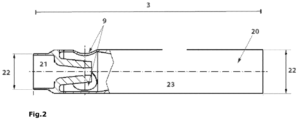
- FIG. 2 shows a schematic representation of a jet head 3 which can be used for circulating a fermenting liquid in a closed fermentation tank, according to a possible embodiment of the present invention.
- the jet head 3 comprises a hollow housing 20 provided with perforations 9.
- a first segment 21 of the jet head 3 has a diameter 22 which is 10% to 20% smaller than the diameter 22 of a second segment 23.
- the first segment 21 allows a connection to a second conduit 4' (not visible in figure 3) or is provided with means allowing a conduit 4' to open into the jet head.
- the perforations 9 are situated in the second segment 23, in the vicinity of the first segment. Preferably, two to four perforations 9 are present in the jet head 3.
- the jet head 3 causes circulation in the fermentation tank 2 by circulating liquid through the perforations 9 in the jet head 3.
- the inner wall of the second segment is folded inwards and narrowed.
- the difference in diameter 22 causes an acceleration of the liquid flowing through the jet head 3, resulting in a drop in the liquid pressure in the jet head 3. This effect is also known as the Venturi effect.
- the pressure built up in the jet head 3 is transferred from the jet head 3 to the fermentation tank 2 by means of the perforations 9, with the result that circulation in the fermentation tank 2 occurs.
Landscapes
- Chemical & Material Sciences (AREA)
- Life Sciences & Earth Sciences (AREA)
- Engineering & Computer Science (AREA)
- Health & Medical Sciences (AREA)
- Polymers & Plastics (AREA)
- Food Science & Technology (AREA)
- Nutrition Science (AREA)
- Organic Chemistry (AREA)
- Wood Science & Technology (AREA)
- Zoology (AREA)
- Bioinformatics & Cheminformatics (AREA)
- Sustainable Development (AREA)
- Biochemistry (AREA)
- General Engineering & Computer Science (AREA)
- General Health & Medical Sciences (AREA)
- Genetics & Genomics (AREA)
- Microbiology (AREA)
- Biotechnology (AREA)
- Biomedical Technology (AREA)
- Apparatus Associated With Microorganisms And Enzymes (AREA)
Description
- The invention relates to a method for the industrial production of a beverage based on a fermented liquid such as tea.
- In a second aspect, the invention also relates to a device for the industrial production of a beverage based on fermented liquid.
- The invention can be applied, among other things, in the production of kombucha.
- Methods and devices for the industrial production of a beverage based on fermented liquids such as tea are known per se from the prior art. The production of a drink based on fermented tea is done by dissolving sugar in boiling water, wherein tea leaves are infused with the boiling sugar mixture. After cooling to room temperature, a mixture of symbiotic bacteria and yeasts is added, after which the fermentation sta rts.
- During the production of kombucha or other fermented drinks, a floating layer forms on the liquid, in the form of a gelatinous cellulose-based biofilm. This gelatinous cellulose-based biofilm is called "SCOBY" (Symbiotic Culture of Bacteria and Yeast), and it is generally required for the fermentation process. However, the presence of the biofilm makes it extremely difficult to produce fermented liquid on a large scale. After all, this biofilm must be removed from the mixture after fermentation, where removal often has to be done manually. This is very time consuming, requires intensive manual labor and the presence of biofilm causes additional problems, such as clogging of input or output of production vessels.
- The production of fermented liquid is generally an aerobic process, whereby a standard device for the production of fermented liquid comprises an open container with a still liquid. However, this leads to problems in sufficiently removing a biofilm, causing contamination of the container, and a limited production capacity. A contamination can be physical, chemical or biological in nature. In addition, there is also a need for better ways to remove particles from the liquid after production. Insufficiently clarified liquid (tea in which too many particles or microorganisms remain) has negative effects on the shelf life, taste and the build-up of alcohol and/or CO2 after bottling.
-
EP1718727 describes a device wherein pure oxygen is injected into a closed fermentation vessel during the fermentation. In this case, the fermentation vessel is homogenized mechanically by means of an agitator. External oxygen is added to the fermentation vessel. The device does not disclose use for fermenting tea. -
CN207294776 describes a device wherein a closed fermentation vessel is equipped with a stirring mechanism. According to the device, the stirring mechanism is connected to an air pump to introduce filtered air into the fermentation vessel. The device does not disclose use for fermenting tea. - An adapted method for the production of fermented tea is known, for example, from
CN103416545 . The method describes a production of kombucha in a tank wherein a woven fabric is used to capture and remove the formed cellulose-based biofilm during the fermentation process. The woven fabric is moved by means of rollers through the interior of the fermentation tank, from a starting point at the top of the tank to an end point at the bottom of the tank. - Also known is the method relating to an industrial production of kombucha from
US20200270556 andWO2018204243 . -
US20200270556 describes a method to produce kombucha on a large scale, using a fermentation system based on vertically oriented fermentation stacks. The fermentation stacks allow oxygen supply from the outside air and are heat conducting. -
WO2018204243 describes a method of producing an alcoholic beverage based on kombucha, using a fermentation system based on the use of separate fermentation tanks for the production of alcoholic tea liqueur on the one hand and the production of fermented tea on the other hand. Both productions are then combined to obtain an alcoholic kombucha drink with a specific alcohol percentage,CN 110892928 A describes a method to produce kombucha using fermentation of a sugar-containing liquid, wherein the fermented liquid is transported between different reactors corresponding to different fermentation steps, wherein each fermentation reactor is provided with nozzles allowing oxygen injection in the fermentation broth. - A difficulty with the above known devices and methods is that the cellulose-based biofilm (SCOBY) is still formed. This makes these known methods less suitable for industrially producing kombucha. After all, the biofilm formed by bacteria, yeast and cellulose in the fermentation broth is difficult to remove from fermentation vessels once formed, due to its size, weight and complex structure. Often this biofilm has to be manually removed from the fermentation vessels periodically. If not removed, this biofilm can significantly reduce tank efficiency by preventing proper cleaning of fermentation vessels, significantly reducing the efficiency of downstream separation through the centrifuge and preventing product sterilization through membrane filtration.
- The present invention aims to solve at least some of the above problems or drawbacks.
- In a first aspect, the present invention relates to a method for the industrial production of a beverage based on fermented liquid according to claim 1. The method comprises fermenting liquid in a closed fermentation tank, by means of microorganisms. In this case, the fermenting liquid is circulated in the fermentation tank, wherein at least a portion of the fermenting liquid is mixed with oxygenated air outside the fermentation tank, and then reintroduced into the fermentation tank.
- This is particularly advantageous because the combination of circulation and aeration of the fermenting liquid prevents the formation of a cellulose-based biofilm in the tank. This eliminates the need to remove the SCOBY at the end of the fermentation process, which of course improves the efficiency of the process. Usually, the removal of such a biofilm is a complex and labor-intensive process, as it has to be removed manually. Moreover, in the present invention, it becomes possible to thoroughly clean the fermentation tank, which is advantageous for aseptic production reducing contamination and food safety issues.
- Production efficiency is also increased when no more biofilm is formed during fermentation. The presence of biofilm often clogs the input and output conduits in the fermentation tank, preventing the fermentation tank from being emptied without periodically removing the biofilm. A worker will usually manually ensure that no biofilm can clog the conduits, but these actions slow down the production process.
- Preferred forms of the method are set out in claims 2-12.
- According to a preferred form, a synergistic effect takes place through the combination of a circulation and an oxygenation. The circulation in the fermentation tank takes place here by means of a jet head, preferably a rotary jet head. In this way, after mixing with oxygenated air outside the tank, the fermentation of liquid is carried out more efficiently throughout the fermentation tank.
- In a second aspect, the present invention relates to a device for the industrial production of fermented liquid according to claim 13.
- The device comprises a closed fermentation tank internally provided with a jet head. The fermentation tank is herein provided with a first conduit which is suitable for transporting at least a part of the fermenting drink from the fermentation tank to an aerator or oxygenator located outside the fermentation tank. The first conduit opens into the aerator or oxygenator and a second conduit exits from the aerator or oxygenator and opens into an inlet of the jet head located inside the fermentation tank, wherein the first and second conduits form an external loop located outside the fermentation tank and wherein the jet head is provided with perforations.
- The circulation in the fermentation tank is done by means of a jet head. This can be a stationary jet head. In a preferred form it is a rotary jet head. The presence of the jet head helps to prevent the formation of a cellulose-based biofilm in the fermentation tank. Moreover, the formation of a cellulose-based biofilm causes blockages in the conduits connected to the tank, which prevents the tank from being optimally emptied and cleaned. The circulation in the tank eliminates these problems. An additional advantage of using a jet head is that the fermenting liquid, after mixing with oxygenated air in an oxygenator outside the tank, is more efficiently distributed throughout the fermentation tank.
- Preferred forms of the device are described in dependent claims 14 and 15.
- According to a preferred form, the device comprises a centrifuge, connected to the fermentation tank, for centrifuging a fermented liquid. This allows particles with a certain density or weight (such as small biofilm residues) to be removed from the liquid. This better clarifies and prepares the fermented liquid for further filtration.
- According to a preferred form, the device comprises a filter unit for filtering the fermented liquid. This is particularly advantageous because the filter unit removes microorganisms such as bacteria and yeasts from the liquid. This is beneficial for shelf life and food safety.
-
-
Figure 1 shows a schematic representation of a device for the production of fermented tea according to the present invention. -
Figure 2 shows a schematic representation of an embodiment of the jet head according to the present invention. - Unless otherwise defined, all terms used in the description of the invention, including technical and scientific terms, have the meaning as commonly understood by a person skilled in the art to which the invention pertains. For a better understanding of the description of the invention, the following terms are explained explicitly.
- In this document, "a" and "the" refer to both the singular and the plural, unless the context presupposes otherwise. For example, "a segment" means one or more segments.
- When the term "around" or "about" is used in this document with a measurable quantity, a parameter, a duration or moment, and the like, then variations are meant of approx. 20% or less, preferably approx. 10% or less, more preferably approx. 5% or less, even more preferably approx. 1% or less, and even more preferably approx. 0.1% or less than and of the quoted value, insofar as such variations are applicable in the described invention. However, it must be understood that the value of a quantity used where the term "about" or "around" is used, is itself specifically disclosed.
- The terms "comprise", "comprising", "consist of", "consisting of", "provided with", "include", "including", "contain", "containing", are synonyms and are inclusive or open terms that indicate the presence of what follows, and which do not exclude or prevent the presence of other components, characteristics, elements, members, steps, as known from or disclosed in the prior art.
- Quoting numerical intervals by endpoints comprises all integers, fractions and/or real numbers between the endpoints, these endpoints included.
- In a first aspect, the present invention relates to a method for the industrial production of a beverage based on fermented liquid. The method comprises fermenting a liquid such as a tea or wort in a closed fermentation tank, by means of microorganisms. Wort is the clear sugary, aqueous solution obtained after mashing, the brewing process wherein the starch of malt and any other grains is enzymatically broken down into simpler molecules. In this case, the fermenting liquid is circulated in the fermentation tank, wherein at least a portion of the fermenting liquid is mixed with oxygen or oxygenated air outside the fermentation tank, and then reintroduced into the fermentation tank.
- The combination of circulation of the fermenting liquid with mixing of oxygenated air (oxygenation) prevents the formation of a cellulose-based biofilm in the tank. The fermentation of liquid such as tea or wort preferably takes place by means of a symbiotic culture of bacteria and yeast. The symbiotic culture, according to the prior art, results in the formation of a cellulose-based biofilm (SCOBY) which floats on the liquid. According to the present invention, the formation of a biofilm is prevented. In addition, it becomes possible to thoroughly clean a fermentation tank, which is advantageous for aseptic production reducing contamination and food safety issues. An additional advantage of the combination of circulation of the fermenting liquid with mixing of oxygenated air is that the acidification process, the process by which alcohol is converted into an acid (e.g., lactic acid or acetic acid), is more efficient, which has a positive influence on the composition and taste of the fermented liquid.
- In addition, the production efficiency is increased when no more biofilm is formed during fermentation. The presence of biofilm often clogs the input and output conduits in a fermentation tank, preventing the fermentation tank from being emptied without periodically removing the biofilm. Biofilm removal is usually done manually, requiring significant time and labor. The present invention eliminates this problem.
- Mixing the fermenting liquid with oxygen or oxygenated air is also advantageous because it allows an aerobic fermentation process to be carried out within a closed tank. By carrying out the mixing outside the fermentation tank, the concentration of oxygen that is added can be strictly controlled, in order to optimize the fermentation in this way.
- According to the invention, circulation in the fermentation tank is accomplished by means of a jet head. A jet head is connected to a conduit provided with an inlet valve through which the liquid is mixed with air and provided with perforations through which the fermenting liquid is passed.
- In a preferred form, use is made of a Venturi wherein the inner wall of the jet head comprises a constriction which generates a fluid pressure in the jet head. This liquid pressure is then transferred through the perforations in the jet head to the liquid in the fermentation tank, creating a circulation. The use of such a jet head is advantageous because the oxygenated fermenting liquid is optimally circulated.
- According to the invention, the mixing of the liquid infusion with air (the oxygenation) takes place outside the fermentation tank, with a portion of the fermenting liquid being conveyed by means of conduits provided for that purpose, which are in liquid connection with the fermentation tank, to an inlet valve (an aerator or oxygenator), where oxygenated air is mixed with the fermenting liquid, and then conveyed back to the fermentation tank via a conduit. In an embodiment, a connection is provided to a tank with oxygenated air).
- According to an embodiment, the oxygen content in the aerated or oxygenated liquid is between 50 and 8000 ppb. Modulation of the oxygen content is ideally suited to control the fermentation process, whereby an adjustment of the oxygen content can cause more acidification (formation of acids) on the one hand or can stimulate the formation of a larger biomass on the other hand.
- According to a further embodiment, the conduit which introduces the aerated or oxygenated liquid back into the fermentation tank discharges into an inlet of the jet head. The aerated or oxygenated liquid is hereby circulated in the fermentation tank by means of the jet head.
- According to an embodiment, fermented liquid is subjected to one or more separation processes after fermentation, wherein particles of a certain size or density are removed from the fermented liquid. An attempt is made to remove microbial residues that are still present in the fermented liquid, in order to prevent an unwanted additional fermentation after production.
- In an embodiment, the fermented drink is bottled for use after the fermentation process. This so-called "raw" drink such as "raw" kombucha will not undergo any further treatment steps after fermentation, other than those aimed at transport, bottling and consumption.
- According to another embodiment, the fermented liquid undergoes at least two separation steps, wherein a first separation is done by centrifugation and a second separation is done by a filter unit. This removes any impurities that could affect the final quality of the product. The present invention uses two separation steps to clarify the fermented liquid: a centrifugation step and a filtration step. A centrifuge provides a density separation in which solid components are removed from a liquid by means of a centrifugal force. A filter unit uses a physical separation by means of filters of defined diameter to remove microorganisms and contaminants, in order to achieve a certain sterilization.
- According to a further embodiment, the fermented liquid undergoes a second separation by means of a filter unit, wherein the filter unit comprises at least three filters. Preferably, a pore size of the filters in the filter unit is between 0.2 and 20 microns.
- In a further preferred form, a first filter will be suitable for filtering larger particles present in the fermented liquid, such as for instance aggregates of biofilm. Preferably, this first filter will have a pore size between 5 and 10 microns. In a further preferred form, a second filter will have a pore size between 1 and 5 microns and a 0.40-0.48-micron filter is used as third filter to remove all yeasts and larger bacteria, where a 0.45-micron filter is capable of removing 10e5 CFU/cm2 from a liquid as standard). More preferably, a 0.20-0.28-micron filter is used to remove all bacteria and achieve better sterility.
- In another embodiment, as an alternative to filtration and after centrifugation, the fermented beverage may undergo a pasteurization step. In a preferred form this will be a flash pasteurization or HTST pasteurization. In HTST pasteurization (High Temperature/Short Time) a liquid is brought to a certain temperature (for example 72°C) for a certain period (for example at least 15 seconds).
- According to an embodiment, the fermented drink is a tea infusion prepared from green, oolong or black tea to which sugar, a sugar solution or other sacchariferous, natural sweetener (such as, for example, honey, agave, date syrup, maple syrup) has been added. Preferably, the sugar is a monosaccharide (such as glucose, fructose or galactose) or a disaccharide (such as sucrose, lactose or maltose) or a mixture thereof.
- In another embodiment, the fermented drink is wort or other sacchariferous liquid such as a fruit juice.
- A starter culture of microorganisms is then added to conduct the fermentation process. A starter culture is preferably a symbiotic aerobic culture of bacteria and yeasts, wherein the bacteria are, for example, Gram-negative AAB bacteria (such as Acetobacter, Gluconobacter or Komagataeibacter) or Gram-positive LAB bacteria (such as Lactobacillus), and wherein yeasts are, for example, Saccharomyces or Zygosaccharomyces. It goes without saying that other microorganisms known in the prior art are also options.
- Yeasts transform the sugars in the infusion into alcohol and CO2, and then the bacteria convert the formed alcohol into acids (such as lactic acid or acetic acid). The present invention is advantageous because the acidification process (the forming of acids) is enhanced in large fermentation tanks, by the method by which the aerobic culture is performed. After all, by mixing the symbiotic culture of bacteria and yeasts with oxygen and by circulating the fermenting liquid in the tank by means of the jet head, the conversion process of sugar to acid is optimized, so that the fermented liquid obtains a better acidity. This allows production of fermented liquid such as tea on an industrial scale.
- According to an embodiment, the fermentation of a liquid proceeds by means of an aerobic process.
- According to an embodiment, the fermentation of liquid takes place at a temperature between 18 and 28°C, wherein the fermentation time is preferably 8 to 14 days. Preferably, the fermentation takes place at a temperature between 20 and 25°C for 8 to 12 days. More preferably, the fermentation takes place at a temperature of 23°C for 9 to 10 days. The temperature at which the fermentation takes place and the fermentation time determine the sweetness, alcohol content and acidity of the fermented liquid. If the temperature is too low, the liquid may be too sweet, too much alcohol may be present, or the fermentation time may become too long. If the temperature is too high, there can be an imbalance between yeasts and bacteria, which can prevent the fermentation from going perfectly. If the fermentation time is too short, the conversion of sugars to acids will not continue. If the fermentation time is too long, too much acid will be produced. The present invention greatly increases the chance of obtaining an optimal fermented liquid. This also increases the market value.
- According to an embodiment, CO2 is added externally to the fermented liquid.
- In an embodiment, a fermented liquid is bottled in bottles, canned in cans, or stored in large storage vessels such as kegs.
- A keg can be part of a tap installation by connecting it to adapted pipes and a tap. This allows fermented liquid to be tapped.
- According to an embodiment, one ingredient selected from the group of fruit juices, herbs, extracts, aromas and fruits is optionally added to the fermented liquid. This greatly increases the possible variety of fermented liquid produced. This makes it possible to respond to the different needs and requirements of a consumer, where a basic recipe is maintained, but where the finish of the fermented liquid can be variably chosen. A fermented tea without added ingredients, for example, is also possible, and is called "natural tea".
- According to an embodiment, the type of fermented liquid produced is kombucha or jun. Kombucha, also called "Manchurian tea", is a fermented tea made from black or green tea leaves, often touted for its (alleged) health benefits. Also called "Xun", Jun is a fermented tea (similar to kombucha) made from green tea leaves and honey.
- It will be apparent to those skilled in the art that the present invention also relates to a method for preventing the formation of a cellulose-based biofilm (SCOBY) during the fermentation of a liquid, for example a fermenting tea. Prevention is achieved by a combination of aeration/addition of oxygen to the fermenting liquid and circulation in the fermentation tank. The embodiments as described above in the context of the production method also apply to this method and are considered to be fully incorporated herein.
- In a second aspect, the present invention relates to a device for the industrial production of fermented liquid. The device comprises a closed fermentation tank which is internally provided with a jet head. The fermentation tank is provided with a first conduit which is suitable for transporting at least a portion of the fermenting drink from the fermentation tank to an aerator or oxygenator located outside the fermentation tank.
- The first conduit opens into the aerator or oxygenator and a second conduit exits from the aerator or oxygenator and opens into an inlet of the jet head located inside the fermentation tank, wherein the first and second conduits form an external loop located outside the fermentation tank and wherein the jet head is provided with perforations.
- This device allows an aerobic fermentation process to be carried out within a closed tank.
- According to an embodiment, the fermentation tank is a conical or cylindrically conical fermentation tank, also called a "conical fermenter".
- Preferably, a cylindrically conical fermentation tank or conical fermenter is made of stainless steel, where use is made, for example, of grade 304 stainless steel (consisting of 18% chromium and 8% nickel) or grade 316 stainless steel (consisting of 16% chromium, 2% molybdenum and 10% nickel). These possible embodiments are highly resistant to corrosion. Furthermore, the fermentation tank preferably comprises a volume between 100 hL and 4000 hL. More preferably, the content of the fermentation tank is 200 hL.
- According to an embodiment, the device comprises a fermentation tank provided with a double wall, wherein the walls define an internal space provided with a cooling liquid (such as for example glycol). This is advantageous to evenly control the temperature in the fermentation tank, optimizing the fermentation process. After all, the use of a cooling liquid around one or more segments of the fermentation tank ensures better heat conduction and a more homogeneous temperature throughout the entire tank. These adjustments allow better control of the fermentation process.
- According to an embodiment, the device comprises a heating element for heating the cooling liquid circulating around the fermentation tank. Preferably, a heating element is positioned around one or more tube networks in direct communication with the internal space of the double wall of the fermentation tank. The required temperature, which is indicated according to a method, can be reached by means of the heating element. This is advantageous because the heating element allows to set an optimum temperature for the fermentation, and to correct it during the fermentation if necessary.
- The circulation of the liquid in the fermentation tank is done by means of a jet head or mixer. As already mentioned, it has been found that a combination of circulation and aeration with oxygen ensures that the cellulose-based biofilm is not formed in the fermentation tank. Optimal circulation conditions are obtained when a rotary jet head is used. In a preferred form, the jet head will comprise a hollow housing provided with perforations. The jet head is connected to the second pipe, which is the connection between the oxygenator and the fermentation tank, by means of the jet head. This conduit ensures the transfer of the aerated liquid to the fermentation tank and is crucial for moving the fermenting liquid. The jet head receives the liquid transported through the second conduit and distributes it throughout the fermentation tank by means of the perforations. Indeed, a constriction in the inner wall of the jet head causes an acceleration of the liquid flowing through the jet head, which results in a change in the liquid pressure inside the jet head. This effect is also known as the Venturi effect. The velocity built up in the jet head is then transferred from the jet head to the fermentation tank by means of the perforations. This effect causes circulation in the fermentation tank.
- The conduits in the fermentation process are preferably made of material suitable for the food industry. These pipes can withstand a pressure of at least 16 bar and are easy to clean. By means of the positions of the valves, the liquid can be passed through the loop between the fermentation tank and oxygenator or sent from the fermentation tank further to the centrifuge, the filter unit and downstream to, for example, a storage unit.
- According to a preferred embodiment, the device further comprises one or more separation means, which allow to further purify the obtained fermented liquid from undesirable elements or contaminants. In a preferred form, at least a centrifuge and a filter unit will be present as separation means.
- To this end, a centrifuge will be provided, in communication with the fermentation tank, for centrifuging a fermented liquid. The connection between the fermentation tank and downstream units such as the centrifuge is made possible by the conduits and the position of the valves present in the conduits. Preferably, the flow of the fermented liquid will be determined by the position of one or more valves present in the conduits, wherein during the fermentation process a valve allows the liquid to be oxygenated and returned to the fermentation vessel, and wherein upon completion of the fermentation, the position of the one or more valves will be adjusted, thus leading the liquid to a centrifuge.
- A centrifugation step allows particles of a certain density or weight to be removed from the fermented liquid. Possible particles include residues of the microorganisms used in the fermentation process.
- In a further preferred form, the device comprises a filter unit for filtering the fermented liquid. Preferably, the filter unit is located downstream of the centrifuge. By further filtration through one or more filters, the liquid will, as it were, receive a disinfecting treatment and will be stripped of any microbiological contaminants that can affect the final quality and shelf life of the liquid.
- In a preferred form, the filter unit will contain at least three filters. Preferably, a pore size of the filters used is between 0.2 and 20 microns. Filters are preferably made of cellulose acetate, cellulose nitrate, polyamide, polycarbonate, polypropylene or polytetrafluoroethylene. The filter unit comprises at least three filters with different pore sizes, wherein a first filter has a larger pore size than a second filter, and a second filter has a larger pore size than a third filter. Preferably, a 5-10-micron filter is used to obstruct large particles (such as aggregates of biofilm), a 1-5-micron filter (FPEP K402 Europor coarse filter) (FPEP K240 Europor fine filter) is used as a second filter, and a 0.4-0.5-micron filter (FPEP K240 Europor fine filter) is used as the third filter to remove all yeasts and larger bacteria. More preferably, a 0.20-0.28-micron filter (FPEP K470 Europor ultra fine filter) is used to remove all bacteria and achieve better sterility. This is advantageous for removing bacteria and yeasts from the fermented liquid after production. This avoids unwanted fermentation after bottling, whereby an undesired build-up of alcohol and/or CO2 is limited.
- The fermented liquid can be bottled by means of a bottling unit. A bottling unit preferably consists of a washing station where empty bottles are cleaned, a filling station where the fermented liquid is poured into bottles, and a closing unit where the bottles with fermented liquid are closed by means of a cap or crown cap. The bottles with fermented liquid can then be provided with a custom label or custom printing. In addition, the fermented liquid can also be stored in vessels, which can be used for tapping the liquid.
- In what follows, the invention is described by way of non-limiting examples or figures illustrating the invention, and which are not intended to and should not be interpreted as limiting the scope of the invention.
-
Figure 1 shows a schematic representation of a device 1 for producing a fermented liquid, according to a possible embodiment of the present invention. The device 1 comprises afermentation tank 2 which is internally provided with a jet head 3. The fermentation tank has a volume of 200 hL. It goes without saying that other volumes are also possible. - According to a possible embodiment, the
fermentation tank 2 is filled with water (for example tap water) to a certain level. For example, the volume contained in thefermentation tank 2 is maintained at a controlled level of about 200 hL. Then, sugar is added to the water (examples of sugar include glucose, sucrose, or lactose) and the water is brought to a boil. To make a tea infusion, tea leaves are added to the sugar water according to a certain ratio and infused in the sugar water for a certain amount of time, where the time of the tea infusion determines the intensity of the tea. For example, tea leaves may consist of green or black tea, and possibly added loosely to the water. Alternatively, tea is contained in a pouch or bag, wherein the pouch or bag is permeable to water and is added to the water. In an alternative embodiment, a sugar infusion mixture is prepared outside the fermentation tank and transferred to the fermentation tank for fermentation. After the tea incubation, the tea leaves are removed again and the infusion is, in one embodiment, cooled to a temperature between 18°C and 28°C. The symbiotic bacteria (such as for example Gluconobacter or Lactobacillus species) and yeasts (such as for example Saccharomyces) are added to the infusion according to a certain ratio, and the fermentation takes place for 8 to 14 days at a temperature between 18°C and 28°C. The fermenting liquid is circulated in thefermentation tank 2 by means of the jet head 3. - A first conduit 4 emanating from the fermentation tank allows to divert the contents or part of the contents of the fermentation tank from the fermentation tank. In
figure 1 , the conduit is provided at the bottom of the fermentation tank, but it goes without saying that other locations on the fermentation tank are also possible, such as at the top or in the middle of the fermentation tank. The direction of liquid flow can be regulated by means of a pump 5 for circulation and valves 6 provided for this purpose. Conduit 4 can send the liquid from the fermentation tank to a more distant processing unit of the device (e.g., a filling unit) or to an oxygenator 7. This oxygenator 7 allows to supply the fermenting liquid from the fermentation tank with oxygen. To this end, the device 1 is also provided with an oxygen bottle 8 for supplying oxygen to the oxygenator. In another embodiment, not shown, the device will comprise an aerator instead of an oxygenator, and a supply of (compressed) air via a sterile filter. - After the fermenting tea has been mixed with oxygen (or air), the liquid will be returned to the
fermentation tank 2 through a second conduit 4' emanating from the oxygenator 7, where the conduit 4' will discharge into an inlet 9 of the jet head 3. The liquid flow can be regulated again by means of valves 6 provided for that purpose, allowing or preventing a connection. In thefermentation tank 2, the jet head 3 is provided with perforations 10 with which speed is developed, according to the Venturi effect, with which tea is drawn from the perforations 10 into the jet head 3. This stimulates circulation. - The first 4 and second 4' conduit form an external loop 11 which leads back to the jet head inlet 9, and which finally opens into the jet head 3. The device 1 thus provides the possibility of circulating fermenting tea from the bottom of the
fermentation tank 2, through the conduits and through the jet head 3. When tea is flowing through, the jet head 3 can generate at least two liquid flows through the perforations 10 (e.g., two, three or four perforations), whereby circulation is obtained, and the circulation flow rate greatly increases. - In the embodiment shown, the first conduit 4 connects to the oxygenator 7. In the oxygenator 7, oxygen from the oxygen bottle 8 is mixed into the fermenting tea. This generates an aeration of the fermenting tea. Subsequently, the aerated tea is returned to the
fermentation tank 2 by means of the second conduit 4', the jet head inlet 9 and the jet head 3, where the fermentation takes place. - After the fermentation process has been finalized, the liquid can be emptied from the
fermentation tank 2 and sent from the fermentation tank via conduit 4 to a unit of the device located further away (for example a filling unit). The first conduit 4 provides the possibility, by means of the pump 5 and the valves 6, to connect thefermentation tank 2 to a centrifuge 12. The centrifuge 12 constitutes a first separation step, wherein the fermenting tea is centrifuged. The centrifuge 12 performs a separation, wherein particles or components of a particular density or weight are removed from the fermented tea. The centrifuge 12 is in communication with a downstream positioned filter unit 13 by means of valves 6 in a third conduit 4". A filter unit 13 forms a second separation step and comprises at least three different filters 14, wherein the pore size 15 of a filter 14 is between 5 and 0.2 microns. The filter unit 13 is connected, through the valves 6 in the third conduit 4", downstream to a more distant unit such as a filling station or a storage vessel for the fermented tea (not shown). - In the embodiment shown in
figure 1 , thefermentation tank 2 comprises a double wall 16, the walls defining an internal space provided with a cooling liquid 17 (e.g., glycol). Apipe network 18 connects the double wall 16 to the cooling liquid tank 19, wherein a heating element 20 is present in thepipe network 18 used for heating the cooling liquid. A pump 5 provides the propulsion and valves 6 are present with which a flow of coolingliquid 17 is permitted or prevented. A control valve 21 for determining the cooling temperature is present in thepipe network 18. -
Figure 2 shows a schematic representation of a jet head 3 which can be used for circulating a fermenting liquid in a closed fermentation tank, according to a possible embodiment of the present invention. The jet head 3 comprises a hollow housing 20 provided with perforations 9. A first segment 21 of the jet head 3 has a diameter 22 which is 10% to 20% smaller than the diameter 22 of a second segment 23. The first segment 21 allows a connection to a second conduit 4' (not visible in figure 3) or is provided with means allowing a conduit 4' to open into the jet head. The perforations 9 are situated in the second segment 23, in the vicinity of the first segment. Preferably, two to four perforations 9 are present in the jet head 3. The jet head 3 causes circulation in thefermentation tank 2 by circulating liquid through the perforations 9 in the jet head 3. At the level of the connection between the first 21 and second 23 segment, the inner wall of the second segment is folded inwards and narrowed. The difference in diameter 22 causes an acceleration of the liquid flowing through the jet head 3, resulting in a drop in the liquid pressure in the jet head 3. This effect is also known as the Venturi effect. The pressure built up in the jet head 3 is transferred from the jet head 3 to thefermentation tank 2 by means of the perforations 9, with the result that circulation in thefermentation tank 2 occurs.
Claims (15)
- A method for the industrial production of kombucha based on a fermented liquid, wherein the liquid is a sacchariferous liquid and is fermented by means of microorganisms in a closed fermentation tank, characterized in that the fermenting liquid is circulated in the fermentation tank and wherein at least a portion of the fermenting liquid is mixed with oxygen or oxygenated air outside the fermentation tank, and then reintroduced into the fermentation tank.
- The method according to claim 1, characterized in that circulation in the fermentation tank is by means of a mixer or a jet head.
- The method according to any of the preceding claims, characterized in that the mixing of the liquid with oxygen or air is done outside the fermentation tank, wherein a portion of the fermenting liquid is conveyed by means of conduits provided for that purpose that are in connection with the fermentation tank to an aerator or oxygenator, where the fermenting liquid is mixed with oxygen or air, and subsequently conveyed back to the fermentation tank by means of a conduit.
- The method according to claim 3, characterized in that the conduit introducing the aerated or oxygenated liquid back into the fermentation tank discharges into an inlet of the mixer or jet head and the aerated or oxygenated liquid is circulated by means of the mixer or jet head in the fermentation tank.
- The method according to any of the preceding claims, characterized in that the oxygen content in the aerated or oxygenated liquid is between 50 and 8000 ppb.
- The method according to any of the preceding claims, characterized in that the fermented liquid is separated after fermentation, wherein particles or microorganisms of a certain size or density are removed from the fermented liquid.
- The method according to claim 6, characterized in that the fermented liquid undergoes at least two separation steps, wherein a first separation is done by centrifugation and a second separation is done by a filter unit.
- The method according to claim 7, characterized in that a second separation step takes place by means of at least three filters with a pore size between 0.2 to 20 microns, wherein a first filter comprises a pore size greater than a second filter, wherein the second filter comprises a pore size greater than a third filter.
- The method according to any of the preceding claims, characterized in that the liquid is wort or an infusion of green, Oolong or black tea to which sugar or a sugar solution has been added as well as a starter culture of microorganisms.
- The method according to any of the preceding claims, characterized in that a fermentation proceeds by means of an aerobic process.
- The method according to any of the preceding claims, characterized in that the fermentation takes place at a temperature between 18 and 28°C, wherein the fermentation time is preferably 8 to 14 days.
- The method according to any of the preceding claims, characterized in that a starter culture is a mixture of aerobic bacteria and yeasts.
- A device for the industrial production of kombucha, the device comprising a closed fermentation tank internally provided with a jet head characterized in that the fermentation tank is provided with a first conduit suitable for transporting a portion of the fermenting drink from the fermentation tank to an aerator or oxygenator located outside the fermentation tank, wherein the first conduit opens into the aerator or oxygenator and a second conduit exits from the aerator or oxygenator and opens into an inlet of the jet head located inside the fermentation tank, wherein the first and second conduits form an external loop located outside the fermentation tank and wherein the jet head is provided with perforations.
- The device according to claim 13, characterized in that the device comprises a centrifuge, in connection with the fermentation tank, for centrifuging the fermented liquid.
- The device according to any of the preceding claims, characterized in that the device comprises a filter unit for filtering the fermented liquid, wherein the filter unit is located downstream of the centrifuge.
Applications Claiming Priority (2)
| Application Number | Priority Date | Filing Date | Title |
|---|---|---|---|
| BE20215100A BE1029101B1 (en) | 2021-02-11 | 2021-02-11 | PROCEDURE AND EQUIPMENT FOR THE INDUSTRIAL PRODUCTION OF FERMENTED BEVERAGE |
| PCT/IB2022/051192 WO2022172185A1 (en) | 2021-02-11 | 2022-02-10 | Method and device for the industrial production of kombucha |
Publications (3)
| Publication Number | Publication Date |
|---|---|
| EP4291629A1 EP4291629A1 (en) | 2023-12-20 |
| EP4291629C0 EP4291629C0 (en) | 2024-12-18 |
| EP4291629B1 true EP4291629B1 (en) | 2024-12-18 |
Family
ID=74661201
Family Applications (1)
| Application Number | Title | Priority Date | Filing Date |
|---|---|---|---|
| EP22710432.0A Active EP4291629B1 (en) | 2021-02-11 | 2022-02-10 | Method and device for the industrial production of kombucha |
Country Status (5)
| Country | Link |
|---|---|
| US (1) | US20240138444A1 (en) |
| EP (1) | EP4291629B1 (en) |
| BE (1) | BE1029101B1 (en) |
| ES (1) | ES3005314T3 (en) |
| WO (1) | WO2022172185A1 (en) |
Families Citing this family (2)
| Publication number | Priority date | Publication date | Assignee | Title |
|---|---|---|---|---|
| GB202409504D0 (en) * | 2024-07-01 | 2024-08-14 | Real Brewing Company Ltd | A method of producing non-alcoholic fermented drink |
| CN119184172B (en) * | 2024-11-13 | 2025-04-11 | 武夷山市手尚工夫茶业有限公司 | A tea fermentation device and use method thereof |
Family Cites Families (10)
| Publication number | Priority date | Publication date | Assignee | Title |
|---|---|---|---|---|
| ATE34768T1 (en) * | 1982-03-15 | 1988-06-15 | Whitbread & Co Ltd | CONTROL OF ALCOHOLIC FERMENTATION. |
| ITTO20010965A1 (en) * | 2001-10-11 | 2003-04-11 | Gimar Tecno S R L | AUTOMATIC OPERATION FERMENTATION EQUIPMENT. |
| ITTO20021012A1 (en) * | 2002-11-20 | 2004-05-21 | Gimar Tecno S R L | AUXILIARY SPRAYING AND RECIRCULATION DEVICE FOR |
| US7985574B2 (en) | 2004-02-17 | 2011-07-26 | American Air Liquide, Inc. | Oxygen-assisted fermentation process |
| CN103416545B (en) | 2012-05-14 | 2015-01-28 | 中原工学院 | Method for producing kombucha beverage by liquid spraying fermentation tower filled with knitted fabric |
| CN207294776U (en) | 2017-04-25 | 2018-05-01 | 菏泽嘉麟生物科技有限公司 | A kind of airflow stirring fermentation tank |
| WO2018204243A1 (en) | 2017-05-01 | 2018-11-08 | Honeymoon Brewery, Llc | Kombucha-based alcoholic beverage brewing system and method |
| CN108753592B (en) * | 2018-06-20 | 2020-09-01 | 新乡医学院 | A tumor cell heating device capable of aseptic sampling |
| US10787634B2 (en) | 2019-02-22 | 2020-09-29 | Clear Craft, Llc | Space-efficient, high throughput fermenting system for producing alcohol-limited kombucha |
| CN110892928A (en) * | 2019-11-11 | 2020-03-20 | 浙江茗皇天然食品开发股份有限公司 | Semi-continuous preparation method and device of black tea fungus fermentation liquor |
-
2021
- 2021-02-11 BE BE20215100A patent/BE1029101B1/en active IP Right Grant
-
2022
- 2022-02-10 US US18/276,210 patent/US20240138444A1/en active Pending
- 2022-02-10 WO PCT/IB2022/051192 patent/WO2022172185A1/en not_active Ceased
- 2022-02-10 EP EP22710432.0A patent/EP4291629B1/en active Active
- 2022-02-10 ES ES22710432T patent/ES3005314T3/en active Active
Also Published As
| Publication number | Publication date |
|---|---|
| EP4291629A1 (en) | 2023-12-20 |
| BE1029101B1 (en) | 2022-09-12 |
| EP4291629C0 (en) | 2024-12-18 |
| ES3005314T3 (en) | 2025-03-14 |
| BE1029101A1 (en) | 2022-09-05 |
| WO2022172185A1 (en) | 2022-08-18 |
| US20240138444A1 (en) | 2024-05-02 |
Similar Documents
| Publication | Publication Date | Title |
|---|---|---|
| RU2162484C1 (en) | Method of kvass production | |
| US5718161A (en) | Beer brewing system and method | |
| RU2156283C2 (en) | Method for continuous cold treatment of nutritive aqueous solution and a method of preparing cooled beverage | |
| US20240138444A1 (en) | Method and Device for the Industrial Production of Kombucha | |
| US12359149B2 (en) | Kombucha-based alcoholic beverage brewing system and method | |
| US3875303A (en) | Preparation of beer | |
| US20210230521A1 (en) | Method for producing wine with a low alcohol content, and fermenting-desugaring unit for the implementation thereof | |
| EP4150040B1 (en) | Single-serve capsule for preparing alcoholic beer | |
| US4963381A (en) | Method for partial or total dealcoholization of wine and/or cider and device for implementing such method | |
| CN110892928A (en) | Semi-continuous preparation method and device of black tea fungus fermentation liquor | |
| JPH0780205A (en) | Selective degassing method and device | |
| US5014612A (en) | Process for the production of dealcoholized beverages, as well as a unit and device for performing the process | |
| WO1999047636A2 (en) | Improved method and apparatus for processing a preparation | |
| UA77050C2 (en) | Method and device of industrial production of bubbly alcohol-containing beverages (variants) | |
| EP4150041B1 (en) | Process of manufacturing a packaged liquid beer concentrate | |
| CN1472302A (en) | Producing method for distilled liquor with fruit juice ferment and distilling apparatus thereof | |
| AU2006260844B2 (en) | Method for preparing a fermented beverage with low alcohol content | |
| CN110117513A (en) | A kind of low bitter taste, beer of Gao Huaxiang and preparation method thereof | |
| US3982024A (en) | Preservation of alcoholic beverages | |
| WO2020165929A1 (en) | Method to produce a low alcohol content drink and corresponding apparatus | |
| EP4653072A1 (en) | Filter assembly for a fermentation vessel and a fermentation vessel comprising the filter assembly | |
| CN222510337U (en) | Coffee extraction system | |
| CN101454436A (en) | Method of fermenting wort | |
| Gitis et al. | Porous Ceramics—Basics and Applications in Food and Water Industries | |
| CN1071787C (en) | Beer brewing technology |
Legal Events
| Date | Code | Title | Description |
|---|---|---|---|
| STAA | Information on the status of an ep patent application or granted ep patent |
Free format text: STATUS: UNKNOWN |
|
| STAA | Information on the status of an ep patent application or granted ep patent |
Free format text: STATUS: THE INTERNATIONAL PUBLICATION HAS BEEN MADE |
|
| PUAI | Public reference made under article 153(3) epc to a published international application that has entered the european phase |
Free format text: ORIGINAL CODE: 0009012 |
|
| STAA | Information on the status of an ep patent application or granted ep patent |
Free format text: STATUS: REQUEST FOR EXAMINATION WAS MADE |
|
| 17P | Request for examination filed |
Effective date: 20230908 |
|
| AK | Designated contracting states |
Kind code of ref document: A1 Designated state(s): AL AT BE BG CH CY CZ DE DK EE ES FI FR GB GR HR HU IE IS IT LI LT LU LV MC MK MT NL NO PL PT RO RS SE SI SK SM TR |
|
| DAV | Request for validation of the european patent (deleted) | ||
| DAX | Request for extension of the european patent (deleted) | ||
| GRAP | Despatch of communication of intention to grant a patent |
Free format text: ORIGINAL CODE: EPIDOSNIGR1 |
|
| STAA | Information on the status of an ep patent application or granted ep patent |
Free format text: STATUS: GRANT OF PATENT IS INTENDED |
|
| INTG | Intention to grant announced |
Effective date: 20240710 |
|
| GRAS | Grant fee paid |
Free format text: ORIGINAL CODE: EPIDOSNIGR3 |
|
| GRAA | (expected) grant |
Free format text: ORIGINAL CODE: 0009210 |
|
| STAA | Information on the status of an ep patent application or granted ep patent |
Free format text: STATUS: THE PATENT HAS BEEN GRANTED |
|
| AK | Designated contracting states |
Kind code of ref document: B1 Designated state(s): AL AT BE BG CH CY CZ DE DK EE ES FI FR GB GR HR HU IE IS IT LI LT LU LV MC MK MT NL NO PL PT RO RS SE SI SK SM TR |
|
| REG | Reference to a national code |
Ref country code: CH Ref legal event code: EP |
|
| REG | Reference to a national code |
Ref country code: DE Ref legal event code: R096 Ref document number: 602022008860 Country of ref document: DE |
|
| REG | Reference to a national code |
Ref country code: IE Ref legal event code: FG4D |
|
| U01 | Request for unitary effect filed |
Effective date: 20250106 |
|
| U07 | Unitary effect registered |
Designated state(s): AT BE BG DE DK EE FI FR IT LT LU LV MT NL PT RO SE SI Effective date: 20250116 |
|
| REG | Reference to a national code |
Ref country code: ES Ref legal event code: FG2A Ref document number: 3005314 Country of ref document: ES Kind code of ref document: T3 Effective date: 20250314 |
|
| U20 | Renewal fee for the european patent with unitary effect paid |
Year of fee payment: 4 Effective date: 20250221 |
|
| PG25 | Lapsed in a contracting state [announced via postgrant information from national office to epo] |
Ref country code: HR Free format text: LAPSE BECAUSE OF FAILURE TO SUBMIT A TRANSLATION OF THE DESCRIPTION OR TO PAY THE FEE WITHIN THE PRESCRIBED TIME-LIMIT Effective date: 20241218 |
|
| PG25 | Lapsed in a contracting state [announced via postgrant information from national office to epo] |
Ref country code: NO Free format text: LAPSE BECAUSE OF FAILURE TO SUBMIT A TRANSLATION OF THE DESCRIPTION OR TO PAY THE FEE WITHIN THE PRESCRIBED TIME-LIMIT Effective date: 20250318 |
|
| PG25 | Lapsed in a contracting state [announced via postgrant information from national office to epo] |
Ref country code: GR Free format text: LAPSE BECAUSE OF FAILURE TO SUBMIT A TRANSLATION OF THE DESCRIPTION OR TO PAY THE FEE WITHIN THE PRESCRIBED TIME-LIMIT Effective date: 20250319 |
|
| PG25 | Lapsed in a contracting state [announced via postgrant information from national office to epo] |
Ref country code: RS Free format text: LAPSE BECAUSE OF FAILURE TO SUBMIT A TRANSLATION OF THE DESCRIPTION OR TO PAY THE FEE WITHIN THE PRESCRIBED TIME-LIMIT Effective date: 20250318 |
|
| PG25 | Lapsed in a contracting state [announced via postgrant information from national office to epo] |
Ref country code: SM Free format text: LAPSE BECAUSE OF FAILURE TO SUBMIT A TRANSLATION OF THE DESCRIPTION OR TO PAY THE FEE WITHIN THE PRESCRIBED TIME-LIMIT Effective date: 20241218 |
|
| PG25 | Lapsed in a contracting state [announced via postgrant information from national office to epo] |
Ref country code: PL Free format text: LAPSE BECAUSE OF FAILURE TO SUBMIT A TRANSLATION OF THE DESCRIPTION OR TO PAY THE FEE WITHIN THE PRESCRIBED TIME-LIMIT Effective date: 20241218 |
|
| PGFP | Annual fee paid to national office [announced via postgrant information from national office to epo] |
Ref country code: ES Payment date: 20250331 Year of fee payment: 4 |
|
| PG25 | Lapsed in a contracting state [announced via postgrant information from national office to epo] |
Ref country code: IS Free format text: LAPSE BECAUSE OF FAILURE TO SUBMIT A TRANSLATION OF THE DESCRIPTION OR TO PAY THE FEE WITHIN THE PRESCRIBED TIME-LIMIT Effective date: 20250418 |
|
| PG25 | Lapsed in a contracting state [announced via postgrant information from national office to epo] |
Ref country code: SK Free format text: LAPSE BECAUSE OF FAILURE TO SUBMIT A TRANSLATION OF THE DESCRIPTION OR TO PAY THE FEE WITHIN THE PRESCRIBED TIME-LIMIT Effective date: 20241218 |
|
| PG25 | Lapsed in a contracting state [announced via postgrant information from national office to epo] |
Ref country code: CZ Free format text: LAPSE BECAUSE OF FAILURE TO SUBMIT A TRANSLATION OF THE DESCRIPTION OR TO PAY THE FEE WITHIN THE PRESCRIBED TIME-LIMIT Effective date: 20241218 |
|
| PG25 | Lapsed in a contracting state [announced via postgrant information from national office to epo] |
Ref country code: MC Free format text: LAPSE BECAUSE OF FAILURE TO SUBMIT A TRANSLATION OF THE DESCRIPTION OR TO PAY THE FEE WITHIN THE PRESCRIBED TIME-LIMIT Effective date: 20241218 |
|
| REG | Reference to a national code |
Ref country code: CH Ref legal event code: PL |
|
| PG25 | Lapsed in a contracting state [announced via postgrant information from national office to epo] |
Ref country code: CH Free format text: LAPSE BECAUSE OF NON-PAYMENT OF DUE FEES Effective date: 20250228 |
|
| PLBE | No opposition filed within time limit |
Free format text: ORIGINAL CODE: 0009261 |
|
| STAA | Information on the status of an ep patent application or granted ep patent |
Free format text: STATUS: NO OPPOSITION FILED WITHIN TIME LIMIT |
|
| 26N | No opposition filed |
Effective date: 20250919 |
|
| PG25 | Lapsed in a contracting state [announced via postgrant information from national office to epo] |
Ref country code: IE Free format text: LAPSE BECAUSE OF NON-PAYMENT OF DUE FEES Effective date: 20250210 |
|
| U20 | Renewal fee for the european patent with unitary effect paid |
Year of fee payment: 5 Effective date: 20260225 |
|
| PGFP | Annual fee paid to national office [announced via postgrant information from national office to epo] |
Ref country code: GB Payment date: 20260220 Year of fee payment: 5 |