EP4290945A2 - Registrierung und zuordnung mehrerer benutzeridentifikatoren für einen dienst auf einer vorrichtung - Google Patents
Registrierung und zuordnung mehrerer benutzeridentifikatoren für einen dienst auf einer vorrichtung Download PDFInfo
- Publication number
- EP4290945A2 EP4290945A2 EP23206074.9A EP23206074A EP4290945A2 EP 4290945 A2 EP4290945 A2 EP 4290945A2 EP 23206074 A EP23206074 A EP 23206074A EP 4290945 A2 EP4290945 A2 EP 4290945A2
- Authority
- EP
- European Patent Office
- Prior art keywords
- service
- particular device
- server
- user identifiers
- registration
- Prior art date
- Legal status (The legal status is an assumption and is not a legal conclusion. Google has not performed a legal analysis and makes no representation as to the accuracy of the status listed.)
- Pending
Links
Images



Classifications
-
- H—ELECTRICITY
- H04—ELECTRIC COMMUNICATION TECHNIQUE
- H04W—WIRELESS COMMUNICATION NETWORKS
- H04W4/00—Services specially adapted for wireless communication networks; Facilities therefor
- H04W4/50—Service provisioning or reconfiguring
-
- H—ELECTRICITY
- H04—ELECTRIC COMMUNICATION TECHNIQUE
- H04L—TRANSMISSION OF DIGITAL INFORMATION, e.g. TELEGRAPHIC COMMUNICATION
- H04L63/00—Network architectures or network communication protocols for network security
- H04L63/08—Network architectures or network communication protocols for network security for authentication of entities
- H04L63/0823—Network architectures or network communication protocols for network security for authentication of entities using certificates
-
- H—ELECTRICITY
- H04—ELECTRIC COMMUNICATION TECHNIQUE
- H04L—TRANSMISSION OF DIGITAL INFORMATION, e.g. TELEGRAPHIC COMMUNICATION
- H04L65/00—Network arrangements, protocols or services for supporting real-time applications in data packet communication
- H04L65/10—Architectures or entities
- H04L65/1016—IP multimedia subsystem [IMS]
-
- H—ELECTRICITY
- H04—ELECTRIC COMMUNICATION TECHNIQUE
- H04L—TRANSMISSION OF DIGITAL INFORMATION, e.g. TELEGRAPHIC COMMUNICATION
- H04L65/00—Network arrangements, protocols or services for supporting real-time applications in data packet communication
- H04L65/1066—Session management
- H04L65/1073—Registration or de-registration
-
- H—ELECTRICITY
- H04—ELECTRIC COMMUNICATION TECHNIQUE
- H04L—TRANSMISSION OF DIGITAL INFORMATION, e.g. TELEGRAPHIC COMMUNICATION
- H04L67/00—Network arrangements or protocols for supporting network services or applications
- H04L67/50—Network services
- H04L67/51—Discovery or management thereof, e.g. service location protocol [SLP] or web services
-
- H—ELECTRICITY
- H04—ELECTRIC COMMUNICATION TECHNIQUE
- H04W—WIRELESS COMMUNICATION NETWORKS
- H04W12/00—Security arrangements; Authentication; Protecting privacy or anonymity
- H04W12/06—Authentication
- H04W12/069—Authentication using certificates or pre-shared keys
-
- H—ELECTRICITY
- H04—ELECTRIC COMMUNICATION TECHNIQUE
- H04W—WIRELESS COMMUNICATION NETWORKS
- H04W12/00—Security arrangements; Authentication; Protecting privacy or anonymity
- H04W12/60—Context-dependent security
- H04W12/69—Identity-dependent
- H04W12/71—Hardware identity
-
- H—ELECTRICITY
- H04—ELECTRIC COMMUNICATION TECHNIQUE
- H04W—WIRELESS COMMUNICATION NETWORKS
- H04W4/00—Services specially adapted for wireless communication networks; Facilities therefor
- H04W4/80—Services using short range communication, e.g. near-field communication [NFC], radio-frequency identification [RFID] or low energy communication
-
- H—ELECTRICITY
- H04—ELECTRIC COMMUNICATION TECHNIQUE
- H04W—WIRELESS COMMUNICATION NETWORKS
- H04W8/00—Network data management
- H04W8/18—Processing of user or subscriber data, e.g. subscribed services, user preferences or user profiles; Transfer of user or subscriber data
- H04W8/183—Processing at user equipment or user record carrier
-
- H—ELECTRICITY
- H04—ELECTRIC COMMUNICATION TECHNIQUE
- H04L—TRANSMISSION OF DIGITAL INFORMATION, e.g. TELEGRAPHIC COMMUNICATION
- H04L67/00—Network arrangements or protocols for supporting network services or applications
- H04L67/2866—Architectures; Arrangements
- H04L67/30—Profiles
- H04L67/306—User profiles
-
- H—ELECTRICITY
- H04—ELECTRIC COMMUNICATION TECHNIQUE
- H04L—TRANSMISSION OF DIGITAL INFORMATION, e.g. TELEGRAPHIC COMMUNICATION
- H04L67/00—Network arrangements or protocols for supporting network services or applications
- H04L67/50—Network services
- H04L67/55—Push-based network services
-
- H—ELECTRICITY
- H04—ELECTRIC COMMUNICATION TECHNIQUE
- H04W—WIRELESS COMMUNICATION NETWORKS
- H04W60/00—Affiliation to network, e.g. registration; Terminating affiliation with the network, e.g. de-registration
-
- H—ELECTRICITY
- H04—ELECTRIC COMMUNICATION TECHNIQUE
- H04W—WIRELESS COMMUNICATION NETWORKS
- H04W8/00—Network data management
- H04W8/18—Processing of user or subscriber data, e.g. subscribed services, user preferences or user profiles; Transfer of user or subscriber data
- H04W8/20—Transfer of user or subscriber data
Definitions
- a mobile device that supports multiple subscriber identity modules may utilize multiple different phone numbers, e.g., a different phone number for each of the SIMs.
- SIMs subscriber identity modules
- a user may utilize multiple different SIMs (e.g., different phone numbers) on a mobile device that supports a single SIM, such as when travelling.
- only one of the SIMs may be active in the mobile device at any given time.
- the user may effectively be unavailable on that service via the phone number when the corresponding SIM is not active.
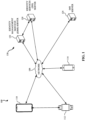
- FIG. 1 illustrates an example network environment 100 in which a system for registering and associating multiple user identifiers for a service on a device may be implemented in accordance with one or more implementations. Not all of the depicted components may be used in all implementations, however, and one or more implementations may include additional or different components than those shown in the figure. Variations in the arrangement and type of the components may be made without departing from the spirit or scope of the claims as set forth herein. Additional components, different components, or fewer components may be provided.
- the network environment 100 includes an electronic device 110, an electronic device 112, an electronic device 114, an identity services (IDS) server 120, an identity management services (IDMS) server 122, and an IP multimedia subsystem (IMS) server 124.
- the network environment 100 is illustrated in FIG. 1 as including the electronic devices 110, 112, 114, the IDS server 120, the IDMS server 122, and the IMS server 124; however, the network environment 100 may include any number of electronic devices and any number of servers or a data center including multiple of the servers in a group of servers 130.
- some of the servers in the group of servers 130 may be communicatively coupled with another server within the group of servers 130 to facilitate sending and/or receiving messages to and from each server as discussed further herein.
- the electronic device 110 may include a touchscreen and may be, for example, a smartphone that includes a touchscreen, a portable computing device such as a laptop computer, a peripheral device (e.g., a digital camera, headphones), a tablet device, a wearable device such as a watch, a band, and the like, any other appropriate device that includes, for example, one or more wireless interfaces such as cellular radios, near-field communication (NFC) radios, WLAN radios, Bluetooth radios, Zigbee radios, and/or other wireless radios.
- NFC near-field communication
- WLAN wireless local area network
- Bluetooth radios Zigbee radios
- the electronic device 110 is depicted as a mobile smartphone device.
- the electronic device 110 may be, and/or may include all or part of, the electronic device discussed below with respect to the electronic system discussed below with respect to FIG. 8 .
- the IDS server 120 and/or the IDMS server 122 may be associated with a particular service provider or entity, e.g. different from a cellular service provider.
- the IDS server 120 can be combined with the IDMS server 122 in at least an implementation, and/or one or more of the IDS server 120 and/or the IDMS server 122 may not be included in one or more implementations.
- one or more of the electronic devices 110, 112, 114 may be associated/registered with a user account with the service provider.
- the electronic devices 110, 112, 114 may each be associated with a same user account, or one or more of the electronic devices may be associated with a different user account.
- the IDS server 120 and/or the IDMS server 122 may perform a process of registering and associating multiple user identifiers for at least one service on a device.
- the IDMS server 122 may authenticate user identifiers (e.g., phone numbers, user account identifiers, etc.).
- the IDMS server 122 may obtain and/or generate handle information of the users for delivery to the IDS server 120.
- the IDS server 120 may then register the authenticated user identifiers for each service and for each device.
- the registration process includes having the IDS server 120 obtain all services on all devices registered to the user account corresponding to the device from which a registration request was received.
- the IDS server 120 may further update a registration data store (or database).
- the IDS server 120 can send push notifications or messages to devices containing the multiple user identifier registrations via the IDMS server 122.
- the IDS server 120 may be deployed to handle entitlement requests conferring capability and/or security permissions, such as for enabling services such as Wi-Fi calling, VoLTE, etc.
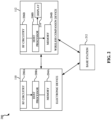
- the electronic device 110 may include a host processor 208A, a memory 204A, and radio frequency (RF) circuitry 206A.
- the electronic device 112 may include a host processor 208B, a memory 204B, RF circuitry 206B, and a display 210.
- the RF circuitry 206A,B may include one or more antennas and one or more transceivers for transmitting/receiving RF communications, such as WiFi, Bluetooth, cellular, and the like.
- the RF circuitry 206A of the electronic device 110 may include circuitry for forming wide area network connections and peer-to-peer connections, such as WiFi, Bluetooth, and/or cellular circuitry, while the RF circuitry 206B of the electronic device 112 may only include Bluetooth, WiFi, and/or other circuitry for forming peer-to-peer connections.
- the RF circuitry 206B of the electronic device 112 may also include circuitry for forming wide area network connections, such as cellular circuitry.
- the host processors 208A-B may include suitable logic, circuitry, and/or code that enable processing data and/or controlling operations of the electronic device 110 and the electronic device 112, respectively.
- the host processors 208A-B may be enabled to provide control signals to various other components of the electronic device 110 and the electronic device 112, respectively.
- the host processors 208A-B may enable implementation of an operating system or otherwise execute code to manage operations of the electronic device 110 and the electronic device 112, respectively.
- the memories 204A-B may include suitable logic, circuitry, and/or code that enable storage of various types of information such as received data, generated data, code, and/or configuration information.
- the memories 204A-B may include, for example, random access memory (RAM), read-only memory (ROM), flash, and/or magnetic storage.
- one or more of the host processors 208A-B, and/or one or more portions thereof may be implemented in software (e.g., subroutines and code), may be implemented in hardware (e.g., an Application Specific Integrated Circuit (ASIC), a Field Programmable Gate Array (FPGA), a Programmable Logic Device (PLD), a controller, a state machine, gated logic, discrete hardware components, or any other suitable devices) and/or a combination of both.
- ASIC Application Specific Integrated Circuit
- FPGA Field Programmable Gate Array
- PLD Programmable Logic Device
- controller e.g., a state machine, gated logic, discrete hardware components, or any other suitable devices
- the electronic device 110 may be a mobile phone, a tablet, or any other type of hand-held device, a media player, a computer, a laptop or virtually any type of wireless device.
- the electronic device 112 may be any of various types of devices that, in some implementations, has a smaller form factor relative to a conventional smart phone, and may have one or more of limited communication capabilities, limited output power, or limited battery life relative to a conventional smart phone. In some implementations, the electronic device 112 may be a smart watch or other type of wearable device.
- the electronic device 112 may be a tablet device, such as an iPad, and may also be capable of communicating with another device (e.g., the electronic device 110), referred to as a proxy device or intermediate device, using a short range communications protocol, and may then use the cellular functionality of this proxy device for communicating cellular voice/data with the base station 212.
- the electronic device 112 may provide voice/data packets intended for the base station 212 over the short range link to the electronic device 110, and the electronic device 110 may use its cellular functionality to transmit (or relay) this voice/data to the base station on behalf of the electronic device 112.
- the peer-to-peer network environment 200 may facilitate registration and association of multiple user identifiers that can access a same service on a single device, such as the electronic device 110.
- the electronic device 110 may be a multiple-SIM device that includes multiple physical SIMs (or UICCs).
- the electronic device 110 may include a physical device identity module (DIM) and one or more electronic SIMs (or e-SIMs).
- the electronic device 112 includes a physical SIM (or electronic SIM) that is separate from the SIMs of the electronic device 110.
- Each SIM of the device may be represented by a user identifier that identifies a phone number associated with the SIM.
- Each user identifier associated with the electronic device 110 may be mapped to a service as part of the multi-user identifier registration process.
- the electronic device 112 may include its own UICC (or SIM card) for accessing services provided by the IMS server 124.
- the UICC of the electronic device 112 is associated with a unique user identifier that is then mapped to a service registered with the electronic device 112 as part of the multi-user identifier registration process.
- a registration mapping may include a first user identifier identifying a phone number associated with the electronic device 112 and one or more user identifiers identifying respective phone numbers associated with the electronic device 110 that are mapped to a same service.
- each of the mapped user identifiers may be queried by a respective handle used to access the service via each respective user identifier.
- FIG. 3 illustrates diagrams 360, 370, 380, 390 for wireless communication devices that support multiple subscriber identities using removable UICCs and/or embedded UICCs (eUICCs) with SIMs and/or eSIMs implemented thereon, in accordance with one or more implementations. Not all of the depicted components may be used in all implementations, however, and one or more implementations may include additional or different components than those shown in the figure. Variations in the arrangement and type of the components may be made without departing from the spirit or scope of the claims as set forth herein. Additional components, different components, or fewer components may be provided.
- eUICCs embedded UICCs
- Each of the diagrams 360, 370, 380, 390 depicts components of the electronic device 110 (depicted as a dual SIM wireless communication device) including one or more processor(s) 306 and wireless circuitry 308 that provides for wireless radio frequency (RF) connections between the electronic device 110 and services 312 via wireless network 310.
- the wireless circuitry 308 includes one or more baseband processor(s), and a set of RF analog front-end circuitry.
- the processor(s) 306 and the wireless circuitry 308 can be configured to perform and/or control performance of one or more functionalities of the electronic device 110, in accordance with various implementations.
- the processor(s) 306 and the wireless circuitry 308 can provide functionality for coordinating hardware/software resources in the electronic device 110 to provide for connections to the wireless network 310.
- the electronic device 110 can concurrently register with one or more services.
- the wireless circuitry 308 of the electronic device 110 can be configured to register with and/or establish a connection with the wireless network 310.
- the wireless circuitry 308 of the electronic device 110 supports transmission of one or more registration requests and reception of one or more registration responses to the services 312 via the wireless networks 310.
- the wireless circuitry 308 of the electronic device 110 supports transmission and reception of only one user registration to the services 312 via the wireless networks 310 at a time.
- the electronic device 110 can register multiple UICCs with a same service via different user identifiers, the electronic device 110 can appear to the service as two or more distinct user identifiers (each corresponding to a different phone number).
- the electronic device 110 includes multiple UICCs 304, which can be inserted and removed individually or together, and communicate with one or more processors 306 that connect to wireless circuitry 308 that provides for wireless communication with one or more wireless networks 310.
- the electronic device 110 can include an embedded UICC (eUICC) 324 connected with the processor(s) 306 and to the wireless network(s) 310 via the wireless circuitry 308.
- the eUICC 324 can be built into the electronic device 110 and may not be removable from the electronic device 110, e.g., permanently affixed to a circuit board in the electronic device 110.
- the eUICC 324 can be programmed such that one or more electronic SIMs (eSIMs) can be implemented on the eUICC 324.
- eSIMs electronic SIMs
- Each eSIM can be associated with a distinct subscriber identity and/or provide distinct cellular services and/or subscriptions for a user of the electronic device 110.
- Diagram 380 illustrates an electronic device 110 that includes a removable UICC 304, on which can be installed one or more SIMs, and an eUICC 324 on which one or more eSIMs can be installed.
- the combination of SIMs on the UICC 304 and/or eSIMs on the eUICC 324 can provide for connections to one or more wireless networks 310 using the wireless circuitry 308 under the control of the processor(s) 306 of the electronic device 110.
- Diagram 390 illustrates another electronic device 110 that includes multiple UICCs 304, on which one or more SIMs can be installed, and an eUICC 324, on which one or more eSIMs can be installed.
- the combination of SIMs on the UICCs 304 and/or eSIMs on the eUICC 324 can provide for connections to one or more wireless networks 310 using the wireless circuitry 308 under the control of the processor(s) 306 of the electronic device 110.
- the electronic device 110 that supports multiple subscriber identities can include at least one LTICC 304 or at least one eUICC 324 or both.
- Each UICC 304 can support one or more SIMs
- each eUICC 324 can support one or more eSIMs.
- An electronic device 110 that supports multiple subscriber identities can include a combination of SIMs and/or eSIMs to support communication with one or more wireless networks 310.
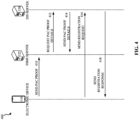
- FIG. 4 illustrates an example sequence diagram 400 for initiating registration and association of multiple phone numbers for a service on an electronic device using information for verifying that each of the phone numbers is associated with the electronic device, in accordance with one or more implementations.
- FIG. 4 is discussed with reference to components of FIG. 1 , namely the electronic device 110, the IDMS server 122 and the IDS server 120. As shown, the diagram shows interactions between the electronic device 110, the IDMS server 122, and the IDS server 120.
- the phone authentication certificate (PAC) validation is described herein with reference to the IDMS server 122; however, the PAC validation system may be used by multiple different services, such as communication services, and the like.
- an API may be provided that allows other services to utilize the PAC validation system.
- the electronic device 110 may initiate a registration for a service on a device by authenticating one or more user identifiers, e.g. phone numbers, with phone authentication certificate (PAC) information (and/or a digital signature).
- the digital signature may be used as a way of establishing trust that a particular user identifier is legitimate.
- the electronic device 110 may begin the registration by sending a request 410 for validating a PAC, where the request 410 may include information providing proof of the PAC ("PAC proof").
- the information related to the proof of the PAC for example, may be used to confirm that the PAC was generated for the electronic device 110 and/or to authenticate that the user identifier is a phone number associated with the PAC.
- the PAC includes a machine identifier (MID) associated with the electronic device 110 and the PAC proof details may include the MID in an implementation.
- MID machine identifier
- the MID may be associated with the electronic device 110 by being assigned to the electronic device 110 (e.g., by the IDMS server 122), by being included in firmware of the electronic device 110, by being included on the electronic device 110 at the time of manufacture, etc.
- the MID in an example is verified and associated with the electronic device 110 prior to requesting the PAC.
- the IDMS server 122 after receiving the request 410 including the PAC proof, communicates with the IDS server 120 to validate the PAC proof.
- the IDMS server 122 sends a request 412 for information regarding details for validating the PAC proof to the IDS server 120, where the request 412 includes the PAC proof.
- the IDS server 120 after receiving the request 412, analyzes the information included in the PAC proof and sends a response 414 including the details for validating the PAC proof.
- the IDS server 120 validates that the PAC is valid (e.g., by using one or more certificates stored at the IDS server 120), and that the signature included in the PAC proof is valid.
- the IDS server 120 may authenticate a phone number and PAC for multiple SIMs used by the electronic device 110.
- the details for validating the PAC proof include information such as, but not limited to, a phone number, a push token (e.g., the credentials associated with the electronic device 110), a MID, a usage timestamp related to when the PAC was last used by a service, a generation timestamp related to when the PAC was generated, a validation strength (e.g., basic, intermediate, maximum) which may be configured by an administrator for use by the IDMS server 122, and a status of the PAC (e.g., valid, invalid, expired, etc.).
- the IDMS server 122 determines whether the PAC proof is validated based on one or more of the following conditions, which may be based on information provided in the PAC proof and/or by further querying the IDS server 120.
- the PAC is required to be associated with the phone number that is the trusted phone number for the account, which may be verified based on the phone number included in the PAC.
- the PAC is required to be younger (e.g., based on the generation timestamp) than the last password change for the account (e.g., for when the electronic device 110 gets stolen and the password is changed).
- the timestamp related to when the PAC was validated is required to be within the predetermined past period of time (e.g., the last 45 days), or the IDS server 120 is required to have utilized the PAC within the predetermined past period of the time based on a timestamp provided by the IDS server 120 to the IDMS server 122.
- the MID in the PAC is required to match with the MID provided in the response 414.
- the IDMS server 122 may transmit a response message that includes an indication that the PAC proof was validated to the IDS server 120 and/or to the electronic device 110.
- a batch protocol is used to authenticate multiple user identifiers in a single request.
- the batch protocol may authenticate user identifiers using corresponding phone numbers.
- the request 410 includes the authentication batch request.
- a client device sends user credentials for each user identifier as a batch in the single request
- the user credentials include SMS (short-messaging-service) and/or SMS-less signatures.
- the IDMS server 122 via the IDS server 120 validates the signatures and may provision PACs in return.
- the user credentials include phone authentication certificates (PACs).
- PACs phone authentication certificates
- the IDMS server 122 validates any passed-in PACs, however, the server does not issue a new PAC to the client device.
- the authentication batch request includes a push token, a list of dictionaries containing per-user authentication requests, a user identifier (e.g., a phone number, a user account identifier, or the like), a tag (e.g., a handle corresponding to the user identifier, such as a phone number or an e-mail address), and an authentication certificate.
- the authentication batch request includes a certificate signature request and a SMS/SMS-less signature in lieu of the authentication certificate.
- the electronic device 110 sends a registration request 416 including an indication that the PAC proof was successfully validated to the IDS server 120.
- the registration request 416 includes user identifiers that correspond to one or more of a phone number associated with a SIM of the electronic device 110 or an e-mail address associated with a user account for accessing at least one service.
- the user identifier may uniquely identify a phone number that is based on one or more hardware identifiers (e.g., an ICC-ID (Integrated Circuit Card ID) of a SIM.
- the registration request 416 may include a service identifier that identifies the at least one service to be mapped with the registered user.
- the registration request 416 may also include a device identifier for identifying a device to be mapped with the at least one service and user identifiers registered to the service via that device.
- the IDS server 120 After receiving a request to register a user identifier for a service on a device from the registration request 416, the IDS server 120 registers the information sent from the electronic device 110, and stores an association between the user identifier and the service on the device, in a registration data store. In some implementations, the IDS server 120 performs phone number identification on each of the multiple SIMs of the electronic device 110 from the registration request 416. In some implementations, the IDS server 120 may register a phone number with a user account for each of the multiple SIMs of the electronic device 110. In this respect, the IDS server 120 provides a registration mapping of a same service to all registered phone numbers associated with the electronic device 110.
- the IDS server 120 uses a tag for the registration of a user identifier, where the tag represents an alias identifying the user identifier (e.g., phone number prefix or suffix, e-mail address, etc.).
- the tag may identify a registered user identifier for a device, where the tag for that user identifier may be different for each device.
- the registration mapping may be indexed by the tag for accessing the service on a respective device via the registered user identifier.
- the tag may identify a priority for a particular user identifier for accessing the service in a particular order relative to other user identifiers.
- the registration process may not be completed until a user of the electronic device 110 provides user input that serves as a confirmation of the registration.
- the electronic device 110 and the IDS server 120 may perform a frame exchange that includes user input responsive to one or more prompts from the IDS server 120.
- the IDS server 120 may prompt a user to select between two or more SIMs for registration.
- the user may indicate which of the two SIMs is a primary SIM and a secondary SIM, where the primary SIM may be programmed to operate as a default phone number for one or more services.
- the IDS server 120 may prompt a user to specify a service for linking between a user account identifier and phone number.
- the user may indicate which services are accessible via a first phone number and which services are accessible via a second phone number, for example.
- the IDS server 120 stores a table that contains a mapping of registrations that indicate linked user identifiers (e.g., a user account linked to multiple phone accounts for a given service on a device).
- the IDS server 120 may add new registration entries to the table.
- the IDS server 120 may update the table by deleting or modifying an existing registration entry.
- the table may be stored internally to the IDS server 120 in some implementations, or may be stored on an external database that is accessible to the IDS server 120 in other implementations.
- any registry or mapping of authenticated user identifiers to unique services may be used by the IDS server 120 to provide a trusted method of associating the identity of the electronic device 110 with a unique user identifier for a particular service and allowing the electronic device 110 to access the particular service via the user identifier.
- a link can be established between a phone number registration and a user account registration for a given service on a device.
- the IDS server 120 allows another device to use handles corresponding to a linked phone number when a user signs into that other device.
- a user at the electronic device 110 may initiate and/or accept a communication session (e.g., voice call, video chat/conference session, instant messaging session, etc.) as will be discussed further in FIG. 5 .
- a communication session e.g., voice call, video chat/conference session, instant messaging session, etc.
- the phone number of an electronic device e.g., electronic device 110, electronic device 112
- an e-mail address of a user account to the requested service may be used, individually or collectively, as the endpoint identifier of a communication session.
- a user at a first electronic device may initiate a communication session with other user(s) at other electronic device(s) to participate in the communication session using their respective handles, which serve as aliases for different phone numbers and/or e-mail addresses registered to a uniquely identified service on a particular device.
- the IDS server 120 may obtain registrations for a given user identifier. For example, the IDS server 120 may obtain registration information indicating all services on all devices registered for that user identifier, such as the registration information discussed further below with respect to FIG. 7 . In this respect, the IDS server 120 may verify the validity of the registration link from the registration information. The IDS server 120 obtains a device identifier for the destination device (e.g., the electronic device 114) based on the verified registration link (518). The IDS server 120 facilitates establishing the communication session for messaging services between the electronic device 110 and the electronic device 114 using the device identifier (522).
- the destination device e.g., the electronic device 114
- the IDS server 120 facilitates establishing the communication session for messaging services between the electronic device 110 and the electronic device 114 using the device identifier (522).
- the IDS server 120 performs a registration of at least one service for the particular device using the authenticated user identifiers.
- the registration includes at least one respective handle for accessing the at least one service via each respective user identifier.
- the handle may be the same as the user identifier, such as in the instance of a phone number, as is discussed further below with respect to FIG. 7 .
- the IDS server 120 transmits to the particular device, information related to the at least one respective handle for accessing the at least one service via each respective user identifier.
- the IDS server 120 may provide the particular device with all or part of the registration information discussed further below with respect to FIG. 7 .
- a second device may be registered to the first service using the first user identifier and associated handles.
- the registration information 700 depicts a registration entry identifying an association between a device, a service, a user identifier and a handle, other identifying information of a device and/or user may be used to represent an association among multiple user identifiers for a service on a device.
- FIG. 8 illustrates an electronic system 800 with which one or more implementations of the subject technology may be implemented.
- the electronic system 800 can be, and/or can be a part of, one or more of the electronic devices 110, 112, 114, the IDS server 120, the IDMS server 122, and/or the IMS server 124, as shown in FIG. 1 .
- the electronic system 800 may include various types of computer readable media and interfaces for various other types of computer readable media.
- the electronic system 800 includes a bus 808, one or more processing unit(s) 812, a system memory 804 (and/or buffer), a ROM 810, a permanent storage device 802, an input device interface 814, an output device interface 806, and one or more network interfaces 816, or subsets and variations thereof.
- a removable storage device such as a floppy disk, flash drive, and its corresponding disk drive
- the system memory 804 may be a read-and-write memory device. However, unlike the permanent storage device 802, the system memory 804 may be a volatile read-and-write memory, such as random access memory.
- the system memory 804 may store any of the instructions and data that one or more processing unit(s) 812 may need at runtime.
- the processes of the subject disclosure are stored in the system memory 804, the permanent storage device 802, and/or the ROM 810. From these various memory units, the one or more processing unit(s) 812 retrieves instructions to execute and data to process in order to execute the processes of one or more implementations.
- the bus 808 also connects to the input and output device interfaces 814 and 806.
- the input device interface 814 enables a user to communicate information and select commands to the electronic system 800.
- Input devices that may be used with the input device interface 814 may include, for example, alphanumeric keyboards and pointing devices (also called “cursor control devices").
- the output device interface 806 may enable, for example, the display of images generated by electronic system 800.
- Output devices that may be used with the output device interface 806 may include, for example, printers and display devices, such as a liquid crystal display (LCD), a light emitting diode (LED) display, an organic light emitting diode (OLED) display, a flexible display, a flat panel display, a solid state display, a projector, or any other device for outputting information.
- printers and display devices such as a liquid crystal display (LCD), a light emitting diode (LED) display, an organic light emitting diode (OLED) display, a flexible display, a flat panel display, a solid state display, a projector, or any other device for outputting information.
- One or more implementations may include devices that function as both input and output devices, such as a touchscreen.
- feedback provided to the user can be any form of sensory feedback, such as visual feedback, auditory feedback, or tactile feedback; and input from the user can be received in any form, including acoustic, speech, or tactile input.
- the bus 808 also couples the electronic system 800 to one or more networks and/or to one or more network nodes, such as the electronic device 110 shown in FIG. 1 , through the one or more network interface(s) 816.
- the electronic system 800 can be a part of a network of computers (such as a LAN, a wide area network ("WAN"), or an Intranet, or a network of networks, such as the Internet. Any or all components of the electronic system 800 can be used in conjunction with the subject disclosure.
- this gathered data may include personal information data that uniquely identifies or can be used to identify a specific person.
- personal information data can include demographic data, location-based data, online identifiers, telephone numbers, email addresses, home addresses, data or records relating to a user's health or level of fitness (e.g., vital signs measurements, medication information, exercise information), date of birth, or any other personal information.
- the present disclosure recognizes that the use of such personal information data, in the present technology, can be used to the benefit of users.
- the personal information data can be used to determine whether to register and/or associate a particular user identifier in accordance with a user's preferences. Accordingly, use of such personal information data enables users to have greater control of the devices for which user identifiers are registered.
- other uses for personal information data that benefit the user are also contemplated by the present disclosure. For instance, health and fitness data may be used, in accordance with the user's preferences to provide insights into their general wellness, or may be used as positive feedback to individuals using technology to pursue wellness goals.
- the present disclosure contemplates that those entities responsible for the collection, analysis, disclosure, transfer, storage, or other use of such personal information data will comply with well-established privacy policies and/or privacy practices.
- such entities would be expected to implement and consistently apply privacy practices that are generally recognized as meeting or exceeding industry or governmental requirements for maintaining the privacy of users.
- Such information regarding the use of personal data should be prominently and easily accessible by users, and should be updated as the collection and/or use of data changes.
- Personal information from users should be collected for legitimate uses only. Further, such collection/sharing should occur only after receiving the consent of the users or other legitimate basis specified in applicable law. Additionally, such entities should consider taking any needed steps for safeguarding and securing access to such personal information data and ensuring that others with access to the personal information data adhere to their privacy policies and procedures.
- the present disclosure also contemplates embodiments in which users selectively block the use of, or access to, personal information data. That is, the present disclosure contemplates that hardware and/or software elements can be provided to prevent or block access to such personal information data.
- the present technology can be configured to allow users to select to "opt in” or “opt out” of participation in the collection of personal information data during registration for services or anytime thereafter.
- the present disclosure contemplates providing notifications relating to the access or use of personal information. For instance, a user may be notified upon downloading an app that their personal information data will be accessed and then reminded again just before personal information data is accessed by the app.
- personal information data should be managed and handled in a way to minimize risks of unintentional or unauthorized access or use. Risk can be minimized by limiting the collection of data and deleting data once it is no longer needed.
- data de-identification can be used to protect a user's privacy. De-identification may be facilitated, when appropriate, by removing identifiers, controlling the amount or specificity of data stored (e.g., collecting location data at city level rather than at an address level), controlling how data is stored (e.g., aggregating data across users), and/or other methods such as differential privacy.
- the present disclosure broadly covers use of personal information data to implement one or more various disclosed embodiments, the present disclosure also contemplates that the various embodiments can also be implemented without the need for accessing such personal information data. That is, the various embodiments of the present technology are not rendered inoperable due to the lack of all or a portion of such personal information data.
- registered and/or associated user identifiers can be provided based on aggregated non-personal information data or a bare minimum amount of personal information, such as the information being handled only on the user's device or other non-personal information available.
- Implementations within the scope of the present disclosure can be partially or entirely realized using a tangible computer-readable storage medium (or multiple tangible computer-readable storage media of one or more types) encoding one or more instructions.
- the tangible computer-readable storage medium also can be non-transitory in nature.
- the computer-readable storage medium can be any storage medium that can be read, written, or otherwise accessed by a general purpose or special purpose computing device, including any processing electronics and/or processing circuitry capable of executing instructions.
- the computer-readable medium can include any volatile semiconductor memory, such as RAM, DRAM, SRAM, T-RAM, Z-RAM, and TTRAM.
- the computer-readable medium also can include any non-volatile semiconductor memory, such as ROM, PROM, EPROM, EEPROM, NVRAM, flash, nvSRAM, FeRAM, FeTRAM, MRAM, PRAM, CBRAM, SONOS, RRAM, NRAM, racetrack memory, FJG, and Millipede memory.
- the computer-readable storage medium can include any nonsemiconductor memory, such as optical disk storage, magnetic disk storage, magnetic tape, other magnetic storage devices, or any other medium capable of storing one or more instructions.
- the tangible computer-readable storage medium can be directly coupled to a computing device, while in other implementations, the tangible computer-readable storage medium can be indirectly coupled to a computing device, e.g., via one or more wired connections, one or more wireless connections, or any combination thereof.
- Instructions can be directly executable or can be used to develop executable instructions.
- instructions can be realized as executable or non-executable machine code or as instructions in a high-level language that can be compiled to produce executable or non-executable machine code.
- instructions also can be realized as or can include data.
- Computer-executable instructions also can be organized in any format, including routines, subroutines, programs, data structures, objects, modules, applications, applets, functions, etc. As recognized by those of skill in the art, details including, but not limited to, the number, structure, sequence, and organization of instructions can vary significantly without varying the underlying logic, function, processing, and output.
- any specific order or hierarchy of blocks in the processes disclosed is an illustration of example approaches. Based upon design preferences, it is understood that the specific order or hierarchy of blocks in the processes may be rearranged, or that all illustrated blocks be performed. Any of the blocks may be performed simultaneously. In one or more implementations, multitasking and parallel processing may be advantageous. Moreover, the separation of various system components in the implementations described above should not be understood as requiring such separation in all implementations, and it should be understood that the described program components and systems can generally be integrated together in a single software product or packaged into multiple software products.
- base station As used in this specification and any claims of this application, the terms “base station”, “receiver”, “computer”, “server”, “processor”, and “memory” all refer to electronic or other technological devices. These terms exclude people or groups of people.
- display or “displaying” means displaying on an electronic device.
- the phrase "at least one of” preceding a series of items, with the term “and” or “or” to separate any of the items, modifies the list as a whole, rather than each member of the list (i.e., each item).
- the phrase "at least one of” does not require selection of at least one of each item listed; rather, the phrase allows a meaning that includes at least one of any one of the items, and/or at least one of any combination of the items, and/or at least one of each of the items.
- phrases “at least one of A, B, and C” or “at least one of A, B, or C” each refer to only A, only B, or only C; any combination of A, B, and C; and/or at least one of each of A, B, and C.
- a processor configured to monitor and control an operation or a component may also mean the processor being programmed to monitor and control the operation or the processor being operable to monitor and control the operation.
- a processor configured to execute code can be construed as a processor programmed to execute code or operable to execute code.
- phrases such as an aspect, the aspect, another aspect, some aspects, one or more aspects, an implementation, the implementation, another implementation, some implementations, one or more implementations, an embodiment, the embodiment, another embodiment, some implementations, one or more implementations, a configuration, the configuration, another configuration, some configurations, one or more configurations, the subject technology, the disclosure, the present disclosure, other variations thereof and alike are for convenience and do not imply that a disclosure relating to such phrase(s) is essential to the subject technology or that such disclosure applies to all configurations of the subject technology.
- a disclosure relating to such phrase(s) may apply to all configurations, or one or more configurations.
- a disclosure relating to such phrase(s) may provide one or more examples.
- a phrase such as an aspect or some aspects may refer to one or more aspects and vice versa, and this applies similarly to other foregoing phrases.
Landscapes
- Engineering & Computer Science (AREA)
- Computer Networks & Wireless Communication (AREA)
- Signal Processing (AREA)
- Computer Security & Cryptography (AREA)
- Multimedia (AREA)
- Databases & Information Systems (AREA)
- Computing Systems (AREA)
- General Engineering & Computer Science (AREA)
- Business, Economics & Management (AREA)
- General Business, Economics & Management (AREA)
- Computer Hardware Design (AREA)
- Telephonic Communication Services (AREA)
- Mobile Radio Communication Systems (AREA)
- Pinball Game Machines (AREA)
Applications Claiming Priority (3)
| Application Number | Priority Date | Filing Date | Title |
|---|---|---|---|
| US201962855864P | 2019-05-31 | 2019-05-31 | |
| PCT/US2020/035424 WO2020243646A1 (en) | 2019-05-31 | 2020-05-29 | Registering and associating multiple user identifiers for a service on a device |
| EP20747167.3A EP3939233B1 (de) | 2019-05-31 | 2020-05-29 | Registrierung und zuordnung mehrerer benutzeridentifikatoren für einen dienst auf einer vorrichtung |
Related Parent Applications (1)
| Application Number | Title | Priority Date | Filing Date |
|---|---|---|---|
| EP20747167.3A Division EP3939233B1 (de) | 2019-05-31 | 2020-05-29 | Registrierung und zuordnung mehrerer benutzeridentifikatoren für einen dienst auf einer vorrichtung |
Publications (2)
| Publication Number | Publication Date |
|---|---|
| EP4290945A2 true EP4290945A2 (de) | 2023-12-13 |
| EP4290945A3 EP4290945A3 (de) | 2024-02-28 |
Family
ID=73549537
Family Applications (2)
| Application Number | Title | Priority Date | Filing Date |
|---|---|---|---|
| EP20747167.3A Active EP3939233B1 (de) | 2019-05-31 | 2020-05-29 | Registrierung und zuordnung mehrerer benutzeridentifikatoren für einen dienst auf einer vorrichtung |
| EP23206074.9A Pending EP4290945A3 (de) | 2019-05-31 | 2020-05-29 | Registrierung und zuordnung mehrerer benutzeridentifikatoren für einen dienst auf einer vorrichtung |
Family Applications Before (1)
| Application Number | Title | Priority Date | Filing Date |
|---|---|---|---|
| EP20747167.3A Active EP3939233B1 (de) | 2019-05-31 | 2020-05-29 | Registrierung und zuordnung mehrerer benutzeridentifikatoren für einen dienst auf einer vorrichtung |
Country Status (4)
| Country | Link |
|---|---|
| US (2) | US11166135B2 (de) |
| EP (2) | EP3939233B1 (de) |
| CN (2) | CN113853777B (de) |
| WO (1) | WO2020243646A1 (de) |
Families Citing this family (9)
| Publication number | Priority date | Publication date | Assignee | Title |
|---|---|---|---|---|
| AU2019388293A1 (en) * | 2018-11-26 | 2021-06-10 | Forticode Limited | Mutual authentication of computer systems over an insecure network |
| US11281802B2 (en) * | 2019-05-31 | 2022-03-22 | Apple Inc. | Providing obfuscated user identifiers for managing user-specific application state on multiuser devices |
| EP3939233B1 (de) * | 2019-05-31 | 2023-11-15 | Apple Inc. | Registrierung und zuordnung mehrerer benutzeridentifikatoren für einen dienst auf einer vorrichtung |
| EP4397015A1 (de) * | 2021-09-03 | 2024-07-10 | Dish Wireless L.L.C. | Systeme und verfahren zur implementierung eines digitalen zwillings mit einer live-streaming-karte |
| US12267912B2 (en) | 2021-12-21 | 2025-04-01 | Dish Wireless L.L.C. | Systems and methods for providing applications with access to network functionality |
| CN114579580B (zh) * | 2022-03-15 | 2026-02-10 | 北京百度网讯科技有限公司 | 存储数据的方法、查询数据的方法和装置 |
| CN116249103A (zh) * | 2022-12-22 | 2023-06-09 | 中国联合网络通信集团有限公司 | 一卡多号的实现方法、装置及系统 |
| US12386930B2 (en) * | 2023-03-14 | 2025-08-12 | Rubrik, Inc. | Identifier mapping techniques for cross node consistency |
| WO2025155153A1 (en) * | 2024-01-19 | 2025-07-24 | Samsung Electronics Co., Ltd. | Method and apparatus for handling user identifiers associated with user equipment in a wireless communication system |
Family Cites Families (12)
| Publication number | Priority date | Publication date | Assignee | Title |
|---|---|---|---|---|
| US6901436B1 (en) * | 1999-03-22 | 2005-05-31 | Eric Schneider | Method, product, and apparatus for determining the availability of similar identifiers and registering these identifiers across multiple naming systems |
| US20080003957A1 (en) * | 2006-06-28 | 2008-01-03 | Infineon Technologies Ag | Message generation with identification group information |
| US9154948B2 (en) * | 2007-11-04 | 2015-10-06 | IndusEdge Innovations Private Limited | Method and system for user authentication |
| US9356907B2 (en) * | 2008-08-05 | 2016-05-31 | HeyWire, Inc. | Messaging system having multiple number, dual mode phone support |
| US20100077208A1 (en) * | 2008-09-19 | 2010-03-25 | Microsoft Corporation | Certificate based authentication for online services |
| US8423058B2 (en) * | 2010-04-07 | 2013-04-16 | Apple Inc. | Registering client computing devices for online communication sessions |
| CN102244845B (zh) * | 2010-05-11 | 2015-08-12 | 中兴通讯股份有限公司 | 访问im业务系统存储服务器的方法和im业务系统 |
| KR20120002836A (ko) * | 2010-07-01 | 2012-01-09 | 삼성전자주식회사 | 복수의 서비스에 대한 접근 제어 장치 및 방법 |
| US10397770B2 (en) * | 2014-05-30 | 2019-08-27 | Apple Inc. | Mitigating paging collisions in dual standby devices |
| CN106162574B (zh) * | 2015-04-02 | 2020-08-04 | 成都鼎桥通信技术有限公司 | 集群系统中应用统一鉴权方法、服务器与终端 |
| US11228580B2 (en) * | 2018-06-25 | 2022-01-18 | Apple Inc. | Two-factor device authentication |
| EP3939233B1 (de) * | 2019-05-31 | 2023-11-15 | Apple Inc. | Registrierung und zuordnung mehrerer benutzeridentifikatoren für einen dienst auf einer vorrichtung |
-
2020
- 2020-05-29 EP EP20747167.3A patent/EP3939233B1/de active Active
- 2020-05-29 WO PCT/US2020/035424 patent/WO2020243646A1/en not_active Ceased
- 2020-05-29 CN CN202080038123.8A patent/CN113853777B/zh active Active
- 2020-05-29 EP EP23206074.9A patent/EP4290945A3/de active Pending
- 2020-05-29 CN CN202311294312.3A patent/CN117201462A/zh active Pending
- 2020-05-29 US US16/888,474 patent/US11166135B2/en active Active
-
2021
- 2021-11-01 US US17/516,597 patent/US20220132285A1/en active Pending
Also Published As
| Publication number | Publication date |
|---|---|
| EP3939233A1 (de) | 2022-01-19 |
| CN117201462A (zh) | 2023-12-08 |
| CN113853777B (zh) | 2023-10-24 |
| WO2020243646A1 (en) | 2020-12-03 |
| CN113853777A (zh) | 2021-12-28 |
| US11166135B2 (en) | 2021-11-02 |
| EP4290945A3 (de) | 2024-02-28 |
| US20200382927A1 (en) | 2020-12-03 |
| EP3939233B1 (de) | 2023-11-15 |
| US20220132285A1 (en) | 2022-04-28 |
Similar Documents
| Publication | Publication Date | Title |
|---|---|---|
| EP3939233B1 (de) | Registrierung und zuordnung mehrerer benutzeridentifikatoren für einen dienst auf einer vorrichtung | |
| US12177768B2 (en) | Maintaining access to services via SIM card | |
| EP4047867A1 (de) | Erbesserte berechtigung in zellularen kommunikationsnetzen | |
| WO2019232464A1 (en) | Techniques for enabling computing devices to identify when they are in proximity to one another | |
| US20120110643A1 (en) | System and method for transparently providing access to secure networks | |
| US9451465B2 (en) | Electronically binding to a lost mobile device | |
| US20240364516A1 (en) | Device-relationship based communication | |
| US11595789B2 (en) | Missed communication notification | |
| US12244604B2 (en) | Companion device authentication | |
| US20250184334A1 (en) | Companion device authentication | |
| WO2016099940A1 (en) | User equipment and method for dynamic internet protocol multimedia subsystem (ims) registration | |
| WO2021136511A1 (zh) | 一种通信方法及装置 | |
| US9578500B1 (en) | Authentication via mobile telephone | |
| US20250088858A1 (en) | Low-Power and Privacy Key Resolution |
Legal Events
| Date | Code | Title | Description |
|---|---|---|---|
| PUAI | Public reference made under article 153(3) epc to a published international application that has entered the european phase |
Free format text: ORIGINAL CODE: 0009012 |
|
| STAA | Information on the status of an ep patent application or granted ep patent |
Free format text: STATUS: REQUEST FOR EXAMINATION WAS MADE |
|
| 17P | Request for examination filed |
Effective date: 20231026 |
|
| AC | Divisional application: reference to earlier application |
Ref document number: 3939233 Country of ref document: EP Kind code of ref document: P |
|
| AK | Designated contracting states |
Kind code of ref document: A2 Designated state(s): AL AT BE BG CH CY CZ DE DK EE ES FI FR GB GR HR HU IE IS IT LI LT LU LV MC MK MT NL NO PL PT RO RS SE SI SK SM TR |
|
| REG | Reference to a national code |
Ref country code: DE Ref legal event code: R079 Free format text: PREVIOUS MAIN CLASS: H04W0060000000 Ipc: H04W0008180000 |
|
| PUAL | Search report despatched |
Free format text: ORIGINAL CODE: 0009013 |
|
| AK | Designated contracting states |
Kind code of ref document: A3 Designated state(s): AL AT BE BG CH CY CZ DE DK EE ES FI FR GB GR HR HU IE IS IT LI LT LU LV MC MK MT NL NO PL PT RO RS SE SI SK SM TR |
|
| RIC1 | Information provided on ipc code assigned before grant |
Ipc: H04W 60/00 20090101ALI20240124BHEP Ipc: H04W 12/71 20210101ALI20240124BHEP Ipc: H04W 12/069 20210101ALI20240124BHEP Ipc: H04W 8/20 20090101ALI20240124BHEP Ipc: H04W 4/80 20180101ALI20240124BHEP Ipc: H04W 4/50 20180101ALI20240124BHEP Ipc: H04L 9/40 20220101ALI20240124BHEP Ipc: H04W 8/18 20090101AFI20240124BHEP |
|
| STAA | Information on the status of an ep patent application or granted ep patent |
Free format text: STATUS: EXAMINATION IS IN PROGRESS |