EP4290888A2 - Auf codierten audiometadaten basierende entzerrung - Google Patents
Auf codierten audiometadaten basierende entzerrung Download PDFInfo
- Publication number
- EP4290888A2 EP4290888A2 EP23200995.1A EP23200995A EP4290888A2 EP 4290888 A2 EP4290888 A2 EP 4290888A2 EP 23200995 A EP23200995 A EP 23200995A EP 4290888 A2 EP4290888 A2 EP 4290888A2
- Authority
- EP
- European Patent Office
- Prior art keywords
- audio
- downmix
- group
- metadata
- drc
- Prior art date
- Legal status (The legal status is an assumption and is not a legal conclusion. Google has not performed a legal analysis and makes no representation as to the accuracy of the status listed.)
- Pending
Links
Images


Classifications
-
- G—PHYSICS
- G10—MUSICAL INSTRUMENTS; ACOUSTICS
- G10L—SPEECH ANALYSIS TECHNIQUES OR SPEECH SYNTHESIS; SPEECH RECOGNITION; SPEECH OR VOICE PROCESSING TECHNIQUES; SPEECH OR AUDIO CODING OR DECODING
- G10L19/00—Speech or audio signals analysis-synthesis techniques for redundancy reduction, e.g. in vocoders; Coding or decoding of speech or audio signals, using source filter models or psychoacoustic analysis
- G10L19/04—Speech or audio signals analysis-synthesis techniques for redundancy reduction, e.g. in vocoders; Coding or decoding of speech or audio signals, using source filter models or psychoacoustic analysis using predictive techniques
- G10L19/26—Pre-filtering or post-filtering
-
- G—PHYSICS
- G11—INFORMATION STORAGE
- G11B—INFORMATION STORAGE BASED ON RELATIVE MOVEMENT BETWEEN RECORD CARRIER AND TRANSDUCER
- G11B27/00—Editing; Indexing; Addressing; Timing or synchronising; Monitoring; Measuring tape travel
- G11B27/10—Indexing; Addressing; Timing or synchronising; Measuring tape travel
- G11B27/19—Indexing; Addressing; Timing or synchronising; Measuring tape travel by using information detectable on the record carrier
- G11B27/28—Indexing; Addressing; Timing or synchronising; Measuring tape travel by using information detectable on the record carrier by using information signals recorded by the same method as the main recording
- G11B27/32—Indexing; Addressing; Timing or synchronising; Measuring tape travel by using information detectable on the record carrier by using information signals recorded by the same method as the main recording on separate auxiliary tracks of the same or an auxiliary record carrier
- G11B27/322—Indexing; Addressing; Timing or synchronising; Measuring tape travel by using information detectable on the record carrier by using information signals recorded by the same method as the main recording on separate auxiliary tracks of the same or an auxiliary record carrier used signal is digitally coded
-
- G—PHYSICS
- G10—MUSICAL INSTRUMENTS; ACOUSTICS
- G10L—SPEECH ANALYSIS TECHNIQUES OR SPEECH SYNTHESIS; SPEECH RECOGNITION; SPEECH OR VOICE PROCESSING TECHNIQUES; SPEECH OR AUDIO CODING OR DECODING
- G10L19/00—Speech or audio signals analysis-synthesis techniques for redundancy reduction, e.g. in vocoders; Coding or decoding of speech or audio signals, using source filter models or psychoacoustic analysis
- G10L19/008—Multichannel audio signal coding or decoding using interchannel correlation to reduce redundancy, e.g. joint-stereo, intensity-coding or matrixing
-
- G—PHYSICS
- G10—MUSICAL INSTRUMENTS; ACOUSTICS
- G10L—SPEECH ANALYSIS TECHNIQUES OR SPEECH SYNTHESIS; SPEECH RECOGNITION; SPEECH OR VOICE PROCESSING TECHNIQUES; SPEECH OR AUDIO CODING OR DECODING
- G10L19/00—Speech or audio signals analysis-synthesis techniques for redundancy reduction, e.g. in vocoders; Coding or decoding of speech or audio signals, using source filter models or psychoacoustic analysis
- G10L19/04—Speech or audio signals analysis-synthesis techniques for redundancy reduction, e.g. in vocoders; Coding or decoding of speech or audio signals, using source filter models or psychoacoustic analysis using predictive techniques
- G10L19/16—Vocoder architecture
- G10L19/167—Audio streaming, i.e. formatting and decoding of an encoded audio signal representation into a data stream for transmission or storage purposes
-
- G—PHYSICS
- G11—INFORMATION STORAGE
- G11B—INFORMATION STORAGE BASED ON RELATIVE MOVEMENT BETWEEN RECORD CARRIER AND TRANSDUCER
- G11B27/00—Editing; Indexing; Addressing; Timing or synchronising; Monitoring; Measuring tape travel
- G11B27/02—Editing, e.g. varying the order of information signals recorded on, or reproduced from, record carriers
- G11B27/031—Electronic editing of digitised analogue information signals, e.g. audio or video signals
-
- H—ELECTRICITY
- H04—ELECTRIC COMMUNICATION TECHNIQUE
- H04S—STEREOPHONIC SYSTEMS
- H04S3/00—Systems employing more than two channels, e.g. quadraphonic
- H04S3/006—Systems employing more than two channels, e.g. quadraphonic in which a plurality of audio signals are transformed in a combination of audio signals and modulated signals, e.g. CD-4 systems
-
- H—ELECTRICITY
- H04—ELECTRIC COMMUNICATION TECHNIQUE
- H04S—STEREOPHONIC SYSTEMS
- H04S3/00—Systems employing more than two channels, e.g. quadraphonic
- H04S3/008—Systems employing more than two channels, e.g. quadraphonic in which the audio signals are in digital form, i.e. employing more than two discrete digital channels
-
- H—ELECTRICITY
- H04—ELECTRIC COMMUNICATION TECHNIQUE
- H04S—STEREOPHONIC SYSTEMS
- H04S7/00—Indicating arrangements; Control arrangements, e.g. balance control
- H04S7/30—Control circuits for electronic adaptation of the sound field
- H04S7/307—Frequency adjustment, e.g. tone control
-
- H—ELECTRICITY
- H04—ELECTRIC COMMUNICATION TECHNIQUE
- H04S—STEREOPHONIC SYSTEMS
- H04S2400/00—Details of stereophonic systems covered by H04S but not provided for in its groups
- H04S2400/03—Aspects of down-mixing multi-channel audio to configurations with lower numbers of playback channels, e.g. 7.1 -> 5.1
-
- H—ELECTRICITY
- H04—ELECTRIC COMMUNICATION TECHNIQUE
- H04S—STEREOPHONIC SYSTEMS
- H04S2400/00—Details of stereophonic systems covered by H04S but not provided for in its groups
- H04S2400/13—Aspects of volume control, not necessarily automatic, in stereophonic sound systems
-
- H—ELECTRICITY
- H04—ELECTRIC COMMUNICATION TECHNIQUE
- H04S—STEREOPHONIC SYSTEMS
- H04S2400/00—Details of stereophonic systems covered by H04S but not provided for in its groups
- H04S2400/15—Aspects of sound capture and related signal processing for recording or reproduction
Definitions
- An embodiment of the invention pertains generally to the encoding and decoding of an audio signal, and the use of metadata, associated with the encoded signal, during playback of the decoded signal, to improve quality of playback in various types of consumer electronics end user devices. Other embodiments are also described.
- Digital audio content appears in many instances, including for example music and movie files.
- an audio signal is encoded, where the encoding need not necessarily be for purposes of data-rate reduction but could simply be for purposes of format conversion, to enable the storage or transmission of a resulting media file or stream, thereby allowing numerous deliveries or transmissions to occur simultaneously (if needed).
- the media file or stream can be received in different types of end user devices, where the encoded audio signal is decoded before being presented to the consumer through either built-in or detachable speakers. This has helped fuel consumers' appetite for obtaining digital media over the Internet.
- Creators and distributers of digital audio content have several industry standards at their disposal, which can be used for encoding and decoding audio content.
- Audio content may be decoded and then processed (rendered) differently than it was originally mastered.
- a mastering engineer could record an orchestra or a concert such that upon playback it would sound (to a listener) as if the listener were sitting in the audience of the concert, i.e. in front of the band or orchestra, with the applause being heard from behind.
- the mastering engineer could alternatively make a different rendering (of the same concert), so that, for example upon playback the listener would hear the concert as if he were on stage (where he would hear the instruments "around him", and the applause "in front”). This is also referred to as creating a different perspective for the listener in the playback room, or rendering the audio content for a different "listening location" or different playback room.
- Audio content may also be rendered for different acoustic environments, e.g. playback through a headset, a smartphone speakerphone, or the built-in speakers of a tablet computer, a laptop computer, or a desktop computer.
- object based audio playback techniques are now available where an individual digital audio object, which is a digital audio recording of, e.g. a single person talking, an explosion, applause, or background sounds, can be played back differently over any one or more speaker channels in a given acoustic environment.
- tonal balance as heard by a listener is affected when a previously mixed recording (of certain audio content) is then rendered into a different acoustic environment, or rendered from a different listener perspective.
- mastering engineers apply equalization (EQ) or spectral shaping to a digital audio signal, in order to optimize the audio signal for a particular acoustic environment or for a particular listener perspective.
- EQ equalization
- rendering a motion picture file for playback in a large movie theater may call for certain EQ to be applied (to the digital audio tracks of the motion picture file) to prevent the resulting sound from being too bright during playback.
- rendering the file for playback through a home theater system e.g. as a DVD file or an Internet streaming movie file, calls for a different EQ because of the smaller room size (and other factors).
- An embodiment of the invention is a production or distribution system (e.g., a server system) that produces EQ values which are part of metadata of an encoded, digital audio content (or audio recording) file.
- the EQ values may define linear filtering (spectral shaping) that is to be applied to the decoded original audio recording, during playback. This application of EQ may be defined to be independent of any downmix.
- the spectral shaping is applied after an audio recording has been extracted by a decoder from the encoded content file; this may take place prior to a specified downmix being formed, after the downmix has been performed, or both prior to and after the downmix.
- the linear filtering defined by the metadata-based EQ values is designed to adjust the balance between frequency components within the audio recording, strengthening or weakening the energy of specific frequency bands, in order to better suit a particular playback acoustic environment or listening perspective.
- the audio content file may be for example a moving picture file, e.g. an MPEG movie file, an audio-only file, e.g. an AAC file, or a file having any suitable multimedia format.
- the metadata associated with the encoded digital audio recording may be carried in a number of extension fields of MPEG-D DRC.
- a metadata-based approach enables a unified sound program content distribution format because only a single, base version of the audio recording is needed, with the ability to deliver multiple rendered versions of the base version for different playback scenarios (as supported by the EQ sequences in the metadata.)
- the metadata may be defined to contain one or more sequences of EQ values. See the table below for example portions of an EQ sequence.
- Each element of a sequence may contain a value that defines some aspect of a spectral shaping (filtering) operation that is to be performed upon a particular decoded channel or object.
- the EQ values have been selected for a particular rendering of the encoded digital audio content.
- a sequence of EQ values may define equalization filtering that is to be applied to the entirety of a piece of sound program content (in the decoded audio recording).
- Each EQ sequence in the metadata of a given file may include the instructions for filtering a respective group of one or more channels or objects.
- An EQ set (of one or more EQ sequences) may define the EQ filtering that is applied during playback of a song through a headset, while another EQ set may define the EQ filtering that is to be applied for playback of the same song through a speaker dock.
- the filtering defined in a given EQ sequence is thus associated with an EQ group of one or more of the original audio channels or audio objects, and may be independent of any downmix that is to also be applied to the channels or objects of that EQ group.
- the EQ values may define filtering that is to be applied in the frequency (or sub-band) domain.
- an EQ payload may have gain values for two or more predefined frequency bands, similar to a graphic equalizer setting, e.g. treble, mid, and bass.
- the EQ filtering operation may multiply a frequency domain representation of the decoded audio content by the gain values.
- the EQ payload may alternatively, or in addition, define filtering that is to be applied in the time domain.
- the EQ payload may contain the tap coefficients of a digital filter.
- an adaptive or variable digital filter may be synthesized (in the decoder stage) through which the decoded audio content is passing during playback, through the filter, in accordance with the EQ payload.
- the EQ filtering operation may be to pass a time domain representation of the audio content through the synthesized digital filter, as the latter is being updated during playback.
- the application of EQ filtering may change during playback, for example as often as every frame of the audio content.
- the EQ may also be designed to change at a higher layer.
- the sequence format may therefore allow the metadata-embedded EQ values to change over time, in synch with the encoded audio content.
- Techniques are also described here (for the EQ metadata) that may enable for example a new EQ to fade in and an old EQ to fade out, or abrupt switching on or off of EQ (during playback).
- Fig. 1 shows an example of the components that make up a computer system that performs encode stage processing, and a computer system that performs decode stage processing, of a digital audio recording. It should be understood that while Fig. 1 shows an example processing chain (at the decode or playback stage) that includes EQ, dynamic range control (DRC), and downmix blocks, not all of these are required to be present in a given embodiment of the invention or in a given instance of a playback device. Also, the metadata of a particular audio content file may specify EQ for playback, but not DRC and not downmix.
- EQ dynamic range control
- the original audio recording in Fig. 1 may be in the form of a bitstream or file (where these terms are used interchangeably here), of a piece of sound program content, such as a musical work or an audio-visual work, e.g., a movie, that has a number of audio channels; alternatively, or in addition to the audio channels, the recording may include a number of audio objects, e.g., the sound program content of individual musical instruments, vocals, sound effects.
- the encode stage processing may be performed by, for example, a computer (or computer network) of a sound program content producer or distributer, such as a producer of musical performances or movies; the decode stage processing may be performed by, for example, a computer (or computer network) of a consumer.
- an encoder 2 encodes a digital audio recording, which has a number of original audio channels or audio objects, into a different digital format.
- the new format may be more suitable for storage of an encoded file (e.g., on a portable data storage device, such as a compact disc or a digital video disc), or for communicating a bitstream to a consumer computer (e.g., over the Internet).
- the encoder 2 may also perform lossy or lossless bitrate reduction (data compression), upon the original audio channels or audio objects, e.g., in accordance with MPEG standards, or lossless data compression such as Apple Lossless Audio Codec (ALAC).
- AAC Apple Lossless Audio Codec
- An equalization (EQ) value generator 3 produces a sequence of EQ values; these define the EQ filtering that is to be applied in the decode stage processing as shown, when decoding the encoded, digital audio recording.
- the EQ values may define a fixed, time-invariant, linear filtering process that can be applied to a digital audio signal (of the decoded recording), or they may define variable linear filtering, having a spectral shape that can vary as per the EQ values, for example on a per digital audio frame basis (where the digital audio signal may be processed in frames or time chunks.)
- the EQ filtering can be applied prior to downmix (e.g., when more than two of the decoded audio channels are then combined into stereo), after downmix, or both prior to and after downmix.
- the EQ filtering may also be specified as being applicable only to a pre-defined group of one or more of the decoded, audio channels or audio objects of the recording - more on this aspect will be provided below.
- Tables 1 and 2 below are examples showing parts of an EQ value sequence.
- the EQ value generator 3 includes a graphic equalizer that is operable by a human user, e.g., a mixing engineer, and configurable into a number of graphic equalizer settings.
- the original audio channels are input to the graphic equalizer, wherein the graphic equalizer is to then filter at least a portion of the digital audio recording in accordance with a particular graphic equalizer setting.
- the EQ value generator 3 may have a digital filter synthesizer that produces the EQ instructions or values, for a given input recording. Different channels or objects (as assigned to a given group) of the piece of sound program content can be assigned their respective EQ sequence of EQ values.
- the EQ instructions or values of an EQ sequence define a linear, digital filter that has a desired transfer function (based on what is found to be a desirable graphic equalizer setting for the given input recording.) This is also referred to as time domain spectral shaping or linear filtering.
- the linear filtering is defined in the frequency domain using equalizer gain levels, one per frequency band, for a number of frequency bands, which define sub-band domain filtering to be applied to an indicated EQ group (of one or more of the original audio channels or audio objects.)
- the encode stage processing may also have a bitstream multiplexer 4 that combines the encoded digital audio recording with one or more sequences of EQ values (produced by the EQ value generator 4), the latter as metadata associated with the encoded digital audio recording.
- the result of the combination may be a bitstream or encoded file (generically referred to from now on as "a bitsream 6") that contains the encoded recording and its associated metadata.
- the metadata may be embedded with the encoded recording in the bitstream 6, or it may be provided in a separate file or a side channel (with which the encoded recording is associated.)
- the decode stage processing may have the following components, all of which may for example be implemented as a programmed processor of a computer, e.g., a consumer electronic device such as a laptop computer, a smartphone, or tablet computer.
- the bitstream 6 is received by a bitstream demultiplexer 8, for example by reading from a locally connected device (e.g., a CD or DVD drive, a smartphone) or streaming from a remote media server over the Internet.
- the bitstream 6 contains a) the encoded digital audio recording, combined with b) a sequence of EQ values as part of the metadata, which is associated with the encoded digital audio recording.
- the EQ sequence identifies an EQ group, which is a group of one or more of the original audio channels or audio objects, upon which EQ filtering is to be applied; the EQ group may have been defined using the EQ value generator 3 in the encoding stage, e.g., by for example the mixing engineer selecting certain channels or objects to be in a single group.
- the demultiplexer 8 may have the inverse capability of the multiplexer 4, and is able to extract the encoded audio or sound program content and provide it to a decoder 9. The latter may have the inverse capability of the encoder 2, and thus decodes the original audio channels or audio objects, from the encoded audio recording.
- the demultiplexer 8 is also able to extract the sequence of EQ values (including the associated EQ group definitions), from the metadata. This information is passed to an EQ grouper 10 and configures two or more EQ filters 11_1, 11_2, ... 11_K, assigned to K groups, respectively.
- a group here refers to one or more audio channels or audio objects; there may be a separate sequence of EQ values provided for each group, as shown.
- the EQ values assigned to a given group define the EQ filter 11 that will operate upon each channel or object in that group (of decoded audio channels or objects.)
- the specified groups are filtered (in accordance with the EQ values specified in the metadata for each group), independently of whether or not a downmix processor 16 is also enabled.
- a downmix processor 16 may optionally be enabled in the decode stage, to combine for example three or more (P>2) input, EQ filtered channels or objects, into two or more (Q ⁇ P) output channels (e.g., converting 5.1 surround into two channel stereo) in accordance with a downmix grouping definition that is also extracted from the metadata.
- the output channels from the downmix processor 16 are then converted into sound by a rendering system (e.g., the audio power amplifiers and speakers of a consumer electronic device - not shown.)
- the EQ filtering specified in the metadata is to be performed regardless of whether or not the downmix processor 16 is present.
- the metadata When the metadata specifies a downmix process, it can also include pre-downmix EQ values for applying EQ (in the decoding stage) prior to the downmix operation, and also post-downmix EQ values for applying EQ after to the downmix operation.
- pre-downmix EQ values for applying EQ (in the decoding stage) prior to the downmix operation
- post-downmix EQ values for applying EQ after to the downmix operation.
- DRC decode stage processing
- a number of DRC blocks 14_1, 14_2, ... 14_L can be provided; each DRC block 14_i performs dynamic range compression on the one or more channels or objects that are assigned to its group; there may be up to L groups (of one or more channels or objects each).
- This grouping of the decoded channels or objects is performed by a DRC grouper 13 that is configured in accordance with the DRC group definitions that are contained in the metadata (in addition to the EQ metadata described above.)
- the metadata thus identifies a DRC group (of channels or objects) and a respective set of DRC settings (DRC sequence), such as threshold and ratio values that define a desired compression curve that can vary over time during playback, to be applied to the channels of that group.
- DRC sequence such as threshold and ratio values that define a desired compression curve that can vary over time during playback
- the same DRC sequence is thus to be applied to all of the channels or objects in a given DRC group.
- the metadata can specify a grouping for DRC that is independent of a grouping for EQ.
- Fig. 2 illustrates a more comprehensive example of decode stage processing that has EQ, DRC and downmix capability.
- All decoded channels or objects are made available to an EQ grouper 10.
- the extracted metadata specifies grouping of these decoded channels or objects into a number of groups, for purposes of applying equalization to them during playback.
- This grouping means that a given EQ value sequence in the metadata is to be applied to all of the channels or objects in an associated EQ group, say group 3, by configuring a pre-downmix EQ filter 11_3.
- the EQ group definitions are provided by the bitstream demultiplexer 8 (see Fig. 2 ) to the EQ grouper 10; the latter in response groups the decoded channels or objects into the specified two or more (K) groups.
- K groups is then filtered by a respective, pre-downmix EQ filter 11 that has been configured as defined in the EQ value sequence associated with the group.
- An example of the basic structure of the EQ filter 11 is given below in Fig. 3
- the metadata can specify more than one "EQ set".
- An EQ set contains instructions for or defines a grouping of the original audio channels or objects, and the EQ filtering that is to be applied to those grouped channels or objects.
- each EQ set is associated with a respective grouping of the original audio channels or objects, and the EQ filtering defined therein may be applied during a different playback scenario. For example, there may be one EQ set that is intended for playback of the decoded audio recording through loudspeakers in a large room, another EQ set that is intended for playback of the recording in a small room, while another EQ set may be intended for playback of the decoded audio recording through a headset.
- a decision may be made in the encode stage processing to provide a DRC grouper 13 with the DRC group definitions from the metadata, and also configure L pre-downmix DRC blocks 14 in accordance with the DRC settings from the metadata.
- the decoded audio channels or objects may be re-grouped and then dynamic range compressed by the pre-downmix DRC blocks 14, before being un-grouped by a channel/object un-grouper 12 and then provided as input to the downmix processor 16.
- the metadata may also contain the needed EQ sequences and EQ grouping definitions to perform post-downmix, linear spectral shaping (equalization, or EQ filtering) upon the decoded audio recording.
- a channel/object re-grouper 17 may be provided in the decode stage that re-groups the output audio channels or objects of the downmix processor 16, into M groups (as specified in the metadata).
- M downmix EQ filters 18 are configured (in accordance with their respective EQ sequences). The re-grouped audio channels or objects then pass through the downmix EQ filters 18.
- a post-downmix DRC operation may also be specified in the metadata; it can be implemented by a channel/object re-grouper 19 that re-groups the channels or objects at the outputs of the post-down mix EQ filters 18, in accordance with a post downmix EQ grouping definition contained in the metadata, and by the post-downmix DRC blocks 20 which are configured as specified by post downmix EQ sequences in the metadata, to compress the post-downmix, EQ filtered audio channels or objects.
- a channel/object un-grouper 22 re-shuffles the output signals from the post-downmix DRC blocks 20 into the arrangement needed to drive a number of audio power amplifiers that are in the playback system.
- a theatrical master of the audio-visual work is first generated having a sound track that is optimized for playback in a large room such as a public movie theater.
- the theatrical master audio or sound track has a large dynamic range.
- a home mix (e.g., for a DVD release) is then created, by applying equalization to the sound track based on a typical X-curve (target level versus frequency) that is selected for a smaller room, to modify the sound track so that treble and bass are attenuated while midrange remains flat.
- the theatrical master is modified for the home mix to have less dynamic range) that is selected for a smaller room.
- the signal processing that is applied to the theatrical mix of the audio soundtrack to generate the home mix typically includes dynamic range compression (DRC) as well as equalization (EQ).
- information is embedded within the metadata of the audio soundtrack of a feature film that describes the needed operations for performing dynamic range compression and linear equalization filtering, to be executed in a playback device.
- the metadata may include EQ sequences that can vary from one instance to another, of the delivery of a feature film.
- the EQ sequences can be tailored by the producer or distributer of a motion picture film, to be specific to a particular speaker layout in the living room of a consumer.
- the EQ sequences can also be tailored to the particular content or sound events in the sound track.
- Object-based audio provides flexibility in composing the acoustic scene, by enabling the location of a rendered audio object to be controlled. To achieve improved tonal balance, the equalization filtering that is applied to each audio object should depend on its rendering location, for example which speaker is going to be converting the audio object.
- the EQ sequences that are specified in the metadata can thus be selected with this object-based audio characteristic in mind. Multiple EQ sets, of EQ sequences, can be included in the metadata, to enable the delivery of different mixes or renderings, again based on the same, base audio object.
- Sets of EQ sequences may for example be defined for playback at different virtual locations of the listener (e.g. one set of EQ sequences may be designed for when the virtual listener is assumed to be a member of the audience and sitting "in front" of a stage on which a musical band is playing, while another EQ sequence may be designed for a rendering where the virtual listener is on stage).
- An embodiment of the invention is an approach to provide consistent equalization as controlled by the producer or distributer of an audio recording (e.g. as part of a feature film), where the "audio scene" can be rendered differently than an unmodified scene of an encoded, base version of the audio recording, using equalization applied to the decoded base version, to improve the audio quality for a different audio scene, as specified in the metadata.
- Examples of where this particular solution is beneficial include the case where the encoded audio recording (e.g. the theatrical master) has surround content, but is to be reproduced in the playback device by a stereo loudspeaker system.
- the equalization techniques described above are also useful where the playback scene does not have height speakers that would enable it to reproduce the sound from an elevated source.
- one embodiment of the system provides the option to apply linear spectral shaping filtering (EQ) at several stages within the decoder processing or decoder stage including both prior to down mix and post down mix as depicted. If the metadata specifies that both EQ and DRC are to be applied, upon the decoded audio recording, then the EQ is applied before application of DRC. This is also depicted in Fig.
- the pre-down mix EQ filters 11 process (spectrally shape) the decoded audio channels or objects prior to these signals being re-grouped (by the re-grouper 13) and then processed by the pre-down mix DRC blocks 14 (and similarly in the post-down mix stage, where the EQ filters 18 process the decoded audio channels or objects prior to them being compressed by the post-down mix DRC blocks 20).
- the grouping of the audio channels or objects for the purpose applying EQ to them may be independent of the grouping (specified in the metadata) for the application of dynamic range compression.
- each filter 11, 18 can be taken, also referred to as a parameterization of each EQ filter, in an EQ value sequence (within the metadata.)
- the structure of a digital filter can be specified in the metadata, in addition to the parameters that define the frequency response of the filter.
- each filter 11, 18 may be composed of individual filter elements including for example finite impulse response, FIR, and/or infinite impulse response, IIR, that may be connected in parallel to form a filter block, and then several of such filter blocks are cascaded.
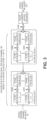
- Fig. 3 shows a cascade of B (two or more) filter blocks that are in an EQ filter 11 or 18.
- each filter block has two or more FIR elements, IIR elements, or a combination both, that are connected in parallel as shown, so that each filter element receives the same, single, decoded channel or object as input.
- the arrangement depicted in Fig. 3 may be duplicated for each single, decoded channel or object, of a given group.
- EQ filter set 3 has the same configuration (as defined for a particular EQ group), and is duplicated for each decoded channel or object that is contained within the EQ group.
- the set of filter elements (here, filter cascades) for all of the channels or objects is referred to here as an EQ filter set, where as suggested above the metadata may specify more than one EQ filter set where each of these is designed or intended for a different playback scenario (of the same base audio recording).
- All of the channels or objects in a given EQ group are to be passed in parallel through a filter structure that has a separate instance of the same, linear filter cascade (as depicted in Fig. 3 for example) for each channel or object in the given group.
- all of the channels or objects in a given EQ group are filtered in the same way.
- the configuration or definition of the filter elements within the cascade are specified in the metadata, by an EQ value sequence that defines the filtering to be applied to a particular EQ group.
- the metadata may specify that only IIR filters are to be used in the filter cascade, or it may specify a combination of IIR and FIR filters.
- the definition of the filter cascade may include the poles and zeroes of each filter block, which are to be constructed or synthesized in the decode stage for time domain filtering of the indicated EQ group of one or more of the decoded, original audio channels or audio objects.
- the pole and zero locations may be in the z-plane (radius and angle) and may be deemed to be IIR filter parameters.
- an EQ sequence may define the filter cascade by specifying the digital filter coefficients of the filter elements, also for time domain filtering of the indicated EQ group of one or more of the original audio channels or audio objects. Still referring to Fig.
- a respective, scalar gain may be applied, before the outputs are combined into a single input signal for the next block of the filter cascade, as shown.
- the metadata may also specify whether or not a phase alignment filter is needed, to obtain a phase match between the outputs of all of the parallel-connected filter elements within a filter block (that are processing the same input channel or object in parallel), before the outputs are combined into the single input signal for the next block of the same filter cascade.
- phase alignment filters are labeled, "Phase Alignment for Block” and are applied to the output of each filter element (as needed) within a given filter block.
- the phase alignment is designed to help avoid undesired phase effects when combining the outputs of several filter elements (in several frequency bins), within the same filter block.
- the phase alignment filters may be defined (in the metadata) as being all pass filters whose phase responses have been designed to obtain a phase match across all of their outputs.
- phase alignment may also be performed as between different channels or objects.
- phase alignment is to be performed between an EQ filtered channel or object of one EQ group, and the EQ filtered channel or object of another EQ group. This is to avoid undesired effects when combining different channel groups (for example by the down mix processor 16), or when converting the EQ filtered channels or objects into sound.
- a phase alignment filter is indicated as "Phase Alignment Across Cascades" and is applied to the output of the last filter block (filter block B-1) of a cascade, so that for example the output channels or objects from EQ filter 11_1 are phase matched with those of EQ filter 11_2.
- phase alignment filter might not exist in some cases.
- the metadata specifies only those IIR filters, for an EQ filter set, for which a phase-alignment filter exists (and is also specified in the metadata.)
- a phase alignment filter may be synthesized (in the decode stage) as a time domain digital filter.
- the following table is an example definition of part of an EQ sequence (in the metatada), showing example encoding and descriptions of the EQ values.
- Field Encoding Description eqSetId Index [0,63] Identifier for the EQ set defined in eqInstructionsU. Value 0 is reserved.
- downmixIdPresent Flag [0,1] If 1, DownmixId is present downmixId, additionalDownmixId Index [0,127] Identifies a downmix that can be applied in combination with this EQ. The EQ is applied after the downmix.
- a value of 0 refers to the base layout, hence the EQ is applied to the base layout.
- additionalDownmixIdPresent Flag [0,1] If 1, additional DownmixIds are present additionalDownmixIdCount Count [0,127] Number of additional Downmix IDs drcSetId, additionalDrcSetId Index [0,63] Indentifies a DRC set that can be applied in combination with this EQ. A value of 0 indicates that it is permitted to apply the EQ without DRC.
- additionalDrcSetIdPresent Flag [0,1] If 1, additional DrcSetIds are present additionalDownmixIdCount Count [0,63] Number of additional DRC set IDs effectSetsPresent Flag, must be 0 Indicates if effects should be applied effectSet1Id, effectSet2Id, effectSet3Id, Index [0,63] Index refers to specific effect set (for future use) eqSetPurpose Bit field, see Table A.44 Defines the purpose of the EQ dependsOnEqSetPresent Flag [0,1] If 1, the EQ set shall be applied in combination with a second EQ set.
- the second EQ set must be located at the opposite side of the dowmixer dependsOnEqSet Index [0,63] Index of the EQ set that shall be combined with this EQ set noIndependentEqUse Flag [0,1] If 1, the EQ set can only be used in combination with a second EQ set eqChannelGroup Index [1,127] Index of EQ channel group that the channel belongs to tdFilterCascadePresent Flag [0,1] Indicates if a time-domain filter cascade is defined eqCascadeGainPresent Flag [0,1] Indicates if a filter cascade gain value is present bsEqCascadeGain Gain value, see Table A.47 Filter cascade gain value filterBlockCount Count [0,15] Number of filter blocks contained in this cascade filterBlockIndex Index [0,127] Index refers to definition of filter block in eqCoefficients() eqPhaseAlignmentPresent Flag [0,
- an EQ sequence contains EQ values, which define the spectral shaping (EQ filtering) that is to be applied to the decoded audio channels or objects of the specified EQ group (the decoded EQ group).
- this encoding stage or production-side defined EQ filtering is applied by the decode stage processor to reduce gain of the decoded, original audio channels or objects below 500 Hz, whether or not downmix is also specified in the metadata (and applied to the decoded EQ group.)
- the decode stage processor may interpret the EQ sequence as being associated with a special, "late night" mode of operation for the playback device.
- This mode of operation may be enabled, for example manually by a user of the playback device or set to be enabled automatically during late evening (based on the current time of day), so as to reduce the chance of low frequency rumble disturbing others who may be resting in adjacent rooms during playback.
- the decode stage processor applies the EQ filtering as defined by the EQ sequence, regardless of the presence of the downmix processor 16. This enables the production-side of the audio recording to determine how much to drop the gain in a low frequency band, by also considering the content of the audio recording so as not to drop the gain too much, thereby providing a better user experience regardless of whether or not any downmix is performed for the playback.
- the metadata further specifies loudness information for an EQ filtered version of the EQ group of one or more of the original audio channels or audio objects, where this loudness information may have been estimated in the encoding stage.
Landscapes
- Engineering & Computer Science (AREA)
- Physics & Mathematics (AREA)
- Acoustics & Sound (AREA)
- Signal Processing (AREA)
- Multimedia (AREA)
- Health & Medical Sciences (AREA)
- Computational Linguistics (AREA)
- Audiology, Speech & Language Pathology (AREA)
- Human Computer Interaction (AREA)
- Mathematical Physics (AREA)
- Stereophonic System (AREA)
- Signal Processing For Digital Recording And Reproducing (AREA)
- Circuit For Audible Band Transducer (AREA)
Applications Claiming Priority (4)
| Application Number | Priority Date | Filing Date | Title |
|---|---|---|---|
| US201562199634P | 2015-07-31 | 2015-07-31 | |
| US15/060,392 US9934790B2 (en) | 2015-07-31 | 2016-03-03 | Encoded audio metadata-based equalization |
| EP16736304.3A EP3329489B1 (de) | 2015-07-31 | 2016-06-13 | Auf codierten audiometadaten basierte entzerrung |
| PCT/US2016/037240 WO2017023423A1 (en) | 2015-07-31 | 2016-06-13 | Encoded audio metadata-based equalization |
Related Parent Applications (2)
| Application Number | Title | Priority Date | Filing Date |
|---|---|---|---|
| EP16736304.3A Division EP3329489B1 (de) | 2015-07-31 | 2016-06-13 | Auf codierten audiometadaten basierte entzerrung |
| EP16736304.3A Division-Into EP3329489B1 (de) | 2015-07-31 | 2016-06-13 | Auf codierten audiometadaten basierte entzerrung |
Publications (2)
| Publication Number | Publication Date |
|---|---|
| EP4290888A2 true EP4290888A2 (de) | 2023-12-13 |
| EP4290888A3 EP4290888A3 (de) | 2024-02-21 |
Family
ID=57882908
Family Applications (2)
| Application Number | Title | Priority Date | Filing Date |
|---|---|---|---|
| EP23200995.1A Pending EP4290888A3 (de) | 2015-07-31 | 2016-06-13 | Auf codierten audiometadaten basierende entzerrung |
| EP16736304.3A Active EP3329489B1 (de) | 2015-07-31 | 2016-06-13 | Auf codierten audiometadaten basierte entzerrung |
Family Applications After (1)
| Application Number | Title | Priority Date | Filing Date |
|---|---|---|---|
| EP16736304.3A Active EP3329489B1 (de) | 2015-07-31 | 2016-06-13 | Auf codierten audiometadaten basierte entzerrung |
Country Status (6)
| Country | Link |
|---|---|
| US (3) | US9934790B2 (de) |
| EP (2) | EP4290888A3 (de) |
| JP (2) | JP6499374B2 (de) |
| KR (2) | KR102178231B1 (de) |
| CN (2) | CN107851449B (de) |
| WO (1) | WO2017023423A1 (de) |
Families Citing this family (36)
| Publication number | Priority date | Publication date | Assignee | Title |
|---|---|---|---|---|
| MX2007005027A (es) * | 2004-10-26 | 2007-06-19 | Dolby Lab Licensing Corp | Calculo y ajuste de la sonoridad percibida y/o el balance espectral percibido de una senal de audio. |
| TWI529703B (zh) | 2010-02-11 | 2016-04-11 | 杜比實驗室特許公司 | 用以非破壞地正常化可攜式裝置中音訊訊號響度之系統及方法 |
| TWI896112B (zh) | 2010-12-03 | 2025-09-01 | 美商杜比實驗室特許公司 | 音頻解碼裝置、音頻解碼方法及音頻編碼方法 |
| CN103325380B (zh) | 2012-03-23 | 2017-09-12 | 杜比实验室特许公司 | 用于信号增强的增益后处理 |
| CN121122295A (zh) | 2012-05-18 | 2025-12-12 | 杜比实验室特许公司 | 用于维持与参数音频编码器相关联的可逆动态范围控制信息的系统 |
| US10844689B1 (en) | 2019-12-19 | 2020-11-24 | Saudi Arabian Oil Company | Downhole ultrasonic actuator system for mitigating lost circulation |
| CN119479682A (zh) | 2013-01-21 | 2025-02-18 | 杜比实验室特许公司 | 用于在不同回放设备之间优化响度和动态范围的系统和方法 |
| KR102192755B1 (ko) | 2013-01-21 | 2020-12-18 | 돌비 레버러토리즈 라이쎈싱 코오포레이션 | 프로그램 라우드니스 및 경계 메타데이터를 가진 오디오 인코더 및 디코더 |
| CN105074818B (zh) | 2013-02-21 | 2019-08-13 | 杜比国际公司 | 音频编码系统、用于产生比特流的方法以及音频解码器 |
| CN107093991B (zh) | 2013-03-26 | 2020-10-09 | 杜比实验室特许公司 | 基于目标响度的响度归一化方法和设备 |
| CN105190618B (zh) | 2013-04-05 | 2019-01-25 | 杜比实验室特许公司 | 用于自动文件检测的对来自基于文件的媒体的特有信息的获取、恢复和匹配 |
| TWM487509U (zh) | 2013-06-19 | 2014-10-01 | 杜比實驗室特許公司 | 音訊處理設備及電子裝置 |
| ES3061991T3 (en) | 2013-09-12 | 2026-04-08 | Dolby Laboratories Licensing Corp | Dynamic range control for a wide variety of playback environments |
| CN110675883B (zh) | 2013-09-12 | 2023-08-18 | 杜比实验室特许公司 | 用于下混合音频内容的响度调整 |
| CN110808723B (zh) | 2014-05-26 | 2024-09-17 | 杜比实验室特许公司 | 音频信号响度控制 |
| CN119296555A (zh) | 2014-10-10 | 2025-01-10 | 杜比实验室特许公司 | 基于发送无关的表示的节目响度 |
| TWI631835B (zh) * | 2014-11-12 | 2018-08-01 | 弗勞恩霍夫爾協會 | 用以解碼媒體信號之解碼器、及用以編碼包含用於主要媒體資料之元資料或控制資料的次要媒體資料之編碼器 |
| US9934790B2 (en) * | 2015-07-31 | 2018-04-03 | Apple Inc. | Encoded audio metadata-based equalization |
| US9832590B2 (en) * | 2015-09-12 | 2017-11-28 | Dolby Laboratories Licensing Corporation | Audio program playback calibration based on content creation environment |
| US10341770B2 (en) | 2015-09-30 | 2019-07-02 | Apple Inc. | Encoded audio metadata-based loudness equalization and dynamic equalization during DRC |
| DE102016208242A1 (de) * | 2016-05-12 | 2017-11-16 | Wirtgen Gmbh | Verfahren zur Kopplung eines Maschinenrahmens einer Bodenbearbeitungsmaschine mit einer Arbeitseinrichtung, Bodenbearbeitungseinrichtung und Verbindungsvorrichtung für das Verfahren |
| EP3566473B8 (de) | 2017-03-06 | 2022-06-15 | Dolby International AB | Integrierte rekonstruktion und wiedergabe von audiosignalen |
| KR102036893B1 (ko) * | 2018-03-30 | 2019-10-25 | 신대철 | 멀티레이어 바이노럴 컨텐츠 생성 방법 및 이를 위한 프로그램 |
| RU2768224C1 (ru) * | 2018-12-13 | 2022-03-23 | Долби Лабораторис Лайсэнзин Корпорейшн | Двусторонняя медийная аналитика |
| WO2020131963A1 (en) | 2018-12-21 | 2020-06-25 | Nura Holdings Pty Ltd | Modular ear-cup and ear-bud and power management of the modular ear-cup and ear-bud |
| EP3897386A4 (de) * | 2018-12-21 | 2022-09-07 | Nura Holdings PTY Ltd | Audioentzerrungsmetadaten |
| EP3931737B1 (de) | 2019-03-01 | 2025-10-15 | Nura Holdings PTY Ltd | Kopfhörer mit zeitsteuerungskapazität und erhöhter sicherheit |
| US12069464B2 (en) | 2019-07-09 | 2024-08-20 | Dolby Laboratories Licensing Corporation | Presentation independent mastering of audio content |
| EP3857919B1 (de) * | 2019-12-02 | 2022-05-18 | Dolby Laboratories Licensing Corporation | Verfahren und vorrichtungen zur umwandlung von kanalbasiertem audio in objektbasiertes audio |
| KR102891079B1 (ko) | 2019-12-31 | 2025-11-26 | 삼성전자주식회사 | 음악 신호 이퀄라이저 및 이퀄라이징 방법 |
| EP4243014A4 (de) | 2021-01-25 | 2024-07-17 | Samsung Electronics Co., Ltd. | Vorrichtung und verfahren zur verarbeitung eines mehrkanal-audiosignals |
| KR20230001135A (ko) * | 2021-06-28 | 2023-01-04 | 네이버 주식회사 | 사용자 맞춤형 현장감 실현을 위한 오디오 콘텐츠를 처리하는 컴퓨터 시스템 및 그의 방법 |
| JP2024531963A (ja) * | 2021-08-26 | 2024-09-03 | ドルビー ラボラトリーズ ライセンシング コーポレイション | オーディオデータのメタデータベースダイナミック処理の方法及び装置 |
| US12563339B2 (en) | 2023-02-09 | 2026-02-24 | Samsung Electronics Co., Ltd. | Signal normalization using loudness metadata for audio processing |
| EP4498704A1 (de) * | 2023-07-27 | 2025-01-29 | Koninklijke Philips N.V. | Erzeugung eines audiodatensignals |
| US12568285B2 (en) * | 2023-09-19 | 2026-03-03 | International Business Machines Corporation | System to auto equalize the audio frequency for an enhanced sound experience |
Family Cites Families (24)
| Publication number | Priority date | Publication date | Assignee | Title |
|---|---|---|---|---|
| US5930758A (en) * | 1990-10-22 | 1999-07-27 | Sony Corporation | Audio signal reproducing apparatus with semiconductor memory storing coded digital audio data and including a headphone unit |
| US5912976A (en) * | 1996-11-07 | 1999-06-15 | Srs Labs, Inc. | Multi-channel audio enhancement system for use in recording and playback and methods for providing same |
| CA2636684C (en) * | 1997-12-24 | 2009-08-18 | Mitsubishi Denki Kabushiki Kaisha | A method for speech coding, method for speech decoding and their apparatuses |
| US7266501B2 (en) * | 2000-03-02 | 2007-09-04 | Akiba Electronics Institute Llc | Method and apparatus for accommodating primary content audio and secondary content remaining audio capability in the digital audio production process |
| EP1986466B1 (de) * | 2007-04-25 | 2018-08-08 | Harman Becker Automotive Systems GmbH | Verfahren und Vorrichtung zur Klangabstimmung |
| US8300849B2 (en) | 2007-11-06 | 2012-10-30 | Microsoft Corporation | Perceptually weighted digital audio level compression |
| US20090290725A1 (en) | 2008-05-22 | 2009-11-26 | Apple Inc. | Automatic equalizer adjustment setting for playback of media assets |
| US8315396B2 (en) * | 2008-07-17 | 2012-11-20 | Fraunhofer-Gesellschaft Zur Foerderung Der Angewandten Forschung E.V. | Apparatus and method for generating audio output signals using object based metadata |
| EP2329492A1 (de) * | 2008-09-19 | 2011-06-08 | Dolby Laboratories Licensing Corporation | Signalverarbeitung zur upstream-qualitätsverbesserung für ressourceneingeschränkte client-vorrichtungen |
| US7755526B2 (en) | 2008-10-31 | 2010-07-13 | At&T Intellectual Property I, L.P. | System and method to modify a metadata parameter |
| WO2011087460A1 (en) | 2010-01-15 | 2011-07-21 | Agency For Science, Technology And Research | A method and a device for generating at least one audio file, and a method and a device for playing at least one audio file |
| US8908874B2 (en) | 2010-09-08 | 2014-12-09 | Dts, Inc. | Spatial audio encoding and reproduction |
| US9135929B2 (en) * | 2011-04-28 | 2015-09-15 | Dolby International Ab | Efficient content classification and loudness estimation |
| MY207992A (en) * | 2011-07-01 | 2025-04-03 | Dolby Laboratories Licensing Corp | System and method for adaptive audio signal generation, coding and rendering |
| US9607624B2 (en) * | 2013-03-29 | 2017-03-28 | Apple Inc. | Metadata driven dynamic range control |
| KR20140128564A (ko) | 2013-04-27 | 2014-11-06 | 인텔렉추얼디스커버리 주식회사 | 음상 정위를 위한 오디오 시스템 및 방법 |
| TWM487509U (zh) * | 2013-06-19 | 2014-10-01 | 杜比實驗室特許公司 | 音訊處理設備及電子裝置 |
| US9858932B2 (en) | 2013-07-08 | 2018-01-02 | Dolby Laboratories Licensing Corporation | Processing of time-varying metadata for lossless resampling |
| ES3061991T3 (en) | 2013-09-12 | 2026-04-08 | Dolby Laboratories Licensing Corp | Dynamic range control for a wide variety of playback environments |
| EP4629236A3 (de) | 2013-10-22 | 2025-12-17 | Fraunhofer-Gesellschaft zur Förderung der angewandten Forschung e.V. | Konzept zur kombinierten dynamikbereichskompression und geführten clipping-verhinderung für audiovorrichtungen |
| EP4421617A3 (de) * | 2013-10-31 | 2024-11-06 | Dolby Laboratories Licensing Corporation | Binaurales rendering für kopfhörer mit metadatenverarbeitung |
| EP3213532B1 (de) * | 2014-10-30 | 2018-09-26 | Dolby Laboratories Licensing Corporation | Filter zur impedanzanpassung und entzerrung für raumklangerzeugung für kopfhörer |
| US9934790B2 (en) | 2015-07-31 | 2018-04-03 | Apple Inc. | Encoded audio metadata-based equalization |
| US10341770B2 (en) | 2015-09-30 | 2019-07-02 | Apple Inc. | Encoded audio metadata-based loudness equalization and dynamic equalization during DRC |
-
2016
- 2016-03-03 US US15/060,392 patent/US9934790B2/en active Active
- 2016-06-13 JP JP2018504931A patent/JP6499374B2/ja active Active
- 2016-06-13 CN CN201680046105.8A patent/CN107851449B/zh active Active
- 2016-06-13 KR KR1020207016997A patent/KR102178231B1/ko active Active
- 2016-06-13 CN CN202010311316.8A patent/CN111477253B/zh active Active
- 2016-06-13 KR KR1020187002465A patent/KR102124547B1/ko active Active
- 2016-06-13 WO PCT/US2016/037240 patent/WO2017023423A1/en not_active Ceased
- 2016-06-13 EP EP23200995.1A patent/EP4290888A3/de active Pending
- 2016-06-13 EP EP16736304.3A patent/EP3329489B1/de active Active
-
2018
- 2018-03-29 US US15/940,912 patent/US10699726B2/en active Active
-
2019
- 2019-03-14 JP JP2019046732A patent/JP6750061B2/ja active Active
-
2020
- 2020-06-04 US US16/893,114 patent/US11501789B2/en active Active
Also Published As
| Publication number | Publication date |
|---|---|
| KR102124547B1 (ko) | 2020-06-18 |
| EP3329489A1 (de) | 2018-06-06 |
| US10699726B2 (en) | 2020-06-30 |
| CN107851449B (zh) | 2020-04-17 |
| CN107851449A (zh) | 2018-03-27 |
| US11501789B2 (en) | 2022-11-15 |
| US20170032801A1 (en) | 2017-02-02 |
| CN111477253B (zh) | 2022-02-01 |
| JP2018528459A (ja) | 2018-09-27 |
| JP6499374B2 (ja) | 2019-04-10 |
| US9934790B2 (en) | 2018-04-03 |
| EP4290888A3 (de) | 2024-02-21 |
| EP3329489B1 (de) | 2023-11-22 |
| KR102178231B1 (ko) | 2020-11-12 |
| CN111477253A (zh) | 2020-07-31 |
| US20180218746A1 (en) | 2018-08-02 |
| US20200342886A1 (en) | 2020-10-29 |
| WO2017023423A1 (en) | 2017-02-09 |
| KR20180020295A (ko) | 2018-02-27 |
| JP6750061B2 (ja) | 2020-09-02 |
| JP2019091095A (ja) | 2019-06-13 |
| KR20200074243A (ko) | 2020-06-24 |
Similar Documents
| Publication | Publication Date | Title |
|---|---|---|
| US11501789B2 (en) | Encoded audio metadata-based equalization | |
| JP6574046B2 (ja) | エンコードされたオーディオ拡張メタデータベースのダイナミックレンジ制御 | |
| JP5467105B2 (ja) | オブジェクトベースのメタデータを用いてオーディオ出力信号を生成するための装置および方法 | |
| KR101849612B1 (ko) | 새로운 미디어 장치 상에 내장된 라우드니스 메타데이터를 갖거나 또는 갖지 않고 미디어의 정규화된 오디오 재생을 위한 방법 및 장치 | |
| US9832590B2 (en) | Audio program playback calibration based on content creation environment | |
| CN120835168A (zh) | 用于提供个性化音频流式传输和渲染的系统和方法 |
Legal Events
| Date | Code | Title | Description |
|---|---|---|---|
| PUAI | Public reference made under article 153(3) epc to a published international application that has entered the european phase |
Free format text: ORIGINAL CODE: 0009012 |
|
| STAA | Information on the status of an ep patent application or granted ep patent |
Free format text: STATUS: REQUEST FOR EXAMINATION WAS MADE |
|
| 17P | Request for examination filed |
Effective date: 20231026 |
|
| AC | Divisional application: reference to earlier application |
Ref document number: 3329489 Country of ref document: EP Kind code of ref document: P |
|
| AK | Designated contracting states |
Kind code of ref document: A2 Designated state(s): AL AT BE BG CH CY CZ DE DK EE ES FI FR GB GR HR HU IE IS IT LI LT LU LV MC MK MT NL NO PL PT RO RS SE SI SK SM TR |
|
| RIN1 | Information on inventor provided before grant (corrected) |
Inventor name: BAUMGARTE, FRANK |
|
| REG | Reference to a national code |
Ref country code: DE Ref legal event code: R079 Free format text: PREVIOUS MAIN CLASS: H04S0007000000 Ipc: G11B0027320000 |
|
| PUAL | Search report despatched |
Free format text: ORIGINAL CODE: 0009013 |
|
| AK | Designated contracting states |
Kind code of ref document: A3 Designated state(s): AL AT BE BG CH CY CZ DE DK EE ES FI FR GB GR HR HU IE IS IT LI LT LU LV MC MK MT NL NO PL PT RO RS SE SI SK SM TR |
|
| RIC1 | Information provided on ipc code assigned before grant |
Ipc: H04S 7/00 20060101ALI20240117BHEP Ipc: H04S 3/00 20060101ALI20240117BHEP Ipc: G11B 27/32 20060101AFI20240117BHEP |