EP4290808B1 - Kampagnen-intelligenz und visualisierung zum bekämpfen von cyberangriffen - Google Patents
Kampagnen-intelligenz und visualisierung zum bekämpfen von cyberangriffen Download PDFInfo
- Publication number
- EP4290808B1 EP4290808B1 EP23206708.2A EP23206708A EP4290808B1 EP 4290808 B1 EP4290808 B1 EP 4290808B1 EP 23206708 A EP23206708 A EP 23206708A EP 4290808 B1 EP4290808 B1 EP 4290808B1
- Authority
- EP
- European Patent Office
- Prior art keywords
- activity
- instance
- attribute
- malicious activity
- malicious
- Prior art date
- Legal status (The legal status is an assumption and is not a legal conclusion. Google has not performed a legal analysis and makes no representation as to the accuracy of the status listed.)
- Active
Links
Images







Classifications
-
- G—PHYSICS
- G06—COMPUTING OR CALCULATING; COUNTING
- G06F—ELECTRIC DIGITAL DATA PROCESSING
- G06F21/00—Security arrangements for protecting computers, components thereof, programs or data against unauthorised activity
- G06F21/50—Monitoring users, programs or devices to maintain the integrity of platforms, e.g. of processors, firmware or operating systems
- G06F21/55—Detecting local intrusion or implementing counter-measures
- G06F21/554—Detecting local intrusion or implementing counter-measures involving event detection and direct action
-
- G—PHYSICS
- G06—COMPUTING OR CALCULATING; COUNTING
- G06F—ELECTRIC DIGITAL DATA PROCESSING
- G06F21/00—Security arrangements for protecting computers, components thereof, programs or data against unauthorised activity
- G06F21/50—Monitoring users, programs or devices to maintain the integrity of platforms, e.g. of processors, firmware or operating systems
- G06F21/55—Detecting local intrusion or implementing counter-measures
-
- G—PHYSICS
- G06—COMPUTING OR CALCULATING; COUNTING
- G06F—ELECTRIC DIGITAL DATA PROCESSING
- G06F18/00—Pattern recognition
- G06F18/20—Analysing
- G06F18/23—Clustering techniques
-
- G—PHYSICS
- G06—COMPUTING OR CALCULATING; COUNTING
- G06F—ELECTRIC DIGITAL DATA PROCESSING
- G06F21/00—Security arrangements for protecting computers, components thereof, programs or data against unauthorised activity
- G06F21/50—Monitoring users, programs or devices to maintain the integrity of platforms, e.g. of processors, firmware or operating systems
- G06F21/55—Detecting local intrusion or implementing counter-measures
- G06F21/56—Computer malware detection or handling, e.g. anti-virus arrangements
-
- G—PHYSICS
- G06—COMPUTING OR CALCULATING; COUNTING
- G06N—COMPUTING ARRANGEMENTS BASED ON SPECIFIC COMPUTATIONAL MODELS
- G06N20/00—Machine learning
-
- G—PHYSICS
- G06—COMPUTING OR CALCULATING; COUNTING
- G06Q—INFORMATION AND COMMUNICATION TECHNOLOGY [ICT] SPECIALLY ADAPTED FOR ADMINISTRATIVE, COMMERCIAL, FINANCIAL, MANAGERIAL OR SUPERVISORY PURPOSES; SYSTEMS OR METHODS SPECIALLY ADAPTED FOR ADMINISTRATIVE, COMMERCIAL, FINANCIAL, MANAGERIAL OR SUPERVISORY PURPOSES, NOT OTHERWISE PROVIDED FOR
- G06Q10/00—Administration; Management
- G06Q10/10—Office automation; Time management
- G06Q10/107—Computer-aided management of electronic mailing [e-mailing]
-
- H—ELECTRICITY
- H04—ELECTRIC COMMUNICATION TECHNIQUE
- H04L—TRANSMISSION OF DIGITAL INFORMATION, e.g. TELEGRAPHIC COMMUNICATION
- H04L41/00—Arrangements for maintenance, administration or management of data switching networks, e.g. of packet switching networks
- H04L41/22—Arrangements for maintenance, administration or management of data switching networks, e.g. of packet switching networks comprising specially adapted graphical user interfaces [GUI]
-
- H—ELECTRICITY
- H04—ELECTRIC COMMUNICATION TECHNIQUE
- H04L—TRANSMISSION OF DIGITAL INFORMATION, e.g. TELEGRAPHIC COMMUNICATION
- H04L51/00—User-to-user messaging in packet-switching networks, transmitted according to store-and-forward or real-time protocols, e.g. e-mail
- H04L51/07—User-to-user messaging in packet-switching networks, transmitted according to store-and-forward or real-time protocols, e.g. e-mail characterised by the inclusion of specific contents
- H04L51/08—Annexed information, e.g. attachments
-
- H—ELECTRICITY
- H04—ELECTRIC COMMUNICATION TECHNIQUE
- H04L—TRANSMISSION OF DIGITAL INFORMATION, e.g. TELEGRAPHIC COMMUNICATION
- H04L51/00—User-to-user messaging in packet-switching networks, transmitted according to store-and-forward or real-time protocols, e.g. e-mail
- H04L51/21—Monitoring or handling of messages
- H04L51/212—Monitoring or handling of messages using filtering or selective blocking
-
- H—ELECTRICITY
- H04—ELECTRIC COMMUNICATION TECHNIQUE
- H04L—TRANSMISSION OF DIGITAL INFORMATION, e.g. TELEGRAPHIC COMMUNICATION
- H04L63/00—Network architectures or network communication protocols for network security
- H04L63/14—Network architectures or network communication protocols for network security for detecting or protecting against malicious traffic
- H04L63/1408—Network architectures or network communication protocols for network security for detecting or protecting against malicious traffic by monitoring network traffic
- H04L63/1416—Event detection, e.g. attack signature detection
-
- H—ELECTRICITY
- H04—ELECTRIC COMMUNICATION TECHNIQUE
- H04L—TRANSMISSION OF DIGITAL INFORMATION, e.g. TELEGRAPHIC COMMUNICATION
- H04L63/00—Network architectures or network communication protocols for network security
- H04L63/14—Network architectures or network communication protocols for network security for detecting or protecting against malicious traffic
- H04L63/1408—Network architectures or network communication protocols for network security for detecting or protecting against malicious traffic by monitoring network traffic
- H04L63/1425—Traffic logging, e.g. anomaly detection
-
- H—ELECTRICITY
- H04—ELECTRIC COMMUNICATION TECHNIQUE
- H04L—TRANSMISSION OF DIGITAL INFORMATION, e.g. TELEGRAPHIC COMMUNICATION
- H04L63/00—Network architectures or network communication protocols for network security
- H04L63/14—Network architectures or network communication protocols for network security for detecting or protecting against malicious traffic
- H04L63/1441—Countermeasures against malicious traffic
- H04L63/1466—Active attacks involving interception, injection, modification, spoofing of data unit addresses, e.g. hijacking, packet injection or TCP sequence number attacks
Definitions
- computing resources such as applications and services to perform various computing tasks.
- Computing resources can be exposed to different types of malicious activities that limit the capacity for the computing resources to operate. For example, cyberattacks continue to be a growing pathway for malicious actors to attempt to expose, steal, destroy, or gain unauthorized access to assets of an individual or company.
- cyberattacks continue to be a growing pathway for malicious actors to attempt to expose, steal, destroy, or gain unauthorized access to assets of an individual or company.
- email attacks continue to be an entry point for attackers against enterprise customers of computing environments and can trigger damaging consequences.
- an attacker can first set the sending infrastructure (e.g., secure sending domains with or without authentication, sending IPs, sending email scripts, etc.). Once the infrastructure is formed, an email template with a particular payload (e.g., URL hosting, infected documents attached to the email, etc.) can be created to trick and entice users to interact with the email to deliver the payload.
- sending infrastructure e.g., secure sending domains with or without authentication, sending IPs, sending email scripts, etc.
- an email template with a particular payload e.g., URL hosting, infected documents attached to the email, etc.
- a post-delivery attack chain e.g., capturing credentials for phishing attacks or other malware
- a post-delivery attack chain e.g., capturing credentials for phishing attacks or other malware
- US2018/270264 A1 describes a data analysis system that may automatically generate memoryefficient clustered data structures, automatically analyze those clustered data structures, and provide results of the automated analysis in an optimized way to an analyst.
- US9548988 B1 describes a computer-implemented method for attributing potentially malicious email campaigns to known threat groups may include (1) identifying a potentially malicious email campaign targeting at least one organization, (2) detecting, within the potentially malicious email campaign, an incriminating feature that has been linked to a known threat group, (3) determining, based at least in part on detecting the incriminating feature linked to the known threat group, that the known threat group is likely responsible for the potentially malicious email campaign, and then in response to determining that the known threat group is likely responsible for the potentially malicious email campaign, (4) attributing the potentially malicious email campaign to the known threat group.
- US2006/168066 A1 describes a method, system, and computer program product for implementing embodiments of an EScam Server, which are useful for determining phishing emails.
- a Trusted Host Miner useful for determining servers associated with a Trusted URL
- a Trusted Host Browser useful for communicating to a user when links are Trusted URLs
- a Page Spider useful for determining on-site links to documents which request a user's confidential information.
- US2004/054498 A1 describes a system for processing emails incorporates means for dealing with previously unknown viruses. The system monitors email traffic patterns to identify patterns characteristic of a virus outbreak and takes corrective action when an outbreak is detected. Individual emails are analysed and, if any one of the constituent parts contains content in which it is possible to contain a virus, characteristic data derived from the email is logged to a database which is scanned for outbreak-indicating traffic patterns.
- Various aspects of the technology described herein are generally directed to systems, methods, and computer storage media, for among other things, providing a multi-attribute cluster-identifier (i.e., an enhanced multi-attribute-based fingerprint for clusters) that supports identifying malicious activity (e.g., malicious email campaigns) in computing environments (e.g., a distributed computing environment).
- a multi-attribute cluster-identifier i.e., an enhanced multi-attribute-based fingerprint for clusters
- An instance of an activity e.g., an email message
- the attribute set of the instance of the activity is analyzed to determine whether the instance of the activity is a malicious activity.
- the attribute set of the instance of the activity is compared to a plurality of multi-attribute cluster-identifiers of previous instances of the activity, such that, a determination that the instance of the activity is a malicious activity is made when the attribute set of the instance of the activity corresponds to an identified multi-attribute cluster-identifier.
- the identified multi-attribute cluster-identifier a risk score and an attribute set indicates a likelihood that the instance of the activity is a malicious activity.
- a plurality of multi-attribute cluster-identifiers for email campaigns can be generated based on attribute sets of previous emails in the email campaigns.
- a malicious activity manager can then monitor the computing environment and analyze an instance of an activity (e.g., an email) to support making a determination whether the instance of the activity is a malicious activity.
- An email is identified as a malicious activity when an attribute set of the email corresponds to a multi-attribute cluster-identifier having a risk score and the attribute set, where the risk score and the attribute set indicate a likelihood that an instance of an activity is a malicious activity.
- the malicious activity manager of a malicious activity management system supports generating a plurality of multi-attribute cluster-identifiers having corresponding risk scores and attribute sets.
- Generating a multi-attribute cluster-identifier is based on clustering analysis and malicious activity determination models that support determining that an attribute set of an activity has a quantified risk (i.e., risk score) that indicates that the activity is a malicious activity.
- Generating the multi-attribute cluster-identifier for an activity can be based on initially clustering instances of the activity based on a corresponding attribute set (e.g., an attribute set of the emails in the email campaign).
- a malicious activity manager then operates to monitor a computing environment and analyzes an instance of an activity (e.g., an email) and matches an attribute set of the instance to an identified multi-attribute cluster-identifier that indicates activity is a malicious activity.
- an instance of an activity e.g., an email
- matches an attribute set of the instance e.g., an attribute set of the instance to an identified multi-attribute cluster-identifier that indicates activity is a malicious activity.
- a multi-attribute cluster-identifier corresponding to the type of malicious activity supports effectively identifying an instance of an activity that is processed in the computing environment as a malicious activity.
- the malicious activity manager further supports providing visualizations of malicious activity operations data.
- the visualizations are associated with different functions and features of the malicious activity manager (e.g., clustering analysis, risks scores, sets of attributes, evaluation results).
- the visualizations are provided to allow effective operation and control of the malicious activity manager from a user interface perspective, while the malicious activity manager simultaneously feeds back information in making decisions for malicious activity management.
- malware activity management operations The operations of the malicious activity manager ("malicious activity management operations") and additional functional components are executed as an algorithm for performing the specific functions for malicious activity management.
- the malicious activity management operations support limiting or preventing malicious activity in computing environments, where malicious actors continuously alter theirs strategies of executing malicious activities.
- the malicious activity management operations further support providing visualizations of malicious activity operations data that are helpful to users and improve computer efficiency in decision-making and in user navigation of graphical user interfaces for malicious activity management.
- Email initiated cyberattacks continue to be the preferred avenue for cybercriminals across the globe.
- threat actors are better able to reach potential victims.
- the email messages used in these campaigns are often highly customized to resemble legitimate messages and to avoid the sophisticated filtering systems used by security operations teams.
- threat actors are able to effectively gauge their hit rate to ensure their chances of success.
- attackers are able to continuously aggregate and update malicious campaigns by quickly adapting their infrastructure, email templates, payloads, and post-delivery attack chains to ensure their chances of success.
- the swift movement by threat actors is a challenge for security operations teams who are tasked with thwarting these dangerous and evolving campaigns.
- IOCs indicators of compromise
- Security operations teams using conventional cyber security systems e.g., a cybersecurity management component
- IOCs indicators of compromise
- Security operations teams using conventional cyber security systems are constantly monitoring for IOCs by creating queries to analyze email activity as well as manually examining emails for patterns of compromise based on email content and traffic.
- attackers are constantly developing and changing their campaigns (i.e., a systematic computer- or network-based attack), it is very difficult to correlate a single potentially malicious email with other threats across a large dataset.
- email phishing attacks have various features that are analyzed manually by security operations teams and automatically by email filtering systems. Attackers are able to observe how their email campaigns interact with their targets' threat detection systems and adapt various features of their email campaigns to beat the filtering mechanisms. For example, cybercriminals may change the subject line, the sending domain, URLs, or a combination of any other features, to successfully get an email in a targets inbox. As such, there is a desire to automatically observe emails for IOCs across large volumes of data to recognize malicious email campaigns.
- a cybersecurity management component may analyze unique features of an email (e.g., a fingerprint) of an email with known malicious email features (i.e., known malicious email fingerprints) as one indicator of a potential threat.
- fingerprints of emails are often misleading and unreliable for identifying potential threats because an email fingerprint is generated based on the content of the email.
- email fingerprints to identify spam, malicious emails often bypass a filtering system or are undetected by a security operations team because the malicious emails often have the same or similar fingerprint to legitimate emails.
- Embodiments of the present invention are directed to simple and efficient methods, systems, and computer storage media for providing a multi-attribute cluster-identifier (i.e., an enhanced multi-attribute-based fingerprint for clusters) that supports identifying malicious activity (e.g., malicious email campaigns) in computing environments (e.g., a distributed computing environment).
- a multi-attribute cluster-identifier i.e., an enhanced multi-attribute-based fingerprint for clusters
- An instance of an activity e.g., an email message
- the attribute set of the instance of the activity is analyzed to determine whether the instance of the activity is a malicious activity.
- the attribute set of the instance of the activity is compared to a plurality of multi-attribute cluster-identifiers of previous instances of the activity, such that, a determination that the instance of the activity is a malicious activity is made when the attribute set of the instance of the activity corresponds to an identified multi-attribute cluster-identifier.
- the identified multi-attribute cluster-identifier a risk score and an attribute set indicates a likelihood that the instance of the activity is a malicious activity.
- a malicious activity management system can support clustering instances of an activity (e.g., a cyberattack) based on attributes associated with the activity.
- the clusters of instances of the cyberattack can be analyzed, based on visualizations and interpretations of cluster segments of the instance of the activity (e.g., cyberattack segments), to generate multi-attribute cluster-identifiers.
- clustering emails in a single cyberattack campaign over a period of time e.g., days, weeks, months, etc.
- malicious activity management operations can assist in determining the nature of the cyberattack and its impact.
- Features of a campaign such as IOCs, spanning a large dataset are identified and showcase a cybercriminal's infrastructure used for email sending and payload hosting.
- Clustering emails into one coherent entity i.e., a cyberattack segment
- tenant policies e.g., SafeSenders, technical reports, etc.
- malicious activity management operations support effective remediation efforts by allowing bulk actions to be taken on all emails identified in the campaign.
- the malicious activity management system is able to efficiently combat attackers' fast-changing email campaigns by clustering emails according to associated attributes indicative of malicious activity.
- malicious activity management operations support analyzing multiple attributes of the mail to link the campaign together.
- malicious activity management operations support linking together the various metadata values and apply filters at each step to reduce false positives.
- a cluster may be built based on expanding a single centroid of a cluster to include other centroids by iteratively analyzing and filtering out certain attributes of an attacker's infrastructure (e.g., sending IP address, subject fingerprint, originating client IP, etc.).
- malicious activity management operations will create a campaign guide.
- the campaign guide links to the metadata properties that are a part of the campaign (e.g., URL domains, IP addresses, etc.).
- a campaign and its associated guide include a vast number of emails with similar attributes indicative of potentially malicious activity.
- malware activity management operations can compute email clusters and aggregate stats or properties for these clusters of emails. Clustering is effective because some aspects of a campaign will have similar attributes and infrastructure as legitimate emails. For example, an email might be sent from a legitimate provider such as outlook.com or some server compromised and hosts phishing websites before being taken down. In these instances, it is contemplated that emails that pertain to a cyberattack and not those that are legitimate in the clusters are included.
- malicious activity management operations can automatically cluster emails into a campaign by learning over a multitude of cyberattack attempts.
- the emails can be grouped based on locality-sensitive hashing (LSH) fingerprints and subsequently expand the cluster to capture potential anomalous emails based on similar attributes in other emails (note: LSH fingerprints are based on a technique that support deriving fingerprints from any type of document or content). Because LSH fingerprints are based on the text of an email message, or any other document or content, (excluding URLs and HTML structure), the distance between two LSH fingerprints that have similar content is very close.
- LSH locality-sensitive hashing
- Historical data Three examples of historical data are the history of the sender, history of the geo location, and history of the link host.
- Features of the historical data include the age of the relationship, the number of days seen, the total number of message (tenant divided by the global), and total number of bad messages (tenant divided by the global).
- the impact score model can be divided into example impact scores such as, but not limited to, a high value employee (HVE) score, content classification score, and website impact score.
- HVE high value employee
- the HVE model uses email communication patters to construct a graph of user with consistent email communications to identify which employees are being targeted by a specific email cluster.
- the HVE model aims at identifying employees that if compromised would result in a bigger impact for a customer. For example, CEOs if compromised can approve payments.
- Admins have special access to sensitive data among other privileges and rights.
- the content classification model uses machine learning techniques based on hashed subject and body tokens of email message as well as structural features to identify messages asking for attributes such as credentials.
- the website impact model which may be implemented as part of the suspicion model, separately, or in any other suitable manner, analyzes whether websites found in an email in the cluster are malicious based on whether the website includes form entries, form entries collecting passwords, and if the websites resembles a proprietary website (e.g., Office365).
- a proprietary website e.g., Office365
- an email message can belong to many different types of clusters.
- the fuzzy content cluster is one example, the payload (website, malware, etc.) cluster is another example.
- Multi-attribute aggregates are also possible and each one may have its own associated suspicious score. Multiple suspicious scores can be combined into a single aggregated value.
- the aggregation could be the result of a statistical combination or a trained model augmented by heuristics if needed.
- An example of a distinction between a suspicion score and an anomaly score is that the suspicion score may be derived as a result of a supervised training approach (e.g., where labeled data is accessible for both what we think is good or bad and the systems automatically learns it).
- the anomaly score may be, but does not have to be, the result of an unsupervised statistical analysis or heuristics.
- an impact score may assess the damage if a compromise was successful.
- malicious activity management operations may take various actions based on the severity of the risk score. For example, a campaign may be blocked so that future emails fitting the profile of email messages in the campaign no longer reach their intended recipients. As another example, prioritized alerts can be triggered based on the risk score so that security operations processers and personnel can remediate issues before victims are (e.g., entering credentials into a malicious web form, installing malware on a user device, etc.). As a further example, affected users and devices may be automatically contained and conditional access may be automatically applied on data access. Moreover, malicious activity management operations may support automatically responding to incidents. For example, malicious emails may be automatically removed and affected or infected devices may be automatically remediated by embodiments of the present invention. As another example, malicious activity management operations may further support automatically cleaning-up of any policy or configuration issues. Yet another example, URLs/senders that may be or are determined to be malicious (or at least potentially malicious) may be automatically blocked if they were not previously blocked.
- a risk score associated with a cluster also allows for quick and efficient exploration of a particular email campaign. For example, a user on a security operations team needs to prioritize emails with the highest associated risk.
- a risk score (e.g., high, medium, or low) would allow the user to quickly view which email clusters present the greatest threat to an organization. Transmitting the risk score and associated information about the campaign to a UI provides a power visualization tool for users. Users may expand a highly dangerous campaign to view details regarding the campaign (e.g., IOCs) and take bulk action on all emails in the campaign. For example, sending an alert to individuals who received an email message as a part of a campaign with a high risk score.
- embodiments of the present disclosure can efficiently identify, investigate, and respond to security incidents at a large scale.
- email campaigns with multiple common attributes, a better understanding of the scope of a potential cyberattack can be used to prevent future attacks.
- Clustering emails together into one logical entity allows actions to be taken on a large scale across multiple tenants instead of at a granular level which can be a time-consuming and manually intensive process.
- the flexibility to visualize and explore campaigns at both a high-level and a granular level enables stakeholders to make effective decisions and security teams to investigate campaigns to mitigate any threats and avoid future harm.
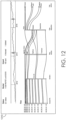
- FIGS. 1-12 are associated with an exemplary technical solution environment (malicious activity management environment or system 100) suitable for use in implementing embodiments of the technical solution.
- the technical solution environment includes a technical solution system suitable for providing malicious activity management operations based on a malicious activity manager.
- 1A discloses, among other engines, managers, generators, selectors, or components not shown (collectively referred to herein as "components"), malicious activity management environment 100, malicious activity management service 120, malicious activity manager 110 having activity instance and attribute sets 112, clustering instructions 114, scoring instructions 116, malicious activity models 118, multi-attribute cluster-identifiers 120, analysis instructions 130, visualization instructions 140, malicious activity management operations 150, malicious activity client 180 (including malicious activity management interface 182, and malicious activity management operations 184) and network 190.
- the components of the malicious activity management system 100 may communicate with each other over one or more networks (e.g., public network or virtual private network "VPN") as shown with network 190.
- the network 190 may include, without limitation, one or more local area networks (LANs) and/or wide area networks (WANs).
- the graphics editing client 180 may be a client computing device that corresponds to the computing device described herein with reference to FIG. 7 .
- Graphics editing system operations e.g., graphics editing system operations 112 and graphics editing system operations 184) can be carried out by a processor executing instructions stored in memory as further described with reference to FIG. 17 .
- the malicious activity manager 110 of a malicious activity management systems supports generating different multi-attribute cluster-identifiers having corresponding risk scores and attribute sets.
- Generating a multi-attribute cluster-identifier is based on clustering analysis and malicious activity determination models that support determining that an attribute set of an activity has a quantified risk (i.e., risk score) that indicates that the activity is a malicious activity.
- Generating the multi-attribute cluster-identifier for an activity can be based on initially clustering instances of the activity based on a corresponding attribute set (e.g., an attribute set of the emails in the email campaign).
- the malicious activity manager 110 monitors a computing environment and analyzes an instance of an activity (e.g., an email) and based on matching the instance to a multi-attribute cluster-identifier (i.e., risk score and attribute set) that indicates activity is a malicious activity, identifies the instance of the activity as a malicious activity.
- a multi-attribute cluster-identifier i.e., risk score and attribute set
- a multi-attribute cluster-identifier corresponding to the type of malicious activity supports effectively identifying an instance of an activity that is processed in the computing environment as a malicious activity.
- the malicious activity manager 110 further supports providing visualizations of malicious activity operations data.
- the visualizations are associated with different functions and features of the malicious activity manager (e.g., clustering analysis, risks scores, attribute sets, and evaluation results).
- the visualizations are provided to allow effective operation and control of the malicious activity manager from a user interface perspective, while the malicious activity manager simultaneously feeds back information in making decisions for malicious activity management.
- An activity refers to a set of electronic messages that are communicated between computing devices.
- An activity includes the set of electronic messages that are stored as data in a machine.
- An instance of an activity can refer to an individual electronic message in the set of messages.
- An electronic message can have static data structure that facilitates processing the electronic message based on machine instructions with machine operations.
- Each instance of the activity includes machine instructions embedded in the individual instances of the activity to support executing machine operations.
- An example activity may be an email campaign and an instance of the activity can refer to an email message.
- Campaign may be a cyberattack campaign (e.g., an email cyberattack campaign).
- Campaign can be an umbrella term associated with operations and computing objects (i.e., campaign objects) surrounding the management of an instance of a campaign.
- a fingerprints refers to a short binary representation of a document.
- the short binary presentation can potentially be for a longer document.
- the binary representation corresponds to a defined distance metric. In this way, documents which are similar will have a small distance.
- LSH local sensitive hashing
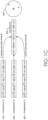
- FIG. 1C illustrates three different fingerprints (i.e., fingerprint A 10C, fingerprint B 20C, and fingerprint C 30C). Each fingerprint has a corresponding binary representation that is a distance metric that can be used to measure a similarity between the different fingerprints.
- centroid can refer to a cluster of fingerprints.
- centroids are clusters based off the fingerprints from the body of the email message. They are created by finding all fingerprints that have N 2 bit words in common. For example, if the centroid allows for up to 3 2 bit words to be different these two would be in the same centroid as shown below:
- Centroids can be generated for corresponding fingerprints.
- centroids can be efficiently generated to efficiently cluster fingerprints into existing centroid.
- a centroid 40C can be generated from Fingerprint A 10C, Fingerprint B 20C, and Fingerprint C 30C.
- the centroid value itself is a fingerprint that is as close to as many fingerprints as possible.
- One technical implementation of generating centroids can be based on a daily basis. Generating centroids on a daily basis may result in the same fingerprint being on a different centroid value each day. As such, an alternative to calculating a new centroid continuously, a list of known centroids can be maintained. Then, a determination can be made if one or more fingerprints can be identified inside of the centroid. If the one or more fingerprints are identified inside of an existing centroid, then the fingerprint will be grouped into that centroids cluster. Fingerprints that are not inside the centroid will be processed to create new centroids.
- FIG. 1D illustrates a high level representation various operations and computing objects associated with a campaign.
- FIG. 1D includes value proposition 10D, campaign visualization 20D, risk score 30D, campaign classifier 40D, clustering tech 50D, and signals, meta-data, and reputation 60D.
- Campaign objects can support implementing the technical solution of the present disclosure, as discussed in more detail below.
- a campaign can include value proposition (i.e., value 10D) that identifies the protection provided, alerts, remediation, and reports.
- Campaigns and campaign objects can also provide customers or administrators great insights in multiple aspects of cyberattacks experienced by users (i.e., campaign visualization 20D).
- Campaign objects empower users to comprehend complex cyberattacks as they are summarized and represented in a visualized graphical user interface (GUI).
- GUI visualized graphical user interface
- URL domains or simply domain refers to an identification string that defines a realm of administrative autonomy, authority, or control within the internet.
- URL domains names are used in various networking contexts and for application-specific naming and addressing purposes.
- the technical implementation of the present disclosure supports logging the domain of URLs that are provided to customers.
- URL domains can be associated with a sending IP address.
- An Internet Protocol (IP) address is a numerical label assigned to each device connected to a computer network that uses the Internet Protocol for communication.
- IP Internet Protocol
- a sending IP address in an IP address that is connected to a primary server or set of servers responsible for managing emails that are sent from a URL domain of the primary server or set of servers.
- the malicious activity management system 100, malicious activity manager 10, and malicious activity client 20 correspond to the components described with reference to FIG. 1A .
- a plurality instances of a potentially malicious activity e.g., a plurality of email messages
- the malicious activity management system e.g., malicious activity manager 10
- the malicious activity manager 10 identifies emails that are part of the same campaign. Multiple attributes of emails are used to link a campaign together.
- Clustering can be based on identifying centroids and identifying centroids with associated metadata attributes of the clustered email messages, the centroids are calculated based on the fingerprints of the email messages, and identifying common metadata attributes among the email messages.
- Clustering can further be based on applying filters based on the common metadata attributes, where applying filters based on the common metadata attributes identifies two of more subsets of the email messages, and generating campaign guides associated with each of the two or more subsets of the plurality of email messages, where a campaign guide links to the common metadata attributes corresponding to a subset of the plurality of email messages.
- a risk score is assigned a cluster based on historical information, attributes, and metadata associated with messages in the cluster.
- the risk score can be based on suspicion score, anomaly score, and impact score.
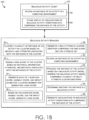
- a suspicion score, an anomaly score, and an impact score are generated for a cluster segment; and at step 36, the suspicion score, the anomaly score, and the impact score are used to generate the risk score.
- the suspicion score is based on information about a tenant of the computing environment; the anomaly score is based on information regarding the sender of information; and the impact score is based on a position of individuals targeted by instances of the activity in a corresponding cluster, classification of content in the corresponding cluster, and website information included in the previous instances of the activity.
- the multi-attribute client-identifier is generated, with the multi-attribute cluster-identifier includes a risk score and the attribute set.
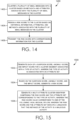
- an instance of an activity is received in a computing environment.
- the instance of the activity is received at the malicious activity manager.
- the instance of the activity is processed based on a malicious activity model. Processing the instance of the activity is performed using a malicious activity model.
- the malicious activity model includes a plurality of multi-attribute cluster-identifiers associated with previous instances of the activity.
- the multi-attribute cluster-identifiers include corresponding risk scores and attribute sets, where the risk scores and the attribute sets indicate a likelihood that the instance of the activity is a malicious activity.
- the malicious activity model is a machine learning model that is generated based on processing a plurality of email messages associated with a plurality cyberattacks.
- the processing the plurality of emails messages is based on clustering the plurality of emails based on action taken by recipients of the plurality of emails, attachments in the email, and corresponding fingerprints of the plurality of emails.
- the malicious activity model is configurable for processing the plurality of email messages at a tenant level, a global level, or a combined tenant-global level.
- a determination whether the instance of the activity is a malicious activity is based on comparing the attribute set of the instance of the activity to the plurality of multi-attribute cluster-identifiers, where the attribute set of the instance of the activity matches an attribute set of at least one of the plurality of multi-attribute cluster-identifiers.
- a risk score and the attribute set of the at least one of the plurality of multi-attribute cluster-identifier indicate a likelihood that the instance of the activity is a malicious activity.
- visualization of malicious activity operations data are generated and communicated to the malicious activity client 20.
- the malicious activity operations data is selected from each of clustering analysis, risks scores, attribute sets, evaluation results for generating corresponding clustering analysis visualizations, risk scores visualization, attributes set visualization and evaluation results visualizations.
- the one or more remediation actions are executed based on the severity of the risk score, wherein the risk score value corresponds to one of the following: high, medium, or low.
- visualizations of malicious activity operations data having the instance of the activity are received and caused to be displayed.
- FIG. illustrate different stages of malicious activity management operations that support identifying malicious activity in computing environments.
- the stages include Alerts 210, analyze 220, investigate 230, assess impact 240, contain 250, and respond 260.
- a report can be triggered and queued with a security operations center (SOC), or an email can be reported as a phishing email by an end user.
- SOC security operations center
- alerts group dozens of hundreds of emails into one coherent entity. The nature of the attack and the impact can be determined from the alert text itself.
- Campaign entities can showcase hacker infrastructure used from email sending and payload hosting.
- Alerts can be visualized using visualization tools.
- a determination can be made if an email is malicious. For example, are there any indicators of compromise (IOC), and what does the latest intelligence indicate about the email.
- IOC indicators of compromise
- actions are performed to contain affected users and device and apply conditional access to data by the users and devices.
- malicious emails can be removed, clean-up operations and policy configuration operations performed, any URLs and unblocked senders can be blocked.
- Visualizations at this stage can support exploring campaigns, performing bulk actions on all emails in a campaign, identifying indicators of compromise, and identifying tenant policies.
- FIG. 3 illustrates a flow diagram and components that support providing malicious activity management operations for identifying malicious activity in computing environments.
- FIG. 3 includes the following stages: email online protection ("EOP") 302, detection 306, and model training 308; and services: EOP service 310, clustering 320, history 330, external 340, tenant 360, global 370, model training 380, and risk score 390.
- An EOP can refer to a hosted e-mail securing service that filters spam and removes viruses from emails.
- the EOP can operate to analyze message logs and extract phish words relative to people (e.g., high value employees HVE) associated with the email messages.
- people e.g., high value employees HVE
- Message data from the EOP can be used to aggregate features on clusters of emails messages 314 based on generating history 314 and utilizing fuzzy cluster algorithms 316.
- Generating history can be based on the message data that includes URLs, senders, sender and location combinations for particular tenants and globally as well.
- the aggregate features from clusters, anomaly algorithms 318, IP and recipient data 319 are processed through machine learning models (e.g., tenant models and global models) trained via model training 380 to generate the risk score 390.
- FIG. 4 provides an alternative view of a flow diagram and components that support malicious activity management operations for identifying malicious activity in computing environments.
- FIG. 4 includes the following stages: cluster 402, detect 404, notify 406, and investigate remediate 408.
- a risk score 418 can be generated based on a suspicion score, an anomaly score, and an impact score.
- the risk score can be used during a notification phase (i.e., notify 406) for alerts (e.g., alert 422) and automatic orders (e.g., auto order 420).
- the notify 406 can further include filtering risk score for corresponding emails based on anomaly indicators, suspicious indicators, and impact indicators during an investigate and remediate phase.
- an email message i.e., an instance
- an email campaign i.e., activity
- an email campaign i.e., activity
- the malicious activity management system 100 can specifically utilize campaign graph clustering techniques based on campaign guides and metadata. Using the campaign graph clustering technique, for each campaign that is discovered, a campaign guide. The campaign guides will then link to the metadata properties that are a part of the campaign. A campaign is generated based on linking together metadata values and apply filters as each step to reduce false positives.
- the malicious activity management system 100 can also implement full fuzzy clustering techniques. For example, LSH fingerprints can be generated based on the text of an email, excluding URLs and HTML structure. These fingerprints are similar to a hash function but the distance is close between messages that have similar content. Full fuzzy clustering enables running daily aggregations. The clustering operations on a given number of messages can be completed based on a defined period of time (e.g., 300 million messages daily and can take about 2 hours to complete). In this way, by way of example, approximately 500 thousand clusters can be output daily out of 5 million possible clusters.
- a defined period of time e.g. 300 million messages daily and can take about 2 hours to complete. In this way, by way of example, approximately 500 thousand clusters can be output daily out of 5 million possible clusters.
- a selected volume of instances of an activity (e.g., 10%) can be selected based on a suspicious model selection (e.g., selecting a set of suspicious instances of an activity).
- fingerprints can be generated for the instances.
- a first clustering step can be performed for a subset of the instances (e.g., 50k batches).
- smaller clusters e.g., 50% vol
- a second clustering step can be performed on the instances (e.g., 50k batches).
- a final clustering step is performed.
- outlier clusters are filtered to generate clusters 590.
- FIG. 6 illustrates a flow diagram for generating a cluster based of centroid and URL.
- a starting centroid is identified, the starting centroid is BC16F415.983B9015.23D61D9B.56D2D102.201B6.
- a centroid can refer to a cluster of fingerprints.
- centroids are clusters based off the fingerprints from the body of the email message. They are created by finding all fingerprints that have N 2 bit words in common.
- a plurality of URLs associated with centroid are identified.
- a plurality of known URLs are filtered out of the URLs found in step 620.
- a set of filtered URLs are identified.
- the filtered URLs are used to identify new centroids.
- the new centroids are identified.
- centroids e.g., known centroids
- a set of instances e.g., 37, 466 messages
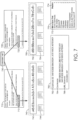
- FIG. 7 illustrated generating campaigns based on identifying multiple common metadata attributes.
- a first email 710 may include a first detected URL 712 and a second email 720 can include a second detected URL 722. It can be determined that both the first URL 712 and the second URL 722 are the same (i.e., chinabic.net 730).
- the first email can have a first centroid 740 and the second email can have a second centroid 750.
- metadata types can be identified and assigned priority for utilizing the metadata types (e.g., common attributes 770, metadata type 772, and priority 774) for generating campaigns.
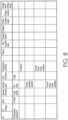
- Metadata types include static centroids, URL domains, sending IP, domains, sender, subject fingerprint, originating client IP etc. each associated with a corresponding priority.
- a campaign e.g., campaign 760 with campaign ID 762, centroids 764, and URL domain
- a campaign can be generated associated with the first email and the second email.
- campaign 760 with campaign ID 762, centroids 764, and URL domain
- the content of the email was slightly different for different users. So there are similarity metrics that were sent by same person which lead to other attributes. So based on one message, embodiments of the present invention extrapolated out and were able to figure out that about 4500 messages in the campaign were potentially malicious.
- emails can be chosen wisely using clustering techniques to generalize and capture and what is anomalous.
- the malicious activity management operations further support discerning malicious emails from legitimate emails.
- Embodiments of the present invention may use a machine learning model to analyze all of these features of the email cluster to determine if the emails are suspicious or not. For example, look at the number of executives the email was sent to. Extract features from the email, and historical data (user actions), and a bunch of others.
- a machine learning model can be generated to classify whether the received cluster is malicious or legitimate. Then have additional logic to determine if the cluster is a mixed cluster because a malicious message does not mean the whole message is bad.
- various ways of grouping/clustering emails messages according to attributes can be implemented. For example, by content similarity (e.g., fingerprinting using locality-sensitive hashing (LSH)).
- LSH locality-sensitive hashing
- clustering deals with operations that group/cluster emails in a way that actually enables embodiments of the present invention to tell apart different emails and also enables embodiments of the present invention to tell how emails are similar even at different time periods.
- Cluster further contemplates how maintaining this information is performed (e.g., how the clusters/groupings are maintained). And, given the scale of clustering contemplated, a determination can be made if a cluster is malicious (e.g., spam, phishing, malware, etc.) using various attributes or signals.
- a machine learning model can be used to determine that a cluster is malicious.
- visualization techniques can be implemented to relay, display, show, or otherwise demonstrate to a user various aspects of a potential attack in an email campaign (e.g., show that an attack that has thousands of emails coming from different places and going to different places). Because of the scale of email is large, operations described herein are further able to see campaigns at a global scale across many tenants and customers. As such, embodiments of the present invention can build a campaign because of the vast amount of data accessible by embodiments of the present invention.
- the risk score can be based several different scores.
- the scores may be used to determine an overall risk score for an associated email campaign.
- Each score calculation may be made using an associated model.
- One such score calculation is a suspicion score. It may be generated at the tenant and global level.
- Features include engine information aggregation such as how many caught by which subsystem, model scores and other subsystem results, historical data: contact graph features with P2 sender and URL hosts for example.
- Training aspects of the suspicion model include bad labels such as clusters which contain at least one phish/malware manual grade (vendor or analyst), good labels such as clusters which contains at least one good manual grade or one good label AND does not have any bad manual grade.
- An anomaly score is an anomaly score.
- Anomaly features include a new sender to a tenant, a new link host to a tenant, an old sender to a tenant form a new location and a new link to a tenant, and many others.
- An anomaly score can be calculated using any suitable model, algorithm, process, or method such as a simple heuristic.
- the model may use history data at a tenant and global level to generate an anomaly score. History may be defined as a closed period time (e.g., 6 months). Frequency of update can be daily. History data is defined at tenant level.
- Example types of history data include, but are not limited to: history of sender (e.g., the ideal address format would be P1+P2, even better; "raw from header + P1 address"), history of geo location (e.g., geo grid that is calculated from latitude/longitude, both client IP and connecting IP addresses), history of link host.
- History of sender e.g., the ideal address format would be P1+P2, even better; "raw from header + P1 address”
- history of geo location e.g., geo grid that is calculated from latitude/longitude, both client IP and connecting IP addresses
- history of link host e.g., history of link host.
- Features include age of relationship, number of days seen, total number of messages (tenant/global), and total number of bad messages (tenant/global), among others.
- An impact score can also be calculated.
- one impact score may be calculated for high value employees (HVEs).
- HVEs high value employees
- An impact score model may use email communication patterns to construct graphs of user with consistent emails communications. For example, given the CEO as a seed, the distance to other user along the graphs is equivalent to the importance of the users.
- Another impact score that may be calculated based on content classification.
- embodiments of the present invention may use a machine learning model or any other suitable model which is based o/analyzes/uses a hashed subject and body tokens as well as structural features to identify messages asking for credentials.
- the model is trained on messages marked as brand impersonation by graders and good messages from the corpus heuristic which are unlikely to be credential seeking.
- Yet another impact score that may be calculated by embodiments of the present invention is based on website impact signals.
- embodiments of the present invention may use a model (machine learning or otherwise) to determine if a website included in emails associated with a campaign include a form entry, a form for collecting a password, or if the website brands looks like a proprietary brand (e.g., Office365).
- the malicious activity management operation further enable certain actions to be taken on campaign based on the overall risk score or suspiciousness level of a campaign. Based on the suspiciousness of campaigns actions can be taken.
- the actions include any of the following: campaign pattern blocked so future instances are no longer reaching the user base; prioritizing alerts that can be triggered so security processes and personnel are able to quickly remediate issues, before victims are handing over their enterprise credentials or installing malware on their devices; campaign can be understood in detail, with good flow diagrams, to determine the set of IOCs (indicators of compromise) that were used across the attack. These IOCs can be checked/inputted in other security products; and campaign write-ups can be automatically generated to describe, in plain English and with nice charts, the origin, timeline, intent, and appearance of the attack. Then how well each aspect of the filtering solution protected or failed to protect. Then which users or devices where targeted and which of them fell victim (see below for further description describing the generation of campaign write-ups.
- example dashboard having different types of visualization are provided.
- the malicious activity management operations further support generating visualizations of malicious activity management operations data.
- the visualizations can be associated with generating a campaign write-up, report, summary, and/or any other information that can be transmitted to any number of tenants, customers, or other users. These write-ups, reports, summaries, and/or any other information can be generated by automatically to show what the campaign looks like a high-level but also allow for granular views of certain data/attributes associated with the campaign. "Campaign Write-ups" may be generated as a user editable document that describes, in plain English (localized of course) and data, charts, graphs, an attack write-up.
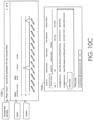
- dashboard 1010 includes a configurable interface for view malicious activity operations data (e.g., alert permissions, classifications, data loss prevention, data governance, threat prevention). As shown, a chart identifying a total number of delivered emails and a total number of clicked email can be generated. The malicious activity operation data can be view based on different selectable tabs (e.g., campaigns, emails, URL clicks, URLs, and email origin). Additional filters available via the interface can include campaign name, campaign ID, etc. As shown in FIG. 10B , dashboard 1020 can illustrate the details of a particular campaign. For example, Phish.98D458AA campaign can have an interface element that identifies IP addresses associated with the campaign and a number of emails allowed for that campaign.
- malicious activity operations data e.g., alert permissions, classifications, data loss prevention, data governance, threat prevention.
- a chart identifying a total number of delivered emails and a total number of clicked email can be generated.
- the malicious activity operation data can be view based on different selectable tabs (e.
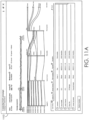
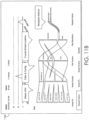
- dashboard 1120 includes the details for a credential theft campaign.
- user actions taken can be displayed (e.g., clicked, report junk, and deleted unread, inbox, deleted, and quarantined).
- Activity associated with particular users e.g., HVE
- dashboard 1120 includes actions taken by users can also be illustrated (e.g., safelinks block or safelink block override).
- dashboard 1210 includes status and impact information for a campaign (e.g., active status, start date, and impact - 4 inbox and 1 clicked). In this way, the visualizations help summarize malicious activity operations data to facilitate improved access to campaign information and support performing additional operations based on the visualizations.
- Malicious activity management operations further support clearing requests from customers, in particular requests to project their studies, knowledge, or other information to their teams and upper management when describing security incidents in their infrastructure. This enables users to understand, feel comfortable, and increase use features and functionality described herein. Having visibility into instances of complex cyberattacks that were prevented or remediated is key in deriving a meaningful return on investment (ROI).
- ROI return on investment
- Client device 1680 may be linked to a service application in cloud computing platform 1610.
- Client device 1680 may be any type of computing device, which may correspond to computing device 1700 described with reference to FIG. 17 , for example, client device 1680 can be configured to issue commands to cloud computing platform 1610.
- client device 680 may communicate with service applications through a virtual Internet Protocol (IP) and load balancer or other means that direct communication requests to designated endpoints in cloud computing platform 1610.
- IP Internet Protocol
- the components of cloud computing platform 610 may communicate with each other over a network (not shown), which may include, without limitation, one or more local area networks (LANs) and/or wide area networks (WANs).
- LANs local area networks
- WANs wide area networks
- computing device 1700 is but one example of a suitable computing environment and is not intended to suggest any limitation as to the scope of use or functionality of the invention. Neither should computing device 1700 be interpreted as having any dependency or requirement relating to any one or combination of components illustrated.
- the invention may be described in the general context of computer code or machine-useable instructions, including computer-executable instructions such as program modules, being executed by a computer or other machine, such as a personal data assistant or other handheld device.
- program modules including routines, programs, objects, components, data structures, etc. refer to code that perform particular tasks or implement particular abstract data types.
- the invention may be practiced in a variety of system configurations, including hand-held devices, consumer electronics, general-purpose computers, more specialty computing devices, etc.
- the invention may also be practiced in distributed computing environments where tasks are performed by remote-processing devices that are linked through a communications network.
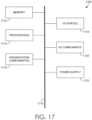
- computing device 1700 includes bus 1710 that directly or indirectly couples the following devices: memory 1712, one or more processors 1714, one or more presentation components 1716, input/output ports 1718, input/output components 1720, and illustrative power supply 1722.
- Bus 1710 represents what may be one or more buses (such as an address bus, data bus, or combination thereof).
- the various blocks of FIG. 17 are shown with lines for the sake of conceptual clarity, and other arrangements of the described components and/or component functionality are also contemplated. For example, one may consider a presentation component such as a display device to be an I/O component. Also, processors have memory. We recognize that such is the nature of the art, and reiterate that the diagram of FIG.
- FIG. 17 is merely illustrative of an example computing device that can be used in connection with one or more embodiments of the present invention. Distinction is not made between such categories as “workstation,” “server,” “laptop,” “hand-held device,” etc., as all are contemplated within the scope of FIG. 17 and reference to “computing device.”
- Computing device 1700 typically includes a variety of computer-readable media.
- Computer-readable media can be any available media that can be accessed by computing device 1700 and includes both volatile and nonvolatile media, removable and non-removable media.
- Computer-readable media may comprise computer storage media and communication media.
- Computer storage media include volatile and nonvolatile, removable and non-removable media implemented in any method or technology for storage of information such as computer-readable instructions, data structures, program modules or other data.
- Computer storage media includes, but is not limited to, RAM, ROM, EEPROM, flash memory or other memory technology, CD-ROM, digital versatile disks (DVD) or other optical disk storage, magnetic cassettes, magnetic tape, magnetic disk storage or other magnetic storage devices, or any other medium which can be used to store the desired information and which can be accessed by computing device 1700.
- Computer storage media excludes signals per se.
- Communication media typically embodies computer-readable instructions, data structures, program modules or other data in a modulated data signal such as a carrier wave or other transport mechanism and includes any information delivery media.
- modulated data signal means a signal that has one or more of its characteristics set or changed in such a manner as to encode information in the signal.
- communication media includes wired media such as a wired network or direct-wired connection, and wireless media such as acoustic, RF, infrared and other wireless media. Combinations of any of the above should also be included within the scope of computer-readable media.
- Memory 1712 includes computer storage media in the form of volatile and/or nonvolatile memory.
- the memory may be removable, non-removable, or a combination thereof.
- Exemplary hardware devices include solid-state memory, hard drives, optical-disc drives, etc.
- Computing device 1700 includes one or more processors that read data from various entities such as memory 1712 or I/O components 1720.
- Presentation component(s) 1716 present data indications to a user or other device.
- Exemplary presentation components include a display device, speaker, printing component, vibrating component, etc.
- I/O ports 1718 allow computing device 1700 to be logically coupled to other devices including I/O components 1720, some of which may be built in.
- I/O components 1720 include a microphone, joystick, game pad, satellite dish, scanner, printer, wireless device, etc.
- the components of the technical solution environment can be integrated components that include a hardware architecture and a software framework that support constraint computing and/or constraint querying functionality within a technical solution system.
- the hardware architecture refers to physical components and interrelationships thereof
- the software framework refers to software providing functionality that can be implemented with hardware embodied on a device.
- the end-to-end software-based system can operate within the system components to operate computer hardware to provide system functionality.
- hardware processors execute instructions selected from a machine language (also referred to as machine code or native) instruction set for a given processor.
- the processor recognizes the native instructions and performs corresponding low level functions relating, for example, to logic, control and memory operations.
- Low level software written in machine code can provide more complex functionality to higher levels of software.
- computer-executable instructions includes any software, including low level software written in machine code, higher level software such as application software and any combination thereof.
- the system components can manage resources and provide services for system functionality. Any other variations and combinations thereof are contemplated with embodiments of the present invention.
- the technical solution system can include an Application Programming Interface (API) library that includes specifications for routines, data structures, object classes, and variables may support the interaction between the hardware architecture of the device and the software framework of the technical solution system.
- APIs include configuration specifications for the technical solution system such that the different components therein can communicate with each other in the technical solution system, as described herein.
- Embodiments described in the paragraphs below may be combined with one or more of the specifically described alternatives.
- an embodiment that is claimed may contain a reference, in the alternative, to more than one other embodiment.
- the embodiment that is claimed may specify a further limitation of the subject matter claimed.
- the word “including” has the same broad meaning as the word “comprising,” and the word “accessing” comprises “receiving,” “referencing,” or “retrieving.” Further the word “communicating” has the same broad meaning as the word “receiving,” or “transmitting” facilitated by software or hardware-based buses, receivers, or transmitters using communication media described herein.
- words such as “a” and “an,” unless otherwise indicated to the contrary include the plural as well as the singular. Thus, for example, the constraint of "a feature” is satisfied where one or more features are present.
- the term “or” includes the conjunctive, the disjunctive, and both (a or b thus includes either a or b, as well as a and b).
- embodiments of the present invention are described with reference to a distributed computing environment; however the distributed computing environment depicted herein is merely exemplary. Components can be configured for performing novel aspects of embodiments, where the term “configured for” can refer to "programmed to" perform particular tasks or implement particular abstract data types using code. Further, while embodiments of the present invention may generally refer to the technical solution environment and the schematics described herein, it is understood that the techniques described may be extended to other implementation contexts.
Landscapes
- Engineering & Computer Science (AREA)
- Computer Security & Cryptography (AREA)
- General Engineering & Computer Science (AREA)
- Signal Processing (AREA)
- Computer Networks & Wireless Communication (AREA)
- Computer Hardware Design (AREA)
- Theoretical Computer Science (AREA)
- Software Systems (AREA)
- Computing Systems (AREA)
- General Physics & Mathematics (AREA)
- Physics & Mathematics (AREA)
- Data Mining & Analysis (AREA)
- Business, Economics & Management (AREA)
- Human Resources & Organizations (AREA)
- Human Computer Interaction (AREA)
- Entrepreneurship & Innovation (AREA)
- Strategic Management (AREA)
- Computer Vision & Pattern Recognition (AREA)
- Artificial Intelligence (AREA)
- Evolutionary Computation (AREA)
- Bioinformatics & Cheminformatics (AREA)
- Evolutionary Biology (AREA)
- Bioinformatics & Computational Biology (AREA)
- Life Sciences & Earth Sciences (AREA)
- Medical Informatics (AREA)
- General Business, Economics & Management (AREA)
- Tourism & Hospitality (AREA)
- Mathematical Physics (AREA)
- Quality & Reliability (AREA)
- Operations Research (AREA)
- Marketing (AREA)
- Economics (AREA)
- Health & Medical Sciences (AREA)
- General Health & Medical Sciences (AREA)
- Virology (AREA)
- Data Exchanges In Wide-Area Networks (AREA)
- Information Transfer Between Computers (AREA)
- Storage Device Security (AREA)
Claims (9)
- Computerimplementiertes Verfahren (1300), wobei das Verfahren umfasst:Zugreifen (1302) auf eine Instanz einer Aktivität in einer Computerumgebung, wobei die Instanz der Aktivität einen Attributsatz umfasst;Empfangen (1304) der Instanz der Aktivität bei einem Modell für bösartige Aktivitäten, das eine Vielzahl von Multiattribut-Cluster-Kennungen umfasst, die mit vorherigen Instanzen der Aktivität verknüpft sind, wobei die Multiattribut-Cluster-Kennungen entsprechende Risikobewertungen und Attributsätze umfassen, wobei die Risikobewertungen und die Attributsätze eine Wahrscheinlichkeit angeben, dass die Instanz der Aktivität eine bösartige Aktivität ist;Bestimmen (1306), unter Verwendung des Modells für bösartige Aktivitäten, dass der Fall der Aktivität eine bösartige Aktivität ist, basierend auf dem Vergleich des Attributsatzes des Falls der Aktivität mit der Vielzahl von Multiattribut-Cluster-Kennungen, wobei der Attributsatz der Instanz der Aktivität mit einem Attributsatz von mindestens einem der Vielzahl von Multiattribut-Cluster-Kennungen übereinstimmt, eine Risikopunktzahl und der Attributsatz des mindestens einen der Vielzahl von Multiattribut-Cluster-Kennungen eine Wahrscheinlichkeit angeben, dass die Instanz der Aktivität eine bösartige Aktivität ist; undErzeugen (1308) einer Visualisierung von Operationsdaten bösartiger Aktivitäten, umfassend den Fall der Aktivität, wobei die Visualisierung den Fall der Aktivität als bösartige Aktivität identifiziert,wobei das Modell bösartiger Aktivitäten ein maschinelles Lernmodell ist, das basierend auf der Verarbeitung einer Vielzahl von E-Mail-Nachrichten, die mit einer Vielzahl von Cyberangriffen verbunden sind, erzeugt wird, wobei die Verarbeitung der Vielzahl von E-Mail-Nachrichten auf einem Clustering der Vielzahl von E-Mails basierend auf von Empfängern der Vielzahl von E-Mails ergriffenen Maßnahmen, Anhängen in der E-Mail und entsprechenden Fingerabdrücken der Vielzahl von E-Mails basiert; und wobei das Modell für böswillige Aktivitäten für die Verarbeitung der Vielzahl von E-Mail-Nachrichten auf Mandantenebene, globaler Ebene oder einer kombinierten Mandantenglobalen Ebene konfiguriert werden kann.
- Verfahren nach Anspruch 1, wobei das Beispiel der Aktivität eine E-Mail-Nachricht ist, wobei das Erzeugen des Modells für böswillige Aktivitäten für eine Vielzahl von E-Mail-Nachrichten umfasst: Clustern der Vielzahl von E-Mail-Nachrichten in zwei oder mehr Cluster basierend auf den Metadaten und Attributen, die mit der Vielzahl von E-Mail-Nachrichten in dem Cluster verbunden sind; und Zuweisen von Risikopunktzahlen zu jedem der zwei oder mehr Cluster basierend auf historischen Informationen, Attributen und Metadaten, die mit der Vielzahl von E-Mail-Nachrichten in den zwei oder mehr Clustern verbunden sind.
- Verfahren nach Anspruch 2, wobei das Clustering der Vielzahl von E-Mail-Nachrichten in die zwei oder mehr Cluster basierend auf Folgendem erfolgt:Identifizieren von Zentroiden mit zugehörigen Metadatenattributen der Vielzahl von E-Mail-Nachrichten, wobei die Zentroiden basierend auf den Fingerabdrücken der Vielzahl von E-Mail-Nachrichten berechnet werden;Identifizieren gemeinsamer Metadatenattribute in der Vielzahl von E-Mail-Nachrichten;Anwenden von Filtern basierend auf den gemeinsamen Metadatenattributen, wobei das Anwenden von Filtern basierend auf den gemeinsamen Metadatenattributen zwei oder mehr Teilmengen der Vielzahl von E-Mail-Nachrichten identifiziert;Erzeugen von Kampagnenleitfäden, die mit jeder der zwei oder mehr Teilmengen der Vielzahl von E-Mail-Nachrichten verknüpft sind, wobei ein Kampagnenleitfaden mit den gemeinsamen Metadatenattributen verknüpft ist, die einer Teilmenge der Vielzahl von E-Mail-Nachrichten entsprechen.
- Verfahren nach Anspruch 1, wobei die Risikobewertungen auf der Grundlage jeder der folgenden Punkte berechnet werden: einer Verdachts-Punktzahl, einer Anomalie-Punktzahl und einer Auswirkungs-Punktzahl, jeweils basierend auf Informationen aus dem Cluster, die indikativ für böswillige Aktivitäten sind, wobei die Verdachts-Punktzahl auf Informationen über einen Mandanten der Computerumgebung basiert, wobei die Anomalie-Punktzahl auf Informationen bezüglich des Absenders von Informationen basiert, wobei die Auswirkungs-Punktzahl auf einer Position von Personen, die Ziel von Instanzen der Aktivität in einem entsprechenden Cluster sind, einer Klassifizierung von Inhalten in dem entsprechenden Cluster und Website-Informationen, die in den vorherigen Instanzen der Aktivität eingeschlossen sind, basiert.
- Verfahren nach Anspruch 1, wobei das Modell für böswillige Aktivitäten ein Modell zum Bestimmen böswilliger Aktivitäten ist, das verwendet wird, um den Attributsatz des Aktivitätsbeispiels zu vergleichen, um mindestens eine der Vielzahl von Kennungen für Cluster mit mehreren Attributen zu identifizieren, die eine Wahrscheinlichkeit angibt, dass das Aktivitätsbeispiel eine böswillige Aktivität ist.
- Verfahren nach Anspruch 1, wobei die Daten der Operationen böswilliger Aktivitäten aus Clustering-Analysen, Risikobewertungen, Attributsätzen und Bewertungsergebnissen ausgewählt werden, um entsprechende Visualisierungen von Clustering-Analysen, Visualisierungen von Risikobewertungen, Visualisierungen von Attributsätzen und Visualisierungen von Bewertungsergebnissen zu erzeugen.
- Verfahren nach Anspruch 1, wobei basierend auf dem Bestimmen, dass der Attributsatz des Beispiels der Aktivität dem Risikowert und dem Attributsatz mindestens eines der Vielzahl von Multiattribut-Cluster-Kennungen entspricht, die eine Wahrscheinlichkeit angeben, dass das Beispiel der Aktivität eine böswillige Aktivität ist, eine oder mehrere Abhilfemaßnahmen ausgeführt werden, wobei die eine oder mehreren Abhilfemaßnahmen basierend auf dem Schweregrad des Risikowerts ausgeführt werden, wobei der Risikowert einem der folgenden entspricht: hoch, mittel oder niedrig.
- System, umfassend: einen oder mehrere Computerprozessoren; und einen Computerspeicher, der computerverwendbare Anweisungen speichert, die, wenn sie von dem einen oder den mehreren Computerprozessoren verwendet werden, den einen oder die mehreren Computerprozessoren dazu veranlassen, Operationen durchzuführen, umfassend:Zugreifen (1302) auf eine Instanz einer Aktivität in einer Computerumgebung, wobei die Instanz der Aktivität einen Attributsatz umfasst;Empfangen (1304) der Instanz der Aktivität bei einem Modell für bösartige Aktivitäten, das eine Vielzahl von Multiattribut-Cluster-Kennungen umfasst, die mit vorherigen Instanzen der Aktivität verknüpft sind, wobei die Multiattribut-Cluster-Kennungen entsprechende Risikobewertungen und Attributsätze umfassen, wobei die Risikobewertungen und die Attributsätze eine Wahrscheinlichkeit angeben, dass die Instanz der Aktivität eine bösartige Aktivität ist;Bestimmen (1306), unter Verwendung des Modells für bösartige Aktivitäten, dass der Fall der Aktivität eine bösartige Aktivität ist, basierend auf dem Vergleich des Attributsatzes des Falls der Aktivität mit der Vielzahl von Multiattribut-Cluster-Kennungen, wobei der Attributsatz der Instanz der Aktivität mit einem Attributsatz von mindestens einem der Vielzahl von Multiattribut-Cluster-Kennungen übereinstimmt, eine Risikopunktzahl und der Attributsatz des mindestens einen der Vielzahl von Multiattribut-Cluster-Kennungen eine Wahrscheinlichkeit angeben, dass die Instanz der Aktivität eine bösartige Aktivität ist; undErzeugen (1308) einer Visualisierung von Operationsdaten bösartiger Aktivitäten, umfassend den Fall der Aktivität, wobei die Visualisierung den Fall der Aktivität als bösartige Aktivität identifiziert,wobei das Modell bösartiger Aktivitäten ein maschinelles Lernmodell ist, das basierend auf der Verarbeitung einer Vielzahl von E-Mail-Nachrichten, die mit einer Vielzahl von Cyberangriffen verbunden sind, erzeugt wird, wobei die Verarbeitung der Vielzahl von E-Mail-Nachrichten auf einem Clustering der Vielzahl von E-Mails basierend auf von Empfängern der Vielzahl von E-Mails ergriffenen Maßnahmen, Anhängen in der E-Mail und entsprechenden Fingerabdrücken der Vielzahl von E-Mails basiert; und wobei das Modell für böswillige Aktivitäten für die Verarbeitung der Vielzahl von E-Mail-Nachrichten auf Mandantenebene, globaler Ebene oder einer kombinierten Mandantenglobalen Ebene konfiguriert werden kann.
- Ein oder mehrere Computerspeichermedien mit darauf gespeicherten, von einem Computer ausführbaren Anweisungen, die, wenn sie von einem Computersystem mit einem Prozessor und einem Speicher ausgeführt werden, den Prozessor veranlassen zum:Zugreifen (1302) auf eine Instanz einer Aktivität in einer Computerumgebung, wobei die Instanz der Aktivität einen Attributsatz umfasst;Empfangen (1304) der Instanz der Aktivität bei einem Modell für bösartige Aktivitäten, das eine Vielzahl von Multiattribut-Cluster-Kennungen umfasst, die mit vorherigen Instanzen der Aktivität verknüpft sind, wobei die Multiattribut-Cluster-Kennungen entsprechende Risikobewertungen und Attributsätze umfassen, wobei die Risikobewertungen und die Attributsätze eine Wahrscheinlichkeit angeben, dass die Instanz der Aktivität eine bösartige Aktivität ist;Bestimmen (1306), unter Verwendung des Modells für bösartige Aktivitäten, dass der Fall der Aktivität eine bösartige Aktivität ist, basierend auf dem Vergleich des Attributsatzes des Falls der Aktivität mit der Vielzahl von Multiattribut-Cluster-Kennungen, wobei der Attributsatz der Instanz der Aktivität mit einem Attributsatz von mindestens einem der Vielzahl von Multiattribut-Cluster-Kennungen übereinstimmt, eine Risikopunktzahl und der Attributsatz des mindestens einen der Vielzahl von Multiattribut-Cluster-Kennungen eine Wahrscheinlichkeit angeben, dass die Instanz der Aktivität eine bösartige Aktivität ist; undErzeugen (1308) einer Visualisierung von Operationsdaten bösartiger Aktivitäten, umfassend den Fall der Aktivität, wobei die Visualisierung den Fall der Aktivität als bösartige Aktivität identifiziert,wobei das Modell bösartiger Aktivitäten ein maschinelles Lernmodell ist, das basierend auf der Verarbeitung einer Vielzahl von E-Mail-Nachrichten, die mit einer Vielzahl von Cyberangriffen verbunden sind, erzeugt wird, wobei die Verarbeitung der Vielzahl von E-Mail-Nachrichten auf einem Clustering der Vielzahl von E-Mails basierend auf von Empfängern der Vielzahl von E-Mails ergriffenen Maßnahmen, Anhängen in der E-Mail und entsprechenden Fingerabdrücken der Vielzahl von E-Mails basiert; und wobei das Modell für böswillige Aktivitäten für die Verarbeitung der Vielzahl von E-Mail-Nachrichten auf Mandantenebene, globaler Ebene oder einer kombinierten Mandantenglobalen Ebene konfiguriert werden kann.
Applications Claiming Priority (3)
| Application Number | Priority Date | Filing Date | Title |
|---|---|---|---|
| US201962929917P | 2019-11-03 | 2019-11-03 | |
| EP20816697.5A EP4052156B1 (de) | 2019-11-03 | 2020-11-03 | Kampagnen-intelligenz und visualisierung zum bekämpfen von cyberangriffen |
| PCT/US2020/058757 WO2021087496A1 (en) | 2019-11-03 | 2020-11-03 | Campaign intelligence and visualization for combating cyberattacks |
Related Parent Applications (2)
| Application Number | Title | Priority Date | Filing Date |
|---|---|---|---|
| EP20816697.5A Division EP4052156B1 (de) | 2019-11-03 | 2020-11-03 | Kampagnen-intelligenz und visualisierung zum bekämpfen von cyberangriffen |
| EP20816697.5A Division-Into EP4052156B1 (de) | 2019-11-03 | 2020-11-03 | Kampagnen-intelligenz und visualisierung zum bekämpfen von cyberangriffen |
Publications (3)
| Publication Number | Publication Date |
|---|---|
| EP4290808A2 EP4290808A2 (de) | 2023-12-13 |
| EP4290808A3 EP4290808A3 (de) | 2024-02-21 |
| EP4290808B1 true EP4290808B1 (de) | 2025-05-28 |
Family
ID=75688883
Family Applications (2)
| Application Number | Title | Priority Date | Filing Date |
|---|---|---|---|
| EP20816697.5A Active EP4052156B1 (de) | 2019-11-03 | 2020-11-03 | Kampagnen-intelligenz und visualisierung zum bekämpfen von cyberangriffen |
| EP23206708.2A Active EP4290808B1 (de) | 2019-11-03 | 2020-11-03 | Kampagnen-intelligenz und visualisierung zum bekämpfen von cyberangriffen |
Family Applications Before (1)
| Application Number | Title | Priority Date | Filing Date |
|---|---|---|---|
| EP20816697.5A Active EP4052156B1 (de) | 2019-11-03 | 2020-11-03 | Kampagnen-intelligenz und visualisierung zum bekämpfen von cyberangriffen |
Country Status (4)
| Country | Link |
|---|---|
| US (2) | US12113808B2 (de) |
| EP (2) | EP4052156B1 (de) |
| CN (2) | CN114761953B (de) |
| WO (1) | WO2021087496A1 (de) |
Families Citing this family (35)
| Publication number | Priority date | Publication date | Assignee | Title |
|---|---|---|---|---|
| US20230224327A1 (en) * | 2018-02-20 | 2023-07-13 | Darktrace Holdings Limited | System to detect malicious emails and email campaigns |
| US11663544B2 (en) * | 2020-01-28 | 2023-05-30 | Salesforce.Com, Inc. | System and methods for risk assessment in a multi-tenant cloud environment |
| US11720686B1 (en) | 2020-04-08 | 2023-08-08 | Wells Fargo Bank, N.A. | Security model utilizing multi-channel data with risk-entity facing cybersecurity alert engine and portal |
| US12015630B1 (en) | 2020-04-08 | 2024-06-18 | Wells Fargo Bank, N.A. | Security model utilizing multi-channel data with vulnerability remediation circuitry |
| US11777992B1 (en) | 2020-04-08 | 2023-10-03 | Wells Fargo Bank, N.A. | Security model utilizing multi-channel data |
| US12341816B1 (en) | 2020-04-08 | 2025-06-24 | Wells Fargo Bank, N.A. | Security model utilizing multi-channel data with service level agreement integration |
| US11706241B1 (en) | 2020-04-08 | 2023-07-18 | Wells Fargo Bank, N.A. | Security model utilizing multi-channel data |
| US11601463B2 (en) * | 2020-07-28 | 2023-03-07 | The Boeing Company | Cybersecurity threat modeling and analysis with text miner and data flow diagram editor |
| US12041089B2 (en) * | 2020-10-01 | 2024-07-16 | Zscaler, Inc. | Cloud access security broker user interface systems and methods |
| US12457236B2 (en) * | 2020-10-14 | 2025-10-28 | Ntt, Inc. | Determination device, determination method, and determination program |
| US11310270B1 (en) * | 2020-10-14 | 2022-04-19 | Expel, Inc. | Systems and methods for intelligent phishing threat detection and phishing threat remediation in a cyber security threat detection and mitigation platform |
| US11457012B2 (en) * | 2020-11-03 | 2022-09-27 | Okta, Inc. | Device risk level based on device metadata comparison |
| US11765195B2 (en) * | 2021-02-16 | 2023-09-19 | Icf International | Distributed network-level probabilistic attack graph generation |
| US12381904B2 (en) * | 2021-04-19 | 2025-08-05 | KnowBe4, Inc. | Prioritization of reported messages |
| US12519806B2 (en) * | 2021-04-29 | 2026-01-06 | KnowBe4, Inc. | Systems and methods for determination of indicators of malicious elements within messages |
| US12505225B2 (en) * | 2021-05-27 | 2025-12-23 | Arctic Wolf Networks, Inc. | Cybersecurity threat management using impact scoring |
| US12088609B1 (en) * | 2021-09-29 | 2024-09-10 | Amazon Technologies, Inc. | Investigative playbooks for cloud security events |
| US12088633B2 (en) * | 2021-09-30 | 2024-09-10 | Hewlett Packard Enterprise Development Lp | Dynamic intrusion detection and prevention in computer networks |
| US20230171287A1 (en) * | 2021-11-29 | 2023-06-01 | AO Kaspersky Lab | System and method for identifying a phishing email |
| US12160447B2 (en) * | 2022-01-31 | 2024-12-03 | Saudi Arabian Oil Company | Method to safeguard against email phishing attacks |
| US12143389B1 (en) | 2022-02-04 | 2024-11-12 | Wells Fargo Bank, N.A. | 3rd party data explorer |
| US20230281315A1 (en) * | 2022-03-03 | 2023-09-07 | SparkCognition, Inc. | Malware process detection |
| EP4490633A4 (de) * | 2022-03-07 | 2025-08-20 | Darktrace Holdings Ltd | System zur erkennung bösartiger e-mails und e-mailkampagnen |
| US12483574B1 (en) * | 2022-06-29 | 2025-11-25 | Massachusetts Mutual Life Insurance Company | System and method of identifying malicious activity in a network |
| US12388843B1 (en) | 2022-09-07 | 2025-08-12 | Rapid7, Inc. | Cyberattack detection using multiple stages of classifiers |
| US12463987B1 (en) | 2022-09-07 | 2025-11-04 | Rapid7, Inc. | Application-level cybersecurity using multiple stages of classifiers |
| US20240152622A1 (en) * | 2022-11-09 | 2024-05-09 | Vmware, Inc. | System and method for scoring security alerts incorporating anomaly and threat scores |
| US20240163307A1 (en) * | 2022-11-15 | 2024-05-16 | Vmware, Inc. | Scalable security analysis of behavioral events |
| US12210629B2 (en) * | 2022-12-28 | 2025-01-28 | Sumo Logic, Inc. | Incident confidence level |
| US12580948B2 (en) * | 2023-03-10 | 2026-03-17 | Arctic Wolf Networks, Inc. | Cybersecurity operations mitigation management |
| US12537853B2 (en) | 2023-08-30 | 2026-01-27 | Cisco Technology, Inc. | Retrospective campaign detection, categorization, classification, and remediation |
| US12561446B2 (en) * | 2023-09-01 | 2026-02-24 | Equifax Inc. | Artificial intelligence techniques for identifying identity manipulation |
| US20250094582A1 (en) * | 2023-09-15 | 2025-03-20 | International Business Machines Corporation | Selectively prioritizing alerts received for an advanced cybersecurity threat prioritization system |
| US20250245344A1 (en) * | 2024-01-29 | 2025-07-31 | Google Llc | Proactive security alert generation across organizations |
| US20250343813A1 (en) * | 2024-05-01 | 2025-11-06 | Mastercard Technologies Canada ULC | Identifying devices on networked computer systems that originate malicious network traffic |
Family Cites Families (9)
| Publication number | Priority date | Publication date | Assignee | Title |
|---|---|---|---|---|
| GB0016835D0 (en) * | 2000-07-07 | 2000-08-30 | Messagelabs Limited | Method of, and system for, processing email |
| US20060168066A1 (en) * | 2004-11-10 | 2006-07-27 | David Helsper | Email anti-phishing inspector |
| US7899871B1 (en) * | 2006-01-23 | 2011-03-01 | Clearwell Systems, Inc. | Methods and systems for e-mail topic classification |
| US10277628B1 (en) | 2013-09-16 | 2019-04-30 | ZapFraud, Inc. | Detecting phishing attempts |
| US9202249B1 (en) * | 2014-07-03 | 2015-12-01 | Palantir Technologies Inc. | Data item clustering and analysis |
| US9548988B1 (en) * | 2014-08-18 | 2017-01-17 | Symantec Corporation | Systems and methods for attributing potentially malicious email campaigns to known threat groups |
| WO2016164844A1 (en) * | 2015-04-10 | 2016-10-13 | PhishMe, Inc. | Message report processing and threat prioritization |
| US10715545B2 (en) * | 2017-09-22 | 2020-07-14 | Microsoft Technology Licensing, Llc | Detection and identification of targeted attacks on a computing system |
| DK3528462T3 (da) | 2018-02-20 | 2024-02-26 | Darktrace Holdings Ltd | Fremgangsmåde til at dele en cybersikkerhedstrusselsanalyse og defensive forholdsregler i et fællesskab |
-
2020
- 2020-11-03 WO PCT/US2020/058757 patent/WO2021087496A1/en not_active Ceased
- 2020-11-03 CN CN202080076915.4A patent/CN114761953B/zh active Active
- 2020-11-03 EP EP20816697.5A patent/EP4052156B1/de active Active
- 2020-11-03 EP EP23206708.2A patent/EP4290808B1/de active Active
- 2020-11-03 US US17/088,552 patent/US12113808B2/en active Active
- 2020-11-03 CN CN202510756281.1A patent/CN120632864A/zh active Pending
-
2024
- 2024-01-22 US US18/419,292 patent/US20240187425A1/en active Pending
Also Published As
| Publication number | Publication date |
|---|---|
| US20210136089A1 (en) | 2021-05-06 |
| US12113808B2 (en) | 2024-10-08 |
| WO2021087496A1 (en) | 2021-05-06 |
| US20240187425A1 (en) | 2024-06-06 |
| EP4290808A2 (de) | 2023-12-13 |
| EP4052156A1 (de) | 2022-09-07 |
| EP4052156B1 (de) | 2024-01-31 |
| CN114761953A (zh) | 2022-07-15 |
| EP4290808A3 (de) | 2024-02-21 |
| CN120632864A (zh) | 2025-09-12 |
| CN114761953B (zh) | 2025-06-24 |
Similar Documents
| Publication | Publication Date | Title |
|---|---|---|
| EP4052156B1 (de) | Kampagnen-intelligenz und visualisierung zum bekämpfen von cyberangriffen | |
| US11601450B1 (en) | Suspicious message report processing and threat response | |
| US20240414211A1 (en) | Cybersecurity components communicating and cooperating with one or more large language models | |
| US20240022595A1 (en) | Method for sharing cybersecurity threat analysis and defensive measures amongst a community | |
| Alani | Big data in cybersecurity: a survey of applications and future trends | |
| US11012472B2 (en) | Security rule generation based on cognitive and industry analysis | |
| US11546364B2 (en) | Phishing data item clustering and analysis | |
| US12495076B2 (en) | System and method for internet activity and health forecasting and internet noise analysis | |
| US20210360027A1 (en) | Cyber Security for Instant Messaging Across Platforms | |
| US20210273961A1 (en) | Apparatus and method for a cyber-threat defense system | |
| CN113474776A (zh) | 用于实时检测,表征,和补救基于电子邮件的威胁的威胁检测平台 | |
| WO2016164844A1 (en) | Message report processing and threat prioritization | |
| EP3699796B1 (de) | Nachrichtenmeldungsverarbeitung und bedrohungspriorisierung | |
| US12388856B2 (en) | Detection, validation, and sourcing of malicious AI-generated distributed data | |
| WO2024263997A1 (en) | System and method for internet activity and health forecasting and internet noise analysis | |
| SMERIGA | Integration of Cisco Global Threat Alert to 3rd Party Product |
Legal Events
| Date | Code | Title | Description |
|---|---|---|---|
| PUAI | Public reference made under article 153(3) epc to a published international application that has entered the european phase |
Free format text: ORIGINAL CODE: 0009012 |
|
| STAA | Information on the status of an ep patent application or granted ep patent |
Free format text: STATUS: THE APPLICATION HAS BEEN PUBLISHED |
|
| AC | Divisional application: reference to earlier application |
Ref document number: 4052156 Country of ref document: EP Kind code of ref document: P |
|
| AK | Designated contracting states |
Kind code of ref document: A2 Designated state(s): AL AT BE BG CH CY CZ DE DK EE ES FI FR GB GR HR HU IE IS IT LI LT LU LV MC MK MT NL NO PL PT RO RS SE SI SK SM TR |
|
| REG | Reference to a national code |
Ref country code: DE Ref legal event code: R079 Free format text: PREVIOUS MAIN CLASS: H04L0009400000 Ipc: G06F0021550000 Ref country code: DE Ref legal event code: R079 Ref document number: 602020052149 Country of ref document: DE Free format text: PREVIOUS MAIN CLASS: H04L0009400000 Ipc: G06F0021550000 |
|
| PUAL | Search report despatched |
Free format text: ORIGINAL CODE: 0009013 |
|
| AK | Designated contracting states |
Kind code of ref document: A3 Designated state(s): AL AT BE BG CH CY CZ DE DK EE ES FI FR GB GR HR HU IE IS IT LI LT LU LV MC MK MT NL NO PL PT RO RS SE SI SK SM TR |
|
| RIC1 | Information provided on ipc code assigned before grant |
Ipc: H04L 9/40 20220101ALI20240112BHEP Ipc: H04L 51/212 20220101ALI20240112BHEP Ipc: H04L 41/22 20220101ALI20240112BHEP Ipc: G06F 21/56 20130101ALI20240112BHEP Ipc: G06F 21/55 20130101AFI20240112BHEP |
|
| STAA | Information on the status of an ep patent application or granted ep patent |
Free format text: STATUS: REQUEST FOR EXAMINATION WAS MADE |
|
| 17P | Request for examination filed |
Effective date: 20240820 |
|
| RBV | Designated contracting states (corrected) |
Designated state(s): AL AT BE BG CH CY CZ DE DK EE ES FI FR GB GR HR HU IE IS IT LI LT LU LV MC MK MT NL NO PL PT RO RS SE SI SK SM TR |
|
| GRAP | Despatch of communication of intention to grant a patent |
Free format text: ORIGINAL CODE: EPIDOSNIGR1 |
|
| STAA | Information on the status of an ep patent application or granted ep patent |
Free format text: STATUS: GRANT OF PATENT IS INTENDED |
|
| INTG | Intention to grant announced |
Effective date: 20250102 |
|
| P01 | Opt-out of the competence of the unified patent court (upc) registered |
Free format text: CASE NUMBER: APP_6650/2025 Effective date: 20250208 |
|
| GRAS | Grant fee paid |
Free format text: ORIGINAL CODE: EPIDOSNIGR3 |
|
| GRAA | (expected) grant |
Free format text: ORIGINAL CODE: 0009210 |
|
| STAA | Information on the status of an ep patent application or granted ep patent |
Free format text: STATUS: THE PATENT HAS BEEN GRANTED |
|
| AC | Divisional application: reference to earlier application |
Ref document number: 4052156 Country of ref document: EP Kind code of ref document: P |
|
| AK | Designated contracting states |
Kind code of ref document: B1 Designated state(s): AL AT BE BG CH CY CZ DE DK EE ES FI FR GB GR HR HU IE IS IT LI LT LU LV MC MK MT NL NO PL PT RO RS SE SI SK SM TR |
|
| REG | Reference to a national code |
Ref country code: GB Ref legal event code: FG4D |
|
| REG | Reference to a national code |
Ref country code: CH Ref legal event code: EP |
|
| REG | Reference to a national code |
Ref country code: IE Ref legal event code: FG4D Ref country code: DE Ref legal event code: R096 Ref document number: 602020052149 Country of ref document: DE |
|
| REG | Reference to a national code |
Ref country code: NL Ref legal event code: MP Effective date: 20250528 |
|
| PG25 | Lapsed in a contracting state [announced via postgrant information from national office to epo] |
Ref country code: ES Free format text: LAPSE BECAUSE OF FAILURE TO SUBMIT A TRANSLATION OF THE DESCRIPTION OR TO PAY THE FEE WITHIN THE PRESCRIBED TIME-LIMIT Effective date: 20250528 Ref country code: FI Free format text: LAPSE BECAUSE OF FAILURE TO SUBMIT A TRANSLATION OF THE DESCRIPTION OR TO PAY THE FEE WITHIN THE PRESCRIBED TIME-LIMIT Effective date: 20250528 |
|
| REG | Reference to a national code |
Ref country code: LT Ref legal event code: MG9D |
|
| PG25 | Lapsed in a contracting state [announced via postgrant information from national office to epo] |
Ref country code: GR Free format text: LAPSE BECAUSE OF FAILURE TO SUBMIT A TRANSLATION OF THE DESCRIPTION OR TO PAY THE FEE WITHIN THE PRESCRIBED TIME-LIMIT Effective date: 20250829 Ref country code: NO Free format text: LAPSE BECAUSE OF FAILURE TO SUBMIT A TRANSLATION OF THE DESCRIPTION OR TO PAY THE FEE WITHIN THE PRESCRIBED TIME-LIMIT Effective date: 20250828 |
|
| PG25 | Lapsed in a contracting state [announced via postgrant information from national office to epo] |
Ref country code: PL Free format text: LAPSE BECAUSE OF FAILURE TO SUBMIT A TRANSLATION OF THE DESCRIPTION OR TO PAY THE FEE WITHIN THE PRESCRIBED TIME-LIMIT Effective date: 20250528 Ref country code: NL Free format text: LAPSE BECAUSE OF FAILURE TO SUBMIT A TRANSLATION OF THE DESCRIPTION OR TO PAY THE FEE WITHIN THE PRESCRIBED TIME-LIMIT Effective date: 20250528 |
|
| PG25 | Lapsed in a contracting state [announced via postgrant information from national office to epo] |
Ref country code: BG Free format text: LAPSE BECAUSE OF FAILURE TO SUBMIT A TRANSLATION OF THE DESCRIPTION OR TO PAY THE FEE WITHIN THE PRESCRIBED TIME-LIMIT Effective date: 20250528 |
|
| PG25 | Lapsed in a contracting state [announced via postgrant information from national office to epo] |
Ref country code: HR Free format text: LAPSE BECAUSE OF FAILURE TO SUBMIT A TRANSLATION OF THE DESCRIPTION OR TO PAY THE FEE WITHIN THE PRESCRIBED TIME-LIMIT Effective date: 20250528 |
|
| PG25 | Lapsed in a contracting state [announced via postgrant information from national office to epo] |
Ref country code: RS Free format text: LAPSE BECAUSE OF FAILURE TO SUBMIT A TRANSLATION OF THE DESCRIPTION OR TO PAY THE FEE WITHIN THE PRESCRIBED TIME-LIMIT Effective date: 20250828 |
|
| PG25 | Lapsed in a contracting state [announced via postgrant information from national office to epo] |
Ref country code: IS Free format text: LAPSE BECAUSE OF FAILURE TO SUBMIT A TRANSLATION OF THE DESCRIPTION OR TO PAY THE FEE WITHIN THE PRESCRIBED TIME-LIMIT Effective date: 20250928 |
|
| PG25 | Lapsed in a contracting state [announced via postgrant information from national office to epo] |
Ref country code: LV Free format text: LAPSE BECAUSE OF FAILURE TO SUBMIT A TRANSLATION OF THE DESCRIPTION OR TO PAY THE FEE WITHIN THE PRESCRIBED TIME-LIMIT Effective date: 20250528 |
|
| REG | Reference to a national code |
Ref country code: AT Ref legal event code: MK05 Ref document number: 1799021 Country of ref document: AT Kind code of ref document: T Effective date: 20250528 |
|
| PGFP | Annual fee paid to national office [announced via postgrant information from national office to epo] |
Ref country code: DE Payment date: 20251022 Year of fee payment: 6 |
|
| PGFP | Annual fee paid to national office [announced via postgrant information from national office to epo] |
Ref country code: GB Payment date: 20251023 Year of fee payment: 6 |
|
| PG25 | Lapsed in a contracting state [announced via postgrant information from national office to epo] |
Ref country code: AT Free format text: LAPSE BECAUSE OF FAILURE TO SUBMIT A TRANSLATION OF THE DESCRIPTION OR TO PAY THE FEE WITHIN THE PRESCRIBED TIME-LIMIT Effective date: 20250528 Ref country code: SM Free format text: LAPSE BECAUSE OF FAILURE TO SUBMIT A TRANSLATION OF THE DESCRIPTION OR TO PAY THE FEE WITHIN THE PRESCRIBED TIME-LIMIT Effective date: 20250528 Ref country code: DK Free format text: LAPSE BECAUSE OF FAILURE TO SUBMIT A TRANSLATION OF THE DESCRIPTION OR TO PAY THE FEE WITHIN THE PRESCRIBED TIME-LIMIT Effective date: 20250528 |
|
| PG25 | Lapsed in a contracting state [announced via postgrant information from national office to epo] |
Ref country code: CZ Free format text: LAPSE BECAUSE OF FAILURE TO SUBMIT A TRANSLATION OF THE DESCRIPTION OR TO PAY THE FEE WITHIN THE PRESCRIBED TIME-LIMIT Effective date: 20250528 |
|
| PG25 | Lapsed in a contracting state [announced via postgrant information from national office to epo] |
Ref country code: EE Free format text: LAPSE BECAUSE OF FAILURE TO SUBMIT A TRANSLATION OF THE DESCRIPTION OR TO PAY THE FEE WITHIN THE PRESCRIBED TIME-LIMIT Effective date: 20250528 |
|
| PG25 | Lapsed in a contracting state [announced via postgrant information from national office to epo] |
Ref country code: SK Free format text: LAPSE BECAUSE OF FAILURE TO SUBMIT A TRANSLATION OF THE DESCRIPTION OR TO PAY THE FEE WITHIN THE PRESCRIBED TIME-LIMIT Effective date: 20250528 |
|
| PG25 | Lapsed in a contracting state [announced via postgrant information from national office to epo] |
Ref country code: IT Free format text: LAPSE BECAUSE OF FAILURE TO SUBMIT A TRANSLATION OF THE DESCRIPTION OR TO PAY THE FEE WITHIN THE PRESCRIBED TIME-LIMIT Effective date: 20250528 |
|
| REG | Reference to a national code |
Ref country code: DE Ref legal event code: R097 Ref document number: 602020052149 Country of ref document: DE |
|
| PG25 | Lapsed in a contracting state [announced via postgrant information from national office to epo] |
Ref country code: RO Free format text: LAPSE BECAUSE OF FAILURE TO SUBMIT A TRANSLATION OF THE DESCRIPTION OR TO PAY THE FEE WITHIN THE PRESCRIBED TIME-LIMIT Effective date: 20250528 |
|
| PLBE | No opposition filed within time limit |
Free format text: ORIGINAL CODE: 0009261 |
|
| STAA | Information on the status of an ep patent application or granted ep patent |
Free format text: STATUS: NO OPPOSITION FILED WITHIN TIME LIMIT |
|
| REG | Reference to a national code |
Ref country code: CH Ref legal event code: L10 Free format text: ST27 STATUS EVENT CODE: U-0-0-L10-L00 (AS PROVIDED BY THE NATIONAL OFFICE) Effective date: 20260409 |
|
| 26N | No opposition filed |
Effective date: 20260303 |