EP4290801A2 - Verteilte private standortüberprüfung und -verbesserung - Google Patents
Verteilte private standortüberprüfung und -verbesserung Download PDFInfo
- Publication number
- EP4290801A2 EP4290801A2 EP23206489.9A EP23206489A EP4290801A2 EP 4290801 A2 EP4290801 A2 EP 4290801A2 EP 23206489 A EP23206489 A EP 23206489A EP 4290801 A2 EP4290801 A2 EP 4290801A2
- Authority
- EP
- European Patent Office
- Prior art keywords
- location
- tiles
- verification system
- lbs server
- mobile device
- Prior art date
- Legal status (The legal status is an assumption and is not a legal conclusion. Google has not performed a legal analysis and makes no representation as to the accuracy of the status listed.)
- Pending
Links
- 238000012795 verification Methods 0.000 title claims abstract 41
- 238000000034 method Methods 0.000 claims abstract 21
- 238000004590 computer program Methods 0.000 claims 1
- 230000002708 enhancing effect Effects 0.000 abstract 1
Images







Classifications
-
- H—ELECTRICITY
- H04—ELECTRIC COMMUNICATION TECHNIQUE
- H04W—WIRELESS COMMUNICATION NETWORKS
- H04W12/00—Security arrangements; Authentication; Protecting privacy or anonymity
- H04W12/60—Context-dependent security
- H04W12/63—Location-dependent; Proximity-dependent
-
- H—ELECTRICITY
- H04—ELECTRIC COMMUNICATION TECHNIQUE
- H04L—TRANSMISSION OF DIGITAL INFORMATION, e.g. TELEGRAPHIC COMMUNICATION
- H04L63/00—Network architectures or network communication protocols for network security
- H04L63/04—Network architectures or network communication protocols for network security for providing a confidential data exchange among entities communicating through data packet networks
- H04L63/0428—Network architectures or network communication protocols for network security for providing a confidential data exchange among entities communicating through data packet networks wherein the data content is protected, e.g. by encrypting or encapsulating the payload
- H04L63/0442—Network architectures or network communication protocols for network security for providing a confidential data exchange among entities communicating through data packet networks wherein the data content is protected, e.g. by encrypting or encapsulating the payload wherein the sending and receiving network entities apply asymmetric encryption, i.e. different keys for encryption and decryption
-
- H—ELECTRICITY
- H04—ELECTRIC COMMUNICATION TECHNIQUE
- H04L—TRANSMISSION OF DIGITAL INFORMATION, e.g. TELEGRAPHIC COMMUNICATION
- H04L63/00—Network architectures or network communication protocols for network security
-
- H—ELECTRICITY
- H04—ELECTRIC COMMUNICATION TECHNIQUE
- H04L—TRANSMISSION OF DIGITAL INFORMATION, e.g. TELEGRAPHIC COMMUNICATION
- H04L63/00—Network architectures or network communication protocols for network security
- H04L63/04—Network architectures or network communication protocols for network security for providing a confidential data exchange among entities communicating through data packet networks
- H04L63/0428—Network architectures or network communication protocols for network security for providing a confidential data exchange among entities communicating through data packet networks wherein the data content is protected, e.g. by encrypting or encapsulating the payload
- H04L63/0478—Network architectures or network communication protocols for network security for providing a confidential data exchange among entities communicating through data packet networks wherein the data content is protected, e.g. by encrypting or encapsulating the payload applying multiple layers of encryption, e.g. nested tunnels or encrypting the content with a first key and then with at least a second key
-
- H—ELECTRICITY
- H04—ELECTRIC COMMUNICATION TECHNIQUE
- H04L—TRANSMISSION OF DIGITAL INFORMATION, e.g. TELEGRAPHIC COMMUNICATION
- H04L9/00—Cryptographic mechanisms or cryptographic arrangements for secret or secure communications; Network security protocols
- H04L9/14—Cryptographic mechanisms or cryptographic arrangements for secret or secure communications; Network security protocols using a plurality of keys or algorithms
-
- H—ELECTRICITY
- H04—ELECTRIC COMMUNICATION TECHNIQUE
- H04L—TRANSMISSION OF DIGITAL INFORMATION, e.g. TELEGRAPHIC COMMUNICATION
- H04L9/00—Cryptographic mechanisms or cryptographic arrangements for secret or secure communications; Network security protocols
- H04L9/30—Public key, i.e. encryption algorithm being computationally infeasible to invert or user's encryption keys not requiring secrecy
- H04L9/3006—Public key, i.e. encryption algorithm being computationally infeasible to invert or user's encryption keys not requiring secrecy underlying computational problems or public-key parameters
- H04L9/3013—Public key, i.e. encryption algorithm being computationally infeasible to invert or user's encryption keys not requiring secrecy underlying computational problems or public-key parameters involving the discrete logarithm problem, e.g. ElGamal or Diffie-Hellman systems
-
- H—ELECTRICITY
- H04—ELECTRIC COMMUNICATION TECHNIQUE
- H04L—TRANSMISSION OF DIGITAL INFORMATION, e.g. TELEGRAPHIC COMMUNICATION
- H04L9/00—Cryptographic mechanisms or cryptographic arrangements for secret or secure communications; Network security protocols
- H04L9/30—Public key, i.e. encryption algorithm being computationally infeasible to invert or user's encryption keys not requiring secrecy
- H04L9/3006—Public key, i.e. encryption algorithm being computationally infeasible to invert or user's encryption keys not requiring secrecy underlying computational problems or public-key parameters
- H04L9/302—Public key, i.e. encryption algorithm being computationally infeasible to invert or user's encryption keys not requiring secrecy underlying computational problems or public-key parameters involving the integer factorization problem, e.g. RSA or quadratic sieve [QS] schemes
-
- H—ELECTRICITY
- H04—ELECTRIC COMMUNICATION TECHNIQUE
- H04L—TRANSMISSION OF DIGITAL INFORMATION, e.g. TELEGRAPHIC COMMUNICATION
- H04L9/00—Cryptographic mechanisms or cryptographic arrangements for secret or secure communications; Network security protocols
- H04L9/32—Cryptographic mechanisms or cryptographic arrangements for secret or secure communications; Network security protocols including means for verifying the identity or authority of a user of the system or for message authentication, e.g. authorization, entity authentication, data integrity or data verification, non-repudiation, key authentication or verification of credentials
- H04L9/3236—Cryptographic mechanisms or cryptographic arrangements for secret or secure communications; Network security protocols including means for verifying the identity or authority of a user of the system or for message authentication, e.g. authorization, entity authentication, data integrity or data verification, non-repudiation, key authentication or verification of credentials using cryptographic hash functions
- H04L9/3239—Cryptographic mechanisms or cryptographic arrangements for secret or secure communications; Network security protocols including means for verifying the identity or authority of a user of the system or for message authentication, e.g. authorization, entity authentication, data integrity or data verification, non-repudiation, key authentication or verification of credentials using cryptographic hash functions involving non-keyed hash functions, e.g. modification detection codes [MDCs], MD5, SHA or RIPEMD
-
- H—ELECTRICITY
- H04—ELECTRIC COMMUNICATION TECHNIQUE
- H04L—TRANSMISSION OF DIGITAL INFORMATION, e.g. TELEGRAPHIC COMMUNICATION
- H04L9/00—Cryptographic mechanisms or cryptographic arrangements for secret or secure communications; Network security protocols
- H04L9/50—Cryptographic mechanisms or cryptographic arrangements for secret or secure communications; Network security protocols using hash chains, e.g. blockchains or hash trees
-
- H—ELECTRICITY
- H04—ELECTRIC COMMUNICATION TECHNIQUE
- H04W—WIRELESS COMMUNICATION NETWORKS
- H04W12/00—Security arrangements; Authentication; Protecting privacy or anonymity
- H04W12/02—Protecting privacy or anonymity, e.g. protecting personally identifiable information [PII]
-
- H—ELECTRICITY
- H04—ELECTRIC COMMUNICATION TECHNIQUE
- H04W—WIRELESS COMMUNICATION NETWORKS
- H04W12/00—Security arrangements; Authentication; Protecting privacy or anonymity
- H04W12/03—Protecting confidentiality, e.g. by encryption
-
- H—ELECTRICITY
- H04—ELECTRIC COMMUNICATION TECHNIQUE
- H04W—WIRELESS COMMUNICATION NETWORKS
- H04W12/00—Security arrangements; Authentication; Protecting privacy or anonymity
- H04W12/03—Protecting confidentiality, e.g. by encryption
- H04W12/037—Protecting confidentiality, e.g. by encryption of the control plane, e.g. signalling traffic
-
- H—ELECTRICITY
- H04—ELECTRIC COMMUNICATION TECHNIQUE
- H04W—WIRELESS COMMUNICATION NETWORKS
- H04W12/00—Security arrangements; Authentication; Protecting privacy or anonymity
- H04W12/10—Integrity
- H04W12/104—Location integrity, e.g. secure geotagging
-
- H—ELECTRICITY
- H04—ELECTRIC COMMUNICATION TECHNIQUE
- H04W—WIRELESS COMMUNICATION NETWORKS
- H04W4/00—Services specially adapted for wireless communication networks; Facilities therefor
- H04W4/02—Services making use of location information
- H04W4/025—Services making use of location information using location based information parameters
-
- H—ELECTRICITY
- H04—ELECTRIC COMMUNICATION TECHNIQUE
- H04L—TRANSMISSION OF DIGITAL INFORMATION, e.g. TELEGRAPHIC COMMUNICATION
- H04L2209/00—Additional information or applications relating to cryptographic mechanisms or cryptographic arrangements for secret or secure communication H04L9/00
- H04L2209/46—Secure multiparty computation, e.g. millionaire problem
Definitions
- Location data can be useful when providing location-based services such as navigation services, social networking services, and location-based advertising. For example, location data associated with vehicles travelling along a section of road can be used to determine traffic levels and traffic flow rates, which can in turn be used to improve route planning algorithms.
- a location-aware device To determine its location, a location-aware device generally uses one or more of satellite-based positioning (such as GPS and GLONASS), cellular-based positioning, and Wi-Fi-based positioning. While the use of these technologies under ideal conditions allows for extremely accurate positioning, the determined location can sometimes be inaccurate or incorrect when conditions are suboptimal, for example when a GPS signal is blocked by a surrounding structure and/or when a Wi-Fi positioning database is out of date.
- satellite-based positioning such as GPS and GLONASS
- cellular-based positioning such as GLONASS
- Wi-Fi-based positioning such as Wi-Fi-based positioning
- location data can easily be spoofed (i.e. a location that is different to the device's actual location can be reported), which leads to inaccurate data being collected for a location.
- Location spoofing is particularly prevalent in situations where users are rewarded for providing location data associated with a particular location, in which case it may be easier to spoof the location to obtain the reward instead of actually travelling to the location.
- a computer-implemented method for verifying a location of a mobile device comprising, at a location-based services (LBS) server: receiving, from the mobile device, a device identifier associated with the mobile device and location information indicating a possible location of the mobile device; determining a first set of LBS server tiles corresponding to a geographical area associated with the possible location of the mobile device; sending a location verification request comprising the device identifier to a distributed ledger system; and, communicating with the distributed ledger system using a private set intersection technique in order to determine whether at least one element of the first set of LBS server tiles is also an element of a first set of verification system tiles corresponding to a geographical area associated with a detected location of the mobile device.
- LBS location-based services
- the method of the first aspect allows the possible location of a mobile device (particularly a non-static device such as a smartphone, tablet etc.) to be verified in a computationally efficient manner without the LBS server sharing the possible location with the distributed ledger system or a location verification system.
- processing location verification requests using a distributed ledger provides transparency and privacy to users.
- the method therefore allows for improvements in the reliability of location data collected by the LBS server whilst preserving user privacy.
- the location verification method could also be used in situations such as verifying cargo deliveries and verifying unbroken cold chains, for example by providing a third party with a session ID associated with the location verification request.
- communicating with the distributed ledger system using a private set intersection technique may comprise, at the LBS server: generating a second set of LBS server tiles by individually encrypting each element of the first set of LBS server tiles using a commutative encryption scheme with a first private key; sending the second set of LBS server tiles to the distributed ledger system; receiving a second set of verification system tiles from the distributed ledger system, the second set of verification system tiles corresponding to the first set of verification system tiles in which each element has been individually encrypted using the commutative encryption scheme with a second private key; generating a third set of verification system tiles by individually encrypting each element of the second set of verification system tiles using the commutative encryption scheme with the first private key; sending the third set of verification system tiles to the distributed ledger system; and, obtaining, from the distributed ledger system, an indication of whether at least one element of the third set of verification system tiles is also an element of a third set of LBS server tiles, the third set of LBS server tiles corresponding to the second set of
- the location information may comprise an uncertainty associated with the possible location, wherein the first set of LBS server tiles may be determined based on the uncertainty associated with the possible location.
- the LBS server tiles can be determined based on the uncertainty associated with the possible location.
- the tiles may be those that intersect with the geographical region encompassed by the uncertainty, or a confidence threshold may be used to select all tiles within a predetermined confidence interval around a mean location.
- the method may further comprise the LBS server: determining, based on the uncertainty associated with the possible location, a respective LBS server probability associated with each element of the first set of LBS server tiles; sending, to the distributed ledger system, the respective LBS server probability associated with each element of the first set of mapping server tiles; and, obtaining, from the distributed ledger system, an updated probability associated with each element of an intersection set of tiles common to the first set of LBS server tiles and the first set of verification system tiles.
- the LBS server can obtain more accurate location information associated with the mobile device without sharing the possible location with the distributed ledger system or location verification system (and without the location verification system sharing the detected location with the distributed ledger system or LBS server). This allows for the location information to be enhanced in a privacy preserving manner.
- the method may further comprise the LBS server: determining, based on the uncertainty associated with the possible location, a respective LBS server probability associated with each element of the first set of LBS server tiles; receiving, from the distributed ledger system or a location verification system, a respective verification system probability associated with each element of the first set of verification system tiles; and, obtaining, from the distributed ledger system, an intersection set of tiles common to the first set of LBS server tiles and the first set of verification system tiles; and, determining an updated probability associated with each element of the intersection set of tiles by combining and normalising the respective LBS server probability and verification system probability associated with each element of the intersection set of tiles.
- the LBS server can obtain more accurate location information associated with the mobile device without sharing the possible location (and without the location verification system sharing the detected location), which allows for the location information to be enhanced in a privacy preserving manner.
- the method may further comprise determining, at the LBS server, an updated location based on the updated probability associated with each element of the intersection set of tiles.
- Determining an updated location may comprise: interpolating a continuous distribution based on the updated probability associated with each element of the intersection set of tiles; and, determining a mean of the continuous distribution, wherein the updated location is the mean of the continuous distribution.
- the method further comprises, at the LBS server; determining a proposed tile level based on the uncertainty associated with the possible location; sending the proposed tile level to the location verification system; and, receiving, from the location verification system, a confirmed tile level, wherein the first set of LBS server tiles is determined based on the confirmed tile level.
- a balance can be achieved between the number of tiles in each set and the accuracy with which the location verification is performed. If the uncertainty is large, a lower tile level (corresponding to geographically larger tiles) may be used so that fewer tiles are required to cover the large area associated with the position, whereas if the uncertainty is small a high tile level (corresponding to geographically smaller tiles) can be used as relatively few tiles will be needed to represent the small area associated with the position. Adjusting the tile level allows for a balance between the size of the tile sets (and therefore the time it takes to perform the method and the memory and bandwidth consumed in storing and communicating the tile sets) and the accuracy with which the positions are represented, which is important given the large number of location reports received by LBS servers.
- a computer-implemented method for verifying a location of a mobile device comprising, at a location verification system: receiving, from a distributed ledger system, a location verification request comprising a device identifier associated with the mobile device; determining a detected location of the mobile device; determining a first set of verification system tiles corresponding to a geographical area associated with the detect location of the mobile device; and, communicating with the distributed ledger system using a private set intersection technique in order to determine whether at least one element of the first set of verification system tiles is also an element of a first set of location-based services (LBS) server tiles corresponding to a geographical area associated with a possible location of the mobile device.
- LBS location-based services
- the method of the second aspect allows the possible location of a mobile device (particularly a non-static device such as a smartphone, tablet etc.) to be verified in a computationally efficient manner without the location verification system sharing the detected location with the distributed ledger system or LBS server.
- processing location verification requests using a distributed provides transparency and privacy to users.
- communicating with the distributed ledger system using a private set intersection technique comprises, at the location verification system: receiving a second set of LBS server tiles from the distributed ledger system, the second set of LBS server tiles corresponding to the first set of LBS server tiles in which each element has been individually encrypted using a commutative encryption scheme with a first private key; generating a second set of verification system tiles by individually encrypting each element of the first set of verification system tiles using the commutative encryption scheme with a second private key; generating a third set of LBS server tiles by individually encrypting each element of the second set of LBS sever tiles using the commutative encryption scheme with the second private key; and, sending the second set of verification system tiles and the third set of LBS server tiles to the distributed ledger system for location verification by the distributed ledger system.
- Determining the detected location of the mobile device may comprise determining an uncertainty associated with the detected location, wherein the first set of verification system tiles may be determined based on the uncertainty associated with the detected location.
- the verification system tiles can be determined based on the uncertainty associated with the detected location.
- the tiles may be those that intersect with the geographical region encompassed by the uncertainty, or a confidence threshold may be used to select all tiles within a predetermined confidence interval around a mean location.
- the method may further comprise, at the location verification system: determining a respective verification system probability associated with each element of the first set of verification system tiles based on the uncertainty associated with the detected location; and, sending, to the distributed ledger system or an LBS server, the respective verification system probability associated with each element of the first set of verification system tiles.
- the method further comprises, at the location verification system: receiving, from the distributed ledger system, a first proposed tile level; determining a second proposed tile level based on the uncertainty associated with the detected location; determining a confirmed tile level; wherein the confirmed tile level is the maximum of the first proposed tile level and the second proposed tile level; and, sending the confirmed tile level to the distributed ledger system server, wherein the first set of verification system tiles is determined based on the confirmed tile level.
- the method may further comprise, further comprising, at the location verification system: determining a proposed tile level based on the uncertainty associated with the detected location; sending, to the distributed ledger, the proposed tile level; and receiving, from the distributed ledger system, a confirmed tile level, wherein the first set of verification system tiles is determined based on the confirmed tile level.
- the method of the third aspect allows the possible location of a mobile device (particularly a non-static device such as a smartphone, tablet etc.) to be verified in a computationally efficient manner without the LBS server or and location verification system sharing the possible location and detected location respectively with the distributed ledger system or with each other.
- processing location verification requests using a distributed ledger provides transparency and privacy to users. The method therefore allows for improvements in the reliability of location data collected by the LBS server whilst preserving user privacy.
- the method may further comprise, at the distributed ledger system: receiving, from the LBS server, a respective LBS server probability associated with each element of the first set of LBS server tiles; receiving, from the verification system, a respective verification system probability associated with each element of the first set of verification system tiles; determining an intersection set of tiles common to the first set of LBS server tiles and the first set of verification system tiles; determining an updated probability associated with each element of the intersection set of tiles by combining and normalising the respective LBS server probability and verification system probability associated with each element of the intersection set of tiles; and, providing, to the LBS server, the updated probability associated with each element of the intersection set of tiles.
- the LBS server can obtain more accurate location information associated with the mobile device without sharing the possible location with the location verification system or the location verification system (and without the location verification system sharing the detected location with the LBS server or location verification system). This allows for the location information to be enhanced in a privacy preserving manner.
- the method may further comprise, at the distributed ledger system: receiving, from the LBS server, a proposed tile level; sending, to the location verification system, the proposed tile level; receiving, from the location verification system, a confirmed tile level; and sending, to the LBS server, the confirmed tile level.
- the commutative encryption scheme may be ElGamal encryption, Pohlig-Hellman encryption or SRA encryption.
- an apparatus comprising a processor configured to perform the method of the first, second or third aspects.
- a computer program product comprising instructions which, when executed by a processor, cause the processor to perform the method of the first, second or third aspects.
- MNOs mobile network operators
- location-based businesses This provides both opportunities and challenges for making use of 5G positioning capabilities for mobile network operators (MNOs) and location-based businesses.
- MNOs mobile network operators
- location-based businesses The improved capability of MNOs to position a subscribed mobile device with certain quality metrics leads to privacy concerns, and any business solution that leverages 5G positioning capabilities and involves sharing of location data needs to maintain the privacy and security of user information.
- MNOs with 5G positioning capabilities can act as location verifiers when the quality and authenticity of location data is critical for a business.
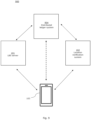
- the LBS server 101 may be any virtual or physical server that provides location-based services, such as services relating to mapping.
- the LBS server 101 may be a physical computing/processing device having, among other components, a processor, a memory and a communications interface.
- the LBS server 101 may be a cloud-based server and/or may be distributed across multiple physical computing systems or nodes.
- the LBS server 101 may also be referred to as a device positioning proxy.
- the LBS server 101 is not part of an MNO system, and it is not capable of directly determining the location of a mobile device using network-based positioning techniques.
- network-based (or station- or access point-based) positioning means techniques that determine the position of a mobile device using e.g. triangulation or similar of wireless signals (i.e. techniques that are based on signal readings taken by a base station or access point etc. and do not rely on a potentially untrustworthy mobile device reporting its location or reporting signals received/detected by a mobile device at a location).
- a preferred example of network-based positioning employed by the methods disclosed herein is radiolocation, particularly passive radiolocation (in which signals emitted/broadcast by the mobile device are detected).
- the location verification system 102 is any virtual or physical system capable of determining a detected location of the mobile device 103 independently of the LBS server 101.
- the verification system 102 may be a physical computing/processing device having, among other components, a processor, a memory and a communications interface.
- the LBS verification system 102 may be a cloud-based system and/or may be distributed across multiple physical computing systems or nodes.
- the mobile device 103 may be referred to as an end user device, a user equipment or communication device.
- the mobile device 103 has, among other components, a processor, a memory and a communication interface.
- the mobile device 103 may be a smartphone, a tablet computer, a laptop/notebook computer, a wearable (e.g. a smartwatch) etc.
- the mobile device 103 is a location aware device, i.e. it is capable of determining its geographical location in two or three dimensions.
- the mobile device 103 advantageously determines its position using on-device (i.e. handset-based) positioning techniques such as GNSS satellite-based positioning (e.g. GPS or GLONASS etc.), Wi-Fi-based positioning and/or cellular-based positioning.
- the location may be determined via a third party, for example it may be reported to the mobile device 103 by the location verification system 102, which can determine a detected location of the mobile device 103 using network-based positioning techniques as outlined above.
- the determined location will generally have an associated uncertainty reflecting the accuracy with which the location has been determined, and different positioning methods may be combined to improve accuracy with which the location is determined.
- the LBS provider In order to ensure that the location data provided by the mobile device 103 is accurate, the LBS provider needs to be able to verify the location.
- the location data provided by the mobile device 103 may be inaccurate if the user spoofs their location (e.g. to try and collect the reward) or if the location determined by the mobile device 103 is incorrect (e.g. due to outdated GPS positioning information or similar).
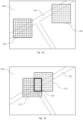
- Figures 2a and 2b show examples of possible and detected locations associated with a mobile device 103 in a map region 200 that has a road 201.
- Figure 2a represents an example in which the possible and detected locations are different.
- the possible location reported by the mobile device 103 to the LBS server 101 is represented by the circle 202a.
- the surrounding circle 202b represents the uncertainty associated with the possible location 202a, e.g. due to the limitations of the positioning technology used by the mobile device 103.
- the detected location determined by the location verification system 102 is represented by the dashed circle 203a, with the surrounding dashed circle 203b representing the uncertainty associated with the detected location 203a.
- Figure 2b represents an example in which a possible location 212a and detected location 213a are approximately the same. Although the possible location 212a and detected location 213a do not exactly coincide, the respective uncertainties 212b and 213b associated with the possible location 212a and the detected location 213a overlap, indicating that the locations coincide when taking account of the uncertainty associated with both locations.
- the LBS server 101 could in theory communicate with the location verification system 102 to confirm that the location reported by the mobile device 103 (the possible location) is the same as the location determined by the location verification system 102 (the detected location).
- the LBS server 101 and location verification system 102 are forbidden from sharing location data with each other. This means that the LBS server 101 and location verification system 102 cannot share location data in order to verify whether the possible location corresponds to the detected location. While the LBS server 101 and location verification system 102 could compare encrypted or hashed location information, the uncertainty associated with the possible and detected locations means that the possible and detected location may not exactly match even when the possible location is correct (i.e. has not been spoofed and is not inaccurate), in which case the comparison would fail.
- the LBS server 101 and location verification system 102 can instead determine respective sets of tiles associated with the possible and actual locations and use a private set intersection technique to determine whether their respective tile sets have any common (intersecting) elements.
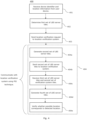
- the set of tiles 302 in Figure 3a is generated based on the possible location 202a in Figure 2a
- the set of tiles 303 in Figure 3a is generated based on the detected location 203a in Figure 2a
- the set of tiles 312 in Figure 3b is generated based on the possible location 212a in Figure 2b
- the set of tiles 313 in Figure 3b is generated based on the detected location 213a in Figure 2b .
- the tiles represent geographical regions and may be two or three dimensional. While the term 'tile' is used generally to refer to both two and three dimensional geographical regions, the term 'block' or 'map block' may also be used, especially when referring to three dimensional regions.
- the tiles may have any tessellating shapes. Regular tiling arrangements such as square (or nearly square to accommodate projections) or hexagonal lattices are preferred in two dimensions, although any other tessellating arrangements (including random tessellations) can be used provided that the LBS server 101 and location verification system 102 agree on the tiling scheme. Likewise, regular tiling arrangements such as cubes, rhombic dodecahedrons or similar are preferred in three dimensions, but other tessellating shapes (regular or irregular) can also be used.
- Exemplary tiling schemes include the HERE Map Tile API (which uses map tiles to form a complete map of the world using the Mercator Projection), OpenStreetMap tiles, and Uber H3 (which uses hexagonal, hierarchical indices).
- HERE Map Tile API which uses map tiles to form a complete map of the world using the Mercator Projection
- OpenStreetMap tiles OpenStreetMap tiles
- Uber H3 which uses hexagonal, hierarchical indices.
- the method can be performed with any method that decomposes two- or three-dimensional space and assigns a unique identifier to each division.
- the LBS server 101 and location verification system 102 can use a private set intersection (PSI) technique to determine which (if any) tiles are common to both sets.
- PSI private set intersection
- the LBS server 101 would conclude that the possible location 202a provided by the mobile device 103 is not accurate/correct.
- the LBS server 101 and location verification system 102 use a private set intersection technique.
- An example of a suitable private set intersection technique is disclosed in section 5.6 and Figure 4 of De Cristofaro and Tsudik "Practical Private Set Intersection Protocols with Linear Complexity", which are hereby incorporated by reference along with the associated definitions from Table 1.
- the client is the LBS server 101 and the server is the location verification system.
- the client's input is the set of LBS server tiles, and the server's input is the set of verification system tiles.
- the server also possesses an RSA private key d, and the server and client share a corresponding RSA public key (n, e).
- the LBS server 101 may communicate with the location verification system 102 to agree a tile size to be used, whereby the tile size may be based on uncertainty associated with the possible location reported to the LBS server 101 by the mobile device 103 and/or an uncertainty associated with a detected location determined by the location verification system 102. As mentioned earlier, this has the advantage of reducing bandwidth requirements by allowing for a balance between the size of the tile sets and the accuracy with which the positions are represented.
- the LBS server 101 may determine a proposed tile level based on the uncertainty associated with the possible location. The LBS server 101 can then send the proposed tile level to the location verification system 102, which responds with a confirmed tile level.
- the LBS server 101 sends a location verification request to the location verification system 102.
- the location verification request may optionally be sent before the first set of LBS server tiles is determined, i.e. step 403 may be performed before step 402.
- the location verification request includes the device identifier associated with the mobile device 103 (so that the location verification system 102 can identify the mobile device 103) and causes the location verification system 102 to determine the detected location of the mobile device 103 using one of the network-based positioning techniques discussed above.
- the LBS server 101 does not share the possible location with the location verification system 102, and the location verification system 102 does not share the detected location with the LBS server 101.
- the location verification system 102 determines a first set of verification system tiles associated with a geographical area corresponding to the detected location of the mobile device 103 (e.g. the tile sets 303 or 313 in Figures 3a and 3b respectively associated with the detected locations 203a and 213a in Figures 2a and 2b ).
- the LBS server 101 verifies the possible location by communicating with the location verification system 102 using a private set intersection technique to determine whether any elements of the first set of LBS server tiles are also elements of the first set of verification system tiles.
- a private set intersection technique means that the possible location can be verified without the LBS server 101 or the location verification system 102 sharing any location information that is not already known by the other party.
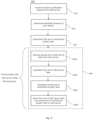
- Steps 404a-404e illustrate the steps of a possible private set intersection technique that can be employed in the method 400 using the RSA-based private set intersection protocol in Figure 4 of De Cristofaro and Tsudik "Practical Private Set Intersection Protocols with Linear Complexity".
- n is an RSA modulus
- e is an RSA public exponent
- d is an RSA private exponent
- H() is a full-domain hash function
- H'() is a regular cryptographic hash function.
- the LBS server 101 generates a second set of LBS server tiles by individually obfuscating and encrypting each element of the first set of server tiles using a public key known to the LBS sever 101 and the location verification system 102.
- the LBS server 101 may communicate with the location verification system 102 to obtain the public RSA key (n, e) associated with the private key d generated by the verification system 102 (the private key d is known only by the location verification system 102).
- the second set of LBS server tiles is sent from the LBS server 101 to the location verification system 102, e.g. via the Internet or otherwise.
- the LBS server 101 receives a third set of LBS server tiles, and a second set of verification system tiles, both from the location verification system 102.
- the third set of LBS server tiles corresponds to the second set of LBS server tiles in which each element of the second set of LBS server tiles has been individually encrypted by the location verification system 102 using the private key d known only to the location verification system 102.
- the second set of verification system tiles likewise corresponds to the first set of verification system times in which each element of the first set of verification system tiles has been individually encrypted using the private key d.
- the LBS server 101 compares the fourth set of LBS server tiles and the second set of verification system tiles to determine whether at least one element of the fourth set of LBS server tiles is also an element of the second set of verification system tiles (e.g. by determining an intersection set of tiles containing all (if any) elements of the fourth set of LBS server tiles that are also elements of the second set of verification system tiles). If there is at least one common tile, the possible location is determined to correspond to the detected location, i.e. the possible location is verified as being correct. If there are no common tiles (i.e. the intersection set of tiles is empty) then the possible location does not correspond to the detected location, and the possible location is not verified as being correct. The act of determining the intersection set of tiles implicitly determines whether there are any common tiles.
- RSA-based private set intersection protocol is a preferred private set intersection technique for verifying the location due to the high level of security it provides, alternative private set intersection protocols could be used instead.
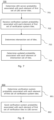
- the corresponding method 500 performed by the location verification system 102 is illustrated in Figure 5 .
- the location verification system 102 receives the location verification request (including the device identifier) from the LBS server 101.
- the mobile device 103 may register with the location verification system 102 prior to the location verification method being performed.
- the location verification system 102 is an MNO system
- the mobile device 103 may be registered with the MNO system by virtue of being a customer of the MNO, in which case a device identifier such as a phone number associated with the mobile device 103 will already be available to the MNO system.
- the location verification system 102 uses the device identifier to identify the mobile device 103 and use a network-based positioning technique (such as those described earlier) to determine a detected location of the mobile device 103 in step 502.
- the location verification system 102 may also determine an uncertainty (e.g. a probability distribution function) associated with the detected position.
- the location verification system 102 may then determine the first set of verification system tiles associated with the geographical area corresponding to the detected location in step 503. As with the first set of LBS server tiles generated by the LBS server 101, the location verification system 102 may determine the first set of verification system tiles based on one or more tile parameters such as a tile level.
- the location verification system 102 may receive a first proposed tile level from the LBS server 101 and determine a second proposed tile level based on the uncertainty associated with the detected position.
- the LBS server 101 and the location verification system 102 must use the same tiling level.
- the location verification system 102 therefore determines a confirmed tile level as the maximum of the first proposed tile level and the second proposed tile level (i.e. the tile level having the smallest geographic tile size) and sends the confirmed tile level to the LBS server 101.
- the first set of verification system tiles is then determined by the location verification system 102 using the confirmed tile level.
- step 504 the location verification system 102 communicates with the LBS server 101 using the private set intersection technique in order to determine whether at least one element of the first set of verification system tiles is also an element of the first set of LBS server tiles.
- Steps 504a-504d illustrate the corresponding steps of the RSA-based private set intersection protocol performed by the location verification system 102 when the LBS server 101 performs the steps 404a-404e described above.
- step 504c the location verification system 102 generates the second set of verification system tiles by individually encrypting each element of the first set of location system tiles with the private key as described above.
- the probabilities may be determined by computing tile probabilities around the mean position until a chosen confidence level is achieved. This can be viewed as a per-tile discretisation of the probability distribution or conversion of the continuous probability distribution to a probability mass function. As an example, a bivariate normal distribution, which is commonly the output of positioning algorithms, can be represented with a mean and a covariance matrix. A given confidence level determines the ellipse by which the actual location would be contained.
- Figure 7 illustrates an exemplary method 700 performed by the LBS server 101 for determining the updated/enhanced probabilities. This method may be performed as part of the method 400 shown in Figure 4 , e.g. as part of the method 400 or as subsequent steps to the method 400 (i.e. the method for updating the probabilities is an extension of the location verification method).
- the LBS server 101 determines an LBS server probability associated with each element of the first set of LBS server tiles (i.e. one probability associated with each tile).
- the probabilities are determined based on the uncertainty associated with the possible location of the mobile device 103 (e.g. using the probability distribution function associated with the possible location) and represent the probability that the mobile device 103 is actually located within each tile based on the location information known to the LBS server 101.
- the LBS server 101 receives a verification system probability associated with each element of the first set of verification system tiles from the location verification system 102 (again, one probability associated with each tile).
- the verification system probabilities are determined by the location verification system 102 in the same way that the LBS server 101 determines the LBS server probabilities (i.e. based on the uncertainty associated with the detected location).
- the LBS server 101 determines the intersection set of tiles that are common to the first set of LBS server tiles and the first set of verification system tiles. This may be determined as part of step 404e described earlier, i.e. when the LBS server 101 determines whether any elements of the fourth set of LBS server tiles are also elements of the second set of verification system tiles (there is a direct correspondence between elements of the first and fourth sets of LBS server tiles and between the first and second sets of verification system tiles, e.g. by using ordered sets and keeping the order of the elements the same or by labelling each element of each set using a consistent labelling scheme).
- the LBS server 101 determines an updated probability associated with each element of the intersection set of tiles.
- the updated probability associated with each element of the intersection set of tiles is calculated by multiplying the respective LBS server probability and verification system probability associated with that element of the intersection set of tiles (each element of the intersection set of tiles is also in the sets of LBS server and verification system tiles) and then normalising the probabilities such that the total probability across all tiles in the intersection set of tiles is equal to one (in other words, each tile in the intersection set 320 has an updated probability that is determined by combining the LBS server and verification system probabilities, and the sum of the updated probabilities associated with all of the tiles is one).
- Non-intersecting tiles have an updated probability of zero.
- the LBS server 101 may use the updated probabilities to determine an updated location of the mobile device 103, which could be determined in several ways.
- the updated location could be determined by selecting the intersection tile having the greatest updated probability value and setting the updated location equal to the centre of that tile.
- the updated probabilities could be used to interpolate a continuous probability distribution based on the updated probability associated with each element of the intersection set of tiles, and the mean of the continuous probability distribution could be determined and used as the updated location.
- the updated location could be determined by calculating a weighted average location based on the updated probabilities and corresponding centre of each tile in the intersection set (i.e. the updated probabilities are used as weights, and the centre of the corresponding tile is used as the position associated with that weight).
- the result of the method 700 is that the location estimate can be improved without either party revealing its believed location of the mobile device 103.
- the location verification system 102 determines a probability associated with each element of the first set of verification system tiles. As explained above, these probability values are determined based on the uncertainty associated with the detected location.
- the method 800 may be performed as part of the method 500 shown in Figure 5 , e.g. at the same time as the method 500 or subsequently to the method steps in the method 500.
- the LBS server 101, location verification system 102 and mobile device 103 are the same as the corresponding components of the system 100 illustrated in Figure 1 ; these components will not be described in detail again in this section.
- the LBS server and location verification system 102 perform the location verification method via the distributed ledger system 904.
- the distributed ledger system 904 is a system that maintains a distributed ledger across one or more virtual of physical computing/processing devices having, among other components, a processor, a memory and a communications interface.
- the distributed ledger system 904 may be a node (or subset of nodes) of a large network of distributed ledger devices that maintain synchronised copies of the distributed ledger, or it may itself be the entire network of nodes.
- Blockchain is an example of a distributed ledger.
- the distributed ledger system 904 does not provide cellular services or location-based services to the mobile device 103 but simply acts as a mediator for the location verification procedure.
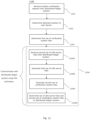
- step 1001 the LBS server 101 receives the device identifier and location information from the mobile device 103 in the same manner as described above in relation to step 401 of Figure 4 .
- step 1002 the LBS server 101 determines a first set of LBS server tiles in the same manner as described above in relation to step 402 of Figure 4 .
- tile parameters such as the tiling scheme to be used and the tile level may be preconfigured so that the LBS server 101 and location verification system 102 generate tiles using the same tile parameters.
- one or more of the parameters may be agreed or negotiated between the LBS server 101 and the location verification system 102 as part of the location verification process, e.g. the tile parameters may be dynamic and be adjusted each time a location is verified.
- the distributed ledger system 904 may receive a second proposed tile level from the location verification system 103 (i.e. a proposed tile level determined by the location verification system 103), which could be sent in response to a location verification request sent from the distributed ledger system 904 to the location verification system 102.
- the distributed ledger system 904 may then determine a confirmed tile level as the maximum of the two proposed tile levels, and the confirmed tile level can be sent to both the LBS server 101 and the location verification system 102.
- the first set of LBS server tiles 101 is then determined using the confirmed tile level.
- step 1003 the LBS server sends a location verification request comprising the device identifier to the distributed ledger system 904.
- This step is analogous to the step 403 of Figure 4 as described above, but the request is sent to the distributed ledger system 904 instead of being sent to the location verification system 103.
- the distributed ledger system 904 receives the location verification request from the LBS server 101, it sends a second location verification request to the location verification system 102 which causes the location verification system 102 to determine the detected location of the mobile device 103 using one of the network-based positioning techniques discussed above.
- the LBS server 101 does not share the possible location with the distributed ledger system 904 or the location verification system 102, and the location verification system 102 does not share the detected location with the LBS server 101 or the distributed ledger system 904.
- the location verification system 102 determines a first set of verification system tiles associated with a geographical area corresponding to the detected location of the mobile device 103 (e.g. the tile sets 303 or 313 in Figures 3a and 3b respectively associated with the detected locations 203a and 213a in Figures 2a and 2b ) as in the earlier method.
- the LBS server 101 communicates with the distributed ledger system 904 using a private set intersection technique to determine whether any elements of the first set of LBS server tiles are also elements of the first set of verification system tiles to thereby verify the possible location.
- a private set intersection technique means that the possible location can be verified without the LBS server 101 or the location verification system 102 sharing any location information that is not already known by the other party.
- the distributed ledger system 904 does not learn any location information associated with the mobile device 103.
- Steps 1004a-1004f illustrate the steps of a possible private set intersection technique that can be employed in the method 1000.
- the RSA-based private set intersection protocol used in steps 404a-404e of the earlier method 400 is intended to be performed when verifying a location without an intermediary
- the steps of the private set intersection technique used in this distributed ledger method 1000 are slightly different.
- the private set intersection technique used in steps 1004a-1004f is not RSA-based but instead uses commutative encryption techniques.
- the LBS server 101 may generate a Diffie-Hellman public key using key generation parameters provided by the distributed ledger system 904 (these key generation parameters may also be sent to the location verification system 102 to allow the location verification system to generate a corresponding Diffie-Hellman public key).
- the Diffie-Hellman keys may be used in addition to the private keys when the sets of tiles are encrypted.
- the same key generation parameters may be used for multiple location verification requests from the LBS server 101, or different key generation parameters may be generated by the distributed ledger system 904 for each request.
- the key generation parameters may be stored by the distributed ledger and visible only to the LBS server 101 and the location verification system 102.
- the second set of LBS server tiles is sent from the LBS server 101 to the distributed ledger system 904.
- the LBS server 101 receives a second set of verification system tiles from the distributed ledger system 904.
- the second set of verification system tiles corresponds to the first set of verification system times in which each element of the first set of verification system tiles has been individually encrypted by the location verification system using the commutative encryption scheme with a second private key known only by the location verification system 102.
- each element of the second set of verification system tiles may also have been encrypted by the distributed ledger system 904 using the commutative encryption scheme with a third private key known only to the distributed ledger system 904.
- This third layer of encryption makes the method resistant to possible future attacks that can exploit the knowledge of clear text and helps to protect against message replay attacks wherein the location verification system 102 could pretend to be the location verification system 102 and LBS server 101 at the same time to gain information that might not otherwise have been available to the location verification system 102.
- Such an additional encryption step is not possible with a two-party verification method (i.e. without the distributed ledger system 904).
- the LBS server 101 generates a third set of verification system tiles by individually encrypting each element of the second set of verification system tiles using the commutative encryption scheme with the first private key.
- the LBS server 101 sends the third set of verification system tiles to the distributed ledger system 1004e.
- the distributed ledger system 904 will compare the elements of the third set of verification system tiles to a third set of LBS server tiles in which each element of the second set of LBS server tiles has been individually encrypted by the location verification system 102 using the commutative encryption scheme with the second private key.
- the distributed ledger system 904 may determine the intersection set of tiles common to the third set of LBS server tiles and the third set of verification system tiles.
- the LBS server 101 obtains an indication whether the possible location is verified, i.e. whether there are any intersecting elements.
- the distributed ledger 904 may actively send this to the LBS server 101, or the LBS server 101 may read the indication from an entry stored by the distributed ledger system 904.
- the indication may include the intersection set of tiles, or it may alternatively just be a binary (e.g. yes/no, true/false etc.) indication confirming whether the possible location was verified as correct.
- the location verification system 102 receives a location verification request (including the device identifier) from the distributed ledger system 904.
- the distributed ledger system 904 may send the location verification request to the location verification system 102 in response to receiving the location verification request from the LBS server 101.
- the mobile device 103 may optionally register with the location verification system 102 prior to the method 1101 (as in the earlier method 500).
- the location verification system 102 determines the first set of verification system tiles associated with the geographical area corresponding to the detected location as in step 503 of the method 500 in Figure 5 .
- step 1104a the location verification system 102 receives the second set of LBS server tiles from the distributed ledger system 904.
- step 1104d the location verification system 102 sends the third set of LBS server tiles and the second set of verification system tiles to the distributed ledger system 904 for location verification by the distributed ledger system 904 (these sets of tiles could also be sent in separate steps).
- the corresponding method 1200 performed by the distributed ledger system 904 is shown in Figure 12 .
- the distributed ledger system 904 receives the (first) location verification request from the LBS server 101.
- the distributed ledger 904 may generate a session identifier associated with the location verification request and send this to the LBS server 101.
- the session identifier may be used in all subsequent communications between the distributed ledger system 904 and the LBS server 101 and location verification system 102 in order to identify the session.
- the distributed ledger system 904 verifies the possible location by communicating the with LBS server 101 and the location verification system 102 using the private set intersection technique to determine whether at least one element of the first set of LBS server tiles determined by the LBS server 101 is also an element of the first set of verification system tiles determined by the location verification system 102.
- Steps 1204a-1204h illustrate the steps of the private set intersection technique performed by the distributed ledger system 904 when the LBS server 101 performs the steps 1004a-1004e described above and the location verification system 102 performs the step 1104a-1104d described above.
- the distributed ledger system 904 sends the second set of verification system tiles and the second set of LBS server tiles to the LBS server 101 and the location verification system 102 respectively.
- the distributed ledger system 904 receives the third set of verification system tiles and the third set of LBS server tiles from the LBS server 101 and the location verification system 102 respectively.
- the distributed ledger system 904 determines whether at least one element of the third set of LBS server tiles is also an element of the third set of verification system tiles, e.g. by determining the intersection set of tiles that are common to the third set of LBS server tiles and the third set of verification system tiles.
- the distributed ledger system 904 may provide key generation parameters to the LBS server 101 and the location verification system 102 for use in the encryption process (e.g. when the encryption method is ElGamal, the key generation parameters may be used by the LBS server 101 and the location verification system 102 to generate Diffie-Hellman public keys).
- the mobile device 103 may register with the distributed ledger system 904.
- the registration may involve the mobile device 103 providing the device identifier and giving consent for its location to be verified.
- the consent may be perpetual (i.e. last until it is withdrawn) or it may expire after a predetermined location or at a certain time.
- the distributed ledger system 904 can then check that consent has been provided before allowing the method 900 to be performed (e.g. after receiving the location verification request from the LBS server 101 and before sending the second location verification request to the location verification system 102).
- users can control whether (and when) the LBS system 101 can verify their location and can easily withdraw consent, thereby improving user privacy.
- the distributed ledger location verification method described above can also be used to allow the mobile device 103 to provide proof of its location.
- a record containing the possible location, intersecting tiles, verification time, verification result, session identifier and device identifier can be stored in the distributed ledger.
- the user can then provide the session identifier to a third party as a location certification, and the third party can then retrieve the record from the distributed ledger.
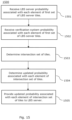
- the method 1300 performed by the LBS server 101 for determining the updated/enhanced probabilities is shown in Figure 13 .
- the corresponding method 1400 performed by the location verification system 102 for determining the updated/enhanced probabilities is shown in Figure 14 .
- the distributed ledger system 904 determines the intersection set of tiles that are common to the first set of LBS server tiles and the first set of verification system tiles. This may be determined as part of step 1203g described earlier, i.e. when the distributed ledger system 904 determines whether any elements of the third set of LBS server tiles are also elements of the third set of verification system tiles (there is a direct correspondence between elements of the first and third sets of LBS server and verification system tiles, e.g. by using ordered sets and keeping the order of the elements the same or by labelling each element of each set using a consistent labelling scheme).
- the distributed ledger system 904 determines an updated probability associated with each element of the intersection set of tiles.
- the updated probability associated with each element of the intersection set of tiles is calculated by multiplying the respective LBS server probability and verification system probability associated with that element of the intersection set of tiles and then normalising the probabilities such that the total probability across all tiles in the intersection set of tiles is equal to one.
- each element of the first sets of tiles may therefore be hashed in any of the above methods (e.g. methods 400 and 500, or 1000-1300) using a hashing algorithm (with the LBS server 101 and location verification system 102 using the same hashing algorithm). Hashing ensures that all elements of each tile set appear very different to each other even though they are geographically close, which makes the method more secure against attacks.
- the steps may be performed in different orders unless specified otherwise or technically impossible.
- the LBS server 101 could generate the first and/or second sets of LBS server tiles before or after sending the location verification request (especially if using a pre-agreed tiled level).
- the location verification system 102 could generate the first and/or second sets of verification system tiles before or after receiving the second set of LBS server tiles.
- the third set of LBS server tiles and second set of verification system tiles could be sent separately rather than in a single step.
- One skilled in the art will recognise other variations to the steps are possible, and the above methods are intended to be exemplary rather than limiting.
- Figure 16 shows an apparatus which may perform methods described herein (including but not limited to methods 400, 500, 700, 800 and 1000-15000).
- a system comprising multiple apparatuses could perform the methods disclosed herein, with different steps of the methods being performed by different apparatuses.
- one or more apparatuses of the location verification system 102 could determine a detected location of the mobile device 103, and another apparatus could generate the sets of tiles and communicate with the LBS server 101 and/or distributed ledger system 904.
- the apparatus 1600 of Figure 16 includes a processor 1601 coupled to a memory 1602, a communication interface 1603 and a storage device 1604 via a bus 1605. It will be appreciated that additional components, such as additional interfaces etc. could be provided.
- the communication interface 1603 is coupled to a network 1610 such as the Internet.
- the communications interface 1603 enables communications by a wired connection (such as an ethernet connection) and/or a wireless connection (such as Wi-Fi, Bluetooth, cellular/mobile network etc).
- the apparatus 1600 may be an example any one of (or component of) the LBS server 101, the location verification system 102, the mobile device 103 and the distributed ledger system 904.
- the memory 1602 may be non-transitory and may include, for example, one or more volatile and/or non-volatile memories.
- the memory 1602 may be an electronic storage device (e.g. a computer-readable storage medium) comprising gates configured to store data (for example, bits) that may be retrievable by a machine (e.g. a computing device like the processor 1601).
- the memory 1602 may be solid-state memory, a hard disk drive (HDD), read-only memory (ROM), random-access memory (ROM), flash memory or another type of memory.
- the memory 1602 may be configured to store information, data, content, applications, instructions or the like executable by processor 1601 for enabling the apparatus 1600 to carry out various functions in accordance with an example of the present disclosure.
- the memory 1602 could be configured to buffer input data for processing by the processor 1601. Additionally or alternatively, the memory 1602 could be configured to store instructions for execution by the processor 1601. For example, memory 1602 may be configured to store computer program instructions which, when executed by the processor 1601, cause the apparatus 1600 to perform a method as described herein.
- the processor 1601 may be embodied in a number of different ways.
- the processor 1601 may be embodied as one or more of various hardware processing means such as a coprocessor, a microprocessor, a controller, a digital signal processor (DSP), a processing element with or without an accompanying DSP, or various other processing circuitry including integrated circuits such as, for example, an application specific integrated circuit (ASIC), a field programmable gate array (FGPA), a microcontroller unit (MCU), a hardware accelerator, a special-purpose computer chip, or the like.
- the processor may include one or more processing cores (of the same or different types) configured to perform independently.
- a multi-core processor may enable multiprocessing within a single physical package.
- the processor 1601 may include one or more processors configured in tandem via the bus to enable independent execution of instructions, pipelining and/or multithreading.
- the processor 1601 may be configured to execute instructions stored in the memory 1602 or otherwise accessible to the processor 1601. Alternatively or additionally, the processor 1601 may be configured to execute hard coded functionality. As such, whether configured by hardware or software methods, or by a combination thereof, the processor 1601 may represent an entity (for example, physically embodied in circuitry) capable of performing operations according to a method of the present disclosure while configured accordingly. Thus, for example, when the processor 1601 is embodied as an ASIC, FPGA or the like, the processor may be specifically configured hardware for conducting the operations described herein. Alternatively, as another example, when the processor 1601 is embodied as an executor of software instructions, the instructions may specifically configure the processor 1601 to perform the algorithms and/or operations described herein when the instructions are executed.
- the processor 1601 may be a processor specific device (for example, a mobile terminal or a fixed computing device) configured to employ a method of the present disclosure by further configuration of the processor by instructions for performing the algorithms and/or operations described herein.
- the processor 1601 may include, among other things, a clock, an arithmetic logic unit (ALU) and logic gates configured to support operation of the processor.
- ALU arithmetic logic unit
- the communication interface 1603 may be any means such as a device or circuitry embodied in either hardware or a combination of hardware and software that is configured to receive and/or transmit data to/from a communications device in communication with the apparatus 1600.
- the communication interface 1603 may include, for example, an antenna (or multiple antennae) and supporting hardware and/or software for enabling communications with a wireless communication network.
- the communication interface 1603 may include the circuitry for interacting with the antenna(s) to cause transmission of signals via the antenna(s) or to handle receipt of signals received via the antenna(s).
- the communication interface 1603 may alternatively or also support wired communication.
- the communication interface 1603 may include a communication modem and/or other hardware and/or software for supporting communication via cable, digital subscriber line (DSL), universal serial bus (USB) or other mechanisms.
- DSL digital subscriber line
- USB universal serial bus
- the apparatus 1600 may also include an optional user interface that may be in communication with the processor 1601 to provide output to the user and, in some arrangements, to receive an indication of a user input.
- the user interface may include a display and may also include a keyboard, a mouse, a joystick, a touch screen, touch areas, soft keys, one or more microphones, a plurality of speakers, or other input/output mechanisms.
- the processor 1601 may comprise user interface circuitry configured to control at least some functions of one or more user interface elements such as a display and, in some arrangements, a plurality of speakers, a ringer, one or more microphones and/or the like.
- the processor 1601 and/or user interface circuitry comprising the processor may be configured to control one or more functions of one or more user interface elements through computer program instructions (for example, software and/or firmware) stored on a memory accessible to the processor 1601 (for example, memory 1602, and/or the like).
- the processor 1601 may receive data via the user interface and/or the communications interface 1603 and the memory 1602 may be configured to store data received via the user interface and/or the communication interface 1603.
- any mentioned apparatus/circuitry/elements/processor may have other functions in addition to the mentioned functions, and that these functions may be performed by the same apparatus/circuitry/elements/processor.
- One or more disclosed aspects may encompass the electronic distribution of associated computer programs and computer programs (which may be source/transport encoded) recorded on an appropriate carrier (e.g. memory, signal).
- any "computer” described herein can comprise a collection of one or more individual processors/processing elements that may or may not be located on the same circuit board, or the same region/position of a circuit board or even the same device. In some examples one or more of any mentioned processors may be distributed over a plurality of devices. The same or different processor/processing elements may perform one or more functions described herein.
- circuitry also covers and implementation of merely a hardware circuit or processor (or multiple processors) or portion of a hardware circuit or processor and its (or their) accompanying software and/or firmware.
- circuitry also covers, for example and if applicable to the particular claim element, a baseband integrated circuit or processor integrated circuit for a mobile device or a similar integrated circuit in server, a cellular network device, or other computing or network device.
Landscapes
- Engineering & Computer Science (AREA)
- Computer Security & Cryptography (AREA)
- Computer Networks & Wireless Communication (AREA)
- Signal Processing (AREA)
- Computing Systems (AREA)
- Theoretical Computer Science (AREA)
- Computer Hardware Design (AREA)
- General Engineering & Computer Science (AREA)
- Mobile Radio Communication Systems (AREA)
- Telephonic Communication Services (AREA)
Priority Applications (1)
| Application Number | Priority Date | Filing Date | Title |
|---|---|---|---|
| EP23206489.9A EP4290801A3 (de) | 2021-05-19 | 2021-05-19 | Verteilte private standortüberprüfung und -verbesserung |
Applications Claiming Priority (2)
| Application Number | Priority Date | Filing Date | Title |
|---|---|---|---|
| EP23206489.9A EP4290801A3 (de) | 2021-05-19 | 2021-05-19 | Verteilte private standortüberprüfung und -verbesserung |
| EP21174750.6A EP4092981B1 (de) | 2021-05-19 | 2021-05-19 | Verteilte private standortüberprüfung und -verbesserung |
Related Parent Applications (2)
| Application Number | Title | Priority Date | Filing Date |
|---|---|---|---|
| EP21174750.6A Division EP4092981B1 (de) | 2021-05-19 | 2021-05-19 | Verteilte private standortüberprüfung und -verbesserung |
| EP21174750.6A Division-Into EP4092981B1 (de) | 2021-05-19 | 2021-05-19 | Verteilte private standortüberprüfung und -verbesserung |
Publications (2)
| Publication Number | Publication Date |
|---|---|
| EP4290801A2 true EP4290801A2 (de) | 2023-12-13 |
| EP4290801A3 EP4290801A3 (de) | 2024-01-17 |
Family
ID=76034444
Family Applications (2)
| Application Number | Title | Priority Date | Filing Date |
|---|---|---|---|
| EP21174750.6A Active EP4092981B1 (de) | 2021-05-19 | 2021-05-19 | Verteilte private standortüberprüfung und -verbesserung |
| EP23206489.9A Pending EP4290801A3 (de) | 2021-05-19 | 2021-05-19 | Verteilte private standortüberprüfung und -verbesserung |
Family Applications Before (1)
| Application Number | Title | Priority Date | Filing Date |
|---|---|---|---|
| EP21174750.6A Active EP4092981B1 (de) | 2021-05-19 | 2021-05-19 | Verteilte private standortüberprüfung und -verbesserung |
Country Status (2)
| Country | Link |
|---|---|
| US (1) | US12149943B2 (de) |
| EP (2) | EP4092981B1 (de) |
Families Citing this family (1)
| Publication number | Priority date | Publication date | Assignee | Title |
|---|---|---|---|---|
| EP4729989A1 (de) * | 2023-06-19 | 2026-04-22 | Hitachi, Ltd. | Detektionsvorrichtung und detektionsverfahren |
Family Cites Families (4)
| Publication number | Priority date | Publication date | Assignee | Title |
|---|---|---|---|---|
| EP3213596A4 (de) * | 2014-10-29 | 2018-08-22 | Thandisizwe Ezwenilethu Pama | Geospatiale standortüberprüfung |
| US20170302663A1 (en) * | 2016-04-14 | 2017-10-19 | Cisco Technology, Inc. | BLOCK CHAIN BASED IoT DEVICE IDENTITY VERIFICATION AND ANOMALY DETECTION |
| US11233641B2 (en) * | 2018-07-31 | 2022-01-25 | Hewlett Packard Enterprise Development Lp | Systems and methods for using distributed attestation to verify claim of attestation holder |
| US11044074B2 (en) * | 2019-01-22 | 2021-06-22 | Mastercard International Incorporated | Method and system for state associated device identification for digital payments using blockchain technology |
-
2021
- 2021-05-19 EP EP21174750.6A patent/EP4092981B1/de active Active
- 2021-05-19 EP EP23206489.9A patent/EP4290801A3/de active Pending
-
2022
- 2022-05-18 US US17/747,789 patent/US12149943B2/en active Active
Non-Patent Citations (1)
| Title |
|---|
| PERAL-ROSADO ET AL., SURVEY OF CELLULAR MOBILE RADIO LOCALIZATION METHODS: FROM 1G TO 5G |
Also Published As
| Publication number | Publication date |
|---|---|
| EP4290801A3 (de) | 2024-01-17 |
| US20220377561A1 (en) | 2022-11-24 |
| EP4092981B1 (de) | 2023-12-20 |
| EP4092981A1 (de) | 2022-11-23 |
| US12149943B2 (en) | 2024-11-19 |
Similar Documents
| Publication | Publication Date | Title |
|---|---|---|
| US10212689B2 (en) | Generating and publishing validated location information | |
| US12375878B2 (en) | Private location verification and enhancement | |
| US11283620B2 (en) | Method, apparatus, and system for providing a homomorphic cryptosystem | |
| KR101806061B1 (ko) | 입증가능한 지오로케이션 | |
| Memon et al. | Dynamic path privacy protection framework for continuous query service over road networks | |
| Šeděnka et al. | Privacy-preserving distance computation and proximity testing on earth, done right | |
| Calderoni et al. | Location privacy without mutual trust: The spatial Bloom filter | |
| Victor et al. | Geofences on the blockchain: Enabling decentralized location-based services | |
| US9635053B2 (en) | Computing system with protocol protection mechanism and method of operation thereof | |
| Zhao et al. | IronM: Privacy-preserving reliability estimation of heterogeneous data for mobile crowdsensing | |
| US8800027B1 (en) | Authentication using privacy protected personally identifiable information | |
| CN118043811A (zh) | 具有装置位置隐私性的地理围栏追踪 | |
| US12149943B2 (en) | Distributed private location verification and enhancement | |
| CN108920973B (zh) | 在基于位置的服务中查询信息的方法和装置 | |
| Sakib et al. | Privacy preserving proximity testing using elliptic curves | |
| Zhang et al. | LPPS‐AGC: Location Privacy Protection Strategy Based on Alt‐Geohash Coding in Location‐Based Services | |
| Peng et al. | A User‐Defined Location‐Sharing Scheme with Efficiency and Privacy in Mobile Social Networks | |
| Zhang et al. | LPPS: Location privacy protection for smartphones | |
| Di et al. | CSEP: Circular shifting encryption protocols for location privacy protection | |
| CN116775780B (zh) | 一种查找设备的方法、装置、第一设备和存储介质 | |
| CN116170191B (zh) | 一种基于同态加密的位置服务任务分配方法 | |
| Nieminen | Privacy-preserving indoor localization with Paillier encryption and garbled circuits | |
| Zhao et al. | An efficient privacy preserving location based service system | |
| Liang et al. | A Location Privacy Protection Scheme Combining Locality-Sensitive Hashing and Landmark Positioning | |
| Wei et al. | Personalised location privacy protection based on grid division for Crowd-Sensing |
Legal Events
| Date | Code | Title | Description |
|---|---|---|---|
| PUAI | Public reference made under article 153(3) epc to a published international application that has entered the european phase |
Free format text: ORIGINAL CODE: 0009012 |
|
| STAA | Information on the status of an ep patent application or granted ep patent |
Free format text: STATUS: THE APPLICATION HAS BEEN PUBLISHED |
|
| AC | Divisional application: reference to earlier application |
Ref document number: 4092981 Country of ref document: EP Kind code of ref document: P |
|
| AK | Designated contracting states |
Kind code of ref document: A2 Designated state(s): AL AT BE BG CH CY CZ DE DK EE ES FI FR GB GR HR HU IE IS IT LI LT LU LV MC MK MT NL NO PL PT RO RS SE SI SK SM TR |
|
| REG | Reference to a national code |
Ref country code: DE Ref legal event code: R079 Free format text: PREVIOUS MAIN CLASS: H04L0009000000 Ipc: H04L0009400000 |
|
| PUAL | Search report despatched |
Free format text: ORIGINAL CODE: 0009013 |
|
| AK | Designated contracting states |
Kind code of ref document: A3 Designated state(s): AL AT BE BG CH CY CZ DE DK EE ES FI FR GB GR HR HU IE IS IT LI LT LU LV MC MK MT NL NO PL PT RO RS SE SI SK SM TR |
|
| RIC1 | Information provided on ipc code assigned before grant |
Ipc: H04W 12/104 20210101ALI20231214BHEP Ipc: H04W 12/03 20210101ALI20231214BHEP Ipc: H04W 4/02 20180101ALI20231214BHEP Ipc: H04L 9/30 20060101ALI20231214BHEP Ipc: H04L 9/40 20220101AFI20231214BHEP |
|
| STAA | Information on the status of an ep patent application or granted ep patent |
Free format text: STATUS: REQUEST FOR EXAMINATION WAS MADE |
|
| 17P | Request for examination filed |
Effective date: 20240712 |
|
| RBV | Designated contracting states (corrected) |
Designated state(s): AL AT BE BG CH CY CZ DE DK EE ES FI FR GB GR HR HU IE IS IT LI LT LU LV MC MK MT NL NO PL PT RO RS SE SI SK SM TR |