EP4290166A2 - Indirekt verdampfendes kühlsystem mit gestufter sprühung - Google Patents
Indirekt verdampfendes kühlsystem mit gestufter sprühung Download PDFInfo
- Publication number
- EP4290166A2 EP4290166A2 EP23204898.3A EP23204898A EP4290166A2 EP 4290166 A2 EP4290166 A2 EP 4290166A2 EP 23204898 A EP23204898 A EP 23204898A EP 4290166 A2 EP4290166 A2 EP 4290166A2
- Authority
- EP
- European Patent Office
- Prior art keywords
- section
- heat exchanger
- nozzles
- tube
- water
- Prior art date
- Legal status (The legal status is an assumption and is not a legal conclusion. Google has not performed a legal analysis and makes no representation as to the accuracy of the status listed.)
- Granted
Links
Images


Classifications
-
- F—MECHANICAL ENGINEERING; LIGHTING; HEATING; WEAPONS; BLASTING
- F28—HEAT EXCHANGE IN GENERAL
- F28D—HEAT-EXCHANGE APPARATUS, NOT PROVIDED FOR IN ANOTHER SUBCLASS, IN WHICH THE HEAT-EXCHANGE MEDIA DO NOT COME INTO DIRECT CONTACT
- F28D5/00—Heat-exchange apparatus having stationary conduit assemblies for one heat-exchange medium only, the media being in contact with different sides of the conduit wall, using the cooling effect of natural or forced evaporation
- F28D5/02—Heat-exchange apparatus having stationary conduit assemblies for one heat-exchange medium only, the media being in contact with different sides of the conduit wall, using the cooling effect of natural or forced evaporation in which the evaporating medium flows in a continuous film or trickles freely over the conduits
-
- F—MECHANICAL ENGINEERING; LIGHTING; HEATING; WEAPONS; BLASTING
- F28—HEAT EXCHANGE IN GENERAL
- F28F—DETAILS OF HEAT-EXCHANGE AND HEAT-TRANSFER APPARATUS, OF GENERAL APPLICATION
- F28F19/00—Preventing the formation of deposits or corrosion, e.g. by using filters or scrapers
- F28F19/006—Preventing deposits of ice
-
- F—MECHANICAL ENGINEERING; LIGHTING; HEATING; WEAPONS; BLASTING
- F28—HEAT EXCHANGE IN GENERAL
- F28F—DETAILS OF HEAT-EXCHANGE AND HEAT-TRANSFER APPARATUS, OF GENERAL APPLICATION
- F28F21/00—Constructions of heat-exchange apparatus characterised by the selection of particular materials
- F28F21/06—Constructions of heat-exchange apparatus characterised by the selection of particular materials of plastics material
-
- F—MECHANICAL ENGINEERING; LIGHTING; HEATING; WEAPONS; BLASTING
- F28—HEAT EXCHANGE IN GENERAL
- F28F—DETAILS OF HEAT-EXCHANGE AND HEAT-TRANSFER APPARATUS, OF GENERAL APPLICATION
- F28F25/00—Component parts of trickle coolers
- F28F25/02—Component parts of trickle coolers for distributing, circulating, and accumulating liquid
- F28F25/04—Distributing or accumulator troughs
-
- F—MECHANICAL ENGINEERING; LIGHTING; HEATING; WEAPONS; BLASTING
- F28—HEAT EXCHANGE IN GENERAL
- F28F—DETAILS OF HEAT-EXCHANGE AND HEAT-TRANSFER APPARATUS, OF GENERAL APPLICATION
- F28F25/00—Component parts of trickle coolers
- F28F25/02—Component parts of trickle coolers for distributing, circulating, and accumulating liquid
- F28F25/06—Spray nozzles or spray pipes
-
- F—MECHANICAL ENGINEERING; LIGHTING; HEATING; WEAPONS; BLASTING
- F28—HEAT EXCHANGE IN GENERAL
- F28F—DETAILS OF HEAT-EXCHANGE AND HEAT-TRANSFER APPARATUS, OF GENERAL APPLICATION
- F28F27/00—Control arrangements or safety devices specially adapted for heat-exchange or heat-transfer apparatus
-
- H—ELECTRICITY
- H05—ELECTRIC TECHNIQUES NOT OTHERWISE PROVIDED FOR
- H05K—PRINTED CIRCUITS; CASINGS OR CONSTRUCTIONAL DETAILS OF ELECTRIC APPARATUS; MANUFACTURE OF ASSEMBLAGES OF ELECTRICAL COMPONENTS
- H05K7/00—Constructional details common to different types of electric apparatus
- H05K7/20—Modifications to facilitate cooling, ventilating, or heating
- H05K7/20709—Modifications to facilitate cooling, ventilating, or heating for server racks or cabinets; for data centers, e.g. 19-inch computer racks
- H05K7/20718—Forced ventilation of a gaseous coolant
- H05K7/20745—Forced ventilation of a gaseous coolant within rooms for removing heat from cabinets, e.g. by air conditioning device
-
- H—ELECTRICITY
- H05—ELECTRIC TECHNIQUES NOT OTHERWISE PROVIDED FOR
- H05K—PRINTED CIRCUITS; CASINGS OR CONSTRUCTIONAL DETAILS OF ELECTRIC APPARATUS; MANUFACTURE OF ASSEMBLAGES OF ELECTRICAL COMPONENTS
- H05K7/00—Constructional details common to different types of electric apparatus
- H05K7/20—Modifications to facilitate cooling, ventilating, or heating
- H05K7/20709—Modifications to facilitate cooling, ventilating, or heating for server racks or cabinets; for data centers, e.g. 19-inch computer racks
- H05K7/208—Liquid cooling with phase change
-
- H—ELECTRICITY
- H05—ELECTRIC TECHNIQUES NOT OTHERWISE PROVIDED FOR
- H05K—PRINTED CIRCUITS; CASINGS OR CONSTRUCTIONAL DETAILS OF ELECTRIC APPARATUS; MANUFACTURE OF ASSEMBLAGES OF ELECTRICAL COMPONENTS
- H05K7/00—Constructional details common to different types of electric apparatus
- H05K7/20—Modifications to facilitate cooling, ventilating, or heating
- H05K7/20709—Modifications to facilitate cooling, ventilating, or heating for server racks or cabinets; for data centers, e.g. 19-inch computer racks
- H05K7/208—Liquid cooling with phase change
- H05K7/20827—Liquid cooling with phase change within rooms for removing heat from cabinets, e.g. air conditioning devices
-
- H—ELECTRICITY
- H05—ELECTRIC TECHNIQUES NOT OTHERWISE PROVIDED FOR
- H05K—PRINTED CIRCUITS; CASINGS OR CONSTRUCTIONAL DETAILS OF ELECTRIC APPARATUS; MANUFACTURE OF ASSEMBLAGES OF ELECTRICAL COMPONENTS
- H05K7/00—Constructional details common to different types of electric apparatus
- H05K7/20—Modifications to facilitate cooling, ventilating, or heating
- H05K7/20709—Modifications to facilitate cooling, ventilating, or heating for server racks or cabinets; for data centers, e.g. 19-inch computer racks
- H05K7/20836—Thermal management, e.g. server temperature control
-
- F—MECHANICAL ENGINEERING; LIGHTING; HEATING; WEAPONS; BLASTING
- F28—HEAT EXCHANGE IN GENERAL
- F28D—HEAT-EXCHANGE APPARATUS, NOT PROVIDED FOR IN ANOTHER SUBCLASS, IN WHICH THE HEAT-EXCHANGE MEDIA DO NOT COME INTO DIRECT CONTACT
- F28D21/00—Heat-exchange apparatus not covered by any of the groups F28D1/00 - F28D20/00
- F28D2021/0019—Other heat exchangers for particular applications; Heat exchange systems not otherwise provided for
- F28D2021/0028—Other heat exchangers for particular applications; Heat exchange systems not otherwise provided for for cooling heat generating elements, e.g. for cooling electronic components or electric devices
- F28D2021/0031—Radiators for recooling a coolant of cooling systems
-
- F—MECHANICAL ENGINEERING; LIGHTING; HEATING; WEAPONS; BLASTING
- F28—HEAT EXCHANGE IN GENERAL
- F28F—DETAILS OF HEAT-EXCHANGE AND HEAT-TRANSFER APPARATUS, OF GENERAL APPLICATION
- F28F25/00—Component parts of trickle coolers
- F28F2025/005—Liquid collection; Liquid treatment; Liquid recirculation; Addition of make-up liquid
-
- F—MECHANICAL ENGINEERING; LIGHTING; HEATING; WEAPONS; BLASTING
- F28—HEAT EXCHANGE IN GENERAL
- F28F—DETAILS OF HEAT-EXCHANGE AND HEAT-TRANSFER APPARATUS, OF GENERAL APPLICATION
- F28F2265/00—Safety or protection arrangements; Arrangements for preventing malfunction
- F28F2265/14—Safety or protection arrangements; Arrangements for preventing malfunction for preventing damage by freezing, e.g. for accommodating volume expansion
Definitions
- This invention relates to cooling systems and systems and methods to control them.
- this invention relates to air stream cooling systems using indirect evaporative cooling.
- a particularly suitable application, for example, is in data center cooling systems.
- One cooling system used for data centers is an indirect evaporative cooling system, such as the Oasis TM indirect evaporative cooling system produced by Munters Corporation of Buena Vista, VA.
- the Oasis TM system includes a polymer air-to-air crossflow tube heat exchanger.
- process air flows through the inside of the tubes as scavenger air flows over the outside of the tubes.
- the process air is cooled by transferring its heat to the scavenger air.
- the polymer tube heat exchanger operates dry, as an air-to-air heat exchanger. Scavenger air indirectly cools the data center air through normal heat exchange, without the use of any water.
- Oasis TM system provides a number of benefits, including reduced water consumption compared to other cooling systems, an even further reduction in water consumption is desired.
- the inventions described herein provide such a reduction in water consumption, as well as providing additional benefits in cold weather conditions and emergency backup systems.
- the present invention relates to an indirect evaporative heat exchanger.
- the indirect evaporative heat exchanger includes a heat exchanger assembly, a plurality of nozzles, a sump, at least one pump, a temperature sensor, and a controller.
- the heat exchanger assembly includes at least one tube having a first end, a second end, and an outer surface.
- the at least one tube is configured to (i) have a process fluid flow therethrough in a first direction from the first end to the second end and (ii) have a scavenger cooling medium flow over the outer surface of the tube in a second direction.
- the second direction intersects the first direction.
- the heat exchanger assembly also includes a plurality of sections aligned in the first direction.
- Each section of the plurality of sections includes a portion of the at least one tube.
- the plurality of nozzles are located above the at least one tube.
- At least one nozzle of the plurality of nozzles is (i) located in each of the plurality of sections and (ii) configured to selectively discharge coolant onto the portion of the tube in that section of the heat exchanger.
- the sump is located beneath the at least one tube.
- the sump is configured to collect the coolant discharged from the plurality of nozzles after the coolant flows over the tube.
- the at least one pump is configured to circulate water from the sump to the nozzles located in at least one section of the heat exchanger.
- the temperature sensor is configured to detect a control temperature.
- the controller communicatively coupled to the temperature sensor and configured to (i) receive a signal from the temperature sensor indicating the temperature detected by the temperature sensor, and operate, when the temperature detected by the temperature sensor is less than a predetermined threshold, the pump to circulate coolant from the sump to the nozzles located in one section of the heat exchanger to prevent freezing of the coolant in the sump.
- the invention in another aspect, relates to a method of preventing freezing in a sump of an evaporative heat exchanger.
- the evaporative heat exchanger includes a heat exchanger assembly.
- the heat exchanger assembly has at least one tube having a first end, a second end, and an outer surface.
- the at least one tube is configured to (i) have a process fluid flow therethrough in a first direction from the first end to the second end and (ii) have a scavenger cooling medium flow over the outer surface of the tube in a second direction.
- the second direction intersects the first direction.
- the heat exchanger assembly also includes a plurality of sections aligned in the first direction. Each section of the plurality of sections includes a portion of the at least one tube.
- the method includes identifying that a control temperature is less than a predetermined threshold, circulating a coolant from the sump to at least one nozzle located in one section of the heat exchanger, discharging the circulated coolant from the at least one nozzle onto the portion of the tube in the section of the heat exchanger in which the nozzle is located, and collecting in the sump the coolant discharged from the at least one nozzle after the coolant flows over the tube.
- the invention in a further aspect, relates to a cooling system.
- the cooling system includes an indirect evaporative heat exchanger configured to cool a process fluid, a mechanical cooling system, and a controller.
- the indirect evaporative heat exchanger includes at least one tube, a plurality of sections, and a plurality of nozzles.
- the at least one tube has a first end, a second end, and an outer surface.
- the at least one tube is configured to (i) have the process fluid flow therethrough in a first direction from the first end to the second end and (ii) have a scavenger cooling medium flow over the outer surface of the tube in a second direction.
- the second direction intersects the first direction.
- the plurality of sections are aligned in the first direction.
- Each section of the plurality of sections includes a portion of the at least one tube.
- the plurality of nozzles are located above the at least one tube. At least one nozzle of the plurality of nozzles is (i) located in each of the plurality of sections and (ii) configured to selectively discharge water onto the portion of the tube in that section of the indirect evaporative heat exchanger.
- the mechanical cooling system includes evaporator coils configured to (i) have the process fluid flow therethrough and (ii) cool the process fluid.
- the controller has a water loss mode corresponding to a loss of water supply event. The controller is configured to, in the water loss mode, selectively discharge water from the nozzles located in one section of the indirect evaporative heat exchanger to cool the process fluid, and operate the mechanical cooling system to cool the process fluid.
- the invention in still another aspect, relates to a method of operating a cooling system during a loss of water supply event.
- the method includes identifying that a water supply to the cooling system from a normal water supply line has been interrupted and cooling a process fluid with an indirect evaporative heat exchanger.
- the indirect evaporative heat exchanger includes at least one tube, a plurality of sections, and a plurality of nozzles.
- the least one tube has a first end, a second end, and an outer surface.
- the at least one tube is configured to (i) have the process fluid flow therethrough in a first direction from the first end to the second end and (ii) have a scavenger cooling medium flow over the outer surface of the tube in a second direction.
- the second direction intersects the first direction.
- the plurality of sections are aligned in the first direction. Each section of the plurality of sections includes a portion the at least one tube. The plurality of nozzles are located above the at least one tube. At least one nozzle of the plurality of nozzles is located in each of the plurality of sections.
- the process fluid is cooled by selectively discharging water from the nozzles located in one section of the indirect evaporative heat exchanger.
- the method further includes operating the mechanical cooling system to cool the process fluid.
- the mechanical cooling system includes evaporator coils configured to have the process fluid flow therethrough.
- the invention in yet another aspect, relates to an indirect evaporative heat exchanger.
- Indirect evaporative heat exchanger includes a heat exchanger assembly and a plurality of nozzles.
- the heat exchanger assembly includes a plurality of linear tubes. Each of the tubes having a first end, a second end and an outer surface. Each of the tubes is configured to (i) have a process fluid flow therethrough in a first direction from the first end to the second end and (ii) have a scavenger cooling medium flow over the outer surface of each tube in a second direction. The second direction intersects the first direction.
- the heat exchanger assembly also includes a plurality of sections aligned in the first direction. Each section of the plurality of sections including a portion of each of the plurality of tubes.
- the plurality of nozzles are located above the plurality of linear tubes. At least one nozzle of the plurality of nozzles is (i) located in each of the plurality of sections and (ii) configured to selectively discharge coolant onto the portion of each of the plurality of tubes in that section of the heat exchanger.
- the invention in still a further aspect, relates to a method cooling a process fluid in an indirect evaporative heat exchanger.
- the method includes flowing a process fluid through a plurality of linear tubes of a heat exchanger assembly in a first direction from a first end of each of the tubes to a second end of each of the tubes.
- the heat exchanger assembly has a plurality of sections, and a portion of each of the plurality of tubes is included in each section of the plurality of sections of the heat exchanger assembly.
- the method also includes flowing a scavenger cooling medium over an outer surface of each tube in a second direction to cool the process fluid. The second direction intersects the first direction.
- the method further includes selecting at least one nozzle of a plurality of selectable nozzles, when the scavenger cooling medium flow alone is not sufficient to cool the process fluid to a target temperature. At least one nozzle of the plurality of selectable nozzles is located in each one of the plurality of sections of the heat exchanger assembly. The method still further includes discharging a coolant from the nozzles selected in the selecting step onto the portion of the tubes in the corresponding section of the indirect heat exchanger assembly to further cool the process fluid.
- FIG. 1 shows a data center 100 having a cooling system 110 according to a preferred embodiment of the invention.
- the cooling system 110 is shown and described in reference to a data center 100, the cooling system 110 is not limited to this application and may be used in other suitable air cooling applications.
- Electronic components such as servers may be mounted on racks 102, and in a data center 100, these racks 102 may be arranged in rows forming aisles 104, 106, therebetween.
- One aisle 104 is a cold aisle
- another aisle 106 is a hot aisle.
- Cool, supply air 112 from the cooling system 110 is directed into the cold aisle 104, using, for example, ducts 108. The supply air 112 then passes from the cold aisle 104 through the racks and into the hot aisle 106.
- the cooling system 110 uses an indirect heat exchanger 200 to cool the return air 114.
- Figure 2 is a perspective view of the indirect heat exchanger 200 and Figure 3 is a detail view showing detail 3 of Figure 2 .
- the indirect heat exchanger 200 includes a heat exchanger assembly 210 having a plurality of tubes 212.
- each of the tubes 212 is generally rectangular with rounded ends (see Figure 3 ).
- the tubes 212 are oriented in a vertical direction such that the long dimension of the generally rectangular tubes 212 is vertical.
- the tubes 212 are arrayed horizontally in rows with a gap 214 between adjacent tubes 212.
- the tubes 212 are also arrayed vertically. In the vertical direction, each row is staggered from the one above or below it.
- the centerline of the tubes 212 in one row is aligned with the center of the gap 214 between tubes 212 in the rows above and below. Any suitable array, however, may be used including, for example, aligning the tubes 212 in the vertical direction instead of staggering them.
- the tubes 212 are supported at each end by a header plate 218.
- the return air 114 is directed through the tubes 212 by the supply air fans 116.
- the tubes 212 of this embodiment are linear and extend in a first direction A, which in this embodiment is a horizontal direction, and thus the return air 114 travels through the tubes 212 in the first direction A as a process fluid.
- the return air 114 is indirectly cooled as is travels through the tubes 212 by scavenger air 122 (see Figure 4 ).
- the scavenger air 122 is drawn over an outer surface 216 of each of the tubes 212 (see Figure 4 ) by scavenger fans 124 (see also Figure 1 ).
- the scavenger air 122 is ambient air drawn from the outdoor environment surrounding the cooling system 110.
- the indirect heat exchanger 200 is a cross flow heat exchanger.
- the scavenger air 122 is drawn over the outer surface 216 of each of the tubes 212 in a second direction B that intersects the first direction A.
- the second direction B is perpendicular to the first direction A.
- the indirect heat exchanger operates dry, as an air-to-air heat exchanger.
- water may be discharged from a plurality of nozzles 220 located above the heat exchanger assembly 210. As shown in Figure 4 , the water flows down around the exterior (outer surface 216) of each of the tubes 212.
- the header plates 218 separate the scavenger air 122 from return air 114 and supply air 112.
- the indirect heat exchanger 200 of this embodiment is divided into a plurality of sections 230 along the first direction A.
- the indirect heat exchanger 200 of this embodiment has three sections 230.
- the sections 230 are evenly distributed over the length of the tubes 212 with each section including a third of each of the plurality of tubes 212, although other suitable distributions may be used.
- a first section 232 is the first third of the tubes 212 proximate the end of each of the tubes 212 where the return air 114 enters the tubes 212.
- the third section 236, which may also be referred to as an end section, is the last third of the tubes 212 is proximate the exit of the tubes 212.
- the second section 234 is the middle third between the first section 232 and the third section 236.
- the indirect heat exchanger 200 is physically separated into three sections by two partitions 238, together with the header plates 218.
- the partitions 238 are similar to the header plates 218.
- the partitions 238, like the header plates 218, are plates through which the tubes 212 extend, and in this embodiment, the partitions 238 extend the full height and width of the heat exchange assembly 210.
- the partitions 238 provide structural support for the tubes 212, particularly in embodiments where the tubes 212 are long. Further, when water is discharged in less than all of the sections (as will be discussed further below), the partitions 238 act as a barrier helping to contain the discharged water in the particular section(s) 230 of the heat exchanger assembly 210 being wetted.
- nozzles 220 that are used to distribute water over the length of each of the tubes 212.
- a first nozzle 222 is located in the first section 232 and used to distribute water over the portion of the tubes 212 in the first section 232.
- a second nozzle 224 is located in the second section 234 and used to distribute water over the portion of the tubes 212 in the second section 234.
- a third nozzle 226 is located in the third section 236 and used to distribute water over the portion of the tubes 212 in the third section 236.
- a plurality of nozzles 220 may be used in each section instead of a single nozzle, and thus the first, second, and third nozzles 222, 224, 226, may be first, second, and third nozzle sets, respectively.
- a plurality of nozzles may be used in each section 230, for example, to ensure that the entire width of the rows in the heat exchanger assembly 210 are wetted when water is discharged from nozzles 220 in a section 230 of the indirect heat exchanger 200, as can be seen in Figure 2 .
- a plurality of nozzles may also be used in each section 230, for example, to ensure that the entire portion of each of the tubes 212 in that section of the heat exchanger assembly 210 is wetted when water is discharged from nozzles 220 in a section 230.
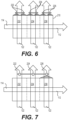
- Figure 6 shows a schematic of the indirect heat exchanger 200 with a plurality of nozzles 220 in each section 230.
- the indirect heat exchanger 200 can be wetted in stages, instead of operating with the entire length of each tube 212 being either dry or wetted. Staging allows the return air 114 to first be cooled in one or more dry sections 230, before water is used in the remaining sections 230, downstream from the dry sections, to achieve the target temperature of the supply air 112. As discussed above, the indirect heat exchanger 200 operates dry, as an air-to-air heat exchanger, when the ambient temperature is cool enough. When scavenger air 122 alone is not sufficient to cool the return air 114 to the target temperature for the supply air 112, water may be discharged from the nozzles 220 in at least one section 230 of indirect heat exchanger 200.
- water is discharged from the nozzles 226 in the third section 236 of the indirect heat exchanger 200.
- the return air 114 is thus first cooled by the scavenger air 122 alone in the first section 232 and the second section 234 before water is used achieve enhanced heat exchange provided by indirect evaporative cooling ("IEC") in the third section 236.
- IEC indirect evaporative cooling
- water may be discharged from the nozzles 224, 226 in the second and third sections 234, 236, while the first section 232 is operated dry.
- additional sections 230 may be activated until water is discharged from the nozzles 220 in all of the sections 230 of the indirect heat exchanger 200. Staging of the indirect heat exchanger 200 has advantages of better temperature control when transitioning from the 100% dry heat exchange mode to the IEC mode and reduced water consumption, as compared to an indirect heat exchanger without staging.
- the cooling system 110 includes a controller 130 for operating the cooling system 110 including the indirect heat exchanger 200, as shown in Figure 5 .
- the controller 130 is a microprocessor-based controller that includes a processor 132 for performing various functions discussed further below and a memory 134 for storing various data.
- the controller 130 may also be referred to as a CPU.
- control of the cooling system 110 may be implemented by way of a series of instructions stored in the memory 134 and executed by the processor 132.
- the controller 130 is thus communicatively coupled to the various pumps and valves in the system, such that they can be operated as discussed further below.
- the controller 130 may also be communicatively coupled to input devices and display devices, as necessary.
- FIG. 5 is a schematic of the indirect heat exchanger 200.
- the water flows over the tubes 212 of the heat exchanger assembly 210, and the portion of the water not evaporated during the cooling process is collected in a sump 242.
- At least one pump 244, 246 is used to circulate the water from the sump 242 to the nozzles 220.
- a first pump 244 is fluidly connected to the nozzles 226 in the third section 236.
- a second pump 246 is fluidly connected to the nozzles 222, 224 in each of the first and second sections 232, 234.
- a staging valve 248 is located between the second pump 246 and the nozzles 222 of the first section 232.
- the controller 130 may operate the first pump 244 to circulate water from the sump 242 and discharge water from the nozzles 226 in the third section 236. In the first stage, the controller 130 does not operate the second pump 246. In the second stage, the staging valve 248 is closed to isolate the nozzles 222 of the first section 232 from the second pump 246, and both the first and second pumps 244, 246 are operated to discharge water from the nozzles 224, 226 in the second and third sections 234, 236. The third stage is similar to the second stage, but the staging valve 248 is open to also discharge water from the nozzles 222 in the first section 232. Although described with two pumps 244, 246 and a single staging valve 248, any suitable number of pumps and staging valves may be used in various combinations to achieve the desired staging of the indirect heat exchanger 200.
- a supplemental mechanical cooling system 300 may also be included with the cooling system 110 (see Figure 1 ).
- This mechanical cooling system 300 includes a cooling coil 302, located in the flow path of the return air 114.
- the cooling coil 302 is located downstream of the indirect heat exchanger 200 and is configured to cool the return air 114 after it has been cooled by the indirect heat exchanger 200.
- Any suitable mechanical cooling system may be used including systems that use direct expansion refrigerant or chilled water to cool the cooling coil 302.
- the mechanical cooling system 300 is a direct expansion (DX) cooling system 300 using the common refrigeration cycle.
- the direct expansion cooling system 300 includes a compressor (not shown) to increase the pressure and temperature of the refrigerant after the cooling coil 302 and before it is cooled in a condenser 304.
- the condenser 304 of the direct expansion cooling system 300 is positioned above the indirect heat exchanger 200 and may also be cooled by the scavenger air 122.
- Other suitable configurations for the condenser 304 may be used including, for example, being located separately from the indirect heat exchanger 200 and in an airstream other than the scavenger air 122.
- the refrigerant then passes through an expansion valve (not shown), reducing its pressure and temperature, before returning to the cooling coil 302.
- the mechanical cooling system 300 system is commonly referred to as a trim cooling system, as it is typically only sized to provide the balance of required cooling after the indirect evaporative cooling process of the indirect heat exchanger. In critical cooling applications, such as data center cooling, performance must be guaranteed. If the trim cooling system (mechanical cooling system 300) is only partially sized, water storage must be provided by the facility in order to maintain full cooling capacity in the case of a water loss event. Such storage may be provided by a water storage tank 320 (see Figure 5 ). These storage tanks 320 are typically sized based on the peak water evaporation requirements for a continuous time interval such as 24 or 48 hours. Typical-year (TMY) hourly weather data is evaluated to determine the period of peak water use. The indirect heat exchanger 200 discussed herein enables a significant reduction in the size of these back-up water storage tanks 320.
- water is added to the indirect heat exchanger by a feed line 312.
- water may be added to the indirect heat exchanger 200 by discharging water from a feed nozzle 314 located above the heat exchanger assembly 210. Water discharged from the feed nozzle 314 then flows over the tubes 212 and into the sump 242 in a manner similar to the nozzles 220 used for recirculation.
- a feed valve 316 may be opened and closed to control the addition of water from the feed line 312 to the indirect heat exchanger 200.
- Water may be added to the indirect heat exchanger 200 using other suitable configurations. For example, instead of filling the sump 242 by using the feed nozzle 314, the feed line 312 may directly empty into the sump 242.
- the feed line 312 may be connected to various water supplies.
- One water supply may be the water supply used under normal operational conditions.
- the normal water supply may be any suitable water supply that the facility, in which the cooling system 110 is located, uses for water. Such normal water supplies may include water from a municipal water main, a well, or the like. As shown in Figure 5 , this normal water supply is connected to the feed line 312 by a normal water supply line 322.
- a normal water supply valve 324 is used to isolate the normal water supply line 322 from the feed line 312.
- water may also be supplied to the cooling system 110 by a backup water supply.
- the backup water supply may be stored in water storage tanks 320.
- the water storage tanks 320 are fluidly connected to the feed line 312 by a backup water supply line 326, and a backup water supply valve 328 is used to isolate the backup water supply line 326 (and water storage tanks 320) from the feed line 312.
- the cooling system 110 may be operated in a water loss mode.
- the water loss mode includes shifting the cooling burden to the mechanical cooling system 300 instead of the indirect heat exchanger 200.
- the mechanical cooling system 300 is operated up to its maximum capacity instead of discharging water from the nozzles 220 of the indirect heat exchanger 200.
- the indirect heat exchanger 200 may be operated with indirect evaporative cooling in only some of the sections 230 of the heat exchanger assembly 210.
- the mechanical cooling system 300 may be sized such that the mechanical cooling system 300 and the indirect heat exchanger 200 operating in the first stage is sufficient to provide the needed cooling capacity based on the peak design conditions.
- water is discharged from the nozzles 226 in the third section 236 of the indirect heat exchanger 200 in the first stage. Operating the cooling system 110 in this way saves a significant amount of water during the water loss event, compared to operating the cooling system 110 with full water sprays, thereby reducing the required volume of water to be stored and the size of water storage tanks 320.
- the water loss mode may be activated when it is identified that the normal water supply has been interrupted.
- the water loss mode may be activated manually when an operator identifies that the normal water supply has been interrupted, but the water loss mode may also be activated automatically.
- a water supply sensor 136 is located in the normal water supply line 322.
- the water supply sensor 136 is communicatively coupled to the controller 130, and when the water supply sensor 136 senses that the normal water supply has been interrupted, it sends a signal to the controller 130. Upon receiving the signal from the water supply sensor 136, the controller 130 activates the water loss mode.
- the data center 100 may include a building management system (BMS) that controls various aspects of the data center 100 including the water supply to the cooling system 110.
- BMS building management system
- the BMS may send a signal, and the controller 130 receives the signal, to operate the cooling system 110 in the water loss mode.
- the controller 130 in response to the signal received from the BMS, may operate the water supply valves 324, 328, the water supply valves 324, 328 may be operated though the BMS to activate (or deactivate) the water loss mode.
- Incorporating a staged spray approach also provides a water savings benefit when the indirect heat exchanger 200 is operated in ambient temperatures near freezing. Because the indirect heat exchanger 200 is typically able to provide full cooling using only scavenger air 122 at temperatures well above freezing, the water system (including the sump 242) is usually drained as ambient temperatures approach freezing to eliminate any freeze concerns. In areas that frequently experience temperature drops towards freezing at night, but heat up and require indirect evaporative cooling during the day, this can lead to frequent fill and dump cycles for the sump 242 that waste water every time the sump 242 is drained. In applications with variable cooling load, a sump basin heater is often employed to allow the sump water to ride through the cold temperatures. This approach is acceptable, but requires energy to operate the heaters. However, in facilities that have a more consistent heat load, such as data centers 100, staged water sprays may provide a more efficient approach.
- the indirect heat exchanger 200 When the ambient temperature reaches a predetermined threshold, the indirect heat exchanger 200 is operated in the first stage. In the first stage, water is circulated from the sump 242 by the first pump 244 to the nozzles 222 in the first section 232. The water discharged from the nozzles 222 will extract enough heat from the return air to keep the entire sump 242 warm enough to prevent freezing.
- temperature of the water in the sump 242 can be measured and the predetermined threshold is based on the temperature of the water in the sump 242.
- a temperature detector 138 is configured to measure the temperature of the ambient air or, alternatively the temperature of the water in the sump 242.
- the temperature detector 138 is communicatively coupled to the controller 130 and transmits the temperature of the ambient air (or water in the sump 242) to the controller 130.
- the controller 130 receives the temperature of the ambient air (or water in the sump 242) from the temperature detector 138, and when the controller 130 determines that the temperature has dropped below the predetermined threshold, the controller 130 operates the first stage of the indirect heat exchanger 200 to prevent freezing of the water in the sump 242 as discussed above.
- the invention relates to the following items.
Landscapes
- Engineering & Computer Science (AREA)
- Physics & Mathematics (AREA)
- Thermal Sciences (AREA)
- General Engineering & Computer Science (AREA)
- Mechanical Engineering (AREA)
- Computer Hardware Design (AREA)
- Microelectronics & Electronic Packaging (AREA)
- Heat-Exchange Devices With Radiators And Conduit Assemblies (AREA)
Applications Claiming Priority (3)
| Application Number | Priority Date | Filing Date | Title |
|---|---|---|---|
| US16/127,325 US11022374B2 (en) | 2018-09-11 | 2018-09-11 | Staged spray indirect evaporative cooling system |
| PCT/US2019/050415 WO2020055871A1 (en) | 2018-09-11 | 2019-09-10 | Staged spray indirect evaporative cooling system |
| EP19860317.7A EP3850289B1 (de) | 2018-09-11 | 2019-09-10 | Indirekt verdampfendes kühlsystem mit gestufter sprühung |
Related Parent Applications (1)
| Application Number | Title | Priority Date | Filing Date |
|---|---|---|---|
| EP19860317.7A Division EP3850289B1 (de) | 2018-09-11 | 2019-09-10 | Indirekt verdampfendes kühlsystem mit gestufter sprühung |
Publications (4)
| Publication Number | Publication Date |
|---|---|
| EP4290166A2 true EP4290166A2 (de) | 2023-12-13 |
| EP4290166A3 EP4290166A3 (de) | 2024-03-06 |
| EP4290166B1 EP4290166B1 (de) | 2025-09-17 |
| EP4290166C0 EP4290166C0 (de) | 2025-09-17 |
Family
ID=69719469
Family Applications (2)
| Application Number | Title | Priority Date | Filing Date |
|---|---|---|---|
| EP23204898.3A Active EP4290166B1 (de) | 2018-09-11 | 2019-09-10 | Indirekt verdampfendes kühlsystem mit gestufter sprühung |
| EP19860317.7A Active EP3850289B1 (de) | 2018-09-11 | 2019-09-10 | Indirekt verdampfendes kühlsystem mit gestufter sprühung |
Family Applications After (1)
| Application Number | Title | Priority Date | Filing Date |
|---|---|---|---|
| EP19860317.7A Active EP3850289B1 (de) | 2018-09-11 | 2019-09-10 | Indirekt verdampfendes kühlsystem mit gestufter sprühung |
Country Status (7)
| Country | Link |
|---|---|
| US (1) | US11022374B2 (de) |
| EP (2) | EP4290166B1 (de) |
| JP (2) | JP2022501568A (de) |
| AU (2) | AU2019339322B2 (de) |
| CA (1) | CA3112260A1 (de) |
| ES (2) | ES2964803T3 (de) |
| WO (1) | WO2020055871A1 (de) |
Families Citing this family (7)
| Publication number | Priority date | Publication date | Assignee | Title |
|---|---|---|---|---|
| US10999954B2 (en) * | 2019-04-23 | 2021-05-04 | Vertiv Corporation | Modular roof mounted cooling system and method for data center |
| US20220042749A1 (en) * | 2020-08-04 | 2022-02-10 | Evapco, Inc. | Polymer tube dry cooling tower |
| JP2022032788A (ja) * | 2020-08-14 | 2022-02-25 | 日本電気株式会社 | 冷却装置、冷却システム、および冷却方法 |
| JP2024064812A (ja) * | 2022-10-28 | 2024-05-14 | 三菱重工サーマルシステムズ株式会社 | チラーシステム及びチラーシステムの制御方法 |
| JP2024064811A (ja) * | 2022-10-28 | 2024-05-14 | 三菱重工サーマルシステムズ株式会社 | チラーシステム及びチラーシステムの制御方法 |
| US20240280304A1 (en) * | 2023-02-16 | 2024-08-22 | Effecterra, Inc. | Systems and methods for a refrigeration system with indirect evaporative heat exchanger |
| CN116923710B (zh) * | 2023-09-18 | 2023-11-17 | 中国航空工业集团公司金城南京机电液压工程研究中心 | 一种飞行器梯级喷雾冷却控制方法及系统 |
Family Cites Families (64)
| Publication number | Priority date | Publication date | Assignee | Title |
|---|---|---|---|---|
| US3923935A (en) | 1971-01-25 | 1975-12-02 | Marley Co | Parallel air path wet-dry water cooling tower |
| GB1376308A (en) * | 1971-06-04 | 1974-12-04 | Cooling Dev Ltd | Art of evaporative cooling |
| HU165521B (de) | 1972-07-03 | 1974-09-28 | ||
| SE383777B (sv) | 1973-07-18 | 1976-03-29 | Munters Ab Carl | Sett och anordning for kylning av luft |
| US3925523A (en) | 1973-11-12 | 1975-12-09 | Marley Co | Opposed air path wet-dry cooling tower and method |
| US4112027A (en) | 1976-01-30 | 1978-09-05 | The Marley Company | Method for indirect evaporative cooling of upflowing fluid by contact with downflowing water from overlying evaporative cooling section |
| US4076771A (en) | 1976-11-19 | 1978-02-28 | The Marley Cooling Tower Company | Bottom vented wet-dry water cooling tower |
| US4182131A (en) * | 1978-11-27 | 1980-01-08 | Consoli Ronald P | High efficiency air conditioner |
| US4380910A (en) | 1981-08-13 | 1983-04-26 | Aztech International, Ltd. | Multi-stage indirect-direct evaporative cooling process and apparatus |
| SE8400302L (sv) | 1984-01-20 | 1985-08-18 | Munters Ab Carl | Kontaktkropp |
| US4683101A (en) | 1985-12-26 | 1987-07-28 | Baltimore Aircoil Company, Inc. | Cross flow evaporative coil fluid cooling apparatus and method of cooling |
| JPS62280501A (ja) * | 1986-05-30 | 1987-12-05 | 三菱重工業株式会社 | 横形蒸発器 |
| US4893669A (en) | 1987-02-05 | 1990-01-16 | Shinwa Sangyo Co., Ltd. | Synthetic resin heat exchanger unit used for cooling tower and cooling tower utilizing heat exchanger consisting of such heat exchanger unit |
| US5401419A (en) | 1988-12-12 | 1995-03-28 | Kocib; Sidney Z. | Conservation of water in operating evaporative coolers |
| US5193352A (en) | 1991-05-03 | 1993-03-16 | Amsted Industries, Inc. | Air pre-cooler method and apparatus |
| US5435382A (en) | 1993-06-16 | 1995-07-25 | Baltimore Aircoil Company, Inc. | Combination direct and indirect closed circuit evaporative heat exchanger |
| US5390505A (en) | 1993-07-23 | 1995-02-21 | Baltimore Aircoil Company, Inc. | Indirect contact chiller air-precooler method and apparatus |
| US5411078A (en) | 1993-12-13 | 1995-05-02 | Ares; Roland | Air and evaporatively cooled heat exchanger and refrigerating system therefor |
| US5390502A (en) | 1994-03-29 | 1995-02-21 | Oven Systems, Inc. | Non-freeze closed loop evaporated cooling system |
| US5695117A (en) | 1994-06-07 | 1997-12-09 | Sizemore; Timothy J. | Evaporative air conditioning system |
| US5724828A (en) * | 1995-04-21 | 1998-03-10 | Baltimore Aircoil Company, Inc. | Combination direct and indirect closed circuit evaporative heat exchanger with blow-through fan |
| US6142219A (en) | 1999-03-08 | 2000-11-07 | Amstead Industries Incorporated | Closed circuit heat exchange system and method with reduced water consumption |
| US6213200B1 (en) | 1999-03-08 | 2001-04-10 | Baltimore Aircoil Company, Inc. | Low profile heat exchange system and method with reduced water consumption |
| JP4282837B2 (ja) * | 1999-08-06 | 2009-06-24 | 高砂熱学工業株式会社 | 外気の予熱予冷設備 |
| EP1257349B1 (de) * | 2000-02-23 | 2008-08-13 | Schlom, Leslie | Wärmetauscher zum kühlen und zur verwendung im vorkühler der turbinenluft-aufbereitung |
| US6574975B2 (en) | 2000-12-20 | 2003-06-10 | Davis Energy Group, Inc. | Dual evaporative pre-cooling system and method therefor |
| US6748759B2 (en) | 2001-08-02 | 2004-06-15 | Ho-Hsin Wu | High efficiency heat exchanger |
| JP4109444B2 (ja) * | 2001-11-09 | 2008-07-02 | Gac株式会社 | 熱交換器およびその製造方法 |
| US6640575B2 (en) | 2002-02-01 | 2003-11-04 | Mac Word | Apparatus and method for closed circuit cooling tower with corrugated metal tube elements |
| US7128138B2 (en) | 2004-05-26 | 2006-10-31 | Entrodyne Corporation | Indirect evaporative cooling heat exchanger |
| US7364141B2 (en) | 2005-03-01 | 2008-04-29 | Spx Cooling Technologies, Inc. | Fluid cooler with evaporative heat exchanger |
| US7243909B2 (en) | 2004-12-10 | 2007-07-17 | Koplin Edward C | Collector sump cooling tower |
| US7765827B2 (en) * | 2005-11-08 | 2010-08-03 | Everest Acquisition Holdings, Inc. | Multi-stage hybrid evaporative cooling system |
| JP4934349B2 (ja) * | 2006-05-12 | 2012-05-16 | 東洋熱工業株式会社 | 氷蓄熱システムの運転制御方法 |
| AU2007260596A1 (en) | 2006-06-16 | 2007-12-21 | Richard Hunwick | Systems and methods for conserving water, cooling tower and heat exchanger |
| US8141374B2 (en) | 2008-12-22 | 2012-03-27 | Amazon Technologies, Inc. | Multi-mode cooling system and method with evaporative cooling |
| WO2011016847A2 (en) | 2009-07-29 | 2011-02-10 | Beutler Corporation | Evaporative pre-cooler for air cooled heat exchangers |
| US9243847B2 (en) | 2009-11-04 | 2016-01-26 | Evapco, Inc. | Hybrid heat exchange apparatus |
| US8966924B2 (en) | 2009-11-13 | 2015-03-03 | Equinix, Inc. | Pre-cooling chamber for a cooling tower |
| US8974274B2 (en) | 2010-04-16 | 2015-03-10 | Google Inc. | Evaporative induction cooling |
| EP2577205B1 (de) * | 2010-05-27 | 2023-01-04 | Johnson Controls Tyco IP Holdings LLP | Kühlsystem umfassend wärmeumlaufkühler und kühlturm und verfahren zum betrieb solch eines kühlsystems |
| US8434746B2 (en) | 2010-07-02 | 2013-05-07 | Baltimore Aircoil Company, Inc. | Induced draft cooling tower |
| US20120067546A1 (en) * | 2010-09-17 | 2012-03-22 | Evapco, Inc. | Hybrid heat exchanger apparatus and method of operating the same |
| US9055696B2 (en) | 2010-12-30 | 2015-06-09 | Munters Corporation | Systems for removing heat from enclosed spaces with high internal heat generation |
| US9032742B2 (en) | 2010-12-30 | 2015-05-19 | Munters Corporation | Methods for removing heat from enclosed spaces with high internal heat generation |
| US9021821B2 (en) | 2010-12-30 | 2015-05-05 | Munters Corporation | Ventilation device for use in systems and methods for removing heat from enclosed spaces with high internal heat generation |
| US20120167610A1 (en) | 2010-12-30 | 2012-07-05 | Munters Corporation | Indirect air-side economizer for removing heat from enclosed spaces with high internal heat generation |
| US8676385B2 (en) * | 2011-04-21 | 2014-03-18 | Evapco, Inc. | Method for operating a heat exchanger unit |
| US9891001B2 (en) | 2012-03-16 | 2018-02-13 | Evapco, Inc. | Hybrid cooler with bifurcated evaporative section |
| US9313929B1 (en) | 2012-05-29 | 2016-04-12 | Google Inc. | Managing data center airflow |
| US9278303B1 (en) | 2012-05-29 | 2016-03-08 | Google Inc. | Managing data center airflow |
| US20140202151A1 (en) * | 2013-01-21 | 2014-07-24 | Alliance For Sustainable Energy, Llc | Hybrid Air-Cooled Condenser For Power Plants and Other Applications |
| US9279619B2 (en) | 2013-03-15 | 2016-03-08 | Baltimore Aircoil Company Inc. | Cooling tower with indirect heat exchanger |
| US9255739B2 (en) | 2013-03-15 | 2016-02-09 | Baltimore Aircoil Company, Inc. | Cooling tower with indirect heat exchanger |
| WO2014145534A1 (en) | 2013-03-15 | 2014-09-18 | Munters Corporation | Indirect evaporative cooling heat exchanger |
| US20160054070A1 (en) | 2013-04-04 | 2016-02-25 | E-Polytech Mfg. Sys, Llc | Heat exchange system adapted to selectively operate in wet and/or or dry mode |
| US9291397B2 (en) | 2014-02-07 | 2016-03-22 | Spx Cooling Technologies, Inc. | Liquid distribution system for a fluid cooler |
| US9945569B2 (en) | 2014-09-10 | 2018-04-17 | Munters Corporation | Water minimizing method and apparatus for use with evaporative cooling devices |
| JP6712274B2 (ja) * | 2014-12-30 | 2020-06-17 | デイル ルフェーヴル, | データセンタ熱除去システムおよび方法 |
| US9789419B2 (en) * | 2015-03-08 | 2017-10-17 | Hossein Akhavi | Restoring cooling tower outlet fog into water cycle |
| JP2018526611A (ja) | 2015-09-10 | 2018-09-13 | マンターズ コーポレイションMunters Corporation | 蒸発冷却デバイスを使用して水を最小限に抑える方法及びそのための装置 |
| US9995533B2 (en) * | 2015-12-03 | 2018-06-12 | Baltimore Aircoil Company, Inc. | Cooling tower with indirect heat exchanger |
| US10895420B2 (en) * | 2016-09-01 | 2021-01-19 | Spx Cooling Technologies, Inc. | Hybrid fluid cooler method and apparatus |
| US10619953B2 (en) * | 2017-11-15 | 2020-04-14 | Baltimore Aircoil Company, Inc. | Automated control of heat exchanger operation |
-
2018
- 2018-09-11 US US16/127,325 patent/US11022374B2/en active Active
-
2019
- 2019-09-10 AU AU2019339322A patent/AU2019339322B2/en active Active
- 2019-09-10 EP EP23204898.3A patent/EP4290166B1/de active Active
- 2019-09-10 CA CA3112260A patent/CA3112260A1/en active Pending
- 2019-09-10 JP JP2021538173A patent/JP2022501568A/ja active Pending
- 2019-09-10 WO PCT/US2019/050415 patent/WO2020055871A1/en not_active Ceased
- 2019-09-10 ES ES19860317T patent/ES2964803T3/es active Active
- 2019-09-10 ES ES23204898T patent/ES3042214T3/es active Active
- 2019-09-10 EP EP19860317.7A patent/EP3850289B1/de active Active
-
2024
- 2024-09-30 JP JP2024170100A patent/JP2025013340A/ja active Pending
-
2025
- 2025-03-04 AU AU2025201564A patent/AU2025201564B2/en active Active
Also Published As
| Publication number | Publication date |
|---|---|
| ES3042214T3 (en) | 2025-11-19 |
| JP2022501568A (ja) | 2022-01-06 |
| JP2025013340A (ja) | 2025-01-24 |
| EP3850289A1 (de) | 2021-07-21 |
| AU2019339322B2 (en) | 2024-12-05 |
| AU2019339322A1 (en) | 2021-05-06 |
| AU2025201564A1 (en) | 2025-03-20 |
| US11022374B2 (en) | 2021-06-01 |
| WO2020055871A1 (en) | 2020-03-19 |
| US20200080787A1 (en) | 2020-03-12 |
| EP3850289B1 (de) | 2023-10-25 |
| EP3850289A4 (de) | 2022-05-04 |
| EP4290166B1 (de) | 2025-09-17 |
| AU2025201564B2 (en) | 2025-09-04 |
| EP4290166C0 (de) | 2025-09-17 |
| CA3112260A1 (en) | 2020-03-19 |
| ES2964803T3 (es) | 2024-04-09 |
| EP3850289C0 (de) | 2023-10-25 |
| EP4290166A3 (de) | 2024-03-06 |
Similar Documents
| Publication | Publication Date | Title |
|---|---|---|
| AU2025201564B2 (en) | Staged spray indirect evaporative cooling system | |
| US11867426B2 (en) | System and methods utilizing fluid coolers and chillers to perform in-series heat rejection and trim cooling | |
| US9706689B2 (en) | Data center cooling system | |
| US10823482B2 (en) | Systems and methods for free and positive defrost | |
| US20200284480A1 (en) | Evaporative Fluid-Cooler with Integrated Mechanical Cooling System | |
| JP2009512190A5 (de) | ||
| US4423602A (en) | Synergistic air conditioning and refrigeration energy enhancement method | |
| CN108224631B (zh) | 一种数据中心应急制冷系统及其控制方法 | |
| JP2010190553A (ja) | 電子機器の冷却システム | |
| US20250071943A1 (en) | Active/passive cooling system with pumped refrigerant | |
| CN112368528A (zh) | 与空冷冷冻机集成的模块式水侧节能器 | |
| CN113703309A (zh) | 一种具有高集成环控系统的人员设备混合舱 | |
| US20090038320A1 (en) | Ice storage constant temperature air conditioning system having divided refrigerant | |
| CN109237644B (zh) | 热泵机组及其控制方法 | |
| US20040104278A1 (en) | System and apparatus for refrigeration and heating |
Legal Events
| Date | Code | Title | Description |
|---|---|---|---|
| PUAI | Public reference made under article 153(3) epc to a published international application that has entered the european phase |
Free format text: ORIGINAL CODE: 0009012 |
|
| STAA | Information on the status of an ep patent application or granted ep patent |
Free format text: STATUS: THE APPLICATION HAS BEEN PUBLISHED |
|
| AC | Divisional application: reference to earlier application |
Ref document number: 3850289 Country of ref document: EP Kind code of ref document: P |
|
| AK | Designated contracting states |
Kind code of ref document: A2 Designated state(s): AL AT BE BG CH CY CZ DE DK EE ES FI FR GB GR HR HU IE IS IT LI LT LU LV MC MK MT NL NO PL PT RO RS SE SI SK SM TR |
|
| REG | Reference to a national code |
Ref country code: DE Ref legal event code: R079 Free format text: PREVIOUS MAIN CLASS: F28D0005020000 Ipc: F28C0001140000 Ref country code: DE Ref legal event code: R079 Ref document number: 602019076024 Country of ref document: DE Free format text: PREVIOUS MAIN CLASS: F28D0005020000 Ipc: F28C0001140000 |
|
| PUAL | Search report despatched |
Free format text: ORIGINAL CODE: 0009013 |
|
| AK | Designated contracting states |
Kind code of ref document: A3 Designated state(s): AL AT BE BG CH CY CZ DE DK EE ES FI FR GB GR HR HU IE IS IT LI LT LU LV MC MK MT NL NO PL PT RO RS SE SI SK SM TR |
|
| RIC1 | Information provided on ipc code assigned before grant |
Ipc: F28D 5/02 20060101ALI20240201BHEP Ipc: F28C 1/14 20060101AFI20240201BHEP |
|
| STAA | Information on the status of an ep patent application or granted ep patent |
Free format text: STATUS: REQUEST FOR EXAMINATION WAS MADE |
|
| 17P | Request for examination filed |
Effective date: 20240821 |
|
| RBV | Designated contracting states (corrected) |
Designated state(s): AL AT BE BG CH CY CZ DE DK EE ES FI FR GB GR HR HU IE IS IT LI LT LU LV MC MK MT NL NO PL PT RO RS SE SI SK SM TR |
|
| GRAP | Despatch of communication of intention to grant a patent |
Free format text: ORIGINAL CODE: EPIDOSNIGR1 |
|
| STAA | Information on the status of an ep patent application or granted ep patent |
Free format text: STATUS: GRANT OF PATENT IS INTENDED |
|
| RIC1 | Information provided on ipc code assigned before grant |
Ipc: F28D 5/02 20060101ALI20250409BHEP Ipc: F28C 1/14 20060101AFI20250409BHEP |
|
| INTG | Intention to grant announced |
Effective date: 20250422 |
|
| GRAS | Grant fee paid |
Free format text: ORIGINAL CODE: EPIDOSNIGR3 |
|
| GRAA | (expected) grant |
Free format text: ORIGINAL CODE: 0009210 |
|
| STAA | Information on the status of an ep patent application or granted ep patent |
Free format text: STATUS: THE PATENT HAS BEEN GRANTED |
|
| AC | Divisional application: reference to earlier application |
Ref document number: 3850289 Country of ref document: EP Kind code of ref document: P |
|
| AK | Designated contracting states |
Kind code of ref document: B1 Designated state(s): AL AT BE BG CH CY CZ DE DK EE ES FI FR GB GR HR HU IE IS IT LI LT LU LV MC MK MT NL NO PL PT RO RS SE SI SK SM TR |
|
| REG | Reference to a national code |
Ref country code: GB Ref legal event code: FG4D |
|
| REG | Reference to a national code |
Ref country code: CH Ref legal event code: EP |
|
| REG | Reference to a national code |
Ref country code: DE Ref legal event code: R096 Ref document number: 602019076024 Country of ref document: DE |
|
| REG | Reference to a national code |
Ref country code: IE Ref legal event code: FG4D |
|
| U01 | Request for unitary effect filed |
Effective date: 20250930 |
|
| U07 | Unitary effect registered |
Designated state(s): AT BE BG DE DK EE FI FR IT LT LU LV MT NL PT RO SE SI Effective date: 20251010 |
|
| REG | Reference to a national code |
Ref country code: ES Ref legal event code: FG2A Ref document number: 3042214 Country of ref document: ES Kind code of ref document: T3 Effective date: 20251119 |
|
| PG25 | Lapsed in a contracting state [announced via postgrant information from national office to epo] |
Ref country code: HR Free format text: LAPSE BECAUSE OF FAILURE TO SUBMIT A TRANSLATION OF THE DESCRIPTION OR TO PAY THE FEE WITHIN THE PRESCRIBED TIME-LIMIT Effective date: 20250917 |
|
| PG25 | Lapsed in a contracting state [announced via postgrant information from national office to epo] |
Ref country code: GR Free format text: LAPSE BECAUSE OF FAILURE TO SUBMIT A TRANSLATION OF THE DESCRIPTION OR TO PAY THE FEE WITHIN THE PRESCRIBED TIME-LIMIT Effective date: 20251218 |
|
| PG25 | Lapsed in a contracting state [announced via postgrant information from national office to epo] |
Ref country code: RS Free format text: LAPSE BECAUSE OF FAILURE TO SUBMIT A TRANSLATION OF THE DESCRIPTION OR TO PAY THE FEE WITHIN THE PRESCRIBED TIME-LIMIT Effective date: 20251217 |
|
| PG25 | Lapsed in a contracting state [announced via postgrant information from national office to epo] |
Ref country code: SM Free format text: LAPSE BECAUSE OF FAILURE TO SUBMIT A TRANSLATION OF THE DESCRIPTION OR TO PAY THE FEE WITHIN THE PRESCRIBED TIME-LIMIT Effective date: 20250917 |
|
| PG25 | Lapsed in a contracting state [announced via postgrant information from national office to epo] |
Ref country code: IS Free format text: LAPSE BECAUSE OF FAILURE TO SUBMIT A TRANSLATION OF THE DESCRIPTION OR TO PAY THE FEE WITHIN THE PRESCRIBED TIME-LIMIT Effective date: 20260117 |
|
| PG25 | Lapsed in a contracting state [announced via postgrant information from national office to epo] |
Ref country code: CZ Free format text: LAPSE BECAUSE OF FAILURE TO SUBMIT A TRANSLATION OF THE DESCRIPTION OR TO PAY THE FEE WITHIN THE PRESCRIBED TIME-LIMIT Effective date: 20250917 |
|
| PG25 | Lapsed in a contracting state [announced via postgrant information from national office to epo] |
Ref country code: PL Free format text: LAPSE BECAUSE OF FAILURE TO SUBMIT A TRANSLATION OF THE DESCRIPTION OR TO PAY THE FEE WITHIN THE PRESCRIBED TIME-LIMIT Effective date: 20250917 |
|
| PG25 | Lapsed in a contracting state [announced via postgrant information from national office to epo] |
Ref country code: SK Free format text: LAPSE BECAUSE OF FAILURE TO SUBMIT A TRANSLATION OF THE DESCRIPTION OR TO PAY THE FEE WITHIN THE PRESCRIBED TIME-LIMIT Effective date: 20250917 |