EP4288307B1 - Véhicule électrique équipé d'un boîtier électronique - Google Patents
Véhicule électrique équipé d'un boîtier électronique Download PDFInfo
- Publication number
- EP4288307B1 EP4288307B1 EP22702501.2A EP22702501A EP4288307B1 EP 4288307 B1 EP4288307 B1 EP 4288307B1 EP 22702501 A EP22702501 A EP 22702501A EP 4288307 B1 EP4288307 B1 EP 4288307B1
- Authority
- EP
- European Patent Office
- Prior art keywords
- support
- motor vehicle
- vehicle according
- wedging
- towards
- Prior art date
- Legal status (The legal status is an assumption and is not a legal conclusion. Google has not performed a legal analysis and makes no representation as to the accuracy of the status listed.)
- Active
Links
Images

Classifications
-
- B—PERFORMING OPERATIONS; TRANSPORTING
- B60—VEHICLES IN GENERAL
- B60R—VEHICLES, VEHICLE FITTINGS, OR VEHICLE PARTS, NOT OTHERWISE PROVIDED FOR
- B60R16/00—Electric or fluid circuits specially adapted for vehicles and not otherwise provided for; Arrangement of elements of electric or fluid circuits specially adapted for vehicles and not otherwise provided for
- B60R16/02—Electric or fluid circuits specially adapted for vehicles and not otherwise provided for; Arrangement of elements of electric or fluid circuits specially adapted for vehicles and not otherwise provided for electric constitutive elements
- B60R16/04—Arrangement of batteries
-
- B—PERFORMING OPERATIONS; TRANSPORTING
- B60—VEHICLES IN GENERAL
- B60R—VEHICLES, VEHICLE FITTINGS, OR VEHICLE PARTS, NOT OTHERWISE PROVIDED FOR
- B60R16/00—Electric or fluid circuits specially adapted for vehicles and not otherwise provided for; Arrangement of elements of electric or fluid circuits specially adapted for vehicles and not otherwise provided for
- B60R16/02—Electric or fluid circuits specially adapted for vehicles and not otherwise provided for; Arrangement of elements of electric or fluid circuits specially adapted for vehicles and not otherwise provided for electric constitutive elements
- B60R16/023—Electric or fluid circuits specially adapted for vehicles and not otherwise provided for; Arrangement of elements of electric or fluid circuits specially adapted for vehicles and not otherwise provided for electric constitutive elements for transmission of signals between vehicle parts or subsystems
- B60R16/0239—Electronic boxes
-
- B—PERFORMING OPERATIONS; TRANSPORTING
- B60—VEHICLES IN GENERAL
- B60R—VEHICLES, VEHICLE FITTINGS, OR VEHICLE PARTS, NOT OTHERWISE PROVIDED FOR
- B60R21/00—Arrangements or fittings on vehicles for protecting or preventing injuries to occupants or pedestrians in case of accidents or other traffic risks
- B60R21/02—Occupant safety arrangements or fittings, e.g. crash pads
-
- H—ELECTRICITY
- H01—ELECTRIC ELEMENTS
- H01M—PROCESSES OR MEANS, e.g. BATTERIES, FOR THE DIRECT CONVERSION OF CHEMICAL ENERGY INTO ELECTRICAL ENERGY
- H01M50/00—Constructional details or processes of manufacture of the non-active parts of electrochemical cells other than fuel cells, e.g. hybrid cells
- H01M50/20—Mountings; Secondary casings or frames; Racks, modules or packs; Suspension devices; Shock absorbers; Transport or carrying devices; Holders
- H01M50/204—Racks, modules or packs for multiple batteries or multiple cells
-
- H—ELECTRICITY
- H01—ELECTRIC ELEMENTS
- H01M—PROCESSES OR MEANS, e.g. BATTERIES, FOR THE DIRECT CONVERSION OF CHEMICAL ENERGY INTO ELECTRICAL ENERGY
- H01M50/00—Constructional details or processes of manufacture of the non-active parts of electrochemical cells other than fuel cells, e.g. hybrid cells
- H01M50/20—Mountings; Secondary casings or frames; Racks, modules or packs; Suspension devices; Shock absorbers; Transport or carrying devices; Holders
- H01M50/218—Mountings; Secondary casings or frames; Racks, modules or packs; Suspension devices; Shock absorbers; Transport or carrying devices; Holders characterised by the material
- H01M50/22—Mountings; Secondary casings or frames; Racks, modules or packs; Suspension devices; Shock absorbers; Transport or carrying devices; Holders characterised by the material of the casings or racks
- H01M50/227—Organic material
-
- H—ELECTRICITY
- H01—ELECTRIC ELEMENTS
- H01M—PROCESSES OR MEANS, e.g. BATTERIES, FOR THE DIRECT CONVERSION OF CHEMICAL ENERGY INTO ELECTRICAL ENERGY
- H01M50/00—Constructional details or processes of manufacture of the non-active parts of electrochemical cells other than fuel cells, e.g. hybrid cells
- H01M50/20—Mountings; Secondary casings or frames; Racks, modules or packs; Suspension devices; Shock absorbers; Transport or carrying devices; Holders
- H01M50/249—Mountings; Secondary casings or frames; Racks, modules or packs; Suspension devices; Shock absorbers; Transport or carrying devices; Holders specially adapted for aircraft or vehicles, e.g. cars or trains
Definitions
- Motor vehicles generally have a low voltage 12V on-board battery, held in a tray located in the front compartment of the powertrain. To remain accessible, the battery is located in a free space in the upper part of this compartment, a little in front of the vehicle body panel.
- a support receiving a housing comprising power electronics, which for example supplies this battery, in order to benefit from available space, and short connecting cables between these elements making it possible to limit costs and electrical losses.
- each brake or clutch pedal fixed to the bulkhead in the passenger compartment has in the engine compartment a hydraulic piston system arranged in alignment with the pedal, elongated in the longitudinal direction of the vehicle, forming a rigid block which from the bulkhead advances into this compartment. It is possible to obtain a hydraulic system substantially aligned with the electronic box arranged next to the battery.
- the present invention aims in particular to avoid these problems of the prior art.
- a motor vehicle equipped with an electronic box linked to a support fixed on a side face of a battery tray of the on-board network, facing the transverse direction of this vehicle, this vehicle being remarkable in that the side face comprises devices for wedging the support in all directions, allowing a descent of this support coming from above, and comprising in the forward direction of the vehicle a limited force for retaining the support less than 50 daN.
- An advantage of this vehicle is that an operator can easily introduce the support receiving the electronic box by sliding it vertically from above, with a hold in all directions, until it arrives on a wedging device towards the bottom.
- the motor vehicle according to the invention may further comprise one or more of the following characteristics, which may be combined with each other.
- the side face of the tray includes a vertical boss forming a wedge towards the front of the support having the limited retaining force.
- the side face includes hooks arranged in a horizontal plane receiving the support during its descent.
- the hooks apply a wedging of the support towards the rear and transversely towards the outside relative to the battery.
- the vehicle comprises a vertical wedging device of the support comprising elastic clips which achieve an automatic wedging towards the top of the support at the end of descent.
- the support comprises lower edges having elasticity in the vertical direction, coming to bear on horizontal bosses of the side face of the tray at the end of descent.
- the elastic front edge or the elastic lower edges each have at the rear a cutout forming an elongated hole parallel to the edge giving its elasticity.
- the battery tray and the support are made by plastic moldings, at the same time forming the wedging devices.
- the electronic box can constitute a direct voltage converter supplying the on-board network battery.
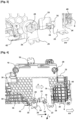
- FIG. 1 has a battery tray 2 made by a plastic molding, fixed in a vehicle having a front side AV, containing a battery of the on-board network 4 having an elongated shape in the longitudinal direction of this vehicle.
- the battery 4 is fixed in the transverse direction on the left side of the vehicle, which is defined by looking at the front of this vehicle.
- An electronic box 12 forming a direct voltage converter receives a voltage of 48V coming from a battery supplying a hybrid electric traction machine of the vehicle, to convert it into a voltage of 12V allowing the battery of the on-board network 4 to be recharged.
- the electronic housing 12 has an elongated parallelepiped shape in the longitudinal direction of the vehicle, of small thickness in the transverse direction, which is fixed by means of a flat support 10 on the vertical right lateral face 8 of the battery tray 2.
- a hydraulic system 14 of the brake or clutch pedal of the vehicle shown schematically, has a longitudinally elongated shape which is aligned with the rear face of the electronic housing 12.
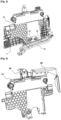
- FIG. 2 presents the support 10 produced by a plastic molding, substantially forming a vertical plate comprising in its thickness hexagonal alveolar shapes allowing it to be stiffened.
- the support 10 comprises in the lower part a central notch 20 surrounded by a front leg 22 and a rear leg 24, ending each by a horizontal rim 26 facing the right side, comprising a slot open towards the outside.
- the support 10 comprises, halfway up towards the front and towards the rear, an elastic clip 32 facing upwards, having, starting from the bottom, a face inclined towards the left side, then a horizontal edge facing towards the right side, and finally a small vertical part.
- the support 10 comprises in front of the front leg 22 an elastic vertical front edge 34 comprising a thin strip of material separated from this support by a cutout forming a vertically elongated hole, giving this edge elasticity in the longitudinal direction.
- the support 10 comprises under each elastic clip 32 a horizontal elastic lower edge 36 comprising a thin strip of material separated from this support by a cutout forming a horizontally elongated hole, giving this edge elasticity in the vertical direction.
- the support 10 has on its rear edge a horizontal rear leg 38 which is turned towards the rear.
- the support 10 has in the upper part two upper legs 50 turned upwards.
- FIGS. 3 and 4 present the battery tray 2 comprising the vertical right side face 8 receiving the support 10 which is fixed flat on it and wedged in all directions, after a lowering of this support by an operator while keeping it pressed against this right face.
- each reinforcement thickness 30 formed at its base is introduced from above into a hook 42 arranged in a horizontal plane and open towards the front, so as to achieve wedging of the base of this support towards the rear and in the transverse direction.
- the elastic vertical front edge 34 comes to bear on a vertical boss 40 formed on the lateral face of the tray 8, with compression of this front edge by elastic deformation in order to ensure, with the hooks 42 forming rear stops, a clearance-free wedging in the longitudinal direction of this support.
- each elastic horizontal lower edge 36 which each come to bear on a horizontal boss 44 formed on the lateral face of the tray 8, by compressing.
- each elastic clip 32 which deforms towards the right side when arriving at a horizontal bar on the lateral face of the tray 8, then relaxes by adjusting its horizontal edge under this bar.
- the various wedging devices include guides defined so as to allow a blind descent of the support 10 which runs along the side face of the tray 8, in a space that is not very visible, ensuring at the end of the stroke that all the wedging devices are properly engaged.
- the vertical boss 40 for holding the elastic front edge 34 of the support 10 is calculated so as to allow retraction of this boss for a longitudinal force on the support towards the front, indicated by the arrow F in figure 3 , exceeding 50daN.
- the thickness of the vertical boss 40 is calculated according to the resistance of its material, so as to obtain this limit resistance value.
- the electronic box 12 cannot transmit to the hydraulic system 14 a force greater than this value of 50daN. This protects the hydraulic system 14 fixed to the vehicle bulkhead and the pedals arranged inside, by avoiding excessive deformation causing intrusions into the passenger compartment.
- FIG 5 has a chute 52 made by molding a plastic material, forming guide channels for the cables receiving the medium supply voltage of the electronic box 12, which is fixed by clipping into the slots facing the outer side of the horizontal edges 26 arranged at the base of the lower front 22 and rear 24 legs of the support 10.
- FIG. 6 has a protective cover for the electrical terminals 60 of the electronic box 12, formed by a molding of a plastic material, which descends onto this box and clips onto the two upper legs 50 of the support 10.
Landscapes
- Engineering & Computer Science (AREA)
- Mechanical Engineering (AREA)
- Chemical & Material Sciences (AREA)
- Chemical Kinetics & Catalysis (AREA)
- Electrochemistry (AREA)
- General Chemical & Material Sciences (AREA)
- Aviation & Aerospace Engineering (AREA)
- Arrangement Or Mounting Of Propulsion Units For Vehicles (AREA)
- Battery Mounting, Suspending (AREA)
- Body Structure For Vehicles (AREA)
Description
- La présente invention revendique la priorité de la demande française N°2101189 déposée le 08.02.2021
- La présente invention concerne un véhicule automobile équipé d'un boîtier électronique lié à un support fixé sur un bac de batterie du réseau de bord.
- Les véhicules automobiles comportent généralement une batterie du réseau de bord présentant une basse tension de 12V, maintenu dans un bac disposé dans le compartiment avant du groupe motopropulseur. La batterie est pour rester accessible disposée dans un espace libre en partie supérieure de ce compartiment, un peu en avant du tablier de la caisse du véhicule.
- On peut en particulier fixer directement sur un côté du bac de la batterie, tourné vers la direction transversale du véhicule, un support recevant un boîtier comprenant une électronique de puissance, qui par exemple alimente cette batterie, afin de bénéficier d'un espace disponible, et de câbles de liaison courts entre ces éléments permettant de limiter les coûts et les pertes électriques.
- Par ailleurs chaque pédale de frein ou d'embrayage fixée sur le tablier dans l'habitacle, possède dans le compartiment moteur un système de piston hydraulique disposé dans l'alignement de la pédale, allongé suivant la direction longitudinale du véhicule, formant un bloc rigide qui à partir du tablier avance dans ce compartiment. On peut obtenir un système hydraulique sensiblement aligné sur le boîtier électronique disposé à côté de la batterie.
- Lors d'un choc frontal du véhicule suffisamment important, on obtient un écrasement de sa face avant et un recul des organes mécaniques se trouvant dans le compartiment moteur, qui doivent pour satisfaire aux normes de sécurité éviter d'entraîner des pénétrations d'organes dans l'habitacle pouvant blesser les pieds du conducteur.
- En particulier avec un recul de la batterie et de son bac entraînant le boîtier électronique fixé rigidement dessus par son support, ce boîtier pourrait alors repousser le système hydraulique d'une pédale aligné longitudinalement, en générant une intrusion dans l'habitacle qui est dangereuse.
- Le document
FR 3 053 296 A1 - La présente invention a notamment pour but d'éviter ces problèmes de l'art antérieur.
- Elle propose à cet effet un véhicule automobile équipé d'un boîtier électronique lié à un support fixé sur une face latérale d'un bac de batterie du réseau de bord, tournée vers la direction transversale de ce véhicule, ce véhicule étant remarquable en ce que la face latérale comporte des dispositifs de calage du support dans toutes les directions, permettant une descente de ce support venant du haut, et comprenant dans la direction avant du véhicule une force limitée de retenue du support inférieure à 50daN. Un avantage de ce véhicule est qu'un opérateur peut facilement introduire le support recevant le boîtier électronique en le glissant verticalement par le haut, avec un maintien dans toutes les directions, jusqu'à ce qu'il arrive sur un dispositif de calage vers le bas.
- Ensuite en cas de choc frontal avant sur le véhicule avec des éléments du groupe motopropulseur repoussant vers l'arrière la batterie, le boîtier électronique étant dans l'alignement d'un système hydraulique d'une pédale, à partir d'un effort ne dépassant pas 50daN appliqué par le boîtier sur ce système le calage avant du boîtier va céder en évitant de transmettre un effort supérieur sur le système hydraulique.
- On obtient de manière simple et efficace une protection contre l'intrusion du système hydraulique et de sa pédale dans l'habitacle, en protégeant les pieds du conducteur.
- Le véhicule automobile selon l'invention peuvent comporter de plus une ou plusieurs des caractéristiques suivantes, qui peuvent être combinées entre elles.
- Avantageusement, la face latérale du bac comporte un bossage vertical formant un calage vers l'avant du support présentant la force limitée de retenue.
- Dans ce cas, avantageusement le support présente un bord avant en appui sur le bossage vertical disposant d'une élasticité dans la direction longitudinale du véhicule.
- Avantageusement, la face latérale comporte des crochets disposés dans un plan horizontal recevant le support lors de sa descente.
- Dans ce cas, avantageusement les crochets appliquent un calage du support vers l'arrière et transversalement vers l'extérieur par rapport à la batterie. Avantageusement, le véhicule comporte un dispositif de calage vertical du support comprenant des clips élastiques qui réalisent un calage automatique vers le haut du support en fin de descente.
- De plus, avantageusement le support comporte des bords inférieurs disposant d'une élasticité dans la direction verticale, venant en appui sur des bossages horizontaux de la face latérale du bac en fin de descente. Avantageusement, le bord avant élastique ou les bords inférieurs élastiques présentent chacun en arrière une découpe formant un perçage allongé parallèle au bord donnant son élasticité.
- Avantageusement, le bac de batterie et le support sont réalisés par des moulages de matière plastique, formant en même temps les dispositifs de calage.
- En particulier, le boîtier électronique peut constituer un convertisseur de tension continue alimentant la batterie du réseau de bord.
- L'invention sera mieux comprise et d'autres caractéristiques et avantages apparaîtront plus clairement à la lecture de la description ci-après donnée à titre d'exemple, en référence aux dessins annexés dans lesquels :
- [
Fig. 1 ] est une vue sur un véhicule automobile selon l'invention, d'un boîtier électronique fixé par un support à un bac de batterie du réseau de bord ; - [
Fig. 2 ] est une vue de côté du support seul ; - [
Fig. 3 ] est une vue de côté du support fixé sur le bac de batterie ; - [
Fig. 4 ] est une vue de détail de la partie inférieure du support fixé sur le bac de batterie ; - [
Fig. 5 ] est une vue de côté du support fixé sur le bac de batterie recevant une goulotte de passage de câbles ; et - [
Fig. 6 ] est une vue de côté du support fixé sur le bac de batterie recevant un capotage de protection de cosses. - La
figure 1 présente un bac de batterie 2 réalisé par un moulage en matière plastique, fixé dans un véhicule présentant un côté avant AV, contenant une batterie du réseau de bord 4 présentant une forme allongée suivant la direction longitudinale de ce véhicule. La batterie 4 est fixée dans la direction transversale sur le côté gauche du véhicule, qui est défini en regardant l'avant de ce véhicule. - Un boîtier électronique 12 formant un convertisseur de tension continue, reçoit une tension de 48V venant d'une batterie alimentant une machine électrique de traction hybride du véhicule, pour la convertir en une tension de 12V permettant de recharger la batterie du réseau de bord 4.
- Le boîtier électronique 12 présente une forme parallélépipédique allongée suivant la direction longitudinale du véhicule, de faible épaisseur suivant la direction transversale, qui est fixée par l'intermédiaire d'un support plat 10 sur la face latérale droite verticale 8 du bac de batterie 2.
- Un système hydraulique 14 de la pédale de frein ou d'embrayage du véhicule, représenté schématiquement, présente une forme allongée longitudinalement qui est alignée sur la face arrière du boîtier électronique 12.
- On obtient avec une fixation fortement rigide du boîtier électronique 12 sur le bac de batterie 2, en cas de choc important sur l'avant du véhicule, un risque de recul de la batterie 4 entraînant par son bac le boîtier électronique qui pourrait venir percuter le système hydraulique 14 en le repoussant vers l'habitacle du véhicule.
- La
figure 2 présente le support 10 réalisé par un moulage en matière plastique, formant sensiblement une plaque verticale comprenant dans son épaisseur des formes alvéolaires hexagonales permettant de la rigidifier. - Le support 10 comporte en partie inférieure une échancrure centrale 20 entourée par une patte avant 22 et une patte arrière 24, se terminant chacune par un rebord horizontal 26 tourné vers le côté droit, comprenant une fente ouverte vers l'extérieur.
- Le support 10 comporte trois perçages 28 renforcés par un contour épais, un en bas, et deux en haut vers l'avant et l'arrière, permettant de fixer le boîtier électronique 12 sur ce support. Chaque patte 22, 24 comporte vers l'arrière une surépaisseur de renfort 30.
- Le support 10 comporte à mi-hauteur vers l'avant et vers l'arrière, un clip élastique 32 tourné vers le haut, présentant en partant du bas une face inclinée vers le côté gauche, puis un rebord horizontal tourné vers le côté droit, et enfin une petite partie verticale.
- Le support 10 comporte en avant de la patte avant 22 un bord avant vertical élastique 34 comprenant une fine bande de matière séparée de ce support par une découpe formant un perçage allongé verticalement, donnant à ce bord une élasticité dans la direction longitudinale.
- Le support 10 comporte sous chaque clip élastique 32 un bord inférieur horizontal élastique 36 comprenant une fine bande de matière séparée de ce support par une découpe formant un perçage allongé horizontalement, donnant à ce bord une élasticité dans la direction verticale.
- Le support 10 comporte sur son bord arrière une patte arrière horizontale 38 qui est tournée vers l'arrière. Le support 10 comporte en partie supérieure deux pattes supérieures 50 tournées vers le haut.
- Les
figures 3 et 4 présentent le bac de batterie 2 comportant la face latérale droite verticale 8 recevant le support 10 qui est fixé à plat dessus est calé dans toutes les directions, après une descente de ce support par un opérateur en le maintenant plaqué sur cette face droite. - Lors de la descente du support 10 on a chaque surépaisseur de renfort 30 formée à sa base qui s'introduit par le haut dans un crochet 42 disposé dans un plan horizontal et ouvert vers l'avant, de manière à réaliser un calage de la base de ce support vers l'arrière et dans la direction transversale.
- On a en parallèle lors de la descente du support 10 sa patte arrière 38 qui s'introduit dans une fente verticale formée à l'arrière de la face latérale du bac 8, de manière à réaliser un calage de la partie arrière de support dans la direction transversale.
- On a en cours de descente du support 10 le bord avant vertical élastique 34 qui vient en appui sur un bossage vertical 40 formé sur la face latérale du bac 8, avec une compression de ce bord avant par déformation élastique afin d'assurer avec les crochets 42 formant des butés arrière, un calage sans jeu dans la direction longitudinale de ce support.
- On a en fin de descente du support 10 les deux bords inférieurs horizontaux élastiques 36 qui viennent en appui chacun sur un bossage horizontal 44 formé sur la face latérale du bac 8, en se comprimant. On a en parallèle en fin de descente chaque clip élastique 32 qui se déforme vers le côté droit en arrivant sur une barrette horizontale de la face latérale du bac 8, puis se détend en ajustant son rebord horizontal sous cette barrette.
- On obtient ainsi lors du clipsage des clips élastiques 32 une compression des deux bords inférieurs élastiques 36 afin d'assurer un calage sans jeu du support 10 dans la direction verticale.
- Les différents dispositifs de calage comportent des guidages définis de manière à permettre une descente en aveugle du support 10 qui longe la face latérale du bac 8, dans un espace peu visible, en assurant en fin de course que tous les calages sont bien engagés.
- Le bossage vertical 40 de maintien du bord avant élastique 34 du support 10, est calculé de manière à permettre un escamotage de ce bossage pour un effort longitudinal sur le support vers l'avant, indiqué par la flèche F en
figure 3 , dépassant 50daN. En particulier on calcule l'épaisseur du bossage vertical 40 en fonction de la résistance de son matériau, de manière à obtenir cette valeur limite de résistance. - De cette manière en cas de choc avant sur le véhicule entraînant un recul du bac de batterie 2, la face arrière du boîtier électronique 12 venant buter sur le système hydraulique 14, le boîtier sort des crochets 42, 44 vers l'avant dans la direction X, puis peut dégager latéralement dans la direction Y.
- Le boîtier électronique 12 ne peut transmettre sur le système hydraulique 14 un effort supérieur à cette valeur de 50daN. On protège ainsi le système hydraulique 14 fixé sur le tablier du véhicule et les pédales disposées à l'intérieur, en évitant une déformation trop forte causant des intrusions dans l'habitacle.
- La
figure 5 présente une goulotte 52 réalisée par un moulage d'une matière plastique, formant des canaux de guidage des câbles recevant la moyenne tension d'alimentation du boîtier électronique 12, qui est fixée par clipsage dans les fentes tournées vers le côté extérieur des rebords horizontaux 26 disposés à la base des pattes inférieures avant 22 et arrière 24 du support 10. - La
figure 6 présente un capot de protection des cosses électriques 60 du boîtier électronique 12, formé par un moulage d'une matière plastique, qui descend sur ce boîtier en venant se clipser sur les deux pattes supérieures 50 du support 10. - On obtient de manière économique, avec un support 10 et un bac de batterie 2 réalisés par moulage de matière plastique de manière à intégrer un grand nom de fonctions lors de ces moulages, une fixation du boîtier électronique 12 avec une simplicité et une rapidité de mise en oeuvre, sans outillage, comprenant dans toutes les directions un positionnement précis et une rigidité suffisante, avec la limitation d'effort maximum qui pourrait être transmis sur un système hydraulique disposé dans l'axe longitudinal de ce boîtier.
Claims (10)
- Véhicule automobile équipé d'un boîtier électronique (12) lié à un support (10) fixé sur une face latérale (8) d'un bac (2) de batterie du réseau de bord (4), tournée vers la direction transversale de ce véhicule, caractérisé en ce que la face latérale (8) comporte des dispositifs de calage du support (10) dans toutes les directions, permettant une descente de ce support (10) venant du haut, et comprenant dans la direction avant du véhicule une force limitée de retenue du support (10) inférieure à 50daN.
- Véhicule automobile selon la revendication 1, caractérisé en ce que la face latérale du bac (8) comporte un bossage vertical (40) formant un calage vers l'avant du support (10) présentant la force limitée de retenue.
- Véhicule automobile selon la revendication 2, caractérisé en ce que le support (10) présente un bord avant (34) en appui sur le bossage vertical (40) disposant d'une élasticité dans la direction longitudinale du véhicule.
- Véhicule automobile selon l'une quelconque des revendications précédentes, caractérisé en ce que la face latérale (8) comporte des crochets (42) disposés dans un plan horizontal recevant le support (10) lors de sa descente.
- Véhicule automobile selon la revendication 4, caractérisé en ce que les crochets (42) appliquent un calage du support (10) vers l'arrière et transversalement vers l'extérieur par rapport à la batterie (4).
- Véhicule automobile selon l'une quelconque des revendications précédentes, caractérisé en ce qu'il comporte un dispositif de calage vertical du support (10) comprenant des clips élastiques (32) qui réalisent un calage automatique vers le haut du support en fin de descente.
- Véhicule automobile selon la revendication 6, caractérisé en ce que le support (10) comporte des bords inférieurs (36) disposant d'une élasticité dans la direction verticale, venant en appui sur des bossages horizontaux (44) de la face latérale du bac (8) en fin de descente.
- Véhicule automobile selon la revendication 3 ou 7, caractérisé en ce que le bord avant élastique (34) ou les bords inférieurs élastiques (36) présentent chacun en arrière une découpe formant un perçage allongé parallèle au bord donnant son élasticité.
- Véhicule automobile selon l'une quelconque des revendications précédentes, caractérisé en ce que le bac de batterie (2) et le support (10) sont réalisés par des moulages de matière plastique, formant en même temps les dispositifs de calage.
- Véhicule automobile selon l'une quelconque des revendications précédentes, caractérisé en ce que le boîtier électronique (12) constitue un convertisseur de tension continue alimentant la batterie du réseau de bord (4).
Applications Claiming Priority (2)
| Application Number | Priority Date | Filing Date | Title |
|---|---|---|---|
| FR2101189A FR3119580B1 (fr) | 2021-02-08 | 2021-02-08 | Vehicule electrique equipe d’un boitier electronique |
| PCT/FR2022/050025 WO2022167737A1 (fr) | 2021-02-08 | 2022-01-05 | Vehicule electrique equipe d'un boitier electronique |
Publications (2)
| Publication Number | Publication Date |
|---|---|
| EP4288307A1 EP4288307A1 (fr) | 2023-12-13 |
| EP4288307B1 true EP4288307B1 (fr) | 2024-12-25 |
Family
ID=74759191
Family Applications (1)
| Application Number | Title | Priority Date | Filing Date |
|---|---|---|---|
| EP22702501.2A Active EP4288307B1 (fr) | 2021-02-08 | 2022-01-05 | Véhicule électrique équipé d'un boîtier électronique |
Country Status (4)
| Country | Link |
|---|---|
| EP (1) | EP4288307B1 (fr) |
| CN (1) | CN116867687A (fr) |
| FR (1) | FR3119580B1 (fr) |
| WO (1) | WO2022167737A1 (fr) |
Families Citing this family (2)
| Publication number | Priority date | Publication date | Assignee | Title |
|---|---|---|---|---|
| FR3154061A1 (fr) * | 2023-10-11 | 2025-04-18 | Psa Automobiles Sa | Dispositif de support de câble pour véhicule automobile. |
| FR3165630A1 (fr) | 2024-08-14 | 2026-02-20 | Stellantis Auto Sas | Support secable destine a une batterie au plomb-acide comprenant un electrolyte liquide |
Family Cites Families (9)
| Publication number | Priority date | Publication date | Assignee | Title |
|---|---|---|---|---|
| US3721962A (en) | 1970-08-03 | 1973-03-20 | Ncr | Beam accessed mos memory with beam reading,writing,and erasing |
| FR2813252B1 (fr) * | 2000-08-25 | 2002-10-31 | Renault | Agencement pour le montage d'une unite electronique d'un vehicule automobile |
| FR2938483B1 (fr) * | 2008-11-14 | 2011-10-21 | Peugeot Citroen Automobiles Sa | Dispositif de deplacement d'un element rigide, et vehicule equipe d'un tel dispositif |
| JP5528988B2 (ja) * | 2010-11-16 | 2014-06-25 | 本田技研工業株式会社 | 車両用バッテリユニットの支持構造 |
| JP2016188024A (ja) * | 2015-03-30 | 2016-11-04 | 株式会社デンソー | 電子制御装置 |
| FR3045533B1 (fr) * | 2015-12-22 | 2019-10-04 | Renault S.A.S. | "ensemble pour l'agencement et la fixation d'elements dans le compartiment moteur d'un vehicule automobile" |
| FR3046497B1 (fr) * | 2016-01-05 | 2018-01-26 | Peugeot Citroen Automobiles Sa | Systeme de fixation d'une batterie de vehicule automobile |
| FR3053296B1 (fr) * | 2016-07-01 | 2018-07-13 | Peugeot Citroen Automobiles Sa | Ensemble de fixation pour un calculateur electronique de vehicule automobile |
| DE102019203045A1 (de) * | 2019-03-06 | 2020-09-10 | Ford Global Technologies, Llc | Batterieanordnung für ein Hybridkraftfahrzeug |
-
2021
- 2021-02-08 FR FR2101189A patent/FR3119580B1/fr not_active Expired - Fee Related
-
2022
- 2022-01-05 CN CN202280013875.8A patent/CN116867687A/zh active Pending
- 2022-01-05 WO PCT/FR2022/050025 patent/WO2022167737A1/fr not_active Ceased
- 2022-01-05 EP EP22702501.2A patent/EP4288307B1/fr active Active
Also Published As
| Publication number | Publication date |
|---|---|
| FR3119580A1 (fr) | 2022-08-12 |
| EP4288307A1 (fr) | 2023-12-13 |
| CN116867687A (zh) | 2023-10-10 |
| WO2022167737A1 (fr) | 2022-08-11 |
| FR3119580B1 (fr) | 2022-12-23 |
Similar Documents
| Publication | Publication Date | Title |
|---|---|---|
| EP4288307B1 (fr) | Véhicule électrique équipé d'un boîtier électronique | |
| EP1032525B1 (fr) | Facade avant composite metal/plastique renforcee pour vehicule automobile | |
| EP1032527B1 (fr) | Facade avant composite metal/plastique surmoulee pour vehicule automobile | |
| FR2479115A1 (fr) | Construction de carrosserie de vehicule avec dispositif de retenue ou de protection des genoux | |
| EP3732080B1 (fr) | Dispositif d'amortissement de choc avant d'un véhicule automobile, comprenant un déflecteur d'air basculant et un amortisseur déformable fixés l'un à l'autre | |
| EP2817201B1 (fr) | Véhicule automobile comprenant un plancher arrière en deux parties | |
| EP1138555A2 (fr) | Dispositif de support et de guidage d'un faisceau de fils électriquement conducteurs permettant de suivre les déplacements d'un siège avant de véhicule automobile | |
| EP1375236A1 (fr) | Ensemble de planche de bord et véhicule comprenant l'ensemble | |
| EP1335849B1 (fr) | Face avant de vehicule automobile comprenant une poutre pare-chocs | |
| FR2962699A1 (fr) | Banquette pour vehicule utilitaire a espace de chargement utile allonge | |
| EP0574281A1 (fr) | Véhicule automobile à propulsion électrique dont la carrosserie peut être dérivée, avec très peu de modifications, de la carrosserie d'un véhicule de base à moteur thermique | |
| FR2939754A1 (fr) | Vehicule a plancher pourvu d'une retenue de connecteur de plancher | |
| EP1987992A1 (fr) | Dispositif pour guider la sangle d'une ceinture de sécurité | |
| FR3074729B1 (fr) | Vehicule electrique ou hybride comportant un pontet de rigidification d’un bloc de modules de batteries | |
| FR3121796A1 (fr) | Vehicule automobile comportant une batterie electrique et un support metallique au-dessus | |
| FR2870197A1 (fr) | Module frontal de vehicule automobile comportant des moyens de montage temporaire dans une position de montage intermediaire | |
| EP3831634A1 (fr) | Moyen de guidage d'un élément par rapport à un train arrière de véhicule en cas de choc | |
| FR3165430A1 (fr) | Agencement d’une goulotte de passage d’un faisceau électrique dans un compartiment moteur de véhicule automobile | |
| FR3164161A1 (fr) | Systeme de support de batterie de reseau de bord de vehicule automobile avec boitier electrique | |
| FR3163906A1 (fr) | Groupe motopropulseur de vehicule automobile avec goulotte recevant un faisceau de cables electriques | |
| EP2643186A1 (fr) | Dispositif de fixation à paroi de retenue transversale, pour un fil de gâche d'une assise de siège de véhicule | |
| FR2759331A1 (fr) | Agencement d'un siege, notamment une banquette arriere, dans un habitacle de vehicule automobile | |
| US6402651B1 (en) | Emergency drive belt | |
| WO2024256763A1 (fr) | Traverse avant de véhicule automobile à déformation programmée lors d'un choc par l'avant | |
| EP3286041B1 (fr) | Patte de fixation d'un pare-chocs sur une caisse de véhicule automobile |
Legal Events
| Date | Code | Title | Description |
|---|---|---|---|
| STAA | Information on the status of an ep patent application or granted ep patent |
Free format text: STATUS: UNKNOWN |
|
| STAA | Information on the status of an ep patent application or granted ep patent |
Free format text: STATUS: THE INTERNATIONAL PUBLICATION HAS BEEN MADE |
|
| PUAI | Public reference made under article 153(3) epc to a published international application that has entered the european phase |
Free format text: ORIGINAL CODE: 0009012 |
|
| STAA | Information on the status of an ep patent application or granted ep patent |
Free format text: STATUS: REQUEST FOR EXAMINATION WAS MADE |
|
| 17P | Request for examination filed |
Effective date: 20230628 |
|
| AK | Designated contracting states |
Kind code of ref document: A1 Designated state(s): AL AT BE BG CH CY CZ DE DK EE ES FI FR GB GR HR HU IE IS IT LI LT LU LV MC MK MT NL NO PL PT RO RS SE SI SK SM TR |
|
| DAV | Request for validation of the european patent (deleted) | ||
| DAX | Request for extension of the european patent (deleted) | ||
| GRAP | Despatch of communication of intention to grant a patent |
Free format text: ORIGINAL CODE: EPIDOSNIGR1 |
|
| STAA | Information on the status of an ep patent application or granted ep patent |
Free format text: STATUS: GRANT OF PATENT IS INTENDED |
|
| RIN1 | Information on inventor provided before grant (corrected) |
Inventor name: KHOUKHI, AMAL Inventor name: GOUJ, SAAD Inventor name: RAHOUTI, FATIMA ZAHRA |
|
| INTG | Intention to grant announced |
Effective date: 20240904 |
|
| GRAS | Grant fee paid |
Free format text: ORIGINAL CODE: EPIDOSNIGR3 |
|
| GRAA | (expected) grant |
Free format text: ORIGINAL CODE: 0009210 |
|
| STAA | Information on the status of an ep patent application or granted ep patent |
Free format text: STATUS: THE PATENT HAS BEEN GRANTED |
|
| GRAF | Information related to payment of grant fee modified |
Free format text: ORIGINAL CODE: EPIDOSCIGR3 |
|
| AK | Designated contracting states |
Kind code of ref document: B1 Designated state(s): AL AT BE BG CH CY CZ DE DK EE ES FI FR GB GR HR HU IE IS IT LI LT LU LV MC MK MT NL NO PL PT RO RS SE SI SK SM TR |
|
| REG | Reference to a national code |
Ref country code: DE Ref legal event code: R084 Ref document number: 602022009098 Country of ref document: DE Ref country code: GB Ref legal event code: FG4D Free format text: NOT ENGLISH |
|
| REG | Reference to a national code |
Ref country code: CH Ref legal event code: EP |
|
| REG | Reference to a national code |
Ref country code: DE Ref legal event code: R096 Ref document number: 602022009098 Country of ref document: DE |
|
| REG | Reference to a national code |
Ref country code: IE Ref legal event code: FG4D Free format text: LANGUAGE OF EP DOCUMENT: FRENCH |
|
| REG | Reference to a national code |
Ref country code: LT Ref legal event code: MG9D |
|
| PG25 | Lapsed in a contracting state [announced via postgrant information from national office to epo] |
Ref country code: HR Free format text: LAPSE BECAUSE OF FAILURE TO SUBMIT A TRANSLATION OF THE DESCRIPTION OR TO PAY THE FEE WITHIN THE PRESCRIBED TIME-LIMIT Effective date: 20241225 |
|
| PG25 | Lapsed in a contracting state [announced via postgrant information from national office to epo] |
Ref country code: FI Free format text: LAPSE BECAUSE OF FAILURE TO SUBMIT A TRANSLATION OF THE DESCRIPTION OR TO PAY THE FEE WITHIN THE PRESCRIBED TIME-LIMIT Effective date: 20241225 |
|
| PG25 | Lapsed in a contracting state [announced via postgrant information from national office to epo] |
Ref country code: BG Free format text: LAPSE BECAUSE OF FAILURE TO SUBMIT A TRANSLATION OF THE DESCRIPTION OR TO PAY THE FEE WITHIN THE PRESCRIBED TIME-LIMIT Effective date: 20241225 |
|
| PG25 | Lapsed in a contracting state [announced via postgrant information from national office to epo] |
Ref country code: NO Free format text: LAPSE BECAUSE OF FAILURE TO SUBMIT A TRANSLATION OF THE DESCRIPTION OR TO PAY THE FEE WITHIN THE PRESCRIBED TIME-LIMIT Effective date: 20250325 |
|
| PG25 | Lapsed in a contracting state [announced via postgrant information from national office to epo] |
Ref country code: LV Free format text: LAPSE BECAUSE OF FAILURE TO SUBMIT A TRANSLATION OF THE DESCRIPTION OR TO PAY THE FEE WITHIN THE PRESCRIBED TIME-LIMIT Effective date: 20241225 Ref country code: GR Free format text: LAPSE BECAUSE OF FAILURE TO SUBMIT A TRANSLATION OF THE DESCRIPTION OR TO PAY THE FEE WITHIN THE PRESCRIBED TIME-LIMIT Effective date: 20250326 |
|
| PGFP | Annual fee paid to national office [announced via postgrant information from national office to epo] |
Ref country code: AT Payment date: 20250417 Year of fee payment: 4 |
|
| PG25 | Lapsed in a contracting state [announced via postgrant information from national office to epo] |
Ref country code: RS Free format text: LAPSE BECAUSE OF FAILURE TO SUBMIT A TRANSLATION OF THE DESCRIPTION OR TO PAY THE FEE WITHIN THE PRESCRIBED TIME-LIMIT Effective date: 20250325 |
|
| REG | Reference to a national code |
Ref country code: NL Ref legal event code: MP Effective date: 20241225 |
|
| PG25 | Lapsed in a contracting state [announced via postgrant information from national office to epo] |
Ref country code: NL Free format text: LAPSE BECAUSE OF FAILURE TO SUBMIT A TRANSLATION OF THE DESCRIPTION OR TO PAY THE FEE WITHIN THE PRESCRIBED TIME-LIMIT Effective date: 20241225 |
|
| REG | Reference to a national code |
Ref country code: AT Ref legal event code: MK05 Ref document number: 1753920 Country of ref document: AT Kind code of ref document: T Effective date: 20241225 |
|
| PG25 | Lapsed in a contracting state [announced via postgrant information from national office to epo] |
Ref country code: SM Free format text: LAPSE BECAUSE OF FAILURE TO SUBMIT A TRANSLATION OF THE DESCRIPTION OR TO PAY THE FEE WITHIN THE PRESCRIBED TIME-LIMIT Effective date: 20241225 |
|
| PG25 | Lapsed in a contracting state [announced via postgrant information from national office to epo] |
Ref country code: PL Free format text: LAPSE BECAUSE OF FAILURE TO SUBMIT A TRANSLATION OF THE DESCRIPTION OR TO PAY THE FEE WITHIN THE PRESCRIBED TIME-LIMIT Effective date: 20241225 |
|
| PG25 | Lapsed in a contracting state [announced via postgrant information from national office to epo] |
Ref country code: ES Free format text: LAPSE BECAUSE OF FAILURE TO SUBMIT A TRANSLATION OF THE DESCRIPTION OR TO PAY THE FEE WITHIN THE PRESCRIBED TIME-LIMIT Effective date: 20241225 |
|
| PG25 | Lapsed in a contracting state [announced via postgrant information from national office to epo] |
Ref country code: IS Free format text: LAPSE BECAUSE OF FAILURE TO SUBMIT A TRANSLATION OF THE DESCRIPTION OR TO PAY THE FEE WITHIN THE PRESCRIBED TIME-LIMIT Effective date: 20250425 |
|
| PG25 | Lapsed in a contracting state [announced via postgrant information from national office to epo] |
Ref country code: PT Free format text: LAPSE BECAUSE OF FAILURE TO SUBMIT A TRANSLATION OF THE DESCRIPTION OR TO PAY THE FEE WITHIN THE PRESCRIBED TIME-LIMIT Effective date: 20250428 |
|
| PG25 | Lapsed in a contracting state [announced via postgrant information from national office to epo] |
Ref country code: EE Free format text: LAPSE BECAUSE OF FAILURE TO SUBMIT A TRANSLATION OF THE DESCRIPTION OR TO PAY THE FEE WITHIN THE PRESCRIBED TIME-LIMIT Effective date: 20241225 |
|
| PG25 | Lapsed in a contracting state [announced via postgrant information from national office to epo] |
Ref country code: RO Free format text: LAPSE BECAUSE OF FAILURE TO SUBMIT A TRANSLATION OF THE DESCRIPTION OR TO PAY THE FEE WITHIN THE PRESCRIBED TIME-LIMIT Effective date: 20241225 Ref country code: AT Free format text: LAPSE BECAUSE OF FAILURE TO SUBMIT A TRANSLATION OF THE DESCRIPTION OR TO PAY THE FEE WITHIN THE PRESCRIBED TIME-LIMIT Effective date: 20241225 |
|
| PG25 | Lapsed in a contracting state [announced via postgrant information from national office to epo] |
Ref country code: SK Free format text: LAPSE BECAUSE OF FAILURE TO SUBMIT A TRANSLATION OF THE DESCRIPTION OR TO PAY THE FEE WITHIN THE PRESCRIBED TIME-LIMIT Effective date: 20241225 |
|
| PG25 | Lapsed in a contracting state [announced via postgrant information from national office to epo] |
Ref country code: CZ Free format text: LAPSE BECAUSE OF FAILURE TO SUBMIT A TRANSLATION OF THE DESCRIPTION OR TO PAY THE FEE WITHIN THE PRESCRIBED TIME-LIMIT Effective date: 20241225 |
|
| PG25 | Lapsed in a contracting state [announced via postgrant information from national office to epo] |
Ref country code: IT Free format text: LAPSE BECAUSE OF FAILURE TO SUBMIT A TRANSLATION OF THE DESCRIPTION OR TO PAY THE FEE WITHIN THE PRESCRIBED TIME-LIMIT Effective date: 20241225 |
|
| REG | Reference to a national code |
Ref country code: CH Ref legal event code: PL |
|
| PG25 | Lapsed in a contracting state [announced via postgrant information from national office to epo] |
Ref country code: SE Free format text: LAPSE BECAUSE OF FAILURE TO SUBMIT A TRANSLATION OF THE DESCRIPTION OR TO PAY THE FEE WITHIN THE PRESCRIBED TIME-LIMIT Effective date: 20241225 |
|
| PG25 | Lapsed in a contracting state [announced via postgrant information from national office to epo] |
Ref country code: MC Free format text: LAPSE BECAUSE OF FAILURE TO SUBMIT A TRANSLATION OF THE DESCRIPTION OR TO PAY THE FEE WITHIN THE PRESCRIBED TIME-LIMIT Effective date: 20241225 Ref country code: LU Free format text: LAPSE BECAUSE OF NON-PAYMENT OF DUE FEES Effective date: 20250105 |
|
| REG | Reference to a national code |
Ref country code: DE Ref legal event code: R097 Ref document number: 602022009098 Country of ref document: DE |
|
| PG25 | Lapsed in a contracting state [announced via postgrant information from national office to epo] |
Ref country code: DK Free format text: LAPSE BECAUSE OF FAILURE TO SUBMIT A TRANSLATION OF THE DESCRIPTION OR TO PAY THE FEE WITHIN THE PRESCRIBED TIME-LIMIT Effective date: 20241225 |
|
| PG25 | Lapsed in a contracting state [announced via postgrant information from national office to epo] |
Ref country code: BE Free format text: LAPSE BECAUSE OF NON-PAYMENT OF DUE FEES Effective date: 20250131 |
|
| PG25 | Lapsed in a contracting state [announced via postgrant information from national office to epo] |
Ref country code: CH Free format text: LAPSE BECAUSE OF NON-PAYMENT OF DUE FEES Effective date: 20250131 |
|
| REG | Reference to a national code |
Ref country code: BE Ref legal event code: MM Effective date: 20250131 |
|
| PLBE | No opposition filed within time limit |
Free format text: ORIGINAL CODE: 0009261 |
|
| STAA | Information on the status of an ep patent application or granted ep patent |
Free format text: STATUS: NO OPPOSITION FILED WITHIN TIME LIMIT |
|
| 26N | No opposition filed |
Effective date: 20250926 |
|
| PGFP | Annual fee paid to national office [announced via postgrant information from national office to epo] |
Ref country code: FR Payment date: 20251217 Year of fee payment: 5 |
|
| PG25 | Lapsed in a contracting state [announced via postgrant information from national office to epo] |
Ref country code: IE Free format text: LAPSE BECAUSE OF NON-PAYMENT OF DUE FEES Effective date: 20250105 |
|
| PGFP | Annual fee paid to national office [announced via postgrant information from national office to epo] |
Ref country code: DE Payment date: 20251217 Year of fee payment: 5 |