EP4287288A1 - Electrode manufacturing apparatus, electrode manufacturing method, and electrode manufactured thereby - Google Patents
Electrode manufacturing apparatus, electrode manufacturing method, and electrode manufactured thereby Download PDFInfo
- Publication number
- EP4287288A1 EP4287288A1 EP22799032.2A EP22799032A EP4287288A1 EP 4287288 A1 EP4287288 A1 EP 4287288A1 EP 22799032 A EP22799032 A EP 22799032A EP 4287288 A1 EP4287288 A1 EP 4287288A1
- Authority
- EP
- European Patent Office
- Prior art keywords
- electrode
- coating part
- pattern
- pattern groove
- pattern formation
- Prior art date
- Legal status (The legal status is an assumption and is not a legal conclusion. Google has not performed a legal analysis and makes no representation as to the accuracy of the status listed.)
- Pending
Links
Images




Classifications
-
- H—ELECTRICITY
- H01—ELECTRIC ELEMENTS
- H01M—PROCESSES OR MEANS, e.g. BATTERIES, FOR THE DIRECT CONVERSION OF CHEMICAL ENERGY INTO ELECTRICAL ENERGY
- H01M4/00—Electrodes
- H01M4/02—Electrodes composed of, or comprising, active material
- H01M4/04—Processes of manufacture in general
-
- H—ELECTRICITY
- H01—ELECTRIC ELEMENTS
- H01M—PROCESSES OR MEANS, e.g. BATTERIES, FOR THE DIRECT CONVERSION OF CHEMICAL ENERGY INTO ELECTRICAL ENERGY
- H01M4/00—Electrodes
- H01M4/02—Electrodes composed of, or comprising, active material
- H01M4/04—Processes of manufacture in general
- H01M4/043—Processes of manufacture in general involving compressing or compaction
-
- H—ELECTRICITY
- H01—ELECTRIC ELEMENTS
- H01M—PROCESSES OR MEANS, e.g. BATTERIES, FOR THE DIRECT CONVERSION OF CHEMICAL ENERGY INTO ELECTRICAL ENERGY
- H01M4/00—Electrodes
- H01M4/02—Electrodes composed of, or comprising, active material
- H01M4/04—Processes of manufacture in general
- H01M4/0402—Methods of deposition of the material
- H01M4/0404—Methods of deposition of the material by coating on electrode collectors
-
- B—PERFORMING OPERATIONS; TRANSPORTING
- B05—SPRAYING OR ATOMISING IN GENERAL; APPLYING FLUENT MATERIALS TO SURFACES, IN GENERAL
- B05C—APPARATUS FOR APPLYING FLUENT MATERIALS TO SURFACES, IN GENERAL
- B05C9/00—Apparatus or plant for applying liquid or other fluent material to surfaces by means not covered by any preceding group, or in which the means of applying the liquid or other fluent material is not important
- B05C9/08—Apparatus or plant for applying liquid or other fluent material to surfaces by means not covered by any preceding group, or in which the means of applying the liquid or other fluent material is not important for applying liquid or other fluent material and performing an auxiliary operation
- B05C9/12—Apparatus or plant for applying liquid or other fluent material to surfaces by means not covered by any preceding group, or in which the means of applying the liquid or other fluent material is not important for applying liquid or other fluent material and performing an auxiliary operation the auxiliary operation being performed after the application
-
- H—ELECTRICITY
- H01—ELECTRIC ELEMENTS
- H01M—PROCESSES OR MEANS, e.g. BATTERIES, FOR THE DIRECT CONVERSION OF CHEMICAL ENERGY INTO ELECTRICAL ENERGY
- H01M4/00—Electrodes
- H01M4/02—Electrodes composed of, or comprising, active material
- H01M4/04—Processes of manufacture in general
- H01M4/0402—Methods of deposition of the material
- H01M4/0409—Methods of deposition of the material by a doctor blade method, slip-casting or roller coating
-
- H—ELECTRICITY
- H01—ELECTRIC ELEMENTS
- H01M—PROCESSES OR MEANS, e.g. BATTERIES, FOR THE DIRECT CONVERSION OF CHEMICAL ENERGY INTO ELECTRICAL ENERGY
- H01M4/00—Electrodes
- H01M4/02—Electrodes composed of, or comprising, active material
- H01M4/04—Processes of manufacture in general
- H01M4/043—Processes of manufacture in general involving compressing or compaction
- H01M4/0435—Rolling or calendering
-
- H—ELECTRICITY
- H01—ELECTRIC ELEMENTS
- H01M—PROCESSES OR MEANS, e.g. BATTERIES, FOR THE DIRECT CONVERSION OF CHEMICAL ENERGY INTO ELECTRICAL ENERGY
- H01M4/00—Electrodes
- H01M4/02—Electrodes composed of, or comprising, active material
- H01M4/04—Processes of manufacture in general
- H01M4/0471—Processes of manufacture in general involving thermal treatment, e.g. firing, sintering, backing particulate active material, thermal decomposition, pyrolysis
-
- H—ELECTRICITY
- H01—ELECTRIC ELEMENTS
- H01M—PROCESSES OR MEANS, e.g. BATTERIES, FOR THE DIRECT CONVERSION OF CHEMICAL ENERGY INTO ELECTRICAL ENERGY
- H01M4/00—Electrodes
- H01M4/02—Electrodes composed of, or comprising, active material
- H01M4/13—Electrodes for accumulators with non-aqueous electrolyte, e.g. for lithium-accumulators; Processes of manufacture thereof
- H01M4/139—Processes of manufacture
-
- B—PERFORMING OPERATIONS; TRANSPORTING
- B05—SPRAYING OR ATOMISING IN GENERAL; APPLYING FLUENT MATERIALS TO SURFACES, IN GENERAL
- B05C—APPARATUS FOR APPLYING FLUENT MATERIALS TO SURFACES, IN GENERAL
- B05C5/00—Apparatus in which liquid or other fluent material is projected, poured or allowed to flow on to the surface of the work
- B05C5/02—Apparatus in which liquid or other fluent material is projected, poured or allowed to flow on to the surface of the work the liquid or other fluent material being discharged through an outlet orifice by pressure, e.g. from an outlet device in contact or almost in contact, with the work
- B05C5/0245—Apparatus in which liquid or other fluent material is projected, poured or allowed to flow on to the surface of the work the liquid or other fluent material being discharged through an outlet orifice by pressure, e.g. from an outlet device in contact or almost in contact, with the work for applying liquid or other fluent material to a moving work of indefinite length, e.g. to a moving web
-
- Y—GENERAL TAGGING OF NEW TECHNOLOGICAL DEVELOPMENTS; GENERAL TAGGING OF CROSS-SECTIONAL TECHNOLOGIES SPANNING OVER SEVERAL SECTIONS OF THE IPC; TECHNICAL SUBJECTS COVERED BY FORMER USPC CROSS-REFERENCE ART COLLECTIONS [XRACs] AND DIGESTS
- Y02—TECHNOLOGIES OR APPLICATIONS FOR MITIGATION OR ADAPTATION AGAINST CLIMATE CHANGE
- Y02E—REDUCTION OF GREENHOUSE GAS [GHG] EMISSIONS, RELATED TO ENERGY GENERATION, TRANSMISSION OR DISTRIBUTION
- Y02E60/00—Enabling technologies; Technologies with a potential or indirect contribution to GHG emissions mitigation
- Y02E60/10—Energy storage using batteries
Definitions
- the present invention relates to an apparatus for manufacturing an electrode, a method for manufacturing the electrode, and the electrode manufactured thereby, and more particularly, to an apparatus for manufacturing an electrode, in which an ion path is structurally forcibly formed in an electrode including a positive electrode or a negative electrode in a battery having a high capacity due to high electrode density to improve ion conductivity and reduce tortuosity, thereby realizing an high output even battery output characteristics and preventing an electrode collector (foil) from being changed in physical property due to heat in the above processes so that the electrode is stable, a method for manufacturing the electrode, and the electrode manufactured thereby.
- lithium secondary batteries such as lithium ion batteries and lithium ion polymer batteries having advantages such as high energy density, discharge voltage, and output stability.
- the capacity of the secondary batteries increases, and the electrode density also increases.
- the electrode density increases as the battery capacity increases, porosity decreases, and tortuosity increases to increase in lithium ion movement path, thereby decreasing in ion conductivity, and as a result, the output characteristics decrease. That is, in the secondary battery, the battery capacity and battery output are generally in a trade-off relationship.
- the present invention has been devised to solve the above problems, and an object of the present invention is to an apparatus for manufacturing an electrode, in which an ion path is structurally forcibly formed in an electrode including a positive electrode or a negative electrode in a battery having a high capacity due to high electrode density to improve ion conductivity and reduce tortuosity, thereby realizing an high output even battery output characteristics and preventing an electrode collector (foil) from being changed in physical property due to heat in the above processes so that the electrode is stable, a method for manufacturing the electrode, and the electrode manufactured thereby.
- An apparatus for manufacturing an electrode according to the present invention includes a pattern formation mechanism configured to form a pattern groove in an electrode comprising an electrode collector and a coating part made of an electrode active material applied on at least one surface of the electrode collector, wherein the pattern formation mechanism presses a surface of the coating part to form an intaglio pattern groove in the coating part.
- the pattern formation mechanism may use ultrasonic vibration in a process of forming the pattern groove.
- the pattern groove may have at least one shape of a line type, a dot type, or a grid type in a plan view of the electrode.
- the pattern formation mechanism may include a press tool having a pressing plane that is a plane disposed to face the coating part and a pressing protrusion protruding from the pressing plane toward the coating part, wherein the pressing protrusion may press the coating part to form the pattern groove, and the pressing protrusion may vibrate by the ultrasonic waves when forming the pattern groove.
- the pattern formation mechanism may further include a lower support part configured to support the electrode at a lower portion of the electrode.
- the pattern formation mechanism may include a roller tool having a rotation body rotating at a position spaced a predetermined distance from the coating part and a pressing protrusion protruding from an outer circumferential surface of the rotation body, wherein the pressing protrusion may press the coating part when the rotation body rotates to form the pattern groove, and the pressing protrusion may vibrate by the ultrasonic waves when forming the pattern groove.
- the pattern formation mechanism may further include a lower support part configured to support the electrode at a lower portion of the electrode and moving in a direction from one side to the other side with respect to the rotation body.
- the pattern formation mechanism may include a roller tool having a rotation body rotating at a position spaced a predetermined distance from the coating part and a pressing protrusion protruding from an outer circumferential surface of the rotation body, and a lower support part configured to support the electrode at a lower portion of the electrode and moving in a direction from one side to the other side with respect to the rotation body, wherein the pressing protrusion may press the coating part when the rotation body rotates to form the pattern groove, and the lower support part may vibrate by the ultrasonic waves when the pressing protrusion forms the pattern groove in the coating part.
- the apparatus may further include a roller-shaped unwinder around which the electrode collector is wound, a transfer part configured to transfer the electrode collector unwound from the unwinder, a coater configured to apply an electrode active material on at least one surface of the electrode collector transferred by the transfer part to form a coating part, a drying part configured to dry the coating part through a drying mechanism, and a rolling part configured to roll the coating part via the drying part through a pair of rollers, wherein the pattern formation mechanism may press the coating part passing through the rolling part through the ultrasonic vibration to form the pattern groove in the coating part.
- the apparatus may further include a roller-shaped rewinder configured to rewind the electrode in which the pattern groove is formed in the coating part by the pattern formation mechanism.
- a method for manufacturing an electrode may include a pattern formation process of forming a pattern groove in an electrode comprising an electrode collector and a coating part made of an electrode active material applied on at least one surface of the electrode collector, wherein the pattern formation process may include a process of pressing a surface of the coating part to form an intaglio pattern groove in the coating part.
- ultrasonic vibration may be used in the process of forming the pattern groove.
- the apparatus may further include an unwinding process of unwinding a roll-shaped electrode collector; a transfer process of transferring the unwound electrode collector; a coating part formation process of applying an electrode active material on at least one surface of the electrode collector being transferred to form the coating part; a drying process of drying the coating part; and a rolling process of rolling the coating part that undergoes the drying process, wherein the pattern formation process may include a process of pressing the coating part that undergoes the rolling process through ultrasonic waves to form the pattern groove in the coating part.
- the apparatus may further include a rewinding process of rewinding the electrode in which the pattern groove is formed in the coating part in the pattern formation process.
- An electrode may include: an electrode collector; and a coating part made of an electrode active material applied on at least one surface of the electrode collector, wherein an intaglio pattern groove may be formed in the coating part, and a trace generated by ultrasonic vibration of a mechanism configured to form the pattern groove may be formed on an inner wall of the pattern groove.
- the trace may include at least one of an uneven shape, a stepped stair shape, a wave pattern shape, or a zigzag shape in a cross-sectional view.
- the pattern groove may have at least one shape of a line type, a dot type, or a grid type in a plan view.
- the ion path may be structurally forcibly formed in the electrode including the positive electrode or the negative electrode in the battery having the high capacity due to the high electrode density to improve the ion conductivity and reduce the tortuosity, thereby realizing the high output even the battery output characteristics and preventing the electrode collector (foil) from being changed in physical property due to the heat in the above processes so that the electrode is stable.
- FIG. 1 is a cross-sectional view illustrating a pattern formation mechanism of an apparatus for manufacturing an electrode according to Embodiment 1 of the present invention.
- FIG. 2 is a view illustrating an example of an electrode manufactured by the apparatus for manufacturing the electrode according to Embodiment 1 of the present invention, wherein FIG. 2(a) is a plan view, and FIG. 2(b) is a perspective view.
- FIG. 3 is a view illustrating another example of the electrode manufactured by the apparatus for manufacturing the electrode according to Embodiment 1 of the present invention, wherein FIG. 3(a) is a plan view, and FIG. 3(b) is a perspective view.
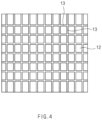
- FIG. 4 is a plan view illustrating further another example of the electrode manufactured by the apparatus for manufacturing the electrode according to Embodiment 1 of the present invention.
- an apparatus for manufacturing an electrode 10 according to Embodiment 1 of the present invention may include a pattern formation mechanism 110 that forms a pattern groove 13 in a coating part 12 of the electrode 10.
- the pattern formation mechanism 110 may be configured to form the pattern groove 13 in the electrode 10 including an electrode collector 11 and a coating part 12 made of an electrode active material applied on at least one surface of the electrode collector 11.
- the pattern formation mechanism 110 may be configured to form an intaglio pattern groove 13 in the coating part 12 by pressing a surface of the active material coating part 12.
- the pattern formation mechanism 110 may use ultrasonic vibration in the process of forming the pattern groove 13.
- the pattern groove 13 may be formed in the coating part 12 of the electrode 10 to structurally and forcibly form an ion path, thereby improving ion conductivity and reducing tortuosity so that output characteristics of the battery are realized at high output. If the electrode 10 in which the pattern groove 13 is formed is the electrode 10 of the battery having a high capacity due to a high density of the electrode 10, both two factors of the high capacity and the high output may be achieved through the apparatus for manufacturing the electrode 10 of the present invention.
- the pattern groove 13 is formed without using a means that generates heat such as a laser, even physical properties of the electrode collector (foil) 11 may not be changed by the heat in the process of forming the pattern groove 13, and thus, the electrode 10 may be stably manufactured.
- the pattern formation mechanism 110 may include a press tool 111.
- the press tool 111 may include a pressing plane 111-1 and a pressing protrusion 111-2.
- the pressing plane 111-1 may be a plane disposed to face the coating part 12, and the pressing protrusion 111-2 may be a protrusion protruding from the pressing plane 111-1 toward the coating part 12.
- the pressing protrusion 111-2 may press the coating part 12 to form the pattern groove 13 in the coating part 12.
- the pressing protrusion 111-2 may vibrate by ultrasonic waves when the pattern groove 13 is formed.
- a direction of the ultrasonic vibration of the pressing protrusion 111-2 is illustrated as reference symbol V in FIG. 1 .
- the press tool 111 itself may vibrate by the ultrasonic waves so that the pressing protrusion 111-2 vibrates by the ultrasonic waves, or only the pressing protrusion 111-2 may vibrate by the ultrasonic waves.
- the pattern groove 13 may be formed in the electrode 10 in a low pressure manner through the pattern formation mechanism 110.
- a low tortuosity cell (LTC) having reduced tortuosity may be manufactured.
- the density of the electrode 10 on the pattern surface may be locally lowered to improve the output characteristics.
- the pattern formation mechanism 110 of the apparatus for manufacturing the electrode 10 according to Embodiment 1 of the present invention may further include a lower support part 112 that supports the electrode 10 at a lower side of the electrode 10.
- the lower support part 112 may serve to support the electrode 10 at the lower side of the electrode 10 when the press tool 111 presses the electrode 10.
- the lower support part 112 may be fixed or may move slowly in a transport direction of the electrode 10. When the lower support part 112 moves, since the pattern groove 13 is formed in the coating part 12 of the electrode 10 while the electrode 10 is being transported, production efficiency may be improved.
- the pattern groove 13 formed in the coating part 12 of the electrode 10 by the apparatus for manufacturing the electrode 10 according to Embodiment 1 of the present invention is the electrode 10 may have at least one shape of a line type, a dot type, or a grid type in the plan view.
- FIG. 2 is a view illustrating the electrode 10 in which the pattern groove 13 is formed in the dot shape.
- FIG. 2(a) is a plan view
- FIG. 2(b) is a perspective view.
- small circular pattern grooves 13 may be arranged side by side in horizontal and vertical directions. This shape may be a regular shape.
- the cross-sectional shape may be formed like a shape in which a cone is turned upside down.
- FIG. 3 is a view illustrating the electrode 10 in which the pattern groove 13 is formed in the line shape.
- FIG. 3(a) is a plan view
- FIG. 3(b) is a perspective view.
- lines may be arranged in the vertical direction.
- the plurality of vertical lines may be formed to be spaced a predetermined interval from each other.
- This shape may be a regular shape.
- the cross-sectional shape may be formed like a shape in which a triangle is turned upside down.
- FIG. 4 is a view illustrating the electrode 10 in which the pattern groove 13 is formed in the grid shape.
- lines may be arranged in the vertical and horizontal directions.
- the vertical line and the horizontal line may have a shape that intersects each other, and in particular, may have a shape that intersects at 90 degrees.
- the plurality of vertical lines may be formed by being spaced a predetermined interval from each other, and the plurality of horizontal lines may also be formed by being spaced a predetermined interval from each other.
- This shape may be a regular shape. That is, if the line type of FIG. 3 is a type in which only the vertical lines or horizontal lines are formed, the grid type of FIG. 4 may be a type in which both the vertical and horizontal lines are formed.
- the pattern groove 13 formed in the coating part 12 of the electrode 10 by the manufacturing apparatus of the electrode 10 according to Embodiment 1 of the present invention may have various shapes as described above.
- a wetting property of the electrolyte may be improved after the electrolyte is injected, and a surface area may be reduced during the lamination process for attaching the separator and the electrode 10, and thus, an applied pressure increases, and the lamination may be better.
- an impregnation property may be advantageous in order of the dot type, the line type, and the grid type.
- it may be advantageous in aspect of an amount of loading of the electrode active material in a reverse order, i.e., in order of the grid type, the line type, and the dot type. In this case, an effect of increasing in output characteristic when compared to a loss of the electrode 10 may also be advantageous.
- the electrode 10 in which the pattern groove 13 is formed by the apparatus for manufacturing the electrode 10 according to Embodiment 1 of the present invention may be a positive electrode or a negative electrode.
- the pattern groove 13 is formed in the positive electrode 10
- greater force may be generated at a high output
- the pattern groove 13 is formed in the negative electrode 10
- an increase in fast charging performance may be expected.
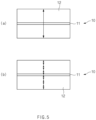
- FIG. 5 is a cross-sectional view comparing cutting of the electrode 10 when ultrasonic waves are not oscillated to cutting of the electrode 10 when the ultrasonic waves are oscillated, wherein FIG. 5(a) is a view when the ultrasonic waves are not oscillated, and FIG. 5(b) is a view when the ultrasonic waves are oscillated.
- FIG. 5 when external force is applied to cut the electrode 10 or to excavate a groove in the electrode 10, a form in which shock waves are transmitted into the electrode 10 is indicated by an arrow.
- FIG. 5(a) the ultrasonic waves are not oscillated, it is be seen that an impact of the cutting external force is transmitted at once over the entire thickness of the electrode 10, and thus a high pressure is applied to the electrode 10. In this case, a lot of deformation of the material may occur.
- FIG. 6 is a schematic cross-sectional view illustrating the entire apparatus for manufacturing the electrode 10 according to Embodiment 1 of the present invention.
- the apparatus for manufacturing the electrode 10 according to Embodiment 1 of the present invention may further include an unwinder 120, a transfer part 130, a coating part 12, a drying part 150, and a rolling part 160 and may further include a rewinder 170 to be disposed later.
- the unwinder 120 may have a roller shape on which the electrode collector 11 is wound.
- the unwinder 120 may unwind the electrode collector 11 to transport the electrode collector 11 by the transfer part 130.
- the transfer part 130 may receive the electrode collector 11 unwound from the unwinder 120 to transfer the electrode collector 11 up to the rewinder 170 via the coating part 12, the drying part 150, the rolling part 160, and the pattern formation mechanism 110.
- the transfer part 130 may be a roll.
- the electrode collector 11 may be transferred as a speed of 40 m/min to 80 m/min, specifically a speed of 60 m/min to 80 m/min by the transfer part 130.
- the transfer speed of the electrode collector 11 may be commercially meaningful when being satisfied in a speed range. If the transfer speed is out of the range to proceed too fast, there is a problem when performing each process. For example, application or drying of electrode active material slurry or rolling of the coating part 12 may not be performed properly. On the other hand, if proceeding at a too slow speed, it may not be preferable because a commercially meaningful manufacturing speed of the electrode 10 is not obtained.
- the electrode collector 11 unwound from the unwinder 120 and transferred by the transfer part 130 is transferred to a coater 140 by the transfer part 130.
- the coater 140 forms the coating part 12 by applying the electrode active material slurry on at least one surface of the electrode collector 11.
- the coater 140 is not limited as long as it may apply the electrode active material slurry, and the electrode active material slurry may be applied by a conventionally known coating device such as a coating die 141, a coating roll, or a slide-slot, but in FIG. 6 , as an example, a structure in which the electrode active material slurry is applied through the coating die 141 is illustrated.
- the coater 140 may have a structure including the coating die 141 provided with an outlet slot so that the electrode active material slurry flows out toward the electrode collector 11, and a coater roll 142 that is disposed to be spaced a predetermined interval from the outlet slot of the die and transports the electrode collector 11 by rotation so that the electrode active material slurry is applied to the electrode collector 11 by the coating die 141.
- the electrode collector 11 coated with the electrode active material slurry may be transferred to the drying part 150 by the transfer part 130.
- the drying part 150 is not limited as long as it is a device capable of drying the coating part 12 by evaporating a solvent from the electrode active material slurry and may have any conventionally known structure.
- the dried coating part 12 in the form of the evaporation of the solvent may be formed on the electrode collector 11, and the coating part 12 may be rolled to have a proper porosity and a proper density of the electrode 10 through the rolling part 160.
- the rolling part 160 is not limited in its device, structure, etc., as long as it has a form capable of rolling the coating unit 12, but, for example, the rolling part 160 may have a form of being rolled by adjusting an interval between a pair of rolling rollers 161.
- the pattern formation mechanism 110 may press the coating part 12 via the rolling part 160 through the ultrasonic vibration to form the pattern groove 13 in the coating part 12.
- the apparatus for manufacturing the electrode 10 according to Embodiment 1 of the present invention may further include a rewinder 170 disposed behind the pattern formation mechanism 110.
- the rewinder 170 may have a roller-shaped configuration that rewinds the electrode 10, in which the pattern groove 13 is formed in the coating part 12 by the pattern formation mechanism 110, in the form of a roll.
- the rewinder 170 may have the same or similar shape as the unwinder 120.
- FIG. 7 is a cross-sectional view illustrating a pattern formation mechanism of an apparatus for manufacturing an electrode according to Embodiment 2 of the present invention.
- Embodiment 2 of the present invention is different from Embodiment 1 in that a pattern groove is formed in an electrode by using a roller tool 211 instead of the press tool.
- Embodiment 1 The contents that are duplicated with Embodiment 1 will be omitted as much as possible, and Embodiment 2 will be described with a focus on the differences. That is, it is obvious that the contents that are not described in Embodiment 2 may be regarded as the contents of Embodiment 1 if necessary.
- a pattern formation mechanism 210 of the apparatus for manufacturing an electrode according to Embodiment 2 of the present invention may include a roller tool 211.
- the roller tool 211 may include a rotation body 211-1 and a pressing protrusion 211-2.
- the rotation body 211-1 may be disposed to rotate by a predetermined distance from a coating part of the electrode. Also, the pressing protrusion 211-2 may have a protrusion shape protruding from an outer circumferential surface of the rotation body 211-1.
- the pressing protrusion 211-2 may be configured to form a pattern groove by pressing the coating part when the rotation body 211-1 rotates.
- the pressing protrusion 211-2 may vibrate by ultrasonic waves when the pattern groove is formed.
- a direction of the ultrasonic vibration of the pressing protrusion 211-2 is illustrated as reference symbol V in FIG. 7 .
- the roller tool 211 itself may vibrate by the ultrasonic waves so that the pressing protrusion 211-2 vibrates by the ultrasonic waves, or only the pressing protrusion 211-2 may vibrate by the ultrasonic waves.
- the pattern groove may be formed in the electrode in a low pressure manner through the pattern formation mechanism 210.
- a low tortuosity cell (LTC) having reduced tortuosity may be manufactured.
- the density of the electrode on the pattern surface may be locally lowered to improve the output characteristics.
- the pattern formation mechanism 210 of the apparatus for manufacturing the electrode according to Embodiment 1 of the present invention may further include a lower support part 212 that supports the electrode at a lower side of the electrode.
- the lower support part 212 may serve to support the electrode at a lower portion of the electrode when the roller tool 211 presses the electrode.
- the lower support part 212 may support the electrode on the lower portion of the electrode and may move in a direction F from one side to the other side with respect to the rotation body 211-1. In this case, the lower support part 212 may move in synchronization with a rotation speed of the rotation body 211-1.
- the lower support part 212 may be fixed as necessary, but it may be more efficient if the lower support part 212 is moving rather than being fixed. When the lower support part 212 moves, a pattern groove may be formed in the coating part of the electrode while the electrode is being transferred, thereby improvising production efficiency.
- FIG. 8 is a cross-sectional view illustrating a pattern formation mechanism of an apparatus for manufacturing an electrode according to Embodiment 3 of the present invention.
- the third embodiment of the present invention is different from the second embodiment in that a pattern groove is formed in an electrode by using an ultrasonically vibrating lower support part.
- Embodiments 1 and 2 The contents that are duplicated with Embodiments 1 and 2 will be omitted as much as possible, and Embodiment 3 will be described with a focus on the differences. That is, it is obvious that the contents that are not described in Embodiment 3 may be regarded as the contents of Embodiments 1 and 2 if necessary.
- a pattern formation mechanism 310 of the apparatus for manufacturing an electrode according to Embodiment 3 of the present invention may include a roller tool 312 and a lower support part 312.
- the roller tool 311 may include a rotation body 311-1 and a pressing protrusion 311-2.
- the rotation body 311-1 may be disposed to rotate by a predetermined distance from a coating part of the electrode.
- the pressing protrusion 311-2 may have a protrusion shape protruding from an outer circumferential surface of the rotation body 311-1.
- the pressing protrusion 311-2 may be configured to form a pattern groove by pressing the coating part when the rotation body 311-1 rotates.
- the lower support part 312 may be a member that supports the electrode on the lower portion of the electrode and moves in a direction F from one side to the other side with respect to the rotation body 311-1.
- the lower support part 312 may be fixed as necessary, but it may be more efficient if the lower support part 212 is moving rather than being fixed.
- a lower support part 312 may rotate by ultrasonic waves when the pressing protrusion 311-2 forms a pattern groove in a coating part. That is, in Embodiment 2, if the pressing protrusion 311-2 vibrates by the ultrasonic waves, but in Embodiment 3, the lower support part 312 vibrates by the ultrasonic waves. A direction of the ultrasonic vibration of the lower support part 312 is illustrated as reference symbol V in FIG. 8 .
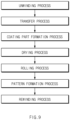
- FIG. 9 is a diagram illustrating each of processes in a method for manufacturing an electrode according to Embodiment 4 of the present invention.
- Embodiment 4 of the present invention is different from Embodiments 1 to 3 in that it relates to a method for manufacturing an electrode.
- Embodiments 1 to 3 The contents that are duplicated with Embodiments 1 to 3 will be omitted as much as possible, and Embodiment 4 will be described with a focus on the differences. That is, it is obvious that the contents that are not described in Embodiment 4 may be regarded as the contents of Embodiments 1 to 3 if necessary.
- the method for manufacturing an electrode according to Embodiment 4 of the present invention may include an unwinding process, a transfer process, a coating part formation process, a drying process, a rolling process, a pattern formation process, and a rewinding process.
- the unwinding process may be a process in which a roll-shaped electrode collector is unwound in an unwinder.
- the transfer process may be a process in which the unwound electrode collector is transferred.
- the coating part formation process may be a process of forming a coating part by applying an electrode active material to at least one surface of the transferred electrode collector.
- the drying process may be a process of drying the coating part of the electrode.
- the rolling process may be a process of rolling the coating part passing through the drying process.
- the pattern formation process may be a process of forming a pattern groove in the coating part by pressing the coating part that undergoes the rolling process through ultrasonic vibration.
- the rewinding process may be a process of rewinding the electrode having the pattern groove formed in the coating part by the pattern formation process.
- the pattern formation process may be, specifically, a process of forming the pattern groove in the electrode including the electrode collector and the coating part made of the electrode active material applied on at least one surface of the electrode collector and pressing a surface of the coating part to form an intaglio pattern groove in the coating part.
- the pattern formation process may be performed using the ultrasonic vibration in the pattern groove formation process.
- the pattern groove When ultrasonic vibration is applied to the applied electrode or the dried or rolled electrode, the pattern groove may be formed in the electrode in a low-pressure manner through the pattern formation mechanism.
- a low tortuosity cell (LTC) having reduced tortuosity may be manufactured. This means that output characteristics are improved because an electrode density on a surface of the pattern groove does not increase locally.
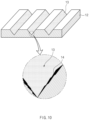
- FIG. 10 is a perspective view and partially enlarged view illustrating the electrode manufactured through the apparatus for manufacturing the electrode according to an embodiment of the present invention.
- Embodiment 5 of the present invention is different from Embodiments 1 to 4 in that it relates to an electrode manufactured according to the preceding embodiments.
- Embodiments 1 to 4 The contents that are duplicated with Embodiments 1 to 4 will be omitted as much as possible, and Embodiment 5 will be described with a focus on the differences. That is, it is obvious that the contents that are not described in Embodiment 5 may be regarded as the contents of Embodiments 1 to 4 if necessary.
- an electrode 10 according to Embodiment 5 of the present invention includes an electrode collector 11 and a coating part 12 made of an electrode active material applied on at least one surface of the electrode collector 11, and an intaglio pattern groove 13 is formed in the coating part 12. Also, traces 14 generated by ultrasonic vibration of a mechanism forming the pattern groove 13 may be formed on an inner wall of the pattern groove 13.
- the trace 14 of the ultrasonic vibration may include at least one of an uneven shape, a stepped stair shape, a wave pattern shape, or a zigzag shape in a cross-sectional view.
- the density of the electrode on the pattern surface may be lowered to improve the output characteristics.
- the pattern groove 13 may have at least one shape of a line type, a dot type, or a grid type in a plan view. Specific advantages and descriptions of the case, in which the pattern groove 13 has the line shape, the dot shape, or the grid shape in the plan view, have been described in detail in the foregoing embodiment 1, and thus, detailed descriptions will be omitted in Embodiment 5.
Landscapes
- Engineering & Computer Science (AREA)
- Chemical & Material Sciences (AREA)
- Manufacturing & Machinery (AREA)
- Chemical Kinetics & Catalysis (AREA)
- Electrochemistry (AREA)
- General Chemical & Material Sciences (AREA)
- Materials Engineering (AREA)
- Battery Electrode And Active Subsutance (AREA)
Abstract
Description
- The present application claims the benefit of the priority of
Korean Patent Application No. 10-2021-0058201, filed on May 04, 2021 - The present invention relates to an apparatus for manufacturing an electrode, a method for manufacturing the electrode, and the electrode manufactured thereby, and more particularly, to an apparatus for manufacturing an electrode, in which an ion path is structurally forcibly formed in an electrode including a positive electrode or a negative electrode in a battery having a high capacity due to high electrode density to improve ion conductivity and reduce tortuosity, thereby realizing an high output even battery output characteristics and preventing an electrode collector (foil) from being changed in physical property due to heat in the above processes so that the electrode is stable, a method for manufacturing the electrode, and the electrode manufactured thereby.
- In recent years, the price of energy sources increases due to the depletion of fossil fuels, the interest in environmental pollution is amplified, and the demand for eco-friendly alternative energy sources is becoming an indispensable factor for future life. Accordingly, studies on various power generation technologies such as solar power, wind power, and tidal power are continuing, and power storage devices such as batteries for more efficiently using the generated electrical energy are also of great interest.
- Furthermore, as technology development and demand for electronic mobile devices and electric vehicles using batteries increase, the demands for batteries as energy sources are rapidly increasing. Thus, many studies on batteries which are capable of meeting various demands have been conducted.
- In particular, in terms of materials, there is a high demand for lithium secondary batteries such as lithium ion batteries and lithium ion polymer batteries having advantages such as high energy density, discharge voltage, and output stability.
- In addition, as interest in environmental problems grows, a lot of studies is being conducted on electric vehicles and hybrid electric vehicles that are capable of replacing vehicles that use fossil fuels such as gasoline and diesel vehicles, which are one of the main causes of air pollution. Research and application of lithium secondary batteries with high energy density and discharge voltage as power sources for electric vehicles and hybrid electric vehicles are being actively conducted.
- As described above, as demands for the lithium secondary batteries rapidly increase, and the usage time of the secondary batteries increases, the capacity of the secondary batteries increases, and the electrode density also increases. However, when the electrode density increases as the battery capacity increases, porosity decreases, and tortuosity increases to increase in lithium ion movement path, thereby decreasing in ion conductivity, and as a result, the output characteristics decrease. That is, in the secondary battery, the battery capacity and battery output are generally in a trade-off relationship.
- However, as an area on which lithium ion secondary batteries are used increases, both factors of the high capacity and high output have to be considered, and thus, it is necessary to develop a battery capable of realizing a high output by forcibly increasing in ion conductivity.
- As described above, when the electrode density is high, the porosity decreases, and the tortuosity also increases, and thus, the lithium ion path increases, and the ion conductivity also decreases. Thus, there is a need for methods for improving the output characteristics by forming a structural and forcible ion path to improve the ion conductivity.
- There may be a method of forming a pattern that improves the ion conductivity by reducing the ion path with a laser, but it is difficult to be applied to the positive electrode when forming a laser pattern, and there is a problem due to a possibility that the physical properties of the electrode foil are changed due to high heat.
- The present invention has been devised to solve the above problems, and an object of the present invention is to an apparatus for manufacturing an electrode, in which an ion path is structurally forcibly formed in an electrode including a positive electrode or a negative electrode in a battery having a high capacity due to high electrode density to improve ion conductivity and reduce tortuosity, thereby realizing an high output even battery output characteristics and preventing an electrode collector (foil) from being changed in physical property due to heat in the above processes so that the electrode is stable, a method for manufacturing the electrode, and the electrode manufactured thereby.
- An apparatus for manufacturing an electrode according to the present invention includes a pattern formation mechanism configured to form a pattern groove in an electrode comprising an electrode collector and a coating part made of an electrode active material applied on at least one surface of the electrode collector, wherein the pattern formation mechanism presses a surface of the coating part to form an intaglio pattern groove in the coating part.
- The pattern formation mechanism may use ultrasonic vibration in a process of forming the pattern groove.
- The pattern groove may have at least one shape of a line type, a dot type, or a grid type in a plan view of the electrode.
- The pattern formation mechanism may include a press tool having a pressing plane that is a plane disposed to face the coating part and a pressing protrusion protruding from the pressing plane toward the coating part, wherein the pressing protrusion may press the coating part to form the pattern groove, and the pressing protrusion may vibrate by the ultrasonic waves when forming the pattern groove.
- The pattern formation mechanism may further include a lower support part configured to support the electrode at a lower portion of the electrode.
- The pattern formation mechanism may include a roller tool having a rotation body rotating at a position spaced a predetermined distance from the coating part and a pressing protrusion protruding from an outer circumferential surface of the rotation body, wherein the pressing protrusion may press the coating part when the rotation body rotates to form the pattern groove, and the pressing protrusion may vibrate by the ultrasonic waves when forming the pattern groove.
- The pattern formation mechanism may further include a lower support part configured to support the electrode at a lower portion of the electrode and moving in a direction from one side to the other side with respect to the rotation body.
- The pattern formation mechanism may include a roller tool having a rotation body rotating at a position spaced a predetermined distance from the coating part and a pressing protrusion protruding from an outer circumferential surface of the rotation body, and a lower support part configured to support the electrode at a lower portion of the electrode and moving in a direction from one side to the other side with respect to the rotation body, wherein the pressing protrusion may press the coating part when the rotation body rotates to form the pattern groove, and the lower support part may vibrate by the ultrasonic waves when the pressing protrusion forms the pattern groove in the coating part.
- The apparatus may further include a roller-shaped unwinder around which the electrode collector is wound, a transfer part configured to transfer the electrode collector unwound from the unwinder, a coater configured to apply an electrode active material on at least one surface of the electrode collector transferred by the transfer part to form a coating part, a drying part configured to dry the coating part through a drying mechanism, and a rolling part configured to roll the coating part via the drying part through a pair of rollers, wherein the pattern formation mechanism may press the coating part passing through the rolling part through the ultrasonic vibration to form the pattern groove in the coating part.
- The apparatus may further include a roller-shaped rewinder configured to rewind the electrode in which the pattern groove is formed in the coating part by the pattern formation mechanism.
- A method for manufacturing an electrode may include a pattern formation process of forming a pattern groove in an electrode comprising an electrode collector and a coating part made of an electrode active material applied on at least one surface of the electrode collector, wherein the pattern formation process may include a process of pressing a surface of the coating part to form an intaglio pattern groove in the coating part.
- In the pattern formation process, ultrasonic vibration may be used in the process of forming the pattern groove.
- The apparatus may further include an unwinding process of unwinding a roll-shaped electrode collector; a transfer process of transferring the unwound electrode collector; a coating part formation process of applying an electrode active material on at least one surface of the electrode collector being transferred to form the coating part; a drying process of drying the coating part; and a rolling process of rolling the coating part that undergoes the drying process, wherein the pattern formation process may include a process of pressing the coating part that undergoes the rolling process through ultrasonic waves to form the pattern groove in the coating part.
- The apparatus may further include a rewinding process of rewinding the electrode in which the pattern groove is formed in the coating part in the pattern formation process.
- An electrode may include: an electrode collector; and a coating part made of an electrode active material applied on at least one surface of the electrode collector, wherein an intaglio pattern groove may be formed in the coating part, and a trace generated by ultrasonic vibration of a mechanism configured to form the pattern groove may be formed on an inner wall of the pattern groove.
- The trace may include at least one of an uneven shape, a stepped stair shape, a wave pattern shape, or a zigzag shape in a cross-sectional view.
- The pattern groove may have at least one shape of a line type, a dot type, or a grid type in a plan view.
- In the apparatus for manufacturing the electrode, the method for manufacturing the electrode, and the electrode manufactured thereby according to the present invention, the ion path may be structurally forcibly formed in the electrode including the positive electrode or the negative electrode in the battery having the high capacity due to the high electrode density to improve the ion conductivity and reduce the tortuosity, thereby realizing the high output even the battery output characteristics and preventing the electrode collector (foil) from being changed in physical property due to the heat in the above processes so that the electrode is stable.
-
-
FIG. 1 is a cross-sectional view illustrating a pattern formation mechanism of an apparatus for manufacturing an electrode according to Embodiment 1 of the present invention. -
FIG. 2 is a view illustrating an example of an electrode manufactured by the apparatus for manufacturing the electrode according to Embodiment 1 of the present invention, whereinFIG. 2(a) is a plan view, andFIG. 2(b) is a perspective view. -
FIG. 3 is a view illustrating another example of the electrode manufactured by the apparatus for manufacturing the electrode according to Embodiment 1 of the present invention, whereinFIG. 3(a) is a plan view, andFIG. 3(b) is a perspective view. -
FIG. 4 is a plan view illustrating further another example of the electrode manufactured by the apparatus for manufacturing the electrode according to Embodiment 1 of the present invention. -
FIG. 5 is a cross-sectional view comparing cutting of the electrode when ultrasonic waves are not oscillated to cutting of the electrode when the ultrasonic waves are oscillated, whereinFIG. 5(a) is a view when the ultrasonic waves are not oscillated, andFIG. 5(b) is a view when the ultrasonic waves are oscillated. -
FIG. 6 is a schematic cross-sectional view illustrating the entire apparatus for manufacturing the electrode according to Embodiment 1 of the present invention. -
FIG. 7 is a cross-sectional view illustrating a pattern formation mechanism of an apparatus for manufacturing an electrode according to Embodiment 2 of the present invention. -
FIG. 8 is a cross-sectional view illustrating a pattern formation mechanism of an apparatus for manufacturing an electrode according to Embodiment 3 of the present invention. -
FIG. 9 is a diagram illustrating each of processes in a method for manufacturing an electrode according to Embodiment 4 of the present invention. -
FIG. 10 is a perspective view and partially enlarged view illustrating the electrode manufactured through the apparatus for manufacturing the electrode according to an embodiment of the present invention. - Hereinafter, preferred embodiments of the present invention will be described in detail with reference to the accompanying drawings so that those of ordinary skill in the art can easily carry out the present invention. However, the present invention may be implemented in several different forms and is not limited or restricted by the following examples.
- In order to clearly explain the present invention, detailed descriptions of portions that are irrelevant to the description or related known technologies that may unnecessarily obscure the gist of the present invention have been omitted, and in the present specification, reference symbols are added to components in each drawing. In this case, the same or similar reference numerals are assigned to the same or similar elements throughout the specification.
- Also, terms or words used in this specification and claims should not be restrictively interpreted as ordinary meanings or dictionary-based meanings, but should be interpreted as meanings and concepts conforming to the scope of the present invention on the basis of the principle that an inventor can properly define the concept of a term to describe and explain his or her invention in the best ways.
-
FIG. 1 is a cross-sectional view illustrating a pattern formation mechanism of an apparatus for manufacturing an electrode according to Embodiment 1 of the present invention.FIG. 2 is a view illustrating an example of an electrode manufactured by the apparatus for manufacturing the electrode according to Embodiment 1 of the present invention, whereinFIG. 2(a) is a plan view, andFIG. 2(b) is a perspective view.FIG. 3 is a view illustrating another example of the electrode manufactured by the apparatus for manufacturing the electrode according to Embodiment 1 of the present invention, whereinFIG. 3(a) is a plan view, andFIG. 3(b) is a perspective view.FIG. 4 is a plan view illustrating further another example of the electrode manufactured by the apparatus for manufacturing the electrode according to Embodiment 1 of the present invention. - Referring to
FIG. 1 , an apparatus for manufacturing anelectrode 10 according to Embodiment 1 of the present invention may include apattern formation mechanism 110 that forms apattern groove 13 in acoating part 12 of theelectrode 10. Specifically, thepattern formation mechanism 110 may be configured to form thepattern groove 13 in theelectrode 10 including anelectrode collector 11 and acoating part 12 made of an electrode active material applied on at least one surface of theelectrode collector 11. Thepattern formation mechanism 110 may be configured to form anintaglio pattern groove 13 in thecoating part 12 by pressing a surface of the activematerial coating part 12. In addition, thepattern formation mechanism 110 may use ultrasonic vibration in the process of forming thepattern groove 13. - In the apparatus for manufacturing the
electrode 10 according to Embodiment 1 of the present invention, as described above, thepattern groove 13 may be formed in thecoating part 12 of theelectrode 10 to structurally and forcibly form an ion path, thereby improving ion conductivity and reducing tortuosity so that output characteristics of the battery are realized at high output. If theelectrode 10 in which thepattern groove 13 is formed is theelectrode 10 of the battery having a high capacity due to a high density of theelectrode 10, both two factors of the high capacity and the high output may be achieved through the apparatus for manufacturing theelectrode 10 of the present invention. - In addition, in the apparatus for manufacturing the
electrode 10 according to Embodiment 1 of the present invention, since thepattern groove 13 is formed without using a means that generates heat such as a laser, even physical properties of the electrode collector (foil) 11 may not be changed by the heat in the process of forming thepattern groove 13, and thus, theelectrode 10 may be stably manufactured. - Referring to
FIG. 1 , thepattern formation mechanism 110 may include apress tool 111. In addition, thepress tool 111 may include a pressing plane 111-1 and a pressing protrusion 111-2. The pressing plane 111-1 may be a plane disposed to face thecoating part 12, and the pressing protrusion 111-2 may be a protrusion protruding from the pressing plane 111-1 toward thecoating part 12. Also, when thepress tool 111 moves in a direction of theelectrode 10, the pressing plane 111-1 and the pressing protrusion 111-2 approach theelectrode 10. Here, the pressing protrusion 111-2 may press thecoating part 12 to form thepattern groove 13 in thecoating part 12. In addition, in the apparatus for manufacturing theelectrode 10 according to Embodiment 1 of the present invention, the pressing protrusion 111-2 may vibrate by ultrasonic waves when thepattern groove 13 is formed. A direction of the ultrasonic vibration of the pressing protrusion 111-2 is illustrated as reference symbol V inFIG. 1 . - In this case, the
press tool 111 itself may vibrate by the ultrasonic waves so that the pressing protrusion 111-2 vibrates by the ultrasonic waves, or only the pressing protrusion 111-2 may vibrate by the ultrasonic waves. - When the ultrasonic vibration is applied to the applied
electrode 10 or the dried or rolledelectrode 10, thepattern groove 13 may be formed in theelectrode 10 in a low pressure manner through thepattern formation mechanism 110. In this case, a low tortuosity cell (LTC) having reduced tortuosity may be manufactured. - That is, when the pattern is formed by the ultrasonic waves, since a pressure applied to the
electrode 10 is reduced due to the ultrasonic wave, unlike when the pattern is formed by the rolling (simple press), the density of theelectrode 10 on the pattern surface may be locally lowered to improve the output characteristics. - In addition, the
pattern formation mechanism 110 of the apparatus for manufacturing theelectrode 10 according to Embodiment 1 of the present invention may further include alower support part 112 that supports theelectrode 10 at a lower side of theelectrode 10. Thelower support part 112 may serve to support theelectrode 10 at the lower side of theelectrode 10 when thepress tool 111 presses theelectrode 10. Thelower support part 112 may be fixed or may move slowly in a transport direction of theelectrode 10. When thelower support part 112 moves, since thepattern groove 13 is formed in thecoating part 12 of theelectrode 10 while theelectrode 10 is being transported, production efficiency may be improved. - Referring to
FIGS. 2 to 4 , thepattern groove 13 formed in thecoating part 12 of theelectrode 10 by the apparatus for manufacturing theelectrode 10 according to Embodiment 1 of the present invention is theelectrode 10 may have at least one shape of a line type, a dot type, or a grid type in the plan view. -
FIG. 2 is a view illustrating theelectrode 10 in which thepattern groove 13 is formed in the dot shape.FIG. 2(a) is a plan view, andFIG. 2(b) is a perspective view. In the plan view ofFIG. 2(a) , smallcircular pattern grooves 13 may be arranged side by side in horizontal and vertical directions. This shape may be a regular shape. In addition, in the cross-sectional view of thepattern groove 13 illustrated inFIG. 2(b) , the cross-sectional shape may be formed like a shape in which a cone is turned upside down. -
FIG. 3 is a view illustrating theelectrode 10 in which thepattern groove 13 is formed in the line shape.FIG. 3(a) is a plan view, andFIG. 3(b) is a perspective view. In the plan view ofFIG. 3A , lines may be arranged in the vertical direction. The plurality of vertical lines may be formed to be spaced a predetermined interval from each other. This shape may be a regular shape. In addition, in the cross-sectional view of thepattern groove 13 illustrated inFIG. 3(b) , the cross-sectional shape may be formed like a shape in which a triangle is turned upside down. -
FIG. 4 is a view illustrating theelectrode 10 in which thepattern groove 13 is formed in the grid shape. In the plan view, lines may be arranged in the vertical and horizontal directions. The vertical line and the horizontal line may have a shape that intersects each other, and in particular, may have a shape that intersects at 90 degrees. In addition, the plurality of vertical lines may be formed by being spaced a predetermined interval from each other, and the plurality of horizontal lines may also be formed by being spaced a predetermined interval from each other. This shape may be a regular shape. That is, if the line type ofFIG. 3 is a type in which only the vertical lines or horizontal lines are formed, the grid type ofFIG. 4 may be a type in which both the vertical and horizontal lines are formed. - The
pattern groove 13 formed in thecoating part 12 of theelectrode 10 by the manufacturing apparatus of theelectrode 10 according to Embodiment 1 of the present invention may have various shapes as described above. When thepattern groove 13 is formed in this manner, a wetting property of the electrolyte may be improved after the electrolyte is injected, and a surface area may be reduced during the lamination process for attaching the separator and theelectrode 10, and thus, an applied pressure increases, and the lamination may be better. - In addition, an impregnation property may be advantageous in order of the dot type, the line type, and the grid type. Also, it may be advantageous in aspect of an amount of loading of the electrode active material in a reverse order, i.e., in order of the grid type, the line type, and the dot type. In this case, an effect of increasing in output characteristic when compared to a loss of the
electrode 10 may also be advantageous. - The
electrode 10 in which thepattern groove 13 is formed by the apparatus for manufacturing theelectrode 10 according to Embodiment 1 of the present invention may be a positive electrode or a negative electrode. When thepattern groove 13 is formed in thepositive electrode 10, greater force may be generated at a high output, and when thepattern groove 13 is formed in thenegative electrode 10, an increase in fast charging performance may be expected. -
FIG. 5 is a cross-sectional view comparing cutting of theelectrode 10 when ultrasonic waves are not oscillated to cutting of theelectrode 10 when the ultrasonic waves are oscillated, whereinFIG. 5(a) is a view when the ultrasonic waves are not oscillated, andFIG. 5(b) is a view when the ultrasonic waves are oscillated. - Referring to
FIG. 5 , when external force is applied to cut theelectrode 10 or to excavate a groove in theelectrode 10, a form in which shock waves are transmitted into theelectrode 10 is indicated by an arrow. Referring toFIG. 5(a) , the ultrasonic waves are not oscillated, it is be seen that an impact of the cutting external force is transmitted at once over the entire thickness of theelectrode 10, and thus a high pressure is applied to theelectrode 10. In this case, a lot of deformation of the material may occur. Referring toFIG. 5(b) , which illustrates a state in which the ultrasonic waves are oscillated, it is seen that the impact of the cutting external force is not transmitted over the entire thickness of theelectrode 10 at once, but is divided into a plurality of short regions, and a small pressure is applied to each of the regions. In this case, the deformation of the material may be maintained to be minimized. -
FIG. 6 is a schematic cross-sectional view illustrating the entire apparatus for manufacturing theelectrode 10 according to Embodiment 1 of the present invention. - Referring to
FIG. 6 , the apparatus for manufacturing theelectrode 10 according to Embodiment 1 of the present invention may further include anunwinder 120, atransfer part 130, acoating part 12, a dryingpart 150, and arolling part 160 and may further include arewinder 170 to be disposed later. - Referring to
FIG. 6 , theunwinder 120 may have a roller shape on which theelectrode collector 11 is wound. Theunwinder 120 may unwind theelectrode collector 11 to transport theelectrode collector 11 by thetransfer part 130. - The
transfer part 130 may receive theelectrode collector 11 unwound from theunwinder 120 to transfer theelectrode collector 11 up to therewinder 170 via thecoating part 12, the dryingpart 150, the rollingpart 160, and thepattern formation mechanism 110. - Here, the
transfer part 130 may be a roll. Theelectrode collector 11 may be transferred as a speed of 40 m/min to 80 m/min, specifically a speed of 60 m/min to 80 m/min by thetransfer part 130. - The transfer speed of the
electrode collector 11 may be commercially meaningful when being satisfied in a speed range. If the transfer speed is out of the range to proceed too fast, there is a problem when performing each process. For example, application or drying of electrode active material slurry or rolling of thecoating part 12 may not be performed properly. On the other hand, if proceeding at a too slow speed, it may not be preferable because a commercially meaningful manufacturing speed of theelectrode 10 is not obtained. - Next, the
electrode collector 11 unwound from theunwinder 120 and transferred by thetransfer part 130 is transferred to acoater 140 by thetransfer part 130. Thecoater 140 forms thecoating part 12 by applying the electrode active material slurry on at least one surface of theelectrode collector 11. Here, thecoater 140 is not limited as long as it may apply the electrode active material slurry, and the electrode active material slurry may be applied by a conventionally known coating device such as acoating die 141, a coating roll, or a slide-slot, but inFIG. 6 , as an example, a structure in which the electrode active material slurry is applied through the coating die 141 is illustrated. - Specifically, the
coater 140 may have a structure including the coating die 141 provided with an outlet slot so that the electrode active material slurry flows out toward theelectrode collector 11, and acoater roll 142 that is disposed to be spaced a predetermined interval from the outlet slot of the die and transports theelectrode collector 11 by rotation so that the electrode active material slurry is applied to theelectrode collector 11 by the coating die 141. - Thereafter, the
electrode collector 11 coated with the electrode active material slurry may be transferred to the dryingpart 150 by thetransfer part 130. - The drying
part 150 is not limited as long as it is a device capable of drying thecoating part 12 by evaporating a solvent from the electrode active material slurry and may have any conventionally known structure. - When passing through the drying
part 150, the driedcoating part 12 in the form of the evaporation of the solvent may be formed on theelectrode collector 11, and thecoating part 12 may be rolled to have a proper porosity and a proper density of theelectrode 10 through the rollingpart 160. - The rolling
part 160 is not limited in its device, structure, etc., as long as it has a form capable of rolling thecoating unit 12, but, for example, the rollingpart 160 may have a form of being rolled by adjusting an interval between a pair of rollingrollers 161. - Referring to
FIG. 6 , thepattern formation mechanism 110 may press thecoating part 12 via the rollingpart 160 through the ultrasonic vibration to form thepattern groove 13 in thecoating part 12. - In addition, the apparatus for manufacturing the
electrode 10 according to Embodiment 1 of the present invention may further include arewinder 170 disposed behind thepattern formation mechanism 110. Therewinder 170 may have a roller-shaped configuration that rewinds theelectrode 10, in which thepattern groove 13 is formed in thecoating part 12 by thepattern formation mechanism 110, in the form of a roll. Therewinder 170 may have the same or similar shape as theunwinder 120. -
FIG. 7 is a cross-sectional view illustrating a pattern formation mechanism of an apparatus for manufacturing an electrode according to Embodiment 2 of the present invention. - Embodiment 2 of the present invention is different from Embodiment 1 in that a pattern groove is formed in an electrode by using a
roller tool 211 instead of the press tool. - The contents that are duplicated with Embodiment 1 will be omitted as much as possible, and Embodiment 2 will be described with a focus on the differences. That is, it is obvious that the contents that are not described in Embodiment 2 may be regarded as the contents of Embodiment 1 if necessary.
- Referring to
FIG. 7 , apattern formation mechanism 210 of the apparatus for manufacturing an electrode according to Embodiment 2 of the present invention may include aroller tool 211. In addition, theroller tool 211 may include a rotation body 211-1 and a pressing protrusion 211-2. - The rotation body 211-1 may be disposed to rotate by a predetermined distance from a coating part of the electrode. Also, the pressing protrusion 211-2 may have a protrusion shape protruding from an outer circumferential surface of the rotation body 211-1.
- The pressing protrusion 211-2 may be configured to form a pattern groove by pressing the coating part when the rotation body 211-1 rotates. The pressing protrusion 211-2 may vibrate by ultrasonic waves when the pattern groove is formed. A direction of the ultrasonic vibration of the pressing protrusion 211-2 is illustrated as reference symbol V in
FIG. 7 . - In this case, the
roller tool 211 itself may vibrate by the ultrasonic waves so that the pressing protrusion 211-2 vibrates by the ultrasonic waves, or only the pressing protrusion 211-2 may vibrate by the ultrasonic waves. - When the ultrasonic vibration is applied to the applied electrode or the dried or rolled
electrode 10, the pattern groove may be formed in the electrode in a low pressure manner through thepattern formation mechanism 210. In this case, a low tortuosity cell (LTC) having reduced tortuosity may be manufactured. - That is, when the pattern is formed by the ultrasonic waves, since a pressure applied to the electrode is reduced due to the ultrasonic wave, unlike when the pattern is formed by the rolling (simple press), the density of the electrode on the pattern surface may be locally lowered to improve the output characteristics.
- In addition, the
pattern formation mechanism 210 of the apparatus for manufacturing the electrode according to Embodiment 1 of the present invention may further include alower support part 212 that supports the electrode at a lower side of the electrode. Thelower support part 212 may serve to support the electrode at a lower portion of the electrode when theroller tool 211 presses the electrode. - Also, the
lower support part 212 may support the electrode on the lower portion of the electrode and may move in a direction F from one side to the other side with respect to the rotation body 211-1. In this case, thelower support part 212 may move in synchronization with a rotation speed of the rotation body 211-1. Of course, thelower support part 212 may be fixed as necessary, but it may be more efficient if thelower support part 212 is moving rather than being fixed. When thelower support part 212 moves, a pattern groove may be formed in the coating part of the electrode while the electrode is being transferred, thereby improvising production efficiency. -
FIG. 8 is a cross-sectional view illustrating a pattern formation mechanism of an apparatus for manufacturing an electrode according to Embodiment 3 of the present invention. - The third embodiment of the present invention is different from the second embodiment in that a pattern groove is formed in an electrode by using an ultrasonically vibrating lower support part.
- The contents that are duplicated with Embodiments 1 and 2 will be omitted as much as possible, and Embodiment 3 will be described with a focus on the differences. That is, it is obvious that the contents that are not described in Embodiment 3 may be regarded as the contents of Embodiments 1 and 2 if necessary.
- Referring to
FIG. 8 , apattern formation mechanism 310 of the apparatus for manufacturing an electrode according to Embodiment 3 of the present invention may include aroller tool 312 and alower support part 312. In addition, theroller tool 311 may include a rotation body 311-1 and a pressing protrusion 311-2. - The rotation body 311-1 may be disposed to rotate by a predetermined distance from a coating part of the electrode. Also, the pressing protrusion 311-2 may have a protrusion shape protruding from an outer circumferential surface of the rotation body 311-1. The pressing protrusion 311-2 may be configured to form a pattern groove by pressing the coating part when the rotation body 311-1 rotates.
- The
lower support part 312 may be a member that supports the electrode on the lower portion of the electrode and moves in a direction F from one side to the other side with respect to the rotation body 311-1. Of course, thelower support part 312 may be fixed as necessary, but it may be more efficient if thelower support part 212 is moving rather than being fixed. - In addition, in the apparatus for manufacturing the electrode according to Embodiment 3 of the present invention, a
lower support part 312 may rotate by ultrasonic waves when the pressing protrusion 311-2 forms a pattern groove in a coating part. That is, in Embodiment 2, if the pressing protrusion 311-2 vibrates by the ultrasonic waves, but in Embodiment 3, thelower support part 312 vibrates by the ultrasonic waves. A direction of the ultrasonic vibration of thelower support part 312 is illustrated as reference symbol V inFIG. 8 . -
FIG. 9 is a diagram illustrating each of processes in a method for manufacturing an electrode according to Embodiment 4 of the present invention. - Embodiment 4 of the present invention is different from Embodiments 1 to 3 in that it relates to a method for manufacturing an electrode.
- The contents that are duplicated with Embodiments 1 to 3 will be omitted as much as possible, and Embodiment 4 will be described with a focus on the differences. That is, it is obvious that the contents that are not described in Embodiment 4 may be regarded as the contents of Embodiments 1 to 3 if necessary.
- Referring to
FIG. 9 , the method for manufacturing an electrode according to Embodiment 4 of the present invention may include an unwinding process, a transfer process, a coating part formation process, a drying process, a rolling process, a pattern formation process, and a rewinding process. - The unwinding process may be a process in which a roll-shaped electrode collector is unwound in an unwinder. The transfer process may be a process in which the unwound electrode collector is transferred. The coating part formation process may be a process of forming a coating part by applying an electrode active material to at least one surface of the transferred electrode collector. The drying process may be a process of drying the coating part of the electrode. The rolling process may be a process of rolling the coating part passing through the drying process. In addition, the pattern formation process may be a process of forming a pattern groove in the coating part by pressing the coating part that undergoes the rolling process through ultrasonic vibration. The rewinding process may be a process of rewinding the electrode having the pattern groove formed in the coating part by the pattern formation process.
- Among them, the pattern formation process may be, specifically, a process of forming the pattern groove in the electrode including the electrode collector and the coating part made of the electrode active material applied on at least one surface of the electrode collector and pressing a surface of the coating part to form an intaglio pattern groove in the coating part.
- In the method for manufacturing the electrode according to Embodiment 4 of the present invention, the pattern formation process may be performed using the ultrasonic vibration in the pattern groove formation process.
- When ultrasonic vibration is applied to the applied electrode or the dried or rolled electrode, the pattern groove may be formed in the electrode in a low-pressure manner through the pattern formation mechanism. In this case, a low tortuosity cell (LTC) having reduced tortuosity may be manufactured. This means that output characteristics are improved because an electrode density on a surface of the pattern groove does not increase locally.
-
FIG. 10 is a perspective view and partially enlarged view illustrating the electrode manufactured through the apparatus for manufacturing the electrode according to an embodiment of the present invention. - Embodiment 5 of the present invention is different from Embodiments 1 to 4 in that it relates to an electrode manufactured according to the preceding embodiments.
- The contents that are duplicated with Embodiments 1 to 4 will be omitted as much as possible, and Embodiment 5 will be described with a focus on the differences. That is, it is obvious that the contents that are not described in Embodiment 5 may be regarded as the contents of Embodiments 1 to 4 if necessary.
- Referring to
FIG. 10 , anelectrode 10 according to Embodiment 5 of the present invention includes anelectrode collector 11 and acoating part 12 made of an electrode active material applied on at least one surface of theelectrode collector 11, and anintaglio pattern groove 13 is formed in thecoating part 12. Also, traces 14 generated by ultrasonic vibration of a mechanism forming thepattern groove 13 may be formed on an inner wall of thepattern groove 13. - The
trace 14 of the ultrasonic vibration may include at least one of an uneven shape, a stepped stair shape, a wave pattern shape, or a zigzag shape in a cross-sectional view. - That is, when the pattern is formed by the ultrasonic waves, since a pressure applied to the electrode is reduced due to the ultrasonic wave, unlike when the pattern is formed by the rolling (simple press), the density of the electrode on the pattern surface may be lowered to improve the output characteristics.
- In the
electrode 10 according to Embodiment 5 of the present invention, thepattern groove 13 may have at least one shape of a line type, a dot type, or a grid type in a plan view. Specific advantages and descriptions of the case, in which thepattern groove 13 has the line shape, the dot shape, or the grid shape in the plan view, have been described in detail in the foregoing embodiment 1, and thus, detailed descriptions will be omitted in Embodiment 5. - While the embodiments of the present invention have been described with reference to the specific embodiments, it will be apparent to those skilled in the art that various changes and modifications may be made without departing from the spirit and scope of the invention as defined in the following claims.
-
- 10: Electrode
- 11: Electrode collector
- 12: Coating part
- 13: Pattern groove
- 14: Trace
- 110: Pattern formation mechanism
- 111: Press tool
- 111-1: Pressing plane
- 111-2: Pressing protrusion
- 112: Lower support part
- 120: Unwinder
- 130: Transfer part
- 140: Coater
- 141: Coating die
- 142: Coater roll
- 150: Drying part
- 160: Rolling part
- 161: Rolling roller
- 170: Rewinder
- 210: Pattern formation mechanism
- 211: Roller roll
- 211-1: Rotation body
- 211-2: Pressing protrusion
- 212: Lower support part
- 310: Pattern formation mechanism
- 311: Roller tool
- 311-1: Rotation body
- 311-2: Pressing protrusion
- 312: Lower support part
- V: Vibration direction of ultrasonic wave
Claims (17)
- An apparatus for manufacturing an electrode, the apparatus comprising:a pattern formation mechanism configured to form a pattern groove in an electrode comprising an electrode collector and a coating part made of an electrode active material applied on at least one surface of the electrode collector,wherein the pattern formation mechanism presses a surface of the coating part to form an intaglio pattern groove in the coating part.
- The apparatus of claim 1, wherein the pattern formation mechanism uses ultrasonic vibration in a process of forming the pattern groove.
- The apparatus of claim 2, wherein the pattern groove has at least one shape of a line type, a dot type, or a grid type in a plan view of the electrode.
- The apparatus of claim 1, wherein the pattern formation mechanism comprises a press tool having a pressing plane that is a plane disposed to face the coating part and a pressing protrusion protruding from the pressing plane toward the coating part,wherein the pressing protrusion presses the coating part to form the pattern groove, andthe pressing protrusion vibrates by the ultrasonic waves when forming the pattern groove.
- The apparatus of claim 4, wherein the pattern formation mechanism further comprises a lower support part configured to support the electrode at a lower portion of the electrode.
- The apparatus of claim 1, wherein the pattern formation mechanism comprises a roller tool having a rotation body rotating at a position spaced a predetermined distance from the coating part and a pressing protrusion protruding from an outer circumferential surface of the rotation body,wherein the pressing protrusion presses the coating part when the rotation body rotates to form the pattern groove, andthe pressing protrusion vibrates by the ultrasonic waves when forming the pattern groove.
- The apparatus of claim 6, wherein the pattern formation mechanism further comprises a lower support part configured to support the electrode at a lower portion of the electrode and moving in a direction from one side to the other side with respect to the rotation body.
- The apparatus of claim 1, wherein the pattern formation mechanism comprises:a roller tool having a rotation body rotating at a position spaced a predetermined distance from the coating part and a pressing protrusion protruding from an outer circumferential surface of the rotation body; anda lower support part configured to support the electrode at a lower portion of the electrode and moving in a direction from one side to the other side with respect to the rotation body,wherein the pressing protrusion presses the coating part when the rotation body rotates to form the pattern groove, andthe lower support part vibrates by the ultrasonic waves when the pressing protrusion forms the pattern groove in the coating part.
- The apparatus of claim 1, further comprising:a roller-shaped unwinder around which the electrode collector is wound;a transfer part configured to transfer the electrode collector unwound from the unwinder;a coater configured to apply an electrode active material on at least one surface of the electrode collector transferred by the transfer part to form a coating part;a drying part configured to dry the coating part through a drying mechanism; anda rolling part configured to roll the coating part via the drying part through a pair of rollers,wherein the pattern formation mechanism presses the coating part passing through the rolling part through the ultrasonic vibration to form the pattern groove in the coating part.
- The apparatus of claim 9, further comprising a roller-shaped rewinder configured to rewind the electrode in which the pattern groove is formed in the coating part by the pattern formation mechanism.
- A method for manufacturing an electrode, the method comprising:a pattern formation process of forming a pattern groove in an electrode comprising an electrode collector and a coating part made of an electrode active material applied on at least one surface of the electrode collector,wherein the pattern formation process comprises a process of pressing a surface of the coating part to form an intaglio pattern groove in the coating part.
- The apparatus of claim 11, wherein, in the pattern formation process, ultrasonic vibration is used in the process of forming the pattern groove.
- The apparatus of claim 11, further comprising:an unwinding process of unwinding a roll-shaped electrode collector;a transfer process of transferring the unwound electrode collector;a coating part formation process of applying an electrode active material on at least one surface of the electrode collector being transferred to form the coating part;a drying process of drying the coating part; anda rolling process of rolling the coating part that undergoes the drying process,wherein the pattern formation process comprises a process of pressing the coating part that undergoes the rolling process through ultrasonic waves to form the pattern groove in the coating part.
- The apparatus of claim 13, further comprising a rewinding process of rewinding the electrode in which the pattern groove is formed in the coating part in the pattern formation process.
- An electrode comprising:an electrode collector; anda coating part made of an electrode active material applied on at least one surface of the electrode collector,wherein an intaglio pattern groove is formed in the coating part, anda trace generated by ultrasonic vibration of a mechanism configured to form the pattern groove is formed on an inner wall of the pattern groove.
- The electrode of claim 15, wherein the trace comprises at least one of an uneven shape, a stepped stair shape, a wave pattern shape, or a zigzag shape in a cross-sectional view.
- The electrode of claim 15, wherein the pattern groove has at least one shape of a line type, a dot type, or a grid type in a plan view.
Applications Claiming Priority (2)
| Application Number | Priority Date | Filing Date | Title |
|---|---|---|---|
| KR1020210058201A KR102884061B1 (en) | 2021-05-04 | 2021-05-04 | Manufacturing apparatus of electrode, manufacturing method of electrode, and electrode manufactured by the same |
| PCT/KR2022/005745 WO2022234987A1 (en) | 2021-05-04 | 2022-04-21 | Electrode manufacturing apparatus, electrode manufacturing method, and electrode manufactured thereby |
Publications (2)
| Publication Number | Publication Date |
|---|---|
| EP4287288A1 true EP4287288A1 (en) | 2023-12-06 |
| EP4287288A4 EP4287288A4 (en) | 2025-03-19 |
Family
ID=83932275
Family Applications (1)
| Application Number | Title | Priority Date | Filing Date |
|---|---|---|---|
| EP22799032.2A Pending EP4287288A4 (en) | 2021-05-04 | 2022-04-21 | Electrode manufacturing apparatus, electrode manufacturing method, and electrode manufactured thereby |
Country Status (6)
| Country | Link |
|---|---|
| US (1) | US20250054936A1 (en) |
| EP (1) | EP4287288A4 (en) |
| JP (1) | JP7642963B2 (en) |
| KR (1) | KR102884061B1 (en) |
| CN (1) | CN116868360A (en) |
| WO (1) | WO2022234987A1 (en) |
Cited By (3)
| Publication number | Priority date | Publication date | Assignee | Title |
|---|---|---|---|---|
| EP4571857A1 (en) * | 2023-12-15 | 2025-06-18 | Customcells Holding GmbH | A system for treating a coating layer of an electrode |
| EP4576231A1 (en) * | 2023-12-18 | 2025-06-25 | Customcells Holding GmbH | A method of treating a coating layer of an electrode |
| EP4679516A1 (en) * | 2024-07-09 | 2026-01-14 | Samsung Sdi Co., Ltd. | An electrode, an electrode assembly, and a rechargeable battery including the same |
Families Citing this family (7)
| Publication number | Priority date | Publication date | Assignee | Title |
|---|---|---|---|---|
| US12533703B2 (en) * | 2020-11-11 | 2026-01-27 | Panasonic Intellectual Property Management Co., Ltd. | Electrode mixture slurry coating device |
| CN118555992A (en) * | 2022-08-16 | 2024-08-27 | 株式会社Lg新能源 | Ultrasonic welding device and ultrasonic welding system |
| KR20240177417A (en) | 2023-06-20 | 2024-12-27 | 주식회사 엘지에너지솔루션 | Manufacturing method for lithium secondary electrode and manufacturing apparatus therefor |
| KR20250053577A (en) * | 2023-10-13 | 2025-04-22 | 주식회사 엘지에너지솔루션 | Battery pressing system |
| KR20250061987A (en) * | 2023-10-30 | 2025-05-08 | 삼성에스디아이 주식회사 | Notching device and secondary battery electrode and secondary battery module by notching device |
| KR20250106393A (en) * | 2024-01-03 | 2025-07-10 | 에스케이온 주식회사 | Electrode sheet manufacturing apparatus, manufacturing method using the same, and electrode sheet manufactured thereby |
| WO2026043295A1 (en) * | 2024-08-21 | 2026-02-26 | 주식회사 엘지에너지솔루션 | Method for manufacturing secondary battery, and electrode |
Family Cites Families (13)
| Publication number | Priority date | Publication date | Assignee | Title |
|---|---|---|---|---|
| JP4023990B2 (en) * | 2000-08-30 | 2007-12-19 | 松下電器産業株式会社 | Method and apparatus for manufacturing battery electrode plate |
| JP4123192B2 (en) * | 2004-06-03 | 2008-07-23 | セイコーエプソン株式会社 | Ultrasonic transducer and method of manufacturing ultrasonic transducer |
| JP2010186736A (en) | 2009-01-13 | 2010-08-26 | Panasonic Corp | Anode plate for nonaqueous battery, electrode group for nonaqueous battery and its manufacturing method, and cylindrical nonaqueous secondary battery and its manufacturing method |
| JP4672079B2 (en) * | 2009-01-14 | 2011-04-20 | パナソニック株式会社 | Non-aqueous battery negative electrode plate, non-aqueous battery electrode group and manufacturing method thereof, cylindrical non-aqueous secondary battery and manufacturing method thereof |
| JP2012064432A (en) | 2010-09-16 | 2012-03-29 | Toyota Motor Corp | Method for manufacturing powder layer, method for manufacturing electrode body and method for manufacturing solid battery |
| KR101876402B1 (en) * | 2012-01-20 | 2018-07-09 | 에스케이이노베이션 주식회사 | manufacturing method of electrode plate for secondary battery and manufacturing device using its manufacturing method |
| JP5724930B2 (en) * | 2012-03-30 | 2015-05-27 | 株式会社豊田自動織機 | Power storage device, secondary battery, and method of manufacturing power storage device |
| KR20140132808A (en) * | 2013-05-06 | 2014-11-19 | 주식회사 엘지화학 | The Method for Preparing Electrodes of Secondary battery |
| KR101664244B1 (en) * | 2013-11-01 | 2016-10-10 | 주식회사 엘지화학 | Method forming electrode surface pattern and the electrode manufactured by the method and secondary battery including the same |
| JP2017084609A (en) | 2015-10-28 | 2017-05-18 | トヨタ自動車株式会社 | Manufacturing method of all solid state battery |
| JP6961338B2 (en) | 2016-12-07 | 2021-11-05 | 三洋電機株式会社 | Negative electrode for non-aqueous electrolyte secondary battery and non-aqueous electrolyte secondary battery |
| KR102265849B1 (en) * | 2017-08-21 | 2021-06-16 | 주식회사 엘지화학 | Electrode for secondary battery, method for manufacturing the same and electrode assembly |
| KR20210008724A (en) * | 2019-07-15 | 2021-01-25 | 삼성에스디아이 주식회사 | Apparatus and method for manufacturing electrode plate |
-
2021
- 2021-05-04 KR KR1020210058201A patent/KR102884061B1/en active Active
-
2022
- 2022-04-21 EP EP22799032.2A patent/EP4287288A4/en active Pending
- 2022-04-21 CN CN202280015852.0A patent/CN116868360A/en active Pending
- 2022-04-21 WO PCT/KR2022/005745 patent/WO2022234987A1/en not_active Ceased
- 2022-04-21 JP JP2023550194A patent/JP7642963B2/en active Active
- 2022-04-21 US US18/278,869 patent/US20250054936A1/en active Pending
Cited By (3)
| Publication number | Priority date | Publication date | Assignee | Title |
|---|---|---|---|---|
| EP4571857A1 (en) * | 2023-12-15 | 2025-06-18 | Customcells Holding GmbH | A system for treating a coating layer of an electrode |
| EP4576231A1 (en) * | 2023-12-18 | 2025-06-25 | Customcells Holding GmbH | A method of treating a coating layer of an electrode |
| EP4679516A1 (en) * | 2024-07-09 | 2026-01-14 | Samsung Sdi Co., Ltd. | An electrode, an electrode assembly, and a rechargeable battery including the same |
Also Published As
| Publication number | Publication date |
|---|---|
| WO2022234987A1 (en) | 2022-11-10 |
| JP2024507229A (en) | 2024-02-16 |
| CN116868360A (en) | 2023-10-10 |
| EP4287288A4 (en) | 2025-03-19 |
| JP7642963B2 (en) | 2025-03-11 |
| KR102884061B1 (en) | 2025-11-07 |
| KR20220150797A (en) | 2022-11-11 |
| US20250054936A1 (en) | 2025-02-13 |
Similar Documents
| Publication | Publication Date | Title |
|---|---|---|
| EP4287288A1 (en) | Electrode manufacturing apparatus, electrode manufacturing method, and electrode manufactured thereby | |
| CN110476275B (en) | Pre-lithiation device, method for producing negative electrode unit, and negative electrode unit | |
| KR101623716B1 (en) | Guide Roll Device Having Pressing Arms | |
| KR102001459B1 (en) | Device for Manufacturing Electrode Sheet by Coating Electrode Mixture on Both Sides in Spray Manner | |
| KR20160087251A (en) | Press roll for electode sheet and electrode sheet manufactured using the same | |
| US20230411670A1 (en) | Pole piece forming apparatus | |
| JP2019533289A (en) | Method for manufacturing lithium secondary battery | |
| CN117253964A (en) | Coating and slitting integrated machine and battery cell production line | |
| US11171336B2 (en) | Electrode for secondary battery including carbon nanotube sheet | |
| CN118099350B (en) | Pole piece manufacturing method and pole piece manufacturing device | |
| JP2014120293A (en) | Method of manufacturing electrode | |
| KR102798545B1 (en) | Manufacturing Method and Manufacturing Apparatus of Electrode for Secondary Battery | |
| KR102254323B1 (en) | Device for Preparing Electrode Comprising Electrode Active Material Particles Having Different Diameters Dependent on Distance from Current Collector and Method of Manufacturing Electrode Using The Same | |
| EP4261916B1 (en) | Manufacturing apparatus of electrode for secondary battery | |
| KR20020001415A (en) | Device for applying primer to manufacturing lithium polymer battery | |
| KR102920618B1 (en) | Apparatus and method for manufacturing cylindrical battery | |
| JP2012064487A (en) | Method for manufacturing battery, battery, vehicle, and electronic device | |
| JP4651948B2 (en) | Double-sided coating method and coated electrode | |
| CN116669862A (en) | Electrode Manufacturing Equipment and Electrode Coil | |
| JP2005203115A (en) | Method of coating double sides and coated electrode | |
| KR20250059186A (en) | Apparatus of manufacturing electrode assembly and method of manufacturing electrode assembly | |
| KR20130007140A (en) | Guide roll device | |
| CN222241034U (en) | Coating device and battery production system | |
| JP2014207208A (en) | Method for manufacturing electrode | |
| KR20130123112A (en) | Guide roll device |
Legal Events
| Date | Code | Title | Description |
|---|---|---|---|
| STAA | Information on the status of an ep patent application or granted ep patent |
Free format text: STATUS: THE INTERNATIONAL PUBLICATION HAS BEEN MADE |
|
| PUAI | Public reference made under article 153(3) epc to a published international application that has entered the european phase |
Free format text: ORIGINAL CODE: 0009012 |
|
| STAA | Information on the status of an ep patent application or granted ep patent |
Free format text: STATUS: REQUEST FOR EXAMINATION WAS MADE |
|
| 17P | Request for examination filed |
Effective date: 20230831 |
|
| AK | Designated contracting states |
Kind code of ref document: A1 Designated state(s): AL AT BE BG CH CY CZ DE DK EE ES FI FR GB GR HR HU IE IS IT LI LT LU LV MC MK MT NL NO PL PT RO RS SE SI SK SM TR |
|
| DAV | Request for validation of the european patent (deleted) | ||
| DAX | Request for extension of the european patent (deleted) | ||
| A4 | Supplementary search report drawn up and despatched |
Effective date: 20250214 |
|
| RIC1 | Information provided on ipc code assigned before grant |
Ipc: H01M 4/139 20100101ALI20250211BHEP Ipc: B05C 5/02 20060101ALI20250211BHEP Ipc: B05C 9/12 20060101ALI20250211BHEP Ipc: H01M 4/04 20060101AFI20250211BHEP |