EP4287042A1 - Method and system for providing edit service of document - Google Patents
Method and system for providing edit service of document Download PDFInfo
- Publication number
- EP4287042A1 EP4287042A1 EP23175979.6A EP23175979A EP4287042A1 EP 4287042 A1 EP4287042 A1 EP 4287042A1 EP 23175979 A EP23175979 A EP 23175979A EP 4287042 A1 EP4287042 A1 EP 4287042A1
- Authority
- EP
- European Patent Office
- Prior art keywords
- data
- edit data
- queue
- document
- edit
- Prior art date
- Legal status (The legal status is an assumption and is not a legal conclusion. Google has not performed a legal analysis and makes no representation as to the accuracy of the status listed.)
- Withdrawn
Links
Images







Classifications
-
- G—PHYSICS
- G06—COMPUTING OR CALCULATING; COUNTING
- G06F—ELECTRIC DIGITAL DATA PROCESSING
- G06F40/00—Handling natural language data
- G06F40/10—Text processing
- G06F40/166—Editing, e.g. inserting or deleting
-
- G—PHYSICS
- G06—COMPUTING OR CALCULATING; COUNTING
- G06F—ELECTRIC DIGITAL DATA PROCESSING
- G06F16/00—Information retrieval; Database structures therefor; File system structures therefor
- G06F16/90—Details of database functions independent of the retrieved data types
- G06F16/93—Document management systems
-
- G—PHYSICS
- G06—COMPUTING OR CALCULATING; COUNTING
- G06F—ELECTRIC DIGITAL DATA PROCESSING
- G06F11/00—Error detection; Error correction; Monitoring
- G06F11/36—Prevention of errors by analysis, debugging or testing of software
- G06F11/3604—Analysis of software for verifying properties of programs
- G06F11/3612—Analysis of software for verifying properties of programs by runtime analysis
-
- G—PHYSICS
- G06—COMPUTING OR CALCULATING; COUNTING
- G06F—ELECTRIC DIGITAL DATA PROCESSING
- G06F16/00—Information retrieval; Database structures therefor; File system structures therefor
- G06F16/10—File systems; File servers
- G06F16/17—Details of further file system functions
- G06F16/176—Support for shared access to files; File sharing support
-
- G—PHYSICS
- G06—COMPUTING OR CALCULATING; COUNTING
- G06F—ELECTRIC DIGITAL DATA PROCESSING
- G06F40/00—Handling natural language data
- G06F40/10—Text processing
- G06F40/197—Version control
-
- G—PHYSICS
- G06—COMPUTING OR CALCULATING; COUNTING
- G06F—ELECTRIC DIGITAL DATA PROCESSING
- G06F9/00—Arrangements for program control, e.g. control units
- G06F9/06—Arrangements for program control, e.g. control units using stored programs, i.e. using an internal store of processing equipment to receive or retain programs
- G06F9/46—Multiprogramming arrangements
- G06F9/54—Interprogram communication
- G06F9/546—Message passing systems or structures, e.g. queues
-
- G—PHYSICS
- G06—COMPUTING OR CALCULATING; COUNTING
- G06Q—INFORMATION AND COMMUNICATION TECHNOLOGY [ICT] SPECIALLY ADAPTED FOR ADMINISTRATIVE, COMMERCIAL, FINANCIAL, MANAGERIAL OR SUPERVISORY PURPOSES; SYSTEMS OR METHODS SPECIALLY ADAPTED FOR ADMINISTRATIVE, COMMERCIAL, FINANCIAL, MANAGERIAL OR SUPERVISORY PURPOSES, NOT OTHERWISE PROVIDED FOR
- G06Q10/00—Administration; Management
- G06Q10/10—Office automation; Time management
- G06Q10/103—Workflow collaboration or project management
-
- G—PHYSICS
- G06—COMPUTING OR CALCULATING; COUNTING
- G06F—ELECTRIC DIGITAL DATA PROCESSING
- G06F2201/00—Indexing scheme relating to error detection, to error correction, and to monitoring
- G06F2201/81—Threshold
Definitions
- the present disclosure relates to a method for providing an edit service of a document, and more particularly, to a method and system for providing an edit service of a document to support a plurality of editors to simultaneously edit an online document.
- an edit service of a document which stores the document in a server or an external device and supports a plurality of users to simultaneously edit the document. Since the edit service of the document should continuously receive edit data from editors who are editing the same document, the editors who edit the same document should be connected to the same server.
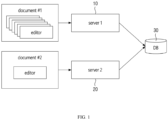
- FIG. 1 is a view illustrating a system environment in which a conventional edit service of a document is provided.
- servers which support editing for document #1 and document #2, may be different from each other. That is, a server 110 may be in charge of editing for the document #1, and a server 2 20 may be in charge of editing for the document #2.
- Each of the servers 10 and 20 may update the document #1 or the document #2, which is stored in a database 30, so that changed details (i.e., edit details) for the document #1 or the document #2 are reflected.
- a plurality of editors may edit the document #1.
- a load for the server 110 may be weighted, whereby a failure may occur in the server 1 10.
- edit data for the document #1 may be lost.
- resources for the server 2 20 remain relatively, load may be concentrated on the server 110 without being distributed in view of the entire system.
- scale-out cannot be performed even without service interruption.
- An object of the present disclosure is to provide a method and system for providing an edit service of a document to support a plurality of editors to stably edit the document and reflect changed data in the document.
- Another object of the present disclosure is to provide a method and system for providing an edit service of a document to stably support document editing without loss of data even though a failure occurs in some modules due to dualization of modules included in the system.
- Another object of the present disclosure is to provide a system capable of performing scale-out even without interruption of its operation.
- a method for providing an edit service of a document including: storing, in a first data queue, first edit data received from a first communication terminal; storing, in the first data queue, second edit data received from a second communication terminal; updating an online document by reflecting the first edit data and the second edit data stored in the first data queue in the online document; transmitting the first edit data to the second communication terminal; and transmitting the second edit data to the first communication terminal.
- the updating the online document may include: merging the first edit data and the second edit data into one edit data; and reflecting the merged edit data in the document.
- the updating the online document may include storing the first edit data and the second edit data in a second data queue based on the updating of the online document being completed, each of the first edit data and the second edit data being stored in association with editor identification information; among the edit data stored in the second data queue, the second edit data that is not associated with an editor of the first communication terminal is transmitted to the first communication terminal; and among the edit data stored in the second data queue, the first edit data that is not associated with an editor of the second communication terminal is transmitted to the second communication terminal.
- the first data queue may be a reception-only queue in which received edit data are stored
- the second data queue may be a transmission-only queue in which edit data are stored before being transmitted to a communication terminal.
- the first data queue may store the first edit data and the second edit data in association with identification information of the document
- the updating the online document may include: acquiring the first edit data and the second edit data from the first data queue based on identification information of the document; and reflecting the first edit data and the second edit data in the document.
- the storing the first edit data in the first data queue may include storing the first edit data in a sub-queue corresponding to the identification information of the document among a plurality of sub-queues included in the first data queue, and the storing the second edit data in the first data queue may include storing the first edit data in the sub-queue.
- a document management system for providing an edit service of an online document
- the document management system including at least one processor to implement: at least one transmission/reception module configured to receive edit data from at least one communication terminal; a queue processing module configured to store, in a first data queue and a second data queue, edit data received by the at least one transmission/reception module; and at least one update module configured to acquire edit data stored in the first data queue, reflect the acquired edit data in the online document, and store edit data, which has been reflected in the online document, in the second data queue, wherein the at least one transmission/reception module is configured to transmit the edit data stored in the second data queue to the at least one communication terminal.
- the at least one transmission/reception module may include a first transmission/reception module configured to communicate with a first communication terminal, and a second transmission/reception module configured to communicate with a second communication terminal; and based on a failure occurring in the second transmission/reception module, the first transmission/reception module may be configured to receive edit data associated with a second editor from the second communication terminal and stores the received edit data in the first data queue.
- the first transmission/reception module may be configured to, based on the failure occurring in the second transmission/reception module: receive, from the second communication terminal, an index related to the edit data received by the second communication terminal, acquire edit data, which is to be transmitted, from the second data queue based on the received index, and transmit the edit data, acquired based on the received index, to the second communication terminal.
- the second data queue may store the edit data associated with the second editor, which has been reflected in the online document
- the first transmission/reception module may be configured to acquire the edit data associated with the second editor from the second data queue, and transmit the acquired edit data associated with the second editor to the first communication terminal.
- the at least one update module may include a first update module configured to process edit data of a first document stored in the first data queue, and a second update module configured to process edit data of a second document stored in the first data queue; and based on a failure occurring in the second update module, the first update module may be configured to acquire the edit data of the second document from the first data queue.
- the first data queue may include a first sub-queue associated with the first document and a second sub-queue associated with the second document, and based on edit data stored in the first sub-queue being not processed for a threshold time period, it may be determined that a failure has occurred in the first update module.
- FIG. 2 is a schematic view illustrating a document edit service system according to one embodiment of the present disclosure.
- a document management system 200 and each of communication terminals 100_1 to 100_n may communicate with each other through a network 300.
- the network 300 includes a mobile communication network, a wired communication network and a short-range communication network, and corresponds to a well-known or commonly used art, and thus its detailed description will be omitted in the present disclosure.
- the communication terminals 100_1 to 100_n are computing devices such as a personal computer, a server, and a mobile communication terminal, and may communicate with the document management system 200 through the network 300.
- the communication terminals 100_1 to 100_n may be terminals owned by a document editor. According to one embodiment, after forming a session with the document management system 200, the communication terminals 100_1 to 100_n may receive a document to be edited from the document management system 200 and edit the received document.
- the document management system 200 may be at least one computing system for storing and managing documents.
- the document management system 200 may provide an edit service of a document to the communication terminals 100_1 to 100_n.
- the document management system 200 may support the plurality of communication terminals 100_1 to 100_n to edit the same document.
- the document management system 200 may support various modules, as described below, to support a stable document management service.
- FIG. 3 is a view illustrating an internal configuration of a document management system of FIG. 2 .
- the document management system may include a transmission/reception processing module 210, a transmission/reception module 220, a queue processing module 230, an update module 240, and a database 250.
- Each module illustrated in FIG. 3 may be implemented as a physical entity or a logical entity.
- two or more modules may be implemented to be integrated into one module.
- each module may be implemented in the form of a virtual machine and mounted to a cloud computing system.
- the database 250 may store a plurality of documents as a storage means.
- the document may be an online document in which editing is performed through online editing.
- the transmission/reception processing module 210 may transmit edit data received from the network 300 to the transmission/reception module 220.
- the transmission/reception processing module 210 may transmit the edit data received from the communication terminals 100_1 to 100_n to the transmission/reception module 220.
- the transmission/reception processing module 210 may perform load balancing for traffic generated by the transmission/reception module 220.
- the transmission/reception processing module 210 may distribute and transmit the edit data received from the network 300 to each of the plurality of transmission/reception modules, based on a physical or logical port. For example, the transmission/reception processing module 210 may transmit edit data included in port numbers ranging from 1 to n (where, n is a natural number) to the first transmission/reception module, and may transmit edit data included in port numbers ranging from n+1 to m (m is a natural number greater than n+1) to the second transmission/reception module. In another embodiment, the transmission/reception processing module 210 may distribute and transfer the edit data received from the network 300 to each of the plurality of transmission/reception modules based on document identification information (for example, document ID).
- document identification information for example, document ID
- the transmission/reception processing module 210 may transmit edit data related to document corresponding to identification information from 1 to n (where, n is a natural number) to the first transmission/reception module, and may transmit edit data related to document corresponding to identification information from n+1 to m (m is a natural number greater than n+1) to the second transmission/reception module.
- the transmission/reception module 220 may store edit data acquired from the transmission/reception processing module 210 in a first data queue 232. In one embodiment, the edit data received by the transmission/reception module 220 may be stored in the first data queue 232. In addition, the transmission/reception module 220 may transmit edit data stored in a second data queue 234 to a destination by using the transmission/reception processing module 210. According to one embodiment, the transmission/reception module 220 may extract the data stored in the second data queue 234 in a first-in-first-out manner and transmit the extracted data to the destination.
- the queue processing module 230 may include a first data queue 232 in which received edit data is stored, and a second data queue 234 in which edit data to be transmitted is stored, as data storage means. That is, the first data queue 232 may be a reception-only queue, and the second data queue 234 may be a transmission-only queue.
- the first data queue 232 may store edit data prior to being reflected in a document.
- the first data queue 232 may store edit data including document identification information, editor identification information (i.e., user identification information), and an index of edit data.
- the first data queue 232 may store edit data in association with the document identification information, the editor identification information, and the index of edit data.
- the index may indicate identification information of each edit data for a corresponding document. For example, index '1' may be assigned to first edit data for the document, and index '2' may be assigned to second edit data for the document.
- the second data queue 234 may store at least one edit data reflected in the document. According to one embodiment, the second data queue 234 may store edit data including the document identification information, the editor identification information, and the index of edit data.
- At least one of the first data queue 232 or the second data queue 234 may include a sub-data queue for each document.
- the sub-data queue is a dedicated queue in which a document is stored, and for example, edit data related to a first document may be stored in a first queue (i.e., a first sub-queue), and edit data related to a second document may be stored in a second queue (i.e., a second sub-queue).
- the update module 240 may acquire at least one edit data for a document stored in a first data queue 232 and reflect the acquired edit data to the document stored in the database 250.
- the update module 240 may acquire a document corresponding to document identification information included in edit data from the database 250, and may update the document by reflecting at least one edit data in the acquired document.
- the update module 240 may store the edit data in the second data queue 234.
- a terminal used by a user 1 is a communication terminal 1
- a terminal used by a user 2 is a communication terminal 2. That is, a terminal used by a user n is referred to as a communication terminal n.
- a user is an editor who edits a document, and the user and the editor may be used interchangeably.
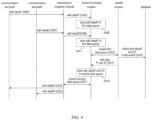
- FIG. 4 is a signal flow chart illustrating a method for providing an edit service of a document in accordance with another embodiment of the present disclosure.
- the communication terminal 1 100_1 may transmit edit data #1 for document #1, which is generated during editing of the document #1, to the document management system 200 (S401).
- the edit data #1 may include identification information of the document #1 and identification information of an editor 1.
- the transmission/reception processing module 210 of the document management system 200 may transmit the edit data #1 to the transmission/reception module 220, and the transmission/reception module 220 may transmit the edit data #1 to the queue processing module 230 (S403).
- the queue processing module 230 may assign an index of the edit data #1 and store the edit data #1 including the index, the identification information of the document #1, and the identification information of the editor 1 in the first data queue 232 (S405).
- the communication terminal 2 100_2 may transmit edit data #2 for the document #1, which is generated during editing of the document #1, to the document management system 200 (S407).
- the edit data #2 may include identification information of the document #1 and identification information of an editor 2.
- the transmission/reception processing module 210 of the document management system 200 may transmit the edit data #2 to the transmission/reception module 220, and the transmission/reception module 220 may transmit the edit data #2 to the queue processing module 230 (S409).
- the queue processing module 230 may assign an index of the edit data #2 and store the edit data #2 including the index, the identification information of the document #1, and the identification information of the editor 2 in the first data queue 232 (S411).
- the update module 240 may inquire and acquire the edit data related to the document #1 stored in the first data queue 232 (S413). At this time, the update module 240 may acquire the edit data #1 and the edit data #2 from the first data queue 232 as the data related to the document #1.
- the update module 240 may update the document #1 by reflecting the edit data #1 and the edit data #2 in the document #1 stored in the database 250 (S415).
- the update module 240 may merge the edit data #1 and the edit data #2 as one edit data, and may update the document #1 by reflecting the merged edit data in the document #1.
- the update module 240 may perform a process of storing the edit data #1 and the edit data #2 in the second data queue 234.
- the update module 240 may transmit the edit data #1 and the edit data #2 to the queue processing module 230 (S419), and the queue processing module 230 may store the edit data #1 and the edit data #2 in the second data queue 234.
- the update module 240 may request the queue processing module 230 of queue movement for the edit data #1 and the edit data #2.
- the queue processing module 230 may acquire the edit data #1 and the edit data #2 from the first data queue 232, and may store the acquired edit data #1 and edit data #2 of the first data queue 232 in the second data queue 234.
- the update module 240 may transmit an update completion message including the index of the edit data #1 and the index of the edit data #2 to the queue processing module 230.
- the queue processing module 230 may delete the edit data #1 and the edit data #2, which correspond to the corresponding index, from the first data queue 232, or may set each of the edit data #1 and the edit data #2 as a completed task. Therefore, among the edit data stored in the first data queue 232, edit data having an index of next order based on the index of the edit data #2 may be processed.
- the transmission/reception module 220 may inquire and acquire the edit data #1 and the edit data #2 for the document #1 from the second data queue 234 (S421). Subsequently, the transmission/reception module 220 may identify editor identification information included in each of the edit data #1 and the edit data #2.
- the transmission/reception module 220 may transmit the edit data #2 to the communication terminal 1 100_1 except for the edit data #1 as the identification information of the editor 1 is included in the edit data #1 (S423). That is, the transmission/reception module 220 may transmit the edit data #2 to the communication terminal 1 100_1, which does not recognize occurrence of the edit data #2, without transmitting the edit data #1 to the communication terminal 1 100_1 that has transmitted the edit data #1. Therefore, the edit data #2 may be reflected in the document #1 that is being edited in the communication terminal 1 100_1, so that the edit data #2 may be updated. That is, since a local resource is used in the communication terminal 1 100_1 and thus the edit data #1 is already reflected therein, the edit data #2 generated by the editor 2 may be transmitted to the communication terminal 1 100_1 and reflected in the document #1.
- the transmission/reception module 220 may transmit the edit data #1 to the communication terminal 2 100_2 except for the edit data #2 as the identification information of the editor 2 is included in the edit data #2 (S425). That is, the transmission/reception module 220 may transmit the edit data #1 to the communication terminal 2 100_2, which does not recognize occurrence of the edit data #1, without transmitting the edit data #2 to the communication terminal 2 100_2 that has transmitted the edit data #2. Therefore, the edit data #1 may be reflected in the document #1 that is being edited in the communication terminal 2 100_2, so that the edit data #1 may be updated. That is, since a local resource is used in the communication terminal 2 100_2 and thus the edit data #2 is already reflected therein, the edit data #1 generated by the editor 1 may be transmitted to the communication terminal 2 100_2 and reflected in the document #1.
- the transmission/reception module 220 may transmit a transmission completion message including the index of the edit data #1 and the index of the edit data #2 to the queue processing module 230 when the edit data is successfully transmitted to each of the communication terminal 1 100_1 and the communication terminal 2 100_2.
- the queue processing module 230 may delete the edit data #1 and the edit data #2, which correspond to the corresponding index, from the second data queue 234, or may set each of the edit data #1 and the edit data #2 as a completed task. Therefore, among the edit data stored in the second data queue 234, edit data having an index of next order based on the index of the edit data #1 and #2 may be processed at next cycle.
- the transmission/reception module 220 may transmit all edit data for the document #1 inquired from the second data queue 234 to the communication terminal 1 100_1 and the communication terminal 2 100_2 without selecting a transmission target of edit data.
- edit data may be stably reflected in the documents.
- the received edit data may be stored in the first data queue 232, and edit data to be transmitted may be stored in the second data queue 234, so that the edit data may be reflected in the document without loss of the edit data.
- the transmission/reception module and the update module may be dualized.
- FIG. 5 is a view illustrating a document management system in which a transmission/reception module and an update module are dualized, in accordance with still another embodiment of the present disclosure.
- the document management system may include a plurality of reception modules 222 and 224, a plurality of transmission modules 226 and 228, a first data queue 132, a second data queue 234, a plurality of update modules 242 and 244, and a database 250. Additionally, the document management system may further include a transmission/reception processing module. In this case, the transmission/reception processing module may load-balance the received data and transmit the data to the respective reception modules 222 and 224. Although the transmission/reception module is illustrated as being divided into the reception modules 222 and 224 and the transmission modules 226 and 228 in FIG. 5 , the present disclosure is not limited thereto, and the reception modules 222 and 224 and the transmission modules 226 and 228 may be integrated into a transmission/reception module.
- the reception module When a failure occurs in any one of the reception modules 222 and 224, the reception module, which operates normally, may process the edit data on behalf of the reception module in which a failure occurs. Also, when a failure occurs in any one of the transmission modules 226 and 228, the transmission module, which operates normally, may transmit the edit data on behalf of the transmission module in which a failure occurs. In addition, when a failure occurs in any one of the update modules 242 and 244, the update module 242 or 244, which operates normally, may reflect the edit data in the document of the database 250 on behalf of the update module 242 or 244 in which a failure occurs.
- FIG. 5 illustrates that edit data related to the editor 1 and an editor 3 are processed by the reception module 1 222 and the transmission module 1 226, and the edit data related to the editor 2 and an editor 4 are processed by the reception module 2 224 and the transmission module 2 228.
- a method for distributing data in accordance with scale-out of a specific module will be described in detail with reference to FIGS. 10 to 13 .
- FIG. 6 is a view illustrating a document management system, which includes a dualized transmission/reception module, in accordance with still another embodiment of the present disclosure.
- FIG. 6 illustrates that a failure occurs in the transmission/reception module 1 220_1 while the edit data generated by the editor 1 is being processed by the transmission/reception module 1 220_1 and the edit data generated by the editor 2 to the editor 4 is being processed by the transmission/reception module 2 220_2.
- the transmission/reception processing module 210 may detect a failure of the transmission/reception module 1 220_1 and inform the transmission/reception module 2 220_2 of a failure occurrence of the transmission/reception module 1 220_1.
- the transmission/reception processing module 210 may determine that a failure has occurred in the transmission/reception module 1 220_1.
- edit data 62 generated by the editor 1 may be transmitted to the transmission/reception module 2 220_2.
- the transmission/reception module 2 220_2 may transmit the edit data 62 to the queue processing module 230 to store the edit data 62 in the first data queue 232 included in the queue processing module 230.
- the update module 240 may acquire the edit data 62 from the first data queue 232 and reflect the acquired edit data 62 in the document stored in the database 250 to update the document.
- the transmission/reception module 2 220_2 may acquire, from the second data queue 234 of the queue processing module 230, edit details 64 that are not received by the editor 1 due to the failure of the transmission/reception module 1 220_1, and may provide the edit details 64 to the editor 1.
- the edit details 64 that are not received by the editor 1 may include edit data edited by the editors 2 to 4 while the failure of the transmission/reception module 1 220_1 occurs.
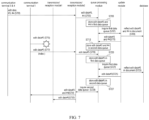
- FIG. 7 is a signal flow chart illustrating the document management system of FIG. 6 , which is operated by occurrence of a failure of a transmission/reception module, in accordance with still another embodiment of the present disclosure.
- a failure occurs in the transmission/reception module 1 220_1 while the communication terminal 1 communicates with the transmission/reception module 1 220_1 and the communication terminal 3 and the communication terminal 4 communicate with the transmission/reception module 2 220_2.
- all of the communication terminal 1, the communication terminal 3 and the communication terminal 4 perform editing for the same document, and data transmitted from the terminal to the transmission/reception module passes through the transmission/reception processing module 210.
- the communication terminal 3 may transmit edit data #3 to the transmission/reception module 1 220_1, and the communication terminal 4 may transmit edit data #4 to the transmission/reception module 2 220_2 (S701). Subsequently, the transmission/reception module 2 220_2 may transmit the edit data #3 and the edit data #4 to the queue processing module 230 (S703).
- the queue processing module 230 may store the edit data #3 and the edit data #4 in the first data queue (S705).
- the queue processing module 230 may store the edit data #3 in association with identification information of a user 3 and store the edit data #4 in association with identification information of a user 4.
- the queue processing module 230 may assign an index to each of the edit data #3 and the edit data #4 and store the index in the first data queue.
- the update module 240 may acquire the edit data #3 and the edit data #4 from the first data queue by inquiring the first data queue (S707).
- the update module 240 may update the document by reflecting the edit data #3 and the edit data #4 in the document stored in the database.
- the update module 240 may merge the edit data #3 and the edit data #4 into one edit data, and then may reflect the merged edit data in the document. Therefore, the user 3 and the content edited by the user 3 may be reflected in the document.
- the update module 240 may perform a process of storing the edit data #3 and the edit data #4 in the second data queue 234 (S711 and S713). According to one embodiment, the update module 240 may directly access the second data queue 234 to store the edit data #3 and the edit data #4 in the second data queue 234.
- the edit data #3 may include identification information of the editor 3, and the edit data #4 may include identification information of the editor 4.
- the communication terminal 1 may detect that a failure has occurred in transmission/reception module 1 220_1 while transmitting edit data #5 to transmission/reception module 1 220_1 (S715). For example, when the communication terminal 1 does not receive a response (e.g., ACK) to data reception from the transmission/reception module 1 220_1 for a threshold time period after transmitting the edit data #5 to the transmission/reception module 1 220_1, the communication terminal 1 may determine that a failure has occurred in the transmission/reception module 1 220_1.
- a response e.g., ACK
- the communication terminal 1 may transmit the edit data #5 and an index of edit data, which is received so far, to the transmission/reception module 2 220_2 (S717).
- the index of the edit data is an index (e.g., index #2) of the edit data #2.
- the transmission/reception module 2 220_2 may transmit the edit data #5 to the queue processing module 230 (S719). Subsequently, the queue processing module 230 may assign an index (e.g., index #5) of the edit data #5 and store the edit data #5, to which the index is assigned, in the first data queue (S720).
- an index e.g., index #5
- the update module 240 may acquire the edit data #5 by inquiring the first data queue (S721). Subsequently, the update module 240 may update the document stored in the database by reflecting the edit data #5 in the document (S723).
- the update module 240 may transmit the edit data #5 to the queue processing module 230 to store the edit data #5 in the second data queue (S725 and S727).
- the edit data #5 may include identification information of the editor 1.
- the transmission/reception module 2 220_2 may acquire the edit data #3 and the edit data #4, which are transmitted to the communication terminal 1, and the edit data #3 and the edit data #5, which are transmitted to the communication terminal 3 and the communication terminal 4, by inquiring the second data queue (S729). According to one embodiment, the transmission/reception module 2 220_2 may determine that edit data, which are not received in the communication terminal 1, the edit data #3 and the edit data #4, based on the index received from the communication terminal 1 in step S717.
- the transmission/reception module 2 220_2 receives the edit data #3, the edit data #4 and the edit data #5, which are edit data having an index after the index received from the communication terminal 1, from the second data queue, wherein the edit data #5 may be excluded from a transmission target as the identification information of the editor 1 is included in the edit data #5.
- the transmission/reception module 2 220_2 may transmit the edit data #3 and the edit data #4 to the communication terminal 1 (S731). Therefore, the communication terminal 1 may receive the edit data #3 and the edit data #4, which are not received due to the failure of the transmission/reception module 1 220_1, and may reflect the received edit data #3 and edit data #4 in a local document that is being edited.
- the transmission/reception module 2 220_2 may transmit the edit data #5 to each of the communication terminal 3 and the communication terminal 4 (S733). Therefore, each of the communication terminal 3 and the communication terminal 4 may reflect a document editing content (i.e., edit data #5) of the editor 1 in the local document.
- a document editing content i.e., edit data #5
- FIG. 8 is a view illustrating a document management system, which includes a dualized update module, in accordance with still another embodiment of the present disclosure.
- the update modules 242 and 244 may be dualized. When a failure occurs while the update module 1 242 processes the edit data stored in the first data queue, the update module 2 244 may process the edit data which has not been processed by the update module 1 242.
- FIG. 8 illustrates that the edit data stored in an odd-numbered sub-queue is processed by the update module 1 242 and the edit data stored in an even-numbered sub-queue is processed by the update module 2 244.
- the update module 1 242 fails to process the edit data stored in a first sub-queue 82 of the first data queue to cause a failure
- the update module 2 244 may process the edit data included in the first sub-queue 82 as well as the edit data stored in a second sub-queue 84.
- FIG. 9 is a signal flow chart illustrating the document management system of FIG. 8 , which is operated by occurrence of a failure of an update module, in accordance with still another embodiment of the present disclosure.
- a failure occurs in the update module 1 242
- the update module 1 242 is in charge of an odd-numbered sub-queue
- the update module 2 244 is in charge of an even-numbered sub-queue.
- the queue processing module 230 may store the edit data #6 received from the transmission/reception module 220 in the second sub-queue of the first data queue (S901).
- the update module 2 244 may acquire the edit data #6 by inquiring the first data queue in response to storing the edit data #6 in the even-numbered sub-queue (S903). Subsequently, the update module 2 244 may update the document by reflecting the edit data #6 in the document stored in the database (S905). Additionally, the update module 2 244 may store the edit data #6 in the second data queue of the queue processing module 230. In this case, the edit data #6 stored in the second data queue may be transmitted to at least one communication terminal through the transmission/reception module 220.
- the queue processing module 230 may store edit data #7 received from the transmission/reception module 220 in a third sub-queue of the first data queue (S907).
- the edit data #7 may not be processed due to the failure of the update module 1 242 that is in charge of the odd-numbered sub-queues.
- the queue processing module 230 may detect that a failure has occurred in the update module 1 242 when the processing for the edit data #7 is not completed for a preset time (S909).
- the queue processing module 230 may request a failure response to the update module 2 244 (S911). At this time, the queue processing module 230 may provide an index of the edit data #7, which has not been processed by the update module 1 242, to the update module 244.
- the update module 1 242 may acquire the edit data #7 stored in the third sub-queue, which is not processed by the update module 1 242, by inquiring the first data queue (S913). Subsequently, the update module 2 244 may update the document by reflecting the edit data #7 to the document stored in the database (S915). Additionally, the update module 2 244 may store the edit data #7 in the second data queue of the queue processing module 230. In this case, the edit data #7 stored in the second data queue may be transmitted to at least one communication terminal through the transmission/reception module 220.
- a normal document update may be performed through the update module 2 244 without loss of the edit data.
- FIG. 10 is a view illustrating a session distributed when a transmission/reception module is scaled out, in accordance with still another embodiment of the present disclosure.
- the transmission/reception module 1 220_1 may initially form a session with each of editors 1 to 6.
- forming a session with an editor may mean forming a session with a communication terminal used by the editor.
- the transmission/reception module 2 220_2 may be added.
- the editors 4 to 6 who are forming a session with the transmission/reception module 1 220_1 may switch the session from the transmission/reception module 1 220_1 to the transmission/reception module 2 220_2. Therefore, the transmission/reception module 1 220_1 may form a session with the editors 1 to 3 to process edit data generated in the editors 1 to 3.
- the transmission/reception module 2 220_2 may form a session with the editors 4 to 6 to process edit data generated in the editors 4 to 6.
- FIG. 11 is a signal flow chart illustrating an operation of a document management system when a transmission/reception module is scaled out, in accordance with still another embodiment of the present disclosure.
- the communication terminals 1 to 3 may form a session with the transmission/reception module 1 220_1 (S1101).
- the communication terminals 4 to 6 may also form a session with the transmission/reception module 1 220_1 (S1103).
- the transmission/reception module 2 220_2 may be added to the document management system, or the transmission/reception module 2 220_2 may be recovered from the failure. In this case, the transmission/reception module 2 220_2 may transmit a participation notification message to the queue processing module 230 (S1105).
- the queue processing module 230 may transmit the participation notification message for the transmission/reception module 2 220_2 to the transmission/reception module 1 220_1 (S1107). At this time, the queue processing module 230 may transmit identification information (e.g., IP address) of the transmission/reception module 2 220_2 to the transmission/reception module 1 220_1.
- identification information e.g., IP address
- the transmission/reception module 1 220_1 may determine some of terminals being session-connected thereto as distribution terminals (S1109). In FIG. 11 , it is described that the transmission/reception module 1 220_1 determines communication terminals 4 to 6 as the distribution terminals. Next, the transmission/reception module 1 220_1 may transmit, to each of the communication terminals 4 to 6 determined as the distribution terminals, a session switching request message that includes identification information (e.g., IP address) of the transmission/reception module 2 220_2. Therefore, the communication terminals 4 to 6 may initiate a process of switching a session from the transmission/reception module 1 220_1 to the transmission/reception module 2 220_2.
- identification information e.g., IP address
- edit data #8 may be transmitted to the transmission/reception module 1 220_1 through at least one of the communication terminals 1 to 3 (S1113).
- the transmission/reception module 1 220_1 may transmit the edit data #8 to the queue processing module 230 (S1115), and the queue processing module 230 may store the edit data #8, which includes an index and editor identification information, in the first data queue (S1117).
- the update module may acquire the edit data #8 by inquiring the first data queue (S1119).
- the update module may update the document by reflecting the edit data #8 in the document stored in the database (S1121).
- the update module may transmit the updated edit data #8 to the queue processing module 230 (S1123).
- the queue processing module 230 may store the edit data #8 in the second data queue (S1125).
- the transmission/reception module 1 220_1 may acquire the edit data #8 from the second data queue and transmit the acquired edit data #8 to some or all of the communication terminals 1 to 3. At this time, the transmission/reception module 1 220_1 may transmit the edit data #8 to the remaining communication terminals except for the communication terminal that has transmitted the edit data #8.
- the communication terminals 4 to 6 that have released the session with the transmission/reception module 1 220_1 may form a session with the transmission/reception module 2 220_2 (S1127).
- the transmission/reception module 2 220_2 may acquire the edit data #8 by inquiring the second data queue (S1129). Then, the transmission/reception module 2 220_2 may transmit the acquired edit data #8 to each of the communication terminals 1 to 3 (S1131).
- scale-out of the transmission/reception module may be normally performed even without interruption of the document management system.
- the edit data may be reflected in the document without loss, and may be stably provided to another editor.
- FIG. 12 is a view illustrating a serve queue distributed when an update module is scaled out, in accordance with still another embodiment of the present disclosure.
- the update module 1 242 may be in charge of documents A, B, C and D corresponding to first to fourth sub-queues, and may process editing for the documents A, B, C and D.
- the update module 2 244 may be added as illustrated in a reference numeral 1220 of FIG. 12 .
- the third sub-queue and the fourth sub-queue, for which the update module 1 242 is responsible may be distributed to the update module 2 244. Therefore, the update module 1 242 may process editing for the document A and the document B, which correspond to the first sub-queue and the second sub-queue, and the update module 2 244 may process editing for the document C and the document D, which correspond to the third sub-queue and the fourth sub-queue.
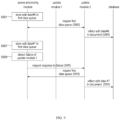
- FIG. 13 is a signal flow chart illustrating a document management system of FIG. 12 when an update module is scaled out, in accordance with still another embodiment of the present disclosure.
- the update module 1 242 may inquire the first to fourth sub-queues for which it is responsible (S1301). When the update module 1 242 acquires the edit data for the documents A to D from the first to fourth sub-queues, the update module 1 242 may perform subsequent processes (i.e., updating the document and storing the edit data in the second data queue).
- the update module 2 244 may be added to the system environment or recovered from the failure to transmit the participation notification message to the queue processing module 230 (S1303). Then, the queue processing module 230 may redistribute the sub-queues. In FIG. 13 , it is assumed that the first and second sub-queues are sub-queues for which the update module 1 242 is responsible, and the third and fourth sub-queues are sub-queues for which the update module 2 244 is responsible. Subsequently, the queue processing module 230 may transmit queue distribution information, which includes the first sub-queue and the second sub-queue, to the update module 1 242 (S1307). In addition, the queue processing module 230 may transmit queue distribution information, which includes the third sub-queue and the fourth sub-queue, to the update module 1 242 (S1309).
- the update module 1 242 may be responsible for the first sub-queue and the second sub-queue based on the received queue distribution information. That is, the update module 1 242 may acquire edit data for the documents A and B by inquiring the first sub-queue and the second sub-queue in the first data queue (S1311). When the edit data is acquired, the update module 1 242 may reflect the edit data in at least one of the document A or the document B by using the acquired edit data.
- the update module 2 244 may be responsible for the third sub-queue and the fourth sub-queue based on the received queue distribution information. That is, the update module 1 242 may acquire the edit data for the documents C and D by inquiring the third sub-queue and the fourth sub-queue in the first data queue (S1313). When the edit data is acquired, the update module 2 244 may reflect the edit data in at least one of the document C or the document D by using the acquired edit data.
- scale-out for the update module may be stably performed without data loss even without interruption of the operation of the document management system.
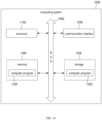
- FIG. 14 is a hardware schematic view illustrating a computing system according to some embodiments of the present disclosure.
- the computing system 1000 shown in FIG. 14 may include one or more processors 1100, a system bus 1600, a communication interface 1200, a memory 1400 for loading a computer program 1500 performed by the processor 1100, and a storage 1300 for storing the computer program 1500.
- the processor 1100 controls the overall operation of each component of the computing system 1000.
- the processor 1100 may perform an operation for at least one application or program for executing the method/operation according to various embodiments of the present disclosure.
- the memory 1400 stores various data, commands and/or information.
- the memory 1400 may load one or more computer programs 1500 from the storage 1300 to execute the method/operations according to various embodiments of the present disclosure.
- the storage 1300 may non-temporarily store one or more computer programs 1500.
- the computer program 1500 may include one or more instructions in which the method/operations according to various embodiments of the present disclosure are implemented. When the computer program 1500 is loaded into the memory 1400, the processor 1100 may execute the one or more instructions to perform the method/operations according to various embodiments of the present disclosure.
- the computing system 1000 described with reference to FIG. 14 may be configured using one or more physical servers included in a server farm based on a cloud technology such as a virtual machine.
- a cloud technology such as a virtual machine.
- the processor 1100, the memory 1400 and the storage 1300 may be virtual hardware, and the communication interface 1200 may be also configured as a virtualized networking component such as a virtual switch.
- the computer program 1500 may include instructions for performing an operation of storing first edit data received from a first communication terminal in a first data queue, an operation of storing second edit data received from a second communication terminal in the first data queue, an operation of updating an online document by reflecting the first and second edit data stored in the first data queue in the online document, an operation of transmitting the first edit data to the second communication terminal, and an operation of transmitting the second edit data to the first communication terminal.
- the technical features of the present disclosure described so far may be embodied as computer readable codes on a computer readable medium.
- the computer readable medium may be, for example, a removable recording medium (CD, DVD, Blu-ray disc, USB storage device, removable hard disk) or a fixed recording medium (ROM, RAM, computer equipped hard disk).
- the computer program recorded on the computer readable medium may be transmitted to other computing device via a network such as internet and installed in the other computing device, thereby being used in the other computing device.
Landscapes
- Engineering & Computer Science (AREA)
- Theoretical Computer Science (AREA)
- General Physics & Mathematics (AREA)
- Physics & Mathematics (AREA)
- General Engineering & Computer Science (AREA)
- Business, Economics & Management (AREA)
- Computational Linguistics (AREA)
- Health & Medical Sciences (AREA)
- Artificial Intelligence (AREA)
- Audiology, Speech & Language Pathology (AREA)
- General Health & Medical Sciences (AREA)
- Human Resources & Organizations (AREA)
- Software Systems (AREA)
- Strategic Management (AREA)
- Data Mining & Analysis (AREA)
- Databases & Information Systems (AREA)
- Entrepreneurship & Innovation (AREA)
- Quality & Reliability (AREA)
- General Business, Economics & Management (AREA)
- Computer Hardware Design (AREA)
- Economics (AREA)
- Marketing (AREA)
- Operations Research (AREA)
- Tourism & Hospitality (AREA)
- Document Processing Apparatus (AREA)
Abstract
Provided is a method for providing an edit service of a document, performed by at least one processor. The method includes storing, in a first data queue, first edit data received from a first communication terminal; storing, in the first data queue, second edit data received from a second communication terminal; updating an online document by reflecting the first edit data and the second edit data stored in the first data queue in the online document; transmitting the first edit data to the second communication terminal; and transmitting the second edit data to the first communication terminal.
Description
- The present disclosure relates to a method for providing an edit service of a document, and more particularly, to a method and system for providing an edit service of a document to support a plurality of editors to simultaneously edit an online document.
- Nowadays, an edit service of a document is provided, which stores the document in a server or an external device and supports a plurality of users to simultaneously edit the document. Since the edit service of the document should continuously receive edit data from editors who are editing the same document, the editors who edit the same document should be connected to the same server.
-
FIG. 1 is a view illustrating a system environment in which a conventional edit service of a document is provided. As shown inFIG. 1 , servers, which support editing fordocument # 1 anddocument # 2, may be different from each other. That is, a server 110 may be in charge of editing for thedocument # 1, and aserver 2 20 may be in charge of editing for thedocument # 2. Each of theservers document # 1 or thedocument # 2, which is stored in adatabase 30, so that changed details (i.e., edit details) for thedocument # 1 or thedocument # 2 are reflected. - However, as shown in
FIG. 1 , a plurality of editors may edit thedocument # 1. In this case, a load for the server 110 may be weighted, whereby a failure may occur in theserver 1 10. When a failure occurs in theserver 1 10 while editing of thedocument # 1 is being performed, edit data for thedocument # 1 may be lost. In addition, since resources for theserver 2 20 remain relatively, load may be concentrated on the server 110 without being distributed in view of the entire system. In addition, in the system structure shown inFIG. 1 , scale-out cannot be performed even without service interruption. - Therefore, a system for stably supporting document editing and facilitating scale-out is required.
- An object of the present disclosure is to provide a method and system for providing an edit service of a document to support a plurality of editors to stably edit the document and reflect changed data in the document.
- Another object of the present disclosure is to provide a method and system for providing an edit service of a document to stably support document editing without loss of data even though a failure occurs in some modules due to dualization of modules included in the system.
- Other object of the present disclosure is to provide a system capable of performing scale-out even without interruption of its operation.
- The objects of the present disclosure are not limited to those mentioned above and additional objects of the present disclosure, which are not mentioned herein, will be clearly understood by those skilled in the art from the following description of the present disclosure.
- According to an aspect of an example embodiment, there is provided a method for providing an edit service of a document, performed by at least one processor, the method including: storing, in a first data queue, first edit data received from a first communication terminal; storing, in the first data queue, second edit data received from a second communication terminal; updating an online document by reflecting the first edit data and the second edit data stored in the first data queue in the online document; transmitting the first edit data to the second communication terminal; and transmitting the second edit data to the first communication terminal.
- The updating the online document may include: merging the first edit data and the second edit data into one edit data; and reflecting the merged edit data in the document.
- The updating the online document may include storing the first edit data and the second edit data in a second data queue based on the updating of the online document being completed, each of the first edit data and the second edit data being stored in association with editor identification information; among the edit data stored in the second data queue, the second edit data that is not associated with an editor of the first communication terminal is transmitted to the first communication terminal; and among the edit data stored in the second data queue, the first edit data that is not associated with an editor of the second communication terminal is transmitted to the second communication terminal.
- The first data queue may be a reception-only queue in which received edit data are stored, and the second data queue may be a transmission-only queue in which edit data are stored before being transmitted to a communication terminal.
- The first data queue may store the first edit data and the second edit data in association with identification information of the document, and the updating the online document may include: acquiring the first edit data and the second edit data from the first data queue based on identification information of the document; and reflecting the first edit data and the second edit data in the document.
- The storing the first edit data in the first data queue may include storing the first edit data in a sub-queue corresponding to the identification information of the document among a plurality of sub-queues included in the first data queue, and the storing the second edit data in the first data queue may include storing the first edit data in the sub-queue.
- According to an aspect of an example embodiment, there is provided a document management system for providing an edit service of an online document, the document management system including at least one processor to implement: at least one transmission/reception module configured to receive edit data from at least one communication terminal; a queue processing module configured to store, in a first data queue and a second data queue, edit data received by the at least one transmission/reception module; and at least one update module configured to acquire edit data stored in the first data queue, reflect the acquired edit data in the online document, and store edit data, which has been reflected in the online document, in the second data queue, wherein the at least one transmission/reception module is configured to transmit the edit data stored in the second data queue to the at least one communication terminal.
- The at least one transmission/reception module may include a first transmission/reception module configured to communicate with a first communication terminal, and a second transmission/reception module configured to communicate with a second communication terminal; and based on a failure occurring in the second transmission/reception module, the first transmission/reception module may be configured to receive edit data associated with a second editor from the second communication terminal and stores the received edit data in the first data queue.
- The first transmission/reception module may be configured to, based on the failure occurring in the second transmission/reception module: receive, from the second communication terminal, an index related to the edit data received by the second communication terminal, acquire edit data, which is to be transmitted, from the second data queue based on the received index, and transmit the edit data, acquired based on the received index, to the second communication terminal.
- The second data queue may store the edit data associated with the second editor, which has been reflected in the online document, and the first transmission/reception module may be configured to acquire the edit data associated with the second editor from the second data queue, and transmit the acquired edit data associated with the second editor to the first communication terminal.
- The at least one update module may include a first update module configured to process edit data of a first document stored in the first data queue, and a second update module configured to process edit data of a second document stored in the first data queue; and based on a failure occurring in the second update module, the first update module may be configured to acquire the edit data of the second document from the first data queue.
- The first data queue may include a first sub-queue associated with the first document and a second sub-queue associated with the second document, and based on edit data stored in the first sub-queue being not processed for a threshold time period, it may be determined that a failure has occurred in the first update module.
- The above and other aspects and features of the present disclosure will become more apparent by describing in detail exemplary embodiments thereof with reference to the attached drawings, in which:
-
FIG. 1 is a view illustrating a system environment in which a conventional edit service of a document is provided; -
FIG. 2 is a schematic view illustrating a document edit service system according to one embodiment of the present disclosure; -
FIG. 3 is a view illustrating an internal configuration of a document management system ofFIG. 2 ; -
FIG. 4 is a signal flow chart illustrating a method for providing an edit service of a document in accordance with another embodiment of the present disclosure; -
FIG. 5 is a view illustrating a document management system in which a transmission/reception module and an update module are dualized, in accordance with still another embodiment of the present disclosure; -
FIG. 6 is a view illustrating a document management system, which includes a dualized transmission/reception module, in accordance with still another embodiment of the present disclosure; -
FIG. 7 is a signal flow chart illustrating the document management system ofFIG. 6 , which is operated by occurrence of a failure of a transmission/reception module, in accordance with still another embodiment of the present disclosure; -
FIG. 8 is a view illustrating a document management system, which includes a dualized update module, in accordance with still another embodiment of the present disclosure; -
FIG. 9 is a signal flow chart illustrating the document management system ofFIG. 8 , which is operated by occurrence of a failure of an update module, in accordance with still another embodiment of the present disclosure; -
FIG. 10 is a view illustrating a session distributed when a transmission/reception module is scaled out, in accordance with still another embodiment of the present disclosure; -
FIG. 11 is a signal flow chart illustrating an operation of a document management system when a transmission/reception module is scaled out, in accordance with still another embodiment of the present disclosure; -
FIG. 12 is a view illustrating a serve queue distributed when an update module is scaled out, in accordance with still another embodiment of the present disclosure; -
FIG. 13 is a signal flow chart illustrating a document management system ofFIG. 12 when an update module is scaled out, in accordance with still another embodiment of the present disclosure; and -
FIG. 14 is a hardware schematic view illustrating a computing system according to some embodiments of the present disclosure. - Hereinafter, example embodiments of the present disclosure will be described with reference to the attached drawings. Advantages and features of the present disclosure and methods of accomplishing the same may be understood more readily by reference to the following detailed description of example embodiments and the accompanying drawings. The present disclosure may, however, be embodied in many different forms and should not be construed as being limited to the embodiments set forth herein. Rather, these embodiments are provided so that this disclosure will be thorough and complete and will fully convey the concept of the disclosure to those skilled in the art, and the present disclosure will be defined by the appended claims and their equivalents.
- In describing the present disclosure, when it is determined that the detailed description of the related well-known configuration or function may obscure the gist of the present disclosure, the detailed description thereof will be omitted.
- Hereinafter, embodiments of the present disclosure will be described with reference to the attached drawings:
-
FIG. 2 is a schematic view illustrating a document edit service system according to one embodiment of the present disclosure. - As shown in
FIG. 2 , adocument management system 200 and each of communication terminals 100_1 to 100_n may communicate with each other through anetwork 300. In this case, thenetwork 300 includes a mobile communication network, a wired communication network and a short-range communication network, and corresponds to a well-known or commonly used art, and thus its detailed description will be omitted in the present disclosure. - The communication terminals 100_1 to 100_n are computing devices such as a personal computer, a server, and a mobile communication terminal, and may communicate with the
document management system 200 through thenetwork 300. The communication terminals 100_1 to 100_n may be terminals owned by a document editor. According to one embodiment, after forming a session with thedocument management system 200, the communication terminals 100_1 to 100_n may receive a document to be edited from thedocument management system 200 and edit the received document. - The
document management system 200 may be at least one computing system for storing and managing documents. Thedocument management system 200 may provide an edit service of a document to the communication terminals 100_1 to 100_n. Thedocument management system 200 may support the plurality of communication terminals 100_1 to 100_n to edit the same document. To this end, thedocument management system 200 may support various modules, as described below, to support a stable document management service. -
FIG. 3 is a view illustrating an internal configuration of a document management system ofFIG. 2 . - As shown in
FIG. 3 , the document management system may include a transmission/reception processing module 210, a transmission/reception module 220, aqueue processing module 230, anupdate module 240, and adatabase 250. Each module illustrated inFIG. 3 may be implemented as a physical entity or a logical entity. In addition, two or more modules may be implemented to be integrated into one module. In some embodiments, each module may be implemented in the form of a virtual machine and mounted to a cloud computing system. - The
database 250 may store a plurality of documents as a storage means. In this case, the document may be an online document in which editing is performed through online editing. - The transmission/
reception processing module 210 may transmit edit data received from thenetwork 300 to the transmission/reception module 220. For example, the transmission/reception processing module 210 may transmit the edit data received from the communication terminals 100_1 to 100_n to the transmission/reception module 220. When a plurality of transmission/reception modules 220 are provided, the transmission/reception processing module 210 may perform load balancing for traffic generated by the transmission/reception module 220. - In one embodiment, the transmission/
reception processing module 210 may distribute and transmit the edit data received from thenetwork 300 to each of the plurality of transmission/reception modules, based on a physical or logical port. For example, the transmission/reception processing module 210 may transmit edit data included in port numbers ranging from 1 to n (where, n is a natural number) to the first transmission/reception module, and may transmit edit data included in port numbers ranging from n+1 to m (m is a natural number greater than n+1) to the second transmission/reception module. In another embodiment, the transmission/reception processing module 210 may distribute and transfer the edit data received from thenetwork 300 to each of the plurality of transmission/reception modules based on document identification information (for example, document ID). For example, the transmission/reception processing module 210 may transmit edit data related to document corresponding to identification information from 1 to n (where, n is a natural number) to the first transmission/reception module, and may transmit edit data related to document corresponding to identification information from n+1 to m (m is a natural number greater than n+1) to the second transmission/reception module. - The transmission/
reception module 220 may store edit data acquired from the transmission/reception processing module 210 in afirst data queue 232. In one embodiment, the edit data received by the transmission/reception module 220 may be stored in thefirst data queue 232. In addition, the transmission/reception module 220 may transmit edit data stored in asecond data queue 234 to a destination by using the transmission/reception processing module 210. According to one embodiment, the transmission/reception module 220 may extract the data stored in thesecond data queue 234 in a first-in-first-out manner and transmit the extracted data to the destination. - The
queue processing module 230 may include afirst data queue 232 in which received edit data is stored, and asecond data queue 234 in which edit data to be transmitted is stored, as data storage means. That is, thefirst data queue 232 may be a reception-only queue, and thesecond data queue 234 may be a transmission-only queue. - The
first data queue 232 may store edit data prior to being reflected in a document. According to one embodiment, thefirst data queue 232 may store edit data including document identification information, editor identification information (i.e., user identification information), and an index of edit data. According to another embodiment, thefirst data queue 232 may store edit data in association with the document identification information, the editor identification information, and the index of edit data. In this case, the index may indicate identification information of each edit data for a corresponding document. For example, index '1' may be assigned to first edit data for the document, and index '2' may be assigned to second edit data for the document. - The
second data queue 234 may store at least one edit data reflected in the document. According to one embodiment, thesecond data queue 234 may store edit data including the document identification information, the editor identification information, and the index of edit data. - In some embodiments, at least one of the
first data queue 232 or thesecond data queue 234 may include a sub-data queue for each document. In this case, the sub-data queue is a dedicated queue in which a document is stored, and for example, edit data related to a first document may be stored in a first queue (i.e., a first sub-queue), and edit data related to a second document may be stored in a second queue (i.e., a second sub-queue). - The
update module 240 may acquire at least one edit data for a document stored in afirst data queue 232 and reflect the acquired edit data to the document stored in thedatabase 250. In one embodiment, theupdate module 240 may acquire a document corresponding to document identification information included in edit data from thedatabase 250, and may update the document by reflecting at least one edit data in the acquired document. When the edit data is successfully reflected, theupdate module 240 may store the edit data in thesecond data queue 234. - Hereinafter, in the following embodiment, a terminal used by a
user 1 is acommunication terminal 1, and a terminal used by auser 2 is acommunication terminal 2. That is, a terminal used by a user n is referred to as a communication terminal n. Also, a user is an editor who edits a document, and the user and the editor may be used interchangeably. -
FIG. 4 is a signal flow chart illustrating a method for providing an edit service of a document in accordance with another embodiment of the present disclosure. - Referring to
FIG. 4 , thecommunication terminal 1 100_1 may transmitedit data # 1 fordocument # 1, which is generated during editing of thedocument # 1, to the document management system 200 (S401). In this case, theedit data # 1 may include identification information of thedocument # 1 and identification information of aneditor 1. The transmission/reception processing module 210 of thedocument management system 200 may transmit theedit data # 1 to the transmission/reception module 220, and the transmission/reception module 220 may transmit theedit data # 1 to the queue processing module 230 (S403). Then, thequeue processing module 230 may assign an index of theedit data # 1 and store theedit data # 1 including the index, the identification information of thedocument # 1, and the identification information of theeditor 1 in the first data queue 232 (S405). - Also, the
communication terminal 2 100_2 may transmitedit data # 2 for thedocument # 1, which is generated during editing of thedocument # 1, to the document management system 200 (S407). In this case, theedit data # 2 may include identification information of thedocument # 1 and identification information of aneditor 2. The transmission/reception processing module 210 of thedocument management system 200 may transmit theedit data # 2 to the transmission/reception module 220, and the transmission/reception module 220 may transmit theedit data # 2 to the queue processing module 230 (S409). Then, thequeue processing module 230 may assign an index of theedit data # 2 and store theedit data # 2 including the index, the identification information of thedocument # 1, and the identification information of theeditor 2 in the first data queue 232 (S411). - In this way, in a state that the
edit data # 1 and theedit data # 2, which are related to thedocument # 1, are stored in thefirst data queue 232, theupdate module 240 may inquire and acquire the edit data related to thedocument # 1 stored in the first data queue 232 (S413). At this time, theupdate module 240 may acquire theedit data # 1 and theedit data # 2 from thefirst data queue 232 as the data related to thedocument # 1. - Subsequently, the
update module 240 may update thedocument # 1 by reflecting theedit data # 1 and theedit data # 2 in thedocument # 1 stored in the database 250 (S415). In one embodiment, theupdate module 240 may merge theedit data # 1 and theedit data # 2 as one edit data, and may update thedocument # 1 by reflecting the merged edit data in thedocument # 1. - When the update for the
document # 1 is completed, theupdate module 240 may perform a process of storing theedit data # 1 and theedit data # 2 in thesecond data queue 234. According to one embodiment, theupdate module 240 may transmit theedit data # 1 and theedit data # 2 to the queue processing module 230 (S419), and thequeue processing module 230 may store theedit data # 1 and theedit data # 2 in thesecond data queue 234. In another embodiment, theupdate module 240 may request thequeue processing module 230 of queue movement for theedit data # 1 and theedit data # 2. In this case, thequeue processing module 230 may acquire theedit data # 1 and theedit data # 2 from thefirst data queue 232, and may store the acquirededit data # 1 and editdata # 2 of thefirst data queue 232 in thesecond data queue 234. - In some embodiments, when the update for the
document # 1 is completed, theupdate module 240 may transmit an update completion message including the index of theedit data # 1 and the index of theedit data # 2 to thequeue processing module 230. In this case, thequeue processing module 230 may delete theedit data # 1 and theedit data # 2, which correspond to the corresponding index, from thefirst data queue 232, or may set each of theedit data # 1 and theedit data # 2 as a completed task. Therefore, among the edit data stored in thefirst data queue 232, edit data having an index of next order based on the index of theedit data # 2 may be processed. - In response to storing the
edit data # 1 and theedit data # 2 in thesecond data queue 234, the transmission/reception module 220 may inquire and acquire theedit data # 1 and theedit data # 2 for thedocument # 1 from the second data queue 234 (S421). Subsequently, the transmission/reception module 220 may identify editor identification information included in each of theedit data # 1 and theedit data # 2. - The transmission/
reception module 220 may transmit theedit data # 2 to thecommunication terminal 1 100_1 except for theedit data # 1 as the identification information of theeditor 1 is included in the edit data #1 (S423). That is, the transmission/reception module 220 may transmit theedit data # 2 to thecommunication terminal 1 100_1, which does not recognize occurrence of theedit data # 2, without transmitting theedit data # 1 to thecommunication terminal 1 100_1 that has transmitted theedit data # 1. Therefore, theedit data # 2 may be reflected in thedocument # 1 that is being edited in thecommunication terminal 1 100_1, so that theedit data # 2 may be updated. That is, since a local resource is used in thecommunication terminal 1 100_1 and thus theedit data # 1 is already reflected therein, theedit data # 2 generated by theeditor 2 may be transmitted to thecommunication terminal 1 100_1 and reflected in thedocument # 1. - The transmission/
reception module 220 may transmit theedit data # 1 to thecommunication terminal 2 100_2 except for theedit data # 2 as the identification information of theeditor 2 is included in the edit data #2 (S425). That is, the transmission/reception module 220 may transmit theedit data # 1 to thecommunication terminal 2 100_2, which does not recognize occurrence of theedit data # 1, without transmitting theedit data # 2 to thecommunication terminal 2 100_2 that has transmitted theedit data # 2. Therefore, theedit data # 1 may be reflected in thedocument # 1 that is being edited in thecommunication terminal 2 100_2, so that theedit data # 1 may be updated. That is, since a local resource is used in thecommunication terminal 2 100_2 and thus theedit data # 2 is already reflected therein, theedit data # 1 generated by theeditor 1 may be transmitted to thecommunication terminal 2 100_2 and reflected in thedocument # 1. - The transmission/
reception module 220 may transmit a transmission completion message including the index of theedit data # 1 and the index of theedit data # 2 to thequeue processing module 230 when the edit data is successfully transmitted to each of thecommunication terminal 1 100_1 and thecommunication terminal 2 100_2. In this case, thequeue processing module 230 may delete theedit data # 1 and theedit data # 2, which correspond to the corresponding index, from thesecond data queue 234, or may set each of theedit data # 1 and theedit data # 2 as a completed task. Therefore, among the edit data stored in thesecond data queue 234, edit data having an index of next order based on the index of theedit data # 1 and #2 may be processed at next cycle. - Meanwhile, in some embodiments, the transmission/
reception module 220 may transmit all edit data for thedocument # 1 inquired from thesecond data queue 234 to thecommunication terminal 1 100_1 and thecommunication terminal 2 100_2 without selecting a transmission target of edit data. - According to the present embodiment, even though documents are simultaneously edited, edit data may be stably reflected in the documents. In addition, the received edit data may be stored in the
first data queue 232, and edit data to be transmitted may be stored in thesecond data queue 234, so that the edit data may be reflected in the document without loss of the edit data. - Meanwhile, the transmission/reception module and the update module may be dualized.
-
FIG. 5 is a view illustrating a document management system in which a transmission/reception module and an update module are dualized, in accordance with still another embodiment of the present disclosure. - As illustrated in
FIG. 5 , the document management system according to still another embodiment of the present disclosure may include a plurality ofreception modules transmission modules second data queue 234, a plurality ofupdate modules database 250. Additionally, the document management system may further include a transmission/reception processing module. In this case, the transmission/reception processing module may load-balance the received data and transmit the data to therespective reception modules reception modules transmission modules FIG. 5 , the present disclosure is not limited thereto, and thereception modules transmission modules - When a failure occurs in any one of the
reception modules transmission modules update modules update module database 250 on behalf of theupdate module -
FIG. 5 illustrates that edit data related to theeditor 1 and aneditor 3 are processed by thereception module 1 222 and thetransmission module 1 226, and the edit data related to theeditor 2 and aneditor 4 are processed by thereception module 2 224 and thetransmission module 2 228. A method for distributing data in accordance with scale-out of a specific module will be described in detail with reference toFIGS. 10 to 13 . - Hereinafter, a method for responding to a failure after each module is dualized will be described.
-
FIG. 6 is a view illustrating a document management system, which includes a dualized transmission/reception module, in accordance with still another embodiment of the present disclosure. -
FIG. 6 illustrates that a failure occurs in the transmission/reception module 1 220_1 while the edit data generated by theeditor 1 is being processed by the transmission/reception module 1 220_1 and the edit data generated by theeditor 2 to theeditor 4 is being processed by the transmission/reception module 2 220_2. In this way, when a failure occurs in the transmission/reception module 1 220_1, the transmission/reception processing module 210 may detect a failure of the transmission/reception module 1 220_1 and inform the transmission/reception module 2 220_2 of a failure occurrence of the transmission/reception module 1 220_1. When the transmission/reception processing module 210 does not receive a reception response to the transmitted edit data for a predetermined time after transmitting the edit data to the transmission/reception module 1 220_1, the transmission/reception processing module 210 may determine that a failure has occurred in the transmission/reception module 1 220_1. - When the failure of the transmission/
reception module 1 220_1 occurs, editdata 62 generated by theeditor 1 may be transmitted to the transmission/reception module 2 220_2. In this case, the transmission/reception module 2 220_2 may transmit theedit data 62 to thequeue processing module 230 to store theedit data 62 in thefirst data queue 232 included in thequeue processing module 230. In addition, theupdate module 240 may acquire theedit data 62 from thefirst data queue 232 and reflect the acquirededit data 62 in the document stored in thedatabase 250 to update the document. Also, the transmission/reception module 2 220_2 may acquire, from thesecond data queue 234 of thequeue processing module 230, editdetails 64 that are not received by theeditor 1 due to the failure of the transmission/reception module 1 220_1, and may provide the edit details 64 to theeditor 1. In this case, the edit details 64 that are not received by theeditor 1 may include edit data edited by theeditors 2 to 4 while the failure of the transmission/reception module 1 220_1 occurs. -
FIG. 7 is a signal flow chart illustrating the document management system ofFIG. 6 , which is operated by occurrence of a failure of a transmission/reception module, in accordance with still another embodiment of the present disclosure. In the description with reference toFIG. 7 , it is assumed that a failure occurs in the transmission/reception module 1 220_1 while thecommunication terminal 1 communicates with the transmission/reception module 1 220_1 and thecommunication terminal 3 and thecommunication terminal 4 communicate with the transmission/reception module 2 220_2. In addition, it is assumed that all of thecommunication terminal 1, thecommunication terminal 3 and thecommunication terminal 4 perform editing for the same document, and data transmitted from the terminal to the transmission/reception module passes through the transmission/reception processing module 210. - Referring to
FIG. 7 , thecommunication terminal 3 may transmitedit data # 3 to the transmission/reception module 1 220_1, and thecommunication terminal 4 may transmitedit data # 4 to the transmission/reception module 2 220_2 (S701). Subsequently, the transmission/reception module 2 220_2 may transmit theedit data # 3 and theedit data # 4 to the queue processing module 230 (S703). - Next, the
queue processing module 230 may store theedit data # 3 and theedit data # 4 in the first data queue (S705). In this case, thequeue processing module 230 may store theedit data # 3 in association with identification information of auser 3 and store theedit data # 4 in association with identification information of auser 4. In addition, thequeue processing module 230 may assign an index to each of theedit data # 3 and theedit data # 4 and store the index in the first data queue. - Subsequently, the
update module 240 may acquire theedit data # 3 and theedit data # 4 from the first data queue by inquiring the first data queue (S707). Next, theupdate module 240 may update the document by reflecting theedit data # 3 and theedit data # 4 in the document stored in the database. In some embodiments, theupdate module 240 may merge theedit data # 3 and theedit data # 4 into one edit data, and then may reflect the merged edit data in the document. Therefore, theuser 3 and the content edited by theuser 3 may be reflected in the document. - Next, when the
edit data # 3 and theedit data # 4 are completely updated, theupdate module 240 may perform a process of storing theedit data # 3 and theedit data # 4 in the second data queue 234 (S711 and S713). According to one embodiment, theupdate module 240 may directly access thesecond data queue 234 to store theedit data # 3 and theedit data # 4 in thesecond data queue 234. Theedit data # 3 may include identification information of theeditor 3, and theedit data # 4 may include identification information of theeditor 4. - The
communication terminal 1 may detect that a failure has occurred in transmission/reception module 1 220_1 while transmittingedit data # 5 to transmission/reception module 1 220_1 (S715). For example, when thecommunication terminal 1 does not receive a response (e.g., ACK) to data reception from the transmission/reception module 1 220_1 for a threshold time period after transmitting theedit data # 5 to the transmission/reception module 1 220_1, thecommunication terminal 1 may determine that a failure has occurred in the transmission/reception module 1 220_1. - In response to the occurrence of the failure of the transmission/
reception module 1 220_1, thecommunication terminal 1 may transmit theedit data # 5 and an index of edit data, which is received so far, to the transmission/reception module 2 220_2 (S717). In this case, it is described that the index of the edit data is an index (e.g., index #2) of theedit data # 2. - Next, the transmission/
reception module 2 220_2 may transmit theedit data # 5 to the queue processing module 230 (S719). Subsequently, thequeue processing module 230 may assign an index (e.g., index #5) of theedit data # 5 and store theedit data # 5, to which the index is assigned, in the first data queue (S720). - The
update module 240 may acquire theedit data # 5 by inquiring the first data queue (S721). Subsequently, theupdate module 240 may update the document stored in the database by reflecting theedit data # 5 in the document (S723). - Next, when the
edit data # 5 is completely updated, theupdate module 240 may transmit theedit data # 5 to thequeue processing module 230 to store theedit data # 5 in the second data queue (S725 and S727). Theedit data # 5 may include identification information of theeditor 1. - Then, the transmission/
reception module 2 220_2 may acquire theedit data # 3 and theedit data # 4, which are transmitted to thecommunication terminal 1, and theedit data # 3 and theedit data # 5, which are transmitted to thecommunication terminal 3 and thecommunication terminal 4, by inquiring the second data queue (S729). According to one embodiment, the transmission/reception module 2 220_2 may determine that edit data, which are not received in thecommunication terminal 1, theedit data # 3 and theedit data # 4, based on the index received from thecommunication terminal 1 in step S717. That is, the transmission/reception module 2 220_2 receives theedit data # 3, theedit data # 4 and theedit data # 5, which are edit data having an index after the index received from thecommunication terminal 1, from the second data queue, wherein theedit data # 5 may be excluded from a transmission target as the identification information of theeditor 1 is included in theedit data # 5. - Subsequently, the transmission/
reception module 2 220_2 may transmit theedit data # 3 and theedit data # 4 to the communication terminal 1 (S731). Therefore, thecommunication terminal 1 may receive theedit data # 3 and theedit data # 4, which are not received due to the failure of the transmission/reception module 1 220_1, and may reflect the receivededit data # 3 and editdata # 4 in a local document that is being edited. - Next, the transmission/
reception module 2 220_2 may transmit theedit data # 5 to each of thecommunication terminal 3 and the communication terminal 4 (S733). Therefore, each of thecommunication terminal 3 and thecommunication terminal 4 may reflect a document editing content (i.e., edit data #5) of theeditor 1 in the local document. - According to the present embodiment, even though a failure occurs in the transmission/
reception module 1 220_1, normal document update and transmission and reception of the edit data may be performed through the transmission/reception module 2 220_2 without loss of the edit data. -
FIG. 8 is a view illustrating a document management system, which includes a dualized update module, in accordance with still another embodiment of the present disclosure. - As shown in
FIG. 8 , theupdate modules update module 1 242 processes the edit data stored in the first data queue, theupdate module 2 244 may process the edit data which has not been processed by theupdate module 1 242. -
FIG. 8 illustrates that the edit data stored in an odd-numbered sub-queue is processed by theupdate module 1 242 and the edit data stored in an even-numbered sub-queue is processed by theupdate module 2 244. In addition, as illustrated inFIG. 8 , when theupdate module 1 242 fails to process the edit data stored in afirst sub-queue 82 of the first data queue to cause a failure, theupdate module 2 244 may process the edit data included in the first sub-queue 82 as well as the edit data stored in asecond sub-queue 84. -
FIG. 9 is a signal flow chart illustrating the document management system ofFIG. 8 , which is operated by occurrence of a failure of an update module, in accordance with still another embodiment of the present disclosure. In the description made with reference toFIG. 9 , it is assumed that a failure occurs in theupdate module 1 242, theupdate module 1 242 is in charge of an odd-numbered sub-queue, and theupdate module 2 244 is in charge of an even-numbered sub-queue. - The
queue processing module 230 may store theedit data # 6 received from the transmission/reception module 220 in the second sub-queue of the first data queue (S901). Theupdate module 2 244 may acquire theedit data # 6 by inquiring the first data queue in response to storing theedit data # 6 in the even-numbered sub-queue (S903). Subsequently, theupdate module 2 244 may update the document by reflecting theedit data # 6 in the document stored in the database (S905). Additionally, theupdate module 2 244 may store theedit data # 6 in the second data queue of thequeue processing module 230. In this case, theedit data # 6 stored in the second data queue may be transmitted to at least one communication terminal through the transmission/reception module 220. - In addition, the
queue processing module 230 may storeedit data # 7 received from the transmission/reception module 220 in a third sub-queue of the first data queue (S907). However, theedit data # 7 may not be processed due to the failure of theupdate module 1 242 that is in charge of the odd-numbered sub-queues. Thequeue processing module 230 may detect that a failure has occurred in theupdate module 1 242 when the processing for theedit data # 7 is not completed for a preset time (S909). - In response to the occurrence of the failure of the
update module 2 244, thequeue processing module 230 may request a failure response to theupdate module 2 244 (S911). At this time, thequeue processing module 230 may provide an index of theedit data # 7, which has not been processed by theupdate module 1 242, to theupdate module 244. - Next, the
update module 1 242 may acquire theedit data # 7 stored in the third sub-queue, which is not processed by theupdate module 1 242, by inquiring the first data queue (S913). Subsequently, theupdate module 2 244 may update the document by reflecting theedit data # 7 to the document stored in the database (S915). Additionally, theupdate module 2 244 may store theedit data # 7 in the second data queue of thequeue processing module 230. In this case, theedit data # 7 stored in the second data queue may be transmitted to at least one communication terminal through the transmission/reception module 220. - According to the present embodiment, even though a failure occurs in the
update module 1 242, a normal document update may be performed through theupdate module 2 244 without loss of the edit data. - Hereinafter, still another embodiment in which a module of a wireless management system is scaled out will be described with reference to
FIGS. 10 to 13 . -
FIG. 10 is a view illustrating a session distributed when a transmission/reception module is scaled out, in accordance with still another embodiment of the present disclosure. As illustrated inFIG. 10 , the transmission/reception module 1 220_1 may initially form a session with each ofeditors 1 to 6. In this case, forming a session with an editor may mean forming a session with a communication terminal used by the editor. - In this environment, the transmission/
reception module 2 220_2 may be added. In this case, theeditors 4 to 6 who are forming a session with the transmission/reception module 1 220_1 may switch the session from the transmission/reception module 1 220_1 to the transmission/reception module 2 220_2. Therefore, the transmission/reception module 1 220_1 may form a session with theeditors 1 to 3 to process edit data generated in theeditors 1 to 3. In addition, the transmission/reception module 2 220_2 may form a session with theeditors 4 to 6 to process edit data generated in theeditors 4 to 6. -
FIG. 11 is a signal flow chart illustrating an operation of a document management system when a transmission/reception module is scaled out, in accordance with still another embodiment of the present disclosure. - Referring to
FIG. 11 , thecommunication terminals 1 to 3 may form a session with the transmission/reception module 1 220_1 (S1101). In addition, thecommunication terminals 4 to 6 may also form a session with the transmission/reception module 1 220_1 (S1103). - In this way, in a state that the
communication terminals 1 to 6 form a session with the transmission/reception module 1 220_1, the transmission/reception module 2 220_2 may be added to the document management system, or the transmission/reception module 2 220_2 may be recovered from the failure. In this case, the transmission/reception module 2 220_2 may transmit a participation notification message to the queue processing module 230 (S1105). - Next, the
queue processing module 230 may transmit the participation notification message for the transmission/reception module 2 220_2 to the transmission/reception module 1 220_1 (S1107). At this time, thequeue processing module 230 may transmit identification information (e.g., IP address) of the transmission/reception module 2 220_2 to the transmission/reception module 1 220_1. - Subsequently, the transmission/
reception module 1 220_1 may determine some of terminals being session-connected thereto as distribution terminals (S1109). InFIG. 11 , it is described that the transmission/reception module 1 220_1 determinescommunication terminals 4 to 6 as the distribution terminals. Next, the transmission/reception module 1 220_1 may transmit, to each of thecommunication terminals 4 to 6 determined as the distribution terminals, a session switching request message that includes identification information (e.g., IP address) of the transmission/reception module 2 220_2. Therefore, thecommunication terminals 4 to 6 may initiate a process of switching a session from the transmission/reception module 1 220_1 to the transmission/reception module 2 220_2. - However, before the session switching is completed by the
communication terminals 4 to 6, editdata # 8 may be transmitted to the transmission/reception module 1 220_1 through at least one of thecommunication terminals 1 to 3 (S1113). In this case, the transmission/reception module 1 220_1 may transmit theedit data # 8 to the queue processing module 230 (S1115), and thequeue processing module 230 may store theedit data # 8, which includes an index and editor identification information, in the first data queue (S1117). - Subsequently, the update module may acquire the
edit data # 8 by inquiring the first data queue (S1119). Next, the update module may update the document by reflecting theedit data # 8 in the document stored in the database (S1121). When the document update is completed, the update module may transmit the updatededit data # 8 to the queue processing module 230 (S1123). Subsequently, thequeue processing module 230 may store theedit data # 8 in the second data queue (S1125). - When the
edit data # 8 is stored in the second data queue, the transmission/reception module 1 220_1 may acquire theedit data # 8 from the second data queue and transmit the acquirededit data # 8 to some or all of thecommunication terminals 1 to 3. At this time, the transmission/reception module 1 220_1 may transmit theedit data # 8 to the remaining communication terminals except for the communication terminal that has transmitted theedit data # 8. - The
communication terminals 4 to 6 that have released the session with the transmission/reception module 1 220_1 may form a session with the transmission/reception module 2 220_2 (S1127). When the session is completely formed, the transmission/reception module 2 220_2 may acquire theedit data # 8 by inquiring the second data queue (S1129). Then, the transmission/reception module 2 220_2 may transmit the acquirededit data # 8 to each of thecommunication terminals 1 to 3 (S1131). - According to the present embodiment, scale-out of the transmission/reception module may be normally performed even without interruption of the document management system. In addition, according to the present embodiment, even though edit data is generated while the transmission/reception module is being added in accordance with scale-out, the edit data may be reflected in the document without loss, and may be stably provided to another editor.
-
FIG. 12 is a view illustrating a serve queue distributed when an update module is scaled out, in accordance with still another embodiment of the present disclosure. As illustrated in areference numeral 1210 ofFIG. 12 , theupdate module 1 242 may be in charge of documents A, B, C and D corresponding to first to fourth sub-queues, and may process editing for the documents A, B, C and D. - In this system environment, the
update module 2 244 may be added as illustrated in areference numeral 1220 ofFIG. 12 . In this case, the third sub-queue and the fourth sub-queue, for which theupdate module 1 242 is responsible, may be distributed to theupdate module 2 244. Therefore, theupdate module 1 242 may process editing for the document A and the document B, which correspond to the first sub-queue and the second sub-queue, and theupdate module 2 244 may process editing for the document C and the document D, which correspond to the third sub-queue and the fourth sub-queue. -
FIG. 13 is a signal flow chart illustrating a document management system ofFIG. 12 when an update module is scaled out, in accordance with still another embodiment of the present disclosure. - Referring to
FIG. 13 , theupdate module 1 242 may inquire the first to fourth sub-queues for which it is responsible (S1301). When theupdate module 1 242 acquires the edit data for the documents A to D from the first to fourth sub-queues, theupdate module 1 242 may perform subsequent processes (i.e., updating the document and storing the edit data in the second data queue). - The
update module 2 244 may be added to the system environment or recovered from the failure to transmit the participation notification message to the queue processing module 230 (S1303). Then, thequeue processing module 230 may redistribute the sub-queues. InFIG. 13 , it is assumed that the first and second sub-queues are sub-queues for which theupdate module 1 242 is responsible, and the third and fourth sub-queues are sub-queues for which theupdate module 2 244 is responsible. Subsequently, thequeue processing module 230 may transmit queue distribution information, which includes the first sub-queue and the second sub-queue, to theupdate module 1 242 (S1307). In addition, thequeue processing module 230 may transmit queue distribution information, which includes the third sub-queue and the fourth sub-queue, to theupdate module 1 242 (S1309). - Subsequently, the
update module 1 242 may be responsible for the first sub-queue and the second sub-queue based on the received queue distribution information. That is, theupdate module 1 242 may acquire edit data for the documents A and B by inquiring the first sub-queue and the second sub-queue in the first data queue (S1311). When the edit data is acquired, theupdate module 1 242 may reflect the edit data in at least one of the document A or the document B by using the acquired edit data. - The
update module 2 244 may be responsible for the third sub-queue and the fourth sub-queue based on the received queue distribution information. That is, theupdate module 1 242 may acquire the edit data for the documents C and D by inquiring the third sub-queue and the fourth sub-queue in the first data queue (S1313). When the edit data is acquired, theupdate module 2 244 may reflect the edit data in at least one of the document C or the document D by using the acquired edit data. - According to the present embodiment, scale-out for the update module may be stably performed without data loss even without interruption of the operation of the document management system.
-
FIG. 14 is a hardware schematic view illustrating a computing system according to some embodiments of the present disclosure. Thecomputing system 1000 shown inFIG. 14 may include one ormore processors 1100, asystem bus 1600, acommunication interface 1200, amemory 1400 for loading acomputer program 1500 performed by theprocessor 1100, and astorage 1300 for storing thecomputer program 1500. - The
processor 1100 controls the overall operation of each component of thecomputing system 1000. Theprocessor 1100 may perform an operation for at least one application or program for executing the method/operation according to various embodiments of the present disclosure. Thememory 1400 stores various data, commands and/or information. Thememory 1400 may load one ormore computer programs 1500 from thestorage 1300 to execute the method/operations according to various embodiments of the present disclosure. Thestorage 1300 may non-temporarily store one ormore computer programs 1500. Thecomputer program 1500 may include one or more instructions in which the method/operations according to various embodiments of the present disclosure are implemented. When thecomputer program 1500 is loaded into thememory 1400, theprocessor 1100 may execute the one or more instructions to perform the method/operations according to various embodiments of the present disclosure. - In some embodiments, the
computing system 1000 described with reference toFIG. 14 may be configured using one or more physical servers included in a server farm based on a cloud technology such as a virtual machine. In this case, among the components shown inFIG. 14 , at least some of theprocessor 1100, thememory 1400 and thestorage 1300 may be virtual hardware, and thecommunication interface 1200 may be also configured as a virtualized networking component such as a virtual switch. - According to one embodiment, the
computer program 1500 may include instructions for performing an operation of storing first edit data received from a first communication terminal in a first data queue, an operation of storing second edit data received from a second communication terminal in the first data queue, an operation of updating an online document by reflecting the first and second edit data stored in the first data queue in the online document, an operation of transmitting the first edit data to the second communication terminal, and an operation of transmitting the second edit data to the first communication terminal. - So far, a variety of embodiments of the present disclosure and the effects according to embodiments thereof have been mentioned with reference to
FIGS. 1 to 14 . The effects according to the technical idea of the present disclosure are not limited to the forementioned effects, and other unmentioned effects may be clearly understood by those skilled in the art from the description of the specification. - The technical features of the present disclosure described so far may be embodied as computer readable codes on a computer readable medium. The computer readable medium may be, for example, a removable recording medium (CD, DVD, Blu-ray disc, USB storage device, removable hard disk) or a fixed recording medium (ROM, RAM, computer equipped hard disk). The computer program recorded on the computer readable medium may be transmitted to other computing device via a network such as internet and installed in the other computing device, thereby being used in the other computing device.
- Although operations are shown in a specific order in the drawings, it should not be understood that desired results may be obtained when the operations must be performed in the specific order or sequential order or when all of the operations must be performed. In certain situations, multitasking and parallel processing may be advantageous. According to the above-described embodiments, it should not be understood that the separation of various configurations is necessarily required, and it should be understood that the described program components and systems may generally be integrated together into a single software product or be packaged into multiple software products.
- In concluding the detailed description, those skilled in the art will appreciate that many variations and modifications may be made to the example embodiments without substantially departing from the principles of the present disclosure. Therefore, the disclosed example embodiments of the disclosure are used in a generic and descriptive sense only and not for purposes of limitation.
Claims (12)
- A method for providing an edit service of a document, performed by at least one processor, the method comprising:storing, in a first data queue, first edit data received from a first communication terminal;storing, in the first data queue, second edit data received from a second communication terminal;updating an online document by reflecting the first edit data and the second edit data stored in the first data queue in the online document;transmitting the first edit data to the second communication terminal; andtransmitting the second edit data to the first communication terminal.
- The method of claim 1, wherein the updating the online document includes:merging the first edit data and the second edit data into one edit data; andreflecting the merged edit data in the document.
- The method of claim 1, wherein the updating the online document includes storing the first edit data and the second edit data in a second data queue based on the updating of the online document being completed, each of the first edit data and the second edit data being stored in association with editor identification information,among the edit data stored in the second data queue, the second edit data that is not associated with an editor of the first communication terminal is transmitted to the first communication terminal, andamong the edit data stored in the second data queue, the first edit data that is not associated with an editor of the second communication terminal is transmitted to the second communication terminal.
- The method of claim 3, wherein the first data queue is a reception-only queue in which received edit data are stored, and the second data queue is a transmission-only queue in which edit data are stored before being transmitted to a communication terminal.
- The method of claim 1, wherein the first data queue stores the first edit data and the second edit data in association with identification information of the document, and
the updating the online document includes:acquiring the first edit data and the second edit data from the first data queue based on identification information of the document; andreflecting the first edit data and the second edit data in the document. - The method of claim 5, wherein the storing the first edit data in the first data queue includes storing the first edit data in a sub-queue corresponding to the identification information of the document among a plurality of sub-queues included in the first data queue, and
the storing the second edit data in the first data queue includes storing the first edit data in the sub-queue. - A document management system for providing an edit service of an online document, the document management system comprising at least one processor to implement:at least one transmission/reception module configured to receive edit data from at least one communication terminal;a queue processing module configured to store, in a first data queue and a second data queue, edit data received by the at least one transmission/reception module; andat least one update module configured to acquire edit data stored in the first data queue, reflect the acquired edit data in the online document, and store edit data, which has been reflected in the online document, in the second data queue,wherein the at least one transmission/reception module is configured to transmit the edit data stored in the second data queue to the at least one communication terminal.
- The document management system of claim 7, wherein the at least one transmission/reception module includes a first transmission/reception module configured to communicate with a first communication terminal, and a second transmission/reception module configured to communicate with a second communication terminal, and
based on a failure occurring in the second transmission/reception module, the first transmission/reception module is configured to receive edit data associated with a second editor from the second communication terminal and stores the received edit data in the first data queue. - The document management system of claim 8, wherein the first transmission/reception module is configured to, based on the failure occurring in the second transmission/reception module:receive, from the second communication terminal, an index related to the edit data received by the second communication terminal,acquire edit data, which is to be transmitted, from the second data queue based on the received index, andtransmit the edit data, acquired based on the received index, to the second communication terminal.
- The document management system of claim 9, wherein the second data queue stores the edit data associated with the second editor, which has been reflected in the online document, and
the first transmission/reception module is configured to acquire the edit data associated with the second editor from the second data queue, and transmit the acquired edit data associated with the second editor to the first communication terminal. - The document management system of claim 7, wherein the at least one update module includes a first update module configured to process edit data of a first document stored in the first data queue, and a second update module configured to process edit data of a second document stored in the first data queue, and
based on a failure occurring in the second update module, the first update module is configured to acquire the edit data of the second document from the first data queue. - The document management system of claim 11, wherein the first data queue includes a first sub-queue associated with the first document and a second sub-queue associated with the second document, and
based on edit data stored in the first sub-queue being not processed for a threshold time period, it is determined that a failure has occurred in the first update module.
Applications Claiming Priority (1)
| Application Number | Priority Date | Filing Date | Title |
|---|---|---|---|
| KR1020220066553A KR20230166504A (en) | 2022-05-31 | 2022-05-31 | Method and system for providing edit service of document |
Publications (1)
| Publication Number | Publication Date |
|---|---|
| EP4287042A1 true EP4287042A1 (en) | 2023-12-06 |
Family
ID=86646453
Family Applications (1)
| Application Number | Title | Priority Date | Filing Date |
|---|---|---|---|
| EP23175979.6A Withdrawn EP4287042A1 (en) | 2022-05-31 | 2023-05-30 | Method and system for providing edit service of document |
Country Status (3)
| Country | Link |
|---|---|
| US (1) | US20230385533A1 (en) |
| EP (1) | EP4287042A1 (en) |
| KR (1) | KR20230166504A (en) |
Citations (6)
| Publication number | Priority date | Publication date | Assignee | Title |
|---|---|---|---|---|
| US7769810B1 (en) * | 2007-04-26 | 2010-08-03 | Adobe Systems Incorporated | Method and system for collaborative editing |
| US20110252312A1 (en) * | 2010-04-12 | 2011-10-13 | Google Inc. | Real-Time Collaboration in a Hosted Word Processor |
| WO2017100021A1 (en) * | 2015-12-10 | 2017-06-15 | Microsoft Technology Licensing, Llc | Enhanced notification of editing events in shared documents |
| KR20170135011A (en) * | 2016-05-30 | 2017-12-08 | 주식회사 인프라웨어 | Method and apparatus for sharing a collaborative editing document |
| US20200356624A1 (en) * | 2019-05-09 | 2020-11-12 | Fu Tai Hua Industry (Shenzhen) Co., Ltd. | Collaborative document editing system and method |
| US11270069B1 (en) * | 2018-04-30 | 2022-03-08 | InVisionApp Inc. | Collaboration synchronization across devices |
Family Cites Families (1)
| Publication number | Priority date | Publication date | Assignee | Title |
|---|---|---|---|---|
| US20120101980A1 (en) | 2010-10-26 | 2012-04-26 | Microsoft Corporation | Synchronizing online document edits |
-
2022
- 2022-05-31 KR KR1020220066553A patent/KR20230166504A/en active Pending
-
2023
- 2023-05-30 EP EP23175979.6A patent/EP4287042A1/en not_active Withdrawn
- 2023-05-31 US US18/204,066 patent/US20230385533A1/en active Pending
Patent Citations (6)
| Publication number | Priority date | Publication date | Assignee | Title |
|---|---|---|---|---|
| US7769810B1 (en) * | 2007-04-26 | 2010-08-03 | Adobe Systems Incorporated | Method and system for collaborative editing |
| US20110252312A1 (en) * | 2010-04-12 | 2011-10-13 | Google Inc. | Real-Time Collaboration in a Hosted Word Processor |
| WO2017100021A1 (en) * | 2015-12-10 | 2017-06-15 | Microsoft Technology Licensing, Llc | Enhanced notification of editing events in shared documents |
| KR20170135011A (en) * | 2016-05-30 | 2017-12-08 | 주식회사 인프라웨어 | Method and apparatus for sharing a collaborative editing document |
| US11270069B1 (en) * | 2018-04-30 | 2022-03-08 | InVisionApp Inc. | Collaboration synchronization across devices |
| US20200356624A1 (en) * | 2019-05-09 | 2020-11-12 | Fu Tai Hua Industry (Shenzhen) Co., Ltd. | Collaborative document editing system and method |
Also Published As
| Publication number | Publication date |
|---|---|
| US20230385533A1 (en) | 2023-11-30 |
| KR20230166504A (en) | 2023-12-07 |
Similar Documents
| Publication | Publication Date | Title |
|---|---|---|
| US9569263B2 (en) | Techniques for generating instructions to control database processing | |
| EP3982274A1 (en) | Storage device, distributed storage system, and data processing method | |
| CN102053800A (en) | Data access method, message receiving resolver and system | |
| US9298807B1 (en) | Techniques for dynamic partitioning in a distributed parallel computational environment | |
| CN110007877B (en) | Method, apparatus, device and medium for data transmission between host and dual-control storage device | |
| CN114866424A (en) | Server management method, device, system, electronic equipment and readable storage medium | |
| CN118567576B (en) | Multi-control memory system and data storage method, device, medium and product thereof | |
| US10040253B2 (en) | Three-dimensional printing control apparatus and method | |
| EP3918466A1 (en) | Handling an input/output store instruction | |
| CN104408068A (en) | Report form data processing method and related equipment | |
| CN111126604B (en) | Model training method, device, server and storage medium | |
| CN107220375B (en) | Data reading and writing method and server | |
| CN107102966B (en) | Multi-core processor chip, interrupt control method and controller | |
| CN111026794A (en) | Data management method, device, equipment and medium based on data source | |
| US9325576B2 (en) | Dynamic server to server configuration and initialization | |
| WO2018089339A1 (en) | Method and system for affinity load balancing | |
| US10678744B2 (en) | Method and system for lockless interprocessor communication | |
| EP2801913A1 (en) | Memory control apparatus and method | |
| CN101634956A (en) | Dispatching method and dispatcher of information of polynuclear processor | |
| CN109683917A (en) | For the method for being deployed in application server, equipment and medium will to be applied | |
| CN113703922A (en) | Virtual machine creating method, device, equipment and computer readable storage medium | |
| KR20230166504A (en) | Method and system for providing edit service of document | |
| US11315055B2 (en) | System and method for visualizing an order allocation process | |
| CN107340974B (en) | Virtual disk migration method and virtual disk migration device | |
| CN107135240B (en) | Method, device and system for command distribution in a distributed system |
Legal Events
| Date | Code | Title | Description |
|---|---|---|---|
| PUAI | Public reference made under article 153(3) epc to a published international application that has entered the european phase |
Free format text: ORIGINAL CODE: 0009012 |
|
| STAA | Information on the status of an ep patent application or granted ep patent |
Free format text: STATUS: EXAMINATION IS IN PROGRESS |
|
| 17P | Request for examination filed |
Effective date: 20230530 |
|
| AK | Designated contracting states |
Kind code of ref document: A1 Designated state(s): AL AT BE BG CH CY CZ DE DK EE ES FI FR GB GR HR HU IE IS IT LI LT LU LV MC ME MK MT NL NO PL PT RO RS SE SI SK SM TR |
|
| STAA | Information on the status of an ep patent application or granted ep patent |
Free format text: STATUS: THE APPLICATION IS DEEMED TO BE WITHDRAWN |
|
| 18D | Application deemed to be withdrawn |
Effective date: 20250110 |