EP4286832A1 - Method of measuring refractive index of liquid substance under test - Google Patents
Method of measuring refractive index of liquid substance under test Download PDFInfo
- Publication number
- EP4286832A1 EP4286832A1 EP22461557.5A EP22461557A EP4286832A1 EP 4286832 A1 EP4286832 A1 EP 4286832A1 EP 22461557 A EP22461557 A EP 22461557A EP 4286832 A1 EP4286832 A1 EP 4286832A1
- Authority
- EP
- European Patent Office
- Prior art keywords
- under test
- substance under
- measurement
- time
- propagation
- Prior art date
- Legal status (The legal status is an assumption and is not a legal conclusion. Google has not performed a legal analysis and makes no representation as to the accuracy of the status listed.)
- Granted
Links
Images

Classifications
-
- G—PHYSICS
- G01—MEASURING; TESTING
- G01N—INVESTIGATING OR ANALYSING MATERIALS BY DETERMINING THEIR CHEMICAL OR PHYSICAL PROPERTIES
- G01N21/00—Investigating or analysing materials by the use of optical means, i.e. using sub-millimetre waves, infrared, visible or ultraviolet light
- G01N21/17—Systems in which incident light is modified in accordance with the properties of the material investigated
- G01N21/41—Refractivity; Phase-affecting properties, e.g. optical path length
- G01N21/4133—Refractometers, e.g. differential
-
- G—PHYSICS
- G01—MEASURING; TESTING
- G01N—INVESTIGATING OR ANALYSING MATERIALS BY DETERMINING THEIR CHEMICAL OR PHYSICAL PROPERTIES
- G01N21/00—Investigating or analysing materials by the use of optical means, i.e. using sub-millimetre waves, infrared, visible or ultraviolet light
- G01N21/17—Systems in which incident light is modified in accordance with the properties of the material investigated
- G01N21/25—Colour; Spectral properties, i.e. comparison of effect of material on the light at two or more different wavelengths or wavelength bands
- G01N21/31—Investigating relative effect of material at wavelengths characteristic of specific elements or molecules, e.g. atomic absorption spectrometry
- G01N21/35—Investigating relative effect of material at wavelengths characteristic of specific elements or molecules, e.g. atomic absorption spectrometry using infrared light
- G01N21/3577—Investigating relative effect of material at wavelengths characteristic of specific elements or molecules, e.g. atomic absorption spectrometry using infrared light for analysing liquids, e.g. polluted water
-
- G—PHYSICS
- G01—MEASURING; TESTING
- G01N—INVESTIGATING OR ANALYSING MATERIALS BY DETERMINING THEIR CHEMICAL OR PHYSICAL PROPERTIES
- G01N21/00—Investigating or analysing materials by the use of optical means, i.e. using sub-millimetre waves, infrared, visible or ultraviolet light
- G01N21/17—Systems in which incident light is modified in accordance with the properties of the material investigated
- G01N21/25—Colour; Spectral properties, i.e. comparison of effect of material on the light at two or more different wavelengths or wavelength bands
- G01N21/31—Investigating relative effect of material at wavelengths characteristic of specific elements or molecules, e.g. atomic absorption spectrometry
- G01N21/35—Investigating relative effect of material at wavelengths characteristic of specific elements or molecules, e.g. atomic absorption spectrometry using infrared light
- G01N21/3581—Investigating relative effect of material at wavelengths characteristic of specific elements or molecules, e.g. atomic absorption spectrometry using infrared light using far infrared light; using Terahertz radiation
- G01N21/3586—Investigating relative effect of material at wavelengths characteristic of specific elements or molecules, e.g. atomic absorption spectrometry using infrared light using far infrared light; using Terahertz radiation by Terahertz time domain spectroscopy [THz-TDS]
Definitions
- the invention concerns a method of determination of a refractive index of substances in a liquid phase in terahertz frequency bands.
- THz radiation pulses are known in the state of the art to be applicable for a time measurement and are generally understood as pulses containing a wide band of frequencies from 10GHz up to 50 GHz - EP2167914B1 .
- European patent no EP2035809 discloses a method for measuring an electrical permeability using a time-domain propagation of narrow terahertz-band pulses. Such measurements fall into a group of Terahertz time-domain spectroscopy (THz-TDS) techniques.
- THz-TDS Terahertz time-domain spectroscopy
- a disadvantage of methods such as that disclosed in EP2035809 is that in a case of high loss substances, not only is it mathematically more difficult to determine the permeability from the delay, but it is also difficult to carry out pulse delay and/or pulse temporal shape measurements when the received pulse is attenuated and distorted by the high loss medium. It is difficult to generate short pulses having high energy and using longer pulses requires increase of container length to preserve precision. The container length on the other hand contributes to the total attenuation and again limits possibility of precise measurement. It is an object of the invention to resolve this problem.
- a method of measuring a refractive index of a liquid substance under test with a time-domain spectroscopy measurement system adapted to measuring a propagation of radiation pulse through a container includes a step of determination of a difference between a propagation time in a base measurement step, and a propagation time in a main measurement step with the container comprising the liquid substance under test.
- the refractive index of the substance under test is computed using said difference.
- the radiation pulse is a terahertz radiation pulse.
- the liquid substance under test is diluted with a known solvent of an absorption lower than an absorption of the liquid substance under test, to obtain a solution having an absorption low enough to enable a measurement of the terahertz radiation pulse transmitted through the container filed with the solution.
- a first concentration of the substance under test in the solution is recorded, and a first time of propagation in the solution is measured.
- the substance under test is diluted to a second concentration and the main measurement step is repeated so that a second concentration of the liquid substance under test in the solution is recorded, and a second time of propagation in the solution is measured.
- the base measurement is carried out with the container filled with the pure solvent to obtain a base propagation time.
- a mixing rule for modeling the dilution is selected so as to fit at least the first concentration and the first propagation time and the second concentration and the second propagation time and the base propagation time.
- the refractive index of substance under test is determined using a difference between the base propagation time and at least one of the propagation times obtained in the main measurement. Energy of the measurement pulses in the teraherz measurement systems is limited. Thanks to the dilution of the liquid substance under test measurement it is possible to determine a refractive index of a substance under test which is so absorptive that the terahertz measurement pulse transmitted through the container filled with the pure substance under test is too weak for a precise measurement. Having two measurements and the base measurement enables testing the applicability of the mixing rule and once applicable is selected using it to determine the refractive index of the pure substance under test.
- the mixing rule is selected from a group comprising Eykman equation, Lorentz-Lorentz equation, Newton equation and Gladstone-Dale equation. This rules has been tested to often be applicable, however person skilled in the art is able to suggest others.
- the container used for the measurement of the liquid substance under test is selected so that its length along the THz pulse propagation path is greater than a velocity of light in vacuum multiplied by a quotient of terahertz time-domain spectroscopy measurement system resolution by a tolerance of permittivity measurement. This allows full use of the measurement equipment abilities to obtain precise measurement.
- the terahertz radiation pulse having width shorter than or equal to 2 ps.
- the width of the radiation pulse is defined as time in which 90% of the energy of the pulse is accumulated.
- Use of the short pulses increases the time resolution of the measurement and that in turn allows to use shorter containers. As the length of the container contributes to the attenuation of transmission the shorter pulses enable using higher concentrations and therefore increasing precision of determination of the refractive index.
- the main measurement step is repeated more than one time. Multiple measurement points enable better test of applicability of the mixing rule and obtaining overdefined set of equations for determination of the refractive index which contributes to reduces an error of the measurement.
- the first pure solvent is measured for a determination of the base propagation time and then fractions of the substance under test are added and the subsequent main measurement steps are executed. That mode of operation enables fast operation without refiling the container but still controlling the concentration.
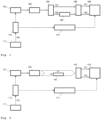
- FIG. 1 A block diagram of a measurement system applicable for a method according to the invention is shown in Fig. 1 .
- the system comprises a THz transmitter 101 triggered with a pulse from an optical control pulse emitting laser 111.
- the THz transmitter generates THz pulses having width of approximately 2 ps, while optical control pulse emitting laser generates triggering pulses having a width of c.a. 50 fs i.e. two orders of magnitude shorter than the THz pulse.
- the triggering pulse is directed to a beam splitting element realized as a beam splitter 112 e.g. a semitransparent mirror.
- the beam splitter 112 directs split pulses to a delay line 113 and to the THZ pulse transmitter 101.
- the THz pulse transmitter 101 triggered with the triggering pulse 130 generates a THz pulse which is fed to a beam former 102.
- the beam splitter 112 can be replaced by other elements used in optical measurements for splitting radiation e.g. based on optical fibers or waveguides.
- the triggering pulse 130 propagating via the delay line 113 is fed to a THz receiver 106.
- the THz receiver 106 is triggered for a detection with the triggering pulse 130 fed from the delay line 113.
- a beam of radiation from the beam former 102 is divided into a reference beam portion 121 and a measurement beam portion 120.
- the division to the measurement beam portion 120 and the reference beam portion 121 is realized with a beam splitter 103.
- the reference beam portion 121 propagates directly to a beam former 105.
- the measurement beam portion 120 propagates from the beam splitter 103 via a measurement container 140 for accommodating the substance under test, to the beam former 105.
- the measurement beam portion and the reference beam portion can be portions of the same beam formed with a beam former 202 to have an aperture large enough to cover more than just area of container 140.
- a portion of beam propagates through the container 140 and the substance therein and another portion of beam propagates outside said container 140.
- the former is the measurement beam portion 120 and the latter is the reference beam portion 121.
- the reference beam portion 121 is used for accommodating a THz pulse time position. It is used to correct time jitter or time-drift of the THz pulse and avoid errors in measurements with the measurement beam portion 120.
- the reference beam portion 121 and the measurement beam portion 120 from the beam former 105 are fed to the THz receiver 106.
- a delay of the delay line 113 is selected so that the THz receiver 106 is triggered with the triggering pulse 130 to start detection exactly in the moment the THz radiation pulses in measurement beam 120 portion and reference beam portion 121 reach the THz receiver 106 or a short advance time earlier. Short advance time gives a margin before samples of measurement pulse propagating through the container are recorded. The 30 ps or less is a reasonable advance time. Then both the triggering pulse 130 and the THz radiation pulses are repeatedly sent. The delay of the delay line is gradually increased, hence after numerous repetitions a sampled time waveform of the received THz radiation pulse is obtained.
- the method according to the invention can be executed using the measurement setup described above to determine the time of propagation of the terahertz radiation pulse.
- the use of the THz radiation pulse for measuring the time of propagation is accurately enough to determine the refractive index.
- the substance under test is highly absorbing, then the time of propagation in the pure substance under test cannot be measured due to a lack of measurable intensity of the transmitted pules.
- the substance under test is diluted with a less absorbing solvent to enable the measurement of the time of propagation, then the refractive index of the solution of the substance under test in the solvent is different than the refractive index of the substance under test.
- the relation between the concentration and the resulting refractive index usually follows one of few mixing rules known in the art. Which rule it is depends on the solvent and on the substance under test. Therefore two main measurements of the refractive index of the absorbing substances under test with terahertz radiation pulses are needed. It appears that with at least two main measurements and base measurement it can be observed which mixing rule fits the best and is appropriate.
- the method according to the invention enables measuring refractive index of the liquid substance under test with a terahertz time-domain spectroscopy measurement system adapted to measuring a propagation of THz radiation pulse through a container.
- Measurements of at least two different concentrations of the substance under test in a solvent allow selection of appropriate mixing rule which fits the best measurement points and then solving it to determine the refractive index of the substance under test.
- the substance under test is diluted with a solvent of an absorption lower than the absorption of the substance under test, to obtain a solution having an absorption low enough to obtain a measureable transmitted THz radiation pulse.
- a first concentration of the substance under test in the solution is recorded, and a first time of propagation in the solution is measured.
- the substance under test is diluted to a second concentration and the main measurement step is repeated so that a second concentration of the substance under test in the solution is recorded, and a second time of propagation in the solution is measured.
- the base measurement is carried out with the container filled with the pure solvent to obtain a base propagation time.
- Adequate mixing rule for modeling dilution known in the art is selected so as to fit the first concentration and the first propagation time and the second concentration and the second propagation time and the base propagation time.
- a refractive index of the substance under test is determined.
- n S of the solvent needs to be known.
- Gasoline is often an applicable solvent.
- Fig. 3 shows an exemplary family of delayed pulses corresponding to different concentrations of the substance under test being isopropanol, in gasoline. Isopropanol is highly absorbing at THz frequency bands.
- the determination of the refractive index includes fitting a predefined mathematical function to the THz radiation pulse waveform and determining times corresponding to peak amplitudes or a center of masses of pulses in the measurement beam portion 120 and the reference beam portion 121.
- the difference in a time of arrival between the THz radiation pulse in the reference beam portion 121 and in the measurement beam portion 120 is a propagation time in the container filed with a substance.
- the propagation time in a container filed with the pure solvent is the base propagation time. Difference between the propagation time in container filed with solution comprising substance under test and the base propagation time defines a time difference ⁇ t as shown in Fig. 3 . That time difference is used for determination of the refractive index of the solution of given concentration of the substance under test in the solvent. Knowing the adequate mixing rule allows determining the refractive index of the pure (not diluted) substance under test.
- n D 2 ⁇ 1 n D 2 + 2 ⁇ x n x 2 ⁇ 1 n x 2 + 2 + ⁇ S n x 2 ⁇ 1 n x 2 + 2 ,
- n D 2 ⁇ 1 ⁇ s n s 2 ⁇ 1 + ⁇ x n x 2 ⁇ 1 ,
- n D ⁇ 1 ⁇ s n s ⁇ 1 + ⁇ x n x ⁇ 1 .
- a method of measuring the refractive index n x of the liquid substance under test involving the terahertz time-domain spectroscopy measurement system adapted to measuring a propagation of THz radiation pulse through a container involves determination of the difference ⁇ t of the propagation time in the base measurement and in the measurement with the container comprising the substance under test having the known concentration ⁇ x when the adequate mixing rule is applied.
- Fig. 4 shows measurement points of function ⁇ t ( ⁇ x ) taken for a number of values of volume concentrations of isopropyl alcohol (ispopropanol) in gasoline. Having at least two points enables selecting adequate mixing rule, construing a solvable set of equations and determining value of refractive index n x of pure, non-dissolved substance under test.
- the results shown in Fig. 4 were obtained for three different lengths of measurement container 140 .
- the grater is the length of the container 140 along the propagation path of the terahertz radiation pulse the more precise measurement of time can be. Limiting factors are convenience of use and attenuation due to absorption.
- Refractive index is derived from model comprising two equations.
- Quite efficient measurement process starts measuring a propagation time through container 140 filed with the pure solvent of the known refractive index ⁇ S . Then the container 140 filed with the solution of volume concentration ⁇ x 1 of 1:1 in proportion of the substance under test and the solvent.
- the invention can be used in ATR configuration.
- this configuration instead of measuring transmission of the pulse the time delay of the pulse is measured in an experimental arrangement typically used for measurements taken from a sample of substance located on a substrate and illuminated with THz radiation pulses at the incidence angle corresponding to the angle of total internal reflection of the THz pulse.
- the invention allows determination of a refractive index of substances that are too absorptive to be measured with a direct measurement of a measurement pulse transmitted through the substance under test.
- wideband terahertz pulses are required. They have relatively low energy and are easily attenuated.
- the invention alleviates this problem.
Landscapes
- Physics & Mathematics (AREA)
- Spectroscopy & Molecular Physics (AREA)
- Health & Medical Sciences (AREA)
- Life Sciences & Earth Sciences (AREA)
- Chemical & Material Sciences (AREA)
- Analytical Chemistry (AREA)
- Biochemistry (AREA)
- General Health & Medical Sciences (AREA)
- General Physics & Mathematics (AREA)
- Immunology (AREA)
- Pathology (AREA)
- Toxicology (AREA)
- Investigating Or Analysing Materials By Optical Means (AREA)
Abstract
Description
- The invention concerns a method of determination of a refractive index of substances in a liquid phase in terahertz frequency bands.
- Various methods of measuring of parameters of media using radiation propagation measurements in terahertz bands are known in the art.
- In particular THz radiation pulses are known in the state of the art to be applicable for a time measurement and are generally understood as pulses containing a wide band of frequencies from 10GHz up to 50 GHz -
EP2167914B1 . - There are known ways to measure concentrations of high-loss substances based on an attenuation of a radiation propagating through them. Fabry-Perot resonator interferometric measurements based on an amplitude drop assessment are disclosed for example in Dobroiu, Adrian & Beigang, Rene & Otani, Chiko & Kawase, Kodo. (2005); Monolithic Fabry-Perot resonator for the measurement of optical constants in the terahertz range; Applied Physics Letters 86; 261107-261107; 10.1063/1.1968423 cited in
EP2035809 . - An article by Stelmaszczyk, K.; Karpierz-Marczewska, E.; Mikhnev, V.; Cywinski, G.; Skotnicki, T.; Knap, W.; Ultrafast Time-of-Flight Method of Gasoline Contamination Detection Down to Ppm Levels by Means of Terahertz Time-Domain Spectroscopy; Applied Sciences 2022, 12, 1629, doi:10.3390/app12031629 discusses a method and a measurement setup for detection of impurities based on analysis of time of propagation.
- European patent no
EP2035809 discloses a method for measuring an electrical permeability using a time-domain propagation of narrow terahertz-band pulses. Such measurements fall into a group of Terahertz time-domain spectroscopy (THz-TDS) techniques. - A disadvantage of methods such as that disclosed in
EP2035809 is that in a case of high loss substances, not only is it mathematically more difficult to determine the permeability from the delay, but it is also difficult to carry out pulse delay and/or pulse temporal shape measurements when the received pulse is attenuated and distorted by the high loss medium. It is difficult to generate short pulses having high energy and using longer pulses requires increase of container length to preserve precision. The container length on the other hand contributes to the total attenuation and again limits possibility of precise measurement. It is an object of the invention to resolve this problem. - A method of measuring a refractive index of a liquid substance under test with a time-domain spectroscopy measurement system adapted to measuring a propagation of radiation pulse through a container, according to the invention includes a step of determination of a difference between a propagation time in a base measurement step, and a propagation time in a main measurement step with the container comprising the liquid substance under test. The refractive index of the substance under test is computed using said difference. According to the invention the radiation pulse is a terahertz radiation pulse. Before the main measurement step the liquid substance under test is diluted with a known solvent of an absorption lower than an absorption of the liquid substance under test, to obtain a solution having an absorption low enough to enable a measurement of the terahertz radiation pulse transmitted through the container filed with the solution. In the main measurement step a first concentration of the substance under test in the solution is recorded, and a first time of propagation in the solution is measured. Then the substance under test is diluted to a second concentration and the main measurement step is repeated so that a second concentration of the liquid substance under test in the solution is recorded, and a second time of propagation in the solution is measured. The base measurement is carried out with the container filled with the pure solvent to obtain a base propagation time. Subsequently a mixing rule for modeling the dilution is selected so as to fit at least the first concentration and the first propagation time and the second concentration and the second propagation time and the base propagation time. Based on the selected mixing rule and known refractive index of the solvent, the refractive index of substance under test is determined using a difference between the base propagation time and at least one of the propagation times obtained in the main measurement. Energy of the measurement pulses in the teraherz measurement systems is limited. Thanks to the dilution of the liquid substance under test measurement it is possible to determine a refractive index of a substance under test which is so absorptive that the terahertz measurement pulse transmitted through the container filled with the pure substance under test is too weak for a precise measurement. Having two measurements and the base measurement enables testing the applicability of the mixing rule and once applicable is selected using it to determine the refractive index of the pure substance under test.
- Advantageously, the mixing rule is selected from a group comprising Eykman equation, Lorentz-Lorentz equation, Newton equation and Gladstone-Dale equation. This rules has been tested to often be applicable, however person skilled in the art is able to suggest others.
- Advantageously, the container used for the measurement of the liquid substance under test is selected so that its length along the THz pulse propagation path is greater than a velocity of light in vacuum multiplied by a quotient of terahertz time-domain spectroscopy measurement system resolution by a tolerance of permittivity measurement. This allows full use of the measurement equipment abilities to obtain precise measurement.
- Advantageously, the terahertz radiation pulse having width shorter than or equal to 2 ps. The width of the radiation pulse is defined as time in which 90% of the energy of the pulse is accumulated. Use of the short pulses increases the time resolution of the measurement and that in turn allows to use shorter containers. As the length of the container contributes to the attenuation of transmission the shorter pulses enable using higher concentrations and therefore increasing precision of determination of the refractive index.
- Advantageously, the main measurement step is repeated more than one time. Multiple measurement points enable better test of applicability of the mixing rule and obtaining overdefined set of equations for determination of the refractive index which contributes to reduces an error of the measurement.
- Advantageously, the first pure solvent is measured for a determination of the base propagation time and then fractions of the substance under test are added and the subsequent main measurement steps are executed. That mode of operation enables fast operation without refiling the container but still controlling the concentration.
- Alternatively, the fractions of the substance under test are selected so as to obtain values of a volumetric concentration of the liquid substance under test in a subsequent measurement following a geometrical series of concentrations

- The invention has been described below in detail, with reference to the following figures in which
-
Fig. 1 shows a block diagram of exemplary measurement system applicable with the method according to the invention, -
Fig. 2 shows a block diagram of alternative configuration of measurement setup applicable with the method according to the invention, -
Fig. 3 shows family of delayed pulses corresponding to different concentration of isopropanol in gasoline, -
Fig. 4 shows relation between concentration and terahertz pulse propagation time in solution of isopropanol in gasoline. - A block diagram of a measurement system applicable for a method according to the invention is shown in
Fig. 1 . The system comprises aTHz transmitter 101 triggered with a pulse from an optical controlpulse emitting laser 111. The THz transmitter generates THz pulses having width of approximately 2 ps, while optical control pulse emitting laser generates triggering pulses having a width of c.a. 50 fs i.e. two orders of magnitude shorter than the THz pulse. - The triggering pulse is directed to a beam splitting element realized as a
beam splitter 112 e.g. a semitransparent mirror. Thebeam splitter 112 directs split pulses to adelay line 113 and to theTHZ pulse transmitter 101. TheTHz pulse transmitter 101 triggered with the triggeringpulse 130 generates a THz pulse which is fed to a beam former 102. - The
beam splitter 112 can be replaced by other elements used in optical measurements for splitting radiation e.g. based on optical fibers or waveguides. - The triggering
pulse 130 propagating via thedelay line 113 is fed to aTHz receiver 106. TheTHz receiver 106 is triggered for a detection with the triggeringpulse 130 fed from thedelay line 113. - A beam of radiation from the beam former 102 is divided into a
reference beam portion 121 and ameasurement beam portion 120. - The division to the
measurement beam portion 120 and thereference beam portion 121 is realized with abeam splitter 103. Thereference beam portion 121 propagates directly to a beam former 105. Themeasurement beam portion 120 propagates from thebeam splitter 103 via ameasurement container 140 for accommodating the substance under test, to the beam former 105. - Alternatively, the measurement beam portion and the reference beam portion can be portions of the same beam formed with a beam former 202 to have an aperture large enough to cover more than just area of
container 140. Such configuration is shown inFig. 2 . Accordingly, a portion of beam propagates through thecontainer 140 and the substance therein and another portion of beam propagates outside saidcontainer 140. The former is themeasurement beam portion 120 and the latter is thereference beam portion 121. - The
reference beam portion 121 is used for accommodating a THz pulse time position. It is used to correct time jitter or time-drift of the THz pulse and avoid errors in measurements with themeasurement beam portion 120. - The
reference beam portion 121 and themeasurement beam portion 120 from the beam former 105 are fed to theTHz receiver 106. - Examples of applicable measurement setups are discussed in article concerning such measurement setups for detection impurities: Stelmaszczyk, K.; Karpierz-Marczewska, E.; Mikhnev, V.; Cywinski, G.; Skotnicki, T.; Knap, W.; Ultrafast Time-of-Flight Method of Gasoline Contamination Detection Down to Ppm Levels by Means of Terahertz Time-Domain Spectroscopy; .
- Initially a delay of the
delay line 113 is selected so that theTHz receiver 106 is triggered with the triggeringpulse 130 to start detection exactly in the moment the THz radiation pulses inmeasurement beam 120 portion andreference beam portion 121 reach theTHz receiver 106 or a short advance time earlier. Short advance time gives a margin before samples of measurement pulse propagating through the container are recorded. The 30 ps or less is a reasonable advance time. Then both the triggeringpulse 130 and the THz radiation pulses are repeatedly sent. The delay of the delay line is gradually increased, hence after numerous repetitions a sampled time waveform of the received THz radiation pulse is obtained. - The method according to the invention can be executed using the measurement setup described above to determine the time of propagation of the terahertz radiation pulse. The use of the THz radiation pulse for measuring the time of propagation is accurately enough to determine the refractive index. However, when the substance under test is highly absorbing, then the time of propagation in the pure substance under test cannot be measured due to a lack of measurable intensity of the transmitted pules. When the substance under test is diluted with a less absorbing solvent to enable the measurement of the time of propagation, then the refractive index of the solution of the substance under test in the solvent is different than the refractive index of the substance under test.
- The relation between the concentration and the resulting refractive index usually follows one of few mixing rules known in the art. Which rule it is depends on the solvent and on the substance under test. Therefore two main measurements of the refractive index of the absorbing substances under test with terahertz radiation pulses are needed. It appears that with at least two main measurements and base measurement it can be observed which mixing rule fits the best and is appropriate.
- The method according to the invention enables measuring refractive index of the liquid substance under test with a terahertz time-domain spectroscopy measurement system adapted to measuring a propagation of THz radiation pulse through a container.
- Measurements of at least two different concentrations of the substance under test in a solvent allow selection of appropriate mixing rule which fits the best measurement points and then solving it to determine the refractive index of the substance under test.
- Before the main measurement step, the substance under test is diluted with a solvent of an absorption lower than the absorption of the substance under test, to obtain a solution having an absorption low enough to obtain a measureable transmitted THz radiation pulse.
- In the main measurement step, a first concentration of the substance under test in the solution is recorded, and a first time of propagation in the solution is measured.
- Subsequently, the substance under test is diluted to a second concentration and the main measurement step is repeated so that a second concentration of the substance under test in the solution is recorded, and a second time of propagation in the solution is measured.
- Additionally, the base measurement is carried out with the container filled with the pure solvent to obtain a base propagation time.
- Adequate mixing rule for modeling dilution known in the art is selected so as to fit the first concentration and the first propagation time and the second concentration and the second propagation time and the base propagation time.
- Based on the selected mixing rule and the known refractive index of the solvent, a refractive index of the substance under test is determined.
- It is easy to measure a pure solvent first and determine the base propagation time. The refractive index nS of the solvent needs to be known. Gasoline is often an applicable solvent.
Fig. 3 shows an exemplary family of delayed pulses corresponding to different concentrations of the substance under test being isopropanol, in gasoline. Isopropanol is highly absorbing at THz frequency bands. - The determination of the refractive index includes fitting a predefined mathematical function to the THz radiation pulse waveform and determining times corresponding to peak amplitudes or a center of masses of pulses in the
measurement beam portion 120 and thereference beam portion 121. The difference in a time of arrival between the THz radiation pulse in thereference beam portion 121 and in themeasurement beam portion 120 is a propagation time in the container filed with a substance. - The propagation time in a container filed with the pure solvent is the base propagation time. Difference between the propagation time in container filed with solution comprising substance under test and the base propagation time defines a time difference Δt as shown in
Fig. 3 . That time difference is used for determination of the refractive index of the solution of given concentration of the substance under test in the solvent. Knowing the adequate mixing rule allows determining the refractive index of the pure (not diluted) substance under test. - In the art there are known numerous rules allowing for determination of the refractive index nD of solution of volume or mass concentration φx of substance having a refractive index of nx in a solvent having a refractive index nS and having concentration φS = 1 - φx . Said rules are discussed e.g. in Tasic, A.Z.; Djordjevic, B.D.; Grozdanic, D.K.; Radojkovic, N. Use of Mixing Rules in Predicting Refractive Indexes and Specific Refractivities for Some Binary Liquid Mixtures. J. Chem. Eng. Data 1992, 37, 310-313 or in Resa, J.M.; Gonzalez, C.; Ortiz de Landaluce, S.; Lanz, J. Densities, Excess Molar Volumes, and Refractive Indices of Ethyl Acetate and Aromatic Hydrocarbon Binary Mixtures. J. Chem. Thermodyn. 2002, 34, 995-1004.
- Typical applicable rules include for example: Eykman equation:

- Lorentz-Lorentz equation:

- Newton equation:

- Gladstone-Dale equation:

- In further description it is focused on Gladstone-Dale equation as it is the one easiest to follow.
- A method of measuring the refractive index nx of the liquid substance under test involving the terahertz time-domain spectroscopy measurement system adapted to measuring a propagation of THz radiation pulse through a container, involves determination of the difference Δt of the propagation time in the base measurement and in the measurement with the container comprising the substance under test having the known concentration φx when the adequate mixing rule is applied.
- Unexpectedly it turned out that for a number of substances just two main measurement steps and recording information about: a first concentration φ x,1 of substance under test in a solution and a first time difference Δt 1 as well as a second concentration φ x,2 of substance under test in a solution and a second time difference Δt 2 gives enough information to either select an adequate mixing rule or event detect that for given concentration more than one mixing rule gives precise results. Having two measurements and the base measurement enables testing the applicability of the known mixing rule and once applicable is selected using it to determine the refractive index of the pure substance under test.
- Naturally, taking more measurements allows better fitting of the mixing rule to the substance under test and also more precise determination of the refractive index. It is crucial that the measurement step is carried out for at least two concentrations of the liquid substance under test in the solution.
Fig. 4 shows measurement points of function Δt(φx ) taken for a number of values of volume concentrations of isopropyl alcohol (ispopropanol) in gasoline. Having at least two points enables selecting adequate mixing rule, construing a solvable set of equations and determining value of refractive index nx of pure, non-dissolved substance under test. The results shown inFig. 4 were obtained for three different lengths ofmeasurement container 140. Generally the grater is the length of thecontainer 140 along the propagation path of the terahertz radiation pulse the more precise measurement of time can be. Limiting factors are convenience of use and attenuation due to absorption. - Having measurement points Δt(φx,i ) enables applying most appropriate mixing rule by curve fitting or solving the model parameters with an overdefined equation system.
- As a result of the base measurement is known, if it can be reasonably assumed that the measurement will fall in the linear range of the curve Δt(φ), then even single measurement is enough to determine refractive index but finding this segment takes at least two measurements.
- Refractive index is derived from model comprising two equations. One equation represents mixing rule of impact of concentration of substance under test in the solvent on the refractive index of the solution. It has been determined that to the data shown in
Fig. 4 a mixing rule given by the Gladstone-Dale equation fits the best:
- The other equation represents impact of refractive index of solution on change in propagation time with respect to propagation in the pure solvent:

container 140 filed with the liquid substance and c represents velocity of light in a vacuum. - When Gladstone-Dale mixing rule is applied, theoretically it is possible to determine a concentration in just one measurement if refractive index nS is known:

- In practice errors in administering concentrations and imperfections of mixing rules make single measurement insufficient and time differences for at least two and preferably more concentrations need to be measured.
- Quite efficient measurement process starts measuring a propagation time through
container 140 filed with the pure solvent of the known refractive index φS . Then thecontainer 140 filed with the solution of volume concentration φ x1 of 1:1 in proportion of the substance under test and the solvent. - The difference Δt 1 of propagation of the THz radiation pulse propagating through the pure solvent and the solution of the substance under test is determined and noted. This step is repeated with different values φx
n of the concentration of the substance under test in the solution in which liquid is consecutively diluted in the weight proportion of 1:1 with addition of the solvent. Thus a geometrical series of concentrations
- Person skilled in the art having read the teachings of the description above is able to routinely use other mixing rules than given in example as well as mixing rules based on mass proportions or mol concentration instead of volume proportion.
- Furthermore it is noted that the invention can be used in ATR configuration. In this configuration instead of measuring transmission of the pulse the time delay of the pulse is measured in an experimental arrangement typically used for measurements taken from a sample of substance located on a substrate and illuminated with THz radiation pulses at the incidence angle corresponding to the angle of total internal reflection of the THz pulse.
- The invention allows determination of a refractive index of substances that are too absorptive to be measured with a direct measurement of a measurement pulse transmitted through the substance under test. For the precise measurement wideband terahertz pulses are required. They have relatively low energy and are easily attenuated. The invention alleviates this problem.
Claims (7)
- A method of measuring a refractive index of a liquid substance under test with a time-domain spectroscopy measurement system adapted to measuring a propagation of radiation pulse through a container (140), including a step of determination of a difference betweena propagation time determined in a base measurement step, anda propagation time, determined in a main measurement step, through the container (140) comprising the liquid substance under test,and computing the refractive index of the substance under test based on said difference,characterized in that,the radiation pulse is a terahertz radiation pulse, and before the main measurement step
the liquid substance under test is diluted with a known solvent of an absorption lower than absorption of the liquid substance under test, to obtain a solution having absorption low enough to enable a measurement of the terahertz radiation pulse transmitted through the container (140) filed with the solution, andin the main measurement stepa first concentration of the substance under test in the solution is recorded, anda first time of propagation of the terahertz radiation pulse in the solution is measured,then the substance under test is diluted to a secondconcentration and the main measurement step is repeated so thata second concentration of the test liquid substance in the solution is recorded, anda second time of propagation in the solution is measured, wherein the base measurement is carried out with thecontainer (140) filled with the pure solvent to obtaina base propagation time,and then a mixing rule for modeling the dilution is selected so as to fit the first concentration and the first propagation time and the second concentration and the second propagation time and the base propagation time, andbased on the selected mixing rule and known refractive index of the solvent, the refractive index of the liquid substance under test is determined based on the difference between the base propagation time and at least one of the propagation times determined in the main measurement. - Method according to claim 1, wherein the mixing rule is selected from a group comprising Eykman equation, Lorentz-Lorentz equation, Newton equation and Gladstone-Dale equation.
- Method according to claim 1 or 2, wherein the container (140) used for the measurement of the test liquid substance is selected so that its length along the THz pulse propagation path is greater than a velocity of light in a vacuum multiplied by a quotient of terahertz time-domain spectroscopy measurement system resolution by a tolerance of permittivity measurement.
- Method according to claim 1 or 2 or 3, wherein the terahertz radiation pulse width is shorter than or equal to 2 ps.
- The method according to any of claim 1 to 4, wherein the main measurement step is repeated more than one time.
- The method according to claim 5, wherein the first pure solvent is measured for a determination of the base propagation time and then fractions of the substance under test are added and the subsequent main measurement steps are executed.
- The method according to claims 1 to 5, wherein fractions of the liquid substance under test are selected so as to obtain values of a volumetric concentration of the substance under test in a subsequent measurement following a geometrical series of concentrations φx
n =
Priority Applications (2)
| Application Number | Priority Date | Filing Date | Title |
|---|---|---|---|
| EP22461557.5A EP4286832B1 (en) | 2022-05-31 | 2022-05-31 | Method of measuring refractive index of liquid substance under test |
| PL22461557.5T PL4286832T3 (en) | 2022-05-31 | 2022-05-31 | Method of measuring refractive index of liquid substance under test |
Applications Claiming Priority (1)
| Application Number | Priority Date | Filing Date | Title |
|---|---|---|---|
| EP22461557.5A EP4286832B1 (en) | 2022-05-31 | 2022-05-31 | Method of measuring refractive index of liquid substance under test |
Publications (3)
| Publication Number | Publication Date |
|---|---|
| EP4286832A1 true EP4286832A1 (en) | 2023-12-06 |
| EP4286832C0 EP4286832C0 (en) | 2024-06-05 |
| EP4286832B1 EP4286832B1 (en) | 2024-06-05 |
Family
ID=81877821
Family Applications (1)
| Application Number | Title | Priority Date | Filing Date |
|---|---|---|---|
| EP22461557.5A Active EP4286832B1 (en) | 2022-05-31 | 2022-05-31 | Method of measuring refractive index of liquid substance under test |
Country Status (2)
| Country | Link |
|---|---|
| EP (1) | EP4286832B1 (en) |
| PL (1) | PL4286832T3 (en) |
Citations (2)
| Publication number | Priority date | Publication date | Assignee | Title |
|---|---|---|---|---|
| EP2035809A1 (en) | 2006-07-05 | 2009-03-18 | Danmarks Tekniske Universitet | Determining parameters of the dielectric function of a substance in aqueous solution by self-referenced reflection thz spectroscopy |
| EP2167914B1 (en) | 2007-07-12 | 2016-04-27 | Picometrix, LLC | System to measure the transit time position(s) of pulses in a time domain data |
-
2022
- 2022-05-31 PL PL22461557.5T patent/PL4286832T3/en unknown
- 2022-05-31 EP EP22461557.5A patent/EP4286832B1/en active Active
Patent Citations (2)
| Publication number | Priority date | Publication date | Assignee | Title |
|---|---|---|---|---|
| EP2035809A1 (en) | 2006-07-05 | 2009-03-18 | Danmarks Tekniske Universitet | Determining parameters of the dielectric function of a substance in aqueous solution by self-referenced reflection thz spectroscopy |
| EP2167914B1 (en) | 2007-07-12 | 2016-04-27 | Picometrix, LLC | System to measure the transit time position(s) of pulses in a time domain data |
Non-Patent Citations (9)
| Title |
|---|
| DOBROIU, ADRIANBEIGANG, RENEOTANI, CHIKOKAWASE, KODO: "Monolithic Fabry-Perot resonator for the measurement of optical constants in the terahertz range", APPLIED PHYSICS LETTERS, vol. 86, 2005, pages 261107 - 261107 |
| KECK CORNELIA M.: "Chapter 5: Determination Of The Real Refractive Index", DISSERTATION ENTITLED : "CYCLOSPORINE NANOSUSPENSIONS: OPTIMISED SIZE CHARACTERISATION & ORAL FORMULATIONS", 8 October 2006 (2006-10-08), pages 118 - 148, XP055980298, Retrieved from the Internet <URL:https://refubium.fu-berlin.de/bitstream/handle/fub188/11046/04_5Chapter5.pdf?sequence=5&isAllowed=y> [retrieved on 20221111] * |
| KECK CORNELIA M.: "Cyclosporine nanosuspensions: Optimised Size Characterisation & Oral Formulations", 8 October 2006 (2006-10-08), XP055980292, Retrieved from the Internet <URL:https://refubium.fu-berlin.de/handle/fub188/11046> [retrieved on 20221111] * |
| PETROV MIHAI: "Concentration determination by means of refractometric method: A consequent dilution of an unknown binary aqueous solution", ACADEMIA JOURNAL OF SCIENTIFIC RESEARCH, January 2021 (2021-01-01), pages 9 - 18, XP055980195, Retrieved from the Internet <URL:https://www.researchgate.net/publication/348999852_Concentration_determination_by_means_of_refractometric_method_A_consequent_dilution_of_an_unknown_binary_aqueous_solution> [retrieved on 20221110], DOI: 10.15413/ajsr.2020.0417 * |
| RESA, J.M.GONZALEZ, C.ORTIZ DE LANDALUCE, S.LANZ, J.: "Densities, Excess Molar Volumes, and Refractive Indices of Ethyl Acetate and Aromatic Hydrocarbon Binary Mixtures", J. CHEM. THERMODYN., vol. 34, 2002, pages 995 - 1004 |
| SIMA SERGIU ET AL: "Application of refractive index mixing rules in binary systems containing n-octane, 2-hexanol or 2-octanol at 298.15 K", REVISTA DE CHIMIE, vol. 65, no. 2, February 2014 (2014-02-01), Bucharest, pages 2021 - 2024, XP055980152, Retrieved from the Internet <URL:https://www.researchgate.net/publication/289343998> [retrieved on 20221110] * |
| STELMASZCZYK KAMIL ET AL: "Ultrafast Time-of-Flight Method of Gasoline Contamination Detection Down to ppm Levels by Means of Terahertz Time-Domain Spectroscopy", APPLIED SCIENCES, vol. 12, no. 3, 4 February 2022 (2022-02-04), pages 1629, XP055979676, DOI: 10.3390/app12031629 * |
| STELMASZCZYK, K.KARPIERZ-MARCZEWSKA, E.MIKHNEV, V.CYWINSKI, G.SKOTNICKI, T.KNAP, W.: "Ultrafast Time-of-Flight Method of Gasoline Contamination Detection Down to Ppm Levels by Means of Terahertz Time-Domain Spectroscopy", APPLIED SCIENCES, vol. 12, 2022, pages 1629 |
| TASIC, A.Z.DJORDJEVIC, B.D.GROZDANIC, D.K.RADOJKOVIC, N.: "Use of Mixing Rules in Predicting Refractive Indexes and Specific Refractivities for Some Binary Liquid Mixtures", J. CHEM. ENG. DATA, vol. 37, 1992, pages 310 - 313 |
Also Published As
| Publication number | Publication date |
|---|---|
| EP4286832C0 (en) | 2024-06-05 |
| EP4286832B1 (en) | 2024-06-05 |
| PL4286832T3 (en) | 2024-08-19 |
Similar Documents
| Publication | Publication Date | Title |
|---|---|---|
| US11408823B2 (en) | Terahertz spectrum measurement method and system based on unequal optical path method | |
| EP1191321B1 (en) | Determination of properties of an optical device | |
| US6016202A (en) | Method and apparatus for measuring material properties using transient-grating spectroscopy | |
| Brattain et al. | A Spectrophotometric Method for the Analysis of Multicomponent Mixtures and Its Infra‐Red Application | |
| JP2009192524A5 (en) | ||
| CN110274880A (en) | A kind of optical spectrum detecting method and system of high-precision spatial resolution | |
| CN104266993A (en) | Article characteristic extraction method and device based on terahertz frequency band | |
| EP2857827A1 (en) | Prism member, terahertz-wave spectroscopic measurement device, and terahertz-wave spectroscopic measurement method | |
| Koleják et al. | Experimental gouy phase shift compensation in terahertz time-domain spectroscopy | |
| US6768548B2 (en) | Pulse-by-pulse cavity ring-down spectroscopy | |
| EP4286832A1 (en) | Method of measuring refractive index of liquid substance under test | |
| US5373356A (en) | Method and apparatus for identifying echoes detected by an optical time-domain reflectometer | |
| US20080315131A1 (en) | Method and Device for Characterising a Structure by Wavelength Effect in a Photoacoustic System | |
| Minato et al. | Development of a lidar system for measuring methane using a gas correlation method | |
| EP1640709B1 (en) | Optical waveform measurement device and measurement method thereof, complex refractive index measurement device and measurement method thereof, and computer program recording medium containing the program | |
| US20190379451A1 (en) | Method and device of determining a time-of-flight of an optical signal between a starting point of an optical path and a reflection point within the optical path | |
| JP7571160B2 (en) | Ultra-high resolution time-domain spectroscopy for sample characterization | |
| US11754465B2 (en) | Optical pulse testing device and optical pulse testing method | |
| Centini et al. | Signal velocity and group velocity for an optical pulse propagating through a GaAs cavity | |
| US20180266939A1 (en) | Method and device for determining a substance concentration or a substance in a liquid medium | |
| Faridi et al. | 1.5 port vector Spectrometer for terahertz time Domain spectroscopy | |
| Ceccherini et al. | Time-resolved interference of coherent polarization waves in semiconductors | |
| RU2729950C2 (en) | Systems and methods of polling parameters in multiple places in a sample | |
| Leonard et al. | A single-ended atmospheric transmissometer | |
| US7046373B2 (en) | Interferometric system for the simultaneous measurement of the index of refraction and of the thickness of transparent materials, and related procedure |
Legal Events
| Date | Code | Title | Description |
|---|---|---|---|
| PUAI | Public reference made under article 153(3) epc to a published international application that has entered the european phase |
Free format text: ORIGINAL CODE: 0009012 |
|
| STAA | Information on the status of an ep patent application or granted ep patent |
Free format text: STATUS: REQUEST FOR EXAMINATION WAS MADE |
|
| 17P | Request for examination filed |
Effective date: 20230626 |
|
| AK | Designated contracting states |
Kind code of ref document: A1 Designated state(s): AL AT BE BG CH CY CZ DE DK EE ES FI FR GB GR HR HU IE IS IT LI LT LU LV MC MK MT NL NO PL PT RO RS SE SI SK SM TR |
|
| GRAP | Despatch of communication of intention to grant a patent |
Free format text: ORIGINAL CODE: EPIDOSNIGR1 |
|
| STAA | Information on the status of an ep patent application or granted ep patent |
Free format text: STATUS: GRANT OF PATENT IS INTENDED |
|
| INTG | Intention to grant announced |
Effective date: 20240227 |
|
| GRAS | Grant fee paid |
Free format text: ORIGINAL CODE: EPIDOSNIGR3 |
|
| GRAA | (expected) grant |
Free format text: ORIGINAL CODE: 0009210 |
|
| STAA | Information on the status of an ep patent application or granted ep patent |
Free format text: STATUS: THE PATENT HAS BEEN GRANTED |
|
| AK | Designated contracting states |
Kind code of ref document: B1 Designated state(s): AL AT BE BG CH CY CZ DE DK EE ES FI FR GB GR HR HU IE IS IT LI LT LU LV MC MK MT NL NO PL PT RO RS SE SI SK SM TR |
|
| REG | Reference to a national code |
Ref country code: CH Ref legal event code: EP |
|
| REG | Reference to a national code |
Ref country code: DE Ref legal event code: R096 Ref document number: 602022003814 Country of ref document: DE |
|
| REG | Reference to a national code |
Ref country code: IE Ref legal event code: FG4D |
|
| U01 | Request for unitary effect filed |
Effective date: 20240705 |
|
| U07 | Unitary effect registered |
Designated state(s): AT BE BG DE DK EE FI FR IT LT LU LV MT NL PT SE SI Effective date: 20240712 |
|
| PG25 | Lapsed in a contracting state [announced via postgrant information from national office to epo] |
Ref country code: HR Free format text: LAPSE BECAUSE OF FAILURE TO SUBMIT A TRANSLATION OF THE DESCRIPTION OR TO PAY THE FEE WITHIN THE PRESCRIBED TIME-LIMIT Effective date: 20240605 |
|
| PG25 | Lapsed in a contracting state [announced via postgrant information from national office to epo] |
Ref country code: GR Free format text: LAPSE BECAUSE OF FAILURE TO SUBMIT A TRANSLATION OF THE DESCRIPTION OR TO PAY THE FEE WITHIN THE PRESCRIBED TIME-LIMIT Effective date: 20240906 |
|
| PG25 | Lapsed in a contracting state [announced via postgrant information from national office to epo] |
Ref country code: ES Free format text: LAPSE BECAUSE OF FAILURE TO SUBMIT A TRANSLATION OF THE DESCRIPTION OR TO PAY THE FEE WITHIN THE PRESCRIBED TIME-LIMIT Effective date: 20240605 |
|
| PG25 | Lapsed in a contracting state [announced via postgrant information from national office to epo] |
Ref country code: NO Free format text: LAPSE BECAUSE OF FAILURE TO SUBMIT A TRANSLATION OF THE DESCRIPTION OR TO PAY THE FEE WITHIN THE PRESCRIBED TIME-LIMIT Effective date: 20240905 Ref country code: HR Free format text: LAPSE BECAUSE OF FAILURE TO SUBMIT A TRANSLATION OF THE DESCRIPTION OR TO PAY THE FEE WITHIN THE PRESCRIBED TIME-LIMIT Effective date: 20240605 Ref country code: GR Free format text: LAPSE BECAUSE OF FAILURE TO SUBMIT A TRANSLATION OF THE DESCRIPTION OR TO PAY THE FEE WITHIN THE PRESCRIBED TIME-LIMIT Effective date: 20240906 Ref country code: ES Free format text: LAPSE BECAUSE OF FAILURE TO SUBMIT A TRANSLATION OF THE DESCRIPTION OR TO PAY THE FEE WITHIN THE PRESCRIBED TIME-LIMIT Effective date: 20240605 Ref country code: RS Free format text: LAPSE BECAUSE OF FAILURE TO SUBMIT A TRANSLATION OF THE DESCRIPTION OR TO PAY THE FEE WITHIN THE PRESCRIBED TIME-LIMIT Effective date: 20240905 |
|
| PG25 | Lapsed in a contracting state [announced via postgrant information from national office to epo] |
Ref country code: IS Free format text: LAPSE BECAUSE OF FAILURE TO SUBMIT A TRANSLATION OF THE DESCRIPTION OR TO PAY THE FEE WITHIN THE PRESCRIBED TIME-LIMIT Effective date: 20241005 |
|
| PG25 | Lapsed in a contracting state [announced via postgrant information from national office to epo] |
Ref country code: CZ Free format text: LAPSE BECAUSE OF FAILURE TO SUBMIT A TRANSLATION OF THE DESCRIPTION OR TO PAY THE FEE WITHIN THE PRESCRIBED TIME-LIMIT Effective date: 20240605 |
|
| PG25 | Lapsed in a contracting state [announced via postgrant information from national office to epo] |
Ref country code: RO Free format text: LAPSE BECAUSE OF FAILURE TO SUBMIT A TRANSLATION OF THE DESCRIPTION OR TO PAY THE FEE WITHIN THE PRESCRIBED TIME-LIMIT Effective date: 20240605 Ref country code: SK Free format text: LAPSE BECAUSE OF FAILURE TO SUBMIT A TRANSLATION OF THE DESCRIPTION OR TO PAY THE FEE WITHIN THE PRESCRIBED TIME-LIMIT Effective date: 20240605 |
|
| PG25 | Lapsed in a contracting state [announced via postgrant information from national office to epo] |
Ref country code: SM Free format text: LAPSE BECAUSE OF FAILURE TO SUBMIT A TRANSLATION OF THE DESCRIPTION OR TO PAY THE FEE WITHIN THE PRESCRIBED TIME-LIMIT Effective date: 20240605 |
|
| PG25 | Lapsed in a contracting state [announced via postgrant information from national office to epo] |
Ref country code: SM Free format text: LAPSE BECAUSE OF FAILURE TO SUBMIT A TRANSLATION OF THE DESCRIPTION OR TO PAY THE FEE WITHIN THE PRESCRIBED TIME-LIMIT Effective date: 20240605 Ref country code: SK Free format text: LAPSE BECAUSE OF FAILURE TO SUBMIT A TRANSLATION OF THE DESCRIPTION OR TO PAY THE FEE WITHIN THE PRESCRIBED TIME-LIMIT Effective date: 20240605 Ref country code: RO Free format text: LAPSE BECAUSE OF FAILURE TO SUBMIT A TRANSLATION OF THE DESCRIPTION OR TO PAY THE FEE WITHIN THE PRESCRIBED TIME-LIMIT Effective date: 20240605 Ref country code: IS Free format text: LAPSE BECAUSE OF FAILURE TO SUBMIT A TRANSLATION OF THE DESCRIPTION OR TO PAY THE FEE WITHIN THE PRESCRIBED TIME-LIMIT Effective date: 20241005 Ref country code: CZ Free format text: LAPSE BECAUSE OF FAILURE TO SUBMIT A TRANSLATION OF THE DESCRIPTION OR TO PAY THE FEE WITHIN THE PRESCRIBED TIME-LIMIT Effective date: 20240605 |
|
| PLBE | No opposition filed within time limit |
Free format text: ORIGINAL CODE: 0009261 |
|
| STAA | Information on the status of an ep patent application or granted ep patent |
Free format text: STATUS: NO OPPOSITION FILED WITHIN TIME LIMIT |
|
| 26N | No opposition filed |
Effective date: 20250306 |
|
| PGFP | Annual fee paid to national office [announced via postgrant information from national office to epo] |
Ref country code: PL Payment date: 20250530 Year of fee payment: 4 |
|
| U20 | Renewal fee for the european patent with unitary effect paid |
Year of fee payment: 4 Effective date: 20250602 |
|
| PGFP | Annual fee paid to national office [announced via postgrant information from national office to epo] |
Ref country code: CH Payment date: 20250605 Year of fee payment: 4 |
|
| PG25 | Lapsed in a contracting state [announced via postgrant information from national office to epo] |
Ref country code: MC Free format text: LAPSE BECAUSE OF FAILURE TO SUBMIT A TRANSLATION OF THE DESCRIPTION OR TO PAY THE FEE WITHIN THE PRESCRIBED TIME-LIMIT Effective date: 20240605 |
|
| PG25 | Lapsed in a contracting state [announced via postgrant information from national office to epo] |
Ref country code: IE Free format text: LAPSE BECAUSE OF NON-PAYMENT OF DUE FEES Effective date: 20250531 |