EP4286780A1 - Conformal heat exchanger - Google Patents
Conformal heat exchanger Download PDFInfo
- Publication number
- EP4286780A1 EP4286780A1 EP23177299.7A EP23177299A EP4286780A1 EP 4286780 A1 EP4286780 A1 EP 4286780A1 EP 23177299 A EP23177299 A EP 23177299A EP 4286780 A1 EP4286780 A1 EP 4286780A1
- Authority
- EP
- European Patent Office
- Prior art keywords
- sheets
- axis
- fins
- fin
- heat exchanger
- Prior art date
- Legal status (The legal status is an assumption and is not a legal conclusion. Google has not performed a legal analysis and makes no representation as to the accuracy of the status listed.)
- Pending
Links
Images

Classifications
-
- F—MECHANICAL ENGINEERING; LIGHTING; HEATING; WEAPONS; BLASTING
- F28—HEAT EXCHANGE IN GENERAL
- F28D—HEAT-EXCHANGE APPARATUS, NOT PROVIDED FOR IN ANOTHER SUBCLASS, IN WHICH THE HEAT-EXCHANGE MEDIA DO NOT COME INTO DIRECT CONTACT
- F28D9/00—Heat-exchange apparatus having stationary plate-like or laminated conduit assemblies for both heat-exchange media, the media being in contact with different sides of a conduit wall
- F28D9/0062—Heat-exchange apparatus having stationary plate-like or laminated conduit assemblies for both heat-exchange media, the media being in contact with different sides of a conduit wall the conduits for one heat-exchange medium being formed by spaced plates with inserted elements
-
- B—PERFORMING OPERATIONS; TRANSPORTING
- B23—MACHINE TOOLS; METAL-WORKING NOT OTHERWISE PROVIDED FOR
- B23K—SOLDERING OR UNSOLDERING; WELDING; CLADDING OR PLATING BY SOLDERING OR WELDING; CUTTING BY APPLYING HEAT LOCALLY, e.g. FLAME CUTTING; WORKING BY LASER BEAM
- B23K1/00—Soldering, e.g. brazing, or unsoldering
- B23K1/0008—Soldering, e.g. brazing, or unsoldering specially adapted for particular articles or work
- B23K1/0012—Brazing of heat exchangers
-
- F—MECHANICAL ENGINEERING; LIGHTING; HEATING; WEAPONS; BLASTING
- F02—COMBUSTION ENGINES; HOT-GAS OR COMBUSTION-PRODUCT ENGINE PLANTS
- F02C—GAS-TURBINE PLANTS; AIR INTAKES FOR JET-PROPULSION PLANTS; CONTROLLING FUEL SUPPLY IN AIR-BREATHING JET-PROPULSION PLANTS
- F02C7/00—Features, components parts, details or accessories, not provided for in, or of interest apart form groups F02C1/00 - F02C6/00; Air intakes for jet-propulsion plants
- F02C7/12—Cooling of plants
- F02C7/14—Cooling of plants of fluids in the plant, e.g. lubricant or fuel
-
- F—MECHANICAL ENGINEERING; LIGHTING; HEATING; WEAPONS; BLASTING
- F28—HEAT EXCHANGE IN GENERAL
- F28D—HEAT-EXCHANGE APPARATUS, NOT PROVIDED FOR IN ANOTHER SUBCLASS, IN WHICH THE HEAT-EXCHANGE MEDIA DO NOT COME INTO DIRECT CONTACT
- F28D1/00—Heat-exchange apparatus having stationary conduit assemblies for one heat-exchange medium only, the media being in contact with different sides of the conduit wall, in which the other heat-exchange medium is a large body of fluid, e.g. domestic or motor car radiators
- F28D1/02—Heat-exchange apparatus having stationary conduit assemblies for one heat-exchange medium only, the media being in contact with different sides of the conduit wall, in which the other heat-exchange medium is a large body of fluid, e.g. domestic or motor car radiators with heat-exchange conduits immersed in the body of fluid
- F28D1/03—Heat-exchange apparatus having stationary conduit assemblies for one heat-exchange medium only, the media being in contact with different sides of the conduit wall, in which the other heat-exchange medium is a large body of fluid, e.g. domestic or motor car radiators with heat-exchange conduits immersed in the body of fluid with plate-like or laminated conduits
- F28D1/0358—Heat-exchange apparatus having stationary conduit assemblies for one heat-exchange medium only, the media being in contact with different sides of the conduit wall, in which the other heat-exchange medium is a large body of fluid, e.g. domestic or motor car radiators with heat-exchange conduits immersed in the body of fluid with plate-like or laminated conduits the conduits being formed by bent plates
-
- F—MECHANICAL ENGINEERING; LIGHTING; HEATING; WEAPONS; BLASTING
- F28—HEAT EXCHANGE IN GENERAL
- F28D—HEAT-EXCHANGE APPARATUS, NOT PROVIDED FOR IN ANOTHER SUBCLASS, IN WHICH THE HEAT-EXCHANGE MEDIA DO NOT COME INTO DIRECT CONTACT
- F28D21/00—Heat-exchange apparatus not covered by any of the groups F28D1/00 - F28D20/00
-
- F—MECHANICAL ENGINEERING; LIGHTING; HEATING; WEAPONS; BLASTING
- F28—HEAT EXCHANGE IN GENERAL
- F28D—HEAT-EXCHANGE APPARATUS, NOT PROVIDED FOR IN ANOTHER SUBCLASS, IN WHICH THE HEAT-EXCHANGE MEDIA DO NOT COME INTO DIRECT CONTACT
- F28D9/00—Heat-exchange apparatus having stationary plate-like or laminated conduit assemblies for both heat-exchange media, the media being in contact with different sides of a conduit wall
- F28D9/0012—Heat-exchange apparatus having stationary plate-like or laminated conduit assemblies for both heat-exchange media, the media being in contact with different sides of a conduit wall the apparatus having an annular form
-
- F—MECHANICAL ENGINEERING; LIGHTING; HEATING; WEAPONS; BLASTING
- F28—HEAT EXCHANGE IN GENERAL
- F28D—HEAT-EXCHANGE APPARATUS, NOT PROVIDED FOR IN ANOTHER SUBCLASS, IN WHICH THE HEAT-EXCHANGE MEDIA DO NOT COME INTO DIRECT CONTACT
- F28D9/00—Heat-exchange apparatus having stationary plate-like or laminated conduit assemblies for both heat-exchange media, the media being in contact with different sides of a conduit wall
- F28D9/02—Heat-exchange apparatus having stationary plate-like or laminated conduit assemblies for both heat-exchange media, the media being in contact with different sides of a conduit wall the heat-exchange media travelling at an angle to one another
-
- F—MECHANICAL ENGINEERING; LIGHTING; HEATING; WEAPONS; BLASTING
- F28—HEAT EXCHANGE IN GENERAL
- F28F—DETAILS OF HEAT-EXCHANGE AND HEAT-TRANSFER APPARATUS, OF GENERAL APPLICATION
- F28F3/00—Plate-like or laminated elements; Assemblies of plate-like or laminated elements
- F28F3/02—Elements or assemblies thereof with means for increasing heat-transfer area, e.g. with fins, with recesses, with corrugations
- F28F3/025—Elements or assemblies thereof with means for increasing heat-transfer area, e.g. with fins, with recesses, with corrugations the means being corrugated, plate-like elements
-
- F—MECHANICAL ENGINEERING; LIGHTING; HEATING; WEAPONS; BLASTING
- F05—INDEXING SCHEMES RELATING TO ENGINES OR PUMPS IN VARIOUS SUBCLASSES OF CLASSES F01-F04
- F05D—INDEXING SCHEME FOR ASPECTS RELATING TO NON-POSITIVE-DISPLACEMENT MACHINES OR ENGINES, GAS-TURBINES OR JET-PROPULSION PLANTS
- F05D2250/00—Geometry
- F05D2250/70—Shape
- F05D2250/71—Shape curved
-
- F—MECHANICAL ENGINEERING; LIGHTING; HEATING; WEAPONS; BLASTING
- F05—INDEXING SCHEMES RELATING TO ENGINES OR PUMPS IN VARIOUS SUBCLASSES OF CLASSES F01-F04
- F05D—INDEXING SCHEME FOR ASPECTS RELATING TO NON-POSITIVE-DISPLACEMENT MACHINES OR ENGINES, GAS-TURBINES OR JET-PROPULSION PLANTS
- F05D2250/00—Geometry
- F05D2250/70—Shape
- F05D2250/71—Shape curved
- F05D2250/713—Shape curved inflexed
-
- F—MECHANICAL ENGINEERING; LIGHTING; HEATING; WEAPONS; BLASTING
- F05—INDEXING SCHEMES RELATING TO ENGINES OR PUMPS IN VARIOUS SUBCLASSES OF CLASSES F01-F04
- F05D—INDEXING SCHEME FOR ASPECTS RELATING TO NON-POSITIVE-DISPLACEMENT MACHINES OR ENGINES, GAS-TURBINES OR JET-PROPULSION PLANTS
- F05D2260/00—Function
- F05D2260/20—Heat transfer, e.g. cooling
- F05D2260/213—Heat transfer, e.g. cooling by the provision of a heat exchanger within the cooling circuit
-
- F—MECHANICAL ENGINEERING; LIGHTING; HEATING; WEAPONS; BLASTING
- F28—HEAT EXCHANGE IN GENERAL
- F28D—HEAT-EXCHANGE APPARATUS, NOT PROVIDED FOR IN ANOTHER SUBCLASS, IN WHICH THE HEAT-EXCHANGE MEDIA DO NOT COME INTO DIRECT CONTACT
- F28D21/00—Heat-exchange apparatus not covered by any of the groups F28D1/00 - F28D20/00
- F28D2021/0019—Other heat exchangers for particular applications; Heat exchange systems not otherwise provided for
- F28D2021/0021—Other heat exchangers for particular applications; Heat exchange systems not otherwise provided for for aircrafts or cosmonautics
-
- F—MECHANICAL ENGINEERING; LIGHTING; HEATING; WEAPONS; BLASTING
- F28—HEAT EXCHANGE IN GENERAL
- F28D—HEAT-EXCHANGE APPARATUS, NOT PROVIDED FOR IN ANOTHER SUBCLASS, IN WHICH THE HEAT-EXCHANGE MEDIA DO NOT COME INTO DIRECT CONTACT
- F28D21/00—Heat-exchange apparatus not covered by any of the groups F28D1/00 - F28D20/00
- F28D2021/0019—Other heat exchangers for particular applications; Heat exchange systems not otherwise provided for
- F28D2021/0026—Other heat exchangers for particular applications; Heat exchange systems not otherwise provided for for combustion engines, e.g. for gas turbines or for Stirling engines
Definitions
- the present disclosure relates to heat exchangers and, more particularly, to a conformal heat exchanger design formed by a method of creating curved, annular plates using folded fins.
- Heat exchanger (HX) performance in a system is often limited based on the number of layers contained within the HX.
- a packed, non-conformal HX typically includes multiple parting sheets that are disposed to separate interleaved fin layers and has a rectangular cross-section that does not fit perfectly into the curvature of the annular passage. This limits the number of layers that can be included in the HX and thus limits HX performance.
- the annular conformal geometry allows additional layers to be fit into the HX as compared to a non-conformal HX. This fills the flow domain with active heat transfer elements instead of inert blockages. As such, for a given performance target, the annular conformal HX can achieve improved performance levels with potentially lighter weight and lower pressure drop characteristics than non-conformal HX designs. It is often the case, however, that a HX with an annular conformal geometry cannot be reliably manufactured.
- a heat exchanger includes parting sheets and a fin sheet interposed between the parting sheets and corrugated along a first axis to form fins.
- Each of the fins is segmented to define gaps, which are arranged along a second axis perpendicular to the first axis, and which cooperatively accommodate curvatures of the parting sheets and the fin sheet in a third axis perpendicular to the first and second axes.
- the fins are at least one of rectangular-shaped, V-shaped and sinusoidal.
- the gaps open to accommodate positive curvatures of the parting sheets and the fin sheet in the third axis and the gaps close to accommodate negative curvatures of the parting sheets and the fin sheet in the third axis.
- sidebars are disposed in connection with opposite ends of the fin sheet between the parting sheets and additional fin sheets are interposed between layers of parting sheets, the fin sheet interposed between the parting sheets and the corresponding sidebars.
- additional fin sheets are corrugated along the second axis to form fins.
- the fins of the additional fin sheets are segmented to accommodate additional curvatures of the layers.
- the fins are braze bonded to the parting sheets.
- braze bonds between base portions of the fins and a corresponding one of the parting sheets are substantially continuous and braze bonds between a connecting portion of the fins and a corresponding one of the parting sheets are segmented at each gap.
- a conformal heat exchanger for disposition within a curved passage includes multiple layers.
- Each of the multiple layers includes parting sheets and a fin sheet interposed between the parting sheets and corrugated along a first axis to form fins.
- Each of the fins includes base portions, sidewalls extending from edges of the base portions, respectively, and a connecting portion extending between edges of the sidewalls. The base portions and the connecting portion are bonded to corresponding ones of the parting sheets.
- the sidewalls and the connecting portion are segmented to define gaps, which are arranged along a second axis perpendicular to the first axis, and which cooperatively accommodate curvatures of the parting sheets and the fin sheet, which conform to a curvature of the curved passage, in a third axis perpendicular to the first and second axes.
- the sidewalls extend from proximal edges of the base portions, respectively, and the connecting portion extends between distal edges of the sidewalls.
- the gaps open to accommodate positive curvatures of the parting sheets and the fin sheet in the third axis and the gaps close to accommodate negative curvatures of the parting sheets and the fin sheet in the third axis.
- each layer further includes sidebars disposed in connection with opposite ends of the fin sheet between the parting sheets and the conformal heat exchanger further includes additional fin sheets interposed between layers.
- the additional fin sheets are corrugated along the second axis to form fins.
- the fins of the additional fin sheets are segmented to accommodate additional curvatures of the layers.
- the base portions and the connecting portion are braze bonded to the corresponding ones of the parting sheets.
- braze bonds between the base portions and the corresponding one of the parting sheets are substantially continuous and braze bonds between the connecting portion and the corresponding one of the parting sheets are segmented at each gap.
- a method of assembling a conformal heat exchanger includes forming a fin sheet corrugated along a first axis to form fins extending along a second axis perpendicular to the first axis, segmenting the fins along the second axis, imparting a fin sheet curvature to the fin sheet in a third axis perpendicular to the first and second axes, interposing the fin sheet with the fin sheet curvature between parting sheets having parting sheet curvatures similar to the fin sheet curvature and bonding the fin sheet to each of the parting sheets.
- the bonding includes braze bonding base portions of the fins to a corresponding one of the parting sheets and braze bonding connecting portions of the fins to a corresponding one of the parting sheets.
- the fin sheet and the parting sheets form a layer of the conformal heat exchanger and the method further includes interleaving additional fin sheets between multiple layers to form an assembly and installing the assembly into a curved passage.
- the method further includes segmenting fins of the additional fin sheets to accommodate additional curvatures of the layers.
- a traditional plate-fin heat exchanger includes alternating layers of folded fin packs. Flexible in one direction, it can be rigid in the transverse or long direction. As a result, the traditional plate-fin heat exchanger is rectangular or cubical and does not package well in annular ducts of a turbine engine. An ability to 'curve' an otherwise rectangular heat exchanger around an annulus is thus desired to thereby provide for increased frontal area and increases heat load capacity.
- a gas turbine engine 20 is provided and includes a fan section 21, a compressor section 22 aft of the fan section 21, a turbine section 23 aft of the compressor section 22 and a diffuser and/or afterburner section 24 aft of the turbine section 23.
- Inlet air enters the gas turbine engine 20 through the fan section 21 and is compressed in the compressor section 22.
- the compressed air is then mixed with fuel and combusted in a combustor 25 to produce high-temperature and high-pressure working fluid.
- the working fluid is then expanded in the turbine section 23 and optionally diffused or re-burned in the diffuser or afterburner section 24.
- the gas turbine engine 20 is at least partially encased in an outer wall 26, which surrounds at least the compressor section 22, to form a bypass duct 27.
- the bypass duct 27 is annular in shape.
- a heat exchanger 28 can be provided in the bypass duct 27.
- the gas turbine engine 20 can be provided as a turbofan engine or as any other similar type of engine.
- a heat exchanger with a compound fin-plate structure is provided for use as the heat exchanger 28 of FIGS. 1A and 1B and can be formed by forming a fin sheet that is corrugated along a first axis to form fins extending along a second axis perpendicular to the first axis, segmenting the fins along the second axis, imparting a fin sheet curvature to the fin sheet in a third axis perpendicular to the first and second axes, interposing the fin sheet with the fin sheet curvature between parting sheets having parting sheet curvatures similar to the fin sheet curvature and bonding the fin sheet to each of the parting sheets.
- the fin sheet (along with sidebars) and the parting sheets form a layer of the conformal heat exchanger and additional fin sheets can be interleaved in multiple layers to form an assembly.
- This assembly can then be installed into a curved passage, such as the bypass duct 27 of the gas turbine engine 20 of FIGS. 1A and 1B , or another system using annular passages.
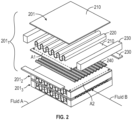
- a conformal heat exchanger 201 is provided for disposition within a curved passage of a heat exchanger system, such as the bypass duct 27 of the gas turbine engine 20 of FIGS. 1A and 1B .
- the conformal heat exchanger 201 can have multiple layers 201 1 , 201 2 , 201 3 (only three layers are illustrated in FIG. 2 for clarity and brevity, though it is to be understood that additional layers can be added; the following description will relate to the illustrated case of there being three layers).
- Each of the multiple layers 201 1 , 201 2 , 201 3 includes parting sheets 210 and a fin sheet 220, which is interposed between the parting sheets 210, as well as sidebars 230 disposed in connection with opposite ends of the fin sheet 220 and interposed between the parting sheets 210.
- the conformal heat exchanger 201 can further include additional fin sheets 240 interleaved between the multiple layers 201 1 , 201 2 , 201 3 .
- Each of the additional fin sheets 240 is interposed between corresponding parting sheets 210 of neighboring ones of the multiple layers 201 1 , 201 2 , 201 3 .
- Fluid A can pass through the conformal heat exchanger 201 between and along the fins (to be described below) of the fin sheets 220 of each of the multiple layers 201 1 , 201 2 , 201 3 in the direction of the fluid A arrow.
- Fluid B can pass through the conformal heat exchanger 201 between and along the fins (to be described below) of the additional fin sheets 240 in the direction of the fluid B arrow.
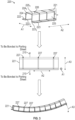
- the fin sheet 220 is corrugated along a first axis A1 to form fins 221 that extend along axis A2, which is perpendicular to axis A1.
- Each fin 221 includes first and second base portions 222, 223, first and second sidewalls 224, 225 extending from proximal edges 222 1 , 223 1 of the first and second base portions 222, 223, respectively, and a connecting portion 226.
- the connecting portion 226 extends between distal edges 224 1 , 225 1 of the first and second sidewalls 224, 225.
- the first and second base portions 222, 223 can each be contiguous with the corresponding one of the parting sheets 210 and the connecting portion 226 can be contiguous with to the other corresponding one of the parting sheets 210.
- the first and second sidewalls 224, 225 and the connecting portion 226 of each fin 221 are segmented to define gaps 227.
- These gaps 227 can be, but are not required to be, parallel with one another and are arranged along the second axis A2.
- the gaps 227 cooperatively accommodate curvatures of the parting sheets 210 and the fin sheet 220 in a third axis A3.
- This third axis A3 is perpendicular to the first axis A1 and the second axis A2.
- the curvatures of the parting sheets 210 and the fin sheet 220 can conform to a curvature of the curved passage, such as the bypass duct 27 of the gas turbine engine 20 of FIGS. 1A and 1B .
- the gaps 227 terminate at the first and second base portions 222, 223 so as to preserve structural integrity of the fin sheet 220, although it is to be understood that the segmenting can extend to the proximal edges 222 1 , 223 1 of the first and second base portions 222, 223, respectively, and beyond the proximal edge 222 1 , 223 1 in some cases.
- the gaps 227 will each converge or diverge depending on a bending direction of the corresponding fin sheet 220.
- the gaps 227 in the fins 221 can be formed by various processes including, but not limited to, electro-discharge machining (EDM), wire-EDM, water-jetting, etc.
- the gaps 227 can be similar or unique in size and shape.
- the gaps 227 are illustrated in FIG. 3 as having substantially uniform thicknesses through the connecting portion 226 and the first and second sidewalls 224, 225 of each fin 221, it is to be understood that other configurations are possible.
- the gaps 227 can be tapered so as to be wider at the connecting portion 226 than at the proximal edges 222 1 , 223 1 of the first and second base portions 222, 223, respectively. In this way, the tapered gaps 227 can accommodate increased curvature of the fin sheet 220 with perhaps fewer gaps 227 being formed.
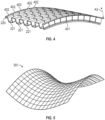
- the gaps 227 can open to accommodate positive curvatures of the parting sheets 210 and the fin sheet 220 in the third axis A3 (see FIG. 3 ) and that the gaps 227 can close to accommodate negative curvatures of the parting sheets 210 and the fin sheet 220 in the third axis A3 (see FIG 4 ).
- the first and second base portions 222, 223 and the connecting portion 226 can be braze bonded to the corresponding ones of the parting sheets 210, although it is to be understood that the bonds can be formed by other suitable processes, such as diffusion bonding processes.
- the bonds (i.e., braze bonds) between the base portions 222, 223 and the corresponding one of the parting sheets 210 are substantially continuous bonds 401 and the bonds (i.e., braze bonds) between the connecting portion 226 and the corresponding one of the parting sheets 210 are segmented at each gap 227. That is, due to the presence of the gaps 227, the bonds between the connecting portion 226 and the corresponding one of the parting sheets 210 are discrete bonds 402.
- the additional fin sheets 240 can be corrugated along the second axis A2 to form fins 241. These fins are similar to the fins 221 and need not be described in detail except to note that the height and pitch of the fins 221 and the fins 241 can be different from one another and can be different from layer-to-layer within the conformal heat exchanger 201.
- the fins 241 of the additional fin sheets 240 can be segmented along the first axis A1 to accommodate additional curvatures of the multiple layers 201 1 , 201 2 , 201 3 in the third axis A3.
- the conformal heat exchanger 201 can have a saddle-shaped topography 501 (see FIG. 5 ) that can be fit as heat exchanger 28' into a curved passage with multi-axis curvatures, such as the bypass duct 27' of the gas turbine engine 20' of FIG. 6 (which is otherwise similar to the gas turbine engine 20 of FIGS. 1A and 1B ).
- the saddle-shaped topography 501 is illustrated in FIG. 5 as lacking a twisting component, it is to be understood that the segmenting of the fins 221 and the fins 241 accommodate formatting of a conformal heat exchanger 201 with a twisted saddle-shaped topography as well.
- the segmenting of the fins 221 and the fins 241 can be executed by various processes including, but not limited to, electro-discharge machining (EDM), wire-EDM, water-jetting, etc.
- EDM electro-discharge machining
- wire-EDM wire-EDM
- water-jetting etc.
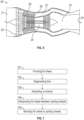
- a method of assembling a conformal heat exchanger as described above includes forming a fin sheet corrugated along a first axis to form fins extending along a second axis perpendicular to the first axis (block 701), segmenting the fins along the second axis (block 702), imparting a fin sheet curvature to the fin sheet in a third axis perpendicular to the first and second axes (block 703), interposing the fin sheet with the fin sheet curvature between parting sheets having parting sheet curvatures similar to the fin sheet curvature (block 704) and bonding the fin sheet to each of the parting sheets (block 705).
- the bonding of block 705 can include braze bonding of base portions of the fins to a corresponding one of the parting sheets and braze bonding of connecting portions of the fins to a corresponding one of the parting sheets, although it is to be understood that other suitable bonding processes can be used.
- the fin sheet and the parting sheets form a layer of the conformal heat exchanger, and the method can further include interleaving additional fin sheets between multiple layers to form an assembly and installing the assembly into a curved passage. In these or other cases, the method can also include segmenting fins of the additional fin sheets to accommodate additional curvatures of the layers.
- the segmenting of block 702 and the segmenting of the fins of the additional fin sheet can be executed by various processes including, but not limited to, EDM, wire-EDM, water-jetting, etc.
- the description provided herein generally relates to non-limiting embodiments in which the fin sheets 220 and the additional fin sheets 240 form rectangular fins 221 and 241, respectively, it is to be understood that this is not required and that other fin shapes are possible. These include, but are not limited to, fins with V-shaped or triangular cross-sections 801 (see FIG. 8 ) and fins with curved or sinusoidal cross-sections 901 (see FIG. 9 ). In each of these and other cases, the fins can be segmented along the second axis as described above to similar effect.
Landscapes
- Engineering & Computer Science (AREA)
- Mechanical Engineering (AREA)
- General Engineering & Computer Science (AREA)
- Physics & Mathematics (AREA)
- Thermal Sciences (AREA)
- Chemical & Material Sciences (AREA)
- Combustion & Propulsion (AREA)
- Heat-Exchange Devices With Radiators And Conduit Assemblies (AREA)
Abstract
Description
- The present disclosure relates to heat exchangers and, more particularly, to a conformal heat exchanger design formed by a method of creating curved, annular plates using folded fins.
- Heat exchanger (HX) performance in a system is often limited based on the number of layers contained within the HX. For example, in annular passages of a turbine engine, a packed, non-conformal HX typically includes multiple parting sheets that are disposed to separate interleaved fin layers and has a rectangular cross-section that does not fit perfectly into the curvature of the annular passage. This limits the number of layers that can be included in the HX and thus limits HX performance.
- In an HX with an annular conformal geometry, the annular conformal geometry allows additional layers to be fit into the HX as compared to a non-conformal HX. This fills the flow domain with active heat transfer elements instead of inert blockages. As such, for a given performance target, the annular conformal HX can achieve improved performance levels with potentially lighter weight and lower pressure drop characteristics than non-conformal HX designs. It is often the case, however, that a HX with an annular conformal geometry cannot be reliably manufactured.
- Accordingly, a need exists for a production method that allows for the formation of a conformal or curved HX using conventional folded heat exchanger fin packs.
- According to an aspect of the disclosure, a heat exchanger is provided and includes parting sheets and a fin sheet interposed between the parting sheets and corrugated along a first axis to form fins. Each of the fins is segmented to define gaps, which are arranged along a second axis perpendicular to the first axis, and which cooperatively accommodate curvatures of the parting sheets and the fin sheet in a third axis perpendicular to the first and second axes.
- In an embodiment of the foregoing embodiment, the fins are at least one of rectangular-shaped, V-shaped and sinusoidal.
- In an embodiment of any of the foregoing embodiments, the gaps open to accommodate positive curvatures of the parting sheets and the fin sheet in the third axis and the gaps close to accommodate negative curvatures of the parting sheets and the fin sheet in the third axis.
- In an embodiment of any of the foregoing embodiments, sidebars are disposed in connection with opposite ends of the fin sheet between the parting sheets and additional fin sheets are interposed between layers of parting sheets, the fin sheet interposed between the parting sheets and the corresponding sidebars.
- In an embodiment of any of the foregoing embodiments, additional fin sheets are corrugated along the second axis to form fins.
- In an embodiment of any of the foregoing embodiments, the fins of the additional fin sheets are segmented to accommodate additional curvatures of the layers.
- In an embodiment of any of the foregoing embodiments, the fins are braze bonded to the parting sheets.
- In an embodiment of any of the foregoing embodiments, braze bonds between base portions of the fins and a corresponding one of the parting sheets are substantially continuous and braze bonds between a connecting portion of the fins and a corresponding one of the parting sheets are segmented at each gap.
- According to an aspect of the disclosure, a conformal heat exchanger for disposition within a curved passage is provided and includes multiple layers. Each of the multiple layers includes parting sheets and a fin sheet interposed between the parting sheets and corrugated along a first axis to form fins. Each of the fins includes base portions, sidewalls extending from edges of the base portions, respectively, and a connecting portion extending between edges of the sidewalls. The base portions and the connecting portion are bonded to corresponding ones of the parting sheets. The sidewalls and the connecting portion are segmented to define gaps, which are arranged along a second axis perpendicular to the first axis, and which cooperatively accommodate curvatures of the parting sheets and the fin sheet, which conform to a curvature of the curved passage, in a third axis perpendicular to the first and second axes.
- In an embodiment of any of the foregoing embodiments, the sidewalls extend from proximal edges of the base portions, respectively, and the connecting portion extends between distal edges of the sidewalls.
- In an embodiment of any of the foregoing embodiments, the gaps open to accommodate positive curvatures of the parting sheets and the fin sheet in the third axis and the gaps close to accommodate negative curvatures of the parting sheets and the fin sheet in the third axis.
- In an embodiment of any of the foregoing embodiments, each layer further includes sidebars disposed in connection with opposite ends of the fin sheet between the parting sheets and the conformal heat exchanger further includes additional fin sheets interposed between layers.
- In an embodiment of any of the foregoing embodiments, the additional fin sheets are corrugated along the second axis to form fins.
- In an embodiment of any of the foregoing embodiments, the fins of the additional fin sheets are segmented to accommodate additional curvatures of the layers.
- In an embodiment of any of the foregoing embodiments, the base portions and the connecting portion are braze bonded to the corresponding ones of the parting sheets.
- In an embodiment of any of the foregoing embodiments, braze bonds between the base portions and the corresponding one of the parting sheets are substantially continuous and braze bonds between the connecting portion and the corresponding one of the parting sheets are segmented at each gap.
- According to an aspect of the disclosure, a method of assembling a conformal heat exchanger is provided and includes forming a fin sheet corrugated along a first axis to form fins extending along a second axis perpendicular to the first axis, segmenting the fins along the second axis, imparting a fin sheet curvature to the fin sheet in a third axis perpendicular to the first and second axes, interposing the fin sheet with the fin sheet curvature between parting sheets having parting sheet curvatures similar to the fin sheet curvature and bonding the fin sheet to each of the parting sheets.
- In an embodiment of any of the foregoing embodiments, the bonding includes braze bonding base portions of the fins to a corresponding one of the parting sheets and braze bonding connecting portions of the fins to a corresponding one of the parting sheets.
- In an embodiment of any of the foregoing embodiments, the fin sheet and the parting sheets form a layer of the conformal heat exchanger and the method further includes interleaving additional fin sheets between multiple layers to form an assembly and installing the assembly into a curved passage.
- In an embodiment of any of the foregoing embodiments, the method further includes segmenting fins of the additional fin sheets to accommodate additional curvatures of the layers.
- Additional features and advantages are realized through the techniques of the present disclosure. Other embodiments and aspects of the disclosure are described in detail herein and are considered a part of the claimed technical concept. For a better understanding of the disclosure with the advantages and the features, refer to the description and to the drawings.
- For a more complete understanding of this disclosure, reference is now made to the following brief description, taken in connection with the accompanying drawings and detailed description, wherein like reference numerals represent like parts:
-
FIG. 1A is a side view of a gas turbine engine with a conformal heat exchanger in accordance with embodiments; -
FIG. 1B is an axial view of the gas turbine engine ofFIG. 1A taken alongline 1B-1B ofFIG. 1A in accordance with embodiments; -
FIG. 2 is a partially exploded perspective view of a heat exchanger in accordance with embodiments; -
FIG. 3 is a perspective view of a fin of a fin sheet ofFIG. 2 in various stages of machining in accordance with embodiments; -
FIG. 4 is a perspective view of a fin sheet with multiple fins and with multiple cuts in each fin in accordance with embodiments; -
FIG. 5 is a graphical depiction of a saddle-shaped topology that a conformal heat exchanger can assume in accordance with embodiments; -
FIG. 6 is a side view of a gas turbine engine with a conformal heat exchanger having multiple axes of curvature in accordance with embodiments; -
FIG. 7 is a flow diagram illustrating a method of assembling a conformal heat exchanger in accordance with embodiments; -
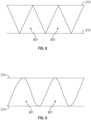
FIG. 8 is a cross-sectional view of V-shaped fins that can be segmented in accordance with embodiments; and -
FIG. 9 is a cross-sectional view of sinusoidal fins that can be segmented in accordance with embodiments. - A traditional plate-fin heat exchanger includes alternating layers of folded fin packs. Flexible in one direction, it can be rigid in the transverse or long direction. As a result, the traditional plate-fin heat exchanger is rectangular or cubical and does not package well in annular ducts of a turbine engine. An ability to 'curve' an otherwise rectangular heat exchanger around an annulus is thus desired to thereby provide for increased frontal area and increases heat load capacity.
- With reference to
FIGS. 1A and 1B , agas turbine engine 20 is provided and includes afan section 21, acompressor section 22 aft of thefan section 21, aturbine section 23 aft of thecompressor section 22 and a diffuser and/orafterburner section 24 aft of theturbine section 23. Inlet air enters thegas turbine engine 20 through thefan section 21 and is compressed in thecompressor section 22. The compressed air is then mixed with fuel and combusted in acombustor 25 to produce high-temperature and high-pressure working fluid. The working fluid is then expanded in theturbine section 23 and optionally diffused or re-burned in the diffuser orafterburner section 24. Thegas turbine engine 20 is at least partially encased in anouter wall 26, which surrounds at least thecompressor section 22, to form abypass duct 27. Thebypass duct 27 is annular in shape. Aheat exchanger 28 can be provided in thebypass duct 27. Thegas turbine engine 20 can be provided as a turbofan engine or as any other similar type of engine. - As will be described below, a heat exchanger with a compound fin-plate structure is provided for use as the
heat exchanger 28 ofFIGS. 1A and 1B and can be formed by forming a fin sheet that is corrugated along a first axis to form fins extending along a second axis perpendicular to the first axis, segmenting the fins along the second axis, imparting a fin sheet curvature to the fin sheet in a third axis perpendicular to the first and second axes, interposing the fin sheet with the fin sheet curvature between parting sheets having parting sheet curvatures similar to the fin sheet curvature and bonding the fin sheet to each of the parting sheets. The fin sheet (along with sidebars) and the parting sheets form a layer of the conformal heat exchanger and additional fin sheets can be interleaved in multiple layers to form an assembly. This assembly can then be installed into a curved passage, such as thebypass duct 27 of thegas turbine engine 20 ofFIGS. 1A and 1B , or another system using annular passages. - With reference to
FIGS. 2-4 , aconformal heat exchanger 201 is provided for disposition within a curved passage of a heat exchanger system, such as thebypass duct 27 of thegas turbine engine 20 ofFIGS. 1A and 1B . Theconformal heat exchanger 201 can havemultiple layers FIG. 2 for clarity and brevity, though it is to be understood that additional layers can be added; the following description will relate to the illustrated case of there being three layers). Each of themultiple layers sheets 210 and afin sheet 220, which is interposed between the partingsheets 210, as well assidebars 230 disposed in connection with opposite ends of thefin sheet 220 and interposed between the partingsheets 210. Theconformal heat exchanger 201 can further includeadditional fin sheets 240 interleaved between themultiple layers additional fin sheets 240 is interposed betweencorresponding parting sheets 210 of neighboring ones of themultiple layers - Fluid A can pass through the
conformal heat exchanger 201 between and along the fins (to be described below) of thefin sheets 220 of each of themultiple layers conformal heat exchanger 201 between and along the fins (to be described below) of theadditional fin sheets 240 in the direction of the fluid B arrow. - As shown in
FIG. 3 , thefin sheet 220 is corrugated along a first axis A1 to formfins 221 that extend along axis A2, which is perpendicular to axis A1. Eachfin 221 includes first andsecond base portions 222, 223, first andsecond sidewalls proximal edges 2221, 2231 of the first andsecond base portions 222, 223, respectively, and a connectingportion 226. The connectingportion 226 extends betweendistal edges second sidewalls second base portions 222, 223 can each be contiguous with the corresponding one of theparting sheets 210 and the connectingportion 226 can be contiguous with to the other corresponding one of theparting sheets 210. - The first and
second sidewalls portion 226 of eachfin 221 are segmented to definegaps 227. Thesegaps 227 can be, but are not required to be, parallel with one another and are arranged along the second axis A2. In this way, thegaps 227 cooperatively accommodate curvatures of theparting sheets 210 and thefin sheet 220 in a third axis A3. This third axis A3 is perpendicular to the first axis A1 and the second axis A2. In accordance with embodiments, the curvatures of theparting sheets 210 and thefin sheet 220 can conform to a curvature of the curved passage, such as thebypass duct 27 of thegas turbine engine 20 ofFIGS. 1A and 1B . Thegaps 227 terminate at the first andsecond base portions 222, 223 so as to preserve structural integrity of thefin sheet 220, although it is to be understood that the segmenting can extend to theproximal edges 2221, 2231 of the first andsecond base portions 222, 223, respectively, and beyond theproximal edge 2221, 2231 in some cases. - The
gaps 227 will each converge or diverge depending on a bending direction of thecorresponding fin sheet 220. In accordance with embodiments, thegaps 227 in thefins 221 can be formed by various processes including, but not limited to, electro-discharge machining (EDM), wire-EDM, water-jetting, etc. - In accordance with embodiments, the
gaps 227 can be similar or unique in size and shape. In addition, although thegaps 227 are illustrated inFIG. 3 as having substantially uniform thicknesses through the connectingportion 226 and the first andsecond sidewalls fin 221, it is to be understood that other configurations are possible. For example, thegaps 227 can be tapered so as to be wider at the connectingportion 226 than at theproximal edges 2221, 2231 of the first andsecond base portions 222, 223, respectively. In this way, the taperedgaps 227 can accommodate increased curvature of thefin sheet 220 with perhapsfewer gaps 227 being formed. - Although the lowermost image in
FIG. 3 is of thefin sheet 220 having a curvature in one direction, as noted above it is to be understood that thegaps 227 can open to accommodate positive curvatures of theparting sheets 210 and thefin sheet 220 in the third axis A3 (seeFIG. 3 ) and that thegaps 227 can close to accommodate negative curvatures of theparting sheets 210 and thefin sheet 220 in the third axis A3 (seeFIG 4 ). - In accordance with embodiments, the first and
second base portions 222, 223 and the connectingportion 226 can be braze bonded to the corresponding ones of theparting sheets 210, although it is to be understood that the bonds can be formed by other suitable processes, such as diffusion bonding processes. In any case, as shown inFIG. 4 , the bonds (i.e., braze bonds) between thebase portions 222, 223 and the corresponding one of theparting sheets 210 are substantiallycontinuous bonds 401 and the bonds (i.e., braze bonds) between the connectingportion 226 and the corresponding one of theparting sheets 210 are segmented at eachgap 227. That is, due to the presence of thegaps 227, the bonds between the connectingportion 226 and the corresponding one of theparting sheets 210 arediscrete bonds 402. - With reference back to
FIG. 2 and with additional reference toFIGS. 5 and6 , theadditional fin sheets 240 can be corrugated along the second axis A2 to form fins 241. These fins are similar to thefins 221 and need not be described in detail except to note that the height and pitch of thefins 221 and the fins 241 can be different from one another and can be different from layer-to-layer within theconformal heat exchanger 201. - In any case, the fins 241 of the
additional fin sheets 240 can be segmented along the first axis A1 to accommodate additional curvatures of themultiple layers conformal heat exchanger 201 can have a saddle-shaped topography 501 (seeFIG. 5 ) that can be fit as heat exchanger 28' into a curved passage with multi-axis curvatures, such as the bypass duct 27' of thegas turbine engine 20' ofFIG. 6 (which is otherwise similar to thegas turbine engine 20 ofFIGS. 1A and 1B ). Although, the saddle-shapedtopography 501 is illustrated inFIG. 5 as lacking a twisting component, it is to be understood that the segmenting of thefins 221 and the fins 241 accommodate formatting of aconformal heat exchanger 201 with a twisted saddle-shaped topography as well. - In accordance with embodiments, the segmenting of the
fins 221 and the fins 241 can be executed by various processes including, but not limited to, electro-discharge machining (EDM), wire-EDM, water-jetting, etc. - With reference to
FIG. 7 , a method of assembling a conformal heat exchanger as described above is provided. The method includes forming a fin sheet corrugated along a first axis to form fins extending along a second axis perpendicular to the first axis (block 701), segmenting the fins along the second axis (block 702), imparting a fin sheet curvature to the fin sheet in a third axis perpendicular to the first and second axes (block 703), interposing the fin sheet with the fin sheet curvature between parting sheets having parting sheet curvatures similar to the fin sheet curvature (block 704) and bonding the fin sheet to each of the parting sheets (block 705). - The bonding of
block 705 can include braze bonding of base portions of the fins to a corresponding one of the parting sheets and braze bonding of connecting portions of the fins to a corresponding one of the parting sheets, although it is to be understood that other suitable bonding processes can be used. Also, the fin sheet and the parting sheets form a layer of the conformal heat exchanger, and the method can further include interleaving additional fin sheets between multiple layers to form an assembly and installing the assembly into a curved passage. In these or other cases, the method can also include segmenting fins of the additional fin sheets to accommodate additional curvatures of the layers. The segmenting ofblock 702 and the segmenting of the fins of the additional fin sheet can be executed by various processes including, but not limited to, EDM, wire-EDM, water-jetting, etc. - With reference to
FIGS. 8 and 9 , although the description provided herein generally relates to non-limiting embodiments in which thefin sheets 220 and theadditional fin sheets 240 formrectangular fins 221 and 241, respectively, it is to be understood that this is not required and that other fin shapes are possible. These include, but are not limited to, fins with V-shaped or triangular cross-sections 801 (seeFIG. 8 ) and fins with curved or sinusoidal cross-sections 901 (seeFIG. 9 ). In each of these and other cases, the fins can be segmented along the second axis as described above to similar effect. - Technical effects and benefits of the present disclosure are that conventional machining equipment is used to modify a fin pack to make a slight modification. This slight modification allows flexibility to be imparted to the fin pack whereby the fin pack can be assembled around an annular form. The resulting structure is economical, durable, light weight and efficient.
- The corresponding structures, materials, acts, and equivalents of all means or step plus function elements in the claims below are intended to include any structure, material, or act for performing the function in combination with other claimed elements as specifically claimed. The description of the present disclosure has been presented for purposes of illustration and description, but is not intended to be exhaustive or limited to the technical concepts in the form disclosed. Many modifications and variations will be apparent to those of ordinary skill in the art without departing from the scope and spirit of the disclosure. The embodiments were chosen and described in order to best explain the principles of the disclosure and the practical application, and to enable others of ordinary skill in the art to understand the disclosure for various embodiments with various modifications as are suited to the particular use contemplated.
- While the preferred embodiments to the disclosure have been described, it will be understood that those skilled in the art, both now and in the future, may make various improvements and enhancements which fall within the scope of the claims which follow. These claims should be construed to maintain the proper protection for the disclosure first described.
Claims (15)
- A heat exchanger (201), comprising:parting sheets (210); anda fin sheet (220) interposed between the parting sheets (210) and corrugated along a first axis (A1) to form fins (221),each of the fins (221) being segmented to define gaps (227), which are arranged along a second axis (A2) perpendicular to the first axis (A1), and which cooperatively accommodate curvatures of the parting sheets (210) and the fin sheet (220) in a third axis (A3) perpendicular to the first and second axes (A1, A2).
- The heat exchanger (201) according to claim 1, wherein the fins (221) are at least one of rectangular-shaped, V-shaped and sinusoidal.
- The heat exchanger (201) according to claim 1 or 2, wherein:the gaps (227) open to accommodate positive curvatures of the parting sheets (210) and the fin sheet (220) in the third axis (A3), andthe gaps (227) close to accommodate negative curvatures of the parting sheets (210) and the fin sheet (220) in the third axis (A3).
- The heat exchanger (201) according to claim 1, 2 or 3, further comprising:sidebars (230) disposed in connection with opposite ends of the fin sheet (220) between the parting sheets (210); andadditional fin sheets (240) interposed between layers of parting sheets (210), the fin sheet (220) interposed between the parting sheets (210) and the corresponding sidebars (230).
- The heat exchanger (201) according to claim 4, wherein the additional fin sheets (240) are corrugated along the second axis (A2) to form fins (241).
- The heat exchanger (201) according to claim 5, wherein the fins (241) of the additional fin sheets (240) are segmented to accommodate additional curvatures of the layers.
- The heat exchanger (201) according to any preceding claim, wherein the fins (221) are braze bonded to the parting sheets (210).
- The heat exchanger (201) according to claim 7, wherein:braze bonds between base portions (222, 223) of the fins (221) and a corresponding one of the parting sheets (210) are substantially continuous, andbraze bonds between a connecting portion (226) of the fins (221) and a corresponding one of the parting sheets (210) are segmented at each gap (227).
- A conformal heat exchanger (201) for disposition within a curved passage and comprising multiple layers each comprising:parting sheets (210); anda fin sheet (220) interposed between the parting sheets (210) and corrugated along a first axis (A1) to form fins (221), each of the fins (221) comprising:base portions (222, 223);sidewalls (224, 225) extending from edges (2221, 2231) of the base portions (222, 223), respectively; anda connecting portion (226) extending between edges (2241, 2251) of the sidewalls (224, 225),the base portions (222, 223) and the connecting portion (226) being bonded to corresponding ones of the parting sheets (210), andthe sidewalls (224, 225) and the connecting portion (226) being segmented to define gaps (227), which are arranged along a second axis (A2) perpendicular to the first axis (A1), and which cooperatively accommodate curvatures of the parting sheets (210) and the fin sheet (220), which conform to a curvature of the curved passage, in a third axis (A3) perpendicular to the first and second axes (A1, A2).
- The conformal heat exchanger (201) according to claim 9, wherein the sidewalls (224, 225) extend from proximal edges (2221, 2231) of the base portions (222, 223), respectively, and the connecting portion (226) extends between distal edges (2241, 2251) of the sidewalls (224, 225).
- The conformal heat exchanger (201) according to claim 9 or 10, wherein:the gaps (227) open to accommodate positive curvatures of the parting sheets (210) and the fin sheet (220) in the third axis (A3), andthe gaps (227) close to accommodate negative curvatures of the parting sheets and the fin sheet (220) in the third axis (A3).
- The conformal heat exchanger (201) according to claim 9, 10 or 11, wherein:each layer further comprises sidebars (230) disposed in connection with opposite ends of the fin sheet (220) between the parting sheets (210); andthe conformal heat exchanger (201) further comprises additional fin sheets (240) interposed between layers, wherein, optionally, the additional fin sheets (240) are corrugated along the second axis (A2) to form fins (241), and, further optionally, the fins (241) of the additional fin sheets (240) are segmented to accommodate additional curvatures of the layers.
- The conformal heat exchanger (201) according to any of claims 9 to 12, wherein the base portions (222, 223) and the connecting portion (226) are braze bonded to the corresponding ones of the parting sheets (210), wherein, optionally:braze bonds between the base portions (222, 223) and the corresponding one of the parting sheets (210) are substantially continuous, andbraze bonds between the connecting portion (226) and the corresponding one of the parting sheets (210) are segmented at each gap (227).
- A method of assembling a conformal heat exchanger (201), the method comprising:forming a fin sheet (220) corrugated along a first axis (A1) to form fins (221) extending along a second axis (A2) perpendicular to the first axis (A1);segmenting the fins (221) along the second axis (A2);imparting a fin sheet curvature to the fin sheet (220) in a third axis (A3) perpendicular to the first and second axes (A1, A2);interposing the fin sheet (220) with the fin sheet curvature between parting sheets (210) having parting sheet curvatures similar to the fin sheet curvature; andbonding the fin sheet (220) to each of the parting sheets (210).
- The method according to claim 14, wherein:the bonding comprises braze bonding base portions (222, 223) of the fins (221) to a corresponding one of the parting sheets (210) and braze bonding connecting portions (226) of the fins (221) to a corresponding one of the parting sheets (210); and/orthe fin sheet (220) and the parting sheets (210) form a layer of the conformal heat exchanger (201), and the method further comprises interleaving additional fin sheets (240) between multiple layers to form an assembly and installing the assembly into a curved passage, wherein, optionally, the method further comprises segmenting fins (241) of the additional fin sheets (240) to accommodate additional curvatures of the layers.
Applications Claiming Priority (1)
| Application Number | Priority Date | Filing Date | Title |
|---|---|---|---|
| US17/831,759 US12209819B2 (en) | 2022-06-03 | 2022-06-03 | Conformal heat exchanger |
Publications (1)
| Publication Number | Publication Date |
|---|---|
| EP4286780A1 true EP4286780A1 (en) | 2023-12-06 |
Family
ID=86692759
Family Applications (1)
| Application Number | Title | Priority Date | Filing Date |
|---|---|---|---|
| EP23177299.7A Pending EP4286780A1 (en) | 2022-06-03 | 2023-06-05 | Conformal heat exchanger |
Country Status (2)
| Country | Link |
|---|---|
| US (1) | US12209819B2 (en) |
| EP (1) | EP4286780A1 (en) |
Cited By (1)
| Publication number | Priority date | Publication date | Assignee | Title |
|---|---|---|---|---|
| US20230251040A1 (en) * | 2022-02-10 | 2023-08-10 | Raytheon Technologies Corporation | Conformal heat exchanger |
Citations (3)
| Publication number | Priority date | Publication date | Assignee | Title |
|---|---|---|---|---|
| JPS6213993A (en) * | 1985-07-11 | 1987-01-22 | Sumitomo Precision Prod Co Ltd | Heat exchanger |
| US20020153129A1 (en) * | 2000-04-25 | 2002-10-24 | White Stephen L. | Integral fin passage heat exchanger |
| EP3348800A1 (en) * | 2017-01-13 | 2018-07-18 | Unison Industries LLC | Fan casing assembly with cooler and method of moving |
Family Cites Families (22)
| Publication number | Priority date | Publication date | Assignee | Title |
|---|---|---|---|---|
| US2571631A (en) * | 1947-02-26 | 1951-10-16 | Kellogg M W Co | Heat exchange element |
| US2656158A (en) * | 1948-07-23 | 1953-10-20 | Air Preheater | Plate type heat exchanger and method of manufacturing same |
| GB975071A (en) * | 1962-03-30 | 1964-11-11 | Parsons C A & Co Ltd | Plate type heat exchangers |
| US3734135A (en) * | 1971-09-03 | 1973-05-22 | Modine Mfg Co | Heat exchanger with internal turbulator |
| DE3049168C2 (en) | 1980-12-24 | 1987-03-19 | Dieter Christian Steinegg-Appenzell Steeb | Method for producing a heat exchanger with bent flat tubes |
| JPS6030628Y2 (en) * | 1982-02-16 | 1985-09-13 | 富士重工業株式会社 | Heat exchanger |
| GB8700801D0 (en) * | 1987-01-14 | 1987-02-18 | Marston Palmer Ltd | Heat exchanger |
| JPH06244328A (en) * | 1993-02-19 | 1994-09-02 | Fujitsu Ltd | heatsink |
| US5564496A (en) * | 1994-11-01 | 1996-10-15 | United Technologies Corporation | Composite parting sheet |
| US6546774B2 (en) * | 2001-08-23 | 2003-04-15 | Modine Manufacturing Company | Method of making a lanced and offset fin |
| DE20117873U1 (en) * | 2001-11-06 | 2002-02-14 | Emitec Gesellschaft für Emissionstechnologie mbH, 53797 Lohmar | Open filter body with improved flow properties |
| KR100866389B1 (en) * | 2002-04-29 | 2008-10-31 | 주식회사 아이메탈아이 | Heat sink and its manufacturing method |
| DE10304814C5 (en) * | 2003-02-06 | 2009-07-02 | Emitec Gesellschaft Für Emissionstechnologie Mbh | Method and tool for producing structured sheet metal layers; The catalyst support body |
| WO2014201311A1 (en) | 2013-06-14 | 2014-12-18 | United Technologies Corporation | Curved plate/fin heat exchanger |
| US20150047820A1 (en) | 2013-08-14 | 2015-02-19 | Hamilton Sundstrand Corporation | Bendable heat exchanger |
| GB2524059B (en) * | 2014-03-13 | 2019-10-16 | Hs Marston Aerospace Ltd | Curved cross-flow heat exchanger |
| WO2016063312A1 (en) * | 2014-10-21 | 2016-04-28 | 住友精密工業株式会社 | Heat exchanger for aircraft engine |
| CN107509366A (en) * | 2017-08-30 | 2017-12-22 | 中国电子科技集团公司第二十九研究所 | A kind of conformal heat exchanger based on porous flat pipe |
| EP3460377B1 (en) * | 2017-09-21 | 2020-04-29 | HS Marston Aerospace Limited | Heat exchanger frame |
| US10551131B2 (en) * | 2018-01-08 | 2020-02-04 | Hamilton Sundstrand Corporation | Method for manufacturing a curved heat exchanger using wedge shaped segments |
| US10926364B2 (en) * | 2018-10-03 | 2021-02-23 | Hamilton Sundstrand Corporation | Plate-fin heat exchanger core design for improved manufacturing |
| US12298080B2 (en) * | 2022-02-10 | 2025-05-13 | Rtx Corporation | Conformal heat exchanger |
-
2022
- 2022-06-03 US US17/831,759 patent/US12209819B2/en active Active
-
2023
- 2023-06-05 EP EP23177299.7A patent/EP4286780A1/en active Pending
Patent Citations (3)
| Publication number | Priority date | Publication date | Assignee | Title |
|---|---|---|---|---|
| JPS6213993A (en) * | 1985-07-11 | 1987-01-22 | Sumitomo Precision Prod Co Ltd | Heat exchanger |
| US20020153129A1 (en) * | 2000-04-25 | 2002-10-24 | White Stephen L. | Integral fin passage heat exchanger |
| EP3348800A1 (en) * | 2017-01-13 | 2018-07-18 | Unison Industries LLC | Fan casing assembly with cooler and method of moving |
Cited By (2)
| Publication number | Priority date | Publication date | Assignee | Title |
|---|---|---|---|---|
| US20230251040A1 (en) * | 2022-02-10 | 2023-08-10 | Raytheon Technologies Corporation | Conformal heat exchanger |
| US12298080B2 (en) * | 2022-02-10 | 2025-05-13 | Rtx Corporation | Conformal heat exchanger |
Also Published As
| Publication number | Publication date |
|---|---|
| US12209819B2 (en) | 2025-01-28 |
| US20230392880A1 (en) | 2023-12-07 |
Similar Documents
| Publication | Publication Date | Title |
|---|---|---|
| CA2598506C (en) | Cooled transition duct for a gas turbine engine | |
| US12025387B2 (en) | Turning vanes and heat exchangers and methods of making the same | |
| US20230296331A1 (en) | Aircraft Heat Exchangers and Plates | |
| US6672836B2 (en) | Coolable rotor blade for an industrial gas turbine engine | |
| EP2383455B1 (en) | Gas turbine engine exhaust mixer | |
| US5797725A (en) | Gas turbine engine vane and method of manufacture | |
| EP2893277B1 (en) | Air-cooled engine surface cooler | |
| US7090463B2 (en) | Guide vane | |
| EP3892949B1 (en) | Aircraft heat exchangers and plates | |
| DK2240317T3 (en) | Engine having a honeycomb structure and similar method for making such a honeycomb | |
| US7347671B2 (en) | Turbine blade turbulator cooling design | |
| CN114961878A (en) | Improved turbine bucket cooling system | |
| US20220260316A1 (en) | Cross-flow heat exchangers and methods of making the same | |
| EP4286780A1 (en) | Conformal heat exchanger | |
| CN107869360A (en) | The seal with gasket substrate and the alveolate texture with multiple cavitys formed therein in gas-turbine unit | |
| JPH11229809A (en) | Hollow air foil | |
| EP3090143A1 (en) | Gas turbine engine component mateface surfaces | |
| CN1109875C (en) | Heat exchanger | |
| JP6948793B2 (en) | Gas turbine blades and manufacturing method | |
| KR20260003240A (en) | Turbine rotor and gas turbine | |
| EP4227629A1 (en) | Conformal heat exchanger | |
| EP3181959A1 (en) | Hula seal | |
| CN118510980A (en) | Gas turbine nozzle with cooling holes and turbine |
Legal Events
| Date | Code | Title | Description |
|---|---|---|---|
| PUAI | Public reference made under article 153(3) epc to a published international application that has entered the european phase |
Free format text: ORIGINAL CODE: 0009012 |
|
| STAA | Information on the status of an ep patent application or granted ep patent |
Free format text: STATUS: THE APPLICATION HAS BEEN PUBLISHED |
|
| AK | Designated contracting states |
Kind code of ref document: A1 Designated state(s): AL AT BE BG CH CY CZ DE DK EE ES FI FR GB GR HR HU IE IS IT LI LT LU LV MC ME MK MT NL NO PL PT RO RS SE SI SK SM TR |
|
| STAA | Information on the status of an ep patent application or granted ep patent |
Free format text: STATUS: REQUEST FOR EXAMINATION WAS MADE |
|
| 17P | Request for examination filed |
Effective date: 20240606 |
|
| RBV | Designated contracting states (corrected) |
Designated state(s): AL AT BE BG CH CY CZ DE DK EE ES FI FR GB GR HR HU IE IS IT LI LT LU LV MC ME MK MT NL NO PL PT RO RS SE SI SK SM TR |
|
| STAA | Information on the status of an ep patent application or granted ep patent |
Free format text: STATUS: EXAMINATION IS IN PROGRESS |
|
| 17Q | First examination report despatched |
Effective date: 20241216 |