EP4286436A1 - Härtbare zusammensetzung aus polycarbonsäure und polycarbodiimid - Google Patents
Härtbare zusammensetzung aus polycarbonsäure und polycarbodiimid Download PDFInfo
- Publication number
- EP4286436A1 EP4286436A1 EP22176749.4A EP22176749A EP4286436A1 EP 4286436 A1 EP4286436 A1 EP 4286436A1 EP 22176749 A EP22176749 A EP 22176749A EP 4286436 A1 EP4286436 A1 EP 4286436A1
- Authority
- EP
- European Patent Office
- Prior art keywords
- acid
- composition
- composition according
- oder
- polycarboxylic acid
- Prior art date
- Legal status (The legal status is an assumption and is not a legal conclusion. Google has not performed a legal analysis and makes no representation as to the accuracy of the status listed.)
- Withdrawn
Links
- 239000000203 mixture Substances 0.000 title claims abstract description 112
- 239000002253 acid Substances 0.000 title claims abstract description 83
- 239000007788 liquid Substances 0.000 claims abstract description 26
- 125000001931 aliphatic group Chemical group 0.000 claims abstract description 21
- 150000001875 compounds Chemical class 0.000 claims abstract description 14
- XLYOFNOQVPJJNP-UHFFFAOYSA-N water Substances O XLYOFNOQVPJJNP-UHFFFAOYSA-N 0.000 claims abstract description 13
- 238000000576 coating method Methods 0.000 claims abstract description 10
- 239000000853 adhesive Substances 0.000 claims abstract description 8
- 230000001070 adhesive effect Effects 0.000 claims abstract description 8
- 239000011248 coating agent Substances 0.000 claims abstract description 7
- -1 poly(oxyalkylene) Polymers 0.000 claims description 108
- 235000014113 dietary fatty acids Nutrition 0.000 claims description 25
- 239000000194 fatty acid Substances 0.000 claims description 25
- 229930195729 fatty acid Natural products 0.000 claims description 25
- 150000004665 fatty acids Chemical class 0.000 claims description 23
- 239000004359 castor oil Substances 0.000 claims description 19
- 235000019438 castor oil Nutrition 0.000 claims description 17
- ZEMPKEQAKRGZGQ-XOQCFJPHSA-N glycerol triricinoleate Natural products CCCCCC[C@@H](O)CC=CCCCCCCCC(=O)OC[C@@H](COC(=O)CCCCCCCC=CC[C@@H](O)CCCCCC)OC(=O)CCCCCCCC=CC[C@H](O)CCCCCC ZEMPKEQAKRGZGQ-XOQCFJPHSA-N 0.000 claims description 17
- NIMLQBUJDJZYEJ-UHFFFAOYSA-N isophorone diisocyanate Chemical compound CC1(C)CC(N=C=O)CC(C)(CN=C=O)C1 NIMLQBUJDJZYEJ-UHFFFAOYSA-N 0.000 claims description 17
- 239000000539 dimer Substances 0.000 claims description 15
- 239000005058 Isophorone diisocyanate Substances 0.000 claims description 14
- 125000005442 diisocyanate group Chemical group 0.000 claims description 13
- VPKDCDLSJZCGKE-UHFFFAOYSA-N carbodiimide group Chemical group N=C=N VPKDCDLSJZCGKE-UHFFFAOYSA-N 0.000 claims description 12
- 125000004432 carbon atom Chemical group C* 0.000 claims description 12
- 239000000758 substrate Substances 0.000 claims description 11
- 239000013638 trimer Substances 0.000 claims description 11
- 125000002843 carboxylic acid group Chemical group 0.000 claims description 8
- 238000002156 mixing Methods 0.000 claims description 8
- 239000004215 Carbon black (E152) Substances 0.000 claims description 7
- 229930195733 hydrocarbon Natural products 0.000 claims description 7
- 239000004014 plasticizer Substances 0.000 claims description 7
- 239000000945 filler Substances 0.000 claims description 6
- 238000005266 casting Methods 0.000 claims description 5
- KORSJDCBLAPZEQ-UHFFFAOYSA-N dicyclohexylmethane-4,4'-diisocyanate Chemical compound C1CC(N=C=O)CCC1CC1CCC(N=C=O)CC1 KORSJDCBLAPZEQ-UHFFFAOYSA-N 0.000 claims description 4
- RRAMGCGOFNQTLD-UHFFFAOYSA-N hexamethylene diisocyanate Chemical compound O=C=NCCCCCCN=C=O RRAMGCGOFNQTLD-UHFFFAOYSA-N 0.000 claims description 4
- 125000001183 hydrocarbyl group Chemical group 0.000 claims description 4
- 125000004430 oxygen atom Chemical group O* 0.000 claims description 4
- 150000001735 carboxylic acids Chemical group 0.000 claims description 3
- 125000002496 methyl group Chemical group [H]C([H])([H])* 0.000 claims description 3
- 239000006254 rheological additive Substances 0.000 claims description 3
- 229920000642 polymer Polymers 0.000 abstract description 31
- 238000003860 storage Methods 0.000 abstract description 9
- 238000004519 manufacturing process Methods 0.000 abstract description 6
- 238000012545 processing Methods 0.000 abstract description 4
- 238000004382 potting Methods 0.000 abstract description 3
- 239000004615 ingredient Substances 0.000 abstract description 2
- 229920005862 polyol Polymers 0.000 description 30
- 150000003077 polyols Chemical class 0.000 description 30
- 150000002009 diols Chemical class 0.000 description 23
- IQPQWNKOIGAROB-UHFFFAOYSA-N isocyanate group Chemical group [N-]=C=O IQPQWNKOIGAROB-UHFFFAOYSA-N 0.000 description 23
- 229920000728 polyester Polymers 0.000 description 18
- 150000001732 carboxylic acid derivatives Chemical group 0.000 description 15
- 239000000126 substance Substances 0.000 description 15
- 238000005033 Fourier transform infrared spectroscopy Methods 0.000 description 14
- AFVFQIVMOAPDHO-UHFFFAOYSA-N Methanesulfonic acid Chemical compound CS(O)(=O)=O AFVFQIVMOAPDHO-UHFFFAOYSA-N 0.000 description 14
- 239000000047 product Substances 0.000 description 14
- PEDCQBHIVMGVHV-UHFFFAOYSA-N Glycerine Chemical compound OCC(O)CO PEDCQBHIVMGVHV-UHFFFAOYSA-N 0.000 description 13
- 229920001577 copolymer Polymers 0.000 description 12
- 150000004072 triols Chemical class 0.000 description 12
- 238000006243 chemical reaction Methods 0.000 description 11
- 230000007062 hydrolysis Effects 0.000 description 11
- 238000006460 hydrolysis reaction Methods 0.000 description 11
- UPMLOUAZCHDJJD-UHFFFAOYSA-N 4,4'-Diphenylmethane Diisocyanate Chemical compound C1=CC(N=C=O)=CC=C1CC1=CC=C(N=C=O)C=C1 UPMLOUAZCHDJJD-UHFFFAOYSA-N 0.000 description 9
- 239000004721 Polyphenylene oxide Substances 0.000 description 9
- ZMANZCXQSJIPKH-UHFFFAOYSA-N Triethylamine Chemical compound CCN(CC)CC ZMANZCXQSJIPKH-UHFFFAOYSA-N 0.000 description 9
- 150000007513 acids Chemical class 0.000 description 9
- 229910052751 metal Inorganic materials 0.000 description 9
- 239000002184 metal Substances 0.000 description 9
- 229920000570 polyether Polymers 0.000 description 9
- 239000004814 polyurethane Substances 0.000 description 9
- PMNLUUOXGOOLSP-UHFFFAOYSA-N 2-mercaptopropanoic acid Chemical compound CC(S)C(O)=O PMNLUUOXGOOLSP-UHFFFAOYSA-N 0.000 description 8
- KAKZBPTYRLMSJV-UHFFFAOYSA-N Butadiene Chemical compound C=CC=C KAKZBPTYRLMSJV-UHFFFAOYSA-N 0.000 description 8
- IAYPIBMASNFSPL-UHFFFAOYSA-N Ethylene oxide Chemical compound C1CO1 IAYPIBMASNFSPL-UHFFFAOYSA-N 0.000 description 8
- NIXOWILDQLNWCW-UHFFFAOYSA-N acrylic acid group Chemical group C(C=C)(=O)O NIXOWILDQLNWCW-UHFFFAOYSA-N 0.000 description 8
- 239000003054 catalyst Substances 0.000 description 8
- MTHSVFCYNBDYFN-UHFFFAOYSA-N diethylene glycol Chemical compound OCCOCCO MTHSVFCYNBDYFN-UHFFFAOYSA-N 0.000 description 8
- 239000000835 fiber Substances 0.000 description 8
- SMZOUWXMTYCWNB-UHFFFAOYSA-N 2-(2-methoxy-5-methylphenyl)ethanamine Chemical compound COC1=CC=C(C)C=C1CCN SMZOUWXMTYCWNB-UHFFFAOYSA-N 0.000 description 7
- ZVFDTKUVRCTHQE-UHFFFAOYSA-N Diisodecyl phthalate Chemical compound CC(C)CCCCCCCOC(=O)C1=CC=CC=C1C(=O)OCCCCCCCC(C)C ZVFDTKUVRCTHQE-UHFFFAOYSA-N 0.000 description 7
- 239000004698 Polyethylene Substances 0.000 description 7
- IISBACLAFKSPIT-UHFFFAOYSA-N bisphenol A Chemical compound C=1C=C(O)C=CC=1C(C)(C)C1=CC=C(O)C=C1 IISBACLAFKSPIT-UHFFFAOYSA-N 0.000 description 7
- 229940098779 methanesulfonic acid Drugs 0.000 description 7
- 229920000573 polyethylene Polymers 0.000 description 7
- 238000012360 testing method Methods 0.000 description 7
- FALRKNHUBBKYCC-UHFFFAOYSA-N 2-(chloromethyl)pyridine-3-carbonitrile Chemical compound ClCC1=NC=CC=C1C#N FALRKNHUBBKYCC-UHFFFAOYSA-N 0.000 description 6
- NLHHRLWOUZZQLW-UHFFFAOYSA-N Acrylonitrile Chemical compound C=CC#N NLHHRLWOUZZQLW-UHFFFAOYSA-N 0.000 description 6
- LYCAIKOWRPUZTN-UHFFFAOYSA-N Ethylene glycol Chemical compound OCCO LYCAIKOWRPUZTN-UHFFFAOYSA-N 0.000 description 6
- RRHGJUQNOFWUDK-UHFFFAOYSA-N Isoprene Chemical compound CC(=C)C=C RRHGJUQNOFWUDK-UHFFFAOYSA-N 0.000 description 6
- 229920002367 Polyisobutene Polymers 0.000 description 6
- 239000004743 Polypropylene Substances 0.000 description 6
- 239000010426 asphalt Substances 0.000 description 6
- 150000004985 diamines Chemical class 0.000 description 6
- 125000002887 hydroxy group Chemical group [H]O* 0.000 description 6
- JVTAAEKCZFNVCJ-UHFFFAOYSA-N lactic acid Chemical compound CC(O)C(O)=O JVTAAEKCZFNVCJ-UHFFFAOYSA-N 0.000 description 6
- 239000003960 organic solvent Substances 0.000 description 6
- 229920001155 polypropylene Polymers 0.000 description 6
- 229940014800 succinic anhydride Drugs 0.000 description 6
- OKTJSMMVPCPJKN-UHFFFAOYSA-N Carbon Chemical compound [C] OKTJSMMVPCPJKN-UHFFFAOYSA-N 0.000 description 5
- CERQOIWHTDAKMF-UHFFFAOYSA-N Methacrylic acid Chemical compound CC(=C)C(O)=O CERQOIWHTDAKMF-UHFFFAOYSA-N 0.000 description 5
- LGRFSURHDFAFJT-UHFFFAOYSA-N Phthalic anhydride Natural products C1=CC=C2C(=O)OC(=O)C2=C1 LGRFSURHDFAFJT-UHFFFAOYSA-N 0.000 description 5
- 239000005062 Polybutadiene Substances 0.000 description 5
- 229920002396 Polyurea Polymers 0.000 description 5
- DNIAPMSPPWPWGF-UHFFFAOYSA-N Propylene glycol Chemical compound CC(O)CO DNIAPMSPPWPWGF-UHFFFAOYSA-N 0.000 description 5
- BLRPTPMANUNPDV-UHFFFAOYSA-N Silane Chemical group [SiH4] BLRPTPMANUNPDV-UHFFFAOYSA-N 0.000 description 5
- XSTXAVWGXDQKEL-UHFFFAOYSA-N Trichloroethylene Chemical compound ClC=C(Cl)Cl XSTXAVWGXDQKEL-UHFFFAOYSA-N 0.000 description 5
- 150000001412 amines Chemical class 0.000 description 5
- 125000003118 aryl group Chemical group 0.000 description 5
- JHIWVOJDXOSYLW-UHFFFAOYSA-N butyl 2,2-difluorocyclopropane-1-carboxylate Chemical compound CCCCOC(=O)C1CC1(F)F JHIWVOJDXOSYLW-UHFFFAOYSA-N 0.000 description 5
- 235000011187 glycerol Nutrition 0.000 description 5
- 238000000034 method Methods 0.000 description 5
- 229920002647 polyamide Polymers 0.000 description 5
- 229920002857 polybutadiene Polymers 0.000 description 5
- 239000005056 polyisocyanate Substances 0.000 description 5
- 229920001228 polyisocyanate Polymers 0.000 description 5
- 229920002635 polyurethane Polymers 0.000 description 5
- VYPSYNLAJGMNEJ-UHFFFAOYSA-N silicon dioxide Inorganic materials O=[Si]=O VYPSYNLAJGMNEJ-UHFFFAOYSA-N 0.000 description 5
- 239000002904 solvent Substances 0.000 description 5
- 229920000638 styrene acrylonitrile Polymers 0.000 description 5
- QTBSBXVTEAMEQO-UHFFFAOYSA-N Acetic acid Chemical group CC(O)=O QTBSBXVTEAMEQO-UHFFFAOYSA-N 0.000 description 4
- VTYYLEPIZMXCLO-UHFFFAOYSA-L Calcium carbonate Chemical compound [Ca+2].[O-]C([O-])=O VTYYLEPIZMXCLO-UHFFFAOYSA-L 0.000 description 4
- LFQSCWFLJHTTHZ-UHFFFAOYSA-N Ethanol Chemical compound CCO LFQSCWFLJHTTHZ-UHFFFAOYSA-N 0.000 description 4
- XEEYBQQBJWHFJM-UHFFFAOYSA-N Iron Chemical compound [Fe] XEEYBQQBJWHFJM-UHFFFAOYSA-N 0.000 description 4
- 239000004952 Polyamide Substances 0.000 description 4
- 239000003677 Sheet moulding compound Substances 0.000 description 4
- KKEYFWRCBNTPAC-UHFFFAOYSA-N Terephthalic acid Chemical compound OC(=O)C1=CC=C(C(O)=O)C=C1 KKEYFWRCBNTPAC-UHFFFAOYSA-N 0.000 description 4
- WYURNTSHIVDZCO-UHFFFAOYSA-N Tetrahydrofuran Chemical compound C1CCOC1 WYURNTSHIVDZCO-UHFFFAOYSA-N 0.000 description 4
- XTXRWKRVRITETP-UHFFFAOYSA-N Vinyl acetate Chemical compound CC(=O)OC=C XTXRWKRVRITETP-UHFFFAOYSA-N 0.000 description 4
- 239000000654 additive Substances 0.000 description 4
- WNLRTRBMVRJNCN-UHFFFAOYSA-N adipic acid Chemical compound OC(=O)CCCCC(O)=O WNLRTRBMVRJNCN-UHFFFAOYSA-N 0.000 description 4
- 229910052782 aluminium Inorganic materials 0.000 description 4
- XAGFODPZIPBFFR-UHFFFAOYSA-N aluminium Chemical compound [Al] XAGFODPZIPBFFR-UHFFFAOYSA-N 0.000 description 4
- WNROFYMDJYEPJX-UHFFFAOYSA-K aluminium hydroxide Chemical compound [OH-].[OH-].[OH-].[Al+3] WNROFYMDJYEPJX-UHFFFAOYSA-K 0.000 description 4
- 150000008064 anhydrides Chemical class 0.000 description 4
- 150000001718 carbodiimides Chemical group 0.000 description 4
- 229910052799 carbon Inorganic materials 0.000 description 4
- 239000007795 chemical reaction product Substances 0.000 description 4
- 150000001993 dienes Chemical class 0.000 description 4
- 239000003925 fat Substances 0.000 description 4
- VTHJTEIRLNZDEV-UHFFFAOYSA-L magnesium dihydroxide Chemical compound [OH-].[OH-].[Mg+2] VTHJTEIRLNZDEV-UHFFFAOYSA-L 0.000 description 4
- 150000002739 metals Chemical class 0.000 description 4
- 239000003921 oil Substances 0.000 description 4
- 235000019198 oils Nutrition 0.000 description 4
- XNGIFLGASWRNHJ-UHFFFAOYSA-L phthalate(2-) Chemical compound [O-]C(=O)C1=CC=CC=C1C([O-])=O XNGIFLGASWRNHJ-UHFFFAOYSA-L 0.000 description 4
- 239000000843 powder Substances 0.000 description 4
- 150000003512 tertiary amines Chemical class 0.000 description 4
- WJIOHMVWGVGWJW-UHFFFAOYSA-N 3-methyl-n-[4-[(3-methylpyrazole-1-carbonyl)amino]butyl]pyrazole-1-carboxamide Chemical compound N1=C(C)C=CN1C(=O)NCCCCNC(=O)N1N=C(C)C=C1 WJIOHMVWGVGWJW-UHFFFAOYSA-N 0.000 description 3
- FJKROLUGYXJWQN-UHFFFAOYSA-N 4-hydroxybenzoic acid Chemical compound OC(=O)C1=CC=C(O)C=C1 FJKROLUGYXJWQN-UHFFFAOYSA-N 0.000 description 3
- QGZKDVFQNNGYKY-UHFFFAOYSA-N Ammonia Chemical compound N QGZKDVFQNNGYKY-UHFFFAOYSA-N 0.000 description 3
- PAYRUJLWNCNPSJ-UHFFFAOYSA-N Aniline Chemical compound NC1=CC=CC=C1 PAYRUJLWNCNPSJ-UHFFFAOYSA-N 0.000 description 3
- RYGMFSIKBFXOCR-UHFFFAOYSA-N Copper Chemical compound [Cu] RYGMFSIKBFXOCR-UHFFFAOYSA-N 0.000 description 3
- 238000004566 IR spectroscopy Methods 0.000 description 3
- OKKJLVBELUTLKV-UHFFFAOYSA-N Methanol Chemical compound OC OKKJLVBELUTLKV-UHFFFAOYSA-N 0.000 description 3
- PPBRXRYQALVLMV-UHFFFAOYSA-N Styrene Chemical compound C=CC1=CC=CC=C1 PPBRXRYQALVLMV-UHFFFAOYSA-N 0.000 description 3
- GWEVSGVZZGPLCZ-UHFFFAOYSA-N Titan oxide Chemical compound O=[Ti]=O GWEVSGVZZGPLCZ-UHFFFAOYSA-N 0.000 description 3
- ZJCCRDAZUWHFQH-UHFFFAOYSA-N Trimethylolpropane Chemical compound CCC(CO)(CO)CO ZJCCRDAZUWHFQH-UHFFFAOYSA-N 0.000 description 3
- YIMQCDZDWXUDCA-UHFFFAOYSA-N [4-(hydroxymethyl)cyclohexyl]methanol Chemical compound OCC1CCC(CO)CC1 YIMQCDZDWXUDCA-UHFFFAOYSA-N 0.000 description 3
- 229910045601 alloy Inorganic materials 0.000 description 3
- 239000000956 alloy Substances 0.000 description 3
- 229920013640 amorphous poly alpha olefin Polymers 0.000 description 3
- TZCXTZWJZNENPQ-UHFFFAOYSA-L barium sulfate Chemical compound [Ba+2].[O-]S([O-])(=O)=O TZCXTZWJZNENPQ-UHFFFAOYSA-L 0.000 description 3
- 239000010428 baryte Substances 0.000 description 3
- 229910052601 baryte Inorganic materials 0.000 description 3
- 238000009835 boiling Methods 0.000 description 3
- 239000002131 composite material Substances 0.000 description 3
- 125000001033 ether group Chemical group 0.000 description 3
- 125000000816 ethylene group Chemical group [H]C([H])([*:1])C([H])([H])[*:2] 0.000 description 3
- 229910021485 fumed silica Inorganic materials 0.000 description 3
- 229920001002 functional polymer Polymers 0.000 description 3
- 239000004310 lactic acid Substances 0.000 description 3
- 235000014655 lactic acid Nutrition 0.000 description 3
- 235000012254 magnesium hydroxide Nutrition 0.000 description 3
- 239000000463 material Substances 0.000 description 3
- JDSHMPZPIAZGSV-UHFFFAOYSA-N melamine Chemical compound NC1=NC(N)=NC(N)=N1 JDSHMPZPIAZGSV-UHFFFAOYSA-N 0.000 description 3
- BDJRBEYXGGNYIS-UHFFFAOYSA-N nonanedioic acid Chemical compound OC(=O)CCCCCCCC(O)=O BDJRBEYXGGNYIS-UHFFFAOYSA-N 0.000 description 3
- 239000002245 particle Substances 0.000 description 3
- 229920001200 poly(ethylene-vinyl acetate) Polymers 0.000 description 3
- 229920000515 polycarbonate Polymers 0.000 description 3
- 229920001451 polypropylene glycol Polymers 0.000 description 3
- 229920002223 polystyrene Polymers 0.000 description 3
- 229920000915 polyvinyl chloride Polymers 0.000 description 3
- 239000004800 polyvinyl chloride Substances 0.000 description 3
- CXMXRPHRNRROMY-UHFFFAOYSA-N sebacic acid Chemical compound OC(=O)CCCCCCCCC(O)=O CXMXRPHRNRROMY-UHFFFAOYSA-N 0.000 description 3
- 230000035945 sensitivity Effects 0.000 description 3
- KKEYFWRCBNTPAC-UHFFFAOYSA-L terephthalate(2-) Chemical compound [O-]C(=O)C1=CC=C(C([O-])=O)C=C1 KKEYFWRCBNTPAC-UHFFFAOYSA-L 0.000 description 3
- 239000012855 volatile organic compound Substances 0.000 description 3
- RBACIKXCRWGCBB-UHFFFAOYSA-N 1,2-Epoxybutane Chemical compound CCC1CO1 RBACIKXCRWGCBB-UHFFFAOYSA-N 0.000 description 2
- OHLKMGYGBHFODF-UHFFFAOYSA-N 1,4-bis(isocyanatomethyl)benzene Chemical compound O=C=NCC1=CC=C(CN=C=O)C=C1 OHLKMGYGBHFODF-UHFFFAOYSA-N 0.000 description 2
- PQXKWPLDPFFDJP-UHFFFAOYSA-N 2,3-dimethyloxirane Chemical compound CC1OC1C PQXKWPLDPFFDJP-UHFFFAOYSA-N 0.000 description 2
- ALYNCZNDIQEVRV-UHFFFAOYSA-N 4-aminobenzoic acid Chemical compound NC1=CC=C(C(O)=O)C=C1 ALYNCZNDIQEVRV-UHFFFAOYSA-N 0.000 description 2
- YMKWWHFRGALXLE-UHFFFAOYSA-N 4-methyl-1-phenyl-2,3-dihydro-1$l^{5}-phosphole 1-oxide Chemical compound C1CC(C)=CP1(=O)C1=CC=CC=C1 YMKWWHFRGALXLE-UHFFFAOYSA-N 0.000 description 2
- NIXOWILDQLNWCW-UHFFFAOYSA-M Acrylate Chemical compound [O-]C(=O)C=C NIXOWILDQLNWCW-UHFFFAOYSA-M 0.000 description 2
- 239000005995 Aluminium silicate Substances 0.000 description 2
- ODINCKMPIJJUCX-UHFFFAOYSA-N Calcium oxide Chemical compound [Ca]=O ODINCKMPIJJUCX-UHFFFAOYSA-N 0.000 description 2
- 241000579895 Chlorostilbon Species 0.000 description 2
- 241000721047 Danaus plexippus Species 0.000 description 2
- 229920002943 EPDM rubber Polymers 0.000 description 2
- IMROMDMJAWUWLK-UHFFFAOYSA-N Ethenol Chemical compound OC=C IMROMDMJAWUWLK-UHFFFAOYSA-N 0.000 description 2
- 229920000181 Ethylene propylene rubber Polymers 0.000 description 2
- 229920002430 Fibre-reinforced plastic Polymers 0.000 description 2
- AEMRFAOFKBGASW-UHFFFAOYSA-N Glycolic acid Chemical compound OCC(O)=O AEMRFAOFKBGASW-UHFFFAOYSA-N 0.000 description 2
- PMMYEEVYMWASQN-DMTCNVIQSA-N Hydroxyproline Chemical compound O[C@H]1CN[C@H](C(O)=O)C1 PMMYEEVYMWASQN-DMTCNVIQSA-N 0.000 description 2
- VQTUBCCKSQIDNK-UHFFFAOYSA-N Isobutene Chemical compound CC(C)=C VQTUBCCKSQIDNK-UHFFFAOYSA-N 0.000 description 2
- 229920002633 Kraton (polymer) Polymers 0.000 description 2
- OFOBLEOULBTSOW-UHFFFAOYSA-N Malonic acid Chemical compound OC(=O)CC(O)=O OFOBLEOULBTSOW-UHFFFAOYSA-N 0.000 description 2
- 229920000877 Melamine resin Polymers 0.000 description 2
- WYNCHZVNFNFDNH-UHFFFAOYSA-N Oxazolidine Chemical compound C1COCN1 WYNCHZVNFNFDNH-UHFFFAOYSA-N 0.000 description 2
- 229910019142 PO4 Inorganic materials 0.000 description 2
- YGYAWVDWMABLBF-UHFFFAOYSA-N Phosgene Chemical compound ClC(Cl)=O YGYAWVDWMABLBF-UHFFFAOYSA-N 0.000 description 2
- 229920003171 Poly (ethylene oxide) Polymers 0.000 description 2
- 239000004793 Polystyrene Substances 0.000 description 2
- GOOHAUXETOMSMM-UHFFFAOYSA-N Propylene oxide Chemical compound CC1CO1 GOOHAUXETOMSMM-UHFFFAOYSA-N 0.000 description 2
- BQCADISMDOOEFD-UHFFFAOYSA-N Silver Chemical compound [Ag] BQCADISMDOOEFD-UHFFFAOYSA-N 0.000 description 2
- 229910000831 Steel Inorganic materials 0.000 description 2
- BZHJMEDXRYGGRV-UHFFFAOYSA-N Vinyl chloride Chemical compound ClC=C BZHJMEDXRYGGRV-UHFFFAOYSA-N 0.000 description 2
- 229920000122 acrylonitrile butadiene styrene Polymers 0.000 description 2
- 239000004676 acrylonitrile butadiene styrene Substances 0.000 description 2
- WNLRTRBMVRJNCN-UHFFFAOYSA-L adipate(2-) Chemical compound [O-]C(=O)CCCCC([O-])=O WNLRTRBMVRJNCN-UHFFFAOYSA-L 0.000 description 2
- 125000000217 alkyl group Chemical group 0.000 description 2
- 150000001343 alkyl silanes Chemical class 0.000 description 2
- 239000004411 aluminium Substances 0.000 description 2
- 235000012211 aluminium silicate Nutrition 0.000 description 2
- 229940024545 aluminum hydroxide Drugs 0.000 description 2
- 235000019826 ammonium polyphosphate Nutrition 0.000 description 2
- 229920001276 ammonium polyphosphate Polymers 0.000 description 2
- RWZYAGGXGHYGMB-UHFFFAOYSA-N anthranilic acid Chemical compound NC1=CC=CC=C1C(O)=O RWZYAGGXGHYGMB-UHFFFAOYSA-N 0.000 description 2
- 150000001463 antimony compounds Chemical class 0.000 description 2
- 125000004069 aziridinyl group Chemical group 0.000 description 2
- 235000012216 bentonite Nutrition 0.000 description 2
- HOQGHOMLEVKTBY-UHFFFAOYSA-N bis(2-ethylhexyl) cyclohexane-1,4-dicarboxylate Chemical compound CCCCC(CC)COC(=O)C1CCC(C(=O)OCC(CC)CCCC)CC1 HOQGHOMLEVKTBY-UHFFFAOYSA-N 0.000 description 2
- MTYUOIVEVPTXFX-UHFFFAOYSA-N bis(2-propylheptyl) benzene-1,2-dicarboxylate Chemical compound CCCCCC(CCC)COC(=O)C1=CC=CC=C1C(=O)OCC(CCC)CCCCC MTYUOIVEVPTXFX-UHFFFAOYSA-N 0.000 description 2
- 150000001639 boron compounds Chemical class 0.000 description 2
- WERYXYBDKMZEQL-UHFFFAOYSA-N butane-1,4-diol Chemical compound OCCCCO WERYXYBDKMZEQL-UHFFFAOYSA-N 0.000 description 2
- 235000010216 calcium carbonate Nutrition 0.000 description 2
- 239000004918 carbon fiber reinforced polymer Substances 0.000 description 2
- 239000002041 carbon nanotube Substances 0.000 description 2
- 229910021393 carbon nanotube Inorganic materials 0.000 description 2
- BVKZGUZCCUSVTD-UHFFFAOYSA-N carbonic acid Chemical class OC(O)=O BVKZGUZCCUSVTD-UHFFFAOYSA-N 0.000 description 2
- 239000004568 cement Substances 0.000 description 2
- 239000011083 cement mortar Substances 0.000 description 2
- 239000004567 concrete Substances 0.000 description 2
- 238000001816 cooling Methods 0.000 description 2
- 229910052802 copper Inorganic materials 0.000 description 2
- 239000010949 copper Substances 0.000 description 2
- 238000004132 cross linking Methods 0.000 description 2
- 239000013078 crystal Substances 0.000 description 2
- 230000001419 dependent effect Effects 0.000 description 2
- 239000002274 desiccant Substances 0.000 description 2
- 239000006185 dispersion Substances 0.000 description 2
- GHLKSLMMWAKNBM-UHFFFAOYSA-N dodecane-1,12-diol Chemical compound OCCCCCCCCCCCCO GHLKSLMMWAKNBM-UHFFFAOYSA-N 0.000 description 2
- 239000010459 dolomite Substances 0.000 description 2
- 229910000514 dolomite Inorganic materials 0.000 description 2
- 239000010976 emerald Substances 0.000 description 2
- 229910052876 emerald Inorganic materials 0.000 description 2
- 239000003822 epoxy resin Substances 0.000 description 2
- 239000005038 ethylene vinyl acetate Substances 0.000 description 2
- 230000007717 exclusion Effects 0.000 description 2
- 239000004794 expanded polystyrene Substances 0.000 description 2
- 239000011151 fibre-reinforced plastic Substances 0.000 description 2
- 239000011152 fibreglass Substances 0.000 description 2
- 238000009472 formulation Methods 0.000 description 2
- 125000000524 functional group Chemical group 0.000 description 2
- 238000005227 gel permeation chromatography Methods 0.000 description 2
- 239000011521 glass Substances 0.000 description 2
- LNEPOXFFQSENCJ-UHFFFAOYSA-N haloperidol Chemical compound C1CC(O)(C=2C=CC(Cl)=CC=2)CCN1CCCC(=O)C1=CC=C(F)C=C1 LNEPOXFFQSENCJ-UHFFFAOYSA-N 0.000 description 2
- 229910052742 iron Inorganic materials 0.000 description 2
- 239000012948 isocyanate Substances 0.000 description 2
- 150000002513 isocyanates Chemical class 0.000 description 2
- NLYAJNPCOHFWQQ-UHFFFAOYSA-N kaolin Chemical compound O.O.O=[Al]O[Si](=O)O[Si](=O)O[Al]=O NLYAJNPCOHFWQQ-UHFFFAOYSA-N 0.000 description 2
- 239000000347 magnesium hydroxide Substances 0.000 description 2
- 229960000816 magnesium hydroxide Drugs 0.000 description 2
- 229910001862 magnesium hydroxide Inorganic materials 0.000 description 2
- QSHDDOUJBYECFT-UHFFFAOYSA-N mercury Chemical compound [Hg] QSHDDOUJBYECFT-UHFFFAOYSA-N 0.000 description 2
- 229910052753 mercury Inorganic materials 0.000 description 2
- 239000000178 monomer Substances 0.000 description 2
- SLCVBVWXLSEKPL-UHFFFAOYSA-N neopentyl glycol Chemical group OCC(C)(C)CO SLCVBVWXLSEKPL-UHFFFAOYSA-N 0.000 description 2
- AHHWIHXENZJRFG-UHFFFAOYSA-N oxetane Chemical compound C1COC1 AHHWIHXENZJRFG-UHFFFAOYSA-N 0.000 description 2
- 230000003647 oxidation Effects 0.000 description 2
- 238000007254 oxidation reaction Methods 0.000 description 2
- 229910052760 oxygen Inorganic materials 0.000 description 2
- 239000000123 paper Substances 0.000 description 2
- 239000013500 performance material Substances 0.000 description 2
- ISWSIDIOOBJBQZ-UHFFFAOYSA-N phenol group Chemical group C1(=CC=CC=C1)O ISWSIDIOOBJBQZ-UHFFFAOYSA-N 0.000 description 2
- 229920001568 phenolic resin Polymers 0.000 description 2
- 235000021317 phosphate Nutrition 0.000 description 2
- 125000005498 phthalate group Chemical class 0.000 description 2
- XNGIFLGASWRNHJ-UHFFFAOYSA-N phthalic acid Chemical class OC(=O)C1=CC=CC=C1C(O)=O XNGIFLGASWRNHJ-UHFFFAOYSA-N 0.000 description 2
- 229920003023 plastic Polymers 0.000 description 2
- 239000004033 plastic Substances 0.000 description 2
- 229920003229 poly(methyl methacrylate) Polymers 0.000 description 2
- 229920000768 polyamine Polymers 0.000 description 2
- 229920001083 polybutene Polymers 0.000 description 2
- 239000004417 polycarbonate Substances 0.000 description 2
- 238000006068 polycondensation reaction Methods 0.000 description 2
- 229920000647 polyepoxide Polymers 0.000 description 2
- 229920005906 polyester polyol Polymers 0.000 description 2
- 239000011495 polyisocyanurate Substances 0.000 description 2
- 229920001195 polyisoprene Polymers 0.000 description 2
- 238000006116 polymerization reaction Methods 0.000 description 2
- 239000004926 polymethyl methacrylate Substances 0.000 description 2
- 229920000098 polyolefin Polymers 0.000 description 2
- 229920006324 polyoxymethylene Polymers 0.000 description 2
- 229920001296 polysiloxane Polymers 0.000 description 2
- YPFDHNVEDLHUCE-UHFFFAOYSA-N propane-1,3-diol Chemical compound OCCCO YPFDHNVEDLHUCE-UHFFFAOYSA-N 0.000 description 2
- 235000013772 propylene glycol Nutrition 0.000 description 2
- 150000003254 radicals Chemical group 0.000 description 2
- 229920013730 reactive polymer Polymers 0.000 description 2
- 229920005989 resin Polymers 0.000 description 2
- 239000011347 resin Substances 0.000 description 2
- YGSDEFSMJLZEOE-UHFFFAOYSA-N salicylic acid Chemical compound OC(=O)C1=CC=CC=C1O YGSDEFSMJLZEOE-UHFFFAOYSA-N 0.000 description 2
- FZHAPNGMFPVSLP-UHFFFAOYSA-N silanamine Chemical compound [SiH3]N FZHAPNGMFPVSLP-UHFFFAOYSA-N 0.000 description 2
- 229910000077 silane Inorganic materials 0.000 description 2
- 150000004756 silanes Chemical class 0.000 description 2
- 150000004760 silicates Chemical class 0.000 description 2
- 229910052709 silver Inorganic materials 0.000 description 2
- 239000010959 steel Substances 0.000 description 2
- TXDNPSYEJHXKMK-UHFFFAOYSA-N sulfanylsilane Chemical compound S[SiH3] TXDNPSYEJHXKMK-UHFFFAOYSA-N 0.000 description 2
- YLQBMQCUIZJEEH-UHFFFAOYSA-N tetrahydrofuran Natural products C=1C=COC=1 YLQBMQCUIZJEEH-UHFFFAOYSA-N 0.000 description 2
- 239000004753 textile Substances 0.000 description 2
- 229920002397 thermoplastic olefin Polymers 0.000 description 2
- 125000003396 thiol group Chemical group [H]S* 0.000 description 2
- 231100000331 toxic Toxicity 0.000 description 2
- 230000002588 toxic effect Effects 0.000 description 2
- ZIBGPFATKBEMQZ-UHFFFAOYSA-N triethylene glycol Chemical compound OCCOCCOCCO ZIBGPFATKBEMQZ-UHFFFAOYSA-N 0.000 description 2
- 125000005591 trimellitate group Chemical group 0.000 description 2
- QXJQHYBHAIHNGG-UHFFFAOYSA-N trimethylolethane Chemical compound OCC(C)(CO)CO QXJQHYBHAIHNGG-UHFFFAOYSA-N 0.000 description 2
- UKRDPEFKFJNXQM-UHFFFAOYSA-N vinylsilane Chemical compound [SiH3]C=C UKRDPEFKFJNXQM-UHFFFAOYSA-N 0.000 description 2
- 239000010456 wollastonite Substances 0.000 description 2
- 229910052882 wollastonite Inorganic materials 0.000 description 2
- 239000002023 wood Substances 0.000 description 2
- 150000007934 α,β-unsaturated carboxylic acids Chemical class 0.000 description 2
- DNIAPMSPPWPWGF-VKHMYHEASA-N (+)-propylene glycol Chemical group C[C@H](O)CO DNIAPMSPPWPWGF-VKHMYHEASA-N 0.000 description 1
- XMNDMAQKWSQVOV-UHFFFAOYSA-N (2-methylphenyl) diphenyl phosphate Chemical compound CC1=CC=CC=C1OP(=O)(OC=1C=CC=CC=1)OC1=CC=CC=C1 XMNDMAQKWSQVOV-UHFFFAOYSA-N 0.000 description 1
- MUTGBJKUEZFXGO-OLQVQODUSA-N (3as,7ar)-3a,4,5,6,7,7a-hexahydro-2-benzofuran-1,3-dione Chemical compound C1CCC[C@@H]2C(=O)OC(=O)[C@@H]21 MUTGBJKUEZFXGO-OLQVQODUSA-N 0.000 description 1
- PLFFHJWXOGYWPR-HEDMGYOXSA-N (4r)-4-[(3r,3as,5ar,5br,7as,11as,11br,13ar,13bs)-5a,5b,8,8,11a,13b-hexamethyl-1,2,3,3a,4,5,6,7,7a,9,10,11,11b,12,13,13a-hexadecahydrocyclopenta[a]chrysen-3-yl]pentan-1-ol Chemical compound C([C@]1(C)[C@H]2CC[C@H]34)CCC(C)(C)[C@@H]1CC[C@@]2(C)[C@]4(C)CC[C@@H]1[C@]3(C)CC[C@@H]1[C@@H](CCCO)C PLFFHJWXOGYWPR-HEDMGYOXSA-N 0.000 description 1
- DNIAPMSPPWPWGF-GSVOUGTGSA-N (R)-(-)-Propylene glycol Chemical group C[C@@H](O)CO DNIAPMSPPWPWGF-GSVOUGTGSA-N 0.000 description 1
- 125000002030 1,2-phenylene group Chemical group [H]C1=C([H])C([*:1])=C([*:2])C([H])=C1[H] 0.000 description 1
- RTTZISZSHSCFRH-UHFFFAOYSA-N 1,3-bis(isocyanatomethyl)benzene Chemical compound O=C=NCC1=CC=CC(CN=C=O)=C1 RTTZISZSHSCFRH-UHFFFAOYSA-N 0.000 description 1
- CUJPFPXNDSIBPG-UHFFFAOYSA-N 1,3-propanediyl Chemical group [CH2]C[CH2] CUJPFPXNDSIBPG-UHFFFAOYSA-N 0.000 description 1
- OMIVCRYZSXDGAB-UHFFFAOYSA-N 1,4-butanediyl Chemical group [CH2]CC[CH2] OMIVCRYZSXDGAB-UHFFFAOYSA-N 0.000 description 1
- PXGZQGDTEZPERC-UHFFFAOYSA-N 1,4-cyclohexanedicarboxylic acid Chemical compound OC(=O)C1CCC(C(O)=O)CC1 PXGZQGDTEZPERC-UHFFFAOYSA-N 0.000 description 1
- PIYNUZCGMLCXKJ-UHFFFAOYSA-N 1,4-dioxane-2,6-dione Chemical compound O=C1COCC(=O)O1 PIYNUZCGMLCXKJ-UHFFFAOYSA-N 0.000 description 1
- PWMWNFMRSKOCEY-UHFFFAOYSA-N 1-Phenyl-1,2-ethanediol Chemical compound OCC(O)C1=CC=CC=C1 PWMWNFMRSKOCEY-UHFFFAOYSA-N 0.000 description 1
- RNFJDJUURJAICM-UHFFFAOYSA-N 2,2,4,4,6,6-hexaphenoxy-1,3,5-triaza-2$l^{5},4$l^{5},6$l^{5}-triphosphacyclohexa-1,3,5-triene Chemical compound N=1P(OC=2C=CC=CC=2)(OC=2C=CC=CC=2)=NP(OC=2C=CC=CC=2)(OC=2C=CC=CC=2)=NP=1(OC=1C=CC=CC=1)OC1=CC=CC=C1 RNFJDJUURJAICM-UHFFFAOYSA-N 0.000 description 1
- MFGALGYVFGDXIX-UHFFFAOYSA-N 2,3-Dimethylmaleic anhydride Chemical compound CC1=C(C)C(=O)OC1=O MFGALGYVFGDXIX-UHFFFAOYSA-N 0.000 description 1
- CSEWAUGPAQPMDC-UHFFFAOYSA-N 2-(4-aminophenyl)acetic acid Chemical compound NC1=CC=C(CC(O)=O)C=C1 CSEWAUGPAQPMDC-UHFFFAOYSA-N 0.000 description 1
- LCZVSXRMYJUNFX-UHFFFAOYSA-N 2-[2-(2-hydroxypropoxy)propoxy]propan-1-ol Chemical class CC(O)COC(C)COC(C)CO LCZVSXRMYJUNFX-UHFFFAOYSA-N 0.000 description 1
- KHMNCHDUSFCTGK-UHFFFAOYSA-N 2-aminophenylacetic acid Chemical compound NC1=CC=CC=C1CC(O)=O KHMNCHDUSFCTGK-UHFFFAOYSA-N 0.000 description 1
- ACJPFLIEHGFXGP-UHFFFAOYSA-N 3,3-dimethyloxolane-2,5-dione Chemical compound CC1(C)CC(=O)OC1=O ACJPFLIEHGFXGP-UHFFFAOYSA-N 0.000 description 1
- AJHPGXZOIAYYDW-UHFFFAOYSA-N 3-(2-cyanophenyl)-2-[(2-methylpropan-2-yl)oxycarbonylamino]propanoic acid Chemical compound CC(C)(C)OC(=O)NC(C(O)=O)CC1=CC=CC=C1C#N AJHPGXZOIAYYDW-UHFFFAOYSA-N 0.000 description 1
- WTKWFNIIIXNTDO-UHFFFAOYSA-N 3-isocyanato-5-methyl-2-(trifluoromethyl)furan Chemical compound CC1=CC(N=C=O)=C(C(F)(F)F)O1 WTKWFNIIIXNTDO-UHFFFAOYSA-N 0.000 description 1
- FMGBDYLOANULLW-UHFFFAOYSA-N 3-isocyanatopropyl(trimethoxy)silane Chemical compound CO[Si](OC)(OC)CCCN=C=O FMGBDYLOANULLW-UHFFFAOYSA-N 0.000 description 1
- NNTRMVRTACZZIO-UHFFFAOYSA-N 3-isocyanatopropyl-dimethoxy-methylsilane Chemical compound CO[Si](C)(OC)CCCN=C=O NNTRMVRTACZZIO-UHFFFAOYSA-N 0.000 description 1
- AYKYXWQEBUNJCN-UHFFFAOYSA-N 3-methylfuran-2,5-dione Chemical compound CC1=CC(=O)OC1=O AYKYXWQEBUNJCN-UHFFFAOYSA-N 0.000 description 1
- SKIKWYMNQLOTQO-UHFFFAOYSA-N 3-methylhexane-1,5-diol Chemical compound CC(O)CC(C)CCO SKIKWYMNQLOTQO-UHFFFAOYSA-N 0.000 description 1
- OFNISBHGPNMTMS-UHFFFAOYSA-N 3-methylideneoxolane-2,5-dione Chemical compound C=C1CC(=O)OC1=O OFNISBHGPNMTMS-UHFFFAOYSA-N 0.000 description 1
- DFATXMYLKPCSCX-UHFFFAOYSA-N 3-methylsuccinic anhydride Chemical compound CC1CC(=O)OC1=O DFATXMYLKPCSCX-UHFFFAOYSA-N 0.000 description 1
- WEPCDISQBQXOBE-UHFFFAOYSA-N 4,7-dimethyl-2-benzofuran-1,3-dione Chemical compound CC1=CC=C(C)C2=C1C(=O)OC2=O WEPCDISQBQXOBE-UHFFFAOYSA-N 0.000 description 1
- ALYNCZNDIQEVRV-PZFLKRBQSA-N 4-amino-3,5-ditritiobenzoic acid Chemical compound [3H]c1cc(cc([3H])c1N)C(O)=O ALYNCZNDIQEVRV-PZFLKRBQSA-N 0.000 description 1
- 229940090248 4-hydroxybenzoic acid Drugs 0.000 description 1
- PCSKKIUURRTAEM-UHFFFAOYSA-N 5-hydroxymethyl-2-furoic acid Chemical compound OCC1=CC=C(C(O)=O)O1 PCSKKIUURRTAEM-UHFFFAOYSA-N 0.000 description 1
- PJMDLNIAGSYXLA-UHFFFAOYSA-N 6-iminooxadiazine-4,5-dione Chemical class N=C1ON=NC(=O)C1=O PJMDLNIAGSYXLA-UHFFFAOYSA-N 0.000 description 1
- 239000004114 Ammonium polyphosphate Substances 0.000 description 1
- NOWKCMXCCJGMRR-UHFFFAOYSA-N Aziridine Chemical compound C1CN1 NOWKCMXCCJGMRR-UHFFFAOYSA-N 0.000 description 1
- 244000025254 Cannabis sativa Species 0.000 description 1
- 235000012766 Cannabis sativa ssp. sativa var. sativa Nutrition 0.000 description 1
- 235000012765 Cannabis sativa ssp. sativa var. spontanea Nutrition 0.000 description 1
- KXDHJXZQYSOELW-UHFFFAOYSA-N Carbamic acid Chemical compound NC(O)=O KXDHJXZQYSOELW-UHFFFAOYSA-N 0.000 description 1
- 229920000049 Carbon (fiber) Polymers 0.000 description 1
- 229920003043 Cellulose fiber Polymers 0.000 description 1
- 239000004971 Cross linker Substances 0.000 description 1
- NEHDRDVHPTWWFG-UHFFFAOYSA-N Dioctyl hexanedioate Chemical compound CCCCCCCCOC(=O)CCCCC(=O)OCCCCCCCC NEHDRDVHPTWWFG-UHFFFAOYSA-N 0.000 description 1
- 239000004593 Epoxy Substances 0.000 description 1
- VGGSQFUCUMXWEO-UHFFFAOYSA-N Ethene Chemical compound C=C VGGSQFUCUMXWEO-UHFFFAOYSA-N 0.000 description 1
- 239000005977 Ethylene Substances 0.000 description 1
- 241001295925 Gegenes Species 0.000 description 1
- 239000013032 Hydrocarbon resin Substances 0.000 description 1
- 229920002121 Hydroxyl-terminated polybutadiene Polymers 0.000 description 1
- ZBVOEVQTNYNNMY-UHFFFAOYSA-N O=P1=CCCC1 Chemical class O=P1=CCCC1 ZBVOEVQTNYNNMY-UHFFFAOYSA-N 0.000 description 1
- ALQSHHUCVQOPAS-UHFFFAOYSA-N Pentane-1,5-diol Chemical compound OCCCCCO ALQSHHUCVQOPAS-UHFFFAOYSA-N 0.000 description 1
- DUFKCOQISQKSAV-UHFFFAOYSA-N Polypropylene glycol (m w 1,200-3,000) Chemical class CC(O)COC(C)CO DUFKCOQISQKSAV-UHFFFAOYSA-N 0.000 description 1
- 239000006004 Quartz sand Substances 0.000 description 1
- KDYFGRWQOYBRFD-UHFFFAOYSA-N Succinic acid Natural products OC(=O)CCC(O)=O KDYFGRWQOYBRFD-UHFFFAOYSA-N 0.000 description 1
- RTAQQCXQSZGOHL-UHFFFAOYSA-N Titanium Chemical compound [Ti] RTAQQCXQSZGOHL-UHFFFAOYSA-N 0.000 description 1
- GSEJCLTVZPLZKY-UHFFFAOYSA-N Triethanolamine Chemical compound OCCN(CCO)CCO GSEJCLTVZPLZKY-UHFFFAOYSA-N 0.000 description 1
- WGLPBDUCMAPZCE-UHFFFAOYSA-N Trioxochromium Chemical compound O=[Cr](=O)=O WGLPBDUCMAPZCE-UHFFFAOYSA-N 0.000 description 1
- QCWXUUIWCKQGHC-UHFFFAOYSA-N Zirconium Chemical compound [Zr] QCWXUUIWCKQGHC-UHFFFAOYSA-N 0.000 description 1
- UKLDJPRMSDWDSL-UHFFFAOYSA-L [dibutyl(dodecanoyloxy)stannyl] dodecanoate Chemical compound CCCCCCCCCCCC(=O)O[Sn](CCCC)(CCCC)OC(=O)CCCCCCCCCCC UKLDJPRMSDWDSL-UHFFFAOYSA-L 0.000 description 1
- 238000010521 absorption reaction Methods 0.000 description 1
- 150000008065 acid anhydrides Chemical class 0.000 description 1
- 150000001252 acrylic acid derivatives Chemical class 0.000 description 1
- 239000012190 activator Substances 0.000 description 1
- 230000000996 additive effect Effects 0.000 description 1
- 239000002318 adhesion promoter Substances 0.000 description 1
- 239000001361 adipic acid Substances 0.000 description 1
- 235000011037 adipic acid Nutrition 0.000 description 1
- 239000004964 aerogel Substances 0.000 description 1
- 150000001298 alcohols Chemical class 0.000 description 1
- 229910021502 aluminium hydroxide Inorganic materials 0.000 description 1
- 150000001414 amino alcohols Chemical class 0.000 description 1
- 125000003277 amino group Chemical group 0.000 description 1
- 229960004050 aminobenzoic acid Drugs 0.000 description 1
- 229910021529 ammonia Inorganic materials 0.000 description 1
- 238000010539 anionic addition polymerization reaction Methods 0.000 description 1
- 229940058905 antimony compound for treatment of leishmaniasis and trypanosomiasis Drugs 0.000 description 1
- JPNZKPRONVOMLL-UHFFFAOYSA-N azane;octadecanoic acid Chemical class [NH4+].CCCCCCCCCCCCCCCCCC([O-])=O JPNZKPRONVOMLL-UHFFFAOYSA-N 0.000 description 1
- 229940067597 azelate Drugs 0.000 description 1
- 239000000440 bentonite Substances 0.000 description 1
- 229910000278 bentonite Inorganic materials 0.000 description 1
- SVPXDRXYRYOSEX-UHFFFAOYSA-N bentoquatam Chemical compound O.O=[Si]=O.O=[Al]O[Al]=O SVPXDRXYRYOSEX-UHFFFAOYSA-N 0.000 description 1
- 229940050390 benzoate Drugs 0.000 description 1
- WPYMKLBDIGXBTP-UHFFFAOYSA-N benzoic acid Chemical compound OC(=O)C1=CC=CC=C1 WPYMKLBDIGXBTP-UHFFFAOYSA-N 0.000 description 1
- 150000001558 benzoic acid derivatives Chemical class 0.000 description 1
- 239000003139 biocide Substances 0.000 description 1
- 230000015572 biosynthetic process Effects 0.000 description 1
- 229940049580 biozide Drugs 0.000 description 1
- RWPICVVBGZBXNA-UHFFFAOYSA-N bis(2-ethylhexyl) benzene-1,4-dicarboxylate Chemical compound CCCCC(CC)COC(=O)C1=CC=C(C(=O)OCC(CC)CCCC)C=C1 RWPICVVBGZBXNA-UHFFFAOYSA-N 0.000 description 1
- ZFMQKOWCDKKBIF-UHFFFAOYSA-N bis(3,5-difluorophenyl)phosphane Chemical compound FC1=CC(F)=CC(PC=2C=C(F)C=C(F)C=2)=C1 ZFMQKOWCDKKBIF-UHFFFAOYSA-N 0.000 description 1
- PEIIRIVDOVFUIW-UHFFFAOYSA-N bis(7-methyloctyl) benzene-1,4-dicarboxylate Chemical compound CC(C)CCCCCCOC(=O)C1=CC=C(C(=O)OCCCCCCC(C)C)C=C1 PEIIRIVDOVFUIW-UHFFFAOYSA-N 0.000 description 1
- 229910052797 bismuth Inorganic materials 0.000 description 1
- JCXGWMGPZLAOME-UHFFFAOYSA-N bismuth atom Chemical compound [Bi] JCXGWMGPZLAOME-UHFFFAOYSA-N 0.000 description 1
- 229920001400 block copolymer Polymers 0.000 description 1
- 239000011449 brick Substances 0.000 description 1
- CDQSJQSWAWPGKG-UHFFFAOYSA-N butane-1,1-diol Chemical class CCCC(O)O CDQSJQSWAWPGKG-UHFFFAOYSA-N 0.000 description 1
- KDYFGRWQOYBRFD-NUQCWPJISA-N butanedioic acid Chemical compound O[14C](=O)CC[14C](O)=O KDYFGRWQOYBRFD-NUQCWPJISA-N 0.000 description 1
- 229960003563 calcium carbonate Drugs 0.000 description 1
- 229910000019 calcium carbonate Inorganic materials 0.000 description 1
- BRPQOXSCLDDYGP-UHFFFAOYSA-N calcium oxide Chemical compound [O-2].[Ca+2] BRPQOXSCLDDYGP-UHFFFAOYSA-N 0.000 description 1
- 239000000292 calcium oxide Substances 0.000 description 1
- 235000009120 camo Nutrition 0.000 description 1
- 239000006229 carbon black Substances 0.000 description 1
- 239000004917 carbon fiber Substances 0.000 description 1
- 150000004649 carbonic acid derivatives Chemical class 0.000 description 1
- HDFRDWFLWVCOGP-UHFFFAOYSA-N carbonothioic O,S-acid Chemical compound OC(S)=O HDFRDWFLWVCOGP-UHFFFAOYSA-N 0.000 description 1
- 150000007942 carboxylates Chemical class 0.000 description 1
- 230000003197 catalytic effect Effects 0.000 description 1
- 239000000919 ceramic Substances 0.000 description 1
- 235000005607 chanvre indien Nutrition 0.000 description 1
- 238000007385 chemical modification Methods 0.000 description 1
- 239000003795 chemical substances by application Substances 0.000 description 1
- 229910000423 chromium oxide Inorganic materials 0.000 description 1
- 238000004140 cleaning Methods 0.000 description 1
- 238000004581 coalescence Methods 0.000 description 1
- 230000000052 comparative effect Effects 0.000 description 1
- 238000009833 condensation Methods 0.000 description 1
- 230000005494 condensation Effects 0.000 description 1
- LDHQCZJRKDOVOX-NSCUHMNNSA-N crotonic acid Chemical compound C\C=C\C(O)=O LDHQCZJRKDOVOX-NSCUHMNNSA-N 0.000 description 1
- FOTKYAAJKYLFFN-UHFFFAOYSA-N decane-1,10-diol Chemical compound OCCCCCCCCCCO FOTKYAAJKYLFFN-UHFFFAOYSA-N 0.000 description 1
- 230000003111 delayed effect Effects 0.000 description 1
- 239000010432 diamond Substances 0.000 description 1
- 229910003460 diamond Inorganic materials 0.000 description 1
- 239000012975 dibutyltin dilaurate Substances 0.000 description 1
- 150000001991 dicarboxylic acids Chemical class 0.000 description 1
- HBGGXOJOCNVPFY-UHFFFAOYSA-N diisononyl phthalate Chemical compound CC(C)CCCCCCOC(=O)C1=CC=CC=C1C(=O)OCCCCCCC(C)C HBGGXOJOCNVPFY-UHFFFAOYSA-N 0.000 description 1
- SZXQTJUDPRGNJN-UHFFFAOYSA-N dipropylene glycol Chemical compound OCCCOCCCO SZXQTJUDPRGNJN-UHFFFAOYSA-N 0.000 description 1
- 238000004821 distillation Methods 0.000 description 1
- 239000000975 dye Substances 0.000 description 1
- 230000007613 environmental effect Effects 0.000 description 1
- 230000032050 esterification Effects 0.000 description 1
- 238000005886 esterification reaction Methods 0.000 description 1
- 238000001704 evaporation Methods 0.000 description 1
- 230000008020 evaporation Effects 0.000 description 1
- 239000004795 extruded polystyrene foam Substances 0.000 description 1
- 239000003063 flame retardant Substances 0.000 description 1
- 239000006260 foam Substances 0.000 description 1
- 239000011494 foam glass Substances 0.000 description 1
- DNXDYHALMANNEJ-UHFFFAOYSA-N furan-2,3-dicarboxylic acid Chemical compound OC(=O)C=1C=COC=1C(O)=O DNXDYHALMANNEJ-UHFFFAOYSA-N 0.000 description 1
- 239000003365 glass fiber Substances 0.000 description 1
- 239000011491 glass wool Substances 0.000 description 1
- 239000002241 glass-ceramic Substances 0.000 description 1
- VANNPISTIUFMLH-UHFFFAOYSA-N glutaric anhydride Chemical compound O=C1CCCC(=O)O1 VANNPISTIUFMLH-UHFFFAOYSA-N 0.000 description 1
- 125000005456 glyceride group Chemical group 0.000 description 1
- 150000002334 glycols Chemical class 0.000 description 1
- 239000010438 granite Substances 0.000 description 1
- 229910021389 graphene Inorganic materials 0.000 description 1
- 229910002804 graphite Inorganic materials 0.000 description 1
- 239000010439 graphite Substances 0.000 description 1
- 238000010438 heat treatment Methods 0.000 description 1
- 239000011487 hemp Substances 0.000 description 1
- MHIBEGOZTWERHF-UHFFFAOYSA-N heptane-1,1-diol Chemical class CCCCCCC(O)O MHIBEGOZTWERHF-UHFFFAOYSA-N 0.000 description 1
- VLKZOEOYAKHREP-UHFFFAOYSA-N hexane Substances CCCCCC VLKZOEOYAKHREP-UHFFFAOYSA-N 0.000 description 1
- ACCCMOQWYVYDOT-UHFFFAOYSA-N hexane-1,1-diol Chemical class CCCCCC(O)O ACCCMOQWYVYDOT-UHFFFAOYSA-N 0.000 description 1
- XXMIOPMDWAUFGU-UHFFFAOYSA-N hexane-1,6-diol Chemical compound OCCCCCCO XXMIOPMDWAUFGU-UHFFFAOYSA-N 0.000 description 1
- 231100000086 high toxicity Toxicity 0.000 description 1
- 229920006270 hydrocarbon resin Polymers 0.000 description 1
- 150000002430 hydrocarbons Chemical class 0.000 description 1
- 125000004435 hydrogen atom Chemical group [H]* 0.000 description 1
- WGCNASOHLSPBMP-UHFFFAOYSA-N hydroxyacetaldehyde Natural products OCC=O WGCNASOHLSPBMP-UHFFFAOYSA-N 0.000 description 1
- QWPPOHNGKGFGJK-UHFFFAOYSA-N hypochlorous acid Chemical compound ClO QWPPOHNGKGFGJK-UHFFFAOYSA-N 0.000 description 1
- 238000002329 infrared spectrum Methods 0.000 description 1
- UQSXHKLRYXJYBZ-UHFFFAOYSA-N iron oxide Inorganic materials [Fe]=O UQSXHKLRYXJYBZ-UHFFFAOYSA-N 0.000 description 1
- 235000013980 iron oxide Nutrition 0.000 description 1
- VBMVTYDPPZVILR-UHFFFAOYSA-N iron(2+);oxygen(2-) Chemical class [O-2].[Fe+2] VBMVTYDPPZVILR-UHFFFAOYSA-N 0.000 description 1
- BUZRAOJSFRKWPD-UHFFFAOYSA-N isocyanatosilane Chemical compound [SiH3]N=C=O BUZRAOJSFRKWPD-UHFFFAOYSA-N 0.000 description 1
- QQVIHTHCMHWDBS-UHFFFAOYSA-L isophthalate(2-) Chemical compound [O-]C(=O)C1=CC=CC(C([O-])=O)=C1 QQVIHTHCMHWDBS-UHFFFAOYSA-L 0.000 description 1
- QQVIHTHCMHWDBS-UHFFFAOYSA-N isophthalic acid Chemical class OC(=O)C1=CC=CC(C(O)=O)=C1 QQVIHTHCMHWDBS-UHFFFAOYSA-N 0.000 description 1
- 150000002576 ketones Chemical class 0.000 description 1
- 238000002372 labelling Methods 0.000 description 1
- 150000002596 lactones Chemical class 0.000 description 1
- 239000010985 leather Substances 0.000 description 1
- 239000000944 linseed oil Substances 0.000 description 1
- 235000021388 linseed oil Nutrition 0.000 description 1
- 231100000053 low toxicity Toxicity 0.000 description 1
- FPYJFEHAWHCUMM-UHFFFAOYSA-N maleic anhydride Chemical compound O=C1OC(=O)C=C1 FPYJFEHAWHCUMM-UHFFFAOYSA-N 0.000 description 1
- 239000004579 marble Substances 0.000 description 1
- 238000005259 measurement Methods 0.000 description 1
- 238000000691 measurement method Methods 0.000 description 1
- 229940056960 melamin Drugs 0.000 description 1
- 239000010445 mica Substances 0.000 description 1
- 229910052618 mica group Inorganic materials 0.000 description 1
- 239000011490 mineral wool Substances 0.000 description 1
- 238000012986 modification Methods 0.000 description 1
- 239000003607 modifier Substances 0.000 description 1
- 239000002808 molecular sieve Substances 0.000 description 1
- 239000004570 mortar (masonry) Substances 0.000 description 1
- 210000004400 mucous membrane Anatomy 0.000 description 1
- TVIDDXQYHWJXFK-UHFFFAOYSA-N n-Dodecanedioic acid Natural products OC(=O)CCCCCCCCCCC(O)=O TVIDDXQYHWJXFK-UHFFFAOYSA-N 0.000 description 1
- 239000012299 nitrogen atmosphere Substances 0.000 description 1
- CTQNGGLPUBDAKN-UHFFFAOYSA-N o-dimethylbenzene Natural products CC1=CC=CC=C1C CTQNGGLPUBDAKN-UHFFFAOYSA-N 0.000 description 1
- KHLCTMQBMINUNT-UHFFFAOYSA-N octadecane-1,12-diol Chemical compound CCCCCCC(O)CCCCCCCCCCCO KHLCTMQBMINUNT-UHFFFAOYSA-N 0.000 description 1
- OEIJHBUUFURJLI-UHFFFAOYSA-N octane-1,8-diol Chemical compound OCCCCCCCCO OEIJHBUUFURJLI-UHFFFAOYSA-N 0.000 description 1
- 239000012860 organic pigment Substances 0.000 description 1
- 150000002923 oximes Chemical class 0.000 description 1
- 150000002924 oxiranes Chemical class 0.000 description 1
- 125000005702 oxyalkylene group Chemical group 0.000 description 1
- 239000003973 paint Substances 0.000 description 1
- 235000011837 pasties Nutrition 0.000 description 1
- UWJJYHHHVWZFEP-UHFFFAOYSA-N pentane-1,1-diol Chemical class CCCCC(O)O UWJJYHHHVWZFEP-UHFFFAOYSA-N 0.000 description 1
- 239000005011 phenolic resin Substances 0.000 description 1
- DGTNSSLYPYDJGL-UHFFFAOYSA-N phenyl isocyanate Chemical compound O=C=NC1=CC=CC=C1 DGTNSSLYPYDJGL-UHFFFAOYSA-N 0.000 description 1
- 239000010452 phosphate Substances 0.000 description 1
- NBIIXXVUZAFLBC-UHFFFAOYSA-K phosphate Chemical compound [O-]P([O-])([O-])=O NBIIXXVUZAFLBC-UHFFFAOYSA-K 0.000 description 1
- 150000003013 phosphoric acid derivatives Chemical class 0.000 description 1
- 150000003014 phosphoric acid esters Chemical class 0.000 description 1
- 239000000049 pigment Substances 0.000 description 1
- 239000011505 plaster Substances 0.000 description 1
- 229920000058 polyacrylate Polymers 0.000 description 1
- 229920000193 polymethacrylate Polymers 0.000 description 1
- 229920000166 polytrimethylene carbonate Chemical group 0.000 description 1
- 229920003009 polyurethane dispersion Polymers 0.000 description 1
- 230000002028 premature Effects 0.000 description 1
- 238000002360 preparation method Methods 0.000 description 1
- 125000002924 primary amino group Chemical group [H]N([H])* 0.000 description 1
- 238000003672 processing method Methods 0.000 description 1
- SCUZVMOVTVSBLE-UHFFFAOYSA-N prop-2-enenitrile;styrene Chemical compound C=CC#N.C=CC1=CC=CC=C1 SCUZVMOVTVSBLE-UHFFFAOYSA-N 0.000 description 1
- RQAGEUFKLGHJPA-UHFFFAOYSA-N prop-2-enoylsilicon Chemical compound [Si]C(=O)C=C RQAGEUFKLGHJPA-UHFFFAOYSA-N 0.000 description 1
- 230000001681 protective effect Effects 0.000 description 1
- 238000000197 pyrolysis Methods 0.000 description 1
- 239000010453 quartz Substances 0.000 description 1
- 230000005855 radiation Effects 0.000 description 1
- WBHHMMIMDMUBKC-XLNAKTSKSA-N ricinelaidic acid Chemical compound CCCCCC[C@@H](O)C\C=C\CCCCCCCC(O)=O WBHHMMIMDMUBKC-XLNAKTSKSA-N 0.000 description 1
- 229960003656 ricinoleic acid Drugs 0.000 description 1
- FEUQNCSVHBHROZ-UHFFFAOYSA-N ricinoleic acid Natural products CCCCCCC(O[Si](C)(C)C)CC=CCCCCCCCC(=O)OC FEUQNCSVHBHROZ-UHFFFAOYSA-N 0.000 description 1
- 229960004889 salicylic acid Drugs 0.000 description 1
- 239000000565 sealant Substances 0.000 description 1
- 229940116351 sebacate Drugs 0.000 description 1
- CXMXRPHRNRROMY-UHFFFAOYSA-L sebacate(2-) Chemical compound [O-]C(=O)CCCCCCCCC([O-])=O CXMXRPHRNRROMY-UHFFFAOYSA-L 0.000 description 1
- 125000000467 secondary amino group Chemical group [H]N([*:1])[*:2] 0.000 description 1
- 238000000926 separation method Methods 0.000 description 1
- 239000004332 silver Substances 0.000 description 1
- URGAHOPLAPQHLN-UHFFFAOYSA-N sodium aluminosilicate Chemical compound [Na+].[Al+3].[O-][Si]([O-])=O.[O-][Si]([O-])=O URGAHOPLAPQHLN-UHFFFAOYSA-N 0.000 description 1
- 239000007787 solid Substances 0.000 description 1
- 239000003381 stabilizer Substances 0.000 description 1
- 239000007858 starting material Substances 0.000 description 1
- 239000004575 stone Substances 0.000 description 1
- 125000001424 substituent group Chemical group 0.000 description 1
- 150000005846 sugar alcohols Polymers 0.000 description 1
- BDHFUVZGWQCTTF-UHFFFAOYSA-M sulfonate Chemical compound [O-]S(=O)=O BDHFUVZGWQCTTF-UHFFFAOYSA-M 0.000 description 1
- 150000003871 sulfonates Chemical class 0.000 description 1
- 229910052717 sulfur Inorganic materials 0.000 description 1
- 239000004094 surface-active agent Substances 0.000 description 1
- 239000000454 talc Substances 0.000 description 1
- 229910052623 talc Inorganic materials 0.000 description 1
- HQHCYKULIHKCEB-UHFFFAOYSA-N tetradecanedioic acid Natural products OC(=O)CCCCCCCCCCCCC(O)=O HQHCYKULIHKCEB-UHFFFAOYSA-N 0.000 description 1
- 229920001169 thermoplastic Polymers 0.000 description 1
- UIERETOOQGIECD-ONEGZZNKSA-N tiglic acid Chemical compound C\C=C(/C)C(O)=O UIERETOOQGIECD-ONEGZZNKSA-N 0.000 description 1
- 150000003606 tin compounds Chemical class 0.000 description 1
- 239000004408 titanium dioxide Substances 0.000 description 1
- 238000004448 titration Methods 0.000 description 1
- 230000002110 toxicologic effect Effects 0.000 description 1
- 231100000027 toxicology Toxicity 0.000 description 1
- LDHQCZJRKDOVOX-UHFFFAOYSA-N trans-crotonic acid Natural products CC=CC(O)=O LDHQCZJRKDOVOX-UHFFFAOYSA-N 0.000 description 1
- FRGPKMWIYVTFIQ-UHFFFAOYSA-N triethoxy(3-isocyanatopropyl)silane Chemical compound CCO[Si](OCC)(OCC)CCCN=C=O FRGPKMWIYVTFIQ-UHFFFAOYSA-N 0.000 description 1
- UFTFJSFQGQCHQW-UHFFFAOYSA-N triformin Chemical compound O=COCC(OC=O)COC=O UFTFJSFQGQCHQW-UHFFFAOYSA-N 0.000 description 1
- GRXOWOKLKIZFNP-UHFFFAOYSA-N undecane-1,1-diol Chemical class CCCCCCCCCCC(O)O GRXOWOKLKIZFNP-UHFFFAOYSA-N 0.000 description 1
- 150000003672 ureas Chemical class 0.000 description 1
- 239000002966 varnish Substances 0.000 description 1
- 239000003981 vehicle Substances 0.000 description 1
- 125000000391 vinyl group Chemical group [H]C([*])=C([H])[H] 0.000 description 1
- 229920002554 vinyl polymer Polymers 0.000 description 1
- 239000001993 wax Substances 0.000 description 1
- 239000000080 wetting agent Substances 0.000 description 1
- 239000010457 zeolite Substances 0.000 description 1
- 229910052726 zirconium Inorganic materials 0.000 description 1
Classifications
-
- C—CHEMISTRY; METALLURGY
- C09—DYES; PAINTS; POLISHES; NATURAL RESINS; ADHESIVES; COMPOSITIONS NOT OTHERWISE PROVIDED FOR; APPLICATIONS OF MATERIALS NOT OTHERWISE PROVIDED FOR
- C09J—ADHESIVES; NON-MECHANICAL ASPECTS OF ADHESIVE PROCESSES IN GENERAL; ADHESIVE PROCESSES NOT PROVIDED FOR ELSEWHERE; USE OF MATERIALS AS ADHESIVES
- C09J175/00—Adhesives based on polyureas or polyurethanes; Adhesives based on derivatives of such polymers
- C09J175/04—Polyurethanes
- C09J175/08—Polyurethanes from polyethers
-
- C—CHEMISTRY; METALLURGY
- C08—ORGANIC MACROMOLECULAR COMPOUNDS; THEIR PREPARATION OR CHEMICAL WORKING-UP; COMPOSITIONS BASED THEREON
- C08G—MACROMOLECULAR COMPOUNDS OBTAINED OTHERWISE THAN BY REACTIONS ONLY INVOLVING UNSATURATED CARBON-TO-CARBON BONDS
- C08G18/00—Polymeric products of isocyanates or isothiocyanates
- C08G18/06—Polymeric products of isocyanates or isothiocyanates with compounds having active hydrogen
- C08G18/08—Processes
- C08G18/10—Prepolymer processes involving reaction of isocyanates or isothiocyanates with compounds having active hydrogen in a first reaction step
-
- C—CHEMISTRY; METALLURGY
- C08—ORGANIC MACROMOLECULAR COMPOUNDS; THEIR PREPARATION OR CHEMICAL WORKING-UP; COMPOSITIONS BASED THEREON
- C08G—MACROMOLECULAR COMPOUNDS OBTAINED OTHERWISE THAN BY REACTIONS ONLY INVOLVING UNSATURATED CARBON-TO-CARBON BONDS
- C08G18/00—Polymeric products of isocyanates or isothiocyanates
- C08G18/06—Polymeric products of isocyanates or isothiocyanates with compounds having active hydrogen
- C08G18/08—Processes
- C08G18/16—Catalysts
- C08G18/22—Catalysts containing metal compounds
- C08G18/24—Catalysts containing metal compounds of tin
- C08G18/244—Catalysts containing metal compounds of tin tin salts of carboxylic acids
- C08G18/246—Catalysts containing metal compounds of tin tin salts of carboxylic acids containing also tin-carbon bonds
-
- C—CHEMISTRY; METALLURGY
- C08—ORGANIC MACROMOLECULAR COMPOUNDS; THEIR PREPARATION OR CHEMICAL WORKING-UP; COMPOSITIONS BASED THEREON
- C08G—MACROMOLECULAR COMPOUNDS OBTAINED OTHERWISE THAN BY REACTIONS ONLY INVOLVING UNSATURATED CARBON-TO-CARBON BONDS
- C08G18/00—Polymeric products of isocyanates or isothiocyanates
- C08G18/06—Polymeric products of isocyanates or isothiocyanates with compounds having active hydrogen
- C08G18/28—Polymeric products of isocyanates or isothiocyanates with compounds having active hydrogen characterised by the compounds used containing active hydrogen
- C08G18/2805—Compounds having only one group containing active hydrogen
- C08G18/2815—Monohydroxy compounds
-
- C—CHEMISTRY; METALLURGY
- C08—ORGANIC MACROMOLECULAR COMPOUNDS; THEIR PREPARATION OR CHEMICAL WORKING-UP; COMPOSITIONS BASED THEREON
- C08G—MACROMOLECULAR COMPOUNDS OBTAINED OTHERWISE THAN BY REACTIONS ONLY INVOLVING UNSATURATED CARBON-TO-CARBON BONDS
- C08G18/00—Polymeric products of isocyanates or isothiocyanates
- C08G18/06—Polymeric products of isocyanates or isothiocyanates with compounds having active hydrogen
- C08G18/28—Polymeric products of isocyanates or isothiocyanates with compounds having active hydrogen characterised by the compounds used containing active hydrogen
- C08G18/2805—Compounds having only one group containing active hydrogen
- C08G18/285—Nitrogen containing compounds
- C08G18/2865—Compounds having only one primary or secondary amino group; Ammonia
-
- C—CHEMISTRY; METALLURGY
- C08—ORGANIC MACROMOLECULAR COMPOUNDS; THEIR PREPARATION OR CHEMICAL WORKING-UP; COMPOSITIONS BASED THEREON
- C08G—MACROMOLECULAR COMPOUNDS OBTAINED OTHERWISE THAN BY REACTIONS ONLY INVOLVING UNSATURATED CARBON-TO-CARBON BONDS
- C08G18/00—Polymeric products of isocyanates or isothiocyanates
- C08G18/06—Polymeric products of isocyanates or isothiocyanates with compounds having active hydrogen
- C08G18/28—Polymeric products of isocyanates or isothiocyanates with compounds having active hydrogen characterised by the compounds used containing active hydrogen
- C08G18/2805—Compounds having only one group containing active hydrogen
- C08G18/288—Compounds containing at least one heteroatom other than oxygen or nitrogen
-
- C—CHEMISTRY; METALLURGY
- C08—ORGANIC MACROMOLECULAR COMPOUNDS; THEIR PREPARATION OR CHEMICAL WORKING-UP; COMPOSITIONS BASED THEREON
- C08G—MACROMOLECULAR COMPOUNDS OBTAINED OTHERWISE THAN BY REACTIONS ONLY INVOLVING UNSATURATED CARBON-TO-CARBON BONDS
- C08G18/00—Polymeric products of isocyanates or isothiocyanates
- C08G18/06—Polymeric products of isocyanates or isothiocyanates with compounds having active hydrogen
- C08G18/28—Polymeric products of isocyanates or isothiocyanates with compounds having active hydrogen characterised by the compounds used containing active hydrogen
- C08G18/40—High-molecular-weight compounds
- C08G18/48—Polyethers
- C08G18/4829—Polyethers containing at least three hydroxy groups
-
- C—CHEMISTRY; METALLURGY
- C08—ORGANIC MACROMOLECULAR COMPOUNDS; THEIR PREPARATION OR CHEMICAL WORKING-UP; COMPOSITIONS BASED THEREON
- C08G—MACROMOLECULAR COMPOUNDS OBTAINED OTHERWISE THAN BY REACTIONS ONLY INVOLVING UNSATURATED CARBON-TO-CARBON BONDS
- C08G18/00—Polymeric products of isocyanates or isothiocyanates
- C08G18/06—Polymeric products of isocyanates or isothiocyanates with compounds having active hydrogen
- C08G18/28—Polymeric products of isocyanates or isothiocyanates with compounds having active hydrogen characterised by the compounds used containing active hydrogen
- C08G18/40—High-molecular-weight compounds
- C08G18/48—Polyethers
- C08G18/4833—Polyethers containing oxyethylene units
- C08G18/4837—Polyethers containing oxyethylene units and other oxyalkylene units
- C08G18/4841—Polyethers containing oxyethylene units and other oxyalkylene units containing oxyethylene end groups
-
- C—CHEMISTRY; METALLURGY
- C08—ORGANIC MACROMOLECULAR COMPOUNDS; THEIR PREPARATION OR CHEMICAL WORKING-UP; COMPOSITIONS BASED THEREON
- C08G—MACROMOLECULAR COMPOUNDS OBTAINED OTHERWISE THAN BY REACTIONS ONLY INVOLVING UNSATURATED CARBON-TO-CARBON BONDS
- C08G18/00—Polymeric products of isocyanates or isothiocyanates
- C08G18/06—Polymeric products of isocyanates or isothiocyanates with compounds having active hydrogen
- C08G18/70—Polymeric products of isocyanates or isothiocyanates with compounds having active hydrogen characterised by the isocyanates or isothiocyanates used
- C08G18/72—Polyisocyanates or polyisothiocyanates
- C08G18/74—Polyisocyanates or polyisothiocyanates cyclic
- C08G18/75—Polyisocyanates or polyisothiocyanates cyclic cycloaliphatic
- C08G18/751—Polyisocyanates or polyisothiocyanates cyclic cycloaliphatic containing only one cycloaliphatic ring
- C08G18/752—Polyisocyanates or polyisothiocyanates cyclic cycloaliphatic containing only one cycloaliphatic ring containing at least one isocyanate or isothiocyanate group linked to the cycloaliphatic ring by means of an aliphatic group
- C08G18/753—Polyisocyanates or polyisothiocyanates cyclic cycloaliphatic containing only one cycloaliphatic ring containing at least one isocyanate or isothiocyanate group linked to the cycloaliphatic ring by means of an aliphatic group containing one isocyanate or isothiocyanate group linked to the cycloaliphatic ring by means of an aliphatic group having a primary carbon atom next to the isocyanate or isothiocyanate group
- C08G18/755—Polyisocyanates or polyisothiocyanates cyclic cycloaliphatic containing only one cycloaliphatic ring containing at least one isocyanate or isothiocyanate group linked to the cycloaliphatic ring by means of an aliphatic group containing one isocyanate or isothiocyanate group linked to the cycloaliphatic ring by means of an aliphatic group having a primary carbon atom next to the isocyanate or isothiocyanate group and at least one isocyanate or isothiocyanate group linked to a secondary carbon atom of the cycloaliphatic ring, e.g. isophorone diisocyanate
-
- C—CHEMISTRY; METALLURGY
- C08—ORGANIC MACROMOLECULAR COMPOUNDS; THEIR PREPARATION OR CHEMICAL WORKING-UP; COMPOSITIONS BASED THEREON
- C08G—MACROMOLECULAR COMPOUNDS OBTAINED OTHERWISE THAN BY REACTIONS ONLY INVOLVING UNSATURATED CARBON-TO-CARBON BONDS
- C08G18/00—Polymeric products of isocyanates or isothiocyanates
- C08G18/06—Polymeric products of isocyanates or isothiocyanates with compounds having active hydrogen
- C08G18/70—Polymeric products of isocyanates or isothiocyanates with compounds having active hydrogen characterised by the isocyanates or isothiocyanates used
- C08G18/72—Polyisocyanates or polyisothiocyanates
- C08G18/77—Polyisocyanates or polyisothiocyanates having heteroatoms in addition to the isocyanate or isothiocyanate nitrogen and oxygen or sulfur
- C08G18/78—Nitrogen
- C08G18/79—Nitrogen characterised by the polyisocyanates used, these having groups formed by oligomerisation of isocyanates or isothiocyanates
- C08G18/797—Nitrogen characterised by the polyisocyanates used, these having groups formed by oligomerisation of isocyanates or isothiocyanates containing carbodiimide and/or uretone-imine groups
-
- C—CHEMISTRY; METALLURGY
- C09—DYES; PAINTS; POLISHES; NATURAL RESINS; ADHESIVES; COMPOSITIONS NOT OTHERWISE PROVIDED FOR; APPLICATIONS OF MATERIALS NOT OTHERWISE PROVIDED FOR
- C09D—COATING COMPOSITIONS, e.g. PAINTS, VARNISHES OR LACQUERS; FILLING PASTES; CHEMICAL PAINT OR INK REMOVERS; INKS; CORRECTING FLUIDS; WOODSTAINS; PASTES OR SOLIDS FOR COLOURING OR PRINTING; USE OF MATERIALS THEREFOR
- C09D175/00—Coating compositions based on polyureas or polyurethanes; Coating compositions based on derivatives of such polymers
- C09D175/02—Polyureas
-
- C—CHEMISTRY; METALLURGY
- C09—DYES; PAINTS; POLISHES; NATURAL RESINS; ADHESIVES; COMPOSITIONS NOT OTHERWISE PROVIDED FOR; APPLICATIONS OF MATERIALS NOT OTHERWISE PROVIDED FOR
- C09D—COATING COMPOSITIONS, e.g. PAINTS, VARNISHES OR LACQUERS; FILLING PASTES; CHEMICAL PAINT OR INK REMOVERS; INKS; CORRECTING FLUIDS; WOODSTAINS; PASTES OR SOLIDS FOR COLOURING OR PRINTING; USE OF MATERIALS THEREFOR
- C09D175/00—Coating compositions based on polyureas or polyurethanes; Coating compositions based on derivatives of such polymers
- C09D175/04—Polyurethanes
- C09D175/08—Polyurethanes from polyethers
-
- C—CHEMISTRY; METALLURGY
- C09—DYES; PAINTS; POLISHES; NATURAL RESINS; ADHESIVES; COMPOSITIONS NOT OTHERWISE PROVIDED FOR; APPLICATIONS OF MATERIALS NOT OTHERWISE PROVIDED FOR
- C09J—ADHESIVES; NON-MECHANICAL ASPECTS OF ADHESIVE PROCESSES IN GENERAL; ADHESIVE PROCESSES NOT PROVIDED FOR ELSEWHERE; USE OF MATERIALS AS ADHESIVES
- C09J175/00—Adhesives based on polyureas or polyurethanes; Adhesives based on derivatives of such polymers
- C09J175/02—Polyureas
Definitions
- the invention relates to two-component compositions and their use as room temperature-curable potting compounds, adhesives or coatings.
- Reactive polymer compositions that are curable at room temperature and can be used as stretchable potting compounds, adhesives or coatings are known.
- Polyurethane systems that harden through the reaction of isocyanate groups with polyols and/or moisture and form particularly elastic polymers are widely used.
- the formulation, production and use of polyurethane systems presents a number of challenges in practice. They usually contain significant amounts of monomeric diisocyanates, which can irritate the eyes, skin and mucous membranes. The moisture sensitivity of the isocyanate groups can lead to premature crosslinking reactions combined with an increase in viscosity and even gelling and thus impair the shelf life and storage stability.
- the water required for curing must penetrate from the outside in the form of atmospheric moisture, which makes application in thick layers or between moisture-tight substrates difficult.
- the problem with two-component systems with a polyol and an isocyanate component is that the isocyanate groups can react not only with the hydroxyl groups of the polyols, but also with any water that may be present. Especially at high ambient humidity, this can trigger the formation of bubbles and cause incomplete polymerization with chain terminations due to only partially reacted polyols, which leads to a more or less severe loss of strength and elasticity.
- mercury catalysts have not been usable for a long time.
- two-component polyurethanes are often catalyzed with tin compounds and/or tertiary amines, but these are significantly less selective, which can cause bubbles to form, especially in high ambient humidity.
- Bismuth or zirconium catalysts have higher selectivity;
- these and other alternative metal catalysts are sensitive to hydrolysis, whereby the catalytic activity is largely lost, which in turn can lead to curing problems.
- Reactive polymer compositions based on silane-functional polymers (SMP/STP) and silicones are also widely used. These polymer systems cure by hydrolysis and condensation of silane groups, releasing alcohols, especially methanol or ethanol, or oximes, which are toxic and cause VOC emissions; In addition, as crosslinkers or drying agents, they usually contain high amounts of low molecular weight silanes, which are also harmful to health. Due to the moisture sensitivity of the silane groups, these polymer systems are also challenging to produce and use and do not always produce the desired results. Also known are water-based polymer systems, which are mostly based on acrylate or polyurethane dispersions. These harden through water evaporation and coalescence and are largely free of chemical reactive groups.
- the object of the present invention is therefore to provide a new, room temperature-curable polymer composition which is suitable as a stretchable casting compound, adhesive or coating and overcomes the disadvantages of the known polymer systems.
- the composition comprises a first component containing at least one polycarboxylic acid that is liquid at room temperature and a second component containing at least one aliphatic polycarbodiimide.
- This composition has several advantageous and surprising properties over prior art room temperature curable polymer systems.
- Both polycarboxylic acid and polycarbodiimide are substances with little toxicological concern, which do not require any hazard labeling and can be handled without special precautions.
- the composition according to the invention is not sensitive to moisture and allows a high degree of freedom in formulation, since additives commonly used in curable compositions can be used in both components without causing problems with the storage stability of the respective component. This means that the mixing ratio of the two components can be adjusted almost arbitrarily, which allows a great deal of freedom in the processing method.
- the composition is readily processable under ambient conditions without the need for organic solvents to dissolve or dilute or water to emulsify or disperse components. The composition cures surprisingly quickly and smoothly under ambient conditions, regardless of humidity, without causing emissions.
- the composition according to the invention is particularly easy to handle without special protective measures as well as high robustness and longevity, both in the production and storage of the components, in their use in a wide range of environmental and application conditions, and after Hardening under mechanical, thermal or chemical stress.
- composition according to the invention is therefore particularly suitable for use as a stretchable casting compound, adhesive or coating.
- Substance names beginning with "Poly” such as polycarboxylic acid or polycarbodiimide refer to substances that formally contain two or more of the functional groups appearing in their name per molecule.
- Carboxylic acids or carboxylic acid groups in deprotonated and therefore ionic form are also referred to as “carboxylic acids” or “carboxylic acid groups”.
- Molecular weight is the molar mass (in grams per mole) of a molecule.
- the “average molecular weight” is the number-average molecular weight (M n ) of a polydisperse mixture of oligomeric or polymeric molecules. It is determined using gel permeation chromatography (GPC) against polystyrene as a standard.
- a dashed line in the formulas in this document represents the bond between a substituent and the associated molecular residue.
- a composition is described as “storage stable” if it can be stored at room temperature in a suitable container for a long period of time, typically for at least 3 months up to 6 months or more, without its application or usage properties being affected by storage changed to an extent relevant to their use.
- a temperature of 23 °C is referred to as "room temperature”.
- Weight percent (weight%) refers to mass proportions of a component of a composition or a molecule based on the entire composition or the entire molecule, unless otherwise stated.
- the terms “mass” and “weight” are used synonymously in this document.
- the first and second components of the curable composition are storage stable on their own and are stored in separate containers until they are mixed together shortly before or during application.
- the polycarboxylic acid preferably has a viscosity at 25 ° C, measured using a cone-plate viscometer, of 0.5 to 300 Pa.s, particularly preferably 1 to 150 Pa.s, in particular 1 to 100 Pa.s.
- a polycarboxylic acid can be easily handled at ambient temperatures even without the addition of solvents or thinners.
- the ratio of the number of carbodiimide groups to the number of carboxylic acid groups in the composition is preferably in the range from 0.8 to 1.5, preferably 1 to 1.3. Such a composition cures quickly and smoothly to form a non-sticky polymer with high strength.
- the polycarboxylic acid preferably has an average molecular weight M n of 500 to 10,000 g/mol, preferably 1,000 to 8,000 g/mol, in particular 1,500 to 5,000 g/mol.
- M n average molecular weight
- Such a polycarboxylic acid is also at ambient temperatures Easy to handle without the addition of solvents or thinners and enables materials with high strength and good elasticity.
- the first component preferably has a total average carboxylic acid functionality of 1.6 to 4, preferably 1.8 to 3.5, in particular 2 to 3. This enables high strength with good stretchability.
- the polycarboxylic acid is preferably a derivative of a polyol with an average molecular weight M n of 300 to 12,000 g/mol, preferably 800 to 6,000 g/mol, in particular 1,200 to 4,000 g/mol.
- the polycarboxylic acid is preferably a derivative of a polyol with an OH number of 9 to 560 mg KOH/g, preferably 18 to 150 mg KOH/g, in particular 28 to 100 mg KOH/g.
- the polycarboxylic acid is a derivative of castor oil.
- a polycarboxylic acid derived from castor oil enables particularly high strength and particularly high stability to heat and hydrolysis.
- Castor oil consists of around 80 to 85% by weight of the triglyceride of ricinoleic acid with a molecular weight of 934 g/mol and an OH functionality of 3. It also contains glycerides of other fatty acids.
- Derivatives of castor oil or of ethoxylated or propoxylated castor oil are suitable, such as the commercially available ethoxylated castor oils Etocas® 10 or Etocas® 35 (both from Croda).
- Ketone resin-modified castor oils such as the commercially available Setathane® D 1150 (from Allnex) are also suitable.
- the polycarboxylic acid is a dimer or trimer fatty acid or a derivative of a dimer or trimer fatty acid.
- a polycarboxylic acid enables high strength and high stability to heat and hydrolysis.
- Such a polycarboxylic acid is preferably the reaction product of a dimer fatty acid diol or trimer fatty acid triol, or a polyester diol or triol based on a dimer or trimer fatty acid, in particular with an average molecular weight M n of 1,000 to 4,000 g/mol.
- amorphous dimer or trimer fatty acid-based polyester diols or triols are suitable, such as in particular the types Priplast® 1837, 1838, 3186, 3187, 3196, 3197, 3199 or 3238 (from Croda) available under the trade name Priplast® .
- the polycarboxylic acid has a poly(oxyalkylene) backbone.
- a polycarboxylic acid is derived in particular from poly(oxyalkylene) polyols or from poly(oxyalkylene) diamines or triamines.
- Preferred poly(oxyalkylene) is poly(oxy-1,2-ethylene), poly(oxy-1,2-propylene), poly(oxy-1,3-propylene), poly(oxy-1,4-butylene) , poly(oxy-1,2-butylene) or a mixed form of these poly(oxyalkylenes).
- poly(oxy-1,2-propylene), poly(oxy-1,3-propylene) or poly(oxy-1,4-butylene), in particular poly(oxy-1,2-propylene) are preferred may contain a content of 0 to 25% by weight of poly(oxy-1,2-ethylene) units based on the poly(oxyalkylene) backbone, especially at the chain ends.
- Polycarboxylic acids with such a backbone have a low viscosity and are therefore particularly easy to handle and enable compositions with particularly good stretchability.
- the polycarboxylic acid has a hydrocarbon backbone.
- a polycarboxylic acid is derived in particular from polybutadiene polyols or hydrogenated polybutadiene polyols.
- Polybutadiene polyols are commercially available, for example as Poly bd® R45 HTLO or Krasol® LBH-P 2000 (both from Cray Valley). They enable particularly high strength and stability against hydrolysis.
- the polycarboxylic acid has end groups of the formula (I).
- W preferably stands for NH.
- a polycarboxylic acid is in particular an addition product of a polyamine to an ⁇ , ⁇ -unsaturated carboxylic acid.
- Acrylic acid, methacrylic acid, crotonic acid or 2,3-dimethylacrylic acid are particularly suitable as ⁇ , ⁇ -unsaturated carboxylic acid.
- Acrylic acid or methacrylic acid is particularly suitable.
- R 2 and R 3 are therefore preferably H.
- poly(oxyalkylene) diamines or poly(oxyalkylene) triamines are particularly suitable as polyamines.
- Particularly preferred is the addition product of a poly(oxy-1,2-propylene) diamine with an average molecular weight M n of 2,000 to 5,000 g/mol or a glycerol- or trimethylolpropane-initiated poly(oxy-1,2- propylene)triamines with an average molecular weight M n of 3,000 to 5,000 g/mol of acrylic acid or methacrylic acid.
- a poly(oxy-1,2-propylene) diamine with an average molecular weight M n of 2,000 to 5,000 g/mol
- a glycerol- or trimethylolpropane-initiated poly(oxy-1,2- propylene)triamines with an average molecular weight M n of 3,000 to 5,000 g/mol of acrylic acid or methacrylic acid.
- the polycarboxylic acid has end groups of the formula (II).
- X is preferably O or NH, in particular O.
- A is preferably selected from the group consisting of 1,2-ethanediyl, 1,2-propanediyl, 1,2-isobutanediyl, 1,2-ethenediyl, 1,2-prop-1-enediyl, 1,2-prop-2 -enediyl, 2,3-but-2-enediyl, 1,3-propanediyl, 2-oxa-1,3-propanediyl, 1,4-butanediyl, 1,7-heptanediyl, 1,8-octanediyl, 1,10 -Decanediyl, 1,2-cyclohexanediyl, 1,4-cyclohexanediyl, 1,2-cyclohex-4-enediyl, 1,2-phenylene, 1,4-phenylene, 3,6-dimethyl-1,2-phenylene and 2 ,5-furandiyl.
- 1,2-ethanediyl or 1,2-phenylene is preferred.
- a polycarboxylic acid with end groups of the formula (II) is in particular an addition product of a compound with two or more hydroxyl groups, amino groups or mercapto groups to a cyclic anhydride of a dicarboxylic acid.
- Such a polycarboxylic acid enables particularly rapid curing.
- Particularly suitable cyclic anhydrides are succinic anhydride, 2-methylsuccinic anhydride, 2,2-dimethylsuccinic anhydride, maleic anhydride, citraconic anhydride, itaconic anhydride, 2,3-dimethylmaleic anhydride, glutaric anhydride, diglycolic anhydride, hexahydrophthalic anhydride, 1,2,3,6-tetrahydrophthalic anhydride hydride, phthalic anhydride, 3, 6-Dimethylphthalic anhydride, especially succinic anhydride or phthalic anhydride.
- polyols in particular those already mentioned, in particular castor oil, derivatives of castor oil, amorphous dimer or trimer fatty acid-based polyester diols or triols, the mentioned poly(oxyalkylene) polyols or polybutadiene polyols.
- Such a polycarboxylic acid enables high strength and good extensibility with good stability against hydrolysis.
- polyesters from the esterification of dicarboxylic acids such as, in particular, succinic acid, adipic acid, azelaic acid, sebacic acid, 1,12-dodecanedioic acid, 1,4-cyclohexanedicarboxylic acid, terephthalic acid or furandicarboxylic acid and diols such as, in particular, ethylene glycol, diethylene glycol , propylene glycol, dipropylene glycol, neopentyl glycol, 1,4-butanediol, 1,5-pentanediol, 3-methyl-1,5-hexanediol, 1,6-hexanediol, 1,8-octanediol, 1,10-decanediol, 1,12 -Dodecanediol, 12-hydroxystearyl alcohol, 1,4-cyclohexane
- dicarboxylic acids such as, in particular, succinic acid,
- the polycarboxylic acid has end groups of the formula (III).
- Y preferably represents O or NH or S.
- B is preferably a radical selected from methylene, 1,1-ethanediyl, 1,2-ethanediyl, 1,2-propanediyl, 1,2-phenylene, 1,3-phenylene, 1,4-phenylene,
- a polycarboxylic acid with end groups of the formula (III) is in particular an addition product of a hydroxycarboxylic acid, aminocarboxylic acid or mercaptocarboxylic acid to a polyisocyanate, in particular a polymer containing isocyanate groups.
- Glycolic acid, lactic acid, thiolactic acid, 4-hydroxybenzoic acid, salicylic acid, 2-aminobenzoic acid, 3-aminobenzoic acid, 4-aminobenzoic acid, 2-aminophenylacetic acid, 4-aminophenylacetic acid or 2-carboxy-5-hydroxymethylfuran are particularly suitable for this.
- Thiolactic acid is preferred. This results in polycarboxylic acids that are easy to handle and enable rapid curing and particularly good extensibility.
- Particularly suitable polyisocyanates are oligomeric diisocyanates such as, in particular, HDI biurets, HDI isocyanurates, HDI uretdiones, HDI iminooxadiazinediones, HDI allophanates, IPDI isocyanurates or mixed isocyanurates based on TDI and HDI, where "HDI” means 1.6 -hexane diisocyanate, "IPDI” stands for isophorone diisocyanate and "TDI” stands for 2,4 (6)-tolylene diisocyanate. Oligomeric diisocyanates derived from HDI, in particular HDI biurets, are preferred.
- Particularly suitable polyisocyanates are polymers containing isocyanate groups, in particular reaction products of polyols with diisocyanates, in particular in a molar NCO/OH ratio of 1.5/1 to 10/1, with unreacted monomeric diisocyanates optionally being removed from the polymer.
- the polymer containing isocyanate groups preferably has a content of free isocyanate groups in the range from 0.5 to 15% by weight, particularly preferably 1 to 10% by weight, in particular 1.5 to 6% by weight.
- Very particularly preferred polymer containing isocyanate groups is a reaction product from the reaction of at least one diisocyanate and at least one polyol in an NCO/OH ratio of at least 3/1, preferably 3/1 to 10/1, in particular 4/1 to 8 /1, and subsequent removal of a large part of the monomeric diisocyanate by means of a suitable separation process, so that the polymer containing isocyanate groups ultimately has a monomeric diisocyanate content of at most 0.2% by weight based on the polymer.
- Such a polymer containing isocyanate groups enables polycarboxylic acids with a particularly low content of monomeric reaction products, which enables a particularly long processing time for the composition.
- diisocyanates are 1,6-hexane diisocyanate (HDI), 2,2(4),4-trimethyl-1,6-hexane diisocyanate (TMDI), 1-methyl-2,4(6)-diisocyanatocyclohexane (H 6 TDI ), isophorone diisocyanate (IPDI), 4,4'-diisocyanatodicyclohexylmethane (H 12 MDI), 4(2),4'-diphenylmethane diisocyanate (MDI) or 2,4(6)-toluene diisocyanate.
- HDI 1,6-hexane diisocyanate
- TMDI 2,2(4),4-trimethyl-1,6-hexane diisocyanate
- H 6 TDI 1-methyl-2,4(6)-diisocyanatocyclohexane
- IPDI isophorone diisocyanate
- H 12 MDI 4,4'-diisocyana
- HDI, IPDI, TDI or MDI are preferred.
- IPDI is particularly preferred. This results in particularly easy-to-process compositions which harden to form polymers with high strength and good extensibility.
- Suitable polyols are those already mentioned, in particular polyether polyols or poly(oxyalkylene) polyols such as in particular poly(oxy-1,2-propylene) diols or triols, ethylene oxide endcapped poly(oxy-1,2-propylene) diols or triols, Dimer fatty acid-based polyester diols or trimer fatty acid-based polyester triols.
- the polycarboxylic acid is preferably largely free of volatile organic solvents.
- it contains less than 10% by weight, preferably less than 5% by weight, particularly preferably less than 1% by weight, of volatile organic solvents with a boiling point at normal pressure of less than 200 ° C, based on the polycarboxylic acid. This enables curable compositions with low volatile organic compound content.
- the polycarboxylic acid is preferably selected from the group consisting of addition products of poly(oxy-1,2-propylene) diamines with an average molecular weight M n of 2,000 to 5,000 g/mol of (meth)acrylic acid, addition products of glycerol or Trimethylolpropane-launched poly(oxy-1,2-propylene)triamines with an average molecular weight M n of 3,000 to 5,000 g/mol of (meth)acrylic acid, addition products of castor oil to a dicarboxylic anhydride, addition products of ethoxylated or propoxylated castor oil a dicarboxylic anhydride, addition products of an amorphous dimer fatty acid-based polyester diol to a dicaronic acid anhydride, addition products of a trimer fatty acid-based polyester triol to a dicarboxylic anhydride, addition products of a polybutadiene polyol to a dicarboxylic anhydride, addition products
- the second component of the curable composition contains at least one aliphatic polycarbodiimide.
- Aliphatic polycarbodiimides enable cured compositions with particularly good heat stability. In contrast, corresponding compositions with aromatic polycarbodiimides show insufficient heat stability.
- the aliphatic polycarbodiimide is preferably liquid at room temperature. Such a polycarbodiimide can be easily handled at ambient temperatures even without the addition of solvents or thinners.
- the second component preferably has an average carbodiimide functionality of 1.6 to 6, preferably 1.8 to 5, in particular 2 to 4.
- the aliphatic polycarbodiimide is preferably obtained from the reaction of at least one monomeric diisocyanate with aliphatic isocyanate groups in the presence of a carbodiimidization catalyst with heating and the release of CO 2 .
- a carbodiimidization catalyst are phospholene oxides, in particular 3-methyl-1-phenyl-2-phospholene-1-oxide or 1-methyl-2(3)-phospholene-1-oxide.
- Suitable monomeric diisocyanates with aliphatic isocyanate groups are, in particular, 1,6-hexane diisocyanate (HDI), 2,2(4),4-trimethyl-1,6-hexane diisocyanate (TMDI), isophorone diisocyanate (IPDI), 4,4'-diisocyanatodicyclohexylmethane (H 12 MDI) or o-, m- or p-xylene diisocyanate (XDI).
- HDI 1,6-hexane diisocyanate
- TMDI 2,2(4),4-trimethyl-1,6-hexane diisocyanate
- IPDI isophorone diisocyanate
- H 12 MDI 4,4'-diisocyanatodicyclohexylmethane
- XDI o-, m- or p-xylene diisocyanate
- the carbodiimide groups of the aliphatic polycarbodiimide are preferably derived from at least one diisocyanate selected from the group consisting of 1,6-hexane diisocyanate (HDI), 2,2(4),4-trimethyl-1,6-hexane diisocyanate (TMDI), isophorone diisocyanate (IPDI ) and 4,4'-diisocyanatodicyclohexylmethane (H 12 MDI).
- HDI 1,6-hexane diisocyanate
- TMDI 2,2(4),4-trimethyl-1,6-hexane diisocyanate
- IPDI isophorone diisocyanate
- H 12 MDI 4,4'-diisocyanatodicyclohexylmethane
- HDI high-methyl methyl-N-phenyl-N-phenyl-N-phenyl-N-phenyl-N-phenyl-N-phenyl-N-phenyl-N-phenyl-N-phenyl-N-phenyl-N-phenyl-N-phenyl-N-phenyl-N-phenyl-N-phenyl-N-phenyl-N-phenyl-N
- the polycarbodiimide is preferably free of isocyanate groups.
- Such a curable composition is not sensitive to moisture during curing and is particularly toxicologically advantageous.
- the polycarbodiimide preferably contains monovalent hydrocarbon groups with 1 to 50 carbon atoms, optionally containing ether groups, as end groups.
- the polycarbodiimide can contain further reactive groups, such as in particular aziridine groups and/or silane groups.
- Such an isocyanate group-free polycarbodiimide is obtained in particular by using at least one compound with a reactive group selected from isocyanate group, hydroxyl group, primary or secondary amino group and mercapto group during or after the carbodiimidization reaction.
- Preferred as such compounds are monoalcohols such as, in particular, alkanols, alkanols containing ether groups or polyether monols, in particular alkanol-started poly(1,2-ethylene) monols, poly(1,2-propylene) monols or mixed poly(1,2-ethylene) (1 ,2-propylene) monols, or monoisocyanates.
- a compound containing silane or aziridine groups is also used in the production of the polycarbodiimide, in particular an isocyanatosilane such as 3-isocyanatopropyltrimethoxysilane, 3-isocyanatopropyldimethoxymethylsilane or 3-isocyanatopropyltriethoxysilane, or aziridine.
- an isocyanatosilane such as 3-isocyanatopropyltrimethoxysilane, 3-isocyanatopropyldimethoxymethylsilane or 3-isocyanatopropyltriethoxysilane, or aziridine.
- Z stands for O.
- R 5 preferably represents an alkyl radical with 1 to 20 carbon atoms or a radical of the formula where m is 1 to 25, R 7 is 1,2-ethylene or 1,2-propylene and R 8 is a monovalent hydrocarbon radical with 1 to 20 carbon atoms.
- An aliphatic polycarbodiimide of the formula (IV) is obtained in particular from the carbodiimidization of HDI, IPDI and/or H 12 MDI and reaction with at least one monofunctional alcohol with 1 to 50 carbon atoms, in particular at least one polyether monol with oxy-1,2- ethylene and/or oxy-1,2-propylene units.
- the aliphatic polycarbodiimide is preferably largely free of volatile organic solvents.
- it contains less than 10% by weight, preferably less than 5% by weight, particularly preferably less than 1% by weight, of volatile organic solvents with a boiling point at normal pressure of less than 200 ° C, based on the polycarbodiimide. This enables curable compositions with a low content of volatile organic compounds and thus low toxicity and emissions.
- Suitable aliphatic polycarbodiimides are commercially available, for example Picassian® LX-725 or Picassian® LX-755 (both from Stahl).
- the curable composition may contain at least one tertiary amine to delay the curing reaction. Triethylamine or triethanolamine is preferred. An amount of tertiary amine is preferably used such that the composition can be processed without any problems. This depends on the Application and application method. Preferably at least 20%, particularly preferably at least 50%, in particular at least 70%, of the carboxylic acid groups are present as nonionic acids.
- Such additives may be present as part of the first or second component.
- Substances reactive with carbodiimide groups are preferred Part of the first component.
- Substances reactive with carboxylic acid groups are preferably a component of the second component.
- the curable composition preferably additionally contains at least one further component selected from plasticizers, fillers and rheology modifiers.
- the curable composition preferably contains several such additional components.
- the curable composition contains less than 10% by weight, preferably less than 5% by weight, in particular less than 2% by weight, of water based on the total composition.
- Such a composition is not water-based. It hardens quickly regardless of the ambient humidity and can be used in thick layers and/or between waterproof substrates.
- the curable composition preferably contains less than 10% by weight, particularly preferably less than 5% by weight, in particular less than 1% by weight, of volatile organic solvents with a boiling point at normal pressure of less than 200 ° C, based on the entire composition. Such a composition causes particularly few emissions.
- the consistency of the first and second components of the curable composition is suitably such that the components can be well mixed together under ambient conditions using simple methods. Liquid or pasty components are particularly suitable for this.
- the first and second components of the curable composition are prepared separately.
- the components of the respective component are mixed together so that a macroscopically homogeneous mass is created.
- Each component is stored in a separate container. Suitable containers are in particular a barrel, a container, a hobbock, a bucket, a canister, a can, a bag, a tubular bag, a cartridge or a tube.
- the components are storage stable.
- the two components and any other components present are mixed together shortly before or during application.
- the mixing ratio is chosen so that the ratio of the number of carbodiimide groups to the number of carboxylic acid groups is in the range from 0.7 to 1.5, preferably 0.8 to 1.3, in particular 0.9 to 1.2.
- the mixing ratio between the first and second components is typically in the range from 50:1 to 1:5, in particular 20:1 to 1:2.
- the “open time” is the period of time between the mixing of the components and the end of the composition being in a suitable state for processing.
- the mixing is preferably carried out at ambient temperature, in particular at a temperature in the range from -5 to 50°C, in particular 0 to 40°C.
- the composition begins to harden as a result of the chemical reaction that occurs.
- the carboxylic acid groups react with the carbodiimide groups to form a stable bond, whereby the composition gradually hardens into a solid polymer. It can be assumed that N-acylurea groups are present
- Curing preferably takes place at ambient temperature, in particular at a temperature in the range from -5 to 50 °C, in particular 0 to 40 °C.
- Another subject of the invention is the cured composition obtained from the curable composition after mixing the two components.
- the cured composition is preferably elastic and has high strength with good extensibility.
- the cured composition preferably has a tensile strength, determined according to DIN EN 53504 as described in the examples, of at least 0.7 MPa, preferably at least 1 MPa, in particular at least 1.5 MPa.
- the cured composition preferably has a Shore A hardness, determined according to DIN 53505 as described in the examples, in the range from 10 to 90, preferably 20 to 85, in particular 30 to 80.
- the cured composition preferably has an elongation at break, determined according to DIN EN 53504 as described in the examples, of at least 10%, preferably at least 30%.
- the cured composition has good heat and hydrolysis stability.
- the cured composition preferably shows high extensibility, strength and hardness even after storage for 7 days at 100 ° C or at 70 ° C and 100% relative humidity.
- the curable composition is suitable for a variety of uses. It can be used in particular as an adhesive, sealant, coating, casting resin or filler.
- a further subject of the invention is the use of the curable composition as a casting compound, adhesive or coating, whereby the first and second and any further components present are mixed with one another and the mixed composition is applied in the liquid state to at least one substrate.
- the substrates can be pretreated before application, in particular by physical and/or chemical cleaning processes or the application of an activator or a primer.
- Two similar or two different substrates can be glued and/or sealed.
- An article is obtained from the use of the curable composition.
- the article is in particular filled, glued or coated with the composition.
- This article may be a structure or part thereof, in particular a civil engineering structure, a bridge, a roof, a staircase, a facade or a floor coating, or it may be an industrial good or a consumer good, in particular a pipe, a rotor blade of a wind turbine, a household machine or a means of transport such as, in particular, an automobile, a bus, a truck, a rail vehicle, a ship, an airplane or a helicopter or an attachment thereof.
- a temperature of 23 ⁇ 1°C and a relative humidity of 50 ⁇ 5% is referred to as a “standard climate” (“NK”).
- the viscosity was measured on a thermostated cone-plate viscometer Rheotec RC30 (cone diameter 10 mm, cone angle 1°, cone tip-plate distance 0.05 mm, shear rate 10 s -1 ).
- the amine number was determined by titration (with 0.1N HClO 4 in acetic acid against crystal violet).
- FT-IR Infrared spectra
- FT-IR 2935, 2853, 2795, 1725, 1638, 1564, 1447, 1413, 1371, 1351, 1296, 1264, 1243, 1205, 1103, 1014, 990, 958, 886, 867, 836, 745.
- FT-IR 2970, 2930, 2868, 1725, 1638, 1558, 1454, 1412, 1373, 1347, 1296, 1264, 1096, 1013, 925, 866, 836, 700.
- FT-IR 2970, 2930, 2867, 1640, 1564, 1455, 1372, 1346, 1296, 1263, 1096, 1013, 925, 866, 835.
- FT-IR 2970, 2930, 2867, 1639, 1568, 1454, 1372, 1344, 1296, 1255, 1094, 1013, 925, 868, 834.
- the polymer with an NCO content of 1.8% by weight was prepared by adding 780 g of glycerol-initiated ethylene oxide endcapped poly(oxy-1,2-propylene)triol (Desmophen ® 5031 BT, OH number 28.0 mg KOH/g, functionality approx. 2.3, from Covestro) and 220 g of isophorone diisocyanate ( Vestanat® IPDI, from Evonik) in the presence of 0.01 g of dibutyltin dilaurate at 80 ° C and the monomeric isophorone diisocyanate was then removed by distillation in a short-path evaporator to a content of 0.02% by weight.
- glycerol-initiated ethylene oxide endcapped poly(oxy-1,2-propylene)triol (Desmophen ® 5031 BT, OH number 28.0 mg KOH/g, functionality approx. 2.3, from Covestro)
- FT-IR 3074, 3005, 2979, 2914, 2844, 1740, 1714, 1639, 1435, 1352, 1291, 1256, 1235, 1208, 1166, 1075, 1047, 993, 964, 910, 843, 803, 723.
- FT-IR 2925, 2855, 2733, 2712, 1456, 1435, 1417, 1378, 1342, 1163, 1099, 1048, 1025, 993, 958, 906, 840, 724.
- FT-IR 2922, 2853, 1789, 1732, 1601, 1263, 1376, 1287, 1257, 1169, 1122, 1072, 1038, 984, 899, 788, 741, 725.
- FT-IR 2957, 2927, 2857, 2138, 2112, 1730, 1595, 1532, 1455, 1374, 1340, 1301, 1245, 1171, 1126, 1102, 1031, 993, 923, 852, 817, 758, 690.
- the polymer with aromatic isocyanate groups was prepared by combining 130 g of polyoxypropylene diol ( Acclaim® 4200, from Covestro; OH number 28.5 mg KOH/g), 260 g of glycerol-initiated ethylene oxide endcapped poly(oxy-1,2-propylene)triol (Caradol ® MD34-02, from Shell; OH number 35.0 mg KOH/g), 60 g of 4,4'-diphenylmethane diisocyanate (Desmodur ® 44 MC L, from Covestro) and 50 g of diisodecyl phthalate at 80 ° C to form a polymer NCO content 2.1% by weight were implemented.
- the first component ingredients listed in Tables 2 to 4 were mixed in the indicated amounts (in parts by weight) using a centrifugal mixer (SpeedMixer TM DAC 150, FlackTek Inc.) and stored in the absence of moisture.
- a centrifugal mixer SpeedMixer TM DAC 150, FlackTek Inc.
- the polycarbodiimide listed in Tables 2 to 4 was used as the second component in the specified amount.
- the two components of each composition were processed into a homogeneous liquid using the centrifugal mixer and immediately tested as follows:
- the gelling time was determined by moving a freshly mixed amount of approx. 3 g in a standard climate with a spatula at regular intervals until the mass gelled.
- the mixed composition was applied to a silicone-coated release paper to form a film 2 mm thick, which was stored for 10 days in a standard climate, some dumbbell-shaped test specimens with a length of 75 mm with a web length of 30 mm and a web width of 4 mm punched out of the film and tested according to DIN EN 53504 at a tensile speed of 200 mm/min for tensile strength, elongation at break and modulus of elasticity 5% (at 0.5-5% elongation). These results are marked with the addition “10d NK” .
- test specimens were stored in a circulating air oven at 100 ° C for a further 7 days after curing for 10 days in a standard climate and, after cooling to room temperature, were tested as described for tensile strength, elongation at break and modulus of elasticity of 5%. These results are marked with the addition “+7d 100°C” . A significant decrease in tensile strength and elastic modulus compared to the values after 10d NK shows limited heat stability.
- the Shore A hardness was determined according to DIN 53505 on test specimens hardened for 10 days in a standard climate. These results are marked with the addition “10d NK” .
- Example Z-7 labeled " (Ref.) " is a comparative example with an aromatic polycarbodiimide.
- Table 2 Composition and properties of ⁇ b>Z-1 ⁇ /b> to ⁇ b>Z-7 ⁇ /b>.
- CaCO 3 likes 1 25.1 25.1 25.1 23.7 25.1 25.1 12.1 fumed silica 1.6 1.6 1.6 - 1.6 0.8 Russ 2 - - - 7.9 - - - second component: PCDI XL-725 14.5 11.7 7.4 7.4 7.3 - - PCDI XL-755 - - - - - 8.5 - PCDI AR-1 - - - -
Landscapes
- Chemical & Material Sciences (AREA)
- Organic Chemistry (AREA)
- Health & Medical Sciences (AREA)
- Chemical Kinetics & Catalysis (AREA)
- Medicinal Chemistry (AREA)
- Polymers & Plastics (AREA)
- Life Sciences & Earth Sciences (AREA)
- Engineering & Computer Science (AREA)
- Materials Engineering (AREA)
- Wood Science & Technology (AREA)
- Polyurethanes Or Polyureas (AREA)
Abstract
Gegenstand der Erfindung ist eine härtbare Zusammensetzung umfassend
- eine erste Komponente enthaltend mindestens eine bei Raumtemperatur flüssige Polycarbonsäure mit einem mittleren Molekulargewicht Mn von 500 bis 20'000 g/mol, und
- eine zweite Komponente enthaltend mindestens ein aliphatisches Polycarbodiimid,
wobei die Zusammensetzung weniger als 10 Gewichts-% Wasser bezogen auf die gesamte Zusammensetzung enthält.
- eine erste Komponente enthaltend mindestens eine bei Raumtemperatur flüssige Polycarbonsäure mit einem mittleren Molekulargewicht Mn von 500 bis 20'000 g/mol, und
- eine zweite Komponente enthaltend mindestens ein aliphatisches Polycarbodiimid,
wobei die Zusammensetzung weniger als 10 Gewichts-% Wasser bezogen auf die gesamte Zusammensetzung enthält.
Die Zusammensetzung ist weitgehend frei von toxikologisch bedenklichen Inhaltsstoffen und härtet bei Umgebungsbedingungen schnell und störungsfrei zu einem nicht-klebrigen, dehnbaren Polymer von hoher Festigkeit aus. Die Zusammensetzung ist besonders geeignet für die Verwendung als Vergussmasse, Klebstoff oder Beschichtung mit hoher Robustheit bei der Herstellung, Lagerung und Verarbeitung, sowie hoher Beständigkeit nach der Aushärtung.
Description
- Die Erfindung betrifft zweikomponentige Zusammensetzungen und ihre Verwendung als bei Raumtemperatur härtbare Vergussmassen, Klebstoffe oder Beschichtungen.
- Reaktive Polymerzusammensetzungen, die bei Raumtemperatur aushärtbar sind und als dehnbare Vergussmassen, Klebstoffe oder Beschichtungen verwendet werden können, sind bekannt. Weit verbreitet sind Polyurethansysteme, welche durch die Reaktion von Isocyanatgruppen mit Polyolen und/oder Feuchtigkeit aushärten und besonders elastische Polymere bilden. Die Formulierung, Herstellung und Verwendung von Polyurethansystemen stellt in der Praxis eine Reihe von Herausforderungen. Sie enthalten zumeist erhebliche Mengen an monomeren Diisocyanaten, welche eine Reizwirkung auf Augen, Haut und Schleimhäute ausüben können. Die Feuchteempfindlichkeit der Isocyanatgruppen kann zu vorzeitigen Vernetzungsreaktionen verbunden mit Viskositätserhöhung bis hin zur Gelierung führen und damit die Haltbarkeit bzw. Lagerstabilität beeinträchtigen. Bei einkomponentig formulierten Systemen muss das für die Aushärtung benötigte Wasser in Form von Luftfeuchtigkeit von aussen eindringen, was die Anwendung in dicken Schichten oder zwischen feuchtigkeitsdichten Substraten erschwert. Bei zweikomponentigen Systemen mit einer Polyol- und einer Isocyanat-Komponente besteht die Problematik, dass die Isocyanatgruppen nicht nur mit den Hydroxylgruppen der Polyole, sondern auch mit gegebenenfalls vorhandenem Wasser reagieren können. Besonders bei hoher Umgebungsfeuchte kann dies Blasenbildung auslösen und eine unvollkommene Polymerisation mit Kettenabbrüchen infolge nur teilweise einreagierter Polyole verursachen, was zu einem mehr oder weniger starken Verlust an Festigkeit und Elastizität führt. Bei der Verwendung von Quecksilberkatalysatoren, welche die Reaktion mit den Polyolen sehr selektiv katalysieren, treten diese Probleme kaum auf. Aufgrund ihrer hohen Toxizität sind Quecksilberkatalysatoren aber schon seit längerem nicht mehr einsetzbar. Als Alternative werden zweikomponentige Polyurethane oft mit Zinnverbindungen und/oder tertiären Aminen katalysiert, welche aber wesentlich weniger selektiv sind, wodurch insbesondere bei hoher Umgebungsfeuchtigkeit Blasen entstehen können. Eine höhere Selektivität haben Bismuth- oder Zirkonium-Katalysatoren; diese und andere alternative Metallkatalysatoren sind aber empfindlich auf Hydrolyse, wodurch die katalytische Aktivität weitgehend verloren geht, was wiederum zu Aushärtestörungen führen kann.
- Ebenfalls weit verbreitet sind reaktive Polymerzusammensetzungen auf der Basis von silanfunktionellen Polymeren (SMP/STP) und Silikonen. Diese Polymersysteme härten durch Hydrolyse und Kondensation von Silangruppen aus, wobei Alkohole, vor allem Methanol oder Ethanol, oder Oxime freigesetzt werden, welche giftig sind und VOC-Emissionen verursachen; zudem enthalten sie als Vernetzer oder Trocknungsmittel meist hohe Mengen an niedrigmolekularen Silanen, welche ebenfalls gesundheitsschädlich sind. Aufgrund der Feuchteempfindlichkeit der Silangruppen sind auch diese Polymersysteme in der Herstellung und Verwendung anspruchsvoll und führen nicht immer zu den gewünschten Ergebnissen. Weiterhin bekannt sind wasserbasierte Polymersysteme, welche zumeist auf Acrylat- oder Polyurethandispersionen basieren. Diese härten über Wasserverdunstung und Koaleszenz aus und sind weitgehend frei von chemischen Reaktivgruppen. Sie können aber nur in relativ dünnen Schichten und nur zwischen offenporigen Substraten eingesetzt werden, und die Geschwindigkeit der Aushärtung ist stark abhängig von der Umgebungsfeuchte. Nach der Aushärtung besteht eine erhöhte Hydrolyseempfindlichkeit aufgrund der enthaltenen, zur Herstellung und Stabilität der Dispersion notwendigen Tenside, was zu einer verminderten Dauerhaftigkeit führen kann, insbesondere in Aussenanwendungen.
- Bekannt ist die Verwendung von emulgierbaren Polycarbodiimiden zur Vernetzung von wässrigen Acryldispersionen, beispielsweise aus
US 4,977,219 . - Aufgabe der vorliegenden Erfindung ist es daher, eine neue, bei Raumtemperatur härtbare Polymerzusammensetzung zur Verfügung zu stellen, welche geeignet ist als dehnbare Vergussmasse, Klebstoff oder Beschichtung und die Nachteile der bekannten Polymersysteme überwindet.
- Überraschenderweise wird diese Aufgabe mit einer härtbaren Zusammensetzung wie in Anspruch 1 beschrieben gelöst. Die Zusammensetzung umfasst eine erste Komponente enthaltend mindestens eine bei Raumtemperatur flüssige Polycarbonsäure und eine zweite Komponente enthaltend mindestens ein aliphatisches Polycarbodiimid. Diese Zusammensetzung hat gegenüber Raumtemperaturhärtbaren Polymersystemen nach dem Stand der Technik mehrere vorteilhafte und überraschende Eigenschaften.
- Sowohl bei der Polycarbonsäure als auch beim Polycarbodiimid handelt es sich um toxikologisch wenig bedenkliche Stoffe, welche keine Gefahrenkennzeichnung erfordern und ohne spezielle Vorkehrungen gehandhabt werden können. Die erfindungsgemässe Zusammensetzung ist nicht empfindlich gegenüber Feuchtigkeit und ermöglicht eine hohe Freiheit beim Formulieren, da in härtbaren Zusammensetzungen üblicherweise eingesetzte Zusatzstoffe in beiden Komponenten eingesetzt werden können, ohne dabei Probleme mit der Lagerstabilität der jeweiligen Komponente zu verursachen. Dadurch ist das Mischungsverhältnis der beiden Komponenten fast beliebig einstellbar, was eine grosse Freiheit bei der Verarbeitungsmethode ermöglicht. Die Zusammensetzung ist bei Umgebungsbedingungen gut verarbeitbar, ohne dass organische Lösemittel zum Lösen oder Verdünnen oder Wasser zum Emulgieren oder Dispergieren von Bestandteilen benötigt werden. Die Zusammensetzung härtet bei Umgebungsbedingungen unabhängig von Feuchtigkeit überraschend schnell und störungsfrei aus, ohne dabei Emissionen zu verursachen. Besonders vorteilhaft ist dabei, dass für eine schnelle Aushärtung keine potentiell toxische, hydrolyseempfindliche Metallkatalysatoren eingesetzt werden müssen. Falls gewünscht kann die Aushärtegeschwindigkeit durch den Einsatz von tertiären Aminen etwas verzögert werden, um die Applikation zu erleichtern. Bei der Aushärtung entsteht ein nicht-klebriges, dehnbares Polymer von hoher Festigkeit mit guter Stabilität gegenüber Hitze und Hydrolyse. Durch die Kombination dieser vorteilhaften Eigenschaften verfügt die erfindungsgemässe Zusammensetzung über eine besonders einfache Handhabung ohne besondere Schutzmassnahmen sowie eine hohe Robustheit und Langlebigkeit, sowohl bei der Herstellung und Lagerung der Komponenten, bei ihrer Verwendung in einem breiten Bereich von Umgebungs- und Applikationsbedingungen, sowie nach der Aushärtung bei mechanischer, thermischer oder chemischer Belastung.
- Die erfindungsgemässe Zusammensetzung ist somit besonders geeignet für die Verwendung als dehnbare Vergussmasse, Klebstoff oder Beschichtung.
- Weitere Aspekte der Erfindung sind Gegenstand weiterer unabhängiger Ansprüche. Besonders bevorzugte Ausführungsformen der Erfindung sind Gegenstand der abhängigen Ansprüche.
- Gegenstand der Erfindung ist eine härtbare Zusammensetzung umfassend
- eine erste Komponente enthaltend mindestens eine bei Raumtemperatur flüssige Polycarbonsäure mit einem mittleren Molekulargewicht Mn von 500 bis 20'000 g/mol, und
- eine zweite Komponente enthaltend mindestens ein aliphatisches Polycarbodiimid,
- Mit "Poly" beginnende Substanznamen wie Polycarbonsäure oder Polycarbodiimid bezeichnen Substanzen, die formal zwei oder mehr der in ihrem Namen vorkommenden funktionellen Gruppen pro Molekül enthalten.
- Als "Carbonsäuren" bzw. "Carbonsäuregruppen" werden auch Carbonsäuren bzw. Carbonsäuregruppen in deprotonierter und somit ionischer Form (Carboxylate) bezeichnet.
- Als "Carbodiimidgruppen" werden funktionelle Gruppen der Formel ---N=C=N--- bezeichnet, welche über die gestrichelten Linien gebunden sind. Als "aliphatisch" wird ein Polycarbodiimid bezeichnet, dessen Carbodiimidgruppen an aliphatische C-Atome gebunden sind.
- Als "Molekulargewicht" wird die molare Masse (in Gramm pro Mol) eines Moleküls bezeichnet. Als "mittleres Molekulargewicht" wird das Zahlenmittel des Molekulargewichts (Mn) einer polydispersen Mischung von oligomeren oder polymeren Molekülen bezeichnet. Es wird mittels Gelpermeationschromatographie (GPC) gegen Polystyrol als Standard bestimmt.
- Eine gestrichelte Linie in den Formeln in diesem Dokument stellt jeweils die Bindung zwischen einem Substituenten und dem zugehörigen Molekülrest dar.
- Als "lagerstabil" wird eine Zusammensetzung bezeichnet, wenn sie bei Raumtemperatur in einem geeigneten Gebinde während längerer Zeit, typischerweise während mindestens 3 Monaten bis zu 6 Monaten und mehr, aufbewahrt werden kann, ohne dass sie sich in ihren Anwendungs- oder Gebrauchseigenschaften durch die Lagerung in einem für ihren Gebrauch relevanten Ausmass verändert. Als "Raumtemperatur" wird eine Temperatur von 23 °C bezeichnet. Alle im Dokument erwähnten Industriestandards und Normen beziehen sich auf die zum Zeitpunkt der Einreichung der Erstanmeldung gültigen Fassungen. Gewichtsprozente (Gewichts-%) bezeichnen Massenanteile eines Bestandteils einer Zusammensetzung oder eines Moleküls, bezogen auf die gesamte Zusammensetzung oder das gesamte Molekül, falls nichts anderes angeben. Die Begriffe "Masse" und "Gewicht" werden im vorliegenden Dokument synonym benutzt.
- Die erste und die zweite Komponente der härtbaren Zusammensetzung sind für sich allein lagerstabil und werden in voneinander getrennten Gebinden gelagert, bis sie kurz vor oder während der Applikation miteinander vermischt werden.
- Bevorzugt weist die Polycarbonsäure eine Viskosität bei 25 °C gemessen mittels Kegel-Platten Viskosimeter von 0.5 bis 300 Pa·s, besonders bevorzugt 1 bis 150 Pa·s, insbesondere 1 bis 100 Pa·s, auf. Eine solche Polycarbonsäure ist bei Umgebungstemperaturen auch ohne Zusatz von Lösemitteln oder Verdünnern gut handhabbar.
- Bevorzugt liegt das Verhältnis der Anzahl Carbodiimidgruppen zur Anzahl Carbonsäuregruppen in der Zusammensetzung im Bereich von 0.8 bis 1.5, bevorzugt 1 bis 1.3. Eine solche Zusammensetzung härtet schnell und störungsfrei zu einem nicht-klebrigen Polymer mit hoher Festigkeit aus.
- Bevorzugt weist die Polycarbonsäure ein mittleres Molekulargewicht Mn von 500 bis 10'000 g/mol, bevorzugt 1'000 bis 8'000 g/mol, insbesondere 1'500 bis 5'000 g/mol, auf. Eine solche Polycarbonsäure ist bei Umgebungstemperaturen auch ohne Zusatz von Lösemitteln oder Verdünnern gut handhabbar und ermöglicht Materialien von hoher Festigkeit und guter Dehnbarkeit.
- Bevorzugt weist die erste Komponente insgesamt eine mittlere Carbonsäure-Funktionalität von 1.6 bis 4, bevorzugt 1.8 bis 3.5, insbesondere 2 bis 3, auf. Dies ermöglicht eine hohe Festigkeit bei guter Dehnbarkeit.
- Bevorzugt ist die Polycarbonsäure ein Derivat eines Polyols mit einem mittleren Molekulargewicht Mn von 300 bis 12'000 g/mol, bevorzugt 800 bis 6'000 g/mol, insbesondere 1'200 bis 4'000 g/mol.
- Bevorzugt ist die Polycarbonsäure ein Derivat eines Polyols mit einer OH-Zahl von 9 bis 560 mg KOH/g, bevorzugt 18 bis 150 mg KOH/g, insbesondere 28 bis 100 mg KOH/g.
- Bevorzugt sind handelsübliche Polyole, wie insbesondere
- Polyetherpolyole, insbesondere Poly(oxyalkylen)diole oder Poly(oxyalkylen)-triole, insbesondere Polymerisationsprodukte von Ethylenoxid, 1,2-Propylenoxid, 1,2-Butylenoxid, 2,3-Butylenoxid, Oxetan, Tetrahydrofuran oder Mischungen davon, wobei diese mit Hilfe eines Startermoleküls mit zwei oder drei aktiven Wasserstoffatomen polymerisiert sein können, insbesondere mit Wasser, Ammoniak oder einer Verbindung mit mehreren OH- oder NH-Gruppen wie beispielsweise 1,2-Ethandiol, 1,2-Propandiol, 1,3-Propandiol, Neopentylglykol, Diethylenglykol, Triethylenglykol, die isomeren Dipropylenglykole oder Tripropylenglykole, die isomeren Butandiole, Pentandiole, Hexandiole, Heptandiole, Octandiole, Nonandiole, Decandiole, Undecandiole, 1,3- oder 1,4-Cyclohexandimethanol, Bisphenol A, hydriertes Bisphenol A, 1,1,1-Trimethylolethan, 1,1,1-Trimethylolpropan, Glycerin oder Anilin, oder Mischungen der vorgenannten Verbindungen. Ebenfalls geeignet sind Polyetherpolyole mit darin dispergierten Polymerpartikeln, insbesondere solche mit Styrol-Acrylnitril-Partikeln (SAN) oder Polyharnstoff- bzw. Polyhydrazodicarbonamid-Partikeln (PHD). Bevorzugte Polyetherpolyole sind Poly(oxy-1,2-propylen)diole, Poly(oxy-1,2-propylen)triole oder sogenannte Ethylenoxid-terminierte (EO-capped) Poly(oxy-1,2propylen)diole oder -triole. Letztere werden dadurch erhalten, dass Poly(oxy-1,2-propylen)diole oder -triole nach Abschluss der Polypropoxylierungsreaktion mit Ethylenoxid weiter alkoxyliert werden und dadurch primäre Hydroxylgruppen aufweisen.
Bevorzugte Polyetherpolyole weisen einen Ungesättigtheitsgrad von weniger als 0.02 mEq/g, insbesondere weniger als 0.01 mEq/g auf. - Polyesterpolyole, insbesondere solche aus der Polykondensation von Hydroxycarbonsäuren bzw. Lactonen oder der Polykondensation von aliphatischen und/oder aromatischen Polycarbonsäuren mit zwei- oder mehrwertigen Alkoholen. Bevorzugt sind amorphe, Di- oder Trimerfettsäure-basierte Polyesterpolyole, wie sie kommerziell beispielsweise von der Firma Croda erhältlich sind.
- Polycarbonatpolyole, erhältlich beispielsweise durch Umsetzung von Diolen mit Dialkylcarbonaten, Diarylcarbonaten oder Phosgen.
- Mindestens zwei Hydroxylgruppen tragende Blockcopolymere, insbesondere Polyetherpolyesterpolyole.
- Polyacrylat- oder Polymethacrylatpolyole.
- Polyhydroxyfunktionelle Fette oder Öle, beispielsweise natürliche Fette und Öle, inbesondere Rizinusöl; oder durch chemische Modifizierung von natürlichen Fetten und Ölen gewonnene - sogenannte oleochemische - Polyole.
- Polykohlenwasserstoffpolyole, auch Oligohydrocarbonole genannt, wie insbesondere polyhydroxyfunktionelle Polyolefine, Polyisobutylene, Polyisoprene; polyhydroxyfunktionelle Ethylen-Propylen-, Ethylen-Butylen- oder Ethylen-Propylen-Dien-Copolymere, wie sie beispielsweise von der Firma Kraton Polymers hergestellt werden; polyhydroxyfunktionelle Polymere von Dienen, insbesondere von 1,3-Butadien, welche insbesondere auch aus anionischer Polymerisation hergestellt sein können; polyhydroxyfunktionelle Copolymere aus Dienen wie 1,3-Butadien oder Diengemischen und Vinylmonomeren wie Styrol, Acrylonitril, Vinylchlorid, Vinylacetat, Vinylalkohol, Isobutylen oder Isopren, insbesondere polyhydroxyfunktionelle Acrylonitril/ Butadien-Copolymere, wie sie insbesondere aus Epoxiden oder Aminoalkoholen und carboxylterminierten Acrylonitril/Butadien-Copolymeren (beispielsweise kommerziell erhältlich unter dem Namen Hypro® CTBN oder CTBNX oder ETBN von Emerald Performance Materials) hergestellt werden können; oder hydrierte polyhydroxyfunktionelle Polymere oder Copolymere von Dienen.
- In einer bevorzugten Ausführungsform ist die Polycarbonsäure ein Derivat von Rizinusöl. Eine von Rizinusöl abgeleitete Polycarbonsäure ermöglicht besonders hohe Festigkeiten und eine besonders hohe Stabilität gegenüber Hitze und Hydrolyse.
- Rizinusöl besteht zu etwa 80 bis 85 Gewichts-% aus dem Triglycerid der Rizinolsäure mit einem Molekulargewicht von 934 g/mol und einer OH-Funktionalität von 3. Zusätzlich sind Glyceride von weiteren Fettsäuren enthalten.
- Geeignet sind Derivate von Rizinusöl oder von ethoxyliertem oder propoxyliertem Rizinusöl, wie beispielsweise die kommerziell erhältlichen ethoxylierten Rizinusöle Etocas® 10 oder Etocas® 35 (beide von Croda). Weiterhin geeignet sind Ketonharz-modifizierte Rizinusöle wie beispielsweise das kommerziell erhältliche Setathane® D 1150 (von Allnex).
- In einer weiteren bevorzugten Ausführungsform ist die Polycarbonsäure eine Dimer- oder Trimerfettsäure oder ein Derivat einer Dimer- oder Trimerfettsäure. Eine solche Polycarbonsäure ermöglicht hohe Festigkeiten und eine hohe Stabilität gegenüber Hitze und Hydrolyse.
- Bevorzugt ist eine solche Polycarbonsäure das Umsetzungsprodukt eines Dimerfettsäurediols oder Trimerfettsäuretriols, oder eines Polyestersdiols oder -triols auf Basis einer Dimer- oder Trimerfettsäure, insbesondere mit einem mittleren Molekulargewicht Mn von 1'000 bis 4'000 g/mol.
- Geeignet sind kommerzielle amorphe Dimer- oder Trimerfettsäure-basierte Polyesterdiole oder -triole, wie insbesondere die unter dem Handelsnamen Priplast® erhältlichen Typen Priplast® 1837, 1838, 3186, 3187, 3196, 3197, 3199 oder 3238 (von Croda).
- In einer weiteren bevorzugten Ausführungsform weist die Polycarbonsäure ein Poly(oxyalkylen)-Rückgrat auf. Eine solche Polycarbonsäure ist inbesondere abgeleitet von Poly(oxyalkylen)polyolen oder von Poly(oxyalkylen)diaminen oder -triaminen.
- Bevorzugt als Poly(oxyalkylen) ist Poly(oxy-1,2-ethylen), Poly(oxy-1,2-propylen), Poly(oxy-1,3-propylen), Poly(oxy-1,4-butylen), Poly(oxy-1,2-butylen) oder eine Mischform dieser Poly(oxyalkylene). Davon bevorzugt ist Poly(oxy-1,2-propylen), Poly(oxy-1,3-propylen) oder Poly(oxy-1,4-butylen), insbesondere Poly(oxy-1,2-propylen), wobei dieses einen Gehalt von 0 bis 25 Gewichts-% Poly(oxy-1,2-ethylen)-Einheiten bezogen auf das Poly(oxyalkylen)-Rückgrat enthalten kann, insbesondere an den Kettenenden. Polycarbonsäuren mit einem solchen Rückgrat sind niedrigviskos und somit besonders gut handhabbar und ermöglichen Zusammensetzungen mit besonders guter Dehnbarkeit.
- Geeignet sind insbesondere Derivate von Poly(oxy-1,2-propylen)diolen oder -triolen, Ethylenoxid endcapped Poly(oxy-1,2-propylen)diolen oder -triolen oder von Poly(oxy-1,4-butylen)diolen, sowie Derivate von Poly(oxy-1,2-propylen)diaminen oder -triaminen, wie beispielsweise die kommerziell erhältlichen Jeffamine® D-2000, D-4000, T-3000 oder T-5000 (alle von Huntsman), oder gemischte Poly(oxy-1,2-propylen)(oxy-1,4-butylen)diamine, wie beispielsweise die kommerziell erhältlichen Jeffamine® XTJ-559 oder XTJ-652 (beide von Huntsman).
- In einer weiteren bevorzugten Ausführungsform weist die Polycarbonsäure ein Kohlenwasserstoff-Rückgrat auf. Eine solche Polycarbonsäure ist insbesondere abgeleitet von Polybutadienpolyolen oder hydrierten Polybutadienpolyolen. Polybutadienpolyole sind kommerziell erhältlich, beispielsweise als Poly bd® R45 HTLO oder Krasol® LBH-P 2000 (beide von Cray Valley). Sie ermöglichen besonders hohe Festigkeiten und Stabilität gegenüber Hydrolyse.
- Bevorzugt weist die Polycarbonsäure Endgruppen ausgewählt aus der Formel (I), der Formel (II) und der Formel (III) auf,

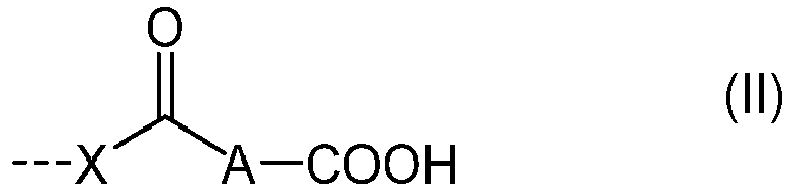

- R1, R2 und R3 jeweils unabhängig voneinander für H oder Methyl stehen,
- A für einen gegebenenfalls ein Sauerstoffatom enthaltenden zweiwertigen Kohlenwasserstoffrest mit 2 bis 8 C-Atomen steht,
- B für einen zweiwertigen, gegebenenfalls ein Sauerstoffatom enthaltenden Kohlenwasserstoffrest mit 1 bis 8 C-Atomen steht, und
- W, X, und Y unabhängig voneinander für O, NR4 oder S stehen, wobei R4 für H oder einen Alkylrest mit 1 bis 8 C-Atomen, insbesondere für H, steht.
- In einer bevorzugten Ausführungsform der Erfindung weist die Polycarbonsäure Endgruppen der Formel (I) auf.

- Bevorzugt steht W für NH. Eine solche Polycarbonsäure ist insbesondere ein Additionsprodukt eines Polyamins an eine α,β-ungesättigte Carbonsäure.
- Als α,β-ungesättigte Carbonsäure geeignet ist insbesondere Acrylsäure, Methacrylsäure, Crotonsäure oder 2,3-Dimethylacrylsäure. Besonders geeignet ist Acrylsäure oder Methacrylsäure. R2 und R3 stehen somit bevorzugt für H.
- Als Polyamin besonders geeignet sind die bereits genannten Poly(oxyalkylen)-diamine oder Poly(oxyalkylen)triamine.
- Besonders bevorzugt ist das Additionsprodukt eines Poly(oxy-1,2-propylen)-diamins mit mittlerem Molekulargewicht Mn von 2'000 bis 5'000 g/mol oder eines Glycerin- oder Trimethylolpropan-gestarteten Poly(oxy-1,2-propylen)triamins mit mittlerem Molekulargewicht Mn von 3'000 bis 5'000 g/mol an Acrylsäure oder Methacrylsäure. Diese Polycarbonsäuren ermöglichen besonders lange Verarbeitungszeiten und besonders hohe Dehnbarkeiten bei hoher Festigkeit.
- In einer weiteren bevorzugten Ausführungsform der Erfindung weist die Polycarbonsäure Endgruppen der Formel (II) auf.

- Bevorzugt steht X für O oder NH, insbesondere für O.
- Bevorzugt ist A ausgewählt aus der Gruppe bestehend aus 1,2-Ethandiyl, 1,2-Propandiyl, 1,2-Isobutandiyl, 1,2-Ethendiyl, 1,2-Prop-1-endiyl, 1,2-Prop-2-endiyl, 2,3-But-2-endiyl, 1,3-Propandiyl, 2-Oxa-1,3-propandiyl, 1,4-Butandiyl, 1,7-Heptandiyl, 1,8-Octandiyl, 1,10-Decandiyl, 1,2-Cyclohexandiyl, 1,4-Cyclohexandiyl, 1,2-Cyclohex-4-endiyl, 1,2-Phenylen, 1,4-Phenylen, 3,6-Dimethyl-1,2-phenylen und 2,5-Furandiyl.
- Davon bevorzugt ist 1,2-Ethandiyl oder 1,2-Phenylen.
- Eine Polycarbonsäure mit Endgruppen der Formel (II) ist insbesondere ein Additionsprodukt einer Verbindung mit zwei oder mehr Hydroxylgruppen, Aminogruppen oder Mercaptogruppen an ein cyclisches Anhydrid einer Dicarbonsäure. Eine solche Polycarbonsäure ermöglicht eine besonders schnelle Aushärtung.
- Als cyclisches Anhydrid geeignet ist insbesondere Bernsteinsäureanhydrid, 2-Methylbernsteinsäureanhydrid, 2,2-Dimethylbernsteinsäureanhydrid, Maleinsäureanhydrid, Citraconsäureanhydrid, Itaconsäureanhydrid, 2,3-Dimethylmaleinsäureanhydrid, Glutarsäureanhydrid, Diglykolsäureanhydrid, Hexahydrophthalsäureanhydrid, 1,2,3,6-Tetrahydrophthalsäureanhydrid, Phthalsäureanhydrid, 3,6-Dimethylphthalsäureanhydrid, insbesondere Bernsteinsäureanhydrid oder Phthalsäureanhydrid.
- Besonders geeignet für diese Addition sind Polyole, insbesondere die bereits genannten, insbesondere Rizinusöl, Derivate von Rizinusöl, amorphe Dimer- oder Trimerfettsäure-basierte Polyesterdiole oder -triole, die genannten Poly(oxyalkylen)polyole oder Polybutadienpolyole. Eine solche Polycarbonsäure ermöglicht eine hohe Festigkeit und gute Dehnbarkeit bei guter Stabilität gegenüber Hydrolyse.
- Weiterhin als Polycarbonsäure mit Endgruppen der Formel (II) geeignet sind Polyester aus der Veresterung von Dicarbonsäuren wie insbesondere Bernsteinsäure, Adipinsäure, Azelainsäure, Sebacinsäure, 1,12-Dodecandisäure, 1,4-Cyclohexandicarbonsäure, Terephthalsäure oder Furandicarbonsäure und Diolen wie insbesondere Ethylenglykol, Diethylenglykol, Propylenglykol, Dipropylenglykol, Neopentylglykol, 1,4-Butandiol, 1,5-Pentandiol, 3-Methyl-1,5-hexandiol, 1,6-Hexandiol, 1,8-Octandiol, 1,10-Decandiol, 1,12-Dodecandiol, 12-Hydroxystearylalkohol, 1,4-Cyclohexandimethanol oder Dimerfettsäurediol, wobei ein Überschuss an Dicarbonsäure eingesetzt wird.
- In einer weiteren bevorzugten Ausführungsform der Erfindung weist die Polycarbonsäure Endgruppen der Formel (III) auf.

- Bevorzugt steht Y für O oder NH oder S.
- Bevorzugt steht B für einen Rest ausgewählt aus Methylen, 1,1-Ethandiyl, 1,2-Ethandiyl, 1,2-Propandiyl, 1,2-Phenylen, 1,3-Phenylen, 1,4-Phenylen,

- Eine Polycarbonsäure mit Endgruppen der Formel (III) ist insbesondere ein Additionsprodukt einer Hydroxycarbonsäure, Aminocarbonsäure oder Mercaptocarbonsäure an ein Polyisocyanat, insbesondere ein Isocyanatgruppen-haltiges Polymer. Dafür geeignet ist insbesondere Glykolsäure, Milchsäure, Thiomilchsäure, 4-Hydroxybenzoesäure, Salicylsäure, 2-Aminobenzoesäure, 3-Aminobenzoesäure, 4-Aminobenzoesäure, 2-Aminophenylessigsäure, 4-Aminophenylessigsäure oder 2-Carboxy-5-hydroxymethylfuran.
- Bevorzugt ist Thiomilchsäure. Damit werden Polycarbonsäuren mit guter Handhabbarkeit erhalten, welche eine schnelle Aushärtung und besonders gute Dehnbarkeiten ermöglichen.
- Als Polyisocyanat geeignet sind insbesondere oligomere Diisocyanate wie insbesondere HDI-Biurete, HDI-Isocyanurate, HDI-Uretdione, HDI-Iminooxadiazindione, HDI-Allophanate, IPDI-Isocyanurate oder gemischte Isocyanurate auf Basis von TDI und HDI, wobei "HDI" für 1,6-Hexandiisocyanat, "IPDI" für Isophorondiisocyanat und "TDI" für 2,4(6)-Toluylendiisocyanat steht. Bevorzugt sind von HDI abgeleitete oligomere Diisocyanate, insbesondere HDI-Biurete.
- Als Polyisocyanat besonders geeignet sind Isocyanatgruppen-haltige Polymere, insbesondere Umsetzungsprodukte von Polyolen mit Diisocyanaten, insbesondere in einem molaren NCO/OH-Verhältnis von 1.5/1 bis 10/1, wobei nicht umgesetzte monomere Diisocyanate gegebenenfalls aus dem Polymer entfernt wurden. Das Isocyanatgruppen-haltige Polymer weist bevorzugt einen Gehalt an freien Isocyanatgruppen im Bereich von 0.5 bis 15 Gewichts-%, besonders bevorzugt 1 bis 10 Gewichts-%, insbesondere 1.5 bis 6 Gewichts-%, auf.
- Ganz besonders bevorzugt als Isocyanatgruppen-haltiges Polymer ist ein Reaktionsprodukt aus der Umsetzung von mindestens einem Diisocyanat und mindestens einem Polyol in einem NCO/OH-Verhältnis von mindestens 3/1, bevorzugt 3/1 bis 10/1, insbesondere 4/1 bis 8/1, und nachfolgender Entfernung eines Grossteils des monomeren Diisocyanats mittels eines geeigneten Trennverfahrens, so dass das Isocyanatgruppen-haltige Polymer schliesslich einen Gehalt an monomerem Diisocyanat von höchstens 0.2 Gewichts-% bezogen auf das Polymer aufweist. Ein solches Isocyanatgruppen-haltiges Polymer ermöglicht Polycarbonsäuren mit besonders niedrigem Gehalt an monomeren Umsetzungsprodukten, was eine besonders lange Verarbeitungszeit der Zusammensetzung ermöglicht.
- Als Diisocyanat geeignet ist insbesondere 1,6-Hexandiisocyanat (HDI), 2,2(4),4-Trimethyl-1,6-hexandiisocyanat (TMDI), 1-Methyl-2,4(6)-diisocyanatocyclohexan (H6TDI), Isophorondiisocyanat (IPDI), 4,4'-Diisocyanatodicyclohexylmethan (H12MDI), 4(2),4'-Diphenylmethandiisocyanat (MDI) oder 2,4(6)-Toluendiisocyanat.
- Bevorzugt ist HDI, IPDI, TDI oder MDI. Besonders bevorzugt ist IPDI. Damit werden besonders gut verarbeitbare Zusammensetzungen erhalten, welche zu Polymeren mit hoher Festigkeit und guter Dehnbarkeit aushärten.
- Geeignete Polyole sind die bereits genannten, insbesondere Polyetherpolyole bzw. Poly(oxyalkylen)polyole wie insbesondere Poly(oxy-1,2-propylen)diole oder -triole, Ethylenoxid endcapped Poly(oxy-1,2-propylen)diole oder -triole, Dimerfettsäure-basierte Polyesterdiole oder Trimerfettsäure-basierte Polyestertriole.
- Bevorzugt ist die Polycarbonsäure weitgehend frei von flüchtigen organischen Lösemitteln. Insbesondere enthält sie weniger als 10 Gewichts-%, bevorzugt weniger als 5 Gewichts-%, besonders bevorzugt weniger als 1 Gewichts-%, flüchtige organische Lösemittel mit einem Siedepunkt bei Normaldruck von weniger als 200 °C bezogen auf die Polycarbonsäure. Dies ermöglicht härtbare Zusammensetzungen mit geringem Gehalt an flüchtigen organischen Verbindungen.
- Bevorzugt ist die Polycarbonsäure ausgewählt aus der Gruppe bestehend aus Additionsprodukten von Poly(oxy-1,2-propylen)diaminen mit mittlerem Molekulargewicht Mn von 2'000 bis 5'000 g/mol an (Meth)acrylsäure, Additionsprodukten von Glycerin- oder Trimethylolpropan-gestarteten Poly(oxy-1,2-propylen)triaminen mit mittlerem Molekulargewicht Mn von 3'000 bis 5'000 g/mol an (Meth)acrylsäure, Additionsprodukten von Rizinusöl an ein Dicarbonsäureanhydrid, Additionsprodukten von ethoxyliertem oder propoxyliertem Rizinusöl an ein Dicarbonsäureanhydrid, Additionsprodukten von einem amorphen Dimerfettsäure basierten Polyesterdiol an ein Dicaronsäureanhydrid, Additionsprodukten von einem Trimerfettsäurebasierten Polyestertriol an ein Dicarbonsäureanhydrid, Additionsprodukten von einem Polybutadienpolyol an ein Dicarbonsäureanhydrid, Additionsprodukten von Milchsäure an ein Polyisocyanat und Additionsprodukten von Thiomilchsäure an ein Polyisocyanat.
- Die zweite Komponente der härtbaren Zusammensetzung enthält mindestens ein aliphatisches Polycarbodiimid. Aliphatische Polycarbodiimide ermöglichen ausgehärtete Zusammensetzungen mit besonders guter Hitzestabilität. Im Gegensatz dazu zeigen entsprechende Zusammensetzungen mit aromatischen Polycarbodiimiden eine ungenügende Hitzestabilität.
- Bevorzugt ist das aliphatische Polycarbodiimid bei Raumtemperatur flüssig. Ein solches Polycarbodiimid ist bei Umgebungstemperaturen auch ohne Zusatz von Lösemitteln oder Verdünnern gut handhabbar.
- Die zweite Komponente weist insgesamt bevorzugt eine mittlere Carbodiimid-Funktionalität von 1.6 bis 6, bevorzugt 1.8 bis 5, insbesondere 2 bis 4, auf.
- Bevorzugt ist das aliphatische Polycarbodiimid erhalten aus der Umsetzung von mindestens einem monomeren Diisocyanat mit aliphatischen Isocyanatgruppen in Gegenwart eines Carbodiimidisierungs-Katalysators unter Erhitzen und Freisetzung von CO2. Bevorzugte Carbodiimidisierungs-Katalysatoren sind Phospholenoxide, insbesondere 3-Methyl-1-phenyl-2-phospholen-1-oxid oder 1-Methyl-2(3)-phospholen-1-oxid.
- Geeignete monomere Diisocyanate mit aliphatischen Isocyanatgruppen sind insbesondere 1,6-Hexandiisocyanat (HDI), 2,2(4),4-Trimethyl-1,6-hexandiisocyanat (TMDI), Isophorondiisocyanat (IPDI), 4,4'-Diisocyanatodicyclohexylmethan (H12MDI) oder o-, m- oder p-Xylendiisocyanat (XDI).
- Bevorzugt sind die Carbodiimidgruppen des aliphatischen Polycarbodiimids abgeleitet von mindestens einem Diisocyanat ausgewählt aus der Gruppe bestehend aus 1,6-Hexandiisocyanat (HDI), 2,2(4),4-Trimethyl-1,6-hexandiisocyanat (TMDI), Isophorondiisocyanat (IPDI) und 4,4'-Diisocyanatodicyclohexylmethan (H12MDI).
- Davon bevorzugt sind HDI, IPDI und H12MDI. Besonders bevorzugt ist IPDI.
- Bevorzugt ist das Polycarbodiimid frei von Isocyanatgruppen. Eine solche härtbare Zusammenstzung ist nicht empfindlich auf Feuchtigkeit bei der Aushärtung und toxikologisch besonders vorteilhaft.
- Als Endgruppen enthält das Polycarbodiimid bevorzugt einwertige, gegebenenfalls Ethergruppen enthaltende Kohlenwasserstoffgruppen mit 1 bis 50 C-Atomen. Zusätzlich kann das Polycarbodiimid weitere Reaktivgruppen enthalten, wie insbesondere Aziridingruppen und/oder Silangruppen.
- Ein solches Isocyanatgruppen-freies Polycarbodiimid wird insbesondere erhalten, indem während oder nach der Carbodiimidisierungs-Reaktion mindestens eine Verbindung mit einer Reaktivgruppe ausgewählt aus Isocyanatgruppe, Hydroxylgruppe, primäre oder sekundäre Aminogruppe und Mercaptogruppe eingesetzt wird.
- Bevorzugt als solche Verbindung sind Monoalkohole wie insbesondere Alkanole, Ethergruppen-haltige Alkanole oder Polyethermonole, insbesondere Alkanolgestartete Poly(1,2-ethylen)monole, Poly(1,2-propylen)monole oder gemischte Poly(1,2-ethylen)(1,2-propylen)monole, oder Monoisocyanate.
- Gegebenenfalls wird bei der Herstellung des Polycarbodiimids eine Silan- oder Aziridingruppen aufweisende Verbindung mitverwendet, wie insbesondere ein Isocyanatosilan wie 3-Isocyanatopropyltrimethoxysilan, 3-Isocyanatopropyldimethoxymethylsilan oder 3-Isocyanatopropyl-triethoxysilan, oder Aziridin.
- Ein bevorzugtes aliphatisches Polycarbodiimid ist ein Polymer und weist insbesondere die Formel (IV) auf,

- n im Mittel für 1.5 bis 6, bevorzugt 1.7 bis 5, insbesondere 2 bis 4, steht,
- D für einen zweiwertigen, jeweils über ein aliphatisches C-Atom gebundenen Kohlenwasserstoffrest mit 6 bis 15 C-Atomen steht, insbesondere ausgewählt aus HDI, IPDI und H12MDI nach Entfernung der beiden Isocyanatgruppen,
- R5 für einen gegebenenfalls Ethergruppen aufweisenden Kohlenwasserstoffrest mit 1 bis 50 C-Atomen steht, und
- Z für O, NR6 oder S steht und R6 für H oder einen Alkylrest mit 1 bis 8 C-Atomen steht.
- Bevorzugt steht Z für O.
- Bevorzugt steht R5 für einen Alkylrest mit 1 bis 20 C-Atomen oder für einen Rest der Formel

- Ein aliphatisches Polycarbodiimid der Formel (IV) wird insbesondere erhalten aus der Carbodiimidisierung von HDI, IPDI und/oder H12MDI und Umsetzung mit mindestens einem monofunktionellen Alkohol mit 1 bis 50 C-Atomen, insbesondere mindestens einem Polyethermonol mit Oxy-1,2-ethylen- und/oder Oxy-1,2-propylen-Einheiten.
- Bevorzugt ist das aliphatische Polycarbodiimid weitgehend frei von flüchtigen organischen Lösemitteln. Insbesondere enthält es weniger als 10 Gewichts-%, bevorzugt weniger als 5 Gewichts-%, besonders bevorzugt weniger als 1 Gewichts-%, flüchtige organische Lösemittel mit einem Siedepunkt bei Normaldruck von weniger als 200 °C, bezogen auf das Polycarbodiimid. Dies ermöglicht härtbare Zusammensetzungen mit geringem Gehalt an flüchtigen organischen Verbindungen und somit geringer Toxizität und Emission.
- Geeignete aliphatische Polycarbodiimide sind kommerziell erhältlich, beispielsweise Picassian® LX-725 oder Picassian® LX-755 (beide von Stahl).
- Die härtbare Zusammensetzung kann zum Verzögern der Aushärtereaktion mindestens ein tertiäres Amin enthalten. Bevorzugt ist Triethylamin oder Triethanolamin. Bevorzugt wird eine solche Menge tertiäres Amin eingesetzt, dass die Verarbeitung der Zusammensetzung ohne Probleme möglich ist. Dies hängt von der Anwendung und der Applikationsmethode ab. Bevorzugt liegen mindestens 20 %, besonders bevorzugt mindestens 50 %, insbesondere mindestens 70 %, der Carbonsäuregruppen als nichtionische Säuren vor.
- Die härtbare Zusammensetzung kann zusätzlich weitere Bestandteile enthalten, insbesondere die Folgenden:
- Füllstoffe, insbesondere gemahlene oder gefällte Calciumcarbonate, welche gegebenenfalls mit Fettsäuren, insbesondere Stearaten, beschichtet sind, Baryte (Schwerspate), Quarzmehle, Quarzsande, Dolomite, Wollastonite, Kaoline, calcinierte Kaoline, Schichtsilikate wie Glimmer oder Talk, Zeolithe, Aluminiumhydroxide, Magnesiumhydroxide, Kieselsäuren inklusive hochdisperse Kieselsäuren aus Pyrolyseprozessen, industriell hergestellte Russe, Graphit, MetallPulver, beispielsweise von Aluminium, Kupfer, Eisen, Silber oder Stahl, PVC-Pulver oder Hohlkugeln;
- Fasern, insbesondere Glasfasern, Kohlefasern, Metallfasern, Keramikfasern, Hanffasern, Zellulosefasern oder Kunststofffasern wie Polyamidfasern oder Polyethylenfasern;
- Nanofüllstoffe wie Graphen oder Carbon Nanotubes;
- Farbstoffe;
- Pigmente, insbesondere Titandioxid, Chromoxid, Eisenoxide oder organische Pigmente;
- Weichmacher, insbesondere Phthalate, insbesondere Diisononylphthalat (DINP), Diisodecylphthalat (DIDP) oder Di(2-propylheptyl)phthalat (DPHP), hydrierte Phthalate, insbesondere Diisononyl-1,2-cyclohexandicarboxylat (DINCH), Terephthalate, insbesondere Bis(2-ethylhexyl)terephthalat oder Diisononylterephthalat (DINT), hydrierte Terephthalate, insbesondere Bis(2-ethylhexyl)-1,4-cyclohexandicarboxylat oder Diisononyl-1,4-cyclohexandicar-boxylat, Isophthalate, Trimellitate, Adipate, insbesondere Dioctyladipat (DOA), Azelate, Sebacate, Benzoate, Glycolether, Glycolester, Weichmacher mit Polyetherstruktur, insbesondere Polypropylenoxid-monole, -diole oder -triole, oder Polypropylenoxid-monole, -diole oder -triole mit blockierten Hydroxylgruppen, insbesondere in der Form von Acetatgruppen, organische Sulfonate oder Phosphate, insbesondere Diphenylkresylphosphat (DPK), Polybutene, Polyisobutene oder von natürlichen Fetten oder Ölen abgeleitete Weichmacher, insbesondere epoxidiertes Soja- oder Leinöl, insbesondere Phthalate, hydrierte Phthalate, Adipate oder Weichmacher mit Polyetherstruktur;
- Lösemittel;
- Modifizierungsmittel wie Kohlenwasserstoffharze, natürliche oder synthetische Wachse oder Bitumen;
- Rheologie-Modifizierer, insbesondere Harnstoffverbindungen, Schichtsilikate wie Bentonite, Derivate von Rizinusöl, hydriertes Rizinusöl, Polyamide, Polyurethane, pyrogene Kieselsäuren oder hydrophob modifizierte Polyoxyethylene;
- Trocknungsmittel, insbesondere Molekularsiebe, Calciumoxid, Mono-Oxazolidine wie Incozol® 2 (von Incorez) oder Orthoameisensäureester;
- Haftvermittler, insbesondere Titanate oder Organoalkoxysilane wie Aminosilane, Mercaptosilane, Epoxysilane, Vinylsilane, (Meth)acrylsilane, Carbamatosilane, Alkylsilane, S-(Alkylcarbonyl)mercaptosilane oder oligomere Formen dieser Silane;
- Katalysatoren;
- nicht-reaktive thermoplastische Polymere, wie Homo- oder Copolymere von ungesättigten Monomeren, insbesondere aus der Gruppe umfassend Ethylen, Propylen, Butylen, Isobutylen, Isopren, Vinylacetat und Alkyl(meth)acrylate, insbesondere Polyethylene (PE), Polypropylene (PP), Polyisobutylene, Ethylenvinylacetat-Copolymere (EVA) und ataktische Poly-α-Olefine (APAO);
- flammhemmende Substanzen, insbesondere die bereits genannten Füllstoffe Aluminiumhydroxid oder Magnesiumhydroxid, organische Phosphorsäureester, Ammoniumpolyphosphate, Melamin oder Derivate davon, Borverbindungen oder Antimonverbindungen;
- Additive, insbesondere Netzmittel, Verlaufmittel, Entschäumer, Entlüfter, Stabilisatoren gegen Oxidation, Wärme, Licht oder UV-Strahlung oder Biozide;
- Solche Zusätze können als Bestandteil der ersten oder der zweiten Komponente vorhanden sein. Mit Carbodiimidgruppen reaktive Substanzen sind bevorzugt ein Bestandteil der ersten Komponente. Mit Carbonsäuregruppen reaktive Substanzen sind bevorzugt ein Bestandteil der zweiten Komponente.
- Bevorzugt enthält die härtbare Zusammensetzung zusätzlich mindestens einen weiteren Bestandteil ausgewählt aus Weichmachern, Füllstoffen und Rheologie-Modifizierern. Bevorzugt enthält die härtbare Zusammensetzung mehrere solche weitere Bestandteile.
- Die härtbare Zusammensetzung enthält weniger als 10 Gewichts-%, bevorzugt weniger als 5 Gewichts-%, insbesondere weniger als 2 Gewichts-%, Wasser bezogen auf die gesamte Zusammensetzung. Eine solche Zusammensetzung ist nicht wasserbasiert. Sie härtet unabhängig von der herrschenden Umgebungsfeuchte schnell aus und kann in dicken Schichten und/oder zwischen wasserdichten Substraten eingesetzt werden.
- Die härtbare Zusammensetzung enthält bevorzugt weniger 10 Gewichts-%, besonders bevorzugt weniger als 5 Gewichts-%, insbesondere weniger als 1 Gewichts-%, flüchtige organische Lösemittel mit einem Siedepunkt bei Normaldruck von weniger als 200 °C bezogen auf die gesamte Zusammensetzung. Eine solche Zusammensetzung verursacht besonders wenig Emissionen.
- Bevorzugt umfasst die härtbare Zusammensetzung
- 10 bis 100 Gewichts-%, bevorzugt 20 bis 70 Gewichts-%, der Summe aus Polycarbonsäuren und Polycarbodiimiden,
- 0 bis 50 Gewichts-%, bevorzugt 10 bis 40 Gewichts-%, Weichmacher,
- 0 bis 90 Gewichts-%, bevorzugt 20 bis 80 Gewichts-%, Füllstoffe,
- und gegebenenfalls weitere Substanzen,
- Die Konsistenz der ersten und der zweiten Komponenten der härtbaren Zusammensetzung ist geeigneterweise so, dass die Komponenten bei Umgebungsbedingungen mit einfachen Verfahren gut miteinander vermischt werden können. Dazu sind insbesondere flüssige oder pastöse Komponenten geeignet.
- Die erste und die zweite Komponente der härtbaren Zusammensetzung werden getrennt voneinander hergestellt. Dabei werden die Bestandteile der jeweiligen Komponente miteinander vermischt, so dass eine makroskopisch homogene Masse entsteht. Jede Komponente wird in einem separaten Gebinde gelagert. Geeignete Gebinde sind insbesondere ein Fass, ein Container, ein Hobbock, ein Eimer, ein Kanister, eine Büchse, ein Beutel, ein Schlauchbeutel, eine Kartusche oder eine Tube. Die Komponenten sind lagerstabil.
- Zur Anwendung der härtbaren Zusammensetzung werden die beiden Komponenten und gegebenenfalls vorhandene weitere Komponenten kurz vor oder während der Applikation miteinander vermischt. Das Mischungsverhältnis wird dabei so gewählt, dass das Verhältnis der Anzahl Carbodiimidgruppen zur Anzahl Carbonsäuregruppen im Bereich von 0.7 bis 1.5, bevorzugt 0.8 bis 1.3, insbesondere 0.9 bis 1.2, liegt. In Gewichtsteilen liegt das Mischungsverhältnis zwischen der ersten und der zweiten Komponente typischerweise im Bereich von 50:1 bis 1:5, insbesondere 20:1 bis 1:2.
- Werden die Komponenten vor der Applikation miteinander vermischt, so muss darauf geachtet werden, dass zwischen dem Vermischen der Komponenten und der Applikation nicht zu viel Zeit vergeht, da es sonst durch die einsetzende Reaktion und den damit verbundenen Anstieg der Viskosität zu Störungen wie beispielsweise einem ungenügenden Verlauf oder einer verlangsamten oder unvollständigen Haftung zum Substrat kommen kann. Insbesondere soll die Offenzeit der Zusammensetzung während der Applikation nicht überschritten werden.
- Als "Offenzeit" wird dabei die Zeitspanne zwischen dem Vermischen der Komponenten und dem Ende eines für die Verarbeitung geeigneten Zustands der Zusammensetzung bezeichnet.
- Das Vermischen erfolgt bevorzugt bei Umgebungstemperatur, insbesondere bei einer Temperatur im Bereich von -5 bis 50°C, insbesondere 0 bis 40°C.
- Mit dem Vermischen der beiden Komponenten beginnt die Zusammensetzung durch die einsetzende chemische Reaktion auszuhärten. Dabei reagieren hauptsächlich die Carbonsäuregruppen mit den Carbodiimidgruppen zu einer stabilen Bindung, wodurch die Zusammensetzung allmählich zu einem festen Polymer aushärtet. Es kann vermutet werden, dass dabei N-Acylharnstoffgruppen der
- Formel

- Die Aushärtung erfolgt bevorzugt bei Umgebungstemperatur, insbesondere bei einer Temperatur im Bereich von -5 bis 50 °C, insbesondere 0 bis 40 °C.
- Ein weiterer Gegenstand der Erfindung ist die ausgehärtete Zusammensetzung, erhalten aus der härtbaren Zusammensetzung nach dem Vermischen der beiden Komponenten.
- Bevorzugt ist die ausgehärtete Zusammensetzung elastisch und weist eine hohe Festigkeit bei guter Dehnbarkeit auf.
- Bevorzugt weist die ausgehärtete Zusammensetzung eine Zugfestigkeit, bestimmt gemäss DIN EN 53504 wie in den Beispielen beschrieben, von mindestens 0.7 MPa, bevorzugt mindestens 1 MPa, insbesondere mindestens 1.5 MPa, auf. Bevorzugt weist die ausgehärtete Zusammensetzung eine Shore A-Härte, bestimmt gemäss DIN 53505 wie in den Beispielen beschrieben, im Bereich von 10 bis 90, bevorzugt 20 bis 85, insbesondere 30 bis 80, auf.
- Bevorzugt weist die ausgehärtete Zusammensetzung eine Bruchdehnung, bestimmt gemäss DIN EN 53504 wie in den Beispielen beschrieben, von mindestens 10 %, bevorzugt mindestens 30 %, auf.
- Weiterhin verfügt die ausgehärtete Zusammensetzung über eine gute Hitze- und Hydrolysestabilität. Bevorzugt zeigt die ausgehärtete Zusammensetzung auch nach einer Lagerung während 7 Tagen bei 100 °C oder bei 70 °C und 100 % relativer Feuchtigkeit eine hohe Dehnbarkeit, Festigkeit und Härte.
- Die härtbare Zusammensetzung eignet sich für eine Vielzahl von Verwendungen. Sie kann insbesondere als Klebstoff, Dichtstoff, Beschichtung, Giessharz oder Spachtelmasse verwendet werden.
- Ein weiterer Gegenstand der Erfindung ist die Verwendung der härtbare Zusammensetzung als Vergussmasse, Klebstoff oder Beschichtung, wobei die erste und die zweite und gegebenenfalls vorhandene weitere Komponenten miteinander vermischt werden und die vermischte Zusammensetzung im flüssigen Zustand auf mindestens ein Substrat appliziert wird.
- Geeignete Substrate sind insbesondere:
- Glas, Glaskeramik, Beton, Mörtel, Zementestrich, Faserzement, Backstein, Ziegel, Gips oder Natursteine wie Granit oder Marmor;
- Reparatur- oder Nivelliermassen auf Basis PCC (Polymer-modifizierter Zementmörtel) oder ECC (Epoxidharz-modifizierter Zementmörtel);
- Metalle oder Legierungen wie Aluminium, Eisen, Stahl, Kupfer, weitere Buntmetalle, inklusive oberflächenveredelte Metalle oder Legierungen wie verzinkte oder verchromte Metalle;
- Asphalt oder Bitumen;
- Leder, Textilien, Papier, Holz, mit Harzen, beispielsweise Phenol-, Melamin- oder Epoxidharzen, gebundene Holzwerkstoffe, Harz-Textil-Verbundwerkstoffe oder weitere sogenannte Polymer-Composites;
- Kunststoffe wie Hart- und Weich-PVC, Polycarbonat, Polystyrol, Polyester, Polyamid, PMMA, ABS, SAN, Epoxidharze, Phenolharze, PUR, POM, TPO, PE, PP, EPM oder EPDM, jeweils unbehandelt oder oberflächenbehandelt, beispielsweise mittels Plasma, Corona oder Flammen;
- Faserverstärkte Kunststoffe, wie Kohlefaser-verstärkte Kunststoffe (CFK), Glasfaser-verstärkte Kunststoffe (GFK), Naturfaser-verstärkte Kunststoffe (NFK) und Sheet Moulding Compounds (SMC);
- Isolierschäume, insbesondere aus EPS, XPS, PUR, PIR, Steinwolle, Glaswolle, Aerogel oder geschäumtem Glas (Foamglas);
- beschichtete oder lackierte Substrate, insbesondere lackierte Fliesen, gestrichener Beton, pulverbeschichtete Metalle oder Legierungen oder lackierte Bleche;
- Beschichtungen, Farben oder Lacke.
- Die Substrate können bei Bedarf vor dem Applizieren vorbehandelt werden, insbesondere durch physikalische und/oder chemische Reinigungsverfahren oder das Aufbringen eines Aktivators oder eines Primers.
- Verklebt und/oder abgedichtet werden können zwei gleichartige oder zwei verschiedene Substrate.
- Aus der Verwendung der härtbaren Zusammensetzung wird ein Artikel erhalten. Der Artikel ist insbesondere mit der Zusammensetzung verfüllt, verklebt oder beschichtet. Dieser Artikel kann ein Bauwerk oder ein Teil davon sein, insbesondere ein Bauwerk des Hoch- oder Tiefbaus, eine Brücke, ein Dach, ein Treppenhaus, eine Fassade oder eine Bodenbeschichtung, oder er kann ein industrielles Gut oder ein Konsumgut sein, insbesondere ein Rohr, ein Rotorblatt einer Windkraftanlage, eine Haushaltmaschine oder ein Verkehrsmittel wie insbesondere ein Automobil, ein Bus, ein Lastkraftwagen, ein Schienenfahrzeug, ein Schiff, ein Flugzeug oder ein Helikopter oder ein Anbauteil davon.
- Im Folgenden sind Ausführungsbeispiele aufgeführt, welche die beschriebene Erfindung näher erläutern sollen. Selbstverständlich ist die Erfindung nicht auf diese beschriebenen Ausführungsbeispiele beschränkt.
- Als "Normklima" ("NK") wird eine Temperatur von 23±1°C und eine relative Luftfeuchtigkeit von 50±5% bezeichnet.
- Die verwendeten Chemikalien waren, sofern nicht anders bezeichnet, von Sigma-Aldrich Chemie GmbH.
- Die Viskosität wurde auf einem thermostatisierten Kegel-Platten-Viskosimeter Rheotec RC30 (Kegeldurchmesser 10 mm, Kegelwinkel 1°, Kegelspitze-PlattenAbstand 0.05 mm, Scherrate 10 s-1) gemessen.
- Die Aminzahl wurde durch Titration bestimmt (mit 0.1N HClO4 in Essigsäure gegen Kristallviolett).
- Infrarotspektren (FT-IR) wurden als unverdünnte Filme auf einem mit horizontaler ATR-Messeinheit mit Diamant-Kristall ausgestatteten FT-IR Gerät Nicolet iS5 von Thermo Scientific gemessen. Die Absorptionsbanden sind in Wellenzahlen (cm-1) angegeben.
- In einem Rundkolben wurden 122.84 g (0.18 mol NH2) Polyetherdiamin (Jeffamine® XTJ-559, propoxyliertes Poly(oxy-1,4-butylen)-Gerüst, Aminzahl 82.7 mg KOH/g, von Huntsman) vorgelegt, mit 13.05 g (0.18 mol) Acrylsäure vermischt und die Mischung während 15 min bei Raumtemperatur gerührt. Erhalten wurde eine gelbliche klare Flüssigkeit mit einer Viskosität von 210 Pa·s bei 25 °C und einem berechneten Carbonsäure-Equivalentgewicht von 755 g/eq.
- FT-IR: 2935, 2853, 2795, 1725, 1638, 1564, 1447, 1413, 1371, 1351, 1296, 1264, 1243, 1205, 1103, 1014, 990, 958, 886, 867, 836, 745.
- In einem Rundkolben wurden 77.66 g (0.078 mol NH2) Polyetherdiamin (Jeffamine® D-2000, Poly(oxy-1,2-propyen)-Gerüst, Aminzahl 56.2 mg KOH/g, von Huntsman) vorgelegt, mit 5.62 g (0.08 mol) Acrylsäure vermischt und die Mischung während 50 min bei Raumtemperatur gerührt. Erhalten wurde eine gelbliche klare Flüssigkeit mit einer Viskosität von 55 Pa·s bei 25 °C und einem berechneten Carbonsäure-Equivalentgewicht von 1'041 g/eq.
- FT-IR: 2970, 2930, 2868, 1725, 1638, 1558, 1454, 1412, 1373, 1347, 1296, 1264, 1096, 1013, 925, 866, 836, 700.
- In einem Rundkolben wurden 221.06 g (0.10 mol NH2) Polyetherdiamin (Jeffamine® D-4000, Poly(oxy-1,2-propyen)-Gerüst, Aminzahl 25.6 mg KOH/g, von Huntsman) vorgelegt, mit 7.27 g (0.10 mol) Acrylsäure vermischt und die Mischung während 20 min bei Raumtemperatur gerührt. Erhalten wurde eine gelbliche klare Flüssigkeit mit einer Viskosität von 18.6 Pa·s bei 25 °C und einem berechneten Carbonsäure-Equivalentgewicht von 2'283 g/eq.
- FT-IR: 2970, 2930, 2867, 1640, 1564, 1455, 1372, 1346, 1296, 1263, 1096, 1013, 925, 866, 835.
- In einem Rundkolben wurden 150.72 g (0.067 mol NH2) Polyethertriamin (Jeffamine® T-5000, Glycerin gestartetes Poly(oxy-1,2-propyen)triamin, Aminzahl 24.9 mg KOH/g, von Huntsman) vorgelegt, mit 4.83 g (0.067 mol) Acrylsäure vermischt und die Mischung während 50 min bei Raumtemperatur gerührt. Erhalten wurde eine dunkelgelbe klare Flüssigkeit mit einer Viskosität von 29 Pa·s bei 25 °C und einem berechneten Carbonsäure-Equivalentgewicht von 2'322 g/eq.
- FT-IR: 2970, 2930, 2867, 1639, 1568, 1454, 1372, 1344, 1296, 1255, 1094, 1013, 925, 868, 834.
- In einem Rundkolben wurden 202.0 g (0.087 mol NCO) eines Isocyanatgruppenhaltigen Polymers mit NCO-Gehalt 1.8 Gewichts-% und Funktionalität 2.3, hergestellt wie nachfolgend beschrieben, mit 8.8 g (0.087 mol) Milchsäure unter Ausschluss von Feuchtigkeit bei 100 °C umgesetzt, bis mittels IR-Spektroskopie keine Isocyanatgruppen mehr nachweisbar waren. Erhalten wurde eine gelbliche klare Flüssigkeit mit einer Viskosität von 308 Pa·s bei 25 °C und einem berechneten Carbonsäure-Equivalentgewicht von 2'423 g/eq.
- Das Polymer mit NCO-Gehalt 1.8 Gewichts-% wurde hergestellt, indem 780 g Glycerin-gestartetes Ethylenoxid endcapped Poly(oxy-1,2-propyen)triol (Desmophen® 5031 BT, OH-Zahl 28.0 mg KOH/g, Funktionalität ca. 2.3, von Covestro) und 220 g Isophorondiisocyanat (Vestanat® IPDI, von Evonik) in Gegenwart von 0.01 g Dibutylzinndilaurat bei 80 °C umgesetzt und anschliessend das monomere Isophorondiisocyanat in einem Kurzwegverdampfer bis zu einem Gehalt von 0.02 Gewichts-% destillativ entfernt wurde.
- In einem Rundkolben wurden 212.3 g (0.091 mol NCO) des Isocyanatgruppenhaltigen Polymers mit NCO-Gehalt 1.8 Gewichts-% und Funktionalität 2.3, hergestellt wie für Säure S5 beschrieben, mit 9.7 g (0.091 mol) Thiomilchsäure unter Ausschluss von Feuchtigkeit bei 100 °C umgesetzt, bis mittels IR-Spektroskopie keine Isocyanatgruppen mehr nachweisbar waren. Erhalten wurde eine gelbliche klare Flüssigkeit mit einer Viskosität von 216 Pa·s bei 25 °C und einem berechneten Carbonsäure-Equivalentgewicht von 2'440 g/eq.
- In einem Rundkolben wurden 176.6 g (0.076 mol NCO) des Isocyanatgruppenhaltigen Polymers mit NCO-Gehalt 1.8 Gewichts-% und Funktionalität 2.3, hergestellt wie für Säure S5 beschrieben, mit 10.4 g (0.076 mol) p-Aminobenzoesäure in 170.3 g Diisodecylphthalat (DIDP) unter Ausschluss von Feuchtigkeit bei 60 °C umgesetzt, bis mittels IR-Spektroskopie keine Isocyanatgruppen mehr nachweisbar waren. Erhalten wurde eine gelbliche klare Flüssigkeit mit einer Viskosität von 77 Pa·s bei 25 °C und einem berechneten Carbonsäure-Equivalentgewicht von 4'701 g/eq (inklusiv DIDP, bzw. 2'461 g/eq ohne DIDP).
- In einem Rundkolben wurden 84.6 g (0.071 mol OH) Hydroxy-terminiertes Polybutadien (Poly bd® R45 HTLO, OH-Zahl 47 mg KOH/g, OH-Funktionalität ca. 2.5, von Cray Valley) vorgelegt, mit 7.2 g (0.072 mol) Bernsteinsäureanhydrid und 0.1 g Methansulfonsäure vermischt und die Mischung während 3 Stunden bei 130 °C gerührt. Erhalten wurde eine gelbliche klare Flüssigkeit mit einer Viskosität von 41 Pa·s bei 25 °C und einem berechneten Carbonsäure-Equivalentgewicht von 1'294 g/eq.
- FT-IR: 3074, 3005, 2979, 2914, 2844, 1740, 1714, 1639, 1435, 1352, 1291, 1256, 1235, 1208, 1166, 1075, 1047, 993, 964, 910, 843, 803, 723.
- In einem Rundkolben wurden 61.0 g (0.18 mol OH) Rizinusöl (OH-Zahl 165 mg KOH/g) vorgelegt, mit 18.0 g (0.18 mol) Bernsteinsäureanhydrid und 0.1 g Methansulfonsäure vermischt und die Mischung während 3 Stunden bei 130 °C gerührt. Erhalten wurde eine bräunliche klare Flüssigkeit mit einer Viskosität von 6.4 Pa·s bei 25 °C und einem berechneten Carbonsäure-Equivalentgewicht von 439 g/eq.
- FT-IR: 2925, 2855, 2733, 2712, 1456, 1435, 1417, 1378, 1342, 1163, 1099, 1048, 1025, 993, 958, 906, 840, 724.
- In einem Rundkolben wurden 101.5 g (0.208 mol OH) ethoxyliertes Rizinusöl (Etocas® 10, OH-Zahl 115 mg KOH/g, OH-Funktionalität ca. 2.7, von Croda) vorgelegt, mit 30.9 g (0.209 mol) Phthalsäureanhydrid und 0.1 g Methansulfonsäure vermischt und die Mischung während 5 Stunden bei 130 °C gerührt. Erhalten wurde eine gelbliche klare Flüssigkeit mit einer Viskosität von 12.1 Pa·s bei 25 °C und einem berechneten Carbonsäure-Equivalentgewicht von 637 g/eq. FT-IR: 2924, 2855, 1789, 1726, 1600, 1455, 1417, 1351, 1285, 1257, 1120, 1071, 1039, 948, 898, 856, 788, 742, 713.
- In einem Rundkolben wurden 100.0 g (0.10 mol OH) Dimerfettsäure-basiertes amorphes Polyesterdiol (Priplast® 1838, OH-Zahl 56 mg KOH/g, von Croda) vorgelegt, mit 10.0 g (0.10 mol) Bernsteinsäureanhydrid und 0.1 g Methansulfonsäure vermischt und die Mischung während 2 Stunden bei 130 °C gerührt. Erhalten wurde eine gelbliche klare Flüssigkeit mit einer Viskosität von 71 Pa·s bei 25 °C und einem berechneten Carbonsäure-Equivalentgewicht von 1'101 g/eq. FT-IR: 2922, 2853, 1735, 1462, 1418, 1391, 1354, 1236, 1164, 1119, 1071, 989, 906, 826, 756, 724.
- In einem Rundkolben wurden 101.25 g (0.10 mol OH) Dimerfettsäure-basiertes amorphes Polyesterdiol (Priplast® 1838, OH-Zahl 56 mg KOH/g, von Croda) vorgelegt, mit 15.0 g (0.10 mol) Phthalsäureanhydrid und 0.1 g Methansulfonsäure vermischt und die Mischung während 1 Stunde bei 150 °C gerührt. Erhalten wurde eine gelbliche klare Flüssigkeit mit einer Viskosität von 72 Pa·s bei 25 °C und einem berechneten Carbonsäure-Equivalentgewicht von 1'164 g/eq.
- FT-IR: 2922, 2853, 1789, 1732, 1601, 1263, 1376, 1287, 1257, 1169, 1122, 1072, 1038, 984, 899, 788, 741, 725.
- In einem Rundkolben wurden 99.8 g (0.068 mol OH) Dimerfettsäure-basiertes amorphes Polyesterdiol (Priplast® 3196, OH-Zahl 37 mg KOH/g, von Croda) vorgelegt, mit 6.8 g (0.068 mol) Bernsteinsäureanhydrid und 0.1 g Methansulfonsäure vermischt und die Mischung während 2 Stunden bei 130 °C gerührt. Erhalten wurde eine gelbliche klare Flüssigkeit mit einer Viskosität von 91 Pa·s bei 25 °C und einem berechneten Carbonsäure-Equivalentgewicht von 1'569 g/eq. FT-IR: 2922, 2852, 1735, 1463, 1353, 1235, 1164, 1118, 1067, 989, 894, 723.
- In einem Rundkolben wurden 105.4 g (0.071 mol OH) Dimerfettsäure-basiertes amorphes Polyesterdiol (Priplast® 3196, OH-Zahl 37 mg KOH/g, von Croda) vorgelegt, mit 10.5 g (0.071 mol) Phthalsäureanhydrid und 0.1 g Methansulfonsäure vermischt und die Mischung während 2 Stunden bei 130 °C gefolgt von 30 Minuten bei 140 °C gerührt. Erhalten wurde eine gelbliche klare Flüssigkeit mit einer Viskosität von 92 Pa·s bei 25 °C und einem berechneten Carbonsäure-Equivalentgewicht von 1'634 g/eq.
- FT-IR: 2922, 2852, 1733, 1601, 1463, 1417, 1376, 1286, 1257, 1168, 1122, 1072, 1039, 983, 899, 741, 724.
Tabelle 1: Übersicht über die hergestellten Polycarbonsäuren Polymer-Rückgrat Funktionalität Viskosität 25°C [Pa·s] Equivalentgewicht [g/eq] Säure S1 Oxyalkylen 2 210 755 Säure S2 Oxy-1,2-propylen 2 55 1'041 Säure S3 Oxy-1,2-propylen 2 18.6 2'283 Säure S4 Oxy-1,2-propylen 3 29 2'322 Säure S5 EO capped Oxy-1,2-propylen 2.3 308 2'423 Säure S6 EO capped Oxy-1,2-propylen 2.3 216 2'440 Säure S7 EO capped Oxy-1,2-propylen 2.3 77 4'701 (2'461 ohne DIDP) Säure S8 Kohlenwasserstoff 2.5 41 1'294 Säure S9 Rizinusöl 2.7 6.4 439 Säure S10 Rizinusöl 2.7 12.1 637 Säure S11 Fettsäure / Polyester 2 71 1'101 Säure S12 Fettsäure / Polyester 2 72 1'164 Säure S13 Fettsäure / Polyester 2 91 1'569 Säure S14 Fettsäure / Polyester 2 92 1'634 - Kommerzielles Polycarbodiimid mit aliphatischen Carbodiimidgruppen und einem Carbodiimid-Equivalentgewicht von 700 g/eq (Picassian® LX-725, von Stahl), mit einer Viskosität von 4.4 Pa·s bei 25 °C.
- Kommerzielles Polycarbodiimid mit aliphatischen Carbodiimidgruppen und einem Carbodiimid-Equivalentgewicht von 850 g/eq (Picassian® LX-755, von Stahl), mit einer Viskosität von 7.7 Pa·s bei 25 °C.
- In einem Rundkolben wurden 218.3 g (0.109 mol NCO) eines aromatische Isocyanatgruppen-haltigen Polymers mit NCO-Gehalt 2.1 Gewichts-%, hergestellt wie nachfolgend beschrieben, vorgelegt, mit 13.0 g (0.109 mol NCO) Phenylisocyanat, 0.35 g 3-Methyl-1-phenyl-2-phospholen-1-oxid und 350 g Diisodecylphthalat (DIDP) unter Stickstoffatmosphäre vermischt und während 6 Stunden bei 100 °C umgesetzt. Dabei wurde jede halbe Stunde kurz Vakuum angelegt, um entstandenes CO2 zu entfernen. Erhalten wurde eine gelbliche klare Flüssigkeit mit einem berechneten Carbodiimid-Equivalentgewicht von 5'336 g/eq (inklusiv DIDP, bzw. 1'943 g/eq ohne DIDP).
- FT-IR: 2957, 2927, 2857, 2138, 2112, 1730, 1595, 1532, 1455, 1374, 1340, 1301, 1245, 1171, 1126, 1102, 1031, 993, 923, 852, 817, 758, 690.
- Das Polymer mit aromatischen Isocyanatgruppen wurde hergestellt, indem 130 g Polyoxypropylen-Diol (Acclaim® 4200, von Covestro; OH-Zahl 28.5 mg KOH/g), 260 g Glycerin-gestartetes Ethylenoxid endcapped Poly(oxy-1,2-propyen)triol (Caradol® MD34-02, von Shell; OH-Zahl 35.0 mg KOH/g), 60 g 4,4'-Diphenylmethandiisocyanat (Desmodur® 44 MC L, von Covestro) und 50 g Diisodecylphthalat bei 80 °C zu einem Polymer mit NCO-Gehalt 2.1 Gewichts-% umgesetzt wurden.
- Für jedes Beispiel wurden die in den Tabellen 2 bis 4 angegebenen Inhaltsstoffe der ersten-Komponente in den angegebenen Mengen (in Gewichtsteilen) mittels eines Zentrifugalmischers (SpeedMixer™ DAC 150, FlackTek Inc.) vermischt und unter Ausschluss von Feuchtigkeit aufbewahrt.
- Als zweite Komponente wurde das in den Tabellen 2 bis 4 angegebene Polycarbodiimid in der angegebenen Menge eingesetzt.
- Die beiden Komponenten jeder Zusammensetzung wurden mittels des Zentrifugalmischers zu einer homogenen Flüssigkeit verarbeitet und diese unverzüglich folgendermassen geprüft:
Die Gelierzeit wurde bestimmt, indem eine frisch vermischte Menge von ca. 3 g im Normklima mit einem Spatel in regelmässigen Abständen bewegt wurde, bis die Masse gelierte. - Zur Bestimmung der mechanischen Eigenschaften wurde die vermischte Zusammensetzung auf einem silikonbeschichteten Trennpapier zu einem Film von 2 mm Dicke aufgebracht, dieser während 10 Tagen im Normklima gelagert, einige hantelförmige Prüfkörper mit einer Länge von 75 mm bei einer Steglänge von 30 mm und einer Stegbreite von 4 mm aus dem Film ausgestanzt und diese gemäss DIN EN 53504 bei einer Zuggeschwindigkeit von 200 mm/min auf Zugfestigkeit, Bruchdehnung und E-Modul 5% (bei 0.5-5% Dehnung) geprüft. Diese Resultate sind mit dem Zusatz "10d NK" versehen.
- Zur Bestimmung der Hitzestabilität wurden weitere solche Prüfkörper anschliessend an die Aushärtung während 10 Tagen im Normklima während weiteren 7 Tagen in einem Umluftofen bei 100 °C gelagert und nach Abkühlen auf Raumtemperatur wie beschrieben auf Zugfestigkeit, Bruchdehnung und E-Modul 5% geprüft. Diese Resultate sind mit dem Zusatz "+7d 100°C" versehen. Eine signifikante Abnahme von Zugfestigkeit und E-Modul im Vergleich zu den Werten nach 10d NK zeigt eine eingeschränkte Hitzestabilität.
- Die Shore A-Härte wurde nach DIN 53505 an während 10 Tagen im Normklima gehärteten Prüfkörpern bestimmt. Diese Resultate sind mit dem Zusatz "10d NK" versehen.
- Zur Bestimmung der Hitze- und Hydrolysestabilität wurden weitere Shore A-Prüfkörper nach 10 Tagen Aushärtung im Normklima entweder zusätzlich während 7 Tagen in einem Umluftofen bei 100 °C gelagert oder zusätzlich während 7 Tagen bei 70 °C und 100 % relativer Feuchtigkeit gelagert und nach Abkühlen auf Raumtemperatur jeweils wie beschrieben die Shore A-Härte bestimmt. Diese Resultate sind mit dem Zusatz "+7d 100°C" bzw. "+7d 70°C/100%rF" versehen.
- Bei der Aushärtung entstand jeweils ein nicht-klebriges, dehnbares Material.
- Die Resultate der durchgeführten Prüfungen sind in den Tabellen 2 bis 4 angegeben.
- Bei dem mit "(Ref.)" bezeichneten Beispiel Z-7 handelt es sich um ein Vergleichsbeispiel mit einem aromatischen Polycarbodiimid.
Tabelle 2: Zusammensetzung und Eigenschaften von Z-1 bis Z-7. Beispiel Z-1 Z-2 Z-3 Z-4 Z-5 Z-6 Z-7 (Ref.) erste Komponente: Säure S1 S2 S3 S3 S4 S3 S3 13.1 15.9 20.2 20.2 20.3 19.1 12.1 Diisodecylphthalat 15.7 15.7 15.7 15.8 15.7 15.7 7.5 CaCO3 gefällt 1 25.1 25.1 25.1 23.7 25.1 25.1 12.1 pyrogene Kieselsäure 1.6 1.6 1.6 - 1.6 1.6 0.8 Russ 2 - - - 7.9 - - - zweite-Komponente: PCDI XL-725 14.5 11.7 7.4 7.4 7.3 - - PCDI XL-755 - - - - - 8.5 - PCDI AR-1 - - - - - - 33.9 Gelierzeit [h:min] 2:10 3:00 3:30 > 2h 5:00 4:00 0:04 10d NK: Zugfestigkeit [MPa] 1.9 0.8 1.5 1.6 1.1 1.1 0.7 Bruchdehnung 34% 34 % 99 % 110 % 67 % 30% 490 % E-Modul 5% [MPa] 7.2 2.4 2.4 1.7 1.5 3.3 0.1 +7d 100°C: Zugfestigkeit [MPa] 2.1 1.1 1.6 2.2 1.2 1.1 n.m.3 Bruchdehnung 46% 47 % 139 % 110 % 75 % 41 % n.m.3 E-Modul 5% [MPa] 5.2 2.0 1.6 2.3 1.3 2.2 n.m.3 Shore A (10d NK) 67 51 46 45 43 53 n.b.4 (+ 7d 100°C) 56 32 33 53 28 46 n.b.4 (+ 7d 70/100) 71 56 52 40 45 53 n.b.4 1 Socal® U1S2 (von Imerys)
2 Monarch® 570 (von Cabot)
3 nicht messbar (flüssig)
4 nicht bestimmt (Prüfung nicht durchgeführt)Tabelle 3: Zusammensetzung und Eigenschaften von Z-8 bis Z-13. Beispiel Z-8 Z-9 Z-10 Z-11 Z-12 Z-13 erste Komponente: Säure S5 S6 S7 S8 S9 S10 20.5 20.5 23.3 16.8 9.5 11.9 Diisodecylphthalat 15.7 15.7 5.1 15.7 15.7 15.7 CaCO3 gefällt 1 25.1 25.1 25.1 25.1 25.1 25.1 pyrogene Kieselsäure 1.6 1.6 1.6 1.6 1.6 1.6 Triethylamin 0.7 0.8 0.5 0.6 0.4 - zweite-Komponente: PCDI XL-725 7.1 7.1 4.2 10.8 18.1 15.7 Gelierzeit [h:min] 0:15 0:38 0:02 0:07 0:35 0:05 10d NK: Zugfestigkeit [MPa] 2.4 1.5 2.1 0.5 1.0 1.1 Bruchdehnung 179 % 133 % 130 % 17 % 17 % 31 % E-Modul 5% [MPa] 2.0 1.5 2.4 2.2 7.1 5.4 +7d 100°C: Zugfestigkeit [MPa] 1.1 1.4 0.7 0.8 Bruchdehnung n.b.2 160 % n.b.2 10 % 6% 20% E-Modul 5% [MPa] 0.8 15.7 10.5 4.7 Shore A (10d NK) 47 43 53 51 73 59 (+ 7d 100°C) 12 29 38 71 75 61 (+ 7d 70/100) 33 18 43 47 73 44 1 Socal® U1S2 (von Imerys)
2 nicht bestimmt (Prüfung nicht durchgeführt)Tabelle 4: Zusammensetzung und Eigenschaften von Z-14 bis Z-20. Beispiel Z-14 Z-15 Z-16 Z-17 Z-18 Z-19 Z-20 erste Komponente: Säure S11 S11 S11 S12 S13 S13 S14 15.7 15.7 15.7 16.0 18.0 18.0 18.2 Diisodecylphthalat 15.7 15.7 15.8 15.7 15.7 15.8 15.7 CaCO3 gefällt 1 25.1 25.1 23.7 25.1 25.1 23.7 25.1 pyrogene Kieselsäure 1.6 1.6 - 1.6 1.6 - 1.6 Russ 2 - - 7.9 - - 7.9 Triethylamin - 0.3 - - - - - zweite-Komponente: PCDI XL-725 11.9 11.9 11.9 11.6 9.6 9.6 9.4 Gelierzeit [h:min] 0:04 0:45 0:04 0:06 0:30 0:09 0:12 10d NK: Zugfestigkeit [MPa] 0.9 0.9 1.4 0.9 0.29 1.1 0.7 Bruchdehnung 35 % 41 % 32 % 34 % 56 % 53% 53% E-Modul 5% [MPa] 2.3 2.3 4.0 2.7 0.7 2.0 1.2 +7d 100°C: Zugfestigkeit [MPa] 0.8 0.7 1.3 0.5 0.24 1.6 0.5 Bruchdehnung 29 % 30% 27 % 30 % 28 % 56% 41 % E-Modul 5% [MPa] 2.5 2.4 4.7 2.0 1.2 3.1 1.3 Shore A (10d NK) 45 46 52 44 16 33 37 (+ 7d 100°C) 42 45 61 27 11 51 15 (+ 7d 70/100) 37 39 59 28 5 46 21 1 Socal® U1S2 (von Imerys)
2 Monarch® 570 (von Cabot)
Claims (15)
- Härtbare Zusammensetzung umfassend- eine erste Komponente enthaltend mindestens eine bei Raumtemperatur flüssige Polycarbonsäure mit einem mittleren Molekulargewicht Mn von 500 bis 20'000 g/mol, und- eine zweite Komponente enthaltend mindestens ein aliphatisches Polycarbodiimid,
wobei die Zusammensetzung weniger als 10 Gewichts-% Wasser bezogen auf die gesamte Zusammensetzung enthält. - Zusammensetzung gemäss Anspruch 1, dadurch gekennzeichnet, dass das Verhältnis der Anzahl Carbodiimidgruppen zur Anzahl Carbonsäuregruppen in der Zusammensetzung im Bereich von 0.8 bis 1.5, bevorzugt 1 bis 1.3, liegt.
- Zusammensetzung gemäss einem der Ansprüche 1 bis 2, dadurch gekennzeichnet, dass die Polycarbonsäure ein mittleres Molekulargewicht Mn von 500 bis 10'000 g/mol, bevorzugt 1'000 bis 8'000 g/mol, insbesondere 1'500 bis 5'000 g/mol, aufweist.
- Zusammensetzung gemäss einem der Ansprüche 1 bis 3, dadurch gekennzeichnet, dass die erste Komponente insgesamt eine mittlere Carbonsäure-Funktionalität von 1.6 bis 4, bevorzugt 1.8 bis 3.5, insbesondere 2 bis 3, aufweist.
- Zusammensetzung gemäss einem der Ansprüche 1 bis 4, dadurch gekennzeichnet, dass die Polycarbonsäure ein Derivat von Rizinusöl ist.
- Zusammensetzung gemäss einem der Ansprüche 1 bis 4, dadurch gekennzeichnet, dass die Polycarbonsäure eine Dimer- oder Trimerfettsäure oder ein Derivat einer Dimer- oder Trimerfettsäure ist.
- Zusammensetzung gemäss einem der Ansprüche 1 bis 4, dadurch gekennzeichnet, dass die Polycarbonsäure ein Poly(oxyalkylen)-Rückgrat aufweist.
- Zusammensetzung gemäss einem der Ansprüche 1 bis 4, dadurch gekennzeichnet, dass die Polycarbonsäure ein Kohlenwasserstoff-Rückgrat aufweist.
- Zusammensetzung gemäss einem der Ansprüche 1 bis 8, dadurch gekennzeichnet, dass die Polycarbonsäure Endgruppen ausgewählt aus der Formel (I), der Formel (II) und der Formel (III) aufweist,


 R1, R2 und R3 jeweils unabhängig voneinander für H oder Methyl stehen, A für einen gegebenenfalls ein Sauerstoffatom enthaltenden zweiwertigen Kohlenwasserstoffrest mit 2 bis 8 C-Atomen steht,B für einen zweiwertigen, gegebenenfalls ein Sauerstoffatom enthaltenden Kohlenwasserstoffrest mit 1 bis 8 C-Atomen steht, undW, X, und Y unabhängig voneinander für O, NR4 oder S stehen, wobei R4 für H oder einen Alkylrest mit 1 bis 8 C-Atomen, insbesondere für H, steht.
 - Zusammensetzung gemäss einem der Ansprüche 1 bis 9, dadurch gekennzeichnet, dass das aliphatische Polycarbodiimid bei Raumtemperatur flüssig ist.
- Zusammensetzung gemäss einem der Ansprüche 1 bis 10, dadurch gekennzeichnet, dass die zweite Komponente insgesamt eine mittlere Carbodiimid-Funktionalität von 1.6 bis 6, bevorzugt 1.8 bis 5, insbesondere 2 bis 4, aufweist.
- Zusammensetzung gemäss einem der Ansprüche 1 bis 11, dadurch gekennzeichnet, dass die Carbodiimidgruppen des aliphatischen Polycarbodiimids abgeleitet sind von mindestens einem Diisocyanat ausgewählt aus der Gruppe bestehend aus 1,6-Hexandiisocyanat, 2,2(4),4-Trimethyl-1,6-hexandiisocyanat, Isophorondiisocyanat und 4,4'-Diisocyanatodicyclohexylmethan.
- Zusammensetzung gemäss einem der Ansprüche 1 bis 12, dadurch gekennzeichnet, dass mindestens ein weiterer Bestandteil ausgewählt aus Weichmachern, Füllstoffen und Rheologie-Modifizierern enthalten ist.
- Ausgehärtete Zusammensetzung erhalten aus der härtbaren Zusammensetzung gemäss einem der Ansprüche 1 bis 13 nach dem Vermischen der beiden Komponente.
- Verwendung der Zusammensetzung gemäss einem der Ansprüche 1 bis 13 als Vergussmasse, Klebstoff oder Beschichtung, wobei die erste und die zweite und gegebenenfalls vorhandene weitere Komponenten miteinander vermischt werden und die vermischte Zusammensetzung im flüssigen Zustand auf mindestens ein Substrat appliziert wird.
Priority Applications (1)
| Application Number | Priority Date | Filing Date | Title |
|---|---|---|---|
| EP22176749.4A EP4286436A1 (de) | 2022-06-01 | 2022-06-01 | Härtbare zusammensetzung aus polycarbonsäure und polycarbodiimid |
Applications Claiming Priority (1)
| Application Number | Priority Date | Filing Date | Title |
|---|---|---|---|
| EP22176749.4A EP4286436A1 (de) | 2022-06-01 | 2022-06-01 | Härtbare zusammensetzung aus polycarbonsäure und polycarbodiimid |
Publications (1)
| Publication Number | Publication Date |
|---|---|
| EP4286436A1 true EP4286436A1 (de) | 2023-12-06 |
Family
ID=81878085
Family Applications (1)
| Application Number | Title | Priority Date | Filing Date |
|---|---|---|---|
| EP22176749.4A Withdrawn EP4286436A1 (de) | 2022-06-01 | 2022-06-01 | Härtbare zusammensetzung aus polycarbonsäure und polycarbodiimid |
Country Status (1)
| Country | Link |
|---|---|
| EP (1) | EP4286436A1 (de) |
Cited By (1)
| Publication number | Priority date | Publication date | Assignee | Title |
|---|---|---|---|---|
| WO2025099128A1 (en) * | 2023-11-07 | 2025-05-15 | Sylmasta Ltd | Bandages |
Citations (3)
| Publication number | Priority date | Publication date | Assignee | Title |
|---|---|---|---|---|
| US4977219A (en) | 1983-02-24 | 1990-12-11 | Union Carbide Chemicals And Plastics Company, Inc. | Low temperature crosslinking of water-borne resins |
| US6329491B1 (en) * | 1997-09-12 | 2001-12-11 | Basf Corporation | Single stage carbodiimide containing coating compositions |
| EP3985046A1 (de) * | 2020-10-15 | 2022-04-20 | Essilor International | Vernetzte gelformulierung |
-
2022
- 2022-06-01 EP EP22176749.4A patent/EP4286436A1/de not_active Withdrawn
Patent Citations (3)
| Publication number | Priority date | Publication date | Assignee | Title |
|---|---|---|---|---|
| US4977219A (en) | 1983-02-24 | 1990-12-11 | Union Carbide Chemicals And Plastics Company, Inc. | Low temperature crosslinking of water-borne resins |
| US6329491B1 (en) * | 1997-09-12 | 2001-12-11 | Basf Corporation | Single stage carbodiimide containing coating compositions |
| EP3985046A1 (de) * | 2020-10-15 | 2022-04-20 | Essilor International | Vernetzte gelformulierung |
Cited By (1)
| Publication number | Priority date | Publication date | Assignee | Title |
|---|---|---|---|---|
| WO2025099128A1 (en) * | 2023-11-07 | 2025-05-15 | Sylmasta Ltd | Bandages |
Similar Documents
| Publication | Publication Date | Title |
|---|---|---|
| EP1996635B1 (de) | Feuchtigkeitshärtende polyurethanzusammensetzung mit gutem tieftemperaturverhalten | |
| EP2220034B1 (de) | Aromatische aldimine und aldimin enthaltende polyurethanzusammensetzungen | |
| EP3833702A1 (de) | Isocyanatgruppen-haltiges polymer mit niedrigem gehalt an monomeren diisocyanaten | |
| EP3830203B1 (de) | Polyurethanzusammensetzung mit langer verarbeitungszeit und hoher festigkeit | |
| EP3947509B1 (de) | Feuchtigkeitshärtende zusammensetzung mit guten haftungseigenschaften | |
| EP3833701A1 (de) | Polyurethan-zusammensetzung mit niedrigem gehalt an monomeren diisocyanaten | |
| EP4499721B1 (de) | Feuchtigkeitshärtender scheibenklebstoff auf polyurethanbasis | |
| WO2017108827A1 (de) | Polyaldimin und härtbare polyurethanzusammensetzung | |
| EP3947507B1 (de) | Isocyanatgruppen-haltiges polymer basierend auf einem dimerfettsäure-polyesterdiol | |
| WO2017108832A1 (de) | Zweikomponentige polyurethanzusammensetzung | |
| EP3833700A1 (de) | Polyurethanzusammensetzung mit polymerem weichmacher und niedrigem gehalt an monomeren diisocyanaten | |
| EP1876196A1 (de) | VOC-freie oder VOC-arme Polyurethanbeschichtung | |
| EP4554994A1 (de) | Raumtemperatur-härtbare polymerzusammensetzung aus polyaldehyd und polycyanoacetat | |
| EP4100455B1 (de) | Lineares isocyanatgruppen-haltiges polymer | |
| EP4100451B1 (de) | Polyurethan-zusammensetzung mit guter haftung auf kunststoffen | |
| EP3898619B1 (de) | Feuchtigkeitshärtende polyurethan-zusammensetzung enthaltend oxazolidin | |
| WO2018234268A1 (de) | Blockierungsmittel für amine, latente härter und polyurethanzusammensetzungen | |
| WO2024012828A1 (de) | Raumtemperatur-härtbare polymerzusammensetzung aus polyaldehyd und 1,3-ketoester | |
| WO2024012829A1 (de) | Raumtemperatur-härtbare polymerzusammensetzung aus polyaldehyd und polymalonat | |
| EP4574867A1 (de) | Härtbare polymerzusammensetzungen enthaltend isocyanate, aldimine und verbindungen mit aktivierten methylen gruppen | |
| EP4574871A1 (de) | Härtbare polymerzusammensetzungen enthaltend aldimine, polyisocyanate und verbindungen mit aktivierten methylen-gruppen | |
| EP4480978A1 (de) | Härtbare zusammensetzung mit aldehydfunktionellem polymer | |
| EP4554997A1 (de) | Aldehydgruppen aufweisendes polymer | |
| WO2026002946A1 (de) | Stabilisator für isocyanatgruppen-haltige zusammensetzungen | |
| EP4585628A1 (de) | Härtbare polymerzusammensetzung enthaltend aldehyde, verbindungen mit aktivierten methylengruppen und eine beschleunigerkomponente |
Legal Events
| Date | Code | Title | Description |
|---|---|---|---|
| PUAI | Public reference made under article 153(3) epc to a published international application that has entered the european phase |
Free format text: ORIGINAL CODE: 0009012 |
|
| STAA | Information on the status of an ep patent application or granted ep patent |
Free format text: STATUS: THE APPLICATION HAS BEEN PUBLISHED |
|
| AK | Designated contracting states |
Kind code of ref document: A1 Designated state(s): AL AT BE BG CH CY CZ DE DK EE ES FI FR GB GR HR HU IE IS IT LI LT LU LV MC MK MT NL NO PL PT RO RS SE SI SK SM TR |
|
| STAA | Information on the status of an ep patent application or granted ep patent |
Free format text: STATUS: THE APPLICATION IS DEEMED TO BE WITHDRAWN |
|
| 18D | Application deemed to be withdrawn |
Effective date: 20240607 |