EP4286051A2 - A method of cross-coupling using a transition metal complex comprising a pad3 ligand - Google Patents
A method of cross-coupling using a transition metal complex comprising a pad3 ligand Download PDFInfo
- Publication number
- EP4286051A2 EP4286051A2 EP23187377.9A EP23187377A EP4286051A2 EP 4286051 A2 EP4286051 A2 EP 4286051A2 EP 23187377 A EP23187377 A EP 23187377A EP 4286051 A2 EP4286051 A2 EP 4286051A2
- Authority
- EP
- European Patent Office
- Prior art keywords
- transition metal
- pad
- metal complex
- equiv
- mmol
- Prior art date
- Legal status (The legal status is an assumption and is not a legal conclusion. Google has not performed a legal analysis and makes no representation as to the accuracy of the status listed.)
- Pending
Links
Images





Classifications
-
- B—PERFORMING OPERATIONS; TRANSPORTING
- B01—PHYSICAL OR CHEMICAL PROCESSES OR APPARATUS IN GENERAL
- B01J—CHEMICAL OR PHYSICAL PROCESSES, e.g. CATALYSIS OR COLLOID CHEMISTRY; THEIR RELEVANT APPARATUS
- B01J31/00—Catalysts comprising hydrides, coordination complexes or organic compounds
- B01J31/16—Catalysts comprising hydrides, coordination complexes or organic compounds containing coordination complexes
- B01J31/24—Phosphines, i.e. phosphorus bonded to only carbon atoms, or to both carbon and hydrogen atoms, including e.g. sp2-hybridised phosphorus compounds such as phosphabenzene, phosphole or anionic phospholide ligands
- B01J31/2404—Cyclic ligands, including e.g. non-condensed polycyclic ligands, the phosphine-P atom being a ring member or a substituent on the ring
- B01J31/2442—Cyclic ligands, including e.g. non-condensed polycyclic ligands, the phosphine-P atom being a ring member or a substituent on the ring comprising condensed ring systems
- B01J31/2461—Cyclic ligands, including e.g. non-condensed polycyclic ligands, the phosphine-P atom being a ring member or a substituent on the ring comprising condensed ring systems and phosphine-P atoms as ring members in the condensed ring system or in a further ring
- B01J31/248—Bridged ring systems, e.g. 9-phosphabicyclononane
- B01J31/2485—Tricyclic systems, e.g. phosphaadamantanes and hetero analogues
-
- C—CHEMISTRY; METALLURGY
- C07—ORGANIC CHEMISTRY
- C07F—ACYCLIC, CARBOCYCLIC OR HETEROCYCLIC COMPOUNDS CONTAINING ELEMENTS OTHER THAN CARBON, HYDROGEN, HALOGEN, OXYGEN, NITROGEN, SULFUR, SELENIUM OR TELLURIUM
- C07F9/00—Compounds containing elements of Groups 5 or 15 of the Periodic Table
- C07F9/02—Phosphorus compounds
- C07F9/28—Phosphorus compounds with one or more P—C bonds
- C07F9/50—Organo-phosphines
- C07F9/5018—Cycloaliphatic phosphines
-
- B—PERFORMING OPERATIONS; TRANSPORTING
- B01—PHYSICAL OR CHEMICAL PROCESSES OR APPARATUS IN GENERAL
- B01J—CHEMICAL OR PHYSICAL PROCESSES, e.g. CATALYSIS OR COLLOID CHEMISTRY; THEIR RELEVANT APPARATUS
- B01J31/00—Catalysts comprising hydrides, coordination complexes or organic compounds
- B01J31/16—Catalysts comprising hydrides, coordination complexes or organic compounds containing coordination complexes
- B01J31/22—Organic complexes
- B01J31/2204—Organic complexes the ligands containing oxygen or sulfur as complexing atoms
- B01J31/2208—Oxygen, e.g. acetylacetonates
-
- B—PERFORMING OPERATIONS; TRANSPORTING
- B01—PHYSICAL OR CHEMICAL PROCESSES OR APPARATUS IN GENERAL
- B01J—CHEMICAL OR PHYSICAL PROCESSES, e.g. CATALYSIS OR COLLOID CHEMISTRY; THEIR RELEVANT APPARATUS
- B01J31/00—Catalysts comprising hydrides, coordination complexes or organic compounds
- B01J31/16—Catalysts comprising hydrides, coordination complexes or organic compounds containing coordination complexes
- B01J31/22—Organic complexes
-
- B—PERFORMING OPERATIONS; TRANSPORTING
- B01—PHYSICAL OR CHEMICAL PROCESSES OR APPARATUS IN GENERAL
- B01J—CHEMICAL OR PHYSICAL PROCESSES, e.g. CATALYSIS OR COLLOID CHEMISTRY; THEIR RELEVANT APPARATUS
- B01J31/00—Catalysts comprising hydrides, coordination complexes or organic compounds
- B01J31/16—Catalysts comprising hydrides, coordination complexes or organic compounds containing coordination complexes
- B01J31/22—Organic complexes
- B01J31/2282—Unsaturated compounds used as ligands
- B01J31/2295—Cyclic compounds, e.g. cyclopentadienyls
-
- B—PERFORMING OPERATIONS; TRANSPORTING
- B01—PHYSICAL OR CHEMICAL PROCESSES OR APPARATUS IN GENERAL
- B01J—CHEMICAL OR PHYSICAL PROCESSES, e.g. CATALYSIS OR COLLOID CHEMISTRY; THEIR RELEVANT APPARATUS
- B01J31/00—Catalysts comprising hydrides, coordination complexes or organic compounds
- B01J31/16—Catalysts comprising hydrides, coordination complexes or organic compounds containing coordination complexes
- B01J31/24—Phosphines, i.e. phosphorus bonded to only carbon atoms, or to both carbon and hydrogen atoms, including e.g. sp2-hybridised phosphorus compounds such as phosphabenzene, phosphole or anionic phospholide ligands
-
- B—PERFORMING OPERATIONS; TRANSPORTING
- B01—PHYSICAL OR CHEMICAL PROCESSES OR APPARATUS IN GENERAL
- B01J—CHEMICAL OR PHYSICAL PROCESSES, e.g. CATALYSIS OR COLLOID CHEMISTRY; THEIR RELEVANT APPARATUS
- B01J31/00—Catalysts comprising hydrides, coordination complexes or organic compounds
- B01J31/16—Catalysts comprising hydrides, coordination complexes or organic compounds containing coordination complexes
- B01J31/24—Phosphines, i.e. phosphorus bonded to only carbon atoms, or to both carbon and hydrogen atoms, including e.g. sp2-hybridised phosphorus compounds such as phosphabenzene, phosphole or anionic phospholide ligands
- B01J31/2404—Cyclic ligands, including e.g. non-condensed polycyclic ligands, the phosphine-P atom being a ring member or a substituent on the ring
- B01J31/2442—Cyclic ligands, including e.g. non-condensed polycyclic ligands, the phosphine-P atom being a ring member or a substituent on the ring comprising condensed ring systems
- B01J31/2447—Cyclic ligands, including e.g. non-condensed polycyclic ligands, the phosphine-P atom being a ring member or a substituent on the ring comprising condensed ring systems and phosphine-P atoms as substituents on a ring of the condensed system or on a further attached ring
-
- C—CHEMISTRY; METALLURGY
- C07—ORGANIC CHEMISTRY
- C07B—GENERAL METHODS OF ORGANIC CHEMISTRY; APPARATUS THEREFOR
- C07B37/00—Reactions without formation or introduction of functional groups containing hetero atoms, involving either the formation of a carbon-to-carbon bond between two carbon atoms not directly linked already or the disconnection of two directly linked carbon atoms
- C07B37/04—Substitution
-
- C—CHEMISTRY; METALLURGY
- C07—ORGANIC CHEMISTRY
- C07F—ACYCLIC, CARBOCYCLIC OR HETEROCYCLIC COMPOUNDS CONTAINING ELEMENTS OTHER THAN CARBON, HYDROGEN, HALOGEN, OXYGEN, NITROGEN, SULFUR, SELENIUM OR TELLURIUM
- C07F15/00—Compounds containing elements of Groups 8, 9, 10 or 18 of the Periodic Table
- C07F15/0006—Compounds containing elements of Groups 8, 9, 10 or 18 of the Periodic Table compounds of the platinum group
-
- C—CHEMISTRY; METALLURGY
- C07—ORGANIC CHEMISTRY
- C07F—ACYCLIC, CARBOCYCLIC OR HETEROCYCLIC COMPOUNDS CONTAINING ELEMENTS OTHER THAN CARBON, HYDROGEN, HALOGEN, OXYGEN, NITROGEN, SULFUR, SELENIUM OR TELLURIUM
- C07F15/00—Compounds containing elements of Groups 8, 9, 10 or 18 of the Periodic Table
- C07F15/0006—Compounds containing elements of Groups 8, 9, 10 or 18 of the Periodic Table compounds of the platinum group
- C07F15/006—Palladium compounds
-
- C—CHEMISTRY; METALLURGY
- C07—ORGANIC CHEMISTRY
- C07F—ACYCLIC, CARBOCYCLIC OR HETEROCYCLIC COMPOUNDS CONTAINING ELEMENTS OTHER THAN CARBON, HYDROGEN, HALOGEN, OXYGEN, NITROGEN, SULFUR, SELENIUM OR TELLURIUM
- C07F15/00—Compounds containing elements of Groups 8, 9, 10 or 18 of the Periodic Table
- C07F15/0006—Compounds containing elements of Groups 8, 9, 10 or 18 of the Periodic Table compounds of the platinum group
- C07F15/006—Palladium compounds
- C07F15/0066—Palladium compounds without a metal-carbon linkage
-
- C—CHEMISTRY; METALLURGY
- C07—ORGANIC CHEMISTRY
- C07F—ACYCLIC, CARBOCYCLIC OR HETEROCYCLIC COMPOUNDS CONTAINING ELEMENTS OTHER THAN CARBON, HYDROGEN, HALOGEN, OXYGEN, NITROGEN, SULFUR, SELENIUM OR TELLURIUM
- C07F15/00—Compounds containing elements of Groups 8, 9, 10 or 18 of the Periodic Table
- C07F15/0006—Compounds containing elements of Groups 8, 9, 10 or 18 of the Periodic Table compounds of the platinum group
- C07F15/0073—Rhodium compounds
-
- C—CHEMISTRY; METALLURGY
- C07—ORGANIC CHEMISTRY
- C07F—ACYCLIC, CARBOCYCLIC OR HETEROCYCLIC COMPOUNDS CONTAINING ELEMENTS OTHER THAN CARBON, HYDROGEN, HALOGEN, OXYGEN, NITROGEN, SULFUR, SELENIUM OR TELLURIUM
- C07F9/00—Compounds containing elements of Groups 5 or 15 of the Periodic Table
- C07F9/02—Phosphorus compounds
- C07F9/28—Phosphorus compounds with one or more P—C bonds
- C07F9/50—Organo-phosphines
- C07F9/5045—Complexes or chelates of phosphines with metallic compounds or metals
-
- C—CHEMISTRY; METALLURGY
- C07—ORGANIC CHEMISTRY
- C07F—ACYCLIC, CARBOCYCLIC OR HETEROCYCLIC COMPOUNDS CONTAINING ELEMENTS OTHER THAN CARBON, HYDROGEN, HALOGEN, OXYGEN, NITROGEN, SULFUR, SELENIUM OR TELLURIUM
- C07F9/00—Compounds containing elements of Groups 5 or 15 of the Periodic Table
- C07F9/02—Phosphorus compounds
- C07F9/28—Phosphorus compounds with one or more P—C bonds
- C07F9/50—Organo-phosphines
- C07F9/505—Preparation; Separation; Purification; Stabilisation
-
- B—PERFORMING OPERATIONS; TRANSPORTING
- B01—PHYSICAL OR CHEMICAL PROCESSES OR APPARATUS IN GENERAL
- B01J—CHEMICAL OR PHYSICAL PROCESSES, e.g. CATALYSIS OR COLLOID CHEMISTRY; THEIR RELEVANT APPARATUS
- B01J2231/00—Catalytic reactions performed with catalysts classified in B01J31/00
- B01J2231/10—Polymerisation reactions involving at least dual use catalysts, e.g. for both oligomerisation and polymerisation
- B01J2231/14—Other (co) polymerisation, e.g. of lactides or epoxides
-
- B—PERFORMING OPERATIONS; TRANSPORTING
- B01—PHYSICAL OR CHEMICAL PROCESSES OR APPARATUS IN GENERAL
- B01J—CHEMICAL OR PHYSICAL PROCESSES, e.g. CATALYSIS OR COLLOID CHEMISTRY; THEIR RELEVANT APPARATUS
- B01J2231/00—Catalytic reactions performed with catalysts classified in B01J31/00
- B01J2231/40—Substitution reactions at carbon centres, e.g. C-C or C-X, i.e. carbon-hetero atom, cross-coupling, C-H activation or ring-opening reactions
- B01J2231/42—Catalytic cross-coupling, i.e. connection of previously not connected C-atoms or C- and X-atoms without rearrangement
-
- B—PERFORMING OPERATIONS; TRANSPORTING
- B01—PHYSICAL OR CHEMICAL PROCESSES OR APPARATUS IN GENERAL
- B01J—CHEMICAL OR PHYSICAL PROCESSES, e.g. CATALYSIS OR COLLOID CHEMISTRY; THEIR RELEVANT APPARATUS
- B01J2231/00—Catalytic reactions performed with catalysts classified in B01J31/00
- B01J2231/40—Substitution reactions at carbon centres, e.g. C-C or C-X, i.e. carbon-hetero atom, cross-coupling, C-H activation or ring-opening reactions
- B01J2231/42—Catalytic cross-coupling, i.e. connection of previously not connected C-atoms or C- and X-atoms without rearrangement
- B01J2231/4205—C-C cross-coupling, e.g. metal catalyzed or Friedel-Crafts type
-
- B—PERFORMING OPERATIONS; TRANSPORTING
- B01—PHYSICAL OR CHEMICAL PROCESSES OR APPARATUS IN GENERAL
- B01J—CHEMICAL OR PHYSICAL PROCESSES, e.g. CATALYSIS OR COLLOID CHEMISTRY; THEIR RELEVANT APPARATUS
- B01J2231/00—Catalytic reactions performed with catalysts classified in B01J31/00
- B01J2231/40—Substitution reactions at carbon centres, e.g. C-C or C-X, i.e. carbon-hetero atom, cross-coupling, C-H activation or ring-opening reactions
- B01J2231/42—Catalytic cross-coupling, i.e. connection of previously not connected C-atoms or C- and X-atoms without rearrangement
- B01J2231/4205—C-C cross-coupling, e.g. metal catalyzed or Friedel-Crafts type
- B01J2231/4211—Suzuki-type, i.e. RY + R'B(OR)2, in which R, R' are optionally substituted alkyl, alkenyl, aryl, acyl and Y is the leaving group
-
- B—PERFORMING OPERATIONS; TRANSPORTING
- B01—PHYSICAL OR CHEMICAL PROCESSES OR APPARATUS IN GENERAL
- B01J—CHEMICAL OR PHYSICAL PROCESSES, e.g. CATALYSIS OR COLLOID CHEMISTRY; THEIR RELEVANT APPARATUS
- B01J2231/00—Catalytic reactions performed with catalysts classified in B01J31/00
- B01J2231/40—Substitution reactions at carbon centres, e.g. C-C or C-X, i.e. carbon-hetero atom, cross-coupling, C-H activation or ring-opening reactions
- B01J2231/42—Catalytic cross-coupling, i.e. connection of previously not connected C-atoms or C- and X-atoms without rearrangement
- B01J2231/4205—C-C cross-coupling, e.g. metal catalyzed or Friedel-Crafts type
- B01J2231/4211—Suzuki-type, i.e. RY + R'B(OR)2, in which R, R' are optionally substituted alkyl, alkenyl, aryl, acyl and Y is the leaving group
- B01J2231/4227—Suzuki-type, i.e. RY + R'B(OR)2, in which R, R' are optionally substituted alkyl, alkenyl, aryl, acyl and Y is the leaving group with Y= Cl
-
- B—PERFORMING OPERATIONS; TRANSPORTING
- B01—PHYSICAL OR CHEMICAL PROCESSES OR APPARATUS IN GENERAL
- B01J—CHEMICAL OR PHYSICAL PROCESSES, e.g. CATALYSIS OR COLLOID CHEMISTRY; THEIR RELEVANT APPARATUS
- B01J2231/00—Catalytic reactions performed with catalysts classified in B01J31/00
- B01J2231/40—Substitution reactions at carbon centres, e.g. C-C or C-X, i.e. carbon-hetero atom, cross-coupling, C-H activation or ring-opening reactions
- B01J2231/42—Catalytic cross-coupling, i.e. connection of previously not connected C-atoms or C- and X-atoms without rearrangement
- B01J2231/4205—C-C cross-coupling, e.g. metal catalyzed or Friedel-Crafts type
- B01J2231/4233—Kumada-type, i.e. RY + R'MgZ, in which Ris optionally substituted alkyl, alkenyl, aryl, Y is the leaving group and Z is halide
-
- B—PERFORMING OPERATIONS; TRANSPORTING
- B01—PHYSICAL OR CHEMICAL PROCESSES OR APPARATUS IN GENERAL
- B01J—CHEMICAL OR PHYSICAL PROCESSES, e.g. CATALYSIS OR COLLOID CHEMISTRY; THEIR RELEVANT APPARATUS
- B01J2231/00—Catalytic reactions performed with catalysts classified in B01J31/00
- B01J2231/40—Substitution reactions at carbon centres, e.g. C-C or C-X, i.e. carbon-hetero atom, cross-coupling, C-H activation or ring-opening reactions
- B01J2231/42—Catalytic cross-coupling, i.e. connection of previously not connected C-atoms or C- and X-atoms without rearrangement
- B01J2231/4205—C-C cross-coupling, e.g. metal catalyzed or Friedel-Crafts type
- B01J2231/4261—Heck-type, i.e. RY + C=C, in which R is aryl
-
- B—PERFORMING OPERATIONS; TRANSPORTING
- B01—PHYSICAL OR CHEMICAL PROCESSES OR APPARATUS IN GENERAL
- B01J—CHEMICAL OR PHYSICAL PROCESSES, e.g. CATALYSIS OR COLLOID CHEMISTRY; THEIR RELEVANT APPARATUS
- B01J2231/00—Catalytic reactions performed with catalysts classified in B01J31/00
- B01J2231/40—Substitution reactions at carbon centres, e.g. C-C or C-X, i.e. carbon-hetero atom, cross-coupling, C-H activation or ring-opening reactions
- B01J2231/42—Catalytic cross-coupling, i.e. connection of previously not connected C-atoms or C- and X-atoms without rearrangement
- B01J2231/4205—C-C cross-coupling, e.g. metal catalyzed or Friedel-Crafts type
- B01J2231/4272—C-C cross-coupling, e.g. metal catalyzed or Friedel-Crafts type via enolates or aza-analogues, added as such or made in-situ, e.g. ArY + R2C=C(OM)Z -> ArR2C-C(O)Z, in which R is H or alkyl, M is Na, K or SiMe3, Y is the leaving group, Z is Ar or OR' and R' is alkyl
-
- B—PERFORMING OPERATIONS; TRANSPORTING
- B01—PHYSICAL OR CHEMICAL PROCESSES OR APPARATUS IN GENERAL
- B01J—CHEMICAL OR PHYSICAL PROCESSES, e.g. CATALYSIS OR COLLOID CHEMISTRY; THEIR RELEVANT APPARATUS
- B01J2231/00—Catalytic reactions performed with catalysts classified in B01J31/00
- B01J2231/40—Substitution reactions at carbon centres, e.g. C-C or C-X, i.e. carbon-hetero atom, cross-coupling, C-H activation or ring-opening reactions
- B01J2231/42—Catalytic cross-coupling, i.e. connection of previously not connected C-atoms or C- and X-atoms without rearrangement
- B01J2231/4277—C-X Cross-coupling, e.g. nucleophilic aromatic amination, alkoxylation or analogues
- B01J2231/4283—C-X Cross-coupling, e.g. nucleophilic aromatic amination, alkoxylation or analogues using N nucleophiles, e.g. Buchwald-Hartwig amination
-
- B—PERFORMING OPERATIONS; TRANSPORTING
- B01—PHYSICAL OR CHEMICAL PROCESSES OR APPARATUS IN GENERAL
- B01J—CHEMICAL OR PHYSICAL PROCESSES, e.g. CATALYSIS OR COLLOID CHEMISTRY; THEIR RELEVANT APPARATUS
- B01J2531/00—Additional information regarding catalytic systems classified in B01J31/00
- B01J2531/02—Compositional aspects of complexes used, e.g. polynuclearity
- B01J2531/0202—Polynuclearity
- B01J2531/0205—Bi- or polynuclear complexes, i.e. comprising two or more metal coordination centres, without metal-metal bonds, e.g. Cp(Lx)Zr-imidazole-Zr(Lx)Cp
-
- B—PERFORMING OPERATIONS; TRANSPORTING
- B01—PHYSICAL OR CHEMICAL PROCESSES OR APPARATUS IN GENERAL
- B01J—CHEMICAL OR PHYSICAL PROCESSES, e.g. CATALYSIS OR COLLOID CHEMISTRY; THEIR RELEVANT APPARATUS
- B01J2531/00—Additional information regarding catalytic systems classified in B01J31/00
- B01J2531/02—Compositional aspects of complexes used, e.g. polynuclearity
- B01J2531/0286—Complexes comprising ligands or other components characterized by their function
- B01J2531/0288—Sterically demanding or shielding ligands
-
- B—PERFORMING OPERATIONS; TRANSPORTING
- B01—PHYSICAL OR CHEMICAL PROCESSES OR APPARATUS IN GENERAL
- B01J—CHEMICAL OR PHYSICAL PROCESSES, e.g. CATALYSIS OR COLLOID CHEMISTRY; THEIR RELEVANT APPARATUS
- B01J2531/00—Additional information regarding catalytic systems classified in B01J31/00
- B01J2531/80—Complexes comprising metals of Group VIII as the central metal
- B01J2531/82—Metals of the platinum group
- B01J2531/822—Rhodium
-
- B—PERFORMING OPERATIONS; TRANSPORTING
- B01—PHYSICAL OR CHEMICAL PROCESSES OR APPARATUS IN GENERAL
- B01J—CHEMICAL OR PHYSICAL PROCESSES, e.g. CATALYSIS OR COLLOID CHEMISTRY; THEIR RELEVANT APPARATUS
- B01J2531/00—Additional information regarding catalytic systems classified in B01J31/00
- B01J2531/80—Complexes comprising metals of Group VIII as the central metal
- B01J2531/82—Metals of the platinum group
- B01J2531/824—Palladium
-
- B—PERFORMING OPERATIONS; TRANSPORTING
- B01—PHYSICAL OR CHEMICAL PROCESSES OR APPARATUS IN GENERAL
- B01J—CHEMICAL OR PHYSICAL PROCESSES, e.g. CATALYSIS OR COLLOID CHEMISTRY; THEIR RELEVANT APPARATUS
- B01J2540/00—Compositional aspects of coordination complexes or ligands in catalyst systems
- B01J2540/40—Non-coordinating groups comprising nitrogen
- B01J2540/44—Non-coordinating groups comprising nitrogen being derivatives of carboxylic or carbonic acids, e.g. amide (RC(=O)-NR2, RC(=O)-NR-C(=O)R), nitrile, urea (R2N-C(=O)-NR2), guanidino (R2N-C(=NR)-NR2) groups
- B01J2540/442—Amide groups or imidato groups (R-C=NR(OR))
-
- C—CHEMISTRY; METALLURGY
- C07—ORGANIC CHEMISTRY
- C07F—ACYCLIC, CARBOCYCLIC OR HETEROCYCLIC COMPOUNDS CONTAINING ELEMENTS OTHER THAN CARBON, HYDROGEN, HALOGEN, OXYGEN, NITROGEN, SULFUR, SELENIUM OR TELLURIUM
- C07F1/00—Compounds containing elements of Groups 1 or 11 of the Periodic Table
-
- C—CHEMISTRY; METALLURGY
- C07—ORGANIC CHEMISTRY
- C07F—ACYCLIC, CARBOCYCLIC OR HETEROCYCLIC COMPOUNDS CONTAINING ELEMENTS OTHER THAN CARBON, HYDROGEN, HALOGEN, OXYGEN, NITROGEN, SULFUR, SELENIUM OR TELLURIUM
- C07F3/00—Compounds containing elements of Groups 2 or 12 of the Periodic Table
Definitions
- the present invention relates to phosphine compounds comprising three adamantyl moieties (PAd 3 ) and, in particular, to transition metal complexes incorporating PAd 3 ligand for cross-coupling catalysis.
- PAd 3 adamantyl moieties
- phosphine compounds comprising three adamantyl moieties (PAd 3 ) and associated synthetic routes are described herein.
- Each adamantyl moiety may be the same or different.
- each adamantyl moiety (Ad) attached to the phosphorus atom can be independently selected from the group consisting of adamantane, diamantane, triamantane and derivatives thereof. Therefore, a series of PAd 3 compounds are contemplated.
- a method of synthesizing a PAd 3 compound comprises providing a reaction mixture including di-(adamantyl)phosphine (PAd 2 ) and a substituted adamantyl moiety and reacting the PAd 2 and substituted adamantyl moiety via an S N 1 pathway to provide PAd 3 .
- a method of synthesizing a PAd 3 compound comprises providing a reaction mixture including di-(adamantyl)phosphide and a substituted adamantyl moiety and reacting the di-(adamantyl)phosphide and substituted adamantyl moiety via an S N 1 pathway to provide PAd 3 .
- a metal complex comprises at least one transition metal and one or more PAd 3 ligands described herein coordinated to the transition metal.
- a metal complex is of the formula (PAd 3 ) m M(L) n wherein M is the transition metal, L is ligand and m and n are each integers from 1 to 3.
- a method of cross-coupling comprises providing a reaction mixture including a substrate, a coupling partner and a transition metal complex comprising PAd 3 ligand and reacting the substrate and coupling partner in the presence of the transition metal complex or derivative thereof to provide cross-coupled reaction product.
- the substrate can be selected from substituted aromatic compounds or substituted unsaturated aliphatic compounds.
- the coupling partner can comprise a variety of species including, but not limited to, organoboron compounds, organolithium compounds, organozinc compounds, organosilicon compounds, Grignard reagents and/or compounds having labile C-H bonds.
- alkyl refers to a straight or branched saturated hydrocarbon group optionally substituted with one or more substituents.
- an alkyl can be C 1 - C 30 .
- alkenyl as used herein, alone or in combination, refers to a straight or branched chain hydrocarbon group having at least one carbon-carbon double bond.
- aryl or "arene” as used herein, alone or in combination, refers to an aromatic monocyclic or multicyclic ring system optionally substituted with one or more ring substituents
- heteroaryl or “heteroarene” as used herein, alone or in combination, refers to an aromatic monocyclic or multicyclic ring system in which one or more of the ring atoms is an element other than carbon, such as nitrogen, oxygen and/or sulfur.
- alkoxy refers to the moiety RO-, where R is alkyl, alkenyl or aryl defined above.
- fluoroalkyl refers to an alkyl group defined above wherein one or more hydrogen atoms are replaced by fluorine atoms.
- phosphine compounds comprising three adamantyl moieties (PAd 3 ) and associated synthetic routes are described herein.
- Each adamantyl moiety may be the same or different.
- each adamantyl moiety (Ad) attached to the phosphorus atom can be independently selected from the group consisting of adamantane, diamantane, triamantane and derivatives thereof.
- all the adamantyl moieties (Ad) may be the same. In other embodiments, all adamantyl moieties (Ad) may be different.
- two adamantyl moieties (Ad) may be the same while the third adamantyl moiety (Ad) is different. Accordingly, use of the common abbreviation Ad for adamantyl moieties of PAd 3 compounds is not to be construed as imparting any structural similarity or difference between the three adamantyl moieties.
- FIG 1(a) illustrates various PAd 3 compounds according to some embodiments described herein.
- R 1 , R 2 and R 3 can be independently selected from several adamantyl moieties (Ad) to provide a series of PAd 3 compounds of differing structure.
- adamantyl moieties (Ad) of PAd 3 compounds are substituted at one or more positions.
- Adamantyl moieties for example, can include one or more acyl-, aryl-, alkyl-, alkoxy-, alkyl-amine and/or alcohol substituents.
- PAd 3 compounds can also exist in salt form as illustrated in Figure 1(b) .
- a method of synthesizing a PAd 3 compound comprises providing a reaction mixture including di-(adamantyl)phosphine (PAd 2 ) and a substituted adamantyl moiety and reacting the PAd 2 and substituted adamantyl moiety via an S N 1 pathway to provide PAd 3 .
- Adamantyl moieties of PAd 2 can be independently selected from adamantane, diamantane, triamantane and derivatives thereof.
- the substituted adamantyl moiety can have an adamantane, diamantane or triamantane architecture.
- the PAd 3 compound illustrated in structure of formula (I) below is synthesized according to the foregoing method.
- a reaction mixture including di-1-adamantylphosphine and a substituted adamantane is provided.
- the di-1-adamantylphosphine and substituted adamantane are reacted via an S N 1 pathway to provide tri(1-adamantyl)phosphine.
- the substituted adamantane in some embodiments, is of formula (II) wherein X is a moiety operable for dissociation into an anion under the S N 1 pathway.
- X is selected from the group consisting of acetate, triflate, tosylate and hydroxyl.
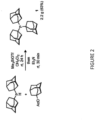
- Figure 2 provides specific reaction conditions of the S N 1 route for synthesis of the PAd 3 compound of formula (I) according to one embodiment.
- Diamantane and triamantane moieties can also be functionalized with a leaving group to provide substituted adamantane for reaction with PAd 2 via an S N 1 pathway.
- the leaving group of these higher adamantane structures can also be selected from the group consisting of acetate, triflate, tosylate and hydroxyl.
- a method of synthesizing PAd 3 compounds described herein comprises providing a reaction mixture including di-(adamantyl)phosphide and a substituted adamantyl moiety and reacting the di-(adamantyl)phosphide and substituted adamantyl moiety via an S N 1 pathway to provide PAd 3 .
- Suitable substituted adamantyl moiety can include a leaving group, X, as described above.
- suitable counterions of the phosphide are cations of bases used to deprotonate PAd 2 and can include alkali ions, MgCl + and ZnBr + .
- strong amine bases for which the pKa (H 2 O) of the amine conjugate acid exceeds approximately 10 may be employed as counterions.
- Such species can include tertiary ammonium ions
- PAd 3 compounds of the present disclosure exhibit significant kinetic stability toward oxidation, thereby permitting storage under air with negligible oxidation. Additionally, synthetic methods described herein can provide PAd 3 compounds at yields exceeding 50 percent or 60 percent.
- a metal complex comprises at least one transition metal and one or more PAd 3 compounds described in Section I above as ligand coordinated to the transition metal.
- Any transition metal operable to coordinate with phosphine ligands can be used to provide a metal complex described herein.
- the transition metal is selected from Group VIIIA, IB or IIB of the Periodic Table. Groups of the Periodic Table described herein are identified according to the CAS designation.
- the transition metal can be a noble metal including, but not limited to, palladium, rhodium, silver and gold.
- the metal complex comprises two transition metals, wherein PAd 3 ligands are coordinated to one or each of the transition metals.
- Non-PAd 3 ligands bridging the transition metal centers can include halo, ⁇ 3 -allyl, ⁇ 3 -crotyl, ⁇ 3 -cinnamyl and ⁇ 3 -indenyl.
- the metal complex can be of the formula (PAd 3 ) m M(L) n wherein M is the transition metal, L is ligand and m and n are each integers from 1 to 3.
- L can generally comprise any species meeting the steric requirements set by the PAd 3 ligand(s).
- L can be selected from the group consisting of alkyl, aryl, halo, CO, cyano, hydroxyl, acetate, substituted benzoate, trifluoroacetate (TFA), tosylate (OTs), mesylate (OMs), triflate (OTf), ⁇ 3 -allyl, ⁇ 3 -crotyl, ⁇ 3 -cinnamyl and ⁇ 3 -indenyl.
- TFA trifluoroacetate
- OTs tosylate
- OMs mesylate
- OTf triflate
- ⁇ 3 -allyl ⁇ 3 -crotyl
- ⁇ 3 -cinnamyl ⁇ 3 -indenyl.
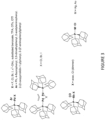
- Figures 3 and 4 illustrate non-limiting examples of metal complexes employing PAd 3 ligands described herein.
- adamantyl moieties (Ad) of the metal complexes illustrated in Figures 3 and 4 are adamantane. It is contemplated that any combination of adamantane, diamantane and/or triamantane moieties can be present in PAd 3 ligands of the metal complexes.
- a method of cross-coupling comprises providing a reaction mixture including a substrate, a coupling partner and a transition metal complex comprising PAd 3 ligand and reacting the substrate and coupling partner in the presence of the transition metal complex or derivative thereof to provide cross-coupled reaction product.
- the transition metal complex can have any composition and/or properties described in Section II hereinabove.
- the substrate can generally be selected from substituted aromatic compounds or substituted unsaturated aliphatic compounds.
- Suitable substituted aromatic compounds can include monocyclic and multicyclic ring systems, such as fused and non-fused multicyclic ring systems.
- Substituted aryl compounds can also comprise heteroaryl species, including monocyclic and multicyclic heteroaryl systems.
- Multicyclic heteroaryl systems can comprise fused and non-fused ring structures such as fused or non-fused heteroaryl rings as well as heteroaryl rings fused or non-fused to aryl rings.
- a substituted aromatic compound of the reaction mixture comprises a leaving group. Any leaving group operable to undergo cross-coupling mechanistic pathways described herein can be employed.
- a leaving group in some embodiments, is selected from the group consisting of halo, tosylate (OTs), mesylate (OMs), nosylate (ONs), N 2 + X - , N 2 NR 1 R 2 and NMe 3 + , wherein X - is halide and R 1 and R 2 are alkyl.
- a leaving group can be based on phenol derivatives of the aromatic compound including, but not limited to, carbamates, phosphonates, carbonates, sulfates, carboxylates and sulfamates.
- Figure 5(a) illustrates various phenol derivative leaving groups according to some embodiments.
- R 1 and R 2 in the embodiments of Figure 5(a) can be alkyl or other suitable aliphatic or substituted aliphatic group.
- Figure 5(b) illustrates thiophenol derivative leaving groups, wherein R can be alkyl or other suitable aliphatic or substituted aliphatic group.
- Aromatic substrates can also comprise one or more ring substituents in addition to the leaving group. As illustrated in the non-limiting embodiments of Figure 6 and the examples below, aromatic substrates can comprise one or more ring substituents selected from the group consisting of alkyl, cycloalkyl, alkoxy, acyl, nitro, nitrile, hydroxyl and amide.
- Substrates of cross-coupling reactions described herein also include substituted unsaturated aliphatic compounds.
- Substituted unsaturated aliphatic compounds can exhibit a single point of unsaturation, such as in vinyl or allyl compounds. In other embodiments, substituted unsaturated aliphatic compounds can have more than one point of unsaturation.
- substituted aliphatic compounds comprise a leaving group.
- a substituted unsaturated aliphatic compound can comprise any of the leaving groups described above for substituted aromatic compounds.
- a leaving group is attached to allyl or vinyl moieties to provide substituted unsaturated aliphatic substrate.
- the vinyl or allyl group can include one or more substituents in addition to the leaving group, including alkyl and/or acyl substituents.
- the coupling partner of the reaction mixture can comprise a variety of species including, but not limited to, organoboron compounds, organolithium compounds, organozinc compounds, organosilicon compounds and Grignard reagents.
- Organic moieties of these organometallic compounds can comprise aromatic moieties and aliphatic moieties.
- Suitable aryl moieties can include monocyclic and multicyclic ring systems, such as fused and non-fused multicyclic ring systems.
- Aryl moieties can also comprise heteroaryl species, including monocyclic and multicyclic heteroaryl systems.
- Multicyclic heteroaryl systems can comprise fused and non-fused ring structures such as fused or non-fused heteroaryl rings as well as heteroaryl rings fused or non-fused to aryl rings.
- aromatic moieties comprise one or more ring substituents selected from the group consisting of alkyl, cycloalkyl, fluoroalkyl and halo.
- Suitable aliphatic moieties of organometallic coupling partners include unsaturated moieties, such as vinyl or allyl groups, as well as saturated moieties.
- unsaturated carbon is coupled to the metal or metalloid of the organometallic compound.
- a branch point carbon of a saturated aliphatic moiety is coupled to the metal or metalloid of the organometallic compound.
- a non-branch point carbon of a saturated aliphatic moiety can be coupled to the metal or metalloid of the organometallic compound.
- a coupling partner comprises a compound having a labile C-H bond.
- Compounds having reactive C-H bonds comprise amines, phosphines, phosphonates, aliphatic carboxylic acids and esters, aliphatic dicarboxylic acids and esters, ketones, nitriles, nitroalkanes, unsaturated aliphatic compounds and aromatic compounds, including aryl and heteroaryl compounds. Heteroarenes can be especially reactive when one or two electronegative atoms are adjacent to the labile C-H bond.
- Figure 7 illustrates various non-limiting embodiments of coupling partner compounds comprising reactive C-H bonds.
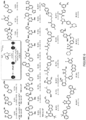
- FIG. 6 illustrates a number of Suzuki-Miyaura couplings employing transition metal complex described herein as catalyst.
- the cross-couplings illustrated in Figure 6 are discussed in further detail in the examples below. Table I lists additional catalytic schemes and associated figures employing transition metal catalyst described herein.
- Transition metal complex can be present in the reaction mixture in any amount not inconsistent with objectives of the present invention. Generally, transition metal complex can be present in an amount of 0.005-5 mol%. Transition metal complex can also be present in the reaction mixture in an amount selected from Table II. Table II - Transition Metal Complex Loading (mol.%) 0.01-3 0.01-1 0.01-0.5 0.01-0.25 0.01-0.1 ⁇ 0.5 ⁇ 0.1
- transition metal complex described herein is formed prior to addition to the reaction mixture.
- PAd 3 ligand and transition metal complex precursor are added to the reaction mixture for in-situ formation of the catalytic transition metal complex or derivative thereof.
- Figures 9 and 12 illustrate addition of PAd 3 ligand and transition metal complex precursor to the reaction mixture for catalytic cross-coupling of substrate and coupling partner.
- Cross-coupling methods described herein can exhibit product yields greater than 50 percent. In some embodiments, product yield ranges from 60-99 percent. Cross-coupling methods described herein can also exhibit product yields selected from Table III. Table III - Product Yield (%) 70-99 75-99 80-99 90-99 95-99 > 90
- transition metal complex described herein can exhibit high turnover numbers (TON) and high turnover frequencies (TOF).
- TON turnover numbers
- TOF turnover frequencies
- transition metal complex in some embodiments, displays TON of at least 1.5 ⁇ 10 4 and TOF of at least 1 ⁇ 10 5 h -1 .
- Tribasic potassium phosphate monohydrate was purchased from Aldrich and ground with a mortar and pestle prior to use.
- Potassium hydroxide was purchased from EMD Millipore and ground with a mortar and pestle prior to use.
- Bis- ⁇ 2-[(acetyl- ⁇ O )amino]phenyl- ⁇ C ⁇ bis[ ⁇ -( p -toluenesulfonate)]dipalladium was prepared according to literature procedure.
- PAd 3 (22 mg, 50 ⁇ mmol, 1 equiv) and Rh(acac)(CO) 2 (12.9 mg, 50 ⁇ mmol, 1 equiv) were dissolved in THF (2 mL) inside the glove box and stirred for 12 h. After evaporation of solvent and purification of the residue by flash chromatography (90 % hexane, 10% ethyl acetate) and drying of the resulting solid under vaccum, 10.5 mg (32%) of the metal complex was obtained as yellow powder.
- Tri(1-adamantyl)phosphine 44 mg, 0.1 mmol, 1 equiv
- bis- ⁇ 2-[(acetyl- ⁇ O )amino]phenyl- ⁇ C ⁇ bis[ ⁇ -(4-methylbenzenesulfonate)]dipalladium 41 mg, 0.05 mmol, 0.5 equiv
- THF 4 ml
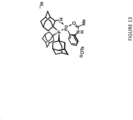
- Catalyst structure is illustrated in Figure 13 . Crystals suitable for single crystal X-ray diffraction were grown from a THF solution at room temperature.
- Pd(py) 2 (Ph)(I) 28 mg, 0.060 mmol, 1 equiv
- 6 and silver acetate 10 mg, 0.060 mmol, 1 equiv
- PAd 3 20 mg, 0.046 mmol, 1 equiv
- the resulting mixture was evaporated, redissolved in toluene (0.5mL), and diluted with ether (10 mL). After sonication, the resulting solid was collected by filtration and aspirated for 0.5 h, yielding 23 mg (57 %) of the metal complex as a yellow powder.
- the following products were prepared via Suzuki-Miyaura with PAd 3 metal catalyst.
- the PAd 3 metal catalyst was generated in situ by addition of a THF stock solution of bis- ⁇ 2-[(acetyl- ⁇ O )amino]phenyl- ⁇ C ⁇ bis[ ⁇ -( p- toluenesulfonate)]dipalladium (3) and PAd 3 ligand.
- the catalyst formed in situ is described and characterized in Example 3 and illustrated in Figure 13 .
- reaction mixture was diluted with ethyl acetate then extracted with water. The combine organic layers were evaporated and the crude product was purified by flash chromatography and preparative HPLC. After drying, 56 mg (55 %) of 13 was obtained as a white solid.
- reaction mixture was diluted with ethyl acetate then extracted with water. The combine organic layers were evaporated and the crude product was purified by flash chromatography and preparative HPLC. After drying, 116 mg (37 %) of 16 was obtained as a white solid.
- reaction mixture was diluted with ethyl acetate then extracted with water. The combine organic layers were evaporated and the crude product was purified by flash chromatography and preparative HPLC. After drying, 43 mg (56 %) of 17 was obtained as a white solid.
Landscapes
- Chemical & Material Sciences (AREA)
- Organic Chemistry (AREA)
- Chemical Kinetics & Catalysis (AREA)
- Inorganic Chemistry (AREA)
- Engineering & Computer Science (AREA)
- Materials Engineering (AREA)
- Biochemistry (AREA)
- Life Sciences & Earth Sciences (AREA)
- Health & Medical Sciences (AREA)
- General Health & Medical Sciences (AREA)
- Molecular Biology (AREA)
- Organic Low-Molecular-Weight Compounds And Preparation Thereof (AREA)
- Low-Molecular Organic Synthesis Reactions Using Catalysts (AREA)
- Catalysts (AREA)
- Quinoline Compounds (AREA)
- Plural Heterocyclic Compounds (AREA)
- Pyrrole Compounds (AREA)
- Pyridine Compounds (AREA)
- Heterocyclic Carbon Compounds Containing A Hetero Ring Having Nitrogen And Oxygen As The Only Ring Hetero Atoms (AREA)
Abstract
Description
- The present application claims priority pursuant to 35 U.S.C. § 119(e) to
United States Provisional Patent Application Serial Number 62/248,056 filed October 29, 2015 - The present invention relates to phosphine compounds comprising three adamantyl moieties (PAd3) and, in particular, to transition metal complexes incorporating PAd3 ligand for cross-coupling catalysis.
- Modern synthetic organic methods utilizing homogeneous transition metal catalysis have benefited immensely from the capacity of phosphines to modify the activity, selectivity and stability of metal catalysts. As a corollary, the behavior of metal catalysts can be manipulated by tuning the steric and electronic properties of supporting ligands such as phosphines. Thus, the discovery of novel phosphine structures with steric and/or electronic properties beyond what can be accessed using existing phosphorus-based ancillary ligands is desirable. Newer applications of phosphines to organocatalysis, frustrated Lewis pair (FLP) catalysis, biorthogonal reactions, and nano-materials should also benefit from access to new phosphine properties.
- In one aspect, phosphine compounds comprising three adamantyl moieties (PAd3) and associated synthetic routes are described herein. Each adamantyl moiety may be the same or different. For example, each adamantyl moiety (Ad) attached to the phosphorus atom can be independently selected from the group consisting of adamantane, diamantane, triamantane and derivatives thereof. Therefore, a series of PAd3 compounds are contemplated. In another aspect, a method of synthesizing a PAd3 compound comprises providing a reaction mixture including di-(adamantyl)phosphine (PAd2) and a substituted adamantyl moiety and reacting the PAd2 and substituted adamantyl moiety via an
S N1 pathway to provide PAd3. In other embodiments, a method of synthesizing a PAd3 compound comprises providing a reaction mixture including di-(adamantyl)phosphide and a substituted adamantyl moiety and reacting the di-(adamantyl)phosphide and substituted adamantyl moiety via anS N1 pathway to provide PAd3. - In another aspect, metal complexes are provided. A metal complex comprises at least one transition metal and one or more PAd3 ligands described herein coordinated to the transition metal. In some embodiments, a metal complex is of the formula (PAd3)mM(L)n wherein M is the transition metal, L is ligand and m and n are each integers from 1 to 3.
- In a further aspect, methods of catalysis are described herein, including catalytic cross-coupling reactions. A method of cross-coupling, in some embodiments, comprises providing a reaction mixture including a substrate, a coupling partner and a transition metal complex comprising PAd3 ligand and reacting the substrate and coupling partner in the presence of the transition metal complex or derivative thereof to provide cross-coupled reaction product. In some embodiments, the substrate can be selected from substituted aromatic compounds or substituted unsaturated aliphatic compounds. Moreover, the coupling partner can comprise a variety of species including, but not limited to, organoboron compounds, organolithium compounds, organozinc compounds, organosilicon compounds, Grignard reagents and/or compounds having labile C-H bonds.
- These and other embodiments are further described in the detailed description which follows.
-
-
Figure 1(a) illustrates various PAd3 compounds according to some embodiments. -
Figure 1(b) illustrates various salt forms of the PAd3 compounds ofFigure 1(a) according to some embodiments. -
Figure 2 illustrates synthesis of one embodiment of a PAd3 compound described herein. -
Figure 3 illustrates several transition metal complexes incorporating PAd3 ligands according to some embodiments. -
Figure 4 illustrates several transition metal complexes incorporating PAd3 ligands according to some embodiments. -
Figure 5(a) illustrates various phenol leaving groups of aryl substrates according to some embodiments. -
Figure 5(b) illustrates various thiophenol leaving groups of aryl substrates according to some embodiments. -
Figure 6 illustrates Suzuki-Miyaura coupling with transition metal complex described herein according to some embodiments. -
Figure 7 illustrates coupling partner compounds (R'-H) having reactive C-H bonds according to some embodiments. -
Figure 8 illustrates Suzuki-Miyaura polymerization with transition metal complex described herein according to some embodiments. -
Figure 9 illustrates Kumada-Tamao-Corriu coupling with transition metal complex described herein according to some embodiments. -
Figure 10 illustrates Buchwald-Hartwig amination with transition metal complex described herein according to some embodiments. -
Figure 11 illustrates α-arylation with transition metal complex described herein according to some embodiments. -
Figure 12 illustrates cross-coupling with transition metal complex described herein according to some embodiments. -
Figure 13 illustrates one embodiment of a transition metal catalyst described herein. - Embodiments described herein can be understood more readily by reference to the following detailed description and examples and their previous and following descriptions. Elements, apparatus and methods described herein, however, are not limited to the specific embodiments presented in the detailed description and examples. It should be recognized that these embodiments are merely illustrative of the principles of the present invention. Numerous modifications and adaptations will be readily apparent to those of skill in the art without departing from the spirit and scope of the invention.
- The term "alkyl" as used herein, alone or in combination, refers to a straight or branched saturated hydrocarbon group optionally substituted with one or more substituents. For example, an alkyl can be C1 - C30.
- The term "alkenyl" as used herein, alone or in combination, refers to a straight or branched chain hydrocarbon group having at least one carbon-carbon double bond.
- The term "aryl" or "arene" as used herein, alone or in combination, refers to an aromatic monocyclic or multicyclic ring system optionally substituted with one or more ring substituents
- The term "heteroaryl" or "heteroarene" as used herein, alone or in combination, refers to an aromatic monocyclic or multicyclic ring system in which one or more of the ring atoms is an element other than carbon, such as nitrogen, oxygen and/or sulfur.
- The term "alkoxy" as used herein, alone or in combination, refers to the moiety RO-, where R is alkyl, alkenyl or aryl defined above.
- The term "fluoroalkyl" as used herein refers to an alkyl group defined above wherein one or more hydrogen atoms are replaced by fluorine atoms.
- In one aspect, phosphine compounds comprising three adamantyl moieties (PAd3) and associated synthetic routes are described herein. Each adamantyl moiety may be the same or different. For example, each adamantyl moiety (Ad) attached to the phosphorus atom can be independently selected from the group consisting of adamantane, diamantane, triamantane and derivatives thereof. In some embodiments, for example, all the adamantyl moieties (Ad) may be the same. In other embodiments, all adamantyl moieties (Ad) may be different. In further embodiments, two adamantyl moieties (Ad) may be the same while the third adamantyl moiety (Ad) is different. Accordingly, use of the common abbreviation Ad for adamantyl moieties of PAd3 compounds is not to be construed as imparting any structural similarity or difference between the three adamantyl moieties.
-
Figure 1(a) illustrates various PAd3 compounds according to some embodiments described herein. As illustrated inFigure 1 , R1, R2 and R3 can be independently selected from several adamantyl moieties (Ad) to provide a series of PAd3 compounds of differing structure. In some embodiments, adamantyl moieties (Ad) of PAd3 compounds are substituted at one or more positions. Adamantyl moieties, for example, can include one or more acyl-, aryl-, alkyl-, alkoxy-, alkyl-amine and/or alcohol substituents. PAd3 compounds can also exist in salt form as illustrated inFigure 1(b) . - Synthetic routes for PAd3 compounds are also described herein. In one aspect, a method of synthesizing a PAd3 compound comprises providing a reaction mixture including di-(adamantyl)phosphine (PAd2) and a substituted adamantyl moiety and reacting the PAd2 and substituted adamantyl moiety via an
S N1 pathway to provide PAd3. Adamantyl moieties of PAd2 can be independently selected from adamantane, diamantane, triamantane and derivatives thereof. Similarly, the substituted adamantyl moiety can have an adamantane, diamantane or triamantane architecture. In one non-limiting embodiment, the PAd3 compound illustrated in structure of formula (I) below is synthesized according to the foregoing method.
- A reaction mixture including di-1-adamantylphosphine and a substituted adamantane is provided. The di-1-adamantylphosphine and substituted adamantane are reacted via an
S N1 pathway to provide tri(1-adamantyl)phosphine. The substituted adamantane, in some embodiments, is of formula (II)
S N1 pathway. In some embodiments, for example, X is selected from the group consisting of acetate, triflate, tosylate and hydroxyl.Figure 2 provides specific reaction conditions of theS N1 route for synthesis of the PAd3 compound of formula (I) according to one embodiment. Diamantane and triamantane moieties can also be functionalized with a leaving group to provide substituted adamantane for reaction with PAd2 via anS N1 pathway. The leaving group of these higher adamantane structures can also be selected from the group consisting of acetate, triflate, tosylate and hydroxyl. - In other embodiments, a method of synthesizing PAd3 compounds described herein comprises providing a reaction mixture including di-(adamantyl)phosphide and a substituted adamantyl moiety and reacting the di-(adamantyl)phosphide and substituted adamantyl moiety via an
S N1 pathway to provide PAd3. Suitable substituted adamantyl moiety can include a leaving group, X, as described above. Moreover, suitable counterions of the phosphide, in some embodiments, are cations of bases used to deprotonate PAd2 and can include alkali ions, MgCl+ and ZnBr+. Moreover, strong amine bases for which the pKa (H2O) of the amine conjugate acid exceeds approximately 10 may be employed as counterions. Such species can include tertiary ammonium ions - It is particularly noted that PAd3 compounds of the present disclosure exhibit significant kinetic stability toward oxidation, thereby permitting storage under air with negligible oxidation. Additionally, synthetic methods described herein can provide PAd3 compounds at yields exceeding 50 percent or 60 percent.
- In another aspect, metal complexes are provided. A metal complex comprises at least one transition metal and one or more PAd3 compounds described in Section I above as ligand coordinated to the transition metal. Any transition metal operable to coordinate with phosphine ligands can be used to provide a metal complex described herein. In some embodiments, the transition metal is selected from Group VIIIA, IB or IIB of the Periodic Table. Groups of the Periodic Table described herein are identified according to the CAS designation. Further, the transition metal can be a noble metal including, but not limited to, palladium, rhodium, silver and gold. In some embodiments, the metal complex comprises two transition metals, wherein PAd3 ligands are coordinated to one or each of the transition metals. Non-PAd3 ligands bridging the transition metal centers can include halo, η3-allyl, η3-crotyl, η3-cinnamyl and η3-indenyl.
- Moreover, the metal complex can be of the formula (PAd3)mM(L)n wherein M is the transition metal, L is ligand and m and n are each integers from 1 to 3. L can generally comprise any species meeting the steric requirements set by the PAd3 ligand(s). In some embodiments, for example, L can be selected from the group consisting of alkyl, aryl, halo, CO, cyano, hydroxyl, acetate, substituted benzoate, trifluoroacetate (TFA), tosylate (OTs), mesylate (OMs), triflate (OTf), η3-allyl, η3-crotyl, η3-cinnamyl and η3-indenyl. In embodiments wherein n is greater than 1, the chemical identity of L ligands can be the same or different.
Figures 3 and4 illustrate non-limiting examples of metal complexes employing PAd3 ligands described herein. The adamantyl moieties (Ad) of the metal complexes illustrated inFigures 3 and4 are adamantane. It is contemplated that any combination of adamantane, diamantane and/or triamantane moieties can be present in PAd3 ligands of the metal complexes. - In a further aspect, methods of catalysis are described herein, including catalytic cross-coupling reactions. A method of cross-coupling, in some embodiments, comprises providing a reaction mixture including a substrate, a coupling partner and a transition metal complex comprising PAd3 ligand and reacting the substrate and coupling partner in the presence of the transition metal complex or derivative thereof to provide cross-coupled reaction product. The transition metal complex can have any composition and/or properties described in Section II hereinabove.
- The substrate can generally be selected from substituted aromatic compounds or substituted unsaturated aliphatic compounds. Suitable substituted aromatic compounds can include monocyclic and multicyclic ring systems, such as fused and non-fused multicyclic ring systems. Substituted aryl compounds can also comprise heteroaryl species, including monocyclic and multicyclic heteroaryl systems. Multicyclic heteroaryl systems can comprise fused and non-fused ring structures such as fused or non-fused heteroaryl rings as well as heteroaryl rings fused or non-fused to aryl rings. A substituted aromatic compound of the reaction mixture comprises a leaving group. Any leaving group operable to undergo cross-coupling mechanistic pathways described herein can be employed. A leaving group, in some embodiments, is selected from the group consisting of halo, tosylate (OTs), mesylate (OMs), nosylate (ONs), N2 +X-, N2NR1R2 and NMe3 +, wherein X- is halide and R1 and R2 are alkyl. In additional embodiments, a leaving group can be based on phenol derivatives of the aromatic compound including, but not limited to, carbamates, phosphonates, carbonates, sulfates, carboxylates and sulfamates.
Figure 5(a) illustrates various phenol derivative leaving groups according to some embodiments. R1 and R2 in the embodiments ofFigure 5(a) can be alkyl or other suitable aliphatic or substituted aliphatic group.Figure 5(b) illustrates thiophenol derivative leaving groups, wherein R can be alkyl or other suitable aliphatic or substituted aliphatic group. - Aromatic substrates can also comprise one or more ring substituents in addition to the leaving group. As illustrated in the non-limiting embodiments of
Figure 6 and the examples below, aromatic substrates can comprise one or more ring substituents selected from the group consisting of alkyl, cycloalkyl, alkoxy, acyl, nitro, nitrile, hydroxyl and amide. - Substrates of cross-coupling reactions described herein also include substituted unsaturated aliphatic compounds. Substituted unsaturated aliphatic compounds can exhibit a single point of unsaturation, such as in vinyl or allyl compounds. In other embodiments, substituted unsaturated aliphatic compounds can have more than one point of unsaturation. As with aromatic substrates, substituted aliphatic compounds comprise a leaving group. For example, a substituted unsaturated aliphatic compound can comprise any of the leaving groups described above for substituted aromatic compounds. In some embodiments, a leaving group is attached to allyl or vinyl moieties to provide substituted unsaturated aliphatic substrate. In such embodiments, the vinyl or allyl group can include one or more substituents in addition to the leaving group, including alkyl and/or acyl substituents.
- The coupling partner of the reaction mixture can comprise a variety of species including, but not limited to, organoboron compounds, organolithium compounds, organozinc compounds, organosilicon compounds and Grignard reagents. Organic moieties of these organometallic compounds can comprise aromatic moieties and aliphatic moieties. Suitable aryl moieties can include monocyclic and multicyclic ring systems, such as fused and non-fused multicyclic ring systems. Aryl moieties can also comprise heteroaryl species, including monocyclic and multicyclic heteroaryl systems. Multicyclic heteroaryl systems can comprise fused and non-fused ring structures such as fused or non-fused heteroaryl rings as well as heteroaryl rings fused or non-fused to aryl rings. In some embodiments, aromatic moieties comprise one or more ring substituents selected from the group consisting of alkyl, cycloalkyl, fluoroalkyl and halo.
- Suitable aliphatic moieties of organometallic coupling partners include unsaturated moieties, such as vinyl or allyl groups, as well as saturated moieties. In some embodiments, for example, an unsaturated carbon is coupled to the metal or metalloid of the organometallic compound. In other embodiments, a branch point carbon of a saturated aliphatic moiety is coupled to the metal or metalloid of the organometallic compound. Alternatively, a non-branch point carbon of a saturated aliphatic moiety can be coupled to the metal or metalloid of the organometallic compound.
- In further embodiments, a coupling partner comprises a compound having a labile C-H bond. Compounds having reactive C-H bonds, in some embodiments, comprise amines, phosphines, phosphonates, aliphatic carboxylic acids and esters, aliphatic dicarboxylic acids and esters, ketones, nitriles, nitroalkanes, unsaturated aliphatic compounds and aromatic compounds, including aryl and heteroaryl compounds. Heteroarenes can be especially reactive when one or two electronegative atoms are adjacent to the labile C-H bond.
Figure 7 illustrates various non-limiting embodiments of coupling partner compounds comprising reactive C-H bonds. - When employing organoboron coupling partner, cross-coupling reactions described herein can proceed via Suzuki-Miyaura coupling or Suzuki-Miyaura polycondensation.
Figure 6 illustrates a number of Suzuki-Miyaura couplings employing transition metal complex described herein as catalyst. The cross-couplings illustrated inFigure 6 are discussed in further detail in the examples below. Table I lists additional catalytic schemes and associated figures employing transition metal catalyst described herein.Table I - Cross Coupling Reactions Coupling Partner Catalytic Scheme Example 
Suzuki-Miyaura polymerization Figure 8 Grignard Reagent (R-Mg-X) Kumada-Tamao-Corriu coupling Figure 9 Alkyl amine/aryl amine Buchwald-Hartwig amination Figure 10 Carbonyl species - ketone, ester, amide, imide α-arylation Figure 11 - Transition metal complex can be present in the reaction mixture in any amount not inconsistent with objectives of the present invention. Generally, transition metal complex can be present in an amount of 0.005-5 mol%. Transition metal complex can also be present in the reaction mixture in an amount selected from Table II.
Table II - Transition Metal Complex Loading (mol.%) 0.01-3 0.01-1 0.01-0.5 0.01-0.25 0.01-0.1 ≤ 0.5 ≤ 0.1 - In some embodiments, transition metal complex described herein is formed prior to addition to the reaction mixture. Alternatively, PAd3 ligand and transition metal complex precursor are added to the reaction mixture for in-situ formation of the catalytic transition metal complex or derivative thereof.
Figures 9 and12 , for example, illustrate addition of PAd3 ligand and transition metal complex precursor to the reaction mixture for catalytic cross-coupling of substrate and coupling partner. - Cross-coupling methods described herein can exhibit product yields greater than 50 percent. In some embodiments, product yield ranges from 60-99 percent. Cross-coupling methods described herein can also exhibit product yields selected from Table III.
Table III - Product Yield (%) 70-99 75-99 80-99 90-99 95-99 > 90 - Further, transition metal complex described herein can exhibit high turnover numbers (TON) and high turnover frequencies (TOF). For example, transition metal complex, in some embodiments, displays TON of at least 1.5 × 10⁴ and TOF of at least 1 × 10⁵ h-1.
- These and other embodiments are further illustrates by the following non-limiting examples.
- All reactions were conducted inside a dry nitrogen filled glove box or using standard Schlenk techniques unless otherwise noted. Solvents were purchased from Aldrich or Fisher and purified in a solvent purification system by percolation through neutral alumina under positive pressure of nitrogen. All chemical reagents were used as received from Aldrich, Combi-Blocks, and TCI unless otherwise noted. Tribasic potassium phosphate granular powder purchased from Fisher was nominally determined to be ca. K3PO4·5H2O according to mass loss measurement after drying at 65 °C for 10 h in a vacuum oven, though this is likely an admixture of the known hydrates K3PO4·3H2O and K3PO4·7H2O. Tribasic potassium phosphate monohydrate was purchased from Aldrich and ground with a mortar and pestle prior to use. Potassium hydroxide was purchased from EMD Millipore and ground with a mortar and pestle prior to use. Bis-{2-[(acetyl-κO)amino]phenyl-κC}bis[µ-(p-toluenesulfonate)]dipalladium was prepared according to literature procedure.
- All products are purified with forced-flow chromatography on Teledyne IscoRediSep ® prepacked silica gel columns. Infrared spectra (FT-IR) were obtained in dichloromethane solution on a Thermo Nicolet spectrometer for Rh(acac)(CO)(L) complexes. 1H, 13C{1H}, 31P{1H} nuclear magnetic resonance spectra (NMR) were obtained on a Bruker 300 MHz or 500 MHz spectrometer and values reported in ppm (δ) referenced against residual CHCl3, CHDCl2, etc. Spin-spin coupling constants are described as singlet (s), doublet (d), triplet (t), quartet (q), quintet (quint), broad (br) or multiplet (m), with coupling constants (J) in Hz. High resolution mass spectrometry (HR-MS) data were obtained using an Agilent 6210 High Resolution Electrospray TOF-MS.
- An oven-dried 100 ml round-bottomed flask equipped with a magnetic stir bar was charged with di-1-adamantylphosphine (2.35 g, 7.77 mmol, 1.0 equiv) and 1-adamantylacetate (1.66 g, 8.54 mmol, 1.1 equiv) in the glove box. dichloromethane (40 ml) was added to dissolve the entire solid. The flask was capped with a rubber septum, and taken out of the glove box. Me3SiOTf (1.69 ml, 9.32 mmol, 1.2 equiv) was added by syringe and the reaction mixture was stirred at room temperature for 24 h. Triethylamine(5.4 ml, 39 mmol, 5.0 equiv)was then added and the reaction was stirred for an additional 0.5 h at room temperature. The neutralized PAd3 subsequently precipitated from solution and was isolated by simple filtration on a disposable filter funnel followed by rinsing with ethanol (50 ml). After aspiration for 0.5 h, 2.2 g (63 %) of 1 obtained as a pure white powder. Although a solution of PAd3is prone to oxidation under air, material in the solid state can be stored on the bench top for at least three months without substantial decomposition. Note that slow decompose in chlorinated solvent (dichloromethane, chloroform) was observed even under an inert atmosphere, but the compound appears stable in solutions of THF, benzene and toluene under N2.
- 1H NMR (501 MHz, CD2Cl2) δ 2.13 (br, 18H), 1.84 (br, 9H), 1.74 - 1.58 (m, 18H).
- 13C NMR (126 MHz, CD2Cl2) δ 42.68 (br), 41.10 (d, J = 34.3 Hz), 37.0 , 29.5 (d, J = 7.2 Hz). 31P NMR (121 MHz, C6D6) δ 59.35.
- HRMS (ESI) m/z calculated for C30H46PO (M+17)453.3286, found 453.3289.
- PAd3 (22 mg, 50 µmmol, 1 equiv) and Rh(acac)(CO)2 (12.9 mg, 50 µmmol, 1 equiv) were dissolved in THF (2 mL) inside the glove box and stirred for 12 h. After evaporation of solvent and purification of the residue by flash chromatography (90 % hexane, 10% ethyl acetate) and drying of the resulting solid under vaccum, 10.5 mg (32%) of the metal complex was obtained as yellow powder.
- 1H NMR (300 MHz, CDCl3) δ 5.52 (s, 1H), 2.62 (br, 18H), 2.08 (s, 3H), 2.08 - 1.98 (br, 9H), 1.94 (s, 3H), 1.90 - 1.62 (m, 18H).
- 13C{1H} NMR (126 MHz, CDCl3) δ 192.9 (dd, J = 76.8, 19.3 Hz), 188.1 , 184.0, 100.9 (d, J = 2.5 Hz), 48.2 (d, J = 7.3 Hz), 42.3 (br), 36.8 (br), 29.6 (d, J = 7.6 Hz), 27.7 (d, J = 4.6 Hz), 27.1. 31P{1H} NMR (121 MHz, CDCl3) δ 90.6 (d, J = 174.6 Hz).
- Tri(1-adamantyl)phosphine (44 mg, 0.1 mmol, 1 equiv) and bis-{2-[(acetyl-κO)amino]phenyl-κC}bis[µ-(4-methylbenzenesulfonate)]dipalladium (41 mg, 0.05 mmol, 0.5 equiv) were weighed into a 20 ml scintillation vial with a magnetic stir bar and brought into glove box. THF (4 ml) was added to the solid. The reaction mixture was stirred at room temperature for 20 min, then concentrated to ca. 1 ml and diluted with diethyl ether (15 ml). The resulting solid that formed was isolated by filtration then dried under vacuum to afford 75 mg (88%) of catalyst as a yellow powder. Catalyst structure is illustrated in
Figure 13 . Crystals suitable for single crystal X-ray diffraction were grown from a THF solution at room temperature. - 1H NMR (501 MHz, CD2Cl2) δ 12.32 (s, 1H), 7.80 (d, J = 7.8 Hz, 2H), 7.52 - 7.41 (m, 2H), 2.35 - 2.31 (m, 1H), 7.18 (m, 3H), 6.89 - 6.82 (m, 1H), 2.49 (s, 3H), 2.45 (br, 18H), 2.40 (s, 3H), 2.11 (br, 9H), 1.84 (br, 18H).
- 31P NMR (203 MHz, CD2Cl2) δ 47.24.
- 13C NMR (126 MHz, CD2Cl2) δ 169.73 (d, J = 2.3 Hz), 144.09 , 142.19 (d, J = 10.0 Hz), 139.32 , 132.65 (d, J = 1.6 Hz), 128.53 , 127.43 , 125.84, 123.40 (d, J = 5.6 Hz), 120.77 , 117.77 (d, J = 6.6 Hz), 48.36 (d, J= 6.2 Hz), 41.56, 36.08 , 29.04 (d, J = 7.7 Hz), 21.04 (d, J = 3.5 Hz), 20.99.
- Pd(py)2(Ph)(I) (28 mg, 0.060 mmol, 1 equiv), prepared according to Grushin's protocol,6 and silver acetate (10 mg, 0.060 mmol, 1 equiv) were stirred in toluene (0.5 mL). After 1.5 h the mixture was filtered through a Celite plug and concentrated to 1 mL. PAd3 (20 mg, 0.046 mmol, 1 equiv) was then added to the solution and stirred for 10 min. The resulting mixture was evaporated, redissolved in toluene (0.5mL), and diluted with ether (10 mL). After sonication, the resulting solid was collected by filtration and aspirated for 0.5 h, yielding 23 mg (57 %) of the metal complex as a yellow powder.
- 1H NMR (501 MHz, CD2Cl2) δ 7.30 (d, J = 7.9 Hz, 2H), 6.82 (t, J = 7.3 Hz, 2H), 6.77 (t, J = 7.1 Hz, 1H), 2.42 (br, 18H), 1.86 (br, 9H), 1.79 (s, 3H), 1.72 - 1.52 (m, 18H).
- 13C{1H} NMR (126 MHz, CD2Cl2) δ 186.9, 141.0, 135.8 (d, J= 3.0 Hz), 126.9, 123.5, 49.1 (d, J = 6.8 Hz), 42.3, 36.4, 29.4 (d, J = 7.9 Hz), 23.6.
- 31P{1H} NMR (203 MHz, CD2Cl2) δ 68.2.
- HRMS (ESI) m/z calculated for Pd(PAd3)(Ph)(MeCN) cation C38H53NPPd 660.2950, found 660.2944.
- PAd3 (11 mg, 25 µmol, 1 equiv) and selenium (9 mg, 95 µmol, 3.8 equiv) were dissolved in THF (2 mL) inside the glove box and stirred for 1 h. After removal of excess selenium by decantation, the mother liquor was evaporated under vacuum to yield 13 mg (99 %) of SePAd3 as a white powder.
- 1H NMR (501 MHz, CDCl3) δ 2.41 (br, 18H), 1.97 (br, 9H), 1.79-1.33 (m, 18H).
- 13C{1H} NMR (126 MHz, CDCl3) δ 48.15 (d, J = 19.6 Hz), 40.14 (br), 36.53 (br), 29.17 (d, J = 8.5 Hz).
- 31P{1H} NMR (203 MHz, CDCl3) δ 79.69 (s, 1JP-Se = 669.9 Hz).
- The following products were prepared via Suzuki-Miyaura with PAd3 metal catalyst. As described in the procedures below, the PAd3 metal catalyst was generated in situ by addition of a THF stock solution of bis-{2-[(acetyl-κO)amino]phenyl-κC}bis[µ-(p-toluenesulfonate)]dipalladium (3) and PAd3 ligand. The catalyst formed in situ is described and characterized in Example 3 and illustrated in
Figure 13 .
- To a mixture of 4-chloroanisole (62 µL, 0.50 mmol, 1 equiv), 1-napthylboronic acid (94 mg, 0.55 mmol, 1.1 equiv), and K3PO4·H2O (0.35 g, 1.5 mmol, 3 equiv) was added toluene (800 µL), a THF stock solution of 3 and PAd3 (100 µL, 0.25 µmol Pd/PAd3) and the mixture was stirred at room temperature for 5 h. The reaction mixture was diluted with ethyl acetate then extracted with water. The combined organic layers were evaporated and the crude product was purified by flash chromatography. After drying, 104 mg of 6 (89 %) was obtained as a white solid. NMR spectroscopic data agreed with literature values.

- A mixture of 2-chlorobenzonitrile (69 mg, 0.50 mmol, 1 equiv), 4-tolylboronic acid (75 mg, 0.55 mmol, 1.1 equiv), THF (100 µL) were stirred into slurry, added K3PO4·5H2O (0.33 g, 1.1 mmol, 2.2 equiv) then a THF stock solution of 3 and PAd3 (10 µL, 0.025 µmol Pd/PAd3). The reaction vial was capped then taken outside the glove box to an oil bath preset at 100 °C for 10 min. The reaction mixture was diluted with ethyl acetate then extracted with water. The combine organic layers were evaporated and the crude product was purified by flash chromatography. After drying, 92 mg (95 %) of 7 was obtained as a colorless crystalline solid. NMR spectroscopic data agreed with literature values.

- A mixture of 1-chloro-2-nitrobenzene (79 mg, 0.50 mmol, 1 equiv), 4-chlorophenylboronic acid (80 mg, 0.51 mmol, 1.02 equiv), and THF (100 µL) were stirred into slurry. Then K3PO4·5H2O (0.33 g, 1.1 mmol, 2.2 equiv) was added followed by a THF stock solution of 3 and PAd3 (10 µL in THF, 0.025 µmol of Pd/PAd3). The reaction vial was capped then taken outside the glove box to an oil bath preset at 100 °C for 10 min. The reaction mixture was diluted with ethyl acetate then extracted with water. The combined organic layers were evaporated and the crude product was purified by flash chromatography. After drying, 114 mg (97 %) of 8 was obtained as a light yellow oil. NMR spectroscopic data agreed with literature values.

- A mixture of 2-chloropyridine (47 µL, 0.50 mmol, 1 equiv), (4-isobutoxyphenyl)boronic acid (107 mg, 0.55 mmol, 1.1 equiv), and n-butanol (200 µL) were stirred into slurry. Then K3PO4·5H2O (0.33 g, 1.1 mmol, 2.2 equiv) was added followed by a THF stock solution of 3 and PAd3 (10 µL, 0.025 µmol of Pd/PAd3). The reaction vial was capped then taken outside the glove box to an oil bath preset at 100 °C for 1 h. The reaction mixture was diluted with ethyl acetate then extracted with water. The combined organic layers were evaporated and the crude product was purified by flash chromatography. After drying, 84 mg (74 %) of 9 was obtained as a white solid.
- 1H NMR (501 MHz, CDCl3) δ 8.67 (ddd, J = 4.9, 1.8, 1.0 Hz, 1H), 8.00 - 7.92 (m, 2H), 7.77 - 7.66 (m, 2H), 7.19 (ddd, J = 7.2, 4.9, 1.4 Hz, 1H), 7.05 - 6.98 (m, 2H), 3.80 (d, J = 6.5 Hz, 2H), 2.14 (dp, J = 13.3, 6.7 Hz, 1H), 1.07 (d, J = 6.7 Hz, 6H).
- 13C{1H} NMR (126 MHz, CDCl3) δ 160.2, 157.2, 149.5, 136.6, 131.8, 128.1, 121.3, 119.8, 114.7, 74.5, 28.3, 19.3.
- HRMS (ESI) m/z calculated for C15H17NO (M+1) 228.1383, found 228.1392.

- A mixture of 2-chloro-4,6-dimethoxypyrimidine (87 mg, 0.50 mmol, 1 equiv), 2-napthylboronic acid (95 mg, 0.55 mmol, 1.1 equiv), THF (150 µL) were stirred into slurry. Then K3PO4·5H2O (0.33 g, 1.1 mmol, 2.2 equiv) was added followed by a THF stock solution of 3 and PAd3 (10 µL, 0.025 µmol of Pd/PAd3). The reaction vial was capped then taken outside the glove box to an oil bath preset at 100 °C for 5 h. The reaction mixture was diluted with ethyl acetate then extracted with water. The combine organic layers were evaporated and the crude product was purified by flash chromatography. After drying, 106 mg (80 %) of 10 was obtained as a white solid.
- 1H NMR (501 MHz, CDCl3) δ 8.99 - 8.92 (m, 1H), 8.22 (ddt, J = 7.0, 2.7, 1.4 Hz, 1H), 7.97 (ddt, J = 23.5, 8.1, 1.4 Hz, 2H), 7.64 - 7.51 (m, 3H), 6.14 - 6.09 (m, 1H), 4.11 - 4.06 (m, 6H). 13C{1H}{1H} NMR (126 MHz, CDCl3) δ 171.3, 165.7, 135.5, 134.2, 131.1, 130.6, 129.4, 128.5, 126.5, 126.3, 125.7, 125.1, 88.0, 54.2.
- HRMS (ESI) m/z calculated for C16H14N2O2 (M+1) 267.1128, found 267.1123.

- To a mixture of 2-chloro-4,6-dimethoxy-1,3,5-triazine (88 mg, 0.50 mmol, 1 equiv), 2,6-difluorophenylboronic acid (118 mg, 0.75 mmol, 1.5 equiv), and K2CO3·1.5H2O (0.25 g, 1.5 mmol, 3 equiv) was added THF (300 µL) then a THF stock solution of 3and PAd3 (200 µL in THF, 0.5 µmol) and the mixture was stirred at room teperature for 5 h. The reaction mixture was diluted with ethyl acetate then extracted with water. The combine organic layers were evaporated and the crude product was purified by flash chromatography. After drying, 118 mg (93 %) of 11 was obtained as a white solid.
- 1H NMR (501 MHz, CDCl3) δ 7.39 (tt, J = 8.4, 6.2 Hz, 1H), 7.02 - 6.93 (m, 2H), 4.07 (s, 6H). 13C{1H} {1H} NMR (126 MHz, CDCl3) δ 172.5, 170.6 (t, J = 1.6 Hz), 160.6 (dd, J = 255.1, 6.0 Hz), 131.9 (t, J = 11.3 Hz), 115.4 (t, J = 16.4 Hz), 111.9 (dd, J = 20.2, 5.0 Hz), 55.5.
- HRMS (ESI) m/z calculated for C11H9F2N3O2 (M+1) 254.0736, found254.0722.
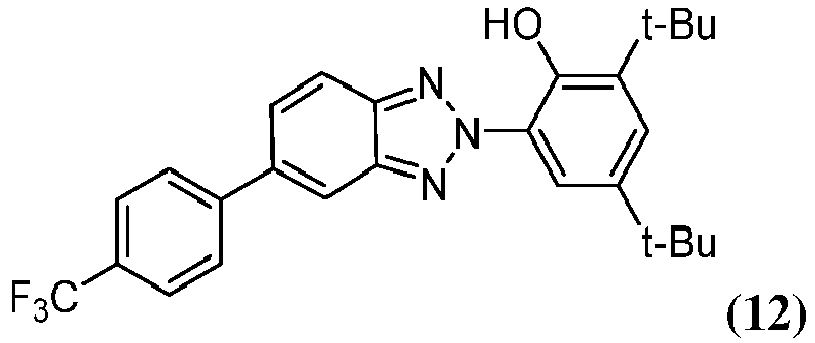
- To a mixture of 2,4-di-tert-butyl-6-(5-chloro-2H-benzotriazol-2-yl)phenol (179 mg, 0.50 mmol, 1 equiv), 4-trifluoromethylphenylboronic acid (114 mg, 0.60 mmol, 1.2 equiv), K3PO4·5H2O (0.36 g, 1.2 mmol, 2.4 equiv), and KOtBu (56 mg, 0.50 mmol, 1 equiv) was added a THF stock solution of 3 and PAd3 (2 mL in THF, 5 µmol of Pd/PAd3). The mixture was stirred at 70 °C for 5 h. The reaction mixture was diluted with ethyl acetate then extracted with water. The combine organic layers were evaporated and the crude product was purified by flash chromatography. After drying, 224 mg (96 %) of 12 was obtained as a white solid.
- 1H NMR (500 MHz, CDCl3) δ 11.63 (s, 1H), 8.22 (d, J = 2.4 Hz, 1H), 8.01 (t, J = 1.2 Hz, 1H), 7.91 (dd, J = 8.9, 0.9 Hz, 1H), 7.71 - 7.58 (m, 5H), 7.37 (d, J = 2.4 Hz, 1H), 1.44 (s, 9H), 1.32 (s, 9H).
- 13C{1H}{1H} NMR (126 MHz, CDCl3) δ 145.7, 143.0, 142.0, 141.3, 140.7, 138.1, 137.6, 128.8 (q, J = 32.6 Hz), 126.7, 126.7, 125.0 (q, J = 3.7 Hz), 124.4, 124.1, 123.1 (q, J = 272.2 Hz), 117.1, 115.1, 114.6, 34.7, 33.6, 30.5, 28.5.
- HRMS (ESI) m/z calculated for C27H28F3N3O (M+1) 468.2257, found 468.2257.

- To a mixture of haloperidol (94 mg, 0.25 mmol, 1 equiv), furan-3-ylboronic acid (42 mg, 0.38 mmol, 1.5 equiv), 1,3,5-trimethyoxybenzene (42 mg, 0.25 mmol, 1 equiv) as internal standard, and K3PO4·H2O (0.17 g, 0.75 mmol, 3 equiv) was added THF (400 µL) and a THF stock solution of 3 and PAd3 (100 µL, 0.25 µmol of Pd/PAd3) and the mixture was stirred at 100 °C for 12 h. The NMR yield of 13 was 80 % determined against the internal standard. The reaction mixture was diluted with ethyl acetate then extracted with water. The combine organic layers were evaporated and the crude product was purified by flash chromatography and preparative HPLC. After drying, 56 mg (55 %) of 13 was obtained as a white solid.
- 1H NMR (501 MHz, CDCl3) δ 8.09 - 8.01 (m, 2H), 7.75 (t, J = 1.2 Hz, 1H), 7.49 (d, J = 3.5 Hz, 5H), 7.21 - 7.12 (m, 2H), 6.72 (dd, J = 1.8, 0.9 Hz, 1H), 3.02 (t, J = 7.1 Hz, 2H), 2.83 (d, J = 11.2 Hz, 2H), 2.56 - 2.44 (m, 4H), 2.04 (td, J = 16.6, 14.3, 9.7 Hz, 4H), 1.79 - 1.72 (m, 2H). 13C{1H} NMR (126 MHz, CDCl3) δ 198.4, 165.6 (d, J = 254.3 Hz), 143.7, 138.5, 131.2, 130.7, 130.7, 126.0, 125.8, 125.0, 115.7, 115.5, 108.8, 71.3, 57.9, 49.4, 38.4, 36.3, 22.0.
- HRMS (ESI) m/z calculated for C25H27FNO3 (M+1) 408.1969, found 408.1960.

- To a mixture of montelukast sodium salt (152 mg, 0.25 mmol, 1 equiv), 3,4,5-trifluorophenyl boronic acid (53 mg, 0.30 mmol, 1.2 equiv), and K3PO4·5 H2O (0.18 g, 0.60 mmol, 2.4 equiv) was added THF (2 mL) then a THF stock solution of 3 and PAd3 (1 mL, 2.5 µmol of Pd/PAd3). The mixture was stirred at 100 °C for 5 h. The reaction mixture was diluted with ethyl acetate then extracted with saturated ammonium chloride then water. The combine organic layers were evaporated and the crude product was purified by flash chromatography. After drying, 152 mg (89 %) of 14 was obtained as yellow solid.
- 1H NMR (500 MHz, CDCl3) δ 8.18 (d, J = 1.8 Hz, 1H), 8.10 (d, J = 8.5 Hz, 1H), 7.82 (d, J = 8.4 Hz, 1H), 7.74 (d, J = 1.9 Hz, 1H), 7.67 (d, J = 8.6 Hz, 1H), 7.62 (dd, J = 5.0, 1.8 Hz, 1H), 7.59 (d, J = 17.1 Hz, 1H), 7.48 (d, J = 17.1 Hz, 1H), 7.40 (m, 1H), 7.37 - 7.28 (m, 5H), 7.18 - 7.13 (m, 2H), 7.10 (ddd, J = 7.6, 5.8, 3.0 Hz, 1H),5.29 (s, 1H),4.01 (t, J = 7.2 Hz, 1H), 3.17 (ddd, J = 13.5, 11.2, 5.1 Hz, 1H), 2.90 (ddd, J = 13.5, 11.2, 5.4 Hz, 1H), 2.65 (d, J = 13.1 Hz, 1H), 2.57 (d, J = 16.2 Hz, 1H), 2.45 (d, J = 13.1 Hz, 1H), 2.38 (d, J = 16.1 Hz, 1H), 2.28 - 2.09 (m, 2H), 1.60 (d, J = 4.9 Hz, 6H), 0.71 - 0.24 (m, 4H).
- 13C{1H} NMR (126 MHz, CDCl3) δ 176.3, 156.9, 151.5 (ddd, J = 249.9, 10.0, 4.2 Hz), 147.7, 145.2, 143.6, 140.2, 139.7 (dt, J = 253.3, 15.4 Hz),139.4, 136.5, 136.4, 136.3 (m), 135.4, 131.5, 129.0, 128.6, 128.5, 128.4, 127.1, 126.9, 126.5, 126.5, 126.4, 125.6, 125.4, 125.0, 119.4, 111.4 (dd, J = 12.6, 5.0 Hz), 73.8, 50.3, 40.3, 40.0, 38.9, 32.3, 31.8, 16.8, 12.7, 12.4.
- HRMS (ESI) m/z calculated for C41H38F3NO3S (M+1) 682.2597, found 682.2598.

- To a mixture of fenofibrate (90 mg, 0.25 mmol, 1 equiv), cyclopropylboronic acid (32 mg, 0.38 mmol, 1.5 equiv), and K3PO4·H2O (0.18 g, 0.75 mmol, 3 equiv) was added toluene (400 µL) then a THF stock solution of 3 and PAd3 (50 µL, 0.125 µmol of Pd/PAd3). The mixture was stirred at 100 °C for 5 h. The reaction mixture was diluted with ethyl acetate then extracted with water. The combine organic layers were evaporated and the crude product was purified by flash chromatography. After drying, 84 mg (92 %) of 15 was obtained as a white solid.
- 1H NMR (501 MHz, CDCl3) δ 7.80 - 7.72 (m, 2H), 7.72 - 7.66 (m, 2H), 7.19 - 7.12 (m, 2H), 6.91 - 6.84 (m, 2H), 5.11 (hept, J = 6.3 Hz, 1H), 1.99 (tt, J = 8.4, 5.0 Hz, 1H), 1.68 (s, 6H), 1.23 (d, J = 6.3 Hz, 6H), 1.13 - 1.05 (m, 2H), 0.85 - 0.78 (m, 2H).
- 13C{1H} NMR (126 MHz, CDCl3) δ 195.2, 173.2, 159.3, 149.2, 135.2, 131.9, 131.0, 130.1, 125.2, 117.1, 79.3, 69.3, 25.4, 21.5, 15.7, 10.3.
- HRMS (ESI) m/z calculated for C23H26O4 (M+1) 367.1904, found 367.1888.

- To a mixture of glibenclamide (247 mg, 0.50 mmol, 1 equiv), N-Boc-pyrroleboronic acid (127 mg, 0.60 mmol, 1.2 equiv), 1,3,5-trimethyoxybenzene (84 mg, 0.50 mmol, 1 equiv) as internal standard, and K3PO4· 5H2O (0.36 g, 1.2 mmol, 2.4 equiv) was added a THF stock solution of 3 and PAd3 (2 mL in THF, 5 µmol of Pd/PAd3). The mixture was stirred at 100 °C for 5 h. The crude NMR yield was 65 % versus the internal standard. The reaction mixture was diluted with ethyl acetate then extracted with water. The combine organic layers were evaporated and the crude product was purified by flash chromatography and preparative HPLC. After drying, 116 mg (37 %) of 16 was obtained as a white solid.
- 1H NMR (501 MHz, CDCl3) δ 8.13 (d, J = 2.4 Hz, 1H), 7.83 (t, J = 5.8 Hz, 1H), 7.78 (d, J = 8.3 Hz, 2H), 7.43 - 7.31 (m, 3H), 7.26 (dd, J = 3.3, 1.8 Hz, 1H), 6.86 (d, J = 8.5 Hz, 1H), 6.37 (d, J = 7.9 Hz, 1H), 6.14 (t, J = 3.3 Hz, 1H), 6.11 (dd, J = 3.3, 1.8 Hz, 1H), 3.75 (s, 3H), 3.69 (q, J = 6.6 Hz, 2H), 3.56 - 3.47 (m, 1H), 2.96 (t, J = 6.9 Hz, 2H), 1.80-1.72 (m, 2H), 1.64-1.46 (m, 4H), 1.34 (s, 9H), 1.30 - 1.03 (m, 4H).
- 13C{1H} NMR (126 MHz, CDCl3) δ 165.2, 156.6, 150.1, 149.2, 146.3, 137.7, 133.8, 133.6, 133.0, 129.9, 127.7, 127.2, 122.6, 120.3, 114.7, 110.6, 110.6, 83.7, 56.0, 49.2, 40.5, 35.7, 33.0, 27.8, 25.4, 24.6.
- HRMS (ESI) m/z calculated for C32H40N4O7S (M+1) 625.2691, found 625.2700.

- To a mixture of 5-R-rivaroxaban (55 mg, 0.13 mmol, 1 equiv), 3,5-bis(trifluoromethyl) phenylboronic acid (35 mg, 0.14 mmol, 1.1 equiv), 1,3,5-trimethyoxybenzene (21 mg, 0.13 mmol, 1 equiv) as internal standard, and K3PO4·5H2O (82 mg, 0.28 mmol, 2.2 equiv) was added a THF stock solution of 3 and PAd3 (2.5 mL, 6.25 µmol of Pd/PAd3). The mixture was stirred at 100 °C for 5 h. The crude NMR yield was 83 % versus the internal standard. The reaction mixture was diluted with ethyl acetate then extracted with water. The combine organic layers were evaporated and the crude product was purified by flash chromatography and preparative HPLC. After drying, 43 mg (56 %) of 17 was obtained as a white solid.
- 1H NMR (501 MHz, CDCl3) δ 7.94 (s, 2H), 7.76 (s, 1H), 7.55 - 7.45 (m, 3H), 7.33 (d, J = 3.9 Hz, 1H), 7.30 - 7.23 (m, 2H), 6.90 (s, 1H), 4.82 (dd, J = 6.0, 3.0 Hz, 1H), 4.26 (s, 2H), 4.04 (t, J = 8.9 Hz, 1H), 3.99 - 3.93 (m, 2H), 3.88 - 3.77 (m, 2H), 3.76 - 3.63 (m, 3H).
- 13C{1H} NMR (126 MHz, CDCl3) δ 166.9, 162.1, 154.4, 145.6, 139.0, 137.4, 136.6, 135.5, 132.3 (q, J = 34.0 Hz), 127.6 (q, J = 476.3 Hz), 126.3, 126.0, 124.1, 121.9, 119.2, 71.9, 68.6, 64.1, 49.7, 47.7, 42.4.
- HRMS (ESI) m/z calculated for C27H21F6N3O5S (M+1) 614.1179, found 614.1196.

- To a mixture of 4-chloroanisole (62 µL, 0.50 mmol, 1 equiv), phenylboronic acid (67 mg, 0.55 mmol, 1.1 equiv), and K3PO4·H2O (0.35 g, 1.5 mmol, 3 equiv) was added toluene (800 µL) then a THF stock solution of 3 and PAd3 (100 µL, 0.25 µmol of Pd/PAd3). The mixture was stirred at room temperature for 5 h. The reaction mixture was diluted with ethyl acetate then extracted with water. The combine organic layers were evaporated and the crude product was purified by flash chromatography. After drying, 75 mg (81 %) of 18 was obtained as a white solid. NMR spectroscopic data agreed with literature values.

- To a mixture of 4-chloroanisole (62 µL, 0.50 mmol, 1 equiv), 3,5-bis(trifluoromethyl) phenylboronic acid (142 mg, 0.55 mmol, 1.1 equiv), and K3PO4·5H2O (0.33 g, 1.1 mmol, 2.2 equiv) was added THF (400 µL) then a THF stock solution of 3 and PAd3 (100 µL, 0.25 µmol of Pd/PAd3). The mixture was stirred at room temperature for 5 h. The reaction mixture was diluted with ethyl acetate then extracted with water. The combine organic layers were evaporated and the crude product was purified by flash chromatography. After drying, 146 mg (91 %) of 19 was obtained as a colorless oil. NMR spectroscopic data agreed with literature values.

- To a mixture of 2-chloro-1,3-dimethylbenzene (66 µL, 0.50 mmol, 1 equiv), 1-napthylboronic acid (129 mg, 0.75 mmol, 1.5 equiv), and K3PO4·5H2O (0.45 g, 1.5 mmol, 3 equiv) was added THF (400 µL) then a THF stock solution of 3 and PAd3 (100 µL, 0.25 µmol of Pd/PAd3). The mixture was stirred at 100 °C for 5 h. The reaction mixture was diluted with ethyl acetate then extracted with water. The combine organic layers were evaporated and the crude product was purified by flash chromatography. After drying, 93 mg (80 %) of 20 was obtained as a white solid. NMR spectroscopic data agreed with literature values.

- To a mixture of 2-chlorotoluene (59 µL, 0.50 mmol, 1 equiv), 2,6-dimethoxyphenylboronic acid (136 mg, 0.75 mmol, 1.5 equiv), and K3PO4·H2O (0.35 g, 1.5 mmol, 3 equiv) was added toluene (400 µL) then a catalyst stock solution of 3 and PAd3 (100 µL, 0.25 µmol of Pd/PAd3). The mixture was stirred at 50 °C for 5 h. The reaction mixture was diluted with ethyl acetate then extracted with water. The combine organic layers were evaporated and the crude product was purified by flash chromatography. After drying, 79 mg (70 %) of 21 was obtained as a white solid. NMR spectroscopic data agreed with literature values.

- To a mixture of 2-chlorotoluene (59 µL, 0.50 mmol, 1 equiv), 2,6-dimethylphenylboronic acid (112 mg, 0.75 mmol, 1.5 equiv), and K3PO4·5H2O (0.45 g, 1.5 mmol, 3 equiv) was added THF (400 µL) then a THF stock solution of 3 and PAd3 (100 µL, 0.25 µmol of Pd/PAd3). The mixture was stirred at 100 °C for 9 h. The reaction mixture was diluted with ethyl acetate then extracted with water. The combine organic layers were evaporated and the crude product was purified by flash chromatography. After drying, 69 mg (70 %) of 22 was obtained as a colorless oil. NMR spectroscopic data agreed with literature values.

- To a mixture of1-bromo-2,4-dimethoxybenzene (72 µL, 0.50 mmol, 1 equiv), cyclopropylboronic acid (64 mg, 0.75 mmol, 1.5 equiv), and K3PO4·H2O (0.35 mg, 1.5 mmol, 3 equiv) was added toluene (400 µL) then a THF stock solution of 3 and PAd3 (100 µL, 0.25 µmol of Pd/PAd3) and the mixture was stirred at 100 °C for 5 h. The reaction mixture was diluted with ethyl acetate then extracted with water. The combine organic layers were evaporated and the crude product was purified by flash chromatography. After drying, 80 mg (90 %) of 23 was obtained as a colorless oil. NMR spectroscopic data agreed with literature values.

- To a mixture of 3-chloropyridine (48 µL, 0.50 mmol, 1 equiv), 1-napthylboronic acid (95 mg, 0.55 mmol, 1.1 equiv), and K3PO4·H2O (0.35 g, 1.5 mmol, 3 equiv) was added toluene (400 µL) then a THF stock solution of 3 and PAd3 (100 µL, 0.25 µmol). The mixture was stirred at 90 °C for 5 h. The reaction mixture was diluted with ethyl acetate then extracted with water. The combine organic layers were evaporated and the crude product was purified by flash chromatography. After drying, 70 mg (68 %) of 24 was obtained as a white solid. NMR spectroscopic data agreed with literature values.

- To a mixture of 3-chloropyridine (48 µL, 0.50 mmol, 1 equiv), 4-tolylboronic acid (75 mg, 0.55 mmol, 1.1 equiv), and K3PO4·H2O (0.35 g, 1.5 mmol, 3 equiv) was added toluene (400 µL) then a THF stock solution of 3 and PAd3 (100 µL, 0.25 µmol of Pd/PAd3). The mixture was stirred at 90 °C for 5 h. The reaction mixture was diluted with ethyl acetate then extracted with water. The combine organic layers were evaporated and the crude product was purified by flash chromatography. After drying, 53 mg (63 %) of 25 was obtained as a white solid. NMR spectroscopic data agreed with literature values.

- To a mixture of 3-chloropyridine (48 µL, 0.50 mmol, 1 equiv), 3,5-bis(trifluoromethyl) phenylboronic acid (142 mg, 0.55 mmol, 1.1 equiv), and K3PO4·H2O (0.35 mg, 1.5 mmol, 3 equiv) was added toluene (400 µL) then a THF stock solution of 3 and PAd3 (100 µL, 0.25 µmol of Pd/PAd3). The mixture was stirred at 90 °C for 5 h. The reaction mixture was diluted with ethyl acetate then extracted with water. The combine organic layers were evaporated and the crude product was purified by flash chromatography. After drying, 143 mg (98 %) of 26 was obtained as a white solid. NMR spectroscopic data agreed with literature values.

- To a mixture of 3-chloropyridine (48 µL, 0.50 mmol, 1 equiv), (4-isobutoxyphenyl)boronic acid (107 mg, 0.55 mmol, 1.1 equiv), and K3PO4·5H2O (0.33 g, 1.1 mmol, 2.2 equiv) was added THF (400 µL) then a THF stock solution of 3 and PAd3 (100 µL, 0.25 µmol of Pd/PAd3). The mixture was stirred at 100 °C for 12 h. The reaction mixture was diluted with ethyl acetate then extracted with water. The combine organic layers were evaporated and the crude product was purified by flash chromatography. After drying, 96 mg (84 %) of 27 was obtained as a colorless oil.
- 1H NMR (501 MHz, CDCl3) δ 8.85 - 8.80 (m, 1H), 8.57 - 8.51 (m, 1H), 7.80 (dt, J = 8.2, 1.9 Hz, 1H), 7.53 - 7.46 (m, 2H), 7.31 (dd, J = 7.9, 5 Hz, 1H), 7.04 - 6.97 (m, 2H), 3.76 (d, J = 6.6 Hz, 2H), 2.11 (dq, J = 13.3, 6.7 Hz, 1H), 1.05 (d, J = 6.9 Hz, 6H).
- 13C{1H} NMR (126 MHz, CDCl3) δ 159.5, 148.0, 147.8, 136.3, 133.8, 129.9, 128.1, 123.5, 115.1, 74.5, 28.3, 19.3.
- HRMS (ESI) m/z calculated for C15H17NO (M+1) 228.1383, found 228.1377.

- To a mixture of 2,6-dichloropyrazine (37 mg, 0.25 mmol, 1 equiv), 3,5-bis(trifluoromethyl)phenylboronic acid (142 mg, 0.55 mmol, 2.2 equiv), and K3PO4·5H2O (0.33 g, 1.1 mmol, 4.4 equiv) was added THF (400 µL) then a THF stock solution of 3 and PAd3 (100 µL, 0.25 µmol of Pd/PAd3). The mixture was stirred at 70 °C for 5 h. The reaction mixture was diluted with ethyl acetate then extracted with water. The combine organic layers were evaporated and the crude product was purified by flash chromatography. After drying, 110 mg (87 %) of 28 was obtained as a white solid.
- 1H NMR (501 MHz, CDCl3) δ 9.20 (s, 2H), 8.62 - 8.58 (m, 4H), 8.07 (s, 2H).
- 13C{1H} NMR (126 MHz, CDCl3) δ 149.2, 141.5, 137.9, 132.8 (q, J = 33.7 Hz), 127.1, 123.9, 123.1 (q, J = 273.4 Hz).
- HRMS (ESI) m/z calculated for C20H8F12N2 (M+1) 505.0569, found 505.0563.

- To a mixture of 2-chlorotoluene (59 µL, 0.50 mmol, 1 equiv), N-Boc-2-pyrroleboronic acid (158 mg, 0.75 mmol, 1.5 equiv), and K3PO4·5H2O (0.45 g, 1.5 mmol, 3equiv) was added THF (400 µL) then a THF stock solution of 3 and PAd3 (100 µL, 0.25 µmol of Pd/PAd3). The mixture was stirred at room temperature for 5 h. The reaction mixture was diluted with ethyl acetate then extracted with water. The combine organic layers were evaporated and the crude product was purified by flash chromatography. After drying, 124 mg (96 %) of 29 was obtained as a colorless oil. NMR spectroscopic data agreed with literature values.

- To a mixture of 2-chloro-3-methylquinoxaline (89 mg, 0.50 mmol, 1 equiv), N-Boc-2-pyrroleboronic acid (158 mg, 0.75 mmol, 1.5 equiv), and K3PO4·5H2O (0.45 g, 1.5 mmol, 3 equiv) was added THF (400 µL) then a THF stock solution of 3 and PAd3 (100 µL, 0.25 µmol of Pd/PAd3). The mixture was stirred at 70 °C for 5 h. The reaction mixture was diluted with ethyl acetate then extracted with water. The combine organic layers were evaporated and the crude product was purified by flash chromatography. After drying, 148 mg (96 %) of 30 was obtained as a white solid.
- 1H NMR (501 MHz, CDCl3) δ 8.09 - 7.98 (m, 2H), 7.74 - 7.63 (m, 2H), 7.43 (dd, J = 3.4, 1.7 Hz, 1H), 6.44 (dd, J = 3.3, 1.7 Hz, 1H), 6.33 (t, J = 3.4 Hz, 1H), 2.56 (s, 3H), 1.17 (s, 9H).
- 13C{1H} NMR (126 MHz, CDCl3) δ 154.5, 149.6, 148.6, 141.2, 140.3, 130.7, 129.8, 129.1, 129.0, 128.3, 122.5, 115.6, 111.4, 84.2, 27.4, 23.0.
- HRMS (ESI) m/z calculated for C18H19N3O2 (M+1) 310.1550, found 310.1552.

- To a mixture of 2-chloropyrazine (44 µL, 0.50 mmol, 1 equiv), 3,4,5-trifluorophenyl-boronic acid (132 mg, 0.75 mmol, 1.5 equiv), and K3PO4·5H2O (0.45 g, 1.5 mmol, 3 equiv) was added THF (400 µL) then a THF stock solution of 3 and PAd3 (100 µL, 0.25 µmol of Pd/PAds). The mixture was stirred at 70 °C for 5 h. The reaction mixture was diluted with ethyl acetate then extracted with water. The combine organic layers were evaporated and the crude product was purified by flash chromatography. After drying, 77 mg (73 %) of 31 was obtained as a white solid.
- 1H NMR (501 MHz, CDCl3) δ 8.98 (d, J = 1.6 Hz, 1H), 8.66 - 8.62 (m, 1H), 8.57 (d, J = 2.5 Hz, 1H), 7.75 - 7.65 (m, 2H).
- 13C{1H} NMR (126 MHz, CDCl3) δ 151.7 (ddd, J = 250.7, 10.2, 4.0 Hz), 149.4 (dt, J = 1.3, 2.5 Hz), 144.3 , 144.0 , 141.6, 140.9 (dt, J = 255.8, 15.4 Hz), 132.3 (dt, J = 5.0, 7.6 Hz ), 111.0 (dd, J = 17.1, 5.5 Hz).
- HRMS (ESI) m/z calculated for C10H5F3N2 (M+1) 211.0478, found 211.0471.

- To a mixture of 2-chloropyrazine (44 µL, 0.50 mmol, 1 equiv), (6-methoxypyridin-3-yl)boronic acid (115 mg, 0.75 mmol, 1.5equiv), and K3PO4·5H2O (0.45 g, 1.5 mmol, 3.0 equiv) was added THF (400 µL) then a THF stock solution of 3 and PAd3 (100 µL, 0.25 µmol of Pd/PAd3). The mixture was stirred at 70 °C for 5 h. The reaction mixture was diluted with ethyl acetate then extracted with water. The combine organic layers were evaporated and the crude product was purified by flash chromatography. After drying, 77 mg (82 %) of 32 was obtained as a white solid.
- 1H NMR (501 MHz, CDCl3) δ 8.89 (d, J = 1.6 Hz, 1H), 8.72 (d, J = 2.6 Hz, 1H), 8.54 - 8.49 (m, 1H), 8.41 (d, J = 2.6 Hz, 1H), 8.15 (dd, J = 8.7, 2.5 Hz, 1H), 6.79 (d, J = 8.7 Hz, 1H), 3.92 (s, 3H). 13C{1H} NMR (126 MHz, CDCl3) δ 165.2, 150.6, 145.7, 144.2, 142.8, 141.3, 137.1, 125.6, 111.4, 53.8.
- HRMS (ESI) m/z calculated for C10H9N3O (M+1) 118.0818, found 118.0814.

- To a mixture of 2-chloro-4,6-dimethoxypyrimidine (87 mg, 0.50 mmol, 1 equiv), N-Boc-2-pyrroleboronic acid (116 mg, 0.55 mmol, 1.1 equiv), and K3PO4·5H2O (0.33 g, 1.1 mmol, 2.2 equiv) was added n-butanol (400 µL) then a THF stock solution of 3 and PAd3 (100 µL, 0.25 µmol of Pd/PAd3). The mixture was stirred at room temperature for 5 h. The reaction mixture was diluted with ethyl acetate then extracted with water. The combine organic layers were evaporated and the crude product was purified by flash chromatography. After drying, 147 mg (96%) of 33 was obtained as a colorless oil.
- 1H NMR (501 MHz, CDCl3) δ 7.33 (dd, J = 3.1, 1.7 Hz, 1H), 6.77 (dd, J = 3.4, 1.7 Hz, 1H), 6.26 (t, J = 3.3 Hz, 1H), 5.95 (s, 1H), 3.97 (s, 6H), 1.48 (s, 9H).
- 13C{1H} NMR (126 MHz, CDCl3) δ 171.0, 159.4, 149.0, 133.0, 124.8, 117.9, 110.5, 87.6, 83.6, 54.0, 27.7.
- HRMS (ESI) m/z calculated for C15H19N3O4 (M+1) 306.1448, found 306.1431.

- To a mixture of 2-chlorobenzonitrile (69 mg, 0.50 mmol, 1 equiv), (3,5-dimethylisoxazol-4-yl)boronic acid (106 mg, 0.75 mmol, 1.5 equiv), and K3PO4·5H2O (0.45 g, 1.5 mmol, 3 equiv) was added THF (400 µL) then a THF stock solution of 3 and PAd3 (100 µL, 0.25 µmol of Pd/PAd3). The mixture was stirred at 100 °C for 9 h. The reaction mixture was diluted with ethyl acetate then extracted with water. The combine organic layers were evaporated and the crude product was purified by flash chromatography. After drying, 78 mg (79%) of 34 was obtained as a colorless oil. NMR spectroscopic data agreed with literature values.

- To a mixture of 2-chloropyridine (47 µL, 0.50 mmol, 1 equiv), furan-3-ylboronic acid (84 mg, 0.75 mmol, 1.5 equiv), and K3PO4·H2O (0.35 g, 1.5 mmol, 3 equiv) was added THF (400 µL) then a THF stock solution of 3 and PAd3 (100 µL, 0.25 µmol of Pd/PAd3). The mixture was stirred at 100 °C for 12 h. The reaction mixture was diluted with ethyl acetate then extracted with water. The combine organic layers were evaporated and the crude product was purified by flash chromatography. After drying, 80 mg (92%) of 35 was obtained as a colorless oil. NMR spectroscopic data agreed with literature values.

- To a mixture of 2-chloropyridine (47 µL, 0.50 mmol, 1 equiv), quinolin-3-ylboronic acid (130 mg, 0.75 mmol, 1.5 equiv), and K3PO4·H2O (0.35 g, 1.5 mmol, 3 equiv) was added n-butanol (400 µL) then a THF stock solution of 3 and PAd3 (100 µL, 0.25 µmol of Pd/PAd3). The mixture was stirred at 100 °C for 5 h. The reaction mixture was diluted with ethyl acetate then extracted with water. The combine organic layers were evaporated and the crude product was purified by flash chromatography. After drying, 83 mg (80%) of 36 was obtained as a white solid. NMR spectroscopic data agreed with literature values.

- To a mixture of 2-chloropyridine (47 µL, 0.50 mmol, 1 equiv), 2,4-difluorophenylboronic acid (118 mg, 0.75 mmol, 1.5 equiv), and K3PO4·5H2O (0.45 mg, 1.5 mmol, 3 equiv) was added THF (400 µL) then a THF stock solution of 3 and PAd3 (100 µL, 0.25 µmol of Pd/PAd3). The mixture was stirred at 70 °C for 4 h. The reaction mixture was diluted with ethyl acetate then extracted with water. The combine organic layers were evaporated and the crude product was purified by flash chromatography. After drying, 89 mg (93%) of 37 was obtained as a colorless oil. NMR spectroscopic data agreed with literature values.
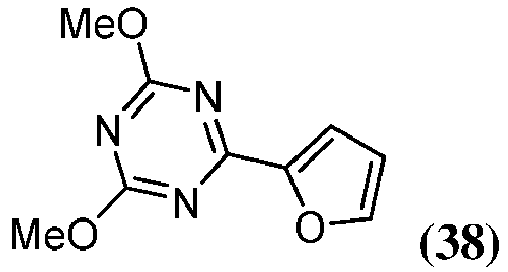
- To a mixture of 2-chloro-4,6-dimethoxy-1,3,5-triazine (88 mg, 0.50 mmol, 1 equiv), furan-2-ylboronic acid (84 mg, 0.75 mmol, 1.5 equiv), and K3PO4·5H2O (0.45 mg, 1.5 mmol, 3 equiv) was added THF (400 µL) then a THF stock solution of 3 and PAd3 (100 µL, 0.25 µmol of Pd/PAd3). The mixture was stirred at room temperature for 1.5 h. The reaction mixture was diluted with ethyl acetate then extracted with water. The combine organic layers were evaporated and the crude product was purified by flash chromatography. After drying, 93 mg (90%) of 38 was obtained as a white solid.
- 1H NMR (501 MHz, CDCl3) δ 7.64 - 7.59 (m, 1H), 7.44 (d, J = 3.5 Hz, 1H), 6.53 (dd, J = 3.4, 1.7 Hz, 1H), 4.03 (s, 6H).
- 13C{1H} NMR (126 MHz, CDCl3) δ 172.6, 166.5, 150.1, 146.6, 117.4, 112.5, 55.2.
- HRMS (ESI) m/z calculated for C9H9N3O3 (M+1) 208.0717, found 208.0706.
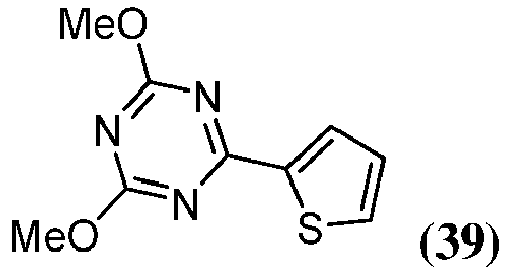
- To a mixture of 2-chloro-4,6-dimethoxy-1,3,5-triazine (88 mg, 0.50 mmol, 1 equiv), thiophen-2-ylboronic acid (96 mg, 0.75 mmol, 1.5 equiv), and K3PO4·5H2O (0.45 mg, 1.5 mmol, 3 equiv) was added THF (400 µL) then a THF stock solution of 3 and PAd3 (100 µL, 0.25 µmol of Pd/PAd3). The mixture was stirred at room temperature for 5 h. The reaction mixture was diluted with ethyl acetate then extracted with water. The combine organic layers were evaporated and the crude product was purified by flash chromatography. After drying, 104 mg (93%) of 39 was obtained as a white solid. NMR spectroscopic data agreed with literature values.

- To a mixture of 4,7-dibromobenzo[c][1,2,5]thiadiazole (147 mg, 0.50 mmol, 1 equiv), thiophen-2-ylboronic acid (192 mg, 1.50 mmol, 3 equiv), and K3PO4·5H2O (0.90 g, 3.0 mmol, 6 equiv) was added THF (900 µL) then a THF stock solution of 3 and PAd3 (100 µL, 0.25 µmol of Pd/PAd3). The mixture was stirred at room temperature for 1 h. The reaction mixture was diluted with ethyl acetate then extracted with water. The combine organic layers were evaporated and the crude product was purified by flash chromatography. After drying, 143 mg (95%) of 40 was obtained as an orange solid. NMR spectroscopic data agreed with literature values.

- To a mixture of 2-chloro-1,3-dimethylbenzene (66 µL, 0.50 mmol, 1 equiv), methylboronic acid (45 mg, 0.75 mmol, 1.5 equiv), 1,3,5-trimethyoxybenzene (84 mg, 0.50 mmol, 1 equiv) as internal standard, and K3PO4·5H2O (0.45 g, 1.5 mmol, 3 equiv) was added THF (400 µL) then a THF stock solution of 3 and PAd3 (100 µL, 0.25 µmol of Pd/PAd3). The mixture was stirred at 50 °C for 5 h. The crude NMR yield was 90 % versus the internal standard. The reaction mixture was diluted with ethyl acetate then extracted with water. The combine organic layers were evaporated and the crude product was purified by flash chromatography. After drying, 30 mg (50 %) of 41 was obtained as a colorless oil.

- To a mixture of fenofibrate (90 mg, 0.25 mmol, 1 equiv), methylboronic acid (30 mg, 0.50 mmol, 2 equiv), 1,3,5-trimethyoxybenzene (42 mg, 0.25 mmol, 1 equiv) as internal standard, and K3PO4·H2O (0.18 g, 0.75 mmol, 3 equiv) was added toluene (400 µL) then a THF stock solution of 3 and PAd3 (50 µL, 0.125 µmol of Pd/PAd3). The mixture was stirred at 100 °C for 5 h. The crude NMR yield was 88 % versus internal standard. The reaction mixture was diluted with ethyl acetate then extracted with water. The combine organic layers were evaporated and the crude product was purified by flash chromatography and preparative HPLC. After drying, 65 mg (76%) of 42 was obtained as a white solid.
- 1H NMR (501 MHz, CDCl3) δ 7.80 - 7.73 (m, 2H), 7.71 - 7.65 (m, 2H), 7.28 (d, J = 7.9 Hz, 2H), 6.92 - 6.84 (m, 2H), 5.10 (hept, J = 6.3 Hz, 1H), 2.44 (s, 3H), 1.67 (s, 6H), 1.22 (d, J = 6.3 Hz, 6H).
- 13C{1H} NMR (126 MHz, CDCl3) δ 195.3, 173.2, 159.3, 142.7, 135.4, 131.9, 130.9, 130.0, 128.9, 117.1, 79.3, 69.3, 25.4, 21.6, 21.5.
- HRMS (ESI) m/z calculated for C21H24O4 (M+1) 341.1747, found 341.1749.

- To a mixture of 4,7-bis(5-bromothiophen-2-yl)benzo[c][1,2,5]thiadiazole (115 mg, 0.25 mmol, 1 equiv),29 (9,9-dimethyl-9H-fluoren-2-yl)boronic acid (131 mg, 0.55mmol, 2.2 equiv), and K3PO4·5H2O (0.33 g, 1.1 mmol, 4.4 equiv) was added THF (900 µL) then a THF stock solution of 3 and PAd3 (100 µL, 0.25 µmol of Pd/PAd3). The mixture was stirred at room temperature for 1 h. The reaction mixture was diluted with ethyl acetate then extracted with water. The combine organic layers were evaporated and the crude product was purified by flash chromatography. After drying, 152 mg (89%) of 43 was obtained as a dark red solid.
- 1H NMR (501 MHz, CDCl3) δ 8.19 (d, J = 3.9 Hz, 2H), 7.97 (s, 2H), 7.82 - 7.72 (m, 8H), 7.54 - 7.46 (m, 4H), 7.38 (pd, J = 7.4, 1.5 Hz, 4H), 1.59 (s, 12H).
- 13C{1H} NMR (126 MHz, CDCl3) δ 154.4, 153.9, 152.7, 146.3, 139.2, 138.7, 138.4, 133.2, 128.6, 127.5, 127.1, 125.8, 125.3, 125.0, 124.0, 122.7, 120.5, 120.1, 120.1, 47.0, 27.2.
- HRMS (ESI) m/z calculated for C44H33N2S3 (M+1) 685.1800, found 685.1782.

- To a mixture of 4-chloroanisole (62 µL, 0.50 mmol, 1 equiv), isopropylboronic acid (66 mg, 0.75 mmol, 1.5 equiv), and K3PO4·H2O (0.35 mg, 1.5 mmol, 3 equiv) was added a toluene stock solution of 3 and PAd3 (2 mL, 5 µmol of Pd/PAd3). The mixture was stirred at 100 °C for 5 h. The reaction mixture was diluted with ethyl acetate then extracted with water. The combine organic layers were evaporated and the crude product was purified by flash chromatography. After drying, 53 mg (70%) of 44 was obtained as a colorless oil. NMR spectroscopic data agreed with literature values.
- Various embodiments of the invention have been described in fulfillment of the various objectives of the invention. It should be recognized that these embodiments are merely illustrative of the principles of the present invention. Numerous modifications and adaptations thereof will be readily apparent to those skilled in the art without departing from the scope of the invention.
- The following features were claimed in the parent PCT application and are presented here as basis for amendment or division as may apply.
-
-
Feature 1. A method of synthesizing a tri-(adamantyl)phosphine compound, PAd3, comprising:
providing a reaction mixture including di-(adamantyl)phosphine (PAd2) and a substituted adamantyl moiety and reacting the PAd2 and substituted adamantyl moiety via anS N1 pathway to provide the PAd3. -
Feature 2. The method ofFeature 1, wherein adamantyl moieties (Ad) of the PAd3 are independently selected from the group consisting of adamantane, diamantane, triamantane and derivatives thereof. -
Feature 3. The method ofFeature 1, wherein the substituted adamantyl moiety comprises a leaving group. - Feature 4. The method of
Feature 3, wherein the leaving group is selected from the group consisting of acetate, triflate, tosylate and hydroxyl. -
Feature 5. The method ofFeature 1, wherein yield of the PAd3 is greater than 50 percent. - Feature 6. The method of
Feature 1, wherein yield of the PAd3 is greater than 60 percent. - Feature 7. A method of cross-coupling comprising:
- providing a reaction mixture including a substrate, a coupling partner and a transition metal complex comprising PAd3 ligand; and
- reacting the substrate and coupling partner in the presence of the transition metal complex or derivative thereof to provide cross-coupled reaction product.
- Feature 8. The method of Feature 7, wherein the transition metal complex comprises one or more metals selected from Group VIIIA, IB or IIB of the Periodic Table.
- Feature 9. The method of Feature 7, wherein the transition metal complex comprises palladium.
- Feature 10. The method of Feature 7, wherein the substrate is a substituted aromatic compound.
- Feature 11. The method of Feature 10, wherein the substituted aromatic compound is an aryl or heteroaryl compound.
-
Feature 12. The method of Feature 10, wherein the substituted aromatic compound comprises a leaving group. - Feature 13. The method of
Feature 12, wherein the leaving group is selected from the group consisting of halo, tosylate (OTs), mesylate (OMs) and nosylate (ONs). - Feature 14. The method of Feature 7, wherein the substrate is a substituted unsaturated aliphatic compound.
- Feature 15. The method of Feature 14, wherein the substituted unsaturated aliphatic compound comprises a vinyl moiety.
-
Feature 16. The method of Feature 14, wherein the substituted unsaturated aliphatic compound comprises an allyl moiety. - Feature 17. The method of Feature 7, wherein the coupling partner comprises an organometallic compound.
- Feature 18. The method of Feature 17, wherein the organometallic compound is selected from the group consisting of organoboron compounds, organolithium compounds, organozinc compounds, organosilicon compounds and Grignard reagents.
- Feature 19. The method of Feature 18, wherein organic moieties of the organometallic compound comprise aromatic moieties.
- Feature 20. The method of Feature 18, wherein organic moieties of the organometallic compound comprise unsaturated aliphatic moieties.
- Feature 21. The method of Feature 18, wherein organic moieties of the organometallic compound comprise saturated aliphatic moieties.
- Feature 22. The method of Feature 7, wherein the transition metal complex is of the formula (PAd3)mM(L)n wherein M is the transition metal, L is ligand and m and n are each integers from 1 to 3.
- Feature 23. The method of Feature 7, wherein the transition metal complex is present in the reaction mixture in an amount less than 0.5 mol.%
- Feature 24. The method of Feature 7, wherein the transition metal complex is present in the reaction mixture in an amount less than 0.1 mol.%
-
Feature 25. The method of Feature 24, wherein yield of cross-coupled reaction product is greater than 60 percent. - Feature 26. The method of Feature 24, wherein yield of cross-coupled reaction product is greater than 80 percent.
Claims (15)
- A transition metal complex of the formula:
(PAd3)mM(L)n
whereinL comprises alkyl, aryl, halo, CO, cyano, hydroxyl, acetate, substituted benzoate, trifluoroacetate, tosylate, mesylate, triflate, η3-allyl, η3-crotyl, η3-cinnamyl or η3-indenylm is an integer ranging from 1 to 3,n is an integer ranging from 2 to 3,the chemical identity of L ligands is different, andM is a transition metal selected from Group 8-12 of the Periodic Table. - A transition metal complex as claimed in claim 1, wherein M is a noble metal.
- A transition metal complex as claimed in claim 2, wherein M is selected from the group consisting of palladium, rhodium, silver and gold.
- A transition metal complex as claimed in claim 3, wherein M is palladium.
- A transition metal complex as claimed in claim 1, wherein the transition metal complex comprises {2-[(acetyl-κO)amino)phenyl-κC](tri-1-adamantylphosphine)palladium}+.
- A transition metal complex as claimed in claim 1, wherein the transition metal complex has the formula:
 R is methyl, Ar, heteroaryl, η3-allyl, η3-crotyl, η3-cinnamyl or η3-indenyl, Ar being Ph, substituted phenyl,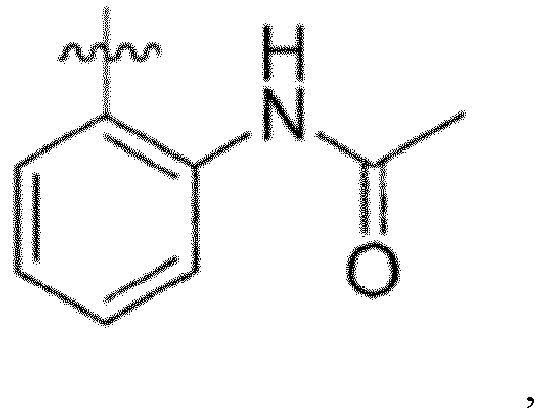

 X is F, Cl, Br, I, OAc, substituted benzoate, trifluoroacetate, tosylate, mesylate, or triflate.
 - A method of cross-coupling comprising:providing a reaction mixture including a substrate, a coupling partner, PAds ligand, and a transition metal complex precursor;forming the transition metal complex in situ, and reacting the substrate and coupling partner in the presence of the transition metal complex to provide cross-coupled reaction product, wherein the transition metal complex comprises one or more metals selected from metals of Groups 8-12 of the Periodic Table.
- A method as claimed in claim 7, wherein the transition metal complex comprises palladium.
- A method as claimed in claim 7, wherein the substrate is a substituted aromatic compound, optionally wherein the substituted aromatic compound comprises a leaving group, optionally wherein the leaving group is selected from the group consisting of halo, tosylate (OTs), mesylate (OMs), and nosylate (ONs).
- A method as claimed in claim 7, wherein the substrate is a substituted unsaturated aliphatic compound.
- A method as claimed in claim 10, wherein the substituted unsaturated aliphatic compound comprises an allyl or vinyl moiety.
- A method as claimed in claim 7, wherein the coupling partner comprises an organometallic compound, optionally wherein the organometallic compound is selected from the group consisting of organoboron compounds, organolithium compounds, organozinc compounds, and organosilicon compounds.
- A method as claimed in claim 12, wherein organic moieties of the organometallic compound comprise aromatic moieties.
- A method as claimed in claim 12, wherein organic moieties of the organometallic compound comprise unsaturated aliphatic moieties.
- A method as claimed in claim 7, wherein the transition metal complex is as claimed in any of claims 1 to 6.
Applications Claiming Priority (3)
| Application Number | Priority Date | Filing Date | Title |
|---|---|---|---|
| US201562248056P | 2015-10-29 | 2015-10-29 | |
| EP16861036.8A EP3377221B1 (en) | 2015-10-29 | 2016-10-31 | A method of cross-coupling using a transition metal complex comprising a pad3 ligand |
| PCT/US2016/059698 WO2017075581A1 (en) | 2015-10-29 | 2016-10-31 | Tri-(adamantyl)phosphines and applications thereof |
Related Parent Applications (1)
| Application Number | Title | Priority Date | Filing Date |
|---|---|---|---|
| EP16861036.8A Division EP3377221B1 (en) | 2015-10-29 | 2016-10-31 | A method of cross-coupling using a transition metal complex comprising a pad3 ligand |
Publications (2)
| Publication Number | Publication Date |
|---|---|
| EP4286051A2 true EP4286051A2 (en) | 2023-12-06 |
| EP4286051A3 EP4286051A3 (en) | 2025-01-22 |
Family
ID=58630859
Family Applications (2)
| Application Number | Title | Priority Date | Filing Date |
|---|---|---|---|
| EP16861036.8A Active EP3377221B1 (en) | 2015-10-29 | 2016-10-31 | A method of cross-coupling using a transition metal complex comprising a pad3 ligand |
| EP23187377.9A Pending EP4286051A3 (en) | 2015-10-29 | 2016-10-31 | A method of cross-coupling using a transition metal complex comprising a pad3 ligand |
Family Applications Before (1)
| Application Number | Title | Priority Date | Filing Date |
|---|---|---|---|
| EP16861036.8A Active EP3377221B1 (en) | 2015-10-29 | 2016-10-31 | A method of cross-coupling using a transition metal complex comprising a pad3 ligand |
Country Status (6)
| Country | Link |
|---|---|
| US (5) | US10981157B2 (en) |
| EP (2) | EP3377221B1 (en) |
| JP (1) | JP6991584B2 (en) |
| KR (1) | KR102726018B1 (en) |
| CN (1) | CN108883405B (en) |
| WO (1) | WO2017075581A1 (en) |
Families Citing this family (7)
| Publication number | Priority date | Publication date | Assignee | Title |
|---|---|---|---|---|
| JP7070582B2 (en) * | 2017-10-02 | 2022-05-18 | Jnc株式会社 | Compounds, liquid crystal compositions and liquid crystal display devices |
| CN110124732A (en) * | 2019-04-13 | 2019-08-16 | 复旦大学 | Polymer catalyst and preparation method thereof for metal catalyzed coupling reaction |
| US20240199671A1 (en) * | 2021-03-25 | 2024-06-20 | Sigma-Aldrich Co. Llc | Novel ferrocene-based unsymmetrical ligands bearing bulky di(adamantly)phosphino motif and their metal catalysts |
| CN116675622B (en) * | 2023-05-26 | 2025-07-29 | 南京工业大学 | Method for catalytic synthesis of 4-methyl-2-cyanobiphenyl |
| CN117049961A (en) * | 2023-08-16 | 2023-11-14 | 苏州君叶生物医药科技有限公司 | Yeast dehydrogenase inhibitor derivative and synthesis method thereof |
| JP2025090342A (en) * | 2023-12-05 | 2025-06-17 | 日本化学工業株式会社 | Phosphine palladium complex, polymerization catalyst, and method for producing aromatic polymer |
| JP2025167005A (en) * | 2024-04-25 | 2025-11-07 | 日本化学工業株式会社 | Method for producing monoorganophosphines having tertiary alkyl groups |
Family Cites Families (18)
| Publication number | Priority date | Publication date | Assignee | Title |
|---|---|---|---|---|
| DE10037961A1 (en) | 2000-07-27 | 2002-02-07 | Aventis Res & Tech Gmbh & Co | New phosphine ligands, their production and their use in catalytic reactions |
| WO2003066643A1 (en) * | 2002-02-04 | 2003-08-14 | Hokko Chemical Industry Co., Ltd. | Process for producing tertiary phosphine having bulky hydrocarbon group bonded |
| JP4271454B2 (en) | 2002-02-04 | 2009-06-03 | 北興化学工業株式会社 | Method for producing tertiary phosphine bonded with bulky hydrocarbon group |
| JP4271455B2 (en) | 2002-02-19 | 2009-06-03 | 北興化学工業株式会社 | Method for producing tertiary phosphine bonded with bulky hydrocarbon group |
| US7449601B2 (en) * | 2004-12-16 | 2008-11-11 | E. I. Du Pont De Nemours And Company | Catalysts useful for catalyzing the coupling of arylhalides with arylboronic acids |
| US7205414B2 (en) | 2005-01-12 | 2007-04-17 | Honeywell International Inc. | Process for the Kumada coupling reaction |
| CN101195641A (en) | 2007-09-30 | 2008-06-11 | 埃沃尼克德古萨有限责任公司 | Novel phosphine ligand, production and uses in catalytic reaction thereof |
| JP2009280529A (en) * | 2008-05-23 | 2009-12-03 | Osaka Univ | Production method of ester compound |
| JP5562069B2 (en) | 2009-03-05 | 2014-07-30 | 国立大学法人大阪大学 | Synthesis method of organic fluorine compounds |
| US8785665B2 (en) * | 2009-12-01 | 2014-07-22 | Mycell Technologies, Llc | Surfactant-enabled transition metal-catalyzed chemistry |
| EP2506970A4 (en) | 2009-12-01 | 2014-03-12 | Mycell Technologies Llc | TRANSITION METAL CATALYSIS CHEMISTRY WITH SURFACE ACTIVATION |
| BR112012022112A2 (en) | 2010-03-01 | 2016-10-25 | Evonik Degussa Gmbh | process for preparing dronedarone oligomeric polyhedral silsesquioxane-linked binders (poss) |
| EP2681185B8 (en) | 2011-03-02 | 2018-08-29 | Bayer CropScience AG | Process for preparing aryl- and heteroarylacetic acid derivatives |
| WO2013159229A1 (en) | 2012-04-24 | 2013-10-31 | Dalhousie University | Silanyloxyaryl phosphine ligand and uses thereof in c-n cross-coupling |
| KR101434020B1 (en) * | 2012-07-04 | 2014-08-25 | 삼성전기주식회사 | Spindle motor |
| WO2014147188A1 (en) | 2013-03-21 | 2014-09-25 | Evonik Industries Ag | Temperature-responsive catalysts |
| US9718818B2 (en) | 2013-08-22 | 2017-08-01 | Merck Sharp & Dohme Corp. | Compounds inhibiting leucine-rich repeat kinase enzyme activity |
| CN107250141A (en) | 2014-12-10 | 2017-10-13 | 加利福尼亚大学董事会 | Phosphorus part and application method |
-
2016
- 2016-10-31 JP JP2018543002A patent/JP6991584B2/en active Active
- 2016-10-31 EP EP16861036.8A patent/EP3377221B1/en active Active
- 2016-10-31 WO PCT/US2016/059698 patent/WO2017075581A1/en not_active Ceased
- 2016-10-31 US US15/770,709 patent/US10981157B2/en active Active
- 2016-10-31 KR KR1020187015161A patent/KR102726018B1/en active Active
- 2016-10-31 EP EP23187377.9A patent/EP4286051A3/en active Pending
- 2016-10-31 CN CN201680076918.1A patent/CN108883405B/en active Active
-
2021
- 2021-02-04 US US17/167,606 patent/US11583844B2/en active Active
-
2023
- 2023-01-23 US US18/100,196 patent/US11794180B2/en active Active
- 2023-09-13 US US18/367,813 patent/US12539508B2/en active Active
-
2025
- 2025-12-16 US US19/421,980 patent/US20260102762A1/en active Pending
Also Published As
| Publication number | Publication date |
|---|---|
| US12539508B2 (en) | 2026-02-03 |
| US20180304248A1 (en) | 2018-10-25 |
| CN108883405B (en) | 2021-07-13 |
| KR102726018B1 (en) | 2024-11-06 |
| US11794180B2 (en) | 2023-10-24 |
| US20210162389A1 (en) | 2021-06-03 |
| EP3377221B1 (en) | 2023-07-26 |
| US20240001353A1 (en) | 2024-01-04 |
| EP4286051A3 (en) | 2025-01-22 |
| CN108883405A (en) | 2018-11-23 |
| US20260102762A1 (en) | 2026-04-16 |
| US20230158480A1 (en) | 2023-05-25 |
| JP2019501212A (en) | 2019-01-17 |
| EP3377221A4 (en) | 2019-07-17 |
| KR20180101330A (en) | 2018-09-12 |
| JP6991584B2 (en) | 2022-02-03 |
| EP3377221A1 (en) | 2018-09-26 |
| US11583844B2 (en) | 2023-02-21 |
| WO2017075581A1 (en) | 2017-05-04 |
| US10981157B2 (en) | 2021-04-20 |
Similar Documents
| Publication | Publication Date | Title |
|---|---|---|
| US12539508B2 (en) | Tri-(adamantyl) phosphines and applications thereof | |
| JP2019528296A (en) | Cross coupling method | |
| WO2011014503A1 (en) | Oxidative homo-coupling reactions of aryl boronic acids using a porous copper metal-organic framework as a highly efficient heterogeneous catalyst | |
| CN110872311B (en) | Multi-copper cluster and preparation method thereof | |
| CN112028819A (en) | Organic ligand compound of tetraphenyl ethylene terpyridine, coordination supermolecule, preparation and application thereof | |
| CN104341457B (en) | A kind of 1,2,3 triazole functionalization N-heterocyclic carbine double-core nickel compounds and preparation method thereof | |
| Fierro-Arias et al. | Pd catalyzed Heck reaction with the catalytic system [Pd (Ph2PC6H4-2-(CH2NMe2))(SRF) 2]: Examination of the electronic effects of fluorinated thiolates | |
| EP3101004A1 (en) | Bipyridyl compound | |
| JP6336579B2 (en) | Pyridine or pyrazine containing compounds | |
| JP5270549B2 (en) | Method for producing HI-6 dimethanesulfonate | |
| JP7081698B2 (en) | Method for manufacturing a coupling compound | |
| JP2017132738A (en) | Method for producing bipyridyl compound | |
| WO2015039606A1 (en) | Novel phosphines, synthesis thereof and their use in catalysis | |
| WO2016149608A1 (en) | Methods for the chemical synthesis of pyrrole-linked bivalent compounds, and compositions thereof | |
| KR20200018346A (en) | New catalyst compound and method for synthesizing acrlylate using the same | |
| CN111471005A (en) | A kind of indole-dihydronaphthalene compound and its preparation method and application | |
| JP6286755B2 (en) | Novel diamine compound and metal complex, and method for producing optically active compound | |
| JP5635443B2 (en) | Novel compound and its complex | |
| CN110950836A (en) | A kind of preparation method of benzodithiolane skeleton compound | |
| CN117343044A (en) | A kind of synthesis method of 2-methyl-1-(pyridin-2-yl) indole compound | |
| KR20240022471A (en) | process | |
| CN114773253A (en) | Preparation method of polysubstituted arylamine compound | |
| JP5866709B2 (en) | Bisimidazolidine pincer complex, bisimidazolidine pincer complex, and methods for producing them | |
| BR122025003245A2 (en) | PROCESS FOR PREPARING INTERMEDIATE COMPOUND OF 1-[(3R,4S)-4-CYANOTETRAHYDROPYRAN-3-YL]-3-[(2-FLUORO-6-METHOXY-4-PYRIDYL)AMINO]PYRAZOLE-4-CARBOXAMIDE | |
| BR122025003253A2 (en) | PROCESS FOR PREPARING INTERMEDIATE COMPOUND OF 1-[(3R,4S)-4-CYANOTETRAHYDROPYRAN-3-YL]-3-[(2-FLUORO-6-METHOXY-4-PYRIDYL)AMINO]PYRAZOLE-4-CARBOXAMIDE |
Legal Events
| Date | Code | Title | Description |
|---|---|---|---|
| PUAI | Public reference made under article 153(3) epc to a published international application that has entered the european phase |
Free format text: ORIGINAL CODE: 0009012 |
|
| STAA | Information on the status of an ep patent application or granted ep patent |
Free format text: STATUS: THE APPLICATION HAS BEEN PUBLISHED |
|
| AC | Divisional application: reference to earlier application |
Ref document number: 3377221 Country of ref document: EP Kind code of ref document: P |
|
| AK | Designated contracting states |
Kind code of ref document: A2 Designated state(s): AL AT BE BG CH CY CZ DE DK EE ES FI FR GB GR HR HU IE IS IT LI LT LU LV MC MK MT NL NO PL PT RO RS SE SI SK SM TR |
|
| REG | Reference to a national code |
Ref country code: DE Ref legal event code: R079 Free format text: PREVIOUS MAIN CLASS: B01J0031240000 Ipc: C07F0015000000 |
|
| PUAL | Search report despatched |
Free format text: ORIGINAL CODE: 0009013 |
|
| AK | Designated contracting states |
Kind code of ref document: A3 Designated state(s): AL AT BE BG CH CY CZ DE DK EE ES FI FR GB GR HR HU IE IS IT LI LT LU LV MC MK MT NL NO PL PT RO RS SE SI SK SM TR |
|
| RIC1 | Information provided on ipc code assigned before grant |
Ipc: C07B 37/04 20060101ALI20241213BHEP Ipc: C07F 9/50 20060101ALI20241213BHEP Ipc: C07F 9/28 20060101ALI20241213BHEP Ipc: C07F 9/00 20060101ALI20241213BHEP Ipc: B01J 31/22 20060101ALI20241213BHEP Ipc: B01J 31/24 20060101ALI20241213BHEP Ipc: C07F 15/00 20060101AFI20241213BHEP |
|
| STAA | Information on the status of an ep patent application or granted ep patent |
Free format text: STATUS: REQUEST FOR EXAMINATION WAS MADE |
|
| 17P | Request for examination filed |
Effective date: 20250716 |