EP4285296B1 - Systeme und verfahren für föderiertes lernen unter verwendung von peer-to-peer-netzwerken - Google Patents
Systeme und verfahren für föderiertes lernen unter verwendung von peer-to-peer-netzwerken Download PDFInfo
- Publication number
- EP4285296B1 EP4285296B1 EP22705707.2A EP22705707A EP4285296B1 EP 4285296 B1 EP4285296 B1 EP 4285296B1 EP 22705707 A EP22705707 A EP 22705707A EP 4285296 B1 EP4285296 B1 EP 4285296B1
- Authority
- EP
- European Patent Office
- Prior art keywords
- node
- participant
- collaborator
- machine learning
- peer
- Prior art date
- Legal status (The legal status is an assumption and is not a legal conclusion. Google has not performed a legal analysis and makes no representation as to the accuracy of the status listed.)
- Active
Links
Images


Classifications
-
- H—ELECTRICITY
- H04—ELECTRIC COMMUNICATION TECHNIQUE
- H04L—TRANSMISSION OF DIGITAL INFORMATION, e.g. TELEGRAPHIC COMMUNICATION
- H04L63/00—Network architectures or network communication protocols for network security
- H04L63/04—Network architectures or network communication protocols for network security for providing a confidential data exchange among entities communicating through data packet networks
- H04L63/0428—Network architectures or network communication protocols for network security for providing a confidential data exchange among entities communicating through data packet networks wherein the data content is protected, e.g. by encrypting or encapsulating the payload
- H04L63/0442—Network architectures or network communication protocols for network security for providing a confidential data exchange among entities communicating through data packet networks wherein the data content is protected, e.g. by encrypting or encapsulating the payload wherein the sending and receiving network entities apply asymmetric encryption, i.e. different keys for encryption and decryption
-
- G—PHYSICS
- G06—COMPUTING OR CALCULATING; COUNTING
- G06N—COMPUTING ARRANGEMENTS BASED ON SPECIFIC COMPUTATIONAL MODELS
- G06N20/00—Machine learning
-
- H—ELECTRICITY
- H04—ELECTRIC COMMUNICATION TECHNIQUE
- H04L—TRANSMISSION OF DIGITAL INFORMATION, e.g. TELEGRAPHIC COMMUNICATION
- H04L63/00—Network architectures or network communication protocols for network security
- H04L63/04—Network architectures or network communication protocols for network security for providing a confidential data exchange among entities communicating through data packet networks
- H04L63/0407—Network architectures or network communication protocols for network security for providing a confidential data exchange among entities communicating through data packet networks wherein the identity of one or more communicating identities is hidden
- H04L63/0421—Anonymous communication, i.e. the party's identifiers are hidden from the other party or parties, e.g. using an anonymizer
-
- H—ELECTRICITY
- H04—ELECTRIC COMMUNICATION TECHNIQUE
- H04L—TRANSMISSION OF DIGITAL INFORMATION, e.g. TELEGRAPHIC COMMUNICATION
- H04L63/00—Network architectures or network communication protocols for network security
- H04L63/06—Network architectures or network communication protocols for network security for supporting key management in a packet data network
- H04L63/068—Network architectures or network communication protocols for network security for supporting key management in a packet data network using time-dependent keys, e.g. periodically changing keys
Definitions
- Embodiments generally relate to systems and methods for federated learning using peer-to-peer networks.
- Federated learning generally involves an "aggregator node” and set of "participant nodes" in a federated network.
- Current available implementations have a centralized design of an aggregator node and various participant nodes, and they form a star topology for communication.
- the participant nodes send their local model gradients to the aggregator node, and the aggregator node composes all the received models together into a singular global model. This singular global model is then sent back to all participant nodes. In this setup, the participants benefit from common learning, without knowing about all the underlying data.
- a method for federated learning using peer-to-peer networks may include: (1) electing, by a plurality of participant nodes in a peer-to-peer network, one of the participant nodes as a collaborator node using a consensus algorithm; (2) generating, by the collaborator node, a collaborator node public key and a collaborator node private key; (3) broadcasting, by the collaborator node and to the plurality of participant nodes, the collaborator node public key; (4) generating, by each participant node, a participant node public key and a participant node private key, wherein each participant node generates a new participant node public key and a new participant node private key for each communication with the collaborator node; (5) encrypting, by each participant node, a message comprising a parameter for a local machine learning model for the participant node and the participant node public key with the collaborator node public key; (6) broadcasting, by each participant node no
- the consensus algorithm may be the Raft consensus algorithm.
- the parameter may include information related to model exchange, local machine learning model weights, and/or the local machine learning model.
- the parameter may include clear data and/or synthetic data.
- the collaborator node may perform model aggregation using the decrypted parameters.
- the collaborator node may train the aggregated machine learning model using the decrypted parameters.
- the participant node is the collaborator node for a limited period.
- the collaborator node may broadcast a heartbeat to the participant nodes.
- the participant nodes may elect a new collaborator node in response to the collaborator node being inactive.
- a system may include a plurality of participant nodes, each participant node associated with a local machine learning model and a peer-to-peer network connecting the plurality of participant nodes.
- the plurality of participant nodes may elect one of the plurality of participant nodes as a collaborator node using a consensus algorithm; the collaborator node may generate a collaborator node public key and a collaborator node private key and may broadcast the collaborator node public key to the plurality of participant nodes; each participant node may generate a participant node public key and a participant node private key, wherein each participant node generates a new participant node public key and a new participant node private key for each communication with the collaborator node, may encrypt a message comprising a parameter for a local machine learning model for the participant node and the participant node public key with the collaborator node public key, and may broadcast the encrypted message on the peer-to-peer network; the collaborator node may decrypt each of the encrypted messages with the collaborator node private key, may update an aggregated
- the consensus algorithm is the Raft consensus algorithm.
- the parameter may include information related to model exchange, local machine learning model weights, and/or the local machine learning model.
- the parameter may include clear data and/or synthetic data.
- the collaborator node may perform model aggregation using the decrypted parameters.
- the collaborator node may train the aggregated machine learning model using the decrypted parameters.
- the participant node may be the collaborator node for a limited period.
- the collaborator node may broadcast a heartbeat to the participant nodes.
- the participant nodes may elect a new collaborator node in response to the collaborator node being inactive.
- Embodiments are directed to systems and methods for federated learning using peer-to-peer network for decentralized orchestration of model weights.
- Embodiments are generally directed to a resilient and highly available aggregator service through decentralization with federated learning using peer-to-peer communication among the participant nodes in a federated network. All of the participant nodes may have equivalent capabilities on the network, and all may be able to communicate with each other. At any given point of time, the network may have only one of the participant nodes acting as a "leader” (or collaborator node) while the rest of the participant nodes act as “follower nodes.” In case the leader node becomes unavailable or unresponsive (e.g., it crashes), the network conducts a new leader election to select a leader node among the remaining participant nodes. This may follow a Raft consensus algorithm to conduct election and assign leaders.
- the leader node may be responsible for acting as transient aggregator for the network.
- a new leader node may be elected after a predefined time interval is elapsed.
- System 100 may include a plurality of participant nodes 110 (e.g., 110 1 , 110 2 , 110 3 , ... 110 N ) in a peer-to-peer network, where each participant node 110 may communicate directly with each of the other participant nodes 110.
- Each participant node 110 may maintain local model 112 (e.g., 112 1 , 112 2 , 112 3 , ... 112 N ), and one of the participant nodes (e.g., participant 110 1 ,) may be elected to be a leader node (or collaborator node) may generate aggregated model 114 for the participant nodes in the federated network.
- Each node may execute a computer program, application, script, etc. (not shown) that may control operations of the respective node.
- Each participant node 110 may participate as a leader node (collaborator node), a follower node, or a candidate node.
- system 100 provides peer-to-peer communication between participant nodes 110. The communications may be facilitated by making remote procedure calls using a TCP layer of networking.
- the network is a peer-to-peer network
- all messages are broadcast to the network. Based on the message type, if encrypted, only the valid recipient can read the message. If the message is not encrypted, all recipients may read the message and take necessary actions.
- the participant nodes in peer-to-peer network may elect one of the participant nodes to be a leader node, or collaborator node, using, for example, the Raft consensus algorithm.
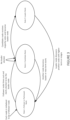
- An example state diagram for each participant node based on the Raft consensus algorithm is provided in Figure 3 .
- Each node may be initialized to be a follower or participant node (State 1). From State 1, the follower node may initiate an election to be a leader node, thereby becoming a candidate node (State 2). In State 2, the node may become a leader node (State 3), no leader may be elected and it may remain a candidate node for another election (State 2), or another node may be elected to be a leader, and the node may return to being a follower, or participant, node (State 1). In State 3, if the node identifies a node with a higher priority, or resigns, the node may return to being a follower, or participant, node (State 1).
- the nodes may use the Raft consensus algorithm to elect a leader node (State 3). State 3 is designed to be transient. If there are no failures, the elected node stays as leader node for a period T, which may be defined by, for example, a network administrator. After the period T is elapsed, the leader node resigns, becomes a follower node (State 1), thereby indirectly initiating an election.
- Raft consensus algorithm An example of the Raft consensus algorithm is provided in Ongaro, et al. "In search of an understandable consensus algorithm.” In Proceedings of the 2014 USENIX Conference on USENIX Annual Technical Conference (USENIX ATC '14), Gibson, G. and Zeldovich (Eds.): 305-329 .
- all the participant nodes may expect a heartbeat from the leader node (e.g., every 5 seconds) to ensure the leader node is functioning properly.
- heartbeat fails, which means the leader node is inactive for some arbitrary reason
- one or more of the follower nodes may promote themselves to be candidate nodes (State 2). After a fair election, one of the candidate nodes is elected as the leader node, while the other candidate nodes return to State 1.
- step 210 the collaborator node maty generate a public and private key pair, and in step 215 may share its public key with the other participant nodes in peer-to-peer network.
- the participant nodes in the peer-to-peer network may generate their public and private keys, and in step 225, each participant node may encrypt a message with the collaborator node's public key and send to the collaborator node.
- the participant nodes may generate new public/private key pairs for each communication, which prevents the collaborator node from identifying an incoming message from a specific node. This dynamic message encryption-decryption thus provides anonymity for the participant nodes in the peer-to-peer network from message flow perspective.
- the message may include parameters for a local machine learning model such as information related to model exchange, local weights, the local machine learning model itself, clear data, synthetic data, etc.
- parameters for a local machine learning model such as information related to model exchange, local weights, the local machine learning model itself, clear data, synthetic data, etc.
- the message may further include the participant node's public key.
- each participant node may encrypt the parameters and its public key with the collaborator node's public key.
- the collaborator node may receive the messages and decrypt the messages using its private key.
- the collaborator node may perform an operation on the received parameters, such as model aggregation, to create or update an aggregated machine learning model, etc.
- the collaborator node may include parameters and/or information for its local model in the operation.
- the collaborator node may encrypt a message with each participant node's public key and broadcast the messages on the peer-to-peer network.
- the message may include updates to the aggregated machine learning model.
- each participant node may decrypt the message from collaborator node, and may take any necessary actions with the contents of the message, such as updating its local machine learning model. Although the participant nodes receive all messages from the collaborator node, they can only decrypt the message encrypted with their public key.
- the processing machine may be a specialized processor.
- the processing machine may a cloud-based processing machine, a physical processing machine, or combinations thereof.
- the processing machine executes the instructions that are stored in the memory or memories to process data.
- This processing of data may be in response to commands by a user or users of the processing machine, in response to previous processing, in response to a request by another processing machine and/or any other input, for example.
- the processing machine used to implement embodiments may be a general-purpose computer.
- the processing machine described above may also utilize any of a wide variety of other technologies including a special purpose computer, a computer system including, for example, a microcomputer, mini-computer or mainframe, a programmed microprocessor, a micro-controller, a peripheral integrated circuit element, a CSIC (Customer Specific Integrated Circuit) or ASIC (Application Specific Integrated Circuit) or other integrated circuit, a logic circuit, a digital signal processor, a programmable logic device such as a FPGA, PLD, PLA or PAL, or any other device or arrangement of devices that is capable of implementing the steps of the processes disclosed herein.
- the processing machine used to implement embodiments may utilize a suitable operating system.
- each of the processors and/or the memories of the processing machine may be located in geographically distinct locations and connected so as to communicate in any suitable manner.
- each of the processor and/or the memory may be composed of different physical pieces of equipment. Accordingly, it is not necessary that the processor be one single piece of equipment in one location and that the memory be another single piece of equipment in another location. That is, it is contemplated that the processor may be two pieces of equipment in two different physical locations. The two distinct pieces of equipment may be connected in any suitable manner. Additionally, the memory may include two or more portions of memory in two or more physical locations.
- processing is performed by various components and various memories.
- processing performed by two distinct components as described above may be performed by a single component.
- processing performed by one distinct component as described above may be performed by two distinct components.
- the memory storage performed by two distinct memory portions as described above may be performed by a single memory portion. Further, the memory storage performed by one distinct memory portion as described above may be performed by two memory portions.
- a set of instructions may be used in the processing of embodiments.
- the set of instructions may be in the form of a program or software.
- the software may be in the form of system software or application software, for example.
- the software might also be in the form of a collection of separate programs, a program module within a larger program, or a portion of a program module, for example.
- the software used might also include modular programming in the form of object-oriented programming. The software tells the processing machine what to do with the data being processed.
- the instructions or set of instructions used in the implementation and operation of embodiments may be in a suitable form such that the processing machine may read the instructions.
- the instructions that form a program may be in the form of a suitable programming language, which is converted to machine language or object code to allow the processor or processors to read the instructions. That is, written lines of programming code or source code, in a particular programming language, are converted to machine language using a compiler, assembler or interpreter.
- the machine language is binary coded machine instructions that are specific to a particular type of processing machine, i.e., to a particular type of computer, for example. The computer understands the machine language.
- instructions and/or data used in the practice of embodiments may utilize any compression or encryption technique or algorithm, as may be desired.
- An encryption module might be used to encrypt data.
- files or other data may be decrypted using a suitable decryption module, for example.
- the medium may be in the form of paper, paper transparencies, a compact disk, a DVD, an integrated circuit, a hard disk, a floppy disk, an optical disk, a magnetic tape, a RAM, a ROM, a PROM, an EPROM, a wire, a cable, a fiber, a communications channel, a satellite transmission, a memory card, a SIM card, or other remote transmission, as well as any other medium or source of data that may be read by the processors.
- the memory or memories used in the processing machine that implements embodiments may be in any of a wide variety of forms to allow the memory to hold instructions, data, or other information, as is desired.
- the memory might be in the form of a database to hold data.
- the database might use any desired arrangement of files such as a flat file arrangement or a relational database arrangement, for example.
- a user interface includes any hardware, software, or combination of hardware and software used by the processing machine that allows a user to interact with the processing machine.
- a user interface may be in the form of a dialogue screen for example.
- a user interface may also include any of a mouse, touch screen, keyboard, keypad, voice reader, voice recognizer, dialogue screen, menu box, list, checkbox, toggle switch, a pushbutton or any other device that allows a user to receive information regarding the operation of the processing machine as it processes a set of instructions and/or provides the processing machine with information.
- the user interface is any device that provides communication between a user and a processing machine.
- the information provided by the user to the processing machine through the user interface may be in the form of a command, a selection of data, or some other input, for example.
- a user interface is utilized by the processing machine that performs a set of instructions such that the processing machine processes data for a user.
- the user interface is typically used by the processing machine for interacting with a user either to convey information or receive information from the user.
- the user interface might interact, i.e., convey and receive information, with another processing machine, rather than a human user. Accordingly, the other processing machine might be characterized as a user.
- a user interface utilized in the system and method may interact partially with another processing machine or processing machines, while also interacting partially with a human user.
Landscapes
- Engineering & Computer Science (AREA)
- Computer Security & Cryptography (AREA)
- Computing Systems (AREA)
- General Engineering & Computer Science (AREA)
- Computer Hardware Design (AREA)
- Computer Networks & Wireless Communication (AREA)
- Signal Processing (AREA)
- Theoretical Computer Science (AREA)
- Software Systems (AREA)
- Evolutionary Computation (AREA)
- Data Mining & Analysis (AREA)
- Medical Informatics (AREA)
- Computer Vision & Pattern Recognition (AREA)
- Physics & Mathematics (AREA)
- General Physics & Mathematics (AREA)
- Mathematical Physics (AREA)
- Artificial Intelligence (AREA)
- Computer And Data Communications (AREA)
- Two-Way Televisions, Distribution Of Moving Picture Or The Like (AREA)
- Information Transfer Between Computers (AREA)
Claims (15)
- Verfahren für föderiertes Lernen unter Verwendung von Peer-zu-Peer-Netzwerken, umfassend:Auswählen (1), durch eine Vielzahl von Teilnehmerknoten (110) in einem Peer-zu-Peer-Netzwerk, einen der Teilnehmerknoten (110) als einen Kollaboratorknoten unter Verwendung eines Konsensalgorithmus;Erzeugen (2), durch den Kollaboratorknoten, eines öffentlichen Schlüssels des Kollaboratorknotens und eines privaten Schlüssels des Kollaboratorknotens;Rundsenden (3), durch den Kollaboratorknoten und an die Vielzahl von Teilnehmerknoten (110), des öffentlichen Schlüssels des Kollaboratorknotens;Erzeugen (4), durch jeden Teilnehmerknoten (110), eines öffentlichen Schlüssels des Teilnehmerknotens und eines privaten Schlüssels des Teilnehmerknotens, wobei jeder Teilnehmerknoten (110) einen neuen öffentlichen Schlüssel des Teilnehmerknotens und einen neuen privaten Schlüssel des Teilnehmerknotens für jede Kommunikation mit dem Kollaboratorknoten erzeugt;Verschlüsseln (5), durch jeden Teilnehmerknoten, einer Nachricht, die einen Parameter für ein lokales Maschinenlernen-Modell für den Teilnehmerknoten (110) und den öffentlichen Schlüssel des Teilnehmerknotens mit dem öffentlichen Schlüssel des Kollaboratorknotens umfasst;Rundsenden (6), durch jeden Teilnehmerknoten, der verschlüsselten Nachricht in dem Peer-zu-Peer-Netzwerk;Entschlüsseln (7), durch den Kollaboratorknoten, jede der verschlüsselten Nachrichten mit dem privaten Schlüssel des Kollaboratorknotens;Aktualisieren (8), durch den Kollaboratorknoten, eines aggregierten Maschinenlernen-Modells mit den entschlüsselten Parametern für die lokalen Maschinenlernen-Modelle;Verschlüsseln (9), durch den Kollaboratorknoten, einer Vielzahl von Aktualisierungsnachrichten, wobei jede eine Aktualisierung von dem aggregierten Maschinenlernen-Modell umfasst, mit dem öffentlichen Schlüssel jedes Teilnehmerknotens;Rundsenden (10), durch den Kollaboratorknoten, der Vielzahl von Nachrichten in dem Peer-zu-Peer-Netzwerk;Entschlüsseln (11), durch jeden der Teilnehmerknoten, einer der Vielzahl von Nachrichten mit dem privaten Schlüssel des Teilnehmerknotens für den Teilnehmerknoten; undAktualisieren (12), durch jeden der Teilnehmerknoten, des lokalen Maschinenlernen-Modells für den Teilnehmerknoten (110) mit der Aktualisierung.
- Verfahren nach Anspruch 1, wobei der Konsensalgorithmus der Raft-Konsensalgorithmus ist.
- Verfahren nach Anspruch 1, wobei der Parameter Informationen bezüglich Modellaustausch, Gewichten des lokalen Maschinenlernen-Modells und/oder des lokalen Maschinenlernen-Modells umfasst.
- Verfahren nach Anspruch 1, wobei der Parameter klare Daten und/oder synthetische Daten umfasst oder wobei der Kollaboratorknoten Modellaggregation unter Verwendung der entschlüsselten Parameter durchführt.
- Verfahren nach Anspruch 1, wobei der Kollaboratorknoten das aggregierte Maschinenlernen-Modell unter Verwendung der entschlüsselten Parameter trainiert oder wobei der Teilnehmerknoten (110) für eine begrenzte Zeitdauer der Kollaboratorknoten ist.
- Verfahren nach Anspruch 1, wobei der Kollaboratorknoten einen Herzschlag an die Teilnehmerknoten (110) rundsendet.
- Verfahren nach Anspruch 1, wobei die Teilnehmerknoten als Reaktion darauf, dass der Kollaboratorknoten inaktiv ist, einen neuen Kollaboratorknoten auswählen.
- System, umfassend:eine Vielzahl von Teilnehmerknoten (110), wobei jeder Teilnehmerknoten mit einem lokalen Maschinenlernen-Modell assoziiert ist; undein Peer-zu-Peer-Netzwerk, das die Vielzahl von Teilnehmerknoten verbindet; wobei:die Vielzahl von Teilnehmerknoten (110) einen der Vielzahl von Teilnehmerknoten (110) als einen Kollaboratorknoten unter Verwendung eines Konsensalgorithmus auswählt;der Kollaboratorknoten einen öffentlichen Schlüssel des Kollaboratorknotens und einen privaten Schlüssel des Kollaboratorknotens erzeugt;der Kollaboratorknoten den öffentlichen Schlüssel des Kollaboratorknotens an die Vielzahl von Teilnehmerknoten (110) rundsendet;jeder Teilnehmerknoten einen öffentlichen Schlüssel des Teilnehmerknotens und einen privaten Schlüssel des Teilnehmerknotens erzeugt, wobei jeder Teilnehmerknoten einen neuen öffentlichen Schlüssel des Teilnehmerknotens und einen neuen privaten Schlüssel des Teilnehmerknotens für jede Kommunikation mit dem Kollaboratorknoten erzeugt;jeder Teilnehmerknoten (110) eine Nachricht verschlüsselt, die einen Parameter für ein lokales Maschinenlernen-Modell für den Teilnehmerknoten und den öffentlichen Schlüssel des Teilnehmerknotens mit dem öffentlichen Schlüssel des Kollaboratorknotens umfasst;jeder Teilnehmerknoten (110) die verschlüsselte Nachricht in dem Peer-zu-Peer-Netzwerk rundsendet;der Kollaboratorknoten jede der verschlüsselten Nachrichten mit dem privaten Schlüssel des Kollaboratorknotens entschlüsselt;der Kollaboratorknoten ein aggregiertes Maschinenlernen-Modell mit den entschlüsselten Parametern für die lokalen Maschinenlernen-Modelle aktualisiert;der Kollaboratorknoten eine Vielzahl von Aktualisierungsnachrichten, wobei jede eine Aktualisierung von dem aggregierten Maschinenlernen-Modell umfasst, mit dem öffentlichen Schlüssel jedes Teilnehmerknotens verschlüsselt;der Kollaboratorknoten die Vielzahl von Nachrichten in dem Peer-zu-Peer-Netzwerk rundsendet;jeder der Teilnehmerknoten (110) eine der Vielzahl von Nachrichten mit seinem privaten Schlüssel des Teilnehmerknotens für die Teilnehmerknoten entschlüsselt; undjeder der Teilnehmerknoten (110) sein lokales Maschinenlernen-Modell mit der Aktualisierung aktualisiert.
- System nach Anspruch 8, wobei der Konsensalgorithmus der Raft-Konsensalgorithmus ist.
- System nach Anspruch 8, wobei der Parameter Informationen bezüglich Modellaustausch, Gewichten des lokalen Maschinenlernen-Modells und/oder des lokalen Maschinenlernen-Modells umfasst.
- System nach Anspruch 8, wobei der Parameter klare Daten und/oder synthetische Daten umfasst.
- System nach Anspruch 8, wobei der Kollaboratorknoten Modellaggregation unter Verwendung der entschlüsselten Parameter durchführt.
- System nach Anspruch 8, wobei der Kollaboratorknoten das aggregierte Maschinenlernen-Modell unter Verwendung der entschlüsselten Parameter trainiert.
- System nach Anspruch 8, wobei der Teilnehmerknoten (100) für eine begrenzte Zeitdauer der Kollaboratorknoten ist oder wobei der Kollaboratorknoten einen Herzschlag an die Teilnehmerknoten (110) rundsendet.
- System nach Anspruch 8, wobei die Teilnehmerknoten als Reaktion darauf, dass der Kollaboratorknoten inaktiv ist, einen neuen Kollaboratorknoten auswählen.
Applications Claiming Priority (3)
| Application Number | Priority Date | Filing Date | Title |
|---|---|---|---|
| IN202111004346 | 2021-02-01 | ||
| US17/649,471 US20220245528A1 (en) | 2021-02-01 | 2022-01-31 | Systems and methods for federated learning using peer-to-peer networks |
| PCT/US2022/070455 WO2022165535A1 (en) | 2021-02-01 | 2022-02-01 | Systems and methods for federated learning using peer-to-peer networks |
Publications (2)
| Publication Number | Publication Date |
|---|---|
| EP4285296A1 EP4285296A1 (de) | 2023-12-06 |
| EP4285296B1 true EP4285296B1 (de) | 2025-03-26 |
Family
ID=80446177
Family Applications (1)
| Application Number | Title | Priority Date | Filing Date |
|---|---|---|---|
| EP22705707.2A Active EP4285296B1 (de) | 2021-02-01 | 2022-02-01 | Systeme und verfahren für föderiertes lernen unter verwendung von peer-to-peer-netzwerken |
Country Status (4)
| Country | Link |
|---|---|
| EP (1) | EP4285296B1 (de) |
| JP (1) | JP2024505553A (de) |
| CA (1) | CA3206729A1 (de) |
| WO (1) | WO2022165535A1 (de) |
Families Citing this family (3)
| Publication number | Priority date | Publication date | Assignee | Title |
|---|---|---|---|---|
| JP7842709B2 (ja) * | 2023-02-07 | 2026-04-08 | 株式会社日立製作所 | 連合学習システム及び連合学習方法 |
| CN116527102B (zh) * | 2023-03-23 | 2023-12-08 | 北京和德宇航技术有限公司 | 卫星测运控系统、方法及电子设备 |
| CN117675411B (zh) * | 2024-01-31 | 2024-04-26 | 智慧眼科技股份有限公司 | 一种基于纵向XGBoost算法的全局模型获取方法及系统 |
Family Cites Families (7)
| Publication number | Priority date | Publication date | Assignee | Title |
|---|---|---|---|---|
| US9990587B2 (en) * | 2015-01-22 | 2018-06-05 | Preferred Networks, Inc. | Machine learning heterogeneous edge device, method, and system |
| CN105610854B (zh) * | 2016-01-18 | 2019-08-06 | 上海交通大学 | 一种网络协同防御系统 |
| CN109716346A (zh) * | 2016-07-18 | 2019-05-03 | 河谷生物组学有限责任公司 | 分布式机器学习系统、装置和方法 |
| EP3564873B1 (de) * | 2018-04-30 | 2022-11-30 | Hewlett Packard Enterprise Development LP | System und verfahren zum dezentralisierten maschinellen lernen mithilfe von blockchain |
| US10970402B2 (en) * | 2018-10-19 | 2021-04-06 | International Business Machines Corporation | Distributed learning preserving model security |
| US20200272945A1 (en) * | 2019-02-21 | 2020-08-27 | Hewlett Packard Enterprise Development Lp | System and method of decentralized model building for machine learning and data privacy preserving using blockchain |
| CN111600707B (zh) * | 2020-05-15 | 2023-04-14 | 华南师范大学 | 一种在隐私保护下的去中心化联邦机器学习方法 |
-
2022
- 2022-02-01 WO PCT/US2022/070455 patent/WO2022165535A1/en not_active Ceased
- 2022-02-01 EP EP22705707.2A patent/EP4285296B1/de active Active
- 2022-02-01 JP JP2023546417A patent/JP2024505553A/ja active Pending
- 2022-02-01 CA CA3206729A patent/CA3206729A1/en active Pending
Also Published As
| Publication number | Publication date |
|---|---|
| EP4285296A1 (de) | 2023-12-06 |
| JP2024505553A (ja) | 2024-02-06 |
| WO2022165535A1 (en) | 2022-08-04 |
| CA3206729A1 (en) | 2022-08-04 |
Similar Documents
| Publication | Publication Date | Title |
|---|---|---|
| US20220245528A1 (en) | Systems and methods for federated learning using peer-to-peer networks | |
| EP4285296B1 (de) | Systeme und verfahren für föderiertes lernen unter verwendung von peer-to-peer-netzwerken | |
| Bouachir et al. | Blockchain and fog computing for cyberphysical systems: The case of smart industry | |
| US10666639B2 (en) | Customer-centric workflow for initial on-boarding of an OpenFlow enabled switch | |
| GB2606628A (en) | Centralized knowledge repository and data mining system | |
| CN112187491B (zh) | 服务器的管理方法、装置和设备 | |
| US12333400B2 (en) | Systems and methods for federated learning using distributed messaging with entitlements for anonymous computation and secure delivery of model | |
| CN113923251B (zh) | 分布式网关系统 | |
| CN107360249A (zh) | 一种适用于调变一体化系统的广域分布式服务调用方法 | |
| CN111083187A (zh) | 工业应用服务处理方法和系统 | |
| CN116980115A (zh) | 消息处理方法、装置、产品、设备和介质 | |
| Bautista et al. | Mpc-as-a-service: a customizable management protocol for running multi-party computation on iot devices | |
| HK40103806B (en) | Systems and methods for federated learning using peer-to-peer networks | |
| HK40103806A (en) | Systems and methods for federated learning using peer-to-peer networks | |
| JP6471977B2 (ja) | サービスファンクション制御システム、サービスファンクション制御方法、サービスコントロールノード、及びプログラム | |
| US10050839B2 (en) | Method for setting up a star-shaped communication network consisting of a central node and peripheral nodes via a web application provided by the central node on the basis of hardware identifiers | |
| CN116917911A (zh) | 使用对等网络进行联合学习的系统和方法 | |
| Khole et al. | A compendium on distributed systems | |
| US20220231837A1 (en) | Intelligent and secure packet captures for cloud solutions | |
| Chandrasekaran et al. | CASE: A context-aware storage placement and retrieval ecosystem | |
| US20230012065A1 (en) | Systems and methods for contextual messaging and information routing in a distributed ledger network | |
| Gouigoux et al. | Asynchronous Interoperability Description and Authentication: Addressing Challenges in a Webhook-Based Event-Driven Architecture | |
| WO2023086684A1 (en) | System and method for decentralized notification services | |
| Jin et al. | Development and Deployment of Jami: Experiences with a Mobile Distributed Communication Platform | |
| Dixit et al. | Invenire: A Real-Time Distributed Chatting Application to Help Solve Lost & Found Issues |
Legal Events
| Date | Code | Title | Description |
|---|---|---|---|
| STAA | Information on the status of an ep patent application or granted ep patent |
Free format text: STATUS: UNKNOWN |
|
| STAA | Information on the status of an ep patent application or granted ep patent |
Free format text: STATUS: THE INTERNATIONAL PUBLICATION HAS BEEN MADE |
|
| PUAI | Public reference made under article 153(3) epc to a published international application that has entered the european phase |
Free format text: ORIGINAL CODE: 0009012 |
|
| STAA | Information on the status of an ep patent application or granted ep patent |
Free format text: STATUS: REQUEST FOR EXAMINATION WAS MADE |
|
| 17P | Request for examination filed |
Effective date: 20230830 |
|
| AK | Designated contracting states |
Kind code of ref document: A1 Designated state(s): AL AT BE BG CH CY CZ DE DK EE ES FI FR GB GR HR HU IE IS IT LI LT LU LV MC MK MT NL NO PL PT RO RS SE SI SK SM TR |
|
| DAV | Request for validation of the european patent (deleted) | ||
| DAX | Request for extension of the european patent (deleted) | ||
| REG | Reference to a national code |
Ref country code: HK Ref legal event code: DE Ref document number: 40103806 Country of ref document: HK |
|
| REG | Reference to a national code |
Ref country code: DE Ref legal event code: R079 Ref country code: DE Ref legal event code: R079 Ref document number: 602022012242 Country of ref document: DE Free format text: PREVIOUS MAIN CLASS: G06N0020200000 Ipc: H04L0009400000 |
|
| GRAP | Despatch of communication of intention to grant a patent |
Free format text: ORIGINAL CODE: EPIDOSNIGR1 |
|
| STAA | Information on the status of an ep patent application or granted ep patent |
Free format text: STATUS: GRANT OF PATENT IS INTENDED |
|
| RIC1 | Information provided on ipc code assigned before grant |
Ipc: G06N 20/00 20190101ALI20240828BHEP Ipc: H04L 9/40 20220101AFI20240828BHEP |
|
| INTG | Intention to grant announced |
Effective date: 20240912 |
|
| GRAS | Grant fee paid |
Free format text: ORIGINAL CODE: EPIDOSNIGR3 |
|
| GRAA | (expected) grant |
Free format text: ORIGINAL CODE: 0009210 |
|
| STAA | Information on the status of an ep patent application or granted ep patent |
Free format text: STATUS: THE PATENT HAS BEEN GRANTED |
|
| AK | Designated contracting states |
Kind code of ref document: B1 Designated state(s): AL AT BE BG CH CY CZ DE DK EE ES FI FR GB GR HR HU IE IS IT LI LT LU LV MC MK MT NL NO PL PT RO RS SE SI SK SM TR |
|
| REG | Reference to a national code |
Ref country code: GB Ref legal event code: FG4D |
|
| REG | Reference to a national code |
Ref country code: CH Ref legal event code: EP |
|
| REG | Reference to a national code |
Ref country code: DE Ref legal event code: R096 Ref document number: 602022012242 Country of ref document: DE |
|
| REG | Reference to a national code |
Ref country code: IE Ref legal event code: FG4D |
|
| PG25 | Lapsed in a contracting state [announced via postgrant information from national office to epo] |
Ref country code: RS Free format text: LAPSE BECAUSE OF FAILURE TO SUBMIT A TRANSLATION OF THE DESCRIPTION OR TO PAY THE FEE WITHIN THE PRESCRIBED TIME-LIMIT Effective date: 20250626 |
|
| PG25 | Lapsed in a contracting state [announced via postgrant information from national office to epo] |
Ref country code: FI Free format text: LAPSE BECAUSE OF FAILURE TO SUBMIT A TRANSLATION OF THE DESCRIPTION OR TO PAY THE FEE WITHIN THE PRESCRIBED TIME-LIMIT Effective date: 20250326 |
|
| REG | Reference to a national code |
Ref country code: LT Ref legal event code: MG9D |
|
| PG25 | Lapsed in a contracting state [announced via postgrant information from national office to epo] |
Ref country code: NO Free format text: LAPSE BECAUSE OF FAILURE TO SUBMIT A TRANSLATION OF THE DESCRIPTION OR TO PAY THE FEE WITHIN THE PRESCRIBED TIME-LIMIT Effective date: 20250626 |
|
| PG25 | Lapsed in a contracting state [announced via postgrant information from national office to epo] |
Ref country code: HR Free format text: LAPSE BECAUSE OF FAILURE TO SUBMIT A TRANSLATION OF THE DESCRIPTION OR TO PAY THE FEE WITHIN THE PRESCRIBED TIME-LIMIT Effective date: 20250326 |
|
| PG25 | Lapsed in a contracting state [announced via postgrant information from national office to epo] |
Ref country code: LV Free format text: LAPSE BECAUSE OF FAILURE TO SUBMIT A TRANSLATION OF THE DESCRIPTION OR TO PAY THE FEE WITHIN THE PRESCRIBED TIME-LIMIT Effective date: 20250326 |
|
| PG25 | Lapsed in a contracting state [announced via postgrant information from national office to epo] |
Ref country code: BG Free format text: LAPSE BECAUSE OF FAILURE TO SUBMIT A TRANSLATION OF THE DESCRIPTION OR TO PAY THE FEE WITHIN THE PRESCRIBED TIME-LIMIT Effective date: 20250326 Ref country code: GR Free format text: LAPSE BECAUSE OF FAILURE TO SUBMIT A TRANSLATION OF THE DESCRIPTION OR TO PAY THE FEE WITHIN THE PRESCRIBED TIME-LIMIT Effective date: 20250627 |
|
| REG | Reference to a national code |
Ref country code: NL Ref legal event code: MP Effective date: 20250326 |
|
| PG25 | Lapsed in a contracting state [announced via postgrant information from national office to epo] |
Ref country code: NL Free format text: LAPSE BECAUSE OF FAILURE TO SUBMIT A TRANSLATION OF THE DESCRIPTION OR TO PAY THE FEE WITHIN THE PRESCRIBED TIME-LIMIT Effective date: 20250326 |
|
| PG25 | Lapsed in a contracting state [announced via postgrant information from national office to epo] |
Ref country code: SE Free format text: LAPSE BECAUSE OF FAILURE TO SUBMIT A TRANSLATION OF THE DESCRIPTION OR TO PAY THE FEE WITHIN THE PRESCRIBED TIME-LIMIT Effective date: 20250326 |
|
| REG | Reference to a national code |
Ref country code: AT Ref legal event code: MK05 Ref document number: 1780060 Country of ref document: AT Kind code of ref document: T Effective date: 20250326 |
|
| PG25 | Lapsed in a contracting state [announced via postgrant information from national office to epo] |
Ref country code: SM Free format text: LAPSE BECAUSE OF FAILURE TO SUBMIT A TRANSLATION OF THE DESCRIPTION OR TO PAY THE FEE WITHIN THE PRESCRIBED TIME-LIMIT Effective date: 20250326 |
|
| PG25 | Lapsed in a contracting state [announced via postgrant information from national office to epo] |
Ref country code: ES Free format text: LAPSE BECAUSE OF FAILURE TO SUBMIT A TRANSLATION OF THE DESCRIPTION OR TO PAY THE FEE WITHIN THE PRESCRIBED TIME-LIMIT Effective date: 20250326 Ref country code: PT Free format text: LAPSE BECAUSE OF FAILURE TO SUBMIT A TRANSLATION OF THE DESCRIPTION OR TO PAY THE FEE WITHIN THE PRESCRIBED TIME-LIMIT Effective date: 20250728 |
|
| PG25 | Lapsed in a contracting state [announced via postgrant information from national office to epo] |
Ref country code: IT Free format text: LAPSE BECAUSE OF FAILURE TO SUBMIT A TRANSLATION OF THE DESCRIPTION OR TO PAY THE FEE WITHIN THE PRESCRIBED TIME-LIMIT Effective date: 20250326 Ref country code: PL Free format text: LAPSE BECAUSE OF FAILURE TO SUBMIT A TRANSLATION OF THE DESCRIPTION OR TO PAY THE FEE WITHIN THE PRESCRIBED TIME-LIMIT Effective date: 20250326 |
|
| PG25 | Lapsed in a contracting state [announced via postgrant information from national office to epo] |
Ref country code: AT Free format text: LAPSE BECAUSE OF FAILURE TO SUBMIT A TRANSLATION OF THE DESCRIPTION OR TO PAY THE FEE WITHIN THE PRESCRIBED TIME-LIMIT Effective date: 20250326 |
|
| PG25 | Lapsed in a contracting state [announced via postgrant information from national office to epo] |
Ref country code: EE Free format text: LAPSE BECAUSE OF FAILURE TO SUBMIT A TRANSLATION OF THE DESCRIPTION OR TO PAY THE FEE WITHIN THE PRESCRIBED TIME-LIMIT Effective date: 20250326 |
|
| PG25 | Lapsed in a contracting state [announced via postgrant information from national office to epo] |
Ref country code: RO Free format text: LAPSE BECAUSE OF FAILURE TO SUBMIT A TRANSLATION OF THE DESCRIPTION OR TO PAY THE FEE WITHIN THE PRESCRIBED TIME-LIMIT Effective date: 20250326 |
|
| PG25 | Lapsed in a contracting state [announced via postgrant information from national office to epo] |
Ref country code: SK Free format text: LAPSE BECAUSE OF FAILURE TO SUBMIT A TRANSLATION OF THE DESCRIPTION OR TO PAY THE FEE WITHIN THE PRESCRIBED TIME-LIMIT Effective date: 20250326 |
|
| PG25 | Lapsed in a contracting state [announced via postgrant information from national office to epo] |
Ref country code: IS Free format text: LAPSE BECAUSE OF FAILURE TO SUBMIT A TRANSLATION OF THE DESCRIPTION OR TO PAY THE FEE WITHIN THE PRESCRIBED TIME-LIMIT Effective date: 20250726 |
|
| REG | Reference to a national code |
Ref country code: DE Ref legal event code: R097 Ref document number: 602022012242 Country of ref document: DE |
|
| PG25 | Lapsed in a contracting state [announced via postgrant information from national office to epo] |
Ref country code: DK Free format text: LAPSE BECAUSE OF FAILURE TO SUBMIT A TRANSLATION OF THE DESCRIPTION OR TO PAY THE FEE WITHIN THE PRESCRIBED TIME-LIMIT Effective date: 20250326 |
|
| PG25 | Lapsed in a contracting state [announced via postgrant information from national office to epo] |
Ref country code: CZ Free format text: LAPSE BECAUSE OF FAILURE TO SUBMIT A TRANSLATION OF THE DESCRIPTION OR TO PAY THE FEE WITHIN THE PRESCRIBED TIME-LIMIT Effective date: 20250326 |
|
| PLBE | No opposition filed within time limit |
Free format text: ORIGINAL CODE: 0009261 |
|
| STAA | Information on the status of an ep patent application or granted ep patent |
Free format text: STATUS: NO OPPOSITION FILED WITHIN TIME LIMIT |
|
| REG | Reference to a national code |
Ref country code: CH Ref legal event code: L10 Free format text: ST27 STATUS EVENT CODE: U-0-0-L10-L00 (AS PROVIDED BY THE NATIONAL OFFICE) Effective date: 20260211 |
|
| PGFP | Annual fee paid to national office [announced via postgrant information from national office to epo] |
Ref country code: LU Payment date: 20260121 Year of fee payment: 5 |
|
| 26N | No opposition filed |
Effective date: 20260105 |
|
| PGFP | Annual fee paid to national office [announced via postgrant information from national office to epo] |
Ref country code: GB Payment date: 20260121 Year of fee payment: 5 |
|
| PGFP | Annual fee paid to national office [announced via postgrant information from national office to epo] |
Ref country code: DE Payment date: 20260121 Year of fee payment: 5 |
|
| PGFP | Annual fee paid to national office [announced via postgrant information from national office to epo] |
Ref country code: FR Payment date: 20260121 Year of fee payment: 5 |