EP4280620A1 - Communication network system - Google Patents
Communication network system Download PDFInfo
- Publication number
- EP4280620A1 EP4280620A1 EP22739514.2A EP22739514A EP4280620A1 EP 4280620 A1 EP4280620 A1 EP 4280620A1 EP 22739514 A EP22739514 A EP 22739514A EP 4280620 A1 EP4280620 A1 EP 4280620A1
- Authority
- EP
- European Patent Office
- Prior art keywords
- transmission channel
- communication
- communication line
- air
- impedance component
- Prior art date
- Legal status (The legal status is an assumption and is not a legal conclusion. Google has not performed a legal analysis and makes no representation as to the accuracy of the status listed.)
- Granted
Links
Images



Classifications
-
- H—ELECTRICITY
- H04—ELECTRIC COMMUNICATION TECHNIQUE
- H04B—TRANSMISSION
- H04B3/00—Line transmission systems
- H04B3/02—Details
-
- H—ELECTRICITY
- H04—ELECTRIC COMMUNICATION TECHNIQUE
- H04B—TRANSMISSION
- H04B3/00—Line transmission systems
- H04B3/02—Details
- H04B3/44—Arrangements for feeding power to a repeater along the transmission line
-
- H—ELECTRICITY
- H04—ELECTRIC COMMUNICATION TECHNIQUE
- H04B—TRANSMISSION
- H04B3/00—Line transmission systems
- H04B3/02—Details
- H04B3/30—Reducing interference caused by unbalanced currents in a normally balanced line
-
- H—ELECTRICITY
- H04—ELECTRIC COMMUNICATION TECHNIQUE
- H04B—TRANSMISSION
- H04B3/00—Line transmission systems
- H04B3/02—Details
- H04B3/46—Monitoring; Testing
Definitions
- the present disclosure relates to a communication network system including, for example, an air-conditioning outdoor unit.
- an air-conditioning system including a plurality of air-conditioning outdoor units, a plurality of air-conditioning indoor units, and a communication network connecting these units is known.
- one air conditioner refrigerant system is configured by connecting one outdoor unit and a plurality of indoor units with a communication line. Furthermore, by connecting a plurality of outdoor units with a communication line, communication between different air conditioner refrigerant systems becomes possible. Further, a controller may be installed so as to be able to communicate with a plurality of outdoor units. In this case, the controller can control all the outdoor units and all the indoor units belonging to the air-conditioning system.
- the communication line includes a plurality of conductive wires, such as two conductive wires, for example.
- an operator who installs the air-conditioning system may erroneously short-circuit the two conductive wires.
- all the outdoor units and all the indoor units belonging to the air-conditioning system may become inoperable due to such a short circuit of the communication line. Therefore, a design is desired in which a short circuit at a certain point of the communication line does not interfere with the operation of the devices belonging to the air-conditioning system.
- a communication network system of a first aspect includes a first transmission channel, a second transmission channel, a first device, a second device, and a third device.
- the second transmission channel is different from the first transmission channel.
- the first device is connected to the first transmission channel and is not connected to the second transmission channel.
- the second device is connected to the second transmission channel and is not connected to the first transmission channel.
- the third device electrically connects the first transmission channel and the second transmission channel.
- the third device does not transmit a short-circuit state occurring in one of the first transmission channel and the second transmission channel to the transmission channel other than the one of the first transmission channel and the second transmission channel, thereby enabling communication between the devices connected to the transmission channel other than the one.
- a communication network system of a second aspect is the communication network system of the first aspect, including a plurality of second transmission channels, a plurality of second devices, and a plurality of third devices.
- Each of the plurality of third devices electrically connects the first transmission channel and one of the plurality of second transmission channels.
- Each of the plurality of third devices does not transmit a short-circuit state occurring in one of the first transmission channel and the plurality of second transmission channels to the transmission channel other than the one of the first transmission channel and the plurality of second transmission channels, thereby enabling communication between the first device or the second device connected to the transmission channel other than the one.
- a communication network system of a third aspect is the communication network system of the second aspect, in which each of the plurality of third devices includes a communication unit configured to transmit and receive a signal.
- a communication network system is the communication network system according to the third aspect, in which each of the plurality of third devices includes an impedance component.
- the third device does not relay communication. Therefore, the communication traffic can be improved.
- a communication network system of a fifth aspect is the communication network system of the fourth aspect, in which the impedance component has an impedance larger than a characteristic impedance of the first transmission channel at a frequency of a signal transmitted by the first transmission channel.
- the signal transmitted by the first transmission channel is attenuated before being received by the communication unit regardless of the presence or absence of a short circuit or the like on the first transmission channel. Therefore, the communication unit is less likely to be affected by a short circuit or the like.
- a communication network system of a sixth aspect is the communication network system of the fourth aspect or the fifth aspect, in which each of the plurality of third devices includes a circuit board.
- the impedance component is mounted on the circuit board.
- the impedance component is mounted on the circuit board. Therefore, it is easy to introduce the impedance component into the third device.
- a communication network system of a seventh aspect is the communication network system of the fourth aspect to the sixth aspect, in which the first transmission channel includes a first communication line and a second communication line.
- Each of the plurality of second transmission channels includes a third communication line and a fourth communication line.
- the impedance component includes at least one of a resistor, a capacitor, and an inductor that is connected directly or via another element to at least one of the first communication line, the second communication line, the third communication line, and the fourth communication line.
- the impedance component is composed of a resistor, a capacitor, and an inductor. Therefore, the impedance component can realize a stable impedance.
- a communication network system of an eighth aspect is the communication network system of the seventh aspect, in which each of the plurality of third devices includes a first impedance component and a second impedance component as the impedance component.
- the first impedance component is disposed between the first transmission channel and the communication unit.
- the second impedance component is disposed between any of the plurality of second transmission channels and the communication unit.
- the third device can operate normally.
- a communication network system of a ninth aspect is the communication network system of the eighth aspect, in which the impedance component includes a first element, a second element, a third element, and a fourth element.
- the first element has a first end connected to the first communication line or the third communication line, and a second end connected to a first terminal of the communication unit.
- the second element has a first end connected to the second communication line or the fourth communication line, and a second end connected to a second terminal of the communication unit.
- the third element has a first end connected to the first end of the first element, and a second end connected to the first end of the second element.
- the fourth element has a first end connected to the second end of the first element, and a second end connected to the second end of the second element. All of the first element, the second element, the third element, and the fourth element include at least one of a resistor, a capacitor, and an inductor.
- the impedance component is a filter composed of four elements.
- a communication network system of a tenth aspect is the communication network system of the eighth aspect, in which the impedance component includes a first element, a second element, a third element, a fourth element, and a fifth element.
- the first element has a first end connected to the first communication line or the third communication line, and a second end.
- the second element has a first end connected to a second end of the first element, and a second end connected to a first terminal of the communication unit.
- the third element has a first end connected to the second communication line or the fourth communication line, and a second end.
- the fourth element has a first end connected to a second end of the third element, and a second end connected to a second terminal of the communication unit.
- the fifth element has a first end connected to the second end of the first element, and a second end connected to the second end of the third element. All of the first element, the second element, the third element, the fourth element, and the fifth element include at least one of a resistor, a capacitor, and an inductor.
- the impedance component is a filter composed of five elements.
- a communication network system of an eleventh aspect is the communication network system of the eighth aspect, in which the impedance component includes a first element and a second element.
- the first element has a first end connected to the first communication line or the third communication line, and a second end connected to a first terminal of the communication unit.
- the second element has a first end connected to the second communication line or the fourth communication line, and a second end connected to a second terminal of the communication unit.
- Both the first element and the second element include at least one of a resistor, a capacitor, and an inductor.
- the impedance component is a filter composed of two elements.
- a communication network system of a twelfth aspect is the communication network system of the eighth aspect, in which the impedance component includes a first element, a second element, and a third element.
- the first element has a first end connected to the first communication line or the third communication line, and a second end connected to a first terminal of the communication unit.
- the second element has a first end connected to the second communication line or the fourth communication line, and a second end connected to a second terminal of the communication unit.
- the third element has a first end connected to the second end of the first element, and a second end connected to the second end of the second element. All of the first element, the second element, and the third element include at least one of a resistor, a capacitor, and an inductor.
- the impedance component is a filter composed of three elements.
- a communication network system of a thirteenth aspect is the communication network system of the eighth aspect, in which the impedance component includes a first element, a second element, and a third element.
- the first element has a first end connected to the first communication line or the third communication line, and a second end connected to a first terminal of the communication unit.
- the second element has a first end connected to the second communication line or the fourth communication line, and a second end connected to a second terminal of the communication unit.
- the third element has a first end connected to the first end of the first element, and a second end connected to the first end of the second element. All of the first element, the second element, and the third element include at least one of a resistor, a capacitor, and an inductor.
- the impedance component is a filter composed of three elements.
- a communication network system of a fourteenth aspect is the communication network system of the seventh aspect, in which the first transmission channel includes a first communication line and a second communication line. Each of the plurality of second transmission channels includes a third communication line and a fourth communication line.
- the impedance component includes a first element, a second element, a third element, a fourth element, a fifth element, and a sixth element.
- the first element has a first end connected to the first communication line, and a second end.
- the second element has a first end connected to a second end of the first element, and a second end connected to the third communication line.
- the third element has a first end connected to the second end of the first element, and a second end.
- the fourth element has a first end connected to the second communication line, and a second end.
- the fifth element has a first end connected to the second end of the fourth element, and a second end connected to the fourth communication line.
- the sixth element has a first end connected to the second end of the fourth element, and a second end. All of the first element, the second element, the third element, the fourth element, the fifth element, and the sixth element include at least one of a resistor, a capacitor, and an inductor.
- the impedance component is a filter composed of six elements.
- a communication network system of a fifteenth aspect is the communication network system of any one of the first aspect to the fourteenth aspect, in which each of the second transmission channels constitutes an air conditioner refrigerant system together with the second device connected to the second transmission channel and the third device connected to the second transmission channel.
- the first transmission channel connects the plurality of air conditioner refrigerant systems to each other.
- a communication network system of a sixteenth aspect is the communication network system of any one of the first aspect to the fifteenth aspect, in which the first device includes a controller.
- the controller is connected only to the first transmission channel. Therefore, the adverse effect of the failure of the controller is less likely to spread to the second transmission channel.
- a communication network system of a seventeenth aspect is the communication network system of any one of the first aspect to the sixteenth aspect, in which each of the plurality of second devices is an air-conditioning indoor unit. Each of the plurality of third devices is an air-conditioning outdoor unit.
- the communication network system constitutes an air conditioner. Therefore, the air in a target space can be conditioned.
- An air-conditioning outdoor unit electrically connects a first transmission channel and a second transmission channel different from the first transmission channel.
- the air-conditioning outdoor unit constitutes an air-conditioning apparatus in cooperation with a controller and an air-conditioning outdoor unit.
- the air-conditioning outdoor unit does not transmit a short-circuit state occurring in one of the first transmission channel and the second transmission channel to the transmission channel other than the one of the first transmission channel and the second transmission channel, thereby enabling communication of a device connected to the transmission channel other than the one.
- the air-conditioning outdoor unit is less likely to be adversely affected by a communication failure.
- An air-conditioning outdoor unit of a nineteenth aspect is the air-conditioning outdoor unit of the eighteenth aspect, in which the air-conditioning apparatus includes a plurality of second transmission channels, a plurality of second devices, and a plurality of third devices.
- the air-conditioning outdoor unit electrically connects the first transmission channel and any of the plurality of second transmission channels.
- the air-conditioning outdoor unit does not transmit a short-circuit state occurring in one of the first transmission channel and the plurality of second transmission channels to the transmission channel other than the one of the first transmission channel and the plurality of second transmission channels, thereby enabling communication between the first device or the second device connected to the transmission channel other than the one.
- An air-conditioning outdoor unit of a twentieth aspect is the air-conditioning outdoor unit of the eighteenth aspect or the nineteenth aspect, further including the communication unit and an impedance component disposed between the communication unit and at least one of the first transmission channel and the second transmission channel.
- the impedance component suppresses transmission of a short-circuit state occurring in one transmission channel to the other transmission channel.
- Fig. 1 shows a circuit of a communication network system 90 according to a first embodiment of the present disclosure.
- the communication network system 90 constitutes an air-conditioning system.
- the communication network system 90 includes a controller 70, a plurality of air-conditioning outdoor units 10a to 10e, a plurality of air-conditioning indoor units 20aa to 20ef, a first transmission channel 50, and a plurality of second transmission channels 60a to 60e.
- the controller 70 is a device configured to control all of the air-conditioning outdoor units 10a to 10e and the air-conditioning indoor units 20aa to 20ef.
- the air-conditioning outdoor units 10a to 10e constitute air conditioner refrigerant systems 30a to 30e, respectively, and function as heat sources.
- Each of the air-conditioning indoor units 20aa to 20ef provides conditioned air to a user.
- a refrigerant circuit not shown in Fig. 1 is configured.
- the first transmission channel 50 connects the controller 70 to all of the plurality of air-conditioning outdoor units 10a to 10e.
- the first transmission channel 50 connects the plurality of air conditioner refrigerant systems 30a to 30e to each other.
- the first transmission channel 50 includes a first communication line 51 and a second communication line 52.
- the second transmission channels 60a to 60e are each a transmission channel different from the first transmission channel 50.
- Each of the second transmission channels 60a to 60e is connected to any of the air-conditioning outdoor units 10a to 10e and to any of the air-conditioning indoor units 20aa to 20ef, thereby constituting one of the air conditioner refrigerant systems 30a to 30e.
- the second transmission channels 60a to 60e include third communication lines 61a to 61e and fourth communication lines 62a to 62e, respectively.
- the controller 70 is connected to the first transmission channel 50.
- the controller 70 is not connected to any of the second transmission channels 60a to 60e.
- Each of the air-conditioning indoor units 20aa to 20ef is connected to one of the second transmission channels 60a to 60e. None of the air-conditioning indoor units 20aa to 20ef is connected to the first transmission channel 50.
- Each of the air-conditioning outdoor units 10a to 10e electrically connects the first transmission channel 50 to one of the second transmission channels 60a to 60e.
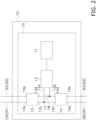
- Fig. 2 shows an internal configuration of an air-conditioning outdoor unit 10.
- the internal configurations of the plurality of air-conditioning outdoor units 10a to 10e shown in Fig. 1 are identical or similar to the configuration of the air-conditioning outdoor unit 10 shown in Fig. 2 .
- the air-conditioning outdoor unit 10 includes a refrigerant circuit control unit 11, a communication unit 12, a first impedance component 13, a second impedance component 14, and a circuit board 15.
- the circuit board 15 includes a first internal wire 17 and a second internal wire 18. At least the first impedance component 13 and the second impedance component 14 are mounted on the circuit board 15.
- the refrigerant circuit control unit 11 and the communication unit 12 may also be mounted on the circuit board 15.
- the refrigerant circuit control unit 11 controls a refrigerant circuit, which is not shown in Fig. 2 .
- the refrigerant circuit includes a compressor, an expansion valve, a fan motor, a heat exchanger, various sensors, and the like.
- the communication unit 12 transmits and receives signals to and from devices other than the air-conditioning outdoor unit 10.
- the communication unit 12 transmits a command received from the controller 70 to the refrigerant circuit control unit 11.
- the communication unit 12 acquires the state of the air-conditioning indoor units 20aa to 20ef from the refrigerant circuit control unit 11.
- the communication unit 12 includes a first terminal 12a and a second terminal 12b.
- the first terminal 12a is connected to the first internal wire 17.
- the second terminal 12b is connected to the second internal wire 18.
- the first impedance component 13 is a circuit having a predetermined impedance.
- the first impedance component 13 is disposed between the first transmission channel 50 and the communication unit 12.
- the second impedance component 14 is a circuit having a predetermined impedance.
- the second impedance component 14 is disposed between the second transmission channel 60 (that is, any one of the plurality of second transmission channels 60a to 60e described above) and the communication unit 12.
- the impedances of the first impedance component 13 and the second impedance component 14 are both larger than the characteristic impedance of the first transmission channel 50 at the frequency of the signal transmitted by the first transmission channel 50.
- the first impedance component 13 includes a first terminal 13a, a second terminal 13b, a third terminal 13c, and a fourth terminal 13d.
- the first terminal 13a is connected to the first communication line 51 of the first transmission channel 50.
- the second terminal 13b is connected to the second communication line 52 of the first transmission channel 50.
- the third terminal 13c is connected to the first terminal 12a of the communication unit 12 via the first internal wire 17.
- the fourth terminal 13d is connected to the second terminal 12b of the communication unit 12 via the second internal wire 18.
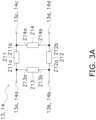
- Fig. 3A shows an example of a circuit configuration of the first impedance component 13 and the second impedance component 14.
- the first impedance component 13 will be described below with reference to Fig. 3A .
- the first impedance component 13 includes a first element Z11, a second element Z12, a third element Z13, and a fourth element Z14.
- the first element Z11 has a first end Z11a and a second end Z11b.
- the first end Z11a of the first element Z11 is connected to the first communication line 51.
- the second end Z11b of the first element Z11 is connected to the first terminal 12a of the communication unit 12.
- the second element Z12 has a first end Z12a and a second end Z12b.
- the first end Z12a of the second element Z12 is connected to the second communication line 52.
- the second end Z11b of the second element Z12 is connected to the second terminal 12b of the communication unit 12.
- the third element Z13 has a first end Z13a and a second end Z13b.
- the first end Z13a of the third element Z13 is connected to the first end Z11a of the first element Z11.
- the second end Z13b of the third element Z13 is connected to the first end Z12a of the second element Z12.
- the fourth element Z14 has a first end Z14a and a second end Z14b.
- the first end Z14a of the fourth element Z14 is connected to the second end Z11b of the first element Z11.
- the second end Z14b of the fourth element Z14 is connected to the second end Z12b of the second element Z12.
- the second impedance component 14 has a first terminal 14a, a second terminal 14b, a third terminal 14c, and a fourth terminal 14d.
- the first terminal 14a is connected to the third communication line 61 of the second transmission channel 60.
- the second terminal 14b is connected to the fourth communication line 62 of the second transmission channel 60.
- the third terminal 14c is connected to the first terminal 12a of the communication unit 12 via the first internal wire 17.
- the fourth terminal 14d is connected to the second terminal 12b of the communication unit 12 via the second internal wire 18.
- the second impedance component 14 includes a first element Z11, a second element Z12, a third element Z13, and a fourth element Z14.
- the first element Z11 has a first end Z11a and a second end Z11b.
- the first end Z11a of the first element Z11 is connected to the third communication line 61.
- the second end Z11b of the first element Z11 is connected to the first terminal 12a of the communication unit 12.
- the second element Z12 has a first end Z12a and a second end Z12b.
- the first end Z12a of the second element Z12 is connected to the fourth communication line 62.
- the second end Z11b of the second element Z12 is connected to the second terminal 12b of the communication unit 12.
- the third element Z13 has a first end Z13a and a second end Z13b.
- the first end Z13a of the third element Z13 is connected to the first end Z11a of the first element Z11.
- the second end Z13b of the third element Z13 is connected to the first end Z12a of the second element Z12.
- the fourth element Z14 has a first end Z14a and a second end Z14b.
- the first end Z14a of the fourth element Z14 is connected to the second end Z11b of the first element Z11.
- the second end Z14b of the fourth element Z14 is connected to the second end Z12b of the second element Z12.
- elements Z shown in Figs. 4A to 4C may be included.
- the element Z having a first end Za and a second end Zb is a resistor R.
- the element Z is a capacitor C.
- the element Z is an inductor L.
- a short-circuit state occurring in one of the first transmission channel 50 and the plurality of second transmission channels 60 is not transmitted to another transmission channel of the first transmission channel 50 and the plurality of second transmission channels 60 in which a short-circuit state is not occurring, due to the interposition of the first impedance component 13 and the second impedance component 14.
- communication between the controller 70 or the air-conditioning indoor unit 20 connected to the other transmission channel is not hindered. Therefore, the controller 70 or the air-conditioning indoor unit 20 can continue to operate.
- the air-conditioning outdoor units 10a to 10e do not relay communication. That is, the air-conditioning outdoor units 10a to 10e do not perform a process of first receiving a signal from the first transmission channel 50 and then transmitting a signal onto the second transmission channel 60. Therefore, the communication traffic can be improved.
- a signal transmitted by the first transmission channel 50 is attenuated before being received by the communication unit 12, regardless of the presence or absence of a short circuit or the like occurring in the first transmission channel 50. Therefore, the communication unit 12 is less likely to be affected by a short circuit or the like.
- the first impedance component 13 and the second impedance component 14 are mounted on the circuit board 15. Therefore, it is easy to introduce the first impedance component 13 and the second impedance component 14 into the air-conditioning outdoor unit 10.
- the first impedance component 13 and the second impedance component 14 are composed of a resistor R, a capacitor C, and an inductor L. Therefore, the first impedance component 13 and the second impedance component 14 can realize a stable impedance.
- the controller 70 is connected only to the first transmission channel 50. Therefore, the adverse effect of the failure of the controller 70 is unlikely to spread to the second transmission channel 60.
- Fig. 3B shows a circuit configuration according to a first modification of the first embodiment. At least one of the first impedance component 13 and the second impedance component 14 may have the circuit configuration of Fig. 3B according to the first modification, instead of the circuit configuration of Fig. 3A .
- the impedance components include a first element Z21, a second element Z22, a third element Z23, a fourth element Z24, and a fifth element Z25.
- the first element Z21 has a first end Z21a and a second end Z21b.
- the first end Z21a of the first element Z21 is connected to the first communication line 51 or the third communication line 61.
- the second element Z22 has a first end Z22a and a second end Z22b.
- the first end Z22a of the second element Z22 is connected to the second end Z21b of the first element Z21.
- the second end Z21b of the second element Z22 is connected to the first terminal 12a of the communication unit 12.
- the third element Z23 has a first end Z23a and a second end Z23b.
- the first end Z23a of the third element Z23 is connected to the second communication line 52 or the fourth communication line 62.
- the fourth element Z24 has a first end Z24a and a second end Z24b.
- the first end Z24a of the fourth element Z24 is connected to the second end Z23b of the third element Z23.
- the second end Z24b of the fourth element Z24 is connected to the second terminal 12b of the communication unit 12.
- the fifth element Z25 has a first end Z25a and a second end Z25b.
- the first end Z25a of the fifth element Z25 is connected to the second end Z11b of the first element Z11.
- the second end Z25b of the fifth element Z25 is connected to the second end Z23b of the third element Z23.
- the controller 70 or the air-conditioning indoor unit 20 that is not related to the cause of the short circuit can continue communication and operation.
- Fig. 3C shows a circuit configuration according to a second modification of the first embodiment. At least one of the first impedance component 13 and the second impedance component 14 may have the circuit configuration of Fig. 3C according to the second modification, instead of the circuit configuration of Fig. 3A .
- the impedance component has a first element Z31 and a second element Z32.
- the first element Z31 has a first end Z31a and a second end Z31b.
- the first end Z31a of the first element Z31 is connected to the first communication line 51 or the third communication line 61.
- the second end Z31b of the first element Z31 is connected to the first terminal 12a of the communication unit 12.
- the second element Z32 has a first end Z32a and a second end Z32b.
- the first end Z32a of the second element Z32 is connected to the second communication line or the fourth communication line.
- the second end Z31b of the second element Z32 is connected to the second terminal 12b of the communication unit 12.
- the controller 70 or the air-conditioning indoor unit 20 that is not related to the cause of the short circuit can continue communication and operation.
- Fig. 3D shows a circuit configuration according to a third modification of the first embodiment. At least one of the first impedance component 13 and the second impedance component 14 may have the circuit configuration of Fig. 3D according to the third modification, instead of the circuit configuration of Fig. 3A .
- the impedance components include a first element Z41, a second element Z42, and a third element Z43.
- the first element Z41 has a first end Z41a and a second end Z41b.
- the first end Z41a of the first element Z41 is connected to the first communication line 51 or the third communication line 61.
- the second end Z41b of the first element Z41 is connected to the first terminal 12a of the communication unit 12.
- the second element Z42 has a first end Z42a and a second end Z42b.
- the first end Z42a of the second element Z42 is connected to the second communication line 52 or the fourth communication line 62.
- the second end Z42b of the second element Z42 is connected to the second terminal 12b of the communication unit 12.
- the third element Z43 has a first end Z43a and a second end Z43b.
- the first end Z43a of the third element Z43 is connected to the second end Z41b of the first element Z41.
- the second end Z43b of the third element Z43 is connected to the second end Z42b of the second element Z42.
- the controller 70 or the air-conditioning indoor unit 20 that is not related to the cause of the short circuit can continue communication and operation.
- Fig. 3E shows a circuit configuration according to a fourth modification of the first embodiment. At least one of the first impedance component 13 and the second impedance component 14 may have the circuit configuration of Fig. 3E according to the fourth modification, instead of the circuit configuration of Fig. 3A .
- the impedance component includes a first element Z51, a second element Z52, and a third element Z53.
- the first element Z51 has a first end Z51a and a second end Z51b.
- the first end Z51a of the first element Z51 is connected to the first communication line 51 or the third communication line 61.
- the second end Z51b of the first element Z51 is connected to the first terminal 12a of the communication unit 12.
- the second element Z52 has a first end Z52a and a second end Z52b.
- the first end Z52a of the second element Z52 is connected to the second communication line 52 or the fourth communication line 62.
- the second end Z52b of the second element Z52 is connected to the second terminal 12b of the communication unit 12.
- the third element Z53 has a first end Z53a and a second end Z53b.
- the first end Z53a of the third element Z53 is connected to the first end Z51a of the first element Z51.
- the second end Z53b of the third element Z53 is connected to the first end Z52a of the second element Z52.
- the controller 70 or the air-conditioning indoor unit 20 that is not related to the cause of the short circuit can continue communication and operation.
- Only one of the first impedance component 13 and the second impedance component 14 may be mounted on the circuit board 15.
- Fig. 5 shows a circuit of a communication network system 90 according to a sixth modification of the first embodiment of the present disclosure.
- the sixth modification of the first embodiment is different from the first embodiment shown in Fig. 1 in the number of devices.
- the communication network system 90 includes one air-conditioning outdoor unit 10, one air-conditioning indoor unit 20, and one second transmission channel 60.
- the communication network system 90 may include one air-conditioning outdoor unit 10 and a plurality of air-conditioning indoor units 20.
- the second embodiment differs from the first embodiment in the configuration of the air-conditioning outdoor units 10a to 10e.
- the communication network system 90 includes the circuit shown in Fig. 1 as in the first embodiment. Specifically, the communication network system 90 includes a controller 70, a plurality of air-conditioning outdoor units 10a to 10e, a plurality of air-conditioning indoor units 20aa to 20ef, a first transmission channel 50, and a plurality of second transmission channels 60a to 60e.
- Fig. 6 shows an internal configuration of the air-conditioning outdoor unit 10 of the second embodiment.
- the internal configurations of the plurality of air-conditioning outdoor units 10a to 10e shown in Fig. 1 are identical or similar to the configuration of the air-conditioning outdoor unit 10 shown in Fig. 6 .
- the air-conditioning outdoor unit 10 includes a refrigerant circuit control unit 11, a communication unit 12, an impedance component 19, and a circuit board 15.
- the circuit board 15 includes a first internal wire 17 and a second internal wire 18. At least the impedance component 19 is mounted on the circuit board 15.
- the refrigerant circuit control unit 11 and the communication unit 12 may also be mounted on the circuit board 15.
- the functions of the refrigerant circuit control unit 11 and the communication unit 12 are the same as in the first embodiment.
- the communication unit 12 includes a first terminal 12a and a second terminal 12b.
- the first terminal 12a is connected to the first internal wire 17.
- the second terminal 12b is connected to the second internal wire 18.
- the impedance component 19 is a circuit having a predetermined impedance.
- the impedance component 19 is disposed between the first transmission channel 50, the second transmission channel 60 (that is, any one of the plurality of second transmission channels 60a to 60e described above), and the communication unit 12.
- the impedance of the impedance component 19 is larger than the characteristic impedance of the first transmission channel 50 at the frequency of the signal transmitted by the first transmission channel 50.
- the impedance component 19 includes a first terminal 19a, a second terminal 19b, a third terminal 19c, a fourth terminal 19d, a fifth terminal 19e, and a sixth terminal 19f.
- the first terminal 19a is connected to the first communication line 51 of the first transmission channel 50.
- the second terminal 19b is connected to the first communication line 61 of the second transmission channel 60.
- the third terminal 19c is connected to the first terminal 12a of the communication unit 12 via the first internal wire 17.
- the fourth terminal 19d is connected to the second communication line 52 of the first transmission channel 50.
- the fifth terminal 19e is connected to the second communication line 62 of the second transmission channel 60.
- the sixth terminal 19f is connected to the second terminal 12b of the communication unit 12 via the second internal wire 18.
- Fig. 7 shows an example of a circuit configuration of the impedance component 19.
- the impedance component 19 includes a first element Z61, a second element Z62, a third element Z63, a fourth element Z64, a fifth terminal Z65, and a sixth terminal Z66.
- the first element Z61 has a first end Z61a and a second end Z61b.
- the first end Z61a of the first element Z61 is connected to the first communication line 51.
- the second element Z62 has a first end Z62a and a second end Z62b.
- the first end Z62a of the second element Z62 is connected to the second end 61b of the first element 61.
- the second end Z62b of the second element Z62 is connected to the third communication line 61.
- the third element Z63 has a first end Z63a and a second end Z63b.
- the first end Z63a of the third element Z63 is connected to the second end Z61b of the first element Z61.
- the second end Z63b of the third element Z63 is connected to the first terminal 12a of the communication unit 12.
- the fourth element Z64 has a first end Z64a and a second end Z64b.
- the first end Z64a of the fourth element Z64 is connected to the second communication line 52.
- the fifth element Z65 has a first end Z65a and a second end Z65b.
- the first end Z65a of the fifth element Z65 is connected to the second end 64b of the fourth element 64.
- the second end Z65b of the fifth element Z65 is connected to the fourth communication line 62.
- the sixth element Z66 has a first end Z66a and a second end Z66b.
- the first end Z66a of the sixth element Z66 is connected to the second end Z64b of the fourth element Z64.
- the second end Z66b of the sixth element Z66 is connected to the second terminal 12b of the communication unit 12.
- All of the first element Z61, the second element Z62, the third element Z63, the fourth element Z64, the fifth element Z65, and the sixth element Z66 described above with reference to Fig. 7 may include the element Z shown in Figs. 4A to 4C .
- the element Z having a first end Za and a second end Zb is a resistor R.
- the element Z is a capacitor C.
- the element Z is an inductor L.
- the air-conditioning outdoor units 10a to 10e do not relay communication. That is, the air-conditioning outdoor units 10a to 10e do not perform a process of first receiving a signal from the first transmission channel 50 and then transmitting a signal onto the second transmission channel 60. Therefore, the communication traffic can be improved.
- Some of the plurality of air-conditioning outdoor units 10a to 10e may have the configuration of the air-conditioning outdoor unit 10 according to the first embodiment.
Landscapes
- Engineering & Computer Science (AREA)
- Computer Networks & Wireless Communication (AREA)
- Signal Processing (AREA)
- Air Conditioning Control Device (AREA)
- Selective Calling Equipment (AREA)
Abstract
Description
- The present disclosure relates to a communication network system including, for example, an air-conditioning outdoor unit.
- As described in
Japanese Patent No. 4169489 - In the air-conditioning system, for example, one air conditioner refrigerant system is configured by connecting one outdoor unit and a plurality of indoor units with a communication line. Furthermore, by connecting a plurality of outdoor units with a communication line, communication between different air conditioner refrigerant systems becomes possible. Further, a controller may be installed so as to be able to communicate with a plurality of outdoor units. In this case, the controller can control all the outdoor units and all the indoor units belonging to the air-conditioning system.
- The communication line includes a plurality of conductive wires, such as two conductive wires, for example. In this case, an operator who installs the air-conditioning system may erroneously short-circuit the two conductive wires. Depending on the design of the communication network included in the air-conditioning system, all the outdoor units and all the indoor units belonging to the air-conditioning system may become inoperable due to such a short circuit of the communication line. Therefore, a design is desired in which a short circuit at a certain point of the communication line does not interfere with the operation of the devices belonging to the air-conditioning system.
- A communication network system of a first aspect includes a first transmission channel, a second transmission channel, a first device, a second device, and a third device. The second transmission channel is different from the first transmission channel. The first device is connected to the first transmission channel and is not connected to the second transmission channel. The second device is connected to the second transmission channel and is not connected to the first transmission channel. The third device electrically connects the first transmission channel and the second transmission channel. The third device does not transmit a short-circuit state occurring in one of the first transmission channel and the second transmission channel to the transmission channel other than the one of the first transmission channel and the second transmission channel, thereby enabling communication between the devices connected to the transmission channel other than the one.
- According to this configuration, a short-circuit state occurring in one of the first transmission channel and the second transmission channel is not transmitted to the other. Therefore, the devices connected to the transmission channel in which a short circuit is not occurring can communicate.
- A communication network system of a second aspect is the communication network system of the first aspect, including a plurality of second transmission channels, a plurality of second devices, and a plurality of third devices. Each of the plurality of third devices electrically connects the first transmission channel and one of the plurality of second transmission channels. Each of the plurality of third devices does not transmit a short-circuit state occurring in one of the first transmission channel and the plurality of second transmission channels to the transmission channel other than the one of the first transmission channel and the plurality of second transmission channels, thereby enabling communication between the first device or the second device connected to the transmission channel other than the one.
- According to this configuration, a short-circuit state occurring in one transmission channel is not transmitted to the other transmission channels. Therefore, the devices connected to the transmission channels in which a short circuit is not occurring can communicate.
- A communication network system of a third aspect is the communication network system of the second aspect, in which each of the plurality of third devices includes a communication unit configured to transmit and receive a signal.
- According to this configuration, when a failure such as a short circuit of the communication line occurs in one of the first transmission channel and the second transmission channels, the failure does not spread to the other. Therefore, it is possible to suppress the occurrence of a situation in which communication cannot be performed both in the first transmission channel and in the second transmission channels.
- A communication network system according to a fourth aspect is the communication network system according to the third aspect, in which each of the plurality of third devices includes an impedance component.
- According to this configuration, because the first transmission channel and the second transmission channels are electrically connected via the impedance component of the third device, the third device does not relay communication. Therefore, the communication traffic can be improved.
- A communication network system of a fifth aspect is the communication network system of the fourth aspect, in which the impedance component has an impedance larger than a characteristic impedance of the first transmission channel at a frequency of a signal transmitted by the first transmission channel.
- According to this configuration, the signal transmitted by the first transmission channel is attenuated before being received by the communication unit regardless of the presence or absence of a short circuit or the like on the first transmission channel. Therefore, the communication unit is less likely to be affected by a short circuit or the like.
- A communication network system of a sixth aspect is the communication network system of the fourth aspect or the fifth aspect, in which each of the plurality of third devices includes a circuit board. The impedance component is mounted on the circuit board.
- According to this configuration, the impedance component is mounted on the circuit board. Therefore, it is easy to introduce the impedance component into the third device.
- A communication network system of a seventh aspect is the communication network system of the fourth aspect to the sixth aspect, in which the first transmission channel includes a first communication line and a second communication line. Each of the plurality of second transmission channels includes a third communication line and a fourth communication line. The impedance component includes at least one of a resistor, a capacitor, and an inductor that is connected directly or via another element to at least one of the first communication line, the second communication line, the third communication line, and the fourth communication line.
- According to this configuration, the impedance component is composed of a resistor, a capacitor, and an inductor. Therefore, the impedance component can realize a stable impedance.
- A communication network system of an eighth aspect is the communication network system of the seventh aspect, in which each of the plurality of third devices includes a first impedance component and a second impedance component as the impedance component. The first impedance component is disposed between the first transmission channel and the communication unit. The second impedance component is disposed between any of the plurality of second transmission channels and the communication unit.
- According to this configuration, when a failure such as a short circuit of the communication line occurs both in the first transmission channel and in the second transmission channels, the failure does not spread to the communication unit of the third device. Therefore, the third device can operate normally.
- A communication network system of a ninth aspect is the communication network system of the eighth aspect, in which the impedance component includes a first element, a second element, a third element, and a fourth element. The first element has a first end connected to the first communication line or the third communication line, and a second end connected to a first terminal of the communication unit. The second element has a first end connected to the second communication line or the fourth communication line, and a second end connected to a second terminal of the communication unit. The third element has a first end connected to the first end of the first element, and a second end connected to the first end of the second element. The fourth element has a first end connected to the second end of the first element, and a second end connected to the second end of the second element. All of the first element, the second element, the third element, and the fourth element include at least one of a resistor, a capacitor, and an inductor.
- According to this configuration, the impedance component is a filter composed of four elements.
- A communication network system of a tenth aspect is the communication network system of the eighth aspect, in which the impedance component includes a first element, a second element, a third element, a fourth element, and a fifth element. The first element has a first end connected to the first communication line or the third communication line, and a second end. The second element has a first end connected to a second end of the first element, and a second end connected to a first terminal of the communication unit. The third element has a first end connected to the second communication line or the fourth communication line, and a second end. The fourth element has a first end connected to a second end of the third element, and a second end connected to a second terminal of the communication unit. The fifth element has a first end connected to the second end of the first element, and a second end connected to the second end of the third element. All of the first element, the second element, the third element, the fourth element, and the fifth element include at least one of a resistor, a capacitor, and an inductor.
- According to this configuration, the impedance component is a filter composed of five elements.
- A communication network system of an eleventh aspect is the communication network system of the eighth aspect, in which the impedance component includes a first element and a second element. The first element has a first end connected to the first communication line or the third communication line, and a second end connected to a first terminal of the communication unit. The second element has a first end connected to the second communication line or the fourth communication line, and a second end connected to a second terminal of the communication unit. Both the first element and the second element include at least one of a resistor, a capacitor, and an inductor.
- According to this configuration, the impedance component is a filter composed of two elements.
- A communication network system of a twelfth aspect is the communication network system of the eighth aspect, in which the impedance component includes a first element, a second element, and a third element. The first element has a first end connected to the first communication line or the third communication line, and a second end connected to a first terminal of the communication unit. The second element has a first end connected to the second communication line or the fourth communication line, and a second end connected to a second terminal of the communication unit. The third element has a first end connected to the second end of the first element, and a second end connected to the second end of the second element. All of the first element, the second element, and the third element include at least one of a resistor, a capacitor, and an inductor.
- According to this configuration, the impedance component is a filter composed of three elements.
- A communication network system of a thirteenth aspect is the communication network system of the eighth aspect, in which the impedance component includes a first element, a second element, and a third element. The first element has a first end connected to the first communication line or the third communication line, and a second end connected to a first terminal of the communication unit. The second element has a first end connected to the second communication line or the fourth communication line, and a second end connected to a second terminal of the communication unit. The third element has a first end connected to the first end of the first element, and a second end connected to the first end of the second element. All of the first element, the second element, and the third element include at least one of a resistor, a capacitor, and an inductor.
- According to this configuration, the impedance component is a filter composed of three elements.
- A communication network system of a fourteenth aspect is the communication network system of the seventh aspect, in which the first transmission channel includes a first communication line and a second communication line. Each of the plurality of second transmission channels includes a third communication line and a fourth communication line. The impedance component includes a first element, a second element, a third element, a fourth element, a fifth element, and a sixth element. The first element has a first end connected to the first communication line, and a second end. The second element has a first end connected to a second end of the first element, and a second end connected to the third communication line. The third element has a first end connected to the second end of the first element, and a second end. The fourth element has a first end connected to the second communication line, and a second end. The fifth element has a first end connected to the second end of the fourth element, and a second end connected to the fourth communication line. The sixth element has a first end connected to the second end of the fourth element, and a second end. All of the first element, the second element, the third element, the fourth element, the fifth element, and the sixth element include at least one of a resistor, a capacitor, and an inductor.
- According to this configuration, the impedance component is a filter composed of six elements.
- A communication network system of a fifteenth aspect is the communication network system of any one of the first aspect to the fourteenth aspect, in which each of the second transmission channels constitutes an air conditioner refrigerant system together with the second device connected to the second transmission channel and the third device connected to the second transmission channel. The first transmission channel connects the plurality of air conditioner refrigerant systems to each other.
- According to this configuration, an adverse effect of a communication failure is unlikely to spread among the plurality of air conditioner refrigerant systems.
- A communication network system of a sixteenth aspect is the communication network system of any one of the first aspect to the fifteenth aspect, in which the first device includes a controller.
- According to this configuration, the controller is connected only to the first transmission channel. Therefore, the adverse effect of the failure of the controller is less likely to spread to the second transmission channel.
- A communication network system of a seventeenth aspect is the communication network system of any one of the first aspect to the sixteenth aspect, in which each of the plurality of second devices is an air-conditioning indoor unit. Each of the plurality of third devices is an air-conditioning outdoor unit.
- According to this configuration, the communication network system constitutes an air conditioner. Therefore, the air in a target space can be conditioned.
- An air-conditioning outdoor unit according to an eighteenth aspect electrically connects a first transmission channel and a second transmission channel different from the first transmission channel. The air-conditioning outdoor unit constitutes an air-conditioning apparatus in cooperation with a controller and an air-conditioning outdoor unit. The air-conditioning outdoor unit does not transmit a short-circuit state occurring in one of the first transmission channel and the second transmission channel to the transmission channel other than the one of the first transmission channel and the second transmission channel, thereby enabling communication of a device connected to the transmission channel other than the one.
- According to this configuration, the air-conditioning outdoor unit is less likely to be adversely affected by a communication failure.
- An air-conditioning outdoor unit of a nineteenth aspect is the air-conditioning outdoor unit of the eighteenth aspect, in which the air-conditioning apparatus includes a plurality of second transmission channels, a plurality of second devices, and a plurality of third devices. The air-conditioning outdoor unit electrically connects the first transmission channel and any of the plurality of second transmission channels. The air-conditioning outdoor unit does not transmit a short-circuit state occurring in one of the first transmission channel and the plurality of second transmission channels to the transmission channel other than the one of the first transmission channel and the plurality of second transmission channels, thereby enabling communication between the first device or the second device connected to the transmission channel other than the one.
- According to this configuration, a short-circuit state occurring in one transmission channel is not transmitted to the other transmission channels. Therefore, the devices connected to the transmission channels in which a short circuit is not occurring can communicate.
- An air-conditioning outdoor unit of a twentieth aspect is the air-conditioning outdoor unit of the eighteenth aspect or the nineteenth aspect, further including the communication unit and an impedance component disposed between the communication unit and at least one of the first transmission channel and the second transmission channel.
- According to this configuration, the impedance component suppresses transmission of a short-circuit state occurring in one transmission channel to the other transmission channel.
-
-
Fig. 1 is a schematic diagram of a circuit of acommunication network system 90 constituting an air conditioner. -
Fig. 2 is a block diagram of an air-conditioningoutdoor unit 10 according to a first embodiment. -
Fig. 3A is a circuit diagram ofimpedance components -
Fig. 3B is a circuit diagram of theimpedance components -
Fig. 3C is a circuit diagram of theimpedance components -
Fig. 3D is a circuit diagram of theimpedance components -
Fig. 3E is a circuit diagram of theimpedance components -
Fig. 4A is a schematic diagram of an element Z. -
Fig. 4B is a schematic diagram of the element Z. -
Fig. 4C is a schematic diagram of the element Z. -
Fig. 5 is a schematic diagram of a circuit of acommunication network system 90 according to a sixth modification of the first embodiment. -
Fig. 6 is a block diagram of an air-conditioningoutdoor unit 10 according to a second embodiment. -
Fig. 7 is a circuit diagram of animpedance component 19. -
Fig. 1 shows a circuit of acommunication network system 90 according to a first embodiment of the present disclosure. Thecommunication network system 90 constitutes an air-conditioning system. Thecommunication network system 90 includes acontroller 70, a plurality of air-conditioningoutdoor units 10a to 10e, a plurality of air-conditioning indoor units 20aa to 20ef, afirst transmission channel 50, and a plurality of second transmission channels 60a to 60e. - The
controller 70 is a device configured to control all of the air-conditioningoutdoor units 10a to 10e and the air-conditioning indoor units 20aa to 20ef. - The air-conditioning
outdoor units 10a to 10e constitute airconditioner refrigerant systems 30a to 30e, respectively, and function as heat sources. - Each of the air-conditioning indoor units 20aa to 20ef provides conditioned air to a user.
- The air-conditioning indoor units 20aa to 20af, together with the air-conditioning
outdoor unit 10a, belong to the airconditioner refrigerant system 30a. The air-conditioning indoor units 20ba to 20bf, together with the air-conditioningoutdoor unit 10b, belong to the airconditioner refrigerant system 30b. The air-conditioning indoor units 20ca to 20cf, together with the air-conditioningoutdoor unit 10c, belong to the airconditioner refrigerant system 30c. The air-conditioning indoor units 20da to 20df, together with the air-conditioningoutdoor unit 10d, belong to the airconditioner refrigerant system 30d. The air-conditioning indoor units 20ea to 20ef, together with the air-conditioningoutdoor unit 10e, belong to the airconditioner refrigerant system 30e. - In each of the air
conditioner refrigerant systems 30a to 30e, a refrigerant circuit not shown inFig. 1 is configured. - The
first transmission channel 50 connects thecontroller 70 to all of the plurality of air-conditioningoutdoor units 10a to 10e. Thefirst transmission channel 50 connects the plurality of airconditioner refrigerant systems 30a to 30e to each other. - The
first transmission channel 50 includes afirst communication line 51 and asecond communication line 52. - The second transmission channels 60a to 60e are each a transmission channel different from the
first transmission channel 50. - Each of the second transmission channels 60a to 60e is connected to any of the air-conditioning
outdoor units 10a to 10e and to any of the air-conditioning indoor units 20aa to 20ef, thereby constituting one of the airconditioner refrigerant systems 30a to 30e. - The second transmission channels 60a to 60e include third communication lines 61a to 61e and fourth communication lines 62a to 62e, respectively.
- The
controller 70 is connected to thefirst transmission channel 50. Thecontroller 70 is not connected to any of the second transmission channels 60a to 60e. - Each of the air-conditioning indoor units 20aa to 20ef is connected to one of the second transmission channels 60a to 60e. None of the air-conditioning indoor units 20aa to 20ef is connected to the
first transmission channel 50. - Each of the air-conditioning
outdoor units 10a to 10e electrically connects thefirst transmission channel 50 to one of the second transmission channels 60a to 60e. -
Fig. 2 shows an internal configuration of an air-conditioningoutdoor unit 10. The internal configurations of the plurality of air-conditioningoutdoor units 10a to 10e shown inFig. 1 are identical or similar to the configuration of the air-conditioningoutdoor unit 10 shown inFig. 2 . - As shown in
Fig. 2 , the air-conditioningoutdoor unit 10 includes a refrigerantcircuit control unit 11, acommunication unit 12, afirst impedance component 13, asecond impedance component 14, and acircuit board 15. Thecircuit board 15 includes a firstinternal wire 17 and a secondinternal wire 18. At least thefirst impedance component 13 and thesecond impedance component 14 are mounted on thecircuit board 15. The refrigerantcircuit control unit 11 and thecommunication unit 12 may also be mounted on thecircuit board 15. - The refrigerant
circuit control unit 11 controls a refrigerant circuit, which is not shown inFig. 2 . The refrigerant circuit includes a compressor, an expansion valve, a fan motor, a heat exchanger, various sensors, and the like. - The
communication unit 12 transmits and receives signals to and from devices other than the air-conditioningoutdoor unit 10. Thecommunication unit 12 transmits a command received from thecontroller 70 to the refrigerantcircuit control unit 11. Thecommunication unit 12 acquires the state of the air-conditioning indoor units 20aa to 20ef from the refrigerantcircuit control unit 11. Thecommunication unit 12 includes afirst terminal 12a and asecond terminal 12b. Thefirst terminal 12a is connected to the firstinternal wire 17. Thesecond terminal 12b is connected to the secondinternal wire 18. - The
first impedance component 13 is a circuit having a predetermined impedance. Thefirst impedance component 13 is disposed between thefirst transmission channel 50 and thecommunication unit 12. - The
second impedance component 14 is a circuit having a predetermined impedance. Thesecond impedance component 14 is disposed between the second transmission channel 60 (that is, any one of the plurality of second transmission channels 60a to 60e described above) and thecommunication unit 12. - The impedances of the
first impedance component 13 and thesecond impedance component 14 are both larger than the characteristic impedance of thefirst transmission channel 50 at the frequency of the signal transmitted by thefirst transmission channel 50. - As shown in
Fig. 2 , thefirst impedance component 13 includes afirst terminal 13a, asecond terminal 13b, a third terminal 13c, and afourth terminal 13d. Thefirst terminal 13a is connected to thefirst communication line 51 of thefirst transmission channel 50. Thesecond terminal 13b is connected to thesecond communication line 52 of thefirst transmission channel 50. The third terminal 13c is connected to thefirst terminal 12a of thecommunication unit 12 via the firstinternal wire 17. Thefourth terminal 13d is connected to the second terminal 12b of thecommunication unit 12 via the secondinternal wire 18. -
Fig. 3A shows an example of a circuit configuration of thefirst impedance component 13 and thesecond impedance component 14. Thefirst impedance component 13 will be described below with reference toFig. 3A . - The
first impedance component 13 includes a first element Z11, a second element Z12, a third element Z13, and a fourth element Z14. - The first element Z11 has a first end Z11a and a second end Z11b. The first end Z11a of the first element Z11 is connected to the
first communication line 51. The second end Z11b of the first element Z11 is connected to thefirst terminal 12a of thecommunication unit 12. - The second element Z12 has a first end Z12a and a second end Z12b. The first end Z12a of the second element Z12 is connected to the
second communication line 52. The second end Z11b of the second element Z12 is connected to the second terminal 12b of thecommunication unit 12. - The third element Z13 has a first end Z13a and a second end Z13b. The first end Z13a of the third element Z13 is connected to the first end Z11a of the first element Z11. The second end Z13b of the third element Z13 is connected to the first end Z12a of the second element Z12.
- The fourth element Z14 has a first end Z14a and a second end Z14b. The first end Z14a of the fourth element Z14 is connected to the second end Z11b of the first element Z11. The second end Z14b of the fourth element Z14 is connected to the second end Z12b of the second element Z12.
- As shown in
Fig. 2 , thesecond impedance component 14 has afirst terminal 14a, asecond terminal 14b, a third terminal 14c, and afourth terminal 14d. Thefirst terminal 14a is connected to thethird communication line 61 of thesecond transmission channel 60. Thesecond terminal 14b is connected to thefourth communication line 62 of thesecond transmission channel 60. The third terminal 14c is connected to thefirst terminal 12a of thecommunication unit 12 via the firstinternal wire 17. Thefourth terminal 14d is connected to the second terminal 12b of thecommunication unit 12 via the secondinternal wire 18. - Referring again to
Fig. 3A , thesecond impedance component 14 will be described. - The
second impedance component 14 includes a first element Z11, a second element Z12, a third element Z13, and a fourth element Z14. - The first element Z11 has a first end Z11a and a second end Z11b. The first end Z11a of the first element Z11 is connected to the
third communication line 61. The second end Z11b of the first element Z11 is connected to thefirst terminal 12a of thecommunication unit 12. - The second element Z12 has a first end Z12a and a second end Z12b. The first end Z12a of the second element Z12 is connected to the
fourth communication line 62. The second end Z11b of the second element Z12 is connected to the second terminal 12b of thecommunication unit 12. - The third element Z13 has a first end Z13a and a second end Z13b. The first end Z13a of the third element Z13 is connected to the first end Z11a of the first element Z11. The second end Z13b of the third element Z13 is connected to the first end Z12a of the second element Z12.
- The fourth element Z14 has a first end Z14a and a second end Z14b. The first end Z14a of the fourth element Z14 is connected to the second end Z11b of the first element Z11. The second end Z14b of the fourth element Z14 is connected to the second end Z12b of the second element Z12.
- For all of the first element Z11, the second element Z12, the third element Z13, and the fourth element Z14 described above with reference to
Fig. 3A , elements Z shown inFigs. 4A to 4C may be included. InFig. 4A , the element Z having a first end Za and a second end Zb is a resistor R. InFig. 4B , the element Z is a capacitor C. InFig. 4C , the element Z is an inductor L. - (8-1)
A short-circuit state occurring in one of thefirst transmission channel 50 and the plurality ofsecond transmission channels 60 is not transmitted to another transmission channel of thefirst transmission channel 50 and the plurality ofsecond transmission channels 60 in which a short-circuit state is not occurring, due to the interposition of thefirst impedance component 13 and thesecond impedance component 14. As a result, communication between thecontroller 70 or the air-conditioningindoor unit 20 connected to the other transmission channel is not hindered. Therefore, thecontroller 70 or the air-conditioningindoor unit 20 can continue to operate. - (8-2)
Because thefirst transmission channel 50 and thesecond transmission channel 60 are electrically connected via the air-conditioningoutdoor units 10a to 10e, the air-conditioningoutdoor units 10a to 10e do not relay communication. That is, the air-conditioningoutdoor units 10a to 10e do not perform a process of first receiving a signal from thefirst transmission channel 50 and then transmitting a signal onto thesecond transmission channel 60. Therefore, the communication traffic can be improved. - (8-3)
When a failure such as a short circuit of a communication line occurs both in thefirst transmission channel 50 and in thesecond transmission channel 60, the failure does not spread to thecommunication unit 12 of the air-conditioningoutdoor unit 10. Therefore, the air-conditioningoutdoor unit 10 can operate normally. - (8-4)
A signal transmitted by thefirst transmission channel 50 is attenuated before being received by thecommunication unit 12, regardless of the presence or absence of a short circuit or the like occurring in thefirst transmission channel 50. Therefore, thecommunication unit 12 is less likely to be affected by a short circuit or the like. - (8-5)
Thefirst impedance component 13 and thesecond impedance component 14 are mounted on thecircuit board 15. Therefore, it is easy to introduce thefirst impedance component 13 and thesecond impedance component 14 into the air-conditioningoutdoor unit 10. - (8-6)
Thefirst impedance component 13 and thesecond impedance component 14 are composed of a resistor R, a capacitor C, and an inductor L. Therefore, thefirst impedance component 13 and thesecond impedance component 14 can realize a stable impedance. - (8-7)
Due to the presence of thefirst impedance component 13 and thesecond impedance component 14, the adverse effect of a communication failure is less likely to spread among the plurality of airconditioner refrigerant systems 30a to 30e. - (8-8)
Thecontroller 70 is connected only to thefirst transmission channel 50. Therefore, the adverse effect of the failure of thecontroller 70 is unlikely to spread to thesecond transmission channel 60. -
Fig. 3B shows a circuit configuration according to a first modification of the first embodiment. At least one of thefirst impedance component 13 and thesecond impedance component 14 may have the circuit configuration ofFig. 3B according to the first modification, instead of the circuit configuration ofFig. 3A . - The impedance components include a first element Z21, a second element Z22, a third element Z23, a fourth element Z24, and a fifth element Z25.
- The first element Z21 has a first end Z21a and a second end Z21b. The first end Z21a of the first element Z21 is connected to the
first communication line 51 or thethird communication line 61. - The second element Z22 has a first end Z22a and a second end Z22b. The first end Z22a of the second element Z22 is connected to the second end Z21b of the first element Z21. The second end Z21b of the second element Z22 is connected to the
first terminal 12a of thecommunication unit 12. - The third element Z23 has a first end Z23a and a second end Z23b. The first end Z23a of the third element Z23 is connected to the
second communication line 52 or thefourth communication line 62. - The fourth element Z24 has a first end Z24a and a second end Z24b. The first end Z24a of the fourth element Z24 is connected to the second end Z23b of the third element Z23. The second end Z24b of the fourth element Z24 is connected to the second terminal 12b of the
communication unit 12. - The fifth element Z25 has a first end Z25a and a second end Z25b. The first end Z25a of the fifth element Z25 is connected to the second end Z11b of the first element Z11. The second end Z25b of the fifth element Z25 is connected to the second end Z23b of the third element Z23.
- With this configuration as well, the
controller 70 or the air-conditioningindoor unit 20 that is not related to the cause of the short circuit can continue communication and operation. -
Fig. 3C shows a circuit configuration according to a second modification of the first embodiment. At least one of thefirst impedance component 13 and thesecond impedance component 14 may have the circuit configuration ofFig. 3C according to the second modification, instead of the circuit configuration ofFig. 3A . - The impedance component has a first element Z31 and a second element Z32.
- The first element Z31 has a first end Z31a and a second end Z31b. The first end Z31a of the first element Z31 is connected to the
first communication line 51 or thethird communication line 61. The second end Z31b of the first element Z31 is connected to thefirst terminal 12a of thecommunication unit 12. - The second element Z32 has a first end Z32a and a second end Z32b. The first end Z32a of the second element Z32 is connected to the second communication line or the fourth communication line. The second end Z31b of the second element Z32 is connected to the second terminal 12b of the
communication unit 12. - With this configuration as well, the
controller 70 or the air-conditioningindoor unit 20 that is not related to the cause of the short circuit can continue communication and operation. -
Fig. 3D shows a circuit configuration according to a third modification of the first embodiment. At least one of thefirst impedance component 13 and thesecond impedance component 14 may have the circuit configuration ofFig. 3D according to the third modification, instead of the circuit configuration ofFig. 3A . - The impedance components include a first element Z41, a second element Z42, and a third element Z43.
- The first element Z41 has a first end Z41a and a second end Z41b. The first end Z41a of the first element Z41 is connected to the
first communication line 51 or thethird communication line 61. The second end Z41b of the first element Z41 is connected to thefirst terminal 12a of thecommunication unit 12. - The second element Z42 has a first end Z42a and a second end Z42b. The first end Z42a of the second element Z42 is connected to the
second communication line 52 or thefourth communication line 62. The second end Z42b of the second element Z42 is connected to the second terminal 12b of thecommunication unit 12. - The third element Z43 has a first end Z43a and a second end Z43b. The first end Z43a of the third element Z43 is connected to the second end Z41b of the first element Z41. The second end Z43b of the third element Z43 is connected to the second end Z42b of the second element Z42.
- With this configuration as well, the
controller 70 or the air-conditioningindoor unit 20 that is not related to the cause of the short circuit can continue communication and operation. -
Fig. 3E shows a circuit configuration according to a fourth modification of the first embodiment. At least one of thefirst impedance component 13 and thesecond impedance component 14 may have the circuit configuration ofFig. 3E according to the fourth modification, instead of the circuit configuration ofFig. 3A . - The impedance component includes a first element Z51, a second element Z52, and a third element Z53.
- The first element Z51 has a first end Z51a and a second end Z51b. The first end Z51a of the first element Z51 is connected to the
first communication line 51 or thethird communication line 61. The second end Z51b of the first element Z51 is connected to thefirst terminal 12a of thecommunication unit 12. - The second element Z52 has a first end Z52a and a second end Z52b. The first end Z52a of the second element Z52 is connected to the
second communication line 52 or thefourth communication line 62. The second end Z52b of the second element Z52 is connected to the second terminal 12b of thecommunication unit 12. - The third element Z53 has a first end Z53a and a second end Z53b. The first end Z53a of the third element Z53 is connected to the first end Z51a of the first element Z51. The second end Z53b of the third element Z53 is connected to the first end Z52a of the second element Z52.
- With this configuration as well, the
controller 70 or the air-conditioningindoor unit 20 that is not related to the cause of the short circuit can continue communication and operation. - Only one of the
first impedance component 13 and thesecond impedance component 14 may be mounted on thecircuit board 15. -
Fig. 5 shows a circuit of acommunication network system 90 according to a sixth modification of the first embodiment of the present disclosure. The sixth modification of the first embodiment is different from the first embodiment shown inFig. 1 in the number of devices. - As shown in
Fig. 5 , thecommunication network system 90 according to the sixth modification of the first embodiment includes one air-conditioningoutdoor unit 10, one air-conditioningindoor unit 20, and onesecond transmission channel 60. - When a short-circuit state occurs in the
first transmission channel 50, communication between thecontroller 70 and the air-conditioningoutdoor unit 10 becomes impossible. However, even in this case, communication between the air-conditioningoutdoor unit 10 and the air-conditioningindoor unit 20 is possible. Therefore, the air-conditioningoutdoor unit 10 and the air-conditioningindoor unit 20 can continue to operate as an air-conditioning system or an air-conditioning apparatus. - The
communication network system 90 may include one air-conditioningoutdoor unit 10 and a plurality of air-conditioningindoor units 20. - The second embodiment differs from the first embodiment in the configuration of the air-conditioning
outdoor units 10a to 10e. - The
communication network system 90 according to the second embodiment of the present disclosure includes the circuit shown inFig. 1 as in the first embodiment. Specifically, thecommunication network system 90 includes acontroller 70, a plurality of air-conditioningoutdoor units 10a to 10e, a plurality of air-conditioning indoor units 20aa to 20ef, afirst transmission channel 50, and a plurality of second transmission channels 60a to 60e. -
Fig. 6 shows an internal configuration of the air-conditioningoutdoor unit 10 of the second embodiment. The internal configurations of the plurality of air-conditioningoutdoor units 10a to 10e shown inFig. 1 are identical or similar to the configuration of the air-conditioningoutdoor unit 10 shown inFig. 6 . - As shown in
Fig. 6 , the air-conditioningoutdoor unit 10 includes a refrigerantcircuit control unit 11, acommunication unit 12, animpedance component 19, and acircuit board 15. Thecircuit board 15 includes a firstinternal wire 17 and a secondinternal wire 18. At least theimpedance component 19 is mounted on thecircuit board 15. The refrigerantcircuit control unit 11 and thecommunication unit 12 may also be mounted on thecircuit board 15. - The functions of the refrigerant
circuit control unit 11 and thecommunication unit 12 are the same as in the first embodiment. Thecommunication unit 12 includes afirst terminal 12a and asecond terminal 12b. Thefirst terminal 12a is connected to the firstinternal wire 17. Thesecond terminal 12b is connected to the secondinternal wire 18. - The
impedance component 19 is a circuit having a predetermined impedance. Theimpedance component 19 is disposed between thefirst transmission channel 50, the second transmission channel 60 (that is, any one of the plurality of second transmission channels 60a to 60e described above), and thecommunication unit 12. - The impedance of the
impedance component 19 is larger than the characteristic impedance of thefirst transmission channel 50 at the frequency of the signal transmitted by thefirst transmission channel 50. - As shown in
Fig. 6 , theimpedance component 19 includes afirst terminal 19a, asecond terminal 19b, a third terminal 19c, afourth terminal 19d, afifth terminal 19e, and asixth terminal 19f. Thefirst terminal 19a is connected to thefirst communication line 51 of thefirst transmission channel 50. Thesecond terminal 19b is connected to thefirst communication line 61 of thesecond transmission channel 60. The third terminal 19c is connected to thefirst terminal 12a of thecommunication unit 12 via the firstinternal wire 17. Thefourth terminal 19d is connected to thesecond communication line 52 of thefirst transmission channel 50. Thefifth terminal 19e is connected to thesecond communication line 62 of thesecond transmission channel 60. Thesixth terminal 19f is connected to the second terminal 12b of thecommunication unit 12 via the secondinternal wire 18. -
Fig. 7 shows an example of a circuit configuration of theimpedance component 19. Theimpedance component 19 includes a first element Z61, a second element Z62, a third element Z63, a fourth element Z64, a fifth terminal Z65, and a sixth terminal Z66. - The first element Z61 has a first end Z61a and a second end Z61b. The first end Z61a of the first element Z61 is connected to the
first communication line 51. - The second element Z62 has a first end Z62a and a second end Z62b. The first end Z62a of the second element Z62 is connected to the second end 61b of the
first element 61. The second end Z62b of the second element Z62 is connected to thethird communication line 61. - The third element Z63 has a first end Z63a and a second end Z63b. The first end Z63a of the third element Z63 is connected to the second end Z61b of the first element Z61. The second end Z63b of the third element Z63 is connected to the
first terminal 12a of thecommunication unit 12. - The fourth element Z64 has a first end Z64a and a second end Z64b. The first end Z64a of the fourth element Z64 is connected to the
second communication line 52. - The fifth element Z65 has a first end Z65a and a second end Z65b. The first end Z65a of the fifth element Z65 is connected to the second end 64b of the fourth element 64. The second end Z65b of the fifth element Z65 is connected to the
fourth communication line 62. - The sixth element Z66 has a first end Z66a and a second end Z66b. The first end Z66a of the sixth element Z66 is connected to the second end Z64b of the fourth element Z64. The second end Z66b of the sixth element Z66 is connected to the second terminal 12b of the
communication unit 12. - All of the first element Z61, the second element Z62, the third element Z63, the fourth element Z64, the fifth element Z65, and the sixth element Z66 described above with reference to
Fig. 7 may include the element Z shown inFigs. 4A to 4C . InFig. 4A , the element Z having a first end Za and a second end Zb is a resistor R. InFig. 4B , the element Z is a capacitor C. InFig. 4C , the element Z is an inductor L. - When a failure such as a short circuit of a communication line occurs in one of the
first transmission channel 50 and thesecond transmission channel 60, the failure does not spread to the other. Therefore, it is possible to suppress the occurrence of a situation in which communication cannot be performed both in thefirst transmission channel 50 and in thesecond transmission channel 60. - In addition, because the
first transmission channel 50 and thesecond transmission channel 60 are electrically connected via the air-conditioningoutdoor units 10a to 10e, the air-conditioningoutdoor units 10a to 10e do not relay communication. That is, the air-conditioningoutdoor units 10a to 10e do not perform a process of first receiving a signal from thefirst transmission channel 50 and then transmitting a signal onto thesecond transmission channel 60. Therefore, the communication traffic can be improved. - Some of the plurality of air-conditioning
outdoor units 10a to 10e may have the configuration of the air-conditioningoutdoor unit 10 according to the first embodiment. - While embodiments of the present disclosure have been described above, it will be understood that various changes in form and detail may be made therein without departing from the spirit and scope of the present disclosure as set forth in the appended claims.
-
- 10, 10a-10e Air-conditioning outdoor unit (third device)
- 12 Communication unit
- 12A First terminal of communication unit
- 12B Second terminal of communication unit
- 13 First impedance component (impedance component)
- 14 Second impedance component (impedance component)
- 15 Circuit board
- 19 Impedance component
- 20, 20aa-20ef Air-conditioning indoor unit (second device)
- 30a-30e Air conditioner refrigerant system
- 50 First transmission channel
- 51 First communication line of first transmission channel
- 52 Second communication line of first transmission channel
- 60, 60a-60e Second transmission channel
- 61, 61a-61e Third communication line of second transmission channel
- 62, 62a-62e Fourth communication line of second transmission channel
- 70 Controller (first device)
- 90 Communication network system
- C Capacitor
- L Inductor
- R Resistor
- Z Element
- Za First end of element
- Zb Second end of element
-
Japanese Patent No. 4169489
Claims (20)
- A communication network system (90) comprising:a first transmission channel (50);a second transmission channel (60) different from the first transmission channel;a first device (70) connected to the first transmission channel and not connected to the second transmission channel;a second device (20) connected to the second transmission channel and not connected to the first transmission channel; anda third device (10) electrically connecting the first transmission channel and the second transmission channel, the third device not transmitting a short-circuit state occurring in one of the first transmission channel and the second transmission channel to a transmission channel other than the one of the first transmission channel and the second transmission channel, thereby enabling communication between devices connected to the transmission channel other than the one.
- The communication network system (90) according to claim 1, comprising:a plurality of the second transmission channels (60a to 60e);a plurality of the second devices (20aa to 20ef); anda plurality of the third devices (10, 10a to 10e),wherein each of the plurality of the third devices (10, 10a to 10e) electrically connects the first transmission channel and one of the plurality of the second transmission channels, andeach of the plurality of the third devices (10, 10a to 10e) does not transmit a short-circuit state occurring in one of the first transmission channel and the plurality of the second transmission channels to a transmission channel other than the one of the first transmission channel and the plurality of the second transmission channels, thereby enabling communication between the first device or the second device connected to the transmission channel other than the one.
- The communication network system according to claim 2, wherein each of the plurality of third devices includes a communication unit (12) configured to transmit and receive a signal.
- The communication network system according to claim 3, wherein each of the plurality of third devices includes an impedance component (13, 14, 19).
- The communication network system according to claim 4, wherein the impedance component (13, 14, 19) has an impedance larger than a characteristic impedance of the first transmission channel at a frequency of a signal transmitted by the first transmission channel.
- The communication network system according to claim 4 or 5, whereineach of the plurality of third devices includes a circuit board (15), andthe impedance component (13, 14, 19) is mounted on the circuit board.
- The communication network system according to any one of claims 4 to 6, whereinthe first transmission channel includes a first communication line (51) and a second communication line (52),each of the plurality of second transmission channels includes a third communication line (61a to 61e) and a fourth communication line (62a to 62e), andthe impedance component (13, 14, 19) includes at least one of a resistor (R), a capacitor (C), and an inductor (L) connected directly or via another element to at least one of the first communication line, the second communication line, the third communication line, and the fourth communication line.
- The communication network system according to claim 7, whereineach of the plurality of third devices has a first impedance component (13) and a second impedance component (14) as the impedance component,the first impedance component is disposed between the first transmission channel and the communication unit, andthe second impedance component is disposed between any of the plurality of second transmission channels and the communication unit.
- The communication network system according to claim 8, whereinthe impedance component (13, 14) includes:a first element (Z11) having a first end (Z11a) connected to the first communication line or the third communication line, and a second end (Z1 1b) connected to a first terminal (12a) of the communication unit;a second element (Z12) having a first end (Z12a) connected to the second communication line or the fourth communication line, and a second end (Z12b) connected to a second terminal (12b) of the communication unit;a third element (Z13) having a first end (Z13a) connected to the first end of the first element, and a second end (Z13b) connected to the first end of the second element; anda fourth element (Z14) having a first end (Z14a) connected to the second end of the first element, and a second end (Z14b) connected to the second end of the second element, andall of the first element, the second element, the third element, and the fourth element include at least one of the resistor, the capacitor, and the inductor.
- The communication network system according to claim 8, whereinthe impedance component (13, 14) includes:a first element (Z21) having a first end (Z21a) connected to the first communication line or the third communication line, and a second end (Z21b);a second element (Z22) having a first end (22a) connected to the second end of the first element, and a second end (Z22b) connected to a first terminal (12a) of the communication unit;a third element (Z23) having a first end (Z23a) connected to the second communication line or the fourth communication line, and a second end (Z23b);a fourth element (Z24) having a first end (Z24a) connected to the second end of the third element, and a second end (Z24b) connected to a second terminal (12b) of the communication unit; anda fifth element (Z25) having a first end (Z25a) connected to the second end of the first element, and a second end (Z25b) connected to the second end of the third element, andall of the first element, the second element, the third element, the fourth element, and the fifth element include at least one of the resistor, the capacitor, and the inductor.
- The communication network system according to claim 8, whereinthe impedance component (13, 14) includes:a first element (Z31) having a first end (Z31a) connected to the first communication line or the third communication line, and a second end (Z31b) connected to a first terminal (12a) of the communication unit; anda second element (Z32) having a first end (Z32a) connected to the second communication line or the fourth communication line, and a second end (Z32b) connected to a second terminal (12b) of the communication unit, andboth the first element and the second element include at least one of the resistor, the capacitor, and the inductor.
- The communication network system according to claim 8, whereinthe impedance component (13, 14) includes:a first element (Z41) having a first end (Z41a) connected to the first communication line or the third communication line, and a second end (Z41b) connected to a first terminal (12a) of the communication unit;a second element (Z42) having a first end (Z42a) connected to the second communication line or the fourth communication line, and a second end (Z42b) connected to a second terminal (12b) of the communication unit; anda third element (Z43) having a first end (Z43a) connected to the second end of the first element, and a second end (Z43b) connected to the second end of the second element, andall of the first element, the second element, and the third element include at least one of the resistor, the capacitor, and the inductor.
- The communication network system according to claim 8, whereinthe impedance component (13, 14) includes:a first element (Z51) having a first end (Z51a) connected to the first communication line or the third communication line, and a second end (Z51b) connected to a first terminal (12a) of the communication unit;a second element (Z52) having a first end (Z52a) connected to the second communication line or the fourth communication line, and a second end (Z52b) connected to a second terminal (12b) of the communication unit; anda third element (Z53) having a first end (Z53a) connected to the first end of the first element, and a second end (Z53b) connected to the first end of the second element, andall of the first element, the second element, and the third element include at least one of the resistor, the capacitor, and the inductor.
- The communication network system according to claim 7, whereinthe first transmission channel includes a first communication line (51) and a second communication line (52),each of the plurality of second transmission channels includes a third communication line (61a to 61e) and a fourth communication line (62a to 62e),the impedance component (19) includes:a first element (Z61) having a first end (Z61a) connected to the first communication line (51), and a second end (Z61b);a second element (Z62) having a first end (Z62a) connected to the second end (Z61b) of the first element (Z61), and a second end (Z62b) connected to the third communication line (61);a third element (Z63) having a first end (Z63a) connected to the second end (Z61b) of the first element (Z61), and a second end (Z63b);a fourth element (Z64) having a first end (Z64a) connected to the second communication line (52), and a second end (Z64b);a fifth element (Z65) having a first end (Z65a) connected to the second end (Z64b) of the fourth element (Z64), and a second end (Z65b) connected to the fourth communication line (62); anda sixth element (Z66) having a first end (Z66a) connected to the second end (Z64b) of the fourth element (Z64), and a second end (Z66b), andall of the first element, the second element, the third element, the fourth element, the fifth element, and the sixth element include at least one of the resistor, the capacitor, and the inductor.
- The communication network system according to any one of claims 1 to 14, whereineach of the second transmission channels, together with the second device connected to the second transmission channel and the third device connected to the second transmission channel, constitutes an air conditioner refrigerant system (30a to 30e), andthe first transmission channel connects a plurality of the air conditioner refrigerant systems (30a to 30e) to each other.
- The communication network system according to any one of claims 1 to 15, wherein the first device includes a controller (70).
- The communication network system according to any one of claims 1 to 16, whereineach of the plurality of second devices is an air-conditioning indoor unit (20aa to 20ef), andeach of the plurality of third devices is an air-conditioning outdoor unit (10, 10a to 10e).
- An air-conditioning outdoor unit (10, 10a to 10e) which electrically connects a first transmission channel (50) and a second transmission channel (60) different from the first transmission channel, and constitutes an air-conditioning apparatus in cooperation with a controller (70) and an air-conditioning outdoor unit (20),
the air-conditioning outdoor unit (10, 10a to 10e) not transmitting a short-circuit state occurring in one of the first transmission channel and the second transmission channel to a transmission channel other than the one of the first transmission channel and the second transmission channel, thereby enabling communication between devices connected to the transmission channel other than the one. - The air-conditioning outdoor unit according to claim 18, wherein the air-conditioning apparatus includes a plurality of the second transmission channels (60a to 60e), a plurality of the second devices (20aa to 20ef), and a plurality of the third devices (10, 10a to 10e),the air-conditioning outdoor unit electrically connects the first transmission channel and any of the plurality of second transmission channels, andthe air-conditioning outdoor unit does not transmit a short-circuit state occurring in one of the first transmission channel and the plurality of second transmission channels to a transmission channel other than the one of the first transmission channel and the plurality of second transmission channels, thereby enabling communication between the first device or the second device connected to the transmission channel other than the one.
- The air-conditioning outdoor unit according to claim 18 or 19, comprising:a communication unit (12); andan impedance component (13, 14) disposed between at least one of the first transmission channel and the second transmission channel and the communication unit.
Applications Claiming Priority (2)
| Application Number | Priority Date | Filing Date | Title |
|---|---|---|---|
| JP2021004300 | 2021-01-14 | ||
| PCT/JP2022/001242 WO2022154109A1 (en) | 2021-01-14 | 2022-01-14 | Communication network system |
Publications (3)
| Publication Number | Publication Date |
|---|---|
| EP4280620A1 true EP4280620A1 (en) | 2023-11-22 |
| EP4280620A4 EP4280620A4 (en) | 2024-06-26 |
| EP4280620B1 EP4280620B1 (en) | 2025-07-02 |
Family
ID=82448501
Family Applications (1)
| Application Number | Title | Priority Date | Filing Date |
|---|---|---|---|
| EP22739514.2A Active EP4280620B1 (en) | 2021-01-14 | 2022-01-14 | Communication network system |
Country Status (6)
| Country | Link |
|---|---|
| US (1) | US11990950B2 (en) |
| EP (1) | EP4280620B1 (en) |
| JP (2) | JP7157361B2 (en) |
| CN (1) | CN116761958B (en) |
| ES (1) | ES3037179T3 (en) |
| WO (1) | WO2022154109A1 (en) |
Family Cites Families (14)
| Publication number | Priority date | Publication date | Assignee | Title |
|---|---|---|---|---|
| US5853123A (en) * | 1994-10-19 | 1998-12-29 | Daikin Industries, Ltd. | Signal transmission/reception device of air conditioner |
| JPH08125675A (en) | 1994-10-25 | 1996-05-17 | Sony Corp | Data communication device |
| SG91835A1 (en) * | 1999-02-26 | 2002-10-15 | Lg Electronics Inc | Communication module and initialization method for multi-air conditioner system |
| JP4169489B2 (en) * | 2001-04-25 | 2008-10-22 | 三洋電機株式会社 | Air conditioning system |
| JP4165581B2 (en) * | 2006-07-11 | 2008-10-15 | ダイキン工業株式会社 | Air conditioner transmission device |
| JP5056516B2 (en) * | 2008-03-18 | 2012-10-24 | ダイキン工業株式会社 | Air conditioner transmission equipment |
| JP5016530B2 (en) * | 2008-03-24 | 2012-09-05 | 株式会社ケアコム | Dwelling unit monitoring system |
| JP2010121810A (en) | 2008-11-18 | 2010-06-03 | Panasonic Corp | Communication control device for air conditioner |
| KR101399025B1 (en) | 2014-02-13 | 2014-05-30 | 비아이산업(주) | Both way communication for fire and gas detection system installing in hazardous area |
| CN204787048U (en) * | 2015-06-29 | 2015-11-18 | 广东美的制冷设备有限公司 | Air conditioner and indoor set supply control circuit thereof |
| CN108302742B (en) * | 2018-04-13 | 2020-05-29 | 珠海格力电器股份有限公司 | Controller of air conditioning unit and air conditioner |
| CN108488914A (en) * | 2018-04-13 | 2018-09-04 | 珠海格力电器股份有限公司 | Air conditioning unit and operation method and device of air conditioning unit |
| JP6611980B1 (en) * | 2018-05-09 | 2019-11-27 | 日立ジョンソンコントロールズ空調株式会社 | Air conditioner system |
| JP7008832B2 (en) * | 2018-08-28 | 2022-01-25 | 三菱電機株式会社 | How to update the air conditioning system and the program of the air conditioning system |
-
2022
- 2022-01-14 JP JP2022004702A patent/JP7157361B2/en active Active
- 2022-01-14 WO PCT/JP2022/001242 patent/WO2022154109A1/en not_active Ceased
- 2022-01-14 EP EP22739514.2A patent/EP4280620B1/en active Active
- 2022-01-14 ES ES22739514T patent/ES3037179T3/en active Active
- 2022-01-14 CN CN202280009825.2A patent/CN116761958B/en active Active
- 2022-10-06 JP JP2022161344A patent/JP2023053943A/en active Pending
-
2023
- 2023-07-10 US US18/220,146 patent/US11990950B2/en active Active
Also Published As
| Publication number | Publication date |
|---|---|
| WO2022154109A1 (en) | 2022-07-21 |
| US20230353192A1 (en) | 2023-11-02 |
| EP4280620B1 (en) | 2025-07-02 |
| ES3037179T3 (en) | 2025-09-29 |
| CN116761958A (en) | 2023-09-15 |
| EP4280620A4 (en) | 2024-06-26 |
| US11990950B2 (en) | 2024-05-21 |
| JP2022109249A (en) | 2022-07-27 |
| CN116761958B (en) | 2024-05-07 |
| JP2023053943A (en) | 2023-04-13 |
| JP7157361B2 (en) | 2022-10-20 |
Similar Documents
| Publication | Publication Date | Title |
|---|---|---|
| US7395084B2 (en) | Dynamic antenna allocation system | |
| CA2464599C (en) | Digital communication over 28vdc power line | |
| JP5520917B2 (en) | Information transmission apparatus and information transmission method | |
| CN108900411B (en) | Lora full duplex gateway | |
| CA2666567C (en) | Radio communication system for acars messages exchange | |
| KR20080102571A (en) | Variable Attenuation Method of Repeater with Attenuation Device and Remote Management System | |
| EP4280620B1 (en) | Communication network system | |
| EP2894792B1 (en) | Wireless communication module | |
| US3636452A (en) | Radio relay system | |
| CN109155746A (en) | Communication relay device and air-conditioning system | |
| SE514436C2 (en) | Arrangements in a radio system | |
| US4139735A (en) | Carrier current communications system | |
| US7162156B2 (en) | Bi-directional single fiber optic link for data and radio frequency transmissions | |
| CN115149247A (en) | Wireless communication device and vehicle | |
| US10044415B2 (en) | System, method, and module for RF-signal coverage for automotive vehicles | |
| US20160301439A1 (en) | Combined communications-transponder avionics radio unit | |
| US4700379A (en) | Aircraft communications apparatus | |
| CN206094436U (en) | Communication device of multi-split air conditioning system and multi-split air conditioning system | |
| US10270887B2 (en) | Server system, aircraft or spacecraft and method | |
| KR100358381B1 (en) | Apparatus for frequency assignment utilizing common antenna without transmission traffic cobination in WLL system | |
| CN100411320C (en) | radio communication repeater | |
| US20040187508A1 (en) | Link for vehicle HVAC controls without wire harness | |
| EP4464948A1 (en) | Relay device, air conditioning-related system, and communication method | |
| EP3832979B1 (en) | Partitioned wireless communication system with redundant data links and power lines | |
| JPH0816213A (en) | Plant control equipment |
Legal Events
| Date | Code | Title | Description |
|---|---|---|---|
| STAA | Information on the status of an ep patent application or granted ep patent |
Free format text: STATUS: THE INTERNATIONAL PUBLICATION HAS BEEN MADE |
|
| PUAI | Public reference made under article 153(3) epc to a published international application that has entered the european phase |
Free format text: ORIGINAL CODE: 0009012 |
|
| STAA | Information on the status of an ep patent application or granted ep patent |
Free format text: STATUS: REQUEST FOR EXAMINATION WAS MADE |
|
| 17P | Request for examination filed |
Effective date: 20230809 |
|
| AK | Designated contracting states |
Kind code of ref document: A1 Designated state(s): AL AT BE BG CH CY CZ DE DK EE ES FI FR GB GR HR HU IE IS IT LI LT LU LV MC MK MT NL NO PL PT RO RS SE SI SK SM TR |
|
| DAV | Request for validation of the european patent (deleted) | ||
| DAX | Request for extension of the european patent (deleted) | ||
| A4 | Supplementary search report drawn up and despatched |
Effective date: 20240527 |
|
| RIC1 | Information provided on ipc code assigned before grant |
Ipc: F24F 1/20 20110101ALI20240521BHEP Ipc: H04Q 9/00 20060101AFI20240521BHEP |
|
| P01 | Opt-out of the competence of the unified patent court (upc) registered |
Free format text: CASE NUMBER: APP_38303/2024 Effective date: 20240627 |
|
| GRAP | Despatch of communication of intention to grant a patent |
Free format text: ORIGINAL CODE: EPIDOSNIGR1 |
|
| STAA | Information on the status of an ep patent application or granted ep patent |
Free format text: STATUS: GRANT OF PATENT IS INTENDED |
|
| INTG | Intention to grant announced |
Effective date: 20250305 |
|
| GRAS | Grant fee paid |
Free format text: ORIGINAL CODE: EPIDOSNIGR3 |
|
| GRAA | (expected) grant |
Free format text: ORIGINAL CODE: 0009210 |
|
| STAA | Information on the status of an ep patent application or granted ep patent |
Free format text: STATUS: THE PATENT HAS BEEN GRANTED |
|
| AK | Designated contracting states |
Kind code of ref document: B1 Designated state(s): AL AT BE BG CH CY CZ DE DK EE ES FI FR GB GR HR HU IE IS IT LI LT LU LV MC MK MT NL NO PL PT RO RS SE SI SK SM TR |
|
| REG | Reference to a national code |
Ref country code: GB Ref legal event code: FG4D |
|
| REG | Reference to a national code |
Ref country code: CH Ref legal event code: EP |
|
| REG | Reference to a national code |
Ref country code: DE Ref legal event code: R096 Ref document number: 602022016974 Country of ref document: DE |
|
| REG | Reference to a national code |
Ref country code: IE Ref legal event code: FG4D |
|
| REG | Reference to a national code |
Ref country code: ES Ref legal event code: FG2A Ref document number: 3037179 Country of ref document: ES Kind code of ref document: T3 Effective date: 20250929 |
|
| REG | Reference to a national code |
Ref country code: NL Ref legal event code: MP Effective date: 20250702 |
|
| PG25 | Lapsed in a contracting state [announced via postgrant information from national office to epo] |
Ref country code: PT Free format text: LAPSE BECAUSE OF FAILURE TO SUBMIT A TRANSLATION OF THE DESCRIPTION OR TO PAY THE FEE WITHIN THE PRESCRIBED TIME-LIMIT Effective date: 20251103 |
|
| PG25 | Lapsed in a contracting state [announced via postgrant information from national office to epo] |
Ref country code: NL Free format text: LAPSE BECAUSE OF FAILURE TO SUBMIT A TRANSLATION OF THE DESCRIPTION OR TO PAY THE FEE WITHIN THE PRESCRIBED TIME-LIMIT Effective date: 20250702 |
|
| REG | Reference to a national code |
Ref country code: AT Ref legal event code: MK05 Ref document number: 1810660 Country of ref document: AT Kind code of ref document: T Effective date: 20250702 |
|
| PG25 | Lapsed in a contracting state [announced via postgrant information from national office to epo] |
Ref country code: IS Free format text: LAPSE BECAUSE OF FAILURE TO SUBMIT A TRANSLATION OF THE DESCRIPTION OR TO PAY THE FEE WITHIN THE PRESCRIBED TIME-LIMIT Effective date: 20251102 |
|
| PG25 | Lapsed in a contracting state [announced via postgrant information from national office to epo] |
Ref country code: NO Free format text: LAPSE BECAUSE OF FAILURE TO SUBMIT A TRANSLATION OF THE DESCRIPTION OR TO PAY THE FEE WITHIN THE PRESCRIBED TIME-LIMIT Effective date: 20251002 |
|
| REG | Reference to a national code |
Ref country code: LT Ref legal event code: MG9D |
|
| PG25 | Lapsed in a contracting state [announced via postgrant information from national office to epo] |
Ref country code: AT Free format text: LAPSE BECAUSE OF FAILURE TO SUBMIT A TRANSLATION OF THE DESCRIPTION OR TO PAY THE FEE WITHIN THE PRESCRIBED TIME-LIMIT Effective date: 20250702 |
|
| PG25 | Lapsed in a contracting state [announced via postgrant information from national office to epo] |
Ref country code: FI Free format text: LAPSE BECAUSE OF FAILURE TO SUBMIT A TRANSLATION OF THE DESCRIPTION OR TO PAY THE FEE WITHIN THE PRESCRIBED TIME-LIMIT Effective date: 20250702 |
|
| PG25 | Lapsed in a contracting state [announced via postgrant information from national office to epo] |
Ref country code: HR Free format text: LAPSE BECAUSE OF FAILURE TO SUBMIT A TRANSLATION OF THE DESCRIPTION OR TO PAY THE FEE WITHIN THE PRESCRIBED TIME-LIMIT Effective date: 20250702 |
|
| PG25 | Lapsed in a contracting state [announced via postgrant information from national office to epo] |
Ref country code: GR Free format text: LAPSE BECAUSE OF FAILURE TO SUBMIT A TRANSLATION OF THE DESCRIPTION OR TO PAY THE FEE WITHIN THE PRESCRIBED TIME-LIMIT Effective date: 20251003 |
|
| PG25 | Lapsed in a contracting state [announced via postgrant information from national office to epo] |
Ref country code: CZ Free format text: LAPSE BECAUSE OF FAILURE TO SUBMIT A TRANSLATION OF THE DESCRIPTION OR TO PAY THE FEE WITHIN THE PRESCRIBED TIME-LIMIT Effective date: 20250702 Ref country code: SE Free format text: LAPSE BECAUSE OF FAILURE TO SUBMIT A TRANSLATION OF THE DESCRIPTION OR TO PAY THE FEE WITHIN THE PRESCRIBED TIME-LIMIT Effective date: 20250702 |
|
| PG25 | Lapsed in a contracting state [announced via postgrant information from national office to epo] |
Ref country code: LV Free format text: LAPSE BECAUSE OF FAILURE TO SUBMIT A TRANSLATION OF THE DESCRIPTION OR TO PAY THE FEE WITHIN THE PRESCRIBED TIME-LIMIT Effective date: 20250702 |
|
| PG25 | Lapsed in a contracting state [announced via postgrant information from national office to epo] |
Ref country code: PL Free format text: LAPSE BECAUSE OF FAILURE TO SUBMIT A TRANSLATION OF THE DESCRIPTION OR TO PAY THE FEE WITHIN THE PRESCRIBED TIME-LIMIT Effective date: 20250702 Ref country code: BG Free format text: LAPSE BECAUSE OF FAILURE TO SUBMIT A TRANSLATION OF THE DESCRIPTION OR TO PAY THE FEE WITHIN THE PRESCRIBED TIME-LIMIT Effective date: 20250702 |
|
| PG25 | Lapsed in a contracting state [announced via postgrant information from national office to epo] |
Ref country code: RS Free format text: LAPSE BECAUSE OF FAILURE TO SUBMIT A TRANSLATION OF THE DESCRIPTION OR TO PAY THE FEE WITHIN THE PRESCRIBED TIME-LIMIT Effective date: 20251002 |
|
| PG25 | Lapsed in a contracting state [announced via postgrant information from national office to epo] |
Ref country code: SM Free format text: LAPSE BECAUSE OF FAILURE TO SUBMIT A TRANSLATION OF THE DESCRIPTION OR TO PAY THE FEE WITHIN THE PRESCRIBED TIME-LIMIT Effective date: 20250702 |
|
| REG | Reference to a national code |
Ref country code: DE Ref legal event code: R097 Ref document number: 602022016974 Country of ref document: DE |
|
| PGFP | Annual fee paid to national office [announced via postgrant information from national office to epo] |
Ref country code: GB Payment date: 20260123 Year of fee payment: 5 |
|
| PGFP | Annual fee paid to national office [announced via postgrant information from national office to epo] |
Ref country code: ES Payment date: 20260227 Year of fee payment: 5 |
|
| PG25 | Lapsed in a contracting state [announced via postgrant information from national office to epo] |
Ref country code: DK Free format text: LAPSE BECAUSE OF FAILURE TO SUBMIT A TRANSLATION OF THE DESCRIPTION OR TO PAY THE FEE WITHIN THE PRESCRIBED TIME-LIMIT Effective date: 20250702 |
|
| PGFP | Annual fee paid to national office [announced via postgrant information from national office to epo] |
Ref country code: DE Payment date: 20260121 Year of fee payment: 5 |
|
| PGFP | Annual fee paid to national office [announced via postgrant information from national office to epo] |
Ref country code: IT Payment date: 20260126 Year of fee payment: 5 |
|
| PGFP | Annual fee paid to national office [announced via postgrant information from national office to epo] |
Ref country code: FR Payment date: 20260123 Year of fee payment: 5 |
|
| PG25 | Lapsed in a contracting state [announced via postgrant information from national office to epo] |
Ref country code: SK Free format text: LAPSE BECAUSE OF FAILURE TO SUBMIT A TRANSLATION OF THE DESCRIPTION OR TO PAY THE FEE WITHIN THE PRESCRIBED TIME-LIMIT Effective date: 20250702 Ref country code: EE Free format text: LAPSE BECAUSE OF FAILURE TO SUBMIT A TRANSLATION OF THE DESCRIPTION OR TO PAY THE FEE WITHIN THE PRESCRIBED TIME-LIMIT Effective date: 20250702 |
|
| PLBE | No opposition filed within time limit |
Free format text: ORIGINAL CODE: 0009261 |
|
| STAA | Information on the status of an ep patent application or granted ep patent |
Free format text: STATUS: NO OPPOSITION FILED WITHIN TIME LIMIT |
|
| REG | Reference to a national code |
Ref country code: CH Ref legal event code: L10 Free format text: ST27 STATUS EVENT CODE: U-0-0-L10-L00 (AS PROVIDED BY THE NATIONAL OFFICE) Effective date: 20260518 |
|
| 26N | No opposition filed |
Effective date: 20260407 |
|
| PG25 | Lapsed in a contracting state [announced via postgrant information from national office to epo] |
Ref country code: LT Free format text: LAPSE BECAUSE OF FAILURE TO SUBMIT A TRANSLATION OF THE DESCRIPTION OR TO PAY THE FEE WITHIN THE PRESCRIBED TIME-LIMIT Effective date: 20250702 |