EP4280101B1 - Pseudo-grun-truth-erzeugung aus zeitstempelüberwachung - Google Patents
Pseudo-grun-truth-erzeugung aus zeitstempelüberwachung Download PDFInfo
- Publication number
- EP4280101B1 EP4280101B1 EP22174715.7A EP22174715A EP4280101B1 EP 4280101 B1 EP4280101 B1 EP 4280101B1 EP 22174715 A EP22174715 A EP 22174715A EP 4280101 B1 EP4280101 B1 EP 4280101B1
- Authority
- EP
- European Patent Office
- Prior art keywords
- region
- frames
- timestamp
- pattern
- frame
- Prior art date
- Legal status (The legal status is an assumption and is not a legal conclusion. Google has not performed a legal analysis and makes no representation as to the accuracy of the status listed.)
- Active
Links
Images

Classifications
-
- G—PHYSICS
- G06—COMPUTING OR CALCULATING; COUNTING
- G06F—ELECTRIC DIGITAL DATA PROCESSING
- G06F18/00—Pattern recognition
- G06F18/20—Analysing
- G06F18/24—Classification techniques
- G06F18/241—Classification techniques relating to the classification model, e.g. parametric or non-parametric approaches
- G06F18/2413—Classification techniques relating to the classification model, e.g. parametric or non-parametric approaches based on distances to training or reference patterns
- G06F18/24133—Distances to prototypes
- G06F18/24143—Distances to neighbourhood prototypes, e.g. restricted Coulomb energy networks [RCEN]
-
- G—PHYSICS
- G06—COMPUTING OR CALCULATING; COUNTING
- G06F—ELECTRIC DIGITAL DATA PROCESSING
- G06F18/00—Pattern recognition
- G06F18/20—Analysing
- G06F18/21—Design or setup of recognition systems or techniques; Extraction of features in feature space; Blind source separation
- G06F18/217—Validation; Performance evaluation; Active pattern learning techniques
- G06F18/2178—Validation; Performance evaluation; Active pattern learning techniques based on feedback of a supervisor
Definitions
- the present disclosure relates to the field of automatic recognition, and more particularly to a computer-implemented method for generating pseudo-ground-truth data for training a machine learning model, such as a neural network, to segment or localize patterns in a sequence of frames, such as a sequence of images.
- a machine learning model such as a neural network
- the method may find applications in all kinds of industries, including the automotive industry. For instance, the method may be used with the aim of training a machine learning model to understand a vehicle's environment in order to adequately control it, or to monitor and support human activities in places such as a factory.
- Machine learning models may be trained to segment or localize patterns in a sequence of frames, i.e. to analyze the sequence of frames in order to detect which sub-ranges of the sequence include some learnt patterns.
- the machine learning model is designed to output pattern estimations for each frame, i.e. the probabilities that every one of the frames includes this or that pattern.
- Timestamp supervision is a form of weak supervision where the annotator is required to annotate a single frame and its class for each action in the video.
- transcript supervision in which transcripts are the ordered set of actions that occur in a video without any temporal information about the start and end of each action instance. While the cost of obtaining timestamp supervision is only marginally higher than transcript supervision, Li showed that timestamp supervision results in action segmentation performance close to the fully supervised setting.
- timestamp supervision as proposed by Li assumes that every action (or more generally every pattern) instance in the sequence is annotated. Nonetheless, an annotator could miss some patterns and as a result, not all pattern segments are necessarily annotated. Generating dense labels in this setting would produce incorrect pseudo-ground-truth, which has a severe negative impact on the performance.
- the present disclosure relates to a computer-implemented method for generating pseudo-ground-truth data for training a machine learning model to segment or localize patterns in a sequence of frames over a succession dimension, the method comprising:
- this method is referred to hereinafter as the generating method.
- a sequence of frames is an ordered series of frames along one dimension, known as the succession dimension, which can be e.g. time or space.
- the contents of the frames are such that a plurality of frames forms a pattern.
- the segmentation aims to determine which pattern is included in which (desirably continuous) series of the frames.
- the segmentation includes the task sometimes referred to as alignment and corresponding to aligning, in the succession dimension, a known output pattern with an input sequence of frames.
- Localization aims to associate a given pattern to each of the frames which belong to that pattern. Therefore, as opposed to segmentation, localization may result in some overlapping patterns, and/or in frames associated to no pattern at all (e.g. background).
- a machine learning model may comprise one or more mathematical expressions configured to process the frames in order to output information representative of the patterns. Weights of the machine learning model may be iteratively updated by the training method.
- the machine learning model may comprise one or more artificial neural network.
- Each artificial neural network (ANN) is a computational model with one or more neurons, each neuron having a transfer function.
- the ANN therefore has a global transfer function that allows the calculation of at least one output as a function of at least one input.
- the neurons may be structured in one or more layers.
- the transfer functions of each neuron or the relative weights of the neurons in the network can be weighted by coefficients called synaptic weights (or simply weights) and bias.
- the weights can be modulated according to the training of the ANN.
- training comprises providing the ANN with a set of situations in which inputs and outputs are known. During the training process, the ANN adapts its synaptic weights and biases to conform to the learned situations, possibly with some tolerance.
- the machine learning model is assumed to be able to learn from the pseudo-ground-truth data.
- a timestamp includes identification of a respective one of the frames and a pattern annotation of said frame.
- the timestamp may be defined as in Li. Basically, the timestamp provides punctual information about what the pattern of a frame is. Annotation may be performed manually or otherwise.
- Identification of a frame may be any information enabling to identify a frame among the other frames of the sequence, including a position of the frame or the frame itself. Therefore, for conciseness, a timestamp may be used to identify a position on the succession dimension, by referring to the position of the frame identified by that timestamp.
- the defining at least one subset may be carried out explicitly, e.g. with a subset having an identified name and content, or implicitly, e.g. when the method works in a certain sub-range of the sequence even without giving it proper identification.
- the subset refers to the at least one subset.
- the at least one subset comprises all the subsets of the sequence, respectively defined between all pairs of consecutive timestamps of the plurality. More generally, herein, the article “the” may refer to "the at least one”.
- the subset comprises all the frames located between two consecutive timestamps, namely the first timestamp and the second timestamp. That is, the plurality does not comprise any other timestamp between the first timestamp and the second timestamp.
- the subset is a continuous portion of the sequence in the succession dimension.
- the respective frames of the first timestamp and the second timestamp, i.e. the boundaries of the subset, may be included or not in the subset.
- the first timestamp precedes the second timestamp i.e. the frame of the first timestamp comes before the frame of the second timestamp in the succession dimension, but the opposite situation is also contemplated.
- the subset is divided into three regions.
- the first region is on the side of the first timestamp
- the second region is on the side of the second timestamp
- the neutral region joins the first region to the second region.
- the regions are adjoining or contiguous, i.e. no frame of the subset is left out of the regions and the regions do not overlap one another.
- each region comprises a set of frames which is continuous over the succession dimension.
- the three regions may be defined explicitly or implicitly. For instance, instead of focusing on a subset bounded by two consecutive timestamps as detailed before, one may focus on a sub-range of the sequence comprising one timestamp and frames on either side(s) thereof, the sub-range being possibly centered on that timestamp. A first portion of the sub-range, corresponding to the first region, would start from that timestamp and extend towards an end of the sub-range. As applicable, a second portion of the sub-range would start from that timestamp and extend towards the other end of the sub-range. The second portion would correspond to the previously-defined second region of a neighboring subset.
- End portions corresponding to parts of the previously-defined neutral region, would extend between the first and second portions and respective ends of the sub-range.
- portions defined in this way may look formally different from the above-defined regions, they amount to implicitly defining the above-mentioned three regions, as long as the initial assigning provides a neutral region or portion to account for possibly missing timestamps, as will be detailed below.
- Pattern estimations for each frame are predicted probabilities that a given frame corresponds to a given pattern.
- the frame-wise pattern probability estimates may comprise a N-component vector for each frame, with each i-th component, i from 1 to N, being the probability that the given frame corresponds to the i-th pattern learnt by the machine learning model.
- the frame-wise pattern probability estimate may be obtained by methods known per se, e.g. machine learning models.
- the compromise used to optimize the boundaries between the first region, the second region and the neutral region balances the size of the neutral region, which is desirably as low as possible because it is not known to which pattern the frames assigned thereto correspond, and a match between the pattern estimations of the frames and the regions to which the frames are assigned, i.e. the confidence with which frames are assigned to the first region and the second region.
- this compromise leverages the information included in the first timestamp and the second timestamp, by assuming that the neighboring frames will belong to the same pattern, while leaving an uncertainty area in-between, namely the neutral region, if pattern estimates show that it is not quantitatively reasonable to assign some frames either to the pattern of the first timestamp or to the pattern or the second timestamp.
- the compromise corresponds to a trade-off between the confidence in the frames with assigned labels, namely the frames of the first and second region, and the size of the neutral region.
- the optimizing may be carried out for each subset separately, or jointly for all the subsets.
- the method outputs the regions after optimization, namely pattern annotation of the first timestamp for the frames assigned to the first region, and pattern annotation of the second timestamp for the frames assigned to the second region.
- This output may be presented in a variety of more or less explicit formats, which enable to derive this information.
- the output may merely comprise a list of frames identifications which correspond to the successive boundaries between the different regions; then, considering the timestamps, it is possible to derive the patterns associated to the frames which were not left in one of the neutral regions after optimization.
- the present generating method relax the assumption that all pattern should be annotated (i.e. that a corresponding timestamp should be provided) and proposes an approach that is designed to deal with potential missing segments in the timestamp supervision framework.
- this approach can skip frames belonging to a missing segment during training while trying to generate labels for all frames belonging to annotated segments.
- the neutral region provides room for possibly unannotated patterns, and may be ignored for subsequent training.
- the pattern estimations are obtained by the machine learning model.
- the machine learning model may be configured to make probabilistic predictions, e.g. at test time: for instance, a neural network is able to make probabilistic predictions, whereas a support vector machine only makes binary predictions and is not regarded as configured to make probabilistic predictions.
- the machine learning model may be the same as the machine learning model which is intended to be trained with the pseudo-ground-truth data.
- the machine learning model may be pre-trained with the sequence of frames and the plurality of timestamps.
- the neutral region comprises the frames to be associated with an unknown pattern
- the pseudo-ground-truth data comprise, for each frame of the neutral region after the optimizing, identification of said frame and, as a corresponding pattern annotation, the unknown pattern.
- the frames annotated with the unknown pattern may be ignored during subsequent training.
- the pseudo-ground-truth data may omit the frames of the neutral region.
- the sequence of frames is selected from a group comprising a plurality of images, a video, an audio track, an electrical input. More specifically, a few non-limiting examples are set out below:
- the sequence of frames may be obtained from a sensor, e.g. a microphone, an imaging device such as a camera, electrodes, etc., or from a database, e.g. a local or distant server or the like.
- a sensor e.g. a microphone
- an imaging device such as a camera, electrodes, etc.
- a database e.g. a local or distant server or the like.
- the pattern is an action.
- the action may be carried out by a human being, an animal or a machine.
- the generating method further comprises:
- the third region has the same function as the first region or the second region, and the end region has the same function as the neutral region.
- a match between the pattern estimations of the frames and the regions to which the frames are assigned is quantified using a sum of log probabilities of pattern estimations of the frames assigned to the respective regions.
- the match is simple to compute and may be used for real-time applications such as autonomous or assisted driving, or manufacturing monitoring.
- r i is the number of frames of the first region
- g i is the number of frames of the neutral region
- l i +1 is the number of frames of the second region
- N is the number of timestamps
- p i is the position of the i-th timestamp in the sequence
- y p i is the pattern annotation of the i-th timestamp
- ⁇ t is the pattern estimation for frame t
- ⁇ is a hyperparameter.
- the compromise is represented by a non-differentiable model and the optimizing comprises solving a differentiable approximation of the non-differentiable model.
- the non-differentiable model By replacing the non-differentiable model by a differentiable approximation thereof, it is possible to use a broader range of iterative optimizations and to make the optimizing step yield faster results for a comparable, if not better performance.
- the generating method can be used in real-time applications such as autonomous or assisted driving, or manufacturing monitoring.
- the present disclosure is further directed to a training method for a machine learning model configured to segment or localize patterns in a sequence of frames over a succession dimension, the training method comprising:
- the machine learning model may comprise models of any type, e.g. a neural network such as a convolutional neural network (CNN).
- CNN convolutional neural network
- the present disclosure is further directed to a system configured to generate pseudo-ground-truth data for training a machine learning model to segment or localize patterns in a sequence of frames over a succession dimension, the system being configured to:
- the system may be configured to carry out the above-mentioned generating method, and may have part or all of the above-described features.
- the system may have the hardware structure of a computer.
- the present disclosure is further related to a computer program including instructions for executing the steps of the above described method for generating pseudo-ground-truth data when said program is executed by a computer.
- This program can use any programming language and take the form of source code, object code or a code intermediate between source code and object code, such as a partially compiled form, or any other desirable form.
- the present disclosure is further related to a recording medium readable by a computer and having recorded thereon a computer program including instructions for executing the steps of the above described method for generating pseudo-ground-truth data.
- the recording medium can be any entity or device capable of storing the program.
- the medium can include storage means such as a ROM, for example a CD ROM or a microelectronic circuit ROM, or magnetic storage means, for example a diskette (floppy disk) or a hard disk.
- the recording medium can be an integrated circuit in which the program is incorporated, the circuit being adapted to execute the method in question or to be used in its execution.
- Figure 1 shows a diagram of a computer-implemented method for generating pseudo-ground-truth data (hereinafter the "generating method 10") for training a machine learning model to segment or localize patterns in a sequence of frames over a succession dimension, according to embodiments of the present disclosure.
- generating method 10 pseudo-ground-truth data
- the generating method 10 comprises a providing step 12 of providing a sequence of frames 50 and a plurality of timestamps 52, a defining step 14 of defining at least one subset 54 comprising the frames located between a first timestamp and a consecutive second timestamp, an assigning step 16 of initially assigning the frames of the at least one subset to one of three non-empty regions, and obtaining step 18 of obtaining pattern estimations for each frame of the at least one subset 54, an optimizing step 20 of optimizing respective boundaries between the regions and an outputting step 22 of outputting pseudo-ground-truth data 60 comprising pattern annotations of the frames based on the regions to which they are assigned after the optimizing step 20.
- the generating method 10 may be used in the context of training a machine learning model using the generated pseudo-ground-truth data.
- a training method for a machine learning model configured to segment or localize patterns in a sequence of frames may comprise generating pseudo-ground-truth data 60 by the generating method 10, and a training step 24 of training the machine learning model based on the pseudo-ground-truth data 60.
- the training step 24 is known per se in the art.
- Figure 2 illustrates a system configured to generate pseudo-ground-truth data (hereinafter the "generating system 30") for training a machine learning model to segment or localize patterns in a sequence of frames over a succession dimension.
- generating system 30 pseudo-ground-truth data
- the generating system 30 may comprise an electronic circuit, a processor 32 (shared, dedicated, or group), a combinational logic circuit, a memory 34 that executes one or more software programs, and/or other suitable components that provide the described functionality.
- the generating system 30 may be a computer device.
- the memory 34, or an external memory to which the generating system 30 may be connected may store data, e.g. a computer program which when executed, carries out the generating method 10 or the training method according to the present disclosure; thus, the memory 34 or the external memory may form a recording medium readable by a computer and having recorded thereon a computer program including instructions for executing the steps of the method.
- the generating system 30 or the external memory may store software which comprises a computer program including instructions for executing the steps of the generating method 10 or the training method. More generally, the generating system 30 may be configured to implement the generating method 10 or the training method.
- an embodiment of the generating method 10 is detailed with reference to Figs. 3 and 4 , focusing on an application to segmenting actions in a video, i.e. segmenting patterns in a sequence of frames over a succession dimension, wherein each pattern correspond to an action performed in the video, each frame comprises an image and the succession dimension is time.
- the principles explained hereinafter can be generalized by the skilled person to any pattern other than actions, any succession dimension other than time, and/or any frame other than images.
- the sequence may be, as detailed above, a plurality of images, a video, an audio track, an electrical input, etc.
- the machine learning model is a neural network model (shortened as "network"), but as detailed above, other models can be envisaged.
- action segmentation is the task of predicting the action label for each frame.
- each timestamp including identification of a respective one of the frames, e.g. a position thereof, and a pattern annotation of said frame, e.g. a label.
- a naive approach for action segmentation using timestamps is to only use the timestamps for training the neural network model.
- the neural network model estimates the frame-wise probability for the entire video and the classification loss is calculated only using the frames with the timestamps.
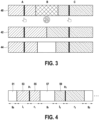
- FIG. 3 shows the ground-truth annotation 40 of a sequence having three patterns A, B and C, only A and C being annotated; the timestamps are represented by a black vertical line, here with a small hand underneath, figuring manual annotation.
- the present disclosure proposes an approach for pseudo-ground-truth generation that is robust to unannotated segments.
- the underlying idea is to only extend the segment boundary from the timestamp position in each direction until a point where the network is still confident in the class of that segment while trying to minimize the size of ignored regions.
- the subset of the video between the two timestamps is divided into three regions.
- the first region 55 with size r i belongs to the first timestamp p i (i.e. comprises the frames to be associated with the pattern of the first timestamp p i )
- the middle or neutral region 57 with size g i is the neutral region (also called ignored region)
- the third region 59 with size l i +1 belongs to the second timestamp p i +1 (i.e. comprises the frames to be associated with the pattern of the second timestamp p i +1 ).
- the first region 55 starts from the first timestamp p i and extends towards the second timestamp p i +1
- the second region starts from the second timestamp p i +1 and extends towards the first timestamp p i
- the neutral region 57 joins the first region 55 to the second region 59.
- the beginning and ending regions of the video are also ignored segments g 0 and g N , respectively: they correspond to the previously-mentioned end regions 51 and the respective neighboring timestamps correspond to the previously-mentioned third timestamps p 1 , p N .
- the regions between an end region and a timestamp are the previously-mentioned third regions 53.
- the third timestamp p 1 may coincide with the first timestamp of the first subset; likewise, the third timestamp p N may coincide with the second timestamp of the last subset.
- the size of the regions may be determined randomly or following any desired rule; only, the first region 55, the neutral region 57 and the second region 59 should not be empty. Experiments have shown that the impact of initialization is small. However, uniform initialization scheme (i.e. the first region 55, the neutral region 57 and the second region 59 initially having the same size) performs better.
- a requirement of the optimizing step 18 is for the network to be confident about the correct action class of the frames in each timestamp region [ p i - l i , p i + r i ] (the hatched regions in Figure 4 ). Simultaneously the size of the neutral regions g i (the white regions in the Figure 4 ) should be as small as possible. In other words, the optimizing is carried out based on a compromise between the size of the neutral region and a match between the pattern estimations of the frames and the regions to which the frames are assigned.
- the goal is to first find the appropriate size of the regions of the video r i , g i , l i and then use them to construct a pseudo-ground-truth for the network training.
- the framewise probabilities of the video ⁇ are estimated using the network (obtaining step 18), namely the same network as that which is then to be trained using the pseudo-ground-truth data.
- the sum of the negative log probabilities of the frames inside that region, ⁇ t p i ⁇ l i p i + r i ⁇ log y ⁇ t y p i should be low.
- the hyper-parameter ⁇ balances the sizes of neutral regions in the result.
- the last three constraints ensure the positivity of the size of the regions. Note that the regions might be empty after optimizing, as opposed to the initializing.
- the hyper-parameter ⁇ may be set between 0.1 and 5, preferably between 0.2 and 2, preferably between 0.5 and 1.5.
- the hyper-parameter ⁇ may be set to 0.7.
- This minimization problem (or model which represents the compromise) is not differentiable and may be solved as such by appropriate methods known in the art.
- the optimizing step 18 comprises solving a differentiable approximation of the non-differentiable model.
- this constrained minimization problem is mapped into an approximate unconstrained optimization problem that can be solved using gradient descent.
- p i ⁇ l i ⁇ t ⁇ p i + r i + ⁇ ⁇ i 0 N g i
- p i - l i ⁇ t ⁇ p i + r i ) is the indicator function with value 1 if t is within the left and right bounds of the timestamp and 0 otherwise.
- the function which is a non-differentiable function with value of 0 or 1 depending on its parameters, can be replaced with the plateau function of FIFA: ( t
- new parameters r ' i , g' i , and l ' i which are the log of the length of the regions relative to each other and can take any real value, may be introduced to make sure that the parameters r i , g i , and l i satisfy the original constraints.
- This optimization is solved for each video in the training batch separately. This optimization problem is only performed during training and to generate the pseudo-ground-truth data. The objective specified in (3) is not used for updating the network weights.
- the pseudo-ground-truth data comprises, for each frame of the first region and/or the second region after the optimizing, identification of said frame and, as a corresponding pattern annotation, the pattern annotation of the first timestamp and/or the second timestamp, respectively.
- the pattern annotations are determined based on the optimized regions.
- the pseudo-ground-truth data may comprise, for each frame of the neutral region after the optimizing, identification of said frame and, as a corresponding pattern annotation, an unknown pattern. Otherwise, the frames of the neutral regions may be ignored or not annotated.
- This pseudo-ground-truth data may be used for training the action segmentation network as in Li (training step 24).
Landscapes
- Engineering & Computer Science (AREA)
- Data Mining & Analysis (AREA)
- Theoretical Computer Science (AREA)
- Computer Vision & Pattern Recognition (AREA)
- Bioinformatics & Cheminformatics (AREA)
- Bioinformatics & Computational Biology (AREA)
- Artificial Intelligence (AREA)
- Evolutionary Biology (AREA)
- Evolutionary Computation (AREA)
- Physics & Mathematics (AREA)
- General Engineering & Computer Science (AREA)
- General Physics & Mathematics (AREA)
- Life Sciences & Earth Sciences (AREA)
- Image Analysis (AREA)
Claims (12)
- Computerimplementiertes Verfahren (10) zum Erzeugen von Pseudo-Ground-Truth-Daten zum Trainieren eines Modells maschinellen Lernens, um Muster in einer Abfolge von Frames über eine Sukzessionsdimension zu segmentieren oder zu lokalisieren, das Verfahren umfassend:- Bereitstellen (12) einer Abfolge von Frames und einer Vielzahl von Zeitstempeln (52), wobei jeder Zeitstempel eine Identifizierung eines entsprechenden Frames und eine Musterbezeichnung des Frames beinhaltet;- Definieren (14) mindestens eines Teilsatzes (54), der die Frames umfasst, die sich zwischen einem ersten Zeitstempel (pi ) und einem darauf folgenden zweiten Zeitstempel ( pi+1 ) der Vielzahl von Zeitstempeln in der Sukzessionsdimension befinden;- anfängliches Zuordnen (16) der Frames des mindestens einen Teilsatzes (54) zu einer von drei nicht leeren Regionen, die drei Regionen umfassend eine erste Region (55), eine zweite Region (59) und eine neutrale Region (57), die die erste Region (55) mit der zweiten Region (59) verbindet, wobei die erste Region (55) an dem ersten Zeitstempel (pi ) beginnt und sich zu dem zweiten Zeitstempel (p i+1) erstreckt, und die Frames umfasst, die mit dem Muster des ersten Zeitstempels (pi ) assoziiert werden sollen, wobei die zweite Region (59) an dem zweiten Zeitstempel (p i+1) beginnt und sich zu dem ersten Zeitstempel (pi ) erstreckt und die Frames umfasst, die mit dem Muster des zweiten Zeitstempels (p i+1) assoziiert werden sollen;- Erlangen (18) von Musterschätzungen für jedes Frame des mindestens einen Teilsatzes;- Optimieren (20) jeweiliger Grenzen zwischen der ersten Region (55), der zweiten Region (59) und der neutralen Region (57) basierend auf einem Kompromiss zwischen der Größe der neutralen Region (57) und einer Übereinstimmung zwischen den Musterschätzungen der Frames und den Regionen, denen die Frames zugeordnet sind;- Ausgeben (22) von Pseudo-Ground-Truth-Daten (60), umfassend, für jedes Frame der ersten Region und/oder der zweiten Region nach der Optimierung, eine Identifizierung des Frames und, als entsprechende Musterbezeichnung, die Musterbezeichnung des ersten Zeitstempels (pi ) bzw. des zweiten Zeitstempels (p i+1) umfassen;wobei das Optimieren ein Lösen des eingeschränkten Minimierungsproblems umfasst
 wobei ri die Anzahl an Frames der ersten Region, gi die Anzahl an Frames der neutralen Region, li+1 die Anzahl an Frames der zweiten Region, N die Anzahl der Zeitstempel, pi die Position des i-ten Zeitstempels in der Abfolge, ypi die Musteranmerkung des i-ten Zeitstempels, ỹt die Musterschätzung für Frame t und β ein Hyperparameter ist.
 - Verfahren nach Anspruch 1, wobei die Musterschätzungen durch das Modell maschinellen Lernens erlangt werden.
- Verfahren nach Anspruch 1 oder 2, wobei die neutrale Region (57) die Frames umfasst, die mit einem unbekannten Muster assoziiert werden sollen, und optional wobei die Pseudo-Ground-Truth-Daten (60), für jedes Frame der neutralen Region (57) nach der Optimierung, eine Identifizierung des Frames und, als entsprechende Musterbezeichnung, das unbekannte Muster umfassen.
- Verfahren nach einem der Ansprüche 1 bis 3, wobei die Abfolge von Frames (50) ausgewählt ist aus einer Gruppe, umfassend eine Vielzahl von Bildern, ein Video, eine Tonspur, einen elektrischen Eingang.
- Verfahren nach einem der Ansprüche 1 bis 4, wobei das Muster eine Aktion ist.
- Verfahren nach einem der Ansprüche 1 bis 5, ferner umfassend:- Definieren mindestens eines Endteilsatzes, umfassend die Frames, die sich zwischen einem Ende der Abfolge und einem dritten Zeitstempel (pi ), der auf dieses Ende folgt, in der Sukzessionsdimension befinden;- anfängliches Zuordnen der Frames des mindestens einen Endteilsatzes zu einem von zwei nicht leeren Regionen, wobei die zwei Regionen eine dritte Region (53) und eine Endregion (51) umfassen, wobei die dritte Region (53) an dem dritten Zeitstempel (pi ) beginnt und sich zu dem Ende der Abfolge erstreckt und die Frames umfasst, die mit dem Muster des dritten Zeitstempels (pi ) assoziiert werden sollen, und die Endregion (51) die dritte Region (53) mit dem Ende der Abfolge verbindet;- Erlangen von Musterschätzungen für jedes Frame des mindestens einen Endteil satzes;- Optimieren einer Grenze zwischen der dritten Region (53) und der Endregion (51) basierend auf einem Kompromiss zwischen der Größe der Endregion und einer Übereinstimmung zwischen den Musterschätzungen der Frames und den Regionen, denen die Frames zugeordnet sind;wobei die Pseudo-Ground-Truth-Daten (60) für jedes Frame der dritten Region (53) nach der Optimierung eine Identifizierung des Frames und, als entsprechende Musterbezeichnung, die Musterbezeichnung des dritten Zeitstempels (pi ) umfassen.
- Verfahren nach einem der Ansprüche 1 bis 6, wobei eine Übereinstimmung zwischen den Musterschätzungen der Frames und den Regionen, denen die Frames zugeordnet sind, unter Verwendung einer Summe von logarithmischen Wahrscheinlichkeiten der Musterschätzungen der den jeweiligen Regionen zugeordneten Frames quantifiziert wird.
- Verfahren nach einem der Ansprüche 1 bis 7, wobei der Kompromiss durch ein nicht differenzierbares Modell dargestellt ist und das Optimieren ein Lösen einer differenzierbaren Annäherung des nicht differenzierbaren Modells umfasst.
- Trainingsverfahren für ein Modell maschinellen Lernens, das konfiguriert ist, um Muster in einer Abfolge von Frames über eine Sukzessionsdimension zu segmentieren oder zu lokalisieren, das Trainingsverfahren umfassend:- Erzeugen von Pseudo-Ground-Truth-Daten gemäß dem Verfahren (10) nach einem der Ansprüche 1 bis 8;- Trainieren (24) des Modells maschinellen Lernens basierend auf den Pseudo-Ground-Truth-Daten.
- System (30), das konfiguriert ist, um Pseudo-Ground-Truth-Daten zum Trainieren eines Modells maschinellen Lernens zu erzeugen, um Muster in einer Abfolge von Frames über eine Sukzessionsdimension zu segmentieren oder zu lokalisieren, wobei das System zu Folgendem konfiguriert ist:- Bereitstellen einer Abfolge von Frames und einer Vielzahl von Zeitstempeln, wobei jeder Zeitstempel eine Identifizierung eines entsprechenden Frames und eine Musterbezeichnung des Frames beinhaltet;- Definieren mindestens eines Teilsatzes, der die Frames umfasst, die sich zwischen einem ersten Zeitstempel und einem darauf folgenden zweiten Zeitstempel der Vielzahl von Zeitstempeln in der Sukzessionsdimension befinden;- anfängliches Zuordnen der Frames des mindestens einen Teilsatzes zu einer von drei nicht leeren Regionen, die drei Regionen umfassend eine erste Region, eine zweite Region und eine neutrale Region, die die erste Region mit der zweiten Region verbindet, wobei die erste Region an dem ersten Zeitstempel beginnt und sich zu dem zweiten Zeitstempel erstreckt, und die Frames umfasst, die mit dem Muster des ersten Zeitstempels assoziiert werden sollen, wobei die zweite Region an dem zweiten Zeitstempel beginnt und sich zu dem ersten Zeitstempel erstreckt und die Frames umfasst, die mit dem Muster des zweiten Zeitstempels assoziiert werden sollen;- Erlangen von Musterschätzungen für jedes Frame des mindestens einen Teilsatzes;- Optimieren jeweiliger Grenzen zwischen der ersten Region, der zweiten Region und der neutralen Region basierend auf einem Kompromiss zwischen der Größe der neutralen Region und einer Übereinstimmung zwischen den Musterschätzungen der Frames und den Regionen, denen die Frames zugeordnet sind;- Ausgeben von Pseudo-Ground-Truth-Daten, umfassend, für jedes Frame der ersten Region und/oder der zweiten Region nach der Optimierung, eine Identifizierung des Frames und, als entsprechende Musterbezeichnung, die Musterbezeichnung des ersten Zeitstempels bzw. des zweiten Zeitstempels umfassen;wobei das Optimieren ein Lösen des eingeschränkten Minimierungsproblems umfasst
 wobei ri die Anzahl an Frames der ersten Region, gi die Anzahl an Frames der neutralen Region, li+1 die Anzahl an Frames der zweiten Region, N die Anzahl der Zeitstempel, pi die Position des i-ten Zeitstempels in der Abfolge, ypi die Musteranmerkung des i-ten Zeitstempels, ỹt die Musterschätzung für Frame t und β ein Hyperparameter ist.
 - Computerprogramm, umfassend Anweisungen, die, wenn das Programm von einem Computer ausgeführt wird, den Computer veranlassen, die Schritte des Verfahrens nach einem der Ansprüche 1 bis 9 durchzuführen.
- Computerlesbares Speichermedium, umfassend Anweisungen, die, wenn das Programm von einem Computer ausgeführt wird, den Computer veranlassen, die Schritte des Verfahrens nach einem der Ansprüche 1 bis 9 durchzuführen.
Priority Applications (1)
| Application Number | Priority Date | Filing Date | Title |
|---|---|---|---|
| EP22174715.7A EP4280101B1 (de) | 2022-05-20 | 2022-05-20 | Pseudo-grun-truth-erzeugung aus zeitstempelüberwachung |
Applications Claiming Priority (1)
| Application Number | Priority Date | Filing Date | Title |
|---|---|---|---|
| EP22174715.7A EP4280101B1 (de) | 2022-05-20 | 2022-05-20 | Pseudo-grun-truth-erzeugung aus zeitstempelüberwachung |
Publications (2)
| Publication Number | Publication Date |
|---|---|
| EP4280101A1 EP4280101A1 (de) | 2023-11-22 |
| EP4280101B1 true EP4280101B1 (de) | 2024-11-20 |
Family
ID=81878052
Family Applications (1)
| Application Number | Title | Priority Date | Filing Date |
|---|---|---|---|
| EP22174715.7A Active EP4280101B1 (de) | 2022-05-20 | 2022-05-20 | Pseudo-grun-truth-erzeugung aus zeitstempelüberwachung |
Country Status (1)
| Country | Link |
|---|---|
| EP (1) | EP4280101B1 (de) |
-
2022
- 2022-05-20 EP EP22174715.7A patent/EP4280101B1/de active Active
Also Published As
| Publication number | Publication date |
|---|---|
| EP4280101A1 (de) | 2023-11-22 |
Similar Documents
| Publication | Publication Date | Title |
|---|---|---|
| US11640714B2 (en) | Video panoptic segmentation | |
| US11526698B2 (en) | Unified referring video object segmentation network | |
| US11144761B2 (en) | Deep data association for online multi-class multi-object tracking | |
| Fathi et al. | Combining Self Training and Active Learning for Video Segmentation. | |
| US7835542B2 (en) | Object tracking systems and methods utilizing compressed-domain motion-based segmentation | |
| RU2742701C1 (ru) | Способ интерактивной сегментации объекта на изображении и электронное вычислительное устройство для его реализации | |
| WO2021050773A1 (en) | Keypoint based pose-tracking using entailment | |
| KR102781017B1 (ko) | 모조 마스크 기반 약지도 시맨틱 분할 장치 및 방법 | |
| US20100195870A1 (en) | Tracking method and device adopting a series of observation models with different life spans | |
| CN113920170A (zh) | 结合场景上下文和行人社会关系的行人轨迹预测方法、系统及存储介质 | |
| Li et al. | Cfad: Coarse-to-fine action detector for spatiotemporal action localization | |
| US20250157055A1 (en) | Method and apparatus with scene flow estimation | |
| US20250316061A1 (en) | Method for training a machine learning model for discovering objects in an image sequence | |
| CN117765432A (zh) | 一种基于动作边界预测的中学理化生实验动作检测方法 | |
| US20250104470A1 (en) | Video face clustering | |
| KR20240035066A (ko) | 약지도 이미지 분할 모델의 학습 방법 | |
| EP4280101B1 (de) | Pseudo-grun-truth-erzeugung aus zeitstempelüberwachung | |
| EP4116870A1 (de) | Computerimplementiertes verfahren zur segmentierung von mustern in einer folge von rahmen | |
| CN117036285B (zh) | 一种基于注释和预测一致性的半监督分割方法 | |
| Nguyen et al. | Self-Supervise Reinforcement Learning Method for Vacant Parking Space Detection Based on Task Consistency and Corrupted Rewards | |
| KR20250007222A (ko) | 자세 추정을 위한 방법 및 장치 | |
| EP4469916A1 (de) | System und verfahren zur qualitätsprüfung markierter bilder | |
| CN120014307A (zh) | 由电子设备执行的方法、对应的电子设备及存储介质 | |
| CN115937161A (zh) | 基于自适应阈值半监督的矿石分选方法和计算机存储介质 | |
| Zhang et al. | Semi-supervised video object segmentation via an edge attention gated graph convolutional network |
Legal Events
| Date | Code | Title | Description |
|---|---|---|---|
| PUAI | Public reference made under article 153(3) epc to a published international application that has entered the european phase |
Free format text: ORIGINAL CODE: 0009012 |
|
| STAA | Information on the status of an ep patent application or granted ep patent |
Free format text: STATUS: REQUEST FOR EXAMINATION WAS MADE |
|
| 17P | Request for examination filed |
Effective date: 20220520 |
|
| AK | Designated contracting states |
Kind code of ref document: A1 Designated state(s): AL AT BE BG CH CY CZ DE DK EE ES FI FR GB GR HR HU IE IS IT LI LT LU LV MC MK MT NL NO PL PT RO RS SE SI SK SM TR |
|
| REG | Reference to a national code |
Ref country code: DE Ref legal event code: R079 Ref document number: 602022007816 Country of ref document: DE Free format text: PREVIOUS MAIN CLASS: G06K0009620000 Ipc: G06F0018000000 |
|
| GRAP | Despatch of communication of intention to grant a patent |
Free format text: ORIGINAL CODE: EPIDOSNIGR1 |
|
| STAA | Information on the status of an ep patent application or granted ep patent |
Free format text: STATUS: GRANT OF PATENT IS INTENDED |
|
| RIC1 | Information provided on ipc code assigned before grant |
Ipc: G06F 18/00 20230101AFI20240704BHEP |
|
| INTG | Intention to grant announced |
Effective date: 20240718 |
|
| GRAS | Grant fee paid |
Free format text: ORIGINAL CODE: EPIDOSNIGR3 |
|
| GRAA | (expected) grant |
Free format text: ORIGINAL CODE: 0009210 |
|
| STAA | Information on the status of an ep patent application or granted ep patent |
Free format text: STATUS: THE PATENT HAS BEEN GRANTED |
|
| AK | Designated contracting states |
Kind code of ref document: B1 Designated state(s): AL AT BE BG CH CY CZ DE DK EE ES FI FR GB GR HR HU IE IS IT LI LT LU LV MC MK MT NL NO PL PT RO RS SE SI SK SM TR |
|
| REG | Reference to a national code |
Ref country code: GB Ref legal event code: FG4D |
|
| REG | Reference to a national code |
Ref country code: CH Ref legal event code: EP |
|
| REG | Reference to a national code |
Ref country code: DE Ref legal event code: R096 Ref document number: 602022007816 Country of ref document: DE |
|
| REG | Reference to a national code |
Ref country code: IE Ref legal event code: FG4D |
|
| REG | Reference to a national code |
Ref country code: LT Ref legal event code: MG9D |
|
| REG | Reference to a national code |
Ref country code: NL Ref legal event code: MP Effective date: 20241120 |
|
| PG25 | Lapsed in a contracting state [announced via postgrant information from national office to epo] |
Ref country code: HR Free format text: LAPSE BECAUSE OF FAILURE TO SUBMIT A TRANSLATION OF THE DESCRIPTION OR TO PAY THE FEE WITHIN THE PRESCRIBED TIME-LIMIT Effective date: 20241120 Ref country code: IS Free format text: LAPSE BECAUSE OF FAILURE TO SUBMIT A TRANSLATION OF THE DESCRIPTION OR TO PAY THE FEE WITHIN THE PRESCRIBED TIME-LIMIT Effective date: 20250320 Ref country code: PT Free format text: LAPSE BECAUSE OF FAILURE TO SUBMIT A TRANSLATION OF THE DESCRIPTION OR TO PAY THE FEE WITHIN THE PRESCRIBED TIME-LIMIT Effective date: 20250320 |
|
| PG25 | Lapsed in a contracting state [announced via postgrant information from national office to epo] |
Ref country code: NL Free format text: LAPSE BECAUSE OF FAILURE TO SUBMIT A TRANSLATION OF THE DESCRIPTION OR TO PAY THE FEE WITHIN THE PRESCRIBED TIME-LIMIT Effective date: 20241120 Ref country code: FI Free format text: LAPSE BECAUSE OF FAILURE TO SUBMIT A TRANSLATION OF THE DESCRIPTION OR TO PAY THE FEE WITHIN THE PRESCRIBED TIME-LIMIT Effective date: 20241120 |
|
| REG | Reference to a national code |
Ref country code: AT Ref legal event code: MK05 Ref document number: 1744215 Country of ref document: AT Kind code of ref document: T Effective date: 20241120 Ref country code: DE Ref legal event code: R081 Ref document number: 602022007816 Country of ref document: DE Owner name: TOYOTA JIDOSHA KABUSHIKI KAISHA, TOYOTA-SHI, JP Free format text: FORMER OWNER: ANMELDERANGABEN UNKLAR / UNVOLLSTAENDIG, 80297 MUENCHEN, DE Ref country code: DE Ref legal event code: R081 Ref document number: 602022007816 Country of ref document: DE Owner name: RHEINISCHE FRIEDRICH-WILHELMS-UNIVERSITAET BON, DE Free format text: FORMER OWNER: ANMELDERANGABEN UNKLAR / UNVOLLSTAENDIG, 80297 MUENCHEN, DE |
|
| PG25 | Lapsed in a contracting state [announced via postgrant information from national office to epo] |
Ref country code: BG Free format text: LAPSE BECAUSE OF FAILURE TO SUBMIT A TRANSLATION OF THE DESCRIPTION OR TO PAY THE FEE WITHIN THE PRESCRIBED TIME-LIMIT Effective date: 20241120 |
|
| PG25 | Lapsed in a contracting state [announced via postgrant information from national office to epo] |
Ref country code: ES Free format text: LAPSE BECAUSE OF FAILURE TO SUBMIT A TRANSLATION OF THE DESCRIPTION OR TO PAY THE FEE WITHIN THE PRESCRIBED TIME-LIMIT Effective date: 20241120 |
|
| PG25 | Lapsed in a contracting state [announced via postgrant information from national office to epo] |
Ref country code: NO Free format text: LAPSE BECAUSE OF FAILURE TO SUBMIT A TRANSLATION OF THE DESCRIPTION OR TO PAY THE FEE WITHIN THE PRESCRIBED TIME-LIMIT Effective date: 20250220 |
|
| PG25 | Lapsed in a contracting state [announced via postgrant information from national office to epo] |
Ref country code: GR Free format text: LAPSE BECAUSE OF FAILURE TO SUBMIT A TRANSLATION OF THE DESCRIPTION OR TO PAY THE FEE WITHIN THE PRESCRIBED TIME-LIMIT Effective date: 20250221 Ref country code: AT Free format text: LAPSE BECAUSE OF FAILURE TO SUBMIT A TRANSLATION OF THE DESCRIPTION OR TO PAY THE FEE WITHIN THE PRESCRIBED TIME-LIMIT Effective date: 20241120 Ref country code: LV Free format text: LAPSE BECAUSE OF FAILURE TO SUBMIT A TRANSLATION OF THE DESCRIPTION OR TO PAY THE FEE WITHIN THE PRESCRIBED TIME-LIMIT Effective date: 20241120 |
|
| PG25 | Lapsed in a contracting state [announced via postgrant information from national office to epo] |
Ref country code: PL Free format text: LAPSE BECAUSE OF FAILURE TO SUBMIT A TRANSLATION OF THE DESCRIPTION OR TO PAY THE FEE WITHIN THE PRESCRIBED TIME-LIMIT Effective date: 20241120 |
|
| PG25 | Lapsed in a contracting state [announced via postgrant information from national office to epo] |
Ref country code: RS Free format text: LAPSE BECAUSE OF FAILURE TO SUBMIT A TRANSLATION OF THE DESCRIPTION OR TO PAY THE FEE WITHIN THE PRESCRIBED TIME-LIMIT Effective date: 20250220 |
|
| PG25 | Lapsed in a contracting state [announced via postgrant information from national office to epo] |
Ref country code: SM Free format text: LAPSE BECAUSE OF FAILURE TO SUBMIT A TRANSLATION OF THE DESCRIPTION OR TO PAY THE FEE WITHIN THE PRESCRIBED TIME-LIMIT Effective date: 20241120 |
|
| PGFP | Annual fee paid to national office [announced via postgrant information from national office to epo] |
Ref country code: DE Payment date: 20250402 Year of fee payment: 4 |
|
| PG25 | Lapsed in a contracting state [announced via postgrant information from national office to epo] |
Ref country code: DK Free format text: LAPSE BECAUSE OF FAILURE TO SUBMIT A TRANSLATION OF THE DESCRIPTION OR TO PAY THE FEE WITHIN THE PRESCRIBED TIME-LIMIT Effective date: 20241120 |
|
| PG25 | Lapsed in a contracting state [announced via postgrant information from national office to epo] |
Ref country code: EE Free format text: LAPSE BECAUSE OF FAILURE TO SUBMIT A TRANSLATION OF THE DESCRIPTION OR TO PAY THE FEE WITHIN THE PRESCRIBED TIME-LIMIT Effective date: 20241120 |
|
| PG25 | Lapsed in a contracting state [announced via postgrant information from national office to epo] |
Ref country code: RO Free format text: LAPSE BECAUSE OF FAILURE TO SUBMIT A TRANSLATION OF THE DESCRIPTION OR TO PAY THE FEE WITHIN THE PRESCRIBED TIME-LIMIT Effective date: 20241120 |
|
| PG25 | Lapsed in a contracting state [announced via postgrant information from national office to epo] |
Ref country code: SK Free format text: LAPSE BECAUSE OF FAILURE TO SUBMIT A TRANSLATION OF THE DESCRIPTION OR TO PAY THE FEE WITHIN THE PRESCRIBED TIME-LIMIT Effective date: 20241120 |
|
| PG25 | Lapsed in a contracting state [announced via postgrant information from national office to epo] |
Ref country code: CZ Free format text: LAPSE BECAUSE OF FAILURE TO SUBMIT A TRANSLATION OF THE DESCRIPTION OR TO PAY THE FEE WITHIN THE PRESCRIBED TIME-LIMIT Effective date: 20241120 |
|
| PG25 | Lapsed in a contracting state [announced via postgrant information from national office to epo] |
Ref country code: IT Free format text: LAPSE BECAUSE OF FAILURE TO SUBMIT A TRANSLATION OF THE DESCRIPTION OR TO PAY THE FEE WITHIN THE PRESCRIBED TIME-LIMIT Effective date: 20241120 |
|
| REG | Reference to a national code |
Ref country code: DE Ref legal event code: R097 Ref document number: 602022007816 Country of ref document: DE |
|
| PG25 | Lapsed in a contracting state [announced via postgrant information from national office to epo] |
Ref country code: SE Free format text: LAPSE BECAUSE OF FAILURE TO SUBMIT A TRANSLATION OF THE DESCRIPTION OR TO PAY THE FEE WITHIN THE PRESCRIBED TIME-LIMIT Effective date: 20241120 |
|
| PLBE | No opposition filed within time limit |
Free format text: ORIGINAL CODE: 0009261 |
|
| STAA | Information on the status of an ep patent application or granted ep patent |
Free format text: STATUS: NO OPPOSITION FILED WITHIN TIME LIMIT |
|
| 26N | No opposition filed |
Effective date: 20250821 |
|
| REG | Reference to a national code |
Ref country code: CH Ref legal event code: H13 Free format text: ST27 STATUS EVENT CODE: U-0-0-H10-H13 (AS PROVIDED BY THE NATIONAL OFFICE) Effective date: 20251223 |
|
| PG25 | Lapsed in a contracting state [announced via postgrant information from national office to epo] |
Ref country code: LU Free format text: LAPSE BECAUSE OF NON-PAYMENT OF DUE FEES Effective date: 20250520 |
|
| PG25 | Lapsed in a contracting state [announced via postgrant information from national office to epo] |
Ref country code: CH Free format text: LAPSE BECAUSE OF NON-PAYMENT OF DUE FEES Effective date: 20250531 |
|
| REG | Reference to a national code |
Ref country code: BE Ref legal event code: MM Effective date: 20250531 |
|
| PG25 | Lapsed in a contracting state [announced via postgrant information from national office to epo] |
Ref country code: MC Free format text: LAPSE BECAUSE OF FAILURE TO SUBMIT A TRANSLATION OF THE DESCRIPTION OR TO PAY THE FEE WITHIN THE PRESCRIBED TIME-LIMIT Effective date: 20241120 |
|
| PG25 | Lapsed in a contracting state [announced via postgrant information from national office to epo] |
Ref country code: IE Free format text: LAPSE BECAUSE OF NON-PAYMENT OF DUE FEES Effective date: 20250520 |
|
| PG25 | Lapsed in a contracting state [announced via postgrant information from national office to epo] |
Ref country code: BE Free format text: LAPSE BECAUSE OF NON-PAYMENT OF DUE FEES Effective date: 20250531 |
|
| PG25 | Lapsed in a contracting state [announced via postgrant information from national office to epo] |
Ref country code: FR Free format text: LAPSE BECAUSE OF NON-PAYMENT OF DUE FEES Effective date: 20250531 |