EP4279991A1 - Novel sulfonium salt, resist composition, and patterning process - Google Patents
Novel sulfonium salt, resist composition, and patterning process Download PDFInfo
- Publication number
- EP4279991A1 EP4279991A1 EP23171817.2A EP23171817A EP4279991A1 EP 4279991 A1 EP4279991 A1 EP 4279991A1 EP 23171817 A EP23171817 A EP 23171817A EP 4279991 A1 EP4279991 A1 EP 4279991A1
- Authority
- EP
- European Patent Office
- Prior art keywords
- group
- carbon atoms
- atom
- optionally
- bond
- Prior art date
- Legal status (The legal status is an assumption and is not a legal conclusion. Google has not performed a legal analysis and makes no representation as to the accuracy of the status listed.)
- Pending
Links
- 239000000203 mixture Substances 0.000 title claims abstract description 123
- RWSOTUBLDIXVET-UHFFFAOYSA-N Dihydrogen sulfide Chemical class S RWSOTUBLDIXVET-UHFFFAOYSA-N 0.000 title claims abstract description 50
- 238000000034 method Methods 0.000 title claims abstract description 43
- 230000008569 process Effects 0.000 title claims abstract description 21
- 238000000059 patterning Methods 0.000 title claims abstract description 19
- 125000004432 carbon atom Chemical group C* 0.000 claims abstract description 185
- 125000001183 hydrocarbyl group Chemical group 0.000 claims abstract description 143
- 125000001153 fluoro group Chemical group F* 0.000 claims abstract description 83
- 229910052731 fluorine Inorganic materials 0.000 claims abstract description 80
- 125000000217 alkyl group Chemical group 0.000 claims abstract description 34
- 230000000269 nucleophilic effect Effects 0.000 claims abstract description 22
- 125000003545 alkoxy group Chemical group 0.000 claims abstract description 10
- -1 sulfonium cation Chemical group 0.000 claims description 177
- 125000005842 heteroatom Chemical group 0.000 claims description 67
- 125000004435 hydrogen atom Chemical group [H]* 0.000 claims description 62
- RTZKZFJDLAIYFH-UHFFFAOYSA-N ether Substances CCOCC RTZKZFJDLAIYFH-UHFFFAOYSA-N 0.000 claims description 58
- 125000004122 cyclic group Chemical group 0.000 claims description 50
- 125000000843 phenylene group Chemical group C1(=C(C=CC=C1)*)* 0.000 claims description 50
- 125000002887 hydroxy group Chemical group [H]O* 0.000 claims description 48
- 229910052717 sulfur Inorganic materials 0.000 claims description 44
- 125000004434 sulfur atom Chemical group 0.000 claims description 44
- 125000004430 oxygen atom Chemical group O* 0.000 claims description 40
- 239000004094 surface-active agent Substances 0.000 claims description 38
- 125000000743 hydrocarbylene group Chemical group 0.000 claims description 37
- 150000001768 cations Chemical class 0.000 claims description 33
- XLYOFNOQVPJJNP-UHFFFAOYSA-N water Substances O XLYOFNOQVPJJNP-UHFFFAOYSA-N 0.000 claims description 33
- 125000002915 carbonyl group Chemical group [*:2]C([*:1])=O 0.000 claims description 30
- 125000002023 trifluoromethyl group Chemical group FC(F)(F)* 0.000 claims description 28
- 125000001931 aliphatic group Chemical group 0.000 claims description 26
- 150000002596 lactones Chemical group 0.000 claims description 26
- 239000003960 organic solvent Substances 0.000 claims description 24
- 125000001424 substituent group Chemical group 0.000 claims description 24
- 239000011347 resin Substances 0.000 claims description 22
- 229920005989 resin Polymers 0.000 claims description 22
- 150000001875 compounds Chemical class 0.000 claims description 21
- 229910052799 carbon Inorganic materials 0.000 claims description 18
- 125000004957 naphthylene group Chemical group 0.000 claims description 18
- 125000004093 cyano group Chemical group *C#N 0.000 claims description 15
- 125000002496 methyl group Chemical group [H]C([H])([H])* 0.000 claims description 15
- 238000010894 electron beam technology Methods 0.000 claims description 14
- 150000008053 sultones Chemical group 0.000 claims description 14
- 150000001244 carboxylic acid anhydrides Chemical class 0.000 claims description 13
- 239000000758 substrate Substances 0.000 claims description 13
- 125000001570 methylene group Chemical group [H]C([H])([*:1])[*:2] 0.000 claims description 10
- 125000003178 carboxy group Chemical group [H]OC(*)=O 0.000 claims description 9
- 125000000816 ethylene group Chemical group [H]C([H])([*:1])C([H])([H])[*:2] 0.000 claims description 9
- 125000000623 heterocyclic group Chemical group 0.000 claims description 8
- ISWSIDIOOBJBQZ-UHFFFAOYSA-N phenol group Chemical group C1(=CC=CC=C1)O ISWSIDIOOBJBQZ-UHFFFAOYSA-N 0.000 claims description 7
- 125000000101 thioether group Chemical group 0.000 claims description 6
- LGRLWUINFJPLSH-UHFFFAOYSA-N methanide Chemical compound [CH3-] LGRLWUINFJPLSH-UHFFFAOYSA-N 0.000 claims description 5
- 229940124530 sulfonamide Drugs 0.000 claims description 5
- 125000003709 fluoroalkyl group Chemical group 0.000 claims description 4
- 125000000020 sulfo group Chemical group O=S(=O)([*])O[H] 0.000 claims description 4
- 239000002904 solvent Substances 0.000 abstract description 45
- 230000035945 sensitivity Effects 0.000 abstract description 20
- UCKMPCXJQFINFW-UHFFFAOYSA-N Sulphide Chemical compound [S-2] UCKMPCXJQFINFW-UHFFFAOYSA-N 0.000 abstract 1
- ACLBTXLOASZGRX-UHFFFAOYSA-N 2-(2,3-dihydro-1,4-benzodioxin-5-yloxy)-n,n-diethylethanamine;hydrochloride Chemical compound Cl.O1CCOC2=C1C=CC=C2OCCN(CC)CC ACLBTXLOASZGRX-UHFFFAOYSA-N 0.000 description 73
- 239000002253 acid Substances 0.000 description 70
- ARXJGSRGQADJSQ-UHFFFAOYSA-N 1-methoxypropan-2-ol Chemical compound COCC(C)O ARXJGSRGQADJSQ-UHFFFAOYSA-N 0.000 description 67
- 230000000052 comparative effect Effects 0.000 description 67
- SWXVUIWOUIDPGS-UHFFFAOYSA-N diacetone alcohol Chemical compound CC(=O)CC(C)(C)O SWXVUIWOUIDPGS-UHFFFAOYSA-N 0.000 description 66
- LLHKCFNBLRBOGN-UHFFFAOYSA-N propylene glycol methyl ether acetate Chemical compound COCC(C)OC(C)=O LLHKCFNBLRBOGN-UHFFFAOYSA-N 0.000 description 65
- 150000001450 anions Chemical class 0.000 description 52
- 229920000642 polymer Polymers 0.000 description 32
- 238000011161 development Methods 0.000 description 30
- 230000018109 developmental process Effects 0.000 description 30
- 125000003118 aryl group Chemical group 0.000 description 29
- 239000000243 solution Substances 0.000 description 29
- 229920005601 base polymer Polymers 0.000 description 28
- 150000003839 salts Chemical class 0.000 description 27
- 229910052757 nitrogen Inorganic materials 0.000 description 22
- 125000004433 nitrogen atom Chemical group N* 0.000 description 22
- 229920006395 saturated elastomer Polymers 0.000 description 22
- WYURNTSHIVDZCO-UHFFFAOYSA-N Tetrahydrofuran Chemical compound C1CCOC1 WYURNTSHIVDZCO-UHFFFAOYSA-N 0.000 description 20
- 239000002585 base Substances 0.000 description 20
- 238000009792 diffusion process Methods 0.000 description 20
- 230000015572 biosynthetic process Effects 0.000 description 19
- 238000003786 synthesis reaction Methods 0.000 description 19
- 239000000178 monomer Substances 0.000 description 18
- 238000006243 chemical reaction Methods 0.000 description 16
- 150000001721 carbon Chemical group 0.000 description 14
- 238000006116 polymerization reaction Methods 0.000 description 13
- 238000004090 dissolution Methods 0.000 description 12
- 125000005843 halogen group Chemical group 0.000 description 12
- 238000001459 lithography Methods 0.000 description 12
- WGTYBPLFGIVFAS-UHFFFAOYSA-M tetramethylammonium hydroxide Chemical compound [OH-].C[N+](C)(C)C WGTYBPLFGIVFAS-UHFFFAOYSA-M 0.000 description 12
- WKBOTKDWSSQWDR-UHFFFAOYSA-N Bromine atom Chemical group [Br] WKBOTKDWSSQWDR-UHFFFAOYSA-N 0.000 description 11
- YMWUJEATGCHHMB-UHFFFAOYSA-N Dichloromethane Chemical compound ClCCl YMWUJEATGCHHMB-UHFFFAOYSA-N 0.000 description 11
- 239000000463 material Substances 0.000 description 11
- 125000001997 phenyl group Chemical group [H]C1=C([H])C([H])=C(*)C([H])=C1[H] 0.000 description 11
- ZCYVEMRRCGMTRW-UHFFFAOYSA-N 7553-56-2 Chemical group [I] ZCYVEMRRCGMTRW-UHFFFAOYSA-N 0.000 description 10
- IAZDPXIOMUYVGZ-WFGJKAKNSA-N Dimethyl sulfoxide Chemical compound [2H]C([2H])([2H])S(=O)C([2H])([2H])[2H] IAZDPXIOMUYVGZ-WFGJKAKNSA-N 0.000 description 10
- 229910052740 iodine Inorganic materials 0.000 description 10
- 108010001861 pregnancy-associated glycoprotein 1 Proteins 0.000 description 10
- YLQBMQCUIZJEEH-UHFFFAOYSA-N tetrahydrofuran Natural products C=1C=COC=1 YLQBMQCUIZJEEH-UHFFFAOYSA-N 0.000 description 10
- YXFVVABEGXRONW-UHFFFAOYSA-N Toluene Chemical compound CC1=CC=CC=C1 YXFVVABEGXRONW-UHFFFAOYSA-N 0.000 description 9
- 239000007864 aqueous solution Substances 0.000 description 9
- 229910052801 chlorine Inorganic materials 0.000 description 9
- 125000001309 chloro group Chemical group Cl* 0.000 description 9
- 125000000113 cyclohexyl group Chemical group [H]C1([H])C([H])([H])C([H])([H])C([H])(*)C([H])([H])C1([H])[H] 0.000 description 9
- 230000000694 effects Effects 0.000 description 9
- 238000005516 engineering process Methods 0.000 description 9
- 238000011156 evaluation Methods 0.000 description 9
- 230000002401 inhibitory effect Effects 0.000 description 9
- 125000001624 naphthyl group Chemical group 0.000 description 9
- 125000001511 cyclopentyl group Chemical group [H]C1([H])C([H])([H])C([H])([H])C([H])(*)C1([H])[H] 0.000 description 8
- LZCLXQDLBQLTDK-UHFFFAOYSA-N ethyl 2-hydroxypropanoate Chemical compound CCOC(=O)C(C)O LZCLXQDLBQLTDK-UHFFFAOYSA-N 0.000 description 8
- 125000001495 ethyl group Chemical group [H]C([H])([H])C([H])([H])* 0.000 description 8
- 125000001188 haloalkyl group Chemical group 0.000 description 8
- 125000001449 isopropyl group Chemical group [H]C([H])([H])C([H])(*)C([H])([H])[H] 0.000 description 8
- 238000004519 manufacturing process Methods 0.000 description 8
- 125000002868 norbornyl group Chemical group C12(CCC(CC1)C2)* 0.000 description 8
- 125000000999 tert-butyl group Chemical group [H]C([H])([H])C(*)(C([H])([H])[H])C([H])([H])[H] 0.000 description 8
- 238000005160 1H NMR spectroscopy Methods 0.000 description 7
- PEDCQBHIVMGVHV-UHFFFAOYSA-N Glycerine Chemical compound OCC(O)CO PEDCQBHIVMGVHV-UHFFFAOYSA-N 0.000 description 7
- 125000005073 adamantyl group Chemical group C12(CC3CC(CC(C1)C3)C2)* 0.000 description 7
- 230000006866 deterioration Effects 0.000 description 7
- 125000004108 n-butyl group Chemical group [H]C([H])([H])C([H])([H])C([H])([H])C([H])([H])* 0.000 description 7
- 230000001681 protective effect Effects 0.000 description 7
- ZWEHNKRNPOVVGH-UHFFFAOYSA-N 2-Butanone Chemical compound CCC(C)=O ZWEHNKRNPOVVGH-UHFFFAOYSA-N 0.000 description 6
- UHOVQNZJYSORNB-UHFFFAOYSA-N Benzene Chemical compound C1=CC=CC=C1 UHOVQNZJYSORNB-UHFFFAOYSA-N 0.000 description 6
- OKKJLVBELUTLKV-UHFFFAOYSA-N Methanol Chemical compound OC OKKJLVBELUTLKV-UHFFFAOYSA-N 0.000 description 6
- 125000003710 aryl alkyl group Chemical group 0.000 description 6
- JHIVVAPYMSGYDF-UHFFFAOYSA-N cyclohexanone Chemical compound O=C1CCCCC1 JHIVVAPYMSGYDF-UHFFFAOYSA-N 0.000 description 6
- 125000004210 cyclohexylmethyl group Chemical group [H]C([H])(*)C1([H])C([H])([H])C([H])([H])C([H])([H])C([H])([H])C1([H])[H] 0.000 description 6
- 238000001840 matrix-assisted laser desorption--ionisation time-of-flight mass spectrometry Methods 0.000 description 6
- VLKZOEOYAKHREP-UHFFFAOYSA-N n-Hexane Chemical compound CCCCCC VLKZOEOYAKHREP-UHFFFAOYSA-N 0.000 description 6
- 125000004123 n-propyl group Chemical group [H]C([H])([H])C([H])([H])C([H])([H])* 0.000 description 6
- 230000007261 regionalization Effects 0.000 description 6
- CJBPIZBHRWDBGQ-COSFPPCYSA-N rfa-1 Chemical compound C1([C@H]2N[C@H](CC3(N=C4C=5C6=C7O[C@](C6=O)(C)O/C=C/[C@@H]([C@H]([C@@H](OC(C)=O)[C@@H](C)[C@@H](O)[C@H](C)[C@@H](O)[C@@H](C)\C=C\C=C(C)/C(=O)NC(=C4N3)C(=O)C=5C(O)=C7C)C)OC)C2)C=2C=CC=CC=2)=CC=CC=C1 CJBPIZBHRWDBGQ-COSFPPCYSA-N 0.000 description 6
- JOLQKTGDSGKSKJ-UHFFFAOYSA-N 1-ethoxypropan-2-ol Chemical compound CCOCC(C)O JOLQKTGDSGKSKJ-UHFFFAOYSA-N 0.000 description 5
- 125000003903 2-propenyl group Chemical group [H]C([*])([H])C([H])=C([H])[H] 0.000 description 5
- ZMXDDKWLCZADIW-UHFFFAOYSA-N N,N-Dimethylformamide Chemical compound CN(C)C=O ZMXDDKWLCZADIW-UHFFFAOYSA-N 0.000 description 5
- XUIMIQQOPSSXEZ-UHFFFAOYSA-N Silicon Chemical compound [Si] XUIMIQQOPSSXEZ-UHFFFAOYSA-N 0.000 description 5
- 150000001298 alcohols Chemical class 0.000 description 5
- 125000003342 alkenyl group Chemical group 0.000 description 5
- 125000001797 benzyl group Chemical group [H]C1=C([H])C([H])=C(C([H])=C1[H])C([H])([H])* 0.000 description 5
- 125000001559 cyclopropyl group Chemical group [H]C1([H])C([H])([H])C1([H])* 0.000 description 5
- 238000001914 filtration Methods 0.000 description 5
- 230000002209 hydrophobic effect Effects 0.000 description 5
- 238000002329 infrared spectrum Methods 0.000 description 5
- 239000003999 initiator Substances 0.000 description 5
- 238000011068 loading method Methods 0.000 description 5
- 239000012046 mixed solvent Substances 0.000 description 5
- QJGQUHMNIGDVPM-UHFFFAOYSA-N nitrogen group Chemical group [N] QJGQUHMNIGDVPM-UHFFFAOYSA-N 0.000 description 5
- 238000000655 nuclear magnetic resonance spectrum Methods 0.000 description 5
- 238000000425 proton nuclear magnetic resonance spectrum Methods 0.000 description 5
- 229910052710 silicon Inorganic materials 0.000 description 5
- 239000010703 silicon Substances 0.000 description 5
- 238000004528 spin coating Methods 0.000 description 5
- 125000004343 1-phenylethyl group Chemical group [H]C1=C([H])C([H])=C(C([H])=C1[H])C([H])(*)C([H])([H])[H] 0.000 description 4
- OZAIFHULBGXAKX-UHFFFAOYSA-N 2-(2-cyanopropan-2-yldiazenyl)-2-methylpropanenitrile Chemical compound N#CC(C)(C)N=NC(C)(C)C#N OZAIFHULBGXAKX-UHFFFAOYSA-N 0.000 description 4
- 125000000094 2-phenylethyl group Chemical group [H]C1=C([H])C([H])=C(C([H])=C1[H])C([H])([H])C([H])([H])* 0.000 description 4
- VYPSYNLAJGMNEJ-UHFFFAOYSA-N Silicium dioxide Chemical compound O=[Si]=O VYPSYNLAJGMNEJ-UHFFFAOYSA-N 0.000 description 4
- 239000003513 alkali Substances 0.000 description 4
- 125000004369 butenyl group Chemical group C(=CCC)* 0.000 description 4
- 239000003795 chemical substances by application Substances 0.000 description 4
- 125000000596 cyclohexenyl group Chemical group C1(=CCCCC1)* 0.000 description 4
- 125000004186 cyclopropylmethyl group Chemical group [H]C([H])(*)C1([H])C([H])([H])C1([H])[H] 0.000 description 4
- 229940116333 ethyl lactate Drugs 0.000 description 4
- 238000001900 extreme ultraviolet lithography Methods 0.000 description 4
- 238000005227 gel permeation chromatography Methods 0.000 description 4
- FUZZWVXGSFPDMH-UHFFFAOYSA-N hexanoic acid Chemical compound CCCCCC(O)=O FUZZWVXGSFPDMH-UHFFFAOYSA-N 0.000 description 4
- 125000006038 hexenyl group Chemical group 0.000 description 4
- MTWNQMHWLWHXGH-XEUPFTBBSA-N pag 8 Chemical compound C([C@H]1O[C@H]([C@@H]([C@@H](OC(C)=O)[C@@H]1OC(C)=O)OC(C)=O)OC[C@H](C(C1O[C@H](COC(C)=O)[C@@H](OC(C)=O)[C@@H]([C@H]1OC(C)=O)O[C@@H]1O[C@H](COC(C)=O)[C@@H](OC(O)=O)[C@@H]([C@H]1OC(C)=O)O[C@@H]1O[C@H](COC(C)=O)[C@@H](OC(C)=O)[C@@H]([C@H]1OC(C)=O)O[C@@H]1O[C@@H]([C@H]([C@H](O[C@H]2[C@@H]([C@@H](OC(O)=O)[C@H](OC(C)=O)[C@@H](COC(C)=O)O2)OC(C)=O)[C@H]1OC(C)=O)OC(C)=O)COC(=O)C)C(O)=O)[C@@H](OC(C)=O)[C@@H](C(CC(C(C)=O)C(C)=O)OC(C)=O)C(C(C)=O)C(C)=O)OC(=C)O[C@@H]1O[C@H](CO)[C@@H](O)[C@H](O)[C@H]1O MTWNQMHWLWHXGH-XEUPFTBBSA-N 0.000 description 4
- 108010001843 pregnancy-associated glycoprotein 2 Proteins 0.000 description 4
- 239000000047 product Substances 0.000 description 4
- 125000004368 propenyl group Chemical group C(=CC)* 0.000 description 4
- 230000002829 reductive effect Effects 0.000 description 4
- 125000002914 sec-butyl group Chemical group [H]C([H])([H])C([H])([H])C([H])(*)C([H])([H])[H] 0.000 description 4
- 238000012546 transfer Methods 0.000 description 4
- 125000000391 vinyl group Chemical group [H]C([*])=C([H])[H] 0.000 description 4
- DGVVWUTYPXICAM-UHFFFAOYSA-N β‐Mercaptoethanol Chemical compound OCCS DGVVWUTYPXICAM-UHFFFAOYSA-N 0.000 description 4
- DKPFZGUDAPQIHT-UHFFFAOYSA-N Butyl acetate Natural products CCCCOC(C)=O DKPFZGUDAPQIHT-UHFFFAOYSA-N 0.000 description 3
- XEKOWRVHYACXOJ-UHFFFAOYSA-N Ethyl acetate Chemical compound CCOC(C)=O XEKOWRVHYACXOJ-UHFFFAOYSA-N 0.000 description 3
- LYCAIKOWRPUZTN-UHFFFAOYSA-N Ethylene glycol Chemical compound OCCO LYCAIKOWRPUZTN-UHFFFAOYSA-N 0.000 description 3
- 239000004793 Polystyrene Substances 0.000 description 3
- DNIAPMSPPWPWGF-UHFFFAOYSA-N Propylene glycol Chemical compound CC(O)CO DNIAPMSPPWPWGF-UHFFFAOYSA-N 0.000 description 3
- 102000046669 Surf-1 Human genes 0.000 description 3
- 108060007963 Surf-1 Proteins 0.000 description 3
- ZMANZCXQSJIPKH-UHFFFAOYSA-N Triethylamine Chemical compound CCN(CC)CC ZMANZCXQSJIPKH-UHFFFAOYSA-N 0.000 description 3
- 230000009471 action Effects 0.000 description 3
- 230000001476 alcoholic effect Effects 0.000 description 3
- 238000005904 alkaline hydrolysis reaction Methods 0.000 description 3
- 125000004849 alkoxymethyl group Chemical group 0.000 description 3
- 239000011203 carbon fibre reinforced carbon Substances 0.000 description 3
- 230000007547 defect Effects 0.000 description 3
- 238000013461 design Methods 0.000 description 3
- MTHSVFCYNBDYFN-UHFFFAOYSA-N diethylene glycol Chemical compound OCCOCCO MTHSVFCYNBDYFN-UHFFFAOYSA-N 0.000 description 3
- 150000002148 esters Chemical group 0.000 description 3
- 238000005530 etching Methods 0.000 description 3
- BHXIWUJLHYHGSJ-UHFFFAOYSA-N ethyl 3-ethoxypropanoate Chemical compound CCOCCC(=O)OCC BHXIWUJLHYHGSJ-UHFFFAOYSA-N 0.000 description 3
- 239000012467 final product Substances 0.000 description 3
- 125000000524 functional group Chemical group 0.000 description 3
- 235000011187 glycerol Nutrition 0.000 description 3
- 238000007654 immersion Methods 0.000 description 3
- 238000000671 immersion lithography Methods 0.000 description 3
- 150000002500 ions Chemical class 0.000 description 3
- 239000010410 layer Substances 0.000 description 3
- 125000005647 linker group Chemical group 0.000 description 3
- 238000002156 mixing Methods 0.000 description 3
- 125000001280 n-hexyl group Chemical group C(CCCCC)* 0.000 description 3
- 125000000740 n-pentyl group Chemical group [H]C([H])([H])C([H])([H])C([H])([H])C([H])([H])C([H])([H])* 0.000 description 3
- 239000012299 nitrogen atmosphere Substances 0.000 description 3
- 239000003505 polymerization initiator Substances 0.000 description 3
- 229920002223 polystyrene Polymers 0.000 description 3
- 239000000843 powder Substances 0.000 description 3
- 125000004805 propylene group Chemical group [H]C([H])([H])C([H])([*:1])C([H])([H])[*:2] 0.000 description 3
- 238000000746 purification Methods 0.000 description 3
- 239000002994 raw material Substances 0.000 description 3
- 230000035484 reaction time Effects 0.000 description 3
- 238000007152 ring opening metathesis polymerisation reaction Methods 0.000 description 3
- 150000003460 sulfonic acids Chemical class 0.000 description 3
- 230000008961 swelling Effects 0.000 description 3
- 125000000876 trifluoromethoxy group Chemical group FC(F)(F)O* 0.000 description 3
- PUPZLCDOIYMWBV-UHFFFAOYSA-N (+/-)-1,3-Butanediol Chemical compound CC(O)CCO PUPZLCDOIYMWBV-UHFFFAOYSA-N 0.000 description 2
- LEEANUDEDHYDTG-UHFFFAOYSA-N 1,2-dimethoxypropane Chemical compound COCC(C)OC LEEANUDEDHYDTG-UHFFFAOYSA-N 0.000 description 2
- RYHBNJHYFVUHQT-UHFFFAOYSA-N 1,4-Dioxane Chemical compound C1COCCO1 RYHBNJHYFVUHQT-UHFFFAOYSA-N 0.000 description 2
- OHVLMTFVQDZYHP-UHFFFAOYSA-N 1-(2,4,6,7-tetrahydrotriazolo[4,5-c]pyridin-5-yl)-2-[4-[2-[[3-(trifluoromethoxy)phenyl]methylamino]pyrimidin-5-yl]piperazin-1-yl]ethanone Chemical compound N1N=NC=2CN(CCC=21)C(CN1CCN(CC1)C=1C=NC(=NC=1)NCC1=CC(=CC=C1)OC(F)(F)F)=O OHVLMTFVQDZYHP-UHFFFAOYSA-N 0.000 description 2
- YIWGJFPJRAEKMK-UHFFFAOYSA-N 1-(2H-benzotriazol-5-yl)-3-methyl-8-[2-[[3-(trifluoromethoxy)phenyl]methylamino]pyrimidine-5-carbonyl]-1,3,8-triazaspiro[4.5]decane-2,4-dione Chemical compound CN1C(=O)N(c2ccc3n[nH]nc3c2)C2(CCN(CC2)C(=O)c2cnc(NCc3cccc(OC(F)(F)F)c3)nc2)C1=O YIWGJFPJRAEKMK-UHFFFAOYSA-N 0.000 description 2
- JEIHSRORUWXJGF-UHFFFAOYSA-N 1-[(2-methylpropan-2-yl)oxy]propan-2-yl acetate Chemical compound CC(=O)OC(C)COC(C)(C)C JEIHSRORUWXJGF-UHFFFAOYSA-N 0.000 description 2
- HMUNWXXNJPVALC-UHFFFAOYSA-N 1-[4-[2-(2,3-dihydro-1H-inden-2-ylamino)pyrimidin-5-yl]piperazin-1-yl]-2-(2,4,6,7-tetrahydrotriazolo[4,5-c]pyridin-5-yl)ethanone Chemical compound C1C(CC2=CC=CC=C12)NC1=NC=C(C=N1)N1CCN(CC1)C(CN1CC2=C(CC1)NN=N2)=O HMUNWXXNJPVALC-UHFFFAOYSA-N 0.000 description 2
- FCEHBMOGCRZNNI-UHFFFAOYSA-N 1-benzothiophene Chemical compound C1=CC=C2SC=CC2=C1 FCEHBMOGCRZNNI-UHFFFAOYSA-N 0.000 description 2
- LIPRQQHINVWJCH-UHFFFAOYSA-N 1-ethoxypropan-2-yl acetate Chemical compound CCOCC(C)OC(C)=O LIPRQQHINVWJCH-UHFFFAOYSA-N 0.000 description 2
- CAKWRXVKWGUISE-UHFFFAOYSA-N 1-methylcyclopentan-1-ol Chemical compound CC1(O)CCCC1 CAKWRXVKWGUISE-UHFFFAOYSA-N 0.000 description 2
- YBYIRNPNPLQARY-UHFFFAOYSA-N 1H-indene Chemical compound C1=CC=C2CC=CC2=C1 YBYIRNPNPLQARY-UHFFFAOYSA-N 0.000 description 2
- 125000004206 2,2,2-trifluoroethyl group Chemical group [H]C([H])(*)C(F)(F)F 0.000 description 2
- VZSRBBMJRBPUNF-UHFFFAOYSA-N 2-(2,3-dihydro-1H-inden-2-ylamino)-N-[3-oxo-3-(2,4,6,7-tetrahydrotriazolo[4,5-c]pyridin-5-yl)propyl]pyrimidine-5-carboxamide Chemical compound C1C(CC2=CC=CC=C12)NC1=NC=C(C=N1)C(=O)NCCC(N1CC2=C(CC1)NN=N2)=O VZSRBBMJRBPUNF-UHFFFAOYSA-N 0.000 description 2
- LDXJRKWFNNFDSA-UHFFFAOYSA-N 2-(2,4,6,7-tetrahydrotriazolo[4,5-c]pyridin-5-yl)-1-[4-[2-[[3-(trifluoromethoxy)phenyl]methylamino]pyrimidin-5-yl]piperazin-1-yl]ethanone Chemical compound C1CN(CC2=NNN=C21)CC(=O)N3CCN(CC3)C4=CN=C(N=C4)NCC5=CC(=CC=C5)OC(F)(F)F LDXJRKWFNNFDSA-UHFFFAOYSA-N 0.000 description 2
- XNWFRZJHXBZDAG-UHFFFAOYSA-N 2-METHOXYETHANOL Chemical compound COCCO XNWFRZJHXBZDAG-UHFFFAOYSA-N 0.000 description 2
- QQZOPKMRPOGIEB-UHFFFAOYSA-N 2-Oxohexane Chemical compound CCCCC(C)=O QQZOPKMRPOGIEB-UHFFFAOYSA-N 0.000 description 2
- WYGWHHGCAGTUCH-UHFFFAOYSA-N 2-[(2-cyano-4-methylpentan-2-yl)diazenyl]-2,4-dimethylpentanenitrile Chemical compound CC(C)CC(C)(C#N)N=NC(C)(C#N)CC(C)C WYGWHHGCAGTUCH-UHFFFAOYSA-N 0.000 description 2
- WZFUQSJFWNHZHM-UHFFFAOYSA-N 2-[4-[2-(2,3-dihydro-1H-inden-2-ylamino)pyrimidin-5-yl]piperazin-1-yl]-1-(2,4,6,7-tetrahydrotriazolo[4,5-c]pyridin-5-yl)ethanone Chemical compound C1C(CC2=CC=CC=C12)NC1=NC=C(C=N1)N1CCN(CC1)CC(=O)N1CC2=C(CC1)NN=N2 WZFUQSJFWNHZHM-UHFFFAOYSA-N 0.000 description 2
- IHCCLXNEEPMSIO-UHFFFAOYSA-N 2-[4-[2-(2,3-dihydro-1H-inden-2-ylamino)pyrimidin-5-yl]piperidin-1-yl]-1-(2,4,6,7-tetrahydrotriazolo[4,5-c]pyridin-5-yl)ethanone Chemical compound C1C(CC2=CC=CC=C12)NC1=NC=C(C=N1)C1CCN(CC1)CC(=O)N1CC2=C(CC1)NN=N2 IHCCLXNEEPMSIO-UHFFFAOYSA-N 0.000 description 2
- ZNQVEEAIQZEUHB-UHFFFAOYSA-N 2-ethoxyethanol Chemical compound CCOCCO ZNQVEEAIQZEUHB-UHFFFAOYSA-N 0.000 description 2
- XMDHFACJUDGSLF-UHFFFAOYSA-N 2-naphthalen-1-ylethenol Chemical compound C1=CC=C2C(C=CO)=CC=CC2=C1 XMDHFACJUDGSLF-UHFFFAOYSA-N 0.000 description 2
- ZPVFWPFBNIEHGJ-UHFFFAOYSA-N 2-octanone Chemical compound CCCCCCC(C)=O ZPVFWPFBNIEHGJ-UHFFFAOYSA-N 0.000 description 2
- XLLXMBCBJGATSP-UHFFFAOYSA-N 2-phenylethenol Chemical compound OC=CC1=CC=CC=C1 XLLXMBCBJGATSP-UHFFFAOYSA-N 0.000 description 2
- IKDIJXDZEYHZSD-UHFFFAOYSA-N 2-phenylethyl formate Chemical compound O=COCCC1=CC=CC=C1 IKDIJXDZEYHZSD-UHFFFAOYSA-N 0.000 description 2
- YLZOPXRUQYQQID-UHFFFAOYSA-N 3-(2,4,6,7-tetrahydrotriazolo[4,5-c]pyridin-5-yl)-1-[4-[2-[[3-(trifluoromethoxy)phenyl]methylamino]pyrimidin-5-yl]piperazin-1-yl]propan-1-one Chemical compound N1N=NC=2CN(CCC=21)CCC(=O)N1CCN(CC1)C=1C=NC(=NC=1)NCC1=CC(=CC=C1)OC(F)(F)F YLZOPXRUQYQQID-UHFFFAOYSA-N 0.000 description 2
- JSGVZVOGOQILFM-UHFFFAOYSA-N 3-methoxy-1-butanol Chemical compound COC(C)CCO JSGVZVOGOQILFM-UHFFFAOYSA-N 0.000 description 2
- MFKRHJVUCZRDTF-UHFFFAOYSA-N 3-methoxy-3-methylbutan-1-ol Chemical compound COC(C)(C)CCO MFKRHJVUCZRDTF-UHFFFAOYSA-N 0.000 description 2
- GYWYASONLSQZBB-UHFFFAOYSA-N 3-methylhexan-2-one Chemical compound CCCC(C)C(C)=O GYWYASONLSQZBB-UHFFFAOYSA-N 0.000 description 2
- HCFAJYNVAYBARA-UHFFFAOYSA-N 4-heptanone Chemical compound CCCC(=O)CCC HCFAJYNVAYBARA-UHFFFAOYSA-N 0.000 description 2
- DEXFNLNNUZKHNO-UHFFFAOYSA-N 6-[3-[4-[2-(2,3-dihydro-1H-inden-2-ylamino)pyrimidin-5-yl]piperidin-1-yl]-3-oxopropyl]-3H-1,3-benzoxazol-2-one Chemical compound C1C(CC2=CC=CC=C12)NC1=NC=C(C=N1)C1CCN(CC1)C(CCC1=CC2=C(NC(O2)=O)C=C1)=O DEXFNLNNUZKHNO-UHFFFAOYSA-N 0.000 description 2
- OZAIFHULBGXAKX-VAWYXSNFSA-N AIBN Substances N#CC(C)(C)\N=N\C(C)(C)C#N OZAIFHULBGXAKX-VAWYXSNFSA-N 0.000 description 2
- KWOLFJPFCHCOCG-UHFFFAOYSA-N Acetophenone Chemical compound CC(=O)C1=CC=CC=C1 KWOLFJPFCHCOCG-UHFFFAOYSA-N 0.000 description 2
- NLXLAEXVIDQMFP-UHFFFAOYSA-N Ammonia chloride Chemical compound [NH4+].[Cl-] NLXLAEXVIDQMFP-UHFFFAOYSA-N 0.000 description 2
- QGZKDVFQNNGYKY-UHFFFAOYSA-O Ammonium Chemical compound [NH4+] QGZKDVFQNNGYKY-UHFFFAOYSA-O 0.000 description 2
- 239000004342 Benzoyl peroxide Substances 0.000 description 2
- OMPJBNCRMGITSC-UHFFFAOYSA-N Benzoylperoxide Chemical compound C=1C=CC=CC=1C(=O)OOC(=O)C1=CC=CC=C1 OMPJBNCRMGITSC-UHFFFAOYSA-N 0.000 description 2
- UYWQUFXKFGHYNT-UHFFFAOYSA-N Benzylformate Chemical compound O=COCC1=CC=CC=C1 UYWQUFXKFGHYNT-UHFFFAOYSA-N 0.000 description 2
- 239000004215 Carbon black (E152) Substances 0.000 description 2
- RGSFGYAAUTVSQA-UHFFFAOYSA-N Cyclopentane Chemical compound C1CCCC1 RGSFGYAAUTVSQA-UHFFFAOYSA-N 0.000 description 2
- ZAFNJMIOTHYJRJ-UHFFFAOYSA-N Diisopropyl ether Chemical compound CC(C)OC(C)C ZAFNJMIOTHYJRJ-UHFFFAOYSA-N 0.000 description 2
- XXRCUYVCPSWGCC-UHFFFAOYSA-N Ethyl pyruvate Chemical compound CCOC(=O)C(C)=O XXRCUYVCPSWGCC-UHFFFAOYSA-N 0.000 description 2
- 239000007818 Grignard reagent Substances 0.000 description 2
- VEXZGXHMUGYJMC-UHFFFAOYSA-N Hydrochloric acid Chemical compound Cl VEXZGXHMUGYJMC-UHFFFAOYSA-N 0.000 description 2
- YIVJZNGAASQVEM-UHFFFAOYSA-N Lauroyl peroxide Chemical compound CCCCCCCCCCCC(=O)OOC(=O)CCCCCCCCCCC YIVJZNGAASQVEM-UHFFFAOYSA-N 0.000 description 2
- CRZQGDNQQAALAY-UHFFFAOYSA-N Methyl benzeneacetate Chemical compound COC(=O)CC1=CC=CC=C1 CRZQGDNQQAALAY-UHFFFAOYSA-N 0.000 description 2
- MKYBYDHXWVHEJW-UHFFFAOYSA-N N-[1-oxo-1-(2,4,6,7-tetrahydrotriazolo[4,5-c]pyridin-5-yl)propan-2-yl]-2-[[3-(trifluoromethoxy)phenyl]methylamino]pyrimidine-5-carboxamide Chemical compound O=C(C(C)NC(=O)C=1C=NC(=NC=1)NCC1=CC(=CC=C1)OC(F)(F)F)N1CC2=C(CC1)NN=N2 MKYBYDHXWVHEJW-UHFFFAOYSA-N 0.000 description 2
- NIPNSKYNPDTRPC-UHFFFAOYSA-N N-[2-oxo-2-(2,4,6,7-tetrahydrotriazolo[4,5-c]pyridin-5-yl)ethyl]-2-[[3-(trifluoromethoxy)phenyl]methylamino]pyrimidine-5-carboxamide Chemical compound O=C(CNC(=O)C=1C=NC(=NC=1)NCC1=CC(=CC=C1)OC(F)(F)F)N1CC2=C(CC1)NN=N2 NIPNSKYNPDTRPC-UHFFFAOYSA-N 0.000 description 2
- AFCARXCZXQIEQB-UHFFFAOYSA-N N-[3-oxo-3-(2,4,6,7-tetrahydrotriazolo[4,5-c]pyridin-5-yl)propyl]-2-[[3-(trifluoromethoxy)phenyl]methylamino]pyrimidine-5-carboxamide Chemical compound O=C(CCNC(=O)C=1C=NC(=NC=1)NCC1=CC(=CC=C1)OC(F)(F)F)N1CC2=C(CC1)NN=N2 AFCARXCZXQIEQB-UHFFFAOYSA-N 0.000 description 2
- VCUFZILGIRCDQQ-KRWDZBQOSA-N N-[[(5S)-2-oxo-3-(2-oxo-3H-1,3-benzoxazol-6-yl)-1,3-oxazolidin-5-yl]methyl]-2-[[3-(trifluoromethoxy)phenyl]methylamino]pyrimidine-5-carboxamide Chemical compound O=C1O[C@H](CN1C1=CC2=C(NC(O2)=O)C=C1)CNC(=O)C=1C=NC(=NC=1)NCC1=CC(=CC=C1)OC(F)(F)F VCUFZILGIRCDQQ-KRWDZBQOSA-N 0.000 description 2
- 239000004677 Nylon Substances 0.000 description 2
- 229920006362 Teflon® Polymers 0.000 description 2
- FHKPLLOSJHHKNU-INIZCTEOSA-N [(3S)-3-[8-(1-ethyl-5-methylpyrazol-4-yl)-9-methylpurin-6-yl]oxypyrrolidin-1-yl]-(oxan-4-yl)methanone Chemical compound C(C)N1N=CC(=C1C)C=1N(C2=NC=NC(=C2N=1)O[C@@H]1CN(CC1)C(=O)C1CCOCC1)C FHKPLLOSJHHKNU-INIZCTEOSA-N 0.000 description 2
- JAWMENYCRQKKJY-UHFFFAOYSA-N [3-(2,4,6,7-tetrahydrotriazolo[4,5-c]pyridin-5-ylmethyl)-1-oxa-2,8-diazaspiro[4.5]dec-2-en-8-yl]-[2-[[3-(trifluoromethoxy)phenyl]methylamino]pyrimidin-5-yl]methanone Chemical compound N1N=NC=2CN(CCC=21)CC1=NOC2(C1)CCN(CC2)C(=O)C=1C=NC(=NC=1)NCC1=CC(=CC=C1)OC(F)(F)F JAWMENYCRQKKJY-UHFFFAOYSA-N 0.000 description 2
- 125000002777 acetyl group Chemical group [H]C([H])([H])C(*)=O 0.000 description 2
- 150000007513 acids Chemical class 0.000 description 2
- 125000002723 alicyclic group Chemical group 0.000 description 2
- 125000003277 amino group Chemical group 0.000 description 2
- 125000005577 anthracene group Chemical group 0.000 description 2
- 125000002178 anthracenyl group Chemical group C1(=CC=CC2=CC3=CC=CC=C3C=C12)* 0.000 description 2
- 229940077388 benzenesulfonate Drugs 0.000 description 2
- 235000019400 benzoyl peroxide Nutrition 0.000 description 2
- QUKGYYKBILRGFE-UHFFFAOYSA-N benzyl acetate Chemical compound CC(=O)OCC1=CC=CC=C1 QUKGYYKBILRGFE-UHFFFAOYSA-N 0.000 description 2
- WERYXYBDKMZEQL-UHFFFAOYSA-N butane-1,4-diol Chemical compound OCCCCO WERYXYBDKMZEQL-UHFFFAOYSA-N 0.000 description 2
- 229940043232 butyl acetate Drugs 0.000 description 2
- NMJJFJNHVMGPGM-UHFFFAOYSA-N butyl formate Chemical compound CCCCOC=O NMJJFJNHVMGPGM-UHFFFAOYSA-N 0.000 description 2
- 125000005587 carbonate group Chemical group 0.000 description 2
- 150000001732 carboxylic acid derivatives Chemical class 0.000 description 2
- IJOOHPMOJXWVHK-UHFFFAOYSA-N chlorotrimethylsilane Chemical compound C[Si](C)(C)Cl IJOOHPMOJXWVHK-UHFFFAOYSA-N 0.000 description 2
- 239000011651 chromium Substances 0.000 description 2
- 229910052681 coesite Inorganic materials 0.000 description 2
- 239000012230 colorless oil Substances 0.000 description 2
- 229910052906 cristobalite Inorganic materials 0.000 description 2
- BGTOWKSIORTVQH-UHFFFAOYSA-N cyclopentanone Chemical compound O=C1CCCC1 BGTOWKSIORTVQH-UHFFFAOYSA-N 0.000 description 2
- 125000004851 cyclopentylmethyl group Chemical group C1(CCCC1)C* 0.000 description 2
- 125000002704 decyl group Chemical group [H]C([H])([H])C([H])([H])C([H])([H])C([H])([H])C([H])([H])C([H])([H])C([H])([H])C([H])([H])C([H])([H])C([H])([H])* 0.000 description 2
- 238000010511 deprotection reaction Methods 0.000 description 2
- SBZXBUIDTXKZTM-UHFFFAOYSA-N diglyme Chemical compound COCCOCCOC SBZXBUIDTXKZTM-UHFFFAOYSA-N 0.000 description 2
- 238000009826 distribution Methods 0.000 description 2
- WNAHIZMDSQCWRP-UHFFFAOYSA-N dodecane-1-thiol Chemical compound CCCCCCCCCCCCS WNAHIZMDSQCWRP-UHFFFAOYSA-N 0.000 description 2
- 238000010828 elution Methods 0.000 description 2
- 150000002170 ethers Chemical class 0.000 description 2
- MTZQAGJQAFMTAQ-UHFFFAOYSA-N ethyl benzoate Chemical compound CCOC(=O)C1=CC=CC=C1 MTZQAGJQAFMTAQ-UHFFFAOYSA-N 0.000 description 2
- FKRCODPIKNYEAC-UHFFFAOYSA-N ethyl propionate Chemical compound CCOC(=O)CC FKRCODPIKNYEAC-UHFFFAOYSA-N 0.000 description 2
- 229940117360 ethyl pyruvate Drugs 0.000 description 2
- NBVXSUQYWXRMNV-UHFFFAOYSA-N fluoromethane Chemical compound FC NBVXSUQYWXRMNV-UHFFFAOYSA-N 0.000 description 2
- 150000004795 grignard reagents Chemical class 0.000 description 2
- CATSNJVOTSVZJV-UHFFFAOYSA-N heptan-2-one Chemical compound CCCCCC(C)=O CATSNJVOTSVZJV-UHFFFAOYSA-N 0.000 description 2
- NGAZZOYFWWSOGK-UHFFFAOYSA-N heptan-3-one Chemical compound CCCCC(=O)CC NGAZZOYFWWSOGK-UHFFFAOYSA-N 0.000 description 2
- 229930195733 hydrocarbon Natural products 0.000 description 2
- 150000002430 hydrocarbons Chemical class 0.000 description 2
- 238000005286 illumination Methods 0.000 description 2
- PQNFLJBBNBOBRQ-UHFFFAOYSA-N indane Chemical compound C1=CC=C2CCCC2=C1 PQNFLJBBNBOBRQ-UHFFFAOYSA-N 0.000 description 2
- 239000003112 inhibitor Substances 0.000 description 2
- 238000005342 ion exchange Methods 0.000 description 2
- 230000001678 irradiating effect Effects 0.000 description 2
- MLFHJEHSLIIPHL-UHFFFAOYSA-N isoamyl acetate Chemical compound CC(C)CCOC(C)=O MLFHJEHSLIIPHL-UHFFFAOYSA-N 0.000 description 2
- 125000000959 isobutyl group Chemical group [H]C([H])([H])C([H])(C([H])([H])[H])C([H])([H])* 0.000 description 2
- 150000002576 ketones Chemical class 0.000 description 2
- 238000002386 leaching Methods 0.000 description 2
- 239000007788 liquid Substances 0.000 description 2
- 238000005259 measurement Methods 0.000 description 2
- 125000000956 methoxy group Chemical group [H]C([H])([H])O* 0.000 description 2
- ZQMHJBXHRFJKOT-UHFFFAOYSA-N methyl 2-[(1-methoxy-2-methyl-1-oxopropan-2-yl)diazenyl]-2-methylpropanoate Chemical compound COC(=O)C(C)(C)N=NC(C)(C)C(=O)OC ZQMHJBXHRFJKOT-UHFFFAOYSA-N 0.000 description 2
- BDJSOPWXYLFTNW-UHFFFAOYSA-N methyl 3-methoxypropanoate Chemical compound COCCC(=O)OC BDJSOPWXYLFTNW-UHFFFAOYSA-N 0.000 description 2
- RPUSRLKKXPQSGP-UHFFFAOYSA-N methyl 3-phenylpropanoate Chemical compound COC(=O)CCC1=CC=CC=C1 RPUSRLKKXPQSGP-UHFFFAOYSA-N 0.000 description 2
- QPJVMBTYPHYUOC-UHFFFAOYSA-N methyl benzoate Chemical compound COC(=O)C1=CC=CC=C1 QPJVMBTYPHYUOC-UHFFFAOYSA-N 0.000 description 2
- JESXATFQYMPTNL-UHFFFAOYSA-N mono-hydroxyphenyl-ethylene Natural products OC1=CC=CC=C1C=C JESXATFQYMPTNL-UHFFFAOYSA-N 0.000 description 2
- HNBDRPTVWVGKBR-UHFFFAOYSA-N n-pentanoic acid methyl ester Natural products CCCCC(=O)OC HNBDRPTVWVGKBR-UHFFFAOYSA-N 0.000 description 2
- 125000000449 nitro group Chemical group [O-][N+](*)=O 0.000 description 2
- VKCYHJWLYTUGCC-UHFFFAOYSA-N nonan-2-one Chemical compound CCCCCCCC(C)=O VKCYHJWLYTUGCC-UHFFFAOYSA-N 0.000 description 2
- 229920001778 nylon Polymers 0.000 description 2
- 150000007524 organic acids Chemical class 0.000 description 2
- 230000035515 penetration Effects 0.000 description 2
- 125000002958 pentadecyl group Chemical group [H]C([*])([H])C([H])([H])C([H])([H])C([H])([H])C([H])([H])C([H])([H])C([H])([H])C([H])([H])C([H])([H])C([H])([H])C([H])([H])C([H])([H])C([H])([H])C([H])([H])C([H])([H])[H] 0.000 description 2
- 125000006340 pentafluoro ethyl group Chemical group FC(F)(F)C(F)(F)* 0.000 description 2
- PGMYKACGEOXYJE-UHFFFAOYSA-N pentyl acetate Chemical compound CCCCCOC(C)=O PGMYKACGEOXYJE-UHFFFAOYSA-N 0.000 description 2
- YFSUTJLHUFNCNZ-UHFFFAOYSA-N perfluorooctane-1-sulfonic acid Chemical compound OS(=O)(=O)C(F)(F)C(F)(F)C(F)(F)C(F)(F)C(F)(F)C(F)(F)C(F)(F)C(F)(F)F YFSUTJLHUFNCNZ-UHFFFAOYSA-N 0.000 description 2
- MDHYEMXUFSJLGV-UHFFFAOYSA-N phenethyl acetate Chemical compound CC(=O)OCCC1=CC=CC=C1 MDHYEMXUFSJLGV-UHFFFAOYSA-N 0.000 description 2
- 238000000206 photolithography Methods 0.000 description 2
- 238000012545 processing Methods 0.000 description 2
- KRIOVPPHQSLHCZ-UHFFFAOYSA-N propiophenone Chemical compound CCC(=O)C1=CC=CC=C1 KRIOVPPHQSLHCZ-UHFFFAOYSA-N 0.000 description 2
- 125000001436 propyl group Chemical group [H]C([*])([H])C([H])([H])C([H])([H])[H] 0.000 description 2
- 125000006239 protecting group Chemical group 0.000 description 2
- 239000007870 radical polymerization initiator Substances 0.000 description 2
- 150000003254 radicals Chemical class 0.000 description 2
- 238000010992 reflux Methods 0.000 description 2
- 238000007142 ring opening reaction Methods 0.000 description 2
- 150000003335 secondary amines Chemical class 0.000 description 2
- 239000000377 silicon dioxide Substances 0.000 description 2
- 230000006641 stabilisation Effects 0.000 description 2
- 238000011105 stabilization Methods 0.000 description 2
- 229910052682 stishovite Inorganic materials 0.000 description 2
- 239000000126 substance Substances 0.000 description 2
- BDHFUVZGWQCTTF-UHFFFAOYSA-M sulfonate Chemical compound [O-]S(=O)=O BDHFUVZGWQCTTF-UHFFFAOYSA-M 0.000 description 2
- 230000002195 synergetic effect Effects 0.000 description 2
- WMOVHXAZOJBABW-UHFFFAOYSA-N tert-butyl acetate Chemical compound CC(=O)OC(C)(C)C WMOVHXAZOJBABW-UHFFFAOYSA-N 0.000 description 2
- JAELLLITIZHOGQ-UHFFFAOYSA-N tert-butyl propanoate Chemical compound CCC(=O)OC(C)(C)C JAELLLITIZHOGQ-UHFFFAOYSA-N 0.000 description 2
- 125000001973 tert-pentyl group Chemical group [H]C([H])([H])C([H])([H])C(*)(C([H])([H])[H])C([H])([H])[H] 0.000 description 2
- 125000000383 tetramethylene group Chemical group [H]C([H])([*:1])C([H])([H])C([H])([H])C([H])([H])[*:2] 0.000 description 2
- 125000001544 thienyl group Chemical group 0.000 description 2
- 125000002889 tridecyl group Chemical group [H]C([*])([H])C([H])([H])C([H])([H])C([H])([H])C([H])([H])C([H])([H])C([H])([H])C([H])([H])C([H])([H])C([H])([H])C([H])([H])C([H])([H])C([H])([H])[H] 0.000 description 2
- 229910052905 tridymite Inorganic materials 0.000 description 2
- 125000004205 trifluoroethyl group Chemical group [H]C([H])(*)C(F)(F)F 0.000 description 2
- 238000010626 work up procedure Methods 0.000 description 2
- ULPMRIXXHGUZFA-UHFFFAOYSA-N (R)-4-Methyl-3-hexanone Natural products CCC(C)C(=O)CC ULPMRIXXHGUZFA-UHFFFAOYSA-N 0.000 description 1
- BYEAHWXPCBROCE-UHFFFAOYSA-N 1,1,1,3,3,3-hexafluoropropan-2-ol Chemical group FC(F)(F)C(O)C(F)(F)F BYEAHWXPCBROCE-UHFFFAOYSA-N 0.000 description 1
- JLIDRDJNLAWIKT-UHFFFAOYSA-N 1,2-dimethyl-3h-benzo[e]indole Chemical compound C1=CC=CC2=C(C(=C(C)N3)C)C3=CC=C21 JLIDRDJNLAWIKT-UHFFFAOYSA-N 0.000 description 1
- GEWWCWZGHNIUBW-UHFFFAOYSA-N 1-(4-nitrophenyl)propan-2-one Chemical compound CC(=O)CC1=CC=C([N+]([O-])=O)C=C1 GEWWCWZGHNIUBW-UHFFFAOYSA-N 0.000 description 1
- 125000001637 1-naphthyl group Chemical group [H]C1=C([H])C([H])=C2C(*)=C([H])C([H])=C([H])C2=C1[H] 0.000 description 1
- PVHCTQIRJHNLMY-UHFFFAOYSA-N 1-propan-2-ylcyclopentan-1-ol Chemical compound CC(C)C1(O)CCCC1 PVHCTQIRJHNLMY-UHFFFAOYSA-N 0.000 description 1
- 125000004793 2,2,2-trifluoroethoxy group Chemical group FC(CO*)(F)F 0.000 description 1
- YQTCQNIPQMJNTI-UHFFFAOYSA-N 2,2-dimethylpropan-1-one Chemical group CC(C)(C)[C]=O YQTCQNIPQMJNTI-UHFFFAOYSA-N 0.000 description 1
- QKRQMVVYVWZVOA-UHFFFAOYSA-N 2-(1-adamantyloxy)-1,1,3,3,3-pentafluoropropane-1-sulfonic acid Chemical compound C1C(C2)CC3CC2CC1(OC(C(F)(F)S(=O)(=O)O)C(F)(F)F)C3 QKRQMVVYVWZVOA-UHFFFAOYSA-N 0.000 description 1
- ZSDQQJHSRVEGTJ-UHFFFAOYSA-N 2-(6-amino-1h-indol-3-yl)acetonitrile Chemical compound NC1=CC=C2C(CC#N)=CNC2=C1 ZSDQQJHSRVEGTJ-UHFFFAOYSA-N 0.000 description 1
- VLSRKCIBHNJFHA-UHFFFAOYSA-N 2-(trifluoromethyl)prop-2-enoic acid Chemical class OC(=O)C(=C)C(F)(F)F VLSRKCIBHNJFHA-UHFFFAOYSA-N 0.000 description 1
- PTTPXKJBFFKCEK-UHFFFAOYSA-N 2-Methyl-4-heptanone Chemical compound CC(C)CC(=O)CC(C)C PTTPXKJBFFKCEK-UHFFFAOYSA-N 0.000 description 1
- AVMSWPWPYJVYKY-UHFFFAOYSA-N 2-Methylpropyl formate Chemical compound CC(C)COC=O AVMSWPWPYJVYKY-UHFFFAOYSA-N 0.000 description 1
- QGLVWTFUWVTDEQ-UHFFFAOYSA-N 2-chloro-3-methoxyphenol Chemical compound COC1=CC=CC(O)=C1Cl QGLVWTFUWVTDEQ-UHFFFAOYSA-N 0.000 description 1
- WBPAQKQBUKYCJS-UHFFFAOYSA-N 2-methylpropyl 2-hydroxypropanoate Chemical compound CC(C)COC(=O)C(C)O WBPAQKQBUKYCJS-UHFFFAOYSA-N 0.000 description 1
- UZVICGKNLLBYRV-UHFFFAOYSA-N 2-naphthalen-1-ylethenyl acetate Chemical compound C1=CC=C2C(C=COC(=O)C)=CC=CC2=C1 UZVICGKNLLBYRV-UHFFFAOYSA-N 0.000 description 1
- 125000001622 2-naphthyl group Chemical group [H]C1=C([H])C([H])=C2C([H])=C(*)C([H])=C([H])C2=C1[H] 0.000 description 1
- FMFHUEMLVAIBFI-UHFFFAOYSA-N 2-phenylethenyl acetate Chemical compound CC(=O)OC=CC1=CC=CC=C1 FMFHUEMLVAIBFI-UHFFFAOYSA-N 0.000 description 1
- KGIGUEBEKRSTEW-UHFFFAOYSA-N 2-vinylpyridine Chemical compound C=CC1=CC=CC=N1 KGIGUEBEKRSTEW-UHFFFAOYSA-N 0.000 description 1
- GOLORTLGFDVFDW-UHFFFAOYSA-N 3-(1h-benzimidazol-2-yl)-7-(diethylamino)chromen-2-one Chemical compound C1=CC=C2NC(C3=CC4=CC=C(C=C4OC3=O)N(CC)CC)=NC2=C1 GOLORTLGFDVFDW-UHFFFAOYSA-N 0.000 description 1
- PFCHFHIRKBAQGU-UHFFFAOYSA-N 3-hexanone Chemical compound CCCC(=O)CC PFCHFHIRKBAQGU-UHFFFAOYSA-N 0.000 description 1
- OROGUZVNAFJPHA-UHFFFAOYSA-N 3-hydroxy-2,4-dimethyl-2H-thiophen-5-one Chemical compound CC1SC(=O)C(C)=C1O OROGUZVNAFJPHA-UHFFFAOYSA-N 0.000 description 1
- CRORGGSWAKIXSA-UHFFFAOYSA-N 3-methylbutyl 2-hydroxypropanoate Chemical compound CC(C)CCOC(=O)C(C)O CRORGGSWAKIXSA-UHFFFAOYSA-N 0.000 description 1
- YEJRWHAVMIAJKC-UHFFFAOYSA-N 4-Butyrolactone Chemical compound O=C1CCCO1 YEJRWHAVMIAJKC-UHFFFAOYSA-N 0.000 description 1
- VGVHNLRUAMRIEW-UHFFFAOYSA-N 4-methylcyclohexan-1-one Chemical compound CC1CCC(=O)CC1 VGVHNLRUAMRIEW-UHFFFAOYSA-N 0.000 description 1
- 125000004199 4-trifluoromethylphenyl group Chemical group [H]C1=C([H])C(=C([H])C([H])=C1*)C(F)(F)F 0.000 description 1
- LPEKGGXMPWTOCB-UHFFFAOYSA-N 8beta-(2,3-epoxy-2-methylbutyryloxy)-14-acetoxytithifolin Natural products COC(=O)C(C)O LPEKGGXMPWTOCB-UHFFFAOYSA-N 0.000 description 1
- VHUUQVKOLVNVRT-UHFFFAOYSA-N Ammonium hydroxide Chemical compound [NH4+].[OH-] VHUUQVKOLVNVRT-UHFFFAOYSA-N 0.000 description 1
- CPELXLSAUQHCOX-UHFFFAOYSA-M Bromide Chemical compound [Br-] CPELXLSAUQHCOX-UHFFFAOYSA-M 0.000 description 1
- MRABAEUHTLLEML-UHFFFAOYSA-N Butyl lactate Chemical compound CCCCOC(=O)C(C)O MRABAEUHTLLEML-UHFFFAOYSA-N 0.000 description 1
- FERIUCNNQQJTOY-UHFFFAOYSA-M Butyrate Chemical compound CCCC([O-])=O FERIUCNNQQJTOY-UHFFFAOYSA-M 0.000 description 1
- KXDHJXZQYSOELW-UHFFFAOYSA-N Carbamic acid Chemical group NC(O)=O KXDHJXZQYSOELW-UHFFFAOYSA-N 0.000 description 1
- OKTJSMMVPCPJKN-UHFFFAOYSA-N Carbon Chemical compound [C] OKTJSMMVPCPJKN-UHFFFAOYSA-N 0.000 description 1
- VEXZGXHMUGYJMC-UHFFFAOYSA-M Chloride anion Chemical compound [Cl-] VEXZGXHMUGYJMC-UHFFFAOYSA-M 0.000 description 1
- VYZAMTAEIAYCRO-UHFFFAOYSA-N Chromium Chemical compound [Cr] VYZAMTAEIAYCRO-UHFFFAOYSA-N 0.000 description 1
- XDTMQSROBMDMFD-UHFFFAOYSA-N Cyclohexane Chemical compound C1CCCCC1 XDTMQSROBMDMFD-UHFFFAOYSA-N 0.000 description 1
- JJHHIJFTHRNPIK-UHFFFAOYSA-N Diphenyl sulfoxide Chemical compound C=1C=CC=CC=1S(=O)C1=CC=CC=C1 JJHHIJFTHRNPIK-UHFFFAOYSA-N 0.000 description 1
- ZFDIRQKJPRINOQ-HWKANZROSA-N Ethyl crotonate Chemical compound CCOC(=O)\C=C\C ZFDIRQKJPRINOQ-HWKANZROSA-N 0.000 description 1
- 229930194542 Keto Natural products 0.000 description 1
- FYYHWMGAXLPEAU-UHFFFAOYSA-N Magnesium Chemical compound [Mg] FYYHWMGAXLPEAU-UHFFFAOYSA-N 0.000 description 1
- CERQOIWHTDAKMF-UHFFFAOYSA-N Methacrylic acid Chemical compound CC(=C)C(O)=O CERQOIWHTDAKMF-UHFFFAOYSA-N 0.000 description 1
- NTIZESTWPVYFNL-UHFFFAOYSA-N Methyl isobutyl ketone Chemical compound CC(C)CC(C)=O NTIZESTWPVYFNL-UHFFFAOYSA-N 0.000 description 1
- UIHCLUNTQKBZGK-UHFFFAOYSA-N Methyl isobutyl ketone Natural products CCC(C)C(C)=O UIHCLUNTQKBZGK-UHFFFAOYSA-N 0.000 description 1
- RJUFJBKOKNCXHH-UHFFFAOYSA-N Methyl propionate Chemical compound CCC(=O)OC RJUFJBKOKNCXHH-UHFFFAOYSA-N 0.000 description 1
- XYVQFUJDGOBPQI-UHFFFAOYSA-N Methyl-2-hydoxyisobutyric acid Chemical compound COC(=O)C(C)(C)O XYVQFUJDGOBPQI-UHFFFAOYSA-N 0.000 description 1
- 229910020968 MoSi2 Inorganic materials 0.000 description 1
- 239000004698 Polyethylene Substances 0.000 description 1
- 239000004743 Polypropylene Substances 0.000 description 1
- 229910004541 SiN Inorganic materials 0.000 description 1
- KEAYESYHFKHZAL-UHFFFAOYSA-N Sodium Chemical compound [Na] KEAYESYHFKHZAL-UHFFFAOYSA-N 0.000 description 1
- 229920002125 Sokalan® Polymers 0.000 description 1
- ATJFFYVFTNAWJD-UHFFFAOYSA-N Tin Chemical compound [Sn] ATJFFYVFTNAWJD-UHFFFAOYSA-N 0.000 description 1
- ZJCCRDAZUWHFQH-UHFFFAOYSA-N Trimethylolpropane Chemical compound CCC(CO)(CO)CO ZJCCRDAZUWHFQH-UHFFFAOYSA-N 0.000 description 1
- 229910008812 WSi Inorganic materials 0.000 description 1
- NLAMRLZPVVKXTK-SNAWJCMRSA-N [(e)-but-1-enyl] acetate Chemical compound CC\C=C\OC(C)=O NLAMRLZPVVKXTK-SNAWJCMRSA-N 0.000 description 1
- ALBJGICXDBJZGK-UHFFFAOYSA-N [1-[(1-acetyloxy-1-phenylethyl)diazenyl]-1-phenylethyl] acetate Chemical compound C=1C=CC=CC=1C(C)(OC(=O)C)N=NC(C)(OC(C)=O)C1=CC=CC=C1 ALBJGICXDBJZGK-UHFFFAOYSA-N 0.000 description 1
- 230000001133 acceleration Effects 0.000 description 1
- 125000004054 acenaphthylenyl group Chemical group C1(=CC2=CC=CC3=CC=CC1=C23)* 0.000 description 1
- 125000004036 acetal group Chemical group 0.000 description 1
- 150000001241 acetals Chemical group 0.000 description 1
- IPBVNPXQWQGGJP-UHFFFAOYSA-N acetic acid phenyl ester Natural products CC(=O)OC1=CC=CC=C1 IPBVNPXQWQGGJP-UHFFFAOYSA-N 0.000 description 1
- HXGDTGSAIMULJN-UHFFFAOYSA-N acetnaphthylene Natural products C1=CC(C=C2)=C3C2=CC=CC3=C1 HXGDTGSAIMULJN-UHFFFAOYSA-N 0.000 description 1
- 125000001539 acetonyl group Chemical group [H]C([H])([H])C(=O)C([H])([H])* 0.000 description 1
- 125000003668 acetyloxy group Chemical group [H]C([H])([H])C(=O)O[*] 0.000 description 1
- 230000002378 acidificating effect Effects 0.000 description 1
- 125000003670 adamantan-2-yl group Chemical group [H]C1([H])C(C2([H])[H])([H])C([H])([H])C3([H])C([*])([H])C1([H])C([H])([H])C2([H])C3([H])[H] 0.000 description 1
- ORILYTVJVMAKLC-UHFFFAOYSA-N adamantane Chemical group C1C(C2)CC3CC1CC2C3 ORILYTVJVMAKLC-UHFFFAOYSA-N 0.000 description 1
- 230000032683 aging Effects 0.000 description 1
- 150000004703 alkoxides Chemical class 0.000 description 1
- 125000004453 alkoxycarbonyl group Chemical group 0.000 description 1
- 125000000304 alkynyl group Chemical group 0.000 description 1
- QGZKDVFQNNGYKY-UHFFFAOYSA-N ammonia Natural products N QGZKDVFQNNGYKY-UHFFFAOYSA-N 0.000 description 1
- 235000019270 ammonium chloride Nutrition 0.000 description 1
- 230000003667 anti-reflective effect Effects 0.000 description 1
- RFRXIWQYSOIBDI-UHFFFAOYSA-N benzarone Chemical compound CCC=1OC2=CC=CC=C2C=1C(=O)C1=CC=C(O)C=C1 RFRXIWQYSOIBDI-UHFFFAOYSA-N 0.000 description 1
- DULCUDSUACXJJC-UHFFFAOYSA-N benzeneacetic acid ethyl ester Natural products CCOC(=O)CC1=CC=CC=C1 DULCUDSUACXJJC-UHFFFAOYSA-N 0.000 description 1
- 150000008107 benzenesulfonic acids Chemical class 0.000 description 1
- 229940007550 benzyl acetate Drugs 0.000 description 1
- 231100000704 bioconcentration Toxicity 0.000 description 1
- MHAPZEWOIUNYBU-UHFFFAOYSA-M bis(4-tert-butylphenyl)iodanium;1,1-difluoro-2-naphthalen-1-ylethanesulfonate Chemical compound C1=CC=C2C(CC(F)(F)S(=O)(=O)[O-])=CC=CC2=C1.C1=CC(C(C)(C)C)=CC=C1[I+]C1=CC=C(C(C)(C)C)C=C1 MHAPZEWOIUNYBU-UHFFFAOYSA-M 0.000 description 1
- 238000009835 boiling Methods 0.000 description 1
- 239000005380 borophosphosilicate glass Substances 0.000 description 1
- 229940006460 bromide ion Drugs 0.000 description 1
- 239000001191 butyl (2R)-2-hydroxypropanoate Substances 0.000 description 1
- 125000000484 butyl group Chemical group [H]C([*])([H])C([H])([H])C([H])([H])C([H])([H])[H] 0.000 description 1
- JHRWWRDRBPCWTF-OLQVQODUSA-N captafol Chemical compound C1C=CC[C@H]2C(=O)N(SC(Cl)(Cl)C(Cl)Cl)C(=O)[C@H]21 JHRWWRDRBPCWTF-OLQVQODUSA-N 0.000 description 1
- 150000007942 carboxylates Chemical class 0.000 description 1
- 230000003197 catalytic effect Effects 0.000 description 1
- 239000001913 cellulose Substances 0.000 description 1
- 229920002678 cellulose Polymers 0.000 description 1
- 230000008859 change Effects 0.000 description 1
- 239000012295 chemical reaction liquid Substances 0.000 description 1
- 239000003153 chemical reaction reagent Substances 0.000 description 1
- 229910052804 chromium Inorganic materials 0.000 description 1
- OTAFHZMPRISVEM-UHFFFAOYSA-N chromone Chemical compound C1=CC=C2C(=O)C=COC2=C1 OTAFHZMPRISVEM-UHFFFAOYSA-N 0.000 description 1
- 230000003749 cleanliness Effects 0.000 description 1
- 239000011248 coating agent Substances 0.000 description 1
- 238000000576 coating method Methods 0.000 description 1
- 238000007334 copolymerization reaction Methods 0.000 description 1
- 239000013078 crystal Substances 0.000 description 1
- 150000004292 cyclic ethers Chemical group 0.000 description 1
- 125000001995 cyclobutyl group Chemical group [H]C1([H])C([H])([H])C([H])(*)C1([H])[H] 0.000 description 1
- 125000004786 difluoromethoxy group Chemical group [H]C(F)(F)O* 0.000 description 1
- 125000001028 difluoromethyl group Chemical group [H]C(F)(F)* 0.000 description 1
- 125000005982 diphenylmethyl group Chemical group [H]C1=C([H])C([H])=C(C([H])=C1[H])C([H])(*)C1=C([H])C([H])=C([H])C([H])=C1[H] 0.000 description 1
- 238000004821 distillation Methods 0.000 description 1
- ODQWQRRAPPTVAG-GZTJUZNOSA-N doxepin Chemical compound C1OC2=CC=CC=C2C(=C/CCN(C)C)/C2=CC=CC=C21 ODQWQRRAPPTVAG-GZTJUZNOSA-N 0.000 description 1
- 238000001035 drying Methods 0.000 description 1
- 230000007613 environmental effect Effects 0.000 description 1
- 125000005448 ethoxyethyl group Chemical group [H]C([H])([H])C([H])([H])OC([H])([H])C([H])([H])* 0.000 description 1
- 125000005745 ethoxymethyl group Chemical group [H]C([H])([H])C([H])([H])OC([H])([H])* 0.000 description 1
- GFUIDHWFLMPAGY-UHFFFAOYSA-N ethyl 2-hydroxy-2-methylpropanoate Chemical compound CCOC(=O)C(C)(C)O GFUIDHWFLMPAGY-UHFFFAOYSA-N 0.000 description 1
- 230000001747 exhibiting effect Effects 0.000 description 1
- 239000011737 fluorine Substances 0.000 description 1
- 125000004785 fluoromethoxy group Chemical group [H]C([H])(F)O* 0.000 description 1
- 125000004216 fluoromethyl group Chemical group [H]C([H])(F)* 0.000 description 1
- 230000002431 foraging effect Effects 0.000 description 1
- 125000002485 formyl group Chemical group [H]C(*)=O 0.000 description 1
- 238000010438 heat treatment Methods 0.000 description 1
- DMEGYFMYUHOHGS-UHFFFAOYSA-N heptamethylene Natural products C1CCCCCC1 DMEGYFMYUHOHGS-UHFFFAOYSA-N 0.000 description 1
- 125000003187 heptyl group Chemical group [H]C([*])([H])C([H])([H])C([H])([H])C([H])([H])C([H])([H])C([H])([H])C([H])([H])[H] 0.000 description 1
- 125000004051 hexyl group Chemical group [H]C([H])([H])C([H])([H])C([H])([H])C([H])([H])C([H])([H])C([H])([H])* 0.000 description 1
- 230000006872 improvement Effects 0.000 description 1
- 125000003454 indenyl group Chemical group C1(C=CC2=CC=CC=C12)* 0.000 description 1
- 230000005764 inhibitory process Effects 0.000 description 1
- 230000010354 integration Effects 0.000 description 1
- 238000011835 investigation Methods 0.000 description 1
- GJRQTCIYDGXPES-UHFFFAOYSA-N iso-butyl acetate Natural products CC(C)COC(C)=O GJRQTCIYDGXPES-UHFFFAOYSA-N 0.000 description 1
- XKYICAQFSCFURC-UHFFFAOYSA-N isoamyl formate Chemical compound CC(C)CCOC=O XKYICAQFSCFURC-UHFFFAOYSA-N 0.000 description 1
- FGKJLKRYENPLQH-UHFFFAOYSA-M isocaproate Chemical compound CC(C)CCC([O-])=O FGKJLKRYENPLQH-UHFFFAOYSA-M 0.000 description 1
- OQAGVSWESNCJJT-UHFFFAOYSA-N isovaleric acid methyl ester Natural products COC(=O)CC(C)C OQAGVSWESNCJJT-UHFFFAOYSA-N 0.000 description 1
- 239000011777 magnesium Substances 0.000 description 1
- 229910052749 magnesium Inorganic materials 0.000 description 1
- 125000002960 margaryl group Chemical group [H]C([*])([H])C([H])([H])C([H])([H])C([H])([H])C([H])([H])C([H])([H])C([H])([H])C([H])([H])C([H])([H])C([H])([H])C([H])([H])C([H])([H])C([H])([H])C([H])([H])C([H])([H])C([H])([H])C([H])([H])[H] 0.000 description 1
- 230000007246 mechanism Effects 0.000 description 1
- 229910052751 metal Inorganic materials 0.000 description 1
- 239000002184 metal Substances 0.000 description 1
- 125000004184 methoxymethyl group Chemical group [H]C([H])([H])OC([H])([H])* 0.000 description 1
- MCVVUJPXSBQTRZ-ONEGZZNKSA-N methyl (e)-but-2-enoate Chemical compound COC(=O)\C=C\C MCVVUJPXSBQTRZ-ONEGZZNKSA-N 0.000 description 1
- 229940095102 methyl benzoate Drugs 0.000 description 1
- 229940057867 methyl lactate Drugs 0.000 description 1
- MBAHGFJTIVZLFB-UHFFFAOYSA-N methyl pent-2-enoate Chemical compound CCC=CC(=O)OC MBAHGFJTIVZLFB-UHFFFAOYSA-N 0.000 description 1
- 229940017219 methyl propionate Drugs 0.000 description 1
- 125000004092 methylthiomethyl group Chemical group [H]C([H])([H])SC([H])([H])* 0.000 description 1
- 125000001421 myristyl group Chemical group [H]C([*])([H])C([H])([H])C([H])([H])C([H])([H])C([H])([H])C([H])([H])C([H])([H])C([H])([H])C([H])([H])C([H])([H])C([H])([H])C([H])([H])C([H])([H])C([H])([H])[H] 0.000 description 1
- YKYONYBAUNKHLG-UHFFFAOYSA-N n-Propyl acetate Natural products CCCOC(C)=O YKYONYBAUNKHLG-UHFFFAOYSA-N 0.000 description 1
- SFMJNHNUOVADRW-UHFFFAOYSA-N n-[5-[9-[4-(methanesulfonamido)phenyl]-2-oxobenzo[h][1,6]naphthyridin-1-yl]-2-methylphenyl]prop-2-enamide Chemical compound C1=C(NC(=O)C=C)C(C)=CC=C1N1C(=O)C=CC2=C1C1=CC(C=3C=CC(NS(C)(=O)=O)=CC=3)=CC=C1N=C2 SFMJNHNUOVADRW-UHFFFAOYSA-N 0.000 description 1
- 125000003136 n-heptyl group Chemical group [H]C([H])([H])C([H])([H])C([H])([H])C([H])([H])C([H])([H])C([H])([H])C([H])([H])* 0.000 description 1
- KKFHAJHLJHVUDM-UHFFFAOYSA-N n-vinylcarbazole Chemical compound C1=CC=C2N(C=C)C3=CC=CC=C3C2=C1 KKFHAJHLJHVUDM-UHFFFAOYSA-N 0.000 description 1
- 125000001971 neopentyl group Chemical group [H]C([*])([H])C(C([H])([H])[H])(C([H])([H])[H])C([H])([H])[H] 0.000 description 1
- 238000006386 neutralization reaction Methods 0.000 description 1
- 125000005246 nonafluorobutyl group Chemical group FC(F)(F)C(F)(F)C(F)(F)C(F)(F)* 0.000 description 1
- 125000001400 nonyl group Chemical group [H]C([*])([H])C([H])([H])C([H])([H])C([H])([H])C([H])([H])C([H])([H])C([H])([H])C([H])([H])C([H])([H])[H] 0.000 description 1
- SJYNFBVQFBRSIB-UHFFFAOYSA-N norbornadiene Chemical compound C1=CC2C=CC1C2 SJYNFBVQFBRSIB-UHFFFAOYSA-N 0.000 description 1
- 230000003287 optical effect Effects 0.000 description 1
- 239000012044 organic layer Substances 0.000 description 1
- AHHWIHXENZJRFG-UHFFFAOYSA-N oxetane Chemical group C1COC1 AHHWIHXENZJRFG-UHFFFAOYSA-N 0.000 description 1
- 150000002921 oxetanes Chemical group 0.000 description 1
- 125000005188 oxoalkyl group Chemical group 0.000 description 1
- 230000036961 partial effect Effects 0.000 description 1
- 239000002245 particle Substances 0.000 description 1
- WXZMFSXDPGVJKK-UHFFFAOYSA-N pentaerythritol Chemical compound OCC(CO)(CO)CO WXZMFSXDPGVJKK-UHFFFAOYSA-N 0.000 description 1
- 125000000538 pentafluorophenyl group Chemical group FC1=C(F)C(F)=C(*)C(F)=C1F 0.000 description 1
- 125000004817 pentamethylene group Chemical group [H]C([H])([*:2])C([H])([H])C([H])([H])C([H])([H])C([H])([H])[*:1] 0.000 description 1
- GXOHBWLPQHTYPF-UHFFFAOYSA-N pentyl 2-hydroxypropanoate Chemical compound CCCCCOC(=O)C(C)O GXOHBWLPQHTYPF-UHFFFAOYSA-N 0.000 description 1
- 125000001147 pentyl group Chemical group C(CCCC)* 0.000 description 1
- JGTNAGYHADQMCM-UHFFFAOYSA-N perfluorobutanesulfonic acid Chemical compound OS(=O)(=O)C(F)(F)C(F)(F)C(F)(F)C(F)(F)F JGTNAGYHADQMCM-UHFFFAOYSA-N 0.000 description 1
- ISWSIDIOOBJBQZ-UHFFFAOYSA-M phenolate Chemical compound [O-]C1=CC=CC=C1 ISWSIDIOOBJBQZ-UHFFFAOYSA-M 0.000 description 1
- WLJVXDMOQOGPHL-UHFFFAOYSA-M phenylacetate Chemical compound [O-]C(=O)CC1=CC=CC=C1 WLJVXDMOQOGPHL-UHFFFAOYSA-M 0.000 description 1
- 229940049953 phenylacetate Drugs 0.000 description 1
- 229920000636 poly(norbornene) polymer Polymers 0.000 description 1
- 239000004584 polyacrylic acid Substances 0.000 description 1
- 229920000728 polyester Polymers 0.000 description 1
- 229920000573 polyethylene Polymers 0.000 description 1
- 229920001155 polypropylene Polymers 0.000 description 1
- 239000011148 porous material Substances 0.000 description 1
- 238000002360 preparation method Methods 0.000 description 1
- 150000003141 primary amines Chemical class 0.000 description 1
- 125000002924 primary amino group Chemical group [H]N([H])* 0.000 description 1
- 230000002250 progressing effect Effects 0.000 description 1
- ILVGAIQLOCKNQA-UHFFFAOYSA-N propyl 2-hydroxypropanoate Chemical compound CCCOC(=O)C(C)O ILVGAIQLOCKNQA-UHFFFAOYSA-N 0.000 description 1
- 229940090181 propyl acetate Drugs 0.000 description 1
- 238000003908 quality control method Methods 0.000 description 1
- 238000010791 quenching Methods 0.000 description 1
- 230000000171 quenching effect Effects 0.000 description 1
- 230000002940 repellent Effects 0.000 description 1
- 239000005871 repellent Substances 0.000 description 1
- 238000001226 reprecipitation Methods 0.000 description 1
- 229910052814 silicon oxide Inorganic materials 0.000 description 1
- 239000012312 sodium hydride Substances 0.000 description 1
- 229910000104 sodium hydride Inorganic materials 0.000 description 1
- 239000007787 solid Substances 0.000 description 1
- 239000007921 spray Substances 0.000 description 1
- 239000007858 starting material Substances 0.000 description 1
- 238000006467 substitution reaction Methods 0.000 description 1
- 150000003456 sulfonamides Chemical class 0.000 description 1
- RWSOTUBLDIXVET-UHFFFAOYSA-O sulfonium Chemical class [SH3+] RWSOTUBLDIXVET-UHFFFAOYSA-O 0.000 description 1
- 150000003462 sulfoxides Chemical class 0.000 description 1
- 230000002194 synthesizing effect Effects 0.000 description 1
- 125000003718 tetrahydrofuranyl group Chemical group 0.000 description 1
- 229910052718 tin Inorganic materials 0.000 description 1
- 125000003944 tolyl group Chemical group 0.000 description 1
- 230000001988 toxicity Effects 0.000 description 1
- 231100000419 toxicity Toxicity 0.000 description 1
- ZFDIRQKJPRINOQ-UHFFFAOYSA-N transbutenic acid ethyl ester Natural products CCOC(=O)C=CC ZFDIRQKJPRINOQ-UHFFFAOYSA-N 0.000 description 1
- 238000009271 trench method Methods 0.000 description 1
- 125000004665 trialkylsilyl group Chemical group 0.000 description 1
- 125000003258 trimethylene group Chemical group [H]C([H])([*:2])C([H])([H])C([H])([H])[*:1] 0.000 description 1
- QXJQHYBHAIHNGG-UHFFFAOYSA-N trimethylolethane Chemical compound OCC(C)(CO)CO QXJQHYBHAIHNGG-UHFFFAOYSA-N 0.000 description 1
- 239000012953 triphenylsulfonium Substances 0.000 description 1
- 125000002948 undecyl group Chemical group [H]C([*])([H])C([H])([H])C([H])([H])C([H])([H])C([H])([H])C([H])([H])C([H])([H])C([H])([H])C([H])([H])C([H])([H])C([H])([H])[H] 0.000 description 1
- NQPDZGIKBAWPEJ-UHFFFAOYSA-N valeric acid Chemical compound CCCCC(O)=O NQPDZGIKBAWPEJ-UHFFFAOYSA-N 0.000 description 1
- 230000000007 visual effect Effects 0.000 description 1
Images



Classifications
-
- G—PHYSICS
- G03—PHOTOGRAPHY; CINEMATOGRAPHY; ANALOGOUS TECHNIQUES USING WAVES OTHER THAN OPTICAL WAVES; ELECTROGRAPHY; HOLOGRAPHY
- G03F—PHOTOMECHANICAL PRODUCTION OF TEXTURED OR PATTERNED SURFACES, e.g. FOR PRINTING, FOR PROCESSING OF SEMICONDUCTOR DEVICES; MATERIALS THEREFOR; ORIGINALS THEREFOR; APPARATUS SPECIALLY ADAPTED THEREFOR
- G03F7/00—Photomechanical, e.g. photolithographic, production of textured or patterned surfaces, e.g. printing surfaces; Materials therefor, e.g. comprising photoresists; Apparatus specially adapted therefor
-
- C—CHEMISTRY; METALLURGY
- C07—ORGANIC CHEMISTRY
- C07C—ACYCLIC OR CARBOCYCLIC COMPOUNDS
- C07C323/00—Thiols, sulfides, hydropolysulfides or polysulfides substituted by halogen, oxygen or nitrogen atoms, or by sulfur atoms not being part of thio groups
- C07C323/10—Thiols, sulfides, hydropolysulfides or polysulfides substituted by halogen, oxygen or nitrogen atoms, or by sulfur atoms not being part of thio groups containing thio groups and singly-bound oxygen atoms bound to the same carbon skeleton
- C07C323/18—Thiols, sulfides, hydropolysulfides or polysulfides substituted by halogen, oxygen or nitrogen atoms, or by sulfur atoms not being part of thio groups containing thio groups and singly-bound oxygen atoms bound to the same carbon skeleton having the sulfur atom of at least one of the thio groups bound to a carbon atom of a six-membered aromatic ring of the carbon skeleton
- C07C323/20—Thiols, sulfides, hydropolysulfides or polysulfides substituted by halogen, oxygen or nitrogen atoms, or by sulfur atoms not being part of thio groups containing thio groups and singly-bound oxygen atoms bound to the same carbon skeleton having the sulfur atom of at least one of the thio groups bound to a carbon atom of a six-membered aromatic ring of the carbon skeleton with singly-bound oxygen atoms bound to carbon atoms of the same non-condensed six-membered aromatic ring
-
- G—PHYSICS
- G03—PHOTOGRAPHY; CINEMATOGRAPHY; ANALOGOUS TECHNIQUES USING WAVES OTHER THAN OPTICAL WAVES; ELECTROGRAPHY; HOLOGRAPHY
- G03F—PHOTOMECHANICAL PRODUCTION OF TEXTURED OR PATTERNED SURFACES, e.g. FOR PRINTING, FOR PROCESSING OF SEMICONDUCTOR DEVICES; MATERIALS THEREFOR; ORIGINALS THEREFOR; APPARATUS SPECIALLY ADAPTED THEREFOR
- G03F7/00—Photomechanical, e.g. photolithographic, production of textured or patterned surfaces, e.g. printing surfaces; Materials therefor, e.g. comprising photoresists; Apparatus specially adapted therefor
- G03F7/004—Photosensitive materials
- G03F7/0045—Photosensitive materials with organic non-macromolecular light-sensitive compounds not otherwise provided for, e.g. dissolution inhibitors
-
- C—CHEMISTRY; METALLURGY
- C07—ORGANIC CHEMISTRY
- C07C—ACYCLIC OR CARBOCYCLIC COMPOUNDS
- C07C309/00—Sulfonic acids; Halides, esters, or anhydrides thereof
- C07C309/01—Sulfonic acids
- C07C309/02—Sulfonic acids having sulfo groups bound to acyclic carbon atoms
- C07C309/03—Sulfonic acids having sulfo groups bound to acyclic carbon atoms of an acyclic saturated carbon skeleton
- C07C309/07—Sulfonic acids having sulfo groups bound to acyclic carbon atoms of an acyclic saturated carbon skeleton containing oxygen atoms bound to the carbon skeleton
- C07C309/12—Sulfonic acids having sulfo groups bound to acyclic carbon atoms of an acyclic saturated carbon skeleton containing oxygen atoms bound to the carbon skeleton containing esterified hydroxy groups bound to the carbon skeleton
-
- C—CHEMISTRY; METALLURGY
- C07—ORGANIC CHEMISTRY
- C07C—ACYCLIC OR CARBOCYCLIC COMPOUNDS
- C07C309/00—Sulfonic acids; Halides, esters, or anhydrides thereof
- C07C309/01—Sulfonic acids
- C07C309/28—Sulfonic acids having sulfo groups bound to carbon atoms of six-membered aromatic rings of a carbon skeleton
- C07C309/41—Sulfonic acids having sulfo groups bound to carbon atoms of six-membered aromatic rings of a carbon skeleton containing singly-bound oxygen atoms bound to the carbon skeleton
- C07C309/42—Sulfonic acids having sulfo groups bound to carbon atoms of six-membered aromatic rings of a carbon skeleton containing singly-bound oxygen atoms bound to the carbon skeleton having the sulfo groups bound to carbon atoms of non-condensed six-membered aromatic rings
-
- C—CHEMISTRY; METALLURGY
- C07—ORGANIC CHEMISTRY
- C07C—ACYCLIC OR CARBOCYCLIC COMPOUNDS
- C07C309/00—Sulfonic acids; Halides, esters, or anhydrides thereof
- C07C309/63—Esters of sulfonic acids
- C07C309/72—Esters of sulfonic acids having sulfur atoms of esterified sulfo groups bound to carbon atoms of six-membered aromatic rings of a carbon skeleton
- C07C309/73—Esters of sulfonic acids having sulfur atoms of esterified sulfo groups bound to carbon atoms of six-membered aromatic rings of a carbon skeleton to carbon atoms of non-condensed six-membered aromatic rings
-
- C—CHEMISTRY; METALLURGY
- C07—ORGANIC CHEMISTRY
- C07C—ACYCLIC OR CARBOCYCLIC COMPOUNDS
- C07C323/00—Thiols, sulfides, hydropolysulfides or polysulfides substituted by halogen, oxygen or nitrogen atoms, or by sulfur atoms not being part of thio groups
- C07C323/10—Thiols, sulfides, hydropolysulfides or polysulfides substituted by halogen, oxygen or nitrogen atoms, or by sulfur atoms not being part of thio groups containing thio groups and singly-bound oxygen atoms bound to the same carbon skeleton
- C07C323/18—Thiols, sulfides, hydropolysulfides or polysulfides substituted by halogen, oxygen or nitrogen atoms, or by sulfur atoms not being part of thio groups containing thio groups and singly-bound oxygen atoms bound to the same carbon skeleton having the sulfur atom of at least one of the thio groups bound to a carbon atom of a six-membered aromatic ring of the carbon skeleton
- C07C323/21—Thiols, sulfides, hydropolysulfides or polysulfides substituted by halogen, oxygen or nitrogen atoms, or by sulfur atoms not being part of thio groups containing thio groups and singly-bound oxygen atoms bound to the same carbon skeleton having the sulfur atom of at least one of the thio groups bound to a carbon atom of a six-membered aromatic ring of the carbon skeleton with the sulfur atom of the thio group bound to a carbon atom of a six-membered aromatic ring being part of a condensed ring system
-
- C—CHEMISTRY; METALLURGY
- C07—ORGANIC CHEMISTRY
- C07C—ACYCLIC OR CARBOCYCLIC COMPOUNDS
- C07C381/00—Compounds containing carbon and sulfur and having functional groups not covered by groups C07C301/00 - C07C337/00
- C07C381/12—Sulfonium compounds
-
- C—CHEMISTRY; METALLURGY
- C07—ORGANIC CHEMISTRY
- C07D—HETEROCYCLIC COMPOUNDS
- C07D279/00—Heterocyclic compounds containing six-membered rings having one nitrogen atom and one sulfur atom as the only ring hetero atoms
- C07D279/10—1,4-Thiazines; Hydrogenated 1,4-thiazines
- C07D279/14—1,4-Thiazines; Hydrogenated 1,4-thiazines condensed with carbocyclic rings or ring systems
- C07D279/18—[b, e]-condensed with two six-membered rings
- C07D279/20—[b, e]-condensed with two six-membered rings with hydrogen atoms directly attached to the ring nitrogen atom
-
- C—CHEMISTRY; METALLURGY
- C07—ORGANIC CHEMISTRY
- C07D—HETEROCYCLIC COMPOUNDS
- C07D307/00—Heterocyclic compounds containing five-membered rings having one oxygen atom as the only ring hetero atom
-
- C—CHEMISTRY; METALLURGY
- C07—ORGANIC CHEMISTRY
- C07D—HETEROCYCLIC COMPOUNDS
- C07D309/00—Heterocyclic compounds containing six-membered rings having one oxygen atom as the only ring hetero atom, not condensed with other rings
- C07D309/02—Heterocyclic compounds containing six-membered rings having one oxygen atom as the only ring hetero atom, not condensed with other rings having no double bonds between ring members or between ring members and non-ring members
- C07D309/08—Heterocyclic compounds containing six-membered rings having one oxygen atom as the only ring hetero atom, not condensed with other rings having no double bonds between ring members or between ring members and non-ring members with hetero atoms or with carbon atoms having three bonds to hetero atoms with at the most one bond to halogen, e.g. ester or nitrile radicals, directly attached to ring carbon atoms
- C07D309/10—Oxygen atoms
-
- C—CHEMISTRY; METALLURGY
- C07—ORGANIC CHEMISTRY
- C07D—HETEROCYCLIC COMPOUNDS
- C07D321/00—Heterocyclic compounds containing rings having two oxygen atoms as the only ring hetero atoms, not provided for by groups C07D317/00 - C07D319/00
- C07D321/02—Seven-membered rings
- C07D321/10—Seven-membered rings condensed with carbocyclic rings or ring systems
-
- C—CHEMISTRY; METALLURGY
- C07—ORGANIC CHEMISTRY
- C07D—HETEROCYCLIC COMPOUNDS
- C07D327/00—Heterocyclic compounds containing rings having oxygen and sulfur atoms as the only ring hetero atoms
- C07D327/02—Heterocyclic compounds containing rings having oxygen and sulfur atoms as the only ring hetero atoms one oxygen atom and one sulfur atom
- C07D327/06—Six-membered rings
- C07D327/08—[b,e]-condensed with two six-membered carbocyclic rings
-
- C—CHEMISTRY; METALLURGY
- C07—ORGANIC CHEMISTRY
- C07D—HETEROCYCLIC COMPOUNDS
- C07D333/00—Heterocyclic compounds containing five-membered rings having one sulfur atom as the only ring hetero atom
- C07D333/02—Heterocyclic compounds containing five-membered rings having one sulfur atom as the only ring hetero atom not condensed with other rings
- C07D333/04—Heterocyclic compounds containing five-membered rings having one sulfur atom as the only ring hetero atom not condensed with other rings not substituted on the ring sulphur atom
- C07D333/06—Heterocyclic compounds containing five-membered rings having one sulfur atom as the only ring hetero atom not condensed with other rings not substituted on the ring sulphur atom with only hydrogen atoms, hydrocarbon or substituted hydrocarbon radicals, directly attached to the ring carbon atoms
-
- C—CHEMISTRY; METALLURGY
- C07—ORGANIC CHEMISTRY
- C07D—HETEROCYCLIC COMPOUNDS
- C07D333/00—Heterocyclic compounds containing five-membered rings having one sulfur atom as the only ring hetero atom
- C07D333/02—Heterocyclic compounds containing five-membered rings having one sulfur atom as the only ring hetero atom not condensed with other rings
- C07D333/46—Heterocyclic compounds containing five-membered rings having one sulfur atom as the only ring hetero atom not condensed with other rings substituted on the ring sulfur atom
-
- C—CHEMISTRY; METALLURGY
- C07—ORGANIC CHEMISTRY
- C07D—HETEROCYCLIC COMPOUNDS
- C07D333/00—Heterocyclic compounds containing five-membered rings having one sulfur atom as the only ring hetero atom
- C07D333/50—Heterocyclic compounds containing five-membered rings having one sulfur atom as the only ring hetero atom condensed with carbocyclic rings or ring systems
- C07D333/52—Benzo[b]thiophenes; Hydrogenated benzo[b]thiophenes
- C07D333/54—Benzo[b]thiophenes; Hydrogenated benzo[b]thiophenes with only hydrogen atoms, hydrocarbon or substituted hydrocarbon radicals, directly attached to carbon atoms of the hetero ring
-
- C—CHEMISTRY; METALLURGY
- C07—ORGANIC CHEMISTRY
- C07D—HETEROCYCLIC COMPOUNDS
- C07D333/00—Heterocyclic compounds containing five-membered rings having one sulfur atom as the only ring hetero atom
- C07D333/50—Heterocyclic compounds containing five-membered rings having one sulfur atom as the only ring hetero atom condensed with carbocyclic rings or ring systems
- C07D333/76—Dibenzothiophenes
-
- C—CHEMISTRY; METALLURGY
- C07—ORGANIC CHEMISTRY
- C07D—HETEROCYCLIC COMPOUNDS
- C07D335/00—Heterocyclic compounds containing six-membered rings having one sulfur atom as the only ring hetero atom
- C07D335/02—Heterocyclic compounds containing six-membered rings having one sulfur atom as the only ring hetero atom not condensed with other rings
-
- C—CHEMISTRY; METALLURGY
- C07—ORGANIC CHEMISTRY
- C07D—HETEROCYCLIC COMPOUNDS
- C07D335/00—Heterocyclic compounds containing six-membered rings having one sulfur atom as the only ring hetero atom
- C07D335/04—Heterocyclic compounds containing six-membered rings having one sulfur atom as the only ring hetero atom condensed with carbocyclic rings or ring systems
- C07D335/10—Dibenzothiopyrans; Hydrogenated dibenzothiopyrans
- C07D335/12—Thioxanthenes
-
- C—CHEMISTRY; METALLURGY
- C07—ORGANIC CHEMISTRY
- C07D—HETEROCYCLIC COMPOUNDS
- C07D339/00—Heterocyclic compounds containing rings having two sulfur atoms as the only ring hetero atoms
- C07D339/08—Six-membered rings
-
- C—CHEMISTRY; METALLURGY
- C07—ORGANIC CHEMISTRY
- C07D—HETEROCYCLIC COMPOUNDS
- C07D493/00—Heterocyclic compounds containing oxygen atoms as the only ring hetero atoms in the condensed system
- C07D493/02—Heterocyclic compounds containing oxygen atoms as the only ring hetero atoms in the condensed system in which the condensed system contains two hetero rings
- C07D493/08—Bridged systems
-
- C—CHEMISTRY; METALLURGY
- C07—ORGANIC CHEMISTRY
- C07D—HETEROCYCLIC COMPOUNDS
- C07D495/00—Heterocyclic compounds containing in the condensed system at least one hetero ring having sulfur atoms as the only ring hetero atoms
- C07D495/02—Heterocyclic compounds containing in the condensed system at least one hetero ring having sulfur atoms as the only ring hetero atoms in which the condensed system contains two hetero rings
- C07D495/08—Bridged systems
-
- C—CHEMISTRY; METALLURGY
- C07—ORGANIC CHEMISTRY
- C07D—HETEROCYCLIC COMPOUNDS
- C07D495/00—Heterocyclic compounds containing in the condensed system at least one hetero ring having sulfur atoms as the only ring hetero atoms
- C07D495/02—Heterocyclic compounds containing in the condensed system at least one hetero ring having sulfur atoms as the only ring hetero atoms in which the condensed system contains two hetero rings
- C07D495/10—Spiro-condensed systems
-
- C—CHEMISTRY; METALLURGY
- C08—ORGANIC MACROMOLECULAR COMPOUNDS; THEIR PREPARATION OR CHEMICAL WORKING-UP; COMPOSITIONS BASED THEREON
- C08F—MACROMOLECULAR COMPOUNDS OBTAINED BY REACTIONS ONLY INVOLVING CARBON-TO-CARBON UNSATURATED BONDS
- C08F212/00—Copolymers of compounds having one or more unsaturated aliphatic radicals, each having only one carbon-to-carbon double bond, and at least one being terminated by an aromatic carbocyclic ring
- C08F212/02—Monomers containing only one unsaturated aliphatic radical
- C08F212/04—Monomers containing only one unsaturated aliphatic radical containing one ring
- C08F212/14—Monomers containing only one unsaturated aliphatic radical containing one ring substituted by heteroatoms or groups containing heteroatoms
- C08F212/22—Oxygen
-
- C—CHEMISTRY; METALLURGY
- C08—ORGANIC MACROMOLECULAR COMPOUNDS; THEIR PREPARATION OR CHEMICAL WORKING-UP; COMPOSITIONS BASED THEREON
- C08F—MACROMOLECULAR COMPOUNDS OBTAINED BY REACTIONS ONLY INVOLVING CARBON-TO-CARBON UNSATURATED BONDS
- C08F220/00—Copolymers of compounds having one or more unsaturated aliphatic radicals, each having only one carbon-to-carbon double bond, and only one being terminated by only one carboxyl radical or a salt, anhydride ester, amide, imide or nitrile thereof
- C08F220/02—Monocarboxylic acids having less than ten carbon atoms; Derivatives thereof
- C08F220/10—Esters
- C08F220/12—Esters of monohydric alcohols or phenols
- C08F220/16—Esters of monohydric alcohols or phenols of phenols or of alcohols containing two or more carbon atoms
- C08F220/18—Esters of monohydric alcohols or phenols of phenols or of alcohols containing two or more carbon atoms with acrylic or methacrylic acids
-
- C—CHEMISTRY; METALLURGY
- C08—ORGANIC MACROMOLECULAR COMPOUNDS; THEIR PREPARATION OR CHEMICAL WORKING-UP; COMPOSITIONS BASED THEREON
- C08F—MACROMOLECULAR COMPOUNDS OBTAINED BY REACTIONS ONLY INVOLVING CARBON-TO-CARBON UNSATURATED BONDS
- C08F220/00—Copolymers of compounds having one or more unsaturated aliphatic radicals, each having only one carbon-to-carbon double bond, and only one being terminated by only one carboxyl radical or a salt, anhydride ester, amide, imide or nitrile thereof
- C08F220/02—Monocarboxylic acids having less than ten carbon atoms; Derivatives thereof
- C08F220/10—Esters
- C08F220/38—Esters containing sulfur
- C08F220/382—Esters containing sulfur and containing oxygen, e.g. 2-sulfoethyl (meth)acrylate
-
- C—CHEMISTRY; METALLURGY
- C08—ORGANIC MACROMOLECULAR COMPOUNDS; THEIR PREPARATION OR CHEMICAL WORKING-UP; COMPOSITIONS BASED THEREON
- C08F—MACROMOLECULAR COMPOUNDS OBTAINED BY REACTIONS ONLY INVOLVING CARBON-TO-CARBON UNSATURATED BONDS
- C08F228/00—Copolymers of compounds having one or more unsaturated aliphatic radicals, each having only one carbon-to-carbon double bond, and at least one being terminated by a bond to sulfur or by a heterocyclic ring containing sulfur
- C08F228/02—Copolymers of compounds having one or more unsaturated aliphatic radicals, each having only one carbon-to-carbon double bond, and at least one being terminated by a bond to sulfur or by a heterocyclic ring containing sulfur by a bond to sulfur
-
- G—PHYSICS
- G03—PHOTOGRAPHY; CINEMATOGRAPHY; ANALOGOUS TECHNIQUES USING WAVES OTHER THAN OPTICAL WAVES; ELECTROGRAPHY; HOLOGRAPHY
- G03F—PHOTOMECHANICAL PRODUCTION OF TEXTURED OR PATTERNED SURFACES, e.g. FOR PRINTING, FOR PROCESSING OF SEMICONDUCTOR DEVICES; MATERIALS THEREFOR; ORIGINALS THEREFOR; APPARATUS SPECIALLY ADAPTED THEREFOR
- G03F7/00—Photomechanical, e.g. photolithographic, production of textured or patterned surfaces, e.g. printing surfaces; Materials therefor, e.g. comprising photoresists; Apparatus specially adapted therefor
- G03F7/004—Photosensitive materials
-
- G—PHYSICS
- G03—PHOTOGRAPHY; CINEMATOGRAPHY; ANALOGOUS TECHNIQUES USING WAVES OTHER THAN OPTICAL WAVES; ELECTROGRAPHY; HOLOGRAPHY
- G03F—PHOTOMECHANICAL PRODUCTION OF TEXTURED OR PATTERNED SURFACES, e.g. FOR PRINTING, FOR PROCESSING OF SEMICONDUCTOR DEVICES; MATERIALS THEREFOR; ORIGINALS THEREFOR; APPARATUS SPECIALLY ADAPTED THEREFOR
- G03F7/00—Photomechanical, e.g. photolithographic, production of textured or patterned surfaces, e.g. printing surfaces; Materials therefor, e.g. comprising photoresists; Apparatus specially adapted therefor
- G03F7/004—Photosensitive materials
- G03F7/027—Non-macromolecular photopolymerisable compounds having carbon-to-carbon double bonds, e.g. ethylenic compounds
- G03F7/028—Non-macromolecular photopolymerisable compounds having carbon-to-carbon double bonds, e.g. ethylenic compounds with photosensitivity-increasing substances, e.g. photoinitiators
- G03F7/029—Inorganic compounds; Onium compounds; Organic compounds having hetero atoms other than oxygen, nitrogen or sulfur
-
- G—PHYSICS
- G03—PHOTOGRAPHY; CINEMATOGRAPHY; ANALOGOUS TECHNIQUES USING WAVES OTHER THAN OPTICAL WAVES; ELECTROGRAPHY; HOLOGRAPHY
- G03F—PHOTOMECHANICAL PRODUCTION OF TEXTURED OR PATTERNED SURFACES, e.g. FOR PRINTING, FOR PROCESSING OF SEMICONDUCTOR DEVICES; MATERIALS THEREFOR; ORIGINALS THEREFOR; APPARATUS SPECIALLY ADAPTED THEREFOR
- G03F7/00—Photomechanical, e.g. photolithographic, production of textured or patterned surfaces, e.g. printing surfaces; Materials therefor, e.g. comprising photoresists; Apparatus specially adapted therefor
- G03F7/004—Photosensitive materials
- G03F7/038—Macromolecular compounds which are rendered insoluble or differentially wettable
-
- G—PHYSICS
- G03—PHOTOGRAPHY; CINEMATOGRAPHY; ANALOGOUS TECHNIQUES USING WAVES OTHER THAN OPTICAL WAVES; ELECTROGRAPHY; HOLOGRAPHY
- G03F—PHOTOMECHANICAL PRODUCTION OF TEXTURED OR PATTERNED SURFACES, e.g. FOR PRINTING, FOR PROCESSING OF SEMICONDUCTOR DEVICES; MATERIALS THEREFOR; ORIGINALS THEREFOR; APPARATUS SPECIALLY ADAPTED THEREFOR
- G03F7/00—Photomechanical, e.g. photolithographic, production of textured or patterned surfaces, e.g. printing surfaces; Materials therefor, e.g. comprising photoresists; Apparatus specially adapted therefor
- G03F7/004—Photosensitive materials
- G03F7/039—Macromolecular compounds which are photodegradable, e.g. positive electron resists
-
- G—PHYSICS
- G03—PHOTOGRAPHY; CINEMATOGRAPHY; ANALOGOUS TECHNIQUES USING WAVES OTHER THAN OPTICAL WAVES; ELECTROGRAPHY; HOLOGRAPHY
- G03F—PHOTOMECHANICAL PRODUCTION OF TEXTURED OR PATTERNED SURFACES, e.g. FOR PRINTING, FOR PROCESSING OF SEMICONDUCTOR DEVICES; MATERIALS THEREFOR; ORIGINALS THEREFOR; APPARATUS SPECIALLY ADAPTED THEREFOR
- G03F7/00—Photomechanical, e.g. photolithographic, production of textured or patterned surfaces, e.g. printing surfaces; Materials therefor, e.g. comprising photoresists; Apparatus specially adapted therefor
- G03F7/004—Photosensitive materials
- G03F7/039—Macromolecular compounds which are photodegradable, e.g. positive electron resists
- G03F7/0392—Macromolecular compounds which are photodegradable, e.g. positive electron resists the macromolecular compound being present in a chemically amplified positive photoresist composition
-
- G—PHYSICS
- G03—PHOTOGRAPHY; CINEMATOGRAPHY; ANALOGOUS TECHNIQUES USING WAVES OTHER THAN OPTICAL WAVES; ELECTROGRAPHY; HOLOGRAPHY
- G03F—PHOTOMECHANICAL PRODUCTION OF TEXTURED OR PATTERNED SURFACES, e.g. FOR PRINTING, FOR PROCESSING OF SEMICONDUCTOR DEVICES; MATERIALS THEREFOR; ORIGINALS THEREFOR; APPARATUS SPECIALLY ADAPTED THEREFOR
- G03F7/00—Photomechanical, e.g. photolithographic, production of textured or patterned surfaces, e.g. printing surfaces; Materials therefor, e.g. comprising photoresists; Apparatus specially adapted therefor
- G03F7/004—Photosensitive materials
- G03F7/039—Macromolecular compounds which are photodegradable, e.g. positive electron resists
- G03F7/0392—Macromolecular compounds which are photodegradable, e.g. positive electron resists the macromolecular compound being present in a chemically amplified positive photoresist composition
- G03F7/0397—Macromolecular compounds which are photodegradable, e.g. positive electron resists the macromolecular compound being present in a chemically amplified positive photoresist composition the macromolecular compound having an alicyclic moiety in a side chain
-
- G—PHYSICS
- G03—PHOTOGRAPHY; CINEMATOGRAPHY; ANALOGOUS TECHNIQUES USING WAVES OTHER THAN OPTICAL WAVES; ELECTROGRAPHY; HOLOGRAPHY
- G03F—PHOTOMECHANICAL PRODUCTION OF TEXTURED OR PATTERNED SURFACES, e.g. FOR PRINTING, FOR PROCESSING OF SEMICONDUCTOR DEVICES; MATERIALS THEREFOR; ORIGINALS THEREFOR; APPARATUS SPECIALLY ADAPTED THEREFOR
- G03F7/00—Photomechanical, e.g. photolithographic, production of textured or patterned surfaces, e.g. printing surfaces; Materials therefor, e.g. comprising photoresists; Apparatus specially adapted therefor
- G03F7/20—Exposure; Apparatus therefor
- G03F7/2002—Exposure; Apparatus therefor with visible light or UV light, through an original having an opaque pattern on a transparent support, e.g. film printing, projection printing; by reflection of visible or UV light from an original such as a printed image
- G03F7/2004—Exposure; Apparatus therefor with visible light or UV light, through an original having an opaque pattern on a transparent support, e.g. film printing, projection printing; by reflection of visible or UV light from an original such as a printed image characterised by the use of a particular light source, e.g. fluorescent lamps or deep UV light
-
- G—PHYSICS
- G03—PHOTOGRAPHY; CINEMATOGRAPHY; ANALOGOUS TECHNIQUES USING WAVES OTHER THAN OPTICAL WAVES; ELECTROGRAPHY; HOLOGRAPHY
- G03F—PHOTOMECHANICAL PRODUCTION OF TEXTURED OR PATTERNED SURFACES, e.g. FOR PRINTING, FOR PROCESSING OF SEMICONDUCTOR DEVICES; MATERIALS THEREFOR; ORIGINALS THEREFOR; APPARATUS SPECIALLY ADAPTED THEREFOR
- G03F7/00—Photomechanical, e.g. photolithographic, production of textured or patterned surfaces, e.g. printing surfaces; Materials therefor, e.g. comprising photoresists; Apparatus specially adapted therefor
- G03F7/26—Processing photosensitive materials; Apparatus therefor
- G03F7/30—Imagewise removal using liquid means
- G03F7/32—Liquid compositions therefor, e.g. developers
- G03F7/322—Aqueous alkaline compositions
-
- G—PHYSICS
- G03—PHOTOGRAPHY; CINEMATOGRAPHY; ANALOGOUS TECHNIQUES USING WAVES OTHER THAN OPTICAL WAVES; ELECTROGRAPHY; HOLOGRAPHY
- G03F—PHOTOMECHANICAL PRODUCTION OF TEXTURED OR PATTERNED SURFACES, e.g. FOR PRINTING, FOR PROCESSING OF SEMICONDUCTOR DEVICES; MATERIALS THEREFOR; ORIGINALS THEREFOR; APPARATUS SPECIALLY ADAPTED THEREFOR
- G03F7/00—Photomechanical, e.g. photolithographic, production of textured or patterned surfaces, e.g. printing surfaces; Materials therefor, e.g. comprising photoresists; Apparatus specially adapted therefor
- G03F7/26—Processing photosensitive materials; Apparatus therefor
- G03F7/42—Stripping or agents therefor
-
- G—PHYSICS
- G03—PHOTOGRAPHY; CINEMATOGRAPHY; ANALOGOUS TECHNIQUES USING WAVES OTHER THAN OPTICAL WAVES; ELECTROGRAPHY; HOLOGRAPHY
- G03F—PHOTOMECHANICAL PRODUCTION OF TEXTURED OR PATTERNED SURFACES, e.g. FOR PRINTING, FOR PROCESSING OF SEMICONDUCTOR DEVICES; MATERIALS THEREFOR; ORIGINALS THEREFOR; APPARATUS SPECIALLY ADAPTED THEREFOR
- G03F7/00—Photomechanical, e.g. photolithographic, production of textured or patterned surfaces, e.g. printing surfaces; Materials therefor, e.g. comprising photoresists; Apparatus specially adapted therefor
- G03F7/70—Microphotolithographic exposure; Apparatus therefor
-
- C—CHEMISTRY; METALLURGY
- C07—ORGANIC CHEMISTRY
- C07C—ACYCLIC OR CARBOCYCLIC COMPOUNDS
- C07C2601/00—Systems containing only non-condensed rings
- C07C2601/02—Systems containing only non-condensed rings with a three-membered ring
-
- C—CHEMISTRY; METALLURGY
- C07—ORGANIC CHEMISTRY
- C07C—ACYCLIC OR CARBOCYCLIC COMPOUNDS
- C07C2601/00—Systems containing only non-condensed rings
- C07C2601/04—Systems containing only non-condensed rings with a four-membered ring
-
- C—CHEMISTRY; METALLURGY
- C07—ORGANIC CHEMISTRY
- C07C—ACYCLIC OR CARBOCYCLIC COMPOUNDS
- C07C2601/00—Systems containing only non-condensed rings
- C07C2601/06—Systems containing only non-condensed rings with a five-membered ring
- C07C2601/08—Systems containing only non-condensed rings with a five-membered ring the ring being saturated
-
- C—CHEMISTRY; METALLURGY
- C07—ORGANIC CHEMISTRY
- C07C—ACYCLIC OR CARBOCYCLIC COMPOUNDS
- C07C2601/00—Systems containing only non-condensed rings
- C07C2601/12—Systems containing only non-condensed rings with a six-membered ring
- C07C2601/14—The ring being saturated
-
- C—CHEMISTRY; METALLURGY
- C07—ORGANIC CHEMISTRY
- C07C—ACYCLIC OR CARBOCYCLIC COMPOUNDS
- C07C2601/00—Systems containing only non-condensed rings
- C07C2601/18—Systems containing only non-condensed rings with a ring being at least seven-membered
-
- C—CHEMISTRY; METALLURGY
- C07—ORGANIC CHEMISTRY
- C07C—ACYCLIC OR CARBOCYCLIC COMPOUNDS
- C07C2602/00—Systems containing two condensed rings
- C07C2602/02—Systems containing two condensed rings the rings having only two atoms in common
- C07C2602/04—One of the condensed rings being a six-membered aromatic ring
- C07C2602/08—One of the condensed rings being a six-membered aromatic ring the other ring being five-membered, e.g. indane
-
- C—CHEMISTRY; METALLURGY
- C07—ORGANIC CHEMISTRY
- C07C—ACYCLIC OR CARBOCYCLIC COMPOUNDS
- C07C2602/00—Systems containing two condensed rings
- C07C2602/36—Systems containing two condensed rings the rings having more than two atoms in common
- C07C2602/42—Systems containing two condensed rings the rings having more than two atoms in common the bicyclo ring system containing seven carbon atoms
-
- C—CHEMISTRY; METALLURGY
- C07—ORGANIC CHEMISTRY
- C07C—ACYCLIC OR CARBOCYCLIC COMPOUNDS
- C07C2603/00—Systems containing at least three condensed rings
- C07C2603/56—Ring systems containing bridged rings
- C07C2603/58—Ring systems containing bridged rings containing three rings
- C07C2603/60—Ring systems containing bridged rings containing three rings containing at least one ring with less than six members
- C07C2603/66—Ring systems containing bridged rings containing three rings containing at least one ring with less than six members containing five-membered rings
-
- C—CHEMISTRY; METALLURGY
- C07—ORGANIC CHEMISTRY
- C07C—ACYCLIC OR CARBOCYCLIC COMPOUNDS
- C07C2603/00—Systems containing at least three condensed rings
- C07C2603/56—Ring systems containing bridged rings
- C07C2603/58—Ring systems containing bridged rings containing three rings
- C07C2603/60—Ring systems containing bridged rings containing three rings containing at least one ring with less than six members
- C07C2603/66—Ring systems containing bridged rings containing three rings containing at least one ring with less than six members containing five-membered rings
- C07C2603/68—Dicyclopentadienes; Hydrogenated dicyclopentadienes
-
- C—CHEMISTRY; METALLURGY
- C07—ORGANIC CHEMISTRY
- C07C—ACYCLIC OR CARBOCYCLIC COMPOUNDS
- C07C2603/00—Systems containing at least three condensed rings
- C07C2603/56—Ring systems containing bridged rings
- C07C2603/58—Ring systems containing bridged rings containing three rings
- C07C2603/70—Ring systems containing bridged rings containing three rings containing only six-membered rings
- C07C2603/74—Adamantanes
Definitions
- the present invention relates to a novel sulfonium salt compound, a resist composition containing the sulfonium salt compound, and a patterning process.
- the ArF lithography began to be partially used from production of 130-nm node devices, and has become main lithography technology from 90-nm node devices. Although 157-nm lithography using F 2 laser was initially promising as the next 45-nm node lithography technology, development delay due to problems was pointed out, and thereby ArF immersion lithography has rapidly emerged (Non Patent Document 1) to be in a practical use stage.
- the ArF immersion lithography can design a numerical aperture (NA) of a projection lens to be 1.0 or more and can achieve high resolution by interposing a liquid having higher refractive index than air, such as water, ethylene glycol, and glycerin, between the projection lens and a wafer. This immersion lithography requires a resist composition hardly eluted into water.
- a highly sensitive resist composition that can exhibit sufficient resolution with a small exposure dose is required to prevent deterioration of a precise and expensive optical material.
- the most common method for achieving this requirement is selecting a component having high transparency at a wavelength of 193 nm.
- a base polymer are polyacrylic acid and a derivative thereof, a norbornene-maleic anhydride alternating polymer, polynorbornene, a ring-opening metathesis polymer, a hydrogenated ring-opening metathesis polymer, etc., and an outcome is obtained in a certain degree in terms of increase in the transparency of the resin itself.
- PFOS perfluorooctanesulfonic acid
- Patent Document 1 describes, as conventional art, a photoacid generator to generate an ⁇ , ⁇ -difluoroalkanesulfonic acid by exposure, specifically di(4-tert-butylphenyl)iodonium 1,1-difluoro-2-(1-naphthyl)ethanesulfonate, and a photoacid generator to generate an ⁇ , ⁇ , ⁇ , ⁇ -tetrafluoroalkanesulfonic acid.
- these acids Although having a reduced fluorine substitution rate, these acids have no decomposable substituent, such as an ester structure, and thereby are not satisfactory from the viewpoint of environmental safety with easy degradability.
- these photoacid generators have problems such as: a limit of molecular design for changing balkiness of the alkanesulfonic acid; and an expensive starting material having fluorine atoms.
- Patent Document 4 describes a photoacid generator having 2-acyloxy-1,1,3,3,3-pentafluoropropane-1-sulfonic acid, which has excellent solubility and stability in a resist solvent, and capable of a wide molecular design.
- a photoacid generator having 2-(1-adamantyloxy)-1,1,3,3,3-pentafluoropropane-1-sulfonic acid, which has the introduced balky substituent has a small acid diffusion.
- Patent Documents 5 to 7 describe photoacid generators having an introduced condensed lactone, sultone, or thiolactone, as the polar group.
- Patent Documents 8 and 9 attempt to introduce an alicyclic group into a cation portion of the photoacid generator to achieve the solvent solubility, and specifically, a cyclohexane ring or an adamantane ring is introduced. Although introducing such an alicyclic group improves the solubility, a certain amount of carbon numbers is required to achieve the solubility. As a result, the molecular structure of the photoacid generator becomes balky to deteriorate lithographic performance such as line width roughness (LWR) and critical dimension uniformity (CDU) in fine pattern formation.
- LWR line width roughness
- CDU critical dimension uniformity
- Patent Documents 10 and 11 introduce an acid-labile group into an anion or cation of the photoacid generator.
- Many of these photoacid generators have a structure in which a carboxylic acid is protected with the acid-labile group. A deprotection reaction of the protective group with an acid proceeds before and after the exposure.
- the polar group to be generated is the carboxyl group, and thereby swelling due to a developer occurs during alkali development to cause a problem of pattern collapse in fine pattern formation.
- Development of a novel photoacid generator is important for meeting the requirement of further miniaturization, and desired is development of a photoacid generator having sufficiently controlled acid diffusion and excellent solvent solubility, and effectively inhibiting the pattern collapse.
- Non Patent Document 1 Journal of Photopolymer Science and Technology Vol. 17, No. 4, pp. 587-601 (2004 ).
- a resist composition using a conventional sulfonium salt-type photoacid generator cannot sufficiently inhibit the acid diffusion, and consequently deteriorates lithographic performance such as the contrast, MEF, and the line width roughness (LWR).
- lithographic performance such as the contrast, MEF, and the line width roughness (LWR).
- LWR line width roughness
- An object of the present invention is to provide: a sulfonium salt used for a resist composition having excellent solvent solubility, high sensitivity and high contrast, and having excellent lithographic performance such as exposure latitude (EL) and LWR; a resist composition compositing this sulfonium salt as a photoacid generator; and a patterning process using this resist composition.
- the present invention provides a sulfonium salt represented by the following formula (1), wherein "p" represents an integer of 1 to 3; R 11 represents a hydrocarbyl group having 1 to 20 carbon atoms and optionally having a heteroatom; two of the three substituents bonded to the sulfonium cation are optionally bonded each other to form a ring together with the sulfur atom to which the two substituents are bonded; R f represents a fluorine atom, a fluorine-atom-containing alkyl group, a fluorine-atom-containing alkoxy group, or a fluorine-atom-containing sulfide group, each group having 1 to 6 carbon atoms; "q” represents an integer of 1 to 4, and when q ⁇ 2, R f may be same as or different from each other; R ALU represents an acid-labile group formed together with the adjacent oxygen atom; "r” represents an integer of 1 to 4; R 12 represents a hydrocarbyl group having
- Such a sulfonium salt can provide a resist composition having excellent solvent solubility, high sensitivity and high contrast, and having excellent lithographic performance such as exposure latitude (EL) and LWR, by blending with the resist composition.
- R ALU in the formula (1) is preferably represented by the following formula (ALU-1) or (ALU-2), wherein in the formula (ALU-1), R 21 , R 22 , and R 23 each independently represent a hydrocarbyl group having 1 to 10 carbon atoms and optionally having a substituent; any two of R 21 , R 22 , and R 23 are optionally bonded each other to form a ring; "u" represents an integer of 0 or 1; in the formula (ALU-2), R 24 and R 25 each independently represent a hydrogen atom or a hydrocarbyl group having 1 to 10 carbon atoms and optionally having a substituent; R 26 represents a hydrocarbyl group having 1 to 20 carbon atoms, or R 26 is optionally bonded to R 24 or R 25 each other to form a heterocyclic group having 3 to 20 carbon atoms together with X a and the carbon atom to which R 24 and R 25 are bonded; -CH 2 - contained in the hydrocarbyl group and the hetero
- Such a sulfonium salt can provide a resist composition having further excellent lithographic performance by blending with the resist composition.
- X- being the non-nucleophilic counterion having no polymerizable group in the formula (1) preferably represents a sulfonate anion, an imide anion, or a methide anion.
- Such a non-nucleophilic counterion can be suitably used for the sulfonium salt.
- the present invention also provides a photoacid generator comprising the above sulfonium salt.
- the inventive sulfonium salt is suitable for a photoacid generator.
- the present invention also provides a resist composition comprising the above photoacid generator
- the inventive resist composition has excellent solvent solubility, high sensitivity and high contrast, and excellent lithographic performance such as exposure latitude (EL) and LWR.
- Such a base resin can be suitably used for the inventive resist composition.
- the above base resin preferably further has a repeating unit represented by the following formula (b1) or (b2), wherein R A and Z B represent the same as above;
- Y A represents a hydrogen atom or a polar group having one or more structures selected from a hydroxy group other than a phenolic hydroxy group, a cyano group, a carbonyl group, a carboxy group, an ether bond, an ester bond, a sulfonate ester bond, a sulfonamide bond, a carbonate bond, a lactone ring, a sultone ring, a sulfur atom, and a carboxylic anhydride;
- R b represents a linear, branched, or cyclic monovalent hydrocarbon group having 1 to 20 carbon atoms and optionally having a heteroatom; and
- "m" represents an integer of 1 to 4.
- a base polymer having such a repeating unit can be suitably used as the base resin blended with the inventive resist composition.
- a base resin having such a repeating unit can be further suitably used as the base resin blended with the inventive resist composition.
- the inventive resist composition preferably further comprises an organic solvent.
- Such a resist composition has excellent operability.
- the inventive resist composition preferably further comprises a compound represented by the following formula (5) or (6), R q1 -SO 3 - Mq + (5) R q2- CO 2 - Mq + (6) wherein R q1 represents a hydrogen atom or a monovalent hydrocarbon group having 1 to 40 carbon atoms and optionally having a heteroatom, R q1 excluding a group in which a hydrogen atom bonded to a carbon atom at an ⁇ -position of the sulfo group is substituted with a fluorine atom or a fluoroalkyl group; R q2 represents a hydrogen atom or a monovalent hydrocarbon group having 1 to 40 carbon atoms and optionally having a heteroatom; and Mq + represents an onium cation.
- R q1 represents a hydrogen atom or a monovalent hydrocarbon group having 1 to 40 carbon atoms and optionally having a heteroatom
- R q2 represents a hydrogen atom or a monovalent hydrocarbon group having 1 to 40
- the inventive resist composition can control the acid diffusion with containing the above compound as a quencher.
- the inventive resist composition preferably further comprises a photoacid generator other than the above photoacid generator.
- Such a resist composition has good resolution.
- the inventive resist composition preferably further comprises an amine compound.
- the amine compound functions as a quencher, and the acid diffusion can be further suitably controlled.
- the inventive resist composition preferably further comprises: a surfactant insoluble or hardly soluble in water and soluble in an alkaline developer; and/or a surfactant insoluble or hardly soluble in water and an alkaline developer.
- such a surfactant In the ArF immersion exposure without a resist protective film, such a surfactant has a function of reducing penetration of water or leaching by orientation on a surface of the resist film.
- a surfactant is useful for inhibiting elution of a watersoluble component from the resist film to reduce damage of an exposure apparatus.
- Such a surfactant is also useful because such a surfactant becomes soluble during development with an alkaline aqueous solution after the exposure and post exposure bake (PEB), and hardly forms a foreign matter causing a defect.
- the present invention also provides a patterning process comprising steps of: forming a resist film on a substrate using the above resist composition; exposing the resist film to high energy ray; and developing the exposed resist film using a developer.
- Such a patterning process uses the inventive resist composition, and can form a pattern with high sensitivity and high contrast, and excellent lithographic performance such as exposure latitude (EL) and LWR.
- the high energy ray is preferably KrF excimer laser light, ArF excimer laser light, electron beam, or extreme ultraviolet ray having a wavelength of 3 to 15 nm.
- Such high energy ray can be suitably used for the inventive patterning process.
- pattern forming using the resist composition containing the inventive sulfonium salt as the photoacid generator can form a resist pattern having high contrast and good sensitivity, excellent lithographic performance such as MEF and LWR, and inhibited pattern collapse.
- the chemically amplified resist composition containing the inventive sulfonium salt as the photoacid generator has excellent solvent solubility, high sensitivity and high contrast, and excellent lithographic performance such as exposure latitude (EL) and LWR.
- a sulfonium salt having a specific structure has excellent solvent solubility and that a resist composition, such as a chemically amplified resist composition, using this sulfonium salt as a photoacid generator has high sensitivity and high contrast, excellent lithographic performance such as EL and LWR, and extremely effectively inhibiting pattern collapse in fine pattern formation.
- the present invention is a sulfonium salt represented by the following formula (1), wherein "p" represents an integer of 1 to 3; R 11 represents a hydrocarbyl group having 1 to 20 carbon atoms and optionally having a heteroatom; two of the three substituents bonded to the sulfonium cation are optionally bonded each other to form a ring together with the sulfur atom to which the two substituents are bonded; R f represents a fluorine atom, a fluorine-atom-containing alkyl group, a fluorine-atom-containing alkoxy group, or a fluorine-atom-containing sulfide group, each group having 1 to 6 carbon atoms; "q” represents an integer of 1 to 4, and when q ⁇ 2, R f may be same as or different from each other; R ALU represents an acid-labile group formed together with the adjacent oxygen atom; "r” represents an integer of 1 to 4; R 12 represents a hydrocarbyl group having 1 to 20
- the inventive sulfonium salt is represented by the following formula (1).
- Ar f represents a structure represented by the following formula (1-1), and the formula (1) can also be represented as the following formula (1-2). [R 11 ] 3-p S + Ar f p X- (1-2)
- R 11 represents a hydrocarbyl group having 1 to 20 carbon atoms and optionally having a heteroatom.
- the hydrocarbyl group may be a saturated or unsaturated group, and may be any of linear, branched, and cyclic groups.
- alkyl groups having 1 to 20 carbon atoms such as a methyl group, an ethyl group, an n-propyl group, an isopropyl group, an n-butyl group, and a tert-butyl group
- cyclic saturated hydrocarbyl groups having 3 to 20 carbon atoms such as a cyclopropyl group, a cyclopentyl group, a cyclohexyl group, a cyclopropylmethyl group, a 4-methylcyclohexyl group, a cyclohexylmethyl group, a norbornyl group, and an adamantyl group
- alkenyl groups having 2 to 20 carbon atoms such as a vinyl group, an allyl group, a propenyl group, a butenyl group, and a hexenyl group
- cyclic unsaturated hydrocarbyl groups having 3 to 20 carbon atoms such as a methyl group, an
- aryl groups are preferable.
- a part or all of hydrogen atoms in the hydrocarbyl group are optionally substituted with a group having a heteroatom, such as an oxygen atom, a sulfur atom, a nitrogen atom, and a halogen atom.
- a part of -CH 2 - constituting the hydrocarbyl group is optionally substituted with a group having a heteroatom, such as an oxygen atom, a sulfur atom, and a nitrogen atom.
- a hydroxy group optionally contained are a hydroxy group, a cyano group, a fluorine atom, a chlorine atom, a bromine atom, an iodine atom, a carbonyl group, an ether bond, an ester bond, a sulfonate ester bond, a carbonate bond, a lactone ring, a sultone ring, a carboxylic anhydride, a haloalkyl group, etc.
- any two of the aromatic ring Ar f and the two R 11 are optionally bonded each other to form a ring together with the sulfur atom to which these groups are bonded.
- Examples of a sulfonium cation in these cases include those represented by the following formulae.
- a broken line represents a residual attachment point of the sulfonium cation.
- t represents an integer of 0 to 2.
- t preferably represents 0, which represents a benzene ring, from the viewpoint of the solvent solubility.
- R f represents a fluorine atom or a fluorine-atom-containing alkyl group, alkoxy group, or sulfide group having 1 to 6 carbon atoms.
- the fluorine-atom-containing alkyl group having 1 to 6 carbon atoms include a fluoromethyl group, a difluoromethyl group, a trifluoromethyl group, a 2,2,2-trifluoroethyl group, a pentafluoroethyl group, a pentafluoropropyl group, a 1,1,1,3,3,3-hexafluoro-2-propyl group, and a nonafluorobutyl group.
- fluorine-atom-containing alkoxy group having 1 to 6 carbon atoms examples include a fluoromethoxy group, a difluoromethoxy group, a trifluoromethoxy group, a 2,2,2-trifluoroethoxy group, a pentafluoroethoxy group, a pentafluoropropoxy group, a 1,1,1,3,3,3-hexafluoro-2-propoxy group, and a nonafluorobutoxy group.
- fluorine-atom-containing sulfide group having 1 to 6 carbon atoms examples include a fluorothiomethoxy group, a difluorothiomethoxy group, a trifluorothiomethoxy group, a 2,2,2-trifluorothioethoxy group, a pentafluorothioethoxy group, a pentafluorothiopropoxy group, a 1,1,1,3,3,3-hexafluoro-2-thiopropoxy group, and a nonafluorothiobutoxy group.
- R f preferably represents a fluorine atom or a fluorine-atom-containing alkoxy group having 1 to 6 carbon atoms, and further preferably a fluorine atom or a trifluoromethoxy group.
- R 12 represents a hydrocarbyl group having 1 to 20 carbon atoms and optionally having a heteroatom.
- the hydrocarbyl group may be a saturated or unsaturated group, and may be any of linear, branched, and cyclic groups.
- alkyl groups having 1 to 20 carbon atoms such as a methyl group, an ethyl group, an n-propyl group, an isopropyl group, an n-butyl group, and a tert-butyl group
- cyclic saturated hydrocarbyl groups having 3 to 20 carbon atoms such as a cyclopropyl group, a cyclopentyl group, a cyclohexyl group, a cyclopropylmethyl group, a 4-methylcyclohexyl group, a cyclohexylmethyl group, a norbornyl group, and an adamantyl group
- alkenyl groups having 2 to 20 carbon atoms such as a vinyl group, an allyl group, a propenyl group, a butenyl group, and a hexenyl group
- cyclic unsaturated hydrocarbyl groups having 3 to 20 carbon atoms such as a methyl group, an
- aryl groups are preferable.
- a part or all of hydrogen atoms in the hydrocarbyl group are optionally substituted with a group having a heteroatom, such as an oxygen atom, a sulfur atom, a nitrogen atom, and a halogen atom.
- a part of -CH 2 - constituting the hydrocarbyl group is optionally substituted with a group having a heteroatom, such as an oxygen atom, a sulfur atom, and a nitrogen atom.
- a hydroxy group optionally contained are a hydroxy group, a cyano group, a fluorine atom, a chlorine atom, a bromine atom, an iodine atom, a carbonyl group, an ether bond, an ester bond, a sulfonate ester bond, a carbonate bond, a lactone ring, a sultone ring, a carboxylic anhydride, a haloalkyl group, etc.
- s represents an integer of 0 to 4, and preferably represents 0 or 1.
- R ALU represents an acid-labile group formed together with the adjacent oxygen atom.
- the acid-labile group means an acidic functional group, such as a phenolic hydroxy group and a carboxyl group, is substituted with one or more functional groups decomposable in the presence of an acid.
- the acid-labile group is not particularly limited as long as the acid-labile group is decomposed in the presence of an acid to release the functional group having alkali solubility.
- R ALU represents an integer of 1 to 4, and when r ⁇ 2, R ALU may be same as or different from each other.
- R f and -O-R ALU are bonded to adjacent carbon atoms.
- "q" or "r” represents 2 or more, at least one pair of R f and -O-R ALU are bonded to the adjacent carbon atoms, and preferably all of R f and -O-R ALU are bonded to the adjacent carbon atoms.
- a sulfonium salt having the structure in which R f and -O-R ALU are bonded to the adjacent carbon atoms can provide a resist composition that can form a pattern having high dissolution contrast, excellent LWR of a line pattern or CDU of a hole pattern, and hardly causing collapse by a synergistic effect of these groups.
- the acid-labile group R ALU is preferably a structure represented by the following formula (ALU-1) or (ALU-2).
- R 21 , R 22 , and R 23 each independently represent a hydrocarbyl group having 1 to 10 carbon atoms and optionally having a substituent. Any two of R 21 , R 22 , and R 23 are optionally bonded each other to form a ring. "u” represents an integer of 0 or 1.
- R 24 and R 25 each independently represent a hydrogen atom or a hydrocarbyl group having 1 to 10 carbon atoms and optionally having a substituent.
- R 26 represents a hydrocarbyl group having 1 to 20 carbon atoms, or R 26 is optionally bonded to R 24 or R 25 each other to form a heterocyclic group having 3 to 20 carbon atoms together with X a and the carbon atom to which R 24 and R 25 are bonded.
- -CH 2 - contained in the hydrocarbyl group and the heterocyclic group is optionally substituted with -O- or -S-;
- X a represents an oxygen atom or a sulfur atom.
- "v” represents an integer of 0 or 1.
- "*" represents a bond to the adjacent oxygen atom.
- Hydrogen atoms in R 21 to R 26 are optionally substituted.
- R 21 to R 26 has an aromatic ring, such as a benzene ring, a naphthalene ring, and an indene ring
- a part or all of hydrogen atoms in the aromatic ring are optionally substituted.
- substituents include a fluorine atom, a chlorine atom, a bromine atom, an iodine atom, a methyl group, a methoxy group, a trifluoromethyl group, a trifluoromethoxy group, a nitro group, and a cyano group.
- Examples of the structure of the acid-labile group represented by the formula (ALU-1) include the following structures, but the structure is not limited thereto. "*" represents a bond to the adjacent oxygen atom.
- Examples of the structure of the acid-labile group represented by the formula (ALU-2) include the following structures, but the structure is not limited thereto. "*" represents a bond to the adjacent oxygen atom.
- the oxygen atom in the following structures may be substituted with a sulfur atom.
- Examples of the cation of the sulfonium salt represented by the formula (1) include the following cations, but the cation is not limited thereto.
- X - represents a non-nucleophilic counterion having no polymerizable group.
- the non-nucleophilic counterion is preferably a sulfonate anion, an imide anion, or a methide anion.
- non-nucleophilic counterion such as the sulfonate anion (sulfonate ion), the imide anion (imide ion), and the methide anion (methide ion)
- halide ions such as a chloride ion and a bromide ion
- fluoroalkylsulfonate ions such as a triflate ion, a 1,1,1-trifluoroethanesulfonate ion, and a nonafluorobutanesulfonate ion
- arylsulfonate ions such as a tosylate ion, a benzenesulfonate ion, a 4-fluorobenzenesulfonate ion, and a 1,2,3,4,5-pentafluorobenzenesulfonate ion
- alkylsulfonate ions such as a mes
- non-nucleophilic counterion examples include anions selected from the following formulae (1A) to (1D).
- R fa represents a fluorine atom or a hydrocarbyl group having 1 to 40 carbon atoms and optionally having a heteroatom.
- the hydrocarbyl group may be a saturated or unsaturated group, and may be any of linear, branched, and cyclic groups. Specific examples thereof include groups same as those exemplified as a hydrocarbyl group represented by R fa1 in the formula (1A'), described later.
- the anion represented by the formula (1A) is preferably represented by the following formula (1A').
- Q 1 and Q 2 each independently represent a hydrogen atom, a fluorine atom, or a fluorinated alkyl group having 1 to 6 carbon atoms.
- at least one of Q 1 and Q 2 preferably represents a trifluoromethyl group.
- "k" represents an integer of 0 to 4, and particularly preferably 1.
- R fa1 represents a hydrocarbyl group having 1 to 50 carbon atoms and optionally having a heteroatom.
- the heteroatom is preferably an oxygen atom, a nitrogen atom, a sulfur atom, a halogen atom, etc., and more preferably an oxygen atom.
- the hydrocarbyl group particularly preferably has 6 to 30 carbon atoms in terms of obtaining high resolution in fine pattern formation.
- the hydrocarbyl group represented by R fa1 in the formula (1A') may be a saturated or unsaturated group, and may be any of linear, branched, and cyclic groups. Specific examples thereof include: alkyl groups having 1 to 38 carbon atoms, such as a methyl group, an ethyl group, an n-propyl group, an isopropyl group, a butyl group, an isobutyl group, a sec-butyl group, a tert-butyl group, a pentyl group, a neopentyl group, a hexyl group, a heptyl group, a 2-ethylhexyl group, a nonyl group, an undecyl group, a tridecyl group, a pentadecyl group, a heptadecyl group, and an icosanyl group; cyclic saturated hydrocarbyl groups having 3 to 38 carbon
- a part or all of hydrogen atoms in the hydrocarbyl group are optionally substituted with a group having a heteroatom, such as an oxygen atom, a sulfur atom, a nitrogen atom, and a halogen atom.
- a part of -CH 2 - in the hydrocarbyl group is optionally substituted with a group having a heteroatom, such as an oxygen atom, a sulfur atom, and a nitrogen atom.
- hydrocarbyl group having a heteroatom examples include a tetrahydrofuryl group, a methoxymethyl group, an ethoxymethyl group, a methylthiomethyl group, an acetamidomethyl group, a trifluoroethyl group, a (2-methoxyethoxy)methyl group, an acetoxymethyl group, a 2-carboxy-1-cyclohexyl group, a 2-oxopropyl group, a 4-oxo-1-adamantyl group, and a 3-oxocyclohexyl group.
- L a1 represents a single bond, an ether bond, an ester bond, a sulfonate ester bond, a carbonate bond, or a carbamate bond. From the viewpoint of the synthesis, L a1 preferably represents an ether bond or an ester bond, and further preferably an ester bond.
- Examples of the anion represented by the formula (1A) include the following anions, but the anion is not limited thereto.
- Q 1 represents the same as above, and Ac represents an acetyl group.
- R fb1 and R fb2 each independently represent a fluorine atom, or a hydrocarbyl group having 1 to 40 carbon atoms and optionally having a heteroatom.
- the hydrocarbyl group may be a saturated or unsaturated group, and may be any of linear, branched, and cyclic groups. Specific examples thereof include groups same as those exemplified as the hydrocarbyl group represented by R fa1 in the formula (1A').
- R fb1 and R fb2 preferably represent a fluorine atom or a linear fluorinated alkyl group having 1 to 4 carbon atoms.
- R fb1 and R fb2 are optionally bonded each other to form a ring together with a bond (-CF 2 -SO 2 -N - -SO 2 -CF 2 -) to which R fb1 and R fb2 are bonded.
- the group obtained by bonding R fb1 and R fb2 each other is preferably a fluorinated ethylene group or a fluorinated propylene group.
- R fc1 , R fc2 , and R fc3 each independently represent a fluorine atom, or a hydrocarbyl group having 1 to 40 carbon atoms and optionally having a heteroatom.
- the hydrocarbyl group may be a saturated or unsaturated group, and may be any of linear, branched, and cyclic groups. Specific examples thereof include groups same as those exemplified as the hydrocarbyl group represented by R fa1 in the formula (1A').
- R fc1 , R fc2 , and R fc3 preferably represent a fluorine atom or a linear fluorinated alkyl group having 1 to 4 carbon atoms.
- R fc1 and R fc2 are optionally bonded each other to form a ring together with a bond (-CF 2 -SO 2 -C - -SO 2 -CF 2 -) to which R fc1 and R fc2 are bonded.
- the group obtained by bonding R fc1 and R fc2 each other is preferably a fluorinated ethylene group or a fluorinated propylene group.
- R fd represents a hydrocarbyl group having 1 to 40 carbon atoms and optionally having a heteroatom.
- the hydrocarbyl group may be a saturated or unsaturated group, and may be any of linear, branched, and cyclic groups. Specific examples thereof include groups same as those exemplified as the hydrocarbyl group represented by R fa1 in the formula (1A').
- Examples of the anion represented by the formula (1D) include the following anions, but the anion is not limited thereto.
- non-nucleophilic counterion further include an anion having an aromatic ring substituted with an iodine atom or a bromine atom.
- anion include anions represented by the following formula (1E).
- x represents an integer satisfying 1 ⁇ x ⁇ 3.
- y and z represent an integer satisfying 1 ⁇ y ⁇ 5, 0 ⁇ z ⁇ 3, and 1 ⁇ y + z ⁇ 5.
- y preferably represents an integer satisfying 1 ⁇ y ⁇ 3, and more preferably 2 or 3.
- z preferably represents an integer satisfying 0 ⁇ z ⁇ 2.
- X BI represents an iodine atom or a bromine atom.
- X BI may be same as or different from each other.
- L 1 represents a single bond, an ether bond, an ester bond, or a saturated hydrocarbylene group having 1 to 6 carbon atoms and optionally having an ether bond or an ester bond.
- the saturated hydrocarbylene group may be any of linear, branched, and cyclic groups.
- L 2 represents a single bond or a divalent linking group having 1 to 20 carbon atoms when "x" represents 1, and L 2 represents a (x + 1)-valent linking group having 1 to 20 carbon atoms when "x" represents 2 or 3.
- the linking group optionally has an oxygen atom, a sulfur atom, or a nitrogen atom.
- the hydrocarbyl group, the hydrocarbyloxy group, the hydrocarbylcarbonyl group, the hydrocarbyloxycarbonyl group, the hydrocarbylcarbonyloxy group, and the hydrocarbylsulfonyloxy group optionally have a fluorine atom, a chlorine atom, a bromine atom, a hydroxy group, an amino group, or an ether bond.
- R 8A and R 8B each independently represent a hydrogen atom or a saturated hydrocarbyl group having 1 to 6 carbon atoms.
- R 8C represents a hydrogen atom or a saturated hydrocarbyl group having 1 to 6 carbon atoms and optionally having a halogen atom, a hydroxy group, a saturated hydrocarbyloxy group having 1 to 6 carbon atoms, a saturated hydrocarbylcarbonyl group having 2 to 6 carbon atoms, or a saturated hydrocarbylcarbonyloxy group having 2 to 6 carbon atoms.
- R 8D represents an aliphatic hydrocarbyl group having 1 to 16 carbon atoms, an aryl group having 6 to 12 carbon atoms, or an aralkyl group having 7 to 15 carbon atoms, and optionally having a halogen atom, a hydroxy group, a saturated hydrocarbyloxy group having 1 to 6 carbon atoms, a saturated hydrocarbylcarbonyl group having 2 to 6 carbon atoms, or a saturated hydrocarbylcarbonyloxy group having 2 to 6 carbon atoms.
- the aliphatic hydrocarbyl group may be a saturated or unsaturated group, and may be any of linear, branched, and cyclic groups.
- the hydrocarbyl group, the hydrocarbyloxy group, the hydrocarbylcarbonyl group, the hydrcarbyloxycarbonyl group, the hydrocarbylcarbonyloxy group, and the hydrocarbylsulfonyloxy group may be any of linear, branched, and cyclic groups.
- each R 8 may be same as or different from each other.
- Rf 1 to Rf 4 each independently represent a hydrogen atom, a fluorine atom, or a trifluoromethyl group, and at least one of them represents a fluorine atom or a trifluoromethyl group.
- Rf 1 and Rf 2 are optionally integrated to form a carbonyl group.
- both of Rf 3 and Rf 4 preferably represent fluorine atoms.
- Rf 1 to Rf 4 herein are applied only in the formula (1E).
- Examples of the anion of the onium salt represented by the formula (1E) include the following anions, but the anion is not limited thereto.
- X BI represents the same as above.
- Non-nucleophilic counterion Usable as the non-nucleophilic counterion are: a fluorobenzenesulfonate anion bonded to an aromatic group having an iodine atom, described in JP 6648726 B ; an anion having a mechanism in which the anion is decomposed by an acid, described in WO 2021/200056 and JP 2021-070692 A ; an anion having a cyclic ether group, described in JP 2018-180525 A and JP 2021-35935 A ; and an anion described in JP 2018-092159 A .
- non-nucleophilic counterion an anion of a balky benzenesulfonic acid derivative having no fluorine atom, described in JP 2006-276759 A , JP 2015-117200 A , JP 2016-65016 A , and JP 2019-202974 A ; and a benzenesulfonate anion or alkylsulfonate anion having no fluorine atom and bonded to an aromatic group having an iodine atom, described in JP 6645464 B .
- non-nucleophilic counterion an anion of a bissulfonic acid, described in JP 2015-206932 A ; an anion having a sulfonate on one side and a sulfonamide or sulfonimide differing therefrom on the other side, described in WO 2020/158366 ; and an anion having a sulfonate on one side and a carboxylate on the other side, described in JP 2015-024989 A .
- inventive sulfonium salt include any combination of the aforementioned anions and cations.
- the inventive sulfonium salt (1) can be synthesized by a known method. For example, a corresponding sulfoxide is firstly reacted with a Grignard reagent in the presence of a halosilicon reagent to synthesize a sulfonium salt having the sulfonium cation. Then, the synthesized sulfonium salt and a corresponding anion can be subjected to a salt-exchange reaction to be converted into the target sulfonium salt.
- the salt exchange with the corresponding anion can be easily performed by a known method, and JP 2007-145797 A can be referred, for example.
- the above manufacturing method is just an example, and a method for manufacturing the inventive sulfonium salt is not limited thereto.
- the inventive sulfonium salt has structural features of: the acid-labile group bonded instead of the hydrogen atom of the hydroxy group on the aromatic ring of the sulfonium cation; the fluorine-atom-containing substituent; and these groups being bonded to adjacent carbon atoms.
- the acid-labile group in an exposed portion causes a deprotection reaction by a generated acid to generate an aromatic hydroxy group. This generation enhances the contrast between the exposed portion and the unexposed portion.
- the adjacent fluorine-atom-containing substituent increases the solubility of the sulfonium salt itself in a resist solvent, and increases the acidity of the aromatic hydroxy group generated in the exposed portion with its electron withdrawing property.
- the inventive sulfonium salt can form a pattern having high dissolution contrast, excellent LWR of a line pattern or CDU of a hole pattern, and hardly causing collapse.
- the inventive sulfonium salt is suitable for the positive-type resist material.
- the above sulfonium salt can be suitably used as a photoacid generator.
- the present invention provides: a photoacid generator comprising the above sulfonium salt; and a resist composition comprising this photoacid generator.
- the inventive resist composition is preferably a chemically amplified resist composition.
- the inventive resist composition will be described with a chemically amplified resist composition as an example.
- inventive chemically amplified resist composition is not particularly limited as long as the resist composition contains the photoacid generator comprising the above sulfonium salt, and the inventive chemically amplified resist composition can comprise:
- inventive chemically amplified resist composition optionally further comprises, as necessary,
- the inventive chemically amplified resist composition optionally further comprises, as necessary, (F) a surfactant insoluble or hardly soluble in water and soluble in an alkaline developer; and/or a surfactant insoluble or hardly soluble in water and an alkaline developer.
- the inventive chemically amplified resist composition optionally further comprises, as necessary, (G) another component.
- the component (A) is a photoacid generator comprising the sulfonium salt represented by the formula (1).
- the inventive resist composition can form a pattern having high dissolution contrast, excellent LER of a line pattern or CDU of a hole pattern, and hardly causing pattern collapse because of the structural features of the sulfonium salt.
- a content of the photoacid generator of the component (A) comprising the sulfonium salt represented by the formula (1) is preferably 0.1 to 40 parts by mass, and more preferably 0.5 to 30 parts by mass, relative to 80 parts by mass of the base polymer, described later.
- the content of the component (A) within the above range is preferable because of good sensitivity and resolution, and no risk of problem of a foreign matter after the development or during peeling of the resist film.
- the photoacid generator being the component (A) may be used singly, or may be used in combination of two or more kinds thereof.
- the base polymer being the component (B) is not particularly limited.
- the base polymer has a repeating unit represented by the following formula (a1) (hereinafter, also referred to as the repeating unit a1) or a repeating unit represented by the following formula (a2) (hereinafter, also referred to as the repeating unit a2).
- R A each independently represents a hydrogen atom, a fluorine atom, a methyl group, or a trifluoromethyl group.
- Z A1 represents a linear, branched, or cyclic alkanediyl group (aliphatic hydrocarbylene group) having 1 to 20 carbon atom, a phenylene group, or a naphthylene group, the alkanediyl group optionally having a heteroatom, an alkoxy group having 1 to 10 carbon atoms and optionally having a fluorine atom, a hydroxy group, an ether bond, an ester bond, or a lactone ring.
- X A and X B each independently represent an acid-labile group.
- “(main chain)” represents a bond between the above group and the polymer main chain.
- R B represents a monovalent hydrocarbon group (hydrocarbyl group) having 1 to 20 carbon atoms and optionally having a heteroatom.
- the monovalent hydrocarbon group may be a saturated or unsaturated group, and may be any of linear, branched, and cyclic groups. Specific examples thereof include groups same as those exemplified in the description of R 12 .
- "n" represents an integer of 0 to 4, and preferably 0 or 1.
- Examples of the acid-labile group represented by X A and X B in the formulae (a1) and (a2) include groups described in JP 2013-80033 A and JP 2013-83821 A .
- Typical examples of the acid-labile group include groups represented by the following formulae (AL-1) to (AL-3), wherein a broken line represents an attachment point.
- R L1 and R L2 each independently represent a saturated hydrocarbyl group having 1 to 40 carbon atoms and optionally having a heteroatom such as an oxygen atom, a sulfur atom, a nitrogen atom, and a fluorine atom.
- the saturated hydrocarbyl group may be any of linear, branched, and cyclic groups.
- the saturated hydrocarbyl group preferably has 1 to 20 carbon atoms.
- a represents an integer of 0 to 10, and preferably an integer of 1 to 5.
- R L3 and R L4 each independently represent a hydrogen atom or a saturated hydrocarbyl group having 1 to 20 carbon atoms and optionally having a heteroatom such as an oxygen atom, a sulfur atom, a nitrogen atom, and a fluorine atom.
- the saturated hydrocarbyl group may be any of linear, branched, and cyclic groups. Any two of R L2 , R L3 , and R L4 are optionally bonded each other to form a ring having 3 to 20 carbon atoms together with the carbon atom or with the carbon atom and the oxygen atom to which these groups are bonded.
- the ring is preferably a ring having 4 to 16 carbon atoms, and particularly preferably an aliphatic ring.
- R L5 , R L6 , and R L7 each independently represent a saturated hydrocarbyl group having 1 to 20 carbon atoms and optionally having a heteroatom such as an oxygen atom, a sulfur atom, a nitrogen atom, and a fluorine atom.
- the saturated hydrocarbyl group may be any of linear, branched, and cyclic groups. Any two of R L5 , R L6 , and R L7 are optionally bonded each other to form a ring having 3 to 20 carbon atoms together with the carbon atom to which these groups are bonded.
- the ring is preferably a ring having 4 to 16 carbon atoms, and particularly preferably an aliphatic ring.
- repeating unit a1 examples include the following repeating units, but the repeating unit is not limited thereto.
- R A and X A represent the same as above.
- repeating unit a2 examples include the following repeating units, but the repeating unit is not limited thereto.
- R A and X B represent the same as above.
- the base polymer preferably further has a repeating unit represented by the following formula (b1) (hereinafter, also referred to as the repeating unit b1) or a repeating unit represented by the following formula (b2) (hereinafter, also referred to as the repeating unit b2) .
- R A and Z B represent the same as above.
- Y A represents a hydrogen atom or a polar group having one or more structures selected from a hydroxy group other than a phenolic hydroxy group, a cyano group, a carbonyl group, a carboxy group, an ether bond, an ester bond, a sulfonate ester bond, a sulfonamide bond, a carbonate bond, a lactone ring, a sultone ring, a sulfur atom, and a carboxylic anhydride.
- "m" represents an integer of 1 to 4.
- Y A may be a hydrogen atom or a polar group having one or more structures selected from a hydroxy group other than a phenolic hydroxy group, a cyano group, a carbonyl group, a carboxy group, an ether bond, an ester bond, a sulfonate ester bond, a carbonate bond, a lactone ring, a sultone ring, and a carboxylic anhydride.
- repeating unit b1 examples include the following repeating units, but the repeating unit is not limited thereto.
- R A represents the same as above.
- repeating unit b2 examples include the following repeating units, but the repeating unit is not limited thereto.
- R A represents the same as above.
- the repeating unit b1 or b2 particularly preferably has a lactone ring as the polar group in ArF lithography, and preferably has a phenol portion in KrF lithography, EB lithography, and EUV lithography.
- the base polymer optionally further has a repeating unit represented by any one of the following formulae (C1) to (C4) (hereinafter, also referred to as the repeating units c1 to c4, respectively), wherein R A represents the same as above.
- R A represent the same as above.
- Z 1 represents a single bond or a phenylene group.
- Z 21 represents an aliphatic hydrocarbylene group having 1 to 6 carbon atoms, a phenylene group, or a divalent group obtained by combining these groups, Z 21 optionally having a carbonyl group, an ester bond, an ether bond, or a hydroxy group.
- Z 31 represents an aliphatic hydrocarbylene group having 1 to 10 carbon atoms, a phenylene group, or a naphthylene group, the hydrocarbylene group optionally having a hydroxy group, an ether bond, an ester bond, or a lactone ring.
- Z 41 represents a hydrocarbylene group having 1 to 20 carbon atoms and optionally having a heteroatom, an ether bond, or an ester bond.
- Z 51 represents an aliphatic hydrocarbylene group having 1 to 6 carbon atoms, a phenylene group, a fluorinated phenylene group, or a phenylene group substituted with a trifluoromethyl group, and Z 51 optionally has a carbonyl group, an ester bond, an ether bond, or a hydroxy group.
- "*" represents an attachment point to a carbon atom in the main chain or to a group bonding to the main chain.
- the aliphatic hydrocarbylene groups represented by Z 21 , Z 31 , and Z 51 may be any of linear, branched, and cyclic groups, and specific examples thereof include groups same as those exemplified in the description of Z A in the formula (a1) .
- the hydrocarbylene group represented by Z 41 may be a saturated or unsaturated group, and may be any of linear, branched, and cyclic groups. Specific examples thereof include the following groups, but the aliphatic hydrocarbylene group is not limited thereto.
- a broken line represents an attachment point.
- R 21 ' and R 22 ' each independently represent a hydrocarbyl group having 1 to 20 carbon atoms and optionally having a heteroatom.
- the hydrocarbyl groups represented by R 21 ' and R 22 ' may be a saturated or unsaturated group, and may be any of linear, branched, and cyclic groups.
- alkyl groups such as a methyl group, an ethyl group, an n-propyl group, an isopropyl group, an n-butyl group, and a tert-butyl group
- cyclic saturated hydrocarbyl groups such as a cyclopropyl group, a cyclopentyl group, a cyclohexyl group, a cyclopropylmethyl group, a 4-methylcyclohexyl group, a cyclohexylmethyl group, a norbornyl group, and an adamantyl group
- alkenyl groups such as a vinyl group, an allyl group, a propenyl group, a butenyl group, and a hexenyl group
- cyclic unsaturated hydrocarbyl groups such as a cyclohexenyl group
- aryl groups such as a phenyl group, a naphthyl group
- the hydrocarbyl group is preferably an aryl group.
- a part of hydrogen atoms in the hydrocarbyl group is optionally substituted with a group having a heteroatom, such as an oxygen atom, a sulfur atom, a nitrogen atom, and a halogen atom.
- a group having a heteroatom such as an oxygen atom, a sulfur atom, and a nitrogen atom is optionally interposed.
- a hydroxy group optionally contained are a hydroxy group, a cyano group, a carbonyl group, an ether bond, an ester bond, a sulfonate ester bond, a carbonate bond, a lactone ring, a sultone ring, a carboxylic anhydride, a haloalkyl group, etc.
- R 21 ' and R 22 ' are optionally bonded each other to form a ring together with the sulfur atom to which R 21 ' and R 22 ' are bonded. Specific examples thereof include the following rings.
- Examples of the cation of the repeating unit c1 include the following cations, but the cation is not limited thereto.
- R A represents the same as above.
- M - represents a non-nucleophilic counterion.
- the non-nucleophilic counterion include counterions same as those of X- in the formula (1).
- L 1 represents a single bond, an ether bond, an ester bond, a carbonyl group, a sulfonate ester bond, a carbonate bond, or a carbamate bond.
- an ether bond, an ester bond, and a carbonyl group are preferable from the viewpoint of the synthesis, and an ester bond and a carbonyl bond are further preferable.
- Rf 1 and Rf 2 each independently represent a fluorine atom or a fluorinated alkyl group having 1 to 6 carbon atoms. Among these, both Rf 1 and Rf 2 preferably represent fluorine atoms for increasing the acid strength of the generated acid.
- Rf 3 and Rf 4 each independently represent a hydrogen atom, a fluorine atom or a fluorinated alkyl group having 1 to 6 carbon atoms. Among these, at least one of Rf 3 and Rf 4 preferably represents a trifluoromethyl group for improving the solvent solubility.
- anion of the repeating unit represented by the formula (C2) include the following anions, but the anion is not limited thereto.
- R A represents the same as above.
- L 1 represents the same as above.
- Rf 5 and Rf 6 each independently represent a hydrogen atom, a fluorine atom, or a fluorinated alkyl group having 1 to 6 carbon atoms. Among these, at least one of Rf 5 and Rf 6 preferably represents a trifluoromethyl group for improving the solvent solubility.
- anion of the repeating unit represented by the formula (C3) include the following anions, but the anion is not limited thereto.
- R A represents the same as above.
- anion of the repeating unit represented by the formula (C4) include the following anions, but the anion is not limited thereto.
- R A represents the same as above.
- a + represents an onium cation.
- the onium cation include an ammonium cation, a sulfonium cation, and an iodonium cation.
- the onium cation is preferably a sulfonium cation or an iodonium cation, and more preferably a sulfonium cation represented by the following formula (cation-1) or an iodonium cation represented by the following formula (cation-2).
- R 11 to R 15 each independently represent a hydrocarbyl group having 1 to 30 carbon atoms and optionally having a heteroatom.
- the hydrocarbyl group may be a saturated or unsaturated group, and may be any of linear, branched, and cyclic groups.
- alkyl groups such as a methyl group, an ethyl group, an n-propyl group, an isopropyl group, an n-butyl group, and a tert-butyl group
- cyclic saturated hydrocarbyl groups such as a cyclopropyl group, a cyclopentyl group, a cyclohexyl group, a cyclopropylmethyl group, a 4-methylcyclohexyl group, a cyclohexylmethyl group, a norbornyl group, and an adamantyl group
- alkenyl groups such as a vinyl group, an allyl group, a propenyl group, a butenyl group, and a hexenyl group
- cyclic unsaturated hydrocarbyl groups such as a cyclohexenyl group
- aryl groups such as a phenyl group, a naphthyl group
- the hydrocarbyl group is preferably an aryl group.
- a part of hydrogen atoms in the hydrocarbyl group is optionally substituted with a group having a heteroatom, such as an oxygen atom, a sulfur atom, a nitrogen atom, and a halogen atom.
- a group having a heteroatom such as an oxygen atom, a sulfur atom, and a nitrogen atom is optionally interposed.
- R 11 to R 15 herein are applied only in the formulae (cation-1) and (cation-2).
- R 11 and R 12 are optionally bonded each other to form a ring together with the sulfur atom to which R 11 and R 12 are bonded.
- examples of the sulfonium cation represented by the formula (cation-1) include cations represented by the following formulae.
- a broken line represents an attachment point to R 13 .
- sulfonium cation represented by the formula (cation-1) examples include the following cations, but the sulfonium cation is not limited thereto.
- Examples of the iodonium cation represented by the formula (cation-2) include the following cations, but the iodonium cation is not limited thereto.
- Examples of specific structures of the repeating units represented by the formulae (C1) to (C4) include any combination of the aforementioned anions and cations.
- repeating units c1 to c4 are preferable from the viewpoint of controlling the acid diffusion
- the repeating units c2 and c4 are further preferable from the viewpoint of the acid strength of the generated acid
- the repeating unit c2 is more preferable from the viewpoint of the solvent solubility.
- the base polymer optionally further has a repeating unit having a structure in which a hydroxy group is protected by an acid-labile group (hereinafter, also referred to as the repeating unit d).
- the repeating unit d is not particularly limited as long as the unit has one or two or more of the hydroxy-group protected structures and generates the hydroxy group with decomposing the protective group by an action of an acid.
- the repeating unit d is preferably represented by the following formula (d1).
- R A represents the same as above.
- R 41 represents a (d + 1)-valent hydrocarbon group having 1 to 30 carbon atoms and optionally having a heteroatom.
- R 42 represents the acid-labile group.
- "d" represents an integer of 1 to 4.
- the acid-labile group represented by R 42 is deprotected by an action of an acid to generate the hydroxy group.
- the structure of R 42 is not particularly limited, but an acetal structure, a ketal structure, an alkoxycarbonyl group, an alkoxymethyl group represented by the following formula (d2), etc. are preferable, and an alkoxymethyl group represented by the following formula (d2) is particularly preferable.
- R 43 represents a hydrocarbyl group having 1 to 15 carbon atoms.
- Specific examples of the acid-labile group represented by R 42 , the alkoxymethyl group represented by the formula (d2), and the repeating unit d include groups same as those exemplified in the description of the repeating unit d described in JP 2020-111564 A .
- the base polymer optionally further has a repeating unit e derived from indene, benzofuran, benzothiophene, acenaphthylene, chromone, coumarin, norbornadiene, or a derivative thereof.
- a repeating unit e derived from indene, benzofuran, benzothiophene, acenaphthylene, chromone, coumarin, norbornadiene, or a derivative thereof.
- monomers to yield the repeating unit e include the following monomers, but the monomer is not limited thereto.
- the base polymer optionally further has a repeating unit f derived from indane, vinylpyridine, or vinylcarbazole.
- Content rates of the repeating units a1, a2, b1, b2, c1 to c4, d, e, and f in the inventive polymer are preferably 0 ⁇ a1 ⁇ 0.8, 0 ⁇ a2 ⁇ 0.8, 0 ⁇ b1 ⁇ 0.6, 0 ⁇ b2 ⁇ 0.6, 0 ⁇ c1 ⁇ 0.4, 0 ⁇ c2 ⁇ 0.4, 0 ⁇ c3 ⁇ 0.4, 0 ⁇ c4 ⁇ 0.4, 0 ⁇ d ⁇ 0.5, 0 ⁇ e ⁇ 0.3, and 0 ⁇ f ⁇ 0.3, and more preferably 0 ⁇ a1 ⁇ 0.7, 0 ⁇ a2 ⁇ 0.7, 0 ⁇ b1 ⁇ 0.5, 0 ⁇ b2 ⁇ 0.5, 0 ⁇ c1 ⁇ 0.3, 0 ⁇ c2 ⁇ 0.3, 0 ⁇
- the polymer preferably has a weight-average molecular weight (Mw) of 1,000 to 500,000, more preferably 3,000 to 100,000.
- Mw weight-average molecular weight
- the Mw within this range yields sufficient etching resistance, and has no risk of deterioration in resolution caused by failure to achieve a difference in a dissolution rate before and after the exposure.
- the Mw in the present invention is a value in terms of polystyrene by gel permeation chromatography (GPC) using tetrahydrofuran (THF) or N,N-dimethylformamide (DMF) as a solvent.
- the Mw/Mn is preferably 1.0 to 2.0, which indicates narrow distribution, to obtain the resist composition suitably used for a fine pattern size.
- organic solvent used in the polymerization examples include toluene, benzene, THF, diethyl ether, dioxane, cyclohexane, cyclopentane, methyl ethyl ketone (MEK), propylene glycol monomethyl ether acetate (PGMEA), and ⁇ -butyrolactone (GBL).
- MEK methyl ethyl ketone
- PMEA propylene glycol monomethyl ether acetate
- GBL ⁇ -butyrolactone
- polymerization initiator examples include 2,2'-azobisisobutyronitrile (AIBN), 2,2'-azobis(2,4-dimethylvaleronitrile), dimethyl 2,2-azobis(2-methylpropionate), 1,1'-azobis(1-acetoxy-1-phenylethane), benzoyl peroxide, and lauroyl peroxide.
- AIBN 2,2'-azobisisobutyronitrile
- 2,2'-azobis(2,4-dimethylvaleronitrile) dimethyl 2,2-azobis(2-methylpropionate)
- 1,1'-azobis(1-acetoxy-1-phenylethane) 1,1'-azobis(1-acetoxy-1-phenylethane
- benzoyl peroxide examples include 2,2'-azobisisobutyronitrile (AIBN), 2,2'-azobis(2,4-dimethylvaleronitrile), dimethyl 2,2-azobis(2-methylpropionate), 1,1'-azobis(1-
- the polymerization initiator may be added into a solution of the monomers and fed into a reaction vessel, or an initiator solution is prepared separately from the monomer solution and each of the solutions may be independently fed into a reaction vessel. Since a radical generated from the initiator may proceed the polymerization reaction during the waiting time to generate a polymer having an ultra-high molecular weight, the monomer solution and the initiator solution are preferably each independently prepared and added dropwise from the viewpoint of quality control.
- the acid-labile group may be introduced into the monomer to be used as it is, or may be protected or partially protected after the polymerization.
- known chain transfer agents such as dodecyl mercaptan and 2-mercaptoethanol, may be used in combination. In this case, an addition amount of these chain transfer agents is preferably 0.01 to 20 mol% relative to the total of the monomers to be polymerized.
- the hydroxy group may be substituted with an acetal group, such as an ethoxyethyl group, easily deprotected by an acid during the polymerization, and the protected hydroxy group may be deprotected by a weak acid and water after the polymerization.
- the hydroxy group may be substituted with an acetyl group, a formyl group, a pivaloyl group, etc. to be subjected to alkaline hydrolysis after the polymerization.
- hydroxystyrene or hydroxyvinylnaphthalene When hydroxystyrene or hydroxyvinylnaphthalene is copolymerized, hydroxystyrene or hydroxyvinylnaphthalene and the other monomers may be heat-polymerized in the organic solvent with adding the radical polymerization initiator.
- acetoxystyrene or acetoxyvinylnaphthalene may be used, and the acetoxy group is deprotected with alkaline hydrolysis after the polymerization to be converted into polyhydroxystyrene or hydroxypolyvinylnaphthalene.
- aqueous ammonia As a base in the alkaline hydrolysis, aqueous ammonia, triethylamine, etc. can be used.
- the reaction temperature is preferably -20 to 100°C, and more preferably 0 to 60°C.
- the reaction time is preferably 0.2 to 100 hours, and more preferably 0.5 to 20 hours.
- An amount of each monomer in the monomer solution is appropriately set so as to be a preferable content rate of the above repeating units, for example.
- a reaction solution obtained by the polymerization reaction may be a final product.
- a powder obtained via a purification step such as reprecipitation method in which the polymerization solution is added into a poor solvent to obtain a powder, may be treated as a final product.
- the powder obtained in the purification step is preferably dissolved in a solvent for forming a polymer solution to be operated as a final product.
- solvents used in this case include solvents described in paragraphs [0144] to [0145] of JP 2008-111103 A , and specifically include: ketones, such as cyclohexanone and methyl-2-n-pentylketone; alcohols, such as 3-methoxybutanol, 3-methyl-3-methoxybutanol, 1-methoxy-2-propanol, and 1-ethoxy-2-propanol; ethers, such as propylene glycol monomethyl ether (PGME), ethylene glycol monomethyl ether, propylene glycol monoethyl ether, ethylene glycol monoethyl ether, propylene glycol dimethyl ether, and diethylene glycol dimethyl ether; esters, such as PGMEA, propylene glycol monoethyl ether acetate, ethyl lactate, ethyl pyruvate, butyl acetate, methyl 3-methoxypropionate, ethyl 3-
- a concentration of the polymer is preferably 0.01 to 30 mass%, and more preferably 0.1 to 20 mass%.
- the reaction solution and the polymer solution are preferably filtered with a filter.
- the filtration can remove a foreign matter and gel, which may cause a defect, and is effective in terms of quality stabilization.
- a material of the filter used for the filtration examples include a fluorocarbon, a cellulose, a nylon, a polyester, and a hydrocarbon.
- the filter is preferably formed with a fluorocarbon, so-called Teflon(R), a hydrocarbon such as polyethylene and polypropylene, or nylon.
- a pore size of the filter can be appropriately selected according to target cleanliness, and is preferably 100 nm or smaller, and more preferably 20 nm or smaller. These filters may be used singly, or may be used in combination of a plurality of these filters.
- the solution may be passed through the filter once, but the solution is more preferably circulated to be filtered a plurality of times.
- the filtration step may be performed in any order and times, but the reaction solution after the polymerization reaction, the polymer solution, or both thereof are preferably filtered.
- the polymer may be used singly, or may be used in combination of two or more kinds thereof having different composition ratio, Mw, and/or Mw/Mn.
- the base polymer (B) optionally contains, in addition to the above polymer, a hydrogenated ring-opening metathesis polymer. Polymers described in JP 2003-66612 A can be used.
- the organic solvent of the component (C) is not particularly limited as long as it can dissolve each component described above and each component described later.
- examples of such an organic solvent include: ketones, such as cyclopentanone, cyclohexanone, and methyl-2-n-pentyl ketone; alcohols, such as 3-methoxybutanol, 3-methyl-3-methoxybutanol, 1-methoxy-2-propanol, and 1-ethoxy-2-propanol; keto alcohols, such as DAA; ethers, such as PGME, ethylene glycol monomethyl ether, propylene glycol monoethyl ether, ethylene glycol monoethyl ether, propylene glycol dimethyl ether, and diethylene glycol dimethyl ether; esters, such as PGMEA, propylene glycol monoethyl ether acetate, ethyl lactate, ethyl pyruvate, butyl acetate, methyl 3-methoxy
- organic solvents preferable are 1-ethoxy-2-propanol, PGMEA, cyclohexanone, GBL, DAA, and a mixed solvent thereof, which have particularly excellent solubility of the base polymer of the component (B).
- a use amount of the organic solvent is preferably 200 to 5,000 parts by mass, and more preferably 400 to 3,500 parts by mass, relative to 80 parts by mass of the base polymer (B).
- the organic solvent (C) may be used singly, or may be used with mixing two or more kinds thereof.
- Examples of the quencher (D) include onium salts represented by the following formula (5) or (6).
- R q1 represents a hydrogen atom or a monovalent hydrocarbon group (hydrocarbyl group) having 1 to 40 carbon atoms and optionally having a heteroatom, except for a group in which a hydrogen atom bonded to a carbon atom at the ⁇ -position of the sulfo group is substituted with a fluorine atom or a fluoroalkyl group.
- R q2 represents a hydrogen atom or a monovalent hydrocarbon group (hydrocarbyl group) having 1 to 40 carbon atoms and optionally having a heteroatom.
- hydrocarbyl group represented by R q1 include: alkyl groups, such as a methyl group, an ethyl group, a propyl group, an isopropyl group, an n-butyl group, a sec-butyl group, a tert-butyl group, an n-pentyl group, a tert-pentyl group, an n-hexyl group, an n-octyl group, a 2-ethylhexyl group, an n-nonyl group, and an n-decyl group; cyclic saturated hydrocarbyl groups, such as a cyclopentyl group, a cyclohexyl group, a cyclopentylmethyl group, a cyclopentylethyl group, a cyclopentylbutyl group, a cyclohexylmethyl group, a cyclohexylethyl group,
- a part or all of hydrogen atoms in these groups are optionally substituted with a group having a heteroatom, such as an oxygen atom, a sulfur atom, a nitrogen atom, and a halogen atom.
- a part of carbon atoms in these groups is optionally substituted with a group having a heteroatom, such as an oxygen atom, a sulfur atom, and a nitrogen atom.
- a hydroxy group optionally contained are a hydroxy group, a cyano group, a carbonyl group, an ether bond, an ester bond, a sulfonate ester bond, a carbonate bond, a lactone ring, a sultone ring, a carboxylic anhydride, a haloalkyl group, etc.
- hydrocarbyl group represented by R q2 include: the substituents exemplified as the specific examples of R q1 ; fluorinated alkyl groups, such as a trifluoromethyl group and a trifluoroethyl group; and fluorinated aryl groups, such as a pentafluorophenyl group and a 4-trifluoromethylphenyl group.
- Examples of the anion of the onium salt represented by the formula (5) include the following anions, but the anion is not limited thereto.
- Examples of the anion of the onium salt represented by the formula (6) include the following anions, but the anion is not limited thereto.
- Mq + represents an onium cation.
- the onium cation is preferably represented by the following formula (cation-1), (cation-2), or (cation-3).
- Examples of the cation represented by the formulae (cation-1) and (cation-2) include cations same as A + in the formulae (C2) to (C4) .
- R 16 to R 19 each independently represent a hydrocarbyl group having 1 to 40 carbon atoms and optionally having a heteroatom.
- R 16 and R 17 are optionally bonded each other to form a ring together with the nitrogen atom to which R 16 and R 17 are bonded.
- Examples of the hydrocarbyl group include groups same as those exemplified in the description of R 11 to R 15 in the formulae (cation-1) and (cation-2).
- examples of the ammonium cation represented by (cation-3) include the following cations, but the cation is not limited thereto.
- onium salt represented by the formula (5) or (6) include any combination of the aforementioned anions and cations. These onium salts are easily prepared by an ion-exchange reaction using a known organic chemical method. About the ion-exchange reaction, JP 2007-145797 A can be referred, for example.
- the onium salt represented by the formula (5) or (6) acts as a quencher in the inventive chemically amplified resist composition. This is because each counter anion of the onium salt is a conjugated base of a weak acid.
- the weak acid herein means an acid exhibiting acidity that cannot deprotect the acid-labile group in the acid-labile group-containing unit used for the base polymer.
- the onium salt represented by the formula (5) or (6) functions as a quencher when used in combination with an onium-salt type photoacid generator having a conjugated base of a strong acid, such as an ⁇ -fluorinated sulfonic acid, as a counter anion.
- an onium salt to generate a strong acid such as an ⁇ -fluorinated sulfonic acid
- an onium salt to generate a weak acid such as non-fluorinated sulfonic acid and a carboxylic acid
- the strong acid generated from the photoacid generator by high-energy ray irradiation collides the unreacted onium salt having the weak acid anion to release the weak acid with salt exchange, resulting in generation of an onium salt having the strong acid anion.
- This process exchanges the strong acid into the weak acid having low catalytic ability, and the acid is apparently deactivated to enable to control the acid diffusion.
- Usable for the quencher (D) are: an onium salt having a sulfonium cation and a phenoxide anion portion in the same molecule, described in JP 6848776 B ; an onium salt having a sulfonium cation and a carboxylate anion portion in the same molecule, described in JP 6583136 B and JP 2020-200311 A ; and an onium salt having an iodonium cation and a carboxylate anion portion in the same molecule, descried in JP 6274755 B .
- the photoacid generator to generate the strong acid is an onium salt
- the strong acid generated by high-energy ray irradiation can be exchanged into the weak acid, as described above. Meanwhile, it is considered that the weak acid generated by high-energy ray irradiation hardly collides the unreacted onium salt to generate the strong acid to cause salt exchange. This is because of a phenomenon that an onium cation is more likely to form an ion pair with an anion of a stronger acid.
- the onium salt represented by the formula (5) or (6) is contained as the onium-salt type quencher (D), a content thereof is preferably 0.1 to 20 parts by mass, and more preferably 0.1 to 10 parts by mass, relative to 80 parts by mass of the base polymer (B).
- the onium-salt type quencher of the component (D) within the above range is preferable in terms of good resolution without considerable deterioration in the sensitivity.
- the onium salt represented by the formula (5) or (6) can be used singly, or used in combination of two or more kinds thereof.
- the inventive chemically amplified resist composition may further comprise a nitrogen-containing quencher.
- the nitrogen-containing quencher is referred to a material that traps the acid generated from the photoacid generator in the chemically amplified resist composition for inhibiting the diffusion toward an unexposed portion to form a desired pattern.
- Examples of the nitrogen-containing quencher of the component (D) include primary, secondary, or tertiary amine compounds described in paragraphs [0146] to [0164] of JP 2008-111103 A , in particular, amine compounds having a hydroxy group, an ether bond, an ester bond, a lactone ring, a cyano group, or a sulfonate ester bond. Examples thereof also include compounds in which a primary or secondary amine is protected with a carbamate group, as compounds described in JP 3790649 B .
- the inventive resist composition can further comprise the amine compound.
- a sulfonium sulfonate salt having a nitrogen-containing substituent may also be used.
- Such a compound functions as a so-called photodegradable base.
- the photodegradable base functions as a quencher in an unexposed portion, and losses the quenching ability by neutralization with a generated acid of the photodegradable base itself in an exposed portion. Using the photodegradable base can further enhance the contrast between the exposed portion and the unexposed portion.
- JP 2009-109595 A and JP 2012-46501 A can be referred, for example.
- a content thereof is preferably 0.001 to 12 parts by mass, and more preferably 0.01 to 8 parts by mass, relative to 80 parts by mass of the base polymer (B).
- the nitrogen-containing compound may be used singly, or may be used in combination of two or more kinds thereof.
- the inventive chemically amplified resist composition optionally includes a photoacid generator other than the component (A) as a component (E) (hereinafter, also referred to as the other photoacid generator).
- the other photoacid generator is not particularly limited as long as it is a compound to generate an acid with high-energy ray irradiation. Examples of preferable other photoacid generators include photoacid generators represented by the following formula (3) or (4).
- R 101 to R 105 each independently represent a hydrocarbyl group having 1 to 20 carbon atoms and optionally having a heteroatom. Any two of R 101 , R 102 , and R 103 are optionally bonded each other to form a ring together with the sulfur atom to which R 101 , R 102 , and R 103 are bonded.
- Examples of the hydrocarbyl group include groups same as those exemplified in the description of R 11 to R 15 in the formulae (cation-1) and (cation-2) .
- examples of the sulfonium cation include cations same as those exemplified as the sulfonium cation represented by the formula (cation-1).
- examples of the iodonium cation include cations same as those exemplified as the iodonium cation represented by the formula (cation-2).
- examples of Xa - include anions same as those exemplified in the formula (1) .
- a photoacid generator represented by the following formula (V) is also preferable.
- R 201 and R 202 each independently represent a hydrocarbyl group having 1 to 30 carbon atoms and optionally having a heteroatom.
- R 203 represents a hydrocarbylene group having 1 to 30 carbon atoms and optionally having a heteroatom. Any two of R 201 , R 202 , and R 203 are optionally bonded each other to form a ring together with the sulfur atom to which R 201 , R 202 , and R 203 are bonded each other.
- the hydrocarbyl group represented by R 201 and R 202 may be a saturated or unsaturated group, and may be any of linear, branched, and cyclic groups. Specific examples thereof include: alkyl groups having 1 to 30 carbon atoms, such as a methyl group, an ethyl group, a propyl group, an isopropyl group, an n-butyl group, a sec-butyl group, a tert-butyl group, a tert-pentyl group, an n-pentyl group, an n-hexyl group, an n-octyl group, a 2-ethylhexyl group, an n-nonyl group, and an n-decyl group; cyclic saturated hydrocarbyl groups having 3 to 30 carbon atoms, such as a cyclopentyl group, a cyclohexyl group, a cyclopentylmethyl group, a cycl
- a part or all of hydrogen atoms in the hydrocarbyl groups is optionally substituted with a group having a heteroatom, such as an oxygen atom, a sulfur atom, a nitrogen atom, and a halogen atom.
- a part of -CH 2 - constituting the hydrocarbyl groups is optionally substituted with a group having a heteroatom, such as an oxygen atom, a sulfur atom, and a nitrogen atom.
- a hydroxy group optionally contained are a hydroxy group, a cyano group, a fluorine atom, a chlorine atom, a bromine atom, an iodine atom, a carbonyl group, an ether bond, an ester bond, a sulfonate ester bond, a carbonate group, a lactone ring, a sultone ring, a carboxylic anhydride, a haloalkyl group, etc.
- the hydrocarbylene group represented by R 203 may be a saturated or unsaturated group, and may be any of linear, branched, and cyclic groups. Specific examples thereof include: alkanediyl groups having 1 to 30 carbon atoms, such as a methanediyl group, an ethane-1,1-diyl group, an ethane-1,2-diyl group, a propane-1,3-diyl group, a butane-1,4-diyl group, a pentane-1,5-diyl group, a hexane-1,6-diyl group, a heptane-1,7-diyl group, an octane-1,8-diyl group, a nonane-1,9-diyl group, a decane-1,10-diyl group, an undecane-1,11-diyl group, a dodecane-1,12-di
- a part or all of hydrogen atoms in the hydrocarbylene groups are optionally substituted with a group having a heteroatom, such as an oxygen atom, a sulfur atom, a nitrogen atom, and a halogen atom.
- a part of -CH 2 - constituting the hydrocarbylene groups is optionally substituted with a group having a heteroatom, such as an oxygen atom, a sulfur atom, and a nitrogen atom.
- a hydroxy group optionally contained are a hydroxy group, a cyano group, a fluorine atom, a chlorine atom, a bromine atom, an iodine atom, a carbonyl group, an ether bond, an ester bond, a sulfonate ester bond, a carbonate group, a lactone ring, a sultone ring, a carboxylic anhydride, a haloalkyl group, etc.
- the heteroatom is preferably an oxygen atom.
- L A represents a single bond, an ether bond, or a hydrocarbylene group having 1 to 20 carbon atoms and optionally having a heteroatom.
- the hydrocarbylene group may be a saturated or unsaturated group, and may be any of linear, branched, and cyclic groups. Specific examples thereof include groups same as those exemplified as the hydrocarbylene group represented by R 203 .
- X a , X b , X c , and X d each independently represent a hydrogen atom, a fluorine atom, or a trifluoromethyl group. At least one of X a , X b , X c , and X d represents a fluorine atom or a trifluoromethyl group.
- the photoacid generator represented by the formula (V) is preferably a photoacid generator represented by the following formula (V').
- L A represents the same as above.
- X e represents a hydrogen atom or a trifluoromethyl group, and preferably a trifluoromethyl group.
- R 301 , R 302 , and R 303 each independently represent a hydrogen atom or a hydrocarbyl group having 1 to 20 carbon atoms and optionally having a heteroatom.
- the hydrocarbyl group may be a saturated or unsaturated group, and may be any of linear, branched, and cyclic groups. Specific examples thereof include groups same as R 12 in the formula (1).
- “m 1 " and “m 2 " each independently represent an integer of 0 to 5.
- m 3 represents an integer of 0 to 4.
- Examples of the photoacid generator represented by the formula (V) include photoacid generators same as those exemplified as photoacid generators represented by the formula (2) in JP 2017-026980 A .
- the photoacid generators having the anion represented by the formula (1A') or (1D) are particularly preferable since having small acid diffusion and excellent solubility in the solvent.
- the photoacid generators represented by the formula (V') is particularly preferable since having extremely small acid diffusion.
- a content thereof is preferably 0.1 to 40 parts by mass, and more preferably 0.5 to 20 parts by mass, relative to 80 parts by mass of the base polymer (B).
- the addition amount of the photoacid generator of the component (E) within the above range is preferable because of good resolution and no risk of generation of a foreign matter problem after the development or during the removal of the resist film.
- the photoacid generator of the component (E) may be used singly, or may be used in combination of two or more kinds thereof.
- the inventive chemically amplified resist composition optionally further comprises: (F) a surfactant insoluble or hardly soluble in water and soluble in an alkaline developer; and/or a surfactant insoluble or hardly soluble in water and an alkaline developer.
- a surfactant as such a surfactant, surfactants described in JP 2010-215608 A and JP 2011-16746 A can be referred.
- the surfactant insoluble or hardly soluble in water and an alkaline developer is preferably FC-4430 (manufactured by 3M Company), SURFLON(R) S-381 (manufactured by AGC Seimi Chemical Co., Ltd.), OLFIN(R) E1004 (manufactured by Nissin Chemical Industry Co., Ltd.), KH-20 and KH-30 (manufactured by AGC Seimi Chemical Co., Ltd.), and an oxetane ring-opening polymerized product represented by the following formula (surf-1).
- FC-4430 manufactured by 3M Company
- SURFLON(R) S-381 manufactured by AGC Seimi Chemical Co., Ltd.
- OLFIN(R) E1004 manufactured by Nissin Chemical Industry Co., Ltd.
- KH-20 and KH-30 manufactured by AGC Seimi Chemical Co., Ltd.
- an oxetane ring-opening polymerized product represented by the following formula (surf-1).
- R represents a divalent to tetravalent aliphatic group having 2 to 5 carbon atoms.
- the divalent aliphatic group include an ethylene group, a 1,4-butylene group, a 1,2-propylene group, a 2,2-dimethyl-1,3-propylene group, and a 1,5-pentylene group.
- the trivalent or tetravalent aliphatic group include the following groups.
- a broken line represents an attachment point.
- the groups are partial structures derived from glycerol, trimethylolethane, trimethylolpropane, and pentaerythritol, respectively.
- a 1,4-butylene group and a 2,2-dimethyl-1,3-propylene group are preferable.
- Rf represents a trifluoromethyl group or a pentafluoroethyl group, and preferably a trifluoromethyl group.
- "m” represents an integer of 0 to 3.
- "n” represents an integer of 1 to 4.
- a sum of "n” and "m”, which represents a valency of R, represents an integer of 2 to 4.
- A represents 1.
- B represents an integer of 2 to 25, and preferably represents an integer of 4 to 20.
- C represents an integer of 0 to 10, and preferably represents 0 or 1. With each constituting unit in the formula (surf-1), the order is not stipulated, and may be block-bonded or random-bonded. Manufacturing of the surfactant of the partially fluorinated oxetane ring-opening polymerized product is described in detail in US 5650483 B .
- the surfactant insoluble or hardly soluble in water and soluble in an alkaline developer has a function of reducing penetration of water or leaching by orientation on a surface of the resist film.
- a surfactant is useful for inhibiting elution of a water-soluble component from the resist film to reduce damage of an exposure apparatus.
- Such a surfactant is also useful because such a surfactant becomes soluble during development with an alkaline aqueous solution after the exposure and after post exposure bake (PEB), and hardly forms a foreign matter causing a defect.
- Such a surfactant which has a property of being insoluble or hardly soluble in water and soluble in an alkaline developer, is preferably a polymer surfactant, which is also referred to as a hydrophobic resin.
- a surfactant preferably has high water repellency and improves water-slipping property.
- Examples of such a polymer surfactant include a polymer having at least one selected from repeating units represented by any of the following formulae (8A) to (8E).
- R B represents a hydrogen atom, a fluorine atom, a methyl group, or a trifluoromethyl group.
- W 1 represents -CH 2 -, -CH 2 CH 2 -, - O-, or separated two -H.
- R s1 each independently represents a hydrogen atom or a hydrocarbyl group having 1 to 10 carbon atoms.
- R s2 represents a single bond or a linear or branched hydrocarbylene group having 1 to 5 carbon atoms.
- R s3 each independently represents a hydrogen atom, a hydrocarbyl group or fluorinated hydrocarbyl group having 1 to 15 carbon atoms, or an acid-labile group.
- R s3 represents a hydrocarbyl group or a fluorinated hydrocarbyl group
- an ether bond or a carbonyl group is optionally interposed between a carbon-carbon bond.
- R s4 represents a (u + 1) -valent hydrocarbon group or fluorinated hydrocarbon group having 1 to 20 carbon atoms. "u” represents an integer of 1 to 3.
- R s7 represents a fluorinated hydrocarbyl group having 1 to 20 carbon atoms.
- R s6 represents a hydrocarbyl group or fluorinated hydrocarbyl group having 1 to 15 carbon atoms, and an ether bond or a carbonyl group is optionally interposed between a carbon-carbon bond thereof.
- R B and "u" are applied only in the formulae (8A) to (8E).
- the hydrocarbyl group represented by R s1 may be any of linear, branched, and cyclic groups. Specific examples thereof include a methyl group, an ethyl group, an n-propyl group, an isopropyl group, a cyclopropyl group, an n-butyl group, an isobutyl group, a sec-butyl group, a tert-butyl group, a cyclobutyl group, an n-pentyl group, a cyclopentyl group, an n-hexyl group, a cyclohexyl group, an n-heptyl, an n-octyl group, an n-nonyl group, an n-decyl group, an adamantyl group, and a norbornyl group. Among these, groups having 1 to 6 carbon atoms are preferable.
- the hydrocarbylene group represented by R s2 may be any of linear, branched, and cyclic groups. Specific examples thereof include a methylene group, an ethylene group, a propylene group, a butylene group, and a pentylene group.
- the hydrocarbyl group represented by R s3 or R s6 may be any of linear, branched, and cyclic groups. Specific examples thereof include alkyl groups, alkenyl groups, and alkynyl groups, and the hydrocarbyl group is preferably alkyl groups. Examples of the alkyl group include the groups exemplified as the hydrocarbyl group represented by R s1 , and in addition, an n-undecyl group, an n-dodecyl group, a tridecyl group, a tetradecyl group, and a pentadecyl group.
- Examples of the fluorinated hydrocarbyl group represented by R s3 or R s6 include groups in which a part or all of hydrogen atoms bonded to a carbon atom in the above hydrocarbyl group are substituted with a fluorine atom.
- an ether bond or a carbonyl group is optionally interposed between a carbon-carbon bond thereof.
- Examples of the acid-labile group represented by R s3 include: the groups represented by the aforementioned formulae (AL-1) to (AL-3); tertiary hydrocarbyl groups having 4 to 20, preferably 4 to 15, carbon atoms; trialkylsilyl groups in which each alkyl group has 1 to 6 carbon atoms; and an oxoalkyl groups having 4 to 20 carbon atoms.
- the (u + 1)-valent hydrocarbon group or fluorinated hydrocarbon group represented by R s4 may be any of linear, branched, and cyclic groups. Specific examples thereof include groups obtained by further removing u hydrogen atoms from the above hydrocarbyl group, fluorinated hydrocarbyl group, etc.
- the fluorinated hydrocarbyl group represented by R s7 may be any of linear, branched, and cyclic groups. Specific examples thereof include groups in which a part or all of hydrogen atoms in the above hydrocarbyl group are substituted with a fluorine atom.
- Specific examples thereof include a trifluoromethyl group, a 2,2,2-trifluoroethyl group, a 3,3,3-trifluoro-1-propyl group, a 3,3,3-trifluoro-2-propyl group, a 2,2,3,3-tetrafluoropropyl group, a 1,1,1,3,3,3-hexafluoroisopropyl group, a 2,2,3,3,4,4,4-heptafluorobutyl group, a 2,2,3,3,4,4,5,5-octafluoropentyl group, a 2, 2, 3, 3, 4, 4, 5, 5, 6, 6, 7, 7-dodecafluoroheptyl group, a 2-(perfluorobutyl)ethyl group, a 2-(perfluorohexyl)ethyl group, a 2-(perfluorooctyl)ethyl group, and a 2-(perfluorodecyl)ethyl group.
- repeating units represented by any one of the formulae (8A) to (8E) include the following repeating units, but the repeating unit is not limited thereto.
- R B represents the same as above.
- the polymer surfactant optionally further has a repeating unit other than the repeating units represented by the formulae (8A) to (8E).
- the other repeating unit include repeating units obtained from methacrylic acid, an ⁇ -trifluoromethylacrylic acid derivative, etc.
- a content of the repeating units represented by the formulae (8A) to (8E) is preferably 20 mol% or more, more preferably 60 mol% or more, and further preferably 100 mol% in all the repeating units.
- Mw of the polymer surfactant is preferably 1,000 to 500,000, and more preferably 3,000 to 100,000.
- Mw/Mn is preferably 1.0 to 2.0, and more preferably 1.0 to 1.6.
- Examples of a method for synthesizing the polymer surfactant include the following method. Into monomers having an unsaturated bond to yield the repeating unit represented by the formulae (8A) to (8E) and, as necessary, the other repeating unit in an organic solvent, and a radical initiator is added and heated to be polymerized.
- Examples of the organic solvent used in the polymerization include toluene, benzene, THF, diethyl ether, and dioxane.
- Examples of the polymerization initiator include AIBN, 2,2'-azobis(2,4-dimethylvaleronitrile), dimethyl 2,2-azobis(2-methylpropionate), benzoyl peroxide, and lauroyl peroxide.
- the reaction temperature is preferably 50 to 100°C.
- the reaction time is preferably 4 to 24 hours.
- the acid-labile group may be introduced into the monomer to be used as it is, or may be protected or partially protected after the polymerization.
- chain transfer agents such as dodecyl mercaptan and 2-mercaptoethanol, may be used to regulate the molecular weight.
- an addition amount of these chain transfer agents is preferably 0.01 to 10 mol% relative to the total number of moles of the monomers to be polymerized.
- a content thereof is preferably 0.1 to 50 parts by mass, and more preferably 0.5 to 10 parts by mass, relative to 80 parts by mass of the base polymer (B).
- a sweepback contact angle between the resist film surface and water is sufficiently improved.
- the resist film surface has a low dissolution rate in the developer to sufficiently maintain the height of the formed fine pattern.
- the inventive chemically amplified resist composition optionally includes: compounds to be decomposed by an acid to generate an acid (acid amplifying compounds); organic acid derivatives; fluorine-substituted alcohols; compounds to change in its solubility in a developer by an action of an acid, the compound having Mw of 3,000 or less (dissolution inhibitors); etc. as another component (G).
- an acid amplifying compound compounds described in JP 2009-269953 A or JP 2010-215608 A can be referred.
- a content thereof is preferably 0 to 5 parts by mass, and more preferably 0 to 3 parts by mass, relative to 80 parts by mass of the base polymer (B).
- the inventive patterning process comprises steps of: forming a resist film on a substrate using the aforementioned chemically amplified resist composition; exposing the resist film to high energy ray, such as KrF excimer laser light, ArF excimer laser light, electron beam (EB), or extreme ultraviolet ray (EUV) having a wavelength of 3 to 15 nm; and developing the exposed resist film using a developer.
- high energy ray such as KrF excimer laser light, ArF excimer laser light, electron beam (EB), or extreme ultraviolet ray (EUV) having a wavelength of 3 to 15 nm
- a substrate for manufacturing an integrated circuit such as Si, SiO 2 , SiN, SiON, TiN, WSi, BPSG, SOG, and an organic anti-reflective film
- a substrate for manufacturing a mask circuit such as Cr, CrO, CrON, MoSi 2 , and SiO 2 .
- the resist film can be used by, for example: applying the above chemically amplified resist composition by a method such as spin-coating so that the film thickness is 0.05 to 2 ⁇ m; and prebaking the coating film on a hot plate at preferably 60 to 150°C for 1 to 10 minutes, more preferably 80 to 140°C for 1 to 5 minutes.
- the high energy ray is preferably KrF excimer laser light, ArF excimer laser light, electron beam, or extreme ultraviolet ray having a wavelength of 3 to 15 nm.
- the exposure of the resist film can be performed by using a mask for forming a target pattern, and irradiating such ray at an exposure dose of preferably 1 to 200 mJ/cm 2 , more preferably 10 to 100 mJ/cm 2 .
- the exposure can be performed by using a mask for forming a target pattern or directly, and irradiating the EB at an exposure dose of preferably 1 to 300 ⁇ C/cm 2 , more preferably 10 to 200 ⁇ C/cm 2 .
- the exposure can be performed by a common exposure method, or can be performed by using an immersion method in which a liquid having a refractive index of 1.0 or more is interposed between the resist film and a projection lens.
- a protective film insoluble in water can be used.
- the protective film insoluble in water which is used for preventing an eluted material from the resist film and for improving water-slipping property on the film surface, roughly includes two types.
- One is an organic-solvent removal type, and the other is alkaline aqueous solution-soluble type.
- the protective film is required to be removed by an organic solvent not dissolving the resist film before development with an alkaline aqueous solution.
- the protective film is soluble in an alkaline developer and removed together with a soluble portion in the resist film.
- the latter protective film is particularly preferably a material containing a base polymer having a 1,1,1,3,3,3-hexafluoro-2-propanol residue group, which is insoluble in water and soluble in the alkaline developer, and dissolved in a solvent.
- a solvent include an alcoholic solvent having 4 or more carbon atoms, an ether solvent having 8 to 12 carbon atoms, and a mixed solvent thereof.
- the aforementioned surfactant insoluble in water and soluble in an alkaline developer can be dissolved in the alcoholic solvent having 4 or more carbon atoms, the ether solvent having 8 to 12 carbon atoms, or the mixed solvent thereof to form the above material.
- PEB may be performed after the exposure.
- the PEB can be performed by heating, for example, on a hot plate preferably at 60 to 150°C for 1 to 5 minutes, more preferably 80 to 140°C for 1 to 3 minutes.
- a developer of an alkaline aqueous solution such as tetramethylammonium hydroxide (TMAH) at preferably 0.1 to 5 mass%, more preferably 2 to 3 mass%, can be used, for example.
- the development can be performed for preferably 0.1 to 3 minutes, more preferably 0.5 to 2 minutes, by a common method, such as a dip method, a puddle method, and a spray method, to form a target pattern on the substrate with dissolving the exposed portion.
- the acid generator, etc. may be extracted from the film surface by performing a rinse with pure water (post soak), particles may be washed away, and rinsing (post soak) may be performed to remove water remained on the film after the exposure.
- a pattern may be formed by a double-patterning method.
- the double-patterning method include: a trench method in which a first exposure and etching process a foundation of a 1:3 trench pattern, and a position-shifted second exposure forms the 1:3 trench pattern to form a 1:1 pattern; and a line method in which a first exposure and etching process a first foundation of a 1:3 isolated left pattern, and a position-shifted second exposure forms a second foundation having the formed 1:3 isolated left pattern under the first foundation to form 1:1 pattern with a half pitch.
- a negative-tone development method can be used. This method uses an organic solvent as the developer instead of the developer of the alkaline aqueous solution, and the unexposed portion is dissolved to achieve the development.
- the target product was extracted twice with a solvent composed of toluene (200 ml) and ethyl acetate (200 ml), a common aqueous work-up was performed, the solvent was evaporated, and purification was performed with distillation to obtain 210.3 g of an intermediate In-1 as a colorless oil (77% yield).
- a Grignard reagent was prepared from magnesium (3.7 g), THF (120 g), and the intermediate In-1 (41.0 g).
- the reaction system was cooled to 10°C or lower, and a solution composed of diphenyl sulfoxide (10.1 g) and methylene chloride (50 g) was added.
- chlorotrimethylsilane (22.6 g) was added dropwise with maintaining the internal temperature of 20°C or lower.
- the mixture was aged at an internal temperature of 20°C or lower for 2 hours.
- FIG. 1 shows a result of a nuclear magnetic resonance spectrum ( 1 H-NMR in DMSO-d 6 ).
- PAG-2 was synthesized in the same manner as in Example I-1 (3) except that the intermediate In-3 was changed to an intermediate In-4 (yielded amount: 14.0 g, 91% yield).
- FIG. 2 shows a result of a nuclear magnetic resonance spectrum ( 1 H-NMR in DMSO-d 6 ).
- PAG-3 was synthesized in the same manner as in Example I-1 (3) except that the intermediate In-3 was changed to an intermediate In-5 (yielded amount: 10.6 g, 97% yield).
- FIG. 3 shows a result of a nuclear magnetic resonance spectrum ( 1 H-NMR in DMSO-d 6 ).
- Example I-6 An intermediate In-6 was synthesized in the same manners as in Example I-1 (1) and Example I-1 (2) except that 1-methylcyclopentanol was changed to 1-isopropylcyclopentanol (yielded amount: 24.8 g, 72% yield in two steps).
- PAG-4 was synthesized in the same manner as in Example I-2 except that the intermediate In-2 was changed to the intermediate In-6 (yielded amount: 10.3 g, 97% yield).
- FIG. 4 shows a result of a nuclear magnetic resonance spectrum ( 1 H-NMR in DMSO-d 6 ).
- PAG-5 was synthesized in the same manner as in Example I-3 except that the intermediate In-2 was changed to the intermediate In-6 (yielded amount: 10.3 g, 92% yield).
- FIG. 5 shows a result of a nuclear magnetic resonance spectrum ( 1 H-NMR in DMSO-d 6 ).
- a base polymer used for a chemically amplified resist composition was synthesized by a method described below. Mw and Mn of the obtained polymer were measured in terms of polystyrene by GPC using THF as a solvent.
- inventive sulfonium salts photoacid generators: PAG-1 to PAG-17), comparative photoacid generators (PAG-A to PAG-L), the base polymers (P-1 to P-6), quenchers (Q-1 to Q-6), and a hydrophobic resin F-1 were dissolved into solvents containing 100 ppm of FC-4430, manufactured by 3M Company, as a surfactant at compositions shown in the following Table 1 and Table 2 to prepare solutions.
- the solutions were filtered with a Teflon(R) filter with 0.2 ⁇ m to prepare chemically amplified resist compositions (R-1 to R-32 and CR-1 to CR-24).
- Each of the chemically amplified resist compositions (R-1 to R-15 and CR-1 to CR-12) shown in Table 1 and Table 2 was applied by spin-coating on a Si substrate on which a silicon-containing spin-on-hard mask SHB-A940, manufactured by Shin-Etsu Chemical Co., Ltd. (silicon content of 43 mass%), was formed with 20 nm in film thickness. Then, the substrate was prebaked at 100°C for 60 seconds using a hot plate to produce a resist film with 50 nm in film thickness. This resist film was exposed by using an EUV scanner NXE3300 (NA 0.33, ⁇ 0.9/0.6, dipole illumination), manufactured by ASML Holding N.V.
- EUV scanner NXE3300 NA 0.33, ⁇ 0.9/0.6, dipole illumination
- the exposure was performed with a LS pattern with 18 nm on wafer size and 36 nm in pitch, and with changing an exposure dose and focus (exposure dose pitch: 1 mJ/cm 2 , focus pitch: 0.020 ⁇ m).
- PEB was performed at a temperature shown in Table 3 and Table 4 for 60 seconds. Thereafter, puddle development with a 2.38 mass% aqueous TMAH solution for 30 seconds, rinse with a surfactant-containing rinsing material, and spin-drying were performed to obtain a positive-type pattern.
- the obtained LS pattern was observed with a length-measurement SEM (CG6300), manufactured by Hitachi High-Technologies Corporation, to evaluate sensitivity, exposure latitude (EL), LWR, depth of focus (DOF), and collapse limit in accordance with the following methods.
- CG6300 length-measurement SEM
- EL exposure latitude
- DOF depth of focus
- Table 3 and Table 4 show the results.
- the chemically amplified resist composition containing the inventive photoacid generator has been found to have excellent EL, LWR, and DOF with good sensitivity.
- the composition has a small collapse limit value, and also has been confirmed to hardly cause pattern collapse even in fine pattern formation. Therefore, the inventive chemically amplified resist composition has been demonstrated to be suitable for a material for EUV lithography.
- Each of the chemically amplified resist compositions (R-1 to R-15 and CR-1 to CR-12) shown in Table 1 and Table 2 was applied by spin-coating on a Si substrate on which a silicon-containing spin-on-hard mask SHB-A940, manufactured by Shin-Etsu Chemical Co., Ltd. (silicon content of 43 mass%), was formed with 20 nm in film thickness. Then, the substrate was prebaked at 105°C for 60 seconds using a hot plate to produce a resist film with 50 nm in film thickness.
- This resist film was exposed by using an EUV scanner NXE3400 (NA 0.33, ⁇ 0.9/0.6, quadrupole illumination, 46 nm in pitch on wafer size, hole pattern mask with +20% bias), manufactured by ASML Holding N.V. Then, PEB was performed at a temperature shown in Table 5 and Table 6 for 60 seconds by using a hot plate, and development was performed with a 2.38 mass% aqueous TMAH solution for 30 seconds to form a hole pattern with 23 nm in size.
- NXE3400 NA 0.33, ⁇ 0.9/0.6, quadrupole illumination, 46 nm in pitch on wafer size, hole pattern mask with +20% bias
- Each of the chemically amplified resist compositions (R-16 to R-32 and CR-13 to CR-24) was applied by spin-coating on a photomask blanks with 152-mm square having a chromium outermost surface by using ACT-M (manufactured by Tokyo Electron Ltd.). The composition was prebaked at 110°C for 600 seconds using a hot plate to produce a resist film with 80 nm in film thickness.
- composition was exposed by using an electron beam exposure apparatus (EBM-5000plus, manufactured by NuFlare Technology, Inc., acceleration voltage of 50 kV), PEB was performed at 110°C for 600 seconds, and development was performed with a 2.38 mass% aqueous TMAH solution to obtain a positive-type pattern.
- EBM-5000plus manufactured by NuFlare Technology, Inc., acceleration voltage of 50 kV
- the obtained resist pattern was evaluated as follows.
- the mask blanks with the produced pattern was observed with the above SEM (scanning electron microscope) to measure LER of a 200-nm line-and-space (LS).
- An exposure dose at which the 200-nm 1:1 LS was resolved with 1:1 was specified as an optimum exposure dose ( ⁇ C/cm 2 ), and a minimum size at the exposure dose at which the 200-nm LS was resolved with 1:1 was specified as a resolution (critical resolution).
- Development loading (Variation of development loading) was evaluated as follows.
- Each disposed on a substrate were: a 200-nm LS pattern formed with the exposure dose ( ⁇ C/cm 2 ) at which the designed 200-nm 1:1 LS was resolved with a ratio of 1:1; and dummy patterns with a density of 15%, 25%, 33%, 45%, 50%, 55%, 66%, 75%, 85%, or 95%, the dummy patterns disposed on around the 200-nm LS pattern.
- the size of the space portion of the 200-nm LS pattern was measured and differences in the sizes of the sparse or dense patterns were compared. Whether the pattern had a rectangular shape or not was determined by visual observation.
- a dissolution rate in an excessively exposed portion was calculated by: applying the resist solution on a 8-inch silicon wafer by spin-coating; baking the resist solution at 110°C for 60 seconds to form a resist film with 90 nm in film thickness; then exposing the resist film to KrF excimer laser light at an exposure dose (mJ/cm 2 ) at which a 200-nm 1:1 line-and-space (LS) was resolved with 1:1; baking the exposed resist film at 110°C for 60 seconds; and developing the baked resist film at 23°C with a 2.38 mass% TMAH aqueous solution using a resist development analyzer (RDA-800, manufactured by Litho Tech Japan Corporation). Table 7 and Table 8 show the results.
- the present specification includes the following aspects.
Landscapes
- Chemical & Material Sciences (AREA)
- Organic Chemistry (AREA)
- Physics & Mathematics (AREA)
- General Physics & Mathematics (AREA)
- Spectroscopy & Molecular Physics (AREA)
- Health & Medical Sciences (AREA)
- Polymers & Plastics (AREA)
- Medicinal Chemistry (AREA)
- Chemical Kinetics & Catalysis (AREA)
- Emergency Medicine (AREA)
- Inorganic Chemistry (AREA)
- Materials For Photolithography (AREA)
- Organic Low-Molecular-Weight Compounds And Preparation Thereof (AREA)
- Exposure And Positioning Against Photoresist Photosensitive Materials (AREA)
- Addition Polymer Or Copolymer, Post-Treatments, Or Chemical Modifications (AREA)
Abstract

Description
- The present invention relates to a novel sulfonium salt compound, a resist composition containing the sulfonium salt compound, and a patterning process.
- As higher integration and higher speed of LSI have been achieved in recent years, the pattern rule has been required to be miniaturized, and far ultraviolet ray lithography and extreme ultraviolet ray (EUV) lithography are promising as the next-generation fine processing technology. Among these, photolithography using ArF excimer laser light is essential technology for ultrafine processing of 0.13 µm or smaller.
- The ArF lithography began to be partially used from production of 130-nm node devices, and has become main lithography technology from 90-nm node devices. Although 157-nm lithography using F2 laser was initially promising as the next 45-nm node lithography technology, development delay due to problems was pointed out, and thereby ArF immersion lithography has rapidly emerged (Non Patent Document 1) to be in a practical use stage. The ArF immersion lithography can design a numerical aperture (NA) of a projection lens to be 1.0 or more and can achieve high resolution by interposing a liquid having higher refractive index than air, such as water, ethylene glycol, and glycerin, between the projection lens and a wafer. This immersion lithography requires a resist composition hardly eluted into water.
- In the ArF lithography, a highly sensitive resist composition that can exhibit sufficient resolution with a small exposure dose is required to prevent deterioration of a precise and expensive optical material. The most common method for achieving this requirement is selecting a component having high transparency at a wavelength of 193 nm. For example, proposed as a base polymer are polyacrylic acid and a derivative thereof, a norbornene-maleic anhydride alternating polymer, polynorbornene, a ring-opening metathesis polymer, a hydrogenated ring-opening metathesis polymer, etc., and an outcome is obtained in a certain degree in terms of increase in the transparency of the resin itself.
- In recent years, in addition to a positive-tone resist with alkali aqueous solution development, a negative-tone resist with organic solvent development has attracted attention. To resolve an extremely fine hole pattern, which cannot be achieved by positive-tone exposure, by the negative-tone exposure, the negative-tone resist forms a negative-type pattern by using a positive-type resist composition having high resolution and developing the exposed pattern with an organic solvent. Furthermore, combining twice development of alkali aqueous solution development and organic solvent development has been investigated to obtain twice resolution. As an ArF resist composition for the negative-tone developments with an organic solvent, conventional positive-type ArF resist compositions can be used, and Patent Documents 1 to 3 describe patterning processes using these compositions.
- To adapt rapid miniaturization in recent years, development of resist compositions is progressing in addition to the process technology. Various investigations are made also on a photoacid generator, and a sulfonium salt composed of a triphenylsulfonium cation and a perfluoroalkanesulfonate anion is commonly used. However, a perfluoroalkanesulfonic acid, which is an acid to be generated, particularly perfluorooctanesulfonic acid (PFOS), has hard degradability, bioconcentration property, and toxicity concern. Thus, it is difficult to be applied for the resist composition, and a photoacid generator to generate perfluorobutanesulfonic acid is used at present. However, when such a photoacid generator is used for the resist composition, the acid to be generated largely diffuses to be difficult to achieve the high resolution. For this problem, various partially fluorine-substituted alkanesulfonic acids and salts thereof have been developed. For example, Patent Document 1 describes, as conventional art, a photoacid generator to generate an α,α-difluoroalkanesulfonic acid by exposure, specifically di(4-tert-butylphenyl)iodonium 1,1-difluoro-2-(1-naphthyl)ethanesulfonate, and a photoacid generator to generate an α,α,β,β-tetrafluoroalkanesulfonic acid. Although having a reduced fluorine substitution rate, these acids have no decomposable substituent, such as an ester structure, and thereby are not satisfactory from the viewpoint of environmental safety with easy degradability. In addition, these photoacid generators have problems such as: a limit of molecular design for changing balkiness of the alkanesulfonic acid; and an expensive starting material having fluorine atoms.
- As a line width of a circuit has been miniaturized, an effect of deterioration in contrast due to acid diffusion have become further considerable in the resist composition. This effect, which is caused by the pattern size being close to a length of the acid diffusion, deteriorates mask fidelity and deteriorates pattern rectangularity due to increase in a size error on a wafer relative to a value of size error of a mask (mask error factor (MEF)). Thus, to sufficiently obtain contribution of the shortened wavelength of the light source and the higher NA, increase in dissolution contrast or inhibition of the acid diffusion is further required compared with conventional materials. One of the solutions, which lowers the baking temperature, reduces the acid diffusion and consequently enables to improve the MEF, but the sensitivity is necessarily lowered.
- Introducing a balky substituent or polar group into the photoacid generator is effective for inhibiting the acid diffusion. Patent Document 4 describes a photoacid generator having 2-acyloxy-1,1,3,3,3-pentafluoropropane-1-sulfonic acid, which has excellent solubility and stability in a resist solvent, and capable of a wide molecular design. In particular, a photoacid generator having 2-(1-adamantyloxy)-1,1,3,3,3-pentafluoropropane-1-sulfonic acid, which has the introduced balky substituent, has a small acid diffusion.
Patent Documents 5 to 7 describe photoacid generators having an introduced condensed lactone, sultone, or thiolactone, as the polar group. Although improvement of performance by the effect of inhibiting the acid diffusion derived from introducing the polar group is confirmed in a certain degree, these photoacid generators are still insufficient for highly controlling the acid diffusion, and the lithographic performance collectively including the MEF, a pattern shape, and the sensitivity, are not satisfactory. - Introducing the polar group into an anion of the photoacid generator is effective for inhibiting the acid diffusion, but is disadvantageous from the viewpoint of solvent solubility. Patent Documents 8 and 9 attempt to introduce an alicyclic group into a cation portion of the photoacid generator to achieve the solvent solubility, and specifically, a cyclohexane ring or an adamantane ring is introduced. Although introducing such an alicyclic group improves the solubility, a certain amount of carbon numbers is required to achieve the solubility. As a result, the molecular structure of the photoacid generator becomes balky to deteriorate lithographic performance such as line width roughness (LWR) and critical dimension uniformity (CDU) in fine pattern formation.
- For improving the dissolution contrast, Patent Documents 10 and 11 introduce an acid-labile group into an anion or cation of the photoacid generator. Many of these photoacid generators have a structure in which a carboxylic acid is protected with the acid-labile group. A deprotection reaction of the protective group with an acid proceeds before and after the exposure. However, the polar group to be generated is the carboxyl group, and thereby swelling due to a developer occurs during alkali development to cause a problem of pattern collapse in fine pattern formation. Development of a novel photoacid generator is important for meeting the requirement of further miniaturization, and desired is development of a photoacid generator having sufficiently controlled acid diffusion and excellent solvent solubility, and effectively inhibiting the pattern collapse.
-
- Patent Document 1:
JP 2008-281974 A - Patent Document 2:
JP 2008-281975 A - Patent Document 3:
JP 4554665 B - Patent Document 4:
JP 2007-145797 A - Patent Document 5:
JP 5061484 B - Patent Document 6:
JP 2016-147879 A - Patent Document 7:
JP 2015-63472 A - Patent Document 8:
JP 5573098 B - Patent Document 9:
JP 6461919 B - Patent Document 10:
JP 5544078 B - Patent Document 11:
JP 5609569 B - Non Patent Document 1: Journal of Photopolymer Science and Technology Vol. 17, No. 4, pp. 587-601 (2004).
- For the recent requirement of high resolution of the resist pattern, a resist composition using a conventional sulfonium salt-type photoacid generator cannot sufficiently inhibit the acid diffusion, and consequently deteriorates lithographic performance such as the contrast, MEF, and the line width roughness (LWR). In addition, such a resist composition has a problem of the pattern collapse due to the swelling in fine pattern formation.
- The present invention is made in view of the above circumstances. An object of the present invention is to provide: a sulfonium salt used for a resist composition having excellent solvent solubility, high sensitivity and high contrast, and having excellent lithographic performance such as exposure latitude (EL) and LWR; a resist composition compositing this sulfonium salt as a photoacid generator; and a patterning process using this resist composition.
- To solve the above problem, the present invention provides a sulfonium salt represented by the following formula (1),

- Such a sulfonium salt can provide a resist composition having excellent solvent solubility, high sensitivity and high contrast, and having excellent lithographic performance such as exposure latitude (EL) and LWR, by blending with the resist composition.
- In the present invention, RALU in the formula (1) is preferably represented by the following formula (ALU-1) or (ALU-2),

- Such a sulfonium salt can provide a resist composition having further excellent lithographic performance by blending with the resist composition.
- In the sulfonium salt, X- being the non-nucleophilic counterion having no polymerizable group in the formula (1) preferably represents a sulfonate anion, an imide anion, or a methide anion.
- Such a non-nucleophilic counterion can be suitably used for the sulfonium salt.
- The present invention also provides a photoacid generator comprising the above sulfonium salt.
- The inventive sulfonium salt is suitable for a photoacid generator.
- The present invention also provides a resist composition comprising the above photoacid generator
- The inventive resist composition has excellent solvent solubility, high sensitivity and high contrast, and excellent lithographic performance such as exposure latitude (EL) and LWR.
- In this case, the resist composition preferably further comprises a base resin having a repeating unit represented by the following formula (a1) or (a2),

- Such a base resin can be suitably used for the inventive resist composition.
- In the inventive resist composition, the above base resin preferably further has a repeating unit represented by the following formula (b1) or (b2),

- A base polymer having such a repeating unit can be suitably used as the base resin blended with the inventive resist composition.
- In the inventive resist composition, the base resin preferably further has at least one repeating unit selected from repeating units represented by the following formulae (C1) to (C4),

- A base resin having such a repeating unit can be further suitably used as the base resin blended with the inventive resist composition.
- The inventive resist composition preferably further comprises an organic solvent.
- Such a resist composition has excellent operability.
- The inventive resist composition preferably further comprises a compound represented by the following formula (5) or (6),
Rq1-SO3 - Mq+ (5)
Rq2-CO2 - Mq+ (6)
wherein Rq1 represents a hydrogen atom or a monovalent hydrocarbon group having 1 to 40 carbon atoms and optionally having a heteroatom, Rq1 excluding a group in which a hydrogen atom bonded to a carbon atom at an α-position of the sulfo group is substituted with a fluorine atom or a fluoroalkyl group; Rq2 represents a hydrogen atom or a monovalent hydrocarbon group having 1 to 40 carbon atoms and optionally having a heteroatom; and Mq+ represents an onium cation. - The inventive resist composition can control the acid diffusion with containing the above compound as a quencher.
- The inventive resist composition preferably further comprises a photoacid generator other than the above photoacid generator.
- Such a resist composition has good resolution.
- The inventive resist composition preferably further comprises an amine compound.
- The amine compound functions as a quencher, and the acid diffusion can be further suitably controlled.
- The inventive resist composition preferably further comprises: a surfactant insoluble or hardly soluble in water and soluble in an alkaline developer; and/or a surfactant insoluble or hardly soluble in water and an alkaline developer.
- In the ArF immersion exposure without a resist protective film, such a surfactant has a function of reducing penetration of water or leaching by orientation on a surface of the resist film. Thus, such a surfactant is useful for inhibiting elution of a watersoluble component from the resist film to reduce damage of an exposure apparatus. Such a surfactant is also useful because such a surfactant becomes soluble during development with an alkaline aqueous solution after the exposure and post exposure bake (PEB), and hardly forms a foreign matter causing a defect.
- The present invention also provides a patterning process comprising steps of: forming a resist film on a substrate using the above resist composition; exposing the resist film to high energy ray; and developing the exposed resist film using a developer.
- Such a patterning process uses the inventive resist composition, and can form a pattern with high sensitivity and high contrast, and excellent lithographic performance such as exposure latitude (EL) and LWR.
- In this case, the high energy ray is preferably KrF excimer laser light, ArF excimer laser light, electron beam, or extreme ultraviolet ray having a wavelength of 3 to 15 nm.
- Such high energy ray can be suitably used for the inventive patterning process.
- As noted above, pattern forming using the resist composition containing the inventive sulfonium salt as the photoacid generator can form a resist pattern having high contrast and good sensitivity, excellent lithographic performance such as MEF and LWR, and inhibited pattern collapse. In particular, in photolithography using high energy ray such as KrF excimer laser light, ArF excimer laser light, electron beam (EB), and EUV, the chemically amplified resist composition containing the inventive sulfonium salt as the photoacid generator has excellent solvent solubility, high sensitivity and high contrast, and excellent lithographic performance such as exposure latitude (EL) and LWR.
-
-
FIG. 1 is a 1H-NMR spectrum of a compound obtained in Example I-1. -
FIG. 2 is a 1H-NMR spectrum of a compound obtained in Example I-2. -
FIG. 3 is a 1H-NMR spectrum of a compound obtained in Example I-3. -
FIG. 4 is a 1H-NMR spectrum of a compound obtained in Example I-4. -
FIG. 5 is a 1H-NMR spectrum of a compound obtained in Example 1-5. - As noted above, there have been demands for the developments of a photoacid generator having sufficiently inhibited acid diffusion, excellent solvent solubility, excellent lithographic performance such as LER, and effectively inhibiting the pattern collapse.
- The present inventors have earnestly made study to achieve the above object, and consequently found that a sulfonium salt having a specific structure has excellent solvent solubility and that a resist composition, such as a chemically amplified resist composition, using this sulfonium salt as a photoacid generator has high sensitivity and high contrast, excellent lithographic performance such as EL and LWR, and extremely effectively inhibiting pattern collapse in fine pattern formation. These findings have led to the completion of the present invention.
- Specifically, the present invention is a sulfonium salt represented by the following formula (1),

- Hereinafter, the present invention will be described in detail, but the present invention is not limited thereto.
- The inventive sulfonium salt is represented by the following formula (1).

- Hereinafter, the structure in the parenthesis of the formula (1) is also referred to as Arf. That is, Arf represents a structure represented by the following formula (1-1), and the formula (1) can also be represented as the following formula (1-2).

[R11]3-pS+Arf p X- (1-2)
- In the formula (1), "p" represents an integer of 1 to 3.
- In the formula (1), R11 represents a hydrocarbyl group having 1 to 20 carbon atoms and optionally having a heteroatom. The hydrocarbyl group may be a saturated or unsaturated group, and may be any of linear, branched, and cyclic groups. Specific examples thereof include: alkyl groups having 1 to 20 carbon atoms, such as a methyl group, an ethyl group, an n-propyl group, an isopropyl group, an n-butyl group, and a tert-butyl group; cyclic saturated hydrocarbyl groups having 3 to 20 carbon atoms, such as a cyclopropyl group, a cyclopentyl group, a cyclohexyl group, a cyclopropylmethyl group, a 4-methylcyclohexyl group, a cyclohexylmethyl group, a norbornyl group, and an adamantyl group; alkenyl groups having 2 to 20 carbon atoms, such as a vinyl group, an allyl group, a propenyl group, a butenyl group, and a hexenyl group; cyclic unsaturated hydrocarbyl groups having 3 to 20 carbon atoms, such as a cyclohexenyl group; aryl groups having 2 to 20 carbon atoms, such as a phenyl group and a naphthyl group; aralkyl groups having 7 to 20 carbon atoms, such as a benzyl group, a 1-phenylethyl group, and a 2-phenylethyl group; and groups obtained by combining these groups. Among these, aryl groups are preferable. A part or all of hydrogen atoms in the hydrocarbyl group are optionally substituted with a group having a heteroatom, such as an oxygen atom, a sulfur atom, a nitrogen atom, and a halogen atom. A part of -CH2- constituting the hydrocarbyl group is optionally substituted with a group having a heteroatom, such as an oxygen atom, a sulfur atom, and a nitrogen atom. As a result, optionally contained are a hydroxy group, a cyano group, a fluorine atom, a chlorine atom, a bromine atom, an iodine atom, a carbonyl group, an ether bond, an ester bond, a sulfonate ester bond, a carbonate bond, a lactone ring, a sultone ring, a carboxylic anhydride, a haloalkyl group, etc.
- When p = 1, any two of the aromatic ring Arf and the two R11 are optionally bonded each other to form a ring together with the sulfur atom to which these groups are bonded. When p = 2, any two of the two aromatic rings Arf and the one R11 are optionally bonded each other to form a ring together with the sulfur atom to which these groups are bonded. When p = 3, any two of the three aromatic rings Arf are optionally bonded each other to form a ring together with the sulfur atom to which these groups are bonded. Examples of a sulfonium cation in these cases include those represented by the following formulae.



- In the formula, a broken line represents a residual attachment point of the sulfonium cation.
- In the formula (1), "t" represents an integer of 0 to 2. "t = 0" represents a benzene ring, "t = 1" represents a naphthalene ring, and "t = 2" represents an anthracene ring. "t" preferably represents 0, which represents a benzene ring, from the viewpoint of the solvent solubility.
- In the formula (1), Rf represents a fluorine atom or a fluorine-atom-containing alkyl group, alkoxy group, or sulfide group having 1 to 6 carbon atoms. Examples of the fluorine-atom-containing alkyl group having 1 to 6 carbon atoms include a fluoromethyl group, a difluoromethyl group, a trifluoromethyl group, a 2,2,2-trifluoroethyl group, a pentafluoroethyl group, a pentafluoropropyl group, a 1,1,1,3,3,3-hexafluoro-2-propyl group, and a nonafluorobutyl group. Examples of the fluorine-atom-containing alkoxy group having 1 to 6 carbon atoms include a fluoromethoxy group, a difluoromethoxy group, a trifluoromethoxy group, a 2,2,2-trifluoroethoxy group, a pentafluoroethoxy group, a pentafluoropropoxy group, a 1,1,1,3,3,3-hexafluoro-2-propoxy group, and a nonafluorobutoxy group. Examples of the fluorine-atom-containing sulfide group having 1 to 6 carbon atoms include a fluorothiomethoxy group, a difluorothiomethoxy group, a trifluorothiomethoxy group, a 2,2,2-trifluorothioethoxy group, a pentafluorothioethoxy group, a pentafluorothiopropoxy group, a 1,1,1,3,3,3-hexafluoro-2-thiopropoxy group, and a nonafluorothiobutoxy group. Among these, Rf preferably represents a fluorine atom or a fluorine-atom-containing alkoxy group having 1 to 6 carbon atoms, and further preferably a fluorine atom or a trifluoromethoxy group.
- In the formula (1), "q" represents an integer of 1 to 4, and when q ≥ 2, Rf may be same as or different from each other. From the viewpoint of easiness of raw material availability, "q" preferably represents 1 or 2.
- In the formula (1), R12 represents a hydrocarbyl group having 1 to 20 carbon atoms and optionally having a heteroatom. The hydrocarbyl group may be a saturated or unsaturated group, and may be any of linear, branched, and cyclic groups. Specific examples thereof include: alkyl groups having 1 to 20 carbon atoms, such as a methyl group, an ethyl group, an n-propyl group, an isopropyl group, an n-butyl group, and a tert-butyl group; cyclic saturated hydrocarbyl groups having 3 to 20 carbon atoms, such as a cyclopropyl group, a cyclopentyl group, a cyclohexyl group, a cyclopropylmethyl group, a 4-methylcyclohexyl group, a cyclohexylmethyl group, a norbornyl group, and an adamantyl group; alkenyl groups having 2 to 20 carbon atoms, such as a vinyl group, an allyl group, a propenyl group, a butenyl group, and a hexenyl group; cyclic unsaturated hydrocarbyl groups having 3 to 20 carbon atoms, such as a cyclohexenyl group; aryl groups having 2 to 20 carbon atoms, such as a phenyl group and a naphthyl group; aralkyl groups having 7 to 20 carbon atoms, such as a benzyl group, a 1-phenylethyl group, and a 2-phenylethyl group; and groups obtained by combining these groups. Among these, aryl groups are preferable. A part or all of hydrogen atoms in the hydrocarbyl group are optionally substituted with a group having a heteroatom, such as an oxygen atom, a sulfur atom, a nitrogen atom, and a halogen atom. A part of -CH2- constituting the hydrocarbyl group is optionally substituted with a group having a heteroatom, such as an oxygen atom, a sulfur atom, and a nitrogen atom. As a result, optionally contained are a hydroxy group, a cyano group, a fluorine atom, a chlorine atom, a bromine atom, an iodine atom, a carbonyl group, an ether bond, an ester bond, a sulfonate ester bond, a carbonate bond, a lactone ring, a sultone ring, a carboxylic anhydride, a haloalkyl group, etc.
- In the formula (1), "s" represents an integer of 0 to 4, and preferably represents 0 or 1.
- In the formula (1), RALU represents an acid-labile group formed together with the adjacent oxygen atom. Here, the acid-labile group means an acidic functional group, such as a phenolic hydroxy group and a carboxyl group, is substituted with one or more functional groups decomposable in the presence of an acid. The acid-labile group is not particularly limited as long as the acid-labile group is decomposed in the presence of an acid to release the functional group having alkali solubility.
- In the formula (1), "r" represents an integer of 1 to 4, and when r ≥ 2, RALU may be same as or different from each other.
- When t = 0, the aromatic ring is a benzene ring, and q + r + s ≤ 5. When t = 1, the aromatic ring is a naphthalene ring, and q + r + s ≤ 7. When t = 2, the aromatic ring is an anthracene ring, and q + r + s ≤ 9. Rf and -O-RALU are bonded to adjacent carbon atoms. When "q" or "r" represents 2 or more, at least one pair of Rf and -O-RALU are bonded to the adjacent carbon atoms, and preferably all of Rf and -O-RALU are bonded to the adjacent carbon atoms. As described later, a sulfonium salt having the structure in which Rf and -O-RALU are bonded to the adjacent carbon atoms can provide a resist composition that can form a pattern having high dissolution contrast, excellent LWR of a line pattern or CDU of a hole pattern, and hardly causing collapse by a synergistic effect of these groups.
- Specifically, the acid-labile group RALU is preferably a structure represented by the following formula (ALU-1) or (ALU-2).

- In the formula (ALU-1), R21, R22, and R23 each independently represent a hydrocarbyl group having 1 to 10 carbon atoms and optionally having a substituent. Any two of R21, R22, and R23 are optionally bonded each other to form a ring. "u" represents an integer of 0 or 1. In the formula (ALU-2), R24 and R25 each independently represent a hydrogen atom or a hydrocarbyl group having 1 to 10 carbon atoms and optionally having a substituent. R26 represents a hydrocarbyl group having 1 to 20 carbon atoms, or R26 is optionally bonded to R24 or R25 each other to form a heterocyclic group having 3 to 20 carbon atoms together with Xa and the carbon atom to which R24 and R25 are bonded. -CH2- contained in the hydrocarbyl group and the heterocyclic group is optionally substituted with -O- or -S-; Xa represents an oxygen atom or a sulfur atom. "v" represents an integer of 0 or 1. "*" represents a bond to the adjacent oxygen atom.
- Hydrogen atoms in R21 to R26 are optionally substituted. When R21 to R26 has an aromatic ring, such as a benzene ring, a naphthalene ring, and an indene ring, a part or all of hydrogen atoms in the aromatic ring are optionally substituted. Examples of such a substituent include a fluorine atom, a chlorine atom, a bromine atom, an iodine atom, a methyl group, a methoxy group, a trifluoromethyl group, a trifluoromethoxy group, a nitro group, and a cyano group.
- Examples of the structure of the acid-labile group represented by the formula (ALU-1) include the following structures, but the structure is not limited thereto. "*" represents a bond to the adjacent oxygen atom.








- Examples of the structure of the acid-labile group represented by the formula (ALU-2) include the following structures, but the structure is not limited thereto. "*" represents a bond to the adjacent oxygen atom. The oxygen atom in the following structures may be substituted with a sulfur atom.





- Examples of the cation of the sulfonium salt represented by the formula (1) include the following cations, but the cation is not limited thereto.
























































- In the formula (1), X- represents a non-nucleophilic counterion having no polymerizable group. The non-nucleophilic counterion is preferably a sulfonate anion, an imide anion, or a methide anion. Specific examples of the non-nucleophilic counterion, such as the sulfonate anion (sulfonate ion), the imide anion (imide ion), and the methide anion (methide ion), include: halide ions, such as a chloride ion and a bromide ion; fluoroalkylsulfonate ions, such as a triflate ion, a 1,1,1-trifluoroethanesulfonate ion, and a nonafluorobutanesulfonate ion; arylsulfonate ions, such as a tosylate ion, a benzenesulfonate ion, a 4-fluorobenzenesulfonate ion, and a 1,2,3,4,5-pentafluorobenzenesulfonate ion; alkylsulfonate ions, such as a mesylate ion and a butanesulfonate ion; imide ions, such as a bis(trifluoromethylsulfonyl)imide ion, a bis(perfluoroethylsulfonyl)imide ion, and a bis(perfluorobutylsulfonyl)imide ion; and methide ions, such as a tris(trifluoromethylsulfonyl)methide ion and a tris(perfluoroethylsulfonyl)methide ion.
- Other examples of the non-nucleophilic counterion include anions selected from the following formulae (1A) to (1D).


- In the formula (1A), Rfa represents a fluorine atom or a hydrocarbyl group having 1 to 40 carbon atoms and optionally having a heteroatom. The hydrocarbyl group may be a saturated or unsaturated group, and may be any of linear, branched, and cyclic groups. Specific examples thereof include groups same as those exemplified as a hydrocarbyl group represented by Rfa1 in the formula (1A'), described later.
- The anion represented by the formula (1A) is preferably represented by the following formula (1A').

- In the formula (1A'), Q1 and Q2 each independently represent a hydrogen atom, a fluorine atom, or a fluorinated alkyl group having 1 to 6 carbon atoms. To improve the solvent solubility, at least one of Q1 and Q2 preferably represents a trifluoromethyl group. "k" represents an integer of 0 to 4, and particularly preferably 1. Rfa1 represents a hydrocarbyl group having 1 to 50 carbon atoms and optionally having a heteroatom. The heteroatom is preferably an oxygen atom, a nitrogen atom, a sulfur atom, a halogen atom, etc., and more preferably an oxygen atom. The hydrocarbyl group particularly preferably has 6 to 30 carbon atoms in terms of obtaining high resolution in fine pattern formation.
- The hydrocarbyl group represented by Rfa1 in the formula (1A') may be a saturated or unsaturated group, and may be any of linear, branched, and cyclic groups. Specific examples thereof include: alkyl groups having 1 to 38 carbon atoms, such as a methyl group, an ethyl group, an n-propyl group, an isopropyl group, a butyl group, an isobutyl group, a sec-butyl group, a tert-butyl group, a pentyl group, a neopentyl group, a hexyl group, a heptyl group, a 2-ethylhexyl group, a nonyl group, an undecyl group, a tridecyl group, a pentadecyl group, a heptadecyl group, and an icosanyl group; cyclic saturated hydrocarbyl groups having 3 to 38 carbon atoms, such as a cyclopentyl group, a cyclohexyl group, a 1-adamantyl group, a 2-adamantyl group, a 1-adamantylmethyl group, a norbornyl group, a norbornylmethyl group, a tricyclodecanyl group, a tetracyclododecanyl group, a tetracyclododecanylmethyl group, and a dicyclohexylmethyl group; unsaturated aliphatic hydrocarbyl groups having 2 to 38 carbon atoms, such as an allyl group and a 3-cyclohexenyl group; aryl groups having 6 to 38 carbon atoms, such as a phenyl group, a 1-naphthyl group, a 2-naphthyl group, and a 9-fluorenyl group; aralkyl groups having 7 to 38 carbon atoms, such as a benzyl group and a diphenylmethyl group; and groups obtained by combining these groups.
- A part or all of hydrogen atoms in the hydrocarbyl group are optionally substituted with a group having a heteroatom, such as an oxygen atom, a sulfur atom, a nitrogen atom, and a halogen atom. A part of -CH2- in the hydrocarbyl group is optionally substituted with a group having a heteroatom, such as an oxygen atom, a sulfur atom, and a nitrogen atom. As a result, optionally contained are a hydroxy group, a fluorine atom, a chlorine atom, a bromine atom, an iodine atom, a cyano group, a nitro group, a carbonyl group, an ether bond, an ester bond, a sulfonate ester bond, a carbonate bond, a lactone ring, a sultone ring, a carboxylic anhydride (-C(=O)-O-C(=O)-), a haloalkyl group, etc. Examples of the hydrocarbyl group having a heteroatom include a tetrahydrofuryl group, a methoxymethyl group, an ethoxymethyl group, a methylthiomethyl group, an acetamidomethyl group, a trifluoroethyl group, a (2-methoxyethoxy)methyl group, an acetoxymethyl group, a 2-carboxy-1-cyclohexyl group, a 2-oxopropyl group, a 4-oxo-1-adamantyl group, and a 3-oxocyclohexyl group.
- In the formula (1A'), La1 represents a single bond, an ether bond, an ester bond, a sulfonate ester bond, a carbonate bond, or a carbamate bond. From the viewpoint of the synthesis, La1 preferably represents an ether bond or an ester bond, and further preferably an ester bond.
- Examples of the anion represented by the formula (1A) include the following anions, but the anion is not limited thereto. In the following formulae, Q1 represents the same as above, and Ac represents an acetyl group.


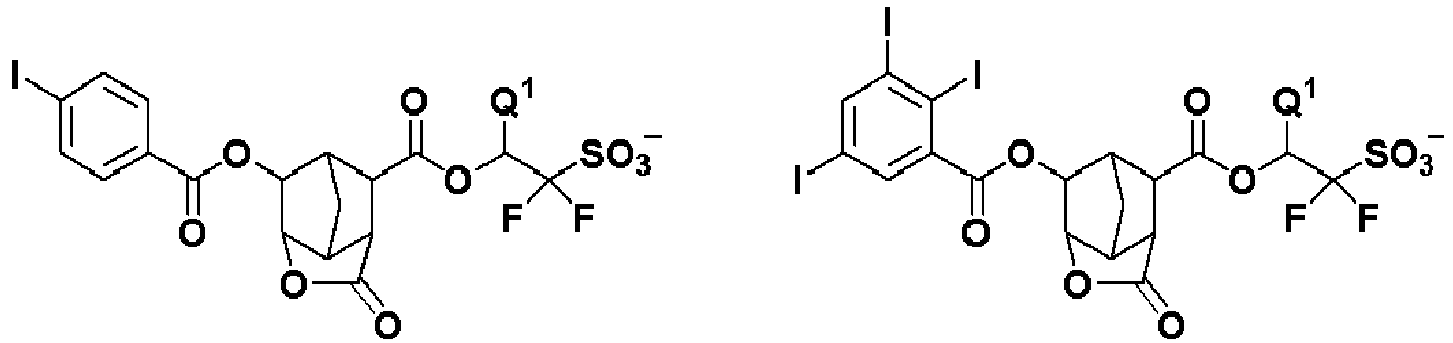








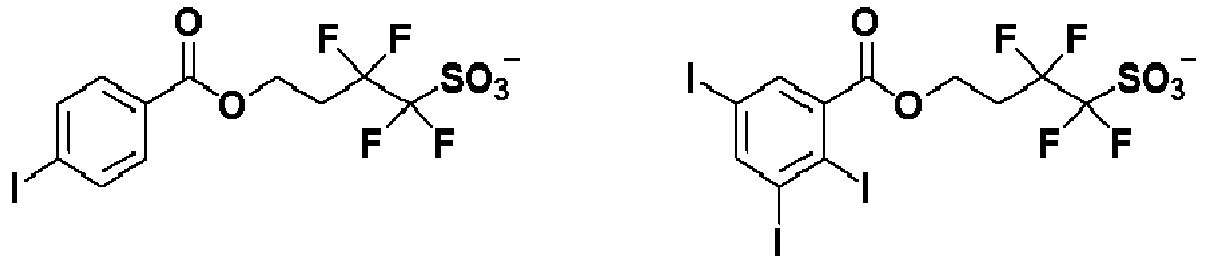


- In the formula (1B), Rfb1 and Rfb2 each independently represent a fluorine atom, or a hydrocarbyl group having 1 to 40 carbon atoms and optionally having a heteroatom. The hydrocarbyl group may be a saturated or unsaturated group, and may be any of linear, branched, and cyclic groups. Specific examples thereof include groups same as those exemplified as the hydrocarbyl group represented by Rfa1 in the formula (1A'). Rfb1 and Rfb2 preferably represent a fluorine atom or a linear fluorinated alkyl group having 1 to 4 carbon atoms. Rfb1 and Rfb2 are optionally bonded each other to form a ring together with a bond (-CF2-SO2-N--SO2-CF2-) to which Rfb1 and Rfb2 are bonded. In this case, the group obtained by bonding Rfb1 and Rfb2 each other is preferably a fluorinated ethylene group or a fluorinated propylene group.
- In the formula (1C), Rfc1, Rfc2, and Rfc3 each independently represent a fluorine atom, or a hydrocarbyl group having 1 to 40 carbon atoms and optionally having a heteroatom. The hydrocarbyl group may be a saturated or unsaturated group, and may be any of linear, branched, and cyclic groups. Specific examples thereof include groups same as those exemplified as the hydrocarbyl group represented by Rfa1 in the formula (1A'). Rfc1, Rfc2, and Rfc3 preferably represent a fluorine atom or a linear fluorinated alkyl group having 1 to 4 carbon atoms. Rfc1 and Rfc2 are optionally bonded each other to form a ring together with a bond (-CF2-SO2-C--SO2-CF2-) to which Rfc1 and Rfc2 are bonded. In this case, the group obtained by bonding Rfc1 and Rfc2 each other is preferably a fluorinated ethylene group or a fluorinated propylene group.
- In the formula (1D), Rfd represents a hydrocarbyl group having 1 to 40 carbon atoms and optionally having a heteroatom. The hydrocarbyl group may be a saturated or unsaturated group, and may be any of linear, branched, and cyclic groups. Specific examples thereof include groups same as those exemplified as the hydrocarbyl group represented by Rfa1 in the formula (1A').
- Examples of the anion represented by the formula (1D) include the following anions, but the anion is not limited thereto.


- Examples of the non-nucleophilic counterion further include an anion having an aromatic ring substituted with an iodine atom or a bromine atom. Examples of such an anion include anions represented by the following formula (1E).

- In the formula (1E), "x" represents an integer satisfying 1 ≤ x ≤ 3. "y" and "z" represent an integer satisfying 1 ≤ y ≤ 5, 0 ≤ z ≤ 3, and 1 ≤ y + z ≤ 5. "y" preferably represents an integer satisfying 1 ≤ y ≤ 3, and more preferably 2 or 3. "z" preferably represents an integer satisfying 0 ≤ z ≤ 2.
- In the formula (1E), XBI represents an iodine atom or a bromine atom. When "x" and/or "y" represent 2 or more, XBI may be same as or different from each other.
- In the formula (1E), L1 represents a single bond, an ether bond, an ester bond, or a saturated hydrocarbylene group having 1 to 6 carbon atoms and optionally having an ether bond or an ester bond. The saturated hydrocarbylene group may be any of linear, branched, and cyclic groups.
- In the formula (1E), L2 represents a single bond or a divalent linking group having 1 to 20 carbon atoms when "x" represents 1, and L2 represents a (x + 1)-valent linking group having 1 to 20 carbon atoms when "x" represents 2 or 3. The linking group optionally has an oxygen atom, a sulfur atom, or a nitrogen atom.
- In the formulae (1E), R8 represents a hydroxy group, a carboxy group, a fluorine atom, a chlorine atom, a bromine atom, an amino group, a hydrocarbyl group having 1 to 20 carbon atoms, a hydrocarbyloxy group having 1 to 20 carbon atoms, a hydrocarbylcarbonyl group having 2 to 20 carbon atoms, a hydrocarbyloxycarbonyl group having 2 to 10 carbon atoms, a hydrocarbylcarbonyloxy group having 2 to 20 carbon atoms, a hydrocarbylsulfonyloxy group having 1 to 20 carbon atoms, -N(R8A)(R8B), -N(R8C)-C(=O)-R8D, or -N(R8C)-C(=O)-OR8D. The hydrocarbyl group, the hydrocarbyloxy group, the hydrocarbylcarbonyl group, the hydrocarbyloxycarbonyl group, the hydrocarbylcarbonyloxy group, and the hydrocarbylsulfonyloxy group optionally have a fluorine atom, a chlorine atom, a bromine atom, a hydroxy group, an amino group, or an ether bond. R8A and R8B each independently represent a hydrogen atom or a saturated hydrocarbyl group having 1 to 6 carbon atoms. R8C represents a hydrogen atom or a saturated hydrocarbyl group having 1 to 6 carbon atoms and optionally having a halogen atom, a hydroxy group, a saturated hydrocarbyloxy group having 1 to 6 carbon atoms, a saturated hydrocarbylcarbonyl group having 2 to 6 carbon atoms, or a saturated hydrocarbylcarbonyloxy group having 2 to 6 carbon atoms. R8D represents an aliphatic hydrocarbyl group having 1 to 16 carbon atoms, an aryl group having 6 to 12 carbon atoms, or an aralkyl group having 7 to 15 carbon atoms, and optionally having a halogen atom, a hydroxy group, a saturated hydrocarbyloxy group having 1 to 6 carbon atoms, a saturated hydrocarbylcarbonyl group having 2 to 6 carbon atoms, or a saturated hydrocarbylcarbonyloxy group having 2 to 6 carbon atoms. The aliphatic hydrocarbyl group may be a saturated or unsaturated group, and may be any of linear, branched, and cyclic groups. The hydrocarbyl group, the hydrocarbyloxy group, the hydrocarbylcarbonyl group, the hydrcarbyloxycarbonyl group, the hydrocarbylcarbonyloxy group, and the hydrocarbylsulfonyloxy group may be any of linear, branched, and cyclic groups. When "x" and/or "z" represent 2 or more, each R8 may be same as or different from each other.
- Among these, R8 preferably represents a hydroxy group, -N(R8C)-C(=O)-R8D, -N(R8C)-C(=O)-O-R8D, a fluorine atom, a chlorine atom, a bromine atom, a methyl group, and a methoxy group, etc.
- In the formula (1E), Rf1 to Rf4 each independently represent a hydrogen atom, a fluorine atom, or a trifluoromethyl group, and at least one of them represents a fluorine atom or a trifluoromethyl group. Rf1 and Rf2 are optionally integrated to form a carbonyl group. In particular, both of Rf3 and Rf4 preferably represent fluorine atoms. Rf1 to Rf4 herein are applied only in the formula (1E).
- Examples of the anion of the onium salt represented by the formula (1E) include the following anions, but the anion is not limited thereto. In the following formulae, XBI represents the same as above.





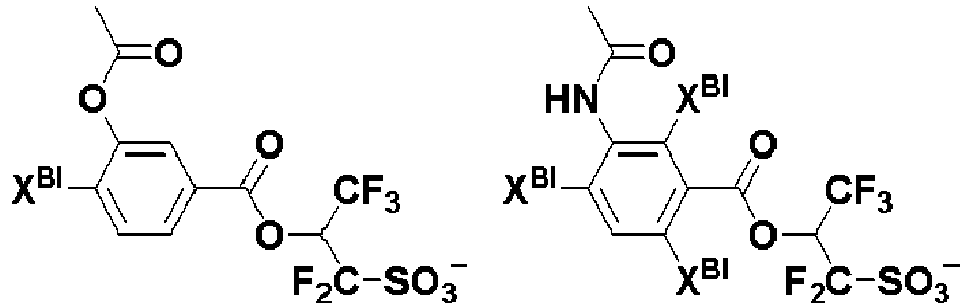


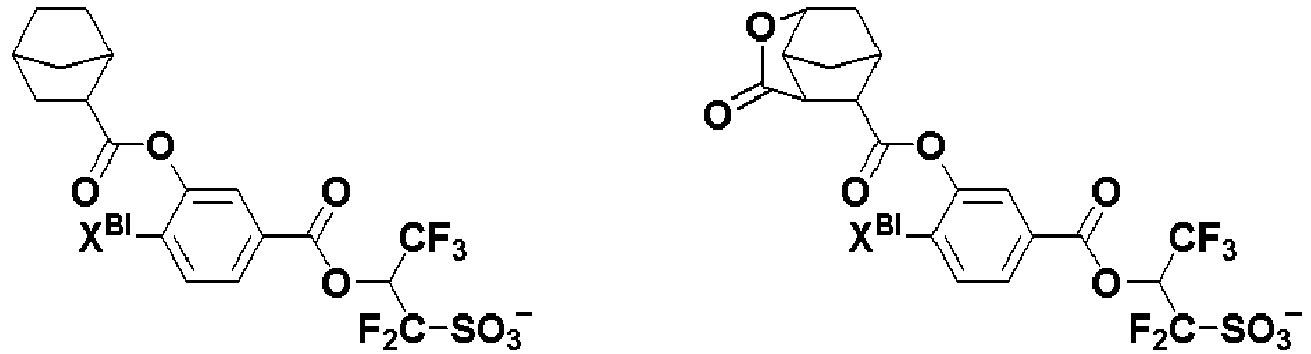


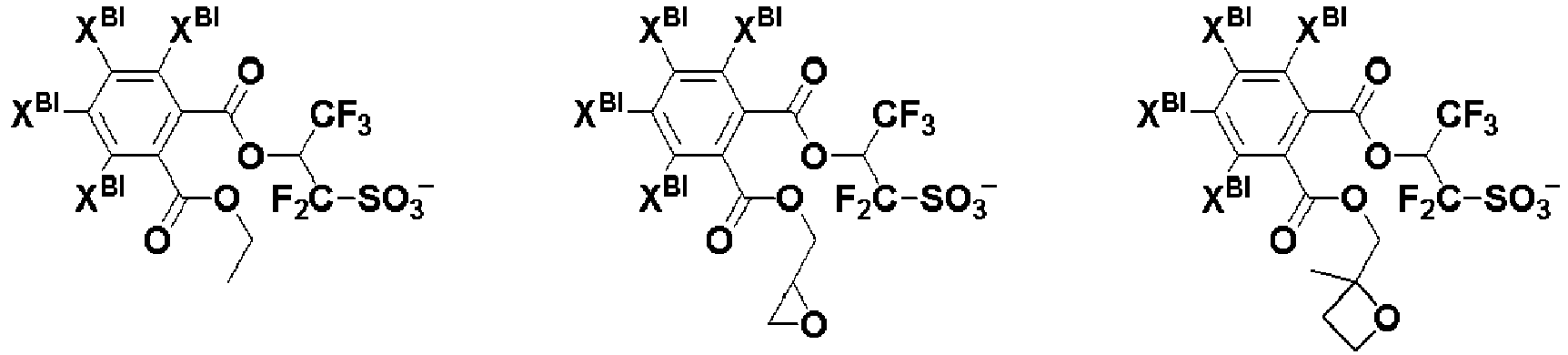








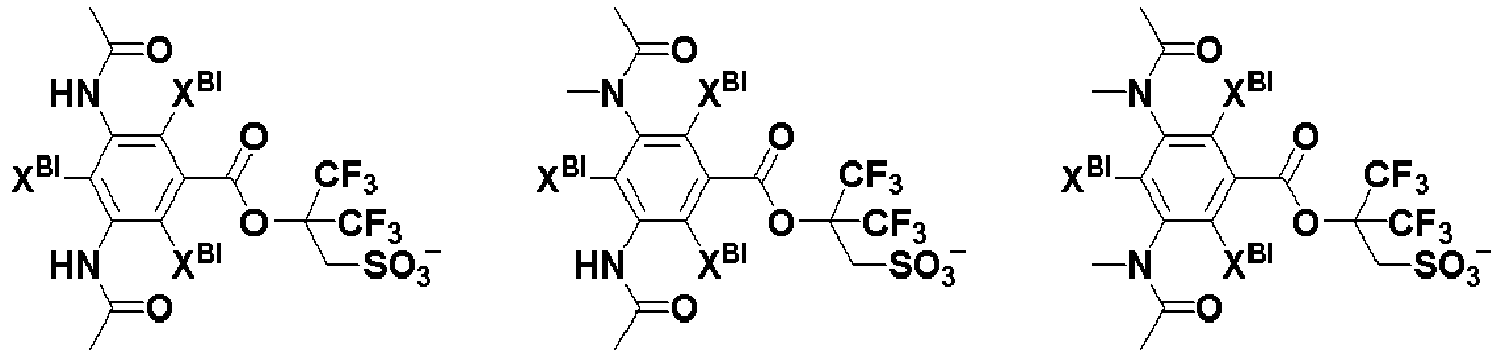


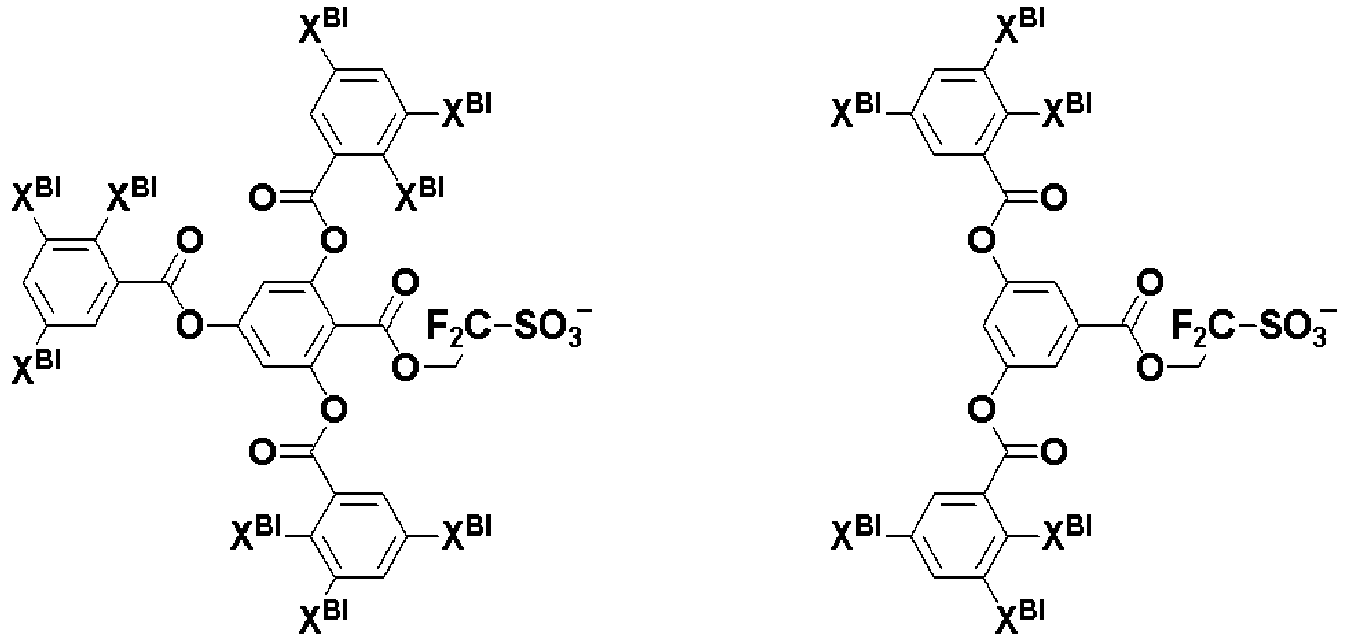


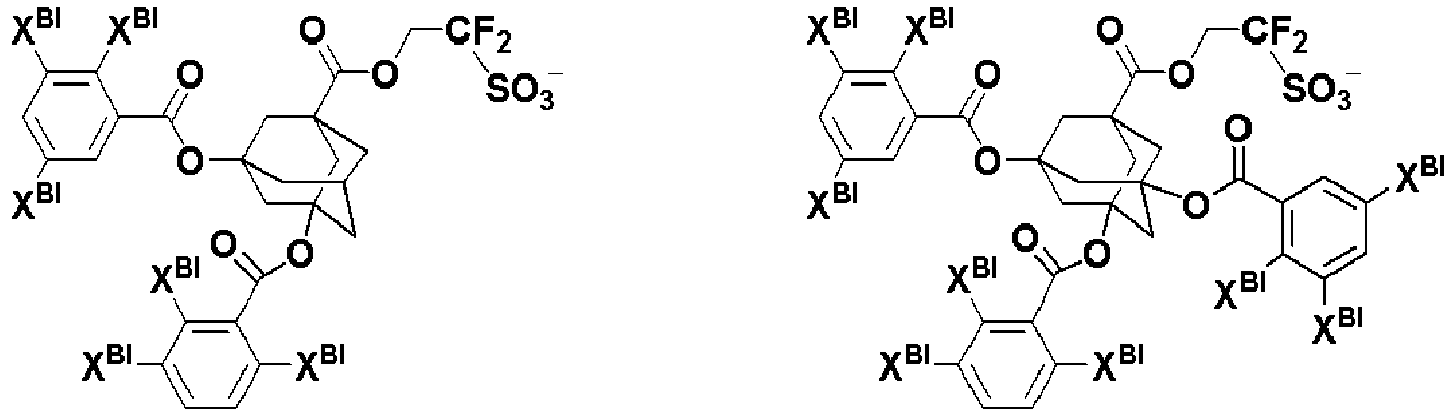








- Usable as the non-nucleophilic counterion are: a fluorobenzenesulfonate anion bonded to an aromatic group having an iodine atom, described in
JP 6648726 B WO 2021/200056 andJP 2021-070692 A JP 2018-180525 A JP 2021-35935 A JP 2018-092159 A - In addition, usable as the non-nucleophilic counterion are: an anion of a balky benzenesulfonic acid derivative having no fluorine atom, described in
JP 2006-276759 A JP 2015-117200 A JP 2016-65016 A JP 2019-202974 A JP 6645464 B - In addition, usable as the non-nucleophilic counterion are: an anion of a bissulfonic acid, described in
JP 2015-206932 A WO 2020/158366 ; and an anion having a sulfonate on one side and a carboxylate on the other side, described inJP 2015-024989 A - Specific examples of the inventive sulfonium salt include any combination of the aforementioned anions and cations.
- The inventive sulfonium salt (1) can be synthesized by a known method. For example, a corresponding sulfoxide is firstly reacted with a Grignard reagent in the presence of a halosilicon reagent to synthesize a sulfonium salt having the sulfonium cation. Then, the synthesized sulfonium salt and a corresponding anion can be subjected to a salt-exchange reaction to be converted into the target sulfonium salt. The salt exchange with the corresponding anion can be easily performed by a known method, and
JP 2007-145797 A - The above manufacturing method is just an example, and a method for manufacturing the inventive sulfonium salt is not limited thereto.
- The inventive sulfonium salt has structural features of: the acid-labile group bonded instead of the hydrogen atom of the hydroxy group on the aromatic ring of the sulfonium cation; the fluorine-atom-containing substituent; and these groups being bonded to adjacent carbon atoms. The acid-labile group in an exposed portion causes a deprotection reaction by a generated acid to generate an aromatic hydroxy group. This generation enhances the contrast between the exposed portion and the unexposed portion. The adjacent fluorine-atom-containing substituent increases the solubility of the sulfonium salt itself in a resist solvent, and increases the acidity of the aromatic hydroxy group generated in the exposed portion with its electron withdrawing property. When the resist film is developed with an alkaline developer after the exposure, compatibility between the generated aromatic hydroxy group and the alkaline developer increases to effectively remove the exposed portion with the developer. The aromatic hydroxy group adjacent to the fluorine-atom-containing substituent, which does not attract the alkaline developer to the unexposed portion with the water repellent effect of the fluorine atom compared with a carboxyl group, is considered to have an effect of reducing swelling due to the alkaline developer. This effect inhibits collapse of the resist pattern produced in the unexposed portion. With a synergistic effect of these, using the inventive sulfonium salt can form a pattern having high dissolution contrast, excellent LWR of a line pattern or CDU of a hole pattern, and hardly causing collapse. Thus, the inventive sulfonium salt is suitable for the positive-type resist material.
- As noted above, the above sulfonium salt can be suitably used as a photoacid generator.
- The present invention provides: a photoacid generator comprising the above sulfonium salt; and a resist composition comprising this photoacid generator. The inventive resist composition is preferably a chemically amplified resist composition. Hereinafter, the inventive resist composition will be described with a chemically amplified resist composition as an example.
- The inventive chemically amplified resist composition is not particularly limited as long as the resist composition contains the photoacid generator comprising the above sulfonium salt, and the inventive chemically amplified resist composition can comprise:
- (A) a photoacid generator comprising of the sulfonium salt represented by the formula (1);
- (B) a base polymer; and
- (C) an organic solvent.
- The inventive chemically amplified resist composition optionally further comprises, as necessary,
- (D) a quencher; and
- (E) another photoacid generator.
- The inventive chemically amplified resist composition optionally further comprises, as necessary,
(F) a surfactant insoluble or hardly soluble in water and soluble in an alkaline developer; and/or a surfactant insoluble or hardly soluble in water and an alkaline developer. - The inventive chemically amplified resist composition optionally further comprises, as necessary,
(G) another component. - The component (A) is a photoacid generator comprising the sulfonium salt represented by the formula (1). As noted above, the inventive resist composition can form a pattern having high dissolution contrast, excellent LER of a line pattern or CDU of a hole pattern, and hardly causing pattern collapse because of the structural features of the sulfonium salt.
- A content of the photoacid generator of the component (A) comprising the sulfonium salt represented by the formula (1) is preferably 0.1 to 40 parts by mass, and more preferably 0.5 to 30 parts by mass, relative to 80 parts by mass of the base polymer, described later. The content of the component (A) within the above range is preferable because of good sensitivity and resolution, and no risk of problem of a foreign matter after the development or during peeling of the resist film. The photoacid generator being the component (A) may be used singly, or may be used in combination of two or more kinds thereof.
- The base polymer being the component (B) is not particularly limited. For example, the base polymer has a repeating unit represented by the following formula (a1) (hereinafter, also referred to as the repeating unit a1) or a repeating unit represented by the following formula (a2) (hereinafter, also referred to as the repeating unit a2).

- In the formulae (a1) and (a2), RA each independently represents a hydrogen atom, a fluorine atom, a methyl group, or a trifluoromethyl group. ZA represents a single bond, (main chain)-C(=O)-O-ZA1-, or a phenylene group or naphthylene group optionally having a C1 to C10 alkoxy group optionally having a fluorine atom, or a phenylene group or naphthylene group optionally having a halogen atom. ZA1 represents a linear, branched, or cyclic alkanediyl group (aliphatic hydrocarbylene group) having 1 to 20 carbon atom, a phenylene group, or a naphthylene group, the alkanediyl group optionally having a heteroatom, an alkoxy group having 1 to 10 carbon atoms and optionally having a fluorine atom, a hydroxy group, an ether bond, an ester bond, or a lactone ring. ZB represents a single bond or (main chain) -C(=O)-O-. XA and XB each independently represent an acid-labile group. Here, "(main chain)" represents a bond between the above group and the polymer main chain.
- In the formula (a2), RB represents a monovalent hydrocarbon group (hydrocarbyl group) having 1 to 20 carbon atoms and optionally having a heteroatom. The monovalent hydrocarbon group may be a saturated or unsaturated group, and may be any of linear, branched, and cyclic groups. Specific examples thereof include groups same as those exemplified in the description of R12. "n" represents an integer of 0 to 4, and preferably 0 or 1.
- Examples of the acid-labile group represented by XA and XB in the formulae (a1) and (a2) include groups described in
JP 2013-80033 A JP 2013-83821 A - Typical examples of the acid-labile group include groups represented by the following formulae (AL-1) to (AL-3),

- In the formulae (AL-1) and (AL-2), RL1 and RL2 each independently represent a saturated hydrocarbyl group having 1 to 40 carbon atoms and optionally having a heteroatom such as an oxygen atom, a sulfur atom, a nitrogen atom, and a fluorine atom. The saturated hydrocarbyl group may be any of linear, branched, and cyclic groups. The saturated hydrocarbyl group preferably has 1 to 20 carbon atoms.
- In the formula (AL-1), "a" represents an integer of 0 to 10, and preferably an integer of 1 to 5.
- In the formula (AL-2), RL3 and RL4 each independently represent a hydrogen atom or a saturated hydrocarbyl group having 1 to 20 carbon atoms and optionally having a heteroatom such as an oxygen atom, a sulfur atom, a nitrogen atom, and a fluorine atom. The saturated hydrocarbyl group may be any of linear, branched, and cyclic groups. Any two of RL2, RL3, and RL4 are optionally bonded each other to form a ring having 3 to 20 carbon atoms together with the carbon atom or with the carbon atom and the oxygen atom to which these groups are bonded. The ring is preferably a ring having 4 to 16 carbon atoms, and particularly preferably an aliphatic ring.
- In the formula (AL-3), RL5, RL6, and RL7 each independently represent a saturated hydrocarbyl group having 1 to 20 carbon atoms and optionally having a heteroatom such as an oxygen atom, a sulfur atom, a nitrogen atom, and a fluorine atom. The saturated hydrocarbyl group may be any of linear, branched, and cyclic groups. Any two of RL5, RL6, and RL7 are optionally bonded each other to form a ring having 3 to 20 carbon atoms together with the carbon atom to which these groups are bonded. The ring is preferably a ring having 4 to 16 carbon atoms, and particularly preferably an aliphatic ring.
- Examples of the repeating unit a1 include the following repeating units, but the repeating unit is not limited thereto. In the following formulae, RA and XA represent the same as above.


- Examples of the repeating unit a2 include the following repeating units, but the repeating unit is not limited thereto. In the following formulae, RA and XB represent the same as above.


- The base polymer preferably further has a repeating unit represented by the following formula (b1) (hereinafter, also referred to as the repeating unit b1) or a repeating unit represented by the following formula (b2) (hereinafter, also referred to as the repeating unit b2) .

- In the formulae (b1) and (b2), RA and ZB represent the same as above. YA represents a hydrogen atom or a polar group having one or more structures selected from a hydroxy group other than a phenolic hydroxy group, a cyano group, a carbonyl group, a carboxy group, an ether bond, an ester bond, a sulfonate ester bond, a sulfonamide bond, a carbonate bond, a lactone ring, a sultone ring, a sulfur atom, and a carboxylic anhydride. "m" represents an integer of 1 to 4.
- YA may be a hydrogen atom or a polar group having one or more structures selected from a hydroxy group other than a phenolic hydroxy group, a cyano group, a carbonyl group, a carboxy group, an ether bond, an ester bond, a sulfonate ester bond, a carbonate bond, a lactone ring, a sultone ring, and a carboxylic anhydride.
- Examples of the repeating unit b1 include the following repeating units, but the repeating unit is not limited thereto. In the following formulae, RA represents the same as above.


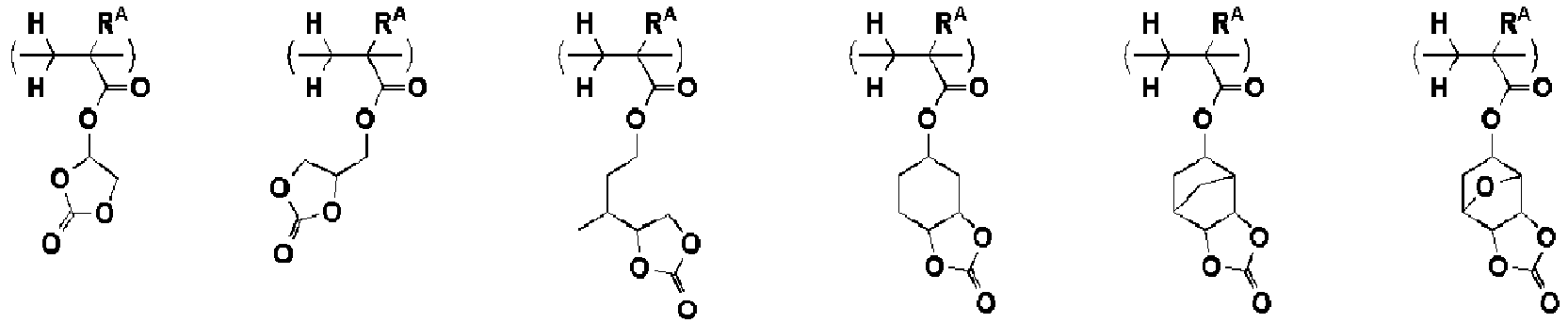





- Examples of the repeating unit b2 include the following repeating units, but the repeating unit is not limited thereto. In the following formulae, RA represents the same as above.


- The repeating unit b1 or b2 particularly preferably has a lactone ring as the polar group in ArF lithography, and preferably has a phenol portion in KrF lithography, EB lithography, and EUV lithography.
- The base polymer optionally further has a repeating unit represented by any one of the following formulae (C1) to (C4) (hereinafter, also referred to as the repeating units c1 to c4, respectively),


- In the formulae (C1) to (C4), RA represent the same as above. Z1 represents a single bond or a phenylene group. Z2 represents a single bond, *-C(=O)-O-Z21-, *-C(=O)-NH-Z21-, or *-O-Z21-. Z21 represents an aliphatic hydrocarbylene group having 1 to 6 carbon atoms, a phenylene group, or a divalent group obtained by combining these groups, Z21 optionally having a carbonyl group, an ester bond, an ether bond, or a hydroxy group. Z3 represents a single bond, a phenylene group, a naphthylene group, or *-C(=O)-O-Z31-. Z31 represents an aliphatic hydrocarbylene group having 1 to 10 carbon atoms, a phenylene group, or a naphthylene group, the hydrocarbylene group optionally having a hydroxy group, an ether bond, an ester bond, or a lactone ring. Z4 represents a single bond, a methylene group, or *-Z41-C(=O)-O-. Z41 represents a hydrocarbylene group having 1 to 20 carbon atoms and optionally having a heteroatom, an ether bond, or an ester bond. Z5 represents a single bond, a methylene group, an ethylene group, a phenylene group, a fluorinated phenylene group, a phenylene group substituted with a trifluoromethyl group, *-C(=O)-O-Z51-, *-C(=O)-N(H)-Z51-, or *-O-Z51-. Z51 represents an aliphatic hydrocarbylene group having 1 to 6 carbon atoms, a phenylene group, a fluorinated phenylene group, or a phenylene group substituted with a trifluoromethyl group, and Z51 optionally has a carbonyl group, an ester bond, an ether bond, or a hydroxy group. "*" represents an attachment point to a carbon atom in the main chain or to a group bonding to the main chain.
- The aliphatic hydrocarbylene groups represented by Z21, Z31, and Z51 may be any of linear, branched, and cyclic groups, and specific examples thereof include groups same as those exemplified in the description of ZA in the formula (a1) .
- The hydrocarbylene group represented by Z41 may be a saturated or unsaturated group, and may be any of linear, branched, and cyclic groups. Specific examples thereof include the following groups, but the aliphatic hydrocarbylene group is not limited thereto.



- In the formulae, a broken line represents an attachment point.
- In the formula (C1), R21' and R22' each independently represent a hydrocarbyl group having 1 to 20 carbon atoms and optionally having a heteroatom. The hydrocarbyl groups represented by R21' and R22' may be a saturated or unsaturated group, and may be any of linear, branched, and cyclic groups. Specific examples thereof include: alkyl groups, such as a methyl group, an ethyl group, an n-propyl group, an isopropyl group, an n-butyl group, and a tert-butyl group; cyclic saturated hydrocarbyl groups, such as a cyclopropyl group, a cyclopentyl group, a cyclohexyl group, a cyclopropylmethyl group, a 4-methylcyclohexyl group, a cyclohexylmethyl group, a norbornyl group, and an adamantyl group; alkenyl groups, such as a vinyl group, an allyl group, a propenyl group, a butenyl group, and a hexenyl group; cyclic unsaturated hydrocarbyl groups, such as a cyclohexenyl group; aryl groups, such as a phenyl group, a naphthyl group, and a thienyl group; aralkyl groups, such as a benzyl group, a 1-phenylethyl group, and a 2-phenylethyl group; and a group obtained by combining these groups. The hydrocarbyl group is preferably an aryl group. A part of hydrogen atoms in the hydrocarbyl group is optionally substituted with a group having a heteroatom, such as an oxygen atom, a sulfur atom, a nitrogen atom, and a halogen atom. Between carbon atoms in these groups, a group having a heteroatom such as an oxygen atom, a sulfur atom, and a nitrogen atom is optionally interposed. As a result, optionally contained are a hydroxy group, a cyano group, a carbonyl group, an ether bond, an ester bond, a sulfonate ester bond, a carbonate bond, a lactone ring, a sultone ring, a carboxylic anhydride, a haloalkyl group, etc.
- R21' and R22' are optionally bonded each other to form a ring together with the sulfur atom to which R21' and R22' are bonded. Specific examples thereof include the following rings.


- Examples of the cation of the repeating unit c1 include the following cations, but the cation is not limited thereto. In the following formulae, RA represents the same as above.


- In the formula (C1), M- represents a non-nucleophilic counterion. Examples of the non-nucleophilic counterion include counterions same as those of X- in the formula (1).
- In the formula (C2), L1 represents a single bond, an ether bond, an ester bond, a carbonyl group, a sulfonate ester bond, a carbonate bond, or a carbamate bond. Among these, an ether bond, an ester bond, and a carbonyl group are preferable from the viewpoint of the synthesis, and an ester bond and a carbonyl bond are further preferable.
- In the formula (C2), Rf1 and Rf2 each independently represent a fluorine atom or a fluorinated alkyl group having 1 to 6 carbon atoms. Among these, both Rf1 and Rf2 preferably represent fluorine atoms for increasing the acid strength of the generated acid. Rf3 and Rf4 each independently represent a hydrogen atom, a fluorine atom or a fluorinated alkyl group having 1 to 6 carbon atoms. Among these, at least one of Rf3 and Rf4 preferably represents a trifluoromethyl group for improving the solvent solubility.
- In the formula (C2), "c" represents an integer of 0 to 3, and preferably 1.
- Specific examples of the anion of the repeating unit represented by the formula (C2) include the following anions, but the anion is not limited thereto. In the following formulae, RA represents the same as above.

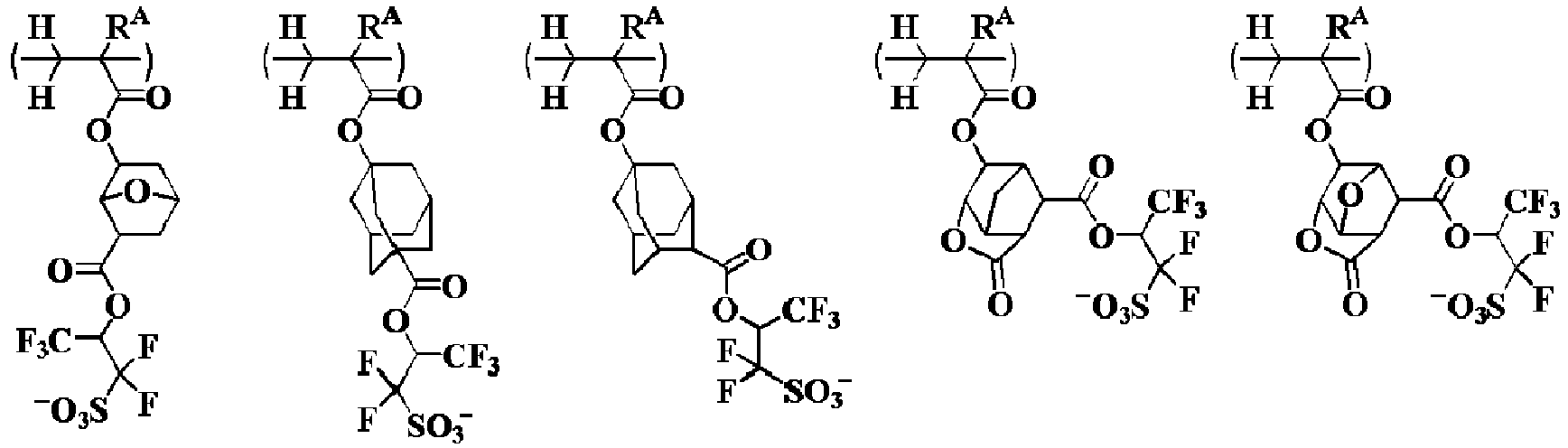


- In the formula (C3), L1 represents the same as above.
- In the formula (C3), Rf5 and Rf6 each independently represent a hydrogen atom, a fluorine atom, or a fluorinated alkyl group having 1 to 6 carbon atoms. Among these, at least one of Rf5 and Rf6 preferably represents a trifluoromethyl group for improving the solvent solubility.
- In the formula (C3), "c" represents an integer of 0 to 3, and preferably 1.
- Specific examples of the anion of the repeating unit represented by the formula (C3) include the following anions, but the anion is not limited thereto. In the following formulae, RA represents the same as above.


- Specific examples of the anion of the repeating unit represented by the formula (C4) include the following anions, but the anion is not limited thereto. In the following formulae, RA represents the same as above.


- In the formulae (C2) to (C4), A+ represents an onium cation. Examples of the onium cation include an ammonium cation, a sulfonium cation, and an iodonium cation. The onium cation is preferably a sulfonium cation or an iodonium cation, and more preferably a sulfonium cation represented by the following formula (cation-1) or an iodonium cation represented by the following formula (cation-2).

- In the formulae (cation-1) and (cation-2), R11 to R15 each independently represent a hydrocarbyl group having 1 to 30 carbon atoms and optionally having a heteroatom. The hydrocarbyl group may be a saturated or unsaturated group, and may be any of linear, branched, and cyclic groups. Specific examples thereof include: alkyl groups, such as a methyl group, an ethyl group, an n-propyl group, an isopropyl group, an n-butyl group, and a tert-butyl group; cyclic saturated hydrocarbyl groups, such as a cyclopropyl group, a cyclopentyl group, a cyclohexyl group, a cyclopropylmethyl group, a 4-methylcyclohexyl group, a cyclohexylmethyl group, a norbornyl group, and an adamantyl group; alkenyl groups, such as a vinyl group, an allyl group, a propenyl group, a butenyl group, and a hexenyl group; cyclic unsaturated hydrocarbyl groups, such as a cyclohexenyl group; aryl groups, such as a phenyl group, a naphthyl group, and a thienyl group; aralkyl groups, such as a benzyl group, a 1-phenylethyl group, and a 2-phenylethyl group; and groups obtained by combining these groups. The hydrocarbyl group is preferably an aryl group. A part of hydrogen atoms in the hydrocarbyl group is optionally substituted with a group having a heteroatom, such as an oxygen atom, a sulfur atom, a nitrogen atom, and a halogen atom. Between carbon atoms in these groups, a group having a heteroatom such as an oxygen atom, a sulfur atom, and a nitrogen atom is optionally interposed. As a result, optionally contained are a hydroxy group, a cyano group, a carbonyl group, an ether bond, an ester bond, a sulfonate ester bond, a carbonate bond, a lactone ring, a sultone ring, a carboxylic anhydride, a haloalkyl group, etc. Note that R11 to R15 herein are applied only in the formulae (cation-1) and (cation-2).
- R11 and R12 are optionally bonded each other to form a ring together with the sulfur atom to which R11 and R12 are bonded. In this case, examples of the sulfonium cation represented by the formula (cation-1) include cations represented by the following formulae.


- In the formulae, a broken line represents an attachment point to R13.
- Examples of the sulfonium cation represented by the formula (cation-1) include the following cations, but the sulfonium cation is not limited thereto.


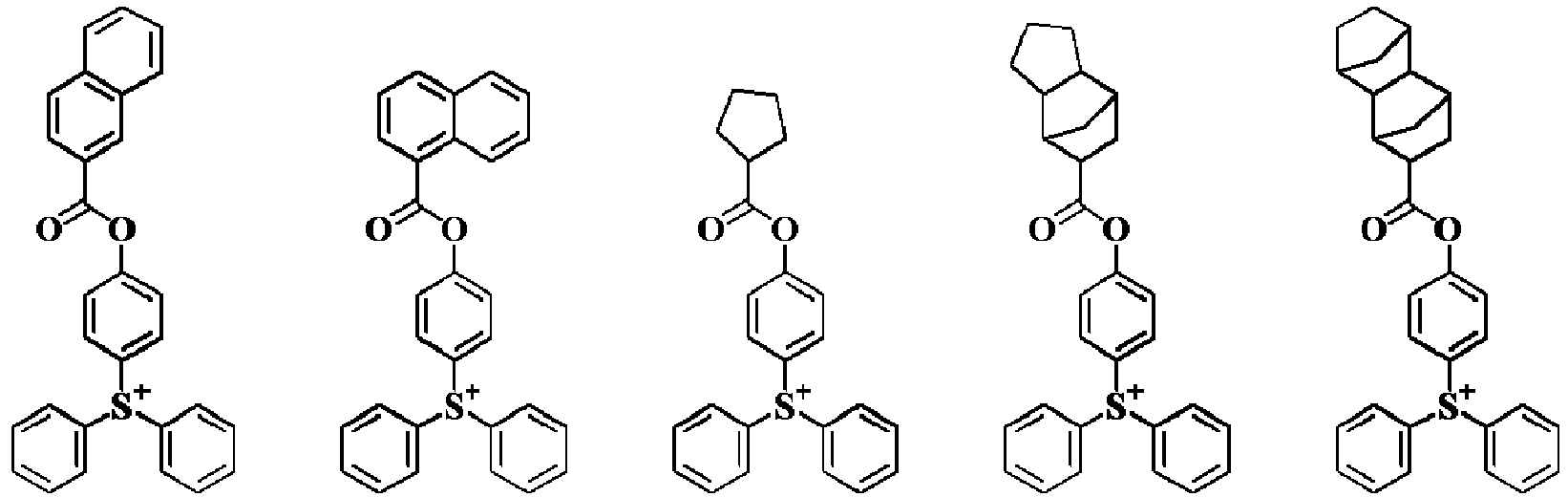


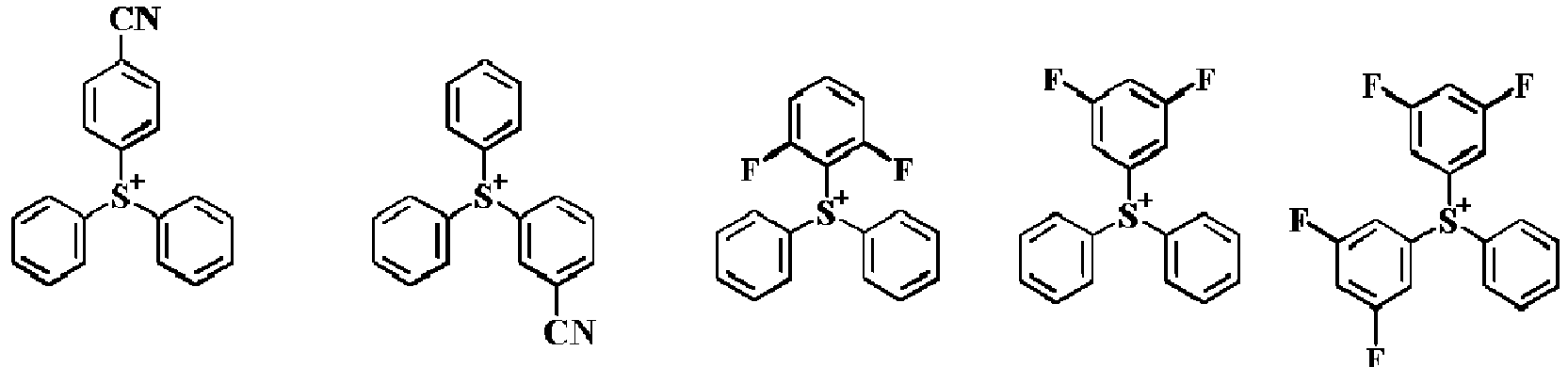





- Examples of the iodonium cation represented by the formula (cation-2) include the following cations, but the iodonium cation is not limited thereto.



- Examples of specific structures of the repeating units represented by the formulae (C1) to (C4) include any combination of the aforementioned anions and cations.
- Among the repeating units c1 to c4, the repeating units c2, c3, and c4 are preferable from the viewpoint of controlling the acid diffusion, the repeating units c2 and c4 are further preferable from the viewpoint of the acid strength of the generated acid, and the repeating unit c2 is more preferable from the viewpoint of the solvent solubility.
- The base polymer optionally further has a repeating unit having a structure in which a hydroxy group is protected by an acid-labile group (hereinafter, also referred to as the repeating unit d). The repeating unit d is not particularly limited as long as the unit has one or two or more of the hydroxy-group protected structures and generates the hydroxy group with decomposing the protective group by an action of an acid. The repeating unit d is preferably represented by the following formula (d1).

- In the formula (d1), RA represents the same as above. R41 represents a (d + 1)-valent hydrocarbon group having 1 to 30 carbon atoms and optionally having a heteroatom. R42 represents the acid-labile group. "d" represents an integer of 1 to 4.
- In the formula (d1), the acid-labile group represented by R42 is deprotected by an action of an acid to generate the hydroxy group. The structure of R42 is not particularly limited, but an acetal structure, a ketal structure, an alkoxycarbonyl group, an alkoxymethyl group represented by the following formula (d2), etc. are preferable, and an alkoxymethyl group represented by the following formula (d2) is particularly preferable.

- In the formula, a broken line represents an attachment point. R43 represents a hydrocarbyl group having 1 to 15 carbon atoms.
- Specific examples of the acid-labile group represented by R42, the alkoxymethyl group represented by the formula (d2), and the repeating unit d include groups same as those exemplified in the description of the repeating unit d described in
JP 2020-111564 A - The base polymer optionally further has a repeating unit e derived from indene, benzofuran, benzothiophene, acenaphthylene, chromone, coumarin, norbornadiene, or a derivative thereof. Examples of monomers to yield the repeating unit e include the following monomers, but the monomer is not limited thereto.


- The base polymer optionally further has a repeating unit f derived from indane, vinylpyridine, or vinylcarbazole.
- Content rates of the repeating units a1, a2, b1, b2, c1 to c4, d, e, and f in the inventive polymer are preferably 0 < a1 ≤ 0.8, 0 ≤ a2 ≤ 0.8, 0 ≤ b1 ≤ 0.6, 0 ≤ b2 ≤ 0.6, 0 ≤ c1 ≤ 0.4, 0 ≤ c2 ≤ 0.4, 0 ≤ c3 ≤ 0.4, 0 ≤ c4 ≤ 0.4, 0 ≤ d ≤ 0.5, 0 ≤ e ≤ 0.3, and 0 ≤ f ≤ 0.3, and more preferably 0 < a1 ≤ 0.7, 0 ≤ a2 ≤ 0.7, 0 ≤ b1 ≤ 0.5, 0 ≤ b2 ≤ 0.5, 0 ≤ c1 ≤ 0.3, 0 ≤ c2 ≤ 0.3, 0 ≤ c3 ≤ 0.3, 0 ≤ c4 ≤ 0.3, 0 ≤ d ≤ 0.3, 0 ≤ e ≤ 0.3, and 0 ≤ f ≤ 0.3.
- The polymer preferably has a weight-average molecular weight (Mw) of 1,000 to 500,000, more preferably 3,000 to 100,000. The Mw within this range yields sufficient etching resistance, and has no risk of deterioration in resolution caused by failure to achieve a difference in a dissolution rate before and after the exposure. The Mw in the present invention is a value in terms of polystyrene by gel permeation chromatography (GPC) using tetrahydrofuran (THF) or N,N-dimethylformamide (DMF) as a solvent.
- Since a molecular weight distribution (Mw/Mn) of the polymer has a larger effect as the pattern rule becomes smaller, the Mw/Mn is preferably 1.0 to 2.0, which indicates narrow distribution, to obtain the resist composition suitably used for a fine pattern size. Within the above range, polymers having a small molecular weight and a large molecular weight are reduced, and there is no risk of a foreign matter on a pattern and deterioration in a pattern shape after the exposure.
- To synthesize the polymer, for example, monomers to yield the aforementioned repeating units and a radical polymerization initiator are added into an organic solvent, and the mixture is heated to perform polymerization.
- Examples of the organic solvent used in the polymerization include toluene, benzene, THF, diethyl ether, dioxane, cyclohexane, cyclopentane, methyl ethyl ketone (MEK), propylene glycol monomethyl ether acetate (PGMEA), and γ-butyrolactone (GBL). Examples of the polymerization initiator include 2,2'-azobisisobutyronitrile (AIBN), 2,2'-azobis(2,4-dimethylvaleronitrile),
dimethyl 2,2-azobis(2-methylpropionate), 1,1'-azobis(1-acetoxy-1-phenylethane), benzoyl peroxide, and lauroyl peroxide. An addition amount of these initiators is preferably 0.01 to 25 mol% relative to a total of the monomers to be polymerized. The reaction temperature is preferably 50 to 150°C, and more preferably 60 to 100°C. The reaction time is preferably 2 to 24 hours, and from the viewpoint of production efficiency, more preferably 2 to 12 hours. - The polymerization initiator may be added into a solution of the monomers and fed into a reaction vessel, or an initiator solution is prepared separately from the monomer solution and each of the solutions may be independently fed into a reaction vessel. Since a radical generated from the initiator may proceed the polymerization reaction during the waiting time to generate a polymer having an ultra-high molecular weight, the monomer solution and the initiator solution are preferably each independently prepared and added dropwise from the viewpoint of quality control. The acid-labile group may be introduced into the monomer to be used as it is, or may be protected or partially protected after the polymerization. To regulate the molecular weight, known chain transfer agents, such as dodecyl mercaptan and 2-mercaptoethanol, may be used in combination. In this case, an addition amount of these chain transfer agents is preferably 0.01 to 20 mol% relative to the total of the monomers to be polymerized.
- When the monomer has a hydroxy group, the hydroxy group may be substituted with an acetal group, such as an ethoxyethyl group, easily deprotected by an acid during the polymerization, and the protected hydroxy group may be deprotected by a weak acid and water after the polymerization. Alternatively, the hydroxy group may be substituted with an acetyl group, a formyl group, a pivaloyl group, etc. to be subjected to alkaline hydrolysis after the polymerization.
- When hydroxystyrene or hydroxyvinylnaphthalene is copolymerized, hydroxystyrene or hydroxyvinylnaphthalene and the other monomers may be heat-polymerized in the organic solvent with adding the radical polymerization initiator. Alternatively, acetoxystyrene or acetoxyvinylnaphthalene may be used, and the acetoxy group is deprotected with alkaline hydrolysis after the polymerization to be converted into polyhydroxystyrene or hydroxypolyvinylnaphthalene.
- As a base in the alkaline hydrolysis, aqueous ammonia, triethylamine, etc. can be used. The reaction temperature is preferably -20 to 100°C, and more preferably 0 to 60°C. The reaction time is preferably 0.2 to 100 hours, and more preferably 0.5 to 20 hours.
- An amount of each monomer in the monomer solution is appropriately set so as to be a preferable content rate of the above repeating units, for example.
- With the polymer obtained in the manufacturing method, a reaction solution obtained by the polymerization reaction may be a final product. Alternatively, a powder obtained via a purification step, such as reprecipitation method in which the polymerization solution is added into a poor solvent to obtain a powder, may be treated as a final product. From the viewpoints of operation efficiency and quality stabilization, the powder obtained in the purification step is preferably dissolved in a solvent for forming a polymer solution to be operated as a final product.
- Specific examples of the solvent used in this case include solvents described in paragraphs [0144] to [0145] of
JP 2008-111103 A - In the polymer solution, a concentration of the polymer is preferably 0.01 to 30 mass%, and more preferably 0.1 to 20 mass%.
- The reaction solution and the polymer solution are preferably filtered with a filter. The filtration can remove a foreign matter and gel, which may cause a defect, and is effective in terms of quality stabilization.
- Examples of a material of the filter used for the filtration include a fluorocarbon, a cellulose, a nylon, a polyester, and a hydrocarbon. In the step of filtering the resist composition, the filter is preferably formed with a fluorocarbon, so-called Teflon(R), a hydrocarbon such as polyethylene and polypropylene, or nylon. A pore size of the filter can be appropriately selected according to target cleanliness, and is preferably 100 nm or smaller, and more preferably 20 nm or smaller. These filters may be used singly, or may be used in combination of a plurality of these filters. With the filtration method, the solution may be passed through the filter once, but the solution is more preferably circulated to be filtered a plurality of times. In the step for producing the polymer, the filtration step may be performed in any order and times, but the reaction solution after the polymerization reaction, the polymer solution, or both thereof are preferably filtered.
- The polymer may be used singly, or may be used in combination of two or more kinds thereof having different composition ratio, Mw, and/or Mw/Mn. The base polymer (B) optionally contains, in addition to the above polymer, a hydrogenated ring-opening metathesis polymer. Polymers described in
JP 2003-66612 A - The organic solvent of the component (C) is not particularly limited as long as it can dissolve each component described above and each component described later. Examples of such an organic solvent include: ketones, such as cyclopentanone, cyclohexanone, and methyl-2-n-pentyl ketone; alcohols, such as 3-methoxybutanol, 3-methyl-3-methoxybutanol, 1-methoxy-2-propanol, and 1-ethoxy-2-propanol; keto alcohols, such as DAA; ethers, such as PGME, ethylene glycol monomethyl ether, propylene glycol monoethyl ether, ethylene glycol monoethyl ether, propylene glycol dimethyl ether, and diethylene glycol dimethyl ether; esters, such as PGMEA, propylene glycol monoethyl ether acetate, ethyl lactate, ethyl pyruvate, butyl acetate, methyl 3-methoxypropionate, ethyl 3-ethoxypropionate, tert-butyl acetate, tert-butyl propionate, and propylene glycol mono-tert-butyl ether acetate; lactones, such as GBL; and a mixed solvent thereof.
- Among these organic solvents, preferable are 1-ethoxy-2-propanol, PGMEA, cyclohexanone, GBL, DAA, and a mixed solvent thereof, which have particularly excellent solubility of the base polymer of the component (B).
- A use amount of the organic solvent is preferably 200 to 5,000 parts by mass, and more preferably 400 to 3,500 parts by mass, relative to 80 parts by mass of the base polymer (B). The organic solvent (C) may be used singly, or may be used with mixing two or more kinds thereof.
- Examples of the quencher (D) include onium salts represented by the following formula (5) or (6).
Rq1-SO3 - Mq+ (5)
Rq2-CO2 - Mq+ (6)
- In the formula (5), Rq1 represents a hydrogen atom or a monovalent hydrocarbon group (hydrocarbyl group) having 1 to 40 carbon atoms and optionally having a heteroatom, except for a group in which a hydrogen atom bonded to a carbon atom at the α-position of the sulfo group is substituted with a fluorine atom or a fluoroalkyl group. In the formula (6), Rq2 represents a hydrogen atom or a monovalent hydrocarbon group (hydrocarbyl group) having 1 to 40 carbon atoms and optionally having a heteroatom.
- Specific examples of the hydrocarbyl group represented by Rq1 include: alkyl groups, such as a methyl group, an ethyl group, a propyl group, an isopropyl group, an n-butyl group, a sec-butyl group, a tert-butyl group, an n-pentyl group, a tert-pentyl group, an n-hexyl group, an n-octyl group, a 2-ethylhexyl group, an n-nonyl group, and an n-decyl group; cyclic saturated hydrocarbyl groups, such as a cyclopentyl group, a cyclohexyl group, a cyclopentylmethyl group, a cyclopentylethyl group, a cyclopentylbutyl group, a cyclohexylmethyl group, a cyclohexylethyl group, a cyclohexylbutyl group, a norbornyl group, a tricyclo[5.2.1.02,6]decanyl group, and an adamantyl group; and aryl groups, such as a phenyl group, a naphthyl group, and an anthracenyl group. A part or all of hydrogen atoms in these groups are optionally substituted with a group having a heteroatom, such as an oxygen atom, a sulfur atom, a nitrogen atom, and a halogen atom. A part of carbon atoms in these groups is optionally substituted with a group having a heteroatom, such as an oxygen atom, a sulfur atom, and a nitrogen atom. As a result, optionally contained are a hydroxy group, a cyano group, a carbonyl group, an ether bond, an ester bond, a sulfonate ester bond, a carbonate bond, a lactone ring, a sultone ring, a carboxylic anhydride, a haloalkyl group, etc.
- Specific examples of the hydrocarbyl group represented by Rq2 include: the substituents exemplified as the specific examples of Rq1; fluorinated alkyl groups, such as a trifluoromethyl group and a trifluoroethyl group; and fluorinated aryl groups, such as a pentafluorophenyl group and a 4-trifluoromethylphenyl group.
- Examples of the anion of the onium salt represented by the formula (5) include the following anions, but the anion is not limited thereto.
CH3SO3 -
CH3CH2SO3 -





- Examples of the anion of the onium salt represented by the formula (6) include the following anions, but the anion is not limited thereto.
HCO2 -
CH3CO2 -
CH3CH2CO2 -






CF3CH2CO2 -
CF3CF2CO2 -



- In the formulae (5) and (6), Mq+ represents an onium cation. The onium cation is preferably represented by the following formula (cation-1), (cation-2), or (cation-3).

- Examples of the cation represented by the formulae (cation-1) and (cation-2) include cations same as A+ in the formulae (C2) to (C4) . In (cation-3), R16 to R19 each independently represent a hydrocarbyl group having 1 to 40 carbon atoms and optionally having a heteroatom. R16 and R17 are optionally bonded each other to form a ring together with the nitrogen atom to which R16 and R17 are bonded. Examples of the hydrocarbyl group include groups same as those exemplified in the description of R11 to R15 in the formulae (cation-1) and (cation-2).
- With the onium cation represented by Mq+, examples of the ammonium cation represented by (cation-3) include the following cations, but the cation is not limited thereto.


- Specific examples of the onium salt represented by the formula (5) or (6) include any combination of the aforementioned anions and cations. These onium salts are easily prepared by an ion-exchange reaction using a known organic chemical method. About the ion-exchange reaction,
JP 2007-145797 A - The onium salt represented by the formula (5) or (6) acts as a quencher in the inventive chemically amplified resist composition. This is because each counter anion of the onium salt is a conjugated base of a weak acid. The weak acid herein means an acid exhibiting acidity that cannot deprotect the acid-labile group in the acid-labile group-containing unit used for the base polymer.
- The onium salt represented by the formula (5) or (6) functions as a quencher when used in combination with an onium-salt type photoacid generator having a conjugated base of a strong acid, such as an α-fluorinated sulfonic acid, as a counter anion. That is, when an onium salt to generate a strong acid, such as an α-fluorinated sulfonic acid, and an onium salt to generate a weak acid, such as non-fluorinated sulfonic acid and a carboxylic acid, are mixed to be used, the strong acid generated from the photoacid generator by high-energy ray irradiation collides the unreacted onium salt having the weak acid anion to release the weak acid with salt exchange, resulting in generation of an onium salt having the strong acid anion. This process exchanges the strong acid into the weak acid having low catalytic ability, and the acid is apparently deactivated to enable to control the acid diffusion.
- Usable for the quencher (D) are: an onium salt having a sulfonium cation and a phenoxide anion portion in the same molecule, described in
JP 6848776 B JP 6583136 B JP 2020-200311 A JP 6274755 B - When the photoacid generator to generate the strong acid is an onium salt, the strong acid generated by high-energy ray irradiation can be exchanged into the weak acid, as described above. Meanwhile, it is considered that the weak acid generated by high-energy ray irradiation hardly collides the unreacted onium salt to generate the strong acid to cause salt exchange. This is because of a phenomenon that an onium cation is more likely to form an ion pair with an anion of a stronger acid.
- When the onium salt represented by the formula (5) or (6) is contained as the onium-salt type quencher (D), a content thereof is preferably 0.1 to 20 parts by mass, and more preferably 0.1 to 10 parts by mass, relative to 80 parts by mass of the base polymer (B). The onium-salt type quencher of the component (D) within the above range is preferable in terms of good resolution without considerable deterioration in the sensitivity. The onium salt represented by the formula (5) or (6) can be used singly, or used in combination of two or more kinds thereof.
- The inventive chemically amplified resist composition may further comprise a nitrogen-containing quencher. In the present invention, the nitrogen-containing quencher is referred to a material that traps the acid generated from the photoacid generator in the chemically amplified resist composition for inhibiting the diffusion toward an unexposed portion to form a desired pattern.
- Examples of the nitrogen-containing quencher of the component (D) include primary, secondary, or tertiary amine compounds described in paragraphs [0146] to [0164] of
JP 2008-111103 A JP 3790649 B - As above, the inventive resist composition can further comprise the amine compound.
- As the nitrogen-containing quencher, a sulfonium sulfonate salt having a nitrogen-containing substituent may also be used. Such a compound functions as a so-called photodegradable base. The photodegradable base functions as a quencher in an unexposed portion, and losses the quenching ability by neutralization with a generated acid of the photodegradable base itself in an exposed portion. Using the photodegradable base can further enhance the contrast between the exposed portion and the unexposed portion. As the photodegradable base,
JP 2009-109595 A JP 2012-46501 A - When the nitrogen-containing quencher of the component (D) is contained, a content thereof is preferably 0.001 to 12 parts by mass, and more preferably 0.01 to 8 parts by mass, relative to 80 parts by mass of the base polymer (B). The nitrogen-containing compound may be used singly, or may be used in combination of two or more kinds thereof.
- The inventive chemically amplified resist composition optionally includes a photoacid generator other than the component (A) as a component (E) (hereinafter, also referred to as the other photoacid generator). The other photoacid generator is not particularly limited as long as it is a compound to generate an acid with high-energy ray irradiation. Examples of preferable other photoacid generators include photoacid generators represented by the following formula (3) or (4).

- In the formulae (3) and (4), R101 to R105 each independently represent a hydrocarbyl group having 1 to 20 carbon atoms and optionally having a heteroatom. Any two of R101, R102, and R103 are optionally bonded each other to form a ring together with the sulfur atom to which R101, R102, and R103 are bonded. Examples of the hydrocarbyl group include groups same as those exemplified in the description of R11 to R15 in the formulae (cation-1) and (cation-2) .
- In the formula (3), examples of the sulfonium cation include cations same as those exemplified as the sulfonium cation represented by the formula (cation-1).
- In the formula (4), examples of the iodonium cation include cations same as those exemplified as the iodonium cation represented by the formula (cation-2).
- In the formulae (3) and (4), examples of Xa-include anions same as those exemplified in the formula (1) .
- As the other photoacid generator of the component (E), a photoacid generator represented by the following formula (V) is also preferable.

- In the formula (V), R201 and R202 each independently represent a hydrocarbyl group having 1 to 30 carbon atoms and optionally having a heteroatom. R203 represents a hydrocarbylene group having 1 to 30 carbon atoms and optionally having a heteroatom. Any two of R201, R202, and R203 are optionally bonded each other to form a ring together with the sulfur atom to which R201, R202, and R203 are bonded each other.
- The hydrocarbyl group represented by R201 and R202 may be a saturated or unsaturated group, and may be any of linear, branched, and cyclic groups. Specific examples thereof include: alkyl groups having 1 to 30 carbon atoms, such as a methyl group, an ethyl group, a propyl group, an isopropyl group, an n-butyl group, a sec-butyl group, a tert-butyl group, a tert-pentyl group, an n-pentyl group, an n-hexyl group, an n-octyl group, a 2-ethylhexyl group, an n-nonyl group, and an n-decyl group; cyclic saturated hydrocarbyl groups having 3 to 30 carbon atoms, such as a cyclopentyl group, a cyclohexyl group, a cyclopentylmethyl group, a cyclopentylethyl group, a cyclopentylbutyl group, a cyclohexylmethyl group, a cyclohexylethyl group, a cyclohexylbutyl group, a norbornyl group, an oxanorbornyl group, a tricyclo[5.2.1.02,6]decanyl group, and an adamantyl group; aryl groups having 6 to 30 carbon atoms, such as a phenyl group, a methylphenyl group, an ethylphenyl group, an n-propylphenyl group, an isopropylphenyl group, an n-butylphenyl group, an isobutylphenyl group, a sec-butylphenyl group, a tert-butylphenyl group, a naphthyl group, a methylnaphthyl group, an ethylnaphthyl group, an n-propylnaphthyl group, an isopropylnaphthyl group, an n-butylnaphthyl group, an isobutylnaphthyl group, a sec-butylnaphthyl group, a tert-butylnaphthyl group, and an anthracenyl group; and groups obtained by combining these groups. A part or all of hydrogen atoms in the hydrocarbyl groups is optionally substituted with a group having a heteroatom, such as an oxygen atom, a sulfur atom, a nitrogen atom, and a halogen atom. A part of -CH2- constituting the hydrocarbyl groups is optionally substituted with a group having a heteroatom, such as an oxygen atom, a sulfur atom, and a nitrogen atom. As a result, optionally contained are a hydroxy group, a cyano group, a fluorine atom, a chlorine atom, a bromine atom, an iodine atom, a carbonyl group, an ether bond, an ester bond, a sulfonate ester bond, a carbonate group, a lactone ring, a sultone ring, a carboxylic anhydride, a haloalkyl group, etc.
- The hydrocarbylene group represented by R203 may be a saturated or unsaturated group, and may be any of linear, branched, and cyclic groups. Specific examples thereof include: alkanediyl groups having 1 to 30 carbon atoms, such as a methanediyl group, an ethane-1,1-diyl group, an ethane-1,2-diyl group, a propane-1,3-diyl group, a butane-1,4-diyl group, a pentane-1,5-diyl group, a hexane-1,6-diyl group, a heptane-1,7-diyl group, an octane-1,8-diyl group, a nonane-1,9-diyl group, a decane-1,10-diyl group, an undecane-1,11-diyl group, a dodecane-1,12-diyl group, a tridecane-1,13-diyl group, a tetradecane-1,14-diyl group, a pentadecane-1,15-diyl group, a hexadecane-1,16-diyl group, and a heptadecane-1,17-diyl group; cyclic saturated hydrocarbylene groups having 3 to 30 carbon atoms, such as a cyclopentanediyl group, a cyclohexanediyl group, a norbornanediyl group, and an adamantanediyl group; and cyclic unsaturated hydrocarbylene groups, such as a phenylene group, a methylphenylene group, an ethylphenylene group, an n-propylphenylene group, an isopropylphenylene group, an n-butylphenylene group, an isobutylphenylene group, a sec-butylphenylene group, a tert-butylphenylene group, a naphthylene group, a methylnaphthylene group, an ethylnaphthylene group, an n-propylnaphthylene group, an isopropylnaphthylene group, an n-butylnaphthylene group, an isobutylnaphthylene group, a sec-butylnaphthylene group, and a tert-butylnaphthylene group. A part or all of hydrogen atoms in the hydrocarbylene groups are optionally substituted with a group having a heteroatom, such as an oxygen atom, a sulfur atom, a nitrogen atom, and a halogen atom. A part of -CH2- constituting the hydrocarbylene groups is optionally substituted with a group having a heteroatom, such as an oxygen atom, a sulfur atom, and a nitrogen atom. As a result, optionally contained are a hydroxy group, a cyano group, a fluorine atom, a chlorine atom, a bromine atom, an iodine atom, a carbonyl group, an ether bond, an ester bond, a sulfonate ester bond, a carbonate group, a lactone ring, a sultone ring, a carboxylic anhydride, a haloalkyl group, etc. The heteroatom is preferably an oxygen atom.
- In the formula (V), LA represents a single bond, an ether bond, or a hydrocarbylene group having 1 to 20 carbon atoms and optionally having a heteroatom. The hydrocarbylene group may be a saturated or unsaturated group, and may be any of linear, branched, and cyclic groups. Specific examples thereof include groups same as those exemplified as the hydrocarbylene group represented by R203.
- In the formula (V), Xa, Xb, Xc, and Xd each independently represent a hydrogen atom, a fluorine atom, or a trifluoromethyl group. At least one of Xa, Xb, Xc, and Xd represents a fluorine atom or a trifluoromethyl group.
- The photoacid generator represented by the formula (V) is preferably a photoacid generator represented by the following formula (V').

- In the formula (V'), LA represents the same as above. Xe represents a hydrogen atom or a trifluoromethyl group, and preferably a trifluoromethyl group. R301, R302, and R303 each independently represent a hydrogen atom or a hydrocarbyl group having 1 to 20 carbon atoms and optionally having a heteroatom. The hydrocarbyl group may be a saturated or unsaturated group, and may be any of linear, branched, and cyclic groups. Specific examples thereof include groups same as R12 in the formula (1). "m1" and "m2" each independently represent an integer of 0 to 5. "m3" represents an integer of 0 to 4.
- Examples of the photoacid generator represented by the formula (V) include photoacid generators same as those exemplified as photoacid generators represented by the formula (2) in
JP 2017-026980 A - Among the above other photoacid generators, the photoacid generators having the anion represented by the formula (1A') or (1D) are particularly preferable since having small acid diffusion and excellent solubility in the solvent. The photoacid generators represented by the formula (V') is particularly preferable since having extremely small acid diffusion.
- When the photoacid generator of the component (E) is contained, a content thereof is preferably 0.1 to 40 parts by mass, and more preferably 0.5 to 20 parts by mass, relative to 80 parts by mass of the base polymer (B). The addition amount of the photoacid generator of the component (E) within the above range is preferable because of good resolution and no risk of generation of a foreign matter problem after the development or during the removal of the resist film. The photoacid generator of the component (E) may be used singly, or may be used in combination of two or more kinds thereof.
- The inventive chemically amplified resist composition optionally further comprises: (F) a surfactant insoluble or hardly soluble in water and soluble in an alkaline developer; and/or a surfactant insoluble or hardly soluble in water and an alkaline developer. As such a surfactant, surfactants described in
JP 2010-215608 A JP 2011-16746 A - Among the surfactants described in the above patent publications, the surfactant insoluble or hardly soluble in water and an alkaline developer is preferably FC-4430 (manufactured by 3M Company), SURFLON(R) S-381 (manufactured by AGC Seimi Chemical Co., Ltd.), OLFIN(R) E1004 (manufactured by Nissin Chemical Industry Co., Ltd.), KH-20 and KH-30 (manufactured by AGC Seimi Chemical Co., Ltd.), and an oxetane ring-opening polymerized product represented by the following formula (surf-1).

- Here, R, Rf, A, B, C, "m", and "n" are applied only in the formula (surf-1) regardless of the above description. R represents a divalent to tetravalent aliphatic group having 2 to 5 carbon atoms. Examples of the divalent aliphatic group include an ethylene group, a 1,4-butylene group, a 1,2-propylene group, a 2,2-dimethyl-1,3-propylene group, and a 1,5-pentylene group. Examples of the trivalent or tetravalent aliphatic group include the following groups.

- In the formula, a broken line represents an attachment point. The groups are partial structures derived from glycerol, trimethylolethane, trimethylolpropane, and pentaerythritol, respectively.
- Among these, a 1,4-butylene group and a 2,2-dimethyl-1,3-propylene group are preferable.
- Rf represents a trifluoromethyl group or a pentafluoroethyl group, and preferably a trifluoromethyl group. "m" represents an integer of 0 to 3. "n" represents an integer of 1 to 4. A sum of "n" and "m", which represents a valency of R, represents an integer of 2 to 4. A represents 1. B represents an integer of 2 to 25, and preferably represents an integer of 4 to 20. C represents an integer of 0 to 10, and preferably represents 0 or 1. With each constituting unit in the formula (surf-1), the order is not stipulated, and may be block-bonded or random-bonded. Manufacturing of the surfactant of the partially fluorinated oxetane ring-opening polymerized product is described in detail in
US 5650483 B . - In the ArF immersion exposure without a resist protective film, the surfactant insoluble or hardly soluble in water and soluble in an alkaline developer has a function of reducing penetration of water or leaching by orientation on a surface of the resist film. Thus, such a surfactant is useful for inhibiting elution of a water-soluble component from the resist film to reduce damage of an exposure apparatus. Such a surfactant is also useful because such a surfactant becomes soluble during development with an alkaline aqueous solution after the exposure and after post exposure bake (PEB), and hardly forms a foreign matter causing a defect. Such a surfactant, which has a property of being insoluble or hardly soluble in water and soluble in an alkaline developer, is preferably a polymer surfactant, which is also referred to as a hydrophobic resin. In particular, such a surfactant preferably has high water repellency and improves water-slipping property.
- Examples of such a polymer surfactant include a polymer having at least one selected from repeating units represented by any of the following formulae (8A) to (8E).

- In the formulae (8A) to (8E), RB represents a hydrogen atom, a fluorine atom, a methyl group, or a trifluoromethyl group. W1 represents -CH2-, -CH2CH2-, - O-, or separated two -H. Rs1 each independently represents a hydrogen atom or a hydrocarbyl group having 1 to 10 carbon atoms. Rs2 represents a single bond or a linear or branched hydrocarbylene group having 1 to 5 carbon atoms. Rs3 each independently represents a hydrogen atom, a hydrocarbyl group or fluorinated hydrocarbyl group having 1 to 15 carbon atoms, or an acid-labile group. When Rs3 represents a hydrocarbyl group or a fluorinated hydrocarbyl group, an ether bond or a carbonyl group is optionally interposed between a carbon-carbon bond. Rs4 represents a (u + 1) -valent hydrocarbon group or fluorinated hydrocarbon group having 1 to 20 carbon atoms. "u" represents an integer of 1 to 3. Rs5 each independently represents a hydrogen atom or a group represented by -C(=O)-O-Rs7. Rs7 represents a fluorinated hydrocarbyl group having 1 to 20 carbon atoms. Rs6 represents a hydrocarbyl group or fluorinated hydrocarbyl group having 1 to 15 carbon atoms, and an ether bond or a carbonyl group is optionally interposed between a carbon-carbon bond thereof. Here, RB and "u" are applied only in the formulae (8A) to (8E).
- The hydrocarbyl group represented by Rs1 may be any of linear, branched, and cyclic groups. Specific examples thereof include a methyl group, an ethyl group, an n-propyl group, an isopropyl group, a cyclopropyl group, an n-butyl group, an isobutyl group, a sec-butyl group, a tert-butyl group, a cyclobutyl group, an n-pentyl group, a cyclopentyl group, an n-hexyl group, a cyclohexyl group, an n-heptyl, an n-octyl group, an n-nonyl group, an n-decyl group, an adamantyl group, and a norbornyl group. Among these, groups having 1 to 6 carbon atoms are preferable.
- The hydrocarbylene group represented by Rs2 may be any of linear, branched, and cyclic groups. Specific examples thereof include a methylene group, an ethylene group, a propylene group, a butylene group, and a pentylene group.
- The hydrocarbyl group represented by Rs3 or Rs6 may be any of linear, branched, and cyclic groups. Specific examples thereof include alkyl groups, alkenyl groups, and alkynyl groups, and the hydrocarbyl group is preferably alkyl groups. Examples of the alkyl group include the groups exemplified as the hydrocarbyl group represented by Rs1, and in addition, an n-undecyl group, an n-dodecyl group, a tridecyl group, a tetradecyl group, and a pentadecyl group. Examples of the fluorinated hydrocarbyl group represented by Rs3 or Rs6 include groups in which a part or all of hydrogen atoms bonded to a carbon atom in the above hydrocarbyl group are substituted with a fluorine atom. As described above, an ether bond or a carbonyl group is optionally interposed between a carbon-carbon bond thereof.
- Examples of the acid-labile group represented by Rs3 include: the groups represented by the aforementioned formulae (AL-1) to (AL-3); tertiary hydrocarbyl groups having 4 to 20, preferably 4 to 15, carbon atoms; trialkylsilyl groups in which each alkyl group has 1 to 6 carbon atoms; and an oxoalkyl groups having 4 to 20 carbon atoms.
- The (u + 1)-valent hydrocarbon group or fluorinated hydrocarbon group represented by Rs4 may be any of linear, branched, and cyclic groups. Specific examples thereof include groups obtained by further removing u hydrogen atoms from the above hydrocarbyl group, fluorinated hydrocarbyl group, etc.
- The fluorinated hydrocarbyl group represented by Rs7 may be any of linear, branched, and cyclic groups. Specific examples thereof include groups in which a part or all of hydrogen atoms in the above hydrocarbyl group are substituted with a fluorine atom. Specific examples thereof include a trifluoromethyl group, a 2,2,2-trifluoroethyl group, a 3,3,3-trifluoro-1-propyl group, a 3,3,3-trifluoro-2-propyl group, a 2,2,3,3-tetrafluoropropyl group, a 1,1,1,3,3,3-hexafluoroisopropyl group, a 2,2,3,3,4,4,4-heptafluorobutyl group, a 2,2,3,3,4,4,5,5-octafluoropentyl group, a 2, 2, 3, 3, 4, 4, 5, 5, 6, 6, 7, 7-dodecafluoroheptyl group, a 2-(perfluorobutyl)ethyl group, a 2-(perfluorohexyl)ethyl group, a 2-(perfluorooctyl)ethyl group, and a 2-(perfluorodecyl)ethyl group.
- Examples of the repeating units represented by any one of the formulae (8A) to (8E) include the following repeating units, but the repeating unit is not limited thereto. In the following formulae, RB represents the same as above.


- The polymer surfactant optionally further has a repeating unit other than the repeating units represented by the formulae (8A) to (8E). Examples of the other repeating unit include repeating units obtained from methacrylic acid, an α-trifluoromethylacrylic acid derivative, etc. In the polymer surfactant, a content of the repeating units represented by the formulae (8A) to (8E) is preferably 20 mol% or more, more preferably 60 mol% or more, and further preferably 100 mol% in all the repeating units.
- Mw of the polymer surfactant is preferably 1,000 to 500,000, and more preferably 3,000 to 100,000. Mw/Mn is preferably 1.0 to 2.0, and more preferably 1.0 to 1.6.
- Examples of a method for synthesizing the polymer surfactant include the following method. Into monomers having an unsaturated bond to yield the repeating unit represented by the formulae (8A) to (8E) and, as necessary, the other repeating unit in an organic solvent, and a radical initiator is added and heated to be polymerized. Examples of the organic solvent used in the polymerization include toluene, benzene, THF, diethyl ether, and dioxane. Examples of the polymerization initiator include AIBN, 2,2'-azobis(2,4-dimethylvaleronitrile),
dimethyl 2,2-azobis(2-methylpropionate), benzoyl peroxide, and lauroyl peroxide. The reaction temperature is preferably 50 to 100°C. The reaction time is preferably 4 to 24 hours. The acid-labile group may be introduced into the monomer to be used as it is, or may be protected or partially protected after the polymerization. - When the polymer surfactant is synthesized, known chain transfer agents, such as dodecyl mercaptan and 2-mercaptoethanol, may be used to regulate the molecular weight. In this case, an addition amount of these chain transfer agents is preferably 0.01 to 10 mol% relative to the total number of moles of the monomers to be polymerized.
- When the surfactant of the component (F) is contained, a content thereof is preferably 0.1 to 50 parts by mass, and more preferably 0.5 to 10 parts by mass, relative to 80 parts by mass of the base polymer (B). When the addition amount is 0.1 part by mass or more, a sweepback contact angle between the resist film surface and water is sufficiently improved. When the addition amount is 50 parts by mass or less, the resist film surface has a low dissolution rate in the developer to sufficiently maintain the height of the formed fine pattern.
- The inventive chemically amplified resist composition optionally includes: compounds to be decomposed by an acid to generate an acid (acid amplifying compounds); organic acid derivatives; fluorine-substituted alcohols; compounds to change in its solubility in a developer by an action of an acid, the compound having Mw of 3,000 or less (dissolution inhibitors); etc. as another component (G). As the acid amplifying compound, compounds described in
JP 2009-269953 A JP 2010-215608 A JP 2009-269953 A JP 2010-215608 A - The inventive patterning process comprises steps of: forming a resist film on a substrate using the aforementioned chemically amplified resist composition; exposing the resist film to high energy ray, such as KrF excimer laser light, ArF excimer laser light, electron beam (EB), or extreme ultraviolet ray (EUV) having a wavelength of 3 to 15 nm; and developing the exposed resist film using a developer.
- As the substrate, a substrate for manufacturing an integrated circuit (such as Si, SiO2, SiN, SiON, TiN, WSi, BPSG, SOG, and an organic anti-reflective film) or a substrate for manufacturing a mask circuit (such as Cr, CrO, CrON, MoSi2, and SiO2) can be used, for example.
- The resist film can be used by, for example: applying the above chemically amplified resist composition by a method such as spin-coating so that the film thickness is 0.05 to 2 µm; and prebaking the coating film on a hot plate at preferably 60 to 150°C for 1 to 10 minutes, more preferably 80 to 140°C for 1 to 5 minutes.
- In the patterning process, the high energy ray is preferably KrF excimer laser light, ArF excimer laser light, electron beam, or extreme ultraviolet ray having a wavelength of 3 to 15 nm.
- When the KrF excimer laser light, the ArF excimer laser light, or the EUV is used, the exposure of the resist film can be performed by using a mask for forming a target pattern, and irradiating such ray at an exposure dose of preferably 1 to 200 mJ/cm2, more preferably 10 to 100 mJ/cm2. When the EB is used, the exposure can be performed by using a mask for forming a target pattern or directly, and irradiating the EB at an exposure dose of preferably 1 to 300 µC/cm2, more preferably 10 to 200 µC/cm2.
- The exposure can be performed by a common exposure method, or can be performed by using an immersion method in which a liquid having a refractive index of 1.0 or more is interposed between the resist film and a projection lens. In this case, a protective film insoluble in water can be used.
- The protective film insoluble in water, which is used for preventing an eluted material from the resist film and for improving water-slipping property on the film surface, roughly includes two types. One is an organic-solvent removal type, and the other is alkaline aqueous solution-soluble type. With the former type, the protective film is required to be removed by an organic solvent not dissolving the resist film before development with an alkaline aqueous solution. With the latter type, the protective film is soluble in an alkaline developer and removed together with a soluble portion in the resist film. The latter protective film is particularly preferably a material containing a base polymer having a 1,1,1,3,3,3-hexafluoro-2-propanol residue group, which is insoluble in water and soluble in the alkaline developer, and dissolved in a solvent. Examples of such a solvent include an alcoholic solvent having 4 or more carbon atoms, an ether solvent having 8 to 12 carbon atoms, and a mixed solvent thereof. The aforementioned surfactant insoluble in water and soluble in an alkaline developer can be dissolved in the alcoholic solvent having 4 or more carbon atoms, the ether solvent having 8 to 12 carbon atoms, or the mixed solvent thereof to form the above material.
- PEB may be performed after the exposure. The PEB can be performed by heating, for example, on a hot plate preferably at 60 to 150°C for 1 to 5 minutes, more preferably 80 to 140°C for 1 to 3 minutes.
- A developer of an alkaline aqueous solution, such as tetramethylammonium hydroxide (TMAH) at preferably 0.1 to 5 mass%, more preferably 2 to 3 mass%, can be used, for example. The development can be performed for preferably 0.1 to 3 minutes, more preferably 0.5 to 2 minutes, by a common method, such as a dip method, a puddle method, and a spray method, to form a target pattern on the substrate with dissolving the exposed portion.
- As a means for patterning process, after the resist film formation, the acid generator, etc. may be extracted from the film surface by performing a rinse with pure water (post soak), particles may be washed away, and rinsing (post soak) may be performed to remove water remained on the film after the exposure.
- Furthermore, a pattern may be formed by a double-patterning method. Examples of the double-patterning method include: a trench method in which a first exposure and etching process a foundation of a 1:3 trench pattern, and a position-shifted second exposure forms the 1:3 trench pattern to form a 1:1 pattern; and a line method in which a first exposure and etching process a first foundation of a 1:3 isolated left pattern, and a position-shifted second exposure forms a second foundation having the formed 1:3 isolated left pattern under the first foundation to form 1:1 pattern with a half pitch.
- In the inventive patterning process, a negative-tone development method can be used. This method uses an organic solvent as the developer instead of the developer of the alkaline aqueous solution, and the unexposed portion is dissolved to achieve the development.
- As the developer for this organic solvent development, usable are 2-octanone, 2-nonanone, 2-heptanone, 3-heptanone, 4-heptanone, 2-hexanone, 3-hexanone, diisobutyl ketone, methylcyclohexanone, acetophenone, methylacetophenone, propyl acetate, butyl acetate, isobutyl acetate, pentyl acetate, butenyl acetate, isopentyl acetate, propyl formate, butyl formate, isobutyl formate, pentyl formate, isopentyl formate, methyl valerate, methyl pentenoate, methyl crotonate, ethyl crotonate, methyl propionate, ethyl propionate, ethyl 3-ethoxypropionate, methyl lactate, ethyl lactate, propyl lactate, butyl lactate, isobutyl lactate, pentyl lactate, isopentyl lactate, methyl 2-hydroxyisobutyrate, ethyl 2-hydroxyisobutyrate, methyl benzoate, ethyl benzoate, phenyl acetate, benzyl acetate, methyl phenylacetate, benzyl formate, phenylethyl formate, methyl 3-phenylpropionate, benzyl propionate, ethyl phenylacetate, 2-phenylethyl acetate, etc. These organic solvents can be used singly, or two or more kinds thereof can be mixed to use.
- Hereinafter, the present invention will be specifically described with showing Synthesis Examples, Examples, and Comparative Examples, but the present invention is not limited to the following Examples. Used apparatuses were as follows.
- IR: NICOLET 6700, manufactured by Thermo Fisher Scientific K.K.
- 1H-NMR: ECA-500, manufactured by JEOL Ltd.
- MALDI TOF-MS: S3000, manufactured by JEOL Ltd.
-

- Under a nitrogen atmosphere, sodium hydride (purity: 55 mass%, 43.6 g) was dispersed in THF (240 ml), and a solution composed of 1-methylcyclopentanol (114.2 g) and THF (120 ml) was added dropwise thereinto. After the dropwise addition, the mixture was heated under reflux for 4 hours to prepare a metal alkoxide. Thereafter, a raw material M-1 (193.0 g) was added dropwise thereinto, and the mixture was heated under reflux for 26 hours for aging. The reaction liquid was cooled with an ice bath, and the reaction was terminated with water (400 ml). The target product was extracted twice with a solvent composed of toluene (200 ml) and ethyl acetate (200 ml), a common aqueous work-up was performed, the solvent was evaporated, and purification was performed with distillation to obtain 210.3 g of an intermediate In-1 as a colorless oil (77% yield).
-

- Under a nitrogen atmosphere, a Grignard reagent was prepared from magnesium (3.7 g), THF (120 g), and the intermediate In-1 (41.0 g). The reaction system was cooled to 10°C or lower, and a solution composed of diphenyl sulfoxide (10.1 g) and methylene chloride (50 g) was added. After the addition, chlorotrimethylsilane (22.6 g) was added dropwise with maintaining the internal temperature of 20°C or lower. After the dropwise addition, the mixture was aged at an internal temperature of 20°C or lower for 2 hours. After the aging, the reaction system was cooled, and an aqueous solution composed of ammonium chloride (15 g), 20 mass% hydrochloric acid (15 g), and water (100 g) was added dropwise to terminate the reaction. Thereafter, methanol (50 g) and diisopropyl ether (200 g) were added, and the aqueous layer was separated. Then, the separated aqueous layer was washed twice with hexane (200 g). Into the washed aqueous layer, methylene chloride (100 g) was added to extract the target product. Thereafter, a common aqueous-work up was performed, and the solvent was evaporated to obtain 19.5 g of an intermediate In-2 as a colorless oil (85% yield).
-

- Under a nitrogen atmosphere, the intermediate In-2 (5.1 g), an intermediate In-3 (6.5 g), methyl isobutyl ketone (60 g), methylene chloride (15 g), and water (30 g) were added, and the mixture was stirred at a room temperature for 30 minutes. The organic layer was separated, washed with water, and then condensed under a reduced pressure. The residue was recrystallized with diisopropyl ether to obtain 8.75 g of PAG-1 as a white crystal (97% yield).
- IR spectrum data and a TOF-MS result of PAG-1 are shown below.
FIG. 1 shows a result of a nuclear magnetic resonance spectrum (1H-NMR in DMSO-d6). - IR (D-ATR): v = 3489, 3064, 2969, 2908, 2853, 1786, 1731, 1601, 1500, 1477, 1448, 1404, 1380, 1324, 1225, 1238, 1181, 1104, 1076, 1035, 1011, 939, 795, 751, 719, 685, 642, 585, 551, 524, 503, 460 cm-1
- MALDI TOF-MS: POSITIVE M+ 379 (corresponding to C24H24FOS+)
NEGATIVE M- 503 (corresponding to C22H25F2O9S-) -

- PAG-2 was synthesized in the same manner as in Example I-1 (3) except that the intermediate In-3 was changed to an intermediate In-4 (yielded amount: 14.0 g, 91% yield).
- IR spectrum data and a TOF-MS result of PAG-2 are shown below.
FIG. 2 shows a result of a nuclear magnetic resonance spectrum (1H-NMR in DMSO-d6). - IR (D-ATR): v = 3444, 3061, 2952, 2870, 1597, 1558, 1496, 1478, 1447, 1403, 1383, 1361, 1311, 1296, 1269, 1183, 1125, 1082, 1036, 999, 969, 926, 906, 883, 816, 758, 716, 684, 641, 594, 561, 545, 504 cm-1
- MALDI TOF-MS: POSITIVE M+ 379 (corresponding to C24H24FOS+)
NEGATIVE M- 651 (corresponding to C37H47O6S2 -) -

- PAG-3 was synthesized in the same manner as in Example I-1 (3) except that the intermediate In-3 was changed to an intermediate In-5 (yielded amount: 10.6 g, 97% yield).
- IR spectrum data and a TOF-MS result of PAG-3 are shown below.
FIG. 3 shows a result of a nuclear magnetic resonance spectrum (1H-NMR in DMSO-d6). - IR (D-ATR): v = 3451, 3060, 2969, 2870, 1749, 1600, 1570, 1497, 1446, 1398, 1379, 1365, 1326, 1268, 1252, 1215, 1199, 1177, 1143, 1122, 1093, 1038, 1001, 931, 871, 812, 750, 717, 685, 656, 640, 617, 591, 561, 527, 504 cm-1
- MALDI TOF-MS: POSITIVE M+ 379 (corresponding to C24H24FOS+)
NEGATIVE M- 711 (corresponding to C17H14I2O5S-) -

- An intermediate In-6 was synthesized in the same manners as in Example I-1 (1) and Example I-1 (2) except that 1-methylcyclopentanol was changed to 1-isopropylcyclopentanol (yielded amount: 24.8 g, 72% yield in two steps).
-

- PAG-4 was synthesized in the same manner as in Example I-2 except that the intermediate In-2 was changed to the intermediate In-6 (yielded amount: 10.3 g, 97% yield).
- IR spectrum data and a TOF-MS result of PAG-4 are shown below.
FIG. 4 shows a result of a nuclear magnetic resonance spectrum (1H-NMR in DMSO-d6). - IR (D-ATR): v = 3060, 2954, 2870, 1599, 1559, 1504, 1476, 1446, 1406, 1386, 1359, 1311, 1288, 1266, 1237, 1214, 1202, 1183, 1162, 1130, 1082, 1036, 998, 970, 958, 913, 882, 815, 790, 745, 716, 682, 641, 601, 590, 562, 545, 511, 494, 465 cm-1
- MALDI TOF-MS: POSITIVE M+ 407 (corresponding to C26H28FOS+)
NEGATIVE M- 651 (corresponding to C37H47O6S2 -) -

- PAG-5 was synthesized in the same manner as in Example I-3 except that the intermediate In-2 was changed to the intermediate In-6 (yielded amount: 10.3 g, 92% yield).
- IR spectrum data and a TOF-MS result of PAG-5 are shown below.
FIG. 5 shows a result of a nuclear magnetic resonance spectrum (1H-NMR in DMSO-d6). - IR (D-ATR): v = 3452, 3060, 2988, 2871, 1749, 1599, 1569, 1498, 1477, 1446, 1397, 1365, 1325, 1267, 1252, 1214, 1175, 1143, 1123, 1092, 1038, 1000, 968, 953, 912, 870, 808, 749, 717, 685, 656, 640, 617, 591, 560, 527, 504 cm-1.
- MALDI TOF-MS: POSITIVE M+ 407 (corresponding to C26H28FOS+)
NEGATIVE M- 711 (corresponding to C17H14I3O5S-) - Each onium salt was synthesized with a corresponding raw material and each organic synthesis reaction. Structures of onium salts used for chemically amplified resist compositions are shown below.


- A base polymer used for a chemically amplified resist composition was synthesized by a method described below. Mw and Mn of the obtained polymer were measured in terms of polystyrene by GPC using THF as a solvent.
- Each monomer was combined and subjected to a copolymerization reaction in THF being a solvent. The reaction solution was poured into methanol, the precipitated solid was washed with hexane, and then isolated and dried to obtain base polymers (polymers P-1 to P-6) having compositions described below. The composition of the obtained base polymer was determined by 1H-NMR, and Mw and Mw/Mn was determined by GPC (solvent: THF, standard: polystyrene).
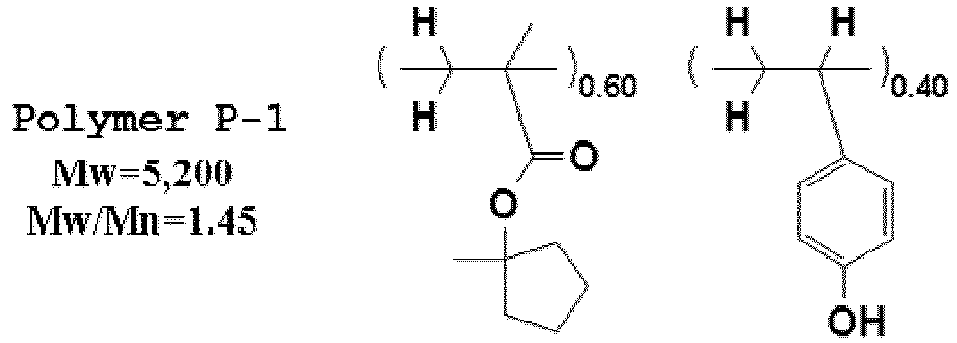


- The inventive sulfonium salts (photoacid generators: PAG-1 to PAG-17), comparative photoacid generators (PAG-A to PAG-L), the base polymers (P-1 to P-6), quenchers (Q-1 to Q-6), and a hydrophobic resin F-1 were dissolved into solvents containing 100 ppm of FC-4430, manufactured by 3M Company, as a surfactant at compositions shown in the following Table 1 and Table 2 to prepare solutions. The solutions were filtered with a Teflon(R) filter with 0.2 µm to prepare chemically amplified resist compositions (R-1 to R-32 and CR-1 to CR-24).
[Table 1] Resist composition Base resin (parts by mass) Photoacid generator (parts by mass) Quencher (parts by mass) Hydrophobic resin (parts by mass) Solvent 1 (parts by mass) Solvent 2 (parts by mass) Solvent 3 (parts by mass) Example 1-1 R-1 P-1 (80) PAG-1 (22) Q-1 (6.0) - PGMEA (2,200) DAA (900) Example 1-2 R-2 P-1 (80) PAG-6 (24) Q-1 (6.0) - PGMEA (2,200) DAA (900) Example 1-3 R-3 P-1 (80) PAG-7 (23) Q-1 (6.0) - PGMEA (2,200) DAA (900) Example 1-4 R-4 P-1 (80) PAG-8 (20) Q-1 (6.0) - PGMEA (2,200) DAA (900) Example 1-5 R-5 P-1 (80) PAG-9 (24) Q-1 (6.0) - PGMEA (2,200) DAA (900) Example 1-6 R-6 P-1 (80) PAG-10 (20) Q-1 (6.0) - PGMEA (2,200) DAA (900) Example 1-7 R-7 P-1 (80) PAG-11 (11) Q-1 (6.0) - PGMEA (2,200) DAA (900) Example 1-8 R-8 P-1 (80) PAG-16 (25) Q-2 (6.0) - PGMEA (2,200) DAA (900) Example 1-9 R-9 P-2 (80) PAG-1 (22) Q-1 (3.4) - PGMEA (2,200) DAA (900) Q-6 (3.4) Example 1-10 R-10 P-2 (80) PAG-6 (24) Q-2 (6.2) - PGMEA (2,200) DAA (900) - Example 1-11 R-11 P-2 (80) PAG-8 (21) Q-3 (5.8) - PGMEA (2,200) DAA (900) - Example 1-12 R-12 P-2 (80) PAG-16 (25) Q-2 (6.2) - PGMEA (2,200) DAA (900) - Example 1-13 R-13 P-3 (80) PAG-1 (12) Q-1 (7.8) - PGMEA (2,200) DAA (900) - Example 1-14 R-14 P-3 (80) PAG-6 (10) Q-2 (3.4) - PGMEA (2,200) DAA (900) - Q-6 (3.4) Example 1-15 R-15 P-3 (80) PAG-10 (10) Q-3 (5.8) - PGMEA (2,200) DAA (900) - Example 1-16 R-16 P-4 (80) PAG-2 (6) Q-4 (2.5) F-1 (1.5) EL (1,700) PGME (360) PGMEA (340) Example 1-17 R-17 P-4 (80) PAG-3 (6) Q-4 (2.5) F-1 (1.5) EL (1,700) PGME (360) PGMEA (340) Example 1-18 R-18 P-4 (80) PAG-4 (6) Q-4 (2.5) F-1 (1.5) EL (1,700) PGME (360) PGMEA (340) Example 1-19 R-19 P-4 (80) PAG-5 (6) Q-4 (2.5) F-1 (1.5) EL (1,700) PGME (360) PGMEA (340) Example 1-20 R-20 P-4 (80) PAG-12 (6) Q-4 (2.5) F-1 (1.5) EL (1,700) PGME (360) PGMEA (340) Example 1-21 R-21 P-4 (80) PAG-13 (6) Q-4 (2.5) F-1 (1.5) EL (1,700) PGME (360) PGMEA (340) Example 1-22 R-22 P-4 (80) PAG-14 (6) Q-4 (2.5) F-1 (1.5) EL (1,700) PGME (360) PGMEA (340) Example 1-23 R-23 P-4 (80) PAG-15 (6) Q-4 (2.5) F-1 (1.5) EL (1,700) PGME (360) PGMEA (340) Example 1-24 R-24 P-4 (80) PAG-16 (4) Q-4 (2.5) F-1 (1.5) EL (1,700) PGME (360) PGMEA (340) Example 1-25 R-25 P-5 (80) PAG-4 (8) Q-4 (2.5) F-1 (1.5) EL (1,700) PGME (360) PGMEA (340) Example 1-26 R-26 P-5 (80) PAG-5 (8) Q-4 (2.5) F-1 (1.5) EL (1,700) PGME (360) PGMEA (340) Example 1-27 R-27 P-5 (80) PAG-13 (6) Q-4 (2.5) F-1 (1.5) EL (1,700) PGME (360) PGMEA (340) Example 1-28 R-28 P-5 (80) PAG-15 (8) Q-4 (2.5) F-1 (1.5) EL (1,700) PGME (360) PGMEA (340) Example 1-29 R-29 P-5 (80) PAG-16 (4) Q-5 (3.0) F-1 (1.5) EL (1,700) PGME (360) PGMEA (340) Example 1-30 R-30 P-6 (80) PAG-4 (6) Q-4 (7.8) F-1 (1.5) EL (1,700) PGME (360) PGMEA (340) Example 1-31 R-31 P-6 (80) PAG-16 (5) Q-5 (2.8) F-1 (1.5) EL (1,700) PGME (360) PGMEA (340) Example 1-32 R-32 P-6 (80) PAG-17 (5) Q-5 (2.8) F-1 (1.5) EL (1,700) PGME (360) PGMEA (340) [Table 2] Resist composition Base resin (parts by mass) Photoacid generator (parts by mass) Quencher (parts by mass) Hydrophobic resin (parts by mass) Solvent 1 (parts by mass) Solvent 2 (parts by mass) Solvent 3 (parts by mass) Comparative Example 1-1 CR-1 P-1 (80) PAG-A (22) Q-1 (6.0) - PGMEA (2,200) DAA (900) - Comparative Example 1-2 CR-2 P-1 (80) PAG-B (21) Q-1 (6.2) - PGMEA (2,200) DAA (900) - Comparative Example 1-3 CR-3 P-1 (80) PAG-C (23) Q-1 (6.1) - PGMEA (2,200) DAA (900) - Comparative Example 1-4 CR-4 P-1 (80) PAG-D (22) Q-1 (5.8) - PGMEA (2,200) DAA (900) - Comparative Example 1-5 CR-5 P-1 (80) PAG-E (20) Q-1 (6.0) - PGMEA (2,200) DAA (900) - Comparative Example 1-6 CR-6 P-1 (80) PAG-F (22) Q-1 (6.2) - PGMEA (2,200) DAA (900) - Comparative Example 1-7 CR-7 P-2 (80) PAG-B (20) Q-2 (6.2) - PGMEA (2,200) DAA (900) - Comparative Example 1-8 CR-8 P-2 (80) PAG-C (22) Q-3 (5.8) - PGMEA (2,200) DAA (900) - Comparative Example 1-9 CR-9 P-2 (80) PAG-F (20) Q-3 (5.8) - PGMEA (2,200) DAA (900) - Comparative Example 1-10 CR-10 P-3 (80) PAG-C (12) Q-1 (7.8) - PGMEA (1,400) DAA (900) - Comparative Example 1-11 CR-11 P-3 (80) PAG-E (10) Q-3 (5.6) - PGMEA (1,400) DAA (900) - Comparative Example 1-12 CR-12 P-3 (80) PAG-D (10) Q-2 (3.4) - PGMEA (1,400) DAA (900) - Q-6 (3.4) Comparative Example 1-13 CR-13 P-4 (80) PAG-G (6) Q-4 (2.5) F-1 (1.5) EL (1,700) PGME (360) PGMEA (340) Comparative Example 1-14 CR-14 P-4 (80) PAG-H (6) Q-4 (2.5) F-1 (1.5) EL (1,700) PGME (360) PGMEA (340) Comparative Example 1-15 CR-15 P-4 (80) PAG-1 (6) Q-4 (2.5) F-1 (1.5) EL (1,700) PGME (360) PGMEA (340) Comparative Example 1-16 CR-16 P-4 (80) PAG-J (6) Q-4 (2.5) F-1 (1.5) EL (1,700) PGME (360) PGMEA (340) Comparative Example 1-17 CR-17 P-4 (80) PAG-K (6) Q-4 (2.5) F-1 (1.5) EL (1,700) PGME (360) PGMEA (340) Comparative Example 1-18 CR-18 P-4 (80) PAG-L (4) Q-4 (2.5) F-1 (1.5) EL (1,700) PGME (360) PGMEA (340) Comparative Example 1-19 CR-19 P-5 (80) PAG-H (6) Q-4 (2.5) F-1 (1.5) EL (1,700) PGME (360) PGMEA (340) Comparative Example 1-20 CR-20 P-5 (80) PAG-1 (6) Q-4 (2.5) F-1 (1.5) EL (1,700) PGME (360) PGMEA (340) Comparative Example 1-21 CR-21 P-5 (80) PAG-J (6) Q-4 (2.5) F-1 (1.5) EL (1,700) PGME (360) PGMEA (340) Comparative Example 1-22 CR-22 P-5 (80) PAG-L (4) Q-5 (2.6) F-1 (1.5) EL (1,700) PGME (360) PGMEA (340) Comparative Example 1-23 CR-23 P-6 (80) PAG-J (6) Q-4 (2.5) F-1 (1.5) EL (1,700) PGME (360) PGMEA (340) Comparative Example 1-24 CR-24 P-6 (80) PAG-L (4) Q-5 (2.6) F-1 (1.5) EL (1,700) PGME (360) PGMEA (340) - In Tables 1 and 2, the solvents, the hydrophobic resin F-1, the comparative photoacid generators PAG-A to PAG-L, and the quenchers Q-1 to Q-6 were as follows.
-Solvent: PGMEA (Propylene glycol monomethyl ether acetate) - DAA (Diacetone alcohol)
- EL (Ethyl lactate)
- PGME (Propylene glycol monomethyl ether)
-

-
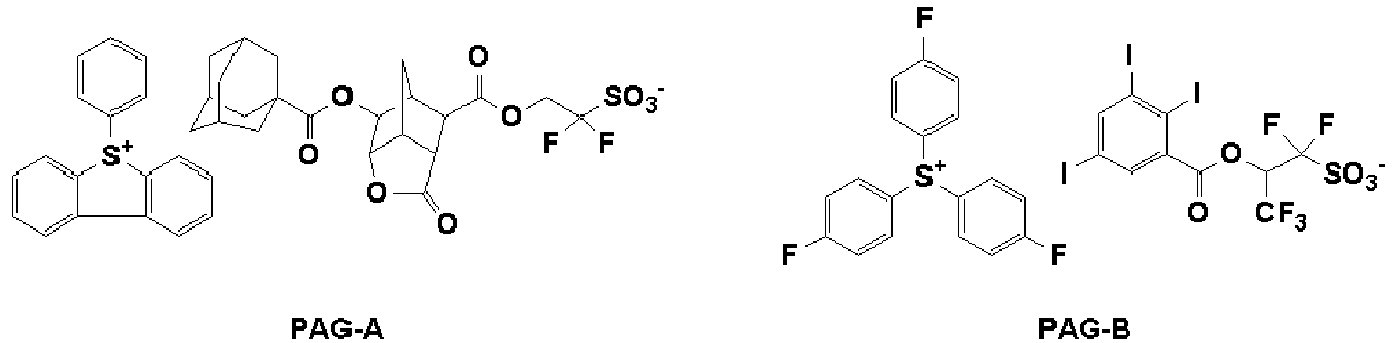

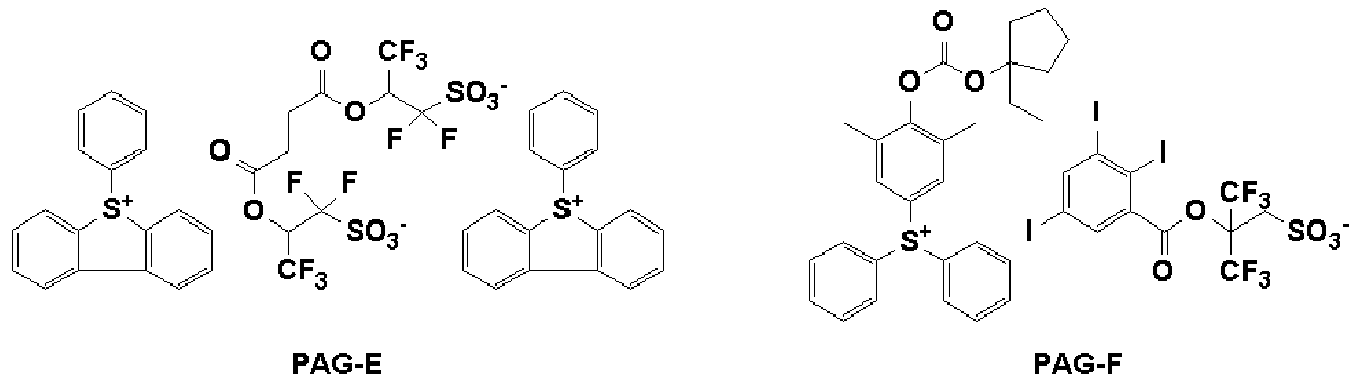


-


- Each of the chemically amplified resist compositions (R-1 to R-15 and CR-1 to CR-12) shown in Table 1 and Table 2 was applied by spin-coating on a Si substrate on which a silicon-containing spin-on-hard mask SHB-A940, manufactured by Shin-Etsu Chemical Co., Ltd. (silicon content of 43 mass%), was formed with 20 nm in film thickness. Then, the substrate was prebaked at 100°C for 60 seconds using a hot plate to produce a resist film with 50 nm in film thickness. This resist film was exposed by using an EUV scanner NXE3300 (NA 0.33, σ 0.9/0.6, dipole illumination), manufactured by ASML Holding N.V. The exposure was performed with a LS pattern with 18 nm on wafer size and 36 nm in pitch, and with changing an exposure dose and focus (exposure dose pitch: 1 mJ/cm2, focus pitch: 0.020 µm). After the exposure, PEB was performed at a temperature shown in Table 3 and Table 4 for 60 seconds. Thereafter, puddle development with a 2.38 mass% aqueous TMAH solution for 30 seconds, rinse with a surfactant-containing rinsing material, and spin-drying were performed to obtain a positive-type pattern.
- The obtained LS pattern was observed with a length-measurement SEM (CG6300), manufactured by Hitachi High-Technologies Corporation, to evaluate sensitivity, exposure latitude (EL), LWR, depth of focus (DOF), and collapse limit in accordance with the following methods. Table 3 and Table 4 show the results.
- An optimum exposure dose Eop (mJ/cm2) to yield the LS pattern with 18 nm in line width and 36 nm in pitch was determined to specify this value as a sensitivity. A smaller sensitivity value indicates higher sensitivity.
- From exposure doses to form the LS pattern within a range of ± 10% of 18 nm space width (16.2 to 19.8 nm), EL (unit: %) was determined by the following equation. The larger the EL value, the better the performance.

- E1: An optimum exposure dose to yield a LS pattern with 16.2 nm in line width and 36 nm in pitch.
- E2: An optimum exposure dose to yield a LS pattern with 19.8 nm in line width and 36 nm in pitch.
- Eop: An optimum exposure dose to yield the LS pattern with 18 nm in line width and 36 nm in pitch.
- In the LS pattern obtained by irradiation at Eop, sizes at 10 positions in the longitudinal direction of the line were measured. From the results, a tripled value (3σ) of a standard variation (σ) was determined as LWR. A smaller LWR value can yield a pattern with smaller roughness and uniform line width.
- As evaluation of depth of focus, determined was a focus range that formed within a range of the 18 nm size ± 10% (16.2 to 19.8 nm) of the LS pattern. A larger DOF value indicates wider depth of focus.
- Line sizes of the LS patterns at each exposure dose with the optimum focus were measured at 10 positions in the longitudinal direction. A narrowest line size obtained without collapse was specified as a collapse limit size. A smaller limit size value indicates excellent collapse limit.
[Table 3] Resist composition PEB temperature (°C) Optimum exposure dose (mJ/cm2) EL (%) LWR (nm) DOF (nm) Collapse limit (nm) Example 2-1 R-1 95 43 18 2.8 120 10.6 Example 2-2 R-2 95 42 18 2.7 110 11 Example 2-3 R-3 90 41 17 2.9 120 10.3 Example 2-4 R-4 95 42 19 2.8 120 10.5 Example 2-5 R-5 95 41 18 2.9 110 11.1 Example 2-6 R-6 95 40 17 2.7 100 10.2 Example 2-7 R-7 90 41 19 2.8 120 10.4 Example 2-8 R-8 95 43 19 2.7 120 11.2 Example 2-9 R-9 95 42 18 2.9 100 11.1 Example 2-10 R-10 90 41 17 3 120 10.6 Example 2-11 R-11 95 42 17 2.8 110 10.8 Example 2-12 R-12 95 44 18 2.9 100 10.5 Example 2-13 R-13 90 38 19 2.8 120 10.6 Example 2-14 R-14 95 39 18 2.8 110 11 Example 2-15 R-15 95 39 17 2.9 120 10.8 [Table 4] Resist composition PEB temperature (°C) Optimum exposure dose (mJ/cm2) EL (%) LWR (nm) DOF (nm) Collapse limit (nm) Comparative Example 2-1 CR-1 95 50 17 3.8 80 15.3 Comparative Example 2-2 CR-2 95 49 18 3.7 90 14.9 Comparative Example 2-3 CR-3 90 43 15 4 70 14.5 Comparative Example 2-4 CR-4 90 44 17 3.8 80 13.9 Comparative Example 2-5 CR-5 90 42 18 3.8 80 15.1 Comparative Example 2-6 CR-6 90 43 17 3.9 90 14.6 Comparative Example 2-7 CR-7 95 48 17 3.8 90 14.8 Comparative Example 2-8 CR-8 90 43 18 4.1 70 13.8 Comparative Example 2-9 CR-9 100 43 19 3.8 80 14.3 Comparative Example 2-10 CR-10 95 43 18 3.9 90 15.2 Comparative Example 2-11 CR-11 95 42 16 3.7 80 14.8 Comparative Example 2-12 CR-12 100 43 17 4.2 70 14.3 - From the results shown in Table 3 and Table 4, the chemically amplified resist composition containing the inventive photoacid generator has been found to have excellent EL, LWR, and DOF with good sensitivity. The composition has a small collapse limit value, and also has been confirmed to hardly cause pattern collapse even in fine pattern formation. Therefore, the inventive chemically amplified resist composition has been demonstrated to be suitable for a material for EUV lithography.
- Each of the chemically amplified resist compositions (R-1 to R-15 and CR-1 to CR-12) shown in Table 1 and Table 2 was applied by spin-coating on a Si substrate on which a silicon-containing spin-on-hard mask SHB-A940, manufactured by Shin-Etsu Chemical Co., Ltd. (silicon content of 43 mass%), was formed with 20 nm in film thickness. Then, the substrate was prebaked at 105°C for 60 seconds using a hot plate to produce a resist film with 50 nm in film thickness. This resist film was exposed by using an EUV scanner NXE3400 (NA 0.33, σ 0.9/0.6, quadrupole illumination, 46 nm in pitch on wafer size, hole pattern mask with +20% bias), manufactured by ASML Holding N.V. Then, PEB was performed at a temperature shown in Table 5 and Table 6 for 60 seconds by using a hot plate, and development was performed with a 2.38 mass% aqueous TMAH solution for 30 seconds to form a hole pattern with 23 nm in size.
- Using a length-measurement SEM (CG6300), manufactured by Hitachi High-Technologies Corporation, an exposure dose when the hole size was formed with 23 nm was measured to specify this exposure dose as a sensitivity. Sizes of 50 holes were measured in this time, and a tripled value (3σ) of a standard variation (σ) calculated from the results was determined as size variation (CDU). Table 5 and Table 6 show the results.
[Table 5] Resist composition PEB Temperature (°C) Optimum exposure dose (mJ/cm2) CDU (nm) Example 3-1 R-1 90 26 2.2 Example 3-2 R-2 95 24 2.4 Example 3-3 R-3 90 24 2.3 Example 3-4 R-4 90 25 2.5 Example 3-5 R-5 90 27 2.3 Example 3-6 R-6 90 25 2.6 Example 3-7 R-7 85 24 2.4 Example 3-8 R-8 90 26 2.3 Example 3-9 R-9 95 24 2.3 Example 3-10 R-10 90 25 2.4 Example 3-11 R-11 90 26 2.5 Example 3-12 R-12 85 27 2.3 Example 3-13 R-13 90 24 2.2 Example 3-14 R-14 90 25 2.4 Example 3-15 R-15 90 24 2.6 [Table 6] Resist composition PEB Temperature (°C) Optimum exposure dose (mJ/cm2) CDU (nm) Comparative Example 3-1 CR-1 90 35 3.5 Comparative Example 3-2 CR-2 95 32 3.3 Comparative Example 3-3 CR-3 90 25 3.1 Comparative Example 3-4 CR-4 85 26 2.9 Comparative Example 3-5 CR-5 90 24 3 Comparative Example 3-6 CR-6 85 27 3.2 Comparative Example 3-7 CR-7 90 26 2.8 Comparative Example 3-8 CR-8 90 25 3.2 Comparative Example 3-9 CR-9 90 26 2.9 Comparative Example 3-10 CR-10 85 25 2.8 Comparative Example 3-11 CR-11 95 26 2.9 Comparative Example 3-12 CR-12 90 25 3.1 - From the results shown in Table 5 and Table 6, the inventive chemically amplified resist composition has been confirmed to have good sensitivity and excellent CDU.
- Each of the chemically amplified resist compositions (R-16 to R-32 and CR-13 to CR-24) was applied by spin-coating on a photomask blanks with 152-mm square having a chromium outermost surface by using ACT-M (manufactured by Tokyo Electron Ltd.). The composition was prebaked at 110°C for 600 seconds using a hot plate to produce a resist film with 80 nm in film thickness.
- Furthermore, the composition was exposed by using an electron beam exposure apparatus (EBM-5000plus, manufactured by NuFlare Technology, Inc., acceleration voltage of 50 kV), PEB was performed at 110°C for 600 seconds, and development was performed with a 2.38 mass% aqueous TMAH solution to obtain a positive-type pattern.
- The obtained resist pattern was evaluated as follows. The mask blanks with the produced pattern was observed with the above SEM (scanning electron microscope) to measure LER of a 200-nm line-and-space (LS). An exposure dose at which the 200-nm 1:1 LS was resolved with 1:1 was specified as an optimum exposure dose (µC/cm2), and a minimum size at the exposure dose at which the 200-nm LS was resolved with 1:1 was specified as a resolution (critical resolution). Development loading (Variation of development loading) was evaluated as follows. Each disposed on a substrate were: a 200-nm LS pattern formed with the exposure dose (µC/cm2) at which the designed 200-nm 1:1 LS was resolved with a ratio of 1:1; and dummy patterns with a density of 15%, 25%, 33%, 45%, 50%, 55%, 66%, 75%, 85%, or 95%, the dummy patterns disposed on around the 200-nm LS pattern. The size of the space portion of the 200-nm LS pattern was measured and differences in the sizes of the sparse or dense patterns were compared. Whether the pattern had a rectangular shape or not was determined by visual observation.
- A dissolution rate in an excessively exposed portion was calculated by: applying the resist solution on a 8-inch silicon wafer by spin-coating; baking the resist solution at 110°C for 60 seconds to form a resist film with 90 nm in film thickness; then exposing the resist film to KrF excimer laser light at an exposure dose (mJ/cm2) at which a 200-nm 1:1 line-and-space (LS) was resolved with 1:1; baking the exposed resist film at 110°C for 60 seconds; and developing the baked resist film at 23°C with a 2.38 mass% TMAH aqueous solution using a resist development analyzer (RDA-800, manufactured by Litho Tech Japan Corporation). Table 7 and Table 8 show the results.
[Table 7] Resist composition Optimum exposure dose (µC/cm2) Critical resolution (nm) LER (nm) Variation of development loading (Δnm) Pattern shape Dissolution rate of excessively exposed portion (nm/s) Example 4-1 R-16 260 30 4.5 1.6 Rectangular 770 Example 4-2 R-17 270 30 4.4 1.7 Rectangular 750 Example 4-3 R-18 260 30 4 . 7 1.6 Rectangular 680 Example 4-4 R-19 260 30 4.4 1.5 Rectangular 700 Example 4-5 R-20 270 30 4.5 1.6 Rectangular 710 Example 4-6 R-21 260 35 4.7 1.7 Rectangular 690 Example 4-7 R-22 260 30 4.3 1.5 Rectangular 720 Example 4-8 R-23 270 30 4.4 1.6 Rectangular 730 Example 4-9 R-24 260 35 4.5 1.6 Rectangular 750 Example 4-10 R-25 265 30 4.6 1.7 Rectangular 760 Example 4-11 R-26 260 30 4.4 1.5 Rectangular 740 Example 4-12 R-27 265 30 4.5 1.7 Rectangular 720 Example 4-13 R-28 260 35 4.6 1.6 Rectangular 730 Example 4-14 R-29 270 30 4.5 1.6 Rectangular 750 Example 4-15 R-30 260 35 4.7 1.7 Rectangular 760 Example 4-16 R-31 255 30 4.5 1.5 Rectangular 710 Example 4-17 R-32 260 30 4.4 1.6 Rectangular 740 [Table 8] Resist composition Optimum exposure dose (µC/cm2) Critical resolution (nm) LER (nm) Variation of development loading (Δnm) Pattern shape Dissolution rate of excessively exposed portion (nm/s) Comparative Example 4-1 CR-13 280 45 5.5 2.1 Rounded head 400 Comparative Example 4-2 CR-14 290 40 5.4 2.3 Rounded head 450 Comparative Example 4-3 CR-15 280 40 5.6 2.2 Rounded head 340 Comparative Example 4-4 CR-16 270 45 5.1 2.2 Rounded head 410 Comparative Example 4-5 CR-17 265 50 5.4 2.4 Rounded head 430 Comparative Example 4-6 CR-18 270 45 5.5 2.3 Rounded head 510 Comparative Example 4-7 CR-19 280 45 5.5 2.1 Rounded head 400 Comparative Example 4-8 CR-20 270 50 5.6 2.3 Rounded head 430 Comparative Example 4-9 CR-21 285 60 5.7 2.2 Rounded head 470 Comparative Example 4-10 CR-22 270 45 5 2 . 1 Rounded head 430 Comparative Example 4-11 CR-23 280 45 5.6 2.2 Rounded head 460 Comparative Example 4-12 CR-24 290 50 5.3 2.1 Rounded head 510 - From the results shown in Table 7 and Table 8, all of the chemically amplified resist compositions containing the inventive photoacid generator exhibited good resolution, LER, and pattern rectangularity, and exhibited a reduced value of the development loading. Therefore, the inventive chemically amplified resist composition has been demonstrated to be suitable also for a material for EB lithography.
- The present specification includes the following aspects.
- [1]: A sulfonium salt represented by the following formula (1),

- [2]: The sulfonium salt according to [1], wherein in the formula (1), RALU is represented by the following formula (ALU-1) or (ALU-2),

- [3]: The sulfonium salt according to [1] or [2], wherein in the formula (1), X- being the non-nucleophilic counterion having no polymerizable group represents a sulfonate anion, an imide anion, or a methide anion.
- [4]: A photoacid generator, comprising the sulfonium salt according to any one of [1] to [3].
- [5]: A resist composition, comprising the photoacid generator according to [4].
- [6]: The resist composition according to [5], further comprising a base resin having a repeating unit represented by the following formula (a1) or (a2),
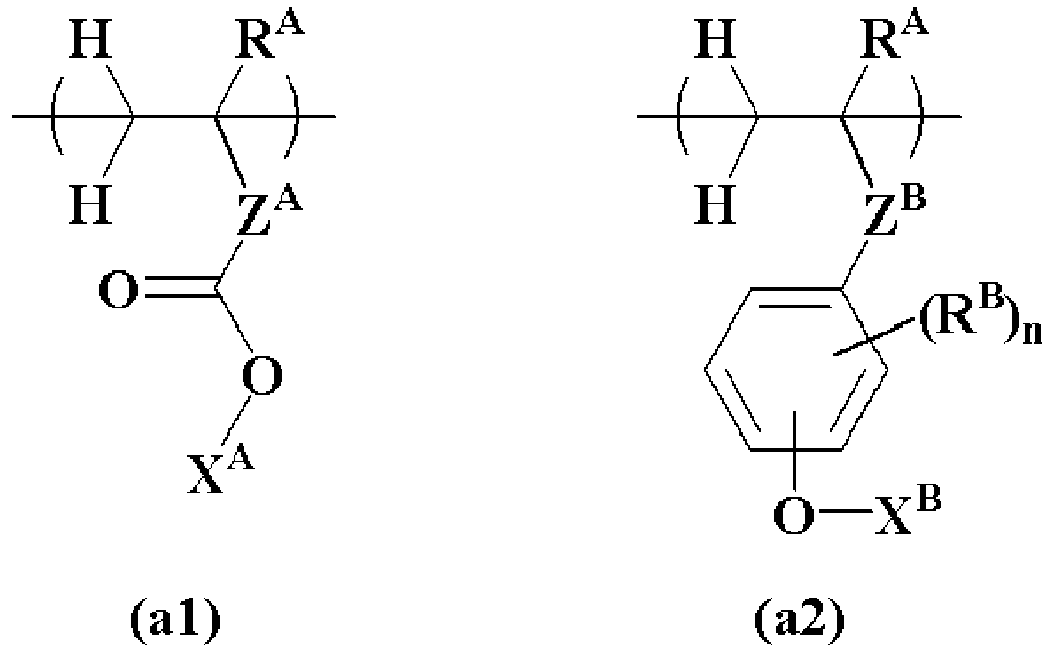
- [7]: The resist composition according to [6], wherein the base resin further has a repeating unit represented by the following formula (b1) or (b2),

- [8]: The resist composition according to [6] or [7], wherein the base resin further has at least one repeating unit selected from repeating units represented by the following formulae (C1) to (C4),

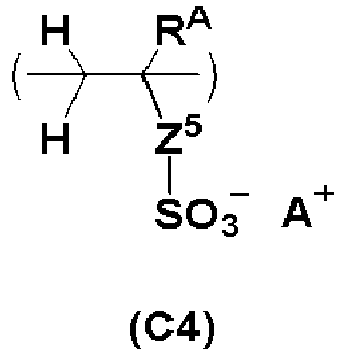
- [9]: The resist composition according to any one of [6] to [8], further comprising an organic solvent.
- [10]: The resist composition according to any one of [6] to [9], further comprising a compound represented by the following formula (5) or (6),
Rq1-SO3 - Mq+ (5)
Rq2-CO2 - Mq+ (6)
wherein Rq1 represents a hydrogen atom or a monovalent hydrocarbon group having 1 to 40 carbon atoms and optionally having a heteroatom, Rq1 excluding a group in which a hydrogen atom bonded to a carbon atom at an α-position of the sulfo group is substituted with a fluorine atom or a fluoroalkyl group; Rq2 represents a hydrogen atom or a monovalent hydrocarbon group having 1 to 40 carbon atoms and optionally having a heteroatom; and Mq+ represents an onium cation. - [11]: The resist composition according to any one of [6] to [10], further comprising a photoacid generator other than the photoacid generator according to [4].
- [12]: The resist composition according to any one of [6] to [11], further comprising an amine compound.
- [13]: The resist composition according to any one of [6] to [12], further comprising: a surfactant insoluble or hardly soluble in water and soluble in an alkaline developer; and/or a surfactant insoluble or hardly soluble in water and an alkaline developer.
- [14]: A patterning process, comprising steps of: forming a resist film on a substrate using the resist composition according to any one of [6] to [13]; exposing the resist film to high energy ray; and developing the exposed resist film using a developer.
- [15]: The patterning process according to [14], wherein the high energy ray is KrF excimer laser light, ArF excimer laser light, electron beam, or extreme ultraviolet ray having a wavelength of 3 to 15 nm.
- It should be noted that the present invention is not limited to the above-described embodiments. The embodiments are just examples, and any examples that substantially have the same feature and demonstrate the same functions and effects as those in the technical concept disclosed in claims of the present invention are included in the technical scope of the present invention.
Claims (15)
- A sulfonium salt represented by the following formula (1),

- The sulfonium salt according to claim 1, wherein in the formula (1), RALU is represented by the following formula (ALU-1) or (ALU-2),

- The sulfonium salt according to claim 1 or claim 2, wherein in the formula (1), X- being the non-nucleophilic counterion having no polymerizable group represents a sulfonate anion, an imide anion, or a methide anion.
- A photoacid generator, comprising the sulfonium salt according to any one of claims 1 to 3.
- A resist composition, comprising the photoacid generator according to claim 4.
- The resist composition according to claim 5, further comprising a base resin having a repeating unit represented by the following formula (a1) or (a2),

- The resist composition according to claim 6, wherein the base resin further has a repeating unit represented by the following formula (b1) or (b2),

- The resist composition according to claim 6 or claim 7, wherein the base resin further has at least one repeating unit selected from repeating units represented by the following formulae (C1) to (C4),


- The resist composition according to any one of claims 6 to 8, further comprising an organic solvent.
- The resist composition according to any one of claims 6 to 9, further comprising a compound represented by the following formula (5) or (6),
Rq1-SO3 - Mq + (5)
Rq2 -CO2 - Mq + (6)
wherein Rq1 represents a hydrogen atom or a monovalent hydrocarbon group having 1 to 40 carbon atoms and optionally having a heteroatom, Rq1 excluding a group in which a hydrogen atom bonded to a carbon atom at an α-position of the sulfo group is substituted with a fluorine atom or a fluoroalkyl group; Rq2 represents a hydrogen atom or a monovalent hydrocarbon group having 1 to 40 carbon atoms and optionally having a heteroatom; and Mq+ represents an onium cation. - The resist composition according to any one of claims 6 to 10, further comprising a photoacid generator other than the photoacid generator according to claim 5.
- The resist composition according to any one of claims 6 to 11, further comprising an amine compound.
- The resist composition according to any one of claims 6 to 12, further comprising:a surfactant insoluble or hardly soluble in water and soluble in an alkaline developer; and/ora surfactant insoluble or hardly soluble in water and an alkaline developer.
- A patterning process, comprising steps of:forming a resist film on a substrate using the resist composition according to any one of claims 6 to 13;exposing the resist film to high energy ray; anddeveloping the exposed resist film using a developer.
- The patterning process according to claim 14, wherein the high energy ray is KrF excimer laser light, ArF excimer laser light, electron beam, or extreme ultraviolet ray having a wavelength of 3 to 15 nm.
Applications Claiming Priority (1)
| Application Number | Priority Date | Filing Date | Title |
|---|---|---|---|
| JP2022081146A JP2023169812A (en) | 2022-05-17 | 2022-05-17 | Novel sulfonium salt, resist composition, and patterning process |
Publications (1)
| Publication Number | Publication Date |
|---|---|
| EP4279991A1 true EP4279991A1 (en) | 2023-11-22 |
Family
ID=86330094
Family Applications (1)
| Application Number | Title | Priority Date | Filing Date |
|---|---|---|---|
| EP23171817.2A Pending EP4279991A1 (en) | 2022-05-17 | 2023-05-05 | Novel sulfonium salt, resist composition, and patterning process |
Country Status (6)
| Country | Link |
|---|---|
| US (1) | US20230418158A1 (en) |
| EP (1) | EP4279991A1 (en) |
| JP (1) | JP2023169812A (en) |
| KR (1) | KR102869196B1 (en) |
| CN (1) | CN117069633A (en) |
| TW (1) | TWI870852B (en) |
Families Citing this family (11)
| Publication number | Priority date | Publication date | Assignee | Title |
|---|---|---|---|---|
| JP2026007396A (en) | 2024-07-03 | 2026-01-16 | 信越化学工業株式会社 | Chemically amplified negative resist composition and method for forming resist pattern |
| JP2026007588A (en) | 2024-07-03 | 2026-01-16 | 信越化学工業株式会社 | Chemically amplified positive resist composition and method for forming resist pattern |
| JP2026007393A (en) | 2024-07-03 | 2026-01-16 | 信越化学工業株式会社 | Chemically amplified positive resist composition and method for forming resist pattern |
| JP2026036486A (en) | 2024-08-20 | 2026-03-05 | 信越化学工業株式会社 | Sulfonium salt, chemically amplified positive resist composition, and method for forming a resist pattern |
| JP2026036480A (en) | 2024-08-20 | 2026-03-05 | 信越化学工業株式会社 | Sulfonium salt, chemically amplified positive resist composition, and method for forming a resist pattern |
| JP2026036473A (en) | 2024-08-20 | 2026-03-05 | 信越化学工業株式会社 | Sulfonium salt, chemically amplified positive resist composition, and method for forming a resist pattern |
| JP2026036484A (en) | 2024-08-20 | 2026-03-05 | 信越化学工業株式会社 | Iodonium salt, chemically amplified positive resist composition, and method for forming resist pattern |
| JP2026042362A (en) | 2024-08-27 | 2026-03-11 | 信越化学工業株式会社 | Onium salt, chemically amplified positive resist composition and method for forming resist pattern |
| JP2026042374A (en) | 2024-08-27 | 2026-03-11 | 信越化学工業株式会社 | Chemically amplified negative resist composition and method for forming resist pattern |
| JP2026044251A (en) | 2024-08-30 | 2026-03-12 | 信越化学工業株式会社 | Chemically amplified negative resist composition and resist pattern formation method |
| JP2026044250A (en) | 2024-08-30 | 2026-03-12 | 信越化学工業株式会社 | Chemically amplified positive-type resist composition and resist pattern formation method |
Citations (48)
| Publication number | Priority date | Publication date | Assignee | Title |
|---|---|---|---|---|
| JPH0345464B2 (en) | 1981-03-30 | 1991-07-11 | Olympus Optical Co | |
| JPH0348726B2 (en) | 1982-12-27 | 1991-07-25 | Meidensha Electric Mfg Co Ltd | |
| JPH0548776B2 (en) | 1989-02-17 | 1993-07-22 | Japan Atomic Energy Res Inst | |
| US5650483A (en) | 1992-07-10 | 1997-07-22 | Aerojet-General Corporation | Preparation of mono-substituted fluorinated oxetane prepolymers |
| JP2003066612A (en) | 2001-06-15 | 2003-03-05 | Shin Etsu Chem Co Ltd | Resist material and pattern forming method |
| JP3790649B2 (en) | 1999-12-10 | 2006-06-28 | 信越化学工業株式会社 | Resist material |
| JP2006276759A (en) | 2005-03-30 | 2006-10-12 | Fuji Photo Film Co Ltd | Positive resist composition for euv exposure, and pattern forming method using it |
| JP2007145797A (en) | 2005-04-06 | 2007-06-14 | Shin Etsu Chem Co Ltd | Novel sulfonate and derivative thereof, photoacid generator, resist material and pattern forming method using the same |
| JP2008111103A (en) | 2006-10-04 | 2008-05-15 | Shin Etsu Chem Co Ltd | Polymer compound, resist material, and pattern forming method |
| JP2008281975A (en) | 2007-04-13 | 2008-11-20 | Fujifilm Corp | Pattern forming method, negative developing or multiple developing resist composition used in the pattern forming method, negative developing developer used in the pattern forming method, and negative developing rinse solution used in the pattern forming method |
| JP2008281974A (en) | 2007-04-13 | 2008-11-20 | Fujifilm Corp | PATTERN FORMING METHOD, RESIST COMPOSITION USED FOR THE PATTERN FORMING METHOD, NEGATIVE DEVELOPER USED FOR THE PATTERN FORMING METHOD, AND NEGATIVE DEVELOPING RINS |
| JP2009109595A (en) | 2007-10-26 | 2009-05-21 | Fujifilm Corp | Positive resist composition for electron beam, X-ray or EUV, and pattern forming method using the same |
| JP2009269953A (en) | 2008-05-01 | 2009-11-19 | Shin Etsu Chem Co Ltd | New photoacid generator, resist material using the same, and pattern forming method |
| JP4554665B2 (en) | 2006-12-25 | 2010-09-29 | 富士フイルム株式会社 | PATTERN FORMATION METHOD, POSITIVE RESIST COMPOSITION FOR MULTIPLE DEVELOPMENT USED FOR THE PATTERN FORMATION METHOD, NEGATIVE DEVELOPMENT SOLUTION USED FOR THE PATTERN FORMATION METHOD, AND NEGATIVE DEVELOPMENT RINSE SOLUTION USED FOR THE PATTERN FORMATION METHOD |
| JP2010215608A (en) | 2009-02-19 | 2010-09-30 | Shin-Etsu Chemical Co Ltd | New sulfonate and derivative thereof, photo acid-generating agent and resist material using the same and method for forming pattern |
| JP2011016746A (en) | 2009-07-08 | 2011-01-27 | Shin-Etsu Chemical Co Ltd | Sulfonium salt, resist material and method for forming pattern |
| JP2012046501A (en) | 2010-07-29 | 2012-03-08 | Sumitomo Chemical Co Ltd | Salt, photoresist composition and method for producing resist pattern |
| JP5061484B2 (en) | 2005-03-30 | 2012-10-31 | 住友化学株式会社 | Salt for acid generator of chemically amplified resist composition |
| JP2013080033A (en) | 2011-10-03 | 2013-05-02 | Shin Etsu Chem Co Ltd | Positive resist material and pattern formation method using the same |
| JP2013083821A (en) | 2011-10-11 | 2013-05-09 | Shin Etsu Chem Co Ltd | Resist protective film material and method for forming pattern |
| JP5544078B2 (en) | 2008-10-17 | 2014-07-09 | 東京応化工業株式会社 | Positive resist composition and resist pattern forming method |
| JP5573098B2 (en) | 2008-11-14 | 2014-08-20 | 住友化学株式会社 | Chemically amplified photoresist composition |
| JP5609569B2 (en) | 2009-11-18 | 2014-10-22 | 住友化学株式会社 | Salt and resist composition for acid generator |
| JP2015024989A (en) | 2013-06-17 | 2015-02-05 | 住友化学株式会社 | Salt, acid generator, resist composition, and method for producing resist pattern |
| JP2015063472A (en) | 2013-09-24 | 2015-04-09 | 住友化学株式会社 | Salt, resist composition and method for producing resist pattern |
| JP2015117200A (en) | 2013-12-18 | 2015-06-25 | 信越化学工業株式会社 | Sulfonium salt, resist composition, and resist pattern forming method |
| JP2015206932A (en) | 2014-04-22 | 2015-11-19 | 信越化学工業株式会社 | Photoacid generator, chemically amplified resist material, and pattern forming method |
| JP2016065016A (en) | 2014-09-25 | 2016-04-28 | 信越化学工業株式会社 | Sulfonium salt, resist composition, and resist pattern forming method |
| JP2016147879A (en) | 2010-03-31 | 2016-08-18 | ローム アンド ハース エレクトロニック マテリアルズ エルエルシーRohm and Haas Electronic Materials LLC | Photoacid generators and photoresists comprising the same |
| JP2017026980A (en) | 2015-07-28 | 2017-02-02 | 信越化学工業株式会社 | Resist material and pattern forming method |
| JP6274755B2 (en) | 2012-07-05 | 2018-02-07 | 住友化学株式会社 | Resist composition and method for producing resist pattern |
| JP2018092159A (en) | 2016-11-29 | 2018-06-14 | 東京応化工業株式会社 | RESIST COMPOSITION, RESIST PATTERN FORMATION METHOD, COMPOUND AND ACID GENERATOR |
| US20180180992A1 (en) * | 2016-12-28 | 2018-06-28 | Shin-Etsu Chemical Co., Ltd. | Chemically Amplified Positive Resist Composition and Resist Pattern Forming Process |
| JP2018180525A (en) | 2017-04-17 | 2018-11-15 | Jsr株式会社 | Radiation sensitive resin composition and method of forming resist pattern |
| JP6461919B2 (en) | 2014-04-14 | 2019-01-30 | 富士フイルム株式会社 | Actinic ray-sensitive or radiation-sensitive resin composition, actinic ray-sensitive or radiation-sensitive film and pattern forming method using the composition, and method for producing electronic device |
| US20190064665A1 (en) * | 2017-08-24 | 2019-02-28 | Shin-Etsu Chemical Co., Ltd. | Sulfonium compound, resist composition, and patterning process |
| JP6583136B2 (en) | 2016-05-11 | 2019-10-02 | 信越化学工業株式会社 | Novel sulfonium compound and method for producing the same, resist composition, and pattern forming method |
| JP2019202974A (en) | 2018-05-25 | 2019-11-28 | 信越化学工業株式会社 | Onium salt, chemically amplified positive resist composition, and resist pattern forming method |
| US20200159118A1 (en) * | 2018-11-15 | 2020-05-21 | Tokyo Ohka Kogyo Co., Ltd. | Resist composition and method of forming resist pattern |
| JP2020111564A (en) | 2019-01-16 | 2020-07-27 | 信越化学工業株式会社 | Novel onium salt, chemically amplified resist composition, and pattern forming method |
| WO2020158366A1 (en) | 2019-01-28 | 2020-08-06 | 富士フイルム株式会社 | Active-light-sensitive or radiation-sensitive resin composition, resist film, pattern formation method, and method for manufacturing electronic device |
| JP2020200311A (en) | 2019-06-04 | 2020-12-17 | 住友化学株式会社 | Salt, quencher, resist composition and method for producing resist pattern and method for producing salt |
| US20210055652A1 (en) * | 2019-08-22 | 2021-02-25 | Shin-Etsu Chemical Co., Ltd. | Resist composition and patterning process |
| JP2021035935A (en) | 2019-08-26 | 2021-03-04 | 住友化学株式会社 | Salt, acid generator, resist composition, and method for producing resist pattern |
| JP2021070692A (en) | 2019-10-29 | 2021-05-06 | 住友化学株式会社 | Salt, acid generator, resist composition, and method for producing resist pattern |
| US20210188770A1 (en) * | 2019-12-11 | 2021-06-24 | Shin-Etsu Chemical Co., Ltd. | Onium salt compound, chemically amplified resist composition and patterning process |
| WO2021200056A1 (en) | 2020-03-30 | 2021-10-07 | 富士フイルム株式会社 | Active-light-sensitive or radiation-sensitive resin composition, active-light-sensitive or radiation-sensitive film, pattern formation method, method for manufacturing electronic device, active-light-sensitive or radiation-sensitive resin composition for manufacturing photomask, and method for manufacturing photomask |
| WO2021199841A1 (en) * | 2020-03-30 | 2021-10-07 | 富士フイルム株式会社 | Actinic-ray-sensitive or radiation-sensitive resin composition, pattern formation method, resist film, and electronic device production method |
Family Cites Families (5)
| Publication number | Priority date | Publication date | Assignee | Title |
|---|---|---|---|---|
| JP3399141B2 (en) * | 1995-03-07 | 2003-04-21 | 信越化学工業株式会社 | Chemically amplified positive resist material |
| JP3798115B2 (en) * | 1997-05-27 | 2006-07-19 | 信越化学工業株式会社 | Sulphonium salt and chemically amplified positive resist material containing the same |
| JP6676960B2 (en) * | 2015-12-24 | 2020-04-08 | コニカミノルタ株式会社 | Temperature-time integration type indicator and measurement method of temperature-time integration amount |
| WO2021220851A1 (en) | 2020-04-28 | 2021-11-04 | 富士フイルム株式会社 | Active light ray-sensitive or radiation-sensitive resin composition, active light ray-sensitive or radiation-sensitive film, mask blank, method for forming pattern, and method for producing electronic device |
| US20230259027A1 (en) * | 2022-01-27 | 2023-08-17 | Shin-Etsu Chemical Co., Ltd. | Resist composition and pattern forming process |
-
2022
- 2022-05-17 JP JP2022081146A patent/JP2023169812A/en active Pending
-
2023
- 2023-05-05 EP EP23171817.2A patent/EP4279991A1/en active Pending
- 2023-05-11 KR KR1020230061008A patent/KR102869196B1/en active Active
- 2023-05-12 CN CN202310534593.9A patent/CN117069633A/en active Pending
- 2023-05-12 US US18/317,019 patent/US20230418158A1/en active Pending
- 2023-05-15 TW TW112117843A patent/TWI870852B/en active
Patent Citations (48)
| Publication number | Priority date | Publication date | Assignee | Title |
|---|---|---|---|---|
| JPH0345464B2 (en) | 1981-03-30 | 1991-07-11 | Olympus Optical Co | |
| JPH0348726B2 (en) | 1982-12-27 | 1991-07-25 | Meidensha Electric Mfg Co Ltd | |
| JPH0548776B2 (en) | 1989-02-17 | 1993-07-22 | Japan Atomic Energy Res Inst | |
| US5650483A (en) | 1992-07-10 | 1997-07-22 | Aerojet-General Corporation | Preparation of mono-substituted fluorinated oxetane prepolymers |
| JP3790649B2 (en) | 1999-12-10 | 2006-06-28 | 信越化学工業株式会社 | Resist material |
| JP2003066612A (en) | 2001-06-15 | 2003-03-05 | Shin Etsu Chem Co Ltd | Resist material and pattern forming method |
| JP2006276759A (en) | 2005-03-30 | 2006-10-12 | Fuji Photo Film Co Ltd | Positive resist composition for euv exposure, and pattern forming method using it |
| JP5061484B2 (en) | 2005-03-30 | 2012-10-31 | 住友化学株式会社 | Salt for acid generator of chemically amplified resist composition |
| JP2007145797A (en) | 2005-04-06 | 2007-06-14 | Shin Etsu Chem Co Ltd | Novel sulfonate and derivative thereof, photoacid generator, resist material and pattern forming method using the same |
| JP2008111103A (en) | 2006-10-04 | 2008-05-15 | Shin Etsu Chem Co Ltd | Polymer compound, resist material, and pattern forming method |
| JP4554665B2 (en) | 2006-12-25 | 2010-09-29 | 富士フイルム株式会社 | PATTERN FORMATION METHOD, POSITIVE RESIST COMPOSITION FOR MULTIPLE DEVELOPMENT USED FOR THE PATTERN FORMATION METHOD, NEGATIVE DEVELOPMENT SOLUTION USED FOR THE PATTERN FORMATION METHOD, AND NEGATIVE DEVELOPMENT RINSE SOLUTION USED FOR THE PATTERN FORMATION METHOD |
| JP2008281975A (en) | 2007-04-13 | 2008-11-20 | Fujifilm Corp | Pattern forming method, negative developing or multiple developing resist composition used in the pattern forming method, negative developing developer used in the pattern forming method, and negative developing rinse solution used in the pattern forming method |
| JP2008281974A (en) | 2007-04-13 | 2008-11-20 | Fujifilm Corp | PATTERN FORMING METHOD, RESIST COMPOSITION USED FOR THE PATTERN FORMING METHOD, NEGATIVE DEVELOPER USED FOR THE PATTERN FORMING METHOD, AND NEGATIVE DEVELOPING RINS |
| JP2009109595A (en) | 2007-10-26 | 2009-05-21 | Fujifilm Corp | Positive resist composition for electron beam, X-ray or EUV, and pattern forming method using the same |
| JP2009269953A (en) | 2008-05-01 | 2009-11-19 | Shin Etsu Chem Co Ltd | New photoacid generator, resist material using the same, and pattern forming method |
| JP5544078B2 (en) | 2008-10-17 | 2014-07-09 | 東京応化工業株式会社 | Positive resist composition and resist pattern forming method |
| JP5573098B2 (en) | 2008-11-14 | 2014-08-20 | 住友化学株式会社 | Chemically amplified photoresist composition |
| JP2010215608A (en) | 2009-02-19 | 2010-09-30 | Shin-Etsu Chemical Co Ltd | New sulfonate and derivative thereof, photo acid-generating agent and resist material using the same and method for forming pattern |
| JP2011016746A (en) | 2009-07-08 | 2011-01-27 | Shin-Etsu Chemical Co Ltd | Sulfonium salt, resist material and method for forming pattern |
| JP5609569B2 (en) | 2009-11-18 | 2014-10-22 | 住友化学株式会社 | Salt and resist composition for acid generator |
| JP2016147879A (en) | 2010-03-31 | 2016-08-18 | ローム アンド ハース エレクトロニック マテリアルズ エルエルシーRohm and Haas Electronic Materials LLC | Photoacid generators and photoresists comprising the same |
| JP2012046501A (en) | 2010-07-29 | 2012-03-08 | Sumitomo Chemical Co Ltd | Salt, photoresist composition and method for producing resist pattern |
| JP2013080033A (en) | 2011-10-03 | 2013-05-02 | Shin Etsu Chem Co Ltd | Positive resist material and pattern formation method using the same |
| JP2013083821A (en) | 2011-10-11 | 2013-05-09 | Shin Etsu Chem Co Ltd | Resist protective film material and method for forming pattern |
| JP6274755B2 (en) | 2012-07-05 | 2018-02-07 | 住友化学株式会社 | Resist composition and method for producing resist pattern |
| JP2015024989A (en) | 2013-06-17 | 2015-02-05 | 住友化学株式会社 | Salt, acid generator, resist composition, and method for producing resist pattern |
| JP2015063472A (en) | 2013-09-24 | 2015-04-09 | 住友化学株式会社 | Salt, resist composition and method for producing resist pattern |
| JP2015117200A (en) | 2013-12-18 | 2015-06-25 | 信越化学工業株式会社 | Sulfonium salt, resist composition, and resist pattern forming method |
| JP6461919B2 (en) | 2014-04-14 | 2019-01-30 | 富士フイルム株式会社 | Actinic ray-sensitive or radiation-sensitive resin composition, actinic ray-sensitive or radiation-sensitive film and pattern forming method using the composition, and method for producing electronic device |
| JP2015206932A (en) | 2014-04-22 | 2015-11-19 | 信越化学工業株式会社 | Photoacid generator, chemically amplified resist material, and pattern forming method |
| JP2016065016A (en) | 2014-09-25 | 2016-04-28 | 信越化学工業株式会社 | Sulfonium salt, resist composition, and resist pattern forming method |
| JP2017026980A (en) | 2015-07-28 | 2017-02-02 | 信越化学工業株式会社 | Resist material and pattern forming method |
| JP6583136B2 (en) | 2016-05-11 | 2019-10-02 | 信越化学工業株式会社 | Novel sulfonium compound and method for producing the same, resist composition, and pattern forming method |
| JP2018092159A (en) | 2016-11-29 | 2018-06-14 | 東京応化工業株式会社 | RESIST COMPOSITION, RESIST PATTERN FORMATION METHOD, COMPOUND AND ACID GENERATOR |
| US20180180992A1 (en) * | 2016-12-28 | 2018-06-28 | Shin-Etsu Chemical Co., Ltd. | Chemically Amplified Positive Resist Composition and Resist Pattern Forming Process |
| JP2018180525A (en) | 2017-04-17 | 2018-11-15 | Jsr株式会社 | Radiation sensitive resin composition and method of forming resist pattern |
| US20190064665A1 (en) * | 2017-08-24 | 2019-02-28 | Shin-Etsu Chemical Co., Ltd. | Sulfonium compound, resist composition, and patterning process |
| JP2019202974A (en) | 2018-05-25 | 2019-11-28 | 信越化学工業株式会社 | Onium salt, chemically amplified positive resist composition, and resist pattern forming method |
| US20200159118A1 (en) * | 2018-11-15 | 2020-05-21 | Tokyo Ohka Kogyo Co., Ltd. | Resist composition and method of forming resist pattern |
| JP2020111564A (en) | 2019-01-16 | 2020-07-27 | 信越化学工業株式会社 | Novel onium salt, chemically amplified resist composition, and pattern forming method |
| WO2020158366A1 (en) | 2019-01-28 | 2020-08-06 | 富士フイルム株式会社 | Active-light-sensitive or radiation-sensitive resin composition, resist film, pattern formation method, and method for manufacturing electronic device |
| JP2020200311A (en) | 2019-06-04 | 2020-12-17 | 住友化学株式会社 | Salt, quencher, resist composition and method for producing resist pattern and method for producing salt |
| US20210055652A1 (en) * | 2019-08-22 | 2021-02-25 | Shin-Etsu Chemical Co., Ltd. | Resist composition and patterning process |
| JP2021035935A (en) | 2019-08-26 | 2021-03-04 | 住友化学株式会社 | Salt, acid generator, resist composition, and method for producing resist pattern |
| JP2021070692A (en) | 2019-10-29 | 2021-05-06 | 住友化学株式会社 | Salt, acid generator, resist composition, and method for producing resist pattern |
| US20210188770A1 (en) * | 2019-12-11 | 2021-06-24 | Shin-Etsu Chemical Co., Ltd. | Onium salt compound, chemically amplified resist composition and patterning process |
| WO2021200056A1 (en) | 2020-03-30 | 2021-10-07 | 富士フイルム株式会社 | Active-light-sensitive or radiation-sensitive resin composition, active-light-sensitive or radiation-sensitive film, pattern formation method, method for manufacturing electronic device, active-light-sensitive or radiation-sensitive resin composition for manufacturing photomask, and method for manufacturing photomask |
| WO2021199841A1 (en) * | 2020-03-30 | 2021-10-07 | 富士フイルム株式会社 | Actinic-ray-sensitive or radiation-sensitive resin composition, pattern formation method, resist film, and electronic device production method |
Non-Patent Citations (1)
| Title |
|---|
| JOURNAL OF PHOTOPOLYMER SCIENCE AND TECHNOLOGY, vol. 17, no. 4, 2004, pages 587 - 601 |
Also Published As
| Publication number | Publication date |
|---|---|
| TW202402733A (en) | 2024-01-16 |
| CN117069633A (en) | 2023-11-17 |
| KR102869196B1 (en) | 2025-10-14 |
| TWI870852B (en) | 2025-01-21 |
| JP2023169812A (en) | 2023-11-30 |
| US20230418158A1 (en) | 2023-12-28 |
| KR20230161355A (en) | 2023-11-27 |
Similar Documents
| Publication | Publication Date | Title |
|---|---|---|
| EP4279991A1 (en) | Novel sulfonium salt, resist composition, and patterning process | |
| JP7719754B2 (en) | Polymerizable monomer, polymer compound, resist composition, and pattern forming method | |
| KR102783801B1 (en) | Chemically amplified resist composition and patterning process | |
| KR102950598B1 (en) | Onium salt, chemically amplified resist composition, and patterning process | |
| KR20250036019A (en) | Onium salt, chemically amplified resist composition, and patterning process | |
| KR102870098B1 (en) | Novel sulfonium-salt-type polymerizable monomer, polymer photoacid generator, base rein, resist composition, and patterning process | |
| JP7852456B2 (en) | Onium salt, chemically amplified resist composition, and patterning method | |
| KR20240130620A (en) | Onium salt, resist composition and pattern forming process | |
| JP2023110575A (en) | POLYMER, RESIST COMPOSITION AND PATTERN FORMATION METHOD | |
| KR20250171174A (en) | Onium salt, chemically amplified resist composition, and pattern forming process | |
| US20250370337A1 (en) | Onium salt, chemically amplified resist composition, and pattern forming process | |
| US20260050213A1 (en) | Onium salt, chemically amplified resist composition, and patterning process | |
| KR20250025576A (en) | Onium salt, chemically amplified resist composition, and pattern forming process | |
| US20260003266A1 (en) | Onium salt, chemically amplified resist composition, and pattern forming process | |
| US20260049053A1 (en) | Onium salt, photoacid generator, chemically amplified resist composition, and patterning process | |
| JP2024160436A (en) | Onium salt, chemically amplified resist composition and pattern forming method | |
| JP2025177372A (en) | Monomer, polymer, chemically amplified resist composition and pattern forming method | |
| KR20260015746A (en) | Onium salt, chemically amplified resist composition, and pattern forming process | |
| KR20260015749A (en) | Onium salt, chemically amplified resist composition, and pattern forming process | |
| JP2025183658A (en) | Onium salt, chemically amplified resist composition and pattern forming method | |
| KR20260025023A (en) | Onium salt, chemically amplified resist composition, and pattern forming process | |
| KR20250048167A (en) | Monomer, polymer, chemically amplified resist composition, and pattern forming process |
Legal Events
| Date | Code | Title | Description |
|---|---|---|---|
| PUAI | Public reference made under article 153(3) epc to a published international application that has entered the european phase |
Free format text: ORIGINAL CODE: 0009012 |
|
| STAA | Information on the status of an ep patent application or granted ep patent |
Free format text: STATUS: THE APPLICATION HAS BEEN PUBLISHED |
|
| AK | Designated contracting states |
Kind code of ref document: A1 Designated state(s): AL AT BE BG CH CY CZ DE DK EE ES FI FR GB GR HR HU IE IS IT LI LT LU LV MC ME MK MT NL NO PL PT RO RS SE SI SK SM TR |
|
| STAA | Information on the status of an ep patent application or granted ep patent |
Free format text: STATUS: REQUEST FOR EXAMINATION WAS MADE |
|
| 17P | Request for examination filed |
Effective date: 20240521 |
|
| RBV | Designated contracting states (corrected) |
Designated state(s): AL AT BE BG CH CY CZ DE DK EE ES FI FR GB GR HR HU IE IS IT LI LT LU LV MC ME MK MT NL NO PL PT RO RS SE SI SK SM TR |