EP4279591A1 - Rna molecule, chimeric na molecule, double-stranded rna molecule, and double-stranded chimeric na molecule - Google Patents
Rna molecule, chimeric na molecule, double-stranded rna molecule, and double-stranded chimeric na molecule Download PDFInfo
- Publication number
- EP4279591A1 EP4279591A1 EP22739528.2A EP22739528A EP4279591A1 EP 4279591 A1 EP4279591 A1 EP 4279591A1 EP 22739528 A EP22739528 A EP 22739528A EP 4279591 A1 EP4279591 A1 EP 4279591A1
- Authority
- EP
- European Patent Office
- Prior art keywords
- double
- rna molecule
- chimeric
- stranded
- rna
- Prior art date
- Legal status (The legal status is an assumption and is not a legal conclusion. Google has not performed a legal analysis and makes no representation as to the accuracy of the status listed.)
- Pending
Links
Images




Classifications
-
- C—CHEMISTRY; METALLURGY
- C12—BIOCHEMISTRY; BEER; SPIRITS; WINE; VINEGAR; MICROBIOLOGY; ENZYMOLOGY; MUTATION OR GENETIC ENGINEERING
- C12N—MICROORGANISMS OR ENZYMES; COMPOSITIONS THEREOF; PROPAGATING, PRESERVING, OR MAINTAINING MICROORGANISMS; MUTATION OR GENETIC ENGINEERING; CULTURE MEDIA
- C12N15/00—Mutation or genetic engineering; DNA or RNA concerning genetic engineering, vectors, e.g. plasmids, or their isolation, preparation or purification; Use of hosts therefor
- C12N15/09—Recombinant DNA-technology
- C12N15/10—Processes for the isolation, preparation or purification of DNA or RNA
- C12N15/1034—Isolating an individual clone by screening libraries
- C12N15/1072—Differential gene expression library synthesis, e.g. subtracted libraries, differential screening
-
- C—CHEMISTRY; METALLURGY
- C12—BIOCHEMISTRY; BEER; SPIRITS; WINE; VINEGAR; MICROBIOLOGY; ENZYMOLOGY; MUTATION OR GENETIC ENGINEERING
- C12N—MICROORGANISMS OR ENZYMES; COMPOSITIONS THEREOF; PROPAGATING, PRESERVING, OR MAINTAINING MICROORGANISMS; MUTATION OR GENETIC ENGINEERING; CULTURE MEDIA
- C12N15/00—Mutation or genetic engineering; DNA or RNA concerning genetic engineering, vectors, e.g. plasmids, or their isolation, preparation or purification; Use of hosts therefor
- C12N15/09—Recombinant DNA-technology
- C12N15/11—DNA or RNA fragments; Modified forms thereof; Non-coding nucleic acids having a biological activity
- C12N15/113—Non-coding nucleic acids modulating the expression of genes, e.g. antisense oligonucleotides; Antisense DNA or RNA; Triplex- forming oligonucleotides; Catalytic nucleic acids, e.g. ribozymes; Nucleic acids used in co-suppression or gene silencing
-
- A—HUMAN NECESSITIES
- A61—MEDICAL OR VETERINARY SCIENCE; HYGIENE
- A61K—PREPARATIONS FOR MEDICAL, DENTAL OR TOILETRY PURPOSES
- A61K31/00—Medicinal preparations containing organic active ingredients
- A61K31/70—Carbohydrates; Sugars; Derivatives thereof
- A61K31/7088—Compounds having three or more nucleosides or nucleotides
-
- A—HUMAN NECESSITIES
- A61—MEDICAL OR VETERINARY SCIENCE; HYGIENE
- A61K—PREPARATIONS FOR MEDICAL, DENTAL OR TOILETRY PURPOSES
- A61K31/00—Medicinal preparations containing organic active ingredients
- A61K31/70—Carbohydrates; Sugars; Derivatives thereof
- A61K31/7088—Compounds having three or more nucleosides or nucleotides
- A61K31/7105—Natural ribonucleic acids, i.e. containing only riboses attached to adenine, guanine, cytosine or uracil and having 3'-5' phosphodiester links
-
- A—HUMAN NECESSITIES
- A61—MEDICAL OR VETERINARY SCIENCE; HYGIENE
- A61K—PREPARATIONS FOR MEDICAL, DENTAL OR TOILETRY PURPOSES
- A61K31/00—Medicinal preparations containing organic active ingredients
- A61K31/70—Carbohydrates; Sugars; Derivatives thereof
- A61K31/7088—Compounds having three or more nucleosides or nucleotides
- A61K31/712—Nucleic acids or oligonucleotides having modified sugars, i.e. other than ribose or 2'-deoxyribose
-
- A—HUMAN NECESSITIES
- A61—MEDICAL OR VETERINARY SCIENCE; HYGIENE
- A61K—PREPARATIONS FOR MEDICAL, DENTAL OR TOILETRY PURPOSES
- A61K31/00—Medicinal preparations containing organic active ingredients
- A61K31/70—Carbohydrates; Sugars; Derivatives thereof
- A61K31/7088—Compounds having three or more nucleosides or nucleotides
- A61K31/713—Double-stranded nucleic acids or oligonucleotides
-
- A—HUMAN NECESSITIES
- A61—MEDICAL OR VETERINARY SCIENCE; HYGIENE
- A61K—PREPARATIONS FOR MEDICAL, DENTAL OR TOILETRY PURPOSES
- A61K48/00—Medicinal preparations containing genetic material which is inserted into cells of the living body to treat genetic diseases; Gene therapy
-
- A—HUMAN NECESSITIES
- A61—MEDICAL OR VETERINARY SCIENCE; HYGIENE
- A61P—SPECIFIC THERAPEUTIC ACTIVITY OF CHEMICAL COMPOUNDS OR MEDICINAL PREPARATIONS
- A61P11/00—Drugs for disorders of the respiratory system
- A61P11/04—Drugs for disorders of the respiratory system for throat disorders
-
- A—HUMAN NECESSITIES
- A61—MEDICAL OR VETERINARY SCIENCE; HYGIENE
- A61P—SPECIFIC THERAPEUTIC ACTIVITY OF CHEMICAL COMPOUNDS OR MEDICINAL PREPARATIONS
- A61P11/00—Drugs for disorders of the respiratory system
- A61P11/06—Antiasthmatics
-
- A—HUMAN NECESSITIES
- A61—MEDICAL OR VETERINARY SCIENCE; HYGIENE
- A61P—SPECIFIC THERAPEUTIC ACTIVITY OF CHEMICAL COMPOUNDS OR MEDICINAL PREPARATIONS
- A61P17/00—Drugs for dermatological disorders
-
- A—HUMAN NECESSITIES
- A61—MEDICAL OR VETERINARY SCIENCE; HYGIENE
- A61P—SPECIFIC THERAPEUTIC ACTIVITY OF CHEMICAL COMPOUNDS OR MEDICINAL PREPARATIONS
- A61P17/00—Drugs for dermatological disorders
- A61P17/04—Antipruritics
-
- A—HUMAN NECESSITIES
- A61—MEDICAL OR VETERINARY SCIENCE; HYGIENE
- A61P—SPECIFIC THERAPEUTIC ACTIVITY OF CHEMICAL COMPOUNDS OR MEDICINAL PREPARATIONS
- A61P19/00—Drugs for skeletal disorders
- A61P19/08—Drugs for skeletal disorders for bone diseases, e.g. rachitism, Paget's disease
-
- A—HUMAN NECESSITIES
- A61—MEDICAL OR VETERINARY SCIENCE; HYGIENE
- A61P—SPECIFIC THERAPEUTIC ACTIVITY OF CHEMICAL COMPOUNDS OR MEDICINAL PREPARATIONS
- A61P21/00—Drugs for disorders of the muscular or neuromuscular system
-
- A—HUMAN NECESSITIES
- A61—MEDICAL OR VETERINARY SCIENCE; HYGIENE
- A61P—SPECIFIC THERAPEUTIC ACTIVITY OF CHEMICAL COMPOUNDS OR MEDICINAL PREPARATIONS
- A61P25/00—Drugs for disorders of the nervous system
-
- A—HUMAN NECESSITIES
- A61—MEDICAL OR VETERINARY SCIENCE; HYGIENE
- A61P—SPECIFIC THERAPEUTIC ACTIVITY OF CHEMICAL COMPOUNDS OR MEDICINAL PREPARATIONS
- A61P25/00—Drugs for disorders of the nervous system
- A61P25/08—Antiepileptics; Anticonvulsants
-
- A—HUMAN NECESSITIES
- A61—MEDICAL OR VETERINARY SCIENCE; HYGIENE
- A61P—SPECIFIC THERAPEUTIC ACTIVITY OF CHEMICAL COMPOUNDS OR MEDICINAL PREPARATIONS
- A61P25/00—Drugs for disorders of the nervous system
- A61P25/14—Drugs for disorders of the nervous system for treating abnormal movements, e.g. chorea, dyskinesia
-
- A—HUMAN NECESSITIES
- A61—MEDICAL OR VETERINARY SCIENCE; HYGIENE
- A61P—SPECIFIC THERAPEUTIC ACTIVITY OF CHEMICAL COMPOUNDS OR MEDICINAL PREPARATIONS
- A61P25/00—Drugs for disorders of the nervous system
- A61P25/28—Drugs for disorders of the nervous system for treating neurodegenerative disorders of the central nervous system, e.g. nootropic agents, cognition enhancers, drugs for treating Alzheimer's disease or other forms of dementia
-
- A—HUMAN NECESSITIES
- A61—MEDICAL OR VETERINARY SCIENCE; HYGIENE
- A61P—SPECIFIC THERAPEUTIC ACTIVITY OF CHEMICAL COMPOUNDS OR MEDICINAL PREPARATIONS
- A61P27/00—Drugs for disorders of the senses
-
- A—HUMAN NECESSITIES
- A61—MEDICAL OR VETERINARY SCIENCE; HYGIENE
- A61P—SPECIFIC THERAPEUTIC ACTIVITY OF CHEMICAL COMPOUNDS OR MEDICINAL PREPARATIONS
- A61P27/00—Drugs for disorders of the senses
- A61P27/02—Ophthalmic agents
-
- A—HUMAN NECESSITIES
- A61—MEDICAL OR VETERINARY SCIENCE; HYGIENE
- A61P—SPECIFIC THERAPEUTIC ACTIVITY OF CHEMICAL COMPOUNDS OR MEDICINAL PREPARATIONS
- A61P3/00—Drugs for disorders of the metabolism
- A61P3/06—Antihyperlipidemics
-
- A—HUMAN NECESSITIES
- A61—MEDICAL OR VETERINARY SCIENCE; HYGIENE
- A61P—SPECIFIC THERAPEUTIC ACTIVITY OF CHEMICAL COMPOUNDS OR MEDICINAL PREPARATIONS
- A61P37/00—Drugs for immunological or allergic disorders
- A61P37/08—Antiallergic agents
-
- A—HUMAN NECESSITIES
- A61—MEDICAL OR VETERINARY SCIENCE; HYGIENE
- A61P—SPECIFIC THERAPEUTIC ACTIVITY OF CHEMICAL COMPOUNDS OR MEDICINAL PREPARATIONS
- A61P9/00—Drugs for disorders of the cardiovascular system
- A61P9/14—Vasoprotectives; Antihaemorrhoidals; Drugs for varicose therapy; Capillary stabilisers
-
- C—CHEMISTRY; METALLURGY
- C12—BIOCHEMISTRY; BEER; SPIRITS; WINE; VINEGAR; MICROBIOLOGY; ENZYMOLOGY; MUTATION OR GENETIC ENGINEERING
- C12N—MICROORGANISMS OR ENZYMES; COMPOSITIONS THEREOF; PROPAGATING, PRESERVING, OR MAINTAINING MICROORGANISMS; MUTATION OR GENETIC ENGINEERING; CULTURE MEDIA
- C12N15/00—Mutation or genetic engineering; DNA or RNA concerning genetic engineering, vectors, e.g. plasmids, or their isolation, preparation or purification; Use of hosts therefor
- C12N15/09—Recombinant DNA-technology
- C12N15/10—Processes for the isolation, preparation or purification of DNA or RNA
-
- C—CHEMISTRY; METALLURGY
- C12—BIOCHEMISTRY; BEER; SPIRITS; WINE; VINEGAR; MICROBIOLOGY; ENZYMOLOGY; MUTATION OR GENETIC ENGINEERING
- C12N—MICROORGANISMS OR ENZYMES; COMPOSITIONS THEREOF; PROPAGATING, PRESERVING, OR MAINTAINING MICROORGANISMS; MUTATION OR GENETIC ENGINEERING; CULTURE MEDIA
- C12N2310/00—Structure or type of the nucleic acid
- C12N2310/10—Type of nucleic acid
- C12N2310/14—Type of nucleic acid interfering nucleic acids [NA]
-
- C—CHEMISTRY; METALLURGY
- C12—BIOCHEMISTRY; BEER; SPIRITS; WINE; VINEGAR; MICROBIOLOGY; ENZYMOLOGY; MUTATION OR GENETIC ENGINEERING
- C12N—MICROORGANISMS OR ENZYMES; COMPOSITIONS THEREOF; PROPAGATING, PRESERVING, OR MAINTAINING MICROORGANISMS; MUTATION OR GENETIC ENGINEERING; CULTURE MEDIA
- C12N2310/00—Structure or type of the nucleic acid
- C12N2310/30—Chemical structure
- C12N2310/32—Chemical structure of the sugar
- C12N2310/322—2'-R Modification
-
- C—CHEMISTRY; METALLURGY
- C12—BIOCHEMISTRY; BEER; SPIRITS; WINE; VINEGAR; MICROBIOLOGY; ENZYMOLOGY; MUTATION OR GENETIC ENGINEERING
- C12N—MICROORGANISMS OR ENZYMES; COMPOSITIONS THEREOF; PROPAGATING, PRESERVING, OR MAINTAINING MICROORGANISMS; MUTATION OR GENETIC ENGINEERING; CULTURE MEDIA
- C12N2310/00—Structure or type of the nucleic acid
- C12N2310/30—Chemical structure
- C12N2310/34—Spatial arrangement of the modifications
- C12N2310/344—Position-specific modifications, e.g. on every purine, at the 3'-end
-
- C—CHEMISTRY; METALLURGY
- C12—BIOCHEMISTRY; BEER; SPIRITS; WINE; VINEGAR; MICROBIOLOGY; ENZYMOLOGY; MUTATION OR GENETIC ENGINEERING
- C12N—MICROORGANISMS OR ENZYMES; COMPOSITIONS THEREOF; PROPAGATING, PRESERVING, OR MAINTAINING MICROORGANISMS; MUTATION OR GENETIC ENGINEERING; CULTURE MEDIA
- C12N2320/00—Applications; Uses
- C12N2320/30—Special therapeutic applications
- C12N2320/34—Allele or polymorphism specific uses
-
- C—CHEMISTRY; METALLURGY
- C12—BIOCHEMISTRY; BEER; SPIRITS; WINE; VINEGAR; MICROBIOLOGY; ENZYMOLOGY; MUTATION OR GENETIC ENGINEERING
- C12N—MICROORGANISMS OR ENZYMES; COMPOSITIONS THEREOF; PROPAGATING, PRESERVING, OR MAINTAINING MICROORGANISMS; MUTATION OR GENETIC ENGINEERING; CULTURE MEDIA
- C12N2320/00—Applications; Uses
- C12N2320/50—Methods for regulating/modulating their activity
- C12N2320/53—Methods for regulating/modulating their activity reducing unwanted side-effects
Definitions
- the present invention relates to RNA molecules, chimeric NA molecules, double-stranded RNA molecules, and double-stranded chimeric NA molecules, for use in RNA interference.
- RNA interference is a simple and efficient way to specifically suppress the expression of a given target gene in cells.
- siRNA however, has been understood to suppress the expression of unintended targets (off-targeted genes) more than expected at the beginning ( Jackson, A.L. et al., (2003) Nature Biotechnology vol. 21, pp. 635-637 ).
- An object of the present invention is to provide novel RNA molecules, novel chimeric NA molecules, novel double-stranded RNA molecules, and novel double-stranded chimeric NA molecules.
- off-target effects refers to non-specific effects of suppressing the expression of unintended targets different from an intended target.
- An aspect of the present invention is an RNA molecule for use in RNA interference to target a mutant allele of a gene, the mutant allele having a point mutation relative to a wild-type allele of the gene, wherein the RNA molecule satisfies the followings:
- a further aspect of the present invention is a double-stranded RNA molecule including a guide strand and a passenger strand, wherein the guide strand is any one of the aforementioned RNA molecules, and the passenger strand is an RNA molecule with a sequence complementary to that of the RNA molecule of the guide strand.
- An overhang may be present at the 3'-end of the guide strand and/or at the 3'-end of the passenger strand. Either or both of the overhangs may be 1-3 nucleotide(s) long.
- RNA molecules may be a double-stranded chimeric NA molecule in which one or more ribonucleotides are each replaced by a deoxyribonucleotide, an artificial nucleic acid, or a nucleic acid analog.
- a further aspect of the present invention is a method for producing an RNA molecule for use as a guide strand in RNA interference, including the step of producing any one of the aforementioned RNA molecules.
- the RNA molecule may be a chimeric NA molecule wherein one or more ribonucleotides are each replaced by a deoxyribonucleotide, an artificial nucleic acid, or a nucleic acid analog.
- a further aspect of the present invention is a method for performing RNA interference to target a mutant allele of a gene in a cell containing a wild-type allele of the gene and the mutant allele of the gene, the mutant allele having a point mutation, wherein the method includes the step of introducing any one of the aforementioned RNA molecules, chimeric NA molecules, double-stranded RNA molecules, or any one of the aforementioned double-stranded chimeric NA molecules into the cell.
- a further aspect of the present invention is a therapeutic agent for a patient with a disease, the patient having wild-type and mutant alleles of a causative gene for the disease, the mutant allele having a point mutation and being responsible for the disease, wherein the therapeutic agent includes, as an active ingredient, any one of the aforementioned RNA molecules, chimeric NA molecules, double-stranded RNA molecules, or any one of the aforementioned double-stranded chimeric NA molecules.
- a further aspect of the present invention is a method for selecting an RNA molecule, a chimeric NA molecule, a double-stranded RNA molecule, or a double-stranded chimeric NA molecule for use in RNA interference to silence a target gene, the method including the steps of evaluating a gene-specific silencing ability of a plurality of the RNA molecules, the chimeric NA molecules, the double-stranded RNA molecules, or the double-stranded chimeric NA molecules, to the target gene by performing the aforementioned RNAi-based method in vitro using each of the plurality of any one of the aforementioned RNA molecules, chimeric NA molecules, double-stranded RNA molecules, or any one of the aforementioned double-stranded chimeric NA molecules; and selecting an RNA molecule, a chimeric NA molecule, a double-stranded RNA molecule, or a double-stranded chimeric NA molecule having at least a certain level of the gene-specific silencing
- nucleotide sequences herein are indicated such that their 5'- and 3'-ends are located on the left and right sides, respectively, unless otherwise specified.
- An embodiment of the present invention is RNA molecules for use in RNA interference to target a mutant allele of a gene, the mutant allele having a point mutation relative to its corresponding wild-type allele.
- Any gene may be targeted as long as the RNA molecules described herein can be designed for it; however, the target is preferably an oncogene that can transform normal cells by a point mutation, a causative gene responsible for a genetic disease developed by a point mutation, or a causative gene responsible for a disease with an SNP linked to a causative mutation in its coding region.
- the percentage of the SNP's linking to the causative mutation in a genetic pool is 50% or more. It is more preferable that the percentage is 60% or more, 70% or more, 80% or more, or 90% or more. It is even more preferable that the percentage is 95% or more, 99% or more, or 99.5% or more.
- Examples of the oncogene include the ZMYM3, CTNNB1, SMARCA4, SMO, and AR genes.
- Examples of the causative gene responsible for a genetic disease include the DNM2, KRT14, IL4R, MAPT, MS4A2, PABPN1, SCNIA, APOB, F12, CLCN7, SCN8A, PCSK9, KRT6A, and RHO genes.
- Examples of the causative gene responsible for a disease with an SNP include the ATXN3 and HTT genes. They are causative genes for either one of the diseases shown in Table 1.
- RNA molecules herein may consist of any number of nucleotides, and the number may be 13 or more and 100 or less, 13 or more and 50 or less, 13 or more and 28 or less, 15 or more and 25 or less, or 17 or more and 21 or less. More preferably, the number is 19 or more and 21 or less.
- One or more ribonucleotides may be each replaced by a deoxyribonucleotide, an artificial nucleic acid, or a nucleic acid analog such as inosine or morpholino.
- Such RNA molecules are herein called "chimeric NA molecules," and the RNA molecules are described as including chimeric NA molecules in the present disclosure.
- RNA molecules In the RNA molecules, the base at position 5 or 6, counted from the base at the 5'-end of a nucleotide sequence complementary to that of a mutant allele, is mismatched with the base of the mutant allele.
- the RNA molecules have a nucleotide sequence complementary to that of the coding region of the mutant allele in the rest of the nucleotide sequence.
- the RNA molecules may have a sequence other than the nucleotide sequence complementary to that of the coding region of the mutant allele, such as a sequence complementary to the complementary nucleotide sequence, with which the molecules may be self-annealed to function as siRNA.
- An example of such a single-stranded RNA is Bonac nucleic acid.
- 1-3 nucleotide(s) may be added to its 3'-end, whose nucleotide sequences are not limited. If the base at the 5'-end of the complementary nucleotide sequence is not adenine or uracil, it may be replaced by adenine, uracil or thymine. If the base at the 3'-end of the complementary nucleotide sequence is not cytosine or guanine, it may be replaced by cytosine or guanine. These modifications enhance the gene expression suppression ability of the RNA molecules when they work as siRNA's guide strands.
- the RNA molecules may also contain chemical substances in addition to nucleic acids for delivery, to increase membrane permeability, or improve blood retention.
- the RNA molecules may be conjugated to GalNAc or PEG.
- the RNA molecules may consist of a sequence other than the nucleotide sequence completely complementary to that of the coding region of the mutant allele except for the base at position 5 or 6.
- the RNA molecules have a nucleotide sequence complementary to that of the mutant allele except for the base at position 5 or 6, and their sequence complementarity is preferably 90% or more, more preferably 95% or more, yet more preferably 98% or more, and most preferably 100%.
- the base at position 5 or 6 may be any base, provided it is mismatched with that of the mutant allele.
- the base may be A, U, C, G, T, I, or any other artificial nucleic acid or nucleic acid analog as long as it differs from that in the corresponding position of the mutant allele.
- the base at position 10 or 11 counted from the base at the 5'-end of the nucleotide sequence complementary to that of the mutant allele, is at the position of the point mutation and is identical to the base in the corresponding position of the mutant allele.
- the mutated base in the mutant allele is adenine, cytosine, guanine, or thymine
- the base at position 10 or 11 of the RNA molecules is adenine, cytosine, guanine, or uracil (or thymine), respectively.
- the group at the 2'-position of the pentose in the nucleotide at position 8, preferably in each of the nucleotides at positions 6 and 8, counted from the base at the 5'-end of the nucleotide sequence complementary to that of the mutant allele, independently is modified with (i.e., replaced by) OCH 3 , halogen, or LNA, whereas the group at the 2'-position of the pentose in the nucleotide at position 7 is not modified with (i.e., replaced by) any of OCH 3 , halogen, and LNA. It is preferable that the nucleotide at position 7 is free from modification.
- RNA in which the group at the 2'-position of the pentose is replaced by -OCH 3 hereinafter referred to as a "2'-O-methyl RNA" has a structure represented by the following general formula:
- halogen any halogen may be used, but fluorine is preferred because of its small molecular size.
- nucleotides at positions other than those mentioned some or all of them may be modified; however, it is preferable that none of them is modified. Modifications of nucleotides are not particularly limited and exemplified that the group at the 2'-position of the pentose in the nucleotides is replaced by a group selected from the group consisting of H, OR, R, halogen, SH, SR, NH 2 , NHR, NR 2 , CN, COOR, and LNA, in which R is C 1 -C 6 alkyl, alkenyl, alkynyl, or aryl; and halogen is F, Cl, Br, or I.
- the IC50 of the RNA molecules for the target is preferably 1 nM or less, more preferably 500 pM or less, and yet more preferably 200 pM or less.
- RNA molecules are used for RNA interference as a single strand, it is preferable that their 5'-end is phosphorylated or can be phosphorylated in situ or in vivo.
- a method of designing the RNA molecules includes the following steps.
- the step is performed in which a nucleotide sequence of a certain length containing a sequence complementary to that of a mutant allele is designed such that a mutated base in the mutant allele is placed at tenth or eleventh position, counted from the base at the 5'-end.
- the next step is to place a mismatched base at position 5 or 6, counted from the base at the 5'-end.
- the group at the 2'-position of the pentose in the nucleotide at position 8, preferably in each of the nucleotides at positions 6 and 8, counted from the base at the 5'- end, is independently modified with OCH 3 , halogen, or LNA.
- the step of replacing it by adenine or uracil or thymine may be performed.
- the group at the 2'-position of the pentose in the nucleotide at position 7 is not modified with any of OCH 3 , halogen, and LNA.
- the nucleotide at position 7 may be free from modification.
- the step of replacing it by cytosine or guanine may be performed.
- 1-3 base(s) may be added to the 3'-end.
- nucleotide sequence can be designed.
- a program for causing a computer to perform this design method may be made, and the program may be stored in a computer-readable recording medium.
- Nucleotides with a sequence designed in this manner can be chemically synthesized according to a routine method.
- An embodiment of the present invention is double-stranded RNA molecules in which one of the aforementioned RNA molecules (hereinafter referred to as a "first RNA molecule”) serves as a guide strand, and a second RNA molecule with a sequence complementary to that of the first RNA molecule serves as a passenger strand.
- the second RNA molecule has a sequence complementary to that of the first RNA molecule and forms a duplex with the first RNA molecule under physiological conditions.
- Their sequence complementarity is preferably 90% or more, more preferably 95% or more, yet more preferably 98% or more, and most preferably 100%.
- the passenger strand may have any length and may be considerably shorter than the first RNA molecule.
- the length of the passenger strand may be equal to or less than half the length of the first RNA molecule. It is, however, preferable that they have the same length.
- the passenger strand is shorter than the first RNA molecule, the latter has a single-stranded portion. This portion may be left single-stranded, or alternatively, a third RNA molecule complementary to the first RNA molecule may be annealed to the single-stranded portion.
- the second and third RNA molecules occupy the entire length of the first RNA molecule, the resulting double strand is identical to the one with a nick present on a single passenger strand to divide it into two.
- the double-stranded RNA molecules may have two blunt ends, or alternatively, they may have an overhang at the 3'-end of either or both first and second RNA molecules serving as the guide and passenger strands, respectively.
- the overhang(s) may have any number of nucleotides but is/are preferably of 1-3 nucleotides long.
- the double-stranded RNA molecule may be a double-stranded chimeric NA molecule in which 1-3, 4-6, 7-9, 10-12, 13-15, 16-18, 19-21, 22-24, or 25 or more ribonucleotides, or all ribonucleotides are each replaced by a deoxyribonucleotide, an artificial nucleic acid such as morpholine, or a nucleic acid analog such as glycol nucleic acid.
- the replaced positions are not limited.
- nucleotides in the passenger strand may be modified; however, it is preferable that they are not modified. Modifications of nucleotides are not particularly limited, and, for example, the group at the 2'-position of the pentose in the nucleotides may be replaced by a group selected from the group consisting of H, OR, R, halogen, SH, SR 1 , NH 2 , NHR, NR 2 , CN, COOR, and LNA, in which R is C 1 -C 6 alkyl, alkenyl, alkynyl, or aryl; and halogen is F, Cl, Br, or I.
- Passenger strands can also be easily designed and easily produced using known techniques.
- a guide strand and a passenger strand may be linked to each other by a linker.
- the linker may be formed of any material, and examples include peptides and PEG.
- sequences as shown in Table 2 can be designed for siRNAs to the K-ras, N-ras, ZMYM3, CTNNB1, SMARCA4, SMO, RHO, ATXN3, DNM2, KRT14, IL4R, MAPT, MS4A2, PABPN1, SCN1A, APOB, F12, CLCN7, SCN8A, PCSK9, KRT6A, HTT and AR genes.
- the parentheses in the K-ras gene indicate the type of mutation
- the parentheses in the HTT gene indicate the position in the genome
- the parentheses in other genes indicate a place counted from the translation start site (i.e., A in the start codon ATG).
- a in the start codon ATG i.e., A in the start codon ATG.
- P stands for a passenger strand
- G stands for a guide strand.
- An embodiment of the present invention is a method for performing RNA interference by which a mutant allele with a point mutation is targeted in cells containing the wild-type allele of a gene of interest and a mutant allele of the gene.
- This method includes the step of introducing the first RNA molecule that may include a chimeric NA molecule, or one of the aforementioned double-stranded RNA molecules that may include a double-stranded chimeric NA molecule, into the cells containing the wild-type allele and the mutant allele.
- RNA interference can be readily performed using known techniques.
- the expression of a target can be reduced by introducing the first RNA molecule or the double-stranded RNA molecule into, for example, culture cells or a human or non-human individual organism expressing the target gene.
- RNA interference makes it possible to primarily suppress the expression of the mutant allele of the gene of interest, substantially not suppressing the expression of the wild-type allele.
- the expression of the wild-type allele may be suppressed up to the level at which the wild-type allele is functional and a normal phenotype is exhibited.
- the expression of the mutant allele should be inhibited at least to the level at which the mutant allele is not functional and the abnormal phenotype is not exhibited. This enables, for example, cells to become functional normally without developing the phenotype due to a mutation even when the mutant allele carries a dominant mutation.
- An embodiment of the present invention is a therapeutic agent for a patient with a disease or a prophylactic agent for a carrier of the disease, the patient or the carrier having wild-type and mutant alleles of a causative gene for the disease, the mutant allele of the causative gene having a point mutation and being responsible for the disease, wherein the therapeutic or prophylactic agent includes, as an active ingredient, any of the aforementioned RNA molecules including any one of the aforementioned chimeric NA molecules or any one of double-stranded RNA molecules including any one of the aforementioned double-stranded chimeric NA molecules.
- Carriers as used herein refer to individuals with a mutant allele of a causative gene for a disease who have not developed it and may develop it in the future. Prophylactic agents for carriers help prevent them from developing the disease due to the mutant allele of the causative gene.
- the cause of the disease may not be the point mutation but rather a different mutation and a certain percentage of patients or carriers of the disease have the point mutation.
- the point mutation is preferably associated with the causative mutation.
- the aforementioned percentage is preferably 50% or more; more preferably, 60% or more, 70% or more, 80% or more, or 90% or more; and yet more preferably, 95% or more, 99% or more, or 99.5% or more, although not specifically limited. If the percentage is low, the patient or carrier may be examined to determine whether they have the point mutation before administering the agent. In these cases, healthy persons other than the patient or carrier preferably do not have the point mutation.
- Examples of the former cases are genetic diseases and tumors that are caused by a point mutation.
- the genetic diseases are not limited as long as their development is caused by a point mutation, among which some examples are shown in Table 1.
- the tumors are not limited as long as they are caused by a point mutation in an oncogene, among which some examples are shown in Table 1.
- triplet repeat diseases examples include triplet repeat diseases.
- Triplet repeat diseases are known to be caused by 5-40 repeats and 36-3000 repeats of a triplet sequence such as CAG in healthy individuals and patients, respectively.
- the ATXN3 mutant gene which is a causative gene for Machado-Joseph disease
- an SNP in which G immediately after a CAG repeat is mutated to C can be found. This mutation could be the target of the siRNA of the present disclosure.
- the triplet repeat diseases are not limited, among which some examples are shown in Table 1.
- any method can be used for the administration of the agents disclosed herein; however, injection is preferable, and intravenous injection is more preferable.
- other ingredients such as pH adjusters, buffers, stabilizers, tonicity adjusting agents, or local anesthetics may be added to the therapeutic agents.
- the dosage of the therapeutic agents is not limited and is selected as appropriate based on, for example, the efficacy of the ingredients contained, the mode of administration, the route of administration, the type of the disease, attributes of a subject (e.g., weight, age, medical conditions, and history of use of other medicaments), and the discretion of a physician in charge.
- An embodiment of the present invention is a method for selecting RNA molecules, chimeric NA molecules, double-stranded RNA molecules, or double-stranded chimeric NA molecules for use in RNA interference to silence a target, the selection method including the steps of evaluating a gene-specific silencing ability of a plurality of the aforementioned RNA molecules, chimeric NA molecules, double-stranded RNA molecules, or double-stranded chimeric NA molecules by performing RNA interference in vitro using them; and selecting RNA molecules, chimeric NA molecules, double-stranded RNA molecules, or double-stranded chimeric NA molecules having at least a certain level of the gene-specific silencing ability.
- a wild-type allele and a mutant allele with a point mutation, of a gene are used as targets, and a molecule is selected which does not suppress the expression of the wild-type allele to a given level but suppresses the expression of the mutant allele to a level equal to or lower than a given level.
- the given level may be any level, but is preferably 50%, more preferably 70%, and even more preferably 90%.
- the K-ras gene was used as a target gene to be silenced.
- This example shows that, by matching position 10 or 11 of each siRNA with the position of the point mutation in the A-mutant allele of the K-ras gene (c. 35G>A) (hereinafter, referred to as the "A-mutant allele"), the RNA molecules exhibit a higher specificity for silencing abilities to the A-mutant allele of the K-ras gene (35G>A) than to the wild-type allele of the K-ras gene (hereinafter, referred to as a "wild-type allele").
- DNAs with the same nucleotide sequences as the wild-type allele of the K-ras gene (wt) and the A-mutant allele of the K-ras gene (c. 35G>A) were chemically synthesized and inserted into the 3'-UTR of the luciferase gene in an expression vector (psiCHECK) to construct wild-type and A-mutant K reporters, respectively.
- the sequences of the segments incorporated into the vectors are indicated below.
- RNAs with the following sequences were chemically synthesized for siRNAs.
- the positions 9, 10, and 11 in siRNAs, K(35)9A, K(35)10A, and K(35)11A, respectively, correspond to the position of the point mutation in the A-mutant allele of the K-ras gene (c. 35G>A).
- base pairs in the position corresponding to the position of the point mutation are enclosed in rectangles.
- Fig. 1 shows gene silencing effects of the siRNAs.
- K(35)9A had a strong silencing effect on both A-mutant and wild-type alleles.
- K(35)10A and K(35)11A strongly suppressed the expression of the A-mutant allele more than that of the wild-type allele although their silencing effects were slightly reduced.
- This example shows that the silencing abilities of the RNA molecule to the A-mutant allele become stronger and its specificities become much higher by, in addition to matching position 11 of an siRNA with the position of the point mutation in the A-mutant allele, changing the base at the 5'-end of the siRNA's guide strand from guanine to uracil and changing the base at the 5'-end of the passenger strand from uracil to guanine.
- the wild-type and A-mutant K reporters were used as reporters for examining gene silencing effects.
- a double-stranded RNA with the following sequences was chemically synthesized for an siRNA, and K(35)11A was used as a control.
- K(35)11A was used as a control.
- a base pair in the position corresponding to the position of the point mutation, and the pairs of the modified bases at the 5'-ends of the guide and passenger strands are enclosed in rectangles.
- Fig. 2 shows gene silencing effects of the siRNAs.
- K(35)11A strongly suppressed the expression of the A-mutant allele more than that of the wild-type allele, whereas K(35)11Arev exerted a stronger silencing effect on both, with a stronger suppression of the expression of the A-mutant allele than that of the wild-type allele.
- This example shows that silencing abilities of the RNA molecules to the A-mutant allele become stronger and their specificities become much higher by, in addition to matching position 11 of each siRNA with the position of the point mutation in the A-mutant allele, changing the base at the 5'-end of the siRNA's guide strand from guanine to uracil, and changing the base at the 5'-end of the passenger strand from uracil to guanine, replacing the group at 2'-position of the pentose in each of ribonucleotides at positions 6-8 of the guide strand by OCH 3 .
- the wild-type and A-mutant K reporters were used as reporters for examining gene silencing effects.
- Double-stranded RNAs with the following sequences were chemically synthesized for siRNAs, and K(35)11Arev was used as a control.
- the base pairs in the position corresponding to the position of the point mutation, and the pairs of the modified bases at the 5'-ends of the guide and passenger strands are enclosed in rectangles.
- the nucleotides in which the group at the 2'-position of the pentose was replaced by OCH 3 are hatched.
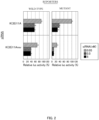
- Fig. 3 shows gene silencing effects of the siRNAs.
- K(35)11Arev strongly suppressed the expression of the A-mutant allele more than that of the wild-type allele, whereas K(35)11ArevOM(6-8) exerted a stronger silencing effect on both, with a stronger suppression of the expression of the A-mutant allele than that of the wild-type allele.
- This example shows that silencing abilities of the RNA molecules to the wild-type allele become weaker and, as a result, their specificities for the A-mutant allele become much higher by, in addition to matching position 11 of each siRNA with the position of the point mutation in the A-mutant allele, changing the base at the 5'-end of the siRNA's guide strand from guanine to uracil, and changing the base at the 5'-end of the passenger strand from uracil to guanine, mismatching the base at position 5 or 6 of the guide strand with that of the A-mutant allele,.
- the wild-type and A-mutant K reporters were used as reporters for examining gene silencing effects.
- Double-stranded RNAs with the following sequences with a mismatched base at one of positions 3-7 based on K(35)11Arev were chemically synthesized for siRNAs.
- K(35)11Arev was used as a control.
- the base pairs in the position corresponding to the position of the point mutation, the pairs of the modified bases at the 5'-ends of the guide and passenger strands, and base pairs with the mismatched base are enclosed in rectangles.
- Fig. 4 shows gene silencing effects of the siRNAs.
- K(35)11Arev strongly suppressed the expression of the A-mutant allele more than that of the wild-type allele, whereas RNA molecules K(35)11ArevM5 and K(35)11ArevM6 exhibited significantly weak silencing abilities to the wild-type allele and, as a result, much higher specificities for the A-mutant allele.
- RNA molecules for the A-mutant allele become much higher by, in addition to matching position 11 of each siRNA with the position of the point mutation in the A-mutant allele, changing the base at the 5'-end of the siRNA's guide strand from guanine to uracil, and changing the base at the 5'-end of the passenger strand from uracil to guanine, replacing the group at the 2'-position of the pentose in each of ribonucleotides at positions 6-8 of the guide strand by OCH 3 , and mismatching the base at position 5 or 6 of the guide strand with that of the A-mutant allele.
- the wild-type and A-mutant K reporters were used as reporters for examining gene silencing effects.
- Double-stranded RNAs with the following sequences with a mismatched base at one of positions 3-7 based on K(35)11Arev were chemically synthesized for siRNAs.
- K(35)11Arev was used as a control.
- the base pairs in the position corresponding to the position of the point mutation, the pairs of the modified bases at the 5'-ends of the guide and passenger strands, and base pairs with the mismatched base are enclosed in rectangles.
- the nucleotides in which the group at the 2'-position of the pentose was replaced by OCH 3 are hatched.
- Fig. 5 shows gene silencing effects of the siRNAs.
- K(35)11ArevOM(6-8)M5 and K(35)11ArevOM(6-8)M6 exhibited very weak silencing abilities to the wild-type allele and, as a result, their specificities for the A-mutant allele became much higher.
- This example shows that non-specific off-target effects can be reduced while silencing abilities to the wild-type allele remains weak and those to the A-mutant allele remains strong, by, in addition to matching position 11 of each siRNA with the position of the point mutation in the A-mutant allele, changing the base at the 5'-end of the siRNA's guide strand from guanine to uracil, and changing the base at the 5'-end of the passenger strand from uracil to guanine, replacing the group at the 2'-position of the pentose in each of ribonucleotides at positions 6-8 of the guide strand by OCH 3 (i.e., the ribonucleotide at position 7 was not modified) and mismatching the base at position 6 of the guide strand with that of the A-mutant allele.
- wild-type and A-mutant K reporters and reporters for detecting off-target effects were used as reporters for examining gene silencing effects.
- the reporters for off-target effects were constructed by chemically synthesizing DNAs with the following reporter sequences for detecting off-target effects and inserting each of them into the 3'-UTR of the luciferase gene in an expression vector (psiCHECK), as in the cases to construct the wild-type and A-mutant K reporters.
- Double-stranded RNAs with the following sequences were chemically synthesized for siRNAs in which, based on K(35)11Arev, a base at position 6 was mismatched and the group at the 2'-position of the pentose in each of ribonucleotides at positions 6 and 8 was modified by OCH 3 .
- K(35)11ArevOM(6-8) was used as a control.
- the base pairs in the position corresponding to the position of the point mutation, the pairs of the modified bases at the 5'-ends of the guide and passenger strands, and base pairs with the mismatched base are enclosed in rectangles.
- the nucleotides in which the group at the 2'-position of the pentose was replaced by OCH 3 are hatched.
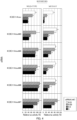
- Fig. 6 shows gene silencing effects and off-target effects of each siRNA.
- K(35)11ArevOM(6-8)M6 exhibited very weak silencing abilities to the wild-type allele and strong silencing abilities to the A-mutant allele, whereas K(35)11ArevOM(6+8)M6 significantly reduced non-specific off-target effects with substantially the same effects on both of the wild-type and A-mutant alleles, compared to K(35)11ArevOM(6-8)M6.
- the present invention allowed to provide novel RNA molecules, novel chimeric NA molecules, novel double-stranded RNA molecules, and novel double-stranded chimeric NA molecules.
Landscapes
- Health & Medical Sciences (AREA)
- Life Sciences & Earth Sciences (AREA)
- Chemical & Material Sciences (AREA)
- Engineering & Computer Science (AREA)
- Bioinformatics & Cheminformatics (AREA)
- Organic Chemistry (AREA)
- General Health & Medical Sciences (AREA)
- Genetics & Genomics (AREA)
- Pharmacology & Pharmacy (AREA)
- Veterinary Medicine (AREA)
- Animal Behavior & Ethology (AREA)
- Public Health (AREA)
- Medicinal Chemistry (AREA)
- Biomedical Technology (AREA)
- Chemical Kinetics & Catalysis (AREA)
- General Chemical & Material Sciences (AREA)
- Nuclear Medicine, Radiotherapy & Molecular Imaging (AREA)
- Molecular Biology (AREA)
- Biotechnology (AREA)
- General Engineering & Computer Science (AREA)
- Zoology (AREA)
- Wood Science & Technology (AREA)
- Biochemistry (AREA)
- Neurology (AREA)
- Microbiology (AREA)
- Plant Pathology (AREA)
- Biophysics (AREA)
- Physics & Mathematics (AREA)
- Neurosurgery (AREA)
- Pulmonology (AREA)
- Epidemiology (AREA)
- Crystallography & Structural Chemistry (AREA)
- Physical Education & Sports Medicine (AREA)
- Bioinformatics & Computational Biology (AREA)
- Orthopedic Medicine & Surgery (AREA)
- Dermatology (AREA)
- Cardiology (AREA)
- Otolaryngology (AREA)
- Heart & Thoracic Surgery (AREA)
- Vascular Medicine (AREA)
Abstract
Description
- The present application claims priority to
Japanese patent application No. 2021-005336, filed on January 15, 2021 - The present invention relates to RNA molecules, chimeric NA molecules, double-stranded RNA molecules, and double-stranded chimeric NA molecules, for use in RNA interference.
- RNA interference is a simple and efficient way to specifically suppress the expression of a given target gene in cells.
- siRNA, however, has been understood to suppress the expression of unintended targets (off-targeted genes) more than expected at the beginning (Jackson, A.L. et al., (2003) Nature Biotechnology vol. 21, pp. 635-637).
- Particularly, it has been shown that the stronger the affinity of siRNA to the mRNA of the target, the greater the off-target effects are induced (Ui-Tei, K. et al. (2008) Nucleic Acids Res. vol. 36, pp. 7100-7109).
- An object of the present invention is to provide novel RNA molecules, novel chimeric NA molecules, novel double-stranded RNA molecules, and novel double-stranded chimeric NA molecules.
- During intensive efforts directed toward identifying RNA sequences with reduced off-target effects, the present inventors found that off-target effects are reduced when the molecules have a mismatch at
position position 8. The term "off-target effects" refers to non-specific effects of suppressing the expression of unintended targets different from an intended target. - An aspect of the present invention is an RNA molecule for use in RNA interference to target a mutant allele of a gene, the mutant allele having a point mutation relative to a wild-type allele of the gene, wherein the RNA molecule satisfies the followings:
- (1) the molecule has a nucleotide sequence complementary to a nucleotide sequence of a coding region of the mutant allele except for a base specified in (2-1) below; and
- (2) when counted from the base at the 5'-end of a nucleotide sequence complementary to the nucleotide sequence of the mutant allele,
- (2-1) a base at
position - (2-2) a base at
position 10 or 11 is at the position of the point mutation and is the base at the position of the point mutation in the mutant allele; - (2-3) the group at the 2'-position of the pentose in the ribonucleotide at
position 8 is modified with OCH3, halogen, or LNA; and - (2-4) the group at the 2'-position of the pentose in the ribonucleotide at position 7 is not modified with any of OCH3, halogen, and LNA.
- (2-1) a base at
- A further aspect of the present invention is a double-stranded RNA molecule including a guide strand and a passenger strand, wherein the guide strand is any one of the aforementioned RNA molecules, and the passenger strand is an RNA molecule with a sequence complementary to that of the RNA molecule of the guide strand. An overhang may be present at the 3'-end of the guide strand and/or at the 3'-end of the passenger strand. Either or both of the overhangs may be 1-3 nucleotide(s) long. Any of the aforementioned double-stranded RNA molecules may be a double-stranded chimeric NA molecule in which one or more ribonucleotides are each replaced by a deoxyribonucleotide, an artificial nucleic acid, or a nucleic acid analog.
- A further aspect of the present invention is a method for producing an RNA molecule for use as a guide strand in RNA interference, including the step of producing any one of the aforementioned RNA molecules. The RNA molecule may be a chimeric NA molecule wherein one or more ribonucleotides are each replaced by a deoxyribonucleotide, an artificial nucleic acid, or a nucleic acid analog.
- A further aspect of the present invention is a method for performing RNA interference to target a mutant allele of a gene in a cell containing a wild-type allele of the gene and the mutant allele of the gene, the mutant allele having a point mutation, wherein the method includes the step of introducing any one of the aforementioned RNA molecules, chimeric NA molecules, double-stranded RNA molecules, or any one of the aforementioned double-stranded chimeric NA molecules into the cell.
- A further aspect of the present invention is a therapeutic agent for a patient with a disease, the patient having wild-type and mutant alleles of a causative gene for the disease, the mutant allele having a point mutation and being responsible for the disease, wherein the therapeutic agent includes, as an active ingredient, any one of the aforementioned RNA molecules, chimeric NA molecules, double-stranded RNA molecules, or any one of the aforementioned double-stranded chimeric NA molecules.
- A further aspect of the present invention is a method for selecting an RNA molecule, a chimeric NA molecule, a double-stranded RNA molecule, or a double-stranded chimeric NA molecule for use in RNA interference to silence a target gene, the method including the steps of evaluating a gene-specific silencing ability of a plurality of the RNA molecules, the chimeric NA molecules, the double-stranded RNA molecules, or the double-stranded chimeric NA molecules, to the target gene by performing the aforementioned RNAi-based method in vitro using each of the plurality of any one of the aforementioned RNA molecules, chimeric NA molecules, double-stranded RNA molecules, or any one of the aforementioned double-stranded chimeric NA molecules; and selecting an RNA molecule, a chimeric NA molecule, a double-stranded RNA molecule, or a double-stranded chimeric NA molecule having at least a certain level of the gene-specific silencing ability.
-
- [
Fig. 1] Fig. 1 shows graphs of the results on silencing abilities of siRNAs that target the K-ras gene, in each of which either one of positions 9-11 corresponded to the position of the point mutation, in an example of the present invention. - [
Fig. 2] Fig. 2 shows graphs of the results on silencing abilities of an siRNA that targets the K-ras gene, in whichposition 11 corresponded to the position of the point mutation, the base at the 5'-end of the guide strand was changed from guanine to uracil, and the base at the 5'-end of the passenger strand was changed from uracil to guanine, in an example of the present invention. - [
Fig. 3] Fig. 3 shows graphs of the results on silencing abilities of siRNAs that target the K-ras gene, in each of whichposition 11 corresponded to the position of the point mutation, the base at the 5'-end of the guide strand was changed from guanine to uracil, the base at the 5'-end of the passenger strand was changed from uracil to guanine, and the group at the 2'-position of the pentose in each of ribonucleotides at positions 6-8 of the guide strand was replaced by OCH3, in an example of the present invention. - [
Fig. 4] Fig. 4 shows graphs of the results on silencing abilities of siRNAs that target the K-ras gene, in each of whichposition 11 corresponded to the position of the point mutation, the base at the 5'-end of the guide strand was changed from guanine to uracil, the base at the 5'-end of the passenger strand was changed from uracil to guanine, and the base at either one of positions 3-7 of the guide strand was mismatched with that of the A-mutant allele, in an example of the present invention. - [
Fig. 5] Fig. 5 shows graphs of the results on silencing abilities of siRNAs that target the K-ras gene, in each of whichposition 11 corresponded to the position of the point mutation, the base at the 5'-end of the guide strand was changed from guanine to uracil, the base at the 5'-end of the passenger strand was changed from uracil to guanine, the group at the 2'-position of the pentose in each of ribonucleotides at positions 6-8 of the guide strand was replaced by OCH3, and the base at either one of positions 3-7 of the guide strand was mismatched with that of the A-mutant allele, in an example of the present invention. - [
Fig. 6] Fig. 6 shows graphs of the results on silencing abilities and off-target effects of siRNAs that target the K-ras gene, in each of whichposition 11 corresponded to the position of the point mutation, the base at the 5'-end of the guide strand was changed from guanine to uracil, the base at the 5'-end of the passenger strand was changed from uracil to guanine, the group at the 2'-position of the pentose in each of ribonucleotides atpositions position 6 of the guide strand was mismatched with that of the A-mutant allele, in an example of the present invention. Embodiments of the invention - Objects, characteristics, advantages, and ideas of the present invention are apparent to a person skilled in the art from the description of the present specification, and the person skilled in the art can easily reproduce the present invention from the description of the present specification. Modes for carrying out the invention, specific examples thereof and so forth, which are described below, provide preferable embodiments of the present invention. They are described for the purpose of illustration or explanation, and thus the present invention is not limited thereto. It is apparent to a person skilled in the art that various alterations and modifications can be made on the basis of the description of the present specification within the spirit and the scope of the present invention disclosed in the present specification.
- The nucleotide sequences herein are indicated such that their 5'- and 3'-ends are located on the left and right sides, respectively, unless otherwise specified.
- An embodiment of the present invention is RNA molecules for use in RNA interference to target a mutant allele of a gene, the mutant allele having a point mutation relative to its corresponding wild-type allele. Any gene may be targeted as long as the RNA molecules described herein can be designed for it; however, the target is preferably an oncogene that can transform normal cells by a point mutation, a causative gene responsible for a genetic disease developed by a point mutation, or a causative gene responsible for a disease with an SNP linked to a causative mutation in its coding region. It is preferable that the percentage of the SNP's linking to the causative mutation in a genetic pool is 50% or more. It is more preferable that the percentage is 60% or more, 70% or more, 80% or more, or 90% or more. It is even more preferable that the percentage is 95% or more, 99% or more, or 99.5% or more.
- Examples of the oncogene include the ZMYM3, CTNNB1, SMARCA4, SMO, and AR genes. Examples of the causative gene responsible for a genetic disease include the DNM2, KRT14, IL4R, MAPT, MS4A2, PABPN1, SCNIA, APOB, F12, CLCN7, SCN8A, PCSK9, KRT6A, and RHO genes. Examples of the causative gene responsible for a disease with an SNP include the ATXN3 and HTT genes. They are causative genes for either one of the diseases shown in Table 1.
[Table 1] Type Gene Gene name Diseases Triplet repeat diseases HTT Huntingtin Huntington's disease A TXN3 ataxin 3 Machado-Joseph disease (spinocerebellar ataxia-3) Tumors ZMYM3 zinc finger MYM-type containing 3 medulloblastoma, lung adenocarcinoma , lung squamous cell carcinoma, small cell lung cancer, and medullary thyroid carcinoma CTNNB1 catenin beta 1 non-small cell lung cancer (NSCLC), and hepatocellular carcinoma SMARCA4 SWI/SNF related, matrix associated, actin dependent regulator of chromatin, subfamily a, member 4 ovarian clear cell carcinoma, SMARCA4-deficient thoracic sarcomatoid tumor, and lung tumor SMO smoothened, frizzled class receptor basal cell carcinoma, and medulloblastoma AR androgen receptor prostate cancer, and salivary duct carcinoma Genetic diseases DNM2 dynamin 2 centronuclear myopathy-1 KRT14 keratin 14 congenital epidermolysis bullosa IL 4R interleukin 4 receptor atopic susceptibility to disorders such as atopic dermatitis MAPT microtubule associated protein tau frontotemporal dementia (±parkinsonism symptoms), and Alzheimer's disease MS4A2 membrane spanning 4-domains A2 atopic susceptibility to disorders such as atopic dermatitis, and childhood asthma PABPN1 poly(A) binding protein nuclear 1 oculopharyngeal muscular dystrophy (OMPD) RHO Rhodopsin retinitis pigmentosa 4 SCN1A sodium voltage-gated channel alpha subunit 1 early infantile epileptic encephalopathy 6 (Dravet syndrome) APOB apolipoprotein B familial hypercholesterolemia, type 2F12 coagulation factor XII hereditary angioedema, type III CLCN7 chloride voltage-gated channel 7 autosomal dominant osteopetrosis, type 2SCN8A sodium voltage-gated channel alpha subunit 8developmental and epileptic encephalopathy, 13, and Dravet syndrome PCSK9 proprotein convertase subtilisin/kexin type 9 familial hypercholesterolemia, type 3 KRT6A keratin 6A pachyonychia congenita, and epidermolysis bullosa - The RNA molecules herein may consist of any number of nucleotides, and the number may be 13 or more and 100 or less, 13 or more and 50 or less, 13 or more and 28 or less, 15 or more and 25 or less, or 17 or more and 21 or less. More preferably, the number is 19 or more and 21 or less. One or more ribonucleotides may be each replaced by a deoxyribonucleotide, an artificial nucleic acid, or a nucleic acid analog such as inosine or morpholino. Such RNA molecules are herein called "chimeric NA molecules," and the RNA molecules are described as including chimeric NA molecules in the present disclosure.
- In the RNA molecules, the base at
position position position position - Moreover, in the RNA molecules, the base at
position 10 or 11, counted from the base at the 5'-end of the nucleotide sequence complementary to that of the mutant allele, is at the position of the point mutation and is identical to the base in the corresponding position of the mutant allele. In the case that the mutated base in the mutant allele is adenine, cytosine, guanine, or thymine, the base atposition 10 or 11 of the RNA molecules is adenine, cytosine, guanine, or uracil (or thymine), respectively. - In the RNA molecules, the group at the 2'-position of the pentose in the nucleotide at
position 8, preferably in each of the nucleotides atpositions 
- Any halogen may be used, but fluorine is preferred because of its small molecular size. For nucleotides at positions other than those mentioned, some or all of them may be modified; however, it is preferable that none of them is modified. Modifications of nucleotides are not particularly limited and exemplified that the group at the 2'-position of the pentose in the nucleotides is replaced by a group selected from the group consisting of H, OR, R, halogen, SH, SR, NH2, NHR, NR2, CN, COOR, and LNA, in which R is C1-C6 alkyl, alkenyl, alkynyl, or aryl; and halogen is F, Cl, Br, or I.
- The IC50 of the RNA molecules for the target is preferably 1 nM or less, more preferably 500 pM or less, and yet more preferably 200 pM or less.
- When the RNA molecules are used for RNA interference as a single strand, it is preferable that their 5'-end is phosphorylated or can be phosphorylated in situ or in vivo.
- A method of designing the RNA molecules includes the following steps.
- First, the step is performed in which a nucleotide sequence of a certain length containing a sequence complementary to that of a mutant allele is designed such that a mutated base in the mutant allele is placed at tenth or eleventh position, counted from the base at the 5'-end. The next step is to place a mismatched base at
position position 8, preferably in each of the nucleotides atpositions - An embodiment of the present invention is double-stranded RNA molecules in which one of the aforementioned RNA molecules (hereinafter referred to as a "first RNA molecule") serves as a guide strand, and a second RNA molecule with a sequence complementary to that of the first RNA molecule serves as a passenger strand. The second RNA molecule has a sequence complementary to that of the first RNA molecule and forms a duplex with the first RNA molecule under physiological conditions. Their sequence complementarity is preferably 90% or more, more preferably 95% or more, yet more preferably 98% or more, and most preferably 100%.
- The passenger strand may have any length and may be considerably shorter than the first RNA molecule. For example, the length of the passenger strand may be equal to or less than half the length of the first RNA molecule. It is, however, preferable that they have the same length. When the passenger strand is shorter than the first RNA molecule, the latter has a single-stranded portion. This portion may be left single-stranded, or alternatively, a third RNA molecule complementary to the first RNA molecule may be annealed to the single-stranded portion. In the case that the second and third RNA molecules occupy the entire length of the first RNA molecule, the resulting double strand is identical to the one with a nick present on a single passenger strand to divide it into two.
- The double-stranded RNA molecules may have two blunt ends, or alternatively, they may have an overhang at the 3'-end of either or both first and second RNA molecules serving as the guide and passenger strands, respectively. The overhang(s) may have any number of nucleotides but is/are preferably of 1-3 nucleotides long.
- The double-stranded RNA molecule may be a double-stranded chimeric NA molecule in which 1-3, 4-6, 7-9, 10-12, 13-15, 16-18, 19-21, 22-24, or 25 or more ribonucleotides, or all ribonucleotides are each replaced by a deoxyribonucleotide, an artificial nucleic acid such as morpholine, or a nucleic acid analog such as glycol nucleic acid. The replaced positions are not limited.
- The nucleotides in the passenger strand may be modified; however, it is preferable that they are not modified. Modifications of nucleotides are not particularly limited, and, for example, the group at the 2'-position of the pentose in the nucleotides may be replaced by a group selected from the group consisting of H, OR, R, halogen, SH, SR1, NH2, NHR, NR2, CN, COOR, and LNA, in which R is C1-C6 alkyl, alkenyl, alkynyl, or aryl; and halogen is F, Cl, Br, or I.
- Passenger strands can also be easily designed and easily produced using known techniques. A guide strand and a passenger strand may be linked to each other by a linker. The linker may be formed of any material, and examples include peptides and PEG.
- Considering the above, the sequences as shown in Table 2 can be designed for siRNAs to the K-ras, N-ras, ZMYM3, CTNNB1, SMARCA4, SMO, RHO, ATXN3, DNM2, KRT14, IL4R, MAPT, MS4A2, PABPN1, SCN1A, APOB, F12, CLCN7, SCN8A, PCSK9, KRT6A, HTT and AR genes.
- In the tables, the parentheses in the K-ras gene indicate the type of mutation, the parentheses in the HTT gene indicate the position in the genome, and the parentheses in other genes indicate a place counted from the translation start site (i.e., A in the start codon ATG). "P" stands for a passenger strand, and "G" stands for a guide strand. In addition,
- (1) a base at
position 5 is mismatched with a base in a mutant allele for K(35)11ArevOM(6+8)M5 and K(35)11TrevOM(6+8)M5, and a base atposition 6 is mismatched with a base in the mutant allele for other sequences; - (2) a base at
position 11 is at the position of the point mutatio and is the base in the mutant allele for all sequences; - (3) the group at the 2'-position of the pentose in each of ribonucleotides at
positions - (4) the group at the 2'-position of the pentose in the ribonucleotide at position 7 is not modified with any of OCH3, halogen, and LNA for all sequences.
- An embodiment of the present invention is a method for performing RNA interference by which a mutant allele with a point mutation is targeted in cells containing the wild-type allele of a gene of interest and a mutant allele of the gene. This method includes the step of introducing the first RNA molecule that may include a chimeric NA molecule, or one of the aforementioned double-stranded RNA molecules that may include a double-stranded chimeric NA molecule, into the cells containing the wild-type allele and the mutant allele.
- RNA interference can be readily performed using known techniques. The expression of a target can be reduced by introducing the first RNA molecule or the double-stranded RNA molecule into, for example, culture cells or a human or non-human individual organism expressing the target gene.
- The use of the aforementioned first RNA molecules or double-stranded RNA molecules in RNA interference makes it possible to primarily suppress the expression of the mutant allele of the gene of interest, substantially not suppressing the expression of the wild-type allele. Here, the expression of the wild-type allele may be suppressed up to the level at which the wild-type allele is functional and a normal phenotype is exhibited. The expression of the mutant allele should be inhibited at least to the level at which the mutant allele is not functional and the abnormal phenotype is not exhibited. This enables, for example, cells to become functional normally without developing the phenotype due to a mutation even when the mutant allele carries a dominant mutation.
- An embodiment of the present invention is a therapeutic agent for a patient with a disease or a prophylactic agent for a carrier of the disease, the patient or the carrier having wild-type and mutant alleles of a causative gene for the disease, the mutant allele of the causative gene having a point mutation and being responsible for the disease, wherein the therapeutic or prophylactic agent includes, as an active ingredient, any of the aforementioned RNA molecules including any one of the aforementioned chimeric NA molecules or any one of double-stranded RNA molecules including any one of the aforementioned double-stranded chimeric NA molecules. Carriers as used herein refer to individuals with a mutant allele of a causative gene for a disease who have not developed it and may develop it in the future. Prophylactic agents for carriers help prevent them from developing the disease due to the mutant allele of the causative gene.
- Here, the cause of the disease may not be the point mutation but rather a different mutation and a certain percentage of patients or carriers of the disease have the point mutation. In the latter cases, the point mutation is preferably associated with the causative mutation. The aforementioned percentage is preferably 50% or more; more preferably, 60% or more, 70% or more, 80% or more, or 90% or more; and yet more preferably, 95% or more, 99% or more, or 99.5% or more, although not specifically limited. If the percentage is low, the patient or carrier may be examined to determine whether they have the point mutation before administering the agent. In these cases, healthy persons other than the patient or carrier preferably do not have the point mutation.
- Examples of the former cases are genetic diseases and tumors that are caused by a point mutation. The genetic diseases are not limited as long as their development is caused by a point mutation, among which some examples are shown in Table 1. Likewise, the tumors are not limited as long as they are caused by a point mutation in an oncogene, among which some examples are shown in Table 1.
- Examples of the latter include triplet repeat diseases. Triplet repeat diseases are known to be caused by 5-40 repeats and 36-3000 repeats of a triplet sequence such as CAG in healthy individuals and patients, respectively. For example, in the ATXN3 mutant gene, which is a causative gene for Machado-Joseph disease, an SNP in which G immediately after a CAG repeat is mutated to C can be found. This mutation could be the target of the siRNA of the present disclosure. The triplet repeat diseases are not limited, among which some examples are shown in Table 1.
- Any method can be used for the administration of the agents disclosed herein; however, injection is preferable, and intravenous injection is more preferable. In such cases, in addition to the active ingredient, other ingredients such as pH adjusters, buffers, stabilizers, tonicity adjusting agents, or local anesthetics may be added to the therapeutic agents.
- The dosage of the therapeutic agents is not limited and is selected as appropriate based on, for example, the efficacy of the ingredients contained, the mode of administration, the route of administration, the type of the disease, attributes of a subject (e.g., weight, age, medical conditions, and history of use of other medicaments), and the discretion of a physician in charge.
- An embodiment of the present invention is a method for selecting RNA molecules, chimeric NA molecules, double-stranded RNA molecules, or double-stranded chimeric NA molecules for use in RNA interference to silence a target, the selection method including the steps of evaluating a gene-specific silencing ability of a plurality of the aforementioned RNA molecules, chimeric NA molecules, double-stranded RNA molecules, or double-stranded chimeric NA molecules by performing RNA interference in vitro using them; and selecting RNA molecules, chimeric NA molecules, double-stranded RNA molecules, or double-stranded chimeric NA molecules having at least a certain level of the gene-specific silencing ability.
- In performing RNA interference in vitro, a wild-type allele and a mutant allele with a point mutation, of a gene are used as targets, and a molecule is selected which does not suppress the expression of the wild-type allele to a given level but suppresses the expression of the mutant allele to a level equal to or lower than a given level. By using this procedure, one or more molecules that suppress the expression of the mutant allele but do not suppress the expression of the wild-type allele can be obtained. Here, the given level may be any level, but is preferably 50%, more preferably 70%, and even more preferably 90%.
- Methods for the assay using RNA interference in vitro are common knowledge in the art, and the selection of genes, selection of cells, and introduction of RNA molecules into cells, etc. are obvious to those skilled in the art.
- HeLa cells cultured in DMEM supplemented with 10% FBS were seeded at 1 × 10⁵ cells/mL on 24-well plates and co-transfected with each double-stranded siRNA with 100 ng of a reporter and 100 ng of plasmid (pGL3) as an internal standard, using 2 µL of lipofectamine 2000. The concentrations of the double-stranded siRNAs are shown in the figures. siGY441 was introduced as a control for siRNA. The cells were harvested after 24 hours, and firefly and Renilla luciferase activities were measured using a dual-luciferase reporter assay system (Promega). Renilla luciferase activity was normalized from the firefly luciferase activity. The results obtained for the double-stranded siRNAs are presented in graphs, relative to those for siGY441, which were set to 100%.
- In this example, the K-ras gene was used as a target gene to be silenced.
- This example shows that, by matching
position 10 or 11 of each siRNA with the position of the point mutation in the A-mutant allele of the K-ras gene (c. 35G>A) (hereinafter, referred to as the "A-mutant allele"), the RNA molecules exhibit a higher specificity for silencing abilities to the A-mutant allele of the K-ras gene (35G>A) than to the wild-type allele of the K-ras gene (hereinafter, referred to as a "wild-type allele"). - First, as reporters for examining gene silencing effects, DNAs with the same nucleotide sequences as the wild-type allele of the K-ras gene (wt) and the A-mutant allele of the K-ras gene (c. 35G>A) were chemically synthesized and inserted into the 3'-UTR of the luciferase gene in an expression vector (psiCHECK) to construct wild-type and A-mutant K reporters, respectively. The sequences of the segments incorporated into the vectors are indicated below.
-
- Wild-type K reporter:

- A-mutant K reporter:

- Next, double-stranded RNAs with the following sequences were chemically synthesized for siRNAs. The
positions 9, 10, and 11 in siRNAs, K(35)9A, K(35)10A, and K(35)11A, respectively, correspond to the position of the point mutation in the A-mutant allele of the K-ras gene (c. 35G>A). In the following sequences, base pairs in the position corresponding to the position of the point mutation are enclosed in rectangles. -
- K(35)9A:

- K(35)10A:

- K(35)11A:

-
Fig. 1 shows gene silencing effects of the siRNAs. - K(35)9A had a strong silencing effect on both A-mutant and wild-type alleles. K(35)10A and K(35)11A strongly suppressed the expression of the A-mutant allele more than that of the wild-type allele although their silencing effects were slightly reduced.
- This example shows that the silencing abilities of the RNA molecule to the A-mutant allele become stronger and its specificities become much higher by, in addition to matching
position 11 of an siRNA with the position of the point mutation in the A-mutant allele, changing the base at the 5'-end of the siRNA's guide strand from guanine to uracil and changing the base at the 5'-end of the passenger strand from uracil to guanine. - The wild-type and A-mutant K reporters were used as reporters for examining gene silencing effects. A double-stranded RNA with the following sequences was chemically synthesized for an siRNA, and K(35)11A was used as a control. In the following sequences, a base pair in the position corresponding to the position of the point mutation, and the pairs of the modified bases at the 5'-ends of the guide and passenger strands are enclosed in rectangles.
- K(35)11Arev:

-
Fig. 2 shows gene silencing effects of the siRNAs. - K(35)11A strongly suppressed the expression of the A-mutant allele more than that of the wild-type allele, whereas K(35)11Arev exerted a stronger silencing effect on both, with a stronger suppression of the expression of the A-mutant allele than that of the wild-type allele.
- This example shows that silencing abilities of the RNA molecules to the A-mutant allele become stronger and their specificities become much higher by, in addition to matching
position 11 of each siRNA with the position of the point mutation in the A-mutant allele, changing the base at the 5'-end of the siRNA's guide strand from guanine to uracil, and changing the base at the 5'-end of the passenger strand from uracil to guanine, replacing the group at 2'-position of the pentose in each of ribonucleotides at positions 6-8 of the guide strand by OCH3. - The wild-type and A-mutant K reporters were used as reporters for examining gene silencing effects. Double-stranded RNAs with the following sequences were chemically synthesized for siRNAs, and K(35)11Arev was used as a control. In the following sequences, the base pairs in the position corresponding to the position of the point mutation, and the pairs of the modified bases at the 5'-ends of the guide and passenger strands are enclosed in rectangles. The nucleotides in which the group at the 2'-position of the pentose was replaced by OCH3 are hatched.
-
- K(35)11ArevOM(2-5):

- K(35)11ArevOM(6-8):

-
Fig. 3 shows gene silencing effects of the siRNAs. - K(35)11Arev strongly suppressed the expression of the A-mutant allele more than that of the wild-type allele, whereas K(35)11ArevOM(6-8) exerted a stronger silencing effect on both, with a stronger suppression of the expression of the A-mutant allele than that of the wild-type allele. Another control, K(35)11ArevOM(2-5) in which the group at the 2'-position of the pentose in each of ribonucleotides at positions 2-5 of the guide strand was replaced by OCH3 exerted considerably weak silencing effect on both.
- This example shows that silencing abilities of the RNA molecules to the wild-type allele become weaker and, as a result, their specificities for the A-mutant allele become much higher by, in addition to matching
position 11 of each siRNA with the position of the point mutation in the A-mutant allele, changing the base at the 5'-end of the siRNA's guide strand from guanine to uracil, and changing the base at the 5'-end of the passenger strand from uracil to guanine, mismatching the base atposition - The wild-type and A-mutant K reporters were used as reporters for examining gene silencing effects. Double-stranded RNAs with the following sequences with a mismatched base at one of positions 3-7 based on K(35)11Arev were chemically synthesized for siRNAs. K(35)11Arev was used as a control. In the following sequences, the base pairs in the position corresponding to the position of the point mutation, the pairs of the modified bases at the 5'-ends of the guide and passenger strands, and base pairs with the mismatched base are enclosed in rectangles.
-
- K(35)11ArevM3:
- 5'- GGGAGCUGAUGGCGUACGAAA-3' (SEQ ID NO. 20)
- 3' -CACCCUCGACUACCGCAUGCU -5' (SEQ ID NO. 21)
- K(35)11ArevM4:
- 5'- GGGAGCUGAUGGCGUUGGAAA-3' (SEQ ID NO. 22)
- 3'-CACCCUCGACUACCGCAACCU -5 (SEQ ID NO. 23)
- K(35)11ArevM5:
- 5'- GGGAGCUGAUGGCGAAGGAAA-3' (SEQ ID NO. 24)
- 3'-CACCCUCGACUACCGCUUCCU -5' (SEQ ID NO. 25)
- K(35)11ArevM6:
- 5' - GGGAGCUGAUGGCCUAGGAAA-3' (SEQ ID NO. 26)
- 3' -CACCCUCGACUACCGGAUCCU -5' (SEQ ID NO. 27)
- K(35)11ArevM7:
- 5'- GGGAGCUGAUGGGGUAGGAAA-3' (SEQ ID NO. 28)
- 3'-CACCCUCGACUACCCCAUCCU -5' (SEQ ID NO. 29)
-
Fig. 4 shows gene silencing effects of the siRNAs. - K(35)11Arev strongly suppressed the expression of the A-mutant allele more than that of the wild-type allele, whereas RNA molecules K(35)11ArevM5 and K(35)11ArevM6 exhibited significantly weak silencing abilities to the wild-type allele and, as a result, much higher specificities for the A-mutant allele.
- This example shows that specificities of the RNA molecules for the A-mutant allele become much higher by, in addition to matching
position 11 of each siRNA with the position of the point mutation in the A-mutant allele, changing the base at the 5'-end of the siRNA's guide strand from guanine to uracil, and changing the base at the 5'-end of the passenger strand from uracil to guanine, replacing the group at the 2'-position of the pentose in each of ribonucleotides at positions 6-8 of the guide strand by OCH3, and mismatching the base atposition - The wild-type and A-mutant K reporters were used as reporters for examining gene silencing effects. Double-stranded RNAs with the following sequences with a mismatched base at one of positions 3-7 based on K(35)11Arev were chemically synthesized for siRNAs. K(35)11Arev was used as a control. In the following sequences, the base pairs in the position corresponding to the position of the point mutation, the pairs of the modified bases at the 5'-ends of the guide and passenger strands, and base pairs with the mismatched base are enclosed in rectangles. The nucleotides in which the group at the 2'-position of the pentose was replaced by OCH3 are hatched.
-
- K(35)11ArevOM(6-8)M3:
- 5'- GGGAGCUGAUGGCGUACGAAA-3' (SEQ ID NO. 30)
- 3'-CACCUCGACUACCGCAUGCU -5 (SEQ ID NO. 31)
- K(35)11ArevOM(6-8)M4:
- 5'- GGGAGCUGAUGGCGUUGGAAA-3 (SEQ ID NO. 32)
- 3'-CACCCUCGACUACCGCAACCU -5 (SEQ ID NO. 33)
- K(35)11ArevOM(6-8)M5:
- 5'- GGGAGCUGAUGGCGAAGGAAA-3 (SEQ ID NO. 34)
- 3'-CACCUCGACUACCGCUUCCU -5 (SEQ ID NO. 35)
- K(35)11ArevOM(6-8)M6:
- 5'- GGGAGCUGAUGGCCCUAGGAAA-3' (SEQ ID NO. 36)
- 3'-CACCCUCGACUACCGGAUCCU -5' (SEQ ID NO. 37)
- K(35)11ArevOM(6-8)M7:
- 5'- GGGAGCUGAUGGGGUAGGAAA-3' (SEQ ID NO. 38)
- 3'-CACCCUCGACUACCCCAUCCU -5' (SEQ ID NO. 39)
-
Fig. 5 shows gene silencing effects of the siRNAs. - K(35)11ArevOM(6-8)M5 and K(35)11ArevOM(6-8)M6 exhibited very weak silencing abilities to the wild-type allele and, as a result, their specificities for the A-mutant allele became much higher.
- This example shows that non-specific off-target effects can be reduced while silencing abilities to the wild-type allele remains weak and those to the A-mutant allele remains strong, by, in addition to matching
position 11 of each siRNA with the position of the point mutation in the A-mutant allele, changing the base at the 5'-end of the siRNA's guide strand from guanine to uracil, and changing the base at the 5'-end of the passenger strand from uracil to guanine, replacing the group at the 2'-position of the pentose in each of ribonucleotides at positions 6-8 of the guide strand by OCH3 (i.e., the ribonucleotide at position 7 was not modified) and mismatching the base atposition 6 of the guide strand with that of the A-mutant allele. - As reporters for examining gene silencing effects, wild-type and A-mutant K reporters and reporters for detecting off-target effects (SEQ ID NOS. 40 and 41) were used. The reporters for off-target effects were constructed by chemically synthesizing DNAs with the following reporter sequences for detecting off-target effects and inserting each of them into the 3'-UTR of the luciferase gene in an expression vector (psiCHECK), as in the cases to construct the wild-type and A-mutant K reporters.
- Reporter sequences for detecting off-target effects:
- 5'-CUCAACCUGCACCACGCCUAGGACG-3' (SEQ ID NO. 40)
- 3'- CACCCUCGACUACCGGAUCCU -5 '(SEQ ID NO. 41)
- Double-stranded RNAs with the following sequences (SEQ ID NOS. 42 and 43) were chemically synthesized for siRNAs in which, based on K(35)11Arev, a base at
position 6 was mismatched and the group at the 2'-position of the pentose in each of ribonucleotides atpositions - K(35)11ArevOM(6+8)M6:
- 5' - GGGAGCUGAUGGCCUAGGAAA-3' (SEQ ID NO. 42)
- 3'-CACCCUCGACUACCGGAUCCU -5' (SEQ ID NO. 43)
-
Fig. 6 shows gene silencing effects and off-target effects of each siRNA. - The RNA molecule, K(35)11ArevOM(6-8)M6 exhibited very weak silencing abilities to the wild-type allele and strong silencing abilities to the A-mutant allele, whereas K(35)11ArevOM(6+8)M6 significantly reduced non-specific off-target effects with substantially the same effects on both of the wild-type and A-mutant alleles, compared to K(35)11ArevOM(6-8)M6.
- The present invention allowed to provide novel RNA molecules, novel chimeric NA molecules, novel double-stranded RNA molecules, and novel double-stranded chimeric NA molecules.
| Gene Name (Position or type of mutation) | Name | Strand | Sequence | Seq. ID No. |
| K-ras (A-Mutant) | K(35)11ArevOM(6+8)M5 | P | GGGAGCUGAUGGCGAAGGAAA | 44 |
| G | UCCUUCGCCAUCAGCUCCCAC | 45 | ||
| K-ras (A-Mutant) | K(35)11ArevOM(6+8)M6 | P | GGGAGCUGAUGGCCUAGGAAA | 42 |
| G | UCCUAGGCCAUCAGCUCCCAC | 43 | ||
| K-ras (T-Mutant) | K(35) 11TrevOM(6+8)M5 | P | GGGAGCUGUUGGCGAAGGAAA | 46 |
| G | UCCUUCGCCAACAGCUCCCAC | 47 | ||
| K-ras (T-Mutant) | K(35)11TrevOM(6+8)M6 | P | GGGAGCUGUUGGCCUAGGAAA | 48 |
| G | UCCUAGGCCAACAGCUCCCAC | 49 | ||
| K-ras (C-Mutant) | K(35)11CrevOM(6+8)M5 | P | GGGAGCUGCUGGCGAAGGAAA | 50 |
| G | UCCUUCGCCAGCAGCUCCCAC | 51 | ||
| K-ras (C-Mutant) | K(35)11CrevOM(6+8)M6 | P | GGGAGCUGCUGGCCUAGGAAA | 52 |
| G | UCCUAGGCCAGCAGCUCCCAC | 53 | ||
| N-ras (35) | N(35)11ArevOM(6+8)M5 | P | CGGAGCAGAUGGUGAUGGAAA | 54 |
| G | UCCAUCACCAUCUGCUCCGAC | 55 | ||
| N-ras (182) | N(182)11GrevOM(6+8)M5 | P | GGCUGGACGAGAAGUGUAAAG | 56 |
| G | UUACACUUCUCGUCCAGCCGU | 57 | ||
| HTT (rs363125) | siHTT_363125-SNP | P | GCACAGUAAUUCAUCGCUAGA | 58 |
| G | UAGCGAUGAAUUACUGUGCGG | 59 | ||
| HTT (rs362307) | siHTT_362307-SNP | P | GAAGUCUGUGCCCAUGUGACC | 60 |
| G | UCACAUGGGCACAGACUUCCA | 61 | ||
| HTT (rs362331) | siHTT_362331-SNP | P | GCCUCAUCCACUGAGUGCACU | 62 |
| G | UGCACUCAGUGGAUGAGGCAG | 63 | ||
| ATXN3 | siATXN3-SNP | P | GGCAGCAGCGGGAGCUAUAAG | 64 |
| G | UAUAGCUCCCGCUGCUGCCGC | 65 | ||
| ZMYM3 | siZMYM3_MUT_2206 | P | GCCACUGGUGUGGCCAGAACC | 66 |
| G | UUCUGGCCACACCAGUGGCUG | 67 | ||
| CTNNB1 | siCTNNB1_MUT_121 | P | GUGCCACUGCCACUGCUCAUU | 68 |
| G | UGAGCAGUGGCAGUGGCACCA | 69 | ||
| SMARCA4 | siSMARCA4_MUT_2729 | P | GCUGCUGAUGGGCUCACCACU | 70 |
| G | UGGUGAGCCCAUCAGCAGCAG | 71 | ||
| SMO | siSMO_MUT_1234 | P | GCCUGGUGUUCAUGGUGGAAG | 72 |
| G | GCCACCAUGAACACCAGGCCG | 73 | ||
| AR | siAR_MUT_2180 | P | GGGCUUCCUCAACAUACAAGU | 74 |
| G | UUGUAUGUUGAGGAAGCCCGG | 75 | ||
| DMN2 | siDNM2_MUT_1102 | P | GCUUCCACAAGCGCUUCCAAU | 76 |
| G | UGGAAGCGCUUGUGGAAGCUG | 77 | ||
| KRT14 | siKRT14_MUT_1151 | P | GGAGCAGCCGGCCGAGCUACG | 78 |
| G | UAGCUCGGCCGGCUGCUCCUC | 79 | ||
| IL4R (223) | siILR4_MUT_223 | P | GCACGUGUGUCCCAGAGAACA | 80 |
| G | UUCUCUGGGACACACGUGCGG | 81 | ||
| IL4R (1507) | siILR4_MUT_1507 | P | GCAGCAACCCCCUCAGCCAGU | 82 |
| G | UGGCUGAGGGGGUUGCUGCAG | 83 | ||
| MAPT | siMAPT_MUT_1853 | P | GCACGUCCUGGGACGCGGAAG | 84 |
| G | UCCGCGUCCCAGGACGUGCUU | 85 | ||
| MS4A2 | siMS4A2_MUT_710 | P | GCCAGGGGGAAUGACUCCACC | 86 |
| G | UGGAGUCAUUCCCCCUGGCUC | 87 | ||
| PABPN1 | siPABPN1_MUT_35 | P | GGCAGCGGCGGCUCCGGGAGG | 88 |
| G | UCCCGGAGCCGCCGCUGCCGC | 89 | ||
| RHO (68) | siRHO_MUT_68 | P | GCGCAGCCACUUCCAGUAACC | 90 |
| G | UUACUGGAAGUGGCUGCGCAC | 91 | ||
| RHO (1039) | siRHO_MUT_1039 | P | GGGUGGCCUCGGCGUAAGACC | 92 |
| G | UCUUACGCCGAGGCCACCCGG | 93 | ||
| SCNIA | siSCN1A_MUT_664 | P | GAGUUCUCUGAGCUUUGAAGA | 94 |
| G | UUCAAAGCUCAGAGAACUCUG | 95 | ||
| APOB | siAPOB_MUT_10580 | P | GAGCACACAGUCUACAGUAAA | 96 |
| G | UACUGUAGACUGUGUGCUCUU | 97 | ||
| F12 | siF12_MUT_983 CG | P | GCAGCCCAGGACCGGGACACC | 98 |
| G | UGUCCCGGUCCUGGGCUGCGG | 99 | ||
| CLCN7 | siCLCN7_MUT_2299 | P | GGACCCGGACGCCGUGGACCA | 100 |
| G | UCCAGCUGCCACAGGCCCCGG | 101 | ||
| SCN8A | siSCN8A_MUT_3991 | P | GGAAUGUGGUGCUCGUGUAUC | 102 |
| G | UACACGAGCACCACAUUCCUG | 103 | ||
| KRT6A | siKRT6A_MUT_520 | P | GCAACAAGGUUGCGUCCUACA | 104 |
| G | UAGGACGCAACCUUGUUGCUG | 105 | ||
| PCSK9 | siPCSK9_MUT_1120 | P | GCUCCAGCUACUGGAGCAACU | 106 |
| G | UUGCUCCAGUAGCUGGAGCCA | 107 |
Claims (18)
- An RNA molecule for use in RNA interference to target a mutant allele of a gene, the mutant allele having a point mutation relative to a wild-type allele of the gene, wherein the RNA molecule satisfies the followings:(1) the molecule has a nucleotide sequence complementary to a nucleotide sequence of a coding region of the mutant allele except for a base specified in (2-1) below; and(2) when counted from the base at the 5'-end of a nucleotide sequence complementary to the nucleotide sequence of the mutant allele,(2-1) a base at position 5 or 6 is mismatched with a base in the mutant allele;(2-2) a base at position 10 or 11 is at the position of the point mutation and is identical to the base at the position of the point mutation in the mutant allele;(2-3) the group at the 2'-position of the pentose in the ribonucleotide at position 8 is modified with OCH3, halogen, or LNA; and(2-4) the group at the 2'-position of the pentose in the ribonucleotide at position 7 is not modified with any of OCH3, halogen, and LNA.
- The RNA molecule according to Claim 1, wherein the group at the 2'-position of the pentose in the ribonucleotide at position 6, counted from the base at the 5'-end of the nucleotide sequence complementary to the nucleotide sequence of the mutant allele, is modified with OCH3, halogen, or LNA.
- The RNA molecule according to Claim 1 or 2, wherein the ribonucleotide at position 7 is free from modification.
- The RNA molecule according to Claim 1, wherein the halogen is fluorine.
- The RNA molecule according to any one of Claims 1 to 4, wherein, when the base at the 5'-end of the nucleotide sequence specified in (1) of Claim 1 is cytosine or guanine, the base is replaced by adenine or uracil.
- The RNA molecule according to any one of Claims 1 to 5, wherein, when the base at the 3'-end of the nucleotide sequence specified in (1) of Claim 1 is adenine or uracil, it is replaced by cytosine or guanine.
- The RNA molecule according to any one of Claims 1 to 6, wherein the RNA molecule comprises 13-28 nucleotides.
- The RNA molecule according to any one of Claims 1 to 7, further comprising 1-3 nucleotide(s) at the 3'-end of the nucleotide sequence specified in (1) of Claim 1.
- A chimeric NA molecule, wherein one or more ribonucleotides in an RNA molecule according to any one of Claims 1 to 8 are each replaced by a deoxyribonucleotide, an artificial nucleic acid, or a nucleic acid analog.
- A double-stranded RNA molecule comprising a guide strand and a passenger strand, wherein the guide strand is an RNA molecule according to any one of Claims 1 to 7, and the passenger strand is an RNA molecule with a sequence complementary to the sequence of the RNA molecule of the guide strand.
- The double-stranded RNA molecule according to Claim 10, wherein the RNA molecule comprises an overhang at the 3'-end of the guide strand and/or an overhang at the 3'-end of the passenger strand.
- The double-stranded RNA molecule according to Claim 11, wherein either or both of the overhangs comprise 1-3 nucleotides.
- A double-stranded chimeric NA molecule, wherein one or more ribonucleotides in a double-stranded RNA molecule according to any one of Claims 10 to 12 are each replaced by a deoxyribonucleotide, an artificial nucleic acid, or a nucleic acid analog.
- A method for producing an RNA molecule for use as a guide strand in RNA interference, comprising the step of:
producing an RNA molecule according to any one of Claims 1 to 8. - A method for producing a chimeric NA molecule for use as a guide strand in RNA interference, comprising the step of:
producing a chimeric NA molecule according to Claim 9. - A method for performing RNA interference to target a mutant allele of a gene in a cell containing a wild-type allele of the gene and the mutant allele, the mutant allele having a point mutation, the method comprising the step of:
introducing an RNA molecule according to any one of Claims 1 to 8, a chimeric NA molecule according to Claim 9, a double-stranded RNA molecule according to any one of Claims 10 to 12, or a double-stranded chimeric NA molecule according to Claim 13 into the cell. - A therapeutic agent for a patient with a disease or a prophylactic agent for a carrier of the disease, the patient or the carrier having wild-type and mutant alleles of a causative gene for the disease, the mutant allele having a point mutation and being responsible for the disease, wherein:
the therapeutic agent or the prophylactic agent comprises, as an active ingredient, an RNA molecule according to any one of Claims 1 to 8, a chimeric NA molecule according to Claim 9, a double-stranded RNA molecule according to any one of Claims 10 to 12, or a double-stranded chimeric NA molecule according to Claim 13. - A method for selecting an RNA molecule, a chimeric NA molecule, a double-stranded RNA molecule, or a double-stranded chimeric NA molecule for use in RNA interference to silence a target gene, the method comprising the steps of:evaluating a gene-specific silencing ability of a plurality of the RNA molecules, the chimeric NA molecules, the double-stranded RNA molecules, or the double-stranded chimeric NA molecules, to the target by performing the method according to Claim 15 in vitro using each of the plurality of the RNA molecules according to any one of Claims 1 to 7, the chimeric NA molecules according to Claim 8, the double-stranded RNA molecules according to any one of Claims 9 to 11, or the double-stranded chimeric NA molecules according to Claim 12; andselecting an RNA molecule, a chimeric NA molecule, a double-stranded RNA molecule, or a double-stranded chimeric NA molecule having at least a certain level of the gene-specific silencing ability.
Applications Claiming Priority (2)
| Application Number | Priority Date | Filing Date | Title |
|---|---|---|---|
| JP2021005336 | 2021-01-15 | ||
| PCT/JP2022/001433 WO2022154123A1 (en) | 2021-01-15 | 2022-01-17 | Rna molecule, chimeric na molecule, double-stranded rna molecule, and double-stranded chimeric na molecule |
Publications (2)
| Publication Number | Publication Date |
|---|---|
| EP4279591A1 true EP4279591A1 (en) | 2023-11-22 |
| EP4279591A4 EP4279591A4 (en) | 2025-09-03 |
Family
ID=82448203
Family Applications (1)
| Application Number | Title | Priority Date | Filing Date |
|---|---|---|---|
| EP22739528.2A Pending EP4279591A4 (en) | 2021-01-15 | 2022-01-17 | RNA molecule, chimeric sodium molecule, double-stranded RNA molecule, and double-stranded chimeric sodium molecule |
Country Status (5)
| Country | Link |
|---|---|
| US (1) | US20230295624A1 (en) |
| EP (1) | EP4279591A4 (en) |
| JP (2) | JPWO2022154123A1 (en) |
| CN (1) | CN116917480A (en) |
| WO (1) | WO2022154123A1 (en) |
Families Citing this family (1)
| Publication number | Priority date | Publication date | Assignee | Title |
|---|---|---|---|---|
| CN114402074B (en) * | 2019-07-16 | 2024-08-06 | 国立大学法人东京大学 | RNA molecules, chimeric NA molecules, double-stranded RNA molecules, and double-stranded chimeric NA molecules |
Family Cites Families (8)
| Publication number | Priority date | Publication date | Assignee | Title |
|---|---|---|---|---|
| US20070259827A1 (en) * | 2006-01-25 | 2007-11-08 | University Of Massachusetts | Compositions and methods for enhancing discriminatory RNA interference |
| KR101237036B1 (en) * | 2009-11-04 | 2013-02-25 | 성균관대학교산학협력단 | Novel siRNA Structure for Minimizing Off-target Effects by Antisense Strand and the Use Thereof |
| CA2781896C (en) * | 2009-12-09 | 2021-03-30 | Nitto Denko Corporation | Modulation of hsp47 expression |
| US8946185B2 (en) * | 2010-06-18 | 2015-02-03 | Lsip, Llc | Agent for suppressing expression of dominant allele |
| KR101696704B1 (en) * | 2013-12-17 | 2017-01-16 | 주식회사 인코드젠 | Modified rna interference inducing nucleotides for blocking off-target effects and the use thereof |
| WO2018098328A1 (en) * | 2016-11-23 | 2018-05-31 | Alnylam Pharmaceuticals, Inc. | Modified rna agents with reduced off-target effect |
| JP7050277B2 (en) * | 2017-11-10 | 2022-04-08 | 久美子 程 | RNA molecule |
| CN114402074B (en) * | 2019-07-16 | 2024-08-06 | 国立大学法人东京大学 | RNA molecules, chimeric NA molecules, double-stranded RNA molecules, and double-stranded chimeric NA molecules |
-
2022
- 2022-01-17 US US18/008,903 patent/US20230295624A1/en active Pending
- 2022-01-17 CN CN202280016777.XA patent/CN116917480A/en active Pending
- 2022-01-17 WO PCT/JP2022/001433 patent/WO2022154123A1/en not_active Ceased
- 2022-01-17 JP JP2022575668A patent/JPWO2022154123A1/ja active Pending
- 2022-01-17 EP EP22739528.2A patent/EP4279591A4/en active Pending
-
2026
- 2026-03-23 JP JP2026047510A patent/JP2026102850A/en active Pending
Also Published As
| Publication number | Publication date |
|---|---|
| WO2022154123A1 (en) | 2022-07-21 |
| US20230295624A1 (en) | 2023-09-21 |
| JP2026102850A (en) | 2026-06-23 |
| JPWO2022154123A1 (en) | 2022-07-21 |
| EP4279591A4 (en) | 2025-09-03 |
| CN116917480A (en) | 2023-10-20 |
Similar Documents
| Publication | Publication Date | Title |
|---|---|---|
| US11034955B2 (en) | Chimeric double-stranded nucleic acid | |
| EP1718747B1 (en) | Stabilized rnas as transfection controls and silencing reagents | |
| US7763590B2 (en) | Compositions and methods for inhibiting expression of a mutant gene | |
| US20150329858A1 (en) | Long non-coding rna used for anticancer therapy | |
| PT1527176E (en) | Further novel forms of interfering rna molecules | |
| CN102604951A (en) | Compositions and methods for treating muscular and cardiovascular disorders | |
| CA3020487A1 (en) | Treatment of idiopathic pulmonary fibrosis using rna complexes that target connective tissue growth factor | |
| EP2296669B1 (en) | Targeted oligonucleotide compositions for modifying gene expression | |
| EP4000638A1 (en) | Rna molecule, chimeric na molecule, double-stranded rna molecule, and double-stranded chimeric na molecule | |
| EP1669450B1 (en) | Staple type oligonucleotide and drug comprising the same | |
| US20230295624A1 (en) | Rna molecule, chimeric na molecule, double-stranded rna molecule, and double-stranded chimeric na molecule | |
| EP4279076A1 (en) | Rna molecule, chimeric na molecule, double-stranded rna molecule, and double-stranded chimeric na molecule | |
| KR20000065690A (en) | Specific and stable antisense oligonucleotide, antisense DNA and process for preparation thereof | |
| KR101168726B1 (en) | Pharmaceutical composition for treating cancer | |
| US20090280567A1 (en) | Stabilized sirnas as transfection controls and silencing reagents | |
| US20240425853A1 (en) | Modified small interfering rna molecules with reduced off-target effects | |
| JP6830441B2 (en) | Therapeutic UNA oligomers and their use | |
| RU2854980C2 (en) | Compositions and methods for inhibiting expression of angiopoietin-like protein 3 (angptl3) | |
| JP2013039036A (en) | NUCLEIC ACID INHIBITING EXPRESSION OF HIF-2α | |
| RU2819149C2 (en) | Bispecific antisense oligonucleotides for dystrophin exon skipping | |
| CN1948482B (en) | Antisensedigonucleotides sequence for inhibiting human Rabj gene expression and its application | |
| EP4019088A1 (en) | Rna action inhibitor and use thereof | |
| WO2025148770A1 (en) | Modified nucleotide monomer and use thereof | |
| WO2025213093A1 (en) | Antisense oligonucleotides for treating pitt hopkin syndrome |
Legal Events
| Date | Code | Title | Description |
|---|---|---|---|
| STAA | Information on the status of an ep patent application or granted ep patent |
Free format text: STATUS: THE INTERNATIONAL PUBLICATION HAS BEEN MADE |
|
| PUAI | Public reference made under article 153(3) epc to a published international application that has entered the european phase |
Free format text: ORIGINAL CODE: 0009012 |
|
| STAA | Information on the status of an ep patent application or granted ep patent |
Free format text: STATUS: REQUEST FOR EXAMINATION WAS MADE |
|
| 17P | Request for examination filed |
Effective date: 20221129 |
|
| AK | Designated contracting states |
Kind code of ref document: A1 Designated state(s): AL AT BE BG CH CY CZ DE DK EE ES FI FR GB GR HR HU IE IS IT LI LT LU LV MC MK MT NL NO PL PT RO RS SE SI SK SM TR |
|
| DAV | Request for validation of the european patent (deleted) | ||
| DAX | Request for extension of the european patent (deleted) | ||
| A4 | Supplementary search report drawn up and despatched |
Effective date: 20250805 |
|
| RIC1 | Information provided on ipc code assigned before grant |
Ipc: C12N 15/113 20100101AFI20250730BHEP Ipc: A61K 31/7088 20060101ALI20250730BHEP Ipc: A61P 17/04 20060101ALI20250730BHEP Ipc: A61P 19/08 20060101ALI20250730BHEP Ipc: A61K 31/712 20060101ALI20250730BHEP Ipc: A61P 25/00 20060101ALI20250730BHEP Ipc: A61K 31/713 20060101ALI20250730BHEP Ipc: A61P 25/08 20060101ALI20250730BHEP Ipc: A61K 48/00 20060101ALI20250730BHEP Ipc: A61P 25/14 20060101ALI20250730BHEP Ipc: A61P 3/06 20060101ALI20250730BHEP Ipc: A61P 25/28 20060101ALI20250730BHEP Ipc: A61P 9/14 20060101ALI20250730BHEP Ipc: A61P 27/00 20060101ALI20250730BHEP Ipc: A61P 11/04 20060101ALI20250730BHEP Ipc: A61P 27/02 20060101ALI20250730BHEP Ipc: A61P 11/06 20060101ALI20250730BHEP Ipc: A61P 37/08 20060101ALI20250730BHEP Ipc: A61P 17/00 20060101ALI20250730BHEP Ipc: C12N 15/10 20060101ALI20250730BHEP |