EP4279283A1 - Foaming promotion liquid, manufacturing method for manufacturing recorded product having three-dimensional image, and manufacturing apparatus for manufacturing recorded product having three-dimensional image - Google Patents
Foaming promotion liquid, manufacturing method for manufacturing recorded product having three-dimensional image, and manufacturing apparatus for manufacturing recorded product having three-dimensional image Download PDFInfo
- Publication number
- EP4279283A1 EP4279283A1 EP23173108.4A EP23173108A EP4279283A1 EP 4279283 A1 EP4279283 A1 EP 4279283A1 EP 23173108 A EP23173108 A EP 23173108A EP 4279283 A1 EP4279283 A1 EP 4279283A1
- Authority
- EP
- European Patent Office
- Prior art keywords
- foaming
- promotion liquid
- manufacturing
- recording medium
- foaming promotion
- Prior art date
- Legal status (The legal status is an assumption and is not a legal conclusion. Google has not performed a legal analysis and makes no representation as to the accuracy of the status listed.)
- Pending
Links
- 238000005187 foaming Methods 0.000 title claims abstract description 390
- 239000007788 liquid Substances 0.000 title claims abstract description 214
- 238000004519 manufacturing process Methods 0.000 title claims abstract description 100
- 239000002904 solvent Substances 0.000 claims abstract description 104
- 239000002245 particle Substances 0.000 claims abstract description 77
- 238000010438 heat treatment Methods 0.000 claims abstract description 59
- 229920002239 polyacrylonitrile Polymers 0.000 claims abstract description 44
- 239000000463 material Substances 0.000 claims abstract description 36
- IAZDPXIOMUYVGZ-UHFFFAOYSA-N Dimethylsulphoxide Chemical compound CS(C)=O IAZDPXIOMUYVGZ-UHFFFAOYSA-N 0.000 claims description 26
- YXFVVABEGXRONW-UHFFFAOYSA-N Toluene Chemical compound CC1=CC=CC=C1 YXFVVABEGXRONW-UHFFFAOYSA-N 0.000 claims description 18
- 238000009835 boiling Methods 0.000 claims description 18
- XLYOFNOQVPJJNP-UHFFFAOYSA-N water Substances O XLYOFNOQVPJJNP-UHFFFAOYSA-N 0.000 claims description 18
- 230000003068 static effect Effects 0.000 claims description 14
- ZMXDDKWLCZADIW-UHFFFAOYSA-N N,N-Dimethylformamide Chemical compound CN(C)C=O ZMXDDKWLCZADIW-UHFFFAOYSA-N 0.000 claims description 9
- ZXEKIIBDNHEJCQ-UHFFFAOYSA-N isobutanol Chemical compound CC(C)CO ZXEKIIBDNHEJCQ-UHFFFAOYSA-N 0.000 claims description 6
- FXHOOIRPVKKKFG-UHFFFAOYSA-N N,N-Dimethylacetamide Chemical compound CN(C)C(C)=O FXHOOIRPVKKKFG-UHFFFAOYSA-N 0.000 claims description 3
- SECXISVLQFMRJM-UHFFFAOYSA-N N-Methylpyrrolidone Chemical compound CN1CCCC1=O SECXISVLQFMRJM-UHFFFAOYSA-N 0.000 claims description 3
- 229940035429 isobutyl alcohol Drugs 0.000 claims description 3
- 239000010410 layer Substances 0.000 description 101
- 238000000034 method Methods 0.000 description 41
- 229920005989 resin Polymers 0.000 description 21
- 239000011347 resin Substances 0.000 description 20
- 239000011230 binding agent Substances 0.000 description 12
- 239000011248 coating agent Substances 0.000 description 9
- 238000000576 coating method Methods 0.000 description 9
- 239000006260 foam Substances 0.000 description 9
- 239000000523 sample Substances 0.000 description 7
- 238000006073 displacement reaction Methods 0.000 description 6
- 229920000178 Acrylic resin Polymers 0.000 description 5
- 239000004925 Acrylic resin Substances 0.000 description 5
- -1 polypropylene Polymers 0.000 description 5
- 238000011144 upstream manufacturing Methods 0.000 description 5
- 238000001035 drying Methods 0.000 description 4
- 239000004014 plasticizer Substances 0.000 description 4
- 239000004094 surface-active agent Substances 0.000 description 4
- 229920005992 thermoplastic resin Polymers 0.000 description 4
- KFZMGEQAYNKOFK-UHFFFAOYSA-N Isopropanol Chemical compound CC(C)O KFZMGEQAYNKOFK-UHFFFAOYSA-N 0.000 description 3
- 230000015572 biosynthetic process Effects 0.000 description 3
- 230000000052 comparative effect Effects 0.000 description 3
- 238000010586 diagram Methods 0.000 description 3
- 230000009477 glass transition Effects 0.000 description 3
- 229930195733 hydrocarbon Natural products 0.000 description 3
- 150000002430 hydrocarbons Chemical class 0.000 description 3
- 238000005259 measurement Methods 0.000 description 3
- 239000003094 microcapsule Substances 0.000 description 3
- 230000035515 penetration Effects 0.000 description 3
- 239000013077 target material Substances 0.000 description 3
- STWZWUFRTQEEMW-UHFFFAOYSA-N 1,1-dichloroethene;prop-2-enoic acid Chemical compound ClC(Cl)=C.OC(=O)C=C STWZWUFRTQEEMW-UHFFFAOYSA-N 0.000 description 2
- 229920002126 Acrylic acid copolymer Polymers 0.000 description 2
- 239000004215 Carbon black (E152) Substances 0.000 description 2
- RTZKZFJDLAIYFH-UHFFFAOYSA-N Diethyl ether Chemical compound CCOCC RTZKZFJDLAIYFH-UHFFFAOYSA-N 0.000 description 2
- XEEYBQQBJWHFJM-UHFFFAOYSA-N Iron Chemical compound [Fe] XEEYBQQBJWHFJM-UHFFFAOYSA-N 0.000 description 2
- IMNFDUFMRHMDMM-UHFFFAOYSA-N N-Heptane Chemical compound CCCCCCC IMNFDUFMRHMDMM-UHFFFAOYSA-N 0.000 description 2
- OFBQJSOFQDEBGM-UHFFFAOYSA-N Pentane Chemical compound CCCCC OFBQJSOFQDEBGM-UHFFFAOYSA-N 0.000 description 2
- 239000004743 Polypropylene Substances 0.000 description 2
- ATUOYWHBWRKTHZ-UHFFFAOYSA-N Propane Chemical compound CCC ATUOYWHBWRKTHZ-UHFFFAOYSA-N 0.000 description 2
- XAGFODPZIPBFFR-UHFFFAOYSA-N aluminium Chemical compound [Al] XAGFODPZIPBFFR-UHFFFAOYSA-N 0.000 description 2
- 229910052782 aluminium Inorganic materials 0.000 description 2
- 239000003963 antioxidant agent Substances 0.000 description 2
- 230000003078 antioxidant effect Effects 0.000 description 2
- 239000002775 capsule Substances 0.000 description 2
- 239000011247 coating layer Substances 0.000 description 2
- 229920001577 copolymer Polymers 0.000 description 2
- 125000004185 ester group Chemical group 0.000 description 2
- NNPPMTNAJDCUHE-UHFFFAOYSA-N isobutane Chemical compound CC(C)C NNPPMTNAJDCUHE-UHFFFAOYSA-N 0.000 description 2
- QWTDNUCVQCZILF-UHFFFAOYSA-N isopentane Chemical compound CCC(C)C QWTDNUCVQCZILF-UHFFFAOYSA-N 0.000 description 2
- VLKZOEOYAKHREP-UHFFFAOYSA-N n-Hexane Chemical compound CCCCCC VLKZOEOYAKHREP-UHFFFAOYSA-N 0.000 description 2
- CRSOQBOWXPBRES-UHFFFAOYSA-N neopentane Chemical compound CC(C)(C)C CRSOQBOWXPBRES-UHFFFAOYSA-N 0.000 description 2
- 239000003960 organic solvent Substances 0.000 description 2
- 239000000049 pigment Substances 0.000 description 2
- 229920001155 polypropylene Polymers 0.000 description 2
- 229920002803 thermoplastic polyurethane Polymers 0.000 description 2
- QLUXVUVEVXYICG-UHFFFAOYSA-N 1,1-dichloroethene;prop-2-enenitrile Chemical compound C=CC#N.ClC(Cl)=C QLUXVUVEVXYICG-UHFFFAOYSA-N 0.000 description 1
- FEIQOMCWGDNMHM-UHFFFAOYSA-N 5-phenylpenta-2,4-dienoic acid Chemical compound OC(=O)C=CC=CC1=CC=CC=C1 FEIQOMCWGDNMHM-UHFFFAOYSA-N 0.000 description 1
- 241000237519 Bivalvia Species 0.000 description 1
- OTMSDBZUPAUEDD-UHFFFAOYSA-N Ethane Chemical compound CC OTMSDBZUPAUEDD-UHFFFAOYSA-N 0.000 description 1
- VGGSQFUCUMXWEO-UHFFFAOYSA-N Ethene Chemical compound C=C VGGSQFUCUMXWEO-UHFFFAOYSA-N 0.000 description 1
- 239000005977 Ethylene Substances 0.000 description 1
- 240000000797 Hibiscus cannabinus Species 0.000 description 1
- 102100039856 Histone H1.1 Human genes 0.000 description 1
- 101001035402 Homo sapiens Histone H1.1 Proteins 0.000 description 1
- CERQOIWHTDAKMF-UHFFFAOYSA-N Methacrylic acid Chemical compound CC(=C)C(O)=O CERQOIWHTDAKMF-UHFFFAOYSA-N 0.000 description 1
- 239000004698 Polyethylene Substances 0.000 description 1
- 239000004793 Polystyrene Substances 0.000 description 1
- 229920001328 Polyvinylidene chloride Polymers 0.000 description 1
- 229920002125 Sokalan® Polymers 0.000 description 1
- 239000000654 additive Substances 0.000 description 1
- 150000001298 alcohols Chemical class 0.000 description 1
- 239000002518 antifoaming agent Substances 0.000 description 1
- 239000004599 antimicrobial Substances 0.000 description 1
- 239000013556 antirust agent Substances 0.000 description 1
- 239000002738 chelating agent Substances 0.000 description 1
- 238000006243 chemical reaction Methods 0.000 description 1
- 239000003795 chemical substances by application Substances 0.000 description 1
- AFYPFACVUDMOHA-UHFFFAOYSA-N chlorotrifluoromethane Chemical compound FC(F)(F)Cl AFYPFACVUDMOHA-UHFFFAOYSA-N 0.000 description 1
- 235000020639 clam Nutrition 0.000 description 1
- 239000004148 curcumin Substances 0.000 description 1
- 230000003247 decreasing effect Effects 0.000 description 1
- 239000008367 deionised water Substances 0.000 description 1
- 229910021641 deionized water Inorganic materials 0.000 description 1
- PXBRQCKWGAHEHS-UHFFFAOYSA-N dichlorodifluoromethane Chemical compound FC(F)(Cl)Cl PXBRQCKWGAHEHS-UHFFFAOYSA-N 0.000 description 1
- AFABGHUZZDYHJO-UHFFFAOYSA-N dimethyl butane Natural products CCCC(C)C AFABGHUZZDYHJO-UHFFFAOYSA-N 0.000 description 1
- 230000000694 effects Effects 0.000 description 1
- 150000002148 esters Chemical class 0.000 description 1
- UKAJDOBPPOAZSS-UHFFFAOYSA-N ethyl(trimethyl)silane Chemical compound CC[Si](C)(C)C UKAJDOBPPOAZSS-UHFFFAOYSA-N 0.000 description 1
- LYCAIKOWRPUZTN-UHFFFAOYSA-N ethylene glycol Natural products OCCO LYCAIKOWRPUZTN-UHFFFAOYSA-N 0.000 description 1
- 238000011156 evaluation Methods 0.000 description 1
- 230000000855 fungicidal effect Effects 0.000 description 1
- 239000000417 fungicide Substances 0.000 description 1
- 150000002334 glycols Chemical class 0.000 description 1
- WGCNASOHLSPBMP-UHFFFAOYSA-N hydroxyacetaldehyde Natural products OCC=O WGCNASOHLSPBMP-UHFFFAOYSA-N 0.000 description 1
- 230000001771 impaired effect Effects 0.000 description 1
- 230000006872 improvement Effects 0.000 description 1
- 229910052742 iron Inorganic materials 0.000 description 1
- 239000001282 iso-butane Substances 0.000 description 1
- 239000004816 latex Substances 0.000 description 1
- 229920000126 latex Polymers 0.000 description 1
- 238000002156 mixing Methods 0.000 description 1
- 239000000203 mixture Substances 0.000 description 1
- 238000012986 modification Methods 0.000 description 1
- 230000004048 modification Effects 0.000 description 1
- IJDNQMDRQITEOD-UHFFFAOYSA-N n-butane Chemical compound CCCC IJDNQMDRQITEOD-UHFFFAOYSA-N 0.000 description 1
- QJGQUHMNIGDVPM-UHFFFAOYSA-N nitrogen group Chemical group [N] QJGQUHMNIGDVPM-UHFFFAOYSA-N 0.000 description 1
- 239000002736 nonionic surfactant Substances 0.000 description 1
- 239000004745 nonwoven fabric Substances 0.000 description 1
- 239000003002 pH adjusting agent Substances 0.000 description 1
- 239000003208 petroleum Substances 0.000 description 1
- 230000000704 physical effect Effects 0.000 description 1
- 239000002985 plastic film Substances 0.000 description 1
- 229920006255 plastic film Polymers 0.000 description 1
- 229920003229 poly(methyl methacrylate) Polymers 0.000 description 1
- 239000004584 polyacrylic acid Substances 0.000 description 1
- 229920006122 polyamide resin Polymers 0.000 description 1
- 229920000728 polyester Polymers 0.000 description 1
- 229920000573 polyethylene Polymers 0.000 description 1
- 239000004926 polymethyl methacrylate Substances 0.000 description 1
- 229920002223 polystyrene Polymers 0.000 description 1
- 239000005033 polyvinylidene chloride Substances 0.000 description 1
- 239000011148 porous material Substances 0.000 description 1
- 238000011085 pressure filtration Methods 0.000 description 1
- 230000008569 process Effects 0.000 description 1
- 230000001737 promoting effect Effects 0.000 description 1
- 239000001294 propane Substances 0.000 description 1
- QQONPFPTGQHPMA-UHFFFAOYSA-N propylene Natural products CC=C QQONPFPTGQHPMA-UHFFFAOYSA-N 0.000 description 1
- 125000004805 propylene group Chemical group [H]C([H])([H])C([H])([*:1])C([H])([H])[*:2] 0.000 description 1
- 230000004044 response Effects 0.000 description 1
- 230000000630 rising effect Effects 0.000 description 1
- 239000007787 solid Substances 0.000 description 1
- 238000000859 sublimation Methods 0.000 description 1
- 230000008022 sublimation Effects 0.000 description 1
- 239000000126 substance Substances 0.000 description 1
- 229920002994 synthetic fiber Polymers 0.000 description 1
- 239000012209 synthetic fiber Substances 0.000 description 1
- 229920003002 synthetic resin Polymers 0.000 description 1
- 239000000057 synthetic resin Substances 0.000 description 1
- CZDYPVPMEAXLPK-UHFFFAOYSA-N tetramethylsilane Chemical compound C[Si](C)(C)C CZDYPVPMEAXLPK-UHFFFAOYSA-N 0.000 description 1
- 230000000930 thermomechanical effect Effects 0.000 description 1
- 238000012546 transfer Methods 0.000 description 1
- CYRMSUTZVYGINF-UHFFFAOYSA-N trichlorofluoromethane Chemical compound FC(Cl)(Cl)Cl CYRMSUTZVYGINF-UHFFFAOYSA-N 0.000 description 1
- WDIWAJVQNKHNGJ-UHFFFAOYSA-N trimethyl(propan-2-yl)silane Chemical compound CC(C)[Si](C)(C)C WDIWAJVQNKHNGJ-UHFFFAOYSA-N 0.000 description 1
- WNWMJFBAIXMNOF-UHFFFAOYSA-N trimethyl(propyl)silane Chemical compound CCC[Si](C)(C)C WNWMJFBAIXMNOF-UHFFFAOYSA-N 0.000 description 1
- 230000000007 visual effect Effects 0.000 description 1
Images

Classifications
-
- C—CHEMISTRY; METALLURGY
- C08—ORGANIC MACROMOLECULAR COMPOUNDS; THEIR PREPARATION OR CHEMICAL WORKING-UP; COMPOSITIONS BASED THEREON
- C08J—WORKING-UP; GENERAL PROCESSES OF COMPOUNDING; AFTER-TREATMENT NOT COVERED BY SUBCLASSES C08B, C08C, C08F, C08G or C08H
- C08J9/00—Working-up of macromolecular substances to porous or cellular articles or materials; After-treatment thereof
- C08J9/22—After-treatment of expandable particles; Forming foamed products
- C08J9/228—Forming foamed products
- C08J9/232—Forming foamed products by sintering expandable particles
-
- B—PERFORMING OPERATIONS; TRANSPORTING
- B41—PRINTING; LINING MACHINES; TYPEWRITERS; STAMPS
- B41M—PRINTING, DUPLICATING, MARKING, OR COPYING PROCESSES; COLOUR PRINTING
- B41M3/00—Printing processes to produce particular kinds of printed work, e.g. patterns
- B41M3/16—Braille printing
-
- B—PERFORMING OPERATIONS; TRANSPORTING
- B41—PRINTING; LINING MACHINES; TYPEWRITERS; STAMPS
- B41M—PRINTING, DUPLICATING, MARKING, OR COPYING PROCESSES; COLOUR PRINTING
- B41M7/00—After-treatment of prints, e.g. heating, irradiating, setting of the ink, protection of the printed stock
- B41M7/009—After-treatment of prints, e.g. heating, irradiating, setting of the ink, protection of the printed stock using thermal means, e.g. infrared radiation, heat
-
- D—TEXTILES; PAPER
- D06—TREATMENT OF TEXTILES OR THE LIKE; LAUNDERING; FLEXIBLE MATERIALS NOT OTHERWISE PROVIDED FOR
- D06N—WALL, FLOOR, OR LIKE COVERING MATERIALS, e.g. LINOLEUM, OILCLOTH, ARTIFICIAL LEATHER, ROOFING FELT, CONSISTING OF A FIBROUS WEB COATED WITH A LAYER OF MACROMOLECULAR MATERIAL; FLEXIBLE SHEET MATERIAL NOT OTHERWISE PROVIDED FOR
- D06N7/00—Flexible sheet materials not otherwise provided for, e.g. textile threads, filaments, yarns or tow, glued on macromolecular material
- D06N7/0005—Floor covering on textile basis comprising a fibrous substrate being coated with at least one layer of a polymer on the top surface
- D06N7/0007—Floor covering on textile basis comprising a fibrous substrate being coated with at least one layer of a polymer on the top surface characterised by their relief structure
- D06N7/0013—Floor covering on textile basis comprising a fibrous substrate being coated with at least one layer of a polymer on the top surface characterised by their relief structure obtained by chemical embossing (chemisches Prägen)
- D06N7/0018—Floor covering on textile basis comprising a fibrous substrate being coated with at least one layer of a polymer on the top surface characterised by their relief structure obtained by chemical embossing (chemisches Prägen) use of kicker for the blowing agent, e.g. Beschleunigungsverfahren
-
- D—TEXTILES; PAPER
- D06—TREATMENT OF TEXTILES OR THE LIKE; LAUNDERING; FLEXIBLE MATERIALS NOT OTHERWISE PROVIDED FOR
- D06N—WALL, FLOOR, OR LIKE COVERING MATERIALS, e.g. LINOLEUM, OILCLOTH, ARTIFICIAL LEATHER, ROOFING FELT, CONSISTING OF A FIBROUS WEB COATED WITH A LAYER OF MACROMOLECULAR MATERIAL; FLEXIBLE SHEET MATERIAL NOT OTHERWISE PROVIDED FOR
- D06N7/00—Flexible sheet materials not otherwise provided for, e.g. textile threads, filaments, yarns or tow, glued on macromolecular material
- D06N7/0005—Floor covering on textile basis comprising a fibrous substrate being coated with at least one layer of a polymer on the top surface
- D06N7/0007—Floor covering on textile basis comprising a fibrous substrate being coated with at least one layer of a polymer on the top surface characterised by their relief structure
- D06N7/0013—Floor covering on textile basis comprising a fibrous substrate being coated with at least one layer of a polymer on the top surface characterised by their relief structure obtained by chemical embossing (chemisches Prägen)
- D06N7/0021—Floor covering on textile basis comprising a fibrous substrate being coated with at least one layer of a polymer on the top surface characterised by their relief structure obtained by chemical embossing (chemisches Prägen) use of a swelling agent
-
- C—CHEMISTRY; METALLURGY
- C08—ORGANIC MACROMOLECULAR COMPOUNDS; THEIR PREPARATION OR CHEMICAL WORKING-UP; COMPOSITIONS BASED THEREON
- C08J—WORKING-UP; GENERAL PROCESSES OF COMPOUNDING; AFTER-TREATMENT NOT COVERED BY SUBCLASSES C08B, C08C, C08F, C08G or C08H
- C08J2333/00—Characterised by the use of homopolymers or copolymers of compounds having one or more unsaturated aliphatic radicals, each having only one carbon-to-carbon double bond, and only one being terminated by only one carboxyl radical, or of salts, anhydrides, esters, amides, imides, or nitriles thereof; Derivatives of such polymers
- C08J2333/18—Homopolymers or copolymers of nitriles
- C08J2333/20—Homopolymers or copolymers of acrylonitrile
Definitions
- the present invention relates to a foaming promotion liquid, a manufacturing method for manufacturing a recorded product having a three-dimensional image, and a manufacturing apparatus for manufacturing a recorded product having a three-dimensional image.
- Japanese Patent Application Laid-Open No. 2012-171317 discusses a method for forming a three-dimensional image having a recess and a protrusion by applying a photothermal conversion material such as black ink onto a recording medium having a foaming layer containing a foaming particle, and emitting light to the recording medium, thereby causing a portion to which the black ink is applied to selectively foam and expand over a portion to which the black ink is not applied.
- the black ink applied to form the protruding portion may influence the visual quality of the image. Thus, particularly in a case where a color image is printed, it is necessary to process a portion to which the black ink is applied, and this causes trouble.
- Japanese Patent Application Laid-Open No. 10-129116 and the publication of Japanese Patent Application Laid-Open No. 11-11018 discuss methods for forming a three-dimensional image by applying, onto a three-dimensional image formation layer containing a foaming capsule and provided in a recording target material for forming a three-dimensional image, a plasticizer for a shell wall resin of the foaming capsule and then heating the recording target material, thereby selectively promoting the foaming property of a portion to which the plasticizer is applied over the foaming property of a portion to which the plasticizer is not applied.
- Japanese Patent Application Laid-Open No. 2020-50719 discusses a method for forming a three-dimensional image by applying, onto a medium including a foaming layer containing a microcapsule foaming particle, a liquid containing a material that swells or dissolves the microcapsule, and heating the medium, thereby selectively reducing the foaming property of a portion to which the liquid is applied over a portion to which the liquid is not applied.
- An aspect of the present disclosure is directed to providing a foaming promotion liquid, a manufacturing method for manufacturing a recorded product having a three-dimensional image, and a manufacturing apparatus for manufacturing a recorded product having a three-dimensional image that are capable of forming a three-dimensional image having a sufficient foaming height even in a case where the heating temperature at which a recording medium having a foaming layer is heated is low.
- a foaming promotion liquid as specified in clams 1 to 9..
- a manufacturing method as specified in claims 10 to 12.
- a manufacturing apparatus as a specified in claims 13 to 15.
- inkjet aqueous ink will occasionally be referred to simply as "ink”.
- a foaming promotion liquid for forming a three-dimensional image will occasionally be referred to simply as "a foaming promotion liquid”.
- a manufacturing method for manufacturing a recorded product having a three-dimensional image will occasionally be referred to simply as "a manufacturing method for manufacturing a recorded product”.
- a manufacturing apparatus for manufacturing a recorded product having a three-dimensional image will occasionally be referred to simply as "a manufacturing apparatus for manufacturing a recorded product”.
- a good solvent for the polyacrylonitrile copolymer will occasionally be referred to simply as "a good solvent”.
- a poor solvent for the polyacrylonitrile copolymer will occasionally be referred to simply as "a poor solvent”.
- Physical property values are values at normal temperature (25°C), unless otherwise noted.
- the heating temperature needs to be lowered.
- the present inventors have diligently considered a manufacturing method for manufacturing a recorded product having a three-dimensional image, a manufacturing apparatus for manufacturing a recorded product having a three-dimensional image, and a foaming promotion liquid that are capable of forming a three-dimensional image having a sufficient foaming height even in a case where the heating temperature at which a recording medium having a foaming layer is heated is low, and have arrived at the present disclosure.
- the present disclosure is not limited to the following exemplary embodiment.
- the manufacturing method for manufacturing a recorded product according to the second aspect includes the step of applying a foaming promotion liquid to a recording medium having a base material and a foaming layer provided on the base material and containing a foaming particle having a shell layer including polyacrylonitrile copolymer, and the step of heating the recording medium to which the foaming promotion liquid is applied, thereby forming a three-dimensional image.
- the foaming promotion liquid according to the first aspect and also used in the manufacturing method for manufacturing a recorded product according to the second aspect and the manufacturing apparatus for manufacturing a recorded product according to the third aspect includes a good solvent for the polyacrylonitrile copolymer and a poor solvent for the polyacrylonitrile copolymer.
- the mass ratio between the amount of the good solvent contained in the foaming promotion liquid and the amount of the poor solvent contained in the foaming promotion liquid is 20:80 to 90:10.
- the good solvent for the polyacrylonitrile copolymer refers to a solvent capable of dissolving the polyacrylonitrile copolymer (first solvent).
- the poor solvent for the polyacrylonitrile copolymer refers to a solvent incapable of dissolving the polyacrylonitrile (second solvent).
- the good solvent for the polyacrylonitrile copolymer is a solvent in which the amount of the polyacrylonitrile copolymer dissolved in 1 L of the solvent is 1 g or more, and the poor solvent is a solvent in which the amount of the polyacrylonitrile copolymer dissolved in 1 L of the solvent is less than 1 g.
- the polyacrylonitrile copolymer is used to determine the good solvent and the poor solvent as follows.
- the foaming promotion liquid obtained by mixing the good solvent and the poor solvent for the polyacrylonitrile used in the shell layer of the foaming particle is applied to the recording medium having the foaming layer containing the foaming particle having the shell layer including the polyacrylonitrile copolymer.
- the good solvent functions to soften the polyacrylonitrile copolymer included in the shell layer of the foaming particle.
- the shell layer of the foaming particle is excessively softened, and, as a result, when the recording medium is heated, a hole is likely to open in the shell layer of the foaming particle. Accordingly, the poor solvent that does not contribute to the softening of the polyacrylonitrile copolymer is contained in the foaming promotion liquid together with the good solvent. This can make a hole less likely to open in the shell layer of the foaming particle to which the foaming promotion liquid is applied while softening the shell layer.
- the softening of the shell layer lowers the foaming start temperature of the foaming particle.
- the heating temperature at which a three-dimensional image is formed is lowered, it is possible to form a three-dimensional image having a sufficient foaming height.
- the good solvent and the poor solvent for the polyacrylonitrile copolymer both have boiling points higher than the heating temperature at which the recording medium is heated to form a three-dimensional image. If the boiling points of the good solvent and the poor solvent are lower than the heating temperature at which the recording medium is heated, the good solvent and the poor solvent boil and intensely vaporize by heat. This results in decreasing the good solvent and the poor solvent contained in the foaming layer of the recording medium to which the foaming promotion liquid is applied, and it is difficult to control the softening of the shell layer of the foaming particle. That is, if the boiling point of the good solvent is lower than or equal to the heating temperature, the good solvent boils by heat, and it is difficult to soften the shell layer of the foaming particle.
- the boiling point of the poor solvent is lower than or equal to the heating temperature, and the boiling point of the good solvent is higher than the heating temperature, the poor solvent boils by heat, and the concentration of the good solvent contained in the foaming promotion liquid increases. Thus, it is difficult to prevent a hole from opening in the shell layer of the foaming particle.
- the static surface tension of the foaming promotion liquid should be 24 mN/m or more and 40 mN/m or less. It is more desirable that the static surface tension of the foaming promotion liquid should be 24 mN/m or more and 36 mN/m or less. It is even more desirable that the static surface tension of the foaming promotion liquid should be 25 mN/m or more and 33 mN/m or less.
- the static surface tension of the foaming promotion liquid is controlled to be within this range, whereby it is possible to cause the foaming promotion liquid to quickly and substantially uniformly penetrate into the foaming layer.
- the dynamic surface tension of the foaming promotion liquid in 1000 ms should be 34 mN/m or less. It is more desirable that the dynamic surface tension of the foaming promotion liquid in 1000 ms should be 32 mN/m or less.
- the static surface tension of the foaming promotion liquid can be measured using an automatic surface tensiometer (e.g., product name "DY-300", manufactured by Kyowa Interface Science Co., Ltd.) under the condition of a temperature of 25°C.
- the dynamic surface tension of the foaming promotion liquid can be measured using a dynamic surface tensiometer by a maximum bubble pressure method (e.g., product name "bubble pressure tensiometer BP-2100", manufactured by KRUSS) under the condition of a temperature of 25°C.
- the maximum bubble pressure method is a method for measuring the maximum pressure required to release an air bubble generated at a tip of a probe (a narrow tube) immersed in a measurement target liquid and obtaining the surface tension of the liquid based on the measured maximum pressure.
- the maximum pressure is measured while continuously generating an air bubble at the tip of the probe.
- the time from when the surface of a new air bubble is generated at the tip of the probe to when the maximum bubble pressure is reached (when the radius of curvature of the air bubble and the radius of the tip portion of the probe are equal to each other) is referred to as a "life time". That is, the maximum bubble pressure method is a method for measuring the surface tension of a liquid in the state where the liquid moves. In the present disclosure, the surface tension was measured in a life time of 1000 ms.
- the static surface tension and the dynamic surface tension of the foaming promotion liquid can be adjusted according to the types and the content of components such as a good solvent, a poor solvent, and a surfactant, in the foaming promotion liquid.
- the viscosity of the foaming promotion liquid should be 1.5 mPa ⁇ s or more and 5.0 mPa ⁇ s or less. It is more desirable that the viscosity of the foaming promotion liquid should be 1.5 mPa ⁇ s or more and 2.7 mPa ⁇ s or less.
- the viscosity is to be within this range, it is possible to cause the foaming promotion liquid to effectively penetrate into the foaming layer by a sufficient amount, and cause the foaming promotion liquid to substantially uniformly function in the entirety of the foaming layer. Then, it is possible to cause the entirety of the foaming layer to foam by subsequent heating.
- the viscosity of the foaming promotion liquid can be measured using an E-type viscometer (product name "RE-80L", manufactured by TOKI) under the condition of a temperature of 25°C.
- the viscosity of the foaming promotion liquid can be adjusted according to the types and the content of components such as a good solvent, a poor solvent, and a surfactant, in the foaming promotion liquid.
- the proportion of the amount of the good solvent applied to the foaming promotion liquid to the amount of the foaming particles contained per unit area in the foaming layer is 80% by mass or less. If this proportion is greater than 80% by mass, a hole is likely to open in the shell layer of the foaming particle.
- the lower limit value of the proportion of the amount of the good solvent applied to the foaming promotion liquid to the amount of the foaming particles contained per unit area in the foaming layer is not particularly limited, it is desirable that the proportion should be 5% by mass or more.
- the recording medium to which the foaming promotion liquid is applied should be heated (d/10) seconds after the foaming promotion liquid is applied to the recording medium. Consequently, it is possible to cause the foaming promotion liquid to uniformly penetrate into the foaming layer.
- the upper limit of the time from the application of the foaming promotion liquid to the heating of the recording medium is not particularly limited, it is desirable that the time should be (2d) seconds or less in a case where high-speed printing is performed.
- the foaming promotion liquid is applied to a portion that should foam, and then, the recording medium is heated at a heating temperature lower than the foaming start temperature of the foaming particle. In this manner, only the portion to which the foaming promotion liquid is applied foams, and on the other hand, a portion to which the foaming promotion liquid is not applied is heated at the temperature less than the foaming start temperature, and therefore does not foam. If the heating temperature at which the three-dimensional image is formed is higher than the foaming start temperature of the foaming particle, the portion to which the foaming promotion liquid is not applied may also expand.
- the foaming start temperature of the foaming particle to which the foaming promotion liquid is applied can be measured by the following method. First, to bring the foaming particle into the state where the foaming promotion liquid is applied to the foaming particle, the foaming particle is immersed in the foaming promotion liquid for 10 seconds. 25 ⁇ g of foaming particles immersed in the foaming promotion liquid is placed as a sample in an aluminum container having a diameter of 7 mm and a depth of 1 mm.
- the foaming particles are heated from 60°C to 200°C at a temperature rising speed of 5°C/min, and the amount of displacement of a measurement terminal in the vertical direction (the amount of displacement of the height of a portion occupied by the sample) is measured.
- the temperature at the time when the displacement starts is determined as the foaming start temperature of the foaming particle to which the foaming promotion liquid is applied.
- the foaming start temperature of the foaming particle in which the foaming promotion liquid is not applied means the following temperature. That is, the foaming start temperature of the foaming particle in which the foaming promotion liquid is not applied means each of the temperature at the time when the displacement starts and the temperature at the time when the amount of displacement reaches the maximum amount that are measured by a method similar to that in the above case of the foaming particle in which the foaming promotion liquid is applied, except that the foaming particle in which the foaming promotion component is not applied is used as a sample.
- the method for heating the foaming layer to which the foaming promotion liquid is applied only needs to be a method using a heating device capable of heating the foaming particle in the foaming layer to a desired temperature.
- any image may be recorded (printed) by applying ink containing a dye or a pigment as a color material to the recording medium. It is desirable to use aqueous ink as the ink.
- the printing may be performed not only by an inkjet recording method for applying ink in an inkjet manner, but also by a printing method such as an electrophotographic manner that uses toner, latex, ultraviolet (UV), or sublimation transfer. It is desirable to record the image by the inkjet recording method among these methods because a finer image can be recorded.
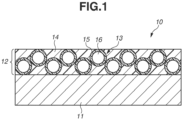
- Fig. 1 is a cross-sectional view schematically illustrating an example of the recording medium used in the manufacturing method for manufacturing a recorded product having a three-dimensional image according to the present exemplary embodiment.
- a recording medium 10 has a base material 11 and a foaming layer 12 provided on the base material 11 and containing a foaming particle 13 that foams by heat. The details of the recording medium used in the manufacturing method for manufacturing a recorded product according to the present exemplary embodiment will be described below.
- the base material 11 functions as a supporting member that supports the foaming layer 12.
- the type of the base material 11 is not particularly limited.
- Examples of the base material 11 can include paper composed of normal natural pulp; Kenaf paper; plastic film sheets of polypropylene, polyethylene, and polyester; and synthetic paper and non-woven fabric obtained by simulating paper using synthetic fibers, synthetic pulp, and synthetic resin films.
- the foaming layer 12 is a layer provided on at least one of the surfaces of the base material 11 and containing the foaming particle 13 and a binder resin 14.
- the foaming particle 13 is a thermally expandable microcapsule having a capsular shell layer 15 containing a thermoplastic resin and a volatile material 16 enclosed within the shell layer 15. If heat is applied to the foaming particle 13, the thermoplastic resin contained in the shell layer 15 softens, and the volatile material 16 enclosed within the shell layer 15 vaporizes and expands in volume. As a result, the foaming particle 13 expands like a balloon.
- the shell layer 15 may include a thermoplastic resin other than polyacrylonitrile copolymer.
- thermoplastic resin other than the polyacrylonitrile copolymer contained in the shell layer 15 can include polystyrene, styrene-acrylic acid ester copolymer, a polyamide resin, polyacrylic acid ester, polyvinylidene chloride, polymethylmethacrylate, vinylidene chloride-acrylonitrile, methacrylic acid ester-acrylic acid copolymer, vinylidene chloride-acrylic acid copolymer, and vinylidene chloride-acrylic acid ester copolymer.
- Examples of the volatile material 16 can include low-molecular-weight hydrocarbons such as ethane, ethylene, propane, propylene, n-butane, isobutane, n-pentane, isopentane, neopentane, n-hexane, heptane, and petroleum ether; chlorofluorocarbons such as CCl 3 F, CCl 2 F 2 , CClF 3 , and CClF 2 -CClF 2 ; and tetraalkylsilanes such as tetramethylsilane, trimethylethylsilane, trimethylisopropylsilane, and trimethyl-n-propylsilane.
- low-molecular-weight hydrocarbons such as ethane, ethylene, propane, propylene, n-butane, isobutane, n-pentane, isopentane, neopentane, n
- the volatile material 16 should be a hydrocarbon having a molecular mass of 120 or less among these.
- the lower limit of the molecular mass of the volatile material 16 (the hydrocarbon) is not particularly limited, it is desirable that the molecular mass of the volatile material 16 should be 50 or more, for example. It is desirable that the amount of foaming particles contained in the foaming layer 12 should be 5% by mass or more and 95% by mass or less with respect to the entire mass of the foaming layer 12.
- the foaming layer 12 contains the binder resin 14 to increase the adhesiveness between the foaming layer 12 and the base material 11.
- the binder resin 14 serves an important role in preventing the foaming layer 12 from peeling off the base material 11 when the foaming particle 13 in the foaming layer 12 foams by heat.
- the binder resin 14 is not particularly limited, it is desirable that the binder resin 14 should contain a water-insoluble resin. It is desirable that the water-insoluble resin should be at least one selected from the group including an acrylic resin and a urethane resin. It is more desirable that the water-insoluble resin should be at least one selected from the group including an acrylic resin that does not have an ester group and a urethane resin that does not have an ester group.
- the amount of the water-insoluble resin contained in the foaming layer 12 should be 10% by mass or more and 95% by mass or less with respect to the entire mass of the foaming layer 12.
- the foaming layer 12 may also contain a water-soluble resin together with the water-insoluble resin in the range where the effect of the present disclosure can be obtained.
- the glass-transition point of the binder resin 14 should be -10°C or more and 30°C or less. The glass-transition point of the binder resin 14 is within the above range, whereby it is possible to prevent the binder resin 14 from hindering the foaming of the foaming particle 13.
- the foaming layer 12 can further contain components such as a pigment, an antioxidant, a dye, and a surfactant in the range where the foaming property is not impaired.
- a thickness of d ⁇ m of the foaming layer 12 should be 10 ⁇ m or more. It is more desirable that the thickness of d ⁇ m of the foaming layer 12 should be 20 ⁇ m or more. It is even more desirable that the thickness of d ⁇ m of the foaming layer 12 should be 25 ⁇ m or more. Although the upper limit of the thickness of d ⁇ m of the foaming layer 12 is not particularly limited, the thickness of d ⁇ m of the foaming layer 12 can be 100 ⁇ m or less, for example.
- the recording medium 10 may further include an ink absorbing layer.
- a coated layer is formed by coating the surface of a base material with a coating liquid for a foaming layer containing a foaming particle.
- the foaming layer is formed by drying the formed coated layer, whereby it is possible to obtain the recording medium.
- a conventionally known coater such as an air knife coater, a die coater, a blade coater, a gate roll coater, a bar coater, a rod coater, a roll coater, a gravure coater, or a curtain coater can be used.
- the method for drying the coated layer can include a method in which hot air is blown against the coated layer.
- the drying conditions may be appropriately set according to the type of the base material and the composition of the coating liquid.
- the temperature at which the coated layer is dried needs to be lower than the foaming start temperature of the foaming particle that is used.
- the foaming layer having an area of 2 g/m 2 or more, it is possible to further improve the foaming property.
- a recording medium in which a foaming layer containing a foaming particle is provided in advance may be used.
- a back coating layer may be provided on the surface on the opposite side of the surface on which the foaming layer is provided.
- the back coating layer may be the same layer as the foaming layer containing the foaming particle, or may be a layer other than the foaming layer.
- a viscous layer containing a viscous resin such as an acrylic resin or an ink absorbing layer for fixing a color material may also be formed.
- the foaming promotion liquid according to the first aspect includes a good solvent for polyacrylonitrile copolymer in a shell layer of a foaming particle and a poor solvent for the polyacrylonitrile copolymer, the good solvent and the poor solvent for the polyacrylonitrile copolymer both have boiling points higher than the heating temperature.
- the good solvent for polyacrylonitrile copolymer can promote the foaming of the foaming particle, so it can be called a foaming promotion component.
- the good solvent for the polyacrylonitrile copolymer should be at least one selected from the group including dimethyl sulfoxide, N,N-dimethylformamide, dimethylacetamide, and N-methylpyrrolidone.
- the poor solvent for the polyacrylonitrile copolymer should be at least one selected from the group including water, toluene, and isobutyl alcohol. It is more desirable that the poor solvent for the polyacrylonitrile copolymer should be water.
- boiling points of the good solvent and the poor solvent should be 100°C or more. It is more desirable that the boiling points of the good solvent and the poor solvent should be 110°C or more.
- the foaming promotion liquid may further contain another component other than the solvents such as the good solvent and the poor solvent.
- the foaming promotion liquid should further contain a liquid component such as a solvent.
- a liquid component such as a solvent.
- water and various water-soluble organic solvents can be used.
- the foaming promotion liquid should contain water.
- a foaming promotion liquid containing water i.e., an aqueous foaming promotion liquid
- deionized water ion-exchanged water
- water-soluble organic solvents can include alcohols, glycols, glycol ethers, and nitrogen-containing compounds.
- the foaming promotion liquid may contain various additives such as a pH adjuster, an antifoam agent, an antirust agent, an antiseptic agent, a fungicide, an antioxidant, an antireductant, and a chelator, where necessary.
- a pH adjuster an antifoam agent
- an antirust agent an antiseptic agent
- a fungicide an antioxidant
- an antireductant an antireductant
- a chelator chelator
- the amount of the contained good solvent is 90% by mass or less, whereby it is easy to prevent a hole from opening in the shell layer of the foaming particle. It is desirable that the amount of the good solvent contained in the polyacrylonitrile should be 31% by mass or more and 70% by mass or less with respect to the entire mass of the foaming promotion liquid.
- the manufacturing apparatus for manufacturing a recorded product having a three-dimensional image according to the third aspect includes a foaming promotion liquid application device that applies a foaming promotion liquid to a recording medium having a base material and a foaming layer provided on the base material and containing a foaming particle having a shell layer including polyacrylonitrile copolymer, and a heating device that heats the recording medium to which the foaming promotion liquid is applied, thereby forming a three-dimensional image.
- the ink, the foaming promotion liquid, and the recording medium used in the manufacturing apparatus for manufacturing a recorded product are similar to the ink, the foaming promotion liquid, and the recording medium used in the manufacturing method for manufacturing a recorded product according to the second aspect.
- the manufacturing apparatus for manufacturing a recorded product can suitably use the manufacturing method for manufacturing a recorded product according to the second aspect.
- the manufacturing apparatus for manufacturing a recorded product can also include an ink storage portion that stores ink, and an ink application unit that discharges the ink from an inkjet recording head and records an image on the recording medium.
- the manufacturing apparatus for manufacturing a recorded product can also include a foaming promotion liquid storage portion that stores the foaming promotion liquid. Further, the manufacturing apparatus for manufacturing a recorded product can also include a conveying unit that conveys the recording medium.
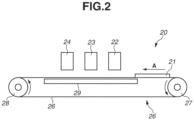
- Fig. 2 is a schematic diagram illustrating the general configuration of the manufacturing apparatus for manufacturing a recorded product having a three-dimensional image according to the present exemplary embodiment.
- a manufacturing apparatus 20 for manufacturing a recorded product includes a foaming promotion liquid application device 22, a heating device 23, an ink application device 24, and a conveying device 25.
- a recording medium 21 is conveyed in the direction of an arrow A in Fig. 2 by the conveying device 25 as a conveying unit that conveys the recording medium 21.
- the conveying device 25 includes a conveying belt 26 that is an endless belt, and two rollers 27 and 28 that hold the conveying belt 26. The rollers 27 and 28 are rotationally driven, whereby the recording medium 21 is conveyed in the direction of the arrow A.
- the conveying device 25 may also include a platen 29 that restricts the displacement of the conveying belt 26 in the up-down direction.
- the foaming promotion liquid application device 22 as a foaming promotion liquid application unit includes an inkjet recording head that discharges a foaming promotion liquid, and discharges the foaming promotion liquid from the inkjet recording head to the recording medium 21 conveyed by the conveying device 25.
- the heating device 23 as a heating unit heats a foaming layer of the recording medium 21 to which the foaming promotion liquid is applied.
- the heating device 23 only needs to be a heating device capable of heating a foaming particle in the foaming layer to a desired temperature. Examples of the heating device 23 can include a dryer, an oven, a heating heater, and an iron.
- the heating device 23 heats the recording medium to which the foaming promotion liquid is applied (d/10) seconds after the foaming promotion liquid is applied to the recording medium.
- the ink application device 24 as an ink application unit includes an inkjet recording head that discharges ink, and applies the ink from the inkjet recording head to the recording medium 21 that has foamed by the heating device 23.
- the ink application device 24 may be placed either upstream or downstream of the foaming promotion liquid application device 22 in the direction A as the conveying direction of the recording medium 21, and may be placed either upstream or downstream of the heating device 23.
- Fig. 2 illustrates a configuration in a case where the ink application device 24 is placed downstream of the foaming promotion liquid application device 22 and downstream of the heating device 23 in the conveying direction of the recording medium 21 (the direction A).
- Figs. 3A, 3B, and 3C illustrate the placement of the foaming promotion liquid application device 22, the heating device 23, and the ink application device 24 in the conveying direction of the recording medium 21.
- Fig. 3A illustrates a configuration in a case where the ink application device 24 is placed downstream of the foaming promotion liquid application device 22 and downstream of the heating device 23 in the conveying direction A of the recording medium 21.
- Fig. 3B illustrates a configuration in a case where the ink application device 24 is placed downstream of the foaming promotion liquid application device 22 and upstream of the heating device 23 in the conveying direction A of the recording medium 21.
- Fig. 3C illustrates a configuration in a case where the ink application device 24 is placed upstream of the foaming promotion liquid application device 22 and upstream of the heating device 23 in the conveying direction A of the recording medium 21.
- the first to third aspects of the present disclosure it is possible to provide a manufacturing method for manufacturing a recorded product having a three-dimensional image, a manufacturing apparatus for manufacturing a recorded product having a three-dimensional image, and a foaming promotion liquid that are capable of forming a three-dimensional image having a sufficient foaming height even in a case where the heating temperature at which a recording medium having a foaming layer is heated is low.
- foaming particles H1 to H3 having a shell layer including polyacrylonitrile copolymer were prepared.
- the foaming start temperature of each foaming particle was measured according to the above measuring method.
- polypropylene synthetic paper product name "New Yupo FGS110", manufactured by Yupo Corporation
- acrylic resin “Mowinyl 6950” (acrylic resin manufactured by Japan Coating Resin Co., Ltd.) having a glass-transition point of 0°C and 50 parts of the foaming particle H1-1 were added to ion-exchanged water, and the resulting product was sufficiently agitated, thereby obtaining a coating liquid 1 having a solid content concentration of 43%.
- the base material was coated with the obtained coating liquid 1 so that the amount of the applied coating liquid 1 was 40 g/m 2 , and then, a foaming layer was formed by drying the coating liquid 1 for 5 minutes in an oven at 80°C, thereby obtaining a recording medium M1-1.
- the amount of foaming particles contained per unit area was 13.3 g/m 2 .
- a thickness of the foaming layer was 40 ⁇ m.
- Recording media M2 and M3 were manufactured and obtained by a method similar to that for the recording medium M1, except that the foaming particle H1 was changed to the foaming particles H2 and H3, respectively.
- the amount of foaming particles contained per unit area was 13.3 g/m 2 .
- a thickness of the foaming layer was 40 ⁇ m.
- a foaming promotion liquid L2 was produced by a method similar to that for the foaming promotion liquid L1, except that 60 parts of dimethyl sulfoxide and 39.5 parts of toluene (boiling point: 111°C) were used.
- a foaming promotion liquid L3 was produced by a method similar to that for the foaming promotion liquid L1, except that isobutyl alcohol (boiling point: 108°C) was used instead of the ion-exchanged water.
- a foaming promotion liquid L4 was produced by a method similar to that for the foaming promotion liquid L1, except that N,N-dimethylformamide (boiling point: 153°C) was used instead of the dimethyl sulfoxide.
- a foaming promotion liquid L5 was produced by a method similar to that for the foaming promotion liquid L1, except that dimethylacetamide (boiling point: 165°C) was used instead of the dimethyl sulfoxide.
- a foaming promotion liquid L6 was produced by a method similar to that for the foaming promotion liquid L1, except that N-methylpyrrolidone (boiling point: 202°C) was used instead of the dimethyl sulfoxide.
- a foaming promotion liquid L7 was produced by a method similar to that for the foaming promotion liquid L1, except that 20 parts of the dimethyl sulfoxide and 79.5 parts of the ion-exchanged water were used.
- a foaming promotion liquid L8 was produced by a method similar to that for the foaming promotion liquid L2, except that 90 parts of the dimethyl sulfoxide and 9.5 parts of the toluene were used.
- a foaming promotion liquid L9 was produced by a method similar to that for the foaming promotion liquid L1, except that isopropyl alcohol (boiling point: 82°C) was used instead of the ion-exchanged water.
- a foaming promotion liquid L10 was produced by a method similar to that for the foaming promotion liquid L1, except that 18 parts of the dimethyl sulfoxide and 81.5 parts of the ion-exchanged water were used.
- a foaming promotion liquid L11 was produced by a method similar to that for the foaming promotion liquid L2, except that 92 parts of the dimethyl sulfoxide and 7.5 parts of the toluene were used.
- a foaming promotion liquid L12 was produced by a method similar to that for the foaming promotion liquid L1, except that "Acetylenol E100” (manufactured by Kawaken Fine Chemicals Co., Ltd.) was used instead of the "Acetylenol E60".
- a foaming promotion liquid L13 was produced by a method similar to that for the foaming promotion liquid L2, except that 88 parts of the dimethyl sulfoxide and 11.5 parts of the toluene were used.
- a foaming promotion liquid L14 was produced by a method similar to that for the foaming promotion liquid L1, except that 64.65 parts of the ion-exchanged water was used and 0.35 parts of "BYK-349" (manufactured by BYK JAPAN KK) was used instead of the "Acetylenol E60".
- a foaming promotion liquid L15 was produced by a method similar to that for the foaming promotion liquid L1, except that 60 parts of the dimethyl sulfoxide and 39.5 parts of the ion-exchanged water were used.
- the viscosity of each foaming promotion liquid was measured using an E-type viscometer (product name “RE-80L”, manufactured by TOKI).
- the static surface tension of the foaming promotion liquid was measured using an automatic surface tensiometer (product name "DY-300", manufactured by Kyowa Interface Science Co., Ltd.).
- the dynamic surface tension of the foaming promotion liquid in 1000 ms was measured using a dynamic surface tensiometer by a maximum bubble pressure method (product name "bubble pressure tensiometer BP-2100", manufactured by KRUSS).
- the dynamic surface tension of the foaming promotion liquid was measured using the dynamic surface tensiometer by the maximum bubble pressure method (product name "bubble pressure tensiometer BP-2100", manufactured by KRUSS) under the condition of a temperature of 25°C.
- the dynamic surface tension in a life time of 1000 ms was measured.
- the foaming promotion liquid L1 was applied by 12 g/m 2 onto the foaming layer of the recording medium M1 heated in advance so that the paper surface temperature was 30°C.
- the resulting product was heated for 10 seconds by 90°C of hot air five seconds after the foaming promotion liquid was applied, thereby obtaining a recorded product 1.
- the proportion of the amount of the good solvent applied to the recording medium M1 to the amount of the foaming particles contained per unit area in the foaming layer of the recording medium M1 was 32% by mass.
- examples 2 to 14 and comparative examples 1 to 4 recorded products 2 to 18 were obtained by methods similar to that in example 1, except that these methods were performed based on the types of the foaming promotion liquid and the recording medium, the amount of the foaming promotion liquid applied to the recording medium, the proportion of the amount of the applied good solvent to the amount of the contained foaming particles, time from application of foaming promotion liquid to heating, and the heating temperature that are illustrated in table 3.
- Proportion of amount of applied good solvent to amount of contained foaming particles (% by mass) illustrated in table 3 means "the proportion of the amount of the good solvent applied to the recording medium to the amount of the foaming particles contained per unit area in the foaming layer”.
- Table 3 illustrates the measurement results.
Landscapes
- Chemical & Material Sciences (AREA)
- Engineering & Computer Science (AREA)
- Chemical Kinetics & Catalysis (AREA)
- Health & Medical Sciences (AREA)
- Textile Engineering (AREA)
- General Chemical & Material Sciences (AREA)
- Polymers & Plastics (AREA)
- Organic Chemistry (AREA)
- Medicinal Chemistry (AREA)
- Materials Engineering (AREA)
- Physics & Mathematics (AREA)
- General Health & Medical Sciences (AREA)
- Thermal Sciences (AREA)
- Toxicology (AREA)
- Printing Methods (AREA)
Abstract
Description
- The present invention relates to a foaming promotion liquid, a manufacturing method for manufacturing a recorded product having a three-dimensional image, and a manufacturing apparatus for manufacturing a recorded product having a three-dimensional image.
- In recent years, in the printing industry, with the progress of digitalization, not only a two-dimensional image but also a three-dimensional image representing a recess and a protrusion needs to be digitalized.
- The publication of
Japanese Patent Application Laid-Open No. 2012-171317 - In response to this, the publication of
Japanese Patent Application Laid-Open No. 10-129116 Japanese Patent Application Laid-Open No. 11-11018 - The publication of
Japanese Patent Application Laid-Open No. 2020-50719 - An aspect of the present disclosure is directed to providing a foaming promotion liquid, a manufacturing method for manufacturing a recorded product having a three-dimensional image, and a manufacturing apparatus for manufacturing a recorded product having a three-dimensional image that are capable of forming a three-dimensional image having a sufficient foaming height even in a case where the heating temperature at which a recording medium having a foaming layer is heated is low.
- According to a first aspect of the present disclosure, there is provided a foaming promotion liquid as specified in clams 1 to 9.. According to a second aspect of the present disclosure, there is provided a manufacturing method as specified in
claims 10 to 12. According to a third aspect of the present disclosure, there is provided a manufacturing apparatus as a specified inclaims 13 to 15. - Further features of the present disclosure will become apparent from the following description of exemplary embodiments with reference to the attached drawings.
-
-
Fig. 1 is a cross-sectional view schematically illustrating an example of a recording medium used in a manufacturing method for manufacturing a recorded product having a three-dimensional image. -
Fig. 2 is a schematic diagram illustrating a general configuration of a manufacturing apparatus for manufacturing a recorded product having a three-dimensional image. -
Figs. 3A, 3B, and 3C are diagrams illustrating specific examples of placement order of a foaming promotion liquid application device, a heating device, and an ink application device in the manufacturing apparatus for manufacturing a recorded product having a three-dimensional image. - The present disclosure will be described in further detail below taking exemplary embodiments as examples. Hereinafter, inkjet aqueous ink will occasionally be referred to simply as "ink". A foaming promotion liquid for forming a three-dimensional image will occasionally be referred to simply as "a foaming promotion liquid". A manufacturing method for manufacturing a recorded product having a three-dimensional image will occasionally be referred to simply as "a manufacturing method for manufacturing a recorded product". A manufacturing apparatus for manufacturing a recorded product having a three-dimensional image will occasionally be referred to simply as "a manufacturing apparatus for manufacturing a recorded product". A good solvent for the polyacrylonitrile copolymer will occasionally be referred to simply as "a good solvent". A poor solvent for the polyacrylonitrile copolymer will occasionally be referred to simply as "a poor solvent". Physical property values are values at normal temperature (25°C), unless otherwise noted.
- In view of energy saving and safety, in a heating step for foaming, the heating temperature needs to be lowered.
- According to the consideration of the present inventors, however, in the methods discussed in the publication of
Japanese Patent Application Laid-Open No. 10-129116 Japanese Patent Application Laid-Open No. 11-11018 - In the method discussed in the publication of
Japanese Patent Application Laid-Open No. 2020-50719 - Thus, the present inventors have diligently considered a manufacturing method for manufacturing a recorded product having a three-dimensional image, a manufacturing apparatus for manufacturing a recorded product having a three-dimensional image, and a foaming promotion liquid that are capable of forming a three-dimensional image having a sufficient foaming height even in a case where the heating temperature at which a recording medium having a foaming layer is heated is low, and have arrived at the present disclosure.
- With reference to the drawings, a description will be given below of a foaming promotion liquid according to a first aspect, a manufacturing method for manufacturing a recorded product having a three-dimensional image according to a second aspect, and a manufacturing apparatus for manufacturing a recorded product having a three-dimensional image according to a third aspect. The present disclosure, however, is not limited to the following exemplary embodiment.
- The manufacturing method for manufacturing a recorded product according to the second aspect includes the step of applying a foaming promotion liquid to a recording medium having a base material and a foaming layer provided on the base material and containing a foaming particle having a shell layer including polyacrylonitrile copolymer, and the step of heating the recording medium to which the foaming promotion liquid is applied, thereby forming a three-dimensional image.
- The foaming promotion liquid according to the first aspect and also used in the manufacturing method for manufacturing a recorded product according to the second aspect and the manufacturing apparatus for manufacturing a recorded product according to the third aspect includes a good solvent for the polyacrylonitrile copolymer and a poor solvent for the polyacrylonitrile copolymer. The mass ratio between the amount of the good solvent contained in the foaming promotion liquid and the amount of the poor solvent contained in the foaming promotion liquid (the amount of the contained good solvent to the amount of the contained poor solvent) is 20:80 to 90:10.
- The good solvent for the polyacrylonitrile copolymer refers to a solvent capable of dissolving the polyacrylonitrile copolymer (first solvent). On the other hand, the poor solvent for the polyacrylonitrile copolymer refers to a solvent incapable of dissolving the polyacrylonitrile (second solvent). In the specification, the good solvent for the polyacrylonitrile copolymer is a solvent in which the amount of the polyacrylonitrile copolymer dissolved in 1 L of the solvent is 1 g or more, and the poor solvent is a solvent in which the amount of the polyacrylonitrile copolymer dissolved in 1 L of the solvent is less than 1 g. The polyacrylonitrile copolymer is used to determine the good solvent and the poor solvent as follows. The foaming promotion liquid obtained by mixing the good solvent and the poor solvent for the polyacrylonitrile used in the shell layer of the foaming particle is applied to the recording medium having the foaming layer containing the foaming particle having the shell layer including the polyacrylonitrile copolymer. The good solvent functions to soften the polyacrylonitrile copolymer included in the shell layer of the foaming particle. If, however, a foaming promotion liquid having a high concentration of the good solvent is applied to the foaming layer of the recording medium, the shell layer of the foaming particle is excessively softened, and, as a result, when the recording medium is heated, a hole is likely to open in the shell layer of the foaming particle. Accordingly, the poor solvent that does not contribute to the softening of the polyacrylonitrile copolymer is contained in the foaming promotion liquid together with the good solvent. This can make a hole less likely to open in the shell layer of the foaming particle to which the foaming promotion liquid is applied while softening the shell layer.
- Then, the softening of the shell layer lowers the foaming start temperature of the foaming particle. As a result, even in a case where the heating temperature at which a three-dimensional image is formed is lowered, it is possible to form a three-dimensional image having a sufficient foaming height.
- The good solvent and the poor solvent for the polyacrylonitrile copolymer both have boiling points higher than the heating temperature at which the recording medium is heated to form a three-dimensional image. If the boiling points of the good solvent and the poor solvent are lower than the heating temperature at which the recording medium is heated, the good solvent and the poor solvent boil and intensely vaporize by heat. This results in decreasing the good solvent and the poor solvent contained in the foaming layer of the recording medium to which the foaming promotion liquid is applied, and it is difficult to control the softening of the shell layer of the foaming particle. That is, if the boiling point of the good solvent is lower than or equal to the heating temperature, the good solvent boils by heat, and it is difficult to soften the shell layer of the foaming particle. If the boiling point of the poor solvent is lower than or equal to the heating temperature, and the boiling point of the good solvent is higher than the heating temperature, the poor solvent boils by heat, and the concentration of the good solvent contained in the foaming promotion liquid increases. Thus, it is difficult to prevent a hole from opening in the shell layer of the foaming particle.
- To deal with a high-speed printing system, it is desirable that the static surface tension of the foaming promotion liquid should be 24 mN/m or more and 40 mN/m or less. It is more desirable that the static surface tension of the foaming promotion liquid should be 24 mN/m or more and 36 mN/m or less. It is even more desirable that the static surface tension of the foaming promotion liquid should be 25 mN/m or more and 33 mN/m or less. The static surface tension of the foaming promotion liquid is controlled to be within this range, whereby it is possible to cause the foaming promotion liquid to quickly and substantially uniformly penetrate into the foaming layer. As a result, it is possible to cause the entirety of the foaming layer in a region to which the foaming promotion liquid is applied to foam by subsequent heating. Thus, it is possible to obtain a sufficient foaming height. If the static surface tension is less than 24 mN/m, the penetration of the foaming promotion liquid is too fast, and accordingly, it is not possible to cause the foaming promotion liquid to sufficiently contribute to foaming particles in an upper portion of the foaming layer, and it is difficult to obtain a sufficient foaming height even by subsequent heating.
- If the static surface tension exceeds 40 mN/m, the penetration of the foaming promotion liquid is not sufficient, and therefore, it is not possible to cause the foaming promotion liquid to sufficiently contribute to foaming particles in a lower portion of the foaming layer, and it is difficult to obtain a sufficient foaming height even by subsequent heating. To cause the foaming promotion liquid to more effectively contribute to the entirety of the foaming layer from the application of the foaming promotion liquid to the heating of the recording medium, it is desirable that the dynamic surface tension of the foaming promotion liquid in 1000 ms should be 34 mN/m or less. It is more desirable that the dynamic surface tension of the foaming promotion liquid in 1000 ms should be 32 mN/m or less. The static surface tension of the foaming promotion liquid can be measured using an automatic surface tensiometer (e.g., product name "DY-300", manufactured by Kyowa Interface Science Co., Ltd.) under the condition of a temperature of 25°C. The dynamic surface tension of the foaming promotion liquid can be measured using a dynamic surface tensiometer by a maximum bubble pressure method (e.g., product name "bubble pressure tensiometer BP-2100", manufactured by KRUSS) under the condition of a temperature of 25°C. The maximum bubble pressure method is a method for measuring the maximum pressure required to release an air bubble generated at a tip of a probe (a narrow tube) immersed in a measurement target liquid and obtaining the surface tension of the liquid based on the measured maximum pressure. Specifically, the maximum pressure is measured while continuously generating an air bubble at the tip of the probe. The time from when the surface of a new air bubble is generated at the tip of the probe to when the maximum bubble pressure is reached (when the radius of curvature of the air bubble and the radius of the tip portion of the probe are equal to each other) is referred to as a "life time". That is, the maximum bubble pressure method is a method for measuring the surface tension of a liquid in the state where the liquid moves. In the present disclosure, the surface tension was measured in a life time of 1000 ms. The static surface tension and the dynamic surface tension of the foaming promotion liquid can be adjusted according to the types and the content of components such as a good solvent, a poor solvent, and a surfactant, in the foaming promotion liquid.
- Moreover, in terms of improvement in the penetration of the foaming promotion liquid into the foaming layer of the recording medium, it is desirable that the viscosity of the foaming promotion liquid should be 1.5 mPa·s or more and 5.0 mPa·s or less. It is more desirable that the viscosity of the foaming promotion liquid should be 1.5 mPa·s or more and 2.7 mPa·s or less. By controlling the viscosity is to be within this range, it is possible to cause the foaming promotion liquid to effectively penetrate into the foaming layer by a sufficient amount, and cause the foaming promotion liquid to substantially uniformly function in the entirety of the foaming layer. Then, it is possible to cause the entirety of the foaming layer to foam by subsequent heating. Thus, it is possible to obtain a sufficient foaming height. The viscosity of the foaming promotion liquid can be measured using an E-type viscometer (product name "RE-80L", manufactured by TOKI) under the condition of a temperature of 25°C. The viscosity of the foaming promotion liquid can be adjusted according to the types and the content of components such as a good solvent, a poor solvent, and a surfactant, in the foaming promotion liquid.
- The proportion of the amount of the good solvent applied to the foaming promotion liquid to the amount of the foaming particles contained per unit area in the foaming layer is 80% by mass or less. If this proportion is greater than 80% by mass, a hole is likely to open in the shell layer of the foaming particle. Although the lower limit value of the proportion of the amount of the good solvent applied to the foaming promotion liquid to the amount of the foaming particles contained per unit area in the foaming layer is not particularly limited, it is desirable that the proportion should be 5% by mass or more.
- In the step of heating the recording medium, when a thickness of the foaming layer is d µm, it is desirable that the recording medium to which the foaming promotion liquid is applied should be heated (d/10) seconds after the foaming promotion liquid is applied to the recording medium. Consequently, it is possible to cause the foaming promotion liquid to uniformly penetrate into the foaming layer. Although the upper limit of the time from the application of the foaming promotion liquid to the heating of the recording medium is not particularly limited, it is desirable that the time should be (2d) seconds or less in a case where high-speed printing is performed.
- In the present exemplary embodiment, it is possible to lower the foaming start temperature of the foaming particle to which the foaming promotion liquid is applied. When a three-dimensional image is formed, the foaming promotion liquid is applied to a portion that should foam, and then, the recording medium is heated at a heating temperature lower than the foaming start temperature of the foaming particle. In this manner, only the portion to which the foaming promotion liquid is applied foams, and on the other hand, a portion to which the foaming promotion liquid is not applied is heated at the temperature less than the foaming start temperature, and therefore does not foam. If the heating temperature at which the three-dimensional image is formed is higher than the foaming start temperature of the foaming particle, the portion to which the foaming promotion liquid is not applied may also expand.
- The foaming start temperature of the foaming particle to which the foaming promotion liquid is applied can be measured by the following method. First, to bring the foaming particle into the state where the foaming promotion liquid is applied to the foaming particle, the foaming particle is immersed in the foaming promotion liquid for 10 seconds. 25 µg of foaming particles immersed in the foaming promotion liquid is placed as a sample in an aluminum container having a diameter of 7 mm and a depth of 1 mm. In the state where the aluminum container is attached to a thermo-mechanical analysis apparatus and a load of 0.1 N is applied onto the foaming particles, the foaming particles are heated from 60°C to 200°C at a temperature rising speed of 5°C/min, and the amount of displacement of a measurement terminal in the vertical direction (the amount of displacement of the height of a portion occupied by the sample) is measured.
- Then, the temperature at the time when the displacement starts is determined as the foaming start temperature of the foaming particle to which the foaming promotion liquid is applied.
- The foaming start temperature of the foaming particle in which the foaming promotion liquid is not applied means the following temperature. That is, the foaming start temperature of the foaming particle in which the foaming promotion liquid is not applied means each of the temperature at the time when the displacement starts and the temperature at the time when the amount of displacement reaches the maximum amount that are measured by a method similar to that in the above case of the foaming particle in which the foaming promotion liquid is applied, except that the foaming particle in which the foaming promotion component is not applied is used as a sample.
- The method for heating the foaming layer to which the foaming promotion liquid is applied only needs to be a method using a heating device capable of heating the foaming particle in the foaming layer to a desired temperature.
- Before and after the foaming promotion liquid is applied to the foaming layer, or before and after the foaming layer to which the foaming promotion liquid is applied is heated, any image may be recorded (printed) by applying ink containing a dye or a pigment as a color material to the recording medium. It is desirable to use aqueous ink as the ink. The printing may be performed not only by an inkjet recording method for applying ink in an inkjet manner, but also by a printing method such as an electrophotographic manner that uses toner, latex, ultraviolet (UV), or sublimation transfer. It is desirable to record the image by the inkjet recording method among these methods because a finer image can be recorded.
-
Fig. 1 is a cross-sectional view schematically illustrating an example of the recording medium used in the manufacturing method for manufacturing a recorded product having a three-dimensional image according to the present exemplary embodiment. As illustrated inFig. 1 , arecording medium 10 has abase material 11 and afoaming layer 12 provided on thebase material 11 and containing a foamingparticle 13 that foams by heat. The details of the recording medium used in the manufacturing method for manufacturing a recorded product according to the present exemplary embodiment will be described below. - The
base material 11 functions as a supporting member that supports thefoaming layer 12. The type of thebase material 11 is not particularly limited. Examples of thebase material 11 can include paper composed of normal natural pulp; Kenaf paper; plastic film sheets of polypropylene, polyethylene, and polyester; and synthetic paper and non-woven fabric obtained by simulating paper using synthetic fibers, synthetic pulp, and synthetic resin films. - As illustrated in
Fig. 1 , thefoaming layer 12 is a layer provided on at least one of the surfaces of thebase material 11 and containing the foamingparticle 13 and abinder resin 14. The foamingparticle 13 is a thermally expandable microcapsule having acapsular shell layer 15 containing a thermoplastic resin and avolatile material 16 enclosed within theshell layer 15. If heat is applied to the foamingparticle 13, the thermoplastic resin contained in theshell layer 15 softens, and thevolatile material 16 enclosed within theshell layer 15 vaporizes and expands in volume. As a result, the foamingparticle 13 expands like a balloon. - The
shell layer 15 may include a thermoplastic resin other than polyacrylonitrile copolymer. - Examples of the thermoplastic resin other than the polyacrylonitrile copolymer contained in the
shell layer 15 can include polystyrene, styrene-acrylic acid ester copolymer, a polyamide resin, polyacrylic acid ester, polyvinylidene chloride, polymethylmethacrylate, vinylidene chloride-acrylonitrile, methacrylic acid ester-acrylic acid copolymer, vinylidene chloride-acrylic acid copolymer, and vinylidene chloride-acrylic acid ester copolymer. - Examples of the
volatile material 16 can include low-molecular-weight hydrocarbons such as ethane, ethylene, propane, propylene, n-butane, isobutane, n-pentane, isopentane, neopentane, n-hexane, heptane, and petroleum ether; chlorofluorocarbons such as CCl3F, CCl2F2, CClF3, and CClF2-CClF2; and tetraalkylsilanes such as tetramethylsilane, trimethylethylsilane, trimethylisopropylsilane, and trimethyl-n-propylsilane. It is desirable that thevolatile material 16 should be a hydrocarbon having a molecular mass of 120 or less among these. Although the lower limit of the molecular mass of the volatile material 16 (the hydrocarbon) is not particularly limited, it is desirable that the molecular mass of thevolatile material 16 should be 50 or more, for example. It is desirable that the amount of foaming particles contained in thefoaming layer 12 should be 5% by mass or more and 95% by mass or less with respect to the entire mass of thefoaming layer 12. - The
foaming layer 12 contains thebinder resin 14 to increase the adhesiveness between the foaminglayer 12 and thebase material 11. Thebinder resin 14 serves an important role in preventing thefoaming layer 12 from peeling off thebase material 11 when the foamingparticle 13 in thefoaming layer 12 foams by heat. Although thebinder resin 14 is not particularly limited, it is desirable that thebinder resin 14 should contain a water-insoluble resin. It is desirable that the water-insoluble resin should be at least one selected from the group including an acrylic resin and a urethane resin. It is more desirable that the water-insoluble resin should be at least one selected from the group including an acrylic resin that does not have an ester group and a urethane resin that does not have an ester group. It is desirable that the amount of the water-insoluble resin contained in thefoaming layer 12 should be 10% by mass or more and 95% by mass or less with respect to the entire mass of thefoaming layer 12. Thefoaming layer 12 may also contain a water-soluble resin together with the water-insoluble resin in the range where the effect of the present disclosure can be obtained. It is desirable that the glass-transition point of thebinder resin 14 should be -10°C or more and 30°C or less. The glass-transition point of thebinder resin 14 is within the above range, whereby it is possible to prevent thebinder resin 14 from hindering the foaming of the foamingparticle 13. - It is desirable that the mass ratio between the foaming
particle 13 and thebinder resin 14 should be 5:95 to 90:10. By keeping the mass ratio between the foamingparticle 13 and thebinder resin 14 is within the above range, it is possible to improve both the foaming property of the foamingparticle 13 and the binding property of thebinder resin 14 to thebase material 11. Thefoaming layer 12 can further contain components such as a pigment, an antioxidant, a dye, and a surfactant in the range where the foaming property is not impaired. - To obtain a sufficient foaming height, it is desirable that a thickness of d µm of the
foaming layer 12 should be 10 µm or more. It is more desirable that the thickness of d µm of thefoaming layer 12 should be 20 µm or more. It is even more desirable that the thickness of d µm of thefoaming layer 12 should be 25 µm or more. Although the upper limit of the thickness of d µm of thefoaming layer 12 is not particularly limited, the thickness of d µm of thefoaming layer 12 can be 100 µm or less, for example. - The
recording medium 10 may further include an ink absorbing layer. - To manufacture a recording medium, first, a coated layer is formed by coating the surface of a base material with a coating liquid for a foaming layer containing a foaming particle. Next, the foaming layer is formed by drying the formed coated layer, whereby it is possible to obtain the recording medium. To coat the surface of the base material with the coating liquid for the foaming layer, a conventionally known coater such as an air knife coater, a die coater, a blade coater, a gate roll coater, a bar coater, a rod coater, a roll coater, a gravure coater, or a curtain coater can be used. Examples of the method for drying the coated layer can include a method in which hot air is blown against the coated layer. The drying conditions (the temperature, the airflow volume, and the time) may be appropriately set according to the type of the base material and the composition of the coating liquid. The temperature at which the coated layer is dried, however, needs to be lower than the foaming start temperature of the foaming particle that is used.
- By providing the foaming layer having an area of 2 g/m2 or more, it is possible to further improve the foaming property. Alternatively, a recording medium in which a foaming layer containing a foaming particle is provided in advance may be used.
- On the surface on the opposite side of the surface on which the foaming layer is provided, a back coating layer may be provided. The back coating layer may be the same layer as the foaming layer containing the foaming particle, or may be a layer other than the foaming layer. A viscous layer containing a viscous resin such as an acrylic resin or an ink absorbing layer for fixing a color material may also be formed.
- The details of the foaming promotion liquid according to the first aspect will be described below.
- The foaming promotion liquid according to the first aspect includes a good solvent for polyacrylonitrile copolymer in a shell layer of a foaming particle and a poor solvent for the polyacrylonitrile copolymer, the good solvent and the poor solvent for the polyacrylonitrile copolymer both have boiling points higher than the heating temperature. The good solvent for polyacrylonitrile copolymer can promote the foaming of the foaming particle, so it can be called a foaming promotion component.
- It is desirable that the good solvent for the polyacrylonitrile copolymer should be at least one selected from the group including dimethyl sulfoxide, N,N-dimethylformamide, dimethylacetamide, and N-methylpyrrolidone.
- It is desirable that the poor solvent for the polyacrylonitrile copolymer should be at least one selected from the group including water, toluene, and isobutyl alcohol. It is more desirable that the poor solvent for the polyacrylonitrile copolymer should be water.
- It is desirable that the boiling points of the good solvent and the poor solvent should be 100°C or more. It is more desirable that the boiling points of the good solvent and the poor solvent should be 110°C or more.
- The foaming promotion liquid may further contain another component other than the solvents such as the good solvent and the poor solvent. For example, to improve the discharge stability of the foaming promotion liquid, it is desirable that the foaming promotion liquid should further contain a liquid component such as a solvent. As the solvent, water and various water-soluble organic solvents can be used. Particularly, it is desirable that the foaming promotion liquid should contain water. By using a foaming promotion liquid containing water (i.e., an aqueous foaming promotion liquid), it is possible to obtain a sufficient foaming height in a short time. It is desirable to use deionized water (ion-exchanged water) as the water. Examples of the water-soluble organic solvents can include alcohols, glycols, glycol ethers, and nitrogen-containing compounds.
- Further, the foaming promotion liquid may contain various additives such as a pH adjuster, an antifoam agent, an antirust agent, an antiseptic agent, a fungicide, an antioxidant, an antireductant, and a chelator, where necessary. It is desirable that the amount of the good solvent for the polyacrylonitrile copolymer contained in the foaming promotion liquid should be 20% by mass or more and 90% by mass or less with respect to the entire mass of the foaming promotion liquid. The amount of the contained good solvent is 20% by mass or more, whereby it is possible to sufficiently soften the shell layer of the foaming particle, and it is easy to lower the foaming start temperature of the foaming particle. On the other hand, the amount of the contained good solvent is 90% by mass or less, whereby it is easy to prevent a hole from opening in the shell layer of the foaming particle. It is desirable that the amount of the good solvent contained in the polyacrylonitrile should be 31% by mass or more and 70% by mass or less with respect to the entire mass of the foaming promotion liquid.
- The manufacturing apparatus for manufacturing a recorded product having a three-dimensional image according to the third aspect includes a foaming promotion liquid application device that applies a foaming promotion liquid to a recording medium having a base material and a foaming layer provided on the base material and containing a foaming particle having a shell layer including polyacrylonitrile copolymer, and a heating device that heats the recording medium to which the foaming promotion liquid is applied, thereby forming a three-dimensional image. The ink, the foaming promotion liquid, and the recording medium used in the manufacturing apparatus for manufacturing a recorded product are similar to the ink, the foaming promotion liquid, and the recording medium used in the manufacturing method for manufacturing a recorded product according to the second aspect. The manufacturing apparatus for manufacturing a recorded product can suitably use the manufacturing method for manufacturing a recorded product according to the second aspect.
- The manufacturing apparatus for manufacturing a recorded product can also include an ink storage portion that stores ink, and an ink application unit that discharges the ink from an inkjet recording head and records an image on the recording medium. The manufacturing apparatus for manufacturing a recorded product can also include a foaming promotion liquid storage portion that stores the foaming promotion liquid. Further, the manufacturing apparatus for manufacturing a recorded product can also include a conveying unit that conveys the recording medium.
-
Fig. 2 is a schematic diagram illustrating the general configuration of the manufacturing apparatus for manufacturing a recorded product having a three-dimensional image according to the present exemplary embodiment. - A
manufacturing apparatus 20 for manufacturing a recorded product includes a foaming promotionliquid application device 22, aheating device 23, anink application device 24, and a conveying device 25. - A
recording medium 21 is conveyed in the direction of an arrow A inFig. 2 by the conveying device 25 as a conveying unit that conveys therecording medium 21. The conveying device 25 includes a conveyingbelt 26 that is an endless belt, and tworollers belt 26. Therollers recording medium 21 is conveyed in the direction of the arrow A. The conveying device 25 may also include aplaten 29 that restricts the displacement of the conveyingbelt 26 in the up-down direction. - The foaming promotion
liquid application device 22 as a foaming promotion liquid application unit includes an inkjet recording head that discharges a foaming promotion liquid, and discharges the foaming promotion liquid from the inkjet recording head to therecording medium 21 conveyed by the conveying device 25. - The
heating device 23 as a heating unit heats a foaming layer of therecording medium 21 to which the foaming promotion liquid is applied. Theheating device 23 only needs to be a heating device capable of heating a foaming particle in the foaming layer to a desired temperature. Examples of theheating device 23 can include a dryer, an oven, a heating heater, and an iron. - It is desirable that when a thickness of the foaming layer is d µm, the
heating device 23 heats the recording medium to which the foaming promotion liquid is applied (d/10) seconds after the foaming promotion liquid is applied to the recording medium. - The
ink application device 24 as an ink application unit includes an inkjet recording head that discharges ink, and applies the ink from the inkjet recording head to therecording medium 21 that has foamed by theheating device 23. Theink application device 24 may be placed either upstream or downstream of the foaming promotionliquid application device 22 in the direction A as the conveying direction of therecording medium 21, and may be placed either upstream or downstream of theheating device 23.Fig. 2 illustrates a configuration in a case where theink application device 24 is placed downstream of the foaming promotionliquid application device 22 and downstream of theheating device 23 in the conveying direction of the recording medium 21 (the direction A). -
Figs. 3A, 3B, and 3C illustrate the placement of the foaming promotionliquid application device 22, theheating device 23, and theink application device 24 in the conveying direction of therecording medium 21. -
Fig. 3A illustrates a configuration in a case where theink application device 24 is placed downstream of the foaming promotionliquid application device 22 and downstream of theheating device 23 in the conveying direction A of therecording medium 21.Fig. 3B illustrates a configuration in a case where theink application device 24 is placed downstream of the foaming promotionliquid application device 22 and upstream of theheating device 23 in the conveying direction A of therecording medium 21.Fig. 3C illustrates a configuration in a case where theink application device 24 is placed upstream of the foaming promotionliquid application device 22 and upstream of theheating device 23 in the conveying direction A of therecording medium 21. According to the first to third aspects of the present disclosure, it is possible to provide a manufacturing method for manufacturing a recorded product having a three-dimensional image, a manufacturing apparatus for manufacturing a recorded product having a three-dimensional image, and a foaming promotion liquid that are capable of forming a three-dimensional image having a sufficient foaming height even in a case where the heating temperature at which a recording medium having a foaming layer is heated is low. - The present disclosure is described in further detail below taking examples and comparative examples. The present disclosure, however, is not limited to the following examples so long as the present disclosure does not depart from the scope of the present disclosure. Component amounts described as "parts" and "%" are based on mass, unless otherwise noted.
- As illustrated in table 1, foaming particles H1 to H3 having a shell layer including polyacrylonitrile copolymer were prepared. The foaming start temperature of each foaming particle was measured according to the above measuring method.
[Table 1] Foaming particle Product name Foaming start temperature H1 HF-50 (manufactured by Matsumoto Yushi-Seiyaku Co., Ltd.) 95°C H2 EMH 204 (manufactured by Sekisui Chemical Company, Limited) 110°C H3 Expancel 007-40 (manufactured by Japan Fillite Co., Ltd.) 91°C - As a base material, polypropylene synthetic paper (product name "New Yupo FGS110", manufactured by Yupo Corporation) was prepared. 100 parts of acrylic resin "Mowinyl 6950" (acrylic resin manufactured by Japan Coating Resin Co., Ltd.) having a glass-transition point of 0°C and 50 parts of the foaming particle H1-1 were added to ion-exchanged water, and the resulting product was sufficiently agitated, thereby obtaining a coating liquid 1 having a solid content concentration of 43%.
- The base material was coated with the obtained coating liquid 1 so that the amount of the applied coating liquid 1 was 40 g/m2, and then, a foaming layer was formed by drying the coating liquid 1 for 5 minutes in an oven at 80°C, thereby obtaining a recording medium M1-1. The amount of foaming particles contained per unit area was 13.3 g/m2. A thickness of the foaming layer was 40 µm.
- Recording media M2 and M3 were manufactured and obtained by a method similar to that for the recording medium M1, except that the foaming particle H1 was changed to the foaming particles H2 and H3, respectively. The amount of foaming particles contained per unit area was 13.3 g/m2. A thickness of the foaming layer was 40 µm.
- 35 parts of dimethyl sulfoxide (boiling point: 189°C) as a good solvent for polyacrylonitrile copolymer, 64.5 parts of ion-exchanged water as a poor solvent for polyacrylonitrile copolymer, and 0.5 parts of a non-ionic surfactant (product name "Acetylenol E60", manufactured by Kawaken Fine Chemicals Co., Ltd.) as a surfactant were mixed together. The resulting product was sufficiently agitated and then subjected to pressure filtration through a filter having a pore size of 1.2 µm, thereby obtaining a foaming promotion liquid L1.
- A foaming promotion liquid L2 was produced by a method similar to that for the foaming promotion liquid L1, except that 60 parts of dimethyl sulfoxide and 39.5 parts of toluene (boiling point: 111°C) were used.
- A foaming promotion liquid L3 was produced by a method similar to that for the foaming promotion liquid L1, except that isobutyl alcohol (boiling point: 108°C) was used instead of the ion-exchanged water.
- A foaming promotion liquid L4 was produced by a method similar to that for the foaming promotion liquid L1, except that N,N-dimethylformamide (boiling point: 153°C) was used instead of the dimethyl sulfoxide.
- A foaming promotion liquid L5 was produced by a method similar to that for the foaming promotion liquid L1, except that dimethylacetamide (boiling point: 165°C) was used instead of the dimethyl sulfoxide.
- A foaming promotion liquid L6 was produced by a method similar to that for the foaming promotion liquid L1, except that N-methylpyrrolidone (boiling point: 202°C) was used instead of the dimethyl sulfoxide.
- A foaming promotion liquid L7 was produced by a method similar to that for the foaming promotion liquid L1, except that 20 parts of the dimethyl sulfoxide and 79.5 parts of the ion-exchanged water were used.
- A foaming promotion liquid L8 was produced by a method similar to that for the foaming promotion liquid L2, except that 90 parts of the dimethyl sulfoxide and 9.5 parts of the toluene were used.
- A foaming promotion liquid L9 was produced by a method similar to that for the foaming promotion liquid L1, except that isopropyl alcohol (boiling point: 82°C) was used instead of the ion-exchanged water.
- A foaming promotion liquid L10 was produced by a method similar to that for the foaming promotion liquid L1, except that 18 parts of the dimethyl sulfoxide and 81.5 parts of the ion-exchanged water were used.
- A foaming promotion liquid L11 was produced by a method similar to that for the foaming promotion liquid L2, except that 92 parts of the dimethyl sulfoxide and 7.5 parts of the toluene were used.
- A foaming promotion liquid L12 was produced by a method similar to that for the foaming promotion liquid L1, except that "Acetylenol E100" (manufactured by Kawaken Fine Chemicals Co., Ltd.) was used instead of the "Acetylenol E60".
- A foaming promotion liquid L13 was produced by a method similar to that for the foaming promotion liquid L2, except that 88 parts of the dimethyl sulfoxide and 11.5 parts of the toluene were used.
- A foaming promotion liquid L14 was produced by a method similar to that for the foaming promotion liquid L1, except that 64.65 parts of the ion-exchanged water was used and 0.35 parts of "BYK-349" (manufactured by BYK JAPAN KK) was used instead of the "Acetylenol E60".
- A foaming promotion liquid L15 was produced by a method similar to that for the foaming promotion liquid L1, except that 60 parts of the dimethyl sulfoxide and 39.5 parts of the ion-exchanged water were used.
- The viscosity of each foaming promotion liquid was measured using an E-type viscometer (product name "RE-80L", manufactured by TOKI). The static surface tension of the foaming promotion liquid was measured using an automatic surface tensiometer (product name "DY-300", manufactured by Kyowa Interface Science Co., Ltd.). The dynamic surface tension of the foaming promotion liquid in 1000 ms was measured using a dynamic surface tensiometer by a maximum bubble pressure method (product name "bubble pressure tensiometer BP-2100", manufactured by KRUSS).
- The static surface tension of the foaming promotion liquid was measured using the automatic surface tensiometer (product name "DY-300", manufactured by Kyowa Interface Science Co., Ltd.) under the condition of a temperature of 25°C.
- The dynamic surface tension of the foaming promotion liquid was measured using the dynamic surface tensiometer by the maximum bubble pressure method (product name "bubble pressure tensiometer BP-2100", manufactured by KRUSS) under the condition of a temperature of 25°C. In the present example, the dynamic surface tension in a life time of 1000 ms was measured.
- Table 2 illustrates the viscosity, the static surface tension, and the dynamic surface tension of each of the foaming promotion liquids L1 to L15.
[Table 2] Foaming promotion liquid Viscosity (mPa·s) Static surface tension (mN/m) Dynamic surface tension (mN/m) L1 2.0 28.0 29.0 L2 1.4 35.0 28.0 L3 2.7 25.0 27.0 L4 1.9 36.0 34.0 L5 1.5 28.0 28.0 L6 1.5 28.0 29.5 L7 1.6 28.0 29.5 L8 1.7 39.7 35.0 L9 1.5 23.9 24.0 L10 1.6 27.0 29.5 L11 1.7 42.0 37.0 L12 2.0 33.0 31.0 L13 1.7 37.0 37.0 L14 2.0 24.0 39.0 L15 2.8 31.0 31.0 - Using the manufacturing apparatus for manufacturing a recorded product illustrated in
Fig. 2 , the foaming promotion liquid L1 was applied by 12 g/m2 onto the foaming layer of the recording medium M1 heated in advance so that the paper surface temperature was 30°C. The resulting product was heated for 10 seconds by 90°C of hot air five seconds after the foaming promotion liquid was applied, thereby obtaining a recorded product 1. Regarding the amount of the good solvent applied to the foaming promotion liquid L1, the proportion of the amount of the good solvent applied to the recording medium M1 to the amount of the foaming particles contained per unit area in the foaming layer of the recording medium M1 was 32% by mass. - In examples 2 to 14 and comparative examples 1 to 4, recorded products 2 to 18 were obtained by methods similar to that in example 1, except that these methods were performed based on the types of the foaming promotion liquid and the recording medium, the amount of the foaming promotion liquid applied to the recording medium, the proportion of the amount of the applied good solvent to the amount of the contained foaming particles, time from application of foaming promotion liquid to heating, and the heating temperature that are illustrated in table 3.
- "Proportion of amount of applied good solvent to amount of contained foaming particles (% by mass)" illustrated in table 3 means "the proportion of the amount of the good solvent applied to the recording medium to the amount of the foaming particles contained per unit area in the foaming layer".
- Using a digital micrometer (product name "M-30", manufactured by Sony), the height of a foaming portion (the foaming height) based on the height of a non-foaming portion on the surface of each of the obtained recorded products 1 to 15 was measured.
- Table 3 illustrates the measurement results.
- A: the difference between a recess and a protrusion is 200 µm or more
- B: the difference between a recess and a protrusion is 100 µm or more and less than 200 µm
- C: the difference between a recess and a protrusion is less than 100 µm


- While the present disclosure has been described with reference to exemplary embodiments, it is to be understood that the disclosure is not limited to the disclosed exemplary embodiments. The scope of the following claims is to be accorded the broadest interpretation so as to encompass all such modifications and equivalent structures and functions.
Claims (15)
- A foaming promotion liquid for forming a three-dimensional image, the foaming promotion liquid including a good solvent for polyacrylonitrile copolymer and a poor solvent for the polyacrylonitrile copolymer,wherein a mass ratio of an amount of the good solvent contained in the foaming promotion liquid to an amount of the poor solvent contained in the foaming promotion liquid is 20:80 to 90:10, andwherein the good solvent and the poor solvent both have boiling points higher than a heating temperature at which a recording medium is heated to form a three-dimensional image.
- The foaming promotion liquid according to claim 1, wherein the good solvent is at least one member selected from the group including dimethyl sulfoxide, N,N-dimethylformamide, dimethylacetamide, and N-methylpyrrolidone.
- The foaming promotion liquid according to claim 1 or 2, wherein the poor solvent is at least one selected from the group including water, toluene, and isobutyl alcohol.
- The foaming promotion liquid according to any one of claims 1 to 3, wherein the poor solvent is water.
- The foaming promotion liquid according to any one of claims 1 to 4, wherein a static surface tension of the foaming promotion liquid is 24 mN/m or more and 40 mN/m or less.
- The foaming promotion liquid according to any one of claims 1 to 5, wherein a static surface tension of the foaming promotion liquid is 25 mN/m or more and 33 mN/m or less.
- The foaming promotion liquid according to any one of claims 1 to 6, wherein a dynamic surface tension of the foaming promotion liquid is 34 mN/m or less.
- The foaming promotion liquid according to any one of claims 1 to 7, wherein a viscosity of the foaming promotion liquid is 1.5 mPa-s or more and 2.7 mPa - s or less.
- The foaming promotion liquid according to any one of claims 1 to 8, wherein an amount of the good solvent contained in the foaming promotion liquid is 20% by mass or more and 90% by mass or less with respect to an entire mass of the foaming promotion liquid.
- A manufacturing method for manufacturing a recorded product having a three-dimensional image, the manufacturing method comprising:applying a foaming promotion liquid to a recording medium having a base material and a foaming layer provided on the base material and containing a foaming particle having a shell layer including polyacrylonitrile copolymer; andheating the recording medium to which the foaming promotion liquid is applied, thereby forming a three-dimensional image,wherein the foaming promotion liquid includes a good solvent for the polyacrylonitrile copolymer and a poor solvent for the polyacrylonitrile copolymer,wherein a mass ratio of an amount of the good solvent contained in the foaming promotion liquid to an amount of the poor solvent contained in the foaming promotion liquid is 20:80 to 90:10,wherein the good solvent and the poor solvent both have boiling points higher than a heating temperature at which the recording medium is heated, andwherein a proportion of an amount of the good solvent applied to the recording medium to an amount of the foaming particles contained per unit area in the foaming layer is 80% by mass or less.
- The manufacturing method for manufacturing a recorded product having a three-dimensional image according to claim 10 or 11, wherein the heating temperature is lower than a foaming start temperature of the foaming particle.
- The manufacturing method for manufacturing a recorded product having a three-dimensional image according to claim 10 or 11, wherein in the step of heating the recording medium, when a thickness of the foaming layer is d µm, the recording medium to which the foaming promotion liquid is applied is heated (d/10) seconds after the foaming promotion liquid is applied to the recording medium.
- A manufacturing apparatus for manufacturing a recorded product having a three-dimensional image, the manufacturing apparatus comprising:a foaming promotion liquid application device configured to apply a foaming promotion liquid to a recording medium having a base material and a foaming layer provided on the base material and containing a foaming particle having a shell layer including polyacrylonitrile copolymer; anda heating device configured to heat the recording medium to which the foaming promotion liquid is applied, thereby forming a three-dimensional image,wherein the foaming promotion liquid includes a good solvent for the polyacrylonitrile copolymer and a poor solvent for the polyacrylonitrile copolymer,wherein a mass ratio of an amount of the good solvent contained in the foaming promotion liquid to an amount of the poor solvent contained in the foaming promotion liquid is 20:80 to 90:10,wherein the good solvent and the poor solvent both have boiling points higher than a heating temperature at which the recording medium is heated, andwherein a proportion of an amount of the good solvent applied to the recording medium to an amount of the foaming particles contained per unit area in the foaming layer is 80% by mass or less.
- The manufacturing apparatus for manufacturing a recorded product having a three-dimensional image according to claim 13, wherein the heating device controls the heating temperature to be a temperature lower than a foaming start temperature of the foaming particle.
- The manufacturing apparatus for manufacturing a recorded product having a three-dimensional image according to claim 13 or 14, wherein when a thickness of the foaming layer is d µm, the heating device heats the recording medium to which the foaming promotion liquid is applied (d/10) seconds after the foaming promotion liquid is applied to the recording medium.
Applications Claiming Priority (3)
| Application Number | Priority Date | Filing Date | Title |
|---|---|---|---|
| JP2022080679 | 2022-05-17 | ||
| JP2022080678 | 2022-05-17 | ||
| JP2023069416A JP2023169869A (en) | 2022-05-17 | 2023-04-20 | Foaming promotion liquid, method for manufacturing recorded article having three-dimensional image, and apparatus for manufacturing recorded article having three-dimensional image |
Publications (1)
| Publication Number | Publication Date |
|---|---|
| EP4279283A1 true EP4279283A1 (en) | 2023-11-22 |
Family
ID=86378216
Family Applications (1)
| Application Number | Title | Priority Date | Filing Date |
|---|---|---|---|
| EP23173108.4A Pending EP4279283A1 (en) | 2022-05-17 | 2023-05-12 | Foaming promotion liquid, manufacturing method for manufacturing recorded product having three-dimensional image, and manufacturing apparatus for manufacturing recorded product having three-dimensional image |
Country Status (2)
| Country | Link |
|---|---|
| US (1) | US20240002622A1 (en) |
| EP (1) | EP4279283A1 (en) |
Citations (8)
| Publication number | Priority date | Publication date | Assignee | Title |
|---|---|---|---|---|
| JPH10129116A (en) | 1996-11-05 | 1998-05-19 | Mitsubishi Paper Mills Ltd | Three-dimensional image forming method and three-dimensional image forming body |
| JPH1111018A (en) | 1997-06-27 | 1999-01-19 | Mitsubishi Paper Mills Ltd | Three-dimensional image forming recording material and three-dimensional image forming method using the same |
| KR100376604B1 (en) * | 2000-10-23 | 2003-03-19 | 주식회사 엘지화학 | Wall Paper with Shaped Pattern and the Method for Manufacturing thereof |
| JP2012171317A (en) | 2011-02-24 | 2012-09-10 | Casio Electronics Co Ltd | Three-dimensional printing device, three-dimensional printing system, and three-dimensional printing method |
| JP2020050719A (en) | 2018-09-26 | 2020-04-02 | 株式会社ミマキエンジニアリング | Ink, solid formed article, and formation method of solid formed article |
| JP2020097191A (en) * | 2018-12-19 | 2020-06-25 | 株式会社ミマキエンジニアリング | Heating machine, foaming machine for foamable media and manufacturing method for foamed media |
| JP2021130218A (en) * | 2020-02-18 | 2021-09-09 | 株式会社ミマキエンジニアリング | Foam formation media and production method of foam formation printed matter using the same |
| US20210402810A1 (en) * | 2018-11-20 | 2021-12-30 | Mimaki Engineering Co., Ltd. | Manufacturing method for printed matter, manufacturing method for foam, foaming inhibition ink, forming method for three-dimensional formed object, and forming system for three-dimensional formed object |
Family Cites Families (2)
| Publication number | Priority date | Publication date | Assignee | Title |
|---|---|---|---|---|
| JP5717107B2 (en) * | 2010-05-07 | 2015-05-13 | 国立大学法人大阪大学 | Polyacrylonitrile porous material |
| DE112015003995B4 (en) * | 2014-09-01 | 2019-01-31 | Fujifilm Corporation | Ink jet recording method |
-
2023
- 2023-05-12 US US18/316,966 patent/US20240002622A1/en active Pending
- 2023-05-12 EP EP23173108.4A patent/EP4279283A1/en active Pending
Patent Citations (8)
| Publication number | Priority date | Publication date | Assignee | Title |
|---|---|---|---|---|
| JPH10129116A (en) | 1996-11-05 | 1998-05-19 | Mitsubishi Paper Mills Ltd | Three-dimensional image forming method and three-dimensional image forming body |
| JPH1111018A (en) | 1997-06-27 | 1999-01-19 | Mitsubishi Paper Mills Ltd | Three-dimensional image forming recording material and three-dimensional image forming method using the same |
| KR100376604B1 (en) * | 2000-10-23 | 2003-03-19 | 주식회사 엘지화학 | Wall Paper with Shaped Pattern and the Method for Manufacturing thereof |
| JP2012171317A (en) | 2011-02-24 | 2012-09-10 | Casio Electronics Co Ltd | Three-dimensional printing device, three-dimensional printing system, and three-dimensional printing method |
| JP2020050719A (en) | 2018-09-26 | 2020-04-02 | 株式会社ミマキエンジニアリング | Ink, solid formed article, and formation method of solid formed article |
| US20210402810A1 (en) * | 2018-11-20 | 2021-12-30 | Mimaki Engineering Co., Ltd. | Manufacturing method for printed matter, manufacturing method for foam, foaming inhibition ink, forming method for three-dimensional formed object, and forming system for three-dimensional formed object |
| JP2020097191A (en) * | 2018-12-19 | 2020-06-25 | 株式会社ミマキエンジニアリング | Heating machine, foaming machine for foamable media and manufacturing method for foamed media |
| JP2021130218A (en) * | 2020-02-18 | 2021-09-09 | 株式会社ミマキエンジニアリング | Foam formation media and production method of foam formation printed matter using the same |
Non-Patent Citations (3)
| Title |
|---|
| CATALÁN J. ET AL: "Characterization of Binary Solvent Mixtures of DMSO with Water and Other Cosolvents", THE JOURNAL OF ORGANIC CHEMISTRY, vol. 66, no. 17, 25 July 2001 (2001-07-25), pages 5846 - 5852, XP093089150, ISSN: 0022-3263, DOI: 10.1021/jo010415i * |
| DAS KAUSHIK ET AL: "Ion-solvent interactions in dimethylformamide + water mixtures", ELECTROCHIMICA ACTA, vol. 26, no. 4, 1 April 1981 (1981-04-01), AMSTERDAM, NL, pages 479 - 485, XP093089154, ISSN: 0013-4686, DOI: 10.1016/0013-4686(81)87026-0 * |
| YANG LI-JUN ET AL: "Dielectric Properties of Binary Solvent Mixtures of Dimethyl Sulfoxide with Water", INTERNATIONAL JOURNAL OF MOLECULAR SCIENCES, vol. 10, no. 3, 17 March 2009 (2009-03-17), Basel, CH, pages 1261 - 1270, XP093089146, ISSN: 1422-0067, Retrieved from the Internet <URL:https://www.ncbi.nlm.nih.gov/pmc/articles/PMC2672028/pdf/ijms-10-01261.pdf> [retrieved on 20231005], DOI: 10.3390/ijms10031261 * |
Also Published As
| Publication number | Publication date |
|---|---|
| US20240002622A1 (en) | 2024-01-04 |
Similar Documents
| Publication | Publication Date | Title |
|---|---|---|
| US20260001260A1 (en) | Method for producing recorded matter having three-dimensional image, device for producing recorded matter having three-dimensional image, and foam-promoting liquid | |
| JP2023109765A (en) | Digital printing process and method | |
| JP6954620B2 (en) | Inkjet recording device | |
| JP2010513649A (en) | Water-based inkjet fluid | |
| JP2011173430A (en) | Inkjet recording element | |
| KR20120024389A (en) | Image forming method and image forming apparatus | |
| RU2739345C1 (en) | Method of forming surface coating, apparatus for forming surface coating and surface coating | |
| JP7225960B2 (en) | Contact member, drying device, and printing device | |
| EP4279283A1 (en) | Foaming promotion liquid, manufacturing method for manufacturing recorded product having three-dimensional image, and manufacturing apparatus for manufacturing recorded product having three-dimensional image | |
| US11809129B2 (en) | Treatment of printing substrate | |
| JPH10230690A (en) | Master for thermal stencil printing and its manufacture | |
| JP2023138415A (en) | Recording medium and method for producing recorded matter having stereoscopic images | |
| JP2007512985A (en) | Plasma treatment of porous inkjet receivers. | |
| JP2024007352A (en) | Method for producing recorded matter having a stereoscopic image, and apparatus for producing recorded matter having a stereoscopic image | |
| US20190061401A1 (en) | Transfer paper for transfer printing | |
| JP2023169869A (en) | Foaming promotion liquid, method for manufacturing recorded article having three-dimensional image, and apparatus for manufacturing recorded article having three-dimensional image | |
| EP4245554A1 (en) | Recording medium and method for producing recorded matter having three-dimensional image | |
| US20240001702A1 (en) | Method for manufacturing recorded matter having stereoscopic image and manufacturing apparatus of recorded matter having stereoscopic image | |
| JP3480851B2 (en) | Reproducing method of recording medium printed by hot-melt type inkjet printer | |
| JP2020116860A (en) | Image forming apparatus and image forming method | |
| JP2025146722A (en) | Recording medium and method for manufacturing a recording having a three-dimensional image | |
| JP2023158261A (en) | Recording medium and method for producing recorded matter having stereoscopic images | |
| JP2023158263A (en) | Recording medium and method for producing recorded matter having stereoscopic images | |
| JP2023158262A (en) | Recording medium and method for producing recorded matter having stereoscopic images | |
| GB2345912A (en) | Porous and voided film coatings |
Legal Events
| Date | Code | Title | Description |
|---|---|---|---|
| PUAI | Public reference made under article 153(3) epc to a published international application that has entered the european phase |
Free format text: ORIGINAL CODE: 0009012 |
|
| STAA | Information on the status of an ep patent application or granted ep patent |
Free format text: STATUS: THE APPLICATION HAS BEEN PUBLISHED |
|
| AK | Designated contracting states |
Kind code of ref document: A1 Designated state(s): AL AT BE BG CH CY CZ DE DK EE ES FI FR GB GR HR HU IE IS IT LI LT LU LV MC ME MK MT NL NO PL PT RO RS SE SI SK SM TR |
|
| STAA | Information on the status of an ep patent application or granted ep patent |
Free format text: STATUS: REQUEST FOR EXAMINATION WAS MADE |
|
| 17P | Request for examination filed |
Effective date: 20240522 |
|
| RBV | Designated contracting states (corrected) |
Designated state(s): AL AT BE BG CH CY CZ DE DK EE ES FI FR GB GR HR HU IE IS IT LI LT LU LV MC ME MK MT NL NO PL PT RO RS SE SI SK SM TR |