EP4278592B1 - Verfahren und vorrichtung zur diensthandhabung - Google Patents
Verfahren und vorrichtung zur diensthandhabung Download PDFInfo
- Publication number
- EP4278592B1 EP4278592B1 EP22750657.3A EP22750657A EP4278592B1 EP 4278592 B1 EP4278592 B1 EP 4278592B1 EP 22750657 A EP22750657 A EP 22750657A EP 4278592 B1 EP4278592 B1 EP 4278592B1
- Authority
- EP
- European Patent Office
- Prior art keywords
- network entity
- alternative
- request
- context
- network
- Prior art date
- Legal status (The legal status is an assumption and is not a legal conclusion. Google has not performed a legal analysis and makes no representation as to the accuracy of the status listed.)
- Active
Links
Images




Classifications
-
- H—ELECTRICITY
- H04—ELECTRIC COMMUNICATION TECHNIQUE
- H04L—TRANSMISSION OF DIGITAL INFORMATION, e.g. TELEGRAPHIC COMMUNICATION
- H04L67/00—Network arrangements or protocols for supporting network services or applications
- H04L67/50—Network services
-
- H—ELECTRICITY
- H04—ELECTRIC COMMUNICATION TECHNIQUE
- H04W—WIRELESS COMMUNICATION NETWORKS
- H04W48/00—Access restriction; Network selection; Access point selection
- H04W48/02—Access restriction performed under specific conditions
- H04W48/04—Access restriction performed under specific conditions based on user or terminal location or mobility data, e.g. moving direction, speed
-
- H—ELECTRICITY
- H04—ELECTRIC COMMUNICATION TECHNIQUE
- H04L—TRANSMISSION OF DIGITAL INFORMATION, e.g. TELEGRAPHIC COMMUNICATION
- H04L69/00—Network arrangements, protocols or services independent of the application payload and not provided for in the other groups of this subclass
- H04L69/40—Network arrangements, protocols or services independent of the application payload and not provided for in the other groups of this subclass for recovering from a failure of a protocol instance or entity, e.g. service redundancy protocols, protocol state redundancy or protocol service redirection
-
- H—ELECTRICITY
- H04—ELECTRIC COMMUNICATION TECHNIQUE
- H04W—WIRELESS COMMUNICATION NETWORKS
- H04W36/00—Hand-off or reselection arrangements
- H04W36/0005—Control or signalling for completing the hand-off
- H04W36/0011—Control or signalling for completing the hand-off for data sessions of end-to-end connection
Definitions
- the non-limiting and exemplary embodiments of the present disclosure generally relate to the technical field of communications, and specifically to methods and apparatuses for service handling.
- a network function (NF) instance can be deployed such that several network function instances are present within an NF set to provide distribution, redundancy and scalability together as a set of NF instances. The same is also supported for NF services. This can be achieved when equivalent NFs and NF services share the same context data or by network function/NF service context transfer procedures.
- 3GPP third Generation Partnership Project
- 5GC fifth generation core network
- a NF consumer or service communication proxy When a NF consumer or service communication proxy (SCP) tries to access resource context or session context on an NF and detects the NF is no longer available (e.g. by error response during service operation invoking towards the NF, or NF status notification via network repository function (NRF), etc.), the NF consumer or SCP may reselect an alternative NF instance in the same NF set and (re)send a service request towards the alternative NF instance. The alternative NF instance will restore the resource context or session context and process the service request to continue the service. If the reselection is done by the SCP, the SCP will indicate the alternative NF instance ID (identifier) as well as target API (application programming interface) root to the NF consumer.
- SCP service communication proxy
- the NF consumer will consider that the resource context or session context is now hosted by the alternative NF instance and invoke service operations towards the resource context or session context using the alternative NF instance.
- the same behavior is also applicable for NF consumer reselection for notifications, where the notification request is sent by NF producer and the reselection is done by NF producer (or SCP).
- the sender can confirm that the alternative NF instance has successfully taken over the resource context or session context and thus sends subsequent messages for the resource context or session context towards the alternative NF instance.
- the scenarios may be different. For example, if the service request is failed at Hyper Text Transfer Protocol (HTTP) stack schema check or failed in OpenAPI inspection, the service request is rejected with a corresponding error code without involving any upper application logic, i.e. the alternative NF instance will not try to restore the resource context or session context at all.
- HTTP Hyper Text Transfer Protocol
- the alternative NF instance may directly reject the service request without restoration of the resource context or session context at all, or it may restore the resource context or session context by policy, e.g. to check whether it is related to high priority service that should be handled.
- the alternative NF instance will restore the resource context or session context and continue processing the service request. But the service request may eventually fail due to application logic, e.g. some resource is not allowed to be modified at the moment.
- the embodiments of the present disclosure propose an improved service handling solution.
- a mechanism in 5GC to enable an alternative NF to explicitly indicate a message sender of a request (such as HTTP request) for addressing an existing context data (such as resource context or session context) that the context data has been taken over by the alternative NF.
- a message sender of a request such as HTTP request
- an existing context data such as resource context or session context
- a network function producer may provide an indication in a negative service operation response/notification response, indicating that the concerned resource context or session context has been taken over by the network function producer and whether further reselection of network function producer shall be avoided.
- a method performed by at a first network entity.
- the method comprises sending a first request targeting resource context or session context to a second network entity.
- the method further comprises receiving a first rejection response from the second network entity or an alternative second network entity.
- the first rejection response includes information comprising a first parameter indicating whether the first request should be retried with the second network entity or to any other alternative second network entity and/or a second parameter indicating whether to use the alternative second network entity for a subsequent request targeting the same resource context or session context.
- the first rejection response including information comprising the second parameter is received from the alternative second network entity.
- two or more of the second network entities and/or the alternative second network entities are grouped into a network function set, a network function service set, or a network function service instance set, and the two or more of the second network entities and/or the alternative second network entities are interchangeable and share the same resource context or session context.
- the information further indicates at least one of whether the first request is rejected due to application logic error or state confliction, or whether the resource context or session context has been taken over by the second network entity.
- the method further comprises avoiding retry of the first request when the first rejection response includes information comprising a first parameter and the first parameter indicates that the first request should be retried with the second network entity or to any other alternative second network entity.
- the method further comprises using the alternative second network entity for a subsequent request targeting the same resource context or session context when the first rejection response includes information comprising a second parameter and the second parameter indicates using the alternative second network entity for a subsequent request targeting the same resource context or session context.
- the second network entity or the alternative second network entity is a hyper text transfer protocol server
- the first network entity is a hyper text transfer protocol client
- communication between the second network entity or the alternative second network entity and the first network entity is direct communication without a service communication proxy.
- the second network entity or alternative second network entity is a hyper text transfer protocol server and the first network entity is a service communication proxy.
- the method further comprises receiving a second request from a hyper text transfer protocol client.
- the sending the first request targeting the resource context or session context to the second network entity is in response to receiving the second request from the hyper text transfer protocol client.
- the method further comprises in response to receiving the first rejection response from the second network entity, forwarding the first rejection response as a response for the second request to the hyper text transfer protocol client.
- the second request comprises the application program interface root of the second network entity.
- the second request comprises application program interface root of another second network entity
- the method further comprises determining that said another second network entity is not reachable and/or said another second network entity cannot handle the second request.
- the method further comprises reselecting the second network entity based on the determination that said another second network entity is not reachable and/or said another network entity cannot handle the second request.
- the method further comprises adding the application program interface root of the second network entity or of the alternative second network entity into the first rejection response.
- the information comprises implicit information or explicit information.
- the first request comprises an application program interface root of the second network entity.
- the information is carried by a new hyper text transfer protocol header, or 3gpp-Sbi-Target-apiRoot, or 3gpp-Sbi-Binding.
- a method performed by a second network entity or an alternative second network entity.
- the method comprises receiving a first request targeting a resource context or session context from a first network entity.
- the method further comprises sending a first rejection response to the first network entity.
- the first rejection response includes information comprising a first parameter indicating whether the first request should be retried with the second network entity or to any other alternative second network entity and/or a second parameter indicating whether to use the alternative second network entity for a subsequent request targeting the same resource context or session context.
- the first rejection response including information comprising the second parameter is received from the alternative second network entity.
- two or more of the second network entities and/or the alternative second network entities are grouped into a network function set, a network function service set, or a network function service instance set, and the two or more of the second network entities and/or the alternative second network entities are interchangeable and share the same resource context or session context.
- the information further indicates at least one of whether the first request is rejected due to application logic error or state confliction, or whether the resource context or session context has been taken over by the second network entity.
- the second network entity or the alternative second network entity is a hyper text transfer protocol server
- the first network entity is a hyper text transfer protocol client
- communication between the second network entity or the alternative second network entity and the first network entity is direct communication without a service communication proxy.
- the second network entity or the alternative second network entity is a hyper text transfer protocol server and the first network entity is a service communication proxy.
- the information comprises implicit information or explicit information.
- the implicit information comprises application program interface root of the second network entity.
- the first request comprises an application program interface root of the second network entity.
- the first rejection response comprises an application program interface root of the second network entity or the alternative second network entity.
- the information is carried by a new hyper text transfer protocol header, or 3gpp-Sbi-Target-apiRoot, or 3gpp-Sbi-Binding.
- a method performed by a third network entity comprises sending a request targeting resource context or session context to a service communication proxy.
- the method further comprises receiving a rejection response from the service communication proxy.
- the rejection response includes information comprises a first parameter indicating whether the request should be retried with a second network entity or to any other alternative second network entity and/or a second parameter indicating whether to use an alternative second network entity for a subsequent request targeting the same resource context or session context.
- the rejection response including information comprising the second parameter is received from the alternative second network entity.
- the method further comprises using the alternative second network entity for a subsequent request targeting the same resource context or session context when the rejection response comprises information comprising the second parameter and the second parameter indicates using the alternative second network entity for a subsequent request targeting the same resource context or session context.
- the request comprises application program interface root of the second network entity.
- the request comprises application program interface root of another second network entity.
- two or more of the second network entities and/or the alternative second network entities are grouped into a network function set, a network function service set, or a network function service instance set, and the two or more of the second network entities and/or the alternative second network entities are interchangeable and share the same resource context or session context.
- the information further indicates at least one of whether the request is rejected due to application logic error or state confliction, or whether the resource context or session context has been taken over by the second network entity.
- the information comprises implicit information or explicit information.
- the implicit information comprises application program interface root of the second network entity.
- the rejection response comprises an application program interface root of the second network entity or of the alternative second network entity.
- the information is carried by a new hyper text transfer protocol header, or 3gpp-Sbi-Target-apiRoot, or 3gpp-Sbi-Binding.
- the third network entity is a hyper text transfer protocol client.
- a first network entity comprising a processor and a memory coupled to the processor. Said memory contains instructions executable by said processor. Said first network entity is operative to send a first request targeting resource context or session context to a second network entity. Said first network entity is further operative to receive a first rejection response from the second network entity or an alternative second network entity.
- the first rejection response includes information comprising a first parameter indicating whether the first request should be retried with the second network entity or to any other alternative second network entity and/or a second parameter indicating whether to use the alternative second network entity for a subsequent request targeting the same resource context or session context.
- the first rejection response including information comprising the second parameter is received from the alternative second network entity.
- a second network entity or an alternative second network entity comprises a processor and a memory coupled to the processor. Said memory contains instructions executable by said processor. Said second network entity or an alternative second network entity is operative to receive a first request targeting resource context or session context from a first network entity. Said second network entity or an alternative second network entity is further operative to send a first rejection response to the first network entity.
- the first rejection response includes information comprising a first parameter indicating whether the first request should be retried with the second network entity or to any other alternative second network entity and/or a second parameter indicating whether to use the alternative second network entity for a subsequent request targeting the same resource context or session context.
- the first rejection response including information comprising the second parameter is received from the alternative second network entity.
- a third network entity comprises a processor and a memory coupled to the processor. Said memory contains instructions executable by said processor. Said third network entity is operative to send a request targeting resource context or session context to a service communication proxy. Said third network entity is further operative to receive a rejection response from the service communication proxy.
- the rejection response includes information comprising a first parameter indicating whether the first request should be retried with a second network entity or to any other alternative second network entity and/or a second parameter indicating whether to use an alternative second network entity for a subsequent request targeting the same resource context or session context.
- the rejection response including information comprising the second parameter is received from the alternative second network entity.
- Said third network entity is further operative to use the alternative second network entity for a subsequent request targeting the same resource context or session context when the rejection response comprises information comprising the second parameter and the second parameter indicates using the alternative second network entity for a subsequent request targeting the same resource context or session context.
- a first network entity comprising a sending module configured to send a first request targeting resource context or session context to a second network entity.
- the first network entity further comprises a first receiving module configured to receive a first rejection response from the second network entity or an alternative second network entity.
- the first rejection response includes information comprising a first parameter indicating whether the first request should be retried with the second network entity or to any other alternative second network entity and/or a second parameter indicating whether to use the alternative second network entity for a subsequent request targeting the same resource context or session context.
- the first rejection response including information comprising the second parameter is received from the alternative second network entity.
- the first network entity further comprises an avoiding module configured to avoid retry of the first request when the first rejection response includes information comprising a first parameter and the first parameter indicates that the first request should be retried with the second network entity or to any other alternative second network entity.
- the first network entity further comprises a using module configured to use the alternative second network entity for a subsequent request targeting the same resource context or session context when the first rejection response includes information comprising a second parameter and the second parameter indicates using the alternative second network entity for a subsequent request targeting the same resource context or session context.
- the first network entity further comprises a second receiving module configured to receive a second request from a hyper text transfer protocol client.
- the sending module is configured to send the first request targeting the resource context or session context to the second network entity is in response to receiving the second request from the hyper text transfer protocol client.
- the first network entity further comprises a forwarding module configured to forward the first rejection response as a response for the second request to the hyper text transfer protocol client in response to receiving the first rejection response from the second network entity.
- the first network entity further comprises a determining module configured to determine that said another second network entity is not reachable and/or said another second network entity cannot handle the second request.
- the first network entity further comprises a reselecting module configured to reselect the second network entity based on the determination that said another second network entity is not reachable and/or said another network entity cannot handle the second request.
- the first network entity further comprises a first adding module configured to add the application program interface root of the second network entity or of the alternative second network entity into the first rejection response when the first rejection response includes information comprising the second parameter and the second parameter indicates using the second network entity or an alternative second network entity for a subsequent request targeting the same resource context or session context.
- a second network entity or an alternative second network entity comprises a receiving module configured to receive a first request targeting a resource context or session context from a first network entity.
- the second network entity or an alternative second network entity further comprises a sending module configured to send a first rejection response to the first network entity.
- the first rejection response includes information comprising a first parameter indicating whether the first request should be retried with the second network entity or to any other alternative second network entity and/or a second parameter indicating whether to use the alternative second network entity for a subsequent request targeting the same resource context or session context.
- the first rejection response including information comprising the second parameter is received from the alternative second network entity.
- a third network entity comprises a sending module configured to send a request targeting resource context or session context to a service communication proxy.
- the third network entity further comprises a receiving module configured to receive a rejection response from the service communication proxy.
- the rejection response includes information comprising a first parameter indicating whether the request should be retried with a second network entity or to any other alternative second network entity and/or a second parameter indicating whether to use an alternative second network entity for a subsequent request targeting the same resource context or session context.
- the rejection response including information comprising the second parameter is received from the alternative second network entity
- the third network entity further comprises a using module configured to use the alternative second network entity for a subsequent request targeting the same resource context or session context when the rejection response comprises information comprising the second parameter and the second parameter indicates using the alternative second network entity for a subsequent request targeting the same resource context or session context.
- a computer-readable storage medium storing instructions which when executed by at least one processor, cause the at least one processor to perform any of the methods according to the first, second and third aspects of the disclosure.
- a computer program product comprising instructions which, when executed on at least one processor, cause the at least one processor to carry out any of the methods according to the first, second and third aspects of the disclosure.
- some embodiments of the present disclosure can enable a second NF to indicate a first NF (which sends a request to the second NF) how to send a subsequent request when a current request is rejected by the second NF.
- the second NF may indicate the first NF that the context data (such as resource context or session context) has been taken over by the second NF or the second network entity is used for processing a subsequent request from the first NF.
- the first NF shall update the resource URI or session URI by replacing apiRoot using the apiRoot of the second NF, even when the current request is rejected by the second NF.
- Some embodiments of the present disclosure provide a mechanism to instruct a NF which performs a NF reselection to not do the NF reselection, which may reduce extra signaling for the further NF reselection.
- the embodiments herein are not limited to the features and advantages mentioned above. A person skilled in the art will recognize additional features and advantages upon reading the following detailed description.
- the term "network” refers to a network following any suitable communication standards such as new radio (NR), long term evolution (LTE), LTE-Advanced, wideband code division multiple access (WCDMA), high-speed packet access (HSPA), Code Division Multiple Access (CDMA), Time Division Multiple Address (TDMA), Frequency Division Multiple Access (FDMA), Orthogonal Frequency-Division Multiple Access (OFDMA), Single carrier frequency division multiple access (SC-FDMA) and other wireless networks.
- NR new radio
- LTE long term evolution
- WCDMA wideband code division multiple access
- HSPA high-speed packet access
- CDMA Code Division Multiple Access
- TDMA Time Division Multiple Address
- FDMA Frequency Division Multiple Access
- OFDMA Orthogonal Frequency-Division Multiple Access
- SC-FDMA Single carrier frequency division multiple access
- a CDMA network may implement a radio technology such as Universal Terrestrial Radio Access (UTRA), etc.
- UTRA includes WCDMA and other variants of CDMA.
- An OFDMA network may implement a radio technology such as Evolved UTRA (E-UTRA), Ultra Mobile Broadband (UMB), IEEE 802.11 (Wi-Fi), IEEE 802.16 (WiMAX), IEEE 802.20, Flash-OFDMA, Ad-hoc network, wireless sensor network, etc.
- E-UTRA Evolved UTRA
- UMB Ultra Mobile Broadband
- IEEE 802.11 Wi-Fi
- WiMAX IEEE 802.16
- Flash-OFDMA Ad-hoc network
- wireless sensor network etc.
- the terms “network” and “system” can be used interchangeably.
- the communications between two devices in the network may be performed according to any suitable communication protocols, including, but not limited to, the communication protocols as defined by a standard organization such as 3GPP.
- the communication protocols may comprise the first generation (1G), 2G, 3G, 4G, 4.5G, 5G communication protocols, and/or any other protocols either currently known or to be developed in the future.
- network device or “network node” or “network function (NF)” refers to any suitable function which can be implemented in a network entity (physical or virtual) of a communication network.
- the network function can be implemented either as a network element on a dedicated hardware, as a software instance running on a dedicated hardware, or as a virtualized function instantiated on an appropriate platform, e.g. on a cloud infrastructure.
- the 5G system may comprise a plurality of NFs such as AMF (Access and mobility Function), SMF (Session Management Function), AUSF (Authentication Service Function), UDM (Unified Data Management), PCF (Policy Control Function), AF (Application Function), NEF (Network Exposure Function), UPF (User plane Function) and NRF (Network Repository Function), RAN (radio access network), SCP (service communication proxy), NWDAF (network data analytics function), NSSF (Network Slice Selection Function), NSSAAF (Network Slice-Specific Authentication and Authorization Function), etc.
- AMF Access and mobility Function
- SMF Session Management Function
- AUSF Authentication Service Function
- UDM Unified Data Management
- PCF Policy Control Function
- AF Application Function
- NEF Network Exposure Function
- UPF User plane Function
- NRF Network Repository Function
- RAN radio access network
- SCP service communication proxy
- NWDAF network data analytics function
- NSSF Network Slice Selection Function
- references in the specification to "one embodiment,” “an embodiment,” “an example embodiment,” and the like indicate that the embodiment described may include a particular feature, structure, or characteristic, but it is not necessary that every embodiment includes the particular feature, structure, or characteristic. Moreover, such phrases are not necessarily referring to the same embodiment. Further, when a particular feature, structure, or characteristic is described in connection with an embodiment, it is submitted that it is within the knowledge of one skilled in the art to affect such feature, structure, or characteristic in connection with other embodiments whether or not explicitly described.
- first and second etc. may be used herein to describe various elements, these elements should not be limited by these terms. These terms are only used to distinguish one element from another. For example, a first element could be termed a second element, and similarly, a second element could be termed a first element, without departing from the scope of example embodiments.
- the term “and/or” includes any and all combinations of one or more of the associated listed terms.
- the phrase "at least one of A and B” or “at least one of A or B” should be understood to mean “only A, only B, or both A and B.”
- the phrase “A and/or B” should be understood to mean “only A, only B, or both A and B”.
- a communication system may further include any additional elements suitable to support communication between terminal devices or between a wireless device and another communication device, such as a landline telephone, a service provider, or any other network node or terminal device.
- the communication system may provide communication and various types of services to one or more terminal devices to facilitate the terminal devices' access to and/or use of the services provided by, or via, the communication system.
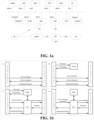
- FIG.1a schematically shows a high level architecture in the fifth generation network according to an embodiment of the present disclosure.
- the fifth generation network may be 5GS.
- the architecture of FIG.1a is same as Figure 4.2.3-1 as described in 3GPP TS 23.501 V17.0.0.
- the system architecture of FIG.1a may comprise some exemplary elements such as AUSF, AMF, DN (data network), NEF, NRF, NSSF, PCF, SMF, UDM, UPF, AF, UE (user equipment), (R)AN ((radio) access network), SCP (Service Communication Proxy), NSSAAF (Network Slice-Specific Authentication and Authorization Function), NSACF (Network Slice Admission Control Function), etc.
- the UE can establish a signaling connection with the AMF over the reference point N1, as illustrated in FIG.1a .
- This signaling connection may enable NAS (Non-access stratum) signaling exchange between the UE and the core network, comprising a signaling connection between the UE and the (R)AN and the N2 connection for this UE between the (R)AN and the AMF.
- the (R)AN can communicate with the UPF over the reference point N3.
- the UE can establish a protocol data unit (PDU) session to the DN (data network, e.g. an operator network or Internet) through the UPF over the reference point N6.
- PDU protocol data unit
- Various NFs shown in FIG.1a may be responsible for functions such as session management, mobility management, authentication, security, etc.
- the AUSF, AMF, DN, NEF, NRF, NSSF, PCF, SMF, UDM, UPF, AF, UE, (R)AN, SCP, NSACF may include the functionality for example as defined in clause 6.2 of 3GPP TS 23.501 V17.0.0.
- the NF consumer may be any suitable NF or NF instance which needs to use one or more services provided by another NF.
- the NF producer may be any suitable NF or NF instance which can provide one or more services to one or more NF consumers. If an NF can provide one or more services to any other NFs, the NF may register its NF profile in the NRF.
- FIG.1b shows communication models for NF/NF services interaction according to an embodiment of the present disclosure.
- Service communication proxy as a network element is introduced in service framework. Routing of the service based interface (SBI) messages for network function (NF) interaction mechanisms may be direct as shown in model A and model B of FIG. 1b , or indirect in model C and model D of FIG.1b . In case of indirect communication, the SCP is employed by the NF service consumer. The SCP routes messages between NF service consumers and NF service producers and may do discovery and associated selection of the NF service producer on behalf of a NF service consumer.
- SBI service based interface
- NF network function
- Model A - Direct communication without NRF interaction Neither NRF nor SCP are used. Consumers are configured with producers' "NF profiles" and directly communicate with a producer of their choice.
- Model B - Direct communication with NRF interaction Consumers do discovery by querying the NRF. Based on the discovery result, the consumer does the selection. The consumer sends the request to the selected producer.
- Model C - Indirect communication without delegated discovery Consumers do discovery by querying the NRF. Based on discovery result, the consumer does the selection of an NF Set or a specific NF instance of NF set. The consumer sends the request to the SCP containing the address of the selected service producer pointing to a NF service instance or a set of NF service instances. In the latter case, the SCP selects an NF Service instance. If possible, the SCP interacts with NRF to get selection parameters such as location, capacity, etc. The SCP routes the request to the selected NF service producer instance.
- Model D - Indirect communication with delegated discovery Consumers do not do any discovery or selection. The consumer adds any necessary discovery and selection parameters required to find a suitable producer to the service request.
- the SCP uses the request address and the discovery and selection parameters in the request message to route the request to a suitable producer instance. The SCP can perform discovery with an NRF and obtain a discovery result.
- the SCP may include one or more of the following functionalities. Some or all of the SCP functionalities may be supported in a single instance of an SCP:
- SCP can be deployed distributed, redundant, and scalable. SCPs can be deployed at PLMN (public land mobile network) level, shared-slice level and slice-specific level.
- PLMN public land mobile network
- an SCP may register its profile in the NRF.
- local configuration may be used.
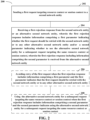
- FIG. 2 shows a flowchart of a method according to an embodiment of the present disclosure, which may be performed by an apparatus implemented in/as or communicatively coupled to a first network entity.
- the apparatus may provide means for accomplishing various parts of the method 200 as well as means for accomplishing other processes in conjunction with other components.
- the first network entity may send a first request targeting resource context or session context to a second network entity.
- the first network entity may be any suitable network function such as a network function consumer or a service communication proxy.
- the second network entity may be any suitable network function such as a network function producer.
- the second network entity is a network function producer and the first network entity is a network function consumer.
- the second network entity is a network function producer and the first network entity is a service communication proxy.
- the second network entity is a hyper text transfer protocol server.
- the first network entity is a hyper text transfer protocol client. Communication between the second network entity and the first network entity is direct communication without a service communication proxy.
- the second network entity or the alternative second network entity is a hyper text transfer protocol server
- the first network entity is a hyper text transfer protocol client
- communication between the second network entity or the alternative second network entity and the first network entity is direct communication without a service communication proxy.
- the second network entity or alternative second network entity is a hyper text transfer protocol server and the first network entity is a service communication proxy.
- the second network entity is a hyper text transfer protocol server and the first network entity is a service communication proxy.
- two or more second network entities are grouped into a network function set.
- the two or more second network entities are interchangeable and share the same resource context or session context.
- equivalent control plane NFs may be grouped into NF Sets, e.g. several SMF instances are grouped into an SMF Set.
- NFs within a NF Set are interchangeable because they share the same context data, and may be deployed in different locations, e.g. different data centers.
- the NF producer instance is the NF instance which hosts the NF Service Producer. When the NF producer instance is not available, another NF producer instance within the same NF Set is selected.
- the NF Service consumer may subscribe to status change notifications of NF instance from the NRF. If the NF Service consumer is notified by the NRF or detects by itself (e.g. request is not responded) that the NF producer instance is not available anymore, another available NF producer instance within the same NF Set is selected by the NF Service consumer.
- the SCP or NF Service consumer may subscribe to status change notifications of NF instance from the NRF and selects another NF producer instance within the same NF Set if the original NF producer instance serving the UE is not available anymore.
- the first request may be any suitable request.
- the first request may be any suitable request which can be sent from a NF consumer to a NF producer or from SCP to a NF producer as described in 3GPP TS 23.502 V17.0.0, the disclosure of which is incorporated by reference herein in its entirety.
- the first request may be an HTTP request.
- the first request may comprise an application program interface root of the second network entity.
- the first network entity may obtain the application program interface root of the second network entity in various ways. For example, the NF/NF service discovery procedure as defined in clauses 4.17.4 and 4.17.5 of 3GPP TS 23.502 V17.0.0 may be performed by the first network entity. In a successful discovery the first network entity gets the NF profile(s) matching the search criteria provided in the Nnrf_NFDiscovery_Request message.
- the NF/NF service discovery procedure as defined in clauses 4.17.4 and 4.17.5 of 3GPP TS 23.502 V17.0.0 may be performed by SCP.
- the SCP gets the NF profile(s) matching the search criteria provided in the Nnrf_NFDiscovery_Request message, selects a NF and sends information of the selected NF to the first network entity.
- the first network entity may receive a first rejection response from the second network entity or an alternative second network entity.
- the first rejection response includes information comprising a first parameter indicating whether the first request should be retried with the second network entity or to any other alternative second network entity and/or a second parameter indicating whether to use the alternative second network entity for a subsequent request targeting the same resource context or session context.
- the first rejection response including information comprising the second parameter is received from the alternative second network entity.
- the first rejection response comprises information indicating whether to avoid retry of the first request by reselection of the second network entity and/or indicating whether to use the second network entity for a subsequent request targeting the same resource context or session context.
- the rejection may be due to various reasons, for example, the first request is failed at HTTP stack schema check or failed in OpenAPI inspection, the second network entity is too busy (overload) when receiving the request message and cannot process it, the first request is failed due to application logic, e.g. some resource is not allowed to be modified at the moment, etc.
- the information may be carried by a new hyper text transfer protocol header, or 3gpp-Sbi-Target-apiRoot, or 3gpp-Sbi-Binding.
- the 3gpp-Sbi-Target-apiRoot and 3gpp-Sbi-Binding may be same as the 3gpp-Sbi-Target-apiRoot and 3gpp-Sbi-Binding as described in 3GPP TS 29.500 V17.2.0, the disclosure of which is incorporated by reference herein in its entirety.
- the information may take any suitable form such as an indicator, a bit, a flag, etc.
- the information further indicates at least one of: whether the first request is rejected due to application logic error or state confliction, or whether the resource context or session context has been taken over by the second network entity.
- the first network entity may know the rejection reason and whether the resource context or session context has been taken over by the second network entity.
- the first network entity may perform any suitable action based on such information. For example, the first network entity may amend the first request to avoid the application logic error or state confliction and resend the amended first request to the second network entity. The first network entity may resend the first request to the second network entity at a later time. Alternatively, the first network entity may notify the error information to any other suitable network function.
- the information may comprise implicit information or explicit information.
- the explicit information may be dedicated indication information.
- the implicit information may be any suitable information which can be used for such indication and any other suitable purpose.
- the implicit information may comprise application program interface root of the second network entity.
- the application program interface root (apiRoot) of the second network entity may be used to indicate the apiRoot of target uniform resource identifier (URI).
- the application program interface root of the second network entity may be 3gpp-Sbi-Target-apiRoot as described in clause 5.2.3.2.4 of 3GPP TS 29.500 V17.2.0.
- An example of 3gpp-Sbi-Target-apiRoot is: 3gpp-Sbi-Target-apiRoot: https://example.com/a/b/c.
- the first network entity may avoid retry of the first request when the first rejection response includes information comprising a first parameter and the first parameter indicates that the first request should be retried with the second network entity or to any other alternative second network entity.
- the first network entity may avoid retry of the first request by reselection of the second network entity when the first rejection response comprises information indicating avoiding retry of the first request by reselection of the second network entity and/or indicating using the second network entity for a subsequent request targeting the same resource context or session context.
- the first network entity may know that further reselection of alternative second network entity should be avoided since it may get the same result. In this embodiment, it may reduce extra signaling for the further reselection.
- the first network entity may use the alternative second network entity for a subsequent request targeting the same resource context or session context when the first rejection response includes information comprising a second parameter and the second parameter indicates using the alternative second network entity for a subsequent request targeting the same resource context or session context.
- the first network entity may use the second network entity for a subsequent request targeting the same resource context or session context when the first rejection response comprises information indicating avoiding retry of the first request by reselection of the second network entity and/or indicating using the second network entity for a subsequent request targeting the same resource context or session context.
- FIG. 3 shows a flowchart of a method according to another embodiment of the present disclosure, which may be performed by an apparatus implemented in/as or communicatively coupled to a first network entity.
- the apparatus may provide means for accomplishing various parts of the method 300 as well as means for accomplishing other processes in conjunction with other components.
- the second network entity may be a network function producer or a hyper text transfer protocol server and the first network entity may be a service communication proxy.
- the first network entity may receive a second request from a hyper text transfer protocol client (e.g., NF service consumer).
- the first network entity may send the first request targeting the resource context or session context to the second network entity in response to receiving the second request from the hyper text transfer protocol client.
- the hyper text transfer protocol client may send the second request to the first network entity such as SCP.
- the second request may include discovery and selection parameters necessary to discover and select the second network entity.
- the discovery and selection parameters are included in the second request by the hyper text transfer protocol client in a way that the first network entity such as SCP does not need to parse the request body.
- the first network entity such as SCP may perform discovery upon the second request either by interacting with an NRF using Nnrf_NFDiscovery service or may use information collected during the previous interactions with an NRF (by the Nnrf_NFDiscovery service or Nnrf_NFManagement_NFStatusNotify service operation).
- the first network entity such as SCP together with the NRF authorizes the second request.
- the first network entity such as SCP selects the second network entity.
- the second request may include the application program interface root of the second network entity.
- the NF service consumer addresses the existing context data (such as resource context or session context) via the resource address returned by the second NF.
- the first NF may know the second request may be sent/forwarded to the resource address of the second NF.
- the first network entity may send the first request targeting resource context or session context to the second network entity.
- the first network entity may receive a first rejection response from the second network entity or an alternative second network entity.
- the first rejection response comprises information indicating whether to avoid retry of the first request by reselection of the second network entity and/or indicating whether to use the second network entity for a subsequent request targeting the same resource context or session context.
- the first network entity may forward the first rejection response as a response for the second request to the hyper text transfer protocol client.
- FIG. 4 shows a flowchart of a method according to another embodiment of the present disclosure, which may be performed by an apparatus implemented in/as or communicatively coupled to a first network entity.
- the apparatus may provide means for accomplishing various parts of the method 400 as well as means for accomplishing other processes in conjunction with other components.
- the second network entity may be a network function producer and the first network entity may be a service communication proxy.
- the first network entity may receive a second request targeting the resource context or session context from a hyper text transfer protocol client.
- the second request may comprise application program interface root of another second network entity.
- the hyper text transfer protocol client such as NF service consumer
- the existing context data such as resource context/session context
- the first NF may know the second request may be sent/forwarded to the resource address of said another second NF.
- the first NF may determine that said another second network entity is not reachable and/or said another second network entity cannot handle the second request.
- the first NF may determine that said another second network entity is not reachable or cannot handle the second request in various ways. For example, the first network entity may send/forward the second request to said another second network entity and receive error response from said another second network entity or does not receive any response from said another second network entity.
- the second request may be rejected due to various reasons such as temporary failure cause, e.g., insufficient memory, which indicate the second request is not handled.
- the second request may be timeout (no response received). The first NF has already determined that said another second network is not reachable.
- the first network entity may reselect the second network entity based on the determination that said another second network entity is not reachable and/or said another network entity cannot handle the second request.
- the second network entity and said another second network entity may belong to a network function set, are interchangeable and share same context data (such as resource context or session context). For example, the details of reselection of a target NF service producer instance have been described in clause 6.3.1.0 of TS 23.501 V17.0.0.
- the first network entity may send the first request targeting the resource context or session context to the reselected second network entity.
- the first network entity may receive a first rejection response from the reselected second network entity.
- the first rejection response comprises information indicating whether to avoid retry of the first request by reselection of the second network entity and/or indicating whether to use the second network entity for a subsequent request targeting the same resource context or session context.
- the first network entity may add the application program interface root of the second network entity or of the alternative second network entity into the first rejection response.
- the first network entity may add the application program interface root of the second network entity into the first rejection response.
- block 412 may be skipped.
- two or more of the second network entities and/or the alternative second network entities are grouped into a network function set, a network function service set, or a network function service instance set, and the two or more of the second network entities and/or the alternative second network entities are interchangeable and share the same resource context or session context.
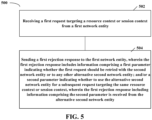
- the second network entity or the alternative second network entity may receive a first request targeting a resource context or session context from a first network entity.
- the first network entity may send the first request targeting a resource context or session context to the second network entity at block 204 of FIG.2 , and then the second network entity may receive the first request targeting a resource context or session context from the first network entity.
- the first rejection response includes information comprising a first parameter indicating whether the first request should be retried with the second network entity or to any other alternative second network entity and/or a second parameter indicating whether to use the alternative second network entity for a subsequent request targeting the same resource context or session context.
- the first rejection response including information comprising the second parameter is received from the alternative second network entity.
- the first rejection response comprises information indicating whether to avoid retry of the first request by reselection of the second network entity and/or indicating whether to use the second network entity for a subsequent request targeting the same resource context or session context.
- the first request may be rejected by the second network entity due to various reasons. For example, the second network entity cannot process the first request currently due to application logic error or state confliction.
- the second network entity may have taken over the context data (such as resource context or session context) for the first request.
- the second network entity expects to process a subsequent request from the first network entity.
- the second network entity may determine that the first network entity should not reselect another second network entity.
- the first rejection response comprises an application program interface root of the second network entity or the alternative second network entity.
- FIG. 6 shows a flowchart of a method according to another embodiment of the present disclosure, which may be performed by an apparatus implemented in/as or communicatively coupled to a third network entity.
- the apparatus may provide means for accomplishing various parts of the method 600 as well as means for accomplishing other processes in conjunction with other components. For some parts which have been described in the above embodiments, detailed description thereof is omitted here for brevity.
- the third network entity is a hyper text transfer protocol client.
- the request comprises application program interface root of the second network entity.
- the request comprises application program interface root of another second network entity.
- the third network entity may receive a rejection response from the service communication proxy.
- the rejection response comprises information indicating whether to avoid retry of the request by a reselection of a second network entity and/or whether to use the second network entity for a subsequent request.
- the rejection response may be the first rejection response as described above.
- the rejection response includes information comprising a first parameter indicating whether the request should be retried with a second network entity or to any other alternative second network entity and/or a second parameter indicating whether to use an alternative second network entity for a subsequent request targeting the same resource context or session context.
- the rejection response including information comprising the second parameter is received from the alternative second network entity.
- the rejection response comprises an application program interface root of the second network entity or of the alternative second network entity.
- the information further indicates at least one of whether the request is rejected due to application logic error or state confliction, or whether the resource context or session context has been taken over by the second network entity.
- the information comprises implicit information or explicit information.
- the implicit information comprises application program interface root of the second network entity.
- the rejection response comprises an application program interface root of the second network entity.
- the information is carried by a new hyper text transfer protocol header, or 3gpp-Sbi-Target-apiRoot, or 3gpp-Sbi-Binding.
- the third network entity may use the alternative second network entity for a subsequent request targeting the same resource context or session context when the rejection response comprises information comprising the second parameter and the second parameter indicates using the alternative second network entity for a subsequent request targeting the same resource context or session context.
- the third network entity may use the second network entity for the subsequent request when the rejection response comprises information indicating avoiding retry of the request by reselection of the second network entity and/or indicating using the second network entity for a subsequent request targeting the same resource context or session context.
- the third network entity may update the resource context or session context URI with the one included in the rejection response for any subsequent request for the same context resource context or session context.
- FIG. 7 shows a flowchart of a method according to another embodiment of the present disclosure.
- second NF1 and second NF2 are grouped into a network function set.
- Second NF1 and second NF2 are interchangeable and share same context data.
- This embodiment is related to direct communication without SCP. It is noted that though only two NFs are shown to be comprised in the network function set, the network function set may comprise any suitable number of NFs.
- the first NF may send a HTTP request to the second NF1.
- the HTTP request addresses an existing resource context or session context in the second NF1.
- the request URI contains the apiRoot related to the second NF1.
- the HTTP request is either rejected with a temporary failure cause, e.g., insufficient memory, which indicates the HTTP request is not handled by the second NF1, or the HTTP request is timeout (no response received from the second NF), or the first NF has already determined that the second NF1 is not reachable.
- a temporary failure cause e.g., insufficient memory
- the first NF may decide to make a reselection (e.g., the second NF2 in the same NF set) according to the binding information of context or the second NF1's NF profile.
- a reselection e.g., the second NF2 in the same NF set
- the details of reselection of a target NF service producer instance have been described in clause 6.3.1.0 of TS 23.501 V17.0.0.
- the first NF may send/redirect the HTTP request to the second NF2 by replacing the apiRoot of the request URI with the apiRoot of the second NF2.
- the second NF2 may send a rejection response to the first NF.
- the HTTP request is still rejected after the second NF2 applies the application logic.
- the HTTP request can not be accepted.
- the second NF2 has decided to take over the resource context or session context.
- the second NF2 includes 3gpp-Sbi-Targrt-Apiroot or a new 3GPP customer header, which may be called "3gpp-Sbi-Response-Info", with an indication to indicate the first NF that the HTTP request is rejected due to application logic error and the resource context or session context has been taken over by the second NF2, i.e., the first NF shall not continue with another reselection (as it will have the same result) and the first NF shall use apiRoot (included in the HTTP request in step 704) which is the second NF2's apiRoot, to address the resource context or session context in a subsequent request for the context.
- apiRoot included in the HTTP request in step 704
- FIG. 8 shows a flowchart of a method according to another embodiment of the present disclosure.
- second NF3 and second NF4 are grouped into a network function set.
- Second NF3 and second NF4 are interchangeable and share same context data.
- This embodiment is related to indirect communication with SCP. It is noted that though only two NFs are shown to be comprised in the network function set, the network function set may comprise any suitable number of NFs.
- the first NF may send a HTTP request to SCP.
- the HTTP request addresses an existing resource context or session context in the second NF3.
- the request URI contains the apiRoot related to the second NF3.
- SCP forwards the HTTP request to the second NF3.
- the HTTP request is either rejected with a temporary failure cause, e.g., insufficient memory, which indicates the HTTP request is not handled by the second NF3, or the HTTP request is timeout(no response received from the second NF), or SCP has already determined that the second NF3 is not reachable.
- a temporary failure cause e.g., insufficient memory
- SCP may decide to make a reselection (e.g., the second NF4 in the same NF set) according to the binding information of context or the second NF3's NF profile.
- a reselection e.g., the second NF4 in the same NF set
- the details of reselection of a target NF service producer instance have been described in clause 6.3.1.0 of TS 23.501 V17.0.0.
- SCP may send/redirect the HTTP request to the second NF4 by replacing the apiRoot of the request URI with the apiRoot of the second NF4.
- the second NF4 may send a rejection response to SCP.
- the HTTP request is still rejected after the second NF4 applies the application logic.
- the HTTP request can not be accepted.
- the second NF4 has decided to take over the resource context or session context.
- the second NF4 includes 3gpp-Sbi-Targrt-Apiroot or a new 3GPP customer header, which may be called "3gpp-Sbi-Response-Info", with an indication to indicate SCP that the HTTP request is rejected due to application logic error and the resource context or session context has been taken over by the second NF4, i.e., SCP shall not continue with another reselection (as it will have the same result) and the SCP shall use apiRoot (included in the HTTP request in step 805) which is the second NF4's apiRoot, to address the resource context or session context in a subsequent signaling for the context.
- apiRoot included in the HTTP request in step 805
- SCP may forward/send the rejection response to the first NF.
- SCP may include 3gpp-Sbi-Targrt-Apiroot or a new 3GPP customer header when the rejection response does not include such information.
- the first NF may update the resource context or session context URI with the one included in the 3gpp-Sbi-Targrt-Apiroot or a new 3GPP customer header for any subsequent signaling for the context.
- some embodiments of the present disclosure can enable a second NF to indicate a first NF (which sends a request to the second NF) how to send a subsequent request when a current request is rejected by the second NF.
- the second NF may indicate the first NF that the context data (such as resource context or session context) has been taken over by the second NF or the second network entity is used for processing a subsequent request from the first NF.
- the first NF shall update the resource URI or session URI by replacing apiRoot using the apiRoot of the second NF, even when the current request is rejected by the second NF.
- Some embodiments of the present disclosure provide a mechanism to instruct a NF which performs a NF reselection to not do the NF reselection, which may reduce extra signaling for the further NF reselection.
- the embodiments herein are not limited to the features and advantages mentioned above. A person skilled in the art will recognize additional features and advantages upon reading the following detailed description.
- FIG.9 is a block diagram showing an apparatus suitable for practicing some embodiments of the disclosure.
- any one of the first network entity, the second network entity or the third network entity described above may be implemented as or through the apparatus 900.
- the apparatus 900 comprises at least one processor 921, such as a digital processor (DP), and at least one memory (MEM) 922 coupled to the processor 921.
- the apparatus 900 may further comprise a transmitter TX and receiver RX 923 coupled to the processor 921.
- the MEM 922 stores a program (PROG) 924.
- the PROG 924 may include instructions that, when executed on the associated processor 921, enable the apparatus 900 to operate in accordance with the embodiments of the present disclosure.
- a combination of the at least one processor 921 and the at least one MEM 922 may form processing means 925 adapted to implement various embodiments of the present disclosure.
- Various embodiments of the present disclosure may be implemented by computer program executable by one or more of the processor 921, software, firmware, hardware or in a combination thereof.
- the MEM 922 may be of any type suitable to the local technical environment and may be implemented using any suitable data storage technology, such as semiconductor based memory devices, magnetic memory devices and systems, optical memory devices and systems, fixed memories and removable memories, as non-limiting examples.
- the processor 921 may be of any type suitable to the local technical environment, and may include one or more of general purpose computers, special purpose computers, microprocessors, digital signal processors (DSPs) and processors based on multicore processor architecture, as non-limiting examples.
- general purpose computers special purpose computers
- microprocessors microprocessors
- DSPs digital signal processors
- processors based on multicore processor architecture, as non-limiting examples.
- the memory 922 contains instructions executable by the processor 921, whereby the first network entity operates according to any of the methods related to the first network entity as described above.
- the memory 922 contains instructions executable by the processor 921, whereby the second network entity operates according to any of the methods related to the second network entity as described above.
- the memory 922 contains instructions executable by the processor 921, whereby the third network entity operates according to any of the methods related to the third network entity as described above.
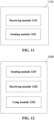
- FIG.10 is a block diagram showing a first network entity according to an embodiment of the disclosure.
- the first network entity 1000 comprises a sending module 1001 configured to send a first request targeting resource context or session context to a second network entity.
- the first network entity 1000 further comprises a first receiving module 1002 configured to receive a first rejection response from the second network entity or an alternative second network entity.
- the first rejection response includes information comprising a first parameter indicating whether the first request should be retried with the second network entity or to any other alternative second network entity and/or a second parameter indicating whether to use the alternative second network entity for a subsequent request targeting the same resource context or session context.
- the first rejection response including information comprising the second parameter is received from the alternative second network entity.
- the first rejection response comprises information indicating whether to avoid retry of the first request by reselection of the second network entity and/or indicating whether to use the second network entity for a subsequent request targeting the same resource context or session context.
- the first network entity 1000 further comprises an avoiding module 1003 configured to avoid retry of the first request when the first rejection response includes information comprising a first parameter and the first parameter indicates that the first request should be retried with the second network entity or to any other alternative second network entity.
- the avoiding module 1003 is configured to avoid retry of the first request by reselection of the second network entity, when the first rejection response comprises information indicating avoiding retry of the first request by reselection of the second network entity and/or indicating using the second network entity for a subsequent request targeting the same resource context or session context.
- the first network entity 1000 further comprises a using module 1004 configured to the alternative second network entity for a subsequent request targeting the same resource context or session context when the first rejection response includes information comprising a second parameter and the second parameter indicates using the alternative second network entity for a subsequent request targeting the same resource context or session context
- the using module 1004 is configured to use the second network entity for a subsequent request targeting the same resource context or session context when the first rejection response comprises information indicating avoiding retry of the first request by reselection of the second network entity and/or indicating using the second network entity for a subsequent request targeting the same resource context or session context.
- the first network entity 1000 further comprises a second receiving module 1005 configured to receive a second request from a hyper text transfer protocol client.
- the sending module 1001 is configured to send the first request targeting the resource context or session context to the second network entity is in response to receiving the second request from the hyper text transfer protocol client.
- the first network entity 1000 further comprises a forwarding module 1006 configured to forward the first rejection response as a response for the second request to the hyper text transfer protocol client in response to receiving the first rejection response from the second network entity.
- the first network entity 1000 further comprises a determining module 1007 configured to determine that said another second network entity is not reachable and/or said another second network entity cannot handle the second request.
- the first network entity 1000 further comprises a reselecting module 1008 configured to reselect the second network entity based on the determination that said another second network entity is not reachable and/or said another network entity cannot handle the second request.
- the first network entity 1000 further comprises an adding module 1009 configured to add the application program interface root of the second network entity or of the alternative second netw when the first rejection response includes information comprising the second parameter and the second parameter indicates using the second network entity or an alternative second network entity for a subsequent request targeting the same resource context or session contextork entity into the first rejection response.
- an adding module 1009 configured to add the application program interface root of the second network entity or of the alternative second netw when the first rejection response includes information comprising the second parameter and the second parameter indicates using the second network entity or an alternative second network entity for a subsequent request targeting the same resource context or session contextork entity into the first rejection response.
- the adding module 1009 is configured to add the application program interface root of the second network entity into the first rejection response when the first rejection response comprises information indicating avoiding retry of the first request by reselection of the second network entity and/or indicating using the second network entity for a subsequent request targeting the same resource context or session context.
- the adding module 1009 is configured to add the application program interface root of another second network entity into the first rejection response when the first rejection response comprises information indicating retrying of the first request by reselection of the second network entity and/or indicating disabling the second network entity for a subsequent request targeting the same resource context or session context.
- FIG.11 is a block diagram showing a second network entity or an alternative second network entity according to an embodiment of the disclosure.
- the second network entity or an alternative second network entity 1100 comprises a receiving module 1101 configured to receive a first request targeting a resource context or session context from a first network entity.
- the second network entity or an alternative second network entity 1100 further comprises a sending module 1102 configured to send a first rejection response to the first network entity.
- the first rejection response includes information comprising a first parameter indicating whether the first request should be retried with the second network entity or to any other alternative second network entity and/or a second parameter indicating whether to use the alternative second network entity for a subsequent request targeting the same resource context or session context.
- the first rejection response including information comprising the second parameter is received from the alternative second network entity.
- the first rejection response comprises information indicating whether to avoid retry of the first request by reselection of the second network entity and/or indicating whether to use the second network entity for a subsequent request targeting the same resource context or session context.
- FIG.12 is a block diagram showing a third network entity according to an embodiment of the disclosure.
- the third network entity 1200 comprises a sending module 1201 configured to send a request targeting resource context or session context to a service communication proxy.
- the third network entity 1200 further comprises a receiving module 1202 configured to receive a rejection response from the service communication proxy.
- the rejection response includes information comprising a first parameter indicating whether the request should be retried with a second network entity or to any other alternative second network entity and/or a second parameter indicating whether to use an alternative second network entity for a subsequent request targeting the same resource context or session context.
- the rejection response including information comprising the second parameter is received from the alternative second network entity.
- the rejection response comprises information indicating whether to avoid retry of the request by a reselection of a second network entity and/or whether to use the second network entity for a subsequent request.
- the third network entity 1200 further comprises a using module 1203 configured to use the alternative second network entity for a subsequent request targeting the same resource context or session context when the rejection response comprises information comprising the second parameter and the second parameter indicates using the alternative second network entity for a subsequent request targeting the same resource context or session context.
- unit or module may have conventional meaning in the field of electronics, electrical devices and/or electronic devices and may include, for example, electrical and/or electronic circuitry, devices, modules, processors, memories, logic solid state and/or discrete devices, computer programs or instructions for carrying out respective tasks, procedures, computations, outputs, and/or displaying functions, and so on, as such as those that are described herein.
- the first network entity, the second network entity or the third network entity may not need a fixed processor or memory, any computing resource and storage resource may be arranged from the first network entity, the second network entity or the third network entity in the communication system.
- the introduction of virtualization technology and network computing technology may improve the usage efficiency of the network resources and the flexibility of the network.
- a computer program product being tangibly stored on a computer readable storage medium and including instructions which, when executed on at least one processor, cause the at least one processor to carry out any of the methods as described above.
- a computer-readable storage medium storing instructions which when executed by at least one processor, cause the at least one processor to carry out any of the methods as described above.
- the present disclosure may also provide a carrier containing the computer program as mentioned above, wherein the carrier is one of an electronic signal, optical signal, radio signal, or computer readable storage medium.
- the computer readable storage medium can be, for example, an optical compact disk or an electronic memory device like a RAM (random access memory), a ROM (read only memory), Flash memory, magnetic tape, CD-ROM, DVD, Blue-ray disc and the like.
- an apparatus implementing one or more functions of a corresponding apparatus described with an embodiment comprises not only prior art means, but also means for implementing the one or more functions of the corresponding apparatus described with the embodiment and it may comprise separate means for each separate function, or means that may be configured to perform two or more functions.
- these techniques may be implemented in hardware (one or more apparatuses), firmware (one or more apparatuses), software (one or more modules), or combinations thereof.
- firmware or software implementation may be made through modules (e.g., procedures, functions, and so on) that perform the functions described herein.
Landscapes
- Engineering & Computer Science (AREA)
- Computer Networks & Wireless Communication (AREA)
- Signal Processing (AREA)
- Computer Security & Cryptography (AREA)
- Mobile Radio Communication Systems (AREA)
- Computer And Data Communications (AREA)
Claims (19)
- Verfahren (200), das von einer ersten Netzwerkentität durchgeführt wird und Folgendes umfasst:Senden (202) einer ersten Anforderung, die auf einen Ressourcenkontext oder Sitzungskontext abzielt, an eine zweite Netzwerkentität; undEmpfangen (204) einer ersten Ablehnungsantwort von der zweiten Netzwerkentität oder einer alternativen zweiten Netzwerkentität,wobei die erste Ablehnungsantwort Informationen aufweist, die Folgendes umfassen:einen ersten Parameter, der angibt, ob die erste Anforderung mit einer von der zweiten Netzwerkentität oder einer anderen alternativen zweiten Netzwerkentität wiederholt werden sollte oder nicht; und/odereinen zweiten Parameter, der angibt, ob die alternative zweite Netzwerkentität für eine nachfolgende Anforderung, die auf denselben Ressourcenkontext oder Sitzungskontext abzielt, verwendet werden soll, wobei die erste Ablehnungsantwort, die Informationen aufweist, die den zweiten Parameter umfassen, von der alternativen zweiten Netzwerkentität empfangen wird.
- Verfahren nach Anspruch 1, wobei zwei oder mehr der zweiten Netzwerkentitäten und/oder der alternativen zweiten Netzwerkentitäten in einen Netzwerkfunktionssatz, einen Netzwerkfunktionsdienstsatz oder einen Netzwerkfunktionsdienstinstanzensatz eingeteilt werden und die zwei oder mehr der zweiten Netzwerkentitäten und/oder der alternativen zweiten Netzwerkentitäten austauschbar sind und denselben Ressourcenkontext oder Sitzungskontext gemeinsam nutzen.
- Verfahren nach Anspruch 1 oder 2, wobei die Informationen ferner mindestens eines von Folgendem umfassen:ob die erste Anforderung aufgrund eines Anwendungslogikfehlers oder eines Zustandskonflikts abgelehnt wurde oderob der Ressourcenkontext oder Sitzungskontext von der alternativen zweiten Netzwerkentität übernommen wurde.
- Verfahren nach einem der Ansprüche 1 bis 3, ferner umfassend:
Vermeiden (206) einer Wiederholung der ersten Anforderung, wenn die erste Ablehnungsantwort Informationen aufweist, die einen ersten Parameter umfassen, und der erste Parameter angibt, dass die erste Anforderung weder mit der zweiten Netzwerkentität noch an eine andere alternativen zweiten Netzwerkentität wiederholt werden sollte. - Verfahren nach einem der Ansprüche 1 bis 4, ferner umfassend:
Verwenden (208) der alternativen zweiten Netzwerkentität für eine nachfolgende Anforderung, die auf denselben Ressourcenkontext oder Sitzungskontext abzielt, wenn die erste Ablehnungsantwort Informationen aufweist, die einen zweiten Parameter umfassen, und der zweite Parameter ein Verwenden der alternativen zweiten Netzwerkentität für eine nachfolgende Anforderung angibt, die auf denselben Ressourcenkontext oder Sitzungskontext abzielt. - Verfahren nach einem der Ansprüche 1 bis 5, wobei die zweite Netzwerkentität oder die alternative zweite Netzwerkentität ein Hypertext-Transfer-Protokoll-Server ist und die erste Netzwerkentität ein Dienstkommunikationsproxy ist; wobei das Verfahren ferner Folgendes umfasst:Empfangen (302) einer zweiten Anforderung, die auf den Ressourcenkontext oder Sitzungskontext abzielt, von einem Hypertext-Transfer-Protokoll-Client, wobei das Senden der ersten Anforderung, die auf den Ressourcenkontext oder Sitzungskontext abzielt, an die zweite Netzwerkentität in Reaktion auf das Empfangen der zweiten Anforderung von dem Hypertext-Transfer-Protokoll-Client erfolgt;in Reaktion auf das Empfangen der ersten Ablehnungsantwort von der zweiten Netzwerkentität Weiterleiten (308) der ersten Ablehnungsantwort als eine Antwort auf die zweite Anforderung an den Hypertext-Transfer-Protokoll-Client.
- Verfahren nach Anspruch 6, wobei die zweite Anforderung die Anwendungsprogrammschnittstellenwurzel der zweiten Netzwerkentität umfasst; oder
wobei die zweite Anforderung eine Anwendungsprogrammschnittstellenwurzel einer anderen zweiten Netzwerkentität umfasst, wobei das Verfahren ferner Folgendes umfasst: Bestimmen (404), dass die andere zweite Netzwerkentität nicht erreichbar ist und/oder die andere zweite Netzwerkentität die zweite Anforderung nicht handhaben kann; Neuauswählen (406) der zweiten Netzwerkentität basierend auf der Bestimmung, dass die andere zweite Netzwerkentität nicht erreichbar ist und/oder die andere zweite Netzwerkentität die zweite Anforderung nicht handhaben kann; wenn die erste Ablehnungsantwort Informationen aufweist, die den zweiten Parameter umfassen, und der zweite Parameter ein Verwenden der zweiten Netzwerkentität oder einer alternativen zweiten Netzwerkentität für eine nachfolgende Anforderung, die auf denselben Ressourcenkontext oder Sitzungskontext abzielt, angibt, Hinzufügen (412) der Anwendungsprogrammschnittstellenwurzel der zweiten Netzwerkentität oder der alternativen zweiten Netzwerkentität zu der ersten Ablehnungsantwort. - Verfahren (500), das von einer zweiten Netzwerkentität oder einer alternativen zweiten Netzwerkentität durchgeführt wird und Folgendes umfasst:Empfangen (502) einer ersten Anforderung, die auf einen Ressourcenkontext oder Sitzungskontext abzielt, von einer ersten Netzwerkentität; undSenden (504) einer ersten Ablehnungsantwort an die erste Netzwerkentität, wobei die erste Ablehnungsantwort Informationen aufweist, die Folgendes umfassen:einen ersten Parameter, der angibt, ob die erste Anforderung mit einer von der zweiten Netzwerkentität oder einer anderen alternativen zweiten Netzwerkentität wiederholt werden sollte oder nicht; und/odereinen zweiten Parameter, der angibt, ob die alternative zweite Netzwerkentität für eine nachfolgende Anforderung, die auf denselben Ressourcenkontext und Sitzungskontext abzielt, verwendet werden soll, wobei die erste Ablehnungsantwort, die Informationen aufweist, die den zweiten Parameter umfassen, von der alternativen zweiten Netzwerkentität empfangen wird.
- Verfahren nach Anspruch 8, wobei zwei oder mehr der zweiten Netzwerkentitäten und/oder der alternativen zweiten Netzwerkentitäten in einen Netzwerkfunktionssatz, einen Netzwerkfunktionsdienstsatz oder einen Netzwerkfunktionsdienstinstanzensatz eingeteilt werden und die zwei oder mehr der zweiten Netzwerkentitäten und/oder der alternativen zweiten Netzwerkentitäten austauschbar sind und denselben Ressourcenkontext oder Sitzungskontext gemeinsam nutzen.
- Verfahren nach Anspruch 8 oder 9, wobei die Informationen ferner mindestens eines von Folgendem umfassen:ob die erste Anforderung aufgrund eines Anwendungslogikfehlers oder eines Zustandskonflikts abgelehnt wurde oderob der Ressourcenkontext oder Sitzungskontext von der alternativen zweiten Netzwerkentität übernommen wurde.
- Verfahren nach einem der Ansprüche 8 bis 10, wobei die Informationen implizite Informationen oder explizite Informationen umfassen; und
die impliziten Informationen eine Anwendungsprogrammschnittstellenwurzel der zweiten Netzwerkentität umfassen. - Verfahren nach einem der Ansprüche 8 bis 11, wobei die erste Anforderung eine Anwendungsprogrammschnittstellenwurzel der zweiten Netzwerkentität umfasst; und/oder
wobei die erste Ablehnungsantwort eine Anwendungsprogrammschnittstellenwurzel der zweiten Netzwerkentität oder der alternativen zweiten Netzwerkentität umfasst. - Verfahren (600), das von einer dritten Netzwerkentität durchgeführt wird und Folgendes umfasst:Senden (602) einer Anforderung, die auf einen Ressourcenkontext oder Sitzungskontext abzielt, an einen Dienstkommunikationsproxy; undEmpfangen (604) einer Ablehnungsantwort von dem Dienstkommunikationsproxy, wobei die Ablehnungsantwort Informationen aufweist, die Folgendes umfassen:einen ersten Parameter, der angibt, ob die Anforderung mit einer von einer zweiten Netzwerkentität oder einer anderen alternativen zweiten Netzwerkentität wiederholt werden sollte oder nicht; und/odereinen zweiten Parameter, der angibt, ob eine alternative zweite Netzwerkentität für eine nachfolgende Anforderung, die auf denselben Ressourcenkontext und Sitzungskontext abzielt, verwendet werden soll, wobei die Ablehnungsantwort, die Informationen aufweist, die den zweiten Parameter umfassen, von der alternativen zweiten Netzwerkentität empfangen wird; undVerwenden (606) der alternativen zweiten Netzwerkentität für eine nachfolgende Anforderung, die auf denselben Ressourcenkontext oder Sitzungskontext abzielt, wenn die Ablehnungsantwort Informationen umfasst, die den zweiten Parameter umfassen, und der zweite Parameter ein Verwenden der alternativen zweiten Netzwerkentität für eine nachfolgende Anforderung angibt, die auf denselben Ressourcenkontext oder Sitzungskontext abzielt.
- Erste Netzwerkentität (900), umfassend:einen Prozessor (921); undeinen Speicher (922), der mit dem Prozessor (921) gekoppelt ist, wobei der Speicher (922) Anweisungen enthält, die von dem Prozessor (921) ausgeführt werden können, wodurch die erste Netzwerkentität (900) zu Folgendem ausgelegt ist:Senden einer ersten Anforderung, die auf einen Ressourcenkontext oder Sitzungskontext abzielt, an eine zweite Netzwerkentität; undEmpfangen einer ersten Ablehnungsantwort von der zweiten Netzwerkentität oder einer alternativen zweiten Netzwerkentität,wobei die erste Ablehnungsantwort Informationen aufweist, die Folgendes umfassen:einen ersten Parameter, der angibt, ob die erste Anforderung mit einer von der zweiten Netzwerkentität oder einer anderen alternativen zweiten Netzwerkentität wiederholt werden sollte oder nicht; und/odereinen zweiten Parameter, der angibt, ob die alternative zweite Netzwerkentität für eine nachfolgende Anforderung, die auf denselben Ressourcenkontext und Sitzungskontext abzielt, verwendet werden soll, wobei die erste Ablehnungsantwort, die Informationen aufweist, die den zweiten Parameter umfassen, von der alternativen zweiten Netzwerkentität empfangen wird.
- Erste Netzwerkentität nach Anspruch 14, wobei die erste Netzwerkentität ferner zum Durchführen des Verfahrens nach einem der Ansprüche 2 bis 7 ausgelegt ist.
- Zweite Netzwerkentität oder alternative zweite Netzwerkentität (900), umfassend:einen Prozessor (921); undeinen Speicher (922), der mit dem Prozessor (921) gekoppelt ist, wobei der Speicher (922) Anweisungen enthält, die von dem Prozessor (921) ausgeführt werden können, wodurch die zweite Netzwerkentität oder eine alternative zweite Netzwerkentität (900) zu Folgendem ausgelegt ist:Empfangen einer ersten Anforderung, die auf einen Ressourcenkontext oder Sitzungskontext abzielt, von einer ersten Netzwerkentität; undSenden einer ersten Ablehnungsantwort an die erste Netzwerkentität,wobei die erste Ablehnungsantwort Informationen aufweist, die Folgendes umfassen:einen ersten Parameter, der angibt, ob die erste Anforderung mit einer von der zweiten Netzwerkentität oder einer anderen alternativen zweiten Netzwerkentität wiederholt werden sollte oder nicht; und/odereinen zweiten Parameter, der angibt, ob die alternative zweite Netzwerkentität für eine nachfolgende Anforderung, die auf denselben Ressourcenkontext und Sitzungskontext abzielt, verwendet werden soll, wobei die Ablehnungsantwort, die Informationen aufweist, die den zweiten Parameter umfassen, von der alternativen zweiten Netzwerkentität empfangen wird.
- Zweite Netzwerkentität oder alternative zweite Netzwerkentität nach Anspruch 16, wobei die zweite Netzwerkentität oder eine alternative zweite Netzwerkentität ferner zum Durchführen des Verfahrens nach einem der Ansprüche 9 bis 12 ausgelegt ist.
- Dritte Netzwerkentität (900), umfassend:einen Prozessor (921); undeinen Speicher (922), der mit dem Prozessor (921) gekoppelt ist, wobei der Speicher (922) Anweisungen enthält, die von dem Prozessor (921) ausgeführt werden können, wodurch die dritte Netzwerkentität (900) zu Folgendem ausgelegt ist:Senden einer Anforderung, die auf einen Ressourcenkontext oder Sitzungskontext abzielt, an einen Dienstkommunikationsproxy; undEmpfangen einer Ablehnungsantwort von dem Dienstkommunikationsproxy, wobei die Ablehnungsantwort Informationen aufweist, die Folgendes umfassen:einen ersten Parameter, der angibt, ob die Anforderung mit einer von einer zweiten Netzwerkentität oder einer anderen alternativen zweiten Netzwerkentität wiederholt werden sollte oder nicht; und/odereinen zweiten Parameter, der angibt, ob eine alternative zweite Netzwerkentität für eine nachfolgende Anforderung, die auf denselben Ressourcenkontext und Sitzungskontext abzielt, verwendet werden soll, wobei die erste Ablehnungsantwort, die Informationen aufweist, die den zweiten Parameter umfassen, von der alternativen zweiten Netzwerkentität empfangen wird; undVerwenden der alternativen zweiten Netzwerkentität für eine nachfolgende Anforderung, die auf denselben Ressourcenkontext oder Sitzungskontext abzielt, wenn die Ablehnungsantwort Informationen umfasst, die den zweiten Parameter umfassen, und der zweite Parameter ein Verwenden der alternativen zweiten Netzwerkentität für eine nachfolgende Anforderung angibt, die auf denselben Ressourcenkontext oder Sitzungskontext abzielt.
- Computerlesbares Speichermedium, das Anweisungen speichert, die bei Ausführung durch mindestens einen Prozessor den mindestens einen Prozessor zum Durchführen des Verfahrens nach einem der Ansprüche 1 bis 13 veranlassen.
Priority Applications (1)
| Application Number | Priority Date | Filing Date | Title |
|---|---|---|---|
| EP25154279.1A EP4535763A3 (de) | 2021-07-02 | 2022-06-22 | Verfahren und vorrichtung zur diensthandhabung |
Applications Claiming Priority (2)
| Application Number | Priority Date | Filing Date | Title |
|---|---|---|---|
| CN2021104259 | 2021-07-02 | ||
| PCT/CN2022/100451 WO2023273986A1 (en) | 2021-07-02 | 2022-06-22 | Method and apparatus for service handling |
Related Child Applications (2)
| Application Number | Title | Priority Date | Filing Date |
|---|---|---|---|
| EP25154279.1A Division EP4535763A3 (de) | 2021-07-02 | 2022-06-22 | Verfahren und vorrichtung zur diensthandhabung |
| EP25154279.1A Division-Into EP4535763A3 (de) | 2021-07-02 | 2022-06-22 | Verfahren und vorrichtung zur diensthandhabung |
Publications (3)
| Publication Number | Publication Date |
|---|---|
| EP4278592A1 EP4278592A1 (de) | 2023-11-22 |
| EP4278592C0 EP4278592C0 (de) | 2025-03-12 |
| EP4278592B1 true EP4278592B1 (de) | 2025-03-12 |
Family
ID=82781034
Family Applications (2)
| Application Number | Title | Priority Date | Filing Date |
|---|---|---|---|
| EP22750657.3A Active EP4278592B1 (de) | 2021-07-02 | 2022-06-22 | Verfahren und vorrichtung zur diensthandhabung |
| EP25154279.1A Pending EP4535763A3 (de) | 2021-07-02 | 2022-06-22 | Verfahren und vorrichtung zur diensthandhabung |
Family Applications After (1)
| Application Number | Title | Priority Date | Filing Date |
|---|---|---|---|
| EP25154279.1A Pending EP4535763A3 (de) | 2021-07-02 | 2022-06-22 | Verfahren und vorrichtung zur diensthandhabung |
Country Status (5)
| Country | Link |
|---|---|
| US (1) | US20240073786A1 (de) |
| EP (2) | EP4278592B1 (de) |
| JP (1) | JP7611413B2 (de) |
| CN (1) | CN117616739A (de) |
| WO (1) | WO2023273986A1 (de) |
Families Citing this family (4)
| Publication number | Priority date | Publication date | Assignee | Title |
|---|---|---|---|---|
| US12526224B2 (en) * | 2023-10-10 | 2026-01-13 | Oracle International Corporation | Methods, systems, and computer readable media for selecting network function (NF) profiles of NF set mates to enable alternate routing |
| US20250337819A1 (en) * | 2024-04-25 | 2025-10-30 | T-Mobile Usa, Inc. | Failure retry order in response to a network function discovery request |
| US12542708B2 (en) * | 2024-05-09 | 2026-02-03 | Verizon Patent And Licensing Inc. | Systems and methods for priority-aware network function restoration in a wireless network |
| CN118804220A (zh) * | 2024-05-17 | 2024-10-18 | 中国移动通信有限公司研究院 | 网元发现与服务请求方法、装置、设备、存储介质与产品 |
Family Cites Families (4)
| Publication number | Priority date | Publication date | Assignee | Title |
|---|---|---|---|---|
| WO2021047551A1 (en) * | 2019-09-12 | 2021-03-18 | Telefonaktiebolaget Lm Ericsson (Publ) | Method and apparatus for flow control |
| WO2021083926A1 (en) * | 2019-10-31 | 2021-05-06 | Telefonaktiebolaget Lm Ericsson (Publ) | Methods and apparatuses for network function discovery with preferred api version |
| EP3886401B1 (de) * | 2020-03-27 | 2024-07-24 | Nokia Technologies Oy | Verfahren, vorrichtung und computerprogrammprodukt zur fehlerbehandlung für indirekte kommunikation |
| US11924294B2 (en) * | 2020-07-31 | 2024-03-05 | Telefonaktiebolaget Lm Ericsson (Publ) | Service request handling |
-
2022
- 2022-06-22 EP EP22750657.3A patent/EP4278592B1/de active Active
- 2022-06-22 WO PCT/CN2022/100451 patent/WO2023273986A1/en not_active Ceased
- 2022-06-22 US US18/547,614 patent/US20240073786A1/en active Pending
- 2022-06-22 JP JP2023550688A patent/JP7611413B2/ja active Active
- 2022-06-22 CN CN202280046895.5A patent/CN117616739A/zh active Pending
- 2022-06-22 EP EP25154279.1A patent/EP4535763A3/de active Pending
Also Published As
| Publication number | Publication date |
|---|---|
| JP2024509774A (ja) | 2024-03-05 |
| WO2023273986A1 (en) | 2023-01-05 |
| CN117616739A (zh) | 2024-02-27 |
| EP4278592A1 (de) | 2023-11-22 |
| EP4278592C0 (de) | 2025-03-12 |
| EP4535763A3 (de) | 2025-06-25 |
| EP4535763A2 (de) | 2025-04-09 |
| US20240073786A1 (en) | 2024-02-29 |
| JP7611413B2 (ja) | 2025-01-09 |
Similar Documents
| Publication | Publication Date | Title |
|---|---|---|
| EP4278592B1 (de) | Verfahren und vorrichtung zur diensthandhabung | |
| EP3923671B1 (de) | Sitzungsaufbauverfahren und -vorrichtung | |
| US20200336554A1 (en) | Proxy routing based on path headers | |
| CN115299168B (zh) | 用于切换的方法和装置 | |
| US12035411B2 (en) | Methods, network function nodes and computer readable media for event subscription management | |
| WO2023078336A1 (en) | Method and apparatus for event reporting | |
| JP2023535893A (ja) | サービス要求処理 | |
| US20250220753A1 (en) | Handling a Protocol Data Unit Session | |
| CN119404530A (zh) | 非直接订阅场景中的特征发现 | |
| EP4470271B1 (de) | Unterstützung für simultane edge-anwendungsserver (eas)-konnektivität in einer anwendungskontextumpositionierung (acr) | |
| US20250063073A1 (en) | Method and apparatus for p-cscf restoration and p-cscf information registration | |
| WO2023016400A1 (en) | Method and apparatus for session restoration | |
| WO2023117367A1 (en) | Method and apparatus for selection or reselection of entity for indirect communication in communication network | |
| WO2023036241A1 (en) | Method and apparatus for traffic probing | |
| EP4490900B1 (de) | Delegierte ermittlung und auswahl von netzfunktionen | |
| WO2023185800A1 (en) | Method and apparatus for processing smf set mismatch | |
| JP7852071B2 (ja) | Smfセットのミスマッチに対処する方法および装置 | |
| US20250380163A1 (en) | Service continuity during network repository function (nrf) outage in a 5th generation network | |
| WO2024083103A1 (en) | Method and apparatus for authentication | |
| US20250380209A1 (en) | Service continuity during network repository function (nrf) outage in model d communication in a 5th generation network | |
| US20250024235A1 (en) | Communication method, apparatus, and device | |
| WO2025242373A1 (en) | Selection of networks for service by user equipment | |
| WO2025016968A1 (en) | Enhancement on the smf selection based on subscription |
Legal Events
| Date | Code | Title | Description |
|---|---|---|---|
| STAA | Information on the status of an ep patent application or granted ep patent |
Free format text: STATUS: UNKNOWN |
|
| STAA | Information on the status of an ep patent application or granted ep patent |
Free format text: STATUS: THE INTERNATIONAL PUBLICATION HAS BEEN MADE |
|
| PUAI | Public reference made under article 153(3) epc to a published international application that has entered the european phase |
Free format text: ORIGINAL CODE: 0009012 |
|
| STAA | Information on the status of an ep patent application or granted ep patent |
Free format text: STATUS: REQUEST FOR EXAMINATION WAS MADE |
|
| 17P | Request for examination filed |
Effective date: 20230814 |
|
| AK | Designated contracting states |
Kind code of ref document: A1 Designated state(s): AL AT BE BG CH CY CZ DE DK EE ES FI FR GB GR HR HU IE IS IT LI LT LU LV MC MK MT NL NO PL PT RO RS SE SI SK SM TR |
|
| GRAP | Despatch of communication of intention to grant a patent |
Free format text: ORIGINAL CODE: EPIDOSNIGR1 |
|
| STAA | Information on the status of an ep patent application or granted ep patent |
Free format text: STATUS: GRANT OF PATENT IS INTENDED |
|
| DAV | Request for validation of the european patent (deleted) | ||
| DAX | Request for extension of the european patent (deleted) | ||
| INTG | Intention to grant announced |
Effective date: 20240625 |
|
| GRAJ | Information related to disapproval of communication of intention to grant by the applicant or resumption of examination proceedings by the epo deleted |
Free format text: ORIGINAL CODE: EPIDOSDIGR1 |
|
| STAA | Information on the status of an ep patent application or granted ep patent |
Free format text: STATUS: REQUEST FOR EXAMINATION WAS MADE |
|
| GRAP | Despatch of communication of intention to grant a patent |
Free format text: ORIGINAL CODE: EPIDOSNIGR1 |
|
| STAA | Information on the status of an ep patent application or granted ep patent |
Free format text: STATUS: GRANT OF PATENT IS INTENDED |
|
| INTC | Intention to grant announced (deleted) | ||
| INTG | Intention to grant announced |
Effective date: 20241010 |
|
| GRAS | Grant fee paid |
Free format text: ORIGINAL CODE: EPIDOSNIGR3 |
|
| GRAA | (expected) grant |
Free format text: ORIGINAL CODE: 0009210 |
|
| STAA | Information on the status of an ep patent application or granted ep patent |
Free format text: STATUS: THE PATENT HAS BEEN GRANTED |
|
| AK | Designated contracting states |
Kind code of ref document: B1 Designated state(s): AL AT BE BG CH CY CZ DE DK EE ES FI FR GB GR HR HU IE IS IT LI LT LU LV MC MK MT NL NO PL PT RO RS SE SI SK SM TR |
|
| REG | Reference to a national code |
Ref country code: GB Ref legal event code: FG4D |
|
| REG | Reference to a national code |
Ref country code: CH Ref legal event code: EP |
|
| REG | Reference to a national code |
Ref country code: DE Ref legal event code: R096 Ref document number: 602022011779 Country of ref document: DE |
|
| REG | Reference to a national code |
Ref country code: IE Ref legal event code: FG4D |
|
| U01 | Request for unitary effect filed |
Effective date: 20250314 |
|
| U07 | Unitary effect registered |
Designated state(s): AT BE BG DE DK EE FI FR IT LT LU LV MT NL PT RO SE SI Effective date: 20250321 |
|
| PG25 | Lapsed in a contracting state [announced via postgrant information from national office to epo] |
Ref country code: RS Free format text: LAPSE BECAUSE OF FAILURE TO SUBMIT A TRANSLATION OF THE DESCRIPTION OR TO PAY THE FEE WITHIN THE PRESCRIBED TIME-LIMIT Effective date: 20250612 |
|
| PG25 | Lapsed in a contracting state [announced via postgrant information from national office to epo] |
Ref country code: ES Free format text: LAPSE BECAUSE OF FAILURE TO SUBMIT A TRANSLATION OF THE DESCRIPTION OR TO PAY THE FEE WITHIN THE PRESCRIBED TIME-LIMIT Effective date: 20250312 |
|
| PG25 | Lapsed in a contracting state [announced via postgrant information from national office to epo] |
Ref country code: NO Free format text: LAPSE BECAUSE OF FAILURE TO SUBMIT A TRANSLATION OF THE DESCRIPTION OR TO PAY THE FEE WITHIN THE PRESCRIBED TIME-LIMIT Effective date: 20250612 |
|
| PG25 | Lapsed in a contracting state [announced via postgrant information from national office to epo] |
Ref country code: HR Free format text: LAPSE BECAUSE OF FAILURE TO SUBMIT A TRANSLATION OF THE DESCRIPTION OR TO PAY THE FEE WITHIN THE PRESCRIBED TIME-LIMIT Effective date: 20250312 |
|
| PG25 | Lapsed in a contracting state [announced via postgrant information from national office to epo] |
Ref country code: GR Free format text: LAPSE BECAUSE OF FAILURE TO SUBMIT A TRANSLATION OF THE DESCRIPTION OR TO PAY THE FEE WITHIN THE PRESCRIBED TIME-LIMIT Effective date: 20250613 |
|
| U20 | Renewal fee for the european patent with unitary effect paid |
Year of fee payment: 4 Effective date: 20250628 |
|
| PG25 | Lapsed in a contracting state [announced via postgrant information from national office to epo] |
Ref country code: SM Free format text: LAPSE BECAUSE OF FAILURE TO SUBMIT A TRANSLATION OF THE DESCRIPTION OR TO PAY THE FEE WITHIN THE PRESCRIBED TIME-LIMIT Effective date: 20250312 |
|
| PG25 | Lapsed in a contracting state [announced via postgrant information from national office to epo] |
Ref country code: PL Free format text: LAPSE BECAUSE OF FAILURE TO SUBMIT A TRANSLATION OF THE DESCRIPTION OR TO PAY THE FEE WITHIN THE PRESCRIBED TIME-LIMIT Effective date: 20250312 |
|
| PG25 | Lapsed in a contracting state [announced via postgrant information from national office to epo] |
Ref country code: CZ Free format text: LAPSE BECAUSE OF FAILURE TO SUBMIT A TRANSLATION OF THE DESCRIPTION OR TO PAY THE FEE WITHIN THE PRESCRIBED TIME-LIMIT Effective date: 20250312 |
|
| PG25 | Lapsed in a contracting state [announced via postgrant information from national office to epo] |
Ref country code: SK Free format text: LAPSE BECAUSE OF FAILURE TO SUBMIT A TRANSLATION OF THE DESCRIPTION OR TO PAY THE FEE WITHIN THE PRESCRIBED TIME-LIMIT Effective date: 20250312 |
|
| PG25 | Lapsed in a contracting state [announced via postgrant information from national office to epo] |
Ref country code: IS Free format text: LAPSE BECAUSE OF FAILURE TO SUBMIT A TRANSLATION OF THE DESCRIPTION OR TO PAY THE FEE WITHIN THE PRESCRIBED TIME-LIMIT Effective date: 20250712 |
|
| PLBE | No opposition filed within time limit |
Free format text: ORIGINAL CODE: 0009261 |
|
| STAA | Information on the status of an ep patent application or granted ep patent |
Free format text: STATUS: NO OPPOSITION FILED WITHIN TIME LIMIT |
|
| REG | Reference to a national code |
Ref country code: CH Ref legal event code: L10 Free format text: ST27 STATUS EVENT CODE: U-0-0-L10-L00 (AS PROVIDED BY THE NATIONAL OFFICE) Effective date: 20260121 |
|
| REG | Reference to a national code |
Ref country code: CH Ref legal event code: H13 Free format text: ST27 STATUS EVENT CODE: U-0-0-H10-H13 (AS PROVIDED BY THE NATIONAL OFFICE) Effective date: 20260127 |
|
| PG25 | Lapsed in a contracting state [announced via postgrant information from national office to epo] |
Ref country code: MC Free format text: LAPSE BECAUSE OF FAILURE TO SUBMIT A TRANSLATION OF THE DESCRIPTION OR TO PAY THE FEE WITHIN THE PRESCRIBED TIME-LIMIT Effective date: 20250312 |
|
| 26N | No opposition filed |
Effective date: 20251215 |
|
| PG25 | Lapsed in a contracting state [announced via postgrant information from national office to epo] |
Ref country code: IE Free format text: LAPSE BECAUSE OF NON-PAYMENT OF DUE FEES Effective date: 20250622 |