EP4278076B1 - System und verfahren zur brennstoffzufuhr zu einer brennkammer in einem flugzeugturbinentriebwerk - Google Patents
System und verfahren zur brennstoffzufuhr zu einer brennkammer in einem flugzeugturbinentriebwerk Download PDFInfo
- Publication number
- EP4278076B1 EP4278076B1 EP22700010.6A EP22700010A EP4278076B1 EP 4278076 B1 EP4278076 B1 EP 4278076B1 EP 22700010 A EP22700010 A EP 22700010A EP 4278076 B1 EP4278076 B1 EP 4278076B1
- Authority
- EP
- European Patent Office
- Prior art keywords
- pilot
- fuel
- valve
- stage
- combustion chamber
- Prior art date
- Legal status (The legal status is an assumption and is not a legal conclusion. Google has not performed a legal analysis and makes no representation as to the accuracy of the status listed.)
- Active
Links
Images



Classifications
-
- F—MECHANICAL ENGINEERING; LIGHTING; HEATING; WEAPONS; BLASTING
- F02—COMBUSTION ENGINES; HOT-GAS OR COMBUSTION-PRODUCT ENGINE PLANTS
- F02C—GAS-TURBINE PLANTS; AIR INTAKES FOR JET-PROPULSION PLANTS; CONTROLLING FUEL SUPPLY IN AIR-BREATHING JET-PROPULSION PLANTS
- F02C7/00—Features, components parts, details or accessories, not provided for in, or of interest apart form groups F02C1/00 - F02C6/00; Air intakes for jet-propulsion plants
- F02C7/22—Fuel supply systems
- F02C7/228—Dividing fuel between various burners
-
- F—MECHANICAL ENGINEERING; LIGHTING; HEATING; WEAPONS; BLASTING
- F02—COMBUSTION ENGINES; HOT-GAS OR COMBUSTION-PRODUCT ENGINE PLANTS
- F02C—GAS-TURBINE PLANTS; AIR INTAKES FOR JET-PROPULSION PLANTS; CONTROLLING FUEL SUPPLY IN AIR-BREATHING JET-PROPULSION PLANTS
- F02C7/00—Features, components parts, details or accessories, not provided for in, or of interest apart form groups F02C1/00 - F02C6/00; Air intakes for jet-propulsion plants
- F02C7/22—Fuel supply systems
- F02C7/232—Fuel valves; Draining valves or systems
-
- F—MECHANICAL ENGINEERING; LIGHTING; HEATING; WEAPONS; BLASTING
- F02—COMBUSTION ENGINES; HOT-GAS OR COMBUSTION-PRODUCT ENGINE PLANTS
- F02C—GAS-TURBINE PLANTS; AIR INTAKES FOR JET-PROPULSION PLANTS; CONTROLLING FUEL SUPPLY IN AIR-BREATHING JET-PROPULSION PLANTS
- F02C9/00—Controlling gas-turbine plants; Controlling fuel supply in air- breathing jet-propulsion plants
- F02C9/26—Control of fuel supply
- F02C9/263—Control of fuel supply by means of fuel metering valves
-
- F—MECHANICAL ENGINEERING; LIGHTING; HEATING; WEAPONS; BLASTING
- F23—COMBUSTION APPARATUS; COMBUSTION PROCESSES
- F23R—GENERATING COMBUSTION PRODUCTS OF HIGH PRESSURE OR HIGH VELOCITY, e.g. GAS-TURBINE COMBUSTION CHAMBERS
- F23R3/00—Continuous combustion chambers using liquid or gaseous fuel
- F23R3/28—Continuous combustion chambers using liquid or gaseous fuel characterised by the fuel supply
- F23R3/34—Feeding into different combustion zones
- F23R3/346—Feeding into different combustion zones for staged combustion
-
- F—MECHANICAL ENGINEERING; LIGHTING; HEATING; WEAPONS; BLASTING
- F02—COMBUSTION ENGINES; HOT-GAS OR COMBUSTION-PRODUCT ENGINE PLANTS
- F02C—GAS-TURBINE PLANTS; AIR INTAKES FOR JET-PROPULSION PLANTS; CONTROLLING FUEL SUPPLY IN AIR-BREATHING JET-PROPULSION PLANTS
- F02C7/00—Features, components parts, details or accessories, not provided for in, or of interest apart form groups F02C1/00 - F02C6/00; Air intakes for jet-propulsion plants
- F02C7/22—Fuel supply systems
-
- F—MECHANICAL ENGINEERING; LIGHTING; HEATING; WEAPONS; BLASTING
- F05—INDEXING SCHEMES RELATING TO ENGINES OR PUMPS IN VARIOUS SUBCLASSES OF CLASSES F01-F04
- F05D—INDEXING SCHEME FOR ASPECTS RELATING TO NON-POSITIVE-DISPLACEMENT MACHINES OR ENGINES, GAS-TURBINES OR JET-PROPULSION PLANTS
- F05D2260/00—Function
- F05D2260/84—Redundancy
-
- F—MECHANICAL ENGINEERING; LIGHTING; HEATING; WEAPONS; BLASTING
- F23—COMBUSTION APPARATUS; COMBUSTION PROCESSES
- F23R—GENERATING COMBUSTION PRODUCTS OF HIGH PRESSURE OR HIGH VELOCITY, e.g. GAS-TURBINE COMBUSTION CHAMBERS
- F23R3/00—Continuous combustion chambers using liquid or gaseous fuel
- F23R3/28—Continuous combustion chambers using liquid or gaseous fuel characterised by the fuel supply
Definitions
- the present invention relates to the field of fuel supply to a combustion chamber in an aircraft turbine engine.
- an aircraft comprises one or more turboshaft engines 600 each comprising a combustion chamber 500 into which air A and fuel C enter, configured to react together following a combustion reaction, so as to release the energy necessary for the thrust of the aircraft.
- the air A comes from outside the turboshaft engine 600 and is guided towards the combustion chamber 500 by an air stream (not shown) while the fuel C comes from a fuel circuit 400 opening into the combustion chamber 500.
- the fuel circuit 400 comprises a set of injectors 100 configured to spray the fuel C in the form of droplets into the combustion chamber 500 as well as a device 200 for distributing the fuel C in the injectors 100 controlled by a control member 300.
- the fuel circuit 400 conventionally comprises the following elements (not shown), cited in the direction of flow of the fuel C from upstream to downstream: a storage tank, a low-pressure pump, a filtering member, a high-pressure pump and a device for metering the flow rate of fuel C to be injected into the combustion chamber 500, usually called FMU (“Fuel Metering Unit”).
- an injector 100 called “dual stage” comprising, on the one hand, a pilot stage 110 configured to deliver a permanent flow of fuel C optimized for the low and medium speeds of the turboshaft engine 600, and on the other hand, a main stage 113 configured to deliver an intermittent flow of fuel C only for the high speeds of the turboshaft engine 600.
- the pilot stage 110 comprises a sealing valve 111, configured to allow the fuel C to circulate as soon as a sufficient pressure of fuel C in the circuit is reached, as well as a nozzle 112 configured to generate a spray of fuel C in the center of the combustion chamber 500.
- the nozzle 112 is of the aerodynamic injection type, that is to say that the air-fuel mixture forming the spray is generated by shearing of the fuel C between two air vortices.
- the main stage 113 comprises a multi-point valve 114 and a multi-point nozzle 115 comprising a set of peripheral injection points located around the nozzle 112 of the pilot stage 110.
- the distribution device 200 comprises a pilot circuit 211 and a main circuit 212 supplying fuel C respectively to the pilot stage 110 and the main stage 113 of each injector 100.
- the distribution device 200 further comprises a distribution valve 210 for distributing the fuel C between the pilot circuit 211 and the main circuit 212.
- Such dual-stage injectors 100 and such a dual-circuit distribution device 200 advantageously form a fuel supply system for optimizing the combustion reaction for any speed of the turboshaft engine 600, by generating the thrust expected for the aircraft while limiting the discharge of burnt gases.
- all of the fuel C is likely to be directed into a single circuit 211, 212. If this is the pilot circuit 211, this may lead to an undesirable loss of thrust of the turboshaft engine 600. If this is the main circuit 212, this may impair the operation of the turboshaft engine 600 and possibly lead to an engine shutdown.
- the invention thus proposes a system and a method for supplying fuel to the combustion chamber making it possible to eliminate at least some of the drawbacks stated.
- the supply system according to the invention advantageously has increased safety in the event of failure of the control member and/or the distribution valve, which could result in the distribution valve being blocked in an uncontrolled distribution position. Indeed, even in the case where the blocking position corresponds to one or the other of the two extreme positions of the valve, which implies that only the primary circuit or the secondary circuit is supplied, a pilot stage is systematically supplied. Thus, in the event that all of the fuel were guided into the primary circuit, this would result in acceptable degraded operation, reducing the performance of the aircraft turbine engine in a slightly significant manner.
- the invention advantageously makes it possible to avoid both the risk of coking and the risk of combustion instabilities during normal operation of the distribution valve. Indeed, it is possible during operation to control the distribution valve in a position adapted to circulate fuel continuously in the primary circuit and the secondary circuit as soon as the fuel flow entering the valve exceeds relatively low values, which prevents any coking of the fuel. Furthermore, the three-stage architecture of the injectors makes it possible to reduce the fuel pressure in each stage compared to the prior art, and in particular in the main stage because part of the fuel flow is distributed in the secondary circuit.
- the first pilot stage, the second pilot stage and the main stage respectively comprise a first pilot jet supplied by the first pilot valve, a second pilot jet supplied by the second pilot valve and a main jet supplied by the main valve.
- the jets advantageously make it possible to inject the fuel into the combustion chamber.
- the second pilot nozzle has a permeability greater than a permeability of the first pilot nozzle, so as to deliver a flow rate suitable for ignition of the aircraft turbine engine.
- the permeability of a nozzle corresponds to the maximum fuel flow rate that it can inject into the combustion chamber.
- the low permeability of the first pilot nozzle thus makes it possible to deliver a relatively low fuel flow rate suitable for ignition of the combustion chamber when starting the aircraft turbine engine.
- the second pilot nozzle makes it possible to inject more fuel than the first pilot nozzle, more fuel circulates in the secondary line than in the primary line, which prevents the main valve from opening unexpectedly. This also avoids having to increase the calibration of the main valve and therefore the pressure in the primary line.
- the second pilot jet has a permeability lower than a permeability of the main jet, to ensure the passage of high fuel flow rates at high speeds of the aircraft turbine engine.
- the first pilot nozzle is of the aerodynamic injection type and is configured to inject a fuel spray into the combustion chamber.
- a first pilot nozzle is advantageously configured to form the air-fuel mixture by shearing the fuel between two air vortices.
- the first pilot nozzle is positioned at the center of each injector, so as to ensure a permanent supply of fuel into the combustion chamber.
- the second pilot jet is of the aeromechanical injection type. and configured to inject a fuel spray into the combustion chamber.
- the second pilot nozzle is positioned peripherally in each injector, preferably around the first pilot nozzle.
- Such a nozzle advantageously makes it possible to pressurize the fuel to inject it in the form of a spray.
- the second pilot nozzle forms a ring around the first pilot nozzle, so as to extend concentrically. The two pilot nozzles thus together ensure the permanent injection of fuel into the combustion chamber, sufficient for low and medium speeds.
- the main nozzle is in the form of a multi-point nozzle comprising a plurality of injection points, said injection points preferably being positioned peripherally in each injector, preferably around the first pilot nozzle.
- the main nozzle is configured to inject fuel auxiliary to the two pilot nozzles during high speeds of the aircraft turbine engine.
- the first pilot valve is a sealing valve, preferably without a metering function.
- a first pilot valve advantageously makes it possible to simply ensure the sealing of the first pilot stage when the engine is stopped or before the ignition of the combustion chamber.
- the second pilot valve is a sealing valve, preferably without a metering function.
- a sealing valve advantageously makes it possible to simply ensure the sealing of the second pilot stage when the engine is stopped or before ignition of the combustion chamber.
- the main valve is a multi-point valve.
- Such a main valve advantageously makes it possible to ensure the supply of each of the injection points of the main nozzle.
- the main valve has a setting greater than a setting of the first pilot valve, so as to deliver a fuel flow only above a predetermined pressure in the main stage corresponding to high fuel flow rates, i.e. at a high or alternatively medium turboshaft engine speed with acceleration.
- the main valve and the first pilot valve are connected to the same primary line, only the first pilot valve is configured to allow fuel to pass when the pressure of the primary line is lower than the predetermined setting pressure of the main valve. This makes it possible to limit injection to the two pilot valves for low aircraft turboshaft engine speeds.
- the calibration of a valve corresponds to the minimum fuel pressure in the stage from which the valve is configured to open and allow fuel to pass.
- a spring valve for example, a spring is provided to maintain a ball in contact with a sealing seat, the spring setting being a function of its stiffness and the compression of the spring in the installation.
- the first pilot valve has a setting substantially equal to a setting of the second pilot valve, so as to ensure the sealing of the fuel of the first pilot stage and the second pilot stage when the engine is stopped or in the starting phases before the ignition of the combustion chamber. It is specified that the term "substantially” means that there is a difference of at most 10% between the two setting values.
- the second pilot valve is a metering valve and the second pilot stage comprises a sealing valve.
- said second pilot valve is positioned downstream of the sealing valve of the second pilot stage.
- said second pilot valve has a setting greater than a setting of the sealing valve of the second pilot stage.
- the sealing valve of the second pilot stage has a setting substantially equal to that of the first pilot valve.
- the second pilot stage comprises an anti-coking conduit opening on the one hand between the second pilot valve and the sealing valve of the second pilot stage, and on the other hand upstream of the supply system, so as to allow the circulation of the fuel via the sealing valve when the second pilot valve is closed.
- an anti-coking conduit allows the circulation of the fuel even at low pressure, the sealing valve being open but the metering valve, i.e. the second pilot valve, being closed.
- the invention also relates to an aircraft turbine engine fuel circuit comprising a supply system as described above, the fuel circuit being configured to supply fuel to the distribution device.
- the invention also relates to the assembly of a supply system as described above and of a combustion chamber of an aircraft turbine engine, the injectors of the supply system opening into the combustion chamber so as to supply it with fuel.
- the invention also relates to the assembly of a combustion chamber and a fuel circuit of an aircraft turbine engine, the fuel circuit comprising a supply system as described above and being configured to supply fuel to the distribution device, the injectors of the supply system opening into the combustion chamber so as to supply it with fuel.
- the invention further relates to an aircraft turboshaft engine comprising a combustion chamber and a feed system as described above, the injectors from the fuel system opening into the combustion chamber so as to supply it with fuel.
- the invention further relates to an aircraft turbine engine comprising a combustion chamber and a fuel circuit comprising a supply system as described above, the fuel circuit being configured to supply fuel to the distribution device, the injectors of the supply system opening into the combustion chamber so as to supply it with fuel.
- the invention further relates to an aircraft comprising at least one turbine engine as described above.
- such a supply method is effective for any operating speed of the aircraft turbine engine thanks to a three-stage injector architecture and reinforces safety in the event of failure thanks to its dual-circuit architecture, each connected to a pilot stage.
- Such a method makes it possible in particular to reduce the risk of fuel coking because the two circuits are permanently supplied with fuel.
- the invention relates to an aircraft which comprises one or more turbine engines 6 each comprising a combustion chamber 5 into which air A and fuel C enter, configured to react together according to a combustion reaction, so as to release the energy necessary for the thrust of the aircraft.
- the air A comes from outside the turbine engine 6 and is guided towards the combustion chamber 5 by an air stream (not shown) while the fuel C comes from a fuel circuit 4 opening into the combustion chamber 5.
- the fuel circuit 4 comprises the following elements (not shown), cited in the direction of flow of the fuel C from upstream to downstream: a storage tank, a low-pressure pump, a filtering member, a high-pressure pump and a device for metering the flow rate of fuel C to be injected into the combustion chamber 5, usually called FMU ("Fuel Metering Unit").
- FMU Full Metering Unit
- each injector 1 comprises three stages, namely a first pilot stage 10, a second pilot stage 16 and a main stage 13.
- the first pilot stage 10 and the second pilot stage 16 respectively comprise a first pilot valve 11 and a second pilot valve 17 each configured to allow a permanent flow of fuel C to circulate.
- the main stage 13 comprises a main valve 14 configured to allow an intermittent flow of fuel C to circulate, so as to adapt the supply of the combustion chamber 5 according to the speed of the aircraft turbine engine 6.
- the first pilot valve 11 and the second pilot valve 17 are adapted to open when the turbine engine 6 is ignited, namely from a low pressure of fuel C in the fuel circuit 4.
- the main valve 14 is adapted to open from a relatively high pressure of fuel C in the fuel circuit 4, corresponding to a high speed of aircraft turboshaft engine 6 or alternatively a medium speed with acceleration.
- the first pilot stage 10, the second pilot stage 16 and the main stage 13 further comprise respectively a first pilot nozzle 12, a second pilot nozzle 18 and a main nozzle 15.
- Each nozzle 12, 15, 18 is mounted downstream of the associated valve 11, 14, 17 relative to the direction of circulation of the fuel C in the supply system S.
- Each nozzle 12, 15, 18 is configured to inject the fuel C having passed through the associated valve 11, 14, 17 into the combustion chamber 5.
- the distribution device 2 comprises two circuits, namely a primary circuit 21 connected to the first pilot stage 10 and to the main stage 13, as well as a secondary circuit 22 connected to the second pilot stage 16.
- the distribution device 2 further comprises a distribution valve 20 configured to distribute the fuel C between the primary circuit 21 and the secondary circuit 22.
- the control member 3 is connected to the distribution device 2 and configured to control the movement of the distribution valve 20 as a function of the speed of the aircraft turbine engine 6 so as to adapt the supply of fuel C to the combustion chamber 5.
- control member 3 and the distribution device 2 are similar to the prior art, which makes it possible to benefit from the advantages of the invention by simple adaptation of a supply system according to the prior art.
- the distribution device 2 is preferably unique, as is the control member 3.
- each injector 1 comprises only three stages 10, 13, 16 and the distribution device 2 comprises only two circuits 21, 22.
- the primary circuit 21 and the secondary circuit 22 are connected to each injector 1.
- Each circuit 21, 22 is divided at a node into several routing paths each connected to a given injector 1.
- the primary circuit 21 and the secondary circuit 22 are thus each divided into three delivery paths, the number of delivery paths being equal to the number of injectors 1.
- the delivery paths are preferably identical so as to distribute the fuel C fairly between the different injectors 1.
- each injector 1 is connected to a primary circuit 21 and to a secondary circuit 22.
- each injector 1 comprises three valves 11, 14, 17, namely two pilot valves 11, 17 allowing the permanent injection of fuel C and a main valve 14 allowing the intermittent injection of fuel C.
- the main valve 14 is configured to open in a complementary manner to the pilot valves 11, 17, in order to ensure a sufficient supply of fuel C during high speeds of the aircraft turbine engine 6.
- the pilot valves 11, 17 together make it possible to ensure a sufficient supply of fuel C for low speeds of the aircraft turbine engine 6.
- the presence of two pilot valves 11, 17 instead of just one in the prior art also makes it possible to guarantee the stability of the flame at high speeds.
- the first pilot valve 11 and the second pilot valve 17 are supplied separately with fuel C, namely by the primary circuit 21 and the secondary circuit 22 respectively.
- fuel C namely by the primary circuit 21 and the secondary circuit 22 respectively.
- the primary circuit 21 supplies both the first pilot valve 11 and the main valve 14, by dividing into two paths at a node N internal to each injector 1, one of the paths corresponding to the first pilot stage 10, the other to the main stage 13.
- This makes it possible to limit the number of circuits 21, 22 of the distribution device 2 to two. In addition, this avoids any risk of coking of the fuel C in the circuits 21, 22 because they permanently supply the pilot valves 11, 17.
- the first pilot valve 11 is in the form of a sealing valve, configured to ensure the sealing of the first pilot stage 10 when the turboshaft engine 6 is stopped or before the ignition of the combustion chamber 5.
- the second pilot valve 17 is also in the form of a sealing valve for the same reasons.
- the main valve 14 is in the form of a multi-point valve configured to supply all of the injection points of the main nozzle 15 as will be described later.
- each of the valves 11, 14, 17 has a setting T11, T14, T17 which corresponds to the minimum pressure of the fuel C in the stage 10, 13, 16 from which the valve 11, 14, 17 is configured to inject it into the combustion chamber 5.
- the setting T14 of the main valve 14 is greater than the setting T11 of the first pilot valve 11. This makes it possible to independently manage the fuel C delivered by the main valve 14 and the first pilot valve 11, although they are both supplied by the primary circuit 21. In practice, below a predetermined pressure in the primary circuit 21, namely for low speeds of the aircraft turbine engine, only the first pilot valve 11 allows fuel C to circulate.
- the first pilot valve 11 and the main valve 14 both allow fuel C to circulate.
- the predetermined pressure is greater than 2 bars and less than 4 bars.
- the calibration T11, T17 of the pilot valves 11, 17 is substantially equal and low, so as to continuously deliver the fuel C into the combustion chamber 5, in particular when the pressure in the primary circuit 21 and the secondary circuit 22 is low.
- the second pilot valve 17 could be in a form other than a sealing valve, such as a metering valve configured to meter the fuel C according to the pressure in the fuel circuit 4 and associated with a sealing valve as will be seen later.
- the first pilot nozzle 12 is of the aerodynamic injection type, that is to say it is configured to generate a spray of fuel C by shearing the fuel C between two air vortices.
- the second pilot nozzle 18 is of the aeromechanical injection type, that is to say it is configured to generate a spray by pressurizing the fuel C.
- the first pilot nozzle 12 and the second pilot nozzle 18 thus have a different structure, which makes it possible to ensure good combustion throughout their operating range (from low speeds to medium speeds).
- the first pilot jet 12 is positioned in the center of the injector 1.
- the second pilot jet 18 is positioned peripherally to the first pilot jet 12 and is present in this example in the form of a ring concentric with the first pilot jet 12. The spray generated by the second pilot jet 18 thus makes it possible to supplement that of the first pilot jet 12.
- the main nozzle 15 preferably comprises a set of injection points 15-i of fuel C.
- the injection points 15-i of the main nozzle 15 are positioned peripherally on each injector 1.
- the injection points 15-i are distributed in a ring concentric with the pilot nozzles 12, 18 and extending externally to them.
- each of the nozzles 12, 15, 18 has a permeability P12, P15, P18 which corresponds to the maximum flow rate of the fuel C that can be injected by the nozzle 12, 15, 18.
- the permeability P12 of the first pilot nozzle 12 is lower than the permeability P18 of the second pilot nozzle 18, which amounts to saying that the permeability of the first pilot stage 10 is lower than the permeability of the second pilot stage 16, so as to be able to inject a low flow rate when the aircraft turbine engine 6 is ignited.
- This also makes it possible, at low speeds, to inject the fuel C mainly from the second pilot stage 16 and therefore to limit the pressure in the primary circuit 21 to avoid any opening of the main valve 14.
- the permeability P15 of the main nozzle 15 is the greatest, so as to be able to deliver a high fuel flow C at high aircraft turboshaft engine speeds 6.
- the supply system S of the invention has enhanced safety thanks to three-stage injectors, including two pilot stages 10, 16 and a main stage 13, as well as a dual-circuit fuel C distribution device 2.
- the pilot stages 10, 16 in fact guarantee the stability of the flame at high speeds of the aircraft turbine engine 6 and are supplied separately to ensure an acceptable degraded mode in the event of a failure in the distribution of the fuel C.
- the first pilot stage 10 and the main stage 13 are supplied by the same primary circuit 21 to avoid any risk of coking.
- a fuel supply system according to the prior art can thus be transformed into the system S of the invention by simply modifying the injectors 1.
- the method begins with a control step E1, during which the control member 3 transmits a control signal S to the distribution valve 20 which is a function of the speed of the aircraft turbine engine 6.
- the control member 3 monitors the position of the distribution valve 20 and adapts it mainly as a function of the speed of the turbine engine. aircraft 6.
- the method then comprises a step E2 of distributing the fuel C between the primary circuit 21 and the secondary circuit 22.
- the distribution valve 20 guides fuel C both in the primary circuit 21 and in the secondary circuit 22 so that the pilot valves 11, 17 can permanently supply the combustion chamber 5.
- the position of the distribution valve 20 regulates the relative proportion Q21, Q22 of fuel C transmitted to the primary circuit 21 and to the secondary circuit 22.
- the method comprises an injection step E3, during which each injector 1 delivers fuel C into the combustion chamber 5. More precisely, the injection step E3 is implemented by the pilot nozzles 12, 18 in addition or not to the main nozzle 15 depending on the speed of the aircraft turboshaft engine 6.
- the distribution valve 20 is positioned so as to distribute E2 the fuel C in a greater proportion Q22 in the secondary circuit 22 and in a smaller proportion Q21 in the primary circuit 21.
- Only the pilot valves 11, 17 are open due to their low calibration T11, T17, to allow the pilot nozzles 12, 18 to inject E3 the fuel C into the combustion chamber 5.
- the pressure in the primary circuit 21 and the secondary circuit 22 is lower than the predetermined calibration pressure T14 of the main valve 14.
- the injection step E3 is implemented mainly by the second pilot nozzle 18, the latter having a greater permeability P18 than the first pilot nozzle 12.
- the distribution valve 20 is positioned so as to distribute E2 the fuel C in a greater proportion Q21 in the primary circuit 21 and in a smaller proportion Q22 in the secondary circuit 22. All of the nozzles 12, 15, 18 then inject E3 the fuel C into the combustion chamber 5.
- the pressure in the primary circuit 21 and the secondary circuit 22 is greater than the predetermined setting pressure T14 of the main valve 14, and therefore that of the pilot valves 11, 17.
- the injection step E3 is implemented mainly by the main nozzle 15 of greater permeability P15.
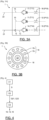
- the feeding process thus makes it possible to optimize the supply of the combustion chamber 5 according to the speed of the aircraft turbine engine 6, by moving the distribution valve 20 and by exploiting the differences in calibration T11, T14, T17 of the valves 11, 14, 17 and in permeability P12, P15, P18 of the associated nozzles 12, 15, 18 in each injector 1. Furthermore, as illustrated in the Figures 6A and 6B , in the event of a failure during the control step E1 and/or during the distribution step E2, an acceptable degraded mode is guaranteed because each circuit 21, 22 is connected to a pilot stage 10, 16.
- the fuel C is injected by the first pilot jet 12 and the main jet 15, which results in a small loss of thrust.
- the fuel C is injected only by the second pilot jet 18, of greater permeability P18 than the first pilot jet 12, which results in a reduced loss of thrust.
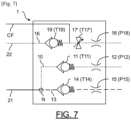
- FIG.7 illustrates an alternative embodiment of the invention differing from the previous one in that the second pilot valve 17' is a metering valve and the pilot stage 16 also comprises a sealing valve 19 and an anti-coking conduit CF.
- the second pilot valve 17' is positioned downstream of the sealing valve 19 so as to supply the second pilot nozzle 18.
- the second pilot valve 17' i.e. the metering valve, has a setting T17' greater than a setting T19 of the sealing valve 19.
- the anti-coking duct CF is in the form of a leakage duct and opens on the one hand into the second pilot stage 16 between the second pilot valve 17 and the auxiliary valve 19, and on the other hand, upstream of the supply system S.
- the sealing valve 19 and the first pilot valve 11 may have substantially equal, i.e. low, settings T11, T19, which makes it possible to circulate fuel C in the second pilot stage 16 from low speeds of the aircraft turbine engine 6.
- the duct anti-coking CF allows for a controlled leakage of fuel C out of the second pilot stage 16 when the pressure in the fuel circuit 14 is higher than the setting T19 of the sealing valve 19 but lower than the setting T17' of the second pilot valve 17'.
- the sealing valve 19 when the sealing valve 19 is open but the second pilot valve 17' is closed, fuel C circulates via the anti-coking conduit CF.
- the controlled circulation of fuel C within the sealing valve 19, while the second pilot valve 17' is closed allows the sealing valve 19 to be cooled and thus prevents coking of fuel C.
Landscapes
- Engineering & Computer Science (AREA)
- Chemical & Material Sciences (AREA)
- Combustion & Propulsion (AREA)
- Mechanical Engineering (AREA)
- General Engineering & Computer Science (AREA)
- Fuel-Injection Apparatus (AREA)
Claims (12)
- System (S) für die Versorgung mit Kraftstoff (C) einer Brennkammer (5) in einem Flugzeug-Turbinentriebwerk (6), wobei das Versorgungssystem (S) umfasst:• eine Vielzahl von Einspritzdüsen (1), die ausgelegt sind, um den Kraftstoff (C) in die Brennkammer (5) einzuspritzen, wobei jede Einspritzdüse (1) in Form einer dreistufigen Einspritzdüse mit einer ersten Vorsteuerstufe (10), einer zweiten Vorsteuerstufe (16) und einer Hauptstufe (13) vorliegt, wobei die erste Vorsteuerstufe (10) und die zweite Vorsteuerstufe (16) jeweils ein erstes Vorsteuerventil (11) und ein zweites Vorsteuerventil (17, 17') umfassen, die jeweils ausgelegt sind, um einen permanenten Kraftstoffstrom (C) zirkulieren zu lassen, wobei die Hauptstufe (13) ein Hauptventil (14) umfasst, das ausgelegt ist, um einen intermittierenden Kraftstoffstrom (C) zirkulieren zu lassen, um die Versorgung der Brennkammer (5) entsprechend der Drehzahl des Flugzeug-Turbinentriebwerks (6) anzupassen,• eine Vorrichtung (2) zur Verteilung des Kraftstoffs (C) in den Einspritzdüsen (1), die in Form einer Zweikreis-Verteilungsvorrichtung vorliegt, die einen Primärkreislauf (21) und einen Sekundärkreislauf (22) umfasst, wobei der Primärkreislauf (21) mit der ersten Vorsteuerstufe (10) und der Hauptstufe (13) verbunden ist, der Sekundärkreislauf (22) mit der zweiten Vorsteuerstufe (16) verbunden ist, wobei die Verteilungsvorrichtung (2) ein Verteilungsventil (20) umfasst, das ausgelegt ist, um den Kraftstoff (C) zwischen dem Primärkreislauf (21) und dem Sekundärkreislauf (22) zu verteilen, und• ein Steuerorgan (3) für das Verteilungsventil (20) entsprechend der Drehzahl des Flugzeug-Turbinentriebwerks (6).
- Versorgungssystem (S) nach Anspruch 1, wobei die erste Vorsteuerstufe (10), die zweite Vorsteuerstufe (16) und die Hauptstufe (13) jeweils eine erste Vorsteuerdüse (12), die vom ersten Vorsteuerventil (11) versorgt wird, eine zweite Vorsteuerdüse (18), die vom zweiten Vorsteuerventil (17, 17') versorgt wird und eine Hauptdüse (15), die vom Hauptventil (14) versorgt wird, umfassen, wobei die zweite Vorsteuerdüse (18) vorzugsweise eine Permeabilität (P18) aufweist, die größer als eine Permeabilität (P12) der ersten Vorsteuerdüse (12) und vorzugsweise kleiner als eine Permeabilität (P15) der Hauptdüse (15) ist.
- Versorgungssystem (S) nach Anspruch 2, wobei die erste Vorsteuerdüse (12) vom aerodynamischen Einspritztyp ist und zum Einspritzen eines Kraftstoffsprays (C) in die Brennkammer (5) ausgelegt ist, wobei die erste Vorsteuerdüse (12) vorzugsweise in der Mitte jeder Einspritzdüse (1) positioniert ist.
- Versorgungssystem (S) nach einem der Ansprüche 2 und 3, wobei die zweite Vorsteuerdüse (18) vom aeromechanischen Einspritztyp ist und zum Einspritzen eines Kraftstoffsprays (C) in die Brennkammer (5) ausgelegt ist, wobei die zweite Vorsteuerdüse (18) vorzugsweise peripher in jeder Einspritzdüse (1), vorzugsweise um die erste Vorsteuerdüse (12) herum, positioniert ist.
- Versorgungssystem (S) nach einem der Ansprüche 2 bis 4, wobei die Hauptdüse (15) in Form einer Mehrpunktdüse mit einer Vielzahl von Einspritzpunkten vorliegt, wobei die Einspritzpunkte vorzugsweise peripher in jeder Einspritzdüse (1), vorzugsweise um die erste Vorsteuerdüse (12) herum, positioniert sind.
- Versorgungssystem (S) nach einem der Ansprüche 1 bis 5, wobei das erste Vorsteuerventil (11) ein Dichtventil ist, das vorzugsweise keine Dosierfunktion hat.
- Versorgungssystem (S) nach einem der Ansprüche 1 bis 6, wobei das Hauptventil (14) eine Tarierung (T14) aufweist, die größer ist als eine Tarierung (T11) des ersten Vorsteuerventils (11), so dass eine Kraftstoffmenge (C) nur oberhalb eines vorbestimmten Drucks in der Hauptstufe (13) abgegeben wird.
- Versorgungssystem (S) nach einem der Ansprüche 1 bis 7, wobei das erste Vorsteuerventil (11) eine Tarierung (T11) aufweist, die im Wesentlichen gleich einer Tarierung (T17) des zweiten Vorsteuerventils (17) ist.
- Versorgungssystem (S) nach einem der Ansprüche 1 bis 8, wobei das zweite Vorsteuerventil (17') ein Dosierventil ist und die zweite Vorsteuerstufe (16) ein Dichtventil (19) umfasst, wobei das zweite Vorsteuerventil (17') vorzugsweise stromabwärts des Dichtventils (19) positioniert ist, wobei das zweite Vorsteuerventil (17') vorzugsweise eine Tarierung (T17') aufweist, die größer ist als eine Tarierung (T19) des Dichtventils (19).
- Versorgungssystem (S) nach Anspruch 9, wobei die zweite Vorsteuerstufe (16) eine Anti-Verkokungsleitung (CF) umfasst, die einerseits zwischen dem zweiten Vorsteuerventil (17') und dem Dichtventil (19) und andererseits stromaufwärts des Versorgungssystems (S) mündet, so dass die Zirkulation des Kraftstoffs (C) über das Dichtventil (19) ermöglicht wird, wenn das zweite Vorsteuerventil (17') geschlossen ist.
- Flugzeug-Turbinentriebwerk (6), umfassend eine Brennkammer (5) und ein Versorgungssystem (S) nach einem der Ansprüche 1 bis 10, wobei die Einspritzdüsen (1) des Versorgungssystems (S) in die Brennkammer (5) münden, um diese mit Kraftstoff (C) zu versorgen.
- Verfahren für die Versorgung mit Kraftstoff (C) einer Brennkammer (5) in einem Flugzeug-Turbinentriebwerk (6) mittels des Versorgungssystems (S) nach einem der Ansprüche 1 bis 10, wobei das Verfahren umfasst:• einen Schritt des Steuerns (E1) des Verteilungsventils (20) entsprechend der Drehzahl des Flugzeug-Turbinentriebwerks (6) mittels des Steuerorgans (3),• einen Schritt des Verteilens (E2) des Kraftstoffs (C) zwischen dem Primärkreislauf (21) und dem Sekundärkreislauf (22) mittels des Verteilungsventils (20) und• einen Schritt des Einspritzens (E3) des Kraftstoffs (C) in die Brennkammer (5) mittels der Einspritzdüsen (1),• wobei bei dem Verfahren, bei dem für jede Drehzahl des Flugzeug-Turbinentriebwerks (6), sobald das Triebwerk (6) gestartet ist, das Verteilungsventil (20) während des Verteilerschritts (E2) Kraftstoff (C) sowohl in den Primärkreislauf (21) als auch in den Sekundärkreislauf (22) leitet.
Applications Claiming Priority (2)
| Application Number | Priority Date | Filing Date | Title |
|---|---|---|---|
| FR2100352A FR3118791B1 (fr) | 2021-01-14 | 2021-01-14 | Système et procédé d’alimentation en carburant d’une chambre de combustion dans un turbomoteur d’aéronef |
| PCT/EP2022/050233 WO2022152621A1 (fr) | 2021-01-14 | 2022-01-07 | Système et procédé d'alimentation en carburant d'une chambre de combustion dans un turbomoteur d'aéronef |
Publications (2)
| Publication Number | Publication Date |
|---|---|
| EP4278076A1 EP4278076A1 (de) | 2023-11-22 |
| EP4278076B1 true EP4278076B1 (de) | 2025-01-01 |
Family
ID=75746782
Family Applications (1)
| Application Number | Title | Priority Date | Filing Date |
|---|---|---|---|
| EP22700010.6A Active EP4278076B1 (de) | 2021-01-14 | 2022-01-07 | System und verfahren zur brennstoffzufuhr zu einer brennkammer in einem flugzeugturbinentriebwerk |
Country Status (5)
| Country | Link |
|---|---|
| US (1) | US12163471B2 (de) |
| EP (1) | EP4278076B1 (de) |
| CN (1) | CN116710644B (de) |
| FR (1) | FR3118791B1 (de) |
| WO (1) | WO2022152621A1 (de) |
Family Cites Families (16)
| Publication number | Priority date | Publication date | Assignee | Title |
|---|---|---|---|---|
| US5321949A (en) * | 1991-07-12 | 1994-06-21 | General Electric Company | Staged fuel delivery system with secondary distribution valve |
| US5735117A (en) * | 1995-08-18 | 1998-04-07 | Fuel Systems Textron, Inc. | Staged fuel injection system with shuttle valve and fuel injector therefor |
| FR2919898B1 (fr) * | 2007-08-10 | 2014-08-22 | Snecma | Injecteur multipoint pour turbomachine |
| GB0811888D0 (en) * | 2008-06-30 | 2008-07-30 | Goodrich Control Sys Ltd | Control system |
| US8573245B1 (en) * | 2010-10-28 | 2013-11-05 | Jansen's Aircraft Systems Controls, Inc. | Fuel manifold for turbine |
| JP5946690B2 (ja) * | 2012-05-02 | 2016-07-06 | 三菱日立パワーシステムズ株式会社 | ガスタービン燃焼器のパージ方法及びパージ装置 |
| US20140338341A1 (en) * | 2012-06-22 | 2014-11-20 | Solar Turbines Incorporated | Liquid fuel turbine engine for reduced oscillations |
| US20140123651A1 (en) * | 2012-11-06 | 2014-05-08 | Ernest W. Smith | System for providing fuel to a combustor assembly in a gas turbine engine |
| FR3001497B1 (fr) * | 2013-01-29 | 2016-05-13 | Turbomeca | Ensemble de combustion de turbomachine comprenant un circuit d alimentation de carburant ameliore |
| GB201603054D0 (en) * | 2016-02-23 | 2016-04-06 | Rolls Royce Controls & Data Services Ltd | Combustion staging system |
| GB2557603B (en) * | 2016-12-09 | 2020-01-15 | Rolls Royce Plc | Fuel supply system |
| GB2557601B (en) * | 2016-12-09 | 2019-01-30 | Rolls Royce Plc | Gas turbine fuel supply system with plural isolation valves |
| GB2557599B (en) * | 2016-12-09 | 2019-05-15 | Rolls Royce Plc | Gas turbine engine fuel supply system having de-priming and re-priming sub-systems |
| GB2563659B (en) * | 2017-06-23 | 2019-10-02 | Rolls Royce Plc | Combustion staging system for fuel injectors of a gas turbine engine |
| GB202003369D0 (en) * | 2020-03-09 | 2020-04-22 | Rolls Royce Plc | Fuel supply system |
| GB202219380D0 (en) * | 2022-12-21 | 2023-02-01 | Rolls Royce Plc | Gas turbine operating conditions |
-
2021
- 2021-01-14 FR FR2100352A patent/FR3118791B1/fr active Active
-
2022
- 2022-01-07 US US18/261,185 patent/US12163471B2/en active Active
- 2022-01-07 EP EP22700010.6A patent/EP4278076B1/de active Active
- 2022-01-07 CN CN202280009826.7A patent/CN116710644B/zh active Active
- 2022-01-07 WO PCT/EP2022/050233 patent/WO2022152621A1/fr not_active Ceased
Also Published As
| Publication number | Publication date |
|---|---|
| US12163471B2 (en) | 2024-12-10 |
| FR3118791B1 (fr) | 2023-07-14 |
| WO2022152621A1 (fr) | 2022-07-21 |
| US20240318601A1 (en) | 2024-09-26 |
| EP4278076A1 (de) | 2023-11-22 |
| CN116710644B (zh) | 2026-04-28 |
| CN116710644A (zh) | 2023-09-05 |
| FR3118791A1 (fr) | 2022-07-15 |
Similar Documents
| Publication | Publication Date | Title |
|---|---|---|
| EP1965056B1 (de) | Verfahren zum Anlassen eines Hubschrauber-Gasturbinenmotors, Kraftstoffzuführkreiskauf eines solchen Motors und mit einem solchen Kreislauf ausgestatteter Motor | |
| EP1605148B1 (de) | Verfahren und Vorrichtung zum Sichern von Brennstoffeinspritzdüsen einer Gasturbine | |
| EP1873455B1 (de) | Vorrichtung zum Einspritzen einer Mischung aus Luft und Treibstoff, Brennkammer und Strömungsmaschine, die mit einer solchen Vorrichtung ausgestattet ist | |
| EP3368826B1 (de) | Aerodynamisches einspritzsystem für flugzeugtriebwerk mit verbesserter luft-kraftstoff-mischung | |
| WO2010052434A2 (fr) | Systeme et procede de lavage et purge a l'eau du circuit combustible liquide d'une turbine | |
| FR3039254A1 (fr) | Chambre de combustion comportant des dispositifs d'injection additionnels debouchant directement dans les zones de recirculation de coin, turbomachine la comprenant, et procede d'alimentation en carburant de celle-ci | |
| EP3325776A1 (de) | Luftfahrzeug mit einem in den heckrumpf integrierten turbinenmotor mit variabler versorgung | |
| CA2899508A1 (fr) | Ensemble de combustion de turbomachine comprenant un circuit d'alimentation de carburant ameliore | |
| FR3021073B1 (fr) | Architecture d'injection de carburant amelioree. | |
| EP4278076B1 (de) | System und verfahren zur brennstoffzufuhr zu einer brennkammer in einem flugzeugturbinentriebwerk | |
| EP3147490B1 (de) | Antriebssystem einer rakete | |
| EP2056023B1 (de) | Ringförmige Brennkammer eines Gasturbinenmotors | |
| FR3001525A1 (fr) | Procede de gestion de la consommation de carburant d un ensemble bimoteur et ensemble associe | |
| FR3033030A1 (fr) | Systeme d'injection d'un melange air-carburant dans une chambre de combustion de turbomachine d'aeronef, comprenant un venturi perfore de trous d'injection d'air | |
| EP4004443B1 (de) | Brennkammer mit sekundäreinspritzsystemen und verfahren zur kraftstoffversorgung | |
| FR3105985A1 (fr) | Circuit multipoint d’injecteur amélioré | |
| WO2009024723A1 (fr) | Systeme d'injection de carburant pour moteur a combustion interne | |
| FR3142533A1 (fr) | Chambre de combustion pour turbomachine | |
| EP4731933A1 (de) | Einspritzsystem für eine turbomaschinenbrennkammer mit optimierter abdichtung zwischen einem injektor und einer schiebebuchse | |
| WO2018060590A1 (fr) | Dispositif d'alimentation en carburant d'une chambre de combustion de turbomachine améliorant l'homogénéité de l'alimentation des dispositifs d'injection du carburant | |
| EP3732359A1 (de) | Verfahren zur steuerung der brennstoffzufuhr zu einer brennkammer einer turbinenmaschine, kraftstoffversorgungssystem und turbinenmotor |
Legal Events
| Date | Code | Title | Description |
|---|---|---|---|
| STAA | Information on the status of an ep patent application or granted ep patent |
Free format text: STATUS: UNKNOWN |
|
| STAA | Information on the status of an ep patent application or granted ep patent |
Free format text: STATUS: THE INTERNATIONAL PUBLICATION HAS BEEN MADE |
|
| PUAI | Public reference made under article 153(3) epc to a published international application that has entered the european phase |
Free format text: ORIGINAL CODE: 0009012 |
|
| STAA | Information on the status of an ep patent application or granted ep patent |
Free format text: STATUS: REQUEST FOR EXAMINATION WAS MADE |
|
| 17P | Request for examination filed |
Effective date: 20230702 |
|
| AK | Designated contracting states |
Kind code of ref document: A1 Designated state(s): AL AT BE BG CH CY CZ DE DK EE ES FI FR GB GR HR HU IE IS IT LI LT LU LV MC MK MT NL NO PL PT RO RS SE SI SK SM TR |
|
| DAV | Request for validation of the european patent (deleted) | ||
| DAX | Request for extension of the european patent (deleted) | ||
| GRAP | Despatch of communication of intention to grant a patent |
Free format text: ORIGINAL CODE: EPIDOSNIGR1 |
|
| STAA | Information on the status of an ep patent application or granted ep patent |
Free format text: STATUS: GRANT OF PATENT IS INTENDED |
|
| RIC1 | Information provided on ipc code assigned before grant |
Ipc: F23R 3/28 20060101ALI20241014BHEP Ipc: F02C 7/232 20060101ALI20241014BHEP Ipc: F23R 3/34 20060101ALI20241014BHEP Ipc: F02C 7/228 20060101AFI20241014BHEP |
|
| GRAS | Grant fee paid |
Free format text: ORIGINAL CODE: EPIDOSNIGR3 |
|
| INTG | Intention to grant announced |
Effective date: 20241028 |
|
| GRAA | (expected) grant |
Free format text: ORIGINAL CODE: 0009210 |
|
| STAA | Information on the status of an ep patent application or granted ep patent |
Free format text: STATUS: THE PATENT HAS BEEN GRANTED |
|
| AK | Designated contracting states |
Kind code of ref document: B1 Designated state(s): AL AT BE BG CH CY CZ DE DK EE ES FI FR GB GR HR HU IE IS IT LI LT LU LV MC MK MT NL NO PL PT RO RS SE SI SK SM TR |
|
| REG | Reference to a national code |
Ref country code: GB Ref legal event code: FG4D Free format text: NOT ENGLISH |
|
| REG | Reference to a national code |
Ref country code: CH Ref legal event code: EP |
|
| REG | Reference to a national code |
Ref country code: DE Ref legal event code: R096 Ref document number: 602022009351 Country of ref document: DE |
|
| REG | Reference to a national code |
Ref country code: IE Ref legal event code: FG4D Free format text: LANGUAGE OF EP DOCUMENT: FRENCH |
|
| PGFP | Annual fee paid to national office [announced via postgrant information from national office to epo] |
Ref country code: AT Payment date: 20250417 Year of fee payment: 4 |
|
| REG | Reference to a national code |
Ref country code: LT Ref legal event code: MG9D |
|
| REG | Reference to a national code |
Ref country code: NL Ref legal event code: MP Effective date: 20250101 |
|
| REG | Reference to a national code |
Ref country code: AT Ref legal event code: MK05 Ref document number: 1756463 Country of ref document: AT Kind code of ref document: T Effective date: 20250101 |
|
| PG25 | Lapsed in a contracting state [announced via postgrant information from national office to epo] |
Ref country code: NL Free format text: LAPSE BECAUSE OF FAILURE TO SUBMIT A TRANSLATION OF THE DESCRIPTION OR TO PAY THE FEE WITHIN THE PRESCRIBED TIME-LIMIT Effective date: 20250101 |
|
| PG25 | Lapsed in a contracting state [announced via postgrant information from national office to epo] |
Ref country code: FI Free format text: LAPSE BECAUSE OF FAILURE TO SUBMIT A TRANSLATION OF THE DESCRIPTION OR TO PAY THE FEE WITHIN THE PRESCRIBED TIME-LIMIT Effective date: 20250101 |
|
| PG25 | Lapsed in a contracting state [announced via postgrant information from national office to epo] |
Ref country code: PL Free format text: LAPSE BECAUSE OF FAILURE TO SUBMIT A TRANSLATION OF THE DESCRIPTION OR TO PAY THE FEE WITHIN THE PRESCRIBED TIME-LIMIT Effective date: 20250101 |
|
| PG25 | Lapsed in a contracting state [announced via postgrant information from national office to epo] |
Ref country code: ES Free format text: LAPSE BECAUSE OF FAILURE TO SUBMIT A TRANSLATION OF THE DESCRIPTION OR TO PAY THE FEE WITHIN THE PRESCRIBED TIME-LIMIT Effective date: 20250101 |
|
| PG25 | Lapsed in a contracting state [announced via postgrant information from national office to epo] |
Ref country code: IS Free format text: LAPSE BECAUSE OF FAILURE TO SUBMIT A TRANSLATION OF THE DESCRIPTION OR TO PAY THE FEE WITHIN THE PRESCRIBED TIME-LIMIT Effective date: 20250501 Ref country code: NO Free format text: LAPSE BECAUSE OF FAILURE TO SUBMIT A TRANSLATION OF THE DESCRIPTION OR TO PAY THE FEE WITHIN THE PRESCRIBED TIME-LIMIT Effective date: 20250401 |
|
| PG25 | Lapsed in a contracting state [announced via postgrant information from national office to epo] |
Ref country code: HR Free format text: LAPSE BECAUSE OF FAILURE TO SUBMIT A TRANSLATION OF THE DESCRIPTION OR TO PAY THE FEE WITHIN THE PRESCRIBED TIME-LIMIT Effective date: 20250101 |
|
| PG25 | Lapsed in a contracting state [announced via postgrant information from national office to epo] |
Ref country code: LV Free format text: LAPSE BECAUSE OF FAILURE TO SUBMIT A TRANSLATION OF THE DESCRIPTION OR TO PAY THE FEE WITHIN THE PRESCRIBED TIME-LIMIT Effective date: 20250101 Ref country code: PT Free format text: LAPSE BECAUSE OF FAILURE TO SUBMIT A TRANSLATION OF THE DESCRIPTION OR TO PAY THE FEE WITHIN THE PRESCRIBED TIME-LIMIT Effective date: 20250502 |
|
| PG25 | Lapsed in a contracting state [announced via postgrant information from national office to epo] |
Ref country code: BG Free format text: LAPSE BECAUSE OF FAILURE TO SUBMIT A TRANSLATION OF THE DESCRIPTION OR TO PAY THE FEE WITHIN THE PRESCRIBED TIME-LIMIT Effective date: 20250101 Ref country code: GR Free format text: LAPSE BECAUSE OF FAILURE TO SUBMIT A TRANSLATION OF THE DESCRIPTION OR TO PAY THE FEE WITHIN THE PRESCRIBED TIME-LIMIT Effective date: 20250402 |
|
| PG25 | Lapsed in a contracting state [announced via postgrant information from national office to epo] |
Ref country code: AT Free format text: LAPSE BECAUSE OF FAILURE TO SUBMIT A TRANSLATION OF THE DESCRIPTION OR TO PAY THE FEE WITHIN THE PRESCRIBED TIME-LIMIT Effective date: 20250101 |
|
| PG25 | Lapsed in a contracting state [announced via postgrant information from national office to epo] |
Ref country code: CZ Free format text: LAPSE BECAUSE OF FAILURE TO SUBMIT A TRANSLATION OF THE DESCRIPTION OR TO PAY THE FEE WITHIN THE PRESCRIBED TIME-LIMIT Effective date: 20250101 |
|
| REG | Reference to a national code |
Ref country code: CH Ref legal event code: PL |
|
| PG25 | Lapsed in a contracting state [announced via postgrant information from national office to epo] |
Ref country code: SE Free format text: LAPSE BECAUSE OF FAILURE TO SUBMIT A TRANSLATION OF THE DESCRIPTION OR TO PAY THE FEE WITHIN THE PRESCRIBED TIME-LIMIT Effective date: 20250101 |
|
| PG25 | Lapsed in a contracting state [announced via postgrant information from national office to epo] |
Ref country code: LU Free format text: LAPSE BECAUSE OF NON-PAYMENT OF DUE FEES Effective date: 20250107 |
|
| REG | Reference to a national code |
Ref country code: DE Ref legal event code: R097 Ref document number: 602022009351 Country of ref document: DE |
|
| PG25 | Lapsed in a contracting state [announced via postgrant information from national office to epo] |
Ref country code: SM Free format text: LAPSE BECAUSE OF FAILURE TO SUBMIT A TRANSLATION OF THE DESCRIPTION OR TO PAY THE FEE WITHIN THE PRESCRIBED TIME-LIMIT Effective date: 20250101 |
|
| PG25 | Lapsed in a contracting state [announced via postgrant information from national office to epo] |
Ref country code: DK Free format text: LAPSE BECAUSE OF FAILURE TO SUBMIT A TRANSLATION OF THE DESCRIPTION OR TO PAY THE FEE WITHIN THE PRESCRIBED TIME-LIMIT Effective date: 20250101 |
|
| PG25 | Lapsed in a contracting state [announced via postgrant information from national office to epo] |
Ref country code: MC Free format text: LAPSE BECAUSE OF FAILURE TO SUBMIT A TRANSLATION OF THE DESCRIPTION OR TO PAY THE FEE WITHIN THE PRESCRIBED TIME-LIMIT Effective date: 20250101 |
|
| PG25 | Lapsed in a contracting state [announced via postgrant information from national office to epo] |
Ref country code: IT Free format text: LAPSE BECAUSE OF FAILURE TO SUBMIT A TRANSLATION OF THE DESCRIPTION OR TO PAY THE FEE WITHIN THE PRESCRIBED TIME-LIMIT Effective date: 20250101 |
|
| PG25 | Lapsed in a contracting state [announced via postgrant information from national office to epo] |
Ref country code: BE Free format text: LAPSE BECAUSE OF NON-PAYMENT OF DUE FEES Effective date: 20250131 |
|
| PG25 | Lapsed in a contracting state [announced via postgrant information from national office to epo] |
Ref country code: CH Free format text: LAPSE BECAUSE OF NON-PAYMENT OF DUE FEES Effective date: 20250131 |
|
| PG25 | Lapsed in a contracting state [announced via postgrant information from national office to epo] |
Ref country code: EE Free format text: LAPSE BECAUSE OF FAILURE TO SUBMIT A TRANSLATION OF THE DESCRIPTION OR TO PAY THE FEE WITHIN THE PRESCRIBED TIME-LIMIT Effective date: 20250101 |
|
| REG | Reference to a national code |
Ref country code: BE Ref legal event code: MM Effective date: 20250131 |
|
| PG25 | Lapsed in a contracting state [announced via postgrant information from national office to epo] |
Ref country code: RO Free format text: LAPSE BECAUSE OF FAILURE TO SUBMIT A TRANSLATION OF THE DESCRIPTION OR TO PAY THE FEE WITHIN THE PRESCRIBED TIME-LIMIT Effective date: 20250101 |
|
| PG25 | Lapsed in a contracting state [announced via postgrant information from national office to epo] |
Ref country code: SK Free format text: LAPSE BECAUSE OF FAILURE TO SUBMIT A TRANSLATION OF THE DESCRIPTION OR TO PAY THE FEE WITHIN THE PRESCRIBED TIME-LIMIT Effective date: 20250101 |
|
| PLBE | No opposition filed within time limit |
Free format text: ORIGINAL CODE: 0009261 |
|
| STAA | Information on the status of an ep patent application or granted ep patent |
Free format text: STATUS: NO OPPOSITION FILED WITHIN TIME LIMIT |
|
| 26N | No opposition filed |
Effective date: 20251002 |
|
| PG25 | Lapsed in a contracting state [announced via postgrant information from national office to epo] |
Ref country code: IE Free format text: LAPSE BECAUSE OF NON-PAYMENT OF DUE FEES Effective date: 20250107 |
|
| PGFP | Annual fee paid to national office [announced via postgrant information from national office to epo] |
Ref country code: GB Payment date: 20260122 Year of fee payment: 5 |
|
| PGFP | Annual fee paid to national office [announced via postgrant information from national office to epo] |
Ref country code: DE Payment date: 20260120 Year of fee payment: 5 |
|
| PGFP | Annual fee paid to national office [announced via postgrant information from national office to epo] |
Ref country code: FR Payment date: 20260116 Year of fee payment: 5 |