EP4277885B1 - Process for the preparation of a chiral triol - Google Patents
Process for the preparation of a chiral triol Download PDFInfo
- Publication number
- EP4277885B1 EP4277885B1 EP22701332.3A EP22701332A EP4277885B1 EP 4277885 B1 EP4277885 B1 EP 4277885B1 EP 22701332 A EP22701332 A EP 22701332A EP 4277885 B1 EP4277885 B1 EP 4277885B1
- Authority
- EP
- European Patent Office
- Prior art keywords
- catalyst
- formula
- phenyl
- halogen
- hydrogen
- Prior art date
- Legal status (The legal status is an assumption and is not a legal conclusion. Google has not performed a legal analysis and makes no representation as to the accuracy of the status listed.)
- Active
Links
Classifications
-
- C—CHEMISTRY; METALLURGY
- C07—ORGANIC CHEMISTRY
- C07C—ACYCLIC OR CARBOCYCLIC COMPOUNDS
- C07C29/00—Preparation of compounds having hydroxy or O-metal groups bound to a carbon atom not belonging to a six-membered aromatic ring
- C07C29/17—Preparation of compounds having hydroxy or O-metal groups bound to a carbon atom not belonging to a six-membered aromatic ring by hydrogenation of carbon-to-carbon double or triple bonds
- C07C29/177—Preparation of compounds having hydroxy or O-metal groups bound to a carbon atom not belonging to a six-membered aromatic ring by hydrogenation of carbon-to-carbon double or triple bonds with simultaneous reduction of a carboxy group
-
- C—CHEMISTRY; METALLURGY
- C07—ORGANIC CHEMISTRY
- C07C—ACYCLIC OR CARBOCYCLIC COMPOUNDS
- C07C33/00—Unsaturated compounds having hydroxy or O-metal groups bound to acyclic carbon atoms
- C07C33/26—Polyhydroxylic alcohols containing only six-membered aromatic rings as cyclic part
-
- C—CHEMISTRY; METALLURGY
- C07—ORGANIC CHEMISTRY
- C07B—GENERAL METHODS OF ORGANIC CHEMISTRY; APPARATUS THEREFOR
- C07B2200/00—Indexing scheme relating to specific properties of organic compounds
- C07B2200/07—Optical isomers
Definitions
- the invention relates to a process for the preparation of the chiral triol of the formula I wherein
- Chiral triols are versatile building blocks for the preparation of various pharmaceutically active drug substances such as for instance for statin drugs ( A. Lenhart, W.D. Chey “Adv. Nutr. 2017, 8(4), 587-596 ).
- the object of the present invention was to provide a process which allows the preparation of the chiral triol in a scalable manner with high enantiomeric purity and yield.
- chiral denotes the ability of non-superimposability with the mirror image
- achiral refers to embodiments which are superimposable with their mirror image.
- Chiral molecules are optically active, i.e., they have the ability to rotate the plane of plane-polarized light. Whenever a chiral center is present in a chemical structure, it is intended that all stereoisomers associated with that chiral center are encompassed by the present invention.
- chiral signifies that the molecule can exist in the form of optically pure enantiomers, mixtures of enantiomers, optically pure diastereoisomers or mixtures of diastereoisomers.
- the term "chiral” denotes optically pure enantiomers or optically pure diastereoisomers.
- stereoisomer denotes a compound that possesses identical molecular connectivity and bond multiplicity, but which differs in the arrangement of its atoms in space.
- diastereomer denotes a stereoisomer with two or more centers of chirality and whose molecules are not mirror images of one another. Diastereomers may have different physical properties, e.g. melting points, boiling points, spectral properties, and reactivities.
- enantiomers denotes two stereoisomers of a compound which are non-superimposable mirror images of one another.
- the spiral bond (c) denotes both options i.e. either a dashed bond (a) or a wedged bond (b).
- C- 1-8 - alkyl denotes a monovalent linear or branched saturated hydrocarbon group of 1 to 8 carbon atoms.
- Examples of C 1-8 -alkyl include methyl, ethyl, propyl, isopropyl, n-butyl, isobutyl, sec-butyl, tert-butyl or pentyl, hexyl, heptyl or octyl with its isomers.
- the term denotes a C- 1-6 - alkyl group.
- C 3-8 -cycloalkyl denotes a saturated carbocycle of 3 to 8 carbon atoms.
- Examples of C 3-8 -cycloalkyl include cyclopropyl, cyclobutyl, cyclopentyl, cyclohexyl, cycloheptyl and cyclooctyl with its isomers.
- the term encompasses C 4-7 -cycloalkyl, more preferably cyclpentyl and cyclohexyl.
- C- 1-6 - alkoxy denotes a monovalent linear or branched saturated hydrocarbon group of 1 to 6 carbon atoms attached to an oxygen atom.
- Examples of C 1-6 -alkoxy include methoxy, ethoxy, propoxy, isopropoxy, n-butoxy, iso-butoxy, sec-butoxy, tert-butoxy, or pentoxy or hexoxy
- the term denotes a C- 1-4 - alkoxy group, more preferably the methoxy group.
- halogen denotes fluoro, chloro, bromo, or iodo.
- C- 1-8 - halogenalkyl denotes a monovalent linear or branched saturated hydrocarbon group of 1 to 8 carbon atoms which is substituted by one or more halogen atoms.
- the term denotes C- 1-4 - halogenalkyl, more preferably a methyl group which is substituted with one or more halogen atoms such as trifluoromethyl.
- the ketone of formula IIa may occur in the mesomeric structures outlined in the scheme below. For the sake of clarity the formula IIa is consistently used throughout this description.
- inventions a) to d) are preferred, more preferred are the embodiments a), b) and d) and embodiment d) is most preferred.
- the chiral triol has the formula Ia wherein R 1 is as above, but preferably stands for halogen, more preferably for chlorine.
- R 1 can be in the ortho-, meta- or para-position of the phenyl ring, but preferably R 1 is in the para-position of the phenyl ring.
- the iridium spiro-pyridylamidophosphine catalyst are of the formula IIIa or IIIb, or enantiomers thereof wherein
- the iridium spiro-pyridylamidophosphine catalyst (Ir-SpiroPAP catalyst) are selected from the compounds wherein;
- the iridium spiro-pyridylamidophosphine catalyst is selected from the compound wherein
- Suitable catalysts are typically commercially available e.g. from Jiuzhou Pharma in China.
- the asymmetric hydrogenation can be performed in the presence of suitable organic solvent and a base at a hydrogen pressure of 5 bar to 100 bar, preferably of 30 bar to 70 bar and at a reaction temperature of 10°C to 90°C, preferably of 20°C to 40°C.
- the organic solvent can be selected from aliphatic alcohols selected from methanol, ethanol, isopropanol, tert-amylalcohol, from halogen substituted alcohols like trifluoroethanol, from haloalkanes like dichloromethane, from ethers like tetrahydrofuran or dioxane or from aromatic solvents like toluene or mixtures thereof. Also suited are mixtures of aliphatic alcohols such as methanol or ethanol with water or with dioxane. The preferred solvent is methanol or ethanol, even more preferred ethanol.
- Suitable bases are inorganic bases selected from alkali or earth alkali- carbonates or - hydrogen carbonates or phosphates or hydrogenphosphates or dihydrogenphosphates or acetates or formates or organic bases selected from amines, alkali alcoholates or amidines.
- Organic bases are usually preferred. Typical representatives of organic bases are potassium tert-butylate or 1,8-Diazabicyclo[5.4.0]undec-7-ene (DBU), 1,4-Diazabicyclo(2.2.2)octane (DABCO) and 7-Methyl-1,5,7-triazabicyclo[4.4.0]dec-5-ene (MTBD), most preferred is DBU.
- DBU 1,8-Diazabicyclo[5.4.0]undec-7-ene
- DABCO 1,4-Diazabicyclo(2.2.2)octane
- MTBD 7-Methyl-1,5,7-triazabicyclo[4.4.0]dec-5-ene
- a substrate to catalyst ratio can expediently be chosen in a range of 100 to 10'000, preferably in a range of 1000 to 5000.
- the chiral triol of formula I can be separated from the reaction mixture by evaporation of the solvent. Subsequent crystallization in a suitable solvent, typically in ketones like methyl isobutyl ketone or esters like isopropyl acetate renders the chiral triol of formula I in good yields, high purity and high enantiomeric excess.
- a suitable solvent typically in ketones like methyl isobutyl ketone or esters like isopropyl acetate renders the chiral triol of formula I in good yields, high purity and high enantiomeric excess.
- the iridium spiro-pyridylamidophosphine catalyst (Ir-SpiroPAP catalyst) of formula IIIa or IIIb may be prepared in situ in the course of the asymmetric hydrogenation reaction by bringing together a suitable Iridium-pre catalyst complex with a spiro-pyridylamidophosphine ligand of the formula wherein R 4a , R 4b , R 4c and R 4d , Q 1 and Q 2 and Z have the meanings as outlined above.
- Suitable Iridium-pre catalyst complex compounds are commercially available e.g. from Sigma Aldrich and can be selected e.g.
- Preferred Iridium-pre catalyst complex compound is [IrCl(COD)] 2 .
- iridium-pre catalyst complex compound and the spiro-pyridylamidophosphine ligand are typically mixed in the presence of the organic solvent and the base mentioned under embodiment a).
- the substrate to Iridium ratio as a rule is adjusted between 100 and 10000, preferably between 1000 and 5000.
- the substrate to ligand ratio as a rule is adjusted between 0.5 and 1.5, preferably between 0.9 and 1.1.
- the iridium-phenylendiamine catalyst are of the formula IVa or IVb, or enantiomers thereof wherein,
- iridium-phenylendiamine catalyst are of the formula IVa, or enantiomers thereof, wherein,
- the iridium-phenylendiamine catalyst are of the formula IVb, or enantiomers thereof, wherein, R 5 is methylsulfonyl, trifluoromethylsulfonyl, 7,7-dimethyl-2-oxobicyclo[2.2.1] heptane-1-yl; tolylsulfonyl or 1,3,5-tri-i-propylphenyl sulfonyl.
- iridium-phenylendiamine catalyst are selected from compounds of the formula IVc and IVd
- the asymmetric hydrogenation for the formation of the ketone of formula IIb of can be performed in the presence of suitable organic solvent at a hydrogen pressure of 5 bar to 100 bar, preferably of 30 bar to 70 bar and at a reaction temperature of 10 °C to 90°C, preferably of 20°C to 40°C.
- the organic solvent can be selected from aliphatic alcohols selected from methanol, ethanol, isopropanol, tert-amylalcohol, from halogen substituted alcohols like trifluoroethanol, from haloalkanes like dichloromethane, from ethers like tetrahydrofuran or dioxane or from aromatic solvents like toluene or mixtures thereof. Also suited are mixtures of aliphatic alcohols such as methanol or ethanol with water or with dioxane. The preferred solvent is methanol or ethanol, even more preferred ethanol.
- the reaction can be performed without the presence of a base.
- bases are tolerated. Suitable bases are inorganic bases selected from alkali or earth alkali- carbonates or - hydrogen carbonates or phosphates or hydrogenphosphates or dihydrogenphosphates or acetates or formates or organic bases selected from amines, alkali alcoholates or amidines. Organic bases are usually preferred. Typical representatives of organic bases are potassium tert-butylate or 1,8-Diazabicyclo[5.4.0]undec-7-ene (DBU), 1,4-Diazabicyclo(2.2.2)octane (DABCO) and 7-Methyl-1,5,7-triazabicyclo[4.4.0]dec-5-ene (MTBD), most preferred is DBU.
- DBU 1,8-Diazabicyclo[5.4.0]undec-7-ene
- DABCO 1,4-Diazabicyclo(2.2.2)octane
- MTBD 7-Methyl-1,5,7-triazabicyclo[4.4.0]dec-5-en
- a substrate to catalyst ratio can expediently be chosen in a range of 100 to 10000, preferably in a range of 500 to 1000.
- the ketone of formula IIb can be separated from the reaction mixture by evaporation of the solvent. Subsequent crystallization in a suitable solvent, typically in an aliphatic alcohol like i-propanol renders the ketone of formula IIb in good yields, high purity and high enantiomeric excess. Alternatively the ketone of formula IIb is not isolated and is further hydrogenated to the chiral triol of formula I in the presence of the Ir-SpiroPAP catalyst.
- the asymmetric hydrogenation is performed in the presence of a mixture of the Ir-SpiroPAP catalyst and an Ir-PEN catalyst.
- the Ir-PEN catalyst catalyzes the first step of the reaction i.e. the transformation to the ketone of formula IIb faster and with a higher chiral selectivity than the Ir-SpiroPAP catalyst.
- the substrate to Ir-PEN catalyst ratio can therefore expediently be chosen in a range of 100 to 10000 preferably in a range of 500 to 1000.
- the substrate to Ir-Spiro-PAP catalyst ratio can expediently be chosen in a range of 100 to 10000, preferably in a range of 2500 to 7500.
- the asymmetric hydrogenation can be performed in the presence of suitable organic solvent and a base at a hydrogen pressure of 5 bar to 100 bar, preferably of 30 bar to 70 bar and at a reaction temperature of 10°C to 90°C, preferably of 20°C to 40°C.
- the organic solvent can be selected from aliphatic alcohols selected from methanol, ethanol, isopropanol, tert-amylalcohol, from halogen substituted alcohols like trifluoroethanol, from haloalkanes like dichloromethane, from ethers like tetrahydrofuran or dioxane or from aromatic solvents like toluene or mixtures thereof. Also suited are mixtures of aliphatic alcohols such as methanol or ethanol with water or with dioxane. The preferred solvent is methanol or ethanol, even more preferred ethanol.
- Suitable bases are inorganic bases selected from alkali or earth alkali- carbonates or - hydrogen carbonates or phosphates or hydrogenphosphates or dihydrogenphosphates or acetates or formates or organic bases selected from amines, alkali alcoholates or amidines.
- Organic bases are usually preferred. Typical representatives of organic bases are potassium tert-butylate or 1,8-Diazabicyclo[5.4.0]undec-7-ene (DBU), 1,4-Diazabicyclo(2.2.2)octane (DABCO) and 7-Methyl-1,5,7-triazabicyclo[4.4.0]dec-5-ene (MTBD), most preferred is DBU.
- DBU 1,8-Diazabicyclo[5.4.0]undec-7-ene
- DABCO 1,4-Diazabicyclo(2.2.2)octane
- MTBD 7-Methyl-1,5,7-triazabicyclo[4.4.0]dec-5-ene
- the chiral triol of formula I can be separated from the reaction mixture by evaporation of the solvent. Subsequent crystallization in a suitable solvent, typically in ketones like methyl isobutyl ketone or esters like isopropyl acetate renders the chiral triol of formula I in good yields, high purity and high enantiomeric excess.
- a suitable solvent typically in ketones like methyl isobutyl ketone or esters like isopropyl acetate renders the chiral triol of formula I in good yields, high purity and high enantiomeric excess.
- intermediates IIb, IIc or IId typically need not to be isolated and can directly be converted to the desired chiral triol of formula I.
- intermediate IIc or IId can in principle be isolated by interrupting the hydrogenation at the appropriate stage and individually be subjected to the asymmetric hydrogenation with either the Ir-Spiro PAP catalyst alone or in the presence of a mixture of an Ir-SpiroPAP catalyst and an Ir-PEN catalyst.
- the reaction conditions as described in the previous embodiments can likewise be applied.
- embodiments a) to d) are preferred, more preferred are the embodiments a), b) and d) and embodiment d) is most preferred.
- JZ-S036-1 6048 [IrClH 2 (( S )-DTB-SpiroPAP)] CAS No not available Available from Jiuzhou Pharma, CN Catalogue No. not available 6049 [IrClH 2 ( R )-DTB-SpiroPAP-4-tBu)] CAS No not available Available from Jiuzhou Pharma, CN Catalogue No. not available 6050 [IrClH 2 (( R )-DTB-SpiroPAP-6-Me)] CAS No not available Available from Jiuzhou Pharma, CN Catalogue No. not available 1508 ( S )-DTB-SpiroPAP-3-Me CAS No not available Available from Jiuzhou Pharma, CN Catalogue No.
- a 380 mL autoclave was charged with 1 (20.0 g, 78.5 mmol), 630 (60.2 mg, 78.3 x 10 -6 mol, S/C 1'000) and EtOH (200 mL).
- the autoclave was sealed and removed from the glove box, connected to a hydrogen line, pressurized with hydrogen gas to 70 bar and heated to 30°C. Under stirring, the hydrogenation was ran at a constant hydrogen pressure of 70 bar. Reaction samples were taken after 1 h (50% conversion) and 2 h (>99.9 % conversion) to follow the progress of the reaction. After a total reaction time of 2.5 h, the autoclave was vented and allowed to cool to room temperature.
- a 380 mL autoclave was charged with 1 (20.0 g, 78.5 mmol), 629 (48.4 mg, 78.3 x 10 -6 mol, S/C 1'000) and EtOH (200 mL).
- the autoclave was sealed and removed from the glove box, connected to a hydrogen line, pressurized with hydrogen gas to 70 bar and heated to 30°C. Under stirring, the hydrogenation was ran at a constant hydrogen pressure of 70 bar.
- a reaction sample was taken after 3.5 h (98% conversion) to follow the progress of the reaction. After a total reaction time of 4 h, the autoclave was vented and allowed to cool to room temperature.
- a 380 mL autoclave was charged with 1 (10.0 g, 39.3 mmol), 680 (38.4 mg, 39.3 x 10 -6 mol, S/C 1'000), DBU (597.8 mg, 3.93 mmol, S/B 10) and EtOH (200 mL).
- the autoclave was sealed and removed from the glove box, connected to a hydrogen line and pressurized with hydrogen gas to 70 bar and heated to 30°C. Under stirring, the hydrogenation was run at a constant hydrogen pressure of 70 bar. After a total reaction time of 20 h (>99.9% conversion), the autoclave was vented and allowed to cool to room temperature.
- reaction mixture was transferred with aid of EtOH (20 mL) from the autoclave into a 500 mL round bottomed flask and the orange reaction solution rotatory evaporated at 40°C / 10 mbar to constant weight to yield crude 6 (9.0 g) with 98.4 area-% purity (DBU not integrated) and a trans / cis ratio of 7.7. (R,R)-6 was obtained with 98.8% ee.
- a 380 mL autoclave was charged with 1 (10.0 g, 39.3 mmol), 601 (29.4 mg, 19.6 x 10 -6 mol, S/Ir 1'000), 1508 (13.2 mg, 39.3 x 10 -6 mol, S/L 1'000), DBU (597.8 mg, 3.93 mmol, S/B 10) and EtOH (200 mL).
- the autoclave was sealed and removed from the glove box, connected to a hydrogen line and pressurized with hydrogen gas to 70 bar and heated to 30°C. Under stirring, the hydrogenation was ran at a constant hydrogen pressure of 70 bar.
- a 380 mL autoclave was charged with 1 (10.0 g, 39.3 mmol), 601, 29.4 mg, 19.6 x 10 -6 mol, S/Ir 1'000), 1508 (13.2 mg, 39.3 x 10 -6 mol, S/L 1'000), KOtBu (437.6 mg, 3.93 mmol, S/B 10) and EtOH (200 mL).
- the autoclave was sealed and removed from the glove box, connected to a hydrogen line and pressurized with hydrogen gas to 70 bar and heated to 30°C. Under stirring, the hydrogenation was ran at a constant hydrogen pressure of 70 bar.
- a 180 mL autoclave was charged with 1 (1.00 g, 3.93 mmol), 630 (3.00 mg, 3.93 x 10 -6 mol, S/C 1'000) and EtOH (20 mL).
- the autoclave was sealed and removed from the glove box, connected to a hydrogen line and pressurized with hydrogen gas to 30 bar and heated to 30°C. Under stirring, the hydrogenation was ran at a constant hydrogen pressure of 30 bar for 4h.
- a 180 mL autoclave was charged with 1 (1.00 g, 3.93 mmol), 630 (3.00 mg, 3.93 x 10 -6 mol, S/C 1'000), 680 (0.77 mg, 0.79 x 10 -6 mol, S/C 5'000), DBU (12.0 mg, 7.86 x 10 -5 mmol, S/B 50) and EtOH (20 mL).
- the autoclave was sealed and removed from the glove box, connected to a hydrogen line and pressurized with hydrogen gas to 30 bar and heated to 30°C. Under stirring, the hydrogenation was ran at a constant hydrogen pressure of 30 bar for 4 h. Afterward the pressure was increased to 70 bar and the reaction carried out for additional 19 h.
- a 180 mL autoclave was charged with 1 (1.00 g, 3.93 mmol), 630 (3.00 mg, 3.93 x 10 -6 mol, S/C 1'000), 680 (0.77 mg, 0.79 x 10 -6 mol, S/C 5'000), DBU (12.0 mg, 7.86 x 10 -5 mmol, S/B 50) and EtOH (20 mL).
- the autoclave was sealed and removed from the glove box, connected to a hydrogen line and pressurized with hydrogen gas to 70 bar and heated to 30°C. Under stirring, the hydrogenation was ran at a constant hydrogen pressure of 70 bar for 23 h.
- a 380 mL autoclave was charged with 1 (15.0 g, 59 mmol), 630 (45.1 mg, 5.9 x 10 -5 mol, S/C 1'000), 680 (11.5 mg, 1.2 x 10 -5 mol, S/C 5'000), DBU (179.3 mg, 1.2 mmol, S/B 50) and EtOH (300 mL).
- the autoclave was sealed and removed from the glove box, connected to a hydrogen line and pressurized with hydrogen gas to 70 bar and heated to 30°C. Under stirring, the hydrogenation was ran at a constant hydrogen pressure of 70 bar. Reaction samples were taken at different time points (see Table 17) to follow the progress of the reaction.
- a 380 mL autoclave was charged with 1 (15.0 g, 59 mmol), 630 (45.1 mg, 5.9 x 10 -5 mol, S/C 1'000), 680 (11.5 mg, 1.2 x 10 -5 mol, S/C 5'000), DBU (179.3 mg, 1.2 mmol, S/B 50) and EtOH (300 mL).
- the autoclave was sealed and removed from the glove box, connected to a hydrogen line and pressurized with hydrogen gas to 70 bar and heated to 30°C. Under stirring, the hydrogenation was ran at a constant hydrogen pressure of 70 bar.
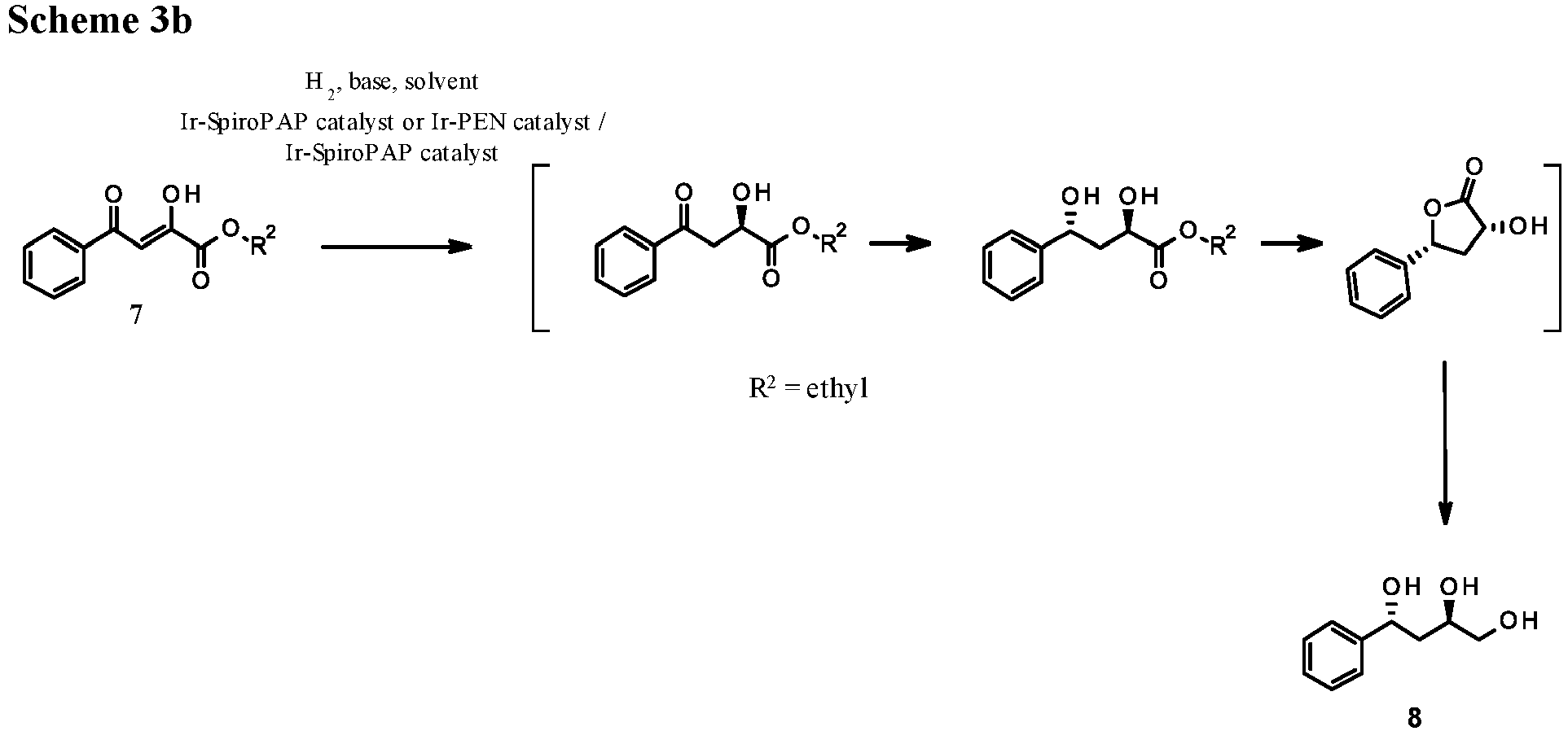
- a 35 mL autoclave was charged with 7 (250 mg, 1.1 mmol), 680 (1.1 mg, 1.1 x 10 -6 mol, S/C 1'000), KOtBu (12.1 mg, 1.1 x 10 -4 mol, S/B 10) and EtOH (5 mL).
- the autoclave was sealed and removed from the glove box, connected to a hydrogen line and pressurized with hydrogen gas to 70 bar and heated to 30°C. Under stirring, the hydrogenation was ran at a constant hydrogen pressure of 70 bar. After a total reaction time of 20 h, the autoclave was vented and allowed to cool to room temperature.
- reaction mixture was transferred with aid of EtOH (5 mL) from the autoclave into a 50 mL round bottomed flask and the orange reaction solution rotatory evaporated at 40°C / 10 mbar to constant weight to yield crude trans- 8 (presumable major enantiomer: ( R,R )- 8 , 245 mg) with >95% LC/MS purity.
Landscapes
- Chemical & Material Sciences (AREA)
- Organic Chemistry (AREA)
- Organic Low-Molecular-Weight Compounds And Preparation Thereof (AREA)
- Low-Molecular Organic Synthesis Reactions Using Catalysts (AREA)
- Catalysts (AREA)
- Nitrogen And Oxygen Or Sulfur-Condensed Heterocyclic Ring Systems (AREA)
Description
- The invention relates to a process for the preparation of the chiral triol of the formula I

- R1 is hydrogen or halogen and
- denotes either a dashed bond (a) or a wedged bond (b)

a)b) .

- Chiral triols are versatile building blocks for the preparation of various pharmaceutically active drug substances such as for instance for statin drugs (A. Lenhart, W.D. Chey "Adv. Nutr. 2017, 8(4), 587-596).
- C.Ticozzi, A.Zanarotti, Tetrahedron Letters, 1994, 35(40), 7421-7424 describe a synthesis of chiral triols by way of the diastereoselective reduction of a hydroxy ketone precursor (S)-2 or (R)-2 with borohydride type catalysts.
- The object of the present invention was to provide a process which allows the preparation of the chiral triol in a scalable manner with high enantiomeric purity and yield.
- The object could be reached with the process for the preparation of the chiral triol of formula I 3651

- R1 is hydrogen or halogen and
- denotes either a dashed bond (a) or a wedged bond (b)
a)b). - and which comprises the asymmetric hydrogenation of a ketone compound of formula IIa

wherein- R1 is hydrogen or halogen and
- R2 is C1-6-alkyl;
- with hydrogen in the presence of an iridium spiro-pyridylamidophosphine catalyst (Ir-SpiroPAP catalyst) of the formula IIIa or IIIb, or enantiomers thereof
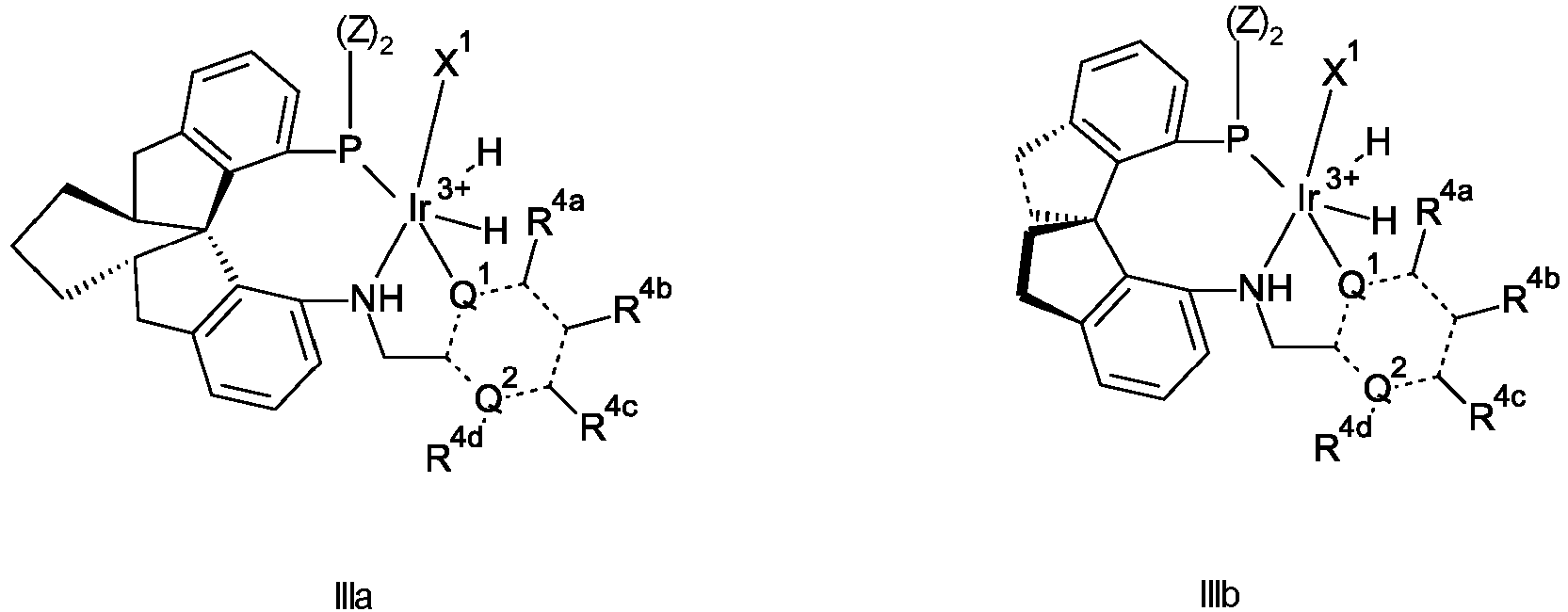
- R4a, R4b, R4c and R4d independently of each other are hydrogen or C1-6-alkyl;
- the dotted ring signifies an aromatic ring when Q1 is nitrogen and Q2 is carbon and the dotted ring signifies a cycloalkane ring wherein Q1 and Q2 are sulfur;
- X1 is either a coordinated ligand or a counter anion selected from halogen, C1-6-alkoxy, tetrahalogenoborate, hexahalogenoborate, tetrakis (3,5-bis(trihalogeno-C1-6-alkyl) phenyl)borate, acetylacetonate, hexahalogenophosphate, p-tolylsulfonate (OTs) or trihalogeno methanesulfonate and
- Z is phenyl, optionally substituted by one or more groups selected from
- C1-8-alkyl, C1-8-halogenalkyl or phenyl; C3-8-cycloalkyl, optionally substituted by one or more C1-8-alkyl groups or di- C1-8-alkyl phosphinyl.
- Unless otherwise defined, all technical and scientific terms used herein have the same meaning as commonly understood by one of ordinary skill in the art to which this invention belongs. Although methods and materials similar or equivalent to those described herein can be used in the practice or testing of the invention, suitable methods and materials are described below.
- The term "chiral" denotes the ability of non-superimposability with the mirror image, while the term "achiral" refers to embodiments which are superimposable with their mirror image. Chiral molecules are optically active, i.e., they have the ability to rotate the plane of plane-polarized light. Whenever a chiral center is present in a chemical structure, it is intended that all stereoisomers associated with that chiral center are encompassed by the present invention.
- The term "chiral" signifies that the molecule can exist in the form of optically pure enantiomers, mixtures of enantiomers, optically pure diastereoisomers or mixtures of diastereoisomers.
- In a preferred embodiment of the invention the term "chiral" denotes optically pure enantiomers or optically pure diastereoisomers.
- The term "stereoisomer" denotes a compound that possesses identical molecular connectivity and bond multiplicity, but which differs in the arrangement of its atoms in space.
- The term "diastereomer" denotes a stereoisomer with two or more centers of chirality and whose molecules are not mirror images of one another. Diastereomers may have different physical properties, e.g. melting points, boiling points, spectral properties, and reactivities.
- The term "enantiomers" denotes two stereoisomers of a compound which are non-superimposable mirror images of one another.
- In the structural formula presented herein a dashed bond (a) denotes that the substituent is below the plane of the paper and a wedged bond (b) denotes that the substituent is above the plane of the paper.
a)b). - The spiral bond (c) denotes both options i.e. either a dashed bond (a) or a wedged bond (b).
c) - The term "C-1-8- alkyl" denotes a monovalent linear or branched saturated hydrocarbon group of 1 to 8 carbon atoms. Examples of C1-8-alkyl include methyl, ethyl, propyl, isopropyl, n-butyl, isobutyl, sec-butyl, tert-butyl or pentyl, hexyl, heptyl or octyl with its isomers. Preferably the term denotes a C-1-6- alkyl group.
- The term "C3-8-cycloalkyl" denotes a saturated carbocycle of 3 to 8 carbon atoms. Examples of C3-8-cycloalkyl include cyclopropyl, cyclobutyl, cyclopentyl, cyclohexyl, cycloheptyl and cyclooctyl with its isomers. Preferably the term encompasses C4-7-cycloalkyl, more preferably cyclpentyl and cyclohexyl.
- The term "C-1-6- alkoxy" denotes a monovalent linear or branched saturated hydrocarbon group of 1 to 6 carbon atoms attached to an oxygen atom. Examples of C1-6-alkoxy include methoxy, ethoxy, propoxy, isopropoxy, n-butoxy, iso-butoxy, sec-butoxy, tert-butoxy, or pentoxy or hexoxy
- with its isomers. Preferably the term denotes a C-1-4- alkoxy group, more preferably the methoxy group.
- The term "halogen" denotes fluoro, chloro, bromo, or iodo.
- The term "C-1-8- halogenalkyl" denotes a monovalent linear or branched saturated hydrocarbon group of 1 to 8 carbon atoms which is substituted by one or more halogen atoms. Preferably the term denotes C-1-4- halogenalkyl, more preferably a methyl group which is substituted with one or more halogen atoms such as trifluoromethyl.
- The ketone of formula IIa may occur in the mesomeric structures outlined in the scheme below. For the sake of clarity the formula IIa is consistently used throughout this description.

- The process of the present invention can be illustrated with the scheme 1 below

- a) The asymmetric hydrogenation of the ketone of formula IIa in the sole presence of an Ir-SpiroPAP catalyst.
- b) The asymmetric hydrogenation of the ketone of formula IIa in the presence of an in situ formed Ir-SpiroPAP catalyst.
- c) The asymmetric hydrogenation of the ketone of formula IIa in the sole presence of an Ir-PEN catalyst to form the ketone of formula IIb and its subsequent asymmetric hydrogenation to the chiral triol of formula I in the presence of the Ir-SpiroPAP catalyst.
- d) The asymmetric hydrogenation of the ketone of formula IIa in the presence of a mixture of an Ir-SpiroPAP catalyst and an Ir-PEN catalyst.
- e) The asymmetric hydrogenation of either intermediate IIb, IIc or IId in presence of an Ir-SpiroPAP catalyst.
- The embodiments a) to d) are preferred, more preferred are the embodiments a), b) and d) and embodiment d) is most preferred.
- In a preferred embodiment of the present invention the chiral triol has the formula Ia

- R1 can be in the ortho-, meta- or para-position of the phenyl ring, but preferably R1 is in the para-position of the phenyl ring.
- In a further preferred embodiment of the present invention the chiral triol has the formula Ib

- Scheme 2 illustrates a preferred embodiment of the invention.

- The iridium spiro-pyridylamidophosphine catalyst (Ir-SpiroPAP catalyst) are of the formula IIIa or IIIb, or enantiomers thereof

- R4a, R4b, R4c and R4d independently of each other are hydrogen or C1-6-alkyl;
- the dotted ring signifies an aromatic ring when Q1 is nitrogen and Q2 is carbon and the dotted ring signifies a cycloalkane ring wherein Q1 and Q2 are sulfur;
- X1 is either a coordinated ligand or a counter anion selected from halogen, C1-6-alkoxy, tetrahalogenoborate, hexahalogenoborate, tetrakis (3,5-bis(trihalogeno-C1-6-alkyl)phenyl)borate, acetylacetonate, hexahalogenophosphate, p-tolylsulfonate (OTs) or trihalogeno methanesulfonate and
- Z is phenyl, optionally substituted by one or more groups selected from C1-8-alkyl, C1-8-halogenalkyl or phenyl; C3-8-cycloalkyl, optionally substituted by one or more C1-8-alkyl groups or di- C1-8-alkyl phosphinyl.
- In a preferred embodiment
- R4a, R4b, R4c and R4d independently of each other are hydrogen or C1-4-alkyl;
- the dotted ring signifies an aromatic ring when Q1 is nitrogen and Q2 is carbon and the dotted ring signifies a cycloalkane ring wherein Q1 and Q2 are sulfur;
- X1 is either a coordinated ligand or a counter anion selected from halogen, methoxy, tetrafluoroborate (BF4), hexafluoroborate (BF6), tetrakis(3,5-bis(trifluoromethyl) phenyl)borate (barf), acetylacetonate (acac), hexafluorophosphate (PF6), p-tolylsulfonate (OTs) or trifluoromethanesulfonate (OTf) and;
- Z is phenyl, optionally substituted by one or more groups selected from C1-6-alkyl, C1-4-halogenalkyl or phenyl or is C4-7-cycloalkyl.
- In a further preferred embodiment
- R4a, R4b, R4c and R4d independently of each other are hydrogen or C1-4-alkyl;
- the dotted ring signifies an aromatic ring when Q1 is nitrogen and Q2 is carbon and the dotted ring signifies a cycloalkane ring wherein Q1 and Q2 are sulfur;
- X1 is halogen;
- Z is phenyl, optionally substituted by one or two groups selected from C1-6-alkyl, C1-4-halogenalkyl or phenyl or is cyclopentyl or cyclohexyl.
- In a further preferred embodiment the iridium spiro-pyridylamidophosphine catalyst (Ir-SpiroPAP catalyst) are selected from the compounds


- R4a, R4b, R4c and R4d independently of each other are hydrogen or C1-4-alkyl;
- X1 is halogen;
- Z is phenyl optionally substituted by one or two groups selected from C1-6-alkyl, C1-4halogenalkyl or phenyl or is cyclopentyl or cyclohexyl.
- In a further preferred embodiment the iridium spiro-pyridylamidophosphine catalyst (Ir-SpiroPAP catalyst) is selected from the compound

- R4a, R4b, R4c and R4d independently of each other are hydrogen or C1-4-alkyl;
- X1 is a ligand selected from halogen;
- Z is phenyl, optionally substituted by one or two groups selected from C1-6-alkyl, C1-4-halogenalkyl or phenyl or is cyclopentyl or cyclohexyl.,
- R4a, R4b, R4c is hydrogen and R4d is methyl;
- X1 is chlorine and
- Z is phenyl, 3,5-dimetylphenyl, 3,5-di-tert-butyl phenyl, 3,5-di-tert-pentyl phenyl, 3,5-diphenyl phenyl, 4-phenyl phenyl, 3,5-di-trifluoromethyl phenyl, cyclohexyl or cyclopentyl.
- Suitable catalysts are typically commercially available e.g. from Jiuzhou Pharma in China.
- The asymmetric hydrogenation can be performed in the presence of suitable organic solvent and a base at a hydrogen pressure of 5 bar to 100 bar, preferably of 30 bar to 70 bar and at a reaction temperature of 10°C to 90°C, preferably of 20°C to 40°C.
- The organic solvent can be selected from aliphatic alcohols selected from methanol, ethanol, isopropanol, tert-amylalcohol, from halogen substituted alcohols like trifluoroethanol, from haloalkanes like dichloromethane, from ethers like tetrahydrofuran or dioxane or from aromatic solvents like toluene or mixtures thereof. Also suited are mixtures of aliphatic alcohols such as methanol or ethanol with water or with dioxane. The preferred solvent is methanol or ethanol, even more preferred ethanol.
- Suitable bases are inorganic bases selected from alkali or earth alkali- carbonates or - hydrogen carbonates or phosphates or hydrogenphosphates or dihydrogenphosphates or acetates or formates or organic bases selected from amines, alkali alcoholates or amidines. Organic bases are usually preferred. Typical representatives of organic bases are potassium tert-butylate or 1,8-Diazabicyclo[5.4.0]undec-7-ene (DBU), 1,4-Diazabicyclo(2.2.2)octane (DABCO) and 7-Methyl-1,5,7-triazabicyclo[4.4.0]dec-5-ene (MTBD), most preferred is DBU.
- A substrate to catalyst ratio can expediently be chosen in a range of 100 to 10'000, preferably in a range of 1000 to 5000.
- The chiral triol of formula I can be separated from the reaction mixture by evaporation of the solvent. Subsequent crystallization in a suitable solvent, typically in ketones like methyl isobutyl ketone or esters like isopropyl acetate renders the chiral triol of formula I in good yields, high purity and high enantiomeric excess.
- In another embodiment the iridium spiro-pyridylamidophosphine catalyst (Ir-SpiroPAP catalyst) of formula IIIa or IIIb may be prepared in situ in the course of the asymmetric hydrogenation reaction by bringing together a suitable Iridium-pre catalyst complex with a spiro-pyridylamidophosphine ligand of the formula

R4a, R4b, R4c and R4d, Q1 and Q2 and Z have the meanings as outlined above. Suitable Iridium-pre catalyst complex compounds are commercially available e.g. from Sigma Aldrich and can be selected e.g. from [Ir(cod)2]BF4, [IrCl(COD)]2, [Ir(acac)(COD)], [Ir(OMe)(COD)]2, [Ir(cod)2]BARF, [Ir(cod)2]PF6, wherein cod or COD has the meaning of cyclooctadiene, acac the meaning of acetylacetonate, BARF the meaning of tetrakis(3,5-bis(trifluoromethyl)phenyl)borate and OMe the meaning of methoxy. - Preferred Iridium-pre catalyst complex compound is [IrCl(COD)]2.
- Usually the iridium-pre catalyst complex compound and the spiro-pyridylamidophosphine ligand are typically mixed in the presence of the organic solvent and the base mentioned under embodiment a).
- The substrate to Iridium ratio as a rule is adjusted between 100 and 10000, preferably between 1000 and 5000. The substrate to ligand ratio as a rule is adjusted between 0.5 and 1.5, preferably between 0.9 and 1.1.
- The asymmetric hydrogenation conditions and the isolation of the chiral triol of formula I can otherwise be chosen as for the process of embodiment a). Also the preferred embodiments outlined in embodiment a) apply likewise.
- The iridium-phenylendiamine catalyst (Ir-PEN catalyst) are of the formula IVa or IVb, or enantiomers thereof
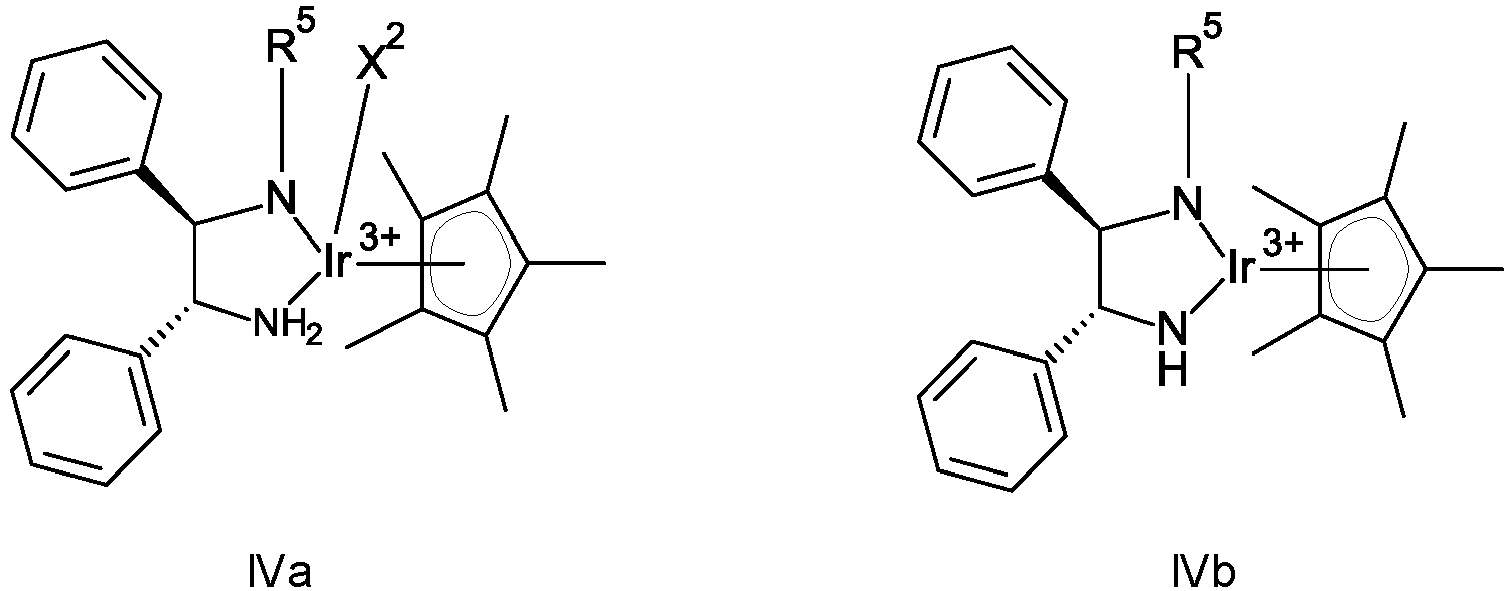
- R5 is C1-6-alkylsulfonyl wherein the alkyl group is optionally substituted with one or more halogen atoms; with a 7,7-dimethyl-2-oxobicyclo[2.2.1] heptane-1-yl group or phenyl sulfonyl, wherein the phenyl group is optionally substituted by one or more C1-6-alkyl groups and
- X2 is either a coordinated ligand or a counter anion selected from a C1-6-alkylsulfonyloxy group which is optionally substituted with one or more halogen, atoms; from halogen, C1-6-alkoxy, tetrahalogenoborate, hexahalogenoborate, tetrakis(3,5-bis(trihalogeno-C1-6-alkyl)phenyl)borate, acetylacetonate, hexahalogenophosphine, p-tolylsulfonate (OTs) or trihalogenomethanesulfonate;
- In a preferred embodiment the iridium-phenylendiamine catalyst (Ir-PEN catalyst) are of the formula IVa or IVb, or enantiomers thereof, wherein R5 is methylsulfonyl, trifluoromethylsulfonyl, 7,7-dimethyl-2-oxobicyclo[2.2.1] heptane-1-yl; tolylsulfonyl or 1,3,5-tri-i-propylphenyl sulfonyl;
- X2 is either a coordinated ligand or a counter anion selected from a methylsulfonyloxy group which is optionally substituted with one or more fluoro atoms; from halogen, methoxy, tetrafluoroborate (BF4), hexafluoroborate (BF6), tetrakis(3,5-bis(trifluoromethyl)phenyl)borate (barf), acetylacetonate (acac), hexafluorophosphate (PF6), p-tolylsulfonate (OTs) or trifluoromethanesulfonate (OTf;
- In a further preferred embodiment the iridium-phenylendiamine catalyst (Ir-PEN catalyst) are of the formula IVa, or enantiomers thereof, wherein,
- R5 is methylsulfonyl, trifluoromethylsulfonyl, 7,7-dimethyl-2-oxobicyclo[2.2.1] heptane-1-yl; tolylsulfonyl or 1,3,5-tri-i-propylphenyl sulfonyl;
- X2 is a trifluoromethylsulfonyl oxy group;
- In a further preferred embodiment the iridium-phenylendiamine catalyst (Ir-PEN catalyst) are of the formula IVb, or enantiomers thereof, wherein,
R5 is methylsulfonyl, trifluoromethylsulfonyl, 7,7-dimethyl-2-oxobicyclo[2.2.1] heptane-1-yl; tolylsulfonyl or 1,3,5-tri-i-propylphenyl sulfonyl. - In a further preferred embodiment the iridium-phenylendiamine catalyst (Ir-PEN catalyst) are selected from compounds of the formula IVc and IVd

- The asymmetric hydrogenation for the formation of the ketone of formula IIb of can be performed in the presence of suitable organic solvent at a hydrogen pressure of 5 bar to 100 bar, preferably of 30 bar to 70 bar and at a reaction temperature of 10 °C to 90°C, preferably of 20°C to 40°C.
- The organic solvent can be selected from aliphatic alcohols selected from methanol, ethanol, isopropanol, tert-amylalcohol, from halogen substituted alcohols like trifluoroethanol, from haloalkanes like dichloromethane, from ethers like tetrahydrofuran or dioxane or from aromatic solvents like toluene or mixtures thereof. Also suited are mixtures of aliphatic alcohols such as methanol or ethanol with water or with dioxane. The preferred solvent is methanol or ethanol, even more preferred ethanol.
- The reaction can be performed without the presence of a base.
- However, bases are tolerated. Suitable bases are inorganic bases selected from alkali or earth alkali- carbonates or - hydrogen carbonates or phosphates or hydrogenphosphates or dihydrogenphosphates or acetates or formates or organic bases selected from amines, alkali alcoholates or amidines. Organic bases are usually preferred. Typical representatives of organic bases are potassium tert-butylate or 1,8-Diazabicyclo[5.4.0]undec-7-ene (DBU), 1,4-Diazabicyclo(2.2.2)octane (DABCO) and 7-Methyl-1,5,7-triazabicyclo[4.4.0]dec-5-ene (MTBD), most preferred is DBU.
- A substrate to catalyst ratio can expediently be chosen in a range of 100 to 10000, preferably in a range of 500 to 1000.
- The ketone of formula IIb can be separated from the reaction mixture by evaporation of the solvent. Subsequent crystallization in a suitable solvent, typically in an aliphatic alcohol like i-propanol renders the ketone of formula IIb in good yields, high purity and high enantiomeric excess. Alternatively the ketone of formula IIb is not isolated and is further hydrogenated to the chiral triol of formula I in the presence of the Ir-SpiroPAP catalyst.
- The subsequent asymmetric hydrogenation can take place in the same manner as described in embodiment a)
- In this embodiment the asymmetric hydrogenation is performed in the presence of a mixture of the Ir-SpiroPAP catalyst and an Ir-PEN catalyst.
- Typically the Ir-PEN catalyst catalyzes the first step of the reaction i.e. the transformation to the ketone of formula IIb faster and with a higher chiral selectivity than the Ir-SpiroPAP catalyst.
- Therefore, regarding catalyst concentration of the two catalysts a higher Ir-PEN catalyst concentration is as a rule applied.
- The substrate to Ir-PEN catalyst ratio can therefore expediently be chosen in a range of 100 to 10000 preferably in a range of 500 to 1000.
- The substrate to Ir-Spiro-PAP catalyst ratio can expediently be chosen in a range of 100 to 10000, preferably in a range of 2500 to 7500.
- The asymmetric hydrogenation can be performed in the presence of suitable organic solvent and a base at a hydrogen pressure of 5 bar to 100 bar, preferably of 30 bar to 70 bar and at a reaction temperature of 10°C to 90°C, preferably of 20°C to 40°C.
- The organic solvent can be selected from aliphatic alcohols selected from methanol, ethanol, isopropanol, tert-amylalcohol, from halogen substituted alcohols like trifluoroethanol, from haloalkanes like dichloromethane, from ethers like tetrahydrofuran or dioxane or from aromatic solvents like toluene or mixtures thereof. Also suited are mixtures of aliphatic alcohols such as methanol or ethanol with water or with dioxane. The preferred solvent is methanol or ethanol, even more preferred ethanol.
- Suitable bases are inorganic bases selected from alkali or earth alkali- carbonates or - hydrogen carbonates or phosphates or hydrogenphosphates or dihydrogenphosphates or acetates or formates or organic bases selected from amines, alkali alcoholates or amidines. Organic bases are usually preferred. Typical representatives of organic bases are potassium tert-butylate or 1,8-Diazabicyclo[5.4.0]undec-7-ene (DBU), 1,4-Diazabicyclo(2.2.2)octane (DABCO) and 7-Methyl-1,5,7-triazabicyclo[4.4.0]dec-5-ene (MTBD), most preferred is DBU.
- The chiral triol of formula I can be separated from the reaction mixture by evaporation of the solvent. Subsequent crystallization in a suitable solvent, typically in ketones like methyl isobutyl ketone or esters like isopropyl acetate renders the chiral triol of formula I in good yields, high purity and high enantiomeric excess.
- The intermediates IIb, IIc or IId typically need not to be isolated and can directly be converted to the desired chiral triol of formula I.
- Intermediate IIb can be prepared and isolated in accordance with embodiment c).
- Also intermediate IIc or IId can in principle be isolated by interrupting the hydrogenation at the appropriate stage and individually be subjected to the asymmetric hydrogenation with either the Ir-Spiro PAP catalyst alone or in the presence of a mixture of an Ir-SpiroPAP catalyst and an Ir-PEN catalyst. The reaction conditions as described in the previous embodiments can likewise be applied.
- As outlined above the embodiments a) to d) are preferred, more preferred are the embodiments a), b) and d) and embodiment d) is most preferred.
-
EtOH Ethanol iPr2O Diisopropyl ether MeOH Methanol DCM Dichloromethane Dioxane 1,4-Dioxane iPrOH 2-Propanol iPrOAc Isopropyl acetate tAmOH tert-Amylalcohol TFE Trifluoroethanol THF Tetrahydrofuran DBU Diazabicycloundecene DABCO 1,4-Diazabicyclo(2.2.2)octane MTBD Triazabicyclodecene DBN 1,5-Diazabicyclo(4.3.0)non-5-ene BIPY Biypridine COD Cyclooctadiene rt Room temperature IPC In process control T Temperature P Hydrogen pressure eq Equivalent rct Reaction time con Conversion exp Experiment S/C Substrate-to-Catalyst ratio S/L Substrate-to-Ligand ratio S/B Substrate-to-Base ratio S/Ir Substrate-to-Iridium ratio 1 4-(4-Chlorophenyl)-2-hydroxy-4-keto-butyric-2-en-acid ethyl ester (Note: 1H-NMR spectra data of 1 in D6-EtOH or CD2Cl2 confirmed the structure to be assigned as: 4-(4-chlorophenyl)-2-hydroxy-4-keto-butyric-2-en-acid ethyl ester. No hint was found for the presence of 4-(4-Chlorophenyl)-2-diketo-butyric acid ethyl ester) (R) -3 = (2R) -3 (2R)-4-(4-Chlorophenyl)-2-hydroxy-4-keto-butyric acid ethyl ester (R,R)- 4 = trans-(2R,4R)-4 (2R,4R)-4-(4-Chlorophenyl)-2,4-dihydroxy-butyric acid ethyl ester trans- 4 mix of (R,R)- 4 and (S,S)-4 cis- 4 mix of (R,S)- 4 and (S,R)- 4 (R,R)-5 = cis-(3R,5R)-5 (3R,5R)-5-(4-Chlorophenyl)-3 -hydroxy-butyrolactone cis-5 mix of (R,R)-5 and (S,S)-5 trans-5 mix of (R,S)-5 and (S,R)-5 (R,R)-6 = trans-(2R,4R)-6 (2R,4R)-4-(4-Chlorophenyl)-butane-1,2,4-triol trans-6 mix of (R,R)-6 and (S,S)-6 cis-6 mix of (R,S)-6 and (S,R)-6 7 4-(Phenyl)-2-hydroxy-4-keto-butyric-2-en-acid ethyl ester (Note: 1H-NMR spectra data of 7 in CD2Cl2 confirmed the structure to be assigned as: 4-(Phenyl)-2-hydroxy-4-keto-butyric-2-en-acid ethyl ester. No hint was found for the presence of 4-(Phenyl)-2-diketo-butyric acid ethyl ester) (R,R)-8 = trans-(2R,4R)-8 (2R,4R)-4-(Phenyl)-butane-1,2,4-triol trans-8 mix of (R,R)-8 and (S,S)-8 cis-8 mix of (R,S)-8 and (S,R)-8 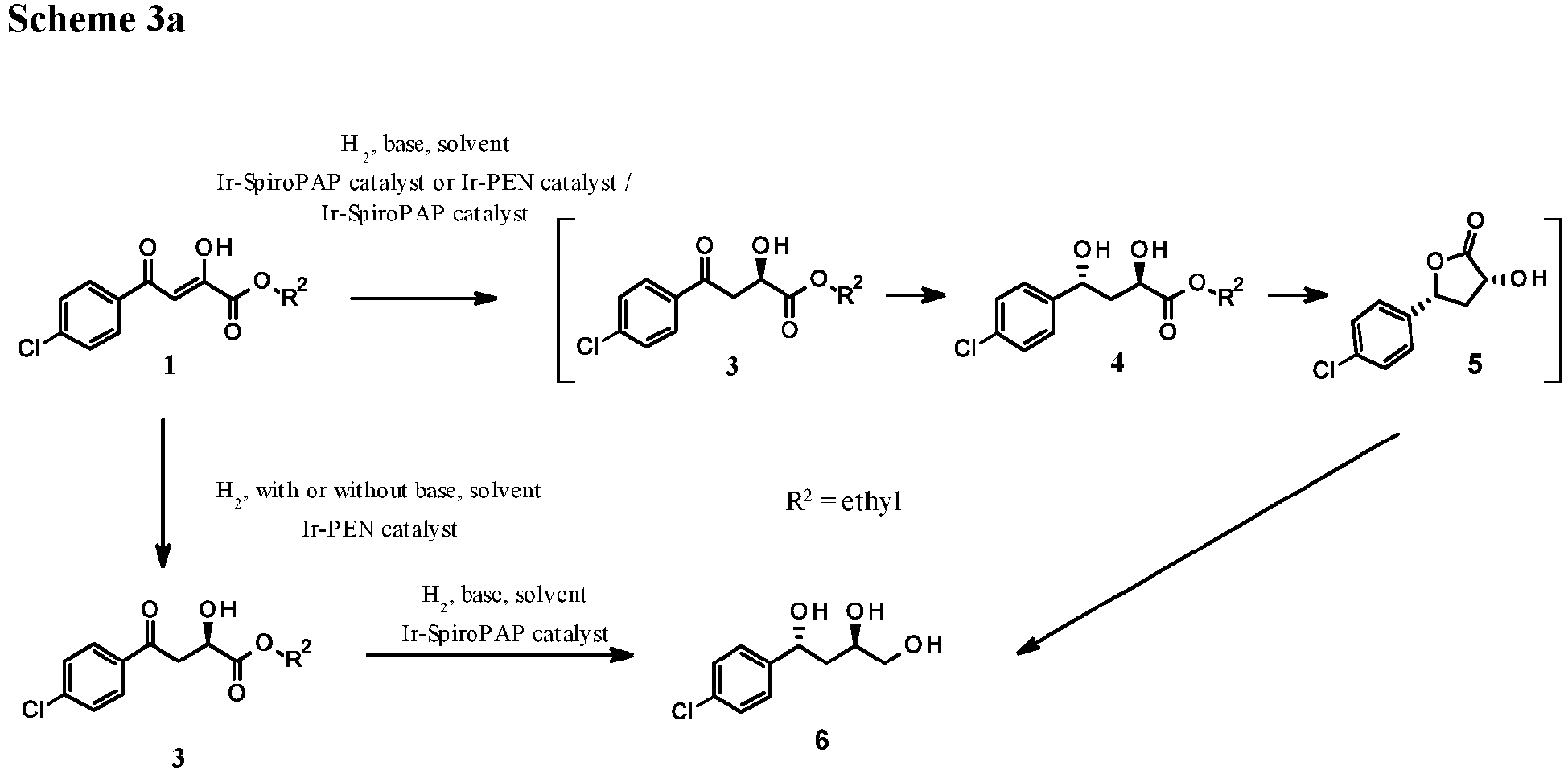
- 627-630 and 6051-6056 were prepared according to T. Ohjuma et al. Organic Letters, 2007, 9, 2565. All other (pre-) catalysts and ligands were commercially available e.g. from Strem, Sigma Aldrich, Jiuzhou Pharma.
(Pre-) Catalysts and Ligands Number Abbreviation Structure 627 [Ir(cp*)((S,S)-Ms-DPEN-2H)] CAS No 937378-51-3 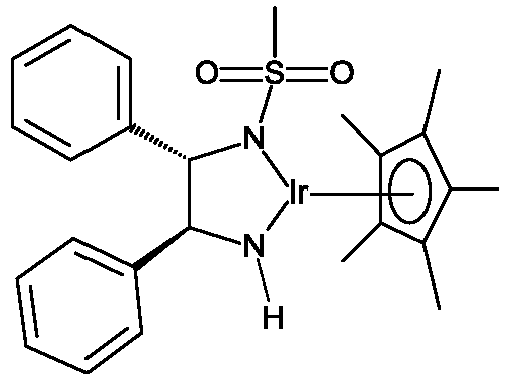
628 [Ir(cp*)((S,S)-Ms-DPEN-H)(OTf)] CAS No 917756-11-7 
629 [Ir(cp*)((R,R)-Ms-DPEN-2H)] CAS No 1263000-75-4 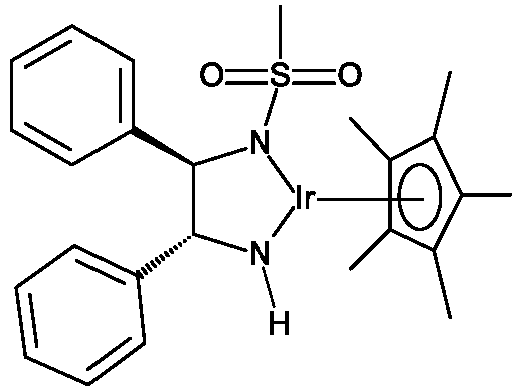
630 [Ir(cp*)((R,R)-Ms-DPEN-H))(OTf)] CAS No 1201686-18-1 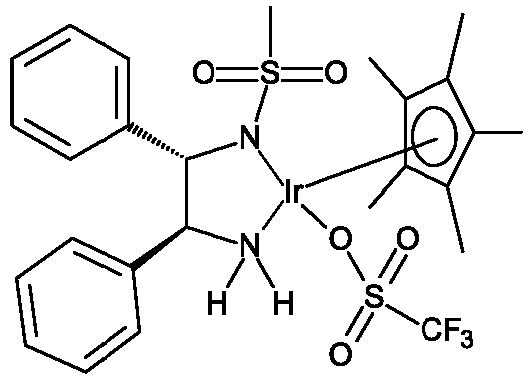
6051 [Ir(cp*)((R,R)-Ts-DPEN-2H)] CAS No 401479-02-5 
6052 [Ir(cp*)((R,R,R)-Cs-DPEN-2H)] CAS No 895579-52-9 
6053 [Ir(cp*)((S,S)-TFMs-DPEN-2H)] CAS No 1807637-08-6 
6054 [Ir(cp*)((S,S)-TIPBs-DPEN-2H)] CAS No.1073339-77-1 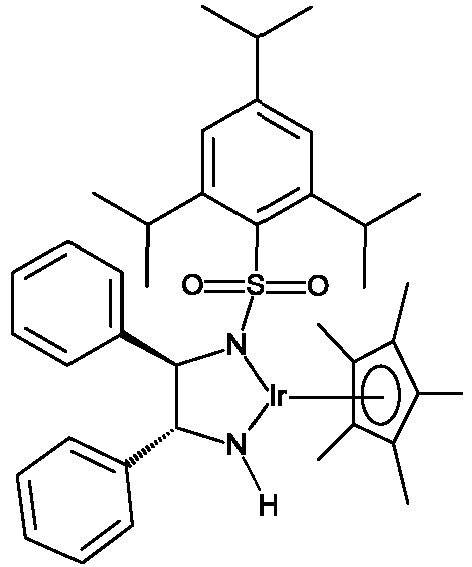
6055 [Ir(cp*)((S,S)-Ts-1,3,5-MeDPEN-2H)] CAS No 2376389-13-6 
6056 [Ir(cp*)((R,R)-Ts-DACH-2H)] CAS No. 1099830-96-2 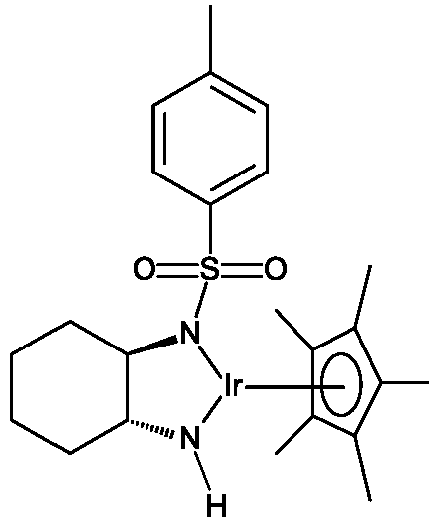
680 [IrClH2((S)-DTB-SpiroPAP-3-Me)] CAS No 1418483-59-6 
Available from Jiuzhou Pharma, CN Catalogue No. JZ-S033-2 682 [IrClH2((S)-DTB-SpiroSAP)] CAS No not available 
Available from Jiuzhou Pharma, CN Catalogue No. JZ-S034-2 6046 [IrClH2((S,S,S)-DTB-PSpiroPAP-3-Me)] CAS No not available 
Available from Jiuzhou Pharma, CN Catalogue No. JZ-S036-1 6048 [IrClH2((S)-DTB-SpiroPAP)] CAS No not available 
Available from Jiuzhou Pharma, CN Catalogue No. not available 6049 [IrClH2(R)-DTB-SpiroPAP-4-tBu)] CAS No not available 
Available from Jiuzhou Pharma, CN Catalogue No. not available 6050 [IrClH2((R)-DTB-SpiroPAP-6-Me)] CAS No not available 
Available from Jiuzhou Pharma, CN Catalogue No. not available 1508 (S)-DTB-SpiroPAP-3-Me CAS No not available 
Available from Jiuzhou Pharma, CN Catalogue No. JZ-S022-2 600 [Ir(cod)2]BF4 CAS No 35138-23-9 
601 [IrCl(COD)]2 CAS No 12112-67-3 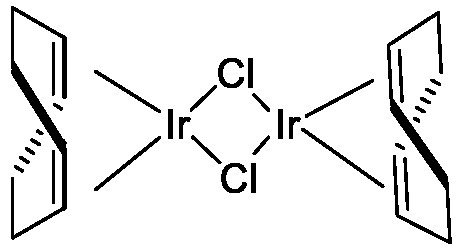
650 [Ir(acac)(COD)] CAS No 12154-84-6 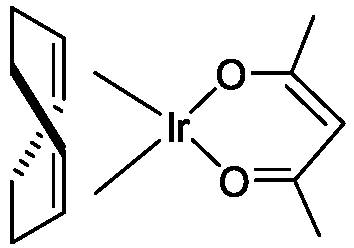
657 [Ir(OMe)(COD)]2 CAS No 12148-71-9 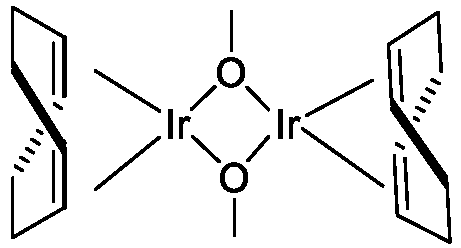
-
Stationary phase Kinetex® (2.6 µm PFP 100 Å, LC Column 50 x 4.6 mm) Eluent: A) Acetonitrile B) H2O + 5% Acetonitrile D) TBAHS Puffer (1g TBAHS in 800 mL Acetonitrile und 200 mL H2O). Pump program (gradient): 10 A : 80 B : 10 D → 80 A: 10 B: 10 D Run time: 16 min Flow: 1mL/min Column oven temperature 40°C Injection volume: 5 uL Detection: DAD 210 nm Retention Times: 1, 13.23 min ; 3, 6.91 min ; trans-4, 6.04 min ; cis-4, 5.73 min ; trans-5, 5.49 min ; cis-5, 5.19 min ; trans-6 2.40 min ; cis-6 2.18 min -
Stationary phase: Daicel Chiralpak IC-3, L = 150 mm, ID = 4.6 mm, 3.0 µm Eluent: A) H2O + 5% Acetonitrile B) Acetonitrile C) 6.25-6.35 g ammonium formate in 950.0 mL Water adjusted to pH 9.0 with ammonium hydroxide solution (25%) + 50.0 mL acetonitrile pump program (isocratic): 60 A : 30 B : 10 C Run time: 20 min Flow: 1mL/min Column oven temperature: 30°C Injection volume: 2.5 uL Detection: DAD 254 nm Retention Times: (S)-3, 10.60 min; (R)-3, 12.20 min -
Stationary phase: Daicel Chiralpak IB-N; L = 150mm, ID = 4.6mm, 3.0µm Eluent: A) CO2 B) Isopropanol, pump program (isocratic): 90 A : 10 B Run time: 9 min Flow: 3mL/min Column oven temperature: 20°C Injection volume: 5 uL Detection: DAD 220 nm Retention Times: 1, 1.19 min; (R)-3, 1.85 min; (S)-3, 1.95 min; (R,R)-4, 2.24 min; (S,S)-4, 2.58 min; (R,S)-4, 3.09 min; (S,R)-4, 3.93 min; (R,R)- 5 , 3.08 min; (S,S)-5, 3.92 min; (R,S)-5, 2.33 min; (S,R)-5, 2.33 min; (R,R)-6, 5.11 min; (S,S)-6, 5.78 min; (R,S)-6, 6.37 min; (S,R)-6, 6.95 min - In a glove box under argon atmosphere, a 380 mL autoclave was charged with 1 (20.0 g, 78.5 mmol), 630 (60.2 mg, 78.3 x 10⁻⁶ mol, S/C 1'000) and EtOH (200 mL). The autoclave was sealed and removed from the glove box, connected to a hydrogen line, pressurized with hydrogen gas to 70 bar and heated to 30°C. Under stirring, the hydrogenation was ran at a constant hydrogen pressure of 70 bar. Reaction samples were taken after 1 h (50% conversion) and 2 h (>99.9 % conversion) to follow the progress of the reaction. After a total reaction time of 2.5 h, the autoclave was vented and allowed to cool to room temperature. The reaction mixture was transferred with aid of EtOH (20 mL) from the autoclave into a 500 mL round bottomed flask and the orange reaction solution rotatory evaporated at 40°C / 10 mbar to constant weight to yield crude (R)-3 (19.9 g) with 96.7 area-% purity and 94.3% ee. 0.9% of trans-4 was detected as major impurity (note: trans-4 demonstrated to have limited stability and converted during handling and storage gradually into trans-5).
- Next, crude (R)-3 (5.00 g) was dissolved in iPr2O (25 mL) at 60°C. The clear solution was allowed to cool to 0°C within 6 h and stirred at this temperature for another 1.5 h. The formed white crystals were filtered, washed with 9 mL of ice cold iPr2O and dried for 1 h at 40°C under vacuum (10 mbar) to afforded pure (R)-3 (4.15 g, 82% yield) with 99.9 area-% purity and 99.6% ee.
-
- LC-MS ESI (m/z): 256.0 [M+]
- 1H-NMR (CDCl3, 600 MHz): δ ppm 7.89 (d, J=8.8 Hz, 2H), 7.41 - 7.50 (m, 3H), 4.65 (td, J=5.8, 3.8 Hz, 1H), 4.28 (q, J=7.2 Hz, 2H), 3.46 - 3.53 (m, 1H), 3.38 - 3.45 (m, 1H), 3.27 (d, J=5.6 Hz, 1H), 1.29 (t, J=7.1 Hz, 3H)
-
- GC-MS ESI (m/z): 258.0 [M+]
- 1H NMR (DMSO-D6, 600 MHz): δ ppm 7.35 - 7.38 (m, 2 H), 7.32 - 7.35 (m, 2 H), 5.44 (br s, 2 H), 4.73 (br d, J=9.6 Hz, 1 H), 4.25 (br d, J=8.6 Hz, 1 H), 4.06 (q, J=7.1 Hz, 2 H), 1.53 - 1.78 (m, 1 H), 1.45 - 1.99 (m, 1 H), 1.17 (t, J=7.1 Hz, 3 H)
- In a glove box under argon atmosphere, a 380 mL autoclave was charged with 1 (20.0 g, 78.5 mmol), 629 (48.4 mg, 78.3 x 10⁻⁶ mol, S/C 1'000) and EtOH (200 mL). The autoclave was sealed and removed from the glove box, connected to a hydrogen line, pressurized with hydrogen gas to 70 bar and heated to 30°C. Under stirring, the hydrogenation was ran at a constant hydrogen pressure of 70 bar. A reaction sample was taken after 3.5 h (98% conversion) to follow the progress of the reaction. After a total reaction time of 4 h, the autoclave was vented and allowed to cool to room temperature. The reaction mixture was transferred with aid of EtOH (20 mL) from the autoclave into a 500 mL round bottomed flask and the orange reaction solution rotatory evaporated at 40°C / 10 mbar to constant weight to yield crude (R)-3 (20.0 g) with 94 area-% purity and 94.5% ee. 1.3% of trans-4 was detected as major impurity. Next, crude (R)-3 (20.0 g) was dissolved in iPr2O (200 mL) at 40°C. The clear solution was then allowed to cool to 0°C within 6 h and stirred at this temperature for another 1.5 h. The formed white crystals were filtered, washed with 45 mL of ice cold iPr2O and dried for 1 h at 40°C under vacuum (10 mbar) to afforded 15.62 g of pure (R)-3 (15.62 g, 78% yield) with 99.2 area-% purity and 99.8% ee.
- In analogy to Example 1.1, 1 (0.5 g, 1.96 mmol) was hydrogenated for 20 h in EtOH (5 mL) and the presence of the catalysts as listed in Table 1 at 30°C and an initial hydrogen pressure of 70 bar H2.
Table 1: exp catalyst conv 3 (R)-3 trans-4 [%] [area-%] [% ee] [area-%] 1.3 629 >99.9 90 95.0 7 1.4 6051 >99.9 95.8 95.0 2.2 1.5 6052 >99.9 94 92 1.9 1.6 6053 60 40 63 (S) 0 - In analogy to Example 1.1, 1 (0.25 g, 0.98 mmol) was hydrogenated for 2 h in EtOH (5 mL) and the presence of the catalysts as listed in Table 2 at 30°C and an initial hydrogen pressure of 70 bar H2.
Table 2: exp catalyst conv 3 (R)-3 trans-4 [%] [area-%] [% ee] [area-%] 1.7 629 59 52 95.0 0 1.8 6054 21 9 n.d. 0 1.9 6055 9 7 n.d. 0 1.10 6056 42 38 15 0 - In analogy to Example 1.1, 1 (0.25 g, 0.98 mmol) was hydrogenated for 2 h in EtOH (5 mL) at 30°C in the presence of the catalysts (S/C 1'000) and initial hydrogen pressures as listed in Table 3.
Table 3: exp catalyst p conv 3 (R)-3 trans-4 [bar] [%] [area-%] [% ee] [area-%] 1.11 629 30 75 71 n.d. 0 1.12 629 50 89 87 n.d. 0 1.13 630 30 >99.9 96.5 95.7 0 1.14 630 50 >99.9 95.9 95.7 0.4 - In analogy to Example 1.1, 1 (0.25 g, 0.98 mmol) was hydrogenated for 2 h in EtOH (5 mL) at 30°C and an initial hydrogen pressures of 70 bar in the presence of various amounts of catalysts and DBU as base as listed in Table 4.
Table 4: exp catalyst S/C DBU conv 3 (R)-3 trans-4 [eq] [%] [area-%] [% ee] [area-%] 1.15 630 1'000 - >99.9 96.3 95.6 0.3 1.16 630 1'000 10 95.0 94.5 96.5 0 1.17 630 500 50 >99.9 97 n.d. 1.4 1.18 630 1000 50 98.3 96.9 96.4 0 1.19 630 2'000 50 56 55 n.d. 0 1.20 630 2'000 - 46 46 n.d. 0 - In a glove box under argon atmosphere, a 380 mL autoclave was charged with 1 (10.0 g, 39.3 mmol), 680 (38.4 mg, 39.3 x 10⁻⁶ mol, S/C 1'000), DBU (597.8 mg, 3.93 mmol, S/B 10) and EtOH (200 mL). The autoclave was sealed and removed from the glove box, connected to a hydrogen line and pressurized with hydrogen gas to 70 bar and heated to 30°C. Under stirring, the hydrogenation was run at a constant hydrogen pressure of 70 bar. After a total reaction time of 20 h (>99.9% conversion), the autoclave was vented and allowed to cool to room temperature. The reaction mixture was transferred with aid of EtOH (20 mL) from the autoclave into a 500 mL round bottomed flask and the orange reaction solution rotatory evaporated at 40°C / 10 mbar to constant weight to yield crude 6 (9.0 g) with 98.4 area-% purity (DBU not integrated) and a trans/cis ratio of 7.7. (R,R)-6 was obtained with 98.8% ee.
-
- GC-MS ESI (m/z): 212.0 [M+]
- 1H-NMR (DMSO-D6, 600 MHz): δ 7.47 - 7.51 (m, 2H), 7.42 (d, J=8.3 Hz, 2H), 6.02 (br s, 1H), 5.40 (dd, J=10.8, 5.4 Hz, 1H), 4.62 (dd, J=10.7, 8.6 Hz, 1H), 2.89 (ddd, J= 12.2, 8.2, 5.4 Hz, 1H), 1.93 (dt, J=12.1, 11.0 Hz, 1H)
-
- GC-MS ESI (m/z): 212.0 [M+]
- 1H-NMR (DMSO-D6, 600 MHz): δ 7.47 (d, J=8.7 Hz, 2 H), 7.40 - 7.42 (m, 2 H), 6.18 (br d, J=5.2 Hz, 1 H), 5.68 (t, J=6.7 Hz, 1H), 4.38 (dt, J=7.0, 4.9 Hz, 1 H), 2.44 - 2.48 (m, 1 H), 2.36 - 2.42 (m, 1 H)
-
- GC-MS ESI (m/z): 216.0 [M+]
- 1H NMR (400 MHz, DMSO) δ 7.40 - 7.31 (m, 4H), 5.23 (d, J = 4.9 Hz, 1H), 4.75 (dd, J = 9.9, 4.8 Hz, 1H), 4.50 (dd, J = 6.5, 5.5 Hz, 2H), 3.68 - 3.67 (m, 1H), 3.30 - 3.24 (m, 2H), 1.67 - 1.61 (m, 1H), 1.44 - 1.39 (m, 1H).
- 13C NMR (101 MHz, DMSO) δ 146.6, 131.3, 128.4, 127.9, 68.7, 68.6, 66.8, 44.3.
-
- GC-MS ESI (m/z): 216.0 [M+]
- 1H-NMR (CDCl3, 600 MHz): δ ppm 7.31-7.34 (m, 2H), 7.32 (s, 2H), 4.98 (dd, J=9.9, 2.5 Hz, 1H), 4.04 (br d, J= 2.4 Hz, 1H), 3.45-3.70 (m, 2H), 2.76 (s, 1H), 1.65-1.95 (m, 2H), 1.08 (s, 2H).
- 13C_NMR (CDCl3, 151 MHz) δ 142.7, 133.3, 128.7, 127.1, 73.82, 72.3, 66.7, 41.6.
- In a glove box under argon atmosphere, a 380 mL autoclave was charged with 1 (10.0 g, 39.3 mmol), 601 (29.4 mg, 19.6 x 10⁻⁶ mol, S/Ir 1'000), 1508 (13.2 mg, 39.3 x 10⁻⁶ mol, S/L 1'000), DBU (597.8 mg, 3.93 mmol, S/B 10) and EtOH (200 mL). The autoclave was sealed and removed from the glove box, connected to a hydrogen line and pressurized with hydrogen gas to 70 bar and heated to 30°C. Under stirring, the hydrogenation was ran at a constant hydrogen pressure of 70 bar. After a total reaction time of 20 h (>99.9% conversion), the autoclave was vented and allowed to cool to room temperature. The reaction mixture was transferred with aid of EtOH (20 mL) from the autoclave into a 500 mL round bottomed flask and the orange reaction solution rotatory evaporated at 40°C / 10 mbar to constant weight to yield crude 6 (9.1 g) with 96.5 area-% purity (DBU not integrated) and a trans/cis ratio of 8.3. (R,R)-6 was obtained with >99.9% ee.
- In a glove box under argon atmosphere, a 380 mL autoclave was charged with 1 (10.0 g, 39.3 mmol), 601, 29.4 mg, 19.6 x 10⁻⁶ mol, S/Ir 1'000), 1508 (13.2 mg, 39.3 x 10⁻⁶ mol, S/L 1'000), KOtBu (437.6 mg, 3.93 mmol, S/B 10) and EtOH (200 mL). The autoclave was sealed and removed from the glove box, connected to a hydrogen line and pressurized with hydrogen gas to 70 bar and heated to 30°C. Under stirring, the hydrogenation was ran at a constant hydrogen pressure of 70 bar. After a total reaction time of 42 h (>99.9% conversion), the autoclave was vented and allowed to cool to room temperature. The reaction mixture was transferred with aid of EtOH (20 mL) from the autoclave into a 500 mL round bottomed flask and the orange reaction solution rotatory evaporated at 40°C / 10 mbar to constant weight to yield crude 6 (9.0 g) with 84.2 area-% purity and a trans/cis ratio of 8.0. (R,R)-6 was obtained with 98.6% ee.
- In analogy to Example 2.1, 1 (0.25 g, 0.98 mmol) was hydrogenated for 20 h in EtOH (5 mL) at 30°C and an initial hydrogen pressure of 70 bar in the presence KOtBu (4.9 x 10⁻⁵ mol, S/B 20) and of the catalysts (S/C 1'000) as listed in Table 5.
Table 5: exp cat conv 3 trans-4 trans-5 6 (R,R)-6 6 [%] [area-%] [area-%] [area-%] [area-%] [%ee] [trans/cis] 2.4 682 >99.9 0 51 27 15 99.9 35 2.5 6046 85 67 0 0 0 - - 2.6 6048 >99.9 0.3 0 1.2 93 99.9 7.8 2.7 6049 99.1 1.1 0 1.4 88 99.8 7.2 2.8 6050 77 56 0.4 0 0 - - - In analogy to Example 2.2, 1 (0.25 g, 0.98 mmol) was hydrogenated for 20 h in EtOH (5 mL) at 30°C and an initial hydrogen pressure of 70 bar in the presence of 1508 (0.98 x 10⁻⁶ mol, S/L 1'000), the presence or absence of DBU (0.98 x 10⁻⁴ mol, S/B 10) and the presence of a pre-catalyst (S/Ir 1'000) as listed in Table 6.
Table 6: exp pre-catalyst base conv 3 trans-4 trans-5 6 (R,R)-6 6 [%] [area-%] [area-%] [area-%] [area-%] [%ee] [trans/cis] 2.9 600 DBU 99.5 0 1.0 1.5 93 99.9 8.3 2.10 601 DBU 99.6 0 0 0.7 96.7 99.6 7.5 2.11 650 DBU 99.7 0 0 0.8 96.0 99.6 7.3 2.12 657 DBU 99.3 0 0 0.7 97.3 99.5 6.9 2.13 600 - 82 69 1.0 0 0 - - 2.14 601 - 95 52 7 1.7 0 - - 2.15 650 - 75 64 0.6 0 0 - - 2.16 657 - >99.9 20 70 0.5 0 - - - In analogy to Example 2.1, 1 (0.10 g, 0.39 mmol or 0.25 g, 0.98 mmol) was hydrogenated for 20 h in EtOH (2 mL for 0.10 g scale experiments, resp. 4 mL for 0.25 g experiments) at 30°C and an initial hydrogen pressure of 70 bar in the presence of 680 (9.8 x 10⁻⁷ mol, S/C 1'000), the presence of a base (S/B 10) as listed in Table 7.
Table 7: exp base conv 3 trans-4 trans-5 6 (R,R)-6 6 [%] [area-% [area-%] [area-%] [area-%] [%ee] [translcis] 2.17 - 8 6 0 0 0 - - 2.18 KOtBu >99.9 0 1.6 0 85 99.9 13 2.19 NaHCO3 79 67 2.4 0 0 - - 2.20 DBU >99.9 0 3.5 0 91 99.9 20 2.21 NEt3 >99.9 0 62 34 0.7 - - 2.22 KH2PO4 25 20 0 0 0 - - 2.23 Cs2CO3 96.7 0 0 0 85 99.6 12 2.24 NaOCHO 51 40 0 0 0 - - 2.25 NaOAc 57 46 0 0 0 - - 2.26 DABCO 93 86 3.4 0 0 - - 2.27 DBN >99.9 0 26 50 17 n.d. 38 2.28 BIPY 6 11 0 0 0 - - 2.29 MTBD >99.9 0 0 0.6 96.3 99.9 8.3 - In analogy to Example 2.1, 1 (0.25 g, 0.98 mmol) was hydrogenated for 20 h at 30°C and an initial hydrogen pressure of 70 bar in the presence of 680 (either 0.98 x 10⁻⁶ mol, S/C 1'000 or 0.20 x 10⁻⁶ mol, S/C 5'000), the presence of KOtBu (0.98 mmol, S/B 10) and a solvent or solvent mixtures (5 mL) as listed in Table 8.
Table 8: exp solvent S/C conv 3 trans-4 trans-5 6 (R,R)-6 6 [%] [area-%] [area-%] [area-%] [area-%] [%ee] [trans/cis] 2.30 EtOH 1'000 >99.9 0 1.6 0 85 99.8 13 2.31 MeOH 1'000 >99.9 0 0 0 92 97.0 4.0 2.32 EtOH 5'000 53 14 0 0 0 - - 2.33 MeOH 5'000 68 20 5 0 0 - - 2.34 iPrOH 5'000 23 5 0 0 0 - - 2.35 tAmOH 5'000 15 2.0 0 0 0 - - 2.36 DCM 5'000 22 6 0 0 0 - - 2.37 THF 5'000 19 8 0 0 0 - - 2.38 toluene 5'000 16 4.4 0 0 0 - - 2.39 TFE 5'000 52 16 2.9 0 0 - - 2.40 dioxane 5'000 3.8 0 0 0 0 - - 2.41 EtOH / H2O 95:5 5'000 99.0 47 0 0 0 - - 2.42 EtOH / dioxane 1:1 5'000 28 6 0 0 0 - - - In analogy to Example 2.1, 1 (0.20 g, 0.79 mmol) was hydrogenated for 20 h in EtOH (5 mL) the presence of 680 (either 0.79 x 10⁻⁶ mol, S/C 1'000 or 0.16 x 10⁻⁶ mol S/C 5'000), the presence of various amounts of KOtBu, different temperatures and initial hydrogen pressures all as listed in Table 9.
Table 9: exp S/C S/B T p conv 3 trans -4 trans -5 6 (R,R)-6 6 [bar] [%] [area -%] [area-%] [area-% ] [area-% ] [%ee] [trans /cis] 2.43 1000 1000 30 70 30 25 0 0 0 - - 2.44 1000 100 30 70 75 65 0 0 0 - - 2.45 1000 10 30 70 >99.9 0 0 0 87 98.8 7.3 2.46 1000 1000 60 70 85 76 0 0 0 - - 2.47 1000 100 60 70 >99.9 0 0 0 88 97.9 7.3 2.48 1000 10 60 70 >99.9 0 0 0 8 96.5 5.2 2.49 5000 1 30 70 17 0 1.2 0 13 99.9 7.8 2.50 5000 1 30 100 16 0 1.3 0 12 99.9 8.0 2.51 5000 1 90 100 >99.9 0 4.6 0 0 - - - In a glove box under argon atmosphere, a 180 mL autoclave was charged with 1 (1.00 g, 3.93 mmol), 629 (1.21 mg, 1.96 x 10⁻⁶ mol, S/C 2'000), 680 (1.92 mg, 1.96 x 10⁻⁶ mol, S/C 2'000), DBU (59.8 mg, 3.93 x 10⁻⁴ mol, S/B 10) and EtOH (20 mL). The autoclave was sealed and removed from the glove box, connected to a hydrogen line and pressurized with hydrogen gas to 70 bar and heated to 30°C. Under stirring, the hydrogenation was ran at a constant hydrogen pressure of 70 bar. Reaction samples were taken at different time points (see Table 10) to follow the progress of the reaction.
Table 10: rct conv 3 trans -4 trans -5 6 (R,R)-6 6 [h] [%] [area-%] [area-%] [area-%] [area-%] [%ee] [trans/cis] 1 16 11 0 0 0 - - 2 51 46 0.1 0 0.2 - - 4 96.4 76 11 7 0.3 - - 6 95.9 0.7 30 41 17 99.9 48 8 97.5 0 2.0 14 74 99.9 55 24 >99.9 0 0 0.8 98.4 99.9 14 - In a glove box under argon atmosphere, a 180 mL autoclave was charged with 1 (1.00 g, 3.93 mmol), 629 (2.42 mg, 3.93 x 10⁻⁶ mol, S/C 1'000), 680 (0.77 mg, 0.79 x 10⁻⁶ mol, S/C 5'000), DBU (30.0 mg, 1.97 x 10⁻⁴ mol, S/B 20) and EtOH (20 mL). The autoclave was sealed and removed from the glove box, connected to a hydrogen line and pressurized with hydrogen gas to 70 bar and heated to 30°C. Under stirring, the hydrogenation was ran at a constant hydrogen pressure of 70 bar. Reaction samples were taken at different time points (see Table 11) to follow the progress of the reaction.
Table 11 rct conv 3 trans -4 trans-5 6 (R,R)-6 6 [h] [%] [area-%] [area-%] [area-%] [area-%] [%ee] [trans/cis] 1 52 50 0 0 0 - - 2 84 82 0.3 0 0 - - 4 99.1 76 16 6 0 - - 6 98.5 23 46 24 1.2 - - 8 97.7 3.8 49 28 13 n.d. n.d. 22 >99.9 0 0.9 2.7 94 99.9 32 - In a glove box under argon atmosphere, a 180 mL autoclave was charged with 1 (1.00 g, 3.93 mmol), 629 (2.42 mg, 3.93 x 10⁻⁶ mol, S/C 1'000), 680 (0.77 mg, 0.79 x 10⁻⁶ mol, S/C 5'000), DBU (5.98 mg, 3.93 x 10⁻⁵ mol, S/B 100) and EtOH (20 mL). The autoclave was sealed and removed from the glove box, connected to a hydrogen line and pressurized with hydrogen gas to 70 bar and heated to 30°C. Under stirring, the hydrogenation was ran at a constant hydrogen pressure of 70 bar. Reaction samples were taken at different time points (see Table 12) to follow the progress of the reaction.
Table 12: rct conv 3 trans-4 trans-5 6 (R,R) -6 6 [h] [%] [area-%] [area-%] [area-%] [area-%] [%ee] [trans/cis] 1 15 13 0 0 0 - - 2 49 47 0 0 0 - - 4 83 76 1.1 0 0 - - 6 98.3 81 9 1.6 0.4 - - 8 98.9 2.3 28 14 53 99.9 55 22 >99.9 0 0 0 98.0 99.9 16 - In a glove box under argon atmosphere, a 180 mL autoclave was charged with 1 (1.00 g, 3.93 mmol), 630 (3.00 mg, 3.93 x 10⁻⁶ mol, S/C 1'000) and EtOH (20 mL). The autoclave was sealed and removed from the glove box, connected to a hydrogen line and pressurized with hydrogen gas to 30 bar and heated to 30°C. Under stirring, the hydrogenation was ran at a constant hydrogen pressure of 30 bar for 4h. Afterward the pressure was released to 1-2 bar and the autoclave returned to the glove box where under argon atmosphere it was opened and charged with 680 (0.77 mg, 0.79 x 10⁻⁶ mol, S/C 5'000), DBU (30.0 mg, 1.97 x 10⁻⁴ mol, S/B 20). The autoclave was sealed again and removed from the glove box, connected to a hydrogen line and pressurized with hydrogen gas to 70 bar and heated to 30°C. Under stirring, the hydrogenation was ran at a constant hydrogen pressure of 70 bar. The reaction was continued for 18 h at to 70 bar and heated to 30°C. Reaction samples were taken at different time points (see Table 13) to follow the progress of the reaction.
Table 13: rct conv 3 trans- 4 trans-5 6 (R,R)-6 6 [h] [%] [area-%] [%ee] [area-%] [area-%] [area-%] [%ee] [trans/cis] 1 54 52 - 0 0 0 - - 2 87 85 95 0 0 0 - - 4 >99.9 93 95.2 0.4 0 0 - - 6 >99.9 31 - 19 18 0.7 - - 23 >99.9 0.8 - 23 10 56 99.9 78 - In a glove box under argon atmosphere, a 180 mL autoclave was charged with 1 (1.00 g, 3.93 mmol), 630 (3.00 mg, 3.93 x 10⁻⁶ mol, S/C 1'000), 680 (0.77 mg, 0.79 x 10⁻⁶ mol, S/C 5'000), DBU (12.0 mg, 7.86 x 10⁻⁵ mmol, S/B 50) and EtOH (20 mL). The autoclave was sealed and removed from the glove box, connected to a hydrogen line and pressurized with hydrogen gas to 30 bar and heated to 30°C. Under stirring, the hydrogenation was ran at a constant hydrogen pressure of 30 bar for 4 h. Afterward the pressure was increased to 70 bar and the reaction carried out for additional 19 h. Reaction samples were taken at different time points (see Table 14) to follow the progress of the reaction.
Table 14: rct conv 3 trans- 4 trans- 5 6 (R,R)- 6 6 [h] [%] [area-%] [%ee] [area-%] [area-%] [area-%] [%ee] [trans/cis] 1 34 34 - - - - - - 2 48 48 92.4 - - - - - 4 67 66 91.9 0.2 - - - - 6 74 73 91.1 0.3 - - - - 23 >99.9 0.9 - 3.8 0.3 92 >99.9 20 - In a glove box under argon atmosphere, a 180 mL autoclave was charged with 1 (1.00 g, 3.93 mmol), 630 (3.00 mg, 3.93 x 10⁻⁶ mol, S/C 1'000), 680 (0.77 mg, 0.79 x 10⁻⁶ mol, S/C 5'000), DBU (12.0 mg, 7.86 x 10⁻⁵ mmol, S/B 50) and EtOH (20 mL). The autoclave was sealed and removed from the glove box, connected to a hydrogen line and pressurized with hydrogen gas to 70 bar and heated to 30°C. Under stirring, the hydrogenation was ran at a constant hydrogen pressure of 70 bar for 23 h. Reaction samples were taken at different time points (see Table 15) to follow the progress of the reaction.
Table 15: rct conv 3 trans- 4 trans- 5 6 (R,R)- 6 6 [h] [%] [area-%] [%ee] [area-%] [area-%] [area-%] [%ee] [trans/cis] 1 30 30 - - - - - - 2 62 61 92.6 - - - - - 4 96.0 91 92.7 3.9 - - - - 6 >99.9 43 - 40 16 0.4 - - 23 >99.9 - - - - 98.1 >99.9 15 - In a glove box under argon atmosphere, a 180 mL autoclave was charged with 1 (1.00 g, 3.93 mmol), 630 (3.00 mg, 3.93 x 10⁻⁶ mol, S/C 1'000), 680 (0.77 mg, 0.79 x 10⁻⁶ mol, S/C 5'000), DBU (30.0 mg, 1.97 x 10⁻⁴ mol, S/B 20) and EtOH (20 mL). The autoclave was sealed and removed from the glove box, connected to a hydrogen line and pressurized with hydrogen gas to 70 bar and heated to 30°C. Under stirring, the hydrogenation was ran at a constant hydrogen pressure of 70 bar for 23 h. Reaction samples were taken at different time points (see Table 16) to follow the progress of the reaction.
Table 16: rct conv 3 trans- 4 trans- 5 6 (R,R)-6 6 [h] [%] [area-%] [%ee] [arca-%] [area-%] [area-%] [‰ee] [trans/cis] 1 22 19 - - - - - - 2 88 85 94.3 1.6 - - - - 4 97 77 93.6 11 4.2 - - - 6 >99.9 9 - 54 30 5 - - 23 >99.9 - - 1.7 0.4 96.2 >99.9 24 - In a glove box under argon atmosphere, a 380 mL autoclave was charged with 1 (15.0 g, 59 mmol), 630 (45.1 mg, 5.9 x 10⁻⁵ mol, S/C 1'000), 680 (11.5 mg, 1.2 x 10⁻⁵ mol, S/C 5'000), DBU (179.3 mg, 1.2 mmol, S/B 50) and EtOH (300 mL). The autoclave was sealed and removed from the glove box, connected to a hydrogen line and pressurized with hydrogen gas to 70 bar and heated to 30°C. Under stirring, the hydrogenation was ran at a constant hydrogen pressure of 70 bar. Reaction samples were taken at different time points (see Table 17) to follow the progress of the reaction. After a total reaction time of 48 h (>99.9% conversion), the autoclave was vented and allowed to cool to room temperature. The reaction mixture was transferred with aid of EtOH (200 mL) from the autoclave into a 500 mL round bottomed flask and the orange reaction solution rotatory evaporated at 40°C / 10 mbar to constant weight to afford crude 6 (12.1 g - a higher yield would be achievable when omitting IPC sampling) with 99.4 area-% purity and a trans/cis ratio of 15. (R,R)-6 was obtained with >99.9% ee.
- Next, crude (R,R)-6 (12.1 g) was suspended in iPrOAc (100 mL) and the slurry stirred for 2h at 50°C. The suspension was cooled to 0°C and stirred at this temperature for 1h, filtered and the filter cake washed with ice-cold iPrOAc (60 ml) in 3 portions to afford after drying (25°C, 10 mbar) pure 6 (9.8 g, 77% yield) with 99.5 area-% purity and a trans/cis ratio of 104. (R,R)-6 was obtained with >99.9% ee.
- Subsequently, (R,R)-6 (9.8 g) from above was dissolved in iPrOAc (78 ml) at 90°C. The colorless solution was cooled to 25°C within 2 h whereby the product started to crystallize. The formed suspension was kept at 25°C for 2 h and cooled to 0°C within 30 min. The crystals were filtered and washed with ice-cold iPrOAc (30 ml) in 2 portions to afford after drying (25°C, 10 mbar) off-white, crystalline 6 (9.0 g, 71% yield - a higher yield would be achievable when omitting IPC sampling during the hydrogenation run) with >99.9 area-% purity and a trans/cis ratio of 713. (R,R)-6 was obtained with >99.9% ee.
-
Table 17: rct conv 3 trans- 4 trans- 5 6 (R,R)- 6 6 [h] [%] [area-%] [%ee] [area-%] [area-%] [area-%] [%ee] [trans/cis] 2 89 88 94 0.4 0 0 - - 4 >99.9 85 93 11 0 0.1 - - 6 >99.9 34 92 44 19 0.4 - - 20 >99.9 0 - 0.9 0.2 96.4 >99.9 18 23 >99.9 0 - 0.7 0.1 97.0 >99.9 18 46 >99.9 0 - 0.2 0.1 96.8 >99.9 15 - In a glove box under argon atmosphere, a 380 mL autoclave was charged with 1 (15.0 g, 59 mmol), 630 (45.1 mg, 5.9 x 10⁻⁵ mol, S/C 1'000), 680 (11.5 mg, 1.2 x 10⁻⁵ mol, S/C 5'000), DBU (179.3 mg, 1.2 mmol, S/B 50) and EtOH (300 mL). The autoclave was sealed and removed from the glove box, connected to a hydrogen line and pressurized with hydrogen gas to 70 bar and heated to 30°C. Under stirring, the hydrogenation was ran at a constant hydrogen pressure of 70 bar. Reaction samples were taken at different time points (see Table 18) to follow the progress of the reaction. After a total reaction time of 23 h (>99.9% conversion), the autoclave was vented and allowed to cool to room temperature. The reaction mixture was transferred with aid of EtOH (200 mL) from the autoclave into a 500 mL round bottomed flask and the orange reaction solution rotatory evaporated at 40°C / 10 mbar to constant weight to afford crude 6 (12.4 g - a higher yield would be achievable when omitting IPC sampling) with 98.7 area-% purity and a trans/cis ratio of 14. (R,R)-6 was obtained with >99.9% ee.
- Next, crude (R,R)-6 (12.4 g) was suspended in DCM (100 mL) and the slurry stirred for 2h at 50°C. The suspension was cooled to 0°C and stirred at this temperature for 1 h, filtered and the filter cake washed with ice-cold DCM (60 ml) in 3 portions to afford after drying (25°C, 10 mbar) pure 6 (11.0 g, 91% yield) with 99.8 area-% purity and a trans/cis ratio of 65. (R,R)-6 was obtained with >99.9% ee.
- Subsequently, (R,R)-6 (11.0 g) from above was dissolved in iPrOAc (88 ml) at 90°C. The colorless solution was cooled to 25°C within 2h whereby the product started to crystallize. The formed suspension was kept at 25°C for 2 h and cooled to 0°C within 30 min. The crystals were filtered and washed with ice-cold iPrOAc (30 ml) in 2 portions to afford after drying (25°C, 10 mbar) off white, crystalline 6 (9.0 g, 75% yield - a higher yield would be achievable when omitting IPC sampling during the hydrogenation run) with >99.9 area-% purity and a trans/cis ratio of 713. (R,R)-6 was obtained with >99.9% ee.
-
Table 18: rct conv 3 trans-4 trans-5 6 (R,R)- 6 6 [h] [%] [area-%] [%ee] [area-%] [area-%] [area-%] [%ee] [trans/cis] 2 89 87 95 0.4 0 0 - - 4 >99.9 95 93 4.5 0.1 0.2 - - 23 >99.9 - - 0.2 0.4 98.1 >99.9 14 - In a glove box under argon atmosphere, a 380 mL autoclave was charged with 1 (15.0 g, 59 mmol), 630 (45.1 mg, 5.9 x 10⁻⁵ mol, S/C 1'000), 680 (11.5 mg, 1.2 x 10⁻⁵ mol, S/C 5'000), DBU (179.3 mg, 1.2 mmol, S/B 50) and EtOH (300 mL). The autoclave was sealed and removed from the glove box, connected to a hydrogen line and pressurized with hydrogen gas to 70 bar and heated to 30°C. Under stirring, the hydrogenation was ran at a constant hydrogen pressure of 70 bar. After a total reaction time of 23 h (>99.9% conversion), the autoclave was vented and allowed to cool to room temperature. The reaction mixture was transferred with aid of EtOH (200 mL) from the autoclave into a 500 mL round bottomed flask and the orange reaction solution rotatory evaporated at 40°C / 10 mbar to constant weight to afford crude 6 (13.2 g) with 99.4 area-% purity and a trans/cis ratio of 18. (R,R)-6 was obtained with >99.9% ee.
- Next, crude (R,R)-6 (13.2 g) was suspended in iPrOAc (106 mL) and the slurry stirred for 2h at 50°C. The suspension was cooled to 0°C and stirred at this temperature for 1h, filtered and the filter cake washed with ice-cold iPrOAc (60 ml) in 3 portions to afford after drying (25°C, 10 mbar) pure 6 (10.6 g, 83% yield) with 99.8 area-% purity and a trans/cis ratio of 91. (R,R)-6 was obtained with >99.9% ee.
- Subsequently, (R,R)-6 (10.6 g) from above was dissolved in iPrOAc (85 ml) at 90°C. The colorless solution was cooled to 25°C within 2 h whereby the product started to crystallize. The formed suspension was kept at 25°C for 2 h and cooled to 0°C within 30 min. The crystals were filtered and washed with ice-cold iPrOAc (30 ml) in 2 portions to afford after drying (25°C, 10 mbar) off-white, crystalline 6 (9.8 g, 77% yield) with >99.9 area-% purity and a trans/cis ratio of 249. (R,R)-6 was obtained with >99.9% ee.
-
- GC-MS ESI (m/z): 216.0 [M+]
- NMR (400 MHz, DMSO) δ 7.27 - 7.42 (m, 4H), 5.21 (d, J = 4.8 Hz, 1H), 4.69 - 4.82 (m, 1H), 4.48 (br d, J=4.6 Hz, 2H), 3.62 - 3.75 (m, 1H), 3.20 - 3.31 (m, 2H), 1.59 - 1.73 (m, 1H), 1.42 (ddd, J=13.9, 9.5, 2.2Hz, 1H).
- In a glove box under argon atmosphere, a 185 mL autoclave was charged with (R)-3 (1.00 g, 3.91 mmol, quality: 99.9% ee, 99.8 area-% purity), 680 (3.83 mg, 3.91 x 10⁻⁶ mol, S/C 1'000) and DBU (59.5 mg, 3.91 x 10⁻⁴ mol, S/B 10) and EtOH (20 mL). The autoclave was sealed and removed from the glove box, connected to a hydrogen line and pressurized with hydrogen gas to 70 bar and heated to 30°C. Under stirring, the hydrogenation was ran at a constant hydrogen pressure of 70 bar. Reaction samples were taken at different time points (see Table 19) to follow the progress of the reaction.
Table 19: rct conv trans- 4 trans- 5 6 (R,R)-6 6 [h] [%] [area-%] [area-%] [area-%] [%ee] [trans/cis] 1 46 14 7 0.8 n.d. - 2 99.2 19 19 54 99.9 84 3 >99.9 0.4 1.1 94 99.9 49 4 >99.9 0 0.2 95 99.9 40 5 >99.9 0 0 95.5 99.9 37 6 >99.9 0 95.7 95.7 99.9 38 - In analogy to Example 3.1, 3 (0.25 g, 0.98 mmol) was hydrogenated in the presence of 680 (0.19 mg, 0.20 x 10⁻⁶ mol, S/C 5'000) for 23 h in EtOH (4 mL) at 30°C and the presence of DBU as base in amounts as listed in Table 20.
Table 20: Exp base S/B conv trans- 4 trans- 5 6 (R,R) -6 6 [%] [area-%] [area-%] [area-%] [%ee] [trans/cis] 3.2 DBU 20 >99.9 0.3 0.1 94 >99.9 39 3.3 DBU 50 >99.9 0.1 0.1 97.2 >99.9 36 - In a glove box under argon atmosphere, a 185 mL autoclave was charged with (R)-3 (6.0 g, 23.0 mmol, quality: 99.9% ee, 99.8 area-% purity) 680 (22.9 mg, 2.3 x 10⁻⁵ mol, S/C 1'000) and DBU (71.2 mg, 4.7 x 10⁻⁴ mol, S/B 50) and EtOH (120 mL). The autoclave was sealed and removed from the glove box, connected to a hydrogen line and pressurized with hydrogen gas to 70 bar and heated to 30°C. Under stirring, the hydrogenation was ran at a constant hydrogen pressure of 70 bar. After a total reaction time of 23 h (99.9% conversion), the autoclave was vented and allowed to cool to room temperature. The reaction mixture was transferred with aid of EtOH (20 mL) from the autoclave into a 250 mL round bottomed flask and the orange reaction solution rotatory evaporated at 40°C / 10 mbar to constant weight to yield crude (R,R)-6 (5.2 g) with 98.7 area-% purity and a trans/cis ratio of 28. (R,R)-6 was obtained with >99.9% ee.
- Next, crude (R,R)-6 (5.2 g) was suspended in iPrOAc (52 mL) and the slurry stirred for 2h at 50°C. The suspension was cooled to 0°C and stirred at this temperature for 1h, filtered and the filter cake washed with ice-cold iPrOAc (30 ml) in 3 portions to afford after drying (25°C, 10 mbar) pure 6 (4.1 g, 81% yield) with 99.5 area-% purity and a trans/cis ratio of 125. (R,R)-6 was obtained with >99.9% ee.
- Subsequently, (R,R)-6 (4.1 g) from above was dissolved in iPrOAc (34 ml) at 90°C. The colorless solution was cooled to 25°C within 2 h whereby the product started to crystallize. The formed suspension was kept at 25°C for 2 h and cooled to 0°C within 30 min. The crystals were filtered and washed with ice-cold iPrOAc (14 ml) in 2 portions to afford after drying (25°C, 10 mbar) off white, crystalline 6 (3.7 g, 73% yield) with >99.9 area-% purity and a trans/cis ratio of 586. (R,R)-6 was obtained with >99.9% ee.
- In a glove box under argon atmosphere, a 185 mL autoclave was charged with (R,R)-5 (1.00 g, 4.71 mmol; quality: 99.9% ee, 99.9 area-% purity), 680 (4.62 mg, 4.71 x 10⁻⁶ mol, S/C 1'000), DBU (71.7 mg, 4.71 x 10⁻⁴ mol, S/B 10) and EtOH (20 mL). The autoclave was sealed and removed from the glove box, connected to a hydrogen line and pressurized with hydrogen gas to 70 bar and heated to 30°C. Under stirring, the hydrogenation was ran at a constant hydrogen pressure of 70 bar. A reaction sample was taken at different time points (see Table 21) to follow the progress of the reaction.
Table 21: rct conv 6 (R,R)-6 6 [h] [%] [area-%] [%ee] [trans/cis] 1 90 82 99.9 >100 2 >99.9 98.2 99.9 >100 - In analogy to Example 4.1, (R,R)- 5 (0.25 g, 1.18 mmol; quality: 99.9% ee, 99.9 area-% purity) was hydrogenated in the presence of 680 (0.23 mg, 2.36 x 10⁻⁷ mol, S/C 5'000) and DBU (9.0 mg, 0.59 x 10⁻⁴ mol, S/B 20) in EtOH (5 mL) to yield after 20 h at 30°C and an initial hydrogen pressure of 70 bar crude (R,R)-6 with 96.7% purity and >99.9% ee (99% conversion; trans/cis ratio >100)
- In a glove box under argon atmosphere, a 35 mL autoclave was charged with 7 (250 mg, 1.1 mmol), 680 (1.1 mg, 1.1 x 10⁻⁶ mol, S/C 1'000), KOtBu (12.1 mg, 1.1 x 10⁻⁴ mol, S/B 10) and EtOH (5 mL). The autoclave was sealed and removed from the glove box, connected to a hydrogen line and pressurized with hydrogen gas to 70 bar and heated to 30°C. Under stirring, the hydrogenation was ran at a constant hydrogen pressure of 70 bar. After a total reaction time of 20 h, the autoclave was vented and allowed to cool to room temperature. The reaction mixture was transferred with aid of EtOH (5 mL) from the autoclave into a 50 mL round bottomed flask and the orange reaction solution rotatory evaporated at 40°C / 10 mbar to constant weight to yield crude trans- 8 (presumable major enantiomer: (R,R)-8, 245 mg) with >95% LC/MS purity.
-
- GC-MS ESI (m/z): 182.1 [M+]
- 1H-NMR (CDCl3, 600 MHz): δ ppm 7.30 - 7.42 (m, 1H), 7.28 - 7.42 (m, 3H), 5.03 (br d, J=3.8 Hz, 1H), 3.98 (br s, 1H), 3.44 - 3.64 (m, 2H), 3.03 - 3.44 (m, 2H), 2.38 - 2.86 (m, 1H), 1.72 - 2.03 (m, 3H)
- 13C-NMR (CDCl3, 151 MHz): δ ppm 144.2, 128.5, 127.5, 125.5, 71.4, 69.4, 66.8, 41.0 ppm.
Claims (25)
- Process for the preparation of a chiral triol of formula I
 R1 is hydrogen or halogen anddenotes either a dashed bond (a) or a wedged bond (b)

a)b) .
 comprising the asymmetric hydrogenation of a ketone compound of formula IIa
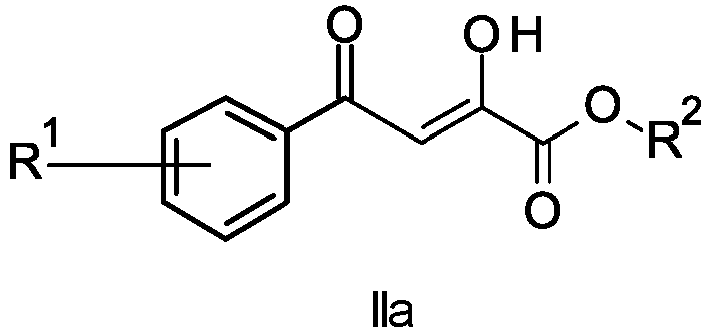 R1 is hydrogen or halogen andR2 iswith hydrogen in the presence of an iridium spiro-pyridylamidophosphine catalyst (Ir-SpiroPAP catalyst) of the formula IIIa or IIIb, or enantiomers thereof,
 R4a, R4b, R4c and R4d independently of each other are hydrogen or C1-6-alkyl; the dotted ring signifies an aromatic ring when Q1 is nitrogen and Q2 is carbon and the dotted ring signifies a cycloalkane ring wherein Q1 and Q2 are sulfur;X1 is either a coordinated ligand or a counter anion selected from halogen, C1-6-alkoxy, tetrahalogeno borate, hexahalogenoborate, tetrakis(3,5-bis(trihalogeno-C1-6-alkyl)phenyl)borate, acetylacetonate, hexahalogenophosphate, p-tolylsulfonate (OTs) or trihalogeno methanesulfonate andZ is phenyl, optionally substituted by one or more groups selected from C1-8-alkyl, C1-8-halogenalkyl or phenyl; C3-8-cycloalkyl, optionally substituted by one or more C1-8-alkyl groups or di- C1-8-alkyl phosphinyl.
- Process of claim 1, wherein the Ir-SpiroPAP catalyst is selected from the compounds IIIa or IIIb, or enantiomers thereof,
whereinR4a, R4b, R4c and R4d independently of each other are hydrogen or C1-4-alkyl;the dotted ring signifies an aromatic ring when Q1 is nitrogen and Q2 is carbon and the dotted ring signifies a cycloalkane ring wherein Q1 and Q2 are sulfur;X1 is either a coordinated ligand or a counter anion selected from halogen, methoxy, tetrafluoroborate (BF4), hexafluoroborate (BF6), tetrakis(3,5-bis(trifluoromethyl) phenyl)borate (barf), acetylacetonate (acac), hexafluorophosphate (PF6), p-tolylsulfonate (OTs) or trifluoromethanesulfonate (OTf) and;Z is phenyl, optionally substituted by one or more groups selected from C1-6-alkyl, C1-4-halogenalkyl or phenyl or is C4-7-cycloalkyl. - Process of claim 1 or 2, wherein the Ir-SpiroPAP catalyst is selected from the compounds IIIa or IIIb, or enantiomers thereofR4a, R4b, R4c and R4d independently of each other are hydrogen or C1-4-alkyl; the dotted ring signifies an aromatic ring when Q1 is nitrogen and Q2 is carbon and the dotted ring signifies a cycloalkane ring wherein Q1 and Q2 are sulfur;X1 is halogen;Z is phenyl, optionally substituted by one or two groups selected from C1-6-alkyl, C1-4-halogenalkyl or phenyl or is cyclopentyl or cyclohexyl.
- Process of anyone of claims 1 to 3, wherein the Ir-SpiroPAP catalyst is selected from the compounds

 R4a, R4b, R4c and R4d independently of each other are hydrogen or C1-4-alkyl;X1 is halogen;Z is phenyl optionally substituted by one or two groups selected from C1-6-alkyl, C1-4-halogenalkyl or phenyl or is cyclopentyl or cyclohexyl.
- Process of anyone of claims 1 to 4, wherein the asymmetric hydrogenation is performed in the presence of an organic solvent and a base at a hydrogen pressure of 5 bar to 100 bar and at a reaction temperature of 10°C to 90°C.
- Process of anyone of claims 1 to 5, wherein the organic solvent is an aliphatic alcohol, a halogen substituted alcohol, an ether or an aromatic solvent or is a mixture thereof.
- Process of anyone of claims 1 to 6, wherein the base is an inorganic base selected from alkali or earth alkali- carbonates or - hydrogen carbonates or phosphates or hydrogenphosphates or dihydrogenphosphates or acetates or formates or organic bases selected from amines, alkali alcoholates or amidines.
- Process of anyone of claim 1 to 6, wherein the substrate to catalyst ratio is selected in a range of 100 to 10'000.
- Process of anyone claim 1 to 8, wherein the Ir-SpiroPAP catalyst of formula IIIa or IIIb is prepared in situ in the course of the asymmetric hydrogenation reaction by bringing together a Iridium-pre catalyst complex with a spiro-pyridylamidophosphine ligand of the formula
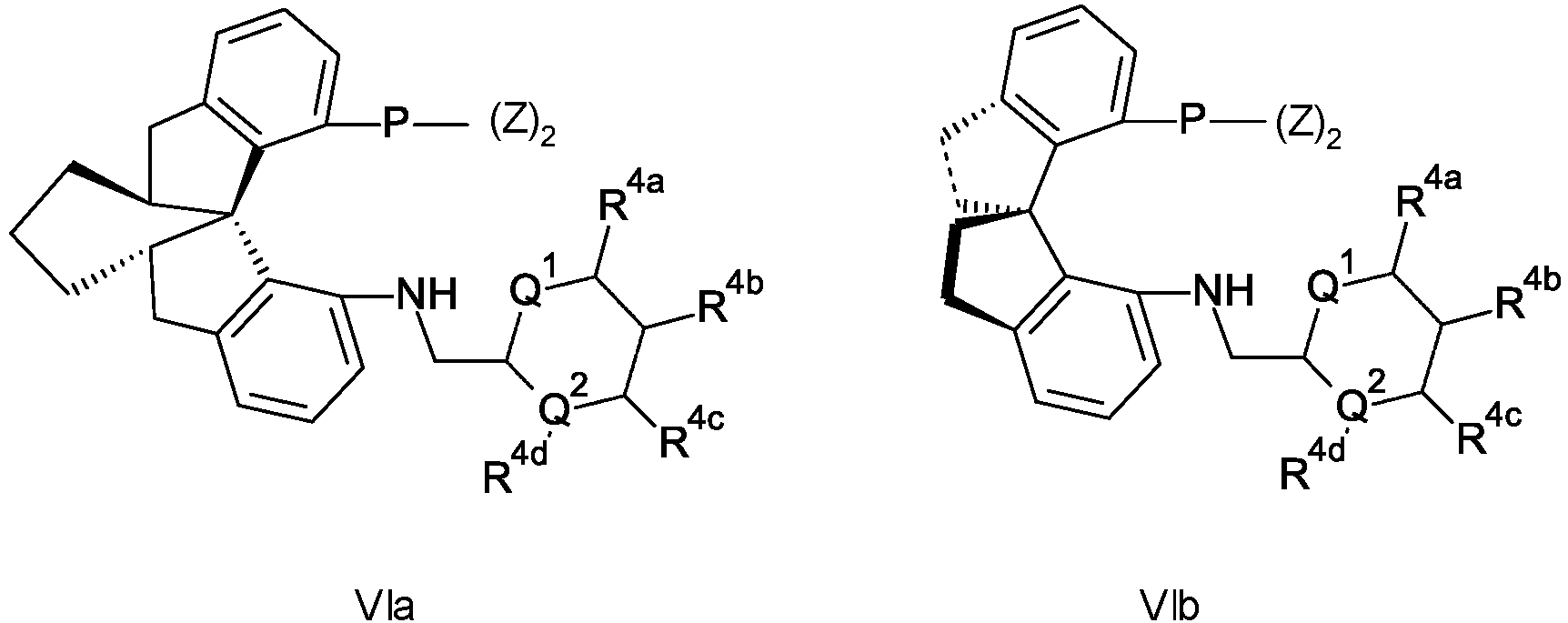
- Process of claim 9, wherein the Iridium-pre catalyst complex is selected from [Ir(cod)2]BF4, [IrCl(COD)]2, [Ir(acac)(COD)], [Ir(OMe)(COD)]2, [Ir(cod)2]BARF, [Ir(cod)2]PF6.
- Process of claim 1, wherein the asymmetric hydrogenation of the ketone of formula IIa in a first step is performed in the presence of the Ir-PEN catalyst of formula IVa or IVb, or enantiomers thereof,
 R5 is C1-6-alkylsulfonyl wherein the alkyl group is optionally substituted with one or more halogen atoms; with a 7,7-dimethyl-2-oxobicyclo[2.2.1] heptane-1-yl group or phenyl sulfonyl, wherein the phenyl group is optionally substituted by one or more C1-6-alkyl groups andX2 is either a coordinated ligand or a counter anion selected from a C1-6-alkylsulfonyloxy group which is optionally substituted with one or more halogen, atoms; from halogen, C1-6-alkoxy, tetrahalogenoborate, hexahalogenoborate, tetrakis(3,5-bis(trihalogeno-C1-6-alkyl)phenyl)borate, acetylacetonate, hexahalogenophosphine, p-tolylsulfonate (OTs) or trihalogenomethanesulfonate;to form the ketone of formula IIb,
 and in a subsequent step the ketone of formula IIb is further subjected to an asymmetric hydrogenation in the presence of an Ir-SpiroPAP catalyst of the formula IIIa or IIIb, or enantiomers thereof, to form the chiral triol of formula I.
- Process of claim 11, whereinR5 is methylsulfonyl, trifluoromethylsulfonyl, 7,7-dimethyl-2-oxobicyclo[2.2.1] heptane-1-yl; tolylsulfonyl or 1,3,5-tri-i-propylphenyl sulfonyl;X2 is either a coordinated ligand or a counter anion selected from a methylsulfonyloxy group which is optionally substituted with one or more fluoro atoms; from halogen, methoxy, tetrafluoroborate (BF4), hexafluoroborate (BF6), tetrakis(3,5-bis(trifluoromethyl)phenyl)borate (barf), acetylacetonate (acac), hexafluorophosphine (PF6), p-tolylsulfonate (OTs) or trifluoromethanesulfonate (OTf.
- Process of claim 11 or 12, wherein the iridium-phenylendiamine catalyst (Ir-PEN catalyst) are of the formula IVa, or enantiomers thereof, wherein,R5 is methylsulfonyl, trifluoromethylsulfonyl, 7,7-dimethyl-2-oxobicyclo[2.2.1] heptane-1-yl; tolylsulfonyl or 1,3,5-tri-i-propylphenyl sulfonyl;X2 is a trifluoromethylsulfonyl oxy group; orare of the formula IVb, or enantiomers thereof, wherein,
R5 is methylsulfonyl, trifluoromethylsulfonyl, 7,7-dimethyl-2-oxobicyclo[2.2.1] heptane-1-yl; tolylsulfonyl or 1,3,5-tri-i-propylphenyl sulfonyl. - Process of anyone of claims 11 to 13, wherein the asymmetric hydrogenation of the ketone of formula IIa is performed in the presence of an organic solvent at a hydrogen pressure of 5 bar to 100 bar and at a reaction temperature of 10°C to 90°C.
- Process of claim 14, wherein the organic solvent is an aliphatic alcohol, a halogen substituted alcohol, an ether or an aromatic solvent or is a mixture thereof.
- Process of claims 14 or 15, wherein the substrate to catalyst ratio is selected in a range of 100 to 1000.
- Process of anyone of claims 1 to 16, wherein the asymmetric hydrogenation of the ketone of formula IIa takes place in the presence of a mixture of an Ir-Spiro PAP catalyst of the formula IIIa or IIIb, or of an enantiomer thereof, and an Ir-PEN catalyst of the formula IVa or IVb, or of an enantiomer thereof.
- Process of claim 17 wherein the reaction is performed in the presence of an organic solvent and a base at a hydrogen pressure of 5 bar to 100 bar and at a reaction temperature of 10°C to 90°C.
- Process of claims 17 or 18, wherein the organic solvent is an aliphatic alcohol, a halogen substituted alcohol, an ether or an aromatic solvent or is a mixture thereof.
- Process of any one of claims 17 to 19, wherein the base is an inorganic base selected from alkali or earth alkali- carbonates or - hydrogen carbonates or phosphates or hydrogenphosphates or dihydrogenphosphates or acetates or formiates or organic bases selected from amines, alkali alcoholates or amidines.
- Process of any one of claims 17 to 20, wherein the substrate to Ir-PEN catalyst ratio is selected in a range of 100 to 10000, preferably in a range of 500 to 1000 and the substrate to Ir-Spiro PAP catalyst ratio is selected in a range of 100 to 10000, preferably in a range of 2500 to 7500.
- Process of claim 1, wherein the intermediates in the asymmetric hydrogenation of the ketone of formula IIa to the chiral triol of formula I of the formula

- Process of any one of claims 1 to 22, wherein the chiral triol has the formula Ia

- Process of claim 23, wherein R1 is halogen.
- Process of any one of claims 1 to 24, wherein the chiral triol has the formula Ib

Applications Claiming Priority (2)
| Application Number | Priority Date | Filing Date | Title |
|---|---|---|---|
| EP21151758 | 2021-01-15 | ||
| PCT/EP2022/050575 WO2022152769A1 (en) | 2021-01-15 | 2022-01-13 | Process for the preparation of a chiral triol |
Publications (3)
| Publication Number | Publication Date |
|---|---|
| EP4277885A1 EP4277885A1 (en) | 2023-11-22 |
| EP4277885B1 true EP4277885B1 (en) | 2025-02-26 |
| EP4277885C0 EP4277885C0 (en) | 2025-02-26 |
Family
ID=74184565
Family Applications (1)
| Application Number | Title | Priority Date | Filing Date |
|---|---|---|---|
| EP22701332.3A Active EP4277885B1 (en) | 2021-01-15 | 2022-01-13 | Process for the preparation of a chiral triol |
Country Status (14)
| Country | Link |
|---|---|
| US (1) | US20240018076A1 (en) |
| EP (1) | EP4277885B1 (en) |
| JP (1) | JP2024504103A (en) |
| KR (1) | KR20230130019A (en) |
| CN (1) | CN116710421A (en) |
| AR (1) | AR124610A1 (en) |
| AU (1) | AU2022208327A1 (en) |
| CA (1) | CA3202552A1 (en) |
| ES (1) | ES3020608T3 (en) |
| IL (1) | IL304149A (en) |
| MX (1) | MX2023008274A (en) |
| PL (1) | PL4277885T3 (en) |
| TW (1) | TW202246203A (en) |
| WO (1) | WO2022152769A1 (en) |
Families Citing this family (1)
| Publication number | Priority date | Publication date | Assignee | Title |
|---|---|---|---|---|
| TW202608905A (en) | 2024-04-23 | 2026-03-01 | 瑞士商赫孚孟拉羅股份公司 | Chiral aminophosphine ligands, iridium catalysts comprising these ligands and use of these catalysts in asymmetric hydrogenations |
Family Cites Families (2)
| Publication number | Priority date | Publication date | Assignee | Title |
|---|---|---|---|---|
| CN102040625B (en) * | 2010-11-19 | 2013-09-25 | 浙江九洲药业股份有限公司 | Chiral spiro pyridylamidophosphine ligand compounds and synthesis method and application thereof |
| CN109970795B (en) * | 2019-05-05 | 2022-03-04 | 浙江九洲药业股份有限公司 | Preparation method and application of 4-substituted chiral spiro aminophosphine ligand on pyridine ring |
-
2022
- 2022-01-13 CA CA3202552A patent/CA3202552A1/en active Pending
- 2022-01-13 WO PCT/EP2022/050575 patent/WO2022152769A1/en not_active Ceased
- 2022-01-13 EP EP22701332.3A patent/EP4277885B1/en active Active
- 2022-01-13 ES ES22701332T patent/ES3020608T3/en active Active
- 2022-01-13 JP JP2023542540A patent/JP2024504103A/en active Pending
- 2022-01-13 AR ARP220100058A patent/AR124610A1/en not_active Application Discontinuation
- 2022-01-13 PL PL22701332.3T patent/PL4277885T3/en unknown
- 2022-01-13 KR KR1020237024838A patent/KR20230130019A/en active Pending
- 2022-01-13 CN CN202280009432.1A patent/CN116710421A/en active Pending
- 2022-01-13 MX MX2023008274A patent/MX2023008274A/en unknown
- 2022-01-13 AU AU2022208327A patent/AU2022208327A1/en not_active Abandoned
- 2022-01-14 TW TW111101686A patent/TW202246203A/en unknown
-
2023
- 2023-06-29 IL IL304149A patent/IL304149A/en unknown
- 2023-07-12 US US18/351,377 patent/US20240018076A1/en active Pending
Also Published As
| Publication number | Publication date |
|---|---|
| TW202246203A (en) | 2022-12-01 |
| JP2024504103A (en) | 2024-01-30 |
| EP4277885A1 (en) | 2023-11-22 |
| WO2022152769A1 (en) | 2022-07-21 |
| AR124610A1 (en) | 2023-04-12 |
| CN116710421A (en) | 2023-09-05 |
| IL304149A (en) | 2023-09-01 |
| AU2022208327A1 (en) | 2023-06-22 |
| US20240018076A1 (en) | 2024-01-18 |
| EP4277885C0 (en) | 2025-02-26 |
| ES3020608T3 (en) | 2025-05-23 |
| PL4277885T3 (en) | 2025-05-12 |
| MX2023008274A (en) | 2023-07-19 |
| CA3202552A1 (en) | 2022-07-21 |
| KR20230130019A (en) | 2023-09-11 |
Similar Documents
| Publication | Publication Date | Title |
|---|---|---|
| Lo et al. | Applications of planar-chiral heterocycles in enantioselective catalysis: Cu (I)/bisazaferrocene-catalyzed asymmetric ring expansion of oxetanes to tetrahydrofurans | |
| IL292180A (en) | Process for the preparation of 2-cyanoethyl (4s)-4-(4-cyano-2-methoxy-phenyl)-5-ethoxy-2,8-dimethyl-1,4-dihydro-1,6-naphthyridine-3-carboxylate by resolution of racemates by means of diastereomeric tartaric acid esters | |
| CN109705011B (en) | A kind of synthetic method and intermediate of Upatinib intermediate | |
| WO2021254896A1 (en) | Process for preparing (4s)-4-(4-cyano-2-methoxyphenyl)-5-ethoxy-2,8-dimethyl-1,4-dihydro-1,6-naphthyridine-3-carboxamide enabled by a catalytic asymmetric hantzsch ester reduction | |
| US20240018076A1 (en) | Process for the preparation of a chiral triol | |
| Paju et al. | Asymmetric oxidation of 3-alkyl-1, 2-cyclopentanediones. Part 2: Oxidative ring cleavage of 3-alkyl-1, 2-cyclopentanediones: synthesis of 2-alkyl-γ-lactone acids | |
| Nunes et al. | Asymmetric synthesis of trans-4, 5-dioxygenated cyclopentenone derivatives by organocatalyzed rearrangement of pyranones and enzymatic dynamic kinetic resolution | |
| US8501658B2 (en) | Enantioselective reactions catalyzed by chiral triazolium salts | |
| Gonzalez-Bulnes et al. | Practical synthesis of (−)-1-amino-1-deoxy-myo-inositol from achiral precursors | |
| CN118598797A (en) | A synthesis method and separation method of chiral 3-hydroxy-4-fluoropiperidine derivative | |
| JP4425654B2 (en) | Water-soluble transition metal-diamine complex, method for producing the same, and use thereof | |
| JP2001526111A (en) | Catalyst compositions based on chiral ligands having molybdenum, tungsten or chromium and methods for asymmetric alkylation of allylic substrates | |
| CN114106046A (en) | Chiral spirocyclic oxazoline-amino phosphine ligand substituted at 5-position of oxazoline ring, and preparation method and application thereof | |
| WO2018212216A1 (en) | Method for producing optically active isomer, optically active isomer, method for producing chiral molecules, and chiral molecules | |
| HK40092557A (en) | Process for the preparation of a chiral triol | |
| CA2813131C (en) | Preparation of bicyclo[2.2.2]octan-2-one compounds | |
| Yoshida et al. | Enantioselective synthesis of a chiral pyridazinone derivative by lipase-catalyzed hydrolysis | |
| EP3517531B1 (en) | Method for producing (r)-5-(3,4-difluorophenyl)-5-[(3-methyl-2-oxopyridin-1(2h)-yl)methyl]imidazolidine-2,4-dione and intermediate for producing same | |
| US20070191614A1 (en) | Process for producing nitrogenous 5-membered cyclic compound | |
| CN119350351B (en) | A nitrogen-centered chiral Tröger base derivative, its preparation method and application | |
| Kageji et al. | Synthesis and structure revision of litseaone A | |
| CN110256479B (en) | Chiral pyrrolidine derivative containing silicon acyl skeleton and preparation method thereof | |
| WO2025224043A1 (en) | Chiral aminophosphine ligands, iridium catalysts comprising these ligands and use of these catalysts in asymmetric hydrogenations | |
| Leonard et al. | Spiro epoxide fused cis bicyclo [3.3. 0] octanes: enantioselective rearrangement and utilisation of the products in synthetic adventures | |
| CN106317011B (en) | A kind of preparation method of rosuvastain calcium intermediate |
Legal Events
| Date | Code | Title | Description |
|---|---|---|---|
| STAA | Information on the status of an ep patent application or granted ep patent |
Free format text: STATUS: UNKNOWN |
|
| STAA | Information on the status of an ep patent application or granted ep patent |
Free format text: STATUS: THE INTERNATIONAL PUBLICATION HAS BEEN MADE |
|
| PUAI | Public reference made under article 153(3) epc to a published international application that has entered the european phase |
Free format text: ORIGINAL CODE: 0009012 |
|
| STAA | Information on the status of an ep patent application or granted ep patent |
Free format text: STATUS: REQUEST FOR EXAMINATION WAS MADE |
|
| 17P | Request for examination filed |
Effective date: 20230816 |
|
| AK | Designated contracting states |
Kind code of ref document: A1 Designated state(s): AL AT BE BG CH CY CZ DE DK EE ES FI FR GB GR HR HU IE IS IT LI LT LU LV MC MK MT NL NO PL PT RO RS SE SI SK SM TR |
|
| DAV | Request for validation of the european patent (deleted) | ||
| DAX | Request for extension of the european patent (deleted) | ||
| GRAP | Despatch of communication of intention to grant a patent |
Free format text: ORIGINAL CODE: EPIDOSNIGR1 |
|
| STAA | Information on the status of an ep patent application or granted ep patent |
Free format text: STATUS: GRANT OF PATENT IS INTENDED |
|
| INTG | Intention to grant announced |
Effective date: 20240820 |
|
| GRAS | Grant fee paid |
Free format text: ORIGINAL CODE: EPIDOSNIGR3 |
|
| GRAA | (expected) grant |
Free format text: ORIGINAL CODE: 0009210 |
|
| STAA | Information on the status of an ep patent application or granted ep patent |
Free format text: STATUS: THE PATENT HAS BEEN GRANTED |
|
| AK | Designated contracting states |
Kind code of ref document: B1 Designated state(s): AL AT BE BG CH CY CZ DE DK EE ES FI FR GB GR HR HU IE IS IT LI LT LU LV MC MK MT NL NO PL PT RO RS SE SI SK SM TR |
|
| REG | Reference to a national code |
Ref country code: GB Ref legal event code: FG4D |
|
| REG | Reference to a national code |
Ref country code: CH Ref legal event code: EP |
|
| REG | Reference to a national code |
Ref country code: DE Ref legal event code: R096 Ref document number: 602022011097 Country of ref document: DE |
|
| REG | Reference to a national code |
Ref country code: IE Ref legal event code: FG4D |
|
| U01 | Request for unitary effect filed |
Effective date: 20250226 |
|
| U07 | Unitary effect registered |
Designated state(s): AT BE BG DE DK EE FI FR IT LT LU LV MT NL PT RO SE SI Effective date: 20250306 |
|
| REG | Reference to a national code |
Ref country code: ES Ref legal event code: FG2A Ref document number: 3020608 Country of ref document: ES Kind code of ref document: T3 Effective date: 20250523 |
|
| REG | Reference to a national code |
Ref country code: GR Ref legal event code: EP Ref document number: 20250400824 Country of ref document: GR Effective date: 20250514 |
|
| PG25 | Lapsed in a contracting state [announced via postgrant information from national office to epo] |
Ref country code: RS Free format text: LAPSE BECAUSE OF FAILURE TO SUBMIT A TRANSLATION OF THE DESCRIPTION OR TO PAY THE FEE WITHIN THE PRESCRIBED TIME-LIMIT Effective date: 20250526 |
|
| PG25 | Lapsed in a contracting state [announced via postgrant information from national office to epo] |
Ref country code: NO Free format text: LAPSE BECAUSE OF FAILURE TO SUBMIT A TRANSLATION OF THE DESCRIPTION OR TO PAY THE FEE WITHIN THE PRESCRIBED TIME-LIMIT Effective date: 20250526 Ref country code: IS Free format text: LAPSE BECAUSE OF FAILURE TO SUBMIT A TRANSLATION OF THE DESCRIPTION OR TO PAY THE FEE WITHIN THE PRESCRIBED TIME-LIMIT Effective date: 20250626 |
|
| PG25 | Lapsed in a contracting state [announced via postgrant information from national office to epo] |
Ref country code: HR Free format text: LAPSE BECAUSE OF FAILURE TO SUBMIT A TRANSLATION OF THE DESCRIPTION OR TO PAY THE FEE WITHIN THE PRESCRIBED TIME-LIMIT Effective date: 20250226 |
|
| PG25 | Lapsed in a contracting state [announced via postgrant information from national office to epo] |
Ref country code: SM Free format text: LAPSE BECAUSE OF FAILURE TO SUBMIT A TRANSLATION OF THE DESCRIPTION OR TO PAY THE FEE WITHIN THE PRESCRIBED TIME-LIMIT Effective date: 20250226 |
|
| PG25 | Lapsed in a contracting state [announced via postgrant information from national office to epo] |
Ref country code: CZ Free format text: LAPSE BECAUSE OF FAILURE TO SUBMIT A TRANSLATION OF THE DESCRIPTION OR TO PAY THE FEE WITHIN THE PRESCRIBED TIME-LIMIT Effective date: 20250226 |
|
| PG25 | Lapsed in a contracting state [announced via postgrant information from national office to epo] |
Ref country code: SK Free format text: LAPSE BECAUSE OF FAILURE TO SUBMIT A TRANSLATION OF THE DESCRIPTION OR TO PAY THE FEE WITHIN THE PRESCRIBED TIME-LIMIT Effective date: 20250226 |
|
| PLBE | No opposition filed within time limit |
Free format text: ORIGINAL CODE: 0009261 |
|
| STAA | Information on the status of an ep patent application or granted ep patent |
Free format text: STATUS: NO OPPOSITION FILED WITHIN TIME LIMIT |
|
| REG | Reference to a national code |
Ref country code: CH Ref legal event code: L10 Free format text: ST27 STATUS EVENT CODE: U-0-0-L10-L00 (AS PROVIDED BY THE NATIONAL OFFICE) Effective date: 20260107 |
|
| PGFP | Annual fee paid to national office [announced via postgrant information from national office to epo] |
Ref country code: GB Payment date: 20251220 Year of fee payment: 5 |
|
| U20 | Renewal fee for the european patent with unitary effect paid |
Year of fee payment: 5 Effective date: 20251217 |
|
| REG | Reference to a national code |
Ref country code: CH Ref legal event code: U11 Free format text: ST27 STATUS EVENT CODE: U-0-0-U10-U11 (AS PROVIDED BY THE NATIONAL OFFICE) Effective date: 20260201 |
|
| 26N | No opposition filed |
Effective date: 20251127 |
|
| PGFP | Annual fee paid to national office [announced via postgrant information from national office to epo] |
Ref country code: CH Payment date: 20260201 Year of fee payment: 5 |
|
| U1H | Name or address of the proprietor changed after the registration of the unitary effect |
Owner name: F. HOFFMANN-LA ROCHE AG; CH Owner name: GENENTECH, INC.; US |