EP4276459B1 - Verfahren und system zur erkennung der anwesenheit eines organs eines embryos in einem ei - Google Patents
Verfahren und system zur erkennung der anwesenheit eines organs eines embryos in einem ei Download PDFInfo
- Publication number
- EP4276459B1 EP4276459B1 EP23171287.8A EP23171287A EP4276459B1 EP 4276459 B1 EP4276459 B1 EP 4276459B1 EP 23171287 A EP23171287 A EP 23171287A EP 4276459 B1 EP4276459 B1 EP 4276459B1
- Authority
- EP
- European Patent Office
- Prior art keywords
- egg
- emission source
- spectral band
- embryo
- organ
- Prior art date
- Legal status (The legal status is an assumption and is not a legal conclusion. Google has not performed a legal analysis and makes no representation as to the accuracy of the status listed.)
- Active
Links
Images




Classifications
-
- G—PHYSICS
- G01—MEASURING; TESTING
- G01N—INVESTIGATING OR ANALYSING MATERIALS BY DETERMINING THEIR CHEMICAL OR PHYSICAL PROPERTIES
- G01N33/00—Investigating or analysing materials by specific methods not covered by groups G01N1/00 - G01N31/00
- G01N33/02—Food
- G01N33/08—Eggs, e.g. by candling
-
- A—HUMAN NECESSITIES
- A01—AGRICULTURE; FORESTRY; ANIMAL HUSBANDRY; HUNTING; TRAPPING; FISHING
- A01K—ANIMAL HUSBANDRY; AVICULTURE; APICULTURE; PISCICULTURE; FISHING; REARING OR BREEDING ANIMALS, NOT OTHERWISE PROVIDED FOR; NEW BREEDS OF ANIMALS
- A01K43/00—Testing, sorting or cleaning eggs ; Conveying devices ; Pick-up devices
Definitions
- the present invention relates to a method and a system for detecting the presence of an organ of an embryo in an egg, implemented in a non-invasive manner.
- the mulard duck was specifically selected because the males transmit an albino gene only to the females, which allows them to be sexed after the ducklings hatch by the color of the eye:
- the males have indeed black eyes because they contain melanin and albino females have red eyes. This particularity makes it possible to consider in ovo sexing around the 9th day by performing egg candling. By shaking the egg it is then possible to bring the eye into contact with the shell, which allows it to be distinguished.
- the filtering step is implemented on the light flux emitted by the emission source, before transmission into the egg.
- the holding element is configured to hold the egg so that the largest axis of the egg is parallel to a horizontal plane.
- the system comprises means for setting said holding element in relative movement with respect to said sensor.
- the system of the invention is used to detect the presence of an organ of a living being in an egg O and ultimately makes it possible to determine for example the sex (male or female) of the living being or the state of fertilization. It is particularly suitable for sexing a mulard-type duck egg. But it can also be used to determine the presence, or even the sex, of any other oviparous embryo whose eye or another organ shows melanin coloration.
- the method and system of the invention are based on analysis by imaging, and not by analysis of spectral data.
- the egg O comprises a shell 20, in which is present the embryo 21 to which the eye 22 belongs, and the cardiovascular system 23 containing in particular hemoglobin.
- the egg also has an air chamber 24 which is located on the opposite side of the tip of the egg.
- the egg O is shown horizontally, the air chamber 24 positioned on the side.
- the support element 1 is chosen to allow the light signal S emitted by the emission source E to pass. It can thus be chosen transparent to allow at least 90% of the signal to pass, for example. luminous, with a minimum of diffusion, and/or for example with an opening through which the light signal S is emitted, and/or present at least one part in the form of a grid intended to be crossed by the signal. This may prove necessary when the emission source E is placed under the support element 1 or when the image sensor C is placed under the support element 1.
- the egg holding element used will have as little interaction as possible with the light signal.
- the solution of the invention relies on the absorption capacity of visible light by the melanin present inside the egg O to create sufficient contrast on the image captured by the image sensor C.
- a combination of two filters may consist of taking a low-pass filter which allows wavelengths below 720nm to pass and a high-pass filter which allows waves above 670nm to pass.
- the light source may include one or more light-emitting diodes.
- the light source is for example chosen to emit with a spectrum such as that represented by the curve of the Figure 8A .
- FIG. 8B shows an example of a bandpass filter response around the 700nm range of interest, which can be applied to the light source.
- a band-pass filter or a set of high-pass and low-pass filters which define a transmission window of 50nm width between 675nm and 725nm in order to optimize the contrast between melanin and oxyhemoglobin. contained in the embryo.
- we will not exceed a window width of 100nm between 650nm and 750nm to maintain an absorption contrast of at least 10 between melanin and oxyhemoglobin.
- the sensor C is advantageously a monochrome type camera, so as to be able to clearly identify the contrast between the areas of the egg O where the light is transmitted and the areas of the egg O where the light is absorbed.
- the use of a narrow P range of wavelengths, around 700nm makes it possible to have a maximum absorption contrast between the melanin contained in the eyes of male embryos and the other biological constituents of the egg, in particular with the hemoglobin of the cardiovascular system, the latter presenting a minimum of absorption around 700nm.
- the cardiovascular system 23 virtually disappears from the image obtained at the sensor, allowing almost systematic identification of the eye of male embryos and therefore identification of the sex of the egg.
- the same principle can be applied to determine the presence of oviparous embryos presenting a melanin-colored organ. Detection of the embryo can make it possible to determine the fertilization state of the eggs or even to sex them in the case where the presence of melanin is correlated with the sex of the embryo.
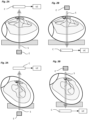
- the support element 1 is configured so that the egg O is positioned flat, that is to say with its largest axis oriented horizontally. This configuration makes it possible to optimize the lighting of the egg O and to have the best positioning of the embryo in relation to the image sensor C, the embryo 21 generally floating near the highest point of the egg .
- the light flux is captured by the sensor (the camera for example) which is positioned above ( Figure 2A ) or below ( Figure 2B ), in the axis of the signal emitted by the emission source S.
- the emission source is thus respectively placed below the support element 1 ( Figure 2A ) or above the egg ( Figure 2B ).
- the light flux captured here is very homogeneous because all the rays reaching the image sensor C have passed through an approximately equivalent portion of the egg (within the geometry of the egg). All rays also pass through the same components of the egg (white, yolk, shell).
- the support element 1 is adapted to hold the egg O so that its largest axis is oriented vertically and the air chamber 24 is positioned at the bottom.
- the light flux is captured by the sensor (the camera for example) which can be positioned above ( Figure 4A ) or below ( figure 4B ), in the axis of the signal emitted by the emission source S located opposite.
- the sensor the camera for example
- This third configuration allows for fairly homogeneous lighting (as in the first configuration above) but the path of the light beam being greater, the flux collected by the image sensor C is lower.
- the support element 1 is for example chosen transparent (or other solutions described above).
- the three configurations described above can be broken down into several other configurations, in which the emission source E and the image sensor C are positioned at 90° relative to each other.
- FIG 5 thus shows this type of configuration with the egg positioned horizontally and the emission source E emitting vertically
- the Figure 6 with the egg oriented at 45° to the vertical and the emission source E emitting at 45° along the long axis of the egg
- the Figure 7 with the egg vertically and the emission source E emitting vertically.
- the air chamber 24 can be located opposite, that is to say towards the top of the egg O, in the case where the egg is held at the vertical.
- care will be taken to place the source as close as possible to the egg to prevent rays from being reflected by the shell and directly reaching the image sensor C without having passed through the egg O.
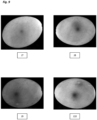
- FIG. 9 shows several photos taken by the image sensor C at different stages of incubation of an egg (at D7, D8, D9, D10), in the case of the first configuration described above.
- the dark area represents the biological component containing melanin, absorbing the signal emitted over the wavelength range centered on 700nm.
- a male mulard duck it is his eye (black spot on the images shown). We thus see that this eye always remains perfectly detectable, from the 7th day of incubation and until the 10th day.
- a complete installation makes it possible to process several eggs at the same time.
- a support plate 10 may have several distinct locations, each intended for supporting a distinct egg O to be characterized.
- a distinct E emission source can be used per location and therefore per egg O to be characterized.
- the same image sensor C can be common to several eggs to be characterized (for example for 4 eggs on the installation).
- the processing means UC are then responsible for processing the images which have been captured by each sensor of the installation, according to the principles defined above.
Landscapes
- Life Sciences & Earth Sciences (AREA)
- Engineering & Computer Science (AREA)
- Food Science & Technology (AREA)
- Health & Medical Sciences (AREA)
- Chemical & Material Sciences (AREA)
- Environmental Sciences (AREA)
- Biochemistry (AREA)
- Analytical Chemistry (AREA)
- Physics & Mathematics (AREA)
- General Health & Medical Sciences (AREA)
- General Physics & Mathematics (AREA)
- Immunology (AREA)
- Pathology (AREA)
- Animal Husbandry (AREA)
- Biodiversity & Conservation Biology (AREA)
- Medicinal Chemistry (AREA)
- Investigating Or Analysing Materials By Optical Means (AREA)
Claims (18)
- Nicht-invasives Verfahren zur Erkennung der Anwesenheit eines Organs eines Embryos in einem Ei (O), umfassend:- einen Schritt des Emittierens eines Lichtsignals (S) aus einer Emissionsquelle (E) durch das Ei, dadurch gekennzeichnet, dass es ferner umfasst:- einen Schritt der Filterung des Lichtflusses in ein schmales Spektralband rund um eine Wellenlänge von 700 nm,- einen Schritt der Bildgebung des vom Lichtfluss durchstrahlten Eies (O),- einen Schritt des Analysierens des Bilds des Eies (O), das in dem Bildgebungsschritt erstellt wurde,- wobei die Anwesenheit des Organs durch den Absorptionskontrast zwischen den Blut enthaltenden Bestandteilen des Eies (O) und dem Melanin enthaltenden Organ des Embryos aufgezeigt wird.
- Verfahren nach Anspruch 1, dadurch gekennzeichnet, dass das schmale Spektralband von 650 nm bis 750 nm reicht.
- Verfahren nach Anspruch 1, dadurch gekennzeichnet, dass das schmale Spektralband von 675 nm bis 725 nm reicht.
- Verfahren nach einem der Ansprüche 1 bis 3, dadurch gekennzeichnet, dass der Schritt der Filterung an dem aus der Emissionsquelle (E) emittierten Lichtfluss vor der Transmission in das Ei durchgeführt wird.
- Verfahren nach einem der Ansprüche 1 bis 3, dadurch gekennzeichnet, dass der Schritt der Filterung an dem aus der Emissionsquelle (E) emittierten Lichtfluss nach der Transmission durch das Ei und vor dem Bildgebungsschritt durchgeführt wird.
- Verfahren nach Anspruch 1, dadurch gekennzeichnet, dass es einen Schritt der Bewegung des Eies, einschließlich Beschleunigungen des Eies (O) vor der Emissionsquelle, umfasst, um das Melanin enthaltende Organ in nächste Nähe zur Schale zu bringen.
- Verfahren nach einem der Ansprüche 1 bis 6, dadurch gekennzeichnet, dass es aus der Geschlechtsbestimmung eines Mulardenten-Eies ab Erkennung der Anwesenheit des Eies der Ente besteht.
- Nicht-invasives System zur Erkennung der Anwesenheit eines Organs eines Embryos in einem Ei (O), umfassend:- ein Halteelement, angeordnet, um das Ei in einer Position zu halten,- eine Quelle zur Emission eines Lichtsignals (S) durch das in Position gehaltene Ei, dadurch gekennzeichnet, dass es ferner umfasst:- eine Vorrichtung zur Reduktion des Spektralbandes des aus der Quelle emittierten Lichtsignals in ein schmales Spektralband rund um eine Wellenlänge von 700 nm,- eine Bildgebungsvorrichtung, die so konfiguriert und angeordnet ist, dass sie einen Lichtfluss nach der Transmission durch das Ei empfängt,- Einrichtungen zum Analysieren des mithilfe der Bildgebungsvorrichtung erhaltenen Bilds des Eies (O), die dazu konfiguriert sind, innerhalb des Eies einen Absorptionskontrast zwischen den Blut enthaltenden Bestandteilen des Eies (O) und dem Melanin enthaltenden Organ des Embryos zu erkennen.
- System nach Anspruch 8, dadurch gekennzeichnet, dass die Vorrichtung zur Reduktion des Spektralbandes ein Filter ist, der auf eine Wellenlänge von 700 nm und eine Bandbreite von 100 nm zentriert ist.
- System nach einem der Ansprüche 8 bis 10, dadurch gekennzeichnet, dass die Vorrichtung zur Reduktion des Spektralbandes zwischen der Emissionsquelle (E) und dem Positions-Halteelement für das Ei platziert ist.
- System nach einem der Ansprüche 8 bis 10, dadurch gekennzeichnet, dass die Vorrichtung zur Reduktion des Spektralbandes zwischen dem Positions-Halteelement für das Ei und der Bildgebungsvorrichtung platziert ist.
- System nach einem der Ansprüche 8 bis 11, dadurch gekennzeichnet, dass es Einrichtungen zur Bewegung des Halteelements umfasst, die zum Erzeugen von Beschleunigungen konfiguriert sind.
- System nach einem der Ansprüche 8 bis 12, dadurch gekennzeichnet, dass das Halteelement konfiguriert ist, um das Ei so zu halten, dass die längste Achse des Eies parallel zu einer horizontalen Ebene ist.
- System nach Anspruch 13, dadurch gekennzeichnet, dass die Emissionsquelle (E) positioniert ist, um das Lichtsignal (S) entlang einer Emissionsachse senkrecht zur horizontalen Ebene zu emittieren.
- System nach Anspruch 14, dadurch gekennzeichnet, dass die Emissionsquelle (E) so positioniert ist, dass das Ei (O) von unten beleuchtet werden kann.
- System nach einem der Ansprüche 13 bis 15, dadurch gekennzeichnet, dass der Sensor (C) in der Emissionsachse der Emissionsquelle (E) positioniert ist.
- System nach einem der Ansprüche 13 bis 15, dadurch gekennzeichnet, dass der Sensor (C) positioniert ist, um den Lichtfluss bei 90° relativ zur Emissionsachse zu empfangen.
- Verwendung des Systems nach einem der Ansprüche 8 bis 17 zur Geschlechtsbestimmung eines Enteneies.
Applications Claiming Priority (1)
| Application Number | Priority Date | Filing Date | Title |
|---|---|---|---|
| FR2204490A FR3135527A1 (fr) | 2022-05-12 | 2022-05-12 | Procédé et système de détermination d'une caractéristique d'un œuf d'un être vivant |
Publications (2)
| Publication Number | Publication Date |
|---|---|
| EP4276459A1 EP4276459A1 (de) | 2023-11-15 |
| EP4276459B1 true EP4276459B1 (de) | 2024-07-03 |
Family
ID=82780958
Family Applications (1)
| Application Number | Title | Priority Date | Filing Date |
|---|---|---|---|
| EP23171287.8A Active EP4276459B1 (de) | 2022-05-12 | 2023-05-03 | Verfahren und system zur erkennung der anwesenheit eines organs eines embryos in einem ei |
Country Status (2)
| Country | Link |
|---|---|
| EP (1) | EP4276459B1 (de) |
| FR (1) | FR3135527A1 (de) |
Family Cites Families (11)
| Publication number | Priority date | Publication date | Assignee | Title |
|---|---|---|---|---|
| ID21888A (id) | 1996-10-04 | 1999-08-05 | Embrex Inc | Metode pemisahan "in ovo" burung |
| US6029080A (en) | 1997-07-09 | 2000-02-22 | Reynnells; Richard D. | Method and apparatus for avian pre-hatch sex determination |
| DE102007013102A1 (de) | 2007-03-14 | 2008-09-18 | Fraunhofer-Gesellschaft zur Förderung der angewandten Forschung e.V. | Mikromechanische Schaltervorrichtung mit mechanischer Kraftverstärkung |
| EP2405740B1 (de) | 2009-03-13 | 2015-12-23 | Van de Ven Beheer B.V. | Verfahren zur geschlechtsbestimmung von vögeln |
| WO2010150265A2 (en) | 2009-06-25 | 2010-12-29 | Yissum Research Development Company Of The Hebrew University Of Jerusalem Ltd. | Hyperspectral identification of egg fertility and gender |
| EP2336751B1 (de) | 2009-12-16 | 2014-09-10 | Fraunhofer-Gesellschaft zur Förderung der angewandten Forschung e.V. | Verfahren zur Bestimmung des Geschlechts an Vogeleiern |
| US9395346B2 (en) * | 2013-11-18 | 2016-07-19 | Zoetis Services Llc | Non-contact egg identification system for determining egg viability, and associated method |
| FR3023617B1 (fr) * | 2014-07-11 | 2018-06-15 | Tronico | Dispositif non invasif de determination de la fertilite et/ou du sexe d’un oeuf, et procede correspondant. |
| CN104316473A (zh) * | 2014-10-28 | 2015-01-28 | 南京农业大学 | 一种基于高光谱图像对鸡种蛋孵化早期胚胎性别鉴定的方法 |
| DE102016004051B3 (de) | 2016-04-04 | 2017-07-27 | Technische Universität Dresden | Verfahren und Vorrichtung zur optischen in-ovo Geschlechtsbestimmung von befruchteten und bebrüteten Vogeleiern |
| DE102018105512A1 (de) * | 2018-03-09 | 2019-09-12 | Technische Universitaet Dresden | Verfahren zur in-ovo fertilisations- und geschlechtsbestimmung am geschlossenen ei |
-
2022
- 2022-05-12 FR FR2204490A patent/FR3135527A1/fr not_active Ceased
-
2023
- 2023-05-03 EP EP23171287.8A patent/EP4276459B1/de active Active
Also Published As
| Publication number | Publication date |
|---|---|
| EP4276459A1 (de) | 2023-11-15 |
| FR3135527A1 (fr) | 2023-11-17 |
Similar Documents
| Publication | Publication Date | Title |
|---|---|---|
| EP3167285B1 (de) | Vorrichtung und verfahren zur nicht-invasiven bestimmung der fruchtbarkeit und/oder des geschlechts von eiern | |
| US10564602B2 (en) | Method for observing a sample | |
| US10448836B2 (en) | Methods and apparatus for coaxial imaging of multiple wavelengths | |
| EP2351518B1 (de) | Perioperative bispektrale optische Sonde | |
| EP2538215B1 (de) | Verfahren zum Durchleuchten von Eiern | |
| EP2149041B1 (de) | Verfahren und vorrichtung zur analyse von biologischem gewebe | |
| EP3210531A1 (de) | Verfahren zur abschätzung der herzfrequenz, und entsprechende vorrichtung | |
| EP0106721A2 (de) | System zur Beobachtung und automatische Mengenbestimmung von durch Fluoreszenz erfassbaren Ereignissen | |
| CN1430723A (zh) | 用可见光/近红外光谱测量和相关水果特性的方法和装置 | |
| EP4276459B1 (de) | Verfahren und system zur erkennung der anwesenheit eines organs eines embryos in einem ei | |
| EP3614305B1 (de) | Authentifizierung durch optischen index | |
| FR3037653B1 (fr) | Procede de traitement d’un signal de retrodiffusion | |
| EP2179270B1 (de) | Verfahren und system zur kennzeichnung von pigmentiertem biologischem gewebe | |
| EP0939316A2 (de) | Verfahren und Vorrichtung zum Messen des gehaltes, insbesondere an Zucker, von Früchten und Gemüsen | |
| EP3076156A1 (de) | Verfahren zur bestimmung des agglutinationsniveaus von partikeln in einer probe | |
| FR3164788A1 (fr) | Procédé et système d’imagerie pour la détermination du genre de l’embryon d’un œuf | |
| EP4545947A1 (de) | Verfahren und vorrichtung zur charakterizierung des geschlechts einer eie | |
| FR2967493A1 (fr) | Dispositif et procede de radiometrie pour determiner les caracteristiques physico-chimiques d'un echantillon. | |
| FR3055703A1 (fr) | Procede d’analyse d’un gaz | |
| EP0286490A1 (de) | Vorrichtung zur Augenbeobachtung mittels vom Augapfel reflektierter Infrarotstrahlung | |
| FR3085516A1 (fr) | Procede de reconnaissance biometrique | |
| FR3095519A1 (fr) | Procédé non-invasif de détermination du genre d'un œuf | |
| YOKOYAMA et al. | Light-source color correlation of wide-field spectroscopic imaging for the adaption to spatial and temporal variations when using an unmanned aerial vehicle | |
| WO2016131763A1 (fr) | Procede de mesure non invasif d'un parametre physiologique au moyen d'un dispositif de mesure spectroscopique confocal |
Legal Events
| Date | Code | Title | Description |
|---|---|---|---|
| PUAI | Public reference made under article 153(3) epc to a published international application that has entered the european phase |
Free format text: ORIGINAL CODE: 0009012 |
|
| STAA | Information on the status of an ep patent application or granted ep patent |
Free format text: STATUS: REQUEST FOR EXAMINATION WAS MADE |
|
| 17P | Request for examination filed |
Effective date: 20230503 |
|
| AK | Designated contracting states |
Kind code of ref document: A1 Designated state(s): AL AT BE BG CH CY CZ DE DK EE ES FI FR GB GR HR HU IE IS IT LI LT LU LV MC ME MK MT NL NO PL PT RO RS SE SI SK SM TR |
|
| GRAP | Despatch of communication of intention to grant a patent |
Free format text: ORIGINAL CODE: EPIDOSNIGR1 |
|
| STAA | Information on the status of an ep patent application or granted ep patent |
Free format text: STATUS: GRANT OF PATENT IS INTENDED |
|
| INTG | Intention to grant announced |
Effective date: 20240202 |
|
| GRAS | Grant fee paid |
Free format text: ORIGINAL CODE: EPIDOSNIGR3 |
|
| GRAA | (expected) grant |
Free format text: ORIGINAL CODE: 0009210 |
|
| STAA | Information on the status of an ep patent application or granted ep patent |
Free format text: STATUS: THE PATENT HAS BEEN GRANTED |
|
| AK | Designated contracting states |
Kind code of ref document: B1 Designated state(s): AL AT BE BG CH CY CZ DE DK EE ES FI FR GB GR HR HU IE IS IT LI LT LU LV MC ME MK MT NL NO PL PT RO RS SE SI SK SM TR |
|
| REG | Reference to a national code |
Ref country code: CH Ref legal event code: EP |
|
| REG | Reference to a national code |
Ref country code: DE Ref legal event code: R096 Ref document number: 602023000200 Country of ref document: DE |
|
| REG | Reference to a national code |
Ref country code: LT Ref legal event code: MG9D |
|
| RAP4 | Party data changed (patent owner data changed or rights of a patent transferred) |
Owner name: COMMISSARIAT A L'ENERGIE ATOMIQUE ET AUX ENERGIESALTERNATIVES |
|
| REG | Reference to a national code |
Ref country code: NL Ref legal event code: MP Effective date: 20240703 |
|
| PG25 | Lapsed in a contracting state [announced via postgrant information from national office to epo] |
Ref country code: PT Free format text: LAPSE BECAUSE OF FAILURE TO SUBMIT A TRANSLATION OF THE DESCRIPTION OR TO PAY THE FEE WITHIN THE PRESCRIBED TIME-LIMIT Effective date: 20241104 |
|
| REG | Reference to a national code |
Ref country code: AT Ref legal event code: MK05 Ref document number: 1700324 Country of ref document: AT Kind code of ref document: T Effective date: 20240703 |
|
| PG25 | Lapsed in a contracting state [announced via postgrant information from national office to epo] |
Ref country code: NL Free format text: LAPSE BECAUSE OF FAILURE TO SUBMIT A TRANSLATION OF THE DESCRIPTION OR TO PAY THE FEE WITHIN THE PRESCRIBED TIME-LIMIT Effective date: 20240703 |
|
| PG25 | Lapsed in a contracting state [announced via postgrant information from national office to epo] |
Ref country code: PT Free format text: LAPSE BECAUSE OF FAILURE TO SUBMIT A TRANSLATION OF THE DESCRIPTION OR TO PAY THE FEE WITHIN THE PRESCRIBED TIME-LIMIT Effective date: 20241104 Ref country code: NL Free format text: LAPSE BECAUSE OF FAILURE TO SUBMIT A TRANSLATION OF THE DESCRIPTION OR TO PAY THE FEE WITHIN THE PRESCRIBED TIME-LIMIT Effective date: 20240703 |
|
| PG25 | Lapsed in a contracting state [announced via postgrant information from national office to epo] |
Ref country code: NO Free format text: LAPSE BECAUSE OF FAILURE TO SUBMIT A TRANSLATION OF THE DESCRIPTION OR TO PAY THE FEE WITHIN THE PRESCRIBED TIME-LIMIT Effective date: 20241003 |
|
| PG25 | Lapsed in a contracting state [announced via postgrant information from national office to epo] |
Ref country code: FI Free format text: LAPSE BECAUSE OF FAILURE TO SUBMIT A TRANSLATION OF THE DESCRIPTION OR TO PAY THE FEE WITHIN THE PRESCRIBED TIME-LIMIT Effective date: 20240703 Ref country code: PL Free format text: LAPSE BECAUSE OF FAILURE TO SUBMIT A TRANSLATION OF THE DESCRIPTION OR TO PAY THE FEE WITHIN THE PRESCRIBED TIME-LIMIT Effective date: 20240703 Ref country code: GR Free format text: LAPSE BECAUSE OF FAILURE TO SUBMIT A TRANSLATION OF THE DESCRIPTION OR TO PAY THE FEE WITHIN THE PRESCRIBED TIME-LIMIT Effective date: 20241004 |
|
| PG25 | Lapsed in a contracting state [announced via postgrant information from national office to epo] |
Ref country code: BG Free format text: LAPSE BECAUSE OF FAILURE TO SUBMIT A TRANSLATION OF THE DESCRIPTION OR TO PAY THE FEE WITHIN THE PRESCRIBED TIME-LIMIT Effective date: 20240703 |
|
| PG25 | Lapsed in a contracting state [announced via postgrant information from national office to epo] |
Ref country code: LV Free format text: LAPSE BECAUSE OF FAILURE TO SUBMIT A TRANSLATION OF THE DESCRIPTION OR TO PAY THE FEE WITHIN THE PRESCRIBED TIME-LIMIT Effective date: 20240703 |
|
| PG25 | Lapsed in a contracting state [announced via postgrant information from national office to epo] |
Ref country code: IS Free format text: LAPSE BECAUSE OF FAILURE TO SUBMIT A TRANSLATION OF THE DESCRIPTION OR TO PAY THE FEE WITHIN THE PRESCRIBED TIME-LIMIT Effective date: 20241103 Ref country code: AT Free format text: LAPSE BECAUSE OF FAILURE TO SUBMIT A TRANSLATION OF THE DESCRIPTION OR TO PAY THE FEE WITHIN THE PRESCRIBED TIME-LIMIT Effective date: 20240703 |
|
| PG25 | Lapsed in a contracting state [announced via postgrant information from national office to epo] |
Ref country code: HR Free format text: LAPSE BECAUSE OF FAILURE TO SUBMIT A TRANSLATION OF THE DESCRIPTION OR TO PAY THE FEE WITHIN THE PRESCRIBED TIME-LIMIT Effective date: 20240703 Ref country code: CZ Free format text: LAPSE BECAUSE OF FAILURE TO SUBMIT A TRANSLATION OF THE DESCRIPTION OR TO PAY THE FEE WITHIN THE PRESCRIBED TIME-LIMIT Effective date: 20240703 |
|
| PG25 | Lapsed in a contracting state [announced via postgrant information from national office to epo] |
Ref country code: ES Free format text: LAPSE BECAUSE OF FAILURE TO SUBMIT A TRANSLATION OF THE DESCRIPTION OR TO PAY THE FEE WITHIN THE PRESCRIBED TIME-LIMIT Effective date: 20240703 Ref country code: RS Free format text: LAPSE BECAUSE OF FAILURE TO SUBMIT A TRANSLATION OF THE DESCRIPTION OR TO PAY THE FEE WITHIN THE PRESCRIBED TIME-LIMIT Effective date: 20241003 |
|
| PG25 | Lapsed in a contracting state [announced via postgrant information from national office to epo] |
Ref country code: RS Free format text: LAPSE BECAUSE OF FAILURE TO SUBMIT A TRANSLATION OF THE DESCRIPTION OR TO PAY THE FEE WITHIN THE PRESCRIBED TIME-LIMIT Effective date: 20241003 Ref country code: PL Free format text: LAPSE BECAUSE OF FAILURE TO SUBMIT A TRANSLATION OF THE DESCRIPTION OR TO PAY THE FEE WITHIN THE PRESCRIBED TIME-LIMIT Effective date: 20240703 Ref country code: NO Free format text: LAPSE BECAUSE OF FAILURE TO SUBMIT A TRANSLATION OF THE DESCRIPTION OR TO PAY THE FEE WITHIN THE PRESCRIBED TIME-LIMIT Effective date: 20241003 Ref country code: LV Free format text: LAPSE BECAUSE OF FAILURE TO SUBMIT A TRANSLATION OF THE DESCRIPTION OR TO PAY THE FEE WITHIN THE PRESCRIBED TIME-LIMIT Effective date: 20240703 Ref country code: IS Free format text: LAPSE BECAUSE OF FAILURE TO SUBMIT A TRANSLATION OF THE DESCRIPTION OR TO PAY THE FEE WITHIN THE PRESCRIBED TIME-LIMIT Effective date: 20241103 Ref country code: HR Free format text: LAPSE BECAUSE OF FAILURE TO SUBMIT A TRANSLATION OF THE DESCRIPTION OR TO PAY THE FEE WITHIN THE PRESCRIBED TIME-LIMIT Effective date: 20240703 Ref country code: GR Free format text: LAPSE BECAUSE OF FAILURE TO SUBMIT A TRANSLATION OF THE DESCRIPTION OR TO PAY THE FEE WITHIN THE PRESCRIBED TIME-LIMIT Effective date: 20241004 Ref country code: FI Free format text: LAPSE BECAUSE OF FAILURE TO SUBMIT A TRANSLATION OF THE DESCRIPTION OR TO PAY THE FEE WITHIN THE PRESCRIBED TIME-LIMIT Effective date: 20240703 Ref country code: ES Free format text: LAPSE BECAUSE OF FAILURE TO SUBMIT A TRANSLATION OF THE DESCRIPTION OR TO PAY THE FEE WITHIN THE PRESCRIBED TIME-LIMIT Effective date: 20240703 Ref country code: CZ Free format text: LAPSE BECAUSE OF FAILURE TO SUBMIT A TRANSLATION OF THE DESCRIPTION OR TO PAY THE FEE WITHIN THE PRESCRIBED TIME-LIMIT Effective date: 20240703 Ref country code: BG Free format text: LAPSE BECAUSE OF FAILURE TO SUBMIT A TRANSLATION OF THE DESCRIPTION OR TO PAY THE FEE WITHIN THE PRESCRIBED TIME-LIMIT Effective date: 20240703 Ref country code: AT Free format text: LAPSE BECAUSE OF FAILURE TO SUBMIT A TRANSLATION OF THE DESCRIPTION OR TO PAY THE FEE WITHIN THE PRESCRIBED TIME-LIMIT Effective date: 20240703 |
|
| REG | Reference to a national code |
Ref country code: DE Ref legal event code: R097 Ref document number: 602023000200 Country of ref document: DE |
|
| PG25 | Lapsed in a contracting state [announced via postgrant information from national office to epo] |
Ref country code: DK Free format text: LAPSE BECAUSE OF FAILURE TO SUBMIT A TRANSLATION OF THE DESCRIPTION OR TO PAY THE FEE WITHIN THE PRESCRIBED TIME-LIMIT Effective date: 20240703 Ref country code: RO Free format text: LAPSE BECAUSE OF FAILURE TO SUBMIT A TRANSLATION OF THE DESCRIPTION OR TO PAY THE FEE WITHIN THE PRESCRIBED TIME-LIMIT Effective date: 20240703 Ref country code: SM Free format text: LAPSE BECAUSE OF FAILURE TO SUBMIT A TRANSLATION OF THE DESCRIPTION OR TO PAY THE FEE WITHIN THE PRESCRIBED TIME-LIMIT Effective date: 20240703 |
|
| PG25 | Lapsed in a contracting state [announced via postgrant information from national office to epo] |
Ref country code: EE Free format text: LAPSE BECAUSE OF FAILURE TO SUBMIT A TRANSLATION OF THE DESCRIPTION OR TO PAY THE FEE WITHIN THE PRESCRIBED TIME-LIMIT Effective date: 20240703 |
|
| PG25 | Lapsed in a contracting state [announced via postgrant information from national office to epo] |
Ref country code: SK Free format text: LAPSE BECAUSE OF FAILURE TO SUBMIT A TRANSLATION OF THE DESCRIPTION OR TO PAY THE FEE WITHIN THE PRESCRIBED TIME-LIMIT Effective date: 20240703 Ref country code: IT Free format text: LAPSE BECAUSE OF FAILURE TO SUBMIT A TRANSLATION OF THE DESCRIPTION OR TO PAY THE FEE WITHIN THE PRESCRIBED TIME-LIMIT Effective date: 20240703 |
|
| PLBE | No opposition filed within time limit |
Free format text: ORIGINAL CODE: 0009261 |
|
| STAA | Information on the status of an ep patent application or granted ep patent |
Free format text: STATUS: NO OPPOSITION FILED WITHIN TIME LIMIT |
|
| 26N | No opposition filed |
Effective date: 20250404 |
|
| PGFP | Annual fee paid to national office [announced via postgrant information from national office to epo] |
Ref country code: DE Payment date: 20250519 Year of fee payment: 3 |
|
| PGFP | Annual fee paid to national office [announced via postgrant information from national office to epo] |
Ref country code: FR Payment date: 20250526 Year of fee payment: 3 |
|
| PG25 | Lapsed in a contracting state [announced via postgrant information from national office to epo] |
Ref country code: SE Free format text: LAPSE BECAUSE OF FAILURE TO SUBMIT A TRANSLATION OF THE DESCRIPTION OR TO PAY THE FEE WITHIN THE PRESCRIBED TIME-LIMIT Effective date: 20240703 |
|
| PG25 | Lapsed in a contracting state [announced via postgrant information from national office to epo] |
Ref country code: LU Free format text: LAPSE BECAUSE OF NON-PAYMENT OF DUE FEES Effective date: 20250503 |
|
| REG | Reference to a national code |
Ref country code: BE Ref legal event code: MM Effective date: 20250531 |
|
| PG25 | Lapsed in a contracting state [announced via postgrant information from national office to epo] |
Ref country code: MC Free format text: LAPSE BECAUSE OF FAILURE TO SUBMIT A TRANSLATION OF THE DESCRIPTION OR TO PAY THE FEE WITHIN THE PRESCRIBED TIME-LIMIT Effective date: 20240703 |
|
| PG25 | Lapsed in a contracting state [announced via postgrant information from national office to epo] |
Ref country code: IE Free format text: LAPSE BECAUSE OF NON-PAYMENT OF DUE FEES Effective date: 20250503 |
|
| PG25 | Lapsed in a contracting state [announced via postgrant information from national office to epo] |
Ref country code: BE Free format text: LAPSE BECAUSE OF NON-PAYMENT OF DUE FEES Effective date: 20250531 |