EP4275741B1 - Computer implemented method for reducing the risk of interrupting an irradiation treatment session due to a deviation from a planned value of an operating parameter of a particle accelerating system - Google Patents
Computer implemented method for reducing the risk of interrupting an irradiation treatment session due to a deviation from a planned value of an operating parameter of a particle accelerating system Download PDFInfo
- Publication number
- EP4275741B1 EP4275741B1 EP22172682.1A EP22172682A EP4275741B1 EP 4275741 B1 EP4275741 B1 EP 4275741B1 EP 22172682 A EP22172682 A EP 22172682A EP 4275741 B1 EP4275741 B1 EP 4275741B1
- Authority
- EP
- European Patent Office
- Prior art keywords
- calculated
- distribution
- dose
- tentative
- confidence level
- Prior art date
- Legal status (The legal status is an assumption and is not a legal conclusion. Google has not performed a legal analysis and makes no representation as to the accuracy of the status listed.)
- Active
Links
Images




Classifications
-
- A—HUMAN NECESSITIES
- A61—MEDICAL OR VETERINARY SCIENCE; HYGIENE
- A61N—ELECTROTHERAPY; MAGNETOTHERAPY; RADIATION THERAPY; ULTRASOUND THERAPY
- A61N5/00—Radiation therapy
- A61N5/10—X-ray therapy; Gamma-ray therapy; Particle-irradiation therapy
- A61N5/103—Treatment planning systems
- A61N5/1031—Treatment planning systems using a specific method of dose optimization
-
- A—HUMAN NECESSITIES
- A61—MEDICAL OR VETERINARY SCIENCE; HYGIENE
- A61N—ELECTROTHERAPY; MAGNETOTHERAPY; RADIATION THERAPY; ULTRASOUND THERAPY
- A61N5/00—Radiation therapy
- A61N5/10—X-ray therapy; Gamma-ray therapy; Particle-irradiation therapy
- A61N5/1048—Monitoring, verifying, controlling systems and methods
- A61N5/1075—Monitoring, verifying, controlling systems and methods for testing, calibrating, or quality assurance of the radiation treatment apparatus
-
- A—HUMAN NECESSITIES
- A61—MEDICAL OR VETERINARY SCIENCE; HYGIENE
- A61N—ELECTROTHERAPY; MAGNETOTHERAPY; RADIATION THERAPY; ULTRASOUND THERAPY
- A61N5/00—Radiation therapy
- A61N5/10—X-ray therapy; Gamma-ray therapy; Particle-irradiation therapy
- A61N5/103—Treatment planning systems
-
- A—HUMAN NECESSITIES
- A61—MEDICAL OR VETERINARY SCIENCE; HYGIENE
- A61N—ELECTROTHERAPY; MAGNETOTHERAPY; RADIATION THERAPY; ULTRASOUND THERAPY
- A61N5/00—Radiation therapy
- A61N5/10—X-ray therapy; Gamma-ray therapy; Particle-irradiation therapy
- A61N5/1042—X-ray therapy; Gamma-ray therapy; Particle-irradiation therapy with spatial modulation of the radiation beam within the treatment head
- A61N5/1043—Scanning the radiation beam, e.g. spot scanning or raster scanning
-
- A—HUMAN NECESSITIES
- A61—MEDICAL OR VETERINARY SCIENCE; HYGIENE
- A61N—ELECTROTHERAPY; MAGNETOTHERAPY; RADIATION THERAPY; ULTRASOUND THERAPY
- A61N5/00—Radiation therapy
- A61N5/10—X-ray therapy; Gamma-ray therapy; Particle-irradiation therapy
- A61N5/1048—Monitoring, verifying, controlling systems and methods
- A61N5/1064—Monitoring, verifying, controlling systems and methods for adjusting radiation treatment in response to monitoring
- A61N5/1065—Beam adjustment
- A61N5/1067—Beam adjustment in real time, i.e. during treatment
-
- A—HUMAN NECESSITIES
- A61—MEDICAL OR VETERINARY SCIENCE; HYGIENE
- A61N—ELECTROTHERAPY; MAGNETOTHERAPY; RADIATION THERAPY; ULTRASOUND THERAPY
- A61N5/00—Radiation therapy
- A61N5/10—X-ray therapy; Gamma-ray therapy; Particle-irradiation therapy
- A61N5/1048—Monitoring, verifying, controlling systems and methods
- A61N5/1071—Monitoring, verifying, controlling systems and methods for verifying the dose delivered by the treatment plan
-
- G—PHYSICS
- G06—COMPUTING OR CALCULATING; COUNTING
- G06F—ELECTRIC DIGITAL DATA PROCESSING
- G06F30/00—Computer-aided design [CAD]
- G06F30/20—Design optimisation, verification or simulation
- G06F30/25—Design optimisation, verification or simulation using particle-based methods
-
- G—PHYSICS
- G16—INFORMATION AND COMMUNICATION TECHNOLOGY [ICT] SPECIALLY ADAPTED FOR SPECIFIC APPLICATION FIELDS
- G16H—HEALTHCARE INFORMATICS, i.e. INFORMATION AND COMMUNICATION TECHNOLOGY [ICT] SPECIALLY ADAPTED FOR THE HANDLING OR PROCESSING OF MEDICAL OR HEALTHCARE DATA
- G16H20/00—ICT specially adapted for therapies or health-improving plans, e.g. for handling prescriptions, for steering therapy or for monitoring patient compliance
- G16H20/40—ICT specially adapted for therapies or health-improving plans, e.g. for handling prescriptions, for steering therapy or for monitoring patient compliance relating to mechanical, radiation or invasive therapies, e.g. surgery, laser therapy, dialysis or acupuncture
-
- A—HUMAN NECESSITIES
- A61—MEDICAL OR VETERINARY SCIENCE; HYGIENE
- A61N—ELECTROTHERAPY; MAGNETOTHERAPY; RADIATION THERAPY; ULTRASOUND THERAPY
- A61N5/00—Radiation therapy
- A61N5/10—X-ray therapy; Gamma-ray therapy; Particle-irradiation therapy
- A61N2005/1085—X-ray therapy; Gamma-ray therapy; Particle-irradiation therapy characterised by the type of particles applied to the patient
-
- A—HUMAN NECESSITIES
- A61—MEDICAL OR VETERINARY SCIENCE; HYGIENE
- A61N—ELECTROTHERAPY; MAGNETOTHERAPY; RADIATION THERAPY; ULTRASOUND THERAPY
- A61N5/00—Radiation therapy
- A61N5/10—X-ray therapy; Gamma-ray therapy; Particle-irradiation therapy
- A61N2005/1085—X-ray therapy; Gamma-ray therapy; Particle-irradiation therapy characterised by the type of particles applied to the patient
- A61N2005/1087—Ions; Protons
Definitions
- the present invention is in the general field of treatment of tumoral cells by irradiation with accelerated particles, such as protons.
- accelerated particles such as protons.
- it concerns a method for setting the operating parameters of a given particle accelerating system ensuring that the given particle accelerating system can deliver within a predefined confidence level beamlets of accelerated particles fulfilling the requirements of a treatment plan (TP) comprised within an acceptable band of variation (BV).
- TP treatment plan
- BV acceptable band of variation
- Radiotherapy with particles or waves such as protons beams, electron beams, heavy ions beams, x-rays, ⁇ -rays, and the like, has become an essential tool for treating patients with tumours.
- Methods of planning radiation therapy are disclosed i. a. in document US 2020/0353288 A1 .
- Pencil beam scanning is a technique consisting of steering beamlets of charged particles towards a target comprising tumoral cells defining a structure of interest. PBS reduces unnecessary radiation exposure to surrounding non-cancerous cells by shaping the area being treated to mirror the tumour geometry of the structure of interest. Pencil beam scanning can treat a tumour with a single beam composed of various beamlets or with multiple beams of different orientations each composed of various beamlets, sometimes called intensity modulated proton therapy (IMPT). Beside the geometry of the target, PBS allows local tuning of the parameters of the beamlets depending on the position within the target. The parameters can include the position and the monitor unit of each beamlet as well as the scanning sequence of the beamlets, with starting time and end time of each beamlet.
- IMPT intensity modulated proton therapy
- TP treatment plan
- a first step of a treatment plan is the capture of images of the tumoural region by CT-scan. Based on these images, an oncologist identifies the right targets and determines the locations and doses to be deposited to kill the tumoural cells. Such plan must satisfy multiple, often competing, parameters, and is therefore quite complex. For this reason, treatment planning is generally carried out with a computer.
- the treatment plan (TP) generally comprises a definition of an array of n beamlets (bi), including values of planned parameters comprising,
- the treatment plan must ensure that, at the end of the treatment, a total target dose greater than or equal to a minimum target dose has been delivered to the tumoural cells forming the target effective for destroying / killing the tumoural cells.
- tDVH target dose volume histogram
- An example of tDVH is represented with a solid line in Figure 1(a) , showing a graph plotting the volume (%) of the structure of interest which must receive at least a target dose as defined by the abscissa of the curve of Figures 1(a) .
- the oncologist also defines an acceptable band of variation (BV) within which the DVH can deviate from the targets tDVH and represented in Figure 1(a) with dashed lines.
- BV acceptable band of variation
- treatment plans by radiation therapy included the delivery of radiation doses to the treated cells at a conventional dose deposition rate (CDR) lower than 1 Gy / s.
- CDR dose deposition rate
- current radiation therapy facilities deliver dose-rates around 0.1 Gy / s and most clinical protocols involve daily delivery of several target fraction doses of 2 to 15 Gy cumulated to reach the total target dose which often exceeds the tolerance limit of normal tissues located in the radiation field, thus damaging them together with the tumoural cells.
- CDR dose deposition rates
- HDR ultra-high dose deposition rate
- HDR can be one or more orders of magnitude largerthan conventional dose deposition rates (CDR) usually applied.
- tDRVH target dose rate volume histogram
- An example of tDRVH is represented with a solid line in Figure 1 (b) , showing a graph plotting the volume (%) of the structure of interest which must receive a target dose rate or higher for the tDRVH as defined by the abscissa of the curves of Figure 1 (b) .
- the oncologist also defines an acceptable band of variation (BV) within which the DRVH can deviate from the target tDRVH and represented in Figure 1(b) with dashed lines.
- BV acceptable band of variation
- the DVH and DRVH are cumulative histograms. There are other ways, however, of representing the distribution of doses or dose rates.
- Figure 1(c) shows a differential dose rate histogram (DDRH) indicating the number of voxels in a structure of interest which receive a dose at the corresponding dose rate indicated in the abscissa.
- DDRH differential dose rate histogram
- Other representations are possible.
- DDH dose distribution histograms
- DRDH dose rate distribution histograms
- Fulfilling the planned beamlet scanning sequence may require defining a planned starting time and a planned end time for each beamlet. This is particularly important for FLASH-RT.
- a treatment plan system defines beamlets parameters including the positions (Xj), monitoring units (MUj) and spots sequence to achieve the treatment plan (TP).
- D(R)DH target dose distribution histogram
- the conversion of the TP into machine operating parameters is very important to ensure that a treatment session can be completed within the treatment plan, and not interrupted because at some point, the random variability of some operating parameters leads the beamlets actually delivered by the particle accelerating system to yield a D(R)DH which falls out of the acceptable band of variation (BV).
- the nominal value of the operating parameters defined in the plan may not be precisely met by a given particle accelerating system.
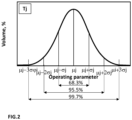
- the operating parameters values at which the particle accelerating system will actually be operating follow instead specific statistical distributions (Tj) as illustrated in Figure 2 , characterized by an average value ( ⁇ j) (which is the nominal value defined by the treatment plan) and a variance ( ⁇ j 2 ) representing the random variability of the treatment machine.
- ⁇ j average value
- ⁇ j 2 a variance representing the random variability of the treatment machine.
- Some particle accelerating systems are equipped with a monitoring device measuring the actual operating parameters of the beamlets as they are being delivered through a nozzle.
- EP2116277 , EP3375484 , US10456598 , EP3222322 , WO2020249565 , and EP2833970 describe examples of devices for in situ monitoring and verification of a selection of operating parameters of the beamlets delivered by a particle accelerating system.
- the operating parameters of one or more beamlets thus monitored differ from the planned values (which is likely to happen)
- BV acceptable band of variation
- an actual value of an operating parameter differing from the corresponding planned value does not necessarily mean that the corresponding D(R)DH extend beyond the acceptable band of variation.
- EP3498336 describes a system and method for treating a dummy (mannequin) and evaluating the DVH by dosimetry before applying the treatment to a patient. This technique clearly reduces the risk of having to interrupt a treatment session, but it also requires blocking a particle accelerating system for the time required to make the tests, during which it cannot be used for treating a patient. Furthermore, a dosimetric tolerance can translate into different machine tolerance levels for spots at different locations or with different MUs (e.g., spot on the edge of the structure of interest may have a higher constraint on position accuracy than spots at the centre of the structure). It is also not obvious how to translate a dose rate tolerance into a tolerance for each spot in the spot map.
- FLASH-RT In some places it is more important to check that the irradiation is in FLASH-RT mode than in other places.
- the tolerances on the dose rate may also be different between positions in the tissue.
- FLASH-RT could be required at the edges of the structure of interest, where tumoral cells are flanked by healthy cells which must be spared.
- PBS pencil beam scanning
- TP treatment plan
- the method allows determining the confidence level (CLj) for a given particle accelerating system to deliver beamlets which will fulfil the TP as a function of a set of operating parameters. If the confidence level thus obtained is too low, an alternative set of operating parameters needs be evaluated.
- a final statistical distribution (Tf) can be set with a final confidence level (CLf) to the corresponding operating parameters by a human operator or by a processor as follows,
- the new tentative statistical distributions (T(j+k)) can have lower standard deviations ( ⁇ j ) than the corresponding tentative statistical distributions (Tj) defined supra.
- the tentative statistical distributions (Tj) of each of the operating parameters are preferably gaussian distributions, and the value of the confidence level (CLj) can be comprised between 68% and 99.7%, preferably between 95.5 and 99% of the tentative statistical distribution.
- a confidence level (CLj) of 68% corresponds to ⁇ j ⁇ ⁇ j
- a confidence level (CLj) of 95% corresponds to ⁇ j ⁇ 2 ⁇ j
- a confidence level of 99.7% of the tentative statistical distribution corresponds to ⁇ j ⁇ 3 ⁇ j
- ⁇ j is an average value
- ⁇ j is the standard deviation of the corresponding tentative statistical distributions.
- the average values ( ⁇ j) and standard deviations ( ⁇ j ) of each operational parameter can be different for each beamlet (bi).
- the particle accelerating system can be equipped with a cyclic check module configured for measuring at different intervals or continuously actual values of the operating parameters including the monitor unit (MUai), the position (Xai), and of the starting time and end time (t0ai, t1ai) of the beamlets emitted by the particle accelerating system.
- the particle accelerating system can also be equipped with a processor configured for comparing the actual values of the operating parameters with the corresponding confidence level (CLj), and for stopping a treatment session in case one actual value of an operating parameter falls out of the corresponding confidence level (CLj).
- the cD(R)DHj0 is defined by the lowest values of cD(R)DHj calculated with the predefined confidence level (CLj) from the N randomly selected values of the monitor unit (Muij), position (Xij) of the beamlets, and starting time and end time (t0ij, t1 ij) and the cD(R)DHj1 is defined by the highest values of cD(R)DHj calculated with the predefined confidence level (CLj) from the N randomly selected values of the monitor unit (Muij), position (X0i) of the beamlets, and starting time and end time (t0ij, t1 ij).
- the treatment plan can include depositing doses into at least a portion of the structure of interest at ultra-high deposition rates (UHDR) defined as a deposition rate greater than or equal to 1 Gy / s.
- UHDR ultra-high deposition rates
- the present invention also concerns an error predicting module configured for implementing the method as defined supra, comprising,
- the processor can be further configured, in case any one of the one or more of the calculated distributions (CDj) of cDDHj and cDRDHj are not comprised within the corresponding acceptable bands of variation with the pre-defined confidence level (CLj), for repeating steps (i) to (iii) supra with new tentative statistical distributions (T(j+k)) of the operating parameters, until the calculated distributions (CDj) of the one or more of cDDHj and cDRDHj are both comprised within the corresponding acceptable bands of variation with the pre-defined confidence level (CLj).
- the method also requires a planned starting time (t0pi) and end time (t1 pi) at which each beamlet is to be delivered. This is particularly important in case of FLASH-RT.
- the starting and end times may or may not be part of the TP.
- FIGS 1(a) to 1(c) show examples of tDVH, tDRVH, and tDRDH represented by the solid lines, as well as of the corresponding acceptable bands of variation (BV) represented by the area comprised between the dashed lines. Similar acceptable bands of variation can be defined for any type of alternative D(R)DH histogram representation. If the beamlets delivered by the particle accelerating system achieve DVH and DRVH comprised within the acceptable band of variation as shown in Figures 3(b) and 3(c) , the session is successful.
- Figure 1(c) includes the actual values of the dose rate distribution histogram (aDDRH) obtained upon measuring the beamlets parameters during a treatment session (cf. long-dashed line). It can be seen that the curve aDDRH in Figure 1(c) is fully enclosed within the acceptable band of variation (BV). The treatment session was therefore successful. Had the curve aDDRH extended beyond the acceptable band of variation (BV), however, the treatment session would have had to be interrupted. In order to decrease the risk of having to interrupt a treatment session because of the actual D(R)DH falling out of the acceptable band of variation, the present invention proposes to implement the following actions with a computer.
- aDDRH dose rate distribution histogram
- a tentative statistical distribution (Tj) is selected of operating parameters (MUj, Xj, t0j, t1j) of the particle accelerating system centred on corresponding average values ( ⁇ j) representative of the performance of the particle accelerating system.
- a confidence level (CLj) of the tentative statistical distribution (Tj) of each of the operating parameters is defined.
- the operating parameters include:
- Tj tentative statistical distributions
- cDVHj calculated dose volume histograms
- cDRVHj calculated dose rate volume histograms
- a confidence level (CLj) can be defined, restricting the distribution to boundaries which are considered as acceptable.
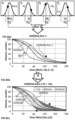
- a value (MUij) of the monitor unit, a value (Xij) of the position of the beamlet, and values (t0ij, t1 ij) of the starting time (t0ij) and end time (t1 ij) are randomly selected from the corresponding tentative statistical distributions (Tj) within the corresponding confidence levels (CLj); as shown with the black circles in the Gaussian distribution curves (Tj) of Figures 3(a) and 4(a) .
- the values are selected within the confidence level (CLj) previously defined.
- N statistical number of times
- any one of the cD(R)DHj-Run x thus calculated extends beyond the acceptable band of variation (BV), it could be concluded that there would be a risk higher than the predefined confidence level (CLj) of having to interrupt a treatment run with the operating parameters of the particle accelerating system according to the tentative statistical distributions (Tj).
- a new tentative statistical distribution (T(j+1)) of the operating parameters are then selected, and the cD(R)DH(j+1) is calculated in a new series of N Runs with randomly selected values of the new tentative statistical distributions (T(j+1)) at each successive Run. This operation is repeated with new tentative statistical distributions (T(j+k)) until the corresponding calculated distributions (CD(j+k)) are entirely comprised within the acceptable band of variation (BV).
- the calculated distributions (CDj) of the cD(R)DHj can be defined by a corresponding area comprised between, on the one hand,
- Figures 4(b) and 4(c) show an example of tentative statistical distribution (Tj) with associated confidence level (CLj) which yield calculated distributions (CDj) of cD(R)DHj extending beyond the corresponding acceptable bands of variation (BV) as indicated by the shaded areas and black arrows.
- Tj tentative statistical distribution
- CLj confidence level
- the particle accelerating system has a probability equal to the final confidence level (CLf) of delivering the beamlets fulfilling the treatment plan (TP) with corresponding actual dose (rate) distribution histogram(aD(R)DH) comprised within the acceptable band of variation (BV), as shown e.g., in Figure 1(c) .
- any one of the N runs of cD(R)DHj extends beyond the boundaries of the corresponding acceptable bands of variation (BV) with the pre-defined confidence level (CLj) as shown e.g., in Figure 4(b)
- a new tentative statistical distribution (T(j+1)) and / or a new confidence level (CL(j+1)) can be defined for one or more of the operating parameters and the cD(R)DHj can be calculated N times with N randomly selected values of each of the operating parameters.
- the new tentative statistical distributions (T(j+k)) defined in case the j+(k-1) preceding tentative statistical distributions did not yield calculated distributions included within the bands of variation (BV) surrounding tD(R)DH for the pre-defined confidence level (CLj), can be selected as distributions having lower standard deviations ( ⁇ j ) (or variances ( ⁇ j 2 )) than the corresponding preceding tentative statistical distributions (Tj+(k-1)).
- Tf final statistical distribution
- the tentative statistical distributions (Tj) of each of the operating parameters are preferably gaussian distributions.
- the values of the confidence levels (CL) are preferably comprised between 68% and 99.7%, preferably between 95.5 and 99% of the tentative statistical distribution.
- a confidence level (CLj) of 68% corresponds to ⁇ j ⁇ ⁇ j.
- a confidence level (CLj) of 95% corresponds to ⁇ j ⁇ 2 ⁇ j and a confidence level of 99.7% of the tentative statistical distribution, corresponds to ⁇ j ⁇ 3 ⁇ j , wherein ⁇ j is the standard deviation of the corresponding tentative statistical distributions.
- the position (Xj) of a spot may, for example, vary by ⁇ 1 mm from the average value ⁇ j of the Xj.
- the monitor unit (MUj) can for example vary by about 0.5% around the average value ( ⁇ j) of MUj. Note that the average values ( ⁇ j) and standard deviations ( ⁇ j ) of each operational parameter can be different for each beamlet (bi).
- the particle accelerating system can be equipped with a cyclic check module configured for measuring at different intervals or continuously actual values of the monitor unit (MUai), the position (Xai), and of the starting time and end time (t0ai, t1ai) of the beamlets emitted by the particle accelerating system.
- a processor can be configured for determining whether any actual operating parameter falls out of the corresponding final confidence level (CLf) (cf. Figures 3(a) and 4(a) , showing the confidence levels (CLj) spanning over a portion only of the statistical distributions (Tj)). In such case, an alarm can be triggered informing an operator of this event.
- the processor can also be configured for stopping the treatment as soon as an operating parameter falling out of the confidence level (CLj) is detected.
- the processor may be configured for calculating the cD(R)DH as soon as a measured actual value of an operating parameter falls out of the corresponding confidence level (CLj) to determine whether or not they are comprised within the corresponding acceptable bands of variation (BV).
- the cD(R)DH can be calculated based on the actual values of the operating parameters measured on the beamlets already delivered, including the parameter falling out of the confidence level (CLj), and on the average values ( ⁇ j) of the operating parameters according to the final statistical distribution (Tf) for the beamlets which remain to be delivered to end the treatment session. If the thus calculated cD(R)DH falls out of the acceptable band of variation (BV), the treatment session is stopped. If, on the other hand, the calculated cD(R)VH is within the acceptable band of variation (BV), the treatment session can proceed further. With this functionality of the processor, the risk of stopping a treatment session is further reduced.
- the treatment plan includes FLASH-RT, in that doses are to be deposited into at least a portion of the structure of interest at ultra-high deposition rates (UHDR) defined as a deposition rate greater than or equal to 1 Gy / s.
- the present invention also concerns an error predicting module configured for implementing the method described supra.
- the error predicting module comprises a memory comprising a plurality of tentative statistical distributions (Tj) for each operating parameter centred on a plurality of corresponding average values ( ⁇ j). It also comprises a user interface configured for entering,
- the error predicting module comprises a processor configured for,
- the processor can be further configured, in case the calculated distribution (CDj) of cD(R)Dj is not comprised within the corresponding acceptable band of variation with the pre-defined confidence level (CLj), for repeating the foregoing three steps with new tentative statistical distributions (T(j+k)) of the operating parameters, until the calculated distributions (CDj) of cD(R)Dj is comprised within the corresponding acceptable bands of variation with the pre-defined confidence level (CLj).
- Figure 6 shows a flowchart illustrating the various steps of the method of the present invention.
- the requirements of the treatment plan (TP) (cf. Figure 6(1) ) are translated into planned parameters for all the beamlets (cf. Figure 6(2) ).
- One or more theoretical dose (rate) distribution histograms (tD(R)DH) are defined (cf. Figure 6(3) ) with their corresponding acceptable bands of variation (BV) (cf. Figure 6(4) ).
- the dose (rate) distribution histograms (D(R)DH) can include non-exhaustively, the dose volume histogram (DVDH), the dose rate volume histogram (DRVH), or the differential dose rate distribution histogram (DDRH), and the like.
- the particle accelerating system is simulated (cf. Figure 6(5) ), by defining a first tentative statistical distribution (Tj) and a corresponding confidence level (CLj) (cf. Figure 6, (6) & (7) ).
- steps (10) & (11)), and steps (7) to (10) are repeated.
- a new value of each operational parameter is randomly selected a statistically representative number of times (N) within the confidence level (CLj) of the tentative statistical distributions (Tj) (cf. Figure 6(11), (12) & (8) ) and steps (8) to (10) are repeated.
- the corresponding tentative statistical distribution (Tj) can be set as the final statistical distribution (Tf) (cf. Figure 6(13) ).
- the particle accelerating system can be programmed with the operational parameters according to the corresponding final statistical distributions (Tf). With such programming, the particle accelerating system has a probability of CLj% of delivering beamlets satisfying the treatment plan without interruption of the treatment session.
- the method of the present invention can be implemented with a single calculated dose (rate) histogram (cD(R)DH) or with several histograms which must all be within the corresponding acceptable bands of variation (BV) to set the final statistical distribution (Tf). If a first tentative statistical distribution (Tj) yields one histogram (e.g., cDVH) enclosed within the corresponding acceptable band of variation (BV) but another histogram (e.g., cDRVH) extending beyond the acceptable band of variation (BV), a new tentative statistical distribution (T(j+1)) must be selected and the method carried out again, until a tentative statistical distribution (T(j+k)) is found that fits all the required histograms into the corresponding acceptable bands of variation (BV).
- rate rate histogram
- BV acceptable bands of variation
- Dose rate related histograms are particularly important for treatment plans comprising beamlets to be emitted in FLASH-mode for depositing doses at ultra-high deposition rates into selected spots of the structure of interest.
- Ref Description BV Band of variation CDj Calculated distribution of cDVHj and cDVRHj D(R)DH
- Dose (rate) distribution histogram (D(R)DH) includes both "dose distribution histograms (DDH)" and “dose rate distribution histograms (DRDH).”.
Landscapes
- Health & Medical Sciences (AREA)
- Engineering & Computer Science (AREA)
- Biomedical Technology (AREA)
- General Health & Medical Sciences (AREA)
- Nuclear Medicine, Radiotherapy & Molecular Imaging (AREA)
- Public Health (AREA)
- Pathology (AREA)
- Animal Behavior & Ethology (AREA)
- Life Sciences & Earth Sciences (AREA)
- Radiology & Medical Imaging (AREA)
- Veterinary Medicine (AREA)
- Physics & Mathematics (AREA)
- Theoretical Computer Science (AREA)
- Computer Hardware Design (AREA)
- Geometry (AREA)
- General Engineering & Computer Science (AREA)
- General Physics & Mathematics (AREA)
- Evolutionary Computation (AREA)
- Surgery (AREA)
- Urology & Nephrology (AREA)
- Epidemiology (AREA)
- Medical Informatics (AREA)
- Primary Health Care (AREA)
- Radiation-Therapy Devices (AREA)
Description
- The present invention is in the general field of treatment of tumoral cells by irradiation with accelerated particles, such as protons. In particular, it concerns a method for setting the operating parameters of a given particle accelerating system ensuring that the given particle accelerating system can deliver within a predefined confidence level beamlets of accelerated particles fulfilling the requirements of a treatment plan (TP) comprised within an acceptable band of variation (BV). This method is advantageous in that it reduces to within the predefined confidence level the risk of having to suddenly interrupt a patient irradiation session because the given particle accelerating system failed to deliver one or more beamlets satisfying the TP within the acceptable band of variation.
- Radiation therapy with particles or waves, such as protons beams, electron beams, heavy ions beams, x-rays, γ-rays, and the like, has become an essential tool for treating patients with tumours. Methods of planning radiation therapy are disclosed i. a. in document
US 2020/0353288 A1 . - Pencil beam scanning (PBS) is a technique consisting of steering beamlets of charged particles towards a target comprising tumoral cells defining a structure of interest. PBS reduces unnecessary radiation exposure to surrounding non-cancerous cells by shaping the area being treated to mirror the tumour geometry of the structure of interest. Pencil beam scanning can treat a tumour with a single beam composed of various beamlets or with multiple beams of different orientations each composed of various beamlets, sometimes called intensity modulated proton therapy (IMPT). Beside the geometry of the target, PBS allows local tuning of the parameters of the beamlets depending on the position within the target. The parameters can include the position and the monitor unit of each beamlet as well as the scanning sequence of the beamlets, with starting time and end time of each beamlet.
- Since both tumoural cells and healthy cells are damaged by such radiations, a major challenge in cancer treatment is to define a treatment plan (TP) ensuring that the tumoural cells are effectively destroyed or killed, while sparing as much as possible the healthy cells, in particular those adjacent to the tumoural cells. A first step of a treatment plan is the capture of images of the tumoural region by CT-scan. Based on these images, an oncologist identifies the right targets and determines the locations and doses to be deposited to kill the tumoural cells. Such plan must satisfy multiple, often competing, parameters, and is therefore quite complex. For this reason, treatment planning is generally carried out with a computer.
- The treatment plan (TP) generally comprises a definition of an array of n beamlets (bi), including values of planned parameters comprising,
- a planned position of each beamlet, defining the positions of spots aimed at by each beamlet which depends inter alia on the positions, sizes, and geometries of the tumoral cells within the structure of interest,
- a planned monitor unit (MUpi) of each beamlet, which relates to the number of particles going through the nozzle of the particle accelerating system and which must reach a given spot in the structure of interest.
- a planned beamlet scanning sequence over the planned positions (Xpi); this is important, since a beamlet deposits a dose into the corresponding spot, but can also deposit lower doses into neighbouring spots, which cannot be neglected when accounting the overall doses deposited in each spot; this is particularly true for flash treatment described more in detail infra.
- The treatment plan must ensure that, at the end of the treatment, a total target dose greater than or equal to a minimum target dose has been delivered to the tumoural cells forming the target effective for destroying / killing the tumoural cells. This can be defined by a target dose volume histogram (= tDVH), for the structure of interest. An example of tDVH is represented with a solid line in
Figure 1(a) , showing a graph plotting the volume (%) of the structure of interest which must receive at least a target dose as defined by the abscissa of the curve ofFigures 1(a) . The oncologist also defines an acceptable band of variation (BV) within which the DVH can deviate from the targets tDVH and represented inFigure 1(a) with dashed lines. - Historically, treatment plans by radiation therapy included the delivery of radiation doses to the treated cells at a conventional dose deposition rate (CDR) lower than 1 Gy / s. With rare exceptions, current radiation therapy facilities deliver dose-rates around 0.1 Gy / s and most clinical protocols involve daily delivery of several target fraction doses of 2 to 15 Gy cumulated to reach the total target dose which often exceeds the tolerance limit of normal tissues located in the radiation field, thus damaging them together with the tumoural cells. Recently, it has been observed that a same dose had different effects on healthy cells but not on tumoral cells when deposited at conventional dose deposition rates (CDR) or at ultra-high dose deposition rate (HDR); HDR can be one or more orders of magnitude largerthan conventional dose deposition rates (CDR) usually applied. Deposition of a charge at ultra-high dose deposition rates (HDR) is also referred to as FLASH-radiotherapy (= FLASH-RT). It has been demonstrated experimentally on animals and on various organs, that ultra-high rate dose deposition at HDR can significantly spare healthy tissues in comparison with conventional deposition of a same dose at CDR and, at the same time, tumoural cells respond same or even better to HDR deposition than to CDR deposition. For example, FLASH-RT reportedly elicits in mice a dramatic decrease of the incidence of lung fibrosis, of memory loss subsequent to brain irradiation, and of necrosis of the small intestine whilst keeping the anti-tumour efficiency unchanged. Such specific normal tissue sparing has been confirmed in large animals and a patient with cutaneous lymphoma has already been treated with FLASH-RT.
- The dose rate distribution in tissue can be defined by a target dose rate volume histogram (= tDRVH), for the structure of interest. An example of tDRVH is represented with a solid line in
Figure 1 (b) , showing a graph plotting the volume (%) of the structure of interest which must receive a target dose rate or higher for the tDRVH as defined by the abscissa of the curves ofFigure 1 (b) . The oncologist also defines an acceptable band of variation (BV) within which the DRVH can deviate from the target tDRVH and represented inFigure 1(b) with dashed lines. - The DVH and DRVH are cumulative histograms. There are other ways, however, of representing the distribution of doses or dose rates. For example,
Figure 1(c) shows a differential dose rate histogram (DDRH) indicating the number of voxels in a structure of interest which receive a dose at the corresponding dose rate indicated in the abscissa. The acceptable band of variation (BV) is represented with dashed lines, and the long-dashed line is actual values (= aDDRH) measured during a treatment session. Other representations are possible. All types of representations of the desired doses and dose rates distributions in a structure of interest a treatment plan must achieve are herein collectively referred to as "dose distribution histograms (DDH)" and "dose rate distribution histograms (DRDH)." The expression "dose (rate) distribution histogram (D(R)DH)" is also used herein for sake of conciseness to include both DDH and DRDH. - Fulfilling the planned beamlet scanning sequence may require defining a planned starting time and a planned end time for each beamlet. This is particularly important for FLASH-RT.
- A treatment plan system (TPS) defines beamlets parameters including the positions (Xj), monitoring units (MUj) and spots sequence to achieve the treatment plan (TP). A translation system (= TS) determines the operating parameters of a given particle accelerating system required for implementing the beamlets parameters, taking into account limits of the particle accelerating system. This is described, e.g., in
US20200298020 ,EP3932482 , andEP3932481A1 . The operating parameters are determined to ensure that the beamlets delivered by the given particle accelerating system will deposit doses into the structure of interest according to the target dose (rate) distribution histogram (D(R)DH) within the acceptable bands of variation (BV). The conversion of the TP into machine operating parameters is very important to ensure that a treatment session can be completed within the treatment plan, and not interrupted because at some point, the random variability of some operating parameters leads the beamlets actually delivered by the particle accelerating system to yield a D(R)DH which falls out of the acceptable band of variation (BV). - The nominal value of the operating parameters defined in the plan may not be precisely met by a given particle accelerating system. The operating parameters values at which the particle accelerating system will actually be operating follow instead specific statistical distributions (Tj) as illustrated in
Figure 2 , characterized by an average value (µj) (which is the nominal value defined by the treatment plan) and a variance (σj 2) representing the random variability of the treatment machine. This means that, even if the TS correctly converts the treatment plan (TP) into operating parameters to ensure that the given particle accelerating system delivers beamlets characterized by the average values (µj), the actual values of the operating parameters on a specific treatment session will be spread around the average value (µj) over the statistical distribution curve (Tj) (cf.Figure 2 ). It is therefore clear that during a treatment session, the operating parameters will deviate from the average values (µi) following the distributions thereof. In some cases, values of the actual operating parameters of the beamlets may yield D(R)DH extending beyond (outside) the corresponding acceptable bands of variation (BV), and the treatment session must be interrupted despite a correct TP conversion by the TS. If a treatment session does not proceed as planned, it can be dangerous for the patient. - Some particle accelerating systems are equipped with a monitoring device measuring the actual operating parameters of the beamlets as they are being delivered through a nozzle.
EP2116277 ,EP3375484 ,US10456598 EP3222322 ,WO2020249565 , andEP2833970 describe examples of devices for in situ monitoring and verification of a selection of operating parameters of the beamlets delivered by a particle accelerating system. In case the operating parameters of one or more beamlets thus monitored differ from the planned values (which is likely to happen), there is a risk that the corresponding D(R)DH extend beyond the acceptable band of variation (BV). Should this be the case, the treatment session must be stopped. This is very uncomfortable for the patient who may have to come back later to complete the treatment session, depending on the usually tight schedule of the particle accelerating system. It is therefore important to take the distributions of the operating parameters into consideration to ensure that a treatment session can be completed within a predefined confidence level (CLj) with all beamlets yielding the D(R)DH in accordance with the treatment plan. - Furthermore, an actual value of an operating parameter differing from the corresponding planned value does not necessarily mean that the corresponding D(R)DH extend beyond the acceptable band of variation. With the calculating power of processors available to date, it is not thinkable of calculating for each measurement of the actual values of the operating parameters the corresponding calculated D(R)DH to decide whether or not to interrupt the treatment session because one actual value differs from the planned values of the operating parameters.
-
EP3498336 describes a system and method for treating a dummy (mannequin) and evaluating the DVH by dosimetry before applying the treatment to a patient. This technique clearly reduces the risk of having to interrupt a treatment session, but it also requires blocking a particle accelerating system for the time required to make the tests, during which it cannot be used for treating a patient. Furthermore, a dosimetric tolerance can translate into different machine tolerance levels for spots at different locations or with different MUs (e.g., spot on the edge of the structure of interest may have a higher constraint on position accuracy than spots at the centre of the structure). It is also not obvious how to translate a dose rate tolerance into a tolerance for each spot in the spot map. In some places it is more important to check that the irradiation is in FLASH-RT mode than in other places. The tolerances on the dose rate may also be different between positions in the tissue. For example, FLASH-RT could be required at the edges of the structure of interest, where tumoral cells are flanked by healthy cells which must be spared. - To date, most methods for ensuring that the operating parameters will yield the desired D(R)DH is a posteriori, i.e., by measuring the treatment properties of the beamlets delivered by the particle accelerating system or, at best, based on dosimetric tests on a dummy (mannequin) performed before treating the patient. There remains a need in the art for a method for determining by calculation, i.e., without having to use precious accelerator time and energy, a set of operating parameters of the particle accelerating system to be used, yielding within a predefined confidence level the desired D(R)DH within the acceptable band of variation (BV).
- The present invention proposes a computer implemented method for optimizing tolerance values of operating parameters of a particle accelerating system allowing a beam formed by a plurality of beamlets of accelerated particles to deposit doses by pencil beam scanning (= PBS) to a patient according to a treatment plan (= TP). The method allows determining the confidence level (CLj) for a given particle accelerating system to deliver beamlets which will fulfil the TP as a function of a set of operating parameters. If the confidence level thus obtained is too low, an alternative set of operating parameters needs be evaluated. These and other advantages of the present invention are presented in continuation.
- The present invention is defined in the appended independent claims. Preferred embodiments are defined in the dependent claims. In particular, the present invention concerns a method implemented by a computer for optimizing tolerance values of operating parameters of a particle accelerating system allowing a beam formed by a plurality of beamlets of particles accelerated along an irradiation axis (Z), to deposit doses by pencil beam scanning (= PBS) into a structure of interest of a patient according to a treatment plan (= TP), the computer implemented method comprising,
- (a) providing an input comprising
- ∘ the treatment plan (= TP) including a definition of an array of beamlets (bi), characterized by planned parameters, including,
- ▪ a planned position (Xpi) of each beamlet (bi) on a plane (X,Y) normal to the irradiation axis (Z),
- ▪ a planned monitor unit (MUpi) of each beamlet,
- ▪ a planned beamlet scanning sequence over the planned positions (Xpi),
- ∘ a planned starting time (t0pi) and end time (t1 pi) at which each beamlet is to be delivered,
- o a definition of the structure of interest, defining one or more tissues being traversed by a number of the beamlets (bi),
- ∘ values of one or more target dose (rate) distribution histograms (= tD(R)DH) including a dose distribution histogram (= tDDH) and / or a target dose rate distribution histogram (= tDRDH), for the structure of interest obtained with a treatment with the planned parameters, wherein the dose distribution histogram (DDH) preferably is a dose distribution volume histogram (DDVH), and the dose rate distribution histogram (DRDH) preferably is a dose rate distribution volume histogram (DRDVH) or a differential dose rate histogram (DDRH).
- ∘ acceptable bands of variation (BV) in which the one or more tD(R)DH are allowed to vary,
- ∘ the treatment plan (= TP) including a definition of an array of beamlets (bi), characterized by planned parameters, including,
- (b) providing a tentative statistical distribution (Tj) of operating parameters of the particle accelerating system centred on corresponding average values (µj) representative of the performance of the particle accelerating system and defining a confidence level (CLj) of the tentative statistical distribution (Tj), wherein the operating parameters comprise,
- ∘ the monitor unit (MUj) of each beamlet,
- ∘ the position of each beamlet (Xj), and
- ∘ the starting time (t0j) and end time (t1j) of delivery of each beamlet,
- (c) randomly selecting from the corresponding tentative statistical distributions (Tj) within the predefined confidence levels (CLj) a value (MUij) of the monitor unit, a value (Xij) of the position of the beamlet, and a value (t0ij, t1 ij) of each of the starting time (t0ij) and end time (t1 ij),
- (d) calculating one or more calculated dose (rate) distribution histograms (= cD(R)DHj-Run x) with the values thus randomly selected,
- (e) repeating the last two steps (c), (d) a statistically representative number of times (N) to yield calculated distributions (CDj) characterizing the one or more thus calculated cD(R)DHj-Run x for all the values thus randomly selected of the operating parameters,
- (f) comparing the calculated distributions (CDj) of the one or more cD(R)DHj with the corresponding acceptable bands of variation (BV) and determining whether the calculated distributions (CDj) of the one or more cD(R)DHj are comprised in the corresponding acceptable bands of variation within the pre-defined confidence level (CLj).
- A final statistical distribution (Tf) can be set with a final confidence level (CLf) to the corresponding operating parameters by a human operator or by a processor as follows,
- If the calculated distributions (CDj) of the one or more cD(R)DHj are all comprised within the corresponding acceptable bands of variation (BV) with the pre-defined confidence level (CLj), for the given treatment plan (TP), setting the tentative statistical distribution (Tj) as the final statistical distribution (i.e., Tf = Tj) and the confidence level (CLj) as the corresponding final confidence level (CLf = CLj) to define the corresponding operating parameters
- If any one of the one or more cD(R)DHj calculated with one set of randomly selected values within the corresponding confidence levels (CLj) of the statistical distribution (Tj) of the operating parameters extends beyond the corresponding acceptable bands of variation (BV), repeating steps (b) to (f) as defined supra,
- ∘ with new tentative statistical distributions (T(j+k)) of the operating parameters and / or
- ∘ selecting new, less ambitious confidence levels (CL(j+k)),
- The new tentative statistical distributions (T(j+k)) can have lower standard deviations (σj) than the corresponding tentative statistical distributions (Tj) defined supra. The tentative statistical distributions (Tj) of each of the operating parameters are preferably gaussian distributions, and the value of the confidence level (CLj) can be comprised between 68% and 99.7%, preferably between 95.5 and 99% of the tentative statistical distribution. Note that a confidence level (CLj) of 68% corresponds to µj ± σj, a confidence level (CLj) of 95% corresponds to µj ± 2σj, and a confidence level of 99.7% of the tentative statistical distribution, corresponds to µj ± 3σj, wherein µj is an average value and σj is the standard deviation of the corresponding tentative statistical distributions. The average values (µj) and standard deviations (σj) of each operational parameter can be different for each beamlet (bi).
- The particle accelerating system can be equipped with a cyclic check module configured for measuring at different intervals or continuously actual values of the operating parameters including the monitor unit (MUai), the position (Xai), and of the starting time and end time (t0ai, t1ai) of the beamlets emitted by the particle accelerating system. The particle accelerating system can also be equipped with a processor configured for comparing the actual values of the operating parameters with the corresponding confidence level (CLj), and for stopping a treatment session in case one actual value of an operating parameter falls out of the corresponding confidence level (CLj).
- The planned parameters also comprise a planned beamlet size (dj) and a planned beam current (Ij), whose respective values (dij, lij) used for calculating the one or more calculated dose (rate) distribution histograms (= cD(R)DH) are randomly selected within a corresponding tentative statistical distribution (Tj) of the beamlet size (dj) and of the planned beam current (Ij).
- The calculated distributions (CDj) of the one or more cD(R)DH are defined by a corresponding area comprised in an envelope defined between, on the one hand, a minimum calculated dose (rate) distribution histogram (= cD(R)DHj0) and, on the other hand, a maximum calculated dose (rate) distribution histogram (= cD(R)DHj1). The cD(R)DHj0 is defined by the lowest values of cD(R)DHj calculated with the predefined confidence level (CLj) from the N randomly selected values of the monitor unit (Muij), position (Xij) of the beamlets, and starting time and end time (t0ij, t1 ij) and the cD(R)DHj1 is defined by the highest values of cD(R)DHj calculated with the predefined confidence level (CLj) from the N randomly selected values of the monitor unit (Muij), position (X0i) of the beamlets, and starting time and end time (t0ij, t1 ij).
- The treatment plan can include depositing doses into at least a portion of the structure of interest at ultra-high deposition rates (UHDR) defined as a deposition rate greater than or equal to 1 Gy / s.
- The present invention also concerns an error predicting module configured for implementing the method as defined supra, comprising,
- a memory comprising a plurality of tentative statistical distributions (Tj) for each operating parameter centred on a plurality of corresponding average values (µj),
- a user interface configured for,
- ∘ entering the treatment plan (TP) including one or more target dose (rate) distribution histograms (= tD(R)DH) including the target dose distribution histogram (= tDDH) and / or the target dose rate distribution histogram (= tDRDH), as well as the corresponding acceptable bands of variation (BV),
- ∘ selecting from the memory or entering a planned starting time (t0pi) and end time (t1 pi) at which each beamlet is to be delivered
- ∘ selecting from the memory or entering for each beamlet, a first tentative statistical distribution (Tj) for each operating parameter, including the monitor unit (MUj), the position (Xj) of the beamlet, and starting time and end time (t0i, t1i),
- ∘ entering a confidence level (CLj) on the operational parameters,
- a processor configured for,
- (i) randomly selecting a value of the monitor unit (MUij), a value of the position (Xij) of the beamlet, values of the starting time and end time (t0ij, t1 ij) comprised within the predefined confidence levels (CLj) of the corresponding tentative statistical distributions (Tj),
- (ii) calculating one or more of a calculated dose distribution histogram (= cDDHj) and a calculated dose rate distribution histogram (= cDRDHj) with the values thus randomly selected,
- (iii) repeating the last two steps a statistically representative number of times (N) to yield the calculated distributions (CDj) of the thus calculated cDDHj and cDRDHj for each beamlet.
- The processor can be further configured, in case any one of the one or more of the calculated distributions (CDj) of cDDHj and cDRDHj are not comprised within the corresponding acceptable bands of variation with the pre-defined confidence level (CLj), for repeating steps (i) to (iii) supra with new tentative statistical distributions (T(j+k)) of the operating parameters, until the calculated distributions (CDj) of the one or more of cDDHj and cDRDHj are both comprised within the corresponding acceptable bands of variation with the pre-defined confidence level (CLj).
- For a fuller understanding of the nature of the present invention, reference is made to the following detailed description taken in conjunction with the accompanying drawings in which:
-
Figures 1(a) to 1(c) : show examples of tDVH, tDRVH, and tDDRH curves with their corresponding acceptable bands of variation (BV). -
Figure 2 : shows a Gaussian distribution of an operating parameter of a given particle accelerating system. -
Figures 3(a) to 3(c) : show various steps of the method of the present invention, with a positive result. -
Figures 4(a) to 4(c) : show various steps of the method of the present invention, with a negative result. -
Figures 5(a) to 5(d) : show N runs of calculations yielding the calculated distributions (CDj) of the thus calculated cD(R)DHj as shown inFigures 3(b) &3(c). -
Figure 6 : shows a flowchart with the various steps of the method of the present invention. - The present invention concerns a computer implemented method and an error predicting module which considerably reduce the risk of carrying out a treatment session which does not respect a corresponding treatment plan, for reasons of equipment.
- The present invention concerns a method implemented by a computer for optimizing tolerance values of operating parameters of a particle accelerating system allowing a beam formed by a plurality of beamlets of particles accelerated along an irradiation axis (Z), to deposit doses by pencil beam scanning (= PBS) to a patient according to a treatment plan (= TP). The particles are preferably protons, but they can be electrons, heavy ions beams, but also waves formed by accelerated particles interacting with a converting material, such as x-rays (or γ-rays). As illustrated in
Figure 6 , the computer implemented method requires the input of a number of values of planned parameters. These can be provided by a treatment plan (TP) including the following planned parameters, - a planned position (Xpi) of each beamlet (bi) on a plane (X,Y) normal to the irradiation axis (Z),
- a planned monitor unit (MUpi) of each beamlet,
- a planned beamlet scanning sequence over the planned positions (Xpi),
- The method also requires a planned starting time (t0pi) and end time (t1 pi) at which each beamlet is to be delivered. This is particularly important in case of FLASH-RT. The starting and end times may or may not be part of the TP.
- The structure of interest must be defined, characterizing one or more tissues being traversed by or interacting with the beamlets (bi). The structure of interest comprises the target comprising the tumoural cells to be killed, but also healthy tissues traversed or somehow touched by one or more beamlets. These include for example, the tissues located upstream from the target along the irradiation axis (Z), i.e., between the nozzle of the particle accelerating system and the target, or also the tissues adjacent to and surrounding the target.
- An objective of the treatment is to yield at the end of a session, given values of a target dose (rate) distribution histogram (tD(R)DH) for the structure of interest, within an acceptable band of variation (BV) in which tD(R)VH are allowed to vary. As shown in
Figures 1(a) to 1(c) , tD(R)DH can include for example a target dose volume histogram (= tDVH) (cf.Figure 1(a) ), a target dose rate volume histogram (= tDRVH) (cf.Figure 1(b) ), or a target differential dose rate histogram (tDDRH) (cf.Figure 1(c) ). Note that other histogram representations are possible and included in the term tD(R)DH, to display the information on the dose and dose rate distributions.Figures 1(a) to 1(c) show examples of tDVH, tDRVH, and tDRDH represented by the solid lines, as well as of the corresponding acceptable bands of variation (BV) represented by the area comprised between the dashed lines. Similar acceptable bands of variation can be defined for any type of alternative D(R)DH histogram representation. If the beamlets delivered by the particle accelerating system achieve DVH and DRVH comprised within the acceptable band of variation as shown inFigures 3(b) and 3(c) , the session is successful. In case the DVH or DRVH fall out of the acceptable band of variation (BV) as shown inFigures 4(b) and 4(c) , the treatment session must be interrupted, to the great discomfort of the patient who must wait for a free slot in the particle accelerator system's schedule to resume the treatment session. -
Figure 1(c) includes the actual values of the dose rate distribution histogram (aDDRH) obtained upon measuring the beamlets parameters during a treatment session (cf. long-dashed line). It can be seen that the curve aDDRH inFigure 1(c) is fully enclosed within the acceptable band of variation (BV). The treatment session was therefore successful. Had the curve aDDRH extended beyond the acceptable band of variation (BV), however, the treatment session would have had to be interrupted. In order to decrease the risk of having to interrupt a treatment session because of the actual D(R)DH falling out of the acceptable band of variation, the present invention proposes to implement the following actions with a computer. - First, as shown in
Figures 3(a) and4(a) , a tentative statistical distribution (Tj) is selected of operating parameters (MUj, Xj, t0j, t1j) of the particle accelerating system centred on corresponding average values (µj) representative of the performance of the particle accelerating system. A confidence level (CLj) of the tentative statistical distribution (Tj) of each of the operating parameters is defined. The operating parameters include: - o the monitor unit (MUj) of each beamlet,
- o the position of each beamlet (Xj), and
- o the starting time (t0j) and end time (t1j) of delivery of each beamlet.
- The selection of tentative statistical distributions (Tj) is based on the performance of the particle accelerating system and is expected to generate a beam delivering the beamlets scanning sequence and generating calculated dose volume histograms (= cDVHj) and calculated dose rate volume histograms (= cDRVHj in the structure of interest that are comprised within the acceptable band of variation (BV). For example, a treatment plan system (TPS) can determine average values (µi) achievable by the particle accelerating system which would yield the desired cDVH and cDRVH. The actual operating parameters of the treatment machine on a specific day, however, are not restricted to the corresponding average values (µi) but are distributed generally over a Gaussian curve, varying from day to day or during the course of a day (cf.
Figure 2 ). The resulting cD(R)DH histograms will therefore vary depending on the actual values of the operating parameters at the specific time of the treatment and must therefore be calculated taking account of the distribution. It would not be practical to consider all the possible values of each operating parameter defined by the corresponding distribution curves. A confidence level (CLj) can be defined, restricting the distribution to boundaries which are considered as acceptable. For example, the confidence level can be defined with respect to the standard deviation (σj), such as for example, µj ± n σj, with n = 1 to 3. - A value (MUij) of the monitor unit, a value (Xij) of the position of the beamlet, and values (t0ij, t1 ij) of the starting time (t0ij) and end time (t1 ij) are randomly selected from the corresponding tentative statistical distributions (Tj) within the corresponding confidence levels (CLj); as shown with the black circles in the Gaussian distribution curves (Tj) of
Figures 3(a) and4(a) . The values are selected within the confidence level (CLj) previously defined. - As shown in
Figure 5(a) , in a first Run (= Run 1), the calculated dose (rate) distribution histogram (= cD(R)DHj) is calculated with the values thus randomly selected. If the calculated cD(R)DHj is enclosed within the corresponding acceptable band of variation, new values of the operating parameters are randomly selected from the tentative statistical distributions (Tj) and the corresponding cD(R)DHj is calculated in a second Run (= Run 2) as illustrated inFigure 5(b) . These operations are repeated a statistical number of times (N) as illustrated inFigure 5(c) , "Run N", as long as the calculated cD(R)DH-Run x are enclosed within the acceptable band of variation (BV). After N runs, the N curves "cD(R)DH-Run x" with x = 1 to N define in combination a calculated distribution (CDj), represented inFigures 3(b) &3(c), 4(b)&4(c), and 5(d) by the shaded areas bounded by the dotted lines. - If, on the other hand, any one of the cD(R)DHj-Run x thus calculated extends beyond the acceptable band of variation (BV), it could be concluded that there would be a risk higher than the predefined confidence level (CLj) of having to interrupt a treatment run with the operating parameters of the particle accelerating system according to the tentative statistical distributions (Tj). A new tentative statistical distribution (T(j+1)) of the operating parameters are then selected, and the cD(R)DH(j+1) is calculated in a new series of N Runs with randomly selected values of the new tentative statistical distributions (T(j+1)) at each successive Run. This operation is repeated with new tentative statistical distributions (T(j+k)) until the corresponding calculated distributions (CD(j+k)) are entirely comprised within the acceptable band of variation (BV).
- Besides the planned position (Xpi), the planned monitor unit (MUpi), the planned beamlet scanning sequence over the planned positions (Xpi), and the planned starting time (t0pi) and end time (t1 pi), the planned parameters can also comprise a planned beamlet size (dj) and a beam current (Ij), whose values (dij, lij)) used for calculating the calculated dose (rate) distribution histogram (= cD(R)DHj) are randomly selected within a corresponding tentative statistical distribution (Tj) of the beamlet size (dj) and beam current (Ij).
- The calculated distributions (CDj) of the cD(R)DHj can be defined by a corresponding area comprised between, on the one hand,
- a minimum calculated dose (rate) distribution histogram (= cD(R)DHj0) and, on the other hand,
- a maximum calculated dose (rate) distribution histogram (= cD(R)DHj1),
- cD(R)DHj0 is defined by the lowest values of cD(R)DHj calculated with the predefined confidence level (CLj) from the N randomly selected values of the monitor unit (Muij), position (Xij) of the beamlets, and starting time and end time (t0ij, t1 ij) and wherein
- cD(R)DHj1 is defined by the highest values of cD(R)DHj calculated with the predefined confidence level (CLj) from the N randomly selected values of the monitor unit (Muij), position (X0i) of the beamlets, and starting time and end time (t0ij, t1 ij).
- By comparing the calculated distributions (CDj) of cD(R)DHj with the acceptable band of variation (BV), it can be determined whether or not the calculated distribution (CDj) of cD(R)DHjj is comprised in the corresponding acceptable band of variation for the pre-defined confidence level (CLj).
Figures 3(b) and 3(c) show an example of tentative statistical distributions (Tj) with associated confidence level (CLj) which yields calculated distributions (CDj) of cD(R)DHj comprised within the corresponding acceptable bands of variation (BV). By contrast,Figures 4(b) and 4(c) show an example of tentative statistical distribution (Tj) with associated confidence level (CLj) which yield calculated distributions (CDj) of cD(R)DHj extending beyond the corresponding acceptable bands of variation (BV) as indicated by the shaded areas and black arrows. For example, it can be seen inFigure 4(b) , that the cD(R)DHj-Run 1 already extends beyond the acceptable band of variation (BV). Calculation with the corresponding tentative statistical distribution can be stopped and a new tentative statistical distribution (T(j+1)) can be selected to repeat the N runs with values of the operating parameters randomly selected from the new tentative statistical distribution (T(j+1)). - The method of the present invention can conclude by setting a final statistical distribution (Tf) to the corresponding operating parameters with a final confidence level (CLf). If the N runs of calculated distributions (CDj) of cD(R)DHj are comprised within the corresponding acceptable band of variation (BV) with the pre-defined confidence level (CLj), for the given treatment plan (TP), the tentative statistical distribution (Tj) can be set as the final statistical distribution (i.e., Tf = Tj) with the final confidence level (CLf = CLj) to define the corresponding operating parameters. It can be concluded that, by implementing the final statistical distributions (Tf) of operating parameters, the particle accelerating system has a probability equal to the final confidence level (CLf) of delivering the beamlets fulfilling the treatment plan (TP) with corresponding actual dose (rate) distribution histogram(aD(R)DH) comprised within the acceptable band of variation (BV), as shown e.g., in
Figure 1(c) . - If, on the other hand, any one of the N runs of cD(R)DHj extends beyond the boundaries of the corresponding acceptable bands of variation (BV) with the pre-defined confidence level (CLj) as shown e.g., in
Figure 4(b) , a new tentative statistical distribution (T(j+1)) and / or a new confidence level (CL(j+1)) can be defined for one or more of the operating parameters and the cD(R)DHj can be calculated N times with N randomly selected values of each of the operating parameters. These operations can be repeated as often as necessary with new tentative statistical distributions (T(j+k)) of the operating parameters and / or with alternative confidence levels (CL(j+k)), until the calculated distributions (CD(j+k)) of cD(R)DHj(j+k) is comprised within the corresponding acceptable band of variation (BV) for the pre-defined confidence level (CLj) or (CL(j+k)). The final statistical distribution (Tf) can thus be set as being the tentative statistical distribution (T(j+k)) (i.e., Tf = T(j+k)) and the corresponding confidence level (CL(j+k)) can be set as the final confidence level (CLf = CL(j+k)), to define the corresponding operating parameters. - The new tentative statistical distributions (T(j+k)) defined in case the j+(k-1) preceding tentative statistical distributions did not yield calculated distributions included within the bands of variation (BV) surrounding tD(R)DH for the pre-defined confidence level (CLj), can be selected as distributions having lower standard deviations (σj) (or variances (σj 2)) than the corresponding preceding tentative statistical distributions (Tj+(k-1)).
- Setting the final statistical distribution (Tf) for the corresponding operating parameters can be carried out by a human operator or automatically, by a processor.
- The tentative statistical distributions (Tj) of each of the operating parameters are preferably gaussian distributions. The values of the confidence levels (CL) are preferably comprised between 68% and 99.7%, preferably between 95.5 and 99% of the tentative statistical distribution. As shown in
Figure 2 , a confidence level (CLj) of 68% corresponds to µj ± σj. A confidence level (CLj) of 95% corresponds to µj ± 2σj and a confidence level of 99.7% of the tentative statistical distribution, corresponds to µj ± 3σj, wherein σj is the standard deviation of the corresponding tentative statistical distributions. For example, in terms of absolute deviations, the position (Xj) of a spot may, for example, vary by ±1 mm from the average value µj of the Xj. The monitor unit (MUj) can for example vary by about 0.5% around the average value (µj) of MUj. Note that the average values (µj) and standard deviations (σj) of each operational parameter can be different for each beamlet (bi). - The particle accelerating system can be equipped with a cyclic check module configured for measuring at different intervals or continuously actual values of the monitor unit (MUai), the position (Xai), and of the starting time and end time (t0ai, t1ai) of the beamlets emitted by the particle accelerating system. A processor can be configured for determining whether any actual operating parameter falls out of the corresponding final confidence level (CLf) (cf.
Figures 3(a) and4(a) , showing the confidence levels (CLj) spanning over a portion only of the statistical distributions (Tj)). In such case, an alarm can be triggered informing an operator of this event. As a safety measure, the processor can also be configured for stopping the treatment as soon as an operating parameter falling out of the confidence level (CLj) is detected. - The fact that one or more values of the actual operating parameters fall out of the corresponding confidence levels (CLj) does not mean that the resulting aD(R)DH necessarily falls out of the acceptable band of variation (BV). It could therefore be over-shooting to interrupt the treatment session simply because one actual value of any operating parameter fell out of the corresponding confidence level (CLj), as it could perfectly yield a D(R)DH comprised within the acceptable band of variation (BV). The processor may be configured for calculating the cD(R)DH as soon as a measured actual value of an operating parameter falls out of the corresponding confidence level (CLj) to determine whether or not they are comprised within the corresponding acceptable bands of variation (BV). The cD(R)DH can be calculated based on the actual values of the operating parameters measured on the beamlets already delivered, including the parameter falling out of the confidence level (CLj), and on the average values (µj) of the operating parameters according to the final statistical distribution (Tf) for the beamlets which remain to be delivered to end the treatment session. If the thus calculated cD(R)DH falls out of the acceptable band of variation (BV), the treatment session is stopped. If, on the other hand, the calculated cD(R)VH is within the acceptable band of variation (BV), the treatment session can proceed further. With this functionality of the processor, the risk of stopping a treatment session is further reduced.
- This function does not take excessive calculating power, as it would concern only 100% - CLj % of the actual values of the operating parameters. For a confidence level (CLj) of 95% i.e., µj ± 2σj, there would be a probability of only 5% that a value of an operating parameter should fall out of the confidence level (CLj) whch the D(R)DH would have to be calculated for. For a confidence level of 99.7% of the tentative statistical distribution, i.e., µj ± 3σj, it would concern a probability of merely 0.3% where such calculation would be required.
- In a preferred embodiment, the treatment plan includes FLASH-RT, in that doses are to be deposited into at least a portion of the structure of interest at ultra-high deposition rates (UHDR) defined as a deposition rate greater than or equal to 1 Gy / s. In this embodiment, the planned parameters also comprise a beam current (I), whose values (Ij) used for calculating the calculated dose distribution histogram (= cDDHj) and, in particular, the calculated dose rate distribution histogram (= cDRDHj) are randomly selected within a corresponding tentative statistical distribution (Tj) of the beam current (Ij).
- The present invention also concerns an error predicting module configured for implementing the method described supra. The error predicting module comprises a memory comprising a plurality of tentative statistical distributions (Tj) for each operating parameter centred on a plurality of corresponding average values (µj). It also comprises a user interface configured for entering,
- planned operators including the treatment plan (TP) including the planned position (Xpi), the planned monitor unit (MUpi), and the planned beamlet scanning sequence, the planned starting time (t0pi) and end time (t1 pi),
- the target dose (rate) distribution histogram (= tD(R)DH) and corresponding acceptable band of variation (BV),
- for each beamlet, a first tentative statistical distribution (Tj) selected among or defined by entering values of the average values (µj) and standard deviations (σj) from one or more of the plurality of tentative statistical distributions for each operating parameter, including at least the monitor unit (MUj), the position (Xj) of the beamlet, and starting time and end time (t0i, t1i),
- The error predicting module comprises a processor configured for,
- randomly selecting a value of the monitor unit (MUij), a value of the position (Xij) of the beamlet, values of the starting time and end time (t0ij, t1 ij) comprised within the predefined confidence levels (CLj) of the corresponding tentative statistical distributions (Tj),
- calculating a calculated dose (rate) distribution histogram (= cD(R)Dj) with the values thus randomly selected,
- repeating the last two steps a statistically representative number of times (N) to yield the calculated distributions (CDj) of the thus calculated cD(R)Dj for each beamlet.
- The processor can be further configured, in case the calculated distribution (CDj) of cD(R)Dj is not comprised within the corresponding acceptable band of variation with the pre-defined confidence level (CLj), for repeating the foregoing three steps with new tentative statistical distributions (T(j+k)) of the operating parameters, until the calculated distributions (CDj) of cD(R)Dj is comprised within the corresponding acceptable bands of variation with the pre-defined confidence level (CLj).
-
Figure 6 shows a flowchart illustrating the various steps of the method of the present invention. The requirements of the treatment plan (TP) (cf.Figure 6(1) ) are translated into planned parameters for all the beamlets (cf.Figure 6(2) ). One or more theoretical dose (rate) distribution histograms (tD(R)DH) are defined (cf.Figure 6(3) ) with their corresponding acceptable bands of variation (BV) (cf.Figure 6(4) ). As defined supra, the dose (rate) distribution histograms (D(R)DH) can include non-exhaustively, the dose volume histogram (DVDH), the dose rate volume histogram (DRVH), or the differential dose rate distribution histogram (DDRH), and the like. - The particle accelerating system is simulated (cf.
Figure 6(5) ), by defining a first tentative statistical distribution (Tj) and a corresponding confidence level (CLj) (cf.Figure 6, (6) &(7) ). A value of each operational parameter is randomly selected within the confidence level (CLj) of the tentative statistical distributions (Tj) (cf.Figure 6(8) ) and the resulting cD(R)DHj-Run (x = 1) is calculated (cf.Figure 6(9) ). If the calculated CD(R)DH-Run (x = 1) is not within the acceptable band of variation (BV) a new tentative statistical distribution (T(j+1)) is selected with a corresponding confidence level (CL(j+1)) (cf.Figure 6 , steps (10) & (11)), and steps (7) to (10) are repeated. If, on the other hand, the calculated CD(R)DH-Run (x = 1) is within the acceptable band of variation (BV), a new value of each operational parameter is randomly selected a statistically representative number of times (N) within the confidence level (CLj) of the tentative statistical distributions (Tj) (cf.Figure 6(11), (12) &(8) ) and steps (8) to (10) are repeated. When all N Runs x yielded calculated CD(R)DH-Run (x = 1 to N) are within the acceptable band of variation (BV), the corresponding tentative statistical distribution (Tj) can be set as the final statistical distribution (Tf) (cf.Figure 6(13) ). The particle accelerating system can be programmed with the operational parameters according to the corresponding final statistical distributions (Tf). With such programming, the particle accelerating system has a probability of CLj% of delivering beamlets satisfying the treatment plan without interruption of the treatment session. - The method of the present invention can be implemented with a single calculated dose (rate) histogram (cD(R)DH) or with several histograms which must all be within the corresponding acceptable bands of variation (BV) to set the final statistical distribution (Tf). If a first tentative statistical distribution (Tj) yields one histogram (e.g., cDVH) enclosed within the corresponding acceptable band of variation (BV) but another histogram (e.g., cDRVH) extending beyond the acceptable band of variation (BV), a new tentative statistical distribution (T(j+1)) must be selected and the method carried out again, until a tentative statistical distribution (T(j+k)) is found that fits all the required histograms into the corresponding acceptable bands of variation (BV). Dose rate related histograms (e.g., DRVH, DDRH) are particularly important for treatment plans comprising beamlets to be emitted in FLASH-mode for depositing doses at ultra-high deposition rates into selected spots of the structure of interest.
Ref Description BV Band of variation CDj Calculated distribution of cDVHj and cDVRHj D(R)DH Dose (rate) distribution histogram (D(R)DH) includes both "dose distribution histograms (DDH)" and "dose rate distribution histograms (DRDH).". cD(R)Dj Calculated dose (rate) distribution histogram of beamlet Si with tentative statistical distribution Tj cDVH Calculated dose volume histogram of beamlet Si with tentative statistical distribution Tj cDRVH Calculated dose rate volume histogram of beamlet Si with tentative statistical distribution Tj cD(R)Dj0 Minimum calculated dose (rate) distribution histogram cD(R)Dj1 Maximum calculated dose (rate) distribution histogram CLj Confidence level CLf Final confidence level Dj Beamlet size DRj Dose deposition rate i i = 1 - N Runs j, k Identifies one tentative statistical distribution of an operational parameter MUai Actual monitor unit of a beamlet Si as delivered by the particle accelerator MUj Monitor unit distribution of a beamlet Si according to the tentative statistical distribution MUij Random value from the monitor unit distribution of a beamlet Si MUpi Planned monitor unit of a beamlet Si PBS Pencil Beam Scanning Si Beamlet Tj, T(j+k) Tentative statistical distribution of an operational parameter Tf Final statistical distribution of an operational parameter TP Treatment plan t0aj Actual starting time of a bemlet Si t0j Starting time distribution of a beamlet Si according to the tentative statistical distribution t0ij Random value from the starting time distribution of a beamlet Si t0pi Planned starting time of a beamlet Si t1ai Actual end time of a bemlet Si t1i End time distribution of a beamlet Si according to the tentative statistical distribution t1ij Random value from the end time distribution of a beamlet Si t1pi Planned end time of a beamlet Si tD(R)Dj Theoretical dose (rate) distribution histogram of beamlet Si with tentative statistical distribution Tj tDVH Theoretical dose volume histogram of beamlet Si with tentative statistical distribution Tj tDRVH Theoretical dose rate volume histogram of beamlet Si with tentative statistical distribution Tj Xai Actual position of a beamlet Si Xi Position of a beamlet Si Xij Random value from the position of a beamlet Si Xpi Planned position of a beamlet Si (X,Y) Plane normal to the irradiation axis (Z) Z Irradiation axis Δti Duration of dose deposition by beamlet Si µj Average value of an operational parameter distribution of beamlet Si σj Standard deviation of an operational parameter distribution of beamlet Si
Claims (15)
- Method implemented by a computer for optimizing tolerance values of operating parameters of a particle accelerating system allowing a beam formed by a plurality of beamlets of particles accelerated along an irradiation axis (Z), to deposit doses by pencil beam scanning (PBS) into a structure of interest of a patient according to a treatment plan (TP), the computer implemented method comprising,(a) providing an input comprising∘ the treatment plan (TP) including a definition of an array of beamlets, bi, each defined by planned parameters, including,▪ a planned position, Xpi, of each beamlet, bi, on a plane (X,Y) normal to the irradiation axis (Z),▪ a planned monitor unit, MUpi, of each beamlet,▪ a planned beamlet scanning sequence over the planned positions, Xpi,∘ a planned starting time, t0pi, and end time, t1pi, at which each beamlet is to be delivered,∘ a definition of the structure of interest, defining one or more tissues being traversed by a number of the beamlets, bi,∘ values of one or more target dose distribution histograms, tDDH, or dose rate distribution histograms, tDRDH, for the structure of interest obtained with a treatment with the planned parameters, and∘ acceptable bands of variation, BV, within which the one or more target dose distribution histograms or target dose rate distribution histograms are allowed to vary,(b) providing a tentative statistical distribution, Tj, of operating parameters of the particle accelerating system centred on corresponding average values, µj, representative of the performance of the particle accelerating system and defining a confidence level, CLj, of the tentative statistical distributuin, Tj, wherein the operating parameters comprise,∘ the monitor unit, MUj, of each beamlet,∘ the position of each beamlet, Xj, and∘ the starting time, t0j, and end time, t1j, of delivery of each beamlet,(c) randomly selecting from the corresponding tentative statistical distributions, Tj, within the predefined confidence levels, CLj, a value MUij of the monitor unit, a value Xij of the position of the beamlet, and a value t0ij, t1ij of each of the startingtime, t0ij, and end time t1ij,(d) calculating one or more calculated dose distribution histograms, cDDHj, run x, or dose rate distribution histograms, cDRDHj, run x, with x = 1 to N being a number of calculation runs, with the values thus randomly selected,(e) repeating the last two steps (c), (d) a statistically representative number N of times to yield calculated distributions, CDj, defining the one or more thus calculated dose distribution histograms, cDDHj, or dose rate distribution histograms, cDRDHj, for all the values thus randomly selected of the operating parameters,(f) comparing the calculated distributions, CDj, of the one or more calculated dose distribution histograms, cDDHj, or dose rate distribution histograms, cDRDHj, with the corresponding acceptable bands of variation, BV, and determining whether the calculated distributions, CDj, of the one or more calculated dose distribution histograms, cDDHj, or dose rate distribution histograms, cDRDHj, are comprised in the corresponding acceptable bands of variation within the predefined confidence level, CLj.
- Method according to claim 1, comprising setting a final statistical distribution. Tf, with a final confidence level, CLf, to the corresponding operating parameters as follows,• If the calculated distributions, CDj, of the one or more calculated dose distribution histograms, cDDHj, or dose rate distribution histograms, cDRDHj, are all comprised within the corresponding acceptable bands of variation, BV, with the predefined confidence level, CLj, for the given treatment plan (TP), setting the tentative statistical distribution, Tj, as the final statistical distribution Tf = Tj, and the confidence level, CLj, as the corresponding final confidence level CLf = CLj, to define the corresponding operating parameter,• If any one of the one or more calculated dose distribution histograms, cDDHj, or dose rate distribution histograms, cDRDHj, calculated with one set of randomly selected values within the corresponding confidence levels, CLj, of the statistical distribution, Tj, of the operating parameters extends beyond the corresponding acceptable bands of variation, BV,∘ repeating steps (b) to (f) of claim 1 with new tentative statistical distributions, T(j+k), of the operating parameters, and or∘ selecting new, less ambitious confidence levels , CL(j+k), until the calculated distributions, CD(j+k), of the one or more calculated dose distribution histograms, cDDH(j+k) or dose rate distribution histograms, cDRDH(j+k), are all comprised within the corresponding acceptable bands of variation, BV, and setting the tentative statistical distribution, T(j+k), as the final statistical distribution Tf = T(j+k), and setting the corresponding confidence level, CL(j+k), as the final confidence level CLf = CL(j+k), to define the corresponding operating parameters.
- Method according to claim 2, wherein setting the final statistical distribution , Tf, to the corresponding operating parameters is carried out by a human operator or by a processor.
- Method according to claim 2 or 3, wherein the new tentative statistical distributions T(j+k) defined in claim 2 in case any one of the one or more calculated dose distribution histograms, cDDHj, or dose rate distribution histograms, cDRDHj, extends beyond the corresponding acceptable bands of variation with the predefined confidence level CLj have lower standard deviations σj than the corresponding tentative statistical distributions Tj defined in step (b) of claim 1.
- Method according to any one of the preceding claims, wherein the tentative statistical distributions Tj of each of the operating parameters are gaussian distributions, and wherein the value of the confidence level CLj is comprised between 68% and 99.7%, preferably between 95.5 and 99% of the tentative statistical distribution, wherein a confidence level of 68% corresponds to µj ± σj, a confidence level of 95% corresponds to µj ± 2σj, and a confidence level of 99.7% of the tentative statistical distribution, corresponds to µj ± 3σj, wherein µj is an average value and σj is the standard deviation of the corresponding tentative statistical distributions.
- Method according to claim 5, wherein the average values µj and standard deviations σj of each operational parameter are allowed to be different for each beamlet bi.
- Method according to any one of the preceding claims, wherein the particle accelerating system is equipped with a cyclic check module configured for measuring at different intervals or continuously actual values of the operating parameters including an actual monitor unit MUai, an actual Preposition Xai, and an actual value of a starting time t0ai and end time t1ai of the beamlets emitted by the particle accelerating system.
- Method according to the preceding claim 7, wherein the particle accelerating system is equipped with a processor configured for comparing the actual values of the operating parameters with the corresponding confidence level CLj, and for stopping a treatment session in case one actual value of an operating parameter falls out of the corresponding final confidence level CLf.
- Method according to any one of the preceding claims, wherein the planned parameters also comprise a planned beamlet size, dj, whose values, dij, used for calculating the one or more calculated dose distribution histograms cDDHj or dose rate distribution histograms cDRDHj are randomly selected within the corresponding tentative statistical distribution Tj of the beamlet size dj.
- Method according to any one of the preceding claims, wherein the calculated distributions CDj of the one or more calculated dose distribution histograms, cDDHj, or dose rate distribution histograms, cDRDHj, are defined by a corresponding area comprised between, on the one hand, a minimum calculated dose distribution histogram, cDDHjO, or a minimum calculated dose rate distribution histogram, cDRDHjO, and, on the other hand, a maximum calculated dose distribution histogram, cDDHj1, or a maximum calculated dose rate distribution histogram, cDRDHj1, wherein• the minimum calculated dose distribution histogram cDDHjO or the minimum calculated dose rate distribution histogram cDRDHj0 is defined by the lowest values of the calculated dose distribution histogram cDDHj or the calculated dose rate distribution histogram cDRDHj calculated with the predefined confidence level CLj from the N randomly selected values of the monitor unit MUij, the position Xij of the beamlets, and the starting time t0ij and end time t1ij, and wherein• the maximum calculated dose distribution histogram cDDHjO or the maximum calculated dose rate distribution histogram cDRDHjO is defined by the highest values of the calculated dose distribution histogram cDDHj or the calculated dose rate distribution histogram cDRDHj calculated with the predefined confidence level CLj from the N randomly selected values of the monitor unit MUij, the position X0i of the beamlets, and the starting time t0ij and end time t1ij.
- Method according to any one of the preceding claims, wherein the treatment plan includes depositing doses into at least a portion of the structure of interest at ultra-high deposition rates defined as a deposition rate greater than or equal to 1 Gy / s.
- Method according to any one of the preceding claims, wherein the planned parameters also comprise a planned beam current, Ij, whose values lij used for calculating the calculated dose distribution histogram cDDHj or dose rate distribution histogram cDRDHj are randomly selected within a corresponding tentative statistical distribution Tj of the beam current Ij.
- Method according to any one of the preceding claims, wherein a dose distribution histogram, selected from the target dose distribution histogram or the calculated dose distribution histogram, DDH a dose volume histogram, DVH, and wherein the dose rate distribution histogram, DRDH, selected from the target dose rate distribution histogram or the calculated dose rate distribution histogram, is a dose rate volume histogram, DRVH, or a differential dose rate histogram, DDRH.
- Error predicting module configured for implementing the method of any one of the preceding claims, comprising,• a memory comprising the plurality of tentative statistical distributions, Tj, for each operating parameter centred on the plurality of corresponding average values, µj,• a user interface configured for,∘ entering the treatment plan (TP) including the one or more target dose distribution histograms, tDHDH, or target dose rate distribution histograms, tDHRDH, as well as the corresponding acceptable bands of variation, BV,∘ selecting from the memory or entering the planned starting time, t0pi, and the planned end time, t1pi, at which each beamlet is to be delivered,∘ selecting from the memory or entering for each beamlet, the first tentative statistical distribution, Tj, for each operating parameter, including the monitor unit, MUj, the position, Xj, of the beamlet, and the starting time, t0j, and end time, t1i, and∘ entering the confidence level, CLj, (OLj) on the operational parameters,• a processor configured for,(i) randomly selecting the value MUij of the monitor unit, the value Xij of the position of the beamlet, the values of the starting time, t0ij, and end time, t1ij, comprised within the predefined confidence levels, CLj, of the corresponding tentative statistical distributions, Tj,(ii) calculating a calculated one or more of the dose distribution histogram, cDDHj, and the calculated dose rate distribution histogram, cDRDHj, with the values thus randomly selected, and(iii) repeating the last two steps the statistically representative number N of times to yield the calculated distributions, CDj, of the thus calculated dose distribution histograms, cDDHj, and dose rate distribution histograms, cDRDHj, for each beamlet.
- Error predicting module according to the preceding claim 14, wherein the processor is further configured, in case any one of the one or more of the calculated distributions, CDj, of corresponding calculated dose distribution histograms (cDDHj) or dose rate distribution histograms (cDRDHj) are not comprised within the corresponding acceptable bands of variation with the predefined confidence level, CLj, for repeating steps (i) to (iii) of claim 14 with new tentative statistical distributions, T(j+k), of the operating parameters, until the calculated distributions, CDj, of the one or more of the calculated dose distribution histograms, cDDHj, or the dose rate distribution histograms, cDRDHj, are all comprised within the corresponding acceptable bands of variation with the predefined confidence level, CLj.
Priority Applications (4)
| Application Number | Priority Date | Filing Date | Title |
|---|---|---|---|
| EP22172682.1A EP4275741B1 (en) | 2022-05-11 | 2022-05-11 | Computer implemented method for reducing the risk of interrupting an irradiation treatment session due to a deviation from a planned value of an operating parameter of a particle accelerating system |
| US18/313,712 US20230364446A1 (en) | 2022-05-11 | 2023-05-08 | Computer implemented method for reducing the risk of interrupting an irradiation treatment session due to a deviation from a planned value of an operating parameter of a particle accelerating system |
| JP2023077662A JP2023168277A (en) | 2022-05-11 | 2023-05-10 | Computer implemented method for reducing risk of interrupting irradiation treatment session due to deviation from planned value of operating parameter of particle accelerating system |
| CN202310532746.6A CN117057209B (en) | 2022-05-11 | 2023-05-11 | Computer-implemented method for reducing the risk of interrupting a radiation therapy session due to deviations from planned values of operating parameters of a particle acceleration system |
Applications Claiming Priority (1)
| Application Number | Priority Date | Filing Date | Title |
|---|---|---|---|
| EP22172682.1A EP4275741B1 (en) | 2022-05-11 | 2022-05-11 | Computer implemented method for reducing the risk of interrupting an irradiation treatment session due to a deviation from a planned value of an operating parameter of a particle accelerating system |
Publications (3)
| Publication Number | Publication Date |
|---|---|
| EP4275741A1 EP4275741A1 (en) | 2023-11-15 |
| EP4275741C0 EP4275741C0 (en) | 2024-09-11 |
| EP4275741B1 true EP4275741B1 (en) | 2024-09-11 |
Family
ID=81603477
Family Applications (1)
| Application Number | Title | Priority Date | Filing Date |
|---|---|---|---|
| EP22172682.1A Active EP4275741B1 (en) | 2022-05-11 | 2022-05-11 | Computer implemented method for reducing the risk of interrupting an irradiation treatment session due to a deviation from a planned value of an operating parameter of a particle accelerating system |
Country Status (4)
| Country | Link |
|---|---|
| US (1) | US20230364446A1 (en) |
| EP (1) | EP4275741B1 (en) |
| JP (1) | JP2023168277A (en) |
| CN (1) | CN117057209B (en) |
Family Cites Families (13)
| Publication number | Priority date | Publication date | Assignee | Title |
|---|---|---|---|---|
| EP2116277A1 (en) | 2008-05-06 | 2009-11-11 | Ion Beam Applications S.A. | Device and method for particle therapy monitoring and verification |
| WO2011162021A1 (en) * | 2010-06-23 | 2011-12-29 | 独立行政法人放射線医学総合研究所 | Irradiation plan making method, irradiation plan making device, and irradiation plan making program |
| EP2647407A1 (en) | 2012-04-03 | 2013-10-09 | Paul Scherrer Institut | A system for the delivery of proton therapy by pencil beam scanning of a predeterminable volume within a patient |
| WO2014090336A1 (en) | 2012-12-14 | 2014-06-19 | Elekta Ab (Publ) | Radiotherapy apparatus |
| US9731149B2 (en) | 2013-09-22 | 2017-08-15 | Pyramid Technical Consultants Inc. | Method and apparatus for measuring, verifying, and displaying progress of dose delivery in scanned beam particle therapy |
| EP3375484B1 (en) | 2015-11-13 | 2020-05-20 | Hitachi, Ltd. | Particle beam therapy system |
| US10716954B2 (en) | 2016-04-05 | 2020-07-21 | Varian Medical System Particle Therapy Gmbh | Time optimized radiation treatment |
| ES2625761B1 (en) | 2016-08-10 | 2018-04-10 | María Del Carmen OVEJERO MAYORAL | METHOD FOR AUTOMATION IN DOSIMETRIC CALIBRATION, RECONSTRUCTION AND VERIFICATION OF COMPREHENSIVE TREATMENTS OF INTEGRATED RADIOTHERAPY IN AN ENVIRONMENT AND SYSTEM FOR PRACTICE OF THE SAME |
| WO2019094824A1 (en) * | 2017-11-10 | 2019-05-16 | Stc. Unm | Technologies for energy-modulated radiation therapy |
| US10918886B2 (en) * | 2019-06-10 | 2021-02-16 | Varian Medical Systems, Inc. | Flash therapy treatment planning and oncology information system having dose rate prescription and dose rate mapping |
| EP3932481B1 (en) * | 2020-06-30 | 2023-12-27 | Ion Beam Applications | Multimodal proton therapy treatment planning system |
| EP4225434A4 (en) * | 2020-10-12 | 2024-07-17 | Elekta (Shanghai) Technology Co., Ltd. | ASSESSING AND PRESENTING THE ROBUSTNESS OF A TREATMENT PLAN |
| US20220161062A1 (en) * | 2020-11-20 | 2022-05-26 | Duke University | Systems and methods for quality assurance in radiation therapy with collimator trajectory data |
-
2022
- 2022-05-11 EP EP22172682.1A patent/EP4275741B1/en active Active
-
2023
- 2023-05-08 US US18/313,712 patent/US20230364446A1/en active Pending
- 2023-05-10 JP JP2023077662A patent/JP2023168277A/en active Pending
- 2023-05-11 CN CN202310532746.6A patent/CN117057209B/en active Active
Also Published As
| Publication number | Publication date |
|---|---|
| EP4275741C0 (en) | 2024-09-11 |
| US20230364446A1 (en) | 2023-11-16 |
| EP4275741A1 (en) | 2023-11-15 |
| JP2023168277A (en) | 2023-11-24 |
| CN117057209A (en) | 2023-11-14 |
| CN117057209B (en) | 2025-10-14 |
Similar Documents
| Publication | Publication Date | Title |
|---|---|---|
| US11980775B2 (en) | Automatic generation of radiation treatment plan optimization objectives | |
| US8483357B2 (en) | Dose calculation method for multiple fields | |
| EP3881895B1 (en) | Method, computer program product and computer system for radiotherapy planning, and radiotherapy delivery system | |
| US20040068182A1 (en) | Digitally reconstruced portal image and radiation therapy workflow incorporating the same | |
| JP7422110B2 (en) | Charged Particle Therapy Planning System with PBS Beamlet Sequence Optimized for High Dose Accumulation Rate | |
| CN113543845A (en) | dose rate based radiation therapy | |
| CN113543846A (en) | Dose rate based radiation treatment planning | |
| US20220072335A1 (en) | Spectrum modeling systems, methods, and devices for particle therapy treatment planning | |
| Yang et al. | Dosimetric verification of IMRT treatment planning using Monte Carlo simulations for prostate cancer | |
| CN102728006B (en) | Method and irradiation device for planning for irradiation planning | |
| CN116920285A (en) | Monitoring unit optimization constraints in radiation therapy planning | |
| EP4275741A1 (en) | Computer implemented method for reducing the risk of interrupting an irradiation treatment session due to a deviation from a planned value of an operating parameter of a particle accelerating system | |
| US20250256130A1 (en) | Radiation dose volume and radiation dose rate volume calculation apparatus and method | |
| US20250319327A1 (en) | Method and apparatus to facilitate optimizing a radiation treatment plan | |
| US20240299772A1 (en) | Treatment planning methods and systems that control the uniformity of dose distributions of radiation treatment fields | |
| WO2024082293A1 (en) | Multicriterial treatment plan optimization using let cost functions | |
| HK1261470A1 (en) | Spectrum modeling systems, methods, and devices for particle therapy treatment planning | |
| DESPLANQUES | An open source software for proton treatment planning | |
| CN103007438A (en) | Method and device for determining the radiation duration of a particle radiation plan |
Legal Events
| Date | Code | Title | Description |
|---|---|---|---|
| PUAI | Public reference made under article 153(3) epc to a published international application that has entered the european phase |
Free format text: ORIGINAL CODE: 0009012 |
|
| STAA | Information on the status of an ep patent application or granted ep patent |
Free format text: STATUS: THE APPLICATION HAS BEEN PUBLISHED |
|
| AK | Designated contracting states |
Kind code of ref document: A1 Designated state(s): AL AT BE BG CH CY CZ DE DK EE ES FI FR GB GR HR HU IE IS IT LI LT LU LV MC MK MT NL NO PL PT RO RS SE SI SK SM TR |
|
| STAA | Information on the status of an ep patent application or granted ep patent |
Free format text: STATUS: REQUEST FOR EXAMINATION WAS MADE |
|
| 17P | Request for examination filed |
Effective date: 20231219 |
|
| RBV | Designated contracting states (corrected) |
Designated state(s): AL AT BE BG CH CY CZ DE DK EE ES FI FR GB GR HR HU IE IS IT LI LT LU LV MC MK MT NL NO PL PT RO RS SE SI SK SM TR |
|
| GRAP | Despatch of communication of intention to grant a patent |
Free format text: ORIGINAL CODE: EPIDOSNIGR1 |
|
| STAA | Information on the status of an ep patent application or granted ep patent |
Free format text: STATUS: GRANT OF PATENT IS INTENDED |
|
| RIC1 | Information provided on ipc code assigned before grant |
Ipc: A61N 5/10 20060101AFI20240319BHEP |
|
| INTG | Intention to grant announced |
Effective date: 20240408 |
|
| GRAS | Grant fee paid |
Free format text: ORIGINAL CODE: EPIDOSNIGR3 |
|
| GRAA | (expected) grant |
Free format text: ORIGINAL CODE: 0009210 |
|
| STAA | Information on the status of an ep patent application or granted ep patent |
Free format text: STATUS: THE PATENT HAS BEEN GRANTED |
|
| AK | Designated contracting states |
Kind code of ref document: B1 Designated state(s): AL AT BE BG CH CY CZ DE DK EE ES FI FR GB GR HR HU IE IS IT LI LT LU LV MC MK MT NL NO PL PT RO RS SE SI SK SM TR |
|
| REG | Reference to a national code |
Ref country code: GB Ref legal event code: FG4D |
|
| REG | Reference to a national code |
Ref country code: CH Ref legal event code: EP |
|
| REG | Reference to a national code |
Ref country code: DE Ref legal event code: R096 Ref document number: 602022005979 Country of ref document: DE |
|
| REG | Reference to a national code |
Ref country code: IE Ref legal event code: FG4D |
|
| U01 | Request for unitary effect filed |
Effective date: 20240930 |
|
| U07 | Unitary effect registered |
Designated state(s): AT BE BG DE DK EE FI FR IT LT LU LV MT NL PT RO SE SI Effective date: 20241024 |
|
| PG25 | Lapsed in a contracting state [announced via postgrant information from national office to epo] |
Ref country code: NO Free format text: LAPSE BECAUSE OF FAILURE TO SUBMIT A TRANSLATION OF THE DESCRIPTION OR TO PAY THE FEE WITHIN THE PRESCRIBED TIME-LIMIT Effective date: 20241211 |
|
| PG25 | Lapsed in a contracting state [announced via postgrant information from national office to epo] |
Ref country code: GR Free format text: LAPSE BECAUSE OF FAILURE TO SUBMIT A TRANSLATION OF THE DESCRIPTION OR TO PAY THE FEE WITHIN THE PRESCRIBED TIME-LIMIT Effective date: 20241212 |
|
| PG25 | Lapsed in a contracting state [announced via postgrant information from national office to epo] |
Ref country code: HR Free format text: LAPSE BECAUSE OF FAILURE TO SUBMIT A TRANSLATION OF THE DESCRIPTION OR TO PAY THE FEE WITHIN THE PRESCRIBED TIME-LIMIT Effective date: 20240911 |
|
| PG25 | Lapsed in a contracting state [announced via postgrant information from national office to epo] |
Ref country code: ES Free format text: LAPSE BECAUSE OF FAILURE TO SUBMIT A TRANSLATION OF THE DESCRIPTION OR TO PAY THE FEE WITHIN THE PRESCRIBED TIME-LIMIT Effective date: 20240911 Ref country code: RS Free format text: LAPSE BECAUSE OF FAILURE TO SUBMIT A TRANSLATION OF THE DESCRIPTION OR TO PAY THE FEE WITHIN THE PRESCRIBED TIME-LIMIT Effective date: 20241211 |
|
| PG25 | Lapsed in a contracting state [announced via postgrant information from national office to epo] |
Ref country code: RS Free format text: LAPSE BECAUSE OF FAILURE TO SUBMIT A TRANSLATION OF THE DESCRIPTION OR TO PAY THE FEE WITHIN THE PRESCRIBED TIME-LIMIT Effective date: 20241211 Ref country code: NO Free format text: LAPSE BECAUSE OF FAILURE TO SUBMIT A TRANSLATION OF THE DESCRIPTION OR TO PAY THE FEE WITHIN THE PRESCRIBED TIME-LIMIT Effective date: 20241211 Ref country code: HR Free format text: LAPSE BECAUSE OF FAILURE TO SUBMIT A TRANSLATION OF THE DESCRIPTION OR TO PAY THE FEE WITHIN THE PRESCRIBED TIME-LIMIT Effective date: 20240911 Ref country code: GR Free format text: LAPSE BECAUSE OF FAILURE TO SUBMIT A TRANSLATION OF THE DESCRIPTION OR TO PAY THE FEE WITHIN THE PRESCRIBED TIME-LIMIT Effective date: 20241212 Ref country code: ES Free format text: LAPSE BECAUSE OF FAILURE TO SUBMIT A TRANSLATION OF THE DESCRIPTION OR TO PAY THE FEE WITHIN THE PRESCRIBED TIME-LIMIT Effective date: 20240911 |
|
| PG25 | Lapsed in a contracting state [announced via postgrant information from national office to epo] |
Ref country code: IS Free format text: LAPSE BECAUSE OF FAILURE TO SUBMIT A TRANSLATION OF THE DESCRIPTION OR TO PAY THE FEE WITHIN THE PRESCRIBED TIME-LIMIT Effective date: 20250111 |
|
| PG25 | Lapsed in a contracting state [announced via postgrant information from national office to epo] |
Ref country code: SM Free format text: LAPSE BECAUSE OF FAILURE TO SUBMIT A TRANSLATION OF THE DESCRIPTION OR TO PAY THE FEE WITHIN THE PRESCRIBED TIME-LIMIT Effective date: 20240911 |
|
| PG25 | Lapsed in a contracting state [announced via postgrant information from national office to epo] |
Ref country code: PL Free format text: LAPSE BECAUSE OF FAILURE TO SUBMIT A TRANSLATION OF THE DESCRIPTION OR TO PAY THE FEE WITHIN THE PRESCRIBED TIME-LIMIT Effective date: 20240911 Ref country code: CZ Free format text: LAPSE BECAUSE OF FAILURE TO SUBMIT A TRANSLATION OF THE DESCRIPTION OR TO PAY THE FEE WITHIN THE PRESCRIBED TIME-LIMIT Effective date: 20240911 |
|
| PG25 | Lapsed in a contracting state [announced via postgrant information from national office to epo] |
Ref country code: SK Free format text: LAPSE BECAUSE OF FAILURE TO SUBMIT A TRANSLATION OF THE DESCRIPTION OR TO PAY THE FEE WITHIN THE PRESCRIBED TIME-LIMIT Effective date: 20240911 |
|
| U20 | Renewal fee for the european patent with unitary effect paid |
Year of fee payment: 4 Effective date: 20250527 |
|
| PLBE | No opposition filed within time limit |
Free format text: ORIGINAL CODE: 0009261 |
|
| STAA | Information on the status of an ep patent application or granted ep patent |
Free format text: STATUS: NO OPPOSITION FILED WITHIN TIME LIMIT |
|
| 26N | No opposition filed |
Effective date: 20250612 |
|
| REG | Reference to a national code |
Ref country code: CH Ref legal event code: H13 Free format text: ST27 STATUS EVENT CODE: U-0-0-H10-H13 (AS PROVIDED BY THE NATIONAL OFFICE) Effective date: 20251223 |
|
| PG25 | Lapsed in a contracting state [announced via postgrant information from national office to epo] |
Ref country code: CH Free format text: LAPSE BECAUSE OF NON-PAYMENT OF DUE FEES Effective date: 20250531 |
|
| PG25 | Lapsed in a contracting state [announced via postgrant information from national office to epo] |
Ref country code: MC Free format text: LAPSE BECAUSE OF FAILURE TO SUBMIT A TRANSLATION OF THE DESCRIPTION OR TO PAY THE FEE WITHIN THE PRESCRIBED TIME-LIMIT Effective date: 20240911 |
|
| PG25 | Lapsed in a contracting state [announced via postgrant information from national office to epo] |
Ref country code: IE Free format text: LAPSE BECAUSE OF NON-PAYMENT OF DUE FEES Effective date: 20250511 |