EP4273384A1 - Gasturbinentriebwerk mit einer auslasskanalanordnung - Google Patents
Gasturbinentriebwerk mit einer auslasskanalanordnung Download PDFInfo
- Publication number
- EP4273384A1 EP4273384A1 EP23171717.4A EP23171717A EP4273384A1 EP 4273384 A1 EP4273384 A1 EP 4273384A1 EP 23171717 A EP23171717 A EP 23171717A EP 4273384 A1 EP4273384 A1 EP 4273384A1
- Authority
- EP
- European Patent Office
- Prior art keywords
- gas turbine
- compressor
- shaft
- turbine engine
- inlet
- Prior art date
- Legal status (The legal status is an assumption and is not a legal conclusion. Google has not performed a legal analysis and makes no representation as to the accuracy of the status listed.)
- Granted
Links
Images

Classifications
-
- F—MECHANICAL ENGINEERING; LIGHTING; HEATING; WEAPONS; BLASTING
- F02—COMBUSTION ENGINES; HOT-GAS OR COMBUSTION-PRODUCT ENGINE PLANTS
- F02C—GAS-TURBINE PLANTS; AIR INTAKES FOR JET-PROPULSION PLANTS; CONTROLLING FUEL SUPPLY IN AIR-BREATHING JET-PROPULSION PLANTS
- F02C7/00—Features, components parts, details or accessories, not provided for in, or of interest apart form groups F02C1/00 - F02C6/00; Air intakes for jet-propulsion plants
- F02C7/36—Power transmission arrangements between the different shafts of the gas turbine plant, or between the gas-turbine plant and the power user
-
- F—MECHANICAL ENGINEERING; LIGHTING; HEATING; WEAPONS; BLASTING
- F02—COMBUSTION ENGINES; HOT-GAS OR COMBUSTION-PRODUCT ENGINE PLANTS
- F02C—GAS-TURBINE PLANTS; AIR INTAKES FOR JET-PROPULSION PLANTS; CONTROLLING FUEL SUPPLY IN AIR-BREATHING JET-PROPULSION PLANTS
- F02C6/00—Plural gas-turbine plants; Combinations of gas-turbine plants with other apparatus; Adaptations of gas-turbine plants for special use
- F02C6/04—Gas-turbine plants providing heated or pressurised working fluid for other apparatus, e.g. without mechanical power output
- F02C6/06—Gas-turbine plants providing heated or pressurised working fluid for other apparatus, e.g. without mechanical power output providing compressed gas
- F02C6/08—Gas-turbine plants providing heated or pressurised working fluid for other apparatus, e.g. without mechanical power output providing compressed gas the gas being bled from the gas-turbine compressor
-
- F—MECHANICAL ENGINEERING; LIGHTING; HEATING; WEAPONS; BLASTING
- F02—COMBUSTION ENGINES; HOT-GAS OR COMBUSTION-PRODUCT ENGINE PLANTS
- F02C—GAS-TURBINE PLANTS; AIR INTAKES FOR JET-PROPULSION PLANTS; CONTROLLING FUEL SUPPLY IN AIR-BREATHING JET-PROPULSION PLANTS
- F02C6/00—Plural gas-turbine plants; Combinations of gas-turbine plants with other apparatus; Adaptations of gas-turbine plants for special use
- F02C6/04—Gas-turbine plants providing heated or pressurised working fluid for other apparatus, e.g. without mechanical power output
- F02C6/10—Gas-turbine plants providing heated or pressurised working fluid for other apparatus, e.g. without mechanical power output supplying working fluid to a user, e.g. a chemical process, which returns working fluid to a turbine of the plant
- F02C6/12—Turbochargers, i.e. plants for augmenting mechanical power output of internal-combustion piston engines by increase of charge pressure
-
- F—MECHANICAL ENGINEERING; LIGHTING; HEATING; WEAPONS; BLASTING
- F02—COMBUSTION ENGINES; HOT-GAS OR COMBUSTION-PRODUCT ENGINE PLANTS
- F02C—GAS-TURBINE PLANTS; AIR INTAKES FOR JET-PROPULSION PLANTS; CONTROLLING FUEL SUPPLY IN AIR-BREATHING JET-PROPULSION PLANTS
- F02C7/00—Features, components parts, details or accessories, not provided for in, or of interest apart form groups F02C1/00 - F02C6/00; Air intakes for jet-propulsion plants
- F02C7/32—Arrangement, mounting, or driving, of auxiliaries
-
- F—MECHANICAL ENGINEERING; LIGHTING; HEATING; WEAPONS; BLASTING
- F02—COMBUSTION ENGINES; HOT-GAS OR COMBUSTION-PRODUCT ENGINE PLANTS
- F02C—GAS-TURBINE PLANTS; AIR INTAKES FOR JET-PROPULSION PLANTS; CONTROLLING FUEL SUPPLY IN AIR-BREATHING JET-PROPULSION PLANTS
- F02C9/00—Controlling gas-turbine plants; Controlling fuel supply in air- breathing jet-propulsion plants
- F02C9/16—Control of working fluid flow
- F02C9/18—Control of working fluid flow by bleeding, bypassing or acting on variable working fluid interconnections between turbines or compressors or their stages
-
- F—MECHANICAL ENGINEERING; LIGHTING; HEATING; WEAPONS; BLASTING
- F23—COMBUSTION APPARATUS; COMBUSTION PROCESSES
- F23R—GENERATING COMBUSTION PRODUCTS OF HIGH PRESSURE OR HIGH VELOCITY, e.g. GAS-TURBINE COMBUSTION CHAMBERS
- F23R3/00—Continuous combustion chambers using liquid or gaseous fuel
- F23R3/02—Continuous combustion chambers using liquid or gaseous fuel characterised by the air-flow or gas-flow configuration
- F23R3/04—Air inlet arrangements
- F23R3/06—Arrangement of apertures along the flame tube
-
- F—MECHANICAL ENGINEERING; LIGHTING; HEATING; WEAPONS; BLASTING
- F02—COMBUSTION ENGINES; HOT-GAS OR COMBUSTION-PRODUCT ENGINE PLANTS
- F02C—GAS-TURBINE PLANTS; AIR INTAKES FOR JET-PROPULSION PLANTS; CONTROLLING FUEL SUPPLY IN AIR-BREATHING JET-PROPULSION PLANTS
- F02C3/00—Gas-turbine plants characterised by the use of combustion products as the working fluid
- F02C3/04—Gas-turbine plants characterised by the use of combustion products as the working fluid having a turbine driving a compressor
-
- F—MECHANICAL ENGINEERING; LIGHTING; HEATING; WEAPONS; BLASTING
- F02—COMBUSTION ENGINES; HOT-GAS OR COMBUSTION-PRODUCT ENGINE PLANTS
- F02C—GAS-TURBINE PLANTS; AIR INTAKES FOR JET-PROPULSION PLANTS; CONTROLLING FUEL SUPPLY IN AIR-BREATHING JET-PROPULSION PLANTS
- F02C7/00—Features, components parts, details or accessories, not provided for in, or of interest apart form groups F02C1/00 - F02C6/00; Air intakes for jet-propulsion plants
- F02C7/12—Cooling of plants
- F02C7/16—Cooling of plants characterised by cooling medium
- F02C7/18—Cooling of plants characterised by cooling medium the medium being gaseous, e.g. air
-
- F—MECHANICAL ENGINEERING; LIGHTING; HEATING; WEAPONS; BLASTING
- F02—COMBUSTION ENGINES; HOT-GAS OR COMBUSTION-PRODUCT ENGINE PLANTS
- F02K—JET-PROPULSION PLANTS
- F02K3/00—Plants including a gas turbine driving a compressor or a ducted fan
- F02K3/02—Plants including a gas turbine driving a compressor or a ducted fan in which part of the working fluid by-passes the turbine and combustion chamber
- F02K3/04—Plants including a gas turbine driving a compressor or a ducted fan in which part of the working fluid by-passes the turbine and combustion chamber the plant including ducted fans, i.e. fans with high volume, low pressure outputs, for augmenting the jet thrust, e.g. of double-flow type
- F02K3/06—Plants including a gas turbine driving a compressor or a ducted fan in which part of the working fluid by-passes the turbine and combustion chamber the plant including ducted fans, i.e. fans with high volume, low pressure outputs, for augmenting the jet thrust, e.g. of double-flow type with front fan
-
- F—MECHANICAL ENGINEERING; LIGHTING; HEATING; WEAPONS; BLASTING
- F05—INDEXING SCHEMES RELATING TO ENGINES OR PUMPS IN VARIOUS SUBCLASSES OF CLASSES F01-F04
- F05D—INDEXING SCHEME FOR ASPECTS RELATING TO NON-POSITIVE-DISPLACEMENT MACHINES OR ENGINES, GAS-TURBINES OR JET-PROPULSION PLANTS
- F05D2220/00—Application
- F05D2220/40—Application in turbochargers
-
- F—MECHANICAL ENGINEERING; LIGHTING; HEATING; WEAPONS; BLASTING
- F05—INDEXING SCHEMES RELATING TO ENGINES OR PUMPS IN VARIOUS SUBCLASSES OF CLASSES F01-F04
- F05D—INDEXING SCHEME FOR ASPECTS RELATING TO NON-POSITIVE-DISPLACEMENT MACHINES OR ENGINES, GAS-TURBINES OR JET-PROPULSION PLANTS
- F05D2220/00—Application
- F05D2220/50—Application for auxiliary power units (APU's)
-
- F—MECHANICAL ENGINEERING; LIGHTING; HEATING; WEAPONS; BLASTING
- F05—INDEXING SCHEMES RELATING TO ENGINES OR PUMPS IN VARIOUS SUBCLASSES OF CLASSES F01-F04
- F05D—INDEXING SCHEME FOR ASPECTS RELATING TO NON-POSITIVE-DISPLACEMENT MACHINES OR ENGINES, GAS-TURBINES OR JET-PROPULSION PLANTS
- F05D2240/00—Components
- F05D2240/35—Combustors or associated equipment
Definitions
- the present disclosure relates generally to gas turbine engines and, more particularly, to gas turbine engines capable of operating in a high overall pressure ratio (OPR) mode and in a low OPR mode to adapt to the ambient conditions and to provide more efficient operation without exceeding thermal limits of the gas turbine engine.
- OPR overall pressure ratio
- the overall pressure ratio is a measure of the total pressure rise in a gas turbine engine (i.e., a pressure ratio equal to the air pressure discharged from the last compressor stage to the ambient air pressure entering the engine).
- OPR the thermodynamic efficiency of the gas turbine engine increases, enabling the engine to consume less fuel per unit of thrust (i.e., thrust specific fuel consumption or TSFC) than a corresponding engine with lower OPR.
- TSFC thrust specific fuel consumption
- air temperatures within the gas turbine engine increase with increasing OPR and can produce temperatures within the compressor section and/or turbine section that exceed permissible material and structural limits.
- the maximum temperature within the compressor and the turbine increase as the ambient temperature increases, adding to the temperature increase associated with the OPR of the engine.
- turbine temperatures are maintained within acceptable limits by limiting OPR to a ratio that produces acceptable turbine temperatures for worst case ambient conditions, typically, design conditions corresponding to hot day take-off. While this technique produces a gas turbine engine design that provides an acceptable compromise for a variety of operating conditions, limiting OPR for hot day take-off conditions produces a gas turbine engine that operates at less OPR than otherwise possible at cruise power, reducing engine efficiency when high efficiency, low fuel consumption operation is most advantageous to extend aircraft range or payload capacity.
- a gas turbine engine includes a first spool, a second spool, a third spool, a diffuser, a primary combustor, a secondary combustor, and an outlet duct assembly.
- the first spool includes a first compressor and a first turbine mounted to a first shaft.
- the second spool includes a second compressor and a second turbine mounted to a second shaft.
- the third spool includes a third compressor and a third turbine mounted to a third shaft.
- the primary combustor is disposed between and fluidly communicates with the first compressor and the first turbine.
- the secondary combustor is disposed between and fluidly communicates with the second compressor and the second turbine.
- the diffuser is disposed between and fluidly communicates with the first compressor and the primary combustor.
- the outlet duct assembly fluidly connects the second turbine to the diffuser and the primary combustor.
- the outlet duct assembly includes a main duct, a plurality of first branch ducts, and a second branch duct.
- the main duct extends from and communicates with the second turbine.
- the plurality of first branch ducts extends from and communicate with the main duct and the diffuser.
- the second branch duct extends from and communicates with the main duct and the primary combustor.
- a gas turbine engine has a boost spool that can be selectively engaged to increase overall pressure ratio (OPR) during certain engine power levels (e.g., cruise power) while operating the gas turbine engine without the boost spool during other power levels (e.g., takeoff power).
- a transmission rotationally couples boost spool to a low pressure spool of the engine and/or to the accessory gearbox facilitating improved speed profiles for the accessory gearbox.
- the gas turbine engine can operate within thermal limits when ambient conditions limit the OPR and can operate with greater engine efficiency when ambient temperatures are lower and permit higher OPR operation.
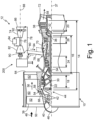
- FIG. 1 is a schematic representation of gas turbine engine 10 that includes boost spool 12 in accordance with an exemplary embodiment of this disclosure.
- Gas turbine engine 10 is a dual spool engine that includes low pressure spool 14 and high pressure spool 16.
- Low pressure spool 14 includes low pressure compressor 18 mechanically and rotationally connected to low pressure turbine 20 by shaft 22, and high pressure spool 16 includes high pressure compressor 24 mechanically and rotationally connected to high pressure turbine 26 by shaft 28.
- Bearings 30 and 32 support shaft 22 of low pressure spool 14, and bearings 34 and 36 support shaft 28 of high pressure spool 16, each at forward and aft shaft ends, respectively.
- Low pressure spool 14 and high pressure spool 16 are coaxial, each extending along and rotating about centerline 37 independently of one another.
- Compressors and turbines 18, 20, 24, and 26 include at least one compressor stage or turbine stage, each stage formed by a row of stationary vanes and a row of rotating blades.
- each of low pressure compressor 18 and high pressure compressor 24 has three stages
- each of low pressure turbine 20 and high pressure turbine 26 has two stages, although the number of stages in each compressor or turbine can be selected based on the desired pressure ratios as is known in the art.
- boost spool 12, low pressure spool 14, and high pressure spool 16 may be referred to as a first spool, a second spool, and/or a third spool in which "first”, “second”, and “third” correspond to one of boost spool 12, low pressure spool 14, and high pressure spool 16.
- first”, “second”, and/or “third” labels may be used in conjunction with corresponding components of the first spool, the second spool, and/or the third spool in order to distinguish components of each spool from components of the other spools.
- variable area turbine 38 includes a row of vanes, each vane rotatable about a vane axis extending in a spanwise direction of the vane.
- the open area through variable area turbine (VAT) 38 changes depending on the stagger angle of vanes with respect to centerline 37.
- the closed position occurs when vanes form a maximum stagger angle with respect to centerline 37 while the open position occurs when vanes form a minimum, and sometimes negative, stagger angle with respect to centerline 37.
- the minimum open area typically coincides with the closed position since vanes tend to rotate toward each other, and in some instances vanes overlap when viewed along centerline 37.
- vanes As vanes move from the closed position towards the open position, the open area through the vane stage increases until a maximum open area is reached, typically near a minimum turning angle, or zero stagger angle position. In some embodiments, the open position coincides with the vane position associated with a maximum open area through the vane row. In other embodiments, vanes can continue to rotate towards the open position in which the vane stagger angle is negative, tending to decrease the open area as the stagger angle becomes more negative.
- a neutral position or nominal position of vanes can be associated with an angular vane position between the open position and the closed position that achieve a desired incident angle with a rotor of low pressure turbine 20.
- Gas turbine engine 10 also includes fan 39 mounted to fan shaft 40.
- One or more bearings 42 support fan shaft 40, which is mechanically and rotationally coupled to low pressure spool 14.
- Fan shaft 40 may be directly connected to shaft 22 of low pressure spool 14. With this arrangement, fan 39 and fan shaft 40 rotate at the same speed and in the same direction as low pressure spool 14. In other embodiments, such as the exemplary embodiment depicted in FIG. 1 , fan shaft 40 may be rotationally coupled to shaft 22 via gearing 44.
- gearing 44 can be an epicyclic gear train that includes a central sun gear mounted to shaft 22, a ring gear mounted to fan shaft 40, and a plurality of plant gears circumferentially spaced about the sun gear and mechanically engaging the ring gear and the sun gear, the planet gears being supported by a planet carrier (not shown).
- gas turbine engines utilizing epicyclic gearing to drive fan 39 and fan shaft 40 restrain the planet carrier to cause fan shaft 40 to rotate slower (and in the opposite direction) than low pressure spool 14. Accordingly, fan 39 and low pressure spool 14 can rotate at speeds that are more efficient for respective blade geometries.
- nose cone 46 guides ambient air flow 48 into inlet 50.
- Rotation of fan 39 which includes circumferentially spaced fan blades 52, compresses ambient air flow 48 before splitter 54 divides flow 48 into bypass flow 56 and core flow 58.
- Bypass flow 56 passes through bypass duct 60 to structural guide vanes 62 and discharges from engine 10 through a bypass flow exhaust nozzle (not shown), which is downstream from structural guide vane outlet 64.
- Inlet guide vanes 66 guide core flow 58 into low pressure compressor 18 that subsequently flows into high pressure compressor 24, each compressor stage further compressing core flow 58.
- Compressed core flow 58 discharges from high pressure compressor 24 into diffuser 68.
- Diffuser 68 fluidly connects high pressure compressor 24 to combustor 70 and includes divergent walls that reduce core flow 58 velocity and thereby increase static pressure of flow 58 before entering combustor 70.
- Combustor 70 can be an annular combustor (or another suitable design). Fuel injected into combustor 70 mixes with compressed core flow 58, and one or more ignitors combust the fuel-to-air mixture to produce a compressed and heated core flow 58 that is discharged into high pressure turbine 26. Core flow 58 interacts with vanes and blades of high pressure turbine 26 causing rotation of shaft 28 about centerline 37 and driving rotation of high pressure compressor 24.
- core flow 58 interacting with vanes and blades of low pressure turbine 20 cause rotation of shaft 22 about centerline 37 to drive rotation of low pressure compressor 18 as well as fan shaft 40 directly or via gearing 44.
- core flow 58 discharges from engine 10 through a core exhaust nozzle (not shown) which is downstream from structural guide vane outlet 72.
- Boost spool 12 includes at least boost compressor 74 and shaft 76 fluidly connected to gas turbine engine 10 by inlet duct assembly 78 and outlet duct assembly 80.
- boost spool 12 also includes one or more of boost turbine 82, combustor 84, and variable inlet guide vanes 86.
- Boost compressor 74 and boost turbine 82 include at least one compressor stage or turbine stage, each stage formed by a row of stationary vanes and a row of rotating blades.
- Variable inlet vanes 86 form an array of circumferentially spaced vanes at an inlet to boost spool 12 and upstream of boost compressor 74.
- Each vane of variable inlet guide vanes 86 is rotatable about a vane axis that extends in a spanwise direction of the vane.
- An angular position of variable inlet guide vanes 86 ranges between a closed position, a neutral or nominal position, and an open position in the same manner as vanes of variable area turbine 38.
- variable inlet vanes 86 can pivot to decrease or increase the open inlet area in order to vary the amount of core flow 58 diverted into boost compressor 74 through inlet duct assembly 78.
- Shaft 76 mechanically and rotationally connects boost compressor 74 to boost turbine 82, each component arranged coaxially with boost axis 88.
- Transmission 200 mechanically and rotationally couples boost spool 12 to one or more spools of gas turbine engine 10 (e.g., low pressure spool 14 and/or high pressure spool 16).
- transmission 200 includes gear 202 mounted to shaft 22.
- Tower shaft 204 includes gear 206 mounted to or integrally formed at a radially inner end of tower shaft 204.
- Gear 206 enmeshes with shaft-mounted gear 202 to rotationally couple shaft 76 (i.e., boost spool 12) to shaft 22 (i.e., low pressure spool 14).
- transmission 200 can include one or more gears, an epicyclic gear train, or other mechanical arrangement that rotationally couples boost spool 12 to low pressure spool 14.
- boost axis 88 can be parallel and offset from centerline 37 of gas turbine engine 10 as schematically shown by FIG. 1 .
- FIG. 1 shows boost spool 12 with a reverse flow orientation (i.e., aft-to-forward flow) such that a flow direction through boost spool 12 from compressor 74 to turbine 82 is opposite a flow direction (i.e., forward-to-aft flow) through gas turbine engine 10 from inlet 50 to bypass outlet 64 and from inlet 50 to a core exhaust nozzle (not shown) which is downstream from structural guide vane outlet 72.
- boost axis 88 can be oblique or perpendicular to centerline 37.
- boost spool 12 For all mounting positions of boost spool 12, the location and orientation of boost spool 12 permits boost spool 12 to receive a compressed air flow from gas turbine engine 10 and to discharge an expanded air flow to gas turbine engine 10.
- Boost spool 12 can receive a compressed airflow from any compressor stage of gas turbine engine 10 to achieve varying degrees of boost compression.
- boost spool 12 receives a compressed air flow from a location that is downstream from the last compressor stage of the gas turbine engine.
- boost spool 12 receives airflow from diffuser 68 and discharges an expanded airflow to diffuser 68.
- boost spool receives airflow from diffuser 68 and discharges an expanded airfoil to both diffuser 68 and combustor 70, which is downstream of high pressure compressor 24 and upstream from high pressure turbine 26.
- boost spool 12 receives a portion of core flow 58 extracted from diffuser 68 (i.e., boost flow 94) and routed to an inlet of boost compressor 74 through inlet duct assembly 78.
- boost flow 94 Within boost compressor 74, the pressure and temperature of boost flow increases with each compressor stage.
- Compressed boost flow 94 enters combustor 84 where injected fuel mixes with compressed boost flow 94. Once the fuel-air mixture is ignited, boost flow 94 discharges into boost turbine 82.
- Turbine 82 expands boost flow 94 across each turbine stage, driving turbine 82, shaft 76, and compressor 74. Expanded boost flow 94 discharges from boost spool 12 through outlet duct assembly 80, which may route discharged air to diffuser 68, combustor 70, or both diffuser 68 and combustor 70.
- a pressure ratio of boost spool 12 (i.e., a boost pressure ratio) can be expressed as a ratio of air pressure at an inlet of turbine 74 divided by air pressure at an outlet of turbine 82.
- boost pressure ratio of boost spool 12 can be between 0.9 and 1.1 in some embodiments.
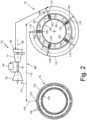
- FIG. 2 schematically depicts inlet duct assembly 78 that extracts a portion of core flow 58 from diffuser 68 and outlet duct assembly 80 that discharges the boost flow to diffuser 68 and combustor 70.
- diffuser 68 includes inner peripheral wall 96 and outer peripheral wall 98 spaced radially outward from wall 96.
- Multiple struts 100 extend from inner peripheral wall 96 to outer peripheral wall 98 of diffuser 68.
- FIG. 2 depicts five struts 100. However more or less struts 100 can be used in other examples, each incorporating features of inlet duct assembly 78 and outlet duct assembly 80 discussed below.
- Combustor 70 includes outer casing 102 and spaced radially from inner casing 104 to define an annular combustion chamber. Inner casing 104 and outer casing 102 are thermally protected by segmented liners 106.
- inlet duct assembly 78 includes multiple branch ducts 108 collected into inlet manifold 110. Each branch duct 108 communicates with diffuser 68 via respective branch inlets 112.
- branch inlets 112 can be formed by inner and/or outer peripheral walls of diffuser 68 such that branch ducts 108 extract core flow 58 through inner and outer walls of diffuser 68.
- branch inlets 112 are formed by respective struts 100.
- Branch inlet ducts 108 extend from branch inlets 112 to inlet manifold 110.
- Inlet manifold 110 can be a pipe, duct, or plenum accommodating the collected flow through each branch inlet duct 108 and routing the accumulated inlet flow to inlet of boost spool 12.
- outlet duct assembly 80 can include one or more ducts extending from an outlet of boost turbine 82 to diffuser 68, combustor 70, or both diffuser 68 and combustor 70.
- outlet duct assembly 80 can include main duct 114 extending from an outlet of boost turbine 82 to one or more branch outlet ducts 116, one or more branch outlet ducts 118, or one or more branch outlet ducts 116 and one or more branch outlet ducts 118.
- Each branch outlet duct 116 extends from main duct 114 to one of boost outlets 120 formed in an inner peripheral wall or an outer peripheral wall of diffuser 68, or a wall of strut 100, placing main duct 114 and boost turbine 82 in communication with diffuser 68.
- Each branch outlet duct 118 extends from main duct 114 to one of boost outlets 122 formed in a peripheral wall of combustor 70, placing main duct 114 and boost turbine 82 in communication with combustor 70.
- outlet duct assembly 80 includes main duct 114, multiple branch ducts 116, and branch duct 118.
- Main duct 114 extends from boost turbine 82 to each branch outlet duct 116 and branch duct 118.
- Branch outlet ducts 116 extend from main duct 114 to boost outlets 120 formed in walls of respective struts 100.
- Branch outlet duct 118 extends from main duct 114 to boost outlet 122 formed in a peripheral wall bounding a combustion zone of combustor 70.
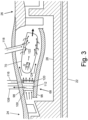
- FIG. 3 is a schematic of diffuser 68 and combustor 70 of gas turbine engine 10.
- branch inlet duct 108 extracts air from core flow 58 through inlet 112, and branch duct 116 discharges boost exhaust flow through outlet 120.
- Branch inlets 112 and branch outlets 120 are formed by strut 100.
- One or both of branch inlet 112 and branch outlet 120 can extend from inner peripheral wall 96 to outer peripheral wall 98.
- Outlet 122 of branch outlet duct 118 discharges through outer casing of combustor 70. The location of outlet 122 is spaced axially downstream from injectors 124, or between injectors 124 and high pressure turbine 26.
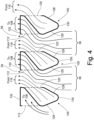
- FIG. 4 depicts another schematic view of struts 100 and the flow distribution within diffuser 68.
- Each strut 100 includes first side wall 126 and second side wall 128 extending from leading edge 130 of strut 100 to rear wall 132.
- Inlets 112 are disposed in one of sidewalls 126 and 128 while outlets 120 are disposed in the other sidewall opposite the inlet sidewall.
- boost spool 12 a portion of compressed core flow 58 enters each inlet 112 and flows through branch inlet ducts 108 and manifold 110 to the inlet of boost spool 12 and boost compressor 74.
- a portion of boost spool flow exiting boost turbine 82 flows through each branch outlet duct 116 before discharging through each outlet 120 into diffuser 68.
- An outlet flow division can be achieved with appropriate selection of length, cross-sectional area, and routing of main duct 114, diffuser branch ducts 116, combustor branch duct 118 and associated outlets 120 and 122 of outlet duct assembly 80.
- a minimum mass flow rate of boost exhaust discharged to diffuser 68 through outlets 120 relates to an amount of flow required to maintain flow into boost spool 12 through inlet duct assembly 78.
- Adequate flow through inlet duct assembly 78 can be achieved by maintaining at least a minimum static pressure at branch inlets 112 throughout all operating conditions during which boost spool 12 can be operated, including transient periods associated with starting or stopping boost spool 12.
- the maximum mass flow rate of boost exhaust discharged to diffuser 68 through outlets 120 relates to a maximum temperature of fuel injectors within combustor 70.
- boost exhaust mass flow rate increases, a temperature of compressed air entering combustor 70 increases. Accordingly, the maximum permitted temperatures of components of combustor 70 during continuous operation limits the maximum mas flow rate of boost exhaust returned to diffuser 68 through outlets 120.
- five percent to forty percent of boost exhaust flow can be discharged into diffuser 68 while the remainder ninety-five percent to sixty percent of boost exhaust flow can be discharged to combustor 70.
- boost exhaust between diffuser 68 and combustor 70 allows boost outlets 120 to extend from the inner peripheral wall to the outer peripheral wall of diffuser 68 as shown in FIG. 3 .
- boost outlets 120 As the radial extent of boost outlets 120 approaches the full radial extent of diffuser 68 at struts 100, flow uniformity and flow stability increase within diffuser 68 while component temperatures within combustor 70 remain acceptable for continuous operation.
- FIG. 5 is a T-s diagram illustrating the thermodynamic performance of gas turbine engine 10 boosted by spool 12 relative to gas turbine engine 10 operating without boost spool 12. Entropy is displayed along abscissa axis 134, and temperature is displayed along ordinate axis 136, each increasing from origin 138. Dashed curve A depicts the preferred thermodynamic cycle of gas turbine engine 10 operating without boost engaged at takeoff power on a hot day. Dashed curve B depicts the thermodynamic cycle of gas turbine engine 10 were boost to be engaged while operating at takeoff power on a hot day. Solid curve C depicts gas turbine engine 10 operating without boost spool 12 engaged while operating at cruise power.
- Solid curves C and D are defined by points 2C, 3C, 4C, and 5C and points 2D, 3D, 4D, and 5D in a similar manner to curves A and B.
- An engine operating along curve A has less OPR (value Y) than an engine operating on any of the other curves (i.e., curves C and D having an OPR equal to value X and curve B having an OPR value equal to Z).
- an engine operating on curves C and D have an OPR value X that is greater than an engine operating on curve B with an OPR value Z.
- the temperature entering the compressor section of gas turbine engine 10 at cruise power is lower than the temperature entering the compressor section of gas turbine engine 10 at takeoff power because the ambient temperature at cruising altitude is lower than the ambient temperature during a hot day takeoff.
- the ambient temperature can be approximately -26.1 degrees Celsius (or about -15 degrees Fahrenheit) while on a hot day takeoff, the ambient temperature can be approximately 46.1 degrees Celsius (or about 115 degrees Fahrenheit).
- the temperature within the engine at points 3A, 3B, 3C, and 3D are limited to a line of constant temperature labeled "T3 Limit" while the temperature at points 4A, 4B, 4C, and 4D are limited to a line of constant temperature labeled "T4 Limit".
- Unboosted operation of gas turbine engine 10 represented by dashed curve A trades engine fuel efficiency and engine materials life between temperature limits during a hot day takeoff and cruising. As a result, the OPR of unboosted operation of engine 10 is reduced for hot day takeoff conditions (i.e., the temperature at point 4A is lower than the temperature at 4B).
- the area bounded by dashed curve A and a line connecting points 5A and 2A represent the amount of work completed by engine 10 while operating at takeoff power and without boost spool 12 operation.
- the area bounded by dashed curve B and a line connecting points 5B and 2B represent the amount of work completed by engine 10 while operating at takeoff power and with boost spool 12 operation.
- the two areas are the same and the amounts of work completed by the engine at takeoff are the same.
- the amount of heat energy rejected by gas turbine engine 10 while operating in accordance with dashed curve A is shown by horizontally-hatched area 140.
- the thermodynamic efficiency of gas turbine engine 10 operating in accordance with dashed curve A is the work energy divided by the summation of work and rejected heat energy defined by curve A.
- gas turbine engine 10 with the same OPR as boost engine operation depicted by curve D does not have the improved engine fuel efficiency and same life of operation.
- the temperature at 4B is higher than the temperature at 4A.
- gas turbine engine 10 can be operated without boost spool 12 during hot day takeoff conditions (i.e., dashed curve A) and can be operated with boost spool 12 at cruise power (i.e., solid curve D) to achieve greater thermal efficiency at cruise power while satisfying thermal limits for hot day takeoff conditions.
- a gas turbine engine includes, among other possible things, a first spool, a second spool, a third spool, a primary combustor, a diffuser, a secondary combustor, and an outlet duct assembly.
- the first spool includes a first compressor and a first turbine mounted to a first shaft.
- the second spool includes a second compressor and a second turbine to a second shaft.
- the third spool includes a third compressor and a third turbine mounted to a third shaft.
- the primary combustor is disposed between and fluidly communicating with the first compressor and the first turbine.
- the diffuser is disposed between and fluidly communicating with the first compressor and the primary combustor.
- a secondary combustor is disposed between and fluidly communicating with the second compressor and the second turbine.
- the outlet duct assembly fluidly connects the second turbine to the diffuser and the primary combustor.
- the outlet duct assembly includes a main duct, a plurality of first branch ducts, and a second branch duct.
- the main duct extends from and communicates with the second turbine.
- the plurality of branch ducts extends from and communicate with the main duct and the diffuser.
- the second branch duct extends from an communicates with the main duct to the primary combustor.
- the gas turbine engine of the preceding paragraph can optionally include, additionally and/or alternatively, any one or more of the following features, configurations, and/or additional components.
- the diffuser includes an inner wall, an outer wall, and a plurality of struts.
- the outer wall is radially spaced from the inner wall to define an annular section that diverges towards the primary combustor.
- the plurality of struts extend radially from the inner wall to the outer wall and circumferentially distributed within the annular section. Each strut of the plurality of struts defines a discharge area of one of the first branch ducts.
- a further embodiment of any of the foregoing gas turbine engines wherein the discharge area of each first branch duct can extend from the inner wall to the outer wall.
- a further embodiment of any of the foregoing gas turbine engines can include an inlet duct assembly.
- inlet duct assembly can include a plurality of inlet branch ducts, each inlet branch duct extends from an inlet defined by one of the plurality of struts.
- inlet duct assembly can include a main inlet duct communicating with the plurality of inlet branch ducts and the second compressor.
- a further embodiment of any of the foregoing gas turbine engines, wherein a boost pressure ratio can be equal to a first air pressure at an inlet of the second compressor divided by a second air pressure at an outlet of the second turbine.
- boost pressure ratio can between 0.9 and 1.1.
- a gas turbine engine includes, among other possible things, a first spool, a second spool, a third spool, a primary combustor, diffuser, secondary combustor, and an outlet duct assembly.
- the first spool includes a first compressor and a first turbine mounted to a first shaft.
- the second spool includes a second compressor and a second turbine mounted to a second shaft.
- the third spool includes a third compressor and a third turbine mounted to a third shaft.
- the primary combustor is disposed between and fluidly communicates with the first compressor and the first turbine
- the primary combustor includes a combustion plenum and a plurality of injectors. The combustion plenum is bound by a casing.
- the casing defines an annular cross-section normal to a centerline of the gas turbine engine.
- the diffuser is deposed between and fluidly communicates with the first compressor and the primary combustor.
- the diffuser includes an inner wall, an outer wall, and a plurality of struts.
- the outer wall is radially spaced from the inner wall to define an annular section that diverges towards the primary combustor.
- the plurality of struts extends radially from the inner wall to the outer wall.
- the struts are circumferentially distributed within the annular section.
- the secondary combustor is disposed between and fluidly communicating with the second compressor and the second turbine.
- the outlet duct assembly fluidly connects the second turbine to the diffuser and the primary combustor.
- the outlet duct assembly includes a main duct, a plurality of first branch ducts, and a second branch duct.
- the main duct extends from and communicates with the second turbine.
- the plurality of branch ducts extends from and communicates between the main duct to the diffuser.
- Each strut of the plurality of struts defines a discharge area of one of the first branch ducts.
- the second branch duct extends from and communicates between the main duct to the primary combustor.
- the second branch duct communicates with the combustion plenum through a discharge outlet.
- the discharge outlet is axially spaced along the centerline from the plurality of injectors.
- the gas turbine engine of the preceding paragraph can optionally include, additionally and/or alternatively, any one or more of the following features, configurations, and/or additional components.
- each first branch duct can extend from the inner wall to the outer wall.
- a further embodiment of any of the foregoing gas turbine engines can include an inlet duct assembly.
- inlet duct assembly includes a plurality of inlet branch ducts and a main inlet duct.
- each inlet branch duct extends from an inlet defined by one of the plurality of struts.
- a further embodiment of any of the foregoing gas turbine engines wherein the main inlet duct communicates with the plurality of inlet branch ducts and the second compressor.
- a further embodiment of any of the foregoing gas turbine engines can include a gear mounted to the third shaft.
- a further embodiment of any of the foregoing gas turbine engines can include a tower shaft enmeshes with the gear and extends radially outward from the third shaft.
- a further embodiment of any of the foregoing gas turbine engines can include a transmission rotationally coupling the tower shaft to the second shaft.
- a further embodiment of any of the foregoing gas turbine engines wherein the first compressor can be a high pressure compressor and the third compressor can be a low pressure compressor.
- a further embodiment of any of the foregoing gas turbine engines wherein the first turbine can be a high pressure turbine and the third turbine can be a low pressure turbine.
- a further embodiment of any of the foregoing gas turbine engines wherein the third shaft can extend through the first shaft such that the first compressor, the primary combustor, and the first turbine are disposed between the third compressor and the third turbine.
- a further embodiment of any of the foregoing gas turbine engines, wherein a ratio of the net discharge area of the plurality of first branch ducts toa n area of the discharge outlet of the second branch duct can be between 0.25 to 0.75.
- a further embodiment of any of the foregoing gas turbine engines, wherein a boost pressure ratio can be equal to a first air pressure at an inlet of the second compressor divided by a second air pressure at an outlet of the second turbine.
- boost pressure ratio can be between 0.9 and 1.1.
Landscapes
- Engineering & Computer Science (AREA)
- Chemical & Material Sciences (AREA)
- Combustion & Propulsion (AREA)
- Mechanical Engineering (AREA)
- General Engineering & Computer Science (AREA)
- Physics & Mathematics (AREA)
- Fluid Mechanics (AREA)
- Chemical Kinetics & Catalysis (AREA)
- General Chemical & Material Sciences (AREA)
- Structures Of Non-Positive Displacement Pumps (AREA)
Applications Claiming Priority (1)
| Application Number | Priority Date | Filing Date | Title |
|---|---|---|---|
| US17/662,199 US11692493B1 (en) | 2022-05-05 | 2022-05-05 | Fluidic valve configuration for boost spool engine |
Publications (2)
| Publication Number | Publication Date |
|---|---|
| EP4273384A1 true EP4273384A1 (de) | 2023-11-08 |
| EP4273384B1 EP4273384B1 (de) | 2025-04-02 |
Family
ID=86329821
Family Applications (1)
| Application Number | Title | Priority Date | Filing Date |
|---|---|---|---|
| EP23171717.4A Active EP4273384B1 (de) | 2022-05-05 | 2023-05-04 | Gasturbinentriebwerk mit einer auslasskanalanordnung |
Country Status (2)
| Country | Link |
|---|---|
| US (1) | US11692493B1 (de) |
| EP (1) | EP4273384B1 (de) |
Citations (4)
| Publication number | Priority date | Publication date | Assignee | Title |
|---|---|---|---|---|
| US3677012A (en) * | 1962-05-31 | 1972-07-18 | Gen Electric | Composite cycle turbomachinery |
| DE3149761A1 (de) * | 1980-12-22 | 1982-07-22 | General Electric Co., Schenectady, N.Y. | "luftabgabeanordnung fuer ein gasturbinenentriebwerk |
| WO2020257396A1 (en) * | 2019-06-19 | 2020-12-24 | Raytheon Technologies Corporation | Gearbox for boost spool turbine engine |
| US11143142B2 (en) * | 2018-08-01 | 2021-10-12 | United Technologies Corporation | Adaptive engine with boost spool |
Family Cites Families (23)
| Publication number | Priority date | Publication date | Assignee | Title |
|---|---|---|---|---|
| US4147024A (en) | 1977-09-15 | 1979-04-03 | Avco Corporation | Dual cycle gas turbine engine system |
| GB9313905D0 (en) | 1993-07-06 | 1993-08-25 | Rolls Royce Plc | Shaft power transfer in gas turbine engines |
| GB0805177D0 (en) | 2008-03-20 | 2008-04-30 | Rolls Royce Plc | A gas turbine engine arrangement |
| US8690099B2 (en) * | 2010-11-16 | 2014-04-08 | Rolls-Royce Corporation | Aircraft and propulsion system |
| US8684304B2 (en) | 2010-11-16 | 2014-04-01 | Rolls-Royce Corporation | Aircraft, propulsion system, and system for taxiing an aircraft |
| US8955335B2 (en) | 2010-12-30 | 2015-02-17 | Rolls-Royce Corporation | System, propulsion system and vehicle |
| US9752500B2 (en) | 2013-03-14 | 2017-09-05 | Pratt & Whitney Canada Corp. | Gas turbine engine with transmission and method of adjusting rotational speed |
| US10240479B2 (en) | 2013-08-07 | 2019-03-26 | United Technologies Corporation | Variable area turbine arrangement for a gas turbine engine |
| GB201414661D0 (en) | 2014-08-19 | 2014-10-01 | Rolls Royce Plc | Gas turbine engine and method of operation |
| US10151211B2 (en) | 2015-01-10 | 2018-12-11 | Florida Turbine Technologies, Inc. | Apparatus and process for converting an aero gas turbine engine into an industrial gas turbine engine for electric power production |
| GB201518788D0 (en) | 2015-10-23 | 2015-12-09 | Rolls Royce Plc | Aircraft pneumatic system |
| US20170241336A1 (en) | 2016-02-24 | 2017-08-24 | Russell B. Jones | Process for retrofitting an industrial gas turbine engine for increased power and efficiency |
| US10273883B2 (en) | 2016-02-26 | 2019-04-30 | The Boeing Company | Engine accessory drives systems and methods |
| US20170298826A1 (en) | 2016-04-18 | 2017-10-19 | John E. Ryznic | Industrial gas turbine engine with turbine airfoil cooling |
| US10669940B2 (en) | 2016-09-19 | 2020-06-02 | Raytheon Technologies Corporation | Gas turbine engine with intercooled cooling air and turbine drive |
| US20180156121A1 (en) | 2016-12-05 | 2018-06-07 | United Technologies Corporation | Gas Turbine Engine With Intercooled Cooling Air and Controlled Boost Compressor |
| US10995673B2 (en) | 2017-01-19 | 2021-05-04 | Raytheon Technologies Corporation | Gas turbine engine with intercooled cooling air and dual towershaft accessory gearbox |
| US10961919B2 (en) | 2017-08-29 | 2021-03-30 | Pratt & Whitney Canada Corp | Corrected parameters control logic for variable geometry mechanisms |
| US11015523B2 (en) | 2018-06-05 | 2021-05-25 | Raytheon Technologies Corporation | Turbofan with bleed supercharged auxiliary engine |
| US11415044B2 (en) | 2018-06-19 | 2022-08-16 | Raytheon Technologies Corporation | Multi-engine architecture with linkages to multiple spools |
| US11485503B2 (en) | 2019-03-29 | 2022-11-01 | Pratt & Whitney Canada Corp. | Hybrid aircraft propulsion power plants |
| US11041462B2 (en) | 2019-06-05 | 2021-06-22 | Raytheon Technologies Corporation | Hybrid turbofan with differential electrical and mechanical power transfer |
| US10914234B1 (en) | 2019-08-23 | 2021-02-09 | Raytheon Technologies Corporation | Gas turbine engine and method for operating same |
-
2022
- 2022-05-05 US US17/662,199 patent/US11692493B1/en active Active
-
2023
- 2023-05-04 EP EP23171717.4A patent/EP4273384B1/de active Active
Patent Citations (4)
| Publication number | Priority date | Publication date | Assignee | Title |
|---|---|---|---|---|
| US3677012A (en) * | 1962-05-31 | 1972-07-18 | Gen Electric | Composite cycle turbomachinery |
| DE3149761A1 (de) * | 1980-12-22 | 1982-07-22 | General Electric Co., Schenectady, N.Y. | "luftabgabeanordnung fuer ein gasturbinenentriebwerk |
| US11143142B2 (en) * | 2018-08-01 | 2021-10-12 | United Technologies Corporation | Adaptive engine with boost spool |
| WO2020257396A1 (en) * | 2019-06-19 | 2020-12-24 | Raytheon Technologies Corporation | Gearbox for boost spool turbine engine |
Also Published As
| Publication number | Publication date |
|---|---|
| US11692493B1 (en) | 2023-07-04 |
| EP4273384B1 (de) | 2025-04-02 |
Similar Documents
| Publication | Publication Date | Title |
|---|---|---|
| EP3604784B1 (de) | Adaptiver motor mit booster-welle | |
| US12305574B2 (en) | Gas turbine engine with improved heat management | |
| US20220333553A1 (en) | Three-stream gas turbine engine with embedded electric machine | |
| US12270338B2 (en) | Gas turbine engine with an improved thermal management system | |
| US20240110510A1 (en) | Gas turbine engine with an environmental temperature dependant heat management system | |
| US20240110517A1 (en) | Method of operating a gas turbine engine | |
| US12398679B2 (en) | Transmission and method for control of boost spool | |
| EP3604783B1 (de) | Gasturbinentriebwerk | |
| US12253021B2 (en) | Transmission and method for control of boost spool | |
| EP4273380B1 (de) | Getriebe und verfahren zur steuerung einer boost-spule | |
| EP4273384B1 (de) | Gasturbinentriebwerk mit einer auslasskanalanordnung | |
| US12123310B2 (en) | Gas turbine engine with idle thrust ratio | |
| US20240110513A1 (en) | Gas turbine engine | |
| US12577913B2 (en) | Geared gas turbine engine | |
| US20240110511A1 (en) | Gas turbine engine thermal management system | |
| US12571358B2 (en) | Gas turbine engine with third stream | |
| EP4345270A1 (de) | Wärmemanagement in einem gasturbinenmotor | |
| EP4345272A1 (de) | Wärmeverwaltungssystem für einen gasturbinenmotor | |
| US20260043378A1 (en) | Gas Turbine Engine with Third Stream | |
| US20260043377A1 (en) | Gas Turbine Engine with Third Stream | |
| US20260043348A1 (en) | Gas Turbine Engine with Third Stream |
Legal Events
| Date | Code | Title | Description |
|---|---|---|---|
| PUAI | Public reference made under article 153(3) epc to a published international application that has entered the european phase |
Free format text: ORIGINAL CODE: 0009012 |
|
| STAA | Information on the status of an ep patent application or granted ep patent |
Free format text: STATUS: THE APPLICATION HAS BEEN PUBLISHED |
|
| AK | Designated contracting states |
Kind code of ref document: A1 Designated state(s): AL AT BE BG CH CY CZ DE DK EE ES FI FR GB GR HR HU IE IS IT LI LT LU LV MC ME MK MT NL NO PL PT RO RS SE SI SK SM TR |
|
| STAA | Information on the status of an ep patent application or granted ep patent |
Free format text: STATUS: REQUEST FOR EXAMINATION WAS MADE |
|
| 17P | Request for examination filed |
Effective date: 20240508 |
|
| RBV | Designated contracting states (corrected) |
Designated state(s): AL AT BE BG CH CY CZ DE DK EE ES FI FR GB GR HR HU IE IS IT LI LT LU LV MC ME MK MT NL NO PL PT RO RS SE SI SK SM TR |
|
| GRAP | Despatch of communication of intention to grant a patent |
Free format text: ORIGINAL CODE: EPIDOSNIGR1 |
|
| STAA | Information on the status of an ep patent application or granted ep patent |
Free format text: STATUS: GRANT OF PATENT IS INTENDED |
|
| RIC1 | Information provided on ipc code assigned before grant |
Ipc: F23R 3/06 20060101ALI20241004BHEP Ipc: F02C 7/32 20060101ALI20241004BHEP Ipc: F02C 6/12 20060101ALI20241004BHEP Ipc: F02C 6/08 20060101AFI20241004BHEP |
|
| INTG | Intention to grant announced |
Effective date: 20241021 |
|
| GRAS | Grant fee paid |
Free format text: ORIGINAL CODE: EPIDOSNIGR3 |
|
| GRAA | (expected) grant |
Free format text: ORIGINAL CODE: 0009210 |
|
| STAA | Information on the status of an ep patent application or granted ep patent |
Free format text: STATUS: THE PATENT HAS BEEN GRANTED |
|
| AK | Designated contracting states |
Kind code of ref document: B1 Designated state(s): AL AT BE BG CH CY CZ DE DK EE ES FI FR GB GR HR HU IE IS IT LI LT LU LV MC ME MK MT NL NO PL PT RO RS SE SI SK SM TR |
|
| REG | Reference to a national code |
Ref country code: GB Ref legal event code: FG4D |
|
| REG | Reference to a national code |
Ref country code: CH Ref legal event code: EP |
|
| REG | Reference to a national code |
Ref country code: IE Ref legal event code: FG4D |
|
| REG | Reference to a national code |
Ref country code: DE Ref legal event code: R096 Ref document number: 602023002670 Country of ref document: DE |
|
| PGFP | Annual fee paid to national office [announced via postgrant information from national office to epo] |
Ref country code: DE Payment date: 20250423 Year of fee payment: 3 |
|
| PGFP | Annual fee paid to national office [announced via postgrant information from national office to epo] |
Ref country code: FR Payment date: 20250520 Year of fee payment: 3 |
|
| PGFP | Annual fee paid to national office [announced via postgrant information from national office to epo] |
Ref country code: AT Payment date: 20250721 Year of fee payment: 3 |
|
| REG | Reference to a national code |
Ref country code: NL Ref legal event code: MP Effective date: 20250402 |
|
| PG25 | Lapsed in a contracting state [announced via postgrant information from national office to epo] |
Ref country code: NL Free format text: LAPSE BECAUSE OF FAILURE TO SUBMIT A TRANSLATION OF THE DESCRIPTION OR TO PAY THE FEE WITHIN THE PRESCRIBED TIME-LIMIT Effective date: 20250402 |
|
| REG | Reference to a national code |
Ref country code: AT Ref legal event code: MK05 Ref document number: 1781464 Country of ref document: AT Kind code of ref document: T Effective date: 20250402 |
|
| PG25 | Lapsed in a contracting state [announced via postgrant information from national office to epo] |
Ref country code: FI Free format text: LAPSE BECAUSE OF FAILURE TO SUBMIT A TRANSLATION OF THE DESCRIPTION OR TO PAY THE FEE WITHIN THE PRESCRIBED TIME-LIMIT Effective date: 20250402 Ref country code: PT Free format text: LAPSE BECAUSE OF FAILURE TO SUBMIT A TRANSLATION OF THE DESCRIPTION OR TO PAY THE FEE WITHIN THE PRESCRIBED TIME-LIMIT Effective date: 20250804 Ref country code: ES Free format text: LAPSE BECAUSE OF FAILURE TO SUBMIT A TRANSLATION OF THE DESCRIPTION OR TO PAY THE FEE WITHIN THE PRESCRIBED TIME-LIMIT Effective date: 20250402 |
|
| REG | Reference to a national code |
Ref country code: LT Ref legal event code: MG9D |
|
| PG25 | Lapsed in a contracting state [announced via postgrant information from national office to epo] |
Ref country code: GR Free format text: LAPSE BECAUSE OF FAILURE TO SUBMIT A TRANSLATION OF THE DESCRIPTION OR TO PAY THE FEE WITHIN THE PRESCRIBED TIME-LIMIT Effective date: 20250703 Ref country code: NO Free format text: LAPSE BECAUSE OF FAILURE TO SUBMIT A TRANSLATION OF THE DESCRIPTION OR TO PAY THE FEE WITHIN THE PRESCRIBED TIME-LIMIT Effective date: 20250702 |
|
| PG25 | Lapsed in a contracting state [announced via postgrant information from national office to epo] |
Ref country code: PL Free format text: LAPSE BECAUSE OF FAILURE TO SUBMIT A TRANSLATION OF THE DESCRIPTION OR TO PAY THE FEE WITHIN THE PRESCRIBED TIME-LIMIT Effective date: 20250402 |
|
| PG25 | Lapsed in a contracting state [announced via postgrant information from national office to epo] |
Ref country code: BG Free format text: LAPSE BECAUSE OF FAILURE TO SUBMIT A TRANSLATION OF THE DESCRIPTION OR TO PAY THE FEE WITHIN THE PRESCRIBED TIME-LIMIT Effective date: 20250402 |
|
| PG25 | Lapsed in a contracting state [announced via postgrant information from national office to epo] |
Ref country code: HR Free format text: LAPSE BECAUSE OF FAILURE TO SUBMIT A TRANSLATION OF THE DESCRIPTION OR TO PAY THE FEE WITHIN THE PRESCRIBED TIME-LIMIT Effective date: 20250402 |
|
| PG25 | Lapsed in a contracting state [announced via postgrant information from national office to epo] |
Ref country code: AT Free format text: LAPSE BECAUSE OF FAILURE TO SUBMIT A TRANSLATION OF THE DESCRIPTION OR TO PAY THE FEE WITHIN THE PRESCRIBED TIME-LIMIT Effective date: 20250402 |
|
| PG25 | Lapsed in a contracting state [announced via postgrant information from national office to epo] |
Ref country code: RS Free format text: LAPSE BECAUSE OF FAILURE TO SUBMIT A TRANSLATION OF THE DESCRIPTION OR TO PAY THE FEE WITHIN THE PRESCRIBED TIME-LIMIT Effective date: 20250702 |
|
| PG25 | Lapsed in a contracting state [announced via postgrant information from national office to epo] |
Ref country code: IS Free format text: LAPSE BECAUSE OF FAILURE TO SUBMIT A TRANSLATION OF THE DESCRIPTION OR TO PAY THE FEE WITHIN THE PRESCRIBED TIME-LIMIT Effective date: 20250802 |
|
| PG25 | Lapsed in a contracting state [announced via postgrant information from national office to epo] |
Ref country code: LV Free format text: LAPSE BECAUSE OF FAILURE TO SUBMIT A TRANSLATION OF THE DESCRIPTION OR TO PAY THE FEE WITHIN THE PRESCRIBED TIME-LIMIT Effective date: 20250402 |
|
| REG | Reference to a national code |
Ref country code: DE Ref legal event code: R097 Ref document number: 602023002670 Country of ref document: DE |
|
| PG25 | Lapsed in a contracting state [announced via postgrant information from national office to epo] |
Ref country code: DK Free format text: LAPSE BECAUSE OF FAILURE TO SUBMIT A TRANSLATION OF THE DESCRIPTION OR TO PAY THE FEE WITHIN THE PRESCRIBED TIME-LIMIT Effective date: 20250402 Ref country code: SM Free format text: LAPSE BECAUSE OF FAILURE TO SUBMIT A TRANSLATION OF THE DESCRIPTION OR TO PAY THE FEE WITHIN THE PRESCRIBED TIME-LIMIT Effective date: 20250402 |
|
| PG25 | Lapsed in a contracting state [announced via postgrant information from national office to epo] |
Ref country code: LU Free format text: LAPSE BECAUSE OF NON-PAYMENT OF DUE FEES Effective date: 20250504 |
|
| PG25 | Lapsed in a contracting state [announced via postgrant information from national office to epo] |
Ref country code: CZ Free format text: LAPSE BECAUSE OF FAILURE TO SUBMIT A TRANSLATION OF THE DESCRIPTION OR TO PAY THE FEE WITHIN THE PRESCRIBED TIME-LIMIT Effective date: 20250402 |
|
| PG25 | Lapsed in a contracting state [announced via postgrant information from national office to epo] |
Ref country code: EE Free format text: LAPSE BECAUSE OF FAILURE TO SUBMIT A TRANSLATION OF THE DESCRIPTION OR TO PAY THE FEE WITHIN THE PRESCRIBED TIME-LIMIT Effective date: 20250402 |
|
| PG25 | Lapsed in a contracting state [announced via postgrant information from national office to epo] |
Ref country code: SK Free format text: LAPSE BECAUSE OF FAILURE TO SUBMIT A TRANSLATION OF THE DESCRIPTION OR TO PAY THE FEE WITHIN THE PRESCRIBED TIME-LIMIT Effective date: 20250402 |
|
| PG25 | Lapsed in a contracting state [announced via postgrant information from national office to epo] |
Ref country code: IT Free format text: LAPSE BECAUSE OF FAILURE TO SUBMIT A TRANSLATION OF THE DESCRIPTION OR TO PAY THE FEE WITHIN THE PRESCRIBED TIME-LIMIT Effective date: 20250402 |
|
| REG | Reference to a national code |
Ref country code: BE Ref legal event code: MM Effective date: 20250531 |
|
| PG25 | Lapsed in a contracting state [announced via postgrant information from national office to epo] |
Ref country code: MC Free format text: LAPSE BECAUSE OF FAILURE TO SUBMIT A TRANSLATION OF THE DESCRIPTION OR TO PAY THE FEE WITHIN THE PRESCRIBED TIME-LIMIT Effective date: 20250402 |
|
| PLBE | No opposition filed within time limit |
Free format text: ORIGINAL CODE: 0009261 |
|
| STAA | Information on the status of an ep patent application or granted ep patent |
Free format text: STATUS: NO OPPOSITION FILED WITHIN TIME LIMIT |
|
| REG | Reference to a national code |
Ref country code: CH Ref legal event code: L10 Free format text: ST27 STATUS EVENT CODE: U-0-0-L10-L00 (AS PROVIDED BY THE NATIONAL OFFICE) Effective date: 20260211 |
|
| PG25 | Lapsed in a contracting state [announced via postgrant information from national office to epo] |
Ref country code: RO Free format text: LAPSE BECAUSE OF FAILURE TO SUBMIT A TRANSLATION OF THE DESCRIPTION OR TO PAY THE FEE WITHIN THE PRESCRIBED TIME-LIMIT Effective date: 20250402 |
|
| 26N | No opposition filed |
Effective date: 20260105 |
|
| PG25 | Lapsed in a contracting state [announced via postgrant information from national office to epo] |
Ref country code: IE Free format text: LAPSE BECAUSE OF NON-PAYMENT OF DUE FEES Effective date: 20250504 |
|
| PG25 | Lapsed in a contracting state [announced via postgrant information from national office to epo] |
Ref country code: BE Free format text: LAPSE BECAUSE OF NON-PAYMENT OF DUE FEES Effective date: 20250531 |