EP4272811A2 - System zur langzeitmodulation der peripheren nervenaktivität mit licht - Google Patents
System zur langzeitmodulation der peripheren nervenaktivität mit licht Download PDFInfo
- Publication number
- EP4272811A2 EP4272811A2 EP23199221.5A EP23199221A EP4272811A2 EP 4272811 A2 EP4272811 A2 EP 4272811A2 EP 23199221 A EP23199221 A EP 23199221A EP 4272811 A2 EP4272811 A2 EP 4272811A2
- Authority
- EP
- European Patent Office
- Prior art keywords
- light
- time
- peripheral nerve
- application
- light signal
- Prior art date
- Legal status (The legal status is an assumption and is not a legal conclusion. Google has not performed a legal analysis and makes no representation as to the accuracy of the status listed.)
- Withdrawn
Links
Images




Classifications
-
- A—HUMAN NECESSITIES
- A61—MEDICAL OR VETERINARY SCIENCE; HYGIENE
- A61N—ELECTROTHERAPY; MAGNETOTHERAPY; RADIATION THERAPY; ULTRASOUND THERAPY
- A61N5/00—Radiation therapy
- A61N5/06—Radiation therapy using light
- A61N5/0613—Apparatus adapted for a specific treatment
- A61N5/0622—Optical stimulation for exciting neural tissue
-
- A—HUMAN NECESSITIES
- A61—MEDICAL OR VETERINARY SCIENCE; HYGIENE
- A61N—ELECTROTHERAPY; MAGNETOTHERAPY; RADIATION THERAPY; ULTRASOUND THERAPY
- A61N5/00—Radiation therapy
- A61N5/06—Radiation therapy using light
- A61N5/067—Radiation therapy using light using laser light
-
- A—HUMAN NECESSITIES
- A61—MEDICAL OR VETERINARY SCIENCE; HYGIENE
- A61N—ELECTROTHERAPY; MAGNETOTHERAPY; RADIATION THERAPY; ULTRASOUND THERAPY
- A61N5/00—Radiation therapy
- A61N5/06—Radiation therapy using light
- A61N5/0601—Apparatus for use inside the body
- A61N2005/0612—Apparatus for use inside the body using probes penetrating tissue; interstitial probes
-
- A—HUMAN NECESSITIES
- A61—MEDICAL OR VETERINARY SCIENCE; HYGIENE
- A61N—ELECTROTHERAPY; MAGNETOTHERAPY; RADIATION THERAPY; ULTRASOUND THERAPY
- A61N5/00—Radiation therapy
- A61N5/06—Radiation therapy using light
- A61N2005/0626—Monitoring, verifying, controlling systems and methods
-
- A—HUMAN NECESSITIES
- A61—MEDICAL OR VETERINARY SCIENCE; HYGIENE
- A61N—ELECTROTHERAPY; MAGNETOTHERAPY; RADIATION THERAPY; ULTRASOUND THERAPY
- A61N5/00—Radiation therapy
- A61N5/06—Radiation therapy using light
- A61N2005/063—Radiation therapy using light comprising light transmitting means, e.g. optical fibres
-
- A—HUMAN NECESSITIES
- A61—MEDICAL OR VETERINARY SCIENCE; HYGIENE
- A61N—ELECTROTHERAPY; MAGNETOTHERAPY; RADIATION THERAPY; ULTRASOUND THERAPY
- A61N5/00—Radiation therapy
- A61N5/06—Radiation therapy using light
- A61N2005/065—Light sources therefor
- A61N2005/0651—Diodes
-
- A—HUMAN NECESSITIES
- A61—MEDICAL OR VETERINARY SCIENCE; HYGIENE
- A61N—ELECTROTHERAPY; MAGNETOTHERAPY; RADIATION THERAPY; ULTRASOUND THERAPY
- A61N5/00—Radiation therapy
- A61N5/06—Radiation therapy using light
- A61N2005/0658—Radiation therapy using light characterised by the wavelength of light used
- A61N2005/0659—Radiation therapy using light characterised by the wavelength of light used infrared
Definitions
- the present disclosure relates generally to neural modulation and, more specifically, to systems and methods for using light for long-term modulation of peripheral nerve activity.
- IH intermittent hypoxia
- Neural modulation with light can provide another option for treating disrupted respiration, as well as other biological responses.
- the present disclosure relates to systems and methods for applying light, which can lead to long-term modulation of this peripheral nerve activity.
- the present disclosure can include a method for long-term modulation of peripheral nerve activity.
- the method can include applying light to the peripheral nerve.
- the illumination can be configured with an intensity for a time to achieve a target biological response.
- the configured illumination can be delivered to the peripheral nerve by an optrode.
- the target biological response can be exhibited, as long-term modulation, for a period after the time the light is applied to the peripheral nerve.
- the present disclosure can include a system that can be used to provide long-term modulation of peripheral nerve activity.
- the system can include a controller, a light generator, and an optrode.
- the controller can be configured to illuminate with an intensity and a time of application to achieve a target biological effect.
- the generator can be configured to receive the configuration from the controller and generate the light according to the configuration (intensity and time).
- the optrode can be configured to be placed proximal to at least a portion of a peripheral nerve to apply the light with the intensity and for the time of application to achieve the target biological effect.
- the target biological effect can extend for a period of time beyond the time of application of the light.
- first should not limit the elements being described by these terms. These terms are only used to distinguish one element from another. Thus, a “first” element discussed below could also be termed a “second” element without departing from the teachings of the present disclosure.
- sequence of operations is not limited to the order presented in the claims or figures unless specifically indicated otherwise.
- nerve modulation can refer to the alteration of nerve activity through targeted delivery of a stimulus to one or more specific neurological sites in a patient's body.
- the targeted delivery of the stimulus can be used for stimulation or inhibition of nerve activity.
- the term “conduction” can refer to the transmission of one or more action potentials.
- inhibition can refer to interference, with or restraint of, conduction. In other words, inhibition can be used to impede the transmission of action potentials.
- the term "threshold" can refer to a maximum or minimum change in intensity resulting in a functional result.
- the functional result can be enhancing conduction or inhibiting conduction caused by application of a certain amount of stimulus.
- the term "light signal” can refer to any signal including electromagnetic radiation that can be used as a stimulus.
- a light signal can be an infrared (IR) light signal.
- the term "intensity" can refer to a magnitude of a property (radiant exposure per unit time) of a light signal.
- the term "radiant exposure” can refer to an amount of radiant energy received by a surface per unit area (expressed in J/cm 2 /pulse). Equivalently, the radiant exposure can be expressed as the irradiance that reaches a surface area due to irradiance, maintained for a particular duration of time.
- target area can refer to an area of a patient's nervous system selected to receive a stimulus for neuromodulation.
- the target area can be at least a portion of a peripheral nerve chosen based on a desired target biological response.
- long-term modulation and “long-term facilitation” can refer to a target biological response related to application of light continuing after the application of the light.
- proximal can refer to something being positioned close to something else. Although the term proximal may also encompass being on or within, something proximal need not be on or within.
- the term "subject” can refer to any warm-blooded organism including, but not limited to, a human being, a pig, a rat, a mouse, a bird, a dog, a cat, a goat, a sheep, a horse, a monkey, an ape, a rabbit, a cow, etc.
- the term “patient” can be used interchangeably with “subject”.
- disorders of the nervous system can negatively disrupt muscle activity related to one or more biological responses.
- a disorder can be related to a phrenic nerve, and the biological response can be related to movement of a diaphragm innervated by the phrenic nerve.
- the disorder can be related to a hypoglossal nerve and the biological response can be related to movement of a tongue innervated by the hypoglossal nerve.
- the disorder can be related to an intercostal nerve and the biological response can be related to movement of an intercostal muscle innervated by the hypoglossal nerve.
- the peripheral nerve can be a spinal motor neuron and the biological response can be related to movement of a muscle innervated by the spinal motor neuron.
- Traditional solutions to these disorders involve serious physiological consequences and/or high cost.
- Neural modulation with light can provide another option for treating negatively disrupt muscle activity related to one or more biological responses without the negative physiological consequences common with traditional treatments.
- application of light leads to long-term modulation of this peripheral nerve activity. While not wishing to be bound by theory, it appears that application of the light works similarly to intermittent hypoxia (IH) affecting the neurotransmitter serotonin, thereby increasing the amplitude of conduction of the peripheral nerves.
- IH intermittent hypoxia
- neural modulation with light signals provide a high spatial selectivity, even for axonal sub-populations within a nerve, and level of precision not seen with traditional electrical and magnetic stimuli.
- the light does not provide any stimulation artifacts, requires no exogenous agents to be added to tissue, and is not affected by external magnetic fields. Moreover, optrodes delivering the light need only be proximal to the peripheral nerve and are not required to contact the peripheral nerve.
- One aspect of the present disclosure can include a system 10 ( FIG. 1 ) that can use a light signal for long-term modulation of peripheral nerve activity.
- the light can be applied for a short time, while a biological effect due to the application can extend for a longer period after the application of the light.
- the light can be applied for one minute or less and the biological effect can extend for ten minutes or more.
- the light can be applied for 30 seconds or less and the biological effect can extend for two minutes or more.
- a light signal e.g., IR light
- other neuromodulatory stimuli e.g., an electrical signal or a magnetic signal
- the light can be used to select a certain axonal sub-population within the peripheral nerve for modulating (with stimulation and/or block).
- stimulation with light does not require contact with the at least the portion of the target nerve for stimulation (although the light signal can be delivered directly to the target nerve, the light need only be delivered proximal to the target nerve), stimulation with light does not create stimulation artifacts, and stimulation with the light does not require exogenous agents to be added to the tissue being stimulated. Additionally, the light is not affected by magnetic field.
- the system 10 can include a controller 12, a generator 14, and one or more optrodes 16.
- the controller 12 can be coupled to the generator 14, which can be coupled to the one or more optrodes 16.
- the coupling between the controller 12 and the generator 14 and/or the coupling between the generator 14 and the one or more optrodes 16 can be via a wired connection.
- the coupling between the controller 12 and the generator 14 and/or the coupling between the generator 14 and the one or more optrodes 16 can be via a wireless connection.
- the coupling between the controller 12 and the generator 14 and/or the coupling between the generator 14 and the one or more optrodes 16 can be via a connection that is both wired and wireless.
- controller 12 and at least a portion of the generator 14 can be included within a single hardware device, but in other instances, the controller 12 and the generator 14 can be entirely distinct hardware devices. Additionally, each element of the system 10 may have additional components to aid in the coupling that are not illustrated.
- the controller 12 can be configured to define a configuration of a light signal (e.g., with certain parameters based on the intended biological effect).
- the parameters can include at least an intensity and a time (in other words, an amount of radiant exposure to be delivered for a time).
- a certain biological response can be evoked and can extend (or carry over) after the application of the light signal.
- the controller 12 can include at least a non-transitory memory 2, a processor 4, and an input/output (I/O) 6.
- the non-transitory memory 2 can store machine executable instructions, which are executable by the processor 4 (for example, as shown in FIG. 2 , the machine executable instructions can include define an intensity of the stimulation to be delivered by the light 22, define a time for application of the light 24, and send the configuration to the generator 26).
- the non-transitory memory 2 and the processor 4 can be combined in a single hardware element (e.g., a microprocessor), but in other instances, the non-transitory memory 2 and the processor 4 can include at least partially distinct hardware elements.
- the I/O 6 can provide an output that includes the configuration of the signal to the generator 14.
- the I/O 6 can receive an input (e.g., based on a manual input, based on a predefined prescription, based on a property recorded by one or more sensors, or the like) that aids in the configuration of the light.
- the generator 14 can be configured to receive the output from the controller 12 and generate the light with the specified configuration.
- the generator 14 can be any device configured or programmed to generate the specified illumination for application to the certain portion of the nerve.
- the generator 14 can be an IR light source, like at least one IR laser and/or at least one IR emitting diode. It will be appreciated that the generator 14 can include additional components to selectively configure the illumination, such as a modulator (not shown).
- the generator 14 can deliver the light to the one or more optrodes 16 for application to the certain portion of the patient's nerve.
- the generator 14 can be connected to the one or more optrodes 16 by a fiber optic cable (e.g., a flexible fiber optic cable made at least in part of a polymer material) to facilitate delivery of the light from the generator 14 to the one or more optrodes 16.
- the one or more optrodes 16 can be placed proximal to one or more portions of the peripheral nerve and/or different peripheral nerves. In some instances, the one or more optrodes 16 can contact the portion of the peripheral nerve (e.g., within a nerve cuff device surrounding at least the portion of the peripheral nerve).
- the one or more optrodes 16 can be located close to the peripheral nerve without contacting the peripheral nerve (e.g., within a nerve cuff device surrounding at least the portion of the peripheral nerve).
- the one or more optrodes 16 can deliver the light signal to the at least the portion of the peripheral nerve...
- Another aspect of the present disclosure can include a method 30 for using light for long-term modulation of peripheral nerve activity.
- the method 30 can be executed using at least a portion of the system 10 shown in FIGS. 1 and 2 and described above.
- the method 30 is illustrated as a process flow diagram with flowchart illustrations. For purposes of simplicity, the method 30 is shown and described as being executed serially; however, it is to be understood and appreciated that the present disclosure is not limited by the illustrated order as some steps could occur in different orders and/or concurrently with other steps shown and described herein. Moreover, not all illustrated aspects may be required to implement the method 30.
- the light can be configured (e.g., by controller 12) with an intensity and a time of application.
- the light can be configured to deliver an amount of radiant exposure to at least a portion of a peripheral nerve for the time.
- the time of application can be one minute or less.
- the time of application can be thirty seconds or less.
- a peripheral nerve can be illuminated (e.g., stimulated through one or more optrodes 16) with the light signal (generated by the generator 14) at the intensity for the time.
- an infrared (IR) light signal e.g., including one or more pulses of IR light
- an IR generator such as one or more IR lasers or one or more IR emitting diodes
- a flexible fiber optic e.g., including a polymer material
- the biological effect can extend (or carry over) for a period of time beyond the illumination time (in other words, the biological response is exhibited after application of the light).
- biological response can extend for ten minutes or more.
- the biological response can extend for two minutes or more.
- the peripheral nerve can be the phrenic nerve and the biological response can be related to movement of the diaphragm innervated by the peripheral nerve.
- the peripheral nerve can be the hypoglossal nerve and the biological response can be related to movement of the tongue innervated by the hypoglossal nerve.
- the peripheral nerve can be an intercostal nerve, and the biological response can be related to movement of a muscle innervated by the intercostal nerve.
- the peripheral nerve can be a spinal motor neuron, and the biological function can be related to movement of a muscle innervated by the spinal motor neuron.
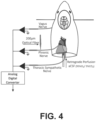
- VNA Vagal
- PNA Phrenic
- tSNA thoracic Sympathetic
- PP Perfusion pressure
- the IR diode laser used provided IR light with wavelengths of 1464 nm and 1860 nm, a pulse duration of 200 ms, and a pulse frequency of 200 Hz.
- the IR diode laser sent the IR light through an optic fiber with a 200 ⁇ m diameter.
- the protocol for IR control - threshold - included baseline recording (Bsin, 5-10 min), test low level of radiant exposure, progressively increased radiant exposure every 2-5 minutes.
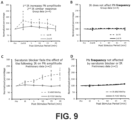
- IR light increases the amplitude of the phrenic nerve.
- the increase in amplitude is caused by IR light having a radiant exposure of 0.368 J/cm 2 /pulse. The frequency is not affected.
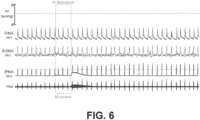
- FIG. 6 illustrates how effective IR light increases the amplitude within the phrenic nerve (PN) without affecting breathing.
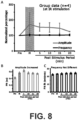
- FIGS. 7 and 8 show how brief IR stimulation evokes long term effects.
- Intermittent hypoxia works via serotonin to increase the amplitude of the phrenic nerve and other non-respiratory motor neurons.
- IR may work through the same mechanism as IH.
- Activation of sensory afferents - TRPV channels - serotonin pathway induction - enhancement of motor activity of the phrenic nerve.
- application of a serotonin blocker Metalsergide via microinjection in the phrenic motor nucleus at the level of C5
- diminished the effect of subsequent IR application and phrenic long term facilitation of the subsequent IR stimulation).
Landscapes
- Health & Medical Sciences (AREA)
- Engineering & Computer Science (AREA)
- Biomedical Technology (AREA)
- Life Sciences & Earth Sciences (AREA)
- Pathology (AREA)
- Nuclear Medicine, Radiotherapy & Molecular Imaging (AREA)
- Radiology & Medical Imaging (AREA)
- Animal Behavior & Ethology (AREA)
- General Health & Medical Sciences (AREA)
- Public Health (AREA)
- Veterinary Medicine (AREA)
- Biophysics (AREA)
- Neurosurgery (AREA)
- Optics & Photonics (AREA)
- Physics & Mathematics (AREA)
- Radiation-Therapy Devices (AREA)
Applications Claiming Priority (3)
| Application Number | Priority Date | Filing Date | Title |
|---|---|---|---|
| US201762592623P | 2017-11-30 | 2017-11-30 | |
| PCT/US2018/063417 WO2019109002A1 (en) | 2017-11-30 | 2018-11-30 | System for long-term modulation of peripheral nerve activity with light |
| EP18829562.0A EP3717067B1 (de) | 2017-11-30 | 2018-11-30 | System zur langzeitmodulation der aktivität von peripheren nerven mit licht |
Related Parent Applications (1)
| Application Number | Title | Priority Date | Filing Date |
|---|---|---|---|
| EP18829562.0A Division EP3717067B1 (de) | 2017-11-30 | 2018-11-30 | System zur langzeitmodulation der aktivität von peripheren nerven mit licht |
Publications (2)
| Publication Number | Publication Date |
|---|---|
| EP4272811A2 true EP4272811A2 (de) | 2023-11-08 |
| EP4272811A3 EP4272811A3 (de) | 2024-02-07 |
Family
ID=64902402
Family Applications (2)
| Application Number | Title | Priority Date | Filing Date |
|---|---|---|---|
| EP18829562.0A Active EP3717067B1 (de) | 2017-11-30 | 2018-11-30 | System zur langzeitmodulation der aktivität von peripheren nerven mit licht |
| EP23199221.5A Withdrawn EP4272811A3 (de) | 2017-11-30 | 2018-11-30 | System zur langzeitmodulation der peripheren nervenaktivität mit licht |
Family Applications Before (1)
| Application Number | Title | Priority Date | Filing Date |
|---|---|---|---|
| EP18829562.0A Active EP3717067B1 (de) | 2017-11-30 | 2018-11-30 | System zur langzeitmodulation der aktivität von peripheren nerven mit licht |
Country Status (3)
| Country | Link |
|---|---|
| US (2) | US20200324141A1 (de) |
| EP (2) | EP3717067B1 (de) |
| WO (1) | WO2019109002A1 (de) |
Family Cites Families (7)
| Publication number | Priority date | Publication date | Assignee | Title |
|---|---|---|---|---|
| US8792978B2 (en) * | 2010-05-28 | 2014-07-29 | Lockheed Martin Corporation | Laser-based nerve stimulators for, E.G., hearing restoration in cochlear prostheses and method |
| US8996131B1 (en) * | 2006-09-28 | 2015-03-31 | Lockheed Martin Corporation | Apparatus and method for managing chronic pain with infrared light sources and heat |
| US9101759B2 (en) * | 2008-07-08 | 2015-08-11 | The Board Of Trustees Of The Leland Stanford Junior University | Materials and approaches for optical stimulation of the peripheral nervous system |
| US9302103B1 (en) * | 2010-09-10 | 2016-04-05 | Cornell University | Neurological prosthesis |
| KR101304338B1 (ko) * | 2010-10-21 | 2013-09-11 | 주식회사 엠아이텍 | 액정폴리머 기반의 전광극 신경 인터페이스 및 그 제조 방법 |
| US20120253261A1 (en) * | 2011-03-29 | 2012-10-04 | Medtronic, Inc. | Systems and methods for optogenetic modulation of cells within a patient |
| WO2015142838A1 (en) * | 2014-03-18 | 2015-09-24 | Case Western Reserve University | Systems and methods for fast and reversible nerve block |
-
2018
- 2018-11-30 US US16/767,257 patent/US20200324141A1/en not_active Abandoned
- 2018-11-30 WO PCT/US2018/063417 patent/WO2019109002A1/en not_active Ceased
- 2018-11-30 EP EP18829562.0A patent/EP3717067B1/de active Active
- 2018-11-30 EP EP23199221.5A patent/EP4272811A3/de not_active Withdrawn
-
2022
- 2022-02-08 US US17/666,653 patent/US20220161055A1/en not_active Abandoned
Also Published As
| Publication number | Publication date |
|---|---|
| WO2019109002A1 (en) | 2019-06-06 |
| US20220161055A1 (en) | 2022-05-26 |
| EP3717067A1 (de) | 2020-10-07 |
| EP4272811A3 (de) | 2024-02-07 |
| EP3717067B1 (de) | 2023-10-11 |
| US20200324141A1 (en) | 2020-10-15 |
Similar Documents
| Publication | Publication Date | Title |
|---|---|---|
| Michelson et al. | Calcium activation of cortical neurons by continuous electrical stimulation: Frequency dependence, temporal fidelity, and activation density | |
| US10322293B2 (en) | Systems and methods for fast and reversible nerve block | |
| US7729773B2 (en) | Neural stimulation and optical monitoring systems and methods | |
| US20080243204A1 (en) | Variational parameter neurostimulation paradigm for treatment of neurologic disease | |
| EP4599882A3 (de) | Am körper tragbare periphere nervenstimulation zur behandlung von krankheiten unter verwendung rhythmischer biologischer prozesse | |
| Ward et al. | A flexible platform for biofeedback-driven control and personalization of electrical nerve stimulation therapy | |
| US20100114190A1 (en) | Nerve stimulator and method using simultaneous electrical and optical signals | |
| Mollet et al. | Electrophysiological responses from vagus nerve stimulation in rats | |
| Fluri et al. | Development of a head-mounted wireless microstimulator for deep brain stimulation in rats | |
| US20240424300A1 (en) | Variable amplitude signals for neurological therapy, and associated systems and methods | |
| US11013919B2 (en) | Systems and methods for controlling brain activity | |
| Grani et al. | Toward a personalized closed-loop stimulation of the visual cortex: Advances and challenges | |
| KR20160064490A (ko) | 실험체의 인지기능 실험장치 및 실험방법 | |
| Wang et al. | Optogenetic activation of visual thalamus generates artificial visual percepts | |
| US10549099B2 (en) | Electronic peripheral nerve stimulation | |
| Dadarlat et al. | Widespread activation of awake mouse cortex by electrical stimulation | |
| US20220161055A1 (en) | System for long-term modulation of peripheral nerve activity with light | |
| US11786750B2 (en) | Modulating neural activity in brainstem circuitry with light | |
| Hishida et al. | Transcranial electrical stimulation of cortico-cortical connections in anesthetized mice | |
| Liu et al. | The long-Term depression of brain activity induced by electrical stimulation of cerebral cortex | |
| WO2024098011A1 (en) | Treatments for neural dysregulation | |
| Azimirad et al. | Experimental study of RoboRat through deep brain stimulation and carbon nanotube coated microelectrodes | |
| Rodrigues et al. | EP 63. Spectral analysis and visualization of multi-unit activity in subthalamic nucleus in Parkinson’s as a tool for automated electrophysiological classification of basal ganglia structures during deep brain stimulation procedures | |
| Ronchi et al. | Single-neuron sub-cellular-resolution electrical stimulation with high-density microelectrode arrays | |
| KR20180107521A (ko) | 2광자 흡수를 이용해 동물 행동 제어를 위한 광학적 신경자극 장치 |
Legal Events
| Date | Code | Title | Description |
|---|---|---|---|
| PUAI | Public reference made under article 153(3) epc to a published international application that has entered the european phase |
Free format text: ORIGINAL CODE: 0009012 |
|
| STAA | Information on the status of an ep patent application or granted ep patent |
Free format text: STATUS: THE APPLICATION HAS BEEN PUBLISHED |
|
| AC | Divisional application: reference to earlier application |
Ref document number: 3717067 Country of ref document: EP Kind code of ref document: P |
|
| AK | Designated contracting states |
Kind code of ref document: A2 Designated state(s): AL AT BE BG CH CY CZ DE DK EE ES FI FR GB GR HR HU IE IS IT LI LT LU LV MC MK MT NL NO PL PT RO RS SE SI SK SM TR |
|
| PUAL | Search report despatched |
Free format text: ORIGINAL CODE: 0009013 |
|
| AK | Designated contracting states |
Kind code of ref document: A3 Designated state(s): AL AT BE BG CH CY CZ DE DK EE ES FI FR GB GR HR HU IE IS IT LI LT LU LV MC MK MT NL NO PL PT RO RS SE SI SK SM TR |
|
| RIC1 | Information provided on ipc code assigned before grant |
Ipc: A61N 5/06 20060101AFI20240102BHEP |
|
| STAA | Information on the status of an ep patent application or granted ep patent |
Free format text: STATUS: REQUEST FOR EXAMINATION WAS MADE |
|
| 17P | Request for examination filed |
Effective date: 20240726 |
|
| RBV | Designated contracting states (corrected) |
Designated state(s): AL AT BE BG CH CY CZ DE DK EE ES FI FR GB GR HR HU IE IS IT LI LT LU LV MC MK MT NL NO PL PT RO RS SE SI SK SM TR |
|
| STAA | Information on the status of an ep patent application or granted ep patent |
Free format text: STATUS: THE APPLICATION IS DEEMED TO BE WITHDRAWN |
|
| 18D | Application deemed to be withdrawn |
Effective date: 20250603 |