EP4271728B1 - Continuous dissolution of a cellulose derivative - Google Patents
Continuous dissolution of a cellulose derivative Download PDFInfo
- Publication number
- EP4271728B1 EP4271728B1 EP21836590.6A EP21836590A EP4271728B1 EP 4271728 B1 EP4271728 B1 EP 4271728B1 EP 21836590 A EP21836590 A EP 21836590A EP 4271728 B1 EP4271728 B1 EP 4271728B1
- Authority
- EP
- European Patent Office
- Prior art keywords
- cellulose carbamate
- mixture
- degrees celsius
- cellulose
- temperature
- Prior art date
- Legal status (The legal status is an assumption and is not a legal conclusion. Google has not performed a legal analysis and makes no representation as to the accuracy of the status listed.)
- Active
Links
Images
Classifications
-
- B—PERFORMING OPERATIONS; TRANSPORTING
- B29—WORKING OF PLASTICS; WORKING OF SUBSTANCES IN A PLASTIC STATE IN GENERAL
- B29B—PREPARATION OR PRETREATMENT OF THE MATERIAL TO BE SHAPED; MAKING GRANULES OR PREFORMS; RECOVERY OF PLASTICS OR OTHER CONSTITUENTS OF WASTE MATERIAL CONTAINING PLASTICS
- B29B7/00—Mixing; Kneading
- B29B7/30—Mixing; Kneading continuous, with mechanical mixing or kneading devices
-
- C—CHEMISTRY; METALLURGY
- C08—ORGANIC MACROMOLECULAR COMPOUNDS; THEIR PREPARATION OR CHEMICAL WORKING-UP; COMPOSITIONS BASED THEREON
- C08B—POLYSACCHARIDES; DERIVATIVES THEREOF
- C08B15/00—Preparation of other cellulose derivatives or modified cellulose, e.g. complexes
- C08B15/05—Derivatives containing elements other than carbon, hydrogen, oxygen, halogens or sulfur
- C08B15/06—Derivatives containing elements other than carbon, hydrogen, oxygen, halogens or sulfur containing nitrogen, e.g. carbamates
-
- C—CHEMISTRY; METALLURGY
- C08—ORGANIC MACROMOLECULAR COMPOUNDS; THEIR PREPARATION OR CHEMICAL WORKING-UP; COMPOSITIONS BASED THEREON
- C08B—POLYSACCHARIDES; DERIVATIVES THEREOF
- C08B3/00—Preparation of cellulose esters of organic acids
- C08B3/14—Preparation of cellulose esters of organic acids in which the organic acid residue contains substituents, e.g. NH2, Cl
-
- C—CHEMISTRY; METALLURGY
- C08—ORGANIC MACROMOLECULAR COMPOUNDS; THEIR PREPARATION OR CHEMICAL WORKING-UP; COMPOSITIONS BASED THEREON
- C08B—POLYSACCHARIDES; DERIVATIVES THEREOF
- C08B3/00—Preparation of cellulose esters of organic acids
- C08B3/22—Post-esterification treatments, including purification
-
- C—CHEMISTRY; METALLURGY
- C08—ORGANIC MACROMOLECULAR COMPOUNDS; THEIR PREPARATION OR CHEMICAL WORKING-UP; COMPOSITIONS BASED THEREON
- C08J—WORKING-UP; GENERAL PROCESSES OF COMPOUNDING; AFTER-TREATMENT NOT COVERED BY SUBCLASSES C08B, C08C, C08F, C08G or C08H
- C08J3/00—Processes of treating or compounding macromolecular substances
- C08J3/02—Making solutions, dispersions, lattices or gels by other methods than by solution, emulsion or suspension polymerisation techniques
- C08J3/03—Making solutions, dispersions, lattices or gels by other methods than by solution, emulsion or suspension polymerisation techniques in aqueous media
- C08J3/05—Making solutions, dispersions, lattices or gels by other methods than by solution, emulsion or suspension polymerisation techniques in aqueous media from solid polymers
-
- D—TEXTILES; PAPER
- D01—NATURAL OR MAN-MADE THREADS OR FIBRES; SPINNING
- D01D—MECHANICAL METHODS OR APPARATUS IN THE MANUFACTURE OF ARTIFICIAL FILAMENTS, THREADS, FIBRES, BRISTLES OR RIBBONS
- D01D1/00—Treatment of filament-forming or like material
- D01D1/02—Preparation of spinning solutions
-
- D—TEXTILES; PAPER
- D01—NATURAL OR MAN-MADE THREADS OR FIBRES; SPINNING
- D01F—CHEMICAL FEATURES IN THE MANUFACTURE OF ARTIFICIAL FILAMENTS, THREADS, FIBRES, BRISTLES OR RIBBONS; APPARATUS SPECIALLY ADAPTED FOR THE MANUFACTURE OF CARBON FILAMENTS
- D01F2/00—Monocomponent artificial filaments or the like of cellulose or cellulose derivatives; Manufacture thereof
- D01F2/24—Monocomponent artificial filaments or the like of cellulose or cellulose derivatives; Manufacture thereof from cellulose derivatives
-
- C—CHEMISTRY; METALLURGY
- C08—ORGANIC MACROMOLECULAR COMPOUNDS; THEIR PREPARATION OR CHEMICAL WORKING-UP; COMPOSITIONS BASED THEREON
- C08J—WORKING-UP; GENERAL PROCESSES OF COMPOUNDING; AFTER-TREATMENT NOT COVERED BY SUBCLASSES C08B, C08C, C08F, C08G or C08H
- C08J2301/00—Characterised by the use of cellulose, modified cellulose or cellulose derivatives
- C08J2301/08—Cellulose derivatives
- C08J2301/10—Esters of organic acids
Definitions
- the present invention relates to a method of dissolving a cellulose derivative.
- the present invention relates to a continuous method of dissolving cellulose carbamate
- Cellulose is the most widely used biopolymer in the world and it finds applications in various industries such as the paper and cardboard industry, and the textile industry as both cellulose and derivatives of cellulose, such as cellulose carbamate, cellulose acetate, ethers and esters.
- the dissolution of cellulose is difficult because of its semi-crystalline structure, strong hydrogen bonds in the polymer sheets and the presence of both hydrophilic and hydrophobic ends in the polymer. For this reason, cellulose requires either a modification of the structure by derivatization or an opening of the fibres and an increase in reactivity.
- CN 106 702 516 A discloses a method of dissolving cellulose carbamate in an alkaline aqueous phase, comprising: mixing cellulose carbamate with an aqueous NaOH solution at -10-0°C by stirring; adding alumina, stirring and mixing; freezing at -5-5°C and thawing at room temperature.
- the cellulose or the cellulose derivative must be dissolved in order to regenerate the cellulose structure for use in various industrial applications.
- the procedure for dissolving cellulose in aqueous alkali is based on a freeze-thaw method.
- the solvent is pre-cooled to below the freezing point of water before cellulose is added and kept cold until the polymer is completely dissolved.
- the temperature required for efficient dissolution in a freezing-thawing process was found to be in the region of -30 degrees Celsius for the entire mixture of cellulose carbamate in aqueous solution.
- the method involves mixing cellulose carbamate with an aqueous alkaline solution and conducting the thus formed mixture through the mixing zone of a continuously operated kneader type dissolving reactor to produce a solution of cellulose carbamate in an alkaline aqueous phase.
- the cellulose carbamate containing aqueous phase is recovered.
- the step of continuously conducting the mixture through the mixing zone of the kneader type dissolving reactor is carried out at a temperature of 10 degrees Celsius or less.
- a method of continuously dissolving cellulose carbamate polymer in an alkaline aqueous phase to form a solution comprising the steps of providing cellulose carbamate polymer, mixing the cellulose carbamate polymer with an aqueous alkaline solution to form a mixture, conducting the mixture through the mixing zone of a continuously operated kneader type dissolving reactor at a mixing speed of 10-500 rpm to produce a solution of said cellulose carbamate polymer in an alkaline aqueous phase, and recovering the dissolved cellulose carbamate polymer containing aqueous phase.
- the step of continuously conducting the mixture through the mixing zone of the kneader type dissolving reactor of said method is carried out at a temperature of 10 degrees Celsius or less.
- the present invention provides a method of continuously dissolving cellulose carbamate polymer in an alkaline solution.
- Cellulose carbamate polymer is an alkali labile cellulose derivative.
- cellulose carbamate polymer can be dissolved in a high cellulose consistency to obtain a cellulose carbamate spinning dope with a lower viscosity than mathematically and experimentally expected by means of conventional dissolving methods known in the art. This was especially demonstrated in case of the dissolving operation performed under super-cooled conditions.
- cellulose carbamate spinning dope is stable for long periods of time even at room temperature.
- cellulose carbamate dopes must be stored at reduced temperatures to avoid gelling of the cellulose carbamate solution.
- Low temperature conditions stand for temperatures in the range of 5 degrees Celsius to -6.9 degrees Celsius.
- Super-cooled conditions stand for temperatures lower than those prevailing at low temperature conditions, in particular it stands for temperatures in the range of -7 degrees Celsius to -20 degrees Celsius
- Chemical pulp or dissolving pulp prepared from wood species such as pine, spruce, birch, beech, aspen, maple, larch, acacia, eucalyptus, hemlock, tupelo, and oak or non-woods such as stalk fibres (wheat straw, rice straw, barley straw, bamboo, bagasse and reed).
- the origin of the feedstock can be either the virgin form of the chemical or dissolving pulp or the recycled feedstocks such as recycled paper and/or cardboard containing chemical pulp or dissolving type pulp.
- Natural plant fibres as such in or in the form of chemical pulp or dissolving pulp.
- the origin of natural plant fibres can be either their virgin forms or natural plant fibre containing textiles or recycled natural fibre containing textiles.
- Natural plant fibres include seed fibres such as cotton and kapok; bast fibres such as hemp, jute, kenaf, ramie, abaca and linen (flax); leaf fibres such as manilla, sisal, ananas and banana; fruit fibres such as coir.
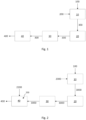
- FIGURE 1 is a flow diagram illustrating a process for continuous dissolution of cellulose carbamate in accordance with at least some embodiments of the present invention.
- Cellulose carbamate 100 in solid form is weighed and fed into a pulper 10.
- the total amount of an aqueous solution of sodium hydroxide 200 required for dissolution of the weighed cellulose carbamate 100 is added into the pulper 10.
- the alkaline solution 200 may be added either in one batch or gradually.
- the pulper 10 is started and a mixture 300 comprising cellulose carbamate in aqueous alkaline solution is formed.
- the mixture 300 is directed to a storing tank 20, equipped with a mixer.
- the storing tank 20 may be a chest storing tank. After the mixture 300 is directed to the storing tank 20 the pulper 10 is ready for the next batch of cellulose carbamate 100 and aqueous solution of sodium hydroxide 200.
- the storing tank 20 has a higher volume than the pulper 10 and can contain more than one batch of mixture 300 directed from the pulper 10.
- the mixture 300 is continuously fed with a pump 30 from the storing tank 20 into the mixing zone of the kneader type dissolving reactor 40.
- the temperature of the mixture 300 is suitably lowered but kept above the limit of solubility of the system during process stages prior to the dissolving reactor 40.
- a solution of cellulose carbamate in aqueous alkaline solution 400 is continuously formed in the dissolving reactor 40 and recovered.
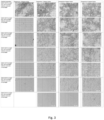
- FIGURE 2 is a flow diagram illustrating a process for continuous dissolution of cellulose carbamate in accordance with at least some embodiments of the present invention.
- Cellulose carbamate 100 in solid form is weighed and fed into a pulper 10.
- a first portion of an aqueous solution of sodium hydroxide 2000 required for formation of pre-slurry with the weighed cellulose carbamate 100 is added into the pulper 10.
- the pulper 10 is started and a pre-slurry 3000 comprising cellulose carbamate in aqueous alkaline solution is formed.
- the pre-slurry 3000 is directed into a storing tank 20 equipped with a mixer. After the pre-slurry 3000 is directed to the storing tank 20 the pulper 10 is ready for the next batch of cellulose carbamate 100 and the next first portion of an aqueous solution of sodium hydroxide 2000.
- the storing tank 20 has a higher volume than the pulper 10 and can contain more than one batch of the pre-slurry 3000 directed from the pulper 10.
- the pre-slurry is continuously fed from the storing tank 20 by using a pump 30 into the mixing zone of the kneader type dissolving reactor 40. A second portion of alkaline solution 2200 is added with the pre-slurry 3000 into the dissolving reactor 40 to provide a mixture 330.
- the mixture 330 is formed in the dissolving reactor.
- the temperature of the pre-slurry 3000 is kept above the limit of solubility of the system during process stages prior to the dissolving reactor 40.
- a solution of cellulose carbamate in aqueous alkaline solution 400 is continuously formed in the dissolving reactor 40 and recovered.
- the present technology relates to a method of dissolving cellulose carbamate.
- the present technology provides a method of continuously dissolving cellulose carbamate in an alkaline aqueous phase to form a solution, comprising the steps of providing cellulose carbamate; mixing the cellulose carbamate with an aqueous alkaline solution to form a mixture; producing from said mixture a solution of said cellulose carbamate in an alkaline aqueous phase; and recovering the cellulose carbamate containing aqueous phase wherein the step of producing the solution is carried out at a temperature of 10 degrees Celsius or less.
- the method of continuously dissolving cellulose carbamate in an alkaline aqueous phase to form a solution comprises the steps of providing cellulose carbamate, mixing the cellulose carbamate with an aqueous alkaline solution to form a mixture, conducting the mixture through the mixing zone of a continuously operated kneader type mixing reactor to produce a solution of said cellulose carbamate in an alkaline aqueous phase e.g. cellulose carbamate dope or cellulose carbamate spinning dope, and recovering the cellulose carbamate containing aqueous phase.
- the step of continuously conducting the mixture through the mixing zone of the mixing kneader is carried out at a temperature of 10 degrees Celsius or less and at a mixing speed of 10-500 rpm.
- cooling takes place in the mixing zone of the mixing kneader.
- the mixture is conducted through a mixing and cooling zone of the mixing kneader.
- the cellulose carbamate may be a cellulose carbamate produced from chemical or dissolving pulp prepared from wood fibres or non-wood fibres or a cellulose carbamate derived from natural plant fibres as such in or in the form of chemical pulp or dissolving type pulp.
- Embodiments of the method may also be carried out using cellulose carbamate produced from mixtures of any of the various cellulosic fibres or pulps described above.
- the cellulose carbamate is manufactured in a process comprising the steps of providing a pulp, adding to the pulp (or optionally to the activated pulp) an aqueous solution of urea and optionally hydrogen peroxide to provide a mixture, mechanically working the mixture to provide a homogeneous composition, heating the composition to a temperature in the range of 120 to 155 degrees Celsius, typically 135 degrees Celsius for a period in the range of 2 to 4 hours to produce cellulose carbamate, recovering the cellulose carbamate, and optionally washing the cellulose carbamate with water and drying in a dryer at a temperature less than or equal to 155 degrees Celsius, preferably 135 degrees Celsius or less, suitably 133 degrees Celsius or less.
- the mixture formed by the cellulose carbamate in the alkaline aqueous solution is subjected to mixing in the mixing zone of the kneader type mixing reactor with low shearing forces by running mixer with a reduced mixer speed of 10-500 rpm, suitably under 250 rpm, most suitably under 100 rpm, preferably under 50 rpm.
- the dissolving process according to an embodiment is thus not dependent on high shear force mixing.
- a typical technical approach is to use high speed mixing in order to obtain a good quality solution.
- the dissolving temperature is the most critical factor, not mixing speed or high shear forces in mixing. The more vigorous is the mixing, the more difficult it is to reach and/or maintain low dissolving temperatures.
- Dissolving at low temperatures and/or under super-cooled conditions provides a cellulose carbamate solution that is of a quality suitably adapted for spinning process.
- the recovered solution is subjected to spinning process, for example wet spinning process to spin cellulose carbamate fibres.
- the mixture of cellulose carbamate polymer and alkaline solution can be formed in various ways, each way of forming the mixture being adapted to the particular alkaline solution or alkaline solutions and the particular cellulose carbamate or cellulose carbamates forming the mixture.
- the cellulose carbamate is first mixed with the alkaline solution, and the mixture thus obtained is fed into the mixing zone of the continuously operated kneader type dissolving reactor.
- precooling is achieved in a first kneader, whereby partial dissolution can be obtained, after which step the mixture is transferred to a second kneader in which the material is dissolved, typically completely or essentially completely.
- Mixing the cellulose carbamate with the alkaline solution, corresponding to the final target chemical composition set for the cellulose carbamate dope to be recovered can be done in a mixing reactor e.g. in the pulper or in another type of homogenizer or in a suitable reactor e.g. in the xanthator type reactor or in a suitable reactor connected to a homogenizer in batches by directly or gradually adjusting the sodium hydroxide and/or the zinc oxide concentration in a pre-slurry and in order to affect to the swelling properties of cellulose carbamate derivative prior to adding the rest of alkali and/or zinc oxide containing alkali and water to reach the final target composition.
- a mixing reactor e.g. in the pulper or in another type of homogenizer or in a suitable reactor e.g. in the xanthator type reactor or in a suitable reactor connected to a homogenizer in batches by directly or gradually adjusting the sodium hydroxide and/or the zinc oxide concentration in a pre-slurry and in order to affect to
- the temperature of the slurry in each slurrying stage can be controlled for example using pre-cooled solutions and/or by external cooling of the pulper or the other type of homogenizer or mixing reactor.
- the cellulose carbamate is first mixed with a first portion of the alkaline solution or zinc oxide containing alkaline solution, and the pre-slurry thus obtained is fed into the mixing zone of the continuously operated kneader type dissolving reactor and a second portion of the alkaline solution or zinc oxide containing alkaline solution is fed into the mixing zone of the continuously operated kneader type dissolving reactor.
- Feeding a pre-slurry of cellulose carbamate including a first portion of the alkaline solution into the mixing zone of the continuously operated kneader and separately feeding the second portion of the alkaline solution into the mixing zone of the continuously operated kneader provides an opportunity to precool the pre-slurry including the first portion of alkaline solution and the second portion of alkaline solution, separately to a specific temperature depending on their chemical compositions, prior to adding them into the mixing zone of the kneader type dissolving reactor. It is further possible to mix the pre-slurry with a second portion of the alkaline solution in a homogenizer before feeding the mixture thus obtained into a kneader.
- the pre-slurry i.e. the slurry with a sodium hydroxide content below the dissolving limit of the system, e.g. a pre-slurry having a sodium hydroxide content of about 2 to 6 %, for example about 3 or 4 % by weight
- Sodium hydroxide or combination of sodium hydroxide and zinc oxide lowers the freezing point of its water solution.
- Cellulose carbamate raises the freezing point of its alkaline water solution, thus the freezing point is higher than -6 degrees Celsius if the cellulose carbamate content in pre-slurry is higher than 6 % by weight.
- a pre-slurry with a sodium hydroxide content of 3 % by weight and cellulose carbamate content of 6 % by weight can be cooled to as low as -6 degrees Celsius without freezing of the mixture or initiation of the dissolving of cellulose carbamate.
- the sodium hydroxide or the combination of sodium hydroxide and zinc oxide lowers the freezing point of the aqueous phase and it is possible to precool this second portion of alkaline solution to a temperature on the level between -30 and -20 degrees Celsius. Further, this allows for adjustment of the alkaline, e.g. sodium hydroxide and/or zinc oxide, concentrations in the pre-slurry, which has an impact on swelling properties of the cellulose derivate in addition to the freezing point of the pre-slurry and solubility limit.
- the alkali concentration in the pre-slurry is related to the temperature at which dissolving the cellulose derivative is initiated.
- the pre-slurry and the second portion of alkaline solution are simultaneously fed into the mixing zone of the continuously operated kneader.
- the chemical composition of the pre-slurry determines the chemical composition of the second portion of the alkaline solution.
- One aim of the optimization of the temperature and alkali concentration of pre-slurry is to prevent initiation of dissolving before the mixing zone of the dissolving reactor in avoid to contamination the pre-slurry handling system by the high viscosity cellulose carbamate solution.
- the dissolution is carried out in either low temperature conditions or in super cooled conditions.
- Low temperature conditions mean temperatures in the range of 5 degrees Celsius to -6.9 degrees Celsius or above.
- the temperature of the mixing zone is in the range of 5 to -6.9 degrees Celsius.
- the temperature of the mixing zone is about 0 degrees Celsius.
- Temperatures of around 0 degrees Celsius, such as in the range of 5 to -6.9 degrees Celsius are particularly suitable for cellulose carbamates formed from chemical or dissolving pulp prepared from wood fibres or non-wood fibres such as commercial wood-based dissolving pulp, non-wood straw-based dissolving pulp or dissolving type pulp prepared from recycled paper and/or cardboard waste streams.
- Super cooled conditions mean temperatures of -7 degrees Celsius or less, but not lower than -20 degrees Celsius.
- the temperature of the mixing zone is -7 degrees Celsius or less.
- Temperatures in the mixing zone lower than -7 degrees Celsius, typically in the range of -7 to -20 degrees Celsius are particularly suitable for cellulose carbamates formed from chemical or dissolving type pulp containing or derived from natural plant fibres such as hemp, jute, or cotton based raw materials either from their virgin forms or from recycled feedstocks such as from recycled textiles.
- dissolution is carried out at ca -15 to ca -20 degrees Celsius.
- the mixture of alkaline liquid and cellulose carbamate can be cooled by contacting it with a cooled surface. It is generally preferred that such contacting will achieve a cooling of the mixture essentially to the temperature of the cooled surface.
- the cellulose carbamate is manufactured from cellulose having wood and/or non-wood fibres in the form of dissolving pulp.
- the cellulose carbamate is manufactured from cellulose having natural plant fibres such as cotton in the form of dissolving type pulp.
- the cellulose carbamate is a mixture of cellulose carbamates manufactured from both cellulose having wood and/or non-wood fibres such as straw in the form of dissolving pulp and cellulose having natural plant fibres such as cotton in the form of dissolving type pulp.
- the preferred temperature in the mixing zone is about -7 degrees Celsius or lower.
- wood fibres derived material such as dissolving wood pulp, and/or non-wood fibres derived material, such as straw based dissolving pulp, are dissolved at a low temperature and natural plant fibres derived material, such as cotton derived dissolving type pulp, is dissolved under super cooled conditions and the separately obtained carbamate dopes are mixed after the dissolving process.
- the said materials dissolvable under low temperature conditions can be also dissolved under super-cooled conditions.
- the degree of substitution (DS) of the cellulose carbamate polymer determines at least in part the physical and chemical conditions in which the cellulose carbamate can be dissolved in aqueous alkaline solution. This also determines at least in part, the concentration of the solution regarding the cellulose part that may be formed of the cellulose carbamate.
- the cellulose carbamate provided has a degree of substitution (DS) of 0.1 to 0.3, in particular about 0.25 or less. After dissolution the DS of the cellulose carbamate diminishes slightly.
- the degree of substitution of the cellulose carbamate is determined by the total nitrogen content determination according to SFS 5505:1988.
- the degree of substitution value of 0.24 corresponds to total nitrogen content of 2.0 % per absolute dry water insoluble fraction of the cellulose carbamate.
- cellulose carbamate which has a degree of polymerization in a predetermined range that is suitable for application in certain embodiments.
- the degree of polymerization (DP) of the cellulose carbamate polymer determines at least in part the viscosity of the aqueous solution of the recovered cellulose carbamate dope.
- the degree of polymerization of the cellulose carbamate polymer can be determined by the intrinsic viscosity determination according to ISO 5351.
- the cellulose carbamate provided has a degree of polymerization (DP) of DP 200 to DP 400, in particular about DP 220 or higher.
- the degree of polymerization value of DP 250 corresponds to an intrinsic viscosity of 197 ml/g.
- the mixture of the cellulose carbamate dope e.g. mixture of cellulose carbamate, alkali, water and possible surfactants-based additives such as polyethylene glycols (PEG), alkylamine or arylamine polyoxy ethylene glycols, alcohol ethoxylates, and fatty alcohol ethers
- PEG polyethylene glycols
- alkylamine or arylamine polyoxy ethylene glycols alkylamine or arylamine polyoxy ethylene glycols
- alcohol ethoxylates ethoxylates
- fatty alcohol ethers ethoxylates
- the mixture of the cellulose carbamate has a cellulose carbamate content of 6 to 10 % by weight (in the mixture of cellulose carbamate and aqueous alkali in the mixing zone or in the cellulose carbamate dope recovered from the dissolving reactor).
- the mixture of cellulose carbamate dope has a cellulose carbamate content of 6 to 8 % by weight, which is the typical cellulose carbamate content obtained under low temperature or super-cooled conditions.
- the mixture of cellulose carbamate dope has a cellulose carbamate content of 8 to 10 % by weight, which is the preferred cellulose carbamate content under super-cooled conditions.
- the aqueous alkaline solution e.g. cellulose carbamate dope contains 5 to 10 % NaOH by weight. In a further embodiment the aqueous alkaline solution contains 6 to 8 % NaOH by weight e.g. in the mixture of cellulose carbamate and aqueous alkali in the mixing zone or in the cellulose carbamate dope recovered from the dissolving reactor). In a particular embodiment the aqueous alkaline solution contains 5 to 7% NaOH. This is the preferred amount of NaOH in the alkaline solution when super-cooled conditions are applied.
- the ratio of cellulose carbamate:NaOH can be important in ensuring total dissolution of the cellulose carbamate.
- the mixture has a cellulose carbamate:NaOH ratio of 6 to 10% by weight:5 to 10% by weight.
- the mixture has a cellulose carbamate:NaOH ratio of 8 to 10% : 5 to 7%, which is the preferred ratio under super-cooled conditions.
- the actual reaction rate is not time but temperature dependent. Under low temperature or supercooled conditions the total mass must reach a target temperature.
- the target temperature is the output temperature of the mixing zone of the dissolving kneader and depends on the chemical composition (cellulose carbamate:NaOH ratio) and the raw material basis (wood and non-wood fibres or natural plant fibres or their mixture).
- the residence time in the mixing zone is at least dependent on the following properties: Mechanical properties and mechanical structure of the kneader type reactor, heat exchange properties of the surfaces in mixing and cooling zone, heat energy released into the system during mixing, cooling power of an external cooling system, feeding temperature of the mixture or feeding temperature of the pre-slurry and alkali solution.
- the residence time is about 1 min to 10 hours, for example 2 min to 2 hours, in particular 2 to 60 min or 2 to 30 min.
- alkali hydrolysis of carbamate groups is inhibited, preferably prevented during the dissolving process.
- the method comprises the further step of adding zinc oxide to the mixture.
- the zinc oxide may be added to the cellulose carbamate, to the alkaline aqueous solution or to the mixture of cellulose carbamate and alkaline aqueous solution.
- the zinc oxide is dissolved in aqueous alkaline solution prior to its use as a dissolving lye for the provided cellulose carbamate.
- the addition of zinc oxide may partly enhance the dissolution and filterability of the solutions and partly prolong the storage time before gelation starts it has also an impact on viscosity of the cellulose carbamate solution and tenacity yield of the obtained wet spun cellulose carbamate fibres.
- the mixture has a zinc oxide content of 0.1 to 1.5% by weight of the mixture.
- the mixture is at least partly defined by the ratio of cellulose carbamate to zinc oxide.
- the cellulose carbamate has a cellulose carbamate:ZnO ratio of 6 to 10%: 0.1 to 1.5 %, this means 0.01-0.25 t of ZnO per 1 t of cellulose carbamate.
- a further method of continuously dissolving cellulose carbamate in an alkaline aqueous phase to form a solution comprising the steps of providing cellulose carbamate; mixing the cellulose carbamate with an aqueous alkaline solution to form a mixture; producing a solution of the cellulose carbamate in the alkaline aqueous phase; and recovering the cellulose carbamate containing aqueous phase, wherein the step of producing the solution is carried out by conducting the mixture through a mixing zone of a continuously operated kneader type dissolving reactor at a mixing speed of 10-500 rpm at a temperature of 10 °C or less, the cellulose carbamate is first mixed with a first portion of the alkaline solution to produce a pre-slurry, and the pre-slurry thus obtained is fed into the mixing zone, and wherein a second portion of the alkaline solution is separately fed into the mixing zone, the pre-slurry being kept in the mixing zone at a temperature of -1 to -6
- dissolution of cellulose carbamate of dissolving pulp is achieved at temperatures higher than those generally applicable to cotton carbamate (-15 to -20 °C).
- the pre-slurry is cooled to a temperature of 0 to -6 degrees Celsius, for example -1 to -6 degrees Celsius, or -2 to -6 degrees Celsius.
- the second portion of the alkaline solution is cooled to a temperature of -7 to -30 degrees Celsius.
- Dissolving at low temperature and/or under super-cooled conditions provides a cellulose carbamate solution that is of a quality suitably adapted for spinning processes.
- Cellulose carbamate can be dissolved in a high cellulose consistency to obtain a cellulose carbamate spinning dope with a lower viscosity than would be mathematically and experimentally expected when dissolving in a conventional method.
- the viscosity of the cellulose carbamate dope having cellulose carbamate (DP of 250 and DS 0.2 %) content of 8.5 %, NaOH content of 6.5 % and ZnO content of 1.3 % recovered after dissolving subsequent temperation to +20 degrees Celsius using conventional method is higher than 15 Pas.
- cellulose carbamate spinning dope has viscosity less than 15 Pas. Viscosity of cellulose carbamate spinning dope according to embodiments is preferably ⁇ 15 Pas. Viscosity of cellulose carbamate spinning dope is measured by ball fall viscosity method at 20 degrees Celsius. Additionally, the present method provides a cellulose spinning dope that is stable for long periods, even at room temperature.
- the temperature of the mixture is maintained at the target temperature for 1 minutes to 30 minutes, for example 3 to 15 minutes.
- the examples related to batch process are to be regarded as comparative or reference examples.
- Example 1 Continuous dissolution of cellulose carbamate by one-step method under supercooled conditions starting from recycled cotton derived cellulose carbamate
- Cellulose carbamate polymer was provided by means of a carbamation process carried out as described in Finnish Patents Nos. 112869 , 112795 , and in Finnish Patent Applications Nos. 20175376 and 20195717 and International Patent Application PCT/FI2020/050560 .
- a mixture of cellulose carbamate polymer and aqueous alkaline solution was formed as follows: A quantity of cellulose carbamate with the degree of polymerisation (DP) of DP 250 (determined as an intrinsic viscosity according to ISO 5351) corresponding to 850 g absolute dry substance with a degree of substitution (DS) of 0.22 (determined as a total nitrogen content according to SFS 5505:1988) was mixed with 9150 g aqueous alkaline solution containing 650 g of sodium hydroxide, 110 g of zinc oxide and 8390 g of water, and stirred for 40 minutes at room temperature of about 20 degrees Celsius in a homogenizer at mixing speed of 700 rpm.
- DP degree of polymerisation
- DS degree of substitution
- a two-screw extruder model of Berstroff ZE 25x49.5 was used as a kneader type dissolving reactor. Its cooling and mixing zone was consisted of 12 separate barrel units in series. The cylinder walls in each barrel unit were cooled to desired temperature by ethylene glycol refrigerant circuit using an external cooling machine. For continuous dissolving operation the mixing zone was pre-cooled to -20 degrees Celsius. The two-screw extruder was equipped with the funnel and the mixture of the cellulose carbamate polymer in aqueous alkaline solution was fed into the pre-cooled mixing zone and temperature was maintained by the external cooling machine. The feeding rate was set to 3.9-4.0 kg/h by adjusting the rotational speed of the screws to 16 rpm, the moment was 50-53 % and motor' power consumption was 415 W.
- the mixture of cellulose carbamate polymer in aqueous alkaline solution was continuously fed into the system for 140 min and the solution of cellulose carbamate in aqueous alkaline solution was recovered by the rate of 3.9-4.0 kg/h.
- the residence time of the mixture in the mixing zone was 6 ⁇ 0.5 min.
- Temperature of the recovered solution was between -15.3 and -17.5 degrees Celsius in the output of extruder's mixing zone.
- the recovered solution was immediately tempered to the temperature of +10 degrees Celsius.
- the recovered solution of cellulose carbamate was sampled and characterized with the results as follows: The cellulose carbamate content in the recovered cellulose carbamate solution was 8.5 %, the sodium hydroxide content was 6.5 %, the zinc oxide content was 1.1 %, the ball fall viscosity measured at +20 degrees Celsius was 8.7 Pas and the filterability index (K R ) was 0.30 measured at +20 degrees Celsius.
- Example 2 Continuous dissolution of cellulose carbamate by two-step method under supercooled conditions starting from recycled cotton derived cellulose carbamate
- Cellulose carbamate polymer was provided by means of a carbamation process carried out as described in Finnish Patents Nos. 112869 , 112795 , and in Finnish Patent Applications Nos. 20175376 and 20195717 and in International Patent Application PCT/FI2020/050560 .
- the pre-slurry i.e. the mixture of cellulose carbamate polymer and aqueous alkaline solution was formed as follows: A quantity of cellulose carbamate with the degree of polymerisation (DP) of DP 333 (determined as an intrinsic viscosity according to ISO 5351) corresponding to 3840 g absolute dry substance with a degree of substitution (DS) of 0.24 (determined as a total nitrogen content according to SFS 5505:1988) was mixed with the first portion of 46076 g aqueous alkaline solution containing 1497 g of sodium hydroxide, 508 g of zinc oxide and 44071 g of water in a homogenizer for 30 minutes equipped with a cooling jacket.
- DP degree of polymerisation
- DS degree of substitution
- the pre-slurry was cooled and tempered to temperature of +0.6 degrees Celsius and left to gentle mixing to prevent the phase separation.
- Cellulose carbamate content in the pre-slurry was 7.7 % by weight
- sodium hydroxide content was 3.0 % by weight
- zinc oxide content was 1.0 % by weight.
- the second portion of aqueous alkaline solution was separately prepared and cooled to -16.3 degrees Celsius. This solution contained 3620 g of sodium hydroxide, 324 g of zinc oxide and 10141 g of water, thus the sodium hydroxide content was 25.7 % by weight and zinc oxide content was 2.30 % by weight.
- a kneader type of model LIST Technology with 14 litres cooling jacketed dissolving chamber, two co-rotating shafts with temperature control and a discharge screw that allows continuous mode operation was served as a kneader type dissolving reactor.
- the ethylene glycol refrigerant was cooled to -10 degrees Celsius by the external cooling machine and flowed through the jacket of dissolving reactor and its shafts.
- the cellulose carbamate slurried in the first portion of aqueous alkaline solution and the second portion of aqueous alkaline solution were separately continuously fed at predetermined rates into the mixing and cooling zone of the dissolving reactor by using two separate peristaltic pumps.
- the pre-slurry feed rate was set to 22.62 kg/h and the second portion feed rate was set to 6.39 kg/h.
- the continuous mode operation included the following steps: First the kneader was filled to the desired fill level of 80 % during the predetermined residence time of 25 minutes, next the discharge screw was turned on and its speed was adjusted to maintain the fill level. The reaction was allowed to stabilise for the period equal to the residence time with constant feeding and discharging, where after the collection of the cellulose carbamate solution was started with rate of 29.0 kg/h. The speed of the rotation shafts was 20 rpm. The collection was possible as long as the feeding was stable. The change of one or more of the parameters in between the continuous dissolving process requires a stabilization period equal to the residence time in order to collect representative product. Temperature of the recovered solution was -7.9 degrees Celsius in the output of the mixing zone of the dissolving reactor.
- Cellulose carbamate polymer was provided by means of a carbamation process carried out as described in Finnish Patents Nos. 112869 , 112795 and in International Patent Application PCT/FI2020/050560 .
- a pre-slurry i.e. a mixture of cellulose carbamate polymer and aqueous alkaline solution was formed as follows: A quantity of cellulose carbamate with the degree of polymerisation (DP) of DP 270 (determined as an intrinsic viscosity according to ISO 5351) corresponding to 29.3 kg absolute dry substance with a degree of substitution (DS) of 0.17 (determined as a total nitrogen content according to SFS 5505:1988) was mixed with the first portion of 310.2 kg aqueous alkaline solution containing 10.3 kg of sodium hydroxide, 1.92 kg of zinc oxide and 300 kg of water in a 500 L batch dissolving reactor tank equipped with a cooling jacket and propeller mixing units setup in two stages.
- DP degree of polymerisation
- DS degree of substitution
- the sodium hydroxide concentration in the pre-slurry was 3.0 % by weight, zinc oxide concentration was 0.57 % by weight and the cellulose carbamate content was 8.6 % by weight.
- the ethylene glycol refrigerant was cooled to -9 degrees Celsius by the separate cooling machine and flowed through the jacket of dissolving reactor tank.
- the aqueous alkaline solution was pre-cooled to -2.9 degrees Celsius prior to mixing with the cellulose carbamate polymer in the dissolving reactor tank, the obtained pre-slurry was tempered to temperature level between -1 and -2 degrees Celsius by mixing at about 250 rpm and left to gentle mixing to prevent the phase separation.
- a second portion of aqueous alkaline solution was separately prepared and cooled to -18 degrees Celsius.
- the total amount of the second portion solution was 108 kg containing 25.7 kg of sodium hydroxide, 3.9 kg of zinc oxide and 78.4 kg of water i.e. the sodium hydroxide concentration was 23.8 % by weight and zinc oxide concentration was 3.64 % by weight.
- the second portion of aqueous alkaline solution was added into the dissolving reactor tank by continuously mixing with the pre-slurry at a mixing speed of 375 rpm.
- the temperature of the obtained solution of cellulose carbamate in aqueous alkaline solution was -4.5 degrees Celsius in the beginning of mixing of two portions together, the temperature of the solution was raised to 0 degrees Celsius during the prolonged mixing.
- the obtained solution was recovered at the temperature of 0 degrees Celsius.
- the target cellulose dope quality was obtained after 15 minutes from addition of the second portion of alkaline solution.
- the recovered solution of cellulose carbamate was sampled and characterized with the results as follows: The cellulose carbamate content in the recovered cellulose carbamate solution was 6.5 %, the sodium hydroxide content was 8.0 %, the zinc oxide content was 1.3 %, the ball fall viscosity measured at +20 degrees Celsius was 2.5 Pas and the filterability index (K R ) was 3.4 measured at +20 degrees Celsius.
- cellulose carbamate solution corresponding to the characterized composition was subsequently filtered using the two-stage backflush filtering process using the 15 ⁇ m filter media in the second filtration stage.
- Wet spinning of filtered and deaerated cellulose carbamate dope was carried out using the spin bath optimized for cellulose carbamate process containing e.g. sodium sulphate and free sulphuric acid.
- the applied godet stretching stress at fibre sampling was 72-78 % under hot bath stretching conditions.
- the obtained filament titre was 1.3 dtex. Fibre tenacity at break measured from the filament samples was >20 cN/tex (SFS-EN ISO 5079).
- Example 4 Dissolution of Cellulose Carbamate Solution in batch by two step method under super cooled temperature conditions starting from recycled cotton derived cellulose carbamate
- Cellulose carbamate polymer was provided by means of a carbamation process carried out as described in Finnish Patents Nos. 112869 , 112795 , and in Finnish Patent Applications Nos. 20175376 and 20195717 and in International Patent Application PCT/FI2020/050560 .
- the pre-slurry i.e. the mixture of cellulose carbamate polymer and aqueous alkaline solution was formed as follows: A quantity of cellulose carbamate with the degree of polymerisation (DP) of DP 265 (determined as an intrinsic viscosity according to ISO 5351) corresponding to 27 kg absolute dry substance with a degree of substitution (DS) of 0.19 (determined as a total nitrogen content according to SFS 5505:1988) was mixed with the first portion of 285 kg aqueous alkaline solution containing 9.45 kg of sodium hydroxide, 3.27 kg of zinc oxide and 276 kg of water in a 500 L dissolving reactor tank equipped with a cooling jacket and propeller mixing units setup in two stages.
- DP degree of polymerisation
- DS degree of substitution
- the sodium hydroxide concentration in the pre-slurry was 3.0 % by weight
- zinc oxide concentration was 1.0 % by weight
- the cellulose carbamate content was 8.7 % by weight.
- the ethylene glycol refrigerant was cooled to -9 degrees Celsius by the separate cooling machine and flowed through the jacket of dissolving reactor tank.
- the aqueous alkaline solution was pre-cooled to -2.5 degrees Celsius prior to mixing with the cellulose carbamate polymer in the dissolving reactor tank, the obtained pre-slurry was tempered to temperature about -2 degrees Celsius by pulse mode stirring at 375 rpm for 10 seconds after standing without mixing every after 10 minutes cooling periods.
- a second portion of aqueous alkaline solution was separately prepared and cooled to -26.6 degrees Celsius.
- the total amount of the second portion solution was 135 kg containing 26.4 kg of sodium hydroxide, 2.6 kg of zinc oxide and 106 kg of water i.e. the sodium hydroxide concentration was 19.7 % by weight and zinc oxide concentration was 1.9 % by weight.
- the second portion of aqueous alkaline solution was added into the dissolving reactor tank by continuously mixing with the pre-slurry at mixing speed of 375 rpm.
- the obtained solution was recovered at the temperature of -7.5 degrees Celsius.
- the target cellulose dope quality was obtained after 15 minutes from addition of the second portion of alkaline solution.
- the recovered solution of cellulose carbamate was sampled and characterized with the results as follows: The cellulose carbamate content in the recovered cellulose carbamate solution was 6.0 %, the sodium hydroxide content was 8.0 %, the zinc oxide content was 1.3 %, the ball fall viscosity measured at +20 degrees Celsius was 1.9 Pas and the filterability index (K R ) was 2.3 measured at +20 degrees Celsius.
- cellulose carbamate solution corresponding to the characterized composition was subsequently filtered using the two-stage backflush filtering process using the 15 ⁇ m filter media in the second filtration stage.
- Wet spinning of filtered and deaerated cellulose carbamate dope was carried out using the spin bath optimized for cellulose carbamate process containing e.g. sodium sulphate and free sulphuric acid.
- the applied godet stretching stress at fibre sampling was 80-88 % under hot bath stretching conditions.
- the obtained filament titre was 1.3 dtex. Fibre tenacity at break measured from the filament samples was >20 cN/tex (SFS-EN ISO 5079).
- Example 5 Impact of the dissolving temperature and sodium hydroxide concentration on dissolving of recycled cotton derived cellulose carbamate
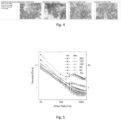
- Figure 3 shows the impact of the dissolving temperature and sodium hydroxide concentration on the dissolution of recycled cotton derived cellulose carbamate.
- the figure comprises 27 micrographs organized in a matrix of four columns and seven rows.
- the first column shows microscope images of samples at a temperature of -10 °C, the following three show samples at -5 °C, 0 °C and 5 °C, respectively.
- the rows are organized such that the samples of the first row contain 3.92 wt-% NaOH, and the following six rows, top-down, contain 4.81 wt-%, 5.66 wt-%, 6.48 wt-%, 7.27 wt-%, 8.04 wt-% and 8.77 wt-%, respectively.
- the cellulose carbamate solutions with a sodium hydroxide content equal to or higher than 8.04 % recovered at a temperature equal to or lower than -5 degrees Celsius and higher than -10 degrees Celsius still contain undissolved cellulose carbamate based fragments.
- Example 6 Stability of the pre-slurry in a two-step dissolving process
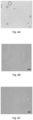
- Figure 4 shows the stability of the pre-slurry of a two-stage dissolving process.
- the figure comprises microscope images of cellulose carbamate samples at four different temperatures, viz. -5 °C, -6 °C, -7 °C, and -8 °C.
- Cellulose carbamate was slurried in aqueous alkaline solution corresponding to a composition of 3 % by weight of sodium hydroxide, 1.0 % by weight of zinc oxide and 6 % by weight of cellulose carbamate.
- Example 7 Stability of the cellulose carbamate polymer slurry in aqueous alkaline solution
- Figure 5 shows the stability of cellulose carbamate polymer slurries.
- the samples were prepared by a one-step dissolving process to the final chemical composition for the dissolution process.
- rheometric shear flow curves were obtained for a mixture containing 8.5 % by weight of cellulose carbamate in aqueous solution with 6.5 % by weight of sodium hydroxide and 1.1 % by weight of zinc oxide as a function of temperature (the shear flow being measured at +20, +15, +10, +5, 0 and -5 degrees Celsius).
- the viscosities measured both towards increased (inc.) and decreased (dec.) shear rates remain constant at temperatures equal to or higher than +5 degrees Celsius.
- the solution begins to resist mixing and simultaneously an increase in viscosity is detected.
- Example 8 Microscope images of solutions of cellulose carbamate
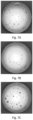
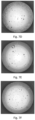
- Microscope images of recovered solutions of cellulose carbamate obtained by means of phase contrast mode are shown in Figures 6A to 6C .
- the micrographs reflected the K R indexes measured from recovered cellulose carbamate solution as described in Examples Nos. 1-4.
- Figure 4A represents a cellulose carbamate solution with very good solubility of cellulose carbamate polymer in aqueous alkaline solution.
- Figure 4B represents a cellulose carbamate solution with good solubility of cellulose carbamate polymer in aqueous alkaline solution.
- Figure 4C represents a cellulose carbamate solution with poor insufficient solubility of cellulose carbamate polymer in aqueous alkaline solution.
- K W and K R index indicate filterability of cellulose carbamate solutions.
- a cellulose carbamate solution recovered as described in Example No. 1 Continuous dissolution of cellulose carbamate by one step method under super cooled conditions starting from recycled cotton derived cellulose carbamate
- K R index 0.30
- Example 2 Continuous dissolution of cellulose carbamate by a two-step method under super cooled conditions starting from recycled cotton derived cellulose carbamate
- Example 3 Dissolution of cellulose carbamate in batch by two step method under low temperature conditions starting from dissolving wood pulp (pine:spruce) derived cellulose carbamate
- Example 4 Dissolution of Cellulose Carbamate Solution in batch by two step method under super cooled temperature conditions starting from recycled cotton derived cellulose carbamate.
- the measured KR indexes were 1.49-3.4 corresponding to the visual clarity image in Figure 4B.
- FIGURE 7E illustrates dissolving rate of CCA dope after a surface contact time of 20 s at temperature of -20 degrees Celsius (as seen in the picture dissolution was completed with improved clarity compared to one-stage process). During the contact time, the temperature of the slurry reached the temperature of the steel surface.
- FIGURE 7F illustrates dissolving rate of CCA dope after a surface contact time of 20 s at temperature of -20 degrees Celsius and subsequent standing at -20 degrees Celsius for 5 min after surface contact (as seen in the Figure 1f the visual clarity of CCA dope was not significantly increased by further standing at -20 degrees Celsius for 5 min).
- the method of continuously dissolving cellulose carbamate in an alkaline aqueous phase to form a solution comprises the steps of
- the cotton raw-material comprises virgin cotton, recycled cotton, cotton-containing textiles, or cotton-containing textiles wastes or combinations thereof.
- the cotton raw-material comprises up to 50 % by weight, preferably 40 % by weight or less of non-cotton cellulosic material, such as wood fibres derived material, e.g. as dissolving wood pulp, and/or non-wood fibres derived material, such as straw based dissolving pulp.
- non-cotton cellulosic material such as wood fibres derived material, e.g. as dissolving wood pulp, and/or non-wood fibres derived material, such as straw based dissolving pulp.
- the step of producing the solution is carried out at a temperature of less than -7 °C, preferably at -8 °C or less.
- the preslurry is cooled to a temperature of 0 to -6 °C, for example -1 to -6 °C or -2 to -6 °C.
- the second portion of the alkaline solution is cooled to a temperature of -7 to -30 °C.
- the pre-slurry has a concentration of alkali, such as NaOH, of 2 to 6 % by weight and/or the second portion has a concentration of alkali, such as NaOH, of 10 to 30 % by weight.
- the cellulose carbamate provided has a degree of polymerization (DP) of about DP 200 or higher, in particular DP 250 to DP 400.
- DP degree of polymerization
- the mixture of the cellulose carbamate has a cellulose carbamate content of 6 to 10 % by weight, for example a cellulose carbamate content of 6 to 8 %, or a cellulose carbamate content of 8 to 10 %.
- the aqueous alkaline solution contains 5 to 10 % NaOH by weight, for example the aqueous alkaline solution contains 7 to 10 % NaOH, or the aqueous alkaline solution contains 5 to 7 % NaOH.
- the mixture has a cellulose carbamate : NaOH ratio of 6 to 10 % by weight : 5 to 10 % by weight, preferably 6 to 8 % : 7 to 10 %, for example, in particular when operating continuously, 8 to 10 % : 5 to 7 %.
- the method of continuously dissolving cellulose carbamate in an alkaline aqueous phase to form a solution comprises the steps of
- the second portion fed into the mixing zone has a temperature of -7 to -30 °C.
- the pre-slurry has a concentration of NaOH of 2 to 6 % by weight of the pre-slurry and/or the second portion has a concentration of NaOH of 10 to 30 % by weight of the second portion.
- the mixture has a cellulose carbamate : NaOH ratio of 6 to 10 % by weight : 5 to 10 % by weight, for example 6 to 8 % : 7 to 10 %, for example, in particular when operating continuously, 8 to 10 % : 5 to 7 %.
- the dissolving is carried out at a temperature of about -15 to about -20 °C.
- At least some embodiments of the present invention find industrial application in the regeneration of cellulosic fibre derivatives for use in particular in the textile and nonwoven industries or in the pulp and paper industries.
Landscapes
- Chemical & Material Sciences (AREA)
- Engineering & Computer Science (AREA)
- Chemical Kinetics & Catalysis (AREA)
- Medicinal Chemistry (AREA)
- Organic Chemistry (AREA)
- Polymers & Plastics (AREA)
- Health & Medical Sciences (AREA)
- Materials Engineering (AREA)
- Life Sciences & Earth Sciences (AREA)
- Biochemistry (AREA)
- Mechanical Engineering (AREA)
- Textile Engineering (AREA)
- General Chemical & Material Sciences (AREA)
- Dispersion Chemistry (AREA)
- Processes Of Treating Macromolecular Substances (AREA)
- Polysaccharides And Polysaccharide Derivatives (AREA)
- Artificial Filaments (AREA)
Description
- The present invention relates to a method of dissolving a cellulose derivative. In particular, the present invention relates to a continuous method of dissolving cellulose carbamate
- Cellulose is the most widely used biopolymer in the world and it finds applications in various industries such as the paper and cardboard industry, and the textile industry as both cellulose and derivatives of cellulose, such as cellulose carbamate, cellulose acetate, ethers and esters. The use of cellulose in these industries, however, requires the cellulose fibre to be dissolved in order to regenerate the structure. The dissolution of cellulose is difficult because of its semi-crystalline structure, strong hydrogen bonds in the polymer sheets and the presence of both hydrophilic and hydrophobic ends in the polymer. For this reason, cellulose requires either a modification of the structure by derivatization or an opening of the fibres and an increase in reactivity.
- Several methods of derivatization are known in the art, the most well-known perhaps being the viscose process, in which cellulose is first treated with an alkali and then with carbon disulphide to produce cellulose xanthate. The viscose process is shunned more and more due to the toxic nature of carbon disulfide and the undesirable environmental impact that the viscose process has. More and more, other derivatization processes are being turned to, particularly those that are inexpensive, do not have the toxicity issues and environmental issues of the viscose process and yet still can be carried out using the available infrastructure, e.g. can be carried out in viscose wet spinning mills.
- The carbamation process for the production of cellulose carbamate is one such derivatization process. Cellulose carbamate is formed by reacting cellulose with urea. Methods of producing cellulose carbamate are described e.g. in Finnish Patents Nos.
112869 112795 CN 106 702 516 A discloses a method of dissolving cellulose carbamate in an alkaline aqueous phase, comprising: mixing cellulose carbamate with an aqueous NaOH solution at -10-0°C by stirring; adding alumina, stirring and mixing; freezing at -5-5°C and thawing at room temperature. - As mentioned above, the cellulose or the cellulose derivative must be dissolved in order to regenerate the cellulose structure for use in various industrial applications. The procedure for dissolving cellulose in aqueous alkali is based on a freeze-thaw method. The solvent is pre-cooled to below the freezing point of water before cellulose is added and kept cold until the polymer is completely dissolved. The temperature required for efficient dissolution in a freezing-thawing process was found to be in the region of -30 degrees Celsius for the entire mixture of cellulose carbamate in aqueous solution. Thus, the freezing and thawing of polymer solutions on an industrial scale is impractical both energetically and economically, since dope production on an industrial scale would require the use of efficient freezing devices that are not usually found in cellulosic fibre production plants. Both freezing and thawing consume energy and time, and reduce the overall efficiency and sustainability of the process.
- Traditional dissolution methods such as freezing-thawing often leads to the phase separation during the prolonged freezing phase in the process or difficulties with the temperature control during the freezing and thawing phases. This may result in fluctuation of the composition of the obtained cellulose solution, the agglomeration of particles, i.e particles that remain undissolved and "glue" together forming clusters that are difficult or even impossible to separate by the subsequent filtration process, in addition to that gelling of the obtained cellulose solution may also resulted induced by the undissolved particles or uncontrolled process temperatures. Nitrogenous hydrolysis is simultaneously accelerated during the prolonged freezing and thawing or by the uncontrolled process temperatures. Challenges related to mitigation of undissolved residues has been partially overcome by making only very dilute solutions of cellulose or by gradual addition of cellulose in batch mixing processes. Traditional freezing and thawing process or operations with diluted cellulose solutions cause unacceptable costs in economy and time.
- It is an aim of the present invention to overcome at least some of the problems described above and provide a method of continuously dissolving cellulose carbamate in an alkaline aqueous phase to form a solution.
- The method involves mixing cellulose carbamate with an aqueous alkaline solution and conducting the thus formed mixture through the mixing zone of a continuously operated kneader type dissolving reactor to produce a solution of cellulose carbamate in an alkaline aqueous phase. The cellulose carbamate containing aqueous phase is recovered. The step of continuously conducting the mixture through the mixing zone of the kneader type dissolving reactor is carried out at a temperature of 10 degrees Celsius or less.
- The invention is defined by the features of the independent claims. Some specific embodiments are defined in the dependent claims. Embodiments of the description not falling under the claims are considered to be only illustrative.
- According to a first aspect of the present invention, there is provided a method of continuously dissolving cellulose carbamate polymer in an alkaline aqueous phase to form a solution, said method comprising the steps of providing cellulose carbamate polymer, mixing the cellulose carbamate polymer with an aqueous alkaline solution to form a mixture, conducting the mixture through the mixing zone of a continuously operated kneader type dissolving reactor at a mixing speed of 10-500 rpm to produce a solution of said cellulose carbamate polymer in an alkaline aqueous phase, and recovering the dissolved cellulose carbamate polymer containing aqueous phase. The step of continuously conducting the mixture through the mixing zone of the kneader type dissolving reactor of said method is carried out at a temperature of 10 degrees Celsius or less.
- Considerable advantages are obtained by means of the invention. The present invention provides a method of continuously dissolving cellulose carbamate polymer in an alkaline solution. Cellulose carbamate polymer is an alkali labile cellulose derivative. By means of the present invention it has been surprisingly found that cellulose carbamate polymer can be dissolved in a high cellulose consistency to obtain a cellulose carbamate spinning dope with a lower viscosity than mathematically and experimentally expected by means of conventional dissolving methods known in the art. This was especially demonstrated in case of the dissolving operation performed under super-cooled conditions.
- It has also surprisingly been found that the obtained cellulose carbamate spinning dope is stable for long periods of time even at room temperature. Typically, cellulose carbamate dopes must be stored at reduced temperatures to avoid gelling of the cellulose carbamate solution.
-
-
FIGURE 1 is a flow diagram illustrating a process for continuous dissolution of cellulose carbamate in accordance with at least some embodiments of the present invention; -
FIGURE 2 is a flow diagram illustrating a process for continuous dissolution of cellulose carbamate in accordance with at least some embodiments of the present invention; -
FIGURE 3 is a compilation of microscope images showing the impact of the dissolving temperature and sodium hydroxide concentration on dissolving of recycled cotton derived cellulose carbamate; -
FIGURE 4 show microscope images indicating the stability of the pre-slurry in a two-stage dissolving process; -
FIGURE 5 depicts graphically the stability of the cellulose carbamate polymer slurry in aqueous alkaline solution in terms of viscosity as a function of shear rate; -
FIGURES 6A to 6C show micrographs of recovered solutions of cellulose carbamates; and -
FIGURES 7A to 7F show micrographs of solutions of cellulose carbamates disclosed in Example 9. - In the present context, the following terms are defined to have the following meanings unless mentioned otherwise.
- "Low temperature conditions" stand for temperatures in the range of 5 degrees Celsius to -6.9 degrees Celsius.
- "Super-cooled conditions" stand for temperatures lower than those prevailing at low temperature conditions, in particular it stands for temperatures in the range of -7 degrees Celsius to -20 degrees Celsius
- Chemical pulp or dissolving pulp prepared from wood species such as pine, spruce, birch, beech, aspen, maple, larch, acacia, eucalyptus, hemlock, tupelo, and oak or non-woods such as stalk fibres (wheat straw, rice straw, barley straw, bamboo, bagasse and reed). The origin of the feedstock can be either the virgin form of the chemical or dissolving pulp or the recycled feedstocks such as recycled paper and/or cardboard containing chemical pulp or dissolving type pulp.
- Natural plant fibres as such in or in the form of chemical pulp or dissolving pulp. The origin of natural plant fibres can be either their virgin forms or natural plant fibre containing textiles or recycled natural fibre containing textiles. Natural plant fibres include seed fibres such as cotton and kapok; bast fibres such as hemp, jute, kenaf, ramie, abaca and linen (flax); leaf fibres such as manilla, sisal, ananas and banana; fruit fibres such as coir.
- Continuous dissolution of cellulose carbamate with an aqueous alkaline solution and conduction of the mixture of cellulose carbamate and aqueous alkaline through the mixing zone of a continuously operated mixing kneader at a temperature of 10 degrees Celsius or less produces a solution of cellulose carbamate in an alkaline aqueous phase having a relatively high cellulose carbamate concentration. The cellulose carbamate typically dissolves completely leaving essentially no undissolved cellulose-derived particles, ensuring an improved filterability of cellulose carbamate dope, which can be characterized e.g. by means of filterability index (KR) measurement. The improved filterability is technically essential when cellulose carbamate is regenerated from the recovered cellulose carbamate containing aqueous phase.
-
FIGURE 1 is a flow diagram illustrating a process for continuous dissolution of cellulose carbamate in accordance with at least some embodiments of the present invention. -
Cellulose carbamate 100 in solid form is weighed and fed into apulper 10. The total amount of an aqueous solution ofsodium hydroxide 200 required for dissolution of the weighedcellulose carbamate 100 is added into thepulper 10. Thealkaline solution 200 may be added either in one batch or gradually. Thepulper 10 is started and amixture 300 comprising cellulose carbamate in aqueous alkaline solution is formed. Themixture 300 is directed to astoring tank 20, equipped with a mixer. The storingtank 20 may be a chest storing tank. After themixture 300 is directed to thestoring tank 20 thepulper 10 is ready for the next batch ofcellulose carbamate 100 and aqueous solution ofsodium hydroxide 200. The storingtank 20 has a higher volume than thepulper 10 and can contain more than one batch ofmixture 300 directed from thepulper 10. Themixture 300 is continuously fed with apump 30 from the storingtank 20 into the mixing zone of the kneadertype dissolving reactor 40. The temperature of themixture 300 is suitably lowered but kept above the limit of solubility of the system during process stages prior to the dissolvingreactor 40. A solution of cellulose carbamate in aqueousalkaline solution 400 is continuously formed in the dissolvingreactor 40 and recovered. -
FIGURE 2 is a flow diagram illustrating a process for continuous dissolution of cellulose carbamate in accordance with at least some embodiments of the present invention. -
Cellulose carbamate 100 in solid form is weighed and fed into apulper 10. A first portion of an aqueous solution ofsodium hydroxide 2000 required for formation of pre-slurry with the weighedcellulose carbamate 100 is added into thepulper 10. Thepulper 10 is started and a pre-slurry 3000 comprising cellulose carbamate in aqueous alkaline solution is formed. - The pre-slurry 3000 is directed into a storing
tank 20 equipped with a mixer. After the pre-slurry 3000 is directed to thestoring tank 20 thepulper 10 is ready for the next batch ofcellulose carbamate 100 and the next first portion of an aqueous solution ofsodium hydroxide 2000. The storingtank 20 has a higher volume than thepulper 10 and can contain more than one batch of the pre-slurry 3000 directed from thepulper 10. The pre-slurry is continuously fed from the storingtank 20 by using apump 30 into the mixing zone of the kneadertype dissolving reactor 40. A second portion ofalkaline solution 2200 is added with the pre-slurry 3000 into the dissolvingreactor 40 to provide amixture 330. Themixture 330 is formed in the dissolving reactor. The temperature of the pre-slurry 3000 is kept above the limit of solubility of the system during process stages prior to the dissolvingreactor 40. A solution of cellulose carbamate in aqueousalkaline solution 400 is continuously formed in the dissolvingreactor 40 and recovered. - As described above, the present technology relates to a method of dissolving cellulose carbamate.
- Generally, the present technology provides a method of continuously dissolving cellulose carbamate in an alkaline aqueous phase to form a solution, comprising the steps of providing cellulose carbamate; mixing the cellulose carbamate with an aqueous alkaline solution to form a mixture; producing from said mixture a solution of said cellulose carbamate in an alkaline aqueous phase; and recovering the cellulose carbamate containing aqueous phase wherein the step of producing the solution is carried out at a temperature of 10 degrees Celsius or less.
- In an embodiment, the method of continuously dissolving cellulose carbamate in an alkaline aqueous phase to form a solution comprises the steps of providing cellulose carbamate, mixing the cellulose carbamate with an aqueous alkaline solution to form a mixture, conducting the mixture through the mixing zone of a continuously operated kneader type mixing reactor to produce a solution of said cellulose carbamate in an alkaline aqueous phase e.g. cellulose carbamate dope or cellulose carbamate spinning dope, and recovering the cellulose carbamate containing aqueous phase.
- The step of continuously conducting the mixture through the mixing zone of the mixing kneader is carried out at a temperature of 10 degrees Celsius or less and at a mixing speed of 10-500 rpm.
- In a further embodiment cooling takes place in the mixing zone of the mixing kneader. Thus, in one embodiment the mixture is conducted through a mixing and cooling zone of the mixing kneader.
- In an embodiment the cellulose carbamate may be a cellulose carbamate produced from chemical or dissolving pulp prepared from wood fibres or non-wood fibres or a cellulose carbamate derived from natural plant fibres as such in or in the form of chemical pulp or dissolving type pulp. Embodiments of the method may also be carried out using cellulose carbamate produced from mixtures of any of the various cellulosic fibres or pulps described above. In a suitable embodiment the cellulose carbamate is manufactured in a process comprising the steps of providing a pulp, adding to the pulp (or optionally to the activated pulp) an aqueous solution of urea and optionally hydrogen peroxide to provide a mixture, mechanically working the mixture to provide a homogeneous composition, heating the composition to a temperature in the range of 120 to 155 degrees Celsius, typically 135 degrees Celsius for a period in the range of 2 to 4 hours to produce cellulose carbamate, recovering the cellulose carbamate, and optionally washing the cellulose carbamate with water and drying in a dryer at a temperature less than or equal to 155 degrees Celsius, preferably 135 degrees Celsius or less, suitably 133 degrees Celsius or less.
- The mixture formed by the cellulose carbamate in the alkaline aqueous solution is subjected to mixing in the mixing zone of the kneader type mixing reactor with low shearing forces by running mixer with a reduced mixer speed of 10-500 rpm, suitably under 250 rpm, most suitably under 100 rpm, preferably under 50 rpm.
- Mixing with low shearing forces allows a target temperature level to be reached and/or maintained. The dissolving process according to an embodiment is thus not dependent on high shear force mixing. A typical technical approach is to use high speed mixing in order to obtain a good quality solution. However, in embodiments the dissolving temperature is the most critical factor, not mixing speed or high shear forces in mixing. The more vigorous is the mixing, the more difficult it is to reach and/or maintain low dissolving temperatures. Dissolving at low temperatures and/or under super-cooled conditions provides a cellulose carbamate solution that is of a quality suitably adapted for spinning process. For example, in an embodiment the recovered solution is subjected to spinning process, for example wet spinning process to spin cellulose carbamate fibres.
- The mixture of cellulose carbamate polymer and alkaline solution can be formed in various ways, each way of forming the mixture being adapted to the particular alkaline solution or alkaline solutions and the particular cellulose carbamate or cellulose carbamates forming the mixture.
- In one specific embodiment, also referred to as a one-step method, the cellulose carbamate is first mixed with the alkaline solution, and the mixture thus obtained is fed into the mixing zone of the continuously operated kneader type dissolving reactor.
- In one embodiment, precooling is achieved in a first kneader, whereby partial dissolution can be obtained, after which step the mixture is transferred to a second kneader in which the material is dissolved, typically completely or essentially completely.
- Mixing the cellulose carbamate with the alkaline solution, to provide a composition corresponding to the final target chemical composition set for the cellulose carbamate dope to be recovered, before feeding the mixture into the mixing zone of the continuously operated kneader type dissolving reactor, allows for accurate control of the chemical composition of the obtained cellulose carbamate dope. Additionally, slurry handling (e.g. the pumping of the mixture) is technically easier because of the lower viscosity and slurry consistency in the slurry prepared to the final composition.
- Mixing the cellulose carbamate with the alkaline solution, corresponding to the final target chemical composition set for the cellulose carbamate dope to be recovered, can be done in a mixing reactor e.g. in the pulper or in another type of homogenizer or in a suitable reactor e.g. in the xanthator type reactor or in a suitable reactor connected to a homogenizer in batches by directly or gradually adjusting the sodium hydroxide and/or the zinc oxide concentration in a pre-slurry and in order to affect to the swelling properties of cellulose carbamate derivative prior to adding the rest of alkali and/or zinc oxide containing alkali and water to reach the final target composition.
- The temperature of the slurry in each slurrying stage can be controlled for example using pre-cooled solutions and/or by external cooling of the pulper or the other type of homogenizer or mixing reactor.
- In a particular embodiment, which can be referred to as a two-step method, the cellulose carbamate is first mixed with a first portion of the alkaline solution or zinc oxide containing alkaline solution, and the pre-slurry thus obtained is fed into the mixing zone of the continuously operated kneader type dissolving reactor and a second portion of the alkaline solution or zinc oxide containing alkaline solution is fed into the mixing zone of the continuously operated kneader type dissolving reactor.
- Feeding a pre-slurry of cellulose carbamate including a first portion of the alkaline solution into the mixing zone of the continuously operated kneader and separately feeding the second portion of the alkaline solution into the mixing zone of the continuously operated kneader provides an opportunity to precool the pre-slurry including the first portion of alkaline solution and the second portion of alkaline solution, separately to a specific temperature depending on their chemical compositions, prior to adding them into the mixing zone of the kneader type dissolving reactor. It is further possible to mix the pre-slurry with a second portion of the alkaline solution in a homogenizer before feeding the mixture thus obtained into a kneader.
- The pre-slurry, i.e. the slurry with a sodium hydroxide content below the dissolving limit of the system, e.g. a pre-slurry having a sodium hydroxide content of about 2 to 6 %, for example about 3 or 4 % by weight, can be cooled near to the freezing point of the mixture without initiation of dissolving of cellulose carbamate. Sodium hydroxide or combination of sodium hydroxide and zinc oxide lowers the freezing point of its water solution. Cellulose carbamate raises the freezing point of its alkaline water solution, thus the freezing point is higher than -6 degrees Celsius if the cellulose carbamate content in pre-slurry is higher than 6 % by weight. E.g. a pre-slurry with a sodium hydroxide content of 3 % by weight and cellulose carbamate content of 6 % by weight can be cooled to as low as -6 degrees Celsius without freezing of the mixture or initiation of the dissolving of cellulose carbamate.
- In the second portion of the alkaline solution, the sodium hydroxide or the combination of sodium hydroxide and zinc oxide lowers the freezing point of the aqueous phase and it is possible to precool this second portion of alkaline solution to a temperature on the level between -30 and -20 degrees Celsius. Further, this allows for adjustment of the alkaline, e.g. sodium hydroxide and/or zinc oxide, concentrations in the pre-slurry, which has an impact on swelling properties of the cellulose derivate in addition to the freezing point of the pre-slurry and solubility limit. The alkali concentration in the pre-slurry is related to the temperature at which dissolving the cellulose derivative is initiated. The higher the alkali concentration in the pre-slurry, the higher the temperature when dissolving of cellulose derivative is initiated, and similarly the lower the alkali concentration in the pre-slurry, the lower the temperature when dissolving is initiated. This allows for optimization of swelling of the cellulose derivative and optimization of the feeding temperature of the pre-slurry.
- Preferably, the pre-slurry and the second portion of alkaline solution are simultaneously fed into the mixing zone of the continuously operated kneader. The chemical composition of the pre-slurry determines the chemical composition of the second portion of the alkaline solution. One aim of the optimization of the temperature and alkali concentration of pre-slurry is to prevent initiation of dissolving before the mixing zone of the dissolving reactor in avoid to contamination the pre-slurry handling system by the high viscosity cellulose carbamate solution.
- The dissolution is carried out in either low temperature conditions or in super cooled conditions.
- "Low temperature conditions" mean temperatures in the range of 5 degrees Celsius to -6.9 degrees Celsius or above. Thus, in one embodiment, the temperature of the mixing zone is in the range of 5 to -6.9 degrees Celsius. In a particular embodiment the temperature of the mixing zone is about 0 degrees Celsius. Temperatures of around 0 degrees Celsius, such as in the range of 5 to -6.9 degrees Celsius are particularly suitable for cellulose carbamates formed from chemical or dissolving pulp prepared from wood fibres or non-wood fibres such as commercial wood-based dissolving pulp, non-wood straw-based dissolving pulp or dissolving type pulp prepared from recycled paper and/or cardboard waste streams.
- "Super cooled conditions" mean temperatures of -7 degrees Celsius or less, but not lower than -20 degrees Celsius. In a further embodiment the temperature of the mixing zone is -7 degrees Celsius or less. Temperatures in the mixing zone lower than -7 degrees Celsius, typically in the range of -7 to -20 degrees Celsius are particularly suitable for cellulose carbamates formed from chemical or dissolving type pulp containing or derived from natural plant fibres such as hemp, jute, or cotton based raw materials either from their virgin forms or from recycled feedstocks such as from recycled textiles.
- In one preferred embodiment, dissolution is carried out at ca -15 to ca -20 degrees Celsius.
- As will be discussed in some of the embodiments, the mixture of alkaline liquid and cellulose carbamate can be cooled by contacting it with a cooled surface. It is generally preferred that such contacting will achieve a cooling of the mixture essentially to the temperature of the cooled surface.
- Thus in one embodiment the cellulose carbamate is manufactured from cellulose having wood and/or non-wood fibres in the form of dissolving pulp.
- In a further embodiment the cellulose carbamate is manufactured from cellulose having natural plant fibres such as cotton in the form of dissolving type pulp.
- In a further embodiment the cellulose carbamate is a mixture of cellulose carbamates manufactured from both cellulose having wood and/or non-wood fibres such as straw in the form of dissolving pulp and cellulose having natural plant fibres such as cotton in the form of dissolving type pulp. In such an embodiment the preferred temperature in the mixing zone is about -7 degrees Celsius or lower.
- In a further embodiment, wood fibres derived material, such as dissolving wood pulp, and/or non-wood fibres derived material, such as straw based dissolving pulp, are dissolved at a low temperature and natural plant fibres derived material, such as cotton derived dissolving type pulp, is dissolved under super cooled conditions and the separately obtained carbamate dopes are mixed after the dissolving process.
- The said materials dissolvable under low temperature conditions can be also dissolved under super-cooled conditions.
- It is preferred to provide cellulose carbamate which has a degree of substitution in a predetermined range that is suitable for application in certain embodiments. The degree of substitution (DS) of the cellulose carbamate polymer determines at least in part the physical and chemical conditions in which the cellulose carbamate can be dissolved in aqueous alkaline solution. This also determines at least in part, the concentration of the solution regarding the cellulose part that may be formed of the cellulose carbamate.
- In one embodiment the cellulose carbamate provided has a degree of substitution (DS) of 0.1 to 0.3, in particular about 0.25 or less. After dissolution the DS of the cellulose carbamate diminishes slightly. The degree of substitution of the cellulose carbamate is determined by the total nitrogen content determination according to SFS 5505:1988. The degree of substitution value of 0.24 corresponds to total nitrogen content of 2.0 % per absolute dry water insoluble fraction of the cellulose carbamate.
- It is preferred to provide cellulose carbamate which has a degree of polymerization in a predetermined range that is suitable for application in certain embodiments. The degree of polymerization (DP) of the cellulose carbamate polymer determines at least in part the viscosity of the aqueous solution of the recovered cellulose carbamate dope. The degree of polymerization of the cellulose carbamate polymer can be determined by the intrinsic viscosity determination according to ISO 5351.
- In one embodiment the cellulose carbamate provided has a degree of polymerization (DP) of
DP 200 toDP 400, in particular about DP 220 or higher. The degree of polymerization value of DP 250 corresponds to an intrinsic viscosity of 197 ml/g. The mixture of the cellulose carbamate dope (e.g. mixture of cellulose carbamate, alkali, water and possible surfactants-based additives such as polyethylene glycols (PEG), alkylamine or arylamine polyoxy ethylene glycols, alcohol ethoxylates, and fatty alcohol ethers) has a cellulose carbamate content. In one embodiment the mixture of the cellulose carbamate has a cellulose carbamate content of 6 to 10 % by weight (in the mixture of cellulose carbamate and aqueous alkali in the mixing zone or in the cellulose carbamate dope recovered from the dissolving reactor). In a further embodiment the mixture of cellulose carbamate dope has a cellulose carbamate content of 6 to 8 % by weight, which is the typical cellulose carbamate content obtained under low temperature or super-cooled conditions. In a further embodiment the mixture of cellulose carbamate dope has a cellulose carbamate content of 8 to 10 % by weight, which is the preferred cellulose carbamate content under super-cooled conditions. - In one embodiment the aqueous alkaline solution e.g. cellulose carbamate dope contains 5 to 10 % NaOH by weight. In a further embodiment the aqueous alkaline solution contains 6 to 8 % NaOH by weight e.g. in the mixture of cellulose carbamate and aqueous alkali in the mixing zone or in the cellulose carbamate dope recovered from the dissolving reactor). In a particular embodiment the aqueous alkaline solution contains 5 to 7% NaOH. This is the preferred amount of NaOH in the alkaline solution when super-cooled conditions are applied.
- In embodiments the ratio of cellulose carbamate:NaOH can be important in ensuring total dissolution of the cellulose carbamate. In an embodiment the mixture has a cellulose carbamate:NaOH ratio of 6 to 10% by weight:5 to 10% by weight. In a particular embodiment the mixture has a cellulose carbamate:NaOH ratio of 8 to 10% : 5 to 7%, which is the preferred ratio under super-cooled conditions.
- In embodiments, the actual reaction rate is not time but temperature dependent. Under low temperature or supercooled conditions the total mass must reach a target temperature. In an embodiment the target temperature is the output temperature of the mixing zone of the dissolving kneader and depends on the chemical composition (cellulose carbamate:NaOH ratio) and the raw material basis (wood and non-wood fibres or natural plant fibres or their mixture). In a further embodiment, the residence time in the mixing zone is at least dependent on the following properties: Mechanical properties and mechanical structure of the kneader type reactor, heat exchange properties of the surfaces in mixing and cooling zone, heat energy released into the system during mixing, cooling power of an external cooling system, feeding temperature of the mixture or feeding temperature of the pre-slurry and alkali solution.
- In one embodiment, the residence time is about 1 min to 10 hours, for example 2 min to 2 hours, in particular 2 to 60 min or 2 to 30 min.
- In one embodiment alkali hydrolysis of carbamate groups is inhibited, preferably prevented during the dissolving process.
- In a further embodiment the method comprises the further step of adding zinc oxide to the mixture. The zinc oxide may be added to the cellulose carbamate, to the alkaline aqueous solution or to the mixture of cellulose carbamate and alkaline aqueous solution. Typically, the zinc oxide is dissolved in aqueous alkaline solution prior to its use as a dissolving lye for the provided cellulose carbamate. In an embodiment the addition of zinc oxide may partly enhance the dissolution and filterability of the solutions and partly prolong the storage time before gelation starts it has also an impact on viscosity of the cellulose carbamate solution and tenacity yield of the obtained wet spun cellulose carbamate fibres. In an embodiment the mixture has a zinc oxide content of 0.1 to 1.5% by weight of the mixture. In one embodiment the mixture is at least partly defined by the ratio of cellulose carbamate to zinc oxide. Thus, in an embodiment the cellulose carbamate has a cellulose carbamate:ZnO ratio of 6 to 10%: 0.1 to 1.5 %, this means 0.01-0.25 t of ZnO per 1 t of cellulose carbamate.
- In one embodiment, a method of continuously dissolving cellulose carbamate, in an alkaline aqueous phase to form a solution is provided, comprising the steps of providing cellulose carbamate by carbamation of cotton raw-material; mixing the cellulose carbamate with an aqueous alkaline solution to form a mixture; producing a solution of the cellulose carbamate in the alkaline aqueous phase; and recovering the cellulose carbamate containing aqueous phase, wherein the step of producing the solution is carried out by conducting the mixture through a mixing zone of a continuously operated kneader type dissolving reactor at a mixing speed of 10-500 rpm at a temperature of -7 °C or less.
- In one embodiment, a further method of continuously dissolving cellulose carbamate in an alkaline aqueous phase to form a solution is provided, comprising the steps of providing cellulose carbamate; mixing the cellulose carbamate with an aqueous alkaline solution to form a mixture; producing a solution of the cellulose carbamate in the alkaline aqueous phase; and recovering the cellulose carbamate containing aqueous phase, wherein the step of producing the solution is carried out by conducting the mixture through a mixing zone of a continuously operated kneader type dissolving reactor at a mixing speed of 10-500 rpm at a temperature of 10 °C or less, the cellulose carbamate is first mixed with a first portion of the alkaline solution to produce a pre-slurry, and the pre-slurry thus obtained is fed into the mixing zone, and wherein a second portion of the alkaline solution is separately fed into the mixing zone, the pre-slurry being kept in the mixing zone at a temperature of -1 to -6 °C before the second portion is fed into the mixing zone.
- In one embodiment, dissolution of cellulose carbamate of dissolving pulp is achieved at temperatures higher than those generally applicable to cotton carbamate (-15 to -20 °C).
- In one embodiment, the pre-slurry is cooled to a temperature of 0 to -6 degrees Celsius, for example -1 to -6 degrees Celsius, or -2 to -6 degrees Celsius. In one embodiment, the second portion of the alkaline solution is cooled to a temperature of -7 to -30 degrees Celsius.
- Dissolving at low temperature and/or under super-cooled conditions provides a cellulose carbamate solution that is of a quality suitably adapted for spinning processes. Cellulose carbamate can be dissolved in a high cellulose consistency to obtain a cellulose carbamate spinning dope with a lower viscosity than would be mathematically and experimentally expected when dissolving in a conventional method. Typically, the viscosity of the cellulose carbamate dope having cellulose carbamate (DP of 250 and DS 0.2 %) content of 8.5 %, NaOH content of 6.5 % and ZnO content of 1.3 % recovered after dissolving subsequent temperation to +20 degrees Celsius using conventional method is higher than 15 Pas. Preferably technically suitable cellulose carbamate spinning dope has viscosity less than 15 Pas. Viscosity of cellulose carbamate spinning dope according to embodiments is preferably <15 Pas. Viscosity of cellulose carbamate spinning dope is measured by ball fall viscosity method at 20 degrees Celsius. Additionally, the present method provides a cellulose spinning dope that is stable for long periods, even at room temperature.
- Typically, the temperature of the mixture is maintained at the target temperature for 1 minutes to 30 minutes, for example 3 to 15 minutes.
- Next, embodiments will be illustrated by means of the following examples.
- The examples related to batch process are to be regarded as comparative or reference examples.
- Cellulose carbamate polymer was provided by means of a carbamation process carried out as described in Finnish Patents Nos.
112869 112795 20175376 20195717 PCT/FI2020/050560 - A mixture of cellulose carbamate polymer and aqueous alkaline solution was formed as follows: A quantity of cellulose carbamate with the degree of polymerisation (DP) of DP 250 (determined as an intrinsic viscosity according to ISO 5351) corresponding to 850 g absolute dry substance with a degree of substitution (DS) of 0.22 (determined as a total nitrogen content according to SFS 5505:1988) was mixed with 9150 g aqueous alkaline solution containing 650 g of sodium hydroxide, 110 g of zinc oxide and 8390 g of water, and stirred for 40 minutes at room temperature of about 20 degrees Celsius in a homogenizer at mixing speed of 700 rpm.
- A two-screw extruder model of Berstroff ZE 25x49.5 was used as a kneader type dissolving reactor. Its cooling and mixing zone was consisted of 12 separate barrel units in series. The cylinder walls in each barrel unit were cooled to desired temperature by ethylene glycol refrigerant circuit using an external cooling machine. For continuous dissolving operation the mixing zone was pre-cooled to -20 degrees Celsius. The two-screw extruder was equipped with the funnel and the mixture of the cellulose carbamate polymer in aqueous alkaline solution was fed into the pre-cooled mixing zone and temperature was maintained by the external cooling machine. The feeding rate was set to 3.9-4.0 kg/h by adjusting the rotational speed of the screws to 16 rpm, the moment was 50-53 % and motor' power consumption was 415 W.
- The mixture of cellulose carbamate polymer in aqueous alkaline solution was continuously fed into the system for 140 min and the solution of cellulose carbamate in aqueous alkaline solution was recovered by the rate of 3.9-4.0 kg/h. The residence time of the mixture in the mixing zone was 6±0.5 min. Temperature of the recovered solution was between -15.3 and -17.5 degrees Celsius in the output of extruder's mixing zone. The recovered solution was immediately tempered to the temperature of +10 degrees Celsius.
- The recovered solution of cellulose carbamate was sampled and characterized with the results as follows: The cellulose carbamate content in the recovered cellulose carbamate solution was 8.5 %, the sodium hydroxide content was 6.5 %, the zinc oxide content was 1.1 %, the ball fall viscosity measured at +20 degrees Celsius was 8.7 Pas and the filterability index (KR) was 0.30 measured at +20 degrees Celsius.
- For cellulose carbamate fibre wet spinning the second part of carbamate solution corresponding to the characterized composition was filtered through the 10 µm filter media and deaerated at +10 degrees Celsius for 12 hours. Wet spinning of filtered and deaerated cellulose carbamate dope was carried out using the spin bath optimized for cellulose carbamate process containing e.g. sodium sulphate and free sulphuric acid. The applied godet stretching stress at fibre sampling was 68-71 % under hot bath stretching conditions. The obtained filament titre was 1.3 dtex. Fibre tenacity at break measured from the filament samples was >20 cN/tex (SFS-EN ISO 5079).
- Cellulose carbamate polymer was provided by means of a carbamation process carried out as described in Finnish Patents Nos.
112869 112795 20175376 20195717 PCT/FI2020/050560 - The pre-slurry i.e. the mixture of cellulose carbamate polymer and aqueous alkaline solution was formed as follows: A quantity of cellulose carbamate with the degree of polymerisation (DP) of DP 333 (determined as an intrinsic viscosity according to ISO 5351) corresponding to 3840 g absolute dry substance with a degree of substitution (DS) of 0.24 (determined as a total nitrogen content according to SFS 5505:1988) was mixed with the first portion of 46076 g aqueous alkaline solution containing 1497 g of sodium hydroxide, 508 g of zinc oxide and 44071 g of water in a homogenizer for 30 minutes equipped with a cooling jacket. The pre-slurry was cooled and tempered to temperature of +0.6 degrees Celsius and left to gentle mixing to prevent the phase separation. Cellulose carbamate content in the pre-slurry was 7.7 % by weight, sodium hydroxide content was 3.0 % by weight and zinc oxide content was 1.0 % by weight. The second portion of aqueous alkaline solution was separately prepared and cooled to -16.3 degrees Celsius. This solution contained 3620 g of sodium hydroxide, 324 g of zinc oxide and 10141 g of water, thus the sodium hydroxide content was 25.7 % by weight and zinc oxide content was 2.30 % by weight.
- A kneader type of model LIST Technology with 14 litres cooling jacketed dissolving chamber, two co-rotating shafts with temperature control and a discharge screw that allows continuous mode operation was served as a kneader type dissolving reactor. The ethylene glycol refrigerant was cooled to -10 degrees Celsius by the external cooling machine and flowed through the jacket of dissolving reactor and its shafts. The cellulose carbamate slurried in the first portion of aqueous alkaline solution and the second portion of aqueous alkaline solution were separately continuously fed at predetermined rates into the mixing and cooling zone of the dissolving reactor by using two separate peristaltic pumps. The pre-slurry feed rate was set to 22.62 kg/h and the second portion feed rate was set to 6.39 kg/h.
- The continuous mode operation included the following steps: First the kneader was filled to the desired fill level of 80 % during the predetermined residence time of 25 minutes, next the discharge screw was turned on and its speed was adjusted to maintain the fill level. The reaction was allowed to stabilise for the period equal to the residence time with constant feeding and discharging, where after the collection of the cellulose carbamate solution was started with rate of 29.0 kg/h. The speed of the rotation shafts was 20 rpm. The collection was possible as long as the feeding was stable. The change of one or more of the parameters in between the continuous dissolving process requires a stabilization period equal to the residence time in order to collect representative product. Temperature of the recovered solution was -7.9 degrees Celsius in the output of the mixing zone of the dissolving reactor.
- The recovered solution of cellulose carbamate was sampled and characterized with the results as follows: The cellulose carbamate content in the recovered cellulose carbamate solution was 6.2 %, the sodium hydroxide content was 8.1 %, the zinc oxide content was 1.3 %, the ball fall viscosity measured at +20 degrees Celsius was 3.3 Pas and the filterability index (KR) was 1.49 measured at +20 degrees Celsius.
- Cellulose carbamate polymer was provided by means of a carbamation process carried out as described in Finnish Patents Nos.
112869 112795 PCT/FI2020/050560 - A pre-slurry i.e. a mixture of cellulose carbamate polymer and aqueous alkaline solution was formed as follows: A quantity of cellulose carbamate with the degree of polymerisation (DP) of DP 270 (determined as an intrinsic viscosity according to ISO 5351) corresponding to 29.3 kg absolute dry substance with a degree of substitution (DS) of 0.17 (determined as a total nitrogen content according to SFS 5505:1988) was mixed with the first portion of 310.2 kg aqueous alkaline solution containing 10.3 kg of sodium hydroxide, 1.92 kg of zinc oxide and 300 kg of water in a 500 L batch dissolving reactor tank equipped with a cooling jacket and propeller mixing units setup in two stages. Thus the sodium hydroxide concentration in the pre-slurry was 3.0 % by weight, zinc oxide concentration was 0.57 % by weight and the cellulose carbamate content was 8.6 % by weight. The ethylene glycol refrigerant was cooled to -9 degrees Celsius by the separate cooling machine and flowed through the jacket of dissolving reactor tank. The aqueous alkaline solution was pre-cooled to -2.9 degrees Celsius prior to mixing with the cellulose carbamate polymer in the dissolving reactor tank, the obtained pre-slurry was tempered to temperature level between -1 and -2 degrees Celsius by mixing at about 250 rpm and left to gentle mixing to prevent the phase separation.
- A second portion of aqueous alkaline solution was separately prepared and cooled to -18 degrees Celsius. The total amount of the second portion solution was 108 kg containing 25.7 kg of sodium hydroxide, 3.9 kg of zinc oxide and 78.4 kg of water i.e. the sodium hydroxide concentration was 23.8 % by weight and zinc oxide concentration was 3.64 % by weight. The second portion of aqueous alkaline solution was added into the dissolving reactor tank by continuously mixing with the pre-slurry at a mixing speed of 375 rpm. The temperature of the obtained solution of cellulose carbamate in aqueous alkaline solution was -4.5 degrees Celsius in the beginning of mixing of two portions together, the temperature of the solution was raised to 0 degrees Celsius during the prolonged mixing. The obtained solution was recovered at the temperature of 0 degrees Celsius. The target cellulose dope quality was obtained after 15 minutes from addition of the second portion of alkaline solution.
- The recovered solution of cellulose carbamate was sampled and characterized with the results as follows: The cellulose carbamate content in the recovered cellulose carbamate solution was 6.5 %, the sodium hydroxide content was 8.0 %, the zinc oxide content was 1.3 %, the ball fall viscosity measured at +20 degrees Celsius was 2.5 Pas and the filterability index (KR) was 3.4 measured at +20 degrees Celsius.
- For cellulose carbamate fibre wet spinning the cellulose carbamate solution corresponding to the characterized composition was subsequently filtered using the two-stage backflush filtering process using the 15 µm filter media in the second filtration stage. Wet spinning of filtered and deaerated cellulose carbamate dope was carried out using the spin bath optimized for cellulose carbamate process containing e.g. sodium sulphate and free sulphuric acid. The applied godet stretching stress at fibre sampling was 72-78 % under hot bath stretching conditions. The obtained filament titre was 1.3 dtex. Fibre tenacity at break measured from the filament samples was >20 cN/tex (SFS-EN ISO 5079).
- Cellulose carbamate polymer was provided by means of a carbamation process carried out as described in Finnish Patents Nos.
112869 112795 20175376 20195717 PCT/FI2020/050560 - The pre-slurry i.e. the mixture of cellulose carbamate polymer and aqueous alkaline solution was formed as follows: A quantity of cellulose carbamate with the degree of polymerisation (DP) of DP 265 (determined as an intrinsic viscosity according to ISO 5351) corresponding to 27 kg absolute dry substance with a degree of substitution (DS) of 0.19 (determined as a total nitrogen content according to SFS 5505:1988) was mixed with the first portion of 285 kg aqueous alkaline solution containing 9.45 kg of sodium hydroxide, 3.27 kg of zinc oxide and 276 kg of water in a 500 L dissolving reactor tank equipped with a cooling jacket and propeller mixing units setup in two stages. Thus the sodium hydroxide concentration in the pre-slurry was 3.0 % by weight, zinc oxide concentration was 1.0 % by weight and the cellulose carbamate content was 8.7 % by weight. The ethylene glycol refrigerant was cooled to -9 degrees Celsius by the separate cooling machine and flowed through the jacket of dissolving reactor tank. The aqueous alkaline solution was pre-cooled to -2.5 degrees Celsius prior to mixing with the cellulose carbamate polymer in the dissolving reactor tank, the obtained pre-slurry was tempered to temperature about -2 degrees Celsius by pulse mode stirring at 375 rpm for 10 seconds after standing without mixing every after 10 minutes cooling periods.
- A second portion of aqueous alkaline solution was separately prepared and cooled to -26.6 degrees Celsius. The total amount of the second portion solution was 135 kg containing 26.4 kg of sodium hydroxide, 2.6 kg of zinc oxide and 106 kg of water i.e. the sodium hydroxide concentration was 19.7 % by weight and zinc oxide concentration was 1.9 % by weight. The second portion of aqueous alkaline solution was added into the dissolving reactor tank by continuously mixing with the pre-slurry at mixing speed of 375 rpm. The obtained solution was recovered at the temperature of -7.5 degrees Celsius. The target cellulose dope quality was obtained after 15 minutes from addition of the second portion of alkaline solution.
- The recovered solution of cellulose carbamate was sampled and characterized with the results as follows: The cellulose carbamate content in the recovered cellulose carbamate solution was 6.0 %, the sodium hydroxide content was 8.0 %, the zinc oxide content was 1.3 %, the ball fall viscosity measured at +20 degrees Celsius was 1.9 Pas and the filterability index (KR) was 2.3 measured at +20 degrees Celsius.
- For cellulose carbamate fibre wet spinning the cellulose carbamate solution corresponding to the characterized composition was subsequently filtered using the two-stage backflush filtering process using the 15 µm filter media in the second filtration stage. Wet spinning of filtered and deaerated cellulose carbamate dope was carried out using the spin bath optimized for cellulose carbamate process containing e.g. sodium sulphate and free sulphuric acid. The applied godet stretching stress at fibre sampling was 80-88 % under hot bath stretching conditions. The obtained filament titre was 1.3 dtex. Fibre tenacity at break measured from the filament samples was >20 cN/tex (SFS-EN ISO 5079).
-
Figure 3 shows the impact of the dissolving temperature and sodium hydroxide concentration on the dissolution of recycled cotton derived cellulose carbamate. The figure comprises 27 micrographs organized in a matrix of four columns and seven rows. The first column shows microscope images of samples at a temperature of -10 °C, the following three show samples at -5 °C, 0 °C and 5 °C, respectively. The rows are organized such that the samples of the first row contain 3.92 wt-% NaOH, and the following six rows, top-down, contain 4.81 wt-%, 5.66 wt-%, 6.48 wt-%, 7.27 wt-%, 8.04 wt-% and 8.77 wt-%, respectively. As will appear, the lower the used dissolving temperature, the lower is the sodium hydroxide content needed for dissolving of cellulose carbamate polymer in the aqueous alkaline solution. As can be further seen, the cellulose carbamate solutions with a sodium hydroxide content equal to or higher than 8.04 % recovered at a temperature equal to or lower than -5 degrees Celsius and higher than -10 degrees Celsius still contain undissolved cellulose carbamate based fragments. -
Figure 4 shows the stability of the pre-slurry of a two-stage dissolving process. The figure comprises microscope images of cellulose carbamate samples at four different temperatures, viz. -5 °C, -6 °C, -7 °C, and -8 °C. Cellulose carbamate was slurried in aqueous alkaline solution corresponding to a composition of 3 % by weight of sodium hydroxide, 1.0 % by weight of zinc oxide and 6 % by weight of cellulose carbamate. As will appear from the micrographs ofFigure 4 , the fibrous structure of recycled cotton derived cellulose carbamate remains undissolved at temperature level up to -6 degrees Celsius, at temperature lower or equal than -7 degrees Celsius dissolving of cellulose carbamate polymer was slightly initiated, and at temperature lower than -8 degrees Celsius the pre-slurry froze. -
Figure 5 shows the stability of cellulose carbamate polymer slurries. The samples were prepared by a one-step dissolving process to the final chemical composition for the dissolution process. For each of the samples, rheometric shear flow curves were obtained for a mixture containing 8.5 % by weight of cellulose carbamate in aqueous solution with 6.5 % by weight of sodium hydroxide and 1.1 % by weight of zinc oxide as a function of temperature (the shear flow being measured at +20, +15, +10, +5, 0 and -5 degrees Celsius). As can be seen, the viscosities measured both towards increased (inc.) and decreased (dec.) shear rates remain constant at temperatures equal to or higher than +5 degrees Celsius. At a temperature equal to or below 0 degrees Celsius the solution begins to resist mixing and simultaneously an increase in viscosity is detected. - Microscope images of recovered solutions of cellulose carbamate obtained by means of phase contrast mode are shown in
Figures 6A to 6C . The micrographs reflected the KR indexes measured from recovered cellulose carbamate solution as described in Examples Nos. 1-4. - Figure 4A represents a cellulose carbamate solution with very good solubility of cellulose carbamate polymer in aqueous alkaline solution. Figure 4B represents a cellulose carbamate solution with good solubility of cellulose carbamate polymer in aqueous alkaline solution. Figure 4C represents a cellulose carbamate solution with poor insufficient solubility of cellulose carbamate polymer in aqueous alkaline solution.
- The KW value and KR index (KR corresponds to viscosity corrected KW value) indicate filterability of cellulose carbamate solutions. The lower the value, the smaller is the amount of filter clogging size (>10 µm) unreactive particles found in the recovered cellulose carbamate solution.
- A cellulose carbamate solution recovered as described in Example No. 1 (Continuous dissolution of cellulose carbamate by one step method under super cooled conditions starting from recycled cotton derived cellulose carbamate) with a measured KR index of 0.30 corresponds to the visual clarity image shown in Figure 4A.
- The cellulose carbamate solution recovered as described in Examples No. 2-4 were as follows: Example 2: Continuous dissolution of cellulose carbamate by a two-step method under super cooled conditions starting from recycled cotton derived cellulose carbamate; Example 3: Dissolution of cellulose carbamate in batch by two step method under low temperature conditions starting from dissolving wood pulp (pine:spruce) derived cellulose carbamate; and Example 4: Dissolution of Cellulose Carbamate Solution in batch by two step method under super cooled temperature conditions starting from recycled cotton derived cellulose carbamate. For these examples, the measured KR indexes were 1.49-3.4 corresponding to the visual clarity image in Figure 4B.
- Cellulose carbamate (powder), with DP of 245 and DS of 0.20 derived from 100 % cotton based textile pulp was used in the following trials.
-
- a) CCA powder was slurried in sodium zincate solution by a one-stage process for obtaining a slurry having a CCA content of 8.5 % by weight, a NaOH content of 6.5 % by weight, a ZnO content of 1.3 % by weight: The carbamate-zincate slurry with a temperature of +15 degrees Celsius was instantly cooled on a metal surface, which was pre-cooled to temperature of -20 degrees Celsius prior to application of the slurry onto the metal surface. The contact time on the metal surface was 20 s, during which time the temperature of the slurry reached the temperature of the metal surface, before temperation of the formed CCA dope to +15 degrees Celsius for microscopy (as seen in the picture in
FIGURE 7A a dissolution of CCA was not completed). - b) CCA powder was slurried in sodium zincate solution by a one-stage process for obtaining a slurry having a CCA content of 8.5 % by weight, a NaOH content of 6.5 % by weight, a ZnO content of 1.3 % by weight): The slurry was pre-cooled to a temperature of -5.5 degrees Celsius prior to application of the pre-cooled slurry onto the surface of the steel surface, which was pre-cooled to temperature of -20 degrees Celsius. The contact time on the steel surface was 20 s, during which time the temperature of the slurry reached the temperature of the steel surface, before temperation of the formed CCA dope to +15 degrees Celsius for microscopy (as seen in the picture of
FIGURE 7B dissolution of CCA was more completed than in case of the initially +15 C slurry). - c) CCA powder was slurried in sodium zincate solution by one-stage process obtaining a slurry having a CCA content of 8.5 % by weight, a NaOH content of 6.5 % by weight, and a ZnO content of 1.3 % by weight: The slurry was pre-cooled to temperature of -5.5 degrees Celsius prior to application of the pre-cooled slurry onto the surface of the steel surface, which was pre-cooled to temperature of -20 degrees Celsius. The contact time on the surface was 20 s, during which time the temperature of the slurry reached the temperature of the steel surface, and the cooled mixture was then instantly removed from the surface contact and temperature was maintained at -20 degrees Celsius for 5 min before temperation of the formed CCA dope to +15 degrees Celsius for microscopy (as seen in the picture of
FIGURE 7C dissolution of CCA was even more completed than in case of the trial b with contact time of 20 s at -20 degrees Celsius). - d) Pre-slurry having a CCA content of 10.8 % by weight, a NaOH content of 3.5 % by weight, and a ZnO content of 1.2 % by weight was prepared and pre-cooled to - 0.5 degrees Celsius, a second portion of zincate solution was added (pre-cooled to +5 degrees Celsius) by mixing to obtain the final target composition (8.5 % by weight of CCA, 6.5 % by weight of NaOH and 1.3 % by weight of ZnO). The temperature of the mixture comprising the final target composition was +1 degrees Celsius prior to application onto a steel surface, which was pre-cooled to -20 degrees Celsius. The picture of
FIGURE 7D illustrates dissolving rate in mixture before the surface contact (as seen in the picture dissolution was not yet completed). - The picture of
FIGURE 7E illustrates dissolving rate of CCA dope after a surface contact time of 20 s at temperature of -20 degrees Celsius (as seen in the picture dissolution was completed with improved clarity compared to one-stage process). During the contact time, the temperature of the slurry reached the temperature of the steel surface. - The picture of
FIGURE 7F illustrates dissolving rate of CCA dope after a surface contact time of 20 s at temperature of -20 degrees Celsius and subsequent standing at -20 degrees Celsius for 5 min after surface contact (as seen in the Figure 1f the visual clarity of CCA dope was not significantly increased by further standing at -20 degrees Celsius for 5 min). - The examples and embodiments provided do not limit the invention, which is solely defined by the claims.
- The verbs "to comprise" and "to include" are used in this document as open limitations that neither exclude nor require the existence of also un-recited features. The features recited in depending claims are mutually freely combinable unless otherwise explicitly stated. Furthermore, it is to be understood that the use of "a" or "an", that is, a singular form, throughout this document does not exclude a plurality.
- In the following, some further is disclosed:
- In one embodiment the method of continuously dissolving cellulose carbamate in an alkaline aqueous phase to form a solution, comprises the steps of
- providing cellulose carbamate by carbamation of cotton raw-material;
- mixing the cellulose carbamate with an aqueous alkaline solution to form a mixture;
- producing a solution of the cellulose carbamate in the alkaline aqueous phase; and
- recovering the cellulose carbamate containing aqueous phase,
- In one embodiment the cotton raw-material comprises virgin cotton, recycled cotton, cotton-containing textiles, or cotton-containing textiles wastes or combinations thereof.
- In one embodiment the cotton raw-material comprises up to 50 % by weight, preferably 40 % by weight or less of non-cotton cellulosic material, such as wood fibres derived material, e.g. as dissolving wood pulp, and/or non-wood fibres derived material, such as straw based dissolving pulp.
- In one embodiment the step of producing the solution is carried out at a temperature of less than -7 °C, preferably at -8 °C or less.
- In one embodiment the cellulose carbamate is mixed with a first portion of the alkaline solution to produce a pre-slurry, and the pre-slurry thus obtained is fed into the mixing zone and a second portion of the alkaline solution is separately fed into the mixing zone.
- In one embodiment the preslurry is cooled to a temperature of 0 to -6 °C, for example -1 to -6 °C or -2 to -6 °C.
- In one embodiment the second portion of the alkaline solution is cooled to a temperature of -7 to -30 °C.
- In one embodiment the pre-slurry has a concentration of alkali, such as NaOH, of 2 to 6 % by weight and/or the second portion has a concentration of alkali, such as NaOH, of 10 to 30 % by weight.
- In one embodiment the cellulose carbamate provided has a degree of polymerization (DP) of about
DP 200 or higher, in particular DP 250 toDP 400. - In one embodiment the mixture of the cellulose carbamate has a cellulose carbamate content of 6 to 10 % by weight, for example a cellulose carbamate content of 6 to 8 %, or a cellulose carbamate content of 8 to 10 %.
- In one embodiment the aqueous alkaline solution contains 5 to 10 % NaOH by weight, for example the aqueous alkaline solution contains 7 to 10 % NaOH, or the aqueous alkaline solution contains 5 to 7 % NaOH.
- In one embodiment the mixture has a cellulose carbamate : NaOH ratio of 6 to 10 % by weight : 5 to 10 % by weight, preferably 6 to 8 % : 7 to 10 %, for example, in particular when operating continuously, 8 to 10 % : 5 to 7 %.
- In one embodiment the method of continuously dissolving cellulose carbamate in an alkaline aqueous phase to form a solution, comprises the steps of
- providing cellulose carbamate;
- mixing the cellulose carbamate with an aqueous alkaline solution to form a mixture;
- producing a solution of the cellulose carbamate in the alkaline aqueous phase; and
- recovering the cellulose carbamate containing aqueous phase,
- the step of producing the solution is carried out by conducting the mixture through a mixing zone of a continuously operated kneader type dissolving reactor at a mixing speed of 10-500 rpm at a temperature of 10 °C or less and
- the cellulose carbamate is first mixed with a first portion of the alkaline solution to produce a pre-slurry, and the pre-slurry thus obtained is fed into the mixing zone, and a second portion of the alkaline solution is separately fed into the mixing zone, the pre-slurry being kept in the mixing zone at a temperature of -1 to -6 °C before the second portion is fed into the mixing zone.
- In one embodiment the second portion fed into the mixing zone has a temperature of -7 to -30 °C.
- In one embodiment the pre-slurry has a concentration of NaOH of 2 to 6 % by weight of the pre-slurry and/or the second portion has a concentration of NaOH of 10 to 30 % by weight of the second portion.
- In one embodiment the mixture has a cellulose carbamate : NaOH ratio of 6 to 10 % by weight : 5 to 10 % by weight, for example 6 to 8 % : 7 to 10 %, for example, in particular when operating continuously, 8 to 10 % : 5 to 7 %.
- In one embodiment the dissolving is carried out at a temperature of about -15 to about -20 °C.
-
Reference Numbers 10 Pulper 20 Storing Tank 30 Pump 40 Dissolving Reactor 100 Cellulose Carbamate 200 Aqueous alkaline Solution (total) 300 Alkaline / cellulose carbamate mixture 330 Aqueous alkaline solution (total amount) / cellulose carbamate mixture 400 Cellulose carbamate in aqueous alkaline solution 2000 First portion of aqueous alkaline solution 2200 second portion of aqueous alkaline solution 3000 pre-slurry of cellulose carbamate and aqueous alkaline solution - At least some embodiments of the present invention find industrial application in the regeneration of cellulosic fibre derivatives for use in particular in the textile and nonwoven industries or in the pulp and paper industries.
Claims (15)
- Method of continuously dissolving cellulose carbamate in an alkaline aqueous phase to form a solution, comprising the steps of- providing cellulose carbamate;- mixing the cellulose carbamate with an aqueous alkaline solution to form a mixture;- producing from said mixture a solution of said cellulose carbamate in an alkaline aqueous phase; and- recovering the cellulose carbamate containing aqueous phasewherein the step of producing the solution is carried out by conducting the mixture through a mixing zone of a continuously operated kneader type dissolving reactor at a mixing speed of 10-500 rpm at a temperature of 10 degrees Celsius or less.
- The method according to claim 1, wherein the mixture formed by the cellulose carbamate in the alkaline aqueous solution is subjected to mixing in the mixing zone of the kneader type dissolving reactor at a mixer speed under 250 rpm, most suitably under 100 rpm, preferably under 50 rpm.
- The method according to any of the preceding claims, wherein the mixture formed by the cellulose carbamate in the alkaline aqueous solution is subjected to cooling in the mixing zone of a kneader type dissolving reactor.
- The method according to any of the preceding claims, wherein the cellulose carbamate is first mixed with a first portion of the alkaline solution, and the pre-slurry thus obtained is fed into the mixing zone of a continuously operated mixing kneader and a second portion of the alkaline solution is fed into the mixing zone of a continuously operated mixing kneader, wherein the pre-slurry is preferably mixed with a second portion of the alkaline solution in a homogenizer before feeding the mixture thus obtained into a kneader.
- The method according to claim 4, wherein the pre-slurry is cooled to a temperature of 0 to -6 degrees Celsius, for example -1 to -6 degrees Celsius, or -2 to -6 degrees Celsius, and the second portion of the alkaline solution is cooled to a temperature of -7 to -30 degrees Celsius.
- The method according to any of the preceding claims, wherein the temperature of the mixture in the mixing zone is about 0 degrees Celsius, or the temperature of the mixture in the mixing zone is -7 degrees Celsius or less, or the temperature of the mixture in the mixing zone is about -15 to about -20 degrees Celsius.
- The method according to any of the preceding claims, wherein precooling is achieved in a first kneader, whereby partial dissolution can be obtained, after which step the mixture is transferred to a second kneader in which the material is dissolved, typically completely or essentially completely.
- The method according to any of the preceding claims, wherein the cellulose carbamate is manufactured from a dissolving pulp derived from cellulose fibres other than natural plant fibres, wherein the cellulose carbamate provided preferably has a degree of polymerization (DP) of about DP 200 or higher, in particular DP 220 to DP 400.
- The method according to any of the preceding claims, wherein the mixture of the cellulose carbamate has a cellulose carbamate content of 6 to 10 % by weight, for example a cellulose carbamate content of 6 to 8 %, or a cellulose carbamate content of 8 to 10 %, and wherein the aqueous alkaline solution contains 5 to 10 % NaOH by weight, for example the aqueous alkaline solution contains 7 to 10 % NaOH, or the aqueous alkaline solution contains 5 to 7 % NaOH.
- The method according to any of the preceding claims, wherein the mixture has a cellulose carbamate : NaOH ratio of 6 to 10 % by weight : 5 to 10 % by weight, for example 6 to 8 % : 7 to 10 %, or 8 to 10 % : 5 to 7 %.
- The method according to any of the preceding claims, wherein the residence time of the mixture in the mixing zone of the mixing kneader is adapted to the temperature of the mixture in the mixing zone, in particular the residence time is about 1 min to 10 hours, for example 2 min to 2 hours, in particular 2 to 60 min or 4 to 30 min.
- The method according to any of the preceding claims, wherein the temperature of mixture is maintained at the target temperature for 1 to 60 min, for example for 5 to 30 min.
- The method according to any of the preceding claims comprising the further step of adding zinc oxide to the mixture, wherein the mixture of the cellulose carbamate solution preferably has a zinc oxide content of 0.1-1.5 % by weight.
- The method according to any of the preceding claims, wherein the mixture of the cellulose carbamate has a cellulose carbamate : ZnO ratio of 6 to 10% : 0.1 to 1.5 %.
- The method according to any of the preceding claims, wherein the cellulose carbamate is manufactured in a process comprising the steps of- providing a pulp;- adding to the pulp an aqueous solution of urea and optionally hydrogen peroxide to provide a mixture;- mechanically working the mixture to provide a homogeneous composition;- heating the composition to a temperature in the range of 120 to 155 degrees Celsius; typically 135 degrees Celsius with mixing for a period in the range of 2 to 4 hours to produce cellulose carbamate;- recovering the cellulose carbamate; and optionally- washing the cellulose carbamate with water and drying in a dryer at a temperature less than or equal to 155 degrees Celsius, preferably 135 degrees Celsius or less, suitably 133 degrees Celsius or less.
Priority Applications (1)
| Application Number | Priority Date | Filing Date | Title |
|---|---|---|---|
| EP24220144.0A EP4553103A1 (en) | 2020-12-31 | 2021-12-31 | Continuous dissolution of a cellulose derivative |
Applications Claiming Priority (2)
| Application Number | Priority Date | Filing Date | Title |
|---|---|---|---|
| FI20206386A FI20206386A1 (en) | 2020-12-31 | 2020-12-31 | Continuous Dissolution of a Cellulose Derivative |
| PCT/FI2021/050918 WO2022144506A1 (en) | 2020-12-31 | 2021-12-31 | Continuous dissolution of a cellulose derivative |
Related Child Applications (2)
| Application Number | Title | Priority Date | Filing Date |
|---|---|---|---|
| EP24220144.0A Division EP4553103A1 (en) | 2020-12-31 | 2021-12-31 | Continuous dissolution of a cellulose derivative |
| EP24220144.0A Division-Into EP4553103A1 (en) | 2020-12-31 | 2021-12-31 | Continuous dissolution of a cellulose derivative |
Publications (3)
| Publication Number | Publication Date |
|---|---|
| EP4271728A1 EP4271728A1 (en) | 2023-11-08 |
| EP4271728B1 true EP4271728B1 (en) | 2025-04-23 |
| EP4271728C0 EP4271728C0 (en) | 2025-04-23 |
Family
ID=79259348
Family Applications (2)
| Application Number | Title | Priority Date | Filing Date |
|---|---|---|---|
| EP21836590.6A Active EP4271728B1 (en) | 2020-12-31 | 2021-12-31 | Continuous dissolution of a cellulose derivative |
| EP24220144.0A Pending EP4553103A1 (en) | 2020-12-31 | 2021-12-31 | Continuous dissolution of a cellulose derivative |
Family Applications After (1)
| Application Number | Title | Priority Date | Filing Date |
|---|---|---|---|
| EP24220144.0A Pending EP4553103A1 (en) | 2020-12-31 | 2021-12-31 | Continuous dissolution of a cellulose derivative |
Country Status (13)
| Country | Link |
|---|---|
| US (1) | US20240117530A1 (en) |
| EP (2) | EP4271728B1 (en) |
| JP (1) | JP2024501697A (en) |
| KR (1) | KR20230128326A (en) |
| CN (1) | CN116685624A (en) |
| CA (1) | CA3203807A1 (en) |
| CL (1) | CL2023001926A1 (en) |
| ES (1) | ES3027861T3 (en) |
| FI (1) | FI20206386A1 (en) |
| PL (1) | PL4271728T3 (en) |
| TW (1) | TW202233697A (en) |
| WO (1) | WO2022144506A1 (en) |
| ZA (1) | ZA202306574B (en) |
Families Citing this family (3)
| Publication number | Priority date | Publication date | Assignee | Title |
|---|---|---|---|---|
| FI20225011A1 (en) | 2022-01-07 | 2023-07-08 | Infinited Fiber Company Oy | Cellulose-based textile fibers |
| EP4650498A1 (en) | 2024-05-17 | 2025-11-19 | Aurotec GmbH | Fluid contacting device |
| EP4650499A1 (en) | 2024-05-17 | 2025-11-19 | Aurotec GmbH | Winding device and winding method |
Citations (6)
| Publication number | Priority date | Publication date | Assignee | Title |
|---|---|---|---|---|
| WO2001007485A1 (en) | 1999-07-28 | 2001-02-01 | Rhodia Acetow Gmbh | Method for carrying out the targeted depolymerization of polysaccharides |
| WO2003064476A1 (en) | 2002-01-29 | 2003-08-07 | Valtion Teknillinen Tutkimuskeskus | Method for manufacturing cellulose carbamate |
| WO2007060296A1 (en) | 2005-11-23 | 2007-05-31 | Valtion Teknillinen Tutkimuskeskus | A method for preparing a cellulose carbamate solution |
| CN104072622A (en) | 2014-07-01 | 2014-10-01 | 东华大学 | Preparation of cellulose carbamate and low-temperature dissolution spinning method of cellulose carbamate |
| WO2017178531A1 (en) | 2016-04-14 | 2017-10-19 | Treetotextile Ab | A method and system for the production of a spinning dope coposition |
| CN107556494A (en) | 2017-08-25 | 2018-01-09 | 孙飞勇 | The dissolving method of cellulose carbamate |
Family Cites Families (11)
| Publication number | Priority date | Publication date | Assignee | Title |
|---|---|---|---|---|
| FI67561C (en) * | 1982-12-08 | 1985-04-10 | Neste Oy | FOERFARANDE FOER UPPLOESNING AV CELLULOSAKARBAMAT |
| DE19757958A1 (en) * | 1997-12-24 | 1999-07-01 | Lurgi Zimmer Ag | Two-stage production of cellulose carbamate solution for the production of spinning solutions used in the manufacture of regenerated cellulose fibers. |
| FI112795B (en) | 2002-01-29 | 2004-01-15 | Valtion Teknillinen | Process for the preparation of cellulose carbamate |
| FI112869B (en) | 2003-01-08 | 2004-01-30 | Valtion Teknillinen | Manufacture of cellulose carbamate used as alkaline solution in, e.g. manufacture of fibers and films, by reacting cellulose and urea in mixture containing cellulose, liquid, auxiliary agent and urea, and having specified liquid content |
| KR100575388B1 (en) * | 2004-12-30 | 2006-05-03 | 주식회사 효성 | Highly homogeneous cellulose solution and fibers made therefrom |
| FI20105036A0 (en) * | 2010-01-18 | 2010-01-18 | Valtion Teknillinen | Process for preparing a carbamate cellulose solution |
| CN102432894B (en) * | 2011-10-17 | 2013-09-11 | 武汉大学 | Cellulose carbamate dissolved combined solvent and using method thereof |
| CN106702516A (en) * | 2015-09-17 | 2017-05-24 | 宜宾丝丽雅集团有限公司 | Production process of cellulose carbamate spinning solution |
| FI129105B (en) * | 2017-04-27 | 2021-07-15 | Teknologian Tutkimuskeskus Vtt Oy | Treatment process for textile-based materials |
| CN107759807A (en) * | 2017-11-23 | 2018-03-06 | 南充盛达鸿科技有限公司 | The dissolving method of cellulose formate |
| FI20225011A1 (en) * | 2022-01-07 | 2023-07-08 | Infinited Fiber Company Oy | Cellulose-based textile fibers |
-
2020
- 2020-12-31 FI FI20206386A patent/FI20206386A1/en unknown
-
2021
- 2021-12-29 TW TW110149368A patent/TW202233697A/en unknown
- 2021-12-31 KR KR1020237025945A patent/KR20230128326A/en active Pending
- 2021-12-31 CN CN202180091209.1A patent/CN116685624A/en active Pending
- 2021-12-31 CA CA3203807A patent/CA3203807A1/en active Pending
- 2021-12-31 PL PL21836590.6T patent/PL4271728T3/en unknown
- 2021-12-31 JP JP2023540110A patent/JP2024501697A/en active Pending
- 2021-12-31 ES ES21836590T patent/ES3027861T3/en active Active
- 2021-12-31 EP EP21836590.6A patent/EP4271728B1/en active Active
- 2021-12-31 EP EP24220144.0A patent/EP4553103A1/en active Pending
- 2021-12-31 US US18/270,241 patent/US20240117530A1/en active Pending
- 2021-12-31 WO PCT/FI2021/050918 patent/WO2022144506A1/en not_active Ceased
-
2023
- 2023-06-26 ZA ZA2023/06574A patent/ZA202306574B/en unknown
- 2023-06-28 CL CL2023001926A patent/CL2023001926A1/en unknown
Patent Citations (6)
| Publication number | Priority date | Publication date | Assignee | Title |
|---|---|---|---|---|
| WO2001007485A1 (en) | 1999-07-28 | 2001-02-01 | Rhodia Acetow Gmbh | Method for carrying out the targeted depolymerization of polysaccharides |
| WO2003064476A1 (en) | 2002-01-29 | 2003-08-07 | Valtion Teknillinen Tutkimuskeskus | Method for manufacturing cellulose carbamate |
| WO2007060296A1 (en) | 2005-11-23 | 2007-05-31 | Valtion Teknillinen Tutkimuskeskus | A method for preparing a cellulose carbamate solution |
| CN104072622A (en) | 2014-07-01 | 2014-10-01 | 东华大学 | Preparation of cellulose carbamate and low-temperature dissolution spinning method of cellulose carbamate |
| WO2017178531A1 (en) | 2016-04-14 | 2017-10-19 | Treetotextile Ab | A method and system for the production of a spinning dope coposition |
| CN107556494A (en) | 2017-08-25 | 2018-01-09 | 孙飞勇 | The dissolving method of cellulose carbamate |
Non-Patent Citations (7)
| Title |
|---|
| "Bachelor's Thesis, Metropolia University of Applied Sciences", 19 April 2018, article VIRKKI NIKO: "Modular dissolution process", XP093364090 |
| "Doctoral Thesis, Tampere University of Technology", 1 January 2015, article VEHVILÄINEN MARIANNA: "Wet-Spinning of Cellulosic Fibres from Water-Based Solution Prepared from Enzyme-Treated Pulp", XP093364101 |
| ANONYMOUS: "PROSESSITEOLLISUUDEN VIRTAUSKAAVIOIDEN PIIRROSMERKIT / Graphical Symbols of Flow Diagrams for Process Industry - PSK 3601 (2nd Edition)", PSK STANDARDISOINTI / PSK STANDARDS ASSOCIATION, 7 May 2007 (2007-05-07), XP093364094 |
| D1A - EVIDENCE OF PERMANENT WEB ADDRESS OF THE BACHELOR THESIS GENERATED BY THE NATIONAL LIBRARY OF FINLAND DATED 22 MAY 2018 |
| D1B - METADATA AND BITSTREAM FORMAT REGISTRIES |
| D9A - EVIDENCE FOR D9 PUBLICATION (PHD THESIS) |
| HARLIN ALI: "Cellulose carbamate:production and applications", VTT TECHNICAL RESEARCH CENTRE OF FINLAND, 1 January 2019 (2019-01-01), XP093066345, ISBN: 978-951-38-8707-0, Retrieved from the Internet <URL:https://cris.vtt.fi/ws/portalfiles/portal/24995478/VTT_Cellulosa_carbamate_NETTI.pdf> DOI: 10.32040/2019.978-951-38-8707-0 |
Also Published As
| Publication number | Publication date |
|---|---|
| ES3027861T3 (en) | 2025-06-17 |
| US20240117530A1 (en) | 2024-04-11 |
| EP4553103A1 (en) | 2025-05-14 |
| CA3203807A1 (en) | 2022-07-07 |
| WO2022144506A1 (en) | 2022-07-07 |
| ZA202306574B (en) | 2026-01-28 |
| PL4271728T3 (en) | 2025-06-23 |
| EP4271728A1 (en) | 2023-11-08 |
| TW202233697A (en) | 2022-09-01 |
| EP4271728C0 (en) | 2025-04-23 |
| CN116685624A (en) | 2023-09-01 |
| CL2023001926A1 (en) | 2024-02-09 |
| FI20206386A1 (en) | 2022-07-01 |
| KR20230128326A (en) | 2023-09-04 |
| JP2024501697A (en) | 2024-01-15 |
Similar Documents
| Publication | Publication Date | Title |
|---|---|---|
| EP4271728B1 (en) | Continuous dissolution of a cellulose derivative | |
| US12091469B2 (en) | Method and system for the production of a spinning dope composition | |
| JP4210285B2 (en) | Method for producing cellulose fiber | |
| WO2009088635A2 (en) | Enzymatic treatment of pulp for lyocell manufacture | |
| EP4021946B1 (en) | Cellulose pretreatment | |
| US4367191A (en) | Preparation of cellulose films or fibers from cellulose solutions | |
| Hummel et al. | High‐performance Lignocellulosic Fibers Spun from Ionic Liquid Solution | |
| CN113481615A (en) | Method for producing and manufacturing coarse denier lyocell fibers | |
| CN119507063B (en) | Pulp pretreatment method and application thereof in preparation of high-intrinsic-viscosity industrial yarn | |
| JPH06220213A (en) | Lignocellulose molding and its preparation | |
| CN115772233B (en) | Defoaming process and system for producing regenerated cellulose based on low-temperature alkali urea method | |
| CN120383745A (en) | Cellulose solution and preparation method thereof | |
| EA045531B1 (en) | PRE-TREATMENT OF CELLULOSE | |
| BR112022003493B1 (en) | CELLULOSE PRETREATMENT |
Legal Events
| Date | Code | Title | Description |
|---|---|---|---|
| STAA | Information on the status of an ep patent application or granted ep patent |
Free format text: STATUS: UNKNOWN |
|
| STAA | Information on the status of an ep patent application or granted ep patent |
Free format text: STATUS: THE INTERNATIONAL PUBLICATION HAS BEEN MADE |
|
| PUAI | Public reference made under article 153(3) epc to a published international application that has entered the european phase |
Free format text: ORIGINAL CODE: 0009012 |
|
| STAA | Information on the status of an ep patent application or granted ep patent |
Free format text: STATUS: REQUEST FOR EXAMINATION WAS MADE |
|
| 17P | Request for examination filed |
Effective date: 20230703 |
|
| AK | Designated contracting states |
Kind code of ref document: A1 Designated state(s): AL AT BE BG CH CY CZ DE DK EE ES FI FR GB GR HR HU IE IS IT LI LT LU LV MC MK MT NL NO PL PT RO RS SE SI SK SM TR |
|
| DAV | Request for validation of the european patent (deleted) | ||
| DAX | Request for extension of the european patent (deleted) | ||
| GRAP | Despatch of communication of intention to grant a patent |
Free format text: ORIGINAL CODE: EPIDOSNIGR1 |
|
| STAA | Information on the status of an ep patent application or granted ep patent |
Free format text: STATUS: GRANT OF PATENT IS INTENDED |
|
| INTG | Intention to grant announced |
Effective date: 20241016 |
|
| GRAJ | Information related to disapproval of communication of intention to grant by the applicant or resumption of examination proceedings by the epo deleted |
Free format text: ORIGINAL CODE: EPIDOSDIGR1 |
|
| STAA | Information on the status of an ep patent application or granted ep patent |
Free format text: STATUS: REQUEST FOR EXAMINATION WAS MADE |
|
| GRAP | Despatch of communication of intention to grant a patent |
Free format text: ORIGINAL CODE: EPIDOSNIGR1 |
|
| STAA | Information on the status of an ep patent application or granted ep patent |
Free format text: STATUS: GRANT OF PATENT IS INTENDED |
|
| INTC | Intention to grant announced (deleted) | ||
| INTG | Intention to grant announced |
Effective date: 20250102 |
|
| GRAS | Grant fee paid |
Free format text: ORIGINAL CODE: EPIDOSNIGR3 |
|
| GRAA | (expected) grant |
Free format text: ORIGINAL CODE: 0009210 |
|
| STAA | Information on the status of an ep patent application or granted ep patent |
Free format text: STATUS: THE PATENT HAS BEEN GRANTED |
|
| AK | Designated contracting states |
Kind code of ref document: B1 Designated state(s): AL AT BE BG CH CY CZ DE DK EE ES FI FR GB GR HR HU IE IS IT LI LT LU LV MC MK MT NL NO PL PT RO RS SE SI SK SM TR |
|
| REG | Reference to a national code |
Ref country code: GB Ref legal event code: FG4D |
|
| REG | Reference to a national code |
Ref country code: CH Ref legal event code: EP |
|
| REG | Reference to a national code |
Ref country code: IE Ref legal event code: FG4D |
|
| U01 | Request for unitary effect filed |
Effective date: 20250423 |
|
| U07 | Unitary effect registered |
Designated state(s): AT BE BG DE DK EE FI FR IT LT LU LV MT NL PT RO SE SI Effective date: 20250428 |
|
| REG | Reference to a national code |
Ref country code: ES Ref legal event code: FG2A Ref document number: 3027861 Country of ref document: ES Kind code of ref document: T3 Effective date: 20250617 |
|
| REG | Reference to a national code |
Ref country code: SK Ref legal event code: T3 Ref document number: E 46314 Country of ref document: SK |
|
| PG25 | Lapsed in a contracting state [announced via postgrant information from national office to epo] |
Ref country code: GR Free format text: LAPSE BECAUSE OF FAILURE TO SUBMIT A TRANSLATION OF THE DESCRIPTION OR TO PAY THE FEE WITHIN THE PRESCRIBED TIME-LIMIT Effective date: 20250724 Ref country code: NO Free format text: LAPSE BECAUSE OF FAILURE TO SUBMIT A TRANSLATION OF THE DESCRIPTION OR TO PAY THE FEE WITHIN THE PRESCRIBED TIME-LIMIT Effective date: 20250723 |
|
| PG25 | Lapsed in a contracting state [announced via postgrant information from national office to epo] |
Ref country code: HR Free format text: LAPSE BECAUSE OF FAILURE TO SUBMIT A TRANSLATION OF THE DESCRIPTION OR TO PAY THE FEE WITHIN THE PRESCRIBED TIME-LIMIT Effective date: 20250423 |
|
| PG25 | Lapsed in a contracting state [announced via postgrant information from national office to epo] |
Ref country code: RS Free format text: LAPSE BECAUSE OF FAILURE TO SUBMIT A TRANSLATION OF THE DESCRIPTION OR TO PAY THE FEE WITHIN THE PRESCRIBED TIME-LIMIT Effective date: 20250723 |
|
| PG25 | Lapsed in a contracting state [announced via postgrant information from national office to epo] |
Ref country code: IS Free format text: LAPSE BECAUSE OF FAILURE TO SUBMIT A TRANSLATION OF THE DESCRIPTION OR TO PAY THE FEE WITHIN THE PRESCRIBED TIME-LIMIT Effective date: 20250823 |
|
| PGFP | Annual fee paid to national office [announced via postgrant information from national office to epo] |
Ref country code: GB Payment date: 20251219 Year of fee payment: 5 |
|
| PG25 | Lapsed in a contracting state [announced via postgrant information from national office to epo] |
Ref country code: SM Free format text: LAPSE BECAUSE OF FAILURE TO SUBMIT A TRANSLATION OF THE DESCRIPTION OR TO PAY THE FEE WITHIN THE PRESCRIBED TIME-LIMIT Effective date: 20250423 |
|
| U20 | Renewal fee for the european patent with unitary effect paid |
Year of fee payment: 5 Effective date: 20251205 |
|
| PGFP | Annual fee paid to national office [announced via postgrant information from national office to epo] |
Ref country code: TR Payment date: 20251224 Year of fee payment: 5 |
|
| PG25 | Lapsed in a contracting state [announced via postgrant information from national office to epo] |
Ref country code: CZ Free format text: LAPSE BECAUSE OF FAILURE TO SUBMIT A TRANSLATION OF THE DESCRIPTION OR TO PAY THE FEE WITHIN THE PRESCRIBED TIME-LIMIT Effective date: 20250423 |
|
| PGFP | Annual fee paid to national office [announced via postgrant information from national office to epo] |
Ref country code: PL Payment date: 20251219 Year of fee payment: 5 |
|
| PGFP | Annual fee paid to national office [announced via postgrant information from national office to epo] |
Ref country code: SK Payment date: 20251223 Year of fee payment: 5 |
|
| PLBI | Opposition filed |
Free format text: ORIGINAL CODE: 0009260 |
|
| PLAX | Notice of opposition and request to file observation + time limit sent |
Free format text: ORIGINAL CODE: EPIDOSNOBS2 |
|
| REG | Reference to a national code |
Ref country code: CH Ref legal event code: L10 Free format text: ST27 STATUS EVENT CODE: U-0-0-L10-L00 (AS PROVIDED BY THE NATIONAL OFFICE) Effective date: 20260204 |
|
| 26 | Opposition filed |
Opponent name: UPM-KYMMENE CORPORATION Effective date: 20260123 |