EP4268448B1 - System und verfahren zur mehrfachbelichtungs-mehrfachbildmischung von rot-grün-blauweiss (rgbw)-bildern - Google Patents
System und verfahren zur mehrfachbelichtungs-mehrfachbildmischung von rot-grün-blauweiss (rgbw)-bildern Download PDFInfo
- Publication number
- EP4268448B1 EP4268448B1 EP22842424.8A EP22842424A EP4268448B1 EP 4268448 B1 EP4268448 B1 EP 4268448B1 EP 22842424 A EP22842424 A EP 22842424A EP 4268448 B1 EP4268448 B1 EP 4268448B1
- Authority
- EP
- European Patent Office
- Prior art keywords
- channel
- saturation
- rgbw
- exposure
- frame
- Prior art date
- Legal status (The legal status is an assumption and is not a legal conclusion. Google has not performed a legal analysis and makes no representation as to the accuracy of the status listed.)
- Active
Links
Images


Classifications
-
- G—PHYSICS
- G06—COMPUTING OR CALCULATING; COUNTING
- G06T—IMAGE DATA PROCESSING OR GENERATION, IN GENERAL
- G06T5/00—Image enhancement or restoration
- G06T5/90—Dynamic range modification of images or parts thereof
- G06T5/92—Dynamic range modification of images or parts thereof based on global image properties
-
- G—PHYSICS
- G06—COMPUTING OR CALCULATING; COUNTING
- G06T—IMAGE DATA PROCESSING OR GENERATION, IN GENERAL
- G06T3/00—Geometric image transformations in the plane of the image
- G06T3/40—Scaling of whole images or parts thereof, e.g. expanding or contracting
- G06T3/4015—Image demosaicing, e.g. colour filter arrays [CFA] or Bayer patterns
-
- G—PHYSICS
- G06—COMPUTING OR CALCULATING; COUNTING
- G06T—IMAGE DATA PROCESSING OR GENERATION, IN GENERAL
- G06T5/00—Image enhancement or restoration
- G06T5/50—Image enhancement or restoration using two or more images, e.g. averaging or subtraction
-
- G—PHYSICS
- G06—COMPUTING OR CALCULATING; COUNTING
- G06T—IMAGE DATA PROCESSING OR GENERATION, IN GENERAL
- G06T5/00—Image enhancement or restoration
- G06T5/73—Deblurring; Sharpening
-
- H—ELECTRICITY
- H04—ELECTRIC COMMUNICATION TECHNIQUE
- H04N—PICTORIAL COMMUNICATION, e.g. TELEVISION
- H04N23/00—Cameras or camera modules comprising electronic image sensors; Control thereof
- H04N23/70—Circuitry for compensating brightness variation in the scene
- H04N23/743—Bracketing, i.e. taking a series of images with varying exposure conditions
-
- H—ELECTRICITY
- H04—ELECTRIC COMMUNICATION TECHNIQUE
- H04N—PICTORIAL COMMUNICATION, e.g. TELEVISION
- H04N23/00—Cameras or camera modules comprising electronic image sensors; Control thereof
- H04N23/95—Computational photography systems, e.g. light-field imaging systems
- H04N23/951—Computational photography systems, e.g. light-field imaging systems by using two or more images to influence resolution, frame rate or aspect ratio
-
- G—PHYSICS
- G06—COMPUTING OR CALCULATING; COUNTING
- G06T—IMAGE DATA PROCESSING OR GENERATION, IN GENERAL
- G06T2207/00—Indexing scheme for image analysis or image enhancement
- G06T2207/10—Image acquisition modality
- G06T2207/10024—Color image
-
- G—PHYSICS
- G06—COMPUTING OR CALCULATING; COUNTING
- G06T—IMAGE DATA PROCESSING OR GENERATION, IN GENERAL
- G06T2207/00—Indexing scheme for image analysis or image enhancement
- G06T2207/10—Image acquisition modality
- G06T2207/10141—Special mode during image acquisition
- G06T2207/10144—Varying exposure
-
- G—PHYSICS
- G06—COMPUTING OR CALCULATING; COUNTING
- G06T—IMAGE DATA PROCESSING OR GENERATION, IN GENERAL
- G06T2207/00—Indexing scheme for image analysis or image enhancement
- G06T2207/20—Special algorithmic details
- G06T2207/20172—Image enhancement details
- G06T2207/20201—Motion blur correction
-
- G—PHYSICS
- G06—COMPUTING OR CALCULATING; COUNTING
- G06T—IMAGE DATA PROCESSING OR GENERATION, IN GENERAL
- G06T2207/00—Indexing scheme for image analysis or image enhancement
- G06T2207/20—Special algorithmic details
- G06T2207/20172—Image enhancement details
- G06T2207/20208—High dynamic range [HDR] image processing
-
- G—PHYSICS
- G06—COMPUTING OR CALCULATING; COUNTING
- G06T—IMAGE DATA PROCESSING OR GENERATION, IN GENERAL
- G06T2207/00—Indexing scheme for image analysis or image enhancement
- G06T2207/20—Special algorithmic details
- G06T2207/20212—Image combination
- G06T2207/20221—Image fusion; Image merging
-
- H—ELECTRICITY
- H04—ELECTRIC COMMUNICATION TECHNIQUE
- H04N—PICTORIAL COMMUNICATION, e.g. TELEVISION
- H04N5/00—Details of television systems
- H04N5/14—Picture signal circuitry for video frequency region
- H04N5/144—Movement detection
Definitions
- This disclosure relates generally to image processing systems. More specifically, this disclosure relates to a system and method for multi-exposure, multi-frame blending of red-green-blue-white (RGBW) images.
- RGBW red-green-blue-white
- a Bayer color filter array (CFA) pattern is widely used in mobile imaging sensors. However, its limited sensitivity makes it a challenge to use under extreme low-light conditions.
- a red-green-blue-white (RGBW) sensor includes a CFA pattern having a white color filter along with the red, green, and blue filters.
- the RGBW CFA pattern is more sensitive and offers a higher signal-to-noise ratio (SNR).
- SNR signal-to-noise ratio
- a drawback of RGBW is its over-sensitivity of the white (W) channel under high-light conditions, assuming the automatic exposure (AE) logic remains calibrated for RGB.
- WO 2021/101037 A1 describes a system and method for dynamic selection of reference image frame.
- US 2008/012969 A1 describes an image pickup apparatus, image processing method and computer program.
- This disclosure provides a system and method for multi-exposure, multi-frame blending of red-green-blue-white (RGBW) images.
- RGBW red-green-blue-white
- the method may include aligning the multiple images to generate motion vectors.
- the method may include converting the images into the multi-channel frames using the motion vectors.
- the method may include equalizing the multi-channel frames to a common brightness level.
- the method may include grouping and blending the multi-channel frames.
- the method may include fusing the white channel with red, green, and blue channels in the saturation-free RGBW frame to generate a three-channel RGB frame.
- the method may include converting the three-channel RGB frame from a first bit depth to a second bit depth.
- the method may include post-processing the converted three-channel RGB frame to generate the final image.
- the method may include, in estimating the saturation across the exposure differences between the different exposure levels, a saturation level at a current exposure level depends on an exposure value of a next exposure level with respect to a reference exposure level.
- the method may include multiplying pairs of the generated motion maps and saturation maps at the different exposure levels to generate combined maps.
- the method may include combining the combined maps with the multi-channel frames at the different exposure levels.
- the method may include performing saturation clipping on pairs of the multi-channel frames.
- the method may include converting red, green, and blue channels of the multi-channel frames to Y, U, and V channels.
- the method may include equalizing a brightness of the white channel to correspond to a brightness of the Y channel.
- the method may include performing guided filtering on the Y channel using the white channel as the guidance signal.
- the electronic device may include the at least one processor.
- the at least one processor may be configured to fuse the white channel with red, green, and blue channels in the saturation-free RGBW frame to generate a three-channel RGB frame.
- the at least one processor may be configured to convert the three-channel RGB frame from a first bit depth to a second bit depth.
- the at least one processor may be configured to post-process the converted three-channel RGB frame to generate the final image.
- the electronic device may include the at least one processor.
- the at least one processor may be configured to multiply pairs of the generated motion maps and saturation maps at the different exposure levels to generate combined maps.
- the at least one processor may be configured to combine the combined maps with the multi-channel frames at the different exposure levels.
- a machine-readable medium contains instructions that when executed cause at least one processor of an electronic device to generate multi-channel frames at different exposure levels from multiple images of a scene obtained using at least one RGBW image sensor.
- the medium also contains instructions that when executed cause the at least one processor to generate multiple motion maps by estimating motion across exposure differences between the different exposure levels using a white channel of the multi-channel frames as a guidance signal.
- the medium further contains instructions that when executed cause the at least one processor to generate multiple saturation maps by estimating saturation across the exposure differences between the different exposure levels.
- the medium also contains instructions that when executed cause the at least one processor to use the generated motion maps and saturation maps to recover saturations from the different exposure levels and generate a saturation-free RGBW frame.
- the medium contains instructions that when executed cause the at least one processor to process the saturation-free RGBW frame to generate a final image of the scene.
- various functions described below can be implemented or supported by one or more computer programs, each of which is formed from computer readable program code and embodied in a computer readable medium.
- application and “program” refer to one or more computer programs, software components, sets of instructions, procedures, functions, objects, classes, instances, related data, or a portion thereof adapted for implementation in a suitable computer readable program code.
- computer readable program code includes any type of computer code, including source code, object code, and executable code.
- computer readable medium includes any type of medium capable of being accessed by a computer, such as read only memory (ROM), random access memory (RAM), a hard disk drive, a compact disc (CD), a digital video disc (DVD), or any other type of memory.
- ROM read only memory
- RAM random access memory
- CD compact disc
- DVD digital video disc
- Acomputer readable medium excludes wired, wireless, optical, or other communication links that transport transitory electrical or other signals.
- a computer readable medium includes media where data can be permanently stored and media where data can be stored and later overwritten, such as a rewritable optical disc or an erasable memory device.
- phrases such as “have,” “may have,” “include,” or “may include” a feature indicate the existence of the feature and do not exclude the existence of other features.
- the phrases “A or B,” “at least one of A and/or B,” or “one or more of A and/or B” may include all possible combinations of A and B.
- “A or B,” “at least one of A and B,” and “at least one of A or B” may indicate all of (1) including at least one A, (2) including at least one B, or (3) including at least one A and at least one B.
- first and second may modify various components regardless of importance and do not limit the components. These terms are only used to distinguish one component from another.
- a first user device and a second user device may indicate different user devices from each other, regardless of the order or importance of the devices.
- a first component may be denoted a second component and vice versa without departing from the scope of this disclosure.
- the phrase “configured (or set) to” may be interchangeably used with the phrases “suitable for,” “having the capacity to,” “designed to,” “adapted to,” “made to,” or “capable of” depending on the circumstances.
- the phrase “configured (or set) to” does not essentially mean “specifically designed in hardware to.” Rather, the phrase “configured to” may mean that a device can perform an operation together with another device or parts.
- the phrase “processor configured (or set) to perform A, B, and C” may mean a generic-purpose processor (such as a CPU or application processor) that may perform the operations by executing one or more software programs stored in a memory device or a dedicated processor (such as an embedded processor) for performing the operations.
- Examples of an "electronic device” may include at least one of a smartphone, a tablet personal computer (PC), a mobile phone, a video phone, an e-book reader, a desktop PC, a laptop computer, a netbook computer, a workstation, a personal digital assistant (PDA), a portable multimedia player (PMP), an MP3 player, a mobile medical device, a camera, or a wearable device (such as smart glasses, a head-mounted device (HMD), electronic clothes, an electronic bracelet, an electronic necklace, an electronic accessory, an electronic tattoo, a smart mirror, or a smart watch).
- PDA personal digital assistant
- PMP portable multimedia player
- MP3 player MP3 player
- a mobile medical device such as smart glasses, a head-mounted device (HMD), electronic clothes, an electronic bracelet, an electronic necklace, an electronic accessory, an electronic tattoo, a smart mirror, or a smart watch.
- Other examples of an electronic device include a smart home appliance.
- the display 160 includes, for example, a liquid crystal display (LCD), a light emitting diode (LED) display, an organic light emitting diode (OLED) display, a quantum-dot light emitting diode (QLED) display, a microelectromechanical systems (MEMS) display, or an electronic paper display.
- the display 160 can also be a depth-aware display, such as a multi-focal display.
- the display 160 is able to display, for example, various contents (such as text, images, videos, icons, or symbols) to the user.
- the display 160 can include a touchscreen and may receive, for example, a touch, gesture, proximity, or hovering input using an electronic pen or a body portion of the user.
- the communication interface 170 is able to set up communication between the electronic device 101 and an external electronic device (such as a first electronic device 102, a second electronic device 104, or a server 106).
- the communication interface 170 can be connected with a network 162 or 164 through wireless or wired communication to communicate with the external electronic device.
- the communication interface 170 can be a wired or wireless transceiver or any other component for transmitting and receiving signals.
- the wireless communication is able to use at least one of, for example, long term evolution (LTE), long term evolution-advanced (LTE-A), 5th generation wireless system (5G), millimeter-wave or 60 GHz wireless communication, Wireless USB, code division multiple access (CDMA), wideband code division multiple access (WCDMA), universal mobile telecommunication system (UMTS), wireless broadband (WiBro), or global system for mobile communication (GSM), as a cellular communication protocol.
- the wired connection can include, for example, at least one of a universal serial bus (USB), high definition multimedia interface (HDMI), recommended standard 232 (RS-232), or plain old telephone service (POTS).
- the network 162 or 164 includes at least one communication network, such as a computer network (like a local area network (LAN) or wide area network (WAN)), Internet, or a telephone network.
- the electronic device 101 further includes one or more sensors 180 that can meter a physical quantity or detect an activation state of the electronic device 101 and convert metered or detected information into an electrical signal.
- one or more sensors 180 include one or more cameras or other imaging sensors for capturing images of scenes, such as at least one red-green-blue-white (RGBW) image sensor configured to obtain multiple images of scenes.
- RGBW red-green-blue-white
- the sensor(s) 180 can also include one or more buttons for touch input, a gesture sensor, a gyroscope or gyro sensor, an air pressure sensor, a magnetic sensor or magnetometer, an acceleration sensor or accelerometer, a grip sensor, a proximity sensor, a color sensor (such as a red green blue (RGB) sensor), a bio-physical sensor, a temperature sensor, a humidity sensor, an illumination sensor, an ultraviolet (UV) sensor, an electromyography (EMG) sensor, an electroencephalogram (EEG) sensor, an electrocardiogram (ECG) sensor, an infrared (IR) sensor, an ultrasound sensor, an iris sensor, or a fingerprint sensor.
- the first external electronic device 102 or the second external electronic device 104 can be a wearable device or an electronic device-mountable wearable device (such as an HMD).
- the electronic device 101 can communicate with the electronic device 102 through the communication interface 170.
- the electronic device 101 can be directly connected with the electronic device 102 to communicate with the electronic device 102 without involving with a separate network.
- the electronic device 101 can also be an augmented reality wearable device, such as eyeglasses, that include one or more cameras.
- the first and second external electronic devices 102 and 104 and the server 106 each can be a device of the same or a different type from the electronic device 101.
- the server 106 includes a group of one or more servers.
- all or some of the operations executed on the electronic device 101 can be executed on another or multiple other electronic devices (such as the electronic devices 102 and 104 or server 106).
- the electronic device 101 when the electronic device 101 should perform some function or service automatically or at a request, the electronic device 101, instead of executing the function or service on its own or additionally, can request another device (such as electronic devices 102 and 104 or server 106) to perform at least some functions associated therewith.
- the other electronic device (such as electronic devices 102 and 104 or server 106) is able to execute the requested functions or additional functions and transfer a result of the execution to the electronic device 101.
- the electronic device 101 can provide a requested function or service by processing the received result as it is or additionally.
- a cloud computing, distributed computing, or client-server computing technique may be used, for example. While FIGURE 1 shows that the electronic device 101 includes the communication interface 170 to communicate with the external electronic device 104 or server 106 via the network 162 or 164, the electronic device 101 may be independently operated without a separate communication function according to some embodiments of this disclosure.
- the server 106 can include the same or similar components 110-180 as the electronic device 101 (or a suitable subset thereof).
- the server 106 can support to drive the electronic device 101 by performing at least one of operations (or functions) implemented on the electronic device 101.
- the server 106 can include a processing module or processor that may support the processor 120 implemented in the electronic device 101.
- the server 106 may perform one or more operations to support techniques for multi-exposure, multi-frame blending of RGBW images.
- FIGURE 1 illustrates one example of a network configuration 100 including an electronic device 101
- the network configuration 100 could include any number of each component in any suitable arrangement.
- computing and communication systems come in a wide variety of configurations, and FIGURE 1 does not limit the scope of this disclosure to any particular configuration.
- FIGURE 1 illustrates one operational environment in which various features disclosed in this patent document can be used, these features could be used in any other suitable system.
- FIGURE 2 illustrates an example process 200 for multi-exposure, multi-frame blending of RGBW images according to this disclosure. Note that the process 200 is described as being performed using one or more components of the electronic device 101 described above. However, this is merely one example, and the process 200 could be performed using any other suitable device(s), such as when implemented using the server 106.
- the electronic device 101 obtains multiple images 205 of a scene.
- the electronic device 101 can obtain the images 205 in a burst capture operation, meaning the images 205 can be obtained in rapid succession or at or near the same time.
- the capture operation may be performed in response to an event, such as a user actuating a shutter control or image capture control.
- the images 205 are captured using a common image sensor 180 of the electronic device 101, such as a camera having an RGBW sensor.
- the images 205 are captured using multiple image sensors 180 of the electronic device 101.
- the images 205 can be multi-exposure, multi-frame, one-channel (mosaic) raw RGBW images at a twelve-bit depth per pixel (which can be identified as RGBW 1C 12b).
- RGBW 1C 12b twelve-bit depth per pixel
- the electronic device 101 performs an alignment operation 210 on the images 205 to generate motion vectors.
- Alignment generally refers to aligning different image frames so that common points in the image frames are aligned. This may be useful or desirable since later blending operations may be more successful when the image frames are well-aligned.
- the alignment operation 210 can include any suitable alignment process, technique, or algorithm for generating motion vectors from images.
- the electronic device 101 uses the motion vectors generated during the alignment operation 210 as inputs to a demosaic-warp operation 215.
- the electronic device 101 performs the demosaic-warp operation 215 to convert the mosaic frames of the image 205 into multi-channel frames (such as four-channel frames).
- the exposure levels of the demosaiced frames can be, for example, EV-4, EV-2, and EV0, although other combinations of exposure levels are possible.
- the demosaic-warp operation 215 can include any suitable process, technique, or algorithm for converting mosaic frames into multi-channel frames.
- the electronic device 101 performs an equalization operation 220 on the multi-channel frames in order to equalize the frames to a common brightness level.
- the selected common brightness level is the brightness of the EV0 frames, although other brightness levels could be selected for the common brightness level.
- the other frames (such as the EV-4 and EV-2 frames) are equalized to the brightness of the target frame (such as the EV0 frames). In some cases, this results in at most a sixteen-bit depth per pixel.
- the EV0 frame is already at the desired brightness level, so the EV0 frames may be unchanged in the equalization operation 220 (although again this depends on the desired brightness level).
- the equalization operation 220 can include any suitable process, technique, or algorithm for equalizing brightness levels in multi-channel frames.
- the electronic device 101 groups the multi-channel frames by exposure level and provides the groups of multi-channel frames as inputs to single-exposure (SE) blending operations 225, 230, and 235.
- SE single-exposure
- Each of the SE blending operations 225, 230, and 235 is performed on a group of multi-channel frames having a common exposure level.
- the SE blending operation 225 may be performed on the multi-channel frames at the EV-4 exposure
- the SE blending operation 230 may be performed on the multi-channel frames at the EV-2 exposure
- the SE blending operation 235 may be performed on the multi-channel frames at the EV0 exposure.
- the multi-channel frames of the corresponding group are blended to generate a single blended image frame.
- the SE blending operations 225, 230, and 235 represent any suitable process, technique, or algorithm for blending multiple multi-channel frames into a single blended frame.
- the outputs of the SE blending operations 225, 230, and 235 are a blended, four-channel, 16xEV-4, RGBW image frame; a blended, four-channel, 4xEV-2, RGBW image frame; and a blended, four-channel, EV0 RGBW image frame, respectively, as shown in FIGURE 2 .
- the 16xEV-4 and 4xEV-2 image frames may be inputs for the W-guided deghosting operation 240, and the 4xEV-2 and EV0 image frames may be inputs for the W-guided deghosting operation 245.
- the outputs of the W-guided deghosting operations 240 and 245 are motion maps for the image frame pairs.
Landscapes
- Engineering & Computer Science (AREA)
- Theoretical Computer Science (AREA)
- Physics & Mathematics (AREA)
- General Physics & Mathematics (AREA)
- Multimedia (AREA)
- Signal Processing (AREA)
- Computing Systems (AREA)
- Color Television Image Signal Generators (AREA)
- Studio Devices (AREA)
Claims (13)
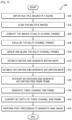
- Verfahren (500), umfassend:Erhalten (502) mehrerer Mehrfachbelichtungsbilder einer Szene unter Verwendung von mindestens einem Rot-Grün-Blau-Weiß-RGBW-Bildsensor;Erzeugen (506) einzelner Mehrkanal-Frames mit unterschiedlichen Belichtungsstufen aus den Bildern;Erzeugen mehrerer Bewegungskarten durch Schätzen (512) der Bewegung über Belichtungsunterschiede zwischen den Mehrkanal-Frames mit unterschiedlichen Belichtungsstufen unter Verwendung eines Weißkanals der Mehrkanal-Frames als Führungssignal;Erzeugen mehrerer Sättigungskarten durch Schätzen (514) gesättigter Pixel über die Belichtungsunterschiede zwischen den Mehrkanal-Frames mit unterschiedlichen Belichtungsstufen für die Rot-, Grün- und Blaukanäle der Mehrkanal-Frames und separat für den Weißkanal der Mehrkanal-Frames;Verwenden (516) der erzeugten Bewegungskarten und Sättigungskarten, um eine Wiederherstellung der Rot-, Grün- und Blausättigung sowie eine Wiederherstellung der Weißsättigung aus den unterschiedlichen Belichtungsstufen zu erreichen, und Verketten der Ausgaben, um ein sättigungsfreies RGBW-Frame zu erzeugen; undVerarbeiten des sättigungsfreien RGBW-Frames zum Erzeugen (522) eines endgültigen Bilds der Szene.
- Verfahren nach Anspruch 1, wobei das Erzeugen der Mehrkanal-Frames mit den unterschiedlichen Belichtungsstufen aus den Bildern Folgendes umfasst:Ausrichten (504) der mehreren Bilder zum Erzeugen von Bewegungsvektoren;Umwandeln (506) der Bilder in Mehrkanal-Frames unter Verwendung der Bewegungsvektoren;Angleichen (508) der Mehrkanal-Frames auf eine gemeinsame Helligkeitsstufe; undGruppieren (510) und Mischen der Mehrkanal-Frames.
- Verfahren nach Anspruch 1, wobei das Verarbeiten des sättigungsfreien RGBW-Frames zur Erzeugung (522) des endgültigen Bilds der Szene Folgendes umfasst:Verschmelzen (518) eines weißen Kanals im sättigungsfreien RGBW-Frame mit roten, grünen und blauen Kanälen im sättigungsfreien RGBW-Frame zur Erzeugung eines dreikanaligen RGB-Frames;Konvertieren (520) des dreikanaligen RGB-Frames von einer ersten Bittiefe in eine zweite Bittiefe; undNachbearbeiten (522) des konvertierten dreikanaligen RGB-Frames zur Erzeugung des endgültigen Bilds.
- Verfahren nach Anspruch 1, wobei beim Schätzen (514) der Sättigung über die Belichtungsunterschiede zwischen den verschiedenen Belichtungsstufen ein Sättigungsgrad bei einer aktuellen Belichtungsstufe von einem Belichtungswert einer nächsten Belichtungsstufe in Bezug auf eine Referenzbelichtungsstufe abhängt.
- Verfahren nach Anspruch 1, wobei das Erzeugen (516) des sättigungsfreien RGBW-Frames Folgendes umfasst:Multiplizieren von Paaren der erzeugten Bewegungskarten und Sättigungskarten bei den verschiedenen Belichtungsstufen, um kombinierte Karten zu erzeugen; undKombinieren der kombinierten Karten mit den Mehrkanal-Frames bei den verschiedenen Belichtungsstufen.
- Verfahren nach Anspruch 1, wobei das Schätzen (512) der Bewegung über die Belichtungsunterschiede zwischen den verschiedenen Belichtungsstufen Folgendes umfasst:Durchführen einer Sättigungsbeschneidung an Paaren der Mehrkanal-Frames;Umwandeln der roten, grünen und blauen Kanäle der Mehrkanal-Frames in Y-, U- und V-Kanäle;Angleichen einer Helligkeit des weißen Kanals, damit sie einer Helligkeit des Y-Kanals entspricht; undDurchführen einer geführten Filterung am Y-Kanal unter Verwendung des weißen Kanals als Führungssignal.
- Elektronisches Gerät (101) umfassend:
mindestens einen Rot-Grün-Blau-Weiß-RGBW-Bildsensor (180), der konfiguriert ist, um mehrere Mehrfachbelichtungsbilder einer Szene zu erhalten; und mindestens einen Prozessor (120), der konfiguriert dazu ist:einzelne Mehrkanal-Frames mit unterschiedlichen Belichtungsstufen aus den Bildern zu erzeugen;mehrere Bewegungskarten zu erzeugen, indem die Bewegung über Belichtungsunterschiede zwischen den Mehrkanal-Frames mit den unterschiedlichen Belichtungsstufen unter Verwendung eines Weißkanals der Mehrkanal-Frames als Führungssignal geschätzt wird;mehrere Sättigungskarten zu erzeugen, indem gesättigte Pixel über die Belichtungsunterschiede zwischen den Mehrkanal-Frames mit unterschiedlichen Belichtungsstufen für die Rot-, Grün- und Blaukanäle der Mehrkanal-Frames und separat für den Weißkanal der Mehrkanal-Frames geschätzt werden;die erzeugten Bewegungskarten und Sättigungskarten zu verwenden, um eine Wiederherstellung der Sättigung in Rot, Grün und Blau sowie eine Wiederherstellung der Weißsättigung aus den unterschiedlichen Belichtungsstufen zu erreichen, und Ausgaben zu verketten, um ein sättigungsfreies RGBW-Bild zu erzeugen; unddas sättigungsfreie RGBW-Bild zu verarbeiten, um ein endgültiges Bild der Szene zu erzeugen. - Elektronisches Gerät nach Anspruch 7, wobei der mindestens eine Prozessor (120) zum Erzeugen der Mehrkanal-Frames mit den unterschiedlichen Belichtungsstufen aus den Bildern dazu konfiguriert ist:die mehreren Bilder auszurichten, um Bewegungsvektoren zu erzeugen;die Bilder unter Verwendung der Bewegungsvektoren in Mehrkanal-Frames umzuwandeln;die Mehrkanal-Frames auf ein gemeinsames Helligkeitsniveau anzugleichen; unddie Mehrkanal-Frames zu gruppieren und zu mischen.
- Elektronisches Gerät nach Anspruch 7, wobei zum Verarbeiten des sättigungsfreien RGBW-Frames zum Erzeugen des endgültigen Bilds der Szene der mindestens eine Prozessor (120) dazu konfiguriert ist:einen weißen Kanal im sättigungsfreien RGBW-Frame mit roten, grünen und blauen Kanälen im sättigungsfreien RGBW-Frame zu verschmelzen, um einen dreikanaligen RGB-Frame zu erzeugen;den dreikanaligen RGB-Frame von einer ersten Bittiefe in eine zweite Bittiefe zu konvertieren; undden konvertierten dreikanaligen RGB-Frame nachzubearbeiten, um das endgültige Bild zu erzeugen.
- Elektronisches Gerät nach Anspruch 7, wobei beim Schätzen der Sättigung über die Belichtungsunterschiede zwischen den unterschiedlichen Belichtungsstufen eine Sättigungsstufe bei einer aktuellen Belichtungsstufe von einem Belichtungswert einer nächsten Belichtungsstufe in Bezug auf eine Referenzbelichtungsstufe abhängt.
- Elektronisches Gerät nach Anspruch 7, wobei zum Erzeugen des sättigungsfreien RGBW-Frames der mindestens eine Prozessor (120) dazu konfiguriert ist:Paare der erzeugten Bewegungskarten und Sättigungskarten bei den verschiedenen Belichtungsstufen zu multiplizieren, um kombinierte Karten zu erzeugen; unddie kombinierten Karten mit den Mehrkanal-Frames bei den verschiedenen Belichtungsstufen zu kombinieren.
- Elektronisches Gerät nach Anspruch 7, wobei der mindestens eine Prozessor (120) zum Schätzen der Bewegung über die Belichtungsunterschiede zwischen den verschiedenen Belichtungsstufen dazu konfiguriert ist:Sättigungsbeschneidung an Paaren der Mehrkanal-Frames durchzuführen;Rot-, Grün- und Blaukanäle der Mehrkanal-Frames in Y-, U- und V-Kanäle umzuwandeln;die Helligkeit des Weißkanals so anzugleichen, dass sie der Helligkeit des Y-Kanals entspricht; undeine geführte Filterung am Y-Kanal unter Verwendung des Weißkanals als Führungssignal durchzuführen.
- Maschinenlesbares Medium, das Anweisungen enthält, die bei Ausführung mindestens einen Prozessor eines elektronischen Geräts veranlassen, Vorgänge auszuführen, die dem Verfahren eines der Ansprüche 1 bis 6 entsprechen.
Applications Claiming Priority (3)
| Application Number | Priority Date | Filing Date | Title |
|---|---|---|---|
| US202163222053P | 2021-07-15 | 2021-07-15 | |
| US17/587,309 US12094086B2 (en) | 2021-07-15 | 2022-01-28 | System and method for multi-exposure, multi-frame blending of red-green-blue-white (RGBW) images |
| PCT/KR2022/010118 WO2023287162A1 (en) | 2021-07-15 | 2022-07-12 | System and method for multi-exposure, multi-frame blending of red-green-blue-white (rgbw) images |
Publications (4)
| Publication Number | Publication Date |
|---|---|
| EP4268448A1 EP4268448A1 (de) | 2023-11-01 |
| EP4268448A4 EP4268448A4 (de) | 2024-06-05 |
| EP4268448C0 EP4268448C0 (de) | 2025-02-26 |
| EP4268448B1 true EP4268448B1 (de) | 2025-02-26 |
Family
ID=84920150
Family Applications (1)
| Application Number | Title | Priority Date | Filing Date |
|---|---|---|---|
| EP22842424.8A Active EP4268448B1 (de) | 2021-07-15 | 2022-07-12 | System und verfahren zur mehrfachbelichtungs-mehrfachbildmischung von rot-grün-blauweiss (rgbw)-bildern |
Country Status (3)
| Country | Link |
|---|---|
| US (1) | US12094086B2 (de) |
| EP (1) | EP4268448B1 (de) |
| WO (1) | WO2023287162A1 (de) |
Families Citing this family (1)
| Publication number | Priority date | Publication date | Assignee | Title |
|---|---|---|---|---|
| US20250095207A1 (en) * | 2023-09-14 | 2025-03-20 | Qualcomm Incorporated | Image quality (iq) improvement |
Family Cites Families (19)
| Publication number | Priority date | Publication date | Assignee | Title |
|---|---|---|---|---|
| JP5011814B2 (ja) | 2006-05-15 | 2012-08-29 | ソニー株式会社 | 撮像装置、および画像処理方法、並びにコンピュータ・プログラム |
| KR101329140B1 (ko) | 2007-08-27 | 2013-11-14 | 삼성전자주식회사 | Rgbw 영상 신호의 채도 향상 시스템 및 방법 |
| US8606009B2 (en) | 2010-02-04 | 2013-12-10 | Microsoft Corporation | High dynamic range image generation and rendering |
| US8699821B2 (en) | 2010-07-05 | 2014-04-15 | Apple Inc. | Aligning images |
| JP2012257193A (ja) | 2011-05-13 | 2012-12-27 | Sony Corp | 画像処理装置、撮像装置、および画像処理方法、並びにプログラム |
| KR101699919B1 (ko) | 2011-07-28 | 2017-01-26 | 삼성전자주식회사 | 다중 노출 퓨전 기반에서 고스트 흐림을 제거한 hdr 영상 생성 장치 및 방법 |
| US10255888B2 (en) | 2012-12-05 | 2019-04-09 | Texas Instruments Incorporated | Merging multiple exposures to generate a high dynamic range image |
| US9344639B2 (en) | 2014-08-12 | 2016-05-17 | Google Technology Holdings LLC | High dynamic range array camera |
| US9613408B2 (en) | 2014-09-25 | 2017-04-04 | Intel Corporation | High dynamic range image composition using multiple images |
| KR20160138685A (ko) | 2015-05-26 | 2016-12-06 | 에스케이하이닉스 주식회사 | 저 복잡도의 하이 다이나믹 레인지 이미지 생성 장치 및 그 방법 |
| KR102059256B1 (ko) | 2015-06-05 | 2019-12-24 | 애플 인크. | Hdr 콘텐츠의 렌더링 및 디스플레이 |
| US9787909B1 (en) | 2016-03-31 | 2017-10-10 | Stmicroelectronics (Research & Development) Limited | Controlling signal-to-noise ratio in high dynamic range automatic exposure control imaging |
| US11128809B2 (en) | 2019-02-15 | 2021-09-21 | Samsung Electronics Co., Ltd. | System and method for compositing high dynamic range images |
| US11062436B2 (en) | 2019-05-10 | 2021-07-13 | Samsung Electronics Co., Ltd. | Techniques for combining image frames captured using different exposure settings into blended images |
| JP7277321B2 (ja) | 2019-09-11 | 2023-05-18 | キヤノン株式会社 | 画像処理装置、画像処理方法、撮像装置およびプログラム |
| WO2021101037A1 (en) | 2019-11-19 | 2021-05-27 | Samsung Electronics Co., Ltd. | System and method for dynamic selection of reference image frame |
| US10911691B1 (en) | 2019-11-19 | 2021-02-02 | Samsung Electronics Co., Ltd. | System and method for dynamic selection of reference image frame |
| CN112529824A (zh) | 2020-11-19 | 2021-03-19 | 重庆兆光科技股份有限公司 | 一种基于自适应结构分解的图像融合方法 |
| US11902669B1 (en) * | 2022-09-09 | 2024-02-13 | Gopro, Inc. | Adaptive acquisition control |
-
2022
- 2022-01-28 US US17/587,309 patent/US12094086B2/en active Active
- 2022-07-12 EP EP22842424.8A patent/EP4268448B1/de active Active
- 2022-07-12 WO PCT/KR2022/010118 patent/WO2023287162A1/en not_active Ceased
Also Published As
| Publication number | Publication date |
|---|---|
| WO2023287162A1 (en) | 2023-01-19 |
| EP4268448A4 (de) | 2024-06-05 |
| US20230021726A1 (en) | 2023-01-26 |
| EP4268448C0 (de) | 2025-02-26 |
| US12094086B2 (en) | 2024-09-17 |
| EP4268448A1 (de) | 2023-11-01 |
Similar Documents
| Publication | Publication Date | Title |
|---|---|---|
| US12206993B2 (en) | System and method for motion warping using multi-exposure frames | |
| US11128809B2 (en) | System and method for compositing high dynamic range images | |
| US11132772B2 (en) | Asymmetric normalized correlation layer for deep neural network feature matching | |
| US10911691B1 (en) | System and method for dynamic selection of reference image frame | |
| US20180189937A1 (en) | Multiframe image processing using semantic saliency | |
| US12272032B2 (en) | Machine learning-based approaches for synthetic training data generation and image sharpening | |
| US11200653B2 (en) | Local histogram matching with global regularization and motion exclusion for multi-exposure image fusion | |
| US12148124B2 (en) | Apparatus and method for combined intraband and interband multi-frame demosaicing | |
| US11276154B2 (en) | Multi-frame depth-based multi-camera relighting of images | |
| US11449968B2 (en) | System and method for synthetic depth-of-field effect rendering for videos | |
| US12254601B2 (en) | Apparatus and method for interband denoising and sharpening of images | |
| US20240257324A1 (en) | Machine learning segmentation-based tone mapping in high noise and high dynamic range environments or other environments | |
| US12079971B2 (en) | Hand motion pattern modeling and motion blur synthesizing techniques | |
| EP4268448B1 (de) | System und verfahren zur mehrfachbelichtungs-mehrfachbildmischung von rot-grün-blauweiss (rgbw)-bildern | |
| KR20210059612A (ko) | 심층 신경망 특징 매칭을 위한 비대칭 정규화 상관 계층 | |
| US12412252B2 (en) | System and method for scene-adaptive denoise scheduling and efficient deghosting | |
| US12586159B2 (en) | Multi-frame high dynamic range (HDR) image generation using quanta image frames | |
| US12541816B2 (en) | Synthetic data generation for machine learning-based post-processing | |
| US12586207B2 (en) | System and method for AI segmentation-based registration for multi-frame processing | |
| EP3977410B1 (de) | Asymmetrische normierte korrelationsschicht für merkmalsabgleich tiefer neuronaler netze | |
| US20250200728A1 (en) | Machine learning-based multi-frame deblurring | |
| CN117441338A (zh) | 用于红绿蓝白(rgbw)图像的多重曝光、多帧混合的系统和方法 | |
| US20260038094A1 (en) | Fast low-light image visibility enhancement | |
| US20230252770A1 (en) | Machine learning model training framework for multi-frame image processing | |
| US12541826B2 (en) | Texture-preserving halo suppression for imaging systems |
Legal Events
| Date | Code | Title | Description |
|---|---|---|---|
| STAA | Information on the status of an ep patent application or granted ep patent |
Free format text: STATUS: THE INTERNATIONAL PUBLICATION HAS BEEN MADE |
|
| PUAI | Public reference made under article 153(3) epc to a published international application that has entered the european phase |
Free format text: ORIGINAL CODE: 0009012 |
|
| STAA | Information on the status of an ep patent application or granted ep patent |
Free format text: STATUS: REQUEST FOR EXAMINATION WAS MADE |
|
| 17P | Request for examination filed |
Effective date: 20230728 |
|
| AK | Designated contracting states |
Kind code of ref document: A1 Designated state(s): AL AT BE BG CH CY CZ DE DK EE ES FI FR GB GR HR HU IE IS IT LI LT LU LV MC MK MT NL NO PL PT RO RS SE SI SK SM TR |
|
| REG | Reference to a national code |
Ref country code: DE Free format text: PREVIOUS MAIN CLASS: H04N0009690000 Ipc: G06T0005730000 Ref country code: DE Ref legal event code: R079 Ref document number: 602022011251 Country of ref document: DE Free format text: PREVIOUS MAIN CLASS: H04N0009690000 Ipc: G06T0005730000 |
|
| A4 | Supplementary search report drawn up and despatched |
Effective date: 20240508 |
|
| RIC1 | Information provided on ipc code assigned before grant |
Ipc: H04N 5/14 20060101ALN20240502BHEP Ipc: H04N 23/951 20230101ALI20240502BHEP Ipc: H04N 23/743 20230101ALI20240502BHEP Ipc: G06T 5/92 20240101ALI20240502BHEP Ipc: G06T 3/4015 20240101ALI20240502BHEP Ipc: G06T 5/50 20060101ALI20240502BHEP Ipc: G06T 5/73 20240101AFI20240502BHEP |
|
| GRAP | Despatch of communication of intention to grant a patent |
Free format text: ORIGINAL CODE: EPIDOSNIGR1 |
|
| STAA | Information on the status of an ep patent application or granted ep patent |
Free format text: STATUS: GRANT OF PATENT IS INTENDED |
|
| DAV | Request for validation of the european patent (deleted) | ||
| DAX | Request for extension of the european patent (deleted) | ||
| RIC1 | Information provided on ipc code assigned before grant |
Ipc: H04N 5/14 20060101ALN20240917BHEP Ipc: H04N 23/951 20230101ALI20240917BHEP Ipc: H04N 23/743 20230101ALI20240917BHEP Ipc: G06T 5/92 20240101ALI20240917BHEP Ipc: G06T 3/4015 20240101ALI20240917BHEP Ipc: G06T 5/50 20060101ALI20240917BHEP Ipc: G06T 5/73 20240101AFI20240917BHEP |
|
| INTG | Intention to grant announced |
Effective date: 20241004 |
|
| GRAS | Grant fee paid |
Free format text: ORIGINAL CODE: EPIDOSNIGR3 |
|
| GRAA | (expected) grant |
Free format text: ORIGINAL CODE: 0009210 |
|
| STAA | Information on the status of an ep patent application or granted ep patent |
Free format text: STATUS: THE PATENT HAS BEEN GRANTED |
|
| AK | Designated contracting states |
Kind code of ref document: B1 Designated state(s): AL AT BE BG CH CY CZ DE DK EE ES FI FR GB GR HR HU IE IS IT LI LT LU LV MC MK MT NL NO PL PT RO RS SE SI SK SM TR |
|
| REG | Reference to a national code |
Ref country code: GB Ref legal event code: FG4D |
|
| REG | Reference to a national code |
Ref country code: CH Ref legal event code: EP |
|
| REG | Reference to a national code |
Ref country code: DE Ref legal event code: R096 Ref document number: 602022011251 Country of ref document: DE |
|
| REG | Reference to a national code |
Ref country code: IE Ref legal event code: FG4D |
|
| U01 | Request for unitary effect filed |
Effective date: 20250226 |
|
| U07 | Unitary effect registered |
Designated state(s): AT BE BG DE DK EE FI FR IT LT LU LV MT NL PT RO SE SI Effective date: 20250306 |
|
| PG25 | Lapsed in a contracting state [announced via postgrant information from national office to epo] |
Ref country code: RS Free format text: LAPSE BECAUSE OF FAILURE TO SUBMIT A TRANSLATION OF THE DESCRIPTION OR TO PAY THE FEE WITHIN THE PRESCRIBED TIME-LIMIT Effective date: 20250526 |
|
| PG25 | Lapsed in a contracting state [announced via postgrant information from national office to epo] |
Ref country code: PL Free format text: LAPSE BECAUSE OF FAILURE TO SUBMIT A TRANSLATION OF THE DESCRIPTION OR TO PAY THE FEE WITHIN THE PRESCRIBED TIME-LIMIT Effective date: 20250226 |
|
| PG25 | Lapsed in a contracting state [announced via postgrant information from national office to epo] |
Ref country code: ES Free format text: LAPSE BECAUSE OF FAILURE TO SUBMIT A TRANSLATION OF THE DESCRIPTION OR TO PAY THE FEE WITHIN THE PRESCRIBED TIME-LIMIT Effective date: 20250226 |
|
| PG25 | Lapsed in a contracting state [announced via postgrant information from national office to epo] |
Ref country code: IS Free format text: LAPSE BECAUSE OF FAILURE TO SUBMIT A TRANSLATION OF THE DESCRIPTION OR TO PAY THE FEE WITHIN THE PRESCRIBED TIME-LIMIT Effective date: 20250626 Ref country code: NO Free format text: LAPSE BECAUSE OF FAILURE TO SUBMIT A TRANSLATION OF THE DESCRIPTION OR TO PAY THE FEE WITHIN THE PRESCRIBED TIME-LIMIT Effective date: 20250526 |
|
| PG25 | Lapsed in a contracting state [announced via postgrant information from national office to epo] |
Ref country code: HR Free format text: LAPSE BECAUSE OF FAILURE TO SUBMIT A TRANSLATION OF THE DESCRIPTION OR TO PAY THE FEE WITHIN THE PRESCRIBED TIME-LIMIT Effective date: 20250226 |
|
| PG25 | Lapsed in a contracting state [announced via postgrant information from national office to epo] |
Ref country code: GR Free format text: LAPSE BECAUSE OF FAILURE TO SUBMIT A TRANSLATION OF THE DESCRIPTION OR TO PAY THE FEE WITHIN THE PRESCRIBED TIME-LIMIT Effective date: 20250527 |
|
| U20 | Renewal fee for the european patent with unitary effect paid |
Year of fee payment: 4 Effective date: 20250723 |
|
| PG25 | Lapsed in a contracting state [announced via postgrant information from national office to epo] |
Ref country code: SM Free format text: LAPSE BECAUSE OF FAILURE TO SUBMIT A TRANSLATION OF THE DESCRIPTION OR TO PAY THE FEE WITHIN THE PRESCRIBED TIME-LIMIT Effective date: 20250226 |
|
| PG25 | Lapsed in a contracting state [announced via postgrant information from national office to epo] |
Ref country code: CZ Free format text: LAPSE BECAUSE OF FAILURE TO SUBMIT A TRANSLATION OF THE DESCRIPTION OR TO PAY THE FEE WITHIN THE PRESCRIBED TIME-LIMIT Effective date: 20250226 |
|
| PG25 | Lapsed in a contracting state [announced via postgrant information from national office to epo] |
Ref country code: SK Free format text: LAPSE BECAUSE OF FAILURE TO SUBMIT A TRANSLATION OF THE DESCRIPTION OR TO PAY THE FEE WITHIN THE PRESCRIBED TIME-LIMIT Effective date: 20250226 |
|
| PLBE | No opposition filed within time limit |
Free format text: ORIGINAL CODE: 0009261 |
|
| STAA | Information on the status of an ep patent application or granted ep patent |
Free format text: STATUS: NO OPPOSITION FILED WITHIN TIME LIMIT |
|
| REG | Reference to a national code |
Ref country code: CH Ref legal event code: L10 Free format text: ST27 STATUS EVENT CODE: U-0-0-L10-L00 (AS PROVIDED BY THE NATIONAL OFFICE) Effective date: 20260107 |
|
| 26N | No opposition filed |
Effective date: 20251127 |
|
| REG | Reference to a national code |
Ref country code: CH Ref legal event code: H13 Free format text: ST27 STATUS EVENT CODE: U-0-0-H10-H13 (AS PROVIDED BY THE NATIONAL OFFICE) Effective date: 20260224 |