EP4266569A1 - Method and apparatus for driving electric motor, and control device - Google Patents
Method and apparatus for driving electric motor, and control device Download PDFInfo
- Publication number
- EP4266569A1 EP4266569A1 EP22814842.5A EP22814842A EP4266569A1 EP 4266569 A1 EP4266569 A1 EP 4266569A1 EP 22814842 A EP22814842 A EP 22814842A EP 4266569 A1 EP4266569 A1 EP 4266569A1
- Authority
- EP
- European Patent Office
- Prior art keywords
- current value
- value
- excitation current
- load information
- determining
- Prior art date
- Legal status (The legal status is an assumption and is not a legal conclusion. Google has not performed a legal analysis and makes no representation as to the accuracy of the status listed.)
- Pending
Links
Images


Classifications
-
- H—ELECTRICITY
- H02—GENERATION; CONVERSION OR DISTRIBUTION OF ELECTRIC POWER
- H02P—CONTROL OR REGULATION OF ELECTRIC MOTORS, ELECTRIC GENERATORS OR DYNAMO-ELECTRIC CONVERTERS; CONTROLLING TRANSFORMERS, REACTORS OR CHOKE COILS
- H02P6/00—Arrangements for controlling synchronous motors or other dynamo-electric motors using electronic commutation dependent on the rotor position; Electronic commutators therefor
- H02P6/08—Arrangements for controlling the speed or torque of a single motor
-
- F—MECHANICAL ENGINEERING; LIGHTING; HEATING; WEAPONS; BLASTING
- F24—HEATING; RANGES; VENTILATING
- F24F—AIR-CONDITIONING; AIR-HUMIDIFICATION; VENTILATION; USE OF AIR CURRENTS FOR SCREENING
- F24F11/00—Control or safety arrangements
- F24F11/62—Control or safety arrangements characterised by the type of control or by internal processing, e.g. using fuzzy logic, adaptive control or estimation of values
- F24F11/63—Electronic processing
- F24F11/64—Electronic processing using pre-stored data
-
- F—MECHANICAL ENGINEERING; LIGHTING; HEATING; WEAPONS; BLASTING
- F24—HEATING; RANGES; VENTILATING
- F24F—AIR-CONDITIONING; AIR-HUMIDIFICATION; VENTILATION; USE OF AIR CURRENTS FOR SCREENING
- F24F11/00—Control or safety arrangements
- F24F11/70—Control systems characterised by their outputs; Constructional details thereof
- F24F11/80—Control systems characterised by their outputs; Constructional details thereof for controlling the temperature of the supplied air
- F24F11/86—Control systems characterised by their outputs; Constructional details thereof for controlling the temperature of the supplied air by controlling compressors within refrigeration or heat pump circuits
-
- H—ELECTRICITY
- H02—GENERATION; CONVERSION OR DISTRIBUTION OF ELECTRIC POWER
- H02P—CONTROL OR REGULATION OF ELECTRIC MOTORS, ELECTRIC GENERATORS OR DYNAMO-ELECTRIC CONVERTERS; CONTROLLING TRANSFORMERS, REACTORS OR CHOKE COILS
- H02P21/00—Arrangements or methods for the control of electric machines by vector control, e.g. by control of field orientation
- H02P21/02—Arrangements or methods for the control of electric machines by vector control, e.g. by control of field orientation specially adapted for optimising the efficiency at low load
-
- H—ELECTRICITY
- H02—GENERATION; CONVERSION OR DISTRIBUTION OF ELECTRIC POWER
- H02P—CONTROL OR REGULATION OF ELECTRIC MOTORS, ELECTRIC GENERATORS OR DYNAMO-ELECTRIC CONVERTERS; CONTROLLING TRANSFORMERS, REACTORS OR CHOKE COILS
- H02P21/00—Arrangements or methods for the control of electric machines by vector control, e.g. by control of field orientation
- H02P21/22—Current control, e.g. using a current control loop
-
- H—ELECTRICITY
- H02—GENERATION; CONVERSION OR DISTRIBUTION OF ELECTRIC POWER
- H02P—CONTROL OR REGULATION OF ELECTRIC MOTORS, ELECTRIC GENERATORS OR DYNAMO-ELECTRIC CONVERTERS; CONTROLLING TRANSFORMERS, REACTORS OR CHOKE COILS
- H02P6/00—Arrangements for controlling synchronous motors or other dynamo-electric motors using electronic commutation dependent on the rotor position; Electronic commutators therefor
- H02P6/28—Arrangements for controlling current
Definitions
- the present disclosure relates to the field of the compressor of the inverter air conditioner, for example, relates to a method and a device for driving motor, and a controlling device.
- a compressor is a device with a largest power consumption, that is, the device with the largest power consumption.
- a driving efficiency of the compressor can be improved.
- the driving efficiency of the compressor can be increased by increasing the operating efficiency of the motor employed in the compressor.
- a compressor of a frequency conversion air conditioner mostly adopts an embedded permanent magnet synchronous motor, because the embedded permanent magnet synchronous motor has higher efficiency, so that the working efficiency of the compressor can be improved.
- High efficiency control of an embedded permanent magnet synchronous motor is achieved when the field current in the motor is minimized and the torque is maximized at the same time.
- L d ,L q and ⁇ a represent the parameters of a motor characteristics
- i q represents a current of a torque part
- the embodiment of the present disclosure provides a method and a device for driving motor, and a controlling device, in order to solve problems that: corresponding adjustment parameters obtaining a first actual temperature of the inner coil need to be memorized for each different load, which easily leads to a huge adjustment operation and a large amount of memory.
- the method for driving motor includes: obtaining real-time load information of an air conditioner, and determining a current input current value of a motor as a first current value; determining a theoretical excitation current value and an adjustment parameter value corresponding to the real-time load information, wherein the adjustment parameter value is a preset value; compensating a preset value to obtain a first compensated adjustment parameter value, determining a first actual excitation current value according to the first compensated adjustment parameter value and a theoretical excitation current value, and determining a current value inputting to the motor at this moment as a second current value; and, determining a first input current difference according to the second current value and the first current value, and controlling the excitation current of the motor to be a first actual excitation current value in a case where the first input current difference is in a first set range.
- the method for driving motor further includes: if the first current value is higher than the second current value, compensating the first compensated adjustment parameter value to obtain a second compensated adjustment parameter value; determining a second actual excitation current value according to the second compensated adjustment parameter value and the theoretical excitation current value, and determining a current value inputting to the motor at this moment as a third current value; and, determining a second input current difference according to the third current value and the first current value, and controlling the excitation current value of the motor to be a second actual excitation current value in a case where the second input current difference is within the first set range.
- determining the preset value as follow : obtaining a load information base, wherein the load information base comprises a plurality of preset load information of an air conditioner and preset adjustment parameter values corresponding to each preset load information; and, if the real-time load information is not matched in the load information base, determining a preset adjustment parameter value corresponding to preset load information closest to the real-time load information as a preset value.
- the method for driving motor further includes: obtaining a load information base, wherein the load information base comprises a plurality of preset load information of an air conditioner and preset excitation current values corresponding to each preset load information; if the real-time load information is matched in the load information base, obtaining a preset excitation current value associated with the real-time load information as a third actual excitation current value, and controlling the excitation current value of the motor as the third actual excitation current value.
- the determining the first actual excitation current value to the first compensated adjusted parameter value and the theoretical excitation current value includes: obtaining a first product of the first compensated adjusted parameter value and the theoretical excitation current value, and determining the first product as the first actual excitation current value
- the determining the first actual excitation current value according to the first compensated adjusted parameter value and the theoretical excitation current value includes: obtaining a second product of an absolute value of the theoretical excitation current and the first compensated adjusted parameter value, and determining the sum of the second product and the theoretical excitation current as the first actual excitation current value.
- determining the first actual excitation current value according to the first compensated adjusted parameter value and the theoretical excitation current value includes: obtaining a sum of the first compensated adjusted parameter value and the theoretical excitation current value, and determining the sum as the first actual excitation current value.
- the preset load informations include one or more of intermediate cooling, intermediate heating, rated cooling, rated heating or maximum heating.
- the device for driving motor includes a processor and a memory storing program instructions, wherein the processor is configured to execute the mentioned controlling method for a driving motor in a case where executing the program instructions.
- the controlling device includes the mentioned device for a driving motor.
- the method and the device for driving motor, and the controlling device provided by the embodiment of the disclosure can have the following technical advantages: a
- the method for driving motor includes: obtaining a real-time load information of an air conditioner, and determining a current input current value of a motor as a first current value; determining a theoretical excitation current value and an adjustment parameter value corresponding to the real-time load information, wherein the adjustment parameter value is a preset value; compensating a preset value to obtain a first compensated adjustment parameter value, determining a first actual excitation current value according to the first compensated adjustment parameter value and a theoretical excitation current value, and determining a current value inputting to the motor at this moment as a second current value; and, determining a first input current difference according to the second current value and the first current value, and controlling the excitation current of the motor to be a first actual excitation current value in case where the first input current difference is in a first set range.
- a large amount of load information and adjustment parameter values corresponding to the load information may not be memorized, and a theoretical excitation current value can be compensated more accurately, and the input current of the motor is minimized in a case that the optimal excitation current value. That is to say, the maximum torque can be obtained with the minimum input power, and the efficiency of the motor can be improved in the case of minimum energy consumption.
- a plurality of means two or more.
- the character "/" indicates that the front element and rear element are in an "or" relationship.
- A/B illustrates A or B.
- a and/or B represent relationships: A or B, or A and B.
- the method for driving motor includes:
- the load information at this moment can be the cooling or heating mode of the air conditioner, and a temperature information set by the air conditioner.
- an adjustment parameter value corresponding to the real-time load information may also be determined, where the adjustment parameter value may be a preset value.
- the preset value may be a value corresponding to the real-time load determined through simulation or experiment, or may be a value set autonomously.
- the preset value may be 1.
- the excitation current value satisfying the requirement may be determined by compensating the preset value.
- the mode of compensation may be one value added, one value subtracted, one value multiplied or one value divided. Recording the adjustment parameter value after the compensation as a first compensated adjustment parameter value, and according to the first compensated adjustment parameters and the theoretical excitation current value, determining the first actual excitation current value.
- the first actual excitation current value is determined as follows: the first compensated adjustment parameter value can be multiplied by the theoretical excitation current value to obtain a first product, and the first product is determined as the first actual excitation current value.
- This adjustment mode is the most basic adjustment mode.
- a second product may be obtained using the absolute value of the theoretical excitation current and the first compensated adjusted parameter value; and a sum of the second product and the theoretical excitation current is determined as the first actual excitation current value.
- the first actual excitation current value obtained by this mode may exceed the sign of the original excitation current value and obtain a maximum adjustment range.
- a sum of the first compensated adjusted parameter value and the theoretical excitation current value may be determined as the first actual excitation current value.
- This compensation method may carry out compensation as long as data is added or subtracted, thereby saving the calculation resources of the compensation means.
- the motor After obtaining the first actual excitation current value, the motor is controlled to operate under the first actual excitation current value. Detecting a current input current value by using a current detection element, and marking the current input current value as a second current value. And making a difference between the second current value and the first current value to obtain a first input current difference. If the first input current difference is within the first set range, it can be considered that the adjustment parameter value at this moment is an optimal value, that is, the excitation current value at this time is the optimal value. Under the condition of operating with the optimal excitation current, the input current of the motor is the minimum value, and the efficient control with the maximum torque can be produced.
- a large amount of load information and adjustment parameter values corresponding to the load information may not be memorized, and a theoretical excitation current value can be compensated more accurately, and the input current of the motor is minimized in a case that the optimal excitation current value. That is to say, in the case of minimum input power, the maximum torque can be obtained, and the efficiency of the motor can be improved in the case of minimum energy consumption.
- the embodiment of the present disclosure may further perform compensation processing to obtain an excitation current value which meets the requirements.
- the method for driving motor further includes:
- the excitation current value obtained after the first compensation is not the optimal value, and thus the excitation current value should be compensated again. If the first current value is higher than the second current value and the first input current difference is not within the first set range, it indicates that the second current value should be adjusted towards the first current value when adjusting again. That is, one numerical value is added to the adjustment parameter value after the first compensation to obtain the adjustment parameter value after the second compensation.
- the first current value is lower than the second current value and the first input current difference is not within the first set range, it indicates that the second current value should be adjusted towards the first current value when adjusting again. That is, one numerical value is subtracted from the adjustment parameter value after the first compensation to obtain the adjustment parameter value after the second compensation.
- the second actual excitation current value is determined according to the second compensated adjusted parameter value and the theoretical excitation current value.
- the manner of determining the second actual excitation current value is referred to the manner of obtaining the first actual excitation current in step S102. Additionally, when the motor is controlled to operate at the second actual excitation current value, the current value currently inputting to the motor can also be detected by the current detection element, and the detected current value currently inputting to the motor is recorded as a third current value.
- the excitation current value of the motor is controlled to be a nth actual excitation current value.
- a large amount of load information and adjustment parameter values corresponding to the load information may not be memorized, and a theoretical excitation current value can be compensated more accurately, and the input current of the motor is minimized in a case that the optimal excitation current value. That is to say, the maximum torque can be obtained with the minimum input power, and the efficiency of the motor can be improved in the case of minimum energy consumption.
- the preset value may also be determined as follow:
- Obtaining a load information base which stores a plurality of preset load information of the air conditioner and preset adjustment parameter values corresponding to each preset load information.
- the preset adjustment parameter values can be obtained through a plurality of experiments.
- a plurality of preset load information includes one or more conditions of intermediate cooling, intermediate heating, rated cooling, rated heating, or maximum heating.
- determining a preset adjustment parameter value corresponding to a preset load information closest to the real-time load information is determined as a preset value, wherein the real-time loading information includes intermediate cooling, intermediate heating, rated value cooling, rated value heating and maximum heating.
- the method for driving motor further includes:
- the load information base includes a plurality of preset load information of the air conditioner, wherein the preset load information includes one or more conditions of intermediate cooling, intermediate heating, rated cooling, rated heating or maximum heating.
- the load information base further includes third excitation current values corresponding to each preset load information.
- the third excitation current values is empirical value obtained through simulation and calculation.
- the preset load information includes one or more of intermediate cooling, intermediate heating, rated cooling, rated heating, or maximum heating.
- load informations can be all memorized, or only a few appropriated ones selected be memorized.
- the intermediate cooling or heating which has a great impact on its state can be selected for memory.
- the rated cooling and/or rated thermal conditions can be selected for memory.
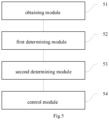
- the device for driving motor includes an obtaining module 51, a first determining module 52, a second determining module 53, and a control module.
- An obtaining module 51 is configured to obtain real-time load information of the air conditioner, and determine a current input current value of the motor as a first current value.
- a second determining module 52 is configured to determine a theoretical excitation current value corresponding to the real-time load information and an adjustment parameter value, wherein the adjustment parameter value is a preset value.
- a second determining module 53 is configured to compensate a preset value to obtain a first compensated adjustment parameter value, determining a first actual excitation current value according to the first compensated adjustment parameter value and a theoretical excitation current value, and determining a current value inputting to the motor at this moment as a second current value.
- a control module 54 is configured to determine a first input current difference according to the second current value and the first current value, and control the excitation current of the motor to be a first actual excitation current value if the first input current difference is within a first set range.
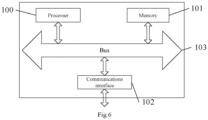
- the embodiment of the present disclosure provides a device for driving motor, which includes a processor 100 and a memory 101.
- the device may also include a communication interface 102 and a bus 103.
- the processor 100, the communication interface 102, and the memory 101 are communicated with each other through the bus 103.
- the communication interface 102 may be configured for information transmission.
- the processor 100 may invoke logic instructions in the memory 101 to execute the method for a driving motor in the above-described embodiment.
- logic instructions in the memory 101 described above may be realized in the form of software functional units and may be stored in a computer-readable storage medium when sold or used as a separate product.
- the memory 101 may be configured to store software programs, and computer executable programs, such as program instructions/modules corresponding to the methods in embodiments of the present disclosure.
- the processor 100 executes the function application and data processing by running the program instructions/modules stored in the memory 101 that is to implement the method for driving motor in the above-described embodiment.
- the memory 101 may include a stored program area and a stored data area wherein the stored program area may store an operating system and an application program required for at least one function.
- the storage data area may store data created according to the use of the terminal device.
- the memory 101 may include a high-speed random access memory and may also include a non-volatile memory.
- the embodiment of the present disclosure provides a control device including the device for a driving motor.
- the embodiments of the present disclosure provide a computer-readable storage medium storing computer-executable instructions configured to execute the above-described method for a driving motor.
- the embodiments of the present disclosure provide a computer program product including a computer program stored on a computer-readable storage medium, the computer program including program instructions that, when executed by a computer, cause the computer to execute the above-described method for a driving motor.
- the computer-readable storage medium may be a transient computer-readable storage medium or a non-transient computer-readable storage medium.
- the technical proposal of the embodiment of the present disclosure can be embodied in the form of a software product
- the computer software product is stored in a storage medium and includes one or more instructions for causing a computer device (which may be a personal computer, server, or network device, etc.) to perform all or part of the steps of the method described in the embodiment of the present disclosure.
- the mentioned storage medium may be a non-transient storage medium, including a U disk, a mobile hard disk, a Read-Only Memory (ROM), a Random Access Memory (RAM), a magnetic disk or an optical disk, and other media capable of storing program codes or maybe a transient storage medium.
- the term “comprise” and its variants “comprises” and/or “comprising”, etc. refer to the presence of stated features, totals, steps, operations, elements, and/or components, but do not exclude the presence or addition of one or more other features, totals, steps, operations, elements, components, and/or groupings of these.
- an element defined by the phrase “includes an " does not preclude the existence of another identical element in the process, method, or device in which the element is included.
- each embodiment may be highlighted as being different from the other embodiments and the same similar parts between the various embodiments may be referred to with respect to each other.
- the method, product, etc. disclosed by the embodiment if it corresponds to the method portion disclosed by the embodiment, reference can be made to the description of the method portion where relevant.
- the disclosed methods, and products may be implemented in other ways.
- the above-described embodiment of the device is only schematic, for example, the division of the unit may be only a logical function division, and in practice, there may be another division mode, for example, multiple units or components may be combined or integrated into another system, or some features may be ignored or not performed.
- the coupling or direct coupling or communication connection between each other shown or discussed may be indirect coupling or communication connection through some interface, device, or unit, and may be electrical, mechanical, or another form.
- the elements illustrated as separate elements may or may not be physically separated, and the elements displayed as elements may or may not be physical elements, i.e.
- each functional unit in the embodiment of the present disclosure may be integrated into one processing unit, each unit may exist physically alone, or two or more units may be integrated into one unit.
- each block in a flow chart or block diagram may represent a module, program segment, or part of code containing one or more executable instructions for performing a specified logical function.
- the functions indicated in the boxes may also occur in a different order than those indicated in the drawings. For example, two successive boxes can actually be executed substantially in parallel, or they can sometimes be executed in reverse order, depending on the functionality involved.
- each block in the block diagram and/or flow chart, and a combination of the blocks in the block diagram and/or flow chart may be implemented in a dedicated hardware-based system that performs a specified function or action or may be implemented in a combination of dedicated hardware and computer instructions.
Landscapes
- Engineering & Computer Science (AREA)
- Power Engineering (AREA)
- Signal Processing (AREA)
- Physics & Mathematics (AREA)
- Chemical & Material Sciences (AREA)
- Combustion & Propulsion (AREA)
- Mechanical Engineering (AREA)
- General Engineering & Computer Science (AREA)
- Fuzzy Systems (AREA)
- Mathematical Physics (AREA)
- Thermal Sciences (AREA)
- Control Of Ac Motors In General (AREA)
Abstract
Description
- The application is based upon and claims priority to
Chinese Patent Application No. 202110608990.7, filed June 1, 2021 - The present disclosure relates to the field of the compressor of the inverter air conditioner, for example, relates to a method and a device for driving motor, and a controlling device.
- In an inverter air conditioner, a compressor is a device with a largest power consumption, that is, the device with the largest power consumption. In order to save energy, a driving efficiency of the compressor can be improved. For example, the driving efficiency of the compressor can be increased by increasing the operating efficiency of the motor employed in the compressor.
- At present, a compressor of a frequency conversion air conditioner mostly adopts an embedded permanent magnet synchronous motor, because the embedded permanent magnet synchronous motor has higher efficiency, so that the working efficiency of the compressor can be improved. High efficiency control of an embedded permanent magnet synchronous motor is achieved when the field current in the motor is minimized and the torque is maximized at the same time. In general, for such a motor, the field current id can be obtained according to the following formula:

- In the formula, Ld,Lq and Ψ a represent the parameters of a motor characteristics, and iq represents a current of a torque part.
- In a case of a certain load, because the formula is obtained under ideal conditions, the actual characteristic parameters of the motor exist errors, and a test of motor parameters also exist errors, so a value of id calculated by the above formula is not necessarily the real minimum value. In order to compensate for these errors, adjustment parameters under different loads can be memorized and can be recalled during calculation.
- In the practice of the embodiment of the present disclosure, it is found that at least the following problems of the related technology:
- For each different load, the corresponding adjustment parameters should be memorized. The adjustment operation is huge and the amount of memory is large.
- In order to have a basic understanding of some aspects of the disclosed embodiments a brief summary is given below. The summary is not intended to be a general comment or to identify crucial/essential constituent elements or to describe the protection scope of these embodiments but rather to serve as a preface to the detailed description that follows.
- The embodiment of the present disclosure provides a method and a device for driving motor, and a controlling device, in order to solve problems that: corresponding adjustment parameters obtaining a first actual temperature of the inner coil need to be memorized for each different load, which easily leads to a huge adjustment operation and a large amount of memory.
- In some embodiments, the method for driving motor includes: obtaining real-time load information of an air conditioner, and determining a current input current value of a motor as a first current value; determining a theoretical excitation current value and an adjustment parameter value corresponding to the real-time load information, wherein the adjustment parameter value is a preset value; compensating a preset value to obtain a first compensated adjustment parameter value, determining a first actual excitation current value according to the first compensated adjustment parameter value and a theoretical excitation current value, and determining a current value inputting to the motor at this moment as a second current value; and, determining a first input current difference according to the second current value and the first current value, and controlling the excitation current of the motor to be a first actual excitation current value in a case where the first input current difference is in a first set range.
- Optionally, if the first input current difference exceeds a first set range, the method for driving motor further includes: if the first current value is higher than the second current value, compensating the first compensated adjustment parameter value to obtain a second compensated adjustment parameter value; determining a second actual excitation current value according to the second compensated adjustment parameter value and the theoretical excitation current value, and determining a current value inputting to the motor at this moment as a third current value; and, determining a second input current difference according to the third current value and the first current value, and controlling the excitation current value of the motor to be a second actual excitation current value in a case where the second input current difference is within the first set range.
- Optionally, determining the preset value as follow : obtaining a load information base, wherein the load information base comprises a plurality of preset load information of an air conditioner and preset adjustment parameter values corresponding to each preset load information; and, if the real-time load information is not matched in the load information base, determining a preset adjustment parameter value corresponding to preset load information closest to the real-time load information as a preset value.
- Optionally, the method for driving motor further includes: obtaining a load information base, wherein the load information base comprises a plurality of preset load information of an air conditioner and preset excitation current values corresponding to each preset load information; if the real-time load information is matched in the load information base, obtaining a preset excitation current value associated with the real-time load information as a third actual excitation current value, and controlling the excitation current value of the motor as the third actual excitation current value.
- Optionally, the determining the first actual excitation current value to the first compensated adjusted parameter value and the theoretical excitation current value includes: obtaining a first product of the first compensated adjusted parameter value and the theoretical excitation current value, and determining the first product as the first actual excitation current value
- Optionally, the determining the first actual excitation current value according to the first compensated adjusted parameter value and the theoretical excitation current value, includes: obtaining a second product of an absolute value of the theoretical excitation current and the first compensated adjusted parameter value, and determining the sum of the second product and the theoretical excitation current as the first actual excitation current value.
- Optionally, determining the first actual excitation current value according to the first compensated adjusted parameter value and the theoretical excitation current value includes: obtaining a sum of the first compensated adjusted parameter value and the theoretical excitation current value, and determining the sum as the first actual excitation current value.
- Optionally, the preset load informations include one or more of intermediate cooling, intermediate heating, rated cooling, rated heating or maximum heating.
- In some embodiments, the device for driving motor includes a processor and a memory storing program instructions, wherein the processor is configured to execute the mentioned controlling method for a driving motor in a case where executing the program instructions.
- In some embodiments, the controlling device includes the mentioned device for a driving motor.
- The method and the device for driving motor, and the controlling device provided by the embodiment of the disclosure can have the following technical advantages: a
- The method for driving motor includes: obtaining a real-time load information of an air conditioner, and determining a current input current value of a motor as a first current value; determining a theoretical excitation current value and an adjustment parameter value corresponding to the real-time load information, wherein the adjustment parameter value is a preset value; compensating a preset value to obtain a first compensated adjustment parameter value, determining a first actual excitation current value according to the first compensated adjustment parameter value and a theoretical excitation current value, and determining a current value inputting to the motor at this moment as a second current value; and, determining a first input current difference according to the second current value and the first current value, and controlling the excitation current of the motor to be a first actual excitation current value in case where the first input current difference is in a first set range. According to the method for driving motor, a large amount of load information and adjustment parameter values corresponding to the load information may not be memorized, and a theoretical excitation current value can be compensated more accurately, and the input current of the motor is minimized in a case that the optimal excitation current value. That is to say, the maximum torque can be obtained with the minimum input power, and the efficiency of the motor can be improved in the case of minimum energy consumption.
- The above general description and the description below are exemplary and explanatory only and are not intended to limit the present disclosure.
- One or more embodiments are illustrated by means of the corresponding drawings, which do not constitute a limitation of the embodiments, elements having the same reference numerals in the drawings are shown as similar elements, and the drawings do not constitute a limitation of proportion, wherein:
-
Fig. 1 is a flow chart of a method for driving motor according to an exemplary embodiment. -
Fig. 2 is a flow chart of a method for driving motor according to another exemplary embodiment. -
Fig. 3 is a flow chart of method for driving motor according to another exemplary embodiment. -
Fig. 4 is a flow chart of method for driving motor according to another exemplary embodiment. -
Fig. 5 is a schematic diagram of a device for driving motor according to an exemplary embodiment. -
Fig. 6 is a schematic diagram of another device for driving motor according to an exemplary embodiment. - In order to enable a more detailed understanding of the features and technical content of the embodiments of the present disclosure, the implementation of the embodiments of the present disclosure will be described in detail below in conjunction with the accompanying drawings, which are for illustration only and are not intended to limit the embodiments of the present disclosure. In the following technical description for convenience of explanation, several details are provided for a full understanding of the disclosed embodiments. However, one or more embodiments may still be practiced without these details. In other instances, the well-known structures and devices may simplify the disclosure in order to simplify the drawings.
- The terms "first", "second" and the like in the specification and claims of embodiments of the present disclosure and the above drawings are used to distinguish similar elements and are not necessarily used to describe a particular order or priority. It should be understood that the data used in this way can be interchanged where appropriate for the embodiments of the present disclosure described herein. Furthermore, the terms "include" and "have" and any variations thereof are intended to cover a non-exclusive inclusion.
- Unless otherwise illustrated, the term "a plurality of" means two or more.
- In the embodiment of the present disclosure, the character "/" indicates that the front element and rear element are in an "or" relationship. For example, A/B illustrates A or B.
- The term "and/or" is an association relationship that describes elements, indicating that there can be three relationships. For example, A and/or B represent relationships: A or B, or A and B.
- As shown in
Fig. 1 , the method for driving motor, includes: - S101, [0041] obtaining real-time load information of an air conditioner, and determining a current input current value of a motor as a first current value.
- S102, determining a theoretical excitation current value and an adjustment parameter value corresponding to the real-time load information, wherein the adjustment parameter value is a preset value.
- S103, compensating a preset value to obtain a first compensated adjustment parameter value, determining a first actual excitation current value according to the first compensated adjustment parameter value and a theoretical excitation current value, and determining a current value inputting to the motor at this moment as a second current value.
- S104, determining a first input current difference according to the second current value and the first current value, and controlling the excitation current of the motor to be a first actual excitation current value in a case where the first input current difference is in a first set range.
- When the motor starts to operate, obtaining a real-time load information of the air conditioner and a first current value, wherein the first current value is a current input current value of the motor detected by a current detection element. The load information at this moment can be the cooling or heating mode of the air conditioner, and a temperature information set by the air conditioner.
- The theoretical excitation current value corresponding to the real-time load information is determined by the following formula:

- Additionally, an adjustment parameter value corresponding to the real-time load information may also be determined, where the adjustment parameter value may be a preset value. As an example, the preset value may be a value corresponding to the real-time load determined through simulation or experiment, or may be a value set autonomously. For example, the preset value may be 1.
- As an example, the excitation current value satisfying the requirement may be determined by compensating the preset value. Wherein, the mode of compensation may be one value added, one value subtracted, one value multiplied or one value divided. Recording the adjustment parameter value after the compensation as a first compensated adjustment parameter value, and according to the first compensated adjustment parameters and the theoretical excitation current value, determining the first actual excitation current value.
- The first actual excitation current value is determined as follows: the first compensated adjustment parameter value can be multiplied by the theoretical excitation current value to obtain a first product, and the first product is determined as the first actual excitation current value. This adjustment mode is the most basic adjustment mode. Alternatively, a second product may be obtained using the absolute value of the theoretical excitation current and the first compensated adjusted parameter value; and a sum of the second product and the theoretical excitation current is determined as the first actual excitation current value. The first actual excitation current value obtained by this mode may exceed the sign of the original excitation current value and obtain a maximum adjustment range. Alternatively, a sum of the first compensated adjusted parameter value and the theoretical excitation current value may be determined as the first actual excitation current value. This compensation method may carry out compensation as long as data is added or subtracted, thereby saving the calculation resources of the compensation means.
- After obtaining the first actual excitation current value, the motor is controlled to operate under the first actual excitation current value. Detecting a current input current value by using a current detection element, and marking the current input current value as a second current value. And making a difference between the second current value and the first current value to obtain a first input current difference. If the first input current difference is within the first set range, it can be considered that the adjustment parameter value at this moment is an optimal value, that is, the excitation current value at this time is the optimal value. Under the condition of operating with the optimal excitation current, the input current of the motor is the minimum value, and the efficient control with the maximum torque can be produced. According to the method for driving motor, a large amount of load information and adjustment parameter values corresponding to the load information may not be memorized, and a theoretical excitation current value can be compensated more accurately, and the input current of the motor is minimized in a case that the optimal excitation current value. That is to say, in the case of minimum input power, the maximum torque can be obtained, and the efficiency of the motor can be improved in the case of minimum energy consumption.
- In a case where the first input current difference exceeds the first set range, the embodiment of the present disclosure may further perform compensation processing to obtain an excitation current value which meets the requirements. As shown in
Fig. 2 , the method for driving motor further includes: - S201, if the first current value is higher than the second current value, compensating the first compensated adjustment parameter value to obtain a second compensated adjustment parameter value; determining a second actual excitation current value according to the second compensated adjustment parameter value and the theoretical excitation current value, and determining a current value inputting to the motor at this moment as a third current value.
- S202, determining a second input current difference according to the third current value and the first current value, and controlling the excitation current value of the motor to be a second actual excitation current value in a case where the second input current difference is within the first set range.
- When the first input current difference is not within the first set range, it indicates that the excitation current value obtained after the first compensation is not the optimal value, and thus the excitation current value should be compensated again. If the first current value is higher than the second current value and the first input current difference is not within the first set range, it indicates that the second current value should be adjusted towards the first current value when adjusting again. That is, one numerical value is added to the adjustment parameter value after the first compensation to obtain the adjustment parameter value after the second compensation.
- If the first current value is lower than the second current value and the first input current difference is not within the first set range, it indicates that the second current value should be adjusted towards the first current value when adjusting again. That is, one numerical value is subtracted from the adjustment parameter value after the first compensation to obtain the adjustment parameter value after the second compensation.
- The second actual excitation current value is determined according to the second compensated adjusted parameter value and the theoretical excitation current value. The manner of determining the second actual excitation current value is referred to the manner of obtaining the first actual excitation current in step S102. Additionally, when the motor is controlled to operate at the second actual excitation current value, the current value currently inputting to the motor can also be detected by the current detection element, and the detected current value currently inputting to the motor is recorded as a third current value.
- Determining a second input current difference according to the difference between the third current value and the first current value. If the second input current difference is within the first set range, the excitation current value of the motor is controlled to be the second actual excitation current value.
- If the second input current difference is not within the first set range, S201 and S202 are repeated until the second input current difference is within the first set range, and the excitation current value of the motor is controlled to be a nth actual excitation current value. According to the method for driving motor, a large amount of load information and adjustment parameter values corresponding to the load information may not be memorized, and a theoretical excitation current value can be compensated more accurately, and the input current of the motor is minimized in a case that the optimal excitation current value. That is to say, the maximum torque can be obtained with the minimum input power, and the efficiency of the motor can be improved in the case of minimum energy consumption.
- As shown in
fig. 3 , the preset value may also be determined as follow: - S301, obtaining a load information base, wherein the load information base comprises a plurality of preset load information of an air conditioner and preset adjustment parameter values corresponding to each preset load information.
- S302, if the real-time load information is not matched in the load information base, determining a preset adjustment parameter value corresponding to preset load information closest to the real-time load information as a preset value.
- Obtaining a load information base, which stores a plurality of preset load information of the air conditioner and preset adjustment parameter values corresponding to each preset load information. The preset adjustment parameter values can be obtained through a plurality of experiments. Wherein a plurality of preset load information includes one or more conditions of intermediate cooling, intermediate heating, rated cooling, rated heating, or maximum heating.
- If the real-time load information is not matched in the load information base, determining a preset adjustment parameter value corresponding to a preset load information closest to the real-time load information is determined as a preset value, wherein the real-time loading information includes intermediate cooling, intermediate heating, rated value cooling, rated value heating and maximum heating.
- As shown in
fig. 4 , the method for driving motor further includes: - S401, obtaining a load information base, wherein the load information base comprises a plurality of preset load information of an air conditioner and preset excitation current values corresponding to each preset load information.
- S402, if the real-time load information is matched in the load information base, obtaining a preset excitation current value associated with the real-time load information as a third actual excitation current value, and controlling the excitation current value of the motor as the third actual excitation current value.
- Obtaining a load information base, wherein the load information base includes a plurality of preset load information of the air conditioner, wherein the preset load information includes one or more conditions of intermediate cooling, intermediate heating, rated cooling, rated heating or maximum heating. And the load information base further includes third excitation current values corresponding to each preset load information. The third excitation current values is empirical value obtained through simulation and calculation.
- Detecting the real-time load information and judging whether the real-time load information can be matched in the load information base. If the real-time load information is matched in the load information base, a third actual excitation current value associated with the real-time load information is obtained, and controlling the third actual excitation current value to be the excitation current value of the motor. According to the scheme, it is helpful to improve the response speed, and can make it easy to achieve the optimal adjustment operation with high efficiency control, thereby saving the operation time. If not matched, executing the steps S 101 to
S 103 to implement. - Optionally, the preset load information includes one or more of intermediate cooling, intermediate heating, rated cooling, rated heating, or maximum heating.
- These load informations can be all memorized, or only a few appropriated ones selected be memorized. In view of the performance requirements, if more attention is paid to the actual operation after the stability control, the intermediate cooling or heating which has a great impact on its state can be selected for memory. And if more attention is paid to the rated capacity, the rated cooling and/or rated thermal conditions can be selected for memory.
- As shown in
fig. 5 , the device for driving motor includes an obtainingmodule 51, a first determiningmodule 52, a second determiningmodule 53, and a control module. An obtainingmodule 51 is configured to obtain real-time load information of the air conditioner, and determine a current input current value of the motor as a first current value. A second determiningmodule 52 is configured to determine a theoretical excitation current value corresponding to the real-time load information and an adjustment parameter value, wherein the adjustment parameter value is a preset value. A second determiningmodule 53 is configured to compensate a preset value to obtain a first compensated adjustment parameter value, determining a first actual excitation current value according to the first compensated adjustment parameter value and a theoretical excitation current value, and determining a current value inputting to the motor at this moment as a second current value. Acontrol module 54 is configured to determine a first input current difference according to the second current value and the first current value, and control the excitation current of the motor to be a first actual excitation current value if the first input current difference is within a first set range. - As shown in
Fig. 6 , the embodiment of the present disclosure provides a device for driving motor, which includes aprocessor 100 and amemory 101. Optionally the device may also include acommunication interface 102 and abus 103. Theprocessor 100, thecommunication interface 102, and thememory 101 are communicated with each other through thebus 103. Thecommunication interface 102 may be configured for information transmission. Theprocessor 100 may invoke logic instructions in thememory 101 to execute the method for a driving motor in the above-described embodiment. - Further, the logic instructions in the
memory 101 described above may be realized in the form of software functional units and may be stored in a computer-readable storage medium when sold or used as a separate product. - As a computer-readable storage medium, the
memory 101 may be configured to store software programs, and computer executable programs, such as program instructions/modules corresponding to the methods in embodiments of the present disclosure. Theprocessor 100 executes the function application and data processing by running the program instructions/modules stored in thememory 101 that is to implement the method for driving motor in the above-described embodiment. - The
memory 101 may include a stored program area and a stored data area wherein the stored program area may store an operating system and an application program required for at least one function. The storage data area may store data created according to the use of the terminal device. In addition, thememory 101 may include a high-speed random access memory and may also include a non-volatile memory. - The embodiment of the present disclosure provides a control device including the device for a driving motor.
- The embodiments of the present disclosure provide a computer-readable storage medium storing computer-executable instructions configured to execute the above-described method for a driving motor.
- The embodiments of the present disclosure provide a computer program product including a computer program stored on a computer-readable storage medium, the computer program including program instructions that, when executed by a computer, cause the computer to execute the above-described method for a driving motor.
- The computer-readable storage medium may be a transient computer-readable storage medium or a non-transient computer-readable storage medium.
- The technical proposal of the embodiment of the present disclosure can be embodied in the form of a software product, The computer software product is stored in a storage medium and includes one or more instructions for causing a computer device (which may be a personal computer, server, or network device, etc.) to perform all or part of the steps of the method described in the embodiment of the present disclosure. The mentioned storage medium may be a non-transient storage medium, including a U disk, a mobile hard disk, a Read-Only Memory (ROM), a Random Access Memory (RAM), a magnetic disk or an optical disk, and other media capable of storing program codes or maybe a transient storage medium.
- The above description and drawings sufficiently illustrate embodiments of the present disclosure to enable to practice by those skilled in the art. Other embodiments may include structural logical electrical procedural and other modifications. Embodiments represent only possible variations. Unless explicitly required, individual parts and functions are optional, and the order of operation can vary. Portions and features of some embodiments may be included in or in place of portions and features of other embodiments. Furthermore, the terms used in the present disclosure are used only to describe embodiments and are not used to limit the claims. As used in the embodiments and the description of the claims, the singular forms of "a", "an" and "the" are intended to include the plural forms as well, unless the context clearly indicates. Similarly, the term "and/or" as used in this application means encompassing one or more associated lists of any and all possible combinations. Additionally, when used in this application, the term "comprise" and its variants "comprises" and/or "comprising", etc. refer to the presence of stated features, totals, steps, operations, elements, and/or components, but do not exclude the presence or addition of one or more other features, totals, steps, operations, elements, components, and/or groupings of these. In the absence of further limitations, an element defined by the phrase "includes an ..." does not preclude the existence of another identical element in the process, method, or device in which the element is included. Herein each embodiment may be highlighted as being different from the other embodiments and the same similar parts between the various embodiments may be referred to with respect to each other. For the method, product, etc. disclosed by the embodiment, if it corresponds to the method portion disclosed by the embodiment, reference can be made to the description of the method portion where relevant.
- Those skilled in the art will appreciate that the various example units and algorithm steps described in connection with the embodiments disclosed herein can be implemented in electronic hardware or a combination of computer software and electronic hardware. Whether these functions are performed in hardware or software can depend on the specific application and design constraints of the technical solution. The skilled artisan may use different methods for each particular application to implement the described functionality but such implementation should not be considered outside the scope of the disclosed embodiments. It will be apparent to the skilled person that for convenience and conciseness of description, the specific operating processes of the above-described systems, devices, and units may be referred to the corresponding processes in the mentioned method embodiments and will not be repeated herein.
- In the embodiments disclosed herein, the disclosed methods, and products (including but not limited to devices, devices, etc.) may be implemented in other ways. For example, the above-described embodiment of the device is only schematic, for example, the division of the unit may be only a logical function division, and in practice, there may be another division mode, for example, multiple units or components may be combined or integrated into another system, or some features may be ignored or not performed. In addition, the coupling or direct coupling or communication connection between each other shown or discussed may be indirect coupling or communication connection through some interface, device, or unit, and may be electrical, mechanical, or another form. The elements illustrated as separate elements may or may not be physically separated, and the elements displayed as elements may or may not be physical elements, i.e. may be located in one place or may be distributed over a plurality of network elements. Some or all of the units can be selected according to actual needs to realize the embodiment. In addition, each functional unit in the embodiment of the present disclosure may be integrated into one processing unit, each unit may exist physically alone, or two or more units may be integrated into one unit.
- The flowcharts and block diagrams in the accompanying drawings illustrate the architecture functionality and operation of possible implementations of systems methods and computer program products according to embodiments of the present disclosure. In this regard, each block in a flow chart or block diagram may represent a module, program segment, or part of code containing one or more executable instructions for performing a specified logical function. In some alternative implementations, the functions indicated in the boxes may also occur in a different order than those indicated in the drawings. For example, two successive boxes can actually be executed substantially in parallel, or they can sometimes be executed in reverse order, depending on the functionality involved. In the description corresponding to the flowcharts and block diagrams in the drawings, the operations or steps corresponding to different blocks may also occur in a different order than that disclosed in the description, and sometimes there is no specific order between the different operations or steps. For example, two successive operations or steps can actually be performed substantially in parallel, or they can sometimes be performed in reverse order, depending on the functionality involved. Each block in the block diagram and/or flow chart, and a combination of the blocks in the block diagram and/or flow chart, may be implemented in a dedicated hardware-based system that performs a specified function or action or may be implemented in a combination of dedicated hardware and computer instructions.
Claims (10)
- A method for driving motor, comprising:obtaining real-time load information of an air conditioner, and determining a current input current value of a motor as a first current value;determining a theoretical excitation current value and an adjustment parameter value corresponding to the real-time load information, wherein the adjustment parameter value is a preset value;compensating a preset value to obtain a first compensated adjustment parameter value, determining a first actual excitation current value according to the first compensated adjustment parameter value and a theoretical excitation current value, and determining a current value inputting to the motor at this moment as a second current value; and,determining a first input current difference according to the second current value and the first current value, and controlling the excitation current of the motor to be a first actual excitation current value in a case where the first input current difference is in a first set range.
- The method according to claim 1, wherein if the first input current difference exceeds a first set range, the method further comprising:if the first current value is higher than the second current value, compensating the first compensated adjustment parameter value to obtain a second compensated adjustment parameter value; determining a second actual excitation current value according to the second compensated adjustment parameter value and the theoretical excitation current value, and determining a current value inputting to the motor at this moment as a third current value; and,determining a second input current difference according to the third current value and the first current value, and controlling the excitation current value of the motor to be a second actual excitation current value in a case where the second input current difference is within the first set range.
- The method according to claim 1, wherein the preset value is determined as follow:obtaining a load information base, wherein the load information base comprises a plurality of preset load information of an air conditioner and preset adjustment parameter values corresponding to each preset load information; and,if the real-time load information is not matched in the load information base, determining a preset adjustment parameter value corresponding to preset load information closest to the real-time load information as a preset value.
- The method according to claim 1, further comprising:obtaining a load information base, wherein the load information base comprises a plurality of preset load information of an air conditioner and preset excitation current values corresponding to each preset load information; and,if the real-time load information is matched in the load information base, obtaining a preset excitation current value associated with the real-time load information as a third actual excitation current value, and controlling the third actual excitation current value to be the excitation current value of the motor.
- The method according to claim 1, wherein the determining the first actual excitation current value according to the first compensated adjusted parameter value and the theoretical excitation current value, comprises:
obtaining a first product of the first compensated adjusted parameter value and the theoretical excitation current value, and determining the first product as the first actual excitation current value. - The method according to claim 1, wherein the determining the first actual excitation current value according to the first compensated adjusted parameter value and the theoretical excitation current value, comprises:
obtaining a second product of an absolute value of the theoretical excitation current and the first compensated adjusted parameter value, and determining the sum of the second product and the theoretical excitation current as the first actual excitation current value. - The method according to claim 1, wherein the determining the first actual excitation current value according to the first compensated adjusted parameter value and the theoretical excitation current value, comprises:
obtaining a sum of the first compensated adjusted parameter value and the theoretical excitation current value, and determining the sum as the first actual excitation current value. - The method according to any one of claims 1 to 7, wherein the preset load informations comprises one or more of intermediate cooling, intermediate heating, rated cooling, rated heating or maximum heating.
- A device for driving motor, comprising a processor and a memory storing program instructions, wherein
the processor is configured to execute the method driving for motor according to any one of claims 1 to 8 when executing the program instructions. - A control device, comprising a device for driving motor according to claim 9.
Applications Claiming Priority (2)
| Application Number | Priority Date | Filing Date | Title |
|---|---|---|---|
| CN202110608990.7A CN113381648B (en) | 2021-06-01 | 2021-06-01 | Method and device for driving motor and control equipment |
| PCT/CN2022/084720 WO2022252795A1 (en) | 2021-06-01 | 2022-04-01 | Method and apparatus for driving electric motor, and control device |
Publications (2)
| Publication Number | Publication Date |
|---|---|
| EP4266569A1 true EP4266569A1 (en) | 2023-10-25 |
| EP4266569A4 EP4266569A4 (en) | 2024-08-14 |
Family
ID=77575246
Family Applications (1)
| Application Number | Title | Priority Date | Filing Date |
|---|---|---|---|
| EP22814842.5A Pending EP4266569A4 (en) | 2021-06-01 | 2022-04-01 | METHOD AND APPARATUS FOR DRIVING AN ELECTRIC MOTOR, AND CONTROL DEVICE |
Country Status (4)
| Country | Link |
|---|---|
| EP (1) | EP4266569A4 (en) |
| JP (1) | JP7547626B2 (en) |
| CN (1) | CN113381648B (en) |
| WO (1) | WO2022252795A1 (en) |
Families Citing this family (2)
| Publication number | Priority date | Publication date | Assignee | Title |
|---|---|---|---|---|
| CN113381648B (en) * | 2021-06-01 | 2022-10-28 | 青岛海尔空调器有限总公司 | Method and device for driving motor and control equipment |
| CN113765467B (en) * | 2021-09-18 | 2024-05-28 | 广州小鹏汽车科技有限公司 | Motor control method, device and storage medium |
Family Cites Families (19)
| Publication number | Priority date | Publication date | Assignee | Title |
|---|---|---|---|---|
| JPS57199489A (en) * | 1981-05-29 | 1982-12-07 | Hitachi Ltd | Controller for induction motor |
| JP2001008486A (en) | 1999-06-18 | 2001-01-12 | Hitachi Ltd | Control device for permanent magnet synchronous motor |
| JP3637897B2 (en) * | 2002-02-28 | 2005-04-13 | 三菱電機株式会社 | Synchronous motor drive device, inverter device, and synchronous motor control method |
| JP4033030B2 (en) * | 2003-04-21 | 2008-01-16 | 株式会社ジェイテクト | Electric power steering device |
| JP4512611B2 (en) * | 2007-05-16 | 2010-07-28 | 株式会社日立製作所 | Synchronous motor control device and equipment using the same |
| CN103968132B (en) * | 2013-02-04 | 2018-11-02 | 浙江三花汽车零部件有限公司 | A kind of control method and control device of electric expansion valve |
| WO2017017839A1 (en) | 2015-07-30 | 2017-02-02 | 三菱電機株式会社 | Motor driving device, and heat pump apparatus, refrigeration/air-conditioning apparatus, and air blowing apparatus using motor driving device |
| JP6658023B2 (en) | 2016-02-04 | 2020-03-04 | 株式会社明電舎 | Automatic current command table generation system and current command table automatic generation method for embedded magnet synchronous motor |
| CN105897104B (en) * | 2016-04-21 | 2018-06-29 | 中国船舶重工集团公司第七一二研究所 | A kind of time constant of rotor of asynchronous machine adjusting method |
| JP7185389B2 (en) | 2017-02-01 | 2022-12-07 | 三菱重工サーマルシステムズ株式会社 | rotary compressor system for air conditioner, rotary compressor and motor for air conditioner |
| CN108322125B (en) * | 2018-01-25 | 2020-11-03 | 上海电气富士电机电气技术有限公司 | Torque response control method of synchronous motor |
| EP3641128B1 (en) * | 2018-10-17 | 2024-05-29 | ABB Schweiz AG | Method, computer program and control system of controlling a motor |
| CN109639198A (en) * | 2018-12-28 | 2019-04-16 | 珠海格力电器股份有限公司 | Motor control method and system and motor |
| CN110529979B (en) * | 2019-09-12 | 2021-07-16 | 宁波奥克斯电气股份有限公司 | A motor control method, device and air conditioner |
| CN111734544B (en) * | 2020-07-01 | 2022-06-10 | 联合汽车电子(重庆)有限公司 | Prepositive control method of intelligent motor under idle running working condition of automobile |
| CN111969910A (en) * | 2020-07-20 | 2020-11-20 | 四川虹美智能科技有限公司 | Method and device for controlling motor, electronic equipment and computer readable medium |
| CN112039402A (en) * | 2020-09-07 | 2020-12-04 | 珠海格力电器股份有限公司 | Motor control system and control method |
| CN112468038B (en) * | 2020-12-21 | 2022-07-12 | 哈尔滨工业大学 | Permanent magnet synchronous motor MTPA control current track searching method and online control method |
| CN113381648B (en) * | 2021-06-01 | 2022-10-28 | 青岛海尔空调器有限总公司 | Method and device for driving motor and control equipment |
-
2021
- 2021-06-01 CN CN202110608990.7A patent/CN113381648B/en active Active
-
2022
- 2022-04-01 JP JP2023518454A patent/JP7547626B2/en active Active
- 2022-04-01 EP EP22814842.5A patent/EP4266569A4/en active Pending
- 2022-04-01 WO PCT/CN2022/084720 patent/WO2022252795A1/en not_active Ceased
Also Published As
| Publication number | Publication date |
|---|---|
| WO2022252795A1 (en) | 2022-12-08 |
| CN113381648B (en) | 2022-10-28 |
| JP7547626B2 (en) | 2024-09-09 |
| CN113381648A (en) | 2021-09-10 |
| EP4266569A4 (en) | 2024-08-14 |
| JP2023542368A (en) | 2023-10-06 |
Similar Documents
| Publication | Publication Date | Title |
|---|---|---|
| EP4266569A1 (en) | Method and apparatus for driving electric motor, and control device | |
| EP2485389B1 (en) | System and method for controlling torque of induction motor in electric vehicle | |
| EP2471172B1 (en) | System and method for motor speed estimation of an electric motor | |
| US11271418B2 (en) | Charging method that reduces aging of electrical energy store of a vehicle | |
| EP4156492A1 (en) | Inverter switching frequency adjusting method, power assembly system and electric vehicle | |
| EP2947740A1 (en) | Control apparatus, method, and program, and natural energy generation apparatus provided with control apparatus, method, and program | |
| EP4738538A1 (en) | Battery temperature control method, apparatus and system, and device and storage medium | |
| EP4509354A1 (en) | Battery heating control method and apparatus, and electric vehicle and medium | |
| CN114919466A (en) | Thermal management control method and device, vehicle control unit and medium | |
| CN115257381A (en) | Vehicle motor locked-rotor protection method, device, equipment and storage medium | |
| EP4520581A1 (en) | Charging control method and apparatus, and related device | |
| CN114834260B (en) | Electric drive active heating control method and device | |
| CN101860315B (en) | Motor control system for achieving peak torque | |
| CN114402514A (en) | Motor, control method, power system and electric automobile | |
| CN114123883B (en) | Control method, device and medium for boosting emission of permanent magnet synchronous linear motor | |
| Akella et al. | Model-based systems analysis of a hybrid fuel cell vehicle configuration | |
| CN103368472A (en) | A multi-winding electromotor equipped with an intelligent controller | |
| EP4718576A1 (en) | Power limiting method for power battery, and device, and storage medium | |
| CN109039200B (en) | Efficient excitation control method for electric forklift oil pump motor | |
| CN104934941A (en) | Luggage case door lock motor protection method and system | |
| US20250083567A1 (en) | Battery heating control method and control device | |
| KR20180031366A (en) | Method for Motor Control Based On Variable Current Controller Gain and Eco Vehicle thereof | |
| CN210273875U (en) | Double-frequency-converter control system | |
| CN117962632B (en) | Limp vehicle speed control method, device, equipment and storage medium | |
| CN109560746B (en) | Overload protection method and device for electric vehicle driving system |
Legal Events
| Date | Code | Title | Description |
|---|---|---|---|
| STAA | Information on the status of an ep patent application or granted ep patent |
Free format text: STATUS: THE INTERNATIONAL PUBLICATION HAS BEEN MADE |
|
| PUAI | Public reference made under article 153(3) epc to a published international application that has entered the european phase |
Free format text: ORIGINAL CODE: 0009012 |
|
| STAA | Information on the status of an ep patent application or granted ep patent |
Free format text: STATUS: REQUEST FOR EXAMINATION WAS MADE |
|
| 17P | Request for examination filed |
Effective date: 20230717 |
|
| AK | Designated contracting states |
Kind code of ref document: A1 Designated state(s): AL AT BE BG CH CY CZ DE DK EE ES FI FR GB GR HR HU IE IS IT LI LT LU LV MC MK MT NL NO PL PT RO RS SE SI SK SM TR |
|
| A4 | Supplementary search report drawn up and despatched |
Effective date: 20240716 |
|
| RIC1 | Information provided on ipc code assigned before grant |
Ipc: H02P 21/02 20060101ALI20240710BHEP Ipc: F24F 11/86 20180101ALI20240710BHEP Ipc: H02P 6/28 20160101AFI20240710BHEP |
|
| DAV | Request for validation of the european patent (deleted) | ||
| DAX | Request for extension of the european patent (deleted) |