EP4265837A1 - Method for adding fragrance to clothes in drying process and clothes processing device - Google Patents
Method for adding fragrance to clothes in drying process and clothes processing device Download PDFInfo
- Publication number
- EP4265837A1 EP4265837A1 EP23168667.6A EP23168667A EP4265837A1 EP 4265837 A1 EP4265837 A1 EP 4265837A1 EP 23168667 A EP23168667 A EP 23168667A EP 4265837 A1 EP4265837 A1 EP 4265837A1
- Authority
- EP
- European Patent Office
- Prior art keywords
- clothing
- fragrance
- concentration
- water content
- humidity
- Prior art date
- Legal status (The legal status is an assumption and is not a legal conclusion. Google has not performed a legal analysis and makes no representation as to the accuracy of the status listed.)
- Granted
Links
Images


Classifications
-
- D—TEXTILES; PAPER
- D06—TREATMENT OF TEXTILES OR THE LIKE; LAUNDERING; FLEXIBLE MATERIALS NOT OTHERWISE PROVIDED FOR
- D06F—LAUNDERING, DRYING, IRONING, PRESSING OR FOLDING TEXTILE ARTICLES
- D06F95/00—Laundry systems or arrangements of apparatus or machines; Mobile laundries
-
- D—TEXTILES; PAPER
- D06—TREATMENT OF TEXTILES OR THE LIKE; LAUNDERING; FLEXIBLE MATERIALS NOT OTHERWISE PROVIDED FOR
- D06F—LAUNDERING, DRYING, IRONING, PRESSING OR FOLDING TEXTILE ARTICLES
- D06F58/00—Domestic laundry dryers
- D06F58/32—Control of operations performed in domestic laundry dryers
- D06F58/34—Control of operations performed in domestic laundry dryers characterised by the purpose or target of the control
- D06F58/36—Control of operational steps, e.g. for optimisation or improvement of operational steps depending on the condition of the laundry
- D06F58/44—Control of operational steps, e.g. for optimisation or improvement of operational steps depending on the condition of the laundry of conditioning or finishing, e.g. for smoothing or removing creases
-
- D—TEXTILES; PAPER
- D06—TREATMENT OF TEXTILES OR THE LIKE; LAUNDERING; FLEXIBLE MATERIALS NOT OTHERWISE PROVIDED FOR
- D06F—LAUNDERING, DRYING, IRONING, PRESSING OR FOLDING TEXTILE ARTICLES
- D06F58/00—Domestic laundry dryers
- D06F58/20—General details of domestic laundry dryers
- D06F58/203—Laundry conditioning arrangements
-
- D—TEXTILES; PAPER
- D06—TREATMENT OF TEXTILES OR THE LIKE; LAUNDERING; FLEXIBLE MATERIALS NOT OTHERWISE PROVIDED FOR
- D06F—LAUNDERING, DRYING, IRONING, PRESSING OR FOLDING TEXTILE ARTICLES
- D06F2103/00—Parameters monitored or detected for the control of domestic laundry washing machines, washer-dryers or laundry dryers
- D06F2103/02—Characteristics of laundry or load
- D06F2103/08—Humidity
-
- D—TEXTILES; PAPER
- D06—TREATMENT OF TEXTILES OR THE LIKE; LAUNDERING; FLEXIBLE MATERIALS NOT OTHERWISE PROVIDED FOR
- D06F—LAUNDERING, DRYING, IRONING, PRESSING OR FOLDING TEXTILE ARTICLES
- D06F2103/00—Parameters monitored or detected for the control of domestic laundry washing machines, washer-dryers or laundry dryers
- D06F2103/38—Time, e.g. duration
-
- D—TEXTILES; PAPER
- D06—TREATMENT OF TEXTILES OR THE LIKE; LAUNDERING; FLEXIBLE MATERIALS NOT OTHERWISE PROVIDED FOR
- D06F—LAUNDERING, DRYING, IRONING, PRESSING OR FOLDING TEXTILE ARTICLES
- D06F2105/00—Systems or parameters controlled or affected by the control systems of washing machines, washer-dryers or laundry dryers
- D06F2105/38—Conditioning or finishing, e.g. control of perfume injection
-
- D—TEXTILES; PAPER
- D06—TREATMENT OF TEXTILES OR THE LIKE; LAUNDERING; FLEXIBLE MATERIALS NOT OTHERWISE PROVIDED FOR
- D06F—LAUNDERING, DRYING, IRONING, PRESSING OR FOLDING TEXTILE ARTICLES
- D06F25/00—Washing machines with receptacles, e.g. perforated, having a rotary movement, e.g. oscillatory movement, the receptacle serving both for washing and for centrifugally separating water from the laundry and having further drying means, e.g. using hot air
Definitions
- the present invention relates to clothes treatment technology, in particular to a method for using a clothing treatment apparatus to add fragrance to clothing in the process of being dried, and a clothing treatment apparatus.
- fragrance products are being used more widely than before; for example, they are being used in an ever-increasing number of clothing treatment apparatuses.
- fragrance When adding fragrance, the majority of existing clothing treatment apparatuses are not able to select the fragrance cut-in time; the fragrance is usually added when the clothing treatment apparatus is started. As a result, much of the fragrance is carried away by condensed water, causing fragrance wastage and extreme residual smell.
- An object of the present invention is to provide an improved method for using a clothing treatment apparatus to add fragrance to clothing in the process of being dried, and a clothing treatment apparatus.
- one aspect of embodiments of the present invention relates to a method for using a clothing treatment apparatus to add fragrance to clothing in the process of being dried, the method comprising: step a , acquiring a humidity of the clothing; step b, beginning to add the fragrance at a first concentration when the humidity falls to a first threshold; and step c, stopping the addition of the fragrance when the humidity falls to a second threshold which is less than the first threshold.
- step a of acquiring a humidity of the clothing comprises detecting a momentary water content of the clothing.
- the first threshold comprises the momentary water content in the range of 20% - 10%.
- the second threshold comprises the momentary water content in the range of 3% to -3%.
- step b of beginning to add the fragrance at a first concentration when the humidity falls to a first threshold comprises determining a duration parameter reflecting a total duration required for a drying process, and determining the first concentration according to a correspondence between the first concentration and the duration parameter pre-stored in the clothing treatment apparatus, wherein the first concentration is lower if the total duration is longer.
- the duration parameter comprises a first rate of change of water content of the clothing within a set time.
- the duration parameter comprises a momentary water content; for a given value of the momentary water content, a low value of the first rate of change of water content corresponds to a low value of the first concentration.
- step b of beginning to add the fragrance at a first concentration when the humidity falls to a first threshold but before step c of stopping the addition of the fragrance when the humidity falls to a second threshold the method comprises: step b 1, beginning to add the fragrance at a second concentration when the humidity falls to a third threshold.
- a second rate of change of water content corresponding to the time when the humidity falls to the third threshold is computed according to a momentary water content of the clothing, and the second concentration is determined according to the momentary water content and the second rate of change of water content.
- a low value of the second rate of change of water content corresponds to a low value of the second concentration.
- the third threshold is less than the first threshold but greater than the second threshold, and the second concentration is less than the first concentration.
- a concentration level of the fragrance is achieved by adjusting the size of an opening of a container of the fragrance.
- step a of acquiring a humidity of the clothing comprises acquiring a humidity parameter reflecting a humidity of the clothing.
- the humidity parameter comprises at least one of the following: a humidity value of the clothing, a capacitance of the clothing, a humidity value of air in contact with the clothing, a rate of change of humidity of air in contact with the clothing, and a rate of change of temperature of air in contact with the clothing.
- the memory stores multiple fragrance settings for a user to select, each fragrance setting corresponding to a scent level of the clothing when drying is complete.
- the processor comprises a control unit, adapted to perform step b of beginning to add the fragrance at a first concentration when the humidity falls to a first threshold and step c of stopping the addition of the fragrance when the humidity falls to a second threshold, wherein the processor is configured such that, in the process of performing step b of beginning to add the fragrance at a first concentration when the humidity falls to a first threshold, the first concentration is associated with the fragrance setting selected by the user.
- the clothing treatment apparatus comprises a washer dryer or a clothes dryer.
- Fig. 1 is a schematic flow chart of a method for using a clothing treatment apparatus to add fragrance to clothing in the process of being dried according to embodiments of the present invention.
- one aspect of embodiments of the present invention relates to a method 10 for using a clothing treatment apparatus to add fragrance to clothing in the process of being dried, the method comprising: step a , acquiring a humidity of the clothing; step b, beginning to add fragrance at a first concentration when the humidity falls to a first threshold; and step c, stopping the addition of fragrance when the humidity falls to a second threshold which is less than the first threshold.
- the type of fragrance added may be freely selected by the user according to their own preferences, and for example may be a floral fragrance, an aquatic fragrance, etc.
- the humidity of clothing may be obtained by means of a humidity sensor for example.
- the clothing treatment apparatus can automatically begin to add fragrance when the humidity sensor senses that the clothing humidity has fallen to the preset first threshold, and automatically stop adding fragrance when the humidity sensor senses that the clothing humidity has fallen to the preset second threshold, with no need for the user to start and stop the addition manually.
- step a of acquiring the humidity of the clothing comprises detecting a momentary water content of the clothing.
- the humidity of clothing gradually decreases with time.
- the momentary water content of the clothing is detected; the addition of fragrance at the first concentration may be begun promptly when the clothing humidity falls to the first threshold, and the addition of fragrance may be stopped promptly when the clothing humidity falls to the second threshold, such that the final scent concentration of the clothing meets expectations.
- the first threshold comprises a momentary water content in the range of 20% - 10%.
- the second threshold comprises a momentary water content in the range of 3% to -3%.
- step b of beginning to add fragrance at the first concentration when the humidity falls to the first threshold comprises determining a duration parameter reflecting a total duration required for a drying process, and determining the first concentration according to a correspondence between the first concentration and the duration parameter pre-stored in the clothing treatment apparatus, wherein the first concentration is lower if the total duration is longer.
- the total duration required for actual drying is different for different weights of clothing. For example, the total duration of drying required for clothing of higher weight is longer. If fragrance is added at the same concentration to clothing of higher weight and clothing of lower weight, the final scent concentration of the clothing of higher weight will generally be greater than the final scent concentration of the clothing of lower weight, because a longer total duration of drying has elapsed.
- the correspondence between the first concentration and the duration parameter pre-stored in the clothing treatment apparatus may comprise: if the total duration of drying is longer, then the clothing is heavier, and a lower first concentration is set accordingly. Conversely, if the total duration of drying is shorter, then the clothing is lighter, and a higher first concentration is set accordingly.
- the duration parameter comprises a first rate of change of water content of clothing within a set time.
- the first rate of change of water content of clothing within a set time may be the rate of change of momentary water content of the clothing between the start and end of the set time; for example, it may be equal to the value obtained when the difference between the momentary water content when the set time starts and the momentary water content when the set time ends is divided by the momentary water content when the set time starts.
- the first rate of change of water content of clothing within a set time can affect the total duration of drying of the clothing, and thus affect the final scent concentration of the clothing. For clothing with a higher first rate of change of water content, the total duration required for drying is shorter. Conversely, for clothing with a lower first rate of change of water content, the total duration required for drying is longer.
- Determining the first rate of change of water content of clothing within a set time can be of assistance in determining the first concentration, to control the final scent concentration of the clothing.
- the first concentration can be higher.
- the first concentration can be lower.
- the duration parameter comprises a momentary water content; for a given value of the momentary water content, a low value of the first rate of change of water content corresponds to a low value of the first concentration.
- the first concentration may be determined according to the momentary water content of clothing and the first rate of change of water content. For example, for the same momentary water content, if the rate of change of water content is lower, then the clothing is heavier, the total duration of drying required is longer, and the first concentration is lower. Conversely, for the same momentary water content, if the rate of change of water content is higher, then the clothing is lighter, the total duration of drying required is shorter, and the first concentration is higher. This enables the actual added fragrance result of different clothes to conform to an expected result, such that different weights of clothing achieve the same final scent concentration when drying ends; thus, the final scent concentration of clothing can be precisely controlled.
- the method comprises: step b 1, beginning to add fragrance at a second concentration when the humidity falls to a third threshold.
- the added fragrance concentration at these times is correspondingly adjusted.
- the added fragrance concentration may be correspondingly reduced gradually, such that the added fragrance concentration throughout the fragrance addition process is more specific, precise and accurate, so that the clothing's final scent concentration better conforms to the expected result.
- a second rate of change of water content corresponding to the time when the humidity falls to the third threshold is computed according to a momentary water content of the clothing, and the second concentration is determined according to the momentary water content and the second rate of change of water content.
- the second rate of change of water content may be equal to the value obtained when the difference between a momentary water content of clothing before falling to the third threshold and the third threshold is divided by the momentary water content of the clothing before falling to the third threshold.
- a low value of the second rate of change of water content corresponds to a low value of the second concentration.
- a smaller second rate of change of water content corresponds to a longer remaining time of drying, and the second concentration may be lower.
- a greater second rate of change of water content corresponds to a shorter remaining time of drying, and the second concentration may be higher.
- the third threshold is less than the first threshold but greater than the second threshold, and the second concentration is less than the first concentration.
- a concentration level of fragrance is achieved by adjusting the size of a fragrance container opening.
- the corresponding fragrance concentration is higher. Conversely, when the fragrance container opening is smaller, the corresponding fragrance concentration is lower.
- step a of acquiring the humidity of the clothing comprises acquiring a humidity parameter reflecting the humidity of the clothing.
- the humidity parameter comprises at least one of the following: a humidity value of the clothing, a capacitance of the clothing, a humidity value of air in contact with the clothing, a rate of change of humidity of air in contact with the clothing, and a rate of change of temperature of air in contact with the clothing.
- the choice of whether to detect the clothing directly or detect the air in contact with the clothing may be made according to the convenience and possibility of detection, to acquire a corresponding humidity parameter. It is also possible to both detect the clothing directly and detect the air in contact with the clothing to acquire a corresponding humidity parameter.
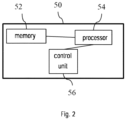
- Fig. 2 is a schematic structural drawing of a clothing treatment apparatus according to embodiments of the present invention.
- a clothing treatment apparatus 50 comprising a memory 52 and a processor 54; the memory 52 stores computer instructions which can run on the processor 54; the processor 54, when running the computer instructions, performs the steps of the method 10 described in the present application.
- the clothing treatment apparatus 50 to automatically start and stop the addition of fragrance, with reference to humidity, to clothing in the process of being dried, helping to improve the convenience of use and fragrance utilization rate of the clothing treatment apparatus 50, and so on.
- the memory 52 may comprise a non-volatile memory or a non-transitory memory, etc.
- the memory 52 may comprise a USB stick, mobile hard disk, read-only memory (ROM), random access memory (RAM), magnetic disk or optical disk, etc.
- the memory 52 stores multiple fragrance settings for the user to select, each fragrance setting corresponding to a scent level of clothing when drying is complete.
- the fragrance settings may comprise strong, medium and weak, etc., respectively corresponding to high, medium and weak, etc. scent concentrations of clothing when drying is complete.
- the processor 54 comprises a control unit 56, adapted to perform step b of beginning to add the fragrance at the first concentration when the humidity falls to the first threshold, and step c of stopping the addition of the fragrance when the humidity falls to the second threshold, wherein the processor 54 is configured such that, in the process of performing step b of beginning to add the fragrance at the first concentration when the humidity falls to the first threshold, the first concentration is associated with a fragrance setting selected by the user.
- the first concentration may be higher. Conversely, if the fragrance concentration corresponding to the fragrance setting selected by the user is lower, the first concentration may be lower.
- the clothing treatment apparatus 50 comprises a washer dryer or a clothes dryer.
- Fig. 3 is a schematic flow chart of a method for using a clothing treatment apparatus to add fragrance to clothing in the process of being dried in some embodiments. As shown in Fig. 3 , in some embodiments, clothing treatment begins, and the user may select an added fragrance concentration.
- a control unit of the clothing treatment apparatus may read the user's selection, and set parameters related to fragrance addition according to the user's selection, for example a first threshold t1 of clothing humidity when the addition of fragrance at a first concentration S1 begins, a clothing humidity tn when fragrance is added at a second concentration Sn for the nth time before the addition of fragrance ends, and a second threshold ti of clothing humidity when the addition of fragrance ends, wherein n may be selected from integers between 1 and infinity.
- a humidity sensor of the clothing treatment apparatus may detect clothing humidity in real time, and the control unit may receive feedback information of the humidity sensor and perform steps b, b1 and c according to this feedback information.
- the addition of fragrance at the first concentration S1 begins when the humidity sensor provides feedback that the clothing humidity has fallen to the first threshold t1, ...
- the addition of fragrance at the second concentration Sn begins when the humidity sensor provides feedback that the clothing humidity has fallen to the third threshold tn, and the fragrance is switched off when the humidity sensor provides feedback that the clothing humidity has fallen to the second threshold ti, thus obtaining a clothing scent level of the selected concentration.
Landscapes
- Engineering & Computer Science (AREA)
- Textile Engineering (AREA)
- Control Of Washing Machine And Dryer (AREA)
Abstract
Description
- The present invention relates to clothes treatment technology, in particular to a method for using a clothing treatment apparatus to add fragrance to clothing in the process of being dried, and a clothing treatment apparatus.
- As the general populace strives to attain better quality of life, fragrance products are being used more widely than before; for example, they are being used in an ever-increasing number of clothing treatment apparatuses.
- When adding fragrance, the majority of existing clothing treatment apparatuses are not able to select the fragrance cut-in time; the fragrance is usually added when the clothing treatment apparatus is started. As a result, much of the fragrance is carried away by condensed water, causing fragrance wastage and extreme residual smell.
- Most existing clothing treatment apparatuses are not able to switch off the fragrance automatically; the user needs to switch it off manually, making the apparatus inconvenient to use.
- Thus, existing methods of adding fragrance to clothing in clothing treatment apparatuses are far from ideal.
- An object of the present invention is to provide an improved method for using a clothing treatment apparatus to add fragrance to clothing in the process of being dried, and a clothing treatment apparatus.
- With regard to the above object, one aspect of embodiments of the present invention relates to a method for using a clothing treatment apparatus to add fragrance to clothing in the process of being dried, the method comprising: step a, acquiring a humidity of the clothing; step b, beginning to add the fragrance at a first concentration when the humidity falls to a first threshold; and step c, stopping the addition of the fragrance when the humidity falls to a second threshold which is less than the first threshold.
- This allows the clothing treatment apparatus to start and stop the addition of fragrance to clothing automatically during drying, helping to achieve a high degree of convenience of fragrance addition, a high fragrance utilization rate, low scent residue in the clothing treatment apparatus, and so on.
- In some embodiments, step a of acquiring a humidity of the clothing comprises detecting a momentary water content of the clothing.
- This allows the clothing treatment apparatus to accurately judge when to automatically start and stop adding fragrance, helping to precisely control the concentration at which fragrance is added.
- In some embodiments, the first threshold comprises the momentary water content in the range of 20% - 10%.
- This allows fragrance to be added in a later stage of the drying of clothing, which can prevent fragrance wastage and extreme scent residue.
- In some embodiments, the second threshold comprises the momentary water content in the range of 3% to -3%.
- This allows the addition of fragrance to be stopped automatically when the drying of clothing ends, with no need for the user to stop the addition manually, helping to achieve a high degree of convenience of use of the clothing treatment apparatus.
- In some embodiments, step b of beginning to add the fragrance at a first concentration when the humidity falls to a first threshold comprises determining a duration parameter reflecting a total duration required for a drying process, and determining the first concentration according to a correspondence between the first concentration and the duration parameter pre-stored in the clothing treatment apparatus, wherein the first concentration is lower if the total duration is longer.
- This allows precise control of the final scent concentration of the clothing.
- In some embodiments, the duration parameter comprises a first rate of change of water content of the clothing within a set time.
- This allows the first concentration to be determined simply and accurately, facilitating precise control of the final scent concentration of the clothing.
- In some embodiments, the duration parameter comprises a momentary water content; for a given value of the momentary water content, a low value of the first rate of change of water content corresponds to a low value of the first concentration.
- This allows the same final scent concentration to be achieved when the same added fragrance concentration is selected for different weights of clothing.
- In some embodiments, after step b of beginning to add the fragrance at a first concentration when the humidity falls to a first threshold but before step c of stopping the addition of the fragrance when the humidity falls to a second threshold, the method comprises: step b 1, beginning to add the fragrance at a second concentration when the humidity falls to a third threshold.
- This allows precise control of the clothing's final scent concentration.
- In some embodiments, a second rate of change of water content corresponding to the time when the humidity falls to the third threshold is computed according to a momentary water content of the clothing, and the second concentration is determined according to the momentary water content and the second rate of change of water content.
- This allows the second concentration to be determined simply and accurately, facilitating precise control of the final scent concentration of the clothing.
- In some embodiments, for a given value of the momentary water content, a low value of the second rate of change of water content corresponds to a low value of the second concentration.
- This allows the same final scent concentration to be achieved when the same added fragrance concentration is selected for different weights of clothing.
- In some embodiments, the third threshold is less than the first threshold but greater than the second threshold, and the second concentration is less than the first concentration.
- This allows the added fragrance concentration to be gradually reduced as the clothing humidity falls during drying, facilitating precise control of the added fragrance concentration and smooth operation of the clothing treatment apparatus.
- In some embodiments, a concentration level of the fragrance is achieved by adjusting the size of an opening of a container of the fragrance.
- This allows convenient adjustment of the fragrance concentration.
- In some embodiments, step a of acquiring a humidity of the clothing comprises acquiring a humidity parameter reflecting a humidity of the clothing.
- This allows the clothing treatment apparatus to accurately determine when to automatically start and stop adding fragrance, helping to achieve a precise correspondence between clothing humidity and added fragrance concentration.
- In some embodiments, the humidity parameter comprises at least one of the following: a humidity value of the clothing, a capacitance of the clothing, a humidity value of air in contact with the clothing, a rate of change of humidity of air in contact with the clothing, and a rate of change of temperature of air in contact with the clothing.
- This allows a humidity parameter effectively reflecting the clothing humidity to be acquired.
- Another aspect of embodiments of the present invention relates to a clothing treatment apparatus, comprising a memory and a processor, the memory storing computer instructions which can run on the processor, wherein the processor, when running the computer instructions, performs the steps of the method as described in the present application.
- This allows the clothing treatment apparatus to automatically start and stop the addition of fragrance to clothing in the process of being dried, helping to improve the convenience of use and fragrance utilization rate of the clothing treatment apparatus, and so on.
- In some embodiments, the memory stores multiple fragrance settings for a user to select, each fragrance setting corresponding to a scent level of the clothing when drying is complete.
- This allows the user to autonomously select the clothing's final scent concentration.
- In some embodiments, the processor comprises a control unit, adapted to perform step b of beginning to add the fragrance at a first concentration when the humidity falls to a first threshold and step c of stopping the addition of the fragrance when the humidity falls to a second threshold, wherein the processor is configured such that, in the process of performing step b of beginning to add the fragrance at a first concentration when the humidity falls to a first threshold, the first concentration is associated with the fragrance setting selected by the user.
- This allows the clothing's final scent concentration to meet user expectations.
- In some embodiments, the clothing treatment apparatus comprises a washer dryer or a clothes dryer.
- This allows the washer dryer or clothes dryer to automatically start and stop the addition of fragrance to clothing in the process of being dried, helping to improve the convenience of use and fragrance utilization rate of the washer dryer or clothes dryer, and so on.
- Where technical conditions permit, the technical solutions in the embodiments of the present application may be combined in any way.
- The present application is described further below with reference to the drawings. Identical or similar labels may be used in the drawings, denoting identical or similar elements, devices, steps or features, etc. in different embodiments. Moreover, descriptions of identical or similar elements, devices, steps, features, effects, etc. in different embodiments may be omitted; and descriptions of elements, devices, steps, features, effects, etc. which are identical or similar to the prior art may be omitted.
-
Fig. 1 is a schematic flow chart of a method for using a clothing treatment apparatus to add fragrance to clothing in the process of being dried according to embodiments of the present invention. -
Fig. 2 is a schematic structural drawing of a clothing treatment apparatus according to embodiments of the present invention; and -
Fig. 3 is a schematic flow chart of a method for using a clothing treatment apparatus to add fragrance to clothing in the process of being dried in some embodiments. -
Fig. 1 is a schematic flow chart of a method for using a clothing treatment apparatus to add fragrance to clothing in the process of being dried according to embodiments of the present invention. As shown inFig. 1 , one aspect of embodiments of the present invention relates to amethod 10 for using a clothing treatment apparatus to add fragrance to clothing in the process of being dried, the method comprising: step a, acquiring a humidity of the clothing; step b, beginning to add fragrance at a first concentration when the humidity falls to a first threshold; and step c, stopping the addition of fragrance when the humidity falls to a second threshold which is less than the first threshold. - This allows the clothing treatment apparatus to start and stop the addition of fragrance to clothing automatically during drying according to clothing humidity, helping to achieve a high degree of convenience of fragrance addition, a high fragrance utilization rate, low scent residue in the clothing treatment apparatus, and so on.
- The type of fragrance added may be freely selected by the user according to their own preferences, and for example may be a floral fragrance, an aquatic fragrance, etc.
- In embodiments of the present application, the humidity of clothing may be obtained by means of a humidity sensor for example. In the process of drying clothing, the clothing treatment apparatus can automatically begin to add fragrance when the humidity sensor senses that the clothing humidity has fallen to the preset first threshold, and automatically stop adding fragrance when the humidity sensor senses that the clothing humidity has fallen to the preset second threshold, with no need for the user to start and stop the addition manually. Furthermore, it is possible to avoid fragrance wastage and extreme scent residue due to much of the fragrance being carried away by condensed water as a result of beginning to add fragrance when the drying of clothing begins, so convenience of use and the fragrance utilization rate can be improved while reducing scent residue, and so on.
- "First", "second", "third" and similar words in the present application are not intended to indicate degree of importance, order of priority or chronological order, etc.; they are mainly used to distinguish between the thresholds, concentrations, etc. which they modify.
- In some embodiments, step a of acquiring the humidity of the clothing comprises detecting a momentary water content of the clothing.
- This allows the clothing treatment apparatus to accurately judge when to automatically start and stop adding fragrance, helping to precisely control the concentration at which fragrance is added.
- During drying, the humidity of clothing gradually decreases with time. The momentary water content of the clothing is detected; the addition of fragrance at the first concentration may be begun promptly when the clothing humidity falls to the first threshold, and the addition of fragrance may be stopped promptly when the clothing humidity falls to the second threshold, such that the final scent concentration of the clothing meets expectations.
- In some embodiments, the first threshold comprises a momentary water content in the range of 20% - 10%.
- This allows the addition of fragrance to be begun in a later stage of the drying of clothing, i.e. when the momentary water content of the clothing is in the range of 20% - 10%, which can prevent fragrance wastage and extreme scent residue.
- In some embodiments, the second threshold comprises a momentary water content in the range of 3% to -3%.
- This allows the addition of fragrance to be stopped automatically when the drying of clothing ends, i.e. when the momentary water content of the clothing is in the range of 3% to -3%, with no need for the user to stop the addition manually, helping to achieve a high degree of convenience of use of the clothing treatment apparatus, and avoiding fragrance wastage and extreme scent residue.
- In some embodiments, step b of beginning to add fragrance at the first concentration when the humidity falls to the first threshold comprises determining a duration parameter reflecting a total duration required for a drying process, and determining the first concentration according to a correspondence between the first concentration and the duration parameter pre-stored in the clothing treatment apparatus, wherein the first concentration is lower if the total duration is longer.
- This allows precise control of the final scent concentration of the clothing.
- In general, if the momentary water content is the same, the total duration required for actual drying is different for different weights of clothing. For example, the total duration of drying required for clothing of higher weight is longer. If fragrance is added at the same concentration to clothing of higher weight and clothing of lower weight, the final scent concentration of the clothing of higher weight will generally be greater than the final scent concentration of the clothing of lower weight, because a longer total duration of drying has elapsed.
- To enable different weights of clothing to ultimately achieve the same expected final scent concentration when drying ends, embodiments of the present application use the method of determining the first concentration with reference to the total duration of drying. For example, the correspondence between the first concentration and the duration parameter pre-stored in the clothing treatment apparatus may comprise: if the total duration of drying is longer, then the clothing is heavier, and a lower first concentration is set accordingly. Conversely, if the total duration of drying is shorter, then the clothing is lighter, and a higher first concentration is set accordingly.
- Thus, when the user selects the same final added fragrance concentration for different clothes, different weights of clothing can have the same final scent concentration when drying ends, avoiding a situation where the final scent concentrations of clothing respectively deviate from an expected added fragrance result due to differences in clothing weight; thus, the final scent concentration of clothing can be precisely controlled according to user expectations.
- In some embodiments, the duration parameter comprises a first rate of change of water content of clothing within a set time.
- This allows the first concentration to be determined simply and accurately, facilitating precise control of the final scent concentration of the clothing.
- The first rate of change of water content of clothing within a set time may be the rate of change of momentary water content of the clothing between the start and end of the set time; for example, it may be equal to the value obtained when the difference between the momentary water content when the set time starts and the momentary water content when the set time ends is divided by the momentary water content when the set time starts.
- The first rate of change of water content of clothing within a set time can affect the total duration of drying of the clothing, and thus affect the final scent concentration of the clothing. For clothing with a higher first rate of change of water content, the total duration required for drying is shorter. Conversely, for clothing with a lower first rate of change of water content, the total duration required for drying is longer.
- Determining the first rate of change of water content of clothing within a set time can be of assistance in determining the first concentration, to control the final scent concentration of the clothing. For clothing with a higher first rate of change of water content, the first concentration can be higher. Conversely, for clothing with a lower first rate of change of water content, the first concentration can be lower.
- In some embodiments, the duration parameter comprises a momentary water content; for a given value of the momentary water content, a low value of the first rate of change of water content corresponds to a low value of the first concentration.
- This allows the same final scent concentration to be achieved when the same added fragrance concentration is selected for different weights of clothing.
- The first concentration may be determined according to the momentary water content of clothing and the first rate of change of water content. For example, for the same momentary water content, if the rate of change of water content is lower, then the clothing is heavier, the total duration of drying required is longer, and the first concentration is lower. Conversely, for the same momentary water content, if the rate of change of water content is higher, then the clothing is lighter, the total duration of drying required is shorter, and the first concentration is higher. This enables the actual added fragrance result of different clothes to conform to an expected result, such that different weights of clothing achieve the same final scent concentration when drying ends; thus, the final scent concentration of clothing can be precisely controlled.
- In some embodiments, after step b of beginning to add the fragrance at the first concentration when the humidity falls to the first threshold, but before step c of stopping the addition of the fragrance when the humidity falls to the second threshold, the method comprises: step b 1, beginning to add fragrance at a second concentration when the humidity falls to a third threshold.
- This allows precise control of the clothing's final scent concentration.
- In the process of drying clothing, as the drying proceeds continuously, the humidity of the clothing continuously falls; based on humidity values at different times, the added fragrance concentration at these times is correspondingly adjusted. For example, the added fragrance concentration may be correspondingly reduced gradually, such that the added fragrance concentration throughout the fragrance addition process is more specific, precise and accurate, so that the clothing's final scent concentration better conforms to the expected result.
- In some embodiments, a second rate of change of water content corresponding to the time when the humidity falls to the third threshold is computed according to a momentary water content of the clothing, and the second concentration is determined according to the momentary water content and the second rate of change of water content.
- This allows the second concentration to be determined simply and accurately, facilitating precise control of the final scent concentration of the clothing.
- The second rate of change of water content may be equal to the value obtained when the difference between a momentary water content of clothing before falling to the third threshold and the third threshold is divided by the momentary water content of the clothing before falling to the third threshold. By determining the corresponding second concentration with reference to the real-time momentary water content which changes continuously during drying and the real-time second rate of change of water content, the added fragrance concentration throughout the fragrance addition process can be made more specific, precise and accurate, so that the clothing's final scent concentration better conforms to the expected result.
- In some embodiments, for a given value of the momentary water content, a low value of the second rate of change of water content corresponds to a low value of the second concentration.
- This allows the clothing scent concentration finally obtained to be the same when the same added fragrance concentration is selected for different weights of clothing.
- For a given momentary water content, a smaller second rate of change of water content corresponds to a longer remaining time of drying, and the second concentration may be lower. Conversely, for a given momentary water content, a greater second rate of change of water content corresponds to a shorter remaining time of drying, and the second concentration may be higher.
- In some embodiments, the third threshold is less than the first threshold but greater than the second threshold, and the second concentration is less than the first concentration.
- This allows the added fragrance concentration to be gradually reduced as the clothing humidity falls during drying, facilitating precise control of the addition concentration and smooth operation of the clothing treatment apparatus.
- In some embodiments, a concentration level of fragrance is achieved by adjusting the size of a fragrance container opening.
- This allows the fragrance concentration to be adjusted conveniently.
- When the fragrance container opening is larger, the corresponding fragrance concentration is higher. Conversely, when the fragrance container opening is smaller, the corresponding fragrance concentration is lower.
- In some embodiments, step a of acquiring the humidity of the clothing comprises acquiring a humidity parameter reflecting the humidity of the clothing.
- This allows the clothing treatment apparatus to accurately determine when to automatically start and stop adding fragrance with the aid of the humidity parameter.
- In some embodiments, the humidity parameter comprises at least one of the following: a humidity value of the clothing, a capacitance of the clothing, a humidity value of air in contact with the clothing, a rate of change of humidity of air in contact with the clothing, and a rate of change of temperature of air in contact with the clothing.
- This allows a humidity parameter effectively reflecting the clothing humidity to be acquired.
- The choice of whether to detect the clothing directly or detect the air in contact with the clothing may be made according to the convenience and possibility of detection, to acquire a corresponding humidity parameter. It is also possible to both detect the clothing directly and detect the air in contact with the clothing to acquire a corresponding humidity parameter.
-
Fig. 2 is a schematic structural drawing of a clothing treatment apparatus according to embodiments of the present invention. As shown inFig. 2 , another aspect of embodiments of the present invention relates to aclothing treatment apparatus 50, comprising amemory 52 and aprocessor 54; thememory 52 stores computer instructions which can run on theprocessor 54; theprocessor 54, when running the computer instructions, performs the steps of themethod 10 described in the present application. - This allows the
clothing treatment apparatus 50 to automatically start and stop the addition of fragrance, with reference to humidity, to clothing in the process of being dried, helping to improve the convenience of use and fragrance utilization rate of theclothing treatment apparatus 50, and so on. - The
memory 52 may comprise a non-volatile memory or a non-transitory memory, etc. Thememory 52 may comprise a USB stick, mobile hard disk, read-only memory (ROM), random access memory (RAM), magnetic disk or optical disk, etc. - In some embodiments, the
memory 52 stores multiple fragrance settings for the user to select, each fragrance setting corresponding to a scent level of clothing when drying is complete. - This allows the user to select the final scent concentration of clothing autonomously.
- For example, the fragrance settings may comprise strong, medium and weak, etc., respectively corresponding to high, medium and weak, etc. scent concentrations of clothing when drying is complete.
- In some embodiments, the
processor 54 comprises acontrol unit 56, adapted to perform step b of beginning to add the fragrance at the first concentration when the humidity falls to the first threshold, and step c of stopping the addition of the fragrance when the humidity falls to the second threshold, wherein theprocessor 54 is configured such that, in the process of performing step b of beginning to add the fragrance at the first concentration when the humidity falls to the first threshold, the first concentration is associated with a fragrance setting selected by the user. - This allows the clothing's final scent concentration to meet user expectations.
- For example, if the fragrance concentration corresponding to the fragrance setting selected by the user is higher, the first concentration may be higher. Conversely, if the fragrance concentration corresponding to the fragrance setting selected by the user is lower, the first concentration may be lower.
- In some embodiments, the
clothing treatment apparatus 50 comprises a washer dryer or a clothes dryer. - This allows the washer dryer or clothes dryer to automatically start and stop the addition of fragrance to clothing in the process of being dried, helping to improve the convenience of use and fragrance utilization rate of the washer dryer or clothes dryer, and so on.
-
Fig. 3 is a schematic flow chart of a method for using a clothing treatment apparatus to add fragrance to clothing in the process of being dried in some embodiments. As shown inFig. 3 , in some embodiments, clothing treatment begins, and the user may select an added fragrance concentration. - A control unit of the clothing treatment apparatus may read the user's selection, and set parameters related to fragrance addition according to the user's selection, for example a first threshold t1 of clothing humidity when the addition of fragrance at a first concentration S1 begins, a clothing humidity tn when fragrance is added at a second concentration Sn for the nth time before the addition of fragrance ends, and a second threshold ti of clothing humidity when the addition of fragrance ends, wherein n may be selected from integers between 1 and infinity.
- In the process of drying, a humidity sensor of the clothing treatment apparatus may detect clothing humidity in real time, and the control unit may receive feedback information of the humidity sensor and perform steps b, b1 and c according to this feedback information.
- Specifically, the addition of fragrance at the first concentration S1 begins when the humidity sensor provides feedback that the clothing humidity has fallen to the first threshold t1, ..., the addition of fragrance at the second concentration Sn begins when the humidity sensor provides feedback that the clothing humidity has fallen to the third threshold tn, and the fragrance is switched off when the humidity sensor provides feedback that the clothing humidity has fallen to the second threshold ti, thus obtaining a clothing scent level of the selected concentration.
- The various particular embodiments described above and shown in the drawings are merely intended to explain the present invention, and are not the entirety of the present invention. Changes of any form made to the present invention by those skilled in the art within the limits of the basic technical concept of the present invention are included in the scope of protection of the present invention.
Claims (18)
- A method (10) for using a clothing treatment apparatus to add fragrance to clothing in the process of being dried, characterized by comprising:step (a), acquiring a humidity of the clothing;step (b), beginning to add the fragrance at a first concentration when the humidity falls to a first threshold; andstep (c), stopping the addition of the fragrance when the humidity falls to a second threshold which is less than the first threshold.
- The method (10) as claimed in claim 1, characterized in that step (a) comprises detecting a momentary water content of the clothing.
- The method (10) as claimed in claim 2, characterized in that the first threshold comprises the momentary water content in the range of 20% - 10%.
- The method (10) as claimed in claim 2, characterized in that the second threshold comprises the momentary water content in the range of 3% to -3%.
- The method (10) as claimed in claim 1, characterized in that step (b) comprises determining a duration parameter reflecting a total duration required for a drying process, and determining the first concentration according to a correspondence between the first concentration and the duration parameter pre-stored in the clothing treatment apparatus, wherein the first concentration is lower if the total duration is longer.
- The method (10) as claimed in claim 5, characterized in that the duration parameter comprises a first rate of change of water content of the clothing within a set time.
- The method (10) as claimed in claim 6, characterized in that the duration parameter comprises a momentary water content; for a given value of the momentary water content, a low value of the first rate of change of water content corresponds to a low value of the first concentration.
- The method (10) as claimed in claim 1, characterized in that after step (b) but before step (c), the method comprises: step (b 1), beginning to add the fragrance at a second concentration when the humidity falls to a third threshold.
- The method (10) as claimed in claim 8, characterized in that a second rate of change of water content corresponding to the time when the humidity falls to the third threshold is computed according to a momentary water content of the clothing, and the second concentration is determined according to the momentary water content and the second rate of change of water content.
- The method (10) as claimed in claim 9, characterized in that for a given value of the momentary water content, a low value of the second rate of change of water content corresponds to a low value of the second concentration.
- The method (10) as claimed in claim 8, characterized in that the third threshold is less than the first threshold but greater than the second threshold, and the second concentration is less than the first concentration.
- The method (10) as claimed in claim 1, characterized in that a concentration level of the fragrance is achieved by adjusting the size of an opening of a container of the fragrance.
- The method (10) as claimed in claim 1, characterized in that step (a) comprises acquiring a humidity parameter reflecting a humidity of the clothing.
- The method (10) as claimed in claim 13, characterized in that the humidity parameter comprises at least one of the following: a humidity value of the clothing, a capacitance of the clothing, a humidity value of air in contact with the clothing, a rate of change of humidity of air in contact with the clothing, and a rate of change of temperature of air in contact with the clothing.
- A clothing treatment apparatus (50), comprising a memory (52) and a processor (54), the memory (52) storing computer instructions which can run on the processor (54), characterized in that the processor (54), when running the computer instructions, performs the steps of the method (10) according to any one of claims 1 - 14.
- The clothing treatment apparatus (50) as claimed in claim 15, characterized in that the memory (52) stores multiple fragrance settings for a user to select, each fragrance setting corresponding to a scent level of the clothing when drying is complete.
- The clothing treatment apparatus (50) as claimed in claim 16, characterized in that the processor (54) comprises a control unit (56), adapted to perform step (b) and step (c), wherein the processor (54) is configured such that, in the process of performing step (b), the first concentration is associated with the fragrance setting selected by the user.
- The clothing treatment apparatus (50) as claimed in any one of claims 15 - 17, characterized by comprising a washer dryer or a clothes dryer.
Applications Claiming Priority (1)
| Application Number | Priority Date | Filing Date | Title |
|---|---|---|---|
| CN202210422246.2A CN116971164A (en) | 2022-04-21 | 2022-04-21 | Method for adding fragrance to clothes in drying process and clothes treatment device |
Publications (2)
| Publication Number | Publication Date |
|---|---|
| EP4265837A1 true EP4265837A1 (en) | 2023-10-25 |
| EP4265837B1 EP4265837B1 (en) | 2025-08-27 |
Family
ID=86095977
Family Applications (1)
| Application Number | Title | Priority Date | Filing Date |
|---|---|---|---|
| EP23168667.6A Active EP4265837B1 (en) | 2022-04-21 | 2023-04-19 | Method for adding fragrance to clothes in drying process and clothes processing device |
Country Status (2)
| Country | Link |
|---|---|
| EP (1) | EP4265837B1 (en) |
| CN (1) | CN116971164A (en) |
Cited By (1)
| Publication number | Priority date | Publication date | Assignee | Title |
|---|---|---|---|---|
| CN119121602A (en) * | 2024-09-14 | 2024-12-13 | 珠海格力电器股份有限公司 | Control method of clothes processing device, electronic device and clothes processing device |
Citations (3)
| Publication number | Priority date | Publication date | Assignee | Title |
|---|---|---|---|---|
| US20030224965A1 (en) * | 2002-05-28 | 2003-12-04 | Johnsondiversey, Inc. | Apparatus, methods, and compositions for adding fragrance to laundry |
| US20040259750A1 (en) * | 2002-04-22 | 2004-12-23 | The Procter & Gamble Company | Processes and apparatuses for applying a benefit composition to one or more fabric articles during a fabric enhancement operation |
| CN110846866A (en) * | 2018-07-24 | 2020-02-28 | 青岛海尔滚筒洗衣机有限公司 | Clothes dryer and control method |
-
2022
- 2022-04-21 CN CN202210422246.2A patent/CN116971164A/en active Pending
-
2023
- 2023-04-19 EP EP23168667.6A patent/EP4265837B1/en active Active
Patent Citations (3)
| Publication number | Priority date | Publication date | Assignee | Title |
|---|---|---|---|---|
| US20040259750A1 (en) * | 2002-04-22 | 2004-12-23 | The Procter & Gamble Company | Processes and apparatuses for applying a benefit composition to one or more fabric articles during a fabric enhancement operation |
| US20030224965A1 (en) * | 2002-05-28 | 2003-12-04 | Johnsondiversey, Inc. | Apparatus, methods, and compositions for adding fragrance to laundry |
| CN110846866A (en) * | 2018-07-24 | 2020-02-28 | 青岛海尔滚筒洗衣机有限公司 | Clothes dryer and control method |
Cited By (1)
| Publication number | Priority date | Publication date | Assignee | Title |
|---|---|---|---|---|
| CN119121602A (en) * | 2024-09-14 | 2024-12-13 | 珠海格力电器股份有限公司 | Control method of clothes processing device, electronic device and clothes processing device |
Also Published As
| Publication number | Publication date |
|---|---|
| EP4265837B1 (en) | 2025-08-27 |
| CN116971164A (en) | 2023-10-31 |
Similar Documents
| Publication | Publication Date | Title |
|---|---|---|
| CN110150711B (en) | Moisture control method and system for moisture regain and humidification process based on multiple regression | |
| EP4265837B1 (en) | Method for adding fragrance to clothes in drying process and clothes processing device | |
| CN114541084B (en) | Dewatering control method and device for washing machine, washing machine and medium | |
| CN116926930B (en) | Clothes drying control method, clothes processing equipment and computer readable storage medium | |
| CN110754937A (en) | Water drainage control method and device for water purifying dispenser, storage medium and water purifying dispenser | |
| CN112656236B (en) | Control method of cooking appliance, cooking appliance and storage medium | |
| CN110685137B (en) | Drying method and device for clothes dryer | |
| CN113699741A (en) | Washing machine control method and system based on cloud rule | |
| CN112359549A (en) | Control method of clothes treatment device and clothes treatment device | |
| WO2018192258A1 (en) | Water heater control method and device, water heater, and control system | |
| CN118512104A (en) | Cooking method, cooking device, electronic equipment and storage medium | |
| CN119632416B (en) | A method for controlling tea steaming based on capacitive liquid level detection | |
| CN118932657A (en) | Method for adjusting detergent dosage, electronic device, and readable storage medium | |
| CN117988078A (en) | Drying equipment, drying control method and storage medium thereof | |
| CN112458697A (en) | Washing control method of clothes treatment equipment and clothes treatment equipment | |
| CN110507205B (en) | Cooking appliance control method and device, storage medium and cooking appliance | |
| CN112921612B (en) | Clothes treatment equipment with clothes drying function and clothes drying time estimation method and module thereof | |
| CN116447733B (en) | Environment humidity degree detection method and device and air conditioner | |
| CN116430928B (en) | Liquid temperature control method and device and temperature control equipment | |
| CN112522930A (en) | Drying time control method of clothes processing equipment | |
| CN116221896B (en) | Equipment control method, device, storage medium, control device and humidification device | |
| CN117144655A (en) | Drying control method, device, storage medium and drying equipment | |
| CN119083128A (en) | Control method of clothing processing equipment and clothing processing equipment | |
| CN110874065A (en) | Cut tobacco dryer outlet moisture control method | |
| CN117845587A (en) | Stop control method and device for drying clothes |
Legal Events
| Date | Code | Title | Description |
|---|---|---|---|
| STAA | Information on the status of an ep patent application or granted ep patent |
Free format text: STATUS: THE APPLICATION HAS BEEN PUBLISHED |
|
| PUAI | Public reference made under article 153(3) epc to a published international application that has entered the european phase |
Free format text: ORIGINAL CODE: 0009012 |
|
| AK | Designated contracting states |
Kind code of ref document: A1 Designated state(s): AL AT BE BG CH CY CZ DE DK EE ES FI FR GB GR HR HU IE IS IT LI LT LU LV MC ME MK MT NL NO PL PT RO RS SE SI SK SM TR |
|
| STAA | Information on the status of an ep patent application or granted ep patent |
Free format text: STATUS: REQUEST FOR EXAMINATION WAS MADE |
|
| 17P | Request for examination filed |
Effective date: 20240425 |
|
| RBV | Designated contracting states (corrected) |
Designated state(s): AL AT BE BG CH CY CZ DE DK EE ES FI FR GB GR HR HU IE IS IT LI LT LU LV MC ME MK MT NL NO PL PT RO RS SE SI SK SM TR |
|
| GRAP | Despatch of communication of intention to grant a patent |
Free format text: ORIGINAL CODE: EPIDOSNIGR1 |
|
| STAA | Information on the status of an ep patent application or granted ep patent |
Free format text: STATUS: GRANT OF PATENT IS INTENDED |
|
| RIC1 | Information provided on ipc code assigned before grant |
Ipc: D06F 25/00 20060101ALN20250407BHEP Ipc: D06F 105/38 20200101ALN20250407BHEP Ipc: D06F 103/38 20200101ALN20250407BHEP Ipc: D06F 103/08 20200101ALN20250407BHEP Ipc: D06F 58/20 20060101ALI20250407BHEP Ipc: D06F 58/44 20200101AFI20250407BHEP |
|
| INTG | Intention to grant announced |
Effective date: 20250424 |
|
| RIN1 | Information on inventor provided before grant (corrected) |
Inventor name: LIU, SHUAI Inventor name: YANG, NING |
|
| GRAS | Grant fee paid |
Free format text: ORIGINAL CODE: EPIDOSNIGR3 |
|
| GRAA | (expected) grant |
Free format text: ORIGINAL CODE: 0009210 |
|
| STAA | Information on the status of an ep patent application or granted ep patent |
Free format text: STATUS: THE PATENT HAS BEEN GRANTED |
|
| AK | Designated contracting states |
Kind code of ref document: B1 Designated state(s): AL AT BE BG CH CY CZ DE DK EE ES FI FR GB GR HR HU IE IS IT LI LT LU LV MC ME MK MT NL NO PL PT RO RS SE SI SK SM TR |
|
| REG | Reference to a national code |
Ref country code: CH Ref legal event code: EP |
|
| REG | Reference to a national code |
Ref country code: DE Ref legal event code: R096 Ref document number: 602023006000 Country of ref document: DE |
|
| REG | Reference to a national code |
Ref country code: IE Ref legal event code: FG4D |
|
| REG | Reference to a national code |
Ref country code: NL Ref legal event code: MP Effective date: 20250827 |
|
| PG25 | Lapsed in a contracting state [announced via postgrant information from national office to epo] |
Ref country code: IS Free format text: LAPSE BECAUSE OF FAILURE TO SUBMIT A TRANSLATION OF THE DESCRIPTION OR TO PAY THE FEE WITHIN THE PRESCRIBED TIME-LIMIT Effective date: 20251227 |
|
| PG25 | Lapsed in a contracting state [announced via postgrant information from national office to epo] |
Ref country code: NO Free format text: LAPSE BECAUSE OF FAILURE TO SUBMIT A TRANSLATION OF THE DESCRIPTION OR TO PAY THE FEE WITHIN THE PRESCRIBED TIME-LIMIT Effective date: 20251127 |
|
| REG | Reference to a national code |
Ref country code: LT Ref legal event code: MG9D |
|
| PG25 | Lapsed in a contracting state [announced via postgrant information from national office to epo] |
Ref country code: PT Free format text: LAPSE BECAUSE OF FAILURE TO SUBMIT A TRANSLATION OF THE DESCRIPTION OR TO PAY THE FEE WITHIN THE PRESCRIBED TIME-LIMIT Effective date: 20251229 |
|
| PG25 | Lapsed in a contracting state [announced via postgrant information from national office to epo] |
Ref country code: FI Free format text: LAPSE BECAUSE OF FAILURE TO SUBMIT A TRANSLATION OF THE DESCRIPTION OR TO PAY THE FEE WITHIN THE PRESCRIBED TIME-LIMIT Effective date: 20250827 |
|
| PG25 | Lapsed in a contracting state [announced via postgrant information from national office to epo] |
Ref country code: HR Free format text: LAPSE BECAUSE OF FAILURE TO SUBMIT A TRANSLATION OF THE DESCRIPTION OR TO PAY THE FEE WITHIN THE PRESCRIBED TIME-LIMIT Effective date: 20250827 Ref country code: NL Free format text: LAPSE BECAUSE OF FAILURE TO SUBMIT A TRANSLATION OF THE DESCRIPTION OR TO PAY THE FEE WITHIN THE PRESCRIBED TIME-LIMIT Effective date: 20250827 |
|
| PG25 | Lapsed in a contracting state [announced via postgrant information from national office to epo] |
Ref country code: GR Free format text: LAPSE BECAUSE OF FAILURE TO SUBMIT A TRANSLATION OF THE DESCRIPTION OR TO PAY THE FEE WITHIN THE PRESCRIBED TIME-LIMIT Effective date: 20251128 |
|
| PG25 | Lapsed in a contracting state [announced via postgrant information from national office to epo] |
Ref country code: SE Free format text: LAPSE BECAUSE OF FAILURE TO SUBMIT A TRANSLATION OF THE DESCRIPTION OR TO PAY THE FEE WITHIN THE PRESCRIBED TIME-LIMIT Effective date: 20250827 |
|
| PG25 | Lapsed in a contracting state [announced via postgrant information from national office to epo] |
Ref country code: LV Free format text: LAPSE BECAUSE OF FAILURE TO SUBMIT A TRANSLATION OF THE DESCRIPTION OR TO PAY THE FEE WITHIN THE PRESCRIBED TIME-LIMIT Effective date: 20250827 |
|
| PG25 | Lapsed in a contracting state [announced via postgrant information from national office to epo] |
Ref country code: PL Free format text: LAPSE BECAUSE OF FAILURE TO SUBMIT A TRANSLATION OF THE DESCRIPTION OR TO PAY THE FEE WITHIN THE PRESCRIBED TIME-LIMIT Effective date: 20250827 Ref country code: BG Free format text: LAPSE BECAUSE OF FAILURE TO SUBMIT A TRANSLATION OF THE DESCRIPTION OR TO PAY THE FEE WITHIN THE PRESCRIBED TIME-LIMIT Effective date: 20250827 |
|
| PG25 | Lapsed in a contracting state [announced via postgrant information from national office to epo] |
Ref country code: RS Free format text: LAPSE BECAUSE OF FAILURE TO SUBMIT A TRANSLATION OF THE DESCRIPTION OR TO PAY THE FEE WITHIN THE PRESCRIBED TIME-LIMIT Effective date: 20251127 |
|
| PG25 | Lapsed in a contracting state [announced via postgrant information from national office to epo] |
Ref country code: ES Free format text: LAPSE BECAUSE OF FAILURE TO SUBMIT A TRANSLATION OF THE DESCRIPTION OR TO PAY THE FEE WITHIN THE PRESCRIBED TIME-LIMIT Effective date: 20250827 |
|
| REG | Reference to a national code |
Ref country code: AT Ref legal event code: MK05 Ref document number: 1830063 Country of ref document: AT Kind code of ref document: T Effective date: 20250827 |
|
| PG25 | Lapsed in a contracting state [announced via postgrant information from national office to epo] |
Ref country code: SM Free format text: LAPSE BECAUSE OF FAILURE TO SUBMIT A TRANSLATION OF THE DESCRIPTION OR TO PAY THE FEE WITHIN THE PRESCRIBED TIME-LIMIT Effective date: 20250827 |
|
| PG25 | Lapsed in a contracting state [announced via postgrant information from national office to epo] |
Ref country code: DK Free format text: LAPSE BECAUSE OF FAILURE TO SUBMIT A TRANSLATION OF THE DESCRIPTION OR TO PAY THE FEE WITHIN THE PRESCRIBED TIME-LIMIT Effective date: 20250827 |
|
| PG25 | Lapsed in a contracting state [announced via postgrant information from national office to epo] |
Ref country code: AT Free format text: LAPSE BECAUSE OF FAILURE TO SUBMIT A TRANSLATION OF THE DESCRIPTION OR TO PAY THE FEE WITHIN THE PRESCRIBED TIME-LIMIT Effective date: 20250827 |
|
| PG25 | Lapsed in a contracting state [announced via postgrant information from national office to epo] |
Ref country code: IT Free format text: LAPSE BECAUSE OF FAILURE TO SUBMIT A TRANSLATION OF THE DESCRIPTION OR TO PAY THE FEE WITHIN THE PRESCRIBED TIME-LIMIT Effective date: 20250827 |
|
| PG25 | Lapsed in a contracting state [announced via postgrant information from national office to epo] |
Ref country code: CZ Free format text: LAPSE BECAUSE OF FAILURE TO SUBMIT A TRANSLATION OF THE DESCRIPTION OR TO PAY THE FEE WITHIN THE PRESCRIBED TIME-LIMIT Effective date: 20250827 |
|
| PG25 | Lapsed in a contracting state [announced via postgrant information from national office to epo] |
Ref country code: SK Free format text: LAPSE BECAUSE OF FAILURE TO SUBMIT A TRANSLATION OF THE DESCRIPTION OR TO PAY THE FEE WITHIN THE PRESCRIBED TIME-LIMIT Effective date: 20250827 Ref country code: EE Free format text: LAPSE BECAUSE OF FAILURE TO SUBMIT A TRANSLATION OF THE DESCRIPTION OR TO PAY THE FEE WITHIN THE PRESCRIBED TIME-LIMIT Effective date: 20250827 |