EP4265820A1 - Composition for surface treatment of steel sheet and steel sheet using same - Google Patents
Composition for surface treatment of steel sheet and steel sheet using same Download PDFInfo
- Publication number
- EP4265820A1 EP4265820A1 EP21907170.1A EP21907170A EP4265820A1 EP 4265820 A1 EP4265820 A1 EP 4265820A1 EP 21907170 A EP21907170 A EP 21907170A EP 4265820 A1 EP4265820 A1 EP 4265820A1
- Authority
- EP
- European Patent Office
- Prior art keywords
- steel sheet
- vanadium
- composition
- weight
- parts
- Prior art date
- Legal status (The legal status is an assumption and is not a legal conclusion. Google has not performed a legal analysis and makes no representation as to the accuracy of the status listed.)
- Pending
Links
Images

Classifications
-
- C—CHEMISTRY; METALLURGY
- C23—COATING METALLIC MATERIAL; COATING MATERIAL WITH METALLIC MATERIAL; CHEMICAL SURFACE TREATMENT; DIFFUSION TREATMENT OF METALLIC MATERIAL; COATING BY VACUUM EVAPORATION, BY SPUTTERING, BY ION IMPLANTATION OR BY CHEMICAL VAPOUR DEPOSITION, IN GENERAL; INHIBITING CORROSION OF METALLIC MATERIAL OR INCRUSTATION IN GENERAL
- C23C—COATING METALLIC MATERIAL; COATING MATERIAL WITH METALLIC MATERIAL; SURFACE TREATMENT OF METALLIC MATERIAL BY DIFFUSION INTO THE SURFACE, BY CHEMICAL CONVERSION OR SUBSTITUTION; COATING BY VACUUM EVAPORATION, BY SPUTTERING, BY ION IMPLANTATION OR BY CHEMICAL VAPOUR DEPOSITION, IN GENERAL
- C23C22/00—Chemical surface treatment of metallic material by reaction of the surface with a reactive liquid, leaving reaction products of surface material in the coating, e.g. conversion coatings, passivation of metals
- C23C22/05—Chemical surface treatment of metallic material by reaction of the surface with a reactive liquid, leaving reaction products of surface material in the coating, e.g. conversion coatings, passivation of metals using aqueous solutions
- C23C22/06—Chemical surface treatment of metallic material by reaction of the surface with a reactive liquid, leaving reaction products of surface material in the coating, e.g. conversion coatings, passivation of metals using aqueous solutions using aqueous acidic solutions with pH less than 6
-
- C—CHEMISTRY; METALLURGY
- C23—COATING METALLIC MATERIAL; COATING MATERIAL WITH METALLIC MATERIAL; CHEMICAL SURFACE TREATMENT; DIFFUSION TREATMENT OF METALLIC MATERIAL; COATING BY VACUUM EVAPORATION, BY SPUTTERING, BY ION IMPLANTATION OR BY CHEMICAL VAPOUR DEPOSITION, IN GENERAL; INHIBITING CORROSION OF METALLIC MATERIAL OR INCRUSTATION IN GENERAL
- C23C—COATING METALLIC MATERIAL; COATING MATERIAL WITH METALLIC MATERIAL; SURFACE TREATMENT OF METALLIC MATERIAL BY DIFFUSION INTO THE SURFACE, BY CHEMICAL CONVERSION OR SUBSTITUTION; COATING BY VACUUM EVAPORATION, BY SPUTTERING, BY ION IMPLANTATION OR BY CHEMICAL VAPOUR DEPOSITION, IN GENERAL
- C23C2/00—Hot-dipping or immersion processes for applying the coating material in the molten state without affecting the shape; Apparatus therefor
- C23C2/26—After-treatment
-
- C—CHEMISTRY; METALLURGY
- C09—DYES; PAINTS; POLISHES; NATURAL RESINS; ADHESIVES; COMPOSITIONS NOT OTHERWISE PROVIDED FOR; APPLICATIONS OF MATERIALS NOT OTHERWISE PROVIDED FOR
- C09D—COATING COMPOSITIONS, e.g. PAINTS, VARNISHES OR LACQUERS; FILLING PASTES; CHEMICAL PAINT OR INK REMOVERS; INKS; CORRECTING FLUIDS; WOODSTAINS; PASTES OR SOLIDS FOR COLOURING OR PRINTING; USE OF MATERIALS THEREFOR
- C09D175/00—Coating compositions based on polyureas or polyurethanes; Coating compositions based on derivatives of such polymers
- C09D175/04—Polyurethanes
-
- C—CHEMISTRY; METALLURGY
- C09—DYES; PAINTS; POLISHES; NATURAL RESINS; ADHESIVES; COMPOSITIONS NOT OTHERWISE PROVIDED FOR; APPLICATIONS OF MATERIALS NOT OTHERWISE PROVIDED FOR
- C09D—COATING COMPOSITIONS, e.g. PAINTS, VARNISHES OR LACQUERS; FILLING PASTES; CHEMICAL PAINT OR INK REMOVERS; INKS; CORRECTING FLUIDS; WOODSTAINS; PASTES OR SOLIDS FOR COLOURING OR PRINTING; USE OF MATERIALS THEREFOR
- C09D7/00—Features of coating compositions, not provided for in group C09D5/00; Processes for incorporating ingredients in coating compositions
- C09D7/40—Additives
- C09D7/65—Additives macromolecular
-
- C—CHEMISTRY; METALLURGY
- C23—COATING METALLIC MATERIAL; COATING MATERIAL WITH METALLIC MATERIAL; CHEMICAL SURFACE TREATMENT; DIFFUSION TREATMENT OF METALLIC MATERIAL; COATING BY VACUUM EVAPORATION, BY SPUTTERING, BY ION IMPLANTATION OR BY CHEMICAL VAPOUR DEPOSITION, IN GENERAL; INHIBITING CORROSION OF METALLIC MATERIAL OR INCRUSTATION IN GENERAL
- C23C—COATING METALLIC MATERIAL; COATING MATERIAL WITH METALLIC MATERIAL; SURFACE TREATMENT OF METALLIC MATERIAL BY DIFFUSION INTO THE SURFACE, BY CHEMICAL CONVERSION OR SUBSTITUTION; COATING BY VACUUM EVAPORATION, BY SPUTTERING, BY ION IMPLANTATION OR BY CHEMICAL VAPOUR DEPOSITION, IN GENERAL
- C23C2/00—Hot-dipping or immersion processes for applying the coating material in the molten state without affecting the shape; Apparatus therefor
- C23C2/04—Hot-dipping or immersion processes for applying the coating material in the molten state without affecting the shape; Apparatus therefor characterised by the coating material
- C23C2/06—Zinc or cadmium or alloys based thereon
-
- C—CHEMISTRY; METALLURGY
- C23—COATING METALLIC MATERIAL; COATING MATERIAL WITH METALLIC MATERIAL; CHEMICAL SURFACE TREATMENT; DIFFUSION TREATMENT OF METALLIC MATERIAL; COATING BY VACUUM EVAPORATION, BY SPUTTERING, BY ION IMPLANTATION OR BY CHEMICAL VAPOUR DEPOSITION, IN GENERAL; INHIBITING CORROSION OF METALLIC MATERIAL OR INCRUSTATION IN GENERAL
- C23C—COATING METALLIC MATERIAL; COATING MATERIAL WITH METALLIC MATERIAL; SURFACE TREATMENT OF METALLIC MATERIAL BY DIFFUSION INTO THE SURFACE, BY CHEMICAL CONVERSION OR SUBSTITUTION; COATING BY VACUUM EVAPORATION, BY SPUTTERING, BY ION IMPLANTATION OR BY CHEMICAL VAPOUR DEPOSITION, IN GENERAL
- C23C2/00—Hot-dipping or immersion processes for applying the coating material in the molten state without affecting the shape; Apparatus therefor
- C23C2/34—Hot-dipping or immersion processes for applying the coating material in the molten state without affecting the shape; Apparatus therefor characterised by the shape of the material to be treated
- C23C2/36—Elongated material
- C23C2/40—Plates; Strips
-
- C—CHEMISTRY; METALLURGY
- C23—COATING METALLIC MATERIAL; COATING MATERIAL WITH METALLIC MATERIAL; CHEMICAL SURFACE TREATMENT; DIFFUSION TREATMENT OF METALLIC MATERIAL; COATING BY VACUUM EVAPORATION, BY SPUTTERING, BY ION IMPLANTATION OR BY CHEMICAL VAPOUR DEPOSITION, IN GENERAL; INHIBITING CORROSION OF METALLIC MATERIAL OR INCRUSTATION IN GENERAL
- C23C—COATING METALLIC MATERIAL; COATING MATERIAL WITH METALLIC MATERIAL; SURFACE TREATMENT OF METALLIC MATERIAL BY DIFFUSION INTO THE SURFACE, BY CHEMICAL CONVERSION OR SUBSTITUTION; COATING BY VACUUM EVAPORATION, BY SPUTTERING, BY ION IMPLANTATION OR BY CHEMICAL VAPOUR DEPOSITION, IN GENERAL
- C23C22/00—Chemical surface treatment of metallic material by reaction of the surface with a reactive liquid, leaving reaction products of surface material in the coating, e.g. conversion coatings, passivation of metals
- C23C22/05—Chemical surface treatment of metallic material by reaction of the surface with a reactive liquid, leaving reaction products of surface material in the coating, e.g. conversion coatings, passivation of metals using aqueous solutions
- C23C22/06—Chemical surface treatment of metallic material by reaction of the surface with a reactive liquid, leaving reaction products of surface material in the coating, e.g. conversion coatings, passivation of metals using aqueous solutions using aqueous acidic solutions with pH less than 6
- C23C22/40—Chemical surface treatment of metallic material by reaction of the surface with a reactive liquid, leaving reaction products of surface material in the coating, e.g. conversion coatings, passivation of metals using aqueous solutions using aqueous acidic solutions with pH less than 6 containing molybdates, tungstates or vanadates
- C23C22/42—Chemical surface treatment of metallic material by reaction of the surface with a reactive liquid, leaving reaction products of surface material in the coating, e.g. conversion coatings, passivation of metals using aqueous solutions using aqueous acidic solutions with pH less than 6 containing molybdates, tungstates or vanadates containing also phosphates
-
- C—CHEMISTRY; METALLURGY
- C23—COATING METALLIC MATERIAL; COATING MATERIAL WITH METALLIC MATERIAL; CHEMICAL SURFACE TREATMENT; DIFFUSION TREATMENT OF METALLIC MATERIAL; COATING BY VACUUM EVAPORATION, BY SPUTTERING, BY ION IMPLANTATION OR BY CHEMICAL VAPOUR DEPOSITION, IN GENERAL; INHIBITING CORROSION OF METALLIC MATERIAL OR INCRUSTATION IN GENERAL
- C23C—COATING METALLIC MATERIAL; COATING MATERIAL WITH METALLIC MATERIAL; SURFACE TREATMENT OF METALLIC MATERIAL BY DIFFUSION INTO THE SURFACE, BY CHEMICAL CONVERSION OR SUBSTITUTION; COATING BY VACUUM EVAPORATION, BY SPUTTERING, BY ION IMPLANTATION OR BY CHEMICAL VAPOUR DEPOSITION, IN GENERAL
- C23C28/00—Coating for obtaining at least two superposed coatings either by methods not provided for in a single one of groups C23C2/00 - C23C26/00 or by combinations of methods provided for in subclasses C23C and C25C or C25D
- C23C28/30—Coatings combining at least one metallic layer and at least one inorganic non-metallic layer
- C23C28/32—Coatings combining at least one metallic layer and at least one inorganic non-metallic layer including at least one pure metallic layer
- C23C28/322—Coatings combining at least one metallic layer and at least one inorganic non-metallic layer including at least one pure metallic layer only coatings of metal elements only
- C23C28/3225—Coatings combining at least one metallic layer and at least one inorganic non-metallic layer including at least one pure metallic layer only coatings of metal elements only with at least one zinc-based layer
-
- C—CHEMISTRY; METALLURGY
- C23—COATING METALLIC MATERIAL; COATING MATERIAL WITH METALLIC MATERIAL; CHEMICAL SURFACE TREATMENT; DIFFUSION TREATMENT OF METALLIC MATERIAL; COATING BY VACUUM EVAPORATION, BY SPUTTERING, BY ION IMPLANTATION OR BY CHEMICAL VAPOUR DEPOSITION, IN GENERAL; INHIBITING CORROSION OF METALLIC MATERIAL OR INCRUSTATION IN GENERAL
- C23C—COATING METALLIC MATERIAL; COATING MATERIAL WITH METALLIC MATERIAL; SURFACE TREATMENT OF METALLIC MATERIAL BY DIFFUSION INTO THE SURFACE, BY CHEMICAL CONVERSION OR SUBSTITUTION; COATING BY VACUUM EVAPORATION, BY SPUTTERING, BY ION IMPLANTATION OR BY CHEMICAL VAPOUR DEPOSITION, IN GENERAL
- C23C28/00—Coating for obtaining at least two superposed coatings either by methods not provided for in a single one of groups C23C2/00 - C23C26/00 or by combinations of methods provided for in subclasses C23C and C25C or C25D
- C23C28/30—Coatings combining at least one metallic layer and at least one inorganic non-metallic layer
- C23C28/34—Coatings combining at least one metallic layer and at least one inorganic non-metallic layer including at least one inorganic non-metallic material layer, e.g. metal carbide, nitride, boride, silicide layer and their mixtures, enamels, phosphates and sulphates
-
- C—CHEMISTRY; METALLURGY
- C23—COATING METALLIC MATERIAL; COATING MATERIAL WITH METALLIC MATERIAL; CHEMICAL SURFACE TREATMENT; DIFFUSION TREATMENT OF METALLIC MATERIAL; COATING BY VACUUM EVAPORATION, BY SPUTTERING, BY ION IMPLANTATION OR BY CHEMICAL VAPOUR DEPOSITION, IN GENERAL; INHIBITING CORROSION OF METALLIC MATERIAL OR INCRUSTATION IN GENERAL
- C23F—NON-MECHANICAL REMOVAL OF METALLIC MATERIAL FROM SURFACE; INHIBITING CORROSION OF METALLIC MATERIAL OR INCRUSTATION IN GENERAL; MULTI-STEP PROCESSES FOR SURFACE TREATMENT OF METALLIC MATERIAL INVOLVING AT LEAST ONE PROCESS PROVIDED FOR IN CLASS C23 AND AT LEAST ONE PROCESS COVERED BY SUBCLASS C21D OR C22F OR CLASS C25
- C23F11/00—Inhibiting corrosion of metallic material by applying inhibitors to the surface in danger of corrosion or adding them to the corrosive agent
- C23F11/08—Inhibiting corrosion of metallic material by applying inhibitors to the surface in danger of corrosion or adding them to the corrosive agent in other liquids
- C23F11/18—Inhibiting corrosion of metallic material by applying inhibitors to the surface in danger of corrosion or adding them to the corrosive agent in other liquids using inorganic inhibitors
-
- C—CHEMISTRY; METALLURGY
- C23—COATING METALLIC MATERIAL; COATING MATERIAL WITH METALLIC MATERIAL; CHEMICAL SURFACE TREATMENT; DIFFUSION TREATMENT OF METALLIC MATERIAL; COATING BY VACUUM EVAPORATION, BY SPUTTERING, BY ION IMPLANTATION OR BY CHEMICAL VAPOUR DEPOSITION, IN GENERAL; INHIBITING CORROSION OF METALLIC MATERIAL OR INCRUSTATION IN GENERAL
- C23C—COATING METALLIC MATERIAL; COATING MATERIAL WITH METALLIC MATERIAL; SURFACE TREATMENT OF METALLIC MATERIAL BY DIFFUSION INTO THE SURFACE, BY CHEMICAL CONVERSION OR SUBSTITUTION; COATING BY VACUUM EVAPORATION, BY SPUTTERING, BY ION IMPLANTATION OR BY CHEMICAL VAPOUR DEPOSITION, IN GENERAL
- C23C2222/00—Aspects relating to chemical surface treatment of metallic material by reaction of the surface with a reactive medium
- C23C2222/10—Use of solutions containing trivalent chromium but free of hexavalent chromium
-
- C—CHEMISTRY; METALLURGY
- C23—COATING METALLIC MATERIAL; COATING MATERIAL WITH METALLIC MATERIAL; CHEMICAL SURFACE TREATMENT; DIFFUSION TREATMENT OF METALLIC MATERIAL; COATING BY VACUUM EVAPORATION, BY SPUTTERING, BY ION IMPLANTATION OR BY CHEMICAL VAPOUR DEPOSITION, IN GENERAL; INHIBITING CORROSION OF METALLIC MATERIAL OR INCRUSTATION IN GENERAL
- C23C—COATING METALLIC MATERIAL; COATING MATERIAL WITH METALLIC MATERIAL; SURFACE TREATMENT OF METALLIC MATERIAL BY DIFFUSION INTO THE SURFACE, BY CHEMICAL CONVERSION OR SUBSTITUTION; COATING BY VACUUM EVAPORATION, BY SPUTTERING, BY ION IMPLANTATION OR BY CHEMICAL VAPOUR DEPOSITION, IN GENERAL
- C23C2222/00—Aspects relating to chemical surface treatment of metallic material by reaction of the surface with a reactive medium
- C23C2222/20—Use of solutions containing silanes
Definitions
- the present invention relates to a composition for surface treatment of a steel sheet, including a trivalent chromium compound, and a steel sheet using the same.
- highly corrosion-resistant hot-dip plated materials include zinc (Zn), magnesium (Mg), and aluminum (Al), they are known as materials with excellent red rust resistance.
- an exposed surface of a highly corrosion-resistant hot-dip plated material mostly consists of Zn or a Zn alloy, when exposed to a humid atmosphere, the highly corrosion-resistant hot-dip plated material easily has point-like corrosion defects on its surface, resulting in poor appearance.
- hexavalent chromium is designated as a harmful environmental material and a carcinogen
- regulations on the use of hexavalent chromium are currently being tightened.
- bivalent chromium, tetravalent chromium, and pentavalent chromium are relatively unstable, they are rarely applied to the composition of a surface treatment solution.
- the chemical conversion coating method has problems of a long immersion time and deterioration in fingerprint resistance to be applied to a continuous process of a steel manufacturer.
- a composition containing trivalent chromium is coated on a steel sheet in a drawing through a spraying or roll coater method, so it can be applied to a continuous process of a steel manufacturer and secure fingerprint resistance.
- the composition includes a porous silica component having a strong moisture absorbing property, it may cause rapid discoloration in a Mg-, Al-, or Zn-alloy steel sheet.
- the present invention is directed to providing a composition for surface treatment of a steel sheet, which enables a steel sheet to improve plate corrosion resistance, processed part corrosion resistance, pitting corrosion resistance, and foreign matter defects.
- the present invention is also directed to providing a composition for surface treatment of a steel sheet, which allows a steel sheet to improve blackening resistance, pipe-forming oil infiltration, and alkali resistance.
- the present invention is also directed to providing a steel sheet which has excellent corrosion resistance, excellent blackening resistance, excellent pipe forming oil infiltration, and excellent alkali resistance, and improved foreign matter defects.
- a composition for surface treatment of a steel sheet according to the present invention includes a trivalent chromium compound; an adhesion-improving agent including a saline compound; an acidity regulator including an acid; a crosslinking agent including a silicate compound; a vanadium-based pitting corrosion-improving agent; a polymer resin; and a solvent.
- a steel sheet according to the present invention includes a steel sheet base material; a zinc plating layer disposed on the steel sheet base material; and a surface treatment layer disposed on the zinc plating layer, wherein the surface treatment layer includes a trivalent chromium compound, an adhesion-improving agent including a silane compound, an acidity regulator including an acid, a crosslinking agent including a silicate compound, a vanadium-based pitting corrosion-improving agent, and a polymer resin.
- a steel sheet according to the present invention has an effect of improving plate corrosion resistance, processed part corrosion resistance, pitting corrosion resistance, and foreign matter defects.
- the steel sheet according to the present invention has excellent effects on blackening resistance, pipe-forming oil infiltration, and alkali resistance.
- the steel sheet according to the present invention has an effect of improving the lifetime of a product and solving problems generated in a distribution process such as the toll processing of the steel sheet.
- the placement of an arbitrary element above (or below) or on (or under) another element may mean that not only an arbitrary element is placed in contact with the top surface (or the bottom surface) of another element, but also a third element is interposed between a first element and a second element placed on (or under) the first element.
- composition for surface treatment of the present invention includes a trivalent chromium compound with low toxicity, instead of a hexavalent chromium compound, which is a harmful environmental material and carcinogen, and thus has the effect of preventing problems such as damage to the human body and environmental pollution.
- composition for surface treatment of a steel sheet according to the present invention does not include a porous silica element, it has the effect of preventing a phenomenon that causes rapid discoloration.
- the composition for surface treatment of a steel sheet according to the present invention includes a trivalent chromium compound, an adhesion-improving agent including a silane compound, an acidity regulator including an acid, a crosslinking agent including a silicate compound, a vanadium-based pitting corrosion-improving agent, a polymer resin, and a solvent.
- the trivalent chromium compound has low toxicity and is stable, and usually forms an insoluble coating film on the surface of the steel sheet to provide corrosion resistance by a barrier effect.
- the trivalent chromium compound may be included at 0.5 to 17 parts by weight with respect to 100 parts by weight of the solvent. With respect to 100 parts by weight of the solvent, the trivalent chromium compound is preferably included at 0.8 to 17 parts by weight, 1 to 16 parts by weight, 1.1 to 16.9 parts by weight, 1.2 to 16.7 parts by weight, 1.2 to 16.5 parts by weight, or 1.3 to 16.1 parts by weight.
- the trivalent chromium compound When included at less than 0.5 parts by weight, a solid insoluble coating film is not sufficiently formed, so moisture penetrating into the surface of the steel sheet may not be effectively blocked, and thus corrosion resistance may not be secured.
- the trivalent chromium compound when included at more than 17 parts by weight, foreign matter defects may be caused by an excessive chromium content.
- the trivalent chromium compound may include one or more of chromium sulfate, chromium nitrate, chromium phosphate, chromium fluoride, and chromium chloride.
- the adhesion-improving agent including a silane compound is bound with a crosslinking agent and a resin and also with the steel sheet, and serves to improve the adhesiveness and corrosion resistance of a surface treatment layer.
- the silane compound promotes the dryness of the surface treatment layer and imparts high corrosion resistance.
- the adhesion-improving agent including a silane compound may be included at 0.1 to 40 parts by weight with respect to 100 parts by weight of the solvent.
- the adhesion-improving agent is preferably included at 0.1 to 38 parts by weight, 0.5 to 37 parts by weight, 1 to 36 parts by weight, 1.1 to 35.9 parts by weight, or 1.2 to 35.7 parts by weight with respect to 100 parts by weight of the solvent.
- the adhesion-improving agent When included at less than 0.1 parts by weight, the adhesion with the steel sheet may not be sufficiently secured and thus corrosion resistance may not be secured.
- adhesion-improving agent when included at more than 40 parts by weight, corrosion resistance may not be secured due to a large amount of unreacted silane remaining after forming a coating film.
- the adhesion-improving agent including a silane compound may include one or more selected from the group consisting of vinylmethoxysilane, vinyltrimethoxysilane, vinyl epoxysilane, vinyltriepoxysilane, 3-aminopropyltriepoxysilane, 3-glycidoxypropyltrimethoxysilane, 3-metaglyoxypropyltrimethoxysilane, 3-glycidoxypropyltriethoxysilane, 3-glycidoxytrimethyldimethoxysilane, N-(3-(trimethoxysilyl)propyl)ethylenediamine (AEAPTMS), 2-(3,4-epoxycyclohexyl)ethyltrimethoxysilane, 2-(3,4-epoxycyclohexyl)ethyltriepoxysilane, 3-(2,3-epoxypropoxy)propyltrimethoxysilane, 3-(2,3-epoxypropoxy)propyl
- the acidity regulator including an acid may adjust the pH of the composition for surface treatment to allow components to be stably present in the composition and appropriately react under coating conditions, thereby stably forming a coating film.
- the acidity regulator including an acid may be included at 0.5 to 11 parts by weight with respect to 100 parts by weight of the solvent.
- the acidity regulator is preferably included at 0.8 to 10 parts by weight, 1 to 9 parts by weight, 1.1 to 8.8 parts by weight, 1.2 to 8.4 parts by weight, and 1.2 to 8.1 parts by weight with respect to 100 parts by weight of the solvent.
- the acidity regulator including an acid When the acidity regulator including an acid is included at less than 0.5 parts by weight, the pH may increase and thus the stability of the solution may be reduced. On the other hand, when the acidity regulator including an acid is included at more than 11 parts by weight, corrosion resistance may not be secured due to an excessively low pH.
- the acidity regulator including an acid may include one or more of phosphoric acid, nitric acid, sulfuric acid, hydrofluoric acid, hydrochloric acid, ammonium phosphate ((NH 4 ) 2 HPO 4 , (NH 4 )H 2 PO 4 ), monophosphate (NaH 2 PO 4 ), diphosphate (Na 2 HPO 4 ), phytic acid, glycolic acid, lactic acid, and acetic acid.
- the crosslinking agent including a silicate compound reacts with an adhesion-improving agent and a resin to increase the degree of crosslinking of the composition, thereby improving the corrosion resistance of a coated steel sheet.
- the crosslinking agent including a silicate compound may be included at 2 to 20 parts by weight with respect to 100 parts by weight of the solvent.
- the crosslinking agent is preferably included at 2 to 19 parts by weight, 2 to 18 parts by weight, 2.2 to 17.8 parts by weight, 2.4 to 17.6 parts by weight, and 2.5 to 17.3 parts by weight with respect to 100 parts by weight of the solvent.
- crosslinking agent including a silicate compound When the crosslinking agent including a silicate compound is included at less than 2 parts by weight, corrosion resistance may not be secured due to an insufficient degree of crosslinking of the surface treatment layer.
- the crosslinking agent including a silicate compound when included at more than 20 parts by weight, corrosion resistance may not be secured due to a large amount of unbound silicate remaining after forming the coating film.
- the crosslinking agent including a silicate compound may include one or more of sodium silicate, calcium silicate, potassium silicate, aluminum silicate, lithium polysilicate, tetramethyl orthosilicate, and tetraethyl orthosilicate.
- the vanadium-based pitting corrosion-improving agent serves to inhibit the formation of fine pitting corrosion by lowering a temperature to perform the crosslinking reaction between a resin and a crosslinking agent and an adhesion-improving agent at a low temperature.
- the vanadium-based pitting corrosion-improving agent may be included at 0.1 to 14.3 parts by weight with respect to 100 parts by weight of the solvent.
- the pitting corrosion-improving agent is preferably included at 2 to 14.0 parts by weight, 2.5 to 13.9 parts by weight, 2.6 to 13.9 parts by weight, or 2.8 to 13.9 parts by weight with respect to 100 parts by weight of the solvent.
- vanadium-based pitting corrosion-improving agent When the vanadium-based pitting corrosion-improving agent is less than 0.1 parts by weight, corrosion resistance may not be secured due to an insufficient degree of crosslinking of the surface treatment layer.
- the polymer resin is added to form a solid coating layer on the surface of the steel sheet along with a trivalent chromium compound, an adhesion-improving agent, and a crosslinking agent.
- alkali resistance and pipe-forming oil infiltration may be improved by improving the action of forming a dense coating film.
- a polymer resin may be included at 0.5 to 25 parts by weight.
- the polymer resin is preferably included at 0.7 to 23 parts by weight, 1 to 20 parts by weight, 1.8 to 18 parts by weight, 1.6 to 16 parts by weight, or 1.4 to 15.8 parts by weight.
- the polymer resin When the polymer resin is included at less than 0.5 parts by weight, it may be difficult to secure pipe-forming oil infiltration and alkali resistance due to an insufficiently formed coating film. On the other hand, when the polymer resin is included at more than 25 parts by weight, corrosion resistance may not be secured due to a relative decrease in the content of the trivalent chromium compound.
- the polymer resin is an emulsion-type resin, and may include one or more of a cationic polyurethane resin, a non-ionic polyurethane resin, a cationic acrylic resin, and a non-ionic acrylic resin.
- the emulsion-type resin refers to a mixture of distilled water and a material that is not compatible with distilled water, and has excellent dispersibility and storability, so it does not cause a layer separation phenomenon even when left for a long time.
- Each of the cationic polyurethane resin and the cationic acrylic resin may include a cationic functional group including one or more of primary to tertiary amino groups and a quaternary ammonium base.
- the cationic functional group may include one or more of an amino group, a methylamino group, an ethylamino group, a dimethylamino group, a diethylamino group, a trimethylamino group, and a triethylamino group.
- the nonionic polyurethane resin may be a resin that is emulsified by a nonionic emulsifier, or may be formed using a non-ionic polyol.
- the non-ionic acrylic resin may be a resin that is emulsified by a non-ionic acrylic resin, or may include one or more of non-ionic phenoxyethyl (meth)acrylate, polyethylene glycol (meth)acrylate, ethoxyethoxyethyl acrylate, phenoxy polyethylene glycol (meth)acrylate, nonylphenol polyethylene glycol (meth)acrylate, methoxy polyethylene glycol (meth)acrylate, polyethylene glycol mono(meth)acrylate, polypropylene glycol mono(meth)acrylate, polytetramethylene glycol mono(meth)acrylate, polyethylene glycol polytetramethylene glycol mono(meth)acrylate, and polypropylene glycol polytetramethylene glycol mono(meth)acrylate.
- the solvent included in the composition for surface treatment of the steel sheet of the present invention may be added to dilute the components of the composition and may include one or more of ethanol, distilled water, and deionized water.
- the solvent is included as a remainder based on a total of 100 wt% of the composition for surface treatment of the steel sheet, and may be included at approximately 50 to 85 wt% with respect to a total of 100 wt% of the composition.
- the composition for surface treatment of a steel sheet may be prepared by mixing and a stirring solvent, a trivalent chromium compound, an adhesion-improving agent, an acidity regulator, a crosslinking agent, a pitting corrosion-improving agent, and a polymer resin.
- Mixing and stirring temperatures may be 24 to 80 °C, but the present invention is not limited thereto.
- the composition for surface treatment of a steel sheet of the present invention is a composition that includes a small amount of trivalent chromium compound, adhesion-improving agent, acidity regulator, crosslinking agent, pitting corrosion-improving agent, and polymer resin, and a large amount of solvent.
- the composition of the present invention has the effect of imparting corrosion resistance to the steel sheet and further improving foreign matter defects by adjusting its components and composition ratio.
- a steel sheet using the composition for surface treatment of a steel sheet of the present invention is as follows.
- the steel sheet includes a steel sheet base material, a zinc plating layer disposed on the steel sheet base material, and a surface treatment layer disposed on the zinc plating layer.
- the steel sheet base material may use a cold-rolled steel sheet, an aluminum-plated steel sheet, an aluminum alloy sheet, a phosphate-coated zinc-plating steel sheet, or a hot-rolled steel sheet, but the present invention is not particularly limited thereto.
- the zinc plating layer may be formed by a hot-dip galvanization method or electrogalvanization method.
- Hot-dip galvanization is called hot-dip galva or GI, and a method in which zinc is melted by heating at high temperature and then a product to be plated is added and cooled.
- Electrogalvanization is a method of adding a product to be plated to a plating solution containing zinc and plating it through electrolysis.
- the surface treatment layer is a coating film formed from the composition for surface treatment of a steel sheet, and the solvent included in the composition is removed, leaving the other components.
- the surface treatment layer may be formed from a composition for surface treatment of a steel sheet, which includes 0.5 to 17 parts by weight of a trivalent chromium compound, 0.1 to 40 parts by weight of an adhesion-improving agent including a silane compound, 0.5 to 11 parts by weight of an acidity regulator including an acid, 2 to 20 parts by weight of a crosslinking agent including a silicate compound, 0.1 to 14.3 parts by weight of a vanadium-based pitting corrosion-improving agent, and 0.5 to 25 parts by weight of a polymer resin with respect to 100 parts by weight of the solvent.
- a composition for surface treatment of a steel sheet which includes 0.5 to 17 parts by weight of a trivalent chromium compound, 0.1 to 40 parts by weight of an adhesion-improving agent including a silane compound, 0.5 to 11 parts by weight of an acidity regulator including an acid, 2 to 20 parts by weight of a crosslinking agent including a silicate compound, 0.1 to 14.3 parts by weight of a vanadium
- the surface treatment layer may include a trivalent chromium compound, an adhesion-improving agent including a silane compound, an acidity regulator including an acid, a crosslinking agent including a silicate compound, a vanadium-based pitting corrosion-improving agent, and a polymer resin.
- the surface treatment layer may be formed such that the trivalent chromium compound is contained at approximately 10 to 70 mg/m 2 .
- the surface treatment layer is formed such that the trivalent chromium compound is contained preferably at approximately 30 to 60 mg/m 2 .
- the content of the trivalent chromium compound in the surface treatment layer may satisfy approximately 10 to 70 mg/m 2 , and thus an advantage of exhibiting excellent physical properties may be obtained.
- the surface treatment layer may be formed to approximately 0.1 to 50 ⁇ m, but the present invention is not limited thereto.
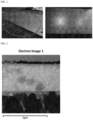
- FIG. 2 is a photograph of the microstructure of the surface treatment layer of the present invention, and the following Table A and FIG. 3 show the results of EDS component analysis of the surface treatment layer of the present invention.
- Table A Component Wt% C 6.9% O 29.5% Mg 2.2% Al 0.2% Si 25.2% P 6.5% V 0.5% Cr 17.6% Fe 0.3% Co 0.4% Zn 10.8% Total: 100%
- the components constituting the surface treatment layer were analyzed by observing the cross-sectional shape of the surface treatment layer (coating layer).
- the surface treatment layer includes a trivalent chromium compound, an adhesion-improving agent including a silane compound, an acidity regulator including an acid, a crosslinking agent including a silicate compound, a vanadium-based pitting corrosion-improving agent, and a polymer resin.
- a method of preparing a steel sheet of the present invention may include forming a zinc plating layer on a steel sheet base material, and coating and drying a composition for surface treatment.
- a method of coating the composition for surface treatment is not limited as long as it is a coating method which is conventionally performed.
- the coating method may be performed by any one method of roll coating, bar coating, spraying, dipping, spray squeezing, and dip squeezing.
- drying is not limited as long as it is performed under conventional conditions.
- drying may be performed at approximately 40 to 200 °C.
- the steel sheet has a white rust generation time of 144 hours or more when measuring the white rust rate of the steel sheet in accordance with ASTM B117 based on the evaluation criteria for plate corrosion resistance.
- the white rust generation time may be 144 to 300 hours, 144 to 250 hours, or 144 to 200 hours.
- the steel sheet has no white rust or very weak white rust according to the evaluation criteria for processed part corrosion resistance.
- the steel sheet satisfies ⁇ E ⁇ 2 according to the evaluation criteria for pipe-forming oil infiltration.
- the steel sheet may satisfy 0 ⁇ ⁇ E ⁇ 2, and 0 ⁇ ⁇ E ⁇ 1.5.
- ⁇ E L ⁇ 2 + a ⁇ 2 + b ⁇ 2
- L* denotes brightness
- a* denotes green, red-based coordinates
- b* denotes yellow, blue-based coordinates (based on the CIE Lab color space).
- the steel sheet satisfies ⁇ E ⁇ 2 according to the evaluation criteria for alkali resistance.
- the steel sheet may satisfy 0 ⁇ ⁇ E ⁇ 2 and 0 ⁇ ⁇ E ⁇ 1.5.
- the steel sheet has 20 or fewer point defects on its surface according to the evaluation criteria for pitting corrosion resistance.
- the number of point defects may be 0 to 20, 0 to 15, 0 to 10, 0 to 7, or 0 to 4.
- the whiteness may satisfy 0 ⁇ ⁇ L ⁇ 2.5, 0 ⁇ ⁇ L ⁇ 2.0, 0 ⁇ ⁇ L ⁇ 1.8, or 0 ⁇ ⁇ L ⁇ 1.4.
- FIG. 1 is the set of photographs of a highly corrosion-resistant plated steel sheet (left) in which pitting corrosion occurs and a highly corrosion-resistant plated steel sheet (right) which is coated with a composition for surface treatment of the present invention.
- the surface-treated, highly corrosion-resistant plated steel sheet of the present invention has neither pitting corrosion nor foreign matter defects.
- composition for surface treatment of a steel sheet and a steel sheet using the same are as follows.
- composition ratios in Tables 1 and 2 below first, with respect to 100 parts by weight of distilled water, phosphoric acid as an acidity regulator was added, chromium nitrate as a trivalent chromium compound was added at approximately 40 °C, and then the resulting mixture was stirred for approximately 30 minutes.
- composition for surface treatment was prepared by adding glycidoxypropyltrimethoxysilane as an adhesion-improving agent, potassium silicate as a crosslinking agent, ammonium metavanadate as a pitting corrosion-improving agent, and an acrylic emulsion as an organic resin every 30 minutes while stirring the resulting mixture.
- test specimens were prepared using the prepared composition for surface treatment as follows.
- a specimen was prepared by cutting a highly corrosion-resistant hot-dip galvanized steel sheet (Zn-Al-Mg) to 7 cm ⁇ 15 cm (width ⁇ length), degreasing the piece of sheet and performing bar coating such that the adhesion amount of a coating film is approximately 50 mg/m 2 based on Cr.
- the white rust generation rate of the steel sheet was measured over time.
- the white rust generation time was 144 hours or more
- ⁇ the white rust generation time is 96 hours or more to less than 144 hours
- X the white rust generation time was less than 96 hours.
- the steel sheet treated with the trivalent chromium surface treatment composition was pushed up to a height of 6 mm using an Erichsen tester, and after 24 hours, the degree of white rust was measured.
- the steel sheet treated with the trivalent chromium surface treatment composition was dipped in pipe-forming oil at room temperature and maintained for 24 hours, followed by measuring a color difference before/after immersion.
- the pipe-forming oil was used by diluting BW WELL MP-411 (Beom Woo, Korea) in 10% water.
- the steel sheet treated with the trivalent chromium surface treatment composition was dipped in an alkali degreasing solution at 60 °C for 2 minutes, washed, followed by measuring a color difference before/after air blowing.
- the scanning area of the steel sheet was 100 ⁇ 50 mm 2 , and magnified 100 times, followed by counting only the number of defects in which the area of corrosive point defect was 29,500 ⁇ m 2 or more.
- a humidity chamber was formed and both the steel sheet and the probe were subjected to rubbing evaluation while maintaining the humidity at 95% or more using a humidifier.
- Examples 1 to 15 according to the present invention have very excellent solution stability, plate corrosion resistance, processed part corrosion resistance, pipe-forming oil infiltration, alkali resistance and pitting corrosion resistance, and improved foreign matter defects.
- Comparative Example 2 has foreign matter defects due to an excessively large content of the trivalent chromium compound.
- Comparative Example 11 it can be seen that processed part corrosion resistance, pipe-forming oil infiltration, and alkali resistance are insufficient because a coating film is not sufficiently formed due to an insufficient organic resin content.
Landscapes
- Chemical & Material Sciences (AREA)
- Organic Chemistry (AREA)
- Engineering & Computer Science (AREA)
- Materials Engineering (AREA)
- Mechanical Engineering (AREA)
- Metallurgy (AREA)
- Chemical Kinetics & Catalysis (AREA)
- Inorganic Chemistry (AREA)
- General Chemical & Material Sciences (AREA)
- Life Sciences & Earth Sciences (AREA)
- Wood Science & Technology (AREA)
- Chemical Treatment Of Metals (AREA)
- Paints Or Removers (AREA)
- Other Surface Treatments For Metallic Materials (AREA)
Abstract
Description
- The present invention relates to a composition for surface treatment of a steel sheet, including a trivalent chromium compound, and a steel sheet using the same.
- Since highly corrosion-resistant hot-dip plated materials include zinc (Zn), magnesium (Mg), and aluminum (Al), they are known as materials with excellent red rust resistance.
- However, since an exposed surface of a highly corrosion-resistant hot-dip plated material mostly consists of Zn or a Zn alloy, when exposed to a humid atmosphere, the highly corrosion-resistant hot-dip plated material easily has point-like corrosion defects on its surface, resulting in poor appearance.
- In addition, recently, in a toll processing process, as the highly corrosion-resistant hot-dip plated material passes through a roll, foreign matter defects occur so the plated material component is stained on the roll.
- To solve these problems, conventionally, corrosion resistance and blackening are secured through chromate treatment for forming a coating film by inputting a plated steel sheet into a solution having hexavalent chromium as a main component.
- However, as hexavalent chromium is designated as a harmful environmental material and a carcinogen, regulations on the use of hexavalent chromium are currently being tightened.
- Meanwhile, since bivalent chromium, tetravalent chromium, and pentavalent chromium are relatively unstable, they are rarely applied to the composition of a surface treatment solution.
- Recently, a method of securing corrosion resistance and blackening resistance of a plated steel sheet by coating a steel sheet with the composition for a surface treatment solution, which contains trivalent chromium that has low toxicity and is stable, is applied.
- For example, in
Korean Unexamined Patent Application Nos. 10-2006-0123628 10-2005-0052215 10-2009-0024450 - However, the chemical conversion coating method has problems of a long immersion time and deterioration in fingerprint resistance to be applied to a continuous process of a steel manufacturer.
- In addition, in
Korean Unexamined Patent Application No. 10-2004-0046347 Japanese Laid-Open Patent Application No. 2002-069660 - However, since the composition includes a porous silica component having a strong moisture absorbing property, it may cause rapid discoloration in a Mg-, Al-, or Zn-alloy steel sheet.
- The present invention is directed to providing a composition for surface treatment of a steel sheet, which enables a steel sheet to improve plate corrosion resistance, processed part corrosion resistance, pitting corrosion resistance, and foreign matter defects.
- The present invention is also directed to providing a composition for surface treatment of a steel sheet, which allows a steel sheet to improve blackening resistance, pipe-forming oil infiltration, and alkali resistance.
- The present invention is also directed to providing a steel sheet which has excellent corrosion resistance, excellent blackening resistance, excellent pipe forming oil infiltration, and excellent alkali resistance, and improved foreign matter defects.
- The objects of the present invention are not limited to the above-mentioned objects, and other objects and advantages of the present invention which are not mentioned can be understood by the following description and more clearly understood by exemplary embodiments of the present invention. In addition, it will be readily apparent that the objects and advantages of the present invention may be realized by means determined by the claims and a combination thereof.
- A composition for surface treatment of a steel sheet according to the present invention includes a trivalent chromium compound; an adhesion-improving agent including a saline compound; an acidity regulator including an acid; a crosslinking agent including a silicate compound; a vanadium-based pitting corrosion-improving agent; a polymer resin; and a solvent.
- A steel sheet according to the present invention includes a steel sheet base material; a zinc plating layer disposed on the steel sheet base material; and a surface treatment layer disposed on the zinc plating layer, wherein the surface treatment layer includes a trivalent chromium compound, an adhesion-improving agent including a silane compound, an acidity regulator including an acid, a crosslinking agent including a silicate compound, a vanadium-based pitting corrosion-improving agent, and a polymer resin.
- A steel sheet according to the present invention has an effect of improving plate corrosion resistance, processed part corrosion resistance, pitting corrosion resistance, and foreign matter defects.
- In addition, the steel sheet according to the present invention has excellent effects on blackening resistance, pipe-forming oil infiltration, and alkali resistance.
- In addition, the steel sheet according to the present invention has an effect of improving the lifetime of a product and solving problems generated in a distribution process such as the toll processing of the steel sheet.
- In addition to the above effects, specific effects of the present invention will be described together while explaining specific details for carrying out the present invention.
-
-
FIG. 1 is a set of photographs of a highly corrosion-resistant plated steel sheet (left) in which pitting corrosion occurs and a highly corrosion-resistant plated steel sheet (right) which is coated with a composition for surface treatment of the present invention. -
FIG. 2 is a photograph of the microstructure of a surface treatment layer (coating layer) of the present invention. -
FIG. 3 shows the result of EDS component analysis of a surface treatment layer (coating layer) of the present invention. - The above-described objects, features and advantages will be described below in detail with reference to the accompanying drawings, and accordingly, the technical spirit of the present invention will be easily implemented by those of ordinary skill in the art to which the present invention belongs. To explain the present invention, when detailed description on the related art is determined to unnecessarily obscure the subject matter of the present invention, the detailed description will be omitted. Hereinafter, exemplary embodiments of the present invention will be described in detail with reference to the accompanying drawings. In the drawings, like reference numerals are used to indicate the same or similar components.
- Hereinafter, the placement of an arbitrary element above (or below) or on (or under) another element may mean that not only an arbitrary element is placed in contact with the top surface (or the bottom surface) of another element, but also a third element is interposed between a first element and a second element placed on (or under) the first element.
- Hereinafter, a composition for surface treatment of a steel sheet and a steel sheet using the same according to some embodiments of the present invention will be described.
- As the components and composition ratio of a composition for surface treatment, which is coated on the surface of a highly corrosion-resistant plated steel sheet in the present invention, were adjusted, the external corrosion resistance of the steel sheet was improved and foreign matter defects are improved, so not only the lifetime of a product is improved but also problems generated in a distribution process such as toll processing of the steel sheet are solved.
- In addition, the composition for surface treatment of the present invention includes a trivalent chromium compound with low toxicity, instead of a hexavalent chromium compound, which is a harmful environmental material and carcinogen, and thus has the effect of preventing problems such as damage to the human body and environmental pollution.
- In addition, since the composition for surface treatment of a steel sheet according to the present invention does not include a porous silica element, it has the effect of preventing a phenomenon that causes rapid discoloration.
- The composition for surface treatment of a steel sheet according to the present invention includes a trivalent chromium compound, an adhesion-improving agent including a silane compound, an acidity regulator including an acid, a crosslinking agent including a silicate compound, a vanadium-based pitting corrosion-improving agent, a polymer resin, and a solvent.
- The trivalent chromium compound has low toxicity and is stable, and usually forms an insoluble coating film on the surface of the steel sheet to provide corrosion resistance by a barrier effect.
- The trivalent chromium compound may be included at 0.5 to 17 parts by weight with respect to 100 parts by weight of the solvent. With respect to 100 parts by weight of the solvent, the trivalent chromium compound is preferably included at 0.8 to 17 parts by weight, 1 to 16 parts by weight, 1.1 to 16.9 parts by weight, 1.2 to 16.7 parts by weight, 1.2 to 16.5 parts by weight, or 1.3 to 16.1 parts by weight.
- When the trivalent chromium compound is included at less than 0.5 parts by weight, a solid insoluble coating film is not sufficiently formed, so moisture penetrating into the surface of the steel sheet may not be effectively blocked, and thus corrosion resistance may not be secured.
- On the other hand, when the trivalent chromium compound is included at more than 17 parts by weight, foreign matter defects may be caused by an excessive chromium content.
- The trivalent chromium compound may include one or more of chromium sulfate, chromium nitrate, chromium phosphate, chromium fluoride, and chromium chloride.
- The adhesion-improving agent including a silane compound is bound with a crosslinking agent and a resin and also with the steel sheet, and serves to improve the adhesiveness and corrosion resistance of a surface treatment layer. In addition, the silane compound promotes the dryness of the surface treatment layer and imparts high corrosion resistance.
- The adhesion-improving agent including a silane compound may be included at 0.1 to 40 parts by weight with respect to 100 parts by weight of the solvent. The adhesion-improving agent is preferably included at 0.1 to 38 parts by weight, 0.5 to 37 parts by weight, 1 to 36 parts by weight, 1.1 to 35.9 parts by weight, or 1.2 to 35.7 parts by weight with respect to 100 parts by weight of the solvent.
- When the adhesion-improving agent is included at less than 0.1 parts by weight, the adhesion with the steel sheet may not be sufficiently secured and thus corrosion resistance may not be secured.
- On the other hand, when the adhesion-improving agent is included at more than 40 parts by weight, corrosion resistance may not be secured due to a large amount of unreacted silane remaining after forming a coating film.
- The adhesion-improving agent including a silane compound may include one or more selected from the group consisting of vinylmethoxysilane, vinyltrimethoxysilane, vinyl epoxysilane, vinyltriepoxysilane, 3-aminopropyltriepoxysilane, 3-glycidoxypropyltrimethoxysilane, 3-metaglyoxypropyltrimethoxysilane, 3-glycidoxypropyltriethoxysilane, 3-glycidoxytrimethyldimethoxysilane, N-(3-(trimethoxysilyl)propyl)ethylenediamine (AEAPTMS), 2-(3,4-epoxycyclohexyl)ethyltrimethoxysilane, 2-(3,4-epoxycyclohexyl)ethyltriepoxysilane, 3-(2,3-epoxypropoxy)propyltrimethoxysilane, 3-(2,3-epoxypropoxy)propyltriethoxysilane, 3-(2,3-epoxypropoxy)propylmethyldiethoxysilane, 3-(2,3-epoxypropoxy)propylmethyldimethoxysilane, 3-aminopropyltriethoxysilane, 3-aminopropyltrimethoxysilane, 3-aminopropylmethyldiethoxysilane, N-(2-aminoethyl-3-aminopropyl)methyldimethoxysilane, N-(2-aminoethyl -3-aminopropyl)trimethoxysilane, diethylenetriaminopropyltrimethoxysilane, 3-ureidopropyltrimethoxysilane, and N-phenylaminopropyltrimethoxysilane.
- The acidity regulator including an acid may adjust the pH of the composition for surface treatment to allow components to be stably present in the composition and appropriately react under coating conditions, thereby stably forming a coating film.
- The acidity regulator including an acid may be included at 0.5 to 11 parts by weight with respect to 100 parts by weight of the solvent. The acidity regulator is preferably included at 0.8 to 10 parts by weight, 1 to 9 parts by weight, 1.1 to 8.8 parts by weight, 1.2 to 8.4 parts by weight, and 1.2 to 8.1 parts by weight with respect to 100 parts by weight of the solvent.
- When the acidity regulator including an acid is included at less than 0.5 parts by weight, the pH may increase and thus the stability of the solution may be reduced. On the other hand, when the acidity regulator including an acid is included at more than 11 parts by weight, corrosion resistance may not be secured due to an excessively low pH.
- The acidity regulator including an acid may include one or more of phosphoric acid, nitric acid, sulfuric acid, hydrofluoric acid, hydrochloric acid, ammonium phosphate ((NH4)2HPO4, (NH4)H2PO4), monophosphate (NaH2PO4), diphosphate (Na2HPO4), phytic acid, glycolic acid, lactic acid, and acetic acid.
- The crosslinking agent including a silicate compound reacts with an adhesion-improving agent and a resin to increase the degree of crosslinking of the composition, thereby improving the corrosion resistance of a coated steel sheet.
- The crosslinking agent including a silicate compound may be included at 2 to 20 parts by weight with respect to 100 parts by weight of the solvent. The crosslinking agent is preferably included at 2 to 19 parts by weight, 2 to 18 parts by weight, 2.2 to 17.8 parts by weight, 2.4 to 17.6 parts by weight, and 2.5 to 17.3 parts by weight with respect to 100 parts by weight of the solvent.
- When the crosslinking agent including a silicate compound is included at less than 2 parts by weight, corrosion resistance may not be secured due to an insufficient degree of crosslinking of the surface treatment layer.
- On the other hand, when the crosslinking agent including a silicate compound is included at more than 20 parts by weight, corrosion resistance may not be secured due to a large amount of unbound silicate remaining after forming the coating film.
- The crosslinking agent including a silicate compound may include one or more of sodium silicate, calcium silicate, potassium silicate, aluminum silicate, lithium polysilicate, tetramethyl orthosilicate, and tetraethyl orthosilicate.
- The vanadium-based pitting corrosion-improving agent serves to inhibit the formation of fine pitting corrosion by lowering a temperature to perform the crosslinking reaction between a resin and a crosslinking agent and an adhesion-improving agent at a low temperature.
- The vanadium-based pitting corrosion-improving agent may be included at 0.1 to 14.3 parts by weight with respect to 100 parts by weight of the solvent. The pitting corrosion-improving agent is preferably included at 2 to 14.0 parts by weight, 2.5 to 13.9 parts by weight, 2.6 to 13.9 parts by weight, or 2.8 to 13.9 parts by weight with respect to 100 parts by weight of the solvent.
- When the vanadium-based pitting corrosion-improving agent is less than 0.1 parts by weight, corrosion resistance may not be secured due to an insufficient degree of crosslinking of the surface treatment layer.
- On the other hand, when the vanadium-based pitting corrosion-improving agent is included at more than 14.3 parts by weight, solution stability may be degraded due to an excessively high solid content.
- The vanadium-based pitting corrosion-improving agent may include one or more of vanadium pentoxide (V2O5), vanadic acid (HVO3), ammonium metavanadate, potassium metavanadate, sodium metavanadate, vanadium oxytrichloride (VOCl3), vanadium trioxide (V2O3), vanadium dioxide (VO2), and vanadium oxysulfate (VOSO4), vanadium oxyoxalate [VO(COO)2], vanadium oxyacetylacetonate [VO(OC(CH3)=CHCOCH3))2], vanadium acetylacetonate [V(OC(CH3)=CHCOCH3))3], vanadium trichloride (VCl3), vanadium sulfate (VSO4 • 8H2O), vanadium dichloride (VCl2), and vanadium oxide (VO).
- The polymer resin is added to form a solid coating layer on the surface of the steel sheet along with a trivalent chromium compound, an adhesion-improving agent, and a crosslinking agent.
- It may be difficult to form a solid coating layer having excellent corrosion resistance only with an inorganic component. Accordingly, as an organic polymer resin imparting flexibility is added to the composition of the present invention, alkali resistance and pipe-forming oil infiltration may be improved by improving the action of forming a dense coating film.
- With respect to 100 parts by weight of the solvent, a polymer resin may be included at 0.5 to 25 parts by weight. With respect to 100 parts by weight of the solvent, the polymer resin is preferably included at 0.7 to 23 parts by weight, 1 to 20 parts by weight, 1.8 to 18 parts by weight, 1.6 to 16 parts by weight, or 1.4 to 15.8 parts by weight.
- When the polymer resin is included at less than 0.5 parts by weight, it may be difficult to secure pipe-forming oil infiltration and alkali resistance due to an insufficiently formed coating film. On the other hand, when the polymer resin is included at more than 25 parts by weight, corrosion resistance may not be secured due to a relative decrease in the content of the trivalent chromium compound.
- The polymer resin is an emulsion-type resin, and may include one or more of a cationic polyurethane resin, a non-ionic polyurethane resin, a cationic acrylic resin, and a non-ionic acrylic resin.
- The emulsion-type resin refers to a mixture of distilled water and a material that is not compatible with distilled water, and has excellent dispersibility and storability, so it does not cause a layer separation phenomenon even when left for a long time.
- Each of the cationic polyurethane resin and the cationic acrylic resin may include a cationic functional group including one or more of primary to tertiary amino groups and a quaternary ammonium base.
- For example, the cationic functional group may include one or more of an amino group, a methylamino group, an ethylamino group, a dimethylamino group, a diethylamino group, a trimethylamino group, and a triethylamino group.
- The nonionic polyurethane resin may be a resin that is emulsified by a nonionic emulsifier, or may be formed using a non-ionic polyol.
- The non-ionic acrylic resin may be a resin that is emulsified by a non-ionic acrylic resin, or may include one or more of non-ionic phenoxyethyl (meth)acrylate, polyethylene glycol (meth)acrylate, ethoxyethoxyethyl acrylate, phenoxy polyethylene glycol (meth)acrylate, nonylphenol polyethylene glycol (meth)acrylate, methoxy polyethylene glycol (meth)acrylate, polyethylene glycol mono(meth)acrylate, polypropylene glycol mono(meth)acrylate, polytetramethylene glycol mono(meth)acrylate, polyethylene glycol polytetramethylene glycol mono(meth)acrylate, and polypropylene glycol polytetramethylene glycol mono(meth)acrylate.
- The solvent included in the composition for surface treatment of the steel sheet of the present invention may be added to dilute the components of the composition and may include one or more of ethanol, distilled water, and deionized water.
- Meanwhile, the solvent is included as a remainder based on a total of 100 wt% of the composition for surface treatment of the steel sheet, and may be included at approximately 50 to 85 wt% with respect to a total of 100 wt% of the composition.
- In the present invention, the composition for surface treatment of a steel sheet may be prepared by mixing and a stirring solvent, a trivalent chromium compound, an adhesion-improving agent, an acidity regulator, a crosslinking agent, a pitting corrosion-improving agent, and a polymer resin. Mixing and stirring temperatures may be 24 to 80 °C, but the present invention is not limited thereto.
- Accordingly, the composition for surface treatment of a steel sheet of the present invention is a composition that includes a small amount of trivalent chromium compound, adhesion-improving agent, acidity regulator, crosslinking agent, pitting corrosion-improving agent, and polymer resin, and a large amount of solvent. The composition of the present invention has the effect of imparting corrosion resistance to the steel sheet and further improving foreign matter defects by adjusting its components and composition ratio.
- A steel sheet using the composition for surface treatment of a steel sheet of the present invention is as follows.
- The steel sheet includes a steel sheet base material, a zinc plating layer disposed on the steel sheet base material, and a surface treatment layer disposed on the zinc plating layer.
- The steel sheet base material may use a cold-rolled steel sheet, an aluminum-plated steel sheet, an aluminum alloy sheet, a phosphate-coated zinc-plating steel sheet, or a hot-rolled steel sheet, but the present invention is not particularly limited thereto.
- The zinc plating layer may be formed by a hot-dip galvanization method or electrogalvanization method.
- Hot-dip galvanization is called hot-dip galva or GI, and a method in which zinc is melted by heating at high temperature and then a product to be plated is added and cooled.
- Electrogalvanization is a method of adding a product to be plated to a plating solution containing zinc and plating it through electrolysis.
- The surface treatment layer is a coating film formed from the composition for surface treatment of a steel sheet, and the solvent included in the composition is removed, leaving the other components.
- Specifically, the surface treatment layer may be formed from a composition for surface treatment of a steel sheet, which includes 0.5 to 17 parts by weight of a trivalent chromium compound, 0.1 to 40 parts by weight of an adhesion-improving agent including a silane compound, 0.5 to 11 parts by weight of an acidity regulator including an acid, 2 to 20 parts by weight of a crosslinking agent including a silicate compound, 0.1 to 14.3 parts by weight of a vanadium-based pitting corrosion-improving agent, and 0.5 to 25 parts by weight of a polymer resin with respect to 100 parts by weight of the solvent.
- Accordingly, the surface treatment layer may include a trivalent chromium compound, an adhesion-improving agent including a silane compound, an acidity regulator including an acid, a crosslinking agent including a silicate compound, a vanadium-based pitting corrosion-improving agent, and a polymer resin.
- The surface treatment layer may be formed such that the trivalent chromium compound is contained at approximately 10 to 70 mg/m2. The surface treatment layer is formed such that the trivalent chromium compound is contained preferably at approximately 30 to 60 mg/m2.
- The content of the trivalent chromium compound in the surface treatment layer may satisfy approximately 10 to 70 mg/m2, and thus an advantage of exhibiting excellent physical properties may be obtained.
- The surface treatment layer may be formed to approximately 0.1 to 50 µm, but the present invention is not limited thereto.
- Regarding to the physical properties and component analysis of the surface treatment layer (coating layer),
FIG. 2 is a photograph of the microstructure of the surface treatment layer of the present invention, and the following Table A andFIG. 3 show the results of EDS component analysis of the surface treatment layer of the present invention.[Table A] Component Wt% C 6.9% O 29.5% Mg 2.2% Al 0.2% Si 25.2% P 6.5% V 0.5% Cr 17.6% Fe 0.3% Co 0.4% Zn 10.8% Total: 100% - Referring to Table A, and
FIGS. 2 and3 , the components constituting the surface treatment layer were analyzed by observing the cross-sectional shape of the surface treatment layer (coating layer). - From the analysis results, it can be confirmed that the surface treatment layer includes a trivalent chromium compound, an adhesion-improving agent including a silane compound, an acidity regulator including an acid, a crosslinking agent including a silicate compound, a vanadium-based pitting corrosion-improving agent, and a polymer resin.
- A method of preparing a steel sheet of the present invention may include forming a zinc plating layer on a steel sheet base material, and coating and drying a composition for surface treatment.
- A method of coating the composition for surface treatment is not limited as long as it is a coating method which is conventionally performed.
- For example, the coating method may be performed by any one method of roll coating, bar coating, spraying, dipping, spray squeezing, and dip squeezing.
- After coating the composition for surface treatment, drying is not limited as long as it is performed under conventional conditions.
- For example, drying may be performed at approximately 40 to 200 °C.
- A steel sheet using the composition for surface treatment of the present invention has △V of less than 20(%) when △V = (Vl - Vi)/ Vi × 100 (%) according to the evaluation criteria for solution stability, or does not show gelation in visual observation.
- In addition, the steel sheet has a white rust generation time of 144 hours or more when measuring the white rust rate of the steel sheet in accordance with ASTM B117 based on the evaluation criteria for plate corrosion resistance.
- For example, the white rust generation time may be 144 to 300 hours, 144 to 250 hours, or 144 to 200 hours.
- In addition, the steel sheet has no white rust or very weak white rust according to the evaluation criteria for processed part corrosion resistance.
- In addition, the steel sheet satisfies ΔE ≤ 2 according to the evaluation criteria for pipe-forming oil infiltration.
- For example, the steel sheet may satisfy 0 < ΔE ≤ 2, and 0 < ΔE ≤ 1.5.

- In the formula, L* denotes brightness, a* denotes green, red-based coordinates, and b* denotes yellow, blue-based coordinates (based on the CIE Lab color space).
- In addition, the steel sheet satisfies ΔE ≤ 2 according to the evaluation criteria for alkali resistance. For example, the steel sheet may satisfy 0 < ΔE ≤ 2 and 0 < ΔE ≤ 1.5.
- In addition, the steel sheet has 20 or fewer point defects on its surface according to the evaluation criteria for pitting corrosion resistance. For example, the number of point defects may be 0 to 20, 0 to 15, 0 to 10, 0 to 7, or 0 to 4.
- In addition, the steel sheet satisfies a whiteness (ΔL=Lbefore-Lafter) of gauze after rubbing according to the evaluation criteria for foreign matter defects of ≤ 2.5. For example, the whiteness may satisfy 0 < ΔL ≤ 2.5, 0 < ΔL ≤ 2.0, 0 < ΔL ≤ 1.8, or 0 < ΔL ≤ 1.4.
-
FIG. 1 is the set of photographs of a highly corrosion-resistant plated steel sheet (left) in which pitting corrosion occurs and a highly corrosion-resistant plated steel sheet (right) which is coated with a composition for surface treatment of the present invention. - Referring to
FIG. 1 , it can be confirmed that the surface-treated, highly corrosion-resistant plated steel sheet of the present invention has neither pitting corrosion nor foreign matter defects. - As such, specific embodiments for the composition for surface treatment of a steel sheet and a steel sheet using the same are as follows.
- According to the composition ratios in Tables 1 and 2 below, first, with respect to 100 parts by weight of distilled water, phosphoric acid as an acidity regulator was added, chromium nitrate as a trivalent chromium compound was added at approximately 40 °C, and then the resulting mixture was stirred for approximately 30 minutes.
- In the same manner, a composition for surface treatment was prepared by adding glycidoxypropyltrimethoxysilane as an adhesion-improving agent, potassium silicate as a crosslinking agent, ammonium metavanadate as a pitting corrosion-improving agent, and an acrylic emulsion as an organic resin every 30 minutes while stirring the resulting mixture.
[Table 1] Classification Trivalent chromium compound Adhesion-improving agent Acidity regulator Crosslinking agent Pitting corrosion resistance-improving agent Organic resin Solvent Example 1 6.0 10.4 7.5 10.4 7.5 7.5 100 Example 2 1.5 7.4 7.4 14.7 7.4 9.0 100 Example 3 4.9 1.2 3.7 2.5 6.2 4.9 100 Example 4 10.7 35.7 5.4 14.3 7.1 5.4 100 Example 5 4.2 11.1 6.9 13.9 13.9 1.4 100 Example 6 16.1 29 1.6 6.5 6.5 1.6 100 Example 7 9.7 12.9 8.1 16.1 4.8 9.7 100 Example 8 4.9 2.5 1.2 6.2 6.2 2.5 100 Example 9 1.3 12.7 1.3 2.5 2.5 6.3 100 Example 10 15.4 32.7 5.8 17.3 5.8 15.4 100 Example 11 12.3 31.6 3.5 8.8 4.5 15.8 100 Example 12 6.2 1.2 4.9 2.5 4.9 3.7 100 Example 13 5.6 6.9 4.2 5.6 6.9 9.7 100 Example 14 6.2 2.5 1.2 2.5 2.5 9.7 100 Example 15 4.2 12.5 1.4 5.6 6.9 8.3 100 [Table 2] Classification Trivalent chromium compound Adhesion-improving agent Acidity regulator Crosslinking agent Pitting corrosion resistance-improving agent Organic resin Solvent Comparative Example 1 0.1 18.9 4.4 14.5 3.0 4.4 100 Comparative Example 2 17.4 1.4 4.3 2.9 5.8 13 100 Comparative Example 3 3.9 0 3.9 10.4 3.9 7.8 100 Comparative Example 4 9.3 46.3 9.3 11.1 7.4 1.9 100 Comparative Example 5 3.7 5.0 0.4 11.2 1.2 2.5 100 Comparative Example 6 15.5 25.9 12.1 10.3 6.9 1.7 100 Comparative Example 7 4.9 31.1 4.9 1.6 8.2 13.1 100 Comparative Example 8 16.7 6.7 5 21.7 3.3 13.3 100 Comparative Example 9 2.9 22.9 2.9 4.3 0.0 10 100 Comparative Example 10 16.4 31 1.8 12.7 14.5 5.5 100 Comparative Example 11 8.9 25.1 3.0 8.9 1.5 0.4 100 Comparative Example 12 20 40 6 4 4 26 100 - For the preparation of test specimens, the test specimens were prepared using the prepared composition for surface treatment as follows.
- A specimen was prepared by cutting a highly corrosion-resistant hot-dip galvanized steel sheet (Zn-Al-Mg) to 7 cm × 15 cm (width × length), degreasing the piece of sheet and performing bar coating such that the adhesion amount of a coating film is approximately 50 mg/m2 based on Cr.
- Immediately after preparing the coating composition prepared by the above method, an initial viscosity (Vi) was measured, the composition was stored in a 50 °C oven for 120 hours and cooled to 25 °C, and a final viscosity (Vl) at 25 °C was measured and substituted into
Equation 1 below. The result was evaluated according to the evaluation criteria below.
-
- O : ΔV is less than 20(%) or no gelation is visually observed
- X : ΔV is 20(%) or more or gelation is visually observed
- In accordance with the method specified in ASTM B117, after treating the trivalent chromium surface treatment composition, the white rust generation rate of the steel sheet was measured over time.
- O : the white rust generation time was 144 hours or more, Δ : the white rust generation time is 96 hours or more to less than 144 hours, and X : the white rust generation time was less than 96 hours.
- The steel sheet treated with the trivalent chromium surface treatment composition was pushed up to a height of 6 mm using an Erichsen tester, and after 24 hours, the degree of white rust was measured.
- O : when white rust did not occur or weakly occurs although white rust occurred, Δ : when weak white rust occurred in a circle and partially spread, but did not spread out of the circle, and X : when white rust occurred and spread out of the circle
- The steel sheet treated with the trivalent chromium surface treatment composition was dipped in pipe-forming oil at room temperature and maintained for 24 hours, followed by measuring a color difference before/after immersion. The pipe-forming oil was used by diluting BW WELL MP-411 (Beom Woo, Korea) in 10% water.
- O : ΔE ≤ 2, Δ : 2 < ΔE ≤ 3, X: 3 < ΔE
- The steel sheet treated with the trivalent chromium surface treatment composition was dipped in an alkali degreasing solution at 60 °C for 2 minutes, washed, followed by measuring a color difference before/after air blowing.
- As the alkali degreasing solution, Fine Cleaner L 4460 A :20g/2.4L + L 4460 B 12g/2.4L (pH=12; Daehan Parkerizing) was used.
- O : ΔE ≤ 2, Δ : 2 < ΔE ≤ 4, X: 4 < ΔE
- After a sprayer was used to form dew on the surface of the steel sheet treated with the trivalent chromium surface treatment composition, two steel sheets were packed facing each other and then put into a thermostat for 8 cycles of high temperature and high humidity (42 °C, 95%) for 6 hours and low temperature and low humidity (15 °C, 60%) for 6 hours, followed by counting point defects on each surface.
- To count corrosive point defects, the scanning area of the steel sheet was 100∗50 mm2, and magnified 100 times, followed by counting only the number of defects in which the area of corrosive point defect was 29,500 µm2 or more.
- O : number of points ≤ 20, Δ : 20 < number of points ≤ 40, X : 40 < number of points
- To evaluate foreign matter defects of the steel sheet treated with the trivalent chromium surface treatment composition, after putting white gauze on a probe with a surface area of approximately 4cm2, a weight of 10 kg was placed on the probe and rubbed back and forth 100 times, and then the whiteness (ΔL=Lbefore-Lafter) value of the gauze before and after rubbing was measured.
- Here, to simulate a high humidity condition, a humidity chamber was formed and both the steel sheet and the probe were subjected to rubbing evaluation while maintaining the humidity at 95% or more using a humidifier.
- O : ΔL ≤ 2.5, Δ : 2.5 < ΔL ≤ 5, X: 5 < ΔL
- The results of measuring the physical properties of the prepared surface-treated steel sheet are shown in Tables 3 and 4 below.
[Table 3] Classifica tion Solution stability Plate corrosion resistance Processed Part corrosion resistance Pipe-forming oil infiltration Alkali resistance Pitting corrosion resistance Foreign matter defects Example 1 ○ ○ ○ ○ ○ ○ ○ Example 2 ○ ○ ○ ○ ○ ○ ○ Example 3 ○ ○ ○ ○ ○ ○ ○ Example 4 ○ ○ ○ ○ ○ ○ ○ Example 5 ○ ○ ○ ○ ○ ○ ○ Example 6 ○ ○ ○ ○ ○ ○ ○ Example 7 ○ ○ ○ ○ ○ ○ ○ Example 8 ○ ○ ○ ○ ○ ○ ○ Example 9 ○ ○ ○ ○ ○ ○ ○ Example 10 ○ ○ ○ ○ ○ ○ ○ Example 11 ○ ○ ○ ○ ○ ○ ○ Example 12 ○ ○ ○ ○ ○ ○ ○ Example 13 ○ ○ ○ ○ ○ ○ ○ Example 14 ○ ○ ○ ○ ○ ○ ○ Example 15 ○ ○ ○ ○ ○ ○ ○ [Table 4] Classification Solution stability Plate corrosion resistance Processed Part corrosion resistance Pipe-forming oil infiltration Alkali resistance Pitting corrosion resistance Foreign matter defects Comparative Example 1 ○ X X ○ ○ X ○ Comparative Example 2 ○ ○ ○ ○ ○ ○ X Comparative Example 3 ○ X X ○ ○ X X Comparative Example 4 ○ Δ X ○ ○ X ○ Comparative Example 5 X X X X ○ ○ ○ Comparative Example 6 ○ Δ X ○ ○ X ○ Comparative Example 7 ○ Δ X ○ ○ X X Comparative Example 8 X X X X ○ X ○ Comparative Example 9 ○ ○ Δ ○ ○ X ○ Comparative Example 10 X X X X ○ X ○ Comparative Example 11 ○ ○ X X X ○ ○ Comparative Example 12 ○ X X ○ ○ X ○ - As shown in Table 3, it can be seen that Examples 1 to 15 according to the present invention have very excellent solution stability, plate corrosion resistance, processed part corrosion resistance, pipe-forming oil infiltration, alkali resistance and pitting corrosion resistance, and improved foreign matter defects.
- However, as shown in Table 4, it can be seen that, in Comparative Example 1, corrosion resistance caused by a barrier effect is inferior due to an insufficient trivalent chromium compound content, so the plate corrosion resistance, the processed part corrosion resistance and the pitting corrosion resistance are insufficient.
- It can be seen that Comparative Example 2 has foreign matter defects due to an excessively large content of the trivalent chromium compound.
- It can be seen that, in Comparative Example 3, the content of the adhesion-improving agent is insufficient, so the plate corrosion resistance, the processed part corrosion resistance, and pitting corrosion resistance are insufficient, resulting in foreign matter defects.
- In Comparative Example 4, it can be seen that processed part corrosion resistance and pitting corrosion resistance are insufficient due to remaining unreacted silane because the content of an adhesion-improving agent is excessively large.
- In Comparative Example 5, it can be seen that solution stability is insufficient due to an insufficient acidity regulator content and therefore, even when coated, plate corrosion resistance, processed part corrosion resistance, and pipe-forming oil infiltration are insufficient.
- In Comparative Example 6, it can be seen that processed part corrosion resistance and pitting corrosion resistance are insufficient due to an excessively large acidity regulator content.
- In Comparative Example 7, it can be seen that processed part corrosion resistance and pitting corrosion resistance are sufficient and foreign matter defects occur due to an insufficient crosslinking agent content.
- In Comparative Example 8, it can be seen that not only solution stability is insufficient by unbound silicate due to an excessively large crosslinking agent content, but also plate corrosion resistance, processed part corrosion resistance, pipe-forming oil infiltration, and pitting corrosion resistance are insufficient even when coated.
- In Comparative Example 9, it can be seen that pitting corrosion resistance is insufficient due to an insufficient pitting corrosion-improving agent content.
- In Comparative Example 10, it can be seen that solution stability is insufficient due to an excessively high pitting corrosion-improving agent content, and even when coated, plate corrosion resistance, processed part corrosion resistance, pipe-forming oil infiltration, and pitting corrosion resistance are insufficient.
- In Comparative Example 11, it can be seen that processed part corrosion resistance, pipe-forming oil infiltration, and alkali resistance are insufficient because a coating film is not sufficiently formed due to an insufficient organic resin content.
- In Comparative Example 12, it can be seen that plate corrosion resistance, processed part corrosion resistance, and pitting corrosion resistance are insufficient due to a relatively insufficient trivalent chromium compound content because an organic resin content is excessively large.
- As above, the present invention has been described with reference to the exemplified drawings, but it is clear that the present invention is not limited by the examples and drawings disclosed herein, and can be modified in various ways by those of ordinary skill in the art within the scope of the technical idea of the present invention. In addition, even though the action effect according to the configuration of the present invention has not been clearly described while describing the examples of the present invention above, it is obvious that effects that can be predicted by the corresponding configuration should also be recognized.
Claims (9)
- A composition for surface treatment of a steel sheet, comprising:a trivalent chromium compound;an adhesion-improving agent comprising a silane compound;an acidity regulator comprising an acid;a crosslinking agent comprising a silicate compound;a vanadium-based pitting corrosion-improving agent;a polymer resin; anda solvent.
- The composition of claim 1, wherein the trivalent chromium compound comprises one or more of chromium sulfate, chromium nitrate, chromium phosphate, chromium fluoride, and chromium chloride.
- The composition of claim 1, wherein the adhesion-improving agent comprising a silane compound comprises one or more of vinylmethoxysilane, vinyltrimethoxysilane, vinyl epoxysilane, vinyltriepoxysilane, 3-aminopropyltriepoxysilane, 3-glycidoxypropyltrimethoxysilane, 3-metaglyoxypropyltrimethoxysilane, 3-glycidoxypropyltriethoxysilane, 3-glycidoxytrimethyldimethoxysilane, N-(3-(trimethoxysilyl)propyl)ethylenediamine (AEAPTMS), 2-(3,4-epoxycyclohexyl)ethyltrimethoxysilane, 2-(3,4-epoxycyclohexyl)ethyltriepoxysilane, 3-(2,3-epoxypropoxy)propyltrimethoxysilane, 3 -(2,3 -epoxypropoxy)propyltriethoxysilane, 3-(2,3-epoxypropoxy)propylmethyldiethoxysilane, 3-(2,3-epoxypropoxy)propylmethyldimethoxysilane, 3-aminopropyltriethoxysilane, 3-aminopropyltrimethoxysilane, 3-aminopropylmethyldiethoxysilane, N-(2-aminoethyl-3-aminopropyl)methyldimethoxysilane, N-(2-aminoethyl -3-aminopropyl)trimethoxysilane, diethylenetriaminopropyltrimethoxysilane, 3-ureidopropyltrimethoxysilane, and N-phenylaminopropyltrimethoxysilane.
- The composition of claim 1, wherein the acidity regulator comprising an acid comprises one or more of phosphoric acid, nitric acid, sulfuric acid, hydrofluoric acid, hydrochloric acid, ammonium phosphate ((NH4)2HPO4, (NH4)H2PO4), monophosphate (NaH2PO4), diphosphate (Na2HPO4), phytic acid, glycolic acid, lactic acid, and acetic acid.
- The composition of claim 1, wherein the crosslinking agent comprising a silicate compound comprises one or more of sodium silicate, calcium silicate, potassium silicate, aluminum silicate, lithium polysilicate, tetramethyl orthosilicate, and tetraethyl orthosilicate.
- The composition of claim 1, wherein the vanadium-based pitting corrosion-improving agent comprises one or more of vanadium pentoxide (V2O5), vanadic acid (HVO3), ammonium metavanadate, potassium metavanadate, sodium metavanadate, vanadium oxytrichloride (VOCl3), vanadium trioxide (V2O3), vanadium dioxide (VO2), vanadium oxysulfate (VOSO4), vanadium oxyoxalate [VO(COO)2], vanadium oxyacetylacetonate [VO(OC(CH3)=CHCOCH3))2], vanadium acetylacetonate [V(OC(CH3)=CHCOCH3))3], vanadium trichloride (VCl3), vanadium sulfate (VSO4 • 8H2O), vanadium dichloride (VCl2), and vanadium oxide (VO).
- The composition of claim 1, wherein the polymer resin comprises one or more of a cationic polyurethane resin, a non-ionic polyurethane resin, a cationic acrylic resin, and a non-ionic acrylic resin.
- The composition of claim 1, which comprises, with respect to 100 parts by weight of the solvent,0.5 to 17 parts by weight of the trivalent chromium compound;0.1 to 40 parts by weight of the adhesion-improving agent comprising a silane compound;0.5 to 11 parts by weight of the acidity regulator including an acid;2 to 20 parts by weight of the crosslinking agent comprising a silicate compound;0.1 to 14.3 parts by weight of the vanadium-based pitting corrosion-improving agent; and0.5 to 25 parts by weight of the polymer resin.
- A steel sheet comprising:a steel sheet base material;a zinc plating layer disposed on the steel sheet base material; anda surface treatment layer disposed on the zinc plating layer,wherein the surface treatment layer comprisesa trivalent chromium compound, an adhesion-improving agent comprising a silane compound, an acidity regulator comprising an acid, a crosslinking agent comprising a silicate compound, a vanadium-based pitting corrosion-improving agent, and a polymer resin.
Applications Claiming Priority (2)
| Application Number | Priority Date | Filing Date | Title |
|---|---|---|---|
| KR1020200179011A KR102677276B1 (en) | 2020-12-18 | 2020-12-18 | Composition for surface treatment of steel sheet and steel sheet using the same |
| PCT/KR2021/019315 WO2022131866A1 (en) | 2020-12-18 | 2021-12-17 | Composition for surface treatment of steel sheet and steel sheet using same |
Publications (2)
| Publication Number | Publication Date |
|---|---|
| EP4265820A1 true EP4265820A1 (en) | 2023-10-25 |
| EP4265820A4 EP4265820A4 (en) | 2024-08-28 |
Family
ID=82057946
Family Applications (1)
| Application Number | Title | Priority Date | Filing Date |
|---|---|---|---|
| EP21907170.1A Pending EP4265820A4 (en) | 2020-12-18 | 2021-12-17 | COMPOSITION FOR SURFACE TREATMENT OF STEEL SHEET AND STEEL SHEET USING SAME |
Country Status (6)
| Country | Link |
|---|---|
| US (1) | US20240052496A1 (en) |
| EP (1) | EP4265820A4 (en) |
| JP (2) | JP7796752B2 (en) |
| KR (1) | KR102677276B1 (en) |
| CN (1) | CN116710596A (en) |
| WO (1) | WO2022131866A1 (en) |
Families Citing this family (2)
| Publication number | Priority date | Publication date | Assignee | Title |
|---|---|---|---|---|
| WO2024112286A1 (en) * | 2022-11-21 | 2024-05-30 | Borcelik Celik San. Tic. A.S. | A coating material that provides anti-corrosive effect and that improves dust prevention and fingerprint prevention characteristics for steel material surfaces that have been subjected to zinc coating processes, and a steel that comprises said coating material |
| PL449450A1 (en) * | 2024-08-02 | 2026-02-09 | Vent Trade Spółka Z Ograniczoną Odpowiedzialnością | Agent for a nano-coating having anticorrosive, hydrophobic and oleophobic properties for galvanized steel elements, especially ventilation elements |
Family Cites Families (17)
| Publication number | Priority date | Publication date | Assignee | Title |
|---|---|---|---|---|
| JP2002069660A (en) | 2000-08-28 | 2002-03-08 | Nippon Parkerizing Co Ltd | Aqueous agent for metal surface treatment without including hexa-valent chromium and metal sheet surface-treated therewith |
| KR100490954B1 (en) | 2002-11-27 | 2005-05-24 | 이덕진 | The trivalent chromate which contains no trace of hexavalent chrome nor any oxidizing agent, and method for preparation thereof |
| KR20050052215A (en) | 2003-11-29 | 2005-06-02 | 테크앤라이프 주식회사 | Chrom chromate coating solution to advance corrosion resistance of zinc galvanizing and manufacturing process of it |
| JP4446233B2 (en) | 2004-03-03 | 2010-04-07 | ディップソール株式会社 | Covalent friction coefficient reducing agent for trivalent chromate treatment solution, trivalent chromate treatment solution and production method thereof, trivalent chromate coating with reduced overall friction coefficient and production method thereof |
| US20060054248A1 (en) * | 2004-09-10 | 2006-03-16 | Straus Martin L | Colored trivalent chromate coating for zinc |
| KR101091276B1 (en) * | 2004-12-28 | 2011-12-07 | 주식회사 포스코 | Chrome-free solution for automotive fuel tank steel plate with excellent corrosion resistance and fuel resistance and steel plate treated with it |
| JP4988434B2 (en) * | 2007-05-28 | 2012-08-01 | 関西ペイント株式会社 | Coating composition with excellent corrosion resistance |
| WO2009031568A1 (en) | 2007-09-03 | 2009-03-12 | Yuken Industry Co., Ltd. | Composition for chemical treatment and member with chemical conversion coating formed by treatment therewith |
| KR20090024450A (en) | 2007-09-04 | 2009-03-09 | 주식회사 에임하이글로벌 | Transparent film for preventing adhesion and manufacturing method thereof |
| KR101547934B1 (en) * | 2013-11-27 | 2015-08-27 | 주식회사 테크유니온 | Inorganic binder composition for hard-core panel |
| KR101786358B1 (en) * | 2016-06-14 | 2017-10-18 | 주식회사 포스코 | Solution composition for surface treating of steel sheet, zinc-based metal plated steel sheet using the same, and manufacturing method of the same |
| KR101786392B1 (en) | 2016-10-10 | 2017-10-17 | 주식회사 포스코 | Solution composition for surface treating of steel sheet, zinc-based metal plated steel sheet using the same, and manufacturing method of the same |
| SG11201903215UA (en) * | 2016-10-11 | 2019-05-30 | Jfe Steel Corp | Surface-treatment solution for zinc or zinc alloy coated steel sheet, method of producing zinc or zinc alloy coated steel sheet with surface-coating layer, and zinc or zinc alloy coated steel sheet with surface-coating layer |
| JP2017025415A (en) * | 2016-11-09 | 2017-02-02 | 日本表面化学株式会社 | Method of forming metal protective coating film and formation treatment agent of protective coating film |
| KR20180135514A (en) * | 2017-06-12 | 2018-12-21 | 주식회사 포스코 | Coating composition for treating a steel sheet, surface treated steel sheet using the same and a method for manufacturing thereof |
| KR102065213B1 (en) * | 2017-11-13 | 2020-01-10 | 주식회사 포스코 | Composition for surface treating of steel sheet, high strength galvanized steel sheet using the same, and manufacturing method of the same |
| KR102142771B1 (en) | 2018-10-24 | 2020-08-07 | 주식회사 포스코 | Solution composition for surface treating of steel sheet, galvanized steel sheet using the same, and manufacturing method of the same |
-
2020
- 2020-12-18 KR KR1020200179011A patent/KR102677276B1/en active Active
-
2021
- 2021-12-17 JP JP2023537261A patent/JP7796752B2/en active Active
- 2021-12-17 EP EP21907170.1A patent/EP4265820A4/en active Pending
- 2021-12-17 WO PCT/KR2021/019315 patent/WO2022131866A1/en not_active Ceased
- 2021-12-17 US US18/268,270 patent/US20240052496A1/en active Pending
- 2021-12-17 CN CN202180085481.9A patent/CN116710596A/en active Pending
-
2025
- 2025-10-02 JP JP2025166250A patent/JP2026001163A/en active Pending
Also Published As
| Publication number | Publication date |
|---|---|
| JP7796752B2 (en) | 2026-01-09 |
| JP2024505793A (en) | 2024-02-08 |
| US20240052496A1 (en) | 2024-02-15 |
| WO2022131866A1 (en) | 2022-06-23 |
| CN116710596A (en) | 2023-09-05 |
| JP2026001163A (en) | 2026-01-06 |
| EP4265820A4 (en) | 2024-08-28 |
| KR102677276B1 (en) | 2024-06-21 |
| KR20220088203A (en) | 2022-06-27 |
Similar Documents
| Publication | Publication Date | Title |
|---|---|---|
| US8241744B2 (en) | Surface-treated metal material and producing method thereof | |
| KR101786392B1 (en) | Solution composition for surface treating of steel sheet, zinc-based metal plated steel sheet using the same, and manufacturing method of the same | |
| EP2255025B1 (en) | Process for coating metallic surfaces with a passivating agent | |
| RU2387738C2 (en) | Metal material with treated surface without using chromate | |
| US12221702B2 (en) | Surface treatment solution composition containing trivalent chromium and inorganic compound, and method for manufacturing hot dip galvanized steel sheet surface-treated using same | |
| ES2934840T3 (en) | Surface Treatment Solution Composition for Ternary Base Hot Dip Zinc Alloy Plated Steel Sheets, Providing Excellent Corrosion Resistance and Tarnishing Resistance, Ternary Base Hot Dip Zinc Alloy Plated Steel Sheets ternary using the same, and manufacturing process thereof | |
| JP5075321B2 (en) | Aqueous treatment agent for metal surface | |
| JP6653026B2 (en) | Solution composition for surface treatment of steel sheet, galvanized steel sheet surface-treated using the same, and method for producing the same | |
| JP2026001163A (en) | Composition for surface treatment of steel sheets | |
| KR20180069912A (en) | Aqueous surface treatment agent for zinc-plated steel or zinc-plated alloy steel, coating method and coated steel | |
| KR101585726B1 (en) | SURFACE TREATMENT COMPOSITION FOR Zn ALLOY COATED STEEL SHEET WITH EXCELLENT CORROSION RESISTANCE AND WELDING PROPERTY, SURFACE TREATMENT METHOD FOR Zn ALLOY COATED STEEL SHEET AND Zn ALLOY COATED STEEL SHEET | |
| DE102013202286B3 (en) | Use of a silane, silanol or / and siloxane additive to prevent specks on zinc-containing metal surfaces and use of the coated metal substrates | |
| EP4455362A1 (en) | Solution composition for surface treatment of steel sheet, steel sheet surface-treated using same, and manufacturing method therefor | |
| KR101500081B1 (en) | Coationg solution and coated steel sheet having high alkali resistance | |
| WO2023090458A1 (en) | Surface-treated steel material | |
| JPWO2017115846A1 (en) | Hot-dip galvanized steel sheet and manufacturing method thereof | |
| EP4455364A1 (en) | Solution composition for steel sheet surface treatment, steel sheet surface-treated using same, and manufacturing method therefor | |
| JP2017087501A (en) | Surface-treated steel plate | |
| KR20240087343A (en) | Surface treatment composition for plated steel sheet, plated steel sheet using same and method for manufacturing thereof | |
| EP4681915A1 (en) | Surface-treated steel sheet | |
| KR20230157433A (en) | Precoated metal plate | |
| WO2025243788A1 (en) | Surface-treated steel material | |
| JPH03146676A (en) | Production of chromated steel sheet having superior resistance to stain by moisture absorption |
Legal Events
| Date | Code | Title | Description |
|---|---|---|---|
| STAA | Information on the status of an ep patent application or granted ep patent |
Free format text: STATUS: THE INTERNATIONAL PUBLICATION HAS BEEN MADE |
|
| PUAI | Public reference made under article 153(3) epc to a published international application that has entered the european phase |
Free format text: ORIGINAL CODE: 0009012 |
|
| STAA | Information on the status of an ep patent application or granted ep patent |
Free format text: STATUS: REQUEST FOR EXAMINATION WAS MADE |
|
| 17P | Request for examination filed |
Effective date: 20230621 |
|
| AK | Designated contracting states |
Kind code of ref document: A1 Designated state(s): AL AT BE BG CH CY CZ DE DK EE ES FI FR GB GR HR HU IE IS IT LI LT LU LV MC MK MT NL NO PL PT RO RS SE SI SK SM TR |
|
| DAV | Request for validation of the european patent (deleted) | ||
| DAX | Request for extension of the european patent (deleted) | ||
| RIC1 | Information provided on ipc code assigned before grant |
Ipc: C23C 22/42 20060101ALI20240412BHEP Ipc: C23F 11/18 20060101ALI20240412BHEP Ipc: C23C 2/40 20060101ALI20240412BHEP Ipc: C23C 2/06 20060101ALI20240412BHEP Ipc: C23C 2/26 20060101ALI20240412BHEP Ipc: C23C 28/00 20060101ALI20240412BHEP Ipc: C23C 22/06 20060101AFI20240412BHEP |
|
| A4 | Supplementary search report drawn up and despatched |
Effective date: 20240731 |
|
| RIC1 | Information provided on ipc code assigned before grant |
Ipc: C23C 22/42 20060101ALI20240725BHEP Ipc: C23F 11/18 20060101ALI20240725BHEP Ipc: C23C 2/40 20060101ALI20240725BHEP Ipc: C23C 2/06 20060101ALI20240725BHEP Ipc: C23C 2/26 20060101ALI20240725BHEP Ipc: C23C 28/00 20060101ALI20240725BHEP Ipc: C23C 22/06 20060101AFI20240725BHEP |