EP4265728A1 - Dna-konstrukt, vektor, bakterium und verfahren zur herstellung eines polypeptids - Google Patents
Dna-konstrukt, vektor, bakterium und verfahren zur herstellung eines polypeptids Download PDFInfo
- Publication number
- EP4265728A1 EP4265728A1 EP21910897.4A EP21910897A EP4265728A1 EP 4265728 A1 EP4265728 A1 EP 4265728A1 EP 21910897 A EP21910897 A EP 21910897A EP 4265728 A1 EP4265728 A1 EP 4265728A1
- Authority
- EP
- European Patent Office
- Prior art keywords
- polypeptide
- amino acid
- vector
- seq
- bacterium
- Prior art date
- Legal status (The legal status is an assumption and is not a legal conclusion. Google has not performed a legal analysis and makes no representation as to the accuracy of the status listed.)
- Withdrawn
Links
Images

Classifications
-
- C—CHEMISTRY; METALLURGY
- C12—BIOCHEMISTRY; BEER; SPIRITS; WINE; VINEGAR; MICROBIOLOGY; ENZYMOLOGY; MUTATION OR GENETIC ENGINEERING
- C12N—MICROORGANISMS OR ENZYMES; COMPOSITIONS THEREOF; PROPAGATING, PRESERVING, OR MAINTAINING MICROORGANISMS; MUTATION OR GENETIC ENGINEERING; CULTURE MEDIA
- C12N15/00—Mutation or genetic engineering; DNA or RNA concerning genetic engineering, vectors, e.g. plasmids, or their isolation, preparation or purification; Use of hosts therefor
- C12N15/09—Recombinant DNA-technology
- C12N15/63—Introduction of foreign genetic material using vectors; Vectors; Use of hosts therefor; Regulation of expression
- C12N15/74—Vectors or expression systems specially adapted for prokaryotic hosts other than E. coli, e.g. Lactobacillus, Micromonospora
- C12N15/743—Vectors or expression systems specially adapted for prokaryotic hosts other than E. coli, e.g. Lactobacillus, Micromonospora for Agrobacterium; Rhizobium; Bradyrhizobium
-
- C—CHEMISTRY; METALLURGY
- C12—BIOCHEMISTRY; BEER; SPIRITS; WINE; VINEGAR; MICROBIOLOGY; ENZYMOLOGY; MUTATION OR GENETIC ENGINEERING
- C12N—MICROORGANISMS OR ENZYMES; COMPOSITIONS THEREOF; PROPAGATING, PRESERVING, OR MAINTAINING MICROORGANISMS; MUTATION OR GENETIC ENGINEERING; CULTURE MEDIA
- C12N9/00—Enzymes; Proenzymes; Compositions thereof; Processes for preparing, activating, inhibiting, separating or purifying enzymes
- C12N9/14—Hydrolases (3)
- C12N9/16—Hydrolases (3) acting on ester bonds (3.1)
-
- C—CHEMISTRY; METALLURGY
- C12—BIOCHEMISTRY; BEER; SPIRITS; WINE; VINEGAR; MICROBIOLOGY; ENZYMOLOGY; MUTATION OR GENETIC ENGINEERING
- C12Y—ENZYMES
- C12Y301/00—Hydrolases acting on ester bonds (3.1)
- C12Y301/04—Phosphoric diester hydrolases (3.1.4)
- C12Y301/04001—Phosphodiesterase I (3.1.4.1)
Definitions
- the present invention relates to DNA constructs, vectors, bacteria, and methods for producing polypeptides. More specifically, the present invention relates to a DNA construct, a vector, and a bacterium for expressing a heterologous protein, and a method for producing a polypeptide by using such a bacterium.
- the present inventors have found a novel problem: the yield or the specific activity of a phosphodiesterase (PDE) may be reduced when such a DNA construct is used for expressing the phosphodiesterase.
- PDE phosphodiesterase
- the present inventors have found that the yield or the specific activity of a phosphodiesterase is reduced when a linker is inserted between the C-terminal amino acid and a His tag, and that the yield or the specific activity of the phosphodiesterase is reduced because a specific amino acid sequence is cleaved by an enzyme comprised in an expression host or a bacterium for transformation of the expression host. Then, the present inventors have found that when a linker is not present between the C-terminal amino acid of a phosphodiesterase and the His tag, a high yield and a high specific activity of the phosphodiesterase can be obtained, and have completed the present invention.
- the present invention provides, for example, the following inventions.
- the present invention it is possible to provide a DNA construct, a vector, and a bacterium by which a high yield and a high specific activity of a phosphodiesterase can be obtained when the phosphodiesterase is expressed as heterologous protein and purified, and a method for producing a polypeptide by using such a bacterium.
- the present invention provides a DNA construct for expressing a heterologous protein, comprising a DNA encoding a polypeptide in which a His tag is added to at least one of the C-terminus and the N-terminus of the following polypeptide (a) or (b), wherein when the His tag is added to the C-terminus, a linker is not present between the His tag and the C-terminal amino acid, and when the His tag is added to the N-terminus, a linker may or may not be present between the His tag and the N-terminal amino acid.
- polypeptides are (a) a polypeptide consisting of an amino acid sequence set forth in SEQ ID NO: 1, 2, or 11 and (b) a polypeptide consisting of an amino acid sequence 90% or more identical to the amino acid sequence set forth in SEQ ID NO: 1, 2, or 11, and having phosphodiesterase activity.
- phosphodiesterases derived from bacteria include phosphodiesterases derived from bacteria such as Clostridium perfringens, Listeria monocytogenes, Clostridium botulinum, Bacillus cereus, Helicobacter pylori, and Staphylococcus aureus.
- SEQ ID NO: 1 represents the amino acid sequence of the precursor form of a phosphodiesterase protein from an actinomycete.
- the N-terminal amino acid may be methionine
- SEQ ID NO: 2 represents the amino acid sequence of the mature form of the phosphodiesterase protein.
- the N-terminal amino acid may be methionine
- SEQ ID NO: 11 represents the amino acid sequence of a phosphodiesterase protein derived from an actinomycete strain different from the actinomycete strain that is the origin of the phosphodiesterase set forth in SEQ ID NO: 1 or 2.
- the N-terminal amino acid may be methionine
- the DNA construct in the present embodiment may be one comprising a DNA encoding a polypeptide in which a His tag is added to the N-terminus of the polypeptide (a) or (b) described above.
- a polypeptide include a polypeptide consisting of an amino acid sequence set forth in SEQ ID NO: 5 or SEQ ID NO: 8.
- the polypeptide may be one in which a His tag is further added to the C-terminus, such as the polypeptide consisting of the amino acid sequence set forth in SEQ ID NO: 8 (provided that a linker is not present between the His tag and the C-terminal amino acid), or may be one in which a His tag is not added to the C-terminus, such as the polypeptide consisting of the amino acid sequence set forth in SEQ ID NO: 5.
- the DNA construct in the present embodiment may be one comprising a DNA encoding a polypeptide in which a His tag is added to the C-terminus of the polypeptide (a) or (b) described above, and a linker is not present between the His tag and the C-terminal amino acid.
- a polypeptide include a polypeptide consisting of an amino acid sequence set forth in SEQ ID NO: 6 or SEQ ID NO: 8.
- the polypeptide may be one in which a His tag is further added to the N-terminus, such as a polypeptide consisting of the amino acid sequence set forth in SEQ ID NO: 8, or may be one in which a His tag is not added to the N-terminus, such as a polypeptide consisting of the amino acid sequence set forth in SEQ ID NO: 6.
- the DNA construct in the present embodiment may be one comprising a DNA encoding a polypeptide consisting of an amino acid sequence set forth in SEQ ID NO: 5, SEQ ID NO: 6, or SEQ ID NO: 8.
- sequence identity to a specific sequence may be, for example, 70% or more, 75% or more, 80% or more, 85% or more, 90% or more, 91% or more, 92% or more, 93% or more, 94% or more, 95% or more, 96% or more, 97% or more, 98% or more, or 99% or more.
- a linker including GGG at its N-terminus for example, GGGGS (SEQ ID NO: 9)
- GGGGS SEQ ID NO: 9
- a linker is not present between the His tag and the C-terminal amino acid. That is, it is preferable that a linker be not present between the His tag and the C-terminal amino acid, and the His tag be directly linked to the C-terminal amino acid.
- a linker may or may not be present between the His tag and the N-terminal amino acid.
- linker examples include, but are not particularly limited to, GGGGS (SEQ ID NO: 9), GS, and SG.
- a His tag is a short peptide that can be used for purification of a polypeptide by utilizing its property of specifically binding to ions of metals such as nickel.
- the number of histidine residues included in the His tag may be, for example, 4 to 10, 5 to 7, or 6.
- the His tag may also be one including methionine at its N-terminus, for example, MHHHHHH (SEQ ID NO: 10).
- the DNA construct in the present embodiment is for heterologous protein expression (recombinant protein expression).
- the DNA construct in the present embodiment can be transformed into an expression host for heterologous protein expression.
- the expression host that can be used include a prokaryote such as a bacterium, a eukaryote such as a yeast, a filamentous fungus, an insect, an animal, algae, and a plant, and a cell thereof.
- Examples of the bacterium may include Escherichia coli, a Brevibacillus bacterium, a Corynebacterium bacterium, and a Rhodococcus bacterium.
- yeast examples include yeasts belonging to the genus Saccharomyces, the genus Pichia, the genus Candida, and the genus Torulopsis.
- filamentous fungus may include filamentous fungi belonging to the genus Aspergillus, the genus Penicillium, and the genus Trichoderma.
- insects belonging to the family Noctuidae and the family Bombycidae of the order Lepidoptera examples of insects belonging to the family Noctuidae and the family Bombycidae of the order Lepidoptera.
- Examples of the animal include a mammal, and examples of an animal cell may include cells derived from a human cervical cancer, a human fetal kidney, a hamster ovary, and an African green monkey kidney.
- Examples of the algae may include algae belonging to the genus Chlamydomonas and the genus Synechococcus.
- Examples of the plant include plants belonging to the family Solanaceae (e.g., tobacco, eggplant, tomato, bell pepper, and chili pepper), the family Rosaceae (e.g., rose and strawberry), the family Brassicaceae (e.g., Arabidopsis thaliana, crucifer, Chinese cabbage, cabbage, Japanese radish, and rapeseed), the family Compositae (e.g., chrysanthemum, crown daisy, and lettuce), the family Chenopodiaceae (e.g., spinach and sugar beet), the family Gramineae (e.g., wheat, rice plant, barley, and corn), and the family Leguminosae (e.g., soybean, adzuki bean, common bean, and fava bean).
- Solanaceae e.g., tobacco, eggplant, tomato, bell pepper, and chili pepper
- Rosaceae e.g., rose and strawberry
- the family Brassicaceae e.g., Arabidops
- the plant may be a plant of the family Solanaceae or the family Brassicaceae, may be a plant of the genus Nicotiana or a plant of the genus Arabidopsis, or may be Nicotiana benthamiana, Nicotiana tabacum, or Arabidopsis thaliana.
- the DNA construct in the present embodiment may comprise, for example, a promoter sequence, a ribosome binding sequence, a translation initiation site, a polyadenylation tail, a Kozak sequence, a replication origin, a genetic marker, antibiotic resistance, an epitope, a targeting sequence, a reporter gene, and the like, in addition to the DNA encoding the polypeptide.
- the DNA construct in the present embodiment can be used for transformation of the expression host by a known method.
- the known method may include an electroporation method, a method by using calcium ions, a spheroplast method, a protoplast method, a lithium acetate method, a calcium phosphate method, a lipofection method, and a competent cell method.
- a method for expressing a heterologous protein by using a plant as an expression host include an agroinfiltration method, a plant virus vector method, a magnICON (R) system, and a particle gun method.
- a vector comprising the DNA construct in the present embodiment can be used for transforming the expression host with the DNA construct of the present embodiment.
- the vector include a plasmid, a virus, a cosmid, a lambda phage, and an artificial chromosome. It is preferable that the vector be an expression vector comprising a promoter sequence and the like.
- the vector When the expression host is a eukaryote, it is preferable that the vector have a promoter sequence, a ribosome binding sequence, a translation initiation site, a polyadenylation tail, a Kozak sequence, and the like.
- the expression host is a prokaryote such as a bacterium
- the vector be capable of self replication in the prokaryote, and have a promoter sequence, a ribosome binding sequence, a translation initiation site, and the like.
- the vector can also comprise, for example, a replication origin, a genetic marker, antibiotic resistance, an epitope, a targeting sequence, a reporter gene, and the like.
- the expression host may be directly transformed with the vector comprising the DNA construct of the present embodiment, or any cell may be transformed with the vector comprising the DNA construct of the present embodiment and the cell into which the DNA construct has been introduced may be used to transform the expression host.
- the cell into which the DNA construct is introduced include a bacterium, a yeast, and an animal cell.
- the vector for introducing the DNA construct into a cell may be referred to as a vector for cellular transformation, and when the cell is a bacterium, the vector may be referred to as a vector for bacterial transformation.
- examples of the bacterium into which the DNA construct is introduced include bacteria belonging to Agrobacterium species, the genus Rhizobium, the genus Sinorhizobium, the genus Mesorhizobium, the genus Phyllobacterium, the genus Ochrobactrum, and the genus Bradyrhizobium, and it is preferable that the bacterium be Agrobacterium tumefaciens.
- a method for expressing a polypeptide that is a heterologous protein by using a plant as an expression host can be performed by a known method. Examples of such a method include an agroinfiltration method, a plant virus vector method, a magnICON (R) system, and a particle gun method.
- a plant body expressing a polypeptide that is a heterologous protein can be obtained by transforming an Agrobacterium with the DNA construct of the present embodiment and infecting the plant body with the Agrobacterium.
- the DNA construct may comprise a T-DNA into which a DNA encoding the polypeptide has been inserted, or the DNA construct may be inserted into the T-DNA of a vector and the Agrobacterium may be transformed therewith.
- a plant body expressing a polypeptide that is a heterologous protein can be obtained by inoculating and infecting the plant body with an RNA as a vector, the RNA being obtained from cDNA of a plant virus genome into which the DNA construct of the present embodiment has been inserted.
- a viral vector include a tobacco mosaic virus (TMV) vector, a plum pox virus (PPV) vector, a potato X virus (PVX) vector, an alfalfa mosaic virus (AIMV) vector, a cucumber mosaic virus (CMV) vector, a cowpea mosaic virus (CPMV) vector, and a zucchini yellow mosaic virus (ZYMV) vector.
- a plant body expressing a polypeptide that is a heterologous protein can be obtained by introducing, into a T-DNA vector, cDNA of a TMV or PVX genome into which the DNA construct of the present embodiment has been inserted, and infecting the plant body with an Agrobacterium transformed with the resulting T-DNA vector.
- a plant body expressing a polypeptide that is a heterologous protein can be obtained by ejecting a metal microparticle coated with the DNA construct of the present embodiment at a high speed to introduce the DNA construct into the cell.
- the present invention also provides a method for producing a polypeptide, comprising a step of infecting an expression host or an expression host cell with a bacterium transformed with the above described vector comprising the DNA construct.
- the production method of the present embodiment may further comprise a step of culturing the infected expression host or expression host cell.
- the culture may be performed by using a culture medium in which culturing the host can be performed efficiently. Either a natural medium or a synthetic medium can be used as such a medium. Furthermore, it is preferable that the culture be performed under a condition under which culturing the host can be performed efficiently.
- the production method of the present embodiment may further comprise a step of extracting the expressed polypeptide after infection of the expression host or the expression host cell.
- the extraction of the polypeptide can be performed by a known method depending on the type of the expression host and the polypeptide, and the like.
- the extraction can be performed by a method based on physical crushing (homogenizer, bead mill, ultrasound, French press, and the like), an osmotic shock method, a freeze-thawing method, a method involving addition of a surfactant, and an enzymatic digestion method.
- the extraction may be performed, for example, by freezing the plant body 5 to 14 days, 7 to 12 days, or 7 days after the infection thereof with the Agrobacterium, and then physically crushing the plant body.
- the supernatant or precipitate containing the polypeptide of interest may be recovered by centrifugation after physical crushing.
- the production method of the present embodiment may further comprise a step of isolating, purifying, and/or concentrating the extracted polypeptide.
- the isolation, purification, and/or concentration of the polypeptide can be performed by a known method depending on the type of the expression host and the polypeptide, and the like, and can be performed by, for example, affinity, ion exchange, gel filtration, and hydrophobic interaction chromatography.
- the yield (%) of the polypeptide produced by the method according to the present embodiment can be 50 to 100%, 50% or more, 59% or more, 70%, 80%, or 90% or more.
- the yield can be calculated by dividing the amount of the polypeptide after purification (e.g., the concentration of the sample) by the amount of the polypeptide before purification and multiplying the result by 100.
- the specific activity (U/mg) of the polypeptide produced by the method according to the present embodiment can be 3000 to 6000 U/mg, 3500 to 5300 U/mg, 4000 to 5300 U/mg, or 5000 to 5500 U/mg.
- the specific activity can be measured by using, for example, Phosphodiesterase Assay Kit (Colorimetric) (manufactured by Abeam plc., Catalog No. ab138876).
- a DNA encoding PDE-GS-His (expression construct 1 described below, SEQ ID NO: 4) was cloned into a tobacco mosaic virus (TMV) vector (manufactured by Icon Genetics GmbH) and the vector was introduced into an Agrobacterium (Agrobacterium tumefaciens) to transform it; after culturing, a mixed solution of the culture solution was infiltrated into a leaf of Nicotiana benthamiana, and the leaf was harvested after about one week. The harvested leaf (infected leaf) was frozen.
- TMV tobacco mosaic virus
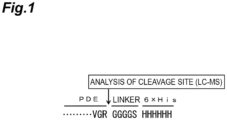
- Example 3 A specimen obtained by a similar method to that described below in the section "3. Purification" in Example 3 was used as a sample, and a cleavage site was confirmed by a mass spectrometer (LC-MS) according to the following procedure.
- LC-MS mass spectrometer
- the sample was subjected to solvent replacement with ammonium bicarbonate solution. Then, after denaturation with a surfactant, reduction and alkylation were performed. After addition of formic acid, the mixture was subjected to LC-MS measurement. The assignment of the measurement results was performed by using MASCOT Server (Matrix Science).
- Arg-C proteinase, Thrombin, and Trypsin belong to the S1 family of proteases, and Clostripain belongs to the C11 family thereof.
- proteases of a tobacco plant was obtained from MEROPS (https://www.ebi.ac.uk/merops/index.shtml), and as a result, 18 proteases were extracted as a protease of the S1 family (Table 1), suggesting the possibility that PDE-GS-His has been cleaved by any one of these enzymes.
- Expression construct 4 His-SG-PDE-GS-His (comparative example)
- TMV tobacco mosaic virus
- Fig. 2 shows the results of evaluation of expression by Western blotting using an HRP-labeled anti-phosphodiesterase antibody.
- 500 g of the frozen infected leaf was weighed and crushed with a cutting mixer. 250 mL of extraction solution (100 mM Tris, 250 mM NaCl, 40 mM sodium ascorbate) was added to the crushed leaf, and the infected leaf was crushed repeatedly.
- crushed infected leaf collected from the cutting mixer and the crushed infected leaf obtained by washing the inside of the mixer with 250 mL of a fresh extraction solution were combined. This mixture was centrifuged at 12, 000 ⁇ g for 5 minutes to collect a supernatant (a fraction from the extraction step).
- the fraction was filtrated through a 0.45 ⁇ m filter, followed by a 0.22 ⁇ m filter.
- the filtrate was subjected to nickel column chromatography (manufactured by GE Healthcare, HisPrep FF16/10 column, Catalog No. 28936551) to remove plant-derived impurities. In this way, a sample solution was obtained.
- An anti-PDE antibody was immobilized on a 96-well microplate. After washing the wells, blocking was performed by adding a blocking solution. After a standard solution and the sample solution were added to the wells and allowed to react, an HRP-labeled anti-PDE antibody was added to the wells and allowed to react. An HRP substrate was added to the wells and allowed to react, and a reaction stop solution was added to the wells to stop the reaction. The absorbance of each well at 450 nm was measured, a standard curve was generated based on the results of the standard solution, and the sample concentration was calculated. The yield was calculated from sample concentrations before purification, of the column flow-through fraction, and after purification.
- the specific activity of the purified polypeptide was measured by using Phosphodiesterase assay Kit (manufactured by Abeam plc., Catalog No. ab138876) according to its protocol.
Landscapes
- Health & Medical Sciences (AREA)
- Genetics & Genomics (AREA)
- Chemical & Material Sciences (AREA)
- Life Sciences & Earth Sciences (AREA)
- Engineering & Computer Science (AREA)
- Organic Chemistry (AREA)
- Zoology (AREA)
- Bioinformatics & Cheminformatics (AREA)
- Wood Science & Technology (AREA)
- General Engineering & Computer Science (AREA)
- General Health & Medical Sciences (AREA)
- Biochemistry (AREA)
- Biomedical Technology (AREA)
- Biotechnology (AREA)
- Microbiology (AREA)
- Molecular Biology (AREA)
- Medicinal Chemistry (AREA)
- Physics & Mathematics (AREA)
- Biophysics (AREA)
- Plant Pathology (AREA)
- Enzymes And Modification Thereof (AREA)
- Micro-Organisms Or Cultivation Processes Thereof (AREA)
- Breeding Of Plants And Reproduction By Means Of Culturing (AREA)
- Preparation Of Compounds By Using Micro-Organisms (AREA)
Applications Claiming Priority (2)
| Application Number | Priority Date | Filing Date | Title |
|---|---|---|---|
| JP2020215323 | 2020-12-24 | ||
| PCT/JP2021/047678 WO2022138757A1 (ja) | 2020-12-24 | 2021-12-22 | Dna構築物、ベクター、細菌及びポリペプチドを製造する方法 |
Publications (2)
| Publication Number | Publication Date |
|---|---|
| EP4265728A1 true EP4265728A1 (de) | 2023-10-25 |
| EP4265728A4 EP4265728A4 (de) | 2025-08-20 |
Family
ID=82159844
Family Applications (1)
| Application Number | Title | Priority Date | Filing Date |
|---|---|---|---|
| EP21910897.4A Withdrawn EP4265728A4 (de) | 2020-12-24 | 2021-12-22 | Dna-konstrukt, vektor, bakterium und verfahren zur herstellung eines polypeptids |
Country Status (3)
| Country | Link |
|---|---|
| EP (1) | EP4265728A4 (de) |
| JP (1) | JP7536895B2 (de) |
| WO (1) | WO2022138757A1 (de) |
Cited By (1)
| Publication number | Priority date | Publication date | Assignee | Title |
|---|---|---|---|---|
| CN116790552A (zh) * | 2022-11-28 | 2023-09-22 | 柏定生物工程(北京)有限公司 | 鞘磷脂酶突变体及其在sdLDL胆固醇检测中的应用 |
Family Cites Families (7)
| Publication number | Priority date | Publication date | Assignee | Title |
|---|---|---|---|---|
| DE60311409T2 (de) * | 2002-12-17 | 2007-11-08 | F. Hoffmann-La Roche Ag | PDE Kern Konstrukt |
| WO2008111450A1 (ja) * | 2007-03-09 | 2008-09-18 | Otsuka Chemical Co., Ltd. | スフィンゴシン化合物、その製造方法及びスフィンゴミエリナーゼ阻害剤 |
| EP2468870A1 (de) * | 2010-12-23 | 2012-06-27 | Philip Morris Products S.A. | Verfahren zur Expression von Desoxyribonuklease in Pflanzen |
| JP5875139B2 (ja) * | 2011-04-28 | 2016-03-02 | 旭化成ファーマ株式会社 | スフィンゴミエリナーゼ含有組成物の製造方法 |
| DK2971064T3 (da) | 2013-03-12 | 2019-12-16 | Ventana Med Syst Inc | Nærhedsassay til in situ-påvisning af mål |
| KR20180087430A (ko) | 2015-12-17 | 2018-08-01 | 얀센 바이오테크 인코포레이티드 | Hla-dr에 특이적으로 결합하는 항체 및 이의 용도 |
| TWI609870B (zh) * | 2016-02-12 | 2018-01-01 | 美國禮來大藥廠 | Pde1抑制劑 |
-
2021
- 2021-12-22 EP EP21910897.4A patent/EP4265728A4/de not_active Withdrawn
- 2021-12-22 WO PCT/JP2021/047678 patent/WO2022138757A1/ja not_active Ceased
- 2021-12-22 JP JP2022571580A patent/JP7536895B2/ja active Active
Cited By (2)
| Publication number | Priority date | Publication date | Assignee | Title |
|---|---|---|---|---|
| CN116790552A (zh) * | 2022-11-28 | 2023-09-22 | 柏定生物工程(北京)有限公司 | 鞘磷脂酶突变体及其在sdLDL胆固醇检测中的应用 |
| CN116790552B (zh) * | 2022-11-28 | 2024-11-01 | 柏定生物工程(北京)有限公司 | 鞘磷脂酶突变体及其在sdLDL胆固醇检测中的应用 |
Also Published As
| Publication number | Publication date |
|---|---|
| EP4265728A4 (de) | 2025-08-20 |
| JPWO2022138757A1 (de) | 2022-06-30 |
| WO2022138757A1 (ja) | 2022-06-30 |
| JP7536895B2 (ja) | 2024-08-20 |
Similar Documents
| Publication | Publication Date | Title |
|---|---|---|
| EP2439280A1 (de) | Pflanzen mit verbesserten Ertragseigenschaften und Verfahren zu ihrer Herstellung | |
| CN116063439B (zh) | 植物14-3-3h蛋白及其编码基因在抗马铃薯Y病毒中的应用 | |
| AU2007260202A1 (en) | Plants with modulated expression of NAC transcription factors having enhanced yield-related traits and a method for making the same | |
| Qiao et al. | Plastocyanin transit peptide interacts with Potato virus X coat protein, while silencing of plastocyanin reduces coat protein accumulation in chloroplasts and symptom severity in host plants | |
| Kim et al. | Improvement of recombinant hGM-CSF production by suppression of cysteine proteinase gene expression using RNA interference in a transgenic rice culture | |
| EP2960335A1 (de) | Pflanzen mit verbesserter toleranz gegen abiotischen stress und/oder verbesserte ertragseigenschaften sowie verfahren zur herstellung davon | |
| KR102350425B1 (ko) | 프테로스틸벤의 생합성 제조를 위한 o-메틸트랜스퍼라제의 사용 방법 | |
| Yasmin et al. | A germin-like protein gene of rice increased superoxide dismutase activity in transformed tobacco | |
| JP7536895B2 (ja) | Dna構築物、ベクター、細菌及びポリペプチドを製造する方法 | |
| Hamel et al. | Molecular changes in agroinfiltrated leaves of Nicotiana benthamiana expressing suppressor of silencing P19 and coronavirus‐like particles | |
| CA2621981A1 (en) | Dehydrin gene from avicennia marina responsible for conferring salt tolerance in plants | |
| US20090210969A1 (en) | Antiporter gene from porteresia coarctata for conferring stress tolerance | |
| US8993839B2 (en) | Plant-based production of heterologous proteins | |
| WO2024047057A1 (en) | Means and methods to produce triterpene saponins in eukaryotic cells | |
| KR102155449B1 (ko) | 식물에서 LysP11의 대량생산방법 및 이를 포함하는 돼지 단독증 예방 또는 치료용 약학적 조성물 | |
| EP1778845A2 (de) | Pflanzen mit modifizierten wachstumseigenschaften und methoden für deren herstellung | |
| EP1601764B1 (de) | Eine metacaspasen-klasse | |
| Reichardt et al. | Assay for Phytaspase-mediated Peptide Precursor Cleavage Using Synthetic Oligopeptide Substrates | |
| KR102630105B1 (ko) | Cel12A 단백질을 포함하는 셀룰로오스 분해용 조성물 및 이의 제조방법 | |
| Lavoie et al. | Heterologous expression of influenza haemagglutinin leads to early and transient activation of the unfolded | |
| US5525713A (en) | DNA encoding polypeptides enabling sorting of proteins to vacuoles in plants | |
| US20020026658A1 (en) | Genes encoding sinapoylglucose: malate sinapoyltransferase and methods of use | |
| CN119799772A (zh) | 一种降低植物白粉菌抗病性的蛋白质及其应用 | |
| CN120555488A (zh) | 高效表达目的基因或目的蛋白的表达盒、表达载体及表达方法 | |
| WO2005045046A1 (en) | Expression of plastid-targeted polypeptides in plants |
Legal Events
| Date | Code | Title | Description |
|---|---|---|---|
| STAA | Information on the status of an ep patent application or granted ep patent |
Free format text: STATUS: THE INTERNATIONAL PUBLICATION HAS BEEN MADE |
|
| PUAI | Public reference made under article 153(3) epc to a published international application that has entered the european phase |
Free format text: ORIGINAL CODE: 0009012 |
|
| STAA | Information on the status of an ep patent application or granted ep patent |
Free format text: STATUS: REQUEST FOR EXAMINATION WAS MADE |
|
| 17P | Request for examination filed |
Effective date: 20230721 |
|
| AK | Designated contracting states |
Kind code of ref document: A1 Designated state(s): AL AT BE BG CH CY CZ DE DK EE ES FI FR GB GR HR HU IE IS IT LI LT LU LV MC MK MT NL NO PL PT RO RS SE SI SK SM TR |
|
| DAV | Request for validation of the european patent (deleted) | ||
| DAX | Request for extension of the european patent (deleted) | ||
| A4 | Supplementary search report drawn up and despatched |
Effective date: 20250721 |
|
| RIC1 | Information provided on ipc code assigned before grant |
Ipc: C12N 15/55 20060101AFI20250715BHEP Ipc: A01H 6/82 20180101ALI20250715BHEP Ipc: C12N 1/20 20060101ALI20250715BHEP Ipc: C12N 1/21 20060101ALI20250715BHEP Ipc: C12N 5/04 20060101ALI20250715BHEP Ipc: C12N 9/16 20060101ALI20250715BHEP Ipc: C12N 15/31 20060101ALI20250715BHEP Ipc: C12N 15/74 20060101ALI20250715BHEP Ipc: C12N 15/82 20060101ALI20250715BHEP |
|
| STAA | Information on the status of an ep patent application or granted ep patent |
Free format text: STATUS: THE APPLICATION HAS BEEN WITHDRAWN |
|
| 18W | Application withdrawn |
Effective date: 20260123 |