EP4265254A2 - Imidazo[4,5-b]pyridine compounds and pharmaceutical compositions thereof for the treatment of inflammatory disorders - Google Patents
Imidazo[4,5-b]pyridine compounds and pharmaceutical compositions thereof for the treatment of inflammatory disorders Download PDFInfo
- Publication number
- EP4265254A2 EP4265254A2 EP23191626.3A EP23191626A EP4265254A2 EP 4265254 A2 EP4265254 A2 EP 4265254A2 EP 23191626 A EP23191626 A EP 23191626A EP 4265254 A2 EP4265254 A2 EP 4265254A2
- Authority
- EP
- European Patent Office
- Prior art keywords
- methyl
- compound
- pyridin
- independently selected
- imidazo
- Prior art date
- Legal status (The legal status is an assumption and is not a legal conclusion. Google has not performed a legal analysis and makes no representation as to the accuracy of the status listed.)
- Pending
Links
Images

Classifications
-
- C—CHEMISTRY; METALLURGY
- C07—ORGANIC CHEMISTRY
- C07D—HETEROCYCLIC COMPOUNDS
- C07D471/00—Heterocyclic compounds containing nitrogen atoms as the only ring hetero atoms in the condensed system, at least one ring being a six-membered ring with one nitrogen atom, not provided for by groups C07D451/00 - C07D463/00
- C07D471/02—Heterocyclic compounds containing nitrogen atoms as the only ring hetero atoms in the condensed system, at least one ring being a six-membered ring with one nitrogen atom, not provided for by groups C07D451/00 - C07D463/00 in which the condensed system contains two hetero rings
- C07D471/04—Ortho-condensed systems
-
- A—HUMAN NECESSITIES
- A61—MEDICAL OR VETERINARY SCIENCE; HYGIENE
- A61K—PREPARATIONS FOR MEDICAL, DENTAL OR TOILETRY PURPOSES
- A61K31/00—Medicinal preparations containing organic active ingredients
- A61K31/33—Heterocyclic compounds
- A61K31/395—Heterocyclic compounds having nitrogen as a ring hetero atom, e.g. guanethidine or rifamycins
- A61K31/495—Heterocyclic compounds having nitrogen as a ring hetero atom, e.g. guanethidine or rifamycins having six-membered rings with two or more nitrogen atoms as the only ring heteroatoms, e.g. piperazine or tetrazines
- A61K31/505—Pyrimidines; Hydrogenated pyrimidines, e.g. trimethoprim
- A61K31/506—Pyrimidines; Hydrogenated pyrimidines, e.g. trimethoprim not condensed and containing further heterocyclic rings
-
- A—HUMAN NECESSITIES
- A61—MEDICAL OR VETERINARY SCIENCE; HYGIENE
- A61K—PREPARATIONS FOR MEDICAL, DENTAL OR TOILETRY PURPOSES
- A61K31/00—Medicinal preparations containing organic active ingredients
- A61K31/33—Heterocyclic compounds
- A61K31/395—Heterocyclic compounds having nitrogen as a ring hetero atom, e.g. guanethidine or rifamycins
- A61K31/435—Heterocyclic compounds having nitrogen as a ring hetero atom, e.g. guanethidine or rifamycins having six-membered rings with one nitrogen as the only ring hetero atom
- A61K31/4353—Heterocyclic compounds having nitrogen as a ring hetero atom, e.g. guanethidine or rifamycins having six-membered rings with one nitrogen as the only ring hetero atom ortho- or peri-condensed with heterocyclic ring systems
- A61K31/437—Heterocyclic compounds having nitrogen as a ring hetero atom, e.g. guanethidine or rifamycins having six-membered rings with one nitrogen as the only ring hetero atom ortho- or peri-condensed with heterocyclic ring systems the heterocyclic ring system containing a five-membered ring having nitrogen as a ring hetero atom, e.g. indolizine, beta-carboline
-
- A—HUMAN NECESSITIES
- A61—MEDICAL OR VETERINARY SCIENCE; HYGIENE
- A61K—PREPARATIONS FOR MEDICAL, DENTAL OR TOILETRY PURPOSES
- A61K31/00—Medicinal preparations containing organic active ingredients
- A61K31/33—Heterocyclic compounds
- A61K31/395—Heterocyclic compounds having nitrogen as a ring hetero atom, e.g. guanethidine or rifamycins
- A61K31/435—Heterocyclic compounds having nitrogen as a ring hetero atom, e.g. guanethidine or rifamycins having six-membered rings with one nitrogen as the only ring hetero atom
- A61K31/44—Non condensed pyridines; Hydrogenated derivatives thereof
- A61K31/4427—Non condensed pyridines; Hydrogenated derivatives thereof containing further heterocyclic ring systems
- A61K31/444—Non condensed pyridines; Hydrogenated derivatives thereof containing further heterocyclic ring systems containing a six-membered ring with nitrogen as a ring heteroatom, e.g. amrinone
-
- A—HUMAN NECESSITIES
- A61—MEDICAL OR VETERINARY SCIENCE; HYGIENE
- A61K—PREPARATIONS FOR MEDICAL, DENTAL OR TOILETRY PURPOSES
- A61K31/00—Medicinal preparations containing organic active ingredients
- A61K31/33—Heterocyclic compounds
- A61K31/395—Heterocyclic compounds having nitrogen as a ring hetero atom, e.g. guanethidine or rifamycins
- A61K31/435—Heterocyclic compounds having nitrogen as a ring hetero atom, e.g. guanethidine or rifamycins having six-membered rings with one nitrogen as the only ring hetero atom
- A61K31/44—Non condensed pyridines; Hydrogenated derivatives thereof
- A61K31/445—Non condensed piperidines, e.g. piperocaine
- A61K31/4523—Non condensed piperidines, e.g. piperocaine containing further heterocyclic ring systems
- A61K31/4545—Non condensed piperidines, e.g. piperocaine containing further heterocyclic ring systems containing a six-membered ring with nitrogen as a ring hetero atom, e.g. pipamperone, anabasine
-
- A—HUMAN NECESSITIES
- A61—MEDICAL OR VETERINARY SCIENCE; HYGIENE
- A61K—PREPARATIONS FOR MEDICAL, DENTAL OR TOILETRY PURPOSES
- A61K31/00—Medicinal preparations containing organic active ingredients
- A61K31/33—Heterocyclic compounds
- A61K31/395—Heterocyclic compounds having nitrogen as a ring hetero atom, e.g. guanethidine or rifamycins
- A61K31/495—Heterocyclic compounds having nitrogen as a ring hetero atom, e.g. guanethidine or rifamycins having six-membered rings with two or more nitrogen atoms as the only ring heteroatoms, e.g. piperazine or tetrazines
- A61K31/496—Non-condensed piperazines containing further heterocyclic rings, e.g. rifampin, thiothixene or sparfloxacin
-
- A—HUMAN NECESSITIES
- A61—MEDICAL OR VETERINARY SCIENCE; HYGIENE
- A61K—PREPARATIONS FOR MEDICAL, DENTAL OR TOILETRY PURPOSES
- A61K31/00—Medicinal preparations containing organic active ingredients
- A61K31/33—Heterocyclic compounds
- A61K31/395—Heterocyclic compounds having nitrogen as a ring hetero atom, e.g. guanethidine or rifamycins
- A61K31/495—Heterocyclic compounds having nitrogen as a ring hetero atom, e.g. guanethidine or rifamycins having six-membered rings with two or more nitrogen atoms as the only ring heteroatoms, e.g. piperazine or tetrazines
- A61K31/50—Pyridazines; Hydrogenated pyridazines
- A61K31/501—Pyridazines; Hydrogenated pyridazines not condensed and containing further heterocyclic rings
-
- A—HUMAN NECESSITIES
- A61—MEDICAL OR VETERINARY SCIENCE; HYGIENE
- A61K—PREPARATIONS FOR MEDICAL, DENTAL OR TOILETRY PURPOSES
- A61K31/00—Medicinal preparations containing organic active ingredients
- A61K31/33—Heterocyclic compounds
- A61K31/395—Heterocyclic compounds having nitrogen as a ring hetero atom, e.g. guanethidine or rifamycins
- A61K31/535—Heterocyclic compounds having nitrogen as a ring hetero atom, e.g. guanethidine or rifamycins having six-membered rings with at least one nitrogen and one oxygen as the ring hetero atoms, e.g. 1,2-oxazines
- A61K31/5355—Non-condensed oxazines and containing further heterocyclic rings
-
- A—HUMAN NECESSITIES
- A61—MEDICAL OR VETERINARY SCIENCE; HYGIENE
- A61P—SPECIFIC THERAPEUTIC ACTIVITY OF CHEMICAL COMPOUNDS OR MEDICINAL PREPARATIONS
- A61P19/00—Drugs for skeletal disorders
- A61P19/08—Drugs for skeletal disorders for bone diseases, e.g. rachitism, Paget's disease
-
- A—HUMAN NECESSITIES
- A61—MEDICAL OR VETERINARY SCIENCE; HYGIENE
- A61P—SPECIFIC THERAPEUTIC ACTIVITY OF CHEMICAL COMPOUNDS OR MEDICINAL PREPARATIONS
- A61P29/00—Non-central analgesic, antipyretic or antiinflammatory agents, e.g. antirheumatic agents; Non-steroidal antiinflammatory drugs [NSAID]
-
- A—HUMAN NECESSITIES
- A61—MEDICAL OR VETERINARY SCIENCE; HYGIENE
- A61P—SPECIFIC THERAPEUTIC ACTIVITY OF CHEMICAL COMPOUNDS OR MEDICINAL PREPARATIONS
- A61P3/00—Drugs for disorders of the metabolism
-
- A—HUMAN NECESSITIES
- A61—MEDICAL OR VETERINARY SCIENCE; HYGIENE
- A61P—SPECIFIC THERAPEUTIC ACTIVITY OF CHEMICAL COMPOUNDS OR MEDICINAL PREPARATIONS
- A61P35/00—Antineoplastic agents
-
- A—HUMAN NECESSITIES
- A61—MEDICAL OR VETERINARY SCIENCE; HYGIENE
- A61P—SPECIFIC THERAPEUTIC ACTIVITY OF CHEMICAL COMPOUNDS OR MEDICINAL PREPARATIONS
- A61P37/00—Drugs for immunological or allergic disorders
- A61P37/02—Immunomodulators
- A61P37/06—Immunosuppressants, e.g. drugs for graft rejection
-
- A—HUMAN NECESSITIES
- A61—MEDICAL OR VETERINARY SCIENCE; HYGIENE
- A61P—SPECIFIC THERAPEUTIC ACTIVITY OF CHEMICAL COMPOUNDS OR MEDICINAL PREPARATIONS
- A61P37/00—Drugs for immunological or allergic disorders
- A61P37/08—Antiallergic agents
-
- C—CHEMISTRY; METALLURGY
- C07—ORGANIC CHEMISTRY
- C07D—HETEROCYCLIC COMPOUNDS
- C07D519/00—Heterocyclic compounds containing more than one system of two or more relevant hetero rings condensed among themselves or condensed with a common carbocyclic ring system not provided for in groups C07D453/00 or C07D455/00
-
- C—CHEMISTRY; METALLURGY
- C07—ORGANIC CHEMISTRY
- C07B—GENERAL METHODS OF ORGANIC CHEMISTRY; APPARATUS THEREFOR
- C07B2200/00—Indexing scheme relating to specific properties of organic compounds
- C07B2200/05—Isotopically modified compounds, e.g. labelled
Definitions
- the present invention relates to compounds which may be useful in the prophylaxis and/or treatment of allergic diseases, inflammatory diseases, metabolic diseases, auto inflammatory diseases, autoimmune diseases, proliferative diseases, transplantation rejection, diseases involving impairment of cartilage turnover, congenital cartilage malformations, and/or diseases associated with hypersecretion of IFN ⁇ , IL12 and/or IL23.
- the compound of the invention inhibits JAK, a family of tyrosine kinases, and more particularly TYK2.
- the present invention also provides methods for the production of the compound of the invention, pharmaceutical compositions comprising the compound of the invention, methods for the prophylaxis and/or treatment of allergic diseases, inflammatory diseases, metabolic diseases, autoinflammatory diseases, autoimmune diseases, proliferative diseases, transplantation rejection, diseases involving impairment of cartilage turnover, congenital cartilage malformations, and/or diseases associated with hypersecretion of IFN ⁇ , IL12 and/or IL23 by administering the compound of the invention.
- Janus kinases are cytoplasmic tyrosine kinases that transduce cytokine signalling from membrane receptors to STAT transcription factors.
- JAK family members Four JAK family members are described, JAK1, JAK2, JAK3 and TYK2.
- JAK family members Upon binding of the cytokine to its receptor, JAK family members auto- and/or transphosphorylate each other, followed by phosphorylation of STATs that then migrate to the nucleus to modulate transcription.
- JAK-STAT intracellular signal transduction serves the interferons, most interleukins, as well as a variety of cytokines and endocrine factors such as EPO, TPO, GH, OSM, LIF, CNTF, GM-CSF and PRL.(Vainchenker et al., 2008)
- JAKinibs JAK inhibitors
- JAK2 inhibition has proven useful in the treatment of polycythemia and myelofibrosis
- undesirable effect associated with JAK2 inhibition were observed (O'Shea and Plenge, 2012) thus rendering compounds with JAK2 inhibition components unsuitable for the treatment of non-JAK2 mediated diseases.
- TYK2 knock out mice it has been shown that IL-6, IL-10, IL-11, IL12, IL-13, IL-19, IL-20, IL-22, IL-23, IL-27, IL-28, IL-29, IL-31, IL-35 and/or type 1 interferons signaling are dependent on TYK2 (Schwartz et al., 2016).
- JAK1 is a key driver in IFN ⁇ , IL6, IL10 and IL22 signaling
- TYK2 is involved in type I interferons (including IFN ⁇ , INF ⁇ ), IL23 and IL12 signaling (Gillooly et al., 2016; Sohn et al., 2013).
- IL12 and IL23 are particularly increased in patients with auto-immune diseases (O'Shea and Plenge, 2012) such as psoriasis and/or inflammatory bowel disorders
- selective TYK2 inhibition may be particularly advantageous in the treatment of these diseases while avoiding JAK2 dependent erythropoietin (EPO) and thrombopoietin (TPO) signaling (Neubauer et al., 1998; Parganas et al., 1998).
- EPO erythropoietin
- TPO thrombopoietin
- TYK2 has been reported as a target for multiple autoimmune disorders, providing protection against inflammatory diseases as well as type 2 diabetes with a limited impact on the immune system. (Dendrou et al., 2016)
- the present invention relates to compounds useful in the prophylaxis and/or treatment of allergic diseases, inflammatory diseases, metabolic diseases, auto inflammatory diseases, autoimmune diseases, proliferative diseases, transplantation rejection, diseases involving impairment of cartilage turnover, congenital cartilage malformations, and/or diseases associated with hypersecretion of IFN ⁇ , IL12 and/or IL23.
- the compound of the invention inhibits JAK, a family of tyrosine kinases, and more particularly TYK2.
- the present invention also provides methods for the production of the compound of the invention, pharmaceutical compositions comprising the compound of the invention, methods for the prophylaxis and/or treatment of allergic diseases, inflammatory diseases, metabolic diseases, auto inflammatory diseases, autoimmune diseases, proliferative diseases, transplantation rejection, diseases involving impairment of cartilage turnover, congenital cartilage malformations, and/or diseases associated with hypersecretion of IFN ⁇ , IL12 and/or IL23 by administering the compound of the invention.
- the compounds of the invention are provided for use in the prophylaxis and/or treatment of allergic diseases, inflammatory diseases, metabolic diseases, auto inflammatory diseases, autoimmune diseases, proliferative diseases, transplantation rejection, diseases involving impairment of cartilage turnover, congenital cartilage malformations, and/or diseases associated with hypersecretion of IFN ⁇ , IL12 and/or IL23.
- the compounds of the invention exhibit improved selectivity towards TYK2 versus other JAK family members, which may be advantageous in the treatment of IFN ⁇ , IL12 and/or IL23 associated diseases, particularly auto-immune diseases such as psoriasis and/or inflammatory bowel disorders.
- the compounds of the invention and their TYK2 selectivity may be advantageous for the design of patient specific treatments and patient tailored dosages.
- the present invention provides pharmaceutical compositions comprising a compound of the invention, and a pharmaceutical carrier, excipient or diluent.
- the pharmaceutical composition may additionally comprise further therapeutically active ingredients suitable for use in combination with the compounds of the invention.
- the further therapeutically active ingredient is an agent for the prophylaxis and/or treatment of allergic diseases, inflammatory diseases, metabolic diseases, auto inflammatory diseases, autoimmune diseases, proliferative diseases, transplantation rejection, diseases involving impairment of cartilage turnover, congenital cartilage malformations, and/or diseases associated with hypersecretion of IFN ⁇ , IL12 and/or IL23.
- the compounds of the invention useful in the pharmaceutical compositions and treatment methods disclosed herein, are pharmaceutically acceptable as prepared and used.
- this invention provides a method of treating a mammal, in particular humans, afflicted with a condition selected from among those listed herein, and particularly allergic diseases, inflammatory diseases, metabolic diseases, auto inflammatory diseases, autoimmune diseases, proliferative diseases, transplantation rejection, diseases involving impairment of cartilage turnover, congenital cartilage malformations, and/or diseases associated with hypersecretion of IFN ⁇ , IL12 and/or IL23, which method comprises administering an effective amount of the pharmaceutical composition or compounds of the invention as described herein.
- the present invention also provides pharmaceutical compositions comprising a compound of the invention, and a suitable pharmaceutical carrier, excipient or diluent for use in medicine.
- the pharmaceutical composition is for use in the prophylaxis and/or treatment of allergic diseases, inflammatory diseases, metabolic diseases, auto inflammatory diseases, autoimmune diseases, proliferative diseases, transplantation rejection, diseases involving impairment of cartilage turnover, congenital cartilage malformations, and/or diseases associated with hypersecretion of IFN ⁇ , IL12 and/or IL23.
- this invention provides methods for synthesizing the compounds of the invention, with representative synthetic protocols and pathways disclosed later on herein.
- FIGURE1 shows the effect of a test compound of the invention on Day 1-5 in the murine psoriatic-like epidermal hyperplasia model, vs the vehicle (filled diamonds) and the control group (filled squares), when dosed q.d. at 3 mg/kg (crosses), 10 mg/kg (asterisks), and 30 mg/kg (filled circles).
- the articles 'a' and 'an' may be used herein to refer to one or to more than one (i.e. at least one) of the grammatical objects of the article.
- ⁇ an analogue' means one analogue or more than one analogue.
- 'Alkyl' means straight or branched aliphatic hydrocarbon having the specified number of carbon atoms. Particular alkyl groups have 1 to 6 carbon atoms or 1 to 4 carbon atoms. Branched means that one or more alkyl groups such as methyl, ethyl or propyl is attached to a linear alkyl chain.
- alkyl groups are methyl (-CH 3 ), ethyl (-CH 2 -CH 3 ), n-propyl (-CH 2 -CH 2 -CH 3 ), isopropyl (-CH(CH 3 ) 2 ), n-butyl (-CH 2 -CH 2 -CH 2 -CH 3 ), tert-butyl (-CH 2 -C(CH 3 ) 3 ), sec-butyl (-CH 2 -CH(CH 3 ) 2 ), n-pentyl (-CH 2 -CH 2 -CH 2 -CH 2 -CH 3 ), n-hexyl (-CH 2 -CH 2 -CH 2 -CH 2 -CH 2 -CH 3 ), and 1,2-dimethylbutyl (-CHCH 3 )-C(CH 3 )H 2 -CH 2 -CH 3 ).
- Particular alkyl groups have between 1 and 4 carbon atoms.
- alkenyl' refers to monovalent olefinically (unsaturated) hydrocarbon groups with the number of carbon atoms specified.
- Particular alkenyl has 2 to 8 carbon atoms, and more particularly, from 2 to 6 carbon atoms, which can be straight-chained or branched and having at least 1 and particularly from 1 to 2 sites of olefinic unsaturation.
- ⁇ Alkylene' refers to divalent alkene radical groups having the number of carbon atoms specified, in particular having 1 to 6 carbon atoms and more particularly 1 to 4 carbon atoms which can be straight-chained or branched. This term is exemplified by groups such as methylene (-CH 2 -), ethylene (-CH 2 -CH 2 -), or -CH(CH 3 )- and the like.
- Alkynylene' refers to divalent alkyne radical groups having the number of carbon atoms and the number of triple bonds specified, in particular 2 to 6 carbon atoms and more particularly 2 to 4 carbon atoms which can be straight-chained or branched. This term is exemplified by groups such as -C ⁇ C-, -CH 2 -C ⁇ C-, and -C(CH 3 )H-C ⁇ CH-.
- alkoxy' refers to the group O-alkyl, where the alkyl group has the number of carbon atoms specified. In particular the term refers to the group -O-C 1-6 alkyl.
- Particular alkoxy groups are methoxy, ethoxy, n-propoxy, isopropoxy, n-butoxy, tert-butoxy, sec-butoxy, n-pentoxy, n-hexoxy, and 1,2-dimethylbutoxy.
- Particular alkoxy groups are lower alkoxy, i.e. with between 1 and 6 carbon atoms. Further particular alkoxy groups have between 1 and 4 carbon atoms.
- ⁇ Amino' refers to the radical -NH 2 .
- 'Aryl' refers to a monovalent aromatic hydrocarbon group derived by the removal of one hydrogen atom from a single carbon atom of a parent aromatic ring system.
- aryl refers to an aromatic ring structure, monocyclic or fused polycyclic, with the number of ring atoms specified.
- the term includes groups that include from 6 to 10 ring members.
- Particular aryl groups include phenyl, and naphthyl.
- 'Cycloalkyl refers to a non-aromatic hydrocarbyl ring structure, monocyclic, fused polycyclic, bridged polycyclic, or spirocyclic, with the number of ring atoms specified.
- a cycloalkyl may have from 3 to 12 carbon atoms, in particular from 3 to 10, and more particularly from 3 to 7 carbon atoms.
- Such cycloalkyl groups include, by way of example, single ring structures such as cyclopropyl, cyclobutyl, cyclopentyl, cyclohexyl, and cycloheptyl.
- ⁇ Cyano' refers to the radical -CN.
- ⁇ Halo' or ⁇ halogen' refers to fluoro (F), chloro (Cl), bromo (Br) and iodo (I). Particular halo groups are either fluoro or chloro.
- Hetero' when used to describe a compound or a group present on a compound means that one or more carbon atoms in the compound or group have been replaced by a nitrogen, oxygen, or sulfur heteroatom. Hetero may be applied to any of the hydrocarbyl groups described above such as alkyl, e.g. heteroalkyl, cycloalkyl, e.g. heterocycloalkyl, aryl, e.g. heteroaryl, and the like having from 1 to 4, and particularly from 1 to 3 heteroatoms, more typically 1 or 2 heteroatoms, for example a single heteroatom.
- Heteroaryl' means an aromatic ring structure, monocyclic or fused polycyclic, that includes one or more heteroatoms independently selected from O, N and S and the number of ring atoms specified.
- the aromatic ring structure may have from 5 to 9 ring members.
- the heteroaryl group can be, for example, a five membered or six membered monocyclic ring or a fused bicyclic structure formed from fused five and six membered rings or two fused six membered rings or, by way of a further example, two fused five membered rings. Each ring may contain up to four heteroatoms typically selected from nitrogen, sulphur and oxygen.
- the heteroaryl ring will contain up to 4 heteroatoms, more typically up to 3 heteroatoms, more usually up to 2, for example a single heteroatom.
- the heteroaryl ring contains at least one ring nitrogen atom.
- the nitrogen atoms in the heteroaryl rings can be basic, as in the case of an imidazole or pyridine, or essentially non-basic as in the case of an indole or pyrrole nitrogen. In general the number of basic nitrogen atoms present in the heteroaryl group, including any amino group substituents of the ring, will be less than five.
- Examples of five membered monocyclic heteroaryl groups include but are not limited to pyrrolyl, furanyl, thiophenyl, imidazolyl, furazanyl, oxazolyl, oxadiazolyl, oxatriazolyl, isoxazolyl, thiazolyl, isothiazolyl, pyrazolyl, triazolyl and tetrazolyl groups.
- Examples of six membered monocyclic heteroaryl groups include but are not limited to pyridinyl, pyrazinyl, pyridazinyl, pyrimidinyl and triazinyl.
- bicyclic heteroaryl groups containing a five membered ring fused to another five-membered ring include but are not limited to imidazothiazolyl and imidazoimidazolyl.
- bicyclic heteroaryl groups containing a six membered ring fused to a five membered ring include but are not limited to benzofuranyl, benzothiophenyl, benzoimidazolyl, benzoxazolyl, isobenzoxazolyl, benzisoxazolyl, benzothiazolyl, benzoisothiazolyl, isobenzofuranyl, indolyl, isoindolyl, indolizinyl, purinyl ( e.g . adenine, guanine), indazolyl, pyrazolopyrimidinyl, triazolopyrimidinyl, and pyrazolopyridinyl groups.
- bicyclic heteroaryl groups containing two fused six membered rings include but are not limited to quinolinyl, isoquinolinyl, pyridopyridinyl, quinoxalinyl, quinazolinyl, cinnolinyl, phthalazinyl, naphthyridinyl, and pteridinyl groups.
- Particular heteroaryl groups are those derived from thiophenyl, pyrrolyl, benzothiophenyl, benzofuranyl, indolyl, pyridinyl, quinolinyl, imidazolyl, oxazolyl and pyrazinyl.
- Heterocycloalkyl' means a non-aromatic fully saturated ring structure, monocyclic, fused polycyclic, spirocyclic, or bridged polycyclic, that includes one or more heteroatoms independently selected from O, N and S and the number of ring atoms specified.
- the heterocycloalkyl ring structure may have from 4 to 12 ring members, in particular from 4 to 10 ring members and more particularly from 4 to 7 ring members.
- Each ring may contain up to four heteroatoms typically selected from nitrogen, sulphur and oxygen.
- the heterocycloalkyl ring will contain up to 4 heteroatoms, more typically up to 3 heteroatoms, more usually up to 2, for example a single heteroatom.
- heterocyclic rings include, but are not limited to azetidinyl, oxetanyl, thietanyl, pyrrolidinyl (e.g. 1-pyrrolidinyl, 2-pyrrolidinyl and 3-pyrrolidinyl), tetrahydrofuranyl (e.g. 1-tetrahydrofuranyl, 2-tetrahydrofuranyl and 3-tetrahydrofuranyl), tetrahydrothiophenyl (e.g. 1-tetrahydrothiophenyl, 2-tetrahydrothiophenyl and 3-tetrahydrothiophenyl), piperidinyl (e.g.
- heterocycloalkenyl' means a 'heterocycloalkyl', which comprises at least one double bond.
- each W and Y is independently selected from -CH 2 -, -NH-, -O- and -S-.
- fused bicyclic rings are shown in the following illustrative examples: wherein each W and Y is independently selected from -CH 2 -, -NH-, -O- and -S-.
- bridged bicyclic rings are shown in the following illustrative examples: wherein each W and Y is independently selected from -CH 2 -, -NH-, -O- and -S- and each Z is selected from N and CH.
- each Y is selected from -CH 2 -, -NH-, -O- and -S-.
- ⁇ Hydroxyl' refers to the radical -OH.
- 'Substituted' refers to a group in which one or more hydrogen atoms are each independently replaced with the same or different substituent(s).
- 'Sulfo' or ⁇ sulfonic acid' refers to a radical such as -SO 3 H.
- 'Thiol' refers to the group -SH.
- term 'substituted with one or more' refers to one to four substituents. In one embodiment it refers to one to three substituents. In further embodiments it refers to one or two substituents. In a yet further embodiment it refers to one substituent.
- 'Thioalkoxy' refers to the group -S-alkyl where the alkyl group has the number of carbon atoms specified. In particular the term refers to the group -S-C 1-6 alkyl.
- Particular thioalkoxy groups are thiomethoxy, thioethoxy, n-thiopropoxy, isothiopropoxy, n-thiobutoxy, tert-thiobutoxy, sec-thiobutoxy, n-thiopentoxy, n-thiohexoxy, and 1,2-dimethylthiobutoxy.
- Particular thioalkoxy groups are lower thioalkoxy, i.e. with between 1 and 6 carbon atoms. Further particular alkoxy groups have between 1 and 4 carbon atoms.
- heterocyclic ring may have one to four heteroatoms so long as the heteroaromatic ring is chemically feasible and stable.
- 'Pharmaceutically acceptable means approved or approvable by a regulatory agency of the Federal or a state government or the corresponding agency in countries other than the United States, or that is listed in the U.S. Pharmacopoeia or other generally recognized pharmacopoeia for use in animals, and more particularly, in humans.
- ⁇ Pharmaceutically acceptable salt' refers to a salt of a compound of the invention that is pharmaceutically acceptable and that possesses the desired pharmacological activity of the parent compound.
- such salts are non-toxic may be inorganic or organic acid addition salts and base addition salts.
- such salts include: (1) acid addition salts, formed with inorganic acids such as hydrochloric acid, hydrobromic acid, sulfuric acid, nitric acid, phosphoric acid, and the like; or formed with organic acids such as acetic acid, propionic acid, hexanoic acid, cyclopentanepropionic acid, glycolic acid, pyruvic acid, lactic acid, malonic acid, succinic acid, malic acid, maleic acid, fumaric acid, tartaric acid, citric acid, benzoic acid, 3-(4-hydroxybenzoyl) benzoic acid, cinnamic acid, mandelic acid, methanesulfonic acid, ethanesulfonic acid, 1,2-ethane-disulfonic acid, 2-hydroxyethanesulfonic acid, benzenesulfonic acid, 4-chlorobenzenesulfonic acid, 2-naphthalenesulfonic acid, 4-toluenesulfonic acid
- Salts further include, by way of example only, sodium, potassium, calcium, magnesium, ammonium, tetraalkylammonium, and the like; and when the compound contains a basic functionality, salts of non-toxic organic or inorganic acids, such as hydrochloride, hydrobromide, tartrate, mesylate, acetate, maleate, oxalate and the like.
- ⁇ pharmaceutically acceptable cation' refers to an acceptable cationic counter-ion of an acidic functional group. Such cations are exemplified by sodium, potassium, calcium, magnesium, ammonium, tetraalkylammonium cations, and the like.
- ⁇ Pharmaceutically acceptable vehicle' refers to a diluent, adjuvant, excipient or carrier with which a compound of the invention is administered.
- Prodrugs' refers to compounds, including derivatives of the compounds of the invention, which have cleavable groups and become by solvolysis or under physiological conditions the compounds of the invention which are pharmaceutically active in vivo.
- Such examples include, but are not limited to, choline ester derivatives and the like, N-alkylmorpholine esters and the like.
- ⁇ Solvate' refers to forms of the compound that are associated with a solvent, usually by a solvolysis reaction. This physical association includes hydrogen bonding.
- Conventional solvents include water, EtOH, acetic acid and the like.
- the compounds of the invention may be prepared e.g. in crystalline form and may be solvated or hydrated.
- Suitable solvates include pharmaceutically acceptable solvates, such as hydrates, and further include both stoichiometric solvates and non-stoichiometric solvates. In certain instances the solvate will be capable of isolation, for example when one or more solvent molecules are incorporated in the crystal lattice of the crystalline solid.
- 'Solvate' encompasses both solution-phase and isolable solvates.
- Representative solvates include hydrates, ethanolates and methanolates.
- 'Subject' includes humans.
- the terms 'human', 'patient' and 'subject' are used interchangeably herein.
- ⁇ Effective amount' means the amount of a compound of the invention that, when administered to a subject for treating a disease, is sufficient to effect such treatment for the disease.
- the "effective amount” can vary depending on the compound, the disease and its severity, and the age, weight, etc., of the subject to be treated.
- 'Preventing' or 'prevention' refers to a reduction in risk of acquiring or developing a disease or disorder (i.e. causing at least one of the clinical symptoms of the disease not to develop in a subject that may be exposed to a disease-causing agent, or predisposed to the disease in advance of disease onset.
- 'prophylaxis' is related to 'prevention', and refers to a measure or procedure the purpose of which is to prevent, rather than to treat or cure a disease.
- prophylactic measures may include the administration of vaccines; the administration of low molecular weight heparin to hospital patients at risk for thrombosis due, for example, to immobilization; and the administration of an anti-malarial agent such as chloroquine, in advance of a visit to a geographical region where malaria is endemic or the risk of contracting malaria is high.
- 'Treating' or 'treatment' of any disease or disorder refers, in one embodiment, to ameliorating the disease or disorder (i.e. arresting the disease or reducing the manifestation, extent or severity of at least one of the clinical symptoms thereof).
- 'treating' or 'treatment' refers to ameliorating at least one physical parameter, which may not be discernible by the subject.
- 'treating' or 'treatment' refers to modulating the disease or disorder, either physically, ( e.g. stabilization of a discernible symptom), physiologically, ( e.g. stabilization of a physical parameter), or both.
- "treating" or "treatment” relates to slowing the progression of the disease.
- ⁇ allergic disease(s)' refers to the group of conditions characterized by a hypersensitivity disorder of the immune system including, allergic airway disease (e.g. asthma, rhinitis), sinusitis, eczema and hives, as well as food allergies or allergies to insect venom.
- allergic airway disease e.g. asthma, rhinitis
- sinusitis e.g. rhinitis
- eczema eczema
- hives as well as food allergies or allergies to insect venom.
- 'asthma' refers to any disorder of the lungs characterized by variations in pulmonary gas flow associated with airway constriction of whatever cause (intrinsic, extrinsic, or both; allergic or non-allergic).
- the term asthma may be used with one or more adjectives to indicate the cause.
- the term 'inflammatory disease(s)' refers to the group of conditions including, rheumatoid arthritis, osteoarthritis, juvenile idiopathic arthritis, psoriasis, psoriatic arthritis, ankylosing spondylitis, allergic airway disease (e.g. asthma, rhinitis), chronic obstructive pulmonary disease (COPD), inflammatory liver diseases (e.g. primary biliary cholangitis (PBC), and/or primary sclerosing cholangitis (PSC)), inflammatory bowel diseases (e.g . Crohn's disease, ulcerative colitis), endotoxin-driven disease states (e.g.
- the term refers to rheumatoid arthritis, osteoarthritis, allergic airway disease (e.g . asthma), chronic obstructive pulmonary disease (COPD) and inflammatory bowel diseases. More particularly the term refers to rheumatoid arthritis, chronic obstructive pulmonary disease (COPD), primary biliary cholangitis (PBC), primary sclerosing cholangitis (PSC) and inflammatory bowel diseases. Most particularly the term refers to rheumatoid arthritis, chronic obstructive pulmonary disease (COPD) and inflammatory bowel diseases.
- COPD chronic obstructive pulmonary disease
- ⁇ metabolic disease(s)' refers to the group of conditions involving the body's ability to process certain nutrients and vitamins. Metabolic disorders include phenylketonuria (PKU), type II diabetes, hyperlipidemia, gout, and rickets. A particular example of metabolic disorders is type II diabetes and/or obesity.
- 'autoinflammatory diseases(s)' refers to the group of diseases including Cryopyrin-Associated Periodic Syndromes (CAPS), Familial Mediterranean Fever (FMF) and Tumor necrosis factor receptor-associated periodic syndrome (TRAPS), Behçets, Systemic-Onset Juvenile Idiopathic Arthritis (SJIA) or Still's disease.
- Cryopyrin-Associated Periodic Syndromes Cryopyrin-Associated Periodic Syndromes (CAPS), Familial Mediterranean Fever (FMF) and Tumor necrosis factor receptor-associated periodic syndrome (TRAPS), Behçets, Systemic-Onset Juvenile Idiopathic Arthritis (SJIA) or Still's disease.
- CAPS Cryopyrin-Associated Periodic Syndromes
- FMF Familial Mediterranean Fever
- TRAPS Tumor necrosis factor receptor-associated periodic syndrome
- Behçets Behçets
- SJIA Systemic-Onset Juvenile Idi
- autoimmune disease(s)' refers to the group of diseases including obstructive airways disease, including conditions such as COPD, asthma (e.g intrinsic asthma, extrinsic asthma, dust asthma, infantile asthma) particularly chronic or inveterate asthma (for example late asthma and airway hyperreponsiveness), bronchitis, including bronchial asthma, systemic lupus erythematosus (SLE), cutaneous lupus erythrematosis, lupus nephritis, dermatomyositis, Sjogren's syndrome, multiple sclerosis, psoriasis, dry eye disease, type I diabetes mellitus and complications associated therewith, atopic eczema (atopic dermatitis), thyroiditis (Hashimoto's and autoimmune thyroiditis), contact dermatitis and further eczematous dermatitis, inflammatory bowel disease ( e.g .
- COPD chronic or inveterate asthma (
- interferonopathy Crohn's disease and ulcerative colitis
- atherosclerosis amyotrophic lateral sclerosis.
- amyotrophic lateral sclerosis Particularly the term refers to COPD, asthma, systemic lupus erythematosis, type I diabetes mellitus, interferonopathy, and inflammatory bowel disease.
- ⁇ proliferative disease(s)' refers to conditions such as cancer (e.g. uterine leiomyosarcoma or prostate cancer), myeloproliferative disorders (e.g. polycythemia vera, essential thrombocytosis and myelofibrosis), leukemia (e.g. acute myeloid leukaemia, acute and chronic lymphoblastic leukemia), multiple myeloma, psoriasis, restenosis, scleroderma or fibrosis.
- cancer e.g. uterine leiomyosarcoma or prostate cancer
- myeloproliferative disorders e.g. polycythemia vera, essential thrombocytosis and myelofibrosis
- leukemia e.g. acute myeloid leukaemia, acute and chronic lymphoblastic leukemia
- multiple myeloma psoriasis
- restenosis scleroderma or fibro
- ⁇ cancer' refers to a malignant or benign growth of cells in skin or in body organs, for example but without limitation, breast, prostate, lung, kidney, pancreas, stomach or bowel.
- a cancer tends to infiltrate into adjacent tissue and spread (metastasise) to distant organs, for example to bone, liver, lung or the brain.
- cancer includes both metastatic tumour cell types (such as but not limited to, melanoma, lymphoma, leukaemia, fibrosarcoma, rhabdomyosarcoma, and mastocytoma) and types of tissue carcinoma (such as but not limited to, colorectal cancer, prostate cancer, small cell lung cancer and non-small cell lung cancer, breast cancer, pancreatic cancer, bladder cancer, renal cancer, gastric cancer, glioblastoma, primary liver cancer, ovarian cancer, prostate cancer and uterine leiomyosarcoma).
- metastatic tumour cell types such as but not limited to, melanoma, lymphoma, leukaemia, fibrosarcoma, rhabdomyosarcoma, and mastocytoma
- types of tissue carcinoma such as but not limited to, colorectal cancer, prostate cancer, small cell lung cancer and non-small cell lung cancer, breast cancer, pancreatic cancer, bladder cancer, renal cancer, gastric cancer, glioblastoma
- ⁇ cancer' refers to acute lymphoblastic leukemia, acute myeloidleukemia, adrenocortical carcinoma, anal cancer, appendix cancer, astrocytomas, atypical teratoid/rhabdoid tumor, basal cell carcinoma, bile duct cancer, bladder cancer, bone cancer (osteosarcoma and malignant fibrous histiocytoma), brain stem glioma, brain tumors, brain and spinal cord tumors, breast cancer, bronchial tumors, Burkitt lymphoma, cervical cancer, chronic lymphocytic leukemia, chronic myelogenous leukemia, colon cancer, colorectal cancer, craniopharyngioma, cutaneous T -Cell lymphoma, embryonal tumors, endometrial cancer, ependymoblastoma, ependymoma, esophageal cancer, ewing sarcoma family of tumors, eye
- leukemia refers to neoplastic diseases of the blood and blood forming organs. Such diseases can cause bone marrow and immune system dysfunction, which renders the host highly susceptible to infection and bleeding.
- leukemia refers to acute myeloid leukaemia (AML), and acute lymphoblastic leukemia (ALL) and chronic lymphoblastic leukaemia (CLL).
- ⁇ transplantation rejection refers to the acute or chronic rejection of cells, tissue or solid organ allo- or xenografts of e.g. pancreatic islets, stem cells, bone marrow, skin, muscle, corneal tissue, neuronal tissue, heart, lung, combined heart-lung, kidney, liver, bowel, pancreas, trachea or oesophagus, or graft-versus-host diseases.
- pancreatic islets e.g. pancreatic islets, stem cells, bone marrow, skin, muscle, corneal tissue, neuronal tissue, heart, lung, combined heart-lung, kidney, liver, bowel, pancreas, trachea or oesophagus, or graft-versus-host diseases.
- the term ⁇ diseases involving impairment of cartilage turnover' includes conditions such as osteoarthritis, psoriatic arthritis, juvenile rheumatoid arthritis, gouty arthritis, septic or infectious arthritis, reactive arthritis, reflex sympathetic dystrophy, algodystrophy, Tietze syndrome or costal chondritis, fibromyalgia, osteochondritis, neurogenic or neuropathic arthritis, arthropathy, endemic forms of arthritis like osteoarthritis deformans endemica, Mseleni disease and Handigodu disease; degeneration resulting from fibromyalgia, systemic lupus erythematosus, scleroderma and ankylosing spondylitis.
- the term refers to ankylosing spondylitis.
- ⁇ congenital cartilage malformation(s)' includes conditions such as hereditary chondrolysis, chondrodysplasias and pseudochondrodysplasias, in particular, but without limitation, microtia, anotia, metaphyseal chondrodysplasia, and related disorders.
- ⁇ disease(s) associated with hypersecretion of of IFN ⁇ , IL12 and/or IL23 includes conditions such as systemic and cutaneous lupus erythematosis, lupus nephritis, dermatomyositis, Sjogren's syndrome, psoriasis, rheumatoid arthritis, psoriatic arthritis, multiple sclerosis, trisomy 21 and/or Crohn's disease.
- Prodrugs include acid derivatives well know to practitioners of the art, such as, for example, esters prepared by reaction of the parent acid with a suitable alcohol, or amides prepared by reaction of the parent acid compound with a substituted or unsubstituted amine, or acid anhydrides, or mixed anhydrides. Simple aliphatic or aromatic esters, amides and anhydrides derived from acidic groups pendant on the compounds of this invention are particularly useful prodrugs.
- double ester type prodrugs such as (acyloxy)alkyl esters or ((alkoxycarbonyl)oxy)alkylesters.
- Particular such prodrugs are the C 1-8 alkyl, C 2-8 alkenyl, C 6-10 optionally substituted aryl, and (C 6-10 aryl)-(C 1-4 alkyl) esters of the compounds of the invention.
- the present disclosure includes all isotopic forms of the compounds of the invention provided herein, whether in a form (i) wherein all atoms of a given atomic number have a mass number (or mixture of mass numbers) which predominates in nature (referred to herein as the "natural isotopic form") or (ii) wherein one or more atoms are replaced by atoms having the same atomic number, but a mass number different from the mass number of atoms which predominates in nature (referred to herein as an "unnatural variant isotopic form"). It is understood that an atom may naturally exists as a mixture of mass numbers.
- unnatural variant isotopic form also includes embodiments in which the proportion of an atom of given atomic number having a mass number found less commonly in nature (referred to herein as an "uncommon isotope") has been increased relative to that which is naturally occurring e.g. to the level of >20%, >50%, >75%, >90%, >95% or> 99% by number of the atoms of that atomic number (the latter embodiment referred to as an "isotopically enriched variant form").
- the term “unnatural variant isotopic form” also includes embodiments in which the proportion of an uncommon isotope has been reduced relative to that which is naturally occurring.
- Isotopic forms may include radioactive forms ( i.e. they incorporate radioisotopes) and non-radioactive forms. Radioactive forms will typically be isotopically enriched variant forms.
- An unnatural variant isotopic form of a compound may thus contain one or more artificial or uncommon isotopes such as deuterium ( 2 H or D), carbon-11 ( 11 C), carbon-13 ( 13 C), carbon-14 ( 14 C), nitrogen-13 ( 13 N), nitrogen-15 ( 15 N), oxygen-15 ( 15 O), oxygen-17 ( 17 O), oxygen-18 ( 18 O), phosphorus-32 ( 32 P), sulphur-35 ( 35 S), chlorine-36 ( 36 Cl), chlorine-37 ( 37 Cl), fluorine-18 ( 18 F) iodine-123 ( 123 I), iodine-125 ( 125 I) in one or more atoms or may contain an increased proportion of said isotopes as compared with the proportion that predominates in nature in one or more atoms.
- isotopes such as deuterium ( 2 H or D), carbon-11 ( 11 C), carbon-13 ( 13 C), carbon-14 ( 14 C), nitrogen-13 ( 13 N), nitrogen-15 ( 15 N), oxygen-15 ( 15 O), oxygen-17 ( 17 O), oxygen-18 (
- Unnatural variant isotopic forms comprising radioisotopes may, for example, be used for drug and/or substrate tissue distribution studies.
- the radioactive isotopes tritium, i.e. 3 H, and carbon-14, i.e. 14 C, are particularly useful for this purpose in view of their ease of incorporation and ready means of detection.
- Unnatural variant isotopic forms which incorporate deuterium i.e. 2 H or D may afford certain therapeutic advantages resulting from greater metabolic stability, for example, increased in vivo half-life or reduced dosage requirements, and hence may be preferred in some circumstances.
- unnatural variant isotopic forms may be prepared which incorporate positron emitting isotopes, such as 11 C, 18 F, 15 0 and 13 N, and would be useful in Positron Emission Topography (PET) studies for examining substrate receptor occupancy.
- PET Positron Emission Topography
- Stereoisomers that are not mirror images of one another are termed 'diastereomers' and those that are non-superimposable mirror images of each other are termed 'enantiomers'.
- a compound has an asymmetric center, for example, it is bonded to four different groups, a pair of enantiomers is possible.
- An enantiomer can be characterized by the absolute configuration of its asymmetric center and is described by the R- and S-sequencing rules of Cahn and Prelog, or by the manner in which the molecule rotates the plane of polarized light and designated as dextrorotatory or levorotatory ( i.e. as (+) or (-)-isomers respectively).
- a chiral compound can exist as either individual enantiomer or as a mixture thereof. A mixture containing equal proportions of the enantiomers is called a ⁇ racemic mixture'.
- 'Tautomers' refer to compounds that are interchangeable forms of a particular compound structure, and that vary in the displacement of hydrogen atoms and electrons. Thus, two structures may be in equilibrium through the movement of ⁇ electrons and an atom (usually H).
- enols and ketones are tautomers because they are rapidly interconverted by treatment with either acid or base.
- Another example of tautomerism is the aci- and nitro- forms of phenylnitromethane, that are likewise formed by treatment with acid or base.
- Tautomeric forms may be relevant to the attainment of the optimal chemical reactivity and biological activity of a compound of interest.
- the compounds of the invention may possess one or more asymmetric centers; such compounds can therefore be produced as individual (R)- or (S)- stereoisomers or as mixtures thereof.
- the present invention relates to compounds which may be useful in the prophylaxis and/or treatment of allergic diseases, inflammatory diseases, metabolic diseases, auto inflammatory diseases, autoimmune diseases, proliferative diseases, transplantation rejection, diseases involving impairment of cartilage turnover, congenital cartilage malformations, and/or diseases associated with hypersecretion of IFN ⁇ , IL12 and/or IL23.
- the compound of the invention inhibits JAK, a family of tyrosine kinases, and more particularly TYK2.
- the present invention also provides methods for the production of the compound of the invention, pharmaceutical compositions comprising the compound of the invention, methods for the prophylaxis and/or treatment of allergic diseases, inflammatory diseases, metabolic diseases, autoinflammatory diseases, autoimmune diseases, proliferative diseases, transplantation rejection, diseases involving impairment of cartilage turnover, congenital cartilage malformations, and/or diseases associated with hypersecretion of IFN ⁇ , IL12 and/or IL23 by administering the compound of the invention.
- the compound of the invention is according to Formula I, wherein L 2 is -NR 4 , wherein R 4 is as previously described.
- R 4 is H.
- R 4 is -CH 3 , -CH 2 -CH 2 -CH 2 -OH, -CH 2 -CHOH-CH 3 , -CH 2 -CH 2 -CH 2 -OCH 3 , or cyclopropyl.
- the compound of the invention is according to Formula I, wherein L 2 is O.
- the compound of the invention is according to Formula I, wherein R 3 is C 1-6 alkyl.
- R 3 is -CH 3 , -CH 2 CH 3 , -CH(CH 3 )CH(CH 3 ) 2 , or -CH(CH 3 )C(CH 3 ) 3 .
- the compound of the invention is according to Formula I, wherein R 3 is C 1-6 alkyl substituted with one or more independently selected halo, or C 3-7 cycloalkyl.
- R 3 is -CH 3 , -CH 2 CH 3 , -CH(CH 3 )CH(CH 3 ) 2 , -CH(CH 3 )C(CH 3 ) 3 , each of which is optionally substituted with one or more independently selected halo, or C 3-7 cycloalkyl.
- R 3 is C 1-6 alkyl optionally substituted with one or more independently F, cyclopropyl, or cyclobutyl.
- R 3 is selected from:
- the compound of the invention is according to Formula I, wherein R 3 is phenyl substituted with one R 5a group and one or two independently selected R 5b groups. In a particular embodiment, R 3 is phenyl substituted with one R 5a group and two independently selected R 5b groups.
- the compound of the invention is according to Formula I, wherein R 3 is 6-membered heteroaryl substituted with one R 5a group and one or two independently selected R 5b groups.
- R 3 is pyridinyl, or pyridazinyl, each of which is substituted with one R 5a group and one R 5b group.
- the compound of the invention is according to Formula I, wherein R 3 is wherein R 5a and R 5b are as described above.
- the compound of the invention is according to Formula I, wherein R 3 is as described above, and R 5a is -CN, -SO 2 -C 1-4 alkyl, or -CF 3 .
- R 5a is -CN, -SO 2 CH 3 , or -CF 3 .
- R 5a is -CN.
- the compound of the invention is according to Formula I, wherein R 3 is as described above, and each R 5b is independently selected from halo, C 1-4 alkyl, and C 3-7 cycloalkyl. In a particular embodiment, each R 5b is independently selected from F, -CH 3 , -CH 2 CH 3 , and cyclopropyl.
- the compound of the invention is according to Formula I, wherein R 3 is 4-10 membered monocyclic or fused, bridged or spiro bicyclic heterocycloalkyl comprising one or two heteroatoms independently selected from N, S, and O.
- R 3 is tetrahydropyranyl, or oxa-spiro[3.5]nonane.
- the compound of the invention is according to Formula I, wherein R 3 is 4-10 membered monocyclic or fused, bridged or spiro bicyclic heterocycloalkyl comprising one or two heteroatoms independently selected from N, S, and O, optionally substituted with one, two or three groups independently selected from R 5a and R 5b .
- R 3 is tetrahydropyranyl, or oxa-spiro[3.5]nonane, each of which is optionally substituted with one, two or three groups independently selected from R 5a and R 5b .
- R 3 is 4-10 membered monocyclic or fused, bridged or spiro bicyclic heterocycloalkyl comprising one or two heteroatoms independently selected from N, S, and O, optionally substituted with one, two or three groups independently selected from R 5a and R 5b , wherein R 5a is -CN, -SO 2 CH 3 , or -CF 3 , and R 5b is selected from F, -CH 3 , -CH 2 CH 3 , and cyclopropyl.
- the compound of the invention is according to Formula I, wherein R 3 is 4-10 membered monocyclic or fused, bridged or spiro bicyclic cycloalkyl.
- R 3 is cyclohexyl, or bicyclo[1.1.1]pentane.
- the compound of the invention is according to Formula I, wherein R 3 is 4-10 membered monocyclic or fused, bridged or spiro bicyclic cycloalkyl, optionally substituted with one, two or three groups independently selected from R 5a and R 5b .
- R 3 is cyclohexyl, or bicyclo[1.1.1]pentane, each of which is optionally substituted with one, two or three groups independently selected from R 5a and R 5b .
- R 3 is 4-10 membered monocyclic or fused, bridged or spiro bicyclic heterocycloalkyl comprising one or two heteroatoms independently selected from N, S, and O, optionally substituted with one, two or three groups independently selected from R 5a and R 5b , wherein R 5a is -CN, -SO 2 CH 3 , or -CF 3 , and R 5b is selected from F, -CH 3 , -CH 2 CH 3 , and cyclopropyl.
- the compound of the invention is according to any one of Formula II: wherein R 1 , L 1 , R 2 , Cy, and the subscript n is as previously described.
- the compound of the invention is according to Formula I, or II, wherein Cy is phenyl.
- the compound of the invention is according to Formula I, or II, wherein Cy is 5-6 membered heteroaryl comprising one, two or three N atoms.
- Cy is pyrazolyl, pyridinyl, pyrimidinyl, or pyridazinyl.
- Cy is pyridinyl, pyrimidinyl, or pyridazinyl.
- Cy is pyridazinyl.
- the compound of the invention is according to Formula I, or II, wherein the subscript n is 1, and R 2 is as previously described.
- R 2 is F, CN, or -CH 3 .
- the compound of the invention is according to Formula I, or II, wherein the subscript n is 0.
- the compound of the invention is according to formula IIIa, IIIb, IIIc, or IIId: wherein L 1 and R 1 are as previously described.
- the compound of the invention is according to any one of Formula I-IIId, wherein L 1 is a single bond.
- the compound of the invention is according to any one of Formula I-IIId, wherein L 1 is -O-
- the compound of the invention is according to any one of Formula I-IIId, wherein L 1 is -S(O) 2 -.
- the compound of the invention is according to any one of Formula I-IIId, wherein L 1 is -NR 6a -, and R 6a is selected from H, and C 1-4 alkyl. In a particular embodiment, R 6a is selected from H, and -CH 3 .
- the compound of the invention is according to any one of Formula I-IIId, wherein L 1 is -S(O) 2 NR 6c -, and R 6c is selected from H, and C 1-4 alkyl. In a particular embodiment, R 6c is selected from H, and -CH 3 .
- the compound of the invention is according to any one of Formula I-IIId, wherein R 1 is H.
- the compound of the invention is according to any one of Formula I-IIId, wherein R 1 is C 1-6 alkyl. In a particular embodiment, R 1 is -CH 3 , or -CH 2 CH 3 .
- each R 7a and R 7b is independently H, or C 1-4 alkyl optionally substituted with one -NR 10a R 10b , wherein each R 10a and R 10b is independently selected H, -CH 3 , or -CH 2 CH 3 .
- each R 7a and R 7b is independently H, or -CH 3 , or -CH 2 CH 3 , each of which is optionally substituted with one -NR 10a R 10b .
- each R 10a and R 10b is independently selected H, -CH 3 , or -CH 2 CH 3 .
- each R 7c and R 7d is independently H, -CH 3 , or -CH 2 CH 3 .
- the compound of the invention is according to any one of Formula I-IIId, wherein R 1 is C 3-7 cycloalkyl.
- R 1 is cyclopropyl, cyclobutyl, cyclopentyl or cyclohexyl.
- the compound of the invention is according to any one of Formula I-IIId, wherein R 1 is C 3-7 cycloalkyl substituted with one or more independently selected OH, or C 1-4 alkoxy.
- R 1 is C 3-7 cycloalkyl substituted with one, two or three independently selected OH, C 1-4 alkoxy.
- R 1 is cyclopropyl, cyclobutyl, cyclopentyl or cyclohexyl, each of which is substituted with one, two or three independently selected OH, C 1-4 alkoxy.
- R 1 is C 3-7 cycloalkyl substituted with one, two or three independently selected OH, -OCH 3 , or -OCH 2 CH 3 .
- the compound of the invention is according to any one of Formula I-IIId, wherein R 1 is 4-9 membered monocyclic or spirobicyclic or bridged or fused bicyclic heterocycloalkyl comprising one, two, or three heteroatoms independently selected from N, S, and O.
- R 1 is azetidinyl, oxetanyl, pyrrolidinyl, morpholinyl, octadeuteriomorpholin-4-yl, tetrahydropyranyl, piperazinyl, dioxanyl, [1,4]Oxazepanyl, 2-Oxa-5-aza-bicyclo[2.2.1]heptanyl, 1-Oxa-6-aza-spiro[3.3]heptanyl, Octahydro-pyrrolo[3,4-b]pyrrolyl, 2-Oxa-6-aza-spiro[3.4]octanyl, 2-Oxa-7-aza-spiro[4.4]nonanyl, 2,6-Diaza-spiro[3.3]heptanyl, or 2,5-Diaza-bicyclo[2.2.1]heptanyl.
- R 1 is azetidinyl, oxetanyl, pyrrolidinyl, morpholinyl, octadeuteriomorpholin-4-yl, tetrahydropyranyl, piperazinyl, or dioxanyl.
- the compound of the invention is according to any one of Formula I-IIId, wherein R 1 is 4-9 membered monocyclic or spirobicyclic or bridged or fused bicyclic heterocycloalkyl comprising one, two, or three heteroatoms independently selected from N, S, and O; which heterocycloalkyl is substituted with one or more independently selected R 11 groups.
- R 1 is 4-9 membered monocyclic or spirobicyclic or bridged or fused or fused bicyclic heterocycloalkyl comprising one, two, or three heteroatoms independently selected from N, S, and O; which heterocycloalkyl is substituted with one, two or three independently selected R 11 groups.
- R 1 is azetidinyl, oxetanyl, pyrrolidinyl, morpholinyl, octadeuteriomorpholin-4-yl, piperidinyl, tetrahydropyranyl, piperazinyl, dioxanyl, [1,4]oxazepanyl, 2-oxa-5-aza-bicyclo[2.2.1]heptanyl, 1-oxa-6-aza-spiro[3.3]heptanyl, octahydro-pyrrolo[3,4-b]pyrrolyl, 2-oxa-6-aza-spiro[3.4]octanyl, 2-oxa-7-aza-spiro[4.4]nonanyl, 2,6-diaza-spiro[3.3]heptanyl, or 2,5-diaza-bicyclo[2.2.1]heptanyl, each of which is substituted with one, two or three independently selected R 11 groups.
- R 1 is azetidinyl, oxetanyl, pyrrolidinyl, morpholinyl, octadeuteriomorpholin-4-yl, tetrahydropyranyl, piperazinyl, or dioxanyl, each of which is substituted with one, two or three independently selected R 11 groups.
- the compound of the invention is according to any one of Formula I-IIId, wherein R 1 is 4-9 membered monocyclic or spirobicyclic or bridged or fused bicyclic heterocycloalkyl comprising one, two, or three heteroatoms independently selected from N, S, and O; which heterocycloalkyl is substituted with one or more independently selected R 11 groups, wherein one or more of the R 11 groups is OH.
- the compound of the invention is according to any one of Formula I-IIId, wherein R 1 is 4-9 membered monocyclic or spirobicyclic or bridged or fused bicyclic heterocycloalkyl comprising one, two, or three heteroatoms independently selected from N, S, and O; which heterocycloalkyl is substituted with one or more independently selected R 11 groups, wherein one or more of the R 11 groups is -CN.
- the compound of the invention is according to any one of Formula I-IIId, wherein R 1 is 4-9 membered monocyclic or spirobicyclic or bridged or fused bicyclic heterocycloalkyl comprising one, two, or three heteroatoms independently selected from N, S, and O; which heterocycloalkyl is substituted with one or more independently selected R 11 groups, wherein one or more of the R 11 groups is halo.
- R 11 is F, or . Cl
- the compound of the invention is according to any one of Formula I-IIId, wherein R 1 is 4-9 membered monocyclic or spirobicyclic or bridged or fused bicyclic heterocycloalkyl comprising one, two, or three heteroatoms independently selected from N, S, and O; which heterocycloalkyl is substituted with one or more independently selected R 11 groups, wherein one or more of the R 11 groups is oxo.
- the compound of the invention is according to any one of Formula I-IIId, wherein R 1 is 4-9 membered monocyclic or spirobicyclic or bridged or fused bicyclic heterocycloalkyl comprising one, two, or three heteroatoms independently selected from N, S, and O; which heterocycloalkyl is substituted with one or more independently selected R 11 groups, wherein one or more of the R 11 groups is -NR 8a R 8b , and each R 8a and R 8b is as previously defined.
- each R 8a and R 8b is independently H, or C 1-4 alkyl.
- each R 8a and R 8b is independently H, -CH 3 , or -CH 2 CH 3 .
- the compound of the invention is according to any one of Formula I-IIId, wherein R 1 is 4-9 membered monocyclic or spirobicyclic or bridged or fused bicyclic heterocycloalkyl comprising one, two, or three heteroatoms independently selected from N, S, and O; which heterocycloalkyl is substituted with one or more independently selected R 11 groups, wherein one or more of the R 11 groups is C 3-7 cycloalkyl.
- R 11 is cyclopropyl, cyclobutyl, cyclopentyl, or cyclohexyl.
- the compound of the invention is according to any one of Formula I-IIId, wherein R 1 is 4-9 membered monocyclic or spirobicyclic or bridged or fused bicyclic heterocycloalkyl comprising one, two, or three heteroatoms independently selected from N, S, and O; which heterocycloalkyl is substituted with one or more independently selected R 11 groups. wherein one or more of the R 11 groups is C 1-4 alkyl optionally substituted with one or more independently selected halo, OH, C 1-4 alkoxy, -NR 9a R 9b , wherein each R 9a andR 9b is as previously defined.
- R 11 is -CH 3 , -CH 2 CH 3 , or -CH 2 CH 2 CH 3 , each of which is optionally substituted with one or more independently selected halo, OH, C 1-4 alkoxy, -NR 9a R 9b , wherein each R 9a andR 9b is as previously defined.
- R 11 is C 1-4 alkyl, optionally substituted with one or more independently selected F, -OCH 3 , -OCH 2 CH 3 , -NH 2 , -NHCH 3 , or -N(CH 3 ) 2 .
- R 11 is -CH 3 , -CH 2 CH 3 , -CH(CH 3 ) 2 or -CH 2 CH 2 CH 3 , each of which is optionally substituted with one or more more independently selected F, -OCH 3 , -OCH 2 CH 3 , -NH 2 , -NHCH 3 , or -N(CH 3 ) 2 .
- the compound of the invention is according to any one of Formula I-IIId, wherein R 1 is 4-9 membered monocyclic or spirobicyclic or bridged or fused bicyclic heterocycloalkyl comprising one, two, or three heteroatoms independently selected from N, S, and O; which heterocycloalkyl is substituted with one or more independently selected R 11 groups, wherein one or more of the R 11 groups is C 1-4 alkoxy optionally substituted with one C 1-4 alkoxy.
- R 11 is - OCH 3 , -OCH 2 CH 3 , or -OCH 2 CH 2 CH 3 , each of which is optionally substituted with one or more independently selected C 1-4 alkoxy.
- R 11 is C 1-4 alkoxy, optionally substituted with one or more more independently selected -OCH 3 , -OCH 2 CH 3 , or -OCH 2 CH 2 CH 3 .
- R 11 is -OCH 3 , -OCH 2 CH 3 , or -OCH 2 CH 2 CH 3 , each of which is optionally substituted with one or more independently selected -OCH 3 , -OCH 2 CH 3 , or -OCH 2 CH 2 CH 3 .
- the compound of the invention is according to any one of Formula I-IIId, wherein R 1 is 4-9 membered monocyclic or spirobicyclic or bridged or fused bicyclic heterocycloalkyl comprising one, two, or three heteroatoms independently selected from N, S, and O; which heterocycloalkyl is substituted with one or more independently selected R 11 groups. wherein one or more of the R 11 groups is 4-7 membered monocyclic heterocycloalkyl comprising one, two, or three heteroatoms independently selected from N, S, and O.
- R 11 is azetidinyl, oxetanyl, pyrolidinyl, tetrahydrofuranyl, piperidinyl, piperazinyl, tetrahydropyranyl, dioxanyl, or morpholinyl.
- the compound of the invention is selected from:
- the compound of the invention is 4-Ethyl-5- ⁇ 3-methyl-7-[5-(morpholine-4-carbonyl)-pyridin-2-ylamino]-3H-imidazo[4,5-b]pyridin-5-yloxy ⁇ -pyridine-2-carbonitrile.
- the compound of the invention is not 4-Ethyl-5- ⁇ 3-methyl-7-[5-(morpholine-4-carbonyl)-pyridin-2-ylamino]-3H-imidazo[4,5-b]pyridin-5-yloxy ⁇ -pyridine-2-carbonitrile.
- the compound of the invention is 4-Methyl-5-[3-methyl-7-(6-morpholin-4-yl-pyridazin-3-ylamino)-3H-imidazo[4,5-b]pyridin-5-yloxy]-pyridine-2-carbonitrile.
- the compound of the invention is not 4-Methyl-5-[3-methyl-7-(6-morpholin-4-yl-pyridazin-3-ylamino)-3H-imidazo[4,5-b]pyridin-5-yloxy]-pyridine-2-carbonitrile.
- the present invention provides a compound for the preparation of the compounds of the invention according to Formula A: wherein
- the present invention provides a compound for the preparation of the compounds of the invention according to Formula A, wherein R 5a is -CN, -SO 2 CH 3 , or -CF 3 . In a particular embodiment, R 5a is -CN.
- the present invention provides a compound for the preparation of the compounds of the invention according to Formula A, wherein R 5b is selected from halo, C 1-4 alkyl, and C 3-7 cycloalkyl.
- R 5b is F, -CH 3 , -CH 2 CH 3 , or cyclopropyl.
- R 5b is -CH 3 .
- the present invention provides a compound for the preparation of the compounds of the invention according to Formula A wherein R 5a is -CN and R 5b is -CH 3 .
- the compounds of the invention are provided in a natural isotopic form.
- the compounds of the invention are provided in an unnatural variant isotopic form.
- the unnatural variant isotopic form is a form in which deuterium (i.e. 2 H or D) is incorporated where hydrogen is specified in the chemical structure in one or more atoms of a compound of the invention.
- the atoms of the compounds of the invention are in an isotopic form which is not radioactive.
- one or more atoms of the compounds of the invention are in an isotopic form which is radioactive.
- radioactive isotopes are stable isotopes.
- the unnatural variant isotopic form is a pharmaceutically acceptable form.
- a compound of the invention whereby a single atom of the compound exists in an unnatural variant isotopic form. In another embodiment, a compound of the invention is provided whereby two or more atoms exist in an unnatural variant isotopic form.
- Unnatural isotopic variant forms can generally be prepared by conventional techniques known to those skilled in the art or by processes described herein e.g. processes analogous to those described in the accompanying Examples for preparing natural isotopic forms. Thus, unnatural isotopic variant forms could be prepared by using appropriate isotopically variant (or labelled) reagents in place of the normal reagents employed in the Examples.
- a compound of the invention is not an isotopic variant.
- a compound of the invention according to any one of the embodiments herein described is present as the free base.
- a compound of the invention according to any one of the embodiments herein described is a pharmaceutically acceptable salt.
- a compound of the invention according to any one of the embodiments herein described is a solvate of the compound.
- a compound of the invention according to any one of the embodiments herein described is a solvate of a pharmaceutically acceptable salt of a compound.
- a compound of the invention may be one for which one or more variables (for example, R groups) is selected from one or more embodiments according to any of the Formula(e) listed above. Therefore, the present invention is intended to include all combinations of variables from any of the disclosed embodiments within its scope.
- the present invention provides prodrugs and derivatives of the compounds according to the formulae above.
- Prodrugs are derivatives of the compounds of the invention, which have metabolically cleavable groups and become by solvolysis or under physiological conditions the compounds of the invention, which are pharmaceutically active, in vivo.
- Such examples include, but are not limited to, choline ester derivatives and the like, N-alkylmorpholine esters and the like.
- Prodrugs include acid derivatives well known to practitioners of the art, such as, for example, esters prepared by reaction of the parent acid with a suitable alcohol, or amides prepared by reaction of the parent acid compound with a substituted or unsubstituted amine, or acid anhydrides, or mixed anhydrides. Simple aliphatic or aromatic esters, amides and anhydrides derived from acidic groups pendant on the compounds of this invention are preferred prodrugs.
- double ester type prodrugs such as (acyloxy)alkyl esters or ((alkoxycarbonyl)oxy)alkylesters.
- Particularly useful are the C 1 to C 8 alkyl, C 2 -C 8 alkenyl, aryl, C 7 -C 12 substituted aryl, and C 7 -C 12 arylalkyl esters of the compounds of the invention.
- a compound of the invention according to Formula I may be admixed as a dry powder with a dry gelatin binder in an approximate 1:2 weight ratio.
- a minor amount of magnesium stearate may be added as a lubricant.
- the mixture may be formed into 240-270 mg tablets (80-90 mg of active compound of the invention according to Formula I per tablet) in a tablet press.
- a compound of the invention according to Formula I may be admixed as a dry powder with a starch diluent in an approximate 1:1 weight ratio.
- the mixture may be filled into 250 mg capsules (125 mg of active compound of the invention according to Formula I per capsule).
- a compound of the invention according to Formula I may be admixed with sucrose (1.75 g) and xanthan gum (4 mg) and the resultant mixture may be blended, passed through a No. 10 mesh U.S. sieve, and then mixed with a previously made solution of microcrystalline cellulose and sodium carboxymethyl cellulose (11:89, 50 mg) in water.
- Sodium benzoate (10 mg) flavor, and color may be diluted with water and added with stirring. Sufficient water may then be added with stirring. Further sufficient water may be then added to produce a total volume of 5 mL.
- a compound of the invention according to Formula I may be admixed as a dry powder with a dry gelatin binder in an approximate 1:2 weight ratio.
- a minor amount of magnesium stearate may be added as a lubricant.
- the mixture may be formed into 450-900 mg tablets (150-300 mg of active compound of the invention according to Formula I) in a tablet press.
- a compound of the invention according to Formula I may be dissolved or suspended in a buffered sterile saline injectable aqueous medium to a concentration of approximately 5 mg/mL.
- Stearyl alcohol (250 g) and a white petrolatum (250 g) may be melted at about 75°C and then a mixture of A compound of the invention according to Formula I (50 g) methylparaben (0.25 g), propylparaben (0.15 g), sodium lauryl sulfate (10 g), and propylene glycol (120 g) dissolved in water (about 370 g) may be added and the resulting mixture may be stirred until it congeals.
- a compound of the invention according to Formula I 50 g) methylparaben (0.25 g), propylparaben (0.15 g), sodium lauryl sulfate (10 g), and propylene glycol (120 g) dissolved in water (about 370 g) may be added and the resulting mixture may be stirred until it congeals.
- the present invention provides compounds of the invention, or pharmaceutical compositions comprising a compound of the invention, for use in medicine.
- the present invention provides compounds of the invention or pharmaceutical compositions comprising a compound of the invention, for use in the prophylaxis and/or treatment of allergic diseases, inflammatory diseases, metabolic diseases, auto inflammatory diseases, autoimmune diseases, proliferative diseases, transplantation rejection, diseases involving impairment of cartilage turnover, congenital cartilage malformations, and/or diseases associated with hypersecretion of IFN ⁇ , IL12 and/or IL23.
- the present invention provides compounds of the invention, or pharmaceutical compositions comprising a compound of the invention for use in the manufacture of a medicament for use in the prophylaxis and/or treatment of allergic diseases, inflammatory diseases, metabolic diseases, auto inflammatory diseases, autoimmune diseases, proliferative diseases, transplantation rejection, diseases involving impairment of cartilage turnover, congenital cartilage malformations, and/or diseases associated with hypersecretion of IFN ⁇ , IL12 and/or IL23.
- this invention provides methods of prophylaxis and/or treatment of a mammal afflicted with allergic diseases, inflammatory diseases, metabolic diseases, auto inflammatory diseases, autoimmune diseases, proliferative diseases, transplantation rejection, diseases involving impairment of cartilage turnover, congenital cartilage malformations, and/or diseases associated with hypersecretion of IFN ⁇ , IL12 and/or IL23, which methods comprise the administration of an effective amount of a compound of the invention or one or more of the pharmaceutical compositions herein described for the treatment or prophylaxis of said condition.
- the present invention provides pharmaceutical compositions comprising a compound of the invention, and another therapeutic agent.
- the other therapeutic agent is a allergic diseases, inflammatory diseases, metabolic diseases, auto inflammatory diseases, autoimmune diseases, proliferative diseases, transplantation rejection, diseases involving impairment of cartilage turnover, congenital cartilage malformations, and/or diseases associated with hypersecretion of IFN ⁇ , IL12 and/or IL23 treatment agent.
- the present invention provides compounds of the invention, or pharmaceutical compositions comprising a compound of the invention, for use in medicine.
- the present invention provides compounds of the invention or pharmaceutical compositions comprising a compound of the invention, for use in the prophylaxis and/or treatment of allergic diseases.
- the allergic disease is asthma.
- the present invention provides compounds of the invention, or pharmaceutical compositions comprising a compound of the invention for use in the manufacture of a medicament for use in the prophylaxis and/or treatment of allergic diseases.
- the allergic disease is asthma.
- this invention provides methods of prophylaxis and/or treatment of a mammal afflicted with allergic diseases, which methods comprise the administration of an effective amount of a compound of the invention or one or more of the pharmaceutical compositions herein described for the treatment or prophylaxis of said condition.
- the allergic disease is asthma.
- the present invention provides pharmaceutical compositions comprising a compound of the invention, and another therapeutic agent.
- the other therapeutic agent is an allergic diseases treatment agent.
- the allergic disease is asthma.
- the present invention provides compounds of the invention, or pharmaceutical compositions comprising a compound of the invention, for use in medicine.
- the present invention provides compounds of the invention or pharmaceutical compositions comprising a compound of the invention, for use in the prophylaxis and/or treatment of inflammatory diseases.
- the inflammatory disease is rheumatoid arthritis, chronic obstructive pulmonary disease (COPD), primary biliary cholangitis (PBC), primary sclerosing cholangitis (PSC) and inflammatory bowel diseases.
- the inflammatory disease is rheumatoid arthritis, chronic obstructive pulmonary disease (COPD) and inflammatory bowel diseases.
- the present invention provides compounds of the invention, or pharmaceutical compositions comprising a compound of the invention for use in the manufacture of a medicament for use in the prophylaxis and/or treatment of inflammatory diseases.
- the inflammatory disease is rheumatoid arthritis, chronic obstructive pulmonary disease (COPD), primary biliary cholangitis (PBC), primary sclerosing cholangitis (PSC) and inflammatory bowel diseases.
- the inflammatory disease is rheumatoid arthritis, chronic obstructive pulmonary disease (COPD) and inflammatory bowel diseases.
- this invention provides methods of prophylaxis and/or treatment of a mammal afflicted with inflammatory diseases, which methods comprise the administration of an effective amount of a compound of the invention or one or more of the pharmaceutical compositions herein described for the treatment or prophylaxis of said condition.
- the inflammatory disease is rheumatoid arthritis, chronic obstructive pulmonary disease (COPD), primary biliary cholangitis (PBC), primary sclerosing cholangitis (PSC) and inflammatory bowel diseases.
- the inflammatory disease is rheumatoid arthritis, chronic obstructive pulmonary disease (COPD) and inflammatory bowel diseases.
- the present invention provides pharmaceutical compositions comprising a compound of the invention, and another therapeutic agent.
- the other therapeutic agent is inflammatory diseases treatment agent.
- the inflammatory disease is rheumatoid arthritis, chronic obstructive pulmonary disease (COPD), primary biliary cholangitis (PBC), primary sclerosing cholangitis (PSC) and inflammatory bowel diseases.
- the inflammatory disease is rheumatoid arthritis, chronic obstructive pulmonary disease (COPD) and inflammatory bowel diseases.
- the present invention provides compounds of the invention, or pharmaceutical compositions comprising a compound of the invention, for use in medicine.
- the present invention provides compounds of the invention or pharmaceutical compositions comprising a compound of the invention, for use in the prophylaxis and/or treatment of metabolic diseases.
- the metabolic disease is type II diabetes and/or obesity.
- the present invention provides compounds of the invention, or pharmaceutical compositions comprising a compound of the invention for use in the manufacture of a medicament for use in the prophylaxis and/or treatment of metabolic diseases.
- the metabolic disease is type II diabetes and/or obesity.
- this invention provides methods of prophylaxis and/or treatment of a mammal afflicted with metabolic diseases, which methods comprise the administration of an effective amount of a compound of the invention or one or more of the pharmaceutical compositions herein described for the treatment or prophylaxis of said condition.
- the metabolic disease is type II diabetes and/or obesity.
- the present invention provides pharmaceutical compositions comprising a compound of the invention, and another therapeutic agent.
- the other therapeutic agent is metabolic diseases treatment agent.
- the metabolic disease is type II diabetes and/or obesity.
- the present invention provides compounds of the invention, or pharmaceutical compositions comprising a compound of the invention, for use in medicine.
- the present invention provides compounds of the invention or pharmaceutical compositions comprising a compound of the invention, for use in the prophylaxis and/or treatment of autoimmune diseases.
- the autoimmune disease is COPD, asthma, systemic lupus erythematosis, type I diabetes mellitus, interferonopathy, and inflammatory bowel disease.
- the present invention provides compounds of the invention, or pharmaceutical compositions comprising a compound of the invention for use in the manufacture of a medicament for use in the prophylaxis and/or treatment of autoimmune diseases.
- the autoimmune disease is COPD, asthma, systemic lupus erythematosis, type I diabetes mellitus, interferonopathy, and inflammatory bowel disease.
- this invention provides methods of prophylaxis and/or treatment of a mammal afflicted with autoimmune diseases, which methods comprise the administration of an effective amount of a compound of the invention or one or more of the pharmaceutical compositions herein described for the treatment or prophylaxis of said condition.
- the autoimmune disease is COPD, asthma, systemic lupus erythematosis, type I diabetes mellitus, interferonopathy, and inflammatory bowel disease.
- the present invention provides pharmaceutical compositions comprising a compound of the invention, and another therapeutic agent.
- the other therapeutic agent is an autoimmune diseases treatment agent.
- the autoimmune disease is COPD, asthma, systemic lupus erythematosis, type I diabetes mellitus, interferonopathy, and inflammatory bowel disease.
- the present invention provides compounds of the invention, or pharmaceutical compositions comprising a compound of the invention, for use in medicine.
- the present invention provides compounds of the invention or pharmaceutical compositions comprising a compound of the invention, for use in the prophylaxis and/or treatment of auto inflammatory diseases.
- the autoimmune disease is Cryopyrin-Associated Periodic Syndromes (CAPS), Familial Mediterranean Fever (FMF) and Tumor necrosis factor receptor-associated periodic syndrome (TRAPS), Behçets, Systemic-Onset Juvenile Idiopathic Arthritis (SJIA) or Still's disease.
- the present invention provides compounds of the invention, or pharmaceutical compositions comprising a compound of the invention for use in the manufacture of a medicament for use in the prophylaxis and/or treatment of auto inflammatory diseases.
- the autoimmune disease is Cryopyrin-Associated Periodic Syndromes (CAPS), Familial Mediterranean Fever (FMF) and Tumor necrosis factor receptor-associated periodic syndrome (TRAPS), Behçets, Systemic-Onset Juvenile Idiopathic Arthritis (SJIA) or Still's disease.
- CPS Cryopyrin-Associated Periodic Syndromes
- FMF Familial Mediterranean Fever
- TRAPS Tumor necrosis factor receptor-associated periodic syndrome
- Behçets Behçets
- SJIA Systemic-Onset Juvenile Idiopathic Arthritis
- Still's disease is Cryopyrin-Associated Periodic Syndromes (CAPS), Familial Mediterranean Fever (FMF) and Tumor necrosis factor receptor-associated periodic syndrome (
- this invention provides methods of prophylaxis and/or treatment of a mammal afflicted with auto inflammatory diseases, which methods comprise the administration of an effective amount of a compound of the invention or one or more of the pharmaceutical compositions herein described for the treatment or prophylaxis of said condition.
- the autoimmune disease is Cryopyrin-Associated Periodic Syndromes (CAPS), Familial Mediterranean Fever (FMF) and Tumor necrosis factor receptor-associated periodic syndrome (TRAPS), Behçets, Systemic-Onset Juvenile Idiopathic Arthritis (SJIA) or Still's disease.
- the present invention provides pharmaceutical compositions comprising a compound of the invention, and another therapeutic agent.
- the other therapeutic agent is an autoinflammatory diseases treatment agent.
- the autoimmune disease is Cryopyrin-Associated Periodic Syndromes (CAPS), Familial Mediterranean Fever (FMF) and Tumor necrosis factor receptor-associated periodic syndrome (TRAPS), Behçets, Systemic-Onset Juvenile Idiopathic Arthritis (SJIA) or Still's disease.
- CPS Cryopyrin-Associated Periodic Syndromes
- FMF Familial Mediterranean Fever
- TRAPS Tumor necrosis factor receptor-associated periodic syndrome
- Behçets Behçets
- SJIA Systemic-Onset Juvenile Idiopathic Arthritis
- the present invention provides compounds of the invention, or pharmaceutical compositions comprising a compound of the invention, for use in medicine.
- the present invention provides compounds of the invention or pharmaceutical compositions comprising a compound of the invention, for use in the prophylaxis and/or treatment of proliferative diseases.
- the proliferative disease is cancer, leukemia, multiple myeloma and psoriasis.
- the present invention provides compounds of the invention, or pharmaceutical compositions comprising a compound of the invention for use in the manufacture of a medicament for use in the prophylaxis and/or treatment of proliferative diseases.
- the proliferative disease is cancer, leukemia, multiple myeloma and psoriasis.
- this invention provides methods of prophylaxis and/or treatment of a mammal afflicted with proliferative diseases, which methods comprise the administration of an effective amount of a compound of the invention or one or more of the pharmaceutical compositions herein described for the treatment or prophylaxis of said condition.
- the proliferative disease is cancer, leukemia, multiple myeloma and psoriasis.
- the present invention provides pharmaceutical compositions comprising a compound of the invention, and another therapeutic agent.
- the other therapeutic agent is a proliferative diseases treatment agent.
- the proliferative disease is cancer, leukemia, multiple myeloma and psoriasis.
- the present invention provides compounds of the invention, or pharmaceutical compositions comprising a compound of the invention, for use in medicine.
- the present invention provides compounds of the invention or pharmaceutical compositions comprising a compound of the invention, for use in the prophylaxis and/or treatment of transplantation rejection.
- the transplantation rejection is graft versus host disease.
- the present invention provides compounds of the invention, or pharmaceutical compositions comprising a compound of the invention for use in the manufacture of a medicament for use in the prophylaxis and/or treatment of transplantation rejection.
- the transplantation rejection is graft versus host disease.
- this invention provides methods of prophylaxis and/or treatment of a mammal afflicted with transplantation rejection, which methods comprise the administration of an effective amount of a compound of the invention or one or more of the pharmaceutical compositions herein described for the treatment or prophylaxis of said condition.
- the transplantation rejection is graft versus host disease.
- the present invention provides pharmaceutical compositions comprising a compound of the invention, and another therapeutic agent.
- the other therapeutic agent is a transplantation rejection treatment agent.
- the transplantation rejection is graft versus host disease.
- the present invention provides compounds of the invention, or pharmaceutical compositions comprising a compound of the invention, for use in medicine.
- the present invention provides compounds of the invention or pharmaceutical compositions comprising a compound of the invention, for use in the prophylaxis and/or treatment of diseases involving impairment of cartilage turnover.
- the disease involving impairment of cartilage turnover is ankylosing spondylitis.
- the present invention provides compounds of the invention, or pharmaceutical compositions comprising a compound of the invention for use in the manufacture of a medicament for use in the prophylaxis and/or treatment of diseases involving impairment of cartilage turnover.
- the disease involving impairment of cartilage turnover is ankylosing spondylitis.
- this invention provides methods of prophylaxis and/or treatment of a mammal afflicted with a disease involving impairment of cartilage turnover, which methods comprise the administration of an effective amount of a compound of the invention or one or more of the pharmaceutical compositions herein described for the treatment or prophylaxis of said condition.
- the disease involving impairment of cartilage turnover is ankylosing spondylitis.
- the present invention provides pharmaceutical compositions comprising a compound of the invention, and another therapeutic agent.
- the other therapeutic agent is a disease involving impairment of cartilage turnover treatment agent.
- the disease involving impairment of cartilage turnover is ankylosing spondylitis.
- the present invention provides compounds of the invention, or pharmaceutical compositions comprising a compound of the invention, for use in medicine.
- the present invention provides compounds of the invention or pharmaceutical compositions comprising a compound of the invention, for use in the prophylaxis and/or treatment of congenital cartilage malformations.
- the congenital cartilage malformations is selected from microtia, anotia, and/or metaphyseal chondrodysplasia.
- the present invention provides compounds of the invention, or pharmaceutical compositions comprising a compound of the invention for use in the manufacture of a medicament for use in the prophylaxis and/or treatment of congenital cartilage malformations.
- the congenital cartilage malformations is selected from microtia, anotia, and/or metaphyseal chondrodysplasia.
- this invention provides methods of prophylaxis and/or treatment of a mammal afflicted with congenital cartilage malformations, which methods comprise the administration of an effective amount of a compound of the invention or one or more of the pharmaceutical compositions herein described for the treatment or prophylaxis of said condition.
- the congenital cartilage malformations is selected from microtia, anotia, and/or metaphyseal chondrodysplasia.
- the present invention provides pharmaceutical compositions comprising a compound of the invention, and another therapeutic agent.
- the other therapeutic agent is a congenital cartilage malformations treatment agent.
- the congenital cartilage malformations is selected from microtia, anotia, and/or metaphyseal chondrodysplasia.
- the present invention provides compounds of the invention, or pharmaceutical compositions comprising a compound of the invention, for use in medicine.
- the present invention provides compounds of the invention or pharmaceutical compositions comprising a compound of the invention, for use in the prophylaxis and/or treatment of diseases associated with hypersecretion of IFN ⁇ , IL12 and/or IL23.
- the disease associated with hypersecretion of IFN ⁇ , IL12 and/or IL23 is systemic and cutaneous lupus erythematosis, lupus nephritis, dermatomyositis, Sjogren's syndrome, psoriasis, rheumatoid arthritis, psoriatic arthritis, trisomy 21 and/or Crohn's disease.
- the present invention provides compounds of the invention, or pharmaceutical compositions comprising a compound of the invention for use in the manufacture of a medicament for use in the prophylaxis and/or treatment of diseases associated with hypersecretion of IFN ⁇ , IL12 and/or IL23.
- the disease associated with hypersecretion of IFN ⁇ , IL12 and/or IL23 is systemic and cutaneous lupus erythematosis, lupus nephritis, dermatomyositis, Sjogren's syndrome, psoriasis, rheumatoid arthritis, psoriatic arthritis, trisomy 21 and/or Crohn's disease.
- this invention provides methods of prophylaxis and/or treatment of a mammal afflicted with diseases associated with hypersecretion of IFN ⁇ , IL12 and/or IL23, which methods comprise the administration of an effective amount of a compound of the invention or one or more of the pharmaceutical compositions herein described for the treatment or prophylaxis of said condition.
- the disease associated with hypersecretion of IFN ⁇ , IL12 and/or IL23 is systemic and cutaneous lupus erythematosis, lupus nephritis, dermatomyositis, Sjogren's syndrome, psoriasis, rheumatoid arthritis, psoriatic arthritis, trisomy 21 and/or Crohn's disease.
- the present invention provides pharmaceutical compositions comprising a compound of the invention, and another therapeutic agent.
- the other therapeutic agent is a diseases associated with hypersecretion of IFN ⁇ , IL12 and/or IL23 treatment agent.
- the disease associated with hypersecretion of IFN ⁇ , IL12 and/or IL23 is systemic and cutaneous lupus erythematosis, lupus nephritis, dermatomyositis, Sjogren's syndrome, psoriasis, rheumatoid arthritis, psoriatic arthritis, trisomy 21 and/or Crohn's disease.
- Injection dose levels range from about 0.1 mg/kg/h to at least 10 mg/kg/h, all for from about 1 to about 120 h and especially 24 to 96 h.
- a preloading bolus of from about 0.1 mg/kg to about 10 mg/kg or more may also be administered to achieve adequate steady state levels.
- the maximum total dose is not expected to exceed about 1 g/day for a 40 to 80 kg human patient.
- the regimen for treatment usually stretches over many months or years so oral dosing is preferred for patient convenience and tolerance.
- one to four (1-4) regular doses daily especially one to three (1-3) regular doses daily, typically one to two (1-2) regular doses daily, and most typically one (1) regular dose daily are representative regimens.
- dosage regimen can be every 1-14 days, more particularly 1-10 days, even more particularly 1-7 days, and most particularly 1-3 days.
- each dose provides from about 1 to about 1000 mg of a compound of the invention, with particular doses each providing from about 10 to about 500 mg and especially about 30 to about 250 mg.
- Transdermal doses are generally selected to provide similar or lower blood levels than are achieved using injection doses.
- a compound of the invention When used to prevent the onset of a condition, a compound of the invention will be administered to a patient at risk for developing the condition, typically on the advice and under the supervision of a physician, at the dosage levels described above.
- Patients at risk for developing a particular condition generally include those that have a family history of the condition, or those who have been identified by genetic testing or screening to be particularly susceptible to developing the condition.
- a compound of the invention can be administered as the sole active agent or it can be administered in combination with other therapeutic agents, including other compound of the inventions that demonstrate the same or a similar therapeutic activity and that are determined to be safe and efficacious for such combined administration.
- co-administration of two (or more) agents allows for significantly lower doses of each to be used, thereby reducing the side effects seen.
- a compound of the invention or a pharmaceutical composition comprising a compound of the invention is administered as a medicament.
- said pharmaceutical composition additionally comprises a further active ingredient.
- a compound of the invention is co-administered with another therapeutic agent for the treatment and/or prophylaxis of a disease involving inflammation
- agents include, but are not limited to, immunoregulatory agents e.g. azathioprine, corticosteroids (e.g. prednisolone or dexamethasone), cyclophosphamide, cyclosporin A, tacrolimus, mycophenolate, mofetil, muromonab-CD3 (OKT3, e.g. Orthocolone ® ), ATG, aspirin, acetaminophen, ibuprofen, naproxen, and piroxicam.
- immunoregulatory agents e.g. azathioprine, corticosteroids (e.g. prednisolone or dexamethasone), cyclophosphamide, cyclosporin A, tacrolimus, mycophenolate, mofetil, muromonab-CD
- a compound of the invention is co-administered with another therapeutic agent for the treatment and/or prophylaxis of arthritis (e.g. rheumatoid arthritis), particular agents include but are not limited to analgesics, non-steroidal anti-inflammatory drugs (NSAIDS), steroids, synthetic DMARDS (for example but without limitation methotrexate, leflunomide, sulfasalazine, auranofin, sodium aurothiomalate, penicillamine, chloroquine, hydroxychloroquine, azathioprine, tofacitinib, baricitinib, fostamatinib, and cyclosporin), and biological DMARDS (for example but without limitation infliximab, etanercept, adalimumab, rituximab, and abatacept).
- analgesics for example but without limitation methotrexate, leflunomide, sulfasalazin
- a compound of the invention is co-administered with another therapeutic agent for the treatment and/or prophylaxis of proliferative disorders
- therapeutic agents include but are not limited to: methotrexate, leukovorin, adriamycin, prednisone, bleomycin, cyclophosphamide, 5-fluorouracil, paclitaxel, docetaxel, vincristine, vinblastine, vinorelbine, doxorubicin, tamoxifen, toremifene, megestrol acetate, anastrozole, goserelin, anti-HER2 monoclonal antibody (e.g.
- the compound of the invention according to Formula I may be administered in combination with other therapies including, but not limited to, radiotherapy or surgery.
- the proliferative disorder is selected from cancer, myeloproliferative disease or leukaemia.
- a compound of the invention is co-administered with another therapeutic agent for the treatment and/or prophylaxis of autoimmune diseases
- agents include but are not limited to: glucocorticoids, cytostatic agents (e.g. purine analogs), alkylating agents, (e.g nitrogen mustards (cyclophosphamide), nitrosoureas, platinum compound of the inventions, and others), antimetabolites (e.g. methotrexate, azathioprine and mercaptopurine), cytotoxic antibiotics (e.g. dactinomycin anthracyclines, mitomycin C, bleomycin, and mithramycin), antibodies (e.g.
- anti-CD20, anti-CD25 or anti-CD3 (OTK3) monoclonal antibodies Atgam ® and Thymoglobuline ®
- cyclosporin tacrolimus, rapamycin (sirolimus), interferons (e.g. IFN- ⁇ ), TNF binding proteins (e.g. infliximab, etanercept, or adalimumab), mycophenolate, fingolimod and myriocin.
- a compound of the invention is co-administered with another therapeutic agent for the treatment and/or prophylaxis of transplant rejection
- agents include but are not limited to: calcineurin inhibitors (e.g. cyclosporin or tacrolimus (FK506)), mTOR inhibitors (e.g. sirolimus, everolimus), anti-proliferatives (e.g. azathioprine, mycophenolic acid), corticosteroids (e.g. prednisolone, hydrocortisone), antibodies (e.g. monoclonal anti-IL-2R ⁇ receptor antibodies, basiliximab, daclizumab), polyclonal anti-T-cell antibodies (e.g. anti-thymocyte globulin (ATG), anti-lymphocyte globulin (ALG)).
- calcineurin inhibitors e.g. cyclosporin or tacrolimus (FK506)
- mTOR inhibitors e.g. sirol
- a compound of the invention is co-administered with another therapeutic agent for the treatment and/or prophylaxis of asthma and/or rhinitis and/or COPD
- particular agents include but are not limited to: beta2-adrenoceptor agonists (e.g. salbutamol, levalbuterol, terbutaline and bitolterol), epinephrine (inhaled or tablets), anticholinergics (e.g. ipratropium bromide), glucocorticoids (oral or inhaled).
- beta2-adrenoceptor agonists e.g. salbutamol, levalbuterol, terbutaline and bitolterol
- epinephrine inhaled or tablets
- anticholinergics e.g. ipratropium bromide
- glucocorticoids oral or inhaled.
- Long-acting ⁇ 2-agonists e.g.
- salmeterol, formoterol, bambuterol, and sustained-release oral albuterol combinations of inhaled steroids and long-acting bronchodilators (e.g. fluticasone/salmeterol, budesonide/formoterol), leukotriene antagonists and synthesis inhibitors (e.g. montelukast, zafirlukast and zileuton), inhibitors of mediator release (e.g. cromoglycate and ketotifen), biological regulators of IgE response (e.g. omalizumab), antihistamines (e.g. ceterizine, cinnarizine, fexofenadine) and vasoconstrictors (e.g. oxymethazoline, xylomethazoline, nafazoline and tramazoline).
- bronchodilators e.g. fluticasone/salmeterol, budesonide/formote
- a compound of the invention may be administered in combination with emergency therapies for asthma and/or COPD, such therapies include oxygen or heliox administration, nebulized salbutamol or terbutaline (optionally combined with an anticholinergic (e.g. ipratropium), systemic steroids (oral or intravenous, e.g. prednisone, prednisolone, methylprednisolone, dexamethasone, or hydrocortisone), intravenous salbutamol, non-specific beta-agonists, injected or inhaled (e.g.
- oxygen or heliox administration ebulized salbutamol or terbutaline
- an anticholinergic e.g. ipratropium
- systemic steroids oral or intravenous, e.g. prednisone, prednisolone, methylprednisolone, dexamethasone, or hydrocortisone
- intravenous salbutamol e.g. pred
- epinephrine isoetharine, isoproterenol, metaproterenol
- anticholinergics IV or nebulized, e.g. glycopyrrolate, atropine, ipratropium
- methylxanthines theophylline, aminophylline, bamiphylline
- inhalation anesthetics that have a bronchodilatory effect (e.g. isoflurane, halothane, enflurane), ketamine and intravenous magnesium sulfate.
- a compound of the invention is co-administered with another therapeutic agent for the treatment and/or prophylaxis of inflammatory bowel disease (IBD), particular agents include but are not limited to: glucocorticoids (e.g. prednisone, budesonide) synthetic disease modifying, immunomodulatory agents (e.g. methotrexate, leflunomide, sulfasalazine, mesalazine, azathioprine, 6-mercaptopurine and cyclosporin) and biological disease modifying, immunomodulatory agents (infliximab, adalimumab, rituximab, and abatacept).
- glucocorticoids e.g. prednisone, budesonide
- immunomodulatory agents e.g. methotrexate, leflunomide, sulfasalazine, mesalazine, azathioprine, 6-mercaptopurine and
- a compound of the invention is co-administered with another therapeutic agent for the treatment and/or prophylaxis of SLE
- particular agents include but are not limited to: human monoclonal antibodies (belimumab (Benlysta)), Disease-modifying antirheumatic drugs (DMARDs) such as antimalarials (e.g. plaquenil, hydroxychloroquine), immunosuppressants (e.g. methotrexate and azathioprine), cyclophosphamide and mycophenolic acid, immunosuppressive drugs and analgesics, such as nonsteroidal anti-inflammatory drugs, opiates (e.g. dextropropoxyphene and co-codamol), opioids (e.g. hydrocodone, oxycodone, MS Contin, or methadone) and the fentanyl duragesic transdermal patch.
- DMARDs Disease-modifying antirheumatic drugs
- antimalarials e.g. plaquen
- a compound of the invention is co-administered with another therapeutic agent for the treatment and/or prophylaxis of psoriasis
- particular agents include but are not limited to: topical treatments such as bath solutions, moisturizers, medicated creams and ointments containing coal tar, dithranol (anthralin), corticosteroids like desoximetasone (Topicort TM ), fluocinonide, vitamin D3 analogues (for example, calcipotriol), argan oil and retinoids (etretinate, acitretin, tazarotene), systemic treatments such as methotrexate, cyclosporine, retinoids, tioguanine, hydroxyurea, sulfasalazine, mycophenolate mofetil, azathioprine, tacrolimus, fumaric acid esters or biologics such as Amevive TM , Enbrel TM , Humir
- a compound of the invention is co-administered with another therapeutic agent for the treatment and/or prophylaxis of allergic reaction
- therapeutic agents include but are not limited to: antihistamines (e.g. cetirizine, diphenhydramine, fexofenadine, levocetirizine), glucocorticoids (e.g. prednisone, betamethasone, beclomethasone, dexamethasone), epinephrine, theophylline or anti-leukotrienes (e.g. montelukast or zafirlukast), anti-cholinergics and decongestants.
- antihistamines e.g. cetirizine, diphenhydramine, fexofenadine, levocetirizine
- glucocorticoids e.g. prednisone, betamethasone, beclomethasone, dexamethasone
- epinephrine e
- any means of delivering two or more therapeutic agents to the patient as part of the same treatment regime is included any means of delivering two or more therapeutic agents to the patient as part of the same treatment regime, as will be apparent to the skilled person.
- the two or more agents may be administered simultaneously in a single formulation, i.e. as a single pharmaceutical composition, this is not essential.
- the agents may be administered in different formulations and at different times.
- the compounds of the invention can be prepared from readily available starting materials using the following general methods and procedures. It will be appreciated that where typical or preferred process conditions (i.e. reaction temperatures, times, mole ratios of reactants, solvents, pressures, etc.) are given, other process conditions can also be used unless otherwise stated. Optimum reaction conditions may vary with the particular reactants or solvent used, but such conditions can be determined by one skilled in the art by routine optimization procedures.
- a compound of the invention may be prepared from known or commercially available starting materials and reagents by one skilled in the art of organic synthesis.
- Racemic mixtures were separated on a Agilent HP1100 system with UV detection. Column used: Chiralpak 1A (10 ⁇ 250 mm, 5 ⁇ m). Solvents used: iPrOH and tBME. Enantiomeric purity is determined on a Agilent HP1100 system with UV detection. Column used: Chiralpak IA (4.6x250 mm, 5 ⁇ m). Solvents used: iPrOH and tBME. Table I. List of abbreviations used in the experimental section: Abbreviatio n Definition DCM Dichloromethane MeCN Acetonitrile DMF N,N-dimethylformamide Cat.
- the compounds of the invention and the comparative examples can be produced according to the following schemes.
- Step 1 To a solution of the acid (1 eq) and EDCI.HCl (1.5 eq) in dry DCM at room temperature is added the amine (1.1 eq) followed by DIPEA (2.0 eq). The mixture is stirred at room temperature for 18h. It is then quenched with aqueous NaHCOs followed by extraction with DCM. Organic layer is concentrated to dryness and crude material is either used as such, or purified by column chromatography using EtOAc/DCM or MeOH/DCM as eluent to afford desired amide.
- Step 2 A solution of Boc-protected amide (1.0 eq) in DCM/TFA (1:1) is heated at 45°C for 18h. It is then concentrated to dryness to remove excess of TFA. Compound is purified via SCX column using MeOH then 2N NH 3 in MeOH as eluent to afford desired product as free base.
- Step 1 To a solution of the acid (1 eq) and HATU (1.1 eq) in dry DMF at room temperature is added the amine (1.5 eq) followed by DIPEA (1.5 eq). The mixture is stirred at room temperature for 18h. It is then diluted with water followed by extraction EtAOc. The organic layer is concentrated to dryness and crude material is either used as such, or purified by column chromatography using EtOAc/DCM or MeOH/DCM as eluent to afford desired amide.
- aryl halide (1.0 eq), amine or aniline (1.0 eq), Pd 2 CL 2 (allyl) 2 (0.02 eq), MorDALPhos (0.04 eq) and Cs 2 CO 3 (1.2 eq) are mixed under N 2 at room temperature after which 1,4-dioxane is added. The resulting mixture is stirred at 110°C. Next, the mixture is allowed to cool down to room temperature, subsequently diluted in DMSO and filtered. The filtrate is purified by preparative HPLC to yield the desired product.
- the aniline (1.0 eq), arylhalide (1.2 eq), XantPhos Pd G3 (0.04 eq) and Cs 2 CO 3 (1.2 eq) are mixed under N2 at room temperature after which 1,4-dioxane is added.
- the resulting mixture is stirred at 80°C.
- the mixture is allowed to cool down to room temperature, subsequently diluted in DMSO and filtered.
- the filtrate is purified by preparative HPLC to yield the desired product.
- the mixture is poured into water and subsequently filtered.
- the resulting solid is washed with water and dried to afford the desired product.
- Step1 To a solution of dry THF containing the aniline (1 eq) is added NaH (60% dispersion in mineral oil, 2.2 eq) under N 2 . The mixture is stirred for 5 min at room temperature before iodomethane (2 eq) is added. The reaction mixture is then stirred at room temperaute overnight. Conversion of the reaction is monitored by LCMS. Reaction is quenched with MeOH then concentrated to dryness. Crude residue is purified by column chromatography using MeOH/DCM, 7N NH 3 in MeOH/DCM or EtOAc/petroleum ether as eluent.
- Step2 To a solution of the dibenyl-protected amine (1 eq) in dry DCM (0.25M) at 0°C is added Tf 2 O (8 eq) dropwise. Mixture is then stirred at room temperauret for 18h. Conversion of the reaction is monitored by LCMS. Reaction is quenched with NaHCO 3 and the mixture is extracted with DCM. Organic layer is concentrated to dryness to afford desired crude material which is used as such or purified by chromatography.
- Step3 Aniline (1 eq), 2-Chloro-4-amino-pyrimidine (2.0 eq), BrettPhos Pd G3 (0.1 eq), BrettPhos (0.1 eq), Cs 2 CO 3 (2.0 eq) are mixed together under inert atmosphere. Solvent, generally 1,4-dioxane, is added and the mixture is stirred at 110°C for 18h. Reaction is then cooled down to room temperature, quenched with H 2 O and compound is extracted with DCM. Organic layer is dried over Na 2 SO 4 , filtered and concentrated to dryness. Residue is purified by chromatography to yield the desired compound.
- Solvent generally 1,4-dioxane
- Step 1 To a solution of the aniline (1.0 eq) in dry THF under N 2 at 0°C is added NaH (60% dispersion in mineral oil, 1.5 eq). After 10 min, iodomethane (2.0 eq) is added and the mixture is stirred at 40°C. Upon completion of the reaction (monitored by LCMS), the mixture is allowed cooled down at room temperature and quenched with a saturated aquaeous NaHCOs solution. Next, the mixture is extracted with DCM, dried over MgSO 4 , filtered and concentrated to dryness. Crude material is purified by column chromatography using EtOAc/petroleum ether or MeOH/DCM as eluent to afford desired product.
- Step 2 Aryl chloride (1.0 eq), aniline (2.0 eq), MorDALPhos Pd G3 (0.03 eq), MorDALPhos (0.03 eq) and Cs 2 CO 3 (1.3 eq) are mixed under N 2 at room temperature after which 1,4-dioxane is added and the mixture was stirred at 110°C. Upon completion, the mixture is cooled down to room temperature and diluted in DMSO. After filtration, the filtrate is purified by preparative HPLC to give the desired product.
- the Boc-protected amine (1.0 equiv.) is dissolved in anhydrous 1,4-dioxane under N 2 .
- HCl (4.0 M in dioxane, 10 eq) is added dropwise and the reaction mixture is stirred at room temperature. After 2 h, all volatiles are evaporated in vacuo.
- the crude is taken up in DCM, washed with saturated aqueous. NaHCOs solution, dried and evaporated in vacuo. The crude product is either used as such or purified by chromatography to give the desired product.
- 6-iodopyridazin-3-amine (CAS [187973-60-0 ], 1.0 eq), amine (2.0 eq), CuI (0.1 eq), L-hydroxyproline ( CAS [51-35-4 ], 0.2 eq) and K 3 PO 4 (3.0 eq) are mixed together under N2.
- DMSO is added and the mixture is stirred at 60°C. After two nights, mixture is cooled down to room temperature and DMSO is removed under reduced pressure. Residue is diluted in MeOH and filtered. Filtrate is purified by column chromatography using 7N NH3 in MeOH/DCM as eluent to afford the desired product.
- Step 1 2,4-Dichloro-6-iodo-pyridin-3-ylamine: To a solution of 2,4-dichloro-3-aminopyridine (250 g, 1.54 mmol, 1 eq) in dry MeCN (1.2 L) under N 2 atmosphere at room temperature was added NIS (382 g, 1.70 mmol, 1.1 eq) and TFA (35.45 mL, 0.46 mmol, 0.3 eq). The mixture was stirred at 40°C for 18 hours in 3L round-bottom flask. Reaction mixture was then quenched with saturated Na 2 S 2 O 3 (500 mL) and NaHCOs (700 mL).
- Step 3 7-Chloro-5-iodo-3-methyl-3H-imidazo[4,5-b]pyridine
- 4-chloro-6-iodo-N-2-methyl-pyridine-2,3-diamine 60 g, 021 mmol, 1 eq
- trimethyl orthoformate 69.5 mL, 0.64 mmol, 3 eq
- the mixture was stirred at 60°C for 1h. Reaction was concentrated to dryness after which the residue was diluted with DCM and quenched with saturated aquaeous NaHCOs solution. After extraction with DCM, organic layer was dried over Na 2 SO 4 , filtered and concentrated to dryness to afford crude material.
- Step 1 2,6-Dichloro-4-amino-5-nitropyridine (520 g, 2.5 mol, 1.0 eq), was added to acetonitrile (5.2L) at room temperature. To the mixture were added, under stirring at room temperature, BoczO (710 g, 3.25 mol, 1.3 eq) and K 3 PO 4 (1000 g, 4.71 mol, 1.9 eq). The reaction mixture was heated at reflux for 1-2 hours. Then a solution of BoczO (110 g, 0.5 mol, 0.2 eq) in acetonitrile (100mL) was added and the reaction mixture was heated at reflux for one additional hour. The reaction mixture was cooled down to room temperature and filtered on a pad Na 2 SO 4 .
- Step 3 tert-butyl N-[6-chloro-2-(methylamino)-3-nitro-4-pyridyl]carbamate (788 g, 2.6 mol, 1.0 eq), was added to acetonitrile (5.5L) at room temperature. To the mixture were added, under stirring at room temperature, 5-hydroxy-4-methyl-pyridine-2-carbonitrile (384 g, 2.86 mol 1.1 eq) and Na 2 CO 3 (414 g, 3.9 mol, 1.5 eq). The reaction mixture was heated at reflux for 48 hours. The reaction mixture was cooled down to room temperature and the insoluble were filtrered and washed with acetonitrile (2L). The combined organic layers were evaporated.
- Step 4 tert-butyl N-[6-[(6-cyano-4-methyl-3-pyridyl)oxy]-2-(methylamino)-3-nitro-4-pyridyl]carbamate (150 g, 375mmol, 1.0 eq) was added to a mixture of acetic acid (750 mL, 35eq) and trimethyl ortho formate (750 mL, 18 eq) at room temperature. To the mixture were added by portions, under vigourous stirring at 20-21°C, Zn dust ⁇ 10 ⁇ m (total of 120g, 4.9eq, added by portions of 15g). Each addition was performed after the reaction mixture had cooled down to 20-21°C.
- Step 5 tert-buty N-[6-[(6-cyano-4-methyl-3-pyridyl)oxy]-2-(methylamino)-3-nitro-4-pyridyl]carbamate (197 g, 0.518 mol, 1.0 eq) was suspended in a mixture of Hydrochloric acid, 4N solution in water (1L) and THF (1L). The reaction mixture was heated at 60°C during 5 hours. The reaction mixture was cooled down to room temperature and the solid was filtered, washed with THF (1L) and dried to afford the desired product as hydrochloric salt.
- LCMS: m/z 281.4 [M+H].
- Dibenzyl-(5-chloro-3-methyl-3H-imidazo[4,5-b]pyridin-7-yl)-amine (Int 14, 200 mg, 0.552 mmol, 1.0 eq), 4-amino-3-ethyl-5-fluorobenzonitrile (Int 15, 181 mg, 1.104 mmol, 2.0 eq), XantPhos Pd G3 (52 mg, 0.055 mmol, 0.1 eq), XantPhos (30 mg, 0.055 mmol, 0.1 eq), Cs 2 CO 3 (360 mg, 1.104 mmol, 2.0 eq), were mixed together under N 2 .
- 5-amino-4-methylpyridine-2-carbonitrile was prepared from 6-Bromo-4-ethyl-pyridin-3-ylamine ( CAS [929617-29-8 ]) as described in patent WO2017012647 (page 55).
- LCMS: m/z 148 [M+H] + .
- reaction mixture was cooled to 0°C prior to the addition dropwise of hydrogen peroxide (30% water solution, 83 mL, 816 mmol, 6.0 eq). After 2 hours, the reaction mixture was diluted with DCM and washed with water. The aqueous phase was acidified to pH 4-5 and extracted 3 times with DCM. Combined organic extracts dried and evaporated in vacuo. The resulting crude was purified by column chromatography (PE/EtOAc gradient elution 30% till 50% EtOAc). Obtained material was triturated with pentane and diethylether to afford the desired product.
- Step2 1-fluoro-2-(methoxymethoxy)-3-bromo-5-methylsulfonyl-benzene.
- 2-Amino-4-methyl-5-pyridinecarboxylic acid (CAS 179555-11-4 , 250 mg, 1.64 mmol, 1.0 equiv.) was mixed with HATU (686 mg, 1.80 mmol, 1.1 eq), DIPEA (857 ⁇ L, 4.92 mmol, 3.0 eq) and DMF (1.0 M). The mixture was stirred for 5 minutes at room temperature, EtNH 3 Cl (201 mg, 2.5 mmol, 1.5 eq) was added and stirring was continued overnight. Next, the reaction mixture was diluted with water (10 mL) and extracted with EtOAc (3x10 mL).
- NiCL 2 .dme (21 mg, 0.09 mmol, 0.12 eq) and dtbbpy (24 mg, 0.09 mmol, 0.12 eq) were mixed in DMA (3 mL) at room temperature under nitrogen and stirred for 5 minutes.
- 6-Amino-nicotinic acid (CAS [3167-49-5 ], 19.6 g, 142 mmol, 1.0 eq), N-methyl-piperazine (CAS [109-01-3], 19 mL, 170 mmol, 1.2 eq) and DIPEA (54 mL, 313 mmol, 2.2 eq) were stirred in dry EtOH (250 mL) before addition of HATU (81 g, 213 mmol, 1.5 eq). The mixture was stirred at room temperature for 18h then concentrated. A solid appeared which was filtrated and discarded.
- Step1 and Step2 were similar as for intermediate 1.
- the reaction mixture was purged with argon and then heated in microwave reactor for 30min at 150°C.
- the reaction mixtures were cooled to 0°C after which hydrogen peroxide solution (30 % w/wn 3.28 mL, 32.1 mmol, 6 eq) was slowly added.
- the reaction mixture was continued to stir at ambient temperature for 18h.
- the combined mixtures were filtered and the residue was washed with ethyl acetate (100 mL).
- the mother liquor was washed with water (50 mL) and evaporated under reduced pressure affording crude.
- Step1 tert-butyl-4-(6-bromopyridine-3-carbonyl)-2,2,3,3,5,5,6,6-octadeuterio-piperazine-1-carboxylate
- Step 3 (6-bromo-3-pyridyl)-[2,2,3,3,5,5,6,6-octadeuterio-4-(trideuteriomethyl)piperazin-1yl]methanone
- the HCl salt of (6-bromo-3-pyridyl)-(2,2,3,3,5,5,6,6-octadeuteriopiperazin-1-yl)methanone (300 mg, 0.96 mmol, 1 eq) was mixed with NaH (115 mg, 2.88 mmol, 3 eq) in THF (6 mL). The resulting mixture was stirred at rT for 30 min. Next, idomethane-d 3 (60 ⁇ L, 0.96 mmol, 1 eq) was added dropwise to the mixture. The mixture was stirred at 40°C. After cooling till 0°C, the mixture was diluted with water and extracted with DCM. The organic layer was concentrated to give the crude desired product which was used as such.
- Step 1 7-Chloro-3-methyl-5-(4-methyl-6-trifluoromethyl-pyridin-3-yloxy)-3H-imidazo[4,5-b]pyridine
- Step 2 N-[3-Methyl-5-(4-methyl-6-trifluoromethyl-pyridin-3-yloxy)-3H-imidazo[4,5-b]pyridin-7-yl]-pyrimidine-4, 6-diamine
- Step 1 7-Chloro-5-(2-fluoro-4-methanesulfonyl-6-methyl-phenoxy)-3-methyl-3H-imidazo[4,5-b]pyridine
- Step 2 N-[5-(2-Fluoro-4-methanesulfonyl-6-methyl-phenoxy)-3-methyl-3H-imidazo[4,5-b]pyridin-7-yl]-pyrimidine-4, 6-diamine
- Step 3 6-[7-(6-Amino-pyrimidin-4-ylamino)-3-methyl-3H-imidazo[4,5-b]pyridin-5-yloxy]-5-methylpyridazine-3-carbonitrile
- Step 1 5-[(7-Chloro-3-methyl-3H-imidazo[4,5-b]pyridin-5-yl)-(3-methoxy-propyl)-amino]-4-methylpyridine-2-carbonitrile
- Step 2 5-[[7-(6-Amino-pyrimidin-4-ylamino)-3-methyl-3H-imidazo[4,5-b]pyridin-5-yl]-(3-methoxypropyl)-amino]-4-methyl-pyridine-2-carbonitrile
- Step 1 5-[[3-(tert-Butyl-dimethyl-silanyloxy)-propyl]-(7-chloro-3-methyl-3H-imidazo[4,5-b]pyridin-5-yl)-amino]-4-methyl-pyridine-2-carbonitrile
- Step 2 5-[[7-(6-Amino-pyrimidin-4-ylamino)-3-methyl-3H-imidazo[4,5-b]pyridin-5-yl]-(3-hydroxypropyl)-amino]-4-methyl-pyridine-2-carbonitrile
- Step 1 (6-Amino-pyridin-3-yl)-(4-trideuteriomethyl-piperazin-1-yl)-methanone
- 6-Amino-nicotinic acid (CAS [3167-49-5 ], 447 mg, 3.236 mmol, 1.0 eq), N-methyl-D3-piperazine ( CAS [1093380-08-5 ], 444 ⁇ L, 3.883, 1.2 eq) and DIPEA (1.24 mL, 7.119 mmol, 2.2 eq) were stirred in dry EtOH (5 mL) after which HATU (1.844 g, 4.854 mmol, 1.5 eq) was added. The mixture was stirred at room temperature for 18h. It was then concentrated to dryness and redissolved in DCM. A precipitate formed and was filtered. Filtrate was purified by column chromatography using DCM/EtOH/25% aqueous NH3 (7/1/0.1) as eluent to obtain the desired product.
- Step 2 4-methyl-5-[3-methyl-7-[[5-[4-(trideuteriomethyl)piperazine-1-carbonytjpyridin-2-yl]amino]imidazo[4,5-b]pyridin-5-yl]oxypyridine-2-carbonitrile
- Step 2 4-Ethyl-5- ⁇ 3-methyl-7-[5-(morpholine-4-carbonyl)-pyridin-2-ylamino]-3H-imidazo[4,5-b]pyridin-5-yloxy ⁇ -pyridine-2-carbonitrile
- Step 1 A solution of Int 49 (75 mg, 0.16 mmol, 1.0 eq) and Et 3 N (46 ⁇ L, 0.33 mmol, 2.0 eq) in anhydrous DCM (1 mL, 0.2 M) was cooled to 0°C under N 2 .
- MsCl CAS [124-63-0 ], 25 ⁇ L, 0.33 mmol, 2.0 eq
- 0.1 mL of anhydrous DCM was added dropwise and the mixture was allowed to warm to room temperature. After 1h, the reaction was diluted with DCM (5 mL) and quenched with saturated aquaeous NaHCO 3 (5 mL). The organic layer was washed with brine (5 mL), dried and evaporated in vacuo to afford the desired product which was used as such.
- Step 2 5-[7-[[5-(1-chloro-2,2,2-trifluoro-ethyl)-2-pyridyl]amino]-3-methyl-imidazo[4,5-b]pyridin-5-yl]oxy-4-methyl-pyridine-2-carbonitrile (31 mg, 0.066 mmol, 1.0 eq), Me 2 NH 2 Cl (53 mg, 0.66 mmol, 10 eq) and K 2 CO 3 (182 mg, 1.32 mmol, 20 eq) were mixed together in anhydrous DMF (0.3 mL). The mixture was stirred for 1h at 80°C under N 2 atmosphere.
- Recombinant human JAK1 (catalytic domain, amino acids 866-1154; catalog number PV4774) is purchased from Invitrogen. 1 ng of JAK1 (or 2 ng of JAK1 depending of the enzyme lot number) is incubated with 20 nM Ulight-JAK1(tyr1023) peptide (Perkin Elmer catalog number TRF0121) in kinase reaction buffer (15mM MOPS pH6.8, 0.01% Brij-35, 5mM MgCl 2 , 2mM DTT, 20 ⁇ M ATP) with or without 4 ⁇ L containing test compound or vehicle (DMSO, 1% final concentration), in a total volume of 20 ⁇ L, in a white 384 Opti plate (Perkin Elmer, catalog number 6007290).
- Kinase activity is calculated by subtracting the ratio obtained in the presence of a positive control inhibitor (1 ⁇ M staurosporine) from the ratio obtained in the presence of vehicle.
- the ability of a test compound to inhibit this activity is determined as: ( 1 ⁇ Fluorescent ratio test compound ⁇ Fluorenscent ratio control Fluorescent ratio vehicle ⁇ Fluorescent ratio control ⁇ 100 wherein
- Dose dilution series were prepared for the compounds enabling the testing of dose-response effects in the JAK1 assay and the calculation of the IC 50 for the compound.
- Each compound is routinely tested at concentration of 20 ⁇ M followed by a 115 serial dilution, 10 points in a final concentration of 1% DMSO.
- potency of compound series increases, more dilutions are prepared and/or the top concentration are lowered (e.g. 5 ⁇ M, 1 ⁇ M).
- the data are expressed as the average IC 50 from the assays. Table V.
- JAK1 potency of illustrative compounds of the invention Cpd IC 50 (nM) 1 153.4 2 70.3 3 110.3 4 92.3 5 23.4 6 49.7 7 8.5 8 23.1 9 47.2 10 83.9 11 27.2 12 26.9 13 24.4 14 91.4 15 12.2 16 71.0 17 64.6 18 293.9 19 80.9 20 8.6 21 208.2 22 23.0 23 234.2 24 61.8 25 243.1 26 338.4 27 347.6 28 348.7 29 505.0 30 398.8 31 186.5 32 117.0 33 67.6 34 100.7 35 52.4 36 40.5 37 84.3 38 40.9 39 101.6 40 269.4 41 268.2 42 145.9 43 53.8 44 54.1 45 80.6 46 66.8 47 77.5 48 35.5 49 34.9 50 85.6 51 29.2 52 37.9 53 68.0 54 11.2 55 100.1 56 99.2 57 780.9 58 97.8 59 460.7 60 85.5 61 60.3 62 86.7 63 102.4 64 343.3 65 69
- JAK2 Recombinant human JAK2 (catalytic domain, amino acids 808-1132; catalog number PV4210) is purchased from Invitrogen. 0.83ng of JAK2 is incubated with 25 nM Ulight-JAK1(tyr1023) peptide (Perkin Elmer catalog number TRF0121) in kinase reaction buffer 25mM MOPS pH7.0, 0.01% Triton X-100, 7.5mM MgCl 2 , 2mM DTT, 0.7 ⁇ M ATP) with or without 4 ⁇ L containing test compound or vehicle (DMSO, 1% final concentration), in a total volume of 20 ⁇ L, in a white 384 Opti plate (Perkin Elmer, catalog number 6007290).
- Kinase activity is calculated by subtracting the ratio obtained in the presence of a positive control inhibitor (1 ⁇ M staurosporine) from the ratio obtained in the presence of vehicle.
- the ability of a test compound to inhibit this activity is determined as: ( 1 ⁇ Fluorescent ratio test compound ⁇ Fluorenscent ratiocontrol Fluorescent ratio vehicle ⁇ Fluorescent ratio control ⁇ 100 wherein
- Dose dilution series are prepared for compound enabling the testing of dose-response effects in the JAK2 assay and the calculation of the IC 50 for the compound.
- Each compound is routinely tested at concentration of 20 ⁇ M followed by a 115 serial dilution, 10 points in a final concentration of 1% DMSO.
- potency of compound series increases, more dilutions are prepared and/or the top concentration are lowered (e.g. 5 ⁇ M, 1 ⁇ M).
- the data are expressed as the average IC 50 from the assays. Table VI.
- JAK2 potency of illustrative compounds of the invention Cpd IC 50 (nM) 1 67.3 2 19.36 3 77.99 4 16.45 5 6.96 6 8.46 7 3.17 8 2.39 9 16.52 10 8.35 11 4.75 12 3.04 13 3.16 14 17.02 15 2.4 16 24.97 17 14.6 18 31.48 19 11.19 20 1.3 21 18.29 22 3.35 23 66.66 24 43.9 25 78.31 26 872.85 27 280.15 28 207.65 29 906.75 30 777.1 31 43.8 32 26.18 33 23.09 34 23.38 35 20.44 36 9.17 37 20.13 38 7.72 39 10.65 40 27.09 41 21.96 42 14.37 43 7.42 44 10.98 45 11.11 46 7.29 47 18.25 48 9.7 49 14.59 50 25.91 51 7.16 52 21.41 53 72.66 54 2.03 55 45.5 56 179.5 57 229.07 58 35.5 59 133.2 60 98.89 61 58.44 62 139.05 63 69.95 64 21
- Recombinant human JAK3 catalytic domain (amino acids 781-1124; catalog number PV3855) is purchased from Invitrogen.
- 0.5 ng JAK3 protein is incubated with 2.5 ⁇ g polyGT substrate (Sigma catalog number P0275) in kinase reaction buffer (25 mM Tris pH 7.5, 0.5 mM EGTA, 10mM MgCL 2 , 2.5mM DTT, 0.5 mM Na3VO4, 5 mM b-glycerolphosphate, 0.01% Triton X-100, 1 ⁇ M non-radioactive ATP, 0.25 ⁇ Ci 33P-gamma-ATP (Perkin Elmer, catalog number NEG602K001MC) final concentrations) with or without 5 ⁇ L containing test compound or vehicle (DMSO, 1% final concentration), in a total volume of 25 ⁇ L, in a polypropylene 96-well plate (Greiner, catalog number 651201).
- Kinase activity is calculated by subtracting counts per min (cpm) obtained in the presence of a positive control inhibitor (10 ⁇ M staurosporine) from cpm obtained in the presence of vehicle. The ability of a test compound to inhibit this activity (or percentage inhibition) is determined as: 1 ⁇ cpm test compound ⁇ cpm control cpm vehicle ⁇ cpm control ⁇ 100
- Dose dilution series were prepared for the compounds enabling the testing of dose-response effects in the JAK3 assay and the calculation of the IC 50 for each compound.
- Each compound is routinely tested at concentration of 20 ⁇ M followed by a 115 serial dilution, 10 points in a final concentration of 1% DMSO.
- potency of compound series increased, more dilutions were prepared and/or the top concentration is lowered (e.g. 5 ⁇ M, 1 ⁇ M).
- Recombinant human TYK2 catalytic domain (amino acids 871-1187; catalog number 08-147) is purchased from Carna Biosciences. 6 ng of TYK2 is incubated with 0.05 mg/mL polyGT substrate (Sigma catalog number P0275) in kinase reaction buffer (25 mM MOPS pH 7.2, 50 mM NaCl, 0.5mM EDTA, 1mM DTT, 5mM MnCl 2 , 10mM MgCl 2 , 0.01% Brij-35, 0.1 ⁇ M non-radioactive ATP, 0.125 ⁇ Ci 33 P-gamma-ATP ( Perkin Elmer, catalog number NEG602K001MC ) final concentrations) with or without 5 ⁇ L containing test compound or vehicle (DMSO, 1% final concentration), in a total volume of 25 ⁇ L, in a polypropylene 96-well plate (Greiner, catalog number 651201).
- Kinase activity is calculated by subtracting counts per min (cpm) obtained in the presence of a positive control inhibitor (10 ⁇ M staurosporine) from cpm obtained in the presence of vehicle.
- the ability of a test compound to inhibit this activity is determined as: 1 ⁇ cpm test compound ⁇ cpm control cpm vehicle ⁇ cpm control ⁇ 100 wherein
- Dose dilution series were prepared for the compounds enabling the testing of dose-response effects in the TYK2 assay and the calculation of the IC 50 for each compound.
- Each compound is routinely tested at concentration of 20 ⁇ M followed by a 115 serial dilution, 10 points in a final concentration of 1% DMSO.
- potency of compound series increased, more dilutions were prepared and/or the top concentration is lowered (e.g. 5 ⁇ M, 1 ⁇ M).
- TYK2 IC 50 Values of Illustrative Compounds of the invention Cpd IC 50 (nM) 1 10.05 2 4.65 3 12.66 4 4.37 5 0.95 6 1.46 7 0.59 8 0.68 9 1.02 10 6.18 11 1.81 12 1.42 13 1.92 14 3.83 15 0.42 16 13.39 17 10.18 18 30.48 19 10.69 20 0.96 21 7.62 22 3.07 23 18.32 24 9.01 25 19.2 26 74.02 27 38.9 28 27.14 29 97.37 30 55.71 31 8.01 32 6.08 33 2.93 34 5.49 35 2.3 36 1.41 37 3.62 38 2.51 39 2.43 40 9.69 41 3.37 42 2.74 43 1.58 44 1.97 45 2.17 46 1.47 47 2.02 48 0.84 49 3.6 50 5.54 51 1.19 52 2.87 53 9.22 54 1.18 55 5.27 56 14.43 57 45.35
- Recombinant human TYK2 catalytic domain (amino acids 871-1187; catalog number 08-147) is purchased from Carna biosciences. 10 ng of TYK2 is incubated in kinase reaction buffer (25 mM MOPS pH7.2, 50 mM NaCl, 0.01% Brij-35, 0.5 mM EDTA, 10mM MgCl 2 , 1mM DTT, 12 ⁇ M ultra pure ATP (Promega, catalog number V915B) final concentrations) with or without 1 ⁇ L containing test compound or vehicle (DMSO, 1% final concentration), in a total volume of 5 ⁇ L, in a white 384 Opti plate (Perkin Elmer, catalog number 6007290).
- kinase reaction buffer 25 mM MOPS pH7.2, 50 mM NaCl, 0.01% Brij-35, 0.5 mM EDTA, 10mM MgCl 2 , 1mM DTT, 12 ⁇ M ultra pure ATP (Pro
- kinase activity is calculated by subtracting the relative light units (RLU) obtained in the presence of a positive control inhibitor (10 ⁇ M staurosporine) from the RLU obtained in the presence of vehicle.
- RLU relative light units
- a test compound to inhibit this activity (or percentage inhibition) is determined as: 1 ⁇ RLU test compound ⁇ RLU control RLU vehicle ⁇ RLU control ⁇ 100 wherein
- Dose dilution series were prepared for the compounds enabling the testing of dose-response effects in the TYK2 assay and the calculation of the IC 50 for the compound.
- Each compound is routinely tested at concentration of 20 ⁇ M followed by a 115 serial dilution, 10 points in a final concentration of 1% DMSO.
- potency of compound series increases, more dilutions are prepared and/or the top concentration are lowered (e.g. 5 ⁇ M, 1 ⁇ M).
- the data are expressed as the average IC 50 from the assays. Table IX.
- TYK2 IC 50 Values of Illustrative Compounds of the invention Cpd IC 50 (nM) 8 0.32 38 1.1 48 0.48 88 0.11 92 0.58 105 0.68 150 1.1 163 1.06 164 1.84 165 1.09 166 2.28 167 2.55 168 2.39 169 1.47 170 1.46 171 0.88 172 0.92 173 1.3 174 1.03 175 2.64 176 0.93 177 1.2 188 0.79 189 0.67 190 0.75
- IFN ⁇ can also be inhibited by a JAK1-selective inhibitor.
- the activation of STAT1 by IL-6 is strictly dependent on JAK1.
- PBMC Pheripheral blood mononuclear cells
- PBMC PBMC are seeded in 96 well plates at 1.0E06 cells/well in a volume of 180 ⁇ L RPMI 1640 containing 10% (v/v) FBS.
- PBMC are treated with test compound for 30 min at 37°C 5% CO 2 .
- 0.6 ⁇ L of 333x concentrated compound dilution is added to the wells using the Mosquito.
- PBMC are stimulated for 30 min at 37°C 5% CO 2 with recombinant human IFN ⁇ (PeproTech, catalog number 300-02A) at a final concentration of 5 ng/mL by addition of 20 ⁇ L (10x concentrated) cytokine trigger to obtain a final volume of 200 ⁇ L per well.
- cytokine stimulation After 30 min of cytokine stimulation, 200 ⁇ L of cell suspension is transferred to a 96-well V-bottom plate, centrifugated for 5 min at 1000 rpm to pellet cells, followed by removal of supernatant.
- the cell pellet is reconstituted in 100 ⁇ L 1x Lysis buffer supplemented with EDTA-free Protease Inhibitor Cocktail (Roche Applied Sciences, Product Number 11836170001) followed by sample freezing and storage at -80°C.
- 1x Lysis buffer is provided with the Phospho-STAT1 Elisa Kit and contains phosphatase inhibitors.
- Endogenous levels of phosphorylated STAT1 are quantified using a 96-well PathScan ® Phospho-STAT1 (Tyr701) Sandwich ELISA Kit (Cell Signaling, Product Number #7234) according to manufacturer's instructions.
- HRP activity (HRP is conjugated to the secondary antibody) is measured by addition of 100 ⁇ L of freshly prepared luminol substrate (BM Chemiluminescence ELISA Substrate (POD), Roche, Product Number 11582950001), incubation for 5 min at room temperature in the dark and measured in an Envision (Perkin Elmer) (integration time of 100 msec).
- BM Chemiluminescence ELISA Substrate (POD) Roche, Product Number 11582950001
- Envision Perkin Elmer
- a positive control ( CAS#[1187594-09-7 ], 10 ⁇ M in vehicle)] and a negative control (vehicle, 0% inhibition) are used to ⁇ percent inhibition (PIN)' values.
- the percentage inhibition is calculated as: 1 ⁇ RCLU test compound ⁇ RCLU positive control RCLU vehicle control ⁇ RCLU positive control ⁇ 100 wherein
- NK-92 cells human malignant non-Hodgkin's lymphoma, interleukin-2 (IL-2) dependent Natural Killer Cell line, ATCC #CRL-2407).
- NK-92 cells are maintained in Minimum Essential Medium (MEM) Alpha medium w/o ribonucleosides and desoxyribonucleosides, 2 mM L-glutamine, 2.2 g/L sodium bicarbonate (Invitrogen, Product Number 22561-021) containing 0.2 mM myo-inositol, 0.1 mM 2-mercapto-EtOH, 0.02 mM folic acid, 12.5% heat inactivated horse serum (Invitrogen, Catalogue Number 26050-088), 12.5% heat inactivated FBS (Sigma, catalogue number F7524), 1% Pen-Strep (100 U/mL Penicilium and 100 ⁇ g/mL Streptomycin) and 10 ng/mL recombinant human IL-2 (R&D Systems, Catalogue Number 202-IL). IL-2 is added freshly to the medium with each medium refreshment step. Cells are cultured in a humidified incubator at 37°C 5% CO 2 .
- NK-92 cells A subcultured fraction of NK-92 cells is washed once in culture medium without rhIL-2 the day before the experiment and incubated overnight in a culture flask. The day of the experiment cells are harvested by centrifugation, resuspended in Hank's Balanced Salt Solution (-Ca, -Mg) (Invitrogen, Catalogue Number 14170088) and seeded in 384-well plates at 60,000 cells/well in a volume of 30 ⁇ L.
- -Ca, -Mg Hank's Balanced Salt Solution
- NK-92 cells are treated with test compounds for 30 min prior to rhIL-12 stimulation by adding 180 nL of 333x concentrated compound dilution and incubation at 37°C 5% CO 2 . After 30 min of compound / vehicle pre-treatment, cells are stimulated with recombinant human IL-12 (R&D Systems, Product Number 219-IL) at a final concentration of 25 ng/mL by addition of 30 ⁇ L (2x concentrated) cytokine trigger to obtain a final volume of 60 ⁇ L per well. NK-92 cells are triggered with rhIL-12 for 30 min at 37°C 5% CO 2 .
- the cells are lysed by addition of 15 ⁇ L 5x lysis buffer (supplemented with the AlphaLISA kit). After 10 minutes, plates are frozen at -80°C overnight and the next day the levels of phospho-STAT4 are quantified using the AlphaLISA SureFire ULTRA p-STAT4 (Tyr693) (Perkin Elmer, Catalogue number ALSU-PST4-A10K) according to the manufacturers instructions.
- AlphaLISA signal (relative light units) is measured using an Envision (Perkin Elmer).
- a positive control ( CAS#[1187594-09-7 ], 10 ⁇ M in vehicle)] and a negative control (vehicle, 0% inhibition) are used to ⁇ percent inhibition (PIN)' values.
- the percentage inhibition is calculated as: ( 1 ⁇ RLU test compound ⁇ RLU pos control RLU trigger / veh ⁇ RLU pos control ⁇ 100 wherein
- NK-92 cells human malignant non-Hodgkin's lymphoma, interleukin-2 (IL-2) dependent Natural Killer Cell line, ATCC #CRL-2407).
- NK-92 cells are maintained in Minimum Essential Medium (MEM) Alpha medium w/o ribonucleosides and desoxyribonucleosides, 2 mM L-glutamine, 2.2 g/L sodium bicarbonate (Invitrogen, Product Number 22561-021) containing 0.2 mM myo-inositol, 0.1 mM 2-mercapto-EtOH, 0.02 mM folic acid, 12.5% heat inactivated horse serum (Invitrogen, Catalogue Number 26050-088), 12.5% heat inactivated FBS (Hyclone, catalogue number SV30160.03), 1% Pen-Strep (100 U/mL Penicilium and 100 ⁇ g/mL Streptomycin) and 10 ng/mL recombinant human IL-2 (R&D Systems, Catalogue Number 202-IL). IL-2 is added freshly to the medium with each medium refreshment step. Cells are cultured in a humidified incubator at 37°C 5%
- a subcultured fraction of NK-92 cells is harvested by centrifugation, the cell pellet is resuspended in culture medium without rhIL-2 and 200,000 cells in 160 ⁇ L are seeded in a 96 well plate (Greiner, catalogue number 651201) already containing 20 ⁇ L diluted test compound or vehicle.
- NK-92 cells are pre-incubated with test compounds or vehicle for 30 min at 37°C 5% CO 2 . Subsequently cells are stimulated with recombinant human IL-12 (R&D Systems, Product Number 219-IL) at a final concentration of 25 ng/mL by addition of 20 ⁇ L (10x concentrated) cytokine trigger to obtain a final volume of 200 ⁇ L per well. NK-92 cells are triggered with rhIL-12 for 45 min at 37°C 5% CO 2 .
- human IL-12 R&D Systems, Product Number 219-IL
- the cells are lysed by addition of 50 ⁇ L ice-cold lysis buffer (supplemented with the MSD kit). Plates are frozen at -80°C for minimal 1 hour to lyse the cells completely. After thawing the levels of phospho-STAT4 are quantified using the Phospho-STAT4 (Tyr693) kit (MSD, Catalogue number K150PAD-2) according to the manufacturer's instructions. Electroluminescent signal is measured on the MSD reader.
- a positive control ( CAS#[1187594-09-7 ], 10 ⁇ M in vehicle)] and a negative control (vehicle, 0% inhibition) are used to ⁇ percent inhibition (PIN)' values.
- the percentage inhibition is calculated as: ( 1 ⁇ RLU test compound ⁇ RLU pos control RLU trigger / veh ⁇ RLU pos control ⁇ 100 wherein
- a flow cytometry analysis is performed to establish JAK1 and TYK2compound potency ex vivo using human whole blood. Therefore, blood is taken from human volunteers who gave informed consent, then equilibrated for 30 min at 37°C under gentle rocking and aliquoted in Eppendorf tubes. Compound is added at different concentrations and incubated at 37°C for 30 min under gentle rocking and subsequently stimulated for 20 min at 37°C under gentle rocking with interleukin 6 (IL-6) for JAK1-dependent pathway stimulation or IFN ⁇ for TYK2-dependent pathway stimulation. Phospho-STAT1 is then evaluated using FACS analysis.
- IL-6 interleukin 6
- the 5X Lyse/Fix buffer (BD PhosFlow, Cat. no 558049) is diluted 5-fold with distilled water and pre-warmed at 37°C. The remaining diluted Lyse/Fix buffer is discarded.
- 10 ⁇ g rhIL-6 (R&D Systems, Cat no 206-IL) is dissolved in 1mL of PBS 0.1% BSA to obtain a 10 ⁇ g/mL stock solution.
- the stock solution of Universal type I IFN (R&D Systems, Cat no 11200-2) is aliquoted and stored at -80°C.
- a 3-fold dilution series of the compound is prepared in DMSO (10 mM stock solution). Control-treated samples received DMSO instead of compound. All samples are incubated with a 1% final DMSO concentration.
- Human blood is collected in heparinized tubes. The blood is divided in aliquots of 148.5 ⁇ L. Then, 1.5 ⁇ L of the test compound dilution is added to each blood aliquot and the blood samples are incubated for 30 min at 37°C under gentle rocking. One and a half microliter of 10-fold diluted IL-6 stock solution or Universal type 1 IFN is added to the blood samples (final concentration 10 ng/mL and 1000 U/mL, respectively) and samples are incubated at 37°C for 20 min under gentle rocking.
- Tubes are centrifuged for 5 min at 400xg at 4°C.
- the cell pellet is washed with 3mL of cold 1X PBS, and after centrifugation the cell pellet is resuspended in 100 ⁇ L of ice-cold 1X PBS and 900 ⁇ L ice-cold 100% MeOH is added. Cells are then incubated at 4°C for 30 min for permeabilization.
- Permeabilized cells are then washed with 1X PBS containing 3% BSA and finally resuspended in 80 ⁇ E of 1X PBX containing 3% BSA.
- PE mouse anti-STAT1 pY701
- PE mouse IgG2a ⁇ isotype control antibody BD Biosciences, Cat. no 612564 and 559319, respectively
- FITC-conjugated anti-CD4 antibody or control FITC-conjugated isotype antibody are added and mixed, then incubated for 30 min at 4°C, in the dark.
- JAK1 is a key driver in IFN ⁇ , IL6, IL10 and IL22 signaling
- TYK2 is involved in type I interferons (including IFN ⁇ , INF ⁇ ), IL23 and IL12 signaling (Gillooly et al., 2016; Sohn et al., 2013).
- IFN ⁇ INF ⁇
- IL23 IL12 signaling
- a potency at least 7 times higher against the IFN ⁇ signalling than on IL-6 signalling for the illustrative compounds of the invention is measured, thus confirming the TYK2-selectivity over JAK1.
- Mouse recombinant IL22 (582-ML-CF), carrier free is provided by R&D systems.
- Mouse recombinant IL23, carrier free (14-8231, CF) is provided by e-Bioscience.
- mice female, 18-20g body weight
- Mice are kept on a 12 h light/dark cycle (07:00 - 19:00). Temperature is maintained at 22°C, food and water are provided ad libitum.
- mice On the first day (D1), the mice are shaved around the two ears.
- mice received a daily intradermal dose of mouse recombinant IL22 or IL23 (1 ⁇ g/20 ⁇ L in PBS/0.1% BSA) in the right pinna ear and 20 ⁇ L of PBS/0.1%BSA in the left pinna ear under anesthesia induced by inhalation of isoflurane.
- mice are dosed with test-compound (3, 10, 30, or 100 mg/kg,po, qd in MC 0.5%), 1h prior IL23/IL22 injection or with vehicle.
- the thickness of both ears is measured daily with an automatic caliper. Body weight is assessed at initiation and at sacrifice. On fifth day, 2 hrs after the last dosing, the mice are sacrificed. The pinnae of the ear are cut, excluding cartilage. The pinnae are weighed and then, placed in vial containing 1 mL of RNAlater solution or in formaldehyde.
- blood samples are also collected from the retro-orbital sinus for PK profile just before dosing (T0) and 1h, 3h, 6h post-dosing.
- mice There are 10 mice per group. The results are expressed as mean ⁇ sem and statistical analysis is performed using one-way Anova followed by Dunnett's post-hoc test versus IL22 or IL23 vehicle groups.
- Ear epidermis thickness is measured by image analysis (Sis'Ncom software) with 6 images per ear captured at magnification x20. Data are expressed as mean ⁇ sem and statistical analysis is performed using one-way Anova followed by Dunnett's post-hoc test versus IL22 or IL23 vehicle groups.
- IL-17a, IL-22, IL-1 ⁇ , LCN2 and S100A9 transcript levels in ear tissue are determined using real-time quantitative PCR.
- IL23-induced ear thickening Day1 Day2 Day3 Day4 Day5 PBS + Vehicle 0.213 0.216 0.220 0.220 0.216 sem 0.002 0.002 0.002 0.002 IL23 + Vehicle 0.210 0.223 0.248 0.267 0.312 sem 0.002 0.002 0.003 0.003 0.004 p value vs Vehicle at same day ns ns ⁇ ⁇ ⁇ IL23 + Cpd 38 3 mg/kg q.d.
Landscapes
- Health & Medical Sciences (AREA)
- Chemical & Material Sciences (AREA)
- Organic Chemistry (AREA)
- Medicinal Chemistry (AREA)
- Pharmacology & Pharmacy (AREA)
- Life Sciences & Earth Sciences (AREA)
- Animal Behavior & Ethology (AREA)
- General Health & Medical Sciences (AREA)
- Public Health (AREA)
- Veterinary Medicine (AREA)
- Epidemiology (AREA)
- Immunology (AREA)
- General Chemical & Material Sciences (AREA)
- Chemical Kinetics & Catalysis (AREA)
- Nuclear Medicine, Radiotherapy & Molecular Imaging (AREA)
- Engineering & Computer Science (AREA)
- Bioinformatics & Cheminformatics (AREA)
- Transplantation (AREA)
- Rheumatology (AREA)
- Pain & Pain Management (AREA)
- Physical Education & Sports Medicine (AREA)
- Orthopedic Medicine & Surgery (AREA)
- Pulmonology (AREA)
- Diabetes (AREA)
- Hematology (AREA)
- Obesity (AREA)
- Pharmaceuticals Containing Other Organic And Inorganic Compounds (AREA)
- Nitrogen Condensed Heterocyclic Rings (AREA)
- Nitrogen And Oxygen Or Sulfur-Condensed Heterocyclic Ring Systems (AREA)
Abstract
Description
- The present invention relates to compounds which may be useful in the prophylaxis and/or treatment of allergic diseases, inflammatory diseases, metabolic diseases, auto inflammatory diseases, autoimmune diseases, proliferative diseases, transplantation rejection, diseases involving impairment of cartilage turnover, congenital cartilage malformations, and/or diseases associated with hypersecretion of IFNα, IL12 and/or IL23. In particular, the compound of the invention inhibits JAK, a family of tyrosine kinases, and more particularly TYK2. The present invention also provides methods for the production of the compound of the invention, pharmaceutical compositions comprising the compound of the invention, methods for the prophylaxis and/or treatment of allergic diseases, inflammatory diseases, metabolic diseases, autoinflammatory diseases, autoimmune diseases, proliferative diseases, transplantation rejection, diseases involving impairment of cartilage turnover, congenital cartilage malformations, and/or diseases associated with hypersecretion of IFNα, IL12 and/or IL23 by administering the compound of the invention.
- Janus kinases (JAKs) are cytoplasmic tyrosine kinases that transduce cytokine signalling from membrane receptors to STAT transcription factors. Four JAK family members are described, JAK1, JAK2, JAK3 and TYK2. Upon binding of the cytokine to its receptor, JAK family members auto- and/or transphosphorylate each other, followed by phosphorylation of STATs that then migrate to the nucleus to modulate transcription. JAK-STAT intracellular signal transduction serves the interferons, most interleukins, as well as a variety of cytokines and endocrine factors such as EPO, TPO, GH, OSM, LIF, CNTF, GM-CSF and PRL.(Vainchenker et al., 2008)
- The combination of genetic models and small molecule JAK inhibitor research revealed the therapeutic potential of JAK inhibitors (JAKinibs) (Babon et al., 2014). The last decade has seen the development of JAKinibs with various degrees of selectivity profiles versus the JAK family members. In particular, whereas targeting multiple JAK may not be detrimental (Broekman et al., 2011), developing selective JAKinibs would be very desirable to develop treatment course tailored to the needs of the patient despite the challenge it represents (Fabian et al., 2005). For example, whereas JAK2 inhibition has proven useful in the treatment of polycythemia and myelofibrosis, undesirable effect associated with JAK2 inhibition were observed (O'Shea and Plenge, 2012) thus rendering compounds with JAK2 inhibition components unsuitable for the treatment of non-JAK2 mediated diseases.
- Using TYK2 knock out mice, it has been shown that IL-6, IL-10, IL-11, IL12, IL-13, IL-19, IL-20, IL-22, IL-23, IL-27, IL-28, IL-29, IL-31, IL-35 and/or
type 1 interferons signaling are dependent on TYK2 (Schwartz et al., 2016). However, it has recently been shown that whereas JAK1 is a key driver in IFNα, IL6, IL10 and IL22 signaling, TYK2 is involved in type I interferons (including IFNα, INFβ), IL23 and IL12 signaling (Gillooly et al., 2016; Sohn et al., 2013). Since the activity of IL12 and IL23 is particularly increased in patients with auto-immune diseases (O'Shea and Plenge, 2012) such as psoriasis and/or inflammatory bowel disorders, selective TYK2 inhibition may be particularly advantageous in the treatment of these diseases while avoiding JAK2 dependent erythropoietin (EPO) and thrombopoietin (TPO) signaling (Neubauer et al., 1998; Parganas et al., 1998). - Furthermore, TYK2 has been reported as a target for multiple autoimmune disorders, providing protection against inflammatory diseases as well as
type 2 diabetes with a limited impact on the immune system. (Dendrou et al., 2016) - Accordingly, there remains a need for new compounds which would effectively and selectively inhibit JAK enzymes, in particular TYK2, thus allowing the design of specific treatments and dosages tailored to the pathology.
- The present invention relates to compounds useful in the prophylaxis and/or treatment of allergic diseases, inflammatory diseases, metabolic diseases, auto inflammatory diseases, autoimmune diseases, proliferative diseases, transplantation rejection, diseases involving impairment of cartilage turnover, congenital cartilage malformations, and/or diseases associated with hypersecretion of IFNα, IL12 and/or IL23. In particular, the compound of the invention inhibits JAK, a family of tyrosine kinases, and more particularly TYK2. The present invention also provides methods for the production of the compound of the invention, pharmaceutical compositions comprising the compound of the invention, methods for the prophylaxis and/or treatment of allergic diseases, inflammatory diseases, metabolic diseases, auto inflammatory diseases, autoimmune diseases, proliferative diseases, transplantation rejection, diseases involving impairment of cartilage turnover, congenital cartilage malformations, and/or diseases associated with hypersecretion of IFNα, IL12 and/or IL23 by administering the compound of the invention.
- Accordingly, in a first aspect of the invention, the compounds of the invention are provided having a Formula (I):

- Cy is phenyl, or 5-6 membered heteroaryl comprising one, two or three N atoms;
- L1 is a single bond, -O-, -C(=O)-, -C(=O)O-, -S(O)2-, -NR6a-, -C(=O)NR6b-, -S(O)2NR6c-, or -C(=O)NR6dS(O)2-;
- R1 is:
- H,
- C1-6 alkyl optionally substituted with one or more independently selected
- ∘ OH,
- ∘ halo,
- ∘ C1-4 alkoxy,
- ∘ -NR7aR7b,
- ∘ -C(=O)OH-,
- ∘ -C(=O)NR7cR7d,
- ∘ -C(=O)OC1-4 alkyl, or
- ∘ 4-8 membered monocyclic heterocycloalkyl comprising one, two, or three heteroatoms independently selected from N, S, and O;
- C3-7 cycloalkyl optionally substituted with one or more OH, C1-4 alkoxy, or
- 4-9 membered monocyclic or spirobicyclic or bridged or fused bicyclic heterocycloalkyl comprising one, two, or three heteroatoms independently selected from N, S, and O ; which heterocycloalkyl is optionally substituted with one or more independently selected R11 groups;
- OH,
- CN,
- halo,
- oxo,
- -NR8aR8b,
- C3-7 cycloalkyl,
- C1-4 alkyl optionally substituted with one or more independently selected halo, OH, C1-4 alkoxy, - NR9aR9b,
- C1-4 alkoxy optionally substituted with one C1-4 alkoxy,
- 4-7 membered monocyclic heterocycloalkyl comprising one, two, or three heteroatoms independently selected from N, S, and O,
- -C(=O)OC1-4alkyl, or
- -NR8cC(=O)OC1-4alkyl;
- R2 is
- halo,
- CN, or
- C1-4 alkyl;
- the subscript n is 0, or 1;
- L2 is O, or -NR4-,
- R3 is
- C1-6 alkyl optionally substituted with one or more independently selected
- o halo, or
- o C3-7 cycloalkyl,
- Phenyl substituted with one R5a group and one or two independently selected R5b groups,
- 6-membered heteroaryl comprising one or two N atoms, substituted with one R5a group and one or two independently selected R5b groups,
- 4-10 membered monocyclic or fused, bridged or spiro bicyclic heterocycloalkyl comprising one or two heteroatoms independently selected from N, S, and O, optionally substituted with one, two or three groups independently selected from R5a and R5b, or
- 4-10 membered monocyclic or fused, bridged or spiro bicyclic cycloalkyl, optionally substituted with one, two or three groups independently selected from R5a and R5b;
- C1-6 alkyl optionally substituted with one or more independently selected
- R4 is
- H,
- C1-4 alkyl optionally substituted with one or more independently selected OH or C1-4 alkoxy, or
- C3-7 cycloalkyl;
- R5a is -CN, -SO2-C1-4 alkyl, or -CF3;
- each R5b is independently selected from halo, C1-4 alkyl, and C3-7 cycloalkyl;
- each R7a, and R7b is independently selected from
- H, and
- C1-4 alkyl optionally substituted with one -NR10aR10b; and
- each R6a, R6b, R6c, R6d, R7c, R7d, R8a, R8b, R8c, R9a, R9b, R10a, and R10b is independently selected from H, and C1-4 alkyl.
- In a particular aspect, the compounds of the invention are provided for use in the prophylaxis and/or treatment of allergic diseases, inflammatory diseases, metabolic diseases, auto inflammatory diseases, autoimmune diseases, proliferative diseases, transplantation rejection, diseases involving impairment of cartilage turnover, congenital cartilage malformations, and/or diseases associated with hypersecretion of IFNα, IL12 and/or IL23.
- Furthermore, it has also been unexpectedly demonstrated that the compounds of the invention exhibit improved selectivity towards TYK2 versus other JAK family members, which may be advantageous in the treatment of IFNα, IL12 and/or IL23 associated diseases, particularly auto-immune diseases such as psoriasis and/or inflammatory bowel disorders.
- Moreover, the compounds of the invention and their TYK2 selectivity may be advantageous for the design of patient specific treatments and patient tailored dosages.
- In a further aspect, the present invention provides pharmaceutical compositions comprising a compound of the invention, and a pharmaceutical carrier, excipient or diluent. In a particular aspect, the pharmaceutical composition may additionally comprise further therapeutically active ingredients suitable for use in combination with the compounds of the invention. In a more particular aspect, the further therapeutically active ingredient is an agent for the prophylaxis and/or treatment of allergic diseases, inflammatory diseases, metabolic diseases, auto inflammatory diseases, autoimmune diseases, proliferative diseases, transplantation rejection, diseases involving impairment of cartilage turnover, congenital cartilage malformations, and/or diseases associated with hypersecretion of IFNα, IL12 and/or IL23.
- Moreover, the compounds of the invention, useful in the pharmaceutical compositions and treatment methods disclosed herein, are pharmaceutically acceptable as prepared and used.
- In a further aspect of the invention, this invention provides a method of treating a mammal, in particular humans, afflicted with a condition selected from among those listed herein, and particularly allergic diseases, inflammatory diseases, metabolic diseases, auto inflammatory diseases, autoimmune diseases, proliferative diseases, transplantation rejection, diseases involving impairment of cartilage turnover, congenital cartilage malformations, and/or diseases associated with hypersecretion of IFNα, IL12 and/or IL23, which method comprises administering an effective amount of the pharmaceutical composition or compounds of the invention as described herein.
- The present invention also provides pharmaceutical compositions comprising a compound of the invention, and a suitable pharmaceutical carrier, excipient or diluent for use in medicine. In a particular aspect, the pharmaceutical composition is for use in the prophylaxis and/or treatment of allergic diseases, inflammatory diseases, metabolic diseases, auto inflammatory diseases, autoimmune diseases, proliferative diseases, transplantation rejection, diseases involving impairment of cartilage turnover, congenital cartilage malformations, and/or diseases associated with hypersecretion of IFNα, IL12 and/or IL23.
- In additional aspects, this invention provides methods for synthesizing the compounds of the invention, with representative synthetic protocols and pathways disclosed later on herein.
- Other objects and advantages will become apparent to those skilled in the art from a consideration of the ensuing detailed description.
- It will be appreciated that compounds of the invention may be metabolized to yield biologically active metabolites.
-
FIGURE1 shows the effect of a test compound of the invention on Day 1-5 in the murine psoriatic-like epidermal hyperplasia model, vs the vehicle (filled diamonds) and the control group (filled squares), when dosed q.d. at 3 mg/kg (crosses), 10 mg/kg (asterisks), and 30 mg/kg (filled circles). - The following terms are intended to have the meanings presented therewith below and are useful in understanding the description and intended scope of the present invention.
- When describing the invention, which may include compounds, pharmaceutical compositions containing such compounds and methods of using such compounds and compositions, the following terms, if present, have the following meanings unless otherwise indicated. It should also be understood that when described herein any of the moieties defined forth below may be substituted with a variety of substituents, and that the respective definitions are intended to include such substituted moieties within their scope as set out below. Unless otherwise stated, the term "substituted" is to be defined as set out below. It should be further understood that the terms "groups" and "radicals" can be considered interchangeable when used herein.
- The articles 'a' and 'an' may be used herein to refer to one or to more than one (i.e. at least one) of the grammatical objects of the article. By way of example `an analogue' means one analogue or more than one analogue.
- 'Alkyl' means straight or branched aliphatic hydrocarbon having the specified number of carbon atoms. Particular alkyl groups have 1 to 6 carbon atoms or 1 to 4 carbon atoms. Branched means that one or more alkyl groups such as methyl, ethyl or propyl is attached to a linear alkyl chain. Particular alkyl groups are methyl (-CH3), ethyl (-CH2-CH3), n-propyl (-CH2-CH2-CH3), isopropyl (-CH(CH3)2), n-butyl (-CH2-CH2-CH2-CH3), tert-butyl (-CH2-C(CH3)3), sec-butyl (-CH2-CH(CH3)2), n-pentyl (-CH2-CH2-CH2-CH2-CH3), n-hexyl (-CH2-CH2-CH2-CH2-CH2-CH3), and 1,2-dimethylbutyl (-CHCH3)-C(CH3)H2-CH2-CH3). Particular alkyl groups have between 1 and 4 carbon atoms.
- 'Alkenyl' refers to monovalent olefinically (unsaturated) hydrocarbon groups with the number of carbon atoms specified. Particular alkenyl has 2 to 8 carbon atoms, and more particularly, from 2 to 6 carbon atoms, which can be straight-chained or branched and having at least 1 and particularly from 1 to 2 sites of olefinic unsaturation. Particular alkenyl groups include ethenyl (-CH=CH2), n-propenyl (-CH2CH=CH2), isopropenyl (-C(CH3)=CH2) and the like.
- `Alkylene' refers to divalent alkene radical groups having the number of carbon atoms specified, in particular having 1 to 6 carbon atoms and more particularly 1 to 4 carbon atoms which can be straight-chained or branched. This term is exemplified by groups such as methylene (-CH2-), ethylene (-CH2-CH2-), or -CH(CH3)- and the like.
- 'Alkynylene' refers to divalent alkyne radical groups having the number of carbon atoms and the number of triple bonds specified, in particular 2 to 6 carbon atoms and more particularly 2 to 4 carbon atoms which can be straight-chained or branched. This term is exemplified by groups such as -C≡C-, -CH2-C≡C-, and -C(CH3)H-C≡CH-.
- 'Alkoxy' refers to the group O-alkyl, where the alkyl group has the number of carbon atoms specified. In particular the term refers to the group -O-C1-6 alkyl. Particular alkoxy groups are methoxy, ethoxy, n-propoxy, isopropoxy, n-butoxy, tert-butoxy, sec-butoxy, n-pentoxy, n-hexoxy, and 1,2-dimethylbutoxy. Particular alkoxy groups are lower alkoxy, i.e. with between 1 and 6 carbon atoms. Further particular alkoxy groups have between 1 and 4 carbon atoms.
- `Amino' refers to the radical -NH2.
- 'Aryl' refers to a monovalent aromatic hydrocarbon group derived by the removal of one hydrogen atom from a single carbon atom of a parent aromatic ring system. In particular aryl refers to an aromatic ring structure, monocyclic or fused polycyclic, with the number of ring atoms specified. Specifically, the term includes groups that include from 6 to 10 ring members. Particular aryl groups include phenyl, and naphthyl.
- 'Cycloalkyl'refers to a non-aromatic hydrocarbyl ring structure, monocyclic, fused polycyclic, bridged polycyclic, or spirocyclic, with the number of ring atoms specified. A cycloalkyl may have from 3 to 12 carbon atoms, in particular from 3 to 10, and more particularly from 3 to 7 carbon atoms. Such cycloalkyl groups include, by way of example, single ring structures such as cyclopropyl, cyclobutyl, cyclopentyl, cyclohexyl, and cycloheptyl.
- `Cyano' refers to the radical -CN.
- `Halo' or `halogen' refers to fluoro (F), chloro (Cl), bromo (Br) and iodo (I). Particular halo groups are either fluoro or chloro.
- `Hetero' when used to describe a compound or a group present on a compound means that one or more carbon atoms in the compound or group have been replaced by a nitrogen, oxygen, or sulfur heteroatom. Hetero may be applied to any of the hydrocarbyl groups described above such as alkyl, e.g. heteroalkyl, cycloalkyl, e.g. heterocycloalkyl, aryl, e.g. heteroaryl, and the like having from 1 to 4, and particularly from 1 to 3 heteroatoms, more typically 1 or 2 heteroatoms, for example a single heteroatom.
- `Heteroaryl' means an aromatic ring structure, monocyclic or fused polycyclic, that includes one or more heteroatoms independently selected from O, N and S and the number of ring atoms specified. In particular, the aromatic ring structure may have from 5 to 9 ring members. The heteroaryl group can be, for example, a five membered or six membered monocyclic ring or a fused bicyclic structure formed from fused five and six membered rings or two fused six membered rings or, by way of a further example, two fused five membered rings. Each ring may contain up to four heteroatoms typically selected from nitrogen, sulphur and oxygen. Typically the heteroaryl ring will contain up to 4 heteroatoms, more typically up to 3 heteroatoms, more usually up to 2, for example a single heteroatom. In one embodiment, the heteroaryl ring contains at least one ring nitrogen atom. The nitrogen atoms in the heteroaryl rings can be basic, as in the case of an imidazole or pyridine, or essentially non-basic as in the case of an indole or pyrrole nitrogen. In general the number of basic nitrogen atoms present in the heteroaryl group, including any amino group substituents of the ring, will be less than five.
- Examples of five membered monocyclic heteroaryl groups include but are not limited to pyrrolyl, furanyl, thiophenyl, imidazolyl, furazanyl, oxazolyl, oxadiazolyl, oxatriazolyl, isoxazolyl, thiazolyl, isothiazolyl, pyrazolyl, triazolyl and tetrazolyl groups.
- Examples of six membered monocyclic heteroaryl groups include but are not limited to pyridinyl, pyrazinyl, pyridazinyl, pyrimidinyl and triazinyl.
- Particular examples of bicyclic heteroaryl groups containing a five membered ring fused to another five-membered ring include but are not limited to imidazothiazolyl and imidazoimidazolyl.
- Particular examples of bicyclic heteroaryl groups containing a six membered ring fused to a five membered ring include but are not limited to benzofuranyl, benzothiophenyl, benzoimidazolyl, benzoxazolyl, isobenzoxazolyl, benzisoxazolyl, benzothiazolyl, benzoisothiazolyl, isobenzofuranyl, indolyl, isoindolyl, indolizinyl, purinyl (e.g. adenine, guanine), indazolyl, pyrazolopyrimidinyl, triazolopyrimidinyl, and pyrazolopyridinyl groups.
- Particular examples of bicyclic heteroaryl groups containing two fused six membered rings include but are not limited to quinolinyl, isoquinolinyl, pyridopyridinyl, quinoxalinyl, quinazolinyl, cinnolinyl, phthalazinyl, naphthyridinyl, and pteridinyl groups. Particular heteroaryl groups are those derived from thiophenyl, pyrrolyl, benzothiophenyl, benzofuranyl, indolyl, pyridinyl, quinolinyl, imidazolyl, oxazolyl and pyrazinyl.
- Examples of representative heteroaryls include the following:


- `Heterocycloalkyl' means a non-aromatic fully saturated ring structure, monocyclic, fused polycyclic, spirocyclic, or bridged polycyclic, that includes one or more heteroatoms independently selected from O, N and S and the number of ring atoms specified. The heterocycloalkyl ring structure may have from 4 to 12 ring members, in particular from 4 to 10 ring members and more particularly from 4 to 7 ring members. Each ring may contain up to four heteroatoms typically selected from nitrogen, sulphur and oxygen. Typically the heterocycloalkyl ring will contain up to 4 heteroatoms, more typically up to 3 heteroatoms, more usually up to 2, for example a single heteroatom. Examples of heterocyclic rings include, but are not limited to azetidinyl, oxetanyl, thietanyl, pyrrolidinyl (e.g. 1-pyrrolidinyl, 2-pyrrolidinyl and 3-pyrrolidinyl), tetrahydrofuranyl (e.g. 1-tetrahydrofuranyl, 2-tetrahydrofuranyl and 3-tetrahydrofuranyl), tetrahydrothiophenyl (e.g. 1-tetrahydrothiophenyl, 2-tetrahydrothiophenyl and 3-tetrahydrothiophenyl), piperidinyl (e.g. 1-piperidinyl, 2-piperidinyl, 3-piperidinyl and 4-piperidinyl), tetrahydropyranyl (e.g. 4-tetrahydropyranyl), tetrahydrothiopyranyl (e.g. 4-tetrahydrothiopyranyl), morpholinyl, thiomorpholinyl, dioxanyl, or piperazinyl.
- As used herein, the term 'heterocycloalkenyl' means a 'heterocycloalkyl', which comprises at least one double bond. Particular examples of heterocycloalkenyl groups are shown in the following illustrative examples:

- Particular examples of monocyclic rings are shown in the following illustrative examples:

- Particular examples of fused bicyclic rings are shown in the following illustrative examples:

- Particular examples of bridged bicyclic rings are shown in the following illustrative examples:

- Particular examples of spirocyclic rings are shown in the following illustrative examples:

- `Hydroxyl' refers to the radical -OH.
- `Oxo' refers to the radical =O.
- 'Substituted' refers to a group in which one or more hydrogen atoms are each independently replaced with the same or different substituent(s).
- 'Sulfo' or `sulfonic acid' refers to a radical such as -SO3H.
- 'Thiol' refers to the group -SH.
- As used herein, term 'substituted with one or more' refers to one to four substituents. In one embodiment it refers to one to three substituents. In further embodiments it refers to one or two substituents. In a yet further embodiment it refers to one substituent.
- 'Thioalkoxy' refers to the group -S-alkyl where the alkyl group has the number of carbon atoms specified. In particular the term refers to the group -S-C1-6 alkyl. Particular thioalkoxy groups are thiomethoxy, thioethoxy, n-thiopropoxy, isothiopropoxy, n-thiobutoxy, tert-thiobutoxy, sec-thiobutoxy, n-thiopentoxy, n-thiohexoxy, and 1,2-dimethylthiobutoxy. Particular thioalkoxy groups are lower thioalkoxy, i.e. with between 1 and 6 carbon atoms. Further particular alkoxy groups have between 1 and 4 carbon atoms.
- One having ordinary skill in the art of organic synthesis will recognize that the maximum number of heteroatoms in a stable, chemically feasible heterocyclic ring, whether it is aromatic or non-aromatic, is determined by the size of the ring, the degree of unsaturation and the valence of the heteroatoms. In general, a heterocyclic ring may have one to four heteroatoms so long as the heteroaromatic ring is chemically feasible and stable.
- 'Pharmaceutically acceptable' means approved or approvable by a regulatory agency of the Federal or a state government or the corresponding agency in countries other than the United States, or that is listed in the U.S. Pharmacopoeia or other generally recognized pharmacopoeia for use in animals, and more particularly, in humans.
- `Pharmaceutically acceptable salt' refers to a salt of a compound of the invention that is pharmaceutically acceptable and that possesses the desired pharmacological activity of the parent compound. In particular, such salts are non-toxic may be inorganic or organic acid addition salts and base addition salts. Specifically, such salts include: (1) acid addition salts, formed with inorganic acids such as hydrochloric acid, hydrobromic acid, sulfuric acid, nitric acid, phosphoric acid, and the like; or formed with organic acids such as acetic acid, propionic acid, hexanoic acid, cyclopentanepropionic acid, glycolic acid, pyruvic acid, lactic acid, malonic acid, succinic acid, malic acid, maleic acid, fumaric acid, tartaric acid, citric acid, benzoic acid, 3-(4-hydroxybenzoyl) benzoic acid, cinnamic acid, mandelic acid, methanesulfonic acid, ethanesulfonic acid, 1,2-ethane-disulfonic acid, 2-hydroxyethanesulfonic acid, benzenesulfonic acid, 4-chlorobenzenesulfonic acid, 2-naphthalenesulfonic acid, 4-toluenesulfonic acid, camphorsulfonic acid, 4-methylbicyclo[2.2.2]-oct-2-ene-1-carboxylic acid, glucoheptonic acid, 3-phenylpropionic acid, trimethylacetic acid, tertiary butylacetic acid, lauryl sulfuric acid, gluconic acid, glutamic acid, hydroxynaphthoic acid, salicylic acid, stearic acid, muconic acid, and the like; or (2) salts formed when an acidic proton present in the parent compound either is replaced by a metal ion, e.g. an alkali metal ion, an alkaline earth ion, or an aluminum ion; or coordinates with an organic base such as ethanolamine, diethanolamine, triethanolamine, N-methylglucamine and the like. Salts further include, by way of example only, sodium, potassium, calcium, magnesium, ammonium, tetraalkylammonium, and the like; and when the compound contains a basic functionality, salts of non-toxic organic or inorganic acids, such as hydrochloride, hydrobromide, tartrate, mesylate, acetate, maleate, oxalate and the like. The term `pharmaceutically acceptable cation' refers to an acceptable cationic counter-ion of an acidic functional group. Such cations are exemplified by sodium, potassium, calcium, magnesium, ammonium, tetraalkylammonium cations, and the like.
- `Pharmaceutically acceptable vehicle' refers to a diluent, adjuvant, excipient or carrier with which a compound of the invention is administered.
- 'Prodrugs' refers to compounds, including derivatives of the compounds of the invention, which have cleavable groups and become by solvolysis or under physiological conditions the compounds of the invention which are pharmaceutically active in vivo. Such examples include, but are not limited to, choline ester derivatives and the like, N-alkylmorpholine esters and the like.
- `Solvate' refers to forms of the compound that are associated with a solvent, usually by a solvolysis reaction. This physical association includes hydrogen bonding. Conventional solvents include water, EtOH, acetic acid and the like. The compounds of the invention may be prepared e.g. in crystalline form and may be solvated or hydrated. Suitable solvates include pharmaceutically acceptable solvates, such as hydrates, and further include both stoichiometric solvates and non-stoichiometric solvates. In certain instances the solvate will be capable of isolation, for example when one or more solvent molecules are incorporated in the crystal lattice of the crystalline solid. 'Solvate' encompasses both solution-phase and isolable solvates. Representative solvates include hydrates, ethanolates and methanolates.
- 'Subject' includes humans. The terms 'human', 'patient' and 'subject' are used interchangeably herein.
- `Effective amount' means the amount of a compound of the invention that, when administered to a subject for treating a disease, is sufficient to effect such treatment for the disease. The "effective amount" can vary depending on the compound, the disease and its severity, and the age, weight, etc., of the subject to be treated.
- 'Preventing' or 'prevention' refers to a reduction in risk of acquiring or developing a disease or disorder (i.e. causing at least one of the clinical symptoms of the disease not to develop in a subject that may be exposed to a disease-causing agent, or predisposed to the disease in advance of disease onset.
- The term 'prophylaxis' is related to 'prevention', and refers to a measure or procedure the purpose of which is to prevent, rather than to treat or cure a disease. Non-limiting examples of prophylactic measures may include the administration of vaccines; the administration of low molecular weight heparin to hospital patients at risk for thrombosis due, for example, to immobilization; and the administration of an anti-malarial agent such as chloroquine, in advance of a visit to a geographical region where malaria is endemic or the risk of contracting malaria is high.
- 'Treating' or 'treatment' of any disease or disorder refers, in one embodiment, to ameliorating the disease or disorder (i.e. arresting the disease or reducing the manifestation, extent or severity of at least one of the clinical symptoms thereof). In another embodiment 'treating' or 'treatment' refers to ameliorating at least one physical parameter, which may not be discernible by the subject. In yet another embodiment, 'treating' or 'treatment' refers to modulating the disease or disorder, either physically, (e.g. stabilization of a discernible symptom), physiologically, (e.g. stabilization of a physical parameter), or both. In a further embodiment, "treating" or "treatment" relates to slowing the progression of the disease.
- As used herein the term `allergic disease(s)' refers to the group of conditions characterized by a hypersensitivity disorder of the immune system including, allergic airway disease (e.g. asthma, rhinitis), sinusitis, eczema and hives, as well as food allergies or allergies to insect venom.
- As used herein the term 'asthma' as used herein refers to any disorder of the lungs characterized by variations in pulmonary gas flow associated with airway constriction of whatever cause (intrinsic, extrinsic, or both; allergic or non-allergic). The term asthma may be used with one or more adjectives to indicate the cause.
- As used herein the term 'inflammatory disease(s)' refers to the group of conditions including, rheumatoid arthritis, osteoarthritis, juvenile idiopathic arthritis, psoriasis, psoriatic arthritis, ankylosing spondylitis, allergic airway disease (e.g. asthma, rhinitis), chronic obstructive pulmonary disease (COPD), inflammatory liver diseases (e.g. primary biliary cholangitis (PBC), and/or primary sclerosing cholangitis (PSC)), inflammatory bowel diseases (e.g. Crohn's disease, ulcerative colitis), endotoxin-driven disease states (e.g. complications after bypass surgery or chronic endotoxin states contributing to e.g. chronic cardiac failure), and related diseases involving cartilage, such as that of the joints. Particularly the term refers to rheumatoid arthritis, osteoarthritis, allergic airway disease (e.g. asthma), chronic obstructive pulmonary disease (COPD) and inflammatory bowel diseases. More particularly the term refers to rheumatoid arthritis, chronic obstructive pulmonary disease (COPD), primary biliary cholangitis (PBC), primary sclerosing cholangitis (PSC) and inflammatory bowel diseases. Most particularly the term refers to rheumatoid arthritis, chronic obstructive pulmonary disease (COPD) and inflammatory bowel diseases.
- As used herein the term `metabolic disease(s)' refers to the group of conditions involving the body's ability to process certain nutrients and vitamins. Metabolic disorders include phenylketonuria (PKU), type II diabetes, hyperlipidemia, gout, and rickets. A particular example of metabolic disorders is type II diabetes and/or obesity.
- As used herein the term 'autoinflammatory diseases(s)' refers to the group of diseases including Cryopyrin-Associated Periodic Syndromes (CAPS), Familial Mediterranean Fever (FMF) and Tumor necrosis factor receptor-associated periodic syndrome (TRAPS), Behçets, Systemic-Onset Juvenile Idiopathic Arthritis (SJIA) or Still's disease.
- As used herein the term 'autoimmune disease(s)' refers to the group of diseases including obstructive airways disease, including conditions such as COPD, asthma (e.g intrinsic asthma, extrinsic asthma, dust asthma, infantile asthma) particularly chronic or inveterate asthma (for example late asthma and airway hyperreponsiveness), bronchitis, including bronchial asthma, systemic lupus erythematosus (SLE), cutaneous lupus erythrematosis, lupus nephritis, dermatomyositis, Sjogren's syndrome, multiple sclerosis, psoriasis, dry eye disease, type I diabetes mellitus and complications associated therewith, atopic eczema (atopic dermatitis), thyroiditis (Hashimoto's and autoimmune thyroiditis), contact dermatitis and further eczematous dermatitis, inflammatory bowel disease (e.g. Crohn's disease and ulcerative colitis), interferonopathy, atherosclerosis and amyotrophic lateral sclerosis. Particularly the term refers to COPD, asthma, systemic lupus erythematosis, type I diabetes mellitus, interferonopathy, and inflammatory bowel disease.
- As used herein the term `proliferative disease(s)' refers to conditions such as cancer (e.g. uterine leiomyosarcoma or prostate cancer), myeloproliferative disorders (e.g. polycythemia vera, essential thrombocytosis and myelofibrosis), leukemia (e.g. acute myeloid leukaemia, acute and chronic lymphoblastic leukemia), multiple myeloma, psoriasis, restenosis, scleroderma or fibrosis. In particular the term refers to cancer, leukemia, multiple myeloma and psoriasis.
- As used herein, the term `cancer' refers to a malignant or benign growth of cells in skin or in body organs, for example but without limitation, breast, prostate, lung, kidney, pancreas, stomach or bowel. A cancer tends to infiltrate into adjacent tissue and spread (metastasise) to distant organs, for example to bone, liver, lung or the brain. As used herein the term cancer includes both metastatic tumour cell types (such as but not limited to, melanoma, lymphoma, leukaemia, fibrosarcoma, rhabdomyosarcoma, and mastocytoma) and types of tissue carcinoma (such as but not limited to, colorectal cancer, prostate cancer, small cell lung cancer and non-small cell lung cancer, breast cancer, pancreatic cancer, bladder cancer, renal cancer, gastric cancer, glioblastoma, primary liver cancer, ovarian cancer, prostate cancer and uterine leiomyosarcoma). In particular, the term `cancer' refers to acute lymphoblastic leukemia, acute myeloidleukemia, adrenocortical carcinoma, anal cancer, appendix cancer, astrocytomas, atypical teratoid/rhabdoid tumor, basal cell carcinoma, bile duct cancer, bladder cancer, bone cancer (osteosarcoma and malignant fibrous histiocytoma), brain stem glioma, brain tumors, brain and spinal cord tumors, breast cancer, bronchial tumors, Burkitt lymphoma, cervical cancer, chronic lymphocytic leukemia, chronic myelogenous leukemia, colon cancer, colorectal cancer, craniopharyngioma, cutaneous T -Cell lymphoma, embryonal tumors, endometrial cancer, ependymoblastoma, ependymoma, esophageal cancer, ewing sarcoma family of tumors, eye cancer, retinoblastoma, gallbladder cancer, gastric (stomach) cancer, gastrointestinal carcinoid tumor, gastrointestinal stromal tumor (GIST), gastrointestinal stromal cell tumor, germ cell tumor, glioma, hairy cell leukemia, head and neck cancer, hepatocellular (liver) cancer, hodgkin lymphoma, hypopharyngeal cancer, intraocular melanoma, islet cell tumors (endocrine pancreas), Kaposi sarcoma, kidney cancer, Langerhans cell histiocytosis, laryngeal cancer, leukemia, Acute lymphoblastic leukemia, acute myeloid leukemia, chronic lymphocytic leukemia, chronic myelogenous leukemia, hairy cell leukemia, liver cancer, non-small cell lung cancer, small cell lung cancer, Burkitt lymphoma, cutaneous T-celllymphoma, Hodgkin lymphoma, non-Hodgkin lymphoma, lymphoma, Waldenstrom macroglobulinemia, medulloblastoma, medulloepithelioma, melanoma, mesothelioma, mouth cancer, chronic myelogenous leukemia, myeloid leukemia, multiple myeloma, asopharyngeal cancer, neuroblastoma, non-Hodgkin lymphoma, non-small cell lung cancer, oral cancer, oropharyngeal cancer, osteosarcoma, malignant fibrous histiocytoma of bone, ovarian cancer, ovarian epithelial cancer, ovarian germ cell tumor, ovarian low malignant potential tumor, pancreatic cancer, papillomatosis, parathyroid cancer, penile cancer, pharyngeal cancer, pineal parenchymal tumors of intermediate differentiation, pineoblastoma and supratentorial primitive neuroectodermal tumors, pituitary tumor, plasma cell neoplasm/multiple myeloma, pleuropulmonary blastoma, primary central nervous system lymphoma, prostate cancer, rectal cancer, renal cell (kidney) cancer, retinoblastoma, rhabdomyosarcoma, salivary gland cancer, sarcoma, Ewing sarcoma family of tumors, sarcoma, kaposi, Sezary syndrome, skin cancer, small cell Lung cancer, small intestine cancer, soft tissue sarcoma, squamous cell carcinoma, stomach (gastric) cancer, supratentorial primitive neuroectodermal tumors, T -cell lymphoma, testicular cancer, throat cancer, thymoma and thymic carcinoma, thyroid cancer, urethral cancer, uterine cancer, uterine sarcoma, vaginal cancer, vulvar cancer, Waldenstrom macroglobulinemia, and Wilms tumor
- As used herein the term 'leukemia' refers to neoplastic diseases of the blood and blood forming organs. Such diseases can cause bone marrow and immune system dysfunction, which renders the host highly susceptible to infection and bleeding. In particular the term leukemia refers to acute myeloid leukaemia (AML), and acute lymphoblastic leukemia (ALL) and chronic lymphoblastic leukaemia (CLL).
- As used herein the term `transplantation rejection' refers to the acute or chronic rejection of cells, tissue or solid organ allo- or xenografts of e.g. pancreatic islets, stem cells, bone marrow, skin, muscle, corneal tissue, neuronal tissue, heart, lung, combined heart-lung, kidney, liver, bowel, pancreas, trachea or oesophagus, or graft-versus-host diseases.
- As used herein the term `diseases involving impairment of cartilage turnover' includes conditions such as osteoarthritis, psoriatic arthritis, juvenile rheumatoid arthritis, gouty arthritis, septic or infectious arthritis, reactive arthritis, reflex sympathetic dystrophy, algodystrophy, Tietze syndrome or costal chondritis, fibromyalgia, osteochondritis, neurogenic or neuropathic arthritis, arthropathy, endemic forms of arthritis like osteoarthritis deformans endemica, Mseleni disease and Handigodu disease; degeneration resulting from fibromyalgia, systemic lupus erythematosus, scleroderma and ankylosing spondylitis. In a particular embodiment, the term refers to ankylosing spondylitis.
- As used herein the term `congenital cartilage malformation(s)' includes conditions such as hereditary chondrolysis, chondrodysplasias and pseudochondrodysplasias, in particular, but without limitation, microtia, anotia, metaphyseal chondrodysplasia, and related disorders.
- As used herein the term `disease(s) associated with hypersecretion of of IFNα, IL12 and/or IL23 includes conditions such as systemic and cutaneous lupus erythematosis, lupus nephritis, dermatomyositis, Sjogren's syndrome, psoriasis, rheumatoid arthritis, psoriatic arthritis, multiple sclerosis, trisomy 21 and/or Crohn's disease.
- 'Compound(s) of the invention', and equivalent expressions, are meant to embrace compounds of the Formula(e) as herein described, which expression includes the pharmaceutically acceptable salts, and the solvates, e.g. hydrates, and the solvates of the pharmaceutically acceptable salts where the context so permits. Similarly, reference to intermediates, whether or not they themselves are claimed, is meant to embrace their salts, and solvates, where the context so permits.
- When ranges are referred to herein, for example but without limitation, C1-8 alkyl, the citation of a range should be considered a representation of each member of said range.
- Other derivatives of the compounds of this invention have activity in both their acid and acid derivative forms, but in the acid sensitive form often offers advantages of solubility, tissue compatibility, or delayed release in the mammalian organism (Bundgard, H, 1985). Prodrugs include acid derivatives well know to practitioners of the art, such as, for example, esters prepared by reaction of the parent acid with a suitable alcohol, or amides prepared by reaction of the parent acid compound with a substituted or unsubstituted amine, or acid anhydrides, or mixed anhydrides. Simple aliphatic or aromatic esters, amides and anhydrides derived from acidic groups pendant on the compounds of this invention are particularly useful prodrugs. In some cases it is desirable to prepare double ester type prodrugs such as (acyloxy)alkyl esters or ((alkoxycarbonyl)oxy)alkylesters. Particular such prodrugs are the C1-8 alkyl, C2-8 alkenyl, C6-10 optionally substituted aryl, and (C6-10aryl)-(C1-4alkyl) esters of the compounds of the invention.
- The present disclosure includes all isotopic forms of the compounds of the invention provided herein, whether in a form (i) wherein all atoms of a given atomic number have a mass number (or mixture of mass numbers) which predominates in nature (referred to herein as the "natural isotopic form") or (ii) wherein one or more atoms are replaced by atoms having the same atomic number, but a mass number different from the mass number of atoms which predominates in nature (referred to herein as an "unnatural variant isotopic form"). It is understood that an atom may naturally exists as a mixture of mass numbers. The term "unnatural variant isotopic form" also includes embodiments in which the proportion of an atom of given atomic number having a mass number found less commonly in nature (referred to herein as an "uncommon isotope") has been increased relative to that which is naturally occurring e.g. to the level of >20%, >50%, >75%, >90%, >95% or> 99% by number of the atoms of that atomic number (the latter embodiment referred to as an "isotopically enriched variant form"). The term "unnatural variant isotopic form" also includes embodiments in which the proportion of an uncommon isotope has been reduced relative to that which is naturally occurring. Isotopic forms may include radioactive forms (i.e. they incorporate radioisotopes) and non-radioactive forms. Radioactive forms will typically be isotopically enriched variant forms.
- An unnatural variant isotopic form of a compound may thus contain one or more artificial or uncommon isotopes such as deuterium (2H or D), carbon-11 (11C), carbon-13 (13C), carbon-14 (14C), nitrogen-13 (13N), nitrogen-15 (15N), oxygen-15 (15O), oxygen-17 (17O), oxygen-18 (18O), phosphorus-32 (32P), sulphur-35 (35S), chlorine-36 (36Cl), chlorine-37 (37Cl), fluorine-18 (18F) iodine-123 (123I), iodine-125 (125I) in one or more atoms or may contain an increased proportion of said isotopes as compared with the proportion that predominates in nature in one or more atoms.
- Unnatural variant isotopic forms comprising radioisotopes may, for example, be used for drug and/or substrate tissue distribution studies. The radioactive isotopes tritium, i.e. 3H, and carbon-14, i.e. 14C, are particularly useful for this purpose in view of their ease of incorporation and ready means of detection. Unnatural variant isotopic forms which incorporate deuterium i.e. 2H or D may afford certain therapeutic advantages resulting from greater metabolic stability, for example, increased in vivo half-life or reduced dosage requirements, and hence may be preferred in some circumstances. Further, unnatural variant isotopic forms may be prepared which incorporate positron emitting isotopes, such as 11C, 18F, 150 and 13N, and would be useful in Positron Emission Topography (PET) studies for examining substrate receptor occupancy.
- It is also to be understood that compounds that have the same molecular formula but differ in the nature or sequence of bonding of their atoms or the arrangement of their atoms in space are termed `isomers'. Isomers that differ in the arrangement of their atoms in space are termed `stereoisomers'.
- Stereoisomers that are not mirror images of one another are termed 'diastereomers' and those that are non-superimposable mirror images of each other are termed 'enantiomers'. When a compound has an asymmetric center, for example, it is bonded to four different groups, a pair of enantiomers is possible. An enantiomer can be characterized by the absolute configuration of its asymmetric center and is described by the R- and S-sequencing rules of Cahn and Prelog, or by the manner in which the molecule rotates the plane of polarized light and designated as dextrorotatory or levorotatory (i.e. as (+) or (-)-isomers respectively). A chiral compound can exist as either individual enantiomer or as a mixture thereof. A mixture containing equal proportions of the enantiomers is called a `racemic mixture'.
- 'Tautomers' refer to compounds that are interchangeable forms of a particular compound structure, and that vary in the displacement of hydrogen atoms and electrons. Thus, two structures may be in equilibrium through the movement of π electrons and an atom (usually H). For example, enols and ketones are tautomers because they are rapidly interconverted by treatment with either acid or base. Another example of tautomerism is the aci- and nitro- forms of phenylnitromethane, that are likewise formed by treatment with acid or base.
- Tautomeric forms may be relevant to the attainment of the optimal chemical reactivity and biological activity of a compound of interest.
- The compounds of the invention may possess one or more asymmetric centers; such compounds can therefore be produced as individual (R)- or (S)- stereoisomers or as mixtures thereof.
- Unless indicated otherwise, the description or naming of a particular compound in the specification and claims is intended to include both individual enantiomers and mixtures, racemic or otherwise, thereof. The methods for the determination of stereochemistry and the separation of stereoisomers are well-known in the art.
- It will be appreciated that compounds of the invention may be metabolized to yield biologically active metabolites.
- The present invention relates to compounds which may be useful in the prophylaxis and/or treatment of allergic diseases, inflammatory diseases, metabolic diseases, auto inflammatory diseases, autoimmune diseases, proliferative diseases, transplantation rejection, diseases involving impairment of cartilage turnover, congenital cartilage malformations, and/or diseases associated with hypersecretion of IFNα, IL12 and/or IL23. In particular, the compound of the invention inhibits JAK, a family of tyrosine kinases, and more particularly TYK2. The present invention also provides methods for the production of the compound of the invention, pharmaceutical compositions comprising the compound of the invention, methods for the prophylaxis and/or treatment of allergic diseases, inflammatory diseases, metabolic diseases, autoinflammatory diseases, autoimmune diseases, proliferative diseases, transplantation rejection, diseases involving impairment of cartilage turnover, congenital cartilage malformations, and/or diseases associated with hypersecretion of IFNα, IL12 and/or IL23 by administering the compound of the invention.
- Accordingly, in a first aspect of the invention, the compounds of the invention are provided having a Formula (I):

- Cy is phenyl, or 5-6 membered heteroaryl comprising one, two or three N atoms;
- L1 is a single bond, -O-, -C(=O)-, -C(=O)O-, -S(O)2-, -NR6a-, -C(=O)NR6b-, -S(O)2NR6c-, or -C(=O)NR6dS(O)2-;
- R1 is :
- H,
- C1-6 alkyl optionally substituted with one or more independently selected
- ∘ OH,
- ∘ halo,
- ∘ C1-4 alkoxy,
- ∘ -NR7aR7b,
- ∘ -C(=O)OH-,
- ∘ -C(=O)NR7cR7d,
- ∘ -C(=O)OC1-4 alkyl, or
- ∘ 4-8 membered monocyclic heterocycloalkyl comprising one, two, or three heteroatoms independently selected from N, S, and O;
- C3-7 cycloalkyl optionally substituted with one or more OH, C1-4 alkoxy, or
- 4-9 membered monocyclic or spirobicyclic or bridged or fused bicyclic heterocycloalkyl comprising one, two, or three heteroatoms independently selected from N, S, and O ; which heterocycloalkyl is optionally substituted with one or more independently selected R11 groups;
- OH,
- CN,
- halo,
- oxo,
- -NR8aR8b,
- C3-7 cycloalkyl,
- C1-4 alkyl optionally substituted with one or more independently selected halo, OH, C1-4 alkoxy, - NR9aR9b,
- C1-4 alkoxy optionally substituted with one C1-4 alkoxy,
- 4-7 membered monocyclic heterocycloalkyl comprising one, two, or three heteroatoms independently selected from N, S, and O,
- -C(=O)OC1-4alkyl, or
- -NR8cC(=O)OC1-4alkyl;
- R2 is
- halo,
- CN, or
- C1-4 alkyl;
- the subscript n is 0, or 1;
- L2 is O, or -NR4-,
- R3 is
- C1-6 alkyl optionally substituted with one or more independently selected
- ∘ halo, or
- ∘ C3-7 cycloalkyl,
- Phenyl substituted with one R5a group and one or two independently selected R5b groups,
- 6-membered heteroaryl comprising one or two N atoms, substituted with one R5a group and one or two independently selected R5b groups,
- 4-10 membered monocyclic or fused, bridged or spiro bicyclic heterocycloalkyl comprising one or two heteroatoms independently selected from N, S, and O, optionally substituted with one, two or three groups independently selected from R5a and R5b, or
- 4-10 membered monocyclic or fused, bridged or spiro bicyclic cycloalkyl, optionally substituted with one, two or three groups independently selected from R5a and R5b;
- C1-6 alkyl optionally substituted with one or more independently selected
- R4 is
- H,
- C1-4 alkyl optionally substituted with one or more independently selected OH or C1-4 alkoxy, or
- C3-7 cycloalkyl;
- R5a is -CN, -SO2-C1-4 alkyl, or -CF3;
- each R5b is independently selected from halo, C1-4 alkyl, and C3-7 cycloalkyl;
- each R7a, and R7b is independently selected from
- H, and
- C1-4 alkyl optionally substituted with one -NR10aR10b; and
- each R6a, R6b, R6c, R6d, R7c, R7d, R8a, R8b, R8c, R9a, R9b, R10a, and R10b is independently selected from H, and C1-4 alkyl.
- In another embodiment, the compound of the invention is according to Formula I, wherein L2 is -NR4, wherein R4 is as previously described. In a particular embodiment, R4 is H. In another particular embodiment, R4 is -CH3, -CH2-CH2-CH2-OH, -CH2-CHOH-CH3, -CH2-CH2-CH2-OCH3, or cyclopropyl.
- In one embodiment, the compound of the invention is according to Formula I, wherein L2 is O.
- In one embodiment, the compound of the invention is according to Formula I, wherein R3 is C1-6 alkyl. In a particular embodiment, R3 is -CH3, -CH2CH3, -CH(CH3)CH(CH3)2, or -CH(CH3)C(CH3)3.
- In one embodiment, the compound of the invention is according to Formula I, wherein R3 is C1-6 alkyl substituted with one or more independently selected halo, or C3-7 cycloalkyl. In a particular embodiment, R3 is -CH3, -CH2CH3, -CH(CH3)CH(CH3)2, -CH(CH3)C(CH3)3, each of which is optionally substituted with one or more independently selected halo, or C3-7 cycloalkyl. In another particular embodiment, R3 is C1-6 alkyl optionally substituted with one or more independently F, cyclopropyl, or cyclobutyl. In a more particular embodiment, R3 is selected from:

- In another embodiment, the compound of the invention is according to Formula I, wherein R3 is phenyl substituted with one R5a group and one or two independently selected R5b groups. In a particular embodiment, R3 is phenyl substituted with one R5a group and two independently selected R5b groups.
- In another embodiment, the compound of the invention is according to Formula I, wherein R3 is 6-membered heteroaryl substituted with one R5a group and one or two independently selected R5b groups. In one embodiment, R3 is pyridinyl, or pyridazinyl, each of which is substituted with one R5a group and one R5b group.
- In one embodiment, the compound of the invention is according to Formula I, wherein R3 is

- In one embodiment, the compound of the invention is according to Formula I, wherein R3 is as described above, and R5a is -CN, -SO2-C1-4 alkyl, or -CF3. In a particular embodiment, R5a is -CN, -SO2CH3, or -CF3. In a more particular embodiment, R5a is -CN.
- In one embodiment, the compound of the invention is according to Formula I, wherein R3 is as described above, and each R5b is independently selected from halo, C1-4 alkyl, and C3-7 cycloalkyl. In a particular embodiment, each R5b is independently selected from F, -CH3, -CH2CH3, and cyclopropyl.
- In one embodiment, the compound of the invention is according to Formula I, wherein R3 is 4-10 membered monocyclic or fused, bridged or spiro bicyclic heterocycloalkyl comprising one or two heteroatoms independently selected from N, S, and O. In a particular embodiment, R3 is tetrahydropyranyl, or oxa-spiro[3.5]nonane.
- In one embodiment, the compound of the invention is according to Formula I, wherein R3 is 4-10 membered monocyclic or fused, bridged or spiro bicyclic heterocycloalkyl comprising one or two heteroatoms independently selected from N, S, and O, optionally substituted with one, two or three groups independently selected from R5a and R5b. In a particular embodiment, R3 is tetrahydropyranyl, or oxa-spiro[3.5]nonane, each of which is optionally substituted with one, two or three groups independently selected from R5a and R5b. In another particular embodiment, R3 is 4-10 membered monocyclic or fused, bridged or spiro bicyclic heterocycloalkyl comprising one or two heteroatoms independently selected from N, S, and O, optionally substituted with one, two or three groups independently selected from R5a and R5b, wherein R5a is -CN, -SO2CH3, or -CF3, and R5b is selected from F, -CH3, -CH2CH3, and cyclopropyl.
- In one embodiment, the compound of the invention is according to Formula I, wherein R3 is 4-10 membered monocyclic or fused, bridged or spiro bicyclic cycloalkyl. In a particular embodiment, R3 is cyclohexyl, or bicyclo[1.1.1]pentane.
- In one embodiment, the compound of the invention is according to Formula I, wherein R3 is 4-10 membered monocyclic or fused, bridged or spiro bicyclic cycloalkyl, optionally substituted with one, two or three groups independently selected from R5a and R5b. In a particular embodiment, R3 is cyclohexyl, or bicyclo[1.1.1]pentane, each of which is optionally substituted with one, two or three groups independently selected from R5a and R5b. In another particular embodiment, R3 is 4-10 membered monocyclic or fused, bridged or spiro bicyclic heterocycloalkyl comprising one or two heteroatoms independently selected from N, S, and O, optionally substituted with one, two or three groups independently selected from R5a and R5b, wherein R5a is -CN, -SO2CH3, or -CF3, and R5b is selected from F, -CH3, -CH2CH3, and cyclopropyl.
- In one embodiment, the compound of the invention is according to any one of Formula II:

- In one embodiment, the compound of the invention is according to Formula I, or II, wherein Cy is phenyl.
- In one embodiment, the compound of the invention is according to Formula I, or II, wherein Cy is 5-6 membered heteroaryl comprising one, two or three N atoms. In a particular embodiment, Cy is pyrazolyl, pyridinyl, pyrimidinyl, or pyridazinyl. In a more particular embodiment, Cy is pyridinyl, pyrimidinyl, or pyridazinyl. In a most particular embodiment, Cy is pyridazinyl.
- In one embodiment, the compound of the invention is according to Formula I, or II, wherein the subscript n is 1, and R2 is as previously described. In a particular embodiment, R2 is F, CN, or -CH3.
- In one embodiment, the compound of the invention is according to Formula I, or II, wherein the subscript n is 0.
- In one embodiment, the compound of the invention is according to formula IIIa, IIIb, IIIc, or IIId:

- In one embodiment, the compound of the invention is according to any one of Formula I-IIId, wherein L1 is a single bond.
- In one embodiment, the compound of the invention is according to any one of Formula I-IIId, wherein L1 is -O-
- In one embodiment, the compound of the invention is according to any one of Formula I-IIId, wherein L1 is -C(=O)-.
- In one embodiment, the compound of the invention is according to any one of Formula I-IIId, wherein L1 is -S(O)2-.
- In one embodiment, the compound of the invention is according to any one of Formula I-IIId, wherein L1 is -NR6a-, and R6a is selected from H, and C1-4 alkyl. In a particular embodiment, R6a is selected from H, and -CH3.
- In one embodiment, the compound of the invention is according to any one of Formula I-IIId, wherein L1 is -C(=O)NR6b-, and R6b is selected from H, and C1-4 alkyl. In a particular embodiment, R6b is selected from H, and -CH3.
- In one embodiment, the compound of the invention is according to any one of Formula I-IIId, wherein L1 is -S(O)2NR6c-, and R6c is selected from H, and C1-4 alkyl. In a particular embodiment, R6c is selected from H, and -CH3.
- In one embodiment, the compound of the invention is according to any one of Formula I-IIId, wherein L1 is -C(=O)NR6dS(O)2-, and R6d is selected from H, and C1-4 alkyl. In a particular embodiment, R6d is selected from H, and -CH3.
- In one embodiment, the compound of the invention is according to any one of Formula I-IIId, wherein R1 is H.
- In one embodiment, the compound of the invention is according to any one of Formula I-IIId, wherein R1 is C1-6 alkyl. In a particular embodiment, R1 is -CH3, or -CH2CH3.
- In one embodiment, the compound of the invention is according to any one of Formula I-IIId, wherein R1 is C1-6 alkyl substituted with one or more independently selected OH, halo, C1-4 alkoxy, -NR7aR7b, -C(=O)OH-, -C(=O)NR7cR7d, -C(=O)OC1-4 alkyl, or 4-8 membered monocyclic heterocycloalkyl comprising one, two, or three heteroatoms independently selected from N, S, and O, and wherein each R7a, R7b, R7c and R7d are as previously described. In a particular embodiment, R1 is -CH3, -CH2CH3, -CH2CH2CH3, -CH2CH(CH3)2,-CH2CH2CH2CH3, or -CH2CH2CH(CH3)2, each of which is substituted with one or more independently selected OH, halo, C1-4 alkoxy,-NR7aR7b, -C(=O)OH-, -C(=O)NR7cR7d, -C(=O)OC1-4 alkyl, 4-8 membered monocyclic heterocycloalkyl comprising one, two, or three heteroatoms independently selected from N, S, and O, and wherein each R7a, R7b, R7c and R7d are as previously described. In a particular embodiment, each R7a and R7b is independently H, or C1-4 alkyl optionally substituted with one -NR10aR10b, wherein each R10a and R10b is independently selected H, -CH3, or -CH2CH3. In a more particular embodiment, each R7a and R7b is independently H, or -CH3, or -CH2CH3, each of which is optionally substituted with one -NR10aR10b. wherein each R10a and R10b is independently selected H, -CH3, or -CH2CH3. In another particular embodiment, each R7c and R7d is independently H, -CH3, or -CH2CH3.
- In another particular embodiment, R1 is C1-6 alkyl substituted with one or more OH, F, -OCH3, -OCH2CH3, -NH2, -NHCH3, -NHCH2CH2-N(CH3)2, -NHCH2CH3, -C(=O)OH-, -C(=O)NH2, -C(=O)NHCH3, -C(=O)NHCH2CH3, -C(=O)N(CH3)2, -C(=O)OC1-4 alkyl, dioxanyl, morpholinyl. In a more particular embodiment, R1 is -CH3, -CH2CH3, -CH2CH2CH3, -CH2CH(CH3)2,-CH2CH2CH2CH3, or - CH2CH2CH(CH3)2, each of which is substituted with one or more OH, F, -OCH3, -OCH2CH3, -NH2, -NHCH3, -NHCH2CH2-N(CH3)2, -NHCH2CH3, -C(=O)OH-, -C(=O)NH2, -C(=O)NHCH3, -C(=O)NHCH2CH3, -C(=O)N(CH3)2, -C(=O)OC1-4 alkyl, dioxanyl, morpholinyl.
- In a most particular embodiment, R1 is -CH3, -CH2CH3, -CH2NH2, -CH2CH(OH)CH3, -CH2-CH2OCH3, -CH2CH2CH2OH, -CH2CH2CH2OCH3, -CH2CH2CH(CH3)OCH3, -CH2CH2C(CH3)OH, -CH2-C(=O)NHCH2CH3, -CH2-morpholinyl, -CH2-dioxanyl, or -CH2N(CH3)CH2CH2N(CH3)2.
- In one embodiment, the compound of the invention is according to any one of Formula I-IIId, wherein R1 is C3-7 cycloalkyl. In a particular embodiment, R1 is cyclopropyl, cyclobutyl, cyclopentyl or cyclohexyl.
- In one embodiment, the compound of the invention is according to any one of Formula I-IIId, wherein R1 is C3-7 cycloalkyl substituted with one or more independently selected OH, or C1-4 alkoxy. In a particular embodiment, R1 is C3-7 cycloalkyl substituted with one, two or three independently selected OH, C1-4 alkoxy. In a more particular embodiment, R1 is cyclopropyl, cyclobutyl, cyclopentyl or cyclohexyl, each of which is substituted with one, two or three independently selected OH, C1-4 alkoxy. In another more particular embodiment, R1 is C3-7 cycloalkyl substituted with one, two or three independently selected OH, -OCH3, or -OCH2CH3.
- In one embodiment, the compound of the invention is according to any one of Formula I-IIId, wherein R1 is 4-9 membered monocyclic or spirobicyclic or bridged or fused bicyclic heterocycloalkyl comprising one, two, or three heteroatoms independently selected from N, S, and O. in a particular embodiment, R1 is azetidinyl, oxetanyl, pyrrolidinyl, morpholinyl, octadeuteriomorpholin-4-yl, tetrahydropyranyl, piperazinyl, dioxanyl, [1,4]Oxazepanyl, 2-Oxa-5-aza-bicyclo[2.2.1]heptanyl, 1-Oxa-6-aza-spiro[3.3]heptanyl, Octahydro-pyrrolo[3,4-b]pyrrolyl, 2-Oxa-6-aza-spiro[3.4]octanyl, 2-Oxa-7-aza-spiro[4.4]nonanyl, 2,6-Diaza-spiro[3.3]heptanyl, or 2,5-Diaza-bicyclo[2.2.1]heptanyl. In a more particular embodiment, R1 is azetidinyl, oxetanyl, pyrrolidinyl, morpholinyl, octadeuteriomorpholin-4-yl, tetrahydropyranyl, piperazinyl, or dioxanyl.
- In one embodiment, the compound of the invention is according to any one of Formula I-IIId, wherein R1 is 4-9 membered monocyclic or spirobicyclic or bridged or fused bicyclic heterocycloalkyl comprising one, two, or three heteroatoms independently selected from N, S, and O; which heterocycloalkyl is substituted with one or more independently selected R11 groups. In a particular embodiment, R1 is 4-9 membered monocyclic or spirobicyclic or bridged or fused bicyclic heterocycloalkyl comprising one, two, or three heteroatoms independently selected from N, S, and O; which heterocycloalkyl is substituted with one, two or three independently selected R11 groups. In a more particular embodiment, R1 is azetidinyl, oxetanyl, pyrrolidinyl, morpholinyl, octadeuteriomorpholin-4-yl, piperidinyl, tetrahydropyranyl, piperazinyl, dioxanyl, [1,4]oxazepanyl, 2-oxa-5-aza-bicyclo[2.2.1]heptanyl, 1-oxa-6-aza-spiro[3.3]heptanyl, octahydro-pyrrolo[3,4-b]pyrrolyl, 2-oxa-6-aza-spiro[3.4]octanyl, 2-oxa-7-aza-spiro[4.4]nonanyl, 2,6-diaza-spiro[3.3]heptanyl, or 2,5-diaza-bicyclo[2.2.1]heptanyl, each of which is substituted with one, two or three independently selected R11 groups. In a most particular embodiment, R1 is azetidinyl, oxetanyl, pyrrolidinyl, morpholinyl, octadeuteriomorpholin-4-yl, tetrahydropyranyl, piperazinyl, or dioxanyl, each of which is substituted with one, two or three independently selected R11 groups.
- In one embodiment, the compound of the invention is according to any one of Formula I-IIId, wherein R1 is 4-9 membered monocyclic or spirobicyclic or bridged or fused bicyclic heterocycloalkyl comprising one, two, or three heteroatoms independently selected from N, S, and O; which heterocycloalkyl is substituted with one or more independently selected R11 groups, wherein one or more of the R11 groups is OH.
- In one embodiment, the compound of the invention is according to any one of Formula I-IIId, wherein R1 is 4-9 membered monocyclic or spirobicyclic or bridged or fused bicyclic heterocycloalkyl comprising one, two, or three heteroatoms independently selected from N, S, and O; which heterocycloalkyl is substituted with one or more independently selected R11 groups, wherein one or more of the R11 groups is -CN.
- In one embodiment, the compound of the invention is according to any one of Formula I-IIId, wherein R1 is 4-9 membered monocyclic or spirobicyclic or bridged or fused bicyclic heterocycloalkyl comprising one, two, or three heteroatoms independently selected from N, S, and O; which heterocycloalkyl is substituted with one or more independently selected R11 groups, wherein one or more of the R11 groups is halo. In a particular embodiment, R11 is F, or . Cl
- , In one embodiment, the compound of the invention is according to any one of Formula I-IIId, wherein R1 is 4-9 membered monocyclic or spirobicyclic or bridged or fused bicyclic heterocycloalkyl comprising one, two, or three heteroatoms independently selected from N, S, and O; which heterocycloalkyl is substituted with one or more independently selected R11 groups, wherein one or more of the R11 groups is oxo.
- , In one embodiment, the compound of the invention is according to any one of Formula I-IIId, wherein R1 is 4-9 membered monocyclic or spirobicyclic or bridged or fused bicyclic heterocycloalkyl comprising one, two, or three heteroatoms independently selected from N, S, and O; which heterocycloalkyl is substituted with one or more independently selected R11 groups, wherein one or more of the R11 groups is -NR8aR8b, and each R8a and R8b is as previously defined. In a particular embodiment, each R8a and R8b is independently H, or C1-4 alkyl. In a more particular embodiment, each R8a and R8b is independently H, -CH3, or -CH2CH3.
- In one embodiment, the compound of the invention is according to any one of Formula I-IIId, wherein R1 is 4-9 membered monocyclic or spirobicyclic or bridged or fused bicyclic heterocycloalkyl comprising one, two, or three heteroatoms independently selected from N, S, and O; which heterocycloalkyl is substituted with one or more independently selected R11 groups, wherein one or more of the R11 groups is C3-7 cycloalkyl. In a particular embodiment, R11 is cyclopropyl, cyclobutyl, cyclopentyl, or cyclohexyl.
- In one embodiment, the compound of the invention is according to any one of Formula I-IIId, wherein R1 is 4-9 membered monocyclic or spirobicyclic or bridged or fused bicyclic heterocycloalkyl comprising one, two, or three heteroatoms independently selected from N, S, and O; which heterocycloalkyl is substituted with one or more independently selected R11 groups. wherein one or more of the R11 groups is C1-4 alkyl optionally substituted with one or more independently selected halo, OH, C1-4 alkoxy, -NR9aR9b, wherein each R9a andR9b is as previously defined. In a particular embodiment, R11 is -CH3, -CH2CH3, or -CH2CH2CH3, each of which is optionally substituted with one or more independently selected halo, OH, C1-4 alkoxy, -NR9aR9b, wherein each R9a andR9b is as previously defined. In another particular embodiment, R11 is C1-4 alkyl, optionally substituted with one or more independently selected F, -OCH3, -OCH2CH3, -NH2, -NHCH3, or -N(CH3)2. In a more particular embodiment, R11 is -CH3, -CH2CH3, -CH(CH3)2 or -CH2CH2CH3, each of which is optionally substituted with one or more more independently selected F, -OCH3, -OCH2CH3, -NH2, -NHCH3, or -N(CH3)2.
- In one embodiment, the compound of the invention is according to any one of Formula I-IIId, wherein R1 is 4-9 membered monocyclic or spirobicyclic or bridged or fused bicyclic heterocycloalkyl comprising one, two, or three heteroatoms independently selected from N, S, and O; which heterocycloalkyl is substituted with one or more independently selected R11 groups, wherein one or more of the R11 groups is C1-4 alkoxy optionally substituted with one C1-4 alkoxy. In a particular embodiment, R11 is - OCH3, -OCH2CH3, or -OCH2CH2CH3, each of which is optionally substituted with one or more independently selected C1-4 alkoxy. In another particular embodiment, R11 is C1-4 alkoxy, optionally substituted with one or more more independently selected -OCH3, -OCH2CH3, or -OCH2CH2CH3. In a more particular embodiment, R11 is -OCH3, -OCH2CH3, or -OCH2CH2CH3, each of which is optionally substituted with one or more independently selected -OCH3, -OCH2CH3, or -OCH2CH2CH3.
- In one embodiment, the compound of the invention is according to any one of Formula I-IIId, wherein R1 is 4-9 membered monocyclic or spirobicyclic or bridged or fused bicyclic heterocycloalkyl comprising one, two, or three heteroatoms independently selected from N, S, and O; which heterocycloalkyl is substituted with one or more independently selected R11 groups. wherein one or more of the R11 groups is 4-7 membered monocyclic heterocycloalkyl comprising one, two, or three heteroatoms independently selected from N, S, and O. in a particular embodiment, R11 is azetidinyl, oxetanyl, pyrolidinyl, tetrahydrofuranyl, piperidinyl, piperazinyl, tetrahydropyranyl, dioxanyl, or morpholinyl.
- In one embodiment, the compound of the invention is according to any one of Formula I-IIId, wherein R1 is 4-9 membered monocyclic or spirobicyclic or bridged or fused bicyclic heterocycloalkyl comprising one, two, or three heteroatoms independently selected from N, S, and O; which heterocycloalkyl is substituted with one or more independently selected R11 groups, wherein one or more of the R11 groups is -C(=O)OC1-4alkyl. In a particular embodiment, R11 is -C(=O)OCH3.
- In one embodiment, the compound of the invention is according to any one of Formula I-IIId, wherein R1 is 4-9 membered monocyclic or spirobicyclic or bridged or fused bicyclic heterocycloalkyl comprising one, two, or three heteroatoms independently selected from N, S, and O; which heterocycloalkyl is substituted with one or more independently selected R11 group, wherein one or more of the R11 groups is -NR8cC(=O)OC1-4alkyl, wherein R8c is as previously defined. In a particular embodiment, R11 is -NHC(=O)OCH3, -NCH3C(=O)OCH3, or -NHC(=O)OCH2CH3.
- In one embodiment, the compound of the invention is selected from:
- 4- { [7-(6-Amino-pyrimidin-4-ylamino)-3 -methyl-3H-imidazo [4,5-b]pyridin-5 -yl] -methyl-amino} -3-ethyl-5- fluoro-benzonitrile,
- 5-{[7-(6-Amino-pyrimidin-4-ylamino)-3-methyl-3H-imidazo[4,5-b]pyridin-5-yl]-methyl-amino}-4-methyl-pyridine-2-carbonitrile
- 4-{[7-(6-Amino-pyrimidin-4-ylamino)-3-methyl-3H-imidazo[4,5-b]pyridin-5-yl]-methyl-amino}-cyclohexanecarbonitrile,
- N7-(6-Amino-pyrimidin-4-yl)-N5-(3,3-dimethyl-tetrahydro-pyran-4-yl)-3,N5-dimethyl-3H-imidazo[4,5-b]pyridine-5,7-diamine,
- N7-(6-aminopyrimidin-4-yl)-N5,3-dimethyl-N5-[(1S)-1,2,2-trimethylpropyl]imidazo[4,5-b]pyridine-5,7-diamine,
- (±)-(1R,3R)-3-{[7-(6-Amino-pyrimidin-4-ylamino)-3-methyl-3H-imidazo[4,5-b]pyridin-5-yl]-methyl-amino}-cyclohexanecarbonitrile,
- 4-{[7-(6-Amino-pyrimidin-4-ylamino)-3-methyl-3H-imidazo[4,5-b]pyridin-5-yl]-methyl-amino}-3-cyclopropyl-5-fluoro-benzonitrile,
- 5-{[7-(6-Amino-pyrimidin-4-ylamino)-3-methyl-3H-imidazo[4,5-b]pyridin-5-yl]-methyl-amino}-4-ethyl-pyridine-2-carbonitrile,
- N7-(6-aminopyrimidin-4-yl)-N5-[(1R)-1-cyclopropylethyl]-N5,3-dimethyl-imidazo[4,5-b]pyridine-5,7-diamine,
- N7-(6-Amino-pyrimidin-4-yl)-3,N5-dimethyl-N5-((3R,4S)-3-methyl-tetrahydro-pyran-4-yl)-3H-imidazo[4,5-b]pyridine-5,7-diamine,
- N7-(6-Amino-pyrimidin-4-yl)-N5-bicyclo[1.1.1]pent-1-yl-3,N5-dimethyl-3H-imidazo[4,5-b]pyridine-5,7-diamine,
- N7-(6-Amino-pyrimidin-4-yl)-3,N5-dimethyl-N5-(3-methyl-tetrahydro-pyran-4-yl)-3H-imidazo[4,5-b]pyridine-5,7-diamine,
- N7-(6-Amino-pyrimidin-4-yl)-NS-(1-cyclopropyl-2,2,2-trifluoro-ethyl)-3,N5-dimethyl-3H-imidazo[4,5-b]pyridine-5,7-diamine,
- N7-(6-Amino-pyrimidin-4-yl)-3,N5-dimethyl-N5-(5-oxa-spiro[3.5]non-8-yl)-3H-imidazo[4,5-b]pyridine-5,7-diamine,
- 5-(1-cyclopropyl-2,2,2-trifluoro-ethoxy)-3-methyl-N-(5-methylsulfonyl-2-pyridyl)imidazo[4,5-b]pyridin-7-amine,
- 6-[5-(6-Cyano-4-methyl-pyridin-3-yloxy)-3-methyl-3H-imidazo[4,5-b]pyridin-7-ylamino]-pyridazine-3-carboxylic acid ethylamide,
- 6-[5-(6-Cyano-4-methyl-pyridin-3-yloxy)-3-methyl-3H-imidazo[4,5-b]pyridin-7-ylamino]-N-(2-hydroxypropyl)-nicotinamide,
- 6-[5-(6-Cyano-4-methyl-pyridin-3-yloxy)-3-methyl-3H-imidazo[4,5-b]pyridin-7-ylamino]-pyridazine-3-carboxylic acid (2-hydroxy-propyl)-amide,
- 5-[5-(6-Cyano-4-methyl-pyridin-3-yloxy)-3-methyl-3H-imidazo[4,5-b]pyridin-7-ylamino]-pyridine-2-carboxylic acid ethylamide,
- 2-{4-[5-(6-Cyano-4-methyl-pyridin-3-yloxy)-3-methyl-3H-imidazo[4,5-b]pyridin-7-ylamino]-phenyl}-N-ethyl-acetamide,
- 4-Methyl-5-{3-methyl-7-[6-(morpholine-4-carbonyl)-pyridin-3-ylamino]-3H-imidazo[4,5-b]pyridin-5-yloxy}-pyridine-2-carbonitrile,
- 5-[5-(6-Cyano-4-methyl-pyridin-3-yloxy)-3-methyl-3H-imidazo[4,5-b]pyridin-7-ylamino]-pyridine-2-carboxylic acid methylamide,
- 5-[5-(6-Cyano-4-methyl-pyridin-3-yloxy)-3-methyl-3H-imidazo[4,5-b]pyridin-7-ylamino]-pyridine-2-carboxylic acid (2-hydroxy-propyl)-amide,
- 5-{7-[6-(2-Methoxy-ethylamino)-pyrimidin-4-ylamino]-3-methyl-3H-imidazo[4,5-b]pyridin-5-yloxy}-4-methyl-pyridine-2-carbonitrile,
- 5-{7-[6-(3-Methoxy-propylamino)-pyrimidin-4-ylamino]-3-methyl-3H-imidazo[4,5-b]pyridin-5-yloxy}- 4-methyl-pyridine-2-carbonitrile,
- 5-{7-[6-(3-Hydroxy-3-methyl-butylamino)-pyrimidin-4-ylamino]-3-methyl-3H-imidazo[4,5-b]pyridin-5-yloxy} -4-methyl-pyridine-2-carbonitrile,
- 5-{7-[6-(3-Hydroxy-propylamino)-pyrimidin-4-ylamino]-3-methyl-3H-imidazo[4,5-b]pyridin-5-yloxy}- 4-methyl-pyridine-2-carbonitrile,
- 5-(7-{6-[([1,4]Dioxan-2-ylmethyl)-amino]-pyrimidin-4-ylamino}-3-methyl-3H-imidazo[4,5-b]pyridin-5-yloxy)-4-methyl-pyridine-2-carbonitrile,
- 5-{7-[6-(3-Methoxy-cyclobutylamino)-pyrimidin-4-ylamino]-3-methyl-3H-imidazo[4,5-b]pyridin-5-yloxy} -4-methyl-pyridine-2-carbonitrile,
- 5-{7-[6-(3-Methoxy-butylamino)-pyrimidin-4-ylamino]-3-methyl-3H-imidazo[4,5-b]pyridin-5-yloxy}-4-methyl-pyridine-2-carbonitrile,
- 4-Methyl-5-[3-methyl-7-(6-morpholin-4-yl-pyridazin-3-ylamino)-3H-imidazo[4,5-b]pyridin-5-yloxy]-pyridine-2-carbonitrile,
- 4-Methyl-5-{3-methyl-7-[6-(4-methyl-piperazin-1-yl)-pyridazin-3-ylamino]-3H-imidazo[4,5-b]pyridin-5-yloxy}-pyridine-2-carbonitrile,
- 5-{7-[6-(3-Dimethylaminomethyl-azetidin-1-yl)-pyridazin-3-ylamino]-3-methyl-3H-imidazo[4,5-b]pyridin-5-yloxy}-4-methyl-pyridine-2-carbonitrile,
- (±)-4-Methyl-5-{3-methyl-7-[6-((3R,5S)-3,4,5-trimethyl-piperazin-1-yl)-pyridazin-3-ylamino]-3H-imidazo[4,5-b]pyridin-5-yloxy}-pyridine-2-carbonitrile,
- 4-Methyl-5-(3-methyl-7-{6-[4-(2,2,2-trifluoro-ethyl)-piperazin-1-yl]-pyridazin-3-ylamino}-3H-imidazo[4,5-b]pyridin-5-yloxy)-pyridine-2-carbonitrile,
- (±)-5-{7-[6-((2R,6S)-2,6-Dimethyl-morpholin-4-yl)-pyridazin-3-ylamino]-3-methyl-3H-imidazo[4,5-b]pyridin-5-yloxy}-4-methyl-pyridine-2-carbonitrile,
- 4-Methyl-5-{3-methyl-7-[6-((S)-2-methyl-morpholin-4-yl)-pyridazin-3-ylamino]-3H-imidazo[4,5-b]pyridin-5-yloxy}-pyridine-2-carbonitrile,
- 5-{7-[6-(4-Cyano-piperidin-1-yl)-pyridazin-3-ylamino]-3-methyl-3H-imidazo[4,5-b]pyridin-5-yloxy}-4-methyl-pyridine-2-carbonitrile,
- 4-methyl-5-[3-methyl-7-[[5-(4-propan-2-ylpiperazine-1-carbonyl)pyridin-2-yl]amino]imidazo[4,5-b]pyridin-5-yl]oxypyridine-2-carbonitrile,
- 5-[7-[[5-(4-cyclobutylpiperazine-1-carbonyl)pyridin-2-yl]amino]-3-methylimidazo[4,5-b]pyridin-5-yl]oxy-4-methylpyridine-2-carbonitrile,
- 5-[7-[[5-(4-cyclopropylpiperazine-1-carbonyl)pyridin-2-yl]amino]-3-methylimidazo[4,5-b]pyridin-5-yl]oxy-4-methylpyridine-2-carbonitrile,
- 4-methyl-5-[3-methyl-7-[(5-morpholin-4-ylpyridin-2-yl)amino]imidazo[4,5-b]pyridin-5-yl]oxypyridine-2-carbonitrile,
- 4-methyl-5-[3-methyl-7-[[5-(4-methylpiperazin-1-yl)pyridin-2-yl]amino]imidazo[4,5-b]pyridin-5-yl]oxypyridine-2-carbonitrile,
- 4-methyl-5-[7-[[5-(4-methylpiperazine-1-carbonyl)pyridin-2-yl]amino]-3-(trideuteriomethyl)imidazo[4,5-b]pyridin-5-yl]oxypyridine-2-carbonitrile,
- 5-[7-[(6-aminopyrimidin-4-yl)amino]-3-methyl-imidazo[4,5-b]pyridin-5-yl]oxy-4-methyl-pyridine-2-carbonitrile,
- 4-[[5-[(6-cyano-4-methyl-3-pyridyl)oxy]-3-methyl-imidazo[4,5-b]pyridin-7-yl]amino]-N-ethyl-benzenesulfonamide,
- N4-[5-(1-cyclopropyl-2,2,2-trifluoro-ethoxy)-3-methyl-imidazo[4,5-b]pyridin-7-yl]pyrimidine-4,6-diamine,
- 5-[[7-[(6-aminopyrimidin-4-yl)amino]-3-methyl-imidazo[4,5-b]pyridin-5-yl]amino]-4-methyl-pyridine-2-carbonitrile,
- 5-[7-[4-(aminomethyl)anilino]-3-methyl-imidazo[4,5-b]pyridin-5-yl]oxy-4-methyl-pyridine-2-carbonitrile formate salt,
- 4-methyl-5-[3-methyl-7-[(5-methylsulfonyl-2-pyridyl)amino]imidazo[4,5-b]pyridin-5-yl]oxy-pyridine-2-carbonitrile,
- 4-methyl-5-[3-methyl-7-[[5-(trifluoromethyl)-2-pyridyl]amino]imidazo[4,5-b]pyridin-5-yl]oxy-pyridine-2-carbonitrile,
- 4-methyl-5-[3-methyl-7-(4-methylsulfonylanilino)imidazo[4,5-b]pyridin-5-yl]oxy-pyridine-2-carbonitrile,
- 4-methyl-5-[3-methyl-7-[(1-methylpyrazol-4-yl)amino]imidazo[4,5-b]pyridin-5-yl]oxy-pyridine-2-carbonitrile,
- 4-[[5-[(6-cyano-4-methyl-3-pyridyl)oxy]-3-methyl-imidazo[4,5-b]pyridin-7-yl]amino]-N,N-dimethyl-benzamide,
- 4-methyl-5-[3-methyl-7-(4-morpholinosulfonylanilino)imidazo[4,5-b]pyridin-5-yl]oxy-pyridine-2-carbonitrile,
- 6-[[5-[(6-cyano-4-methyl-3-pyridyl)oxy]-3-methyl-imidazo[4,5-b]pyridin-7-yl]amino]-N-ethyl-4-methyl-pyridine-3-carboxamide,
- 3-methyl-N7-(5-methylsulfonyl-2-pyridyl)-N5-[2-methyl-1-(trifluoromethyl)propyl]imidazo[4,5-b]pyridine-5,7-diamine,
- 4-[[5-[(6-cyano-4-methyl-3-pyridyl)amino]-3-methyl-imidazo[4,5-b]pyridin-7-yl]amino]-N,N-dimethyl-benzamide,
- 6-[[5-[(6-cyano-4-methyl-3-pyridyl)amino]-3-methyl-imidazo[4,5-b]pyridin-7-yl]amino]-N,N-dimethylpyridine-3-carboxamide,
- 5-[7-[4-(difluoromethylsulfonyl)anilino]-3-methyl-imidazo[4,5-b]pyridin-5-yl]oxy-4-methyl-pyridine-2-carbonitrile,
- 5-[7-(4-cyclopropylsulfonylanilino)-3-methyl-imidazo[4,5-b]pyridin-5-yl]oxy-4-methyl-pyridine-2-carbonitrile,
- 5-[7-[(1,1-dimethyl-3-oxo-isoindolin-5-yl)amino]-3-methyl-imidazo[4,5-b]pyridin-5-yl]oxy-4-methyl-pyridine-2-carbonitrile,
- 5-[7-[4-(3-methoxypropylsulfonyl)anilino]-3-methyl-imidazo[4,5-b]pyridin-5-yl]oxy-4-methyl-pyridine-2-carbonitrile,
- N4-[5-(1-cyclopropylethoxy)-3-methyl-imidazo[4,5-b]pyridin-7-yl]pyrimidine-4,6-diamine,
- 6-[[5-[(6-cyano-4-methyl-3-pyridyl)oxy]-3-methyl-imidazo[4,5-b]pyridin-7-yl]amino]-N,N-dimethyl-pyridazine-3-carboxamide,
- 6-[[5-[(6-cyano-4-methyl-3-pyridyl)oxy]-3-methyl-imidazo[4,5-b]pyridin-7-yl]amino]-N,N-dimethylpyridine-3-carboxamide,
- 4-methyl-5-[3-methyl-7-[[5-(morpholine-4-carbonyl)-2-pyridyl]amino]imidazo[4,5-b]pyridin-5-yl]oxy-pyridine-2-carbonitrile,
- 6-[[5-[(6-cyano-4-methyl-3-pyridyl)amino]-3-methyl-imidazo[4,5-b]pyridin-7-yl]amino]-N,N-dimethyl-pyridazine-3-carboxamide,
- 6-[[5-[(6-cyano-4-methyl-3-pyridyl)oxy]-3-methyl-imidazo[4,5-b]pyridin-7-yl]amino]-N,N,2-trimethyl-pyridine-3-carboxamide,
- 6-[[5-[(6-cyano-4-methyl-3-pyridyl)oxy]-3-methyl-imidazo[4,5-b]pyridin-7-yl]amino]-N-ethyl-2-methylpyridine-3-carboxamide,
- 5-[7-[[5-[(dimethylamino)methyl]pyridin-2-yl]amino]-3-methylimidazo[4,5-b]pyridin-5-yl]oxy-4-methylpyridine-2-carbonitrile formate salt,
- 4-methyl-5-[3-methyl-7-[[5-(morpholin-4-ylmethyl)pyridin-2-yl]amino]imidazo[4,5-b]pyridin-5-yl]oxypyridine-2-carbonitrile formate salt,
- 5-[7-[[5-[[2-(dimethylamino)ethyl-methylamino]methyl]pyridin-2-yl]amino]-3-methylimidazo[4,5-b]pyridin-5-yl]oxy-4-methylpyridine-2-carbonitrile formate salt,
- 5-[7-[(5-methoxypyridin-2-yl)amino]-3-methylimidazo[4,5-b]pyridin-5-yl]oxy-4-methylpyridine-2-carbonitrile,
- 4-methyl-5-[3-methyl-7-[[5-[(3S)-3-methylmorpholin-4-yl]pyridin-2-yl]amino]imidazo[4,5-b]pyridin-5-yl]oxypyridine-2-carbonitrile,
- 4-methyl-5-[3-methyl-7-[[5-(1-methylpiperidin-4-yl)oxypyridin-2-yl]amino]imidazo[4,5-b]pyridin-5-yl]oxypyridine-2-carbonitrile,
- 4-methyl-5-[3-methyl-7-[[5-(oxan-4-yl)pyridin-2-yl]amino]imidazo[4,5-b]pyridin-5-yl]oxypyridine-2-carbonitrile,
- 5-[[7-[(6-aminopyrimidin-4-yl)amino]-3-methyl-imidazo[4,5-b]pyridin-5-yl]-cyclopropyl-amino]-4-methyl-pyridine-2-carbonitrile,
- 5-[7-[4-(3-hydroxyoxetan-3-yl)anilino]-3-methylimidazo[4,5-b]pyridin-5-yl]oxy-4-methylpyridine-2-carbonitrile,
- 4-methyl-5-[3-methyl-7-[[6-(1-methylazetidin-3-yl)oxypyridazin-3-yl]amino]imidazo[4,5-b]pyridin-5-yl] oxypyridine-2-carbonitrile,
- 5-[[5-[(1-cyclopropyl-2,2,2-trifluoro-ethyl)amino]-3-methyl-imidazo[4,5-b]pyridin-7-yl]amino]-N-ethyl-pyridine-2-carboxamide,
- N5-(1-cyclopropyl-2,2,2-trifluoro-ethyl)-3-methyl-N7-(5-methylsulfonyl-2-pyridyl)imidazo[4,5-b]pyridine-5,7-diamine,
- N7-(6-aminopyrimidin-4-yl)-3-methyl-NS-[2-methyl-1-(trifluoromethyl)propyl]imidazo[4,5-b]pyridine-5,7-diamine,
- N7-(6-aminopyrimidin-4-yl)-N5-(1-cyclobutylethyl)-3-methyl-imidazo[4,5-b]pyridine-5,7-diamine,
- N7-(6-aminopyrimidin-4-yl)-N5-(dicyclopropylmethyl)-3-methyl-imidazo[4,5-b]pyridine-5,7-diamine,
- 5-[7-[[5-(3-hydroxyazetidine-1-carbonyl)-2-pyridyl]amino]-3-methyl-imidazo[4,5-b]pyridin-5-yl]oxy-4-methyl-pyridine-2-carbonitrile,
- N,N-dimethyl-6-[[3-methyl-5-[[(1R)-2-methyl-1-(trifluoromethyl)propyl]amino]imidazo[4,5-b]pyridin-7-yl]amino]pyridine-3-carboxamide,
- N7-(6-aminopyrimidin-4-yl)-3-methyl-N5-[(1R)-2-methyl-1-(trifluoromethyl)propyl]imidazo[4,5-b]pyridine-5,7-diamine,
- 6-[[5-[(6-cyano-4-methyl-3-pyridyl)oxy]-3-methyl-imidazo[4,5-b]pyridin-7-yl]amino]-N-(2-dimethylaminoethyl)pyridine-3-carboxamide,
- 6-[[5-[(6-cyano-4-methyl-3-pyridyl)oxy]-3-methyl-imidazo[4,5-b]pyridin-7-yl]amino]-N-(3-methoxypropyl)pyridine-3-carboxamide,
- 6-[[5-[(6-cyano-4-methyl-3-pyridyl)oxy]-3-methyl-imidazo[4,5-b]pyridin-7-yl]amino]-N-(3-hydroxypropyl)pyridine-3-carboxamide,
- 5-[7-[[5-[3-(1-hydroxy-1-methyl-ethyl)azetidine-1-carbonyl]-2-pyridyl]amino]-3-methyl-imidazo[4,5-b]pyridin-5-yl]oxy-4-methyl-pyridine-2-carbonitrile,
- 5-[7-[[5-(3-methoxyazetidine-1-carbonyl)-2-pyridyl]amino]-3-methyl-imidazo[4,5-b]pyridin-5-yl]oxy-4-methyl-pyridine-2-carbonitrile,
- 5-[7-[[5-[3-(methoxymethyl)azetidine-1-carbonyl]-2-pyridyl]amino]-3-methyl-imidazo[4,5-b]pyridin-5-yl]oxy-4-methyl-pyridine-2-carbonitrile,
- 4-methyl-5-[3-methyl-7-[[5-(4-methylpiperazine-1-carbonyl)-2-pyridyl]amino]imidazo[4,5-b]pyridin-5-yl]oxy-pyridine-2-carbonitrile,
- 5-[7-[[5-[3-(dimethylamino)azetidine-1-carbonyl]-2-pyridyl]amino]-3-methyl-imidazo[4,5-b]pyridin-5-yl]oxy-4-methyl-pyridine-2-carbonitrile,
- 5-[7-[[5-[(3R)-3-(dimethylamino)pyrrolidine-1-carbonyl]pyridin-2-yl]amino]-3-methylimidazo[4,5-b]pyridin-5-yl]oxy-4-methylpyridine-2-carbonitrile,
- 4-methyl-5-[3-methyl-7-[[6-(morpholine-4-carbonyl)pyridazin-3-yl]amino]imidazo[4,5-b]pyridin-5-yl] oxypyridine-2-carbonitrile,
- 4-methyl-5-[3-methyl-7-(4-morpholinoanilino)imidazo[4,5-b]pyridin-5-yl]oxy-pyridine-2-carbonitrile,
- 4-methyl-5-[3-methyl-7-[4-(4-methylpiperazin-1-yl)anilino]imidazo[4,5-b]pyridin-5-yl]oxy-pyridine-2-carbonitrile,
- 5-[7-[[6-[3-(1-hydroxy-1-methyl-ethyl)azetidine-1-carbonyl]pyridazin-3-yl]amino]-3-methyl-imidazo[4,5-b]pyridin-5-yl]oxy-4-methyl-pyridine-2-carbonitrile,
- 5-[7-[[5-[(3S)-3-hydroxypyrrolidine-1-carbonyl]-2-pyridyl]amino]-3-methyl-imidazo[4,5-b]pyridin-5-yl]oxy-4-methyl-pyridine-2-carbonitrile,
- 5-[7-[[5-(3-cyclopropyl-3-hydroxy-azetidine-1-carbonyl)-2-pyridyl]amino]-3-methyl-imidazo[4,5-b]pyridin-5-yl]oxy-4-methyl-pyridine-2-carbonitrile,
- 4-methyl-5-[3-methyl-7-[[5-(8-oxa-3-azaspiro[4.4]nonane-3-carbonyl)-2-pyridyl]amino]imidazo[4,5-b]pyridin-5-yl]oxy-pyridine-2-carbonitrile,
- 5-[7-[[6-(3-hydroxyazetidine-1-carbonyl)pyridazin-3-yl]amino]-3-methyl-imidazo[4,5-b]pyridin-5-yl]oxy-4-methyl-pyridine-2-carbonitrile,
- 5-[7-[[6-(3-methoxyazetidine-1-carbonyl)pyridazin-3-yl]amino]-3-methyl-imidazo[4,5-b]pyridin-5-yl]oxy-4-methyl-pyridine-2-carbonitrile,
- 5-[7-[[6-[3-(methoxymethyl)azetidine-1-carbonyl]pyridazin-3-yl]amino]-3-methyl-imidazo[4,5-b]pyridin-5-yl]oxy-4-methyl-pyridine-2-carbonitrile,
- 5-[7-[[5-[3-(hydroxymethyl)azetidine-1-carbonyl]-2-pyridyl]amino]-3-methyl-imidazo[4,5-b]pyridin-5-yl]oxy-4-methyl-pyridine-2-carbonitrile,
- 5-[7-[[5-(3-hydroxy-3-methyl-azetidine-1-carbonyl)-2-pyridyl]amino]-3-methyl-imidazo[4,5-b]pyridin-5-yl]oxy-4-methyl-pyridine-2-carbonitrile,
- 4-methyl-5-[3-methyl-7-[[5-(3-oxa-6-azaspiro[3.3]heptane-6-carbonyl)-2-pyridyl]amino]imidazo[4,5-b]pyridin-5-yl]oxy-pyridine-2-carbonitrile,
- 5-[7-[[5-(3-methoxy-3-methyl-azetidine-1-carbonyl)-2-pyridyl]amino]-3-methyl-imidazo[4,5-b]pyridin-5-yl]oxy-4-methyl-pyridine-2-carbonitrile,
- tert-butyl 1-[6-[[5-[(6-cyano-4-methyl-3-pyridyl)oxy]-3-methyl-imidazo[4,5-b]pyridin-7-yl]amino]pyridine-3-carbonyl]azetidine-3-carboxylate,
- 4-methyl-5-[3-methyl-7-[[5-(6-methyl-2,6-diazaspiro[3.3]heptane-2-carbonyl)-2-pyridyl]amino]imidazo[4,5-b]pyridin-5-yl]oxy-pyridine-2-carbonitrile,
- 5-[7-[[5-(4-hydroxypiperidine-1-carbonyl)pyridin-2-yl]amino]-3-methylimidazo[4,5-b]pyridin-5-yl]oxy-4-methylpyridine-2-carbonitrile,
- 5-[7-[[5-(4-methoxypiperidine-1-carbonyl)pyridin-2-yl]amino]-3-methylimidazo[4,5-b]pyridin-5-yl]oxy-4-methylpyridine-2-carbonitrile,
- 5-[7-[[5-[4-(dimethylamino)piperidine-1-carbonyl]pyridin-2-yl]amino]-3-methylimidazo[4,5-b]pyridin-5-yl]oxy-4-methylpyridine-2-carbonitrile,
- 5-[7-[[5-[(3R)-3-hydroxypyrrolidine-1-carbonyl]pyridin-2-yl]amino]-3-methylimidazo[4,5-b]pyridin-5-yl]oxy-4-methylpyridine-2-carbonitrile,
- 4- {6-[5-(6-Cyano-4-methyl-pyridin-3-yloxy)-3-methyl-3H-imidazo [4,5-b]pyridin-7-ylamino]-pyridine-3-carbonyl}-piperazine-1-carboxylic acid tert-butyl ester,
- 5-[7-[[5-[(3R)-3-(2-methoxyethoxy)pyrrolidine-1-carbonyl]pyridin-2-yl]amino]-3-methylimidazo[4,5-b]pyridin-5-yl]oxy-4-methylpyridine-2-carbonitrile,
- (1- {6-[5-(6-Cyano-4-methyl-pyridin-3-yloxy)-3-methyl-3H-imidazo [4,5-b]pyridin-7-ylamino]-pyridine-3- carbonyl}-pyrrolidin-3-yl)-methyl-carbamic acid tert-butyl ester,
- 4-methyl-5-[3-methyl-7-[[5-(2-oxa-7-azaspiro[3.4]octane-7-carbonyl)pyridin-2-yl]amino]imidazo[4,5-b]pyridin-5-yl]oxypyridine-2-carbonitrile,
- 5-[7-[[5-[3-[(dimethylamino)methyl] azetidine-1-carbonyl]pyridin-2-yl] amino]-3-methylimidazo [4,5-b]pyridin-5-yl]oxy-4-methylpyridine-2-carbonitrile,
- 5-[7-[[5-[(3S)-3-(dimethylammo)pyrrolidme-1-carbonyl]pyridm-2-yl]ammo]-3-methylimidazo[4,5-b]pyridin-5-yl]oxy-4-methylpyridine-2-carbonitrile,
- 4-methyl-5-[3-methyl-7-[[5-(2-oxa-6-azaspiro[3.3]heptane-6-carbonyl)pyridin-2-yl]amino]imidazo[4,5-b]pyridin-5-yl]oxypyridine-2-carbonitrile,
- 5-[7-[[5-[3,3-bis(hydroxymethyl)azetidine-1-carbonyl]pyridin-2-yl]amino]-3-methylimidazo[4,5-b]pyridin-5-yl]oxy-4-methylpyridine-2-carbonitrile,
- 6-[[5-(6-cyano-4-methylpyridin-3-yl)oxy-3-methylimidazo[4,5-b]pyridin-7-yl]amino]-N-(2-hydroxyethyl)-N-methylpyridine-3-carboxamide,
- 4-methyl-5-[3-methyl-7-[[5-(3-propan-2-yloxyazetidine-1-carbonyl)pyridin-2-yl]amino]imidazo[4,5-b]pyridin-5-yl]oxypyridine-2-carbonitrile,
- 5-[7-[[5-(4-hydroxy-4-methylpiperidine-1-carbonyl)pyridin-2-yl]amino]-3-methylimidazo[4,5-b]pyridin-5-yl]oxy-4-methylpyridine-2-carbonitrile,
- 6-[[5-(6-cyano-4-methylpyridin-3-yl)oxy-3-methylimidazo[4,5-b]pyridin-7-yl]amino]-N-[rac-(1R,3R)-3-hydroxycyclopentyl]pyridine-3-carboxamide,
- 4-methyl-5-[3-methyl-7-[[5-[rac-(3R,4R)-3-fluoro-4-hydroxypyrrolidine-1-carbonyl]pyridin-2-yl]amino]imidazo[4,5-b]pyridin-5-yl]oxypyridine-2-carbonitrile,
- 4-methyl-5-[3-methyl-7-[[5-[rac-(3R,4R)-3,4-dihydroxypiperidine-1-carbonyl]pyridin-2-yl]amino]imidazo[4,5-b]pyridin-5-yl]oxypyridine-2-carbonitrile,
- 4-methyl-5-[3-methyl-7-[[5-[rac-(3R,4R)-3-fluoro-4-methoxypyrrolidine-1-carbonyl]pyridin-2-yl]amino]imidazo[4,5-b]pyridin-5-yl]oxypyridine-2-carbonitrile,
- 5-[7-[[6-[3-(dimethylamino)azetidin-1-yl]pyridazin-3-yl]amino]-3-methylimidazo[4,5-b]pyridin-5-yl]oxy-4-methylpyridine-2-carbonitrile,
- 4-methyl-5-[3-methyl-7-[[5-[(2S)-2-methylmorpholine-4-carbonyl]pyridin-2-yl]amino]imidazo[4,5-b]pyridin-5-yl]oxypyridine-2-carbonitrile,
- 4-methyl-5-[3-methyl-7-[[5-[(2R)-2-methylmorpholine-4-carbonyl]pyridin-2-yl]amino]imidazo[4,5-b]pyridin-5-yl]oxypyridine-2-carbonitrile,
- 4-methyl-5-[3-methyl-7-[[5-[(3R)-3-methylmorpholine-4-carbonyl]pyridin-2-yl]amino]imidazo[4,5-b]pyridin-5-yl] oxypyridine-2-carbonitrile,
- 4-methyl-5-[3-methyl-7-[[5-[(3S)-3-methylmorpholine-4-carbonyl]pyridin-2-yl]amino]imidazo[4,5-b]pyridin-5-yl]oxypyridine-2-carbonitrile,
- 4-methyl-5-[3-methyl-7-[[5-[rac-(2R,6S)-2,6-dimethylmorpholine-4-carbonyl]pyridin-2-yl]amino]imidazo[4,5-b]pyridin-5-yl]oxypyridine-2-carbonitrile,
- 4-methyl-5-[3-methyl-7-[[5-[rac-(2R,6R)-2,6-dimethylmorpholine-4-carbonyl]pyridin-2-yl]amino]imidazo[4,5-b]pyridin-5-yl]oxypyridine-2-carbonitrile,
- 4-methyl-5-[3-methyl-7-[[6-(4-methylpiperazine-1-carbonyl)pyridazin-3-yl]amino]imidazo[4,5-b]pyridin-5-yl]oxypyridine-2-carbonitrile,
- 3,5-difluoro-4-[3-methyl-7-[[5-(4-methylpiperazine-1-carbonyl)pyridin-2-yl]amino]imidazo[4,5-b]pyridin-5-yl] oxybenzonitrile,
- 4-methyl-5-[3-methyl-7-[[6-[(1R,4R)-5-methyl-2,5-diazabicyclo[2.2.1]heptan-2-yl]pyridazin-3-yl]amino]imidazo[4,5-b]pyridin-5-yl]oxypyridine-2-carbonitrile,
- 5-{7-[5-((3R,4R)-3-Dimethylammo-4-hydroxy-pyrrolidme-1-carbonyl)-pyridm-2-ylamino]-3-methyl-3H-imidazo[4,5-b]pyridin-5-yloxy}-4-methyl-pyridine-2-carbonitrile,
- 5-{7-[5-((3S,4S)-3-Hydroxy-4-morpholin-4-yl-pyrrolidine-1-carbonyl)-pyridin-2-ylamino]-3-methyl-3H-imidazo[4,5-b]pyridin-5-yloxy}-4-methyl-pyridine-2-carbonitrile,
- 4-methyl-5-[3-methyl-7-[[5-[2-(trifluoromethyl)morpholine-4-carbonyl]pyridin-2-yl]amino]imidazo[4,5-b]pyridin-5-yl]oxypyridine-2-carbonitrile,
- 5-[7-[[5-(2-cyclopropylmorpholine-4-carbonyl)pyridin-2-yl]amino]-3-methylimidazo[4,5-b]pyridin-5-yl]oxy-4-methylpyridine-2-carbonitrile,
- 4-methyl-5-[3-methyl-7-[[5-[(3R)-3-propan-2-ylmorpholine-4-carbonyl]pyridin-2-yl]amino]imidazo[4,5-b]pyridin-5-yl]oxypyridine-2-carbonitrile,
- 4-methyl-5-[3-methyl-7-[[5-(2-oxa-5-azabicyclo[2.2.1]heptane-5-carbonyl)pyridin-2-yl]amino]imidazo[4,5-b]pyridin-5-yl]oxypyridine-2-carbonitrile,
- 5-[7-[[5-(3-cyclopropylmorpholine-4-carbonyl)pyridin-2-yl]amino]-3-methylimidazo[4,5-b]pyridin-5-yl]oxy-4-methylpyridine-2-carbonitrile,
- 4-[6-[[5-(6-cyano-4-methylpyridin-3-yl)oxy-3-methylimidazo[4,5-b]pyridin-7-yl]amino]pyridine-3-carbonyl]morpholine-2-carbonitrile,
- 4-Methyl-5- {3-methyl-7-[5-((3aS,6aS)-1-methyl-hexahydro-pyrrolo[3,4-b]pyrrole-5-carbonyl)-pyridin-2-ylamino]-3H-imidazo[4,5-b]pyridin-5-yloxy}-pyridine-2-carbonitrile,
- 4-[6-[[5-(6-cyano-4-methylpyridin-3-yl)oxy-3-methylimidazo[4,5-b]pyridin-7-yl]amino]pyridine-3-carbonyl]morpholine-3-carbonitrile,
- 5-[7-[[6-[(2R)-2-(hydroxymethyl)morpholin-4-yl]pyridazin-3-yl]amino]-3-methylimidazo[4,5-b]pyridin-5-yl]oxy-4-methylpyridine-2-carbonitrile,
- 4-methyl-5-[3-methyl-7-[[6-(2,2,3,3,5,5,6,6-octadeuteriomorpholin-4-yl)pyridazin-3-yl]amino]imidazo[4,5-b]pyridin-5-yl]oxy-pyridine-2-carbonitrile,
- 5-[7-[[6-[(2S)-2-(hydroxymethyl)morpholin-4-yl]pyridazin-3-yl]amino]-3-methylimidazo[4,5-b]pyridin-5-yl]oxy-4-methylpyridine-2-carbonitrile,
- 5-[7-[[6-[(2S,6S)-2,6-dimethylmorpholin-4-yl]pyridazin-3-yl]amino]-3-methylimidazo[4,5-b]pyridin-5-yl]oxy-4-methylpyridine-2-carbonitrile,
- 4-methyl-5-[3-methyl-7-[[6-(1,4-oxazepan-4-yl)pyridazin-3-yl]amino]imidazo[4,5-b]pyridin-5-yl]oxypyridine-2-carbonitrile,
- 5-[7-[[6-[(2R,6R)-2,6-dimethylmorpholin-4-yl]pyridazin-3-yl]amino]-3-methylimidazo[4,5-b]pyridin-5-yl]oxy-4-methylpyridine-2-carbonitrile,
- 5-[7-[[6-[2-(hydroxymethyl)morpholin-4-yl]pyridazin-3-yl]amino]-3-methylimidazo[4,5-b]pyridin-5-yl]oxy-4-methylpyridine-2-carbonitrile,
- 4-methyl-5-[3-methyl-7-[[6-(8-oxa-3-azabicyclo[3.2.1]octan-3-yl)pyridazin-3-yl]amino]imidazo[4,5-b]pyridin-5-yl]oxypyridine-2-carbonitrile,
- 4-[6-[[5-(6-cyano-4-methylpyridin-3-yl)oxy-3-methylimidazo[4,5-b]pyridin-7-yl]amino]pyridazin-3-yl]morpholine-2-carbonitrile,
- 4-methyl-5-[3-methyl-7-[[6-[(2R)-2-methylmorpholin-4-yl]pyridazin-3-yl]amino]imidazo[4,5-b]pyridin-5-yl]oxypyridine-2-carbonitrile,
- 4-methyl-5-[3-methyl-7-[[6-[(2R)-2-propan-2-ylmorpholin-4-yl]pyridazin-3-yl]amino]imidazo[4,5-b]pyridin-5-yl]oxypyridine-2-carbonitrile,
- 4-methyl-5-[3-methyl-7-[[6-[(1S,4S)-2-oxa-5-azabicyclo[2.2.1]heptan-5-yl]pyridazin-3-yl]amino]imidazo[4,5-b]pyridin-5-yl]oxypyridine-2-carbonitrile,
- 5-[7-[[6-(2,2-dimethylmorpholin-4-yl)pyridazin-3-yl]amino]-3-methylimidazo[4,5-b]pyridin-5-yl]oxy-4-methylpyridine-2-carbonitrile,
- 4-methyl-5-[3-methyl-7-[[6-[rac-(2R,6R)-2,6-dimethylmorpholin-4-yl]pyridazin-3-yl]amino]imidazo[4,5-b]pyridin-5-yl]oxypyridine-2-carbonitrile,
- 4-methyl-5-[3-methyl-7-[[6-[(2S)-2-propan-2-ylmorpholin-4-yl]pyridazin-3-yl]amino]imidazo[4,5-b]pyridin-5-yl]oxypyridine-2-carbonitrile,
- 4-methyl-5-[3-methyl-7-[[5-(piperazine-1-carbonyl)pyridin-2-yl]amino]imidazo[4,5-b]pyridin-5-yl] oxypyridine-2-carbonitrile,
- N7-(6-aminopyrimidin-4-yl)-N5-(1-cyclopropyl-2,2,2-trifluoro-ethyl)-3-methyl-imidazo[4,5-b]pyridine-5,7-diamine,
- 4-methyl-5-[3-methyl-7-[(5-piperazin-1-yl-2-pyridyl)amino]imidazo[4,5-b]pyridin-5-yl]oxy-pyridine-2-carbonitrile,
- 5-[7-[[5-[4-(dimethylamino)-1-piperidyl]-2-pyridyl]amino]-3-methyl-imidazo[4,5-b]pyridin-5-yl]oxy-4-methyl-pyridine-2-carbonitrile,
- 5-[7-[[5-[3-(dimethylamino)pyrrolidin-1-yl]-2-pyridyl]amino]-3-methyl-imidazo[4,5-b]pyridin-5-yl]oxy-4-methyl-pyridine-2-carbonitrile,
- 5-[7-[[5-[2-methoxyethyl(methyl)amino]-2-pyridyl]amino]-3-methyl-imidazo[4,5-b]pyridin-5-yl]oxy-4-methyl-pyridine-2-carbonitrile,
- 5-[7-[[5-[4-(hydroxymethyl)-1-piperidyl]-2-pyridyl]amino]-3-methyl-imidazo[4,5-b]pyridin-5-yl]oxy-4-methyl-pyridine-2-carbonitrile,
- 5-[7-[[5-(dimethylamino)-2-pyridyl]amino]-3-methyl-imidazo[4,5-b]pyridin-5-yl]oxy-4-methyl-pyridine-2-carbonitrile,
- 4-methyl-5-[3-methyl-7-[[1-(2-morpholinoethyl)pyrazol-4-yl]amino]imidazo[4,5-b]pyridin-5-yl]oxy-pyridine-2-carbonitrile,
- 5-[[7-[(6-aminopyrimidin-4-yl)amino]-3-methyl-imidazo[4,5-b]pyridin-5-yl]-(2-hydroxypropyl)amino]-4-methyl-pyridine-2-carbonitrile,
- 4-methyl-5-[3-methyl-7-[[5-(2,2,3,3,5,5,6,6-octadeuterio-4-methyl-piperazine-1-carbonyl)-2-pyridyl] amino] imidazo [4,5-b]pyridin-5-yl] oxy-pyridine-2-carbonitrile,
- 4-methyl-5-[3-methyl-7-[[5-(2,2,6,6-tetradeuterio-4-methyl-piperazine-1-carbonyl)-2-fpyridyl]amino]imidazo[4,5-b]pyridin-5-yl]oxy-pyridine-2-carbonitrile, and
- 4-methyl-5-[3-methyl-7-[[5-[2,2,3,3,5,5,6,6-octadeuterio-4-(trideuteriomethyl)piperazine-1-carbonyl]-2-pyridyl] amino] imidazo [4,5-b]pyridin-5-yl] oxy-pyridine-2-carbonitrile.
- In one embodiment, the compound of the invention is 4-Ethyl-5-{3-methyl-7-[5-(morpholine-4-carbonyl)-pyridin-2-ylamino]-3H-imidazo[4,5-b]pyridin-5-yloxy}-pyridine-2-carbonitrile.
- In another embodiment, the compound of the invention is not 4-Ethyl-5-{3-methyl-7-[5-(morpholine-4-carbonyl)-pyridin-2-ylamino]-3H-imidazo[4,5-b]pyridin-5-yloxy}-pyridine-2-carbonitrile.
- In one embodiment, the compound of the invention is 4-Methyl-5-[3-methyl-7-(6-morpholin-4-yl-pyridazin-3-ylamino)-3H-imidazo[4,5-b]pyridin-5-yloxy]-pyridine-2-carbonitrile.
- In another embodiment, the compound of the invention is not 4-Methyl-5-[3-methyl-7-(6-morpholin-4-yl-pyridazin-3-ylamino)-3H-imidazo[4,5-b]pyridin-5-yloxy]-pyridine-2-carbonitrile.
- In one embodiment, the present invention provides a compound for the preparation of the compounds of the invention according to Formula A:

- R5a is -CN, -SO2C1-4 alkyl, or -CF3;
- R5b is selected from halo, C1-4 alkyl, and C3-7 cycloalkyl.
- In a further embodiment, the present invention provides a compound for the preparation of the compounds of the invention according to Formula A, wherein R5a is -CN, -SO2CH3, or -CF3. In a particular embodiment, R5a is -CN.
- In a further embodiment, the present invention provides a compound for the preparation of the compounds of the invention according to Formula A, wherein R5b is selected from halo, C1-4 alkyl, and C3-7 cycloalkyl. In a particular embodiment, R5b is F, -CH3, -CH2CH3, or cyclopropyl. In a more particular embodiment, R5b is -CH3.
- In one embodiment, the present invention provides a compound for the preparation of the compounds of the invention according to Formula A wherein R5a is -CN and R5b is -CH3.
- In one embodiment, the compounds of the invention are provided in a natural isotopic form.
- In one embodiment, the compounds of the invention are provided in an unnatural variant isotopic form. In a specific embodiment, the unnatural variant isotopic form is a form in which deuterium (i.e. 2H or D) is incorporated where hydrogen is specified in the chemical structure in one or more atoms of a compound of the invention. In one embodiment, the atoms of the compounds of the invention are in an isotopic form which is not radioactive. In one embodiment, one or more atoms of the compounds of the invention are in an isotopic form which is radioactive. Suitably radioactive isotopes are stable isotopes. Suitably the unnatural variant isotopic form is a pharmaceutically acceptable form.
- In one embodiment, a compound of the invention is provided whereby a single atom of the compound exists in an unnatural variant isotopic form. In another embodiment, a compound of the invention is provided whereby two or more atoms exist in an unnatural variant isotopic form.
- Unnatural isotopic variant forms can generally be prepared by conventional techniques known to those skilled in the art or by processes described herein e.g. processes analogous to those described in the accompanying Examples for preparing natural isotopic forms. Thus, unnatural isotopic variant forms could be prepared by using appropriate isotopically variant (or labelled) reagents in place of the normal reagents employed in the Examples.
- In one embodiment a compound of the invention is not an isotopic variant.
- In one aspect a compound of the invention according to any one of the embodiments herein described is present as the free base.
- In one aspect a compound of the invention according to any one of the embodiments herein described is a pharmaceutically acceptable salt.
- In one aspect a compound of the invention according to any one of the embodiments herein described is a solvate of the compound.
- In one aspect a compound of the invention according to any one of the embodiments herein described is a solvate of a pharmaceutically acceptable salt of a compound.
- While specified groups for each embodiment have generally been listed above separately, a compound of the invention includes one in which several or each embodiment in the above Formula, as well as other formulae presented herein, is selected from one or more of particular members or groups designated respectively, for each variable. Therefore, this invention is intended to include all combinations of such embodiments within its scope.
- While specified groups for each embodiment have generally been listed above separately, a compound of the invention may be one for which one or more variables (for example, R groups) is selected from one or more embodiments according to any of the Formula(e) listed above. Therefore, the present invention is intended to include all combinations of variables from any of the disclosed embodiments within its scope.
- Alternatively, the exclusion of one or more of the specified variables from a group or an embodiment, or combinations thereof is also contemplated by the present invention.
- In certain aspects, the present invention provides prodrugs and derivatives of the compounds according to the formulae above. Prodrugs are derivatives of the compounds of the invention, which have metabolically cleavable groups and become by solvolysis or under physiological conditions the compounds of the invention, which are pharmaceutically active, in vivo. Such examples include, but are not limited to, choline ester derivatives and the like, N-alkylmorpholine esters and the like.
- Other derivatives of the compounds of this invention have activity in both their acid and acid derivative forms, but the acid sensitive form often offers advantages of solubility, tissue compatibility, or delayed release in the mammalian organism (Bundgard, H, 1985). Prodrugs include acid derivatives well known to practitioners of the art, such as, for example, esters prepared by reaction of the parent acid with a suitable alcohol, or amides prepared by reaction of the parent acid compound with a substituted or unsubstituted amine, or acid anhydrides, or mixed anhydrides. Simple aliphatic or aromatic esters, amides and anhydrides derived from acidic groups pendant on the compounds of this invention are preferred prodrugs. In some cases it is desirable to prepare double ester type prodrugs such as (acyloxy)alkyl esters or ((alkoxycarbonyl)oxy)alkylesters. Particularly useful are the C1 to C8 alkyl, C2-C8 alkenyl, aryl, C7-C12 substituted aryl, and C7-C12 arylalkyl esters of the compounds of the invention.
-
- 1). A compound according to Formula (I):

- Cy is phenyl, or 5-6 membered heteroaryl comprising one, two or three N atoms;
- L1 is a single bond, -O-, -C(=O)-, -C(=O)O-, -S(O)2-, -NR6a-, -C(=O)NR6b-, -S(O)2NR6c-, or -C(=O)NR6dS(O)2-;
- R1 is :
- H,
- C1-6 alkyl optionally substituted with one or more independently selected
- ∘ OH,
- ∘ halo,
- ∘ C1-4 alkoxy,
- ∘ -NR7aR7b,
- ∘ -C(=O)OH-,
- ∘ -C(=O)NR7cR7d,
- ∘ -C(=O)OC1-4 alkyl, or
- ∘ 4-8 membered monocyclic heterocycloalkyl comprising one, two, or three heteroatoms independently selected from N, S, and O;
- C3-7 cycloalkyl optionally substituted with one or more OH, C1-4 alkoxy, or
- 4-9 membered monocyclic or spirobicyclic or bridged or fused bicyclic heterocycloalkyl comprising one, two, or three heteroatoms independently selected from N, S, and O ; which heterocycloalkyl is optionally substituted with one or more independently selected R11 groups;
- OH,
- CN,
- halo,
- oxo,
- -NR8aR8b,
- C3-7 cycloalkyl,
- C1-4 alkyl optionally substituted with one or more independently selected halo, OH, C1-4 alkoxy, - NR9aR9b,
- C1-4 alkoxy optionally substituted with one C1-4 alkoxy,
- 4-7 membered monocyclic heterocycloalkyl comprising one, two, or three heteroatoms independently selected from N, S, and O,
- -C(=O)OC1-4alkyl, or
- -NR8cC(=O)OC1-4alkyl;
- R2 is
- halo,
- CN, or
- C1-4 alkyl;
- the subscript n is 0, or 1;
- L2 is O, or -NR4-,
- R3 is
- C1-6 alkyl optionally substituted with one or more independently selected
- o halo, or
- o C3-7 cycloalkyl,
- Phenyl substituted with one R5a group and one or two independently selected R5b groups,
- 6-membered heteroaryl comprising one or two N atoms, substituted with one R5a group and one or two independently selected R5b groups,
- 4-10 membered monocyclic or fused, bridged or spiro bicyclic heterocycloalkyl comprising one or two heteroatoms independently selected from N, S, and O, optionally substituted with one, two or three groups independently selected from R5a and R5b, or
- 4-10 membered monocyclic or fused, bridged or spiro bicyclic cycloalkyl, optionally substituted with one, two or three groups independently selected from R5a and R5b;
- C1-6 alkyl optionally substituted with one or more independently selected
- R4 is
- H,
- C1-4 alkyl optionally substituted with one or more independently selected OH or C1-4 alkoxy, or
- C3-7 cycloalkyl;
- R5a is -CN, -SO2-C1-4 alkyl, or -CF3;
- each R5b is independently selected from halo, C1-4 alkyl, and C3-7 cycloalkyl;
- each R7a, and R7b is independently selected from
- H, and
- C1-4 alkyl optionally substituted with one -NR10aR10b; and
- each R6a, R6b, R6c, R6d, R7c, R7d, R8a, R8b, R8c, R9a, R9b, R10a, and R10b is independently selected from H, and C1-4 alkyl;
- or a pharmaceutically acceptable salt thereof, or a solvate or the solvate of a pharmaceutically acceptable salt thereof.
- 2). The compound or pharmaceutically acceptable salt thereof according to
clause 1, wherein L2 is -NR4. - 3). The compound or pharmaceutically acceptable salt thereof according to
clause 2, wherein R4 is H. - 4). The compound or pharmaceutically acceptable salt thereof according to
clause 2, wherein R4 is -CH3, -CH2-CH2-CH2-OH, -CH2-CHOH-CH3, -CH2-CH2-CH2-OCH3, or cyclopropyl. - 5). The compound or pharmaceutically acceptable salt thereof according to
clause 1, wherein L2 is O. - 6). The compound or pharmaceutically acceptable salt thereof according to
clause 1, wherein R3 is C16 alkyl optionally substituted with one or more independently selected halo, or C3-7 cycloalkyl. - 7). The compound or pharmaceutically acceptable salt thereof according to
clause 1, wherein R3 is -CH3, -CH2CH3, -CH(CH3)CH(CH3)2, -CH(CH3)C(CH3)3, each of which is optionally substituted with one or more independently selected halo, or C3-7 cycloalkyl. - 8). The compound or pharmaceutically acceptable salt thereof according to
clause 1, wherein R3 is C1-6 alkyl optionally substituted with one or more independently F, cyclopropyl, or cyclobutyl. - 9). The compound or pharmaceutically acceptable salt thereof according to
clause 1, wherein R3 is selected from:
- 10). The compound or pharmaceutically acceptable salt thereof according to
clause 1, wherein R3 is phenyl substituted with one R5a group and one or two independently selected R5b groups. - 11). The compound or pharmaceutically acceptable salt thereof according to
clause 1, wherein R3 is phenyl substituted with one R5a group and two independently selected R5b groups. - 12). The compound or pharmaceutically acceptable salt thereof according to
clause 1, wherein R3 is 6-membered heteroaryl substituted with one R5a group and one or two independently selected R5b groups. - 13). The compound or pharmaceutically acceptable salt thereof according to
clause 1, wherein R3 is pyridinyl, or pyridazinyl, each of which is substituted with one R5a group and one R5b group. - 14). The compound or pharmaceutically acceptable salt thereof according to
clause 1, wherein R3 is
- 15). The compound or pharmaceutically acceptable salt thereof according to any one of clauses 1-14, wherein R5a is -CN, -SO2-C1-4 alkyl, or -CF3.
- 16). The compound or pharmaceutically acceptable salt thereof according to any one of clauses 1-14, wherein R5a is -CN, -SO2CH3, or -CF3.
- 17). The compound or pharmaceutically acceptable salt thereof according to any one of clauses 1-14, wherein R5a is -CN.
- 18). The compound or pharmaceutically acceptable salt thereof according to any one of clauses 1-17, wherein R5b is independently selected from halo, C1-4 alkyl, and C3-7 cycloalkyl.
- 19). The compound or pharmaceutically acceptable salt thereof according to any one of clauses 1-17, wherein R5b is independently selected from F, -CH3, -CH2CH3, and cyclopropyl.
- 20). The compound or pharmaceutically acceptable salt thereof according to
clause 1, wherein R3 is 4-10 membered monocyclic or fused, bridged or spiro bicyclic heterocycloalkyl comprising one or two heteroatoms independently selected from N, S, and O, optionally substituted with one, two or three groups independently selected from R5a and R5b. - 21). The compound or pharmaceutically acceptable salt thereof according to
clause 1, wherein R3 is tetrahydropyranyl, or oxa-spiro[3.5]nonane, each of which is optionally substituted with one, two or three groups independently selected from R5a and R5b. - 22). The compound or pharmaceutically acceptable salt thereof according to clause 1-9, 20 or 21, wherein R5a is -CN, -SO2CH3, or -CF3.
- 23). The compound or pharmaceutically acceptable salt thereof according to clause 1-9, 20, 21 or 22, wherein R5b is selected from F, -CH3, -CH2CH3, and cyclopropyl.
- 24). The compound or pharmaceutically acceptable salt thereof according to clause 20, wherein R3 is 4-10 membered monocyclic or fused, bridged or spiro bicyclic cycloalkyl, optionally substituted with one, two or three groups independently selected from R5a and R5b.
- 25). The compound or pharmaceutically acceptable salt thereof according to clause 24, wherein R3 is cyclohexyl, or bicyclo[1.1.1]pentane, each of which is optionally substituted with one, two or three groups independently selected from R5a and R5b.
- 26). The compound or pharmaceutically acceptable salt thereof according to clause 1-9, 24 or 25, wherein wherein R5a is -CN, -SO2CH3, or -CF3.
- 27). The compound or pharmaceutically acceptable salt thereof according to clause 1-9, or 24-26, wherein wherein R5b is selected from F, -CH3, -CH2CH3, and cyclopropyl.
- 28). The compound or pharmaceutically acceptable salt thereof according to
clause 1, wherein the compound is according to Formula II:
- 29). The compound or pharmaceutically acceptable salt thereof according to any one of clause 1-28, wherein Cy is phenyl.
- 30). The compound or pharmaceutically acceptable salt thereof according to any one of clause 1-28, wherein Cy is 5-6 membered heteroaryl comprising one, two or three N atoms.
- 31). The compound or pharmaceutically acceptable salt thereof according to any one of clause 1-28, wherein Cy is pyrazolyl, pyridinyl, pyrimidinyl, or pyridazinyl.
- 32). The compound or pharmaceutically acceptable salt thereof according to any one of clause 1-28, wherein Cy is pyridinyl, pyrimidinyl, or pyridazinyl.
- 33). The compound or pharmaceutically acceptable salt thereof according to any one of clause 1-28, wherein Cy is pyridazinyl.
- 34). The compound or pharmaceutically acceptable salt thereof according to any one of clause 1-33, wherein the subscript n is 1.
- 35). The compound or pharmaceutically acceptable salt thereof according to any one of clause 1-34, wherein R2 is F, CN, or -CH3.
- 36). The compound or pharmaceutically acceptable salt thereof according to any one of clause 1-33, wherein the subscript n is 0.
- 37). The compound or pharmaceutically acceptable salt thereof according to
clause 1, wherein the compound is according to formula IIIa, IIIb, IIIc, or IIId:
- 38). The compound or pharmaceutically acceptable salt thereof according to any one of clause 1-37, wherein L1 is a single bond.
- 39). The compound or pharmaceutically acceptable salt thereof according to clause to any one of clause 1-37, wherein L1 is -O-
- 40). The compound or pharmaceutically acceptable salt thereof according to any one of clause 1-37, wherein L1 is -C(=O)-.
- 41). The compound or pharmaceutically acceptable salt thereof according to any one of clause 1-37, wherein L1 is -S(O)2-.
- 42). The compound or pharmaceutically acceptable salt thereof according to any one of clause 1-37, wherein L1 is -NR6a-.
- 43). The compound or pharmaceutically acceptable salt thereof according to clause 42, wherein R6a is H, or C1-4 alkyl.
- 44). The compound or pharmaceutically acceptable salt thereof according to clause 42, wherein R6a is H, or -CH3.
- 45). The compound or pharmaceutically acceptable salt thereof according to any one of clause 1-37, wherein L1 is -C(=O)NR6b-.
- 46). The compound or pharmaceutically acceptable salt thereof according to clause 45, wherein R6b is H, or C1-4 alkyl.
- 47). The compound or pharmaceutically acceptable salt thereof according to clause 45, wherein R6b is H, or -CH3.
- 48). The compound or pharmaceutically acceptable salt thereof according to any one of clause 1-37, wherein L1 is -S(O)2NR6c-.
- 49). The compound or pharmaceutically acceptable salt thereof according to clause 48, wherein R6c is H, or C1-4 alkyl.
- 50). The compound or pharmaceutically acceptable salt thereof according to clause 48, wherein R6c is H, or -CH3.
- 51). The compound or pharmaceutically acceptable salt thereof according to any one of clause 1-37, wherein L1 is -C(=O)NR6dS(O)2-.
- 52). The compound or pharmaceutically acceptable salt thereof according to clause 51, wherein R6d is H, or C1-4 alkyl.
- 53). The compound or pharmaceutically acceptable salt thereof according to clause 51, wherein R6d is H, or -CH3.
- 54). The compound or pharmaceutically acceptable salt thereof according to any one of clause 1-53, wherein wherein R1 is H.
- 55). The compound or pharmaceutically acceptable salt thereof according to any one of clause 1-37, wherein R1 is C1-6 alkyl.
- 56). The compound or pharmaceutically acceptable salt thereof according to clause 55, wherein R1 is -CH3, or -CH2CH3.
- 57). The compound or pharmaceutically acceptable salt thereof according to any one of clause 1-37, wherein R1 is C1-6 alkyl substituted with one or more independently selected OH, halo, C1-4 alkoxy, -NR7aR7b, -C(=O)OH-, -C(=O)NR7cR7d, -C(=O)OC1-4 alkyl, or 4-8 membered monocyclic heterocycloalkyl comprising one, two, or three heteroatoms independently selected from N, S, and O,
- 58). The compound or pharmaceutically acceptable salt thereof according to clause 57, wherein R1 is -CH3, -CH2CH3, -CH2CH2CH3, -CH2CH(CH3)2,-CH2CH2CH2CH3, or -CH2CH2CH(CH3)2, each of which is substituted with one or more independently selected OH, halo, C1-4 alkoxy,-NR7aR7b, -C(=O)OH-, -C(=O)NR7cR7d, -C(=O)OC1-4 alkyl, 4-8 membered monocyclic heterocycloalkyl comprising one, two, or three heteroatoms independently selected from N, S, and O.
- 59). The compound or pharmaceutically acceptable salt thereof according to clause 57, or 58, wherein R7a is H, or C1-4 alkyl optionally substituted with one -NR10aR10b.
- 60). The compound or pharmaceutically acceptable salt thereof according to clause 57, or 58, wherein R7a is H.
- 61). The compound or pharmaceutically acceptable salt thereof according to clause 59, wherein R7a is -CH3, or -CH2CH3, each of which is optionally substituted with one -NR10aR10b.
- 62). The compound or pharmaceutically acceptable salt thereof according to clause 61, wherein each R10a and R10b is independently selected H, -CH3, or -CH2CH3.
- 63). The compound or pharmaceutically acceptable salt thereof according to clause 57, or 58, wherein R7b is H, or C1-4 alkyl optionally substituted with one -NR10aR10b.
- 64). The compound or pharmaceutically acceptable salt thereof according to clause 57, or 58, wherein R7b is H.
- 65). The compound or pharmaceutically acceptable salt thereof according to clause 63, wherein R7b is -CH3, or -CH2CH3, each of which is optionally substituted with one -NR10aR10b.
- 66). The compound or pharmaceutically acceptable salt thereof according to clause 65, wherein each R10a and R10b is independently selected H, -CH3, or -CH2CH3.
- 67). The compound or pharmaceutically acceptable salt thereof according to clause 57, or 58, wherein R7c is H.
- 68). The compound or pharmaceutically acceptable salt thereof according to clause 57, or 58, wherein R7c is -CH3, or -CH2CH3.
- 69). The compound or pharmaceutically acceptable salt thereof according to clause 57, or 58, wherein R7d is H.
- 70). The compound or pharmaceutically acceptable salt thereof according to clause 57, or 58, wherein R7d is -CH3, or -CH2CH3.
- 71). The compound or pharmaceutically acceptable salt thereof according to any one of clause 1-37, wherein R1 is C1-6 alkyl substituted with one or more OH, F, -OCH3, -OCH2CH3, -NH2, -NHCH3, -NHCH2CH2-N(CH3)2, -NHCH2CH3, -C(=O)OH-, -C(=O)NH2, -C(=O)NHCH3, -C(=O)NHCH2CH3, -C(=O)N(CH3)2, -C(=O)OC1-4 alkyl, dioxanyl, or morpholinyl.
- 72). The compound or pharmaceutically acceptable salt thereof according to any one of clause 1-37, wherein R1 is -CH3, -CH2CH3, -CH2CH2CH3, -CH2CH(CH3)2,-CH2CH2CH2CH3, or -CH2CH2CH(CH3)2, each of which is substituted with one or more OH, F, -OCH3, -OCH2CH3, -NH2, -NHCH3, -NHCH2CH2-N(CH3)2, -NHCH2CH3, -C(=O)OH-, -C(=O)NH2, -C(=O)NHCH3, -C(=O)NHCH2CH3, -C(=O)N(CH3)2, -C(=O)OC1-4 alkyl, dioxanyl, or morpholinyl.
- 73). The compound or pharmaceutically acceptable salt thereof according to any one of clause 1-37, wherein R1 is C3-7 cycloalkyl.
- 74). The compound or pharmaceutically acceptable salt thereof according to any one of clause 1-37, wherein R1 is cyclopropyl, cyclobutyl, cyclopentyl or cyclohexyl.
- 75). The compound or pharmaceutically acceptable salt thereof according to any one of clause 1-37, wherein R1 is C3-7 cycloalkyl substituted with one or more independently selected OH, or C1-4 alkoxy.
- 76). The compound or pharmaceutically acceptable salt thereof according to any one of clause 1-37, wherein R1 is C3-7 cycloalkyl substituted with one, two or three independently selected OH, or C1-4 alkoxy.
- 77). The compound or pharmaceutically acceptable salt thereof according to any one of clause 1-37, wherein R1 is cyclopropyl, cyclobutyl, cyclopentyl or cyclohexyl, each of which is substituted with one, two or three independently selected OH, or C1-4 alkoxy.
- 78). The compound or pharmaceutically acceptable salt thereof according to any one of clause 1-37, wherein R1 is C3-7 cycloalkyl substituted with one, two or three independently selected OH, -OCH3, or -OCH2CH3.
- 79). The compound or pharmaceutically acceptable salt thereof according to any one of clause 1-37, wherein R1 is 4-9 membered monocyclic or spirobicyclic or bridged or fused bicyclic heterocycloalkyl comprising one, two, or three heteroatoms independently selected from N, S, and O.
- 80). The compound or pharmaceutically acceptable salt thereof according to any one of clause 1-37, wherein R1 is azetidinyl, oxetanyl, pyrrolidinyl, morpholinyl, octadeuteriomorpholin-4-yl, piperidinyl, tetrahydropyranyl, piperazinyl, dioxanyl, [1,4]o xazepanyl, 2-oxa-5-aza-bicyclo[2.2.1]heptanyl, 1-oxa-6-aza-spiro[3.3]heptanyl, octahydro-pyrrolo[3,4-b]pyrrolyl, 2-oxa-6-aza-spiro[3.4]octanyl, 2-oxa-7-aza-spiro[4.4]nonanyl, 2,6-diaza-spiro[3.3]heptanyl, or 2,5-diaza-bicyclo[2.2.1]heptanyl.
- 81). The compound or pharmaceutically acceptable salt thereof according to any one of clause 1-37, wherein R1 is 4-9 membered monocyclic or spirobicyclic or bridged or fused bicyclic heterocycloalkyl comprising one, two, or three heteroatoms independently selected from N, S, and O; which heterocycloalkyl is substituted with one or more independently selected R11 groups.
- 82). The compound or pharmaceutically acceptable salt thereof according to any one of clause 1-37, wherein R1 is 4-9 membered monocyclic or spirobicyclic or bridged or fused bicyclic heterocycloalkyl comprising one, two, or three heteroatoms independently selected from N, S, and O; which heterocycloalkyl is substituted with one, two or three independently selected R11 groups.
- 83). The compound or pharmaceutically acceptable salt thereof according to any one of clause 1-37, wherein R1 is azetidinyl, oxetanyl, pyrrolidinyl, morpholinyl, octadeuteriomorpholin-4-yl, piperidinyl, tetrahydropyranyl, piperazinyl, dioxanyl, [1,4]oxazepanyl, 2-oxa-5-aza-bicyclo[2.2.1]heptanyl, 1-oxa-6-aza-spiro[3.3]heptanyl, octahydro-pyrrolo[3,4-b]pyrrolyl, 2-oxa-6-aza-spiro[3.4]octanyl, 2-oxa-7-aza-spiro[4.4]nonanyl, 2,6-diaza-spiro[3.3]heptanyl, or 2,5-diaza-bicyclo[2.2.1]heptanyl, each of which is substituted with one, two or three independently selected R11 groups.
- 84). The compound, according to clause 81, 82, or 83, wherein R11 is OH.
- 85). The compound, according to clause 81, 82, or 83, wherein R11 is CN.
- 86). The compound, according to clause 81, 82, or 83, wherein R11 is halo.
- 87). The compound, according to clause 81, 82, or 83, wherein R11 is F, or Cl
- 88). The compound, according to clause 81, 82, or 83, wherein R11 is oxo.
- 89). The compound, according to clause 81, 82, or 83, wherein R11 is -NR8aR8b, and each R8a and R8b is independently H, or C1-4 alkyl.
- 90). The compound, according to clause 81, 82, or 83, wherein R11 is -NR8aR8b, and each R8a and R8b H, -CH3, or -CH2CH3.
- 91). The compound, according to clause 81, 82, or 83, wherein R11 is C3-7 cycloalkyl.
- 92). The compound, according to clause 81, 82, or 83, wherein R11 is cyclopropyl, cyclobutyl, cyclopentyl, or cyclohexyl.
- 93). The compound, according to clause 81, 82, or 83, wherein R11 is C1-4 alkyl optionally substituted with one or more independently selected halo, OH, C1-4 alkoxy, or -NR9aR9b, wherein each R9a and R9b is independently H, or C1-4 alkyl.
- 94). The compound, according to clause 81, 82, or 83, wherein R11 is -CH3, -CH2CH3, -CH(CH3)2, or -CH2CH2CH3, each of which is optionally substituted with one or more more independently selected halo, OH, C1-4 alkoxy, -NR9aR9b, wherein each R9a andR9b is independently H, or C1-4 alkyl.
- 95). The compound, according to clause 81, 82, or 83, wherein R11 is C1-4 alkyl, optionally substituted with one or more independently selected F, -OCH3, OCH2CH3, -NH2, -NHCH3, or -N(CH3)2.
- 96). The compound, according to clause 81, 82, or 83, wherein R11 is -CH3, -CH2CH3, -CH(CH3)2 or -CH2CH2CH3, each of which is optionally substituted with one or more independently F, -OCH3, -OCH2CH3, -NH2, -NHCH3, or -N(CH3)2.
- 97). The compound, according to clause 81, 82, or 83, wherein R11 is C1-4 alkoxy optionally substituted with one C1-4 alkoxy.
- 98). The compound, according to clause 81, 82, or 83, wherein R11 is -OCH3, -OCH2CH3, or -OCH2CH2CH3, optionally substituted with one C1-4 alkoxy.
- 99). The compound, according to clause 81, 82, or 83, wherein R11 is C1-4 alkoxy optionally substituted with one -OCH3, -OCH2CH3, or -OCH2CH2CH3.
- 100). The compound, according to clause 81, 82, or 83, wherein R11 is -OCH3, -OCH2CH3, or -OCH2CH2CH3, optionally substituted with one -OCH3, -OCH2CH3, or -OCH2CH2CH3.
- 101). The compound, according to clause 81, 82, or 83, wherein R11 is -OCH3, or -OCH2CH2OCH3.
- 102). The compound, according to clause 81, 82, or 83, wherein R11 is 4-7 membered monocyclic heterocycloalkyl comprising one, two, or three heteroatoms independently selected from N, S, and O.
- 103). The compound, according to clause 81, 82, or 83, wherein R11 is azetidinyl, oxetanyl, pyrolidinyl, tetrahydrofuranyl, piperidinyl, piperazinyl, tetrahydropyranyl, dioxanyl, or morpholinyl.
- 104). The compound, according to clause 81, 82, or 83, wherein R11 is -C(=O)OC1-4alkyl.
- 105). The compound, according to clause 81, 82, or 83, wherein R11 is -C(=O)OCH3.
- 106). The compound, according to clause 81, 82, or 83, wherein R11 is -NR8cC(=O)OC1-4alkyl.
- 107). The compound, according to clause 81, 82, or 83, wherein R11 is -NHC(=O)OCH3, -NCH3C(=O)OCH3, or -NHC(=O)OCH2CH3.
- 108). A pharmaceutical composition comprising a pharmaceutically acceptable carrier and a pharmaceutically effective amount of a compound according to any one of clauses 1-107.
- 109). The pharmaceutical composition according to clause 108 comprising a further therapeutic agent.
- 110). The compound or pharmaceutically acceptable salt thereof, according to any one of clauses 1-107, or the pharmaceutical composition according any one of clauses 108-109, for use in medicine.
- 111). A compound according to any one of clauses 1-107, or the pharmaceutical composition according any one of clauses 108-109, for use in the treatment, or prophylaxis of allergic diseases, inflammatory diseases, metabolic diseases, auto inflammatory diseases, autoimmune diseases, proliferative diseases, transplantation rejection, diseases involving impairment of cartilage turnover, congenital cartilage malformations, and/or diseases associated with hypersecretion of IFNα, IL12 and/or IL23.
- 112). The compound or pharmaceutically acceptable salt thereof according to any one of clauses 1-107, or the pharmaceutical composition according any one of clauses 108-109, is administered in combination with a further therapeutic agent.
- 113). The pharmaceutical composition according to clause 109, or the method according to clause 112, wherein the further therapeutic agent is an agent for the treatment, or prophylaxis of allergic diseases, inflammatory diseases, metabolic diseases, auto inflammatory diseases, autoimmune diseases, proliferative diseases, transplantation rejection, diseases involving impairment of cartilage turnover, congenital cartilage malformations, and/or diseases associated with hypersecretion of IFNα, IL12 and/or IL23.
- 114). The compound for the preparation of the compound or pharmaceutically acceptable salt thereof according to
clause 1, wherein the compound for the preparation is according to Formula A:
- R5a is -CN, -SO2C1-4 alkyl, or -CF3;
- R5b is selected from halo, C1-4 alkyl, and C3-7 cycloalkyl.
- 115). The compound for the preparation according to clause 114, wherein R5a is -CN, -SO2CH3, or -CF3.
- 116). The compound for the preparation according to clause 114, wherein R5a is -CN.
- 117). The compound for the preparation according to any one of clauses 114-116, wherein R5b is F, -CH3, -CH2CH3, or cyclopropyl.
- 118). The compound for the preparation according to any one of clauses 114-116, wherein R5b is -CH3.
- A compound of the invention according to Formula I may be admixed as a dry powder with a dry gelatin binder in an approximate 1:2 weight ratio. A minor amount of magnesium stearate may be added as a lubricant. The mixture may be formed into 240-270 mg tablets (80-90 mg of active compound of the invention according to Formula I per tablet) in a tablet press.
- A compound of the invention according to Formula I may be admixed as a dry powder with a starch diluent in an approximate 1:1 weight ratio. The mixture may be filled into 250 mg capsules (125 mg of active compound of the invention according to Formula I per capsule).
- A compound of the invention according to Formula I (125 mg), may be admixed with sucrose (1.75 g) and xanthan gum (4 mg) and the resultant mixture may be blended, passed through a No. 10 mesh U.S. sieve, and then mixed with a previously made solution of microcrystalline cellulose and sodium carboxymethyl cellulose (11:89, 50 mg) in water. Sodium benzoate (10 mg), flavor, and color may be diluted with water and added with stirring. Sufficient water may then be added with stirring. Further sufficient water may be then added to produce a total volume of 5 mL.
- A compound of the invention according to Formula I may be admixed as a dry powder with a dry gelatin binder in an approximate 1:2 weight ratio. A minor amount of magnesium stearate may be added as a lubricant. The mixture may be formed into 450-900 mg tablets (150-300 mg of active compound of the invention according to Formula I) in a tablet press.
- A compound of the invention according to Formula I may be dissolved or suspended in a buffered sterile saline injectable aqueous medium to a concentration of approximately 5 mg/mL.
- Stearyl alcohol (250 g) and a white petrolatum (250 g) may be melted at about 75°C and then a mixture of A compound of the invention according to Formula I (50 g) methylparaben (0.25 g), propylparaben (0.15 g), sodium lauryl sulfate (10 g), and propylene glycol (120 g) dissolved in water (about 370 g) may be added and the resulting mixture may be stirred until it congeals.
- In one embodiment, the present invention provides compounds of the invention, or pharmaceutical compositions comprising a compound of the invention, for use in medicine. In a particular embodiment, the present invention provides compounds of the invention or pharmaceutical compositions comprising a compound of the invention, for use in the prophylaxis and/or treatment of allergic diseases, inflammatory diseases, metabolic diseases, auto inflammatory diseases, autoimmune diseases, proliferative diseases, transplantation rejection, diseases involving impairment of cartilage turnover, congenital cartilage malformations, and/or diseases associated with hypersecretion of IFNα, IL12 and/or IL23.
- In another embodiment, the present invention provides compounds of the invention, or pharmaceutical compositions comprising a compound of the invention for use in the manufacture of a medicament for use in the prophylaxis and/or treatment of allergic diseases, inflammatory diseases, metabolic diseases, auto inflammatory diseases, autoimmune diseases, proliferative diseases, transplantation rejection, diseases involving impairment of cartilage turnover, congenital cartilage malformations, and/or diseases associated with hypersecretion of IFNα, IL12 and/or IL23.
- In additional method of treatment aspects, this invention provides methods of prophylaxis and/or treatment of a mammal afflicted with allergic diseases, inflammatory diseases, metabolic diseases, auto inflammatory diseases, autoimmune diseases, proliferative diseases, transplantation rejection, diseases involving impairment of cartilage turnover, congenital cartilage malformations, and/or diseases associated with hypersecretion of IFNα, IL12 and/or IL23, which methods comprise the administration of an effective amount of a compound of the invention or one or more of the pharmaceutical compositions herein described for the treatment or prophylaxis of said condition.
- In one embodiment, the present invention provides pharmaceutical compositions comprising a compound of the invention, and another therapeutic agent. In a particular embodiment, the other therapeutic agent is a allergic diseases, inflammatory diseases, metabolic diseases, auto inflammatory diseases, autoimmune diseases, proliferative diseases, transplantation rejection, diseases involving impairment of cartilage turnover, congenital cartilage malformations, and/or diseases associated with hypersecretion of IFNα, IL12 and/or IL23 treatment agent.
- In one embodiment, the present invention provides compounds of the invention, or pharmaceutical compositions comprising a compound of the invention, for use in medicine. In a particular embodiment, the present invention provides compounds of the invention or pharmaceutical compositions comprising a compound of the invention, for use in the prophylaxis and/or treatment of allergic diseases. In a particular embodiment, the allergic disease is asthma.
- In another embodiment, the present invention provides compounds of the invention, or pharmaceutical compositions comprising a compound of the invention for use in the manufacture of a medicament for use in the prophylaxis and/or treatment of allergic diseases. In a particular embodiment, the allergic disease is asthma.
- In additional method of treatment aspects, this invention provides methods of prophylaxis and/or treatment of a mammal afflicted with allergic diseases, which methods comprise the administration of an effective amount of a compound of the invention or one or more of the pharmaceutical compositions herein described for the treatment or prophylaxis of said condition. In a particular embodiment, the allergic disease is asthma.
- In one embodiment, the present invention provides pharmaceutical compositions comprising a compound of the invention, and another therapeutic agent. In a particular embodiment, the other therapeutic agent is an allergic diseases treatment agent. In a particular embodiment, the allergic disease is asthma.
- In one embodiment, the present invention provides compounds of the invention, or pharmaceutical compositions comprising a compound of the invention, for use in medicine. In a particular embodiment, the present invention provides compounds of the invention or pharmaceutical compositions comprising a compound of the invention, for use in the prophylaxis and/or treatment of inflammatory diseases. In a particular embodiment, the inflammatory disease is rheumatoid arthritis, chronic obstructive pulmonary disease (COPD), primary biliary cholangitis (PBC), primary sclerosing cholangitis (PSC) and inflammatory bowel diseases. In a more particular embodiment, the inflammatory disease is rheumatoid arthritis, chronic obstructive pulmonary disease (COPD) and inflammatory bowel diseases.
- In another embodiment, the present invention provides compounds of the invention, or pharmaceutical compositions comprising a compound of the invention for use in the manufacture of a medicament for use in the prophylaxis and/or treatment of inflammatory diseases. In a particular embodiment, the inflammatory disease is rheumatoid arthritis, chronic obstructive pulmonary disease (COPD), primary biliary cholangitis (PBC), primary sclerosing cholangitis (PSC) and inflammatory bowel diseases. In a more particular embodiment, the inflammatory disease is rheumatoid arthritis, chronic obstructive pulmonary disease (COPD) and inflammatory bowel diseases.
- In additional method of treatment aspects, this invention provides methods of prophylaxis and/or treatment of a mammal afflicted with inflammatory diseases, which methods comprise the administration of an effective amount of a compound of the invention or one or more of the pharmaceutical compositions herein described for the treatment or prophylaxis of said condition. In a particular embodiment, the inflammatory disease is rheumatoid arthritis, chronic obstructive pulmonary disease (COPD), primary biliary cholangitis (PBC), primary sclerosing cholangitis (PSC) and inflammatory bowel diseases. In a more particular embodiment, the inflammatory disease is rheumatoid arthritis, chronic obstructive pulmonary disease (COPD) and inflammatory bowel diseases.
- In one embodiment, the present invention provides pharmaceutical compositions comprising a compound of the invention, and another therapeutic agent. In a particular embodiment, the other therapeutic agent is inflammatory diseases treatment agent. In a particular embodiment, the inflammatory disease is rheumatoid arthritis, chronic obstructive pulmonary disease (COPD), primary biliary cholangitis (PBC), primary sclerosing cholangitis (PSC) and inflammatory bowel diseases. In a more particular embodiment, the inflammatory disease is rheumatoid arthritis, chronic obstructive pulmonary disease (COPD) and inflammatory bowel diseases.
- In one embodiment, the present invention provides compounds of the invention, or pharmaceutical compositions comprising a compound of the invention, for use in medicine. In a particular embodiment, the present invention provides compounds of the invention or pharmaceutical compositions comprising a compound of the invention, for use in the prophylaxis and/or treatment of metabolic diseases. In a particular embodiment, the metabolic disease is type II diabetes and/or obesity.
- In another embodiment, the present invention provides compounds of the invention, or pharmaceutical compositions comprising a compound of the invention for use in the manufacture of a medicament for use in the prophylaxis and/or treatment of metabolic diseases. In a particular embodiment, the metabolic disease is type II diabetes and/or obesity.
- In additional method of treatment aspects, this invention provides methods of prophylaxis and/or treatment of a mammal afflicted with metabolic diseases, which methods comprise the administration of an effective amount of a compound of the invention or one or more of the pharmaceutical compositions herein described for the treatment or prophylaxis of said condition. In a particularembodiment, the metabolic disease is type II diabetes and/or obesity.
- In one embodiment, the present invention provides pharmaceutical compositions comprising a compound of the invention, and another therapeutic agent. In a particular embodiment, the other therapeutic agent is metabolic diseases treatment agent. In a particularembodiment, the metabolic disease is type II diabetes and/or obesity.
- In one embodiment, the present invention provides compounds of the invention, or pharmaceutical compositions comprising a compound of the invention, for use in medicine. In a particular embodiment, the present invention provides compounds of the invention or pharmaceutical compositions comprising a compound of the invention, for use in the prophylaxis and/or treatment of autoimmune diseases. In a particular embodiment, the autoimmune disease is COPD, asthma, systemic lupus erythematosis, type I diabetes mellitus, interferonopathy, and inflammatory bowel disease.
- In another embodiment, the present invention provides compounds of the invention, or pharmaceutical compositions comprising a compound of the invention for use in the manufacture of a medicament for use in the prophylaxis and/or treatment of autoimmune diseases. In a particular embodiment, the autoimmune disease is COPD, asthma, systemic lupus erythematosis, type I diabetes mellitus, interferonopathy, and inflammatory bowel disease.
- In additional method of treatment aspects, this invention provides methods of prophylaxis and/or treatment of a mammal afflicted with autoimmune diseases, which methods comprise the administration of an effective amount of a compound of the invention or one or more of the pharmaceutical compositions herein described for the treatment or prophylaxis of said condition. In a particular embodiment, the autoimmune disease is COPD, asthma, systemic lupus erythematosis, type I diabetes mellitus, interferonopathy, and inflammatory bowel disease.
- In one embodiment, the present invention provides pharmaceutical compositions comprising a compound of the invention, and another therapeutic agent. In a particular embodiment, the other therapeutic agent is an autoimmune diseases treatment agent. In a particular embodiment, the autoimmune disease is COPD, asthma, systemic lupus erythematosis, type I diabetes mellitus, interferonopathy, and inflammatory bowel disease.
- In one embodiment, the present invention provides compounds of the invention, or pharmaceutical compositions comprising a compound of the invention, for use in medicine. In a particular embodiment, the present invention provides compounds of the invention or pharmaceutical compositions comprising a compound of the invention, for use in the prophylaxis and/or treatment of auto inflammatory diseases. In a particular embodiment, the autoimmune disease is Cryopyrin-Associated Periodic Syndromes (CAPS), Familial Mediterranean Fever (FMF) and Tumor necrosis factor receptor-associated periodic syndrome (TRAPS), Behçets, Systemic-Onset Juvenile Idiopathic Arthritis (SJIA) or Still's disease.
- In another embodiment, the present invention provides compounds of the invention, or pharmaceutical compositions comprising a compound of the invention for use in the manufacture of a medicament for use in the prophylaxis and/or treatment of auto inflammatory diseases. In a particular embodiment, the autoimmune disease is Cryopyrin-Associated Periodic Syndromes (CAPS), Familial Mediterranean Fever (FMF) and Tumor necrosis factor receptor-associated periodic syndrome (TRAPS), Behçets, Systemic-Onset Juvenile Idiopathic Arthritis (SJIA) or Still's disease.
- In additional method of treatment aspects, this invention provides methods of prophylaxis and/or treatment of a mammal afflicted with auto inflammatory diseases, which methods comprise the administration of an effective amount of a compound of the invention or one or more of the pharmaceutical compositions herein described for the treatment or prophylaxis of said condition. In a particular embodiment, the autoimmune disease is Cryopyrin-Associated Periodic Syndromes (CAPS), Familial Mediterranean Fever (FMF) and Tumor necrosis factor receptor-associated periodic syndrome (TRAPS), Behçets, Systemic-Onset Juvenile Idiopathic Arthritis (SJIA) or Still's disease.
- In one embodiment, the present invention provides pharmaceutical compositions comprising a compound of the invention, and another therapeutic agent. In a particular embodiment, the other therapeutic agent is an autoinflammatory diseases treatment agent. In a particular embodiment, the autoimmune disease is Cryopyrin-Associated Periodic Syndromes (CAPS), Familial Mediterranean Fever (FMF) and Tumor necrosis factor receptor-associated periodic syndrome (TRAPS), Behçets, Systemic-Onset Juvenile Idiopathic Arthritis (SJIA) or Still's disease.
- In one embodiment, the present invention provides compounds of the invention, or pharmaceutical compositions comprising a compound of the invention, for use in medicine. In a particular embodiment, the present invention provides compounds of the invention or pharmaceutical compositions comprising a compound of the invention, for use in the prophylaxis and/or treatment of proliferative diseases. In a particular embodiment, the proliferative disease is cancer, leukemia, multiple myeloma and psoriasis.
- In another embodiment, the present invention provides compounds of the invention, or pharmaceutical compositions comprising a compound of the invention for use in the manufacture of a medicament for use in the prophylaxis and/or treatment of proliferative diseases. In a particular embodiment, the proliferative disease is cancer, leukemia, multiple myeloma and psoriasis.
- In additional method of treatment aspects, this invention provides methods of prophylaxis and/or treatment of a mammal afflicted with proliferative diseases, which methods comprise the administration of an effective amount of a compound of the invention or one or more of the pharmaceutical compositions herein described for the treatment or prophylaxis of said condition. In a particular embodiment, the proliferative disease is cancer, leukemia, multiple myeloma and psoriasis.
- In one embodiment, the present invention provides pharmaceutical compositions comprising a compound of the invention, and another therapeutic agent. In a particular embodiment, the other therapeutic agent is a proliferative diseases treatment agent. In a particular embodiment, the proliferative disease is cancer, leukemia, multiple myeloma and psoriasis.
- In one embodiment, the present invention provides compounds of the invention, or pharmaceutical compositions comprising a compound of the invention, for use in medicine. In a particular embodiment, the present invention provides compounds of the invention or pharmaceutical compositions comprising a compound of the invention, for use in the prophylaxis and/or treatment of transplantation rejection. In a particular embodiment, the transplantation rejection is graft versus host disease.
- In another embodiment, the present invention provides compounds of the invention, or pharmaceutical compositions comprising a compound of the invention for use in the manufacture of a medicament for use in the prophylaxis and/or treatment of transplantation rejection. In a particular embodiment, the transplantation rejection is graft versus host disease.
- In additional method of treatment aspects, this invention provides methods of prophylaxis and/or treatment of a mammal afflicted with transplantation rejection, which methods comprise the administration of an effective amount of a compound of the invention or one or more of the pharmaceutical compositions herein described for the treatment or prophylaxis of said condition. In a particular embodiment, the transplantation rejection is graft versus host disease.
- In one embodiment, the present invention provides pharmaceutical compositions comprising a compound of the invention, and another therapeutic agent. In a particular embodiment, the other therapeutic agent is a transplantation rejection treatment agent. In a particular embodiment, the transplantation rejection is graft versus host disease.
- In one embodiment, the present invention provides compounds of the invention, or pharmaceutical compositions comprising a compound of the invention, for use in medicine. In a particular embodiment, the present invention provides compounds of the invention or pharmaceutical compositions comprising a compound of the invention, for use in the prophylaxis and/or treatment of diseases involving impairment of cartilage turnover. In a particular embodiment, the disease involving impairment of cartilage turnover is ankylosing spondylitis.
- In another embodiment, the present invention provides compounds of the invention, or pharmaceutical compositions comprising a compound of the invention for use in the manufacture of a medicament for use in the prophylaxis and/or treatment of diseases involving impairment of cartilage turnover. In a particular embodiment, the disease involving impairment of cartilage turnover is ankylosing spondylitis.
- In additional method of treatment aspects, this invention provides methods of prophylaxis and/or treatment of a mammal afflicted with a disease involving impairment of cartilage turnover, which methods comprise the administration of an effective amount of a compound of the invention or one or more of the pharmaceutical compositions herein described for the treatment or prophylaxis of said condition. In a particular embodiment, the disease involving impairment of cartilage turnover is ankylosing spondylitis.
- In one embodiment, the present invention provides pharmaceutical compositions comprising a compound of the invention, and another therapeutic agent. In a particular embodiment, the other therapeutic agent is a disease involving impairment of cartilage turnover treatment agent. In a particular embodiment, the disease involving impairment of cartilage turnover is ankylosing spondylitis.
- In one embodiment, the present invention provides compounds of the invention, or pharmaceutical compositions comprising a compound of the invention, for use in medicine. In a particular embodiment, the present invention provides compounds of the invention or pharmaceutical compositions comprising a compound of the invention, for use in the prophylaxis and/or treatment of congenital cartilage malformations. In a particular embodiment, the congenital cartilage malformations is selected from microtia, anotia, and/or metaphyseal chondrodysplasia.
- In another embodiment, the present invention provides compounds of the invention, or pharmaceutical compositions comprising a compound of the invention for use in the manufacture of a medicament for use in the prophylaxis and/or treatment of congenital cartilage malformations. In a particular embodiment, the congenital cartilage malformations is selected from microtia, anotia, and/or metaphyseal chondrodysplasia.
- In additional method of treatment aspects, this invention provides methods of prophylaxis and/or treatment of a mammal afflicted with congenital cartilage malformations, which methods comprise the administration of an effective amount of a compound of the invention or one or more of the pharmaceutical compositions herein described for the treatment or prophylaxis of said condition. In a particular embodiment, the congenital cartilage malformations is selected from microtia, anotia, and/or metaphyseal chondrodysplasia.
- In one embodiment, the present invention provides pharmaceutical compositions comprising a compound of the invention, and another therapeutic agent. In a particular embodiment, the other therapeutic agent is a congenital cartilage malformations treatment agent. In a particular embodiment, the congenital cartilage malformations is selected from microtia, anotia, and/or metaphyseal chondrodysplasia.
- In one embodiment, the present invention provides compounds of the invention, or pharmaceutical compositions comprising a compound of the invention, for use in medicine. In a particular embodiment, the present invention provides compounds of the invention or pharmaceutical compositions comprising a compound of the invention, for use in the prophylaxis and/or treatment of diseases associated with hypersecretion of IFNα, IL12 and/or IL23. In a particular embodiment, the disease associated with hypersecretion of IFNα, IL12 and/or IL23 is systemic and cutaneous lupus erythematosis, lupus nephritis, dermatomyositis, Sjogren's syndrome, psoriasis, rheumatoid arthritis, psoriatic arthritis, trisomy 21 and/or Crohn's disease.
- In another embodiment, the present invention provides compounds of the invention, or pharmaceutical compositions comprising a compound of the invention for use in the manufacture of a medicament for use in the prophylaxis and/or treatment of diseases associated with hypersecretion of IFNα, IL12 and/or IL23. In a particular embodiment, the disease associated with hypersecretion of IFNα, IL12 and/or IL23 is systemic and cutaneous lupus erythematosis, lupus nephritis, dermatomyositis, Sjogren's syndrome, psoriasis, rheumatoid arthritis, psoriatic arthritis, trisomy 21 and/or Crohn's disease.
- In additional method of treatment aspects, this invention provides methods of prophylaxis and/or treatment of a mammal afflicted with diseases associated with hypersecretion of IFNα, IL12 and/or IL23, which methods comprise the administration of an effective amount of a compound of the invention or one or more of the pharmaceutical compositions herein described for the treatment or prophylaxis of said condition. In a particular embodiment, the disease associated with hypersecretion of IFNα, IL12 and/or IL23 is systemic and cutaneous lupus erythematosis, lupus nephritis, dermatomyositis, Sjogren's syndrome, psoriasis, rheumatoid arthritis, psoriatic arthritis, trisomy 21 and/or Crohn's disease.
- In one embodiment, the present invention provides pharmaceutical compositions comprising a compound of the invention, and another therapeutic agent. In a particular embodiment, the other therapeutic agent is a diseases associated with hypersecretion of IFNα, IL12 and/or IL23 treatment agent. In a particular embodiment, the disease associated with hypersecretion of IFNα, IL12 and/or IL23 is systemic and cutaneous lupus erythematosis, lupus nephritis, dermatomyositis, Sjogren's syndrome, psoriasis, rheumatoid arthritis, psoriatic arthritis, trisomy 21 and/or Crohn's disease.
- Injection dose levels range from about 0.1 mg/kg/h to at least 10 mg/kg/h, all for from about 1 to about 120 h and especially 24 to 96 h. A preloading bolus of from about 0.1 mg/kg to about 10 mg/kg or more may also be administered to achieve adequate steady state levels. The maximum total dose is not expected to exceed about 1 g/day for a 40 to 80 kg human patient.
- For the prophylaxis and/or treatment of long-term conditions, such as degenerative conditions, the regimen for treatment usually stretches over many months or years so oral dosing is preferred for patient convenience and tolerance. With oral dosing, one to four (1-4) regular doses daily, especially one to three (1-3) regular doses daily, typically one to two (1-2) regular doses daily, and most typically one (1) regular dose daily are representative regimens. Alternatively for long lasting effect drugs, with oral dosing, once every other week, once weekly, and once a day are representative regimens. In particular, dosage regimen can be every 1-14 days, more particularly 1-10 days, even more particularly 1-7 days, and most particularly 1-3 days.
- Using these dosing patterns, each dose provides from about 1 to about 1000 mg of a compound of the invention, with particular doses each providing from about 10 to about 500 mg and especially about 30 to about 250 mg.
- Transdermal doses are generally selected to provide similar or lower blood levels than are achieved using injection doses.
- When used to prevent the onset of a condition, a compound of the invention will be administered to a patient at risk for developing the condition, typically on the advice and under the supervision of a physician, at the dosage levels described above. Patients at risk for developing a particular condition generally include those that have a family history of the condition, or those who have been identified by genetic testing or screening to be particularly susceptible to developing the condition.
- A compound of the invention can be administered as the sole active agent or it can be administered in combination with other therapeutic agents, including other compound of the inventions that demonstrate the same or a similar therapeutic activity and that are determined to be safe and efficacious for such combined administration. In a specific embodiment, co-administration of two (or more) agents allows for significantly lower doses of each to be used, thereby reducing the side effects seen.
- In one embodiment, a compound of the invention or a pharmaceutical composition comprising a compound of the invention is administered as a medicament. In a specific embodiment, said pharmaceutical composition additionally comprises a further active ingredient.
- In one embodiment, a compound of the invention is co-administered with another therapeutic agent for the treatment and/or prophylaxis of a disease involving inflammation, particular agents include, but are not limited to, immunoregulatory agents e.g. azathioprine, corticosteroids (e.g. prednisolone or dexamethasone), cyclophosphamide, cyclosporin A, tacrolimus, mycophenolate, mofetil, muromonab-CD3 (OKT3, e.g. Orthocolone®), ATG, aspirin, acetaminophen, ibuprofen, naproxen, and piroxicam.
- In one embodiment, a compound of the invention is co-administered with another therapeutic agent for the treatment and/or prophylaxis of arthritis (e.g. rheumatoid arthritis), particular agents include but are not limited to analgesics, non-steroidal anti-inflammatory drugs (NSAIDS), steroids, synthetic DMARDS (for example but without limitation methotrexate, leflunomide, sulfasalazine, auranofin, sodium aurothiomalate, penicillamine, chloroquine, hydroxychloroquine, azathioprine, tofacitinib, baricitinib, fostamatinib, and cyclosporin), and biological DMARDS (for example but without limitation infliximab, etanercept, adalimumab, rituximab, and abatacept).
- In one embodiment, a compound of the invention is co-administered with another therapeutic agent for the treatment and/or prophylaxis of proliferative disorders, particular agents include but are not limited to: methotrexate, leukovorin, adriamycin, prednisone, bleomycin, cyclophosphamide, 5-fluorouracil, paclitaxel, docetaxel, vincristine, vinblastine, vinorelbine, doxorubicin, tamoxifen, toremifene, megestrol acetate, anastrozole, goserelin, anti-HER2 monoclonal antibody (e.g. HerceptinTM), capecitabine, raloxifene hydrochloride, EGFR inhibitors (e.g. Iressa®, Tarceva™, Erbitux™), VEGF inhibitors (e.g. Avastin™), proteasome inhibitors (e.g. Velcade™), Glivec® and hsp90 inhibitors (e.g. 17-AAG). Additionally, the compound of the invention according to Formula I may be administered in combination with other therapies including, but not limited to, radiotherapy or surgery. In a specific embodiment the proliferative disorder is selected from cancer, myeloproliferative disease or leukaemia.
- In one embodiment, a compound of the invention is co-administered with another therapeutic agent for the treatment and/or prophylaxis of autoimmune diseases, particular agents include but are not limited to: glucocorticoids, cytostatic agents (e.g. purine analogs), alkylating agents, (e.g nitrogen mustards (cyclophosphamide), nitrosoureas, platinum compound of the inventions, and others), antimetabolites (e.g. methotrexate, azathioprine and mercaptopurine), cytotoxic antibiotics (e.g. dactinomycin anthracyclines, mitomycin C, bleomycin, and mithramycin), antibodies (e.g. anti-CD20, anti-CD25 or anti-CD3 (OTK3) monoclonal antibodies, Atgam® and Thymoglobuline®), cyclosporin, tacrolimus, rapamycin (sirolimus), interferons (e.g. IFN-β), TNF binding proteins (e.g. infliximab, etanercept, or adalimumab), mycophenolate, fingolimod and myriocin..
- In one embodiment, a compound of the invention is co-administered with another therapeutic agent for the treatment and/or prophylaxis of transplant rejection, particular agents include but are not limited to: calcineurin inhibitors (e.g. cyclosporin or tacrolimus (FK506)), mTOR inhibitors (e.g. sirolimus, everolimus), anti-proliferatives (e.g. azathioprine, mycophenolic acid), corticosteroids (e.g. prednisolone, hydrocortisone), antibodies (e.g. monoclonal anti-IL-2Rα receptor antibodies, basiliximab, daclizumab), polyclonal anti-T-cell antibodies (e.g. anti-thymocyte globulin (ATG), anti-lymphocyte globulin (ALG)).
- In one embodiment, a compound of the invention is co-administered with another therapeutic agent for the treatment and/or prophylaxis of asthma and/or rhinitis and/or COPD, particular agents include but are not limited to: beta2-adrenoceptor agonists (e.g. salbutamol, levalbuterol, terbutaline and bitolterol), epinephrine (inhaled or tablets), anticholinergics (e.g. ipratropium bromide), glucocorticoids (oral or inhaled). Long-acting β2-agonists (e.g. salmeterol, formoterol, bambuterol, and sustained-release oral albuterol), combinations of inhaled steroids and long-acting bronchodilators (e.g. fluticasone/salmeterol, budesonide/formoterol), leukotriene antagonists and synthesis inhibitors (e.g. montelukast, zafirlukast and zileuton), inhibitors of mediator release (e.g. cromoglycate and ketotifen), biological regulators of IgE response (e.g. omalizumab), antihistamines (e.g. ceterizine, cinnarizine, fexofenadine) and vasoconstrictors (e.g. oxymethazoline, xylomethazoline, nafazoline and tramazoline).
- Additionally, a compound of the invention may be administered in combination with emergency therapies for asthma and/or COPD, such therapies include oxygen or heliox administration, nebulized salbutamol or terbutaline (optionally combined with an anticholinergic (e.g. ipratropium), systemic steroids (oral or intravenous, e.g. prednisone, prednisolone, methylprednisolone, dexamethasone, or hydrocortisone), intravenous salbutamol, non-specific beta-agonists, injected or inhaled (e.g. epinephrine, isoetharine, isoproterenol, metaproterenol), anticholinergics (IV or nebulized, e.g. glycopyrrolate, atropine, ipratropium), methylxanthines (theophylline, aminophylline, bamiphylline), inhalation anesthetics that have a bronchodilatory effect (e.g. isoflurane, halothane, enflurane), ketamine and intravenous magnesium sulfate.
- In one embodiment, a compound of the invention is co-administered with another therapeutic agent for the treatment and/or prophylaxis of inflammatory bowel disease (IBD), particular agents include but are not limited to: glucocorticoids (e.g. prednisone, budesonide) synthetic disease modifying, immunomodulatory agents (e.g. methotrexate, leflunomide, sulfasalazine, mesalazine, azathioprine, 6-mercaptopurine and cyclosporin) and biological disease modifying, immunomodulatory agents (infliximab, adalimumab, rituximab, and abatacept).
- In one embodiment, a compound of the invention is co-administered with another therapeutic agent for the treatment and/or prophylaxis of SLE, particular agents include but are not limited to: human monoclonal antibodies (belimumab (Benlysta)), Disease-modifying antirheumatic drugs (DMARDs) such as antimalarials (e.g. plaquenil, hydroxychloroquine), immunosuppressants (e.g. methotrexate and azathioprine), cyclophosphamide and mycophenolic acid, immunosuppressive drugs and analgesics, such as nonsteroidal anti-inflammatory drugs, opiates (e.g. dextropropoxyphene and co-codamol), opioids (e.g. hydrocodone, oxycodone, MS Contin, or methadone) and the fentanyl duragesic transdermal patch.
- In one embodiment, a compound of the invention is co-administered with another therapeutic agent for the treatment and/or prophylaxis of psoriasis, particular agents include but are not limited to: topical treatments such as bath solutions, moisturizers, medicated creams and ointments containing coal tar, dithranol (anthralin), corticosteroids like desoximetasone (Topicort™), fluocinonide, vitamin D3 analogues (for example, calcipotriol), argan oil and retinoids (etretinate, acitretin, tazarotene), systemic treatments such as methotrexate, cyclosporine, retinoids, tioguanine, hydroxyurea, sulfasalazine, mycophenolate mofetil, azathioprine, tacrolimus, fumaric acid esters or biologics such as Amevive™, Enbrel™, Humira™, Remicade™, Raptiva™ and ustekinumab (a IL-12 and IL-23 blocker). Additionally, a compound of the invention may be administered in combination with other therapies including, but not limited to phototherapy, or photochemotherapy (e.g. psoralen and ultraviolet A phototherapy (PUVA)).
- In one embodiment, a compound of the invention is co-administered with another therapeutic agent for the treatment and/or prophylaxis of allergic reaction, particular agents include but are not limited to: antihistamines (e.g. cetirizine, diphenhydramine, fexofenadine, levocetirizine), glucocorticoids (e.g. prednisone, betamethasone, beclomethasone, dexamethasone), epinephrine, theophylline or anti-leukotrienes (e.g. montelukast or zafirlukast), anti-cholinergics and decongestants.
- By co-administration is included any means of delivering two or more therapeutic agents to the patient as part of the same treatment regime, as will be apparent to the skilled person. Whilst the two or more agents may be administered simultaneously in a single formulation, i.e. as a single pharmaceutical composition, this is not essential. The agents may be administered in different formulations and at different times.
- The compounds of the invention can be prepared from readily available starting materials using the following general methods and procedures. It will be appreciated that where typical or preferred process conditions (i.e. reaction temperatures, times, mole ratios of reactants, solvents, pressures, etc.) are given, other process conditions can also be used unless otherwise stated. Optimum reaction conditions may vary with the particular reactants or solvent used, but such conditions can be determined by one skilled in the art by routine optimization procedures.
- Additionally, as will be apparent to those skilled in the art, conventional protecting groups may be necessary to prevent certain functional groups from undergoing undesired reactions. The choice of a suitable protecting group for a particular functional group as well as suitable conditions for protection and deprotection are well known in the art (Greene, T W; Wuts, P G M;, 1991).
- The following methods are presented with details as to the preparation of a compound of the invention as defined hereinabove and the comparative examples. A compound of the invention may be prepared from known or commercially available starting materials and reagents by one skilled in the art of organic synthesis.
- All reagents were of commercial grade and were used as received without further purification, unless otherwise stated. Commercially available anhydrous solvents were used for reactions conducted under inert atmosphere. Reagent grade solvents were used in all other cases, unless otherwise specified. Column chromatography is performed on silica gel 60 (35-70 µm). Thin layer chromatography is carried out using pre-coated silica gel F-254 plates (thickness 0.25 mm). 1H NMR spectra were recorded on a a Bruker Advance 300 NMR spectrometer (300 MHz). Chemical shifts (δ) for 1H NMR spectra are reported in parts per million (ppm) relative to tetramethylsilane (δ 0.00) or the appropriate residual solvent peak, i.e. CHCl3 (δ 7.27), as internal reference. Multiplicities are given as singlet (s), doublet (d), triplet (t), quartet (q), quintuplet (quin), multiplet (m) and broad (br). Electrospray MS spectra were obtained on a Waters platform LC/MS spectrometer or with Waters Acquity H-Class UPLC coupled to a Waters Mass detector 3100 spectrometer. Columns used: Waters Acquity UPLC BEH C18 1.7µm, 2.1mm ID x 50mm L, Waters Acquity UPLC BEH C18 1.7 µm, 2.1mm ID × 30 mm L, or Waters Xterra MS 5µm C18, 100 x 4.6mm. The methods are using either MeCN/H2O gradients (H2O contains either 0.1% TFA or 0.1% NH3) or MeOH /H2O gradients (H2O contains 0.05% TFA). Microwave heating is performed with a Biotage Initiator.
- Racemic mixtures were separated on a Agilent HP1100 system with UV detection. Column used: Chiralpak 1A (10×250 mm, 5µm). Solvents used: iPrOH and tBME. Enantiomeric purity is determined on a Agilent HP1100 system with UV detection. Column used: Chiralpak IA (4.6x250 mm, 5µm). Solvents used: iPrOH and tBME.
Table I. List of abbreviations used in the experimental section: Abbreviatio n Definition DCM Dichloromethane MeCN Acetonitrile DMF N,N-dimethylformamide Cat. Catalytic amount TFA Trifluoroacetic acid THF Tetrahydrofuran NMR Nuclear Magnetic Resonnance DMSO Dimethylsulfoxide LC-MS Liquid Chromatography-Mass Spectrometry EtOAc ethyl acetate APCI atmospheric pressure chemical ionization Rt retention time s singlet brs broad singlet d duplet dd double duplet m multiplet min minute mL milliliter µL microliter g gram mg milligram TEA Triethylamine mmol millimoles HPLC High pressure liquid chromatography NMP N-Methylpyrrolidone AcCl Acetyl Chloride ppm parts per million Pd2(dba)3 Tris(dibenzylideneacetone)di palladium(0) Pd(OAc)2 Palladium(II) acetate XPhos 2-Dicyclohexylphosphino-2',4',6'-triisopropylbiphenyl Cpd Compound Mtd Method Int Intermediate MW Molecular weight Mes Molecular weight measured NA Not active Pd(dppf)CL2. DCM 1,1'-Bis(diphenylphosphino)ferro cene-palladium(II)dichloride dichloromethane µm micrometer tBME tert-Butylmethylether iPrOH iso-Propanol DMA dimethylacetamide TFA Trifluoroacetic acid DBU 1,8-Diazabicycloundec-7-ene DiPPF 1,1'-Bis(di-isopropyl phosphino)ferrocene HATU 1-[Bis(dimethylamino)methyle ne]-1H-1,2,3-triazolo[4,5-b]pyridinium 3-oxid hexafluorophosphate NIS N-Iodosuccinimide XantPhos 4,5-Bis(diphenylphosphino)-9,9-dimethylxanthene XantPhos Pd G3 [(4,5-Bis(diphenylphos phino)-9,9-dimethyl xanthene)-2-(2'-amino-1,1'-biphenyl)]palladium(II) methanesulfonate MorDALPho s Di(1-adamantyl)-2-morpholinophenylphosphine MorDALPho s Pd G3 (2-(Di-1-adamantylphos phino)morpholinobenzene)[2 -(2'-amino-1,1'-biphenyl)] palladium(II) methanesulfonate BrettPhos 2-(Dicyclohexylphos phino)3,6-dimethoxy-2',4',6'-triisopropyl-1,1'-biphenyl BrettPhos Pd G3 [(2-Di-cyclohexylphosphino-3,6-dimethoxy-2',4',6'-triisopropyl-1,1'-biphenyl)-2-(2'-amino-1,1'-biphenyl)] palladium(II) methane sulfonate methanesulfonate SPhos 2-Dicyclohexylphosphino-2',6'-dimethoxybiphenyl SPhos Pd G2 Chloro(2-dicyclohexyl phosphino-2',6'-dimethoxy-1,1'-biphenyl)[2-(2'-amino-1,1'-biphenyl)]palladium(II) RuPhos 2-Dicyclohexylphosphino-2',6'-diisopropoxybiphenyl RuPhos Pd G3 (2-Dicyclohexylphosphino-2',6'-diisopropoxy-1,1'-biphenyl)[2-(2'-amino-1,1'-biphenyl)]palladium(II) methanesulfonate tBuBrettPhos Pd G3 [(2-Di-tert-butylphosphino-3,6-dimethoxy-2',4',6'-triisopropyl-1,1'-biphenyl)-2-(2'-amino-1,1'-biphenyl)]palladium(II) methanesulfonate TMHD 2,2,6,6-Tetramethyl heptanedione T3P Propylphosphonic anhydride - The compounds of the invention and the comparative examples can be produced according to the following schemes.


-

- A solution of the acid (1 eq), HATU (1.3 eq) and Et3N (2.5 eq) in NMP is stirred for 1 min, after which the amine (1 eq) is added. After completion, the mixture is filtered and the filtrate is purified by preparative chromatography to yield the desired product.
- To a suspension of the acid (1 eq), Et3N (5 eq) and the amine (1 to 3 eq) in DMF is added slowly at room temperature a 50% solution of T3P in AcOEt (2 eq). The reaction mixture is stirred at room temperature until completion. The reaction mixture is poured into ice/water and extracted with DCM. The organic layer is concentrated to dryness to afford the desired product.
-

- Step 1: To a solution of the acid (1 eq) and EDCI.HCl (1.5 eq) in dry DCM at room temperature is added the amine (1.1 eq) followed by DIPEA (2.0 eq). The mixture is stirred at room temperature for 18h. It is then quenched with aqueous NaHCOs followed by extraction with DCM. Organic layer is concentrated to dryness and crude material is either used as such, or purified by column chromatography using EtOAc/DCM or MeOH/DCM as eluent to afford desired amide.
- Step 2: A solution of Boc-protected amide (1.0 eq) in DCM/TFA (1:1) is heated at 45°C for 18h. It is then concentrated to dryness to remove excess of TFA. Compound is purified via SCX column using MeOH then 2N NH3 in MeOH as eluent to afford desired product as free base.
-

- Step 1: To a solution of the acid (1 eq) and HATU (1.1 eq) in dry DMF at room temperature is added the amine (1.5 eq) followed by DIPEA (1.5 eq). The mixture is stirred at room temperature for 18h. It is then diluted with water followed by extraction EtAOc. The organic layer is concentrated to dryness and crude material is either used as such, or purified by column chromatography using EtOAc/DCM or MeOH/DCM as eluent to afford desired amide.
-

- The aryl halide (1.0 eq), amine or aniline (1.0 eq), Pd2CL2(allyl)2 (0.02 eq), MorDALPhos (0.04 eq) and Cs2CO3 (1.2 eq) are mixed under N2 at room temperature after which 1,4-dioxane is added. The resulting mixture is stirred at 110°C. Next, the mixture is allowed to cool down to room temperature, subsequently diluted in DMSO and filtered. The filtrate is purified by preparative HPLC to yield the desired product.
-

- The aniline (1.0 eq), arylhalide (1.2 eq), XantPhos Pd G3 (0.04 eq) and Cs2CO3 (1.2 eq) are mixed under N2 at room temperature after which 1,4-dioxane is added. The resulting mixture is stirred at 80°C. Next, the mixture is allowed to cool down to room temperature, subsequently diluted in DMSO and filtered. The filtrate is purified by preparative HPLC to yield the desired product. Alternatively, the mixture is poured into water and subsequently filtered. The resulting solid is washed with water and dried to afford the desired product.
- A suspension of aniline (1.0 eq), arylhalide (1.1 eq) and K3PO4 (3.0 eq) in degazed dioxane was heated at reflux. To this solution was added dropwise (over 7 hours) a solution of Pd(OAc)2 (0.14 eq) and Xantphos (0.28 eq) in degazed dioxane. After completion, the reaction mixture was filtered hot on a Pad of Dicalite (Carlo Erba, ref P8880014), and the filtering agent was rinsed with THF and CHCl3. The solvent were evaporated and the solid was triturated in acetonitrile. The solid was filtered, washed with acetonitrile. The crude was purified by column chromatography using CHCl3/MeOH: 98/2 as eluent to afford the desired product.
-

- Intermediate 1 (1.0 eq), aniline or amine (2.0 eq), XantPhos Pd G3 (0.03 eq), XantPhos (0.03 eq) and Cs2CO3 (1.3 eq) are mixed under N2 at room temperature after which 1,4-dioxane is added. The resulting mixture is stirred at 110°C. Upon completion, the mixture is cooled down to room temperature and coated on silica. Crude material is purified by column chromatography using EtOAc/petroleum ether or MeOH/DCM as eluent.
-

- Step1: To a solution of dry THF containing the aniline (1 eq) is added NaH (60% dispersion in mineral oil, 2.2 eq) under N2. The mixture is stirred for 5 min at room temperature before iodomethane (2 eq) is added. The reaction mixture is then stirred at room temperaute overnight. Conversion of the reaction is monitored by LCMS. Reaction is quenched with MeOH then concentrated to dryness. Crude residue is purified by column chromatography using MeOH/DCM, 7N NH3 in MeOH/DCM or EtOAc/petroleum ether as eluent.
- Step2: To a solution of the dibenyl-protected amine (1 eq) in dry DCM (0.25M) at 0°C is added Tf2O (8 eq) dropwise. Mixture is then stirred at room temperauret for 18h. Conversion of the reaction is monitored by LCMS. Reaction is quenched with NaHCO3 and the mixture is extracted with DCM. Organic layer is concentrated to dryness to afford desired crude material which is used as such or purified by chromatography.
- Step3: Aniline (1 eq), 2-Chloro-4-amino-pyrimidine (2.0 eq), BrettPhos Pd G3 (0.1 eq), BrettPhos (0.1 eq), Cs2CO3 (2.0 eq) are mixed together under inert atmosphere. Solvent, generally 1,4-dioxane, is added and the mixture is stirred at 110°C for 18h. Reaction is then cooled down to room temperature, quenched with H2O and compound is extracted with DCM. Organic layer is dried over Na2SO4, filtered and concentrated to dryness. Residue is purified by chromatography to yield the desired compound.
-

- Step 1: To a solution of the aniline (1.0 eq) in dry THF under N2 at 0°C is added NaH (60% dispersion in mineral oil, 1.5 eq). After 10 min, iodomethane (2.0 eq) is added and the mixture is stirred at 40°C. Upon completion of the reaction (monitored by LCMS), the mixture is allowed cooled down at room temperature and quenched with a saturated aquaeous NaHCOs solution. Next, the mixture is extracted with DCM, dried over MgSO4, filtered and concentrated to dryness. Crude material is purified by column chromatography using EtOAc/petroleum ether or MeOH/DCM as eluent to afford desired product.
- Step 2: Aryl chloride (1.0 eq), aniline (2.0 eq), MorDALPhos Pd G3 (0.03 eq), MorDALPhos (0.03 eq) and Cs2CO3 (1.3 eq) are mixed under N2 at room temperature after which 1,4-dioxane is added and the mixture was stirred at 110°C. Upon completion, the mixture is cooled down to room temperature and diluted in DMSO. After filtration, the filtrate is purified by preparative HPLC to give the desired product.
-

- The Boc-protected amine (1.0 equiv.) is dissolved in
anhydrous 1,4-dioxane under N2. HCl (4.0 M in dioxane, 10 eq) is added dropwise and the reaction mixture is stirred at room temperature. After 2 h, all volatiles are evaporated in vacuo. The crude is taken up in DCM, washed with saturated aqueous. NaHCOs solution, dried and evaporated in vacuo. The crude product is either used as such or purified by chromatography to give the desired product. -

- To a solution of 4-amino-6-chloropyrimidine (CAS [5305-59-9], 1.0 eq) and amine (1.2 eq) in dry NMP under N2 is added TEA (1.3 eq). The mixture is stirred at 160°C overnight. It is then cooled down to room temperature and diluted in H2O. Reaction is basified using saturated aquaeous NaHCOs solution. This mixture is extracted with EtOAc. The organic layer is washed with brine (3x), dried over MgSO4, filtered and concentrated to dryness to afford the crude product. The crude is used as such either purified by chromatography.
-

- 6-iodopyridazin-3-amine (CAS [187973-60-0], 1.0 eq), amine (2.0 eq), CuI (0.1 eq), L-hydroxyproline (CAS [51-35-4], 0.2 eq) and K3PO4 (3.0 eq) are mixed together under N2. DMSO is added and the mixture is stirred at 60°C. After two nights, mixture is cooled down to room temperature and DMSO is removed under reduced pressure. Residue is diluted in MeOH and filtered. Filtrate is purified by column chromatography using 7N NH3 in MeOH/DCM as eluent to afford the desired product.
-

- To a solution of the amine (1 eq) in anhydrous dioxane (10 mL) is added DIPEA (4 eq) and 3,6-dichloropyridazine (CAS [141-30-0], 1.0 eq) and the mixture is stirred for 24h at 100°C. Next, the mixture is diluted with DCM and washed with brine. Reaction mixture is extracted with DCM. Combined organic extracts are dried and evaporated in vacuo to afford a crude which is used as such or purified by chromatography.
-

- Step 1: 2,4-Dichloro-6-iodo-pyridin-3-ylamine: To a solution of 2,4-dichloro-3-aminopyridine (250 g, 1.54 mmol, 1 eq) in dry MeCN (1.2 L) under N2 atmosphere at room temperature was added NIS (382 g, 1.70 mmol, 1.1 eq) and TFA (35.45 mL, 0.46 mmol, 0.3 eq). The mixture was stirred at 40°C for 18 hours in 3L round-bottom flask. Reaction mixture was then quenched with saturated Na2S2O3 (500 mL) and NaHCOs (700 mL). Organic layer was washed with saturated NaHCOs and aqueous layers were washed twice with EtOAc (2x700 mL). Combined organic layers were dried over MgSO4, filtered and concentrated to dryness to obtain crude product. It was purified by column chromatography using cyclohexane and EtOAc (10%) to give the desired product LCMS: m/z = 289 [M+H].
- 2,4-dichloro-6-iodo-pyridin-3-amine (20 g, 0.07 mmol, 1 eq) was dissolved in n-butanol (300 mL) at autoclave (600 mL). Methylamine (33% in EtOH, 28.72 mL, 0.28 mmol, 4 eq) was added under N2 ar room temperature. The mixture was stirred at 180°C for 18 hours and then cooled to room temperature. This step was repeated twice and in the end, all the reaction mixtures were combined and concentrated to give 60 g of title compound that was used in next step as such. LCMS: m/z = 284 [M+H].
- Step 3: 7-Chloro-5-iodo-3-methyl-3H-imidazo[4,5-b]pyridine To a solution of 4-chloro-6-iodo-N-2-methyl-pyridine-2,3-diamine (60 g, 021 mmol, 1 eq) in formic acid (30 mL) was added trimethyl orthoformate (69.5 mL, 0.64 mmol, 3 eq).The mixture was stirred at 60°C for 1h. Reaction was concentrated to dryness after which the residue was diluted with DCM and quenched with saturated aquaeous NaHCOs solution. After extraction with DCM, organic layer was dried over Na2SO4, filtered and concentrated to dryness to afford crude material. It was purified by column chromatography using eluent cyclohexane/EtOAc from 10 to 60% of EtOAc to give the desired product. LCMS: m/z = 294 [M+H]. 1H NMR (300MHz, DMSO-d6) δ ppm: 8.46 (s, 1H), 7.83 (s, 1H), 3.81 (s, 3H).
-

- Intermediate 1 (68.51 g, 233.83 mmol, 1.0 eq), Intermediate 21 (47.00 g, 350.75 mmol, 1.5 eq), CuI (8.89 g, 46.77 mmol, 0.2 eq), TMHD (97.45 mL, 467.66 mmol, 2 eq) and Cs2CO3 (152 g, 467.66 mmol, 2 eq) were mixed together under air, DMF (234 mL) was added and the mixture was stirred at 85°C for 2 nights. If full conversion was not reached, additional CuI (0.1 eq) and TMHD (1 eq) were added after which the mixture was stirred further at 85°C for another night. Next, the mixture was cooled to 0°C. The resulting thick paste was then filtered and the cake was washed with ice cooled DMF (2 x 20 mL). It was then washed with ice cooled MTBE (3x150 mL). After drying the cake, it was suspended in 500 mL of 10% aqueous TMEDA solution. It was stirred for 2h, filtered and the cake was washed with H2O to afford the desired product. LCMS: m/z = 300 [M+H]+.
-

- To a mixture of intermediate 2 (5.0 g, 16.72 mmol, 1.0 eq), benzophenone imine (CAS [1013-88-3], 2.81 mL, 16.72 mmol, 1.0 eq), Pd2CL2(allyl)2 (122 mg, 0.33 mmol, 0.02 eq), XantPhos (387 mg, 0.67 mmol, 0.04 eq) and Cs2CO3 (6.54 g, 20.07 mmol, 1.2 eq) under N2 atmosphere, 1,4-dioxane (100 mL) was added and the mixture was stirred at 110°C for 24h. After letting it cool down till room temperature, the mixture was diluted with EtOAc and filtered over celite. The cake was washed with EtOAc (100 mL) and the filtrate was poured in 2N aquaeous HCl solution (200 mL), stirring it for 10 min. After extraction with EtOAc, the aquaeous phase was neutralized to pH = 7 using NaHCOs. This was followed by an extraction with EtOAc (5x 100 mL) after which the combined organic layers were dried over MgSO4, filtered and concentrated to dryness to afford the crude material which was triturated with DCM to afford the desired product. LCMS: m/z = 281 [M+H]+.
-

- Step 1: 2,6-Dichloro-4-amino-5-nitropyridine (520 g, 2.5 mol, 1.0 eq), was added to acetonitrile (5.2L) at room temperature. To the mixture were added, under stirring at room temperature, BoczO (710 g, 3.25 mol, 1.3 eq) and K3PO4 (1000 g, 4.71 mol, 1.9 eq). The reaction mixture was heated at reflux for 1-2 hours. Then a solution of BoczO (110 g, 0.5 mol, 0.2 eq) in acetonitrile (100mL) was added and the reaction mixture was heated at reflux for one additional hour. The reaction mixture was cooled down to room temperature and filtered on a pad Na2SO4. The Na2SO4 was washed with acetonitrile (2L). The filtrate was evaporated under reduced pressure and redissolved in DCM (5L). The DCM layer was washed with water. The organic layer was extracted with DCM (5L) and the combined organic layers were dried over Na2SO4, filtered and evaporated to afford the desired product. LCMS: m/z = 306/308 [M+H].
- Step 2: 2,6-Dichloro-4 Boc-amino-5-nitropyridine (770 g, 2.5 mol, 1.0 eq) was added to isopropanol (11L) at room temperature. To the mixture were added, under stirring at room temperature, methylamine 33% in EtOH (800 mL, 3.0 eq) over 1h30. The reaction mixture was stirred at room temperature for 1h30. The suspension was filtered, washed with isopropanol (1L) then water (4L). Following drying the desired product was obtained. LCMS: m/z = 302.9/304.8 [M+H].
- Step 3: tert-butyl N-[6-chloro-2-(methylamino)-3-nitro-4-pyridyl]carbamate (788 g, 2.6 mol, 1.0 eq), was added to acetonitrile (5.5L) at room temperature. To the mixture were added, under stirring at room temperature, 5-hydroxy-4-methyl-pyridine-2-carbonitrile (384 g, 2.86 mol 1.1 eq) and Na2CO3 (414 g, 3.9 mol, 1.5 eq). The reaction mixture was heated at reflux for 48 hours. The reaction mixture was cooled down to room temperature and the insoluble were filtrered and washed with acetonitrile (2L). The combined organic layers were evaporated. The crude was washed with water (5L), collected and dried to afford the desired product. LCMS: m/z = 401.1 [M+H] ; m/z = 399.2 [M-H]. 1H NMR (400 MHz, DMSO-d 6) δ 10.70 (s, 1H), 9.05 (q, 1H), 8.62 (s, 1H), 8.13 (s, 1H), 7.23 (s, 1H), 2.59 (d, 3H), 2.24 (s, 3H), 1.50 (s, 9H).
- Step 4: tert-butyl N-[6-[(6-cyano-4-methyl-3-pyridyl)oxy]-2-(methylamino)-3-nitro-4-pyridyl]carbamate (150 g, 375mmol, 1.0 eq) was added to a mixture of acetic acid (750 mL, 35eq) and trimethyl ortho formate (750 mL, 18 eq) at room temperature. To the mixture were added by portions, under vigourous stirring at 20-21°C, Zn dust < 10µm (total of 120g, 4.9eq, added by portions of 15g). Each addition was performed after the reaction mixture had cooled down to 20-21°C. The reaction mixture was stirred during one hour after the last addition. The suspension was filtered on Dicalite 4158 (Carlo Erba, ref P8880014), washed with THF (1L) and the combined organic layers were evapored. The residue was slowly poured into a cold mixture of 20% ammoniac solution (100mL) and water (2L). The resulting solid was filtered, washed with water (2L) and dried to afford the desired product. LCMS: m/z = 381.0 [M+H] ; m/z = 379.2 [M-H]. 1H NMR (400 MHz, DMSO-d 6) δ 9.32 (bs, 1H), 8.55 (s, 1H), 8.22 (s, 1H), 8.10 (s, 1H), 7.54 (s, 1H), 3.60 (s, 3H), 2.27 (s, 3H), 1.49 (s, 9H).
- Step 5: tert-buty N-[6-[(6-cyano-4-methyl-3-pyridyl)oxy]-2-(methylamino)-3-nitro-4-pyridyl]carbamate (197 g, 0.518 mol, 1.0 eq) was suspended in a mixture of Hydrochloric acid, 4N solution in water (1L) and THF (1L). The reaction mixture was heated at 60°C during 5 hours. The reaction mixture was cooled down to room temperature and the solid was filtered, washed with THF (1L) and dried to afford the desired product as hydrochloric salt. LCMS: m/z = 281.4 [M+H]. 1H NMR (400MHz, DMSO-ck) δ ppm: 9.28 (s, 1H), 8.54 (s, 1H), 8.12 (s, 1H), 7.57 (bs, 2-3H), 6.33 (s, 1H), 3.67 (s, 3H), 2.25 (s, 3H).
-

- 7-Chloro-5-iodo-3-methyl-3H-imidazo[4,5-b]pyridine (
Int 1, 50 mg, 0.171 mmol, 1.0 eq), 5-amino-4-methylpyridine-2-carbonitrile (Int 17, 24 mg, 0.205 mmol, 1.2 eq), XantPhos Pd G3 (5 mg, 0.005 mmol, 0.03 eq), XantPhos (3 mg, 0.005 mmol, 0.03 eq) and K3PO4 (72 mg, 0.342 mmol, 2.0 eq) were mixed under N2 at room temperature. Diglyme (1 mL) was added and the mixture was stirred at 80°C. After one night, it was cooled down to room temperature, quenched with water and the mixture was extracted with DCM. Organic layer was washed with brine, dried over Na2SO4, filtered and concentrated to dryness. Crude material was purified by column chromatography (EtOAc/petroleum ether, 7:3 to 1:0) to afford the desired product. LCMS: m/z = 299 [M+H]+. -

- 7-Chloro-5-iodo-3-methyl-3H-imidazo[4,5-b]pyridine (
Int 1, 50 mg, 0.171 mmol, 1.0 eq), 5-amino-4-methylpyridine-2-carbonitrile (Int 18, 30 mg, 0.205 mmol, 1.2 eq), RuPhos Pd G3 (4 mg, 0.005 mmol, 0.03 eq), RuPhos (2 mg, 0.005 mmol, 0.03 eq) and K3PO4 (72 mg, 0.342, 2.0 eq) were mixed under N2 at room temperature. Diglyme (1 mL) was added and the mixture was stirred at 80°C. After one night, it was cooled down to room temperature, quenched with water and compound was extracted with DCM. Organic layer was washed with brine, dried over Na2SO4, filtered and concentrated to dryness. Crude material was purified by column chromatography (EtOAc/petroleum ether, 1:1 to 1:0) to afford the desired product. LCMS: m/z = 313 [M+H]+. -

- To a solution of Int 67 (130 mg, 0.49 mmol, 1 eq) in dry THF (2 mL) was added sodium hydride (60% in oil, 39 mg, 0.98 mmol, 2.0 eq) under a N2 atmosphere. After 5 minutes, methyl iodide (46 µL, 0.73 mmol, 1.5 eq) was added. Reaction was heated at 40°C for 18 hours. Next, the reaction was diluted with EtOAc and washed with brine. Combined organic extracts were dried and evaporated in vacuo. The resulting crude was purified by column chromatography (PE/EtOAc gradient elution from 20% till 80% EtOAc) to yield the desired product. LCMS: m/z = 281 [M+H]+.
-

- To a solution of Intermediate 65 (220 mg, 0.88 mmol, 1 eq) in dry THF (2 mL) was added sodium hydride (60% in oil, 71 mg, 1.76 mmol, 2 eq) under N2 atmosphere. After 5 minutes, methyl iodide (82 µL, 1.32 mmol, 1.5 eq) was added. Reaction was heated at 40°C for 18 h. Next, the reaction was diluted with EtOAc and washed with brine. Combined organic extracts dried and evaporated in vacuo. The resulting crude was purified by column chromatography (PE/EtOAc gradient elution from 20% till 80% EtOAc) to yield the desired product. LCMS: m/z = 265 [M+H]+.
-

- To 25 mL of conc H2SO4 in a round-bottom flask at -5 °C was added 2,6-dichloro-pyridin-4-ylamine (3.0g, 18.5 mmol). The mixture was stirred at -5 °C until a homogenous solution was obtained. 1.4 mL (22.5 mmol, 1.2 equivalents) of nitric acid in 5 mL of H2SO4 was slowly added keeping the internal T below 10 °C. the mixture was stirred at 0 - 10 °C for 30 min. the mixture was then heated to 80°C for 30 min. The mixture was cooled to room temperature and the mixture was poured into ice. The resulting yellow suspension was neutralized by slow addition of aqueous NH3 to pH ~4. The product was filtered and washed with ice cold water to obtain the desired product. LCMS:m/z=209 [M+H]+.
- To a solution of 2,6-dichloro-3-nitro-pyridin-4-ylamine (5.0g, 24.1 mmol) in dry DMF (200 mL) was added benzylbromide (8.6 mL, 72.5 mmol, 3.0 eq) and K2CO3 (16.6g, 120.5 mmol, 5.0 eq) and the mixture was stirred at 80 °C. After 1h, full conversion was observed by LCMS. The mixture was diluted with EtOAc and quenched with water. Compound was extracted with EtOAc. The combined organic layers were washed with sat NaHCO3, dried over Na2SO4, filtered and concentrated under reduced pressure. Crude material was purified by silica chromatography (petroleum ether/EtOAc: 100/0 to 80/20) to afford the desired product. LCMS: m/z = 388 [M+H]+.
- To a mixture of dibenzyl-(2,6-dichloro-3-nitro-pyridin-4-yl)-amine (6.9g, 17.8 mmol) and Cs2CO3 (5.8g, 17.8 mmol, 1.0 eq) in THF (100 mL) was added MeNH2 (2N in THF, 8.9 mL, 17.8 mmol, 1 eq) at 0 °C and the mixture was stirred at rt for 24h. Full conversion was observed by LCMS. The volatiles were removed in vacuum. The residue was dissolved in DCM and washed twice with water, and brine. The organic layer was dried over Na2SO4, filtered and concentrated under reduced pressure to afford the desired product which was used as such in the next step. LCMS: m/z = 383 [M+H]+
- To a solution of N4,N4-Dibenzyl-6-chloro-N2-methyl-3-nitro-pyridine-2,4-diamine (crude mixture, 15.5 mmol) in MeOH/THF (1:1) (100mL) was added zinc (5.0g, 77.5 mmol 5 eq) and NHaCl (170 mg, 3.0 mmol, 0.2 eq). The resulting mixture was stirred at rt. After one night, reaction was heated to 50°C until completetion of the reaction was observed by LCMS. The reaction was then cooled down to room temperature then filtered over celite. The filtrate was evaporated. The residue was dissolved in DCM and washed with sat NaHCOs. The organic layer was dried over Na2SO4, filtered and concentrated to obtain the desired product which was used as such in the next step. LCMS: m/z = 353 [M+H]+.
- To a suspension of N4,N4-Dibenzyl-6-chloro-N2-methyl-pyridine-2,3,4-triamine (crude material, 15.5 mmol) in acetonitrile (100 mL) was added triethylorthoformate (5.1 mL, 31 mmol, 2 eq) and the mixture was stirred at 80 °C. After 18h, LCMS showed full conversion toward desired product. Acetonitrile was removed in vacuo. The residue was dissolved in DCM and washed with sat NaHCOs, dried over Na2SO4, filtered and concentrated.Crude material waspurified by silica chromatography (petroleum ether/EtOAc: 100/0 to 70/30) to obtain the desired product. LCMS: m/z = 363 [M+H]+.
-

- Starting from the commercial available 4-amino3-fluorobenzonitrile [63069-50-1], 4-amino-3-ethyl-5-fluorobenzonitrile was prepared in 2 steps according to
WO2017012647 (intermediate 13, page 61). LCMS: m/z = 165 [M+H]+. -

- Dibenzyl-(5-chloro-3-methyl-3H-imidazo[4,5-b]pyridin-7-yl)-amine (Int 14, 200 mg, 0.552 mmol, 1.0 eq), 4-amino-3-ethyl-5-fluorobenzonitrile (Int 15, 181 mg, 1.104 mmol, 2.0 eq), XantPhos Pd G3 (52 mg, 0.055 mmol, 0.1 eq), XantPhos (30 mg, 0.055 mmol, 0.1 eq), Cs2CO3 (360 mg, 1.104 mmol, 2.0 eq), were mixed together under N2. Dry 1,4-dioxane (3 mL) was added and the mixture was stirred at 110°C for 18h. Reaction mixture was cooled down to romm temperature and quenched with H2O. Extraction was performed with DCM. Organic layer was dried over Na2SO4, filtered and concentrated to dryness to afford the desired product which was used as such in the next step. LCMS: m/z = 491 [M+H]+.
-

- 5-amino-2-bromo-4-methy-pyridine (1.0 g, 5 mmol, 1 eq), Zn(CN)2 (640 mg, 5.5 mmol, 1.1 eq) and Pd(PPh3)4 (580 mg, 0.5 mmol, 0.1 eq) were mixed in dry DMF (10 mL) under N2 and heated in a closed microwave tube at 150°C for 5 min under microwave irradiations. The reaction mixturewas cooled down to room temperature and poured in aquaeous sat. NaHCOs. Extraction was performed with EtOAc. The combined organic layers were dried over Na2SO4, filtered and concentrated to dryness.The obtained crude residue was triturated with Et2O to afford the desired product. LCMS: m/z = 134 [M+H]+.
-

- A solution of 5-amino-4-methylpyridine-2-carbonitrile (Int 17, 1.0 g, 7.52 mmol, 1.0 eq) in dry THF (25 mL) under N2 was cooled till -78°C. Next, LiHMDS (1M in THF, 7.52 mL, 7.52 mmol, 1.0 eq) was slowly added. The resulting mixture was stirred at room temperature for 3h after which iodomethane (940 µL, 15.04 mmol, 2.0 eq) was added dropwise. The mixture was stirred at room temperature for 18h. It was then quenched with 1 mL of water and concentrated to dryness. The obtained crude material was purified by column chromatography (acetone/petroleum ether, 1:3) to afford the desired product. LCMS: m/z = 148 [M+H]+.
-

- To a solution of 4-Amino-3-fluoro-benzonitrile (4.00 g, 29.4 mmol, 1.0 eq) and NIS (6.64 g, 29.4 mmol, 1.0 eq) in dry THF (90 mL) was added TFA (680 µL, 8.84 mmol, 0.3 eq). Reaction mixture was stirred at room temperature for 24h. It was then quenched with saturated NaHCOs solution followed by extraction with DCM. Resulting organic layer washed with brine, dried over Na2SO4 and concentrated to dryness to afford the desired product. This was used as such in the next step. LCMS: m/z = 263 [M+H]+.
- 4-Amino-3-fluoro-5-iodo-benzonitrile (2.00 g, 7.64 mmol, 1.0 eq) and SPhos Pd G2 (165 mg, 0.24 mmol, 0.03 eq) were dissolved in dry THF (30 mL) under N2 at room temperature and cyclopropyl zinc bromide (0.5M in THF, 24.45 mL, 12.23 mmol, 1.6 eq) was slowly added. The mixture was stirred at room temperature for 2h then it was quenched with MeOH, concentrated to dryness, taken up in DCM, coated on silica and purified by column chromatography (EtOAc/petroleum ether, gradient elution from 15% EtOAc till 30% EtOAC) to afford the desired product LCMS: m/z = 177 [M+H]+.
-

- 5-amino-4-methylpyridine-2-carbonitrile was prepared from 6-Bromo-4-ethyl-pyridin-3-ylamine (CAS [929617-29-8]) as described in patent
WO2017012647 (page 55). LCMS: m/z = 148 [M+H]+. -

- A mixture of 5-bromo-2-cyano-4-methylpyridine (CAS [886364-86-9], 26.8 g mg, 136 mmol, 1 eq), 4,4,4',4',5,5,5',5'-octamethyl-2,2'-bi(1,3,2-dioxaborolane) (CAS [73183-34-3], 48.4 g, 190 mmol, 1.4 eq), Pd(dppf)CL2.CH2CL2 (5.55 g, 6.80 mmol, 0.05 eq), potassium acetate (40 g, 408 mmol, 3 eq) were stirred under N2 in 1,4-dioxane (500 mL) for 2 hours at 110°C. Then, the reaction mixture was cooled to 0°C prior to the addition dropwise of hydrogen peroxide (30% water solution, 83 mL, 816 mmol, 6.0 eq). After 2 hours, the reaction mixture was diluted with DCM and washed with water. The aqueous phase was acidified to pH 4-5 and extracted 3 times with DCM. Combined organic extracts dried and evaporated in vacuo. The resulting crude was purified by column chromatography (PE/EtOAc gradient elution 30% till 50% EtOAc). Obtained material was triturated with pentane and diethylether to afford the desired product.
-

- A solution of 5-Nitro-pyridine-2-carboxylic acid methyl ester (CAS [29682-14-2], 1.0 g, 5.49 mmol, 1.0 eq) and 1-Amino-propan-2-ol (CAS [78-96-6], 472 µL, 6.04 mmol, 1.1 eq) in dry EtOH (15 mL) under N2 was stirred at 110 °C in a sealed tube. After one night, it was cooled down to room temperature and concentrated to dryness and crude residue was purified by column chromatography (EtOAc/petroleum ether, gradient from 50% till 80% EtOAc) to afford the desired product. LCMS: m/z = 226 [M+H]+.
- A suspension of 5-Nitro-pyridine-2-carboxylic acid (2-hydroxy-propyl)-amide and Pd/C in MeOH under N2 was put under H2 atmosphere. It was then stirred at room temperature. After 3h, reaction was stopped and filtered over thick Pall-Seitz filter paper. The resulting cake was washed with MeOH and filtrate was concentrated to dryness to afford 1.08 g of colorless oil. It was suspended in H2O and freeze dried to afford the desired product. LCMS: m/z = 196 [M+H]+.
-

- A mixture of 2-fluoro-4-methylsulfonyl-phenol (CAS [398456-87-6], 3 g, 15.7 mmol, 1 eq) and KOAc (1.55 g, 15.7 mmol, 1 eq) in AcOH (40 mL) was stirred at room temperature. The mixture was cooled to 0°C and BR2 (0.812 mL, 15.7 mmol, 1 eq) was added dropwise. The mixture was stirred for 30 min at 0°C, then concentrated and precipitate was filtered off to give the desired product. LCMS: m/z = 269.18 [M+H].
- Chloromethyl methyl ether (107-30-2, 0.87 mL, 11.45 mmol, 1.1 eq) was dropwise added to the solution of 2-bromo-6-fluoro-4-methylsulfonyl-phenol (2.8g, 10.41 mmol, 1 eq) and DIPEA in DCM (20 mL) at 0°C. The reaction was stirred at room temperature overnight. Next, the reaction mixture was washed with water and the isolated organic layer was dried and evaporated to obtain crude product. Crude product was purified by column chromatography using a gradient elution ranging from 0% till 100% EtOac in cyclohexane. Solvent evaporation gave the desired product. 1H NMR (300 MHz, DMSO-ck) δ ppm 8.02-7.98 (m, 1H), 7.91 (dd, J 1 =10.7Hz, J 2 =2.1Hz, 1H), 5.31 (s, 2H), 3.52 (s, 3H), 3.30 (s, 3H).
- The reaction was performed in 2 x 1.4 g scale in microwave vials in parallel, 1-fluoro-2-(methoxymethoxy)-3-bromo-5-methylsulfonyl-benzene (2.8g, 8.9 mmol, 1 eq) and Cs2CO3 (8.74 g, 26.8 mmol, 3 eq) were suspended in dioxane (34 mL) and the reaction mixture was purged with argon for 10 minutes in a microwave vial. The catalyst Pd(dppf)CL2.DCM (1.638 g, 1.8 mmol, 0.2 eq) and methylboronic acid (CAS [13061-96-6], 803mg, 13.4 mmol, 1.5 eq) were added to the reaction mixture and the reaction was sealed. The reaction is stirred at 100°C for 2 hours. After 2 hours the reaction mixture was diluted with EtOAc (50mL) and filtered. Filtrate was evaporated to obtain 5.8g of crude product. Crude product was purified by column chromatography using a gradient of MeOH in DCM (0% till 5% MeOOH) giving the desired product. LC-MS: m/z = 249 [M+H].
- 1-fluoro-2-(methoxymethoxy)-3-methyl-5-methylsulfonyl-benzene (1.9 g, 7.65 mmol, 1 eq) was dissolved in DCM (12 mL) and TFA (12 mL) and water (2 mL) were added. The reaction was stirred at room temperature for 2h. Next, the reaction mixture was evaporated till dryness to obtain a crude product. Crude product was dissolved in EtOAc and precipitated with cyclohexane. Precipitate was filtered and dried to obtain the desired product. LCMS: m/z = 205.33 [M+H]. 1H NMR (300MHz, CDCl3) δ ppm 7.55-7.50 (m, 2H), 5.74 (d, J=5.4Hz, 1H), 3.01 (s, 3H), 2.33 (s, 3H).
-

- Int 1 (450 mg, 1.53 mmol, 1.0 equiv.), CuI (29 mg, 0.15 mmol, 0.1 eq), 3,4,7,8-tetramethyl-1,10-phenanthroline (72 mg, 0.3 mmol, 0.2 eq), cesium carbonate (72 mg, 0.3 mmol, 0.2 eq) were mixed together in dimethylformamide (2 mL), then 1-cyclopropyl-2,2,2-trifluoroethan-1-ol (CAS [1993-77-7], 858 mg, 6.13 mmol, 4.0 eq) was added and the mixture was heated at 80°C. Reaction was diluted with EtOAc and washed with brine. Combined organic extracts dried and evaporated in vacuo. The resulting crude was purified by column chromatography (PE/EtOAc gradient elution from 20% till 80% EtOAc) to afford the desired product. LCMS: m/z = 306 [M+H]+.
-

- A suspension of 5-Nitro-pyridine-2-carboxylic acid ethylamide (CAS [1437794-42-7], 3.0 g, 15.38 mmol, 1.0 eq) and Pd/C (10% loading, 163 mg, 1.54 mmol, 0.1 eq) was stirred in MeOH (15 mL) under N2. The mixture was put under H2 atmosphere. It was then stirred at room temperature. After 3h, the mixture was filtered. The resulting cake was washed with MeOH and filtrate was concentrated to dryness to afford the desired product. LCMS: m/z = 166 [M+H]+.
-

- An ice cooled solution of Intermediate 57 (225 mg, 1.23 mmol, 1.0 equiv.), tri-n-butylphosphine (460 µL, 1.84 mmol, 1.5 eq) and 1-cyclopropylethanol (CAS [765-42-4], 225 mg, 1.23 mmol, 1.0 eq) in THF (10 mL) was for 10 minutes. Then, azodicarboxylic dimorpholide (CAS [10465-82-4], 472 mg, 1.84 mmol, 1.5 eq) was added at 0°C. Reaction was let to warm up to room temperature and stirred for 18h. Mixture diluted with EtOAC and washed with brine. Combined organic extracts dried and evaporated in vacuo. The resulting crude was purified by column chromatography (PE/EtOAc gradient elution from 20% till 80% EtOAc) to afford the desired product. LCMS: m/z = 252 [M+H]+.
-

- 2-Amino-4-methyl-5-pyridinecarboxylic acid (CAS 179555-11-4, 250 mg, 1.64 mmol, 1.0 equiv.) was mixed with HATU (686 mg, 1.80 mmol, 1.1 eq), DIPEA (857 µL, 4.92 mmol, 3.0 eq) and DMF (1.0 M). The mixture was stirred for 5 minutes at room temperature, EtNH3Cl (201 mg, 2.5 mmol, 1.5 eq) was added and stirring was continued overnight. Next, the reaction mixture was diluted with water (10 mL) and extracted with EtOAc (3x10 mL). The combined organic extracts were washed with brine (10 mL), saturated aquaeous NaHCOs solution (10 mL) and brine again (10 mL). Next, the organic layer was dried and evaporated in vacuo to afford the desired product which was used as such in the next step. LCMS: m/z = 180 [M+H]+.
-

- Int 51 (550 mg, 1.1 mmol, 1.0 eq) and LiI (573 mg, 4.3 mmol, 4.0 eq) were suspended in anhydrous pyridine (5 mL) under a N2 atmosphere and heated to 115°C for 48h. Next, the reaction mixture was evaporated in vacuo and the residue was suspended in saturated aquaeous Na2CO3 solution and EtOAc. The EtOAc phase was discarded and the pH of the aqueous phase was adjusted to 5-6. The resulting precipitate was filtered and dried overnight in vacuo at 50°C to afford the desired product. LCMS: m/z = 416 [M+H]+.
-

- A reaction vial was loaded with 2-amino-5-bromopyridine (CAS [1072-97-5], 250 mg, 1.45 mmol, 1.0 eq), (S)-3-methylmorpholine (CAS [350595-57-2], 246 µL, 2.17 mmol, 1.5 eq) and RuPhos Pd G3 (61 mg, 0.073 mmol, 0.05 eq). The mixture flushed with N2 and LiHMDS (3.5 mL, 3.48 mmol, 2.4 eq, 1.0 M in THF) was added dropwise. After stirring for 20 min at 60°C the mixture was allowed to cool to room temperature and quenched with a few drops of MeOH. Next, the crudewas purified by chromatography (DCM/MeOH 95/5 isocratic elution) to afford the desired product. LCMS: m/z = 194 [M+H]+.
-

- NiCL2.dme (21 mg, 0.09 mmol, 0.12 eq) and dtbbpy (24 mg, 0.09 mmol, 0.12 eq) were mixed in DMA (3 mL) at room temperature under nitrogen and stirred for 5 minutes. Next, 2-(Boc-amino)-5-bromopyridine (CAS [159451-66-8], 204 mg, 0.75 mmol, 1.0 eq), potassium (tetrahydro-227-pyran-4-yl)trifluoroborate (CAS [1279123-50-0] , 152 mg, 0.79 mmol, 1.05 eq), 2,6-lutidine (140 µL, 1.2 mmol, 1.6 eq) and [Ir{dFCF3ppy}2(bpy)]PF6 (24 mg, 0.023 mmol, 0.03 eq) were added in succession. The mixture was stirred until all solids dissolved after which anhydrous 1,4-dioxane (12 mL) was added and stirred overnight at room temperature under blue light irradiation (Kessil KSH150B LED Grow Light 150, Blue, 34W). Notes: the vial was placed in a crystallizing dish containing water. Air flow was applied to keep the reaction below 20°C. The distance between the vial and the lamp was approx. 5 cm. The distance between the funnel (air flow) and the vial was approx. 5cm. The mixture was concentrated and partitioned between DCM and water. Aqueous layer was discarded. The organic phase dried and evaporated in vacuo. The resulting crude was purified by column chromatography (Petroleum ether/EtOAc 8/2 to 1/1) to afford the desired product. LCMS: m/z = 279 [M+H]+.
-

- To a solution of 1-methylazetidin-3-ol (CAS [111043-48-2], 250 mg, 1.68 mmol, 1.0 eq) in anhydrous THF (4 mL) was added NaH (101 mg, 2.52 mmol, 4.5 eq, 60% in mineral oil). The mixture was stirred at room temperature for 10 min and subsequently heated to 50°C for another 10 min. It was then cooled to rt after which 3,6-dichloropyridazine (CAS [141-30-0], 161 mg, 1.85 mmol, 1.1 eq) was added and the mixture was stirred for 2h at room temperature. Next, the mixture was added dropwise to a stirred solution of NaHCOs (10 mL of saturated solution + 10 mL of water) and extracted with DCM (3x10 mL). Combined organic extracts dried and evaporated in vacuo to afford the desired product. LCMS: m/z = 200 [M+H]+.
-

- Intermediate 1 (6.0 g, 20.48 mmol, 1 eq), tBuBrettPhos Pd G3 (348 mg, 0.410 mmol, 0.02 eq) and CsOH monohydrate (10.08g, 61.44 mmol, 3 eq) were mixed in 1,4-dioxane (40 mL) after which H2O (3.68 mL, 204.80 mmol, 10 eq) was added. The mixture was stirred at room temperature. After one night, reaction mixture was quenched with H2O and impurities were extracted with EtOAc. Aqueous layer was acidified to pH = 5 and compound was extracted with EtOAc. Organic layer was dried over MgSO4, filtered and concentrated to dryness to afford the desired product. LCMS: m/z = 184 [M+H]+.
-

- Intermediate 60 (1.24 g, 3.0 mmol, 1.0 eq) and LiI (1.20 g, 9.0 mmol, 3.0 eq) were suspended in anhydrous pyridine (10 mL, 0.3 M) under N2 atmosphere and heated to 115°C for 2 days. Next, the reaction mixture was evaporated in vacuo and the residue was suspended in saturated aquaeous Na2CO3 solution and EtOAc. The EtOAc phase was discarded and the pH of the aqueous phase was adjusted to 5-6. The resulting precipitate was filtered and dried overnight in vacuo at 50°C to afford the desired product. LCMS: m/z = 402 [M+H]+.
-

- Intermediate 62 (1.24 g, 3.0 mmol, 1.0 eq) and LiI (1.20 g, 9.0 mmol, 3.0 eq) were suspended in anhydrous pyridine (10 mL) under N2 atmosphere and heated to 115°C for 48h. Next, the reaction mixture was evaporated in vacuo and the residue was suspended in saturated aquaeous Na2CO3 solution and EtOAc. The EtOAc phase was discarded and the pH of the aqueous phase was adjusted to a pH between 5 and 6. The resulting precipitate was filtered and dried overnight in vacuo at 50°C to afford the desired product. LCMS: m/z = 403 [M+H]+.
-

- To a solution of 4-Aminophenylacetic acid (CAS [1197-55-3], 1.0 g, 6.61 mmol, 1.0 eq,), EDCI (1.52 g, 7.94 mmol, 1.2 eq) and HOBt (1.21 g, 7.94 mmol, 1.2 eq) in dichloromethane (30 mL) was added ethyl amine (CAS [75-04-7], 3.63 mL, 7.27 mmol, 1.0 eq) and DIPEA (2.30 mL, 13.2 mmol, 2.0 eq) The mixture was stirred at room temperature for 18h. Next, the reaction was diluted with EtOAc and washed with brine. Combined organic extracts dried and evaporated in vacuo to afford the desired product. LCMS: m/z = 179 [M+H]+.
-

- 6-Amino-nicotinic acid (CAS [3167-49-5], 19.6 g, 142 mmol, 1.0 eq), N-methyl-piperazine (CAS [109-01-3], 19 mL, 170 mmol, 1.2 eq) and DIPEA (54 mL, 313 mmol, 2.2 eq) were stirred in dry EtOH (250 mL) before addition of HATU (81 g, 213 mmol, 1.5 eq). The mixture was stirred at room temperature for 18h then concentrated. A solid appeared which was filtrated and discarded. Filtrate was purified by column chromatography using DCM/EtOH/25% aqueous NH3 (in a ratio 7/1/0.1) as eluent to afford the desired product. LCMS: m/z = 221 [M+H]+.
-

- Step1 and Step2 were similar as for intermediate 1.
- 2,4-dichloro-6-iodo-pyridin-3-amine (10 g, 0.03 mmol, 1 eq) was dissolved in n-butanol (150 mL) at autoclave (300 mL). Methyl-d3-amine hydrochloride (CAS [74326-22-8], 5 g, 0.07 mmol, 2.3 eq) and TEA (9.69 mL, 0.07 mmol, 1 eq) were added under N2 at room temperature. The mixture was stirred at 180°C for 48h and then cooled to room temperature. Reaction mixture was concentrated to give the desired product that was used in next step as such. LCMS: m/z = 287 [M+H].
- To a solution of 4-chloro-6-iodo-N2-(trideuteriomethyl)pyridine-2,3-diamine (10 g, 0.03 mmol, 1 eq) in formic acid (5 mL) was added trimethyl orthoformate (10 mL, 0.09 mmol, 3 eq).The mixture was stirred at 60°C for 1h. Reaction was concentrated to dryness, residue was diluted with DCM and quenched with saturated aquaeous NaHCOs solution. After extraction with DCM, organic layer was dried over Na2SO4, filtered and concentrated to dryness to afford crude material. It was purified by column chromatography using eluent cyclohexane/EtOAc, gradient from 0 to 70% of EtOAc to give the desired product. LCMS: m/z = 297 [M+H].
-

- Intermediate 4 (150 mg, 0.50 mmol, 1 eq), cyclopropylboronic acid (CAS [411235-57-9], 86.26 mg mL, 1.0 mmol, 2 eq) and Cs2CO3 (106.44 mg, 1.0 mmol, 2 eq) was suspended in DMF (5 mL) in round bottom flask equipped with drying tube and molecular sieves 4Å. The resulting suspension was stirred at room temperature. In separate flask, 2,2'-bipyridine (78.42 mg, 0.05 mmol, 0.1 eq) and copper(II)-acetate (91.20 mg, 1.00 mmol, 2 eq) were suspended in acetonitrile (2.5 mL) and the mixture was heated at 80°C for 10 minutes. After 10 minutes, the warm solution was added to the suspension of compounds in DMF. The reaction mixture was stirred overnight at room temperature. After overnight stirring at room temperature, reaction temperature was raised at 55°C, The reaction was stirred overnight at 55°C. The reaction was cooled, water is added and the obtained suspension was extracted with DCM. Organic layers were combined, dried over Na2SO4, filtered and evaporated to obtain crude product. Crude product was purified chromatographic separation using 0-25% (10% MeOH/DCM) in DCM system to give the desired product. LCMS: m/z = 340 [M+H].
-

- To an ice cooled suspension of intermediate 20 (1 g, 6.8 mmol, 1 eq) in water (20 mL) was added hydrochloric acid (3.5 mL, 7.5 mmol, 1.1 eq) and an aquaeous solution (3 mL) of sodium nitrite (0.518 g, 7.5 mmol, 1.1 eq). The reaction mixture was left to stir at 0°C for 15 min upon which an aquaeous solution (5 mL) of potassium iodide (1.24 g, 7.5 mmol, 1.1 eq) was added. The reaction mixture was continued to stir at ambient temperature for 1h. Next, the reaction mixture was diluted with EtOAc (100 mL). The organic phase was isolated and the remaining aquaeous phase was extracted with ethyl acetate (100 mL). The combined organic phases were concentrated under reduced pressure and the obtained crude was purified by column chromatography (cyclohexane as solvent A and cyclohexane:ethyl acetate=5:1 as solvent B gradient from 0-100% solvent B). The fractions containing product were combined and evaporated to afford the desired product. LCMS: m/z = 259 [M+H].
- The reaction was carried out in 2 microwave vessels. To a solution of 4-ethyl-5-iodo-pyridine-2-carbonitrile (1.38 g, 5.35 mmol, 1 eq) in 1,4-dioxane (20 mL) were added bis(pinacolato)diboron (1.9 g, 7.49 mmol, 1.4 eq) and [1,1'-bis(diphenylphosphino)ferrocene] dichloropalladium (II), complex with dichloromethane (0.441 g, 0.54 mmol, 0.1 eq) and potassium acetate (1.58 g, 16.1 mmol, 3 eq). The reaction mixture was purged with argon and then heated in microwave reactor for 30min at 150°C. The reaction mixtures were cooled to 0°C after which hydrogen peroxide solution (30 % w/wn 3.28 mL, 32.1 mmol, 6 eq) was slowly added. The reaction mixture was continued to stir at ambient temperature for 18h. The combined mixtures were filtered and the residue was washed with ethyl acetate (100 mL). The mother liquor was washed with water (50 mL) and evaporated under reduced pressure affording crude. The purification is done by column chromatography using cyclohexane as solvent A and cyclohexane:ethyl acetate=1:1 as solvent B (gradient from 0-100% of solvent B) to afford the desired product. LCMS: m/z = 149.05 [M+H].
-

- Intermediate 85 (2.1 g, 7.1 mmol, 1.0 eq), Intermediate 21 (1.43 g, 10.6 mmol, 1.5 eq), CuI (270 mg, 1.42 mmol, 0.2 eq), TMHD (3.0 mL, 14.2 mmol, 2 eq) and Cs2CO3 (4.61 g, 14.2 mmol, 2 eq) were mixed together under air, DMF (12 mL) was added and the mixture was stirred at 85°C for 72h. Next, the mixture was cooled to 0°C. The resulting thick paste was then filtered and the cake was washed with ice cooled DMF. It was then washed with ice cooled MTBE. After drying the cake, it was suspended in 25 mL of 10% aqueous TMEDA solution. It was stirred for 2h, filtered and the cake was washed with water to afford the desired product. LCMS: m/z = 303 [M+H]+.
-

- A mixture of Int 57 (300 mg, 1.63 mmol, 1 eq), 3,4,5-trifluorobenzonitrile ([134227-45-5], 300 mg, 1.63 mmol, 1 eq), K2CO3 (452 mg, 3.26 mmol, 2 eq) in NMP (3 mL) was heated for 18 h at 100°C. Next, the reaction was diluted with EtOAc and washed with brine. Combined organic extracts dried and evaporated in vacuo. The resulting crude was purified by column chromatography (PE/EtOAc 50/50 to 0/100) to afford the desired product. LCMS: m/z = 321 [M+H]+.
-

- A mixture of 6-bromonicotinic acid ([6311-35-9], 745 mg, 3.69 mmol, 1.1 eq), piperazine-d8-N-T-Boc ([1126621-86-0], 650 mg, 3.35 mmol, 1 eq), HATU (1.4 g, 3.69 mmol, 1.1 mmol) and Et3N (0.93 mL, 6.7 mmol, 2 eq) in DCM (15 mL) was stirred overnight at room temperature. Next, the mixture was diluted with DCM and extracted twice with a saturated aqueous solution of NH4Cl. The resulting organic layer was evaporated to give an oil. The resulting oil was purified by column chromatography (DCM/MeOH 100/0 till 98/2) to afford the desired product.
- Tert-butyl-4-(6-bromopyridine-3-carbonyl)-2,2,3,3,5,5,6,6-octadeuterio-piperazine-1-carboxylate (1.1 g, 2.9 mmol, 1 eq) was mixed with a 4 M HCl in dioxane solution (7 mL, 29 mmol, 10 eq) in dioxane (20 mL). A small amount of water was added to improve the overall solubility. After completion of the reaction, the mixture was concentrated to dryness to afford the HCl salt of the desired product.
- The HCl salt of (6-bromo-3-pyridyl)-(2,2,3,3,5,5,6,6-octadeuteriopiperazin-1-yl)methanone (300 mg, 0.96 mmol, 1 eq) was mixed with NaH (115 mg, 2.88 mmol, 3 eq) in THF (6 mL). The resulting mixture was stirred at rT for 30 min. Next, idomethane-d3 (60 µL, 0.96 mmol, 1 eq) was added dropwise to the mixture. The mixture was stirred at 40°C. After cooling till 0°C, the mixture was diluted with water and extracted with DCM. The organic layer was concentrated to give the crude desired product which was used as such.
Table II. Intermediates towards illustrative compounds of the invention Int Structure Name SM Method MW Mes 1 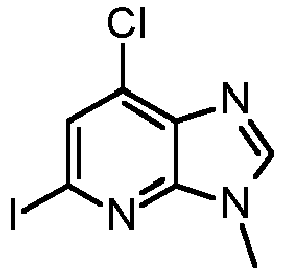
7-Chloro-5-iodo-3-methyl-3H-imidazo[4,5-b]pyridine CAS [2587-02-2] Exemplifie d 293 294 2 
5-(7-Chloro-3-methyl-3H-imidazo[4,5-b]pyridin-5-yloxy)-4-methyl-pyridine-2-carbonitrile Int 1 Exemplifie d 300 300 3 
5-(7-Amino-3-methyl-3H-imidazo[4,5-b] pyridin-5-yloxy)-4-methyl-pyridine-2-carbonitrile Int2 Exemplifie d 280 281 4 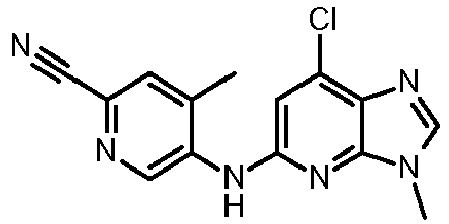
5-(7-Chloro-3-methyl-3H-imidazo[4,5-b] pyridin-5-ylamino)-4-methyl-pyridine-2-carbonitrile Int 1, Int 17 Exemplifie d 299 299 5 
5- [(7-Chloro-3-methyl-3H-imidazo[4,5-b] pyridin-5-yl)-methyl-amino]-4-methylpyridine-2-carbonitrile Int 1, Int 18 Exemplifie d 313 313 6 
(±)-4-[(7-chloro-3-methyl-imidazo[4,5-b]pyridin-5-yl)amino] cyclohexanecarbonitrile Int 1, [873537-33-8] B3 290 290 7 
7-chloro-N-(3,3-dimethyltetrahydropyran-4-yl)-3-methyl-imidazo [4,5-b]pyridin-5-amine Int 1, [1400580-54-2] B3 295 295 8 
(7-Chloro-3-methyl-3H-imidazo[4,5-b]pyridin-5-yl)-methyl-((S)-1,2,2-trimethyl-propyl)-amine Int 67 Exemplifie d 280 281 9 
(±)-(1R,3R)-3-[(7-chloro -3-methyl-imidazo[4,5-b] pyridin-5-yl)amino] cyclohexanecarbonitrile Int 1, [920966-30-9] B3 290 290 10 
4-[(7-chloro-3-methyl-imidazo[4,5-b]pyridin-5-yl)amino]-3-cyclopropyl-5-fluoro-benzonitrile Int 1, Int 19 B3 342 342 11 
5-[(7-chloro-3-methyl-imidazo[4,5-b]pyridin-5-yl)amino]-4-ethylpyridine-2-carbonitrile Int 1, Int 20 B3 313 313 12 
(7-Chloro-3-methyl-3H-imidazo[4,5-b]pyridin-5-yl)-((R)-1-cyclopropylethyl)-methyl-amine Int 65, [6240-96-6] Exemplifie d 264 265 13 
(±)-7-chloro-3-methyl-N-[(3R,4S)-3-methyltetra hydropyran-4-yl]imidazo [4,5-b]pyridin-5-amine Int 1, [1682655-57-7] B3 281 281 14 
Dibenzyl-(5-chloro-3-methyl-3H-imidazo[4,5-b]pyridin-7-yl)-amine [2587-02-2] Exemplifie d 362 363 15 
4-amino-3-ethyl-5-fluorobenzonitrile [63069-50-1] Exemplifie d 164 165 16 
4-(7-Dibenzylamino-3- methyl-3H-imidazo[4,5-b]pyridin-5-ylamino)-3-ethyl-5-fluoro-benzonitrile Int 15, Int. 16 Exemplifie d 490 491 17 
5-amino-4-methylpyridine-2-carbonitrile [156118-16-0] Exemplifie d 133 134 18 
3-Methyl-4-methylamino-benzonitrile Int 17 Exemplifie d 147 148 19 
4-Amino-3-cyclopropyl-5-fluoro-benzonitrile [63069-50-1] Exemplifie d 176 177 20 
5-Amino-4-ethylpyridine-2-carbonitrile [929617-29-8] Exemplifie d 147 148 21 
5-hydroxy-4-methyl pyridine-2-carbonitrile [886364-86-9] Exemplifie d 134 135 22 
5-Amino-pyridine-2-carboxylic acid (2-hydroxy-propyl)-amide [29682-14-2], [78-96-6] Exemplifie d 195 226 23 
2-fluoro-6-methyl-4-methylsulfonyl-phenol [398456-87-6] Exemplifie d 204 205 24 
N-(3-bicyclo[1.1.1] pentanyl)-7-chloro-3-methyl-imidazo[4,5-b] pyridin-5-amine Int1, [2287-35-0] B3 249 249 25 
7-chloro-3-methyl-N-(3-methyltetrahydropyran-4-yl)imidazo[4,5-b]pyridin-5-amine Int1, [1787906-12-0] B3 281 281 26 
7-chloro-N-(1-cyclopropyl-2,2,2-trifluoro-ethyl)-3-methyl-imidazo[4,5-b]pyridin-5-amine Int1, [75702-99-7] B3 305 305 27 
7-chloro-3-methyl-N-(5-oxaspiro[3.5]nonan-8-yl)imidazo[4,5-b]pyridin-5-amine Int 1, [1309434-30-7] B3 307 307 28 
7-Chloro-5-(1-cyclopropyl-2,2,2-trifluoro-ethoxy)-3-methyl-3H-imidazo[4,5-b]pyridine Int 1, [1993-77-7 ] Exemplifie d 305 306 29 
6-Amino-pyridazine-3- carboxylic acid ethylamide [301548-08-3] and [75-04-7] A2 166 167 30 
6-Amino-N-(2-hydroxypropyl)-nicotinamide [231958-14-8] and [78-96-6] A2 195 196 31 
6-Amino-pyridazine-3- carboxylic acid (2-hydroxy-propyl)-amide [301548-08-3] and [78-96-6] A2 167 168 32 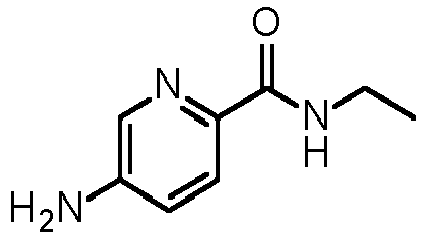
5-Amino-pyridine-2-carboxylic acid ethylamide [1437794-42-7] Exemplifie d 165 166 33 
N-(2-Methoxy-ethyl)-pyrimidine-4,6-diamine [5305-59-9] and [109-85-3] P1 168 169 34 
N-(3-Methoxy-propyl)-pyrimidine-4,6-diamine [5305-59-9] and [5332-73-0] P1 182 183 35 
4-(6-Amino-pyrimidin-4-ylamino)-2-methyl-butan-2-ol [5305-59-9] and [26734-08-7] P1 196 197 36 
3-(6-Amino-pyrimidin-4-ylamino)-propan-1 -ol [5305-59-9] and [156-87-6] P1 168 169 37 
N-[1,4]Dioxan-2-ylmethyl-pyrimidine-4,6-diamine [5305-59-9] and [88277-83-2] P1 210 211 38 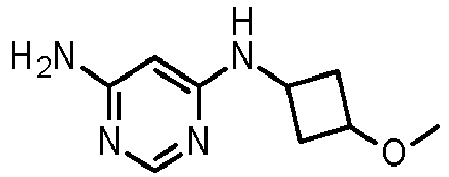
N-(3-Methoxy-cyclobutyl)-pyrimidine-4,6-diamine [5305-59-9] and [1234615-98-5] P1 194 195 39 
4-(6-Amino-pyrimidin-4-ylamino)-butan-2-ol [5305-59-9] and [39884-48-5] P1 182 183 40 
6-(3-Dimethylaminomethyl-azetidin-1-yl)-pyridazin-3-ylamine [187973-60-0] and [321890-22-6] P2 207 208 41 
(±)-6-((3R,5S)-3,4,5-Trimethyl-piperazin-1-yl)-pyridazin-3-ylamine [187973-60-0] and [147539-61-5] P2 221 222 42 
6-[4-(2,2,2-Trifluoroethyl)-piperazin-1-yl]- pyridazin-3-ylamine [187973-60-0] and [13349-90-1] P2 261 262 43 
(±)-6-((2R,6S)-2,6-Dimethyl-morpholin-4-yl)-pyridazin-3-ylamine [187973-60-0] and [6485-55-8] P2 208 209 44 
6-((S)-2-Methyl-morpholin-4-yl)-pyridazin-3-ylamine [187973-60-0] and [74572-13-7] P2 194 195 45 
1-(6-Amino-pyridazin-3 yl)-piperidine-4-carbonitrile [187973-60-0] and [4395-98-6] P2 203 204 46 
(7-Chloro-3-methyl-3H-imidazo[4,5-b]pyridin-5-yl)-(2-methyl-1-trifluoromethyl-propyl)-amine Int 1, [1582-18-9] B3 307 307 47 
5-[7-[4-(N-Boc-aminomethyl)anilino] -3- methyl-imidazo[4,5-b]pyridin-5-yl]oxy-4-methyl-pyridine-2-carbonitrile Int 1, [94838-55-8] B1 485 486 48 
7-Chloro-5-(1-cyclopropyl-ethoxy)-3- methyl-3H-imidazo[4,5-b]pyridine Int 57 Exemplifie d 251 252 49 
4-Methyl-5-[3-methyl-7-[[5-(2,2,2-trifluoro-1-hydroxy-ethyl)-2-pyridyl]amino] imidazo[4 ,5-b]pyridin-5-yl]oxypyridine-2-carbonitrile Int 3, [1188477-81-7] B3 455 456 50 
N-ethyl-4-methylpyridine-3-carboxamide [179555-11-4] Exemplifie d 179 180 51 
Methyl 6-[[5-[(6-cyano-4-methyl-3-pyridyl)oxy]- 3 -methyl-imidazo [4,5-b]pyridin-7-yl]amino]-2-methyl-pyridine-3-carboxylate Int2, [872355-52-7] B1 429 430 52 
6-[[5-[(6-cyano-4-methyl-3-pyridyl)oxy] -3-methyl-imidazo[4,5-b]pyridin-7-yl]amino]-2-methyl-pyridine-3-carboxylic acid Int 51 Exemplifie d 415 416 53 
5-((S)-3-methyl-4-morpholinyl)-2-pyridinamine [1072-97-5], [350595-57-2] Exemplifie d 193 194 54 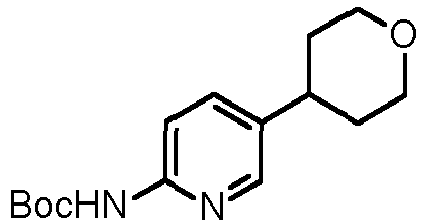
N-Boc-5-(tetrahydro-2H-pyran-4-yl)pyridin-2-amine [159451-66-8], [1279123-50-0] Exemplifie d 278 279 55 
5-(tetrahydro-2H-pyran-4-yl)pyridin-2-amine Int 54 D1 178 179 56 
3-chloro-6-(1-methylazetidin-3-yl)oxypyridazine [111043-48-2], [141-30-0] Exemplifie d 200 200 57 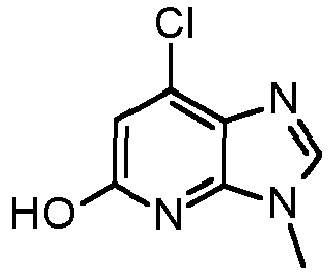
7-Chloro-3-methyl-3H-imidazo[4,5-b]pyridin-5-ol Int 1 Exemplifie d 184 184 58 
(7-Chloro-3-methyl-3H-imidazo[4,5-b]pyridin-5-yl)-(1-cyclobutyl-ethyl)-amine Int 1, [60637-96-9] B3 264 265 59 
(7-Chloro-3-methyl-3H-imidazo[4,5-b]pyridin-5-yl)-dicyclopropylmethyl-amine Int 1, [13375-29-6] B3 276 277 60 
6-[5-(6-Cyano-4-methyl-pyridin-3-yloxy)-3-methyl-3H-imidazo[4,5-b]pyridin-7-ylamino]-nicotinic acid methyl ester Int 2, [36052-24-1] B1 415 416 61 
6-[5-(6-Cyano-4-methyl-pyridin-3-yloxy)-3-methyl-3H-imidazo[4,5-b]pyridin-7-ylamino]-nicotinic acid Int 60 Exemplifie d 401 402 62 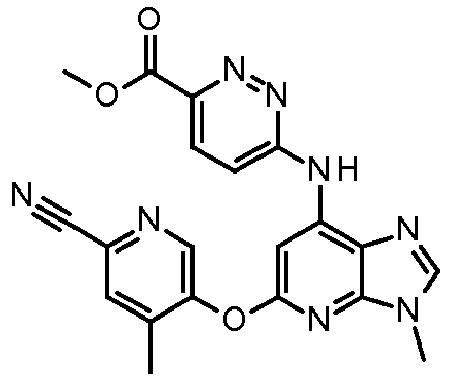
6-[5-(6-Cyano-4-methyl-pyridin-3-yloxy)-3-methyl-3H-imidazo[4,5-b]pyridin-7-ylamino]-pyridazine-3-carboxylic acid methyl ester Int 2, [98140-96-6] B1 416 417 63 
6-[5-(6-Cyano-4-methyl-pyridin-3-yloxy)-3-methyl-3H-imidazo[4,5-b]pyridin-7-ylamino]-pyridazine-3-carboxylic acid Int 62 Exemplifie d 402 403 64 
(7-Chloro-3-methyl-3H-imidazo[4,5-b]pyridin-5-yl)-((R)-2-methyl-1-trifluoromethyl-propyl)-amine Int 1, [1032181-63-7] B3 306 307 65 
(7-Chloro-3-methyl-3H-imidazo[4,5-b]pyridin-5-yl)-((R)-1-cyclopropylethyl)-amine Int 1, [6240-96-6] B3 251 251 66 
(6-aminopyridazin-3-yl)-(4-methylpiperazin-1- yl)methanone [301548-08-3] and [109-01-3] A3 221 222 67 
(7-Chloro-3-methyl-3H-imidazo[4,5-b]pyridin-5-yl)-((S)-1,2,2-trimethylpropyl)-amine Int 1, [22526-47-2] B1 267 267 68 
[(R)-4-(6-Chloro-pyridazin-3-yl)-morpholin-2-yl]-methanol [141-30-0], [1436436-17-7] P3 229 230 69 
4-(6-chloropyridazin-3-yl)-2,2,3,3,5,5,6,6-octadeuterio-morpholine [141-30-0], [342611-02-3] P3 207 208 70 
[(S)-4-(6-Chloro-pyridazin-3-yl)-morpholin-2-yl]-methanol [141-30-0], [1313584-92-7] P3 229 230 71 
(2S,6S)-4-(6-Chloro-pyridazin-3-yl)-2,6-dimethyl-morpholine [141-30-0], [276252-76-4] P3 227 228 72 
4-(6-Chloro-pyridazin-3-yl)-[1,4]oxazepane [141-30-0], [5638-60-8] P3 213 214 73 
(2R,6R)-4-(6-Chloro-pyridazin-3-yl)-2,6-dimethyl-morpholine [141-30-0], [171753-74-5] P3 227 228 74 
[4-(6-Chloro-pyridazin-3-yl)-morpholin-2-yl]- methanol [141-30-0], [103003-01-6] P3 229 230 75 
3-(6-Chloro-pyridazin-3-yl)-8-oxa-3-aza-bicyclo [3.2.1] octane [141-30-0], [54745-74-3] P3 225 226 76 
4-(6-Chloro-pyridazin-3- yl)-morpholine-2-carbonitrile [141-30-0], [1205751-07-0] P3 224 225 77 
(R)-4-(6-Chloro-pyridazin-3-yl)-2-methylmorpholine [141-30-0], [168038-14-0] P3 213 214 78 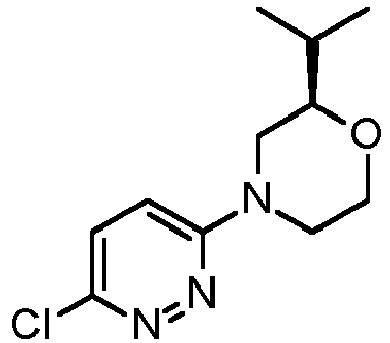
(R)-4-(6-Chloro-pyridazin-3-yl)-2-isopropyl-morpholine [141-30-0], [792886-64-7] P3 241 242 79 
(1S,4S)-5-(6-Chloro-pyridazin-3-yl)-2-oxa-5-aza-bicyclo [2.2.1]heptane [141-30-0], [547716-11-0] P3 211 212 80 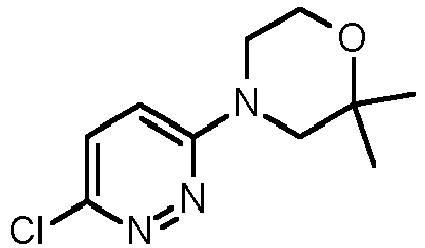
4-(6-Chloro-pyridazin-3- yl)-2,2-dimethyl-morpholine [141-30-0], [147688-58-2] P3 227 228 81 
(rel)-(2S,6S)-4-(6-Chloro-pyridazin-3-yl)-2,6-dimethyl-morpholine [141-30-0], [6485-45-6] P3 227 228 82 
(S)-4-(6-Chloro-pyridazin-3-yl)-2-isopropyl-morpholine [141-30-0], [1286768-31-7] P3 241 242 83 
2-(4-Amino-phenyl)-N-ethyl-acetamide [1197-55-3], [75-04-7] Exemplifie d 178 179 84 
6-amino-pyridin-3-yl)-(4-methyl-piperazin-1-yl)-methanone [3167-49-5], [109-01-3] Exemplifie d 220 221 85 
7-chloro-5-iodo-3-(trideuteriomethyl)imidaz o[4,5-b]pyridine [2587-02-2] Exemplifie d 297 297 86 
5-[(7-chloro-3-methyl-imidazo[4,5-b]pyridin-5-yl)-cyclopropyl-amino]-4-methyl-pyridine-2-carbonitrile Int 4, [411235-57-9] Exemplifie d 339 340 87 
4-ethyl-5-hydroxypyridine-2-carbonitrile Int 20 Exemplifie d 148 149 88 
Tert-butyl4-[6-[[5-[(6-cyano-4-methyl-3-pyridyl)oxy]-3-methyl-imidazo[4,5-b]pyridin-7-yl]amino]-3-pyridyl]piperazine-1- carboxylate Int 2, [571188-59-5] B1 542 543 89 
5-[7-chloro-3-(trideuteriomethyl)imidaz o[4,5-b]pyridin-5-yl]oxy-4-methyl-pyridine-2-carbonitrile Int 85, Int 21 Exemplifie d 303 303 90 
1-(6-chloropyridazin-3-yl)-N,N-dimethyl-azetidin-3 -amine [141-30-0], [935670-07-8] P3 213 213 91 
(1R,4R)-2-(6-Chloro-pyridazin-3-yl)-5-methyl-2,5-diaza-bicyclo [2.2.1]heptane [141-30-0], [125224-64-8] P3 224 225 92 
4-(7-Chloro-3-methyl-3H-imidazo[4,5-b]pyridin-5-yloxy)-3,5-difluoro-benzonitrile Int 57, [134227-45-5] Exemplifie d 321 321 93 
(6-bromo-3-pyridyl)-[2,2,3,3,5,5,6,6-octadeuterio-4-(trideuteriomethyl)pipera zin-1-yl]methanone [1126621-86-0], [6311-35-9] and [865-50-9] Exemplifie d 295 295-297 -

- Intermediate 1 (110 mg, 0.377 mmol, 1.0 eq), 4-Methyl-6-trifluoromethyl-pyridin-3-ol (CAS [1253790-72-5] , 100 mg, 0.565 mmol, 1.5 eq), CuI (7 mg, 0.038 mmol, 0.1 eq), TMHD [1118-71-4] (78 µL, 0.377, 1.0 eq) and Cs2CO3 (246 mg, 0.754 mmol, 2.0 eq) were mixed together under air, dry DMF (1 mL) was added and the mixture was stirred at 85°C overnight. After cooling down to room temperature, the mixture was filtered over pall-seitz thick filter paper. The resulting cake was washed with EtOAc. The obtained filtrate was washed with H2O. Aqueous layer was extracted with EtOAc. Combined organic layers were washed with brine, dried over MgSO4, filtered and concentrated to dryness. Crude material was purified by column chromatography (EtOAc/DCM, gradient of 20% till 60% EtOAc) to afford the desired product. LCMS: m/z = 343 [M+H]+.
- (40mg, 0.117 mmol, 1.0 eq), Pyrimidine-4,6-diamine (CAS [79364-63-9], 26 mg, 0.234 mmol, 2.0 eq), MorDALPhos Pd G3 (2 mg, 0.002 mmol, 0.02 eq), MorDALPhos (1 mg, 0.002 mmol, 0.02 eq), Cs2CO3 (46 mg, 0.140 mmol, 1.2 eq) were mixed together under N2 after which 1,4-dioxane (1 mL) was added. The resulting mixture was stirred at 110°C. After one night, it was cooled down to room temperature. The mixture was diluted with 2 mL of DMSO and purified preparative-HPLC to afford the desired product.
LCMS: m/z = 417 [M+H]+.
- Intermediate 1 (957 mg, 3.27 mmol, 1.0 eq), intermediate 23 (1.0 g, 4.90 mmol, 1.5 eq), CuI (62 mg, 0.327 mmol, 0.1 eq), TMHD (CAS [1118-71-4], 681 µL, 3.27, 1.0 eq) and Cs2CO3 (2.13 g, 6.54 mmol, 2.0 eq) were mixed together under air, dry DMF (10 mL) was added and the mixture was stirred at 85°C. After one week, it was cooled down to room temperature and filtered over pall-seitz thick filter paper. The resulting cake was washed with EtOAc. The obtained filtrate was washed with H2O. Aqueous layer was extracted with EtOAc. Combined organic layers were washed with brine, dried over MgSO4, filtered and concentrated to dryness. Crude material was purified by column chromatography (EtOAc//DCM, 10% till 100% EtOAc) to afford the desired product.
- 7-Chloro-5-(2-fluoro-4-methanesulfonyl-6-methyl-phenoxy)-3-methyl-3H-imidazo[4,5-b]pyridine (50mg, 0.136 mmol, 1.0 eq), Pyrimidine-4,6-diamine (CAS [79364-63-9], 30 mg, 0.271 mmol, 2.0 eq), MorDALPhos Pd G3 (2 mg, 0.002 mmol, 0.02 eq), MorDALPhos (1 mg, 0.002 mmol, 0.02 eq) and Cs2CO3 (53 mg, 0.163 mmol, 1.2 eq) were mixed together under N2, 1,4-dioxane (1 mL) was added. The resulting mixture was stirred at 110°C. After one night, it was cooled down to room temperature. The mixture was diluted with 2 mL of DMSO and purified preparative-HPLC to afford the desired product. LCMS: m/z = 444 [M+H]+.

- Intermediate 1 (6.0 g, 20.48 mmol, 1.0 eq), tBuBrettPhos Pd G3 (348 mg, 0.410 mmol, 0.02 eq) and CsOH monohydrate (10.08g, 61.44 mmol, 3.0 eq) were mixed in 1,4-dioxane (40 mL) and H2O (3.68 mL, 204.80 mmol, 10 eq) was added. The mixture was mechanically stirred at room temperature. After one night, reaction mixture was quenched with H2O and impurities were extracted with EtOAc. Aqueous layer was acidified to pH = 5 and extracted with EtOAc. Organic layer was dried over MgSO4, filtered and concentrated to dryness to afford the desired product. LCMS: m/z = 184 [M+H]+.
- 7-Chloro-3-methyl-3H-imidazo[4,5-b]pyridin-5-ol (500 mg, 2.73 mmol, 1.0 eq), 6-Chloro-5-methylpyridazine-3-carbonitrile (627 mg, 4.10 mmol, 1.5 eq) and K2CO3 (566 mg, 4.10 mmol, 1.5 eq) were mixed together under N2. Next, dry DMF (8 mL) was added and the mixture was stirred at 100°C. After 3h, it was cooled down to room temperature and quenched with H2O to give rise to a suspension. Filtration gave a solid that was washed with H2O then dried in the vacuumoven to afford the desired product. LCMS: m/z = 301 [M+H]+.
- 6-(7-Chloro-3-methyl-3H-imidazo[4,5-b]pyridin-5-yloxy)-5-methyl-pyridazine-3-carbonitrile (50 mg, 0.167 mmol, 1.0 eq), Pyrimidine-4,6-diamine [79364-63-9] (37 mg, 0.333 mmol, 2.0 eq), Pd2(dba)3 (3 mg, 0.003 mmol, 0.02 eq), MorDALPhos (3 mg, 0.006 mmol, 0.04 eq) and Cs2CO3 (65 mg, 0.200 mmol, 1.2 eq) were mixed together under N2, dioxane (1 mL) was added and the mixture was stirred at 110°C. After one night, it was cooled down to room temperature. The mixture was diluted with 2 mL of DMSO and purified preparative-HPLC to afford the desired product. LCMS: m/z = 375 [M+H]+.

- To a solution of intermediate 4 (150 mg, 0.48 mmol, 1.0 eq) and Cs2CO3 (186 mg, 0.57 mmol, 1.2 eq) in dry DMF (3 mL) under N2 was added 1-bromo-3-methoxypropane (CAS [36865-41-5], 147 mg, 0.96 mmol, 2.0 eq). The mixture was stirred at 50°C for 3h. It was then cooled down to room temperature and quenched with H2O. Compound was extracted with EtOAc. Organic layer was washed with brine, dried over MgSO4, filtered and concentrated to dryness. Crude was purified by column chromatography (MeOH/DCM, 2% MeOH) to afford the desired product. LCMS: m/z = 371 [M+H]+.
- 5-[(7-Chloro-3-methyl-3H-imidazo[4,5-b]pyridin-5-yl)-(3-methoxy-propyl)-amino]-4-methylpyridine-2-carbonitrile (113 mg, 0.30 mmol, 1.0 eq), Pyrimidine-4,6-diamine (CAS [79364-63-9], 66 mg, 0.60 mmol, 2.0 eq), Pd2(dba)3 (5 mg, 0.006 mmol, 0.02 eq), MorDALPhos (5 mg, 0.012 mmol, 0.04 eq) and Cs2CO3 (117 mg, 0.36 mmol, 1.2 eq) were mixed together under N2 after which 1.4-dioxane (2 mL) was added and the mixture was stirred at 110°C. After one night, it was cooled down to room temperature and DMSO (1 mL) was added. Mixture was filtered and purified by preparative HPLC to afford the desired product. LCMS: m/z = 445 [M+H]+.

- To a solution of intermediate 4 (100 mg, 0.33 mmol, 1.0 eq) in dry DMF (1 mL) under N2 was added LHMDS (1M in THF, 390 µL, 0.39 mmol, 1.2 eq). The mixture was stirred at room temperature for 5 min then 3-bromopropoxy-tert-butyl-dimethyl-silane(CAS [89031-84-5], 98 mg, 0.39 mmol, 1.2 eq) was added and the mixture was stirred at 50°C for 3h. It was then cooled down to room temperature and quenched with H2O. The mixture was extracted with EtOAc. Organic layer was washed with brine, dried over MgSO4, filtered and concentrated to dryness. Crude was purified by column chromatography (EtOAc/petroleum ether, 6:4) to afford the desired product. LCMS: m/z = 471 [M+H]+.
- 5-[[3-(tert-Butyl-dimethyl-silanyloxy)-propyl]-(7-chloro-3-methyl-3H-imidazo[4,5-b]pyridin-5-yl)-amino]-4-methyl-pyridine-2-carbonitrile (102 mg, 0.217 mmol, 1.0 eq), Pyrimidine-4,6-diamine (CAS [79364-63-9], 48 mg, 0.434 mmol, 2.0 eq), Pd2(dba)3 (4 mg, 0.046 mmol, 0.02 eq), MorDALPhos (4 mg, 0.08 mmol, 0.04 eq) and Cs2CO3 (85 mg, 0.26 mmol, 1.2 eq) were mixed together under N2 after which 1,4-dioxane (2 mL) was added. Next, the mixture was stirred at 110°C during overnight.After letting the mixture cool down till room temperature, DMSO (1 mL) and TBAF (1M in THF, 0.6 mL, 0.6 mmol, 2.8 eq) were added. The mixture was stirred for 10 min at room temperature. Reaction mixture was then filtered and purified by preparative HPLC to afford the desired product. LCMS: m/z = 431 [M+H]+.

- 6-Amino-nicotinic acid (CAS [3167-49-5], 447 mg, 3.236 mmol, 1.0 eq), N-methyl-D3-piperazine (CAS [1093380-08-5], 444 µL, 3.883, 1.2 eq) and DIPEA (1.24 mL, 7.119 mmol, 2.2 eq) were stirred in dry EtOH (5 mL) after which HATU (1.844 g, 4.854 mmol, 1.5 eq) was added. The mixture was stirred at room temperature for 18h. It was then concentrated to dryness and redissolved in DCM. A precipitate formed and was filtered. Filtrate was purified by column chromatography using DCM/EtOH/25% aqueous NH3 (7/1/0.1) as eluent to obtain the desired product.
- Intermediate 2 (201 mg, 0.673 mmol, 1.0 eq), (6-Amino-pyridin-3-yl)-(4-trideuteriomethyl-piperazin-1-yl)-methanone (150 mg, 0.673 mmol, 1.0 eq), Pd2Cl2(allyl)2 (5 mg, 0.013 mmol, 0.02 eq), MorDALPhos (12 mg, 0.026 mmol, 0.04 eq) and Cs2CO3 (263 mg, 0.808 mmol, 1.2 eq) were mixed together under N after which 1,4-dioxane (3 mL) was added. The mixurte was stirred at 110°C. After one night, it was cooled down to room temperature followed by the addition of 0.5 mL of DMSO. Mixture was filtered and filtrate was purified by preparative HPLC to afford the desired product. LCMS: m/z = 487 [M+H]+.

- Intermediate 1 (215 mg, 0.733 mmol, 1.0 eq), 4-Ethyl-5-hydroxy-pyridine-2-carbonitrile (Int 87, 141 mg, 0.953 mmol, 1.3 eq), CuI (28 mg, 0.147 mmol, 0.2 eq), TMHD (CAS [1118-71-4], 305 µL, 1.466 mmol, 2.0 eq) and Cs2CO3 (478 g, 1.466 mmol, 2.0 eq) were mixed together under air, solvent was added and the mixture was stirred at 85°C. After 48h, it was cooled down to room temperature and quenched with 10% aq. TMEDA solution and compound was extracted with EtOAc. Organic layer was washed with brine, dried over MgSO4, filtered and concentrated to dryness. Crude material was purified by column chromatography (EtOAc/DCM, 7:3) to afford the desired product. LCMS: m/z = 314 [M+H]+.
- 5-(7-Chloro-3-methyl-3H-imidazo[4,5-b]pyridin-5-yloxy)-4-ethyl-pyridine-2-carbonitrile (82 mg, 0.263 mmol, 1.0 eq), 5-[(morpholin-4-yl)carbonyl]pyridin-2-amine (CAS [827587-90-6 ], 55 mg, 0.263 mmol, 1.0 eq), MorDALPhos Pd G3 (CAS [6035-47-8], 5 mg, 0.005 mmol, 0.02 eq), MorDALPhos (CAS [1237588-12-3] (2 mg, 0.005 mmol, 0.02 eq) and Cs2CO3 (103 mg, 0.316 mmol, 1.2 eq) were mixed together under N2 after which 1,4-dioxane (1 mL) was added and the mixture was stirred at 110°C. After one night, the mixture was allowed to cool down till room temperature and was then diluted with 2 mL of DMSO. Resulting mixture was filtered and filtrate was purified by preparative HPLC to afford the desired product. LCMS: m/z = 485 [M+H]+.

- Step 1: A solution of Int 49 (75 mg, 0.16 mmol, 1.0 eq) and Et3N (46 µL, 0.33 mmol, 2.0 eq) in anhydrous DCM (1 mL, 0.2 M) was cooled to 0°C under N2. MsCl (CAS [124-63-0], 25 µL, 0.33 mmol, 2.0 eq) in 0.1 mL of anhydrous DCM was added dropwise and the mixture was allowed to warm to room temperature. After 1h, the reaction was diluted with DCM (5 mL) and quenched with saturated aquaeous NaHCO3 (5 mL). The organic layer was washed with brine (5 mL), dried and evaporated in vacuo to afford the desired product which was used as such. MS m/z 474/476 (75/25%).
- Step 2: 5-[7-[[5-(1-chloro-2,2,2-trifluoro-ethyl)-2-pyridyl]amino]-3-methyl-imidazo[4,5-b]pyridin-5-yl]oxy-4-methyl-pyridine-2-carbonitrile (31 mg, 0.066 mmol, 1.0 eq), Me2NH2Cl (53 mg, 0.66 mmol, 10 eq) and K2CO3 (182 mg, 1.32 mmol, 20 eq) were mixed together in anhydrous DMF (0.3 mL). The mixture was stirred for 1h at 80°C under N2 atmosphere. Next, the reaction mixture was diluted with water (5 mL) and extracted with EtOAc (2x5 mL). The combined organic extracts were dried and evaporated in vacuo. The residue was dissolved in MeOH, filtered purified by preparative HPLC to afford the desired products. LCMS 79: m/z = 483 [M+H]+ ; LCMS 80: m/z = 483 [M+H]+.

- In a 5 mL vial, 2-[tert-butyl(dimethyl)silyl]oxypropylamine (CAS [1789680-15-4], 380 mg, 2 mmol, 2.0 eq), 2-cyano-4-methyl-5-bromopyridine (CAS [886364-86-9], 200 mg, 1 mmol, 1.0 eq), XantPhosPd G3 (CAS [1445085-97-1], 29 mg, 0.03 mmol, 0.03 eq), XantPhos (CAS [161265-03-8], 17.5 mg, 0.03 mmol, 0.03 eq), and Cs2CO3 (975 mg, 3.0 mmol, 3.0 eq) were added. Dry 1,4-dioxane (3 mL) was added and the mixture was brought under N2 and degassed. The mixture was stirred overnight at 70°C. Water and ethyl acetate were added, after shaking, the water layer was separated. The organic layer was washed once more with water. The precipitate in the organic layer was filtered away. The organic layer was dried over MgSO4, filtered and evaporated. Purification column chromatogratography 5-to 25 % of EtOAc in PE afforded the desired product (200 mg, yield 33%). LCMS: m/z = 306 [M+H]+.
- In a 5 mL vial, 5-[2-[tert-butyl(dimethyl)silyl]oxypropylamino]-4-methyl-pyridine-2-carbonitrile (50 mg, 0.16 mmol, 1.0 eq), Int 1 (48 mg, 0.16 mmol, 1.0 eq), Pd2dba3 (15 mg, 0.016 mmol, 0.1 eq), P(tBu)3.HBF4 (9.3 mg, 0.032 mmol, 0.2 eq) and NaOtBu (16 mg, 0.192 mmol, 1.2 eq) were added. Dry toluene was added and the mixture was brought under N2. It was degassed and stirred for 5h at 110°C. Water and ethyl acetate were added, the mixture was filtered over celite. The layers were separated and the organic layer was dried over MgSO4, filtered and evaporated. Crude was purified with column chromatography using an eluens from 5% EtOAc to 70% EtOAc in PE to afford the desired product. LCMS: m/z = 471 [M+H]+.
- In a 5 mL vial, 5-[2-[tert-butyl(dimethyl)silyl]oxypropyl-(7-chloro-3-methyl-imidazo[4,5-b]pyridin-5-yl)amino]-4-methyl-pyridine-2-carbonitrile (50 mg, 0.22 mmol, 1 eq), 4,6-diaminopyrimidine (49 mg, 0.44 mmol, 2 eq), MorDalPhos Pd G3 (18 mg, 0.022 mmol, 0.1 eq), MorDalPhos (10 mg, 0.022 mmol, 0.1 eq) and Cs2CO3 (143 mg, 0.44 mmol, 2 eq) were added. Anhydrous 1,4-dioxane was added, the mixture was brought under N2 and degassed. It was subsequently stirred at 110°C for 2h. The mixture was cooled to room temperature, water and ethyl acetate were added, the layers were separated and the water layer was washed with EtOAc. The combined organic layers were dried over sodium sulphate, filtered and evaporated to give the desired product which was used as such. LCMS (M+1): 545.3
- A 1 M solution of TBAF in THF (0.2 mL, 0.2 mmol, 2 eq) was added to a solution of 5-[[7-[(6-aminopyrimidin-4-yl)amino]-3-methyl-imidazo[4,5-b]pyridin-5-yl]-[2-[tert-butyl(dimethyl)silyl]oxypropyl]amino]-4-methyl-pyridine-2-carbonitrile (50 mg, 0.1 mmol, 1 equiv) in anhydrous THF (10 mL) at room temperature and the mixture was stirred overnight. The volatiles were evaporated and the mixture was purified by preparative chromatography to give the desired product. LCMS: m/z = 431 [M+H]+.

- Intermediate 3 (1.0 eq, 409g, 1.459 moles) and 4-(6-bromopyridazin-3-yl)morpholine (CAS [66346-91-6], 1.1 eq, 392g) were added to xylene mix of isomers (8L) at room temperature. To the mixture was added, under stirring at room temperature, potassium phosphate tribasic (3.0 eq, 929g). The reaction mixture was heated from room temperature to 135°C in 2h30. Then a suspension of Pd(OAc)2 (2 mol%, 6.6 g) and Xantphos (4 mol%, 33.8g) in xylene (50 mL) was added to the hot mixture. The reaction was heated at reflux for 1h30. Then a suspension of Pd(OAc)2 (2 mol%, 6.6 g) and Xantphos (4 mol%, 33.8 g) in xylenes (50 mL) was added and the reaction was heated at reflux for an additional 1h30. Then a suspension of Pd(OAc)2 (2 mol%, 6.6 g) and Xantphos (4 mol%, 33.8 g) in xylenes (50 mL) was added one last time. The reaction was refluxed for an additional 1h30. The reaction mixture was cooled down to room temperature and stirred overnight. The suspension was filtered, washed with acetonitrile (5 L). The solid was washed with water (15 L) until obtaining a neutral pH, dried under suction, then suspended in acetonitrile (6.5 L) and stirred at room temperature for 1 h. The suspension was filtered, washed with acetonitrile (2 L) and dried. Chromatography on SiO2 (1 g of SiO2 for 1 g of crude) using eluent CHCl3/acetone (70/30) and then CHCl3/MeOH (96/4) afforded the desired product.
- Intermediate 3 (280 mg, 1 mmol, 1.0 eq), 4-(6-bromopyridazin-3-yl)morpholine (268 mg, 1.1 mmol, 1.1 eq) and CsCOs (977 mg, 3 mmol, 3 eq) are mixed under argon at room temperature and degassed tert-amyl alcohol or DMF (5 mL) is added. [Pd(cinnamyl)Cl]2 (5.18 mg, 0.010 mmol, 0.01 eq) and JosiPhos (CAS[1702311-34-9]) (13 mg, 0.024 mmol, 0.024 eq) are added under argon either as solid or as pre-mixed solution in 1 mL degassed tert-amyl alcohol or DMF. The mixture is heated to 100°C for at least 2h.
- The reaction mixture is then cooled to room temperature and acetonitrile is added. The suspension is filtered, the solid is triturated first with water then acetonitrile, and dried to afford the desired product.
Table III. Illustrative compounds of the invention Cp d# Structure Name SM Mtd MW Mes 8 
4-{[7-(6-Amino-pyrimidin-4-ylamino)-3-methyl-3H-imidazo[4,5-b]pyridin-5-yl]-methyl-amino}-3-ethyl-5- fluoro-benzonitrile Int 16 C1 417 418 9 
5-{[7-(6-Amino-pyrimidin-4-ylamino)-3-methyl-3H-imidazo[4,5-b]pyridin-5-yl]-methyl-amino}-4-methylpyridine-2-carbonitrile Int 4 C2 386 387 10 
4-{[7-(6-Amino-pyrimidin-4-ylamino)-3-methyl-3H-imidazo[4,5-b]pyridin-5-yl]-methyl-amino}-cyclohexanecarbonitrile Int 6 C2 378 378 11 
N7-(6-Amino-pyrimidin-4-yl)-N5-(3,3-dimethyl-tetrahydro-pyran-4-yl)-3,N5-dimethyl-3H-imidazo[4,5-b]pyridine-5,7-diamine Int 7 C2 383 383 12 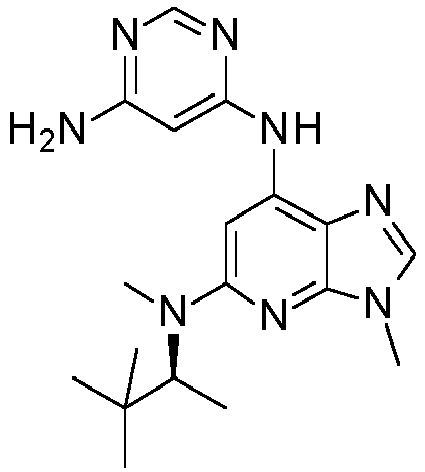
N7-(6-aminopyrimidin-4-yl)-N5,3-dimethyl-N5-[(1S)-1,2,2-trimethylpropyl]imidazo[4,5 -b]pyridine-5,7-diamine Int 33, [79364-63-9] B1 355 355 13 
(±)-(1R,3R)-3-{[7-(6-Amino-pyrimidin-4-ylamino)-3-methyl-3H-imidazo[4,5-b]pyridin-5-yl]-methyl-amino}-cyclohexanecarbonitrile Int 9 C2 378 378 14 
4-{[7-(6-Amino-pyrimidin-4-ylamino)-3-methyl-3H-imidazo[4,5-b]pyridin-5-yl]-methyl-amino}-3- cyclopropyl-5-fluoro-benzonitrile Int 10 C2 430 430 15 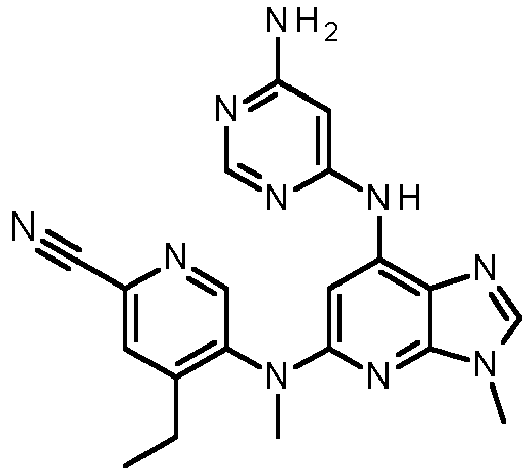
5-{[7-(6-Amino-pyrimidin-4-ylamino)-3-methyl-3H-imidazo[4,5-b]pyridin-5-yl]-methyl-amino}-4-ethylpyridine-2-carbonitrile Int 11 C2 400 401 16 
N7-(6-aminopyrimidin-4-yl)-N5-[(1R)-1-cyclopropylethyl]-N5,3- dimethyl-imidazo[4,5-b]pyridine-5,7-diamine Int 34, [79364-63-9] B1 338 339 17 
N7-(6-Amino-pyrimidin-4-yl)-3,N5-dimethyl-N5-((3R,4S)-3-methyl-tetrahydro-pyran-4-yl)-3H-imidazo[4,5-b]pyridine-5,7-diamine Int 13 C2 368 369 18 
N7-(6-Amino-pyrimidin-4-yl)-N5-bicyclo[1.1.1]pent-1-yl-3,N5-dimethyl-3H-imidazo[4,5-b]pyridine-5,7-diamine Int 24 C2 336 337 19 
N7-(6-Amino-pyrimidin-4-yl)-3,N5-dimethyl-N5-(3-methyl-tetrahydro-pyran-4-yl)-3H-imidazo[4,5-b]pyridine-5,7-diamine Int 25 C2 368 369 20 
N7-(6-Amino-pyrimidin-4-yl)-N5-(1-cyclopropyl-2,2,2-trifluoro-ethyl)-3,N5-dimethyl-3H-imidazo[4,5-b]pyridine-5,7-diamine Int 26 C2 392 393 21 
N7-(6-Amino-pyrimidin-4-yl)-3,N5-dimethyl-N5-(5-oxa-spiro[3.5]non-8-yl)-3H-imidazo[4,5-b]pyridine-5,7-diamine Int 27 C2 395 395 22 
5-(1-cyclopropyl-2,2,2-trifluoro-ethoxy)-3-methyl-N-(5-methylsulfonyl-2-pyridyl)imidazo[4,5-b]pyridin-7-amine Int 28, [35196-11-3] B1 441 442 23 
6-[5-(6-Cyano-4-methyl-pyridin-3-yloxy)-3-methyl-3H-imidazo[4,5-b]pyridin-7-ylamino]-pyridazine-3- carboxylic acid ethylamide Int 2, Int 29 B1 429 430 24 
6-[5-(6-Cyano-4-methyl-pyridin-3-yloxy)-3-methyl-3H-imidazo[4,5-b]pyridin-7-ylamino] -N-(2-hydroxypropyl)-nicotinamide Int 2, Int 30 B1 459 459 25 
6-[5-(6-Cyano-4-methyl-pyridin-3-yloxy)-3-methyl-3H-imidazo[4,5-b]pyridin-7-ylamino]-pyridazine-3-carboxylic acid (2-hydroxypropyl)-amide Int 2, Int 31 B1 460 460 26 
5-[5-(6-Cyano-4-methyl-pyridin-3-yloxy)-3-methyl-3H-imidazo[4,5-b]pyridin-7-ylamino]-pyridine-2-carboxylic acid ethylamide Int 2, Int 32 B1 429 429 27 
2-{4-[5-(6-Cyano-4-methyl-pyridin-3-yloxy)-3-methyl-3H-imidazo[4,5-b]pyridin-7-ylamino]-phenyl}-N-ethyl-acetamide In t3, Int 83 B1 442 442 28 
4-Methyl-5-{3-methyl-7-[6-(morpholine-4-carbonyl)-pyridin-3-ylamino]-3H-imidazo[4,5-b]pyridin-5-yloxy}-pyridine-2-carbonitrile Int 2, [118013 1-89-8] B1 471 471 29 
5-[5-(6-Cyano-4-methyl-pyridin-3-yloxy)-3-methyl-3H-imidazo[4,5-b]pyridin-7-ylamino]-pyridine-2-carboxylic acid methylamide Int 2, [941284 -74-8] B1 414 415 30 
5-[5-(6-Cyano-4-methyl-pyridin-3-yloxy)-3-methyl-3H-imidazo[4,5-b]pyridin-7-ylamino] -pyridine-2-carboxylic acid (2-hydroxypropyl)-amide Int 2, Int 22 B1 459 459 31 
5-{7-[6-(2-Methoxy-ethylamino)-pyrimidin-4-ylamino]-3-methyl-3H-imidazo[4,5-b]pyridin-5-yloxy}-4-methyl-pyridine-2-carbonitrile Int 2, Int 33 B1 431 432 32 
5-{7-[6-(3-Methoxy-propylamino)-pyrimidin-4-ylamino]-3-methyl-3H-imidazo[4,5-b]pyridin-5-yloxy}-4-methyl-pyridine-2-carbonitrile Int 2, Int 34 B1 445 446 33 
5- {7-[6-(3-Hydroxy-3-methyl-butylamino)-pyrimidin-4-ylamino]-3- methyl-3H-imidazo[4,5-b]pyridin-5-yloxy}-4-methyl-pyridine-2-carbonitrile Int 2, Int 35 B1 459 460 34 
5-{7-[6-(3-Hydroxy-propylamino)-pyrimidin-4-ylamino]-3-methyl-3H-imidazo[4,5-b]pyridin-5-yloxy}-4-methyl-pyridine-2-carbonitrile Int 2, Int 36 B1 431 432 35 
5-(7-{6-[([1,4]Dioxan-2-ylmethyl)-amino]- pyrimidin-4-ylamino}-3-methyl-3H-imidazo[4,5-b]pyridin-5-yloxy)-4-methyl-pyridine-2-carbonitrile Int 2, Int 37 B1 473 474 36 
5-{7-[6-(3-Methoxy-cyclobutylamino)-pyrimidin-4-ylamino]-3- methyl-3H-imidazo[4,5-b]pyridin-5-yloxy}-4-methyl-pyridine-2-carbonitrile Int 2, Int 38 B1 457 458 37 
5-{7-[6-(3-Methoxy-butylamino)-pyrimidin-4-ylamino-3-methyl-3H-imidazo[4,5-b]pyridin-5-yloxy}-4-methyl-pyridine-2-carbonitrile Int 2, Int 39 B1 459 460 38 
4-Methyl-5-[3-methyl-7-(6-morpholin-4-yl-pyridazin-3- ylamino)-3H-imidazo[4,5-b]pyridin-5-yloxy]-pyridine-2-carbonitrile Int 2, [66346-91-6] or Int 3, [66346-91-6] B1 Or see abov e 443 444 39 
4-Methyl-5-{3-methyl-7-[6-(4-methyl-piperazin-1-yl)-pyridazin-3-ylamino]-3H-imidazo[4,5-b]pyridin-5-yloxy}-pyridine-2-carbonitrile Int 2, [66346-94-9] B1 456 457 40 
5-{7-[6-(3-Dimethylaminomethyl-azetidin-1-yl)-pyridazin-3-ylamino]-3-methyl-3H-imidazo[4,5-b]pyridin-5-yloxy}-4-methyl-pyridine-2-carbonitrile Int 2, Int 40 B1 470 471 41 
(±)-4-Methyl-5-{3-methyl-7-[6-((3R,5S)-3,4,5-trimethyl-piperazin-1-yl)-pyridazin-3-ylamino]-3H-imidazo[4,5-b]pyridin-5-yloxy}-pyridine-2-carbonitrile Int 2, Int 41 B1 484 485 42 
4-Methyl-5-(3-methyl-7-{6-[4-(2,2,2-trifluoro-ethyl)-piperazin-1-yl]-pyridazin-3- ylamino}-3H-imidazo[4,5-b]pyridin-5-yloxy)-pyridine-2-carbonitrile Int 2, Int 42 B1 524 525 43 
(±)-5-{7-[6-((2R,6S)-2,6-Dimethyl-morpholin-4-yl)-pyridazin-3-ylamino]-3-methyl-3H-imidazo[4,5-b]pyridin-5-yloxy}-4-methyl-pyridine-2-carbonitrile Int 2, Int 43 B1 471 472 44 
4-Methyl-5-{3-methyl-7-[6-((S)-2-methyl-morpholin-4-yl)-pyridazin-3-ylamino]-3H-imidazo[4,5-b]pyridin-5-yloxy}-pyridine-2-carbonitrile Int 2, Int 44 B1 457 458 45 
5-{7-[6-(4-Cyano-piperidin-1-yl)-pyridazin-3-ylamino]-3-methyl-3H-imidazo[4,5-b]pyridin-5-yloxy}-4-methyl-pyridine-2-carbonitrile Int 2, Int 45 B1 466 467 46 
4-methyl-5-[3-methyl-7-[[5-(4-propan-2-ylpiperazine-1- carbonyl)pyridin-2-yl]amino]imidazo[4,5-b]pyridin-5-yl]oxypyridine-2-carbonitrile Int 61, [4318-42-7] A1-a 512 513 47 
5-[7-[[5-(4-cyclobutylpiperazine-1-carbonyl)pyridin-2-yl]amino]-3-methylimidazo[4,5-b]pyridin-5-yl]oxy-4-methylpyridine-2-carbonitrile Int 61, [799557 -65-6] A1-a 524 525 48 
5-[7-[[5-(4-cyclopropylpiperazine-1- carbonyl)pyridin-2-yl]amino]-3-methylimidazo[4,5-b]pyridin-5-yl]oxy-4-methylpyridine-2-carbonitrile Int 61, [20327-23-5] A1-a 510 511 49 
4-methyl-5-[3-methyl-7-[(5-morpholin-4-ylpyridin-2-yl)amino]imidazo[4,5-b]pyridin-5-yl]oxypyridine-2-carbonitrile Int 2, [571189 -78-1] B1 442 443 50 
4-methyl-5-[3-methyl-7-[[5-(4-methylpiperazin-1- yl)pyridin-2-yl]amino]imidazo[4,5-b]pyridin-5-yl] oxypyridine-2-carbonitrile Int 2, [571189 -49-6] B1 456 457 51 
4-methyl-5-[7-[[5-(4-methylpiperazine-1- carbonyl)pyridin-2-yl]amino]-3-(trideuteriomethyl)imidazo[ 4,5-b]pyridin-5-yl]oxypyridine-2-carbonitrile Int 84, Int 89 B1 487 487 52 
5-[7-[(6-aminopyrimidin-4-yl)amino]-3-methyl-imidazo[4,5-b]pyridin-5-yl]oxy-4-methyl-pyridine-2-carbonitrile Int 2, [79364-63-9] B1 373 374 53 
4-[[5-[(6-cyano-4-methyl-3-pyridyl)oxy]-3-methyl-imidazo[4,5-b]pyridin-7-yl]amino]-N-ethyl-benzenesulfonamide Int 2, [1709-53-1] B1 464 464 54 
N4-[5-(1-cyclopropyl-2,2,2-trifluoro-ethoxy)-3-methyl-imidazo[4,5-b]pyridin-7-yl]pyrimidine-4,6-diamine Int 28, [79364-63-9] B1 379 380 55 
5-[[7-[(6-aminopyrimidin-4-yl)amino]-3-methyl-imidazo[4,5-b]pyridin-5-yl]amino]-4-methylpyridine-2-carbonitrile Int 4, [79364-63-9] B1 372 373 57 
5-[7-[4-(aminomethyl)anilino]-3- methyl-imidazo[4,5-b]pyridin-5-yl]oxy-4-methyl-pyridine-2-carbonitrile formate salt Int47 D1 385 369 (M-NH2 -) 58 
4-methyl-5-[3-methyl-7-[(5-methylsulfonyl-2-pyridyl)amino]imidazo[4,5-b]pyridin-5-yl] oxy-pyridine-2-carbonitrile Int 2, [35196-11-3] B1 436 436 59 
4-methyl-5-[3-methyl-7-[[5-(trifluoromethyl)-2-pyridyl]amino]imidazo[4,5-b]pyridin-5-yl]oxy-pyridine-2-carbonitrile Int 2, [74784-70-6] B1 425 426 60 
4-methyl-5-[3-methyl-7-(4-methylsulfonylanilino)imida zo[4,5-b]pyridin-5-yl]oxypyridine-2-carbonitrile Int 2, [5470-49-5] B1 435 435 61 
4-methyl-5-[3-methyl-7-[(1-methylpyrazol-4-yl)amino]imidazo[4,5-b]pyridin-5-yl]oxy-pyridine-2-carbonitrile Int 2, [69843-13-6] B1 360 361 62 
4-[[5-[(6-cyano-4-methyl-3-pyridyl)oxy]-3-methyl-imidazo[4,5-b]pyridin-7-yl]amino]-N,N-dimethyl-benzamide Int 2, [6331-71-1] B1 428 428 63 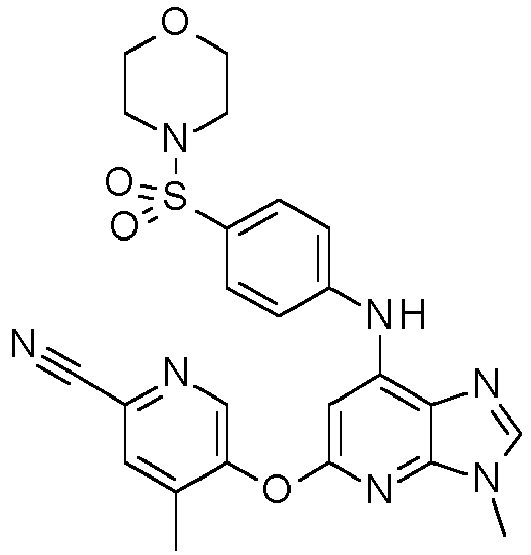
4-methyl-5-[3-methyl-7-(4-morpholinosulfonylanilino)i midazo[4,5-b]pyridin-5-yl]oxy-pyridine-2-carbonitrile Int 2, [21626-70-0] B1 506 506 64 
6-[[5-[(6-cyano-4-methyl-3-pyridyl)oxy]-3-methyl-imidazo[4,5-b]pyridin-7-yl]amino]-N-ethyl-4-methyl-pyridine-3-carboxamide Int2, Int50 B1 443 443 65 
3-methyl-N7-(5-methylsulfonyl-2-pyridyl)-N5-[2-methyl-1-(trifluoromethyl)propyl]imid azo[4,5-b]pyridine-5,7-diamine Int 46, [35196-11-3] B1 443 443 66 
4-[[5-[(6-cyano-4-methyl-3-pyridyl)amino]-3-methyl-imidazo[4,5-b]pyridin-7-yl]amino]-N,N-dimethyl-benzamide Int 4, [6331-71-1] B1 427 427 67 
6-[[5-[(6-cyano-4-methyl-3-pyridyl)amino]-3-methyl-imidazo[4,5-b]pyridin-7-yl]amino]-N,N-dimethylpyridine-3-carboxamide Int 4, [827588 -33-0] B1 428 428 68 
5-[7-[4-(difluoromethylsulfonyl)anil ino]-3-methyl-imidazo[4,5-b]pyridin-5-yl]oxy-4-methyl-pyridine-2-carbonitrile Int 2, [24906-77-2] B1 471 471 69 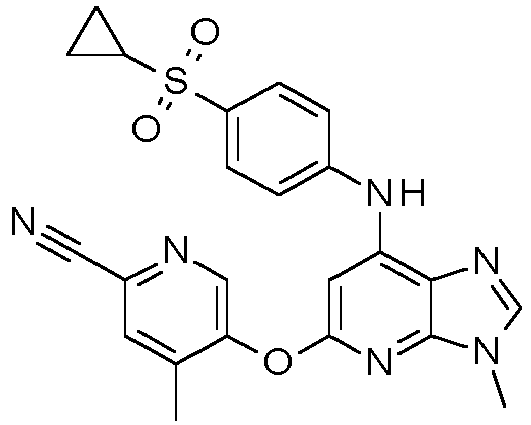
5-[7-(4-cyclopropylsulfonylanilino)-3-methyl-imidazo[4,5-b]pyridin-5-yl]oxy-4-methyl-pyridine-2-carbonitrile Int 2, [114755 8-13-1] B1 461 461 71 
5-[7-[4-(3-methoxypropylsulfonyl)anili no]-3-methyl-imidazo[4,5-b]pyridin-5-yl]oxy-4-methyl-pyridine-2-carbonitrile Int 2, [124716 4-58-4] B1 493 493 72 
N4-[5-(1-cyclopropylethoxy)-3-methyl-imidazo[4,5-b]pyridin-7-yl]pyrimidine-4,6-diamine Int 48, [79364-63-9] B1 325 326 73 
6-[[5-[(6-cyano-4-methyl-3-pyridyl)oxy]-3-methyl-imidazo[4,5-b]pyridin-7-yl]amino]-N,N-dimethyl-pyridazine-3-carboxamide Int 2, [125021 6-83-1] B1 429 429 74 
6-[[5-[(6-cyano-4-methyl-3-pyridyl)oxy]-3-methyl-imidazo[4,5-b]pyridin-7-yl]amino]-N,N-dimethylpyridine-3-carboxamide Int 2, [827588 -33-0] B1 429 429 75 
4-methyl-5-[3-methyl-7-[[5-(morpholine-4-carbonyl)-2-pyridyl]amino]imidazo[4,5-b]pyridin-5-yl]oxy-pyridine-2-carbonitrile Int 2, [827587 -90-6] B1 471 471 76 
6-[[5-[(6-cyano-4-methyl-3-pyridyl)amino]-3-methyl-imidazo[4,5-b]pyridin-7-yl]amino]-N,N-dimethyl-pyridazine-3-carboxamide Int 4, [125021 6-83-1] B1 429 429 77 
6-[[5-[(6-cyano-4-methyl-3-pyridyl)oxy]-3-methyl-imidazo[4,5-b]pyridin-7-yl]amino]-N,N,2-trimethyl-pyridine-3-carboxamide Int 52, [506-59-2] A1 443 443 78 
6-[[5-[(6-cyano-4-methyl-3-pyridyl)oxy]-3-methyl-imidazo[4,5-b]pyridin-7-yl] amino]-N-ethyl-2-methyl-pyridine-3-carboxamide Int 52, [557-66-4] A1 443 443 81 
5-[7-[[5-[(dimethylamino)methyl]pyr idin-2-yl]amino]-3-methylimidazo[4,5-b]pyridin-5-yl]oxy-4-methylpyridine-2-carbonitrile formate salt Int 2, [138442 9-17-7] B1 415 415 82 
4-methyl-5-[3-methyl-7-[[5-(morpholin-4-ylmethyl)pyridin-2-yl]amino]imidazo[4,5-b]pyridin-5-yl] oxypyridine-2-carbonitrile formate salt Int 2, [400775 -78-2] B1 457 457 83 
5-[7-[[5-[[2-(dimethylamino)ethyl-methylamino]methyl]pyridi n-2-yl]amino]-3-methylimidazo[4,5-b]pyridin-5-yl]oxy-4-methylpyridine-2-carbonitrile formate salt Int 2, [119733 2-20-9] B1 472 472 84 
5-[7-[(5-methoxypyridin-2-yl)amino]-3-methylimidazo[4,5-b]pyridin-5-yl]oxy-4-methylpyridine-2-carbonitrile Int 2, [10167-97-2] B1 387 388 85 
4-methyl-5-[3-methyl-7-[[5-[(3S)-3-methylmorpholin-4-yl]pyridin-2-yl]amino]imidazo[4,5-b]pyridin-5-yl] oxypyridine-2-carbonitrile Int 2, Int 53 B1 457 457 86 
4-methyl-5-[3-methyl-7-[[5-(1-methylpiperidin-4-yl)oxypyridin-2-yl]amino]imidazo[4,5-b]pyridin-5-yl]oxypyridine-2-carbonitrile Int 2, [124932 2-37-9] B1 471 471 87 
4-methyl-5-[3-methyl-7-[[5-(oxan-4-yl)pyridin-2-yl]amino]imidazo[4,5-b]pyridin-5-yl] oxypyridine-2-carbonitrile Int 2, Int 55 B1 442 442 88 
5-[[7-[(6-aminopyrimidin-4-yl)amino]-3-methyl-imidazo[4,5-b]pyridin-5-yl]-cyclopropyl-amino]-4-methyl-pyridine-2-carbonitrile Int 86, [156-81-0] B1 413 414 89 
5-[7-[4-(3-hydroxyoxetan-3-yl)anilino]-3-methylimidazo[4,5-b]pyridin-5-yl]oxy-4-methylpyridine-2-carbonitrile Int 2, [111173 5-05-7] B1 429 429 90 
4-methyl-5-[3-methyl-7-[[6-(1-methylazetidin-3-yl)oxypyridazin-3- yl]amino]imidazo[4,5-b]pyridin-5-yl]oxypyridine-2-carbonitrile Int 3, Int 56 B2-a 444 444 91 
5-[[5-[(1-cyclopropyl-2,2,2-trifluoro-ethyl)amino]-3-methyl-imidazo[4,5-b]pyridin-7-yl]amino]-N-ethyl-pyridine-2-carboxamide Int 26, Int 32 B1 433 434 92 
N5-(1-cyclopropyl-2,2,2-trifluoro-ethyl)-3-methyl-N7-(5-methylsulfonyl-2-pyridyl)imidazo[4,5-b]pyridine-5,7-diamine Int 26, [35196-11-3] B1 440 441 93 
N7-(6-aminopyrimidin-4-yl)-3-methyl-N5-[2-methyl-1-(trifluoromethyl)propyl]imid azo[4,5-b]pyridine-5,7-diamine Int 46, [79364-63-9] B1 380 381 94 
N7-(6-aminopyrimidin-4-yl)-N5-(1-cyclobutylethyl)-3 -methyl-imidazo[4,5-b]pyridine-5,7-diamine Int 58, [79364-63-9] B1 338 339 95 
N7-(6-aminopyrimidin-4-yl)-N5-(dicyclopropylmethyl)-3-methyl-imidazo[4,5-b]pyridine-5,7-diamine Int 59, [79364-63-9] B1 350 351 96 
5-[7-[[5-(3-hydroxyazetidine-1- carbonyl)-2-pyridyl]amino]- 3-methyl-imidazo[4,5-b]pyridin-5-yl]oxy-4-methyl-pyridine-2-carbonitrile Int 2, [45347-82-8] A1-a 457 457 97 
N,N-dimethyl-6-[[3-methyl-5-[[(1R)-2-methyl-1-(trifluoromethyl)propyl]ami no]imidazo[4,5-b]pyridin-7-yl]amino]pyridine-3- carboxamide Int 64, [827588 -33-0] B1 436 436 98 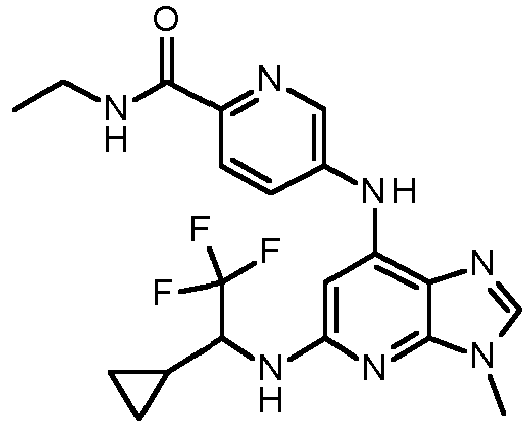
N7-(6-aminopyrimidin-4-yl)-3-methyl-N5-[(1R)-2-methyl-1-(trifluoromethyl)propyl]imid azo[4,5-b]pyridine-5,7-diamine Int 64, [79364-63-9] B1 380 381 99 
6-[[5-[(6-cyano-4-methyl-3-pyridyl)oxy]-3-methyl-imidazo[4,5-b]pyridin-7-yl]amino]-N-(2-dimethylaminoethyl)pyridin e-3-carboxamide Int 61, [108-00-9] A1-a 472 472 100 
6-[[5-[(6-cyano-4-methyl-3-pyridyl)oxy]-3-methyl-imidazo[4,5-b]pyridin-7-yl]amino]-N-(3-methoxypropyl)pyridine-3- carboxamide Int 61, [5332-73-0] A1-a 473 473 101 
6-[[5-[(6-cyano-4-methyl-3-pyridyl)oxy]-3-methyl-imidazo[4,5-b]pyridin-7-yl]amino]-N-(3-hydroxypropyl)pyridine-3- carboxamide Int 61, [156-87-6] A1-a 459 459 102 
5-[7-[[5-[3-(1-hydroxy-1-methyl-ethyl)azetidine-1-carbonyl]-2-pyridyl]amino]- 3-methyl-imidazo[4,5-b]pyridin-5-yl]oxy-4-methyl-pyridine-2-carbonitrile Int 61, [135792 3-33-1] A1-a 499 499 103 
5-[7-[[5-(3-methoxyazetidine-1- carbonyl)-2-pyridyl]amino]- 3-methyl-imidazo[4,5-b]pyridin-5-yl]oxy-4-methyl-pyridine-2-carbonitrile Int 61, [110925 -17-2] A1-a 471 471 104 
5-[7-[[5-[3-(methoxymethyl)azetidine-1-carbonyl]-2-pyridyl]amino]-3-methyl-imidazo[4,5-b]pyridin-5-yl]oxy-4-methyl-pyridine-2-carbonitrile Int 61, [942308 -06-7] A1-a 485 485 105 
4-methyl-5-[3-methyl-7-[[5-(4-methylpiperazine-1- carbonyl)-2-pyridyl]amino]imidazo[4,5-b]pyridin-5-yl]oxy-pyridine-2-carbonitrile Int 61, [5332-73-0] A1-a 484 484 106 
5-[7-[[5-[3-(dimethylamino)azetidine-1- carbonyl]-2-pyridyl]amino]- 3-methyl-imidazo[4,5-b]pyridin-5-yl]oxy-4-methyl-pyridine-2-carbonitrile Int 61, [124668 -49-1] A1-a 484 484 107 
5-[7-[[5-[(3R)-3-(dimethylamino)pyrrolidine-1-carbonyl]pyridin-2-yl]amino]-3-methylimidazo[4,5-b]pyridin-5-yl]oxy-4-methylpyridine-2-carbonitrile Int 61, [132958 -72-6] A1-a 498 498 108 
4-methyl-5-[3-methyl-7-[[6-(morpholine-4-carbonyl)pyridazin-3- yl]amino]imidazo[4,5-b]pyridin-5-yl] oxypyridine-2-carbonitrile Int 63, [110-91-8] A1-a 472 472 109 
4-methyl-5-[3-methyl-7-(4-morpholinoanilino)imidazo[ 4,5-b]pyridin-5-yl]oxypyridine-2-carbonitrile Int 2, [2524-67-6] B1 442 442 110 
4-methyl-5-[3-methyl-7-[4-(4-methylpiperazin-1- yl)anilino]imidazo[4,5-b]pyridin-5-yl]oxy-pyridine-2-carbonitrile Int 2, [16153-81-4] B1 455 455 111 
5-[7-[[6-[3-(1-hydroxy-1-methyl-ethyl)azetidine-1-carbonyl]pyridazin-3-yl]amino]-3-methyl-imidazo[4,5-b]pyridin-5-yl]oxy-4-methyl-pyridine-2-carbonitrile Int 63, [135792 3-33-1] A1-a 500 500 112 
5-[7-[[5-[(3S)-3-hydroxypyrrolidine-1- carbonyl]-2-pyridyl]amino]- 3-methyl-imidazo[4,5-b]pyridin-5-yl]oxy-4-methyl-pyridine-2-carbonitrile Int 61, [100243 -39-8] A1-a 471 471 113 
5-[7-[[5-(3-cyclopropyl-3-hydroxy-azetidine-1- carbonyl)-2-pyridyl]amino]- 3-methyl-imidazo[4,5-b]pyridin-5-yl]oxy-4-methyl-pyridine-2-carbonitrile Int 61, [848192 -93-8] A1-a 497 497 114 
4-methyl-5-[3-methyl-7-[[5-(8-oxa-3-azaspiro[4.4]nonane-3-carbonyl)-2-pyridyl]amino]imidazo[4,5-b]pyridin-5-yl]oxy-pyridine-2-carbonitrile Int 61, [175-97-3] A1-a 511 511 115 
5-[7-[[6-(3-hydroxyazetidine-1-carbonyl)pyridazin-3-yl]amino]-3-methyl-imidazo[4,5-b]pyridin-5-yl]oxy-4-methyl-pyridine-2-carbonitrile Int 63, [45347-82-8] A1-a 458 458 116 
5-[7-[[6-(3-methoxyazetidine-1-carbonyl)pyridazin-3-yl]amino]-3-methyl-imidazo[4,5-b]pyridin-5-yl]oxy-4-methyl-pyridine-2-carbonitrile Int 63, [45347-82-8] A1-a 472 472 117 
5-[7-[[6-[3-(methoxymethyl)azetidine-1-carbonyl]pyridazin-3-yl]amino]-3-methyl-imidazo[4,5-b]pyridin-5-yl]oxy-4-methyl-pyridine-2-carbonitrile Int 63, [942308 -06-7] A1-a 486 486 118 
5-[7-[[5-[3-(hydroxymethyl)azetidine-1- carbonyl]-2-pyridyl]amino]- 3-methyl-imidazo[4,5-b]pyridin-5-yl]oxy-4-methyl-pyridine-2-carbonitrile Int 61, [928038 -44-2] A1-a 471 471 119 
5-[7-[[5-(3-hydroxy-3-methyl-azetidine-1- carbonyl)-2-pyridyl]amino]- 3-methyl-imidazo[4,5-b]pyridin-5-yl]oxy-4-methyl-pyridine-2-carbonitrile Int 61, [124668 -46-8] A1-a 471 471 120 
4-methyl-5-[3-methyl-7-[[5-(3-oxa-6-azaspiro[3.3]heptane-6-carbonyl)-2-pyridyl]amino]imidazo[4,5-b]pyridin-5-yl]oxy-pyridine-2-carbonitrile Int 61, [936947 -34-1] A1-a 483 483 121 
5-[7-[[5-(3-methoxy-3-methyl-azetidine-1- carbonyl)-2-pyridyl]amino]- 3-methyl-imidazo[4,5-b]pyridin-5-yl]oxy-4-methyl-pyridine-2-carbonitrile Int 61, [905843 -93-8] A1-a 485 485 122 
tert-butyl 1-[6-[[5-[(6-cyano-4-methyl-3-pyridyl)oxy]-3-methyl-imidazo[4,5-b]pyridin-7-yl]amino]pyridine-3- carbonyl]azetidine-3- carboxylate Int 61, [53871-08-2] A1-a 541 541 123 
4-methyl-5-[3-methyl-7-[[5-(6-methyl-2,6-diazaspiro[3.3]heptane-2-carbonyl)-2-pyridyl]amino]imidazo[4,5-b]pyridin-5-yl]oxy-pyridine-2-carbonitrile Int 61, [120356 7-11-6] A1-a 496 496 124 
5-[7-[[5-(4-hydroxypiperidine-1- carbonyl)pyridin-2-yl]amino]-3-methylimidazo[4,5-b]pyridin-5-yl]oxy-4-methylpyridine-2-carbonitrile Int 61, [5382-16-1] A1-a 485 485 125 
5-[7-[[5-(4-methoxypiperidine-1-carbonyl)pyridin-2-yl]amino]-3-methylimidazo [4,5-b]pyridin-5-yl]oxy-4-methylpyridine-2-carbonitrile Int 61, [4045-24-3] A1-a 499 499 126 
5-[7-[[5-[4-(dimethylamino)piperidine-1-carbonyl]pyridin-2-yl]amino]-3-methylimidazo [4,5-b]pyridin-5-yl]oxy-4-methylpyridine-2-carbonitrile Int 61, [50533-97-6] A1-a 512 512 127 
5-[7-[[5-[(3R)-3-hydroxypyrrolidine-1-carbonyl]pyridin-2-yl]amino]-3-methylimidazo [4,5-b]pyridin-5-yl]oxy-4-methylpyridine-2-carbonitrile Int 61, [2799-21-5] A1-a 471 471 128 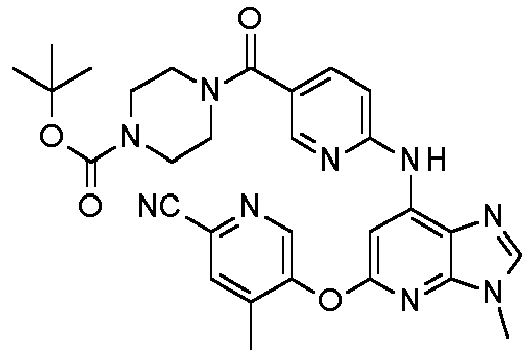
4-{6-[5-(6-Cyano-4-methyl-pyridin-3-yloxy)-3-methyl-3H-imidazo[4,5-b]pyridin-7-ylamino]-pyridine-3-carbonyl}-piperazine-1-carboxylic acid tert-butyl ester Int 61, [57260-71-6] A1-a 570 570 129 
5-[7-[[5-[(3R)-3-(2-methoxyethoxy)pyrrolidine-1-carbonyl]pyridin-2-yl]amino]-3-methylimidazo [4,5-b]pyridin-5-yl]oxy-4-methylpyridine-2-carbonitrile Int 61, [942618 -26-0] A1-a 529 529 130 
(1-{6-[5-(6-Cyano-4-methyl-pyridin-3-yloxy)-3- methyl-3H-imidazo[4,5-b]pyridin-7-ylamino]-pyridine-3-carbonyl}- pyrrolidin-3-yl)-methyl-carbamic acid tert-butyl ester Int 61, [172478 -00-1] A1-a 584 584 131 
4-methyl-5-[3-methyl-7-[[5-(2-oxa-7-azaspiro[3.4]octane-7-carbonyl)pyridin-2-yl]amino]imidazo[4,5-b]pyridin-5-yl] oxypyridine-2-carbonitrile Int 61, [39640-71-6] A1-a 497 497 132 
5-[7-[[5-[3-[(dimethylamino)methyl] aze tidine-1-carbonyl]pyridin-2-yl]amino]-3-methylimidazo[4,5-b]pyridin-5-yl]oxy-4-methylpyridine-2-carbonitrile Int 61, [321890 -22-6] A1-a 498 498 133 
5-[7-[[5-[(3S)-3-(dimethylamino)pyrrolidine-1-carbonyl]pyridin-2-yl]amino]-3-methylimidazo[4,5-b]pyridin-5-yl]oxy-4-methylpyridine-2-carbonitrile Int 61, [132883 -44-4] A1-a 498 498 134 
4-methyl-5-[3-methyl-7-[[5-(2-oxa-6-azaspiro[3.3]heptane-6-carbonyl)pyridin-2-yl]amino]imidazo[4,5-b]pyridin-5-yl] oxypyridine-2-carbonitrile Int 61, [104570 9-32-7] A1-a 483 483 135 
5-[7-[[5-[3,3-bis(hydroxymethyl)azetidine -1-carbonyl]pyridin-2-yl]amino]-3-methylimidazo [4,5-b]pyridin-5-yl]oxy-4-methylpyridine-2-carbonitrile Int 61, [101623 2-92-0] A1-a 501 501 136 
6-[[5-(6-cyano-4-methylpyridin-3-yl)oxy-3- methylimidazo [4,5-b]pyridin-7-yl]amino]-N-(2-hydroxyethyl)-N-methylpyridine-3-carboxamide Int 61, [109-83-1] A1-a 459 459 137 
4-methyl-5-[3-methyl-7-[[5-(3-propan-2-yloxyazetidine-1 -carbonyl)pyridin-2-yl]amino]imidazo[4,5-b]pyridin-5-yl] oxypyridine-2-carbonitrile Int 61, [871657 -49-7] A1-a 499 499 138 
5-[7-[[5-(4-hydroxy-4-methylpiperidine-1- carbonyl)pyridin-2-yl]amino]-3-methylimidazo [4,5-b]pyridin-5-yl]oxy-4-methylpyridine-2-carbonitrile Int 61, [3970-68-1] A1-a 499 499 139 
6-[[5-(6-cyano-4-methylpyridin-3-yl)oxy-3- methylimidazo[4,5-b]pyridin-7-yl]amino]-N-[rac-(1R,3R)-3-hydroxycyclopentyl]pyridin e-3-carboxamide Int 61, [124555 -33-5] A1-a 485 485 140 
4-methyl-5-[3-methyl-7-[[5-[rac-(3R,4R)-3-fluoro-4-hydroxypyrrolidine-1-carbonyl]pyridin-2-yl]amino]imidazo[4,5-b]pyridin-5-yl] oxypyridine-2-carbonitrile Int 61, [133432 0-82-9] A1-a 489 489 141 
4-methyl-5-[3-methyl-7-[[5-[rac-(3R,4R)-3,4-dihydroxypiperidine-1-carbonyl]pyridin-2-yl]amino]imidazo[4,5-b]pyridin-5-yl] oxypyridine-2-carbonitrile Int 61, [39640-71-6] A1-a 501 501 142 
4-methyl-5-[3-methyl-7-[[5-[rac-(3R,4R)-3-fluoro-4-methoxypyrrolidine-1- carbonyl]pyridin-2-yl]amino]imidazo[4,5-b]pyridin-5-yl] oxypyridine-2-carbonitrile Int 61, [120356 6-98-6] A1-a 503 503 143 
5-[7-[[6-[3-(dimethylamino)azetidin-1 - yl]pyridazin-3-yl]amino]-3-methylimidazo[4,5-b]pyridin-5-yl]oxy-4-methylpyridine-2-carbonitrile Int 2, Int 90 B1 457 457 144 
4-methyl-5-[3-methyl-7-[[5-[(2S)-2-methylmorpholine-4-carbonyl]pyridin-2-yl]amino]imidazo[4,5-b]pyridin-5-yl] oxypyridine-2-carbonitrile Int 61, [74572-13-7] A1-a 485 485 145 
4-methyl-5-[3-methyl-7-[[5-[(2R)-2-methylmorpholine-4-carbonyl]pyridin-2-yl]amino]imidazo[4,5-b]pyridin-5-yl] oxypyridine-2-carbonitrile Int 61, [168038 -14-0] A1-a 485 485 146 
4-methyl-5-[3-methyl-7-[[5-[(3R)-3-methylmorpholine-4-carbonyl]pyridin-2-yl]amino]imidazo[4,5-b]pyridin-5-yl] oxypyridine-2-carbonitrile Int 61, [74572-04-6 ] A1-a 485 485 147 
4-methyl-5-[3-methyl-7-[[5-[(3S)-3-methylmorpholine-4-carbonyl]pyridin-2-yl]amino]imidazo[4,5-b]pyridin-5-yl] oxypyridine-2-carbonitrile Int 61, [350595 -57-2] A1-a 485 485 148 
4-methyl-5-[3-methyl-7-[[5-[rac-(2R,6S)-2,6-dimethylmorpholine-4-carbonyl]pyridin-2-yl]amino]imidazo[4,5-b]pyridin-5-yl] oxypyridine-2-carbonitrile Int 61, [6485-55-8] A1-a 499 499 149 
4-methyl-5-[3-methyl-7-[[5-[rac-(2R,6R)-2,6-dimethylmorpholine-4-carbonyl]pyridin-2-yl]amino]imidazo[4,5-b]pyridin-5-yl] oxypyridine-2-carbonitrile Int 61, [6485-45-6] A1-a 499 499 150 
4-methyl-5-[3-methyl-7-[[6-(4-methylpiperazine-1- carbonyl)pyridazin-3- yl]amino]imidazo[4,5-b]pyridin-5-yl] oxypyridine-2-carbonitrile Int 66 Int2 B1 485 485 151 
3,5-difluoro-4-[3-methyl-7-[[5-(4-methylpiperazine-1 - carbonyl)pyridin-2-yl]amino]imidazo[4,5-b]pyridin-5-yl]oxybenzonitrile Int 92, Int 84 B1 505 505 152 
4-methyl-5-[3-methyl-7-[[6-[(1R,4R)-5-methyl-2,5-diazabicyclo[2.2.1]heptan-2-yl]pyridazin-3-yl]amino]imidazo[4,5-b]pyridin-5-yl]oxypyridine-2-carbonitrile Int 3, Int 91 B2-a 469 469 153 
5-{7-[5-((3R,4R)-3-Dimethylamino-4-hydroxy-pyrrolidine-1-carbonyl)-pyridin-2-ylamino]-3- methyl-3H-imidazo[4,5-b]pyridin-5-yloxy}-4-methyl-pyridine-2-carbonitrile Int 61, [960289 -61-6] A1-a 514 514 154 
5-{7-[5-((3S,4S)-3-Hydroxy-4-morpholin-4-yl-pyrrolidine-1-carbonyl)-pyridin-2-ylamino]-3- methyl-3H-imidazo[4,5-b]pyridin-5-yloxy}-4-methyl-pyridine-2-carbonitrile Int 61, [118733 9-81-6] A1-a 556 556 155 
4-methyl-5-[3-methyl-7-[[5-[2-(trifluoromethyl)morpholine -4-carbonyl]pyridin-2-yl]amino]imidazo[4,5-b]pyridin-5-yl] oxypyridine-2-carbonitrile Int 61, [119615 2-51-8] A1-a 539 539 156 
5-[7-[[5-(2-cyclopropylmorpholine-4-carbonyl)pyridin-2-yl]amino]-3-methylimidazo[4,5-b]pyridin-5-yl]oxy-4-methylpyridine-2-carbonitrile Int 61, [106373 4-79-1] A1-a 511 511 157 
4-methyl-5-[3-methyl-7-[[5-[(3R)-3-propan-2-ylmorpholine-4-carbonyl]pyridin-2-yl]amino]imidazo[4,5-b]pyridin-5-yl]oxypyridine-2-carbonitrile Int 61, [74572-01-3] A1-a 513 513 158 
4-methyl-5-[3-methyl-7-[[5-(2-oxa-5-azabicyclo[2.2.1]heptane-5-carbonyl)pyridin-2-yl]amino]imidazo[4,5-b]pyridin-5-yl]oxypyridine-2-carbonitrile Int 61, [31560-06-2] A1-a 483 483 159 
5-[7-[[5-(3-cyclopropylmorpholine-4-carbonyl)pyridin-2-yl]amino]-3-methylimidazo[4,5-b]pyridin-5-yl]oxy-4-methylpyridine-2-carbonitrile Int 61, [260667 -05-7] A1-a 511 511 160 
4-[6-[[5-(6-cyano-4-methylpyridin-3-yl)oxy-3-methylimidazo[4,5-b]pyridin-7-yl]amino]pyridine-3- carbonyl]morpholine-2-carbonitrile Int 61, [120575 1-07-0] A1-a 496 496 161 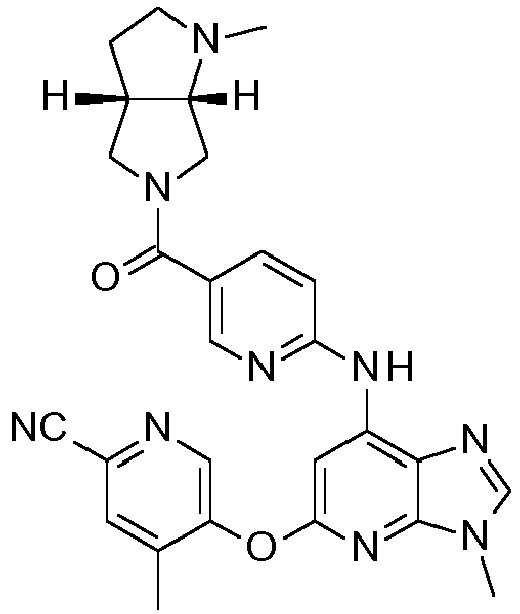
4-Methyl-5-{3-methyl-7-[5-((3aS,6aS)-1-methyl-hexahydro-pyrrolo[3,4-b]pyrrole-5-carbonyl)-pyridin-2-ylamino]-3H-imidazo[4,5-b]pyridin-5-yloxy}-pyridine-2-carbonitrile Int 61, [877212 -98-1] A1-a 510 510 162 
4-[6-[[5-(6-cyano-4-methylpyridin-3-yl)oxy-3- methylimidazo[4,5-b]pyridin-7-yl]amino]pyridine-3- carbonyl]morpholine-3-carbonitrile Int 61, [97039-63-9] A1-a 496 496 163 
5-[7-[[6-[(2R)-2-(hydroxymethyl)morpholin-4-yl]pyridazin-3-yl]amino]-3 -methylimidazo [4,5-b]pyridin-5-yl]oxy-4-methylpyridine-2-carbonitrile Int 3, Int 68 B2-a 474 474 164 
4-methyl-5-[3-methyl-7-[[6-(2,2,3,3,5,5,6,6-octadeuteriomorpholin-4-yl)pyridazin-3-yl]amino]imidazo[4,5-b]pyridin-5-yl]oxy-pyridine-2-carbonitrile Int 3, Int 69 B2-a 452 452 165 
5-[7-[[6-[(2S)-2-(hydroxymethyl)morpholin-4-yl]pyridazin-3-yl]amino]-3 -methylimidazo[4,5-b]pyridin-5-yl]oxy-4-methylpyridine-2-carbonitrile Int 3, Int 70 B2-a 474 474 166 
5-[7-[[6-[(2S,6S)-2,6-dimethylmorpholin-4-yl]pyridazin-3-yl]amino]-3-methylimidazo[4,5-b]pyridin-5-yl]oxy-4-methylpyridine-2-carbonitrile Int 3, Int 71 B2-a 472 472 167 
4-methyl-5-[3-methyl-7-[[6-(1,4-oxazepan-4-yl)pyridazin-3-yl]amino]imidazo[4,5-b]pyridin-5-yl]oxypyridine-2-carbonitrile Int 3, Int 72 B2-a 458 458 168 
5-[7-[[6-[(2R,6R)-2,6-dimethylmorpholin-4-yl]pyridazin-3-yl]amino]-3-methylimidazo[4,5-b]pyridin-5-yl]oxy-4-methylpyridine-2-carbonitrile Int 3, Int 73 B2-a 472 472 169 
5-[7-[[6-[2-(hydroxymethyl)morpholin-4-yl]pyridazin-3-yl]amino]- 3-methylimidazo[4,5-b]pyridin-5-yl]oxy-4-methylpyridine-2-carbonitrile Int 3, Int 74 B2-a 474 474 170 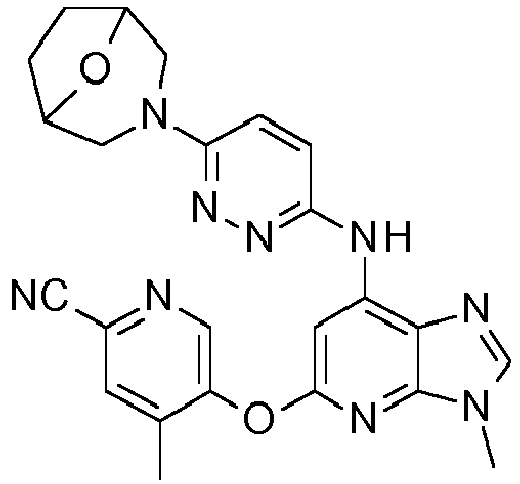
4-methyl-5-[3-methyl-7-[[6-(8-oxa-3-azabicyclo[3.2.1]octan-3-yl)pyridazin-3-yl]amino]imidazo[4,5-b]pyridin-5-yl] oxypyridine-2-carbonitrile Int 3, Int 75 B2-a 470 470 171 
4-[6-[[5-(6-cyano-4-methylpyridin-3-yl)oxy-3- methylimidazo[4,5-b]pyridin-7-yl]amino]pyridazin-3- yl]morpholine-2-carbonitrile Int 3, Int 76 B2-a 468 469 172 
4-methyl-5-[3-methyl-7-[[6-[(2R)-2-methylmorpholin-4-yl]pyridazin-3-yl]amino]imidazo[4,5-b]pyridin-5-yl] oxypyridine-2-carbonitrile Int 3, Int 77 B2-a 458 458 173 
4-methyl-5-[3-methyl-7-[[6-[(2R)-2-propan-2-ylmorpholin-4-yl]pyridazin-3-yl]amino]imidazo[4,5-b]pyridin-5-yl] oxypyridine-2-carbonitrile Int 3, Int 78 B2-a 486 486 174 
4-methyl-5-[3-methyl-7-[[6-[(1S,4S)-2-oxa-5-azabicyclo[2.2.1]heptan-5-yl]pyridazin-3-yl]amino]imidazo[4,5-b]pyridin-5-yl] oxypyridine-2-carbonitrile Int 3, Int 79 B2-a 455 456 175 
5-[7-[[6-(2,2-dimethylmorpholin-4-yl)pyridazin-3-yl]amino]-3-methylimidazo[4,5-b]pyridin-5-yl]oxy-4-methylpyridine-2-carbonitrile Int 3, Int 80 B2-a 472 472 176 
4-methyl-5-[3-methyl-7-[[6-[rac-(2R,6R)-2,6-dimethylmorpholin-4-yl]pyridazin-3-yl]amino]imidazo[4,5-b]pyridin-5-yl] oxypyridine-2-carbonitrile Int 3, Int 81 B2-a 472 472 177 
4-methyl-5-[3-methyl-7-[[6-[(2S)-2-propan-2-ylmorpholin-4-yl]pyridazin-3-yl]amino]imidazo[4,5-b]pyridin-5-yl] oxypyridine-2-carbonitrile Int 3, Int 82 B2-a 486 486 178 
4-methyl-5-[3-methyl-7-[[5-(piperazine-1-carbonyl)pyridin-2-yl]amino]imidazo[4,5-b]pyridin-5-yl] oxypyridine-2-carbonitrile Cmpd 128 D1 470 470 179 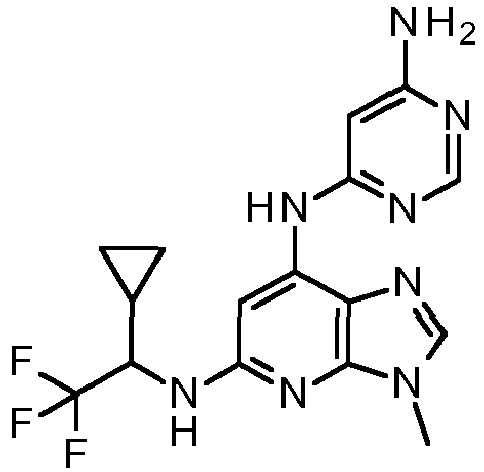
N7-(6-aminopyrimidin-4-yl)-N5-(1-cyclopropyl-2,2,2-trifluoro-ethyl)-3-methyl-imidazo[4,5-b] pyridine-5,7-diamine Int 26, [156-81-0] B1 378 380 180 
4-methyl-5-[3-methyl-7-[(5-piperazin-1-yl-2-pyridyl)amino] imidazo [4,5- b]pyridin-5-yl]oxy-pyridine-2-carbonitrile Int 88 D1 442 443 181 
5-[7-[[5-[4-(dimethylamino)-1- piperidyl]-2-pyridyl]amino]-3-methyl-imidazo[4,5-b]pyridin-5-yl]oxy-4-methyl-pyridine-2-carbonitrile Int 2, [100231 7-13-6 ] B1 484 485 182 
5-[7-[[5-[3-(dimethylamino)pyrrolidin-1-yl]-2-pyridyl]amino]-3-methyl-imidazo[4,5-b]pyridin-5-yl]oxy-4-methyl-pyridine-2-carbonitrile Int 2, [748183 -23-5 ] B1 470 471 183 
5-[7-[[5-[2-methoxyethyl(methyl)amino ]-2-pyridyl]amino]-3-methyl-imidazo[4,5-b]pyridin-5-yl]oxy-4-methyl-pyridine-2-carbonitrile Int 2, [866620 -42-0] B1 445 446 184 
5-[7-[[5-[4-(hydroxymethyl)-1- piperidyl]-2-pyridyl] amino]- 3-methyl-imidazo[4,5-b]pyridin-5-yl]oxy-4-methyl-pyridine-2-carbonitrile Int 2, [115250 1-47-7] B1 471 472 185 
5-[7-[[5-(dimethylamino)-2-pyridyl]amino]-3-methyl-imidazo[4,5-b]pyridin-5-yl]oxy-4-methyl-pyridine-2-carbonitrile Int 2, [39856-52-5] B1 400 402 186 
4-methyl-5-[3-methyl-7-[[1-(2-morpholinoethyl)pyrazol-4-yl]amino]imidazo[4,5-b]pyridin-5-yl]oxy-pyridine-2-carbonitrile Int 2, [115296 1-27-7] B1 460 461 187 
5-[[7-[(6-aminopyrimidin-4-yl)amino]-3-methyl-imidazo[4,5-b]pyridin-5-yl]-(2-hydroxypropyl)amino]-4-methyl-pyridine-2-carbonitrile Exampli fied Exa mpli fied 430 431 188 
4-methyl-5-[3-methyl-7-[[5-(2,2,3,3,5,5,6,6-octadeuterio-4-methyl-piperazine-1-carbonyl)-2-pyridyl]amino]imidazo[4,5-b]pyridin-5-yl]oxy-pyridine-2-carbonitrile Int 61,[ 917358-65-7 ] A1-a 492 492 189 
4-methyl-5-[3-methyl-7-[[5-(2,2,6,6-tetradeuterio-4-methyl-piperazine-1- carbonyl)-2-pyridyl]amino]imidazo[4,5-b]pyridin-5-yl]oxy-pyridine-2-carbonitrile Int 61, [343864 -02-8] A1-a 488 488 190 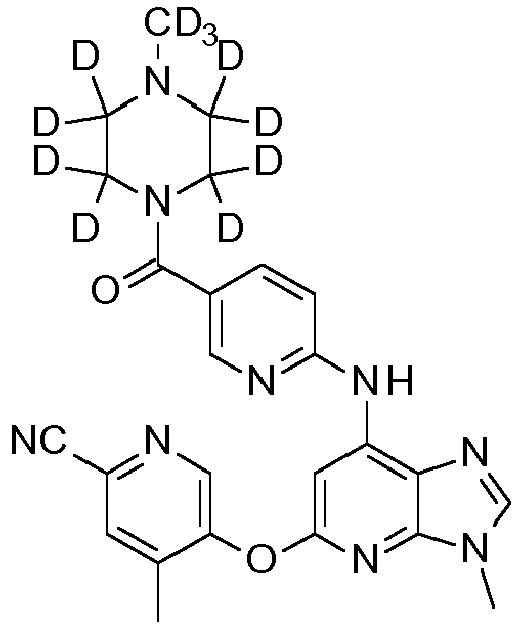
4-methyl-5-[3-methyl-7-[[5-[2,2,3,3,5,5,6,6-octadeuterio-4-(trideuteriomethyl)piperazin e-1-carbonyl]-2-pyridyl]amino]imidazo[4,5-b]pyridin-5-yl]oxy-pyridine-2-carbonitrile Int 3, Int93 B2-a 495 495 Table IV. 1H NMR of final compounds Cpd# 1H NMR 1 1H NMR (400 MHz, DMSO-d6) δ ppm 9.74 (s, 1H), 8.54 (s, 1H), 8.21 (d, J = 0.9 Hz, 1H), 8.17 (s, 1H), 8.17 (s, 1H), 7.97 (s, 1H), 6.63 (s, 2H), 6.34 (d, J = 1.1 Hz, 1H), 3.59 (s, 3H), 2.32 (s, 3H). 2 1H NMR (400 MHz, DMSO-d6) δ ppm 9.71 (s, 1H), 8.22 (d, J = 0.9 Hz, 1H), 8.16 (s, 1H), 8.14 (s, 1H), 7.80 (d, J = 7.4 Hz, 2H), 6.63 (s, 2H), 6.34 (d, J = 1.0 Hz, 1H), 3.54 (s, 3H), 3.32 (s, 3H), 2.30 (s, 3H). 3 1H NMR (400 MHz, DMSO-d6) δ ppm 9.83 (s, 1H), 8.37 (d, J = 1.0 Hz, 1H), 8.29 (s, 1H), 8.23 (s, 1H), 8.16 (d, J = 1.0 Hz, 1H), 6.64 (s, 2H), 6.35 (d, J = 1.0 Hz, 1H), 3.70 (s, 3H), 2.42 (d, J = 1.0 Hz, 3H). 4 1H NMR (400 MHz, DMSO-d6) δ ppm 9.36 (s, 1H), 8.70 (s, 1H), 8.15 (s, 1H), 8.04 (s, 1H), 7.93 (d, J= 0.9 Hz, 1H), 7.41 (s, 1H), 6.52 (s, 2H), 6.22 (d, J = 1.1 Hz, 1H), 4.08 (dd, J= 8.2, 6.4 Hz, 2H), 3.72 (s, 3H), 3.47 (d, J = 12.2 Hz, 2H), 3.26 (s, 3H), 2.21 (s, 3H), 1.98 (p, J= 6.3 Hz, 2H). 5 1H NMR (400 MHz, DMSO-d6) δ 9.31 (s, 1H), 8.65 (s, 1H), 8.10 (s, 1H), 7.99 (s, 1H), 7.88 (d, J = 0.9 Hz, 1H), 7.36 (s, 1H), 6.48 (s, 2H), 6.17 (d, J = 1.0 Hz, 1H), 4.62 (s, 1H), 4.08 - 4.02 (m, 2H), 3.67 (s, 3H), 3.51 (t, J = 6.2 Hz, 2H), 2.16 (s, 3H), 1.82 (q, J = 6.8, 6.3 Hz, 2H). 6 1H NMR (400 MHz, DMSO-d6) δ ppm 10.20 (s, 1H), 8.54 (s, 1H), 8.39 (dd, J = 2.3, 0.7 Hz, 1H), 8.29 (s, 1H), 8.22 (s, 1H), 8.13 (s, 1H), 7.77 (dd, J = 8.6, 2.4 Hz, 1H), 7.51 (dd, J = 8.7, 0.8 Hz, 1H), 3.61 (s, 3H), 3.52 (s, 4H), 2.34 (s, 4H), 2.29 (d, J = 0.7 Hz, 3H). 7 1H NMR (400 MHz, DMSO-d6) δ ppm 10.21 (s, 1H), 8.54 (s, 1H), 8.42 (dd, J = 2.4, 0.7 Hz, 1H), 8.29 (s, 1H), 8.21 (s, 1H), 8.14 (s, 1H), 7.80 (dd, J = 8.6, 2.4 Hz, 1H), 7.52 (dd, J = 8.6, 0.8 Hz, 1H), 3.67 - 3.61 (m, 4H), 3.61 (s, 3H), 3.55 (s, 4H), 2.68 (q, J = 7.5 Hz, 2H), 1.19 (t, J = 7.5 Hz, 3H). 8 1H NMR (400 MHz, DMSO-d6) δ ppm 9.23 (s, 1H), 7.96 (s, 1H), 7.87-7.81 (m, J=15.66, 9.85, 7.33 Hz, 3H), 7.36 (s, 1H), 6.45 (s, 2H), 6.16 (s, 1H), 3.68 (s, 3H), 3.35 (s, 3H), 2.59 (q, J=7.45 Hz, 2H), 1.14 (t, J=7.58 Hz, 3H). 9 1H NMR (400 MHz, DMSO-d6) δ ppm 9.3 (s, 1H), 8.63 (s, 1H), 8.08 (t, J=0.7 Hz, 1H), 8.0 (s, 1H), 7.92 (d, J=0.9 Hz, 1H), 7.43 (s, 1H), 6.48 (s, 2H), 6.18 (d, J=1.0 Hz, 1H), 3.67 (s, 3H), 3.48 (s, 3H), 2.18 (s, 3H). 10 1H NMR (400 MHz, DMSO-d6) δ ppm 9.01 (s, 1H), 8.15 (d, J=0.73 Hz, 1H), 7.87 (s, 1H), 7.61 (s, 1H), 6.46 (s, 2H), 6.21 (d, J=0.78 Hz, 1H), 4.42-4.36 (m, J=0.0 Hz, 1H), 3.67 (s, 3H), 2.73-2.66 (m, J=0.0 Hz, 1H), 2.15 (td, J=3.03, 2.52 Hz, 2H), 1.73-1.58 (m, J=0.0 Hz, 6H). 11 1H NMR (400 MHz, DMSO-d6) δ ppm 9.01 (s, 1H), 8.14 (d, J=0.9 Hz, 1H), 7.87 (s, 1H), 7.69 (s, 1H), 6.45 (s, 2H), 6.22 (d, J=0.9Hz, 1H), 4.8 (dd, J=12.63, 3.79 Hz, 1H), 4.01 (dd, J=11.12, 4.55 Hz, 1H), 3.67 (s, 3H), 3.46-3.4 (m, J=11.37, 11.37 Hz, 2H), 3.23 (d, J=11.12 Hz, 1H), 2.92 (s, 3H), 2.22 (dt, J=25.01, 7.58 Hz, 1H), 1.39-1.32 (m, J=7.71 Hz, 1H), 1.08 (s, 3H), 0.79 (s, 3H). 12 1H NMR (400 MHz, DMSO-d6) δ ppm: 8.97 (s, 1H), 8.14 (d, J=0.72 Hz, 1H), 7.85 (s, 1H), 7.61 (s, 1H), 6.45 (s, 2H), 6.22 (d, J=0.81 Hz, 1H), 4.87 (q, J=7.07 Hz, 1H), 3.67 (s, 3H), 2.89 (s, 3H), 1.16 (d, J=7.07 Hz, 3H), 0.95 (s, 9H). 13 1H NMR (400 MHz, DMSO-d6) δ ppm 9.04 (s, 1H), 8.15 (d, J=1.0 Hz, 1H), 7.88 (s, 1H), 7.67 (s, 1H), 6.45 (s, 1H), 6.22 (d, J=1.0 Hz, 1H), 3.68 (s, 3H), 3.35 (s, 1H), 2.87 (s, 3H), 2.01-1.44 (m, J=0.0 Hz, 8H). 15 1H NMR (400 MHz, DMSO-d6) δ ppm 9.29 (s, 1H), 8.61 (s, 1H), 8.14 (s, 1H), 7.99 (s, 1H), 7.89 (d, J = 1.0 Hz, 1H), 7.40 (s, 1H), 6.47 (s, 2H), 6.18 (d, J = 1.0 Hz, 1H), 3.67 (s, 3H), 3.47 (s, 3H), 2.53 (s, 2H), 1.14 (t, J = 7.5 Hz, 3H). 16 1H NMR (400 MHz, DMSO-d6) δ ppm: 8.95 (s, 1H), 8.13 (d, J=0.73 Hz, 1H), 7.84 p (s, 1H), 7.53 (s, 1H), 6.45 (s, 2H), 6.21 (d, J=0.95 Hz, 1H), 4.15-4.08 (m, J=5.3 Hz, 1H), 3.65 (s, 3H), 2.95 (s, 3H), 1.19 ppm (d, J=6.79 Hz, 3H), 1.1-1.04 (m, 1H), 0.58-0.51 (m, 1H), 0.4-0.29 (m, 2H), 0.27-0.21 (m, 1H). 17 1H NMR (400 MHz, DMSO-d6) δ ppm 9.02 (s, 1H), 8.16 (d, J = 0.9 Hz, 1H), 7.88 (s, 1H), 7.66 (s, 1H), 6.46 (s, 2H), 6.23 (d, J= 1.0 Hz, 1H), 4.39 (td, J = 11.2, 3.8 Hz, 1H), 3.98 (dd, J = 11.3, 4.5 Hz, 1H), 3.89 (dd, J = 11.2, 4.4 Hz, 1H), 3.68 (s, 3H), 3.52 - 3.41 (m, 1H), 3.08 (t, J = 11.0 Hz, 1H), 2.88 (s, 3H), 2.02 - 1.88 (m, 1H), 1.78 (qd, J = 12.3, 4.7 Hz, 1H), 1.56 (d, J = 9.0 Hz, 1H), 0.69 (d, J = 6.6 Hz, 3H). 18 1H NMR (400 MHz, DMSO-d6) δ ppm 9.14 (s, 1H), 8.14 (d, J=0.76 Hz, 1H), 8.0 (s, 1H), 7.9 (s, 1H), 6.47 (s, 2H), 6.23 (d, J=0.76 Hz, 1H), 3.68 (s, 3H), 3.0 (s, 3H), 2.49 (s, 1H), 2.23 (s, 6H). 20 1H NMR (400 MHz, DMSO-d6) δ ppm 9.17 (s, 1H), 8.16 (d, J = 0.9 Hz, 1H), 7.93 (s, 1H), 7.73 (s, 1H), 6.49 (s, 2H), 6.25 (d, J = 1.0 Hz, 1H), 4.99 (q, J = 9.0 Hz, 1H), 3.64 (s, 3H), 3.06 (s, 3H), 1.48 - 1.35 (m, 1H), 0.87 - 0.69 (m, 1H), 0.64 (dt, J = 9.7, 4.7 Hz, 1H), 0.57 (dt, J = 9.6, 4.8 Hz, 1H), 0.20 (dd, J = 4.7, 1.3 Hz, 1H). 21 1H NMR (400 MHz, DMSO-d6) δ ppm 9.05 (s, 1H), 8.10 (d, J = 0.9 Hz, 1H), 7.88 (s, 1H), 7.71 (s, 1H), 6.46 (s, 2H), 6.23 (d, J = 1.0 Hz, 1H), 4.60 (t, J = 12.3 Hz, 1H), 3.77 (dd, J = 11.8, 3.8 Hz, 1H), 3.67 (s, 3H), 3.50 (dd, J= 12.4, 10.2 Hz, 1H), 2.91 (s, 3H), 2.36 - 2.21 (m, 2H), 2.11 - 1.47 (m, 9H). 22 1H NMR (400 MHz, DMSO-d6) δ ppm: 10.4 (d, J=7.32 Hz, 1H), 8.82 (d, J=2.3 Hz, 1H), 8.2 (s, 1H), 8.13 (dd, J=8.85, 2.53 Hz, 1H), 7.98 (s, 1H), 7.6 (d, J=8.85 Hz, 1H), 5.46 (ddd, J=24.49, 2.8, 2.02 Hz, 1H), 3.76 (d, J=8.1 Hz, 3H), 3.27 (dd, J=2.53, 1.52 Hz, 3H), 1.34-1.25 (m, 1H), 0.77-0.59 ppm (m, 4H). 23 1H NMR (400 MHz, DMSO-d6) δ ppm 10.53 (s, 1H), 9.12 (t, J = 6.0 Hz, 1H), 8.60 (s, 1H), 8.38 (s, 1H), 8.28 (s, 1H), 8.13 (s, 1H), 8.09 (d, J = 9.2 Hz, 1H), 7.89 (d, J = 9.2 Hz, 1H), 3.64 (s, 3H), 3.33 (m, J = 7.3 Hz, 2H), 2.31 (s, 3H), 1.16 (t, J = 7.2 Hz, 3H). 24 1H NMR (400 MHz, DMSO-d6) δ ppm 10.23 (s, 1H), 8.82 (d, J = 2.4 Hz, 1H), 8.56 (s, 1H), 8.51 (dd, J = 9.8, 4.1 Hz, 1H), 8.29 (s, 1H), 8.22 (s, 1H), 8.19 - 8.04 (m, 2H), 7.49 (d, J = 8.7 Hz, 1H), 4.96 - 4.73 (m, 1H), 3.80 (dt, J = 12.3, 6.0 Hz, 1H), 3.61 (s, 3H), 3.28 - 3.08 (m, 2H), 2.30 (s, 3H), 1.07 (s, 3H). 25 1H NMR (400 MHz, DMSO-d6) δ ppm 10.48 (s, 1H), 8.88 (t, J = 5.9 Hz, 1H), 8.59 (s, 1H), 8.37 (s, 1H), 8.28 (s, 1H), 8.13 (s, 1H), 8.10 (d, J = 9.2 Hz, 1H), 7.89 (d, J = 9.2 Hz, 1H), 4.89 (s, 1H), 3.91 - 3.77 (m, 1H), 3.64 (s, 3H), 3.33 - 3.21 (m, 2H), 2.31 (s, 3H), 1.09 (d, J = 6.2 Hz, 3H). 26 1H NMR (400 MHz, DMSO-d6) δ ppm 9.76 (s, 1H), 8.68 (dd, J = 2.6, 0.8 Hz, 1H), 8.64 (t, J = 6.1 Hz, 1H), 8.54 (s, 1H), 8.18 (s, 1H), 8.11 (d, J = 0.8 Hz, 1H), 8.00 (dd, J = 8.6, 0.8 Hz, 1H), 7.95 (dd, J = 8.5, 2.6 Hz, 1H), 6.70 (s, 1H), 3.60 (s, 3H), 3.38 - 3.27 (m, 2H), 2.28 (d, J = 0.7 Hz, 3H), 1.13 (td, J = 7.2, 3.5 Hz, 3H). 27 1H NMR (400 MHz, DMSO-d6) δ ppm 9.21 (s, 1H), 8.49 (s, 1H), 8.11 (s, 1H), 8.07 (d, J = 0.7 Hz, 1H), 8.01 (t, J = 5.4 Hz, 1H), 7.33 (d, J = 8.5 Hz, 2H), 7.26 (d, J = 8.5 Hz, 2H), 6.45 (s, 1H), 3.58 (s, 3H), 3.37 (s, 2H), 3.14 - 3.02 (m, 2H), 2.25 (d, J = 0.7 Hz, 3H), 1.03 (t, J = 7.2 Hz, 3H). 28 1H NMR (400 MHz, DMSO-d6) δ ppm 9.69 (s, 1H), 8.64 (dd, J = 2.7, 0.7 Hz, 1H), 8.53 (s, 1H), 8.18 (s, 1H), 8.10 (t, J= 0.8 Hz, 1H), 7.93 (dd, J= 8.5, 2.7 Hz, 1H), 7.66 (dd, J = 8.5, 0.7 Hz, 1H), 6.68 (s, 1H), 3.63 (m, J = 22.7 Hz, 11H), 2.28 (s, 3H). 29 1H NMR (400 MHz, DMSO-d6) δ ppm 9.68 (s, 1H), 8.67 (dd, J = 2.6, 0.8 Hz, 1H), 8.61 (q, J = 4.9 Hz, 1H), 8.54 (s, 1H), 8.18 (s, 1H), 8.10 (s, 1H), 8.04 - 7.97 (m, 1H), 7.95 (dd, J = 8.5, 2.6 Hz, 1H), 6.70 (s, 1H), 3.60 (s, 3H), 2.83 (d, J = 4.7 Hz, 3H), 2.28 (s, 3H). 30 1H NMR (400 MHz, DMSO-d6) δ ppm 9.78 (s, 1H), 8.69 (dd, J = 2.6, 0.8 Hz, 1H), 8.54 (s, 1H), 8.47 (t, J = 6.0 Hz, 1H), 8.18 (s, 1H), 8.10 (d, J = 0.7 Hz, 1H), 8.01 (dd, J = 8.5, 0.7 Hz, 1H), 7.95 (dd, J = 8.5, 2.6 Hz, 1H), 6.70 (s, 1H), 4.85 (s, 1H), 3.86 - 3.74 (m, 1H), 3.60 (s, 3H), 3.41 - 3.29 (m, 1H), 3.24 - 3.14 (m, 1H), 2.28 (d, J = 0.7 Hz, 3H), 1.07 (s, 3H). 32 1H NMR (400 MHz, DMSO-d6) δ ppm 9.73 (s, 1H), 8.52 (s, 1H), 8.25 (s, 1H), 8.18 (s, 2H), 8.11 (s, 1H), 7.17 (s, 1H), 6.41 (s, 1H), 3.59 (s, 3H), 3.41-3.38 (m, J=6.39, 6.23 Hz, 4H), 3.25 (s, 3H), 2.28 (s, 3H), 1.8-1.73 (m, J=6.59 Hz, 2H). 33 1H NMR (400 MHz, DMSO-d6) δ ppm 9.72 (s, 1H), 8.52 (s, 1H), 8.24 (s, 1H), 8.19 (s, 1H), 8.18 (s, 1H), 8.11 (s, 1H), 7.07 (s, 1H), 6.38 (s, 1H), 4.35 (s, 1H), 3.31-3.22 (m, 4H), 2.28 (s, 3H), 1.65 (dd, J=7.87, 5.86 Hz, 2H), 1.15 (s, 6H). 35 1H NMR (400 MHz, DMSO-d6) δ ppm 9.75 (s, 1H), 8.53 (s, 1H), 8.28 (s, 1H), 8.19 (s, 2H), 8.18 (s, 2H), 8.12 (t, J = 0.7 Hz, 1H), 7.28 (s, 1H), 6.44 (s, 1H), 3.76 (d, J = 11.3 Hz, 2H), 3.72 - 3.46 (m, 7H), 3.44 (s, 1H), 3.25 (dd, J= 11.4, 9.8 Hz, 2H), 2.29 (d, J = 0.7 Hz, 3H). 36 1H NMR (400 MHz, DMSO-d6) δ ppm 9.77 (s, 1H), 8.53 (s, 1H), 8.26 (s, 1H), 8.19 (s, 2H), 8.11 (s, 1H), 7.44 (d, J = 6.7 Hz, 1H), 6.37 (s, 1H), 3.59 (s, 4H), 3.29 (d, J = 1.7 Hz, 1H), 3.16 (d, J = 6.8 Hz, 3H), 2.73 - 2.63 (m, 2H), 2.29 (d, J = 0.7 Hz, 3H), 1.80 (dt, J = 11.6, 8.8 Hz, 2H). 37 1H NMR (400 MHz, DMSO-d6) δ ppm 9.72 (s, 1H), 8.53 (s, 1H), 8.25 (s, 1H), 8.19 (s, 1H), 8.15 - 8.08 (m, 1H), 7.12 (s, 1H), 6.89 (s, 1H), 6.40 (s, 1H), 4.55 (d, J = 4.8 Hz, 1H), 3.70 (s, 1H), 3.59 (s, 3H), 3.30 (d, J = 16.8 Hz, 2H), 2.29 (d, J = 0.7 Hz, 3H), 1.58 (dq, J = 13.7, 7.0, 6.6 Hz, 2H), 1.11 (s, 3H). 38 1H NMR (400 MHz, DMSO-d6) δ ppm 9.86 (s, 1H), 8.53 (s, 1H), 8.20 (s, 1H), 8.19 (s, 1H), 8.15 - 8.08 (m, 1H), 7.64 (d, J = 9.7 Hz, 1H), 7.43 (d, J = 9.7 Hz, 1H), 3.75 (t, J = 4.8 Hz, 4H), 3.61 (s, 3H), 3.50 - 3.42 (m, 4H), 2.31 (d, J = 0.7 Hz, 3H). 39 1H NMR (400 MHz, DMSO-d6) δ ppm 9.83 (s, 1H), 8.53 (s, 1H), 8.19 (s, 1H), 8.18 (s, 1H), 8.11 (d, J = 0.7 Hz, 1H), 7.60 (d, J = 9.7 Hz, 1H), 7.42 (d, J = 9.8 Hz, 1H), 3.61 (s, 3H), 3.50 (t, J = 5.0 Hz, 4H), 2.44 (t, J = 4.9 Hz, 4H), 2.31 (d, J = 0.7 Hz, 3H), 2.24 (s, 3H). 41 1H NMR (400 MHz, DMSO-d6) δ ppm 9.81 (s, 1H), 8.53 (s, 1H), 8.19 (s, 1H), 8.18 (s, 1H), 8.11 (s, 1H), 7.60 (d, J = 9.7 Hz, 1H), 7.44 (d, J = 9.8 Hz, 1H), 4.14 - 4.03 (m, 2H), 3.61 (s, 3H), 2.65 - 2.54 (m, 2H), 2.31 (s, 3H), 2.26 - 2.14 (m, 5H), 1.09 (d, J = 6.1 Hz, 6H). 42 1H NMR (400 MHz, DMSO-d6) δ ppm 9.84 (s, 1H), 8.53 (s, 1H), 8.19 (s, 1H), 8.19 (s, 1H), 8.11 (d, J = 0.7 Hz, 1H), 7.62 (d, J = 9.8 Hz, 1H), 7.43 (d, J = 9.8 Hz, 1H), 3.61 (s, 3H), 3.52 (t, J = 5.0 Hz, 4H), 3.26 (q, J = 10.2 Hz, 2H), 2.76 (t, J = 5.0 Hz, 4H), 2.31 (d, J = 0.7 Hz, 3H). 43 1H NMR (400 MHz, DMSO-d6) δ ppm 9.83 (s, 1H), 8.53 (s, 1H), 8.19 (s, 1H), 8.19 (s, 1H), 8.11 (t, J = 0.7 Hz, 1H), 7.62 (d, J = 9.7 Hz, 1H), 7.42 (d, J = 9.8 Hz, 1H), 4.21 - 3.97 (m, 2H), 3.67 (ddd, J = 10.5, 6.3, 2.4 Hz, 2H), 3.62 (s, 3H), 2.49 - 2.40 (m, 2H), 2.31 (d, J = 0.7 Hz, 3H), 1.17 (d, J = 6.2 Hz, 6H). 44 1H NMR (400 MHz, DMSO-d6) δ ppm 9.84 (s, 1H), 8.53 (s, 1H), 8.19 (s, 1H), 8.19 (s, 1H), 8.12 (t, J = 0.7 Hz, 1H), 7.63 (d, J = 9.8 Hz, 1H), 7.43 (d, J = 9.8 Hz, 1H), 4.10 (d, J = 12.4 Hz, 1H), 3.99 (d, J = 12.8 Hz, 1H), 3.94 (ddd, J = 11.5, 3.7, 1.2 Hz, 1H), 3.71 - 3.53 (m, 4H), 2.87 (td, J = 12.4, 3.5 Hz, 1H), 2.60 - 2.52 (m, 2H), 2.31 (d, J = 0.7 Hz, 3H), 1.17 (d, J = 6.2 Hz, 3H). 45 1H NMR (400 MHz, DMSO-d6) δ ppm 9.84 (s, 1H), 8.53 (s, 1H), 8.19 (d, J = 0.9 Hz, 2H), 8.12 (s, 1H), 7.62 (d, J = 9.8 Hz, 1H), 7.45 (d, J = 9.8 Hz, 1H), 3.81 (ddd, J = 13.3, 6.5, 3.6 Hz, 2H), 3.61 (s, 3H), 3.40 (dd, J = 9.0, 3.5 Hz, 2H), 3.20 - 3.09 (m, 1H), 2.37 - 2.25 (m, 3H), 2.06 - 1.89 (m, 2H), 1.78 (dtd, J= 12.5, 8.6, 3.5 Hz, 2H). 49 1H NMR (400 MHz, (DMSO-d6) δ ppm: 9.69 (s, 1H), 8.5 (s, 1H), 8.14 (s, 1H), 8.11 (s, 1H), 8.1 (s, 1H), 8.01 (d, J=2.8 Hz, 1H), 7.46 (dd, J=9.1, 3.0 Hz, 1H), 7.37 (d, J=9.1 Hz, 1H), 3.75 (m, 4H), 3.58 (s, 3H), 3.09 (m, 4H), 2.28 (s, 3H). 50 1H NMR (400 MHz, (DMSO-d6) δ ppm : 9.66 (s, 1H), 8.50 (s, 1H), 8.25 (s, 1H), 8.13 (s, 1H), 8.1 (s, 2H), 7.99 (d, J=3.0 Hz, 1H), 7.45 (dd, J=9.1, 3.0 Hz, 1H), 7.34 (d, J=8.9 Hz, 1H), 3.58 (s, 3H), 3.11 (m, 4H), 2.47 (m, 4H), 2.27 (s, 3H), 2.22 (s, 3H). 51 1H NMR (400 MHz, (DMSO-d6) δ ppm : 10.19 (s, 1H), 8.53 (s, 1H), 8.38 (d, J=2.0 Hz, 1H), 8.28 (s, 1H), 8.20 (s, 2H), 8.10 (s, 1H), 7.76 (dd, J=8.6, 2.5 Hz, 1H), 3.53 (s br, 3H), 2.35 (s, 4H), 2.28 (s, 3H), 2.2 (s, 3H). 52 1H NMR 400 MHz, (DMSO-d6) δ ppm): 9.71 (s, 1H), 8.52 (s, 1H), 8.2 (d, J=0.6 Hz, 1H), 8.17 (s, 1H), 8.16 (s, 1H), 8.1 (s, 1H), 6.6 (s, 2H), 6.34 (d, J=0.6 Hz, 1H), 3.58 (s, 3H), 2.28 (s, 3H). 53 1H NMR (400 MHz, CDC13) δ ppm: 8.49 (s, 1H), 8.01 (s, 1H), 7.90 (dd, J=6.8, 2.0 Hz, 2H), 7.86 (s, 1H), 7.64 (s, 1H), 7.46 (dd, J=6.8, 2.0 Hz, 2H), 6.83 (s, 1H), 4.68 (t, J=6.1 Hz, 1H), 3.69 (s, 3H), 3.06 (dq, J=7.3, 6.8 Hz, 2H), 2.33 (s, 3H), 1.15 (t, J=7.3 Hz, 3H). 54 1H NMR (400 MHz, DMSO-d6) δ ppm : 9.55 (s, 1H), 8.22 (s, 1H), 8.12 (d, J=5.11 Hz, 1H), 7.85 (s, 1H), 6.60 (m, 2H), 6.3 (d, J=0.94 Hz, 1H), 5.43 (dt, J=15.42, 6.82 Hz, 1H), 3.72 ppm (s, 3H), 1.32-1.23 ppm (m, 1H), 0.75-0.69 ppm (m, 1H), 0.67-0.57 ppm (m, 3H). 55 1H NMR (400 MHz, DMSO-d6) δ ppm: 9.45 (s, 1H), 9.39 (s, 1H), 8.73 (s, 1H), 8.21 p (s, 1H), 8.08 (s, 1H), 8.02 (s, 1H), 7.82 (s, 1H), 6.57 (s, 2H), 6.28 (d, J=0.8 Hz, 1H), 3.72 (s, 3H), 2.37 (s, 3H). 56 1H NMR (400 MHz, DMSO-d6) δ ppm: 9.61 (s, 1H), 8.52 (s, 1H), 8.39 (s, 1H), 8.16 (s, 1H), 8.09 (s, 1H), 7.63 (d, J=8.1 Hz, 1H), 7.58 (d, J=1.6 Hz, 1H), 7.49 (dd, J=8.1, 1.6 Hz, 1H), 6.7 (s, 1H), 4.36 (s, 2H), 3.58 ppm (s, 3H), 2.25 ppm (s, 3H). 57 1H NMR (400 MHz, DMSO-d6) δ ppm: 9.34 (s, 1H), 8.49 (s, 1H), 8.40 (s, 1H), 8.12 (s, 1H), 8.07 (s, 1H), 7.43 (d, J=8.6 Hz, 2H), 7.39 (d, J=8.6 Hz, 2H), 6.48 (s, 1H), 4.32 (s, 3H), 3.90 (s, 2H), 3.57 (s, 3H), 2.24 (s, 3H). 58 1H NMR (400 MHz, DMSO-d6) δ ppm: 10.55 (s, 1H), 8.79 (d, J=2.5 Hz, 1H), 8.57 (s, 1H), 8.27 (s, 1H), 8.25 (s, 1H), 8.15 (dd, J=8.8, 2.5 Hz, 1H), 8.13 (s, 1H), 7.64 (d, J=8.8 Hz, 1H), 3.62 (s, 3H), 3.26 (s, 3H), 2.30 (s, 3H). 59 1H NMR (400 MHz, DMSO-d6) δ ppm: 10.43 (s, 1H), 8.72 (d, J=2.0 Hz, 1H), 8.56 (s, 1H), 8.28 (s, 1H), 8.24 (s, 1H), 8.12 (s, 1H), 8.07 (dd, J=9.0, 2.0 Hz, 1H), 7.64 (d, J=9.0 Hz, 1H), 3.62 (s, 3H), 2.29 (s, 3H). 60 1H NMR (400 MHz, DMSO-d6) δ ppm: 9.85 (s, 1H), 8.59 (s, 1H), 8.24 (s, 1H), 8.15 (s, 1H), 7.92 (d, J=8.8 Hz, 2H), 7.66 (d, J=8.8 Hz, 2H), 6.83 (s, 1H), 3.65 (s, 3H), 3.37 (s, 3H), 2.33 (s, 3H). 61 1H NMR (400 MHz, DMSO-d6) δ ppm: 8.81 (s, 1H), 8.39 (s, 1H), 8.0 (s, 1H), 7.99 (s, 1H), 7.79 (s, 1H), 7.43 (s, 1H), 6.17 (s, 1H), 3.77 (s, 3H), 3.49 (s, 3H), 2.18 (s, 3H). 62 1H NMR (400 MHz, DMSO-d6) δ ppm 9.46 (s, 1H), 8.51 (s, 1H), 8.14 (s, 1H), 8.08 (s, 1H), 7.45 (d, J=8.8 Hz, 2H), 7.42 (d, J=8.8 Hz, 2H), 6.63 (s, 1H), 3.58 (s, 3H), 2.98 (s, 6H), 2.26 (s, 3H). 63 1H NMR (400 MHz, DMSO-d6) δ ppm: 9.81 (s, 1H), 8.54 (s, 1H), 8.19 (s, 1H), 8.1 (s, 1H), 7.69 (d, J=8.9 Hz, 2H), 7.63 (d, J=8.9 Hz, 2H), 6.81 (s, 1H), 3.65 (t, J=4.7 Hz, 4H), 3.60 (s, 3H), 2.88 (t, J=4.7 Hz, 4H), 2.28 (s, 3H). 64 1H NMR (400 MHz, DMSO-d6) δ ppm: 9.94 (s, 1H), 8.54 (s, 1H), 8.30 (s, 1H), 8.30 (t, J=5.4 Hz, 1H), 8.23 (s, 1H), 8.19 (s, 1H), 8.11 (s, 1H), 7.32 (s, 1H), 3.6 (s, 3H), 3.25 (qd, J=7.2, 5.4 Hz, 2H), 2.35 (s, 3H), 2.28 (s, 3H), 1.12 (t, J=7.2 Hz, 3H). 65 1H NMR (400 MHz, DMSO-d6) δ ppm: 10.0 (s, 1H), 8.71 (d, J=2.31 Hz, 1H), 8.08 (dd, J=8.97, 2.54 Hz, 1H), 7.93 (s, 1H), 7.8 (s, 1H), 7.5 (d, J=8.85 Hz, 1H), 6.98 (d, J=9.83 Hz, 1H), 5.01 (td, J=9.1, 5.81 Hz, 1H), 3.72-3.69 (s, 3H), 3.25 (s, 3H), 2.17 (td, J=12.63, 6.81 Hz, 1H), 1.01 (t, J=7.7 Hz, 6H). 66 1H NMR (400 MHz, DMSO-d6) δ ppm: 9.62 (s, 1H), 9.14 (s, 1H), 8.48 (s, 1H), 8.04 (s, 1H), 7.79 (s, 1H), 7.45 (d, J=9.1 Hz, 2H), 7.42 (d, J=9.1 Hz, 2H), 6.92 (s, 1H), 3.72 (s, 3H), 2.99 (s, 6H), 2.33 (s, 3H). 67 1H NMR (400 MHz, DMSO-d6) δ ppm: 9.82 (s, 1H), 9.47 (s, 1H), 8.73 (s, 1H), 8.39 (dd, J=2.4, 0.5 Hz, 1H), 8.17 (s, 1H), 8.09 (s, 1H), 7.82 (s, 1H), 7.77 (dd, J=8.6, 2.4 Hz, 1H), 7.43 (dd, J=8.6, 0.5 Hz, 1H), 3.72 (s, 3H), 3.0 (s, 6H), 2.37 (s, 3H). 68 1H NMR (400 MHz, DMSO-d6) δ ppm: 10.09 (s, 1H), 8.56 (s, 1H), 8.23 (s, 1H), 8.12 (s, 1H), 7.86 (d, J=9.0 Hz, 2H), 7.67 (d, J=9.0 Hz, 2H), 7.24 (t, JHF=52.4 Hz, 1H), 6.87 (s, 1H), 3.60 (s, 3H), 2.27 (s, 3H). 69 1H NMR (400 MHz, DMSO-d6) δ ppm: 9.83 (s, 1H), 8.54 (s, 1H), 8.19 (s, 1H), 8.11 (s, 1H), 7.82 (dt, J=9.5, 2.4 Hz, 2H), 7.6 (dt, J=9.5, 2.4 Hz, 2H), 6.78 (s, 1H), 3.59 (s, 3H), 2.85-2.79 (m, 1H), 2.27 (s, 3H), 1.13-1.09 (m, 2H), 1.07-1.01 (m, 2H). 70 1H NMR (400 MHz, DMSO-d6) δ ppm: 10.33 (s, 1H), 9.29 (s, 1H), 8.48 (s, 1H), 8.11 (s, 1H), 8.08 (s, 1H), 7.26 (d, J=8.1 Hz, 1H), 6.99 (dd, J=8.1, 2.0 Hz, 1H), 6.91 (d, J=2.0 Hz, 1H), 6.52 (s, 1H), 3.57 (s, 3H), 2.24 (s, 3H), 1.25 (s, 6H). 71 1H NMR (400 MHz, DMSO-d6) δ ppm: 9.85 (s, 1H), 8.53 (s, 1H), 8.19 (s, 1H), 8.09 (s, 1H), 7.82 (dt, J=9.5, 2.6 Hz, 2H), 7.61 (dt, J=9.5, 2.6 Hz, 2H), 6.79 (s, 1H), 3.59 (s, 3H), 3.34 (t, J=6.7 Hz, 2H), 3.28-3.24 (m, 2H), 3.17 (s, 3H), 2.26 (s, 3H), 1.81-1.74 (m, 2H). 73 1H NMR (400 MHz, DMSO-d6) δ ppm: 10.43 (s, 1H), 8.56 (s, 1H), 8.34 (s, 1H), 8.25 (s, 1H), 8.11 (s, 1H), 7.85 (d, J=9.2 Hz, 1H), 7.78 (d, J=9.2 Hz, 1H), 3.62 (s, 3H), 3.08 (s, 3H), 3.06 (s, 3H), 2.30 (s, 3H). 74 1H NMR (400 MHz, DMSO-d6) δ ppm: 10.19 (s, 1H), 8.54 (s, 1H), 8.42 (d, J=2.3 Hz, 1H), 8.29 (s, 1H), 8.21 (s, 1H), 8.12 (s, 1H), 7.79 (dd, J=8.6, 2.3 Hz, 1H), 7.5 (dd, J=8.6, 0.5 Hz, 1H), 3.6 (s, 3H), 3.0 (s, 6H), 2.28 (s, 3H). 75 1H NMR (400 MHz, DMSO-d6) δ ppm: 10.21 (s, 1H), 8.53 (s, 1H), 8.42 (d, J=2.4 Hz, 1H), 8.29 (s, 1H), 8.21 (s, 1H), 8.12 (s, 1H), 7.79 (dd, J=8.6, 2.4 Hz, 1H), 7.51 (dd, J=8.6, 0.5 Hz, 1H), 3.64-3.61 (m, 4H), 3.6 (s, 3H), 3.55-3.52 (m, 4H), 2.28 (s, 3H). 76 1H NMR (400 MHz, DMSO-d6) δ ppm: 10.08 (s, 1H), 9.48 (s, 1H), 8.91 (s, 1H), 8.29 (s, 1H), 8.13 (s, 1H), 7.82 (s, 1H), 7.81(d, J=9.2 Hz, 1H), 7.74 (d, J=9.2 Hz, 1H), 3.73 (s, 3H), 3.10 (s, 3H), 3.06 (s, 3H), 2.37 (s, 3H). 77 1H NMR (400 MHz, DMSO-d6) δ ppm: 10.04 (s, 1H), 8.59 (s, 1H), 8.3 (s, 1H), 8.21 (s, 1H), 8.15 (s, 1H), 7.54 (d, J=8.4 Hz, 1H), 7.27 (d, J=8.4 Hz, 1H), 3.65 (s, 3H), 3.0 (s, 3H), 2.82 (s, 3H), 2.28 (s, 3H), 2.27 (s, 3H). 78 1H NMR (400 MHz, DMSO-d6) δ ppm: 10.04 (s, 1H, NH), 8.60 (s, 1H), 8.29 (s, 1H), 8.25 (t, J=5.4 Hz, 1H, NH), 8.21 (s, 1H), 8.16 (s, 1H), 7.66 (d, J=8.5 Hz, 1H), 7.26 (d, J=8.5 Hz, 1H), 3.65 (s, 3H), 3.25 (m, 2H), 2.43 (s, 3H), 2.28 (s, 3H), 1.11 (t, J=7.2 Hz, 3H). 79 1H NMR (400 MHz, DMSO-d6) δ ppm: 10.09 (s, 1H), 8.54 (s, 1H), 8.33 (d, J=2.2 Hz, 1H), 8.28 (s, 1H), 8.20 (s, 1H), 8.12 (s, 1H), 7.74 (dd, J=8.6, 2.2 Hz, 1H), 7.53 (d, J=8.6 Hz, 1H), 4.51 (q, JHF=9.7 Hz, 1H), 3.60 (s, 3H) 2.29 (s, 3H), 2.25 (s, 6H). 80 1H NMR (400 MHz, DMSO-d6) δ ppm: 10.01 (s, 1H), 8.54 (s, 1H), 8.40 (d, J=2.0 Hz, 1H), 8.26 (s, 1H), 8.19 (s, 1H), 8.11 (s, 1H), 7.83 (dd, J=8.5, 2.0 Hz, 1H), 7.49 (d, J=8.5 Hz, 1H), 4.47-4.35 (m, 1H), 3.60 (s, 3H), 2.53-2.46 (m, 2H), 2.83-2.73 (m, 1H), 2.29 (s, 3H), 1.01 (t, J=7.1 Hz, 3H). 81 1H NMR (400 MHz, DMSO-d6) δ ppm: 9.93 (s, 1H), 8.52 (s, 1H), 8.25 (s, 1H), 8.23 (s, 2H), 8.17 (s, 1H), 8.08 (s, 1H), 7.66 (dd, J=8.5, 2.3 Hz, 1H), 7.43 (d, J=8.5 Hz, 1H), 4.81 (s, 1H), 3.59 (s, 3H), 3.53 (s, 2H), 2.27 (s, 3H), 2.25 (s, 6H). 82 1H NMR (400 MHz, DMSO-d6) δ ppm: 9.89 (s, 1H), 8.52 (s, 1H), 8.24 (s, 2H), 8.21 (d, J=2.0 Hz, 1H), 8.17 (s, 1H), 8.10 (s, 1H), 7.63 (dd, J=8.6, 2.3 Hz, 1H), 7.42 (d, J=8.6 Hz, 1H), 4.51 (s, 1H), 3.59 (s, 3H), 3.56 (t, J=4.4 Hz, 4H), 3.42 (s, 2H), 2.35 (t, J=4.0 Hz, 4H), 2.28 (s, 3H). 83 1H NMR (400 MHz, DMSO-d6) δ ppm: 9.89 (s, 1H), 8.52 (s, 1H), 8.25 (s, 2H), 8.22 (d, J=2.2 Hz, 1H), 8.17 (s, 1H), 8.1 (s, 1H), 7.65 (dd, J=8.5, 2.2 Hz, 1H), 7.43 (d, J=8.5 Hz, 1H), 4.27-4.15 (m, 1H), 3.59 (s, 3H), 3.48 (s, 2H), 2.67 (t, J=6.8 Hz, 2H), 2.52 (t, J=6.8 Hz, 2H), 2.35 (s, 6H), 2.28 (s, 3H), 2.14 (s, 3H). 84 1H NMR (400 MHz, DMSO-d6) δ ppm: 9.76 (s, 1H), 8.51 (s, 1H), 8.14 (s, 1H), 8.11 (s, 1H), 8.10 (s, 1H), 8.06 (t, J=1.9 Hz, 1H), 7.43 (s, 1H), 7.42 (s, 1H), 3.80 (s, 3H), 3.58 (s, 3H), 2.28 (s, 3H). 85 1H NMR (400 MHz, DMSO-d6) δ ppm: 9.70 (s, 1H), 8.50 (s, 1H), 8.14 (s, 1H), 8.12 (s, 1H), 8.10 (s, 1H), 7.98 (d, J=2.8 Hz, 1H), 7.44 (dd, J=9.0, 2.8 Hz, 1H), 7.38 (d, J=9.0 Hz, 1H), 3.88-3.61 (m, 5H), 3.58 (s, 3H), 3.12-3.00 (m, 2H), 2.28 (s, 3H), 0.95 (d, J=6.3 Hz, 3H). 86 1H NMR (400 MHz, DMSO-d6) δ ppm: 9.77 (s, 1H), 8.50 (s, 1H), 8.14 (s, 1H), 8.11 (s, 1H), 8.10 (s, 1H), 8.06 (d, J=2.8 Hz, 1H), 7.45 (dd, J=8.9, 2.8 Hz, 1H), 7.41 (d, J=8.9 Hz, 1H), 4.33 (septuplet, J=4.0 Hz, 1H), 3.58 (s, 3H), 2.69-2.61 (m, J=3.8 Hz, 2H), 2.28 (s, 3H), 2.18 (s, 3H), 1.95-1.91 (m, 2H), 1.65-1.62 (m, 2H), 1.67-1.59 (m, 2H). 87 1H NMR (400 MHz, DMSO-d6) δ ppm: 9.84 (s, 1H), 8.52 (s, 1H), 8.23 (s, 1H), 8.22 (d, J=2.5 Hz, 1H), 8.16 (s, 1H), 8.11 (s, 1H), 7.65 (dd, J=8.7, 2.5 Hz, 1H), 7.41 (d, J=8.7 Hz, 1H), 3.95 (td, J=5.8, 3.0 Hz, 2H), 3.59 (s, 3H), 3.47-3.40 (m, 2H), 2.81-2.74 (m, J=5.2 Hz, 1H), 2.28 (s, 3H), 1.72-1.66 (m, 4H). 88 1H NMR (300MHz, DMSO- d6,) δ ppm 9.34 (s, 1H), 8.61 (s, 1H), 8.43 (s, 1H), 8.16 (s, 1H), 7.97 (s, 1H), 7.95 (s, 1H), 6.51 (br. s., 2H), 6.25 (s, 1H), 3.46 (s, 3H), 3.22-3.12 (m, 1H), 2.09 (s, 3H), 1.05-0.95 (m, 2H), 0.57-0.48 (m, 2H). 89 1H NMR (400 MHz, DMSO-d6) δ ppm: 9.31 (s, 1H), 8.49 (s, 1H), 8.11 (s, 1H), 8.07 (s, 1H), 7.59 (d, J=8.6 Hz, 2H), 7.42 (d, J=8.6 Hz, 2H), 6.50 (s, 1H), 6.33 (s, 1H), 4.77 (d, J=6.6 Hz, 2H), 4.71 (d, J=6.6 Hz, 2H), 3.57 (s, 3H), 2.24 (s, 3H). 90 1H NMR (400 MHz, DMSO-d6) δ ppm: 10.05 (s, 1H), 8.53 (s, 1H), 8.22 (s, 1H), 8.2 (s, 1H), 8.11 (s, 1H), 7.79 (d, J=9.5 Hz, 1H), 7.25 (d, J=9.5 Hz, 1H), 5.2 (quintuplet, J=5.7 Hz, 1H), 3.76-3.72 (m, 2H), 3.60 (s, 3H), 3.06-3.02 ppm (m, 2H), 2.30 ppm (s, 6H). 94 1H NMR (400 MHz, DMSO-d6) δ ppm : 8.89 (s, 1H), 8.14 (s, 1H), 7.79 (s, 1H), 7.31 (s, 1H), 6.47 (s, 2H), 6.17 (d, J=0.79 Hz, 1H), 6.15 (d, J=8.34 Hz, 1H), 4.03-3.98 (m, 1H), 3.65 (s, 3H), 2.41-2.33 (m, 1H), 1.98-1.9 (m, 2H), 1.86-1.69 (m, 4H), 1.02 (d, J=6.34 Hz, 3H). 96 1H NMR (400 MHz, DMSO-d6) δ ppm : 10.29 (s, 1H), 8.6 (d, J=2.03 Hz, 1H), 8.55 (s, 1H), 8.32 (s, 1H), 8.23 (s, 1H), 8.13 (s, 1H), 7.95 (dd, J=8.77, 2.45 Hz, 1H), 7.51 (d, J=8.82 Hz, 1H), 5.8 (d, J=5.81 Hz, 1H), 4.58-4.5 (m, 2H), 4.28-4.24 (m, 1H), 4.15-4.12 (m, 1H), 3.82-3.78 (m, 1H), 3.61 (s, 3H), 2.29 (s, 3H). 97 1H NMR (400 MHz, DMSO-d6) δ ppm : 9.54 (s, 1H), 8.37 (d, J=2.27 Hz, 1H), 7.89 (s, 1H), 7.77 (d, J=2.73 Hz, 1H), 7.77 (s, 1H), 7.39 (d, J=8.61 Hz, 1H), 6.95 (d, J=9.83 Hz, 1H), 5.07-4.96 (m, 1H), 3.69 (s, 3H), 2.99 (s, 6H), 2.21-2.13 (m, 1H), 1.02 (dd, J=16.67, 9.61 Hz, 6H). 98 1H NMR (400 MHz, DMSO-d6) δ ppm : 9.05 ppm (s, 1H), 8.17 (d, J=0.5 Hz, 1H), 7.86 (s, 1H), 7.57 (s, 1H), 6.92 (d, J=9.61 Hz, 1H), 6.5 (s, 2H), 6.21 (d, J=0.74 Hz, 1H), 5.02-4.95 (m, 1H), 3.66 (s, 3H), 2.16 (dq, J=19.47, 6.59 Hz, 1H), 1.0 (t, J=6.83 Hz, 6H). 100 1H NMR (400 MHz, DMSO-d6) δ ppm : 10.26 (s, 1H), 8.79 (d, J=2.28 Hz, 1H), 8.57 (s, 1H), 8.46 (t, J=5.56 Hz, 1H), 8.27 (d, J=10.39 Hz, 2H), 8.14 (d, J=2.27 Hz, 1H), 8.1 (dd, J=8.8, 2.48 Hz, 1H), 7.48 (d, J=8.61 Hz, 1H), 3.62 (s, 3H), 3.41-3.29 (m, 4H), 3.25 (s, 3H), 3.31 (s, 3H), 1.80-1.73 (m, 2H). 101 1H NMR (400 MHz, DMSO-d6) δ ppm : 10.27-10.2 (m, 1H), 8.79 (d, J=2.04 Hz, 1H), 8.57 (s, 1H), 8.44 (t, J=5.56 Hz, 1H), 8.3 (d, J=3.45 Hz, 1H), 8.22 (s, 1H), 8.13 (s, 1H), 8.1 (dd, J=8.8, 2.48 Hz, 1H), 7.5 (d, J=8.83 Hz, 1H), 4.55-4.47 (m, 1H), 3.6 (s, 3H), 3.49-3.33 ppm (m, 4H), 2.3 ppm (s, 3H), 1.72-1.66 (m, 2H). 102 1H NMR (400 MHz, DMSO-d6) δ ppm : 10.29 (s, 1H), 8.62 (d, J=2.28 Hz, 1H), 8.55 (s, 1H), 8.31 (s, 1H), 8.26 (s, 1H), 8.13 (s, 1H), 7.96 (dd, J=8.78, 2.45 Hz, 1H), 7.51 (d, J=8.82 Hz, 1H), 4.37-4.32 (m, 1H), 4.27-4.23 (m, 1H), 4.0-3.91 (m, 2H), 3.61 (s, 3H), 2.65-2.57 (m, 1H), 2.29 (s, 3H), 1.05 (d, J=4.3 Hz, 6H). 103 1H NMR (400 MHz, DMSO-d6) δ ppm : 10.31 (s, 1H), 8.63 (d, J=2.49 Hz, 1H), 8.55 (s, 1H), 8.3 (s, 1H), 8.27 (s, 1H), 8.14 (s, 1H), 7.97 (dd, J=8.76, 2.45 Hz, 1H), 7.51 (d, J=8.61 Hz, 1H), 4.60-4.54 ppm (m, 1H), 4.30-4.24 (m, 3H), 3.84-382 (m, 1H), 3.61 (s, 3H), 3.25 (s, 3H), 2.29 ppm (s, 3H). 105 1H NMR (400 MHz, DMSO-d6) δ ppm : 10.19 (s, 1H), 8.53 (s, 1H), 8.38 (d, J=2.27 Hz, 1H), 8.28 (s, 1H), 8.2 (s, 1H), 8.11 (s, 1H), 7.76 (dd, J=8.59, 2.33 Hz, 1H), 7.51-7.49 (m, 1H), 3.6 (s, 3H), 3.52 (s, 4H), 2.34 (s, 4H), 2.28 (s, 3H), 2.2 (s, 3H) 107 1H NMR (400 MHz, DMSO-d6) δ ppm : 10.23 (s, 1H), 8.55 (s, 2H), 8.31 (d, J=3.29 Hz, 1H), 8.22 (s, 1H), 8.15 (s, 1H), 8.14 (d, J=5.5 Hz, 2H), 7.92-7.89 (m, 1H), 7.51 (d, J=8.64 Hz, 1H), 3.85-3.52 (m, 6H), 2.96-2.66 (m, 2H), 2.3 (s, 3H), 2.26 (s, 3H), 2.17 (s, 3H), 2.15-2.02 (m, 1H), 1.84-1.7 (m, 1H). 108 1H NMR (400 MHz, DMSO-d6) δ ppm : 8.58 (s, 1H), 8.35 (s, 1H), 8.28 (s, 1H), 8.14 (s, 1H), 7.86 (dd, J=16.05, 9.2 Hz, 2H), 3.71 (s, 4H), 3.63 (s, 8H), 2.31 (s, 3H). 113 1H NMR (400 MHz, DMSO-d6) δ ppm : 8.37 (d, J=2.06 Hz, 1H), 8.31 (s, 1H), 8.15-8.06 (m, 2H), 7.98 (s, 1H), 7.89 (s, 1H), 7.72 (dd, J=8.66, 2.34 Hz, 1H), 7.27 (d, J=8.78 Hz, 1H), 3.99-3.84 (m,2H), 3.66-3.53 (m, 2H), 3.36 ppm (s, 3H), 2.03 (s, 3H), 0.96 (dq, J=13.73, 5.35 Hz, 1H), 0.19-0.05 (m, 4H). 125 1H NMR (400 MHz, DMSO-d6) δ ppm : 10.34 (s, 1H), 8.67 (s, 1H), 8.58 (s, 1H), 8.43 (d, J=2.19 Hz, 1H), 8.14 (s, 1H), 8.03 (s, 1H), 7.83 (dd, J=8.44, 2.21 Hz, 1H), 7.37 (d, J=8.6 Hz, 1H), 4.00-3.77 (m, 2H), 3.67 (s, 3H), 3.51-3.33 (s, 1H), 3.33-3.24 (m, 5H), 2.28 (s, 3H), 1.94-1.82 (m, 2H), 1.53-1.45 (m, 2H). 126 1H NMR (400 MHz, DMSO-d6) δ ppm : 10.22 (s, 1H), 8.54 (s, 1H), 8.43 (d, J=2.19 Hz, 1H), 8.3 (s, 1H), 8.22 (s, 1H), 8.13 (s, 1H), 7.79 ppm (dd, J=8.6, 2.37 Hz, 0H), 7.53 (d, J=8.6 Hz, 0H), 4.61-3.78 (m, 2H), 3.60 (s, 3H), 3.33-2.79 (m, 3H), 2.69 (s, 6H), 2.32 (s, 3H), 2.08-1.81 (m, 2H), 1.69-1.5 (m, 2H). 134 1H NMR (400 MHz, DMSO-d6) δ ppm : 10.28 (s, 1H), 8.59 (d, J=2.37 Hz, 1H), 8.55 (s, 1H), 8.28 (s, 1H), 8.24 (s, 1H), 8.12 (s, 1H), 7.93 (dd, J=8.77, 2.37 Hz, 1H), 7.5 (d, J=8.61 Hz, 1H), 4.73-4.66 (m, 4H), 4.57 (s, 2H), 4.22 (s, 2H), 3.61 (s, 3H), 2.29 (s, 3H). 137 1H NMR (400 MHz, DMSO-d6) δ ppm : 10.32 (s, 1H), 8.62 (d, J=2.37 Hz, 1H), 8.56 (s, 1H), 8.38 (s, 1H), 8.22 (s, 1H), 8.13 (s, 1H), 7.97 (dd, J=8.77, 2.38 Hz, 1H), 7.46 (d, J=8.78 Hz, 1H), 4.62-4.53 (m, 1H), 4.43 (m, 1H), 4.35-4.21 (m, 2H), 3.88-3.77 (m, 1H), 3.65-3.45 (m, 1H), 2.29 (s, 3H), 1.1 (d, J=6.04 Hz, 6H). 138 1H NMR (400 MHz, DMSO-d6) δ ppm : 10.32 (s, 1H), 8.65 (s, 1H), 8.58 (s, 1H), 8.42 (d, J=2.19 Hz, 1H), 8.14 (s, 1H), 8.03 (s, 1H), 7.82 (dd, J=8.59, 2.37 Hz, 1H), 7.37 (d, J=8.6 Hz, 1H), 3.67 (s, 3H), 3.55-3.17 (m, 4H), 2.28 (s, 3H), 1.59-1.42 (m, 4H), 1.17 (s, 3H). 142 1H NMR (400 MHz, DMSO-d6) δ ppm : 10.36 (s, 1H), 8.61-8.56 (m, 3H), 8.14 (s, 1H), 8.11 (s, 1H), 7.98 (d, J=8.6 Hz, 1H), 7.41 (d, J=8.6 Hz, 1H), 5.35-5.18 (m, 1H), 4.17-3.56 (m, 8H), 3.34 (d, J=36.77 Hz, 3H), 2.29 (s, 3H). 143 1H NMR (400 MHz, DMSO-d6) δ ppm : 9.79 (s, 1H), 8.53 (s, 1H), 8.19 (s, 1H), 8.14 (s, 1H), 8.11 (s, 1H), 7.6 (d, J=9.54 Hz, 1H), 6.94 (d, J=9.43 Hz, 1H), 4.07-4.03 (m, 2H), 3.8-3.77 (m, 2H), 3.64 (s, 3H), 3.28-3.17 (m, 1H), 2.3 (d, J=4.54 Hz, 3H), 2.13 (s, 6H). 144 1H NMR (400 MHz, DMSO-d6) δ ppm : 10.24 (s, 1H), 8.55 (s, 1H), 8.42-8.4 (m, 1H), 8.29 (s, 1H), 8.25 (s, 1H), 8.13 (s, 1H), 7.81-7.78 (m, 1H), 7.5 (d, J=8.81 Hz, 1H), 4.4-3.97 (m, , 2H), 3.61 (s, 3H), 3.69-3.38 ppm (m, 4H), 3.3-2.74 (m, 1H), 2.29 (s, 3H), 1.19-1.0 (m, 3H). 145 1H NMR (400 MHz, DMSO-d6) δ ppm : 10.24 (s, 1H), 8.55 (s, 1H), 8.42-8.4 (m, 1H), 8.29 (s, 1H), 8.25 (s, 1H), 8.13 (s, 1H), 7.81-7.78 (m, 1H), 7.5 (d, J=8.81 Hz, 1H), 4.4-3.97 (m, , 2H), 3.61 (s, 3H), 3.69-3.38 ppm (m, 4H), 3.3-2.74 (m, 1H), 2.29 (s, 3H), 1.19-1.0 (m, 3H). 146 1H NMR (400 MHz, DMSO-d6) δ ppm : 10.21 (s, 1H), 8.54 (s, 1H), 8.4 (d, J=2.04 Hz, 1H), 8.3 (s, 1H), 8.21 (s, 1H), 8.13 (s, 1H), 7.78 (dd, J=8.59, 2.33 Hz, 1H), 7.52 (dd, J=8.6, 0.46 Hz, 1H), 4.24-4.09 (m, 1H), 3.87-3.56 (m, 2H), 3.64-3.56 (m, 5H), 3.46-3.33 (m, 2H), 2.29 (s, 3H), 1.26 (s, 3H). 147 1H NMR (400 MHz, DMSO-d6) δ ppm : 10.21 (s, 1H), 8.54 (s, 1H), 8.4 (d, J=2.04 Hz, 1H), 8.3 (s, 1H), 8.21 (s, 1H), 8.13 (s, 1H), 7.78 (dd, J=8.59, 2.33 Hz, 1H), 7.52 (dd, J=8.6, 0.46 Hz, 1H), 4.24-4.09 (m, 1H), 3.87-3.56 (m, 2H), 3.64-3.56 (m, 5H), 3.46-3.33 (m, 2H), 2.29 (s, 3H), 1.26 (s, 3H). 148 1H NMR (400 MHz, DMSO-d6) δ ppm : 10.24 (s, 1H), 8.55 (s, 1H), 8.41 (d, J=0.46 Hz, 1H), 8.29 (s, 1H), 8.26 (s, 1H), 8.13 (s, 1H), 7.8 (dd, J=8.6, 2.33 Hz, 1H), 7.5 (d, J=8.36 Hz, 1H), 4.47-3.45 (m, 8H), 3.0-2.71 (m, 1H), 2.28 (s,, 3H), 1.26-0.92 (m, 6H). 149 1H NMR (400 MHz, DMSO-d6) δ ppm : 10.2 (s, 1H), 8.54 (d, J=5.32 Hz, 1H), 8.4 (d, J=2.73 Hz, 1H), 8.29 (s, 1H), 8.2 (s, 1H), 8.11 (s, 1H), 7.77 (dd, J=8.6, 2.33 Hz, 1H), 7.51 (d, J=8.34 Hz, 1H), 4.0-3.9 (m, 2H), 3.66-3.53 (m, 5H), 3.32-3.15 (m, 2H), 2.28 (s, 3H), 1.18-1.04 (m, 6H). 151 1H NMR (400 MHz, DMSO-d6) δ ppm : 10.23 (s, 1H), 8.42 (d, J=2.27 Hz, 1H), 8.34 (s, 1H), 8.21 (s, 1H), 8.06 (td, J=8.32, 3.0 Hz, 2H), 7.78 (dd, J=8.59, 2.44 Hz, 1H), 7.52 (d, J=8.6 Hz, 1H), 3.65-3.44 (m, 7H), 2.39-2.3 (m, 4H), 2.21 (s, 3H). 152 1H NMR (400 MHz, DMSO-d6) δ ppm : 9.73 (s, 1H), 8.52 (s, 1H), 8.18 (s, 1H), 8.15 (s, 1H), 8.11 (d, J=0.48 Hz, 1H), 7.57 (d, J=9.62 Hz, 1H), 7.09 (d, 1H), 4.61 (s, 1H), 3.61 (s, 3H), 3.54-3.48 (m, 2H), 3.39-3.31 (m, 2H), 2.83 (dd, J=9.6, 2.01 Hz, 1H), 2.31 (s, 3H), 2.30 (s, 3H), 1.92 (d, J=9.34 Hz, 1H), 1.79 (d, J=9.35 Hz, 1H). 153 1H NMR (400 MHz, DMSO-d6) δ ppm : 10.21 (s, 1H), 8.53 (s, 1H), 8.52 (s, 1H), 8.3 (d, J=3.54 Hz, 1H), 8.21 (s, 1H), 8.12 (s, 1H), 7.89 (d, J=8.34 Hz, 1H), 7.5 (d, J=8.6 Hz, 1H), 5.26-5.15 (m, 1H), 4.25-4.12 (m, 1H), 3.78-3.65 (m, 2H), 3.6 (s, 3H), 3.5-3.33 (m, 2H), 2.66-2.57 (m, 1H), 2.29 (s, 3H), 2.24 (s, 3H), 2.15 (s, 3H). 154 1H NMR (400 MHz, DMSO-d6) δ ppm : 10.2 ppm (s, 1H), 8.53 (s, 1H), 8.52 (s, 1H), 8.3 (d, J=2.28 Hz, 1H), 8.2 (s, 1H), 8.11 (s, 1H), 7.88 (d, J=4.55 Hz, 1H), 7.49 (d, J=8.6 Hz, 1H), 5.28-5.18 (m, 1H), 4.29-4.15 (m, 1H), 3.8-3.68 (m, 2H), 3.64-3.48 (m, 7H), 2.78-2.53 (, 4H), 3.48-3.3 (m, 2H), 2.28 (s, 3H). 155 1H NMR (400 MHz, DMSO-d6) δ ppm : 10.26 (s, 1H), 8.55 (s, 1H), 8.47 (d, J=2.26 Hz, 1H), 8.28 (s, 1H), 8.25 (s, 1H), 8.13 (s, 1H), 7.83 (dd, J=8.6, 2.29 Hz, 1H), 7.53 (dd, J=8.61, 0.45 Hz, 1H), 4.49-3.65 (m, 5H), 3.61 (s, 3H), 3.38-3.02 (m, 2H), 2.29 (s, 3H). 156 1H NMR (400 MHz, DMSO-d6) δ ppm : 10.21 (s, 1H), 8.54 (s, 1H), 8.41 (d, J=2.27 Hz, 1H), 8.26 (s, 1H), 8.25 (s, 1H), 8.12 (s, 1H), 7.79 (dd, J=8.6, 2.31 Hz, 1H), 7.5 (d, J=8.35 Hz, 1H), 4.47-3.67 (m, 3H), 3.62 ppm (s, 3H), 3.4-2.72 ppm (m, 4H), 2.28 (s, 3H), 0.93-0.79 (m, 1H), 0.53-0.14 (m, 4H). 157 1H NMR (400 MHz, DMSO-d6) δ ppm : 10.2 (s, 1H), 8.53 (s, 1H), 8.38 (d, J=1.52 Hz, 1H), 8.29 (s, 1H), 8.21 (s, 1H), 8.11 (s, 1H), 7.76 (dd, J=8.34, 1.76 Hz, 1H), 7.51 (d, J=8.35 Hz, 1H), 4.15-3.64 (m, 3H), 3.6 (s, 3H), 3.55-2.95 (m, 4H), 2.34-2.24 (m, 4H), 1.08-0.63 (m, 6H). 158 1H NMR (400 MHz, DMSO-d6) δ ppm : 10.24 (s, 1H), 8.58-8.49 (m, 2H), 8.31-8.24 (m, 2H), 8.13 (d, J=4.5 Hz, 1H), 7.94-7.84 (m, 1H), 7.54-7.47 (m, J=4.3 Hz, 1H), 4.83-4.54 (m, 2H), 3.99-3.65 (m, 2H), 3.61 ppm (s, 3H), 3.59-3.25 ppm (m, 2H), 2.28 (s, 3H), 1.94-1.75 (m, 2H). 159 1H NMR (400 MHz, DMSO-d6) δ ppm : 10.22 (s, 1H), 8.54 (s, 1H), 8.38 (d, J=2.05 Hz, 1H), 8.29 (s, 1H), 8.23 (s, 1H), 8.12 (s, 1H), 7.76 (dd, J=8.59, 2.33 Hz, 1H), 7.52-7.5 (m, J=2.51 Hz, 1H), 3.9-3.57 (m, 7H), 3.56-3.27 (m, 3H), 2.28 (s, 3H), 1.57-1.48 (m, 1H), 0.55-0.43 (m, 2H), 0.32-0.25 (m, 1H), 0.15-0.06 (m, 1H). 160 1H NMR (400 MHz, DMSO-d6) δ ppm : 10.28 (s, 1H), 8.55 (s, 1H), 8.45-8.45 (m, J=1.83, 0.44 Hz, 1H), 8.45 (dd, J=2.28, 0.44 Hz, 1H), 8.27 (s, 2H), 8.12 (s, 1H), 7.81 (dd, J=8.61, 2.33 Hz, 1H), 7.53 (dd, J=8.6, 0.45 Hz, 1H), 5.09-4.99 (m, 1H), 4.09-3.57 (m, 8H), 3.43-3.32 (m, 1H), 2.27 (s, 3H). 161 1H NMR (400 MHz, DMSO-d6) δ ppm : 10.19 (s, 1H), 8.53 (s, 1H), 8.49 (s, 1H), 8.29 (s, 1H), 8.2 (s, 1H), 8.11 (s, 1H), 7.86 (dd, J=8.6, 2.28 Hz, 1H), 7.49 (d, J=8.59 Hz, 1H), 3.77-3.4 (m, 6H), 3.04-2.96 (m, 1H), 2.83-2.69 (m, 3H), 2.31-2.09 (m, 7H), 2.06-1.85 (m, 1H), 1.59-1.45 (m, 1H). 163 1H NMR (400 MHz, DMSO-d6) δ ppm : 9.84 (s, 1H), 8.53 (s, 1H), 8.19 (d, J=1.59 Hz, 2H), 8.1 (s, 1H), 7.63 (d, J=9.66 Hz, 1H), 7.41 (d, J=9.67 Hz, 1H), 4.83-4.81 (m, 1H), 4.16 (d, J=12.59 Hz, 1H), 3.97 (d, J=10.88 Hz, 2H), 3.64-3.58 (m, 0.61 Hz, 4H), 3.56-3.49 (m, 2H), 3.48-3.43 (m, 1H), 2.9 (td, J=12.23, 3.06 Hz, 1H), 2.64 (dd, J=12.59, 10.39 Hz, 1H), 2.31 (s, 3H) 164 1H NMR (400 MHz, DMSO-d6) δ ppm : 9.83 (s, 1H), 8.52 (s, 1H), 8.18 (s, 1H), 8.17 (s, 1H), 8.1 (s, 1H), 7.62 (d, J=9.78 Hz, 1H), 7.4 (d, J=9.77 Hz, 1H), 3.6 (s, 3H), 2.29 (s, 3H) 165 1H NMR (400 MHz, DMSO-d6) δ ppm : 9.82 (s, 1H), 8.51 (s, 1H), 8.17 (s, 1H), 8.17 (s, 1H), 8.09 (s, 1H), 7.62 (d, J=9.66 Hz, 1H), 7.4 (d, J=9.78 Hz, 1H), 4.81 (s, 1H), 4.14 (d, J=12.47 Hz, 1H), 3.96 (d, J=10.88 Hz, 2H), 3.63-3.57 (m, 4H), 3.52 (ddd, J=20.17, 5.26, 2.81 Hz, 2H), 3.43 (td, J=11.0, 5.5 Hz, 1H), 2.89 (td, J=12.35, 3.06 Hz, 1H), 2.66-2.6 (m, 1H), 2.29 (s, 3H) 166 1H NMR (400 MHz, DMSO-d6) δ ppm : 9.79 (s, 1H), 8.51 (s, 1H), 8.17 (s, 1H), 8.15 (s, 1H), 8.09 (s, 1H), 7.59 (d, J=9.66 Hz, 1H), 7.39 (d, J=9.66 Hz, 1H), 4.07-4.03 (m, 2H), 3.62-3.58 (m, 5H), 3.21 (dd, J=12.72, 6.23 Hz, 2H), 2.29 (s, 3H), 1.17 (d, J=6.48 Hz, 6H) 167 1HNMR (400 MHz, DMSO-d6) δ ppm : 9.72 (s, 1H), 8.5 (s, 1H), 8.16 (s, 1H), 8.14 (s, 1H), 8.09 (s, 1H), 7.57 (d, J=9.78 Hz, 1H), 7.27 (d, J=9.78 Hz, 1H), 3.81-3.78 (m, 2H), 3.76-3.72 (m, 4H), 3.61-3.58 (m, 5H), 2.3 (s, 3H), 1.9-1.87 (m, 2H) 168 1H NMR (400 MHz, DMSO-d6) δ ppm : 9.79 (s, 1H), 8.51 (s, 1H), 8.17 (s, 1H), 8.15 (s, 1H), 8.09 (s, 1H), 7.6 (d, J=9.78 Hz, 1H), 7.39 (d, J=9.78 Hz, 1H), 4.07-4.03 (m, 2H), 3.62-3.57 (m, 5H), 3.21 (dd, J=12.72, 6.24 Hz, 2H), 2.29 (s, 3H), 1.17 (d, J=6.36 Hz, 6H) 169 1H NMR (400 MHz, DMSO-d6) δ ppm : 9.83 (s, 1H), 8.52 (s, 1H), 8.18 (s, 1H), 8.18 (s, 1H), 8.1 (s, 1H), 7.62 (d, J=9.77 Hz, 1H), 7.4 (d, J=9.78 Hz, 1H), 4.8 (t, J=5.38 Hz, 1H), 4.15 (d, J=12.47 Hz, 1H), 3.98-3.95 (m, 2H), 3.64-3.57 (m, 4H), 3.55-3.48 (m, 2H), 3.47-3.42 (m, 1H), 2.93-2.86 (m, 1H), 2.63 (dd, J=12.48, 10.27 Hz, 1H), 2.3 (s, 3H) 170 1H NMR (400 MHz, DMSO-d6) δ ppm : 9.78 (s, 1H), 8.51 (s, 1H), 8.17 (s, 1H), 8.14 (s, 1H), 8.1 (s, 1H), 7.59 (d, J=9.77 Hz, 1H), 7.3 (d, J=9.78 Hz, 1H), 4.45 (s, 2H), 3.79 (d, J=11.98 Hz, 2H), 3.6 (s, 3H), 3.0 (dd, J=12.23, 2.21 Hz, 2H), 2.3 (s, 3H), 1.86-1.78 (m, 4H) 171 1H NMR (400 MHz, DMSO-d6) δ ppm :9.9 (s, 1H), 8.52 (s, 1H), 8.19 (s, 1H), 8.18 (s, 1H), 8.1 (s, 1H), 7.67 (d, J=9.77 Hz, 1H), 7.5 (d, J=9.58 Hz, 1H), 5.17 (t, J=3.55 Hz, 1H), 4.09 (dd, J=13.46, 3.42 Hz, 1H), 3.94-3.9 (m, 2H), 3.87-3.84 (m, 1H), 3.6 (s, 3H), 3.49 (dd, J=13.47, 3.43 Hz, 1H), 3.28-3.21 (m, 1H), 2.3 (s, 3H) 172 1H NMR (400 MHz, DMSO-d6) δ ppm : 9.82 (s, 1H), 8.52 (s, 1H), 8.18 (s, 1H), 8.17 (s, 1H), 8.1 (s, 1H), 7.62 (d, J=9.78 Hz, 1H), 7.41 (d, J=9.78 Hz, 1H), 4.11-4.07 (m, 1H), 4.01-3.96 (m, 1H), 3.95-3.91 (m, 1H), 3.67-3.55 (m, 5H), 2.9-2.82 (m, 1H), 2.57-2.52 (m, 1H), 2.3 (s, 3H), 1.16 (d, J=6.12 Hz, 3H) 173 1H NMR (400 MHz, DMSO-d6) δ ppm : 9.82 (s, 1H), 8.52 (s, 1H), 8.18 (s, 1H), 8.18 (s, 1H), 8.1 (s, 1H), 7.63 (d, J=9.78 Hz, 1H), 7.45 (d, J=9.78 Hz, 1H), 4.16-4.1 (m, 1H), 4.0-3.94 (m, 2H), 3.6 (s, 3H), 3.58-3.55 (m, 1H), 3.24-3.17 (m, 1H), 2.9-2.82 (m, 1H), 2.66-2.58 (m, 1H), 2.3 (s, 3H), 1.79-1.69 (m, 1H), 0.98-0.95 (m, 6H) 174 1H NMR (400 MHz, DMSO-d6) δ ppm : 9.74 (s, 1H), 8.51 (s, 1H), 8.17 (s, 2H), 8.17 (s, 3H), 8.17 (s, 1H), 8.14 (s, 1H), 8.1 (s, 1H), 7.59 (d, J=9.65 Hz, 1H), 7.13 (d, J=9.54 Hz, 1H), 4.85 (s, 1H), 4.67 (s, 1H), 3.79-3.78 (m, 1H), 3.68 (d, J=7.46 Hz, 1H), 3.6 (s, 3H), 3.53-3.5 (m, 1H), 3.32-3.32 (m, 1H), 2.31 (s, 3H), 1.96-1.93 (m, 1H), 1.89-1.87 (m, 1H) 175 1H NMR (400 MHz, DMSO-d6) δ ppm : 9.8 (s, 1H), 8.52 (s, 1H), 8.18 (s, 1H), 8.16 (s, 1H), 8.1 (s, 1H), 7.6 (d, J=9.78 Hz, 1H), 7.4 (d, J=9.67 Hz, 1H), 3.76-3.74 (m, 2H), 3.6 (s, 3H), 3.46-3.44 (m, 2H), 3.35 (s, 2H), 2.3 (s, 3H), 1.21 (s, 6H) 176 1H NMR (400 MHz, DMSO-d6) δ ppm : 9.79 (s, 1H), 8.52 (s, 1H), 8.17 (s, 1H), 8.16 (s, 1H), 8.09 (s, 1H), 7.6 (d, J=9.67 Hz, 1H), 7.39 (d, J=9.78 Hz, 1H), 4.05 (td, J=6.24, 3.3 Hz, 2H), 3.62-3.58 (m, 5H), 3.21 (dd, J=12.72, 6.24 Hz, 2H), 2.3 (s, 3H), 1.17 (d, J=6.36 Hz, 6H) 177 1H NMR (400 MHz, DMSO-d6) δ ppm : 9.82 (s, 1H), 8.51 (s, 1H), 8.18 (s, 2H), 8.09 (s, 1H), 7.62 (d, J=9.78 Hz, 1H), 7.44 (d, J=9.78 Hz, 1H), 4.13 (d, J=12.59 Hz, 1H), 3.97 (td, J=3.18, 2.69 Hz, 2H), 3.6 (s, 3H), 3.58-3.54 (m, 1H), 3.2 (ddd, J=10.27, 6.6, 2.2 Hz, 1H), 2.91-2.81 (m, 1H), 2.65-2.57 (m, 1H), 2.3 (s, 3H), 1.79-1.68 (m, 1H), 0.97-0.94 (m, 6H) 179 1H NMR (300MHz, DMSO- d6) δ ppm 9.03 (s, 1H), 8.14 (s, 1H), 7.84 (s, 1H), 7.50 (s, 1H), 6.99 (d, J=9.00Hz, 1H), 6.47 (s, 2H), 6.19 (s, 1H), 4.64-4.53 (m, 1H), 3.62 (s, 3H), 1.19-1.09 (m, 1H), 0.63-0.55 (m, 1H), 0.50-0.37 (m, 3H). 180 1H NMR (300 MHz, DMSO-d6) δ ppm 9.67 (s, 1H), 8.52 (s, 1H), 8.26 (s, 1H), 8.15 (s, 1H), 8.11 (s, 2H), 8.01 (br. s., 1H), 7.45 (br. s., 1H), 7.33-7.41 (m, 1H), 3.59 (s, 3H), 3.11 (br. s., 3H), 2.96 (br. s., 4H), 2.29 (s, 4H). 181 1H NMR (300 MHz, DMSO-d6) δ ppm 9.62 (br. s., 1H), 8.49 (br. s., 1H), 8.08 (br. s., 3H), 7.99 (br. s., 1H), 7.24-7.55 (m, 2H), 3.50-3,68 (br. s., 6H), 2.24-2.29 (br.s., 2H), 2.11-2.22 (m, 6H), 1.81 (br. s., 2H), 1.50 (br. s., 2H), 1.23 (br. s., 2H), 0.84 (br. s., 1H) 182 1H NMR (300 MHz, DMSO-d6) δ ppm 9.46 (br. s., 1H), 8.48 (s, 1H), 8.09 (d, J=4.01 Hz, 2H), 7.95 (s, 1H), 7.68 (br. s., 1H), 7.30 (d, J=8.71 Hz, 1H), 7.04 (d, J=6.62 Hz, 1H), 3.57 (br. s., 3H), 2.95-3.10 (m, J=7.50 Hz, 2H), 2.79 (br. s., 2H), 2.27 (br. s., 3H), 2.19 (br. s., 6H), 1.70-1.90 (m, J=9.80 Hz, 1H), 1.23 (br. s., 1H), 0.84 (br. s., 1H). 183 1H NMR (300 MHz, DMSO-d6) δ ppm 9.49 (s, 1H), 8.48 (s, 1H), 8.09 (d, J=5.40 Hz, 2H), 7.99 (s, 1H), 7.82 (d, J=2.61 Hz, 1H), 7.13-7.35 (m, 2H), 3.57 (s, 3H), 3.47 (s, 3H), 3.24 (s, 3H), 2.90 (s, 3H), 2.27 (s, 4H). 184 1H NMR (300 MHz, DMSO-d6) : δ ppm 9.61 (s, 1H), 8.49 (s, 1H), 8.12 (s, 1H), 8.08 (d, J=3.83 Hz, 2H), 7.99 (br. s., 1H), 7.37-7.51 (m, 1H), 7.23-7.36 (m, 1H), 4.35-4.56 (m, 1H), 3.64 (br. s., 2H), 3.57 (s, 3H), 2.55-2.79 (m, 2H), 2.27 (s, 3H), 1.74 (d, J=12.37 Hz, 2H), 1.48 (br. s., 1H), 1.26 (br. s., 2H), 0.72-0.93 (m, 2H). 185 1H NMR (300 MHz, DMSO-d6) δ ppm 9.52 (s, 1H), 8.48 (s, 1H), 8.09 (d, J=6.62 Hz, 2H), 8.01 (s, 1H), 7.85 (d, J=2.61 Hz, 1H), 7.19-7.39 (m, 2H), 3.57 (s, 3H), 2.86 (s, 6H), 2.27 (s, 3H). 186 1H NMR (300 MHz, DMSO-d6) δ ppm 8.88 (br. s., 1H), 8.44 (s, 1H), 8.05 (br. s., 2H), 7.92 (br. s., 1H), 7.47 (s, 1H), 6.23 (s, 1H), 4.20 (br. s., 2H), 3.54 (br. s., 7H), 2.68 (br. s., 2H), 2.40 (br. s., 4H), 2.24 (br. s., 3H). 187 NMR (400MHz, DMSO-d6) δ ppm: 9.18 (br s, 1H), 8.57 (s, 1H), 7.89 (s, 1H), 7.82 (s, 1H), 7.69 (s, 1H), 7.13 (s, 1H), 6.34 (br s, 2H), 5.97 (d, 1H), 4.66 (d, 1H), 3.97 - 3.90 (m, 2H), 3.54 - 3.46 (m, 1H), 3.48 (s, 3H), 1.99 (s, 3H), 0.96 (d, 3H). - Recombinant human JAK1 (catalytic domain, amino acids 866-1154; catalog number PV4774) is purchased from Invitrogen. 1 ng of JAK1 (or 2 ng of JAK1 depending of the enzyme lot number) is incubated with 20 nM Ulight-JAK1(tyr1023) peptide (Perkin Elmer catalog number TRF0121) in kinase reaction buffer (15mM MOPS pH6.8, 0.01% Brij-35, 5mM MgCl2, 2mM DTT, 20µM ATP) with or without 4 µL containing test compound or vehicle (DMSO, 1% final concentration), in a total volume of 20 µL, in a white 384 Opti plate (Perkin Elmer, catalog number 6007290). After 60 min at room temperature, reactions are stopped by adding 20 µL/well of detection mixture (1 × detection buffer (Perkin Elmer, catalog number CR97-100), 0.5nM Europium-anti-phosphotyrosine (PT66) (Perkin Elmer, catalog number AD0068/AD0069), 10 mM EDTA). Readout is performed after 60 min incubation at room temperature using the Envision with excitation at 320nm and measuring emission at 615 nm and 665nm (Perkin Elmer). The ratio of the relative fluorescence units (RFU) at 665nm and 615nm (RFU 665 / RFU 615 multiplied with a factor 1000) is used to do further calculations. Kinase activity is calculated by subtracting the ratio obtained in the presence of a positive control inhibitor (1 µM staurosporine) from the ratio obtained in the presence of vehicle. The ability of a test compound to inhibit this activity (or percentage inhibition) is determined as:

- Fluorescent ratio test compound = ratio RFU 665/ RFU 615 * 1000 determined for sample with test compound present
- Fluorescent ratio control = ratio RFU 665/ RFU 615 * 1000 determined for sample with positive control inhibitor
- Fluorescent ratio vehicle = ratio RFU 665/ RFU 615 * 1000 determined in the presence of vehicle
- Dose dilution series were prepared for the compounds enabling the testing of dose-response effects in the JAK1 assay and the calculation of the IC50 for the compound. Each compound is routinely tested at concentration of 20 µM followed by a 115 serial dilution, 10 points in a final concentration of 1% DMSO. When potency of compound series increases, more dilutions are prepared and/or the top concentration are lowered (e.g. 5 µM, 1 µM). The data are expressed as the average IC50 from the assays.
Table V. JAK1 potency of illustrative compounds of the invention Cpd IC50 (nM) 1 153.4 2 70.3 3 110.3 4 92.3 5 23.4 6 49.7 7 8.5 8 23.1 9 47.2 10 83.9 11 27.2 12 26.9 13 24.4 14 91.4 15 12.2 16 71.0 17 64.6 18 293.9 19 80.9 20 8.6 21 208.2 22 23.0 23 234.2 24 61.8 25 243.1 26 338.4 27 347.6 28 348.7 29 505.0 30 398.8 31 186.5 32 117.0 33 67.6 34 100.7 35 52.4 36 40.5 37 84.3 38 40.9 39 101.6 40 269.4 41 268.2 42 145.9 43 53.8 44 54.1 45 80.6 46 66.8 47 77.5 48 35.5 49 34.9 50 85.6 51 29.2 52 37.9 53 68.0 54 11.2 55 100.1 56 99.2 57 780.9 58 97.8 59 460.7 60 85.5 61 60.3 62 86.7 63 102.4 64 343.3 65 69.4 66 146.4 67 51.4 68 112.6 69 61.3 70 115.7 71 103.2 72 8.9 73 60.2 74 23.6 75 32.7 76 199.5 77 43.8 78 60.2 79 18.5 80 19.9 81 150.0 82 103.2 83 277.7 84 57.1 85 30.4 86 197.5 87 73.1 88 5.3 89 71.5 90 199.7 91 156.8 92 9.6 93 57.1 94 217.2 95 249.8 96 21.8 97 21.8 98 28.2 99 110.7 100 63.5 101 48.9 102 52.0 103 46.2 104 54.0 105 54.1 106 38.9 107 132.9 108 91.7 109 215.8 110 314.9 111 310.4 112 55.9 113 44.0 114 78.8 115 107.3 116 151.2 117 204.8 118 29.1 119 26.8 120 30.2 121 25.2 122 48.3 123 124.4 124 36.4 125 47.8 126 121.9 127 43.6 128 176.8 129 105.6 130 123.8 131 52.7 132 139.7 133 178.2 134 55.4 135 28.2 136 43.0 137 54.6 138 37.8 139 33.8 140 51.5 141 52.6 142 85.1 143 92.1 144 44.4 145 43.9 146 22.3 147 40.6 148 52.2 149 79.3 150 136.9 151 97.0 152 205.4 153 54.4 154 62.0 155 41.4 156 34.8 157 19.8 158 23.6 159 34.6 160 37.3 161 137.1 162 34.3 163 51.5 164 53.6 165 39.1 166 76.2 167 52.4 168 50.0 169 62.8 170 59.0 171 27.2 172 45.2 173 53.4 174 37.2 175 73.6 176 37.8 177 74.5 178 85.3 179 14.5 180 81.7 181 151.0 182 164.7 183 95.4 184 59.0 185 93.6 186 77.2 187 126.9 188 41.8 189 43.3 190 41.6 - Recombinant human JAK2 (catalytic domain, amino acids 808-1132; catalog number PV4210) is purchased from Invitrogen. 0.83ng of JAK2 is incubated with 25 nM Ulight-JAK1(tyr1023) peptide (Perkin Elmer catalog number TRF0121) in kinase reaction buffer 25mM MOPS pH7.0, 0.01% Triton X-100, 7.5mM MgCl2, 2mM DTT, 0.7µM ATP) with or without 4 µL containing test compound or vehicle (DMSO, 1% final concentration), in a total volume of 20 µL, in a white 384 Opti plate (Perkin Elmer, catalog number 6007290). After 60 min at room temperature, reactions are stopped by adding 20 µL/well of detection mixture (1xdetection buffer (Perkin Elmer, catalog number CR97-100) with 0.5nM Europium-anti-phosphotyrosine (PT66) (Perkin Elmer, catalog number AD0068/AD0069) and 10 mM EDTA). Readout is performed after 60 min incubation at room temperature using the Envision with excitation at 320nm and measuring emission at 615 nm and 665nm (Perkin Elmer). The ratio of the relative fluorescence units (RFU) at 665nm and 615nm (RFU 665 / RFU 615 multiplied with a factor 1000) is used to do further calculations. Kinase activity is calculated by subtracting the ratio obtained in the presence of a positive control inhibitor (1 µM staurosporine) from the ratio obtained in the presence of vehicle. The ability of a test compound to inhibit this activity (or percentage inhibition) is determined as:

- Fluorescent ratio test compound = ratio RFU 665/ RFU 615 * 1000 determined for sample with test compound present
- Fluorescent ratio control = ratio RFU 665/ RFU 615 * 1000 determined for sample with positive control inhibitor
- Fluorescent ratio vehicle = ratio RFU 665/ RFU 615 * 1000 determined in the presence of vehicle
- Dose dilution series are prepared for compound enabling the testing of dose-response effects in the JAK2 assay and the calculation of the IC50 for the compound. Each compound is routinely tested at concentration of 20 µM followed by a 115 serial dilution, 10 points in a final concentration of 1% DMSO. When potency of compound series increases, more dilutions are prepared and/or the top concentration are lowered (e.g. 5 µM, 1 µM). The data are expressed as the average IC50 from the assays.
Table VI. JAK2 potency of illustrative compounds of the invention Cpd IC50 (nM) 1 67.3 2 19.36 3 77.99 4 16.45 5 6.96 6 8.46 7 3.17 8 2.39 9 16.52 10 8.35 11 4.75 12 3.04 13 3.16 14 17.02 15 2.4 16 24.97 17 14.6 18 31.48 19 11.19 20 1.3 21 18.29 22 3.35 23 66.66 24 43.9 25 78.31 26 872.85 27 280.15 28 207.65 29 906.75 30 777.1 31 43.8 32 26.18 33 23.09 34 23.38 35 20.44 36 9.17 37 20.13 38 7.72 39 10.65 40 27.09 41 21.96 42 14.37 43 7.42 44 10.98 45 11.11 46 7.29 47 18.25 48 9.7 49 14.59 50 25.91 51 7.16 52 21.41 53 72.66 54 2.03 55 45.5 56 179.5 57 229.07 58 35.5 59 133.2 60 98.89 61 58.44 62 139.05 63 69.95 64 213.6 65 12.42 66 198.73 67 28.23 68 175.1 69 69.97 70 81.29 71 86.15 72 1.91 73 13.13 74 13.84 75 8.56 76 19.85 77 16.65 78 31.62 79 5.58 80 5.2 81 10.44 82 17.69 83 27.06 84 45.46 85 10.48 86 22.86 87 38.82 88 1.42 89 110.41 90 15.04 91 42.03 92 1.17 93 16.4 94 39.68 95 37.97 96 15.74 97 6.29 98 6.31 99 51.07 100 39.44 101 37.76 102 13.28 103 19.42 104 17.11 105 10.15 106 14.48 107 27.12 108 9.66 109 197.43 110 237.47 111 29.72 112 21.58 113 15.07 114 19.96 115 29.13 116 28.32 117 32.26 118 17.27 119 13.18 120 13.28 121 18.85 122 23.67 123 40.24 124 7.71 125 13.27 126 16.76 127 18.26 128 16.85 129 32 130 21.82 131 14.8 132 36.48 133 25.8 134 14.46 135 12.64 136 19.62 137 12.88 138 8.22 139 23.7 140 14.55 141 10.45 142 21.26 143 22.89 144 15.85 145 14.64 146 6.95 147 11.78 148 15.81 149 21.23 150 10.84 151 9.32 152 26.59 153 16.7 154 22.18 155 17.83 156 12.3 157 5.95 158 11.74 159 7.25 160 11.23 161 17.48 162 11.33 163 5.77 164 5.99 165 4.43 166 11.47 167 6.22 168 5.94 169 6.61 170 5.27 171 5.97 172 6.99 173 5.22 174 3.01 175 8.77 176 4.86 177 6.91 178 11.58 179 2.23 180 18.23 181 36.91 182 76.4 183 41.22 184 22.11 185 41.39 186 22.22 187 42.33 188 7.53 189 9.7 190 7.98 - Recombinant human JAK3 catalytic domain (amino acids 781-1124; catalog number PV3855) is purchased from Invitrogen. 0.5 ng JAK3 protein is incubated with 2.5 µg polyGT substrate (Sigma catalog number P0275) in kinase reaction buffer (25 mM Tris pH 7.5, 0.5 mM EGTA, 10mM MgCL2, 2.5mM DTT, 0.5 mM Na3VO4, 5 mM b-glycerolphosphate, 0.01% Triton X-100, 1 µM non-radioactive ATP, 0.25µCi 33P-gamma-ATP (Perkin Elmer, catalog number NEG602K001MC) final concentrations) with or without 5µL containing test compound or vehicle (DMSO, 1% final concentration), in a total volume of 25 µL, in a polypropylene 96-well plate (Greiner, catalog number 651201). After 45 min at 30 °C, reactions are stopped by adding 25 µL/well of 150 mM phosphoric acid. All of the terminated kinase reaction is transferred to prewashed (75 mM phosphoric acid) 96 well filter plates (Perkin Elmer catalog number 6005177) using a cell harvester (Perkin Elmer). Plates are washed 6 times with 300 µL per well of a 75 mM phosphoric acid solution and the bottom of the plates is sealed. 40 µL/well of Microscint-20 (Perkin Elmer, catalog number 6013621) is added, the top of the plates is sealed and readout is performed using the Topcount (Perkin Elmer). Kinase activity is calculated by subtracting counts per min (cpm) obtained in the presence of a positive control inhibitor (10 µM staurosporine) from cpm obtained in the presence of vehicle. The ability of a test compound to inhibit this activity (or percentage inhibition) is determined as:

- cpm test compound = cpm determined for sample with test compound present
- cpm control = cpm determined for sample with positive control inhibitor
- cpm vehicle = cpm determined in the presence of vehicle
- Dose dilution series were prepared for the compounds enabling the testing of dose-response effects in the JAK3 assay and the calculation of the IC50 for each compound. Each compound is routinely tested at concentration of 20µM followed by a 115 serial dilution, 10 points in a final concentration of 1% DMSO. When potency of compound series increased, more dilutions were prepared and/or the top concentration is lowered (e.g. 5 µM, 1 µM).
- The following compounds have been tested for their activity against JAK3 and theaverage IC50 values, as determined using the assays described herein, are given in the table below.
Table VII. JAK3 IC50 Values of Illustrative Compounds of the invention Cpd IC50 (nM) 1 1493.67 2 130.7 3 2159.67 4 783.97 5 329.15 6 210.47 7 65.73 8 47.51 9 499.78 10 459.3 11 142.9 12 36.68 13 9.66 14 278.75 15 73.98 16 220.8 17 237.1 18 187.25 19 231.4 20 13.05 21 437.43 22 97.93 23 2925.5 24 919.2 25 2295.5 26 4000 27 1855 28 3152 29 4000 30 4000 31 1046.45 32 601.35 33 503.4 34 1109 35 452.47 36 417.27 37 439.15 38 395.91 39 363.16 40 759.45 41 389.13 42 912.57 43 254.1 44 475.95 45 486.05 46 205 47 200.05 48 266.05 49 495.4 50 476.47 51 188.55 52 516.88 53 495.05 54 36.32 55 481.33 56 2868.33 57 3041 58 1102.67 59 3782 60 2061 61 1111.93 62 2374 63 583.9 64 3221.5 65 69.69 66 972.07 67 258.2 68 2762.5 69 1314.5 70 1262 71 1083 72 24.34 73 1065 74 466.45 75 283.94 76 579.03 77 591.63 78 736.7 79 573.07 80 391.53 81 386.3 82 207.8 83 368.03 84 907.8 85 478.55 86 445.7 87 979.35 88 188.5 89 1989.5 90 1128.75 91 207.85 92 13.01 93 77.4 94 87.08 95 177.25 96 457.97 97 36.36 98 48.23 99 915.97 100 911.73 101 909.57 102 334.13 103 560.2 104 449.67 105 258.76 106 270.4 107 364.98 108 666.17 109 2810.67 110 1968 111 1050.37 112 541.83 113 495.03 114 392.6 115 2113.5 116 1201 117 2030 118 432.35 119 481.15 120 536.2 121 781.45 122 586.6 123 657 124 203.5 125 225 126 316.7 127 587.15 128 258.6 129 730.7 130 416.5 131 256.55 132 463.35 133 314.55 134 370.5 135 402.65 136 526.85 137 491.35 138 272.85 139 672.95 140 500 141 334.15 142 639.95 143 579.87 144 391.23 145 372.33 146 215.5 147 385.33 148 301.2 149 567.33 151 136.62 152 539.9 153 229.25 154 300.8 155 238.55 156 194.4 157 90.07 158 186.45 159 255.85 160 514.15 161 455.15 162 452.97 178 291.77 179 25.36 180 408.6 181 396.5 182 721.4 183 561.03 184 487.33 185 871.13 186 256.87 187 659.7 - Recombinant human TYK2 catalytic domain (amino acids 871-1187; catalog number 08-147) is purchased from Carna Biosciences. 6 ng of TYK2 is incubated with 0.05 mg/mL polyGT substrate (Sigma catalog number P0275) in kinase reaction buffer (25 mM MOPS pH 7.2, 50 mM NaCl, 0.5mM EDTA, 1mM DTT, 5mM MnCl2, 10mM MgCl2, 0.01% Brij-35, 0.1 µM non-radioactive ATP, 0.125 µCi 33P-gamma-ATP ( Perkin Elmer, catalog number NEG602K001MC ) final concentrations) with or without 5µL containing test compound or vehicle (DMSO, 1% final concentration), in a total volume of 25 µL, in a polypropylene 96-well plate (Greiner, catalog number 651201). After 120 min at 30 °C, reactions were stopped by adding 25 µL/well of 150 mM phosphoric acid. All of the terminated kinase reaction is transferred to prewashed (75 mM phosphoric acid) 96 well filter plates (Perkin Elmer catalog number 6005177) using a cell harvester (Perkin Elmer). Plates were washed 6 times with 300 µL per well of a 75 mM phosphoric acid solution and the bottom of the plates is sealed. 40 µL/well of Microscint-20 (Perkin Elmer, catalog number 6013621) is added, the top of the plates is sealed and readout is performed using the Topcount (Perkin Elmer). Kinase activity is calculated by subtracting counts per min (cpm) obtained in the presence of a positive control inhibitor (10 µM staurosporine) from cpm obtained in the presence of vehicle. The ability of a test compound to inhibit this activity (or percentage inhibition) is determined as:

- cpm test compound = cpm determined for sample with test compound present
- cpm control = cpm determined for sample with positive control inhibitor
- cpm vehicle = cpm determined in the presence of vehicle
- Dose dilution series were prepared for the compounds enabling the testing of dose-response effects in the TYK2 assay and the calculation of the IC50 for each compound. Each compound is routinely tested at concentration of 20 µM followed by a 115 serial dilution, 10 points in a final concentration of 1% DMSO. When potency of compound series increased, more dilutions were prepared and/or the top concentration is lowered (e.g. 5 µM, 1 µM).
- The following compounds have been tested for their activity against TYK2; and the average IC50 values, as determined using the assays described herein, are given in the table below.
Table VIII. TYK2 IC50 Values of Illustrative Compounds of the invention Cpd IC50 (nM) 1 10.05 2 4.65 3 12.66 4 4.37 5 0.95 6 1.46 7 0.59 8 0.68 9 1.02 10 6.18 11 1.81 12 1.42 13 1.92 14 3.83 15 0.42 16 13.39 17 10.18 18 30.48 19 10.69 20 0.96 21 7.62 22 3.07 23 18.32 24 9.01 25 19.2 26 74.02 27 38.9 28 27.14 29 97.37 30 55.71 31 8.01 32 6.08 33 2.93 34 5.49 35 2.3 36 1.41 37 3.62 38 2.51 39 2.43 40 9.69 41 3.37 42 2.74 43 1.58 44 1.97 45 2.17 46 1.47 47 2.02 48 0.84 49 3.6 50 5.54 51 1.19 52 2.87 53 9.22 54 1.18 55 5.27 56 14.43 57 45.35 58 7.42 59 69.16 60 9.72 61 10.27 62 12.68 63 7.58 64 51.59 65 7.84 66 11.72 67 3.38 68 15.65 69 6.07 70 12.05 71 13.56 72 1.41 73 3.44 74 3.66 75 1.96 76 6.71 77 2.98 78 9.69 79 3.57 80 2.22 81 6.83 82 8.15 83 16.26 84 10.98 85 4.81 86 9.06 87 8.81 88 0.52 89 10.97 90 12.38 91 24.09 92 1 93 4.99 94 30.74 95 26.3 96 2.51 97 3.08 98 3.04 99 17.81 100 8.06 101 9.36 102 1.98 103 2.73 104 2.88 105 1.87 106 1.43 107 5.44 108 2.63 109 24.38 110 26.68 111 5.53 112 4.29 113 2.05 114 3 115 8.88 116 5.41 117 8.47 118 2.81 119 2.56 120 1.57 121 1.9 122 3.03 123 9.38 124 2.51 125 2.26 126 5.54 127 3.36 128 5.87 129 5.84 130 4.67 131 2.87 132 8.93 133 6.67 134 2.1 135 2.08 136 2.76 137 2.32 138 1.66 139 5.64 140 2.87 141 3.34 142 4.53 143 4.55 144 2.15 145 2 146 1.15 147 1.66 148 2.08 149 3.66 152 12.47 153 1.83 154 3.36 155 2.05 156 1.75 157 0.97 158 1.21 159 1.02 160 1.39 161 2.14 162 2.06 178 3.39 179 1.1 180 6.61 181 7.08 182 17.16 183 12.9 184 6.42 185 16.96 186 6.27 187 6.54 - Recombinant human TYK2 catalytic domain (amino acids 871-1187; catalog number 08-147) is purchased from Carna biosciences. 10 ng of TYK2 is incubated in kinase reaction buffer (25 mM MOPS pH7.2, 50 mM NaCl, 0.01% Brij-35, 0.5 mM EDTA, 10mM MgCl2, 1mM DTT, 12µM ultra pure ATP (Promega, catalog number V915B) final concentrations) with or without 1 µL containing test compound or vehicle (DMSO, 1% final concentration), in a total volume of 5 µL, in a white 384 Opti plate (Perkin Elmer, catalog number 6007290). After 120 min at room temperature, reactions were stopped and the remaining ATP is depleted by adding 5 µL/well of ADP Glo Reagent (Promega, catalog number V912B). After 40 min at room temperature, 10 µl Kinase Detection Reagent (Kinase Detection Substrate (Promega, catalog number V914B) dissolved in Kinase Detection Buffer (Promega, catalog number V913B)) is added to convert ADP to ATP and to measure this newly synthesized ATP in a luciferase/luciferin reaction. Readout is performed after 30 min incubation at room temperature using the Envision . Kinase activity is calculated by subtracting the relative light units (RLU) obtained in the presence of a positive control inhibitor (10 µM staurosporine) from the RLU obtained in the presence of vehicle. The ability of a test compound to inhibit this activity (or percentage inhibition) is determined as:

- RLU test compound = RLU determined for sample with test compound present
- RLU control = RLU determined for sample with positive control inhibitor
- RLU vehicle = RLU determined in the presence of vehicle
- Dose dilution series were prepared for the compounds enabling the testing of dose-response effects in the TYK2 assay and the calculation of the IC50 for the compound. Each compound is routinely tested at concentration of 20 µM followed by a 115 serial dilution, 10 points in a final concentration of 1% DMSO. When potency of compound series increases, more dilutions are prepared and/or the top concentration are lowered (e.g. 5 µM, 1 µM). The data are expressed as the average IC50 from the assays.
Table IX. TYK2 IC50 Values of Illustrative Compounds of the invention Cpd IC50 (nM) 8 0.32 38 1.1 48 0.48 88 0.11 92 0.58 105 0.68 150 1.1 163 1.06 164 1.84 165 1.09 166 2.28 167 2.55 168 2.39 169 1.47 170 1.46 171 0.88 172 0.92 173 1.3 174 1.03 175 2.64 176 0.93 177 1.2 188 0.79 189 0.67 190 0.75 - The in vitro assay reported above show the selectivity of the illustrative compounds of the invention towards TYK2 over the remaining JAK family members.
- In order to determine the selectivity of the illustrative compounds of the invention, specific pathways inhibition is measured.
- In particular, whereas both IFNα and IL-12 signalings are TYK2-dependent, IFNα can also be inhibited by a JAK1-selective inhibitor. However, the activation of STAT1 by IL-6 is strictly dependent on JAK1.
- Pheripheral blood mononuclear cells (PBMC) are isolated from buffy coats under sterile conditions by density gradient centrifugation using LymphoPrepTM medium (Axis-Shield catalogue number 1114545) followed by 2 subsequent wash steps in PBS (Sigma catalogue number P4417-100TAB). After these 2 wash steps the cell pellet is dissolved in ammonium chloride buffer (1.5 M NH4CI, 100 mM NaHCOs and 10mM Na2.EDTA) for lysis of the red blood cells. Subsequently cells are centrifuged and the PBMC are resuspended in plain RPMI 1640 medium (Lonza catalogue number BE12-115F/U1) containing 10% (v/v) heat inactivated FBS (Sigma Aldrich catalogue number F7524).
- Immediately after isolation, PBMC are seeded in 96 well plates at 1.0E06 cells/well in a volume of 180 µL RPMI 1640 containing 10% (v/v) FBS.
- PBMC are treated with test compound for 30 min at 37°C 5% CO2. 0.6 µL of 333x concentrated compound dilution is added to the wells using the Mosquito. After 30 min of test compound / vehicle pre-treatment, PBMC are stimulated for 30 min at 37°C 5% CO2 with recombinant human IFNα (PeproTech, catalog number 300-02A) at a final concentration of 5 ng/mL by addition of 20 µL (10x concentrated) cytokine trigger to obtain a final volume of 200 µL per well.
- All compounds are tested in single starting from 30 µM followed by a 1/3 serial dilution, 10 doses in total (30 µM, 10 µM, 3.3 µM, 1.11 µM, 0.370 µM, 0.123 µM, 0.0412 µM, 0.0137 µM, 0.0046 µM and 0.0015 µM) in a final concentration of 0.3% DMSO.
- After 30 min of cytokine stimulation, 200 µL of cell suspension is transferred to a 96-well V-bottom plate, centrifugated for 5 min at 1000 rpm to pellet cells, followed by removal of supernatant. The cell pellet is reconstituted in 100 µL 1x Lysis buffer supplemented with EDTA-free Protease Inhibitor Cocktail (Roche Applied Sciences, Product Number 11836170001) followed by sample freezing and storage at -80°C. 1x Lysis buffer is provided with the Phospho-STAT1 Elisa Kit and contains phosphatase inhibitors. Endogenous levels of phosphorylated STAT1 are quantified using a 96-well PathScan® Phospho-STAT1 (Tyr701) Sandwich ELISA Kit (Cell Signaling, Product Number #7234) according to manufacturer's instructions.
- HRP activity (HRP is conjugated to the secondary antibody) is measured by addition of 100 µL of freshly prepared luminol substrate (BM Chemiluminescence ELISA Substrate (POD), Roche, Product Number 11582950001), incubation for 5 min at room temperature in the dark and measured in an Envision (Perkin Elmer) (integration time of 100 msec).
- A positive control (CAS#[1187594-09-7], 10 µM in vehicle)] and a negative control (vehicle, 0% inhibition) are used to `percent inhibition (PIN)' values.
- The percentage inhibition is calculated as:

- RCLU(vehicle control): Relative Chemilumescent signal determined in presence of vehicle and trigger
- RCLU(test compound): Relative Chemiluminescent signal determined in presence of test compounds and trigger
- RCLU(positive control): Relative Chemiluminescent signal determined in presence of positive control and trigger
- PIN values are plotted for compounds tested in dose-response and average IC50 values are derived using GraphPad Prism Software applying non-linear regression (sigmoidal) curve fitting.
- NK-92 cells (human malignant non-Hodgkin's lymphoma, interleukin-2 (IL-2) dependent Natural Killer Cell line, ATCC #CRL-2407).
- NK-92 cells are maintained in Minimum Essential Medium (MEM) Alpha medium w/o ribonucleosides and desoxyribonucleosides, 2 mM L-glutamine, 2.2 g/L sodium bicarbonate (Invitrogen, Product Number 22561-021) containing 0.2 mM myo-inositol, 0.1 mM 2-mercapto-EtOH, 0.02 mM folic acid, 12.5% heat inactivated horse serum (Invitrogen, Catalogue Number 26050-088), 12.5% heat inactivated FBS (Sigma, catalogue number F7524), 1% Pen-Strep (100 U/mL Penicilium and 100 µg/mL Streptomycin) and 10 ng/mL recombinant human IL-2 (R&D Systems, Catalogue Number 202-IL). IL-2 is added freshly to the medium with each medium refreshment step. Cells are cultured in a humidified incubator at 37°C 5% CO2.
- A subcultured fraction of NK-92 cells is washed once in culture medium without rhIL-2 the day before the experiment and incubated overnight in a culture flask. The day of the experiment cells are harvested by centrifugation, resuspended in Hank's Balanced Salt Solution (-Ca, -Mg) (Invitrogen, Catalogue Number 14170088) and seeded in 384-well plates at 60,000 cells/well in a volume of 30 µL.
- NK-92 cells are treated with test compounds for 30 min prior to rhIL-12 stimulation by adding 180 nL of 333x concentrated compound dilution and incubation at 37°C 5% CO2. After 30 min of compound / vehicle pre-treatment, cells are stimulated with recombinant human IL-12 (R&D Systems, Product Number 219-IL) at a final concentration of 25 ng/mL by addition of 30 µL (2x concentrated) cytokine trigger to obtain a final volume of 60 µL per well. NK-92 cells are triggered with rhIL-12 for 30 min at 37°C 5% CO2.
- After 30 min of cytokine stimulation the cells are lysed by addition of 15 µL 5x lysis buffer (supplemented with the AlphaLISA kit). After 10 minutes, plates are frozen at -80°C overnight and the next day the levels of phospho-STAT4 are quantified using the AlphaLISA SureFire ULTRA p-STAT4 (Tyr693) (Perkin Elmer, Catalogue number ALSU-PST4-A10K) according to the manufacturers instructions. AlphaLISA signal (relative light units) is measured using an Envision (Perkin Elmer).
- All compounds are tested in duplicate starting from 30 µM followed by a 1/3 serial dilution, 10 doses in total (30 µM, 10 µM, 3.3 µM, 1.11 µM, 0.370 µM, 0.123 µM, 0.0412 µM, 0.0137 µM, 0.0046 µM and 0.0015 µM) in a final concentration of 0.3% DMSO.
- A positive control (CAS#[1187594-09-7], 10 µM in vehicle)] and a negative control (vehicle, 0% inhibition) are used to `percent inhibition (PIN)' values.
- The percentage inhibition is calculated as:

- RLU(trigger/veh): Relative lumescent signal determined in presence of vehicle and trigger
- RLU(test compound): Relative luminescent signal determined in presence of test compounds and trigger
- RLU(pos control): Relative luminescent signal determined in presence of 10 µM CAS#[1187594-09-7] and trigger
- PIN values are plotted for compounds tested in dose-response and IC50 values are derived using GraphPad Prism Software applying non-linear regression (sigmoidal) curve fitting. The data are expressed as the average IC50 from different experiments.
- NK-92 cells (human malignant non-Hodgkin's lymphoma, interleukin-2 (IL-2) dependent Natural Killer Cell line, ATCC #CRL-2407).
- NK-92 cells are maintained in Minimum Essential Medium (MEM) Alpha medium w/o ribonucleosides and desoxyribonucleosides, 2 mM L-glutamine, 2.2 g/L sodium bicarbonate (Invitrogen, Product Number 22561-021) containing 0.2 mM myo-inositol, 0.1 mM 2-mercapto-EtOH, 0.02 mM folic acid, 12.5% heat inactivated horse serum (Invitrogen, Catalogue Number 26050-088), 12.5% heat inactivated FBS (Hyclone, catalogue number SV30160.03), 1% Pen-Strep (100 U/mL Penicilium and 100 µg/mL Streptomycin) and 10 ng/mL recombinant human IL-2 (R&D Systems, Catalogue Number 202-IL). IL-2 is added freshly to the medium with each medium refreshment step. Cells are cultured in a humidified incubator at 37°C 5% CO2.
- A subcultured fraction of NK-92 cells is harvested by centrifugation, the cell pellet is resuspended in culture medium without rhIL-2 and 200,000 cells in 160 µL are seeded in a 96 well plate (Greiner, catalogue number 651201) already containing 20 µL diluted test compound or vehicle.
- NK-92 cells are pre-incubated with test compounds or vehicle for 30 min at 37°C 5% CO2. Subsequently cells are stimulated with recombinant human IL-12 (R&D Systems, Product Number 219-IL) at a final concentration of 25 ng/mL by addition of 20 µL (10x concentrated) cytokine trigger to obtain a final volume of 200 µL per well. NK-92 cells are triggered with rhIL-12 for 45 min at 37°C 5% CO2.
- After 45 min of cytokine stimulation the cells are lysed by addition of 50 µL ice-cold lysis buffer (supplemented with the MSD kit). Plates are frozen at -80°C for minimal 1 hour to lyse the cells completely. After thawing the levels of phospho-STAT4 are quantified using the Phospho-STAT4 (Tyr693) kit (MSD, Catalogue number K150PAD-2) according to the manufacturer's instructions. Electroluminescent signal is measured on the MSD reader.
- All compounds are tested in duplicate starting from 30 µM followed by a 1/3 serial dilution, 10 doses in total (30 µM, 10 µM, 3.3 µM, 1.11 µM, 0.370 µM, 0.123 µM, 0.0412 µM, 0.0137 µM, 0.0046 µM and 0.0015 µM) in a final concentration of 0.3% DMSO.
- A positive control (CAS#[1187594-09-7], 10 µM in vehicle)] and a negative control (vehicle, 0% inhibition) are used to `percent inhibition (PIN)' values.
- The percentage inhibition is calculated as:

- RLU (trigger/veh): Relative lumescent signal determined in presence of vehicle and trigger
- RLU (test compound): Relative luminescent signal determined in presence of test compounds)
- RLU(pos control): Relative luminescent signal determined in presence of 10 µM CAS#[1187594-09-7] and trigger
- PIN values are plotted for compounds tested in dose-response and IC50 values are derived using LIMS Software applying non-linear regression (sigmoidal) curve fitting. The data are expressed as the average IC50 from different experiments.
- A flow cytometry analysis is performed to establish JAK1 and TYK2compound potency ex vivo using human whole blood. Therefore, blood is taken from human volunteers who gave informed consent, then equilibrated for 30 min at 37°C under gentle rocking and aliquoted in Eppendorf tubes. Compound is added at different concentrations and incubated at 37°C for 30 min under gentle rocking and subsequently stimulated for 20 min at 37°C under gentle rocking with interleukin 6 (IL-6) for JAK1-dependent pathway stimulation or IFNα for TYK2-dependent pathway stimulation. Phospho-STAT1 is then evaluated using FACS analysis.
- The 5X Lyse/Fix buffer (BD PhosFlow, Cat. no 558049) is diluted 5-fold with distilled water and pre-warmed at 37°C. The remaining diluted Lyse/Fix buffer is discarded.
- 10 µg rhIL-6 (R&D Systems, Cat no 206-IL) is dissolved in 1mL of PBS 0.1% BSA to obtain a 10µg/mL stock solution. The stock solution of Universal type I IFN (R&D Systems, Cat no 11200-2) is aliquoted and stored at -80°C.
- A 3-fold dilution series of the compound is prepared in DMSO (10 mM stock solution). Control-treated samples received DMSO instead of compound. All samples are incubated with a 1% final DMSO concentration.
- Human blood is collected in heparinized tubes. The blood is divided in aliquots of 148.5µL. Then, 1.5 µL of the test compound dilution is added to each blood aliquot and the blood samples are incubated for 30 min at 37°C under gentle rocking. One and a half microliter of 10-fold diluted IL-6 stock solution or
Universal type 1 IFN is added to the blood samples (final concentration 10 ng/mL and 1000 U/mL, respectively) and samples are incubated at 37°C for 20 min under gentle rocking. - At the end of the stimulation period, 3mL of 1X pre-warmed Lyse/Fix buffer is immediately added to the blood samples, vortexed briefly and incubated for 15 min at 37°C in a water bath in order to lyse red blood cells and fix leukocytes.
- Tubes are centrifuged for 5 min at 400xg at 4°C. The cell pellet is washed with 3mL of cold 1X PBS, and after centrifugation the cell pellet is resuspended in 100 µL of ice-cold 1X PBS and 900 µL ice-cold 100% MeOH is added. Cells are then incubated at 4°C for 30 min for permeabilization.
- Permeabilized cells are then washed with 1X PBS containing 3% BSA and finally resuspended in 80µE of 1X PBX containing 3% BSA.
- 20µL of PE mouse anti-STAT1 (pY701) or PE mouse IgG2aκ isotype control antibody (BD Biosciences, Cat. no 612564 and 559319, respectively) and FITC-conjugated anti-CD4 antibody or control FITC-conjugated isotype antibody are added and mixed, then incubated for 30 min at 4°C, in the dark.
- Cells are then washed once with 1X PBS and analyzed on a FACSCanto II flow cytometer (BD Biosciences).
- 50,000 total events are counted and Phospho-STAT1 positive cells are measured after gating on CD4+ cells, in the lymphocyte gate. Data are analyzed using the FACSDiva software and the percentage of inhibition of IL-6 or IFNα stimulation calculated from the percentage of positive cells for phospho-STAT1 on CD4+ cells.
- Using the above protocol, the following results are obtained.
Cpd# IFN α IC50 (nM) IL6 IC50 (nM) 38 622.41 8010.63 52 355.9 3589.22 75 476.43 3467.37 102 175.12 ND 105 137.54 2519.61 106 532.8 ND 112 446.68 ND 150 269.15 6812.92 166 1445.44 ND 168 1071.52 ND 176 756.83 ND ND: not determined - Whereas JAK1 is a key driver in IFNα, IL6, IL10 and IL22 signaling, TYK2 is involved in type I interferons (including IFNα, INFβ), IL23 and IL12 signaling (Gillooly et al., 2016; Sohn et al., 2013). Although a similar inhibitory potency on IFNα and IL12 signalings is observed in the cell assay, a potency at least 7 times higher against the IFNα signalling than on IL-6 signalling for the illustrative compounds of the invention is measured, thus confirming the TYK2-selectivity over JAK1.
- Mouse recombinant IL22 (582-ML-CF), carrier free is provided by R&D systems. Mouse recombinant IL23, carrier free (14-8231, CF) is provided by e-Bioscience.
- Balb/c mice (female, 18-20g body weight) are obtained from CERJ (France). Mice are kept on a 12 h light/dark cycle (07:00 - 19:00). Temperature is maintained at 22°C, food and water are provided ad libitum.
- The design of the study is adapted from Rizzo et al, 2011.
- On the first day (D1), the mice are shaved around the two ears.
- For 4 consecutive days (D1 to D4), the mice received a daily intradermal dose of mouse recombinant IL22 or IL23 (1 µg/20µL in PBS/0.1% BSA) in the right pinna ear and 20µL of PBS/0.1%BSA in the left pinna ear under anesthesia induced by inhalation of isoflurane.
- From D1 to D5, mice are dosed with test-compound (3, 10, 30, or 100 mg/kg,po, qd in MC 0.5%), 1h prior IL23/IL22 injection or with vehicle.
- The thickness of both ears is measured daily with an automatic caliper. Body weight is assessed at initiation and at sacrifice. On fifth day, 2 hrs after the last dosing, the mice are sacrificed. The pinnae of the ear are cut, excluding cartilage. The pinnae are weighed and then, placed in vial containing 1 mL of RNAlater solution or in formaldehyde.
- At D4, blood samples are also collected from the retro-orbital sinus for PK profile just before dosing (T0) and 1h, 3h, 6h post-dosing.
- There are 10 mice per group. The results are expressed as mean ± sem and statistical analysis is performed using one-way Anova followed by Dunnett's post-hoc test versus IL22 or IL23 vehicle groups.
- After sacrifice, ears are collected and fixed in 3.7% formaldehyde before embedding in paraffin. Two µm thick sections are done and stained with hematoxylin and eosin. Ear epidermis thickness is measured by image analysis (Sis'Ncom software) with 6 images per ear captured at magnification x20. Data are expressed as mean ± sem and statistical analysis is performed using one-way Anova followed by Dunnett's post-hoc test versus IL22 or IL23 vehicle groups.
- IL-17a, IL-22, IL-1β, LCN2 and S100A9 transcript levels in ear tissue are determined using real-time quantitative PCR.
- Using the above mentioned protocol using IL-23 injection, the ear thickness measurements below were obtained, showing for example that at 3, 10 and 30 mg/kg q.d.,
illustrative compound 38 prevented significantly IL-23 induced ear thickening.Table XIII. IL23-induced ear thickening (mm) Day1 Day2 Day3 Day4 Day5 PBS + Vehicle 0.213 0.216 0.220 0.220 0.216 sem 0.002 0.002 0.002 0.002 0.002 IL23 + Vehicle 0.210 0.223 0.248 0.267 0.312 sem 0.002 0.002 0.003 0.003 0.004 p value vs Vehicle at same day ns ns ∗∗∗ ∗∗∗ ∗∗∗ IL23 + Cpd 38 3 mg/kg q.d.0.210 0.220 0.236 0.258 0.260 sem 0.001 0.002 0.003 0.002 0.002 p value vs Vehicle at same day ns ns ∗∗ ns ∗∗∗ IL23 + Cpd 38 10 mg/kg q.d.0.213 0.218 0.241 0.251 0.258 sem 0.002 0.002 0.002 0.003 0.005 p value vs Vehicle at same day ns ns ∗∗∗ ∗∗ ∗∗∗ IL23 + Cpd 38 30 mg/kg q.d.0.212 0.219 0.236 0.243 0.255 sem 0.001 0.002 0.003 0.003 0.004 p value vs Vehicle at same day ns ns ns ∗∗ ∗∗∗ Sem: standard error of the mean
10 mice/group
∗p<0.05, ∗∗p<0.01, ∗∗∗p<0.001 daily significance vs IL23-vehicle group by using ANOVA and Dunnett's test - It will be appreciated by those skilled in the art that the foregoing descriptions are exemplary and explanatory in nature, and intended to illustrate the invention and its preferred embodiments. Through routine experimentation, an artisan will recognize apparent modifications and variations that may be made without departing from the spirit of the invention. All such modifications coming within the scope of the appended claims are intended to be included therein. Thus, the invention is intended to be defined not by the above description, but by the following claims and their equivalents.
- All publications, including but not limited to patents and patent applications, cited in this specification are herein incorporated by reference as if each individual publication are specifically and individually indicated to be incorporated by reference herein as though fully set forth.
- It should be understood that factors such as the differential cell penetration capacity of the various compounds can contribute to discrepancies between the activity of the compounds in the in vitro biochemical and cellular assays.
- At least some of the chemical names of compound of the invention as given and set forth in this application, may have been generated on an automated basis by use of a commercially available chemical naming software program, and have not been independently verified. Representative programs performing this function include the Lexichem naming tool sold by Open Eye Software, Inc. and the Autonom Software tool sold by MDL, Inc. In the instance where the indicated chemical name and the depicted structure differ, the depicted structure will control.
-
- Babon, J.J., Lucet, I.S., Murphy, J.M., Nicola, N.A., Varghese, L.N., 2014. The molecular regulation of Janus kinase (JAK) activation. Biochem. J. 462, 1-13. https://doi.org/10.1042/BJ20140712
- Broekman, F., Giovannetti, E., Peters, G.J., 2011. Tyrosine kinase inhibitors: Multi-targeted or single-targeted? World J. Clin. Oncol. 2, 80-93. https://doi.org/10.5306/wjco.v2.i2.80
- Dendrou, C.A., Cortes, A., Shipman, L., Evans, H.G., Attfield, K.E., Jostins, L., Barber, T., Kaur, G., Kuttikkatte, S.B., Leach, O.A., Desel, C., Faergeman, S.L., Cheeseman, J., Neville, M.J., Sawcer, S., Compston, A., Johnson, A.R., Everett, C., Bell, J.I., Karpe, F., Ultsch, M., Eigenbrot, C., McVean, G., Fugger, L., 2016. Resolving TYK2 locus genotype-to-phenotype differences in autoimmunity. Sci. Transl. Med. 8, 363ra149. https://doi.org/10.1126/scitranslmed.aag1974
- Fabian, M.A., Biggs, W.H., Treiber, D.K., Atteridge, C.E., Azimioara, M.D., Benedetti, M.G., Carter, T.A., Ciceri, P., Edeen, P.T., Floyd, M., Ford, J.M., Galvin, M., Gerlach, J.L., Grotzfeld, R.M., Herrgard, S., Insko, D.E., Insko, M.A., Lai, A.G., Lélias, J.-M., Mehta, S.A., Milanov, Z.V., Velasco, A.M., Wodicka, L.M., Patel, H.K., Zarrinkar, P.P., Lockhart, D.J., 2005. A small molecule-kinase interaction map for clinical kinase inhibitors. Nat. Biotechnol. 23, 329-336. https://doi.org/10.1038/nbt1068
- Gillooly, K., Zhang, Y., Yang, X., Zupa-Fernandez, A., Cheng, L., Stmad, J., Cunningham, M., Heimrich, E., Zhou, X., Chen, J., Chaudhry, C., Li, S., McIntyre, K., Carman, J., Moslin, R., Wrobleski, S., Weinstein, D., Burke, J., 2016. BMS-986165 Is a Highly Potent and Selective Allosteric Inhibitor of Tyk2, Blocks IL-12, IL-23 and Type I Interferon Signaling and Provides for Robust Efficacy in Preclinical Models of Systemic Lupus Erythematosus and Inflammatory Bowel Disease. ACR Meet. Abstr.
- Neubauer, H., Cumano, A., Muller, M., Wu, H., Huffstadt, U., Pfeffer, K., 1998. Jak2 Deficiency Defines an EssentialDevelopmental Checkpoint in DefinitiveHematopoiesis. Cell 93, 397-409. https://doi.org/10.1016/50092-8674(00)81168-X
- O'Shea, J.J., Plenge, R., 2012. JAKs and STATs in Immunoregulation and Immune-Mediated Disease. Immunity 36, 542-550. https://doi.org/10.1016/j.immuni.2012.03.014
- Parganas, E., Wang, D., Stravopodis, D., Topham, D.J., Marine, J.-C., Teglund, S., Vanin, E.F., Bodner, S., Colamonici, O.R., van Deursen, J.M., Grosveld, G., Ihle, J.N., 1998. Jak2 Is Essential for Signaling through a Variety of Cytokine Receptors. Cell 93, 385-395. https://doi.org/10.1016/50092-8674(00)81167-8
- Schwartz, D.M., Bonelli, M., Gadina, M., O'Shea, J.J., 2016. Type I/II cytokines, JAKs, and new strategies for treating autoimmune diseases. Nat. Rev. Rheumatol. 12, 25-36. https://doi.org/10.1038/nrrheum.2015.167
- Sohn, S.J., Barrett, K., Abbema, A.V., Chang, C., Kohli, P.B., Kanda, H., Smith, J., Lai, Y., Zhou, A., Zhang, B., Yang, W., Williams, K., Macleod, C., Hurley, C.A., Kulagowski, J.J., Lewin-Koh, N., Dengler, H.S., Johnson, A.R., Ghilardi, N., Zak, M., Liang, J., Blair, W.S., Magnuson, S., Wu, L.C., 2013. A Restricted Role for TYK2 Catalytic Activity in Human Cytokine Responses Revealed by Novel TYK2-Selective Inhibitors. J. Immunol. 191, 2205-2216. https://doi.org/10.4049/jimmunol.1202859
- Vainchenker, W., Dusa, A., Constantinescu, S.N., 2008. JAKs in pathology: Role of Janus kinases in hematopoietic malignancies and immunodeficiencies. Semin. Cell Dev. Biol. 19, 385-393. https://doi.org/10.1016/j.semcdb.2008.07.002
| Cpd | IC50 (nM) |
| 1 | 85.5 |
| 2 | 87 |
| 3 | 119 |
| 4 | 91 |
| 6 | 84.33 |
| 7 | 49 |
| 9 | 30 |
| 12 | 25 |
| 22 | 50 |
| 23 | 160 |
| 24 | 151 |
| 25 | 198 |
| 31 | 94 |
| 33 | 72 |
| 36 | 79 |
| 38 | 81.25 |
| 39 | 77.3 |
| 40 | 114.6 |
| 41 | 80.62 |
| 43 | 70 |
| 44 | 79 |
| 46 | 76 |
| 47 | 52 |
| 48 | 63 |
| 49 | 109 |
| 50 | 95 |
| 51 | 107.5 |
| 52 | 42.75 |
| 53 | 119 |
| 54 | 35 |
| 55 | 76 |
| 57 | 405 |
| 58 | 88 |
| 59 | 407 |
| 60 | 73 |
| 61 | 112 |
| 62 | 116 |
| 63 | 128 |
| 65 | 96 |
| 66 | 138.5 |
| 67 | 51 |
| 68 | 128 |
| 69 | 90 |
| 71 | 111 |
| 72 | 124.5 |
| 73 | 81 |
| 74 | 62 |
| 75 | 65 |
| 80 | 93 |
| 81 | 56 |
| 82 | 126 |
| 83 | 137 |
| 84 | 178 |
| 85 | 114.97 |
| 86 | 121.16 |
| 87 | 158.47 |
| 88 | 14 |
| 89 | 266 |
| 90 | 288 |
| 92 | 67 |
| 93 | 65 |
| 96 | 73 |
| 98 | 38 |
| 102 | 75 |
| 103 | 68 |
| 104 | 65 |
| 105 | 73.89 |
| 106 | 102.5 |
| 107 | 110 |
| 108 | 52 |
| 111 | 123 |
| 112 | 130 |
| 115 | 144 |
| 116 | 113 |
| 117 | 148 |
| 118 | 110 |
| 119 | 81 |
| 133 | 121 |
| 137 | 62 |
| 138 | 91 |
| 144 | 119 |
| 145 | 134 |
| 146 | 122 |
| 147 | 121 |
| 148 | 142 |
| 149 | 218 |
| 150 | 278 |
| 153 | 234 |
| 154 | 351 |
| 158 | 87 |
| 161 | 96 |
| 166 | 84 |
| 167 | 129 |
| 168 | 82 |
| 169 | 147 |
| 170 | 83 |
| 171 | 45 |
| 172 | 66 |
| 173 | 114 |
| 174 | 72 |
| 175 | 94 |
| 176 | 66.5 |
| 177 | 71 |
| 178 | 189 |
| 179 | 51 |
| 180 | 84 |
| 186 | 229 |
| Cpd | IL12 pSTAT4 IC50 (nM) |
| 1 | 110.84 |
| 2 | 73.54 |
| 3 | 273.5 |
| 4 | 197.5 |
| 6 | 207.33 |
| 7 | 133 |
| 9 | 41 |
| 19 | 72 |
| 22 | 22 |
| 31 | 110 |
| 33 | 129 |
| 36 | 50 |
| 38 | 82 |
| 39 | 256 |
| 40 | 3528 |
| 41 | 314 |
| 43 | 49 |
| 44 | 50 |
| 46 | 210 |
| 47 | 84 |
| 48 | 56 |
| 49 | 150 |
| 50 | 248 |
| 51 | 274.5 |
| 52 | 50 |
| 54 | 16 |
| 55 | 77.75 |
| 61 | 221 |
| 62 | 100 |
| 65 | 80 |
| 66 | 205.35 |
| 67 | 54.14 |
| 68 | 122 |
| 69 | 42.77 |
| 71 | 127.5 |
| 72 | 57.23 |
| 73 | 158.05 |
| 74 | 62.94 |
| 75 | 159 |
| 80 | 83 |
| 81 | 224 |
| 82 | 195 |
| 83 | 987 |
| 84 | 87 |
| 85 | 153.5 |
| 86 | 505.5 |
| 87 | 265.5 |
| 88 | 22 |
| 89 | 476 |
| 90 | 1519 |
| 93 | 25.36 |
| 96 | 358 |
| 98 | 18.9 |
| 102 | 302 |
| 103 | 63.5 |
| 104 | 108 |
| 105 | 147.33 |
| 106 | 150.5 |
| 107 | 622 |
| 108 | 94 |
| 111 | 393 |
| 112 | 1103 |
| 113 | 190 |
| 115 | 968 |
| 116 | 79 |
| 117 | 181 |
| 118 | 299 |
| 119 | 261 |
| 133 | 981 |
| 137 | 89 |
| 138 | 332 |
| 144 | 211 |
| 145 | 238 |
| 146 | 215 |
| 147 | 213 |
| 148 | 160 |
| 149 | 347 |
| 150 | 1021 |
| 153 | 7577 |
| 154 | 8720 |
| 158 | 204 |
| 161 | 864 |
| 166 | 97 |
| 167 | 88 |
| 168 | 87 |
| 169 | 665 |
| 170 | 73 |
| 171 | 127 |
| 172 | 58 |
| 173 | 33 |
| 174 | 61 |
| 175 | 137 |
| 176 | 40.5 |
| 177 | 24 |
| 178 | 2573 |
| 179 | 13 |
| 180 | 769 |
| 186 | 241 |
| Cpd | IL12 pSTAT4 IC50 (nM) |
| 1 | 538.8 |
| 2 | 259.3 |
| 8 | 416.2 |
| 9 | 252.0 |
| 10 | 529.8 |
| 11 | 377.3 |
| 12 | 540.0 |
| 14 | 1501.0 |
| 15 | 185.7 |
| 17 | 905.3 |
| 18 | 4683.0 |
| 19 | 805.9 |
| 20 | 377.8 |
| 21 | 1050.0 |
| 23 | 247.7 |
| 24 | 3371.0 |
| 25 | 1117.0 |
| 26 | 1527.0 |
| 52 | 400.9 |
| 53 | 409.3 |
| 54 | 290.9 |
| 55 | 264.6 |
| 57 | 7459.0 |
| 58 | 595.3 |
| 59 | 4724.0 |
| 60 | 1150.0 |
| 62 | 809.2 |
| 63 | 1144.0 |
| 66 | 1654.0 |
| 67 | 232.8 |
| 68 | 1444.0 |
| 69 | 203.5 |
| 72 | 27.7 |
| 73 | 199.0 |
| 74 | 88.6 |
| 88 | 90.1 |
| 91 | 3150.0 |
| 92 | 281.5 |
| 93 | 200.6 |
Claims (15)
- A compound according to Formula I:
 Cy is phenyl, or 5-6 membered heteroaryl comprising one, two or three N atoms;L1 is a single bond, -O-, -C(=O)-, -C(=O)O-, -S(O)2-, -NR6a-, -C(=O)NR6b-, -S(O)2NR6c-, or -C(=O)NR6dS(O)2-;R1 is :- H,- C1-6 alkyl optionally substituted with one or more independently selected∘ OH,∘ halo,∘ C1-4 alkoxy,∘ -NR7aR7b,∘ -C(=O)OH-,∘ -C(=O)NR7cR7d,∘ -C(=O)OC1-4 alkyl, or∘ 4-8 membered monocyclic heterocycloalkyl comprising one, two, or three heteroatoms independently selected from N, S, and O;- C3-7 cycloalkyl optionally substituted with one or more OH, C1-4 alkoxy, or- 4-9 membered monocyclic or spirobicyclic or bridged or fused bicyclic heterocycloalkyl comprising one, two, or three heteroatoms independently selected from N, S, and O ; which heterocycloalkyl is optionally substituted with one or more independently selected R11 groups;each R11 is independently:- OH,- CN,- halo,- oxo,- -NR8aR8b,- C3-7 cycloalkyl,- C1-4 alkyl optionally substituted with one or more independently selected halo, OH, C1-4 alkoxy, - NR9aR9b,- C1-4 alkoxy optionally substituted with one C1-4 alkoxy,- 4-7 membered monocyclic heterocycloalkyl comprising one, two, or three heteroatoms independently selected from N, S, and O,- -C(=O)OC1-4alkyl, or- -NR8cC(=O)OC1-4alkyl;R2 is- halo,- CN, or- C1-4 alkyl;the subscript n is 0, or 1;L2 is O, or -NR4-,R3 is- C1-6 alkyl optionally substituted with one or more independently selected∘ halo, or∘ C3-7 cycloalkyl,- Phenyl substituted with one R5a group and one or two independently selected R5b groups,- 6-membered heteroaryl comprising one or two N atoms, substituted with one R5a group and one or two independently selected R5b groups,- 4-10 membered monocyclic or fused, bridged or spiro bicyclic heterocycloalkyl comprising one or two heteroatoms independently selected from N, S, and O, optionally substituted with one, two or three groups independently selected from R5a and R5b, or- 4-10 membered monocyclic or fused, bridged or spiro bicyclic cycloalkyl, optionally substituted with one, two or three groups independently selected from R5a and R5b;R4 is- H,- C1-4 alkyl optionally substituted with one or more independently selected OH or C1-4 alkoxy, or- C3-7 cycloalkyl;R5a is -CN, -SO2-C1-4 alkyl, or -CF3;each R5b is independently selected from halo, C1-4 alkyl, and C3-7 cycloalkyl;each R7a, and R7b is independently selected from- H, and- C1-4 alkyl optionally substituted with one -NR10aR10b; andeach R6a, R6b, R6c, R6d, R7c, R7d, R8a, R8b, R8c, R9a, R9b , R10a, and R10b is independently selected from H, and C1-4 alkyl;or a pharmaceutically acceptable salt thereof, or a solvate or the solvate of a pharmaceutically acceptable salt thereof.
 - The compound or pharmaceutically acceptable salt thereof according to claim 1, wherein L2 is O.
- The compound or pharmaceutically acceptable salt thereof according to claim 1, wherein R3 is selected from:

- The compound or pharmaceutically acceptable salt thereof according to claim 1, wherein R3 is

- The compound or pharmaceutically acceptable salt thereof according to any one of claims 1-4, wherein R5a is -CN, -SO2-C1-4 alkyl, or -CF3.
- The compound or pharmaceutically acceptable salt thereof according to any one of claims 1-4, wherein R5b is independently selected from halo, C1-4 alkyl, and C3-7 cycloalkyl.
- The compound or pharmaceutically acceptable salt thereof according to claim 1, wherein the compound is according to formula IIIa, IIIb, IIIc, or IIId:

- The compound or pharmaceutically acceptable salt thereof according to claim 1, or 7, wherein L1 is a single bond or -C(=O)-.
- The compound or pharmaceutically acceptable salt thereof according to any one of claims 1-8, wherein R1 is 4-9 membered monocyclic or spirobicyclic or bridged or fused bicyclic heterocycloalkyl comprising one, two, or three heteroatoms independently selected from N, S, and O; which heterocycloalkyl is optionally substituted with one, two or three independently selected R11 groups.
- The compound or pharmaceutically acceptable salt thereof according to any one of claims 1-8, wherein R1 is azetidinyl, oxetanyl, pyrrolidinyl, morpholinyl, octadeuteriomorpholin-4-yl, tetrahydropyranyl, piperazinyl, dioxanyl, each of which is substituted with one, two or three independently selected R11 groups.
- The compound or pharmaceutically acceptable salt thereof according to claim 9 or 10, wherein R11 is C1-4 alkyl optionally substituted with one or more independently selected halo, OH, C1-4 alkoxy, -NR9aR9b, wherein each R9a and R9b is independently H, or C1-4 alkyl.
- A pharmaceutical composition comprising a pharmaceutically acceptable carrier and a pharmaceutically effective amount of a compound according to any one of claims 1-11.
- The pharmaceutical composition according to claim 11 comprising a further therapeutic agent.
- The compound or pharmaceutically acceptable salt thereof, according to any one of claims 1-11, or the pharmaceutical composition according any one of claims 11-12, for use in medicine.
- A compound according to any one of claims 1-11, or the pharmaceutical composition according any one of claims 12-13, for use in the treatment, or prophylaxis of allergic diseases, inflammatory diseases, metabolic diseases, auto inflammatory diseases, autoimmune diseases, proliferative diseases, transplantation rejection, diseases involving impairment of cartilage turnover, congenital cartilage malformations, and/or diseases associated with hypersecretion of IFNα, IL12 and/or IL23.
Applications Claiming Priority (3)
| Application Number | Priority Date | Filing Date | Title |
|---|---|---|---|
| GBGB1717260.2A GB201717260D0 (en) | 2017-10-20 | 2017-10-20 | Novel compounds and pharma ceutical compositions thereof for the treatment of inflammatory disorders |
| PCT/EP2018/077677 WO2019076716A1 (en) | 2017-10-20 | 2018-10-11 | Novel compounds and pharmaceutical compositions thereof for the treatment of inflammatory disorders |
| EP18788711.2A EP3697784B9 (en) | 2017-10-20 | 2018-10-11 | Imidazo[4,5-b]pyridine compounds and pharmaceutical compositions thereof for the treatment of inflammatory disorders |
Related Parent Applications (3)
| Application Number | Title | Priority Date | Filing Date |
|---|---|---|---|
| EP18788711.2A Division EP3697784B9 (en) | 2017-10-20 | 2018-10-11 | Imidazo[4,5-b]pyridine compounds and pharmaceutical compositions thereof for the treatment of inflammatory disorders |
| EP18788711.2A Division-Into EP3697784B9 (en) | 2017-10-20 | 2018-10-11 | Imidazo[4,5-b]pyridine compounds and pharmaceutical compositions thereof for the treatment of inflammatory disorders |
| EP18077677 Previously-Filed-Application | 2018-10-11 |
Publications (2)
| Publication Number | Publication Date |
|---|---|
| EP4265254A2 true EP4265254A2 (en) | 2023-10-25 |
| EP4265254A3 EP4265254A3 (en) | 2024-03-13 |
Family
ID=60481889
Family Applications (2)
| Application Number | Title | Priority Date | Filing Date |
|---|---|---|---|
| EP23191626.3A Pending EP4265254A3 (en) | 2017-10-20 | 2018-10-11 | Imidazo[4,5-b]pyridine compounds and pharmaceutical compositions thereof for the treatment of inflammatory disorders |
| EP18788711.2A Active EP3697784B9 (en) | 2017-10-20 | 2018-10-11 | Imidazo[4,5-b]pyridine compounds and pharmaceutical compositions thereof for the treatment of inflammatory disorders |
Family Applications After (1)
| Application Number | Title | Priority Date | Filing Date |
|---|---|---|---|
| EP18788711.2A Active EP3697784B9 (en) | 2017-10-20 | 2018-10-11 | Imidazo[4,5-b]pyridine compounds and pharmaceutical compositions thereof for the treatment of inflammatory disorders |
Country Status (30)
| Country | Link |
|---|---|
| US (3) | US11564923B2 (en) |
| EP (2) | EP4265254A3 (en) |
| JP (2) | JP7292271B2 (en) |
| KR (1) | KR102757425B1 (en) |
| CN (2) | CN117534670A (en) |
| AR (1) | AR113784A1 (en) |
| AU (2) | AU2018350592B2 (en) |
| CA (1) | CA3079449A1 (en) |
| CO (1) | CO2020005200A2 (en) |
| DK (1) | DK3697784T5 (en) |
| ES (1) | ES2967432T3 (en) |
| FI (1) | FI3697784T5 (en) |
| GB (1) | GB201717260D0 (en) |
| HR (1) | HRP20231315T1 (en) |
| HU (1) | HUE063998T2 (en) |
| IL (2) | IL273943B2 (en) |
| LT (1) | LT3697784T (en) |
| MA (1) | MA50391B1 (en) |
| MX (1) | MX2020003863A (en) |
| MY (1) | MY205443A (en) |
| PH (1) | PH12020550230A1 (en) |
| PL (1) | PL3697784T3 (en) |
| PT (1) | PT3697784T (en) |
| RS (1) | RS64800B1 (en) |
| SG (1) | SG11202003516TA (en) |
| SI (1) | SI3697784T1 (en) |
| SM (1) | SMT202300377T1 (en) |
| TW (2) | TWI805629B (en) |
| WO (1) | WO2019076716A1 (en) |
| ZA (1) | ZA202002166B (en) |
Families Citing this family (15)
| Publication number | Priority date | Publication date | Assignee | Title |
|---|---|---|---|---|
| GB201717260D0 (en) * | 2017-10-20 | 2017-12-06 | Galapagos Nv | Novel compounds and pharma ceutical compositions thereof for the treatment of inflammatory disorders |
| EP3976612A4 (en) * | 2019-05-28 | 2023-04-26 | Mankind Pharma Ltd | NEW COMPOUNDS FOR JANUS KINASE 1 INHIBITION |
| JP2023503343A (en) | 2019-11-26 | 2023-01-27 | プラクシス プレシジョン メディシンズ, インコーポレイテッド | ion channel modulator |
| US12668594B2 (en) | 2020-12-23 | 2026-06-30 | Sudo Biosciences Limited | TYK2 inhibitors and uses thereof |
| KR20230159421A (en) | 2021-02-19 | 2023-11-21 | 수도 바이오사이언시즈 리미티드 | TYK2 inhibitors and uses thereof |
| IL305119A (en) | 2021-02-19 | 2023-10-01 | Sudo Biosciences Ltd | TYK2 inhibitors and uses thereof |
| TW202302583A (en) | 2021-02-19 | 2023-01-16 | 英商蘇多生物科學有限公司 | Tyk2 inhibitors and uses thereof |
| MX2024000517A (en) | 2021-07-12 | 2024-01-31 | Galapagos Nv | Treatment of inflammatory diseases. |
| TW202339749A (en) | 2021-12-16 | 2023-10-16 | 大陸商凌科藥業有限公司 | Tyk2 inhibitors and compositions and methods thereof |
| WO2023161327A1 (en) * | 2022-02-24 | 2023-08-31 | Galapagos Nv | Compound for use in and methods of treatment of inflammatory diseases |
| WO2023161326A1 (en) | 2022-02-24 | 2023-08-31 | Galapagos Nv | Compound for use in and methods of treatment of inflammatory diseases |
| JP7882100B2 (en) * | 2022-12-07 | 2026-06-30 | 富士通株式会社 | Information processing program, information processing method, and information processing device. |
| EP4652166A1 (en) | 2023-01-18 | 2025-11-26 | Galapagos N.V. | Pharmaceutical compositions and solid forms of compound 1 with fumarate for the treatment of inflammatory disorders |
| CN120584114A (en) | 2023-01-19 | 2025-09-02 | 加拉帕戈斯股份有限公司 | Imidazolo[4,5-b]pyridine derivatives for the treatment of allergic diseases, inflammatory diseases, metabolic diseases, autoinflammatory diseases, autoimmune diseases and proliferative diseases |
| WO2026098666A1 (en) * | 2024-11-11 | 2026-05-15 | 杭州领业医药科技有限公司 | Cocrystal of tyk2 inhibitor, and preparation method therefor and use thereof |
Citations (1)
| Publication number | Priority date | Publication date | Assignee | Title |
|---|---|---|---|---|
| WO2017012647A1 (en) | 2015-07-20 | 2017-01-26 | Galapagos Nv | Novel compounds and pharmaceutical compositions thereof for the treatment of inflammatory disorders |
Family Cites Families (7)
| Publication number | Priority date | Publication date | Assignee | Title |
|---|---|---|---|---|
| CN102127078A (en) | 2005-07-14 | 2011-07-20 | 安斯泰来制药株式会社 | Heterocyclic janus kinase 3 inhibitors |
| UA99459C2 (en) | 2007-05-04 | 2012-08-27 | Астразенека Аб | 9-(pyrazol-3-yl)- 9h-purine-2-amine and 3-(pyraz0l-3-yl)-3h-imidazo[4,5-b]pyridin-5-amine derivatives and their use for the treatment of cancer |
| ES2567552T3 (en) | 2012-01-30 | 2016-04-25 | Cephalon, Inc. | Imidazo [4,5-b] pyridine derivatives such as ALK and JAK modulators for the treatment of proliferative disorders |
| GB201401086D0 (en) | 2014-01-23 | 2014-03-12 | Galapagos Nv | Novel compounds and pharmaceutical compositions thereof for the treatment of inflammatory disorders |
| AR105400A1 (en) | 2015-08-04 | 2017-09-27 | Lilly Co Eli | JAK1 INHIBITORS |
| CN110300590A (en) | 2016-10-21 | 2019-10-01 | 林伯士拉克许米公司 | TYK2 inhibitor and application thereof |
| GB201717260D0 (en) * | 2017-10-20 | 2017-12-06 | Galapagos Nv | Novel compounds and pharma ceutical compositions thereof for the treatment of inflammatory disorders |
-
2017
- 2017-10-20 GB GBGB1717260.2A patent/GB201717260D0/en not_active Ceased
-
2018
- 2018-10-11 DK DK18788711.2T patent/DK3697784T5/en active
- 2018-10-11 RS RS20231045A patent/RS64800B1/en unknown
- 2018-10-11 CN CN202311478101.5A patent/CN117534670A/en active Pending
- 2018-10-11 MA MA50391A patent/MA50391B1/en unknown
- 2018-10-11 SI SI201831002T patent/SI3697784T1/en unknown
- 2018-10-11 EP EP23191626.3A patent/EP4265254A3/en active Pending
- 2018-10-11 SG SG11202003516TA patent/SG11202003516TA/en unknown
- 2018-10-11 JP JP2020521991A patent/JP7292271B2/en active Active
- 2018-10-11 MY MYPI2020001882A patent/MY205443A/en unknown
- 2018-10-11 EP EP18788711.2A patent/EP3697784B9/en active Active
- 2018-10-11 US US16/757,189 patent/US11564923B2/en active Active
- 2018-10-11 ES ES18788711T patent/ES2967432T3/en active Active
- 2018-10-11 CA CA3079449A patent/CA3079449A1/en active Pending
- 2018-10-11 CN CN201880067863.7A patent/CN111225916B/en active Active
- 2018-10-11 AU AU2018350592A patent/AU2018350592B2/en active Active
- 2018-10-11 IL IL273943A patent/IL273943B2/en unknown
- 2018-10-11 HR HRP20231315TT patent/HRP20231315T1/en unknown
- 2018-10-11 SM SM20230377T patent/SMT202300377T1/en unknown
- 2018-10-11 MX MX2020003863A patent/MX2020003863A/en unknown
- 2018-10-11 PT PT187887112T patent/PT3697784T/en unknown
- 2018-10-11 KR KR1020207014284A patent/KR102757425B1/en active Active
- 2018-10-11 WO PCT/EP2018/077677 patent/WO2019076716A1/en not_active Ceased
- 2018-10-11 PL PL18788711.2T patent/PL3697784T3/en unknown
- 2018-10-11 FI FIEP18788711.2T patent/FI3697784T5/en active
- 2018-10-11 HU HUE18788711A patent/HUE063998T2/en unknown
- 2018-10-11 IL IL302615A patent/IL302615B2/en unknown
- 2018-10-11 LT LTEPPCT/EP2018/077677T patent/LT3697784T/en unknown
- 2018-10-19 TW TW107136998A patent/TWI805629B/en active
- 2018-10-19 AR ARP180103068A patent/AR113784A1/en active IP Right Grant
- 2018-10-19 TW TW112121026A patent/TWI866258B/en active
-
2020
- 2020-04-07 PH PH12020550230A patent/PH12020550230A1/en unknown
- 2020-04-27 CO CONC2020/0005200A patent/CO2020005200A2/en unknown
- 2020-05-04 ZA ZA2020/02166A patent/ZA202002166B/en unknown
-
2022
- 2022-12-27 US US18/146,698 patent/US12472181B2/en active Active
-
2023
- 2023-03-10 AU AU2023201522A patent/AU2023201522B2/en active Active
- 2023-06-06 JP JP2023093474A patent/JP7654031B2/en active Active
-
2025
- 2025-10-21 US US19/364,059 patent/US20260183288A1/en active Pending
Patent Citations (1)
| Publication number | Priority date | Publication date | Assignee | Title |
|---|---|---|---|---|
| WO2017012647A1 (en) | 2015-07-20 | 2017-01-26 | Galapagos Nv | Novel compounds and pharmaceutical compositions thereof for the treatment of inflammatory disorders |
Non-Patent Citations (13)
| Title |
|---|
| BABON, J.J.LUCET, I.S.MURPHY, J.M.NICOLA, N.A.VARGHESE, L.N.: "The molecular regulation of Janus kinase (JAK) activation", BIOCHEM. J., vol. 462, 2014, pages 1 - 13, Retrieved from the Internet <URL:https://doi.org/10.1042/BJ20140712> |
| BROEKMAN, F.GIOVANNETTI, E.PETERS, G.J.: "Tyrosine kinase inhibitors: Multi-targeted or single-targeted?", WORLD J. CLIN. ONCOL., vol. 2, 2011, pages 80 - 93, Retrieved from the Internet <URL:https://doi.org/10.5306/wjco.v2.i2.80> |
| CAS , no. 1253790-72-5 |
| CAS, no. 1187594-09-7 |
| DENDROU, C.A.CORTES, A.SHIPMAN, L.EVANS, H.G.ATTFIELD, K.E.JOSTINS, L.BARBER, T.KAUR, G.KUTTIKKATTE, S.B.LEACH, O.A.: "Resolving TYK2 locus genotype-to-phenotype differences in autoimmunity", SCI. TRANSL. MED, vol. 8, 2016, pages 363 - 149, Retrieved from the Internet <URL:https://doi.org/10.1126/scitranslmed.aag1974> |
| FABIAN, M.A.BIGGS, W.H.TREIBER, D.K.ATTERIDGE, C.E.AZIMIOARA, M.D.BENEDETTI, M.G.CARTER, T.A.CICERI, P.EDEEN, P.T.FLOYD, M.: "A small molecule-kinase interaction map for clinical kinase inhibitors", NAT. BIOTECHNOL., vol. 23, 2005, pages 329 - 336, Retrieved from the Internet <URL:https://doi.org/10.1038/nbt1068> |
| GILLOOLY, K.ZHANG, Y.YANG, X.ZUPA-FERNANDEZ, A.CHENG, L.STMAD, J.CUNNINGHAM, M.HEIMRICH, E.ZHOU, X.CHEN, J.: "BMS-986165 Is a Highly Potent and Selective Allosteric Inhibitor of Tyk2, Blocks IL-12, IL-23 and Type I Interferon Signaling and Provides for Robust Efficacy in Preclinical Models of Systemic Lupus Erythematosus and Inflammatory Bowel Disease", ACR MEET. ABSTR, 2016 |
| NEUBAUER, H.CUMANO, A.MULLER, M.WU, H.HUFFSTADT, U.PFEFFER, K.: "Jak2 Deficiency Defines an EssentialDevelopmental Checkpoint in DefinitiveHematopoiesis", CELL, vol. 93, 1998, pages 397 - 409, Retrieved from the Internet <URL:https://doi.org/10.1016/S0092-8674(00)81168-X> |
| O'SHEA, J.J., PLENGE, R.: " JAKs and STATs in Immunoregulation and Immune-Mediated Disease.", IMMUNITY, vol. 36, 2012, pages 542 - 550, Retrieved from the Internet <URL:https://doi.rg/10.1016/j.immuni.2012.03.014> |
| PARGANAS, E.WANG, D.STRAVOPODIS, D.TOPHAM, D.J.MARINE, J.-C.TEGLUND, S.VANIN, E.F.BODNER, S.COLAMONICI, O.R.VAN DEURSEN, J.M.: "Jak2 Is Essential for Signaling through a Variety of Cytokine Receptors", CELL, vol. 93, 1998, pages 385 - 395, XP055573292, Retrieved from the Internet <URL:https://doi.org/10.1016/S0092-8674(00)81167-8> DOI: 10.1016/S0092-8674(00)81167-8 |
| SCHWARTZ, D.M.BONELLI, M.GADINA, M.O'SHEA, J.J.: "Type I/II cytokines, JAKs, and new strategies for treating autoimmune diseases", NAT. REV. RHEUMATOL, vol. 12, 2016, pages 25 - 36, XP055272570, Retrieved from the Internet <URL:https://doi.org/10.1038/nrrheum.2015.167> DOI: 10.1038/nrrheum.2015.167 |
| SOHN, S.J.BARRETT, K.ABBEMA, A.VCHANG, C.KOHLI, P.B.KANDA, H.SMITH, J.LAI, Y.ZHOU, A.ZHANG, B.: "A Restricted Role for TYK2 Catalytic Activity in Human Cytokine Responses Revealed by Novel TYK2-Selective Inhibitors", J. IMMUNOL., vol. 191, 2013, pages 2205 - 2216, Retrieved from the Internet <URL:https://doi.org/10.4049/jimmunol.1202859> |
| VAINCHENKER, W.DUSA, A.CONSTANTINESCU, S.N.: "JAKs in pathology: Role of Janus kinases in hematopoietic malignancies and immunodeficiencies", SEMIN. CELL DEV. BIOL., vol. 19, 2008, pages 385 - 393, XP025885305, Retrieved from the Internet <URL:https://doi.org/10.1016/j.semcdb.2008.07.002> DOI: 10.1016/j.semcdb.2008.07.002 |
Also Published As
Similar Documents
| Publication | Publication Date | Title |
|---|---|---|
| US12472181B2 (en) | Compounds and pharmaceutical compositions thereof for the treatment of inflammatory disorders | |
| ES2985528T3 (en) | New compounds and pharmaceutical compositions thereof for the treatment of diseases | |
| EP3806853B1 (en) | Compounds and pharmaceutical compositions thereof for the treatment of diseases | |
| US12606554B2 (en) | Compounds and pharmaceutical compositions thereof for the treatment of diseases | |
| KR20190069529A (en) | As inhibitors of the ubiquitin-specific protease 7, piperidine derivatives | |
| WO2021032582A1 (en) | Pyrazolo[4,3-c]pyridine derivatives and pharmaceutical compositions thereof for the treatment of inflammatory disorders | |
| WO2021032323A1 (en) | Fused pyrimidine compounds and pharmaceutical compositions thereof for the treatment of fibrotic diseases | |
| RU2785126C2 (en) | New compounds and their pharmaceutical compositions for treatment of inflammatory diseases | |
| HK40101992A (en) | Imidazo[4,5-b]pyridine compounds and pharmaceutical compositions thereof for the treatment of inflammatory disorders | |
| HK40035999A (en) | Imidazo[4,5-b]pyridine compounds and pharmaceutical compositions thereof for the treatment of inflammatory disorders | |
| HK40035999B (en) | Imidazo[4,5-b]pyridine compounds and pharmaceutical compositions thereof for the treatment of inflammatory disorders | |
| BR122025019954A2 (en) | Pharmaceutical compounds, compositions and their uses for the treatment of inflammatory disorders. | |
| BR112020007541B1 (en) | Pharmaceutical compounds, compositions and their uses for the treatment of inflammatory disorders. |
Legal Events
| Date | Code | Title | Description |
|---|---|---|---|
| PUAI | Public reference made under article 153(3) epc to a published international application that has entered the european phase |
Free format text: ORIGINAL CODE: 0009012 |
|
| STAA | Information on the status of an ep patent application or granted ep patent |
Free format text: STATUS: THE APPLICATION HAS BEEN PUBLISHED |
|
| AC | Divisional application: reference to earlier application |
Ref document number: 3697784 Country of ref document: EP Kind code of ref document: P |
|
| AK | Designated contracting states |
Kind code of ref document: A2 Designated state(s): AL AT BE BG CH CY CZ DE DK EE ES FI FR GB GR HR HU IE IS IT LI LT LU LV MC MK MT NL NO PL PT RO RS SE SI SK SM TR |
|
| REG | Reference to a national code |
Ref country code: DE Ref legal event code: R079 Free format text: PREVIOUS MAIN CLASS: A61K0031501000 Ipc: C07D0471040000 |
|
| PUAL | Search report despatched |
Free format text: ORIGINAL CODE: 0009013 |
|
| AK | Designated contracting states |
Kind code of ref document: A3 Designated state(s): AL AT BE BG CH CY CZ DE DK EE ES FI FR GB GR HR HU IE IS IT LI LT LU LV MC MK MT NL NO PL PT RO RS SE SI SK SM TR |
|
| RIC1 | Information provided on ipc code assigned before grant |
Ipc: A61K 31/501 20060101ALI20240206BHEP Ipc: A61K 31/437 20060101ALI20240206BHEP Ipc: C07D 471/04 20060101AFI20240206BHEP |
|
| REG | Reference to a national code |
Ref country code: HK Ref legal event code: DE Ref document number: 40101992 Country of ref document: HK |
|
| STAA | Information on the status of an ep patent application or granted ep patent |
Free format text: STATUS: REQUEST FOR EXAMINATION WAS MADE |
|
| 17P | Request for examination filed |
Effective date: 20240913 |
|
| RBV | Designated contracting states (corrected) |
Designated state(s): AL AT BE BG CH CY CZ DE DK EE ES FI FR GB GR HR HU IE IS IT LI LT LU LV MC MK MT NL NO PL PT RO RS SE SI SK SM TR |
|
| STAA | Information on the status of an ep patent application or granted ep patent |
Free format text: STATUS: EXAMINATION IS IN PROGRESS |
|
| 17Q | First examination report despatched |
Effective date: 20250520 |
|
| GRAP | Despatch of communication of intention to grant a patent |
Free format text: ORIGINAL CODE: EPIDOSNIGR1 |
|
| STAA | Information on the status of an ep patent application or granted ep patent |
Free format text: STATUS: GRANT OF PATENT IS INTENDED |
|
| RAP3 | Party data changed (applicant data changed or rights of an application transferred) |
Owner name: LAKEFRONT BIOTHERAPEUTICS NV |
|
| INTG | Intention to grant announced |
Effective date: 20260619 |