EP4265125A1 - Composition for tobacco - Google Patents
Composition for tobacco Download PDFInfo
- Publication number
- EP4265125A1 EP4265125A1 EP21910089.8A EP21910089A EP4265125A1 EP 4265125 A1 EP4265125 A1 EP 4265125A1 EP 21910089 A EP21910089 A EP 21910089A EP 4265125 A1 EP4265125 A1 EP 4265125A1
- Authority
- EP
- European Patent Office
- Prior art keywords
- sweetness
- weight
- sweetener
- composition according
- neotame
- Prior art date
- Legal status (The legal status is an assumption and is not a legal conclusion. Google has not performed a legal analysis and makes no representation as to the accuracy of the status listed.)
- Pending
Links
- 239000000203 mixture Substances 0.000 title claims abstract description 118
- 241000208125 Nicotiana Species 0.000 title claims abstract description 74
- 235000002637 Nicotiana tabacum Nutrition 0.000 title claims abstract description 74
- 235000003599 food sweetener Nutrition 0.000 claims abstract description 202
- 239000003765 sweetening agent Substances 0.000 claims abstract description 202
- 239000007788 liquid Substances 0.000 claims abstract description 98
- BAQAVOSOZGMPRM-QBMZZYIRSA-N sucralose Chemical compound O[C@@H]1[C@@H](O)[C@@H](Cl)[C@@H](CO)O[C@@H]1O[C@@]1(CCl)[C@@H](O)[C@H](O)[C@@H](CCl)O1 BAQAVOSOZGMPRM-QBMZZYIRSA-N 0.000 claims abstract description 95
- 239000004376 Sucralose Substances 0.000 claims abstract description 94
- 235000019408 sucralose Nutrition 0.000 claims abstract description 94
- 235000019505 tobacco product Nutrition 0.000 claims abstract description 26
- ITVGXXMINPYUHD-CUVHLRMHSA-N neohesperidin dihydrochalcone Chemical compound C1=C(O)C(OC)=CC=C1CCC(=O)C(C(=C1)O)=C(O)C=C1O[C@H]1[C@H](O[C@H]2[C@@H]([C@H](O)[C@@H](O)[C@H](C)O2)O)[C@@H](O)[C@H](O)[C@@H](CO)O1 ITVGXXMINPYUHD-CUVHLRMHSA-N 0.000 claims description 109
- 235000010434 neohesperidine DC Nutrition 0.000 claims description 107
- 239000001329 FEMA 3811 Substances 0.000 claims description 106
- 229940089953 neohesperidin dihydrochalcone Drugs 0.000 claims description 106
- HLIAVLHNDJUHFG-HOTGVXAUSA-N neotame Chemical compound CC(C)(C)CCN[C@@H](CC(O)=O)C(=O)N[C@H](C(=O)OC)CC1=CC=CC=C1 HLIAVLHNDJUHFG-HOTGVXAUSA-N 0.000 claims description 85
- 235000019412 neotame Nutrition 0.000 claims description 83
- 108010070257 neotame Proteins 0.000 claims description 83
- 108010093901 N-(N-(3-(3-hydroxy-4-methoxyphenyl) propyl)-alpha-aspartyl)-L-phenylalanine 1-methyl ester Proteins 0.000 claims description 82
- 239000004384 Neotame Substances 0.000 claims description 82
- 239000004394 Advantame Substances 0.000 claims description 81
- 235000019453 advantame Nutrition 0.000 claims description 81
- YTKBWWKAVMSYHE-OALUTQOASA-N (3s)-3-[3-(3-hydroxy-4-methoxyphenyl)propylamino]-4-[[(2s)-1-methoxy-1-oxo-3-phenylpropan-2-yl]amino]-4-oxobutanoic acid Chemical compound C([C@@H](C(=O)OC)NC(=O)[C@H](CC(O)=O)NCCCC=1C=C(O)C(OC)=CC=1)C1=CC=CC=C1 YTKBWWKAVMSYHE-OALUTQOASA-N 0.000 claims description 80
- 239000000796 flavoring agent Substances 0.000 claims description 67
- IAOZJIPTCAWIRG-QWRGUYRKSA-N aspartame Chemical compound OC(=O)C[C@H](N)C(=O)N[C@H](C(=O)OC)CC1=CC=CC=C1 IAOZJIPTCAWIRG-QWRGUYRKSA-N 0.000 claims description 35
- 235000013355 food flavoring agent Nutrition 0.000 claims description 35
- LPLVUJXQOOQHMX-QWBHMCJMSA-N glycyrrhizinic acid Chemical compound O([C@@H]1[C@@H](O)[C@H](O)[C@H](O[C@@H]1O[C@@H]1C([C@H]2[C@]([C@@H]3[C@@]([C@@]4(CC[C@@]5(C)CC[C@@](C)(C[C@H]5C4=CC3=O)C(O)=O)C)(C)CC2)(C)CC1)(C)C)C(O)=O)[C@@H]1O[C@H](C(O)=O)[C@@H](O)[C@H](O)[C@H]1O LPLVUJXQOOQHMX-QWBHMCJMSA-N 0.000 claims description 33
- 108010011485 Aspartame Proteins 0.000 claims description 32
- UEDUENGHJMELGK-HYDKPPNVSA-N Stevioside Chemical compound O([C@@H]1[C@@H](O)[C@H](O)[C@@H](CO)O[C@H]1O[C@]12C(=C)C[C@@]3(C1)CC[C@@H]1[C@@](C)(CCC[C@]1([C@@H]3CC2)C)C(=O)O[C@H]1[C@@H]([C@@H](O)[C@H](O)[C@@H](CO)O1)O)[C@@H]1O[C@H](CO)[C@@H](O)[C@H](O)[C@H]1O UEDUENGHJMELGK-HYDKPPNVSA-N 0.000 claims description 32
- 235000019634 flavors Nutrition 0.000 claims description 32
- 229940013618 stevioside Drugs 0.000 claims description 32
- OHHNJQXIOPOJSC-UHFFFAOYSA-N stevioside Natural products CC1(CCCC2(C)C3(C)CCC4(CC3(CCC12C)CC4=C)OC5OC(CO)C(O)C(O)C5OC6OC(CO)C(O)C(O)C6O)C(=O)OC7OC(CO)C(O)C(O)C7O OHHNJQXIOPOJSC-UHFFFAOYSA-N 0.000 claims description 32
- 235000019202 steviosides Nutrition 0.000 claims description 32
- 239000000605 aspartame Substances 0.000 claims description 31
- 235000010357 aspartame Nutrition 0.000 claims description 31
- 229960003438 aspartame Drugs 0.000 claims description 31
- WBZFUFAFFUEMEI-UHFFFAOYSA-M Acesulfame k Chemical compound [K+].CC1=CC(=O)[N-]S(=O)(=O)O1 WBZFUFAFFUEMEI-UHFFFAOYSA-M 0.000 claims description 30
- LPLVUJXQOOQHMX-UHFFFAOYSA-N glycyrrhetinic acid glycoside Natural products C1CC(C2C(C3(CCC4(C)CCC(C)(CC4C3=CC2=O)C(O)=O)C)(C)CC2)(C)C2C(C)(C)C1OC1OC(C(O)=O)C(O)C(O)C1OC1OC(C(O)=O)C(O)C(O)C1O LPLVUJXQOOQHMX-UHFFFAOYSA-N 0.000 claims description 30
- 229960004949 glycyrrhizic acid Drugs 0.000 claims description 30
- UYRUBYNTXSDKQT-UHFFFAOYSA-N glycyrrhizic acid Natural products CC1(C)C(CCC2(C)C1CCC3(C)C2C(=O)C=C4C5CC(C)(CCC5(C)CCC34C)C(=O)O)OC6OC(C(O)C(O)C6OC7OC(O)C(O)C(O)C7C(=O)O)C(=O)O UYRUBYNTXSDKQT-UHFFFAOYSA-N 0.000 claims description 30
- 235000019410 glycyrrhizin Nutrition 0.000 claims description 30
- 244000228451 Stevia rebaudiana Species 0.000 claims description 29
- 235000010358 acesulfame potassium Nutrition 0.000 claims description 29
- 229960004998 acesulfame potassium Drugs 0.000 claims description 29
- 239000000619 acesulfame-K Substances 0.000 claims description 29
- 108090000765 processed proteins & peptides Proteins 0.000 claims description 29
- CVHZOJJKTDOEJC-UHFFFAOYSA-N saccharin Chemical compound C1=CC=C2C(=O)NS(=O)(=O)C2=C1 CVHZOJJKTDOEJC-UHFFFAOYSA-N 0.000 claims description 29
- 239000004378 Glycyrrhizin Substances 0.000 claims description 28
- HELXLJCILKEWJH-NCGAPWICSA-N rebaudioside A Chemical compound O([C@H]1[C@H](O)[C@@H](CO)O[C@H]([C@@H]1O[C@H]1[C@@H]([C@@H](O)[C@H](O)[C@@H](CO)O1)O)O[C@]12C(=C)C[C@@]3(C1)CC[C@@H]1[C@@](C)(CCC[C@]1([C@@H]3CC2)C)C(=O)O[C@H]1[C@@H]([C@@H](O)[C@H](O)[C@@H](CO)O1)O)[C@@H]1O[C@H](CO)[C@@H](O)[C@H](O)[C@H]1O HELXLJCILKEWJH-NCGAPWICSA-N 0.000 claims description 28
- -1 terpene glycoside Chemical class 0.000 claims description 28
- 235000019204 saccharin Nutrition 0.000 claims description 27
- 229940081974 saccharin Drugs 0.000 claims description 27
- 239000000901 saccharin and its Na,K and Ca salt Substances 0.000 claims description 27
- SNICXCGAKADSCV-JTQLQIEISA-N (-)-Nicotine Chemical compound CN1CCC[C@H]1C1=CC=CN=C1 SNICXCGAKADSCV-JTQLQIEISA-N 0.000 claims description 26
- 229960002715 nicotine Drugs 0.000 claims description 26
- SNICXCGAKADSCV-UHFFFAOYSA-N nicotine Natural products CN1CCCC1C1=CC=CN=C1 SNICXCGAKADSCV-UHFFFAOYSA-N 0.000 claims description 26
- 108050004114 Monellin Proteins 0.000 claims description 23
- 102000004169 proteins and genes Human genes 0.000 claims description 23
- 108090000623 proteins and genes Proteins 0.000 claims description 23
- 235000010436 thaumatin Nutrition 0.000 claims description 22
- 239000000892 thaumatin Substances 0.000 claims description 22
- 239000000284 extract Substances 0.000 claims description 21
- 235000007586 terpenes Nutrition 0.000 claims description 21
- NVBFHJWHLNUMCV-UHFFFAOYSA-N sulfamide Chemical compound NS(N)(=O)=O NVBFHJWHLNUMCV-UHFFFAOYSA-N 0.000 claims description 20
- 229930182486 flavonoid glycoside Natural products 0.000 claims description 18
- 150000007955 flavonoid glycosides Chemical class 0.000 claims description 18
- 229910052736 halogen Inorganic materials 0.000 claims description 18
- 150000002367 halogens Chemical class 0.000 claims description 18
- 229930182470 glycoside Natural products 0.000 claims description 16
- ARGKVCXINMKCAZ-UZRWAPQLSA-N neohesperidin Chemical group C1=C(O)C(OC)=CC=C1[C@H]1OC2=CC(O[C@H]3[C@@H]([C@@H](O)[C@H](O)[C@@H](CO)O3)O[C@H]3[C@@H]([C@H](O)[C@@H](O)[C@H](C)O3)O)=CC(O)=C2C(=O)C1 ARGKVCXINMKCAZ-UZRWAPQLSA-N 0.000 claims description 16
- IIACRCGMVDHOTQ-UHFFFAOYSA-N sulfamic acid Chemical class NS(O)(=O)=O IIACRCGMVDHOTQ-UHFFFAOYSA-N 0.000 claims description 16
- DNIAPMSPPWPWGF-UHFFFAOYSA-N Propylene glycol Chemical compound CC(O)CO DNIAPMSPPWPWGF-UHFFFAOYSA-N 0.000 description 129
- PEDCQBHIVMGVHV-UHFFFAOYSA-N Glycerine Chemical compound OCC(O)CO PEDCQBHIVMGVHV-UHFFFAOYSA-N 0.000 description 86
- 239000000126 substance Substances 0.000 description 61
- 238000011156 evaluation Methods 0.000 description 47
- 235000000346 sugar Nutrition 0.000 description 46
- 235000011187 glycerol Nutrition 0.000 description 43
- 230000001953 sensory effect Effects 0.000 description 30
- 239000000047 product Substances 0.000 description 23
- 150000005846 sugar alcohols Chemical class 0.000 description 23
- 235000018102 proteins Nutrition 0.000 description 22
- CZMRCDWAGMRECN-UGDNZRGBSA-N Sucrose Chemical compound O[C@H]1[C@H](O)[C@@H](CO)O[C@@]1(CO)O[C@@H]1[C@H](O)[C@@H](O)[C@H](O)[C@@H](CO)O1 CZMRCDWAGMRECN-UGDNZRGBSA-N 0.000 description 21
- 229930006000 Sucrose Natural products 0.000 description 21
- 150000001720 carbohydrates Chemical class 0.000 description 21
- 229960004793 sucrose Drugs 0.000 description 21
- 239000005720 sucrose Substances 0.000 description 20
- 239000002904 solvent Substances 0.000 description 17
- 150000001875 compounds Chemical class 0.000 description 16
- 238000000692 Student's t-test Methods 0.000 description 15
- 239000000460 chlorine Substances 0.000 description 15
- 229910052801 chlorine Inorganic materials 0.000 description 15
- 238000012353 t test Methods 0.000 description 15
- 150000001413 amino acids Chemical class 0.000 description 13
- 235000013305 food Nutrition 0.000 description 13
- ZAMOUSCENKQFHK-UHFFFAOYSA-N Chlorine atom Chemical compound [Cl] ZAMOUSCENKQFHK-UHFFFAOYSA-N 0.000 description 12
- UDIPTWFVPPPURJ-UHFFFAOYSA-M Cyclamate Chemical compound [Na+].[O-]S(=O)(=O)NC1CCCCC1 UDIPTWFVPPPURJ-UHFFFAOYSA-M 0.000 description 12
- DHMQDGOQFOQNFH-UHFFFAOYSA-N Glycine Chemical compound NCC(O)=O DHMQDGOQFOQNFH-UHFFFAOYSA-N 0.000 description 12
- 239000000625 cyclamic acid and its Na and Ca salt Substances 0.000 description 12
- 239000003571 electronic cigarette Substances 0.000 description 12
- 229960001462 sodium cyclamate Drugs 0.000 description 12
- 235000001014 amino acid Nutrition 0.000 description 11
- 239000008122 artificial sweetener Substances 0.000 description 11
- 235000021311 artificial sweeteners Nutrition 0.000 description 11
- 238000012360 testing method Methods 0.000 description 9
- 239000000443 aerosol Substances 0.000 description 8
- 238000000876 binomial test Methods 0.000 description 8
- 239000002798 polar solvent Substances 0.000 description 8
- 238000012216 screening Methods 0.000 description 8
- 239000000243 solution Substances 0.000 description 8
- 235000019640 taste Nutrition 0.000 description 8
- 150000003505 terpenes Chemical class 0.000 description 8
- 241000196324 Embryophyta Species 0.000 description 7
- 238000007922 dissolution test Methods 0.000 description 7
- 125000002887 hydroxy group Chemical group [H]O* 0.000 description 7
- 210000000214 mouth Anatomy 0.000 description 7
- ARGKVCXINMKCAZ-UHFFFAOYSA-N neohesperidine Natural products C1=C(O)C(OC)=CC=C1C1OC2=CC(OC3C(C(O)C(O)C(CO)O3)OC3C(C(O)C(O)C(C)O3)O)=CC(O)=C2C(=O)C1 ARGKVCXINMKCAZ-UHFFFAOYSA-N 0.000 description 7
- 239000003960 organic solvent Substances 0.000 description 7
- 229940049703 saccharin sodium dihydrate Drugs 0.000 description 7
- 230000000391 smoking effect Effects 0.000 description 7
- 239000004471 Glycine Substances 0.000 description 6
- 238000002485 combustion reaction Methods 0.000 description 6
- 235000013373 food additive Nutrition 0.000 description 6
- 239000002778 food additive Substances 0.000 description 6
- 238000010438 heat treatment Methods 0.000 description 6
- XLYOFNOQVPJJNP-UHFFFAOYSA-N water Substances O XLYOFNOQVPJJNP-UHFFFAOYSA-N 0.000 description 6
- 239000005715 Fructose Substances 0.000 description 5
- 229930091371 Fructose Natural products 0.000 description 5
- RFSUNEUAIZKAJO-ARQDHWQXSA-N Fructose Chemical compound OC[C@H]1O[C@](O)(CO)[C@@H](O)[C@@H]1O RFSUNEUAIZKAJO-ARQDHWQXSA-N 0.000 description 5
- WQZGKKKJIJFFOK-GASJEMHNSA-N Glucose Natural products OC[C@H]1OC(O)[C@H](O)[C@@H](O)[C@@H]1O WQZGKKKJIJFFOK-GASJEMHNSA-N 0.000 description 5
- 125000003277 amino group Chemical group 0.000 description 5
- 238000000354 decomposition reaction Methods 0.000 description 5
- 239000003085 diluting agent Substances 0.000 description 5
- 230000000694 effects Effects 0.000 description 5
- 239000008103 glucose Substances 0.000 description 5
- HEBKCHPVOIAQTA-UHFFFAOYSA-N meso ribitol Natural products OCC(O)C(O)C(O)CO HEBKCHPVOIAQTA-UHFFFAOYSA-N 0.000 description 5
- LNOPIUAQISRISI-UHFFFAOYSA-N n'-hydroxy-2-propan-2-ylsulfonylethanimidamide Chemical compound CC(C)S(=O)(=O)CC(N)=NO LNOPIUAQISRISI-UHFFFAOYSA-N 0.000 description 5
- 239000000779 smoke Substances 0.000 description 5
- QAOWNCQODCNURD-UHFFFAOYSA-N Sulfuric acid Chemical compound OS(O)(=O)=O QAOWNCQODCNURD-UHFFFAOYSA-N 0.000 description 4
- 125000000539 amino acid group Chemical group 0.000 description 4
- 239000007864 aqueous solution Substances 0.000 description 4
- WQZGKKKJIJFFOK-VFUOTHLCSA-N beta-D-glucose Chemical compound OC[C@H]1O[C@@H](O)[C@H](O)[C@@H](O)[C@@H]1O WQZGKKKJIJFFOK-VFUOTHLCSA-N 0.000 description 4
- 125000002915 carbonyl group Chemical group [*:2]C([*:1])=O 0.000 description 4
- 229930003935 flavonoid Natural products 0.000 description 4
- 150000002215 flavonoids Chemical class 0.000 description 4
- 235000017173 flavonoids Nutrition 0.000 description 4
- 125000000524 functional group Chemical group 0.000 description 4
- 235000021472 generally recognized as safe Nutrition 0.000 description 4
- 150000004820 halides Chemical class 0.000 description 4
- 238000011160 research Methods 0.000 description 4
- 150000008163 sugars Chemical class 0.000 description 4
- WQZGKKKJIJFFOK-QTVWNMPRSA-N D-mannopyranose Chemical compound OC[C@H]1OC(O)[C@@H](O)[C@@H](O)[C@@H]1O WQZGKKKJIJFFOK-QTVWNMPRSA-N 0.000 description 3
- LFQSCWFLJHTTHZ-UHFFFAOYSA-N Ethanol Chemical compound CCO LFQSCWFLJHTTHZ-UHFFFAOYSA-N 0.000 description 3
- 244000303040 Glycyrrhiza glabra Species 0.000 description 3
- 235000006200 Glycyrrhiza glabra Nutrition 0.000 description 3
- TVXBFESIOXBWNM-UHFFFAOYSA-N Xylitol Natural products OCCC(O)C(O)C(O)CCO TVXBFESIOXBWNM-UHFFFAOYSA-N 0.000 description 3
- 238000004458 analytical method Methods 0.000 description 3
- CKLJMWTZIZZHCS-REOHCLBHSA-N aspartic acid group Chemical group N[C@@H](CC(=O)O)C(=O)O CKLJMWTZIZZHCS-REOHCLBHSA-N 0.000 description 3
- 125000004432 carbon atom Chemical group C* 0.000 description 3
- 125000003178 carboxy group Chemical group [H]OC(*)=O 0.000 description 3
- 125000001309 chloro group Chemical group Cl* 0.000 description 3
- 238000010586 diagram Methods 0.000 description 3
- 150000002016 disaccharides Chemical group 0.000 description 3
- 238000004519 manufacturing process Methods 0.000 description 3
- 239000000463 material Substances 0.000 description 3
- 150000002894 organic compounds Chemical class 0.000 description 3
- 125000001997 phenyl group Chemical group [H]C1=C([H])C([H])=C(*)C([H])=C1[H] 0.000 description 3
- 102000004196 processed proteins & peptides Human genes 0.000 description 3
- 238000003756 stirring Methods 0.000 description 3
- 239000000811 xylitol Substances 0.000 description 3
- 235000010447 xylitol Nutrition 0.000 description 3
- HEBKCHPVOIAQTA-SCDXWVJYSA-N xylitol Chemical compound OC[C@H](O)[C@@H](O)[C@H](O)CO HEBKCHPVOIAQTA-SCDXWVJYSA-N 0.000 description 3
- 229960002675 xylitol Drugs 0.000 description 3
- HDTRYLNUVZCQOY-UHFFFAOYSA-N α-D-glucopyranosyl-α-D-glucopyranoside Natural products OC1C(O)C(O)C(CO)OC1OC1C(O)C(O)C(O)C(CO)O1 HDTRYLNUVZCQOY-UHFFFAOYSA-N 0.000 description 2
- LTJMHCGDSFTOHA-UHFFFAOYSA-N 2-carbamoylbenzenesulfonic acid Chemical compound NC(=O)C1=CC=CC=C1S(O)(=O)=O LTJMHCGDSFTOHA-UHFFFAOYSA-N 0.000 description 2
- QGZKDVFQNNGYKY-UHFFFAOYSA-N Ammonia Chemical compound N QGZKDVFQNNGYKY-UHFFFAOYSA-N 0.000 description 2
- 241000208838 Asteraceae Species 0.000 description 2
- WKBOTKDWSSQWDR-UHFFFAOYSA-N Bromine atom Chemical compound [Br] WKBOTKDWSSQWDR-UHFFFAOYSA-N 0.000 description 2
- VEXZGXHMUGYJMC-UHFFFAOYSA-M Chloride anion Chemical compound [Cl-] VEXZGXHMUGYJMC-UHFFFAOYSA-M 0.000 description 2
- FBPFZTCFMRRESA-FSIIMWSLSA-N D-Glucitol Natural products OC[C@H](O)[C@H](O)[C@@H](O)[C@H](O)CO FBPFZTCFMRRESA-FSIIMWSLSA-N 0.000 description 2
- FBPFZTCFMRRESA-KVTDHHQDSA-N D-Mannitol Chemical compound OC[C@@H](O)[C@@H](O)[C@H](O)[C@H](O)CO FBPFZTCFMRRESA-KVTDHHQDSA-N 0.000 description 2
- HEBKCHPVOIAQTA-QWWZWVQMSA-N D-arabinitol Chemical compound OC[C@@H](O)C(O)[C@H](O)CO HEBKCHPVOIAQTA-QWWZWVQMSA-N 0.000 description 2
- 108010016626 Dipeptides Proteins 0.000 description 2
- 239000004386 Erythritol Substances 0.000 description 2
- UNXHWFMMPAWVPI-UHFFFAOYSA-N Erythritol Natural products OCC(O)C(O)CO UNXHWFMMPAWVPI-UHFFFAOYSA-N 0.000 description 2
- PXGOKWXKJXAPGV-UHFFFAOYSA-N Fluorine Chemical compound FF PXGOKWXKJXAPGV-UHFFFAOYSA-N 0.000 description 2
- 235000017443 Hedysarum boreale Nutrition 0.000 description 2
- 235000007858 Hedysarum occidentale Nutrition 0.000 description 2
- AYRXSINWFIIFAE-SCLMCMATSA-N Isomaltose Natural products OC[C@H]1O[C@H](OC[C@@H](O)[C@@H](O)[C@H](O)[C@@H](O)C=O)[C@@H](O)[C@@H](O)[C@@H]1O AYRXSINWFIIFAE-SCLMCMATSA-N 0.000 description 2
- RRHGJUQNOFWUDK-UHFFFAOYSA-N Isoprene Chemical compound CC(=C)C=C RRHGJUQNOFWUDK-UHFFFAOYSA-N 0.000 description 2
- 208000007976 Ketosis Diseases 0.000 description 2
- COLNVLDHVKWLRT-QMMMGPOBSA-N L-phenylalanine Chemical compound OC(=O)[C@@H](N)CC1=CC=CC=C1 COLNVLDHVKWLRT-QMMMGPOBSA-N 0.000 description 2
- GUBGYTABKSRVRQ-QKKXKWKRSA-N Lactose Natural products OC[C@H]1O[C@@H](O[C@H]2[C@H](O)[C@@H](O)C(O)O[C@@H]2CO)[C@H](O)[C@@H](O)[C@H]1O GUBGYTABKSRVRQ-QKKXKWKRSA-N 0.000 description 2
- VTAJIXDZFCRWBR-UHFFFAOYSA-N Licoricesaponin B2 Natural products C1C(C2C(C3(CCC4(C)CCC(C)(CC4C3=CC2)C(O)=O)C)(C)CC2)(C)C2C(C)(C)CC1OC1OC(C(O)=O)C(O)C(O)C1OC1OC(C(O)=O)C(O)C(O)C1O VTAJIXDZFCRWBR-UHFFFAOYSA-N 0.000 description 2
- 229930195725 Mannitol Natural products 0.000 description 2
- 239000004392 Polyglycitol syrup Substances 0.000 description 2
- WINXNKPZLFISPD-UHFFFAOYSA-M Saccharin sodium Chemical compound [Na+].C1=CC=C2C(=O)[N-]S(=O)(=O)C2=C1 WINXNKPZLFISPD-UHFFFAOYSA-M 0.000 description 2
- 244000299461 Theobroma cacao Species 0.000 description 2
- HDTRYLNUVZCQOY-WSWWMNSNSA-N Trehalose Natural products O[C@@H]1[C@@H](O)[C@@H](O)[C@@H](CO)O[C@@H]1O[C@@H]1[C@H](O)[C@@H](O)[C@@H](O)[C@@H](CO)O1 HDTRYLNUVZCQOY-WSWWMNSNSA-N 0.000 description 2
- HDTRYLNUVZCQOY-LIZSDCNHSA-N alpha,alpha-trehalose Chemical compound O[C@@H]1[C@@H](O)[C@H](O)[C@@H](CO)O[C@@H]1O[C@@H]1[C@H](O)[C@@H](O)[C@H](O)[C@@H](CO)O1 HDTRYLNUVZCQOY-LIZSDCNHSA-N 0.000 description 2
- 230000004075 alteration Effects 0.000 description 2
- 230000015572 biosynthetic process Effects 0.000 description 2
- GDTBXPJZTBHREO-UHFFFAOYSA-N bromine Substances BrBr GDTBXPJZTBHREO-UHFFFAOYSA-N 0.000 description 2
- 229910052794 bromium Inorganic materials 0.000 description 2
- 239000003153 chemical reaction reagent Substances 0.000 description 2
- 235000020971 citrus fruits Nutrition 0.000 description 2
- 235000009508 confectionery Nutrition 0.000 description 2
- 238000001816 cooling Methods 0.000 description 2
- 238000011161 development Methods 0.000 description 2
- 238000004090 dissolution Methods 0.000 description 2
- 229930004069 diterpene Natural products 0.000 description 2
- 229940079593 drug Drugs 0.000 description 2
- 239000003814 drug Substances 0.000 description 2
- 238000005516 engineering process Methods 0.000 description 2
- 239000003623 enhancer Substances 0.000 description 2
- 235000019414 erythritol Nutrition 0.000 description 2
- UNXHWFMMPAWVPI-ZXZARUISSA-N erythritol Chemical compound OC[C@H](O)[C@H](O)CO UNXHWFMMPAWVPI-ZXZARUISSA-N 0.000 description 2
- 229940009714 erythritol Drugs 0.000 description 2
- 239000011737 fluorine Substances 0.000 description 2
- 229910052731 fluorine Inorganic materials 0.000 description 2
- 229930182830 galactose Natural products 0.000 description 2
- 239000007789 gas Substances 0.000 description 2
- 150000002338 glycosides Chemical class 0.000 description 2
- 239000001685 glycyrrhizic acid Substances 0.000 description 2
- 230000036541 health Effects 0.000 description 2
- 239000003112 inhibitor Substances 0.000 description 2
- 239000000905 isomalt Substances 0.000 description 2
- 235000010439 isomalt Nutrition 0.000 description 2
- HPIGCVXMBGOWTF-UHFFFAOYSA-N isomaltol Natural products CC(=O)C=1OC=CC=1O HPIGCVXMBGOWTF-UHFFFAOYSA-N 0.000 description 2
- DLRVVLDZNNYCBX-RTPHMHGBSA-N isomaltose Chemical compound O[C@@H]1[C@@H](O)[C@H](O)[C@@H](CO)O[C@@H]1OC[C@@H]1[C@@H](O)[C@H](O)[C@@H](O)C(O)O1 DLRVVLDZNNYCBX-RTPHMHGBSA-N 0.000 description 2
- BJHIKXHVCXFQLS-PQLUHFTBSA-N keto-D-tagatose Chemical compound OC[C@@H](O)[C@H](O)[C@H](O)C(=O)CO BJHIKXHVCXFQLS-PQLUHFTBSA-N 0.000 description 2
- 125000000468 ketone group Chemical group 0.000 description 2
- 150000002584 ketoses Chemical class 0.000 description 2
- 239000000832 lactitol Substances 0.000 description 2
- 235000010448 lactitol Nutrition 0.000 description 2
- VQHSOMBJVWLPSR-JVCRWLNRSA-N lactitol Chemical compound OC[C@H](O)[C@@H](O)[C@@H]([C@H](O)CO)O[C@@H]1O[C@H](CO)[C@H](O)[C@H](O)[C@H]1O VQHSOMBJVWLPSR-JVCRWLNRSA-N 0.000 description 2
- 229960003451 lactitol Drugs 0.000 description 2
- 239000008101 lactose Substances 0.000 description 2
- 239000000845 maltitol Substances 0.000 description 2
- 235000010449 maltitol Nutrition 0.000 description 2
- VQHSOMBJVWLPSR-WUJBLJFYSA-N maltitol Chemical compound OC[C@H](O)[C@@H](O)[C@@H]([C@H](O)CO)O[C@H]1O[C@H](CO)[C@@H](O)[C@H](O)[C@H]1O VQHSOMBJVWLPSR-WUJBLJFYSA-N 0.000 description 2
- 229940035436 maltitol Drugs 0.000 description 2
- 239000000594 mannitol Substances 0.000 description 2
- 235000010355 mannitol Nutrition 0.000 description 2
- 238000000034 method Methods 0.000 description 2
- GUMSHIGGVOJLBP-SLRPQMTOSA-N methyl hesperidin Chemical compound C1=C(OC)C(OC)=CC=C1[C@H]1OC2=CC(O[C@H]3[C@@H]([C@@H](O)[C@H](O)[C@@H](CO[C@H]4[C@@H]([C@H](O)[C@@H](O)[C@H](C)O4)O)O3)O)=CC(O)=C2C(=O)C1 GUMSHIGGVOJLBP-SLRPQMTOSA-N 0.000 description 2
- 230000004048 modification Effects 0.000 description 2
- 238000012986 modification Methods 0.000 description 2
- 235000021096 natural sweeteners Nutrition 0.000 description 2
- NRNCYVBFPDDJNE-UHFFFAOYSA-N pemoline Chemical compound O1C(N)=NC(=O)C1C1=CC=CC=C1 NRNCYVBFPDDJNE-UHFFFAOYSA-N 0.000 description 2
- 235000019451 polyglycitol syrup Nutrition 0.000 description 2
- 229920001184 polypeptide Polymers 0.000 description 2
- 150000008442 polyphenolic compounds Chemical class 0.000 description 2
- 235000013824 polyphenols Nutrition 0.000 description 2
- QSRAJVGDWKFOGU-WBXIDTKBSA-N rebaudioside c Chemical compound O[C@@H]1[C@H](O)[C@@H](O)[C@H](C)O[C@H]1O[C@@H]1[C@@H](O[C@H]2[C@@H]([C@@H](O)[C@H](O)[C@@H](CO)O2)O)[C@H](O)[C@@H](CO)O[C@H]1O[C@]1(CC[C@H]2[C@@]3(C)[C@@H]([C@](CCC3)(C)C(=O)O[C@H]3[C@@H]([C@@H](O)[C@H](O)[C@@H](CO)O3)O)CC3)C(=C)C[C@]23C1 QSRAJVGDWKFOGU-WBXIDTKBSA-N 0.000 description 2
- 229930000044 secondary metabolite Natural products 0.000 description 2
- 159000000000 sodium salts Chemical class 0.000 description 2
- 239000007787 solid Substances 0.000 description 2
- 239000000600 sorbitol Substances 0.000 description 2
- 235000010356 sorbitol Nutrition 0.000 description 2
- 238000007619 statistical method Methods 0.000 description 2
- 125000001424 substituent group Chemical group 0.000 description 2
- IFDLXKQSUOWIBO-UHFFFAOYSA-N 1,3-dichloropropan-1-ol Chemical compound OC(Cl)CCCl IFDLXKQSUOWIBO-UHFFFAOYSA-N 0.000 description 1
- SERLAGPUMNYUCK-DCUALPFSSA-N 1-O-alpha-D-glucopyranosyl-D-mannitol Chemical compound OC[C@@H](O)[C@@H](O)[C@H](O)[C@H](O)CO[C@H]1O[C@H](CO)[C@@H](O)[C@H](O)[C@H]1O SERLAGPUMNYUCK-DCUALPFSSA-N 0.000 description 1
- OWEGMIWEEQEYGQ-UHFFFAOYSA-N 100676-05-9 Natural products OC1C(O)C(O)C(CO)OC1OCC1C(O)C(O)C(O)C(OC2C(OC(O)C(O)C2O)CO)O1 OWEGMIWEEQEYGQ-UHFFFAOYSA-N 0.000 description 1
- RMZNXRYIFGTWPF-UHFFFAOYSA-N 2-nitrosoacetic acid Chemical compound OC(=O)CN=O RMZNXRYIFGTWPF-UHFFFAOYSA-N 0.000 description 1
- SSZWWUDQMAHNAQ-UHFFFAOYSA-N 3-chloropropane-1,2-diol Chemical compound OCC(O)CCl SSZWWUDQMAHNAQ-UHFFFAOYSA-N 0.000 description 1
- SERLAGPUMNYUCK-YJOKQAJESA-N 6-O-alpha-D-glucopyranosyl-D-glucitol Chemical compound OC[C@H](O)[C@@H](O)[C@H](O)[C@H](O)CO[C@H]1O[C@H](CO)[C@@H](O)[C@H](O)[C@H]1O SERLAGPUMNYUCK-YJOKQAJESA-N 0.000 description 1
- ZCYVEMRRCGMTRW-UHFFFAOYSA-N 7553-56-2 Chemical compound [I] ZCYVEMRRCGMTRW-UHFFFAOYSA-N 0.000 description 1
- TWCMVXMQHSVIOJ-UHFFFAOYSA-N Aglycone of yadanzioside D Natural products COC(=O)C12OCC34C(CC5C(=CC(O)C(O)C5(C)C3C(O)C1O)C)OC(=O)C(OC(=O)C)C24 TWCMVXMQHSVIOJ-UHFFFAOYSA-N 0.000 description 1
- GUBGYTABKSRVRQ-XLOQQCSPSA-N Alpha-Lactose Chemical compound O[C@@H]1[C@@H](O)[C@@H](O)[C@@H](CO)O[C@H]1O[C@@H]1[C@@H](CO)O[C@H](O)[C@H](O)[C@H]1O GUBGYTABKSRVRQ-XLOQQCSPSA-N 0.000 description 1
- PLMKQQMDOMTZGG-UHFFFAOYSA-N Astrantiagenin E-methylester Natural products CC12CCC(O)C(C)(CO)C1CCC1(C)C2CC=C2C3CC(C)(C)CCC3(C(=O)OC)CCC21C PLMKQQMDOMTZGG-UHFFFAOYSA-N 0.000 description 1
- OYPRJOBELJOOCE-UHFFFAOYSA-N Calcium Chemical compound [Ca] OYPRJOBELJOOCE-UHFFFAOYSA-N 0.000 description 1
- 206010007269 Carcinogenicity Diseases 0.000 description 1
- 229920003043 Cellulose fiber Polymers 0.000 description 1
- FBPFZTCFMRRESA-JGWLITMVSA-N D-glucitol Chemical compound OC[C@H](O)[C@@H](O)[C@H](O)[C@H](O)CO FBPFZTCFMRRESA-JGWLITMVSA-N 0.000 description 1
- CANAPGLEBDTCAF-NTIPNFSCSA-N Dulcoside A Chemical compound O[C@@H]1[C@H](O)[C@@H](O)[C@H](C)O[C@H]1O[C@H]1[C@H](O[C@]23C(C[C@]4(C2)[C@H]([C@@]2(C)[C@@H]([C@](CCC2)(C)C(=O)O[C@H]2[C@@H]([C@@H](O)[C@H](O)[C@@H](CO)O2)O)CC4)CC3)=C)O[C@H](CO)[C@@H](O)[C@@H]1O CANAPGLEBDTCAF-NTIPNFSCSA-N 0.000 description 1
- CANAPGLEBDTCAF-QHSHOEHESA-N Dulcoside A Natural products C[C@@H]1O[C@H](O[C@@H]2[C@@H](O)[C@H](O)[C@@H](CO)O[C@H]2O[C@]34CC[C@H]5[C@]6(C)CCC[C@](C)([C@H]6CC[C@@]5(CC3=C)C4)C(=O)O[C@@H]7O[C@H](CO)[C@@H](O)[C@H](O)[C@H]7O)[C@H](O)[C@H](O)[C@H]1O CANAPGLEBDTCAF-QHSHOEHESA-N 0.000 description 1
- 239000001512 FEMA 4601 Substances 0.000 description 1
- 239000001776 FEMA 4720 Substances 0.000 description 1
- 241000233866 Fungi Species 0.000 description 1
- 235000001453 Glycyrrhiza echinata Nutrition 0.000 description 1
- 235000017382 Glycyrrhiza lepidota Nutrition 0.000 description 1
- 241000238631 Hexapoda Species 0.000 description 1
- DGAQECJNVWCQMB-PUAWFVPOSA-M Ilexoside XXIX Chemical compound C[C@@H]1CC[C@@]2(CC[C@@]3(C(=CC[C@H]4[C@]3(CC[C@@H]5[C@@]4(CC[C@@H](C5(C)C)OS(=O)(=O)[O-])C)C)[C@@H]2[C@]1(C)O)C)C(=O)O[C@H]6[C@@H]([C@H]([C@@H]([C@H](O6)CO)O)O)O.[Na+] DGAQECJNVWCQMB-PUAWFVPOSA-M 0.000 description 1
- FYYHWMGAXLPEAU-UHFFFAOYSA-N Magnesium Chemical compound [Mg] FYYHWMGAXLPEAU-UHFFFAOYSA-N 0.000 description 1
- LTYOQGRJFJAKNA-KKIMTKSISA-N Malonyl CoA Natural products S(C(=O)CC(=O)O)CCNC(=O)CCNC(=O)[C@@H](O)C(CO[P@](=O)(O[P@](=O)(OC[C@H]1[C@@H](OP(=O)(O)O)[C@@H](O)[C@@H](n2c3ncnc(N)c3nc2)O1)O)O)(C)C LTYOQGRJFJAKNA-KKIMTKSISA-N 0.000 description 1
- GUBGYTABKSRVRQ-PICCSMPSSA-N Maltose Natural products O[C@@H]1[C@@H](O)[C@H](O)[C@@H](CO)O[C@@H]1O[C@@H]1[C@@H](CO)OC(O)[C@H](O)[C@H]1O GUBGYTABKSRVRQ-PICCSMPSSA-N 0.000 description 1
- 108010038807 Oligopeptides Proteins 0.000 description 1
- 102000015636 Oligopeptides Human genes 0.000 description 1
- ZLMJMSJWJFRBEC-UHFFFAOYSA-N Potassium Chemical compound [K] ZLMJMSJWJFRBEC-UHFFFAOYSA-N 0.000 description 1
- HELXLJCILKEWJH-SEAGSNCFSA-N Rebaudioside A Natural products O=C(O[C@H]1[C@@H](O)[C@@H](O)[C@H](O)[C@@H](CO)O1)[C@@]1(C)[C@@H]2[C@](C)([C@H]3[C@@]4(CC(=C)[C@@](O[C@H]5[C@H](O[C@H]6[C@H](O)[C@@H](O)[C@H](O)[C@@H](CO)O6)[C@@H](O[C@H]6[C@H](O)[C@@H](O)[C@H](O)[C@@H](CO)O6)[C@H](O)[C@@H](CO)O5)(C4)CC3)CC2)CCC1 HELXLJCILKEWJH-SEAGSNCFSA-N 0.000 description 1
- GIPHUOWOTCAJSR-UHFFFAOYSA-N Rebaudioside A. Natural products C1CC2C3(C)CCCC(C)(C(=O)OC4C(C(O)C(O)C(CO)O4)O)C3CCC2(C2)CC(=C)C21OC1OC(CO)C(O)C(O)C1OC(C1O)OC(CO)C(O)C1OC1OC(CO)C(O)C(O)C1O GIPHUOWOTCAJSR-UHFFFAOYSA-N 0.000 description 1
- 235000006092 Stevia rebaudiana Nutrition 0.000 description 1
- 235000009470 Theobroma cacao Nutrition 0.000 description 1
- 235000009499 Vanilla fragrans Nutrition 0.000 description 1
- 244000263375 Vanilla tahitensis Species 0.000 description 1
- 235000012036 Vanilla tahitensis Nutrition 0.000 description 1
- 238000001790 Welch's t-test Methods 0.000 description 1
- 239000002253 acid Substances 0.000 description 1
- 239000000654 additive Substances 0.000 description 1
- 230000000996 additive effect Effects 0.000 description 1
- 125000003172 aldehyde group Chemical group 0.000 description 1
- 150000001299 aldehydes Chemical class 0.000 description 1
- 150000001323 aldoses Chemical class 0.000 description 1
- 230000029936 alkylation Effects 0.000 description 1
- 238000005804 alkylation reaction Methods 0.000 description 1
- WQZGKKKJIJFFOK-PHYPRBDBSA-N alpha-D-galactose Chemical compound OC[C@H]1O[C@H](O)[C@H](O)[C@@H](O)[C@H]1O WQZGKKKJIJFFOK-PHYPRBDBSA-N 0.000 description 1
- 229910021529 ammonia Inorganic materials 0.000 description 1
- 230000003466 anti-cipated effect Effects 0.000 description 1
- 230000003110 anti-inflammatory effect Effects 0.000 description 1
- 235000003704 aspartic acid Nutrition 0.000 description 1
- 229910052789 astatine Inorganic materials 0.000 description 1
- RYXHOMYVWAEKHL-UHFFFAOYSA-N astatine atom Chemical compound [At] RYXHOMYVWAEKHL-UHFFFAOYSA-N 0.000 description 1
- OQFSQFPPLPISGP-UHFFFAOYSA-N beta-carboxyaspartic acid Natural products OC(=O)C(N)C(C(O)=O)C(O)=O OQFSQFPPLPISGP-UHFFFAOYSA-N 0.000 description 1
- GUBGYTABKSRVRQ-QUYVBRFLSA-N beta-maltose Chemical compound OC[C@H]1O[C@H](O[C@H]2[C@H](O)[C@@H](O)[C@H](O)O[C@@H]2CO)[C@H](O)[C@@H](O)[C@@H]1O GUBGYTABKSRVRQ-QUYVBRFLSA-N 0.000 description 1
- 235000019658 bitter taste Nutrition 0.000 description 1
- 239000011575 calcium Substances 0.000 description 1
- 229910052791 calcium Inorganic materials 0.000 description 1
- 238000004364 calculation method Methods 0.000 description 1
- 235000014633 carbohydrates Nutrition 0.000 description 1
- 231100000260 carcinogenicity Toxicity 0.000 description 1
- 230000007670 carcinogenicity Effects 0.000 description 1
- 230000008859 change Effects 0.000 description 1
- 238000006243 chemical reaction Methods 0.000 description 1
- 235000019219 chocolate Nutrition 0.000 description 1
- 235000019506 cigar Nutrition 0.000 description 1
- 235000019504 cigarettes Nutrition 0.000 description 1
- 239000003086 colorant Substances 0.000 description 1
- 238000004891 communication Methods 0.000 description 1
- 238000012790 confirmation Methods 0.000 description 1
- 150000004141 diterpene derivatives Chemical class 0.000 description 1
- 235000013399 edible fruits Nutrition 0.000 description 1
- HELXLJCILKEWJH-UHFFFAOYSA-N entered according to Sigma 01432 Natural products C1CC2C3(C)CCCC(C)(C(=O)OC4C(C(O)C(O)C(CO)O4)O)C3CCC2(C2)CC(=C)C21OC(C1OC2C(C(O)C(O)C(CO)O2)O)OC(CO)C(O)C1OC1OC(CO)C(O)C(O)C1O HELXLJCILKEWJH-UHFFFAOYSA-N 0.000 description 1
- 230000032050 esterification Effects 0.000 description 1
- 238000005886 esterification reaction Methods 0.000 description 1
- 235000015203 fruit juice Nutrition 0.000 description 1
- 231100000025 genetic toxicology Toxicity 0.000 description 1
- 230000001738 genotoxic effect Effects 0.000 description 1
- 229940108690 glucosyl hesperidin Drugs 0.000 description 1
- MNQZXJOMYWMBOU-UHFFFAOYSA-N glyceraldehyde Chemical compound OCC(O)C=O MNQZXJOMYWMBOU-UHFFFAOYSA-N 0.000 description 1
- 108091005708 gustatory receptors Proteins 0.000 description 1
- 125000005843 halogen group Chemical group 0.000 description 1
- QUQPHWDTPGMPEX-QJBIFVCTSA-N hesperidin Chemical group C1=C(O)C(OC)=CC=C1[C@H]1OC2=CC(O[C@H]3[C@@H]([C@@H](O)[C@H](O)[C@@H](CO[C@H]4[C@@H]([C@H](O)[C@@H](O)[C@H](C)O4)O)O3)O)=CC(O)=C2C(=O)C1 QUQPHWDTPGMPEX-QJBIFVCTSA-N 0.000 description 1
- PFOARMALXZGCHY-UHFFFAOYSA-N homoegonol Natural products C1=C(OC)C(OC)=CC=C1C1=CC2=CC(CCCO)=CC(OC)=C2O1 PFOARMALXZGCHY-UHFFFAOYSA-N 0.000 description 1
- 239000012456 homogeneous solution Substances 0.000 description 1
- 239000003906 humectant Substances 0.000 description 1
- 150000002430 hydrocarbons Chemical group 0.000 description 1
- 230000002209 hydrophobic effect Effects 0.000 description 1
- 150000002484 inorganic compounds Chemical class 0.000 description 1
- 229910010272 inorganic material Inorganic materials 0.000 description 1
- 229910017053 inorganic salt Inorganic materials 0.000 description 1
- 238000007689 inspection Methods 0.000 description 1
- PNDPGZBMCMUPRI-UHFFFAOYSA-N iodine Chemical compound II PNDPGZBMCMUPRI-UHFFFAOYSA-N 0.000 description 1
- 229910052740 iodine Inorganic materials 0.000 description 1
- 239000011630 iodine Substances 0.000 description 1
- 238000002955 isolation Methods 0.000 description 1
- 229940010454 licorice Drugs 0.000 description 1
- 239000012263 liquid product Substances 0.000 description 1
- 239000011777 magnesium Substances 0.000 description 1
- 229910052749 magnesium Inorganic materials 0.000 description 1
- LTYOQGRJFJAKNA-DVVLENMVSA-N malonyl-CoA Chemical compound O[C@@H]1[C@H](OP(O)(O)=O)[C@@H](COP(O)(=O)OP(O)(=O)OCC(C)(C)[C@@H](O)C(=O)NCCC(=O)NCCSC(=O)CC(O)=O)O[C@H]1N1C2=NC=NC(N)=C2N=C1 LTYOQGRJFJAKNA-DVVLENMVSA-N 0.000 description 1
- 229960001855 mannitol Drugs 0.000 description 1
- 238000005259 measurement Methods 0.000 description 1
- 125000002496 methyl group Chemical group [H]C([H])([H])* 0.000 description 1
- 238000002156 mixing Methods 0.000 description 1
- 239000003607 modifier Substances 0.000 description 1
- 229930003658 monoterpene Natural products 0.000 description 1
- 150000002773 monoterpene derivatives Chemical class 0.000 description 1
- 235000002577 monoterpenes Nutrition 0.000 description 1
- 239000000879 neohesperidine DC Substances 0.000 description 1
- 125000004433 nitrogen atom Chemical group N* 0.000 description 1
- 235000013615 non-nutritive sweetener Nutrition 0.000 description 1
- 238000001503 one-tailed test Methods 0.000 description 1
- 150000004045 organic chlorine compounds Chemical class 0.000 description 1
- XIMSTDAFGWROBF-UHFFFAOYSA-N oxathiazine 2-oxide Chemical class O=S1OC=CC=N1 XIMSTDAFGWROBF-UHFFFAOYSA-N 0.000 description 1
- 238000012856 packing Methods 0.000 description 1
- COLNVLDHVKWLRT-UHFFFAOYSA-N phenylalanine Natural products OC(=O)C(N)CC1=CC=CC=C1 COLNVLDHVKWLRT-UHFFFAOYSA-N 0.000 description 1
- 238000006116 polymerization reaction Methods 0.000 description 1
- 239000011591 potassium Substances 0.000 description 1
- 229910052700 potassium Inorganic materials 0.000 description 1
- 239000003755 preservative agent Substances 0.000 description 1
- 230000002335 preservative effect Effects 0.000 description 1
- 125000002924 primary amino group Chemical group [H]N([H])* 0.000 description 1
- BDERNNFJNOPAEC-UHFFFAOYSA-N propan-1-ol Chemical class CCCO BDERNNFJNOPAEC-UHFFFAOYSA-N 0.000 description 1
- 230000006920 protein precipitation Effects 0.000 description 1
- 230000009257 reactivity Effects 0.000 description 1
- 235000019203 rebaudioside A Nutrition 0.000 description 1
- 230000009467 reduction Effects 0.000 description 1
- 230000001105 regulatory effect Effects 0.000 description 1
- 239000011347 resin Substances 0.000 description 1
- 229920005989 resin Polymers 0.000 description 1
- 238000012552 review Methods 0.000 description 1
- 238000012502 risk assessment Methods 0.000 description 1
- 150000003839 salts Chemical class 0.000 description 1
- 150000007949 saponins Chemical class 0.000 description 1
- 210000002265 sensory receptor cell Anatomy 0.000 description 1
- 108091008691 sensory receptors Proteins 0.000 description 1
- 102000027509 sensory receptors Human genes 0.000 description 1
- 229930004725 sesquiterpene Natural products 0.000 description 1
- 150000004354 sesquiterpene derivatives Chemical class 0.000 description 1
- 239000011734 sodium Substances 0.000 description 1
- 229910052708 sodium Inorganic materials 0.000 description 1
- 229960002920 sorbitol Drugs 0.000 description 1
- 241000894007 species Species 0.000 description 1
- 235000013599 spices Nutrition 0.000 description 1
- FDDDEECHVMSUSB-UHFFFAOYSA-N sulfanilamide Chemical group NC1=CC=C(S(N)(=O)=O)C=C1 FDDDEECHVMSUSB-UHFFFAOYSA-N 0.000 description 1
- YBBRCQOCSYXUOC-UHFFFAOYSA-N sulfuryl dichloride Chemical compound ClS(Cl)(=O)=O YBBRCQOCSYXUOC-UHFFFAOYSA-N 0.000 description 1
- 102000015130 taste receptor activity proteins Human genes 0.000 description 1
- 239000012085 test solution Substances 0.000 description 1
- 231100000027 toxicology Toxicity 0.000 description 1
- 150000003648 triterpenes Chemical class 0.000 description 1
- 239000000341 volatile oil Substances 0.000 description 1
Images

Classifications
-
- A—HUMAN NECESSITIES
- A24—TOBACCO; CIGARS; CIGARETTES; SIMULATED SMOKING DEVICES; SMOKERS' REQUISITES
- A24B—MANUFACTURE OR PREPARATION OF TOBACCO FOR SMOKING OR CHEWING; TOBACCO; SNUFF
- A24B15/00—Chemical features or treatment of tobacco; Tobacco substitutes, e.g. in liquid form
- A24B15/10—Chemical features of tobacco products or tobacco substitutes
- A24B15/16—Chemical features of tobacco products or tobacco substitutes of tobacco substitutes
- A24B15/167—Chemical features of tobacco products or tobacco substitutes of tobacco substitutes in liquid or vaporisable form, e.g. liquid compositions for electronic cigarettes
-
- A—HUMAN NECESSITIES
- A24—TOBACCO; CIGARS; CIGARETTES; SIMULATED SMOKING DEVICES; SMOKERS' REQUISITES
- A24B—MANUFACTURE OR PREPARATION OF TOBACCO FOR SMOKING OR CHEWING; TOBACCO; SNUFF
- A24B13/00—Tobacco for pipes, for cigars, e.g. cigar inserts, or for cigarettes; Chewing tobacco; Snuff
-
- A—HUMAN NECESSITIES
- A24—TOBACCO; CIGARS; CIGARETTES; SIMULATED SMOKING DEVICES; SMOKERS' REQUISITES
- A24B—MANUFACTURE OR PREPARATION OF TOBACCO FOR SMOKING OR CHEWING; TOBACCO; SNUFF
- A24B15/00—Chemical features or treatment of tobacco; Tobacco substitutes, e.g. in liquid form
- A24B15/18—Treatment of tobacco products or tobacco substitutes
- A24B15/28—Treatment of tobacco products or tobacco substitutes by chemical substances
- A24B15/30—Treatment of tobacco products or tobacco substitutes by chemical substances by organic substances
-
- A—HUMAN NECESSITIES
- A24—TOBACCO; CIGARS; CIGARETTES; SIMULATED SMOKING DEVICES; SMOKERS' REQUISITES
- A24B—MANUFACTURE OR PREPARATION OF TOBACCO FOR SMOKING OR CHEWING; TOBACCO; SNUFF
- A24B15/00—Chemical features or treatment of tobacco; Tobacco substitutes, e.g. in liquid form
- A24B15/18—Treatment of tobacco products or tobacco substitutes
- A24B15/28—Treatment of tobacco products or tobacco substitutes by chemical substances
- A24B15/30—Treatment of tobacco products or tobacco substitutes by chemical substances by organic substances
- A24B15/302—Treatment of tobacco products or tobacco substitutes by chemical substances by organic substances by natural substances obtained from animals or plants
- A24B15/303—Plant extracts other than tobacco
Definitions
- the present invention relates to a composition for tobacco.
- the present invention also relates to an e-liquid or tobacco product which includes the composition for tobacco.
- a common liquid for electronic cigarettes (commonly referred to as “e-liquid” or “e-juice”) is composed of propylene glycol (PG), glycerine (GL), nicotine, and a flavoring agent.
- PG propylene glycol
- GL glycerine
- nicotine a flavoring agent
- the component that plays a very important role in characterizing the smoke taste of an e-liquid is a flavoring agent. It is commonly considered that, among the five senses of a person, the senses of smelling and tasting contribute to the most part of the person sensing a smoke taste.
- the primary role of a flavoring agent included in an e-liquid is to make a person to sense various flavors by acting on the sense of smelling. It is considered that a flavoring agent is one of the most important elements that constitute the charms of a product. In fact, e-liquids that include various types of flavoring agents are on the market. It can be said that the charm of a product depends greatly on the quality of the flavoring agent included therein.
- e-liquids aiming to appeal to the sense of tasting, that is, e-liquids that impart some tastes, have been coming on the market.
- One of the most major qualities of taste is sweetness.
- flavoring agents for electronic cigarettes which include a flavor compatible with sweetness, such as a coffee-like flavor, a vanilla-like flavor, or a fruit-like flavor. It is considered that it is intended to increase the level of consumer satisfaction on smoke taste by imparting sweetness.
- sweeteners One of the most typical examples of substances having sweetness (“sweeteners”) is a saccharide.
- the amount of saccharide that can be dissolved in PG or GL, which is a major solvent included in e-liquids, is limited and it is often difficult to add a saccharide to an e-liquid in an amount with which a sufficient degree of sweetness can be achieved under the conditions in which electronic cigarettes are commonly used.
- heating-type electronic cigarette devices which are the most common type of electronic cigarette devices, heating an e-liquid that includes a large amount of saccharide may cause troubles, such as burning and adhesion of the saccharide, to occur in the vicinity of the heated portion, which may result in the failure of the device.
- the advantageous effects of adding a saccharide to an e-liquid in order to impart sweetness are limited.
- e-liquids that include a sweetener other than saccharides have been coming on the market.
- sweeteners that impart higher sweetness than saccharides that is, sweeteners that have a high degree of sweetness. It is considered that the amount of high-sweetness sweetener required for providing the same degree of sweetness as saccharides is small compared with saccharides. Therefore, in the case where a high-sweetness sweetener is added to an e-liquid, for example, burning and adhesion of the sweetener, which may occur in the case where a saccharide is used, is less likely to occur in the vicinity of the heated portion advantageously.
- An example of the sweeteners that have been most-used for e-liquids is sucralose. Products that include sucralose and dilute solutions of sucralose, which are intended to be mixed with another liquid by the consumer before use, have been marketed.
- Sucralose is an artificial sweetener that has a molecular structure formed as a result of the hydroxyl groups of sucrose being replaced with chlorine. Sucralose is considered to have a degree of sweetness that is 320 to 1000 times that of sucrose (NPL 1). Sucralose has been approved for use as a food additive in many countries, such as the United States, the European countries, and Japan. However, research results that show that heating sucralose to high temperatures results in the production of a harmful organic chlorine compound have been reported recently (NPL 2). Furthermore, The German Federal Institute for Risk Assessment (BfR) announced a written opinion concerning the risk of heating sucralose (NPL 3).
- NPL 4 discloses that sucralose promotes the formation of decomposition products of PG or GL used as a solvent for an e-liquid, that is, carbonyls, and that chlorine-containing organic compounds and chlorine are generated as decomposition products of sucralose. There has been concern about the harm of carbonyls, chlorine-containing organic compounds, and chlorine to the human body.
- chlorinated propanol compounds such as 3-monochloro-1,2-propanediol and 1,3-dichloropropanol, are detected in an aerosol generated by heating an e-liquid including sucralose.
- the above compounds are components considered to have carcinogenicity and genotoxicity.
- the inventors of the present invention focused on the fact that one of the reasons for which a chlorine-containing decomposition product is generated when an e-liquid including sucralose is used in a heating-type electronic cigarette device is that the molecular structure of sucralose includes highly reactive chlorine. It is known that not only chlorine but also organic halides have high reactivity.
- the inventors of the present invention searched a sweetener that can be applied to a composition for tobacco, such as an e-liquid, instead of sucralose, which involves health risks, from various compounds that do not include halogen elements. Thus, the inventors of the present invention conceived the present invention.
- the present invention includes, but is not limited to, the following aspects.
- composition according to the present invention includes a sweetener other than sucralose, which includes halogen atoms, the composition can be applied to tobaccos with safety.
- the present invention includes, but is not limited to, the following embodiments.
- the present invention relates to a composition for tobacco.
- the composition for tobacco includes a sweetener other than sucralose in a nonrestrictive manner.
- a “sweetener” is a substance added to food, drink, tobacco, or the like to impart sweetness.
- Sweeteners are broadly categorized into a sugar, a sugar alcohol, an amino acid, a protein, a terpene glycoside, sulfamide, a sulfamic acid salt, a peptide derivative, a flavonoid glycoside, and the like in terms of chemical structure.
- a “sugar” is a compound that includes one aldehyde or ketone group and a plurality of hydroxyl groups. Sugars that include an aldehyde group are classified as aldoses, while sugars that include a ketone group are classified as ketoses. Sugar is commonly considered as synonymous with carbohydrate.
- the term “sugar” refers also to a compound formed as a result of some of the hydroxyl groups of a sugar being replaced with other groups, such as “sugar halide", unless otherwise specified.
- a "sugar alcohol” is a type of the compounds produced by the reduction of the carbonyl group of an aldose or ketose.
- amino acid is a generic term for organic compounds that include both amino and carboxyl functional groups.
- Peptide is a generic term for short chain-like molecules constituted by amino acids linked by peptide bonds. Peptides that include two, three, and four amino acid residues incorporated therein are referred to as “dipeptide”, “tripeptide”, and “tetrapeptide”, respectively. A peptide that includes ten or less residues is referred to as “oligopeptide”, while a peptide that includes a number of residues linked to one another is referred to as “polypeptide”. Commonly, a long peptide that includes 50 or more residues may be referred to as "protein". In the present specification, the term “peptide” may also refer to protein unless otherwise specified.
- a “peptide derivative” is a derivative formed as a result of a substituent being introduced to a peptide consisting of amino acids. Examples of the formation of a peptide derivative include alkylesterification of a carboxyl group and alkylation of an amino group.
- Terpene is a generic term for secondary metabolites of plants, insects, fungus, and the like which have a hydrocarbon skeleton that includes isoprene as a constitutional unit. Since "terpene” is originally a term given to a group of compounds including ten carbon atoms which were found in essential oils in large amounts, terpenes are systematically organized on a base of 10 carbon atoms. Specifically, terpenes that include 10, 15, 20, and 30 carbon atoms are referred to as “monoterpene”, “sesquiterpene”, “diterpene”, and “triterpene”, respectively.
- Terpene derivatives that include a polar functional group, such as a hydroxyl or carbonyl group may be particularly classified as “terpenoid”.
- Glycoside is a generic term for compounds formed as a result of sugars being bonded to various atomic groups with a glycosidic linkage.
- Tepene glycoside is a compound formed as a result of a sugar being bonded to a terpene with a glycosidic linkage.
- a “sulfamide” is an inorganic compound represented by structural formula: H 2 NSO 2 NH 2 .
- a sulfamide is commonly produced by the reaction between sulfuryl chloride and ammonia.
- a group of compounds that are derivatives formed as a result of an organic substituent being bonded to the nitrogen atoms included in sulfamides are also referred to as "sulfamides".
- Sulfamic acid is produced as a result of a hydroxyl group included in sulfuric acid being replaced with an amino group and is referred to as "amidosulfuric acid". Sulfamic acid is highly soluble in water and has relatively high acidity.
- Sulfamic acid salt is a salt of sulfamic acid with sodium, potassium, calcium, magnesium, or the like.
- Flavonoid is a generic term for secondary metabolites of plants which are produced by polymerization of coumaric acid-CoA and malonyl-CoA. Flavonoid is a representative example of "polyphenols", which are a broader group of compounds. "Flavonoid glycoside” is a compound formed as a result of a sugar being bonded to a flavonoid with a glycosidic linkage.
- the sweetener included in the tobacco composition is a sweetener other than sucralose.
- Sucralose is referred to also as "4,1',6'-trichlorogalactosucrose” and has a structure formed as a result of three of the hydroxyl groups included in cane sugar (sucrose) being selectively replaced with chlorine.
- Sucralose is one of the types of sugars that include a halogen element (chlorine) and is a sugar oxide.
- the term “sugar” refers also to "sugar halide” and “sugar chloride” unless otherwise specified.
- the sweetener is not a sugar. In one aspect, the sweetener is not either a sugar or a sugar alcohol.
- the sweetener is not either a sugar or an amino acid. In one aspect, the sweetener is not any of a sugar, a sugar alcohol, and an amino acid. In the present specification, the expression “in one aspect” means that the present invention is not limited.
- the inventors of the present invention focused on the fact that one of the reasons for which a chlorine-containing decomposition product is generated when an e-liquid including sucralose is used in a heating-type electronic cigarette device is that the molecular structure of sucralose includes highly reactive chlorine. It is considered that even a sweetener other than sucralose may produce harmful organic halides similarly to sucralose when the sweetener is a compound including a halogen element other than chlorine, such as fluorine, bromine, or iodine. In consideration of the above issue, one of the preferable conditions for the sweetener applied to e-liquids is that the sweetener is a compound the molecular structure of which does not include a halogen element.
- the sweetener included in the composition for tobacco does not include a halogen element.
- halogen element include fluorine, chlorine, bromine, iodine, astatine, and tennessine.
- the type of the halogen element is not limited. In one aspect, the halogen element is chlorine.
- the sweetener is not a sugar and does not include a halogen element. In one aspect, the sweetener is not either a sugar or a sugar alcohol and does not include a halogen element. In one aspect, the sweetener is not either a sugar or an amino acid and does not include a halogen element. In one aspect, the sweetener is not any of a sugar, a sugar alcohol, and an amino acid and does not include a halogen element.
- a sweetener that has a chemical structure selected from the group consisting of a peptide derivative, a flavonoid glycoside, a terpene glycoside, sulfamide, a sulfamic acid salt, and a protein has sweetness comparable to or more than that of sucralose.
- the sweetener is selected from the group consisting of a peptide derivative, a flavonoid glycoside, a terpene glycoside, sulfamide, a sulfamic acid salt, and a protein.
- the sweetener is selected from the group consisting of a peptide derivative, a flavonoid glycoside, a terpene glycoside, sulfamide, a sulfamic acid salt, and a protein and does not include a halogen element.
- a sweetener that has a chemical structure selected from the group consisting of a peptide derivative, a flavonoid glycoside, a terpene glycoside, sulfamide, and a sulfamic acid salt has sweetness comparable to or more than that of sucralose and sufficiently high solubility in an organic solvent included in the composition for tobacco.
- the sweetener is used while it is completely dissolved in the organic solvent.
- completely dissolved used herein refers to, in one aspect, the state in which the sweetener does not remain undissolved in an organic solvent at 25°C ⁇ 2°C.
- the sweetener is selected from the group consisting of a peptide derivative, a flavonoid glycoside, a terpene glycoside, sulfamide, and a sulfamic acid salt. In one aspect, the sweetener is selected from the group consisting of a peptide derivative, a flavonoid glycoside, a terpene glycoside, sulfamide, and a sulfamic acid salt and does not include a halogen element.
- the sweetener is a peptide derivative. In one aspect, the sweetener is a flavonoid glycoside. In one aspect, the sweetener is a peptide derivative and does not include a halogen element. In one aspect, the sweetener is a flavonoid glycoside and does not include a halogen element.
- the sweetener is selected from the group consisting of monellin, thaumatin, glycyrrhizin, stevioside or a stevia extract, saccharin, acesulfame potassium, advantame, neotame, aspartame, and neohesperidin dihydrochalcone.
- Monellin is a protein discovered in a plant that grows naturally in tropical rain forests. Monellin has two noncovalently bonded polypeptide chains, that is, an A-chain consisting of 44 amino acid residues and a B-chain consisting of 50 amino acid residues. The amino acid sequence of monellin is disclosed in, for example, NPL 21.
- Thaumatin is a single-chain protein consisting of 207 amino acid residues, which was also discovered in a plant that grows naturally in tropical rain forests similarly to monellin. Thaumatin is a low-calorie sweetener and known also as a flavor modifier as well as a sweetener. The amino acid sequence of thaumatin is disclosed in, for example, NPL 22.
- Glycyrrhizin is a sweetener that is an active component included in licorice roots and classified as triterpene glycoside. Glycyrrhizin may be referred to as "glycyrrhizic acid”.
- the IUPAC name of glycyrrhizin is (3- ⁇ ,20- ⁇ )-20-carboxy-11-oxo-30-norolean-12-en-3-yl-2-O- ⁇ -D-glucopyranuronosyl- ⁇ -D-glucopyranosiduronic acid.
- Stevia extract is an extract of "stevia”.
- Stevia (Stevia rebaudiana) is a perennial plant native to South Africa in the genus Stevia of the family Asteraceae.
- Stevia is also known as “sweetleaf stevia”.
- a stevia extract includes, as a sweetness component, diterpene glycosides, such as “stevioside” or Rebaudioside A.
- Stevioside is also know as “stevioside” and represented by the following chemical formula.
- Saccharin has an IUPAC name: 1,1-dioxo-1,2-benzosothiazole-3-one and is also known as o-sulfobenzamide, o-benzoic acid sulfimide, or 2-sulfobenzoic acid imide. Saccharin has a skeleton consisting of a benzene ring and a sultam ring fused to the benzene ring.
- Saccharin is an artificial sweetener that is often used in the form of a sodium salt to enhance solubility in water and classified as a sulfamide, which is commonly added to foods particularly in the United States, China, etc.
- Commercial saccharin products such as saccharin sodium dihydrate (P/N: B0131) produced by Tokyo Chemical Industry Co., Ltd. and saccharin sodium dihydrate (P/N: 193-08602) produced by FUJIFILM Wako Pure Chemical Corporation, can also be used.
- Acesulfame potassium is a derivative of oxathiazinone dioxide which has a sulfamic acid skeleton.
- Acesulfame potassium is an artificial sweetener that has an IUPAC name of potassium 6-methyl-2,2-dioxo-oxathiazin-4-olate and that is classified as a sulfamic acid salt.
- Acesulfame potassium may also be referred to as "acelfame K".
- Commercial acesulfame potassium products such as Tokyo Chemical Industry Co., Ltd. (P/N: A1490) and FUJIFILM Wako Pure Chemical Corporation (P/N: 013-14102), can also be used.
- Advancedame is an artificial sweetener that is a derivative of aspartame and that has a peptide skeleton.
- Advantame has a structure formed as a result of a 3-(3-hydroxy-4-methoxyphenyl)propyl group being introduced to the amino group of the aspartic acid residue of aspartame.
- the IUPAC name of advantame is (3S)-3-[3-(3-hydroxy-4-methoxyphenyl)propylamino]-4-[[(2S)-1-methoxy-1-oxo-3-phenylpropan-2-yl]amino]-4-oxobutanoic acid.
- advantame products such as advantame monohydrate produced by FUJIFILM Wako Pure Chemical Corporation (P/N: 018-26801) and advantame monohydrate produced by Sigma-Aldrich (P/N: 1011889), can also be used.
- Neotame is an artificial sweetener that is a derivative of aspartame and that has a peptide skeleton. Neotame has a structure formed as a result of a 3,3-dimethylbutyl group being introduced to the amino group of the aspartic acid residue of aspartame.
- the IUPAC name of neotame is (3S)-3-(3,3-dimethylbutylamino)-4-[[(2S)-1-methoxy-1-oxo-3-phenylpropan-2-yl]amino]-4-oxobutanoic acid.
- Aspartame is an artificial sweetener having a dipeptide skeleton consisting of phenylalanine and aspartic acid. Aspartame has a structure formed as a result of methyl esterification of the carboxyl group of the phenylalanine residue.
- the IUPAC name of aspartame is N-(L- ⁇ -aspartyl)-L-phenylalanine-1-methyl ester.
- the sweetener is a neohesperidin derivative.
- Neohesperidin is a compound known as IUPAC name: (2S)-7-[[2-O-(6-deoxy- ⁇ -L-mannopyranosyl)- ⁇ -D-glucopyranosyl]oxy]-2,3-dihydro-5-hydroxy-2-(3-hydroxy-4-methoxyphenyl)-4H-1-benzopyran-4-one
- Neohesperidin is one of the types of polyphenols which is included in citrus fruits and a flavonoid having a bitter taste.
- neohesperidin derivative refers to, in a nonrestrictive manner, derivatives that maintain the disaccharide skeleton structure of neohesperidin which is made of mannose and glucose.
- the neohesperidin derivative is a derivative that maintains the disaccharide skeleton structure of neohesperidin which is made of mannose and glucose and the structure of a substituted phenyl group, which is preferably a 3-hydroxy-4-methoxyphenyl structure.
- neohesperidin derivative examples include, but are not limited to, neohesperidin dihydrochalcone, glucosyl hesperidin (CAS No.: 161713-86-6), and methylhesperidin (CAS No.: 11013-97-1).
- the neohesperidin derivative is neohesperidin dihydrochalcone.
- Neohesperidin dihydrochalcone is a compound with CAS No. 20702-77-6 which is represented by the following chemical formula.
- Neohesperidin dihydrochalcone is a sweetener classified as a flavonoid glycoside.
- Neohesperidin dihydrochalcone is a neohesperidin derivative which maintains the disaccharide skeleton structure of neohesperidin which is made of mannose and glucose and a 3-hydroxy-4-methoxyphenyl structure.
- Neohesperidin dihydrochalcone reportedly has a degree of sweetness about 1000 to 1800 times that of sucrose (NPLs 11 and 12).
- neohesperidin dihydrochalcone products such as Tokyo Chemical Industry Co., Ltd. (P/N: N0675) and Sigma-Aldrich (P/N: W381101), can also be used.
- the sweetener is a hesperidin derivative having a degree of sweetness equal to or more than 0.5 times the degree of sweetness of neohesperidin dihydrochalcone.
- Sweetness is determined on the basis of, for example, with the sweetness intensity of sucrose having a predetermined concentration being 1, the weight ratio of the concentration of a substance at which the same sweetness intensity as sucrose is imparted or a ratio relative to the threshold value of sucrose which is calculated under the same conditions (NPL 6-11, although the sweetness intensity of sucrose is defined as 100 in some documents, in the present specification, all sweetness intensity values are described with the sweetness intensity of sucrose being 1). Since the degree of sweetness is an index relative to the sweetness intensity of sucrose, sweetness is often referred to as "relative sweetness".
- the degree of sweetness is used consistently. Note that the relationship between sweetness and concentration is not always linear and, therefore, the degree of sweetness may vary when the concentration of sucrose used as a reference changes. The degree of sweetness may be affected by conditions such as the amount, temperature, and pH of the test solution used and the number and learning levels of panelists.
- the expression "having a degree of sweetness equal to or more than 0.5 times the degree of sweetness of neohesperidin dihydrochalcone” used herein means that the above requirement is satisfied when the degree of sweetness is measured under substantially the same conditions as neohesperidin dihydrochalcone.
- neohesperidin dihydrochalcone has a degree of sweetness about 1000 to 1800 times that of sucrose
- the expression "having a degree of sweetness equal to or more than 0.5 times the degree of sweetness of neohesperidin dihydrochalcone” means that the degree of sweetness is preferably, but not limited to, 500 or more, 600 or more, 700 or more, 800 or more, 900 or more, or 1000 or more.
- monellin and thaumatin which are proteins
- PG propylene glycol
- GL glycerine
- proteins may become insoluble in e-liquids, which commonly further include a flavoring agent and nicotine in a coexistent manner. Therefore, in the case where monellin or thaumatin is used as a sweetener, the types of flavoring agents that can be used and the content of nicotine may be limited disadvantageously.
- the sweetener is selected from the group consisting of glycyrrhizin, stevioside or a stevia extract, saccharin, acesulfame potassium, advantame, neotame, and neohesperidin dihydrochalcone.
- composition for tobacco may include one type of sweetener or two or more types of sweeteners in combination.
- the contents of the sweeteners in the composition for tobacco are not limited.
- the sweetener is advantame.
- the content of advantame in the composition for tobacco is, but not limited to, 0.005% by weight or more, 0.01% by weight or more, 0.02% by weight or more, 0.03 weight or more, 0.04% by weight or more, 0.05% by weight or more, 0.06% by weight or more, or 0.07% by weight or more.
- the content of advantame in the composition for tobacco is, but not limited to, 0.30% by weight or less, 0.20% by weight or less, 0.15% by weight or less, or 0.10% by weight or less.
- the sweetener is neotame.
- the content of neotame in the composition for tobacco is, but not limited to, 0.02% by weight or more, 0.03% by weight or more, 0.04% by weight or more, 0.05% by weight or more, 0.06% by weight or more, 0.07% by weight or more, 0.08% by weight or more, 0.09% by weight or more, 0.10% by weight or more, or 0.12% by weight or more.
- the content of neotame in the composition for tobacco is, but not limited to, 0.50% by weight or less, 0.40% by weight or less, 0.30% by weight or less, 0.20% by weight or less, or 0.15% by weight or less.
- the sweetener is neohesperidin dihydrochalcone.
- the content of neohesperidin dihydrochalcone in the composition for tobacco is, but not limited to, 0.05% by weight or more, 0.08% by weight or more, 0.10% by weight or more, 0.12% by weight or more, 0.15% by weight or more, 0.18% by weight or more, 0.20% by weight or more, 0.22% by weight or more, 0.25% by weight or more, 0.28% by weight or more, or 0.30% by weight or more.
- the content of neohesperidin dihydrochalcone in the composition for tobacco is, but not limited to, 0.80% by weight or less, 0.60% by weight or less, 0.50% by weight or less, 0.40% by weight or less, or 0.35% by weight or less.
- composition for tobacco may include one type of sweetener or two or more types of sweeteners in combination.
- composition for tobacco is a composition that includes a part or the entirety of the component in order to impart a taste, such as a flavor or sweetness, to a "tobacco", such as a tobacco product or an e-liquid.
- the composition may be either liquid or solid and is preferably a liquid composition.
- tobacco refers to a tobacco product, such as a combustion-type flavor inhalation article, a heating-type flavor inhalation article, or a snus, an e-liquid, or the like.
- the composition for tobacco is heated to 150°C to 300°C when used.
- the composition for tobacco may include another component in addition to the sweetener.
- the component that can be included in the composition include, but are not limited to, a flavoring agent, a taste substance, a gustatory receptor activity enhancer/inhibitor, and a sensory receptor activity enhancer/inhibitor.
- the composition for tobacco may further include a colorant, a humectant, and a preservative as needed.
- the properties and state of the flavoring material and the optional materials are not limited. For example, they may be liquid or solid. The above materials may be used as a single component or a combination of a plurality of components.
- the composition for tobacco includes a flavoring agent.
- suitable flavors of the flavoring agent include flavors produced by using one or more flavoring agent selected from a tobacco extract, a tobacco component, a sugar, a sugar-based flavor, licorice, cocoa, chocolate, a fruit juice and a fruit, a spice, Western liquor, a herb, vanilla, and a flower-based flavor alone or in combination of two or more.
- the flavoring agent can be selected from various types of flavor components as described in, for example, " Collection of Well-known Prior Arts (Flavoring Agent)” (published by Japan Patent Office, March 14, 2007 ), “ Latest Handbook of Flavoring Agents (popular edition)” (February 25, 2012, edited by Soichi Arai, Akio Kobayashi, Izumi Yajima, and Michiaki Kawasaki, Asakura Publishing Co., Ltd. ), and " Tobacco Flavoring for Smoking Products” (June, 1972, R. J. REYNOLDS TOBACCO COMPANY ).
- the composition for tobacco includes nicotine.
- the present invention also relates to an e-liquid.
- the e-liquid according to the present invention includes the composition for tobacco according to the present invention.
- composition for tobacco according to the present invention is as described in detail in the section "1. Composition for Tobacco".
- the e-liquid is a liquid composition for liquid heating-type flavor aspirators (may be also referred to as "electronic cigarettes").
- the e-liquid commonly includes propylene glycol (PG), glycerine (GL), nicotine, a flavoring agent, and the like.
- the e-liquid including the composition for tobacco includes a sweetener other than sucralose.
- the present invention further relates to a tobacco product.
- the tobacco product according to the present invention includes the composition for tobacco according to the present invention.
- composition for tobacco according to the present invention is as described in detail in the section "1. Composition for Tobacco".
- tobacco product examples include, but are not limited to, a combustion-type flavor inhalation article, a heating-type flavor inhalation article, and a snus.
- the tobacco product is a combustion-type flavor inhalation article.
- the "combustion-type flavor inhalation article” is a common combustion smoking article with which smoking is done using combustion. Examples thereof include a paper tobacco, a paper-wrapped tobacco, and a cigar.
- the composition for tobacco may be, but is not necessarily, used by, for example, impregnating tobacco leaves, shredded tobacco, a tobacco sheet, or the like included in the combustion-type flavor inhalation article with the composition for tobacco that is in a liquid form.
- the composition for tobacco may be charged into the combustion-type flavor inhalation article together with the tobacco leaves, the shredded tobacco, the tobacco sheet, or the like in the production of the flavor inhalation article.
- the tobacco product is a heating-type flavor inhalation article.
- the "heating-type flavor inhalation article” is an article that includes tobacco leaves and generates a vapor (aerosol) by heating the tobacco leaves instead of combusting them, the vapor being inhaled by the user.
- the "heating-type flavor inhalation article” commonly includes, but does not necessarily include, a tobacco-containing segment, a tubular cooling segment having perforations formed in the circumference thereof, and a filter segment.
- the non-combustion heating-type smoking article may further include a segment other than the tobacco-containing segment, the cooling segment, or the filter segment.
- the tobacco leaves, the shredded tobacco, the tobacco sheet, or the like included in the non-combustion heating-type smoking article may be impregnated with the composition for tobacco which is in a liquid form.
- the composition for tobacco in the production of the non-combustion heating-type smoking article, for example, the composition for tobacco may be charged into the smoking article together with the tobacco leaves, the shredded tobacco, the tobacco sheet, or the like.
- the tobacco product may be a snus.
- a snus is also referred to as "snuff'.
- a snus is commonly formed of ground tobacco leaves charged in a bag and used while being pinched between the lip and gum.
- a snus that contains no tobacco leaves which is referred to as “nicotine pouch” or “white snus”
- These products are commonly formed by packing, instead of tobacco leaves, a support composed of cellulose fibers, a resin, an inorganic salt, or the like on which nicotine extracted and isolated from tobacco leaves is deposited with a bag and are being recognized as a new form of snus.
- the nicotine pouch is considered as one of the forms of snus.
- snus products do not involve heating or combustion and do not produce smoke, they are also referred to as "smoke-free cigarettes".
- the tobacco leaves included in common snus products or the supports included in the nicotine pouches may be impregnated with the composition for tobacco that is in a liquid form.
- sweeteners are substances that are intrinsically present in foods, such as a sugar and a sugar alcohol, or substances developed and used in actual use on the understanding that they are added to foods or drinks, such as an artificial sweetener. Most of such sweeteners are basically water-soluble substances, and some of them are substances that are hardly soluble in organic solvents. Therefore, attention needs to be paid.
- solvents included in common e-liquids are PG and GL
- solubility of the sweetener in PG and GL It is considered that, theoretically, a substance having a higher sweetness intensity can achieve the same degree of sweetness in a smaller amount. Therefore, it can be said that a substance having a higher sweetness intensity is more advantageous also in terms of solubility in PG and GL.
- the sweetness intensity of a sweetener is commonly expressed using an index "degree of sweetness".
- the degree of sweetness is determined on the basis of, with the sweetness intensity of sucrose having a predetermined concentration being 1, the weight ratio of the concentration of a substance that has the same sweetness intensity as the sucrose solution or the ratio relative to the threshold value of sucrose which is determined under the same conditions as above (NPL 6-11, although the sweetness intensity of sucrose is defined as 100 in some documents, in the present specification, all sweetness intensity values are described with the sweetness intensity of sucrose being 1). Since the degree of sweetness is an index relative to the sweetness intensity of sucrose, the degree of sweetness is often referred to as "relative sweetness”. Thus, these terms are synonymous. In the present specification, "the degree of sweetness” is used consistently.
- the degree of sweetness of sucralose is reportedly 320 to 1000 (NPLs 1, 7, 9, 13, and 14).
- the inventor of the present invention calculated the ratio of the degree of sweetness of each of the sweeteners reported in documents and the like to the degree of sweetness of sucralose and defined the above ratio as "estimated magnification required for achieving the same degree of sweetness as sucralose" of the sweetener (e.g.: XX times sucralose; hereinafter, referred to as "estimated required magnification”), which was used as an index for primary screening.
- estimatemated magnification e.g.: XX times sucralose; hereinafter, referred to as "estimated required magnification
- the degree of sweetness is an index that commonly expresses the intensity of sweetness in an aqueous solution.
- the sweetness intensity that corresponds to the reported degree of sweetness is not always imparted in the case where an aerosol is delivered into the oral cavity as in electronic cigarettes, it is not irrational to assume that there is a certain correlation between the degree of sweetness imparted in an aqueous solution and the sweetness intensity delivered into the oral cavity after being aerosolized.
- the above degree of sweetness is considered as a parameter appropriate as an index for primary screening.
- a saccharide which is one of the most typical sweeteners, is discussed below.
- the degree of sweetness of a sugar is typically about 0.2 to 1.7, which varies by a certain degree by evaluation method and document. Assume that a sweetness intensity comparable to that of sucralose is imparted using fructose, which has a relatively high degree of sweetness (1.15 to 1.80) among saccharides. Calculated simply on the basis of the degree of sweetness of sucralose (320 to 1000), the estimated required magnification of fructose is about 178 to 870 fold. Mathematically, a larger amount of sugar is required in the case where a saccharide having a lower degree of sweetness than fructose is used. It is considered very likely difficult to dissolve a sugar in the solvent of an e-liquid, which is PG or GL, in an amount large enough to impart sweetness. Thus, it is considered difficult to impart sufficient sweetness by using a saccharide alone.
- a sugar alcohol which is commonly used as an alternative to a saccharide for foods and drinks, is discussed below. As listed in Table 1, many sugar alcohols have a lower degree of sweetness than saccharides, which falls within a range of about 0.3 to 1.2. Even xylitol, which has a relatively high degree of sweetness among sugar alcohols, has a degree of sweetness of 0.65 to 1.20. Thus, for imparting sufficient sweetness, it is considered necessary to dissolve a sugar alcohol in the solvent of an e-liquid, which is PG or GL, in an amount larger than the amount of saccharide above. For the above reason, it is also considered difficult to impart sufficient sweetness by using a sugar alcohol alone.
- glycine some amino acids, such as glycine, have sweetness.
- the degree of sweetness of glycine is 0.9. That is, glycine has a low degree of sweetness similarly to the saccharide and the sugar alcohol descried above. Thus, it is considered difficult to impart sufficient sweetness by using glycine alone.
- Some proteins also have sweetness. Examples of such proteins include monellin and thaumatin. Monellin and thaumatin are proteins discovered in a plant that grows naturally in tropical rain forests. Monellin (degree of sweetness: 3000; NPLs 12, 13, and 14) and thaumatin (degree of sweetness: 1600 to 3000; NPLs 9, 12, 13, and 14) are known as natural sweeteners having markedly high sweetness. The estimated required magnifications of monellin and thaumatin which are calculated using the above degrees of sweetness are about 0.1 to 0.3 fold and about 0.1 to 0.6 fold, respectively, relative to sucralose.
- Glycyrrhizin and stevioside which are natural sweeteners having a terpene glycoside structure, are discussed below.
- Glycyrrhizin also referred to as “glycyrrhizic acid” in many cases
- Glycyrrhizic acid is a component included in licorice roots and considered to have efficacy in anti-inflammatory action and the like (NPL 15).
- Stevioside is a sweetener discovered in stevia, which is a plant in South America in the family Asteraceae. Stevioside is also often added to foods or the like without isolation in the form of a stevia extract, which is a mixture of stevioside and another analog derived from stevia.
- the degrees of sweetness of glycyrrhizin and stevioside (stevia extract) are 50 to 300 (NPLs 8, 12, and 14) and 150 to 300 (NPLs 9, 12, and 14), respectively.
- the estimated required magnifications of glycyrrhizin and stevioside (stevia extract) which are calculated using the above degrees of sweetness are about 1.1 to 20.0 fold and about 1.1 to 6.7 fold, respectively, relative to sucralose. Since glycyrrhizin and stevioside (stevia extract) both include a highly polar sugar chain in the molecular structure, they are considered to have a certain degree of solubility in PG or GL, which is a polar solvent.
- glycyrrhizin and stevioside can be candidates for sweetness sources for e-liquids which are alternative to sucralose, and glycyrrhizin and stevioside (stevia extract) were used in the following studies.
- Saccharin which has a sulfamide skeleton
- acesulfame potassium which has a sulfamic acid skeleton
- Sulfamide and sulfamic acid have a structure formed as a result of a hydroxyl group of sulfuric acid being replaced with an amino group.
- sulfamide has a structure including two amino group substituents
- sulfamic acid has a structure including one amino group substituent.
- Saccharin is commonly used in the form of a sodium salt in order to enhance solubility in water and is a sweetener commonly added to foods particularly in the United States, China, etc.
- Acesulfame potassium is a sweetener added to foods in various countries, such as Japan, the European countries, and the United States.
- the degrees of sweetness of saccharin and acesulfame potassium are reportedly 200 to 550 (NPLs 7, 8, 9, 13, and 14) and 200 (NPLs 7, 9, 13, and 14).
- the estimated required magnifications of saccharin and acesulfame potassium which are calculated using the above degrees of sweetness are about 0.58 to 5.00 fold and about 1.60 to 5.00 fold, respectively, relative to sucralose.
- saccharin and acesulfame potassium both have a highly polar sulfamide or sulfamine skeleton in the molecular structure, they are considered to have a certain degree of solubility in PG or GL, which is a polar solvent. For the above reasons, it was determined that saccharin and acesulfame potassium can be candidates for sweetness sources for e-liquids which are alternative to sucralose, and saccharin and acesulfame potassium were used in the following studies.
- Sodium cyclamate which has a sulfamic acid skeleton similarly to the above, is discussed below.
- Sodium cyclamate is known as "chikuro" in Japan.
- the use of sodium cyclamate is permitted in the European countries and China but prohibited in Japan, the United States, etc.
- the attitudes taken toward this sweetener vary by country. Therefore, foods that contain sodium cyclamate are often imported from overseas to Japan and violation of Food Sanitation Act by the use of a non-designated additive frequently occurs.
- Sodium cyclamate has a degree of sweetness of 30 to 80 (NPLs 7, 9, 13, and 14).
- sodium cyclamate Although it is lower than that of a saccharin or acesulfame potassium, sodium cyclamate has a certain degree of sweetness and is considered to have a certain degree of solubility in PG and GL on the basis of the chemical structure thereof. Although it is considered highly possible to apply sodium cyclamate to e-liquids, sodium cyclamate may lack versality since sodium cyclamate is considered difficult to handle in many countries due to regulatory constraints. Therefore, sodium cyclamate is not used in the studies described below.
- Aspartame which is an artificial sweetener that is a peptide derivative, is discussed below. Aspartame has been used in various countries as a food additive. The degree of sweetness of aspartame is reportedly 100 to 200 (NPLs 7, 8, 9, 13, and 14). The estimated required magnification of aspartame which is calculated using the above degree of sweetness is about 1.60 to 10.00 fold relative to sucralose. Since aspartame includes a plurality of polar functional groups in the molecule, it is considered to have a certain degree of solubility in PG or GL, which is a polar solvent. For the above reasons, it was determined that aspartame can be a candidate for sweetness sources for e-liquids which are alternative to sucralose, and aspartame was used in the following studies.
- Advantame and neotame which are artificial sweeteners that are peptide derivatives similarly to the above and have considerably high degrees of sweetness, are discussed below. Both of them are sweeteners developed by converting aspartame into derivatives. The addition of advantame and neotame to foods is permitted in a plurality of countries.
- the degree of sweetness of advantame is reportedly 20000 (NPL 13), which is considered the highest of the degrees of sweetness of synthetic sweeteners ever known in the related art.
- the degree of sweetness of neotame is reportedly 7000 to 13000 (NPLs 13 and 14).
- Neotame is an artificial sweetener that had been considered to have the highest degree of sweetness before advantame was developed.
- both of the two have a considerably high degree of sweetness which is superior to that of sucralose, it is considered possible to maintain the intended sweetness intensity by addition of a trace amount of advantame or neotame.
- the estimated required magnifications of advantame or neotame which are calculated using the above degrees of sweetness are about 0.016 to 0.050 fold and about 0.025 to 0.143 fold, respectively, relative to sucralose. It is considered possible to maintain the intended sweetness intensity by addition of a trace amount of advantame or neotame.
- advantame and neotame include a plurality of polar functional groups in the molecule, they are considered to have a certain degree of solubility in PG or GL, which is a polar solvent.
- PG or GL which is a polar solvent.
- Neohesperidin dihydrochalcone which is a flavonoid glycoside
- Neohesperidin dihydrochalcone is an artificial sweetener synthesized by converting neohesperidin, which is included in citrus fruits, into a derivative (NPL 11).
- the degree of sweetness of neohesperidin dihydrochalcone is reportedly 1000 to 1800 (NPLs 11 and 12).
- Neohesperidin dihydrochalcone is a food additive certified as GRAS (Generally Recognized As Safe) in the United States (NPL 16) and, in the European countries, also registered as a sweetener as a food additive E959 (NPL 17).
- neohesperidin dihydrochalcone is a substance confirmed as safe.
- the estimated required magnification of neohesperidin dihydrochalcone which is calculated using the above degree of sweetness (1000 to 1800) is about 0.18 to 1.00 fold relative to sucralose. Since neohesperidin dihydrochalcone has a highly polar sugar chain in the molecular structure, it is considered to have a certain degree of solubility in PG or GL, which is a polar solvent.
- neohesperidin dihydrochalcone can be a candidate for sweetness sources for e-liquids which are alternative to sucralose, and neohesperidin dihydrochalcone was used in the following studies.
- Substances that may be candidates for sweetness sources for e-liquids which are alternative to sucralose were screened using the estimated required magnifications relative to sucralose as an index.
- the following ten sweeteners monellin, thaumatin, glycyrrhizin, stevioside (stevia extract), saccharin, acesulfame potassium, advantame, neotame, aspartame, and neohesperidin dihydrochalcone, were selected as useful candidate substances.
- monellin and thaumatin which are proteins
- monellin and thaumatin are considered to have a certain degree of solubility in PG and GL, which are polar solvents
- many proteins commonly have a low solubility in hydrophobic organic solvents.
- a protein precipitation method in which an organic solvent is used which is a testing method commonly used in the field of biology, uses the above property of proteins.
- it may be possible to dissolve only monellin or thaumatin in PG or GL it should be considered that common e-liquids include a flavoring agent and nicotine in addition to PG or GL.
- addition of a flavoring agent and nicotine may make proteins, such as monellin and thaumatin, insoluble and, accordingly, the types of flavoring agents that can be used and the amount of nicotine added may be limited.
- the inventor of the present invention calculated the estimated concentration of each of the sweeteners in an e-liquid by multiplying the concentration of commonly used sucralose by the above-described estimated required magnification of the sweetener.
- the concentration of commonly used sucralose was cited from the information described in NPL 18. In this document, it is described that adding 1% (wt/vol) sucralose to an e-liquid imparts low sweetness. On the assumption that certain sweetness can be imparted when the sucralose concentration reaches 1%(wt/vol), that is, 1 mg/mL, the reference target is set to 1 mg/mL of sucralose concentration tentatively.
- the target concentrations of the sweeteners described above were determined by multiplying the reference target by the respective estimated required magnifications relative to sucralose.
- weight/volume units such as mg/mL
- the density of the liquid varies due to a plurality of factors, such as the PG/GL ratio in the solvent, the type and amount of the sweetener dissolved, the impacts of coexistent substances, such as nicotine and a flavoring agent, and temperature.
- the use of the above units is not suitable for making comparisons and evaluations by quantitively setting the sweetener concentration in the liquid.
- a test of determining the weight concentration of 1 mg/mL sucralose solution was conducted. All the tests described in this section were conducted at room temperature in a test chamber air-conditioned at 25°C ⁇ 2°C.
- the diluent solvent used was a solvent prepared by mixing PG and GL at a weight ratio of 1:1 and leaving the resulting mixture to stand until gas bubbles were completely removed from the mixture.
- a sucralose sample (P/N: S0839) purchased from Tokyo Chemical Industry Co., Ltd. was used.
- sucralose Into a screw tube, 0.500 g of sucralose was weighed and charged. Subsequently, 99.500 g of a diluent solvent was weighed and charged into the screw tube. The resulting mixture was stirred until the sucralose was completely dissolved in the diluent solvent to form a 0.5-weight% diluted sucralose solution. After the solution had been left to stand until gas bubbles were completely removed, 10.000 g of the above diluted solution was weighed and charged into a 50-mL measuring flask. Subsequently, the volume was adjusted to 50 mL with a diluent solvent. Hereby, a 1-mg/mL sucralose solution was prepared.
- the weight of the diluent solvent used for the volume adjustment was 46.786 g. From the above results, the weight concentration of sucralose in the liquid prepared so as to have a sucralose concentration of 1 mg/mL with a solvent including PG and GL at PG:GL - 1:1 was 0.088% by weight. In the studies below, the liquid containing 0.088% by weight sucralose was used as a reference standard.
- the target concentration of each of the sweeteners was calculated in terms of weight concentration by multiplying the weight concentration of sucralose (0.088% by weight) calculated in the above section by the estimated required magnification of the sweetener relative to sucralose, which was calculated from the degree of sweetness. Table 2 lists the results.
- the target concentration was used as a measure for determining the actual solubility.
- stevia includes, in addition to stevioside, analogs such as rebaudioside A, Rebaudioside C, and dulcoside A in a coexist manner.
- the chemical composition of stevia greatly varies by species, cultivation conditions, and the like (NPL 19).
- the chemical structures of them are glycosides that have a terpene (aglycone) structure bonded to the sugar chain in common, except that the sugar sequences of glycone differ from one another.
- the solubilities of the above components in PG or GL do not greatly differ from one another. Therefore, the dissolution test was conducted using a pure stevioside product as a representative.
- saccharin sodium dihydrate which is a more stable form of saccharin commonly used as a food additive, was used as saccharin.
- Sweeteners purchased from the following reagent companies were used.
- This test was conducted at room temperature in a test chamber air-conditioned at 25°C ⁇ 2°C.
- sweeteners and PG having the weights described in Table 3 were weighed and charged into screw tubes, and the resulting mixtures were stirred for 6 hours at a rate of 750 rpm with a magnetic stirrer. Whether part of the sweeteners left undissolved was visually inspected as needed. When the sweeteners had been completely dissolved, the stirring was stopped and the subsequent step was conducted. In the case where part of the sweeteners left undissolved even after 6 hours of stirring, they were evaluated as "Insoluble" at the timing.
- Table 3 lists the results of the dissolution test.
- glycyrrhizin, stevioside, saccharin sodium dihydrate, acesulfame potassium, advantame, neotame, and neohesperidin dihydrochalcone had certain degrees of solubility equal to or more than the respective target concentrations calculated in the section 2-2-3. Therefore, it can be said that there is no harm in applying these sweeteners to e-liquids in terms of solubility.
- the degree of solubility of aspartame was 0.15% by weight or more and less than 0.25% by weight, which was lower than the degrees of solubility of the other 7 substances and was about the lower limit of the above target concentration (0.141% to 0.440% by weight).
- e-Liquids that had the compositions described in Table 4 were prepared using glycyrrhizin, stevioside, saccharin, acesulfame potassium, aspartame, advantame, neotame, and neohesperidin dihydrochalcone and subjected to a qualitative sensory evaluation using the Logic Compact device commercially available in the European countries (selling site: https://logicvapes.co.uk/about/compact).
- the evaluation panel was conducted by two expert panels freely making comments, who are involved in the development and sensory evaluations of e-liquids on a daily basis. Table 4 lists the compositions of the samples evaluated and the results of the evaluation.
- glycyrrhizin, stevioside, saccharin, acesulfame potassium, advantame, neotame, and neohesperidin dihydrochalcone imparted sweetness having an intensity with which the expert panels can sense the sweetness.
- sweeteners that is, advantame, neotame, and neohesperidin dihydrochalcone, which were confirmed to impart sweetness at low concentrations, were subjected to further inspection in order to clarify the preferable concentration range in which sweetness can be imparted.
- the lower limit for the concentration of the sweetener in the e-liquid at which the sweetener imparts sweetness that is, the threshold value.
- the threshold value is "the concentration at which general consumers can sense sweetness in a statistically significant manner"
- the threshold value was determined by a sensory evaluation.
- e-Liquids having the compositions described in Table 5 were prepared, where a standard that did not include any sweetener is referred to as "Reference 1", while the standards including a specific one of the sweeteners at different concentrations are referred to as “samples”. Then, a sensory evaluation was conducted by 18 panels using the Logic Compact device above. Specifically, the degree of sweetness (defined as sweetness sensed by the tongue or the sweetness that remains in the mouth after aerosol inhalation) was compared between Reference 1 and the sample of each Lot, and which of Reference 1 and the sample had higher sweetness was determined by two-alternative forced choice. Subsequently, a statistical analysis was conducted using a binomial test. In the binomial test, the statistical significance level ⁇ was set to 0.05, which is commonly employed.
- the evaluation results were statistically analyzed using a binomial test.
- the null hypothesis H 0 is set to "the probability of choosing Reference 1 is equal to the probability of choosing the sample".
- the "number of persons who answer that the sample has higher sweetness" when 18 persons are participated in the survey follows a binomial distribution B(18, 0.5).
- the probability p at which the number of persons who answer that "the sample has higher sweetness” is equal to or more than the above evaluation results under the null hypothesis was calculated. Table 6 lists the results of the binomial test.
- the threshold concentration at which the sweetness of advantame included in an e-liquid can be sensed in a significant manner falls between Lots A1-3 and A1-4, that is, is more than 0.005% by weight and less than 0.01% by weight.
- the threshold concentration at which the sweetness of neotame included in an e-liquid can be sensed in a significant manner falls between Lots B1-4 and B1-5, that is, is more than 0.02% by weight and less than 0.05% by weight.
- the threshold concentration at which the sweetness of neohesperidin dihydrochalcone included in an e-liquid can be sensed in a significant manner falls between Lots C1-4 and C1-5, that is, is more than 0.05% by weight and less than 0.1% by weight.
- the above concentration range was determined by a sensory evaluation.
- the concentration of sucralose, which is a comparison target was set to 1 mg/mL as described in the section 2-2-1, since it is described in NPL 18 that sweetness can be imparted at 1 mg/mL. Since a 1-mg/mL sucralose liquid corresponds to 0.088% by weight as determined in the section 2-2-2, this concentration was used as Reference 2.
- e-Liquids having the compositions described in Table 7 were prepared, where a standard that included 0.088% by weight sucralose is referred to as "Reference 2", while the standards including a specific one of the sweeteners at different concentrations are referred to as “samples”. Then, a sensory evaluation was conducted by 18 panels using the Logic Compact device above. Specifically, the degree of sweetness (defined as sweetness sensed by the tongue or the sweetness that remains in the mouth after aerosol inhalation) was compared between Reference 2 and the sample of each Lot, and which of Reference 2 and the sample had higher sweetness was determined by two-alternative forced choice. Subsequently, a statistical analysis was conducted using a binomial test. In the binomial test, the statistical significance level ⁇ was set to 0.05, which is commonly employed.
- the evaluation results were statistically analyzed using a binomial test.
- the null hypothesis H 0 is set to "the probability of choosing Reference 2 is equal to the probability of choosing the sample".
- the "number of persons who answer that the sample has higher sweetness” and the "number of persons who answer that Reference 2 has higher sweetness” when 18 persons are participated in the survey both follow a binomial distribution B(18, 0.5).
- the probability pi at which the number of persons who answer that "the sample has higher sweetness” is equal to or more than the above evaluation results under the null hypothesis and the probability pz at which the number of persons who answer that "Reference 2 has higher sweetness” is equal to or more than the above evaluation results under the null hypothesis were calculated.
- Table 8 lists the results of the binomial test.
- the boundary concentration of neohesperidin dihydrochalcone at which the sample imparts the same degree of sweetness as Reference 2 falls within the range of more than 0.05% by weight and less than 0.1% by weight. It is considered that the boundary concentration of neohesperidin dihydrochalcone at which the sample imparts higher sweetness than Reference 2 falls within the range of more than 0.15% by weight and less than 0.25% by weight.
- Reference 1 that did not include a sweetener
- Reference 2 that included 0.088% by weight sucralose
- standards that included a specific one of the sweeteners at different concentrations which are referred to as "samples”
- a sensory evaluation was conducted using the Logic Compact device above. Specifically, the degree of sweetness (defined as sweetness sensed by the tongue or the sweetness that remains in the mouth after aerosol inhalation) of each of the samples was determined, and a score of 0 to 10 was given to the sweetness intensity of each Lot, with the scores of sweetness intensity of References 1 and 2 being 0 and 5, respectively.
- the evaluation panel was conducted by nine expert panels, who are involved in the sensory evaluations of e-liquids on a daily basis. The scores of sweetness intensity were collected and statistically analyzed by t-test in order to determine whether the sweetness intensity increased depending on the concentration of the sweetener. In the t-test, the statistical significance level ⁇ was set to 0.05, which is commonly employed.
- Table 9 lists the compositions and scores of the samples evaluated.
- Figs. 1 to 3 are graphs illustrating the scores.
- a one-tailed test was conducted at a significance level of 5% by Welch's t-test in order to determine whether Group 2 has higher sweetness intensity than Group 1 in a significant manner, where Group 1 is the sweetness intensity of a specific one of the Lots and Group 2 is a Lot having a higher sweetener concentration than the above Lot by one level (e.g.: when the "specific one of the Lots" is A3-1, "Lot having a higher sweetener concentration than the above Lot by one level” is A3-2). In this case, a null hypothesis H 0 is set to "Groups 1 and 2 have the same sweetness intensities".
- Table 10 lists the results of the t-test.
- the null hypothesis was rejected at a significance level of 5%. That is, when the content of advantame falls between 0.05% by weight and 0.10% by weight and between 0.10% by weight and 0.15% by weight, a significant difference in sweetness intensity can be confirmed.
- the null hypothesis was not rejected at a significance level of 5%. That is, when the content of advantame falls between 0.15% by weight and 0.20% by weight and between 0.20% by weight and 0.30% by weight, a significant difference in sweetness intensity is not confirmed.
- the null hypothesis was rejected at a significance level of 5%. That is, when the content of neotame falls between 0.10% by weight and 0.15% by weight and between 0.15% by weight and 0.20% by weight, a significant difference in sweetness intensity can be confirmed.
- the null hypothesis was not rejected at a significance level of 5%. That is, when the content of neotame falls between 0.20% by weight and 0.30% by weight and between 0.30% by weight and 0.40% by weight, a significant difference in sweetness intensity is not confirmed.
- the null hypothesis was rejected at a significance level of 5%. That is, when the content of neohesperidin dihydrochalcone falls between 0.15% by weight and 0.20% by weight, 0.20% by weight and 0.30% by weight, and between 0.30% by weight and 0.40% by weight, a significant difference in sweetness intensity can be confirmed.
- the null hypothesis was not rejected at a significance level of 5%. That is, when the content of neohesperidin dihydrochalcone falls between 0.40% by weight and 0.50% by weight, a significant difference in sweetness intensity is not confirmed.
- Table 11 summarizes the sweetener concentrations and results of the sensory evaluation which are described in the above sections.
- e-liquids including only sweeteners were used in the sensory evaluation described up to the section 3-5, common e-liquid products include coexistent substances, such as a flavoring agent and nicotine.
- coexistent substances such as a flavoring agent and nicotine.
- the impacts of the coexistent substances on sweetness were determined by a sensory evaluation using neohesperidin dihydrochalcone as a representative of the sweeteners.
- the content of nicotine in the products having the highest nicotine content among Logic Compact products commercially available in the European countries is about 18 mg/mL. This is equivalent to about 1.6% by weight in terms of weight concentration. This content was employed in this evaluation.
- the flavoring agent used was a tobacco-type flavoring agent that is most commonly used in Logic Compact.
- Lot C4-2 corresponds to "Concentration A at which sweetness was sensed in a significant manner" in Table 11, while Lot C4-4 corresponds to "Concentration B at which sweetness higher than that of 1 mg/mL sucralose was imparted" in Table 10.
- a sensory evaluation was conducted by six panels using the Logic Compact device above. The evaluation panel was conducted by six expert panels, who are involved in the sensory evaluations of e-liquids on a daily basis.
- the degrees of sweetness (defined as sweetness sensed by the tongue or the sweetness that remains in the mouth after aerosol inhalation; excluding a sweet flavor derived from the flavoring agent) of the samples were compared with one another, and which of Reference 3 and Lot C4-1 or C4-2 had higher sweetness and which of Reference 4 and Lot C4-3 or C4-4 had higher sweetness were determined by two-alternative forced choice.
- Table 12 Sample Compositions Lot Name of sweetener used e-Liquid recipe [weight%] Sweetener Nicotine Flavoring agent PG GL Reference 3 None 0.000 1.600 5.000 46.700 46.700 C4-1 Neohesperidin dihydrochalcone 0.050 1.600 5.000 46.675 46.675 C4-2 0.100 1.600 5.000 46.650 46.650 Reference 4 Sucralose 0.088 1.600 5.000 46.656 46.656 C4-3 Neohesperidin dihydrochalcone 0.150 1.600 5.000 46.625 46.625 C4-4 0.250 1.600 5.000 46.575 46.575
- Lot C4-1 where the concentration was set to 0.05% by weight that is the lower limit for the threshold concentration A at which the sweetness of neohesperidin dihydrochalcone can be sensed, the number of persons who chose Reference 3, which did not include a sweetener, was substantially equal to the number of persons who chose the sample.
- Lot C4-2 where the concentration was set to 0.10% by weight that is the upper limit for the threshold concentration A, all of the evaluation panels answered that the sample had higher sweetness. Thus, a trend similar to that exhibited under the conditions where nicotine and a flavoring agent are not included was exhibited.
Landscapes
- Chemical & Material Sciences (AREA)
- Chemical Kinetics & Catalysis (AREA)
- General Chemical & Material Sciences (AREA)
- Health & Medical Sciences (AREA)
- General Health & Medical Sciences (AREA)
- Toxicology (AREA)
- Life Sciences & Earth Sciences (AREA)
- Agronomy & Crop Science (AREA)
- Botany (AREA)
- Manufacture Of Tobacco Products (AREA)
- Seasonings (AREA)
Abstract
Description
- The present invention relates to a composition for tobacco. The present invention also relates to an e-liquid or tobacco product which includes the composition for tobacco.
- A common liquid for electronic cigarettes (commonly referred to as "e-liquid" or "e-juice") is composed of propylene glycol (PG), glycerine (GL), nicotine, and a flavoring agent.
- One of the advantages of electronic cigarettes is that the user can readily appreciate a wide variety of smoke tastes. The component that plays a very important role in characterizing the smoke taste of an e-liquid is a flavoring agent. It is commonly considered that, among the five senses of a person, the senses of smelling and tasting contribute to the most part of the person sensing a smoke taste. The primary role of a flavoring agent included in an e-liquid is to make a person to sense various flavors by acting on the sense of smelling. It is considered that a flavoring agent is one of the most important elements that constitute the charms of a product. In fact, e-liquids that include various types of flavoring agents are on the market. It can be said that the charm of a product depends greatly on the quality of the flavoring agent included therein.
- Recently, e-liquids aiming to appeal to the sense of tasting, that is, e-liquids that impart some tastes, have been coming on the market. One of the most major qualities of taste is sweetness. There have been many flavoring agents for electronic cigarettes which include a flavor compatible with sweetness, such as a coffee-like flavor, a vanilla-like flavor, or a fruit-like flavor. It is considered that it is intended to increase the level of consumer satisfaction on smoke taste by imparting sweetness.
- One of the most typical examples of substances having sweetness ("sweeteners") is a saccharide. However, the amount of saccharide that can be dissolved in PG or GL, which is a major solvent included in e-liquids, is limited and it is often difficult to add a saccharide to an e-liquid in an amount with which a sufficient degree of sweetness can be achieved under the conditions in which electronic cigarettes are commonly used. Moreover, in heating-type electronic cigarette devices, which are the most common type of electronic cigarette devices, heating an e-liquid that includes a large amount of saccharide may cause troubles, such as burning and adhesion of the saccharide, to occur in the vicinity of the heated portion, which may result in the failure of the device. For the above reasons, it can be said that the advantageous effects of adding a saccharide to an e-liquid in order to impart sweetness are limited.
- Recently, e-liquids that include a sweetener other than saccharides have been coming on the market. There are many sweeteners that impart higher sweetness than saccharides, that is, sweeteners that have a high degree of sweetness. It is considered that the amount of high-sweetness sweetener required for providing the same degree of sweetness as saccharides is small compared with saccharides. Therefore, in the case where a high-sweetness sweetener is added to an e-liquid, for example, burning and adhesion of the sweetener, which may occur in the case where a saccharide is used, is less likely to occur in the vicinity of the heated portion advantageously. An example of the sweeteners that have been most-used for e-liquids is sucralose. Products that include sucralose and dilute solutions of sucralose, which are intended to be mixed with another liquid by the consumer before use, have been marketed.
- Sucralose is an artificial sweetener that has a molecular structure formed as a result of the hydroxyl groups of sucrose being replaced with chlorine. Sucralose is considered to have a degree of sweetness that is 320 to 1000 times that of sucrose (NPL 1). Sucralose has been approved for use as a food additive in many countries, such as the United States, the European countries, and Japan. However, research results that show that heating sucralose to high temperatures results in the production of a harmful organic chlorine compound have been reported recently (NPL 2). Furthermore, The German Federal Institute for Risk Assessment (BfR) announced a written opinion concerning the risk of heating sucralose (NPL 3).
- Several studies of the decomposition product generated when an e-liquid including sucralose is used in a heating-type electronic cigarette device have also been reported recently (
NPLs 4 and 5). NPL 4 discloses that sucralose promotes the formation of decomposition products of PG or GL used as a solvent for an e-liquid, that is, carbonyls, and that chlorine-containing organic compounds and chlorine are generated as decomposition products of sucralose. There has been concern about the harm of carbonyls, chlorine-containing organic compounds, and chlorine to the human body. Moreover, according toNPL 5, chlorinated propanol compounds, such as 3-monochloro-1,2-propanediol and 1,3-dichloropropanol, are detected in an aerosol generated by heating an e-liquid including sucralose. The above compounds are components considered to have carcinogenicity and genotoxicity. - As described above, it is difficult to avoid saying that using an e-liquid including sucralose in a heating-type electronic cigarette device involves health risks.
- Thus, the development of a sweetener that can be added to tobacco products such as an e-liquid, the sweetener having a sufficient degree of sweetness comparable to that of a saccharide and being safe, has been anticipated.
-
- [NPL 1] Food and Drug Administration, "Food Additives Permitted for Direct Addition to Food for Human Consumption; Sucralose", Federal Register: 21 CFR Part 172, Docket No. 87F-0086 (1998)
- [NPL 2] Diogo N. de Oliveira et al., Scientific Reports, 5, Article number: 9598 (2015)
- [NPL 3] Bundesinstitut fur Risikobewertung, "Harmful compounds might be formed when foods containing the sweetener Sucralose are heated", BfR opinion No 012/2019 of 9 April 2019
- [NPL 4] Anna K. Duell et al., Chemical Research in Toxicology, 32 (6), 1241-1249 (2019)
- [NPL 5] Rachel El-Hage et al., Aerosol Science and Technology, 53 (10), 1197-1203 (2019)
- [NPL 6] Gillian E. et al. "Sugar and Other Sweeteners", In J.A. Kent et al. (eds.), Handbook of Industrial Chemistry and Biotechnology, 933-978 (2017)
- [NPL 7] W. J. Colonna et al. "Sugar", In Claudia Ley et al. (eds.), Kirk-Othmer Encyclopedia of Chemical Technology (2006)
- [NPL 8] Bhusnure O.G. et al., Indo American Journal of Pharmaceutical Research, 5 (12), 3836-3849 (2015)
- [NPL 9] Kay Parker et al., Biotechnology and Molecular Biology Review, 5 (5), 71-78 (2010)
- [NPL 10] Chinaza Godswill Awuchi, International Journal of Advanced Academic Research, 3 (2), 31-66 (2017)
- [NPL 11] EFSA Journal 2011;9(12):2444
- [NPL 12] T. Hofmann et al., Angew. Chem. Int. Ed., 50 (10), 2220-2242 (2011)
- [NPL 13] Jewel Ann Joseph et al., Frontiers in Microbiology, 10, Article number: 695 (2019)
- [NPL 14] Kenji Maehashi, Journal of the Brewing Society of Japan, 106 (12), 818-825 (2011)
- [NPL 15] Sakae Amagaya et al., Journal of Pharmacobio-Dynamics, 7 (12), 923-928 (1984)
- [NPL 16] "Notice to US Food and Drug Administration of the Conclusion that the Intended Use of Neohesperidin dihydrochalcone is Generally Recognized as Safe" GRAS Notice(GRN) No.902, Preece, AIBMR Life Sciences, Inc.(2019)
- [NPL 17] Official Journal of the European Communications, EUROPEAN PARLIAMENT AND COUNCIL DIRECTIVE 94/35/EC of 30 June 1994, on sweeteners for use in foodstuffs
- [NPL 18] Kathryn Rosbrook et al., PLoS ONE, 12 (10): e0185334 (2017)
- [NPL 19] Katarzyna Marcinek et al., Acta Scientiarum Polonorum TechnologiaAlimentaria, 14 (2), 145-152 (2015)
- [NPL 20] Marcos Hatada et al., Journal of the American Chemical Society, 107 (14), 4279-4282 (1985)
- [NPL 21] Masanori Kohmura et al., Agricultural and Biological Chemistry, 54 (9), 2219-2224 (1990)
- [NPL 22] Ramanuja B. Iyengar et al., European Journal of Biochemistry, 96 (1), 193-204 (1979)
- The inventors of the present invention focused on the fact that one of the reasons for which a chlorine-containing decomposition product is generated when an e-liquid including sucralose is used in a heating-type electronic cigarette device is that the molecular structure of sucralose includes highly reactive chlorine. It is known that not only chlorine but also organic halides have high reactivity. The inventors of the present invention searched a sweetener that can be applied to a composition for tobacco, such as an e-liquid, instead of sucralose, which involves health risks, from various compounds that do not include halogen elements. Thus, the inventors of the present invention conceived the present invention.
- The present invention includes, but is not limited to, the following aspects.
- [Aspect 1] A composition for tobacco, the composition including a sweetener other than sucralose.
- [Aspect 2] The composition according to aspect 1, the composition including a sweetener that does not include a halogen element.
- [Aspect 3] The composition according to
aspect 1 or 2, wherein the sweetener is selected from the group consisting of a peptide derivative, a flavonoid glycoside, a terpene glycoside, a sulfamide, a sulfamic acid salt, and a protein. - [Aspect 4] The composition according to any one of aspects 1 to 3, wherein the sweetener is a peptide derivative.
- [Aspect 5] The composition according to any one of aspects 1 to 3, wherein the sweetener is a flavonoid glycoside.
- [Aspect 6] The composition according to any one of aspects 1 to 3 and 5, wherein the sweetener is a neohesperidin derivative.
- [Aspect 7] The composition according to any one of aspects 1 to 3 and 6, wherein the sweetener is a neohesperidin derivative having a degree of sweetness equal to or more than 0.5 times a degree of sweetness of neohesperidin dihydrochalcone.
- [Aspect 8] The composition according to any one of aspects 1 to 3, wherein the sweetener is selected from the group consisting of monellin, thaumatin, glycyrrhizin, stevioside or a stevia extract, saccharin, acesulfame potassium, advantame, neotame, aspartame, and neohesperidin dihydrochalcone.
- [Aspect 9] The composition according to any one of aspects 1 to 3, wherein the sweetener is selected from the group consisting of glycyrrhizin, stevioside or a stevia extract, saccharin, acesulfame potassium, advantame, neotame, and neohesperidin dihydrochalcone.
- [Aspect 10] The composition according to any one of aspects 1 to 4, 8, and 9, wherein the sweetener is advantame.
- [Aspect 11] The composition according to any one of aspects 1 to 4, 8, and 9, wherein the sweetener is neotame.
- [Aspect 12] The composition according to any one of aspects 1 to 3 and 5 to 9, wherein the sweetener is neohesperidin dihydrochalcone.
- [Aspect 13] The composition according to
aspect 10, wherein a content of advantame is 0.01% by weight or more. - [Aspect 14] The composition according to
aspect 10, wherein a content of advantame is 0.05% by weight or more. - [Aspect 15] The composition according to aspect 11, wherein a content of neotame is 0.05% by weight or more.
- [Aspect 16] The composition according to aspect 11, wherein a content of neotame is 0.10% by weight or more.
- [Aspect 17] The composition according to aspect 12, wherein a content of neohesperidin dihydrochalcone is 0.10% by weight or more.
- [Aspect 18] The composition according to aspect 12, wherein a content of neohesperidin dihydrochalcone is 0.25% by weight or more.
- [Aspect 19] The composition according to any one of aspects 1 to 18, the composition including a flavoring agent.
- [Aspect 20] The composition according to any one of aspects 1 to 19, the composition including nicotine.
- [Aspect 21] An e-liquid including the composition according to any one of aspects 1 to 20.
- [Aspect 22] A tobacco product including the composition according to any one of aspects 1 to 20.
- [Aspect 23] The tobacco product according to aspect 22, the tobacco product being a combustion-type flavor inhalation article.
- [Aspect 24] The tobacco product according to aspect 22, the tobacco product being a heating-type flavor inhalation article.
- [Aspect 25] The tobacco product according to aspect 22, the tobacco product being a snus.
- Since the composition according to the present invention includes a sweetener other than sucralose, which includes halogen atoms, the composition can be applied to tobaccos with safety.
-
- [
Fig. 1] Fig. 1 is a scatter diagram illustrating the results of a sensory evaluation in terms of advantame in a high-concentration range, where the error bar indicates a standard deviation. - [
Fig. 2] Fig. 2 is a scatter diagram illustrating the results of a sensory evaluation in terms of neotame in a high-concentration range, where the error bar indicates a standard deviation. - [
Fig. 3] Fig. 3 is a scatter diagram illustrating the results of a sensory evaluation in terms of neohesperidin dihydrochalcone in a high-concentration range, where the error bar indicates a standard deviation. - The present invention includes, but is not limited to, the following embodiments.
- The present invention relates to a composition for tobacco. The composition for tobacco includes a sweetener other than sucralose in a nonrestrictive manner.
- A "sweetener" is a substance added to food, drink, tobacco, or the like to impart sweetness. Sweeteners are broadly categorized into a sugar, a sugar alcohol, an amino acid, a protein, a terpene glycoside, sulfamide, a sulfamic acid salt, a peptide derivative, a flavonoid glycoside, and the like in terms of chemical structure.
- A "sugar" is a compound that includes one aldehyde or ketone group and a plurality of hydroxyl groups. Sugars that include an aldehyde group are classified as aldoses, while sugars that include a ketone group are classified as ketoses. Sugar is commonly considered as synonymous with carbohydrate. In the present specification, the term "sugar" refers also to a compound formed as a result of some of the hydroxyl groups of a sugar being replaced with other groups, such as "sugar halide", unless otherwise specified.
- A "sugar alcohol" is a type of the compounds produced by the reduction of the carbonyl group of an aldose or ketose.
- "Amino acid" is a generic term for organic compounds that include both amino and carboxyl functional groups.
- "Peptide" is a generic term for short chain-like molecules constituted by amino acids linked by peptide bonds. Peptides that include two, three, and four amino acid residues incorporated therein are referred to as "dipeptide", "tripeptide", and "tetrapeptide", respectively. A peptide that includes ten or less residues is referred to as "oligopeptide", while a peptide that includes a number of residues linked to one another is referred to as "polypeptide". Commonly, a long peptide that includes 50 or more residues may be referred to as "protein". In the present specification, the term "peptide" may also refer to protein unless otherwise specified. A "peptide derivative" is a derivative formed as a result of a substituent being introduced to a peptide consisting of amino acids. Examples of the formation of a peptide derivative include alkylesterification of a carboxyl group and alkylation of an amino group.
- "Terpene" is a generic term for secondary metabolites of plants, insects, fungus, and the like which have a hydrocarbon skeleton that includes isoprene as a constitutional unit. Since "terpene" is originally a term given to a group of compounds including ten carbon atoms which were found in essential oils in large amounts, terpenes are systematically organized on a base of 10 carbon atoms. Specifically, terpenes that include 10, 15, 20, and 30 carbon atoms are referred to as "monoterpene", "sesquiterpene", "diterpene", and "triterpene", respectively. Terpene derivatives that include a polar functional group, such as a hydroxyl or carbonyl group, may be particularly classified as "terpenoid". "Glycoside" is a generic term for compounds formed as a result of sugars being bonded to various atomic groups with a glycosidic linkage. "Terpene glycoside" is a compound formed as a result of a sugar being bonded to a terpene with a glycosidic linkage.
- A "sulfamide" is an inorganic compound represented by structural formula: H2NSO2NH2. A sulfamide is commonly produced by the reaction between sulfuryl chloride and ammonia. In the field of organic chemistry, a group of compounds that are derivatives formed as a result of an organic substituent being bonded to the nitrogen atoms included in sulfamides are also referred to as "sulfamides".
- "Sulfamic acid" is produced as a result of a hydroxyl group included in sulfuric acid being replaced with an amino group and is referred to as "amidosulfuric acid". Sulfamic acid is highly soluble in water and has relatively high acidity. "Sulfamic acid salt" is a salt of sulfamic acid with sodium, potassium, calcium, magnesium, or the like.
- "Flavonoid" is a generic term for secondary metabolites of plants which are produced by polymerization of coumaric acid-CoA and malonyl-CoA. Flavonoid is a representative example of "polyphenols", which are a broader group of compounds. "Flavonoid glycoside" is a compound formed as a result of a sugar being bonded to a flavonoid with a glycosidic linkage.
- Examples of sugar sweeteners: sucralose, fructose, sucrose, tagatose, glucose, galactose, trehalose, maltose, isomaltose, and lactose
- Examples of sugar alcohol sweeteners: xylitol, maltitol, erythritol, sorbitol, mannitol, a polyglycitol syrup, arabitol, isomalt, and lactitol
- Examples of amino acid sweeteners: glycine
- Examples of protein sweeteners: monellin and thaumatin
- Examples of terpene glycoside sweeteners: glycyrrhizin and stevioside/stevia extract
- Examples of sulfamide sweeteners: saccharin
- Examples of sulfamic acid salt sweeteners: acesulfame potassium and sodium cyclamate
- Examples of peptide derivative sweeteners: aspartame, advantame, and neotame
- Examples of flavonoid glycoside sweeteners: neohesperidin dihydrochalcone
- In one aspect, the sweetener included in the tobacco composition is a sweetener other than sucralose. Sucralose is referred to also as "4,1',6'-trichlorogalactosucrose" and has a structure formed as a result of three of the hydroxyl groups included in cane sugar (sucrose) being selectively replaced with chlorine. Sucralose is one of the types of sugars that include a halogen element (chlorine) and is a sugar oxide. In the present specification, the term "sugar" refers also to "sugar halide" and "sugar chloride" unless otherwise specified. In one aspect, the sweetener is not a sugar. In one aspect, the sweetener is not either a sugar or a sugar alcohol. In one aspect, the sweetener is not either a sugar or an amino acid. In one aspect, the sweetener is not any of a sugar, a sugar alcohol, and an amino acid. In the present specification, the expression "in one aspect" means that the present invention is not limited.
- The inventors of the present invention focused on the fact that one of the reasons for which a chlorine-containing decomposition product is generated when an e-liquid including sucralose is used in a heating-type electronic cigarette device is that the molecular structure of sucralose includes highly reactive chlorine. It is considered that even a sweetener other than sucralose may produce harmful organic halides similarly to sucralose when the sweetener is a compound including a halogen element other than chlorine, such as fluorine, bromine, or iodine. In consideration of the above issue, one of the preferable conditions for the sweetener applied to e-liquids is that the sweetener is a compound the molecular structure of which does not include a halogen element.
- In one aspect, the sweetener included in the composition for tobacco does not include a halogen element. Examples of the "halogen element" include fluorine, chlorine, bromine, iodine, astatine, and tennessine. In the present invention, the type of the halogen element is not limited. In one aspect, the halogen element is chlorine.
- In one aspect, the sweetener is not a sugar and does not include a halogen element. In one aspect, the sweetener is not either a sugar or a sugar alcohol and does not include a halogen element. In one aspect, the sweetener is not either a sugar or an amino acid and does not include a halogen element. In one aspect, the sweetener is not any of a sugar, a sugar alcohol, and an amino acid and does not include a halogen element.
- The inventors of the present invention found that a sweetener that has a chemical structure selected from the group consisting of a peptide derivative, a flavonoid glycoside, a terpene glycoside, sulfamide, a sulfamic acid salt, and a protein has sweetness comparable to or more than that of sucralose. In one aspect, the sweetener is selected from the group consisting of a peptide derivative, a flavonoid glycoside, a terpene glycoside, sulfamide, a sulfamic acid salt, and a protein. In one aspect, the sweetener is selected from the group consisting of a peptide derivative, a flavonoid glycoside, a terpene glycoside, sulfamide, a sulfamic acid salt, and a protein and does not include a halogen element.
- The inventors of the present invention found that a sweetener that has a chemical structure selected from the group consisting of a peptide derivative, a flavonoid glycoside, a terpene glycoside, sulfamide, and a sulfamic acid salt has sweetness comparable to or more than that of sucralose and sufficiently high solubility in an organic solvent included in the composition for tobacco. In one aspect, the sweetener is used while it is completely dissolved in the organic solvent. The expression "completely dissolved" used herein refers to, in one aspect, the state in which the sweetener does not remain undissolved in an organic solvent at 25°C ± 2°C. In one aspect, the sweetener is selected from the group consisting of a peptide derivative, a flavonoid glycoside, a terpene glycoside, sulfamide, and a sulfamic acid salt. In one aspect, the sweetener is selected from the group consisting of a peptide derivative, a flavonoid glycoside, a terpene glycoside, sulfamide, and a sulfamic acid salt and does not include a halogen element.
- In one aspect, the sweetener is a peptide derivative. In one aspect, the sweetener is a flavonoid glycoside. In one aspect, the sweetener is a peptide derivative and does not include a halogen element. In one aspect, the sweetener is a flavonoid glycoside and does not include a halogen element.
- In one aspect, the sweetener is selected from the group consisting of monellin, thaumatin, glycyrrhizin, stevioside or a stevia extract, saccharin, acesulfame potassium, advantame, neotame, aspartame, and neohesperidin dihydrochalcone.
- "Monellin" is a protein discovered in a plant that grows naturally in tropical rain forests. Monellin has two noncovalently bonded polypeptide chains, that is, an A-chain consisting of 44 amino acid residues and a B-chain consisting of 50 amino acid residues. The amino acid sequence of monellin is disclosed in, for example, NPL 21.
- "Thaumatin" is a single-chain protein consisting of 207 amino acid residues, which was also discovered in a plant that grows naturally in tropical rain forests similarly to monellin. Thaumatin is a low-calorie sweetener and known also as a flavor modifier as well as a sweetener. The amino acid sequence of thaumatin is disclosed in, for example, NPL 22.
- "Glycyrrhizin" is a sweetener that is an active component included in licorice roots and classified as triterpene glycoside. Glycyrrhizin may be referred to as "glycyrrhizic acid". The IUPAC name of glycyrrhizin is (3-β,20-β)-20-carboxy-11-oxo-30-norolean-12-en-3-yl-2-O-β-D-glucopyranuronosyl-α-D-glucopyranosiduronic acid.

- Commercial glycyrrhizin products, such as Tokyo Chemical Industry Co., Ltd. (P/N: G0150) and FUJIFILM Wako Pure Chemical Corporation (P/N: 074-03481), can also be used.
- "Stevia extract" is an extract of "stevia". Stevia (Stevia rebaudiana) is a perennial plant native to South Africa in the genus Stevia of the family Asteraceae. Stevia is also known as "sweetleaf stevia". A stevia extract includes, as a sweetness component, diterpene glycosides, such as "stevioside" or Rebaudioside A. Stevioside is also know as "stevioside" and represented by the following chemical formula.

- Commercial stevioside products, such as Tokyo Chemical Industry Co., Ltd. (P/N: S0594) and FUJIFILM Wako Pure Chemical Corporation (P/N: 194-16481), can also be used.
- "Saccharin" has an IUPAC name: 1,1-dioxo-1,2-benzosothiazole-3-one and is also known as o-sulfobenzamide, o-benzoic acid sulfimide, or 2-sulfobenzoic acid imide. Saccharin has a skeleton consisting of a benzene ring and a sultam ring fused to the benzene ring.

- Saccharin is an artificial sweetener that is often used in the form of a sodium salt to enhance solubility in water and classified as a sulfamide, which is commonly added to foods particularly in the United States, China, etc. Commercial saccharin products, such as saccharin sodium dihydrate (P/N: B0131) produced by Tokyo Chemical Industry Co., Ltd. and saccharin sodium dihydrate (P/N: 193-08602) produced by FUJIFILM Wako Pure Chemical Corporation, can also be used.
- "Acesulfame potassium" is a derivative of oxathiazinone dioxide which has a sulfamic acid skeleton. Acesulfame potassium is an artificial sweetener that has an IUPAC name of potassium 6-methyl-2,2-dioxo-oxathiazin-4-olate and that is classified as a sulfamic acid salt.
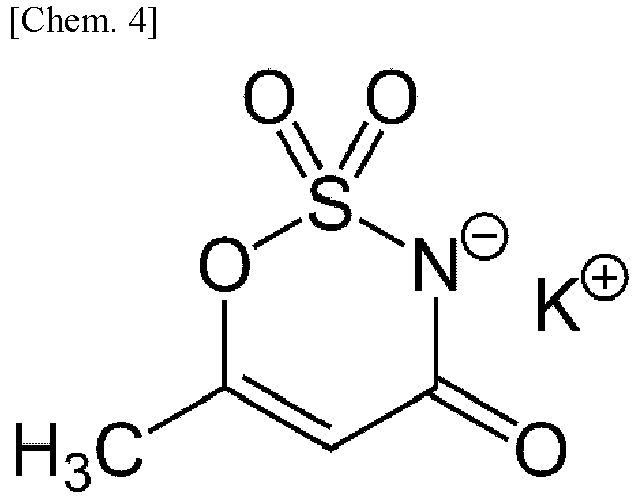
- Acesulfame potassium may also be referred to as "acelfame K". Commercial acesulfame potassium products, such as Tokyo Chemical Industry Co., Ltd. (P/N: A1490) and FUJIFILM Wako Pure Chemical Corporation (P/N: 013-14102), can also be used.
- "Advantame" is an artificial sweetener that is a derivative of aspartame and that has a peptide skeleton. Advantame has a structure formed as a result of a 3-(3-hydroxy-4-methoxyphenyl)propyl group being introduced to the amino group of the aspartic acid residue of aspartame. The IUPAC name of advantame is (3S)-3-[3-(3-hydroxy-4-methoxyphenyl)propylamino]-4-[[(2S)-1-methoxy-1-oxo-3-phenylpropan-2-yl]amino]-4-oxobutanoic acid.

- Commercial advantame products, such as advantame monohydrate produced by FUJIFILM Wako Pure Chemical Corporation (P/N: 018-26801) and advantame monohydrate produced by Sigma-Aldrich (P/N: 1011889), can also be used.
- "Neotame" is an artificial sweetener that is a derivative of aspartame and that has a peptide skeleton. Neotame has a structure formed as a result of a 3,3-dimethylbutyl group being introduced to the amino group of the aspartic acid residue of aspartame. The IUPAC name of neotame is (3S)-3-(3,3-dimethylbutylamino)-4-[[(2S)-1-methoxy-1-oxo-3-phenylpropan-2-yl]amino]-4-oxobutanoic acid.

- Commercial neotame products, such as Tokyo Chemical Industry Co., Ltd. (P/N: N1112) and Sigma-Aldrich (P/N: 49777), can also be used.
- "Aspartame" is an artificial sweetener having a dipeptide skeleton consisting of phenylalanine and aspartic acid. Aspartame has a structure formed as a result of methyl esterification of the carboxyl group of the phenylalanine residue. The IUPAC name of aspartame is N-(L-α-aspartyl)-L-phenylalanine-1-methyl ester.


- Commercial aspartame products, such as Tokyo Chemical Industry Co., Ltd. (P/N: A0997) and FUJIFILM Wako Pure Chemical Corporation (P/N: 016-11331), can also be used.
- In one aspect, the sweetener is a neohesperidin derivative.
- Neohesperidin is a compound known as IUPAC name: (2S)-7-[[2-O-(6-deoxy-α-L-mannopyranosyl)-β-D-glucopyranosyl]oxy]-2,3-dihydro-5-hydroxy-2-(3-hydroxy-4-methoxyphenyl)-4H-1-benzopyran-4-one

- Neohesperidin is one of the types of polyphenols which is included in citrus fruits and a flavonoid having a bitter taste.
- The term "neohesperidin derivative" refers to, in a nonrestrictive manner, derivatives that maintain the disaccharide skeleton structure of neohesperidin which is made of mannose and glucose. In one aspect, the neohesperidin derivative is a derivative that maintains the disaccharide skeleton structure of neohesperidin which is made of mannose and glucose and the structure of a substituted phenyl group, which is preferably a 3-hydroxy-4-methoxyphenyl structure.
- Examples of the neohesperidin derivative include, but are not limited to, neohesperidin dihydrochalcone, glucosyl hesperidin (CAS No.: 161713-86-6), and methylhesperidin (CAS No.: 11013-97-1).
- In one aspect, the neohesperidin derivative is neohesperidin dihydrochalcone.
- Neohesperidin dihydrochalcone is a compound with CAS No. 20702-77-6 which is represented by the following chemical formula.
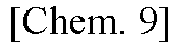

- Neohesperidin dihydrochalcone is a sweetener classified as a flavonoid glycoside. Neohesperidin dihydrochalcone is a neohesperidin derivative which maintains the disaccharide skeleton structure of neohesperidin which is made of mannose and glucose and a 3-hydroxy-4-methoxyphenyl structure. Neohesperidin dihydrochalcone reportedly has a degree of sweetness about 1000 to 1800 times that of sucrose (NPLs 11 and 12).
- Commercial neohesperidin dihydrochalcone products, such as Tokyo Chemical Industry Co., Ltd. (P/N: N0675) and Sigma-Aldrich (P/N: W381101), can also be used.
- In one aspect, the sweetener is a hesperidin derivative having a degree of sweetness equal to or more than 0.5 times the degree of sweetness of neohesperidin dihydrochalcone. Sweetness is determined on the basis of, for example, with the sweetness intensity of sucrose having a predetermined concentration being 1, the weight ratio of the concentration of a substance at which the same sweetness intensity as sucrose is imparted or a ratio relative to the threshold value of sucrose which is calculated under the same conditions (NPL 6-11, although the sweetness intensity of sucrose is defined as 100 in some documents, in the present specification, all sweetness intensity values are described with the sweetness intensity of sucrose being 1). Since the degree of sweetness is an index relative to the sweetness intensity of sucrose, sweetness is often referred to as "relative sweetness". Thus, these terms are synonymous. In the present invention, "the degree of sweetness" is used consistently. Note that the relationship between sweetness and concentration is not always linear and, therefore, the degree of sweetness may vary when the concentration of sucrose used as a reference changes. The degree of sweetness may be affected by conditions such as the amount, temperature, and pH of the test solution used and the number and learning levels of panelists. The expression "having a degree of sweetness equal to or more than 0.5 times the degree of sweetness of neohesperidin dihydrochalcone" used herein means that the above requirement is satisfied when the degree of sweetness is measured under substantially the same conditions as neohesperidin dihydrochalcone. Since it is known that neohesperidin dihydrochalcone has a degree of sweetness about 1000 to 1800 times that of sucrose, the expression "having a degree of sweetness equal to or more than 0.5 times the degree of sweetness of neohesperidin dihydrochalcone" means that the degree of sweetness is preferably, but not limited to, 500 or more, 600 or more, 700 or more, 800 or more, 900 or more, or 1000 or more.
- Among the ten types of sweeteners described above, monellin and thaumatin, which are proteins, are considered to have a certain degree of solubility in propylene glycol (PG) and glycerine (GL), which are polar solvents. However, proteins may become insoluble in e-liquids, which commonly further include a flavoring agent and nicotine in a coexistent manner. Therefore, in the case where monellin or thaumatin is used as a sweetener, the types of flavoring agents that can be used and the content of nicotine may be limited disadvantageously.
- In one aspect, the sweetener is selected from the group consisting of glycyrrhizin, stevioside or a stevia extract, saccharin, acesulfame potassium, advantame, neotame, and neohesperidin dihydrochalcone.
- The composition for tobacco may include one type of sweetener or two or more types of sweeteners in combination.
- The contents of the sweeteners in the composition for tobacco are not limited.
- In one aspect, the sweetener is advantame. The content of advantame in the composition for tobacco is, but not limited to, 0.005% by weight or more, 0.01% by weight or more, 0.02% by weight or more, 0.03 weight or more, 0.04% by weight or more, 0.05% by weight or more, 0.06% by weight or more, or 0.07% by weight or more. The content of advantame in the composition for tobacco is, but not limited to, 0.30% by weight or less, 0.20% by weight or less, 0.15% by weight or less, or 0.10% by weight or less.
- In one aspect, the sweetener is neotame. The content of neotame in the composition for tobacco is, but not limited to, 0.02% by weight or more, 0.03% by weight or more, 0.04% by weight or more, 0.05% by weight or more, 0.06% by weight or more, 0.07% by weight or more, 0.08% by weight or more, 0.09% by weight or more, 0.10% by weight or more, or 0.12% by weight or more. The content of neotame in the composition for tobacco is, but not limited to, 0.50% by weight or less, 0.40% by weight or less, 0.30% by weight or less, 0.20% by weight or less, or 0.15% by weight or less.
- In one aspect, the sweetener is neohesperidin dihydrochalcone. The content of neohesperidin dihydrochalcone in the composition for tobacco is, but not limited to, 0.05% by weight or more, 0.08% by weight or more, 0.10% by weight or more, 0.12% by weight or more, 0.15% by weight or more, 0.18% by weight or more, 0.20% by weight or more, 0.22% by weight or more, 0.25% by weight or more, 0.28% by weight or more, or 0.30% by weight or more. The content of neohesperidin dihydrochalcone in the composition for tobacco is, but not limited to, 0.80% by weight or less, 0.60% by weight or less, 0.50% by weight or less, 0.40% by weight or less, or 0.35% by weight or less.
- The composition for tobacco may include one type of sweetener or two or more types of sweeteners in combination.
- The "composition for tobacco" is a composition that includes a part or the entirety of the component in order to impart a taste, such as a flavor or sweetness, to a "tobacco", such as a tobacco product or an e-liquid. The composition may be either liquid or solid and is preferably a liquid composition. The term "tobacco" refers to a tobacco product, such as a combustion-type flavor inhalation article, a heating-type flavor inhalation article, or a snus, an e-liquid, or the like. In one aspect, the composition for tobacco is heated to 150°C to 300°C when used.
- In one aspect, the composition for tobacco may include another component in addition to the sweetener. Examples of the component that can be included in the composition include, but are not limited to, a flavoring agent, a taste substance, a gustatory receptor activity enhancer/inhibitor, and a sensory receptor activity enhancer/inhibitor. The composition for tobacco may further include a colorant, a humectant, and a preservative as needed. The properties and state of the flavoring material and the optional materials are not limited. For example, they may be liquid or solid. The above materials may be used as a single component or a combination of a plurality of components.
- In one aspect, the composition for tobacco includes a flavoring agent. Examples of suitable flavors of the flavoring agent include flavors produced by using one or more flavoring agent selected from a tobacco extract, a tobacco component, a sugar, a sugar-based flavor, licorice, cocoa, chocolate, a fruit juice and a fruit, a spice, Western liquor, a herb, vanilla, and a flower-based flavor alone or in combination of two or more. The flavoring agent can be selected from various types of flavor components as described in, for example, "Collection of Well-known Prior Arts (Flavoring Agent)" (published by Japan Patent Office, March 14, 2007), "Latest Handbook of Flavoring Agents (popular edition)" (February 25, 2012, edited by Soichi Arai, Akio Kobayashi, Izumi Yajima, and Michiaki Kawasaki, Asakura Publishing Co., Ltd.), and "Tobacco Flavoring for Smoking Products" (June, 1972, R. J. REYNOLDS TOBACCO COMPANY).
- In one aspect, the composition for tobacco includes nicotine.
- The present invention also relates to an e-liquid. The e-liquid according to the present invention includes the composition for tobacco according to the present invention.
- The "composition for tobacco" according to the present invention is as described in detail in the section "1. Composition for Tobacco".
- The e-liquid is a liquid composition for liquid heating-type flavor aspirators (may be also referred to as "electronic cigarettes"). The e-liquid commonly includes propylene glycol (PG), glycerine (GL), nicotine, a flavoring agent, and the like. The e-liquid including the composition for tobacco includes a sweetener other than sucralose.
- The present invention further relates to a tobacco product. The tobacco product according to the present invention includes the composition for tobacco according to the present invention.
- The "composition for tobacco" according to the present invention is as described in detail in the section "1. Composition for Tobacco".
- Examples of the "tobacco product" include, but are not limited to, a combustion-type flavor inhalation article, a heating-type flavor inhalation article, and a snus.
- In one aspect, the tobacco product is a combustion-type flavor inhalation article. The "combustion-type flavor inhalation article" is a common combustion smoking article with which smoking is done using combustion. Examples thereof include a paper tobacco, a paper-wrapped tobacco, and a cigar. The composition for tobacco may be, but is not necessarily, used by, for example, impregnating tobacco leaves, shredded tobacco, a tobacco sheet, or the like included in the combustion-type flavor inhalation article with the composition for tobacco that is in a liquid form. Alternatively, for example, the composition for tobacco may be charged into the combustion-type flavor inhalation article together with the tobacco leaves, the shredded tobacco, the tobacco sheet, or the like in the production of the flavor inhalation article.
- In one aspect, the tobacco product is a heating-type flavor inhalation article. The "heating-type flavor inhalation article" is an article that includes tobacco leaves and generates a vapor (aerosol) by heating the tobacco leaves instead of combusting them, the vapor being inhaled by the user. The "heating-type flavor inhalation article" commonly includes, but does not necessarily include, a tobacco-containing segment, a tubular cooling segment having perforations formed in the circumference thereof, and a filter segment. The non-combustion heating-type smoking article may further include a segment other than the tobacco-containing segment, the cooling segment, or the filter segment. For example, the tobacco leaves, the shredded tobacco, the tobacco sheet, or the like included in the non-combustion heating-type smoking article may be impregnated with the composition for tobacco which is in a liquid form. In another case, in the production of the non-combustion heating-type smoking article, for example, the composition for tobacco may be charged into the smoking article together with the tobacco leaves, the shredded tobacco, the tobacco sheet, or the like.
- In one aspect, the tobacco product may be a snus. A snus is also referred to as "snuff'. A snus is commonly formed of ground tobacco leaves charged in a bag and used while being pinched between the lip and gum. Recently, a snus that contains no tobacco leaves, which is referred to as "nicotine pouch" or "white snus", has been coming on the market. These products are commonly formed by packing, instead of tobacco leaves, a support composed of cellulose fibers, a resin, an inorganic salt, or the like on which nicotine extracted and isolated from tobacco leaves is deposited with a bag and are being recognized as a new form of snus. In the present invention, the nicotine pouch is considered as one of the forms of snus. Since snus products do not involve heating or combustion and do not produce smoke, they are also referred to as "smoke-free cigarettes". For example, the tobacco leaves included in common snus products or the supports included in the nicotine pouches may be impregnated with the composition for tobacco that is in a liquid form.
- Details of the present invention are described with reference to Examples below. The present invention is not limited by Examples below. Various modifications and alterations may be readily done to the present invention by those skilled in the art on the basis of the description of the present specification and such modifications and alterations are intended to be included within the technical scope of the present invention.
- The condition that is to be considered primarily is solubility in e-liquids because, in consideration of article characteristics of e-liquids, it is necessary to prepare a homogeneous solution in which the contents are completely dissolved. Commonly known sweeteners are substances that are intrinsically present in foods, such as a sugar and a sugar alcohol, or substances developed and used in actual use on the understanding that they are added to foods or drinks, such as an artificial sweetener. Most of such sweeteners are basically water-soluble substances, and some of them are substances that are hardly soluble in organic solvents. Therefore, attention needs to be paid. Since solvents included in common e-liquids are PG and GL, in the case where a sweetener is applied to an e-liquid, consideration needs to be given to solubility of the sweetener in PG and GL. It is considered that, theoretically, a substance having a higher sweetness intensity can achieve the same degree of sweetness in a smaller amount. Therefore, it can be said that a substance having a higher sweetness intensity is more advantageous also in terms of solubility in PG and GL.
- The sweetness intensity of a sweetener is commonly expressed using an index "degree of sweetness". The degree of sweetness is determined on the basis of, with the sweetness intensity of sucrose having a predetermined concentration being 1, the weight ratio of the concentration of a substance that has the same sweetness intensity as the sucrose solution or the ratio relative to the threshold value of sucrose which is determined under the same conditions as above (NPL 6-11, although the sweetness intensity of sucrose is defined as 100 in some documents, in the present specification, all sweetness intensity values are described with the sweetness intensity of sucrose being 1). Since the degree of sweetness is an index relative to the sweetness intensity of sucrose, the degree of sweetness is often referred to as "relative sweetness". Thus, these terms are synonymous. In the present specification, "the degree of sweetness" is used consistently. The degree of sweetness of sucralose is reportedly 320 to 1000 (
NPLs 1, 7, 9, 13, and 14). The inventor of the present invention calculated the ratio of the degree of sweetness of each of the sweeteners reported in documents and the like to the degree of sweetness of sucralose and defined the above ratio as "estimated magnification required for achieving the same degree of sweetness as sucralose" of the sweetener (e.g.: XX times sucralose; hereinafter, referred to as "estimated required magnification"), which was used as an index for primary screening. Note that the degree of sweetness is an index that commonly expresses the intensity of sweetness in an aqueous solution. Although it is fully known that the sweetness intensity that corresponds to the reported degree of sweetness is not always imparted in the case where an aerosol is delivered into the oral cavity as in electronic cigarettes, it is not irrational to assume that there is a certain correlation between the degree of sweetness imparted in an aqueous solution and the sweetness intensity delivered into the oral cavity after being aerosolized. Thus, the above degree of sweetness is considered as a parameter appropriate as an index for primary screening. - Information on commonly known sweeteners is widely gathered and classified by chemical structure. Table 1 lists the degree of sweetness.
-
Table 1. List of Sweeteners and Degrees of Sweetness Name of sweetener Category of chemical structure Degree of sweetness Cited document No. Sucralose Sugar chloride 320-1000 1, 7, 9, 13, 14 Fructose Sugar 1.15-1.80 6,7,8,9,14 Sucrose Sugar 1 6, 7, 8, 9, 10, 14 Tagatose Sugar 0.92 6 Glucose Sugar 0.5-1.0 6,7,8,9,14 Galactose Sugar 0.32-0.60 7, 9, 14 Trehalose Sugar 0.45-0.50 6 Isomaltose Sugar 0.4 14 Lactose Sugar 0.15-0.30 6,7,8,9,14 Xylitol Sugar alcohol 0.65-1.2 6, 9, 10, 14 Maltitol Sugar alcohol 0.68-0.90 6, 10 Erythritol Sugar alcohol 0.7-0.8 6, 10 Sorbitol Sugar alcohol 0.5-0.7 6, 8, 10, 14 Mannitol Sugar alcohol 0.4-0.7 6, 8, 10, 14 Polyglycitol syrup Sugar alcohol 0.4-0.9 10 Arabitol Sugar alcohol 0.7 10 Isomalt Sugar alcohol 0.5 10 Lactitol Sugar alcohol 0.3-0.4 6, 10 Glycine Amino acid 0.9 14 Monellin Protein 3000 12, 13, 14 Thaumatin Protein 1600-3000 9, 12, 13, 14 Glycyrrhizin Terpene glycoside 50-300 8, 12, 14 Stevioside / Stevia extract Terpene glycoside 150-300 9, 12, 14 Saccharin Sulfamide 200-550 7, 8, 9, 13, 14 Acesulfame potassium Sulfamic acid salt 200 7, 9, 13, 14 Sodium cyclamate Sulfamic acid salt 30-80 7, 9, 13, 14 Aspartame Peptide derivative 100-200 7, 8, 9, 13, 14 Advantame Peptide derivative 20000 13 Neotame Peptide derivative 7000-13000 13, 14 Neohesperidin dihydrochalcone Flavonoid glycoside 1000-1800 11, 12 - First, a saccharide, which is one of the most typical sweeteners, is discussed below. The degree of sweetness of a sugar is typically about 0.2 to 1.7, which varies by a certain degree by evaluation method and document. Assume that a sweetness intensity comparable to that of sucralose is imparted using fructose, which has a relatively high degree of sweetness (1.15 to 1.80) among saccharides. Calculated simply on the basis of the degree of sweetness of sucralose (320 to 1000), the estimated required magnification of fructose is about 178 to 870 fold. Mathematically, a larger amount of sugar is required in the case where a saccharide having a lower degree of sweetness than fructose is used. It is considered very likely difficult to dissolve a sugar in the solvent of an e-liquid, which is PG or GL, in an amount large enough to impart sweetness. Thus, it is considered difficult to impart sufficient sweetness by using a saccharide alone.
- A sugar alcohol, which is commonly used as an alternative to a saccharide for foods and drinks, is discussed below. As listed in Table 1, many sugar alcohols have a lower degree of sweetness than saccharides, which falls within a range of about 0.3 to 1.2. Even xylitol, which has a relatively high degree of sweetness among sugar alcohols, has a degree of sweetness of 0.65 to 1.20. Thus, for imparting sufficient sweetness, it is considered necessary to dissolve a sugar alcohol in the solvent of an e-liquid, which is PG or GL, in an amount larger than the amount of saccharide above. For the above reason, it is also considered difficult to impart sufficient sweetness by using a sugar alcohol alone.
- It is known that some amino acids, such as glycine, have sweetness. The degree of sweetness of glycine is 0.9. That is, glycine has a low degree of sweetness similarly to the saccharide and the sugar alcohol descried above. Thus, it is considered difficult to impart sufficient sweetness by using glycine alone.
- Some proteins also have sweetness. Examples of such proteins include monellin and thaumatin. Monellin and thaumatin are proteins discovered in a plant that grows naturally in tropical rain forests. Monellin (degree of sweetness: 3000; NPLs 12, 13, and 14) and thaumatin (degree of sweetness: 1600 to 3000;
NPLs 9, 12, 13, and 14) are known as natural sweeteners having markedly high sweetness. The estimated required magnifications of monellin and thaumatin which are calculated using the above degrees of sweetness are about 0.1 to 0.3 fold and about 0.1 to 0.6 fold, respectively, relative to sucralose. Although many proteins commonly have a low solubility in organic solvents, they are considered to have a certain degree of solubility in PG or GL, which is a polar solvent, and may be applied to e-liquids when the amount of the protein used is significantly small. From the above discussion, it was determined that monellin and thaumatin can be candidates for sweetness sources for e-liquids which are alternative to sucralose, and monellin and thaumatin were used in the following studies. - Glycyrrhizin and stevioside, which are natural sweeteners having a terpene glycoside structure, are discussed below. Glycyrrhizin (also referred to as "glycyrrhizic acid" in many cases) is a component included in licorice roots and considered to have efficacy in anti-inflammatory action and the like (NPL 15). Stevioside is a sweetener discovered in stevia, which is a plant in South America in the family Asteraceae. Stevioside is also often added to foods or the like without isolation in the form of a stevia extract, which is a mixture of stevioside and another analog derived from stevia. The degrees of sweetness of glycyrrhizin and stevioside (stevia extract) are 50 to 300 (
NPLs 8, 12, and 14) and 150 to 300 (NPLs 9, 12, and 14), respectively. The estimated required magnifications of glycyrrhizin and stevioside (stevia extract) which are calculated using the above degrees of sweetness are about 1.1 to 20.0 fold and about 1.1 to 6.7 fold, respectively, relative to sucralose. Since glycyrrhizin and stevioside (stevia extract) both include a highly polar sugar chain in the molecular structure, they are considered to have a certain degree of solubility in PG or GL, which is a polar solvent. For the above reasons, it was determined that glycyrrhizin and stevioside (stevia extract) can be candidates for sweetness sources for e-liquids which are alternative to sucralose, and glycyrrhizin and stevioside (stevia extract) were used in the following studies. - Saccharin, which has a sulfamide skeleton, and acesulfame potassium, which has a sulfamic acid skeleton, are discussed below. Sulfamide and sulfamic acid have a structure formed as a result of a hydroxyl group of sulfuric acid being replaced with an amino group. Specifically, sulfamide has a structure including two amino group substituents, while sulfamic acid has a structure including one amino group substituent. Saccharin is commonly used in the form of a sodium salt in order to enhance solubility in water and is a sweetener commonly added to foods particularly in the United States, China, etc. Acesulfame potassium is a sweetener added to foods in various countries, such as Japan, the European countries, and the United States. The degrees of sweetness of saccharin and acesulfame potassium are reportedly 200 to 550 (
NPLs NPLs 7, 9, 13, and 14). The estimated required magnifications of saccharin and acesulfame potassium which are calculated using the above degrees of sweetness are about 0.58 to 5.00 fold and about 1.60 to 5.00 fold, respectively, relative to sucralose. Since saccharin and acesulfame potassium both have a highly polar sulfamide or sulfamine skeleton in the molecular structure, they are considered to have a certain degree of solubility in PG or GL, which is a polar solvent. For the above reasons, it was determined that saccharin and acesulfame potassium can be candidates for sweetness sources for e-liquids which are alternative to sucralose, and saccharin and acesulfame potassium were used in the following studies. - Sodium cyclamate, which has a sulfamic acid skeleton similarly to the above, is discussed below. Sodium cyclamate is known as "chikuro" in Japan. The use of sodium cyclamate is permitted in the European countries and China but prohibited in Japan, the United States, etc. The attitudes taken toward this sweetener vary by country. Therefore, foods that contain sodium cyclamate are often imported from overseas to Japan and violation of Food Sanitation Act by the use of a non-designated additive frequently occurs. Sodium cyclamate has a degree of sweetness of 30 to 80 (
NPLs 7, 9, 13, and 14). Although it is lower than that of a saccharin or acesulfame potassium, sodium cyclamate has a certain degree of sweetness and is considered to have a certain degree of solubility in PG and GL on the basis of the chemical structure thereof. Although it is considered highly possible to apply sodium cyclamate to e-liquids, sodium cyclamate may lack versality since sodium cyclamate is considered difficult to handle in many countries due to regulatory constraints. Therefore, sodium cyclamate is not used in the studies described below. - Aspartame, which is an artificial sweetener that is a peptide derivative, is discussed below. Aspartame has been used in various countries as a food additive. The degree of sweetness of aspartame is reportedly 100 to 200 (
NPLs - Advantame and neotame, which are artificial sweeteners that are peptide derivatives similarly to the above and have considerably high degrees of sweetness, are discussed below. Both of them are sweeteners developed by converting aspartame into derivatives. The addition of advantame and neotame to foods is permitted in a plurality of countries. The degree of sweetness of advantame is reportedly 20000 (NPL 13), which is considered the highest of the degrees of sweetness of synthetic sweeteners ever known in the related art. The degree of sweetness of neotame is reportedly 7000 to 13000 (NPLs 13 and 14). Neotame is an artificial sweetener that had been considered to have the highest degree of sweetness before advantame was developed. Since both of the two have a considerably high degree of sweetness which is superior to that of sucralose, it is considered possible to maintain the intended sweetness intensity by addition of a trace amount of advantame or neotame. The estimated required magnifications of advantame or neotame which are calculated using the above degrees of sweetness are about 0.016 to 0.050 fold and about 0.025 to 0.143 fold, respectively, relative to sucralose. It is considered possible to maintain the intended sweetness intensity by addition of a trace amount of advantame or neotame. Furthermore, since advantame and neotame include a plurality of polar functional groups in the molecule, they are considered to have a certain degree of solubility in PG or GL, which is a polar solvent. For the above reasons, it was determined that advantame and neotame can be candidates for sweetness sources for e-liquids which are alternative to sucralose, and advantame and neotame were used in the following studies.
- Finally, neohesperidin dihydrochalcone, which is a flavonoid glycoside, is discussed below. Neohesperidin dihydrochalcone is an artificial sweetener synthesized by converting neohesperidin, which is included in citrus fruits, into a derivative (NPL 11). The degree of sweetness of neohesperidin dihydrochalcone is reportedly 1000 to 1800 (NPLs 11 and 12). Neohesperidin dihydrochalcone is a food additive certified as GRAS (Generally Recognized As Safe) in the United States (NPL 16) and, in the European countries, also registered as a sweetener as a food additive E959 (NPL 17). Thus, it can be said that neohesperidin dihydrochalcone is a substance confirmed as safe. The estimated required magnification of neohesperidin dihydrochalcone which is calculated using the above degree of sweetness (1000 to 1800) is about 0.18 to 1.00 fold relative to sucralose. Since neohesperidin dihydrochalcone has a highly polar sugar chain in the molecular structure, it is considered to have a certain degree of solubility in PG or GL, which is a polar solvent. For the above reasons, it was determined that neohesperidin dihydrochalcone can be a candidate for sweetness sources for e-liquids which are alternative to sucralose, and neohesperidin dihydrochalcone was used in the following studies.
- Substances that may be candidates for sweetness sources for e-liquids which are alternative to sucralose were screened using the estimated required magnifications relative to sucralose as an index. As a result, the following ten sweeteners: monellin, thaumatin, glycyrrhizin, stevioside (stevia extract), saccharin, acesulfame potassium, advantame, neotame, aspartame, and neohesperidin dihydrochalcone, were selected as useful candidate substances.
- First, monellin and thaumatin, which are proteins, are discussed below. As described above, although monellin and thaumatin are considered to have a certain degree of solubility in PG and GL, which are polar solvents, many proteins commonly have a low solubility in hydrophobic organic solvents. A protein precipitation method in which an organic solvent is used, which is a testing method commonly used in the field of biology, uses the above property of proteins. Although it may be possible to dissolve only monellin or thaumatin in PG or GL, it should be considered that common e-liquids include a flavoring agent and nicotine in addition to PG or GL. Specifically, addition of a flavoring agent and nicotine may make proteins, such as monellin and thaumatin, insoluble and, accordingly, the types of flavoring agents that can be used and the amount of nicotine added may be limited.
- The actual solubilities of the other eight sweeteners in PG/GL were determined. For determining solubility, it is necessary to set specific target concentration for each of the sweeteners.
- The inventor of the present invention calculated the estimated concentration of each of the sweeteners in an e-liquid by multiplying the concentration of commonly used sucralose by the above-described estimated required magnification of the sweetener.
- The concentration of commonly used sucralose was cited from the information described in NPL 18. In this document, it is described that adding 1% (wt/vol) sucralose to an e-liquid imparts low sweetness. On the assumption that certain sweetness can be imparted when the sucralose concentration reaches 1%(wt/vol), that is, 1 mg/mL, the reference target is set to 1 mg/mL of sucralose concentration tentatively. The target concentrations of the sweeteners described above were determined by multiplying the reference target by the respective estimated required magnifications relative to sucralose.
- In the case where "weight/volume" units, such as mg/mL, are used, the density of the liquid varies due to a plurality of factors, such as the PG/GL ratio in the solvent, the type and amount of the sweetener dissolved, the impacts of coexistent substances, such as nicotine and a flavoring agent, and temperature. Thus, the use of the above units is not suitable for making comparisons and evaluations by quantitively setting the sweetener concentration in the liquid. In order to neglect the above impacts, in the discussions below, studies were conducted on a weight concentration basis while the PG/GL ratio in the solvent was fixed to PG:GL = 1:1 by weight.
- A test of determining the weight concentration of 1 mg/mL sucralose solution was conducted. All the tests described in this section were conducted at room temperature in a test chamber air-conditioned at 25°C ± 2°C. The diluent solvent used was a solvent prepared by mixing PG and GL at a weight ratio of 1:1 and leaving the resulting mixture to stand until gas bubbles were completely removed from the mixture. A sucralose sample (P/N: S0839) purchased from Tokyo Chemical Industry Co., Ltd. was used.
- Into a screw tube, 0.500 g of sucralose was weighed and charged. Subsequently, 99.500 g of a diluent solvent was weighed and charged into the screw tube. The resulting mixture was stirred until the sucralose was completely dissolved in the diluent solvent to form a 0.5-weight% diluted sucralose solution. After the solution had been left to stand until gas bubbles were completely removed, 10.000 g of the above diluted solution was weighed and charged into a 50-mL measuring flask. Subsequently, the volume was adjusted to 50 mL with a diluent solvent. Hereby, a 1-mg/mL sucralose solution was prepared. The weight of the diluent solvent used for the volume adjustment was 46.786 g. From the above results, the weight concentration of sucralose in the liquid prepared so as to have a sucralose concentration of 1 mg/mL with a solvent including PG and GL at PG:GL - 1:1 was 0.088% by weight. In the studies below, the liquid containing 0.088% by weight sucralose was used as a reference standard.
- The target concentration of each of the sweeteners was calculated in terms of weight concentration by multiplying the weight concentration of sucralose (0.088% by weight) calculated in the above section by the estimated required magnification of the sweetener relative to sucralose, which was calculated from the degree of sweetness. Table 2 lists the results.
-
Table 2. Estimated Required Magnifications and Target Concentrations of Sweeteners Name of sweetener Degree of sweetness Estimated required magnification Target concentration [weight%] Glycyrrhizin 50-300 1.1-20.0 0.094-1.760 Stevioside / Stevia extract 150-300 1.1-6.7 0.094-0.587 Saccharin 200-550 0.58-5.00 0.051-0.440 Acesulfame potassium 200 1.60-5.00 0.141-0.440 Aspartame 100-200 1.60-10.00 0.141-0.880 Advantame 20000 0.016-0.050 0.0014-0.0044 Neotame 7000-13000 0.025-0.143 0.0022-0.0126 Neohesperidin dihydrochalcone 1000-1800 0.18-1.00 0.016-0.088 - On the assumption that each of the sweeteners imparts a certain degree of sweetness when the concentration of the sweetener is equal to or more than the target concentration, the target concentration was used as a measure for determining the actual solubility.
- Although there are many documents that can be referred for the information regarding the degrees of solubility of the sweeteners in a solvent such as water or ethanol, there are few documents that can be referred for the information regarding the degrees of solubility of the sweeteners in PG or GL. Therefore, a dissolution test was conducted using actual substances.
- It is known that stevia includes, in addition to stevioside, analogs such as rebaudioside A, Rebaudioside C, and dulcoside A in a coexist manner. The chemical composition of stevia greatly varies by species, cultivation conditions, and the like (NPL 19). The chemical structures of them are glycosides that have a terpene (aglycone) structure bonded to the sugar chain in common, except that the sugar sequences of glycone differ from one another. Thus, it is considered that the solubilities of the above components in PG or GL do not greatly differ from one another. Therefore, the dissolution test was conducted using a pure stevioside product as a representative. Moreover, saccharin sodium dihydrate, which is a more stable form of saccharin commonly used as a food additive, was used as saccharin.
- Sweeteners purchased from the following reagent companies were used.
- Glycyrrhizin: Tokyo Chemical Industry Co., Ltd. (P/N: G0150)
- Stevioside: FUJIFILM Wako Pure Chemical Corporation (P/N: 194-16481)
- Saccharin sodium dihydrate: Tokyo Chemical Industry Co., Ltd. (P/N: B0131)
- Acesulfame potassium: Tokyo Chemical Industry Co., Ltd. (P/N: A1490)
- Aspartame: Tokyo Chemical Industry Co., Ltd. (P/N: A0997)
- Advantame: FUJIFILM Wako Pure Chemical Corporation (P/N: 018-26801)
- Neotame: Tokyo Chemical Industry Co., Ltd. (P/N: N1112)
- Neohesperidin dihydrochalcone: Tokyo Chemical Industry Co., Ltd. (P/N: N0675)
- This test was conducted at room temperature in a test chamber air-conditioned at 25°C ± 2°C.
- Certain amounts of sweeteners and PG having the weights described in Table 3 were weighed and charged into screw tubes, and the resulting mixtures were stirred for 6 hours at a rate of 750 rpm with a magnetic stirrer. Whether part of the sweeteners left undissolved was visually inspected as needed. When the sweeteners had been completely dissolved, the stirring was stopped and the subsequent step was conducted. In the case where part of the sweeteners left undissolved even after 6 hours of stirring, they were evaluated as "Insoluble" at the timing.
- Certain amounts of GL having the weights described in Table 3 were further charged into the respective screw tubes, and the resulting mixtures were stirred for 1 hour at a rate of 1000 rpm with a magnetic stirrer. After the stirring had been finished, the mixtures were visually inspected for reaggregation. Samples that were homogeneous liquids were determined as "Soluble".
- Table 3 lists the results of the dissolution test.
-
Table 3 Results of Dissolution Test of Sweeteners Name of sweetener Amount of e-liquid added [g] Final concentration of sweetener [weight%] Results of dissolution test Sweet substance PG GL Glycyrrhizin 0.400 9.800 9.800 2.000 Soluble Stevioside 0.200 9.900 9.900 1.000 Soluble Saccharin sodium dihydrate 0.200 9.900 9.900 1.000 Soluble Acesulfame potassium 0.100 9.950 9.950 0.500 Soluble Aspartame 0.100 9.950 9.950 0.500 Insoluble Aspartame 0.050 9.975 9.975 0.250 Insoluble Aspartame 0.030 9.985 9.985 0.150 Soluble Advantame 0.100 9.950 9.950 0.500 Soluble Neotame 0.100 9.950 9.950 0.500 Soluble Neohesperidin dihydrochalcone 0.100 9.950 9.950 0.500 Soluble - It was confirmed that glycyrrhizin, stevioside, saccharin sodium dihydrate, acesulfame potassium, advantame, neotame, and neohesperidin dihydrochalcone had certain degrees of solubility equal to or more than the respective target concentrations calculated in the section 2-2-3. Therefore, it can be said that there is no harm in applying these sweeteners to e-liquids in terms of solubility. The degree of solubility of aspartame was 0.15% by weight or more and less than 0.25% by weight, which was lower than the degrees of solubility of the other 7 substances and was about the lower limit of the above target concentration (0.141% to 0.440% by weight).
- The results of determination of the solubilities of seven substances, that is, glycyrrhizin, stevioside (stevia extract), saccharin, acesulfame potassium, advantame, neotame, and neohesperidin dihydrochalcone, in the solvent of e-liquids, that is, PG/GL, confirmed that these substances have certain degrees of solubility equal to or more than the respective concentrations considered necessary for imparting sweetness and can be usefully applied to e-liquids. Aspartame had a slightly low degree of solubility in PG and GL.
- In the discussion made up to the
section 2, screening was conducted to determine whether the sweeteners can be applied to e-liquids in consideration of degree of sweetness and the degree of solubility. As described above, the degree of sweetness is a value that expresses sweetness intensity determined using an aqueous solution. Therefore, it is necessary to confirm whether the candidate sweeteners can actually impart sweetness even in the form of an e-liquid. Thus, in this section, the results of determining whether the candidate sweeteners actually impart sweetness and, in the case where the candidate sweeteners impart sweetness, the concentrations at which the candidate sweeteners impart sweetness. - e-Liquids that had the compositions described in Table 4 were prepared using glycyrrhizin, stevioside, saccharin, acesulfame potassium, aspartame, advantame, neotame, and neohesperidin dihydrochalcone and subjected to a qualitative sensory evaluation using the Logic Compact device commercially available in the European countries (selling site: https://logicvapes.co.uk/about/compact). The evaluation panel was conducted by two expert panels freely making comments, who are involved in the development and sensory evaluations of e-liquids on a daily basis. Table 4 lists the compositions of the samples evaluated and the results of the evaluation.
-
Table 4 Results of Qualitative Evaluations of Sweeteners Name of sweetener e-Liquid recipe [weight%] Comment of sensory evaluations Sweetener PG GL Glycyrrhizin 2.000 49.000 49.000 Sweetness was felt Stevioside 1.000 49.500 49.500 Sweetness was felt, and relatively brown flavor was imparted Saccharin sodium dihydrate 0.500 49.750 49.750 Sweetness was felt, and slight odor was felt Acesulfame potassium 0.500 49.750 49.750 Sweetness was felt Aspartame 0.150 49.925 49.925 Slight sweetness was felt, which was very weak comparing with the other standards Advantame 0.010 49.995 49.995 High sweetness was felt Neotame 0.020 49.990 49.990 High sweetness was felt Neohesperidin dihydrochalcone 0.100 49.950 49.950 High sweetness was felt, and relatively brown flavor was imparted - Since the degree of solubility of aspartame in PG and GL is limited as described above, a sufficient degree of sweetness could not be imparted at the concentration at which aspartame can be completely dissolved in a solvent of PG:GL = 1:1. Since aspartame has a degree of solubility of about 5% by weight in water at a pH of 7 (NPL 20), it is considered possible to further increase the concentration by adding water as a dissolution assistant.
- It was confirmed that glycyrrhizin, stevioside, saccharin, acesulfame potassium, advantame, neotame, and neohesperidin dihydrochalcone imparted sweetness having an intensity with which the expert panels can sense the sweetness.
- It was confirmed that, among these, the three types of sweeteners having higher degrees of sweetness, that is, advantame, neotame, and neohesperidin dihydrochalcone, were capable of imparting sweetness even at low concentrations. It can be said that the above results support the assumption that "there is a certain correlation between the degree of sweetness imparted in an aqueous solution and the sweetness intensity delivered into the oral cavity after being aerosolized", which is mentioned in the section 1-1.
- The three types of sweeteners, that is, advantame, neotame, and neohesperidin dihydrochalcone, which were confirmed to impart sweetness at low concentrations, were subjected to further inspection in order to clarify the preferable concentration range in which sweetness can be imparted.
- For each of the three types of sweeteners, that is, advantame, neotame, and neohesperidin dihydrochalcone, the lower limit for the concentration of the sweetener in the e-liquid at which the sweetener imparts sweetness, that is, the threshold value, was determined. On the understanding that the threshold value is "the concentration at which general consumers can sense sweetness in a statistically significant manner", the threshold value was determined by a sensory evaluation.
- e-Liquids having the compositions described in Table 5 were prepared, where a standard that did not include any sweetener is referred to as "Reference 1", while the standards including a specific one of the sweeteners at different concentrations are referred to as "samples". Then, a sensory evaluation was conducted by 18 panels using the Logic Compact device above. Specifically, the degree of sweetness (defined as sweetness sensed by the tongue or the sweetness that remains in the mouth after aerosol inhalation) was compared between Reference 1 and the sample of each Lot, and which of Reference 1 and the sample had higher sweetness was determined by two-alternative forced choice. Subsequently, a statistical analysis was conducted using a binomial test. In the binomial test, the statistical significance level α was set to 0.05, which is commonly employed.
- The evaluation results were statistically analyzed using a binomial test. The null hypothesis H0 is set to "the probability of choosing Reference 1 is equal to the probability of choosing the sample". Under the null hypothesis, the "number of persons who answer that the sample has higher sweetness" when 18 persons are participated in the survey follows a binomial distribution B(18, 0.5). The probability p at which the number of persons who answer that "the sample has higher sweetness" is equal to or more than the above evaluation results under the null hypothesis was calculated. Table 6 lists the results of the binomial test.
-
Table 5 Sample Compositions Lot Name of sweetener used e-Liquid recipe [weight%] Sweetener PG GL Reference 1 None 0.0000 50.0000 50.0000 A1-1 Advantame 0.0010 49.9995 49.9995 A1-2 0.0025 49.9988 49.9988 A1-3 0.0050 49.9975 49.9975 A1-4 0.0100 49.9950 49.9950 A1-5 0.0200 49.9900 49.9900 B1-1 Neotame 0.0010 49.9995 49.9995 B1-2 0.0050 49.9975 49.9975 B1-3 0.0100 49.9950 49.9950 B1-4 0.0200 49.9900 49.9900 B1-5 0.0500 49.9750 49.9750 C1-1 Neohesperidin dihydrochalcone 0.0010 49.9995 49.9995 C1-2 0.0100 49.9950 49.9950 C1-3 0.0200 49.9900 49.9900 C1-4 0.0500 49.9750 49.9750 C1-5 0.1000 49.9500 49.9500 -
Table 6 Results of Binominal Test Lot Name of sweetener used Sweetener concentration [weight%] Number of persons who answered the sample/Reference 1 had higher sweetness p value Sample Reference 1 A1-1 Advantame 0.0010 9 9 0.593 A1-2 0.0025 9 9 0.593 A1-3 0.0050 9 9 0.593 A1-4 0.0100 14 4 0.015 A1-5 0.0200 15 3 0.004 B1-1 Neotame 0.0010 10 8 0.407 B1-2 0.0050 4 14 0.996 B1-3 0.0100 9 9 0.593 B1-4 0.0200 12 6 0.119 B1-5 0.0500 14 4 0.015 C1-1 Neohesperidin dihydrochalcone 0.0010 6 12 0.952 C1-2 0.0100 8 10 0.760 C1-3 0.0200 7 11 0.881 C1-4 0.0500 10 8 0.407 C1-5 0.1000 14 4 0.015 - Since the p values of Lots A1-1,A1-2, and A1-3, which included 0.001%, 0.0025%, and 0.005% by weight advantame, were 0.593, 0.593, and 0.593, respectively, the null hypothesis was not rejected at a significance level of 5% in any of the standards. That is, it cannot be said that, at a concentration of 0.005% by weight or less, the sweetness of advantame was sensed in a statistically significant manner compared with Reference 1 that did not include a sweetener.
- In contrast, since the p values of Lots A1-4 and A1-5, which included 0.01% and 0.02% by weight advantame, were 0.015 and 0.004, respectively, the null hypothesis was rejected at a significance level of 5% in both of the standards. That is, it can be said that, at a concentration of 0.01% by weight or more, the sweetness of advantame was sensed in a statistically significant manner compared with Reference 1 that did not include a sweetener.
- On the basis of the above results, it is considered that the threshold concentration at which the sweetness of advantame included in an e-liquid can be sensed in a significant manner falls between Lots A1-3 and A1-4, that is, is more than 0.005% by weight and less than 0.01% by weight.
- Since the p values of Lots B1-1, B1-2, B1-3, and B1-4, which included 0.001%, 0.005%, 0.01%, and 0.02% by weight neotame, were 0.407, 0.996, 0.593, and 0.119, respectively, the null hypothesis was not rejected at a significance level of 5% in any of the standards. That is, it cannot be said that, at a concentration of 0.02% by weight or less, the sweetness of neotame was sensed in a statistically significant manner compared with Reference 1 that did not include a sweetener.
- In contrast, since the p value of Lot B1-5, which included 0.05% by weight neotame, was 0.015, the null hypothesis was rejected at a significance level of 5%. That is, it can be said that, at a concentration of 0.05% by weight or more, the sweetness of neotame was sensed in a statistically significant manner compared with Reference 1 that did not include a sweetener.
- On the basis of the above results, it is considered that the threshold concentration at which the sweetness of neotame included in an e-liquid can be sensed in a significant manner falls between Lots B1-4 and B1-5, that is, is more than 0.02% by weight and less than 0.05% by weight.
- Since the p values of Lots C1-1, C1-2, C1-3, and C1-4, which included 0.001%, 0.01%, 0.02%, and 0.05% by weight neohesperidin dihydrochalcone, were 0.952, 0.760, 0.881, and 0.407, respectively, the null hypothesis was not rejected at a significance level of 5% in any of the standards. That is, it cannot be said that, at a concentration of 0.05% by weight or less, the sweetness of neohesperidin dihydrochalcone was sensed in a statistically significant manner compared with Reference 1 that did not include a sweetener.
- In contrast, since the p value of Lot C1-5, which included 0.1% by weight neohesperidin dihydrochalcone, was 0.015, the null hypothesis was rejected at a significance level of 5%. That is, it can be said that, at a concentration of 0.1% by weight or more, the sweetness of neohesperidin dihydrochalcone was sensed in a statistically significant manner compared with Reference 1 that did not include a sweetener.
- On the basis of the above results, it is considered that the threshold concentration at which the sweetness of neohesperidin dihydrochalcone included in an e-liquid can be sensed in a significant manner falls between Lots C1-4 and C1-5, that is, is more than 0.05% by weight and less than 0.1% by weight.
- The concentration ranges in which the three types of sweeteners, that is, advantame, neotame, and neohesperidin dihydrochalcone, can impart a sweetness intensity comparable to that of sucralose, which has been commonly used in e-liquids, were determined. The concentration range in which a sweetener imparts sweetness comparable to that of sucralose was defined as "the concentration at which general consumers do not sense a difference in sweetness intensity in a statistically significant manner". The above concentration range was determined by a sensory evaluation. The concentration of sucralose, which is a comparison target, was set to 1 mg/mL as described in the section 2-2-1, since it is described in NPL 18 that sweetness can be imparted at 1 mg/mL. Since a 1-mg/mL sucralose liquid corresponds to 0.088% by weight as determined in the section 2-2-2, this concentration was used as
Reference 2. - e-Liquids having the compositions described in Table 7 were prepared, where a standard that included 0.088% by weight sucralose is referred to as "
Reference 2", while the standards including a specific one of the sweeteners at different concentrations are referred to as "samples". Then, a sensory evaluation was conducted by 18 panels using the Logic Compact device above. Specifically, the degree of sweetness (defined as sweetness sensed by the tongue or the sweetness that remains in the mouth after aerosol inhalation) was compared betweenReference 2 and the sample of each Lot, and which ofReference 2 and the sample had higher sweetness was determined by two-alternative forced choice. Subsequently, a statistical analysis was conducted using a binomial test. In the binomial test, the statistical significance level α was set to 0.05, which is commonly employed. - The evaluation results were statistically analyzed using a binomial test. The null hypothesis H0 is set to "the probability of choosing
Reference 2 is equal to the probability of choosing the sample". Under the null hypothesis, the "number of persons who answer that the sample has higher sweetness" and the "number of persons who answer thatReference 2 has higher sweetness" when 18 persons are participated in the survey both follow a binomial distribution B(18, 0.5). The probability pi at which the number of persons who answer that "the sample has higher sweetness" is equal to or more than the above evaluation results under the null hypothesis and the probability pz at which the number of persons who answer that "Reference 2 has higher sweetness" is equal to or more than the above evaluation results under the null hypothesis were calculated. Table 8 lists the results of the binomial test. -
Table 7 Sample Compositions Lot Name of sweetener used e-Liquid recipe [weight%] Sweetener PG GL Reference 2 Sucralose 0.0880 49.9560 49.9560 A2-1 Advantame 0.0050 49.9975 49.9975 A2-2 Advantame 0.0100 49.9950 49.9950 A2-3 Advantame 0.0200 49.9900 49.9900 A2-4 Advantame 0.0500 49.9750 49.9750 B2-1 Neotame 0.0100 49.9950 49.9950 B2-2 Neotame 0.0200 49.9900 49.9900 B2-3 Neotame 0.0500 49.9750 49.9750 B2-4 Neotame 0.1000 49.9500 49.9500 C2-1 Neohesperidin dihydrochalcone 0.0500 49.9750 49.9750 C2-2 Neohesperidin dihydrochalcone 0.1000 49.9500 49.9500 C2-3 Neohesperidin dihydrochalcone 0.1500 49.9250 49.9250 C2-4 Neohesperidin dihydrochalcone 0.2500 49.8750 49.8750 -
Table 8 Results of Binominal Test Lot Name of sweetener used Sweetener concentration [weight%] Number of persons who answered the sample/ Reference 2 had higher sweetnessp1 value p2 value Sample Reference 2 A2-1 Advantame 0.005 9 9 0.593 0.593 A2-2 Advantame 0.010 6 12 0.952 0.119 A2-3 Advantame 0.020 9 9 0.593 0.593 A2-4 Advantame 0.050 15 3 0.004 0.999 B2-1 Neotame 0.010 10 8 0.407 0.760 B2-2 Neotame 0.020 7 11 0.881 0.240 B2-3 Neotame 0.050 9 9 0.593 0.593 B2-4 Neotame 0.100 13 5 0.048 0.985 C2-1 Neohesperidin dihydrochalcone 0.050 4 14 0.996 0.015 C2-2 Neohesperidin dihydrochalcone 0.100 6 12 0.952 0.119 C2-3 Neohesperidin dihydrochalcone 0.150 11 7 0.240 0.881 C2-4 Neohesperidin dihydrochalcone 0.250 14 4 0.015 0.996 - Since the pi values of Lots A2-1, A2-2, and A2-3, which included 0.005%, 0.01%, and 0.02% by weight advantame, were 0.593, 0.952, and 0.593, respectively, the null hypothesis was not rejected on the basis of the pi value at a significance level of 5% in any of the standards. That is, it cannot be said that, when the content of advantame is 0.005% by weight or more and 0.02% by weight or less, the sample has higher sweetness than
Reference 2 in a statistically significant manner. Since the p2 values of Lots A2-1, A2-2, and A2-3 were 0.593, 0.119, and 0.593, respectively, the null hypothesis was not rejected on the basis of the p2 value at a significance level of 5% in any of the standards. That is, it cannot be said that, when the content of advantame is 0.005% by weight or more and 0.02% by weight or less,Reference 2 has higher sweetness than the sample in a statistically significant manner. - As described above, when the content of advantame is 0.005% by weight or more and 0.02% by weight or less, it cannot be said that the sample has higher sweetness than
Reference 2 orReference 2 has higher sweetness than the sample in a statistically significant manner on the basis of p1 and p2 values. Thus, it can be concluded that there is no statistically significant difference between the sweetness intensities of the sample andReference 2 at the above concentrations. - In contrast, since the pi value of Lot A2-4, which included 0.05% by weight advantame, was 0.004, the null hypothesis was rejected at a significance level of 5%. The null hypothesis was also rejected at a significance level of 1%, which is further strict evaluation criteria. That is, it can be said that, when the content of advantame was 0.05% by weight, the sample imparted higher sweetness than
Reference 2 in a statistically significant manner. - From the above results, it was confirmed that, when the concentration of advantame was 0.005% by weight or more and 0.02% by weight or less, the same degree of sweetness as
Reference 2, which included 0.088% by weight sucralose, was imparted and that, when the concentration of advantame was 0.05% by weight or more, sweetness higher than that ofReference 2 was imparted. Thus, it is considered that the boundary concentration of advantame at which sweetness higher than that ofReference 2 can be imparted falls within the range of more than 0.02% by weight and less than 0.05% by weight. - Since the pi values of Lots B2-1, B2-2, and B2-3, which included 0.01%, 0.02%, and 0.05% by weight neotame, were 0.407, 0.881, and 0.593, respectively, the null hypothesis was not rejected on the basis of the pi value at a significance level of 5% in any of the standards. That is, it cannot be said that, when the content of neotame is 0.01% by weight or more and 0.05% by weight or less, the sample has higher sweetness than
Reference 2 in a statistically significant manner. Since the p2 values of Lots B2-1, B2-2, and B2-3 were 0.760, 0.240, and 0.593, respectively, the null hypothesis was not rejected on the basis of the p2 value at a significance level of 5% in any of the standards. That is, it cannot be said that, when the content of neotame is 0.01% by weight or more and 0.05% by weight or less,Reference 2 has higher sweetness than the sample in a statistically significant manner. - As described above, when the content of neotame is 0.01% by weight or more and 0.05% by weight or less, it cannot be said that the sample has higher sweetness than
Reference 2 orReference 2 has higher sweetness than the sample in a statistically significant manner on the basis of p1 and p2 values. Thus, it can be concluded that there is no statistically significant difference between the sweetness intensities of the sample andReference 2 at the above concentrations. - In contrast, since the pi value of Lot B2-4, which included 0.1% by weight neotame, was 0.048, the null hypothesis was rejected at a significance level of 5%. That is, it can be said that, when the content of neotame was 0.1% by weight, the sample imparted higher sweetness than
Reference 2 in a statistically significant manner. - From the above results, it was confirmed that, when the concentration of neotame was 0.01% by weight or more and 0.05% by weight or less, the same degree of sweetness as
Reference 2, which included 0.088% by weight sucralose, was imparted and that, when the concentration of neotame was 0.1% by weight or more, sweetness higher than that ofReference 2 was imparted. Thus, it is considered that the boundary concentration of neotame at which sweetness higher than that ofReference 2 can be imparted falls within the range of more than 0.05% by weight and less than 0.1% by weight. - Since the p2 value of Lot C2-1, which included 0.05% by weight neohesperidin dihydrochalcone, was 0.015, the null hypothesis was rejected at a significance level of 5%. That is, it can be said that, when the content of neohesperidin dihydrochalcone is 0.05% by weight,
Reference 2 has higher sweetness than the sample in a statistically significant manner. - Since the pi values of Lots C2-2 and C2-3, which included 0.1% and 0.15% by weight neohesperidin dihydrochalcone, were 0.952 and 0.240, respectively, the null hypothesis was not rejected on the basis of the pi value at a significance level of 5% in any of the standards. That is, it cannot be said that, when the content of neohesperidin dihydrochalcone is 0.1% by weight or more and 0.15% by weight or less, the sample has higher sweetness than
Reference 2 in a statistically significant manner. Since the p2 values of Lots C2-2 and C2-3 were 0.119 and 0.881, respectively, the null hypothesis was not rejected on the basis of the p2 value at a significance level of 5% in any of the standards. That is, it cannot be said that, when the content of neohesperidin dihydrochalcone is 0.1% by weight or more and 0.15% by weight or less,Reference 2 has higher sweetness than the sample in a statistically significant manner. - As described above, when the content of neohesperidin dihydrochalcone is 0.1% by weight or more and 0.15% by weight or less, it cannot be said that the sample has higher sweetness than
Reference 2 orReference 2 has higher sweetness than the sample on the basis of p1 and p2 values. Thus, it can be concluded that there is no statistically significant difference between the sweetness intensities of the sample andReference 2 at the above concentrations. - In contrast, since the pi value of Lot C2-4, which included 0.25% by weight neohesperidin dihydrochalcone, was 0.015, the null hypothesis was rejected at a significance level of 5%. That is, it can be said that, when the content of neohesperidin dihydrochalcone was 0.25% by weight, the sample imparted higher sweetness than
Reference 2 in a statistically significant manner. - From the above results, it was confirmed that, when the concentration of neohesperidin dihydrochalcone was 0.05% by weight or less, sweetness lower than that of
Reference 2, which included 0.088% by weight sucralose, was imparted. It was also confirmed that, when the concentration of neohesperidin dihydrochalcone was 0.1% by weight or more and 0.15% by weight or less, the same degree of sweetness asReference 2 was imparted and that, when the concentration of neohesperidin dihydrochalcone was 0.25% by weight or more, sweetness higher than that ofReference 2 was imparted. It is considered that the boundary concentration of neohesperidin dihydrochalcone at which the sample imparts the same degree of sweetness asReference 2 falls within the range of more than 0.05% by weight and less than 0.1% by weight. It is considered that the boundary concentration of neohesperidin dihydrochalcone at which the sample imparts higher sweetness thanReference 2 falls within the range of more than 0.15% by weight and less than 0.25% by weight. - The relationship between the concentration of each of the three types of sweeteners, that is, advantame, neotame, and neohesperidin dihydrochalcone, and the sweetness intensity of the sweetener at higher concentrations than in the studies described in the above sections was determined by a sensory evaluation.
- Reference 1 that did not include a sweetener,
Reference 2 that included 0.088% by weight sucralose, and standards that included a specific one of the sweeteners at different concentrations, which are referred to as "samples", were prepared. Then, a sensory evaluation was conducted using the Logic Compact device above. Specifically, the degree of sweetness (defined as sweetness sensed by the tongue or the sweetness that remains in the mouth after aerosol inhalation) of each of the samples was determined, and a score of 0 to 10 was given to the sweetness intensity of each Lot, with the scores of sweetness intensity ofReferences 1 and 2 being 0 and 5, respectively. The evaluation panel was conducted by nine expert panels, who are involved in the sensory evaluations of e-liquids on a daily basis. The scores of sweetness intensity were collected and statistically analyzed by t-test in order to determine whether the sweetness intensity increased depending on the concentration of the sweetener. In the t-test, the statistical significance level α was set to 0.05, which is commonly employed. - Table 9 lists the compositions and scores of the samples evaluated.
Figs. 1 to 3 are graphs illustrating the scores. A one-tailed test was conducted at a significance level of 5% by Welch's t-test in order to determine whetherGroup 2 has higher sweetness intensity than Group 1 in a significant manner, where Group 1 is the sweetness intensity of a specific one of the Lots andGroup 2 is a Lot having a higher sweetener concentration than the above Lot by one level (e.g.: when the "specific one of the Lots" is A3-1, "Lot having a higher sweetener concentration than the above Lot by one level" is A3-2). In this case, a null hypothesis H0 is set to "Groups 1 and 2 have the same sweetness intensities". Table 10 lists the results of the t-test. -
Table 9 Sample Compositions and Results of Sensory Evaluation Lot Name of sweetener used e-Liquid recipe [weight%] Sweetness intensity scores given by each evaluation panel Sweetener PG GL Panel 1 Panel 2 Panel 3 Panel 4 Panel 5 Panel 6 Panel 7 Panel 8 Panel 9 Reference 1 None 0.000 50.000 50.000 Reference 2 Sucralose 0.088 49.956 49.956 A3-1 Advantame 0.050 49.975 49.975 2.5 4.4 5.0 2.0 4.0 2.0 1.6 5.5 5.0 A3-2 0.100 49.950 49.950 2.8 5.5 5.0 4.0 7.9 4.0 5.9 6.7 7.0 A3-3 0.150 49.925 49.925 4.0 6.5 6.9 6.5 9.0 6.0 6.9 8.5 7.5 A3-4 0.200 49.900 49.900 7.0 6.5 6.9 8.3 10.0 7.0 8.1 9.2 8.0 A3-5 0.300 49.850 49.850 7.5 6.9 8.0 9.5 9.9 8.0 9.3 9.4 9.5 B3-1 Neotame 0.100 49.950 49.950 4.1 5.2 7.0 2.0 7.5 1.0 1.6 4.6 4.5 B3-2 0.150 49.925 49.925 5.3 6.2 7.0 3.0 9.0 4.0 5.3 6.0 7.0 B3-3 0.200 49.900 49.900 7.0 7.0 8.8 5.5 9.9 7.0 8.2 6.8 8.0 B3-4 0.300 49.850 49.850 7.7 8.0 8.9 7.1 10.0 8.0 9.0 9.2 8.5 B3-5 0.400 49.800 49.800 7.8 8.8 9.9 8.0 10.0 9.0 10.0 9.5 9.0 C3-1 Neohesperidin dihydrochalcone 0.150 49.925 49.925 5.1 4.2 3.9 0.5 3.9 2.0 1.8 3.7 3.5 C3-2 0.200 49.900 49.900 5.4 5.0 5.0 1.5 5.0 4.0 2.8 5.4 5.0 C3-3 0.300 49.850 49.850 5.8 5.5 5.0 2.5 7.0 5.0 4.7 6.7 7.5 C3-4 0.400 49.800 49.800 6.1 5.9 5.9 5.0 8.0 6.6 7.5 7.8 8.0 C3-5 0.500 49.750 49.750 6.5 6.8 5.9 6.5 8.1 7.0 8.6 8.1 8.0 -
Table 10 Results of t-Test Name of sweetener used Group 1 Group 2Results of t-test Lot Average score Standard deviation Lot Average score Standard deviation Degree of freedom t-Value One-tailed probability for t-value Advantame A3-1 3.556 1.527 A3-2 5.422 1.643 16 -2.4970 0.0119 A3-2 5.422 1.643 A3-3 6.867 1.452 16 -1.9765 0.0329 A3-3 6.867 1.452 A3-4 7.889 1.167 16 -1.6466 0.0600 A3-4 7.889 1.167 A3-5 8.667 1.074 16 -1.4717 0.0803 Neotame B3-1 4.167 2.286 B3-2 5.867 1.763 16 -1.7665 0.0488 B3-2 5.867 1.763 B3-3 7.578 1.293 16 -2.3481 0.0167 B3-3 7.578 1.293 B3-4 8.489 0.884 16 -1.7452 0.0513 B3-4 8.489 0.884 B3-5 9.111 0.824 16 -1.5450 0.0710 Neohesperidin dihydrochalcone C3-1 3.178 1.441 C3-2 4.344 1.348 16 -1.7735 0.0476 C3-2 4.344 1.348 C3-3 5.522 1.496 16 -1.7542 0.0494 C3-3 5.522 1.496 C3-4 6.756 1.104 16 -1.9899 0.0328 C3-4 6.756 1.104 C3-5 7.278 0.938 16 -1.0818 0.1479 - In the t-test between Lots A3-1 and A3-2 and the t-test between Lots A3-2 and A3-3, the null hypothesis was rejected at a significance level of 5%. That is, when the content of advantame falls between 0.05% by weight and 0.10% by weight and between 0.10% by weight and 0.15% by weight, a significant difference in sweetness intensity can be confirmed. On the other hand, in the t-test between Lots A3-3 and A3-4 and between Lots A3-4 and A3-5, the null hypothesis was not rejected at a significance level of 5%. That is, when the content of advantame falls between 0.15% by weight and 0.20% by weight and between 0.20% by weight and 0.30% by weight, a significant difference in sweetness intensity is not confirmed.
- From the above results, it is considered that, when the concentration of advantame is 0.15% by weight or less, sweetness intensity significantly increases in accordance with the concentration of advantame and, when the concentration of advantame is higher than 0.15% by weight, sweetness intensity mildly increases in accordance with the concentration of advantame.
- In the t-test between Lots B3-1 and B3-2 and the t-test between Lots B3-2 and B3-3, the null hypothesis was rejected at a significance level of 5%. That is, when the content of neotame falls between 0.10% by weight and 0.15% by weight and between 0.15% by weight and 0.20% by weight, a significant difference in sweetness intensity can be confirmed. On the other hand, in the t-test between Lots B3-3 and B3-4 and between Lots B3-4 and B3-5, the null hypothesis was not rejected at a significance level of 5%. That is, when the content of neotame falls between 0.20% by weight and 0.30% by weight and between 0.30% by weight and 0.40% by weight, a significant difference in sweetness intensity is not confirmed.
- From the above results, it is considered that, when the concentration of neotame is 0.20% by weight or less, sweetness intensity significantly increases in accordance with the concentration of neotame and, when the concentration of neotame is higher than 0.20% by weight, sweetness intensity mildly increases in accordance with the concentration of neotame.
- In the t-test between Lots C3-1 and C3-2, the t-test between Lots C3-2 and C3-3, and the t-test between Lots C3-3 and C3-4, the null hypothesis was rejected at a significance level of 5%. That is, when the content of neohesperidin dihydrochalcone falls between 0.15% by weight and 0.20% by weight, 0.20% by weight and 0.30% by weight, and between 0.30% by weight and 0.40% by weight, a significant difference in sweetness intensity can be confirmed. On the other hand, in the t-test between Lots C3-4 and C3-5, the null hypothesis was not rejected at a significance level of 5%. That is, when the content of neohesperidin dihydrochalcone falls between 0.40% by weight and 0.50% by weight, a significant difference in sweetness intensity is not confirmed.
- From the above results, it is considered that, when the concentration of neohesperidin dihydrochalcone is 0.40% by weight or less, sweetness intensity significantly increases in accordance with the concentration of neohesperidin dihydrochalcone and, when the concentration of neohesperidin dihydrochalcone is higher than 0.40% by weight, sweetness intensity mildly increases in accordance with the concentration of neohesperidin dihydrochalcone.
- Table 11 summarizes the sweetener concentrations and results of the sensory evaluation which are described in the above sections.
-
Table 11 Summary of Sweetener Substance Concentrations and Sensory Evaluation Results Name of sweetener Concentration A at which sweetness was sensed in a significant manner [weight%] Concentration B at which sweetness higher than that of 1 mg/mL sucralose was imparted [weight%] Concentration C at which the change in sweetness intensity started to be mild [weight%] Advantame 0.01 0.05 0.15 Neotame 0.05 0.10 0.20 Neohesperidin dihydrochalcone 0.10 0.25 0.40 - Although e-liquids including only sweeteners were used in the sensory evaluation described up to the section 3-5, common e-liquid products include coexistent substances, such as a flavoring agent and nicotine. In order to determine the impacts of the coexistent substances on imparting sweetness, the impacts of the coexistent substances on sweetness were determined by a sensory evaluation using neohesperidin dihydrochalcone as a representative of the sweeteners.
- The content of nicotine in the products having the highest nicotine content among Logic Compact products commercially available in the European countries is about 18 mg/mL. This is equivalent to about 1.6% by weight in terms of weight concentration. This content was employed in this evaluation. The flavoring agent used was a tobacco-type flavoring agent that is most commonly used in Logic Compact.
- All the samples used in this section included 1.6% by weight nicotine and 5.0% by weight tobacco-type flavoring agent. e-Liquids having the compositions described in Table 12 were prepared, where a standard that did not include a sweetener is referred to as "
Reference 3", a standard that included 0.088% by weight sucralose is referred to as "Reference 4", and samples that included 0.05%, 0.10%, 0.15%, and 0.25% by weight neohesperidin dihydrochalcone are referred to as "Lot C4-1", "Lot C4-2", "Lot C4-3", and "Lot C4-4", respectively. Note that Lot C4-2 corresponds to "Concentration A at which sweetness was sensed in a significant manner" in Table 11, while Lot C4-4 corresponds to "Concentration B at which sweetness higher than that of 1 mg/mL sucralose was imparted" in Table 10. A sensory evaluation was conducted by six panels using the Logic Compact device above. The evaluation panel was conducted by six expert panels, who are involved in the sensory evaluations of e-liquids on a daily basis. Specifically, the degrees of sweetness (defined as sweetness sensed by the tongue or the sweetness that remains in the mouth after aerosol inhalation; excluding a sweet flavor derived from the flavoring agent) of the samples were compared with one another, and which ofReference 3 and Lot C4-1 or C4-2 had higher sweetness and which ofReference 4 and Lot C4-3 or C4-4 had higher sweetness were determined by two-alternative forced choice. - Table 13 lists the results.
-
Table 12 Sample Compositions Lot Name of sweetener used e-Liquid recipe [weight%] Sweetener Nicotine Flavoring agent PG GL Reference 3 None 0.000 1.600 5.000 46.700 46.700 C4-1 Neohesperidin dihydrochalcone 0.050 1.600 5.000 46.675 46.675 C4-2 0.100 1.600 5.000 46.650 46.650 Reference 4Sucralose 0.088 1.600 5.000 46.656 46.656 C4-3 Neohesperidin dihydrochalcone 0.150 1.600 5.000 46.625 46.625 C4-4 0.250 1.600 5.000 46.575 46.575 -
Table 13 Results of Sensory Evaluation Lot Neohesperidin dihydrochalcone concentration [weight%] Number of persons who sensed high sweetness Sample Reference 3 Reference 4C4-1 0.05 3 3 C4-2 0.10 6 0 C4-3 0.15 4 2 C4-4 0.25 5 1 - In Lot C4-1, where the concentration was set to 0.05% by weight that is the lower limit for the threshold concentration A at which the sweetness of neohesperidin dihydrochalcone can be sensed, the number of persons who chose
Reference 3, which did not include a sweetener, was substantially equal to the number of persons who chose the sample. On the other hand, as for Lot C4-2, where the concentration was set to 0.10% by weight that is the upper limit for the threshold concentration A, all of the evaluation panels answered that the sample had higher sweetness. Thus, a trend similar to that exhibited under the conditions where nicotine and a flavoring agent are not included was exhibited. - In Lot C4-3 where the concentration was set to 0.15% by weight that is the upper limit for the concentration B at which sweetness comparable to that of the standard including 0.088% by weight sucralose can be imparted, out of six panels, four answered that the sample had higher sweetness. In Lot C4-4 where the concentration was set to 0.25% by weight, which is the lower limit for the concentration C at which sweetness higher than that of the standard including 0.088% by weight sucralose can be imparted, out of six panels, five answered that the sample had higher sweetness. Thus, a trend similar to that exhibited under the conditions where nicotine and a flavoring agent are not included was exhibited even in the case where a comparison was made with respect to sucralose.
- From the above results, it was confirmed that the sweetness of neohesperidin dihydrochalcone can be imparted in the same manner as described above even in the case where a flavoring agent and nicotine are also present in a coexistent manner.
- The results of studies conducted under the conditions where nicotine and a flavoring agent are included confirm that the threshold value (= concentration A) at which the sweetness of neohesperidin dihydrochalcone can be sensed in a significant manner and the boundary concentration (= concentration B) of neohesperidin dihydrochalcone at which neohesperidin dihydrochalcone can impart higher sweetness than a 1-mg/mL sucralose liquid were the same as in the case where nicotine and the flavoring agent are not included. It was not confirmed from the results that coexistence of nicotine and a flavoring agent significantly affects imparting of sweetness. It is considered that the same results as described above are obtained regarding the other sweeteners, such as advantame and neotame.
Claims (25)
- A composition for tobacco, the composition comprising a sweetener other than sucralose.
- The composition according to claim 1, the composition comprising a sweetener that does not include a halogen element.
- The composition according to claim 1 or 2, wherein the sweetener is selected from the group consisting of a peptide derivative, a flavonoid glycoside, a terpene glycoside, a sulfamide, a sulfamic acid salt, and a protein.
- The composition according to any one of claims 1 to 3, wherein the sweetener is a peptide derivative.
- The composition according to any one of claims 1 to 3, wherein the sweetener is a flavonoid glycoside.
- The composition according to any one of claims 1 to 3 and 5, wherein the sweetener is a neohesperidin derivative.
- The composition according to any one of claims 1 to 3 and 6, wherein the sweetener is a neohesperidin derivative having a degree of sweetness equal to or more than 0.5 times a degree of sweetness of neohesperidin dihydrochalcone.
- The composition according to any one of claims 1 to 3, wherein the sweetener is selected from the group consisting of monellin, thaumatin, glycyrrhizin, stevioside or a stevia extract, saccharin, acesulfame potassium, advantame, neotame, aspartame, and neohesperidin dihydrochalcone.
- The composition according to any one of claims 1 to 3, wherein the sweetener is selected from the group consisting of glycyrrhizin, stevioside or a stevia extract, saccharin, acesulfame potassium, advantame, neotame, and neohesperidin dihydrochalcone.
- The composition according to any one of claims 1 to 4, 8, and 9, wherein the sweetener is advantame.
- The composition according to any one of claims 1 to 4, 8, and 9, wherein the sweetener is neotame.
- The composition according to any one of claims 1 to 3 and 5 to 9, wherein the sweetener is neohesperidin dihydrochalcone.
- The composition according to claim 10, wherein a content of advantame is 0.01% by weight or more.
- The composition according to claim 10, wherein a content of advantame is 0.05% by weight or more.
- The composition according to claim 11, wherein a content of neotame is 0.05% by weight or more.
- The composition according to claim 11, wherein a content of neotame is 0.10% by weight or more.
- The composition according to claim 12, wherein a content of neohesperidin dihydrochalcone is 0.10% by weight or more.
- The composition according to claim 12, wherein a content of neohesperidin dihydrochalcone is 0.25% by weight or more.
- The composition according to any one of claims 1 to 18, the composition comprising a flavoring agent.
- The composition according to any one of claims 1 to 19, the composition comprising nicotine.
- An e-liquid comprising the composition according to any one of claims 1 to 20.
- A tobacco product comprising the composition according to any one of claims 1 to 20.
- The tobacco product according to claim 22, the tobacco product being a combustion-type flavor inhalation article.
- The tobacco product according to claim 22, the tobacco product being a heating-type flavor inhalation article.
- The tobacco product according to claim 22, the tobacco product being a snus.
Applications Claiming Priority (2)
| Application Number | Priority Date | Filing Date | Title |
|---|---|---|---|
| JP2020211272 | 2020-12-21 | ||
| PCT/JP2021/042725 WO2022137936A1 (en) | 2020-12-21 | 2021-11-22 | Composition for tobacco |
Publications (2)
| Publication Number | Publication Date |
|---|---|
| EP4265125A1 true EP4265125A1 (en) | 2023-10-25 |
| EP4265125A4 EP4265125A4 (en) | 2024-11-20 |
Family
ID=82159054
Family Applications (1)
| Application Number | Title | Priority Date | Filing Date |
|---|---|---|---|
| EP21910089.8A Pending EP4265125A4 (en) | 2020-12-21 | 2021-11-22 | COMPOSITION FOR TOBACCO |
Country Status (3)
| Country | Link |
|---|---|
| EP (1) | EP4265125A4 (en) |
| JP (2) | JPWO2022137936A1 (en) |
| WO (1) | WO2022137936A1 (en) |
Cited By (1)
| Publication number | Priority date | Publication date | Assignee | Title |
|---|---|---|---|---|
| WO2026012986A1 (en) * | 2024-07-09 | 2026-01-15 | Givaudan Sa | Flavor compositions comprising methyl n-[3-(3-hydroxy-4-methoxyphenyl)propyl]aspartylphenylalaninat |
Families Citing this family (6)
| Publication number | Priority date | Publication date | Assignee | Title |
|---|---|---|---|---|
| GB202217145D0 (en) * | 2022-11-16 | 2022-12-28 | Nicoventures Trading Ltd | Consumable |
| CN115918951A (en) * | 2022-12-30 | 2023-04-07 | 东莞市吉纯生物技术有限公司 | A compound sweetener for electronic cigarette liquid and preparation method thereof |
| KR20250168566A (en) | 2023-05-31 | 2025-12-02 | 니뽄 다바코 산교 가부시키가이샤 | Mouthpiece segment for non-combustion heated flavor inhaler, non-combustion heated flavor inhaler and non-combustion heated flavor inhaler system |
| CN116784510A (en) * | 2023-06-20 | 2023-09-22 | 卓尔悦国际控股有限公司 | A compound sweetener, atomized liquid and aerosol generating device |
| CN116869215A (en) * | 2023-08-10 | 2023-10-13 | 镁乐生物科技(深圳)有限公司 | Composition and electronic atomized liquid |
| CN121512216A (en) * | 2024-08-13 | 2026-02-13 | 思摩尔国际控股有限公司 | Sweetened compositions for atomizing fluids, atomizing fluids, methods for their preparation, and atomizing devices. |
Family Cites Families (12)
| Publication number | Priority date | Publication date | Assignee | Title |
|---|---|---|---|---|
| JPS5545184B2 (en) * | 1973-04-20 | 1980-11-17 | ||
| GB1604217A (en) * | 1977-04-26 | 1981-12-02 | Tate & Lyle Ltd | Smoking articles containing thaumatin or monellin |
| DK1926401T3 (en) * | 2005-09-22 | 2014-03-24 | Reynolds Tobacco Co R | Røgløst tobacco product |
| CN1951377A (en) * | 2005-10-20 | 2007-04-25 | 刘新强 | A colorless transparent healthcare drop used in cigarette |
| US9101161B2 (en) * | 2006-11-02 | 2015-08-11 | The Coca-Cola Company | High-potency sweetener composition with phytoestrogen and compositions sweetened therewith |
| JP2016015925A (en) * | 2014-07-09 | 2016-02-01 | 三栄源エフ・エフ・アイ株式会社 | Cigarette comprising advantame |
| CN105105315B (en) * | 2015-08-18 | 2017-07-28 | 云南中烟工业有限责任公司 | A kind of clear throat type tobacco powder spray and preparation method thereof |
| BR112018006471B1 (en) * | 2015-10-01 | 2024-02-27 | Senomyx, Inc | COMPOUND, COMPOSITION, METHOD OF MODULATING THE MELASTIN MEMBER OF TRANSIENT RECEPTOR POTENTIAL CHANNEL 8 (TRPM8), METHOD OF MODULATING THE FEELING OF REFRESHMENT OF A COMPOSITION, AND METHOD OF INDUCING A FEELING OF REFRESHMENT IN A HUMAN OR ANIMAL |
| CN107583575A (en) * | 2016-07-10 | 2018-01-16 | 青岛科技大学 | A kind of preparation of stable type flores aurantii flavor flavouring essence for tobacco and purposes |
| CN106539125B (en) * | 2016-10-20 | 2018-05-18 | 云南中烟工业有限责任公司 | A kind of sweetened humectant additive of cigarette shreds and preparation method thereof |
| CN108113048A (en) * | 2017-12-12 | 2018-06-05 | 湖北中烟工业有限责任公司 | A kind of tobacco juice for electronic smoke of sophora flower odor type and preparation method thereof |
| GB201902220D0 (en) * | 2019-02-18 | 2019-04-03 | Nicoventures Trading Ltd | Aerosol provision systems |
-
2021
- 2021-11-22 JP JP2022571983A patent/JPWO2022137936A1/ja active Pending
- 2021-11-22 WO PCT/JP2021/042725 patent/WO2022137936A1/en not_active Ceased
- 2021-11-22 EP EP21910089.8A patent/EP4265125A4/en active Pending
-
2025
- 2025-02-27 JP JP2025030054A patent/JP2025081701A/en active Pending
Cited By (1)
| Publication number | Priority date | Publication date | Assignee | Title |
|---|---|---|---|---|
| WO2026012986A1 (en) * | 2024-07-09 | 2026-01-15 | Givaudan Sa | Flavor compositions comprising methyl n-[3-(3-hydroxy-4-methoxyphenyl)propyl]aspartylphenylalaninat |
Also Published As
| Publication number | Publication date |
|---|---|
| EP4265125A4 (en) | 2024-11-20 |
| WO2022137936A1 (en) | 2022-06-30 |
| JPWO2022137936A1 (en) | 2022-06-30 |
| JP2025081701A (en) | 2025-05-27 |
Similar Documents
| Publication | Publication Date | Title |
|---|---|---|
| JP2025081701A (en) | Composition for tobacco | |
| US11202462B2 (en) | Rebaudioside A and stevioside compositions | |
| US10568351B2 (en) | Rebaudioside A and stevioside with improved solubilities | |
| Pein et al. | Taste-masking assessment of solid oral dosage forms–a critical review | |
| EP0068551B1 (en) | Non-nutritive sweeteners | |
| CN108464425B (en) | Stevia extract and sweetening composition | |
| CN101652342B (en) | Organic compounds that mask the sensation of discomfort | |
| US20140335254A1 (en) | Process for rebaudioside d | |
| CN111356376A (en) | Sweetening taste-masking composition, sweetening taste-masking product and use thereof | |
| JP2010522700A (en) | Functional organic compounds that block off notes | |
| BR112020006587A2 (en) | aqueous solution of steviol glycoside, beverage composition, sweetener, and method for solubilizing a total steviol glycoside composition. | |
| US20230270148A1 (en) | Bitter blockers and related methods of use | |
| KR100834964B1 (en) | Method for preparing of Rubus suavissimus Extracts with improved taste | |
| JP2017527309A (en) | Flavor improving composition, use thereof and product containing the same | |
| Chen et al. | Levels of mint and wintergreen flavorants: smokeless tobacco products vs. confectionery products | |
| EP0605261B1 (en) | Use of a flavone derivative as taste modifier and a method of modifying taste | |
| MX2012010225A (en) | Palatable beverages and compositions with cocoa extract. | |
| Surana et al. | Non-saccharide natural intense sweeteners. An overview of current status | |
| TW200948281A (en) | Chewing gum containing eucalyptus extract | |
| WO2022144892A1 (en) | Taste-improving compositions and uses thereof | |
| SK15812003A3 (en) | Oral composition comprising an extract from the bark of Albizzia myriophylla | |
| WO2024235850A1 (en) | Methyl cellulose as a humectant in pouch substrates | |
| TEMPERA | AME | |
| WO2012026499A1 (en) | Storage method and stabilizing agent for aspartyl dipeptide ester derivative | |
| Alexander | The contribution of phenolics to the bitter taste of honeybush (Cyclopia genistoides) herbal tea |
Legal Events
| Date | Code | Title | Description |
|---|---|---|---|
| STAA | Information on the status of an ep patent application or granted ep patent |
Free format text: STATUS: THE INTERNATIONAL PUBLICATION HAS BEEN MADE |
|
| PUAI | Public reference made under article 153(3) epc to a published international application that has entered the european phase |
Free format text: ORIGINAL CODE: 0009012 |
|
| STAA | Information on the status of an ep patent application or granted ep patent |
Free format text: STATUS: REQUEST FOR EXAMINATION WAS MADE |
|
| 17P | Request for examination filed |
Effective date: 20230719 |
|
| AK | Designated contracting states |
Kind code of ref document: A1 Designated state(s): AL AT BE BG CH CY CZ DE DK EE ES FI FR GB GR HR HU IE IS IT LI LT LU LV MC MK MT NL NO PL PT RO RS SE SI SK SM TR |
|
| DAV | Request for validation of the european patent (deleted) | ||
| DAX | Request for extension of the european patent (deleted) | ||
| REG | Reference to a national code |
Ref country code: DE Ref legal event code: R079 Free format text: PREVIOUS MAIN CLASS: A23L0027000000 Ipc: A24B0015167000 |
|
| A4 | Supplementary search report drawn up and despatched |
Effective date: 20241021 |
|
| RIC1 | Information provided on ipc code assigned before grant |
Ipc: A24B 13/00 20060101ALI20241015BHEP Ipc: A24B 15/30 20060101ALI20241015BHEP Ipc: A24B 15/167 20200101AFI20241015BHEP |