EP4262859B1 - Procédés de fabrication de thérapies biologiques - Google Patents
Procédés de fabrication de thérapies biologiques Download PDFInfo
- Publication number
- EP4262859B1 EP4262859B1 EP21854946.7A EP21854946A EP4262859B1 EP 4262859 B1 EP4262859 B1 EP 4262859B1 EP 21854946 A EP21854946 A EP 21854946A EP 4262859 B1 EP4262859 B1 EP 4262859B1
- Authority
- EP
- European Patent Office
- Prior art keywords
- attribute
- molecular
- level
- biological therapy
- exposure
- Prior art date
- Legal status (The legal status is an assumption and is not a legal conclusion. Google has not performed a legal analysis and makes no representation as to the accuracy of the status listed.)
- Active
Links
Images








Classifications
-
- A—HUMAN NECESSITIES
- A61—MEDICAL OR VETERINARY SCIENCE; HYGIENE
- A61P—SPECIFIC THERAPEUTIC ACTIVITY OF CHEMICAL COMPOUNDS OR MEDICINAL PREPARATIONS
- A61P43/00—Drugs for specific purposes, not provided for in groups A61P1/00-A61P41/00
-
- A—HUMAN NECESSITIES
- A61—MEDICAL OR VETERINARY SCIENCE; HYGIENE
- A61K—PREPARATIONS FOR MEDICAL, DENTAL OR TOILETRY PURPOSES
- A61K49/00—Preparations for testing in vivo
- A61K49/0004—Screening or testing of compounds for diagnosis of disorders, assessment of conditions, e.g. renal clearance, gastric emptying, testing for diabetes, allergy, rheuma, pancreas functions
-
- G—PHYSICS
- G16—INFORMATION AND COMMUNICATION TECHNOLOGY [ICT] SPECIALLY ADAPTED FOR SPECIFIC APPLICATION FIELDS
- G16H—HEALTHCARE INFORMATICS, i.e. INFORMATION AND COMMUNICATION TECHNOLOGY [ICT] SPECIALLY ADAPTED FOR THE HANDLING OR PROCESSING OF MEDICAL OR HEALTHCARE DATA
- G16H10/00—ICT specially adapted for the handling or processing of patient-related medical or healthcare data
- G16H10/40—ICT specially adapted for the handling or processing of patient-related medical or healthcare data for data related to laboratory analysis, e.g. patient specimen analysis
-
- G—PHYSICS
- G16—INFORMATION AND COMMUNICATION TECHNOLOGY [ICT] SPECIALLY ADAPTED FOR SPECIFIC APPLICATION FIELDS
- G16H—HEALTHCARE INFORMATICS, i.e. INFORMATION AND COMMUNICATION TECHNOLOGY [ICT] SPECIALLY ADAPTED FOR THE HANDLING OR PROCESSING OF MEDICAL OR HEALTHCARE DATA
- G16H20/00—ICT specially adapted for therapies or health-improving plans, e.g. for handling prescriptions, for steering therapy or for monitoring patient compliance
- G16H20/10—ICT specially adapted for therapies or health-improving plans, e.g. for handling prescriptions, for steering therapy or for monitoring patient compliance relating to drugs or medications, e.g. for ensuring correct administration to patients
-
- A—HUMAN NECESSITIES
- A61—MEDICAL OR VETERINARY SCIENCE; HYGIENE
- A61K—PREPARATIONS FOR MEDICAL, DENTAL OR TOILETRY PURPOSES
- A61K39/00—Medicinal preparations containing antigens or antibodies
-
- G—PHYSICS
- G16—INFORMATION AND COMMUNICATION TECHNOLOGY [ICT] SPECIALLY ADAPTED FOR SPECIFIC APPLICATION FIELDS
- G16H—HEALTHCARE INFORMATICS, i.e. INFORMATION AND COMMUNICATION TECHNOLOGY [ICT] SPECIALLY ADAPTED FOR THE HANDLING OR PROCESSING OF MEDICAL OR HEALTHCARE DATA
- G16H20/00—ICT specially adapted for therapies or health-improving plans, e.g. for handling prescriptions, for steering therapy or for monitoring patient compliance
- G16H20/10—ICT specially adapted for therapies or health-improving plans, e.g. for handling prescriptions, for steering therapy or for monitoring patient compliance relating to drugs or medications, e.g. for ensuring correct administration to patients
- G16H20/17—ICT specially adapted for therapies or health-improving plans, e.g. for handling prescriptions, for steering therapy or for monitoring patient compliance relating to drugs or medications, e.g. for ensuring correct administration to patients delivered via infusion or injection
Definitions
- Embodiments herein relate to methods of manufacturing biological therapies and levels of molecular attributes on biological therapies.
- biological molecules such as therapeutic proteins
- Other biological therapies including nucleic acid and cell-based therapies can also undergo changes within their environment.
- this flexibility in structure or chemistry is required for the biological function of most, if not all, biological molecules and cells, it also presents many challenges during the development and manufacture of biological therapies for pharmaceutical applications.
- therapeutic proteins endure various conditions during the many process steps that lead up to being administered to a patient.
- the many process steps include, for instance, one or more of protein production (e.g., recombinant production), harvest, purification, formulation, filling, packaging, storage, delivery, and final preparation immediately prior to administration to the patient.
- a therapeutic protein is placed in one or more environments that may or may not lead to a change in its structure or chemistry.
- the change in structure or chemistry can lead to the formation of different species of the biological therapies that results in a heterogeneous product. While some species retain their ability to bind to their targets and therefore maintain therapeutic efficacy, others lose target binding ability and thus become functionally inactive. In order to maximize and maintain quality control of these biological therapies, the biopharmaceutical industry has focused much effort to understand why some species lose activity while others retain activity
- CQAs critical quality attributes
- a method of manufacturing a biological therapy can comprise detecting a level of a molecular attribute of the biological therapy in a formulation at one or more timepoints under storage conditions.
- the method can comprise determining a rate of change of the molecular attribute under the storage conditions.
- the method can comprise obtaining data on in vivo safety and/or efficacy of the biological therapy for subjects that have received an administration of the biological therapy.
- the method can comprise estimating a level of molecular attribute exposure received by the subjects at the time of the administration of the biological therapy, based on (i) the rate of change of the molecular attribute during storage of the biological therapy in the formulation and (ii) a duration that the biological therapy in the formulation was under the storage conditions prior to the administration of the biological therapy.
- the method can comprise determining a presence or absence of a correlation between the estimated level of molecular attribute exposure and the safety and/or efficacy data for the biological therapy. If the correlation is absent, the method can comprise manufacturing production lots of the biological therapy comprising the molecular attribute at or below a specified permissible level of the molecular attribute based on the estimated level of molecule attribute exposure.
- the method can further comprise setting a specification for levels of the molecular attribute at the time of manufacture that do not exceed a maximum permissible level of the molecular attribute of the biological therapy.
- the maximum permissible level of the molecular attribute may be based on the highest estimated levels of molecular attribute exposure that are not associated with adverse events and/or inhibition of efficacy of the biological therapy.
- the manufacturing may further comprise rejecting production lots of the biological therapy comprising levels of the molecular attribute exceeding the maximum permissible levels.
- the specified maximum permissible level of the molecular attribute is calculated to produce a level of attribute exposure at end-of-shelf that is less than or equal to 90-100% of the highest estimated level of molecular attribute exposure that is not associated with adverse events and/or an inhibition of efficacy in subjects.
- a method of developing a manufacturing process for a biological therapy can comprise detecting a level of a molecular attribute of the biological therapy in a formulation at one or more timepoints under storage conditions.
- the method can comprise determining a rate of change of the molecular attribute under the storage conditions.
- the method can comprise obtaining data on safety and/or efficacy of the biological therapy in subjects that have received an administration of the biological therapy.
- the method can comprise estimating a level of molecular attribute exposure received by the subjects at the time of the administration of the biological therapy, based on (i) the rate of change of the molecular attribute during storage of the biological therapy in the formulation and (ii) a duration that the biological therapy in the formulation was under the storage conditions prior to the administration of the biological therapy.
- the method can comprise determining a presence or absence of a correlation between the estimated level of molecular attribute exposure and the safety and/or efficacy data of the biological therapy. If (a) the correlation is absent, the method can comprise establishing the manufacturing process to produce levels of the molecular attribute at or below a specified permissible level based on the estimated level of molecular attribute exposure.
- the method can comprise establishing the manufacturing process to produce levels of the molecular attribute at or below a specified a maximum permissible level of the molecular attribute based on the highest level of the molecular attribute that is not associated with adverse events and/or inhibition of efficacy of the biological therapy.
- a method of assessing a clinical impact of a molecular attribute of a biological therapy can comprise detecting a level of a molecular attribute of the biological therapy in a formulation at one or more timepoints under storage conditions.
- the method can comprise determining a rate of change of the molecular attribute under the storage conditions.
- the method can comprise obtaining data on safety and/or efficacy of the biological therapy in subjects that have received an administration of the biological therapy.
- the method can comprise estimating a level of molecular attribute exposure received by the subjects at the time of the administration of the biological therapy, based on (i) the rate of change of the molecular attribute during storage of the biological therapy in the formulation and (ii) a duration that the biological therapy in the formulation was under the storage conditions prior to said administration.
- the method can comprise determining a presence or absence of a correlation between the estimated molecular attribute exposure and the safety and/or efficacy of the biological therapy. If (a) the correlation is absent, the method can comprise determining that the molecular attribute impacts neither clinical safety nor efficacy of the biological therapy. Or, if (b) the correlation is present, the method can comprise determining that the molecular attribute impacts safety and/or efficacy of the biological therapy.
- the method can further comprise setting a specification for permissible levels of the molecular attribute of the biological therapy, wherein the permissible levels of the molecular attribute are based on the highest estimated levels of molecular attribute exposure received by the subjects.
- the method can further comprise setting a specification for maximum permissible levels of the molecular attribute of the biological therapy, in which the maximum permissible levels of the molecular attribute are based on levels of the molecular attribute associated with adverse events and/or inhibition of efficacy of the biological therapy.
- the estimating may be further based on (iii) a dose of the biological therapy in said administration, and (iv) an amount of the molecular attribute measured at time of manufacture and/or lot release.
- the level of the molecular attribute of the biological therapy in the formulation may be detected at two or more timepoints under storage conditions.
- the one or more timepoints or two or more timepoints may comprise a time of manufacture, and at least two subsequent timepoints.
- the correlation may comprise a weighted correlation between attribute exposure and adverse event occurrences.
- determining a presence or absence of a correlation between the estimated level of molecular attribute exposure and the safety and/or efficacy data for the biological therapy may comprise Bayesian estimation.
- the biological therapy in the formulation may have been under the storage conditions for different durations in the administrations to different subjects.
- the administration (of the biological therapy) may comprise two or more administration events.
- the estimated level of molecular attribute exposure received by the subjects at the time of the administration (of the biological therapy) can be amaximum or an average of the two or more administration events.
- the administration (of the biological therapy) may comprises a continuous infusion
- the estimating may comprise calculating an estimated level of molecular attribute exposure during two or more intervals of the continuous infusion, such 24-hour intervals.
- the safety data may comprise adverse event data.
- the safety data can comprise an adverse event time course.
- the efficacy data may comprise clinical endpoint data.
- the molecular attribute may comprise at least one of: acidic species, basic species, high molecular weight species, subvisible particle number, low molecular weight, middle molecular weight, glycosylation (such as non-glycosylated heavy chain or high mannose), non-heavy chain and light chain, deamidation, deamination, cyclization, oxidation, isomerization, fragmentation/clipping, N-terminal and C-terminal variants, reduced and partial species, folded structure, surface hydrophobicity, chemical modification, covalent bond, a C-terminal amino acid motif PARG, or a C-terminal amino acid motif PAR-Amide.
- the molecular attribute may comprise at least one of: acidic species, basic species, high molecular weight species, amino acid isomers, or subvisible particle number.
- the biological therapy may be selected from the group consisting of: an antibody, an antigen-binding antibody fragment, an antibody protein product, a Bi-specific T cell engager (BiTE ® ) molecule, a bispecific antibody, a trispecific antibody, an Fc fusion protein, a recombinant protein, a recombinant virus, a recombinant T cell, a synthetic peptide, and an active fragment of a recombinant protein.
- BiTE ® Bi-specific T cell engager
- the formulation may be a pharmaceutically acceptable formulation.
- the subject (or patient) may be a human subject (or patient).
- detecting the level of a molecular attribute of the biological therapy may comprise mass spectrometry, chromatography, electrophoresis, spectroscopy, light obscuration, a particle method (such as nanoparticle/visible/micron-sized resonant mass or Brownian motion), analytical centrifugation, imaging or imaging characterization, or immunoassay.
- a biological therapy such as a therapeutic protein, nucleic acid, or therapy comprising cells
- safety and efficacy of the biological therapy are controlled by limiting levels of attribute exposure to a subject.
- the biological therapy will be stored in formulation for some period of time before it is administered to a subject.
- levels of molecular attributes of the biological therapy may change.
- levels of molecular attributes may vary between different productions lots, for example reflecting differences in molecular attribute levels at different stages of production between initial cell culture and final drug product of the biological therapy.
- levels of attributes such as acidic species, basic species, high molecular weight species, amino acid isomers, or subvisible particles may increase.
- Such attributes may cause a decrease in efficacy of the biological therapy, and/or may cause adverse events in a subject receiving the biological therapy.
- changes in levels of molecular attributes in storage can be modeled. Based on the level of molecular attribute at the time a production lot of a biological therapy is manufactured, the amount of time that the biological therapy in formulation is in storage before administration to a subject, the rate of change of the molecular attribute in storage, and the dosage of the biological therapy, the level of molecular attribute at the time of administration to the subject can be calculated. Furthermore, if the actual level of molecular attribute at the time of administration is not associated with adverse events or a loss of efficacy, it can be determined that that level of molecular attributes is safe and effective. Accordingly, using methods described herein, production lots of the biological therapy can be produced at or below specified levels based on the level that is deemed to be safe and effective at the time of administration.
- Methods described herein may utilize a data analysis approach that tests whether a correlation exists between the estimated actual level of patient exposure to a given attribute and the extent of the occurrence of a clinical outcome by analyzing the data from clinical studies and product quality analysis studies. This approach may be referred to as Clinical Impact of Attributes (CIA).
- CIA Clinical Impact of Attributes
- the methods described herein utilize actual clinical data and assessments of levels of attribute exposure at the time that a biological therapy is administered. These methods provide a real-world assessment of the impact of molecular attributes, overcoming shortcomings of conventional approaches that have utilized non-human model systems for determining attribute levels, and which have not accounted for attribute exposure at the time of administration.
- Molecular attributes and variations of this root term has its ordinary and customary meaning as would be understood by one of ordinary skill in the art in view of this disclosure. It refers to a chemically or physically changed structure on a macromolecule, such as a protein or nucleic acid, and may be characterized in terms of its physicochemical identity or attribute type and location within the sequence of the macromolecule, e.g., the position of the amino acid on which the attribute is present. For example, asparagine and glutamine residues are susceptible to deamidation. A deamidated asparagine at position 10 of a therapeutic protein amino acid sequence is an example of an attribute. Exemplary molecular attribute types are described herein.
- molecular attributes may be referred to herein simply as “attributes.”
- the levels of attributes critical to the drug quality, or critical quality attributes (CQAs) may be explicitly defined by the product purity specifications. These specifications are typically subject to extensive regulatory reviews.
- a specification may set the permissible levels of one or more molecular attributes in the manufacture of a biological therapy.
- the molecular attribute comprises or consists of one or more of acidic species, basic species, high molecular weight species, subvisible particle number, low molecular weight, middle molecular weight, glycosylation (such as non-glycosylated heavy chain or high mannose), non-heavy chain and light chain, deamidation, deamination, cyclization, oxidation, isomerization, fragmentation/clipping, N-terminal and C-terminal variants, reduced and partial species, folded structure, surface hydrophobicity, chemical modification, covalent bonds a C-terminal amino acid motif PARG, or a C-terminal amino acid motif PAR-Amide.
- PARG is an alternative C-terminal variant of antibodies that may occur as a result of alternative splicing. It represents 4 amino acids (Proline, Alanine, Arginine, Glycine) where the "AR" was genetically inserted in the canonical IgG2 C-terminal sequence.
- PAR-amide is another C-terminal variant that results from further processing of PARG. It refers to the C-terminal glycine getting cleaved off of antibodies ending in PARG, leaving behind an amide group on the C-terminal Arginine.
- the molecular attribute comprises or consists of at least one of: acidic species, basic species, high molecular weight species, amino acid isomers, or subvisible particle number.
- Any suitable analytical technique for detecting a molecular attribute may be used with the methods described herein.
- Techniques for detecting a molecular attribute include, but are not limited to mass spectrometry, chromatography, electrophoresis, spectroscopy, light obscuration, particle methods (nanoparticle/visible/micron-sized resonant mass or Brownian motion), analytical centrifugation, imaging and imaging characterizations, and immunoassays.
- Example techniques for detecting molecular attributes include reduced and non-reduced peptide mapping (which may detect chemical modifications), chromatography (such as size exclusion chromatography (SEC), ion exchange chromatography (IEX) such as cation exchange chromatography (CEX), hydrophobic interaction chromatography (HIC), affinity chromatography such as Protein A-column chromatography, or reverse phase (RP) chromatography), capillary isoelectric focusing (clEF), capillary zone electrophoresis (CZE), free flow fractionation (FFF), or ultracentrifugation (UC), HIAC (such as for detecting subvisible particle count), MFI (such as for detecting subvisible particle count and morphology), visible inspection (visible particles), SDS-PAGE (such as for detecting fragments, covalent aggregates), color analysis (Trp Ox), rCE-SDS and nrCE-SDS (such as for detecting fragments that are partial molecules), nanoparticle sizing methods, spectroscopy methods (
- biological therapy and variations of this root term has its ordinary and customary meaning as would be understood by one of ordinary skill in the art in view of this disclosure. It refers to a therapeutic composition comprising a biological macromolecule, for example a gene therapy, a therapeutic protein, a nucleic acid, a virus, or a cell or a portion thereof.
- the biological therapy may be selected from the group consisting of: an antibody, an antigen-binding antibody fragment, an antibody protein product, a Bi-specific T cell engager (BiTE ® ) molecule, a bispecific antibody, a trispecific antibody, an Fc fusion protein, a recombinant protein, a recombinant virus, a recombinant T cell, a synthetic peptide, deoxyribonucleic acid (DNA), ribonucleic acid (RNA), and an active fragment of a recombinant protein.
- BiTE ® Bi-specific T cell engager
- an “antibody” has its customary and ordinary meaning as understood by one of ordinary skill in the art in view of this disclosure. It refers to an immunoglobulin of any isotype with specific binding to the target antigen, and includes, for instance, chimeric, humanized, and fully human antibodies.
- the antibody may be a monoclonal antibody.
- human antibodies can be of any isotype, including IgG (including IgG1, IgG2, IgG3 and IgG4 subtypes), IgA (including IgA1 and IgA2 subtypes), IgM and IgE.
- a human IgG antibody generally will comprise two full-length heavy chains and two full-length light chains.
- Antibodies may be derived solely from a single source, or may be "chimeric,” that is, different portions of the antibody may be derived from two or more different antibodies from the same or different species. It will be understood that once an antibody is obtained from a source, it may undergo further engineering, for example to enhance stability and folding. Accordingly, it will be understood that a "human” antibody may be obtained from a source, and may undergo further engineering, for example in the Fc region. The engineered antibody may still be referred to as a type of human antibody. Similarly, variants of a human antibody, for example those that have undergone affinity maturation, will also be understood to be “human antibodies” unless stated otherwise. In some embodiments, an antibody comprises, consists essentially of, or consists of a human, humanized, or chimeric monoclonal antibody.
- a “heavy chain” of an antigen binding protein includes a variable region ("VH"), and three constant regions: CH1, CH2, and CH3.
- Example heavy chain constant regions suitable for antigen binding proteins described herein, including example human IgG1, IgG2, IgG3, and IgG4 constant regions, are shown in FIGs. 9A-B.
- a "light chain” of an antigen binding protein includes a variable region ("VL"), and a constant region ("CL").
- Human light chains include kappa chains and lambda chains.
- Example light chain constant regions suitable for antigen binding proteins described herein, including example human lambda and human kappa constant regions are shown in FIG. 9C.
- the biological therapy is an antibody protein product.
- antibody protein product refers to any one of several antibody alternatives which in various instances is based on the architecture of an antibody but is not found in nature.
- the antibody protein product has a molecular-weight within the range of at least about 12-150 kDa.
- Antibody protein products in some aspects are those based on the full antibody structure and/or those that mimic antibody fragments which retain full antigen-binding capacity, e.g., scFvs, Fabs and VHH/VH (discussed below).
- the smallest antigen binding antibody fragment that retains its complete antigen binding site is the Fv fragment, which consists entirely of variable (V) regions.
- a soluble, flexible amino acid peptide linker is used to connect the V regions to a scFv (single chain fragment variable) fragment for stabilization of the molecule, or the constant (C) domains are added to the V regions to generate a Fab fragment [fragment, antigen-binding].
- Both scFv and Fab fragments can be easily produced in host cells, e.g., prokaryotic host cells.
- Other antibody protein products include disulfide-bond stabilized scFv (ds-scFv), single chain Fab (scFab), as well as di- and multimeric antibody formats like dia-, tria-and tetra-bodies, or minibodies (miniAbs) that comprise different formats consisting of scFvs linked to oligomerization domains.
- minibodies minibodies that comprise different formats consisting of scFvs linked to oligomerization domains.
- the smallest fragments are VHH/VH of camelid heavy chain Abs as well as single domain Abs (sdAb).
- V-domain antibody fragment which comprises V domains from the heavy and light chain (VH and VL domain) linked by a peptide linker of ⁇ 15 amino acid residues.
- VH and VL domain V domains from the heavy and light chain linked by a peptide linker of ⁇ 15 amino acid residues.
- a peptibody or peptide-Fc fusion is yet another antibody protein product.
- the structure of a peptibody consists of a biologically active peptide grafted onto an Fc domain.
- Peptibodies are well-described in the art. See, e.g., Shimamoto et al.., mAbs 4(5): 586-591 (2012 ).
- Biological therapies suitable for the methods described herein can include polypeptides, including those that bind to one or more of the following: These include CD proteins, including CD3, CD4, CD8, CD19, CD20, CD22, CD30, and CD34; including those that interfere with receptor binding.
- HER receptor family proteins including HER2, HER3, HER4, and the EGF receptor.
- Cell adhesion molecules for example, LFA-I, Mol, pl50, 95, VLA-4, ICAM-I, VCAM, and alpha v/beta 3 integrin.
- VEGF vascular endothelial growth factor
- growth hormone such as vascular endothelial growth factor ("VEGF"), growth hormone, thyroid stimulating hormone, follicle stimulating hormone, luteinizing hormone, growth hormone releasing factor, parathyroid hormone, Mullerian-inhibiting substance, human macrophage inflammatory protein (MIP-1alpha), erythropoietin (EPO), nerve growth factor, such as NGF-beta, platelet-derived growth factor (PDGF), fibroblast growth factors, including, for instance, aFGF and bFGF, epidermal growth factor (EGF), transforming growth factors (TGF), including, among others, TGF- ⁇ and TGF- ⁇ , including TGF- ⁇ I, TGF- ⁇ 2, TGF- ⁇ 3, TGF- ⁇ 4, or TGF- ⁇ 5, insulin-like growth factors-I and -II (IGF-I and IGF-II), des(I-3)-IGF-I (brain IGF-I), and osteoinductive factors.
- Insulins and insulin-related proteins including insulin, insulin A-chain, insulin B-chain, proinsulin, and insulin-like growth factor binding proteins.
- Coagulation and coagulation-related proteins such as, among others, factor VIII, tissue factor, von Willebrands factor, protein C, alpha-1-antitrypsin, plasminogen activators, such as urokinase and tissue plasminogen activator ("t-PA"), bombazine, thrombin, and thrombopoietin; (vii) other blood and serum proteins, including but not limited to albumin, IgE, and blood group antigens.
- Colony stimulating factors and receptors thereof including the following, among others, M-CSF, GM-CSF, and G-CSF, and receptors thereof, such as CSF-1 receptor (c-fms).
- Receptors and receptor-associated proteins including, for example, flk2/flt3 receptor, obesity (OB) receptor, LDL receptor, growth hormone receptors, thrombopoietin receptors ("TPO-R,” "c-mpl”), glucagon receptors, interleukin receptors, interferon receptors, T-cell receptors, stem cell factor receptors, such as c-Kit, and other receptors.
- Receptor ligands including, for example, OX40L, the ligand for the OX40 receptor.
- Neurotrophic factors including bone-derived neurotrophic factor (BDNF) and neurotrophin-3, -4, -5, or -6 (NT-3, NT-4, NT-5, or NT-6).
- Interleukins and interleukin receptors including IL-I to IL-33 and IL-I to IL-33 receptors, such as the IL-8 receptor, among others.
- Viral antigens including an AIDS envelope viral antigen.
- Lipoproteins Lipoproteins, calcitonin, glucagon, atrial natriuretic factor, lung surfactant, tumor necrosis factor-alpha and -beta, enkephalinase, RANTES (regulated on activation normally T-cell expressed and secreted), mouse gonadotropin-associated peptide, DNAse, inhibin, and activin. Integrin, protein A or D, rheumatoid factors, immunotoxins, bone morphogenetic protein (BMP), superoxide dismutase, surface membrane proteins, decay accelerating factor (DAF), HIV envelope, transport proteins, homing receptors, addressins, regulatory proteins, immunoadhesins, antibodies.
- Integrin, protein A or D Integrin, protein A or D, rheumatoid factors, immunotoxins, bone morphogenetic protein (BMP), superoxide dismutase, surface membrane proteins, decay accelerating factor (DAF), HIV envelope, transport proteins, homing receptors, address
- TALL proteins including TALL-I
- amyloid proteins including but not limited to amyloid-beta proteins, thymic stromal lymphopoietins ("TSLP"), RANK ligand ("RANKL” or "OPGL”), c-kit
- TNF receptors including TNF Receptor Type 1, TRAIL-R2, angiopoietins, and biologically active fragments or analogs or variants of any of the foregoing.
- biological therapies suitable for the methods described herein include antibodies such as infliximab, bevacizumab, cetuximab, ranibizumab, palivizumab, abagovomab, abciximab, actoxumab, adalimumab, afelimomab, afutuzumab, alacizumab, alacizumab pegol, ald518, alemtuzumab, alirocumab, altumomab, amatuximab, anatumomab mafenatox, anrukinzumab, apolizumab, arcitumomab, aselizumab, altinumab, atlizumab, atorolimiumab, tocilizumab, bapineuzumab, basiliximab, bavituximab, bectumomab, belimumab, bemaritu
- the biological therapy is a BiTE ® molecule.
- BiTE ® molecules are engineered bispecific antigen binding constructs which direct the cytotoxic activity of T cells against cancer cells. They are the fusion of two single-chain variable fragments (scFvs) of different antibodies, or amino acid sequences from four different genes, on a single peptide chain of about 55 kilodaltons. One of the scFvs binds to T cells via the CD3 receptor, and the other to a tumor cell via a tumor specific molecule.
- Blinatumomab (BLINCYTO ® ) is an example of a BiTE ® molecule, specific for CD19.
- BiTE ® molecules that are modified, such as those modified to extend their half-lives, can also be used in the disclosed methods.
- the polypeptide is an antigen binding protein, e.g., a BiTE ® molecule.
- an antibody protein product comprises a BiTE ® molecule.
- the biological therapy is in a formulation.
- the formulation may be a pharmaceutically acceptable formulation.
- the formulation may comprise the biological therapy together with a pharmaceutically acceptable diluent, carrier, solubilizer, emulsifier, preservative, and/or adjuvant.
- Acceptable formulation materials for biological therapies as described herein preferably are nontoxic to recipients at the dosages and concentrations employed.
- the pharmaceutical composition may contain formulation materials for modifying, maintaining or preserving, for example, the pH, osmolality, viscosity, clarity, color, isotonicity, odor, sterility, stability, rate of dissolution or release, adsorption or penetration of the composition.
- suitable formulation materials include, but are not limited to, amino acids (such as glycine, glutamine, asparagine, arginine or lysine); antimicrobials; antioxidants (such as ascorbic acid, sodium sulfite or sodium hydrogen-sulfite); buffers (such as borate, bicarbonate, Tris-HCl, citrates, phosphates or other organic acids); bulking agents (such as mannitol or glycine); chelating agents (such as ethylenediamine tetraacetic acid (EDTA)); complexing agents (such as caffeine, polyvinylpyrrolidone, beta-cyclodextrin or hydroxypropyl-beta-cyclodextrin); fillers; monosaccharides; disaccharides; and other carbohydrates (such as glucose, sucrose, mannose or dextrins); proteins (such as serum albumin, gelatin or immunoglobulins); coloring, flavoring and diluting agents; emuls
- amino acids
- a suitable vehicle or carrier for the formulation may be water for injection, physiological saline solution or artificial cerebrospinal fluid, possibly supplemented with other materials common in compositions for parenteral administration.
- Neutral buffered saline or saline mixed with serum albumin are further exemplary vehicles.
- pharmaceutical compositions comprise Tris buffer of about pH 7.0-8.5, or acetate buffer of about pH 4.0-5.5, and may further include sorbitol or a suitable substitute therefor.
- buffers are used to maintain the composition at physiological pH or at a slightly lower pH, typically within a pH range of from about 5 to about 8. Including about 5.1, about 5.2, about 5.3, about 5.4, about 5.5, about 5.6, about 5.7, about 5.8, about 5.9, about 6.0, about 6.1, about 6.2, about 6.3, about 6.4, about 6.5, about 6.6, about 6.7, about 6.8, about 6.9, about 7.0, about 7.1, about 7.2, about 7.3, about 7.4, about 7.5, about 7.6, about 7.7, about 7.8, about 7.9, and about 8.0.
- biological therapies may be self-administered by subjects, either directly, or via an automated injector, while some may be administered to the subject by another individual such as a health care provider.
- a subject "receiving and administration" or “being administered” a biological therapy to a subject may refer to the biological therapy being self-administered by the subjects to themselves (either directly, or via an apparatus such as an automated injector), and/or by other individuals, such as health care providers, to the subject.
- methods described herein may be used to assess whether molecular attributes impact efficacy of a biological therapy, and/or impact a safety profile of a biological therapy.
- the methods can comprise determining an estimated actual level of molecular attribute exposure at the time that a subject receives an administration of a biological therapy. Such methods can identify suitable molecular attribute levels or ranges for manufacturing, lot release, and/or time of administration.
- a method of manufacturing a biological therapy can comprise detecting a level of a molecular attribute of the biological therapy in a formulation at one or more timepoints under storage conditions (optionally, at two or more timepoints under storage conditions).
- detecting a level of a molecular attribute of the biological therapy in a formulation at one or more timepoints under storage conditions at two or more timepoints under storage conditions.
- detecting the level of the molecular attribute at two more timepoints under storage conditions can be used to calculate a rate of change of the molecular attribute as described herein.
- the timepoints may comprise the time of manufacture.
- the timepoints may comprise the time of manufacture and at least one other timepoint.
- the method can comprise determining a rate of change of the molecular attribute under the storage conditions (it is contemplated that for some molecular attribute of some biological therapies under some storage conditions, for example some biological therapies that are stored frozen, the rate of change may be calculated as zero).
- the method can comprise obtaining data on in vivo safety and/or efficacy of the biological therapy for subjects that have received an administration of the biological therapy.
- the method can comprise estimating a level of molecular attribute exposure received by the subjects at the time of said administration, based on (i) the rate of change of the molecular attribute during storage and (ii) a duration that the biological therapy in the formulation was under the storage conditions prior to said administration.
- the estimating may also take into account (iii) the level of the molecular attribute at the time of manufacture and/or at lot release, and/or (iv) the dose of the biological product administered to the subject.
- the estimating may use equation 1 or equation 2 or equation 3.
- the method can comprise determining a presence or absence of a correlation between the estimated level of molecular attribute exposure received by the subjects and the safety and/or efficacy data for the biological therapy. If the correlation is absent, the method can comprise manufacturing production lots of the biological therapy comprising the molecular attribute at or below a specified permissible level of the molecular attribute based on the estimated level of molecule attribute exposure.
- the specified permissible level may be a level of the molecular attribute that is calculated to yield a level of attribute exposure at end-of-shelf that is less than or equal to the highest estimated level of molecular attribute exposure in subjects.
- the specified permissible level may be a level of the molecular attribute that is calculated to produce a level of attribute exposure at end-of-shelf that is less than or equal to 90 - 100% of the highest estimated level of molecular attribute exposure in subjects. Accordingly, the permissible level is expected to yield levels of attribute exposure that are shown to be safe and effective in subjects throughout the shelf life of the biological therapy. Production lots with levels of the molecular attribute that exceed the specified permissible level may be rejected.
- the method can further comprise setting a specification for levels of the molecular attribute at the time of manufacture to not exceed a maximum permissible level of the molecular attribute of the biological therapy.
- the maximum permissible level of the molecular attribute can be based on the highest estimated levels of molecular attribute exposure in subjects that are not associated with adverse events and/or inhibition of efficacy of the biological therapy.
- the method of manufacturing can further comprise rejecting production lots of the biological therapy comprising levels of the molecular attribute exceeding the maximum permissible level (and thus outside of the specification). Production lots with levels of the molecular attribute that do not exceed the specified maximum permissible level may be accepted.
- the specified maximum permissible level may be a level of the molecular attribute that is calculated to produce a level of attribute exposure at end-of-shelf that is less than or equal to the highest estimated level of molecular attribute exposure that is not associated with adverse events and/or an inhibition of efficacy in subjects.
- the calculation may use equation 1 or equation 2 or equation 3, and may take into account the rate of change of the molecular attribute in formulation during storage, and the dose of molecular attribute to be administered to a subject.
- the specified maximum permissible level may be a level of the molecular attribute that is calculated to produce a level of attribute exposure at end-of-shelf that is less than or equal to 90 - 100% of the highest estimated level of molecular attribute exposure that is not associated with adverse events and/or an inhibition of efficacy in subjects.
- a "permissible level" of molecular attribute refers to a level of molecular attribute of a biological therapy in formulation that is within specification at the time of manufacture.
- the permissible level may be calculated to yield a specified level of molecular attribute exposure (to a subject who would be administered the biological therapy in formulation) at end-of-shelf or expiration that is less than or equal to an estimated level of molecular attribute exposure that was not associated with adverse events and/or loss of efficacy (this may be referred to as a permissible level "based on" the estimated level of attribute exposure).
- permissible levels of molecular attributes can provide confidence that the level of molecular attribute exposure from the biological therapy in formulation is safe and effective when administered to a subject, even if it is administered very close to its end-of-shelf or expiration date.
- a “maximum permissible level” refers to a scenario when there is a correlation between the estimated level of molecular attribute exposure and safety and/or efficacy data.
- the “maximum permissible level” refers to the highest level of molecular attribute in formulation that yields a level of molecular attribute exposure (to a subject who would be administered the biological therapy in formulation) at end-of-shelf or expiration that is less than or equal to the highest level of molecular attribute exposure not associated with adverse events.
- the permissible level or maximum permissible level may be calculated using equation 1 or equation 2 or equation 3 based on the estimated level of attribute exposure not associated with adverse events, the duration until end-of-shelf or expiration, and rate of change of the level of molecular attribute, and the dose of the biological therapy. That is, using the level of molecular attribute exposure that was not associated with adverse events and/or inhibition of efficacy, the rate of change in the molecular attribute in formulation, and this duration, the permissible level (if applicable, the maximum permissible level) may be determined.
- a permissible level or maximum permissible level “based on" an estimated level of a molecular attribute exposure refers to the permissible level (or maximum permissible level) calculated to yield no more than the estimated level of molecular attribute at end-of-shelf or expiration.
- the highest suitable dose may be used to calculate the permissible level or maximum permissible level "based on" the estimated level of a molecular attribute (as lower doses will have even lower levels of the molecular attribute exposure).
- the estimated level of attribute exposure may be selected to fall within a confidence interval for a distribution or a spread of estimated molecular attribute exposure levels that were determined for a group of subjects. It is contemplated that an estimated level of attribute exposure received by subjects does not necessarily imply that every subject received the same numerical level of attribute exposure. Rather, the estimated level of attribute exposure received by those subjects may comprise a distribution of estimated attribute levels received by individual subjects.
- the maximum permissible level may be selected using a confidence interval so that there is at least an 85%, 90%, 95%, 97%, or 99% probability that the level of attribute exposure at end of shelf is less than or equal to the highest level of attribute exposure that was not associated with a loss of safety or efficacy. It is further contemplated that the actual value of the permissible or maximum permissible level "based on" the level of molecular attribute exposure may undergo rounding.
- the rounding may provide administrative or mathematical convenience, such as rounding to one, two, or three significant figures in a suitable unit for measuring the molecular attribute. For added caution, the rounding may be a rounding down.
- the permissible level or maximum permissible level of attribute "based on” the estimated level of attribute exposure may be calculated to yield a level of attribute exposure at end-of-shelf that is no more than 99%, 97%, 95%, 90%, 85%, or 80% of the reference level of attribute exposure (that was not associated with a loss of safety and/or efficacy) calculated using Equation 1 or 2 as described herein. This rounding down can provide additional assurance that the level of attribute exposure from the end-of-shelf biological therapy will still be safe and/or effective.
- production lots are manufactured with levels of more than one molecular attribute, each at or below its permissible (or maximum permissible) level.
- the production lots may be manufactured with at least one, two, three, four, five, six, seven, eight, nine, or ten molecular attributes, including ranges between any two of the listed values, for example one - ten, one - five, two - ten, two - five, three - ten, three - five, or five - ten molecular attributes, each of which is at or below a specified permissible (or maximum permissible) level.
- DNA may encode the therapeutic protein.
- DNA may encode the antibodies, for example, DNA encoding a VH domain, a VL domain, a single chain variable fragment (scFv), or fragments and combinations thereof (target polynucleotides), can be inserted into a suitable expression vector, which can then be transfected into a suitable host cell, such as Escherichia coli cells, COS cells, Chinese Hamster Ovary (CHO) cells, or myeloma cells that do not otherwise produce an antibody, to obtain the desired antibodies.
- a suitable host cell such as Escherichia coli cells, COS cells, Chinese Hamster Ovary (CHO) cells, or myeloma cells that do not otherwise produce an antibody, to obtain the desired antibodies.
- Suitable expression vectors are known in the art, containing, for example a polynucleotide that encodes the target polypeptide linked to a promoter.
- Such vectors can include the nucleotide sequence encoding the constant region of the antibody molecule, and the variable domain of the antibody can be cloned into such a vector for expression of the heavy chain, the entire light chain, or both the entire heavy and light chains (or fragments thereof).
- the expression vector can be transferred to a host cell by conventional techniques, and the transfected cells can be cultured to produce the antibodies.
- any cell line that can express, or is engineered to express, proteins such as functional antibody or antibody fragments can be used.
- suitable mammalian cell lines include immortalized cell lines available from the American Type Culture Collection (Manassas, VA), including Chine Hamster Ovary (CH)) cells, HeLa cells, baby hamster kidney (BHK) cells, monkey kidney cells (COS), human hepatocellular carcinoma cells (e.g., Hep G2), and human epithelial kidney 293 cells.
- cell lines or host systems can be chosen to ensure correct modification and processing of antibodies. Eukaryotic host cells that possess the cellular machinery for proper processing of the primary transcript, glycosylation, and phosphorylation of the gene product can be used.
- NS0 a murine myeloma cell line that does not endogenously produce any functional immunoglobulin chains
- SP20 CRL7030 and HsS78Bst cells.
- Human cell lines developed by immortalizing human lymphocytes can also be used.
- the human cell line PER.C6 ® (Janssen; Titusville, NJ) can be used to recombinantly produce monoclonal antibodies.
- non-mammalian cells examples include insect cells (e.g., Sf21/Sf9, Trichoplusia ni Bti-Tn5bl-4), or yeast cells (e.g., Saccharomyces (such as S. cerevisiae, Pichia, etc.), plant cells, or chicken cells.
- Proteins such as antibodies can be stably expressed in a cell line using conventional methods. Stable expression can be used for long-term, high-yield production of recombinant proteins.
- host cells can be transformed with an appropriately engineered vector that includes expression control elements (e.g., promoter, enhancer, transcription terminators, polyadenylation sites, etc.), and a selectable marker gene.
- expression control elements e.g., promoter, enhancer, transcription terminators, polyadenylation sites, etc.
- Methods for producing stable cell lines with a high yield are known in the art and reagents are available commercially. Transient expression can also be accomplished using conventional methods.
- a cell line expressing a protein such as an antibody can be maintained in cell culture medium and under culture conditions that result in the expression and production of the antibodies.
- Cell culture media can be based on commercially available media formulations, including, for example, DMEM or Ham's F12.
- the cell culture media can be modified to support increases in both cell growth and biologic protein expression.
- cell culture medium can be optimized for a specific cell culture, including cell culture growth medium which is formulated to promote cellular growth or cell culture production medium which is formulated to promote recombinant protein production.
- basal media include Dulbecco's Modified Eagle's Medium (DMEM), DME/F12, Minimal Essential Medium (MEM), Basal Medium Eagle (BME), RPMI 1640, F-10, F-12, a-Minimal Essential Medium (a-MEM), Glasgow's Minimal Essential Medium (G-MEM), PF CHO, and Iscove's Modified Dulbecco's Medium.
- DMEM Dulbecco's Modified Eagle's Medium
- MEM Minimal Essential Medium
- BME Basal Medium Eagle
- RPMI 1640 F-10, F-12
- a-MEM a-Minimal Essential Medium
- G-MEM Glasgow's Minimal Essential Medium
- PF CHO Iscove's Modified Dulbecco's Medium
- basal media include BME Basal Medium, Dulbecco's Modified Eagle Medium.
- the basal medium may be serum-free, meaning that the medium contains no serum (e.g., fetal bovine serum (FBS)) or animal protein-free media or chemically-defined media.
- the basal medium can be modified in order to remove certain non-nutritional components found in basal media, such as various inorganic and organic buffers, surfactant(s), and sodium chloride.
- the cell culture medium can contain a basal cell medium (modified or not), and at least one of the following: iron source, recombinant growth factor; buffer; surfactant; osmolarity regulator; energy source; and non-animal hydrolysates.
- the modified basal cell medium can optionally contain amino acids, vitamins, or a combination of both amino acids and vitamins.
- a modified basal medium can further contain glutamine, e.g., L-glutamine, and/or methotrexate.
- an therapeutic protein e.g., an antibody or antibody protein product
- it can be purified by conventional methods, for example, by chromatography (e.g., ion exchange, affinity, particularly by affinity for the specific antigens, Protein A, Protein G, or sizing column chromatography), centrifugation, differential solubility, or by any other standard technique for the purification of proteins.
- the protein can be fused to heterologous polypeptide sequences ("tags") to facilitate purification.
- the purified protein is typically formulated with an excipient to produce a sterile solution that can be injected or infused.
- the purified protein may be formulated in a formulation as described herein. Formulation may be followed by filling, packaging, storage, delivery, and final preparation immediately prior to administration to the subject.
- a method of developing a manufacturing process for biological therapy is described.
- the method can comprise detecting a level of a molecular attribute of the biological therapy in a formulation at one or more timepoints under storage conditions (optionally at two or more timepoints under storage conditions).
- the timepoints may include the time of manufacture.
- the timepoints may include the time of manufacture, and at least one other timepoint.
- the method can comprise determining a rate of change of the molecular attribute under the storage conditions.
- the method can comprise obtaining data on safety and/or efficacy of the biological therapy in subjects that have received an administration of the biological therapy.
- the method can comprise estimating a level of molecular attribute exposure received by the subjects at the time of administration, based on (i) the rate of change of the molecular attribute during storage of the biological therapy in the formulation and (ii) a duration that the biological therapy in the formulation was under the storage conditions prior to said administration.
- the estimating may also take into account (iii) the level of the molecular attribute at the time of manufacture and/or at lot release, and/or (iv) the dose of the biological product administered to the subject.
- the estimating may use equation 1 or equation 2 or equation 3.
- the method can comprise determining a presence or absence of a correlation between the estimated level of molecular attribute exposure and the safety and/or efficacy data of the biological therapy.
- the method can comprise establishing the manufacturing process to produce levels of the molecular attribute at or below a specified permissible level based on the estimated level of molecular attribute exposure.
- the specified permissible levels may be a level of the molecular attribute that is calculated to yield a level of attribute exposure at end-of-shelf that is less than or equal to the highest estimated level of molecular attribute exposure in subjects.
- the calculation may use equation 1 or equation 2 or equation 3.
- the specified permissible level may be a level of the molecular attribute that is calculated to produce a level of attribute exposure at end-of-shelf that is less than or equal to 90-100% of the highest estimated level of molecular attribute exposure in subjects. Production lots with levels of the molecular attribute that exceed the specified permissible level may be rejected.
- the method can comprise establishing the manufacturing process to produce levels of the molecular attribute at or below a specified a maximum permissible level of the molecular attribute based on the highest level of the molecular attribute that is not associated with adverse events and/or inhibition of efficacy of the biological therapy.
- the specified maximum permissible level may be a level of the molecular attribute that is calculated to produce a level of attribute exposure at end-of-shelf that is less than or equal to the highest estimated level of molecular attribute exposure that is not associated with adverse events and/or an inhibition of efficacy in subjects.
- the calculation may use equation 1 or equation 2 or equation 3.
- the specified maximum permissible level may be a level of the molecular attribute that is calculated to produce a level of attribute exposure at end-of-shelf that is less than or equal to 90 - 100% of the highest estimated level of molecular attribute exposure that is not associated with adverse events and/or an inhibition of efficacy in subjects.
- the permissible level or maximum permissible level may be part of a specification at time of manufacture or lot release.
- a method of assessing a clinical impact of molecular attributes are described. Such method may further be used in a method of manufacturing a biological therapy, and in a method of developing a manufacturing process for a biological therapy as described herein.
- the method can comprise detecting a level of a molecular attribute of the biological therapy in a formulation at one or more timepoints under storage conditions.
- the level of attribute exposure can be detected at two or more timepoints under the storage conditions.
- the timepoints for detecting the level of molecular attribute may include the time of manufacture or at least one other timepoint.
- the two or more timepoints for detecting the level of molecular attribute may include the time of manufacture and at least one other timepoint.
- the method can comprise determining a rate of change of the molecular attribute under the storage conditions.
- the method can comprise obtaining data on safety and/or efficacy of the biological therapy in subjects that have received an administration of the biological therapy.
- the method can comprise estimating a level of molecular attribute exposure received by the subjects at the time of said administration, based on (i) the rate of change of the molecular attribute during storage of the biological therapy in the formulation and (ii) a duration that the biological therapy in the formulation was under the storage conditions prior to said administration.
- the estimating may also take into account (iii) the level of the molecular attribute at the time of manufacture and/or at lot release, and/or (iv) the dose of the biological product administered to the subject.
- the estimating may use equation 1 or equation 2 or equation 3 as described herein.
- the method can comprise determining a presence or absence of a correlation between the estimated molecular attribute exposure and the safety and/or efficacy of the biological therapy. If (a) the correlation is absent, it can be determined that the molecular attribute impacts neither clinical safety nor efficacy of the biological therapy. If (b) the correlation is present, it can be determined that the molecular attribute impacts clinical safety and/or efficacy of the biological therapy.
- the method may further comprise setting a specification for permissible levels of the molecular attribute of the biological therapy, in which the permissible levels of the molecular attribute are based on the highest estimated levels of the molecular attribute received by the subjects.
- the specification for permissible levels may be a level of the molecular attribute at the time of manufacture that is calculated to yield a level of attribute exposure at end-of-shelf that is less than or equal to the highest estimated level of molecular attribute exposure in subjects.
- the specification of permissible levels may be a level of the molecular attribute that is calculated to produce a level of attribute exposure at end-of-shelf that is less than or equal to 90 - 100% of the highest estimated level of molecular attribute exposure in subjects.
- the specification may be used for manufacturing and/or release testing of the biological therapy. If a lot or product of the biological therapy comprises the molecular attribute at a level that exceeds the permissible level, the lot or product may be considered out of specification and rejected.
- the biological therapy may be manufactured according to the specification.
- the method may further comprise setting a specification for maximum permissible levels of the molecular attribute of the biological therapy, in which the maximum permissible levels of the molecular attribute are based on levels of the highest estimated molecular attribute exposure that were not associated with adverse events and/or inhibition of efficacy of the biological therapy.
- the specification may be used for manufacturing and/or release testing of the biological therapy.
- the specification for the maximum permissible level may be a level of the molecular attribute that is calculated to produce a level of attribute exposure at end-of-shelf that is less than or equal to the highest estimated level of molecular attribute exposure that is not associated with adverse events and/or an inhibition of efficacy in subjects.
- the calculation may use equation 1 or equation 2 or equation 3.
- the specified maximum permissible level may be a level of the molecular attribute that is calculated to produce a level of attribute exposure at end-of-shelf that is less than or equal to 90 - 100% of the highest estimated level of molecular attribute exposure that is not associated with adverse events and/or an inhibition of efficacy in subjects. If a production lot or product of the biological therapy comprises the molecular attribute at a level that exceeds the maximum permissible level, the lot or product may be considered out of specification and rejected.
- the biological therapy may be manufactured according to the specification.
- the estimating is further based on (iii) a dose of the biological therapy in said administration, and (iv) an amount of the molecular attribute measured at time of manufacture and/or lot release.
- a greater dose of biological product will administer a larger quantity of a molecular attribute than a smaller dose having the same percent content of the molecular attribute.
- the level of the molecular attribute at time of manufacture and/or the dose may not vary appreciably, and thus the estimate can be performed from (i) and (ii) alone.
- the manufacturing process may be well-established and tightly controlled and shown to yield consistent levels of a molecular attribute at the time of manufacture.
- the biological therapy may only be administered at a single dose, so that there is no need to weigh the calculation by dose.
- the level of molecular attribute of the biological therapy in the formulation is measured at one or more timepoints at or after time of manufacture, for example, at least one, two, three, four, five, six, seven, eight, nine, or ten timepoints, including ranges between any two of the listed values, for example one-two timepoints, one-five timepoints, or one-ten timepoints.
- timepoints at or after time of manufacture
- the levels of molecular attribute of the biological therapy in the formulation is measured at one or more timepoints at or after time of manufacture, for example, at least one, two, three, four, five, six, seven, eight, nine, or ten timepoints, including ranges between any two of the listed values, for example one-two timepoints, one-five timepoints, or one-ten timepoints.
- the level of molecular attribute of the biological therapy in the formulation is measured at two or more timepoints, for example at least two, three, four, five, six, seven, eight, nine, or ten timepoints, including ranges between any two of the listed values, for example, two-five timepoints, two-ten timepoints, three-five timepoints, three-ten timepoints, or five-ten timepoints.
- the levels of the molecular attribute at the two or more timepoints can be used to calculate a rate of change in the levels of the molecular attribute under storage conditions.
- the timepoints may be at or after the time of manufacture. In some embodiments, for any method described herein, the two or more timepoints comprise a time of manufacture.
- the two or more timepoints comprise a time of manufacture, and at least one subsequent timepoint. In some embodiments, for any method described herein, the two or more timepoints comprise a time of manufacture, and at least two subsequent timepoints.
- equation 3 can account for the relative level of molecular attribute exposure relative to dose strength. Without being limited by theory, if a molecular attribute impacts the efficacy, it can be inferred that non-attributes may also be impacting efficacy.
- the relative concentration of active pharmaceutical ingredient (API) with respect to dosage strength may impact efficacy.
- the % molecular attribute relative to the dosage strength can be useful for measuring the effect of a molecular attribute on efficacy.
- equation 3 can be used when a presence or absence of a correlation between the estimated level of molecular attribute exposure and efficacy data is determined.
- estimating the level of molecular attribute exposure received by the subject comprises assigning an estimated attribute exposure level as follows:
- the correlation comprises a weighted correlation between attribute exposure and adverse event occurrences.
- the weighting may use the size of each groups of subjects. Without being limited by theory, it is contemplated that if subjects experience adverse events in a multi-dose regimen of a biological therapy, those subjects may stop using the biological therapy. In the aggregate, there may be fewer data for subjects experiencing adverse events than for those subjects who did not experience adverse events, which may impact the determination of a correlation (or lack thereof). Accordingly, data may optionally be weighted to account for subjects who discontinued a multi-dose regimen of a biological therapy before completing the regiment, for example subjects who experienced adverse events.
- the biological therapy in the formulation may be under storage conditions for different durations for different subjects. As such, there may not be a single duration for which the biological therapy in the formulation was under storage conditions. Rather, different durations may be applied to different administrations of the biological therapy, as appropriate. Estimating the level of the molecular attribute exposure may account for these different durations by selecting an appropriate time of storage (t i ) in each instance. Thus, in the method of some embodiments, the biological therapy was under the storage conditions for different durations in the administrations to different subjects.
- the administration of the biological therapy may comprise two or more administration events, for example at least two, three, four, five, or ten administration events, including ranges between any two of the listed values, such as two-three, two-five, two-ten, three-five, three-ten, or five-ten administration events.
- the estimated level of attribute exposure received by the subjects at the time of administration is a maximum or an average of the two or more administration events.
- the administration of the biological therapy may comprise a continuous infusion.
- the continuous infusion may be, for example, over a period of hours or days.
- the administration comprises a continuous infusion
- estimating the level of attribute exposure comprises calculating an estimated level of molecular attribute exposure during two or more intervals of the continuous infusion, such 12-hour or 24-hour intervals.
- Methods described herein may utilize clinical study data. These include, but are not limited to, the subject number, clinical outcome information (date, time and extent (severity or grade)), treatment lot number, treatment (date, time and duration). Data may be grouped according to clinical outcome (e.g., clinical endpoints and/or adverse events). Adverse event may be indicative of safety data, and clinical endpoints may be indicative of efficacy data.
- clinical outcome-based grouping subjects are grouped according to the occurrence of the clinical outcome with the severity or extent of interest. By way of example, to analyze the impact of a molecular attribute on the severity of a safety adverse event, the subjects are grouped according to the occurrence of the AE with the severity grade of interest (e.g. The severe fever-positive group would include the patients who had a fever with grade 3 or higher, whereas the severe fever-negative group would include the subjects who did not have a fever with grade 3 or higher). Then, the estimated level of attribute exposure for each subject is determined as described.
- safety data for the methods described herein may comprise adverse event data.
- the adverse events may comprise treatment-related adverse events.
- adverse events related to treatment with a biological therapy may comprise immune adverse events, such as an immune response against the biological therapy (e.g., anti-drug antibody (ADA)).
- immune adverse events include anemia, cytokine release syndrome (CRS), fever, infusion related reaction (IRR), lymphocytopenia, or neurological events.
- the safety data comprise adverse event data.
- the safety data may comprise an adverse event time course.
- efficacy data for the methods described herein may comprise clinical evidence of efficacy, for example, treatment, prevention, amelioration, or delayed onset of a disease or disorder.
- Clinical endpoint data may be indicative of efficacy.
- efficacy data comprise clinical endpoint data.
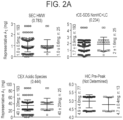
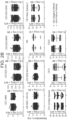
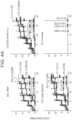
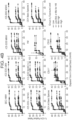
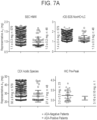
- presence or absence of a correlation between the estimated level of molecular attribute exposure and the safety and/or efficacy data for the biological therapy may be calculated using statistical methods. For example, a linear regression correlation between the rate of clinical event from safety and/or efficacy data and attribute exposure level may be calculated, and p-values may be determined ( Figs. 3A , 3B , 7B and 9 ). For example, the p values may be calculated from t-tests or F-tests ( Figs. 2A , 2B , 5A , 5B , 6 , 7A , 8 , 10A and 10B ). For example, Log-rank or Mantel-Cox test could be performed to calculate p-values for testing the earlier clinical safety event onsets for clinical subject groups with higher levels of the attribute exposures ( Figs. 4A and 4B ).
- a Bayesian estimation approach is used.
- the Bayesian estimation approach may be used for determining a presence or absence of a correlation between the estimated level of molecular attribute exposure and the safety and/or efficacy data for the biological therapy. Due to the stepwise learning nature of a Bayesian approach, all evidences may be fully used a priori in an unbiased way.
- the method may modify the probability density function of the clinical impact of each attribute to take a certain value whenever a new piece of evidence comes in, until all evidences are used.
- the probability of each attribute to be associated with each adverse event is derived at the end of the analysis.
- a computer program has been developed to harness high computation power required for the Bayesian approach ( See Example 12).
- the program provides an interactive platform to visualize the outcome of Bayesian estimation approach with user-provided spreadsheets.
- the program also provides parameter tuning modules to define initial priors, remove outliers, and select multiple attributes.
- a few sets of real clinical data from previous CIA performed for mAb D as well as a few modeled data based on the mAb D CIA data were tested on the system.
- the Bayesian estimation method generated expected results, demonstrating the validity of the system.
- CIA Clinical Impact Analysis
- attribute-exposure level at the treatment administration time, A t is approximated by accounting for the attribute level measured at the time of manufacture, and change in the level over time.
- patients are grouped by the retrospectively known clinical outcome, such as ADA test results ( FIG 1B ). Then, A t representing individual patients are compared between the groups as illustrated.
- patients are grouped according to the representative A t ( FIG. 1C ). The incidence (left) or time course (right) of clinical outcome for each group is compared with respect to the group's average representative A t .
- ADA remains a critical regulatory concern due to a range of impacts on safety and efficacy, including neutralization of the target-binding function by the drug and other more serious adverse events 17,18 .
- HMW high molecular weight
- SEC size exclusion chromatography
- CEX acidic species in cation exchange
- NonHC+LC non-heavy-chain and light-chain species in capillary electrophoresis in reducing/denaturing condition
- HIC hydrophobic interaction chromatography
- the attributes analyzed for mAb B are SEC HMW; rCE-SDS-separable low molecular weight (LMW) species, mid-molecular weight (MMW) species, non-glycosylated heavy chain (NGHC) species, sum of LMW MMW and NGHC (L+M+NG), and NonHC+LC; high-mannose (HM) species analyzed by hydrophilic interaction chromatography, CEX-separable basic species 3 and all basic species; and C-term sequence variant 1 (CSV1) and C-term sequence variant 2 (CSV2) analyzed by mass spectrometry. It is contemplated that for methods described herein, any attribute or combination of attributes can be analyzed.
- CIA entails analyzing the extents of prevalence, or time course, of clinical outcome per a given variable, such as varying levels of attributes exposed to patients. The following approaches were carried out to integrate the ADA test results and attribute-exposure level for individual patients in performing CIA.
- Criteria for selecting clinical studies for CIA were that (1) a large variability in the attribute-exposure level was present, and (2) a large number of patients was enrolled. This way, statistically meaningful results can be obtained from analyzing the clinical impact in the context of wide range of attribute-exposure levels. So, dose-escalation studies, or studies that used multiple treatment lots, were selected, and, if larger patient number was needed, patients from comparable studies were combined for the analysis.
- the ADA test results from electrochemiluminescence (ECL)-based bridging immunoassays 19 each developed to specifically detect the mAb A- or mAb B-binding ADA in the patient serum, were parsed for the analysis.
- ECL electrochemiluminescence
- binding ADA encompasses both neutralizing and non-neutralizing ADAs.
- neutralizing ADAs are far less prevalent than binding ADAs for both mAb A and mAb B, requiring a far larger patient number for statistically meaningful analyses, and analyzing the binding ADAs fits the present Example, which tests whether any clinical outcome is associated with a variable in treatments.
- the clinical studies selected for mAb A were 4 early-phase dose-escalation studies with up to total 218 patients, 2 Phase 2 studies with up to 627 patients, and 2 Phase 3 studies with up to 542 patients. These 3 sets of studies were individually analyzed by retrospective or prospective CIA described below.
- the clinical studies selected for mAb B were 2 Phase 2 studies with up to 5,440 patients. This set of studies were analyzed by both retrospective and prospective CIA.
- the drug-product batches administered in the clinical studies selected for CIA were traced using batch trace record to identify the drug-product lots inspected in product quality analytical tests, so the attribute level determined at the time of lot release specific to individual treatment lots could be obtained.
- the tests for lot-release analyses are SEC (size-exclusion chromatography) for HMW, rCE-SDS (capillary electrophoresis in reducing, and SDS-denaturing condition) for HC, LC, LMW, MMW and NGHC, and CEX (cation-exchange chromatography) for acidic or basic species, individually developed specifically for mAb A or mAb B.
- HIC hydrophobic-interaction chromatography
- HILIC Hydrophilic chromatography
- LCMSMS liquid chromatography-tandem mass spectrometry
- the data from attribute stability studies were also mined for each drug product.
- the stability data represent the change in the level of individual attributes over time in the storage condition, critical to determining the attribute-exposure level at the time of treatment administration as below.
- a t % A 0 + % A ⁇ ⁇ t D
- % A 0 the percentage of attribute at the time of lot release
- % A ⁇ rate of change in the percentage of attribute level
- t is the storage time between lot release and treatment administration
- D the dose strength in the dimension of weight of active pharmaceutical ingredient associated with each treatment.
- Each patient is then assigned with a representative A t .
- the representative A t was A t associated with the treatment.
- the treatments administered after the first time that the patient is tested positive for ADA are irrelevant to investigating the cause of ADA. So, for the ADA-positive patient, the representative A t was the average, or maximum, of the attribute-exposure levels associated with the treatments administered prior to the first time that ADA was tested positive. For the ADA-negative patient, all treatments in the entire regimen were included in determining the average or maximum exposure to obtain the representative A t .
- CIA for HMW, NonHC+LC or acidic species of mAb A separately analyzed 218 patients from the 4 combined early-phase studies, and 627 patients from the 2 combined Phase 2 studies.
- CIA for HIC Pre-Peak of mAb A separately analyzed 90 patients from the 2 combined early-phase studies, and 24 patients from the 2 combined Phase 2 studies.
- a separate CIA for HMW of mAb A additionally analyzed 553 patients from the 2 combined Phase 3.
- CIA for HM of mAb B was performed by analyzing 127 patients, and for CSV1 and CSV2, by analyzing 1,671 patients, from the same set of clinical studies.
- the representative attribute-exposure level analyzed for individual patients was determined from the single exposures for the patients in the Phase 1 studies for mAb A, maximum exposures for the patients in the Phase 2 and 3 studies for mAb B, and maximum exposures for the patients of mAb B.
- Average A t is a statistical representation of the multiple attribute exposures.
- Maximum A t is immunologically relevant because the patient may generate ADA only upon an exposure to an immunogen exceeding a certain threshold level 20,21 .
- Retrospective analysis (subjects grouped by the retrospectively known clinical outcome) was developed to test whether the ADA-positive patients were associated with higher attribute-exposure levels as compared to the ADA-negative patients. Patients are grouped according to retrospectively known ADA test results ( FIG. 1B ). Then, the distributions of the representative attribute-exposure levels are compared between the ADA-positive and ADA-negative patient groups for each attribute. If the representative attribute-exposure levels for ADA-positive patient group are higher than those for the ADA-negative patient group on an average, then Student's t-test is performed to assess whether the difference is statistically significant.
- FIGs. 2A-B illustrate comparisons of the levels of attribute exposures between the ADA-positive and ADA-negative patients show statistically significant association is absent between the high exposure level and ADA-positive patients for all analyzed attributes, indicating that these attributes do not cause ADA in the examined clinical conditions.
- Numbers in parentheses are p-values determined when needed. The lines are the average ⁇ standard deviation of individual patients' representative attribute exposures for each group.
- Example 4 Prospective CIA (of ADA Incidence for Attributes of mAb A and mAb B
- Incidence analysis in subjects grouped according to the representative A t was developed to test whether a positive correlation exists between the attribute-exposure level and the incidence of ADA response.
- the patients are grouped in quartiles according to the attribute-exposure levels, and the % ADA-positive patient determined for each group is compared with each other with respect to the group average of the representative attribute-exposure levels ( FIG. 1C , Left Panel).
- the ranges of the exposure levels applied to create bins for the quartiles were optimized to achieve minimal variabilities in exposure levels within each patient group, and simultaneously to ensure adequate number of patients constituting each group. If a positive correlation was observed between the incidence of ADA and attribute-exposure level, a weighted correlation was computed using the patient number in individual groups as the weight 22 to test whether the correlation was statistically significant.
- Example 3 Consistent with the results from the CIA analysis of Example 3 (in which subjects were grouped by the retrospectively known clinical outcome), no correlation is found statistically positive between the incidence of ADA and the exposure level for all attributes analyzed for mAb A or mAb B ( FIGs. 3A-B , FIG. 7B ). In fact, lower exposure appears associated with ADA-positive patients of mAb B, manifested as negative correlations in the Incidence for subjects grouped according to the representative A t ( FIG. 3B ). This negative correlation is a statistically informative outcome that additionally corroborates the absence of causation (See Below; FIGs. 5A-B , FIG. 9 ).
- FIGs. 3A-B show fractions of ADA-positive patients in the patient quartiles grouped according to the representative attribute exposure levels ranging from low to high are plotted as a function of the group average of the representative exposure levels. Numbers in the parentheses are weighted p-values determined when a positive correlation is found. The number of patients in each quartile is next to the plot. Error bars are standard deviations. Results for mAb A are shown in FIG. 3A , and results for mAb B are shown in FIG. 3B .
- next-highest HMW exposures may create a bias to nudge the correlation in a negative direction. This potential bias may be taken into account when performing the analysis.
- FIG. 5A the maximum A t was determined using all treatments or ADA-relevant treatments are plotted for the ADA-negative or ADA-positive patients. Average ⁇ standard deviation for maximum A t determined using all treatments for ADA-negative patients are indicated; and those for other groups are as analyzed for the same corresponding groups in Figure 2B . p-values from the t-tests are higher than 0.05 for the comparisons indicated n.s. (not significant), unless indicated otherwise. The error bars are standard deviation.
- FIG. 5B frequencies of the time for monthly treatments linked to the maximum HMW exposures in individual patients are shown for the ADA-negative and ADA-positive groups.
- FIG. 5C frequency of treatments resulting in different levels of HMW exposures for individual mAb2 patients is plotted, along with the cumulative percentage of the treatment numbers.
- Example 7 Applying the Approach of CIA in Analyzing the Clinical Impact of Treatment Regimen
- Example 8 An additional analysis of prospective CIA incidence
- FIG. 9B is recapitulated, and compared to the same sets data that are re-analyzed using average A t , instead of maximum A t as FIG. 9B.
- Lines are non-weighted linear regression, and the slope of all regressions is statistically zero, except for those for rCE-SDS NonHC+LC analyzed using maximum At, CEX Basic Species 3 analyzed using maximum At, CEX All Basic Species analyzed using maximum A t , and CSV2 analyzed using maximum A t .
- Number of patients binned in the quartiles for re-analyses is same as the corresponding quartiles as in FIG. 9B, unless indicated otherwise.
- the correlations for the re-analyzed data are generally less negative, except for HM and CSV1, the slope for all fits of which are statistically zero.
- the CIA analyses for impact of attributes of mAb A on ADA performed using the data from Phase 2 clinical studies indicate that none of the CQAs is a determinant of ADA response at the examined exposure levels ( FIG. 7 ).
- the attribute-exposure levels in the Phase 3 clinical studies of mAb A are lower than those in the earlier phase studies, and, as indicated by the CIA analysis of subjects grouped according to the representative A t , do not cause ADA ( FIG. 8 ).
- FIG. 7-B patients on regimen in clinical studies different from those analyzed in FIG. 2A are analyzed. Average A t per a treatment is used as representative A t for individual treatments. Error bars are uncertainty propagated from standard deviation associated with individual average A t .
- the quartiles analyzed in ( FIG. 7B ), and the attribute exposure ranges used to group the quartiles, are same as those in FIG. 4A .
- a bias will be found in maximum attribute exposures between the ADA-negative and ADA-positive patients, if the attributes do not cause ADA and only the ADA-relevant treatments are analyzed in the CIA of ADA-positive patients, as established herein. Such bias will decrease when the average exposure per a treatment is analyzed as the representative exposure for individual patients. For instance, plausibly, the bias resulting in lowered maximum HMW exposures upon excluding ADA-irrelevant treatments from the CIA of ADA-positive patients may be offset by the analogous bias resulting in heightened minimum HMW exposures. Consistent with this illustration, using the average exposures as the representative exposures for CIA generally diminishes, or eliminates, these negative correlations ( FIG. 9 ). Because A t analyzed here are relevant to ADA, and analyzing maximum exposures is immunologically significant 25,26, negative correlations described in the main text provide added evidence that the attributes do not cause ADA in the examined clinical condition.
- the work here describes an effort that integrates treatment info for individual patients and assesses the clinically relevant impact of molecular attributes for therapeutics.
- no significant positive correlation is found between the ADA response and exposure level for any of 15 attributes examined between 2 drug products, mAb A and mAb B, indicating that none of these attributes is a determinant of ADA at the examined levels for the corresponding drug products (Table 1).
- This work does not establish that these attributes also pose no increased safety risk in different exposure levels or for other therapeutic mAb molecules.
- the present approach analyzes passive data mined from clinical studies originally intended to focus on establishing safety or efficacy of the drug products. Ethical concerns in exposing patients to arbitrary levels of attributes preclude generation of active data by designing studies specifically to explore the attribute impact in patients. Nevertheless, CIA of passive data provides rich insights and implications for both applied and basic scientific pursuits in biotech.
- CIA can help to determine the patient-centric product purity specification limits. Lack of causation of ADA by attribute exposures, as established above, indicates that no increased risk of immunological safety is posed by the attributes at the examined exposure levels. Notably, the upper limits of these attribute-exposures levels analyzed for mAb A (Table 1) are near, or higher than, the limits on corresponding attributes imposed by the specifications of this drug product (not shown), demonstrating that patient-focused evidence generated by CIA can be used for determining the therapeutics specification limits.
- FIG. 6 illustrates impacts of factors in treatments on ADA.
- Various factors of mAb B treatment regimen, average dose strength per a treatment, treatment duration, treatment number and treatment lot number are compared between ADA-negative and ADA-positive patients. These factors are of all treatments for ADA-negative patients, or of treatments prior to the first ADA-positive test results for ADA-positive patients. Errors are standard deviation.
- CIA can also deepen fundamental knowledge in clinical immunology. Any association found between the ADA response and attribute exposure level can prompt focused in vitro or in vivo studies to investigate the causation or mechanism of ADA generation. Depending on whether average or maximum A t better represents any attribute exposure found correlated to ADA, a hypothesis can also be narrowed to test whether the repeated high attribute exposures or single high attribute exposures are critical to inducing ADA response.
- CIA can be combined with other analyses to provide powerful implications in therapeutics development, and to address uncharted critical questions. Can an attribute impact the clinical outcome of a subset of population defined by their demographic or genomic information? Can resulting knowledge in demography and genomics advance clinical trial design? would attributes alter biophysical behaviors, such as structure and conformational dynamics, for different therapeutic protein molecules, and in turn, impact clinical outcomes?
- Example 11 Analysis of Product C, a canonical BiTE ® molecule
- Attribute exposure was estimated based on 1) the % level of attribute for different drug-product lots at the time of manufacturing, 2) the attribute stability, or the rate at which the level of attribute changes over the duration of DP storage, 3) the date and time at which an individual treatment is administered to each patient, along with the record of which drug-product lot was administered for each treatment. Then, 4) the date and time of the occurrence of the given clinical outcome with the grades (or severities) of interest can be incorporated for the next step in CIA ( Figure 1 ), where 5) CIA combines the information to determine the attribute exposure, and 6) analyzes whether an association exists between the level of attribute exposure and the occurrence of the clinical outcome of interest.
- FIGs. 10A-B The results for the analysis of Product C are shown in FIGs. 10A-B .
- the impact of potency on the AEs was analyzed by testing whether a correlation exists between the Product C dose scaled per the potency value and the occurrence of the AEs for patients administered with no dose, mid dose or high dose levels.
- FIG 10A association of potency with the occurrence of AEs with any grade was analyzed.
- Fig. 10B association of potency with the occurrence of AEs with a grade of 3 or higher was analyzed.
- a computer program was developed to harness high computation power required for the Bayesian estimation approach.
- the program provides an interactive platform to visualize the outcome of Bayesian estimation approach with user-provided spreadsheets.
- the program also provides parameter tuning modules to define initial priors, remove outliers, and select multiple attributes.
- a set of processed clinical data for methods of assessing a clinical impact of a molecular attribute of mAb D as well as a few modeled data based on the mAb D CIA data were tested on the system.
- the method was performed to test whether positive correlation exists between mAb D HMW exposure and the occurrence of pyrexia adverse event by comparing the maximum daily HMW exposures between the adverse event negative- and positive-subjects.
- the method found no correlation using the conventional method ( FIG. 11A ).
- the Bayesian method FIGs. 11C-D
- FIGs. 11A-B generated analogous results to the conventional system ( FIGs. 11A-B ), demonstrating the validity of the system:
- patient and “subject” are used interchangeably herein. Generally, these terms will be understood to refer to humans. In the methods of some embodiments, the patient or subject is a human.
Landscapes
- Health & Medical Sciences (AREA)
- Engineering & Computer Science (AREA)
- Public Health (AREA)
- General Health & Medical Sciences (AREA)
- Epidemiology (AREA)
- Medical Informatics (AREA)
- Primary Health Care (AREA)
- Chemical & Material Sciences (AREA)
- Medicinal Chemistry (AREA)
- Bioinformatics & Cheminformatics (AREA)
- Life Sciences & Earth Sciences (AREA)
- Animal Behavior & Ethology (AREA)
- Veterinary Medicine (AREA)
- Pathology (AREA)
- Toxicology (AREA)
- Biomedical Technology (AREA)
- Pharmacology & Pharmacy (AREA)
- Diabetes (AREA)
- Endocrinology (AREA)
- Gastroenterology & Hepatology (AREA)
- Rheumatology (AREA)
- Urology & Nephrology (AREA)
- Nuclear Medicine, Radiotherapy & Molecular Imaging (AREA)
- Organic Chemistry (AREA)
- Chemical Kinetics & Catalysis (AREA)
- General Chemical & Material Sciences (AREA)
- Medicines Containing Antibodies Or Antigens For Use As Internal Diagnostic Agents (AREA)
- Medicines Containing Material From Animals Or Micro-Organisms (AREA)
- Medicines That Contain Protein Lipid Enzymes And Other Medicines (AREA)
- Investigating Or Analysing Biological Materials (AREA)
- Immunology (AREA)
- Mycology (AREA)
- Data Mining & Analysis (AREA)
- Databases & Information Systems (AREA)
- Microbiology (AREA)
- Pharmaceuticals Containing Other Organic And Inorganic Compounds (AREA)
Claims (15)
- Procédé de fabrication d'une thérapie biologique, le procédé comprenant les étapes consistant à :détecter un niveau d'un attribut moléculaire de la thérapie biologique dans une formulation au niveau d'un ou de plusieurs points dans le temps sous des conditions de stockage ;déterminer un taux de changement de l'attribut moléculaire sous les conditions de stockage, dans lequel un attribut moléculaire est une structure de la molécule chimiquement ou physiquement modifiée qui définit ses propriétés physicochimiques ;obtenir des données sur une sécurité et/ou une efficacité in vivo de la thérapie biologique pour des sujets qui ont reçu une administration de la thérapie biologique ;estimer un niveau d'exposition à l'attribut moléculaire reçue par les sujets au moment de ladite administration, sur la base (i) du taux de changement de l'attribut moléculaire durant un stockage de la thérapie biologique dans la formulation et (ii) une durée durant laquelle la thérapie biologique dans la formulation se trouvait sous les conditions de stockage avant ladite administration ;déterminer une présence ou une absence d'une corrélation entre le niveau estimé de l'exposition à l'attribut moléculaire et les données de sécurité et/ou d'efficacité pour la thérapie biologique ; etsi la corrélation est absente, fabriquer des lots de production de la thérapie biologique comprenant l'attribut moléculaire au niveau, ou en-dessous, d'un niveau permissible spécifié de l'attribut moléculaire sur la base du niveau estimé de l'exposition à l'attribut moléculaire.
- Procédé selon la revendication 1, dans lequel si la corrélation est présente, le procédé comprend en outre la définition d'une spécification pour des niveaux de l'attribut moléculaire au moment de la fabrication qui n'excèdent pas un niveau permissible maximal de l'attribut moléculaire de la thérapie biologique,dans lequel ledit niveau permissible maximal de l'attribut moléculaire est basé sur les niveaux estimés les plus élevés de l'exposition à l'attribut moléculaire qui ne sont pas associés à des événements adverses et/ou à une inhibition de l'efficacité de la thérapie biologique,ladite fabrication comprenant en outre le rejet de lots de production de la thérapie biologique comprenant des niveaux de l'attribut moléculaire excédant les niveaux permissibles maximaux.
- Procédé selon la revendication 2, dans lequel le niveau permissible maximal spécifié de l'attribut moléculaire est calculé pour produire un niveau d'exposition à l'attribut à la péremption du produit qui est inférieur ou égal à 90 à 100 % du niveau estimé le plus élevé de l'exposition à l'attribut moléculaire qui n'est pas associé à des événements adverses et/ou à une inhibition de l'efficacité chez des sujets.
- Procédé de développement d'un procédé de fabrication pour une thérapie biologique, le procédé comprenant les étapes consistant à :détecter un niveau d'un attribut moléculaire de la thérapie biologique dans une formulation au niveau d'un ou de plusieurs points dans le temps sous des conditions de stockage ;déterminer un taux de changement de l'attribut moléculaire sous les conditions de stockage ;obtenir des données sur la sécurité et/ou l'efficacité de la thérapie biologique chez les sujets qui ont reçu une administration de la thérapie biologique ;estimer un niveau d'exposition à l'attribut moléculaire reçue par les sujets au moment de ladite administration, sur la base (i) du taux de changement de l'attribut moléculaire durant un stockage de la thérapie biologique dans la formulation et (ii) une durée durant laquelle la thérapie biologique dans la formulation se trouvait sous les conditions de stockage avant ladite administration ;déterminer une présence ou une absence d'une corrélation entre le niveau estimé de l'exposition à l'attribut moléculaire et les données de sécurité et/ou d'efficacité de la thérapie biologique ; et(a) si la corrélation est absente, établir le procédé de fabrication pour produire des niveaux de l'attribut moléculaire au niveau, ou en-dessous, d'un niveau permissible spécifié sur la base du niveau estimé de l'exposition à l'attribut moléculaire ; ou(b) si la corrélation est présente, établir le procédé de fabrication pour produire des niveaux de l'attribut moléculaire au niveau, ou en-dessous, d'un niveau permissible maximal spécifié de l'attribut moléculaire sur la base du niveau le plus élevé de l'attribut moléculaire qui n'est pas associé à des événements adverses et/ou une inhibition de l'efficacité de la thérapie biologique, dans lequel un attribut moléculaire est une structure de la molécule chimiquement ou physiquement modifiée qui définit ses propriétés physicochimiques.
- Procédé d'évaluation d'un impact clinique d'un attribut moléculaire d'une thérapie biologique, le procédé comprenant les étapes consistant à :détecter un niveau d'un attribut moléculaire de la thérapie biologique dans une formulation au niveau d'un ou de plusieurs points dans le temps sous des conditions de stockage ;déterminer un taux de changement de l'attribut moléculaire sous les conditions de stockage ;obtenir des données sur la sécurité et/ou l'efficacité de la thérapie biologique chez des sujets qui ont reçu une administration de la thérapie biologique ;estimer un niveau d'exposition à l'attribut moléculaire reçue par les sujets au moment de ladite administration, sur la base (i) du taux de changement de l'attribut moléculaire durant un stockage de la thérapie biologique dans la formulation et (ii) une durée durant laquelle la thérapie biologique dans la formulation se trouvait sous les conditions de stockage avant ladite administration ;déterminer une présence ou une absence d'une corrélation entre l'exposition estimée à l'attribut moléculaire et la sécurité et/ou l'efficacité de la thérapie biologique ; etsi (a) la corrélation est absente, déterminer que l'attribut moléculaire n'impacte ni la sécurité ni l'efficacité clinique de la thérapie biologique ; ousi (b) la corrélation est présente, déterminer que l'attribut moléculaire impacte une sécurité et/ou une efficacité de la thérapie biologique, dans lequel un attribut moléculaire est une structure de la molécule chimiquement ou physiquement modifiée qui définit ses propriétés physicochimiques.
- Procédé selon la revendication 5, dans lequel si (a) la corrélation est absente, le procédé comprend en outre la définition d'une spécification pour des niveaux permissibles de l'attribut moléculaire de la thérapie biologique, dans lequel les niveaux permissibles de l'attribut moléculaire sont basés sur les niveaux estimés les plus élevés de l'exposition à l'attribut moléculaire reçue par les sujets, ou
dans lequel (b) si la corrélation est présente, le procédé comprend en outre la définition d'une spécification pour des niveaux permissibles maximaux de l'attribut moléculaire de la thérapie biologique, dans lequel lesdits niveaux permissibles maximaux de l'attribut moléculaire sont basés sur des niveaux de l'attribut moléculaire associés à des événements adverses et/ou à une inhibition de l'efficacité de la thérapie biologique. - Procédé selon l'une quelconque des revendications précédentes, dans lequela) l'estimation est en outre basée sur (iii) une dose de la thérapie biologique dans ladite administration, et (iv) une quantité de l'attribut moléculaire mesurée au moment de la fabrication et/ou de la mise sur le marché du lot ;b) l'estimation du niveau de l'exposition à l'attribut moléculaire comprend le calcul :
 c) l'estimation du niveau de l'exposition à l'attribut moléculaire comprend le calcul :dans lequel %Arel. est un pourcentage du niveau relatif de l'exposition à l'attribut moléculaire par rapport à la dose, dans lequel At est le niveau de l'exposition à l'attribut moléculaire calculé en utilisant l'équation 1 ou 2, et dans lequel D est la puissance du dosage dans la dimension de poids de l'ingrédient pharmaceutique actif associé à chaque traitement.
- Procédé selon l'une quelconque des revendications précédentes, dans lequela) le niveau de l'attribut moléculaire de la thérapie biologique dans la formulation est détecté à deux ou plusieurs points dans le temps sous des conditions de stockage ; et/oub) l'attribut moléculaire comprend au moins l'un de : des espèces acides, des espèces basiques, des espèces à poids moléculaire élevé, un nombre de particules pouvant être subdivisé, un faible poids moléculaire, un poids moléculaire modéré, une glycosylation (telle qu'un mannose non glycosylé à chaîne lourde ou élevée), une chaîne non lourde et une chaîne légère, une désamidation, déamination, cyclisation, oxydation, isomérisation, fragmentation/découpage, des variants en terminaison N et en terminaison C, des espèces réduites et partielles, une structure pliée, une hydrophobie de surface, une modification chimique, une liaison covalente, un motif PARG d'acide aminé en terminaison C, ou un motif PAR-amide d'acide aminé en terminaison C.
- Procédé selon l'une quelconque des revendications précédentes, dans lequel le un ou plusieurs points dans le temps ou les deux ou plusieurs points dans le temps comprennent un moment de fabrication, et au moins deux points dans le temps ultérieurs.
- Procédé selon l'une quelconque des revendications précédentes, dans lequela) la corrélation comprend une corrélation pondérée entre une exposition à l'attribut et des occurrences d'évènement adverse ; et/oub) une détermination d'une présence ou d'une absence d'une corrélation entre le niveau estimé de l'exposition à l'attribut moléculaire et les données de sécurité et/ou d'efficacité pour la thérapie biologique comprend une estimation bayésienne.
- Procédé selon l'une quelconque des revendications précédentes, dans lequela) la thérapie biologique dans la formulation se trouvait sous des conditions de stockage pendant des durées différentes dans les administrations à différents sujets ;b) l'administration comprend deux ou plusieurs évènements d'administration, préférablement dans lequel le niveau estimé de l'exposition à l'attribut moléculaire reçue par les sujets au moment de ladite administration est un maximum ou une moyenne de deux ou plusieurs évènements d'administration ; et/ouc) ladite administration comprend une perfusion continue, et ladite estimation comprend un calcul d'un niveau estimé d'exposition à l'attribut moléculaire durant deux ou plusieurs intervalles de ladite perfusion continue, tels que des intervalles de 24 heures.
- Procédé selon l'une quelconque des revendications précédentes, dans lequela) lesdites données de sécurité comprennent des données d'évènement adverse, préférablement dans lequel les données de sécurité comprennent un cours du temps d'évènement adverse ; et/oub) lesdites données d'efficacité comprennent des données de point final clinique.
- Procédé selon l'une quelconque des revendications précédentes, dans lequel la thérapie biologique est sélectionnée dans le groupe constitué : d'un anticorps, d'un fragment d'anticorps de liaison à l'antigène, d'un produit protéique d'anticorps, d'une molécule d'engagement des cellules T bispécifiques (BiTE®), d'un anticorps bispécifique, d'un anticorps trispécifique, d'une protéine de fusion Fc, d'une protéine recombinante, d'un virus recombinant, d'une cellule T recombinante, d'un peptide synthétique, et d'un fragment actif d'une protéine recombinante.
- Procédé selon l'une quelconque des revendications précédentes, dans lequel la formulation est une formulation pharmaceutiquement acceptable.
- Procédé selon l'une quelconque des revendications précédentes, dans lequel une détection du niveau d'un attribut moléculaire de la thérapie biologique comprend une spectrométrie de masse, chromatographie, électrophorèse, spectroscopie, un obscurcissement de la lumière, un procédé de particules (tel qu'une masse résonante de nanoparticule/visible/de la taille d'un micron ou un mouvement brownien), une centrifugation analytique, une imagerie ou caractérisation par imagerie, ou un dosage immunologique.
Applications Claiming Priority (3)
| Application Number | Priority Date | Filing Date | Title |
|---|---|---|---|
| US202063126274P | 2020-12-16 | 2020-12-16 | |
| US202163242395P | 2021-09-09 | 2021-09-09 | |
| PCT/US2021/063641 WO2022132982A1 (fr) | 2020-12-16 | 2021-12-15 | Méthodes d'élaboration de biothérapies |
Publications (2)
| Publication Number | Publication Date |
|---|---|
| EP4262859A1 EP4262859A1 (fr) | 2023-10-25 |
| EP4262859B1 true EP4262859B1 (fr) | 2025-01-29 |
Family
ID=80624090
Family Applications (1)
| Application Number | Title | Priority Date | Filing Date |
|---|---|---|---|
| EP21854946.7A Active EP4262859B1 (fr) | 2020-12-16 | 2021-12-15 | Procédés de fabrication de thérapies biologiques |
Country Status (9)
| Country | Link |
|---|---|
| US (1) | US20240197922A1 (fr) |
| EP (1) | EP4262859B1 (fr) |
| JP (1) | JP7829579B2 (fr) |
| KR (1) | KR20230121850A (fr) |
| AU (1) | AU2021401730A1 (fr) |
| CA (1) | CA3204991A1 (fr) |
| ES (1) | ES3023587T3 (fr) |
| MX (1) | MX2023006994A (fr) |
| WO (1) | WO2022132982A1 (fr) |
Families Citing this family (4)
| Publication number | Priority date | Publication date | Assignee | Title |
|---|---|---|---|---|
| US20250179158A1 (en) | 2022-03-02 | 2025-06-05 | Amgen Inc. | Compositions of anti-c5 monoclonal antibody |
| WO2024092203A1 (fr) | 2022-10-28 | 2024-05-02 | Amgen Inc. | Compositions d'anticorps anti-interleukine 12/interleukine 23 |
| AU2024312108A1 (en) * | 2023-06-22 | 2025-12-04 | Amgen Inc. | Methods and systems for determining an impact of attributes |
| WO2025080688A1 (fr) | 2023-10-12 | 2025-04-17 | Amgen Inc. | Compositions de constructions d'anticorps bispécifiques contre dll3 humain et cd3 humain |
-
2021
- 2021-12-15 WO PCT/US2021/063641 patent/WO2022132982A1/fr not_active Ceased
- 2021-12-15 KR KR1020237024172A patent/KR20230121850A/ko active Pending
- 2021-12-15 ES ES21854946T patent/ES3023587T3/es active Active
- 2021-12-15 AU AU2021401730A patent/AU2021401730A1/en active Pending
- 2021-12-15 CA CA3204991A patent/CA3204991A1/fr active Pending
- 2021-12-15 JP JP2023535839A patent/JP7829579B2/ja active Active
- 2021-12-15 EP EP21854946.7A patent/EP4262859B1/fr active Active
- 2021-12-15 MX MX2023006994A patent/MX2023006994A/es unknown
-
2023
- 2023-06-13 US US18/333,607 patent/US20240197922A1/en active Pending
Also Published As
| Publication number | Publication date |
|---|---|
| ES3023587T3 (en) | 2025-06-02 |
| EP4262859A1 (fr) | 2023-10-25 |
| US20240197922A1 (en) | 2024-06-20 |
| JP7829579B2 (ja) | 2026-03-13 |
| JP2023554342A (ja) | 2023-12-27 |
| KR20230121850A (ko) | 2023-08-21 |
| WO2022132982A1 (fr) | 2022-06-23 |
| MX2023006994A (es) | 2023-06-26 |
| CA3204991A1 (fr) | 2022-06-23 |
| AU2021401730A9 (en) | 2024-09-19 |
| AU2021401730A1 (en) | 2023-06-29 |
Similar Documents
| Publication | Publication Date | Title |
|---|---|---|
| EP4262859B1 (fr) | Procédés de fabrication de thérapies biologiques | |
| Singh et al. | Monoclonal antibodies: a review | |
| US11697670B2 (en) | Methods for purifying antibodies having reduced high molecular weight aggregates | |
| US20220404370A1 (en) | Methods of protein clips recovery | |
| AU2019257683A1 (en) | Treatment of atopic dermatitis | |
| EP3894839B1 (fr) | Procédé d'adéquation de système destiné à être utilisé avec une détermination de concentration de protéine par pente | |
| EP3928101B1 (fr) | Procédés de détermination de la stabilité de protéines | |
| US20230035363A1 (en) | In vivo reversibility of high molecular weight species | |
| WO2025049384A1 (fr) | Procédés d'analyse de co-formulations d'anticorps | |
| US20250136667A1 (en) | Isolation of therapeutic protein | |
| EP3958903A1 (fr) | Formulation d'anticorps | |
| CN116615232A (zh) | 制造生物治疗剂的方法 | |
| KR20260026538A (ko) | 제품 품질 속성 목표 범위 | |
| EP4388311B1 (fr) | Méthodes faisant appel à des composés thérapeutiques et à une peau de mammifère in vitro | |
| KR20260051418A (ko) | 항체 공동제형의 분석 방법 | |
| WO2020176730A1 (fr) | Formulation d'anticorps |
Legal Events
| Date | Code | Title | Description |
|---|---|---|---|
| STAA | Information on the status of an ep patent application or granted ep patent |
Free format text: STATUS: UNKNOWN |
|
| STAA | Information on the status of an ep patent application or granted ep patent |
Free format text: STATUS: THE INTERNATIONAL PUBLICATION HAS BEEN MADE |
|
| PUAI | Public reference made under article 153(3) epc to a published international application that has entered the european phase |
Free format text: ORIGINAL CODE: 0009012 |
|
| STAA | Information on the status of an ep patent application or granted ep patent |
Free format text: STATUS: REQUEST FOR EXAMINATION WAS MADE |
|
| 17P | Request for examination filed |
Effective date: 20230705 |
|
| AK | Designated contracting states |
Kind code of ref document: A1 Designated state(s): AL AT BE BG CH CY CZ DE DK EE ES FI FR GB GR HR HU IE IS IT LI LT LU LV MC MK MT NL NO PL PT RO RS SE SI SK SM TR |
|
| DAV | Request for validation of the european patent (deleted) | ||
| DAX | Request for extension of the european patent (deleted) | ||
| REG | Reference to a national code |
Ref country code: DE Ref legal event code: R079 Free format text: PREVIOUS MAIN CLASS: A61K0039000000 Ipc: A61P0043000000 Ref country code: DE Ref legal event code: R079 Ref document number: 602021025655 Country of ref document: DE Free format text: PREVIOUS MAIN CLASS: A61K0039000000 Ipc: A61P0043000000 |
|
| RIC1 | Information provided on ipc code assigned before grant |
Ipc: A61K 39/00 20060101ALN20240627BHEP Ipc: A61P 43/00 20060101AFI20240627BHEP |
|
| GRAP | Despatch of communication of intention to grant a patent |
Free format text: ORIGINAL CODE: EPIDOSNIGR1 |
|
| STAA | Information on the status of an ep patent application or granted ep patent |
Free format text: STATUS: GRANT OF PATENT IS INTENDED |
|
| RIC1 | Information provided on ipc code assigned before grant |
Ipc: A61K 39/00 20060101ALN20240725BHEP Ipc: A61P 43/00 20060101AFI20240725BHEP |
|
| RIC1 | Information provided on ipc code assigned before grant |
Ipc: A61K 39/00 20060101ALN20240729BHEP Ipc: A61P 43/00 20060101AFI20240729BHEP |
|
| INTG | Intention to grant announced |
Effective date: 20240814 |
|
| GRAS | Grant fee paid |
Free format text: ORIGINAL CODE: EPIDOSNIGR3 |
|
| GRAA | (expected) grant |
Free format text: ORIGINAL CODE: 0009210 |
|
| STAA | Information on the status of an ep patent application or granted ep patent |
Free format text: STATUS: THE PATENT HAS BEEN GRANTED |
|
| AK | Designated contracting states |
Kind code of ref document: B1 Designated state(s): AL AT BE BG CH CY CZ DE DK EE ES FI FR GB GR HR HU IE IS IT LI LT LU LV MC MK MT NL NO PL PT RO RS SE SI SK SM TR |
|
| REG | Reference to a national code |
Ref country code: GB Ref legal event code: FG4D |
|
| REG | Reference to a national code |
Ref country code: CH Ref legal event code: EP |
|
| REG | Reference to a national code |
Ref country code: DE Ref legal event code: R096 Ref document number: 602021025655 Country of ref document: DE |
|
| P01 | Opt-out of the competence of the unified patent court (upc) registered |
Free format text: CASE NUMBER: APP_2823/2025 Effective date: 20250117 |
|
| REG | Reference to a national code |
Ref country code: IE Ref legal event code: FG4D |
|
| REG | Reference to a national code |
Ref country code: NL Ref legal event code: FP |
|
| REG | Reference to a national code |
Ref country code: ES Ref legal event code: FG2A Ref document number: 3023587 Country of ref document: ES Kind code of ref document: T3 Effective date: 20250602 |
|
| PG25 | Lapsed in a contracting state [announced via postgrant information from national office to epo] |
Ref country code: RS Free format text: LAPSE BECAUSE OF FAILURE TO SUBMIT A TRANSLATION OF THE DESCRIPTION OR TO PAY THE FEE WITHIN THE PRESCRIBED TIME-LIMIT Effective date: 20250429 |
|
| PG25 | Lapsed in a contracting state [announced via postgrant information from national office to epo] |
Ref country code: FI Free format text: LAPSE BECAUSE OF FAILURE TO SUBMIT A TRANSLATION OF THE DESCRIPTION OR TO PAY THE FEE WITHIN THE PRESCRIBED TIME-LIMIT Effective date: 20250129 |
|
| PG25 | Lapsed in a contracting state [announced via postgrant information from national office to epo] |
Ref country code: PL Free format text: LAPSE BECAUSE OF FAILURE TO SUBMIT A TRANSLATION OF THE DESCRIPTION OR TO PAY THE FEE WITHIN THE PRESCRIBED TIME-LIMIT Effective date: 20250129 |
|
| REG | Reference to a national code |
Ref country code: LT Ref legal event code: MG9D |
|
| PG25 | Lapsed in a contracting state [announced via postgrant information from national office to epo] |
Ref country code: IS Free format text: LAPSE BECAUSE OF FAILURE TO SUBMIT A TRANSLATION OF THE DESCRIPTION OR TO PAY THE FEE WITHIN THE PRESCRIBED TIME-LIMIT Effective date: 20250529 Ref country code: NO Free format text: LAPSE BECAUSE OF FAILURE TO SUBMIT A TRANSLATION OF THE DESCRIPTION OR TO PAY THE FEE WITHIN THE PRESCRIBED TIME-LIMIT Effective date: 20250429 |
|
| REG | Reference to a national code |
Ref country code: AT Ref legal event code: MK05 Ref document number: 1762866 Country of ref document: AT Kind code of ref document: T Effective date: 20250129 |
|
| PG25 | Lapsed in a contracting state [announced via postgrant information from national office to epo] |
Ref country code: HR Free format text: LAPSE BECAUSE OF FAILURE TO SUBMIT A TRANSLATION OF THE DESCRIPTION OR TO PAY THE FEE WITHIN THE PRESCRIBED TIME-LIMIT Effective date: 20250129 |
|
| PG25 | Lapsed in a contracting state [announced via postgrant information from national office to epo] |
Ref country code: PT Free format text: LAPSE BECAUSE OF FAILURE TO SUBMIT A TRANSLATION OF THE DESCRIPTION OR TO PAY THE FEE WITHIN THE PRESCRIBED TIME-LIMIT Effective date: 20250529 Ref country code: LV Free format text: LAPSE BECAUSE OF FAILURE TO SUBMIT A TRANSLATION OF THE DESCRIPTION OR TO PAY THE FEE WITHIN THE PRESCRIBED TIME-LIMIT Effective date: 20250129 |
|
| PG25 | Lapsed in a contracting state [announced via postgrant information from national office to epo] |
Ref country code: BG Free format text: LAPSE BECAUSE OF FAILURE TO SUBMIT A TRANSLATION OF THE DESCRIPTION OR TO PAY THE FEE WITHIN THE PRESCRIBED TIME-LIMIT Effective date: 20250129 Ref country code: GR Free format text: LAPSE BECAUSE OF FAILURE TO SUBMIT A TRANSLATION OF THE DESCRIPTION OR TO PAY THE FEE WITHIN THE PRESCRIBED TIME-LIMIT Effective date: 20250430 |
|
| PG25 | Lapsed in a contracting state [announced via postgrant information from national office to epo] |
Ref country code: AT Free format text: LAPSE BECAUSE OF FAILURE TO SUBMIT A TRANSLATION OF THE DESCRIPTION OR TO PAY THE FEE WITHIN THE PRESCRIBED TIME-LIMIT Effective date: 20250129 |
|
| PG25 | Lapsed in a contracting state [announced via postgrant information from national office to epo] |
Ref country code: SE Free format text: LAPSE BECAUSE OF FAILURE TO SUBMIT A TRANSLATION OF THE DESCRIPTION OR TO PAY THE FEE WITHIN THE PRESCRIBED TIME-LIMIT Effective date: 20250129 |
|
| PG25 | Lapsed in a contracting state [announced via postgrant information from national office to epo] |
Ref country code: SM Free format text: LAPSE BECAUSE OF FAILURE TO SUBMIT A TRANSLATION OF THE DESCRIPTION OR TO PAY THE FEE WITHIN THE PRESCRIBED TIME-LIMIT Effective date: 20250129 |
|
| PG25 | Lapsed in a contracting state [announced via postgrant information from national office to epo] |
Ref country code: DK Free format text: LAPSE BECAUSE OF FAILURE TO SUBMIT A TRANSLATION OF THE DESCRIPTION OR TO PAY THE FEE WITHIN THE PRESCRIBED TIME-LIMIT Effective date: 20250129 |
|
| PG25 | Lapsed in a contracting state [announced via postgrant information from national office to epo] |
Ref country code: EE Free format text: LAPSE BECAUSE OF FAILURE TO SUBMIT A TRANSLATION OF THE DESCRIPTION OR TO PAY THE FEE WITHIN THE PRESCRIBED TIME-LIMIT Effective date: 20250129 Ref country code: CZ Free format text: LAPSE BECAUSE OF FAILURE TO SUBMIT A TRANSLATION OF THE DESCRIPTION OR TO PAY THE FEE WITHIN THE PRESCRIBED TIME-LIMIT Effective date: 20250129 |
|
| PG25 | Lapsed in a contracting state [announced via postgrant information from national office to epo] |
Ref country code: RO Free format text: LAPSE BECAUSE OF FAILURE TO SUBMIT A TRANSLATION OF THE DESCRIPTION OR TO PAY THE FEE WITHIN THE PRESCRIBED TIME-LIMIT Effective date: 20250129 |
|
| PG25 | Lapsed in a contracting state [announced via postgrant information from national office to epo] |
Ref country code: SK Free format text: LAPSE BECAUSE OF FAILURE TO SUBMIT A TRANSLATION OF THE DESCRIPTION OR TO PAY THE FEE WITHIN THE PRESCRIBED TIME-LIMIT Effective date: 20250129 |
|
| REG | Reference to a national code |
Ref country code: DE Ref legal event code: R097 Ref document number: 602021025655 Country of ref document: DE |
|
| PLBE | No opposition filed within time limit |
Free format text: ORIGINAL CODE: 0009261 |
|
| STAA | Information on the status of an ep patent application or granted ep patent |
Free format text: STATUS: NO OPPOSITION FILED WITHIN TIME LIMIT |
|
| REG | Reference to a national code |
Ref country code: CH Ref legal event code: L10 Free format text: ST27 STATUS EVENT CODE: U-0-0-L10-L00 (AS PROVIDED BY THE NATIONAL OFFICE) Effective date: 20251210 |
|
| PGFP | Annual fee paid to national office [announced via postgrant information from national office to epo] |
Ref country code: NL Payment date: 20251119 Year of fee payment: 5 |
|
| REG | Reference to a national code |
Ref country code: CH Ref legal event code: U11 Free format text: ST27 STATUS EVENT CODE: U-0-0-U10-U11 (AS PROVIDED BY THE NATIONAL OFFICE) Effective date: 20260101 |
|
| 26N | No opposition filed |
Effective date: 20251030 |
|
| PGFP | Annual fee paid to national office [announced via postgrant information from national office to epo] |
Ref country code: DE Payment date: 20251126 Year of fee payment: 5 |
|
| PGFP | Annual fee paid to national office [announced via postgrant information from national office to epo] |
Ref country code: GB Payment date: 20251120 Year of fee payment: 5 |
|
| PGFP | Annual fee paid to national office [announced via postgrant information from national office to epo] |
Ref country code: IT Payment date: 20251119 Year of fee payment: 5 |
|
| PGFP | Annual fee paid to national office [announced via postgrant information from national office to epo] |
Ref country code: FR Payment date: 20251120 Year of fee payment: 5 |
|
| PGFP | Annual fee paid to national office [announced via postgrant information from national office to epo] |
Ref country code: IE Payment date: 20251121 Year of fee payment: 5 |
|
| PGFP | Annual fee paid to national office [announced via postgrant information from national office to epo] |
Ref country code: ES Payment date: 20260102 Year of fee payment: 5 |