EP4262134B1 - Sichere mehrparteienberechnungsverfahren und -vorrichtungen - Google Patents
Sichere mehrparteienberechnungsverfahren und -vorrichtungen Download PDFInfo
- Publication number
- EP4262134B1 EP4262134B1 EP23167642.0A EP23167642A EP4262134B1 EP 4262134 B1 EP4262134 B1 EP 4262134B1 EP 23167642 A EP23167642 A EP 23167642A EP 4262134 B1 EP4262134 B1 EP 4262134B1
- Authority
- EP
- European Patent Office
- Prior art keywords
- party
- ciphertext
- montgomery
- state
- converted
- Prior art date
- Legal status (The legal status is an assumption and is not a legal conclusion. Google has not performed a legal analysis and makes no representation as to the accuracy of the status listed.)
- Active
Links
Images



Classifications
-
- H—ELECTRICITY
- H04—ELECTRIC COMMUNICATION TECHNIQUE
- H04L—TRANSMISSION OF DIGITAL INFORMATION, e.g. TELEGRAPHIC COMMUNICATION
- H04L9/00—Cryptographic mechanisms or cryptographic arrangements for secret or secure communications; Network security protocols
- H04L9/008—Cryptographic mechanisms or cryptographic arrangements for secret or secure communications; Network security protocols involving homomorphic encryption
-
- G—PHYSICS
- G06—COMPUTING OR CALCULATING; COUNTING
- G06F—ELECTRIC DIGITAL DATA PROCESSING
- G06F7/00—Methods or arrangements for processing data by operating upon the order or content of the data handled
- G06F7/60—Methods or arrangements for performing computations using a digital non-denominational number representation, i.e. number representation without radix; Computing devices using combinations of denominational and non-denominational quantity representations, e.g. using difunction pulse trains, STEELE computers, phase computers
- G06F7/72—Methods or arrangements for performing computations using a digital non-denominational number representation, i.e. number representation without radix; Computing devices using combinations of denominational and non-denominational quantity representations, e.g. using difunction pulse trains, STEELE computers, phase computers using residue arithmetic
- G06F7/728—Methods or arrangements for performing computations using a digital non-denominational number representation, i.e. number representation without radix; Computing devices using combinations of denominational and non-denominational quantity representations, e.g. using difunction pulse trains, STEELE computers, phase computers using residue arithmetic using Montgomery reduction
-
- H—ELECTRICITY
- H04—ELECTRIC COMMUNICATION TECHNIQUE
- H04L—TRANSMISSION OF DIGITAL INFORMATION, e.g. TELEGRAPHIC COMMUNICATION
- H04L2209/00—Additional information or applications relating to cryptographic mechanisms or cryptographic arrangements for secret or secure communication H04L9/00
- H04L2209/46—Secure multiparty computation, e.g. millionaire problem
Definitions
- One or more embodiments of this specification relate to joint data processing, and in particular, to privacy-protection-based secure multi-party computation methods and apparatuses.
- data needed for federated machine learning often involves a plurality of fields.
- an electronic payment platform has transaction record data of merchants
- an electronic commerce platform stores sales data of the merchants
- a bank institution has loan data of the merchants.
- Data often exists in the form of islands. Due to problems such as data security and user privacy, data integration faces great resistance, and it is difficult to integrate data scattered on various platforms to train a machine learning model. Therefore, it is proposed that a plurality of parties jointly perform data processing and model training on the premise of protecting privacy, so that data is available but invisible.
- One or more embodiments of this specification describe secure multi-party computation methods and apparatuses, to improve computation performance by using Montgomery reduction in a ciphertext computation stage of homomorphic encryption.
- a secure multi-party computation method includes the following: a first party performs a first mapping operation and homomorphic encryption on first plaintext data to obtain a first converted ciphertext in a Montgomery state, where the first mapping operation is used to convert data from an integer ring to the Montgomery state; the first party sends the first converted ciphertext to a second party; and the second party performs a first homomorphic operation in the Montgomery state based on the first converted ciphertext to obtain a first result ciphertext in the Montgomery state, where the first homomorphic operation includes a modular multiplication operation.
- the method further includes the following: the second party sends the first result ciphertext to the first party; and the first party performs Montgomery reduction and a decryption operation on the first result ciphertext to obtain a first result plaintext.
- the method further includes the following: the second party sends the first result ciphertext to a third party; and the third party performs a second homomorphic operation in the Montgomery state based on the first result ciphertext to obtain a second result ciphertext.
- that the first party performs a first mapping operation and homomorphic encryption on first data to obtain a first converted ciphertext in a Montgomery state specifically includes the following: the first party performs homomorphic encryption on the first plaintext data to obtain a first original ciphertext; and converts the first ciphertext to the Montgomery state by using the first mapping operation, to obtain the first converted ciphertext.
- that the first party performs a first mapping operation and homomorphic encryption on first data to obtain a first converted ciphertext in a Montgomery state specifically includes the following: the first party converts the first plaintext data to the Montgomery state by using the first mapping operation, to obtain a first converted plaintext; and performs an encryption operation on the first converted plaintext in the Montgomery state to obtain the first converted ciphertext.
- the method further includes the following: the second party obtains a second converted ciphertext in the Montgomery state; and the obtaining a first result ciphertext in the Montgomery state specifically includes performing the first homomorphic operation on the first converted ciphertext and the second converted ciphertext to obtain the first result ciphertext.
- the second party receives the second converted ciphertext from the first party.
- the second party performs the first mapping operation and homomorphic encryption on local second plaintext data of the second party to obtain the second converted ciphertext.
- the first plaintext data is parameter data of a service prediction model
- the second plaintext data is characteristic data of a service object
- a secure multi-party computation method is provided.
- the method is executed by a first party and includes the following: a first mapping operation and homomorphic encryption are performed on first plaintext data to obtain a first converted ciphertext in a Montgomery state, where the first mapping operation is used to convert data from an integer ring to the Montgomery state; the first converted ciphertext is sent to a second party; a result ciphertext is received from a third party, where the result ciphertext is obtained by performing a homomorphic operation in the Montgomery state based on the first converted ciphertext, and the homomorphic operation includes a modular multiplication operation; and
- a secure multi-party computation method is provided.
- the method is executed by a second party and includes the following: a first converted ciphertext in a Montgomery state is received from a first party, where the first converted ciphertext is obtained by the first party by performing a first mapping operation and homomorphic encryption on first plaintext data, and the first mapping operation is used to convert data from an integer ring to the Montgomery state; a first homomorphic operation is performed in the Montgomery state based on the first converted ciphertext to obtain a first result ciphertext in the Montgomery state, where the first homomorphic operation includes a modular multiplication operation; and the first result ciphertext is sent.
- a secure multi-party computation system includes a first party and a second party.
- the first party is configured to perform a first mapping operation and homomorphic encryption on first plaintext data to obtain a first converted ciphertext in a Montgomery state, where the first mapping operation is used to convert data from an integer ring to the Montgomery state.
- the first party is further configured to send the first converted ciphertext to a second party.
- the second party is configured to perform a first homomorphic operation in the Montgomery state based on the first converted ciphertext to obtain a first result ciphertext in the Montgomery state, where the first homomorphic operation includes a modular multiplication operation.
- a secure multi-party computation apparatus is deployed in a first party and includes: an encryption conversion unit, configured to perform a first mapping operation and homomorphic encryption on first plaintext data to obtain a first converted ciphertext in a Montgomery state, where the first mapping operation is used to convert data from an integer ring to the Montgomery state; a sending unit, configured to send the first converted ciphertext to a second party; a receiving unit, configured to receive a result ciphertext from a third party, where the result ciphertext is obtained by performing a homomorphic operation in the Montgomery state based on the first converted ciphertext, and the homomorphic operation includes a modular multiplication operation; and a decryption conversion unit, configured to perform Montgomery reduction and a decryption operation on the result ciphertext to obtain a result plaintext.
- an encryption conversion unit configured to perform a first mapping operation and homomorphic encryption on first plaintext data to obtain a first converted ciphertext in a Montgomery state, where the first mapping operation is used to convert data from
- a secure multi-party computation apparatus is deployed in a second party and includes: a receiving unit, configured to receive a first converted ciphertext in a Montgomery state from a first party, where the first converted ciphertext is obtained by the first party by performing a first mapping operation and homomorphic encryption on first plaintext data, and the first mapping operation is used to convert data from an integer ring to the Montgomery state; an operation unit, configured to perform a first homomorphic operation in the Montgomery state based on the first converted ciphertext to obtain a first result ciphertext in the Montgomery state, where the first homomorphic operation includes a modular multiplication operation; and a sending unit, configured to send the first result ciphertext.
- a computer-readable storage medium stores a computer program.
- the computer program When the computer program is executed in a computer, the computer is enabled to perform the method according to any one of the previous first to third aspects.
- a computation device includes a memory and a processor.
- the memory stores executable code
- the processor implements the method according to any one of the previous first to third aspects when executing the executable code.
- a ciphertext is kept in the Montgomery state, so that computation performance of a ciphertext computation stage can be improved by using Montgomery reduction.
- homomorphic encryption is a cryptographic technology that can protect data privacy and can also implement data computation when a plurality of parties jointly perform a data operation.
- Homomorphic encryption allows that a computation party performs an operation on a ciphertext and obtains a result that is still encrypted, where a result obtained by decrypting the result is the same as a result obtained by performing the same operation on a plaintext.
- the homomorphic encryption algorithm is such an encryption function that a result of performing an operation on a plaintext and then performing encryption is equivalent to a result of performing encryption and then performing a corresponding operation on a ciphertext.
- the encryption algorithm satisfies addition homomorphism, where ⁇ is a corresponding homomorphic addition operation.
- the Paillier algorithm is a common encryption algorithm that satisfies addition homomorphism.
- the Paillier algorithm uses an asymmetric encryption manner in which a public key is used for encryption and a private key is used for decryption.
- ciphertext multiplication E PK (v 1 ) ⁇ E PK (v 2 ) corresponds to a homomorphic addition operation.
- a plurality of improved algorithms are also proposed, such as the OU (Okamoto-Uchiyama) algorithm and the DJ (Damg ⁇ rd-Jurik) algorithm. Similar to the encryption and operation rules of Paillier, in encryption and operation rules of the improved algorithms, power operations and modulo operations are involved in encryption processes, and ciphertext multiplication is involved in ciphertext operation stages.
- the homomorphic encryption algorithm can be applied to a joint computation scenario as a common secure multi-party computation means.
- a homomorphic encryption computation process is several orders of magnitude slower than plaintext computation in computation performance. It is a constraint for further popularization and application of the homomorphic encryption algorithm.
- Montgomery reduction also referred to as the Montgomery statute.
- Montgomery reduction aims to calculate a value of a mod m without division.
- m is set to an integer and represents modulo space
- R is an integer related to m and taken based on a base of a numbering system, R>m, and m is mutually prime with R.
- a Montgomery reduction computation result of the integer is TR -1 mod m .
- a value of TR -1 mod m can be fast calculated by using Montgomery reduction.
- traditional division is replaced with a simple shift operation to implement a fast modulo operation.
- FIG. 1 is a schematic diagram illustrating performing a modular multiplication operation by using Montgomery reduction.
- a and b are integers in integer ring Z and m is a positive integer
- a*b mod m attempts to be calculated, i.e. modular multiplication of a and b attempts to be performed.
- the modular multiplication operation is performed by applying Montgomery reduction, and an operation process mainly includes the following steps.
- a mapping function f(x) is used to respectively convert a and b from the integer ring (hereinafter referred to as a Z ring) to a Montgomery ring (hereinafter referred to as an M ring), to obtain results aR and bR in a Montgomery state.
- the mapping function f(x) xR mod m is used to map an input integer x to the Montgomery ring, where xR is denoted as a mapping result of x in the Montgomery state.
- the result is a result in the M ring or the Montgomery state.
- abR mod m in the M ring is mapped back to the Z ring by applying Montgomery reduction again to obtain ab mod m, i.e. a desired target computation result.
- FIG. 2 is a schematic diagram illustrating performing a modular exponentiation operation by using Montgomery reduction.
- g is an integer in integer ring Z and e and m are positive integers
- g ⁇ e mod m attempts to be calculated, i.e. modular exponentiation of g attempts to be performed.
- the modular exponentiation operation is performed by applying Montgomery reduction, and an operation process mainly includes the following steps.
- a mapping function f(x) is used to convert g from the integer ring to a Montgomery ring, to obtain a result gR in a Montgomery state.
- gR raised to the power of e is decomposed into a plurality of times of modular multiplication, each time of modular multiplication is performed by applying one time of Montgomery reduction, and a result (g) e R mod m in the M state is finally obtained.
- the result in the M ring is mapped back to the Z ring by applying Montgomery reduction again to obtain g e mod m, i.e. a target computation result.
- mapping function f(x) needs to be used to map a value x to be calculated from an integer ring Z ring to an M ring.
- xR mod m in f(x) involves division, and performance is relatively low. Therefore, conversion from the Z ring to the M ring is relatively slow.
- An encryption process of the homomorphic encryption algorithm generally involves a large quantity of modular exponentiation operations. For example, references can be made to the encryption process of the Paillier algorithm shown in Equation (2). Therefore, an encryption stage of the homomorphic encryption algorithm can be accelerated by using Montgomery reduction.
- a ciphertext operation stage of the homomorphic encryption algorithm for example, homomorphic addition shown in equation (3), generally involves a modular multiplication operation. As previously described, in the modular multiplication operation, performance obtained by using Montgomery reduction is not higher than performance obtained by directly performing computation. Therefore, in conventional technologies, a homomorphic ciphertext operation cannot be accelerated by using Montgomery reduction.
- an encryption party keeps an encrypted ciphertext in a Montgomery state, so that a computation party can perform a homomorphic ciphertext operation in the Montgomery state by using Montgomery reduction, including a modular multiplication operation, thereby greatly improving computation performance of a ciphertext operation stage.
- Implementations of the solution architecture are described in detail below.
- FIG. 3 is a schematic diagram illustrating a computation process of secure multi-party computation, according to one or more embodiments.
- secure multi-party computation involves a first party and a second party.
- the first party acts as an encryption party/a decryption party
- the second party acts as a ciphertext computation party.
- the first party and the second party can be specifically implemented as any servers, apparatuses, platforms, devices, or device clusters having computation and processing capabilities, and are not limited here.
- the first party and the second party can have different service roles.
- the first party can be a model owner, having a pre-trained service prediction model that needs privacy protection, and the second party can be a model user, having characteristic data of some service objects to be tested.
- the first party can be a model user, and the second party can be a model owner.
- the first party is a private data owner, and the second party is a computation platform.
- the first party At a preliminary stage before secure multi-party computation, the first party first generates a key pair of a homomorphic encryption algorithm, i.e. a public key PK and a private key SK.
- the public key PK is public
- the private key SK is held by the local party.
- the homomorphic encryption algorithm can be a Paillier algorithm, an OU algorithm, a DJ algorithm, etc.
- a modular exponentiation operation is used in an encryption stage, and a modular multiplication operation is involved in a ciphertext operation stage.
- the two parties can perform secure multi-party computation.
- the first party performs a mapping operation and homomorphic encryption on first plaintext data to obtain a first converted ciphertext in a Montgomery state.
- the first plaintext data denoted as pi
- the first party first performs homomorphic encryption on the first plaintext data pi in a conventional method to obtain a first original ciphertext ci; and then converts the first original ciphertext ci to the Montgomery state by using the mapping operation, to obtain the first converted ciphertext ciR.
- the first party can convert the first plaintext data pi to the Montgomery state by using the previous mapping operation f(x), to obtain a first converted plaintext piR; and then perform an encryption operation on the first converted plaintext piR in the Montgomery state to obtain the first converted ciphertext ciR.
- a process of performing the encryption operation on the first converted plaintext piR in the Montgomery state involves the modular exponentiation operation in the M ring shown in FIG. 2 .
- the first party instead of converting the result in the M ring back to the integer ring in FIG. 2 , in step 31, the first party directly outputs a result in an M ring, i.e. a result in the Montgomery state, as the first converted ciphertext ciR.
- step 32 the first party sends the first converted ciphertext ciR to the second party.
- the second party performs a homomorphic operation in the Montgomery state based on the first converted ciphertext ciR to obtain a first result ciphertext c'R in the Montgomery state.
- the homomorphic operation includes a modular multiplication operation, for example, a homomorphic addition operation (corresponding to ciphertext multiplication)in the Paillier algorithm or the OU algorithm.
- the homomorphic operation includes performing a homomorphic operation, for example, homomorphic addition, on the first converted ciphertext ciR and other ciphertext data.
- a homomorphic operation for example, homomorphic addition
- the second party needs to ensure that the other ciphertext data is also in the Montgomery state.
- the second party obtains a second converted ciphertext c 2 R in the Montgomery state.
- the second converted ciphertext can be from the first party, i.e. the first party obtains the second converted ciphertext c 2 R by encrypting and converting second plaintext data p 2 in a similar method to the first converted ciphertext, and then sends the second converted ciphertext c 2 R to the second party.
- the second converted ciphertext can be from the second party, i.e. the second party reads local second plaintext data p 2 of the second party, and performs the mapping operation and homomorphic encryption on the data to obtain the second converted ciphertext c 2 R.
- the second party can obtain the second converted ciphertext c 2 R by encrypting and mapping the second plaintext data in a similar method in which the first party obtains the first converted ciphertext.
- the second party performs the homomorphic operation on the first converted ciphertext ciR and the second converted ciphertext c 2 R in the Montgomery state.
- the homomorphic operation corresponds to ciphertext multiplication
- the homomorphic operation of the first converted ciphertext ciR and the second converted ciphertext c 2 R corresponds to the modular multiplication operation in the M ring shown in FIG. 1 .
- the homomorphic operation performed by the second party can involve more data, for example, also involve a third ciphertext, and the homomorphic operation can include more complex operations, for example, a plurality of times of modular multiplication, and a combination of modular multiplication results. Implementations are not limited here.
- the second party performs the homomorphic operation in the Montgomery state based on the first converted ciphertext to obtain the first result ciphertext c'R in the Montgomery state. Then, in step 34, the second party sends the first result ciphertext c'R to the first party.
- step 35 the first party performs Montgomery reduction and a decryption operation on the first result ciphertext c'R to obtain a first result plaintext.
- the first party can first apply Montgomery reduction to the first result ciphertext c'R to obtain a ciphertext c' in an ordinary form (in the integer ring); and then decrypt the ciphertext c' by using a private key SK held by the first party to obtain the first result plaintext.
- the previous secure multi-party computation can be applied to a plurality of different service scenarios.
- data transmitted between the first party and the second party can have different service meanings.
- the first plaintext data can be model parameters of a service prediction model owned by the first party, and the first party encrypts the first plaintext data and then sends encrypted plaintext data to the second party;
- the second plaintext data can be characteristic data that is of a service object and that is owned by the second party, and the second party performs a homomorphic operation based on model parameters in an encrypted state and the characteristic data, where the obtained first result ciphertext can correspond to a prediction result or an intermediate result of the service prediction model.
- the first plaintext data can be characteristic data that is of a service object and that is owned by the first party, and the second plaintext data can be model parameters.
- the first plaintext data and the second plaintext data are both private data of the first party, for example, user personal information of different projects; the first party encrypts the first plaintext data and sends encrypted plaintext data to the second party; and the second party performs a homomorphic operation on private data in an encrypted state based on a secret algorithm or model of the second party, to obtain the first result ciphertext, where the first result ciphertext corresponds to a processing result for the private data.
- secure multi-party computation in FIG. 3 can also be applied to other service scenarios. The service scenarios are not listed one by one here.
- FIG. 4 is a schematic diagram illustrating a computation process of secure multi-party computation, according to one or more embodiments.
- secure multi-party computation involves a first party, a second party, and a third party.
- the first party acts as an encryption party/a decryption party
- the second party and the third party act as ciphertext computation parties.
- the parties can be specifically implemented as any servers, apparatuses, platforms, devices, or device clusters having computation and processing capabilities, and are not limited here.
- the first party can be a model owner, having a pre-trained service prediction model that needs privacy protection, and the second party and the third party are both model users, each having a part of characteristic data (private data) of a service object to be tested.
- the first party is a data owner, and the second party and the third party each have a model part deployed in a distributed method.
- the architecture can also be applied to other service scenarios.
- step 41 the first party performs a mapping operation and homomorphic encryption on first plaintext data to obtain a first converted ciphertext c 1 R in a Montgomery state.
- step 42 the first party sends the first converted ciphertext ciR to the second party.
- step 43 the second party performs a first homomorphic operation in the Montgomery state based on the first converted ciphertext ciR to obtain a first result ciphertext c'R in the Montgomery state.
- step 44 the second party sends the first result ciphertext c'R to the third party.
- the third party performs a second homomorphic operation in the Montgomery state based on the first result ciphertext c'R to obtain a second result ciphertext.
- the second homomorphic operation can include performing a homomorphic operation on the first result ciphertext and other converted ciphertext data, referred to as a third converted ciphertext.
- the third converted ciphertext is obtained by the third party by performing mapping conversion and encryption on third plaintext data locally owned by the third party.
- the third converted ciphertext is provided by the first party for the third party.
- the third converted ciphertext is an intermediate result ciphertext obtained by performing a homomorphic operation based on a converted ciphertext provided by the first party and a local converted ciphertext of the third party.
- an operation method of the second homomorphic operation can be the same as or different from the operation method of the first homomorphic operation performed by the second party, and implementations are not limited here.
- step 46 the third party sends the second result ciphertext to the first party.
- step 47 the first party performs Montgomery reduction and a decryption operation on the second result ciphertext to obtain a second result plaintext.
- the process of performing multi-party secure computation by using Montgomery reduction is previously described with reference to a scenario of two computation parties (the second party and the third party). It can be understood that the computation process can be extended to a scenario of more computation parties.
- a fourth party is further included, and the third party sends the result ciphertext of the third party to the fourth party, so that the fourth party continues to perform a homomorphic operation on the basis of the result ciphertext. That is, after obtaining a result ciphertext, each computation party sends the result ciphertext to a subsequent computation party, so that the subsequent computation party continues an operation. Finally, a certain computation party sends a final result ciphertext to the first party, so that the first party decrypts the final result ciphertext to obtain a result plaintext.
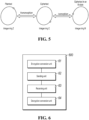
- FIG. 5 illustrates a correspondence among plaintext space, ciphertext space, and Montgomery space.
- the plaintext space corresponds to an integer ring Z
- the ciphertext space corresponds to another integer ring C
- the Montgomery space corresponds to an integer ring M.
- Homomorphism indicates one-to-many mapping from plaintexts to ciphertexts
- isomorphism indicates one-to-one mapping from ciphertexts to Montgomery ciphertexts. Because the C ring and the M ring are in a one-to-one mapping relationship, security of a ciphertext in an M state is consistent with security of a native ciphertext.
- FIG. 6 is a schematic diagram illustrating a structure of a secure multi-party computation apparatus deployed in a first party, according to one or more embodiments.
- the apparatus 600 includes:
- the second party and the third party are the same party. In one or more other implementations, the second party and the third party are different computation parties.
- the encryption conversion unit 61 is specifically configured to perform homomorphic encryption on the first plaintext data to obtain a first original ciphertext; and convert the first ciphertext to the Montgomery state by using the first mapping operation, to obtain the first converted ciphertext.
- the encryption conversion unit 61 is specifically configured to convert the first plaintext data to the Montgomery state by using the first mapping operation, to obtain a first converted plaintext; and perform an encryption operation on the first converted plaintext in the Montgomery state to obtain the first converted ciphertext.
- FIG. 7 is a schematic diagram illustrating a structure of a secure multi-party computation apparatus deployed in a second party, according to one or more embodiments. As shown in FIG. 7 , the apparatus 700 includes:
- the sending unit 73 is specifically configured to send the first result ciphertext to the first party, so that the first party performs Montgomery reduction and a decryption operation on the first result ciphertext to obtain a first result plaintext.
- the sending unit 73 is specifically configured to send the first result ciphertext to a third party, so that the third party performs a second homomorphic operation in the Montgomery state based on the first result ciphertext to obtain a second result ciphertext.
- the apparatus further includes an acquisition unit (not shown), configured to obtain a second converted ciphertext in the Montgomery state.
- the operation unit 72 is configured to perform the first homomorphic operation on the first converted ciphertext and the second converted ciphertext to obtain the first result ciphertext.
- the acquisition unit is configured to receive the second converted ciphertext from the first party.
- the acquisition unit is configured to perform the first mapping operation and homomorphic encryption on local second plaintext data to obtain the second converted ciphertext.
- the first plaintext data is parameter data of a service prediction model
- the second plaintext data is characteristic data of a service object
- one or more embodiments of this specification further disclose a secure multi-party computation system, including a first party and a second party.
- the first party is configured to perform a first mapping operation and homomorphic encryption on first plaintext data to obtain a first converted ciphertext in a Montgomery state, where the first mapping operation is used to convert data from an integer ring to the Montgomery state.
- the first party is further configured to send the first converted ciphertext to a second party.
- the second party is configured to perform a first homomorphic operation in the Montgomery state based on the first converted ciphertext to obtain a first result ciphertext in the Montgomery state, where the first homomorphic operation includes a modular multiplication operation.
- a computation party in a homomorphic ciphertext computation stage of secure multi-party computation, can accelerate computation by using Montgomery reduction, thereby improving computation performance.
- a computer-readable storage medium stores a computer program.
- the computer program When the computer program is executed in a computer, the computer is enabled to perform the methods executed by the parties in the previous secure multi-party computation processes.
- a computation device includes a memory and a processor.
- the memory stores executable code
- the processor implements the methods executed by the parties in the previous secure multi-party computation processes when executing the executable code.
Landscapes
- Engineering & Computer Science (AREA)
- Computer Security & Cryptography (AREA)
- Computer Networks & Wireless Communication (AREA)
- Signal Processing (AREA)
- Machine Translation (AREA)
- Complex Calculations (AREA)
Claims (15)
- Sicheres Mehrparteien-Berechnungsverfahren, umfassend:Durchführen (S31, S41), durch eine erste Partei, einer ersten Abbildungsoperation und einer homomorphen Verschlüsselung an ersten Klartextdaten, um einen ersten konvertierten Ciphertext in einem Montgomery-Zustand zu erhalten, wobei die erste Abbildungsoperation verwendet wird, um Daten aus einem ganzzahligen Ring in den Montgomery-Zustand zu konvertieren;Senden (S32, S42), durch die erste Partei, des ersten konvertierten Ciphertextes an eine zweite Partei; undDurchführen (S33, S43), durch die zweite Partei, einer ersten homomorphen Operation in dem Montgomery-Zustand basierend auf dem ersten konvertierten Ciphertext, um einen ersten Ergebnis-Ciphertext in dem Montgomery-Zustand zu erhalten, wobei die erste homomorphe Operation eine modulare Multiplikationsoperation umfasst.
- Verfahren gemäß Anspruch 1, ferner umfassend:Senden (S34), durch die zweite Partei, des ersten Ergebnis-Ciphertextes an die erste Partei; undDurchführen (S35), durch die erste Partei, einer Montgomery-Reduktion und einer Entschlüsselungsoperation an dem ersten Ergebnis-Ciphertext, um einen ersten Ergebnis-Klartext zu erhalten.
- Verfahren gemäß Anspruch 1, ferner umfassend:Senden (S44), durch die zweite Partei, des ersten Ergebnis-Ciphertextes an eine dritte Partei; undDurchführen (S45), durch die dritte Partei, einer zweiten homomorphen Operation in dem Montgomery-Zustand basierend auf dem ersten Ergebnis-Ciphertext, um einen zweiten Ergebnis-Ciphertext zu erhalten.
- Verfahren gemäß Anspruch 1, wobei das Durchführen (S31, S41), durch eine erste Partei, einer ersten Abbildungsoperation und einer homomorphen Verschlüsselung an ersten Daten, um einen ersten konvertierten Ciphertext in einem Montgomery-Zustand zu erhalten, insbesondere umfasst:Durchführen, durch die erste Partei, einer homomorphen Verschlüsselung an den ersten Klartextdaten, um einen ersten Original-Ciphertext zu erhalten, und Konvertieren des ersten Ciphertextes in den Montgomery-Zustand durch Verwenden der ersten Abbildungsoperation, um den ersten konvertierten Ciphertext zu erhalten; oderKonvertieren, durch die erste Partei, der ersten Klartextdaten in den Montgomery-Zustand durch Verwenden der ersten Abbildungsoperation, um einen ersten konvertierten Klartext zu erhalten, und Durchführen einer Verschlüsselungsoperation an dem ersten konvertierten Klartext in dem Montgomery-Zustand, um den ersten konvertierten Ciphertext zu erhalten.
- Verfahren gemäß Anspruch 1, ferner umfassend:Erhalten, durch die zweite Partei, eines zweiten konvertierten Ciphertextes in dem Montgomery-Zustand; undwobei das Erhalten eines ersten Ergebnis-Ciphertextes in dem Montgomery-Zustand insbesondere umfasst:
Durchführen der ersten homomorphen Operation an dem ersten konvertierten Ciphertext und dem zweiten konvertierten Ciphertext, um den ersten Ergebnis-Ciphertext zu erhalten. - Verfahren gemäß Anspruch 5, wobei das Erhalten, durch die zweite Partei, eines zweiten konvertierten Ciphertextes in dem Montgomery-Zustand insbesondere umfasst:Empfangen, durch die zweite Partei, des zweiten konvertierten Ciphertextes von der ersten Partei; oderDurchführen der ersten Abbildungsoperation und einer homomorphen Verschlüsselung an lokalen zweiten Klartextdaten der zweiten Partei, um den zweiten konvertierten Ciphertext zu erhalten, wobei optional die ersten Klartextdaten Parameterdaten eines Dienstvorhersagemodells sind und die zweiten Klartextdaten Charakteristikdaten eines Dienstobjekts sind.
- Sicheres Mehrparteien-Berechnungsverfahren, wobei das Verfahren von einer ersten Partei ausgeführt wird und dies umfasst:Durchführen (S31, S41) einer ersten Abbildungsoperation und einer homomorphen Verschlüsselung an ersten Klartextdaten, um einen ersten konvertierten Ciphertext in einem Montgomery-Zustand zu erhalten, wobei die erste Abbildungsoperation verwendet wird, um Daten aus einem ganzzahligen Ring in den Montgomery-Zustand zu konvertieren;Senden (S32, S42) des ersten konvertierten Ciphertextes an eine zweite Partei;Empfangen (S34, S46) eines Ergebnis-Ciphertextes von einer dritten Partei, wobei der Ergebnis-Ciphertext erhalten wird, indem eine homomorphe Operation in dem Montgomery-Zustand basierend auf dem ersten konvertierten Ciphertext durchgeführt (S33, S43) wird und die homomorphe Operation eine modulare Multiplikationsoperation umfasst, wobei optional die zweite Partei und die dritte Partei dieselbe Partei sind; undDurchführen (S35, S47) einer Montgomery-Reduktion und einer Entschlüsselungsoperation an dem Ergebnis-Ciphertext, um einen Ergebnis-Klartext zu erhalten.
- Verfahren gemäß Anspruch 7, wobei das Durchführen (S31, S41) einer ersten Abbildungsoperation und einer homomorphen Verschlüsselung an ersten Daten, um einen ersten konvertierten Ciphertext in einem Montgomery-Zustand zu erhalten, insbesondere umfasst:Durchführen einer homomorphen Verschlüsselung an den ersten Klartextdaten, um einen ersten Original-Ciphertext zu erhalten, und Konvertieren des ersten Ciphertextes in den Montgomery-Zustand durch Verwenden der ersten Abbildungsoperation, um den ersten konvertierten Ciphertext zu erhalten; oderKonvertieren der ersten Klartextdaten in den Montgomery-Zustand durch Verwenden der ersten Abbildungsoperation, um einen ersten konvertierten Klartext zu erhalten; undDurchführen einer Verschlüsselungsoperation an dem ersten konvertierten Klartext in dem Montgomery-Zustand, um den ersten konvertierten Ciphertext zu erhalten.
- Sicheres Mehrparteien-Berechnungsverfahren, wobei das Verfahren von einer zweiten Partei ausgeführt wird und dies umfasst:Empfangen (S32, S42) eines ersten konvertierten Ciphertextes in einem Montgomery-Zustand von einer ersten Partei, wobei der erste konvertierte Ciphertext durch die erste Partei erhalten wird, indem eine erste Abbildungsoperation und eine homomorphe Verschlüsselung an ersten Klartextdaten durchgeführt (S31, S41) wird, und die erste Abbildungsoperation verwendet wird, um Daten aus einem ganzzahligen Ring in den Montgomery-Zustand zu konvertieren;Durchführen (S33, S43) einer ersten homomorphen Operation in dem Montgomery-Zustand basierend auf dem ersten konvertierten Ciphertext, um einen ersten Ergebnis-Ciphertext in dem Montgomery-Zustand zu erhalten, wobei die erste homomorphe Operation eine modulare Multiplikationsoperation umfasst; undSenden (S34, S44) des ersten Ergebnis-Ciphertextes.
- Verfahren gemäß Anspruch 9, wobei das Senden (S34, S44) des ersten Ergebnis-Ciphertextes umfasst:Senden (S34) des ersten Ergebnis-Ciphertextes an die ersten Partei, sodass die erste Partei eine Montgomery-Reduktion und eine Entschlüsselungsoperation an dem ersten Ergebnis-Ciphertext durchführt (S35), um einen ersten Ergebnis-Klartext zu erhalten; oderSenden (S44) des ersten Ergebnis-Ciphertextes an eine dritte Partei, sodass die dritte Partei eine zweite homomorphe Operation in dem Montgomery-Zustand basierend auf dem ersten Ergebnis-Ciphertext durchführt (S45), um einen zweiten Ergebnis-Ciphertext zu erhalten.
- Verfahren gemäß Anspruch 9, ferner umfassend:Erhalten eines zweiten konvertierten Ciphertextes in dem Montgomery-Zustand; undwobei das Erhalten eines ersten Ergebnis-Ciphertextes in dem Montgomery-Zustand insbesondere umfasst:
Durchführen (S43, S45) der ersten homomorphen Operation an dem ersten konvertierten Ciphertext und dem zweiten konvertierten Ciphertext, um den ersten Ergebnis-Ciphertext zu erhalten;wobei optional das Erhalten eines zweiten konvertierten Ciphertextes in dem Montgomery-Zustand insbesondere umfasst:Empfangen des zweiten konvertierten Ciphertextes von der ersten Partei; oderDurchführen der ersten Abbildungsoperation und einer homomorphen Verschlüsselung an lokalen zweiten Klartextdaten, um den zweiten konvertierten Ciphertext zu erhalten, wobei vorzugsweise die ersten Klartextdaten Parameterdaten eines Dienstvorhersagemodells sind und die zweiten Klartextdaten Charakteristikdaten eines Dienstobjekts sind. - Sicheres Mehrparteien-Berechnungssystem, umfassend eine erste Partei und eine zweite Partei, wobeidie erste Partei dazu ausgelegt ist, eine erste Abbildungsoperation und eine homomorphe Verschlüsselung an ersten Klartextdaten durchzuführen (S31, S41), um einen ersten konvertierten Ciphertext in einem Montgomery-Zustand zu erhalten, wobei die erste Abbildungsoperation verwendet wird, um Daten aus einem ganzzahligen Ring in den Montgomery-Zustand zu konvertieren;die erste Partei ferner dazu ausgelegt ist, den ersten konvertierten Ciphertext an die zweite Partei zu senden (S32, S42); unddie zweite Partei dazu ausgelegt ist, eine erste homomorphe Operation in dem Montgomery-Zustand basierend auf dem ersten konvertierten Ciphertext durchzuführen (S33, S43), um einen ersten Ergebnis-Ciphertext in dem Montgomery-Zustand zu erhalten, wobei die erste homomorphe Operation eine modulare Multiplikationsoperation umfasst.
- Sichere Mehrparteien-Berechnungseinrichtung, wobei die Einrichtung bei einer ersten Partei eingesetzt wird und dies umfasst:eine Verschlüsselungskonvertierungseinheit, die dazu ausgelegt ist, eine erste Abbildungsoperation und eine homomorphe Verschlüsselung an ersten Klartextdaten durchzuführen (S31, S41), um einen ersten konvertierten Ciphertext in einem Montgomery-Zustand zu erhalten, wobei die erste Abbildungsoperation verwendet wird, um Daten aus einem ganzzahligen Ring in den Montgomery-Zustand zu konvertieren;Eine Sendeeinheit, die dazu ausgelegt ist, den ersten konvertierten Ciphertext an eine zweite Partei zu senden (S32, S42);eine Empfangseinheit, die dazu ausgelegt ist, einen Ergebnis-Ciphertext von einer dritten Partei zu empfangen (S46), wobei der Ergebnis-Ciphertext erhalten wird, indem eine homomorphe Operation in dem Montgomery-Zustand basierend auf dem ersten konvertierten Ciphertext durchgeführt wird, und die homomorphe Operation eine modulare Multiplikationsoperation umfasst; undeine Entschlüsselungskonvertierungseinheit, die dazu ausgelegt ist, eine Montgomery-Reduktion und eine Entschlüsselungsoperation an dem Ergebnis-Ciphertext durchzuführen (S35, S47), um einen Ergebnis-Klartext zu erhalten.
- Sichere Mehrparteien-Berechnungseinrichtung, wobei die Einrichtung bei einer zweiten Partei eingesetzt wird und dies umfasst:eine Empfangseinheit, die dazu ausgelegt ist, einen ersten konvertierten Ciphertext in einem Montgomery-Zustand von einer ersten Partei zu empfangen (S32, S42), wobei der erste konvertierte Ciphertext durch die erste Partei erhalten wird, indem eine erste Abbildungsoperation und eine homomorphe Verschlüsselung an ersten Klartextdaten durchgeführt (S31, S41) wird, und die erste Abbildungsoperation verwendet wird, um Daten aus einem ganzzahligen Ring in den Montgomery-Zustand zu konvertieren;eine Operationseinheit, die dazu ausgelegt ist, eine erste homomorphe Operation in dem Montgomery-Zustand basierend auf dem ersten konvertierten Ciphertext durchzuführen (S33, S43), um einen ersten Ergebnis-Ciphertext in dem Montgomery-Zustand zu erhalten, wobei die erste homomorphe Operation eine modulare Multiplikationsoperation umfasst; undeine Sendeeinheit, die dazu ausgelegt ist, den ersten Ergebnis-Ciphertext zu senden (S34, S44).
- Rechenvorrichtung, umfassend einen Speicher und einen Prozessor, wobei der Speicher ausführbaren Code speichert und der Prozessor das Verfahren gemäß einem der Ansprüche 1 bis 11 implementiert, wenn der ausführbare Code ausgeführt wird.
Applications Claiming Priority (1)
| Application Number | Priority Date | Filing Date | Title |
|---|---|---|---|
| CN202210380969.0A CN114793155B (zh) | 2022-04-12 | 2022-04-12 | 多方安全计算的方法及装置 |
Publications (2)
| Publication Number | Publication Date |
|---|---|
| EP4262134A1 EP4262134A1 (de) | 2023-10-18 |
| EP4262134B1 true EP4262134B1 (de) | 2024-10-30 |
Family
ID=82462849
Family Applications (1)
| Application Number | Title | Priority Date | Filing Date |
|---|---|---|---|
| EP23167642.0A Active EP4262134B1 (de) | 2022-04-12 | 2023-04-12 | Sichere mehrparteienberechnungsverfahren und -vorrichtungen |
Country Status (3)
| Country | Link |
|---|---|
| US (1) | US20230327851A1 (de) |
| EP (1) | EP4262134B1 (de) |
| CN (2) | CN120017243A (de) |
Families Citing this family (3)
| Publication number | Priority date | Publication date | Assignee | Title |
|---|---|---|---|---|
| CN115996117B (zh) * | 2022-12-20 | 2025-09-19 | 上海交通大学 | 基于改进Paillier算法的优化加密解密方法及系统 |
| CN117499010B (zh) * | 2023-10-31 | 2025-01-24 | 北京海泰方圆科技股份有限公司 | 一种数据处理方法及装置 |
| CN121509119A (zh) * | 2026-01-14 | 2026-02-10 | 国网安徽省电力有限公司信息通信分公司 | 高性能的数据多域变换格基同态加解密方法及系统 |
Family Cites Families (16)
| Publication number | Priority date | Publication date | Assignee | Title |
|---|---|---|---|---|
| US8719324B1 (en) * | 2005-04-28 | 2014-05-06 | Cetin K. Koc | Spectral modular arithmetic method and apparatus |
| CN102207847B (zh) * | 2011-05-06 | 2013-12-04 | 广州杰赛科技股份有限公司 | 基于蒙哥马利模乘运算的数据加解密处理方法及装置 |
| US8817974B2 (en) * | 2011-05-11 | 2014-08-26 | Nxp B.V. | Finite field cryptographic arithmetic resistant to fault attacks |
| US10333696B2 (en) * | 2015-01-12 | 2019-06-25 | X-Prime, Inc. | Systems and methods for implementing an efficient, scalable homomorphic transformation of encrypted data with minimal data expansion and improved processing efficiency |
| US20190386814A1 (en) * | 2016-11-07 | 2019-12-19 | Sherjil Ahmed | Systems and Methods for Implementing an Efficient, Scalable Homomorphic Transformation of Encrypted Data with Minimal Data Expansion and Improved Processing Efficiency |
| CN106685663B (zh) * | 2017-02-15 | 2019-07-19 | 华中科技大学 | 一种环域上误差学习问题的加密方法及电路 |
| CN107104796B (zh) * | 2017-05-02 | 2018-06-29 | 北京邮电大学 | 一种基于非交换群上的对称乘法同态加密方法及装置 |
| CN107425974B (zh) * | 2017-05-18 | 2021-03-23 | 西安电子科技大学 | 一种FourQ椭圆曲线上KP运算的硬件实现方法 |
| CN112199707B (zh) * | 2020-10-28 | 2022-12-27 | 支付宝(杭州)信息技术有限公司 | 一种同态加密中的数据处理方法、装置以及设备 |
| CN112070222B (zh) * | 2020-11-10 | 2021-01-29 | 深圳致星科技有限公司 | 用于联邦学习的处理装置、加速器及方法 |
| CN112988237B (zh) * | 2021-04-21 | 2021-07-23 | 深圳致星科技有限公司 | 一种Paillier解密系统、芯片和方法 |
| CN112865954B (zh) * | 2021-04-26 | 2021-07-06 | 深圳致星科技有限公司 | 用于Paillier解密的加速器、芯片及系统 |
| CN113032848B (zh) * | 2021-05-20 | 2021-08-10 | 华控清交信息科技(北京)有限公司 | 一种数据处理方法和用于数据处理的芯片 |
| CN114021734B (zh) * | 2021-10-14 | 2022-04-12 | 深圳致星科技有限公司 | 用于联邦学习和隐私计算的参数计算装置、系统及方法 |
| CN113946846B (zh) * | 2021-10-14 | 2022-07-12 | 深圳致星科技有限公司 | 用于联邦学习和隐私计算的密文计算装置及方法 |
| CN114239019B (zh) * | 2021-12-16 | 2025-10-17 | 萨思数字科技(北京)有限公司 | 保护隐私数据的共有数据数目确定方法、装置和系统 |
-
2022
- 2022-04-12 CN CN202510111779.2A patent/CN120017243A/zh active Pending
- 2022-04-12 CN CN202210380969.0A patent/CN114793155B/zh active Active
-
2023
- 2023-04-11 US US18/298,464 patent/US20230327851A1/en active Pending
- 2023-04-12 EP EP23167642.0A patent/EP4262134B1/de active Active
Also Published As
| Publication number | Publication date |
|---|---|
| EP4262134A1 (de) | 2023-10-18 |
| US20230327851A1 (en) | 2023-10-12 |
| CN114793155B (zh) | 2025-01-21 |
| CN114793155A (zh) | 2022-07-26 |
| CN120017243A (zh) | 2025-05-16 |
Similar Documents
| Publication | Publication Date | Title |
|---|---|---|
| US11895231B2 (en) | Adaptive attack resistant distributed symmetric encryption | |
| US12255988B2 (en) | Computer-implemented system and method for distributing shares of digitally signed data | |
| CN110991655B (zh) | 多方联合进行模型数据处理的方法及装置 | |
| EP4262134A1 (de) | Sichere mehrparteienberechnungsverfahren und -vorrichtungen | |
| CN110912713B (zh) | 多方联合进行模型数据处理的方法及装置 | |
| US6751318B2 (en) | Method and apparatus for digital signature authentication | |
| EP3075098B1 (de) | Serverunterstützte private einstellungskreuzung (psi) mit datenübertragung | |
| JP5001176B2 (ja) | 署名生成装置、署名生成方法及び署名生成プログラム | |
| EP2742644B1 (de) | Verschlüsselungs- und entschlüsselungsverfahren | |
| US6111952A (en) | Asymmetrical cryptographic communication method and portable object therefore | |
| Liao et al. | Analysis of a mobile payment protocol with outsourced verification in cloud server and the improvement | |
| Kaaniche et al. | A novel zero-knowledge scheme for proof of data possession in cloud storage applications | |
| Wang et al. | Dpp: Data privacy-preserving for cloud computing based on homomorphic encryption | |
| US20260058829A1 (en) | Improved blockchain system and method | |
| US6826586B2 (en) | Method for efficient computation of point doubling operation of elliptic curve point scalar multiplication over finite fields F(2m) | |
| Somsuk | Enhanced Algorithm for Recovering RSA Plaintext When Two Modulus Values Share at Least One Common Prime Factor | |
| Kinganga et al. | Dynamics data encryption based on chaotic functions and elliptic curves: Application to text data | |
| CN115333716B (zh) | 数据共享方法、装置及相关设备 | |
| Kumar et al. | Enhanced image encryption using chaotic maps and elliptic curve cryptography with elliptic curve Diffie–Hellman key exchange | |
| CN111709740B (zh) | 区块链系统中隐藏交易地址的方法、计算机可读存储介质和区块链系统 | |
| Shiriaev et al. | One plaintext attack on the BFV scheme | |
| SULTAN | ElGamal Cryptosystem | |
| Hassaan | Asymmetric Cryptographic Schemes Based on Noncommutative Structures | |
| HK40026957A (en) | Multi-party joint model data processing method and device | |
| HK40026957B (en) | Multi-party joint model data processing method and device |
Legal Events
| Date | Code | Title | Description |
|---|---|---|---|
| PUAI | Public reference made under article 153(3) epc to a published international application that has entered the european phase |
Free format text: ORIGINAL CODE: 0009012 |
|
| STAA | Information on the status of an ep patent application or granted ep patent |
Free format text: STATUS: REQUEST FOR EXAMINATION WAS MADE |
|
| 17P | Request for examination filed |
Effective date: 20230412 |
|
| AK | Designated contracting states |
Kind code of ref document: A1 Designated state(s): AL AT BE BG CH CY CZ DE DK EE ES FI FR GB GR HR HU IE IS IT LI LT LU LV MC ME MK MT NL NO PL PT RO RS SE SI SK SM TR |
|
| GRAP | Despatch of communication of intention to grant a patent |
Free format text: ORIGINAL CODE: EPIDOSNIGR1 |
|
| STAA | Information on the status of an ep patent application or granted ep patent |
Free format text: STATUS: GRANT OF PATENT IS INTENDED |
|
| INTG | Intention to grant announced |
Effective date: 20240523 |
|
| RIN1 | Information on inventor provided before grant (corrected) |
Inventor name: CUI, JINMING Inventor name: ZHANG, LEI Inventor name: WANG, LEI Inventor name: LU, YUFEI |
|
| GRAS | Grant fee paid |
Free format text: ORIGINAL CODE: EPIDOSNIGR3 |
|
| GRAA | (expected) grant |
Free format text: ORIGINAL CODE: 0009210 |
|
| STAA | Information on the status of an ep patent application or granted ep patent |
Free format text: STATUS: THE PATENT HAS BEEN GRANTED |
|
| AK | Designated contracting states |
Kind code of ref document: B1 Designated state(s): AL AT BE BG CH CY CZ DE DK EE ES FI FR GB GR HR HU IE IS IT LI LT LU LV MC ME MK MT NL NO PL PT RO RS SE SI SK SM TR |
|
| REG | Reference to a national code |
Ref country code: GB Ref legal event code: FG4D |
|
| REG | Reference to a national code |
Ref country code: CH Ref legal event code: EP |
|
| REG | Reference to a national code |
Ref country code: DE Ref legal event code: R096 Ref document number: 602023000860 Country of ref document: DE |
|
| REG | Reference to a national code |
Ref country code: IE Ref legal event code: FG4D |
|
| P01 | Opt-out of the competence of the unified patent court (upc) registered |
Free format text: CASE NUMBER: APP_59735/2024 Effective date: 20241105 |
|
| REG | Reference to a national code |
Ref country code: LT Ref legal event code: MG9D |
|
| REG | Reference to a national code |
Ref country code: NL Ref legal event code: MP Effective date: 20241030 |
|
| PG25 | Lapsed in a contracting state [announced via postgrant information from national office to epo] |
Ref country code: IS Free format text: LAPSE BECAUSE OF FAILURE TO SUBMIT A TRANSLATION OF THE DESCRIPTION OR TO PAY THE FEE WITHIN THE PRESCRIBED TIME-LIMIT Effective date: 20250228 Ref country code: HR Free format text: LAPSE BECAUSE OF FAILURE TO SUBMIT A TRANSLATION OF THE DESCRIPTION OR TO PAY THE FEE WITHIN THE PRESCRIBED TIME-LIMIT Effective date: 20241030 Ref country code: PT Free format text: LAPSE BECAUSE OF FAILURE TO SUBMIT A TRANSLATION OF THE DESCRIPTION OR TO PAY THE FEE WITHIN THE PRESCRIBED TIME-LIMIT Effective date: 20250228 |
|
| PG25 | Lapsed in a contracting state [announced via postgrant information from national office to epo] |
Ref country code: NL Free format text: LAPSE BECAUSE OF FAILURE TO SUBMIT A TRANSLATION OF THE DESCRIPTION OR TO PAY THE FEE WITHIN THE PRESCRIBED TIME-LIMIT Effective date: 20241030 Ref country code: FI Free format text: LAPSE BECAUSE OF FAILURE TO SUBMIT A TRANSLATION OF THE DESCRIPTION OR TO PAY THE FEE WITHIN THE PRESCRIBED TIME-LIMIT Effective date: 20241030 |
|
| REG | Reference to a national code |
Ref country code: AT Ref legal event code: MK05 Ref document number: 1737993 Country of ref document: AT Kind code of ref document: T Effective date: 20241030 |
|
| PG25 | Lapsed in a contracting state [announced via postgrant information from national office to epo] |
Ref country code: BG Free format text: LAPSE BECAUSE OF FAILURE TO SUBMIT A TRANSLATION OF THE DESCRIPTION OR TO PAY THE FEE WITHIN THE PRESCRIBED TIME-LIMIT Effective date: 20241030 |
|
| PG25 | Lapsed in a contracting state [announced via postgrant information from national office to epo] |
Ref country code: ES Free format text: LAPSE BECAUSE OF FAILURE TO SUBMIT A TRANSLATION OF THE DESCRIPTION OR TO PAY THE FEE WITHIN THE PRESCRIBED TIME-LIMIT Effective date: 20241030 |
|
| PG25 | Lapsed in a contracting state [announced via postgrant information from national office to epo] |
Ref country code: NO Free format text: LAPSE BECAUSE OF FAILURE TO SUBMIT A TRANSLATION OF THE DESCRIPTION OR TO PAY THE FEE WITHIN THE PRESCRIBED TIME-LIMIT Effective date: 20250130 |
|
| PG25 | Lapsed in a contracting state [announced via postgrant information from national office to epo] |
Ref country code: GR Free format text: LAPSE BECAUSE OF FAILURE TO SUBMIT A TRANSLATION OF THE DESCRIPTION OR TO PAY THE FEE WITHIN THE PRESCRIBED TIME-LIMIT Effective date: 20250131 Ref country code: LV Free format text: LAPSE BECAUSE OF FAILURE TO SUBMIT A TRANSLATION OF THE DESCRIPTION OR TO PAY THE FEE WITHIN THE PRESCRIBED TIME-LIMIT Effective date: 20241030 Ref country code: AT Free format text: LAPSE BECAUSE OF FAILURE TO SUBMIT A TRANSLATION OF THE DESCRIPTION OR TO PAY THE FEE WITHIN THE PRESCRIBED TIME-LIMIT Effective date: 20241030 |
|
| PG25 | Lapsed in a contracting state [announced via postgrant information from national office to epo] |
Ref country code: PL Free format text: LAPSE BECAUSE OF FAILURE TO SUBMIT A TRANSLATION OF THE DESCRIPTION OR TO PAY THE FEE WITHIN THE PRESCRIBED TIME-LIMIT Effective date: 20241030 |
|
| PG25 | Lapsed in a contracting state [announced via postgrant information from national office to epo] |
Ref country code: RS Free format text: LAPSE BECAUSE OF FAILURE TO SUBMIT A TRANSLATION OF THE DESCRIPTION OR TO PAY THE FEE WITHIN THE PRESCRIBED TIME-LIMIT Effective date: 20250130 |
|
| PG25 | Lapsed in a contracting state [announced via postgrant information from national office to epo] |
Ref country code: SM Free format text: LAPSE BECAUSE OF FAILURE TO SUBMIT A TRANSLATION OF THE DESCRIPTION OR TO PAY THE FEE WITHIN THE PRESCRIBED TIME-LIMIT Effective date: 20241030 |
|
| PGFP | Annual fee paid to national office [announced via postgrant information from national office to epo] |
Ref country code: DE Payment date: 20250218 Year of fee payment: 3 |
|
| PG25 | Lapsed in a contracting state [announced via postgrant information from national office to epo] |
Ref country code: DK Free format text: LAPSE BECAUSE OF FAILURE TO SUBMIT A TRANSLATION OF THE DESCRIPTION OR TO PAY THE FEE WITHIN THE PRESCRIBED TIME-LIMIT Effective date: 20241030 |
|
| PG25 | Lapsed in a contracting state [announced via postgrant information from national office to epo] |
Ref country code: EE Free format text: LAPSE BECAUSE OF FAILURE TO SUBMIT A TRANSLATION OF THE DESCRIPTION OR TO PAY THE FEE WITHIN THE PRESCRIBED TIME-LIMIT Effective date: 20241030 |
|
| PG25 | Lapsed in a contracting state [announced via postgrant information from national office to epo] |
Ref country code: RO Free format text: LAPSE BECAUSE OF FAILURE TO SUBMIT A TRANSLATION OF THE DESCRIPTION OR TO PAY THE FEE WITHIN THE PRESCRIBED TIME-LIMIT Effective date: 20241030 |
|
| PG25 | Lapsed in a contracting state [announced via postgrant information from national office to epo] |
Ref country code: SK Free format text: LAPSE BECAUSE OF FAILURE TO SUBMIT A TRANSLATION OF THE DESCRIPTION OR TO PAY THE FEE WITHIN THE PRESCRIBED TIME-LIMIT Effective date: 20241030 |
|
| PG25 | Lapsed in a contracting state [announced via postgrant information from national office to epo] |
Ref country code: CZ Free format text: LAPSE BECAUSE OF FAILURE TO SUBMIT A TRANSLATION OF THE DESCRIPTION OR TO PAY THE FEE WITHIN THE PRESCRIBED TIME-LIMIT Effective date: 20241030 |
|
| PG25 | Lapsed in a contracting state [announced via postgrant information from national office to epo] |
Ref country code: IT Free format text: LAPSE BECAUSE OF FAILURE TO SUBMIT A TRANSLATION OF THE DESCRIPTION OR TO PAY THE FEE WITHIN THE PRESCRIBED TIME-LIMIT Effective date: 20241030 |
|
| REG | Reference to a national code |
Ref country code: DE Ref legal event code: R097 Ref document number: 602023000860 Country of ref document: DE |
|
| PLBE | No opposition filed within time limit |
Free format text: ORIGINAL CODE: 0009261 |
|
| STAA | Information on the status of an ep patent application or granted ep patent |
Free format text: STATUS: NO OPPOSITION FILED WITHIN TIME LIMIT |
|
| PG25 | Lapsed in a contracting state [announced via postgrant information from national office to epo] |
Ref country code: SE Free format text: LAPSE BECAUSE OF FAILURE TO SUBMIT A TRANSLATION OF THE DESCRIPTION OR TO PAY THE FEE WITHIN THE PRESCRIBED TIME-LIMIT Effective date: 20241030 |
|
| 26N | No opposition filed |
Effective date: 20250731 |
|
| PG25 | Lapsed in a contracting state [announced via postgrant information from national office to epo] |
Ref country code: LU Free format text: LAPSE BECAUSE OF NON-PAYMENT OF DUE FEES Effective date: 20250412 |
|
| PG25 | Lapsed in a contracting state [announced via postgrant information from national office to epo] |
Ref country code: MC Free format text: LAPSE BECAUSE OF FAILURE TO SUBMIT A TRANSLATION OF THE DESCRIPTION OR TO PAY THE FEE WITHIN THE PRESCRIBED TIME-LIMIT Effective date: 20241030 |
|
| REG | Reference to a national code |
Ref country code: BE Ref legal event code: MM Effective date: 20250430 |
|
| PG25 | Lapsed in a contracting state [announced via postgrant information from national office to epo] |
Ref country code: FR Free format text: LAPSE BECAUSE OF NON-PAYMENT OF DUE FEES Effective date: 20250430 |
|
| PG25 | Lapsed in a contracting state [announced via postgrant information from national office to epo] |
Ref country code: BE Free format text: LAPSE BECAUSE OF NON-PAYMENT OF DUE FEES Effective date: 20250430 |
|
| PG25 | Lapsed in a contracting state [announced via postgrant information from national office to epo] |
Ref country code: IE Free format text: LAPSE BECAUSE OF NON-PAYMENT OF DUE FEES Effective date: 20250412 |